The Broad Ax
Saturday, February 9, 1907
Chicago, Illinois
Page text (machine-generated)
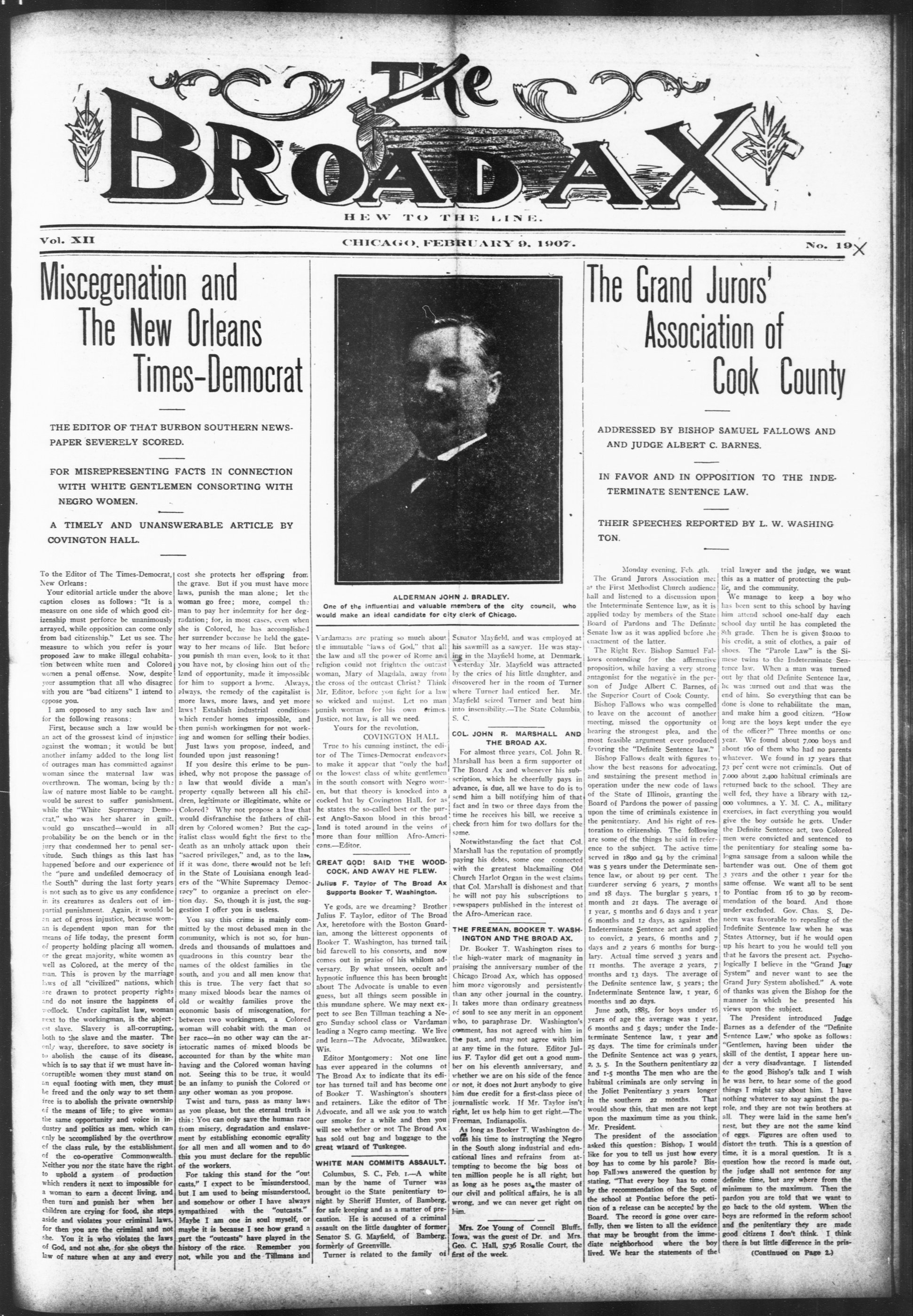
Miscegenation and The New Orleans Times-Democrat
THE EDITOR OF THAT BURBON SOUTHERN NEWS PAPER SEVERELY SCORED.
FOR MISREPRESENTING FACTS IN CONNECTION WITH WHITE GENTLEMEN CONSORTING WITH NEGRO WOMEN.
A TIMELY AND UNANSWERABLE ARTICLE BY COVINGTON HALL.
Vol. XII
Miscegenation
The New
Time
THE EDITOR OF THAT BU
PAPER SEVERELY SCORE
FOR MISREPRESENTING
WITH WHITE GENTLEM
NEGRO WOMEN.
A TIMELY AND UNANSWER
COVINGTON HALL.
To the Editor of The Times-Democrat, New Orleans:
Your editorial article under the above caption closes as follows: "It is a measure on one side of which good citizenship must perforce be unanimously arrayed, while opposition can come only from bad citizenship." Let us see. The measure to which you refer is your proposed law to make illegal cohabitation between white men and Colored women a penal offense. Now, despite your assumption that all who disagree with you are "bad citizens" I intend to oppose you.
I am opposed to any such law and for the following reasons:
First, because such a law would be an act of the grossest kind of injustice against the woman; it would be but another infamy added to the long list of outrages man has committed against woman since the maternal law was overthrown. The woman, being by the law of nature most liable to be caught, would be surest to suffer punishment, while the "White Supremacy Democrat," who was her sharer in guilt, would go unscathed—would in all probability be on the bench or in the jury that condemned her to penal servitude. Such things as this last has happened before and our experience of the "pure and undefiled democracy of the South" during the last forty years is not such as to give us any confidence in its creatures as dealers out of impartial punishment. Again, it would be an act of gross injustice, because woman is dependent upon man for the means of life today, the present form of property holding placing all women, or the great majority, white women as well as Colored, at the mercy of the man. This is proven by the marriage laws of all "civilized" nations, which are drawn to protect property rights and do not insure the happiness of wedlock. Under capitalist law, woman next to the workingman, is the objectest slave. Slavery is all-corrupting, both to the slave and the master. The only way, therefore, to save society is to abolish the cause of its disease, which is to say that if we must have incorruptible women they must stand on an equal footing with men, they must be freed and the only way to set them free is to abolish the private ownership of the means of life; to give woman the same opportunity and voice in industry and politics as men, which can only be accomplished by the overthrow of the class rule, by the establishment of the co-operative Commonwealth. Neither you nor the state have the right to uphold a system of production which renders it next to impossible for a woman to earn a decent living, and then turn and punish her when her children are crying for food, she steps aside and violates your criminal laws, for then you are the criminal and not she. You it is who violates the laws of God, and not she, for she obeys the law of nature when at any and every
---
cost she protects her offspring from the grave. But if you must have more laws, punish the man alone; let the woman go free; more, compel the man to pay her indemnity for her degradation; for, in most cases, even when she is Colored, he has accomplished her surrender because he held the gateway to her means of life. But before you punish th man even, look to it that you have not, by closing him out of the land of opportunity, made it impossible for him to support a home. Always, always, the remedy of the capitalist is more laws, more laws, and yet more laws! Establish industrial conditions which render homes impossible, and then punish workingmen for not working and women for selling their bodies. Just laws you propose, indeed, and founded upon just reasoning!
If you desire this crime to be punished, why not propose the passage of a law that would divide a man's property equally between all his children, legitimate or illegitimate, white or Colored? Why not propose a law that would disfranchise the fathers of children by Colored women? But the capitalist class would fight the first to the death as an unholy attack upon their "sacred privileges," and, as to the last, if it was done, there would not be left in the State of Louisiana enough leaders of the "White Supremacy Democracy" to organize a precinct on election day. So, though it is just, the suggestion it offer is useless.
You say this crime is mainly committed by the most debased men in the community, which is not so, for hundreds and thousands of mulattoes and quadroons in this country bear the names of the oldest families in the south, and you and all men know that this is true. The very fact that so many mixed bloods bear the names of old or wealthy families prove the economic basis of miscegenation, for between two workingmen, a Colored woman will cohabit with the man or her race—in no other way can the aristocratic names of mixed bloods be accounted for than by the white man having and the Colored woman having not. Seeing this to be true, it would be an infamy to punish the Colored or any other woman as you propose.
Twist and turn, pass as many laws as you please, but the eternal truth is this: You can only save the human race from misery, degradation and enslavement by establishing economic equality for all men and all women and to do this you must declare for the republic of the workers.
For taking this stand for the "outcasts," I expect to be misunderstood, but I am used to being misunderstood, and somehow or other I have always sympathized with the "outcasts." Maybe I am one in soul myself, or maybe it is because I see how grand a part the "outcasts" have played in the history of the race. Remember you not, while you and the Tillmans and
HEW TO THE LINE.
CHICAGO, FEBRUARY 9, 1907.
CHICAGO, FEBRUARY 9, 1907.
M. H.
ALDERMAN JOHN J. BRADLEY. One of the influential and valuable members of the city council, who would make an ideal candidate for city clerk of Chicago.
Vardamaas are prating so much about the immutable "laws of God," that all the law and all the power of Rome and religion could not frighten the outcast woman, Mary of Magdalene, away from the cross of the outcast Christ? Think Mr. Editor, before you fight for a law so wicked and unjust. Let no man punish woman for his own crimes. Justice, not law, is all we need.
Senator Mayfield, and was employed as his sawmill as a sawyer. He was staying in the Mayfield home, at Denmark. Yesterday Mr. Mayfield was attracted by the cries of his little daughter, and discovered her in the room of Turner where Turner had enticed her. Mr. Mayfield seized Turner and beat him into insensibility.—The State Columbia S. C.
Yours for the revolution.
COVINGTON HALL
True to his cunning instinct, the editor of The Times-Democrat endeavors to make it appear that "only the bad or the lowest class of white gentlemen in the south consort with Negro women, but that theory is knocked into a cocked hat by Covington Hall, for as he states the so-called best or the purest Anglo-Saxon blood in this broad land is toted around in the veins of more than four million Afro-Americans.—Editor.
GREAT GOD! SAID THE WOOD-
COCK, AND AWAY HE FLEW.
Julius F. Taylor of The Broad Ax Supports Booker T. Washington.
Ye gods, are we dreaming? Brother Julius F. Taylor, editor of The Broad Ax, heretofore with the Boston Guardian, among the bitterest opponents of Booker T. Washington, has turned tail, bid farewell to his consorts, and now comes out in praise of his whilom adversary. By what unseen, occult and hypnotic influence this has been brought about The Advocate is unable to even guess, but all things seem possible in this mundane sphere. We may next expect to see Ben Tillman teaching a Negro Sunday school class or Vardaman leading a Negro camp meeting. We live and learn—The Advocate, Milwaukee, Wis.
Editor Montgomery: Not one line has ever appeared in the columns of The Broad Ax to indicate that its editor has turned tail and has become one of Booker T. Washington's shouters and retainers. Like the editor of The Advocate, and all we ask you to watch our smoke for a while and then you will see whether or not The Broad Ax has sold out bag and baggage to the great wizard of Tuskegee.
WHITE MAN COMMITS ASSAULT.
Columbus, S. C., Feb. 1.—A white man by the name of Turner was brought to the State penitentiary tonight by Sheriff Hunter, of Bamberg, for safe keeping and as a matter of precaution. He is accused of a criminal assault on the little daughter of former Senator S. G. Mayfield, of Bamberg, formerly of Greenville. Turner is related to the family of
Senator Mayfield, and was employed at his sawmill as a sawyer. He was staying in the Mayfield home, at Denmark. Yesterday Mr. Mayfield was attracted by the cries of his little daughter, and discovered her in the room of Turner where Turner had enticed her. Mr. Mayfield seized Turner and beat him into insensibility.—The State Columbia, S. C.
COL. JOHN R. MARSHALL AND
THE BROAD AX.
For almost three years, Col. John R. Marshall has been a firm supporter of the Board Ax and whenever his subscription, which he cheerfully pays in advance, is due, all we have to do is to send him a bill notifying him of that fact and in two or three days from the time he receives his bill, we receive a check from him for two dollars for the same.
Notwithstanding the fact that Col. Marshall has the reputation of promptly paying his debts, some one connected with the greatest blackmailing Old Church Harlot Organ in the west claims that Col. Marshall is dishonest and that he will not pay his subscriptions to newspapers published in the interest of the Afro-American race.
THE FREEMAN, BOOKER T. WASH-
INGTON AND THE BROAD AX.
Dr. Booker T. Washington rises to the high-water mark of magnanity in praising the anniversary number of the Chicago Broad Ax, which has opposed him more vigorously and persistently than any other journal in the country. It takes more than ordinary greatness of soul to see any merit in an opponent who, to paraphrase Dr. Washington's comment, has not agreed with him in the past, and may not agree with him at any time in the future. Editor Julius F. Taylor did get out a good number on his eleventh anniversary, and whether we are on his side of the fence or not, it does not hurt anybody to give him due credit for a first-class piece of journalistic work. If Mr. Taylor isn't right, let us help him to get right.—The Freeman, Indianapolis.
As long as Booker T. Washington devotes his time to instructing the Negro in the South along industrial and educational lines and refrains from attempting to become the big boss of ten million people he is all right, but as long as he poses as the master of our civil and political affairs, he is all wrong, and we can never get right on him.
Mrs. Zoe Young of Council Bluffs, Iowa, was the guest of Dr. and Mrs. Geo. C. Hall, 5736 Rosalie Court, the first of the week.
The Grand Jurors Association of Cook County
ADDRESSED BY BISHOP SAMUEL FALLOWS AND AND IUDGE ALBERT C. BARNES.
IN FAVOR AND IN OPPOSITION TO THE INDETERMINATE SENTENCE LAW.
THEIR SPEECHES REPORTED BY L. W. WASHINGTON
Monday evening, Feb. 4th. The Grand Jurors Association met at the First Methodist Church audience hall and listened to a discussion upon the Inteterminate Sentence law, as it is applied today by members of the State Board of Pardons and The Definate Senate law as it was applied before the enactment of the latter. The Right Rev. Bishop Samuel Fallowes contending for the affirmative proposition, while having a very strong antagonist for the negative in the person of Judge Albert C. Barnes, of the Superior Court of Cook County. Bishop Fallowes who was compelled to leave on the account of another meeting, missed the opportunity of hearing the strongest plea, and the most feasible argument ever produced favoring the "Definite Sentence law."
Bishop Fallows dealt with figures to show the best reasons for advocating, and sustaining the present method in operation under the new code of laws of the State of Illinois, granting the Board of Pardons the power of passing upon the time of criminals existence in the penitentiary. And his right of restoration to citizenship. The active time served in 1890 and 94 by the criminal was 5 years under the Determinate sentence law, or about 19 per cent. The murderer serving 6 years, 7 months and 18 days. The burglar 5 years, 1 month and 21 days. The average of 1 year, 5 months and 6 days and 1 year 6 months and 12 days, as against the Indeterminate Sentence act and applied to convict, 2 years, 6 months and 7 days and 2 years 6 months for burglar. Actual time served 3 years and 11 months. The average 2 years, 7 months and 13 days. The average of the Definite sentence law, 5 years; the Indeterminate Sentence law, 1 year, 6 months and 20 days.
June 20th, 1885, for boys under 16 years of age the average was 1 year, 6 months and 5 days; under the Indeterminate Sentence law, 1 year and 25 days. The time for criminals under the Definite Sentence act was 9 years, 2, 3, 5. In the Southern penitentiary 22 and 1-5 months The men who are the habitual criminals are only serving in the Joliet Penitentiary 3 years longer in the southern 22 months. That would show this, that men are not kept upon the maximum time as you think, Mr. President.
The president of the association asked this question: Bishop, I would like for you to tell us just how every boy has to come by his parole? Bishop Fallows answered the question by stating, "That every boy has to come by the recommendation of the Supt. of the school at Pontiac before the petition of a release can be accepted by the Board. The record is gone over carefully, then we listen to all the evidence that may be brought from the immediate neighborhood where the boy lived. We hear the statements of the
---
trial lawyer and the judge, we want this as a matter of protecting the public, and the community.
We manage to keep a boy who has been sent to this school by having him attend school one-half day each school day until he has completed the 8th grade. Then he is given $10,00 to his credit, a suit of clothes, a pair of shoes. The "Parole Law" is the Simeese twins to the Indeterminate Sentence law. When a man was turned out by that old Definite Sentence law, he was turned out and that was the end of him. So everything that can be done is done to rehabilitate the man, and make him a good citizen. "How long are the boys kept under the eye of the officer?" Three months or one year. We found about 7,000 boys and about 160 of them who had no parents whatever. We found in 17 years that 73 per cent were not criminals. Out of 7,000 about 2,400 habitual criminals are returned back to the school. They are well fed, they have a library with 12,000 volumes, a Y. M. C. A., military exercises, in fact everything you would give the boy outside he gets. Under the Definite Sentence act, two Colored men were convicted and sentenced to the penitentiary for stealing some bologna sausage from a saloon while the bartender was out. One of them got 3 years and the other 1 year for the same offense. We want all to be sent to Pontiac from 16 to 30 by recommendation of the board. And those under excluded. Gov. Chas. S. Deneen was favorable to repealing of the Indefinite Sentence law when he was States Attorney, but if he would open up his heart to you he would tell you that he favors the present act. Psychologically I believe in the "Grand Juicy System" and never want to see the Grand Jury System abolished." A vote of thanks was given the Bishop for the manner in which he presented his views upon the subject.
The President introduced Judge Barnes as a defender of the "Definite Sentence Law," who spoke as follows: "Gentlemen, having been under the skill of the dentist, I appear here under a very disadvantage. I listended to the good Bishop's talk and I wish he was here, to hear some of the good things I might say about him. I have nothing whatever to say against the parole, and they are not twin brothers at all. They were laid in the same hen's nest, but they are not the same kind of eggs. Figures are often used to distort the truth. This is a question of time, it is a moral question. It is a question how the record is made out, the judge shall not sentence for any definite time, but any where from the minimum to the maximum. Then the pardon you are told that we want to go back to the old system. When the boys are reformed in the reform school and the penitentiary they are made good citizens I don't think. I think there is but little difference in the pris- (Continued on Page 2.)
THE BROAD AX.
Will promulgate and at all times uphold the true principles of Democracy, but Catholic, Protestant, Pentecost, Indebted, Farmers, Single Taxes, Republican, Secular, and Christian, who can have their say, so long as their language is proper and responsibility is fixed.
The Broad is a newspaper whose platform is broad enough for all, ever claiming the editorial right to speak its own mind.
Communicate well will receive attention. Write only on one side of the paper.
Subscriptions must be paid in advance.
One Year.....$0.00
Six Months.....1.00
Addressing reasonable bases on application.
Communicate to
JULIUS F. TAYLOR, Editor and Publisher..
Entered at the Post Office at Chicago
Ill., as Second-class Matter.
PERSONAL MENTION.
Walter M. Farmer, for 16 years an honored member of the bar in St. Louis, Mo., is now engaged in the general practice of law. Suite 708, 171 Washington street. Phone Main 4153. Residence 4856 Langley avenue. Phone Drexel 6802.
Mr. George Rhodes 2826 Wabash ave., was called to Louisville, Ky., by the illnes of his mother.
Mrs. Hattie Arraut 3108 Prairie ave. entertained a number of friends Tuesday eve., at cards and games.
What grew my hair where it was not and covered up a bad bald spot, Farmer's Hair Tonic and Cream.
Mr. Roscoe Evans 3333 State st., leaves the city Monday to sepend the balance of the winter in Omaha.
Mr. F. Washington of St. Louis spent two days in the city last week stopped at the Keystone Hotel.
Mr. Chas. Lett, 3213 Wabash ave., leaves the city Monday to spend the balance of the winter in Hot Springs.
S. C. Tyler, has succeeded the firm of Woodfolk and Tyler, and he will continue to conduct the Buffet at 4920 State street.
Mr. Rob Bartlett 3110 La Salle st., who was recently taken to the hospital in a critical condition passed away last Sunday.
Little Katherine Crumb, who was accidently poisoned last Saturday at the home of her grandmother in St. Louis, Mo., is reported out of danger.
Misses Covington and Williamson, 710 Champlain avenue, entertained a small party of friends at dinner and music Sunday afternoon and evening.
It is absurd to expect to be enlightened by reason, and at the same time to prescribe to her what side of the question she must adopt.—Kant.
Mr. Robert Perry 3526 Calumet ave., who has been confined to his bed in Provident Hospital for the past 3 weeks is at work again.
Mr. John E. Hawkins has been tendered the position of manager of "The Employers National Investigating Bureau with offices in the Hartford Bldg.
The masquerade ball at the Appomattox Club Thursday evening was well attended by the members of the club and their friends.
Mrs. Winslow and daughter Hattie 4528 St. Lawrence ave., were both confined to their beds a few days last week with la Grippe.
Mr. Will Marlon Cook, of New York is spending a week in the city it is rumored that he is soon to take charge of the New Pekin Theatre.
Mrs. Minnie Lee 3426 Wabash ave. who recently went to St. Paul, for a visit was called to her former home New Orleans, by the death of a brother.
In spite of the inclement weather Thursday evening at Quinn Chapel, the lecture by Prof. Vernon, Registrar of the United States Treas., was well attended.
Mrs. Jennie E. Watts, after a delightful visit with her parents and friends in this city returned to her home in New York city Wednesday morning.
Mrs. Philip Green 345 West 47th street, one of the prominent members of the South Side Smart Set, is improving from slight attack of rheumatism.
Rev. H. E. Stewart, pastor of the Institutional Church, 3825 Dearborn street, will this coming Sunday evening give another one of his illustrated sermons, and in the morning he will hold forth as usual at 10.45. Saints and sinners alike are invited to intend both services.
GREAT PUBLIC MEETING HELD AT CARNEGIE HALL UNDER THE AUSPICES OF THE ARMSTRONG ASSOCIATION IN THE INTEREST OF NEGRO INDUSTRIAL EDUCATION, AT THE SOUTH. NEGRO AND INDIAN STUDENTS ADDRESS NEW YORK MILLIONAIRES.
(Special to The Broad Ax by A. J. Gary.)
New York City, Feb. 4, fifty students of Hampton Institute including fifteen Indians were the principle participants at a public meeting here last Tuesday evening, under the auspices of The Armstrong Association of New York, an organization composed of the leading white Citizens of New York City, and whose main interest is in the industrial education of the Negro at the South, Fully 2,000, of New York's best Citizens, crowded the great hall, such a mixed audience has rarely been seen, many occupants of the box seats and who seemed greatly interested, were, Mrs. Andrw Carnegie, Mr. and Mrs. Wm. Jay Schieffelin, Mr. Isaac N. Seligman, Mr. Oswald G. Villard, Mr. George Foster Peabody, Mr. Robert C. Ogden, Mrs. James Roosevelt, and a large number of others, which space will not allow me to name. Mr. Robert C. Ogden, president of the Trustees of Hampton, Institute preside and introduced Mr. Thomas C. Walker a graduate of Hampton a lawyer who having practiced in all the courts of Virginia, he has four times justice of the peace, once a county commissioner, a delegate to the National Republican Convention and in 1896, was appointed Collector of Customs for the port of Rappahannock, being the only Negro ever given such a position in Virginia. Recently he refused an offer of the Consulship of Guadelope, West Indies. Mr. Walker said in part, The Negro owned property in Gloucester County, in 1885 to an amount little less than $20,000, and today the assessed valuation of all species of property are $246,000, which is a little more than one half than the real value belongings. The Negro has bought up all the property that they could buy, and yet, our neighbor.
Mr. Thomas Dixon, Jr., ex-minister, who lives in Gloucester, the arch enemy of both races, would have you believe that the Negro is worthless and incapable of self-help.
Mr. Charles Doxeon, an Onondago Indian, a graduate of Hampton, and
Randel Woodfolk who is widely known in the Town of Lake recently became united in marriage to Mrs. Sadie Dentchon, and for the present he and his bride are residing at 4912 State street.
Two girls wanted as helpers in Oatts and Waggener tailoring establishment conducted by Mr. J. M. Oatts the Hyde Park tailors. Call up. Phone Hyde Park 3768.
The Hyde Park Sunday Club will celebrate Douglass day Sunday 10, 3:30 p. m., L. A. Newby, Atty, will be the principle speaker, a musical and literary program will be the features of the afternoon.
Through the influence of Mr. W. H. Clark Mayor Dunne appointed Dr. D. H. Anderson, 3100 State st., medical inspector for Kieth School and South Side District.
Prof. W. Kemper Harreld, who lives in grand style at 6626 Champlain ave., and who is one of the shining lights of the Frederick Douglass Center, has so far failed to cough up the five dollars belonging to us.
The Charity Ball to be given under the auspices of the Advisory Board for the benefit of Provident Hospital Monday evening should be made a financial success because of the worthiness of the cause.
Former County Commissioner Timothy Cruise, headed a delegation of prominent west side citizens, which called on Mayor Edward F. Dunne Wednesday, and pledged their loyal support to him in his contest for re-nomination and re-election.
On Friday evening the 1st, S. D. Cooper, age 64, departed this life at St. Luke's Hospital after an illness of about three days. Mr. Cooper was well known by the old settlers of Chicago. The funeral took place Tuesday at St. Thomas' Episcopal Church. Rev. Father Massiah officiating. Interment at Oakwoods.
"Side Lights on the Race Question." by Mrs. Kate Kinsey Brook, is a well written article on the race question published in the Chicago Broad Ax. It should be read by every Colored person and every unprejudiced white person in the country. Coming from an educated and cultured white lady, it will have the effect of making the best class of white people think more favorably of the Negro.-The Cimeter, Muskogee. I. T.
Marcus Ruben, the most extensive manufacturer of waiters' jackets and aprons, at 390 State street, in the west.
---
who, works at the machinist trade in New York, delivered a very inspiring address, said in part, we have gone to worse barbarism than before, as a rule success must depend upon the mind and training, now when you civilize a man, he will still remain half barbarian, no one desires to work alongside a half civilized man, our great need is the moral training.
Many songs of Negro folk lore were sang to the delight of the audience, Indian songs were also sung by Indians students. The last speaker was Major Robert R. Moton, since his graduation, he has had charge of the discipline at Hampton Institute, with the title of first Captain, and later Major, this responsible position he still holds. In his address he said in part. Whatever theories may or may not have been advanced for the settlement of the Negro question, of one thing we are sure, that while legislature enactments and judicial discussions are important, and should not be overlooked, they cannot settle the Negro question. We hear a great deal about this color question, and race prejudice, but the blackest Negro in Alabama who puts the same amount of the intelligence, skill and industry into his farming, gets as large returns for his energy as the whitest Anglo-Saxon. The earth yields up her increase as willingly to the skillful persuasions of a swarthy, as to a fair husbandman. The Negro is passing through perhaps the most trying period in his history, trying for him, trying for his friends, but we ask that you be patient with us. My friends will you help to sustain Hampton? not for the white man, not for the black man, but for the Country.*
Long applause greeted each speaker, especially Major Moton's address, their songs were greeted with long applause. A telegram was received from Booker Washington, which stated that he was unable to be present, due to the fact that the Alabama legislature were investigating his school, as his friends think it best for him to be there at this present time. has opened a branch establishment, corner 30th street and Broadway, New York City, which shows enterprise on the part of Marcus Ruben. That he has opened a branch in a very good field there is no question as to his success.
Frank C. Burke has been selected by Mayor Edward F. Dunne, to succeed E. H. Roche as City Purchasing Agent, and Mr. Roche will devote all his time to managing Mayor Dunne's campaign for re-election.
The members of the City Council spent all Monday night in wrangling over the new traction ordinances, which was finally passed on roll call by a vote of 55 to 14. But the new ordinances regulating the street car companies in this city will not become premanently effective until they are submitted to the voters at the coming April election, or either approved or rejected by them. Many evil minded people intimate that some of the City Fathers had their mits well oiled for fighting and standing by the street traction companies.
Mrs. Chas. S. Jackson. 2613 Wabash av., entertained 20 ladies, 12 were members of the Fortnightly Whist Club and 8 invited guests, last Wednesday afternoon from 2 to 5 p. m. The club members including the hostess are: Mrs. W. Emanuel, Mrs. J. Gray Lucas, Mrs. A. C. Harris, Mrs. J. Gray Lucas, Mrs. A. C. Harris, Mrs. Frank P. George, Mrs. James A. Cotton, Mrs. Geo. Hawley, Mrs. Eaves, Mrs. J.R. Marshall, Mrs. R. R. Jackson, Mrs. Del L. Lee, Mrs. S. A. T. Watkins. Guests: Mrs. M. Washington, Mrs. J. A. Kelley, Mrs. L. B. Anderson, Mrs. N. C. Smith, Mrs. Ora Dunlap of Indiana, Mrs. Wm. Haymen, Mrs. E. S. Miller, Mrs. Lena Paul, Mrs. Mable Washington won first prize, art glass dish; Mrs. Ora Dunlap second prize, beautiful vase; Mrs. J. A. Kelly third prize, hand painted plate. Smiley served.
ODD FELLOWS INCORPORATE A
STOCK COMPANY.
Last Monday night members of the old Joint Building Committee met in Odd Fellows Hall and delivered to "The United Odd Fellows Hall Association all property acquired by them in connection with the purchase of their hall at 3335-37 State st.
The new Corporation is chartered under the laws of Illinois with a capital stock of fifty thousand dollars, eighteen thousand of which has already been fully paid by the lodges—households and members in Chicago. The stock is held at ten dollars per share and is non assessable.
The Odd Fellows show their far-sightedness and sound business judgment in the fact that the lodges of Chicago are absolute owners of their property and have never sought nor
secured a single dollar outside of themselves, therefor will never have to submit to outside dictation, or share profits to which they have exclusive rights, with those, who, so to speak, are a million miles away. In renting they eryn of themselves—and in paying they pay to themselves and in the day of dividends—the dividends will be theirs and remain in Chicago where it is made and belongs. The Association is governed by a board of 15 Directors from whom its officers are selected. The officers for the ensuing year are—Geo. T. Kersey, Pres.; Isaac W. Smith, V. Pres.; Robt. W. Lucy, Sec'y, Treas.; Jas. W. Camp, Sec.; Morris J. Lewis, Ass't. Sec.; Ex Grand Master, Edw. H. Morris is counsel for the company—H.
DR. STORK MAKES MISTAKE.
Gives Milwaukee Couple Black Baby
Instead of White.
Milwaukee, Wis., Feb. 2.—Among all the virtues accuracy is perhaps the most desirable. In all the relations of life more trouble is caused by inaccuracy and carelessness in details than by any other of the lapses to which human nature is liable.
And if anything on earth ought to be accurate it is a stork. Mistakes made by storks are so hard to explain and usually cause so much argument and trouble that they are perfectly disheartening.
For instance, just because a careless, inaccurate stork in preparing for a visit to the home of C. W. Klinski, over on the south side, made a mistake and picked out a coal-black baby instead of a white one which was expected to grace the fireside, Mr. Klinski has been beating his wife and careering around with an ax and otherwise behaving in such a way as to attract the attention of the police.
Won Wife at Plankinton Hotel.
Mr. Klinski came here a few months ago from the fair land of Poland. He secured work as a coal heaver and looked about for a wife. The lady who subsequently became Mrs. Klinski was at that time working at the Planktonn house, that hostelry where the waiters are marvels of politeness, suavity and shadiness of complexion. Mr. Klinski laid ardent siege to the affections of the lady and finally won her coy consent to become Mrs. Klinski.
All went lovely until this unfortunate mistake was made by the stork. When Mr. Klinski first viewed the little stranger he was startled, but did not despair. Klinski is a coal heaver and he realized the efficacy of soap and water in changing a sooty complexion to one fair as an Easter lily. Besides, he thought he might be partly to blame. So he secured a scrubbing brush and a cake of soap and went to work on the little stranger, but without appreciable result, except that the visitor howled lustily. Then he became peevish. Every time he looked at th black baby it made him mad. Then he would allow his temper to get the better of him and would slap the wife of his bosom, who irritated him by her efforts to explain the phenomenon.
Promised Change in Color.
There was a nice old lady in attendance at Mr. Klinski's place and she comeded moderation. "Keep the baby a year." she said. "I have seen lots of them like that and they always turn white in a year."
Klinski looked at her incredulously, but, reflecting that he is a stranger in this country, and unused to its customs, he thought she might possibly be right in her conjecture. So he waited. Things ran along for a month. Then the news of the partial eclipse in Klinski's household got about among his fellow workers. They called him "John Nigger," and this aroused his irie. He pondered over the matter for several days. Then he went home and after slapping Mrs. Klinski severely and addressing some remarks to her in Polish which might better be left unprinted he seized an ax and salLIED forth in search of a hypothetical person of dark complexion, intent upon wreaking vengeance on that personage should he meet up with him.
Klinski's sanguinary intentions were frustrated by the police and he told Judge Neelen about it this morning. "I can stand for the woman," he said. "but not for that baby. The men all call me 'John Nigger' and I don't like that name." Attorney Michael Blenski wanted Judge Neelen to give the baby a transfer, insisting that it had been misdirected. But the court refused to interfere with the dispensations of Providence. He told Klinski he had better remain away from his home and suggested the divorce court as a remedy for a good many ills, including errors on the part of the stock.—The Chicago Chronicle. Evidently the present Mrs. Klinski was not so long ago'chased and willingly caught by one of the Colored waiters around the Plankinton house—Editor
(Concluded from Page 1.)
oner that is sent to the penitentiary if he is a criminal by nature. Bishop Fallowz told you that 17 per cent of the men and boys out on parole returned and 83 per cent never returned. I would reform a man before he is sent to Joliet at all. I would parole a man for the first offense as they do a child of the Juvenile court, and you will find that you will save more men and make them good citizens than to brand them as criminals when they might be saved. Think of giving a man from 1 to 20 years for stealing a box of cigars, he may tell you when he comes out to support a family how much help he is going to get. How much better it would be for the judge with all of the evidence before him to parole the man and save him from the mark of Cain. There was a man who was a union man and who had been discharged, and was not permitted to work with union men. His family were starving for want of food. He was arrested charged with stealing a carpet and selling it in order to buy food. The judge hearing all the witnesses both for and against this man and it would have been an act of mercy to parole him for this first offence. Those are the men who don't know anything about the case. He knows too that if he does do right that he will be permitted to retain his citizenship and keep his record clear and his name unattributed. What do you, gentlemen, think about it? I notice this, that when you sentence a man to the penitentiary and turn him out by parole it follows him right back here into the community. I know men who have turned states' evidence and the very fact that they had admitted that they had committed crime had followed them. How the situation changed since the jury fixed the punishment. I have a case in mind of boy who was indicted by a grand jury for an attempt to hold up some boys, and when the case was tried it was found to be a tin pistol that he had ridiculous, and yet that boy, if he had been permitted to have gone to prison would have been for all time to come stained with the blot of a criminal. There is nothing to me so unjust as for three men on the pardon board to say how long a man shall stay in the penitentiary when they do not know anything about them, not even the record is before the board of pardon. I have in mind now a case of a union man who stole some clothing and sold them to by bread for his wife and children. He was arrested, indicted, bound over to the Criminal court and sent to the penitentiary. The evidence showed that he had been barred from his union and was not permitted to work. Do you think a man like this should have been given an indefinite sentence and branded as a criminal? Then I say that I am against the "Indeterminate Sentence Law" for the sake of justice, to the individuality and would not repeal the "Parole Law." Not at all. But I would make every sentence a definite sentence, 1 year, 2 years, 3 years or 5 years. But upon the theory of revolution don't let us go back. I have been down to Pontiac school and had those boys to promise everything good to get out, and no sooner out than their return. What has the indefinite sentence done for the criminal? Nothing, it is the very same thing now as it was before this act was passed. What is three politicians who were appointed for political reasons to do with a man in time of reformation. What is it done to reform him. They have made scalpers out of them. The Parole system does not reform him in the penitentiary.
A union of the parole system with the now present parole system is my deal. A criminal will be reformed by segregation. Every boy knows that when he is put behind the bars, that he is in the criminal class. The only way you will ever reform a man is to reform him before you put the stigma of crime upon him, and that is to permit the judge before whom he is tried to parole him for the first offense.
I have another case in mind and that of a Colored man who was sent to the penitentiary because he shot too quickly. It was during a strike, he was a Christian gentleman and I sent a letter to the Board of Pardons stating that one year was sufficient for him, but he was kept there to be reformed like a number of other Colored men are kept there, for this practical working of the law. I don't believe, gentlemen, that you can get this act through, that is to allow the judge to parole the person for the first offense. I don't believe that you do enough politics. These three men of the pardon board were the only men against it and it failed. In Michigan the law is a little more humane. They fix a time limit for a man to remain there, and this is all I ask for.
---
The real criminal is not the man. He should not be pardoned at all." The following named persons are officers elected for the ensuing year of the Grand Jurors Association: Pres. W. L. Bush; 1st Vice, L. K. Torbett; 2d Vice, C. E. Bonnell; 3d Vice, F. D. Tracy; Secy, Henry Simons; Treas. E. H. Wimfheimer.
THE PEKIN THEATRE
Have you heard them all whistling,
"Josie," "Take Your Time," "A Night,
A Girl, A Moon," "In Memory of You
Sweetheart," and "I'd Like to Know
Your Address and your Name?" You
must have heard them but perhaps
you haven't seen the new "Man from
Bam," at the Pekin Theatre as yet
and didn't recognize the big song hits
of the production.
It certainly is a new "Man from Bam" on view at this theatre, as the authors and composer have so changed the lines, situations and music that this new play is scarcely recognized as the old Pekin triumph. And it may be said that the changes much improve the play. The big racing scene at the end of the second act is alone worth the price of admission. This scene is handled in masterly style by J. Ed. Green the Director of Amusements of the Pekin, and nightly there are insistent curtain calls after this act.
Of course, Harrison Stewart has the principle part in the production and it fits him like an old glove. Every one of his lines is a laugh. Among the others, Jerry Mills, does some of the best acting of his career, as Bob Skinner; Lottie Grady looks charming and acts with fine discretion of the songs that fall to her lot create the usual enthusiasm among her followers. J. F. Mores, Lawrence Chenault, Pearl Brown, May White, Don Wormlite, Audbrey Lyles, John Turner, G. Elmore White, Madeline Cooper and the five picks make up an unusually large cast and they are all effective and well cast. See the new "Man from Bam" by all means, as next week is the last week of this production.
A CARD OF THANKS
The officers and members of the Phyllis Wheatley Club desire to extend their sincere thanks, and to express their highest appreciation to all those who contributed in any way to the success of the big benefit at the Pekin Theatre on the evening of Feb. 6.
Especially do we thank Mr. Robert Motts, whose heart is big enough, and his mind broad enough to be interested in all things tending to better community conditions, for his invaluable encouragement, sympathy and practical help:
The Patronesses, who worked so earnestly and untiringly to dispose of tickets, and to influence their friends to assist a worthy cause.
The public, who so generously taxed the seating capacity of our own pretty little theatre to its utmost limits.
To the large numbers who were unable to secure seats, we wish better luck next time. Mrs. Thos. Pearson, chairman of committee; Mrs. Elizabeth Lindsay Davis, Pres., P. W. C.
TWO FURNISHED ROOMS TO RENT.
Two elegant furnished rooms to rent, 4245 Champlain ave., near 43nd street. Call between 3 and 9 p. m.
A Good Home for Children.
Wanted children, either White or Colored to board and room, they will receive the care of a good mother; charges reasonable. Mrs. L. Coleman, 2830 Armour Ave., 2d flat.
FARMER'S HAIR TONIC AND CREAM.
When all else fails try Farmer's hair tonic and cream. On sale at The Peoples' Pharmacies 29th and Armour Ave., and 27th and Dearborn Streets, also at 4832 and 4856 Langley Ave.
L. W. Washington, General Agent for The Broad Ax In the Hyde Park District.
From on and after this date until further notice to the contrary, L. W. Washington, 5613 Jefferson avenue will act as the general agent for The Broad Ax, and news items and advertisements left with him not later than Wednesday evening or early Thursday morning prior to the day of publication will find their way into its columns.
The London "Gazette" on Friday contained the following:—Chancery of the Royal Victorian Order, St. James's Palace, January 7th. The King has been graciously pleased to make the following appointments to the Royal Victorian Order:—To be Knight Grand Cross, Spencer Compton, the Duke of Devonshire, K. G.; to be Commander, Lord Charles William Augustus Montagu; to be members of the Fourth Class, Glbson Martin, and Edward Mason French, F. R. C. S.
EDITORIAL FLINGS.
Porters on Pullman cars claim that it "galls their souls" to accept tips. The life of the Pullman porter is full of gall.-Youngstown Vindicator. It will be pretty rough on us if the ice freezes so hard and thick this winter that the companies can't cut it, and thus there is another scarcity next year.-New York Tribune.
In addressing him as "the beloved, most cherished, exalted, most honored and excellent president," the sultan must think Mr. Roosevelt is at the head of some dinky lodge.-Detroit Free Press.
They are now talking not only of a national income tax, but of a state income tax as well. A man will only have to lie twice instead of once, that's all. And the same lie at that.-Akron Beacon Journal.
England thinks that the United States constitution needs immediate revision. In fact, there is a lingering suspicion in Great Britain that there should have been no United States constitution in the first place.-Washington Post. A chair of journalism has been established at the University of Missouri, in honor perhaps of Eugene Field, the greatest journalist the University of Missouri ever turned out. She turned him out in his freshman year.-New York Mail.
SHORT STORIES
Easter occurs this year on March 31, more than three weeks earlier than the Easter date of 1906.
A carved war god, recently discovered in a Colorado cave, is believed to be more than 1,000 years old.
There are about 4,000 lepers in Colombia, or one to every 1,000 inhabitants. Most of them are now isolated. Cases are rarely found among the classes living with hygienic care.
The Doukhobors of Winnipeg are gradually recovering their senses. They no longer turn horses and cattle loose and harness themselves to the plow, but, on the contrary, are now purchasing horses for farm labor.
The obligation to accept American currency as legal tender in Cuba is said to have constituted a part of the dissatisfaction which exists in that island. It is complained that there is not enough of such currency to meet the requirements of trade.
NEW YORK CITY.
It will cost $11,770,000 more to run the government of New York city this year than it did last year. Every hour there is an average of 146,000 persons entering the surface, elevated and subway cars in New York city.
New York city had the first Hebrew cemetery in the United States. It was established in 1656, and a part of it yet remains at New Bowery and Oliver street.
"Little Italy," the block bounded by One Hundred and Twelfth and One Hundred and Thirteenth streets, First and Second avenues, has grown from 882 inhabitants in 1900 to 4,412.
Strangers from villages and small cities wonder why the New York city authorities allow many of the walks of the city to be left unclean all winter, particularly where there are vacant lots—New York Herald.
LAST WORDS OF FAMOUS MEN
Louis XIV. of France (1638-1715), "I thought dying had been harder." William Ewart Gladstone (1809-1898), British statesman, "Amen." Phillips Brooks (1853-1859), American clergyman, "I am going home." Lord Chesterfield (1694-1773), English courtier, "Give the doctor a chair."
lish courtier, "Give the doctor a chair. Henry Havelock (1795-1857), English general, "Tell my son to come and see how a Christian can die." William McKinley (1843-1901), American statesman and president: "Goodby. All goodby. It is God's way. His will be done." Patrick Henry (1736-1810), American orator and patriot: "Here is a book (the Bible) worth more than all others ever printed, yet it is my misfortune never to have found time to read it. It is now too late. I trust in the mercy of God."
PITH AND POINT.
Some dogs, like some men, just naturally can't get along.
Not all people can be clever, but most of us can do a little better than we do.
When you are so unfortunate as to get into a lawsuit plead guilty unless you get the best lawyer.
What a poet calls "inspiration" is probably the same thing the gambling fraternity calls a "hunch."
How far can you afford to carry crankiness? Can you afford to carry it to the extent of being impolite? That sort of thing hurts your business, no doubt about that.—Atchison Globe.
MODES OF THE MOMENT.
Velvet dotted veils with borders of velvet ribbon are pretty and becoming. Among the dark colors which are most popular with milliners is a warm, golden brown, or "mordore," which looks equally well in velvet and felt. Bretelle and suspender effects figure conspicuously in the designs for soft silks, and silks incidentally are enjoying an unwonted prestige for semidress as well as for full dress wear. The vogue for embroidery has spread to headgear, and one of the most recent innovations consists in covering the hat of felt, beaver or velvet with the same embroidery which is seen on the gown.
HUMOR
PETE'S STATISTICS
There Was a Slight Mistake That His Attention Was Called To.
"I assure you, lady," began Panhandle Pete as the farmer's wife came to the door with a scowl on her face. "I ain't no common tramp. I'm a gent author wot's writin' a book uv his travels round de world."
"You don't look much like an author," she coldly replied.
"No, ma'm, but I'm dressed up dis way so as ter study de life, yer see. I'm doin' a world tour on a bet, an' if yer'll give me a little assistance I'll put yer in de book."
"What's the name of the book?"
"It ain't named yet, lady. I'm jest takin' some interestin' notes as I go on me way, an' den some day I'll set down an' put 'em all tergether."
"You fellows tell such tales," she suspiciously remarked as she looked him over.
"Dat's wot dey do, lady," he replied as he took out pencil and paper and began to write. "Scuse me while I put down dat a kind an' beautiful lady, meanin' you, gib me some ideas fer me book an' den inwed me in an' gib me de finest spread I had on de hull trip. In course dat's only fer de book, yer know, an' yer needn't gimme only four or five turkey sandwiches an' some roast beef an' a couple uv mince pies an' a pitcher or two uv cider. I got some interestin' notes here, lady. So far on de trip I've had 362 pieces uv punkin ple, 892 pieces of mince, 116 dogs hev bit me, 262 kind ladies, includin' yerself, her"—
"Wasn't it you who was here working the swindle about this time last winter?" she interrupted him with.
"Me? No, ma'am. I wuz jest startin'
on me trip about dat time an 'biddin'
me old gray haired mother goodby. Ah,
lady, yer should he seen de tears she
shed as she parted from her only son!
But, as I wuz sayin', de feed yer gib
me will"—
"Just a minute. There's a little mistake
in your figures, I think."
"As—as ter how, lady?"
"Why, as to the number of dogs that have bitten you. You said 116, didn't you?"
"Y-yes, lady."
"Well," she said as she came out into the yard and started toward the barn, "you want to change that, because Carlo will make the one hundred and seventeenth. Here, Carlo! Here, Carlo! Carlo! Carlo!"
But Panhandle Pete had leaped the fence at the very first call and was half a mile down the road before the dog caught sight of him.—A. B. Lewis in Judge.
Escaped.
Stranger (at Hayrick farm)—Boy, can you tell me where old Farmen Cornshack lives?
Boy—He's dead.
Stranger—Dead? Why, I've come all
the way from Ameriky to visit him.
Boy—He must have been expectin'
ver. I guess—London Tit-Bits.
She'd Change It.
"Ah," significantly remarked Miss Strong, his fiancée, "I'll make the best of it." Philadelphia Press.
Coloral Precaution:
"I suppose you have put something by for a rainy day?"
"Certainly," answered Mr. Dustin Stax. "I have several millions put away in gilt edged securities." "You must be looking for a deluge." —Washington Star.
Would Keep Up With Him
Daughter—Just think, mamma, my husband wants to join the gymnastic society to become strong.
Mother—Oh, that will be of no great advantage to him. During his absence we will exercise too.—Il Motto per Ridere.
His Experience.
"After all," said the philosopher, "the real joy of a thing is in the anticipation of it."
"Well," replied Henpeck, "if there's any joy in matrimony that must be it."
Catholic Standard and Times.
Avoiding Trouble
"Do you have any trouble with your fanorf?" asked Mrs. Flatleigh.
"Oh, no. Both my husband and I believe in devoting all our spare moments to the pursuit of pleasure."—Chicago Record-Herald.
Strange. Isn't It?
A lady whose name was Miss Rook
Was taught at a school how to cook.
The poor fellow she wed.
I think, now is dead
Since Miss Rook learned to cook by the
How Won't Green
Dickens — I thought you said that wood was too green to burn?
Picken—It was, but I insured it, let the insurance lapse, and you ought to have seen it go!-Florida Times-Union.
WILL THIS BILL PASS?
Bill Taylor's gone to Denver; A legislative chair
Proud of him we'd sure be.
He says we will, but will we?
We're waitin' now to see.
He says, by gum, he'll stun 'em
With speeches that he'll make,
An' folks will all be askin',
"Who's that bright country Jake?"
He says on bills we favor
He'll make 'em all agree.
He says he will, but will he?
We're waitin' now to see.
He vows no boss will rule him;
He'll stick to what is right.
No matter if to do it
The whole bunch he must fight.
He says he'll drink no whisky;
Bill swears he'll stick to tea.
He says he will, but will he?
We're waitin' now to see.
Bill Taylor's gone to Denver
With "Hon." hitched to his name;
He's not up for richels
An' not to gain great fame.
He says it is ambition
To serve us faithfully.
He says it is, but is it?
We're waitin' now to see.
The Young Lady—Are you two young
sters twins?
The Boy (indignantly)—No. She's a
girl—Sketch.
Simplified Mitten:
"Are you and Miss Spinks engaged?"
inquired a young man of his chum.
"Report sa's so."
"Well, she once sent me a true lover's knot."
"Ah! That looked like business."
"Yes, but she spelled it without a k'." - Tit-Bits.
Strictly Business
"He has queer notions of the moral life."
"How so?"
"Why, he bought a ten dollar present for a particular friend of his and the next day swindled him outrageously on a $10,000 deal."—Cleveland Plain Dealer
With His Knife
"That fellow Jones you pointed out to me yesterday is a 'sword swallower', isn't he?"
"Nonsense! Did you think you saw him in a dime museum?"
"Oh, no, but I saw him in a restaurant today."—Catholic Standard and Times.
"What does this report mean by saying that 'the shorts were caught in a corner and squeezed?'"
"Why, it means that they sold what they didn't have to buyers whom they had to get it back from at a higher price in order to deliver it to them."—Judge.
Ought to Be Good For That.
Young Father (at department store)
-I don't know exactly what to ask for, but I want something for the baby to cut its teeth on.
New Salesman-Youll find the files in the hardware department on the sixth floor.-Minneapolis Journal.
Painful Suggestion.
Chapleigh—I was—aw—out late lawst night, and the—aw—wesult was I had a head on me this mawning, doncher know.
Miss Caustique—Well, if I were you I'd stay out late every night.—Chicago Tribune.
Modeaty.
"Whom do you regard as the greatest living actor?"
"My friend," answered Mr. Stormington Barnes, "the question is not considerate. You know how I hate to talk about myself."—Washington Star.
Between the Acts
"Just as Jack was about to kiss me last night father walked into the room."
"What did you do?"
"I gave Jack a rain check."—Milwaukee Sentinel.
He Knew by Experiencre.
"To be kind to your little companions at all times," said the minister reprovingly, "is a good thing."
"Huh!" grunted Tommy. "It makes dem tink yer a good ting."—Philadelphia Press.
Two Failures.
Homely Man-I married for beauty. Sarcastic Man—You remind me of a friend of mine who married for money. Homely Man—How's that? Sarcastic Man—He didn't get it.—Chicago News.
In the De Hop Cafe
Mr. Mouse—Ah, I see Mr. Frog is running a first class eating counter!
Mr. Lizard—Yes, and thoroughly up to date. Why, each one of his toad-stools is a revolving stool. — Detroit Tribune.
His Artistic Career:
"I hear that Smear, the architect, is drawing for the newspapers."
"Yes; he makes the crosses at the spot where the murder was committed."—Cornell Widow.
BREVITIES
THE HALL OF FAME.
Governor Harris of Ohio is the oldest chief executive of any state in the Union.
Lord Northcliff, formerly Sir Alfred Harmsworth of England, may be entitled the greatest newspaper magnate of the world. He owns and actively directs some forty prosperous dailies and other periodicals.
Captain Edward Howard of Oakland, Cal., probably the oldest mariner in the United States, has retired after having followed the sea over eighty years. He is ninety-six years old, but is still stout and hearty.
According to Czech newspapers, at Aujlez, Moravia, recently Joseph Koppner, 101 years old, led to the altar Rosa Waldner, who has also passed the century mark. The "young couple" knew and loved each other for thirty years.
The youngest member of the Sixtieth congress will be Harry B. Wolf, elected from the Third district of Maryland. He has just passed his twenty-sixth birthday and is married. Mr. Wolf began life as a Baltimore newsboy and is now a lawyer in good practice.
Captain A. W. V. Trant of the transatlantic liner Devonian handles his ship in first class style and in addition finds time in the spare moments of his voyages to paint pictures in oil, write the words for music and compose verses that are of more than ordinary merit.
John E. Wilkie, chief of the secret service, is one of the best amateur magicians in the country. He performs wonders with a deck of cards, and his sleight of hand maneuvers with coin, handkerchiefs and other objects are a source of constant wonder to his friends.
Professor Moissan, the inventor of artificial diamonds, has been awarded the Nobel prize for chemistry. Professor Moissan invented an electrical furnace giving a temperature of 3,000 degrees. His invention of diamonds was severely challenged when it was first made known. H.J. Henebry, Ireland's Rugby fullback, played the other day for seventy minutes against the South Africans while suffering from a split ear, damaged skull, broken middle finger on left hand, strained chest muscles and torn finger cartilages. He received the injuries in a tackle ten minutes after the game began.
PLAYS AND PLAYERS
Charles Frohman has gone to London, to be abroad for some months. Clara Bloodgood has scored her greatest success in Clyde Fitch's play, "The Truth." Charles Frohman will shortly produce "La Belle Marseilaise" in London with John Hare. J. M. Barries "Peter Pan" is now being played at the Duke of York's theater, London. Ethel Barrymore will probably appear in London next summer with an American company. William H. Crane is having a most successful tour with "She Stoops to Conquer," in which he is starring jointly with Ellis Jeffreys. Henry Arthur Jones, author of "The Hypocrites," is to write a new play, to be produced at the Hudson theater, New York, a year from next September.
Between now and May one New York manager will produce plays in London with John Hare, Ellen Terry, Marlie Tempest, Irene Vanbrugh, Edna May, Gerald Du Maurier, Ellaline Terriss, Sevmour Hicks and Huntley Wright.
ENGLISH ETCHINGS.
The other day a London food inspector or took a sample of oleomargarine from a grocer's shop and on examining it found it to be pure butter. English people eat on the average thirteen pounds of butter a head yearly, says the Steward's Bulletin. This is more than is eaten per capita in any other nation. A motor car driver in London the other day charged and scattered like chaff a whole troop of the life guards, but paid $8 next day in the police court for his victory. Because the lock of a Methodist church in Hazlemere, England, wouldn't work it was taken off. The locksmith found 12s. 775d. in it, some plous people having mistaken it for a contribution box.
Henry Labouchere in a recent number of London Truth says that in the past twenty-five years members of the British aristocracy have parted with more than $500,000,000 to promoters and brokers and have "received about sixpence in the pound by way of commission."
GERMAN GLEANINGS.
Every German soldier's equipment includes a Bible and a half pound cake of chocolate.
There are 430 manufacturers of artificial flowers, leaves, plants and fruits in the district of Dresden, Germany.
A charitable Berlin lady has taken the necessary legal steps to secure for Voigt, the hero of Kopenick, a life pension, which will relieve him of the necessity of seeking further work on his release from prison.
During the year 1906, 30,000 deserted wives were relieved by the Berlin poor law officials at a cost of $125,000. A great majority of cases of matrimonial troubles resulted from drunkenness, which breaks up homes, at least temporarily.
FEW CRACK BILLIARDISTS.
Schaefer Deserves Most Credit For Improving the Game.
The fact that very few first class billardists have ever been developed is one of the strange features of the game. Vignaux, Schaefer and Slosson have been champions more than thirty years, the only others developed during all this time being Ives, Hoppe and Sutton, a most remarkable showing, not to be paralleled in any other branch of sport.
Of all the experts Schaefer deserves most credit for the development of the game to its present high standard. He always has been anxious and willing to aid in the development of youngsters, and Ives, Hoppe, Morningstar and Sutton all were his pupils. The balk line nurse, the feature of play responsible for all high runs, however, is the invention of Sutton, and when as a shortstop he first sprung it he occasioned great surprise.
Schaefer is the father of all the rules under which billiards are played. At various times he has surmounted by his inventive genius the many barriers imposed on experts to decrease their speed and necessitated the making of new restrictions, for the other experts could all take advantage of the new discoveries as soon as they came to know them, and almost unending cues were the result.
In a championship contest between Jake and Ives the latter sat down with 14 to go, and Schaefer came to bat with 506 to go. The largest run ever made up to that time had been 288, and the Wizard seemed to have but little show to win. His great inventive genius came to the rescue, however, the anchor nurse was discovered, and Schaefer run the game out. This was the only time the anchor nurse was allowed in a match game, for Ives after it was discovered could play it as well as Schaefer, and as it made the game too easy it was immediately barred.
Incidental to the above game, Frank White, a well known Chicago sport, won a most remarkable bet from Leo Mayer, the well known bookmaker. As Schaefer walked up to the table in the final inning White turned around to Mayer, who was making books on the contest, and said, "What are the odds now, Leo?" "One hundred to 1," said Mayer. "I'll bet you $10," said White. "Done," said Leo. And when the game was over Leo had to settle with the wise Mr. White, who, a billiard player himself, knew that a game was never over until the last point was made.—Washington Post.
Painting Barrels
Did you ever see a Standard Oil man paint a barrel? No? It is a revelation. Tricks in all trades. The oil barrels, as every well informed man should know (Standard Oil being the biggest thump in the world), are blue as to bige and bulge and white as to heads. The completed barrel is rolled into the shop by thousands. A man steps up with a brush of white paint and with three swipes executes a design upon the head, then spins the barrel along. It is caught by another man with a brush deeply dipped in blue paint. He takes the rim between his thumb and fingers, gives it a whirl and while that barrel is spinning runs his brush up and down. In less than three seconds that barrel is all blue. Then as it spins along the man with the white paints keels it over and with three more swipes makes the other head white. Talk about your bowling alleys!-New York Press.
Blind Football Fans
When the 200 inmates of Henshaw's Blind asylum, Manchester, sat down to tea the other evening an officer read out to them the announcement in the Daily Mail of a special edition for the blind. There was a burst of applause when the reading was over, followed by a buzz of animated discussion.
"It is surprising," said Mr. M. H. Illingworth, the governor, "what a keen interest the blind take in field sports. They follow the game of football in detail."
"Have you ever been to a football match?" he asked a blind youth.
"Yes," he replied.
"And you know the players?"
"Yes, I know them all and every thing that is going on."-London Mail.
Single and Plural S Germans.
A journalist in Berlin has been exercising his ingenuity in attempts to explain the meaning of the letter S which appears with more or less frequency after the names of German military officers in the records kept at the ministry of war and in the kaiser's military cabinet. He has come to the following conclusions: One S after an officer's name means that this particular officer "sauft" (drinks); SS means that he "sauft stark" (drinks hard); SSS denotes that he "sauft sehr stark" (drinks very hard); SSSS means that he "sauft sehr stark schnapps" (drinks very hard schnapps); finally, SSSS means that the "schnapps" is "schlecht" (bad). Any officer with five S's is summarily dismissed by the kaiser.
A. Swell Bootblack
A bootblack wearing a diamond stud and whose linen is as spotless as that worn by those whose shoes he shines is one of the fixtures of a government building in this city. He was highly insulted when a passing stranger, seeing his "kit," asked him to "polish 'em up!" In a loud voice the son of Italy gave the well intentioned offender to understand that he "shined only by contract." This is a fact, and when at the end of each month he collects his "fees" the bootblack's pile in profits amounts to as much as the salaries of some of the men who employ him and is really in excess of that paid to many.—Philadelphia Record.
BREVITIES
THE HALL OF FAME.
The empress of Russia is gifted with a special talent for caricature.
Senator Pettus, the oldest member of congress, sticks to his pet phrase of telling his colleagues how "young" he is when reference is made to his advanced years.
Dr. Charles McCutcheon of Tacoma, Wash., one of the most prominent physicians on the Pacific coast, has imported from his boyhood home in Ireland 200 song birds to sing to him in his old age.
Sir F. Treves recently told a health society meeting in London that as regards the treatment of our meat before we eat it we have made no advance on the habits of our ancestors, the cave dwellers.
Dr. James M. Yenger, formerly president of Drew Seminary For Young Women at Carmel, N. Y., was elected a member of the Pennsylvania house of representatives from Mifflin, his native county, at the recent election.
Roger Pocock, the founder of the Legion of Frontiersmen, has been in turn cowboy, novelist, poet, missionary and prospector. He led an expedition to the Klondike, served in the mounted police in the northwest and was a scout in the Transvaal war.
Vere Goldthwaite, one of the most interesting personalities of the Boston bar, has had a romantic career. He is the son of a well known Boston physician and for a number of years traveled with a wild west show. For a time he was one of the best known cowboys of Colorado.
Ex-Senator William E. Chandler is an expert stenographer, having learned the art of pot hook writing early in life. He uses stenography in making all his notes, and when he was in the senate he jotted down many of the speeches in which he was particularly interested and desired the notes for immediate reference.
On the occasion of the last birthday anniversary of the king of Italy a letter carrier was remembered with an increase of pay. The man, whose name is Domenico Silicia, has been in the service at Regliano for the last sixty years, is eighty years old, blind, and still attends to his duties with the assistance of a grandchild.
GERMAN GLEANINGS
In order to replace a lost thumb a young man in Berlin has had a great toe amputated and grafted on the stump. The operation has proved successful.
Queen Wilhelmina recently shipped some cows from Holland for her husband's estate in Mecklenburg-Schwerin. But they were stopped at the German frontier under the law forbidding the importation of foreign cattle.
This dramatic criticism appeared in the Mainzer Neueste Nachrichten: "The Maid of Orleans was born in the village of Domremy Jan. 6, 1412. On May 30, 1431, she was burned alive in the market place of Rouen, and on Oct. 23, 1906, she was buried in the theater of Mayence. Requiescat in pace."
The smokeless condition in Berlin is ascribed to the preponderant use of smokeless fuel in the form of coke and briquets, the skillful, scientific construction of boiler furnaces and chimneys and finally to the high standard of skill taught and enforced among firemen who stoke furnaces with coal for steam and other purposes.
SHORT STORIES.
Forty years ago artificial teeth were often made of hippopotanus ivory. The senior class of the Belfast (Me.) High school gave a a "skiddoo" dance the other night. The admission was 23 cents, and every twenty-third person was admitted free.
The chimney of a gold smelting furnace at Vallejo Junction, Cal., was cleaned recently, and the soot was chemically treated in the gold dust room. It contained dust worth $7,000.
By naming his ten children after as many states a South Carolina valley farmer has proved his patriotism. His six daughters are named Carolina, Virginia, Georgia, Florida, Jersey and Idaho, while the boys are known as Texas, Tennessee Ohio and Missouri.
Thomas Hudam after careful studies declares that the average man of fifty looks back on 18,250 days lived awake and 6,212 asleep. To work 6,348 days have been devoted, but to pleasure only 4,192. Disease has claimed 600 days and slight indisposition the same number
ENGLISH ETCHINGS.
On an average 26,000 letters are posted without addresses in England every year.
There have been landslips of thirty or forty acres at a time at Lyme Regis, England, whole fields sliding toward the sea.
One million two hundred and fifty thousand Bibles are contained in the new warehouse of the British and Foreign Bible society in Queen Victoria street, London.
A Lowestoft (England) servant, who successfully sued her mistress in lieu of notice, stated that she was dismissed because she got up early one fine Sunday morning and went for a twenty minutes' walk.
A book which once belonged to Ben Jonson and in which he made notes and wrote his signature and motto was sold in London the other day for $500. The handwriting is minute and beautiful. It is a copy of Martial.
Established 1877. Phone Oakland 1550-1551
John J. Dunn
Wholesale and Retail Dealer in...
COAL &
WOOD
Fifty-First St. and Armour Ave.
RAIL YARDS: 131st St. & L.S. & M.S. RY.
132nd St. and Armour Ave.
CHICAGO
50,000
BOOKS FREE By Mail
50,000
BOOKS FREE By Mail
treating on all the
DISEASES PECULIAR TO MAN.
THIS BOOK contains many illustrations and is a storehouse of knowledge for both old and young who are suffering from excesses, lost vitality, nervous disorders, blood poison, stomach, kidney and bladder diseases. It explains how you can successfully cure yourself at home.
DR. JOS. LISTER & CO.
40 Dearborn St., A-10, Chicago, IL.
J. H. COLEMAN & CO.
Express & Van Moving
TRUNKS EVERYWHERE.
2540 State Street
Tel. 699 South
CHICAGO
Phone Oakland 1828
F. A. Rawlins
The Modern Embalmer
UNDERTAKER AND
FUNERAL DIRECTOR
When his work is finished
you have no displeasure.
4834 State St., CHICAGO
Phone Douglas 1550
ICE CREAM
CIGARS, TOBACCO
SHIRT WAISTS
KIMONAS
MRS. A. E. BAKER
THE ELITE BUFFET
FINE WINES, LIQUORS
AND CIGARS
3030 State Street
CHICAGO
McCALL'S MARITIME
10
15
MONEY BURGER
McCALL'S MARITIME
50
YEAR
INCLUDING A FREE CENTER
There are some McCall's Patterns sold in the United
States than of any other make of patterns. This is an
amount of their style, scintery and simplicity.
McCall's Magazine (The Queen of Pashmina) has
been publishing since 1900. The Queen Magazine. One
year's subscription (as numbers) costs 50 cents. Last
number, 5 cents. Every subscriber gets a McCall's Pub
Lady Agate Wanted. Handmade premiums or
Liberal cash commission. Pattern Catalogue of 600 de-
signs. One year subscription. One year ad-
dress. ADDRESS THE McCALL CO. NEW YORK
COOK
Waiters and Cooks
Prefer Our Make
JACKETS AND LINEN
because they have found them
satisfactory.
Write for complete Catalogue
FREE.
giving full instructions how
to order.
Marcus Ruben (Inc.)
390 State St., CHICAGO.
READY FOR THE PRESS
CHICAGO CAVE DWELLERS
Not for Preachers
820 Pages, Cloth, $1.00
POST PAID
A Story of the Underworld
and the Overworld
By Parker H. Sercombe,
Editor, To-Morrow
Magazine, Chicago.
Only a limited edition of
this remarkable book will be
printed. Each copy will be
signed by Sercombe Him-
self and automatically num-
bered from 1 up. First
opponent is will the low
numbers in rotation except
No. 1, which goes to Mrs.
Sercombe.
Address
TO-MORROW MAGAZINE,
For the Sigismun and superwoman and The New Civilization.
$220 Calumet Ave., Chicago, Ill.
10 CENTS THE COPY. $1 A YEAR.
J. ED. GREEN'S Training School For the Stage
---
PRACTICAL instruction director and theatrical productions at from $10 to $25 per pearing on the stage Referrals critic, actor or actress. Invoice costs One Dollar and Fifty Cents Students can join at any time and Fridays for adults. Saturday Young men taught stage COURSE OF STUDY: Stage ville. Professionals and amateur business, etc. FIRST DAY OF TERM: Tu
For terms write, phone Calu Pekin Theatre, 2700 ST
PRACTICAL instruction by the most successful stage director and theatrical producer. Engagements given all graduates at from $10 to $25 per week. Over 500 pupils now appearing on the stage References: Any reputable manager, critic, actor or actress. Investigation invited... Instruction costs One Dollar and Fifty Cents ($1.50) an hour. Students can join at any time. Classes in the day, Tuesdays and Fridays for adults. Saturday mornings for children only. Young men taught stage management and producing.
COURSE OF STUDY: Stage Dancing, Art of Acting, Vaudeville. Professionals and amateurs coached in special parts, original business, etc.
FIRST DAY OF TERM: Tuesday, March 5th, 1907.
For terms write, phone Calumet 67 or call on J. ED. GREEN, Pekin Theatre, 2700 STATE STREET, CHICAGO.
THE BROAD AX.
Is for sale at the following news stand:
George M. Oatts, 5501 Lake ave.
Mrs. E. L. Holmes, 2508½ State st.
Cigars, tobacco and news stand.
J. W. McKiney, news stand, North-east corner State and 47th st.
L. W. Washington, 5613 Jefferson ave., General agent.
L. L. Jones, barber shop and news stand, 3842 State st.
A. F. Tervalon, 134 W. 51st street
Cigar Store and News Stand.
Mrs. Nellie Phelps, Cigars, Notions and News Stand, 131 W. 51st street.
T. B. Hall's Cigar Store and Laundry office, 261 29th St.
W. S. Cole, 354 Thirty-first street.
cigars, tobacco and news stand.
J. R. Peters Cigars, Tobacco and News Stand, 384 E. 27th street.
Mrs. A. E. Baker, Notions and News Stand, 419, 36th street.
W. P. Johnson, Notion Store and News Stand 3704 State st.
Turner Williams' Shaving Parlor and News Stand, 2903 Armour ave.
B. Davis, cigars, tobacco, and confectionery, 3832 State st.
Whiteleye Bros. 2724 State St., Gent's furnishings and new stand.
The Stationery, 2970 State street
Cigars, Tobacco and News stand.
C. C. McLain, cigars, tobacco and news stand, 2906 State street.
W. H. Gans, news stand, 2805 State street.
J. H. Hadley, cigars, tobacco and news stand, 110 W. 47th street, near State.
Special Ann
Special Announcement!!!
Black Diamond Development Company's Stock Goes to 35c
The closing of contracts for a sufficient amount which insures the building of the lines and connecting of Black Diamond wells to the pipe line has justified the Directors of the Company in closing the sale of Black Diamond stock at the old price and no stock will be sold hereafter for less than "35c" and only a small amount at this price.
Mr. W. M. Budd of Chanute, Kansas, who has had entire charge of all the gas wells belonging to the City of Chanute for the past two years has been employed to act as superintendent fo Black Diamond Development Co's wells and properties, and the securing of Mr. Budd as superintendent is additional evidence that the Black Diamond's valuable properties will be managed with the most expert care and economy in the future as it has been in the past.
No. 6 well on the Stoelzing land was brought in a few days ago and proved to be another gas well.
Word has just been received from Mr. Budd that the high water had gone down so that it was possible to cross the Neosho River and that as soon as the weather would permit he would have the dirt flying in burying the pipe line.
The Prize offered by Fred A. Wescott, Manager of the Black Diamond Dev. Co. in his "Black Diamond Development Company" Word Contest, was won by Mrs. Anna Wood, 2623 Dearborn St., Chicago, having compiled 5,868 words.
The next two highest in number were Wm. H. W. Cornelius, 302 So. Fawn St., Philadelphia, Pa., with 4,407 words, and Miss Blanche A. D. Hill, 2911 Wylie Ave., Pittsburgh, Pa., with 4,163 words.
The number of lists sent in and the great number of word contained show the great interest that is taken in Black Diamond Dev. Co. by its stockholders.
by the most successful stage
er. Engagements given all grad-
week. Over 500 pupils now ap-
peences: Any reputable manager,
instigation invited... Instruction
ents ($1.50) an hour.
Classes in the day, Tuesdays
day mornings for children only.
management and producing.
Dancing, Art of Acting, Vaude-
urs coached in special parts, orig-
tuesday, March 5th, 1907.
met 67 or call on J. ED. GREEN,
ATE STREET, CHICAGO.
Mrs. Katherine R. Hamlet, Cigars, tobacco, and fancy groceries and news stand 5028 Armour ave.
The Informer News Co., 188 Randolph St. Detroit, Mich.
Howard Music & Art Company, Buxton, Iowa.
News items and advertisements left at these places will find their way into the columns of The Broad Ax.
Special Announcement
From on and after this date all announcements of entertainments, etc., for which an admission is charged, will be considered advertising, and will be charged for at the rate of 12 cents a line, seven words to a line. The money must accompany the matter and reach the editor no later than Thursday morning of the week intended for publication. This rule will also apply to all personal items and matter for which no charges will be made. In other words, all news matter must reach us either on Wednesday evening or early Thursday morning in order to find its way into the columns of this paper the same week it is written
Write plainly on one side of the paper only, and address all communications to The Broad Ax, 5040 Armour avenue.
It is stated that the new Judge in the Court of Sessions, Aberdeen, may be Donald Crawford, the Sheriff of Aberdeen and Kincardine. Another name mentioned is that of William Campbell, the Dean of Faculty.
ouncement!!!
HILLMAN'S STATE & WASHINGTON STS.
MARKET AND GROCERY TELEPHONE DOUGLAS 565 81st and State Streets
J. J. Bradley
BRADLEY &
REAL ESTATE,
AND INSURANCE
709 S. Halsted Street
Sandy W. Trick
2918 State St
New Department
Why don't you get in the habit of doing you
re? Every Tuesday and Friday special sales
Stamps with each 10c purchase.
We carry a swell line of Ladies' Shirtw
s. A spendiid assortment of Shoes. Hosiery
tees, Ribbons, Gowns, Bracelets, Millinery and
We make a specialty of Men's Balbriggan
istcoats, Pants, Shoes, Fedora and Derby H
A beautiful line of soft Percale Negligee Sh
A fancy line of Neckwear and Handkerchie
See our Novelties in Jewelry, Watch-chain
Safety Pins.
Sandy W. Trice & Co.
2918 State Street
Why don't you get in the habit of doing your trading in the New Store? Every Tuesday and Friday special sales-day and two of Fish Trading Stamps with each 10c purchase.
We carry a swell line of Ladles' Shirtwaists, Underwear and Consets. A spiendid assortment of Shoes. Hosiery, Gloves, Belts, fine Purses. Laces, Ribbons, Gowns, Bracelets, Millinery and everything you wear.
We make a specialty of Men's Baihriggan Underwear, Hosiery, swell Walstcoats, Pants, Shoes, Fedora and Derby Hats.
A beautiful line of soft Percale Negligee Shirts and Suspenders.
A fancy line of Neckwear and Handkerchiefs.
See our Novelties in Jewelry, Watch-chains, Fobs, Cuff-buttons, Studs and Safety Pins.
Boys' Suits, Pants, Hats, Shoes and Shirts.
- American Brick Co.
President and Treasurer, THOMAS CAREY.
Vice-President, JOHN SHELHAMER,
Secretary, WILLIAM SULLIVAN.
American Brick Co.
Common and Sew
Office and Yards:
45th and Roll
Yards running winter and summer
with the latest improved Wolf
output of Winter Yards
output of Summer Yards
Telephone Yard
ILLINOIS BRID
Common and Sewer Brick Office and Yards:
45th and Robey Sts.
Output of Winter Yards ..... 1,400.0 per day
Output of Summer Yards ..... 3,000.0 per day
ILLINOIS BRICK CO.
94 N. Western Av
1994 N. Western Ave., Chicago.
SOUTH SIDE TAILORING CO.
Not Incorporated.
unk's Bro
Junk's Brewery
M. JUNK, Proprietor JOS. P. JUNK, Manager 3700-3710 South Halsted Street and 897 to 929 Thirtyseventh Street CHICAGO
---
GRAY & MORAN
ATTORNEYS AT LAW
Suite 1114 Ashland Block, Clark and
Randolph Sts. Tel. Central 569.
CHICAGO.
Residenee 57 Macallister Place
Telephone Ashland 363
Office Telephones
Central 1239 Automatic 5940
MILES J. DEVINE
Suite 318-320 Reaper Block
CLARK AND WASHINGTON STS.
CHICAGO.
A. D. GASH
Attorney at Law,
84-86 La Salle Street, Chicago
Suite 615 to 619.
Telephone Main 3077.
JOHN E. OWENS
ATTORNEY & COUNSELOR
AT LAW
923 ASHLAND BLOCK
TELEPHONE CENTRAL 998 CHICAGO
Telephone Main 4839
Residence, 6626 Champlain Ave.
Tel. Wentworth 2821
J. GRAY LUCAS
Attorney At Law
SUITE 51, 119-121 LA SALLE ST.
CHICAGO
Jesse Binga
REAL ESTATE, LOANS AND
RENTING
FIRE INSURANCE
Bates Building
3637 STATE STREET CHICAGO
Telephones
Oakland 1480, Gray 3331, Blue 3983
W. E. Carlmore & Co.
LOANS AND FIRE INSURANCE
Money Loaned on Mortgages
OFFICES
120 W. 51st St. 5252 State St
4901 Dearborn St.
CHICAGO
L. L. JONES. S. GRAY.
The Twentieth Century
Barber Shop
Agent for the Black Diamond De-
velopment Company. Stock for
sale now 25c Per Share.
Fine Stock of Cigars.
3842 State Street, CHICAGO.
Phone Douglas 7434.
PHONE { OFFICE DOUGLAS 8009
RES. DOUGLAS
Physician and Surgeon
Wours—10 to 12 A. M. 2 to 5:30 P. M.
and nights—Sundays, 3 to 5 P. M.
Medical Examiner and Court Physician for the Foresters No. 7895.
A. B. SCHULTZ, M. D.
PHYSICIAN AND SURGEON.
2710 State Street
Hours: 9 to 12 A. M.
3 to 6 and after 6 P. M.
CHICAGO
Dr. M. J. Brown
holds tree clinics at Provident Hospital free dispensary eye, ear, nose and throat department, Monday, Wednesday and Friday. Hours 2 to 4.
George M. Oatts, Prop.
SUITS made to Order $15.00 up.
PANTS made to Order $4.00 up.
Cleaning, Dyeing and Repairing.
Strict Attention paid Ladies' work.
Telephone Hyde Park 5927.
3444 COTTAGE GROVE AVENUE
5501 LAKE AVE. CHICAGO
The death is announced in London of the Hon. David Murray, London, and Adelaide. The eldest son of the late Provost Murray, Anstruther, Mr. Murray emigrated to Adelaide in the early '50s of last century, and established a general merchant's business in different parts in New South Wales. In the year 1870 he was elected one of the representatives of New South Wales to the Legislative Chamber.
WHERE EVERY PATRON
ON EVERY PURCHASE
Jacob Feinberg
Telephone Yards 693
BADLEY & FIELDS
REAL ESTATE, LOANS
AND INSURANCE
Ested Street
CHICAGO
Lady W. Trice & Co.
2918 State Street
Department Store
If you get in the habit of doing your trading in the New
York Tuesday and Friday special sales-day and two of Fish Trad.
with each 10c purchase.
On a swell line of Ladies' Shirtwaists, Underwear and Cor-
ridid assortment of Shoes. Hosiery, Gloves, Belts, fine PurSES.
Ins, Gowns, Bracelets, Millinery and everything you wear.
A specialty of Men's Baibriggan Underwear, Hosiery, swell
ants, Shoes, Fedora and Derby Hats.
A swell line of soft Percale Negligee Shirts and Suspenders.
Line of Neckwear and Handkerchiefs.
Novelties in Jewelry, Watch-chains, Fobs, Cuff-buttons, Studs
Ins.
BRADLEY & FIELDS REAL ESTATE, LOANS AND INSURANCE
American Brick Co. Inc. and Treasurer, THOMAS CAREY. Vice-President, JOHN SHELHAMER. Secretary, WILLIAM SULLIVAN.
President and Treasurer, THOMAS CAREY. Vice-President, JOHN SHELHAMER. Secretary, WILLIAM SULLIVAN. MANUFATURERS OF
Lemon and Sewer Brick
Office and Yards:
H and Robey Sts.
Yards running winter and summer, equipped
with the latest improved Wolf Dryer.
Water Yards ..... 1440.0 per day
Summer Yards..... 30400 per day
Telephone Yards 128.
NOIS BRICK CO.
Yards running winter and summer, equipped with the latest improved Wolf Dryer.
Telephone Yards 128.
WILLIAM C. KUESTER. SUPERINTENDENT. N. Western Ave., Chicago. Telephone Lake View 270.
Telephone Yards 718 k's Brewery
Telephone Yards: 718
J. M. Fields
CHICAGO