The Broad Ax
Saturday, February 16, 1907
Chicago, Illinois
Page text (machine-generated)
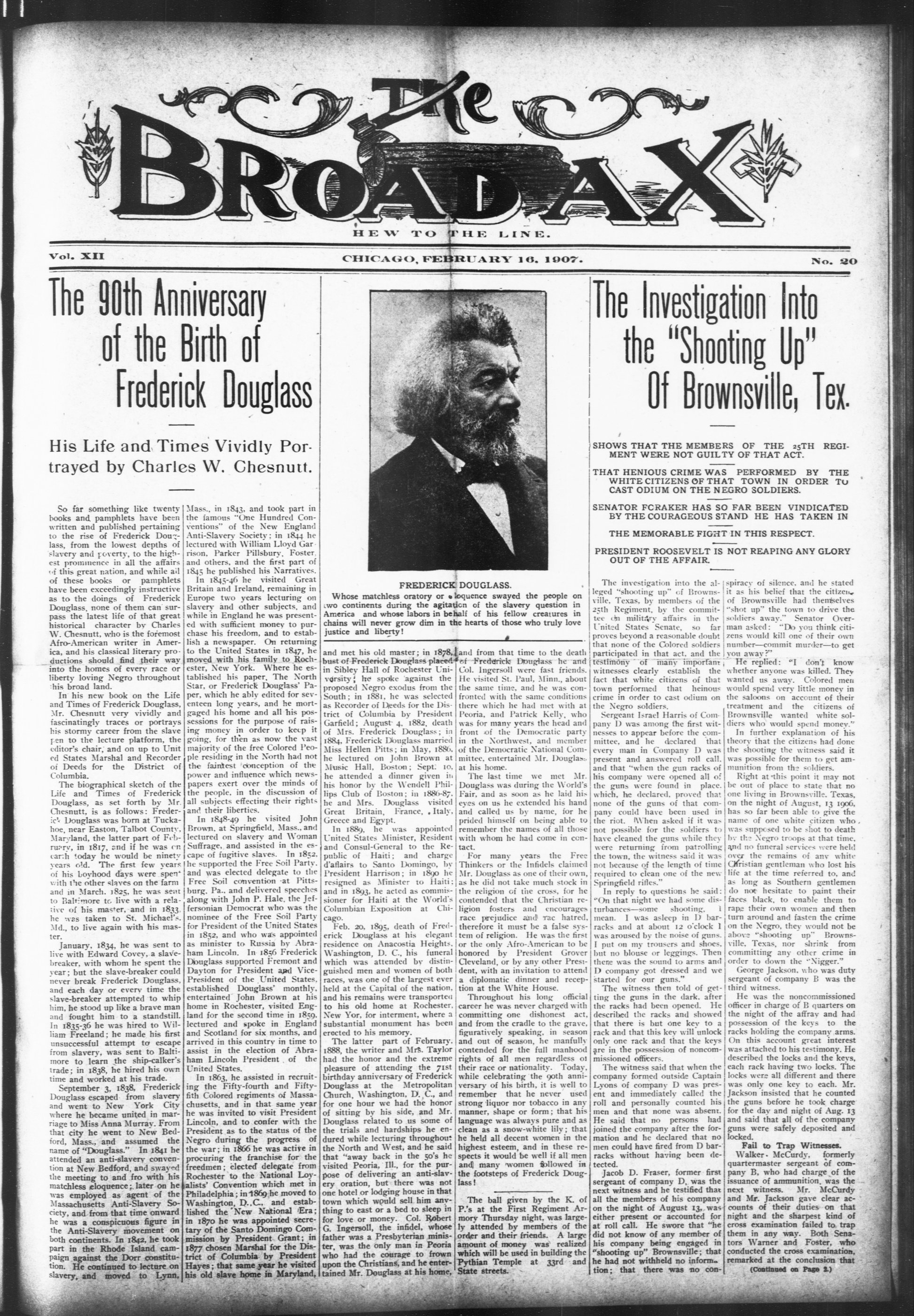
The 90th Anniversary of the Birth of Frederick Douglass
His Life and Times Vividly Portrayed by Charles W. Chesnutt.
The 90th Anniversary of the Frederick
His Life and Time trayed by Charle
So far something like twenty books and pamphlets have been written and published pertaining to the rise of Frederick Douglass, from the lowest depths of slavery and poverty, to the highest prominence in all the affairs of this great nation, and while all of these books or pamphlets have been exceedingly instructive as to the doings of Frederick Douglass, none of them can surpass the latest life of that great historical character by Charles W. Chesnutt, who is the foremost Afro-American writer in America, and his classical literary productions should find their way into the homes of every race or liberty loving Negro throughout this broad land.
In his new book on the Life and Times of Frederick Douglass, Mr. Chesnutt very vividly and fascinatingly traces or portrays his stormy career from the slave pen to the lecture platform, the editor's chair, and on up to United States Marshal and Recorder of Deeds for the District of Columbia.
The biographical sketch of the Life and Times of Frederick Douglass, as set forth by Mr Chesnutt, is as follows: Frederick Douglass was born at Tuckahoe, near Easton, Talbot County, Maryland, the latter part of February, in 1817, and if he was on earth today he would be ninety years old. The first few years of his boyhood days were spent with the other slaves on the farm and in March. 1825, he was sent to Baltimore to live with a relative of his master, and in 1833 he was taken to St. Michael's Md., to live again with his master.
January, 1834, he was sent to live with Edward Covey, a slave-breaker, with whom he spent the year; but the slave-breaker could never break Frederick Douglass, and each day or every time the slave-breaker attempted to whip him, he stood up like a brave man and fought him to a standstill. In 1835-36 he was hired to William Freeland; he made his first unsuccessful attempt to escape from slavery, was sent to Baltimore to learn the ship-calker's trade; in 1838, he hired his own time and worked at his trade.
September 3, 1838, Frederick Douglass escaped from slavery and went to New York City where he became united in marriage to Miss Anna Murray. From that city he went to New Bedford, Mass., and assumed the name of "Douglass." In 1841 he attended an anti-slavery convention at New Bedford, and swayed the meeting to and fro with his matchless eloquence; later on he was employed as agent of the Massachusetts Anti-Slavery Society, and from that time onward he was a conspicuous figure in the Anti-Slavery movement on both continents. In 1842, he took part in the Rhode Island campaign against the Dorr constitution. He continued to lecture on slavery, and moved to Lynn,
Mass., in 1843, and took part in the famous "One Hundred Conventions" of the New England Anti-Slavery Society; in 1844 he lectured with William Lloyd Garrison, Parker Pillsbury, Foster, and others, and the first part of 1845 he published his Narratives.
In 1845-46 he visited Great Britain and Ireland, remaining in Europe two years lecturing on slavery and other subjects, and while in England he was presented with sufficient money to purchase his freedom, and to establish a newspaper. On returning to the United States in 1847, he moved with his family to Rochester, New York. Where he established his paper, The North Star, or Frederick Douglass' Paper, which he ably edited for seventeen long years, and he mortgaged his home and all his possessions for the purpose of raising money in order to keep it going, for then as now the vast majority of the free Colored People residing in the North had not the faintest conception of the power and influence which newspapers exert over the minds of the people, in the discussion of all subjects effecting their rights and their liberties.
In 1848-49 he visited John Brown, at Springfield, Mass., and lectured on slavery and Woman Suffrage, and assisted in the escape of fugitive slaves. In 1852 he supported the Free Soil Party, and was elected delegate to the Free Soil convention at Pittsburg, Pa., and delivered speeches along with John P. Hale, the Jeffersonian Democrat who was the nominee of the Free Soil Party for President of the United States in 1852, and who was appointed as minister to Russia by Abraham Lincoln. In 1856 Frederick Douglass supported Fremont and Dayton for President and Vice-President of the United States, established Douglass' monthly, entertained John Brown at his home in Rochester, visited England for the second time in 1859, lectured and spoke in England and Scotland for six months, and arrived in this country in time to assist in the election of Abraham Lincoln President of the United States.
In 1863, he assisted in recruiting the Fifty-fourth and Fifty-fifth Colored regiments of Massachusetts, and in that same year he was invited to visit President Lincoln, and to confer with the President as to the status of the Negro during the progress of the war; in 1866 he was active in procuring the franchise for the freedmen; elected delegate from Rochester to the National Loyalists' Convention which met in Philadelphia; in 1869 he moved to Washington, D., C., and established the New National Era; in 1870 he was appointed secretary of the Santo Domingo Commission by President Grant; in 1877 chosen Marshal for the District of Columbia by President Hayes; that same year he visited his old slave home in Maryland,
HEW TO THE LINE. CHICAGO, FEBRUARY 16, 1907.
and met his old master; in 1878, bust of Frederick Douglass placed in Sibley Hall of Rochester University; he spoke against the proposed Negro exodus from the South; in 1881, he was selected as Recorder of Deeds for the District of Columbia by President Garfield; August 4, 1882, death of Mrs. Frederick Douglass; in 1884, Frederick Douglass married Miss Hellen Pitts; in May, 1886, he lectured on John Brown at Music Hall, Boston; Sept. 10, he attended a dinner given in his honor by the Wendell Phillips Club of Boston; in 1880-81, he and Mrs. Douglass visited Great Britain, France, Italy, Greece and Egypt.
and from that time to the death of Frederick Douglass he and Col. Ingersoll were fast friends. He visited St. Paul, Minn., about the same time, and he was confronted with the same condition there which he had met with a Peoria, and Patrick Kelly, who was for many years the head and front of the Democratic part in the Northwest, and member of the Democratic National Committee, entertained Mr. Douglas at his home.
The last time we met Mr. Douglass was during the World Fair, and as soon as he laid his eyes on us he extended his hand and called us by name, for he prided himself on being able to
In 1889, he was appointed United States Minister, Resident and Consul-General to the Republic of Haiti; and charge d'aflairs to Santo Domingo, by President Harrison; in 1890 he resigned as Minister to Haiti; and in 1893, he acted as commissioner for Haiti at the World's Columbian Exposition at Chicago.
Feb. 20, 1895, death of Frederick Douglass at his elegant residence on Anacostia Heights. Washington, D. C., his funeral which was attended by distinguished men and women of both races, was one of the largest ever held at the Capital of the nation, and his remains were transported to his old home at Rochester, New Yor, for interment, where a substantial monument has been erected to his memory.
The latter part of February 1888, the writer and Mrs. Taylor had the honor and the extreme pleasure of attending the 71st birthday anniversary of Frederick Douglass at the Metropolitan Church, Washington, D. C., and for one hour we had the honor of sitting by his side, and Mr. Douglass related to us some of the trials and hardships he endured while lecturing throughout the North and West, and he said that "away back in the 50's he visited Peoria, Ill., for the purpose of delivering an anti-slavery oration, but there was not one hotel or lodging house in that town which would sell him anything to east or a bed to sleep in for love or money. Col. Robert G. Ingersoll, the infidel, whose father was a Presbyterian minister, was the only man in Peoria who had the courage to frown upon the Christians, and he entertained Mr. Douglass at his home,
and from that time to the death of Frederick Douglass he and Col. Ingersoll were fast friends. He visited St. Paul, Minn., about the same time, and he was confronted with the same conditions there which he had met with at Peoria, and Patrick Kelly, who was for many years the head and front of the Democratic party in the Northwest, and member of the Democratic National Committee, entertained Mr. Douglass at his home.
The last time we met Mr. Douglass was during the World's Fair, and as soon as he laid his eyes on us he extended his hand and called us by name, for he prided himself on being able to remember the names of all those with whom he had come in contact.
For many years the Free Thinkers or the Infidels claimed Mr. Douglass as one of their own, as he did not take much stock in the religion of the cross, for he contended that the Christian religion fosters and encourages race prejudice and rac hatred, therefore it must be a false system of religion. He was the first or the only Afro-American to be honored by President Grover Cleveland, or by any other President, with an invitation to attend a diplomatic dinner and reception at the White House.
Throughout his long official career he was never charged with committing one dishonest act, and from the cradle to the grave, figuratively speaking, in season and out of season, he manfully contended for the full manhood rights of all men regardless of their race or nationality. Today, while celebrating the 90th anniversary of his birth, it is well to remember that he never used strong liquor nor tobacco in any manner, shape or form; that his language was always pure and as clean as a snow-white lily; that he held all decent women in the highest esteem, and in these respects it would be well if all men and many women followed in the footsteps of Frederick Douglass!
The ball given by the K. of P.'s at the First Regiment Armory Thursday night, was largely attended by members of the order and their friends. A large amount of money was realized which will be used in building the Pythian Temple at 33rd and State streets.
The Investigation Into the "Shooting Up" Of Brownsville, Tex.
SHOWS THAT THE MEMBERS OF THE 25TH REGIMENT WERE NOT GUILTY OF THAT ACT.
THAT HENIOUS CRIME WAS PERFORMED BY THE WHITE CITIZENS OF THAT TOWN IN ORDER TO CAST ODIUM ON THE NEGRO SOLDIERS.
SENATOR FCRAKER HAS SO FAR BEEN VINDICATED BY THE COURAGEOUS STAND HE HAS TAKEN IN THE MEMORABLE FIGHT IN THIS RESPECT.
PRESIDENT ROOSEVELT IS NOT REAPING ANY GLORY OUT OF THE AFFAIR.
The investigation into the alleged "shooting up" of Brownsville, Texas, by members of the 25th Regiment, by the committee on military affairs in the United States Senate, so far proves beyond a reasonable doubt that none of the Colored soldiers participated in that act, and the testimony of many important witnesses clearly establish the fact that white citizens of that town performed that heinous crime in order to cast odium on the Negro soldiers.
spiracy of silence, and he states it as his belief that the citizen of Brownsville had themselves "shot up" the town to drive the soldiers away." Senator Overman asked: "Do you think citizens would kill one of their own number—commit murder—to get you away?"
He replied: "I don't know whether anyone was killed. They wanted us away. Colored men would spend very little money in the saloons on account of their treatment and the citizens of
Sergeant Israel Harris of Company D was among the first witnesses to appear before the committee, and he declared that every man in Company D was present and answered roll call, and that "when the gun racks of his company were opened all of the guns were found in place, which, he declared, proved that none of the guns of that company could have been used in the riot. When asked if it was not possible for the soldiers to have cleaned the guns while they were returning from patrolling the town, the witness said it was not because of the length of time required to clean one of the new Springfield rifles."
In reply to questions he said: "On that night we had some disturbances—some shooting, I mean. I was asleep in D barracks and at about 12 o'clock I was aroused by the noise of guns. I put on my trousers and shoes, but no blouse or leggings. Then there was the sound to arms and D company got dressed and we started for our guns."
The witness then told of getting the guns in the dark, after the racks had been opened. He described the racks and showed that there is but one key to a rack and that this key will unlock only one rack and that the keys are in the possession of noncommissioned officers.
The witness said that when the company formed outside Captain Lyons of company D was present and immediately called the roll and personally counted his men and that none was absent. He said that no persons had joined the company after the formation and he declared that no men could have fired from D barracks without having been detected.
Jacob D. Fraser, former first sergeant of company D, was the next witness and he testified that all the members of his company on the night of August 13, was either present or accounted for at roll call. He swore that "he did not know of any member of his company being engaged in "shooting up" Brownsville; that he had not withheld no information; that there was no con-
No. 20
ATION INTO
NOTING UP"
TOWNSVILLE, Tex.
RS OF THE 25TH REGI-
TY OF THAT ACT.
IS PERFORMED BY THE
TOWN IN ORDER TO
REGRO SOLDIERS.
O FAR BEEN VINDICATED
TAND HE HAS TAKEN IN
T IN THIS RESPECT.
NOT REAPING ANY GLORY
spiracy of silence, and he stated it as his belief that the citizen of Brownsville had themselves "shot up" the town to drive the soldiers away." Senator Overman asked: "Do you think citizens would kill one of their own number—commit murder—to get you away?" He replied: "I don't know whether anyone was killed. They wanted us away. Colored men would spend very little money in the saloons on account of their treatment and the citizens of Brownsville wanted white soldiers who would spend money." In further explanation of his theory that the citizens had done the shooting the witness said it was possible for them to get ammunition from the soldiers.
Right at this point it may not be out of place to state that no one living in Brownsville, Texas, on the night of August, 13 1906, has so far been able to give the name of one white citizen who was supposed to be shot to death by the Negro troops at that time, and no funeral services were held over the remains of any white Christian gentleman who lost his life at the time referred to, and as long as Southern gentlemen do not hesitate to paint their faces black, to enable them to rape their own women and then turn around and fasten the crime on the Negro, they would not be above "shooting up" Brownsville, Texas, nor shrink from committing any other crime in order to down the "Nigger." George Jackson, who was duty sergeant of company B was the third witness.
He was the noncommissioned officer in charge of B quarters on the night of the affray and had possession of the keys to the racks holding the company arms. On this account great interest was attached to his testimony. He described the locks and the keys, each rack having two locks. The locks were all different and there was only one key to each. Mr. Jackson insisted that he counted the guns before he took charge for the day and night of Aug. 13 and said that all of the company guns were safely deposited and locked.
Fail to Trap Witnesses.
Walker. McCurdy, formerly quartermaster sergeant of company B, who had charge of the issuance of ammunition, was the next witness. Mr. McCurdy and Mr. Jackson gave clear accounts of their duties on that night and the sharpest kind of cross examination failed to trap them in any way. Both Senators Warner and Foster, who conducted the cross examination, remarked at the conclusion that (Continued on Page 2.)
"Will promigrate and at all times uphold the true principles of Democracy, but Catholic, Protestant, Poor, Indoeble, Armor, Single Tax, Civil Kill, and other ought, can keep us safe, else we can have their say, so long as their language is proper and responsibility is fired.
The Broad AX is a newspaper whose platform is broad enough for only one claiming the editorial right to speak in our own mind.
Local communications will receive attention.
Write only on one side of the paper.
Subscriptions must be paid in advance.
One Year.....$2.00
Six Months.....1.00
Advertising rates made known on application.
Address all communications to
THE BROAD AX
600 Armour Avenue, Chicago.
JULIUS F. TAYLOR, Editor and Publisher.
Entered at the Post Office at Chicago,
Ill., as second-class Matter.
PERSONAL MENTION.
Walter M. Farmer, for 16 years an honored member of the bar in St. Louis, Mo., is now engaged in the general practice of law. Suite 708, 171 Washington street, Phone Main 4153. Residence 4856 Langley avenue. Phone Drexel 6802.
Mr. Henry Scroggs, 4734 Dearborn street, is on the sick list.
Rev. Jacob Demby, 6450 Champlain ave., is confined to his home on account of sickness.
Mr. and Mrs. H. M. Fleming have gone to housekeeping at 3259 Rhodes avenue.
Mrs. Cora Turner, 364 27th street, is confined to her bed with a severe spell of sickness.
Mr. John L. Fry, proprietor of the Keystone Hotel, was on the sick list for a few days last week.
Mrs. J. Jackson, 5152 Armour avenue, has been confined to her home the past week with illness.
The report that Mr. Thomas Harris, a former resident of this city, is dead in Los Angeles, is false.
Mr. E. C. Jones of Oakland, Cal., is spending a month's visit in the city, stopping at the Keystone Hotel.
Col. John R. Marshall, 3630 Calumet avenue, left the city Tuesday to attend to some business in Metropolis, Ill.
Mr. and Mrs. Will Davis, 3018 Dearborn street, returned to the city last week after a month's visit to San Francisco.
Miss Pearl Wilson, 3211 Wabash avenue, who has spent the past year in New York, is visiting her mother, Mrs. Henrietta Wilson.
Fred Busse will enter the race for Mayor of Chicago on the Republican ticket, and with a united party behind him, he will kick up some dust.
Revs. J. S. Woods, H. H. Thompson, J. C. Anderson, R. E. Moore and Mrs. Nora Taylor, have issued a call to organize an A. M. E. Union for Chicago and vicinity in the near future.
Attorney P. J. O'Keeffe, who occupies a fine suite of law offices on the eleventh floor of the Ashland block, is a warm supporter of Fred Busee for mayor of Chicago.
Mr. and Mrs. William Smith, 347-37 street entertained a few friends at cards Tuesday evening. Mrs. Susie Jones receiving first prize and Mr. Frank Sweet the booby.
Prof. W. Kemper Harreld, who puts in much of his time in hanging around the Frederick Douglass Center, is still holding on to the five dollars which should be coming our way.
Miss Magrue Selden entertained a small number of friends at progressive whist Saturday evening. Mr. George Robert Arthur was the successful winner of the prize, a handsome picture.
Oscar De Priest and Col. D. R. Wilkins, who hat white and Colored Democrats unless they can work or use them, to boost their own game, called on Mayor Edward F. Dunne, last Thursday.
Mrs. R. L. Haley left recently for the west to join her husband who has a high-class position. They will winter in Nebraska. Their many friends will miss them. Mrs. Haley is a society favorite.
Joseph H. Hudlun, who has had charge of the Board of Trade building for many years, has been advised by his doctor to take a two months' vacation for the benefit of his health, as he has been under the weather for some time.
As springtime approaches we are beginning to hear rumors of rent-raising and moving. Last year we heard some pretty hard tales concerning many of our Colored landlords and we hope by this time they have learned to treat their decent tenants decently.
Monday evening the city council by a vote of 57 to 12 passed the street car ordinances over Mayor Dunne's veto, it is now up to the voters at the coming April election to either reject or approve the actions of the members of the city council in dealing with the street car question.
The stork last Monday evening brought a beautiful little girl baby to the home of Mr. and Mrs. Jacob L. Parks, 3155 State street, and the mother and little Miss Parks are doing nicely, and big hearted "Jake" is so proud over the addition to his family that he is buying wine and cigars for all of his gentleman friends, and ice cream soda for the ladies.
Former-Mayor Carter H. Harrison, arrived in the city Tuesday from Pasadena, Cal., and he is stopping at the Virginia Hotel and he will put up a stiff fight to land the nomination for Mayor of Chicago, and many of his friends and warm supporters feel confident that he will be successful in his contest for that honor with the present mayor of Chicago.
On the account of the destruction of the Coliseum Annex by fire last Monday evening, it was necessary to postpone the Charity Ball for the benefit of Provident Hospital. The advisory board under whose auspices the ball was arranged, will immediately arrange for a ball or some other form of entertainment in the near future.
Twelve young misses were entertained last Saturday afternoon at a theater box party at The New Pekin theater by Miss Lucy Lindsey, the sister of the proprietor of the theater, Mr. Robert Motts. During each intermission the young folks were served refreshments and upon leaving the theater the hostess presented her happy little guests with a heart-shaped box filled with delicious bonbons.
Have you seen the picture of our Colored soldiers storming San Juan Hill? It is a beauty! All ready for framing! With a war history of the Negro printed at the bottom. This picture is given, free of charge, with every copy of the Greatest Negro soldier song, "Yol Will Miss the Colored Soldiers." No loyal Colored persons will be without this magnificent tribute to their race. Send 25c to Dabney Publishing Co., 420 McAllister St., Cincinnati, O. Agents wanted.
Tuesday Abraham Lincoln's birthday was celebrated in many parts of the country. Here in this city it was also observed and among those to speak here was Prof. W. E. B. DuBois, who eloquently eulogized the great emancipator at Bowen's Hall on the west side. On Wednesday Prof. Du Bois was the guest of the University of Chicago and addressed a joint meeting of the Woman's Union and of the Commonwealth, Political Economy and Sociology clubs. Thursday evening the distinguished educator also spoke at Bethel Church on "Frederick Douglass," where he was accorded a banquet and reception.
Mayor Edward F. Dunne and his friends feel cock sure, that at the primaries next week, that he will win more than enough delegates to secure his re-nomination at the hands of the city convention. In justice to Mayor Dunne, it can be truthfully said that he is honest, that he has striven in the past to bring around many needed reforms in conducting the affairs of this city and if he should again be selected as the standard bearer of his party, a much larger number of intelligent and progressive Aro-
American voters will march under his banner, than two years ago, for he has been fair in all his dealings with his Colored brethren.
What grew my hair where it was not and covered up a bad bald spot, Farmer's Hair Tonic and Cream.
THE ATLANTA NEWS GONE TO THE WALL. A Welcome Death
The most welcome news received from Atlanta, Ga., within the last six months was the announcement that the Atlanta News, an afternoon newspaper published in that city, had gone into liquidation. It was this sheet which through its offer of one thousand dollars reward for a lynching in Fulton County, its advocacy of Ku-Kluxism and its sensational extras proclaiming in boldface type alleged criminal assaults committed by Negroes, that brought about the Atlanta massacre.
It is a distinct gain to the South that this malevolent sheet, this breeder of race-hatreds, has died. It would have been better for Atlanta had the News never been born. In its last will and testament, as it were, the subscription lists, advertising accounts, and good will were left to the Atlanta Georgian, of which John Temple Graves, a monomaniac on the Negro question, is editor.
We are glad that The News is dead and hope that in a few weeks The Georgian will be numbered among the dead and missing. Newspapers are not supposed to go to Hades when they die—they have it here on earth. But the former editor of The Georgian and the editor of a certain daily paper in this city, will certainly have choice seats in the infernal regions if there is any truth in the religion which the white man professes. The News' death is mourned only by its owners and creditors.—The Globe, Nashville, Tenn.
It will be recalled that the day before Booker T. Washington's Negro National Business League convened in Atlanta. Last August the editor of The News ordered the great beggar of Tuskegee to appear before him, and after abjectly complying to his commands, the editor of The News, dictated a speech for Mr. Washington, which he ordered him to deliver at the opening session of his Business League, in which he branded the Negro race as a "race of criminals," that the "Negro is committing too much crime both North and South; that the Negro must stop raping white women," but he was very careful not to say one word about white Christian gentlemen ravishing Colored women.
This was all the editor of The News wanted, for after Booker T. Washington had with his eyes wide open played into his hands by exclaiming that "the Negro race is a race of criminals." Therefore we still maintain that Booker T. Washington and Charles S. Daniel, editor of The News, are responsible for the deaths of those innocent and lawabiding Colored men and women, who lost their lives in the Atlanta race riot.
NEGRO LAWYER GETS A MILLION
Pine Bluff Boy Wins Big Suit and Gets Million Dollar Fee.
LARGEST FEE PAID ANY ATTORNEY.
Special to the Citizen.
Chicago, Ill., Tuesday—Dr. E. R. Robinson, who has been in the courts for ten years to secure the benefit of a car wheel of his own patent that had been infringed upon by the American Car & Foundry Company, has won out to the tune of $10,000,000. Of over twenty-five lawyers in his employ, from time to time, the last one was J. Gray Lucas, a Colored man, formerly of Pine Bluff, Ark., who gets one-tenth of the judgment, which makes him a millionaire.
There is not one human being residing in the city of Chicago, nor within the state of Illinois, who has come in contact with one penny of the money which the ignorant dupes and suckers claim has been gathered in from the so-called "killings" in connection with the ten-million dollar law suit. At the present time it would seem to a level headed man up a tree, that one million years will
roll on into eternity before those who are blowing their own tin horns in relation to this famous would-be patent car wheel suit, can buy and scatter any "Red Paint" around this town, with the money which they will honestly win in this respect.—Editor.
SIDELIGHTS ON THE
RACE QUESTION.
The Broad Ax of the issue of the 26th ultimo contains an installment of an address by a Mrs. Kate Kinsey Brook, who once taught school in the South, that will certainly shock the sensibilities of the Northern apologists for Southern white criminals. Not that Mrs. Brook tells anything new, but rather because she is lifting the lid so high that the Ogdens and Seth Lows are likely to become apprehensive lest the vulgar outside world may get a glimpse of their ideal social condition in white Southern society. Mrs. Brook relates many instances that have come to her personal notice while in the South, of prosperous, respectable Colored families having to leave their homes to save their wives and daughters from the white rapists. She verifies the oft-repeated statement that there is absolutely no protection in any Southern State for Colored females. Beginning at the cradle they are a prey to the white fiends, except one is so fortunate as to have a manly father or other male defender. In thus bringing the truth of horrible conitions before the Northern public, The Broad Ax, through Mrs. Brook, is doing the race and the country a great service.—The Citizen, Philadelphia, Pa.
Proscription in Atlanta.
There is no city in all America so heartless and proscriptive in the administration of municipal equities as Atlanta. The laws appear to be administered as if they were not enacted for the benefit of the citizen body but for the exclusive benefits of the whites. Any sort of a white man is allowed to dish out whisky to a Negro but no Negro can sell whisky, it makes no difference how decent and law-abiding he may be. Atlanta absolutely refuses to license any Negro to run a barroom. A Negro is permitted to drink whisky, provided he buys it from a white man. This is enough to drive the Negro into open violation of the whisky law. In the barber business the city issues license to all who apply without qualification, but if a white man goes into a Negro shop and obtains a shave upon his own volition, the poor Negro is hauled up before the recorder and fined, and the white man who obtained the shave upon demand, goes scott free. This may be justice, but if so, it must be the heartless kind.—Atlanta Independent.
Chicago's Table Manners.
Chicago, Feb. 11.—I believe that there is not a large city in the world in which the table maners prevailing in the fashionable and high-priced restaurants are so execrable as in Chicago. The guest who does not the moment he takes his seat clear his throat and spit right and left on the carpet or the marble floor and then blow his nose like a cornet or a bassoon is the exception. Tom Brown's report when he got back to London that Chicago was a cross between a western mining camp and a civilized city was not so far wrong in some particulars.—Boulevardier.
Evidently "Boulevardier" has been made to lose a good meal or two just where he expected to obtain one. The next time he feels like enjoying a good wholesome dinner let him go to one of our first-class Colored restaurants, where, while he may not be handed his bread from a solid silver plate, he will at least miss the spectacular of seeing his table mate blow his nose on the table linen, or make a bad-smelling, medicine-spoon out of the sugar shell. For evidently our self-styled "superiors" are much in need of better breeding.—T. D. N.
GOOD DEMOCRATS.
The Democratic city committee of Palestine, Texas, has decided against so-called "White Primaries," with the result that Negroes will be permitted to the primaries with other voters.—Ex.
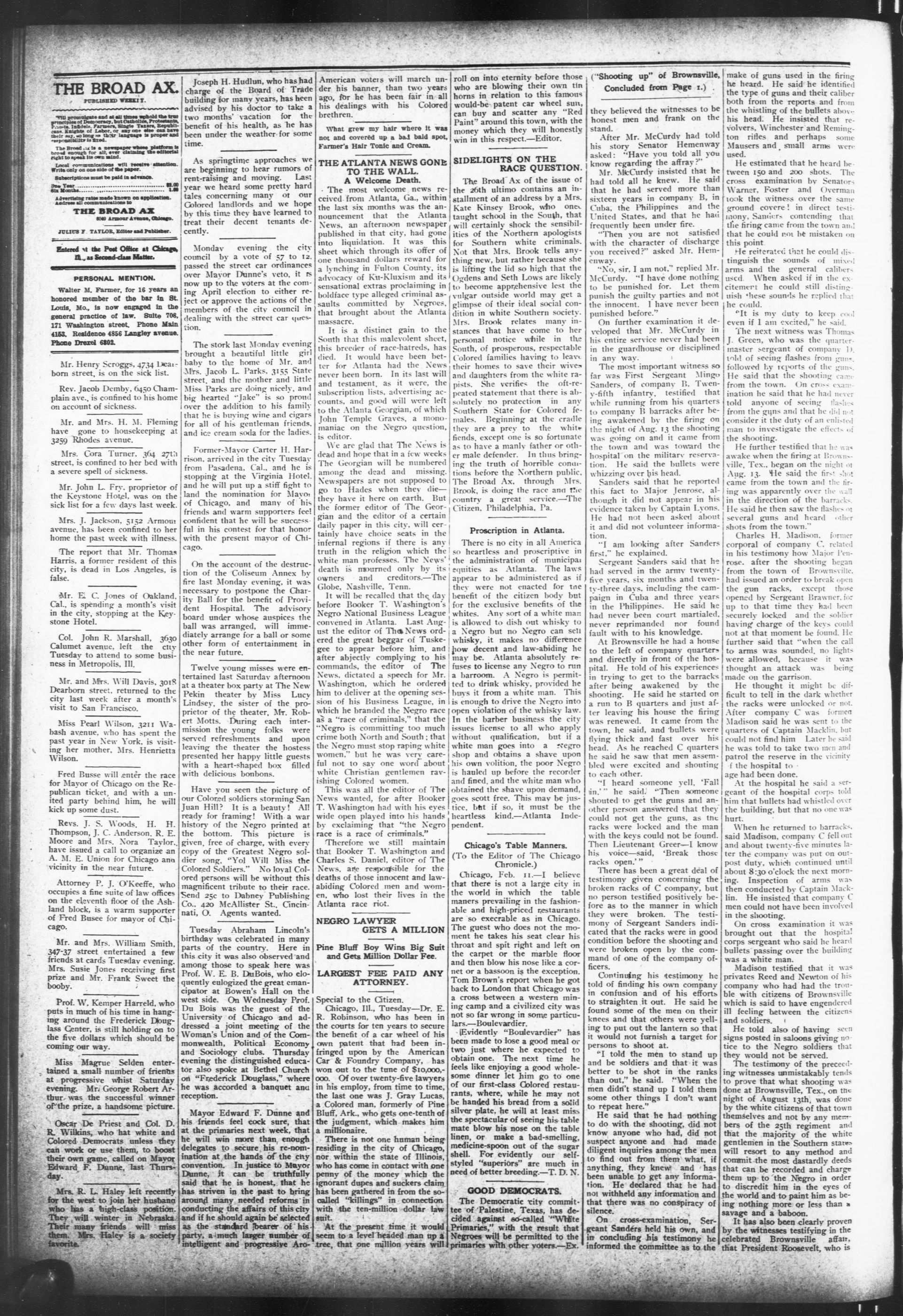
they believed the witnesses to be honest men and frank on the stand.
After Mr. McCurdy had told his story Senator Hemenway asked: "Have you told all you know regarding the affray?"
Mr. McCurdy insisted that he had told all he knew. He said that he had served more than sixteen years in company B, in Cuba, the Philippines and the United States, and that he had frequently been under fire.
"Then you are not satisfied with the character of discharge you received?" asked Mr. Hemenway.
"No, sir, I am not," replied Mr. McCurdy. "I have done nothing to be punished for. Let them punish the guilty parties and not the innocent. I have never been punished before."
On further examination it developed that Mr. McCurdy in his entire service never had been in the guardhouse or disciplined in any way.
The most important witness so far was First Sergeant Mingo Sanders, of company B. Twenty-fifth infantry, testified that while running from his quarters to company B barracks after being awakened by the firing on the night of Aug. 13 the shooting was going on and it came from the town and was toward the hospital on the military reservation. He said the bullets were whizzing over his head. Sanders said that he reported this fact to Major Jenrose, although it did not appear in his evidence taken by Captain Lyons. He had not been asked about it and did not volunteer information.
"I am looking after Sanders first," he explained.
Sergeant Sanders said that he had served in the army twenty-five years, six months and twenty-three days, including the campaign in Cuba and three years in the Philippines. He said he had never been court martialed, never reprimanded nor found fault with to his knowledge.
At Brownsville he had a house to the left of company quarters and directly in front of the hospital. He told of his experiences in trying to get to the barracks after being awakened by the shooting. He said he started on a run to B quarters and just after leaving his house the firing was renewed. It came from the town, he said, and 'bullets were flying thick and fast over his head. As he reached C quarters he said he saw that men assembled were excited and shouting to each other.
"I heard someone yell, 'Fall in,'" he said. "Then someone shouted to get the guns and another person answered that they could not get the guns, as the racks were locked and the man with the keys could not be found. Then Lieutenant Greer—I know his voice—said, 'Break those racks open.'"
There has been a great deal of testimony given concerning the broken racks of C company, but no person testified positively before as to the manner in which they were broken. The testimony of Sergeant Sanders indicated that the racks were in good condition before the shooting and were broken open by the command of one of the company officers. Continuing his testimony he told of finding his own company in confusion and of his efforts to straighten it out. He said he found some of the men on their knees and that others were yelling to put out the lantern so that it would not furnish a target for persons to shoot at.
"I told the men to stand up and be soldiers and that it was better to be shot in the ranks than out," he said. "When the men didn't stand up I told them some other things I don't want to repeat here."
He said that he had nothing to do with the shooting, did not know anyone who had, did not suspect anyone and had made diligent inquiries among the men to find out from them what, if anything, they knew and has been unable to get any information. He declared that he had not withheld any information and that there was no conspiracy of silence.
On cross-examination, Sergeant Sanders held his own, and in concluding his testimony he informed the committee as to the
make of guns used in the firing he heard. He said he identified the type of guns and their caliber both from the reports and from the whistling of the bullets above his head. He insisted that revolvers, Winchester and Remington rifles and perhaps some Mausers and small arms were used.
He estimated that he heard between 150 and 200 shots. The cross examination by Senators Warner, Foster and Overman took the witness over the same ground covere! in direct testimony. Sanders contending that the firing came from the town and that he could not be mistaken on this point.
He reiterated that he could distinguish the sounds of mixed arms and the general calibers used. When asked if in the excitement he could still distinguish these sounds he replied that he could. "It is my duty to keep cool even if I am excited," he said.
The next witness was Thomas J. Green, who was the quartermaster sergeant of company D told of seeing flashes from guns followed by reports of the guns. He said that the shooting came from the town. On cross examination he said that he had never told anyone of seeing flashes from the guns and that he did not consider it the duty of an enlisted man to investigate the effects of the shooting.
He further testified that he was awake when the firing at Brownville, Tex., began on the night of Aug. 13. He said the first shot came from the town and the firing was apparently over the wall in the direction of the barracks. He said he then saw the flashes on several guns and heard other shots from the town."
Charles H. Madison, former corporal of company C. related in his testimony how Major Penrose, after the shooting began from the town of Brownsville, had issued an order to break open the gun racks, except those opened by Sergeant Brawner, for up to that time they had been securely locked and the soldier having charge of the keys could not at that moment be found. He further said that "when the call to arms was sounded, no lights were allowed, because it was thought an attack was being made on the garrison.
He thought it might be difficult to tell in the dark whether the racks were unlocked or not. After company C was formed Madison said he was sent to the quarters of Captain Macklin, but could not find him. Later he said he was told to take two men and patrol the reserve in the vicinity of the hospital to age had been done. At the hospital he said a sergeant of the hospital corps told him that bullets had whistled over the building, but that no one was hurt.
When he returned to barracks, said Madison, company C fell out and about twenty-five minutes later the company was put on outpost duty, which continued until about 8:30 o'clock the next morning. Inspection of arms was then conducted by Captain Macklin. He insisted that company C men could not have been involved in the shooting. On cross examination it was brought out that the hospital corps sergeant who said he heard bullets passing over the building was a white man.
Madison testified that it was privates Reed and Newton of his company who had had the trouble with citizens of Brownsville which is said to have engendered ill feeling between the citizens and soldiers. He told also of having seen signs posted in saloons giving notice to the Negro soldiers that they would not be served.
The testimony of the preceding witnesses unmistakably tends to prove that what shooting was done at Brownsville, Tex., on the night of August 13th, was done by the white citizens of that town themselves and not by any members of the 25th regiment and that the majority of the white gentlemen in the Southern states will resort to any method and commit the most dastardly deeds that can be recorded and charge them up to the Negro in order to discredit him in the eyes of the world and to paint him as being nothing more or less than a savage and a baboon.
It has also been clearly proven by the witnesses testifying in the celebrated Brownsville affair, that President Roosevelt, who is
receiving no glory out of it, went off half-cocked at the time he discharged the three companies of the 25th Regiment for committing a crime, which was in reality committed by his own white fellow citizens.
Too much praise cannot be showered upon Senator Foraker for the courageous stand he has taken in the Brownsville affair, not because the soldiers discharged were Colored men, but because President Roosevelt has no right to stride over the people like the bull-headed Czar or Russia, and to brand a number of innocent men as criminals—to discharge them from the army without permitting them to have a hearing or to testifying in their own defense, simply to suit his fantastical ideas
THE PEKIN THEATER
Following out his announced policy, Proprietor Motts of the Pekin Theater will withdraw "The Man From Bam" Sunday night, and beginning Monday, Feb. 18th, "Honolulu," the big spectacular music play will be staged. This production will tax the members of the clever stock company to their utmost as the action is rapid, the dialogue brisk and the music the most pretentious of any similar attraction at this house. James T. Brymn wrote the score for this play and it promises to eclipse all other efforts of his in this line.
Harrison Stewart who is creating a furore with his refined comedy and clever singing will, of course, have the leading part. Louis Pennington, a recent acquisition to Mr. Motts' staff will have an important role and great things are expected of him, as he is an actor and producer of wide experience. He was for a great many seasons E. H. Sothern's right hand man, and recently resigned from Virginia Harned's company in order to become associated with the Pekin forces. Jerry Mills, Lawrence Chenault, J. F. Mores, Audbrey L. Lyles, Lotte Grady, Nettie Lewis, and May White will ably second the others in the whilwind of fun and fancy, and a big chorus will lend color and movement to the production.
Miss Vella Crawford, a charming actress and a wonderful soprano singer, who is a new comer at the Pekin will have an important role, and those who heard her sing in "The Man From Bam" will look forward with pleasure to her appearance in a more ambitious part. The entire production will be under the personal direction of Jerry Mills, and it goes without saying that the ensembles and effects will be under the personal direction of Jerry Mills, and it goes without saying that the ensembles and effects will be novel and striking.—"D."
A Good Home for Children.
Wanted children, either White or Colored to board and room, they will receive the care of a good mother; charges reasonable. Mrs. L. Coleman, 839 Armour Ave., 2d flat.
FARMER'S HAIR TONIC AND CREAM
When all else fails try Farmer's hair tonic and cream. On sale at The Peoples' Pharmacies 20th and Armour Ave., and 27th and Dearborn Streets, also at 4832 and 4856 Langley Ave.
L. W. Washington, General Agent for The Broad Ax in the Hyde Park District.
From on and after this date until further notice to the contrary, L. W. Washington, 5013. Jefferson avenue will act as the general agent for The Broad Ax, and news items and advertisements left with him not later than Wednesday evening or early Thursday morning prior to the day of publication, will find their way into its columns.
Jan MacLaren In America
On the 30th of July Dr. John Watson leaves for New York in the Baitie. He hopes to preach on February 10 in the Fifth Avenue Baptist Church, to which Mr. Aked is going. After a few days in New York he goes to Philadelphia, where he preaches in condition with the University of Philadelphia. He also addresses the Presbyterian Social Union, and delivers three historical lectures at Haverford College, and one before a historical society in Philadelphia. At the end of April he delivers the Cole Lectures in the Vanderbilt University, Nashville. This is a lectureship in theology, and the subject of the six lectures will be "The Bible in the Pulpit; the Practical Use of the Bible in the Present Day and in the Light of Critical Results." In July and August Dr. Watson hopes to speak at several of the Chautauqua conventions, and return to England in the first week of September. This is a varied and interesting programme.
EDITORIAL FLINGS.
Porters on Pullman cars claim that it "galls their souls" to accept tips. The life of the Pullman porter is full of gall—Youngstown Vindicator.
It will be pretty rough on us if the ice freezes so hard and thick this winter that the companies can't cut it, and thus there is another scarcity next year.—New York Tribune.
In addressing him as "the beloved, most cherished, exalted, most honored and excellent president," the sultan must think Mr. Roosevelt is at the head of some dinky lodge—Detroit Free Press.
They are now talking not only of a national income tax, but of a state income tax as well. A man will only have to lie twice instead of once, that's all. And the same lie at that—Akron Beacon Journal.
England thinks that the United States constitution needs immediate revision. In fact, there is a lingering suspicion in Great Britain that there should have been no United States constitution in the first place.—Washington Post. A chair of journalism has been established at the University of Missouri, in honor perhaps of Eugene Field, the greatest journalist the University of Missouri ever turned out. She turned him out in his freshman year.—New York Mail.
SHORT STORIES
Easter occurs this year on March 31, more than three weeks earlier than the Easter date of 1900.
A carved war god, recently discovered in a Colorado cave, is believed to be more than 1,000 years old.
There are about 4,000 lepers in Colombia, or one to every 1,000 inhabitants. Most of them are now isolated. Cases are rarely found among the classes living with hygienic care.
The Doukhobors of Winnipeg are gradually recovering their senses. They no longer turn horses and cattle loose and harness themselves to the plow, but, on the contrary, are now purchasing horses for farm labor.
The obligation to accept American currency as legal tender in Cuba is said to have constituted a part of the dissatisfaction which exists in that island. It is complained that there is not enough of such currency to meet the requirements of trade.
NEW YORK CITY.
It will cost $11,770,000 more to run the government of New York city this year than it did last year. Every hour there is an average of 146,000 persons entering the surface, elevated and subway cars in New York city.
New York city had the first Hebrew cemetery in the United States. It was established in 1656, and a part of it yet remains at New Bowery and Oliver street.
"Little Italy," the block bounded by One Hundred and Twelfth and One Hundred and Thirteenth streets, First and Second avenues, has grown from 882 inhabitants in 1900 to 4,412.
Strangers from villages and small cities wonder why the New York city authorities allow many of the walks of the city to be left unclean all winter, particularly where there are vacant lots—New York Herald.
LAST WORDS OF FAMOUS MEN
Louis XIV. of France (1638-1715), "I thought dying had been harder." William Ewart Gladstone (1800-1898), British statesman,"Amen." Phillips Brooks (1835-1893), American clergyman, "I am going home."
Lord Chesterfield (1694-1773), English courtier, "Give the doctor a chair."
Henry Havelock (1795-1857), English general, "Tell my son to come and see how a Christian can die." William McKinley (1843-1901), American statesman and president: "Goodby. All goodby. It is God's way. His will be done." Patrick Henry (1736-1810), American orator and patriot: "Here is a book (the Bible) worth more than all others ever printed, yet it is my misfortune never to have found time to read it. It is now too late. I trust in the mercy of God."
PITH AND POINT.
Some dogs, like some men, just naturally can't get along.
Not all people can be clever, but most of us can do a little better than we do.
When you are so unfortunate as to get into a lawsuit plead guilty unless you get the best lawyer.
What a poet calls "inspiration" is probably the same thing the gambling fraternity calls a "hunch."
How far can you afford to carry crankiness? Can you afford to carry it to the extent of being impolite? That sort of thing hurts your business, no doubt about that.-Atchison Globe.
MODES OF THE MOMENT.
Velvet dotted veils with borders of velvet ribbon are pretty and becoming. Amogm the dark colors which are most popular with milliners is a warm, golden brown, or "mordore," which looks equally well in velvet and felt. Bretelle and suspender effects figure conspicuously in the designs for soft silks, and silks incidentally are enjoying an unwonted prestige for semidress as well as for full dress wear. The vogue for embroidery has spread to headgear, and one of the most recent innovations consists in covering the hat of felt, beaver or velvet with the same embroidery which is seen on the gown.
HUMOR
PETE'S STATISTICS:
There Was a Slight Mistake That His Attention Was Called To.
"I assure you, lady," began Panhandle Pete as the farmer's wife came to the door with a scowl on her face. "I ain't no common cramp, I'm a gent author wot's writin' a book uv his travels round de world."
"You don't look much like an author," she coldly replied.
"No, ma'am, but I'm dressed up dis way so as ter study de life, yer see. I'm doin' a world tour on a bet, an' if yer'll give me a little assistance I'll put yer in de book."
"What's the name of the book?"
"It ain't named yet, lady. I'm jest takin' some interestin' notes as I go on me way, an' den some day I'll set down an' put 'em all tergether."
"You fellows tell such tales," she suspiciously remarked as she looked him over.
"Dat's wot dey do, lady," he replied as he took out pencil and paper and began to write. "Scuse me while I put down dat a kind an' beautiful lady, meanin' you, gib me some ideas for me book an' den inwed me in an' gib me de finest spread I had on de hull trip. In course dat's only fer de book, yer know, an' yer needn't gimme only four or five turkey sandwiches an' some roast beef an' a couple uv mince pies an' a pitcher or two uv cler. I got some interestin' notes here, lady. So far on de trip I've had 362 pieces uv punkin ple, 892 pieces of mince, 110 dogs hev bit me, 262 kind ladies, includin' yerself, hev"— "Wasn't it you who was here working the swindle about this time last winter?" she interrupted him with
"Me? No, ma'am. I wuz jest startin' on me trip about dat time an 'biddin' me old gray haired mother goodby. Ah, lady, yer should he seen de tears she shed as she parted from her only son! But, as I wuz sayin', de feed yer gib me will"—
"Just a minute. There's a little mistake in your figures, I think."
"As—as ter how, lady?"
"Why, as to the number of dogs that have bitten you. You said 116, didn't you?"
"Y-yes, lady."
"Well," she said as she came out into the yard and started toward the barn, "you want to change that, because Carlo will make the one hundred and seventeenth. Here, Carlo! Here, Carlo! Carlo! Carlo!"
But Panhandle Pete had leaped the fence at the very first call and was half a mile down the road before the dog caught sight of him.—A. B. Lewis in Judge.
Escaped.
Stranger (at Hayrick farm)—Boy,
can you tell me where old Farmer
Cornshack lives?
Boy—He's dead.
Stranger—Dead? Why, I've come all
the way from Ameriky to visit him.
Boy—He must have been expectin'
ver. I guess.—London Tit-Bits.
She'd Change It.
"Ah," significantly remarked Miss Strong, his fiancée, "I'll make the best of it."-Philadelphia Press.
Colossal Precaution
"I suppose you have put something by for a rainy day?"
"Certainly," answered Mr. Dustin Stax. "I have several millions put away in gilt edged securities."
"You must be looking for a deluge."
—Washington Star.
Would Keep Up With Him.
Daughter—Just think, mamma, my husband wants to join the gymnastic society to become strong.
Mother—Oh, that will be of no great advantage to him. During his absence we will exercise too.—Il Motto per Ridere.
His Experience.
"After all," said the philosopher, "the real joy of a thing is in the anticipation of it."
"Well," replied Henpeck, "if there's any joy in matrimony that must be it."
Catholic Standard and Times.
Avoiding Trouble
"Do you have any trouble with your janitor?" asked Mrs. Flatleigh. "Oh, no. Both my husband and I believe in devoting all our spare moments to the pursuit of pleasure."—Chicago Record-Herald.
Strange, Isn't It?
A lady whose name was Miss Rook Was taught at a school how to cook. The poor fellow she wed.
Since Miss Rook learned to cook by the book.
—Leslie's Weekly.
Men Won't Green.
Dickens — I thought you said that wood was too green to burn?
Picken — It was, but I insured it, let the insurance lapse, and you ought to have it go!-Florida Times-Union.
WILL THIS BILL PASS?
Bill Taylor's gone to Denver;
A legislative chair
He's got, for Bill was 'lected
To represent us there.
Before he left, he sold us.
Before he left he told us
Proud of him we'd sure be.
He says we will, but will we?
We're waitin' now to see.
"Who's that bright country Jake?"
He says on bills we favor
He'll make 'em all agree.
He says he will, but will he?
We're waitin' now to see.
He vows no boss will rule him;
He'll stick to what is right.
No matter if to do it
The whole bunch he must fight.
He says he'll drink no whisky;
Bill swears he'll stick to tea.
He says he will, but will he?
We're waitin' now to see.
Bill Taylor's gone to Denver
With "Hon." hitched to his name;
He's not up there for riches
An' not to gain great fame.
He says it's his ambition
To serve us faithfully.
He says it is, but is it?
We're waitin' now to see.
The Young Lady—Are you two young-
sters twins?
The Boy (indignantly)—No. She's a
girl—Sketch.
Simplified Mitten
"Are you and Miss Spinks engaged?"
inquired a young man of his chum.
"Report says so."
"Well, she once sent me a true lover's knot."
"Ah! That looked like business."
"Yes, but she spelled it without a k'."
"-Tit-Bits."
Strictly Business
"He has queer notions of the moral life."
"How so?"
"Why, he bought a ten dollar present for a particular friend of his and the next day swindled him outrageously on a $10,000 deal."—Cleveland Plain Dealer.
With His Knife.
"That fellow Jones you pointed out to me yesterday is a 'sword swallower,' isn't he?"
"Nonsense! Did you think you saw him in a dime museum?"
"Oh, no, but I saw him in a restaurant today."—Catholic Standard and Times.
Wall Street Term Elucidated.
"What does this report mean by saying that 'the shorts were caught in a corner and squeezed'?"
"Why, it means that they sold what they didn't have to buyers whom they had to get it back from at a higher price in order to deliver it to them."—Judge.
Ought to Be Good For That.
Young Father (at department store)
—I don't know exactly what to ask for, but I want something for the baby to cut its teeth on.
New Salesman-You'll find the files in the hardware department on the sixth floor-Minneapolis Journal.
Painful Suggestion
Chapleigh—I was—aw—out late law night, and the—aw—wesult was I had a head on me this mawning, doncher know.
Miss Caustfque—Well, if I were you I'd stay out late every night—Chicago Tribune.
Modesty.
"Whom do you regard as the greatest living actor?"
"My friend," answered Mr. Stormington Barnes, "the question is not considerate. You know how I hate to talk about myself."—Washington Star.
Between the Acts
"Just as Jack was-about to kiss me
last night father walked into the
room."
"What did you do?"
"I gave Jack a rain check."—Mil-
waukee Sentinel.
He Know by Experience
"To be kind to your little companions at all times," said the minister reprovingly, "is a good thing." "Huh!" grunted Tommy. "It makes dem t'ink yer a good t'ing."—Philadelphia Press.
Two Failures
Homely Man-I married for beauty.
Sarcastic Man—You remind me of a friend of mine who married for money.
Homely Man—How's that?
Sarcastic Man—He didn't get it—Chicago News.
In the De Hop Cafe
Mr. Mouse—Ab, I see Mr. Frog is running a first class eating counter!
Mr. Lissard—Yes, and thoroughly up to date. Why, one of his toad-stools is a revolving stool. — Detroit Tribune.
His Artistic Career
"I hear that Smear, the architect, is drawing for the newspapers."
"Yes; he makes the crosses at the spot where the murder was committed."—Cornell Widow.
THE HALL OF FAME.
Governor Harris of Ohio is the oldest chief executive of any state in the Union.
Lord Northcliff, formerly Sir Alfred Harmsworth of England, may be entitled the greatest newspaper magnate of the world. He owns and actively directs some forty prosperous dailies and other periodicals.
Captain Edward Howard of Oakland, Cal., probably the oldest mariner in the United States, has retired after having followed the sea over eighty years. He is ninety-six years old, but is still stout and hearty.
According to Czech newspapers, at Aujezd, Moravia, recently Joseph Koppner, 101 years old, led to the altar Rosa Waldner, who has also passed the century mark. The "young couple" knew and loved each other for thirty years.
The youngest member of the Sixtieth congress will be Harry B. Wolf, elected from the Third district of Maryland. He has just passed his twenty-sixth birthday and is married. Mr. Wolf began life as a Baltimore newsboy and is now a lawyer in good practice.
Captain A. W. V. Trant of the transatlantic liner Devonian handles his ship in first class style and in addition finds time in the spare moments of his voyages to paint pictures in oil, write the words for music and compose verses that are of more than ordinary merit.
John E. Wilkie, chief of the secret service, is one of the best amateur magicians in the country. He performs wonders with a deck of cards, and his sleight of hand maneuvers with coin, handkerchiefs and other objects are a source of constant wonder to his friends.
Professor Moissan, the inventor of artificial diamonds, has been awarded the Nobel prize for chemistry. Professor Moissan invented an electrical furnace giving a temperature of 3,000 degrees. His invention of diamonds was severely challenged when it was first made known. H. J. Henebry, Ireland's Rugby fullback, played the other day for seventy minutes against the South Africans while suffering from a split ear, damaged skull, broken middle finger on left hand, strained chest muscles and torn finger cartilages. He received the injuries in a tackle ten minutes after the game began.
PLAYS AND PLAYERS.
Charles Frohman has gone to London, to be abroad for some months. Clara Bloodgood has scored her greatest success in Clyde Fitch's play, "The Truth." Charles Frohman will shortly produce "La Belle Marseillaise" in London with John Hare. J. M. Barrie's "Peter Pan" is now being played at the Duke of York's theater, London. Ethel Barrymore will probably appear in London next summer with an American company. William H. Crane is having a most successful tour with "She Stoops to Conquer," in which he is starring jointly with Ellis Jeffreys. Henry Arthur Jones, author of "The Hypocrites," is to write a new play, to be produced at the Hudson theater, New York, a year from next September.
Between now and May one New York manager will produce plays in London with John Hare, Ellen Terry, Marle Tempest, Irene Vanbrugh, Edna May, Gerald Du Maurier, Ellalline Terriss, Seymour Hicks and Huntley Wright.
ENGLISH ETCHINGS.
The other day a London food inspector or took a sample of oleomargarine from a grocer's shop and on examining it found it to be pure butter. English people eat on the average thirteen pounds of butter a head yearly, says the Steward's Bulletin. This is more than is eaten per capita in any other nation. A motor car driver in London the other day charged and scattered like chaff a whole troop of the life guards, but paid $8 next day in the police court for his victory. Because the lock of a Methodist church in Hazlemere, England, wouldn't work it was taken off. The locksmith found 12s. 7½d. in it, some ploupe people having mistaken it for a contribution box.
Henry Labouchere in a recent number of London Truth says that in the past twenty-five years members of the British aristocracy have parted with more than $500,000,000 to promoters and brokers and have "received about sixpence in the pound by way of commission."
GERMAN GLEANINGS.
Every German soldier's equipment includes a Bible and a half pound cake of chocolate.
There are 430 manufacturers of artificial flowers, leaves, plants and fruits in the district of Dresden, Germany.
A charitable Berlin lady has taken the necessary legal steps to secure for Volgt, the hero of Kopenick, a life pension, which will relieve him of the necessity of seeking further work on his release from prison.
During the year 1906, 30,000 deserted wives were relieved by the Berlin poor law officials at a cost of $125,000. A great majority of cases of matrimonial troubles resulted from drunkenness, which breaks up homes, at least temporarily.
FEW CRACK BILLIARDISTS.
Schaefer Deserves Most Credit For Improving the Game.
The fact that very few first class billiardists have ever been developed is one of the strange features of the game. Vignaux, Schaefer and Slosson have been champions more than thirty years, the only others developed during all this time being Ives, Hoppe and Sutton, a most remarkable showing, not to be paralleled in any other branch of sport.
Of all the experts Schaefer deserves most credit for the development of the game to its present high standard. He always has been anxious and willing to aid in the development of youngsters, and Ives, Hoppe, Morningstar and Sutton all were his pupils. The balk line nurse, the feature of play responsible for all high runs, however, is the invention of Sutton, and when as a shortstop he first sprung it he occasioned great surprise.
Schaefer is the father of all the rules under which billiards are played. At various times he has surmounted by his inventive genius the many barriers imposed on experts to decrease their speed and necessitated the making of new restrictions, for the other experts could all take advantage of the new discoveries as soon as they came to know them, and almost unending runs were the result.
In a championship contest between Jake and Ives the latter sat down with 14 to go, and Schaefer came to bat with 560 to go. The largest run ever made up to that time had been 288, and the Wizard seemed to have but little show to win. His great inventive genius came to the rescue, however, the anchor nurse was discovered, and Schaefer ran the game out. This was the only time the anchor nurse was allowed in a match game, for Ives after it was discovered could play it as well as Schaefer, and as it made the game too easy it was immediately barred.
Incidental to the above game, Frank White, a well known Chicago sport, won a most remarkable bet from Leo Mayer, the well known bookmaker. As Schaefer walked up to the table in the final inning White turned around to Mayer, who was making books on the contest, and said, "What are the odds now, Leo?" "One hundred to 1," said Mayer. "I'll bet you $10," said White. "Done," said Leo. And when the game was over Leo had to settle with the wise Mr. White, who, a billiard player himself, knew that a game was never over until the last point was made—Washington Post.
Painting Barrels
Did you ever see a Standard Oil man paint a barrel? No? It is a revelation. Tricks in all trades. The oil barrels, as every well informed man should know (Standard Oil being the biggest thump in the world), are blue as to blige and bulge and white as to heads. The completed barrel is rolled into the shop by thousands. A man steps up with a brush of white paint and with three swipes executes a design upon the head, then spins the barrel along. It is caught by another man with a brush deeply dipped in blue paint. He takes the rim between his thumb and fingers, gives it a whirl and while that barrel is spinning runs his brush up and down. In less than three seconds that barrel is all blue. Then as it spins along the man with the white paints keels it over and with three more swipes makes the other head white. Talk about your bowling alleys!-New York Press.
Blind Football Fans.
When the 200 inmates of Henshaw's Blind asylum, Manchester, sat down to tea the other evening an officer read out to them the announcement in the Daily Mall of a special edition for the blind. There was a burst of applause when the reading was over, followed by a buzz of animated discussion.
"It is surprising," said Mr. M. H. Illingworth, the governor, "what a keen interest the blind take in field sports. They follow the game of football in detail."
"Have you ever been to a football match?" he asked a blind youth.
"Yes," he replied.
"And you know the players?"
"Yes, I know them all and everything that is going on."-London Mall,
Single and Plural S Germans.
A journalist in Berlin has been exercising his ingenuity in attempts to explain the meaning of the letter S which appears with more or less frequency after the names of German military officers in the records kept at the ministry of war and in the kaiser's military cabinet. He has come to the following conclusions: One S after an officer's name means that this particular officer "sautt" (drinks); SS means that he "sautt stark" (drinks hard); SSS denotes that he "sautt sehr stark" (drinks very hard); SSSS means that he "sautt sehr stark schnapps" (drinks very hard schnapps); finally, SSSS means that the "schnappe" is "schlecht" (bad). Any officer with five S's is summarily dismissed by the kaiser.
A Swell Bootblack
A bootblack wearing a diamond stud and whose linen is as spotless as that worn by those whose shoes he shines is one of the fixtures of a government building in this city. He was highly insulted when a passing stranger, seeing his "kit", asked him to "pollish 'em up!" In a loud voice the son of Italy gave the well intentioned offender to understand that he "shined only by contract." This is a fact and when at the end of each month he collects his "fees" the bootblack's pile in profits amounts to as much as the salaries of some of the men who employ him and is really in excess of that paid to many.—Philadelphia Record.
Fifty-First St. and Armour Ave.
RAIL YARDS: 1st St. & L. S. & M. S. RY.
2nd St. and Armour Ave.
CHICAGO
50,000
BOOKS FREE By Mail
50,000
BOOKS FREE By Mail
treating on all the
DISEASES PECULIAR TO MAN.
THIS BOOK contains many illustrations and is a storehouse of knowledge for both old and young who are suffering from excesses, lost vitality, nervous disorders, blood poison, stomach kidney and bladder diseases. It explains how you can successfully cure yourself at home.
J. H. COLEMAN & CO.
Express & Van Moving
TRUNKS EVERYWHERE.
2540 State Street
Tel. 699 South
CHICAGO
F. A. Rawlins
The Modern Embalmer
UNDERTAKER AND
FUNERAL DIRECTOR
When his work is finished
you have no displeasure.
4834 State St., CHICAGO
Phone Douglas 1550
ICE CREAM CIGARS, TOBACCO
SHIRT WAISTS KIMONAS
MRS. A. E. BAKER
NOTIONS
Underwear a
Specialty
CHICAGO
J. GARNER
Tel. Douglas 3250
FINE WINES, LIQUORS
AND CIGARS
3030 State Street CHICAGO
MOCALL PATTERN
10
15
MONEY BOOK
MOCALL MAGAZINE
50
YEAR
WASHINGTON APEX MILITARY
There are many Mocall Patentary gold in the United States that of any other make of pattern. This is an account of their style, summary and simplicity.
Mocall's magazine (The Queen of Punish) has been published by the Lighthouse Publishing Company. One year's subscription (in number) costs $50 cents. Latest number, 5 cents. Every subscriber gets a Mocall Patent.
Lady Agate Wanted. Handmade premium so Bursary cash commission. Pattern Catalogue of 60 daigir and Printed Catalogues (including too premium
COOKS
Waiters and Cooks
Prefer Our Make
JACKETS AND LINEN
because they have found them
satisfactory.
Write for complete Catalogue
FREE.
giving full instructions how
to order.
Marcus Ruben (Inc.)
390 State St., CHICAGO.
READY FOR THE PRESS
CHICAGO CAVE DWELLERS
Not for Preachers
320 Pages, Cloth, $1.00
PORT PAID
A Story of the Underworld
and the Overworld
By Parker H. Sercombe,
Editor To-Morrow
Magazine, Chicago.
Only a limited edition of
this remarkable book will be
printed. Each copy will be
signed by Sercombe Him-
self and automatically num-
bered from 1 up. First
orders is will get the low
number of positions accept
No. 1, which goes to Mrs.
Sercombe.
Address
TO-MORROW MAGAZINE,
For the Supermarket and supermarket and The New Civilization.
2238 Geismet Ave.,
Chicago, IL.
to CENTS THE COPY. $1 A YEAR.
J. ED. GREEN'S Training School For the Stage
---
PRACTICAL instruction director and theatrical produc uates at from $10 to $25 per pearing on the stage Refer critic, actor or actress. Invc costs One Dollar and Fifty Cents Students can join at any time and Fridays for adults. Satu Young men taught stage COURSE OF STUDY: Stage ville. Professionals and amate ional-business, etc. FIRST DAY OF TERM: Tue For terms write, phone Calu Pekin Theatre, 2700 ST
PRACTICAL instruction by the most successful stage director and theatrical producer. Engagements given all graduates at from $10 to $25 per week. Over 500 pupils now appearing on the stage References: Any reputable manager, critic, actor or actress. Investigation invited... Instruction costs One Dollar and Fifty Cents ($1.50) an hour. Students can join at any time. Classes in the day, Tuesdays and Fridays for adults. Saturday mornings for children only. Young men taught stage management and producing.
COURSE OF STUDY: Stage Dancing, Art of Acting, Vaudeville. Professionals and amateurs coached in special parts, origi- nal business, etc.
FIRST DAY OF TERM: Tuesday, March 5th, 1907.
For terms write, phone Calumet 67 or call on J. ED. GREEN, Pekin Theatre, 2700 STATE STREET, CHICAGO.
THE BROAD AX.
Is for sale at the following news
stands:
George M. Oatts, 5501 Lake ave.
Mrs. E. L. Holmes, 2508½ State st.
Cigars, tobacco and news stand.
J. W. McKiney, news stand, North-
east corner State and 47th st.
L. W. Washington, 5613 Jefferson
ave., General agent.
L. L. Jones, barber shop and news
stand, 3842 State st.
A. F. Tervalon, 134 W. 51st street
Cigar Store and News Stand.
Mrs. Nellie Phelps, Cigars, Notions
and News Stand, 131 W. 51st street.
T. B. Hall's Cigar Store and
Laundry office, 281 29th St.
W. S. Cole, 354 Thirty-first street,
cigars, tobacco and news stand.
J. R. Peters Cigars, Tobacco and
Mrs. A. E. Baker, Notions and News Stand, 419, 36th street.
W. P. Johnson, Notion Store and News Stand 3704 State st.
Turner Williams' Shaving Parlor and News Stand, 2903 Armour ave.
B. Davis, cigars, tobacco, and confectionery, 3532 State st.
Whiteleye Bros. 2724 State St., Gent's furnishings and new stand.
The Stationery, 2970 State street.
Cigars, Tobacco and News stand.
C. C. McLain, cigars, tobacco and news stand, 2906 State street.
W. H. Gans, news stand, 2805 State street.
J. H. Hadley, cigars, tobacco and news stand, 110 W. 47th street, near State.
Special Ann
Special Announcement!!!
Black Diamond Development Company's Stock Goes to 35c
The closing of contracts for a sufficient amount which insures the building of the lines and connecting of Black Diamond wells to the pipe line has justified the Directors of the Company in closing the sale of Black Diamond stock at the old price and no stock will be sold hereafter for less than "35c" and only a small amount at this price.
Mr. W. M. Budd of Chanute, Kansas, who has had entire charge of all the gas wells belonging to the City of Chanute for the past two years has been employed to act as superintendent fo Black Diamond Development Co's wells and properties, and the securing of Mr. Budd as superintendent is additional evidence that the Black Diamond's valuable properties will be managed with the most expert care and economy in the future as it has been in the past.
No. 6 well on the Stoelzing land was brought in a few days ago and proved to be another gas well.
Word has just been received from Mr. Budd that the high water had gone down so that it was possible to cross the Neosho River and that as soon as the weather would permit he would have the dirt flying in burying the pipe line.
The Prize offered by Fred A. Wescott, Manager of the Black Diamond Dev. Co. in his "Black Diamond Development Company" Word Contest, was won by Mrs. Anna Wood, 2623 Dearborn St., Chicago, having compiled 5,868 words.
The next two highest in number were Wm. H. W. Cornelius, 302 So. Fawn St., Philadelphia, Pa., with 4,407 words, and Miss Blanche A. D. Hill, 2911 Wylie Ave., Pittsburgh, Pa., with 4,163 words.
The number of lists sent in and the great number of word contained show the great interest that is taken in Black Diamond Dev. Co. by its stockholders.
on by the most successful stage
er. Engagements given all grad-
week. Over 500 pupils now ap-
pences: Any reputable manager,
instigation invited... Instruction
ents ($1.50) an hour.
Use. Classes in the day, Tuesdays
rday mornings for children only.
management and producing.
Use Dancing, Art of Acting, Vaude-
urs coached in special parts, orig-
tuesday, March 5th, 1907.
met 67 or call on J. ED. GREEN,
DATE STREET, CHICAGO.
Mrs. Katherine R. Hamlet, Cigars, tobacco, and fancy groceries and news stand 5028 Armour ave.
The Informer News Co., 188 Randolph St, Detroit, Mich.
Howard Music & Art Company, Buxton, Iowa.
News items and advertisements left at these places will find their way into the columns of The Broad A
Special Announcement
From on and after this date all announcements of entertainments, etc. for which an admission is charged, will be considered advertising, and will be charged for at the rate of 12 cents a line, seven words to a line. The money must accompany the matter and reach the editor no later than Thursday morning of the week intended for publication. This rule will also apply to all personal items and matter for which no charges will be made. In other words, all news matter must reach us either on Wednesday evening or early Thursday morning in order to find its way into the columns of this paper the same week it is written
Write plainly on one side of the paper only, and address all communications to The Broad Ax, 5040 Armour avenue.
It is stated that the new Judge in the Court of Sessions, Aberdeen, may be Donald Crawford, the Sheriff of Aberdeen and Kincardine. Another name mentioned is that of William Campbell, the Dean of Faculty.
ouncement!!!
GRAY & MORAN
ATTORNEYS AT LAW
Suite 1114 Ashland Block, Clark and
Randolph Sts. Tel. Central 569.
CHICAGO.
Residence 57 Macallister Place
Telephone Ashland 363
Office Telephones
Central 1239 Automatic 5940
MILES J. DEVINE
ATTORNEY AT LAW
Suite 318-320 Reaper Block
CLARK AND WASHINGTON STS.
CHICAGO.
A. D. GASH
Attorney at Law,
84-86 La Salle Street, Chicago
Suite 615 to 619.
Telephone Main 3077.
JOHN E. OWENS
ATTORNEY & COUNSELOR
AT LAW
323 ASHLAND BLOCK
Telephone Main 4839
Residence, 6626 Champlain Ave.
Tel. Wentworth 2821
J. GRAY LUCAS
Attorney At Law
SUITE 51, 119-121 LA SALLE ST-
CHICAGO
Tel. Douglas 1565 Notary Public
REAL ESTATE, LOANS AND
RENTING
FIRE INSURANCE
Bates Building
3637 STATE STREET CHICAGO
Telephones
Onkland 1489, Gray 3331, Blue 3983
W. E. Carlmore & Co.
REAL ESTATE
LOANS AND FIRE INSURANCE
Money Loaned on Mortgages
OFFICES
120 W. 51st St. 5252 State St.
4901 Dearborn St.
CHICAGO
The Twentieth Century Barber Shop
Agent for the Black Diamond Development Company. Stock for sale now 25c Per Share.
Fine Stock of Cigars.
3842 State Street, CHICAGO.
Phone Douglas 7434.
PHONE { OFFICE DOUGLAS 8009
RFS. DOUGLAS
Physician and Surgeon
*Wours*—10 to 12 A. M. 2 to 5:30 P. M.
and nights—Sundays. 3 to 5 P. M.
Medical Examiner and Court Physician for the Foresters No. 7895.
Phone 194 South
A. B. SCHULTZ, M. D.
PHYSICIAN AND SURGEON.
2719 State Street
Hours: 9 to 12 A.M.
3 to 5 and after 6 P. m.
CHICAO
Dr. M. J. Brown
holds tree clinics at Provident Hospital free dispensary eye, ear, nose and throat department, Monday, Wednesday and Friday. Hours 2 to 4
SOUTH SIDE TAILORING CO.
Not Incorporated.
George M. Oatts, Prop.
SUITS made to Order $15.00 up.
PANTS made to Order $4.00 up.
Cleaning, Dyeing and Repairing.
Strict Attention paid Ladies' work.
Telephone Hyde Park 5927.
3444 COTTAGE GROVE AVENUE
5501 LAKE AVE. CHICAGO
The death is announced in London of the Hon. David Murray, London, and Adelaide. The eldest son of the late Provost Murray, Anstruther, Mr. Murray emigrated to Adelaide in the early '50's of last century, and established a general merchant's business in different parts in New South Wales. In the year 1870 he was elected one of the representatives of New South Wales to the Legislative Chamber.
---
HILLMAN'S
STATE & WASHINGTON STS.
WHERE EVERY PATRON
Saves
ON EVERY PURCHASE
Jacob Feinberg Wholesale and Retail
81st and State Streets
J. J. Bradley BRADY REAL AM
BRADLEY & REAL ESTATE, AND INSURA
RADLEY & FIELDS
REAL ESTATE, LOANS
AND INSURANCE
Alsted Street
CHICAGO
Dy W. Trice & Co.
2918 State Street
Department Store
It you get in the habit of doing your trading in the New
York Tuesday and Friday special sales-day and two of Fish Trad-
with each 10c purchase.
Buy a swell line of Ladies' Shirtwaists, Underwear and Cor-
nidid assortment of Shoes. Hosiery, Gloves, Belts, fine Purses.
Ins, Gowns, Bracelets, Millinery and everything you wear.
Buy a specialty of Men's Balbriggan Underwear, Hosiery, swell
Pants, Shoes, Fedora and Derby Hats.
Buy a line of soft Percale Negligee Shirts and Suspenders.
Buy a line of Neckwear and Handkerchiefs.
Novelties in Jewelry, Watch-chains, Fobs, Cuff-buttons, Studs
Ins.
BRADLEY & FIELDS REAL ESTATE, LOANS AND INSURANCE 4709 8. Halsted Street CHI
Sandy T
29
New De
Why don't you get in
store? Every Tuesday at
big Stamps with each 10
We carry a swell l
its. A spendiid assortm
aces, Ribbons, Gowns,
We make a specialty
Valistcoats, Pants, Shoes,
A beautiful line of so
a fancy line of Neck
See our Novelties In
and Safety Pins.
Sandy W. Tribe
2918 State St
New Department
Why don't you get in the habit of doing you
re? Every Tuesday and Friday special sales
Stamps with each 10c purchase.
We carry a swell line of Ladies' Shirtwa
ws. A spendiid assortment of Shoes. Hosiery
ses, Ribbons, Gowns, Bracelets, Millinery and
We make a specialty of Men's Balbriggan
istcoats, Pants, Shoes, Fedora and Derby Hat
A beautiful line of soft Percale Negligee Sh
A fancy line of Neckwear and Hardkerchie
See our Novelties in Jewelry, Watch-chain
Safety Pins.
Sandy W. Trice & Co.
2918 State Street
Why don't you get in the habit of doing your trading in the New Store? Every Tuesday and Friday special sales-day and two of Fish Trading Stamps with each 10c purchase.
We carry a swell line of Ladies' Shirtwaists, Underwear and Correts. A spendiid assortment of Shoes. Hosiery, Gloves, Belts, fine Purses. Laces, Ribbons, Gowns, Bracelets, Millinery and everything you wear.
We make a specialty of Men's Balbriggan Underwear, Hosiery, swell Waistcoats, Pants, Shoes, Fedora and Derby Hats.
A beautiful line of soft Percale Negligee Shirts and Suspenders.
A fancy line of Neckwear and Handkerchiefs.
See our Novelties in Jewelry, Watch-chains, Fobs, Cuff-buttons, Studs and Safety Pins.
Boys' Suits, Pants, Hats, Shoes and Shirts.
Ameri
President and T
Vice-
MA
Common
45th an
Yards run
with the l
output of Winter Yards
output of Summer Yards
Teleph
LLINO
American Br
President and Treasurer, THOMAS
Vice-President, JOHN SH
Secretary, WILLA
MANUFATURER
Common and Sev
Office and Yards:
45th and Rol
Yards running winter and sum
with the latest improved Wolf
put of Winter Yards
put of Summer Yards
Telephone Yar
ILLINOIS BR
American Brick Co..
President and Treasurer, THOMAS CAREY.
Vice-President, JOHN SHELHAMER,
Secretary, WILLIAM SULLIVAN.
MANUFATURERS OF
Smon and Sewer Brick
Office and Yards:
H and Robey Sts.
Yards running winter and summer, equipped
with the latest improved Wolf Dryer.
Winter Yards ..... 14,400 per day
Summer Yard: ..... 30,000 per day
Telephone Yards 128.
NOIS BRICK CO.
American Brick Co.
President and Treasurer, THOMAS CAREY. Vice-President, JOHN SHELHAMER, Secretary, WILLIAM SULLIVAN. MANUFATURERS OF Common and Sewer Brick Office and Yards:
45th and Robey Sts.
Yards running winter and summer, equipped with the latest improved Wolf Dryer.
Output of Winter Yards ..... 14,400 per day
Output of Summer Yards..... 30,400 per day
Telephone Yards 128.
ILLINOIS BRICK CO.
WILLIAM C. KUESTBR.
SUPERINTENDENT.
994 N. W.
94 N. Western Ave
N. Western Ave., Chicago.
1994 N. Western Ave., Chicago.
Telephone Lake View 270 Telephone Yards 718 unk's Brew
unk's Bro
Telephone Yards 718 k's Brewery
Telephone Yards 718
Junk's Brewery
M. JUNK, Proprietor JOS. P. JUNK, Manager 3700-3710 South Halsted Street and 897 to 929 Thirtyseventh Street CHICAGO
Telephone Yards 693
J. M. Fields
CHICAGO