The Broad Ax
Saturday, March 9, 1907
Chicago, Illinois
Page text (machine-generated)
THE BROAD AX
THE ONWARD MARCH OF THE BROAD AX
ITS OUTSPOKEN POLICY AND INDEPENDENT ATTITUDE ON ALL PUBLIC QUESTIONS.
CONTINUES TO MEET WITH THE HEARTY APPROVAL OF ITS THOUSANDS OF READERS.
MANY NEW SUBSCRIBERS IN THE VARIOUS SECTIONS OF THE COUNTRY ADDED TO ITS MAILING LIST WITHIN THE PAST FEW MONTHS.
THE ONWARD MAN
OF THE
ITS OUTSPOKEN POLICY AND
TUDE ON ALL PUBLIC QUEST
CONTINUES TO MEET WITH
AL OF ITS THOUSANDS OF
MANY NEW SUBSCRIBERS IN
OF THE COUNTRY ADDED
WITHIN THE PAST FEW
---
Within the past two or three months many Colored people who are afraid of their shadow, have freely expressed the opinion that The Broad Ax had completely killed itself in this community, that no one would read nor subscribe for it, for the reason that it was too out spoken against permitting Benjamin R. Tillman from speaking in this city the latter part of last November, and from the further fact that its editor never hesitates in setting forth his views on religion even if they are contrary to the religious views of the vast majority of those who profess to love the Lord with all their heart and soul.
Those persons who labor under the impression that The Broad Ax is dying out because of its independent attitude and the bold and fearless manner in which it deals with all public questions, are barking up the wrong tree and, as a matter of fact, it continues in its onward march, and it is more popular today than ever among its thousands of readers.
The following are among the many new subscribers to The Broad Ax within the past few months:
Fred A. Wescott, 1207 Security building, secretary of the Black Diamond Development Company; William Randolph Smith, 748 Austin avenue, assistant secretary to John M. Collins, Chief of police; Mrs. L. C. French, 872 West Fulton street; Attorney C. J. Waring, 119 La Salle street, Adolph Howlen, 425 41st street; Dr. W. T. Jefferson, 4314 Forrestville avenue; Mrs. Frank A., Artist 148 E. 42nd st, Henry S. Anderson, 6450 Champlain avenue; J. W. Womack, 6322 Rhodes avenue; J. R. Reed, 225 22nd street; Thornton Williams, 1439 State street; Dr. W. D. Langford, 2353 State street; G. W. McKinley, 141 W. 51st street; Mrs. T. J. Crowley, 5113 Dearborn st, Mrs. Richard Pinn, 5025 Armour avenue; Emmet Simpson, 4740 Dearborn street; D. J. Summons, 6752 Ada street; J. G. Wilkerson, 6132 Ada st.; Mrs. M. J. Wallace 3247 State street; David J. Knighten, 3034 Calumet avenue; Joseph R. Dunn, 3335 Statae street; Edward D. Green, 2637 La Salle street, ex-member of the legislature of Illinois; Mack Weaver, 3210 Indiana avenue; Mrs. Mollie Graves, 2976 Dearborn street; lawyer Hale G. Parker, 5711 Engleside avenue; F. C. Long, head waiter Windemire hotel; Mrs. Moses Ratcliff, 4850 Dearborn street; Mrs. D. Williamson, 5508 Lake avenue; Mrs. Grant Gardner, 3546 State street; A. Tucker, 5501 Lake avenue Michael G. Walsh, 4738 Union avenue; Deputy Coroner of Cook county; W. D. Neighbors, 3221 State street A. L. Harris, 3148 State street, Jas. A. Logan, 4315 Forrestville ave., G. W. Paris, 4958 Washington avenue; D. Miller, 5139 Lake avenue; W. B. Darby, 315 30th street.
In addition to the new city subscribers to The Broad Ax, the following are among its new subscribers in the various sections of the country:
W. P. Dabney, 420 McAllister street, Cincinnati, O.; Mrs. Jennie E. Watts, 211 Cruger avenue; New York city; W. C. Oliver, El Paso, Texas; Mrs. Martha Cospal, 1205 Spring street, Seattle, Wash.; Dr. J. W. McDowell, 2724 Hickory street, St. Louis, Mo.; P. W. Appleby, Slaughter, La.; R. T. Mockbee, Erin, Tenn.; R. C. Yarbor-
ugh, Lamcoo, Tex.; J. W. Willis, Soldiers Home, La Fayette, Ind.; and the following citizens of La Fayette: S. H. Wharton, Leslie M. Stone, Mrs. Inniah E. Anderson and Attorney Fred Evans.
It may not be out of place to state that if each and every person, who are interested in the aims and objects of The Broad Ax would induce just one or two of their friends to become regular subscribers to it, they would be doubly contributing to the cause of right and justice, thereby enabling it to increase its influence and circulation tenfold.
We also desire to state at this time that we are ridding as fast as possible the mailing list of The Broad Ax of that class of subscribers who think there is nothing to do in connection with running a newspaper except to call on them fifteen or twenty times for their subscriptions, and who took upon editors and collectors for Afro-American newspapers as tramps and think they are conferring a great favor upon them by paying their honest debts.
This class of so-called subscribers are no good to any newspaper for they simply want to deadhead their way through life.
SOUNDS THE PRAISES OF MAYOR
DUNNE.
Mayor Edward F. Dunne, of Chicago, has been renominated, and we are frank to say that we hope he will be triumphantly elected. Under his guidance Chicago has forged ahead of her neighbors, and without any effort at exaggeration, Mayor Dunne has been one of the best chief executives that city ever had. If he is elected at the ensuing election, under the new charter he will hold office for a term of four years, making him the first mayor of Chicago to enjoy such a distinction, as he and his predecessors in office were only elected for two years. During the incumbency of Mayor Dunne he has seen fit to be the mayor of all the people, being as fair to a black man as he was to a white one. We are sorry that this country has so few men of the Dunne stripe. It is our earnest hope that the Negroes of Chicago will give him their undivided support, and if he is elected for a second term, it is safe to predict that he will treat them handsomer in the future than he has in the past. We suggest a campaign slogan which will undoubtedly secure a large Negro vote for Dunne, and it is—Remember Ben Tillman.—The Pioneer Press, Martinsburg, W. Va.
Here! here! what's the matter with Mayor Dunne he's all right.—Editor.
Only 93 are Japanese, of the 60,000 children attending the public schools of San Francisco, says the Nashville Globe. Yet, the Mikado, is willing to involve this country in a bloody war before there shall be discrimination against just one of the ninety-three.
And yet WE are told to submit to every indignity, every oppression, every robbery of rights, civil and political, without even a murmur. And some of us are actually trying to do it!—The St. Luke Herald, Richmond, Va.
HEW TO THE LINE.
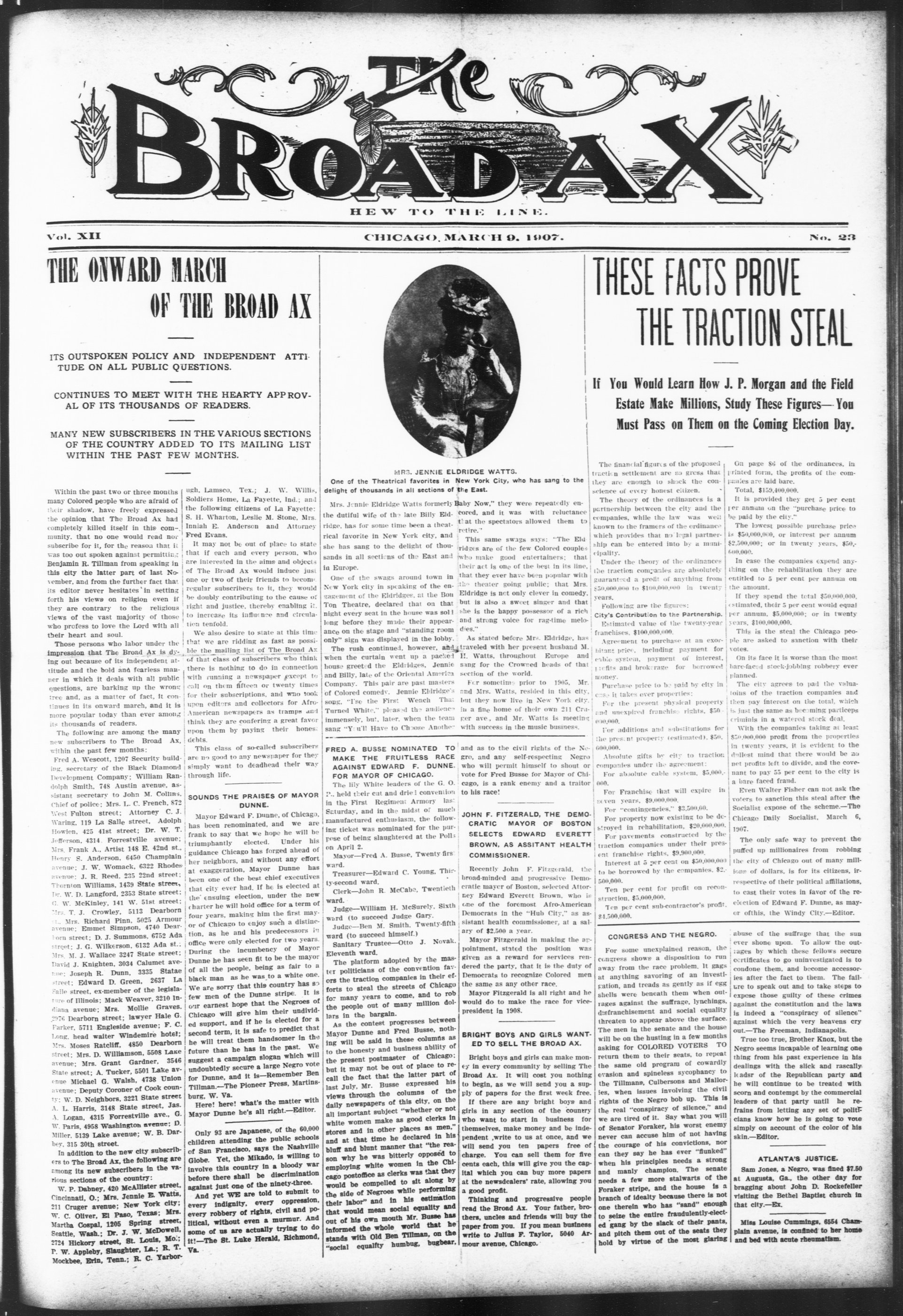
MRS. JENNIE ELDRIDGE WATTS.
One of the Theatrical favorites in New York City, who has sang to the delight of thousands in all sections of the East.
Mrs. Jennie Eldridge Watts formerly the dutiful wife of the late Billy Eldridge, has for some time been a theatrical favorite in New York city, and she has sang to the delight of thousands in all sections of the East and in Europe.
One of the swags around town in New York city in speaking of the engagement of the Eldridges, at the Bon Ton Theatre, declared that on that night every seat in the house was sold long before they made their appearance on the stage and "standing room only" sign was displayed in the lobby.
The rush continued, however, and when the curtain went up a packed house greeted the Eldridges, Jennie and Billy, late of the Oriental America Company. This pair are past masters of Colored comedy. Jennie Eldridge's song, "I See the First Wench That Turned White," pleased the audience immensely, but, later, when the team sang "Y'll Have to Choose Another
FRED A. BUSSE NOMINATED TO MAKE THE FRUITLESS RACE AGAINST EDWARD F. DUNNE. FOR MAYOR OF CHICAGO.
The lily White leaders of the G. O. P., held their cut and dried convention in the First Regiment Armory last Saturday, and in the midst of much manufactured enthusiasm, the following ticket was nominated for the purpose of being slaughtered at the Polls on April 2.
Mayor—Fred A. Busse, Twenty first ward.
Treasurer—Edward C. Young, Thirty-second ward.
Clerk—John R. McCabe, Twentieth ward.
Judge—William H. McSurely, Sixth ward (to succeed Judge Gary.
Judge—Ben M. Smith, Twenty-fifth ward (to succeed himself.
Sanitary Trustee—Otto J. Novaka, Eleventh ward.
The platform adopted by the master politicians of the convention favors the traction companies in their efforts to steal the streets of Chicago for many years to come, and to rob the people out of many million dollars in the bargain.
As the contest progresses between Mayor Dunne and Fred Busse, nothing will be said in these columns as to the honesty and business ability of the present postmaster of Chicago; but it may not be out of place to recall the fact that the latter part of last July, Mr. Busse expressed his views through the columns of the daily newspapers of this city, on the all important subject "whether or not white women make as good clerks in stores and in other places as men," and at that time he declared in his bluff and blunt manner that "the reason why he was bitterly opposed to employing white women in the Chicago postoffice as clerks was that they would be compelled to sit along by the side of Negroes while performing their labor" and in his estimation that would mean social equality and out of his own mouth Mr. Busse has informed the whole world that he stands with Old Ben Tillman, on the "social equality humbug, bugbear,
Baby Now," they were repeatedly enceded, and it was with reluctance that the spectators allowed them to retire."
This same swags says: "The Eldridges are of the few Colored couples who make good entertainers; that their act is one of the best in its line, that they ever have been popular with the theater going public; that Mrs. Eldridge is not only clever in comedy, but is also a sweet singer and that she is the happy possessor of a rich and strong voice for rag-time melodies."
As stated before Mrs. Eldridge, has traveled with her present husband M. H. Watts, throughout Europe and sang for the Crowned heads of that section of the world.
For sometime prior to 1905, Mr. and Mrs. Watts, resided in this city, but they now live in New York city in a fine home of their own 211 Crager ave, and Mr. Watts is meeting with success in the music business.
and as to the civil rights of the Negro, and any self-respecting Negro who will permit himself to shout on vote for Fred Busse for Mayor of Chicago, is a rank enemy and a traitor to his race!
JOHN F. FITZERALD, THE DEMOCRATIC MAYOR OF BOSTON SELECTS EDWARD EVERETT BROWN, AS ASSITANT HEALTH COMMISSIONER.
Recently John F. Fitzgerald, the broad-minded and progressive Democratic mayor of Boston, selected Attorney Edward Everett Brown, who is one of the foremost Afro-American Democrats in the "Hub City," as assistant health commissioner, at a salary of $2,500 a year.
Mayor Fitzgerald in making the appointment, stated the position was given as a reward for services rendered the party, that it is the duty of Democrats to recognize Colored men the same as any other race.
Mayor Fitzgerald is all right and he would do to make the race for vice-president in 1908.
BRIGHT BOYS AND GIRLS WANT
ED TO SELL THE BROAD AX.
Bright boys and girls can make money in every community by selling The Broad Ax. It will cost you nothing to begin, as we will send you a supply of papers for the first week free. If there are any bright boys and girls in any section of the country who want to start in business for themselves, make money and be independent, write to us at once, and we will send you ten papers free of charge. You can sell them for five cents each, this will give you the capital which you can buy more papers at the newsdealers' rate, allowing you a good profit.
Thinking and progressive people read the Broad Ax. Your father, brothers, uncles and friends will buy the paper from you. If you mean business write to Julius F. Taylor, 5040 Armour avenue, Chicago.
THESE FACTS PROVE THE TRACTION STEAL
If You Would Learn How J. P. Morgan and the Field Estate Make Millions, Study These Figures-You Must Pass on Them on the Coming Election Day.
The financial figures of the proposed traction settlement are so gross that they are enough to shock the conscience of every honest citizen.
The theory of the ordinances is a partnership between the city and the companies, while the law was well known to the framers of the ordinance which provides that no legal partnership can be entered into by a municipality.
Under the theory of the ordinances the traction companies are absolutely guaranteed a profit of anything from $50,000,000 to $100,000,000 in twenty years.
Following are the figures:
City's Contribution to the Partnership.
Estimated value of the twenty-year franchises, $100,000,000.
Agreement to purchase at an exorbitant price, including payment for cable system, payment of interest, profits and brokerage for borrowed money.
Purchase price to be paid by city in case it takes over properties:
For the present physical property and unexpired franchise rights, $50,000,000.
For additions and substitutions for the present property (estimated), $50, 600,000.
Absolute gifts by city to traction companies under the agreement:
For absolute cable system, $5,000, 000.
For Franchise that will expire in seven years, $9,000,000.
For "contingencies," $3,500,00.
For property now existing to be destroyed in rehabilitation, $20,000,000.
For pavements constructed by the traction companies under their present franchise rights, $9,900,000.
Interest at 5 per cent on $50,000,000 to be borrowed by the companies, $2, 500,000.
Ten per cent for profit on reconstruction, $5,000,000.
Ten per cent sub-contractor's profit, $4,500,000.
CONGRESS AND THE NEGRO
For some unexplained reason, the congress shows a disposition to run away from the race problem. It gags at anything savoring of an investigation, and treads as gently as if egg shells were beneath them when outrages against the suffrage, lynchings, disfranchisement and social equality threaten to appear above the surface. The men in the senate and the house will be on the husting in a few months asking for COLORED VOTERS TO return them to their seats, to repeat the same old program of cowardly evasion and spineless sycophancy to the Tillmans, Culbersons and Mallories, when issues involving the civil rights of the Negro bob up. This is the real "conspiracy of silence," and we are tired of it. Say what you will of Senator Foraker, his worst enemy never can accuse him of not having the courage of his convictions, nor can they say he has ever "flunked" when his principles needs a strong and manly champion. The senate needs a few more stalwarts of the Foraker stripe, and the house is a branch of ideality because there is not one therein who has "sand" enough to seize the entire fraudulently-elected gang by the slack of their pants, and pitch them out of the seats they hold by virtue of the most glaring
PROVE
ECTION STEAL
J. P. Morgan and the Field
Study These Figures—You
in the Coming Election Day.
On page 86 of the ordinances, in
printed form, the profits of the com-
panies are laid bare.
Total. $159,400,000.
It is provided they get 5 per cent per annum on the "purchase price to be paid by the city."
The lowest possible purchase price is $50,000,000, or interest per annum $2,500,000; or in twenty years, $50,000,000.
In case the companies expend anything on the rehabilitation they are entitled to 5 per cent per annum on the amount.
If they spend the total $50,000,000, estimated, their 5 per cent would equal per annum, $5,000,000; or in twenty years, $100,000,000.
This is the steal the Chicago people are asked to sanction with their votes.
On its face it is worse than the most bare-faced stock-jobbing robbery ever planned.
The city agrees to pad the valuatoins of the traction companies and then pay interest on the total, which is just the same as becoming participes criminis in a watered stock deal.
With the companies taking at least $50,000,000 profit from the properties in twenty years, it is evident to the dullest mind that there would be no net profits left to divide, and the covenant to pay 55 per cent to the city is a bare faced fraud.
Even Walter Fisher can not ask the voters to sanction this steal after the Socialist expose of the scheme.—The Chicago Daily Socialist, March 6, 1907.
The only safe way to prevent the puffed up millionaires from robbing the city of Chicago out of many millions of dollars, is for its citizens, irrespective of their political affiliations, to cast their votes in favor of the reelection of Edward F. Dunne, as mayor of this, the Windy City—Editor.
abuse of the suffrage that the sun ever shone upon. To allow the outrages by which these fellows secure certificates to go uninvestigated is to condone them, and become accessories after the fact to them. The failure to speak out and to take steps to expose those guilty of these crimes against the constitution and the laws is indeed a "conspiracy of silence" against which the very heavens cry out.—The Freeman, Indianapolis.
True too true, Brother Knox, but the Negro seems incapable of learning one thing from his past experience in his dealings with the slick and rascally leader of the Republican party and he will continue to be treated with scorn and contempt by the commercial leaders of that party until he refrains from letting any set of politicians know how he is going to vote simply on account of the color of his skin.—Editor.
ATLANTA'S JUSTICE.
Sam Jones, a Negro, was fined $7.50 at Augusta, Ga., the other day for bragging about John D. Rockefeller visiting the Bethel Baptist church in that city.—Ex.
Miss Louise Cummings, 6554 Champlain avenue, is confined to her home and bed with acute rheumatism.
THE BROAD AX.
will communicate and at all times uphold his true principles of Democracy, and Catholicism, Protestantism, Lutheranism, Farmers, Single Takers, Republicanism of Labor, or any other one can republicanism - their language is proper and the truth is, as a newspaper whose platform is good enough for all, ever claiming the editorial truth is his own mind. Local communications will receive attention. At only one side of the paper.
JU:1U8 F TAYLOR, Editor and Publisher.
Entered at the Post Office at Chicago,
IL, as Second-claim Matter.
PERSONAL MENTION.
Walter M. Farmer, for 16 years an honored member of the bar in St. Louis, Mo., is now engaged in the general practice of law. Suite 708. 171 Washington street, Phone Main 4153. Residence 4856 Langley avenue. Phone Drexel 6302.
MCRE TROUBLE FOR THE SOUTH.
When is a Negro Not a Negro is Now the Absorbing Question in Old Virginia.
Negro Sues Railroad as a Negro and is Declared by the Courts to be a White Man and Loses His Case—Negroes to go to the White Schools and Marry With White Persons—Hard Matter to Draw the Line—May Give Some Trouble in Jim Crow Cars.
From the Washington Heraid.
Richmond. Va., March 3.—According to the laws of Virginia any person having Negro blood in his veins, yet possessed of less than one-fourth of it, is recognized under the statutes as a white man or woman. The people generally hold that one drop of Negro blood makes a Negro, and the solution of the problem bids fair to become an issue in this State in the near future. The Virginia legislative body will assemble in this city next year, and there seems scarcely any doubt but that the existing situation will be brought to the attention of the members.
Recent objections raised by Mrs. W. J. Doss, of Hurts, Pittsburgh county, against children infused with Negro blood being permitted to enter white schools, which complaints were made by letter to Gov. Claude A. Swanson, started the comments among the people of the State, as well as inquiry into the existing laws concerning miscegenation and the intermarriage of whites and blacks in Virginia. The matter has been referred to the superintendent of school for Pittsburgh county.
If the alleged one-seventh of Negro blood in these children is established, it will not prevent their attendance upon the school under the law. The law fixes the limit at one-fourth or more of Negro blood before the child can be called or classed as a Negro.
Enacted by "Carpet-Baggers."
Few people of the present generation are aware that such a law exists. It was enacted by a "carpet-bagger" legislature in 1866, and is not the representative voice of the people of the present day. One section of the old law reads: "A woman whose father was white, and whose mother's father was white, and whose great-grandfather was of brown complexion, is not a Negro in the sense of this statute."
With reference further in the matter the following appears: "A marriage between a white man and a woman who is of less than one-fourth Negro blood, even though it be only one drop less, is legal. A woman whose father was white, and whose mother's father was white, and whose great-grandfather was of brown complexion, is not a Negro in the sense of this statute."
The "carpet-bagger" legislation may conflict with the existing "jim-crow" legislation. In fact, it has, already caused a rupture, the complainant claiming by his mother to be a Negro, was proven by the old law to be a white man, and lost in the litigation. The case was tried in the circuit court of the late Judge Beverly A. Hancock.
The complainant was an octoroon. While traveling by rail he seated himself in a "jim-crow" compartment from which he was ordered by the conductor to move into the white coach. The man demurred, saying he was a Negro. The trainman insisted, saying that he (the passenger) must either leave the coach or be put off the train. The man was finally ejected at a station, whereupon he brought suit against the railroad. He lost his suit on the ground that not having one-fourth Negro blood in his veins, he was, in the eyes
of the laws of Virginia, a white man and not a black man. Abiding by this decision as a precedent, and by the statutes of the code as a fundamental law, there would apparently be no such thing as the general enforcement of the "jim crow" law in Virginia. Having so far sought in vain for any amendment of those statutes, as set forth and embodied in the code of Virginia, several inquiring lawyers are beginning to look into the future. They hold that in spite of the best laid schemes to prevent the emgalamination of the two races, such a law, practically legalizing the inter-marriage of the whites and the blacks, will certainly endanger the long existence of the one or the other.
URGES UPRISING OF BLACKS.
Negro Bishop Attacks Roosevelt and
Unges Resort to War.
President Rocsevelt was characterized as "the coward in the white house," and then, while a large gathering of Negro men and women applauded the sentiment, a Negro bishop advocated an armed uprising of the blacks in the United States. Bishop Alexander Walters of the Afro-American council was the speaker, the place was the African Methodist Episcopal church at Thirty-eighth and Dearborn streets and the time was last night.
Never in the city of Chicago has an armed uprising been so publicly advocated by a speaker of such prominence among his people and never has the advocacy been so enthusiastically received by the auditors.
War as a Last Resort.
Only as a last recourse, however, would the bishop resort to war. Education, the seeking after wealth, moral training for the young and strong religious faith were first to be relied upon, he said.
Bishop Walters devoted an hour and one-half setting forth the doctrines of the Afro-American council and his personal views on such matters as the recent Brownsville raid and the spirit of race prejudice. His strongest utterances were directed against President Roosevelt, charging the latter with underhand and treacherous acts against the black race.
He touched upon the case in a recent Chicago election in which he alleged that Mr. Barnett, the Negro candidate for the judgeship, had been rightfully elected and then counted cut and followed this with references to a number of incidents in public affairs and social customs in which he claimed discrimination is shown by the white citizens against the Negro people. He said steps should be taken by the blacks to guard against disenfranchisement.
President Roosevelt Assailed.
President Roosevelt Assured.
After assailing the president, Senator Tillman, Thomas Nelson Page and other prominent men for their unfavorable attitude toward Negroes and for articles in magazines the prelate ended his discourse by declaring that the council he represents is now in possession of conclusive proof that the Brownsville affair was the work of white men and that the black soldiers affected were innocent victims of a plot. He said further that the council is now almost sure of being able to produce the names of the white men who committed the outrage.
The bishop was preceded in his lecture by a spirited introduction from Rev. A. J. Carey, in which the latter made the reference to President Roosevelt as "the coward in the white house."—The Chicago Chronicle Friday March 8.
More Prominent Afro-Americans Come Out In Favor of the Re-election of Edward F. Dunne as Mayor of Chicago.
Mark Cowan, John Laeflett, Frank P. George, Dr. Leonard Lewis, Dr. A. York, Samuel Evans, Robt. Lamar, Fred Logan, Wm. H. Riley, Wm. Sherman Blackwell, Dr. W. D. Langford, W. L. Sledge, Will Rawlins, G. F. Von Chin, ( S. C. Reeves, Abe Jones, Robt. Turner, Richard Campbell, George Holly, Dr. D. E. Bass, Turner Williams, Thos. Parsons, David Newby, W. M. McGee, T. J. Green, James Steele, A. Furgeson, Hugh Fields, Clarence Bramblet, Edwin Perkins, W. M. McCullough, James Allen, Harry Bower, Wm. Bush, John Trott, Wm. P. Bell, W. H. Davis, Fred D. Brown, Will Moran, Benny F. Hoxter, Vesley Turner, John Baker, J. W. Matthews, Major Kalton, J. Claxton, Chas. Valley, W. J. Winfrey, Isaac Silas Garfield Scott, J. M. Hall, R. W. Hall, Beverly Randolph, J. S. Pogne, Dr. A. B. McKissack, and Dr. McKinley.
DEATH CLAIMED MOTHER AND BABY.
Mrs. Ophelia Tibbs Hamilton, of Danville, Ky., youngest sister of Mrs. A. Wilberforce Williams, of this city, and Mrs. J. W. Neeley of Buxton, la., died Sunday morning, March 3, in child birth. Mrs. Hamilton visited Chicago during the summer of 1905. She made many good, loyal and warm friends while here.
She was educated at Berea College, Ky., and took music at the State Normal, Frankfort, Ky.
She was married to Dr. R. B. Hamilton, a successful dentist of Danville, in April, 1902. Mrs. Hamilton brought sunlight and cheer to all whom she come in contact. She was a devout Christian.
She leaves a dear mother, two brothers and two sisters.
Mrs. A. Wilberforce Williams and Miss Garnetta Tibbs left Sunday night for Danville, Mrs. J. W. Neeley and Mr. O. B. Tibbs, of Buxton, Ia., passed through Chicago Monday night for Danville. Dr. A. Wilberforce Williams left Tuesday night for Danville to be at the funeral services of his sister-in-law, Mrs. Hamilton, Wednesday at 2 o'clock p. m.—"E."
THE NEW COLORED INDUSTRIAL
SCHOOL IN CHICAGO.
We have a Colored Industrial School located at 249 26th street, in this city, for the training of those in the race who wish to learn trades We teach millinery, dressmaking, carpentering, printing, shoe-making, music, hairdressing, mattress-making, blacksmithing, public speaking and various other useful means of earning a livelihood and learning to enjoy the blessings of life.
If there has ever been a time for our people to unite as a race and strive to become as one it is now. I see no other way for our people to become a professional training as well become an intelligent and powerful race unless they receive a professional training as well as an education. The mothers and fathers should urge their children to attend this institution. We are trying to reach everybody. Our school is open evenings for those who can not attend in the day.
I see no other means by which the Negro race problem can be solved. It is true as it has been stated that our race has made rapid progress in spite of obstacles and hindernances which has confronted it; but it has not yet reached its zenith in intelligence and success. I am of the opinion that we must help ourselves and not depend solely upon others. If we ever compete with others, we must unite. There is no reason why we should not know and be able to practice with the success the other races do, any profession or trade or business of any kind.
We urge every father and mother who is interested in bringing the children in from the streets, that they may be taught the different methods of earning an honest living, to see to it that their children attend this school from the age of ten (10) years up.
Hours from 7 to 9 p.m.
THE INDEPENDENCE LEAGUE'S ALDERMANIC CANDIDATES.
The Independence League, is booming the following Aldermanic candidates in the various wards:
1—Charles W. Espey, Ind., L.
2—George F. Harding, Rep.
3—F. J. Halbeisen, Dem.
4—John W. McNeal, Dem.
5—Frank Heppelman, Ind., L.
6—Dr. Byron S. Turner, Dem. and
Ind. L.
7—Clarence A. Toolen, Dem.
8 —John H. Mack, Dem.
10—Joseph F. Triska, Ind. L.
11—Charles Moertel, Ind. L.
12—Michael Zimmer, Dem.
13—Harry Woods, Ind. L.
15—Herman Krueger, Dem.
17—Lewis D. Sitts, Rep.
19—Tom Yore, Ind. L.
21—Dr. Lliston H. Montgomery, Ind. L.
22—George P. Crowe, Ind. L.
23—Frederick Schwindler, Ind. J.
24—John Haderlein, Dem.
28—Francis C. Connery, Dem.
29—John Downey, Dem.
31—P. J. O'Connell, Dem.
32—E. B. Brown, Dem.
33—Axel R. Runsten, Dem.
34—Joseph F. Kohout, Dem.
A Good Home for Children.
Wanted children, either White or Colored to board and room, they will receive the care of a good mother; charges reasonable. Mrs. L. Coleman, 2830 Armour Ave., 2d flat.
CHIPS
Robert A. Williams, 3544 Dearborn st., is confined to his home with a slight spell of sickness.
Some Negroes are born fortunate, some achieve fortune and some make use of "the ballot" to show the politicians where they stand.
Mrs. Grace Hunter, 5002 Armour avenue, gave a birthday party Thursday evening in honor of her many friends.
Alderman John Burns, has again been selected to make the race for the City Council in the 30th ward, and he looks like a winner!
John Q. Grant 3232 Wabash ave., one of the oldest citizens in Chicago, is confined to his home with a severe attack of paralysis.
Mr. John Auter, of Evanston, left for the east the first of the week. It is rumored he will return with a charming bride about the latter part of this month.
Mr. and Mrs. Wm. Buckner, has returned to the city for a little rest after a very busy and successful tour through the western states, with their jubilee singers.
John H. Mack Democratic candidate for Aldeman in the 8th ward, should be elected to the City Council, for he is a successful business man, and engaged in the printing business at 111 Sherman st.
The Old Oak Inn, corner 51st and Decarbon streets, which is conducted by W. R. Carson, is doing a thriving business and shortly he will commence the construction of a roofgarden, and when finished it will be run in first-class style.
---
Mayer Dunne of Chicago, has been nominated by the Democrats of that city and his chances of reelection are very bright. He has been exceptionally kind to the Negroes in the way of recognition, and it is most likely that he will secure the support of a large number of Negro votes.
In that section the Democrats seek the Negro vote, and when they get it, they don't forget the Negro when they go up to the pie counter.—The Star, Newport News, Va.
Cowen's "Rose Maiden" was fairly well rendered by the "Choral Study Club" Monday evening at the Institutional church. Directed by Pedro T. Tinsley, and admirably assisted by a picked orchestra.
Mme. Patti Dean Brown, soprano, Oreina J. Howard, contralto; Messrs. J. Gray Lucas and Frank B. Waring, tenor and baritone, respectively, showed excellent voice training in their solo work. Mmes. Brown and Howe are deserve especial mention because of the good control they had of their sweet voices. The chorus plainly showed a lack of sufficient practice, but the large audience was appreciative because of the great efforts on the part of the club to raise the standard of music for the music-lovers of this community. We have no doubt but that the same audience would assemble again the hear the "Rose Malden," by the Choral Study Club, providing the directors would assure them that the club had been thoroughly rehearsed by their able and earnest director—"T."
What grew my hair where it was not and covered up a bad bald spot. Farmer's Hair Tonic and Cream. Prof. W. Kemper Harreld, who puts in much of his time in hanging around the Frederick Douglass Center, is still holding on to the five dollars which should be coming our way.
FARMER'S HAIR TONIC AND CREAM.
When all else fails try Farmer's hair tonic and cream. On sale at The Peoples' Pharmacies 29th and Armour Ave., and 27th and Dearborn Streets, also at 4832 and 4856 Langley Ave.
L. W. Washington, General Agent for The Broad Ax in the Hyde Park District.
From on and after this date until further notice to the contrary, L. W. Washington, 5613 Jefferson avenue will act as the general agent for The Broad Ax, and news items and advertisements left with him not later than Wednesday evening or early Thursday morning prior to the day of publication will find their way into its columns.
AERIAL NAVIGATION.
"Heavier Than Air" Flying Machines Now the Goal of Inventors. Prizes aggregating many thousands of dollars for the production of a flying machine of the "heavier than air" variety, offered by English and French enthusiasts, have caused great activity among would be inventors, and some of the most prominent aeronautic experts predict that the year just begun will be marked by remarkable advances in the science and practice of aerial flight. To the gasoline engine and to the extraordinary mechanical progress made in automobilitism is due the hope that something definite and worthy may be achieved by those who seek to solve the problem of aerial traveling.
The ordinary balloon, it is agreed, has little practical value save as an exerting form of sport and for purposes of observation in calm weather. In anything like a stiff breeze it is the sport of the winds and quite useless from a practical point of view. Better things are said of the cigar shaped contrivances utilizing both the gas bag and the gasoline engine. Six years ago Santos-Dumont was able to steer an airship of this kind around the Elfid tower, running with and against the wind. Since that time hundreds of similar steerable balloons have been built in France until today they are nearly as common as the spherical gas bag. Nevertheless it is realized that these are far from representing a solution of the problem of practical navigation of the air. They have, in fact, only stimulated the desire for something that will represent a radical improvement, such as the successful "heavier than air" vessel would be. The latter would mean, naturally, a dirigible vessel which could be driven in any kind of weather and in any desired direction. A fortune in prizes already awaits the inventor of such a vessel, to say nothing of the monetary return in a business way. Two prizes of $2,000 each, one in England, the other in France, await the inventor of the successful aeroplane.
The mechanical difficulties in the way of producing a perfectly dirigible airship are immense because of the number of contingencies that must be provided for in traveling through such a mobile and treacherous element as the air. Machinery that can be depended on not to fall and precipitate the "heavier than air" machine to the earth is the most necessary qualification, but this can be provided, it is known, if the method of propulsion can be invented. The screw propeller idea is by no means ideal because of its great bulk, its poor lifting power and its enormous waste of energy. A flapping propeller, moving from side to side, seems to give promise, but many sound thinkers favor an approximation to the bird method of flight, though serious difficulties lie in the way of converting circular motion derived from a motor into the complicated and various motions performed by the wings of a bird. Even if such motion could be approximated by mechanical means great skill would be required in directing the controlling mechanism, as the constantly changing aerial conditions would have to be instinctively provided against.
Toy models working after the manner of a bird's wings have successfully traveled a few yards, but have failed of success when enlarged to any extent. That the air is a region in which man can travel has been proved, however, and that under conditions he can sail or fly through it by the aid of mechanical power has also been demonstrated, but many years are likely to elapse before any practical method of aerial navigation can be attained. It is a problem that will not be solved hurriedly, but that a solution will come eventually is now almost a settled conviction with students of aeronautics, and the incentives offered abroad within the past few months give the hope that great progress, if not actual achievement, will mark the current year.—New York Sun.
London Theater Cleaners.
The housemaids, or, in theatrical language, the cleaners of a theater, if an average were taken of London theaters, would number a dozen. Every day the whole of the auditorium has to be swept and dusted, and the actors' dressing rooms cleaned and made ready for their occupation at night. The work is under the superintendence of a housekeeper, who gets a salary of at least £3 a week, while each cleaner gets about £1. There are many ladies' maids to each theater who are known as dressers. To each dressing room there is at least one, and the pay is the same throughout the whole company-2 shillings for each performance, exclusive of the tips.-London Leader.
To Help the Divers-
The difficulty a diver experiences in lifting weights beneath the water is partly overcome by a new Italian invention, which has been formally adopted by that government. The mechanism is a diving suit, the artificial arms of which are worked from the inside by the wearer. The leverage thus secured enables the diver to lift objects heavier than he could otherwise handle. In addition to this improvement over the old method, a high power electric light that will penetrate the water for some distance is placed in the helmet.
Oxen as Racers.
Attempts are being made in France to train oxen for saddle riding, and several races have been organized to test their capacity. They have been trained not only as racers on the flat, but also as successful jumpers. The bridle and saddle used are almost similar in general design to those for hunters.
PLAYS AND PLAYERS.
Emma Janvier has signed with the Shuberts to appear in "The Orchid."
As soon as Katie Barry's contract with Keith & Proctor expire in the spring she will leave on a year's tour around the world.
Ernest Stallard, an English actor for six years with E. S. Willard, has been engaged to appear with Hennard Crosman in "All-of-a-Sudden Poggy."
Reeves Smith has sailed for London taking with him Brady's production of "The Redskin," to be offered in England under the title of "The Last of His Race."
The famous dramatist, Victorien Sardon, has been nominated for the grand cross of the Legion of Honor. His in-law, also a well known playwright, has been decorated with the cross of chevalier of the Legion of Honor.
A creditable "bit" is that done in "Caught In the Rain" by Jane Lancey an Ethel Barrymoreish young woman who rarely speaks. The agony that she causes Mr. Collier during a five minute chat is one of the best things in the piece.
Mme. Nazimova, now appearing Nora in "A Doll's House" in New York has eclipsed her performance as Heidi Gabber. Beautiful, graceful, possessing intellect and acting ability of the highest order, she is hailed as greater the Bernhardt, more realistic than Dice.
SHORT STORIES
In Chile all mining land belongs to the state.
The nearest approach to peatbed motion is a church clock at El Paso, which is wound by sun heat expansion.
White pine timbers 100 feet long, twenty-six inches square are being shipped from the state of Washington to Barre, Vt. These timbers occupy three flat ears.
The Kosciusko statute to be enacted opposite the White House in Washington represents the famous Pile of an engender with a heap in one hand on a glass in the other.
A floating target has been constructed by the government for practice in Sandy Hook. It is made of hard steel plates, weighing ninety tons, and it closely resembles a section of a floating ship.
Shipments of apples from the United States to Brazil via Europe have arrived in good condition. The direct American ships to Brazil are old freighters which cannot carry cell storage freight.
EDITORIAL FLINGS.
Dr. Felix Adler says that the desti-
for wealth is a form of insanity. It
follows, then, that the only same peo-
ple are in the lunatic asylums—Roche-
ster Post-Express.
At $5,000 a year it would require 290
years to accumulate $1,600,000. Members
of congress may now become mil-
lionaires in 153 years if they save their
money.—Kansas City Star.
“The Herald will attempt no deface
of the split infinitive,” says the Boston
Herald. But what is to become
of the split infinitive if Boston passes
it up?—Washington Herald.
A Broadway merchant testified the
other day that his wife is boss, and
there is this difference between him
and those who laugh at him. He has
the courage to admit it.—New York
Herald.
GERMAN GLEANINGS.
In north Germany 220,000 pounds weight of amber is dug yearly.
Appendicitis has made such steady progress in Germany from year to year that medical societies have taken it up for special extended study.
Prussia is said to favor a tax or impost on ships passing up and down German rivers. The object of the measure would be to increase the price of imported grain, thus favoring the empire's farmers.
In Germany 3 women are employed as chimney sweeps, 7 as gunsmiths, 19 as brass and bell founders, 147 as perspersmiths, 379 as farriers and nailers, 309 as masons, 8 as stonecutters, 2,000 in marble, stone and slate quarries. In all 5,500,000 women earn their living in trades and professions.
MODES OF THE MOMENT.
Silk gowns for both daytime and evening wear are to be very fashionable.
Plain brussels net veils, with lace borders spotted with chenille dots, are said to be the successors to the net veil with the narrow plaited ruffle.
The circular cloak is prophesied for future evening wraps. Already they are assuming shawl-like lines, and even kimono sleeves will not do if larger sleeves underneath on the evening gowns are to come into vogue.
Robe dresses in lawns, moussellines and chiffon are features of spring fashions. Most of these have floral or conventional designs over them, while the border near the edge usually introduces a new but harmonizing color in its rather oriental execution.
FACTS FROM FRANCE.
The first omnibuses which ran in Paris, in 1662, charged a fare of 5 sous. The French law treats a frog as a fish and declares all fishing for it by night to be poaching. The new French twelve inch gun is claimed to have the greatest penetrative power of any gun yet made. It pierces at the muzzle fifty-four inches of wrought iron or ten and a half inches of Krupp steel at three and a half miles.
BREVITIES
THE HALL OF FAME
Nicolo Puccini, the Italian composer, holds the record of having written no fewer than 134 operas. He was born in 1728.
F. H. Brown of Montpellier, Vt., has a "banjo clock" 105 years old, invented by the Willards of Boston. After a twenty-six year rest the clock is keeping excellent time.
H. W. Potter of Kingman claims the record for log hauling in eastern Maine. On Jan. 12 he hauled with seventeen teams 52,700 feet, which made an average of 3,100 feet per load.
A recent old folks' concert in Brockton, Mass., had as a feature the singing of Ellis Holmes, who is in his ninety-second year. For a large part of a century Mr. Holmes has been a bass singer.
John Stevens of Washington, Pa., was forced to dig his way through a solid wall of coal and debris twenty feet thick in order to escape from a mine in which he was imprisoned. His only tool was an iron pointed pick handle.
Professor Kuno Francke, curator of the Germanic museum at Harvard university, has received information from the German embassy at Washington that Emperor William has conferred upon him the Order of the Crown of the Second Class.
The elder Salvini has just had judgment confirmed in the New York courts by which he recovers $20,000 from the managers who failed to make good their contract with him for a tour here in 1901. Salvini is now seventy-eight years of age.
William P. Letchworth, whose gift of 1000 acres at Portage Falls, on the Genesee river, for a public park has been accepted by New York state, is an adopted member of the Seneca tribe of Indians and bears the tribal name Hai-wa-ls-tah (The man who always does the right thing).
Henry Squires, who recently died in Burlington, Ia., was at one time recognized as the greatest tenor singer in America. He began his musical career in Burlington, Vt., in 1825, and sang in numerous grand opera troupes and traveled all over the world. He sang in concert with Jenny Lind and in opera with Carlotta Patti.
Living together on a farm at Putney, Vt. are three brothers whose ages aggregate 250 years. They are Ira, aged eighty-six; William, eighty-three years old, and Willard Smith, who has lived eighty-one years. These brothers are living on the farm where they were born and none of them has ever been more than thirty miles from Putney.
ENGLISH ETCHINGS.
London's imports by sea are over 174,000,000 tons yearly.
England was first divided into shires in the seventh century A. D.
The average life of a London house is at the outside two centuries.
Before the Norman conquest Winchester, not London, was the capital of England.
It is quite legal in England for a child to be christened by a single letter instead of a name.
The wives of knights and baronets have no right to the title of "lady," but have the designation of "dame."
A London firm of electroplate makers has in its service eighteen men and women who have been working for it from fifty-six to sixty years.
Under the Black Prince officers received 4 shillings a day and common soldiers twopence. The purchasing power of money was then about fourteen times what it is now.
Prior to the dissolution of the monasteries by Henry VIII. sixty-four abbots and thirty-six priors sat in the house of lords, and spiritual, peers entirely outnumbered the temporal.
MONEY.
Norway even now uses corn for currency.
Absolutely pure gold is twenty-four carats fine.
Sheep and oxen among the old Romans took the place of money.
In India cakes of tea pass as currency, and in China pieces of silk.
In some districts of New Guinea female slaves form the standard of value.
Seashells were the earliest forms of money, the skins of animals coming next as a substitute.
It is an interesting fact that the Japanese coins in the matter of fineness are superior to all others.
The Icelandic and Irish laws yet have traces of the use of cattle for money. Many Teutonic fines were paid in cattle.
In the days of 1849 of California the ounce of pure gold ($16.50) formed the common medium of exchange. Another interest form of money was a lump of gold, called a slug, equalling just $50.
OLD FASHIONED.
What has become of the old fashioned man who called it "stone coal?" An old fashioned woman has very little confidence in medicine that tastes good. What has become of the old fashioned girl who was ever ready to "faint away?" What has become of the old fashioned woman who always opened the tremolo stop of her voice when she sang? What has become of the old fashioned man who went into a grocery store and inquired, "Is your scales right?" - Atchison Globe
THE PRESAGE OF GREATNESS
My frand, you say "Hallo!" to me
Een socha kinda way
I know dat you are gona be
Da greata man som' day.
You are so smarta 'Merican,
You need no speak at all
To poor old dumba Dago man,
Baycause he ees so small
Een deea beega ceety. Steell
You small to me,
An', oh my, frand, you mak' me feel
So proud as I can be!
Wan time w'en w'en you younga man
An' leavee w'en Eetaly
Ees 'nudder you hak'
Now, wat you s'pose baycome of dee
Gran' man I know at home?
Look! See, my frend! Today he ees
Da greata pope een Rome!
-T. A. Daly in Catholic Standard and Times
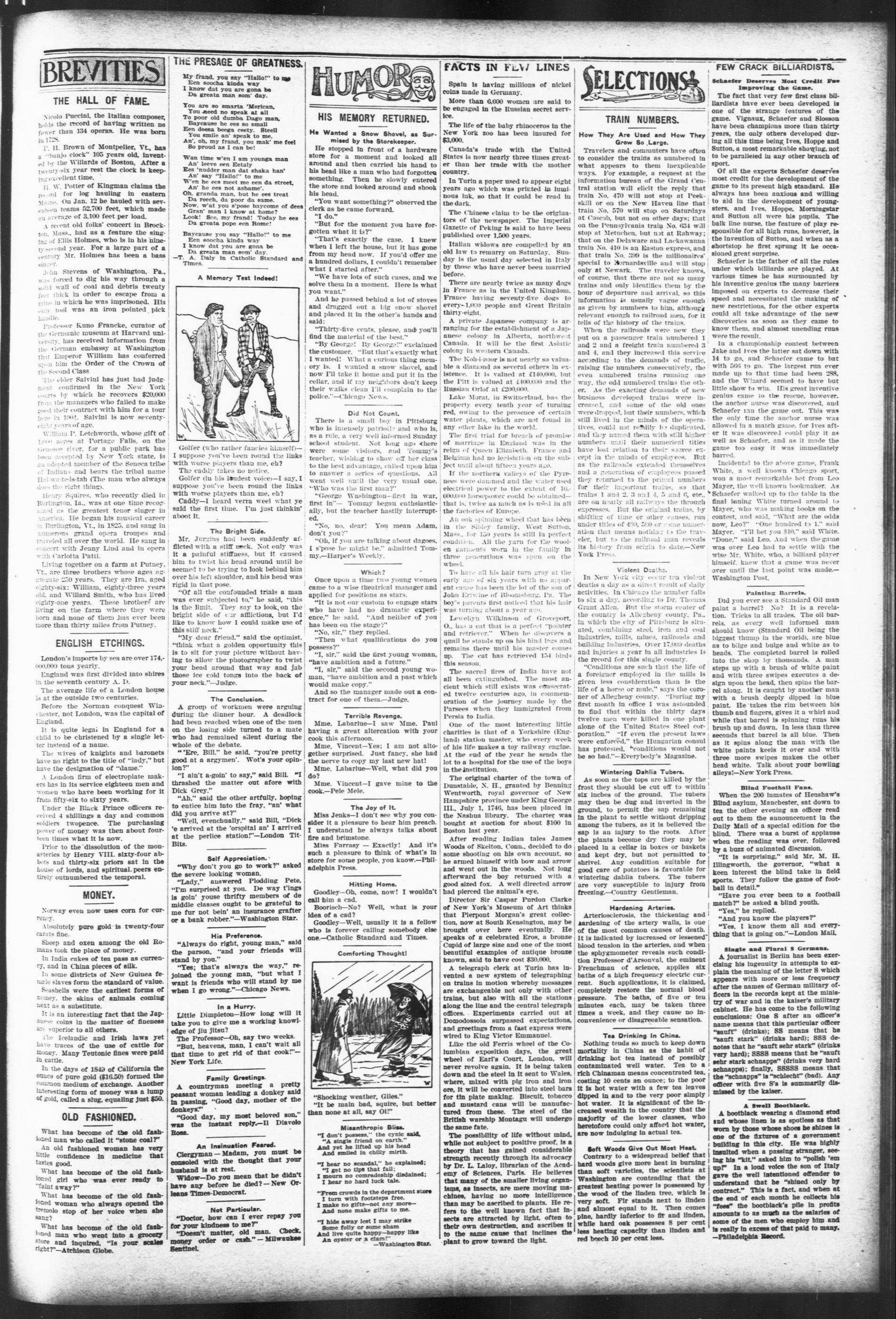
A Memory Test Indeed!
Golfer (who rather fancies himself)—
I suppose you've been round the links
with worse players than me, eh?
The caddy takes no notice.
Golfer in his loudest voice—I say, I suppose you've been round the links with worse players than me, eh? Caddy—I heard vera weel what ye said the first time. I'm just thinkin' about it.
The Bright Side.
Mr. Juzzins had been suddenly afflicted with a stiff neck. Not only was it a painful stiffness, but it caused him to twist his head around until he seemed to be trying to look behind him over his left shoulder, and his head was rigid in that pose.
"Of all the confounded trials a man was ever subjected to," he said, "this is the limit. They say to look on the bright side of car afflictions, but I like to know how I could make use of this stiff neck."
"My dear friend," said the optimist, "think what a golden opportunity this is to sit for your picture without having to allow the photographer to twist your head around that way and jab those ice cold tongs into the back of your neck."—Judge.
The Conclusion.
A group of workmen were arguing during the dinner hour. A deadlock had been reached when one of the men on the losing side turned to a mate who had remained silent during the whole of the debate.
“Ere, Bill,” he said, “you’re pretty good at a argymen’. Wot’s your opinion?”
“I ain’t a-goin’ to say,” said Bill. “I thrashed the matter out afore with Dick Grey.”
“Ah,” said the other artfully, hoping to entice him into the fray, “an’ what did you arrive at?”
“Well, evenchually,” said Bill, “Dick e’arrived at the 'orsipital an’ I arrived at the perlice station!”—London Tit-Bits.
Self Appreciation.
"Why don't you go to work?" asked the severe looking woman.
"Lady," answered Plodding Pete,
"Tm surprised at you. De way tings is goin' youse thrifty members of de middle classes ought to be grateful to me fur not bein' an insurance grafter or a bank robber."—Washington Star.
His Preference.
"Always do right, young man," said the parson, "and your friends will stand by you." "Yes; that's always the way," rejoined the young man, "but what I want is friends who will stand by me when I go wrong."—Chicago News.
In a Hurry.
Little Dimpleton—How long will it take you to give me a working knowledge of jiu jitsu?
The Professor—Oh, say two weeks.
"But, heavens, man, I can't wait all that time to get rid of that cook!"—New York Life.
Family Greetings.
A countryman meeting a pretty peasant woman leading a donkey said in passing. "Good day, mother of the donkeys."
"Good day, my most beloved son," was the instant reply.—Il Diavolo Rosa.
An Insinuation Feared.
Clergyman—Madam, you must be consololed with the thought that your husband is at rest.
Widow—Do you mean that he didn't have any before he died?—New Orleans Times-Democrat.
Not Particular.
"Doctor, how can I ever repay you for your kindness to me?"
"Doesn't matter, old man. Check, money order or cash." - Milwaukee Sentinel.
HUMOR
HIS MEMORY RETURNED
He Wanted a Snow Shovel, as Surmised by the Storekeeper.
He stopped in front of a hardware store for a moment and looked all around and then carried his hand to his head like a man who had forgotten something. Then he slowly entered the store and looked around and shook his head.
"You want something?" observed the clerk as he came forward.
"I do."
"But for the moment you have forgotten what it is?"
"That's exactly the case. I knew when I left the house, but it has gone from my head now. If you'd offer me a hundred dollars, I couldn't remember what I started after."
"We have lots of such cases, and we solve them in a moment. Here is what you want."
And he passed behind a lot of stoves and dragged out a big snow shovel and placed it in the other's hands and said: "Thirty-five cents, please, and you'll find the material of the best." "By George! By George!" exclaimed the customer. "But that's exactly what I wanted! What a curious thing memory is. I wanted a snow shovel, and now I'll take it home and put it in the cellar, and if my neighbors don't keep their walks clean I'll complain to the police."-Chicago News.
Did Not Count:
There is a small boy in Pittsburgh who is intensely patriotic; and who is, as a rule, a very well informed Sunday school student. Not long ago there were some visitors, and Tommy's teacher, wishing to show off her class to the best advantage, called upon him to answer a series of questions. All went well until the very usual one. "Who was the first man?" "George Washington—first in war, first in"—Tommy began enthusiastically, but the teacher hastily interrupted. "No, no, dear! You mean Adam, don't you?" "Oh, if you are talking about dagoes, I s'pose he might be." admitted Tommy.—Harrer's Weekly.
Which?
Once upon a time two young women came to a wise theatrical manager and applied for positions as stars.
"It is not our custom to engage stars who have had no dramatic experience," he said. "And neither of you has been on the stage?"
"No, sir," they replied.
"Then what qualifications do you possess?"
"I, sir," said the first young woman, "have ambition and a future."
"I, sir," said the second young woman, "have ambition and a past which would make copy."
And so the manager made out a contract for one of them--Judge.
Terrible Revenge.
Mme, Labarlue—I saw Mme, Paul having a great altercation with your cook this afternoon.
Mme, Vincent—Yes; I am not altogether surprised. Just fancy, she had the nerve to copy my last new hat!
Mme, Labarlue—Well, what did you do?
Mme, Vincent—I gave mine to the cook—Pele Mele.
The Joy of It:
Miss Jenks—I don't see why you consider it a pleasure to hear him preach. I understand he always talks about fire and brimstone.
Miss Farrasy — Exactly! And it's such a pleasure to think of what's in store for some people, you know.—Philadelphia Press.
Hitting Home.
Goodley—Oh, come, now! I wouldn't call him a cad.
Boorisch—No? Well, what is your idea of a cad?
Goodley—Well, usually it is a fellow who is forever calling somebody else one—Catholic Standard and Times.
Comforting Thought!
"Shocking weather, Giles."
"It be main bad, squire, but better than none at all, say Oi!"
Misanthropic Bliss
"I don't possess," the cynic said,
"A single friend on earth."
And yet he lifted up his head
And smiled in chilly mirth.
"I hear no scandal," he explained;
"I get no tips that fall;
I mourn no comradeship disdained;
I hear no hard luck tale.
"From crowds in the department store
I turn with footsteps free.
I make no gifts—not any more—
And none make gifts to me.
"I hide away lest I may strike
Some folly or some sham
And live quite happy—happy like
An oyster or a clam!"
FACTS IN FLV LINES
Spain is having millions of nickel coins made in Germany.
More than 6,000 women are said to be engaged in the Russian secret service.
The life of the baby rhinoceros in the New York zoo has been insured for $3,000.
Canada's trade with the United States is now nearly three times greater than her trade with the mother country.
In Turin a paper used to appear eight years ago which was printed in luminous ink, so that it could be read in the dark.
The Chinese claim to be the originators of the newspaper. The Imperial Gazette of Peking is said to have been published over 1,500 years.
Italian widows are compelled by an old law to remarry on Saturday. Sunday is the usual day selected in Italy by those who have never been married before.
There are nearly twice as many dogs in France as in the United Kingdom, France having seventy-five dogs to every-1,000 people and Great Britain thirty-eight.
A private Japanese company is arranging for the establishment of a Japanese colony in Alberta, northwest Canada. It will be the first Asiatic colony in western Canada.
The Kohl-moor is not nearly so valuable a diamond as several others in existence. It is valued at £140,000, but the Pitt is valued at £400,000 and the Russian Orfet at £200,000.
Lake Morat, in Switzerland, has the property every tenth year of turning red, owing to the presence of certain water plants, which are not found in any other lake in the world.
The first trial for breach of promise of marriage in England was in the reign of Queen Elizabeth. France and Belgium had no legislation on the subject until about fifteen years ago.
If the northern valleys of the Pyrenees were dammed and the water used electrical power to the extent of 10,000,000 horsepower could be obtained—that is, twice as much as is used in all the factories of Europe.
An oak spinning wheel that has been in the Sibylle family, West Sutton, Mass., for 150 years is still in perfect condition. All the yarn for the woolen garments worn in the family in three generations was spun on the wheel.
To have all his hair turn gray at the early age of six years with no apparent cause has been the lot of the son of John Ertwine of Bloomsburg, Pa. The boy's parents first noticed that his hair was turning about a year ago.
Lewelyn Wilkinson of Groveport, O., has a cat that is a perfect "pointer and retriever." When he discovers a quill he stands up on his bind legs and remains there until his master comes up. The cat has retrieved 154 birds this season.
The sacred fires of India have not all been extinguished. The most ancient which still exists was consecrated twelve centuries ago, in commemoration of the journey made by the Parsees when they immigrated from Persia to India.
One of the most interesting little charities is that of a Yorkshire (England) station master, who every week of his life makes a toy railway engine. At the end of the year he sends the lot to a hospital for the use of the boys in the institution.
The original charter of the town of Dunstable, N. H., granted by Benning Wentworth, royal governor of New Hampshire province under King George III., July 1, 1746, has been placed in the Nashua library. The charter was bought at auction for about $100 in Boston last year.
After reading Indian tales James Woods of Skelton, Conn., decided to do some shooting on his own account, so he armed himself with bow and arrow and went out in the woods. Not long afterward the boy returned with a good sized fox. A well directed arrow had pierced the animal's eye.
Director Sir Caspar Purdon Clarke of New York's Museum of Art thinks that Pierpont Morgan's great collection, now at South Kensington, may be brought over here eventually. He speaks of a celebrated Eros, a bronze Cupid of large size and one of the most beautiful examples of antique bronze known, said to have cost $30,000.
A telegraph clerk at Turin has invented a new system of telegraphing on trains in motion whereby messages are exchangeable not only with other trains, but also with all the stations along the line and the central telegraph offices. Experiments carried out at Domodossola surpassed expectations, and greetings from a fast express were wired to King Victor Emmanuel.
Like the old Ferris wheel of the Columbian exposition days, the great wheel of Earl's Court, London, will never revolve again. It is being taken down and the steel in it sent to Wales, where, mixed with plg iron and iron ore, it will be converted into steel bars for tin plate making. Biscuit, tobacco and mustard cans will be manufactured from these. The steel of the British warship Montagu will undergo the same fate.
The possibility of life without mind, while not subject to positive proof, is a theory that has gained considerable strength recently through its advocacy by Dr. L. Laloy, librarian of the Academy of Sciences, Paris. He believes that many of the smaller living organisms, as insects, are more moving machines, having no more intelligence than may be ascribed to plants. He refers to the well known fact that insects are attracted by light, often to their own destruction, and ascribes it to the same cause that inclines the plant to grow toward the light.
SELECTIONS
TRAIN NUMBERS
How They Are Used and How They Grow So Large.
Travelers and commuters have often to consider the trains as numbered in what appears to them inexplicable ways. For example, a request at the information bureau of the Grand Central station will elicit the reply that train No. 470 will not stop at Peekskill or on the New Haven line that train No. 570 will stop on Saturdays at Cosecob, but not on other days; that on the Pennsylvania train No. 634 will stop at Metuchen, but not at Rahway; that on the Delaware and Lackawanna train No. 410 is an Easton express, and that train No. 330 is the millionaires' special to Bernardsville and will stop only at Newark. The traveler knows, of course, that there are not so many trains and only identifies them by the hour of departure and arrival, so this information is usually vague enough as given by numbers to him, although relevant enough to railroad men, for it tells of the history of the trains.
When the railroads were new they put on a passenger train numbered 1 and 2 and a freight train numbered 3 and 4, and they increased this service according to the demands of traffic, raising the numbers consecutively, the even numbered trains running one way, the old numbered trains the other. As the exacting demands of new business developed trains were increased, and some of the old ones were dropped, but their numbers, which still lived in the minds of the operatives, could not readily be duplicated, and they named them with still higher numbers until their numerical titles have lost relation to their source except in the minds of employees. But as the railroads extended themselves and a generation of employees passed they returned to the primal numbers for their important trains, so that trains 1 and 2, 3 and 4, 5 and 6, etc. are on nearly all the railways through expresses. But the original trains, by shifting of time or other causes, run under titles of 400, 500 or some numeration that means nothing to the traveler, but to the railroad man reveals its history from origin to date.—New York Press.
Violent Deaths
In New York city occur ten violent deaths a day as a direct result of daily activities. In Chicago the number falls to six a day, according to Dr. Thomas Grant Allen. But the storm center of the country is Allegheny county, Pa., in which the city of Pittsburg is situated, combining steel, iron and coal industries, mills, mines, railroads and building industries. Over 17,000 deaths and injuries a year in all industries is the record for this single county.
“Conditions are such that the life of a foreigner employed in the mills is given less consideration than is the life of a horse or mule,” says the coroner of Allegheny county. “During my first month in office I was astounded to find that within the thirty days twelve men were killed in one plant alone of the United States Steel corporation.” “If even the present laws were enforced,” the Hungarian consul has protested, “conditions would not be so bad.”—Everybody's Magazine.
Wintering Dahlia Tubers.
As soon as the tops are killed by the frost they should be cut off to within six inches of the ground. The tubers may then be dug and inverted in the ground, to permit the sap remaining in the plant to settle without dripping among the tubers, as it is believed the sap is an injury to the roots. After the plants become dry they may be placed in a cellar in boxes or baskets and kept dry, but not permitted to shrivel. Any condition suitable for good care of potatoes is favorable for wintering dahlia tubers. The tubers are very susceptible to injury from freezing.-Country Gentleman.
Hardening Arteries
Arteriosclerosis, the thickening and hardening of the artery walls, is one of the most common causes of death. It is indicated by increased or lessened blood tension in the arteries, and when the sphygmometer reveals such condition Professor d'Arsonval, the eminent Frenchman of science, applies six baths of a high frequency electric current. Such applications, it is claimed, completely restore the normal blood pressure. The baths, of five or ten minutes each, may be taken three times a week, and they cause no inconvenience or disagreeable sensation.
Tea Drinking In China.
Nothing tends so much to keep down mortality in China as the habit of drinking hot tea instead of possibly contaminated well water. Tea to a rich Chinaman means concentrated tea, costing 10 cents an ounce; to the poor it is hot water with a few tea leaves dipped in and to the very poor simply hot water. It is significant of the increased wealth in the country that the majority of the lower classes, who heretofore could only afford hot water, are now indulging in actual tea.
Soft Woods Give Out Most Heat. Contrary to a widespread belief that hard woods give more heat in burning than soft varieties, the scientists at Washington are contending that the greatest heating power is possessed by the wood of the linden tree, which is very soft. Fir stands next to linden and almost equal to it. Then comes pine, hardly inferior to fir and linden, while hard oak possesses 8 per cent less heating capacity than linden and red beech 10 per cent less.
FEW CRACK BILLIARDISTS.
Schaefer Deserves Most Credit Few Improving the Game.
The fact that very few first class billiardists have ever been developed is one of the strange features of the game. Vignaux, Schaefer and Slosson have been champions more than thirty years, the only others developed during all this time being Ives, Hoppe and Sutton, a most remarkable showing, not to be paralleled in any other branch of sport.
Of all the experts Schaefer deserves most credit for the development of the game to its present high standard. He always has been anxious and willing to aid in the development of youngsters, and Ives, Hoppe, Morningstar and Sutton all were his pupils. The balk line nurse, the feature of play responsible for all high runs, however, is the invention of Sutton, and when as a shortstop he first sprung it he occasioned great surprise.
Schaefer is the father of all the rules under which billiards are played. At various times he has surmounted by his inventive genius the many barriers imposed on experts to decrease their speed and necessitated the making of new restrictions, for the other experts could all take advantage of the new discoveries as soon as they came to know them, and almost unending runs were the result.
In a championship contest between Jake and Ives the latter sat down with 14 to go, and Schaefer came to bat with 566 to go. The largest run ever made up to that time had been 288, and the Wizard seemed to have but little show to win. His great inventive genius came to the rescue, however, the anchor nurse was discovered, and Schaefer ran the game out. This was the only time the anchor nurse was allowed in a match game, for Ives after it was discovered could play it as well as Schaefer, and as it made the game too easy it was immediately barred.
Incidental to the above game, Frank White, a well known Chicago sport, won a most remarkable bet from Leo Mayer, the well known bookmaker. As Schaefer walked up to the table in the final lining White turned around to Mayer, who was making books on the contest, and said, "What are the odds now, Leo?" "One hundred to 1," said Mayer. "I'll bet you $10," said White. "Done," said Leo. And when the game was over Leo had to settle with the wise Mr. White, who, a billiard player himself, knew that a game was never over until the last point was made.—Washington Post.
Painting Barrels
Did you ever see a Standard Oil man paint a barrel? No? It is a revelation. Tricks in all trades. The oil barrels, as every well informed man should know (Standard Oil being the biggest thump in the world), are blue as to blige and bulge and white as to heads. The completed barrel is rolled into the shop by thousands. A man steps up with a brush of white paint and with three swipes executes a design upon the head, then spins the barrel along. It is caught by another man with a brush deeply dipped in blue paint. He takes the rim between his thumb and fingers, gives it a whirl and while that barrel is spinning runs his brush up and down. In less than three seconds that barrel is all blue. Then as it spins along the man with the white paints keels it over and with three more swipes makes the other head white. Talk about your bowling alleys!-New York Press.
Blind Football Fans.
When the 200 inmates of Henshaw's Blind asylum, Manchester, sat down to tea the other evening an officer read out to them the announcement in the Daily Mall of a special edition for the blind. There was a burst of applause when the reading was over, followed by a buzz of animated discussion.
"It is surprising," said Mr. M. H. Illingworth, the governor, "what a keen interest the blind take in field sports. They follow the game of football in detail."
"Have you ever been to a football match?" he asked a blind youth.
"Yes." he replied.
"And you know the players?"
"Yes, I know them all and every-
thing that is going on."—London Mail.
Single and Plural S Germans.
A journalist in Berlin has been exercising his ingenuity in attempts to explain the meaning of the letter S which appears with more or less frequency after the names of German military officers in the records kept at the ministry of war and in the kaiser's military cabinet. He has come to the following conclusions: One S after an officer's name means that this particular officer "sauft" (drinks); SS means that he "sauft stark" (drinks hard); SSS denotes that he "sauft sehr stark" (drinks very hard); SSSS means that he "sauft sehr stark schnapps" (drinks very hard snapps); finally, SSSS means that the "schnapps" is "schlecht" (bad). Any officer with five S's is summarily displeased by the kaiser.
A Swell Bootblack
A bootblack wearing a diamond stud and whose linen is as spotless as that worn by those whose shoes he shines is one of the fixtures of a government building in this city. He was highly insulted when a passing stranger, seeing his "kit," asked him to "polish 'em up!" In a loud voice the son of Italy gave the well intentioned offender to understand that he "shined only by contract." This is a fact, and when at the end of each month he collects his "fees" the bootblack's pile in profits amounts to as much as the salaries of some of the men who employ him and is really in excess of that paid to many.—Philadelphia Record.
Fifty-First St. and Armour Ave.
RAIL YARDS: 51st St. & L. S. & M. S. RY.
32nd St. and Armour Ave.
CHICAGO
50,000
BOOKS FREE By Mail
treatin on all the
DISEASES PECULIAR TO MAN.
THIS BOOK contains many illustrations and is a
storehouse of knowledge for both old and young
who are suffering from excesses, lost vitality
discordance, blood poison, stomach,
kidney and bladder diseases. It explains how you
can successfully cure yourself at home.
DR. JOS. LISTER & CO.
40 Dearborn St., A-10. Chicago, IL.
Tile and Slate Hauling a Specialty.
COAL
J. H. COLEMAN & CO.
Express & Van Moving
TRUNKS EVERYWHERE.
2540 State Street
Tel. 699 South
CHICAGO
F. A. Rawlins
The Modern Embalmer
UNDERTAKER AND
FUNERAL DIRECTOR
When his work is finished
you have no displeasure.
4834 State St., CHICAGO
ICE CREAM CIGARS. TOBACCO
SHIRT WAISTS KIMONA8
MRS. A. E. BAKER
NOTIONS
419-36TH STREET
Underwear a
Specialty CHICAGO
J. GARNER Tel. Douglas 3256
THE ELITE BUFFET
FINE WINES, LIQUORS
AND CIGARS
McCALL PATTERNS
10
AN
15
ONE HONED
McCALL MAGAZINE
50
A YEAR
INCLUDING A FREE PATTERN
There are more McCall Patterns sold in the United
States than of any other magazine. This is on
account of their superior scarcity and simplicity.
McCall's Magazine (The Queen of Fashion) has more subscribers than any other Ladies' Magazine. One year's subscription (not inclusive of Queen's Latest Number, & copies. Every subscriber gets a McCall Pastora Free. Subscribe today.
Lady Agents Wanted. Handsome premium agents in the finest furniture, Cushionage (of top decorators) and Premium Catalogue (showing good premium cost free. Address THE McCALL CO. New York
Waiters and Cooks
Prefer Our Make
JACKETS AND LINEN
because they have found them
satisfactory.
Write for complete Catalogue
FREE.
giving full instructions how
to order.
Marcus Ruben (Inc.)
390 State St., CHICAGO.
READY FOR THE PRESS
CHICAGO CAVE DWELLERS
Not for Preachers
320 Pages, Cloth, $1.00
PORT PAID
A Story of the Underworld
and the Overworld
By Parker H. Serccombe,
Editor To-Morrow
Magazine, Chicago.
Only a limited edition of
this remarkable book will be
printed. Each copy will be
signed by Serccombe Him-
self and automatically num-
bered from 1 up. First
orders in will get the low
numbers in rotation except
No. 1, which goes to Mrs.
Serccombe.
Address
TO-MORROW MAGAZINE,
For the Spermium and supernova and The New Civilization.
2228 Calumet Ave.
Chicago, Ill.
10 CENTS THE COPY. $1 A YEAR.
---
GENUIS. HERO AND VAGABOND
On the Gallows he Speaks and Offers a Gift.
"Sae rantingly, sae wantonly, sae dauntingly gae be;
daintingly gaced be,
He played a spring and danced it
round beneath the gallows-tree."
Burns, "Macpherson's Lament."
Genius, and cateran, hero and vagabond, the subject of these lines was endowed by nature with a personality which in happier times might have made of him a leader, warrior, or national poet. Circumstances, however, proved unfavorable, forcing James Macpherson to expend his powers in a perpetual struggle with constituted authority. The result became a drama of which the main outlines have been preserved, showing a tragic and commanding figure standing above the crowd of obscure sievers and raiders that infested the Highlands at the close of the seventeenth century.
The son of a Macpherson of Inversheide and of a gipsy woman, the boy had received the rudiments of an education before the death of his father constrained him to join his mother's tribe. As he grew to man's estate, he developed a powerful frame and a handsome and commanding presence. Armed with a sword of antique design, which few men could carry, much less wield, he gathered around him a band of gypsies, outlaws, and "broken men," and became a terror to the law, a Jacobite intriguer of course, and the friend and associate of Rob Roy. Freebooters they were, rievers and outlaws like other Highland caterans, but the authority of James Macpherson held his followers in check, and no oppression of the poor, no robbery of the widow or orphan, and no act of murder was overlaid to their coarse while under his command. A northern Robin hood, be frequently relieved the poor with the results of his depredations among the rich.
Love of Music and Poetry.
Love 6. Music and Poetry
Into his banishment Macpherson had carried with him a love of music and poetry, and a violin was his companion throughout his wanderings.
His musical gifts won for him the friendship of chiefs and clansmen only a degree less lawless than himself, and he was frequently present at the contests of Highland musicians. At festive gatherings he was a noted performer, and when the dancers had become weary Macpherson would bring out his violin, and play airs of his own composition until day broke to surprise him and a few choice spirits.
His depredations having become too audacious, endeavors were made to apprehend this notorious freebooter. Once he was captured, and immured in Aberdeen jail, but was liberated by one of his father's relations, in concert with a gipsy, and literally cut his way through the crowd, finally escaping on horseback. Shortly afterwards he had the audacity to attend a market at Banff with several of his followers. A body of soldiers was dispatched quietly to the scene, and the outaws were taken by surprise, Macpherson broke loose, and with his great strength, aided by his sword, defied all attempts to retake him. Finding the military at a loss, the good burgesses were fain to come to the rescue with blankets, which were thrown over his head, and blinded, with his assailants thronging on all sides, Macpherson was compelled to fly. Closely pursued, he reached the gable of a church, and with his back against a wall, held his opponents at bay, but fell at last over a tombstone, and was secured.
The formality was gone through of trying the freebooters in the Sheriff Court. The proceedings were opened by the prisoners being commanded to recite the Lord's Prayer, an order with which these outlaws found some difficulty in complying. Three of the band escaped with imprisonment, but the fate of James Macpherson and of his principal followers, was a foregone conclusion.
Sentenced to Death.
The Sheriff addressed them as follows:—"Forasmuch as you, James Macpherson and James Gordon, panels, are found guilty . . . to be known, holden, and repute to be Egyptians and vagabonds and oppressors of His Majesty's free lieges . . . and that you are thieves and receptors of thieves, and that you are of pessima fama: Therefore, the Sheriff-Depute of Banff, and I in his name, adjudges and discerns you . . . to be taken from the Cross of Banff to the Telboft roof . . . and there upon one gibbet to be erected to be hanged by the neck to the death, by the hand of the common exxtioner, upon Friday next . . . being a public weekly mercat day, betwix the hours of 2 and 3 in the afternoon."
The night preceding his execution
Mrs. W. P. Fleming.
Mrs. Williamina Paton Fleming is the world's champion star discoverer and has been honored by the Royal Astronomical Society of England. was spent by Macpherson in composing his own dirge. On the morrow he took his place unmoved in the dismal procession, violin in hand, and marched from the prison to the place of execution, playing the "Farewell" as he went. Having arrived at the gallows-foot, he played a tune and danced to it; then, ascending the ladder, he held up the violin. "Any clansman here to whom my last gift would be acceptable?"
Strange Scene at the Gallows.
Straight on the canvas
Imagine the scene; the condemned man on the ladder; officials and soldiers standing by, impassive in the discharge of their duty; the crowd drawn thither by the double attraction of a market and an execution.
Among the figures which rise into distinctiveness are country folk with basket on arm, stolid yet curious; apprentices who have stolen a moment from their work; a maid-servant or two with mouth agape and hand on hips; a few law-abiding citizens, with gloomy, condemnatory faces, beggars, townspeople, and fisher-folk; and amidst the throng one or two sym-
pathisers, afraid to avow an acquaintancehip with the notorious cateran.
"No clansman? Any friend, then, who will take my instrument as a last gift!"
No reply being forthcoming, he broke the instrument, and dropped fragments into the open grave at his side; then threw himself from the ladder in stolcal silence.
Literature is the poorer for the failure of Sir Walter Scott to carry out his intention of writing in novel form the deeds of this splendid outlaw. In later days two giants of widely divergent minds joined hands over his fate; Carlyle has recorded the impression made upon Alfred Tennyson by the story, followed by the playing of the lament, a tune "as tough as hemp and as strong as a lion."
NOTES FROM SCOTLAND.
Five young men have left Ullapool for Canada.
Sir Alexander Baird has returned to Urie from Egypt.
Sir Robert Pullar has been returned unopposed for Perth City.
Coates Brothers (Limited) have definitely decided to discontinue their Palsley carpet mills.
An organ rectal was held in the Nairn Parish Church on Tuesday evening of last week.
The Independent Order of Good Templars have been successful in forming a Lodge at Cawdor.
Leutenant-Colonel Forbes-Mackay, formerly a member of Edinburgh town Council, died on Tuesday last.
Provost Arrol, Alloa, has written to the Town Clerk resigning his position as Provost on account of ill-health.
Oyster fishing in the Bay of Firth is now prosecuted with good success by Kirkwall and Finstown fishermen.
Sir Lewis M'Tiver, M. P. for West Edinburgh, will not again stand for Parliament, owing to the state of his health.
The Forrest Choral Society are to give a rendering of "The Msslah" in the United Free High Church on March 8th.
Wm. Scott, who has been a headmaster of Troon schools for 32 years, i. dead. He was a native of Penpont, Dumfrieshire.
W. M. Cadenhead, stationmaster, Blairgowrie, has, after the long railway service of 44 years, intimated his resignation.
The Revil A. Allan, who is to undertake a long mission tour, has tendered his resignation of the pastorate of St. Mary's Church, Govan.
Fire broke out on Sunday evening last in Lochgelligh Parish Church, but, fortunately it was extinguished before great damage was done.
The Rev. Douglas, Invergordon, delivered a lecture on "Charles Dickens" to the members of the Literary Society on Monday last. Rev. Father Macqueen, Inverness, attains his semilijubilee in the priesthood this month and the event is to be fittingly recognized. The proposed tramway line to connect Eglinton Street, via Elsintral street, with Pollokshaws Road has been adopted by Glasgow Corporation. The death took place on Wednesday last week at 44 Irvine Place, Aberdeen of ex-Inspector John Esson, late of the Aberdeenshire Constabulary. The weather still continues moderate, and fishing is prosecuted regularly. East Coast boats landed shots of herrings at Kirkwall on Tuesday last. John Bruce, son of John Bruce, Wing, Longhope, Orkney, has successfully passed before the Marine Board at Dunedin, New Zealand, as second mate.
Considerable discussion took place at Broughty Ferry Town Council on Monday last in regard to the question of the acquisition of a public recreation ground. A proposal to secure three acres of ground for the purpose was defeated, and the whole question remitted.
THE BROAD AX.
Is for sale at the following news
stands*
George M. Oatts, 5501 Lake ave.
Mrs. E. L. Holmes, 2508½ State st.
Cigars, tobacco and news stand.
L. W. Washington, 5613 Jefferson
ave., General agent.
L. L. Jones, barber shop and news
stand, 3842 State st.
A. F. Tervalon, 134 W. 51st street
Cigar Store and News Stand.
Mrs. Nelle Pheips, Cigars, Notions
and News Stand, 131 W. 51st street.
T. B. Hall's Cigar Store and
Laundry office, 281 29th St.
W. S. Cole, 354 Thirty-first street.
Cigars, tobacco and news stand.
J. R. Peters Cigars, Tobacco and
News Stand, 338 E. 27th street.
Mrs. A. E. Baker, Notions and News
Stand, 419, 36th street.
W. P. Johnson, Notion Store and News Stand 3704 State st.
Turner Williams' Shaving Parlor and News Stand, 2903 Armour ave.
B. Davis, cigars, tobacco, and confectionery, 8532 State st.
Whitley Bros. 2724 State St., Gent's furnishings and new stand.
The Stationery, 2970 State street. Cigars, Tobacco and News stand.
C. C. McLain, cigars, tobacco and news stand, 2906 State street.
J. H. Hadley, cigars, tobacco and news stand, 110 W. 47th street, near State.
Mrs. Katherine R. Hamlet, Cigars, tobacco, and fancy groceries and news stand 5028 Armour ave.
The Informer News Co., 188 Randolph St., Detroit, Mich.
The Standard News Co 131 W. 53rd st., New York, City, N. Y.
News items and advertisements left at these places will find their way into the columns of The Broad An.
HILLMAN'S STATE & WASHINGTON STS.
MILES J. DEVINE
ATTORNEY AT LAW
81st and State Streets
J. J. Bradley
BRADLEY &
REAL ESTATE,
AND INSURANCE
4709 S. Halsted Street
Sandy W. Trick
2918 State St
New Department
Why don't you get in the habit of doing you
more? Every Tuesday and Friday special sales
Stamps with each 10c purchase.
We carry a swell line of Ladies' Shirtwaits. A spendid assortment of Shoes Hosiery
Accesses, Ribbons, Gowns. Bracelets, Millinery and
We make a specialty of Men's Balbriggan
Histcoats, Pants, Shoes, Fedora and Derby Hat
A beautiful line of soft Percale Necklace Sh
A fancy line of Neckwear and Hookerchie
See our Novelties in Jewelry, Watch-chains
and Safety Pins.
Sandy W. Trice & Co. 2918 State Street
Why don't you get in the habit of doing your trading in the New Store? Every Tuesday and Friday special sales-day and two of Fish Trading Stamps with each 10c purchase.
We carry a swell line of Ladies' Shirtwaists, Underwear and Concepts. A spiendid assortment of Shoes Hosiery, Gloves, Belts, fine Purses, Laces, Ribbons, Gowns, Bracelets, Millinery and everything you wear.
We make a specialty of Men's Balbriggan Underwear. Hosiery, swell Valistcoats, Pants, Shoes, Fedora and Derby Hats.
See our Novelties In Jewelry, Watch-chains, Fobs, Cuff-buttons, Studs and Safety Pins. Boys' Suits, Pants, Hats, Shoes and Shirts.
American Br
President and Treasurer, THOMAS
Vice-President, JOHN S.
Secretary, WILLIAM
MANUFATUREM
Common and Sev
Office and Yards
45th and Rol
Yards running winter and summer with the latest improved Wolf
Output of Winter Yards
Output of Summer Yards
Telephone Yard
ILLINOIS BR
American Brick Co.
Common and Sewer Brick Office and Yards:
Fine Stock of Cigars.
3842 State Street, CHICAGO.
Phone Douglas 4314.
Phone 194 South
45th and Robey Sts.
Output of Winter Yards ..... 12,400 o per day
Output of summer Yards ..... 30,000 per day
ILLINOIS BRICK CO.
994 N. Western Av
1994 N. Western Ave., Chicago
Telephone Yar unk's Br
Telephone Yards 718 Junk's Brewery
M. JUNK, Proprietor JOS. P. JUNK, Manager 3700-3710 South Halsted Street and 897 to 929 Thirtyseventh Street CHICAGO
---
GRAY & MORAN
ATTORNEYS AT LAW
Suite 1114 Ashland Block, Clark and
Randolph Sts. Tel. Central 569.
CHICAGO.
Residence 57 Macallister Place
Telephone Ashland 363
Office Telephones
12345 Automatic 5940
Suite 318-320 Reaper Block
CLARK AND WASHINGTON STS.
CHICAGO.
A. D. GASH
Attorney at Law,
84-86 La Salle Street,
Chicago
Suite 615 a 619.
Telephone Main 3077.
JOHN E. OWENS
ATTORNEY & COUNSELOR
AT LAW
323 ASHLAND BLOCK
TELEPHONE CENTRAL 898 CHICAGO
Telephone Main 4839
Residence, 6626 Champlain Ave.
Tel. Wentworth 2821
J. GRAY LUCAS
Attorney At Law
SUITE 51, 119-121 LA SALLE ST.
CHICAGO
Tel. Douglas 1565 Notary Public
REAL ESTATE, LOANS AND
RENTING
FIRE INSURANCE
Bates Building .
3637 STATE STREET CHICAGO
Telephones
Onkland 1489, Gray 3331, Blue 3983
REAL ESTATE
LOANS AND FIRE INSURANCE
Money Loaned on Mortgages
OFFICES
120 W. 51st St. 5252 State St.
4901 Dearborn St.
CHICAGO
L. L. JONES. S. GRAY.
The Twentieth Century Barber Shop
Agent for the Black Diamond Development Company. Stock for sale now 35c Per Share.
A. B. SCHULTZ, M. D.
PHYSICIAN AND SURGEON.
2719 State Street
Bourse: 9 to 12 A. M.
3 to 5 and after 6 P. M.
CHICAG
SOUTH SIDE TAILORING CO. Not Incorporated.
George M. Oatts, Prop.
SUITS made to Order $15.00 up.
PANTS made to Order $4.00 up.
Cleaning, Dyeing and Repairing.
Strict Attention paid Ladies' work.
Telephone Hyde Park 5927.
3444 COTTAGE GROVE AVENUE
5501 LAKE AVE. CHICAGO
Special Announcement
From on and after this date all announcements of entertainments, etc., for which an admission is charged, will be considered advertising, and will be charged for at the rate of 12 cents a line, seven words to a line. The money must accompany the matter and reach the editor no later than Thursday morning of the week intended for publication. This rule will also apply to all personal items and matter for which no charges will be made. In other words, all news matter must reach us either on Wednesday evening or early Thursday morning in order to find its way into the columns of this paper the same week it is written
Write plainly on one side of the paper only, and address all communications to The Broad Ax, 5040 Armour avenue.
D. M. Stromach, a native of Forres, and until lately employed by G. S. Nicolow, Glasgow, has been entertained to dinner in the Grosvenor Hotel on leaving for Africa, a large number of his fellow-employees attending to do him honor.
WHERE EVERY PATRON Saves ON EVERY PURCHASE
Jacob Feinberg
Telephone Yards 693
RADLEY & FIELDS
REAL ESTATE, LOANS
AND INSURANCE
United Street CHICAGO
Lady W. Trice & Co.
2918 State Street
Department Store
If you get in the habit of doing your trading in the New
Tuesday and Friday special sales-day and two of Fish Trad-
with each 10c purchase.
a swell line of Ladies' Shirtwaists, Underwear and Con-
did assortment of Shoes Hosiery, Gioves, Belts, fine Purses,
Gowns. Bracelets, Millinery and everything you wear.
a specialty of Men's Balbriggan Underwear, Hosiery, swell
ants, Shoes, Fedora and Derby Hats.
a line of soft Percale Nugligee Shirts and Suspenders.
line of Neckwear and Hookerchiefs.
Novelties in Jewelry, Watch-chains. Fobs, Cuff-buttons, Stud
ins.
BRADLEY & FIELDS REAL ESTATE, LOANS AND INSURANCE
American Brick Co.
Agent and Treasurer, THOMAS CAREY.
Vice-President, JOHN SHELHAMER.
Secretary, WILLIAM SULLIVAN
MANUFATURERS OF
Lemon and Sewer Brick
Office and Yards:
H and Robey Sts.
Yards running winter and summer, equipped
with the latest improved Wolf Dryer.
Water Yards ..... 14,450 per day
Summer Yards ..... 30,400 per day
Telephone Yards 128.
INOIS BRICK CO.
President and Treasurer, THOMAS CAREY. Vice-President, JOHN SHELHAMER Secretary, WILLIAM SULLIVAN MANUFATURERS OF
Yards running winter and summer, equipped with the latest improved Wolf Dryer.
Telephone Yards 128.
WILLIAM C. KUESTER.
SUPERINTENDENT.
N. Western Ave., Chicago.
Telephone Lake View 270.
Telephone Yards 718
J. M. Fields
CHICAGO