The Broad Ax
Saturday, April 20, 1907
Chicago, Illinois
Page text (machine-generated)
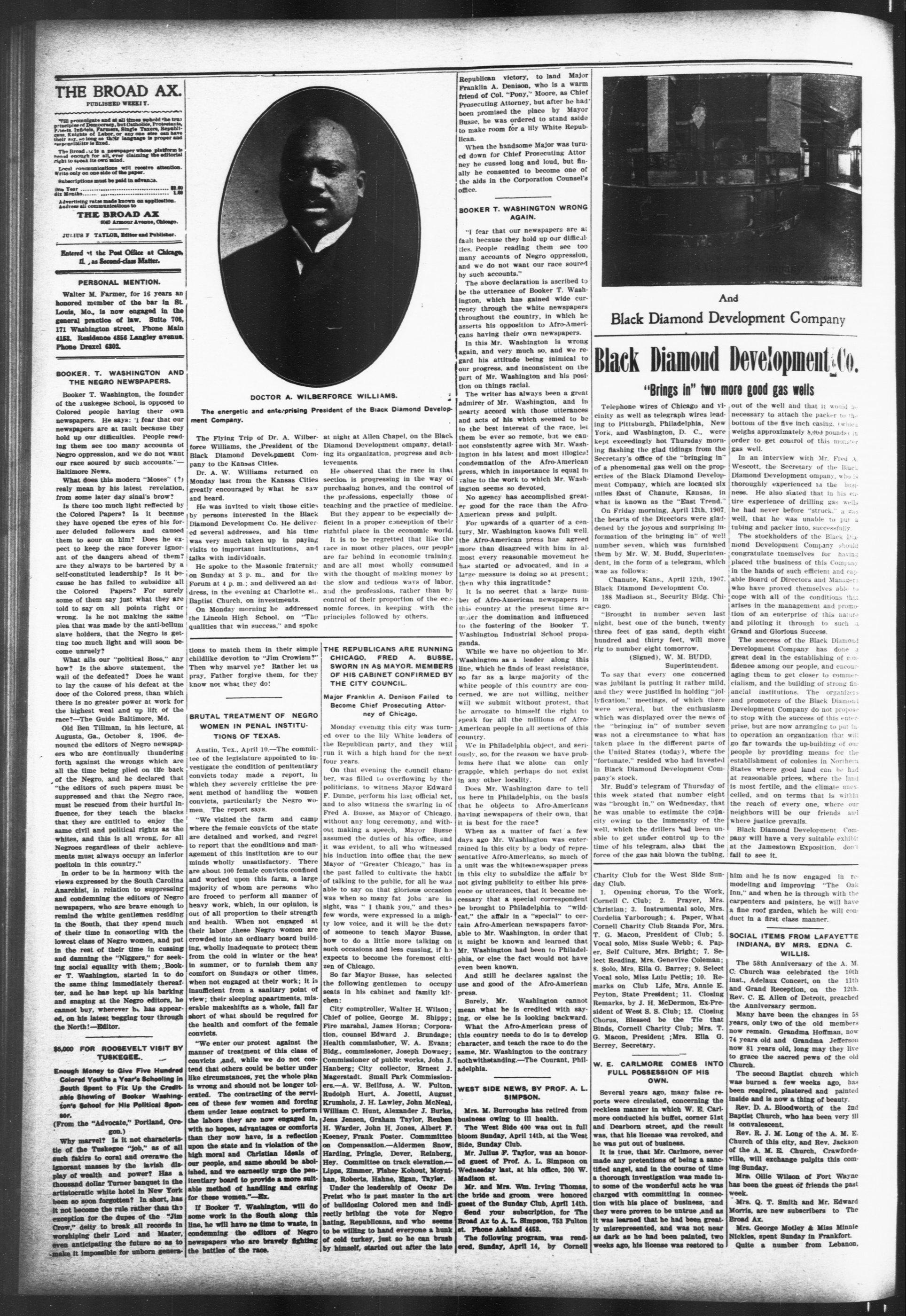
THE BROAD AX
"The Following
the
"A Race Ri0
THE FIRST OF A SERIES O
CALLED "RACE PROBLE
BEGINNING IN THE APRIL
CAN MAGAZINE.
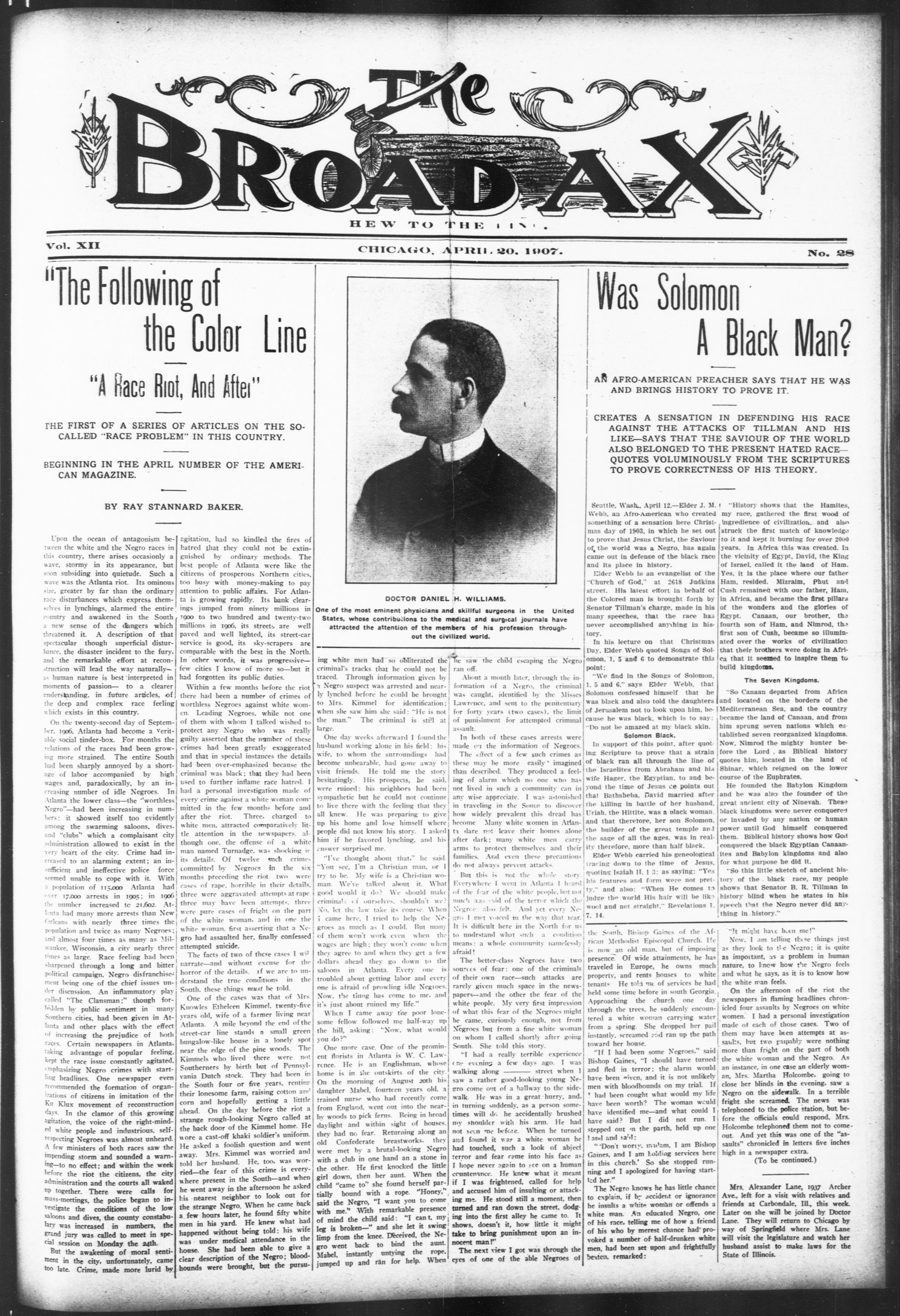
"The Following of the Color Line "A Race Riot, And After"
THE FIRST OF A SERIES OF ARTICLES ON THE SO CALLED "RACE PROBLEM" IN THIS COUNTRY.
BEGINNING IN THE APRIL NUMBER OF THE AMERICAN MAGAZINE.
BY RAY STANNARD BAKER
Upon the ocean of antagonism between the white and the Negro races in this country, there arises occasionally a wave, stormy in its appearance, but soon subsiding into quietude. Such a wave was the Atlanta riot. Its ominous size, greater by far than the ordinary race disturbances which express themselves in lynchings, alarmed the entire country and awakened in the South a new sense of the dangers which threatened it. A description of that spectacular though superficial disturbance, the disaster incident to the fury, and the remarkable effort at reconstruction will lead the way naturally—as human nature is best interpreted in moments of passion—to a clearer understanding, in future articles, of the deep and complex race feeling which exists in this country.
But the awakening of moral sentiment in the city, unfortunately, came too late. Crime, made more lurid by
Vol. XII
agitation, had so kindled the fires of hatred that they could not be extinguished by ordinary methods. The best people of Atlanta were like the citizens of prosperous Northern cities, too busy with money-making to pay attention to public affairs. For Atlanta is growing rapidly. Its bank clearings jumped from ninety millions in 1900 to two hundred and twenty-two millions in 1906, its streets are well paved and well lighted, its street-car service is good, its sky-scrapers are comparable with the best in the North. In other words, it was progressive—few cities I know of more so—but it had forgotten its public duties.
Within a few months before the riot there had been a number of crimes of worthless Negroes against white women. Leading Negroes, while not one of them with whom I talked wished to protect any Negro who was really guilty asserted that the number of these crimes had been greatly exaggerated and that in special instances the details had been over-emphasized because the criminal was black; that they had been used to further inflame race hatred. I had a personal investigation made of every crime against a white woman committed in the few months before and after the riot. Three, charged to white men, attracted comparatively little attention in the newspapers, although one, the offense of a white man named Turnadge, was shocking in its details. Of twelve such crimes committed by Negroes in the six months preceding the riot two were cases of rape, horrible in their details, three were aggravated attempts at rape, three may have been attempts, three were pure cases of fright on the part of the white woman, and in one the white woman, first asserting that a Negro had assaulted her, finally confessed attempted suicide.
The facts of two of these cases I will narrate—and without excuse for the horror of the details, if we are to understand the true conditions in the South, these things must be told.
One of the cases was that of Mrs Knowles Etheleen Kimmel, twenty-five years old, wife of a farmer living near Atlanta. A mile beyond the end of the street-car line stands a small green bungalow-like house in a lonely spot near the edge of the pine woods. The Kimmels who lived there were not Southerners by birth but of Pennsylvania Dutch stock. They had been in the South four or five years, renting their lonesome farm, raising cotton and corn and hopefully getting a little ahead. On the day before the riot a strange rough-looking Negro called at the back door of the Kimmel home. He wore a cast-off khaki soldier's uniform. He asked a foolish question and went away. Mrs. Kimmel was worried and told her husband. He, too, was worried—the fear of this crime is everywhere present in the South—and when he went away in the afternoon he asked his nearest neighbor to look out for the strange Negro. When he came back a few hours later, he found fifty white men in his yard. He knew what had happened without being told: his wife was under medical attendance in the house. She had been able to give a clear description of the Negro; blood-hounds were brought, but the pursu-
---
---
CHICAGO, APRIL 20, 1907.
DOCTOR DANIEL H. WILLIAMS. One of the most eminent physicians and skillful surgeons in the United States, whose contributions to the medical and surgical journals have attracted the attention of the members of his profession throughout the civilized world.
One of the most eminent physicians and skillful surgeons in the United States, whose contributions to the medical and surgical journals have attracted the attention of the members of his profession throughout the civilized world.
ing white men had so obliterated the criminal's tracks that he could not be traced. Through information given by a Negro suspect was arrested and nearly lynched before he could be brought to Mrs. Kimmel for identification; when she saw him she said: "He is not the man." The criminal is still at large.
One day weeks afterward I found the husband working alone in his field: his wife, to whom the surroundings had become unbearable, had gone away to visit friends. He told me the story hesitatingly. His prospects, he said, were ruined: his neighbors had been sympathetic but he could not continue to live there with the feeling that they all knew. He was preparing to give up his home and lose himself where people did not know his story. I asked him if he favored lynching, and his answer surprised me.
"I've thought about that." he said. "You see, I'm a Christian man, or I try to be. My wife is a Christian woman. We've talked about it. What good would it do? We should make criminals of ourselves, shouldn't we? No, let the law take its course. When I came here, I tried to help the Negroes as much as I could. But many of them won't work even when the wages are high; they won't come when they agree to and when they get a few dollars ahead they go down to the saloons in Atlanta. Every one is troubled about getting labor and every one is afraid of prowling idle Negroes. Now, the thing has come to me, and it's just about ruined my life."
When I came away the poor lonesome fellow followed me half-way up the hill, asking: "Now, what would you do?"
One more case. One of the prominent florists in Atlanta is W. C. Lawrence. He is an Englishman, whose home is in the outskirts of the city. On the morning of August 20th his daughter Mabel, fourteen years old, a trained nurse who had recently come from England, went out into the nearby woods to pick ferns. Being in broad daylight and within sight of houses, they had no fear. Returning along an old Confederate breastworks, they were met by a brutal-looking Negro with a club in one hand an a stone in the other. He first knocked the little girl down, then her aunt. When the child "came to" she found herself partially bound with a rope. "Honey," said the Negro, "I want you to come with me." With remarkable presence of mind the child said: "I can't, my leg is broken—" and she let it swing limp from the knee. Deceived, the Negro went back to bind the aunt. Mabel, instantly untying the rope, jumped up and ran for help. When
he saw the child escaping the Negro ran off.
About a month later, through the information of a Negro, the criminal was caught, identified by the Misses Lawrence, and sent to the penitentiary for forty years (two cases), the limit of punishment for attempted criminal assault.
In both of these cases arrests were made on the information of Negroes.
The effect of a few such crimes as these may be more easily `imagined than described. They produced a feeling of alarm which no one who has not lived in such a community can in any wise appreciate. I was astonished in traveling in the Sonu to discover how widely prevalent this dread has become. Many white women in Atlanta dare not leave their homes alone after dark; many white men carry arms to protect themselves and their families. And even these precautions do not always prevent attacks.
But this is not the whole story. Everywhere I went in Atlanta I heard of the fear of the white people, but not much was said of the terror which the Negroes also felt. And yet every Negro I met voiced in the way that fear. It is difficult here in the North for us to understand what such a condition means: a whole community namelessly afraid!
The better-class Negroes have two sources of fear: one of the criminals of their own race—such attacks are rarely given much space in the newspapers—and the other the fear of the white people. My very first impression of what this fear of the Negroes might be came, curiously enough, not from Negroes but from a fine white woman on whom I called shortly after going South. She told this story.
"I had a really terrible experience one evening a few days ago. I was walking along ____ street when I saw a rather good-looking young Negro come out of a hallway to the sidewalk. He was in a great hurry, and, in turning suddenly, as a person sometimes will do, he accidentally brushed my shoulder with his arm. He had not seen me before. When he turned and found it was a white woman he had touched, such a look of abject terror and fear came into his face as I hope never again to see on a human countenance. He knew what it meant if I was frightened, called for help and accused him of insulting or attacking me. He stood still a moment, then turned and ran down the street, dodging into the first alley he came to. It shows, doesn't it, how little it might take to bring punishment upon an innocent man!"
The next view I got was through the eyes of one of the able Negroes of
Was Solomon A Black Man?
AN AFRO-AMERICAN PREACHER SAYS THAT HE WAS AND BRINGS HISTORY TO PROVE IT.
CREATES A SENSATION IN DEFENDING HIS RACE AGAINST THE ATTACKS OF TILLMAN AND HIS LIKE—SAYS THAT THE SAVIOUR OF THE WORLD ALSO BELONGED TO THE PRESENT HATED RACE—QUOTES VOLUMINOUSLY FROM THE SCRIPTURES TO PROVE CORRECTNESS OF HIS THEORY.
Seattle, Wash., April 12.—Elder J. M. Webb, an Afro-American who created something of a sensation here Christmas day of 1903, in which he set out to prove that Jesus Christ, the Saviour of the world was a Negro, has again came out in defense of the black race and its place in history.
Elder Webb is an evangelist of the "Church of God," at 2618 Judkins street. His latest effort in behalf of the Colored man is brought forth by Senator Tillman's charge, made in his many speeches, that the race has never accomplished anything in history.
In his lecture on that Christmas Day, Elder Webb quoted Songs of Solomon, 1, 5 and 6 to demonstrate this point:
"We find in the Songs of Solomon, 1, 5 and 6," says Elder Webb, that Solomon confessed himself that he was black and also told the daughters of Jerusalem not to look upon him, because he was black, which is to say: "Do not be amazed at my black skin.
Solomon Black
In support of this point, after quoting Scripture to prove that a strain of black ran all through the line of the Israelites from Abraham and his wife Hager, the Egyptian, to and beyond the time of Jesus he points out that Bathsheba, David married after the killing in battle of her husband, Uriah, the Hittite, was a black woman, and that therefore, her son Solomon, the builder of the great temple and the sage of all the ages, was in reality therefore, more than half black. Elder Webb carried his geneological tracing down to the time of Jesus, quoting Isaiah II. 1.3: as saying: "Yes his features and form were not pretty," and also: "When He comes to judge the world His hair will be like wool and not straight." Revelations 1.7, 14.
the South, Bishop Gaines of the African Methodist Episcopal Church. He is now an old man, but of imposing presence. Of wide attainments, he has traveled in Europe, he owns much property, and rents houses to white tenants. He told me of services he had held some time before in south Georgia. Approaching the church one day through the trees, he suddenly encountered a white woman carrying water from a spring. She dropped her pail instantly, screamed and ran up the path toward her house.
"If I had been some Negroes," said Bishop Gaines, "I should have turned and fled in terror; the alarm would have been given, and it is not unlikely men with bloodhounds on my trial. If I had been caught what would my life have been worth? The woman would have identified me—and what could I have said? But I did not run. I stepped out in the parth, held up one! and said:
"Don't worry, madam, I am Bishop Gaines, and I am holding services here in this church.' So she stopped running and I apologized for having startled her."
The Negro knows he has little chance to explain, if by accident or ignorance he insults a white woman or offends a white man. An educated Negro, one of his race, telling me of how a friend of his who by merest chance had provoked a number of half-drunken white men, had been set upon and frightfully beaten, remarked:
ON
Black Man?
A CHER SAYS THAT HE WAS
TO PROVE IT.
IN DEFENDING HIS RACE
KES OF TILLMAN AND HIS
SE SAVIOUR OF THE WORLD
HE PRESENT HATED RACE—
ALLY FROM THE SCRIPTURES
ESS OF HIS THEORY.
---
"History shows that the Hamites my race, gathered the first wood of ingredience of civilization, and also struck the first match of knowledge to it and kept it burning for over 2000 years. In Africa this was created. In the vicinity of Egypt, David, the King of Israel, called it the land of Ham. Yes, it is the place where our father Ham, resided. Mizraim, Phut and Cush remained with our father, Ham, in Africa, and became the first pillars of the wonders and the glories of Egypt. Canaan, our brother, the fourth son of Ham, and Nimrod, the first son of Cush, became so illuminated over the works of civilization that their brothers were doing in Africa that it seemed to inspire them to build kingdoms.
The Seven Kingdoms.
"So Canaan departed from Africa and located on the borders of the Mediterranean Sea, and the country became the land of Canaan, and from him sprung seven nations which established seven reorganized kingdoms. Now, Nimrod the mighty hunter before the Lord, as Biblical history quotes him, located in the land of Shinar, which reigned on the lower course of the Euphrates.
He founded the Babylon Kingdom and he was also the founder of the great ancient city of Ninevah. These black kingdoms were never conquered or invaded by any nation or human power until God himself conquered them. Biblical history shows how God conquered the black Egyptian Canaanites and Babylon kingdoms and also for what purpose he did it.
"So this little sketch of ancient history of the black race, my people shows that Senator B. R. Tillman in history blind when he states in his speech that the Negro never did anything in history."
Now, I am telling these things just as they look to the Negro; it is quite as important, as a problem in human nature, to know how the Negro feels and what he says, as it is to know how the white man feels.
On the afternoon of the riot the newspapers in flaming headlines chronicled four assaults by Negroes on white women. I had a personal investigation made of each of those cases. Two of them may have been attempts at assaults, but two papably were nothing more than fright on the part of both the white woman and the Negro. As an instance, in one case an elderly woman, Mrs. Martha Holcombe, going to close her blinds in the evening, saw a Negro on the sidewalk. In a terrible fright she screamed. The news was telephoned to the police station, but before the officials could respond, Mrs. Holcombe telephoned them not to come out. And yet this was one of the "assaults" chronicled in letters five inches high in a newspaper extra.
(To be continued.)
Mrs. Alexander Lane, 1937 Archer Ave., left for a visit with relatives and friends at Carbondale, Ill., this week. Later on she will be joined by Doctor Lane. They will return to Chicago by way of Springfield where Mrs. Lane will visit the legislature and watch her husband assist to make laws for the State of Illinois.
PUBLISHED WEEKLY.
Will promulgate and at all times uphold the true principle, the rights of the professors, the professors, the indulges, the Farmers, the Single Taxes, the Republicans, the Knights of Labor, or any one else can have their say, no long as their language is proper and responsibility is fixed.
The Broad. it is a newspaper whose platform is based upon the aim of claiming the editorial right to speak its own mind.
Local communications will receive attention. Write only on one side of the paper.
JULIUS F. TAYLOR, Editor and Publisher.
Entered at the Post Office at Chicago
II, as Second-class Matter.
PERSONAL MENTION.
Walter M. Farmer, for 16 years an honored member of the bar in St. Louis, Mo., is now engaged in the general practice of law. Suite 708, 171 Washington street. Phone Main 4153. Residence 4856 Langley avenue. Phone Draxel 6302.
BOOKER. T. WASHINGTON AND THE NEGRO NEWSPAPERS.
Booker T. Washington, the founder of the 1ruskegee School, is opposed to Colored people having their own newspapers. He says: "I fear that our newspapers are at fault because they hold up our difficulties. People reading them see too many accounts of Negro oppression, and we do not want our race soured by such accounts."—Baltimore News.
What does this modern "Moses" (?) really mean by his latest revelation, from some later day sinai's brow?
Is there too much light reflected by the Colored Papers? Is it because they have opened the eyes of his former deluded followers and caused them to sour on him? Does he expect to keep the race forever ignorant of the dangers ahead of them? are they always to be bartered by a self-constituted leadership? Is it because he has failed to subsidize all the Colored Papers? For surely some of them say just what they are told to say on all points right or wrong. Is he not making the same plea that was made by the anti-bellum slave holders, that the Negro is getting too much light and will soon become unruely?
What ails our "political Boss," any how? Is the above statement, the wail of the defeated? Does he want to lay the cause of his defeat at the door of the Colored press, than which there is no greater power at work for the highest weal and up lift of the race?—The Guide Baltimore, Md.
Old Ben Tillman, in his lecture, at Augusta, Ga., October 8, 1906, denounced the editors of Negro newspapers who are continually thundering forth against the wrongs which are all the time being plied on the back of the Negro, and he declared that "the editors of such papers must be suppressed and that the Negro race, must be rescued from their hurtful influence, for they teach the blacks that they are entitled to enjoy the same civil and political rights as the whites, and this is all wrong, for all Negroes regardless of their achievements must always occupy an inferior position in this country."
In order to be in harmony with the views expressed by the South Carolina Anarchist, in relation to suppressing and condemning the editors of Negro newspapers, who are brave enough to remind the white gentlemen residing in the South, that they spend much of their time in consorting with the lowest class of Negro women, and put in the rest of their time in cussing and damning the "Niggers," for seeking social equality with them; Booker T. Washington, started in to do the same thing immediately thereafter, and he has kept up his barking and snapping at the Negro editors, he cannot buy, wherever he has appeared, on his latest begging tour through the North!—Editor.
$6,000 FOR ROOSEVELT VISIT BY
TUSKEGEE.
Enough Money to Give Five Hundred Colored Youths a Year's Schooling in South Spent to Fix Up the Creditable Showing of Booker Washington's School for His Political Sponsor. (From the "Advocate," Portland, Oregon.)
Why marvel? Is it not characteristic of the Tuskegee "job," as of all such fakirs to coral and overwea the ignorant masses by the lavish display of wealth and power? Has a thousand dollar Turner banquet in the artistocratic white hotel in New York been so soon forgotten? In short, has it not become the rule rather than the exception for the dupes of the "Jim Crow," delty to break all records in worshiping their Lord and Master, even anticipating the future so as to make it impossible for unborn genera-
[Name not visible]
DOCTOR A. WILBERFORCE WILLIAMS.
The energetic and enterprising President of the Black Diamond Development Company.
The Flying Trip of Dr. A. Wilberforce Williams, the President of the Black Diamond Development Company to the Kansas Cities.
Dr. A. W. Williams returned on Monday last from the Kansas Cities greatly encouraged by what he saw and heard.
He was invited to visit those cities by persons interested in the Black Diamond Development Co. He delivered several addresses, and his time was very much taken up in paying visits to important institutions, and talks with individuals.
at night at Allen Chapel, on the Black Diamond Development company, detailing its organization, progress and achievements.
He observed that the race in that section is progressing in the way of purchasing homes, and the control of the professions, especially those of teaching and the practice of medicine.
But they appear to be especially deficient in a proper conception of their rightful place in the economic world.
It is to be regretted that like the race in most other places, our people are far behind in economic training.
He spoke to the Masonic fraternity on Sunday at 3 p. m., and for the Forum at 4 p. m.; and delivered an address, in the evening at Charlotte st., Baptist Church, on investments.
On Monday morning he addressed the Lincoln High School, on "The qualities that win success," and spoke
tions to match them in their simple childlike devotion to "Jim Crowism?" Then why marvel ye? Rather let us pray, Father forgive them, for they know not what they do!
BRUTAL TREATMENT OF NEGRO WOMEN IN PENAL INSTITUTIONS OF TEXAS.
Austin, Tex., April 10.—The committee of the legislature appointed to investigate the condition of penitentiary convicts today made a report, in which they severely criticise the present method of handling the women convicts, particularly the Negro women. The report says.
"We visited the farm and camp where the female convicts of the state are detained and worked, and regret to report that the conditions and management of this institution are to our minds wholly unsatisfactory. There are about 100 female convicts confined and worked upon this farm, a large majority of whom are persons who are forced to perform all manner of heavy work, which, in our opinion, is out of all proportion to their strength and health. When not engaged at their labor, these Negro women are crowded into an ordinary board building, wholly inadequate to protect them from the cold in winter or the heat in summer, or to furnish them any comfort on Sundays or other times, when not engaged at their work; it is insufficient from a sanitary point of view; their sleeping apartments, miserable makeshifts as a whole, fall far short of what should be required for the health and comfort of the female convicts.
"We enter our protest against the manner of treatment of this class of convicts and, while we do not contend that others could be better under like circumstances, yet the whole plan is wrong and should not be longer tolerated. The contracting of the services of these few women and forcing them under lease contract to perform the labors they are now engaged in, with no hopes, advantages or comforts than they now have, is a reflection upon the state and in violation of the high moral and Christian Ideals of our people, and same should be abolished, and we earnestly urge the penitentiary board to provide a more suitable method of handling and caring for these women."—Ex.
If Booker T. Washington, will do some work in the South along this line, he will have no time to waste, in condemning the editors of Negro newspapers who are bravely fighting the battles of the race.
at night at Allen Chapel, on the Black Diamond Development company, detailing its organization, progress and achievements.
He observed that the race in that section is progressing in the way of purchasing homes, and the control of the professions, especially those of teaching and the practice of medicine. But they appear to be especially deficient in a proper conception of their rightful place in the economic world. It is to be regretted that like the race in most other places, our people are far behind in economic training, and are all most wholly consumed with the thought of making money by the slow and tedious ways of labor, and the professions, rather than by control of their proportion of the economic forces, in keeping with the principles followed by others.
THE REPUBLICANS ARE RUNNING CHICAGO, FRED A. BUSSE, SWORN IN AS MAYOR. MEMBERS OF HIS CABINET CONFIRMED BY THE CITY COUNCIL.
Major Franklin A. Denison Failed to Become Chief Prosecuting Attorney of Chicago.
Monday evening this city was turned over to the lily White leaders of the Republican party, and they will run it with a high hand for the next four years.
On that evening the council chamber, was filled to overflowing by the politicians, to witness Mayor Edward F. Dunne, perform his last official act, and to also witness the swaring in of Fred A. Busse, as Mayor of Chicago, without any long ceremony, and without making a speech, Mayor Busse assumed the duties of his office, and it was evident, to all who witnessed his induction into office that the new Mayor of "Greater Chicago," has in the past failed to cultivate the habit of talking to the public, for all he was able to say on that glorious occasion was when so many fat jobs are in sight, was "I thank you," and these few words, were expressed in a mighty low voice, and it will be the duty of someone to teach Mayor Busse, how to do a little more talking on such occasions and less cussing, if he expects to become the foremost citizen of Chicago.
So far Mayor Busse, has selected the following gentlemen to occupy seats in his cabinet and family kit: chen:
City comptroller, Walter H. Wilson; Chief of police, George M. Shippy; Fire marshal, James Horan; Corporation, counsel Edward J. Brundage; Health commissioner, W. A. Evans; Bldg., commissioner, Joseph Downey; Commissioner of public works, John J. Hanberg; City collector, Ernest J. Magerstadt. Small Park Commissioners.—A. W. Beilfuss, A. W. Fulton. Rudolph Hurt, A. Josetti, August Krumholz, J. H. Lawley, John McNeal William C. Hunt, Alexander J. Burke Jens Jensen, Graham Taylor, Reuben H. Warder, John H. Jones, Albert F. Keenan, Frank Foster. Committee on Compensation—Aldermen Snow Harding, Pringle, Dever, Reinberg Hey. Committee on track elevation.—Lipps, Zimmer, Fisher Kohout, Moynihan, Roberts, Hahne, Egan, Tayler.
Under the leadership of Oscar De Preist who is past master in the art of bulldozing Colored men and indirectly bribing the vote for Negro hating, Republicans, and who seems to be willing to hand everyone a hunk of cold turkey, just so he can brush by himself, started out after the late
Republican victory, to land Major Franklin A. Denison, who is a warm friend of Col. "Pony," Moore, as Chief Prosecuting Attorney, but after he had been promised the place by Mayor Busse, he was ordered to stand aside to make room for a lily White Republican. When the handsome Major was turned down for Chief Prosecuting Attorney he cussed long and loud, but finally he consented to become one of the aids in the Corporation Counsel's office.
BOOKER T. WASHINGTON WRONG
AGAIN.
"I fear that our newspapers are at fault because they hold up our difficulties. People reading them see too many accounts of Negro oppression, and we do not want our race soured by such accounts."
The above declaration is ascribed to be the utterance of Booker T. Washington, which has gained wide currency through the white newspapers throughout the country, in which he asserts his opposition to Afro-Americans having their own newspapers.
In this Mr. Washington is wrong again, and very much so, and we regard his attitude being inimical to our progress, and inconsistent on the part of Mr. Washington and his position on things racial.
The writer has always been a great admirer of Mr. Washington, and in nearly accord with those utterances and acts of his which seemed to be to the best interest of the race, let them be ever so remote, but we cannot consistently agree with Mr. Washington in his latest and most illogical condemnation of the Afro-American press, which in importance is equal in value to the work to which Mr. Washington seems so devoted.
No agency has accomplished greater good for the race than the Afro-American press and pulpit.
For upwards of a quarter of a century, Mr. Washington knows full well, the Afro-American press has agreed more than disagreed with him in almost every reasonable movement he has started or advocated, and in a large measure is doing so at present; then why this ingratitude? It is no secret that a large number of Afro-American newspapers in this country at the present time are under the domination and influenced to the fostering of the Booker T. Washington Industrial School propaganda
While we have no objection to Mr. Washington as a leader along this line, which he finds of least resistance, so far as a large majority of the white people of this country are concerned, we are not willing, neither will we submit without protest, that he arrogate to himself the right to speak for all the millions of Afro-American people in all sections of this country.
We in Philadelphia object, and seriously, so, for the reason we have problems here that we alone can only grapple, which perhaps do not exist in any other locality.
Does Mr. Washington dare to tell us here in Philadelphia, on the basis that he objects to Afro-Americans having newspapers of their own, that it is best for the race?
When as a matter of fact a few days ago Mr. Washington was entertained in this city by a body of representative Afro-Americans, so much of a unit was the white newspaper press in this city to subsidize the affair by not giving publicity to either his presence or utterances, that it became necessary that a special correspondent be brought to Philadelphia to "wildcat," the affair in a "special" to certain Afro-American newspapers favorable to Mr. Washington, in order that it might be known and learned that Mr. Washington had been to Philadelphia, or else the fact would not have even been known.
And still he declares against the use and good of the Afro-American press.
Surely, Mr. Washington cannot mean what he is credited with saying, or else he is looking backward. What the Afro-American press of this country needs to do is to develop character, and teach the race to do the same, Mr. Washington to the contrary notwithstanding.—The Courant, Philadelphia.
WEST SIDE NEWS, BY PROF. A. L. SIMPSON.
Mrs. M. Burroughs has retired from business owing to ill health. The West Side 400 was out in full bloom Sunday, April 14th, at the West Side, Sunday Club. Mr. Jullus F. Taylor, was an honored guest of Prof. A. L. Simpson on Wednesday last, at his office, 200 W. Madison st. Mr. and Mrs. Wm. Irving Thomas, the bride and groom were honored guest of the Sunday Club, April 14th. Send your subscription, for The Broad Ax to A. L. Simpson, 753 Fulton st. Phone Ashland 4453. The following program, was rendered, Sunday, April 14, by Cornell
CHICAGO LINCOLN COMPANY
Black Diamond Development Company
Black Diamond Development Co.
Telephone wires of Chicago and vicinity as well as telegraph wires leading to Pittsburgh, Philadelphia, New York, and Washington, D. C., were kept exceedingly hot Thursday morning flashing the glad tidings from the Secretary's office of the "bringing in" of a phenomenal gas well on the properties of the Black Diamond Development Company, which are located six miles East of Chanute, Kansas, in what is known as the "East Trend." On Friday morning, April 12th, 1907, the hearts of the Directors were gladdened by the joyous and surprising information of the bringing in" of well number seven, which was furnished them by Mr. W. M. Budd, Superintendent, in the form of a telegram, which was as follows:
Chanute, Kans., April 12th, 1907. Black Diamond Development Co. 188 Madison st., Security Bldg. Chicago. "Brought in number seven last night, best one of the bunch, twenty three feet of gas sand, depth eight hundred and thirty feet, will move rig to number eight tomorrow.
(Signed), W. M. BUDD. Superintendent
To say that every one concerned was jubilant is putting it rather mild, and they were justified in holding "jollyification," meetings, of which there were several, but the enthusiasm which was displayed over the news of the "bringing in" of number seven was not a circumstance to what has taken place in the different parts of the United States (today), where the "fortunate," resided who had invested in Black Diamond Development Company's stock.
Mr. Budd's telegram of Thursday of this week stated that number eight was "brought in." on Wednesday, that he was unable to estimate the capacity owing to the immensity of the well, which the drillers had been unable to get under control up to the time of his telegram, also that the force of the gas had blown the tubing.
Charity Club for the West Side Sunday Club
1. Opening chorus, To the Work Cornell C. Club; 2. Prayer, Mrs Christian; 3. Instrumental solo, Mrs Cordelia Yarborough; 4. Paper, What Cornell Charity Club Stands For, Mrs T. G. Macon, President of Club; 5. Vocal solo, Miss Susie Webb; 6. Paper, Self Culture, Mrs. Bright; 7. Select Reading, Mrs. Genevive Coleman; 8. Solo, Mrs. Ella G. Barrey; 9. Select Vocal solo, Miss Lulu Pettis; 10. Remarks on Club Life, Mrs. Annie E. Peyton, State President; 11. Closing Remarks, by J. H. McDermon, Ex-President of West S. S. Club; 12. Closing Chorus, Blessed be the Tie that Binds, Cornell Charity Club; Mrs. T. G. Macon, President; Mrs. Ella G. Berrey, Secretary.
W. E. CARLMORE COMES INTO FULL POSSESSION OF HIS OWN
Several years ago, many false reports were circulated, concerning the reckless manner in which W. E. Carlmore conducted his buffet, corner 51st and Dearborn street, and the result was, that his license was revoked, and he was put out of business.
It is true, that Mr. Carlmore, never made any pretentions of being a sanctified angel, and in the course of time a thorough investigation was made into some of the wonderful acts he was charged with committing in connection with his place of business, and they were proven to be untrue, and as it was learned that he had been greatly misrepresented, and was not near as dark as he had been painted, two weeks ago, his license was restored to
out of the well and that it would be necessary to attach the packer to the bottom of the five inch casing, which weighs approximately 8,900 pounds in order to get control of this monster gas well.
In an interview with Mr. Fred A. Wescott, the Secretary of the Black Diamond Development company, who is thoroughly experienced in the business. He also stated that in his entire experience of drilling gas wells he had never before "struck." a gas well, that he was unable to put a tubing and packer into, successfully.
The stockholders of the Black Diamond Development Company should congratulate themselves for having placed the business of this Company in the hands of such efficient and capable Board of Directors and Managers who have proved themselves able to cope with all of the conditions that arises in the management and promotion of an enterprise of this nature and piloting it through to such a Grand and Glorious Success.
The success of the Black Diamond Development Company has done a great deal in the establishing of confidence among our people, and encouraging them to get closer to commercialism, and the building of strong financial institutions. The organizers and promoters of the Black Diamond Development Company do not propose to stop with the success of this enterprise, but are now arranging to put in operation an organization that will go far towards the up-building of our people by providing means for the establishment of colonies in Northern States where good land can be had at reasonable prices, where the land is most fertile, and the climate unexcelled, and on terms that is within the reach of every one, where our neighbors will be our friends and where justice prevails.
Black Diamond Development Company will have a very suitable exhibit at the Jamestown Exposition, don't fall to see it.
him and he is now engaged in remodeling and improving "The Oak Inn," and when he is through with the carpenters and painters, he will have a fine roof garden, which he will conduct in a first class manner.
SOCIAL ITEMS FROM LAFAYETTE
INDIANA, BY MRS. EDNA C.
WILLIS
The 58th Anniversary of the A. M. C. Church was celebrated the 10th inst., Adelaux Concert, on the 11th and Grand Reception, on the 12th Rev. C. E. Allen of Detroit, preached the Anniversary sermon.
Many have been the changes in 58 years, only two of the old members now remain. Grandma Hoffman, now 74 years old and Grandma Jefferson now 81 years old, long may they live to grace the sacred pews of the old Church.
The second Baptist church which was burned a few weeks ago, has been reapired, plastered and painted inside and is now a thing of beauty.
Rev. D. A. Bloodworth of the 2nd Baptist Church, who has been very ill is convalescent.
Rev. R. J. M. Long of the A. M. E. Church of this city, and Rev. Jackson of the A. M. E. Church, Crawfordsville, will exchange pulpits this coming Sunday.
Mrs. Ollie Wilson of Fort Wayne has been the guest of friends the past week.
Mrs. Q. T. Smith and Mr. Edward Morris, are new subscribers to The Broad Ax.
Mrs. George Motley & Miss Minnie Nickles, spent Sunday in Frankfort.
Quite a number from Lebanon,
1
errr 2
aoe
: i ee
a
peastert and Loguaapert, | situated
Foul iven by the Douglas Club on
ape 15th.
sr Georse Myers who has beer
gum tng continues about the
se
fords us much pleasure to state
pat Mro. Wills Is am hqnored mem
per of the white race, that she is
Misay iateresied tm the progress of
Em cowred people along all tines, and
et the past few months, she has
Sineed quite a few of her friends to
Rome subscribers to this paper.
—_——_—
ystITUTIONAL CHURCH AND $0.
CIAL SETTLEMENT, $825 DEAR-
BORN ST.
qbe Sons Recital May the 6th prom:
get be a grand affair, Mra. Mar
er B Anderson, assisted by wel
bow arusts. Mrs Anderson needs
fo introduction to the musical peo
fe ot Chicago. She is the tnstructo
Fiabe sight reading clase of the Cho
Sh study club, and is the director of
tbe Qainn Chapel Choir.
‘The Kindergarten Committee will
ave charge of the affair. The com
nittee is composed of some of the
‘ery best Colored people under whose
grection this particular work at the
institutional Church has been support:
ed this year.
west Me at the Institutional Chureh
May 6th Song Recital.
jam going to the Song Recital May
the 6th, at Institutional Church.
Miss Hallie Q. Brown and Mrs. Jen-
nie Hodges Dramatic Soprano of New
yealand will fornish a high class en-
tertainment at Institutional Church
jet Wednesday night, April the 24th.
jn informal reception will be given
Miss Brown by the Club Women of
the city at the close of the program.
Rev. H. E. Stewart Minister and
Warden of the Institutional Church
has arranged to have @ special pro-
gram each Sunday night at the
Church, Prof. N. Clark Smith assisted
by the Orchestra will furnish @ pro
mm.
The Juvenile Choir consisting of
about 20 boys and girls, made a good
impression at their first appearance
last Sunday morning, they will sing
each Sunday morning.
Hilbert Stewart 13 years old is the
organist.
‘Mrs. Hodges the Dramatic Soprano
from New Zealand has been engaged
to sing a solo at the morning service
tomorrow.
HUSTLING COLORED MAN WANT-
TED TO SELL SUBURBAN REAL
ESTATE.
Wanted a good representative Co!
ored man to sell choice lots in a North
Shore suburb to Colored people caa
make $100.69 to $200.00 per week. Nc
capital required, must be man ol
ability and education, References
required. Address “J.” care Editor
‘The Broad Ax, 5040 Armour ave.
CHIPs.
Mester Chas. Cheney, 3246 Armout
avenue, is confined to his house witi
the measels.
Mr. Harry Garnes, of Columbus, O.
spent a few days in the city last week
en route east
Mr. Tenny Blunt who has been spend
ing the past two months in Detroit, ha
returned to the city.
‘The People’s Pharmacy Co. will oper
2 first class drug store at the corne
of agrd and State streets soon,
Mr. Chas. Young of Baltimore, Md.
spent three days in the city last week
Stopped at the Keystone Hotel.
Mr. Hobson, the tailor goat State
Street, who was recently visited by 3
fire, expects to go into the milk busi
ess
Mr. Harry Jenkins, 4749 Dearborr
Street, aiter an absence of two months
is the west returned to the city Fri
Mr. Jno. French of Tuskegee, Ala.
Spent a few days im the city last week
He came on the sad mission to bury
his mother,
The Catholics have erected in Phila-
dclphia, for Colored children, at a cost
°f $5000 a magnificent parochial
school
Mrs. Edward S. Miller, 3642 Wabash
avenue, left Sunday morning for Win:
chester. Ky., where she will spend
sometime in visiting with relatives and
friends,
Dr. William E, Mackey, 3160 State
Street, will soon be able to eat three
‘quare meals each day, after his recent
Sell of ‘sickness.
Thursday evening, April 25, 2 mass
meeting will be held at Bethel church
in the interest of the Parkwood Ceme-
‘ery Association. =
G. W. Paris, who has charge of the
Kenwood flats, goth street and Wash-
ne, Ss one of the
admirers of The Broad Ax. a
Mr. Stephen Brooks, who cares. for
Mr. EH. Harriman’s private car
spent a few days in the city last week,
Stopped at the Keystone Hotel.
Marshall Drish, 4613 Dearborn St.
Teturned home Sunday morning much
improved in health after spending: his
vacation at Little Rock, Ark.
Mr. Chas. Webb, of Fort Sheridan
has been honorably discharged from
the United States Army and is visiting
his aunt, Mrs. Davis, 1729 Armour Ave.
Mrs. Chas. Jackson, 2613 Wabash
avenue, has been confined to her home
for the past week on the account of
injuries which she received in a street
car accident.
Mrs. Clara E. Bowles, 4765 Dearborn
street, died Tuesday evening after a
serious illness. Funeral services were
held over her remains this morning at
Quinn Chapel,
James A. Quinn, the leading Demo
cratic statesman in the 21st ward,
dropped into the mayor's office Wed-
nesday, where he was heartily wel-
comed by attaches of Mayor Busse’s
office.
Mrs. Frank Armstrong, 2503 Wabash
avenue, four or five years ago chucked
five or six hundred dollars into the so-
called Robinson Patent Car Wheel case
and so far she has failed to see the
sight of her money.
Mrs. L. C. French, who has always
been exceedingly popular on the West
Side, has removed from 872 W. Fulton
street, to No. 1 rrtth street, Pullman,
IIL, where she will have plenty of room
to mintain a garden and raise lovely
flowers.
L. R. Murray, residing at 2715 Ar-
mour avenue, who was one of our old
friends in Salt Lake City, Utah, is hon-
est through and through, and when
ever he gives his word that he will re-
mit his subscription to The Broad Ax,
the money is forthcoming.
Col. Dan Jackson, who was former-
ly associated with his father in the un-
dertaking business, returned home from
New York City Sunday morning. and
after visiting with friends, he left for
the east Thursday evening. Col. Jack-
son is looking well, and appears to be
making things go in New York.
The second of a series of public
health meetings will be held at Bethel
Church on Sunday evening, April 21st,
at 7:45 p.m.
Papers will be read by A. W. Wil-
liams, Dr. W. A. Richardson and Mr.
George M. Porter. There will also be
presented some special musical selec-
tions.
Dr. M. C. B. Mason, secretary of
the Freedman's Aid Society, will deliv-
er his great address, “Africa in Amer-
ica and Africa Across the Sea,” at
Quinn Chapel, 24th and Wabash ave.,
Monday evening, April 22, for the bene-
fit of the Amanda Smith Industrial
Home. Singing by the children of the
home. Admission 25 cents.
| Wednesday evening, April 24th, Miss
| Hallie Q. Brown, the noted elocution-
i ist, and Mrs. H. Hamilton Hodges, the
tnapproachable dramatic soprano of
New Zealand, will appear in a fine dra-
matic and musical recital at Institu-
tional Church, 3825 Dearborn street.
Admission 25 cents. This will be a
rare musical treat and as it is for a
worthy cause, the church should be
filled to overflowing.
‘Upon the promise that the splendid
Easter musical programme would be re-
peated at Quinn Chapel last Sunday
evening, a large number of visitors at-
[ tended the church, but they were
| doomed to disappointment so far as the
musical programme is concerned, for
E Easter music was not rendered.
There was no apology offered for the
failure in keeping their promise.
Churches should not use such methods
to get attendance.
Button Holes.
Be careful to cut your hole quite
straight and of precisely the same size
as the button, having first marked the
place by two rows of running stitches
two or three threads apart. Bring the
working thread round from right to
left under the point of the needle,
and drawing it out through the loop
so that the knot comes to the edge of
the slit, and so continue till the but
ton hole is finished. Make a bar or
bridge of button hole each end, the
knot side toward the slit.
A clergyman not long out of the
seminary in taking up his work mn 8
small parish made the usual mistakes
with which young ministers are credit
ed. At one time he was talking about
the spiritual life and urging his lis
teners to begin an active Christian
existence.
“It will help those around you,” he
said, “to live good lives and it's also
good for the liver.”
Tea Ri mei ak t wae
IBREVITIES
RPawh, Vb hd
—e
THE HALL OF FAME.
ance Zeller, the eminent stu-
history of philosophy, has
~ celebrated his ninety-thind birth-
Major Frank O. Briggs, the new
Senator from New Jersey, is said to be
one of the finest amateur boxers in the
United States.
| Robert 8. Patterson, publisher of the
Chicago Tribune, has decided to retire
‘nd will probably spend the remainder
of bis days in Washington.
James Frothingham Hunnewell, who
‘has just been chosen president of the
Boston society, is one of the most
‘Noted antiquarians of the day.
C. E. Holt of Norway, Me, whose
seventy-second birthday ‘occurred re-
‘cently, has been tn attendance at Ox.
ford county court forty-seven years,
Lord Roberts is the only man alive
Who bas the privilege of wearing two
Victoria crosses. One is that won by
‘Bimself in the mutiny; the other is that
‘won by his son, the late Lieutenant
Roberts, at Colenso,
W. H. Newman has worked his way
through all the branches of railroading
tw bis present position of president of
the New York Central railway. His
one rule for success is, “Work, work,
work.” And this ts his only advice to
young men.
Hon. Lionel Walter Rothschild of
London has been for a long time de-
Yoting part of his share of the Roth-
‘echild family wealth to the production
of one of the costliest books on record.
‘The subject is extinct birds. Already
more than $100,000 has been expended.
George W. Woodruff, who bas been
appointed assistant attorney general
of the United States, was a distin-
guished athlete at ale and was cap-
tain of the crew in his senior year.
Before entering the forest service sev-
eral years ago he was a distinguished
lawyer.
Grant D. Seaton is instructor of the
largest men's Bible class in the world.
‘It fs taught as a part of the Sunday
school of the California Avenue Con-
gregational church, Chicago. The class
has been divided into four squads. One
squad has red for its color, another
white, another blue and another pur-
ple.
Austin K. Jones has been bell ringer
at Harvard for forty-nine years. He
has rung the clapper of the bell in
Harvard hall 3,175,000 times and has
‘walked to and from the bell rope near-
Jy half a century, 50,045 miles. He ts
eighty-one years old and has rung in
‘and tolled out five Harvard university
presidents.
SHORT STORIES.
‘Wool is said to yield 32,000 varieties
of goods.
‘The United States has nearly 9,000.-
000 negroes.
| Whistling has a very beneficial effect
on the lungs.
‘An average man needs 1,000 pounds
weight of food yearly.
Whalebone 100 years ago brought
$125 a ton. A ton of it is now worth
$15,000.
‘At the age of twenty the average
man loses six days yearly by iliness;
at sixty-five he loses twenty-six days.
‘There are over one-fourth as mans
horses as people in the United States,
which means that there are at pres-
‘ent 23,564,000 horses and mules.
Club life in New York does not go
back far. The New York club, second
in organization only to the Union club,
was organized in 1845.
‘There has been a breach between the
first and second parishes of Exeter,
NN. H., for over 160 years, and the
present parishioners are attempting to
heal that breach.
FACTS FROM FRANCE.
The French budget for last year
reached the huge sum of $750,000,000,
and the expenditure came within $10,-
000 of that amount.
‘The president of the French republic
4s paid $120,000 a year, with $80,000 for
household expenses. No other presi-
dent is so well peid.
Fifty words were passed as “O. K.”
the other day by the commission of the
French academy which is at work on
the dictionary. After many years it is
atill at the letter D.
‘The Eiffel tower at Paris is now
used as a wireless station by the
French government. Communication
has been maintained with ease with
the eastern frontier of France.
‘At a laborers’ exhibition which it is
proposed to hold in Paris in 1900 the
object will be to offer a comparison be-
tween the life of the workmen through-
out the world today and that of labor.
ers in centuries gone by.
GERMAN GLEANINGS.
Germany during its entire history
never before had such a prosperous
year as that of 1906.
Partly because of the high price of
meat the German fish catch has nearly
trebled in amount and value within the
last five years.
‘ince the foundation of the German
‘empire its population has increased by
20,100,000. The birth rate is at present
six per thousand higher in Germany
‘than in England.
‘The German statistical bureau bas
fasued a summary of the average
prices of food products in the empire
@oring the past year, which shows
clearly that the general increase of
‘cost in the United States for the neces-
sities of life is simply part of « world-
wide movement
CHOICE MISCELLANY
Railroad “Surprice Tests.”
It is but a few years since American
railroads began systematically the use
of “surprise tests.” These more or less
directly grew out of an accident that
‘occurred on one of the largest systems
of the middle west. To test the opera-
tions of their signals some officials
‘Went out one night and, leaving a sig-
nal set at “clear,” simply removed the
light. They watched ten or twelve
trains go by, and not one engineer
stopped to inquire what was the trou-
ble, as the rules demand. This same
Toad reports that {n 1906 1,600 surprise
tests were made without one resulting
in failure. The figures are a little
staggering. Human nature is not usu-
ally 80 inerrant. But what is certain
4s that accidents on this line have been
very materially reduced. The Pennsyl-
vania has had an almost identical ex-
perience, and very recently the officials
of the Lake Shore saw twenty-four
out of twenty-five trains go by a sig-
nal purposely set with “lights out.”
‘Yet when the New York Central sys-
tem began these surprise tests they
were threatened with a strike—Carl
Snyder in Everybody's,
‘The Ueea ef Weed.
Almost instinctively one thinks of
the drain on forests as being due to
the demand for lumber in the large
sense—for materials for buildings and
fences and furniture. In point of fact
much of the drain is due to seemingly
Uttle things. Fine ladders take the Ar,
last-blocks sweep away the rock ma-
ple, paper pulp mills have taken the
poplar and spruce, pencils require red
cedar, and spools consume the white
birch. One little regarded industry
makes enormous drains upon the white
pine, especially in New England. That
is the manufacture of packing boxes.
In the six New England states alone
there are 34 box factories. Last year
they used up more than 6,000,000 feet
of boards, four-fifths of which were
‘white pine, The regrettable thing about
At is that the wood is put to such ephem-
eral use. After the packing case has
been used once its ordinary fate is the
fire. One cannot help wonderipg why
manufacturers do not devise some sort
of a@ permanent collapsible packing
case which after use cin be returned
at small cost for use again.—Youth's
Companion.
Need of Standardizing Medicines.
Man has heedfully viewed about him
the Infinite number of things, creatures,
plants and metals, and out of them he
1s compounding or extracting a bewil-
dering number of substances of alleged
therapeutic value. In one list of the
newer remedies arranged under thelr
trade names there are presented under
the single letter “A.” from Abrastol to
Amurin, no less than 418 separate titles.
‘These, most of them, have a value
‘more or less definite and unquestion-
‘able and more or less understood. But
{t 1s a matter of fact that less than 50
per cent of the “standard” preparations
that appear in the pharmacopoeia have
been standardized, and it Is true that
in the mnufacture of the 10,000 drugs
and combinations of drugs that are be-
Ing used by the physicians of the coun-
try there is more opportunity for fraud
through adulteration and substitution
than In any other manufacturing Indus-
try known among men.—Harper's.
ae a ey ad
“Some idea of the absorbent process
of a large city may be gathered from
the fact that two wards—namely, the
‘Twenty-second and Forty-second—em-
brace a number of villages which once
were entirely separate and individual,
as follows: Chestnut Hill, Mount Airy,
Germantown, Pittville, Somerville and
‘Branchtown. This is only a specimen,”
‘said an old Germantown resident. “In
other districts similar records can
‘doubtless be found. Yet the expansive
‘process is so strong and Irresistible
that I expect to see many adjacent
‘country towns swallowed by the city,
‘and that in a few years, though It
‘would take an act of the legislature
obliterating county lines to bring It
about.”—Philadelphia Record.
‘The Russian Word “Pogrom.”
The word “pogrom” has been used in
dispatches from Russia to describe the
‘massacres, organized riots and loots of
‘shops which have taken place in vart-
‘ous parts of the empire, in particular
the demonstrations of this nature sup-
‘posed to have been organized or en-
‘couraged by officers of the local or cen-
tral governemnt. In the Russian lan-
guage the verb “pogromlyat” means to
devastate, plunder, pillage. The sub-
stantive “pogrom”—accent on the last
syliable—means devastation, destruc-
tion.—New York Times.
A Remarkable Watch.
One of the most remarkable watches
im the world is owned by the czarina
of Russia. On looking through # crys
tal Im the base cae can see the holy
sepulcher, with pretorians standing
guard. As the watch runs the stone
moves from the mouth of the cave, the
guards kneel and angels appear at the
Uttle door. From both sides of the
wateh very softly tinkles the alr of an
aster hymn. The watch weighs only
seven ounces. The maker worked on
It for nine years.
Vieline For the British Museum.
‘The English scientist Charles J. Old-
ham, who died in January, left about
$200,000 for educational purposes, Ox-
ford, Cambridge and the Manchester
grammar schools being the chief bene-
ficiaries. Yet he may be best remem-
dered by 2 gift more out of the ordt-
nary. To the British museum he left a
complete Stradivarius quartet—two vi
ling, viola and cello—with = third vio-
Ita in case a purchaser cannot be found
for it at $15,000.—Boeton Transcript.
SELECTIONSS,
SEATTLE AND TACOMA. _
A Tale of the Fierce Rivalry of Two
Loving Cities.
In Tacoma it ts difficult to get any
one to admit that Seattle bas a harbor
at all. During the few hours that we
spent there as banquetees I happened
casually to mention the matter of har-
bors. The Tacoma man smiled sadly,
tolerantly, as be might at @ foolish
child.
“My dear sir,” he said gently, “I pre
sume you are aware that a ship Is
about as safe In the harbor of Seattle
‘8 she would be in Hell Gate. Do you
ever read the papers?” He still re
garded me with that same sad smile.
“Of course not everything gets Into the
Papers. There is hardly « day—hardly
‘a day, sir—that some ship doesn't sink
in Seattle harber while she’s tied up to
the dock. Harbor! Harbor!" He
threw up bis hands, “Heavens!” he
exclaimed. Then in a few swift, pas-
slonate phrases he blocked out the su-
Derlativeness of the harbor of Tacoma,
and as we parted he grabbed the lapels
of my coat and whispered hoarsely,
“And you can mail a letter in Tacoma
to—any—place—tn—the—world, and you
will get an answer to [t one—whole—
day quicker than you would if you
‘sent it from Seattle!”
About the time we visited these vi-
vaclous cities, Tacoma and Seattle, a
whale which had been disporting itself
in the waters of the sound in their
neighborhood was found one day float-
‘ing lifeless. A Seattle paper at once
‘explained that he had probably “wan-
ered about until he caught a glimpse
of Tacoma and fell dead.” “Death
came,” continued this obituary, “sud-
denly and unexpectedly just as he bad
settled himself to e long siege to watch
Tacoma grow. In this form it was
probably a mercy, for he would have
died of starvation had he stayed until
the object of his visit was accomplish-
¢4."—From “In the Banquet Belt,” by
Arthur Rubl, in Outing Magazine.
lodine In the Human Body.
Todine is found in many quarters
‘where It would be least suspected. Ac-
cording to some interesting expert-
ments of Amand Gautler, the thyroid
gland contains about one-thousandth
part by weight of this substance.
Where does it come from? asks Gau-
tier. Some authorities say it Is de-
rived from the atmosphere or from wa-
ter, but others fall to discover traces
of the substance therein. M. Gautier
believes, however, that the failure was
due to Insuffictent methods. He finds
minute particles of lodine in the alr
of Paris and still more in that of the
seashore and salt marshes. It is well
known that seaweed Is especially rich
in fodine. It has also been discovered
in ordinary foods, especially in certain
fish. By bathing a rabbit in water
containing iodine M. Gautier discover-
ed ® curious fact—namely, that the
brain bas a pecullar attraction for this
substance, absorbing over seven times
s much proportionately to weight as
the glands of the neck and four times
‘as much as the heart and lungs.—Chi-
cago Chronicle.
Cine: Cinna Uli Os it
Just about one out of every three In-
habitants of New York city was born
in a foreign country. Manhattan alone
has 789,342 resilents of foreign birth
and Brooklyn 356.697. The total num-
ber of foreigners domesticated in the
metropolis {s, in precise figures, 1,297,-
080. They would alone compose a city
as big as Philadelphia, considerably
larger than Constantinople or more
than twice as big as Boston. Half of
the population of the state of New
‘York is located within the limits of the
great American metropolis, which has
more Inhabitants than Switzerland by
one-fifth and more than Denmark or
Servia or Greece. The population of
New York city is more than equal to
that of nine sovereign states of the
Union combincd—Maine, Connecticut,
Delaware, Florida, North Dakota, South
Dakota, Colorado, Montana and Neva-
da. To this total Arizona and Alaska
would have to be added in order to
farnish as many Americans as are to
be found within the precincts of the
five boroughs.—Pearson's Magazine.
Giese Tee Seen:
‘The king's taste in jewelry is ex-
tremely quiet. A horseshoe or single
pearl pin or a plain gold tie ring and a
signet ring on his little finger are all be
ever wears, with the simplest possible
studs and links. All those who have
played bridge with his majesty, bow-
ever, are familiar with the heavy gold
bangle which adorns his right wrist.
The German emperor also wears gold
bracelets on either arm. But the most
singular ornaments worn by @ royal
pomenige one Ge Swe ries ioe
of Orleans wears on either littie
finger, which are attached by @ slen-
der gold chain to a bangle on the wrist.
The late king of Spain used to wear 8
flexible gold necklet, and the late King
Milan bad a golden anklet riveted on
him.—London Tit-Bits.
Devoured by Wolves.
‘Two persons have recently been de
voured by wolves in the Kellmer dis-
trict of Hungary. The first to perish
‘was the village postman, a man named
Peto. He had been for his mails to
the town of Putnok and was attacked
on the road by a pack of wolves, and
nothing but the feet, which were pro-
tected by very thick boots of hard
leather, was seen again. After be was
Jong overdue home his wife left to
search for him and shared bis fate.
Only tatters of her clothing were left.
—Lendon Globe.
ENGLISH ETCHINGS.
Fewer than 8000 people own half
the soll of Great Britain.
Of the boy workers in London news-
doys are the healthiest, barbers’ boys
the most unhealthy.
For every English person who lives
fn a house valued at over £20 a year
ix live in dwellings of lower value.
There are now 30,000,000 acres of
Permanent pasture in England, and
‘the extent of grass land is still in-
creasing.
The smallest capital in the British
empire is Edinburgh, the chief and
indeed only town in Tristan da Cun-
ba. It bas ninety-seven Inhabitants.
There are 2.000 golf clubs in England,
‘with 300.000 players. These use 500,000
golf balls a week and ina year walk
after golf balls about 240,000,000 miles.
‘Women of the poorer class in Lon-
don have adopted Dutch wooden shoes
for indoor use. The sabots are im-
ported by a Streatham Hill firm, and
their price ts from 25 cents upward.
They are becoming popular in London,
although no one has yet appeared in
the streets wearing them.
PLAYS AND PLAYERS.
Eva Tanquay has gone into vaude-
ville.
George Ade is to write a play for
Exra Kendall.
‘Maxine Elliott is to play a month's
engagement in New York in “Her
Great Match.”
‘Winchell Smith and William Gillette
are writing a new American comedy
in collaboration.
J. Fred Zimmerman has secured from
George Broadhurst the rights to “The
Lady From Lane's.”
Augustus Thomas has returned from
Mexico, where be went to get local col-
or for a play that he is to write for
Dustin Farnum.
‘Miss Carlotta Nillson will appear in
Dr. Leopold Kampf's Russian play “On
the Eve” at the expiration of her pres-
ent contract. The name of her man-
ager has not been mentioned.
‘Miss Mary Mannering has improved
rapidly from an attack of grip, but Is
still suffering from rheumatism and
was ordered by her physician not to
Tesume her tour for several weeks.
EDITORIAL FLINGS.
‘There are entirely too many mock
marriages—Galveston Dally News.
Hetty Green will refuse to pay any
‘attention to the fact that it is becom-
ing fashionable for rich people to give
‘away thelr money.—Washington Star.
A great many people agree with
President Eliot that football is a bru-
tal and ruffianly sport who wouldn't
miss a Thanksgiving game for love or
money.—Kansas City Journal.
Pittsburg wants it understood that
some “really good men” live there. Of
course not every one in Pittsburg is
rich. Some are so poor they can’t af-
ford to be really bad—Kansas City
Times.
Before we use criminals for the pur.
pose of producing antitoxins perhaps
‘we would better make sure that in ad-
ministering antitoxins derived from
criminals we will not transplant crime
germs into the systems of honest peo-
ple.—Chicago Chronicle.
MODES OF THE MOMENT.
Polka dots, checks and stripes are
the leading motifs in silks.
‘Metallic effects are seen in the new
millinery, but less of them. Gold lace
over black tulle and also over white is
effective.
In spite of the general sentiment to-
ward fancy materials, the tendency to-
ward elaborate trimming increases, and
this applies to skirts as well as coats
and waists.
Foulards when used are of the bor-
dered variety, the most popular of
these showing a wide satin band or a
narrower band headed by several still
narrower ones.
‘Taffeta, either plain or fancy, has a
place among the trimmings rather than
‘as a dress fabric, a¥ the tendency turns
toward satin and the more glossy
‘weaves, even for separate coats, for
which there is an unprecedented de-
mand.—New York Post.
PITH AND POINT.
Never take any one’s word when you
can get a contract.
‘A man can keep a secret if it is a
mean story on himself.
People are always complaining of
‘annoyances they receive pay for stand-
ing.
Too many men when asked for an
opinion try to decide in favor of all
parties concerned.
‘Even the bartender bas a poor opin-
fon of the man who plays cards in the
middle of the day.
Paste this on the lid of your trunks:
‘Your friends are not as anxious to
have you come and see them as you
think they are—Atchison Globe.
MONEY.
‘The notes used by the Bank of Eng-
land cost exactly « cent each.
‘In 1844 Napier’s coin weighing ma-
chine was used in the Bank of Eng-
land.
In the fifth century before Christ re-
fined copper was deemed as precious 45
‘Among some native Australians green-
stone and red ocher formed the cur
reney.
‘The old Chinese gold coins were tn
the form of cubes, while the bronse
cotas were shaped like knives and min-
ing tools.
Fifty-First St. and Armour Ave.
RAIL YARDS: 1st St. & L. S. & M. S. RY.
2nd St. and Armour Ave.
CHICAGO
50,000
BOOKS FREE By Mail
50,000 BOOKS FREE By Mail treating on all the DISEASES PECULIAR TO MAN.
THIS BOOK contains many illustrations and is a storehouse of knowledge for both old and young who are suffering from excesses, lost vitality, nervous dissorders, blood poison, stomach, kidney and bladder diseases. It explains how you can successfully cure yourself at home.
DR. JOS. LISTER & CO.
40 Dearborn St., A-10. Chicago, Ill.
Tile and Slate Hauling a Specialty.
COAL
J. H. COLEMAN & CO.
Express & Van Moving
TRUNK8 EVERYWHERE.
2540 State Street
Phone 699 Calumet CHICAGO
Phone Oakland 1828
UNDERTAKER AND
FUNERAL DIRECTOR
When his work is finished
you have no dispensure.
4834 State St., CHICAGO
Phone Douglas 1550
ICE CREAM CIGARS, TOBACCO
SHIRT WAISTS KIMONA8
MRS. A. E. BAKER
NOTIONS
419-36TH STREET
Underwear a
Specialty CHICAGO
J. GARNER Tel. Douglas 325
THE ELITE BUFFET
FINE WINES, LIQUORS
AND CIGARS
3030 State Street CHICAGO
McCall Patterns
10
15
MONEY INDEX
McCall Patterns
50
YEAR
INCLUDING FREE MILITARY
There are more McCall Patterns sold to the United
States than any other market in America. This is an
assessment of their style, accuracy and simplicity.
McCALL'S Magazine (The Queen of Fashion) has been subservient than any other Lord Magistrate, and has published a number of articles with some 500 copies. Located number 5, eighty. Every article gets a McCall Fashion Pogue, besides a daily.
Lady Margaret Wentworth, Lady Catherine premiums pro floral cash commission. Pattern Catalogue (of the de signs) and Premium Catalogues (showing co-premiums single Evie. Address THE McCALL CO., New York.
Waiters and Cooks
Prefer Our Make
JACKETS AND LINEN
because they have found them
satisfactory.
Write for complete Catalogue
FREE.
giving full instructions how
to order.
Marcus Ruben (Inc.)
390 State St., CHICAGO.
READY FOR THE PRESS
CHICAGO CAVE DWELLERS
Not for Preachers
320 Pages, Cloth, $1.00
POST PAID
A Story of the Underworld
and the Overworld
By Parker H. Sercombe,
Editor To-Morrow
Magazine, Chicago.
Only a limited edition of
this remarkable book will be
printed. Each copy will be
signed by Sercombe Him-
self and automatically num-
bered from 1 up.
First orders in will get the low
numbers in notation except
No. 1, which goes to Mrs.
Sercombe.
Address
TO-MORROW MAGAZINE,
For the magazine and improvement and The New Cities,
2238 Calumet Ave., Chicago, Illinois.
10 CENTS THE COPY. $1 A YEAR.
```markdown
```
NEW SHORT STORIES
Clothes and the Man.
A. B. Stickney, the president of the Chicago Great Western railway, who had an interview with the president, does not answer the popular description of a railway magnate in his personal appearance. He looks more like a well to do farmer off on a holiday than a multimillionaire. A friend of Mr. Stickney related this story and vouched for its accuracy:
"Mr. Stickney is notoriously careless in his dress, to the great annoyance of his wife and family.
"When he was starting cast recently Mrs. Stickney got after him and made
$
"MY FRIEND, I THINK YOU ARE IN THE
WRONG SHOP"
"MY FRIEND, I THINK YOU ARE IN THE WRONG SHOP"
him promise to go to a first class tailor upon his arrival in New York and order a complete wardrobe of clothes.
"As I was leaving the Waldorf,' said Stickney to me in relating the incident, 'the morning after my arrival, I remembered the promise I had made to my wife about getting some clothes, so I dropped in the first place I came to. It was on Fifth avenue and seemed to be a pretty swell establishment.
"I walked about examining different pieces of cloth, trying to make up my mind what I would select.
"Presently a very distinguished looking individual approached. In a very condescending tone he asked me what I wished. I was a little taken aback, but meekly informed him that I had thought of getting some clothes. "My friend," was the reply of the haughty personage. "I think you are in the wrong shop. We are too high priced here for you. Doubtless you can find what you want over on Sixth avenue." "Mr. Stickney thanked the lordly tailor and left. He said that it was the first and only time he had ever attempted to order clothes of a fashionable New York tailor." Mr. Stickney's wealth is estimated in the neighborhood of $20,000,000. — Washington Post.
This story is told on Mr. Meyer, the new postmaster general. He had taken the oath of office the day previous and was spending his first day at his desk, where he had had nothing to do except receive congratulations from friends. A messenger came in carrying an armload of unsigned correspondence.
"Goodness me!" exclaimed the secretary. "Have我! got to go through all this?"
"Oh, no, sir!" replied the messenger. "All you have to do is to sign your name right there." And he put his finger at the place.
It is told of a certain secretary of the interior that he once signed his own resignation, which his accommodating private secretary had written out for him. It was a joke, of course, and the letter was captured before it reached the president, but it showed how mechanical the function of "signing the mail" can become—Washington Star.
Not Very Plausible
J. G. Phelps Stokes has withdrawn his support from the Young Men's Christian association because in some of its classes business methods of a very worldly description are taught.
"The association," said Mr. Phelps Stokes recently, "attempts to give good reasons for teaching the tactics of Wall street. It attempts to reconcile such teachings with its Christian character. On the whole it fails in this.
"It fails like the huckster who attempted to account for the miserable condition of his horse.
"Why," said a woman to the man, 'your horse is a living skeleton. Don't you ever feed him?
"Feed him!" said the huckster. 'Well, that's a good one, that is. Why, he's got two bushels of oats and a ton of hay at home now, only he ain't got time to eat 'em.'"
Cheap Recreation
H. O. Haveneyer, the head of the American sugar industry, said of a muckraking magazine article:
"Articles such as this don't impress one with their sincerity or their justice. Reading them, one is reminded of the rich old woman who said to her daughter:
"Isn't it dull and stupid?
"Dull and stupid is no word for it, the daughter answered. 'I am bored to death'
"The mother yawed.
"Ring for the cook,' she said. 'We'll give her a regular good scolding—just to kill time.'"
HUMOR OF THE HOUR
The Wrong Word Again.
There is an Evanston lady who frequently attaches to words meanings that are not warranted by the dictionaries. Her husband, being a purist, never falls when he hears her using a malapropism to call her attention to it, generally with an almost tearful protest. A few evenings ago they attended a party at the Country club and with several other men and women formed a group at one end of the ballroom. Turning to one of her companions, the lady of spurious definitions exclaimed:
"Oh, Mrs. Blankley, I saw your two sons as they were on their way to high school this morning! What big, stallright boys they are getting to be".
Then, seeing a look of pain upon her husband's face, she hurriedly added:
"There! I've gone and used the wrong word again. William says I'm getting to be a regular Mrs. Mollypop." —Chicago Record-Herald.
Willing to Wait.
A Polish undertaker sent two of his men with a coffin to a flat on the first floor. By mistake they rang at a door on the second floor, where a man was lying in bed ill. The stupefied servant let them in. The sick man's feelings when he saw the coffin can be imagined. Sitting up in bed, his voice shaking with horror, he roared: "Go away! I'm not dead yet!" "That doesn't matter," was the placid answer. "We'll wait." -Bocian.
Warnings.
Mrs. Stubb—I notice so many married men save the receipted milliner bills. What use do they make of them?
Mr. Stubb—Charity.
Mrs. Stubb—Charity?
Mr. Stubb—Yes; they are sent around to the bachelor clubs to warn any reckless member who might be thinking about plunging into the sea of matrimony.—Chicago News.
Strictly Technical.
"In't that patient of yours an all around athlete?"
"Yes, and his afflictions are entirely consistent."
"What do you mean?"
"He has a running sore, a jumping toothache and a fighting chance to get rid of both."-Baltimore News.
BRIGHT BOYS AND GIRLS WANT:
ED TO SELL THE BROAD AX.
Bright boys and girls can make money in every community by selling The Broad Ax. It will cost you nothing to begin, as we will send you a supply of papers for the first week free.
If there are any bright boys and girls in any section of the country who want to start in business for themselves, make money and be independent, write to us at once, and we will send you ten papers free of charge. You can sell them for five cents each, this will give you the capital which you can buy more papers at the newsdealers' rate, allowing you a good profit.
Thinking and progressive people read the Broad Ax. Your father, brothers, uncles and friends will buy the paper from you. If you mean business write to Julius F. Taylor, 5040 Armour avenue, Chicago.
THE BROAD AX.
Is for sale at the following news stands:
George M. Oatts, 5501 Lake ave.
Mrs. E. L. Holmes, 2508½ State st.
Cigars, tobacco and news stand.
L. W. Washington, 5613 Jefferson ave., General agent.
L. L. Jones, barber shop and news stand, 3842 State st.
A. F. Tervalon, 134 W. 51st street
Cigar Store and News Stand.
Mrs. Nellie Phelps, Cigars, Notions and News Stand, 131 W. 51st street.
T. B. Hall's Cigar Store and Laundry office, 281 29th St.
W. S. Cole, 354 Thirty-first street.
Cigars, tobacco and news stand.
J. R. Peters Cigars, Tobacco and News Stand, 338 E. 27th street.
Mrs. A. E. Baker, Notions and News Stand, 419, 36th street.
W. P. Johnson, Notion Store and News Stand 3704 State st.
Whiteley Bros. 2724 State St, Gent's furnishings and new stand. The Stationery, 2970 State street. Cigars, Tobacco and News stand.
J. H. Hadley, cigars, tobacco and news stand, 110 W. 47th street, near State.
Mrs. Katherine R. Hamlet, Cigars, tobacco, and fancy groceries and news stand 5028 Armour ave.
The Informer News Co., 188 Randolph St., Detroit, Mich.
The Standard News Co 131 W. 53rd st., New York, City, N. Y.
News items and advertisements left at these places will find their way into the columns of The Broad Az.
GRAY & MORAN
ATTORNEYS AT LAW
Suite 1114 Ashland Block, Clark and Randolph Sts. Tel. Central 569.
CHICAGO.
Residence 57 Macallister Place
Telephone Ashland 363
Office Telephones
Central 1239 Automatic 5940
MILES J. DEVINE
ATTORNEY AT LAW
Suite 318-320 Reaper Block
CLARK AND WASHINGTON STS.
CHICAGO.
A. D. GASH
Attorney at Law.
84-86 La Salle Street, Chicago
Suite 615 o 619.
Telephone Main 3077.
JOHN E. OWENS
ATTORNEY & COUNSELOR
AT LAW
323 ASHLAND BLOCK
TELEPHONE CENTRAL 999 CHI
Tel. Douglas 1565 Notary P
Notary Public
REAL ESTATE, LOANS AND
RENTING
FIRE INSURANCE
Bates Building
3637 STATE STREET CHICAGO
Telephones
Oakland 1489, Gray 3331, Blue 3983
W. E. Carlmore & Co.
REAL ESTATE
LOANS AND FIRE INSURANCE
Money Loaned on Mortgages
OFFICES
120 W. 51st St. 5252 State St.
4901 Dearborn St.
CHICAGO
L. L. JONES. S. GRAY.
The Twentieth Century Barber Shop
Agent for the Black Diamond Develpment Company. Stock for sale now 50c Per Share.
sale now 50c Per Share.
Fine Stock of Cigars.
3842 STATE STREET CHICAGO
Phone Douglas 4314.
A. B. SCHULTZ, M. D.
PHYSICIAN AND SURGEON.
2719 State Street
Hours: 9 to 12 A.M.
3 to 9 and after 6 P. h.
CHICAG
SOUTH SIDE
TAILORING CO.
Not Incorporated.
George M. Oatts, Prop.
SUITS made to Order $15.00 up.
PANTS made to Order $4.00 up.
Cleaning, Dyeing and Repairing.
Strict Attention paid Ladles' work.
Telephone Hyde Park 5927.
3444 COTTAGE GROVE AVENUE
5501 LAKE AVE. CHICAGO
Speclat Announcement
From on and after this date all and nouncements of entertainments, etc. for which an admission is charged will be considered advertising, and will be charged for at the rate of 12 cents a line, seven words to a line. The money must accompany the matter and reach the editor no later than Thursday morning of the week intended for publication. This rule will also apply to all personal items and matter for which no charges will be made. In other words, all news matter must reach us either on Wednesday evening or early Thursday morning in order to find its way into the columns of this paper the same week it is written.
Write plainly on one side of the paper only, and address all communications to The Broad Ax, 5040 Armour avenue.
D. M. Stronach, a native of Forres, and until lately employed by G. S. Nicoll, Glasgow, has been entertained to dinner in the Grosvenor Hotel on leaving for Africa, a large number of his fellow-employees attending to do him honor.
Lanouist & Illsley Co.
General Contractors
393 NORTH CLARK STREET.....CHICAGO
---
HILLMAN'S STATE & WASHINGTON STS.
ON EVERY PURCHASE
Jacob Feinberg
MARKET AND GROCERY TELEPHONE DOUGLAS 565 31st and State Streets
BRAD
REAL
AM
BRADLEY & FIELDS
REAL ESTATE, LOANS
AND INSURANCE
4709 S. Halsted Street
Sandy W
29
New De
Why don't you get in
store? Every Tuesday and
big Stamps with each 10
We carry a swell l
ants. A spendid assortm
aces, Ribbons, Gowns, I
we make a specialty
fistcoats, Pants, Shoes,
A beautiful line of so
a fancy line of Neck
See our Novelties In
and Safety Pins.
Sandy W. Trice & Co.
2918 State Street
New Department Store
Why don't you get in the habit of doing your trading in the New
ire? Every Tuesday and Friday special sales-day and two of Fish Trad.
Stamps with each 10c purchase.
We carry a swell line of Ladies' Shirtwaists, Underwear and Co-
s. A spierdid assortment of Shoes Hosiery, Gloves, Belts, fine Purses.
Ces, Ribbons, Gowns, Bracelets, Millinery and everything you wear.
We make a specialty of Men's Balbriggan Underwear, Hosiery, swell
istcoats, Pants, Shoes, Fedora and Derby Hats.
A beautiful line of soft Percale Negligee Shirts and Suspenders.
A fancy line of Neckwear and Hardkerchiefs.
See our Novelties in Jewelry, Watch-chains. Fobs, Cuff-buttons, Studs
Safety Pins.
Why don't you get in the habit of doing your trading in the New Store? Every Tuesday and Friday special sales-day and two of Fish Trading Stamps with each 10c purchase.
We carry a swell line of Ladles' Shirtwaists, Underwear and Concepts. A spiredd assortment of Shoes Hosiery, Gloves, Belts, fine Purses. Laces, Ribbons, Gowns, Bracelets, Millinery and everything you wear.
We make a specialty of Men's Baibrigan Underwear, Hosiery, swell Waistcoats, Pants, Shoes, Fedora and Derby Hats.
See our Novelties in Jewelry, Watch-chains, Fobs, Cuff-buttons, Studs and Safety Pins.
Boys' Suits, Pants, Hats, Shoes and Shirts.
America
President and Tr
Vice-
MA
Common
45th and
Yards run
with the la
output of Winter Yards ...
output of Summer Yards
Telepho
ILLINOI
American Brick Co..
President and Treasurer, THOMAS CAREY.
Vice-President, JOHN SHELHAMER,
Secretary, WILLIAM SULLIVAN.
MANUFATURERS OF
Common and Sewer Brick
Office and Yards:
45th and Robey Sts.
Yards running winter and summer, equipped
with the latest improved Wolf Dryer.
out of Winter Yards ..... 14,400 per day
out of Summer Yards..... 30,400 per day
Telephone Yards 128.
ILLINOIS BRICK CO.
American Brick Co.
President and Treasurer, THOMAS CAREY.
Vice-President, JOHN SHELHAMER,
Secretary, WILLIAM SULLIVAN.
MANUFATURERS OF
Common and Sewer Brick
Office and Yards:
45th and Robey Sts.
Yards running winter and summer, equipped with the latest improved Wolf Dryer.
Output of Winter Yards ..... 14,400 per day
Output of Summer Yards..... 380,000 per day
Telephone Yards 128.
ILLINOIS BRICK CO.
WILLIAM C. KUESTER. SUPERINTENDENT.
994 N. W.
94 N. Western Ave., Chicago.
1994 N. Western Avo., Chicago.
Telephone Lake View 270.
Telephone Yards: 718
unk's Brew
Telephone Yards: 718 unk's Brewery
Junk's Brewery
M. JUNK, Proprietor JOS. P. JUNK, Manager 3700-3710 South Halsted Street and 897 to 929 Thirtyseventh Street CHICAGO
J. J. Bradley
J. M. Fields
Telephone Yards 693
CH!CAGO
Store