The Broad Ax
Saturday, April 27, 1907
Chicago, Illinois
Page text (machine-generated)
THE BROAD AX
"The Following
the
"A Race Rio
THE FIRST OF A SERIES
CALLED "RACE PROBLE
BEGINNING IN THE APRIL
CAN MAGAZINE.
"The Following of the Color Line "A Race Riot, And After"
THE FIRST OF A SERIES OF ARTICLES ON THE SOCALLED "RACE PROBLEM" IN THIS COUNTRY.
BEGINNING IN THE APRIL NUMBER OF THE AMERICAN MAGAZINE.
BY RAY STANNARD BAKER
In short, Atlanta before the riot was in a condition of extraordinary nervous tension. A thorough study of the psychology of this riot, as of many others, would undoubtedly show that the chief cause was fear—fear on both sides—the sort of panic fear that strikes out blindly, not knowing or caring what it hits.
And finally on this hot Saturday half-holiday, when the country people had come in by hundreds, when every one was out of doors, when the streets were crowded, when the saloons had been filled since early morning with white men and Negroes, both drinking—certain newspapers in Atlanta began to print extras with big headings announcing new assaults on white wome by Negroes. The Atlanta News published five such extras, and newsboys cried them through the city:
The whole city, already deeply agitated, was thrown into a vertical state of panic. The news in the extras was taken as truthful; for the city was not in a mood then for cool investigation. Calls began to come in from every direction for police protection. A loafing Negro in a back yard, who in ordinary times would not have been noticed, became an object of real terror. The police force, too small at best, and thus distracted and separated.
In Atlanta the proportion of men who go armed continually is very large; the pawnshops of Decatur and Peters streets, with windows like arsenals, furnish the low class of Negroes and whites with cheap revolvers and knives. Every possible element was here, then, for a murderous outbreak; the good citizens, white and black, were far away in their homes; the bad men had been drinking in the dives permitted to exist by the respectable people of Atlanta; and here they were gathered, by night, in the heart of the city.
And finally a trivial incident fired the tinder. Fear and vengeance generated it; it was marked at first by a sort of rough, half-drunken horseplay, but when once blood was shed, the brute, which is none too well controlled in the best city, came out and gorged itself. Once permit the shakels of law and order to be cast off, and men, white or black, Christian or pagan, revert to primordial savagery. There is no such thing as an orderly mob.
Crime had been committed by Negroes, but this mob made no attempt to find the criminals; it expressed its blind unreasoning, uncontrolled race hatred by attacking every man, woman or boy it saw who had a black face. A lame boot-black, an inoffensive, industrious Negro boy, at that moment actually at work shining a man's shoes, was dragged out and cuffed, kicked and beaten to death in the street. Another young Negro was chased and stabbed to death with jackknives in the most unspeakable horrible manner. The mob entered barber shops where respectable Negro men were at work shaving white customers, pulled them away from their chairs and killed them. Cars were stopped and inoffensive Negroes were thrown through the windows or dragged out and beaten. They did not
Vol. XII
"Third assault."
stop with killing and malming; they broke into hardware stores and armed themselves, they demolished not only Negro barber shops and restaurants, but they robbed stores kept by white men. Of course the Mayor came out, and the police force and the fire department, and finally the Governor ordered out the militia—to apply that pound of cure which should have been an ounce of prevention.
It is highly significant of Southern conditions—which the North does not understand—that the first instinct of thousands of Negroes in Atlanta, when the riot broke out, was not to run away from the white people but to run to them. The white man who takes the most radical position in opposition to the Negro race will often be found loaning money to Negroes, feeding them and their families from his kitchen, or defending "his Negroes," in court or elsewhere. All of the more prominent white citizens of Atlanta, during the riot, protected and fed many Colored families who ran to them in their terror. Even Hoke Smith, Governor elect of Georgia, who is more distrusted by the Negroes as a race probably than any other white man in Georgia, protected many Negroes in his house during the disturbance. In many cases white friends armed Negroes and told them to protect themselves. One widow I know of who had a single black servant, placed a shot-gun in his hands and told him to fire on any mob that tried to get him. She trusted him absolutely. Southern people possess a real liking, wholly unknown in the North, for individual Negroes whom they know.
So much for Saturday night. Sunday quiescent but nervous—the atmosphere full of the electricity of apprehension. Monday night, after a day of alarm and of prowling crowds of men, which might at any moment develop into mobs, the riot broke forth again—in a suburb of Atlanta called Brownsville.
When I went out to Brownville knowing of its bloody part in the riot, I expected to find a typical Negro slum. I looked for squalor, ignorance, vice. And I was surprised to find a large settlement of Negroes practically every one of whom owned his own home, some of the houses being as attractive without and as well furnished within as the ordinary homes of middle-class white people. Near at hand, surrounded by beautiful grounds, were two Negro colleges—Clark University and Gammon Theological Seminary. The post office was kept by a Negro. There were several sfores owned by Negroes. The school-house, though supplied with teachers by the county, was built wholly with money personally contributed by the Negroes of the neighborhood, in order that there might be adequate educational facilities for their children. They had three churches and not a saloon. The residents were all of the industrious, property-owning sort, bearing the best reputation among white people who knew them.
Think, then, of the situation in Brownville during the riot in Atlanta. All sorts of exaggerated rumors came
HEW TO THE LINE.
CHICAGO, APRIL 27, 1907.
SHERIFF
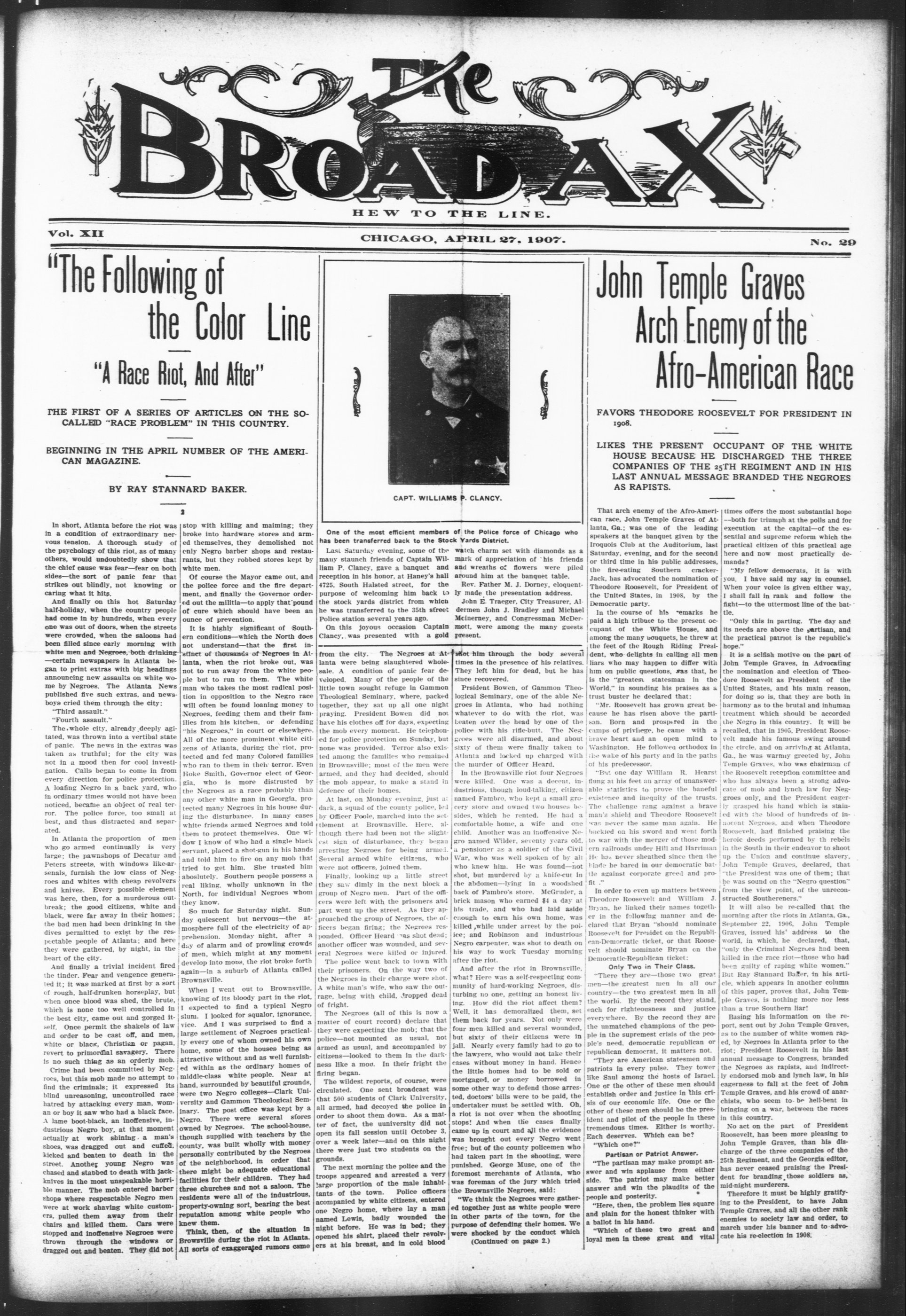
One of the most efficient members of the Police force of Chicago who has been transferred back to the Stock Yards District.
Last Saturday evening, some of the many staunch friends of Captain William P. Clancy, gave a banquet and reception in his honor, at Haney's hall 4725, South Halsted street, for the purpose of welcoming him back to the stock yards district from which he was transferred to the 35th street Police station several years ago.
On this joyous occasion Captain Clancy, was presented with a gold shot him through the body several times in the presence of his relatives. They left him for dead, but he has since recovered.
Präsident Bowen, of Gammon Theological Seminary, one of the able Negroes in Atlanta, who had nothing whatever to do with the riot, was beaten over the head by one of the police with his rifle-butt. The Negroes were all disarmed, and about sixty of them were finally taken to Atlanta and locked up charged with the murder of Officer Heard.
In the Brownsville riot four Negroes were killed. One was a decent, in dustrious, though loud-talking, citizen
At last, on Monday evening, just as dark, a squad of the county police, led by Officer Poole, marched into the settlement at Brownsville. Here, although there had been not the slightest sign of disturbance, they began arresting Negroes for being armed. Several armed white citizens, who were not officers, joined them.
Finally, looking up a little street they saw dimly in the next block a group of Negro men. Part of the officers were left with the prisoners and part went up the street. As they approached the group of Negroes, the officers began firing; the Negroes responded. Officer Heard was shot dead; another officer was wounded, and several Negroes were killed or injured.
The police went back to town with their prisoners. On the way two of the Negroes in their charge were shot. A white man's wife, who saw the outrage, being with child, dropped dead of fright.
The Negroes (all of this is now a matter of court record) declare that they were expecting the mob; that the police—not mounted as usual, not armed as usual, and accompanied by citizens—looked to them in the darkness like a mou. In their fright the firing began.
The wildest reports, of course, were circulated. One sent broadcast was that 500 students of Clark University, all armed, had decoyed the police in order to shoot them down. As a matter of fact, the university did not open its fall session until October 3, over a week later—and on this night there were just two students on the grounds.
The next morning the police and the troops appeared and arrested a very large proportion of the male inhabitants of the town. Police officers accompanied by white citizens, entered one Negro home, where lay a man named Lewis, badly wounded the night before. He was in bed; they opened his shirt, placed their revolvers at his breast, and in cold blood
watch charm set with diamonds as a mark of appreciation of his friends and wreathes of flowers were piled around him at the banquet table.
Rev. Father M. J. Dorney, eloquently made the presentation address.
John E. Traeger, City Treasurer, Aldermen John J. Bradley and Michael Mcinerney, and Congressman McDermott, were among the many guests present.
shot him through the body several times in the presence of his relatives. They left him for dead, but he has since recovered.
Prsident Bowen, of Gammon Theological Seminary, one of the able Negroes in Atlanta, who had nothing whatever to do with the riot, was beaten over the head by one of the police with his rifle-butt. The Negroes were all disarmed, and about sixty of them were finally taken to Atlanta and locked up charged with the murder of Officer Heard.
In the Brownsville riot four Negroes were killed. One was a decent, industrious, though loud-talking, citizen named Fambro, who kept a small grocery store and owned two houses besides, which he rented. He had a comfortable home, a wife and one child. Another was an inoffensive Negro named Wilder, seventy years old, a pensioner as a soldier of the Civil War, who was well spoken of by all who knew him. He was found—not shot, but murdered by a knife-cut in the abdomen—lying in a woodshed back of Fambro's store. McGruder, a brick mason who earned $4 a day at his trade, and who had laid aside enough to earn his own home, was killed while under arrest by the police; and Robinson and industrious Negro carpenter, was shot to death on his way to work Tuesday morning after the riot.
And after the riot in Brownsville, what? Here was a self-respecting community of hard-working Negroes, disturbing no one, getting an honest living. How did the riot affect them? Well, it has demoralized them, set them back for years. Not only were four men killed and several wounded, but sixty of their citizens were in jail. Nearly every family had to go to the lawyers, who would not take their cases without money in hand. Hence the little homes had to be sold or mortgaged, or money borrowed in some other way to defend those arrested, doctors' bills were to be paid, the undertaker must be settled with. Oh, a riot is not over when the shooting stops! And when the cases finally came up in court and all the evidence was brought out every Negro went free; but of the county policemen who had taken part in the shooting, were punished. George Muse, one of the foremost merchants of Atlanta, who was foreman of the jury which tried the Brownsville Negroes, said: "We think the Negroes were gathered together just as white people were in other parts of the town, for the purpose of defending their homes. We were shocked by the conduct which
(Continued on page 2.)
John Temple Graves Arch Enemy of the Afro-American Race
FAVORS THEODORE ROOSEVELT FOR PRESIDENT IN 1908.
LIKES THE PRESENT OCCUPANT OF THE WHITE HOUSE BECAUSE HE DISCHARGED THE THREE COMPANIES OF THE 25TH REGIMENT AND IN HIS LAST ANNUAL MESSAGE BRANDED THE NEGROES AS RAPISTS.
That arch enemy of the Afro-American race, John Temple Graves of Atlanta, Ga.; was one of the leading speakers at the banquet given by the Iroquois Club at the Auditorium, last Saturday, evening, and for the second or third time in his public addresses, the fire-eating Southern cracker-Jack, has advocated the nomination of Theodore Roosevelt, for President of the United States, in 1908, by the Democratic party.
In the course of his remarks he paid a high tribute to the present occupant of the White House, and among the many bouquets, he threw at the feet of the Rough Riding President, who delights in calling all men liars who may happen to differ with him on public questions, was that, he is the "greatest statesman in the World," in sounding his praises as a trust buster he declared that:
"Mr. Roosevelt has grown great because he has risen above the partisan. Born and prospered in the camps of privilege, he came with a brave heart and an open mind to Washington. He followed orthodox in the wake of his party and in the paths of his predecessor.
"But one day William R. Hearst flung at his feet an array of unanswerable statistics to prove the baneful existence and inequity of the trusts. The challenge rang against a brave man's shield and Theodore Roosevelt was never the same man again. He buckled on his sword and went forth to war with the merger of those modern railroads under Hill and Harriman. He has never sheathed since then the blade he bared in our democratic battle against corporate greed and profit."
In order to even up matters between Theodore Roosevelt and William J. Bryan, he linked their names together in the following manner and declared that Bryan "should nominate Roosevelt for Presidet on the Republican-Democratic ticket, or that Roosevelt should nominate Bryan on the Democratic-Republican ticket:
Only Two in Their Class.
"There they are—those two great men—the greatest men in all our country—the two greatest men in all the world. By the record they stand, each for righteousness and justice everywhere. By the record they are the unmatched champions of the people in the supremeest crisis of the people's need, democratic republican or republican democrat, it matters not. "They are American statesmen and patriots in every pulse. They tower like Saul among the hosts of Israel. One or the other of these men should establish order and justice in this crisis of our economic life. One or the other of these men should be the president and pilot of the people in these tremendous times. Either is worthy. Each deserves. Which can be? "Which one?"
Partisan or Patriot Answer.
"The partisan may make prompt answer and win applause from either side. The patriot may make better answer and win the plaudits of the people and posterity.
"Here, then, the problem lies square and plain for the honest thinker with a ballot in his hand.
"Which of these two great and loyal men in these great and vital
No. 29
The Graves
Cemy of the
American Race
HSEVELT FOR PRESIDENT IN
OCCUPANT OF THE WHITE
DISCHARGED THE THREE
5TH REGIMENT AND IN HIS
GE BRANDED THE NEGROES
times offers the most substantial hope—both for triumph at the polls and for execution at the capital—of the essential and supreme reform which the practical citizen of this practical age here and now most practically demands?
"My fellow democrats, it is with you. I have said my say in counsel. When your voice is given either way, I shall fall in rank and follow the fight—to the uttermost line of the battle.
"Only this in parting. The day and its needs are above the partisan, and the practical patron is the republic's hope."
It is a selfish motive on the part of John Temple Graves, in Advocating the nomination and election of Theodore Roosevelt as President of the United States, and his main reason, for doing so is, that they are both in harmony as to the brutal and inhuman treatment which should be accorded the Negro in this country. It will be recalled, that in 1905, President Roosevelt made his famous swing around the circle, and on arriving at Atlanta, Ga., he was warmy greeted by, John Temple Graves, who was chairman of the Roosevelt reception committee and who has always been a strong advocate of mob and lynch law for Negroes only, and the President eagerly grasped his hand which is stained with the blood of hundreds of innocent Negroes, and when the Theodore Roosevelt, had finished praising the heroic deeds performed by th rebels in the South in their endeavor to shoot up the Union and continue slavery, John Temple Graves, declared, that "the President was one of them; that he was sound on the "Negro question" from the view point, of the unreconstructed Southereners."
It will also be re-called that the morning after the riots in Atlanta, Ga., September 22, 1906. John Temple Graves, issued his' address to the world, in which, he declared, that, "only the Criminal Negroes had been killed in the race riot—those who had been guilty of raping white women." But Ray Stannard Baker, in his article, which appears in another column of this paper, proves that, John Temple Graves, is nothing more nor less than a true Southern liar!
Basing his information on the report, sent out by John Temple Graves, as to the number of white women raped, by Negroes in Atlanta prior to the riot; President Roosevelt in his last annual message to Congress, branded the Negroes as rapists, and indirectly endorsed mob and lynch law, in his eagerness to fall at the feet of John Temple Graves, and his crowd of anarchists, who seem to be hell-bent in bringing on a war, between the races in this country.
No act on the part of President Roosevelt, has been more pleasing to John Temple Graves, than his discharge of the three companies of the 25th Regiment, and the Georgia editor, has never ceased praising the President for branding those soldiers as, mid-night murderers.
Therefore it must be highly gratifying to the President, to have John Temple Graves, and all the other rank enemies to society law and order, to march under his banner and to advocate his re-election in 1908.
THE BROAD AX.
Will promulgate and at all times uphold the true principles of Democracy, but Castellano, Protestanta, Pineau, Inbilder, Single tax, axe tax, can keep their say on Labor, the one case they can say on their say, in so their language is proper and responsibility is fixed.
The Broad. is a newspaper whose platform is broad enough for all, ever claiming the editorial right to speak its own mind.
Both communications will receive attention. Write outside of the paper.
Subscriptions must be paid in advance.
One Year ..... $2.50
Six Months ..... 1.00
Advertising rates made known on application.
Address all communications to
THE BROAD AX
8004 Armour Avenue, Chicago.
JULIUS F. TAYLOR, Editor and Publisher.
Entered at the Post Office at Chicago,
Ill., as Second-class Matter.
PERSONAL MENTION.
Walter M. Farmer, for 16 years an honored member of the bar in St. Louis, Mo., is now engaged in the general practice of law. Suite 708, 171 Washington street, Phone Main, 4153. Residence 4856 Langley avenue. Phone Drexel 6302.
WILL TELL OF NEGRO PROGRESS.
john G. Jones will deliver an address at the Ebenezer Baptist church, Thirty-fifth and Dearborn streets, Sunday afternoon at 4 o'clock on "The Progress and Achievements of the Colored People in Chicago in the Past Fifty Years."
FARWELL STAG TO DOC
TOR ROBINSON.
The Bachelor Club entertained at a stag at 2624 Wabash Ave. in honor of its president, Dr. Clarence Robinson, brother-in-law to prosecuting attorney, S. A. T. Watkins, Dr. Robinson leaves the ity tomorrow for Buxton, Iowa, where he is to begin to practice.
Those who responded to toasts were: Assistant Corporation Counsel, Maj. F. A. Denison, on Citizenship; Atty. Gordon Jackson, formerly of Cincinnati, on the Niagara movement, Sart, Gen. Milton J. Dean of the 9th calvary, on the Army; Julius Avendorph, on Social Life; R. A. J. Shaw, on Club Life and Dr. Geo. C. Hall, on Medline
Dr. Wm. J. Howard presided as toastmaster. String music and whist were the amusements for the evening.
INSTITUTIONAL CHURCH
NOTES
3825 Dearborn Street
Special services all day tomorrow. The choir of boys and girls will sing at the morning service. Rev. H. E. Stewart will preach from the subject: Our Priesthood. 10:45 a.m. The evening service will be of an interesting character music by the orchestra singing by the large voluntary choir. The solo and chorus work promises to be quite a feature of the evening service. Twenty minutes' sermon by the pastor. The evening service held not later than 9:15 p.m. Come early if you desire to enjoy the entire service.
Meet Me at the Institutional church May 6th. Song Recital for benefit of the kindergarten. Mrs.' Martha Anderson soprano
Orchestra and Voluntary chorus Sunday night at Institutional Church. Come early and enjoy a splenddi service. Our Priesthood, subject of a discourse at the Institutional Church Sunday. "S."
WEST SIDE NEWS
By Prof. A. L. Simpson.
Miss Bertha Stevenson has made her debut now 18, free, single and disengaged.
Miss Ida Moore, a charming maid, who for a number of years resided with Mrs. M. Burroughs of 920 W. Lake St., is now with her folks again.
The Broad Ax. for sale at 920 W. Lake St. Call early; they sell fast. 5c per copy.
The Rev. R. L. Darden of Providence Baptist Church, is doing a great work. He has baptized more people on the West Side in the past year than all the preachers together.
The West Side Sunday Club has a new critic and the young folks are verv careful what they do and say, as they know he is not, afraid to call their names. The club is doing a great work and should be encouraged. Their
new president is springing surprises on them right along. He is a wonder.
On Sunday, April 28th inst., at 8 p. m., the Rev. R. L. Darden, of Providence Baptist Church, will preach an odd sermon. Subject, The Horse Pawing in the Valley.
The Jackson Sisters who purchased the confectionery store of Mrs. M. Burroughs, 920 W. Lake street, are now prepared to serve first class meals at second class prices, southern cooking. Girl waitresses will serve you.
Miss Georgia S. Broody, 753 West Fulton street, was united in marriage to Mr. James G. Gordon. Wednesday evening, April 24th. The bride and groom will be at home to their many friends after May 4 at 837 Fulton street.
THE NEW YORK EVENING POST
ON JAMES K. VARDAMAN.
Gov. Vardaman has begun his campaign for the Senate by his usual demagogic attack upon the Negro. In his opening speech he said:
"If it is necessary that every Negro in the State he lynched, it will be done to maintain white supremacy," and he added with commendable frankness: "The white man, the Caucasin, is utterly conscienceless when it comes to racial existence." At the same time he stated that he was not hopeless of a solution of the race problem. But constructive remedy is, as usual, not to be found in his speech. In mark contrast with this exhibition of semi-savagery on Gov. Vardaman's part is a recent utterance by ex-Gov. Northern of Georgia. "I believe," he said in a speech in Atlanta, "every one of a mob is a red-handed murderer whether he be the tall-end member or leader. . . . I consider people who burn Negroes as savages hot from hell. Just now we are lapsing into barbarism, and our civilization is slipping from us. Something must be done."
While the Columbia State feels that this is too pessimistic, it expresses its opinioin that "We have a few public men not many, who seem to be doing all they can to fan the flame of hatred btween the races, instead of trying to extinguish it." There are many other signs that the South is rapidly dividing into two classes; those who follow Vardaman and Tillman in their blindly destructive policy, and those who, like Mr. Northern, who believe that there is such a thing as a Christian duty towards a backward race—backward by reason of the white man's cupidity.—New York Evening Post.
OPPOSED TO NEGRO NEWSPAP-ERS.
Prof. Booker T. Washington, the founder of Tuskegee School, is opposed to Colored people having their own newspapers. He says: "I fear that our newspapers are at fault because they hold up our difficulties. People reading them see too many accounts of Negro oppression and we do not want our race soured by such accounts."
We do not question the sincerity nor impugn the motives of the "Wizard of Tuskegee," but if he is correctly quoted in the above extract, we are inclined to think that when he made the statement he had given his brains a vacation and his tongue was working over time.
The reason he assigns for his opposition to Negro newspapers, 'they hold up our difficulties,' to our mind is one of the most potent reasons why they should be sustained. Unquestionably difficulties confront us on every hand. Can we learn to meet and master them uniformed as to their nature or cause? Most assuredly not. From whence are we to receive such information? Certahly not from papers that assist in placing such "difficulties," in our pathway.
We have no harsh words to say of Prof. Washington's views along that line, feeling that his propaganda against Negro newspapers is at least three decades behind time—The Reporter tSotnna, shrdl sardlu sdlurdl porter Staunton, Va.
BISHOP TURNER DENOUNCES
BEN. TILLMAN.
Tell Whites that Negroes are Discriminated against in the laws—Enough innocent Negro blood split to drown Congress, the supreme court and the president. (From Atlanta Constitution.)
(From Atlanta Constitution.)
At the second mass meeting, held yesterday afternoon at the People's tabernacle, on Yonge street, under the auspices of the Vigilant Reform Band, to bring about a better understanding between the races, to build a reform building and tabernacle and to establish a fund for the blind and old people of the Negro race, who are a nuisance on the streets, the principal address was made by Bishop Turner, of the African Methodist Episcopal church, many of the other speak-
ers on the program being unable to attend for various reasons.
Bishop Turner's speech proved somewhat of a surprise. He made a bitter attack upon the courts and upon legislation, declaring that the Negroes were discriminated against. He paid his respects to the nation, the supreme court, congress, the president and Senator Benjamin R. Tillman, ending with words of praise for ex-Governor Northen.
"There has been enough innocent Negro blood split," he shouted, "to drown congress, the supreme court and the president."
In referring to Senator Tillman, he boldly asserted that he had more educational and refining qualifications than the great South Carolinian who represents his stat ein the senate of the nation, and calmly offered to match himself with the senator before any jury of twelve men, south or north, and submit to hanging if he failed to gain the verdict of superiority.
"Why Governor Northen is as far above Tillman as Jupiter to a Lucifer match, the sun to the glow-worn and the rainbow to the ring-worm," said he.
FOLLOWING "THE COLOR LINE."
(Concluded from page 1.)
the evidence showed some of the county police had been guilty of."
After the riot was over, many Negro families, terrified and feeling themselves unprotected, sold out for what they could get—I heard a good many pitiful stories of such sudden and costly sacrifices—and left the country, some going to California, some to Northern cities. The best and most enterprising are those who go; the worst remain. Not only have Negroes left Brownsville, but they have left the city itself in considerable numbers. Labor will thus be still scarcer and wages may be higher in Atlanta because of the riot.
It is significant that not one of the Negroes killed and wounded in the riot was of the criminal class. Every one was industrious, respectable and law-abiding. A white committee, composed of W. G. Cooper, Secretary of the Chamber of Commerce, and Geo. Muse, a prominent merchant, and backed by the sober citizenship of the town, made an honest investigation and has issued a brave and truthful report. It is a report which deserves to be read by every American. Here are a few of its conclusions:
1. Among the victims of the mob there was not a single vagrant.
2. They were earning wages in useful work up to the time of the riot.
3. They were supprring themselves and their families or dependent relatives.
4. Most of the dead left small children and widows, mothers or sisters with practically no means and very small earning capacity.
5. The wounded lost from one to eight weeks' time, at 50 cents to $4 a day, each.
6. About 70 persons were wounded, and among these there was an immense amount of suffering. In some cases it was prolonged and excruciating pain.
7. Many of the wounded are disfigured, and several are permanently disabled.
8. Most of them were in humble circumstances, but they were honest, industrious and law-abiding citizens and useful members of society.
9. These statements are true of both white and Colored.
10. Of the wounded, ten are white and sixty are Colored. Of the dead, two are white and ten are Colored; two female, and ten male. This includes three killed at Brownsville.
11. Wild rumors of a larger number killed have no foundation that we can discover. As the city was paying the funeral expenses of victims and relief was given their families, they had every motive to make known their loss. In one case relatives of a man killed in a broil made fruitless efforts to secure relief.
12. Two persons reported as victims of the riot had no connection with it. One, a Negro man, was killed in a broil over a crap game; and another, a Negro woman, was killed by her paramour. Both homicides occurred at some distance from the scene of the riot.
The men who made this brave report did not mince matters. They called murder, murder ;and robbery, robbery. Read this:
13. As twelve persons were killed and seventy were murderously assaulted, and as, by all accounts, a number took part in each assault, it is clear that several hundred murderers or would-be murderers are at large in this community.
At first, after the riot, there was an inclination in some quarters to say; "Well, at any rate, the riot cleared the atmosphere. The Negroes have had their lesson. There won't be any more trouble soon."
But read the sober conclusions in the Committee's report. The riot did not prevent further crime.
14. Although less than three months have passed since the riot, events, have already demonstrated that the slaughter of the innocent does not deter the criminal class from committing more crimes. Rapes and robbery have been committed in the city during that time.
15. The slaughter of the innocent does drive away good citizens. From one small neighborhood twenty-five families have gone. Agreat many of them were buying homes on the instalment plan.
16. The crimes of the mob include robbery as well as murder. In a number of cases the property of innocent and unoffending people was taken. Furniture was destroyed, small shops were looted, windows were smashed, trunks were burst open, money was taken from the small hoard, and articles of value were appropriated. In the commission of these crimes the victims, both men and women, were treated with unspeakably brutally.
17. As a result of four days of lawlessness there are in this glad Christmas time widows of both races mourning their husbands, and husbands of both races mourning for their wives; there are orphan children of both races who cry out in vain for faces they will see no more; there are grown men of both races disabled for life, and all this sorrow has come to people who are absolutely innocent or very wrong-doing.
(To be continued.)
CHIPS
Mrs. Whitaker, 3249 Forest Avenue, is on the sick list.
Mrs. Doctor Carey of Cincinnati, Ohio, is the guest of Mr. J. Hancock, 6508 Langley Ave.
Dr. W. H. Marshall, 3448 State street, left the city Friday to spend a week in the southland.
Mrs. Cora Galloway, 5116 Dearborn street, who has been ill for the past two weeks, is improving.
The funeral took place from her late residence Monday at 1 p. m., Rev. Father Massiah officiating. Interment, Oakwoods.
Mr. Young, the popular druggist of Baltimore, spent a few days in the city last week the guest of his brother, Mr. Chas. Young of the Keystone Hotel.
Miss Etta Evans of South Bend Ind., formerly of Rockford, Ill., left the city Saturday after a pleasant two weeks' visit to Mrs. Thompson, 3726 Calumet Avenue.
Mr. Albert Ray of Sault Ste Marie, Mich., who has been looking over some land in Indian Territory, spent a few days in the city last week, stopped at the Keystone Hotel.
L. L. Jones, 3842 State street, vice president of the Black Diamond Development Company, leaves for Pittsburg, Pa., Sunday morning, where he will spend ten days with friends.
Mr. J. Harry Harris, of Milwaukee, Wis., spent a few days in the city on business this week. Harry says Milwaukee is the coming city. Let us hope so for Harry's sake.
After an illness of about six months' duration, Mrs. Cornelia Reynolds, 3654 Dearborn street, departed this life, Saturday morning, April 20th. Mrs. Reynolds was well known by most of the old residents of Chicago.
Mr. Joseph Jenkins has moved from his old residence, 4715 Dearborn street, to 6648 Evans avenue, where with his sister, Mrs. Stuart, he has handsomely fitted up a cozy flat into which it is said he is soon to carry a charming bride.
Col. R. A. Ware, 2232, Dearborn street, who is one of the best known Afro-Americans in secret society circles in Chicago, has been confined to his home with sickness since last fall, and his hosts of friends would all be delighted to see him restored to his usual good health.
When Lieut. Governor Tillman of South Carolina was tried for the murder of Editor Gonzales, of the Columbia State, T. D. Mitchell was the star witness for the defence. Since then he has been invicted of ballot-box stuffing at Brookland, S. C., and also indicted for gambling with Negroes. Now comes the information that he has been arrested charged with criminal assault upon a Negro woman. A fine specimen of Anglo-Saxon super-
iority! Will Senator B. R. Tillman deign to explain this anomaly.—The Herald, Chattanooga, Tenn.
Dr. Mason's lecture at Quinn Chapel Monday evening for the benefit of the Amanda Smith Industrial Home, was not well attended and this is laid to the discredit of the Chicago folks who will not turn out in support of their worthy charity institutions.
After attending the Thomas recital at Orchestra Hall, Saturday evening, Mr. Wm. Morse, the well to do bachelor, entertained at supper at Johnson's New England Restaurant. Mmes. Mary Williams, Rosa Lively, Misses Lucy Lindsay, Virginia Lively, Gladvs Williams and Mr. Noah D. Thompson.
The Guide, Baltimore, Md., the Leader, Springfield, Ill., and the Advocate Portland, Oregon, quoted our article in full on Booker T. Washington, and the attack he made on the Negro Press, in his lecture delivered at the Olivet Baptist Church, Friday evening, April 5. which proves that we struck the bull's eye.
Mr. Felix Weir, Chicago's favorite violinist, after an absence of nearly two years, will return and give a recital at Bethel church Monday evening, April 29th. Mr. Geo. W. Bainbridge, one of Chicago's leading tenors, will assist. Miss Gertrude Jackson, will be at the piano. Admission 35 cents. Julius N. Avendorph, Manager. 8:45 sharp.
Editor John Temple Graves, of Atlanta, Ga., whose paper helped to kindle the flames of hatred and prejudice that resulted in the race riot in that city some time ago, in which innocent men and women of both races were killed and thousands of dollars' worth of property destroyed, is reported as having expressed a desire or wish that the Afro-American journals of Chicago and other Northern cities, in which their editors condemn in bitter terms the wholesale outrages perpetrated upon their race, be excluded from the United Stats mails. How is that for cheek and gall, from an arch conspirator and an enemy to good government?—The Advocate, Portland, Oregon.
It can also truthfully be said that Booker T. Washington is working hand in hand with Graves and Tillman in their effort to kill newspapers published in the interest of the Afro-American race.
Quite a Bargain.
Eldyth—Grace seems quite happy since she married the count. She says she has the dearest husband in the world.
Mayme—Dearest fiddlesticks! Why, he only cost her father half a million.—Minneapolis Journal.
Ear From It.
Goodley—I'm surprised to see you beating that dog. You should have some pity for dumb animals.
Marryat—So I have, but if you had to listen to this fellow every night, as I do, you'd know he isn't dumb.—Philadelphia Press.
Crowded Out.
Hicks—I dropped around to see the Fitz Kloses in their flat last night, but I couldn't get in.
Wicks—Not at home, eh?
Hicks—Yes, they were all at home.
That was the trouble.—Catholic Standard and Times.
Positively Delightful
"Ah!" exclaimed the irate father. "How is it I catch you kissing my daughter, sir? Answer me, sir! How is it?" "Fine, sir! Fine, indeed!" replied the young man.—New Orleans Times-Democrat.
A Common Error.
"Then you haven't what I want?"
"No, but we have something that is practically just as good."
"You mean that it is theoretically just as good."-Pittsburg Post.
Living High.
"That man has all his ideas and standards on a high plane."
"Indeed! Who is he?"
"The inventor of that new aeroplane."—Houston Post.
FURNISHED ROOM TO RENT.
Nice furnished room to rent to man and wife that can come well recommended, 4613 Dearborn st.
HUSTLING COLORED MAN WANT TED TO SELL SUBURBAN REAL ESTATE
Wanted a good representative Colored man to sell choice lots in a North Shore suburb to Colored people can make $100.00 to $200.00 per week. No capital required, must be man of ability and education. References required. Address "J." care Editor The Broad Ax, 5040 Armour ave.
WASHINGTON LETTER
WASHINGTON LETTER
[Special Correspondence.]
Work has been begun on the restoration of the United States capitol building. The word "restoration" exactly fits the case, as Superintendent Elliott Woods and his capable assistant, Mr Lynn, working under authority of an appropriation made by congress at the last session, are endeavoring to restore the building to the state, even as to details, originally intended. Every vestige of the paint now on the walls of Statuary hall in imitation of Italian marble will be scraped off, and they will be left in their natural sandstone finish. More than this, two of the old stairways which run from Statuary hall—which until 1850 was the hall of the house of representatives—to what were formerly the men's gallery and the women's gallery have been rediscovered and opened, and the men's gallery will be restored to its original condition.
Restoring the Capitol
One reason why this work has been undertaken was that the restoring of the walls of the rotunda to their natural sandstone finish seems to have met with universal approval from senators, representatives and visitors to the capitol building. It is agreed on all sides that the rotunda is a very much more beautiful and artistic place than was the case when the rose tinted sandstone was covered with half a dozen layers of paint.
The plans for the restoration of the capitol also include the removal of the paint from the crypt and the pillars within it.
Purely Grecian In Design.
Statuary hall, when used as the chamber of the house of representatives, was generally conceded to be the most beautiful legislative hall in the world. It is purely Greekian in its design and decorations, the outline of the plan being a semicircle of ninety-six feet chord elongated in its vertical diameter line by a parallelogram 72 feet long by 25 feet wide. The height to the top of the entablature blocking is thirty-five feet and to the apex of the dome ceiling fifty-seven feet. So far as can be determined by sounding and testing, the entire wall space is of sandstone similar to that in the rotunda.
Marble Polished by Slaves.
The circular colonnade is made up of fourteen columns and two antes of the richest Corinthian proportions. The shafts are composed of a remarkably beautiful species of variegated marble called Breccia, in solid blocks, obtained from the banks of the Potomac, a hundred miles or so above the city. This marble is of a very remarkable formation, and the blocks, being of a nature which made it impossible to have them turned on a lathe, as is ordinarily the case, were polished by hand by slave labor. The capitals are of white Italian marble, sculptured after a specimen taken from the temple of Jupiter Stator at Rome, the most admired specimen of capitals of this delicate, beautiful order. The entablature is after the proportions of that in the same temple, ornamented with dentils and medallions, enriched between and underneath with leaves and roses. Over the colonnades springs the magnificent painted paneled dome.
Uncle Sam's Printing Bill.
The government printing bill, which amounted to a little over $7,500,000 last year, will drop to about $5,500,000 this year and this in spite of the fact that a number of new bureaus have been established and several new laws, including the immigration law, the pure food law and the railroad rate law, which entailed an enormous amount of printing, have come into operation. The congressional printing commission is working out plans for a still further reduction of the printing bill. This commission will sit here from time to time during the summer and fall and when congress meets again will be prepared to recommend additional reform legislation.
Public Buildings.
About $6,000,000 is to be expended within the District during the coming fiscal year in the erection of public buildings and the continuance of the work on such structures now under way. Such is the amount of money provided for those purposes by the appropriation bill which will become effective the 1st of July next. It is a striking illustration of the development of the city that this immense sum of money to be spent in brick and stone in order to provide additional housing for the various activities of the government is in large part to be used in continuing the construction of buildings already begun.
Some Great Structures.
Some Great Structures
In the list of the appropriations for the coming year for buildings in this city there are three instances of amounts aggregating about $1,000,000 each which are merely intended to complete three structures which are now in progress. This is a good deal of money for such a purpose, and it enables one to form some conception of the size and importance of the buildings referred to—the National museum, the senate office building and the house office building.
The Agricultural Building.
Another extensive structure, the cost of which is represented not by six figures preceded by the numeral 1, but numerals 2 and 3, is the one that is being built for the department of agriculture. Such progress has been made in the erection of that building as to require at this time only a comparatively small amount of money. The additions to the group of buildings about the capitol which are now being made by the erection of the senate and the house office buildings has led congress to provide a heating plant which could supply all the buildings with the necessary heat and light and power. CARL SCHOFIELD
A TANTALIZING METAL
A TANTALIZING METAL
Peculiar Properties and Wonderful Hardness of Tantalum.
A rare metal which has attracted universal attention during the last two years while before it was scarcely known outside of some scientific laboratories is tantalum, so named by its discoverer, Ekelberg, on account of the tantalizing difficulties experienced in extracting the metal from its ores.
Only two years ago was it found out by German scientists that what the discoverer thought to be tantalum was an alloy of it and a carbide, and more tantalizing efforts were necessary to produce this metal in its perfectly pure state. But, this success once being reached, the metal immediately became of such importance that it is now revolutionizing at least one large industry, that of the manufacture of incandescent lamps for electric lights. Although it has been tried to use tantalum as a steel hardening agent, the mechanical difficulties in alloying tantalum with steel have been so great that we shall probably see other applications come into prominence first.
Tantalum is one of the hardest substances known, and its use for scientific instruments, where price stands always second to accuracy and durability, will doubtless be developed much sooner, inasmuch as tantalum also resists the corrosive influence of acids and alkaline solutions in a very remarkable degree.
One of the most striking experiments to demonstrate the hardness of tantalum was that for the purpose of boring a hole through a sheet of pure tantalum metal a diamond drill bore was used, revolving incessantly for three days and making 5,000 revolutions per minute, and the result was a depression of less than one one-hundredth of an inch in the metal, but an entirely dull and smooth diamond.-E. Schaaf-Regelman in Engineering Magazine.
"Please Omit Flowers."
Those three words added to an obituary notice deprive the florists of Chicago of about $100,000 a year. Some of the larger establishments that cater to a fashionable trade are hit harder than the small concerns, but there is no florist in the city who does not feel the loss entailed by the three words quoted above.
"There were about 30,000 deaths in Chicago last year," said a Madison street florist, "and at least one-tenth of the death notices printed informed friends to 'please omit flowers.' When some person of note dies and flowers are to be omitted at the funeral, the big florists are out all the way from $25 to $100 each. Those who request that flowers be omitted are the very ones whose friends are well able to purchase floral tributes and would otherwise do so. Many persons come to me in the course of a year to order a wreath or some floral design for a funeral, not knowing that the 'please omit flowers' has been published with the death notice. All the florists in the city have the same experience, and I estimate that our losses in the year amount to $100,000."—Chicago Record-Herald.
Be Kind to the Waiter.
It is one of the noblest functions of a trades union to vindicate the personal dignity of its members, but the waiters of Bucharest carry professional pride almost too far. Two customers in a cafe there the other day, a French paper reports, insulted the waiter who served them. The waiter reported the affair to the Walters' union, and the union blacklisted the two customers, and in every cafe and restaurant in Bucharest they are rigidly boycotted by the waiters. At one establishment the proprietor himself offered to serve them, but the waiters unanimously threatened to throw down their napkins there and then if he did. The wits of Bucharest assure the two boycotted men that there is nothing for it but to get married. And even then they will have to be very meek with their wives.—Manchester Guardian.
"The Worst Indian That Ever Lived."
Geronimo in his prime ran forty miles on foot in one day. rode 500 miles on one stretch as fast as he could change horses and wore out the column that finally captured him until three sets of officers were needed to finish the chase, and not more than one-third of the troopers who started were in at the finish. Wrinkled and crafty and cruel is his swarthy face today, but the fire of his infernal energy has died, and he is no more than a relic of the Geronimo of whom General Miles said after their first meeting:
"He rode into our camp and dismounted, a prisoner. He was one of the brightest, most resolute, determined men I ever met, with the sharpest, clearest dark eye. Every movement showed power and energy."—Outing Magazine.
Bread Line For Americans, Mostly.
A prominent clergyman at the head of an east side and Bowyery mission in New York is authority for the statement that the men who line up for free bread at the distributing places around 1 o'clock every morning, men who have no place to lay their heads for a single night's lodging, are nearly all from the interior of the United States.-Van Norden's Margzine.
Niagara's Recession
A recent examination of Niagara made by the Canadian geological survey reveals that the recession of the falls on the Canadian side is perceptibly slowing. The falls recede now about two feet two inches a year as compared with five feet three inches, which was calculated to be the annual recession between the years 1875 and 1890
FISHY WISHY FANCIES.
Sometimes when I am weary
I have the curious wish
That I were but a tadpole
Or just a jelly fish.
For if I were a tadpole
I'd have no social fads;
I'd spend my time "in swimmin"
With other little tads.
And if I were a jell fish.
Then all day long I'd eat
My mother's apple jellies
Or other jellas as sweet.
But, ah, I can't play tadpole,
For I am twenty-nine—
And hopping like a bullfrog
To keep myself in line!
And how can I indulge me
This jelly fish whim?
I'm flopping like a flounder
To keep me "in the swim."
—Robertus Love in Judge.
Lady Visitor—Do you ever make any sacrifices for your little sister?
Bobby—Yes, ma'am; I eat all the candy"cause it makes her sick—Philadelphia Press.
Something Wrong.
The lad timidly entered the office of the old broker.
"Well, my boy," said the broker, wheeling in his chair, "I suppose you have come to apply for a position as office boy?"
"Y-yes, sir," replied the lad, twitching his hat nervously.
"H'm! How many grandmothers have you?"
"None, sir. Both are dead."
"Well, how often do you get the mumps in the baseball season?"
"Never, sir. I only have the mumps in the winter."
"Strange. Then what excuse do you make up when you wish to take an afternoon off to see a ball game?"
"None at all, sir. I don't like baseball, and I have never been to a game in my life."
The old broker gave a low whistle.
"My dad," he exclaimed, "any American can boy who doesn't like baseball must be a freak. You'd better go in a dime museum."—Chicago News.
Hard Lines.
Dr. Austin Flint, the alienist, said at the Century club in New York apropos of a will contest that had been tried last year:
"The plaintiff lost, and no wonder. His case was as difficult a one as that of the young man who appeared unduly depressed after the death of his rich aunt.
"Why are you so sad?" an acquaintance said to the young man. "You never appeared to care much for your aunt."
"I didn't,' said the youth dolefully, 'but I was the means of keeping her in an insane asylum the last five years of her life, and now that she has left me all her money I've got to go to court and prove that she was of sound mind."—Washington Star.
Why Not?
"Certainly I'm going to the reception," said the conceived chump. "I believe the beautiful Miss Swellman will be there."
"Surely you don't expect her to speak to you?" remarked the quiet man.
"Why not?" asked the conceived chump. "What's the matter? Is she bashful?" — Catholic Standard and Times.
Theory Upset.
"De Squale has disproved one pet theory anyway."
"What one and how?" "It is commonly believed that lemons are good for the voice, and his doesn't improve in the least in spite of the fact that the critics hand him a lemon everywhere he goes."—Judge.
Man and His Opinion
"Every man has a right to his opinion."
"Yes. The great trouble with a good many people who have opinions is that they think they have the right to bore everybody else with them." - Ohio State Journal.
Called.
"I did want to tip you, waiter," said McBluff, "but I have no change."
"I can make change for you, sir," said the waiter.
"Er-can you? Well-er-give me five pennies for this nickel."—Philadelphia Press.
Her Title Clear.
"Well," said Mrs. Nagget, "I guess I have a perfect right to my opinions." "Of course you have, my dear," replied her husband, "and if you only kept them to yourself no one would ever question that right."—Baltimore News.
The Lesser Evil.
"Of course," said the tragedian, "in the theatrical business a short run is bad"— "But," interrupted the critic, "a good long walk is worse, isn't it?"—Minneapolis Journal.
Natural Conclusion
"Here's a story of a man who has sixteen wives."
"Yes. Every little while I hear that some one has escaped from a lunatic evilum."—Houston Post.
HUMOR
SUNDOWN WITH A BUMP.
The Irishman Decides That This Is a Wonderful Country.
An Irish contractor in San Francisco sent to Ireland for his father to join him. The journey was a great event to the old man, who had lived in rural districts all his life, and he reached San Francisco much excited.
After several days of sightseeing his son resumed his business and suggested that his father visit the Presidio.
"And phwat's the Presidio?" asked the old man.
"The Presidio, father, is the government reservation for the soldiers, a fine bit of a park, and you'll enjoy yourself."
At the end of a strenuous day the old man stood gazing at the big buildings, comparing them with the small huts of his old home. Seeing a soldier near, he tapped on the shoulder.
"Me bye, phwat's that string of houses fornist us?"
"Why, those are the officers' quarters."
"And that man with the big smoke-stack?"
"That's the cook shanty."
"Shanty, is it? Well, 'tis a great country. 'Tis palaces they're using."
The young man offered to show him the new gymnasium. On the way the sundown gun was discharged just as they passed. The old man, much startled, caught his companion's arm.
"Phwat's that, now?"
"Sundown," replied his friend, smiling.
"Sundown, is it? Think of that, now!
Don't the sun go down with a terrible bump in this country?"—Lippincott's Magazine.
Overheard In Court
There is a Chicago lawyer who, his colleagues aver, has a positive genius for malapropos suggestion to his witnesses on the stand.
Recently this lawyer was counsel in a suit for divorce, wherein he was examining a woman who had taken the stand in behalf of the plaintiff.
"Now, madam," began the attorney, who is always saying the wrong thing, "repeat the slanderous statements made by the defendant on this occasion."
"Oh, they are unfit for any respectable person to hear!" gasped the witness.
"Then, madam," said the attorney coaxingly, "suppose you just whisper them to his honor the judge."—Cleveland Leader.
Can Wash Her Sins Away.
The little four-year-old daughter of a minister friend of mine was given a little washtub and board for Christmas. She had often heard her father exhorting sinners to have their sins washed away, so when she received her washtub and board she seemed much pleased and sald: "Now, mamma, I can wash all my sins away."—Chicago News.
A Matter of Business
Customer (to waiter)—What's the meaning of this? Yesterday you gave me twice as large a portion as today. Walter—Where did you sit? Customer—By the window. Walter—Oh, that accounts for it! We always give people by the window large portions. It's an advertisement.—Snutok.
Too Boomy.
"Gracious!" exclaimed the economical mother. "I thought I had cut down this old suit of your father's so it would fit you, but it seems entirely too large yet."
"Yes, ma," replied the bright boy, "especially the 'wide ex-pants.'"—Catholic Standard and Times.
A Suitable Difference
"You are in a position to be praised for many things."
"Yes," answered Senator Sorghum, "but sometimes a man's influence does not depend so much on what he is praised for as on what he is appraised for"—Washington Star.
Hard Pins.
Peter Perslmmon—So de ol' gen'man
keeps yo' wife in pin money? You
ought to be glad ob dat.
Sam Sunflower—l'dak to know why.
He keeps her in money to buy rolling
pins to thump me obeh de haid wid.
Baltimore News.
Too Much Sunshine.
Photographer—Not quite so much sunshine, please, or you'll fog the plate.—Harper's Weekly.
The Worst Part.
"One thing I didn't like about your show," said the critic, "was the long walts between the acts."
"Huh!" snorted the players. "They're nothing compared with the long walts between installments of salary."—Philadelphia Press.
FACTS IN FEW LINES
A letter of Thomas Jefferson brought $100 at auction recently.
In the ordinary English barber shop a hair cut costs 6 cents and a shave 4. Spain is the greatest lead producing country in the world, and Germany ranks second.
The English are great apple eaters and import 100,000 tons of American apples a year.
Improvements made in surgery have been the means of reducing the mortality of amputation operations to 6 per cent.
In reply to an advertisement for a woman typist at a salary of $2.75 a week a London firm received no fewer than 397 replies.
Professor Chittenden of Yale's scientific school after a year's experimenting on dog nourishment has found that without meat they show no less energy, strength or vitality.
The entire population of the Hungarian village of Toltzeg has taken the pledge. The village has a very alcoholic reputation, but it was converted by a sermon by the parish priest. Queensland state, Australia, offers free passage to agricultural immigrants and assisted passage to others. Free grants of 150 acres of land are given to those who pay their own fare. A man who has lived in London for fourteen years never saw the cabman who bears badge No. 1 until one day last month. The cabby was talking to a colleague bearing the badge No. 14,032. On a farm near Petersburg, Ind., is still standing a blockhouse which sheltered the settlers of the region when General William Henry Harrison and Tecumseh's men were gunning for one another.
Since 1812 there have been forty-one officers in command of the Kittery (Me.) navy yard, among them being Captain Thomas McDonough, the hero of Lake Champlain, and Captain Isaac Hull, who commanded the Constitution.
Owing to the Jewish opposition "The Merchant of Venice" is now excluded from the public schools in Cleveland, Detroit and El Paso, while Chicago, Des Moines and other cities are considering similar action. The reason urged is that Shylock gives boys and girls a false impression.
Nobody knows just why, but the old style quill pen, feather and all, has come into favor among society women in New York city. Mrs. James E. Stillman and other leaders never write with any other. Another fad of the day—letters are not folded, being slipped into envelopes the exact size of the note paper.
New York city is the greatest Y. M. C. A. center in the world. It has more than forty organizations and 20,000 members. It has 400 secretaries and employees, and 2,800 of its members are officeholders and committeemen. Its largest building, the Twenty-third street branch, cost $1,000,000 and has 3,600 members.
Brigadier General Beli, who has been looking over the defenses of Boston harbor, says that it is the most strongly fortified in the world. He says, "The forts are so located that they can train their guns to make it almost impossible for any warship or fleet of war vessels to get within striking distance of the city."
One of the two famous silk woven pictures of George Washington in existence in this country is owned by a Cleveland (O.) family, that of L. R. Pulliam. The picture is one of ten woven in Lyons, France. Only three of these are known to have come to this country. One was burned in the San Francisco fire, and the other is in possession of the Washington artillery, with headquarters in Charleston, S. C. Mr. Lagercrantz, recently appointed minister from Sweden to this country, at one time held a commission in a crack regiment, but gave it up to associate himself with the Salvation Army. In connection with this organization he passed years in London and India. Then he left it because he thought the cause of humanity could be served equally in a different way. Mr. Lagercrantz is a very wealthy man, being part owner of the extensive Virsbro Steel works in Sweden.
Since the fire the color of Baltimore has changed. It used to be a town of red bricks, and to an observer standing at the top of the Washington monument it appeared distinctly ruddy. But in the buildings erected since the fire the old style red bricks have been used but little. Most facades are yellow or gray or white or salmon pink. The result is that the city looks lighter and brighter. But what the smoke and dust of ten years will do to this clay brilliance remains to be seen.
An original Rembrandt etching, whose existence is unknown to art historians, is the property of Gustav Tlelke of Cleveland. The print shows Rembrandt and his wife and is considered by critics as Rembrandt's best. It has always been supposed that there were only two of these prints in existence, one in Paris and one in London. Tlelke is a Hollander and is seventy-two years old. The etching has been in his possession fifty years. He found it back of an old picture at his parents' home.
"Tent life in zero weather is not particularly hard on one," said J. D. Cary of Pendleton, Ore. "When I was in Alaska three years ago I lived in a tent when the thermometer was 40 degrees below zero. We had two walls to the tent, so that there was always air space between the two sections. A tent is far warmer than is commonly supposed. There are many homes in Alaska that are snug and comfortable all winter through, although they are sided with only one thickness of boards and three thicknesses of building paper."
WOMAN AND FASHION
WOMAN AND FASHION
A Picturesque Hat
The new hats are picturesque in shape, color and trimming. The uptilted, jaunty shapes are no longer the height of fashion. Drooping brims and
H
BLUE STRAW WITH GABLAND OF FLOWERS.
hats without bands fitting closely to
the head are the most up to date models.
The model illustrated is of a dull
blue straw with a garland of flowers
on wide, black velvet ribbon.
Lingerie Neckwear.
The consideration of lingerie neckwear and blouse accessories, which promise to be a craze the coming season, is altogether a fascinating study. It is almost impossible to describe in full the daintiness of some of these little details, for the fine quality of the materials and the wonderful handwork employed in their construction are the chief charm of modish collars, cuffs, bows, ties and frills. Lingerie belts that boast of all the elaboration given to collars and other lingerie trifles are very much to the fore. Filet work, eyelet embroidery and inset of heavy lace decorate the handsomest white girdles. A favored style is decidedly wide at the back, tapering as it nears the sides and front, where it closes with a carved ivory buckle. Etched pearl and polished silver clamps in odd shapes are equally popular for the lingerie belt. A trifle clumsy, but quite novel, is a big square buckle covered with coarse crocheted motifs. Such an affair would make a charming accompaniment for an Irish lace blouse or a linen one trimmed with crochet lace.
The Best Dressers.
The best dressed women are apt to be conservative in their selections. Even the woman who has the most ample dress allowance makes considerable demand on each of her toilets, especially on her street costumes. Distinction and becomingness, not freakish fussiness, are what such women require, and the dressmaker or tailor who best supplies these requisites is the one who secures and holds their patronage.
Kimono Sleeves.
The clever woman who wants last season's gown brought up to date will see many opportunities for introducing the kimono sleeve effects if she studies the new models.
While many of these are palpably in one piece with the body of the waist, many others are simulated, the joinings being concealed under lengthwise folds and trimmings.
A large mushroom shaped hat has its brim and crown entirely of large, loose folds of leaf green taffeta silk. It is edged with green velvet and is trimmed with long, wide, shaded green grasses that start from the left front, cross the front and end at the right side.
A Modish Spring Costume.
The gown in the sketch is a combination of plain chiffon and an all over embroidery, with garnitures of taffeta bands connected with fancy stitches to stimulate hemstitching. The bertha on
t
A CHIFFON GOWN.
the bodice, prolonged into sleeves over the arm, is one of the many modish and ingenious devices to lengthen the shoulder line and avoid the seam at the top of the sleeve. The latter, like a family skeleton, is concealed effectively in one way or another in almost every dressy gown that one sees this season.
ENGLISH ETCHINGS.
Fewer than 8,000 people own half the soil of Great Britain.
Of the boy workers in London newsboys are the healthiest, barbers' boys the most unhealthy.
For every English person who lives in a house valued at over £20 a year six live in dwellings of lower value.
There are now 30,000,000 acres of permanent pasture in England, and the extent of grass land is still increasing.
The smallest capital in the British empire is Edinburgh, the chief and indeed only town in Tristan da Cunha. It has ninety-seven inhabitants.
There are 2,000 golf clubs in England, with 300,000 players. These use 500,000 golf balls a week and in a year walk after golf balls about 240,000 miles.
Women of the poorer class in London have adopted Wooden shoes for indoor use. The sabots are imported by a Streatham Hill firm, and their price is from 25 cents upward. They are becoming popular in London, although no one has yet appeared in the streets wearing them.
PLAYS AND PLAYERS.
Eva Tanquay has gone into vaude-
ville.
George Ade is to write a play for
Ezra Kendall.
Maxine Elliott is to play a month's
engagement in New York in "Her
Great Match."
Winchell Smith and William Gillette
are writing a new American comedy
in collaboration.
J Fred Zimmerman has secured from
George Broadhurst the rights to "The
Lady From Lane's."
Augustus Thomas has returned from
Mexico, where he went to get local色
or for a play that he is to write for
Dustin Farnum.
Miss Carlotta Nillson will appear in
Dr. Leopold Kampf's Russian play "On
the Eve" at the expiration of her
present contract. The name of her man-
ager has not been mentioned.
Miss Mary Manninging has improved rapidly from an attack of grip, but is still suffering from rheumatism and was ordered by her physician not to resume her tour for several weeks.
EDITORIAL FLINGS.
There are entirely too many mock marriages.—Galveston Dally News.
Hetty Green will refuse to pay any attention to the fact that it is becoming fashionable for rich people to give away their money.—Washington Star.
A great many people agree with President Ellot that football is a brutal and ruffly sport who wouldn't miss a Thanksgiving game for love or money.—Kansas City Journal.
Pittsburg wants it understood that some "really good men" live there. Of course not every one in Pittsburg is rich. Some are so poor they can't afford to be really bad.—Kansas City Times.
Before we use criminals for the purpose of producing antitoxins perhaps we would better make sure that in administering antitoxins derived from criminals we will not transplant crime germs into the systems of honest people.—Chicago Chronicle.
MODES OF THE MOMENT.
Polka dots, checks and stripes are the leading motifs in silks.
Metallic effects are seen in the new millinery, but less of them. Gold lace over black tulle and also over white is effective.
In spite of the general sentiment toward fancy materials, the tendency toward elaborate trimming increases, and this applies to skirts as well as coats and waists.
Foulards when used are of the bordered variety, the most popular of these showing a wide satin band or a narrower band headed by several still narrower ones.
Taffeta, either plain or fancy, has a place among the trimmings rather than as a dress fabric, as the tendency turns toward satin and the more glossy weaves, even for separate coats, for which there is an unprecedented demand—New York Post.
PITH AND POINT.
Never take any one's word when you can get a contract.
A man can keep a secret if it is a mean story on himself.
People are always complaining of annoyances they receive pay for standing.
Too many men when asked for an opinion try to decide in favor of all parties concerned.
Even the bartender has a poor opinion of the man who plays cards in the middle of the day.
Paste this on the lid of your trunks: Your friends are not as anxious to have you come and see them as you think they are.—Atchison Globe.
MONEY.
The notes used by the Bank of England cost exactly a cent each. In 1844 Napier's coin weighing machine was used in the Bank of England. In the fifth century before Christ refined copper was deemed as precious as gold. Among some native Australians greenstone and red ocher formed the currency. The old Chinese gold coins were in the form of cubes, while the bronze coins were shaped like knives and mining tools.
Fifty-First St. and Armour Ave.
RAIL YARD: 51st St. & L. S. & M. S. Ry.
Sand St. and Armour Ave.
CHICAGO
50,000
BOOKS FREE By Mall
treating on all the
DISEASES PECULIAR TO MAN.
THIS BOOK contains many illustrations and is a storehouse of knowledge for both old and young who are suffering from excesses, lost vitality, nervous disorders, blood poison, stomach, kidney and bladder diseases. It explains how you can successfully cure yourself at home.
DR. JOS. LISTER & CO.
40 Dearborn St., A-10, Chicago, Ill.
Tile and Slate Hauling a Specialty.
COAL
J. H. COLEMAN & CO.
Express & Van Moving
TRUNKS EVERYWHERE.
2540 State Street
Phone 699 Calumet CHICAGO
UNDERTAKER AND
FUNERAL DIRECTOR
When his work is finished
you have no displeasure.
4834 State St., CHICAGO
Phone Douglas 1550
ICE CREAM CIGARS, TOBACCO
SHIRT WAISTS KIMONAS
MRS. A. E. BAKER
NOTIONS
419-36TH STREET
Underwear a
Specialty CHICAGO
J. GARNER Tel. Douglas 325
THE ELITE BUFFET
FINE WINES, LIQUORS
AND CIGARS
3030 State Street CHICAGO
BIGGAL PATTERN
10
15
MINE INDEX
SOCIALIS MAGAZINE
50
YEAR
INCLUDING A TIME MUSEUM
These images MacMail Patterns used in the United States are not available. This is an excerpt of their summary and simplicity.
McCALL'S Magazine (The Queen of Fashion) has been authorised than any other Lady Magazine. It has a special subscription for models today. £60 per number, 5 cents. Every subscriber gets a McCall Fashion Free. Subscribe today.
London, 1897 W. Wattley. Handmade premium paper. Liberal cash commission. Future Catalogue (of too decoris) and Premium Catalogue (showing too premium so fine). Address THE McCALL CO., New York.
Waiters and Cooks
Prefer Our Make
JACKETS AND LINEN
because they have found them
satisfactory.
Write for complete Catalogue
FREE.
giving full instructions how
to order.
Marcus Ruben (Inc.)
390 State St., CHICAGO.
READY FOR THE PRESS
CHICAGO CAVE DWELLERS
Not for Preachers
320 Pages, Cloth, $1.00
POST PAID
A Story of the Underworld
and the Overworld
By Parker H. Sercombe,
Editor To-Morrow
Magazine, Chicago.
Only a limited edition of this remarkable book will be printed. Each copy will be signed by Sercombe Himself and automatically numbered from 1 up. First orders in will get the low numbers in rotation except No. 1, which goes to Mrs. Sercombe.
Address
TO-MORROW MAGAZINE,
For the Supermen and superwomen and The New Civilization,
2228 Galumet Ave., Chicago, Ill.
10 CENTS THE COPY. $1 A YEAR.
NEW SHORT STORIES
Clothes and the Man.
A. B. Stickney, the president of the Chicago Great Western railway, who had an interview with the president, does not answer the popular description of a railway magnate in his personal appearance. He looks more like a well to do farmer off on a holiday than a multimillionaire. A friend of Mr. Stickney related this story and vouchered for its accuracy:
"Mr. Stickney is notoriously careless in his dress, to the great annoyance of his wife and family.
"When he was starting east recently Mrs. Stickney got after him and made
$
"MY FRIEND, I THINK YOU ARE IN THE WRONG SHOP"
him promise to go to a first class tailor upon his arrival in New York and order a complete wardrobe of clothes.
"As I was leaving the Waldorf,' said Stickney to me in relating the incident, 'the morning after my arrival, I remembered the promise I had made to my wife about getting some clothes, so I dropped in the first place I came to. It was on Fifth avenue and seemed to be a pretty swell establishment.
"I walked about examining different pieces of cloth, trying to make up my mind what I would select.
"Presently a very distinguished looking individual approached. In a very condescending tone he asked me what I wished. I was a little taken aback, but meekly informed him that I had thought of getting some clothes. "My friend," was the reply of the haughty personage. "I think you are in the wrong shop. We are too high priced here for you. Doubtless you can find what you want over on Sixth avenue." "Mr. Stickney thanked the lordly tailor and left. He said that it was the first and only time he had ever attempted to order clothes of a fashionable New York tailor." Mr. Stickney's wealth is estimated in the neighborhood of $20,000,000. — Washington Post.
Told on the Postmaster General.
This story is told on Mr. Meyer, the new postmaster general. He had taken the oath of office the day previous and was spending his first day at his desk, where he had had nothing to do except receive congratulations from friends. A messenger came in carrying an armload of unsigned correspondence.
"Goodness me!" exclaimed the secretary. "Have I got to go through all this?"
"Oh, no, sir!" replied the messenger. "All you have to do is to sign your name right there." And he put his finger at the place.
It is told of a certain secretary of the interior that he once signed his own resignation, which his accommodating private secretary had written out for him. It was a joke, of course, and the letter was captured before it reached the president, but it showed how mechanical the function of "signing the mail" can become.-Washington Star.
Not Very Plausible.
J. G. Phelps Stokes has withdrawn his support from the Young Men's Christian association because in some of its classes business methods of a very worldly description are taught.
"The association," said Mr. Phelps Stokes recently, "attempts to give good reasons for teaching the tactics of Wall street. It attempts to reconcile such teachings with its Christian character. On the whole it fails in this.
"It falls like the huckster who attempted to account for the miserable condition of his horse.
"Why,' said a woman to the man, your horse is a living skeleton. Don't you ever feed him?
"Feed him!' said the huckster. 'Well, that's a good one, that is. Why, he's got two bushels of oats and a ton of hay at home now, only he ain't got time to eat 'em.'"
Cheap Recreation.
H. O. Haveneyer, the head of the American sugar industry, sald of a muckraking magazine article:
"Articles such as this don't impress one with their sincerity or their justice. Reading them, one is reminded of the rich old woman who said to her daughter:
"Isn't it dull and stupid?
"Dull and stupid is no word for it," the daughter answered. "I am bored to death."
"The mother vawed."
The mother jovices
"Ring for the cook,' she said.
We'll give her a regular good scolding—just to kill time."
HUMOR OF THE HOUR
The Wrong Word Again.
There is an Evanston lady who frequently attaches to words meanings that are not warranted by the dictionaries. Her husband, being a purist, never falls when he hears her using a malapropism to call her attention to it, generally with an almost tearful protest. A few evenings ago they attended a party at the Country club and with several other men and women formed a group at one end of the ballroom. Turning to one of her companions, the lady of spurious definitions exclaimed: "Oh. Mrs. Blankley, I saw your two sons as they were on their way to high school this morning! What big, stallright boys they are getting to be!" Then, seeing a look of pain upon her husband's face, she hurriedly added: "There! I've gone and used the wrong word again. William says I'm getting to be a regular Mrs. Mollypop."—Chicago Record-Herald.
Willing to Wait.
A Polish undertaker sent two of his men with a coffin to a flat on the first floor. By mistake they rang at a door on the second floor, where a man was lying in bed ill. The stupefied servant let them in. The sick man's feelings when he saw the coffin can be imagined. Sitting up in bed, his voice shaking with horror, he roared: "Go away! I'm not dead yet!"
"Go away! I'm not dead yet!"
"That doesn't matter," was the placid answer. "We'll wait."—Boclan.
Warnings.
Mrs. Stubb—I notice so many married men save the receipted milliner bills. What use do they make of them?
Mr. Stubb—Charity.
Mrs. Stubb—Charity?
Mr. Stubb—Yes; they are sent around to the bachelor clubs to warn any reckless member who might be thinking about plunging into the sea of matrimony.—Chicago News.
"Isn't that patient of yours an all around athlete?"
"Yes, and his afflictions are entirely consistent."
"What do you mean?"
"He has a running sore, a jumping toothache and a fighting chance to get rid of both."-Baltimore News,
BRIGHT BOYS AND GIRLS WANT
ED TO SELL THE BROAD AX.
Bright boys and girls can make money in every community by selling The Broad Ax. It will cost you nothing to begin, as we will send you a supply of papers for the first week free. If there are any bright boys and girls in any section of the country who want to start in business for themselves, make money and be independent, write to us at once, and we will send you ten papers free of charge. You can sell them for five cents each, this will give you the capital which you can buy more papers at the newsdealers' rate, allowing you a good profit.
Thinking and progressive people read the Broad Ax. Your father, brothers, uncles and friends will buy the paper from you. If you mean business write to Julius F. Taylor, 5040 Armour avenue, Chicago.
THE BROAD AX.
Is for sale at the following news stands:
George M. Oatts, 5501 Lake ave.
Mrs. E. L. Holmes, 2508 $ \frac{1}{2} $ State st.
Cigars, tobacco and news stand.
L. W. Washington, 5613 Jefferson ave., General agent.
L. L. Jones, barber shop and news stand, 3842 State st.
A. F. Tervalon, 134 W. 51st street
Cigar Store and News Stand.
Mrs. Nellie Phelps, Cigars, Notions and News Stand, 131 W. 51st street.
T. B. Hall's Cigar Store and Laundry office, 251 29th St.
W. S. Cole, 354 Thirty-first street.
Cigars, tobacco and news stand.
Mrs. A. E. Baker, Notions and News Stand, 419, 36th street.
W. P. Johnson, Notion Store and News Stand 3704 State st.
Turner Williams' Shaving Parlor and News Stand, 2903 Armour ave.
B. Davis, cigars, tobacco, and confectionery, 3532 State st.
Whiteley Bros. 2724 State St., Gent's furnishings and new stand.
The Stationery, 2970 State street. Cigars, Tobacco and News stand.
C. C. McLain, cigars, tobacco and news stand, 2906 State street.
J. H. Hadley, cigars, tobacco and news stand, 110 W. 47th street, near State.
Mrs. Katherine R. Hamlet, Cigars, tobacco, and fancy groceries and news stand 5028 Armour ave.
The Informer News Co., 188 Randolph St., Detroit, Mich.
The Standard News Co 131 W. 53rd st., New York, City, N. Y.
News items and advertisements left at these places will find their way into the columns of The Broad Ax.
HILLMAN'S STATE & WASHINGTON STS.
MILES J. DEVINE
ATTORNEY AT LAW
Suite 318-320 Reaper Block
CLARK AND WASHINGTON STS.
CHICAGO.
81st and State Streets
J. J. Bradley
Sandy W. Trice & Co.
2918 State Street
W. E. Carlmore & Co.
REAL ESTATE
LOANS AND FIRE INSURANCE
Money Lonned on Mortgages
OFFICES
120 W. 51st St. 5252 State St.
4901 Dearborn St.
CHICAGO
L. L. JONES. S. GRAY.
NEW
Why don't
Store? Every
ing Stamps wi
We carry
acts. A spien
Laces, Ribbon
We make
Walistcoats, Pa
A beautifu
Why don't you get in the habit of doing your trading in the New Store? Every Tuesday and Friday special sales-day and two of Fish Trading Stamps with each 10c purchase.
We carry a swell line of Ladles' Shirtwaists, Underwear and Corsets. A spiendid assortment of Shoes. Hosiery, Gloves, Belts, fine Purses. Laces, Ribbons, Gowns, Bracelets, Millinery and everything you wear.
We make a specialty of Men's Balbriggan Underwear, Hosiery, swell W'alstcoats, Pants, Shoes, Fedora and Derby Hats.
See our Novelties in Jewelry, Watch-chains, Fobs, Cuff-buttons, Studs and Safety Bins.
American Brick Co.
Common and Sewer Brick Office and Yards:
45th and Robey Sts.
ILLINOIS BRICK CO.
1994 N. Western Ave., Chicago
Telephone Yards 718 Junk's Brewery
M. JUNK, Proprietor JOS. P. JUNK, Manager 3700-3710 South Halsted Street and 897 to 929 Thirtyseventh Street CHICAGO
---
GRAY & MORAN
ATTORNEYS AT LAW
Suite 1114 Ashland Block, Clark and
Randolph Sts. Tel. Central 569.
CHICAGO.
Residence 57 Macallister Place
Telephone Ashland 363
Office Telephones
Central 1114 Automatic 5940
A. D. GASH
Attorney at Law,
84-86 La Salle Street, Chicago
Suite 615 to 619,
Telephone Main 3077.
JOHN E. OWENS
ATTORNEY & COUNSELOR
AT LAW
ASHLAND BLOCK
TELEPHONE CENTRAL 999 CHICAGO
Tel. Douglas 1565 Notary Public
Tel. Douglas 1565
REAL ESTATE, LOANS AND
RENTING
FIRE INSURANCE
Bates Building
3637 STATE STREET CHICAGO
Telephones
Oakland 1489, Gray 3331, Blue 3983
L. L. JONES.
The Twentieth Century Barber Shop
Agent for the Black Diamond De-
velopment Company. Stock for
sale now 50c Per Share.
Fine Stock of Cigars.
3842 STATE STREET CHICAGO
Phone Douglas 4314.
A. B. SCHULTZ, M. D.
PHYSICIAN AND SURGEON.
2719 State Street
Hours: 9 to 12 A. M.
3 to 5 and after 6 P. h.
CHICAG
SOUTH SIDE TAILORING CO.
Not Incorporated.
George M. Oatts, Prop.
SUITS made to Order $15.00 up.
PANTS made to Order $4.00 up.
Cleaning, Dyeing and Repairing.
Strict Attention paid Ladies' work.
Telephone Hyde Park 5927.
3444 COTTAGE GROVE AVENUE
5501 LAKE AVE. CHICAGO
Speclaf Announcement
From on and after this date all announcements of entertainments, etc., for which an admission is charged, will be considered advertising, and will be charged for at the rate of 12 cents a line, seven words to a line. The money must accompany the matter and reach the editor no later than Thursday morning of the week intended for publication. This rule will also apply to all personal items and matter for which no charges will be made. In other words, all news matter must reach us either on Wednesday evening or early Thursday morning in order to find its way into the columns of this paper the same week it is written
Write plainly on one side of the paper only, and address all communications to The Broad Ax, 5040 Armour avenue.
D. M. Stronach, a native of Forres, and until lately employed by G. S. Nicoll, Glasgow, has been entertained to dinner in the Grosvenor Hotel on leaving for Africa, a large number of his fellow-employees attending to do him honor.
Lanouist & Illsley Co.
Lanouist & Illsley Co.
General Contractors
393 NORTH CLARK STREET.....CHICAGO
WHERE EVERY PATRON Saves ON EVERY PURCHASE
Jacob Feinberg
Telephone Yards 693
BRADLEY &
REAL ESTATE,
AND INSURANCE
709 S. Halsted Street
Sandy W. Trick
2918 State St
New Department
Why don't you get in the habit of doing you
re? Every Tuesday and Friday special sales
Stamps with each 10c purchase.
We carry a swell line of Ladies' Shirtwa-
s. A spendiid assortment of Shoes. Hosiery
ees, Ribbons, Gowns, Bracelets, Millinery and
We make a specialty of Men's Balbriggan
listcoats, Pants, Shoes, Fedora and Derby H
A beautiful line of soft Percale Negligee Sh
A fancy line of Neckwear and Handkerchie
See our Novelties In Jewelry, Watch-chain
Safety Pins.
BADLEY & FIELDS
REAL ESTATE, LOANS
AND INSURANCE
United Street CHICAGO
Dly W. Trice & Co.
2918 State Street
Department Store
If you get in the habit of doing your trading in the New
Tuesday and Friday special sales-day and two of Fish Trad-
tion each 10c purchase.
a swell line of Ladiee' Shirtwaists, Underwear and Cor-
did assortment of Shoes. Hosiery, Gloves, Belts, fine Purses.
Gowns, Bracelets, Millinery and everything you wear.
a specialty of Men's Balbriggan Underwear, Hosiery, swell
ants, Shoes, Fedora and Derby Hats.
a line of soft Percale Negligee Shirts and Suspenders.
Line of Neckwear and Hardkerchiefs.
Oveltles In Jewelry, Watch-chains, Fobs, Cuff-buttons, Studs
BRADLEY & FIELDS REAL ESTATE, LOANS AND INSURANCE
Boys' Suits, Pants, Hats, Shoes and Shirts.
American Br
President and Treasurer, THOMAS S.
Vice-President, JOHN S.
Secretary, WILLIAM
MANUFATURED
Common and Sev
Office and Yards
45th and Rol
Yards running winter and sum
with the latest improved Wolf
output of Winter Yards
output of Summer Yards
Telephone Yard
ILLINOIS BR
American Brick Co. 4
Present and Treasurer, THOMAS CAREY.
Vice-President, JOHN SHELHAMER,
Secretary, WILLIAM SULLIVAN.
MANUFATURERS OF
Lemon and Sewer Brick
Office and Yards:
H and Robey Sts.
Yards running winter and summer, equipped
with the latest improved Wolf Dryer.
Water Yards ..... 14,000 per day
Summer Yardz..... 30,000 per day
Telephone Yards 128.
INOIS BRICK CO.
President and Treasurer, THOMAS CAREY. Vice-President, JOHN SHELHAMER. Secretary, WILLIAM SULLIVAN. MANUFATURERS OF
Yards running winter and summer, equipped with the latest improved Wolf Dryer.
Telephone Yards 128.
WILLIAM C. KUESTER
SUPERINTENDENT.
1994 N. Western Ave., CH
1994 N. Western Ave., Chicago
Telephone Lake View 270.
Telephone Yards: 718
Junk's Brewery
Telephone Yards 718 k's Brewery
J. M. Fields
CHICAGO