The Broad Ax
Saturday, May 4, 1907
Chicago, Illinois
Page text (machine-generated)
THE BROAD AX
"The Following
the
"A Race Ri
THE FIRST OF A SERIES O
CALLED "RACE PROBLE
BEGINNING IN THE APRIL
CAN MAGAZINE.
"The Following of the Color Line "A Race Riot, And After"
THE FIRST OF A SERIES OF ARTICLES ON THE SOCALLED "RACE PROBLEM" IN THIS COUNTRY.
BEGINNING IN THE APRIL NUMBER OF THE AMERICAN MAGAZINE.
BY RAY STANNARD BAKER
In trying to find out exactly the point of view and the feelings of the Negroes—which is most important in any honest consideration of conditions—I was handed the following letter, written by a young Colored man, a former resident in Atlanta; now a student in the North. He is writing frankly to a friend. It is valuable as showing a real point of view—the bitterness, the hopelessness, the distrust:
“. . . It is possible that you have formed at least a good idea of how we feel as the result of the horrible eruption in Georgia, I have not spoken to a Caucasian on the subject since then. But, listen: How would you feel, if with our history, there came a time when, after speeches and papers and teachings you acquired property and were educated, and were a fairly good man, it were impossible for you to walk the street (for whose maintenance you were taxed) with your sister without being in mortal fear of death if you resented any insult offered to her? How would you feel if you saw a governor, a mayor, a sheriff, whom you could not oppose at the polls, encourage by deed or word or both, a mob of 'best' and worst citizens to slaughter your people in the streets and in their own homes and in their places of business? Do you think that you could resist the same wrath that caused God to slay the Philistines and the Russians to throw bombs? I can resist it, but with each new outrage I am less able to resist it. And yet if I gave way to my feelings I should become just like other men . . . of the mob! But I do not . . . quite, and I must hurry through the only life I shall live on earth, tortured by these experiences and these horrible impulses, with no hope of ever getting away from them; they are ever present, like the just God, the devil, and my conscience.
"If there were no such thing as Christianity we should be hopeless." Besides this effect on the Negroes the riot for a week or more practically paralyzed the city of Atlanta. Factories were closed, railroad cars were left unloaded in the yards, the streetcar system was crippled, and there was no cab-service (cabdrivers being Negroes), hundreds of servants deserted their places, the bank clearings slumped by hundreds of thousands of dollars, the state fair, then just opening, was a failure. It was, indeed, weeks before confidence was fully restored and the city returned to its normal condition.
One more point I wish to make before taking up the extraordinary reconstructive work which followed the riot. I have not spoken of the men who made the mob. We know the dangerous Negro class-after all a very small proportion of the entire Negro population. There is a corresponding low class of whites, quite as illiterate as the Negroes. The poor white hates the Negro, and the Negro dislikes the poor white. It is in these lower strata of society, where the races rub together in unclean streets, that the fire is generated. Decatur and Peters streets, with their swarming saloons and dives, furnish the point of contact. I talked with many
Vol. XII
people who saw the mobs at different times, and the universal testimony was that it was made up largely of boys and young men, and of the low criminal and semi-criminal class. The ignorant Negro and the uneducated white; there lies the trouble
This idea that 115,000 people of Atlanta—respectable, law-abiding, good citizens, white and black—should be disgraced before the world by a few hundred criminals was what aroused the strong, honest citizenship of Atlanta to vigorous action.
The riot brought out all that was worst in human nature: the reconstruction has brought all that is best and finest. I think there has been no more hopeful or courageous movement in the South since the war than this effort of the good men of Atlanta to get hold of the monumentally complex Negro problem in a new way.
Almost the first act of the authorities was to close every saloon in the city, afterward revoking all the licenses—and for two weeks no liquor was sold in the city. The police, at first accused of ont having done their best in dealing with the mob, arrested a good many white rioters, and Judge Broyles, to show that the authorities had no sympathy with such disturbers of the peace, sent every man brought before him, 24 in all, to the chain-gang for the largest possible sentence, without the alternative of a fine. The grand jury met and boldly denounced the mob; its report said in part:
"That the sensationalism of the afternoon papers in the presentation of the criminal news to the public prior to the riots of Saturday night, especially in the case of the Atlanta News, deserves our severest condemnation." But the most important and far-reaching effect of the riot was in arousing the strong men of the city. It struck at the pride of those men of the South, it struck at their sense of law and order, it struck at their business interests. On Sunday following the first riot a number of prominent men gathered at the Piedmont Hotel, and had a brief discussion; but it was not until Tuesday afternoon, when the worst of the news from Brownsville had come in, that they gathered in the courthouse with the serious intent of stopping the riot at all costs. Most of the prominent men of Atlanta were present. Sam D. Jones, president of the Chamber of Commerce, presided. One of the first speeches was made by Charles T. Hopkins, who had been the leading spirit in the meetings on Sunday and Monday. He expressed with eloquence the humiliation which Atlanta felt.
"Saturday evening at eight o'clock," he said, "the credit of Atlanta was good for any number of millions of dollars in New York or Boston or any financial center; to-day we couldn't borrow fifty cents. The reputation we have been building up so arduously for years has been swept away in two short hours. Not by men who have made and make Atlanta, not by men who represent the character and strength of our city, but by hoodlums, understrappers and white criminals. Innocent Negro men have been struck down for no crime whatever, while
HEW TO THE LINE.
CHICAGO, MAY 4, 1907.
peacefully enjoying the life and liberty guaranteed to every American citizen. The Negro race is a child race. We are a strong race, their guardians. We have boasted of our superiority and we have now sunk to this level—we have shed the blood of our helpless wards. Christianity and humanity demand that we treat the Negro fairly. He is here, and here to stay. He only knows how to do those things we teach him to do; it is our Christian duty to protect him. I for one, and I believe I voice the best sentiment of the city, am willing to lay down my life rather than to have the scenes of the last few days repeated."
and that Atlanta mean to protect such men.
"If necessary," said Col. McBride, "I will go out and sit on his porch with a rifle."
Such was the spirit of this remarkable meeting. Mr. Hopkins proposed that the white people of the city express their deep regret for the riot and show their sympathy for the Negroes who had suffered at the hands of the mob by raising a fund of money for their assistance. Then and there $4,423 was subscribed, to which the city afterward added $1,000.
But this was not all. These men, once thoroughly aroused, began look
the situation better than we did. Was astonished at their intelligence and diplomacy. They never refer to the riot; they were looking to the future. I didn't know that there were such Negroes in Atlanta."
Out of this beginning grew the lanta Civic League. Knowing the race prejudice was strong, Mr. Hopkins sent out 2,000 cards, inviting the most prominent men in the city to come members. To his surprise 1,3 immediately accepted, only two fused, and those anonymously; 3 men not formally invited were also taken as members. The League has the great body of the best citizen
In the midst of the meeting a Colored men arose rather doubtfully. He was, however, promptly recognized as Dr. W. F. Penn, one of the foremost Colored physicists of Atlanta, a graduate of Yale College—a man of much influence among his people. He said that he had come to ask the protection of the white men of Atlanta. He said that on the day before a mob had come to his home; that ten white men, some of whose families he knew and had treated professionally, had been sent into his house to look for concealed arms; that his little girl had run to them, one after another, and begged them not to shoot her father; that his life and the lives of his family had afterward been threatened, so that he had had to leave his home; that he had been saved from a gathering mob by a white man in an automobile.
"What shall we do?" he asked the meeting—and those who heard his speech said that the silence was profound. "We have been disarmed; how shall we protect our lives and property? If living a sober, industrious, upright life, accumulating property and educating his children as best he knows how, is not the standard by which a Colored man can live and be protected in the South, what is to become of him? If the kind of life I have lived isn't the kind you want, shall I leave and go North?
"When we aspire to be decent and industrious we are told that we are bad examples to other Colored men. Tell us what your standards are for Colored men. What are the requirements under which we may live and be protected? What shall we do?" When he had finished, Col. A. J. McBride, a real estate owner and a Confederate veteran, arose and said with much feeling that he knew Dr. Penn and that he was a good man,
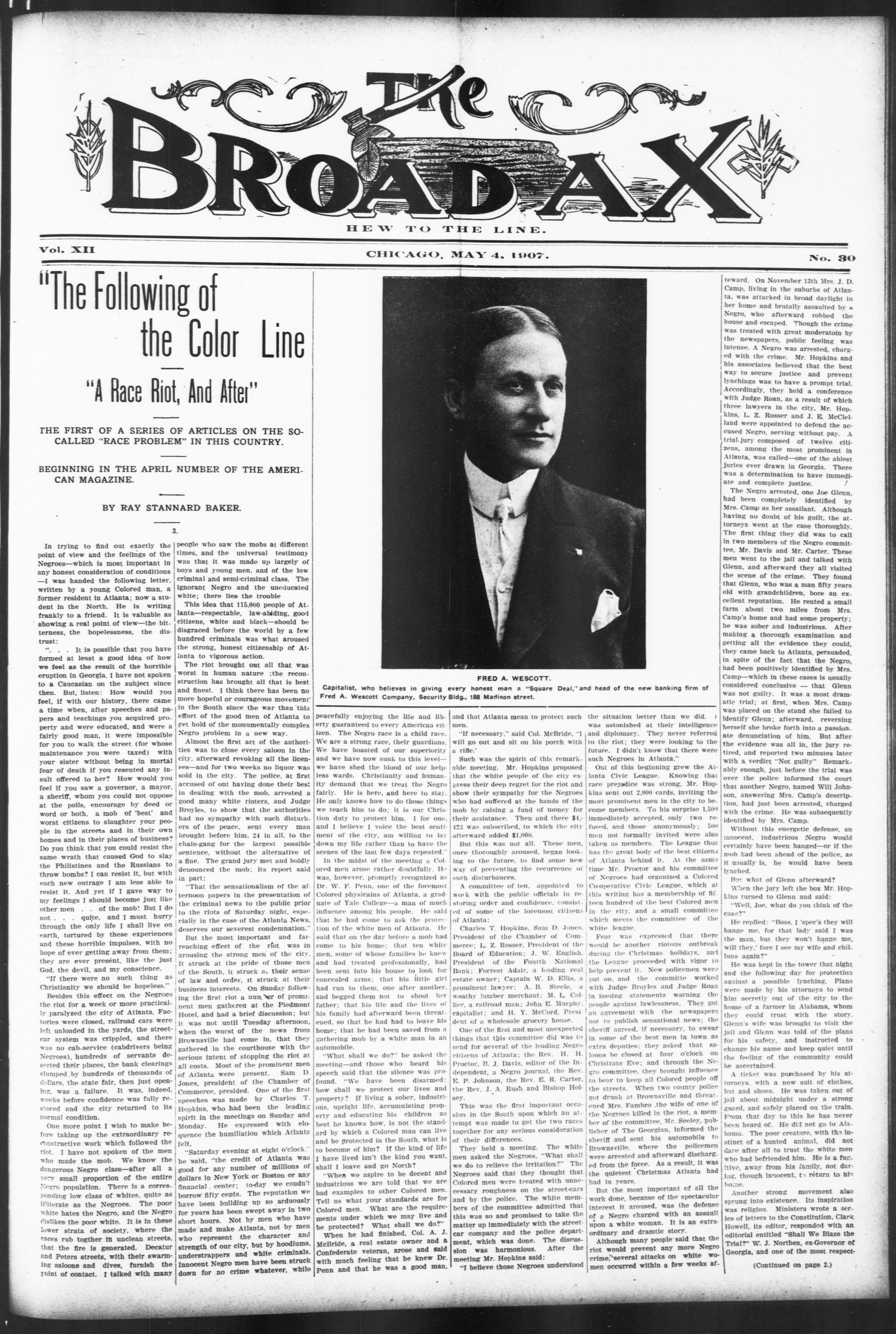
FRED A. WESCOTT.
and that Atlanta mean to protect such men.
"If necessary," said Col. McBride, "I will go out and sit on his porch with a rifle."
Such was the spirit of this remarkable meeting. Mr. Hopkins proposed that the white people of the city express their deep regret for the riot and show their sympathy for the Negroes who had suffered at the hands of the mob by raising a fund of money for their assistance. Then and there $4,423 was subscribed, to which the city afterward added $1,000.
But this was not all. These men, once thoroughly aroused, began looking to the future, to find some new way of preventing the recurrence of such disturbances.
A committee of ten, appointed to work with the public officials in restoring order and confidence, consisted of some of the foremost citizens of Atlanta:
Charles T. Hopkins, Sam D. Jones President of the Chamber of Commerce; L. Z. Rosser, President of the Board of Education; J. W. English President of the Fourth National Bank; Forrest Adair, a leading real estate owner; Captain W. D. Ellis, a prominent lawyer; A. B. Steele, a wealthy lumber merchant; M. L. Collier, a railroad man; John E. Murphy, capitalist; and H. Y. McCord, President of a wholesale grocery house. One of the first and most unexpected things that this committee did was to send for several of the leading Negro citizens of Atlanta; the Rev. H. H. Proctor, B. J. Davis, editor of the Independent, a Negro journal, the Rev. E. P. Johnson, the Rev. E. R. Carter, the Rev. J. A. Rush and Bishop Holsey. This was the first important occasion in the South upon which an attempt was made to get the two races together for any serious consideration of their differences.
They held a meeting. The white men asked the Negroes, "What shall we do to relieve the irritation?" The Negroes said that they thought that Colored men were treated with unnecessary roughness on the street-cars and by the police. The white members of the committee admitted that this was so and promised to take the matter up immediately with the street-car company and the police department, which was done. The discussion was harmonious. After the meeting Mr. Hopkins said:
"I believe those Negroes understood
the situation better than we did. I was astonished at their intelligence and diplomacy. They never referred to the riot; they were looking to the future. I didn't know that there were such Negroes in Atlanta."
Out of this beginning grew the Atlanta Civic League. Knowing that race prejudice was strong, Mr. Hopkins sent out 2,000 cards, inviting the most prominent men in the city to become members. To his surprise 1,500 immediately accepted, only two refused, and those anonymously; 500 men not formally invited were also taken as members. The League thus has the great body of the best citizen of Atlanta behind it. At the same time Mr. Proctor and his committee of Negroes had organized a Colored Cooperative Civic League, which at this writing has a membership of fifteen hundred of the best Colored men in the city, and a small committee which meets the committee of the white league.
Fear was expressed that there would be another riotous outbreak during the Christmas holidays, and the League proceeded with vigor to help prevent it. New policemen were put on, and the committee worked with Judge Broyles and Judge Roan in issuing statements warning the people against lawlessness. They got an agreement with the newspapers not to publish sensational news; the sheriff agreed, if necessary, to swear in some of the best men in town as extra deputies; they asked that saloons be closed at four o'clock on Christmas Eve; and through the Negro committee, they brought influence to bear to keep all Colored people off the streets. When two county police got drunk at Brownsville and threatened Mrs. Fambro, the wife of one of the Negroes killed in the riot, a member of the committee, Mr. Seeley, publisher of The Georgian, informed the sheriff and sent his automobile to Brownsville, where the policemen were arrested and afterward discharged from the force. As a result, it was the quietest Christmas Atlanta had had in years.
But the most important of all the work done, because of the spectacular interest it aroused, was the defense of a Negro charged with an assault upon a white woman. It is an extraordinary and dramatic story. Although many people said that the riot would prevent any more Negro crime, several attacks on white women occurred within a few weeks af-
teward. On November 13th Mrs. J. D. Camp, living in the suburbs of Atlanta, was attacked in broad daylight in her home and brutally assaulted by a Negro, who afterward robbed the house and escaped. Though the crime was treated with great moderatoin by the newspapers, public feeling was intense. A Negro was arrested, charged with the crime. Mr. Hopkins and his associates believed that the best way to secure justice and prevent lynchings was to have a prompt trial. Accordingly, they held a conference with Judge Roan, as a result of which three lawyers in the city, Mr. Hopkins, L. Z. Rosser and J. E. McClelland were appointed to defend the accused Negro, serving without pay. A trial-jury composed of twelve citizens, among the most prominent in Atlanta, was called—one of the ablest juries ever drawn in Georgia. There was a determination to have immediate and complete justice.
The Negro arrested, one Joe Glenn, had been completely identified by Mrs. Camp as her assailant. Although having no doubt of his guilt, the attorneys went at the案 thoroughly. The first thing they did was to call in two members of the Negro committee, Mr. Davis and Mr. Carter. These men went to the jail and talked with Glenn, and afterward they all visited the scene of the crime. They found that Glenn, who was a man fifty years old with grandchildren, bore an excellent reputation. He rented a small farm about two miles from Mrs. Camp's home and had some property; he was sober and industrious. After making a thorough examination and getting all the evidence they could, they came back to Atlanta, persuaded, in spite of the fact that the Negro, had been positively identified by Mrs. Camp—which in these cases is usually considered conclusive — that Glenn was not guilty. It was a most dramatic trial; at first, when Mrs. Camp was placed on the stand she failed to identify Glenn; afterward, reversing herself she broke forth into a passionate denunciation of him. But after the evidence was all in, the jury retired, and reported two minutes later with a verdict "Not guilty" Remarkably enough, just before the trial was over the police informed the court that another Negro, named Will Johnson, answering Mrs. Camp's description, had just been arrested, charged with the crime. He was subsequently identified by Mrs. Camp.
Without this energetic defense, an innocent, industrious Negro would certainly have been hanged—or if the mob had been ahead of the police, as it usually is, he would have been lynched.
But what of Glenn afterward?
When the jury left the box Mr. Hopkins turned to Glenn and said:
"Well, Joe, what do you think of the case?
He replied: 'Boss, I 'spec's they will hange me, for that lady said I was the man, but they won't hange me, will they,' fore I see my wife and chilluns again?
He was kept in the tower that night and the following day for protection against a possible lynching. Plans were made by his attorneys to send him secretly out of the city to the home of a farmer in Alabama, whom they could trust with the story. Glenn's wife was brought to visit the jail and Glenn was told of the plans for his safety, and instructed to change his name and keep quiet until the feeling of the community could be ascertained.
A ticket was purchased by his attorneys, with a new suit of clothes, hat and shoes. He was taken out of jail about midnight under a strong guard, and safely placed on the train. From that day to this he has never been heard of. He did not go to Alabama. The poor creature, with the instinct of a hunted animal, did not dare after all to trust the white men who had befriended him. He is a fugitive, away from his family, not daring, though innocent, to return to his home.
Another strong movement also sprung into existence. Its inspiration was religio. Ministers wrote a series of letters to the Constitution. Clark Howell, its editor, responded with an editorial entitled "Shall We Blaze the Trial?" W. J. Northen, ex-Governor of Georgia, and one of the most respect
(Continued on page 2.)
THE BROAD AX.
PUBLISHED WEEKLY.
Will promulgate and at all times sphold the true principles of Democracy, but Catholic, Protestant, Pentecostal, Indelia, Farmers, Single Taxes, Republican Knights of Labor, or any one else can have the same language is proper and reasonable. It is Exed. The Broad. *is a newspaper whose platform is broad enough for all, ever claiming the editorial right to speak its own mind. Local communications will receive attention. Write only on one side of the paper.*
Subscriptions must be paid in advance.
One Year ..... $2.00
six Months ..... 1.00
JULIUS F. TAYLOR, Editor and Publisher.
Entered at the Post Office at Chicago
IL, as Second-class Matter.
PERSONAL MENTION.
Walter M. Farmer, for 16 years an honored member of the bar in St. Louis, Mo., is now engaged in the general practice of law. Suite 708, 171 Washington street, Phone Main 415$ . Residence 4856 Langley avenue. Phone Drexel 6302.
MAYOR BUSSE'S NEW APPOINTMENTS.
Mayor Bussee, at the meeting of the city council Monday evening selected George H. White to succeed Doctor Howard S. Taylor as prosecuting attorney of Chicago. Charles W. Andrews was chosen city oil inspector to succeed John A. Ploner. Frances B. Higgie was selected to displace G. J. Elderkin, as vessel dispatcher for Chicago.
Tuesday morning Mr. White began his hard labor as chief prosecuting attorney for Chicago, and on that same evening S. A. T. Watkins was separated from his job to make room for a lily white Republican.
So far Mayor Busse has removed two Colored men from fair positions, and has only appointed one in the person of Major F. A. Denison, to take their places, who is supposed to misrepresent the better element of the Colored people residing in this city and who is just as pretty as he can be when on "dress parade."
RACE WAR IN HIGH SCHOOL.
Pittsburg, Pa., April 30—A race war is on in the high school at Oakdale, fifteen miles from here. Ray Woolle, Negro, member of the graduating class making the highest percentage, has been named valedictorian. The other graduates, all whites, announce that they will not take part in the commencement exercises if the Negro is allowed to speak. The faculty, however, declares that those not taking part will go without a diploma.
The above report was sent out by the Associated Press, and we were really surprised that any disturbances occurred at Oakdale public schools over the fact that a young Colored boy had outstripped all the white pupils in learning, for we have always been taught to believe that in every respect all white boys and girls are far superior to Colored boys and girls.
MRS. WM. EMANUEL, ENTERTAINS
IN HONOR OF MRS. CLIFFORD
JOHNSON AND MRS. M. R.
PLUMMER.
Mrs. Wm. Emanuel entertained at a nine course luncheon last Tuesday afternoon, April 30th, at her residence in honor of Mrs. Clifford Johnson and Mrs. M. R. Plummer of Oak Park. The parlors were beautifully decorated with cut flowers and ferns. The table decorations were of white and pink which presented a very pretty effect. Those present were the members of the board of the settlement Mrs. T. Pearson, Mrs. I. Dempsey, Mrs. L. Covington, Mrs. Hodges, Mrs. F. L. Barnett Mrs. C. Johnson, and Mrs. M. R. Plummre. The guests were Mrs. Manning Mrs. Edw. Mead and Mrs. Julius N Avendorph.
The MENU.
Sliced tomatoes and Schrimps
Cream of Asparagus
Bread Sticks.
Broiled Sweet Breads on Toast
with Mushroom Sauce
Roman Punch.
Broiled Spring Chicken,
Peas, New Potatoes Parker House
Rolls, Olives, Radishes and Celery.
Combination Salad Cheese Bars.
Individual Ice-Cream (Easter Lilies.)
Assorted Cakes
Salted Nuts and Bonbons.
Mrs. Anna Smiley Served.
LOST, STOLEN, STRAYED, OR MISLAID.
(St. Luke xix, 10.)
Missing—Last Sunday, families from
Church.
Stolen—All the Lord's Day, by a number of people of different ages dressed in their Sunday clothes. Strayed—Several hundred boys and girls, believed to have gone in the direction of no Sunday School.
Mislaid—A quantity of silver on counters of ticket offices and in street cars and public houses, etc. The money rightfully belonging to the church of God.
Wanted—A great many church members. When last seen were walking up Sabbath-Breakers' Lane, which leads to the city of no good.
Lost—Girls and boys carefully reared for a time very promising, last seen with one or two older companions on the road to Prodigal town and husk lane.
The Institutional Church and Social Settlement, 3825 Dearborn street, is ready to assist in the recovery of any of the above persons named. The morning services at 1045 will be of special interest. Music by the juvenile choir. Sermon by H. E. Stewart, minister. Big chorus and orchestra every Sunday evening services at 7:50 o'clock. To all and any of the services, the public are cordially invited.
Miss Hallie Q. Brown will deliver a lay sermon at the Institutional church next Sunday night subject. "What is that in thine hand."
Mrs. Jennie Hodges of New Zealand will sing a solo at the Institutional Church Sunday night.
Song recital at the Institutional Church Monday night. May 6th, 1907. Given by Mrs. Martha B. Anderson vocal soloist. Benefit of kindergarten A large attendance is expected. Program at 8 p. m. Phone, Douglas 3647. He. E. Stewart, minister and warden.
FOLLOWING "THE COLOR LINE." (Concluded from page 1.)
ed men in the state, took up the work, asking himself, as he says: "What am I to do, who have to pray every night?" He answered that question by calling a meeting at the Colored Y. M. C. A. building, where some twenty white men met an equal number of Negroes, mostly preachers, and held a prayer meeting. The South still looks to its ministers for leadership—and they really lead. The sermons of men like the Rev. John E. White, the Rev. C. B. Wilmer, the Rev. W. W. Landrum, who spoken with power and ability against lawlessness and injustice to the Negro, have had a large influence in the reconstruction movement.
Recently ex-Governor Northen has been traveling through the State of Georgia, making a notable series of speeches, urging the establishment of law and order organizations, and meeting support wherever he goes. He has talked against mob-law and lynching in plain language. Here are some of the things he says:
"We shall never settle this until we give absolute justice to the Negro. We are not now doing justice to the Negro in Georgia.
"Get into contact with the best Negroes; there are plenty of good Negroes in Georgia. What we must do is to get the good white folks to leaven the bad white folks and good Negroes to leaven the bad Negroes."
There must be no aristocracy of crime: a white fiend is as much to be dreaded as a black brute.
Another great movement, headed by the Rev. John E. White, plans the appointment of committees by the governors of the various Southern States to consider broadly the whole Negro question.
These movements do not cover specifically, it will have been observed, the enormously difficult problems of politics, and the political relationships of the races, nor the subject of Negro education, nor the most exasperating of all the provocatives—those problems which arise from human contact in street cars, railroad trains, and in life generally.
That they will meet the greatest difficulties in their work is shown by such an editorial as the following, published December 12th by the Atlanta Evening News:*
"No law of God or man can hold back the vengeance of our white men upon such a criminal (the Negro who attacks a white woman). If necessary, we will double and treble and quadruple the law of Moses, and hang off-hand the criminal, or failing to find that a remedy, we will hang two, three, or four of the Negroes nearest to the crime, until the crime is no longer done or feared in all this Southern land that we inhabit and love."
But these reconstructive movements are, in their beginnings, full of significance and hope; they mean that the strong people in the South, stirred by a moral impulse, are trying to grapple with these problems in a new way—a constructive way.
*On January 31, 1907, the Atlanta Evening News went into the hands of a receiver—its failure being due largely to the strong public sentiment against its course before and during the riot.
(In May Mr. Baker will "follow the color line" as it appears in Southern city life).
(The End.)
"Echoes from Kansas"
---
During the past four years Kansas has passed through the many stages of "Ups and Downs," and to such an extent that the "Sunflower State," has won for itself a place of prominence. No great man has ever won fame without passing through the stage of ridicule; no great invention has been brought to the notice of the public and proved itself practical or made itself generally a success, without first being looked upon with suspicion, not because it lacked merit but because the public did not know the real good there was in it, but "Time" tells its own story.
Likewise with the State of Kansas. Years ago the farmer who was ambitious and without sufficient funds to purchase high priced land in Illinois and other States, took up with Horace Greeley's advice "To go West young man, Go West" and many a man, with his family housed in a covered wagon, which was also capable of sheltering his entire earthly possessions, set out for Kansas "The Far West," as it was considered then. Many of these same people who had the necessary ambition, but lacked the "stick-to-it-tiveness" were seen returning to their former Eastern home States, with the inscription on their wagons, slightly reversed, whereas on their outward journey to make a home and fortune it read, "Kansas or Bust," on the return trip it read "From Kansas Busted."
But those who remained, perhaps from choice or compulsion, have weathered the storm, and today the citizens of Kansas are generally well to do, and many are independently rich.
It has taken time, as it does in all things, to learn the virtues of the ground, but it must be remembered that Providence did not place a foot of ground on this Earth, but for a purpose and a value, and it is not the "Wise man," who condemns the "Rock Pile," or the "desert" for he knows that it has a handsome value but possibly science has not proven its worth at the time.
But a few years ago (only five years) South Eastern Kansas was valued for its farm land, which averaged from $15.00 to $50.00 per acre, but during the past five years quite a different measure of value has been placed upon this farm land, owing to the fact that this section of the country has been visited, not by a rain of insects which destroys and discourages, but by men who had capital and were willing to back up their judgment with money, in the belief that Kansas, if properly prospected, would bring fortunes to them from the development of Oil and Gas.
Evidences of their (good) judgment is to be seen today on every hand, and thousands of monuments have been raised to their honor and fortune, in the shape of oil derricks, for oil wells are more numerous in South Eastern Kansas than grasshoppers used to be, and the roar of Gas Wells would make former Kansas cyclones seem as but playthings.
The Kansas-Indian Territory Oil field is today producing 121,000 barrels of oil per day, or an average of 44,165,000 barrels per 365 days.
The revenue derived from this source alone is making fortunes for many, every year.
It would be next to impossible to estimate the value of revenue being derived from Gas Wells.
All of the Cities from Cleveland, Okla., to St. Joseph, Mo., are today burning Natural Gas. In drilling for Oil and Gas in Kansas, it was discovered that almost on top of the ground, material was to be found which was most suitable for the manufacture of glass, brick, tile and cement, and with Natural Gas as fuel, which was in abundance and, consequently very cheap, huge plants and factories have been built, costing many millions of dollars and employing thousands of men.
Towns and cities averaging in population from 1,000 to 25,000 people have been built throughout the Gas fields during this short period of five years, and yet but a small proportion of the gas produced in Kansas is consumed by the many manufacturing plants, but is purchased by the Kansas Natural Gas Company, which have invested upwards of $20,000,000.00 in the gas business and are today furnishing all of the larger cities of Eastern Kansas, such as Topeka, Leavenworth, Wichita, Ottawa, Kansas City and St. Joseph, Mo., with Natural Gas. At a meeting of the stockholders of the Kansas Natural Gas Company held in Pittsburgh a few days ago, President T. N. Barnsdale reported to the stockholders as follows:
Kansas Natural Has 66,000 Gas Consumers. At the annual meeting of the Kansas Natural Gas Company, held in Pittsburg, Pa., last week, the financial
statement to stockholders showed gross earnings for the year to be $2,
000,000; net earnings, $773,100.89;
surplus $632,289.75. The company is
3 years old and has as yet paid no
dividends. It has a capitalization of
$12,000,000 and bond issues of $7,800,
000.
In his annual report President T. N.
Burnsdale announced that the company
now has 1,033.6 miles of pipe and 284.
174 acres of oil and gas lands under
lease; 301 gas wells and 40 oil wells
with a daily capacity of 600 barrels. A
total of 66,101 consumers are being
supplied with gas, of whom 27,863
were added during the year.
The pipe lines run through the lead and zinc districts of Missouri and Kansas and touch Kansas City, Topeka, Joplin, Leavenworth, Atchison and St. Joseph. Kansas City has not been developed and is expected to become an important source of revenue during the present year. The board of directors and officers were re-elected.
The Kansas Natural Gas Company was one of the first to enter the Gas Business in Kansas as in any other undertaking, its path was not "strew with roses," in its early development, but the men behind this monster corporation were men of experience and have constantly kept at work developing its possibilities while possibly 96 per cent. of the men who went into this field at the time of its boom sooner or later became discouraged and gave up their business and returned to their respective places of abode with the familiar inscription stamped on their faces, or, bank accounts, or both, "From Kansas Busted."
In times and places of a boom most men can read but "Success" on their horizon and are inclined to invest their all and to go to the limit of their credit, not remembering that in all things there is "stormy weather" and a "Pay day," and in most cases are unable to "weather the storm and today but a few of the familiar faces are to be seen on the Oil and Gas Fields of Kansas.
Out of the hundreds of men who frequented the Kansas field five years ago, the number remaining and plotting their ships on to "Success," can be counted on your fingers; but like the Kansas farmer who "weathered the storm," in the early days these men are found, not only with ordinary success within their grasp, but are all found with large profitable businesses on their hands, not only in Kansas but elsewhere throughout the country.
One of the striking examples of "stick-to-it-tivness," energy and sound judgment is evidenced in the stead; and substantial growth of the Business of Fred A. Wescott, one of the pioneers of the Kansas field, and whose early start on the road to "Financial Success," was made in investments in Oil and Gas lands of Kansas, and whose business interests are today well distributed throughout the different parts of the United States.
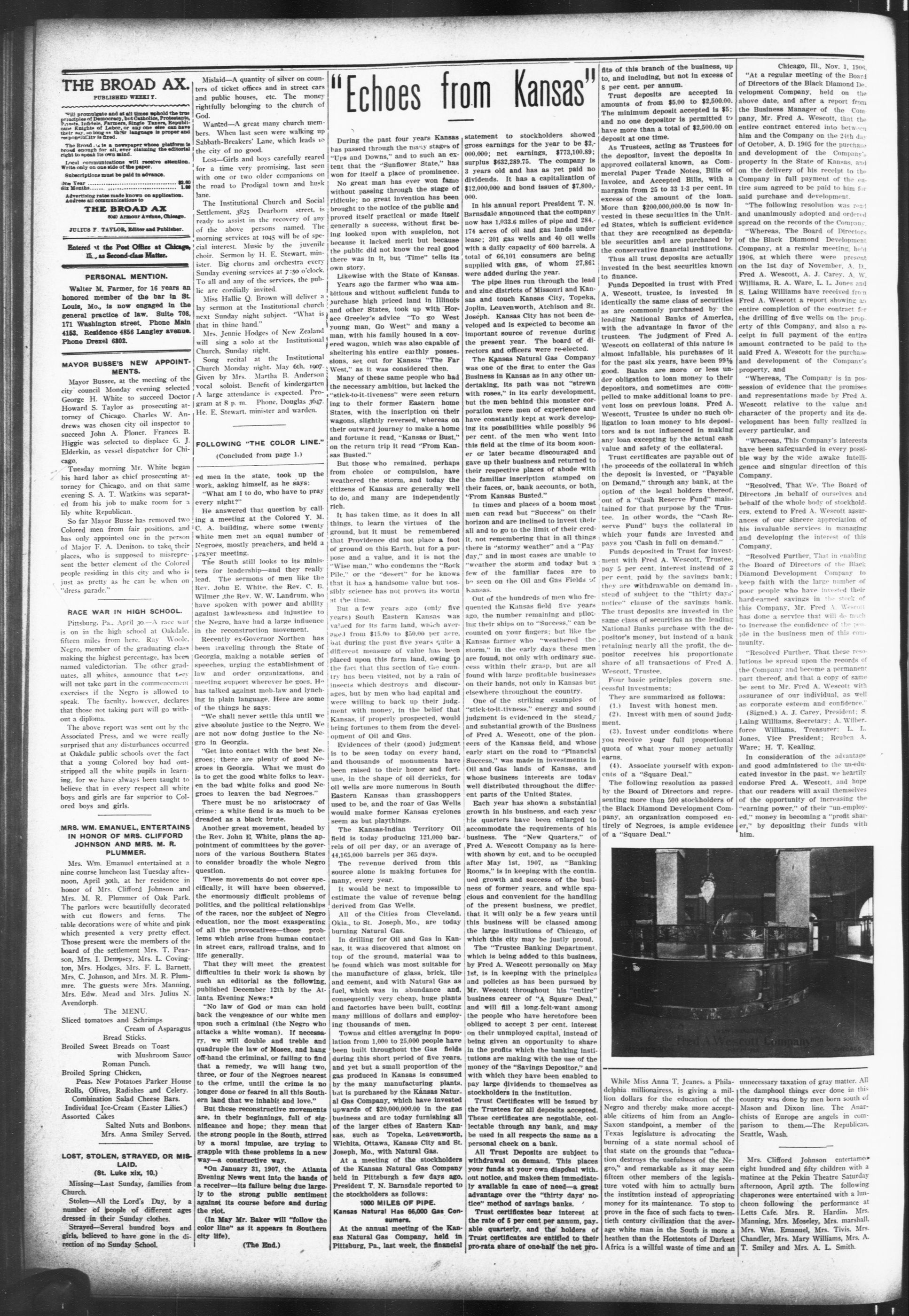
Each year has shown a substantial growth in his business, and each year his quarters have been enlarged to accommodate the requirements of his business. The "New Quarters," of Fred A. Wescott Company as is herewith shown by cut, and to be occupied after May 1st, 1907, as "Banking Rooms," is in keeping with the continued growth and success of the business of former years, and while spacious and convenient for the handling of the present business, we predict, that it will only be a few years until this business will be classed among the large institutions of Chicago, of which this city may be justly proud.
The "Trustee Banking Department, which is being added to this business, by Fred A. Wescott personally on May 1st, is in keeping with the principles and policies as has been pursued by Mr. Wescott throughout his "entire" business career of "A Square Deal," and will fill a long-felt-want among the people who have heretofore been obliged to accept 3 per cent. interest on their unemployed capital, instead of being given an opportunity to share in the profits which the banking institutions are making with the use of the money of the "Savings Depositor," and with which they have been enabled to pay large dividends to themselves as stockholders in the institution.
Trust Certificates will be issued by the Trustees for all deposits accepted. These certificates are negotiable, collectable through any bank, and may be used in all respects the same as a personal check on a bank.
All Trust Deposits are subject to withdrawal on demand. This places your funds at your own disposal without notice, and makes them immediately available in case of need—a great advantage over the "thirty days" notice" method of savings banks.
Trust certificates bear interest at the rate of 5 per cent per annum, payable quarterly, and the holders of Trust certificates are entitled to their pro-rata share of one-half the net pro-
WANT CONSIDERATION OF
Tred A Wescott Company
CHICAGO
fits of this branch of the business, up to, and including, but not in excess of 8 per cent, per annum.
per cent deposit
Trust deposits are accepted in amounts of from $5.00 to $2,500.00.
The minimum deposit accepted is $5; and no one depositor is permitted to have more than a total of $2,500.00 on deposit at one time.
As Trustees, acting as Trustees for the depositor, invest the deposits in approved collateral known, as Commercial Paper Trade Notes, Bills of Invoice, and Accepted Bills, with a margin from 25 to 33 1-3 per cent. in excess of the amount of the loan. More than $200,000,000.00 is now invested in these securities in the United States, which is sufficient evidence that they are recognized as dependable securities and are purchased by the conservative financial institutions. Thus all trust deposits are actually invested in the best securities known to finance.
Funds Deposited in trust with Fred A. Wescott, trustee, is invested identically the same class of securities as are commonly purchased by the leading National Banks of America, with the advantage in favor of the trustees. The judgment of Fred A. Wescott on collateral of this nature is almost infallable, his purchases of it for the past six years, have been 99% good. Banks are more or less under obligation to loan money to their depositors, and sometimes are compelled to make additional loans to prevent loss on previous loans. Fred A. Wescott, Trustee is under no such obligation to loan money to his depositors and is not influenced in making any loan excepting by the actual cash value and safety of the collateral.
Trust certificates are payable out of the proceeds of the collateral in which the deposit is invested, or "Payable on Demand," through any bank, at the option of the legal holders thereof, out of a "Cash Reserve Fund" maintained for that purpose by the Trustee. In other words, the "Cash Reserve Fund" buys the collateral in which your funds are invested and pays "Cash in full on demand."
Funds deposited in Trust for investment with Fred A. Wescott, Trustee, pay 5 per cent. interest instead of 3 per cent. paid by the savings bank; they are withdrawable on demand instead of subject to the "thirty days' notice" clause of the savings bank. The trust deposits are invested in the same class of securities as the leading National Banks purchase with the depositor's money, but instead of a bank retaining nearly all the profit, the depositor receives his proportionate share of all transactions of Fred A. Wescott, Trustee.
Four basic principles govern successful investments:
They are summarized as follows:
(1.) Invest with honest men.
(2.) Invest with men of sound judgment.
(3). Invest under conditions where you receive your full proportional quota of what your money actually earns.
(4). Associate yourself with exponents of a "Square Deal."
The following resolution as passed by the Board of Directors and representing more than 500 stockholders of the Black Diamond Development Company, an organization composed entirely of Negroes, is ample evidence of a "Square Deal."
Tred A. We
While Miss Anna T. Jeanes, a Philadelphia millionairress, is giving a million dollars for the education of the Negro and thereby make more acceptable citizens of him from an Anglo-Saxon standpoint, a member of the Texas legislature is advocating the burning of a state normal school of that state on the grounds that "education destroys the usefulness of the Negro," and remarkable as it may seem fifteen other members of the legislature voted with him to actually burn the institution instead of appropriating money for its maintenance. To stop to prove in the face of such facts to twentieth century civilization that the average white man in the South is more a heathen than the Hottentots of Darkest Africa is a willful waste of time and an
---
Chicago, Ill., Nov. 1, 1906. "At a regular meeting of the Board of Directors of the Black Diamond Development Company, held on the above date, and after a report from the Business Manager of the Company, Mr. Fred A. Wescott, that the entire contract entered into between him and the Company on the 24th day of October, A. D. 1905 for the purchase and development of the Company's property in the State of Kansas, and on the delivery of his receipt to the Company in full payment of the entire sum agreed to be paid to him for said purchase and development.
"The following resolution was read and unanimously adopted and ordered spread on the records of the Company. "Whereas, The Board of Directors of the Black Diamond Development Company, at a regular meeting, held 1906, at which there were present on the 1st day of November, A. D. Fred A. Wescott, A. J. Carey, A. W. Williams, R. A. Ware, L. L. Jones and S. Laing Williams have received from Fred A. Wescott a report showing an entire completion of the contract for the drilling of five wells on the property of this Company, and also a receipt in full payment of the entire amount contracted to be paid to the said Fred A. Wescott for the purchase and development of the Company's property, and
"Whereas, The Company is in possession of evidence that the promises and representations made by Fred A. Wescott relative to the value and character of the property and its development has been fully realized in every particular, and
"Whereas, This Company's interests have been safeguarded in every possible way by the wide awake intelligence and singular direction of this Company.
"Resolved, That We. The Board of Directors in behalf of ourselves and behalf of the whole body of stockholders, extend to Fred A. Wescott assurances of our sincerе appreciation of his invaluable services in managing and developing the interest of this Company.
"Resolved Further. That in enabling the Board of Directors of the Black Diamond Development Company to keep faith with the large number of poor people who have invested their hard-earned savings in the stock of this Company, Mr. Fred A. Wescott has done a service that will do much to increase the confidence of the people in the business men of this community.
"Resolved Further. That these resolutions be spread upon the records of the Company and become a permanent part thereof, and that a copy of same be sent to Mr. Fred A. Wescott with assurance of our individual, as well as corporate esteem and confidence."
(Signed.) A. J. Carey, President; S. Laing Williams, Secretary; A. Wilberforce Williams, Treasurer; L. L. Jones, Vice President; Reuben A. Ware; H. T. Kealing.
In consideration of the advantage and good administered to the un-educated investor in the past, we heartily endorse Fred A. Wescott, and hope that our readers will avail themselves of the opportunity of increasing the "earning power," of their "un-employed," money in becoming a "profit sharer," by depositing their funds with him.
Scott Company
CHICAGO
unnecessary taxation of gray matter. All the damphool things ever done in this country was done by men born south of Mason and Dixon line. The Anarchists of Europe are angels in comparison to them.-The Republican, Seattle, Wash.
Mrs. Clifford Johnson entertained eight hundred and fifty children with a matinee at the Pekin Theatre Saturday afternoon, April 27th. The following chaperones were entertained with a luncheon following the performance at Letts Cafe. Mrs. R. Hardin, Mrs. Manning, Mrs. Moseley, Mrs. marshall, Mrs. Wm. Emanuel, Mrs. Tivis, Mrs. Chandler, Mrs. Mary Williams, Mrs. A. T. Smiley and Mrs. A. L. Smith.
Mr. Wm. H. Clark has moved to 3122 Dearborn St.
Mr. Fred Siblee, 3841 Armour Ave., is on the sick list.
Mr. Major Keton left the city Tuesday to spend a month in the west for his health.
Mrs. Blanch Newsom Gray is the guest of Mrs. C. H. Smiley, 2111 Indiana Avenue.
Mr. Will Patterson is again remembered among the 20th century crew running into Chicago.
The Theo. Jones Transfer Co. has a number of beautiful automobile moving vans, the first to be seen in the city.
The Appomattox Club will give their first annual Carnation May Party May 8th, at the Douglas Club House, 3518 Ellis Ave.
S. A. T. Watkins has moved his law office from 78 Dearborn street to room 411 Real Estate Board building, 59 Dearborn street.
Alderman Henry L. Fick says that The Broad Ax is on "the bum since it ceased getting after Rev. Abraham Lincoln Murray."
Col. Robert M. Mitchell or Col. B. F. Moseley may succeed S. A. T. Watkins as one of the assistant prosecuting attorneys of Chicago.
Mr. Will Taylor, formerly of Chicago, but now of Cairo, Ill., spent a few days in the city last week, stopping at the Keystone.
Mr. Wm. Piper, who conducts a buffet at the corner of 51st and Armour, contemplates moving with the view of locating in a northern Indiana town.
Mrs. Sallie Wheeler, 4836 Grand Boulevard, entertained a number of friends at an afternoon luncheon Wednesday in honor of Mrs. Florence Johnson of New York.
Mrs. Will Allen, of Portland, Oer, presented her husband with a fine baby last week. Mrs. Allen was well known in Chicago by her maiden name, Lillian Medley.
Mrs. A. Wilberforce Williams, 6510 Langley Ave., who has spent the past six weeks at Danville, Ky., with her mother, Mrs. Tibbs and other relatives, returned home Monday.
Doctor George C. Hall, who owns a fine four-story flat building on Wabash avenue near 33d street, may shortly, become chief surgeon of the Freedmen's Hospital, Washington, D. C.
Former Alderman Silas F. Leachman and John P. Tansey have gone to Louisville, Ky., and if there be those who are looking for a few "tips" on the races, they can catch them on the fly at 505 Second street, in that city.
Dr. J. W. McDowell of St. Louis, arrived in the city Tuesday for permanent residence. He will have his office in the building on the corner of 31st and State streets and his home at 3518 Calumet Ave.
Attorney Albert B. George, Ashland block, who takes well with the fatr ladies every day in the week and Sundays, too, has hosts of friends in the Town of Lake, who would like to see him stick his large feet under Mayor Busse's pie counter.
J. W. Hagan, who has for some years been connected with Whiteley Bros., 2724 State street, is now with C. H. Green, 2718, three doors north of the old stand, where he will handle a fine line of tobacco and cigars and all the leading daily and weekly newspapers.
Mrs. Susie Higgins-Lambkin will appear in repertory of popular readings Wednesday afternoon and evening in the parlors of the Wilson house, 3211 Wabash Ave. Mrs. Lambkin is formerly of Kansas City, Mo., where she is well known as a dramatic reader of pleasing ability.
Thursday evening Mr. and Mrs. Moses Ratcliff, 4850 Dearborn street, entertained Rev. and rs. Stovall, the new pastor of St. Mark Church and a number of their friends at a 5 o'clock luncheon. The hostess served her guests in her usual elegant style, and the repast was all that could be desired.
We should be more than pleased to know why criminal assault made by a white man upon a Negro woman fails to elicit as much sympathy and downright "cussing" as when the case is the reverse. Messrs. Tillman, Graves, Davis and Vardaman, explain, please.-The Herald, Chattanooga, Tenn.
There is a principle in everything, but when leaders of the race teach the masses not to read Negro newspapers, the entire race should rise en masse against them. Newspapers are records of history and very race should read
and value its race journals as other races, for no other race paper will ever record you. Read all newspapers, white or black and remember "birds of a feather flock together in their own social realm. Because of our white friendly contemporaries will print some matter, our educated fools ignore their own race papers.-The World, Carey, Miss.
Will Booker T. Washington please stand up and lead us in prayer?
John W. Hardy, who is one of the best and one of the most popular police officers among the Afro-Americans in Chicago, is still retained on Chief Shippy's special staff, and as long as Officer Hardy continues to make good the chances are that he will answer at roll call on the second floor in the city hall.
Mr. Felix Wier, who spent several days in the city preparatory to his recital under the management of Mr. Julius N. Avendorph, left for Pittsburg, Pa. Sunday where he will give a recital Monday night. He will go from there to Washington, D. C. Mr. Weir will appear at Bethel church, Saturday evening, May 4th.
The Felix Weir violin recital, on account of inclement weather, is postponed until Saturday evening, May 4 at Bethel Church. Mr. Bainbridge, a tenor of rare ability and Miss Gertrude Jackson will assist. Come, help give our Chicago boy the reception he deserves. Admission, 35 cents. 8:45 prompt. Julius N. Avendorph, Mgr.
Col. and Mrs. J. R. Marshall, entertained with a box party last Saturday evening, April 27th, at the Pekin theatre, after which supper was served at the Lett Cafe. Those present were: Mr. and Mrs. B. F. Moseley, Major and Mrs. R. R. Jackson, Mr. and Mrs. Hampton, Mr. and Mrs. Blackwell, Mr. and Mrs. D. Manson and Prof. and Mrs. Wm. Emanuel.
Col. Edward H. Wright, who has worked harder for the success of the G. O. P. than any other Colored Republican in the state of Illinois, and who has so far been left out in the cold by the powers that be, has an itching desire to become the new city sealer of Chicago, but it appears that there are too many German--Americans after that job for Col. Wright to land it.
the dramatic entertainment and dance given at the Oakland Music Hall Tuesday evening, for the benefit of the Frederick Douglas Senter, was well attended by the society folks of the city, "The Wife of His Youth," by Chas. W. Chestnut, was well dramatized by a company of young folks who got lots of fun out of the production, while entertaining the many well-wishers of the "Center." Mmes. George C. Hall and Cecelia P. Woolley managed the entertainment, while Prof. N. Clark Smith served as musical director. A hand, some sum was realized.
SANDY W. TRICE.
The Up to date Afro-American merchant, and the guiding spirit of the Sandy W. Trice and Company Department Store.
"Is it not lovely, when husband and wife are always of the same opinion?"
"Certainly; only it makes such a great difference whose opinion it is."
"Stimson is a mean man."
"Why so?"
"He's got a way of keeping his wife from going through his pockets for loose change."
"How's that?"
"He spends it all before he gets home."
FURNISHED ROOM TO RENT.
Nice furnished room to rent to man and wife that can come well recommended, 4613 Dearborn st.
HUSTLING COLORED MAN WANTED TO SELL SUBURBAN REAL ESTATE
Wanted a good representative Colored man to sell choice lots in a North Shore suburb to Colored people can make $100.00 to $200.00 per week. No capital required, must be man of ability and education. References required. Address "J." care Editor The Broad Ax. 5040 Armour ave.
WASHINGTON LETTER
The improvement of this city on an elaborate scale in some such manner as was outlined by the report of the parking commission is going on, and each year some feature or detail is begun or added to, so that while no general scheme of the sort has been adopted, yet such a one is in fact being carried out.
An illustration is found in current legislation. Provision is made for transferring the gorge of Piney branch into a parkway. The new parkway will leave Rock Creek park about where it joins the zoo park and will extend east, following the gorge of Piney branch as far as the new bridge over Sixteenth street.
A Picturesque Bit of Scenery.
Of course this strip of parkway, 400 feet wide, with drivewa's bordering the stream on both sides, will furnish an admirable means of communication between Rock Creek park and such a thoroughfare as Sixteenth street extended. There is no question about the value of the additional means of reaching the great pleasure grounds of the public. At the same time the really significant thing about it is the fact that congress by such legislation has saved forever for the enjoyment of the public a picturesque bit of scenery, and it has been possible in this instance to accomplish that as well as provide something practical.
In the plan of the parking commission such a use of the deep ravine through which that section of Piney branch passes was recommended, and it was further suggested that it be continued east of Sixteenth street to the ground about the proposed municipal hospital building on Seventh street, and from the latter point the widening of one of the streets could be made so as to provide a continuation of the driveway through to the grounds of the Soldiers' home.
Rock Creek Gorge.
A somewhat similar undertaking has also been authorized in the act which provided for securing the connecting link in what is known as Park road and Waterside drive. All the land for this road, which passes along the east side of Rock creek from Q street to the Massachusetts avenue bridge, has been acquired by the public except the section through what is known as the Lyons mill property.
In addition to the space required for a driveway there is quite a good deal of land that lies along the creek at the foot of the gorge, all of which is owned by the public, so that there will be no encroachment on the gorge of Rock creek between these points.
Uncle Sam's Stenographers.
The chief clerks of the nine executive departments in Washington have just completed for the first time an accurate census of the stenographic clerks employed in the various departments. The report of the civil service commission shows that during 1900 there were 2,653 persons examined for this service, of whom 1,870 were men and 783 women. Of these 708 men and 335 women passed, and 410 men and 67 women were appointed. The usual entrance salary was $840 to $900. The highest salary which a stenographic clerk can possibly attain is $1,800. Stenographic clerks in the government service usually become so useful that instead of taking dictation they are employed to dictate. At present there is a dearth of the higher grade of these clerks. The total number in the executive departments is 1,568, 25 per cent leaving every year to obtain some better work.
Military Shooting Range.
One of the largest military shooting ranges in the United States is to be located in the vicinity of this city. Very shortly a board of specially detailed army officers, headed by Colonel Helston, adjutant general, will visit Washington for the purpose of selecting a site for this big range, where it is proposed that the regular troops and national guard organizations stationed near this city shall be trained in the use of the military rifle. It is probable also that within a few years Washington will be the place where the annual military shooting competition will be held.
Fixing Up the Zoo.
The zoo is now putting on its spring and summer dress. On account of such grooming for the crowds to be entertained during the next few months the grounds and buildings present a scene of great activity. Many repairs are in progress. Additions are being made to the list of exhibits, and a general awakening is apparent.
All of the outside quarters for the animals are being overhauled preparatory to putting the animals in them for the hot weather. Fresh coats of paint are being applied in many instances. A new roof is being put on the lama house.
Weighing the Alaska Bear.
"Why, how you have grown since I saw you last!" will be a remark which the Alaskan brown bear, so well known to visitors to the zoo, will hear from the crowds that will stop in front of his cage in a few weeks. Mr. Alaska Brown consented to be weighed a few days ago, after much urging, and he tipped the scales at 970 pounds. Last year his weight was 890 pounds. Efforts to weigh the male polar bear have so far proved futile. Tempting pieces of bread and meat and other "cub" delicacies of the polar regions were used la the hope of tempting him into the shifting box, but Mr. Bruin has so far been keen enough to get the food and yet not get entirely within the box. To weigh him it is necessary to get him into the box. So far when he reaches for the food he deliberately keeps one foot outside, thus preventing the closing of the door.
CARL SCHOFIELD.
SHORT STORIES.
Eight trained oarsmen pulling a boat exert about two horsepower.
On the Tombigbee river, Alabama, is enough limestone to supply a cement plant for 100 years.
A Dakota man, aged sixty, has married a girl of twenty, while his son married the girl's mother, aged forty-four.
The pay of the chief justice of the supreme court of the United States is $13,000 a year. The associate justices of the court receive $12,500 a year.
Douglas township, in Clarke county, Ill., is the holder of a unique distinction. It is the only township in the state without a church, lawyer, doctor, preacher, justice of the peace, constable or punter.
The outcome of the fund left to the city of Boston by Benjamin Franklin so long ago and which matured last year and was doubled by an endowment from Andrew Carnegie is to be a fine trade school.
According to a Bangor paper, Patrick McMann of Jackson is the only man in Maine who ever succeeded in teaching woodchucks to play checkers, having a pair not long ago which he trapped and taught the game.
GERMAN GLEANINGS.
In 300 years, according to a Berlin scientist, water will be worth 15 cents a drink.
It is said to be practically assured that there will be a world's fair in Berlin in 1913 in celebration of the twenty-fifth anniversary of Emperor William's accession to the throne.
Berlin has a veritable congestion of music halls. In addition to Bechstein and Beethoven halls, the Philharmonie and the Singakademie, that quartet of music temples, a new Mozart hall has lately been erected on Nollendorf platz.
Many German cities now have their Richard Wagner streets, but greater Berlin is going to name a whole quarter after him. In the Friedenau district there is to be a Wagner place, from which there will radiate eight streets named after the heroes in Wagner's operas—Elsa, Eva, Sleglinde, Senta, Isolde, Ortrud, Gutrune and Kundry.
OLD FASHIONED.
What has become of the old fashioned man who wore paper collars?
What has become of the old fashioned man who was always figuring on a great time when his ship came in?
What has become of the old fashioned parents who pulled their babies through a horse collar for "liver growth?"
What has become of the old fashioned woman who said she worked her fingers to the bone slaving for her children?
What has become of the old fashioned woman who spoke of light hearted people as those who hadn't a load on their hearts they couldn't kick off at their heels?—Atchison Globe.
PLAYS AND PLAYERS.
"A Marriage of Reason," the Bellew play, proved a dismal failure in New York. It opened at Wallack's and closed after two weeks. Clyde Fitch's new comedy, "The Truth," which was produced in London recently, with Marie Tempest in the leading role, was accorded a favorable reception. "The White Chrysanthemums," widely heralded, has been sent to the storehouse for repairs. It may be presented in New York later if a suitable cast can be obtained and the piece improved in spots. Chrystal Herne, daughter of the late James Herne, will be promoted to stardom next season under Charles Dillingham. Charles Kline's latest, to be called "The Stepchild," has been selected for her vehicle.
AROUND THE HOUSE
In ventilating a room open the window at the top and bottom. The fresh air rushes in one way, while the foul air makes its exit the other. If a few drops of ammonia are added to the water in which silver is washed each day it will keep it bright as new without expenditure of strength. In order to prevent lamp chimneys from cracking put them into cold water and let it come to a boll. Before taking the chimneys out the water should be allowed to get cold. After washing lace curtains lay a blanket on the floor in some empty room, spread the curtains on the blanket, stretching them carefully, and they will keep their place without any fastening until dried.
NEW YORK CITY.
Telegraph instruments of New York city tick off seventeen messages each minute of the day.
Public receipts and expenditures of New York city have increased in the last four years in an amount equal to $102,000 each day.
It is estimated that 113,000 persons in New York city make their living by their wits, which means the lack of wit in others.
New York city is not a windy city, as its hourly average velocity of wind is nine miles. The highest ever reported is eight miles, which is the accepted minimum velocity of a hurricane, below that down to sixty being known as a great storm.—New York Herald.
Sandy W. Trice & Company
Muslin Petticoats, deep flounce, choice.....98c
Muslin Corset-Covers, neatly trimmed.....25c
Muslin Gowns, empire style.....98c
Lawn Kimonos, all sizes.....49c and up
Muslin Drawers ..... 50c and up
Vast assortment of White Waists from 49c to ..... $2.50
Special Sale of Women's Low Shoes ..... 98c and up
Special Sale of Men's Shoes ..... $1.49c and up
THE SPRINGTIME TERROR.
Hang the rugs upon the line;
Beat 'em black and blue;
Fill your lungs with dust gmeis fine
And your nose—kerchoo!
Yank the pictures from the wall
Till your muscles hurt.
What if some of them should fall—
You are out for dirt!
When the dust has made you blind,
Back the rugs you bring.
Then look around, and you will find
You can't find them!
—Cleveland Plain Dealer.
Checkmate.
The Young Man (defiantly)—I proposed to your daughter this morning, sir, and she said she couldn't hear my suit.
The Stern Parent—Is it possible?
You surprise me!—Sketch.
Trials of a Woman Suffragist.
Kelr Hardle had a trying experience the other evening. Addressing a meeting mainly attended by the other side, he failed to get a hearing until the chairman said, "Gentlemen, if you will listen to Mr. Hardle quietly, he will be happy to answer any question you may put to him at the end of his speech."
When the honorable member had resumed his seat, a question written on half a sheet of note paper was sent up to Mr. Hardle and passed by him unopened to the chairman, who read it, and grew very red in the face. "Read it out!" roared a dozen men, and the chairman at last obeyed. The question was, "Why do you call a Gibson girl?" It finished the meeting—Onlooker.
Fellow Travelers
A Greenwich man tells of a Connecticut farmer who after having driven a lot of hogs to Greenwich sold them for precisely what had been offered him before he left home.
"You don't seem to have made much by bringing your hogs down here," remarked the man who tells the story.
"Well, no," replied the agriculturist dejectedly. "I ain't made no money, but then, you know," he added, his face brightening. "I had the company of the hogs on the way down."—Harper's Weekly.
What He Prays For
"Who's that, pa?" a little Kansas youngster in the senate gallery at the capitol inquired as a magnificent looking old man rose before the opening of a session.
"That," said the father, "is Edward Everett Hale, the chaplain."
"Ob," said the boy. "He prays for the senate, doesn't he?"
"Well, no," said the father, "not exactly. He gets up, takes a good look at the senate, and then he prays for the country." — Woman's Home Companion.
Strenuous.
Mother (returning suddenly) - Gracious, children, what have you been doing? Why, the room looks like a hurricane had struck it, and Willie looks like he had been through a thrashing machine! Tommy—Please, mamma, we have been playing Russian douma, and Willie was the czar—Chicago News.
Unappreciative.
"Your husband says that when he is angry he always counts ten before speaking," said one woman.
"Yes," answered the other, "I wish he'd stop it. Since he got dyspepsia home seems nothing but a class in arithmetic."-Bohemian Magazine.
Overruled.
The Maid—And do you make love to every girl you meet the same as you do to me?
Young Lawyer—My dear young lady, it is unprofessional to ask a question that would tend to incriminate the witness—St. Louis Post-Dispatch.
HUMOR OF THE HOUR
HUMOR OF THE HOUR
How He Slent
Ex-Senator Billy Mason tells of a political campaign in South Dakota wherein he had been called upon by the state committee to take a part. When Mason arrived at his first town, where he was to deliver a speech the next day, he found that the two so called hotels were crowded to the doors.
Not having telegraphed for accommodations, the Illinois man discovered that he would have to make shift as best he could.
He was compelled for that night to sleep on a wire cot that had only some blankets and a sheet on it. As Mr. Mason is a man of considerable avoid-duplos, he found his improvised bed anything but comfortable.
"Well," asked the proprietor when the politician appeared in the morning, "how did you sleep?" "Fairly well," answered Mason, "but I certainly looked like a waffle when I got up."-Cleveland Leader.
Neither Exactly Suited.
"It's the thought of the prospective parents-in-law," said Jerome K. Jerome at a bachelor-dinner, "that keeps many a young man from marrying. But I knew one young fellow who wasn't to be daunted. When he asked the father for the hand of the only girl he ever loved the crusty old gentleman said, with a sneer:
"You want to marry my daughter, do you? Let me tell you that you're not exactly the sort of man I would choose for a son-in-law."
"Well, to be frank," said the cheerful youth, "you are not the sort of man I'd choose for a father-in-law either. But we needn't chum, you know, unless we want to."—Women's Home Companion.
Handed Her a Bunch.
Eva—Yes, indeed, the bride wore or
orange blossoms, but no thanks to her
rival.
Katharine—And what did her rival
do?
Eva—Why, her rival sent her a bouquet
of lemon blossoms. —Chicago
News.
A boy reads a newspaper to a man.
Little Girl (who has just kissed her father good night)-Oh, father, your beard is scratchy!
Father-Dear me, miss, you are particular. It can't be very bad. I shaved it this morning.
Little Girl-Well, then, father, it's- it very tall for its age!-Punch.
His Last Request.
Judge (to prisoner just condemned to death)—You have the legal right to express a last wish, and if it is possible it will be granted. Prisoner (a barber)—I should like just once more to be allowed to shave the district attorney.
Not So Comfortable.
"Some of those financial enterprises of yours are largely made up of water."
"Yes," answered the stock manipulator. "And it is getting to be rather hot water."—Washington Star.
He Wanted to Know.
"Pa!"
"Well, my son?"
"Pa, is it really true that gran'pa used to do as much work before breakfast as we do in all day?"—Woman's Home Companion.
Carrying Out the Simile.
"They tell me Mrs. Bitterpill works like a beaver."
"Yes, I guess that's right. She fell in love with a perfect stick and has been chewing about it ever since."—Judge.
Fifty-First St. and Armour Ave.
RAIL YARDS: 121st St. & L. S. & N. S. RY.
123rd St. and Armour Ave.
CHICAGO
50,000
BOOKS FREE By Mail
50,000
BOOKS FREE By Mail
treating on all the
DISEASES PECULIAR TO MAN.
THIS BOOK contains many illustrations and is a storehouse of knowledge for both old and young
who suffer from excesses, lost vitality,
nervous disorders, blood poison, stomach,
kidney and bladder diseases. It explains how you
can successfully cure yourself at home.
DR. JOS. LISTER & CO.
40 Dearborn St., A-10. Chicago, Ill.
Tile and State Hauling a Specialty.
COAL
J. H. COLEMAN & CO.
Express & Van Moving
TRUNKS EVERYWHERE.
2540 State Street
Phone 699 Calumet CHICAGO
Phone Oakland 1328
F. A. Rawlins
The Modern Embalmer
UNDERTAKER AND
FUNERAL DIRECTOR
ICE CREAM CIGARS, TOBACCO
SHIRT WAISTS KIMONAS
MRS. A. E. BAKER
NOTIONS
419-36TH STREET
Underwear a
Specialty HICAGO
J. GARNER Tel. Douglas 325
THE ELITE BUFFET
FINE WINES, LIQUORS
AND CIGARS
8030 State Street CHICAGO
MECALL PASTORY
10
15
MONEY MINT
MECALL MAGAZINE
50
YEAR
REINVENTED AFTER MINT
Thank you MacCall Pastory sold to the United
States that of any other maker of pastries. This is an
official certificate of authenticity.
amount of their style, economy and simplicity.
McCall's Magazine (The Queen of Punishers) has
here subscribed the best cookery and kitchenware.
Oxford magazine (in pumphery) august 50 october.
Latest
number, & edition. Every subscriber gets a McCall's
Punishers Prize. Subscribe today.
Lady Ackley W. et al. Hardcover programme po-
nal for commercial. Fashion Catalogue (of foo do-
sage) and Premium Catalogue (shoving too premium
sand frogs). Addron THE MCCALL CO. New York.
Waiters and Cooks
Prefer Our Make
JACKETS AND LINEN
because they have found them
satisfactory.
Write for complete Catalogue
FREE.
giving full instructions how
to order.
Marcus Ruben (Inc.)
390 State St., CHICAGO.
```markdown
```
By Parker H. Sercombe
Editor To-Morrow
Magazine, Chicago.
Only a limited edition of
this remarkable book will be
printed. Each copy will be
signed by Sercombe Him-
self and automatically num-
bered from 1 up. First
orders in 1 will get the low
numbers in rotation except
No. 1, which goes to Mrs.
Sercombe.
Address
TO-MROWR MAGAZINE
For the superius and superwoman and The New Celticism,
2238 Columbst Ave.
Chicago, IL.
10 CENTS THE COPY. $1 A YEAR.
SELECTIONS
CLEMENCEAU'S JOKE.
But For It the French Premier Might Have Been President. Georges Clemenceau, the present premier of France, is said to be a master of clever repartee, which he seldom loses a chance to exercise, even though by so doing he stings bitterly a very close friend. William Morton Fullerton in Everybody's Magazine remarks upon this characteristic and upon Clemenceau's love of a practical joke. The serious consequences of two of his gullies are told by the writer:
Once his penchant for making fun cost him more than a friend. It lost for him the presidency of the French chamber. There was some years ago in that chamber an honest countryman by the name of Michon, who loathed all the refinements of civilization. He was always asking for the suppression of the opera. He carried his peasant rusticity so far as to avoid, in fact, the use of water, not merely for drinking purposes, but also for his ablutions. One day during a debate in the chamber on the Paris water system the defender of the project remarked that each inhabitant required per day at least sixty liters of water. Michon rose indignantly, exclaiming, "What, the Parisians drink, then, sixty liters of water?" Clemenceau thereupon in his most sarcastic tones cried out from his place. "My dear Michon, I assure you that there are certain tribes where water is also used for washing purposes." Very possibly Michon would have forgiven this personality if M. Clemenceau had henceforth let him alone. But there is something of the gamin of Paris about the disabused philosopher Clemenceau, and his face wears uniformly an ironic grin, which is the mask of an essential playfulness of temper not wholly free from malice. He is an irrepressible practical joker, as one day Michon found out to his cost. It was Michou's custom when his colleagues were thronging the house during a livey debate to visit alone the buffet of the chamber and there to fill his pockets with sand-wiches. As he wore a voluminous shooting jacket, the inroads thus made on the deputies' larder were by no means insignificant.
M. Clemenceau one day glided behind him and when Michou was thus storing away his dinner dexterously filched each successive sandwich from his pocket. Michou, however, soon discovered the larceny and burst into a furious passion. He vowed vengeance. Shortly after the chamber had to elect its president. There were two candidates for the post. M. Clemenceau being put forward by the Radicals. The latter was beaten by one vote, and that vote was cast by Michou, who, although a Radical and the object of his colleagues' supplications, refused to pardon the pickpocket Clemenceau. The fortunate candidate was M. Fallieres, now president of the republic, of whose high destiny this election was the beginning. Never before had M. Clemenceau come anywhere near public office. And later on, instead of attaining power, he was beaten down by storms of obloquy. They who anuse themselves when reading history with such classic problems as the influence of the length of Cleopatra's nose upon the destinies of Rome may find in this tale excellent matter for similar speculation.
Germany's New Railway Rates.
The new German railway passenger rate is 2.68 cents a mile, first class, with no reduction for round trip tickets and no free baggage. For express trains the rates will be higher, causing a substantial addition to the cost of travel. The object is to keep local passengers off the long distance trains. For second class the rate a mile is 1.72 cents, with an additional charge for baggage and for express trains. Railway tickets are taxed. This adds to the traveler's expense. The density of traffic averages much greater in Germany than in the United States.—Baltimore Sun.
Native White Population.
Native White Population In native white population West Virginia is first, having in 1900 the largest percentage of native whites of native parents, North Dakota being last in the list. Oklahoma, Kentucky, Indiana and New Mexico follow close upon West Virginia, each having over 75 per cent of their total population native white of native parents. In each of twenty-nine states and territories the native white of native parents constituted in 1900 more than 50 per cent of the total population. - New York American.
A Strange Mode of Life.
In a railway carriage, perched on a cliff overhanging the Severn, near Bridgnorth, England, lives Henry Hudson, a man who has traveled extensively, published more than one novel and written for scientific magazines. He adopted his strange mode of life partly from a love of nature. He builds coracles, which he sends to Norway, and has invented socks made from wood, which are being considered by the British military authorities.
Maps For Balloonists.
According to the Aerophile, it is proposed to supply maps specially prepared for the use of aeronauts, giving the position of the principal objects, such as the bends of rivers, factories, railway junctions, etc., which can easily be distinguished from the car of a balloon. Similarly all the great centers of light will be indicated on the maps for use in night traveling.—Pall Mall Gazette.
"If you won't talk about your new auto I won't talk about my new baby."
—Cleveland Leader.
Quick Corrections.
He—Let me propose to you—
She—Oh, Indeed, I'll accept—
He—That we get out of the rain—
She—Your suggestion. —Baltimore American.
Quantitative Distinction.
Mrs. Knlcker—Does your husband go out between the acts?
Mrs. Bocker—No. He comes in the theater between drinks. —Judge.
Mike's Choice.
Footpad—Your money or your life!
Mike—Take me loff. Oi need thm money.—Kansas City Times.
The Sad Part.
"Man wants but little here below," So rass that ancient song.
Alas that for that little he so often has to long!
He has to long so long, alas, But for that little bit And mostly always shuffles off Without a-getting it!
—Woman's Home Companion.
"The McBangs have had a marital bust-up, haven't they?"
bust-up, haven't they?" "I should say so. McBaugs exploded with rage, his wife burst into tears and was all cut up about it, and now they have broken with each other."—Cleveland Leader.
Opposed to It.
"Really," said Mrs. Subbubs, "we ought to have one of those burglar alarms put in"—
"What!" exclaimed Subbubs. "And have the thing go off at night and wake the baby? Not much!"—Philadelphia Press.
Unavoidable.
"The trouble with that man is that he takes small matters seriously."
"Yes," answered Miss Cayenne, "but you could not expect him to do otherwise without sacrificing his self esteem."—Washington Star.
Heard In the Restaurant.
"I haven't spoken to my wife for three years," said the henpecked man.
"Why?" asked some one.
"I didn't want to interrupt her," he said—Houston Post.
BRIGHT BOYS AND GIRLS WANT
ED TO SELL THE BROAD AX.
Bright boys and girls can make money in every community by selling The Broad Ax. It will cost you nothing to begin, as we will send you a supply of papers for the first week free.
If there are any bright boys and girls in any section of the country who want to start in business for themselves, make money and be independent, write to us at once, and we will send you ten papers free of charge. You can sell them for five cents each, this will give you the capital which you can buy more papers at the newsdealers' rate, allowing you a good profit.
Thinking and progressive people read the Broad Ax. Your father, brothers, uncles and friends will buy the paper from you. If you mean busliness write to Julius F. Taylor, 5040 Armour avenue, Chicago.
THE BROAD AX.
is for sale at the following news stands:
Mrs. E. L. Holmes, 2508½ State st.
Cigars, tobacco and news stand.
J. W. Hoagan, cigars, tobacco and
news Stand, 2487 State St.
A. F. Tervalon, 134 W. 51st street
Cigar Store and News Stand.
Mrs. Nellie Phelps, Cigars, Notions
and News Stand, 131 W. 51st street.
T. B. Hall's Cigar Store and
Laundry office, 131 2nd St.
Mrs. A. E. Baker, Notions and News Stand, 419, 36th street. W. P. Johnson, Notion Store and News Stand 3704 State st.
Whitley Bros. 2724 State St., Gent's furnishings and new stand.
C. C. McLain, cigars, tobacco and news stand, 2906 State street.
J. H. Hadley, cigars, tobacco and news stand, 110 W. 47th street, near State.
Mrs. Katherine R. Hamlet, Cigars, tobacco, and fancy groceries and news stand 5028 Armour ave.
The Informer News Co., 188 Randolph St., Detroit, Mich.
The Standard News Co 131 W. 53rd st., New York, City, N. Y.
News items and advertisements left at these places will find their way into the columns of The Broad Az.
---
HILLMAN'S STATE & WASHINGTON STS.
Jacob Feinberg
Wholesale and Retail
MARKET AND GROCERY
TELEPHONE DOUGLAS 565
J. J. Bradley
BRADLEY &
REAL ESTATE,
AND INSURANCE
709 S. Halsted Street
Sandy W. Trick
2918 State St
New Department
Why don't you get in the habit of doing you
re? Every Tuesday and Friday special sales
Stamps with each 10c purchase.
We carry a swell line of Ladies' Shirtwa
s. A spendiid assortment of Shoes. Hosiery
ees, Ribbons, Gowns, Bracelets, Millinery and
We make a specialty of Men's Balbriggan
listcoats, Pants, Shoes, Fedora and Derby Hat
A beautiful line of soft Percale Negligee Sh
A fancy line of Neckwear and Hardkerchie
See our Novelties In Jewelry, Watch-chains
Safety Pins.
Sandy W. Trice & Co.
2918 State Street
Why don't you get in the habit of doing your trading in the New Store? Every Tuesday and Friday special sales-day and two of Fish Trading Stamps with each 10c purchase.
We carry a swell line of Ladles' Shirtwaists, Underwear and Consects. A spiendid assortment of Shoes. Hosiery, Gloves, Belts, fine Purses. Laces, Ribbons, Gowns, Bracelets, Millinery and everything you wear.
We make a specialty of Men's Baibriggan Underwear, Hosiery, swell V'allcoats, Pants, Shoes, Fedora and Derby Hats.
See our Novelties In Jewelry, Watch-chains, Fobs, Cuff-buttons, Studs and Safety Pins.
Boys' Suits, Pants, Hats, Shoes and Shirts.
American Br
President and Treasurer, THOMAS S.
Vice-President, JOHN S.
Secretary, WILLIAM
MANUFATURED
Common and Sev
Office and Yards
45th and Rol
Yards running winter and suu
with the latest improved Wolf
Input of Winter Yards
Input of Summer Yards
Telephone Yards
ILLINOIS BR
American Brick Co.
Common and Sewer Brick Office and Yards:
45th and Robey Sts.
Output of Winter Yards 14,000 per day
Output of Summer Yards 30,000 per day
ILLINOIS BRICK CO.
994 N. Western Av
1994 N. Western Ave., Chicago.
Telephone Yar Junk's Br
Junk's Brewery
M. JUNK, Proprietor JOS. P. JUNK, Manager 3700-3710 South Halsted Street and 897 to 929 Thirtyseventh Street CHICAGO
General Contractors
393 NORTH CLARK STREET.....CHICAGO
GRAY & MORAN
GRAY & MORAN
ATTORNEYS AT LAW
Suite 1114 Ashland Block, Clark and
Randolph Sts. Tel. Central 569.
CHICAGO.
Residence 57 Macallister Place
Telephone Ashland 363
Office Telephones
Central 1239 Automatic 5940
MILES J. DEVINE
ATTORNEY AT LAW
Suite 318-320 Reaper Block
CLARK AND WASHINGTON STS.
CHICAGO.
A. D. GASH
Attorney at Law,
84-86 La Salle Street, Chicago
Suite 615 to 619,
Telephone Main 3077.
JOHN E. OWENS
ATTORNEY & COUNSELOR
AT LAW
323 ASHLAND .BLOCK
Tel. Douglas 1565 Notary Public
REAL ESTATE, LOANS AND
RENTING
FIRE INSURANCE
Bates Building
3637 STATE STREET CHICAGO
Telephones
Oakland 1469, Gray 3331, Blue 3983
W. E. Carlmore & Co.
REAL ESTATE
LOANS AND FIRE INSURANCE
Money Loaned on Mortgages
OFFICES
120 W. 51st St. 5252 State St.
4901 Dearborn St.
CHICAGO
The Twentieth Century Barber Shop
Agent for the Black Diamond Development Company. Stock for sale now 50c Per Share.
Fine Stock of Cigars.
3842 STATE STREET CHICAGO
Phone Douglas 4314.
Phone 194 South
A. B. SCHULTZ, M. D.
PHYSICIAN AND SURGEON.
2719 State Street
Hours: 9 to 12 A. M.
3 to 5 and after 6 P. M.
CHICAGO
SOUTH SIDE TAILORING CO.
Not Incorporated.
George M. Oatts, Prop.
SUITS made to Order $15.00 up.
PANTS made to Order $4.00 up.
Cleaning, Dyeing and Repairing.
Strict Attention paid Ladies' work
Telephone Hyde Park 5927.
3444 COTTAGE GROVE AVENUE
5501 LAKE AVE. CHICAGO
Speciat Announcement
From on and after this date all announcements of entertainments, etc., for which an admission is charged, will be considered advertising, and will be charged for at the rate of 12 cents a line, seven words to a line. The money must accompany the matter and reach the editor no later than Thursday morning of the week intended for publication. This rule will also apply to all personal items and matter for which no charges will be made. In other words, all news matter must reach us either on Wednesday evening or early Thursday morning in order to find its way into the columns of this paper the same week it is written
Write plainly on one side of the paper only, and address all communications to The Broad Ax, 5040 Armour avenue.
D. M. Stronach, a native of Forres, and until lately employed by G. S. Nicoll, Glasgow, has been entertained to dinner in the Grosvenor Hotel on leaving for Africa, a large number of his fellow-employees attending to do him honor.
Lanouist&IllsleyCo.
393 NORTH CLARK STREET.....CHICAGO
WHERE EVERY PATRON Saves ON EVERY PURCHASE
Telephone Yards 693
CADLEY & FIELDS
REAL ESTATE, LOANS
AND INSURANCE
Ed Street CHICAGO
Lly W. Trice & Co.
2918 State Street
Department Store
you get in the habit of doing your trading in the New
Tuesday and Friday special sales-day and two of Fish Trad-
each 10c purchase.
A swell line of Ladies' Shirtwaists, Underwear and Cor-
uld assortment of Shoes. Hosiery, Gloves, Belts, fine Purses.
Gowns, Bracelets, Millinery and everything you wear.
A specialty of Men's Balbriggan Underwear, Hosiery, swell
ants, Shoes, Fedora and Derby Hats.
A line of soft Percale Negligee Shirts and Suspenders.
A line of Neckwear and Hardkerchiefs.
Velvetles In Jewelry, Watch-chains, Fobs, Cuff-buttons, Studs
BRADLEY & FIELDS REAL ESTATE, LOANS AND INSURANCE
American Brick Co. 4
Agent and Treasurer, THOMAS CAREY.
Vice-President, JOHN SHELHAMER,
Secretary, WILLIAM SULLIVAN.
MANUFATURERS OF
Lemon and Sewer Brick
Office and Yards:
Lemon and Robey Sts.
Yards running winter and summer, equipped
with the latest improved Wolf Dryer.
Water Yards ..... 14,000 per day
Summer Yards..... 30,000 per day
Telephone Yards 128.
INOIS BRICK CO.
President and Treasurer, THOMAS CAREY. Vice-President, JOHN SHELHAMER, Secretary, WILLIAM SULLIVAN. MANUFATURERS OF
Yards running winter and summer, equipped with the latest improved Wolf Dryer.
Telephone Yards 128.
WILLIAM G. KUESTER. SUPERINTENDENT. N. Western Ave., Chicago Telephone Lake View 270.
Telephone Yards 718 k's Brewery
Telephone Yards 718
J. M. Fields
CHICAGO