The Broad Ax
Saturday, May 18, 1907
Chicago, Illinois
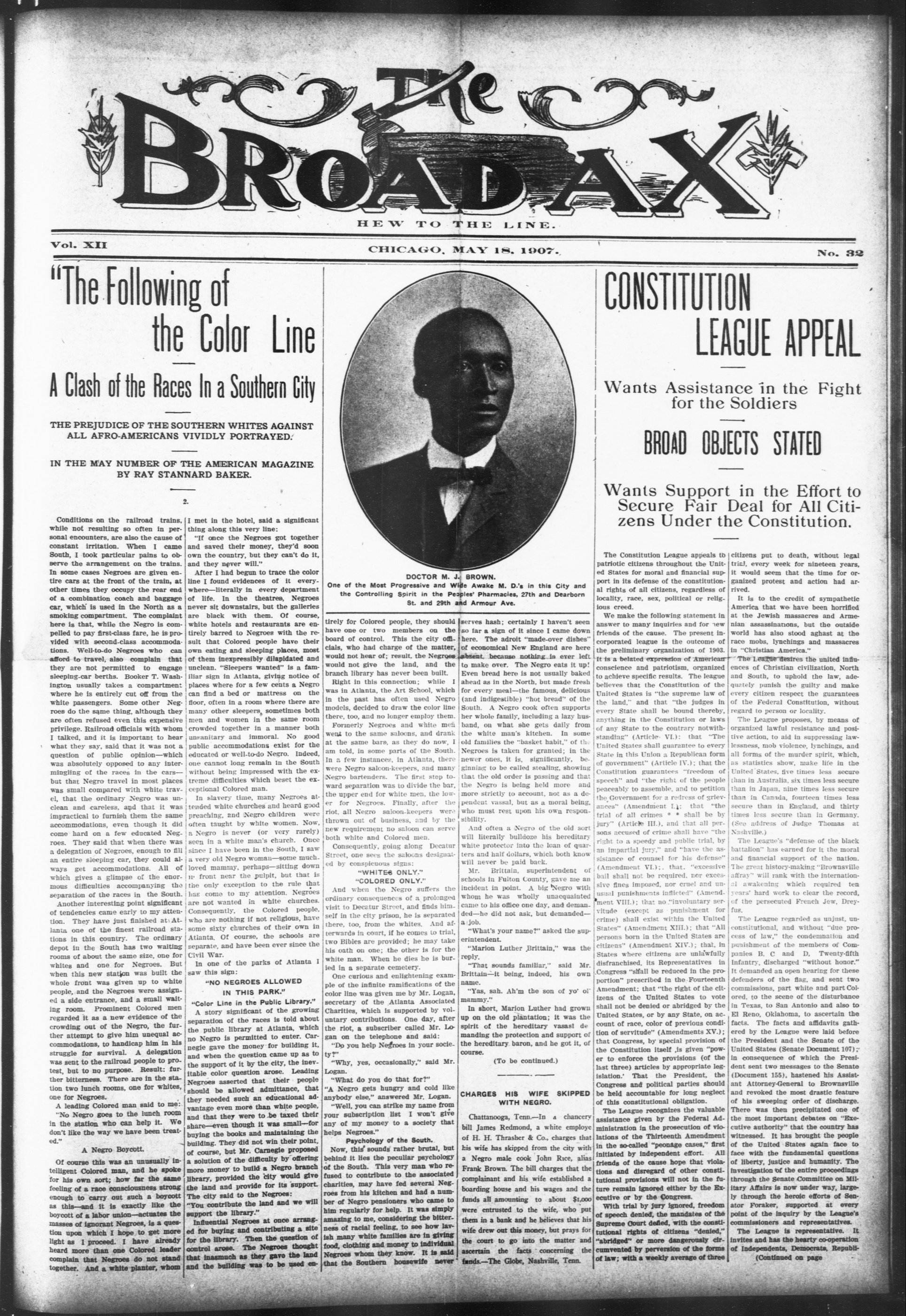
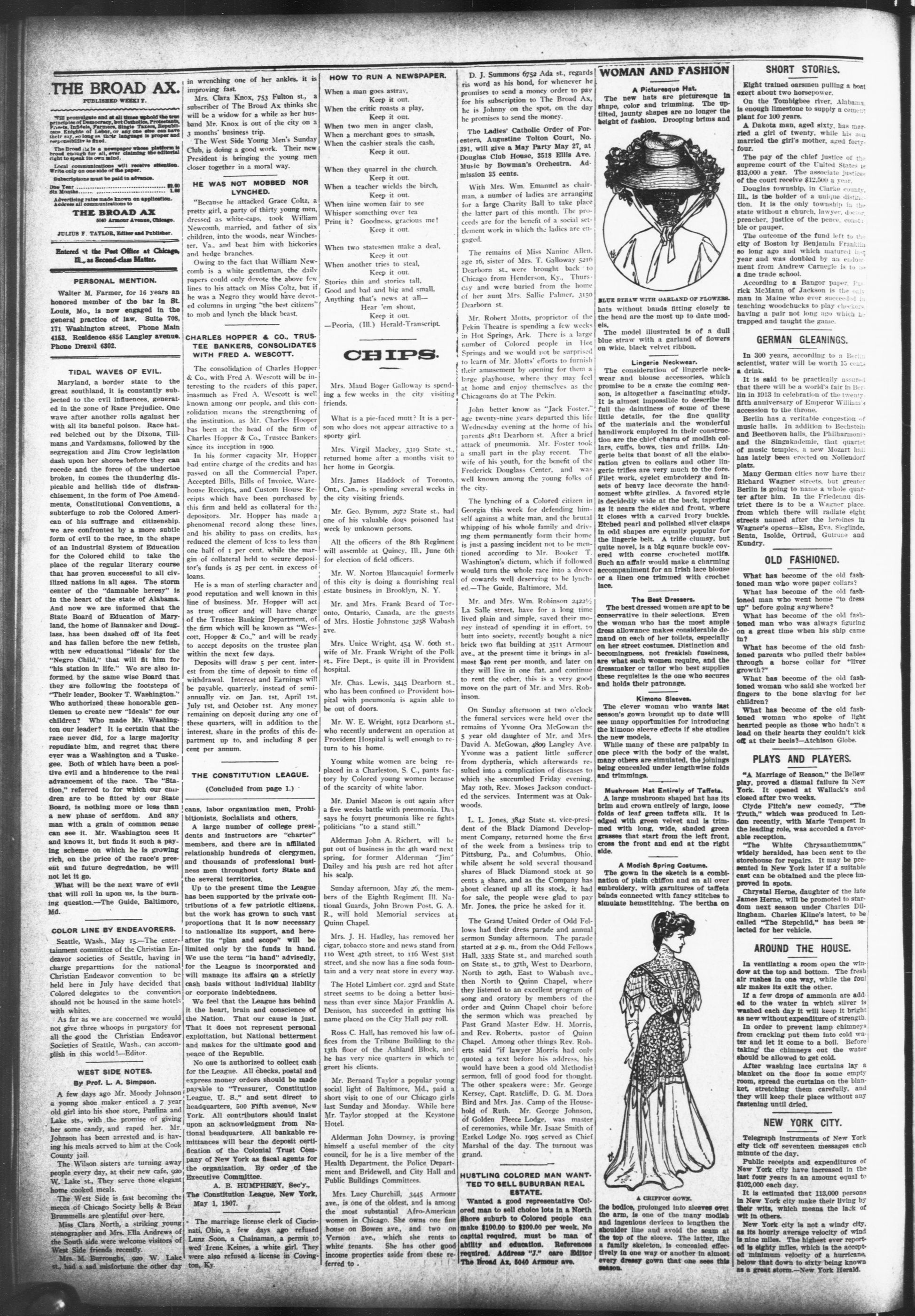
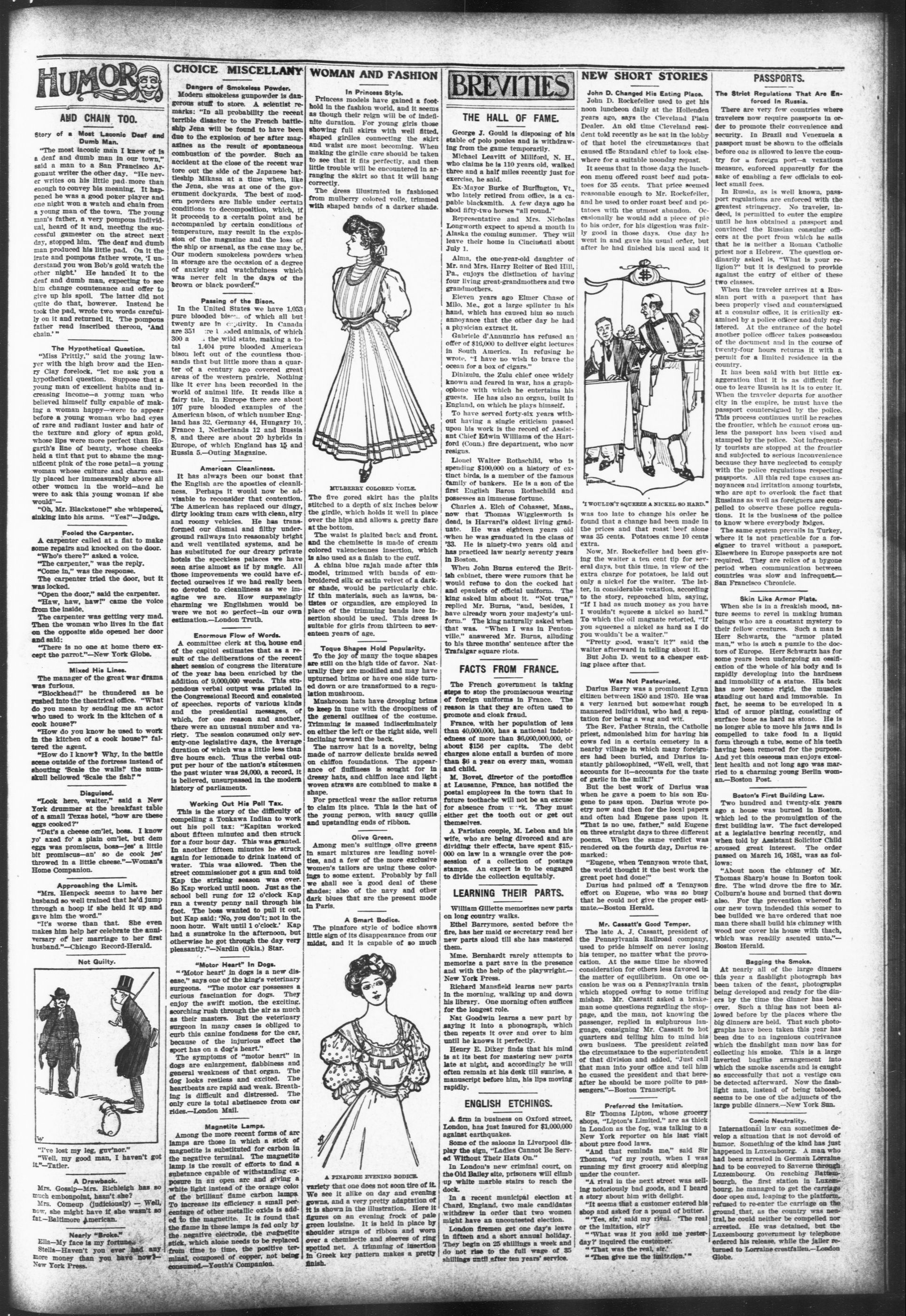
Page text (machine-generated)
THE BROAD AX
HEW TO THE LINE.
"The Following of the Color Line A Clash of the Races In a Southern City
THE PREJUDICE OF THE SOUTHERN WHITES AGAINST ALL AFRO-AMERICANS VIVIDLY PORTRAYED.
IN THE MAY NUMBER OF THE AMERICAN MAGAZINE BY RAY STANNARD BAKER.
Vol. XII
"The Following
the
A Clash of the Race
THE PREJUDICE OF THE SO
ALL AFRO-AMERICANS
IN THE MAY NUMBER OF
BY RAY STAN
Conditions on the railroad trains, while not resulting so often in personal encounters, are also the cause of constant irritation. When I came South, I took particular pains to observe the arrangement on the trains. In some cases Negroes are given entire cars at the front of the train, at other times they occupy the rear end of a combination coach and baggage car, which is used in the North as a smoking compartment. The complaint here is that, while the Negro is compelled to pay first-class fare, he is provided with second-class accommodations. Well-to-do Negroes who can afford to travel, also complain that they are not permitted to engage sleeping-car berths. Booker T. Washington usually takes a compartment where he is entirely cut off from the white passengers. Some other Negroes do the same thing, although they are often refused even this expensive privilege. Railroad officials with whom I talked, and it is important to hear what they say, said that it was not a question of public opinion—which was absolutely opposed to any intermingling of the races in the cars—but that Negro travel in most places was small compared with white travel, that the ordinary Negro was unclean and careless, and that it was impractical to furnish them the same accommodations, even though it did come hard on a few educated Negroes. They said that when there was a delegation of Negroes, enough to fill an entire sleeping car, they could always get accommodations. All of which gives a glimpse of the enormous difficulties accompanying the separation of the races in the South.
Another interesting point significant of tendencies came early to my attention. They have just finished at Atlanta one of the finest railroad stations in this country. The ordinary depot in the South has two waiting rooms of about the same size, one for whites and one for Negroes. But when this new station was built the whole front was given up to white people, and the Negroes were assigned a side entrance, and a small waiting room. Prominent Colored men regarded it as a new evidence of the crowding out of the Negro, the further attempt to give him unequal accommodations, to handicap him in his struggle for survival. A delegation was sent to the railroad people to protest, but to no purpose. Result: further bitterness. There are in the station two lunch rooms, one for whites, one for Negroes.
A leading Colored man said to me: "No Negro goes to the lunch room in the station who can help it. We don't like the way we have been treated."
A Negro Boycott.
Of course this was an unusually intelligent Colored man, and he spoke for his own sort; how far the same feeling of a race consciousness strong enough to carry out such a boycott as this—and it is exactly like the boycott of a labor union—actuates the masses of ignorant Negroes, is a question upon which I hope to get more light as I proceed. I have already heard more than one Colored leader complain that Negroes do not stand together. And a white planter, whom
I met in the hotel, said a significant thing along this very line:
"If once the Negroes got together and saved their money, they'd soon own the country, but they can't do it, and they never will."
After I had begun to trace the color line I found evidences of it everywhere—literally in every department of life. In the theatres, Negroes never sit downstairs, but the galleries are black with them. Of course, white hotels and restaurants are entirely barred to Negroes with the result that Colored people have their own eating and sleeping places, most of them inexpressibly dilapidated and unclean. "Sleepers wanted" is a familiar sign in Atlanta, giving notice of places where for a few cents a Negro can find a bed or mattress on the floor, often in a room where there are many other sleepers, sometimes both men and women in the same room crowded together in a manner both unsanitary and immoral. No good public accommodations exist for the educated or well-to-do Negro. Indeed, one cannot long remain in the South without being impressed with the extreme difficulties which beset the exceptional Colored man.
In slavery time, many Negroes attended white churches and heard good preaching, and Negro children were often taught by white women. Now, a Negro is never (or very rarely) seen in a white man's church. Once since I have been in the South, I saw a very old Negro woman—some much-loved mummy, perhaps—sitting down in front near the pulpit, but that is the only exception to the rule that has come to my attention. Negroes are not wanted in white churches. Consequently, the Colored people, who are nothing if not religious, have some sixty churches of their own in Atlanta. Of course, the schools are separate, and have been ever since the Civil War. In one of the parks of Atlanta I saw this sign:
"NO NEGROES ALLOWED
IN THIS PARK."
"Color Line in the Public Library."
A story significant of the growing separation of the races is told about the public library at Atlanta, which no Negro is permitted to enter. Carnegie gave the money for building it, and when the question came up as to the support of it by the city, the inevitable color question arose. Leading Negroes asserted that their people should be allowed admittance, that they needed such an educational advantage even more than white people, and that they were to be taxed their share—even though it was small—for buying the books and maintaining the building. They did not win their point, of course, but Mr. Carnegie proposed a solution of the difficulty by offering more money to build a Negro branch library, provided the city would give the land and provide for its support. The city said to the Negroes: "You contribute the land and we will support the library."
Influential Negroes at once arranged for buying and contributing a site for the library. Then the question of control arose. The Negroes thought that inasmuch as they gave the land and the building was to be used en-
CHICAGO, MAY 18, 1907.
[Name not visible]
One of the Most Progressive and Wide Awake M. D.'s in this City and the Controlling Spirit in the People's Pharmacies, 27th and Dearborn St. and 29th and Armour Ave.
tirely for Colored people, they should have one or two members on the board of control. This the city officials, who had charge of the matter, would not hear of; result, the Negroes would not give the land, and the branch library has never been built.
Right in this connection; while I was in Atlanta, the Art School, which in the past has often used Negro models, decided to draw the color line there, too, and no longer employ them.
Formerly Negroes and white men went to the same saloons, and drank at the same bars, as they do now, I am told, in some parts of the South. In a few instances, in Atlanta, there were Negro saloon-keepers, and many Negro bartenders. The first step toward separation was to divide the bar, the upper end for white men, the lower for Negroes. Finally, after the riot, all Negro saloon-keepers were thrown out of business, and by the new requirement no saloon can serve both white and Colored men.
serves hash; certainly I haven't seen so far a sign of it since I came down here. The adroit "made-over dishes of economical New England are her absent, because nothing is ever left to make over. The Negro eats it up Even bread here is not usually baked ahead as in the North, but made fres for every meal—the famous, delicious (and indigestible) "hot bread" of the South. A Negro cook often supports her whole family, including a lazy husband, on what she gets daily from the white man's kitchen. In some old families the "basket habit," of the Negroes is taken for granted; in the newer ones, it is, significantly, be ginning to be called stealing, showing that the old order is passing and that the Negro is being held more and more strictly to account, not as a dependent vassal, but as a moral being who must rest upon his own responsibility.
And often a Negro of the old son will literally bulldoze his hereditary
Consequently, going along Decatur Street, one sees the saloons designated by conspicuous signs:
"WHITE8 ONLY."
"COLORED ONLY."
And when the Negro suffers the ordinary consequences of a prolonged visit to Decatur Street, and finds himself in the city prison, he is separated there, too, from the whites. And afterwards in court, if he comes to trial, two Bibles are provided; he may take his oath on one; the other is for the white man. When he dies he is buried in a separate cemetery.
One curious and enlightening example of the infinite ramifications of the color line was given me by Mr. Logan, secretary of the Atlanta Associated Charities, which is supported by voluntary contributions. One day, after the riot, a subscriber called Mr. Logan on the telephone and said:
"Do you help Negroes in your society?
"Why, yes, occasionally," said Mr. Logan.
"What do you do that for?"
"A Negro gets hungry and cold like anybody else," answered Mr. Logan.
"Well, you can strike my name from your subscription list I won't give any of my money to a society that helps Negroes."
Psychology of the South.
Now, this sounds rather brutal, but behind it lies the peculiar psychology of the South. This very man who refused to contribute to the associated charities, may have fed several Negroes from his kitchen and had a number of Negro pensioners who came to him regularly for help. It was simply amazing to me, considering the bitterness of racial feeling, to see how lavish many white families are in giving food, clothing and money to individual Negroes whom they know. It is said that the Southern housewife never
serves hash; certainly I haven't seen so far a sign of it since I came down here. The adroit "made-over dishes" of economical New England are here absent because nothing is ever left to make over. The Negro乞 it up! Even bread here is not usually baked ahead as in the North, but made fresh for every meal—the famous, delicious (and indigestible) "hot bread" of the South. A Negro cook often supports her whole family, including a lazy husband, on what she gets daily from the white man's kitchen. In some old families the "basket habit," of the Negroes is taken for granted; in the newer ones, it is, significantly, beginning to be called stealing, showing that the old order is passing and that the Negro is being held more and more strictly to account, not as a dependent vassal, but as a moral being, who must rest upon his own responsibility.
And often a Negro of the old sort will literally buildoze his hereditary white protector into the loan of quarters and half dollars, which both know will never be paid back.
Mr. Brittain, superintendent of schools in Fulton County, gave me an incident in point. A big Negro with whom he was wholly unacquainted came to his office one day, and demanded—he did not ask, but demanded—a job.
"What's your name?" asked the superintendent.
"Marion Luther Brittain," was the reply.
"That sounds familiar," said Mr. Brittain—it being, indeed, his own name.
"Yas, sah. Ah'm the son of yo' ol mammy."
In short, Marion Luther had grown up on the old plantation; it was the spirit of the hereditary vasasl de manding the protection and support of the hereditary baron, and he got it, of course.
(To be continued.)
CHARGES HIS WIFE SKIPPED
WITH NEGRO.
Chattanooga, Tenn.—In a chancery bill James Redmond, a white employee of H. H. Thrasher & Co., charges that his wife has skipped from the city with a Negro male cook John Rice, alias Frank Brown. The bill charges that the complainant and his wife established a boarding house and his wages and the funds all amounting to about $1,000 were entrusted to the wife, who put them in a bank and he believes that his wife drew out this money, but prays for the court to go into the matter and ascertain the facts concerning the funds—The Globe, Nashville, Tenn.
CONSTITUTION LEAGUE APPEAL
Wants Assistance in the Fight for the Soldiers
Wants Support in the Effort to Secure Fair Deal for All Citizens Under the Constitution.
The Constitution League appeals to patriotic citizens throughout the United States for moral and financial support in its defense of the constitutional rights of all citizens, regardless of locality, race, sex, political or religious creed.
We make the following statement in answer to many inquiries and for new friends of the cause. The present incorporated league is the outcome of the preliminary organization of 1903. It is a belated expression of American conscience and patriotism, organized to achieve specific results. The league believes that the Constitution of the United States is "the supreme law of the land," and that "the judges in every State shall be bound thereby, anything in the Constitution or laws of any State to the contrary notwithstanding" (Article VL): that "The United States shall guarantee to every State in this Union a Republican form of government" (Article IV.); that the Constitution guarantees "freedom of speech" and "the right of the people peaceably to assemble, and to petition the Government for a redress of grievances" (Amendment I.); that "the trial of all crimes * * shall be by jury" (Article III.), and that all persons accused of crime shall have "the right to a speedy and public trial, by an impartial jury," and "have the assistance of counsel for his defense" (Amendment VL.); that "excessive bail shall not be required, nor excessive fines imposed, nor cruel and unusual punishments inflicted" (Amendment VIII.); that no "involuntary servitude (except as punishment for crime) shall exist within the United States" (Amendment XIII.); that "All persons born in the United States are citizens" (Amendment XIV.); that, in States where citizens are unlawfully disfranchised, its Representatives in Congress "sillall be reduced in the proportion" prescribed in the Fourteenth Amendment; that "the right of the citizens of the United States to vote shall not be denied or abridged by the United States, or by any State, on account of race, color of previous condition of servitude" (Amendments XV.); that Congress, by special provision of the Constitution itself, is given "power to enforce the provisions (of the last three) articles by appropriate legislation." That the President, the Congress and political parties should be held accountable for long neglect of this constitutional obligation.
The League recognizes the valuable assistance given by the Federal Administration in the prosecution of violations of the Thirteenth Amendment in the so-called "peonage cases," first initiated by independent effort. All friends of the cause hope that violations and disregard of other constitutional provisions will not in the future remain ignored either by the Executive or by the Congress. With trial by jury ignored, freedom of speech denied, the mandates of the Supreme Court defied, with the constitutional rights of citizens "denied," "abridged" or more dangerously circumvented by perversion of the forms of law; with a weekly average of three
No. 32
ON
AGUE APPEAL
ance in the Fight
Soldiers
ECTS STATED
in the Effort to
Deal for All Citi-
ne Constitution.
citizens put to death, without legal trial, every week for nineteen years, it would seem that the time for organized protest and action had arrived.
It is to the credit of sympathetic America that we have been horrified at the Jewish massacres and Armenian assassinations, but the outside world has also stood aghast at the race mobs, lynchings and massacres in "Christian America."
The League desires the united influences of Christian civilization, North and South, to uphold the law, adequately punish the guilty and make every citizen respect the guarantees of the Federal Constitution, without regard to person or locality.
The League regarded as unjust, unconstitutional, and without "due process of law," the condemnation and punishment of the members of Companies B. C and D, Twenty-fifth Infantry, discharged "without honor." It demanded an open hearing for these defenders of the flag, and sent two commissions, part white and part Colored, to the scene of the disturbance in Texas, to San Antonio and also to El Reno, Oklahoma, to ascertain the facts. The facts and affidavits gathered by the League were laid before the President and the Senate of the United States (Senate Document 107); in consequence of which the President sent two messages to the Senate (Document 155), hastened his Assistant Attorney-General to Brownsville and revoked the most drastic feature of his sweeping order of discharge. There was then precipitated one of the most important debates on "Executive authority" that the country has witnessed. It has brought the people of the United States again face to face with the fundamental questions of liberty, justice and humanity. The investigation of the entire proceedings through the Senate Committee on Military Affairs is now under way, largely through the heroic efforts of Senator Foraker, supported at every point of the inquiry by the League's commissioners and representatives. The League is representative. It invites and has the hearty co-operation of Independents, Democrats, Republi-
(Continued on page
THE BROAD AX.
PUBLISHED WEEKLY.
Will promulgate and at all times uphold the true principles of Democracy, but Catholic, Protestant, Catholic, Infidel, Farmers, Single Taxes, Republican, or any other language, or their say, so long as their language is proper and responsibility is fixed.
The Broad M is a newspaper whose platform is broad enough for all, ever claiming the editorial right to speak its own mind.
Local communications will receive attention. Write only on one side of the paper.
Subscriptions must be paid in advance.
One Year ..... $2.00
Six Months ..... 1.00
Address all communications to:
JULIUS F. TAYLOR, Editor and Publisher.
Entered at the Post Office at Chicago,
Ill. as Second-clam Matter.
PERSONAL MENTION.
Walter M. Farmer, for 16 years an honored member of the bar in St. Louis, Mo., is now engaged in the general practice of law. Suite 708. 171 Washington street. Phone Main 4153. Residence 4856 Langley avenue. Phone Drexel 6302.
TIDAL WAVES OF EVIL.
Maryland, a border state to the great southland, it is constantly subjected to the evil influences, generated in the zone of Race Prejudice. One wave after another rolls against her with all its baneful poison. Race hatred belched out by the Dixons, Tillmans, and Vardamans, followed by the segregation and Jim Crow legislation dash upon her shores before they can recede and the force of the undertoe broken, in comes the thundering dispicable and hellish tide of disfranchisement, in the form of Poe Amendments, Constitutional Conventions, a subterfuge to rob the Colored American of his suffrage and citizenship. we are confronted by a more subtle form of evil to the race, in the shape of an Industrial System of Education for the Colored child to take the place of the regular literary course that has proven successful to all civilized nations in all ages. The storm center of the "damnable heresy" is in the heart of the state of Alabama. And now we are informed that the State Board of Education of Maryland, the home of Bannaker and Douglass, has been dashed off of its feet and has fallen before the new fetish, with new educational "ideals" for the "Negro Child," that will fit him for "his station in life." We are also informed by the same wise Board that they are following the footsteps of "Their leader, Booker T. Washington." Authorized these honorable gentlemen to create new "Ideals" for our children? Who made Mr. Washington our leader? It is certain that the race never did, for a large majority repudiate him, and regret that there ever was a Washington and a Tuskegee. Both of which have been a positive evil and a hindrance to the real advancement of the race. The "Station," referred to for which our children are to be fitted by our State Board, is nothing more or less than a new phase of serfdom. And any man with a grain of common sense can see it. Mr. Washington sees it and knows it, but finds it such a paying scheme on which he is growing rich, on the price of the race's present and future degredation, he will not let it go.
What will be the next wave of evil that will roll in upon us, is the burning question.—The Guide, Baltimore, Md.
COLOR LINE BY ENDEAVORERS.
Seattle, Wash., May 15—The entertainment committee of the Christian Endeavor societies of Seattle, having in charge preparations for the national Christian Endeavor convention to be held here in July have decided that Colored delegates to the convention should not be housed in the same hotels with whites. As far as we are concerned we would not give three whoops in purgatory for all the good the Christian Endeavor Societies of Seattle, Wash., can accomplish in this world!-Editor.
WEST SIDE NOTES.
A few days ago Mr. Moody Johnson a young shoe maker enticed a 7 year old girl into his shoe store, Paulina and Lake sts., with the promise of giving her some candy, and raped her. Mr. Johnson has been arrested and is having his meals served to him at the Cook County jail. The Wilson sisters are turning away people every day, at their new cafe, 920 W. Lake st., They serve those elegant home cooked meals. The West Side is fast becoming the mecca of Chicago Society bells & Beau Brummells are plentiful over here. Miss Clara North, a striking young stenographer and Mrs. Ella Andrews of the South side were welcome visitors of West Side friends recently. Mrs. M. Burroughs, 920 W. Lake st., had a sad misfortune the other day
in wrenching one of her ankles, it is improving fast.
Mrs. Clara Knox, 753 Fulton st., a subscriber of The Broad Ax thinks she will be a widow for a while as her husband Mr. Knox is out of the city on 3 months' business trip.
The West Side Young Men's Sunday Club, is doing a good work. Their new President is bringing the young men closer together in a moral way.
HE WAS NOT MOBBED NOR
LYNCHED.
"Because he attacked Grace Coltz, a pretty girl, a party of thirty young men, dressed as white-caps, took William Newcomb, married, and father of six children, into the woods, near Winchester, Va., and beat him with hickories and hedge branches.
Owing to the fact that William Newcomb is a white gentleman, the daily papers could only devote the above few lines to his attack on Miss Coltz, but if he was a Negro they would have devoted columns in urging "the best citizens" to mob and lynch the black beast.
CHARLES HOPPER & CO., TRUSTEE BANKERS, CONSOLIDATES WITH FRED A. WESCOTT.
The consolidation of Charles Hopper & Co., with Fred A. Wescott will be interesting to the readers of this paper, inasmuch as Fred A. Wescott is well known among our people, and this consolidation means the strengthening of the institution, as Mr. Charles Hooper has been at the head of the firm of Charles Hopper & Co., Trustee Bankers since its inception in 1000.
In his former capacity Mr. Hopper had entire charge of the credits and has passed on all the Commercial Paper, Accepted Bills, Bills of Invoice, Warehouse Receipts, and Custom House Receipts which have been purchased by this firm and held as collateral for the depositors. Mr. Hopper has made a phenomenal record along these lines, and his ability to pass on credits, has reduced the element of less to less than one half of 1 per cent. while the margin of collateral held to secure depositor's funds is 25 per cent. in excess of loans.
He is a man of sterling character and good reputation and well known in this line of business. Mr. Hopper will act as trust officer and will have charge of the Trustee Banking Department, of the firm which will be known as "Wescott, Hopper & Co," and will be ready to accept deposits on the trustee plan within the next few days.
Deposits will draw 5 per cent. interest from the time of deposit to time of withdrawal. Interest and Earnings will be payable, quarterly, instead of semiannually viz. on Jan. 1st, April 1st, July 1st, and October 1st. Any money remaining on deposit during any one of these quarters, will in addition to the interest, share in the profits of this department up to, and including 8 per cent per annum.
THE CONSTITUTION LEAGUE.
cans, labor organization men, Prohibitionists, Socialists and others. A large number of college presidents and instructors are "charter" members, and there are in affiliated relationship hundreds of clergymen, and thousands of professional business men throughout forty State and the several territories.
Up to the present time the League has been supported by the private contributions of a few patriotic citizens, but the work has grown to such vast proportions that it is now necessary to nationalize its support, and hereafter its "plan and scope" will be limited only by the funds in hand. We use the term "in hand" advisedly, for the League is incorporated and will manage its affairs on a strictly cash basis without individual liability or corporate indebtedness. We feel that the League has behind it the heart, brain and conscience of the Nation. That our cause is just. That it does not represent personal exploitation, but National betterment and makes for the ultimate good and peace of the Republic.
No one is authorized to collect cash for the League. All checks, postal and express money orders should be made payable to "Treasurer, Constitution League, U. S." and sent direct to headquarters, 500 Fifth avenue, New York. All contributors should insist upon an acknowledgment from National headquarters. All bankable remittances will bear the deposit certification of the Colonial Trust Company of New York as fiscal agents for the organization. By order of the Executive Committee.
A. B. HUMPHREY, Sec'y., The Constitution League, New York, May 1, 1907.
- The marriage license clerk of Cincinnati, Ohio, a few days ago refused Lunz Soon, a Chainaman, a permit to wed Irene Keines, a white girl. They were also refused a license in Covington, Ky.
HOW TO RUN A NEWSPAPER.
When a man goes astray,
Keep it out.
When the critic roasts a play,
Keep it out.
When two men in anger clash,
When a merchant goes to smash,
When the cashier steals the cash,
Keep it out.
When they quarrel in the church.
Keep it out.
When a teacher wields the birch,
Keep it out.
When nine women fair to see
Whisper something over tea
Print it? Goodness, gracious me!
Keep it out.
When two statesmen make a deal,
Keep it out
When another tries to steal,
Keep it out
Stories thin and stories tall,
Good and bad and big and small.
Anything that's news at all—
Hear 'em shout,
Keep it out.
—Peoria. (Ill.) Herald-Transcript
CHIPS
Mrs. Maud Boger Galloway is spending a few weeks in the city visiting friends.
What is a pie-faced mutt? It is a person who does not appear attractive to a sporty girl.
Mrs. Virgil Mackey, 3319 State st., returned home after a months visit to her home in Georgia.
Mrs. James Haddock of Toronto, Ont., Can., is spending several weeks in the city visiting friends.
Mr. Geo. Bynum, 2972 State st., had one of his valuable dogs poisoned last week by unknown persons.
All the officers of the 8th Regiment will assemble at Quincy, Ill., June 6th for election of field officers.
Mr. W. Norton Blaucaquiel formerly of this city is doing a flourishing real estate business in Brooklyn, N. Y.
Mr. and Mrs. Frank Beard of Toronto, Ontario, Canada, are the guests of Mrs. Hostie Johnstone 3258 Wabash ave.
Mrs. Unice Wright, 454 W. 60th st., wife of Mr. Frank Wright of the Polls st., Fire Dept., is quite ill in Provident hospital.
Mr. Chas. Lewis, 3445 Dearborn st., who has been confined to Provident hospital with pneumonia is again able to be out of doors.
Mr. W. E. Wright, 1912 Dearborn st., who recently underwent an operation at Provident Hospital is well enough to return to his home.
Young white women are being replaced in a Charleston, S. C., pants factory by Colored young women because of the scarcity of white labor.
Mr. Daniel Macon is out again after a five weeks battle with pneumonia. Dau says he fouyrt pneumonia like re fights politicians "to a stand still."
Alderman John A. Richert, will be put out of business in the 4th ward next spring, for former Alderman "Jim" Dailey and his push are red hot after his scalp.
Sunday afternoon, May 26, the members of the Eighth Regiment Ill. National Guards, John Brown Post, G. A. R., will hold Memorial services at Quinn Chapel.
Mrs. J. H. Hadley, has removed her cigar, tobacco store and news stand from 110 West 47th street, to 116 West 51st street, and she now has a fine soda fountain and a very neat store in every way.
The Hotel Limbert cor. 23rd and State street seems to be doing a better business than ever since Major Franklin A. Denison, has succeeded in getting his name placed on the City Hall pay roll.
Ross C. Hall, has removed his law offices from the Tribune Building to the 13th floor of the Ashland Block, and he has very nice quarters in which to greet his clients.
Mr. Bernard Taylor a popular young social light of Baltimore, Md., paid a short visit to one of our Chicago girls last Sunday and Monday. While here Mr. Taylor stopped at the Keystone Hotel. Alderman John Downey, is proving himself a useful member of the city council, for he is a live member of the Health Department, the Police Department and Bridewell, and City Hall and Public Buildings Committees.
Mrs. Lucy Churchill. 3445 Armour ave., is one of the oldest, and is among the most substantial Afro-American women in Chicago. She owns one fine house on Bowen ave., and two on Vernon ave., which she rents to white tenants. She has other good income properties aside from these referred to.
D. J. Summons 6752 Ada st., regards ris word as his bond, for whenever he promises to send a money order to pay for his subscription to The Broad Ax, he is Johnny on the spot, on the day he promises to send the money.
The Ladies' Catholic Order of Foresters, Augustine Tolton Court, No. 391, will give a May Party May 27, at Douglas Club House, 3518 Ellis Ave. Music by Bowman's Orchestra. Admission 35 cents.
With Mrs. Wm. Emanuel as chairman, a number of ladies are arranging for a large Charity Ball to take place the latter part of this month. The proceeds are for the benefit of a social settlement work in which the ladies are engaged.
The remains of Miss Nanine Allen, age 16, sister of Mrs. T. Galloway 5216 Dearborn st., were brought back to Chicago from Henderson, Ky., Thursday and were buried from the home of her aunt Mrs. Sallie Palmer, 3150 Dearborn st.
Mr. Robert Motts, proprietor of the Pekin Theatre is spending a few weeks in Hot Springs, Ark. There is a large number of Colored people in Hot Springs and we would not be surprised to learn of Mr. Motts' efforts to furnish their amusement by opening for them a large playhouse, where they may feel at home and enjoy themselves as the Chicagoans do at The Pekin.
John better know as "Jack Foster," age twenty-nine years departed this life Wednesday evening at the home of his parents 4811 Dearborn st. After a brief attack of pneumonia. Mr. Foster took a small part in the play recent. The wife of his youth, for the benefit of the Frederick Douglass Center, and was well known among the young folks of the city.
The lynching of a Colored citizen in Georgia this week for defending himself against a white man, and the brutal whipping of his whole family and driving them permanently form their home is just a passing incident not to be mentioned according to Mr. Booker T. Washington's dictum, which if followed would turn the whole race into a drove of cowards well deserving to be lynched. The Guide, Baltimore, Md.
Mr. and Mrs. Wm. Robinson 24221/ La Salle street, have for a long time lived plain and simple, saved their money instead of spending it in effort, to butt into society, recently bought a nice brick two flat building at 3511 Armour ave., at the present time it brings in almost $40 rent per month, and later on they will live in one flat, and continue to rent the other, this is a very good move on the part of Mr. and Mrs. Robinson.
On Sunday afternoon at two o'clock the funeral services were held over the remains of Yvonne Ora McGowan the 5 year old daughter of Mr. and Mrs. David A. McGowan, 4809 Langley Ave. Yvonne was a patient little sufferer from dypheria, which afterwards resulted into a complication of diseases to which she succumbed Friday evening, May 10th, Rev. Moses Jackson conducted the services. Interment was at Oakwoods.
L. L. Jones, 3842 State st. vice-president of the Black Diamond Development Company, returned home the first of the week from a business trip to Pittsburg, Pa., and Columbus, Ohio, while absent he sold several thousand shares of Black Diamond stock at 50 cents a share, and as the Company has about cleaned up all its stock, it had for sale, the people were glad to pay Mr. Jones, the price he asked for it.
The Grand United Order of Odd Fellows had their dress parade and annual sermon Sunday afternoon. The parade started at 2 p. m., from the Odd Fellows Hall, 3335 State st. and marched south on State st., to 37th, West to Dearborn, North to 29th, East to Wabash ave., then North to Quinn Chapel, where they listened to an excellent program of song and oratory by members of the order and Quinn Chapel choir before the sermon which was preached by Past Grand Master Edw. H. Morris, and Rev. Roberts, pastor of Quinn Chapel. Among other things Rev. Roberts said "if lawyer Morris had only quoted a text before his address, his would have been a good old Methodist sermon, full of good food for thought. The other speakers were: Mr. George Kersey, Capt. Ratcliffe, D. G. M. Dora Bird and Mrs. Jas. Camp of the Household of Ruth. Mr. George Johnson, of Golden Fleece Lodge, was master of ceremonies, while Mr. Isaac Smith of Ezekel Lodge No. 1905 served as Chief Marshal of the day. The turnout was grand.
HUSTLING COLORED MAN WANTED TO SELL SUBURBAN REAL ESTATE.
Wanted a good representative Colored man to sell choice lots in a North Shore suburb to Colored people can make $100.00 to $200.00 per week. No capital required, must be man of ability and education. References required. Address "J." care Editor The Broad Ax. 5040 Armour ave.
WOMAN AND FASHION
The new hats are picturesque in shape, color and trimming. The uptilted, jaunty shapes are no longer the height of fashion. Drooping brims and
M.
BLUE STRAW WITH GARLAND OF FLOWERS.
hats without bands fitting closely to
the head are the most up to date
models.
The model illustrated is of a dull
blue straw with a garland of flowers
on wide, black velvet ribbon.
Lingerie Neckwear.
The consideration of lingerie neckwear and blouse accessories, which promise to be a craze the coming season, is altogether a fascinating study. It is almost impossible to describe in full the daintiness of some of these little details, for the fine quality of the materials and the wonderful handwork employed in their construction are the chief charm of modilish collars, cuffs, bows, ties and frills. Lingerie belts that boast of all the elaboration given to collars and other lingerie trifles are very much to the fore. Filet work, eyelet embroidery and insets of heavy lace decorate the handsomest white girlles. A favored style is decidedly wide at the back, tapering as it nears the sides and front, where it closes with a carved ivory buckle. Etched pearl and polished silver clasps in odd shapes are equally popular for the lingerie belt. A trifle clumsy, but quite novel, is a big square buckle covered with coarse crocheted motifs. Such an affair would make a charming accompaniment for an Irish lace blouse or a linen one trimmed with crochet lace.
The Best Dressers.
The best dressed women are apt to be conservative in their selections. Even the woman who has the most ample dress allowance makes considerable demand on each of her toilers, especially on her street costumes. Distinction and becomingness, not freakish fussiness, are what such women require, and the dressmaker or tailor who best supplies these requisites is the one who secures and holds their patronage.
Kimono Sleeves
The clever woman who wants last season's gown brought up to date will see many opportunities for introducing the kimono sleeve effects if she studies the new models.
While many of these are palpably in one piece with the body of the waist, many others are simulated, the joinings being concealed under lengthwise folds and trimmings.
Mushroom Hat Entirely of Taffeta.
A large mushroom shaped hat has its brim and crown entirely of large, loose folds of leaf green taffeta silk. It is edged with green velvet and is trimmed with long, wide, shaded green grasses that start from the left front, cross the front and end at the right side.
A Modish Spring Costume
The gown in the sketch is a combination of plain chiffon and an all over embroidery, with garnitures of taffeta bands connected with fancy stitches to simulate hemstitching. The bertha on
B.
A CHIPFON GOWN.
the bodice, prolonged into sleeves over the arm, is one of the many modish and ingenious devices to lengthen the shoulder line and avoid the seam at the top of the sleeve. The latter, like a family skeleton, is concealed effectively in one way or another in almost every dressy gown that one sees this season.
SHORT STORIES.
Eight trained oarsmen pulling a boat exert about two horsepower.
On the Tombigbee river, Alabama, is enough limestone to supply a cement plant for 100 years.
A Dakota man, aged sixty, has married a girl of twenty, while his son married the girl's mother, aged forty-four.
The pay of the chief justice of the supreme court of the United States is $13,000 a year. The associate justice of the court receive $12,500 a year.
Douglas township, in Clarke county, Ill., is the township of a unique distinction. It is the only township in the state without a church, lawyer, doctor, preacher, justice of the peace, constable or pauper.
The outcome of the fund left to the city of Boston by Benjamin Franklin so long ago and which matured last year and was doubled by an endowment from Andrew Carnegie is to be a fine trade school.
According to a Bangor paper, Patrick McMann of Jackson is the only man in Maine who ever succeeded in teaching woodchucks to play checkers having a pair not long ago which h trapped and taught the game.
GERMAN GLEANINGS
In 300 years, according to a Berlin scientist, water will be worth 15 cents a drink.
It is said to be practically assured that there will be a world's fair in Berlin in 1913 in celebration of the twenty-fifth anniversary of Emperor William's accession to the throne.
Berlin has a veritable congestion of music halls. In addition to Bechstein and Beethoven halls, the Philharmonie and the Singakademie, that quartet of music temples, a new Mozart hall has lately been erected on Nollendorfplatz.
Many German cities now have their Richard Wagner streets, but greater Berlin is going to name a whole quarter after him. In the Friedenau district there is to be a Wagner place, from which there will radiate eight streets named after the heroes in Wagner's operas—Elsa, Eva, Sieglinde, Senta, Isolde, Ortrud, Gutrune and Kundry.
OLD FASHIONED.
PLAYS AND PLAYERS.
"A Marriage of Reason," the Believel play, proved a dismal failure in New York. It opened at Wallack's and closed after two weeks. Clyde Fitch's new comedy, "The Truth," which was produced in London recently, with Marle Tempest in the leading role, was accorded a favorable reception. "The White Chrysanthemums," widely heralded, has been sent to the storehouse for repairs. It may be presented in New York later if a suitable cast can be obtained and the piece improved in spots. Chrystal Herne, daughter of the late James Herne, will be promoted to stardom next season under Charles Dillingham. Charles Kline's latest, to be called "The Stepchild," has been selected for her vehicle.
AROUND THE HOUSE.
In ventilating a room open the window at the top and bottom. The fresh air rushes in one way, while the foul air makes its exit the other.
If a few drops of ammonia are added to the water in which silver is washed each day it will keep it bright as new without expenditure of strength.
In order to prevent lamp chimneys from cracking put them into cold water and let it come to a boll. Before taking the chimneys out the water should be allowed to get cold.
After washing lace curtains lay a blanket on the floor in some empty room, spread the curtains on the blanket, stretching them carefully, and they will keep their place without any fastening until dried.
NEW YORK CITY.
Telegraph instruments of New York city tick off seventeen messages each minute of the day.
Public receipts and expenditures of New York city have increased in the last four years in an amount equal to $102,000 each day.
It is estimated that 113,000 persons in New York city make their living by their wits, which means the lack of wit in others.
New York city is not a windy city, as its hourly average velocity of wind is nine miles. The highest ever reported is eighty miles, which is the accepted minimum velocity of a hurricane, below that down to sixty being known as a great storm—New York Herald.
ied
AUD CHAIN TOO.
Story of a Most Laconic Deaf and
Dumb Man.
“The most taconfe man I knew of fs
a deaf and dumb man in our town,”
seid a man to a San Francisco Ar-
gonaut writer the other day. “He nev-
er writes on his little pad. more than
enough to convey bis meaning. It hap-
pened he was a good poker player and
one night Won a watch and chain from
a young man of the town. The young
man's father, a very pompous Individ-
ual, heard of it and, meeting the suc-
cessful gamester on the strect next
sx, stopped him. ‘The deaf and dumb
man produced his little pad. On it the
irate and pompous father wrote, ‘I un-
derstand you won Bob's gold watch the
other night’ He handed it to the
deat and dumb man, expecting to see
him change countenance and offer to
give up his spoil. ‘The latter did not
quite do that, however. Instead be
took the pad, wrote two words careful-
ly on it and returned it, The pompous
father read inscribed thereon, ‘And
chain’*”
The Hypothetical Question.
“Miss Prittly,” said the young law-
yer with the high brow and the Hen-
ty Clay forelock, “let me ask you a
hypothetical question. Suppose that a
young man of excellent habits and in-
creasing income—a young man who
believed himself fully capable of mak-
ing a woman happy—were to appear
before a young woman who bad eyes
of rare and radiant luster and hair of
the texture and glory of spun gold,
whose lips were more perfect than Ho-
garth’s Hine of beauty, whose cheeks
held a tint that put to shame the mag-
nificent pink of the rose petal—a young
‘woman whose culture and charm eas-
tly placed her immeasurably above all
other women in the world—and he
were to ask this young woman If she
would”—
“Oh, Mr. Blackstone!” she whispered,
sinking into his arms. “Yes!"—Jndge.
imi
A carpenter called at a flat to make
some repairs and knocked on the door.
“Who's there?” asked a voice.
“The carpenter,” was the reply.
“Come in,” was the response.
‘The carpenter tried the door, but tt
‘was locked.
“Open the door,” said the carpenter.
“Haw, haw, haw!” came the voice
from the inside.
‘The carpenter was getting very mad.
‘Then the woman who lives in the flat
oa the opposite side opened her door
and said:
“There is no one at home there ex-
cept the parrot.”"—New York Globe.
Mixed His Lines.
‘The manager of the great war drama
‘was furious.
“Blockhead!” he thundered as he
rushed into the theatrical office. “What
Go you mean by sending me an actor
who used to work in the kitchen of a
cook house?”
“How do you know he used to work
im the Kitchen of a cook house?” fal-
tered the agent.
“How do I know? Why, in the battle
scene outside of the fortress instead of
shouting ‘Scale the walls? the num-
skull bellowed ‘Scale the fish!”
Sinden’,
“Look here, waiter,” said a New
York drummer at the breakfast table
of a small Texas hotel, “how are these
‘eggs cooked?”
“Dat'’s a cheese om'let, boss. I know
yo’ axed fo’ a plain om'let, but dem
exgs was promiscus, boss—jes’ a little
bit promiscus—an’ so de cook jes’
throwed in a little cheese.”—Woman's
Home Companion.
Approaching the Limit.
“Mrs. Henpeck seems to bave her
husband so well trained that he’d jump
through a hoop if she held it up and
gave him the word.”
“It's worse than that’ She even
makes him help her celebrate the anni-
versary of her marriage to her first
husband.”"—Chicago Record-Herald.
Net Guilty.
//
Ge
, <i
p
= PS
t
“T've lost my leg, guv‘nor.”
“Well, my good man, I haven't got
it"—Tatler.
ial
‘Mrs. Gossip—Mrs. Richleigh bas, s0
much embonpoint, hasn't she?
Mrs. Comeup (Gudicionsty) — Well,
‘Bow, she might have if she wasn’t s0
tst—Baltimore american.
Mearly “Becka™ « |.
Ella—My face is my fortunes =~
Stella—Haven't yon ever any
tore money than you ve bow r
New York Press. 2 as
CHOICE MISCELLANY
Dangers of Smokeless Powder.
‘Modern smokeless gunpowder is dan-
serous stuff to store. A scientist re-
marks: “In all probability the recent
terrible disaster to the French battle
ship Jena will be found to have been
Gue to the explosion of her after mag.
azines as the result of spontaneous
combustion of the powder. Such an
‘Accident at the close of the recent war
tore out the side of the Japanese bat-
tleship Mikasa at a time when, like
‘the Jena, she was at one of the gov-
ernment dockyards. The best of mod-
erm powders are Mable under certain
conditions to decomposition, which, if
it proceeds to a certain point and’ be
actompanied by certain conditions of
temperature, may result in the explo-
sion of the magazine and the loss of
the ship or arsenal, as the case may be.
Our modern smokeless powders when
in storage are the occasion of a degree
of anxiety and watchfulness which
was never felt in the days of the
brown or black powderé.”
incall ai
In the United States we have 1,053
Pure blooded bis-:.. of which all but
twenty are tn c*ytivity. In Canada
are 351 :re 1 voded animals, of which
300.2 _. the wild state, making a to
tal 1.404 pure blooded American
bison left out of the countless thou
‘sands that but little more than a quar.
ter of a century ago covered great
areas of the western prairie. Nothing
Uke it ever has been recorded in the
world of animal life. It reads like a
fairy tale. In Europe there are about
107 pure blooded examples of the
American bison, of which number Eng:
land has 32, Germany 44, Hungary 10,
France 1, Netherlands 12 and Russia
8, and there are about 20 hybrids in
Burope, of which England has 15 and
Bussia 5.—Outing Magazine.
Rie Rl.
It bas always been our boast that
the English are the apostles of cleanlt-
ness, Perhaps {t would now be ad-
visable to reconsider that contention.
‘The American has replaced our dingy,
irty looking tram cars with clean, alry
and roomy vehicles. He has trans-
formed our dismal and filthy under-
ground railways into reasonably bright
and well ventilated systems, and he
has substituted for our dreary private
hotels the speckless palaces we have
seen arise almost as if by magic. All
‘those improvements we could have ef-
fected ourselves if we had really been
‘80 devoted to cleanliness as we im-
agine we are. How surpassingly
charming we Englishmen would be
Were we not so perfect—in our own
estimation—London Truth.
a ia cla
A committee clerk at the house end
of the capitol estimates that as a re
sult of the deliberations of the recent
shert session of congress the literature
of the year has been enriched by the
addition of 9,000,000 words. This stu-
pendous verbal output was printed in
the Congressional Record and consisted
of speeches. reports of various kinds
and the presidential messages, of
which, for one reason and another,
there were an unusual number and va-
riety. The session consumed only sev-
enty-one legislative days, the Average
uration of which was a little less than
five hours each. Thus the verbal out-
put per hour of the nation’s stitesmen
the past winter was 24,000, a record, it
1s believed, unsurpassed in the modern
Ristory of parliaments.
Werkine Out Mis Poll Tex.
‘This is the story of the difficulty of
compelling a Tonkawa Indian to work
out his poll tax: “Kapitan worked
about fifteen minutes and then struck
for a four hour day. This was granted.
In another fifteen minutes he struck
again for lemonade to drink instead of
water. This was allowed. Then the
street commissioner got a gun and told
Kap the striking season was over.
So Kap worked until noon. Just as the
school bell rung for 12 o'clock Kap
ran a twenty penny nail through bis
foot. ‘The boss wanted to pull it out,
but Kap said: ‘No, you don't; not in the
noon hour. Wait until 1 o'clock.’ Kap
had @ sunstroke in the afternoon, but
otherwise he got through the day very
pleasantly.”"—Nardin (Okia.) Star.
@Mctor Heart” In Doas.
“Motor heart’ in dogs is a new dis
ease,” says one of the king’s veterinary
surgeons. “The motor car possesses 2
curious fascination for dogs. They
enjoy the swift motion, the exciting,
scorching rush through the air as much
as their masters. But the veterinary
surgeon In many cases is obliged to
curb this canine fondness for the car,
because of the injurious effect the
sport has on a dog's beart.”
‘The symptoms of “motor heart” in
dogs are enlargement, flabbiness and
general weakness of that organ. The
dog looks restless and excited. The
heartbeats are rapid and weak. Breatb-
ing is difficult and distressed. The
only cure is total abstinence from car
rides—London Mail.
ttaattte Samen
Among the more recent forms of ar
lamps are those in which a stick of
magnetite is substituted for carbon in
the negative terminal. The magnetite
lamp is the result of efforts to find
substance capable of withstanding ex-
posure in an open arc and giving a
awhite light instead of the orange color
‘of the brilliant fame carbon lamps
To increase its efficiency 2 small per
centage of other metallic oxids is add-
ed to the magnetite. It is found that
the flame in these lamps is fed only by
the. negative electrode, the magnetite
stick, which alone needs to be replaced
‘from time to time, the positive ter
quinal, composed of copper, not being
eansumed.—Youth's Companion.
‘WOMAN AND FASHION
In Princess Style.
Princess models have gained » foot:
hold in the fashion world, and it seems
as though their reign will be of indefl
nite duration. For young girls those
showing full skirts with well fitted,
shaped girdles connecting the skirt
and waist are most becoming. When
making the ginile care should be taken
to see that it fits perfectly, and then
Uttle trouble will be encountered In ar-
Fanging the skirt so that ft will hang
correctly.
The dress illustrated is fashioned
from mulberry colored volle, trimmed
with shaped bands of a darker shade.
7
ie .
7 AF HH R
Mi) f i! if i
i
PANS
ER
i ii \\
H'\\\
Hl \\\
/
I a
PSN. ii eet
Sh
Ce
‘The five gored skirt has the plaits
stitched to a depth of six inches below
the girdle, which holds it well in place
over the hips and allows « pretty flare
at the bottom.
‘The waist is plaited back and front.
and the chemisette is made of cream
colored valenciennes insertion, which
4s also used as a finish to the curt.
A china blue rajah made after this
model, trimmed with bands of em-
broidered silk or satin velvet of a dark-
ex shade, would be particularly chic.
If thin materials, such as lawns, ba-
tistes or organdies, are employed in
place of the trimming bands lace {n-
sertion should be used. This dress is
suitable for girls from thirteen to sev-
enteen years of age.
Toaue Shapes Hold Popularity.
‘To the joy of many the toque shapes
are still on the high tide of favor. Nat-
urally they are modified and may have
upturned brims or have one side turn-
ed down or are transformed to a regu-
lation mushroom.
‘Mushroom hats have drooping brims
to keep in tune with the droopiness of
the general outlines of the costume.
‘Trimming ts massed indiscriminately
on elther the left or the right side, well
inclining toward the back.
The narrow hat is a novelty, being
made of narrow delicate braids sewed
on chiffon foundations. The appear-
ance of fiuffiness is sought for in
dressy hats, and chiffon lace and light
‘woven straws are combined to make a
shape.
For practical wear the sailor returns
to claim its place. This is the hat of
the young person, with saucy quills
‘and upstanding ends of ribbon.
Olive Green.
Among men’s suitings ollve greens
tm smart mixtures are leading novel-
ties, and a few of the more exclusive
‘women’s tailors are using these color-
ings to some extent. Probably by fall
we shall see ‘a good deal of these
shades; also of the navy and other
dark blues that are the present mode
in Paris.
i i
‘The pinafore style of bodice shows
ttle sign of its disappearance from our
midst, and it is capable of so much
x "7
GS ayy
67, POS A
cs <N
Cs CF 8
foe RSS
Pe
ff q \
y
& PIMAVORE EVEXING BODICR.
variety that one does not soon tire of *&
‘We see it alike on day and evening
gowns, and a very pretty adaptation of
4 is shown in the illustration. Here it
figures on an evening frock of pale
green louisine. It is held in place by
shoulder straps of ribbon and worn
‘over 2 chemisette and sleeves of ring
spotted net. A trimming of insertion
‘tm Greek key pattern makes a pretty
nish.
THE HALL OF FAME.
George J. Gould is disposing of his
stable of polo ponies and is withdraw-
ing from the game temporarily.
Michael Leavitt of Millford, N. H.
who claims he is 110 years old, walked
three and a half miles recently just for
exercise, he sald.
Ex-Mayor Burke of Burftogton, Vt,
who lately retired from office, is a ca-
pable blacksmith. A few days ago he
shod fifty-two horses “all round.”
Representative and Mrs. Nicholas
Longworth expect to spend a month in
Alaska the coming summer. They will
leave their home in Cincinfati about
July 1.
Alma, the one-year-old daughter of
‘Mr. and Mrs. Harry Reiter of Red Hill,
Pa., enjoys the distinction of having
four living great-grandmothers and two
grandmothers.
Eleven years ago Elmer Chase of
Milo, Me, got a large splinter in his
hand, which has caused bim so much
"annoyance that the other day he had
@ physician extract it.
| Gabriele d’Annunzio has refused an
offer of $16,000 to deliver eight lectures
in South America. In refusing be
wrote, “I have no wish to brave the
ocean for a box of cigars.”
| Dinizulu, the Zulu chlet once widely
| known and feared in war, has a graph-
ophoue with which he entertains his
| guests. He has also an organ, built in
England, on which he plays himself.
‘To have served forty-six years with-
out having a single criticism passed
| upon his work is the record of Assist-
-ant Chief Edwin Williams of the Hart-
}ford (Conn) fire department, who now
| resigus.
Lionel Walter Rothschild, who ts
"spending $100,000 on a history of ex-
tinct birds, is a member of the famous
family of bankers. He ts a son of the
‘first English Baron Rothschild and
"possesses an immense fortune.
"Charles A. Elch of Cohasset, Mass.,
now that Thomas Wigglesworth is
‘dead, is Harvard's oldest living grad-
uate. He was eighteen years old
‘when he was graduated in the class of
'83. He is ninety-two years old and
‘hhas practiced law nearly seventy years
In Boston.
‘When John Burns entered the Brit-
‘sh cabinet, there were rumors that he
‘would refuse to don the cocked hat
and epaulets of official uniform. The
‘King asked bim about it. “Not true,”
replied Mr. Burns, “and, besides, I
bave already worn your majesty’s unl-
form.” The king naturally asked when
that was. “When I was in Penton-
ville,” answered Mr. Burns, alluding
to his three months’ sentence after the
‘Trafalgar square riots.
FACTS FROM FRANCE.
‘The French government Is taking
steps to stop the promiscuous wearing
of foreign uniforms in France. The
reason is that they are often used to
promote and cloak fraud.
France, with her population of less
than 40,000,000, has a national indebt-
‘edness of more than $6,090,000,000, or
about $156 per capita. The debt
charges alone entail a burden of more
than $6 a year on every man, woman
and child.
M, Bovet, director of the postoffice
at Lausanne, France, has notified the
postal employees in the town that in
future toothache will not be an excuse
for absence from v-rk. They must
either get the tooth out or get out
themselves.
A Parisian couple, M. Lebon and his
‘wife, who are being divorced and are
Gividing their effects, have spent $15,-
000 on law in a wrangle over the pos-
session of a collection of postage
stamps. An expert is to be engaged
to divide the collection equitably.
LEARNING THEIR PARTS.
‘William Gillette memorizes new parts
‘on long country walks.
Ethel Barrymore, seated before the
fire, bas her maid or secretary read her
new parts aloud till she has mastered
them.
‘Mme. Bernhardt rarely attempts to
memorize a part save in the presence
and with the help of the playwright—
‘New York Press.
Richard Mansfield learns new parts
in the morning, walking up and down
his brary. One morning often suffices
for the longest role.
Nat Goodwin learns a new part by
saying it Into a phonograph, which
‘then repeats It over and over to bim
until he knows it perfectly.
Henry E. Dikey finds that bis mind
4s at its best for mastering new parts
late at night, and accordingly he will
often remain at his desk till sunrise, 2
manuscript before him, his lips moving
rapidly.
ENGLISH ETCHINGS.
A firm in business on Oxford street
London, has just insured for $1,000,000
against earthquakes.
‘Some of the saloons in Liverpool dis
play the sign, “Ladies Cannot Be Serv.
4 Without Their Hats On.”
In London’s new criminal court, on
the Old Bailey site, prisoners will elim
up white marble stairs to reach the
dock.
In a recent municipal election at
Chard, England, two male candidates
withdrew in onter that two women
might have an uncontested election.
London firemen get one day's leave
in fifteen and a short annual holiday.
‘They begin on 25 shillings a week and
do not rise to the full wage of 35
shillings ont? efter ten years’ service.
NEW SHORT STORIES
John D. Changed His Eating Place.
John D. Rockefeller used to get his
noon luncheon daily at the Hollenden
years ago, says the Cleveland Plain
Dealer. An old time Cleveland resi-
Gent tok recently as he sat in the lobby
of that hotel the circumstances that
caused tle Standard chief to look else-
where for a suitable noonday repast.
It seems that in those days the lunch-
eon menu offered roast beef aud pota-
toes for 35 cents. That price seemed
reasonable enough to Mr. Rockefeller,
and he used to order roast beef and po-
tatoes with the utmost abandon. Oc-
easionally he would add a piece of ple
to bis order, for his digestion was fair-
ly good in those days. One day he
went in and gave his usual orter, but
after he had finished bis meal and it
ey.
eats
ii hw TT
At
was too late to change his order he
found that a change had been made in
the prices and that roast’ beef alone
was 35 cents. Potatoes came 10 cents
extra.
Now, Mr. Rockefeller had been giv-
tng the waiter a ten cent tip for sev-
eral dass, but this time. In view of the
extra charge for potatoes, he laid out
only a nickel for the waiter. ‘The lat-
ter, in considerable vexation, according
to the story, reproached him, saying,
“If I had as much money as you have
I wouldn't squeeze a nickel so hard.”
To which the oil magnate retorted, “If
you squeezed a nickel as hard as I do
you wouldn't be a waiter.”
“Pretty good, wasn't it?" said the
walter afterward in telling about it.
But John D. went to a cheaper eat-
ing place after that.
‘Wes Not Pasteurized,
Darius Barry was a prominent Lynn
citizen between 1850 and 1870. He was
@ very learned but somewhat rough
mannered Individual, who had a repu-
tation for being a wag and wit.
The Rev. Father Strain, the Catholic
Priest, admonished him for having his
cows fed in a certain cemetery in a
nearby village in which many forelgn-
ers had been buried, and Darius in-
stantly philosophized, “Well, well, that
‘accounts for it—accounts for the taste
of garlic in the milk!”
But the best work of Darius was
when he gave a poem to bis son Eu-
gene to pass upon. Darius wrote po-
etry now and then for the local papers
and often had Eugene pass upon it
“That is no use, father,” said Eugene
on three straight days to three different
poems. When the same verdict was
rendered on the fourth day, Darius re-
marked:
“Bugene, when Tennyson wrote that
the world thought it the best work the
great poet had done!”
Darius had palmed off a Tennyson
effort on Eugene, who was so busy
that he could not give the proper estl-
mate—Boston Herald.
‘te: Casement Cie Teens:
‘The late A. J. Cassatt, president of
the Pennsylvania Railroad company,
used to pride himself on never losing
his temper, no matter what the provo-
cation. At the same time he showed
consideration for others less favored in
the matter of equilibrium. On one oc
casion he was on a Pennsylvania train
which stopped owing to some trifling
mishap. Mr. Cassatt asked a brake-
man some questions regarding the stop-
page, and the man, not knowing the
passenger, replied in sulpburous lan-
guage, consigning Mr. Cassatt to hot
quarters and telling him to mind his
own business. The president related
the cireumstance to the superintendent
of that division and added, “Just call
that man into your office and tell him
he cussed the president and that here-
after he should be more polite to pas-
sengers.”—Boston Transcript.
Bestecred the tuultation.
Sir Thomas Lipton, whose grocery
shops, “Lipton’s Limited,” are as thick
In London as the fog, was talking to a
New York reporter on his last visit
about pure food laws.
“and that reminds me,” sald Si
Thomas, “of my youth, when I was
running my first grocery and sleeping
under the counter.
“A rival in the next street was sell
Ing notoriously bad goods, and T beard
a story about him with delight.
“It seems that a customer entered his
sbop and asked for a pound of butter.
“Yes, sir,’ said my rial. ‘The real
ona pe
“What was it you sold me yester
day?’ inquired the customer.
“That was the real, sir.”
“Then give me the tmltr.tion.’”
PASSPORTS.
‘The Strict Regulations That Are En-
forced In Russia.
‘There are very few countries where
travelers now require passports in or
der to promote their convenience and
security. In Brazil and Venezuela a
‘passport must be shown to the officials
‘before one is allowed to leave the coun-
‘try for u foreign port—a vexatious
‘measure, enforced apparently for the
sake of enabling a few officials to col-
| lect small fees.
In Russia, as is well known, pass-
‘port regulations are enforced with the
‘greatest stringency. No traveler, in-
deed, is permitted to enter the empire
“until he has obtained a passport and
convinced the Russian consular offl-
cers at the port from which he sails
that he is neither a Roman Catholic
priest nor a Hebrew. ‘The question or-
dinarily asked is, “What ts your re-
ligion?” but it 1s designed to provide
against the entry of elther of these
two classes.
‘When the traveler arrives at a Rus-
slan port with a passport that has
been properly vised and countersigned
at a consular office, it is critically ex-
amined by a police otticer aad duly reg-
Istered. At the entrance of the hotel
another police officer takes possession
of the document and in the course of
twenty-four hours returns It with a
Permit for a limited residence in the
country.
It has been said with but little ex-
aggeration that it Is as difficult for
one to leave Russia as It 18 to enter it.
When the traveler departs for another
city in the empire, he must have the
Passport countersigned by the police.
‘This process continues until he reaches
the frontier, which he cannot cross un-
Jess the passport has been vised and
stamped by the police. Not infrequent-
ly tourists are stopped at the frontier
and subjected to serious inconvenience
because they have neglected to comply
with the police regulations respecting
Passports. All this red tape causes an-
‘Royances and irritation among tourists,
who are apt to overlook the fact that
Russians as well as foreigners are com-
pelled to observe these police regula-
tions. It is the business of the police
to know where everybody ndges.
‘The same system prevails in Turkey,
where it {s not practicable for a for-
@igner to travel without a passport.
Elsewhere in Europe passports are not
required. They are relics of a bygone
Period when communication between
countries was slow and infrequent—
San Francisco Chronicle.
Skin Like Armor Plate.
‘When she is in a freakish mood, na-
ture seems to revel in making human
deings who are a constant mystery to
thelr fellow creatures. Such a man ts
Herr Schwartz, the “armor plated
man,” who is sueh a puzzle to the doc-
tors of Europe. Herr Schwartz has for
some years been undergoing an ossifi-
cation of the whole of his body and is
tapidly developing into the hardness
and immobility of a statue. His back
bas now become rigid, the muscles
standing out hard and immovable. In
fact, he seems to be enveloped in a
Kind of armor plating, consisting of
surface bone as hard as stone. He is
no longer able to move his jaws and is
compelled to take food in a liquid
form through a tube, some of his teeth
having been removed for the purpose.
And yet this osseous man enjoys excel-
lent health and not long ago was mar-
ried to a charming youag Berlin wom-
an—Boston Post.
Beston’s Firet Building Law.
‘Two hundred and twenty-six years
ago a house was burned in Boston,
‘which led to the promulgation of the
first building law. The fact developed
at a legislative bearing recently, and
‘when told by Assistant Solicitor Child
aroused great interest. The order
passed on March 16, 1681, was as fol-
lows:
“About noon the chimney of Mr.
‘Thomas Sharp’s house in Boston took
fire. The wind drove the fire to Mr.
Colburn’s house and burned that down
also. For the prevention whereof in
our new town indended this somer to
‘bee builded we have ordered that noe
man there shall build his chimney with
wood nor cover his house with thach,
which was readily asented unto.”"—
Boston Herald.
a area
At nearly all of the large dinners
this year 2 flasblight photograph bas
been taken of the feast, photographs
being developed and ready for the din-
ers by the time the dinner bas beeu
over. Such a thing has not been al-
lowed before by the places where the
dig dinners are held. ‘That such photo-
graphs have been taken this year has
Deen due to an ingenious contrivance
which the flashlight man now has for
collecting his smoke. This is a large
inverted baglike arrangement into
which the smoke ascends and is caught
80 successfully that not a vestige can
be detected afterward. Now the flash-
light man, instead of being tabooed,
seems to be one of the adjuncts of the
large public dinners—New York Sun.
Comic Neutrality.
International law can sometimes de-
velop a situation that is not devoid of
humor. Something of the kind has just
happened in Laxembourg. A mag who
had been arrested in Germain Lorraine
had to be conveyed to Saverne through
Luxembourg. On reaching cull
bourgh, the first station in Luxem-
Dourg, he managed to get the carriage
door open and, leaping to the platform,
refused to re-enter the carriage om the
ground that, as the country was ne
tral, be could neither be compelled nor
arrested. He was detained, but the
Laxembourg government by telephooe
ordered his release. while the jailer re-
turned to Lorraine crestfallen.—London
Fifty-First St. and Armour Ave.
RAIL YARDS: 1st St. & L. & H. S. RY.
2nd St. and Armour Ave.
CHICAGO
50,000
BOOKS FREE By Mail
50,000
BOOKS FREE By
Mail
THIS BOOK contains many illustrations and is a storehouse of knowledge for both old and young who are suffering from excesses, lost vitality, nervous disorders, blood poison, stomach, kidney and bladder diseases. It explains how you can successfully cure yourself at home.
DR. JOS. LISTER & CO.
40 Dearborn St., A-10, Chicago, Ill.
Tile and State Hauling a Specialty.
COAL
J. H. COLEMAN & CO.
Express & Van Moving
TRUNKS EVERYWHERE.
2540 State Street
Phone 699 Calumet CHICAGO
Phone Oakland 1328
F. A. Rawlins
The Modern Embalmer
UNDERTAKER AND
FUNERAL DIRECTOR
When his work is finished
you have no displeasure.
4834 State St.,' CHICAGO
Phone Douglas 1550
ICE CREAM CIGARS, TOBACCO
SHIRT WAISTS KIMONAS
Underwear a Specialty
THICAGO
J. GARNER
Tel. Douglas 325
FINE WINES, LIQSORS
AND CIGARS
3030 State Street CHICAGO
MCALL PATTERN
10
15
ONE INCHES
MCALL PATTERN
50
YEAR
MASSING AFTER SUNRISE
There are more McCall Patterns sold in the United
States than any other make of cigars. This is an
amount of their size, amount of simplicity.
McCALL'S Magazine (The Queen of Fashion) has more suburban than any other Ladies' Magazine. One of the most stylish in the world, it contains 80 magazines, almost 800 copies. Every magazine gets a McCall Fashion Trust, subscribe today.
McCALL'S Magazine. Handmade premium paper and cloth commission. Pattern Catalogue of 600 designs and Prentium Catalogue (showing 600 premium designs). Address THE McCALL CO., New York.
Waiters and Cooks
Prefer Our Make
JACKETS AND LINEN
because they have found them
satisfactory.
Write for complete Catalogue
FREE.
giving full instructions how
to order.
Marcus Ruben (Inc.)
390 State St., CHICAGO.
READY FOR THE PRESS
CHICAGO CAVE DWELLERS
Not for Preachers
320 Pages, Cloth, $1.00
POST PAID
A Story of the Underworld
and the Overworld
By Parker H. Sercombe,
Editor To-Morrow
Magazine, Chicago.
Only a limited edition of
this remarkable book will be
printed. Each copy will be
signed by Sercombe Him-
self and automatically num-
bered from 1 up.
First orders is will get the low
numbers in motion except
No. 1, which goes to Mrs.
Sercombe.
Address
TO-MORROW MAGAZINE,
For the business and superintendent and The New Civilization.
2228 Calumet Ave., Chicago, Ill.
10 CENTS THE COPY. $1 A YEAR.
19
FACTS IN FEW LINES
FACTS IN FEW LINES
Switzerland has a hotel keeper's school, where hotel keeping is taught in all its branches.
Australia has arranged for the repatriation of a thousand discouraged Australians now in South Africa.
A Baltimore scientist now claims to have discovered that natural gas was used on the altars of many primitive temples.
A Tokyo newspaper remarks "that one day's pay for an American workman in San Francisco represents a fair monthly stipend for a Japanese."
Of the 95,000,000 yards which still remain to be excavated before the Panama canal is finished 43,500,000 are concentrated in the famous Culebra cutting.
Mrs. J. B. Hines of Washington swept her dining room and threw the dust into the kitchen stove. The dust exploded with a loud report and blew the stove to fragments.
What is regarded as the world's shearing record has been established by nine men on Hawkes bay station, Australia. They succeeded in shearing 2,394 sheep in nine hours.
The two new Cunarders are the first vessels to exceed the Great Eastern in beam. They are eighty-eight feet wide as against the eighty-three feet of the leviathan of fifty years ago.
Mrs. James E. Mansfield of Newark, N. J., while on her deathbed wrote this, which has been admitted to probate: "This is my last will. Property, both personal and real, to my husband."
In the thirty-five years that William J. Wheeler of South Paris, Me., has been an insurance agent he has made settlements for damage done by lightning in eleven out of the twelve months of the year.
The fact that $117 a square foot has recently been paid for land in New York city recalls the other alleged fact that the entire Manhattan island was originally bought from the Indians for $24 worth of gewgaws.
A small table that had been many years in an almshouse at Bristol, England, was sent recently with other discarded furniture to an auction room, where it was recognized as a Chippendale and sold for $367.50.
A pack of English foxhounds were recently in full cry after a fox and the field was having a fine run when all at once two sheep dogs jumped out, killed reynard and ended the day's sport there and then to the general disrust.
Richard J. O'Mulrenin, M. A., of Dublin by his will left the violin which was played on Vinegar hill the night before the battle in 1798 to the museum in Kildare street, Dublin. His library was bequeathed to the Gaelic league.
Edward B. Condon, who went to Tanana, Alaska, without a dollar three years ago, now owns mining properties worth a million. At a recent dinner given in his honor he burst into tears when presented with a gold watch, for he declared it was the only gift he had ever received.
Sewer system, new water system, fire alarm boxes, electric railways, telephones, new and increased electric light plant, bridges, most extensive harbor improvements and no port dues—all this going on at the one time in Manila means that the city is becoming the American Hongkong, Shanghai or Yokohama.
Fifth avenue, New York, is sometimes spoken of in art circles as "Picture lane" because of the numerous dealers' galleries there or in the side streets just off the avenue. Art, however, is not limited to any one of the city's thoroughfares. Fourth avenue has its share of galleries, and they are also to be found west of Fifth avenue and uptown.
Eben Appleton of New York city has in his possession the "star spangled banner" which flew over Fort McHenry and which inspired Francis Scott Key to the composition of his national ode. It is his intention at his death to leave the flag to either one of the national museums at Washington or the Massachusetts Historical museum at Boston.
The men who mechanically handle large sums of money seem to lose the sense of relative value. A customer asked the paying teller of a New York downtown branch bank, "How much money do you usually have on hand when the bank opens?" "Not very much," was the answer; "not over $300,000 or $400,000. We keep the most of it in the main bank uptown."
There is now a canal connection between Milan and Pavia, about twenty-five miles long, through an ancient channel, which has been in use for more than 600 years. Thousands of canal boats from the Po go to Milan every year, pass through the city's canal system, which is founded on the old defensive moats of the middle ages, and proceed northward to the Italian lakes, or vice versa.
Probably the oddest scrapbook in New England is that of William F. Fernald of Old Orchard, Me. It is a big book, devoted exclusively to the preservation of news lore pertaining to appendicitis. Every person, great or small, who has had an attack of appendicitis and a newspaper notice within range of Mr. Fernald acquires a space of record in his book. All phases of the case are noted.
A wonderful family of barbers is that of Benjamin M. Youells, who lives at Easton, Pa., and who, although eighty-seven years old, still wields a razor. Of his nine children, all of whom are living, the three sons are barbers, and two of his six daughters can handle a razor as skilfully as a man. The other four daughters are married to barbers. Nine of his seven grandchildren are barbers, and his seven great-grandchildren say they will become knights of the razor.
Pairing Off.
"Let's make a bargain."
"Well?"
"If you won't talk about your new auto I won't talk about my new baby."
—Cleveland Leader.
Quick Corrections.
He—Let me propose to you—
She—Oh, indeed, I'll accept—
He—That we get out of the rain—
She—Your suggestion. — Baltimore American.
Quantitative Distinction.
Mrs. Knicker—Does your husband go out between the acts?
Mrs. Bocker—No. He comes in the theater between drinks. —Judge.
Mike's Choice.
Footpad—Your money or your life!
Mike—Take me loof. Oi need the money.—Kansas City Times.
The Sad Part.
"Man wants but little here below,"
So as short as little song.
Alas, that for that little he
So often has to long!
He has to long so long, alas,
But for that little bit.
And most it always shuffles off
Without a-getting it!
—Woman's Home Companion.
A Smash.
"The McBangs have had a marital bust-up, haven't they?" "I should say so. McBangs exploded with rage, his wife burst into tears and was all cut up about it, and now they have broken with each other."—Cleveland Leader.
Opposed to It.
"Really," said Mrs. Subbubs, "we ought to have one of those burglar alarms put in"— "What!" exclaimed Subbubs. "And have the thing go off at night and wake the baby? Not much!"—Philadelphia Press.
"The trouble with that man is that he takes small matters seriously." "Yes," answered Miss Cayenne, "but you could not expect him to do otherwise without sacrificing his self esteem." -Washington Star.
"I didn't want to interrupt her," he said—Houston Post.
BRIGHT BOYS AND GIRLS WANT ED TO SELL THE BROAD AX.
Bright boys and girls can make money in every community by selling The Broad Ax. It will cost you nothing to begin, as we will send you a supply of papers for the first week free. If there are any bright boys and girls in any section of the country who want to start in business for themselves, make money and be independent, write to us at once, and we will send you ten papers free of charge. You can sell them for five cents each, this will give you the capital which you can buy more papers at the newsdealers' rate, allowing you a good profit.
Thinking and progressive people read the Broad Ax. Your father, brothers, uncles and friends will buy the paper from you. If you mean bustiness write to Julius F. Taylor, 5040 Armour avenue, Chicago.
THE BROAD AX.
Is for sale at the following news stands:
Mrs. E. L. Holmes, 2508½ State st. Cigars, tobacco and news stand.
J. W. Hoagan, cigars, tobacco and news Stand 2718 State St.
L. L. Jones, barber shop and news stand, 3842 State st.
A. F. Tervalon, 134 W. 51st street Cigar Store and News Stand.
Mrs. Nellie Phelps, Cigars, Notions and News Stand, 131 W. 51st street.
T. B. Hall's Cigar Store and Laundry office, 281 29th st.
W. S. Cole, 354 Thirty-first street. cigars, tobacco and news stand.
J. R. Peters Cigars, Tobacco and News Stand, 338 E. 27th street.
Mrs. A. E. Baker, Notions and News Stand, 419, 36th street.
W. P. Johnson, Notion Store and News Stand 3704 State st.
Turner Williams' Shaving Parlor and News Stand, 2903 Armour ave.
Whiteley Bros. 2724 State St., Gent's furnishings and new stand. C. C. McLain, cigars, tobacco and news stand, 2906 State street.
Mrs. Katherine R. Hamlet, Cigars, tobacco, and fancy groceries and news stand 5028 Armour ave.
The Informer News Co., 188 Randolph St., Detroit, Mich.
The Standard News Co 131 W. 53rd st., New York, City, N. Y.
News items and advertisements left at these places will find their way into the columns of The Broad Ax.
HILLMAN'S STATE & WASHINGTON STS.
81st and State Streets
BRADLEY & FIELDS REAL ESTATE, LOANS AND INSURANCE
Sandy W. Trice & Co.
2918 State Street
Why don't you get in the habit of doing your trading in the New Store? Every Tuesday and Friday special sales-day and two of Fish Trading Stamps with each 10c purchase.
We carry a swell line of Ladies' Shirtwaists, Underwear and Corrects. A spendiid assortment of Shoes. Hosiery, Gloves, Belts, fine Purses. Laces, Ribbons, Gowns, Bracelets, Millinery and everything you wear.
See our Novelties in Jewelry, Watch-chains, Fobs, Cuff-buttons, Studs and Safety Pins.
'Boys' Suits, Pants, Hats, Shoes and Shirts.
American Brick Co..
President and Treasurer, THOMAS CAREY.
Vice-President, JOHN SHELHAMER,
Secretary, WILLIAM SULLIVAN.
MANUFATURERS OF
Common and Sewer Brick
Office and Yards:
45th and Robey Sts.
Yards running winter and summer, equipped
with the latest improved Wolf Dryer.
Out of Winter Yards ..... 140,000 per day
Out of Summer Yards..... 300,000 per day
Telephone Yards 128.
ILLINOIS BRICK CO.
American Brick Co.
Common and Sewer Brick Office and Yards:
ILLINOIS BRICK CO.
94 N. Western Ave., Chicago.
1994 N. Western Ave., Chicago.
Telephone Yards: 718
Junk's Brewery
M. JUNK, Proprietor JOS. P. JUNK, Manager 3700-3710 South Halsted Street and 897 to 929 Thirtyseventh Street CHICAGO
GRAY & MORAN
ATTORNEYS AT LAW
Suite 1114 Ashland Block, Clark and
Randolph Sts. Tel. Central 569.
CHICAGO.
Residence 57 Macallister Place
Telephone Ashland 363
Office Telephones
Central 1239 Automatic 5940
MILES J. DEVINE
ATTORNEY AT LAW
Suite 315-320 Resper Block
CLARK AND WASHINGTON STS.
CHICAGO.
A. D. GASH
Attorney at Law,
84-86 La Salle Street, Chicago
Suite 615 to 619,
Telephone Main 3077.
JOHN E. OWENS
ATTORNEY & COUNSELOR
AT LAW
J. J. Bradley
323 AGHLAND BLOCK
TELEPHONE CENTRAL 998 CHICAGO
Tel. Douglas 1565 Notary Public
Jesse Binga
REAL ESTATE, LOANS AND
RENTING
FIRE INSURANCE
Bates Building
3637 STATE STREET CHICAGO
Telephones
Oakland 1489, Gray 3331, Blue 3983
W. E. Carlmore & Co.
OFFICES
120 W. 51st St. 5252 State St.
4901 Dearborn St.
CHICAGO
The Twentieth Century Barber Shop
Agent for the Black Diamond Development Company. Stock for sale now 50c Per Share.
Fine Stock of Cigars.
3842 STATE STREET CHICAGO
Phone Douglas 4314.
A. B. SCHULTZ, M. D.
PHYSICIAN AND SURGEON.
2719 State Street
Hours: 9 to 12 A. M.
3 to 5 and after 6 P. M.
CHICAG
Special Announcement
From on and after this date all an nouncements of entertainments, etc. for which an admission is charged will be considered advertising, and will be charged for at the rate of 12 cents a line, seven words to a line. The money must accompany the matter and reach the editor no later than Thursday morning of the week intended for publication. This rule will also apply to all personal items and matter for which no charges will be made. In other words, all news matter must reach us either on Wednesday evening or early Thursday morning in order to find its way into the columns of this paper the same week it is written.
Write plainly on one side of the paper only, and address all communications to The Broad Ax, 5040 Armour avenue.
D. M. Stronach, a native of Forres, and until lately employed by G. S. Nicoll, Glasgow, has been entertained to dinner in the Grosvenor Hotel on leaving for Africa, a large number of his fellow-employees attending to do him honor.
Whem All Else Fails, Try
Farmer's Hair Tonic
Farmer's Hair Cream
On Sale at People's Drug Store, 27th and Dearborn street and 29th street and Armour avenue; 4836 Langley avenue and 4832 Langley avenue; Sandy W. Trice & Co., 2918 State street; Mrs. Helen Avery Brown, 4326 Cottage Grove Avenup.
WHERE EVERY PATRON Saves ON EVERY PURCHASE
Jacob Feinberg
J. M. Fields
Telephone Yards 693
CHICAGO
President and Treasurer, THOMAS CAREY.
Vice-President, JOHN SHELHAMER,
Secretary, WILLIAM SULLIVAN.
MANUFATURERS OF
Yards running winter and summer, equipped with the latest improved Wolf Driver.
Telephone Yards 128.
WILLIAM C. KUESTER. SUPERINTENDENT.
Telephone Lake View 270.
Telephone Yards: 718