The Broad Ax
Saturday, May 25, 1907
Chicago, Illinois
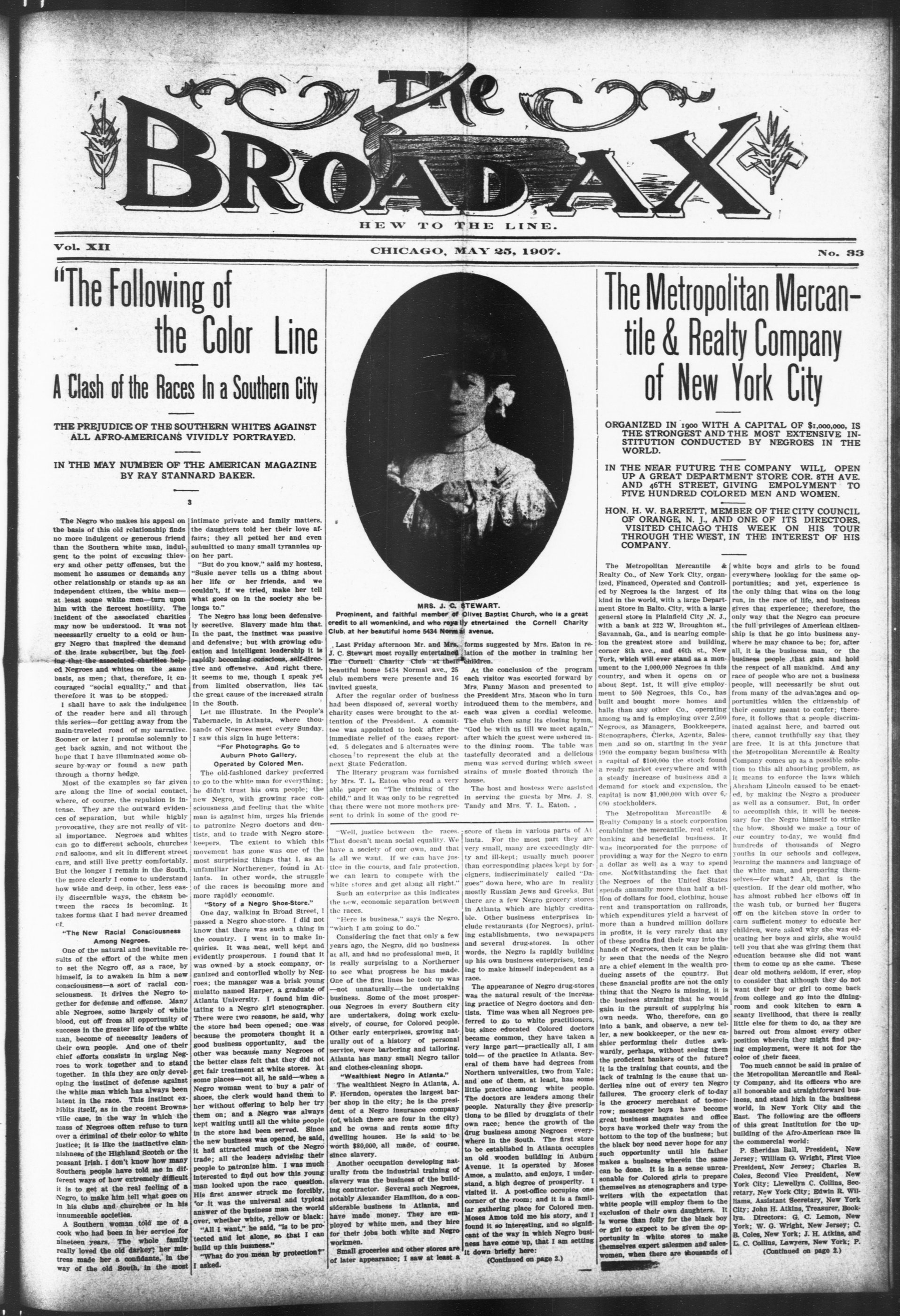
Page text (machine-generated)
"The Following of the Color Line A Clash of the Races In a Southern City
THE PREJUDICE OF THE SOUTHERN WHITES AGAINST ALL AFRO-AMERICANS VIVIDLY PORTRAYED.
IN THE MAY NUMBER OF THE AMERICAN MAGAZINE BY RAY STANNARD BAKER.
Vol. XII
"The Following
the
A Clash of the Race
THE PREJUDICE OF THE SO
ALL AFRO-AMERICANS
IN THE MAY NUMBER OF T
BY RAY STAN
The Negro who makes his appeal on the basis of this old relationship finds no more indulgent or generous friend than the Southern white man, indulgent to the point of excusing the thevery and other petty offenses, but the moment he assumes or demands any other relationship or stands up as an independent citizen, the white men—at least some white men—turn upon him with the fiercest hostility. The incident of the associated charities may now be understood. It was not necessarily cruelty to a cold or hungry Negro that inspired the demand of the irate subscriber, but the feeling that the associated charities helped Negroes and whites on the same basis, as men; that, therefore, it encouraged "social equality," and that therefore it was to be stopped.
I shall have to ask the indulgence of the reader here and all through this series—for getting away from the main-traveled road of my narrative. Sooner or later I promise solemnly to get back again, and not without the hope that I have illuminated some obscure by-way or found a new path through a thorny hedge.
Most of the examples so far given are along the line of social contact, where, of course, the repulsion is intense. They are the outward evidences of separation, but while highly provocative, they are not really of vital importance. Negroes and whites can go to different schools, churches and saloons, and sit in different street cars, and still live pretty comfortably. But the longer I remain in the South, the more clearly I come to understand how wide and deep, in other, less easily discernible ways, the chasm between the races is becoming. It takes forms that I had never dreamed of
"The New Racial Consciousness Among Negroes.
One of the natural and inevitable results of the effort of the white men to set the Negro off, as a race, by himself, is to awaken in him a new consciousness—a sort of racial consciousness. It drives the Negro together for defense and offense. Many able Negroes, some largely of white blood, cut off from all opportunity of success in the greater life of the white man, become of necessity leaders of their own people. And one of their chief efforts consists in urging Negroes to work together and to stand together. In this they are only developing the instinct of defense against the white man which has always been latent in the race. This instinct exhibits itself, as in the recent Brownsville case, in the way in which the mass of Negroes often refuse to turn over a criminal of their color to white justice; it is like the instinctive clanishness of the Highland Scotch or the peasant Irish. I don't know how many Southern people have told me in different ways of how extremely difficult it is to get at the real feeling of a Negro, to make him tell what goes on in his clubs and churches or in his innumerable societies.
A Southern woman told me of a cook who had been in her service for nineteen years. The whole family really loved the old darkey; her mistress made her a confidante, in the way of the old South, in the most
intimate private and family matters, the daughters told her her love affairs; they all petted her and even submitted to many small tyrannies upon her part.
"But do you know," said my hostess, "Susie never tells us a thing about her life or her friends, and we couldn't, if we tried, make her tell what goes on in the society she belongs to."
The Negro has long been defensively secretive. Slavery made him that. In the past, the instinct was passive and defensive; but with growing education and intelligent leadership it is rapidly becoming conscious, self-directive and offensive. And right there, it seems to me, though I speak yet from limited observation, lies tac the great cause of the increased strain in the South.
Let me illustrate. In the People's Tabernacle, in Atlanta, where thousands of Negroes meet every Sunday I saw this sign in huge letters:
The old-fashioned darkey preferred to go to the white man for everything; he didn't trust his own people; the new Negro, with growing race consciousness, and feeling that the white man is against him, urges his friends to patronize Negro doctors and dentists, and to trade with Negro storekeepers. The extent to which this movement has gone was one of the most surprising things that I, as an unfamiliar Northerener, found in Atlanta. In other words, the struggle of the races is becoming more and more rapidly economic.
"Story of a Negro Shoe-Store."
One day, walking in Broad Street, I passed a Negro shoe-store. I did not know that there was such a thing in the country. I went in to make inquiries. It was neat, well kept and evidently prosperous. I found that it was owned by a stock company, organized and contorlled wholly by Negroes; the manager was a brisk young mulatto named Harper, a graduate of Atlanta University. I found him dictating to a Negro girl stenographer. There were two reasons, he said, why the store had been opened; one was because the promoters thought it a good business opportunity, and the other was because many Negroes of the better class felt that they did not get fair treatment at white stores. At some places—not all, he said—when a Negro woman went to buy a pair of shoes, the clerk would hand them to her without offering to help her try them on; and a Negro was always kept waiting until all the white people in the store had been served. Since the new business was opened, he said, it had attracted much of the Negro trade; all the leaders advising their people to patronize him. I was much interested to find out how this young man looked upon the race question. His first answer struck me forcibly, "or it was the universal and typical answer of the business man the world over, whether white, yellow or black: "All I want," he said, "is to be protected and let alone, so that I can build up this business."
build up the brain
"What do you mean by protection?"
I asked.
CHICAGO, MAY 25, 1907.
Prominent, and faithful member of Olivet Baptist Church, who is a great credit to all womenkind, and who royally entertained the Cornell Charity Club, at her beautiful home 5434 Normal avenue.
Last Friday afternoon Mr. and Mrs. J. C. Stewart most royally entertained The Cornell Charity Club at their beautiful home 5434 Normal ave., 25 club members were present and 16 invited guests.
After the regular order of business had been disposed of, several worthy charity cases were brought to the attention of the President. A committee was appointed to look after the immediate relief of the cases reported. 5 delegates and 5 alternates were chosen to represent the club at the next State Federation.
The literary program was furnished by Mrs. T. L. Eaton who read a very able paper on "The training of the child," and it was only to be regretted that there were not more mothers present to drink in some of the good re
forms suggested by Mrs. Eaton in relation of the mother in training her children.
At the conclusion of the program each visitor was escorted forward by Mrs. Fanny Mason and presented to the President Mrs. Macon who in turn introduced them to the members, and each was given a cordial welcome. The club then sang its closing hymn "God be with us till we meet again; after which the guest were ushered in to the dining room. The table was tastefully decorated and a delicious menu was served during which sweet strains of music floated through the house.
The host and hostess were assisted in serving the guests by Mrs. J. S. Tandy and Mrs. T. L. Eaton,
"Well, justice between the races. That doesn't mean social equality. We have a society of our own, and that is all we want. If we can have justice in the courts, and fair protection, we can learn to compete with the white stores and get along all right." Such an enterprise as this indicates the new, economic separation between the races.
"Here is business," says the Negro, "which I am going to do."
Considering the fact that only a few years ago, the Negro, did no business at all, and had no professional men, it is really surprising to a Northerner to see what progress he has made. One of the first lines he took up was—not unnaturally—the undertaking business. Some of the most prosperous Negroes in every Southern city are undertakers, doing work exclusively, of course, for Colored people. Other early enterprises, growing naturally out of a history of personal service, were barbering and tailoring. Atlanta has many small Negro tailor and clothes-cleaning shops.
"Wealthiest Negro in Atlanta."
The wealthiest Negro in Atlanta, A. F. Herndon, operates the largest barber shop in the city; he is the president of a Negro insurance company (of which there are four in the city) and he owns and rents some fifty dwelling houses. He is said to be worth $80,000, all made, of course, since slavery.
Another occupation developing naturally from the industrial training of slavery was the business of the building contractor. Several such Negroes, notably Alexander Hamilton, do a considerable business in Atlanta, and have made money. They are employed by white men, and they hire for their jobs both white and Negro workmen.
Small groceries and other stores are of later appearance; I saw at least a
forms suggested by Mrs. Eaton in relation of the mother in training her children.
At the conclusion of the program each visitor was escorted forward by Mrs. Fanny Mason and presented to the President Mrs. Macon who in turn introduced them to the members, and each was given a cordial welcome. The club then sang its closing hymn, "God be with us till we meet again," after which the guest were ushered into the dining room. The table was tastefully decorated and a delicious menu was served during which sweet strains of music floated through the house.
The host and hostess were assisted in serving the guests by Mrs. J. S. Tandy and Mrs. T. L. Eaton.
score of them in various parts of Atlanta. For the most part they are very small, many are exceedingly dirty and ill-kept; usually much poorer than corresponding places kept by foreigners, indiscriminately called "Dagoes" down here, who are in reality mostly Russian Jews and Greeks. But there are a few Negro grocery stores in Atlanta which are highly creditable. Other business enterprises include restaurants (for Negroes), printing establishments, two newspapers and several drug-stores. In other words, the Negro is rapidly building up his own business enterprises, tending to make himself independent as a race.
The appearance of Negro drug-stores was the natural result of the increasing practice of Negro doctors and dentists. Time was when all Negroes preferred to go to white practitioners, but since educated Colored doctors became common, they have taken a very large part—practically all, I am told—of the practice in Atlanta. Several of them have had degrees from Northern universities, two from Yale; and one of them, at least, has some little practice among white people. The doctors are leaders among their people. Naturally they give prescriptions to be filled by druggists of their own race; hence the growth of the drug business among Negroes everywhere in the South. The first store to be established in Atlanta occupies an old wooden building in Auburn Avenue. It is operated by Moses Amos, a mulatto, and enjoys, I understand, a high degree of prosperity. I visited it. A post-office occupies one corner of the room; and it is a familiar gathering place for Colored men. Moses Amos told me his story, and I found it so interesting, and so significant of the way in which Negro business have come up, that I am setting it down briefly here:
(Continued on page 2.)
The Metropolitan Mercantile & Realty Company of New York City
ORGANIZED IN 1900 WITH A CAPITAL OF $1,000,000, IS THE STRONGEST AND THE MOST EXTENSIVE INSTITUTION CONDUCTED BY NEGROES IN THE WORLD.
IN THE NEAR FUTURE THE COMPANY WILL OPEN UP A GREAT DEPARTMENT STORE COR. 8TH AVE. AND 46TH STREET, GIVING EMPOLYMENT TO FIVE HUNDRED COLORED MEN AND WOMEN.
HON. H. W. BARRETT, MEMBER OF THE CITY COUNCIL OF ORANGE, N. J., AND ONE OF ITS DIRECTORS, VISITED CHICAGO THIS WEEK ON HIS TOUR THROUGH THE WEST, IN THE INTEREST OF HIS COMPANY.
The Metropolitan Mercantile & Realty Co., of New York City, organized, Financed, Operated and Controlled by Negroes is the largest of its kind in the world, with a large Department Store in Balto. City, with a large general store in Plainfield City N. J., with a bank at 222 W. Broughton st., Savannah, Ga., and is nearing completion the greatest store and building, corner 8th ave., and 46th st., New York, which will ever stand as a monument to the 1,000,000 Negroes in this country, and when it opens on or about Sept. 1st, it will give employment to 500 Negroes, this Co., has built and bought more homes and halls than any other Co., operating among us and is employing over 2,500 Negroes, as Managers, Bookkeepers, Stenographers, Clerks, Agents, Salesmen and so on, starting in the year 1900 the company began business with a capital of $100,000 the stock found a ready market everywhere and with a steady increase of business and a demand for stock and expansion, the capital is now $1,000,000 with over 6,00 stockholders.
The Metropolitan Mercantile & Realty Company is a stock corporation combining the mercantile, real estate, banking and beneficial business. It was incorporated for the purpose of providing a way for the Negro to earn a dollar as well as a way to spend one. Notwithstanding the fact that the Negroes of the United States spends annually more than half a billion of dollars for food, clothing, house rent and transportation on railroads, which expenditures yield a harvest of more than a hundred million dollars in profits, it is very rarely that any of these profits find their way into the hands of Negroes, then it can be plainly seen that the needs of the Negro are a chief element in the wealth production assets of the country. But these financial profits are not the only thing that the Negro is missing, it is the business straining that he would gain in the pursuit of supplying his own needs. Who, therefore, can go into a bank, and observe, a new teller, a new bookkeeper, or the new cashier performing their duties awkwardly, perhaps, without seeing them the proficient bankers of the future? It is the training that counts, and the lack of training is the cause that underlies nine out of every ten Negro failures. The grocery clerk of to-day is the grocery merchant of to-morrow; messenger boys have great business magnates and office boys have worked their way from the bottom to the top of the business; but the black boy need never hope for any such opportunity until his father makes a business wherein the same can be done. It is in a sense unreasonable for Colored girls to prepare themselves as stenographers and typewriters with the expectation that white people will employ them to the exclusion of their own daughters. It is worse than folly for the black boy or girl to expect to be given the opportunity in white stores to make themselves expert salesmen and salesmen, when there are thousands of
No. 33
Hitan Mercan-
ty Company
York City
A CAPITAL OF $1,000,000, IS
THE MOST EXTENSIVE IN-
ED BY NEGROES IN THE
THE COMPANY WILL OPEN
PENT STORE COR. 8TH AVE.
LIVING EMPOLYMENT TO
RED MEN AND WOMEN.
NUMBER OF THE CITY COUNCIL
AND ONE OF ITS DIRECTORS,
HIS WEEK ON HIS TOUR
IN THE INTEREST OF HIS
white boys and girls to be found everywhere looking for the same opportunities; and yet, experience is the only thing that wins on the long run, in the race of life, and business gives that experience; therefore, the only way that the Negro can procure the full privileges of American citizenship is that he go into business anywhere he may chance to be; for, after all, it is the business man, or the business people that gain and hold the respect of all mankind. And any race of people who are not a business people, will necessarily be shut out from many of the advantages and opportunities which the citizenship of their country meant to confer; therefore, it follows that a people discriminated against here, and barred out there, cannot truthfully say that they are free. It is at this juncture that the Metropolitan Mercantile & Realty Company comes up as a possible solution to this all absorbing problem, as it means to enforce the laws which Abraham Lincoln caused to be enacted, by making the Negro a producer as well as a consumer. But, in order to accomplish this, it will be necessary for the Negro himself to strike the blow. Should we make a tour of our country to-day, we would find hundreds of thousands of Negro youths in our schools and colleges, learning the manners and language of the white man, and preparing themselves—for what? Ah, that is the question. If the dear old mother, who has almost rubbed her elbows off in the wash tub, or burned her flugers off on the kitchen stove in order to earn sufficient money to educate her children, were asked why she was educating her boys and girls, she would tell you that she was giving them that education because she did not want them to come up as she came. These dear old mothers seldom, if ever, stop to consider that although they do not want their boy or girl to come back from college and go into the dining room and cook kitchen to earn a scanty livelihood, that there is really little else for them to do, as they are barred out from almost every other position wherein they might find paying employment, were it not for the color of their faces.
Too much cannot be said in praise of the Metropolitan Mercantile and Realty Company, and its officers who are all honorable and straightforward business, and stand high in the business world, in New York City and the East. The following are the officers of this great Institution for the upbuilding of the Afro-American race in the commercial world:
P. Sheridan Ball, President, New Jersey; William G. Wright, First Vice President, New Jersey; Charles B. Coles, Second Vice President, New York City; Llewellyn C. Collins, Secretary, New York City; Edwin R. Williams, Assistant Secretary, New York City; John H. Atkins, Treasurer, Booklyn. Directors: G. C. Lemon, New York; W. G. Wright, New Jersey; C. B. Coles, New York; J. H. Atkins, and L. C. Collins, Lawyers, New York; P.
(Continued on page 2.)
a ss ee Se es tae . .
. fi Ft es ns) : Sey ne = =e e ree .
PUBLISHED WEEKI Y.
peice interna
mu apd ot all times | tthe trms
mae ee
or an one ane’ eam
Se SS is lnarenee proper on
‘The Broad cts 4, newwpener wheee .
aicetoes oe
Wiieelyoccacctee yee mee
‘Bubecriptions must be paid in advance.
eee ee
Sees cers mate mnewe on egptertion.
THE BROAD AX
($04) Armour Avenue, Obieage
‘TULIUS F. TAYLOR, Beiter and Publicber.
[eens I
Batered wt the Post Office st Chicagn,
Ts Second-clam Matter.
———_—_—_—_—e
PERSONAL MENTION.
‘Walter M. Farmer, for 16 years an
honored member of the bar in St.
Louls, Mo, is now engaged in the
general practice of law. Suite 708,
171 Washington street. Phone Main
4153. Residence 4856 Langley avenue.
Phone Drerel 6302.
JEWS BARRED FROM HO-
TELS WILL FIGHT.
Atlantic City, N. J., May 18—
Suits are threatened against hotel
keepers here because of their hos-
tility to Jews as guests. Men
of Jewish descent, prominent in
professional and business life all
over the country, when writing
for accommodations receive a
printed card reading:
“The patronage of Jews is not
Solicited.”
Mrs. Bertha Rayher Frank of
Baltimore, a sister of United
States Senator Isidor Rayner of
Maryland, who was a guest at
the Marlborough-Blenheim, de-
parted suddenly because she
learned Jews were not desired as
guests at the hotel.
Mrs. Frank is the widow of the
late Dr. Samuel Leon Frank in
whose memory she gave last yea.
the large fortune left by him to
a number of nonsectarian philan-
thropic and educational institu-
tions. She is a member of every
nonsectarian charity in Baltimore.
“I resent this insult to many
estimable people of Jewish faith
who are affronted by the stand
taken by the proprietors of a
number of the principal hotels in
this resort,” said Mrs. Frank.
“A few days later I asked ac-
commodations for my two nieces.
“I was asked, ‘Are your friends
Jews? I replied, ‘Yes, ‘Why?
and was told, ‘We don’t entertain
Jews.’
“IT was so annoyed at this in-
sult to Jews at large, never hav-
ing heard directly of such a thing
happening to self-respecting Jews
of good position, I immediately
ordered my trunks packed and
left the hotel.
“Before doing this I sent for
the hotel clerk and told him why
I was leaving. He told me he
was instructed by the proprietors
to refuse to give rooms tq Jews.
“The policy of We house,’ he said,
‘is opposed to Jews.’”
Notwithstanding the fact that
first-class Jews are driven out of
the leading hotels in Atlanic City,
N. J., simply on account of their
race, there is a strong feeling
among the most prominent Jews
throughout the country that it is
their highest duty to join hands
with the so-called pure white
‘Amercans in their damnable ef-
fort, at any cost, to keep the Ne-
gro down on the same level with
the beast, and several of this
same class of Jews, in our pres-
ence, have contended that “‘a mis-
take had been made in giving the
Negro his freedom,” and that the
Negro was “better off as a slave.”
It is beyond our understanding
how any one connected with the
Jewish race can entertain such
ideas, for members of that race
have been slain by the a
sands in every. country under
sun, and have suffered untold
horrors on account of their race
they refrain from assisting the
American eo to strew the
pathway of the Negro with thorns
and thistles. It may not be very
long until they will be forced to
Zo to ‘ing in order to com-
Borge oe
ple fe eatin sections tof this
ry.—Eiditor.
(Col. W. Allison Sweeney, who
is one of the ablest and one of the
the Afro-Americans in the Unit-
ed States, returned to the city
‘the first of the week fresh from a
See ee ones
: ts .
NEGRO FRANCHISE MIS-
TAKE.
Presbyterians Unrestrict-
ed Coie: 1865.
General Assembly at Columbus
Applauds Dr. Wilson’s Speech.
Columbus, O., May 20.—Hear-
ty applause’ from the Presbyte-
rian general assembly greeted the
statement today that a mistake
had been made in 1865 in confer-
ring unrestricted citizenship on
the Negro. The statement was
made by Dr. Wilson of Pitts-
‘burg, known as a friend of the
‘Negro, and the applause, though
not universal, came from all parts
of the house.
“T have had men on this board
of freedmen say to me that they
thought it would have been wise
to have fixed an educational qual-
ification or a property qualifica-
tion and let the Colored men thus
grow up into the enjoyment of
the full rights of citizenship,” said
Dr. Wilson.
This statement, he said, gave
full credit to the man who. made
the amendment to the constitu-
tion and placed no discredit to
the Colored man.
He said the question was ser-
iously asked whether the Colored
man had the capacilities to reach
that plane contemplated for citi-
zenship by: the forefathers and
that after varied experience with
Colored men in different parts of
the country he was fully con-
vinced that they did have those
capabilities.
Possibilities in Negro.
Putting the degraded southern
Negro at the side of the degraded
Pole, the degraded Slav, the de-
graded Italian, he said he would
select the degraded southern Ne-
gro as the one possessing the
most capabilities of being trans-
formed into a good American
citizen. There are more possi-
bilities among the Negroes than
among the degraded alien popu-
lation, he said—The Chicago
Chronicle, May 21.
By carefully reading the re-
marks of Rev. Wilson on the pos-
sibilities of the Negro, it can
plainly be observed that the head-
line writer for The Chronicle
got mixed up on the actual jacts
as to just what Rev. Wilson did
say on that important subject,
and as stated before the head-
lines were written for the sole
purpose of poisoning the minds
of the people against permitting
the Negro to become or remain a
full fledged American citizen.
PRESBYTERIANS PREDICT
GREAT WAR OF RACES.
Birmingham, Ala., May 21.—
“In two decades a race war will
astound the world unless some-
thing is done.
“We are living on the crest of
a volcano, and even now the fire
and roar of the caldron below is
beginning to burst forth.”
These were the climaxes of two
speeches delivered before the
Presbyterian general assembly on
the race problem.
Then came the answer, “Man's
Opportunity is God’s opportun-
ity. The Bible and grace of
God will save us.”
It was a meeting with the
promise of results which may
have much to do with the solv-
ing of the race question in the
south.
iThe first address was made by
Judge W. C. Wells of Jackson,
Miss.; the second by Rev. Eg-
bert Smith of Louisville, Ky. ; the
third by Rev. -C. H. Champney of
Montgomery, Ala.
“We know, as you do,” said
the Negro, “that there is a crisis
coming, but God is above us, and
with your help we can tide it
over, and God's kingdom will be
glorified.” ¢
Sometimes we honestly believe
it would be a mighty good thing
if we had an old fashioned war
‘of the races in this country, and
the Negroes surviving it, could
never be reduced to a condition of
serfdom like they are at the pres-
ent time. for in such a war they
would learn that “those who
would be free must themselves
strike the first blow.”—Editor.
WEST SIDE NEWS.
By Prof. A. L. Simpson.
‘A few days ago a young white
man walked into Mr. W. H. Mar-
tin’s place, the gun and _lock-
smith at Madison and Peoria
streets, and asked for his revol-
ver that Mr. Martin had repaired
and after getting it he tendered
a bill for payment, and while Mr.
Martin was making change the
young man loaded it, and when
‘Mr. Martin tarned to him with
the change in his hand, the man
exclaimed, “I'll see how she
works,” and pulled the trigger.
The ball struck Mr. Martin in
the pit of the stomach. He was
hastily removed to the Cook
County hospital, but couldn't re-
cover. He died on the 22nd inst.
at 10 o'clock. Mr. Martin was
well thought of by all and leaves
a host of friends and a weeping
wife. It is quite sad, indeed. Mr.
Martin was known as one of the
best gun and locksmiths in Chi-
cago.
On Wednesday, May the 22d,
Mrs, J. H. Zedricks, employed
as forelady at the Richie Box
factory,, 965 W. Lake street, met
with a very painful accident in
spraining one of her ankles very
bad. She had to be taken home
and put to bed.
Miss Jessie Lucas, a striking
belle of the West Side, has a new
and very favorable position which
will be mentioned in this paper
later on. Read next week's is-
sue. :
The West Side Sunday Club
will furnish the program at Way-
man Chapel Sunday, May the
26th.
Fifty Colored girls and women,
are wanted at the W. C. Richie
Box Factory, 965 W. Lake street,
at once. Good wages.
Dr. Charles Pickett is visiting
friends and relations this week.
The doctor has a large practice
in Mississippi.
You can only get plain facts by
reading The Broad Ax.
Prof. A. L. Simpson is still at
the foot. Office 200 W. Madison
St.; residence 753 Fulton.
THE SUBSCRIPTION PARTY
A DELIGHTFUL AFFAIR.
The Subscription Dancing Par-
ty, given last Monday evening.
at the palace-like dance hall of
Chicago, Rosalie Hall, 57th st.
and Rosalie Ct., was one of the
most successful of the seven of
these delightful parties given un-
der the management of Mr. Ju-
lius N. Avendorph. These par-
ties have become a part of Chi-
cago’s social life, and they are
looked forward to by those who
support them: with a great deal
of pleasure. The women, as us-
ual were in the majority Monday
evening, but that only added to
the beauty of the affair as they
were all handsomely gowned.
The Grand March was led by Mt
Avendorph and Mrs. J. Gray Lu-
cas. Those present were Mr. an@
Mrs. H. Hudson, Mr. and Mrs. 7.
Gray Lucas, Mr. and Mrs. A.C:
Hartis, Mr. and Mrs. James Nel-
son, Mir. and Mrs. Samuel Evans,
Prof. and Mrs. Wm. Emanuel.
Dr. and Mrs. James R. Whité,
Mr. and Mrs. Robt. Howard, Mrs,
Alice Thomas, Mrs. L. Thomp:
son, Mr. and Mrs. David Man-
son, Mr. James Newsome, Mr.
Isaac Dunlop, Mr. and Mrs. Del-
bert L. Lee, Mr. and Mrs. Chas.
Webb, Mr. and Mrs. Virgil
Phumphrey, Mr. A. A. Wells, Dr.
and Mrs. Richardson, Mr. and
Mrs. John Morton, Mr. and Mrs.
‘Eaves, Mr. and Mrs. B. F. Mose-
ley, Mrs. H. Johnson, Mr. and
Mrs. H. Anderson, Mr. and Mrs.
Geo. Ayers, Mr. and Mrs. J. T.
Henderson, Mr. and Mrs. F. L.
Barnett, Mir. and Mrs. Phil.
Green, Mr. and Mrs. C. H. Dick-
erson, Dr. and Mrs. Jos. Kelly,
Mr. and Mrs. A. K. Brown, Mrs.
Deverson, Mrs. Ophila Bryant,
Mrs. C. Alexander, Mrs. Hayman,
Mrs. W. L. Bowman, Mr. and
Mrs. J. P. Byrant, Mrs. D. P.
French, Mrs. D. Hardin, Mrs. A.
Hampton, Mr. and Mrs. Herrelds,
Mr. and Mrs. F. Brown, Mrs.’
Geo. Blackwell, Mr. W. R. So-
bers, Mr. Theo. Jones, Jr., Mr:
N. E: Caldwell, Mr. W. Roane.
Mr. W. Rollin, Mr. Geo, Thom
son, Mr. A. R. Brodie, Mr. Jon
Fry, Mr. John Trott, Mr. Turner,
Mr. M. A. Mardis, Mr. G. Wil-
son, Dr. A. Barnes, Mr. Jessie
Stubbs, Mr. W. C. Casey, Mr.
Wm. Browne, Mr. F. A. Denison,
Mr. Geo. Bond, Mr. Wm. Whor-
ton, Mr. W. D. Moore, Mr. J. N.
Blackshear Mr. T. Douglas, Mr.
T. Palmer, Mr. Gorton Jackson,
Mr. Robt. Lee, Mr. Mose White,
Mr. P. Herring, Mr. Wm. Carroll,
Mr. C. A. Jordan, Mr. Isaac Reed,
Mr. F. L. Barnett, [r., Mr. Wm.
Howard, Mrs. G. Hardin, of St.
Louis, Mo.; Mrs. F .Hatter, of
Montreal, Can.; Miss A. Thomas,
Miss Mamie Selden, Miss Daisy
Hogget, Miss E. Evans, Miss E.
M. Griffith, Miss R. Doreth, Miss
H. Jackson, Misses Paul, of Buf-
falo, N. Y., Miss E. Johnson, Miss
L. Green, Miss Georgie Thomp-
son, of Louisville, Ky.; Miss B.
Bowman, Miss C. Wilson, Miss
H. E. Wright, Miss Thomas. “J.”
Mr. Ferdinand Small, 4120
Evans avenue, is confined to his
home with pneumonia.
en rer eee are
Development Compan and one of
the most active Afro-American busi
ness men in Chicago.
Among the many hair tontes, on the
market at the present time, none of
lianiarejore seta Gnciaer ea
manufactured by Prof. Penn, which is
handled by L. L. Jones, 3843 State st.,
and as it is pronounced the best hair
tonic in the world, and if it does not
do just what it is claimed it will do,
your money will be refunded.
It sells for 15c, 25¢ and 50c per box,
it will do the work, cleans the hair,
keeps it soft and straight, it will
shortly be for sale by all druggists,
and lady hair dressers, for it will do
the work.
Aside from handling Prof. Penn's
new discovery for the hair, Mr. Jones,
sells the best cigars in the city for
the money; he also sells all the lead-
ing brands of shoe polish, and at all
times his tonsorial artists~ turm out
first-cass work. If you want to buy a
house or sell your own, call and see
him, or Phone Douglas 4314. Being
full of good business ideas, Mr. Jones,
is of the opinion that it is wrong to
look upon every enterprise as a fake,
simply because it is conducted by Col-
ored men, for it is always well to look
‘at the men who are at the head of
such enterprises before passing judg.
ment, and if you want your mosey
to be earning you something while you
are sleeping, invest some of it in the
gilt edge stocks which Mr. Jones has
for sale.
FOLLOWING THE COLOR LINE.
Coneluded from page 1.)
“Rise of a Necro Druacist.”
“I never shall forget,” he said, “my
first day in the drug business. It was
in 1876. I remember I was with a
crowd of boys in Peachtree Street,
where Dr. Huss, a Southern white
man, kept a drug-store. The old doc-
tor was sitting out in front smoking
his pipe. He called one little Negro
after another, and finally chose me.
He sald:
“I want you to live with me, work
in the store and look after my horse.”
“He sent me to his house and told
me to tell his wife to give me some
breakfast, and I certainly delivered
‘the first message correctly. His wife,
who was a noble lady, not only fed
me, but made me take a bath in a sure
enough procelain tub, the first I had
ever seen. When I went back to the
‘store, I was so regenerated that the
doctor had to adjust his spectacles be-
fore he knew me. He said to me:
- “You can wash bottles, put up cas-
tor oll, salts and turpentine, sell any-
‘thing you know and put the money in
the drawer.’
“He showed me how to work the
keys of the cash drawer. ‘I am going
to trust you,’ he said. ‘Don’t steal from
me; if you wont anything ask for it,
and you can have it. And don't lie;
Thate a liar. A boy who will lie will
steal, too.’
“I remained with Dr. Huss thirteen
years. He sent me to school and paid
my tuition out of his own pocket; he
trusted me fully, often leaving me in
charge of his business for weeks at
a time. When he died, I formed a
partnership with Dr. Butler, Dr. Slater
and others, and bought the store. Our
business grew and prospered, so that
within a few years we hada stock
worth $3,000, and cash of $300. That
‘made us ambitious. We bought land,
built a new store, and went intto debt
to do it. We didn’t know much about
‘business—that’s the Negro’s chief
trouble—and we lost trade by chang-
ing our location, so that in spite of all
we could do, we failed and lost every-
thing, though we finally paid our
creditors every cent. After many
trials we started again in 1896 in our
present store; today we are doing a
good business; we can get all the
credit we want from wholesale hous-
es, we employ six clerks, and pay
good interest on the capital invested.”
“Greatest Difficulties Met by Negro
Business Men.”
I asked him what was the greatest
difficulty he hid to meet. He said it
was the credit system; the fact that
many Negroes have not jearned finan-
cial responsibility. Once, he said, he
nearly stopped business on this ac-
account.
“I remember,” he said, “the . last
time we got into trouble. We needed
$400 to pay our bills. I picked out
‘some of our best customers and gave
them a hearttoheart talk and told
them what trouble we were in. They
‘all promised to pay; but on the day
set for payment, out of $1,680 which
they owed us we collected just $8.25.
After that experience we came down
to a cash basis. We trust no one, and
‘since then we have been doing well.”
: He sald he thought the best oppor-
tunity for Negro development was in
the South where he had his whole
race behind him. He said he had once
been tempted to go North looking for
an opening.
“How did you make out?” I asked.
“Well, I'll tell you,” he said, “when
I got there I wanted a shave; I walk-
ed the streets two hours visiting bar-
ber shops, and they all turned me
away with some excuse. I finally had
to buy a razor and shave myself!
‘That was just a sample. I came
home disgusted and decided to fight
it out down here where I understood
conditions.”
_ Of course only a comparatively few
Negroes are able to get ahead in busi-
ness. They must depend almost ex-
clusively on the trade of their own
race, and they must meet the highly
organized competition of white men.
But it Is certainly significant that even
a few—all I have met so far are mulat-
toes, some very white—are able to
}make progress along these unfamiliar
Wines. Most Southern men I met had
little or no idea of the remarkable ex-
tent of this advancement among the
ibetter class of Negroes. Here is a
|stranse thing. I don't know how many
Southern men have prefaced their
talks with me with words something
like this:
“You can’t expect to know the Ne-
gro after a short visit. You must live
down here like we do. Now, I know
the Negroes like a book. I was
brought up with them. I know what
they'll do and what they won't do. I
have had Negroes in my house all my
life.”
But curiously enough I found that
these men rarely knew anything about
the better class of Negroes—those
who were in business ,or in indepen-
dent occupations, those who owned
their own homes. They did come into
lcontact with the servant Negro, the
field hand, the common laborer, who
make up, of course ,the great mass of
the race. On the other hand, the best
class of Negroes did not know the
higher class of white people, and bas-
jed their suspicion and hatred upon the
|acts of the poorer sort of whites with
whom they naturally came into con-
tact. The best elements of the two
races are as far apart as though they
lived in different continents; and that
is one of the chief causes of the grow-
ing danger of the Southern situation.
Last month I showed the striking fact
that one of the first—almost instinc-
tive—efforts at reconstruction after
the Atlanta riot was to bring the best
elements of both races together, so
that they might, by becoming ac-
quainted and gaining confidence in
each other ,allay suspicion and bring
influence to bear upon the lawless ele-
ments of both white people and Col-
jored.
‘Many Southerners look back wist-
fully to the faithful, simple, ignorant,
obedient, cheerful, old plantation dar-
key and deplore his disappearance.
‘They want the New South, but the old
darkey. That darkey is disappearing
forever along with the old feudalism
and the old-time exclusively agricul-;
tural life.
_ A New Negro is not less inevitable
than a new white man and a New
South. And the New Negro, as my
clever friend says, doesn't langh as
much as the old one. It is grim busi-
ness he is in, this being free, this
new, fierce struggle in the open com-
petitive field for the daily loaf. Many
go Gown to vagrancy and crime in
that struggle; a few will rise. The
more rapid the progress (with the
trained white man setting the pace),
the more frightful the mortality.
(Mr, Baker's narrative of observation
of Southern life will continue next
month.)
(The end.)
'A loving remembrance of my
a beloved mother Ania
lay 26th, 1903, 4 years ‘y-
Also dearly feoeed sister, Lea-
nor Victory Anderson-Burdette,
who died May 26th, 1904, 3 years
today.
Day by day I saw you fade
And gently pass away,
‘Yet in my dreams I often prayed
That you might longer stay,
If love and care your death pre-
vent,
Thy days would not so soon be
spent.
Life was desired but God did see
Eternal rest was best for thee.”
From a devoted son,
Joseph H. Anderson.
—_—_—_—
Mr. and Mrs. Peyton C. Tay-
lor, 3243 Wabash — have is-
sued invitations to the marriage
of their sister, Miss Katherina
Loretta Winbush to Mr. Robert
C.Comsep st sociock Bm, June
the sth at Monica Church;
36th and Dearborn streets. The
reception will be from 6 to 11 p.
‘m., at the above residence.
THE METROPOLITAN MERCAN.
TILE AND REALTY COMPANy.
Concluded from page 1.)
Sheridan Ball, New Jersey; E. R. Wil-
liams, Architect, New York! B. R.
Thompson, New Jersey; H. W. Bar.
ret(, New Jersey.
‘The following well-known ministers,
are members of the advisory board:
Rev. Wm. A. Creditt, D. D., Pastor of
Cherry Street Baptist Church, Phila.
deiphia, Pa.; Rev. M. W. Gilbert, D. p.,
Pastor of Mt. Olive Baptist Church
New York City; Rev. W. H. Brooks,
D. D., Pastor of St. Marks, Methodisc
Episcopal Church, New York City;
Rev. C. Leroy Butler, D. D., Pastor of
St. James Presbyterian Church, New
York City; Rev. J. WE. Bowen, D. D.,
President of Gamon Theological Sem
inary, Atlanta, Ga.
With such high class men at
the head of affairs of the Metropolitan
Mercantile & Realty Company, it is no
wonder it has weathered all the finan.
cial storms for more than seven years,
thereby extending its business inter-
ests into many parts of the United
States, and whenever the Negro makes
up his mind to render hearty Support
to such solid and worthy institutions
as the Metropolitan Mercantile &
Realty Company he will go a long
ways in solving some of the most im.
portant problems which now confront
dim.
Hon. H. W. Barrett, one of its direc-
tors, gave a successful stereopticon
exhibition and a grand lecture, “The
Negro in Business,” Thursday evening
at Bethel Church, in the interest of
his company. Mr. Barrett is also the
General Manager of the Metropolitan
Mutual Benefit Association, an indus-
trial insurance, operating in 17 States,
with headquarters at 36 Clinton st.,
Newark, N. J., he also has the honor
of being a member of the City Council
of his home city, Orange, N. J., a mem-
ber of the Essex Co., Committee, a
notary public and commissioner of
deeds, and is widely known as a busi-
ness leader as well as one interested
in the uplift of his people.
CHIPs.
| Mr. James Taylor. 204 E. goth
street, is confined to his home
‘sick.
| Dr. R. L. Washington and wife
of Franklyn, Tenn., spent a week
in the city, stopping at 128 28th
street.
Miss Vella Crawford will sever
her connection with the Pekin
Stock Co. and return to St. Louis
the first of the month.
| Mrs. Harriett Wyett, Rains-
ville, Ohio, and Miss Bertha Mor-
‘ton, Columbus, Ohio, are visiting
Mr. and Mrs. Joseph Jackson, 528
W. 56th Street.
Col. Robert M. Mitchell. 79
‘Clark street, Monday, Tuesday
and Wednesday, attended the re-
‘union of the G. A. R. at Deca-
tur, Ill.
"Mr. and Mrs. Chas. Williams,
6618 Vernon Avenue and their
company of Jubilee Singers, re-
turned to the city Friday morning
for a few weeks’ vacation.
Dr. Tames Alexander, Chatan-
ooga, Tenn., is spending a week
in the city, enroute to New York.
Mr. Frank Gillespie has moved
from 32d street to 3726 Wabash
avenue.
Mrs. W. B. Kennedy, 5746 sth
avenue, who has been very ill at
her home, is reported to be grad-
ually regaining her usual good
health, much to the pleasure of
her family and many warm
friends.
Mrs. Sadie Scott and son, mas-
ter Dewey, 5742 Grove avenue.
will leave about June 15 for a visit
to their old home, Detroit, Mich.,
Niagara Falls and the St. Law-
rence river. (They will not re-
turn until September.
Mrs. Delila Young and daugh-
ter, Frances Greenwood, 6616
Vernon Ave., left Thursday morn-
ing for Pittsburg, Penn., and oth-
er points east where they will
visit friends and __ relatives
throughout the summer months.
Mr. Will Macon ~_ Joe Thom-
as, two men of Cedar Rap-
ids, are spending a pleasant visit
in this city, the guests of Mrs.
R. Jones, 2931 Armour Ave.
Path at Hot Seige for
month at Hot is
health.
é Miss eee ee of Chicago.
soon avery eco
merchant in Boston. Botts
will be remembered by ong Chi-
cagoans as the sweet sing-
er who was ever willing to please
songs. *
Rev. L. E. Christy, editor of the Sentinel, East St. Louis, Ill., spent the past week in the city, and on last Sunday he preached two powerful sermons at Bethel Church for Rev. A. J. Carey and his congregation.
Mr. and Mrs. Henry Wilcox Forte, formerly Chicagoans, celebrated the twelfth anniversary of their marriage Wednesday, May 22d, at their present residence, 1007 Rittenhouse St., Cincinnati, Ohio. Mr. Samuel W. Thompson and Mr. Joseph Jenkins were among the many Chicagoans who attended the anniversary.
Mrs. M. A. Williams, 6618 Vernon avenue, entertained at breakfast Tuesday morning, Hon. H. W. Barrett of Orange, N. J., formerly of Baltimore, Md. The Elks' Ball at "Tattersalls" Monday evening was attended by about fifteen hundred people. A great quantity of beer and liquors was sold throughout the evening and early morn, 'till about 4 o'clock a. m., when everybody was happy. About two thousand dollars was realized.
Mayor Fred Busse at the meeting of the city council Monday evening, appointed the following new city officials, and there does not seem to be an Irish-American nor an Afro-American in this small bunch. H. S. Dietrich, John Minwegen and E. Orris Hart members of the local board of improvements; Paul Redieske, deputy commissioner of public works; John Kjefflander, city sealer. Col. Edward H. Wright wanted to practice with that job, but he was not in it when it came to a show down.
Mayor Busse in his effort to build up his new political machine, has, in a bullheaded manner demanded that nine or ten members of the board of education step aside before their terms expire, so that he can fill their places with henchmen of his own selection. John J. Hayes, and his associates on the board are perfectly justified in carrying the fight into the courts to settle the question for once and for all time to come whether or not Mayor Busse can dismiss the members of the board of education in such a rough handed method.
Hon. H. W. Barrett, city councilman of Orange, N. J., and Gen. Manager of The Metropolitan Mercantile & Realty Co., of New York, spent the week in our city on business for his company. Mr. Barrett represents a large and prosperous business institution and his expense account is unlimited, but he differs from the Wizard of Tuskegee in that if he cannot find a suitable Colored hotel at which to stop, he has his advance agent or secretary find a good boarding house, conducted by one of his own race with which to spend his "money and advice."
Because of a protest registered with Mayor A. C. Harper, of Los Angeles, Cal., by Colored residents of that city, an order has been issued to the police department directing the removal of certain signs in saloons and restaurants reading, "Colored trade not desired," and "Colored people will not be served." The action of the mayor was not officially made a part of the municipal business, but it is said a failure to comply with the request of the police department will result in the revocation of licenses.—Ex.
The thirty-third anniversary of Golden Fleece Lodge, No. 1615. G. U. O. of O. F., was celebrated Thursday evening at Odd Fellows Hall. A large number of prominent Odd Fellows throughout the city and state attended and listened to the speeches by the following prominent members of the order: Messrs. E. H. Morris, ex-Grand Master; ex-Dist. G. M., H. A. Bartlett, Maj. Jno. C. Buckner, Dist. G. M. Bird, Mrs. Irene L. Camp and Hon. Harry Barrett, P. G. M. of Orange, N. J.; Mr. Noah D. Thompson, Noble Grand of Golden Fleece Lodge acted as master of ceremonies and presented each speaker to the vast audience, which afterwards repaired to the dining hall, where they ate and danced 'till early morning.
The new home for the members of St. Thomas' Episcopal Church, corner 38th and Wabash avenue, was formally presented to them by Bishop Anderson, Wednesday evening, after which the Bishop "laid hands on" and confirmed about one hundred persons as members of the church. A very large crowd was on hand to witness the solemn ceremonies
which were so well arranged and so excellently carried out under the direction of Father Massiah and a large core of the older members of the church. The bishop's congratulatory address was very highly appreciated by all who were fortunate enough to gain admission to the church and hear it, for, notwithstanding the inclement weather, about two hundred persons were unable to gain admission to the auditorium or galleries, every seat of which was occupied long before the services began.
In his remarks concerning the vast amount of "moral uplifting" the parishoners might do in their new neighborhood, the Bishop did not once refer to or insinuate the nationality of his audience. That a strong Christian relationship regardless of race or color exists, the good Bishop seemed to have no doubt, and his vast, attentive audience of mixed races agreed with him. Unfortunately, Father Massiah supplemented the Bishop's remarks by calling attention to the fact that his is a Colored people's church, notwithstanding the fact that many white Christians have and will contribute towards its support. The musical part of the program was excellent, Mr. Creighton Thompson's tenor solo with Mr. Harrison Emanuel's violin obligato, deserves special mention. Regular services will be held in the church on and after next Sunday. May 26th. "T."
The Ladies' Catholic Order of Foresters, Augustine Tolton Court, No. 391, will give a May Party May 27, at Douglas Club House, 3518 Ellis Ave. Music by Bowman's Orchestra. Admission 35 cents.
WOMAN AND FASHION
A very pretty model for a graduation frock is here shown in mercerized batiste, with insertion and frills of German valenciennes lace. The chemisette is of baby Irish. The pattern can also be developed in chiffon or net
M.
WHITE MERCERIZED BATISTE
over silk in volle or in smooth pongee
or china silk. The waist is made in
one piece and can be arranged over
the fitted lining or left unlined, and a
chemisette joined to it is as material
renders desirable. It is shirred at its
lower edge, while the skirt is shirred
at the upper, and the two are joined to
give the princess effect. For a girl of
moderate size will be required for the
waist 3½ yards of material 27 or 2½
yards 44 inches wide, with one-half
yard of all over lace for the chemisette, 1 yard of insertion and 3 yards
of lace edging; for the skirt 5½ yards
27 or 3½ yards 44 inches wide, with 16
yards of insertion.
Millinery Matters
There are many turban shapes and hats with considerable brims in front. These are usually on the mushroom order.
A great many slashing big masses of ribbon loops are used as trimmings, with large ballheaded pins thrust into them. Another style is to use great quantities of tulle wound around to form a crown, with aigrets or paradise plumes springing from the folds. Flowers, of course, are always in vogue for summer trimmings.
In becoming colors, with properly dressed hair and worn at just the right angle, the new hats are perfectly charming. Worn any other way the extreme shapes are grotesque.
Guimnes and Matching Sleeves.
As nearly every gown has the neck cut out and some sort of thin collar and guipme or plastron used, with a touch of the plastron material in the sleeve finishings or perhaps nearly the whole sleeve made of it, there is ample chance to cut away solled or worn places in the old bodice and to replace these with new goods without any danger of giving the gown the "home-made" look that spoils many made
A Tragic Story
The Glorale di Sicilia, in speaking of the memoirs of the brigand, Giuseppe Salomone, says: "In the introduction the brigand speaks of the tragedy of his life as the result of the hatred for him of the mayor of his native town. Salomone was arrested for alding in the robbery of a fisherman and, although absolutely innocent, was sentenced through the influence of the mayor to ten years' imprisonment. 'I am not learned and am no writer,' he says, 'and must force myself to write. The reader must overlook my errors of literature when he remembers the hatred which inspires me.' He tells of his years of torture in the prisons of Fonombrom, Ancona and Senigallia and of his hope that some day his innocence would be made known. But the full term of ten years had elapsed when he was released, and he hastened to embrace his mother, who believed in his innocence. When he reached his home he found the candles burning near the body of his mother, who had died the night before. 'Then,' he says, 'I vowed vengeance, and at the first opportunity I killed the mayor.' Since then the police have been trailing him, and he knows that finally he will be captured. His closing words are to the jury which will be called upon to decide his fate, to whom he says: 'Remember what drove me to crime—3,650 nights and as many days of agony! Ten times the trees blossomed, ten times the harvest time came, and I an honest man, in fetters!"
A Marine Monster of 1800.
"When I saw our latest leviathan warship, the Indomitable, launched at Glasgow the other day," writes a correspondent, "I could not help wondering what our forefathers of a century ago would have thought of her. In 1800 a leading naval authority wrote: 'The size of our ships seems now to have reached' its ultimatum. The French indeed have latterly built a ship of most extraordinary size, 172 feet keel, 55 feet 9 inches by the beam, tonnage about 2,850 tons. But she is pronounced to be entirely unfit for service.' And yet this marine monster of 1800, whose size made her so unwieldy that 'she hath never been out of harbor,' was but a third as long as our latest cruiser, little more than two-thirds the width and a sixth of the tonnage. In fact, she was relatively so small that she might easily, one would think, have been carried on the Indomitable's deck. Although a fifty acre forest had provided her timbers and it had taken 200 shipwrights a year to build her, her total cost was less than one-tenth that of her successor of today."—Westminster Gazette.
Flowers That Fight.
Many plants and flowers are provided with devices that protect them from undesirable insects and other enemies. The cactus and other prickly plants find their spikes an admirable protection, while several plants exude a sticky liquid which entangles insects endeavoring to climb up the stem. As insects are useful to many flowers in conveying the pollen from the male to the female plants, provision is made to attract those insects which are capable of performing the service and to exclude those which would be of no use to the flower. Several pale flowers, for instance, which attract moths exhale a fragrant odor only in the evening when the moths will be abroad and be attracted thereby. "In the day the flowers close and thereby avoid the notice of undesirable insects abroad at that time. Certain plants of the dandelion class actually have bodyguards of ants which repel the attacks of destructive beetles, the ants being rewarded with a sweet nectar deposited by the plant—New York American.
Queer Locomotives In Bolivia
Queer Locomotives in Bolivia. The Siamee twin effect is the result of a definite purpose and not, as might well be imagined, a freak locomotive made to pull itself apart. This type of engine, built in England for the Bolivian railways, is so constructed on account of the terrific grades, which frequently are as steep as one foot in thirty-five. Under such conditions if a single boiler of necessary length was used all the water would frequently be at one end or the other of the boilers with disastrous results; hence the Fairlie type, as it is known, was designed, using two boilers, each fired independently of the other. The machine is really two small complete locomotives backed together and connected permanently. The water tanks are on each side below the cab floor. The coal storage is in the side tanks above—New York Globe.
The Chinese Jews.
American interest in China since the Boxer rebellion has extended to the Chinese Jews, who settled at Kafungfu during the Han dynasty, that ruled China from 200 B. C, to 200 A. D. The Kafungfu colony is mentioned occasionally by European travelers, among them Marco Polo in the fourteenth century, while in 1600 and 1704 they were visited by Jesuit missionaries. Today, according to Alfred K. Glover, writing in the Overland Monthly, the Chinese Jews are almost extinct, but their records and historical tablets are carefully preserved.
North Pole as an Auto Station
No less than six automobiles, patterned after the euphoniously named Long Island scooter, are said to be building for various arctic explorers, who will use them in attempts to reach the pole during the summer of 1908. Two of them are under construction for Dr. Frederick A. Cook of Brooklyn, who once accompanied Peary, and a third is for Anthony Fisla of Ziegler expedition fame, while the remainder are for other expeditions.
HUMOR OF THE HOUR
Tit For Tat.
Young Stevens was on his way north to spend the week end with his parents and felt in a particularly joyful mood.
The train in which he was traveling had stopped at a small village. As a farmer who was sauntering up and down the platform came opposite Stevens' compartment he was asked by the youth if he knew that the Duke of Devonshire was in the train.
Immediately the man showed great interest and sald:
"No. Is he?"
"I think he is not," answered Stevens.
"I only asked if you knew that he was."
The farmer said nothing, but continued his walk on the platform. As he came opposite the window again he remarked that their town had been experiencing some excitement.
"What's the matter?" asked Stevens,
"The authorities wouldn't let some folks bury a woman," replied the farmer.
"What was the reason for refusing?"
"She wasn't dead," was the laconic reply.
And then he strolled away, leaving young Stevens biting his lip.-Judge's Library.
The Sleepyhead's Choice.
"I see that an eminent physician declares that two hours of sleep before midnight are worth more than six after that hour."
"Nonsense! Two hours of sleep after you're called in the morning are worth more than anything else."—Des Moines Register.
Anything to Oblige
"All the big strawberries," said Miss Housekeep, "are on the top of this box. I can see that."
"Well, ma'm," replied the huckster, "if yer'd rather have de little ones on top I'll just turn de box upside down."
--Philadelphia Press.
A Has Been Maybe.
Intending Horse Purchaser--You say he's quiet and will pass anything. Owner--Yes. Bystander--I reckon I know something he won't pass. Indignant Owner--What's that? Bystander--The veterinary surgeon.-London Opinion.
Only Fair Play.
A
Wifey—Be to my faults a little blind. Hubby—I'll be a little blind if you'll keep your mouth a little shutter.
Wifey—Be to my faults a little blind. Hubby—I'll be a little blind if you'll keep your mouth a little shutter.
No Chance
"Do you think his interest in art will ever amount to anything?"
"No." answered Miss Cayenne. "He is too well off to become an artist himself and not rich enough to become a connoisseur."—Washington Star.
Not In Her Estimation
"I suppose you regard marriage as a failure."
"No," replied the lady who had secured three divorces. "I've succeeded in getting a fair bunch of allmany each time."—Chicago Record-Herald.
Implacable
"Jimson's widow threatens to break his will."
"I thought she approved of it?" "Yes, but she can't forgive him for dying during housecleaning time."—Cleveland Plain Dealer.
Delays Are Dangerous.
Miss Gotrox — George, dear, I'm afraid our wedding will have to be postponed.
Mr. Owings — Impossible, darling. My creditors won't stand for it.—St. Louis Post-Dispatch.
The Trouble With Them.
"Don't you know the reason some men can't get along in this world?"
"No. You tell it."
"Well, they're afraid of thunder, and they can't dodge lightning."—Atlanta Constitution.
Both Happy.
Roundebout—By the way, old man,
how are you getting along with your
wife now?
Gayboy — Splendidly! We were di-
vorced last week.—New York Life.
The Absentminded Magnate.
Gunbusta—Will you pass the butter,
please?
Railroad Magnate (absentmindedly)
—No, sir; you'll get no pass — Oh,
excuse me! Certainly—Judge.
Dreamer—I'd like to visit some of my casties in the air—Detroit Tribune.
Went a-Whizn.
George held her hand and she held him;
Soon they hugged and went to kism!
Imgrant, her pa had rizn—
Madden's hops and simply slizzin—
? ! * ! ? O * ; ? ?
Gee, but George went out whizn!
American tourists spent $1,110,000 in the Swiss city of Lucerne last year. Twenty-seven thousand vessels enter the port of London in the course of a year. The smoking of dried colt's foot leaves antedated the introduction of tobacco in England. Probably the oldest dog in the state of Maine is Jack, owned by C. E. Freeman of Norway. Mr. Freeman claims that the dog is thirty-two years old. There were 35,918 emigrants from Ireland to England last year, an increase of 4,704 over the previous year, this being the first time in five years that an increase has been recorded. Cocoa importations into the United States are now averaging more than $1,000,000 a month against $250,000 per month a decade ago. Meantime importations of both tea and coffee show a decline.
In his "Queens of Spain" Major Hume says that Isabella I. authorized the burning of 700 persons in Seville alone and condemned 5,000 more to life imprisonment and the confiscation of their property.
Mayor Fitzgerald observed Arbor day by planting an elm tree on Boston Common. The tree is an offspring of the Washington elm at Cambridge, which was presented to the city by Jackson Dawson of the Arnold arboretum.
William Blount of Bayonne, N. J., is only fourteen years old, but has run away from home 100 times. He has been publicly spanked in court and threatened with hanging, but these methods of correction have no effect.
Dr. Paul Prager, an army surgeon of Vienna, suggests that molds of the mouths of prisoners would be much better than finger prints for identification purposes, as the palate remains absolutely unchanged throughout life.
A complete set of the signatures of the signers of the Declaration of Independence recently sold in New York for $2,850. A Portsmouth (N. H.) man has a nearly complete set and which includes that of Button Gwinnett, which is very rare.
Northeast Australia develops very slowly. Farmers grow maize in the old fashioned way. The maize crop in Queensland this year is a record one. Canning pineapples is becoming an important industry in Queensland. Opal mining is growing steadily.
The lack of railroad transportation has been the main cause of keeping the state of Sinaloa from taking her position as one of the leading and largest states of Mexico, it having 35,000 square miles of splendid farming land and thousands of rich undeveloped mines.
A little bit of land, not too far from the city, if intelligently cultivated, declares Bolton Hall, author of "Three Acres and Liberty," will support a family and give them a life far more wholesome than they could ever have in the crowded city. Intensive cultivation is the password now. Charles Doolittle Walcott, the new head of the Smithsonian institution For Scientific Research, was state geologist of New York and in 1888 attended the international geological congress in London, where he won much praise for his addresses. Since 1902 he had been secretary of the Carnegie institute. He lives in Washington.
The home of the poet Keats in the Piazza di Spagni, Rome, which is to be preserved as a memorial to Keats and Shelley, will be overhauled, and the floor on which Keats lived will be made into a memorial museum. A fund for the purchase of furniture has been started by Nelson Gay of Boston, secretary of the local committee.
Baron d'Estournelles de Constant, one of the prominent figures at the peace congress in New York, is a member of the French senate, an officer of the Legion of Honor, author, lecturer and champion of international arbitration. He came to this country as head of the French section at the congress, and his motto is, "My country's good through the peace of the world."
A New York woman who has employed several Japanese male servants declares that she will have no more of them. "I do not care," she says, "to have a butter or waiter who, however humble he may appear, carries with him the air of knowing more about everything than I do. A Japanese servant will do as he is told, but his manner of doing it suggests that he knows a better way."
According to a Shelbyville correspondent, Combs P. Parrish of that city claims the stump removing championship of Indiana. Parrish has been in the business of stump blowing for twenty-eight years. A few months ago on the Adams farm, near Shelbyville, he removed 2,900 stumps. His record for fast work was in March, when in five days, with the assistance of several men, he blew 2,875 stumps from the ground.
Not only does Henry Vanness of Rockville, Conn., enjoy the distinction of being the only negro railroad conductor in the world, but he has also the honor of being one of the men who have been longest in continuous railroad service in the country, having been employed as a conductor for forty-three years without a break. He has been employed on the New York, New Haven and Hartford railroad since it was opened to traffic in 1863.
Mrs. Anna F. Coston has on Staten Island the oddest laboratory and factory known. It is where the distress signals, her own invention, used in the army and navy, the revenue service and the life saving and lighthouse bureaus, are manufactured. The signal burns with a strong red, white red flame for two minutes and is visible twenty miles away. The formula for the signal light is kept a secret, but a copy is deposited in a vault, and there is no danger of its being lost.
NEW SHORT STORIES
Joke Was on the Jokers.
During the American civil war several northern soldiers were talking together one day just before the advance upon Corinth. A tall, ungainly raw recruit stepped up to them with a bundle of solled clothes in his hand. "Do you know where I can get this washing done?" he asked.
Two of the group were practical jokers. A bright thought flashed into their heads and, as the sequel shows, unfortunately found expression. "Oh, yes, we know. Just go up there with
B
"WHAT CAN I DO FOR YOU?" SAID GENERAL GRANT.
your bundle," pointing to the headquarters of General Grant. "You will see a short, stout man"—describing the general—"who does washing. Take your bundle to him." The recruit thanked them and walked off in the direction indicated.
He gained entrance to headquarters and stood in the general's presence. "What can I do for you?" said General Grant. "I was directed here by a couple of soldiers. They told me that you did washing, and I have a bundle here." General Grant probably enjoyed the situation, but his imperturbable face did not relax. He simply asked the question, "Could you identify these men again?" "Yes, sir." "Very well. You shall have a chance."
Turning to an orderly, he directed him to call a guard, go with the recruit to where the jokers were standing, ready to enjoy the discomfiture, and let him identify them.
"Take the men to the guardhouse, give them this man's bundle of clothes and make them wash it thoroughly. See that the work is well done." The general was obeyed to the letter.
General Sheridan's Request
When General John M. Wilson, U. S. A., retired, was superintendent of public buildings and grounds in Washington under Cleveland he was invited one afternoon by General Phil Sheridan to accompany him on a carriage drive about the city. The hero of Winchester was in fine spirits until they approached Scott circle, in the center of which loomed the equestrian statue of General Winfield Scott. Then Little Phil became serious, Reinig up his horse, he sat and gazed earnestly at the statue. "Wilson," said General Sheridan, "I have an incurable malady and do not expect to live more than a year. When I am dead I suppose that my equestrian statue will be erected somewhere in Washington. I request here and now that you see to it that I am not seated upon such an outrageous looking horse as that upon which the sculptor has placed Scott."
The Scott horse, by the way, was modeled after one of the favorite mares ridden by General John Morgan, the dashing Kentucky Confederate cavalryman, a fact known only to General Wilson and a few other persons in Washington—Washington Herald.
The Busy Juryman.
William Archer, the English critic, was advocating spelling reform at a dinner in New York.
"I believe," he said, "that reformed spelling would be unanimously adopted if the public would but weigh the matter with an open, unprejudiced mind."
He paused and smiled.
"But no," he said. "The public's attitude is such that it brings vividly before me an episode that I once heard related in London by Justice Darling.
"The justice as the trial of a certain case was about to begin started and said suddenly:
"But there are only eleven jurymen in the box. Where is the twelfth?
"The foreman rose and held up his hand with a soothing gesture.
"It's all right, your honor," he said respectfully. "The twelfth juryman had to go away on business, but he has left his verdict with me."
The Ubiquitous Self Seeker.
The Ubiquitous Self seeker.
Bernard K. Green, the well known consulting engineer of Washington, said the other day in a discussion of the new Pennsylvania capitol, which he helped to build: "The trouble with every question is that self seeking enters into it. Were there no self seekers the world would be a very Utopia. But as it is"— He smiled. "Why, yesterday," he said, "in a talk about filtration in a cafe I heard a well dressed man say earnestly, 'I maintain that all water used for drinking and culinary purposes should be boiled at least one hour.' You are a physician, I presume?' said a thin man respectfully. 'No sir,' was the reply; 'I am a coal dealer.'"
Fifty-First St. and Armour Ave.
RAIL YARDS: 1st St. & L. & S. N. R. Ry.
2nd St. and Armour Ave.
CHICAGO
50,000
BOOKS FREE By Mail
treating on all the
50,000 BOOKS FREE By Mail
THE HOSPICE contains many illustrations and is a storehouse of knowledge for both old and young who are suffering from excesses, lost vitality, nervous disorders, blood poison, stomach, kidney and bladder problems how you can successfully cure you at home.
DR. JOSH. LISTER & CO.
40 Dearborn St., A-10, Chicago, Ill.
Tile and Slate Hauling a Specialty.
COA1.
TRUNKS EVERYWHERE.
2540 State Street
Phone 699 Calumet CHICAGO
Phone Oakland 1828
F. A. Rawlins
The Modern Embalmer
UNDERTAKER AND
FUNERAL DIRECTOR
When his work is finished
you have no displeasure.
4834 State St., CHICAGO
Phone Donglin 1550
ICE CREAM CIGARS, TOBACCO
SHIRT WAIST$ KIMONAS
THE ELITE BUFFET
FINE WINES, LIQJORS AND CIGARS
10
15
50
YEAR
MADRID MUSEUM
NEW YORK
The museum of McCall Postage card to the United States Pass of any other make of paper. This is on McCall's Merging (The Queen of Puzzles) paper and may either Lady Magazine, One Piece magazine in any other size or a McCall Postage card. It may be given a McCall Postage card. Let us know today.
Waiters and Cooks
Prefer Our Make
JACKETS AND LINEN
because they have found them
satisfactory.
Write for complete Catalogue
FREE.
giving full instructions how
to order.
Marcus Ruben (Inc.)
390 State St., CHICAGO.
READY FOR THE PRESS
CHICAGO CAVE DWELLERS
Not for Preachers
820 Pages, Cloth, $1.00
PORT PAID
A Story of the Underworld
and the Overworld
By Parker H. Sercombe,
Editor, To-Morrow
Magazine, Chicago.
Only a limited edition of
this remarkable book will be
printed. Each copy will be
signed by: Sercombe Him-
self and automatically num-
bered from 1 up. First
orders in will get the low
numbers in rotation except
No. 1, which goes to Mrs.
Sercombe.
Address
TO-MORROW MAGAZINE,
For the business and highways and The New Clinton,
2200 Calumet Ave.
Chicago, Illinois.
10 CENTS THE COPY, $1 A YEAR.
WASHINGTON LETTER
[Special Correspondence.]
[Special Correspondence.]
It is not such a prosala world when a hard headed congress will spend $100,000 for a sea altar to sentiment. That is what the rebuilding of the old frigate Constitution means. She has been rebuilt to the exact model of her first self. Again a full rigged ship, she may spread the stately pyramid of snowy canvas which carried her safely from one pursuing fleet and maneuvered her so craftily into position for raking the Guerriere.
The Guerriere's Bell.
They have dug up the Guerriere's bell, too, which will again strike the hours on the frigate's deck as it did from the date of that famous fight to about 1848. This bell has a history of its own, for it was cast by one Peter Ziest of Amsterdam in the year 1260, stolen from Holland by soldiers of the French revolution and was installed on the Guerriere in time for the capture of that ship by the English. When the Guerriere was in turn sunk by the Americans a midshipman sent to save anything removable from her decks brought back the bell.
Wooden Walls and Steel.
When the Constitution was turned out new a second time from Boston, where she was launched in September, 1797, the old ship found a grim looking line of sisters to welcome her return. For years the Constitution has been carried on the navy list as "unserviceable." The fiscal year which sees her return to the active list will see that list decorated with the names of twenty-five modern steel battleships of the first class. This summer sees the American navy with more battleships in commission than any nation except Great Britain.
Six New Battleships.
Of the nineteen battleships on the active list only the Wisconsin and Oregon are in yards under such repairs that take them out of commission temporarily. France, having more battleships built, has but thirteen in commission at this time. Germany has sixteen. Six new American battleships will go into commission during the coming fiscal year if the plans of the bureau of construction for rushing the work succeed, and by the end of the year thirteen armored cruisers, which can take their place in the front line of battle, will also be in commission.
The New and the Old.
The frigate Constitution corresponded to the armored cruiser in her day. A duplicate of her old battery will be reinstalled in her gun ports. She had thirty long twenty-four pounders and twenty-four thirty-two-pounders, - or, in other words, her batteries could discharge 1,488 pounds of shot simultaneously, or about 744 in broadside. One twelve inch gun on one of the sister ships the rejuvenated Constitution will meet fires a shell heavier than her whole broadside.
Sex of the National Bird.
Lillian Devereux Blake of New York, who proclaims that the eagle on the national coat of arms is a ladybird, and the curator of the Harvard museum, who says no one can tell what the government's idea was as to sex, are both in error. It is plainly recorded in official documents that the fathers selected an eagle of the male persuasion.
Gallard Hunt, chief of the passport division of the state department, is the greatest living authority on the national coat of arms. The question of the sex of the eagle, it is true, has been called to his attention only in the last few days. To settle it he looked up the description of the coat of arms as given in the annals of the Continental congress, and under date of June 20, 1774, discovered the following:
Settles the Question.
"Arms. Pale ways of thirteen pieces, argent and gules; a chief azure, the escutcheon on the breast of the American eagle displayed proper, holding in his dexter talon an olive branch and in his sinister a bundle of thirteen arrows, all proper, and in his beak a scroll, inscribed with this motto, "E pluribus unum." "That settles the question." observed Mr. Hunt, "for that is the law. See that word 'his'." It could not be a ladybird."
Mr. Pinchot's Trip.
Gifford Pinchot, chief forester, dropped in at the White House a few days ago to say goodbye to the president and Secretary Loeb prior to his departure for the west, where he will remain until the fall. He is to accompany the inland waterways commission on its trip on the Mississippi river and will afterward attend the public land meeting at Denver from the 18th to the 20th of June. This gathering is to be held for the general discussion of public land matters and has been inaugurated by Governor Buchtel of Colorado, who has been interesting the governors of the various western states in the meeting. From Denver Mr. Pinchot will go to Idaho and during the remainder of the summer hopes to visit a number of the forest reserves.
An Agricultural Explorer.
Probably nobody in the government service has had so many interesting and unusual experiences as have fallen to the lot within the last year of Professor Frank N, Meyer, explorer for the agricultural department. He has gust completed a remarkable tour of China, Korea and Alaska in search of plants, flowers and cereals. In the prosecution of his work he penetrated remote and mysterious parts of those lands which it is believed were never before visited by a white man. He has brought back to Washington specimens of plants, flowers and cereals that are new to the agricultural department.
"If you won't talk about your new auto I won't talk about my new baby."
—Cleveland Leader.
Quick Corrections.
He—Let me propose to you—
She—Oh, Indeed, I'll accept—
He—That we get out of the rain—
She—Your suggestion. —Baltimore American.
Quantitative Distinction.
Mrs. Knucker—Does your husband go out between the acts?
Mrs. Bocker—No. He comes in the theater between drinks. —Judge.
Mike's Choice.
Footpad—Your money or your life!
Mike—Take me loff. Oi need the
money.—Kansas City Times.
The Sad Part.
The Sad Part.
"Man wants but little here below," So runs the ancient song. Alas, that for that little he So often has to long!
He has to long so long, alas. But for that little bit And mostly always shuffles off Without a-getting it!
—Woman's Home Company.
A Smash.
"The McBangs have had a marital bust-up, haven't they?" "I should say so. McBangs exploded with rage, his wife burst into tears and was all cut up about it, and now they have broken with each other."—Cleveland Leader.
Opposed to It.
"Really," said Mrs. Subbubs, "we ought to have one of those burglar alarms put in"—
"What!" exclaimed Subbubs. "And have the thing go off at night and wake the baby? Not much!"—Philadelphia Press.
Unavoidable.
"The trouble with that man is that he takes small matters seriously."
"Yes," answered Miss Cayenne, "but you could not expect him to do otherwise without sacrificing his self esteem."—Washington Star.
Heard In the Restaurant.
"I haven't spoken to my wife for three years," said the benpecked man.
"Why?" asked one one.
"I didn't want to interrupt her," he said—Houston Post.
BRIGHT BOYS AND GIRLS WANT-
ED TO SELL THE BROAD AX.
Bright boys and girls can make money in every community by selling The Broad Ax. It will cost you nothing to begin, as we will send you a supply of papers for the first week free.
If there are any bright boys and girls in any section of the country who want to start in business for themselves, make money and be independent, write to us at once, and we will send you ten papers free of charge. You can sell them for five cents each, this will give you the capital which you can buy more papers at the newsdealers' rate, allowing you a good profit.
Thinking and progressive people read the Broad Ax. Your father, brothers, uncles and friends will buy the paper from you. If you mean business write to Julius F. Taylor, 5040 Armour avenue, Chicago.
THE BROAD AX.
is for sale at the following news stands:
HILLMAN'S STATE & WASHINGTON STS.
Residence 57 Macallister Place
Telephone Ashland 383
Office Telephones
Central 1239 Automatic 5940
MARKET AND GROCERY TELEPHONE DOUGLAS 565 81st and State Streets
J. J. Bradley
BRADLEY & REAL ESTATE, AND INSURANCE
709 S. Halsted Street
Sandy W. Trick
2918 State St
New Department
Why don't you get in the habit of doing you? Every Tuesday and Friday special sales Stamps with each 10c purchase.
We carry a swell line of Ladies' Shirtwaits. A spendiid assortment of Shoes, Hosiery, Socks, Ribbons, Gowns, Bracelets, Millinery and We make a specialty of Men's Balbriggan, Pants, Shoes, Fedora and Derby Hat.
A beautiful line of soft Percale Negligee Shirts. A fancy line of Neckwear and Handkerchiefs.
See our Novelties In Jewelry, Watch-chains and Safety Pins.
Sandy W. Trice & Co. 2918 State Street
Telephones
Oakland 1489, Gray 3331, Blue 3963
W. E. Carlmore & Co.
Why don't you get in the habit of doing your trading in the New Store? Every Tuesday and Friday special sales-day and two of Fish Trading Stamps with each 10c purchase.
We carry a swell line of Ladles' Shirtwalsts, Underwear and Corsecs. A spendiid assortment of Shoes, Hosiery, Gloves, Belts, fine Purses, Laces, Ribbone, Gowns, Bracelets, Millinery and everything you wear.
See our Novelties in Jewelry, Watch-chains, Fobs, Cuff-buttons, Studs and Safety Pins.
Boys' Suits, Pants, Hats, Shoes and Shirts.
American Br
President and Treasurer, THOMAS
Vice-President, JOHN SE
Secretary, WILLIAM
MANUFATURED
Common and Sev
Office and Yards:
45th and Rol
Yards running winter and sum
with the latest improved Wolff
Input of Winter Yards
Input of Summer Yards:
Telephone Yard
ILLINOIS BR
American Brick Co.
Common and Sewer Brick Office and Yards:
45th and Robey Sts.
Output of Winter Yards ..... 140,000 per day
Output of Summer Yards..... 300,000 per day
Telephone Yards 128.
ILLINOIS BRICK CO.
994 N. Western Av
Whem All Else Fails, Try Farmer's Hair Tonic And Farmer's Hair Cream
Telephone Yard Junk's Br
M. JUNK, Proprietor JOS. P. JUNK, Manager 3700-3710 South Halsted Street and 897 to 929 Thirtyseventh Street CHICAGO
---
GRAY & MORAN
ATTORNEYS AT LAW
Suite 1114 Ashland Block, Clark and
Randolph Sts. Tel. Central 569.
CHICAGO.
MILES J. DEVINE
ATTORNEY AT LAW
Suite 318-320 Reaper Block
CLARK AND WASHINGTON STS.
CHICAGO.
A. D. GASH
Attorney at Law,
94-86 La Salle Street, Chicago
Suites 615 to 619.
Telephone Main 3077.
JOHN E. OWENS
ATTORNEY & COUNSELOR
.AT LAW
822 ASHLAND BLOCK
TELEPHONE CENTRAL 800 CHICAGO
Tel. Douglas 1565 Notary Ph
Notary Public
REAL ESTATE, LOANS AND
RENTING
FIRE INSURANCE
Bates Building
3637 STATE STREET CHICAGO
REAL ESTATE
LOANS AND FIRE INSURANCE
Money Loaned on Mortgages
OFFICES
120 W. 51st St. 5252 State St.
4901 Dearborn St.
CHICAGO
The Twentieth Century Barber Shop
Agent *for the Black Diamond De-
velopment Company. Stock for
sale now 50c Per Share.
Fine Stock of Cigars.
3842 STATE STREET CHICAGO
Phone Douglas 4314.
Phone 194 South
A. B. SCHULTZ, M. D. PHYSICIAN AND SURGEON.
2719 State Street
Hours: 9 to 12 A. M.
3 to 5 and after 6 P. M.
CHICAG
Special Announcement
From on and after this date all announcements of entertainments, etc. for which an admission is charged, will be considered advertising, and will be charged for at the rate of 12 cents a line, seven words to a line. The money must accompany the matter and reach the editor no later than Thursday morning of the week intended for publication. This rule will also apply to all personal items and matter for which no charges will be made. In other words, all news matter must reach us either on Wednesday evening or early Thursday morning in order to find its way into the columns of this paper the same week it is written.
Write plainly on one side of the paper only, and address all communications to The Broad Ax, 5040 Armour avenue.
D. M. Stronach, a native of Forres, and until lately employed by G. S. Nicoll, Glasgow, has been entertained to dinner in the Grosvenor Hotel on leaving for Africa, a large number of his fellow-employees attending to do him honor.
On Sale at People's Drug Store, 27th and Dearborn street and 29th street and Armour avenue; 4836 Langley avenue and 4832 Langley avenue; Sandy W. Trice & Co., 2918 State street; Mrs. Helen Avery Brown, 4826 Cottage Grove Avenue.
WHERE EVERY PATRON
ON EVERY PURCHASE
Jacob Feinberg
Telephone Yards 693
RADLEY & FIELDS
REAL ESTATE, LOANS
AND INSURANCE
United Street CHICAGO
Dy W. Trice & Co.
2918 State Street
Department Store
If you get in the habit of doing your trading in the New
Tuesday and Friday special sales-day and two of Fish Trad-
with each 10c purchase.
a swell line of Ladies' Shirtwaists, Underwear and Cor-
did assortment of Shoes, Hosiery, Gloves, Belts, fine Purses,
Gowns, Bracelets, Millinery and everything you wear.
a specialty of Men's Balbriggan Underwear, Hosiery, swell
ants, Shoes, Fedora and Derby Hats.
a line of soft Percale Negligee Shirts and Suspenders.
A line of Neckwear and Handkerchiefs.
Novelties In Jewelry, Watch-chains, Fobs, Cuff-buttons, Stude
ns.
BRADLEY & FIELDS REAL ESTATE, LOANS AND INSURANCE
American Brick Co. 4
Present and Treasurer, THOMAS CAREY.
Vice-President, JOHN SHELHAMER,
Secretary, WILLIAM SULLIVAN.
MANUFATURERS OF
Lemon and Sewer Brick
Office and Yards:
H and Robey Sts.
Yards running winter and summer, equipped
with the latest improved Wolf Dryer.
Water Yards ..... 144,00 per day
Summer Yards ..... 304,00 per day
Telephone Yards 128.
INOIS BRICK CO.
President and Treasurer, THOMAS CAREY. Vice-President, JOHN SHELHAMER Secretary, WILLIAM SULLIVAN. MANUFATURERS OF
Yards running winter and summer, equipped with the latest improved Wolf Dryer.
WILLIAM G. KUESTER. SUPERINTENDENT. N. Western Ave., Chicago. Telephone Lake View 270.
Telephone Yards 718 k's Brewery
J. M. Fields
CHICAGO