The Broad Ax
Saturday, June 8, 1907
Chicago, Illinois
Page text (machine-generated)
THE BROAD AX
HEW TO THE LINE.
"The Following of the Color Line The Negro In Southern City Life
THE CITY OFFICIALS OF ATLANTA, GA., BEND ALL THEIR ENERGIES TO MANUFACTURE CRIMINALS AMONG COLORED MEN, WOMEN AND CHILDREN FOR THE CHAIN-GANGS
MUCH LIGHT SHED ON THE SHALLOW PRETENSES OF THE WHITES IN THE SOUTH.
BY RAY STANNARD BAKER, IN THE JUNE NUMBER OF THE AMERICAN MAGAZINE.
Vol. XII
"The Following
the
The Negro In S
THE CITY OFFICIALS OF A
THEIR ENERGIES TO M
AMONG COLORED MEN,
FOR THE CHAIN-GANGS
MUCH LIGHT SHED ON THE
OF THE WHITES IN THE
BY RAY STANNARD BAKER,
THE AMERICAN MAGA
FATE OF THE BLACK BOY.
As I have already suggested, one of the things that impressed me strongly in visiting Judge Broyles' court—and others like it—was the astonishing number of children, especially Negroes, arrested. Some of them were very young and often exceedingly bright-looking From the records I find that the last year one boy six years old, seven of seven years, thirty-three of eight years, sixty-nine of nine years, 107 of ten years, 142 of eleven years, and 219 of twelve years were arrested and brought into court—in other words, 578 boys and girls, mostly Negroes, under twelve years of age!
"I should think," I said to a police officer, "you would have trouble in taking care of all these children in your reformatories."
"Reformatories!" he said, "there aren't any."
"What do you do with them?"
"Well, if they're bad we put 'em in the stockade or the chain-gang, otherwise they're turned loose."
I found, however, that a new state juvenile reformatory was just being opened at Milledgevillle—which may accommodate a few Negro boys. An attempt is also being made in Atlanta to get hold of some of the children through a new probation system. I talked with the excellent officer, Mr. Gloer, who works in conjunction with Judge Broyles He reaches a good many white boys, but very few Negroes. Of 1,011 boys and girls under sixteen, arrested in 1905, 819 were black, but of those given the advantage of the probation system, 50 were white and only 7 Colored. In other words, out of 819 arrests of Negro children only 7 enjoyed the benefit of the probation system.
Mr. Gloer has endeavored to secure a Colored assistant who would help look after the swarming Negro children who are becoming criminals. The city refused to appropriate money for that purpose, but some of the leading Colored citizens agreed last year to contribute one dollar a month each, and a Negro woman was employed to help with the Colored children brought into court. Excellent work was done, but owing to the feeling since the riot the Negro assistant has discontinued her work.
CARE OF NEGRO ORPHANS.
With many hundreds of Negro orphans, waifs and foundlings, the state or city does very little to help them. If it were not for the fact that the Negroes, something like the Jews, are wonderfully helpful to one another, adopting orphan children with the greatest willingness, there would be much suffering. Several orphanages in the state are conducted by the Colored people themselves, either through their churches or by private subscription. In Atlanta the Carrie Steele orphanage, which is managed by Negroes, has received an appropriation yearly from the city, and has taken children sent by the city charities department. Since the riot the appropriation was suddenly cut off without explanation, but through the activities of the new Civic League; it has, I understand, been restored.
Without proper reformatories or asylums, with small advantage of the probation system, hundreds of Negro children are on the streets of Atlanta every day—shooting craps, stealing, learning to drink. A few, shut up in the stockade, or in chain-gangs, without any attempt to reform them or teach them, take lessons in crime from older offenders and come out worse than they went in. They spread abroad the lawlessness they learn and finally commit some frightful crime and get back into the chalang-gang for life—where they make a profit for the state! Every child, white or Colored, is getting an education somewhere. If that education is not in schools, or at home, or in cases of incorrigibility, in proper reformatories, then it is on the streets or in chain-gangs.
Why Negro Children are not in School. My curiosity, aroused by the very large number of young prisoners, led me next to inquire why these children were not in school. I visited a number of schools and I talked with L. M. Landrum, the able assistant superintendent. Compulsory education is not practiced anywhere in the South, so that children may run the streets unless their parents insist upon sending them to school. I found more than this, however, that Atlanta did not begin to have enough school facilities for the children who wanted to go. Like many rapidly growing cities, both South and North, it has been difficult to keep up with the demand. Just as in the North the tenement classes are often neglected, so in the South the lowest class—which is the Negro—is neglected. Several new schools have been built for white children, but there has been no new school for Colored children in fifteen or twenty years (though one Negro private school has been taken over within the last few years by the city). So crowded are the Colored schools that they have two sessions a day, one squad of children coming in the forenoon another in the afternoon. The Colored teachers, therefore, do double work, for which they receive about two-thirds as much as the white teachers.
Though many Southern cities have instituted industrial training in the public schools, Atlanta so far has done nothing. The president of the board of education in his report (1903) calls attention to this fact, and says also:
"While on the subject of Negro schools, permit me to call your attention to their overcrowded condition. In every Negro school many teachers teach two sets of pupils, each set for one-half of a school day.
"The last bond election was carried by a majority of only thirty-three votes. To my personal knowledge more than thirty-three Negroes voted for the bonds on the solemn assurance that by the passage of the bonds the Negro children would receive more school accommodations."
The eargerness of the Colored people for a chance to send their children to school is something astonishing and pathetic. They will submit to all sorts of inconveniences in order that their
CHICAGO, JUNE 8, 1907.
[Name]
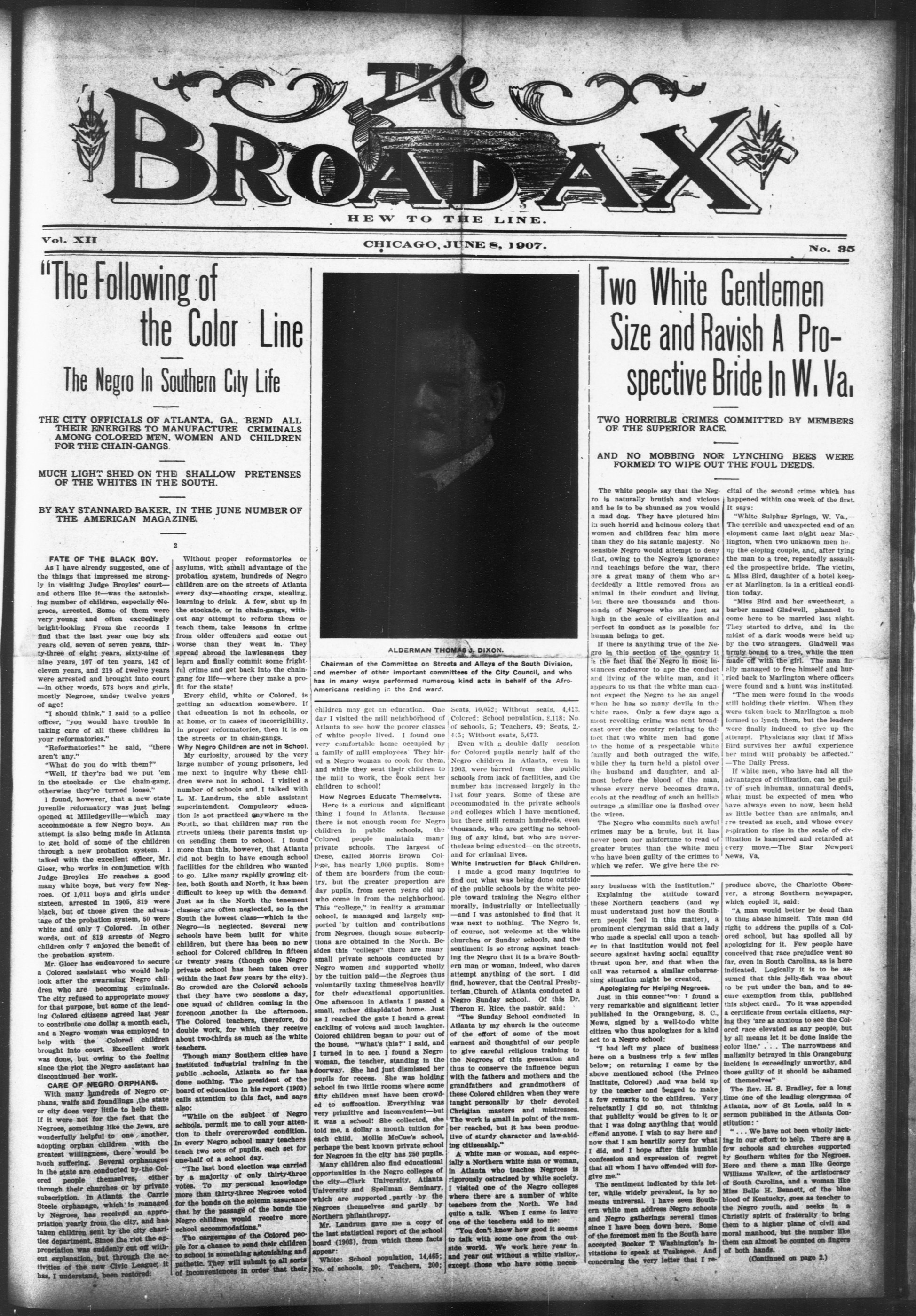
Chairman of the Committee on Streets and Alleys of the South Division, and member of other important committees of the City Council, and who has in many ways performed numerous kind acts in behalf of the Afro-Americans residing in the 2nd ward.
Chairman of the Committee on Streets and Alleys of the South Division, and member of other important committees of the City Council, and who has in many ways performed numerous kind acts in behalf of the Afro-Americans residing in the 2nd ward.
children may get an education. One day I visited the mill neighborhood of Atlanta to see how the poorer classes of white people lived. I found one very comfortable home occupied by a family of mill employees They hired a Negro woman to cook for them, and while they sent their children to the mill to work, the cook sent her children to school!
Seats, 10,052; Without seats, 4,42 Colored: School population, 8,118; No of schools, 5; Teachers, 49; Seats, 4,75; Without seats, 5,673.
Even with a double daily session for Colored pupils nearly half of the Negro children in Atlanta, even in 1903, were barred from the public schools from lack of facilities, and the number has increased largely in t
How Negroes Educate Themselves. Here is a curious and significant thing I found in Atlanta. Because there is not enough room for Negro children in public schools, the Colored people maintain many private schools. The largest of these, called Morris Brown College, has nearly 1,000 pupils. Some of them are boarders from the country, but the greater proportion are day pupils, from seven years old up who come in from the neighborhood. This "college," in reality a grammar school, is managed and largely supported by tuition and contributions from Negroes, though some subscriptions are obtained in the North. Besides this "college" there are many small private schools conducted by Negro women and supported wholly by the tuition paid—the Negroes thus voluntarily taxing threeselves heavily for their educational opportunities. One afternoon in Atlanta I passed a small, rather dilapidated home. Just as I reached the gate I heard a great cackling of voices and much laughter. Colored children began to pour out of the house. "What's this?" I said, and I turned in to see. I found a Negro woman, the teacher, standing in the doorway. She had just dismissed her pupils for recess. She was holding school in two little rooms where some fifty children must have been crowded to suffocation. Everything was very primitive and inconvenient—but it was a school! She collected, she told me, a dollar a month tuition for each child. Mollie McCue's school, perhaps the best known private school for Negroes in the city has 250 pupils.
Many children also find educational opportunities in the Negro colleges of the city—Clark University, Atlanta University and Spellman Seminary, which are supported partly by the Negroes themselves and partly by Northern philanthropy.
Mr. Landrum gave me a copy of the last statistical report of the school board (1903), from which these facts appear:
White: School population, 14,465;
No of schools, 20; Teachers, 200;
Seats, 10,052; Without seats, 4,413. Colored: School population, 8,118; No. of schools, 5; Teachers, 49; Seats, 2,475; Without seats, 5,673.
Even with a double daily session for Colored pupils nearly half of the Negro children in Atlanta, even in 1903, were barred from the public schools from lack of facilities, and the number has increased largely in the last four years. Some of these are accommodated in the private schools and colleges which I have mentioned, but there still remain hundreds, even thousands, who are getting no schooling of any kind, but who are nevertheless being educated—on the streets, and for criminal lives.
White Instruction for Black Children. I made a good many inquiries to find out what was being done outside of the public schools by the white people toward training the Negro either morally, industrially or intellectually—and I was astonished to find that it was next to nothing. The Negro is, of course, not welcome at the white churches or Sunday schools, and the sentiment is so strong against teaching the Negro that it is a brave Southern man or woman, indeed, who dares attempt anything of the sort. I did find, however, that the Central Presbyterian, Church of Atlanta conducted a Negro Sunday school.. Of this Dr. Theron H. Rice, the pastor, said:
"The Sunday School conducted in Atlanta by my church is the outcome of the effort of some of the most earnest and thoughtful of our people to give careful religious training to the Negroes of this generation and thus to conserve the influence begun with the fathers and mothers and the grandfathers and grandmothers of these Colored children when they were taught personally by their devoted Christian masters and mistresses. The work is small in point of the number reached, but it has been productive of sturdy character and law-abiding citizenship."
A white man or woman, and especially a Northern white man or woman, in Atlanta who teaches Negroes is rigorously ostracised by white society. I visited one of the Negro colleges where there are a number of white teachers from the North. We had quite a talk. When I came to leave one of the teachers said to me:
"You don't know how good it seems to talk with some one from the outside world. We work here year in and year out without a white visitor, except those who have some neces-
Two White Gentlemen Size and Ravish A Prospective Bride In W. Va.
TWO HORRIBIBLE CRIMES COMMITTED BY MEMBERS OF THE SUPERIOR RACE.
AND NO MOBBING NOR LYNCHING BEES WERE FORMED TO WIPE OUT THE FOUL DEEDS.
The white people say that the Negro is naturally brutish and vicious and he is to be shunned as you would a mad dog. They have pictured him in such horrid and heinous colors that women and children fear him more than they do his satanic majesty. No sensible Negro would attempt to deny that, owing to the Negro's ignorance and teachings before the war, there are a great many of them who are decidedly a little removed from an animal in their conduct and living, but there are thousands and thousands of Negroes who are just as high in the scale of civilization and perfect in conduct as is possible for human beings to get.
If there is anything true of the Negro in this section of the country it is the fact that the Negro in most instances endeavor to ape the conduct and living of the white man, and it appears to us that the white man cannot expect the Negro to be an angel when he has so many devils in the white race. Only a few days ago a most revolting crime was sent broadcast over the country relating to the fact that two white men had gone to the home of a respectable white family and both outraged the wife, while they in turn held a pistol over the husband and daughter, and almost before the blood of the man, whose every nerve becomes drawn, cools at the reading of such an hellish outrage a similar one is flashed over the wires.
The Negro who commits such awful crimes may be a brute, but it has never been our misfortune to read of greater brutes than the white men who have been guilty of the crimes to which we refer. We give here the re-
sary business with the institution."
Explaining the attitude toward these Northern teachers (and we must understand just how the Southern people feel in this matter), a prominent clergyman said that a lady who made a special call upon a teacher in that institution would not feel secure against having social equality thrust upon her, and that when the call was returned a similar enbarrassing situation might be created.
Apologizing for Helping Negroes.
Just in this connecton: I found a very remarkable and significant letter published in the Orangeburg, S. C., News, signed by a well-to-do white citizen who thus apologizes for a kind act to a Negro school:
"I had left my place of business here on a business trip a few miles below; on returning I came by the above mentioned school (the Prince Institute, Colored), and was held up by the teacher and begged to make a few remarks to the children. Very reluctantly I did so, not thinking that publicity would be given to it or that I was doing anything that would offend anyone. I wish to say here and now that I am heartily sorry for what I did, and I hope after this humble confession and expression of regret that all whom I have offended will forgive me."
The sentiment indicated by this letter, while widely prevalent, is by no means universal. I have seen Southern white men address Negro schools and Negro gatherings several times since I have been down here. Some of the foremost men in the South have accepted Booker T Washington's invitations to speak at Tuskegee. And concerning the very letter that I re-
Gentlemen
avish A Pro-
Bride In W. Va.
COMMITTED BY MEMBERS
E.
R LYNCHING BEES WERE
AT THE FOUL DEEDS.
critical of the second crime which has
happened within one week of the first.
It says:
"White Sulphur Springs, W. Va.,—The terrible and unexpected end of an elopment came last night near Marlington, when two unknown men he up the eloping couple, and, after tying the man to a tree, repeatedly assaulted the prospective bride. The victim, a Miss Bird, daughter of a hotel keeper at Marlington, is in a critical condition today.
"Miss Bird and her sweetheart, a barber named Gladwell, planned to come here to be married last night. They started to drive, and in the midst of a dark woods were held up by the two strangers. Gladwell was firmly bound to a tree, while the men made off with the girl. The man finally managed to free himself and hurried back to Marlington where officers were found and a hunt was instituted.
"The men were found in the woods still holding their victim. When they were taken back to Marlington a mob formed to lynch them, but the leaders were finally induced to give up the attempt. Physicians say that if Miss Bird survives her awful experience her mind will probably be affected."
—The Daily Press
If white men, who have had all the advantages of civilization, can be guilty of such inhuman, unnatural deeds, what must be expected of men who have always even to now, been held as little better than are animals, and are treated as such, and whose every aspiration to rise in the scale of civilization is hampered and retarded at every move—The Star Newport News, Va.
produce above, the Charlotte Observer, a strong Southern newspaper, which copied it, said:
"A man would better be dead than to thus abase himself. This man did right to address the pupils of a Colored school, but has spoiled all by apologizing for it. Few people have conceived that race prejudice went so far, even in South Carolina, as is here indicated. Logically it is to be assumed that this jelly-fish was about to be put under the ban, and to secure exemption from this, published this abject card. To it was appended a certificate from certain citizens, saying they are as anxious to see the Colored race elevated as any people, but by all means let it be done inside the color line." . . . The narrowness and malignity betrayed in this Orangeburg incident is exceedingly unworthy, and those guilty of it should be ashamed of themselves"
The Rev. H. S. Bradley, for a long time one of the leading clergyman of Atlanta, now of St Louis, said in a sermon published in the Atlanta Constitution:
"... We have not been wholly lacking in our effort to help. There are a few schools and churches supported by Southern whites for the Negroes. Here and there a man like George Williams Walker, of the artistocracy of South Carolina, and a woman like Miss Belle H. Bennett, of the blue blood of Kentucky, goes as teacher to the Negro youth, and seeks in a Christly spirit of fraternity to bring them to a higher plane of civil and moral manhood, but the number like them can almost be counted on fingers of both hands.
(Continued on page 2.)
THE BROAD AX.
Will promulgate and at all times uphold the principles of Democracy, but Catholic, Protestant, Catholic, Inflation, Farmers, Single Taxers, Republicans, Knights of Labor, or any one else can have their own so long as their language is proper and responsible.
The Broad is a newspaper whose platform is broad enough for all, ever claiming the editorial right to speak its own mind.
Local communications will receive attention.
Write only on one side of the paper.
Subscriptions must be paid in advance.
One Year ..... $2.00
Six Months ..... 1.00
Advertising rates made known on application.
Address all communications to
JULIUS F. TAYLOR, Editor and Publisher.
Entered at the Post Office at Chicago
Ill., as Second-class Matter.
SHALL HOWARD UNIVERSITY BE TUSKEGEEIZED?
A greater blunder has never been made in the educational system effecting the race than the selection of Dr. Booker T. Washington as a trustee of Howard University It is a matter of public knowledge that Dr. Booker T. Washinton's whole influence has been given to the development of industrial education, and that he has repeatedly slured the schools for higher education in his public addresses. His public career has not only been a menance to our schools for higher education, but a positive injury to them. By his public utterances and policy, he has discouraged our northern friends in giving contributions for higher education.
He has made it very difficult for our great Institutions in the South to exist at all. Many of them have been compelled to discharge a number of their teachers for lack of money contributed by our friends in the North Even Howard University has felt the paralysis of his onslaughts, against higher education. Many Philanthropists who willingly contributed to the support of Howard University in its work for higher education, have withdrawn the helping hand because of the words and policies of Dr. Booker T. Washington. His appointment as Trustee of Howard University is a menace and an injury to the work o higher education affecting the race.
It is a betrayal of the highest interests of our people into the hands of the most unscrupulous foe of higher education. We make the demand in the name and for the interests of Howard University and the future of our children, for his resignation. Let the noble band of graduates of Howard University and the men and women of this country, who love and reverence that great Institution, for the splendid work it has achieved, raise their voices in protest against this most condemnable outrage of their highest interests and welfare involved in the appointment of Dr. Washington as trustee of Howard University. We say to President Thirkield that booker T. Washington must go, if the prosperity and peace of Howard University is to be preserved.—The Guide, Baltimore, Md.
BRYAN PRAISES NEGRO DEBAT
ER.
Lincoln, Neb.-The great intercollegiate debate held in this city last Friday night between Nebraska and Wisconsin universities presented a great opportunity for the Afro-American that was improved to the fullest. When the Wisconsin party alighted from their Pullman all eyes were on Marshall, who was driven to the best hotel in the city, where he put up. Friday night the hall was packed with 1500 people. There were a brass band, orchestra, a quartet and William Jennings Bryan. Marshall's oratory completely captured the great crowd, and it was full three minutes before the applause had subsided after he had finished.
Mr. Bryan, as did hundreds of others, declared that Marshall's speech was the finest ever heard in Nebraska. Led by Mr Bryan, the gentlemen with their wives and daughters pressed forward to grasp the hand of the most brilliant Afro-American orator in the northwest—Eugene J. Marshall. The Advance, St. Louis, Mo.
BOOKER WASHINGTON TO LIVE NEAR ROOSEVELT.
New York Special. — Booker T. Washington, the Negro educator, has leased a summer home at West Neck, L. I., and will be near enough to Sagmore Hill to see the tall chimneys of the president's house.
In a direct line across the waters of Cold Spring bay he will be about three miles from the Roosevelt summer house.
And Booker T. Washington is the chap who puts in the most of his time in traveling around over the country in Pullman Palace cars, and stopping at high priced white hotels, in order to beg enough money to enable him to educate his own children in the best schools in the East and in Europe, and to further enable him to maintain a fine summer home near President Hooverelt, so that he can feel his oats, and rub up against the
robbing millionaires.
While at the same time the beggina Wizard of Tuskegee contends that industrial education is plenty good enough for the children of common Colored people, and that none of them must not ever expect to occupy a fine summer home like himself near the President of the United States.
DENEEN STOPS WEDDING PLAN OF ILLINOIS GIRL AND NEGO
Young Woman's Heart Is Captured When Suitor Smuggles Cake and Candy Through Window to Her Cell.
St. Louis, Mo., June 2.—Governor Deneen of Illinois yesterday frustrated the plan of Rose Hudpeth, a pretty white girl, 17 years old, to marry P. S. Williams, a Negro, 30 years old. She intended to marry him as a reward for passing candy and cake on a long pole to her in Edwardsville jail, where she was being held for waywardness.
The Governor sent Charles Virden of the state charities bureau to Edwardsville, who arrested the Negro there.
The Negro said he planned to have the girl bound out to a farmer, later intending to elope with her and join a troupe of side show performers, Mr. Virden says. What's the matter with Gov. Deneen, he is all right and mighty friendly to the Colored people.—Editor.
WEST SIDE NEWS BY PROF. A. L.
SIMPSON.
Mrs. Irene L. Camp on last Thursday entertained the Hannibal Court Sewing Circle, No. 3 I. O. O. C., at luncheon in her spacious parlors 9 S. Wood st. Visitors present were: Mrs. Maggie Homack, Mrs. Jennie Amos, Mrs. Sallie Chinn, A delightful time was indulged in. Mrs. I. L. Camps, daughter furnished the music.
Mr. Francis Miller who has been in the care of Dr. John W. Lewis for the past week is much improved and will soon be able to attend business again.
Mrs. James Thornton, has moved from 693 Austin ave., to 53 North Campbell ave.
Mr. David C. Austin formerly of the West Side is living at 6305 Normal ave., Englewood.
Mrs. M. Burroughs is still on the sick list.
Miss Ida Moore is now chief book- keeper in the firm of Mr. Thomas W. Grant & Co., the Lake St., Picture Enlarging House.
Miss Irene Andrews has just returned from the South where she has been attending school.
There will be a reproduction of the drunkards warning at Providence Baptist church soon.
Prof. A. L. Simpson whose office is at 200 W. Madison st., will on next Monday occupy a suite of rooms in the Eureka building 159 W. Madison st., you are as welcome as the flowers in May.
Mr. Knox who went away a few weeks ago to attend to business out of the city and lives at 753 Fulton st., has been on the sick list, but at present he is better.
When completed Mr. Samuel C. Wharton. A trusted employee of Mr. John H. Klank. The owner of the New Monarch Turkish Bath House will have full charge of all of the Colored employees. Mrs. Rolston 753 Fulton st., is on the sick list.
CARD OF THANKS.
In grateful acknowledgment and sincere appreciation of the numerous tokens of sympathy and condolence received by me during the illness and since the death of my beloved husband Robert A. Williams. I hereby tender one and all my heartfelt thanks. To reply otherwise than this would entail considerable writing so I pray your acceptance of this notice as an acknowledgement of your individual kindness. June 6th 1907. Mrs. Robert A. Williams, 3544 Dearborn st.
THE BEST SKIN AND SCALP FOOD
IN THE WORLD.
The Penn-Jones-Co., make the best skin and scalp food in the world; for many thousand years people have bee looking for something like it, and this new discovery by Prof. Penn, for the hair is just what you want, for it gives new life to the hair by cultivating the roots, and if you try it once you will never be without it, for it is absolutely harmless in every respect. By using Prof. Penn's skin and scalp food you can throw away your irons, for it softens the hair and makes it pliable, and if it falls to do the work your money will be refunded. Prof. Penn's new skin and scalp food can be secured at all the leading drug stores, department stores, and a'so barber shops. It will also be for sale by first-class lady hair dressers.
Main office 188 Madison street, F. A. Wescott and Co., branch office 3842 State street, Chicago. All mail orders will receive prompt attention.
"BETHEL LITERARY AND HISTOR
JICAL CLUB."
Last Sunday, Prof. W. C. Buckner, Manager of "Dixie Jubilee Quartet," delivered an address before Bethel Literary and Historical Club on "Cloudless Skies," which, from a stand-point of perfect reasoning, earnest expression and charming delivery could not be excelled.
Prof. Buckner is a son of Bethel Church and a self made man whose words count—because of being backed by the illustration in him of a manly life, Mr. Chas. Huggins a member of the Dixie Quartet Co., also a member of the club sang a solo entitled "Nearer Home," with splendid effect. By special request Madam Buckner sang—as she alone can—"Jesus Lover of my Soul." U. H. Benson and Mrs. C. Jackson made five minute talks and Prof. Buckner by request sang, "I'm only tired." This coming Sunday, Mr. Jas. R. Greene of Chicago University will be the principal speaker, the following Sunday, Mrs. Hattic Lindsay Davis, Pres. of Phyllis Wheatley Club will speak. Good music and everybody welcome. 4:30 sharp.
Chas. Griffin, Cor. Sec.
Geo. T. Kersey, Pres.
"T."
FCLOWING THE COLORED LINE
(Concluded from page 1.)
"Our Southern churches have spent probably a hundred times as much money since the Civil War in an effort to evangelize the people of China, Japan, India, South America, Africa, Mexico and Cuba, as they have spent to give the gospel to the Negroes at our doors. It is often true that opportunity is overlooked because it lies at our feet."
The Southern Baptist Church and other white church organizations I have found carry on missionary work to some extent among the Negroes, which I shall refer to again.
(To be continued.)
CHIPS
Sergeant John Fry, joined the officers of the 8th Regiment on their trip to Quincy, Ill., Thursday.
Mrs. Will Green a former resident of this city but now of Muskogee, I. T., is not expected to live.
Mr. Walter Hall, 3126 Wabash ave., who recently broke his arm is again able to follow his line of duty.
Mr. Richard Hood, 2450 Dearborn st., is confined to his home with a severe attack of pneumonia.
Mrs. Carrie Syphax Watson of Milwaukee, Wis., is the guest of Mrs. Martha E. Gray 2436 Dearborn st.
Mr. and Mrs. J. J. Jewell of Owensboro, Kentucky are in the city on the account of the death of their brother Mr. Wm. Estes.
Mr. Jackson, 3251 Rhodes ave., entertained a number of his young gentlemen friends with a Stag Party, Saturday night.
Mr. Wm. Waldridge well known in this city died in Phoenix, Ariz. June 5, and will be buried there with Masonic rites.
Mrs. Tich Harper authoress of "The play without a name" entertained a number of friends with a box party Thursday night, at the Pekin.
Mr. Clarence Cohen of Muskogee, Indian Terirtory is visiting his brother and sister. Mr. and Mrs. Jos, B. Crumb 814 Englewood ave.
The Physicians, Dentists, and Pharmacist Club, will give their second annual banquet at the New England Cafe, 2922 State st., Friday evening June 14.
Mr. and Mrs. Fred Grant of Macon, Ga., are spending a week in the city en-route to Cedar Rapids, Ia., while here they are the guests of Mrs. O. Ball, 4613 Armour ave.
William Piper has located, cor. 10th ave., and Jefferson st., Gary, Ind., where he will conduct a Buffet, Hotel and Restaurant
Miss Lizzie Slaughter, 3544 Dearborn st., has been seriously indisposed for the past week, but at this writing she is much better.
Miss R. Marie Edie 5709 Grove ave. spent last Wednesday and Thursday in visiting friends at Jefferson, Wis., where she was enabled for two days to enjoy plenty of good country food.
Col. Robert T. Motts, owner of the Fekin Theater, struck town Tuesday morning from Hot Springs, Ark., where he spent three weeks resting up, for the benefit of his health.
Rev. Father Massiah, Rector of St. Thomas Episcopal Church left Chicago, Monday for a two weeks vacation. Mr. Richard Kelley lay-reader, will have charge of the church services during the rector's absence.
Mrs. Robert A. Williams, 3544
Dearborn st., returned home Saturday morning from Youngstown, Ohio, where she remained for several weeks after the burial of her husband, Robert A. Williams in that city.
Our highly esteemed friend Maj John C. Buckner, 3638 Dearborn st. has in the last two weeks passed through a siege of sickness, but under the skillful care of Dr. Langford, he is on the fair road to recovery of his health.
Mrs. Edward S. Miller 3642 Wabash Ave., who has been visiting for some time with relatives at Winchester, Ky., returned home Monday morning accompanied, by her mother Mrs. Lucy Evans, who will in the future reside with her dutiful daughter and son-in-law, Dr. E. S. Miller.
Fred R. Moore, business manager for the Afro-American Magazine, New York City and National Organizer of Booker T. Washington's Negro National Business League, visited Chicago the first of the week and was shown around town by Sandy W. Trice, President of the business league in this city.
Mrs. Lulu Williams, 2415 Wabash ave., who lost her husband in New York City last August and who always played with Messrs. Howard, Watts and King, at Wings 22nd and State sts., this city, is a splendid house-keeper, and she has her furnished rooms constantly filled by a nice class of roomers and she is getting along very nicely.
A Texas editor who had been handed a lemn by three of his subscribers sent each one of them a card bearing the following inscription: "To three of my delinquent subscribers. One of them said: 'I will pay Saturday night if I live.' He's dead. Another said: 'See you tomorrow' He's blind. Still another said 'I hope to pay you this week, or go to hell.' He's gone.'—Ex.
William R., and his brother M. C. Cowan have engaged in the Real Estate business 260 S. Clark st., and they will make a specialty of handling first class South Side income property, which they can sell at reasonable prices and suitable terms, as will Cowan is well and favorable known and a hustler from away back, and he is bound to get his share of everything going on in the Real Estate business.
The Eighteenth Concert of The Choral Study Club, rendering The Grand Triology of "Hiawatha" at Quinn Chapel. Monday night was a great success in every respect. Too much praise cannot be given. Prof. Pedro 1. Tinsley and the members of The Choral Study Club who have striven so long and hard to give the West a "Negro Singing Society," which in time will be second to none in the United States. "D."
Miss Katherine Loretta Winbush was united in wedlock to Mr. Robert C. Crump at 5:30 p. m. Wednesday. June 5, at St. Monica's Catholic Church cor. Thirty-sixth and Dearborn st. The wedding reception followed from six to eleven o'clock at the home of Mr. and Mrs. Peyton C. Taylor, 3243 Wabash ave., where the bride and groom will be at home to their many friends. After June the 15th. Many handsome presents were received by the happy pair.
Mr. Estes, 3117 Armour ave., age 66 years, died suddenly at his home Saturday evening at eleven o'clock. While Mr. Estes has been suffering for a long time with heart trouble, he has been able to be about and superintend his business, for he had a very prosperous coal and ice business. A widow to whom his entire estate valued at about $6000, was left survives him. The funeral took place at Bethel A. M. E. Church at two p. m., Wednesday, Golden Fleece Lodge, No. 1615 G. U. O. F. had charge of the services. Rev. A. J. Carey preached the burial sermon. Interment at Oakwoods.
GIRLS HAVE MORE LIBERTY
GIRLS HAVE MORE LIBERTY.
One idea in the mind of girls of today is that parents should not interfere with their goings and comings. Why it has come about is somewhat of a question, for there is really no less obligation on the part of parents to know a daughter's associates and the places she goes than there was on mothers concerning themselves a generation ago. A perfectly natural fact is that normal young people crave amusement, and if this it not provided at home it will assuredly be sought elsewhere. This is true of the girl who has nothing to do, as well as for her friend who has to work all day, and both will turn to recreation away from home if none is to be found there.—Chicago Daily News.
WASHINGTON LETTER
[Special Costs and Deductions.]
The locality of squares 726, 727 and 728, east of the capitol grounds and north of the Congressional library, possesses much historical interest from a national as well as local viewpoint. With the library and the office buildings for the senate and house of representatives the area known as the capitol grounds is inclosed by marble walls, with the exception of that portion fronting on First street between East Capitol and B streets, northeast. Doubtless at no distant day the government will take the squares first named as the site of a temple of justice for the accommodation of the supreme court of the United States.
Historic Ground.
Should a building be erected there for the highest judicial body it would be peculiarly appropriate, for after the burning of the capitol in 1814 the head of the judicial system sat for a number of years in the building at First and A streets. The quarters mentioned were thus occupied from 1816 to 1820. The old circuit court of the District was also in this building from 1816 to 1825, when quarters were provided in the city hall for the local court, together with offices for the clerk, the marshal and other officials.
During the civil war it became, under the name of the old capitol prison, a noted place, and here not a few executions, some by gallows, others by shooting, occurred. Captain Wirz of Andersonville was hanged there. All traces of it are now obliterated, and instead is a block of fine residences, in one of which the late Justice Field long resided.
The New Railway Station.
Washington's new Union station, erected jointly by the Pennsylvania and the Baltimore and Ohio under certain concessions granted by the government, is now more than three-fourths completed, and Baltimore and Ohio trains will run into the new structure within a short time. Architecturally the building will be one of the most magnificent in the city. Its dimensions are truly stupendous. Altogether 100 acres will be occupied by the new terminal facilities. The north approach includes a train yard of thirty-three tracks, power plant, express building, coach yard having a capacity for about 750 cars, engine and repair yards, with engine house and shop facilities.
Finest Building of Its Kind.
Fineest Building of its
The tunnel under Capitol hill is the feature of the south approach. The station site when the work began was on ground less than twenty-five feet above the tide of the Potomac. More than 2,500,000 cubic yards of material were excavated and deposited to transform it into an eminence nearly sixty feet above tide, with gently sloping approaches. If this material were deposited on an average size city block it would form a shaft higher than the Washington monument. To move all this material would require about 60,000 standard gauge commercial cars, which, if coupled together in a single line, would extend 600 miles, a greater distance than from Washington to Columbus.
The general waiting room of the new depot will of itself cover 130 by 220 feet, or two-thirds of an acre, a greater area than is occupied by the average city station. The roundhouse, shops and engine yards will cover fifty-five acres, the coach yard sixty acres, the train yard thirty-one acres, the station proper and a portion of the plaza nine acres.
Professional opinion has it that it will be the most beautiful station building in the world.
A Remarkable Structure.
Within a few weeks the Connecticut avenue bridge will be completed and opened to the public. In fact, there remains unfinished little more than the decoration of the bridge. The bridge itself is a remarkable structure. It is 1,421 feet long, 53 feet wide and consists of five 150-foot arches and two 82-foot arches. It is built of unreenforced concrete throughout. The stone for the concrete work was taken from a quarry about 400 feet from the site of the bridge, which saved a haul of 80,000 cubic yards of stone.
Largest Concrete Bridge.
This is the largest concrete bridge in the world and is unique, in that it is not re-enforced with steel. The bridge is apparently trimmed with granite. These trimmings are made of concrete, cast in blocks on the ground, and instead of using sand for the mortar stone dust was used, which, when dressed down, gives an appearance of granite. The main false work of the structure, which consisted mostly of Georgia pine lumber, cost the District $54,000. It required 1,500,000 board feet of lumber for this work alone. It is probable that the entire amount of lumber required to complete the bridge was in the neighborhood of 2,000,000 board feet.
Street Signs.
The commissioners will not be able to erect signs on the public thoroughfares throughout the city as contemplated because of lack of an appropriation. They have appreciated the necessity of such signs as "drive slow." "keep to the right," "walk your horses," etc., particularly so when a pedestrian meets with an accident due to careless driving. Several months ago at the suggestion of the superintendent of police they asked for samples of signs of various shapes and sizes, and the superintendent of police furnished a list of streets and street intersections most in need of posted instructions to drivers.
It was decided to erect about 200 signs, but when the question of purchasing and erecting the same was investigated it was found that there were no funds. CARL SCHOFIELD.
SHORT STORIES
In the sixteenth century it was unlawful to marry during Lent. The average man needs 1,000 pounds weight of food to sustain him for a year. Alaskan Indians in the absence of tobacco will smoke shavings soaked in oil and pepper. The Sargent lumber mill at South Brewer is the oldest mill on the Penobscot river and possibly the oldest in Maine. It was built in 1820. In Europe 200 acres of land are cultivated by every hundred inhabitants, but in the United States a hundred inhabitants cultivate 800 acres. While tearing out an old fireplace a few days ago Clarence Boyce of Windsor, Vt., found a United States cent coined in 1796. The cent is in excellent condition.
A Turkish peddler with fifty chameleons was arrested in New York, and during the night all the chameleons escaped. Every policeman in city hall station went lizard hunting and recovered them.
MODES OF THE MOMENT.
To be especially in vogue one must have the belt to match the collar and cuff set.
Braided and cord are widely used on the underskirts now, which really are quite as much a part of the gown as the bodice.
Rich Indian and Russian designs are greatly in vogue not only for the linen suit, but for the soft linen costumes, kimonos, house gowns and evening wraps.
Not all of the latest models in linen are of plain materials by any means. In fact, there is a very conspicuous showing of fancy weaves, stripes, checks and figures, but none of them is aggressive, and only delicate colors are seen.
The linen sunshade has blossomed out in new designs and beauty, one of the fads being a border of brown suede or patent kid to match the belt and shoes, and another is the very plain top or center, with billows of mull, net or linen frills around the edge.—New York Post.
PLAYS AND PLAYERS
Della Stacey is to star in a new musical piece.
A crusade for grand opera in English has been started in London.
"The Prince of Pilsen" is soon to be introduced in France and Australia.
George M. Cohen has been playing his old role of the little jockey in a big revival of "Little Johnny Jones."
It is said that Louise Gunning is to be starred next season in a comic opera by Edward Paulton, the author of "The Princess Beggar."
Henry B. Harris has engaged Grace Elliston for the leading role in Martha Morton's new play of American life called "The Movers," which he is to bring out in the fall.
Cohan & Harris will have Thomas E. Shea under their management next season. They will also produce a new play by Channing Pollock entitled "Frances Baird, Detective."
HOUSEHOLD HINTS.
Newspapers may be used to pad the ironing board just as well as old blanket or muslin.
A little charcoal mixed with clear water and thrown into a sink will disinfect and deodorize it.
Natural colored linen stands more washings and hard usage in summer pillow covers for hammocks, porches and living rooms than other materials.
Colored fabrics will not fade if they are washed in flour starch. Make a thin starch and wash the garment, using no soap. Rinse in clean starch and dry in the shade.
If you wish your soft pillows to stand up firmly make the cover an inch smaller each way than the pillow. It will then be held out as plumply at the corners as if there were not inside pillow.
Editorial Flings.
Platforms are made for one party to stand on and the other to jump on.—Puck.
What a pass we are coming to when a court is asked to determine the sacredness of a concert by testimony as to the length of the dresses worn by the performers!—New York Herald.
A New York man joked while his leg was being cut off. That sounds very fine and heroic, but let him toss off a few merry quilps while his teeth are being pulled if he wants to attract attention.—Chicago News.
Every summer brings the announcement that a flying machine has been completed. But the sheriff still keeps his eye on the country road for autos without worrying over the possibility of aerial collisions.—Washington Star.
New York City.
New York city consumes 987,500 pounds of sugar each day.
New York city has more telephones than London, though London has 2,000,000 more in population than New York city.
According to an estimate made by a banker who is fond of figures, each adult person in New York city is carrying an average of $26.
There are in New York city fourteen clocks in public view that have no figures or Roman letters on their faces, using some advertising words with twelve letters in their places, and it is as easy to tell the time by their use as by the usual characters.—New York Herald.
BREVITIES
THE HALL OF FAME
Sidney Webster, the recipient of Mr. Harriman's letter, was the private secretary of President Franklin Pierce.
Maximillian Benedict von Goldschmidt Rothschild of Frankfort has been given the title of baron by the kaiser.
M. Lepine, the prefect of police of Paris, has accepted the directorship of the Suez Canal company, made vacant by the death of the late M. Casimir-Perier.
Charles P. Taft, a former Ohio congressman, owner of the Cincinnati Times-Star and brother of the war secretary, is credited with a fortune of $20,000,000.
Chauncey Dickson was recently installed as father deacon at a Catskill (N. Y.) Baptist church. The office was created for him because in September he will be 100 years old.
William A. Flanders of Penacook, N. H., has quite a collection of old newspapers and almanacs, running back toward 1800, and old clocks that would make the searcher after antiques turn green with envy. Francisco Jose, who was born in 1788, is still alive and at work and a good shot with the rifle at Oporto, Portugal. He served in the Portuguese army which in 1810 opposed the invasion of the French under Napoleon I. Professor William Hallock of Columbia university is recognized as the leading meteorologist in this country and is the author of numerous books and treatises on weights and measures. Recently he was appointed official measurer to the New York Yacht club.
William Rhinelander Stewart of New York is engaged in promoting the interests of organized charities. When he was president of the state board of charities he served without pay and is one of the few men in public life to spend his own money with a liberal hand to advance his purpose.
George Westinghuse fills more roles in the industrial life than any other American millionaire. This is proved by his achievements as an inventor, financier, organizer and industrial crusader. All of the twenty-six distinct Westinghouse companies in the United States and foreign countries practically are under his control.
General Anson Mills, owner of the Mills building and other valuable property in Washington and who retired from the army several years ago, is one of the wealthiest military men in the country, and his fortune is rapidly increasing. He made his wealth by inventing a machine which manufactures the cartridge belt that is now used by most of the armies throughout the world.
FOREIGN FACTS.
The coal yield of Great Britain is now about 236,000,000 tons a year.
Toys occupy sixteenth place in Germany's export, with a total value of $15,000,000.
Paris cab horses work only every other day and are fed on the days they work, not on the days they "rest."
Germany has thirty-one agricultural colleges maintained by the state, and there are many agricultural schools of which half the cost is defrayed by the nation.
The wages paid both skilled and common laborers in France are very low, while the cost of living is relatively higher in France than in the United States, with the exception of house rent and servants' wages.
An endless chain made at Cradley Heath, Staffordshire, England, no less than two and a half miles long and twenty-five tons in weight, was recently forwarded to a Leicestershire colliery. The chain was taken from the forge to canal boats on wagons drawn by a traction engine.
THE COOKBOOK.
To keep lima beans from bolling over put a small piece of butter with them at the time they are put on the stove.
Delicious fritters can be made from stale cake by dipping the slices in cream, frying in butter and spreading a bit of preserve or fresh berries over the slices, served hot.
Spinach will be much improved in color if it is quickly boiled in salted water until nearly tender, then drained and dropped into cold water until chilled. It should then be thoroughly drained, after which it is ready for use.
Citron which has been in the house for some time will soon become hardened. A very good and easy way to soften it is to place it in boiling water and let it stand for about two minutes. When removed it will be softened and easily cut.
The Butcher Bird.
He's the northern shrike.
In size he's like the robin.
He's slate gray with black and white.
He has a black band from bill to throat.
In November he usually departs for the south.
This band makes his eyes appear much larger.
He is said to live up to his name by being a veritable murderer. He kills other birds, especially English sparrows, and puts the surplus in his graveyard.
He prefers to dine upon field mice, but does no, disdain snakes, which he hangs up to devour at leisure—Philadelphia Record.
NEW SHORT STORIES
T. V. Powderly at the informal conference of capital and labor that Andrew Carnegie held in his Fifth avenue mansion recently told a story about contentment.
"Contentment is a good thing," Mr. Powderly began, "but it should never be carried too far. It is discontent, we must always remember, that brings about improvement.
"Let me tell you a story about a too contented Scranton farmer.
"This old man might have had a good modern shotgun, but he was con-
S
HE LAY UNCONSCIOUS FOR SOME MINUTES.
tent with an old musket, a relic of the civil war. He was very proud of this antique firearm. When I lived in Scranton he was always boasting about his prowess at sparrow shooting with it.
"One day he took a man out with him to show what he could do in the sparrow shooting line. Before he set out he loaded the gun. He put into it a half dozen screws, some rusty nails, a handful of buttons and a bit of file that happened to be lying on a rubbish heap.
"The two men came to a tree, a great flock of sparrows rose into the air, and the farmer put up his gun and let drive. The report was tremendous.
One sparrow fell, and the old man fell too. He lay unconscious for some minutes.
"When he revived he looked at his watch. Then he sat up, patted his gun affectionately and said, with a content ed smile: "She used me well this time. It mostly takes twenty minutes to a good half hour before I come to myself; but, by gosh, I always get my sparrow."
Leads to Confusion.
The late A. J. Cassatt at a dinner at the Philadelphia Country club was once asked his opinion of the fashion of women riding horseback astride.
"I don't altogether favor this fashion," said Mr. Cassatt, smiling. "I think it leads to confusion.
"I was driving one afternoon on the Lancaster pike when a rider was thrown violently from a spirited bay horse. Luckily the accident happened in front of a pharmacy.
"The pharmacist ran forth with his clerk. He propped up the head of the unconscious rider, and, seeing a gold cigarette case lying in the road, he took it up and read the address, 'P. S. Browne, 1817 Walnut street.'"
"Jack," the pharmacist shouted to his errand boy, 'telephone to Mrs. Browne, 1817 Walnut street, that her husband has'—
"But just then a tiny gold hand mirror with a powder puff attachment fell from the rider's trousers pocket, and the pharmacist called:
"I mean, Jack, to telephone to Mr. Browne that Mrs. Browne has fallen"
"But at this point the clerk, who had been burning a feather under the rider's nose, tickled her lips with it, and she smiled and murmured, 'Jim.'
"Telephone Mr. and Mrs. Browne that Miss Browne has fallen off her horse!"
Loose Fasting.
Dr. Edward Everett Hale at the divorce reform congress in Washington said of certain divorce laws:
"The apologies put forward for these laws remind me of the apology that a gourmet bishop once made during Lent.
"The bishop happened to sit at dinner beside an irreverent young woman. He ate his oysters, and then, with flashing eyes, a heightened color and every indication of enjoyment, he fell to upon a plate of rich turtle soup.
"The young woman, watching the bishop swallow this costly food, could not restrain a sneer.
"I thought," she said, "that you fasted during Lent bishop?"
ed during Ben, "The bishop put down his spoon and allowed his face to become passive. "Ah, 'I do fast in Lent,' he said. "I subsist chiefly on fish.' He swallowed a lump of meat worth about half a dollar. "Turtle,' he added, 'is a kind of fish.'
Servants and Eggs.
Mrs. Phelps Stokes in an address in New York said of the servant question:
"Are there not too many mistresses who treat their servants as the lady did in buying eggs?"
did in buying these a shop and said:
"Have you eggs?"
"Yes, madam," said the shopman.
"Well,' said the lady, 'I want a dozen absolutely fresh eggs for myself and (she touched the arm of her maid, who stood beside her) a half dozen not quite so fresh for my maid here."
CHOICE MISCELLANY
The President's Name.
Strange as it may be, since it is spoken every day, if not every hour, by peoples of every nation, tongue and clime, comparatively few persons give to the president's name its correct pronunciation, says the Washington Herald. Even right here in Washington it is more commonly called "Roosvelt" than anything else, while its facetious twist into "Rosenfelt" is not infrequent. Among that class of persons who make a stagger at giving it its proper pronunciation it becomes "Rosevelt" more often than anything else, though "Roosvelt" is a close second. For the several hundredth time within the period of his occupancy of the White House the president a few days ago tried to straighten out a visitor orthoepically in respect of the presidential patronymic. He spelled it out thus:
"Ro-zle-velt.
"It is more nearly Ro-za-velt than it is Ro-za-velt," the president explained patiently, "but if I should syllable it that way for you and you should fol'low my spelling in an effort to convey to others the historically correct pronunciation of my name somebody would be sure to give the broad sound to the 'a' and make it 'Ro-zar-velt,' so that it is safer to use the diphthong 'e' in order to avoid worse confusion. So remember that in my name the double o is just u, the s is z, and the e following the s is short a."
The Camel.
Admiral D. D. Porter, who once went to north Africa to secure camels for introduction into America, gives some interesting points about the value of these ugly but useful animals. He says:
"In their campaigns against Algiers the French were surprised to see their camels, although reduced to skeletons, making forced marches with their loads. Mules in their condition could not have even carried their saddles. A camel's flesh is as good as beef. You can hardly tell one meat from the other. Camel's milk is very good, as I can testify, because I used it in my coffee. A camel generally drinks once in three days, and besides his four stomachs he carries a sort of reservoir in which he stores water. I have been told that even ten days after the death of a camel this reservoir can be opened and ten or fifteen pints of clear, drinkable water taken from it."
T. M. C.'s Ten Dollar Bill
T. M. C. may be interested to know that the $10 he or she received as a Christmas gift in 1905 is now in the possession of a New Yorker who is trying hard not to spend it. The Metropolitan bank passed it out a few days ago. It is a United State note, No. 44,560,198, and in the blank space on the reverse side is this typewritten greeting:
Perhaps it was T. M. C. who added in precise handwriting on the opposite space:
-New York Sun.
Carriage Luncheons.
Luncheon served in carriages lined up along the curbstone is the latest fad introduced to Philadelphia. This innovation was witnessed when a carriage containing a man and a woman fashionably dressed was stopped in front of a Chestnut street restaurant. The coachman got down from his seat and hastened into the restaurant, and in a short time a waiter appeared on the sidewalk with a trayful of edibles. The food was handed into the carriage, and the occupants fell to eating in full view of passersby. The idea promises to become popular among shoppers who, as a rule, find the public dining rooms crowded just about the time they want their luncheon, says the Philadelphia Record.
In 1807 Daniel Miller laid out 200 building lots on a large tract of land which he owned along the Susquehanna river near the mouth of Wilsonico Creek. He numbered tickets to correspond with the numbers of the lots and, placing them in a hat, charged $33 a draw. The drawer became the owner of the lot indicated by his ticket. The town was called Millersburg in honor of the founder. It is located in Dauphin county and will celebrate its one hundredth anniversary on Sept. 1 4 and 5 next.-Philadelphia Record.
An Admiral at Three and a Half.
The present Marquils of Donegal, who is now three and a half years old, is by heredity high admiral of Lough Neagh, a naval command dating back to the time of Queen Elizabeth. The little admiral derives no pay or enoluments from his office, but he has several notable perquisites, among others the right to wear the uniform of an admiral of the fleet and to receive an admiral's salute. In addition the young marquils is hereditary governor of Carrickfergus castle and is at all times entitled to free quarters in that ancient fortress.-Render Magazine.
French Army and Navy Pay.
The curious fact has come to light that, while French army officers have had their pay raised to meet growing prices, the pay of naval officers remains just where it was thirty years ago. The naval officer draws now considerably less at home than his brother of corresponding grade in the army, and the inequality becomes more glaring outside France, since the army officer serving abroad has his pay doubled, while that of the naval officer remains stationary.
FACTS IN FEW LINES
Goethe was eighty-two years of age when he completed "Faust." The Norwegians have whaling establishments in Iceland, Scotland, South America, Japan and elsewhere.
While Australia has the reputation of a great sheep growing country, there are more of these animals in India.
The number of different species of animals known to naturalists is roughly 156,000, of which 15,300 are vertebrates or backboned.
In Greece the usual price of olive oil is only about 20 cents a quart at wholesale. When the yield is exceptionally large pure oil is still cheaper.
The thin paper on which the Oxford Bible is printed is made after a secret process by the Oxford University Press. The secret is valued at $1,250,000.
Professor Burt G. Wilder of Cornell is out with a declaration that cats ought to be licensed and that cats that are not worth licensing ought not to be permitted to live.
The late Sir Walter Besant ten years ago estimated that there were fifty novelists in England who earned upward of $5,000 a year. There are now probably nearer 150.
Mrs. Hardling, testifying in a London court against her son, said he had been a brute to her since his boyhood. "In fact," she said, "a husband could not have treated me worse."
A college of foreign languages has been opened in Canton, China, the part of the Chinese empire from which the greatest number of emigrants sail to distant parts of the globe.
A record in sawing laths has been made by a crew at Smith's mills, at Machias, Me., when in one day of a little over nine hours 61,000 good laths and over 6,000 poor ones were sawed.
At the Norwich (England) rural council Councillor Watts reported a case of a boatman who willed and bequeathed his son Freed to another boatman, who paid a half crown to make the transaction, as he imagined, legal.
After handling $2,000,000 in currency Cashier John F. O'Brien of the city collector's office in Chicago fell from his seat in a dead faint. He got the money in all shapes, and the strain of counting and sorting proved too great.
The Japanese premier, Prince Kung, tried to compliment General Grant in English when he was in Japan by assuring him that he was born to command. His words were, however, "Sire, brave general, you were made to order."
The adage which advises people who live in glass houses not to throw stones will have to be revised. The glass that is now used in making houses is not breakable. It looks like white marble and is used in the same way as that material. The Grosecloses brothers of Sully county, S. D., have a large tract of land which they are cultivating entirely without the aid of horses or other animals. Plowing, harrowing, seeding, harvesting and marketing are all done with motor machinery.
A box containing a thousand cigars arrived at Buckingham palace recently. It was a present from Baron Rothschild to King Edward. For over thirty years his majesty has received a similar present from Rothschild. The cigars are worth about $2.65 each.
The Merchants' bank in Salem, Mass. is a young men's bank. Henry M. Batchelder, its president, is the youngest bank president in the city. J. H. Glifford, the cashier, only recently passed his thirtieth year, while F. A. Brooks, assistant cashier, and A. H. Barnet, teller, are both under thirty. The steel bridge the Portland and Seattle railroad is building across the Columbia at Vancouver will be a mile and a half long, the longest steel bridge in the world. It will be finished next January. Twenty thousand tons of steel will be used in it, not including the weight of the double track. The drawbridge is 464 feet long.
All mechanics in France are obliged to serve an apprenticeship of from two to three years, during half of which period at least they receive no wages and must board themselves. In addition to this each one must give up two years of his life for military service, for which he receives a cent a day and board and clothes. It will be seen that every mechanic in France must expend four or five years of his life without wages.
One of the growing methods of cheating in New York is by "short change." The system has taken firm root in many ticket offices and shops and has notably increased when small payments are being made through dumb waiters, in which latter instance the person delivering goods says too little was sent down or that he returned more than the receiver can find and that there must have been a loss in transit.
Just outside the city limits of Nashua, N. H., there have been all sorts of dog fights and so called sport of that kind for years, but it is now at an end. Mrs. Jennie Klimball, a little woman, five feet high, decided that good citizens were right who did not want these things and that they should stop. So she became a deputy sheriff, and she was so diplomatic about it that it was not necessary more than once for her to make an arrest.
Although a millionaire, Edwin U. Curtis has taken the position of United States subtreasurer at Boston. Early in life he took a fancy-to politics, and, having plenty of money, he gratified his desire. He was elected mayor of Boston. Twice afterward he was nominated, but each time defeated. He does not care for private business and would prefer to be in public service. His salary of $5,000 a year in his new position would be only a small part of the profits he would find in a mercantile pursuit.
WOMAN AND FASHION
WOMAN AND FASHION
The New Cape Coast
Cape wraps are seen on many of the most attractive Paris spring gowns. One model carried out in pastel blue cloth has a becoming little cape of the same material, with velvet collar and square fronts, trimmed with broad blas bands and silk tassels. The novel feature of this coat is the manner in which it is fastened. There
TWO SMART MODELS.
is no opening in front or back. The large buttons on the shoulders are for use as well as ornamentation. Those on the left shoulder can be easily unbuttoned and the coat removed in that way. This is a striking and new style, but not altogether practical, though many of them are worn. The second model is made of light tan broadcloth and worn with a princess dress of tan chiffon velvet trimmed with straps of cloth. One desirable feature of these coats is that they look quite as well worn with one dress as another and make splendid wraps for the warmer weather.
how to Wear Necklaces.
As though milliners had not put the woman who is no longer young sufficiently at a disadvantage by decreeing modes in hats that are becoming only to the ingenuue, now the jewelers must prescribe a new method of wearing the pearl necklace that, alas, none but the young may venture. It is a coquettish mode of arrangement that is properly suited only to the unlined face. Doubtless many women who have long passed their youthful charms will be tempted to essay it. A long rope of pearls is necessary, and the evening gown which accompanies it should be of empire type. The necklace is caught up to the collarure at either side of the head with circular clasps, pearl set and with tasseled pendants of the pearls. Beautiful clasps in interesting antique patterns come specially for the purpose. Of the two loops of the pearl rope which hang down in front from the clasps one should reach to the base of the neck, beneath the chin; the other should fall to the waist. These sway and quiver in lines of delightful grace with each movement of the wearer's head. No jeweled dog collar is worn with the necklace when it is arranged in this way.
Motoring Headgear
Many women prefer for all ordinary motoring to wear a separate veil tied over the hat and covering all of the head save the face and select their veils with a view to their becoming qualities as well as to their relation to the costume. If one can afford to sacrifice a veil often, white chiffon is desirable, for nothing is more becoming, and the white motor veils with dotted or striped borders of black or of color are very charming. They succumb to the dust quickly, of course, as do the light blue veils, in which many motor women now look particularly well, but extravagance in the interest of vanity is no new thing.
Suits For Small Boys.
The small boys are going to be comfortable this summer. If they are not it will not be the fault of the shopkeepers, who are ready with an almost unlimited supply of jaunty, cool suits. The accompanying cut shows one of the most popular models. White linen is the material used for the suit, while
A
the broad collar, cuffs and belt are of red, trimmed with white. The upper part of the blouse is cut/in sailor fashion, but the lower part falls straight down and is worn with a loose belt more after the manner of the Russian blouse. This makes a more childish garment than the regulation Russian model, or the sailor suit which blouses at the waist line. Other suits of this model are made of blue linen, chambray and checked gingham.
HUMOR OF THE HOUR
Not Her Day.
Eleanor's beauty was of a changeable type. If her hair were becomingly arranged and the color of her gown just right she was almost beautiful. Under adverse conditions, however, she was really homely. One day while rushing homeward after a visit to the dentist Eleanor unexpectedly encountered her younger brother in the street. "For heaven's sake," he pleaded earnestly as the girl approached, "walk straight ahead and pretend that you don't know me. There's a whole bunch of the boys coming this way, and it isn't ten minutes since I told them that you were pretty."—Lippincott's.
The Bore Retorts.
Midnight came and still the bore remained.
"Do you like music?" asked the beautiful girl, just to break the monotony.
"Passionately fond of it," replied the bore.
"In fact, music will always carry me away."
She rushed over to the piano and played several popular airs.
"You are still here," she said, turning on the stool.
"Yes," yawned the bore.
"But I thought you said music always carried you away?"
"So I did—music."—Chicago News.
Spending His Wealth.
"I can't last much longer, my dear," said old Mr. Kloseman, who was nearing his end; "but, ab! It's good to think that even after death I'll be near you and watch over you."
"Well—er—really," replied the soon to be young widow, "if that's true, Silas, I'm afraid my extraavance will pain you terribly."—Philadelphia Press.
Where the Difficulty Lay.
A Brooklyn man has a little girl named Ethel, who not long since gave a birthday party, at which there was some slight delay in providing seats for her small friends.
Said Ethel, "You see, it isn't that we have not chairs enough, but that I have asked too much company."—Woman's Home Companion.
How It Happens.
"I have a great admiration for these public men who are constantly figuring in anecdotes. They appear to be bright enough to say something clever whenever they are interviewed." "Not at all. They are merely bright enough always, to get themselves interviewed by clever reporters."—Cleveland Leader.
Regular.
"Borrowell boasts that he is as regular in his habits as clockwork."
"Lives on tick, eh?"—Philadelphia Press.
Didn't Blame Him.
Farmer Hayrix—I hear yore son Zedekiah air makin' a name fer hiself in the city.
Farmer Oatcake—Yaas, and I ain't blamin' him fer it neither. I ain't powerfully stuck on his ole name myself, by grass!-Detroit Free Press.
Too Severe a Test.
"He says I am the only girl he ever loved," said the sentimental miss. "Well," answered Miss Cayenne, "perhaps he means it. Don't insist on knowing whether you are the only girl to whom he has made the same remark."—Washington Star.
The Always Ailing Kind.
Friend—Why did you pass that man as a good risk? I beard him tell you he had over ten different kinds of chronic diseases.
nice Doctor—Yes; but, you know, those kind of fellows never die.
-Judge.
At the Tea Party:
"You know he has been refused by so many girls that now he gets mad if one hands him a lemon in his tea."—Baltimore American.
Not Ashamed of Them
"Oh, yes! He's been in jail half a dozen times, and he doesn't hesitate to admit it."
"You don't say? Has the courage of his convictions, eh?"—Houston Post.
Evan Poor Music.
"is very fond or music.
"Oh, very!" replied Mrs. Pepprey.
"She even appears to be fond of her
own."—Des Molines Register.
Not For Fuel.
"I guess it must burn up the ground.
He gets arrested every few days for
speeding." - Cleveland Plain Dealer.
Her First Thought.
When an automobile runs over a man,
He rants and swears as loud as he can
And feels for the skin that is peeled from
his face
And vows that his ribs are out of place.
But a woman don't hunt for bruises or
wounds.
Just shrieks, "You chump, you've mussed
my hair!"
Fifty-First St. and Armour Ave.
Ball Yards: 1st St. & L. S. & M. S. RY.
and St. and Armour Ave.
CHICAGO
50,000
BOOKS FREE By Mall
treating on all the
DISEASES PECULIAR TO MAN.
THIS BOOK contains many illustrations and is a storehouse of knowledge for both old and young who are suffering from excesses, lost vitality, nervous disorders, blood poison, vomit, kidney and bladder diseases. It explains how you can successfully cure yourself at home.
DR. JOS. LISTER & CO.
40 Dearborn St., A-10. Chicago, Ill.
Tile and Slate Hauling a Specialty.
COAL
J. H. COLEMAN & CO.
Express & Van Moving
TRUNKS EVERYWHERE.
2540 State Street
Phone 699 Calumet CHICAGO
Phone Oakland 1828
F. A. Rawlins
The Modern Embalmer
UNDERTAKER AND &
FUNERAL DIRECTOR
When his work is finished
you have no displeasure.
4834 State St., CHICAGO
Phone Douglas 1550
ICE CREAM CIGARS. TOBACCO
SHIRT WAISTS KIMONAS
MRS. A E BAKER
NOTIONS
419-36TH STREET
Underwear a
Specialty
CHICAGO
FINE WINES, LIQ. JORS
AND CIGARS
3030 State Street CHICAGU
10
15
MCALL POSTER
ONE BASE
50
YEAR
RECORD A FREE WINNER
Black
These are maps McCall Posterware sold to the United
States that may either make of pattern. This is an
official map.
fashion of their style, accomy and simplicity.
McCUT'S Magazine ("The Queen of Potholes") has published a new issue of Lester Magistrate. One year's subscription (at numbers) costs 50 cents. Last summer, 5 cents. Every subscriber gets a McCall Pub. Prize. For the holiday.
Lady Agnes Wanted. Hardcover pamphlet of decor and decoration. Pattern Catalogue of the decor and Pattern Catalogue of the present issue free. Address THE MCCALL CO., New York.
Waiters and Cooks
Prefer Our Make
JACKETS AND LINEN
because they have found them
satisfactory.
Write for complete Catalogue
FREE.
giving full instructions how
to order.
Marcus Ruben (Inc.)
390 State St., CHICAGO.
READY FOR THE PRESS
CHICAGO CAVE DWELLERS
Not for Preachers
320 Pages, Cloth, $1.00
POST PAID
A Story of the Underworld
and the Overworld
By Parker H. Sercombe,
Editor To-Morrow
Magazine, Chicago.
Only a limited edition of
this remarkable book will be
printed. Each copy will be
signed by Sercombe Him-
self and automatically num-
bered from 1 up. First
orders in will get the low
numbers in rotation except
No. 1, which goes to Mrs.
Sercombe.
Address
TO-MORROW MAGAZINE,
For the Signatures and Impressions and The New Civilization.
2320 Calumet Ave., Chicago, Illinois.
30 CENTS THE COPY. $1 A YEAR.
```markdown
```
SELECTIONS
A BASEBALL SUPPER.
How a College Team's Captain Entertained Eight "Fans."
"Out on the first!" "That's a hot one!" "Willie scores one!" "Home run for Arthur!" These were the familiar terms that greeted each joke or attempted joke. The occasion was a novel entertainment recently given in a college town at which the captain of the college team entertained eight of the most enthusiastic "fans" among his friends at a baseball dinner. Counting the host, the party numbered nine. Dinner was announced at 9 o'clock in the evening.
With the assistance of his mother and sister the young man carried out the whole arrangement with brilliant success. Before going into the dining room each man was given a place on the "team" and by this means found his proper place at the table. The dining table, which was square, was turned and spread in such a manner as to represent the diamond of a baseball field. Instead of the usual cards there was at each cover a miniature fan bearing the word pitcher, catcher, first base, second base, third base, right shortstop, left shortstop, right field, left field. The menu cards were diamond shaped and had "Official Score" printed on one side, and on the other side was the menu, consisting of nine courses, or "innings," as they were termed on the cards. They read, leaving out the interpolations, as follows:
FIRST INNING.
First strike.....Oyster Cocktails
SECOND INNING.
In which the Losing Team Lands...Soup
THIRD INNING.
Caught on the Fly.....
Mountain Trout on Diamond Shaped Toast
FOURTH INNING.
A Sacrifice .....
.....Lamb Chops with Potato Balls
FIFTH INNING.
A Foul Ball.....
.....Turkey Croquettes, Green Peas
SIXTH INNING.
The Umpire, When We Lose.....
.....Lobster Salad, Cheese Wafers
SEVENTH INNING.
What We Were Handed...Lemon Cream
In Diamond Shaped Slices and Macca-
roons.
EIGHTH INNING.
Essential for Good Playing...
Preserved Ginger, Wafers, Coffee
NINTH INNING.
Where They All Score...
Distribution of Favors
The favors were tiny horns, with
which, at the suggestion of one of the
boys, they rooted for the clever host
and the unique way in which they had
been entertained.—What to Eat.
The "Drago Doctrine."
What is the "Drago doctrine," which is to be excluded from the deliberations of The Hague conference? It has nothing to do with the late Queen Drago of Servia, but derives its name from Dr. Drago, foreign minister of the Argentine Republic, who, imitating the example of President Monroe, enunciated the convenient theory that debts owed to the citizens of one government by those of another may not be "collected" by force. This was when the combined fleets of England, Germany and Italy in 1902 appeared off Venezuela and caused Mr. Kipling to write his "Rowers." This "Drago doctrine" was naturally hailed with enthusiasm by all the money borrowing republics of South America, but they were told from Washington that it could not be regarded as a subclause of the Monroe doctrine.-Chicago News.
The Postoffice and Crime Detection
The Postoffice and Crime Detection. Discussing "Frauds In the Mall" in the North American Review, George B. Cortelyon, secretary of the treasury, says: It will be readily understood that the guarding of the mails for the purpose of keeping at the minimum the manifold abuses to which they are inherently subject is a task of great magnitude. But it is being better and more efficiently done every year, affording much justification for the remark which was made not long ago that "the postoffice department of the United States is the most effective agency in the world for the detection and prevention of crime and the apprehension of the criminal."
The Phonograph as a Witness
In Brussels lives a lawyer who recently made good use of a phonograph in a lawsuit. He had been continually annoyed by the noises of hammering at an iron foundry in his near neighborhood. Finding that complaints were unavailing, he brought the matter into court. But before doing so he placed a phonograph in his library for one whole day. When the case came before the court he produced the phonograph and set going the specially prepared cylinder. An uproar and din as from the forge of Vulcan was the result, and the ingenious lawyer won his case.
The Shock on the Dread
In the simultaneous discharge of eight of the ten twelve-inch guns of the Dreadnought a shock was given that vessel of 400,000 tons, more than double that of any broadside ever before fired. The vessel of 18,500 tons skidled sideways several yards, listing many degrees. The guns are fifty-three feet long, and each shell of 850 pounds is discharged by 265 pounds of cordite, with a muzzle velocity of 2,000 miles an hour.
France's Lost Provinces
The Germans are by no means content with the state of affairs in Alsace-Lorraine, for in spite of the six and thirty years which have passed since the annexation the sentiments of the majority of the population are as anti-German as ever—London Globe.
BRIGHT BOYS AND GIRLS WANT ED TO SELL THE BROAD AX.
Bright boys and girls can make money in every community by selling The Broad Ax. It will cost you nothing to begin, as we will send you a supply of papers for the first week free. If there are any bright boys and girls in any section of the country who want to start in business for themselves, make money and be independent, write to us at once, and we will send you ten papers free of charge. You can sell them for five cents each, this will give you the capital which you can buy more papers at the newsdealers' rate, allowing you a good profit.
Thinking and progressive people read the Broad Ax. Your father, brothers, uncles and friends will buy the paper from you. If you mean business write to Julius F. Taylor, 5040 Armour avenue, Chicago.
THE BROAD AX.
Is for sale at the following news stands:
Mrs. E. L. Holmes, 2508½ State st.
Cigars, tobacco and news stand.
J. W. Hoagan, cigars, tobacco and news Stand 2718 State St.
L. L. Jones, barber shop and news stand, 3842 State st.
A. F. Tervalon, 134 W. 51st street
Cigar Store and News Stand.
Mrs. Nelle Phelps, Cigars. Notlone and News Stand, 131 W. 51st street
T. B. Hall's Cigar Store and Laundry office, 261 29th St.
W. S. Cole, 354 Thirty-first street,
cigars, tobacco and news stand.
J. R. Peters Cigars, Tobacco and News Stand, 338 E. 27th street.
Mrs. A. E. Baker, Notions and News Stand, 419, 36th street.
W. P. Johnson, Notion Store and News Stand 3704 State st.
Turner Williams' Shaving Parlor and News Stand, 2903 Armour ave.
B. Davis, cigars, tobacco, and confectionery, 3632 State st.
Jackson Sisters, cigars, confectionery store and news stand, 920 W. Lake Street.
C. C. McLain, cigars, tobacco and news stand, 2906 State street.
Mrs. J. H. Hadley 116 W. 51st st., cigars, tobacco and news stand.
Mrs. Katherine R. Hamlet, Cigars, tobacco, and fancy groceries and news stand 5028 Armour ave.
The Informer News Co., 188 Randolph St., Detroit, Mich.
The Standard News Co 131 W. 53rd st., New York, City, N. Y.
News items and advertisements left at these places will find their way into the columns of The Brood Az.
Pairing Off.
"Let's make a bargain."
"Well?"
"If you won't talk about your new auto I won't talk about my new baby."
—Cleveland Leader.
Quick Corrections.
He—Let me propose to you—
She—Oh, indeed, I'll accept—
He—That we get out of the rain—
She—Your suggestion. — Baltimore
American.
Quantitative Distinction.
Mrs. Knicker—Does your husband go
out between the acts?
Mrs. Bocker—No. He comes in the
theater between drinks. —Judge
Mike's Choice
Mike's Choice.
Footpad—Your money or your life!
Mike—Take me loff. Oi need the money.—Kansas City Times.
The Sad Part.
"Man wants but little here below," So runs the ancient song.
Alas, that for that little he So often has to long!
He has to long so long, alas, But for that little bit And mostly always shuffles off Without a-getting it!
—Woman's Home Company.
A Smash.
"The McBangs have had a marital bust-up, haven't they?" "I should say so. McBangs exploded with rage, his wife burst into tears and was all cut up about it, and now they have broken with each other."—Cleveland Leader.
Opposed to It.
"Really," said Mrs. Subbubs, "we ought to have one of those burglar alarms put in"—
"What!" exclaimed Subbubs. "And have the thing go off at night and wake the baby? Not much!"—Philadelphia Press.
Unavoidable.
"The trouble with that man is that he takes small matters seriously."
"Yes," answered Miss Cayenne, "but you could not expect him to do otherwise without sacrificing his self esteem."—Washington Star.
Heard in the Restaurant.
"I haven't spoken, to my wife for three years," said the henpecked man.
"Why?" asked some one.
"I didn't want to interrupt her," he said—Houston Post.
GRAY & MORAN
ATTORNEYS AT LAW
Suite 1114 Ashland Block, Clark and Randolph Sts. Tel. Central 569.
CHICAGO.
Residence 57 Macallister Place
Telephone Ashland 363
Office Telephones
Central 1239 Automatic 5940
MILES J. DEVINE
ATTORNEY AT LAW
Suite 318-330 Reaper Block
CLARK AND WASHINGTON STS.
CHICAGO.
A. D. GASH
Attorney at Law,
84-86 La Salle Street, Chicago
Suite 615 to 619,
Telephone Main 3077.
JOHN E. OWENS
ATTORNEY & COUNSELOR
AT LAW
323 ASHLAND .BLOCK
Tel. Douglas 1565 Notary Public
REAL ESTATE, LOANS AND
RENTING
Bates Building
3637 STATE STREET CHICAGO
Telephones
Oakland 1489, Gray 3331, Blue 3983
W. E. Carlmore & Co.
REAL ESTATE
LOANS AND FIRE INSURANCE
Money Loaned on Mortgages
OFFICES
120 W. 51st St. 5252 State St.
4901 Dearborn St.
CHICAGO
W. R. Cowan M. C. Cowan
Telephone Harrison 1075
W.R.COWAN&CO REAL ESTATE, LOANS AND INSURANCE
260 S. Clark Street CHICAGO
Phone 194 South
A. B. SCHULTZ, M. D.
PHYSICIAN AND SURGEON.
2719 State Street
Hours: 9 to 12 A. M.
3 to 5 and after 6 P. M.
CHICAG
Speclal Announcement
From on and after this date all announcements of entertainments, etc. for which an admission is charged will be considered advertising, and will be charged for at the rate of 12 cents a line, seven words to a line. The money must accompany the matter and reach the editor no later than Thursday morning of the week intended for publication. This rule will also apply to all personal items and matter for which no charges will be made. In other words, all news matter must reach us either on Wednesday evening or early Thursday morning in order to find its way into the columns of this paper the same week it is written.
Write plainly on one side of the paper only, and address all communications to The Broad Ax, 5040 Armour avenue.
D. M. Stronach, a native of Forres, and until lately employed by G. S. Nioll, Glasgow, has been entertained to dinner in the Grosvenor Hotel on leaving for Africa, a large number of his fellow-employees attending to do him honor.
Whem-All Else Fails, Try
Farmer's Hair Tonic
And
Farmer's Hair Cream
On Sale at People's Drug Store, 27th and Dearborn street and 29th street and Armour avenue; 4836 Langley avenue and 4832 Langley avenue; Sandy W. Trice & Co., 2918 State street; Mrs. Helen Avery Brown, 4326 Cottage Grove Avenue.
HILLMAN'S
STATE & WASHINGTON STS.
WHERE EVERY PATRON
Saves
ON EVERY PURCHASE
Jacob Feinberg
MARKET AND GROCERY TELEPHONE DOUGLAS 565 81st and State Streets
BRADLEY & FIELDS REAL ESTATE, LOANS AND INSURANCE
Sandy W. Trice & Co.
2918 State Street
Why don't you get in the habit of doing your trading in the New Store? Every Tuesday and Friday special sales-day and two of Fish Trading Stamps with each 10c purchase.
We carry a swell line of Ladies' Shirtwaists, Underwear and Corrects. A spendid assortment of Shoes Hosiery, Gloves, Belts, fine Purses. Laces, Ribbons, Gowns, Bracelets, Millinery and everything you wear.
We make a specialty of Men's Baibriggan Underwear, Hosiery, swell Valistcoats, Pants, Shoes, Fedora and Derby Hats.
A beautiful line of soft Percale Negilge Shirts and Suspenders.
A fancy line of Neckwear and Handkerchiefs.
See our Novelties in Jewelry, Watch-chains, Fobs, Cuff-buttons, Studs and Safety Pins.
Boys' Suits, Pants, Hats, Shoes and Shirts.
American Br
President and Treasurer, THOMAS
Vice-President, JOHN SH
Secretary, WILLIAM
MANUFATURER
Common and Sev
Office and Yards:
45th and Rol
Yards running winter and sum
with the latest improved Wolf
out of Winter Yards
out of Summer Yards.
Telephone Yard
ILLINOIS BRID
American Brick Co..
President and Treasurer, THOMAS CAREY.
Vice-President, JOHN SHELHAMER,
Secretary, WILLIAM SULLIVAN.
MANUFATURERS OF
Lemon and Sewer Brick
Office and Yards:
H and Robey Sts.
Yards running winter and summer, equipped
with the latest improved Wolf Dryer.
Water Yards ..... 144,00 per day
Summer Yards ..... 30,400 per day
Telephone Yards 128.
INOIS BRICK CO.
American Brick Co.
President and Treasurer, THOMAS CAREY.
Vice-President, JOHN SHELHAMER,
Secretary, WILLIAM SULLIVAN.
MANUFATURERS OF
Common and Sewer Brick
Office and Yards:
45th and Robey Sts.
Yards running winter and summer, equipped with the latest improved Wolf Dryer.
Output of Winter Yards ..... 1440.0 per day
Output of Summer Yards..... 3040.0 per day
Telephone Yards 128.
ILLINOIS BRICK CO.
WILLIAM C. KUESTER.
SUPERINTENDENT.
94 N. Western Ave., C
N. Western Ave., Chicago.
1994 N. Western Ave., Chicago.
Telephone Lake View 270.
Telephone Yards: 718
Telephone Yards 718
Junk's Brewery
M. JUNK, Proprietor JOS. P. JUNK, Manager 3700-3710 South Halsted Street and 897 to 929 Thirtyseventh Street CHICAGO
J. M. Fields
CHICAGO