The Broad Ax
Saturday, August 17, 1907
Chicago, Illinois
Page text (machine-generated)
Following the Color Line White Man and Negro In Black Belt
CONCLUSION OF A SERIE OF ARTICLES IN THE AU GUST NUMBER OF THE AMERICAN MAGAZINE BY RAY STANNARD BAKER.
Vol. XII
Following the
White Man and Neg
CONCLUSION OF A SERIE OF
GUST NUMBER OF THE AN
BY RAY STANNAR
The following article on the Race Problem in the South is the last of the series of articles which have been running through the columns of The American Magazine by Ray Stannard Baker, and from many view points, it should be carefully perused.—Editor
White Man and Negro in the Black Belt.
Generally speaking, the sharpeast race prejudice in the South is exhibited by the poorer class of white people, whether farmers, artisans or unskilled workers, who come into active competition with the Negroes, or from politicians who are seeking the votes of this class of people. It is this element which has driven the Negroes out of more than one community in the South and it commonly forms the lynching mobs. A similar antagonism of the working classes exists in the North wherever the Negro has appeared in large numbers—as I shall show when I come to write of the treatment of the Northern Negro.
On the other hand, the larger land owners and employers of the South, and all professional and business men who hire servants, while they dislike and fear the Negro as a race (though often loving and protecting individual Negroes), want the black man to work for them. More than that, they must have him: for he has a practical monopoly on labor in the South. White men of the employing class will do almost anything to keep the Negro on the land and his wife in the kitchen—so long as they are obedient and unambitious workers.
"Good" and "Bad" Landlords.
But I had not been very long in the black belt before I began to see that the large planters—the big employers of labor—often pursued very different methods in dealing with the Negro. In the feudal middle ages there were good and bad barons; so in the South to-day there are "good" and "bad" landlords (for lack of a better designation) and every gradation between them.
The good landlord, generally speaking, is the one who knows by inheritance how a feudal system should be operated. In other words, he is the old slave-owner or his descendant, who not only feels the ancient responsibility of slavery times, but believes that the good treatment of tenants, as a policy, will produce better results than harshness and force. The bad landlord represents the degeneration of the feudal system: he is in farming to make all he can out of it this year and next, without reference to human life.
I have already told something of J Pope Brown's plantation near Hawkinsville. On the November day, when we drove out through it, I was impressed with the fact that nearly all the houses used by the Negro tenants were new, and much superior to the old log cabins built either before or after the war, some of which I saw still standing, vacant and dilapidated, in various parts of the plantation. I asked the reason why he had built new houses:
"Well," he answered, "I find that I can keep a better class of tenants, if the accommodations are good." Liquor and "the Resulting Trouble." Mr. Brown has other methods for keeping the tenantry on his plantation satisfied. Every year he gives a barbecue and "frolic" for his Negroes, with music and speaking and plenty
---
to eat. A big watermelon patch is also a feature of the plantation, and during all the year the tenants are looked after, not only to see that the work is properly done, but in more intimate and sympathetic ways. On one trip through the plantation we stopped in front of a Negro cabin inside lay a Negro boy close to death from a bullet wound in the head. He had been at a Negro party a few nights before where there was liquor. Some one had overturned the lamp: shooting began, and the young fellow was taken out for dead. Such accidents or crimes are all too familiar in the plantation country. Although Pulaski County, Georgia, prohibits the sale or purchase of liquor (most of the South, indeed, is prohibition in its sentiment), the Negroes are able from time to time to get judges of liquor—and, as one Southerner put it to me, "enjoy the resulting trouble."
The boy's father came out of the field and told us with real eloquence of sorrow of the patient's condition "Las' night," he said, "we done thought he was a-crossin de ribbah."
Mr. Brown had already sent the doctor out from the city; he now made arrangements to transport the boy to a hospital in Macon where he could be properly treated.
Use of Cocaine Among Negroes.
As I have said before, the white lendlord who really tries to treat his Negroes well, often has a hard time of it. Many of those (not all) he deals with are densely ignorant, irresponsible, indolent—and often rendered more careless from knowing that the white man must have labor. Many of them will not keep up the fences, or take care of their tools, or pick the cotton even after it is ready, without steady attention. A prominent Mississippi planter gave me an illustration of one of the troubles he just then had to meet. An eighteen-year-old Negro left his plantation to work in a railroad camp. There he learned to use cocaine, and when he came back to the plantation he taught the habit to a dozen of the best Negroes there, to their complete rule. The planter had the entire crowd arrested, searched for cocaine and kept in jail until the habit was broken. Then he prosecuted the white drug-gist who sold the cocaine.
Some Southern planters, to prevent the Negroes from leaving, have built churches for them, and in one instance I heard of a schoolhouse as well.
Another point of the utmost importance—for it strikes at the selfish interest of the landlord—lies in the treatment of the Negro, who, by industry or ability, can "get ahead." A good landlord not only places no obstacles in the way of such tenants, but takes a real pride in their successes. Mr. Brown said:
"If a tenant sees that other Negroes on the same plantation have been able to save money and get land of their own, it tends to make them more industrious. It pays the planter to treat his tenants well."
Negro With $1,000 in the Bank.
The result is that a number of Mr. Brown's tenants have bought and own good farms near the greater plantation. The plantation, indeed, becomes a sort of central sun around which revolves like planets the lesser life of the Negro landowner. Mr. Brown told me with no little pride of the
CHICAGO, AUGUST 17, 1907.
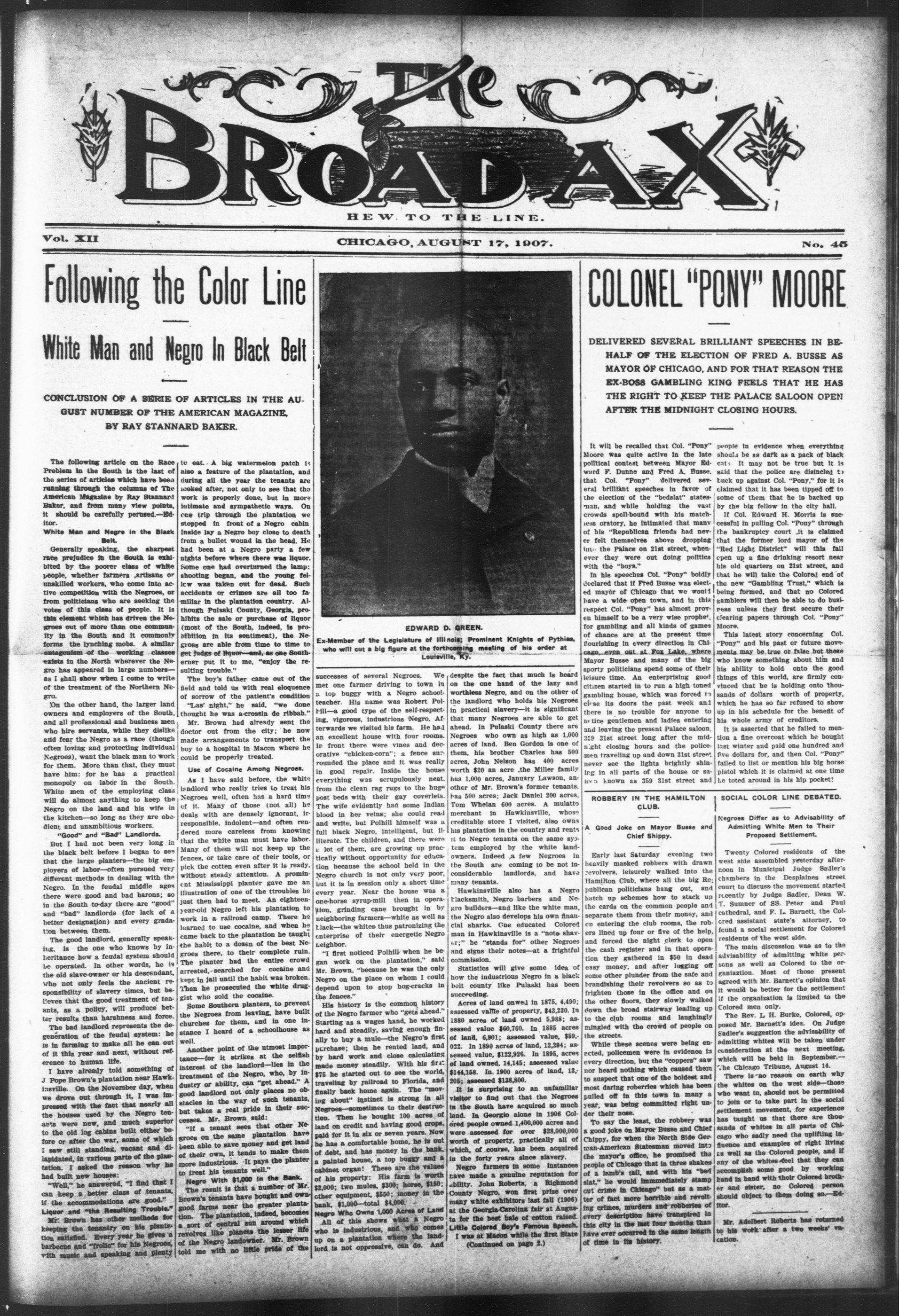
[Portrait of a man in a dark coat with a white shirt and a black tie. The background is a plain, light color. No text or additional details are present.]
Ex-Member of the Legislature of Illinois; Prominent Knights of Pythias who will cut a big figure at the forthcoming meeting of his order at Louisville, Ky.
successes of several Negroes. We met one farmer driving to town in a top buggy with a Negro school-teacher. His name was Robert Polhill—a good type of the self-respecting, vigorous, industrious Negro. Afterwards we visited his farm. He had an excellent house with four rooms. In front there were vines and decorative "chicken-corn"; a fence surrounded the place and it was really in good repair. Inside the house everything was scrupulously neat, from the clean rag rugs to the huge post beds with their gay coverlets. The wife evidently had some Indian blood in her veins; she could read and write, but Polhill himself was a full black Negro, intelligent, but illiterate. The children, and there were a lot of them, are growing up practically without opportunity for education because the school held in the Negro church is not only very poor, but it is in session only a short time every year. Near the house was a one-horse syrup-mill then in operation, grinding cane brought in by neighboring farmers—white as well as black—the whites thus patronizing the enterprise of their energetic Negro neighbor.
"I first noticed Polhill when he began work on the plantation," said Mr. Brown, "because he was the only Negro on the place on whom I could depend upon to stop hog-cracks in the fences."
His history is the common history of the Negro farmer who "gets ahead." Starting as a wages hand, he worked hard and steadily, saving enough finally to buy a mule—the Negro's first purchase; then he rented land, and by hard work and close calculating made money steadily. With his first $75 he started out to see the world, traveling by railroad to Florida, and finally back home again. The "moving about" instinct is strong in all Negroes—sometimes to their destruction. Then he bought 100 acres of land on credit and having good crops, paid for it in six or seven years. Now he has a comfortable home, he is out of debt, and has money in the bank, a painted house, a top buggy and a cabinet organ! These are the values of his property: His farm is worth $2,000; two mules, $300; horse, $150; other equipment, $550; money in the bank, $1,000—total $4,000.
Megro Who Owns 1,000 Acres of Land
All of this shows what a Negro who is industrious, and who comes up on a plantation where the landlord is not oppressive, can do. And
despite the fact that much is heard on the one hand of the lazy and worthless Negro, and on the other of the landlord who holds his Negroes in practical slavery—it is significant that many Negroes are able to get ahead. In Pulaski County there are Negroes who own as high as 1,000 acres of land. Ben Gordon is one of them, his brother Charles has 500 acres, John Nelson has 400 acres worth $20 an acre, the Miller family has 1,000 acres, January Lawson, another of Mr. Brown's former tenants, has 500 acres; Jack Daniel 200 acres, Tom Whelan 600 acres. A mulatto merchant in Hawkinsville, whose creditable store I visited, also owns his plantation in the country and rents it to Negro tenants on the same system employed by the white landowners. Indeed, a few Negroes in the South are coming to be not in considerable landlords, and have many tenants.
Hawkinsville also has a Negro blacksmith, Negro barbers and Negro builders—and like the white man, the Negro also develops his own financial sharks. One educated Colored man in Hawkinsville is a "note shaver;" he "stands for" other Negroes and signs their notes—at a frightful commission.
Statistics will give some idea of how the industrious Negro in a black belt county like Pulaski has been succeeding.
Acres of land onweil in 1875, 4,490; assessed value of property, $43,230. In 1880 acres of land owned 5,988; assessed value $60,760. In 1885 acres of land, 6,901; assessed value, $59,022. In 1890 acres of land, 12,294; assessed value, $122,926. In 1895 acres of land owned, 14,145; assessed value $144,158. In 1900 acres of land, 13,205; assessed $138,800.
It is surprising to an unfamiliar visitor to find out that the Negroes in the South have acquired so much land. In Georgio alone in 1906 Colored people owned 1,400,000 acres and were assessed for over $28,000,000 worth of property, practically all of which, of course, has been acquired in the forty years since slavery.
Negro farmers in some instances have made a genuine reputation for ability. John Roberts, a Richmond County Negro, won first prize over many white exhibitors last fall (1906) at the Georgia-Carolina fair at Augusta for the best bale of cotton raised. Little Colored Boy's Famous Speech. I was at Macon while the first State
COLONEL "PONY" MOORE
DELIVERED SEVERAL BRILLIANT SPEECHES IN BEHALF OF THE ELECTION OF FRED A. BUSSE AS MAYOR OF CHICAGO, AND FOR THAT REASON THE EX-BOSS GAMBLING KING FEELS THAT HE HAS THE RIGHT TO KEEP THE PALACE SALOON OPEN AFTER THE MIDNIGHT CLOSING HOURS.
It will be recalled that Col. "Pony" Moore was quite active in the late political contest between Mayor Edward F. Dunne and Fred A. Busse, that Col. "Pony" delivered several brilliant speeches in favor of the election of the "bedslat" statesman, and while holding the vast crowds spell-bound with his matchless oratory, he intimated that many of his "Republican friends had never felt themselves above dropping into the Palace on 21st street, whenever they were out doing politics with the "boys."
In his speeches Col. "Pony" boldly declared that if Fred Busse was elected mayor of Chicago that we would have a wide open town, and in this respect Col. "Pony" has almost proven himself to be a very wise prophet, for gambling and all kinds of games of chance are at the present time flourishing in every direction in Chicago, even out at Fox Lake, where Mayor Busse and many of the big sporty politicians spend some of their leisure time. An enterprising good citizen started in to run a high toned gambling house, which was forced to close its doors the past week and there is no trouble for anyone to notice gentlemen and ladies entering and leaving the present Palace saloon, 359 31st street long after the midnight closing hours and the policemen traveling up and down 31st street never see the lights brightly shining in all parts of the house or salon known as 359 31st street and
ROBBERY IN THE HAMILTON CLUB.
A Good Joke on Mayor Busse and Chief Shippy.
Early last Saturday evening two heavily masked robbers with drawn revolvers, leisurely walked into the Hamilton Club, where all the big Republican politicians hang out, and hatch up schemes how to stack up the cards on the common people and separate them from their money, and on entering the club rooms, the robers lined up four or five of the help, and forced the night clerk to open the cash register and in that operation they gathered in $50 in dead easy money, and after lugging off some other plunder from the safe and brandishing their revolvers so as to frighten those in the office and on the other floors, they slowly walked down the broad stairway leading up to the club rooms and laughingly mingled with the crowd of people on the streets.
While these scenes were being enacted, policemen were in evidence in every direction, but the "coppers" saw nor heard nothing which caused them to suspect that one of the boldest and most daring robberies which has been pulled off in this town in many a year, was being committed right under their nose.
To say the least, the robbery was a good joke on Mayor Busse and Chief Chippy, for when the North Side German-American Statesman moved into the mayor's office, he promised the people of Chicago that in three shakes of a lamb's tail, and with his "bed slat," he would immediately stamp out crime in Chicago" but as a matter of fact more horrible and revolting crimes, murders and robberies of every description have transpired in this city in the last four months than have ever occurred in the same length of time in its history.
ONY" MOORE
BILLIANT SPEECHES IN BEION OF FRED A. BUSSE AS AND FOR THAT REASON THEING FEELS THAT HE HAS THE PALACE SALOON OPEN CLOSING HOURS.
people in evidence when everything should be as dark as a pack of black cats. It may not be true but it is said that the police are disinclined to buck up against Col. "Pony," for it is claimed that it has been tipped off to some of them that he is backed up by the big fellow in the city hall.
If Col. Edward H. Morris is successful in pulling Col. "Pony" through the bankruptcy court, it is claimed that the former lord mayor of the "Red Light District" will this fall open up a fine drinking resort near his old quarters on 21st street, and that he will take the Colored end of the new "Gambling Trust," which is being formed, and that no Colored gamblers will then be able to do business unless they first secure their clearing papers through Col. "Pony" Moore.
This latest story concerning Col. "Pony" and his past or future movements may be true or false but those who know something about him and his ability to hold onto the good things of this world, are firmly convinced that he is holding onto thousands of dollars worth of property, which he has so far refused to show up in his schedule for the benefit of his whole army of creditors.
It is asserted that he failed to mention a fine overcoat which he bought last winter and paid one hundred and five dollars for, and then Col. "Pony" failed to list or mention his big horse pistol which it is claimed at one time he toed around in his hip pocket!
SOCIAL COLOR LINE DEBATED.
Negroes Differ as to Advisability of Admitting White Men to Their Proposed Settlement.
Twenty Colored residents of the west side assembled yesterday afternoon in Municipal Judge Sadler's chambers in the Desplaines street court to discuss the movement started recently by Judge Sadler, Dean W. T. Sumner of SS. Peter and Paul esthedral, and F. L. Barnett, the Colored assistant state's attorney, to found a social settlement for Colored residents of the west side.
The main discussion was as to the advisability of admitting white persons as well as Colored to the organization. Most of those present agreed with Mr. Barnett's opinion that it would be better for the settlement if the organization is limited to the Colored men only.
The Rev. L. H. Burke, Colored, opposed Mr. Barnett's idea. On Judge Sadler's suggestion the advisability of admitting whites will be taken under consideration at the next meeting, which will be heli in September.—The Chicago Tribune, August 14.
There is no reason on earth why the whites on the west side—those who want to, should not be permitted to join or to take part in the social settlement movement, for experience has taught us that there are thousands of whites in all parts of Chicago who sadly need the uplifting influence and examples of right living as well as the Colored people, and if any of the whites feel that they can accomplish some good by working hand in hand with their Colored brother and sister, no Colored person should object to them doing so.—Editor.
Mr. Adelbert Roberts has returned to his work after a two weeks' vacation.
THE BROAD AX.
‘PUBLISHED WEEKIY.
ene
Soeeseess
See ese oese et
Soe
cigcaabecee
‘Subscriptions must be paid tn advance.
Bee
‘heccerce re may oom apt,
THE BROAD AX
tai Armor Avene, Chienge.
BLIUS ¥. TAYLOR, Metter and Prbiicher.
pe che eeaeeeanmEE
Eestered xt the Post Office at Chicagn
BL, 28 Second-class Matter.
———
FOLLOWING THE COLOR LINE.
(Concladed from p3ge 1.)
fair was largely attended, and not
caly by Negroes ,but by many white
visitors. The brunt of the work of
organization fell upon R. R. Wright,
president of the Georgia State’ Indus
trial College (Colored) of Savannah.
President Wright is a full-blooded
African descént, his grandmother, who
reared him, being an African Negro
of the Mandingo tribe. Just ‘at the
close of the war he was a boy in 2
frecdman’s school at Atlanta. One
Sunday General O. 0. Howani came
to address the piipils. When he had
finished, he expressed a desire to
take a message back to the people of
the North. 3
“What shall I tell them for you?”
ke asked.
A little black boy in front stood up
quickly, and said:
“Tel ‘em, Massa, we is rising.”
Upon this incident John Greenleaf
Whittier wrote a famous poem: and
st the Negro fair ,crowning the charts
which had been prepared to show the
Jrogress of the Negroes of Georgia,
I saw this motto:
“WE ARE RISING.”
The little black boy grew up, was
graduated at Atlanta University, stud:
ied at Harvard, traveled in Europe
served in the Spanish-American War,
and is now seeking to help his race
to get an industrial training in the
college which he organized in 1891.
‘The attendance at the fair in Macon
was between 25,000 and 30,000, the
Negroes raised $11,000 and spent $7.
000, and propose to have a greater fair
this year. In this enterprise they had
the sympathy and approval of th»
best white people. A vivid glimpse of
what ‘the fair meant is given by the
Daily News of Macon—a white news-
paper:
“The fair shows whst progress can
be accomplished by the industrious
and thrifty Negro, who casts aside
the belief that he is a dependent, and
sails right in to make a living and a
home for himself. Some of the agri-
cultural exhibits of black farmers
have never been surpassed in Macon.
On the whole, the exposition just
simply astounded folks who did not
know what the Negro is doing for
himself.
“another significant feature about
the fair was the excellent behavior of
the great ‘throngs of Colored peopl
Who poured into the city during its
progress. Thére was not an arrest 03
the fair grounds and very few in the
city.”
‘The better class of Negro farmers,
indeed, have shown not only a capac-
ity for getting ahead individually, but
for organizing for self-advancemen:,
and even for working with correspond:
ing associations of white farmers. The
great cotton ami tobacco’ associations
of the Gouth, which aim to direct
tbe marketing of the product of the
forms, have found it not only wise,
‘Dut necessary to enlist the coopera.
tion of Negro farmers. At the annual
rally of the dark+tobacco growers at
Guthrie, Ky., last September, many
‘Negro planters were in the line of
parade with the whites. The farm
ere conferences held at Hampton,
‘Tuskegee, Calhoun , and at simile:
schools, filustrate in other ways the
possibilities of advancement which
grow out of landownership by the Ne
grees.
‘The Penatties of Being Free.
© So mmeh for the sunny side of th:
picture; the broad-gauge landlord an‘
‘the prosperous tenantry. Conditions
4h the black belt are in one respect
agmuch as they were in slavery times
water ‘would be under any: feuds
‘system: if the master or ons i
“good,” the Negro prospers; if he is
1 ,, grasping, unkind, the Negrc
to: the. aan. In assuming
faleo essumes tremendous dutios and
re a
jou, She! an. and ener
eerTp ae aeee
St Be ae pee
Of course, ‘scarcity of labor and
High wages have given the really am-
bitious and industrious Negro his op-
portunity, and many thousands of
them are becoming more and mors
independent of the favor or the tll-
will of the whites. Ami therein. lies
a profound danger ,not only to the
‘Negro, but to the South. Gradually
icsing the support and advice of the
vest type of white man, the independ-
‘ent Negro finds himself in competi-
‘Gon with the poorer type of white
man, whose jealousy he must meet.
He takes the penalties of being really
free. Escaping the exactions of s
feudal life, he finds he must meet
the sharper gifficulties of a free in-
dustrial system. And being without
the political rights of his poor white
competitor and wholly without social
recognition, discredited, by the bestial
ctimes of the lower class of his own
race, he has, indeed, a hard struggle
before him. In many neighborhoods
he fs peculiarly at the mercy of this
iower class white electorate, and the
self-seeking politicians whose stock in
trade consists in playing upon the pas-
sions of race-hatred.
(To be continued.)
MICHAEL C. McDONALD AND HIS
EARTHLY TROUBLES ARE
ENDED.
ENDED.
Last Saturday morning Michael c.
McDonald, who was for many years
‘ene of the controlling factore in the
political affairs in this city and abso
lute boss among the gambling frater
nity, passed away at a West Side hos
pital, thus ending all of his earthly
troubles.
Funeral services were heh over his
remains at the Chureh of (Our Lady
of Sorrows, Albany Ave., and Jack-
son Blvo., on Monday and his funeral
was largely attended by all national-
ities.
The following were the honorary
and active pall bearers: Wm. A.
Pinkerton, A. S. Trude, George M.
Shippy, Wesley Shimeal, Wm. Pitz:
gerald, John Condon, M. C. Conlon,
John Powers, E. F. Cullerton, William
Skakel, Robert E. Burke, Alexander
Sullivan, Charles (“Parson”) Davies,
Dr. Leonard St. John, Pat Sheedy (N.
Y.), George M. Noyes, P. Page, John
Lunphy, Wm. A. McGarigle, James H.
Hildreth, Thomas Foley, Judge John
Gibbons, Elbridge Hanecy, Charles
Piamondon, Robert M. Mitchel] Matt
Hogan, George A. Trude, Frank Cain,
B. Ramsey, Nicholas Hunt, John L.
Whitman, E. H. Lauterbach, Ed Alex-
atider, Lieut. John Hartnett, Thomas
Skahen, Dan Doyle, Thos. O’Shaugh-
nessy, Harry Holland, Thomas McNal-
ly. All officers and members of the
Cook County Democracy.
The active pallbearers were: M. J.
Comerford, W. W. Boyd, P. H. O’Don-
nell, L. Miller, James Horan, Charles
Winship, Edward Maher, Robert Cal-
ledine.
The celebrant of the Mass was th?
Rev. Robert McGuire of the Church
of Our Lady of Sorrows, Rev. J. J.
Jennings of the Church of the Pre-
sentation, was deacon, and the Rev.
Father Martine of St. Anthony's Cap-
€] subdeacon.
The Rev. Father M. J. Dorney uf
St. Gabriel's church preached the fu-
neral sermon, who was a personal
friend of M. C. McDonald ,and he
spoke in part as follows:
“ask Lyman J. Gage, great factor
in one of the largest financial institu:
tions in Chicago—he may be here,
for aught I know—for his estimate of
Mike McDonald,” said the priest.
“Doubtless he will tell you that Mike's
paper and his word were good. Who
was instrumental in placing Murray
F. Tuley in the common council of
the city of Chicago? Mike McDonald:
‘Who subsequently had s great share
in placing Murray F. Tuley on the
bench? Mike MeDonald!
“Who placed that other great jur-
iet, McAllister, on the bench? Mike
‘McDonaldi
“Who was it that gave to the city
of Chicago one of its best health com
missioners and at a time when Chi
‘cago needed a big man for the posi-
tiom—I refer to Dr. Wickersham!
Mike McDonald.
“Who was it they called the king
cf the politicians and the gamblers
but who was’ it whose shrewdness
enabled him to exercise such a pow
ler? Mike McDonald.”
In glowing terms Father Dorney re
ferred to the deeds of charity and the
penefactions of Mike McDonald.
“He easociated with gamblers an¢
others without the pale of the church
end gave scandal in various ways,’
|said the speaker, “but before bi
death he was heartily sorry for it
and he died a true Christian.”
In many respects Michael C. Me
‘Donald was cruel, wicked man, tha
be failed to treat some of those wh:
ere near and dear to, him as the:
oar treated but .with al
nis faults he possessed « big, warm
[heart ,2nd he was always found con
i for the civil and political
‘ot the Negro, and he was io
neenent aamedend ee
ieee ie esaitnn- Selene ‘watees 6
break away from their blind slayery
to the Republican party.
Te goes without saying that when-
ever worthy Colored people went to
him, with their financin and other
troubles ,he never turned them away
empty handed and his many good
deeds should overbalance and out:
weigh the many evils which fell
scross “his pathway in his journey
through life.
INSTITUTIONAL CHURCH, 3825
DEARBORN STREET.
Special service at 10:50 a.m. The
pastor will preach upon a theme of
special interest ,touching the moral,
social and religious life of the Negro
of the city.
Special program at the morning ser-
vice. Inasmuch as the pastor will
give an illustrated sermon at Quinn
Chapef there will be no services held
‘at the Instittuional church Sunday
right, but the choir and members wil!
go to Quinn Chapel.
‘Snuday, August 25th will be special
service all day at the church. Pro
gram will be announced next week.
‘The Girls' Secret is the title of a
@rama in three acts which willl be
rendered at the Institutional Church
September the 2nd. under the dire.
tion of Mrs. Todd.
‘The Fall Festival will be held this
year Sept. 10, 11, 12. Booths will be
farnished by the clubs of the city
Following booths have been arrange]
‘Apron booth, Cornell Charity Clu».
Delicatessen booth, I. B. W. Club; mis-
cellaneous booth by the Phylis Wheat-
ly Club, Children Booth, Mabel Smith.
Other clubs will assist in furnishinz
the programs and serving refresh-
ments, etc.,
Mrs. Celia Parker Woolley will fur-
pish the program for the night of the
ith. This will be well selected and
worth your consideration —“S.”
STOP COURT TO ARREST JUDGE.
Houston, Tex. Aug. 10.—Judge H.
B. Short was arrested while holding
court, on an indictment charging him
with complicity in the murder of Dr.
Mike Paul last fall. He was engaged
in trying an important civil sult, but
the arrest caused a postponement un-
ti he could give bond in the sum of
$10,000.
Dr. Paul was one of the posse pur-
sting a Negro, Dick Garrett. Gar-
rett took refuge in the home of Judge
Short and fired upon the posse, kill
ing Dr. Paul.
It is too bat that Judge Short dit
not kill every man composing the
anob, for actions at that time is the
Lest method to adopt in order to re-
strain the lawless element from tak-
ing the law into their own hands—
Editor.
NINE WHITE MEN!
One delicate, refined young white
woman, 17 years old, was attacked
and raped by nine white men in New
York last week. She is now insane
Where, oh where is Old Ben Till-
man, Rev. Tom Dixon, Jim Varda-
man, Jeff Davis, John Temple Graves
and the other whining he tom cats
who claim that white gentlemen nev-
er rape females belonging to the su-
perior race, that only Negroes com-
wit such crimes!—Editor.
“JIM CROW” CARS.
Trouble is daily occuring in the
South over Jim Crow cars. Whites
are being arrested for going into
“Negro seats.” Negroes are being ar
rested for remaining in Negro seats
when told to move. Only last week
a promnient Colored real estate deal-
er of Newport News, Va, was ar
rested and fined for not moving out
of Negro seats to give more room for
white persons—The Union, Cincin-
pati, Ohio.
WOULD DISFRANCHISE NEGRO;
- GEORGIA HOUSE PASSES BILL.
‘Legisiators by an Overwheiming Vote
Adopt Measure Which, It is Esti-
mated, Will Affect 95 Per Cent of
Blacks.
Atlanta, Ga, Aug. 14.—By a vote of
159 to 16 the lower house of the
Georgia general assembly today pass
‘ed the bill to distrancise the Negross.
‘The measure already had been passed
by the senate and now goes to Gov.
Hoke Smith, who will approve it. It
is claimed the law will disfranchise
198 per cent of the Negroes.
Wanted First-Class Housekeeper.”
‘Wanted Housckeeper—zxperiencd®,
comely Colored or creole girl, ex-
tremely neat ami clean, who has
‘worked in s high class, up-to-date fam-
Uy. Must be quiet, light in color, and
‘well trained, and furnish unquestion-
able reference. State age, wages and
‘Where previously employed. Address
|J..M., care Editor of The Broad Az,
THE LELAND GIANTS WON TWO
OUT OF THREE GAMES IN
_. THEIR HOT CONTEST WITH
THE ALL-STARS—
LAST WEEK.
Rube Foster, who is one of the
greatest base ball players in tii> coun
try, last week lead the “Giants” on
to victory for he and his team wo
two out of three hot contests with the
AllStars, and the Colored fans, and
m fact all the Colored and white
sporting element who put up their
money on the “Giants” rolled ‘a
wealth all last week, for everything
came their way until last Sunday af-
iernoon, then the “Giants” went down
to defeat before Jake Stahl's South
Chicagos.
‘This coming Sunday afternoon the
“Giants” will play the Marquettes at
auburn Park, 79th and Wentwort?
Ave., and Rube Foster promises to do
seme great twirling, make all hom:
runs and win the game.
CHIPs.
Mrs. Augusta Hawkins and vaug-
ter will spend a few days with friends
in Springfield, ll.
Mrs. S. B. Toller, of Vicksburs.
Miss., is the guest of Mrs A. H.
‘Thomas, 3617 Dearborn St.
Mrs. James E. Thompson has re-
turned .from her summer's resting
place much improved in health.
Mrs. Charles A. Blanchford of Louis-
ville, Ky., is visiting ber friend, Mrs.
Robt. A. Williams, 3544 Dearborn St.
Frank H. Lewis continues to con-
uct the Railroad Inn Buffet, 51st
etreet and Armour Ave., in first class
shape.
Dr. Geo. °C. Hall and Maj. F. A.
| pentson are spending their vacation
iu Atlantic City, New Jersey, and
cther Eastern points.
The Subscription Dancing Party
given at Oakland Music Hall Friday
evening was a social success. A large
rumber of visitors attended.
Mrs. 0. R. Bryant, 6432 Champlain
Ave, announces the marriage of her
caughter, Mellie Rea Bryant, to Mr.
Henry Dailey, May 15th ,1907.
Mrs. Lulu Williams. 2415 Wabash
Ave., spent last week in Cincinnati.
©. She is back home aguin feelin;
1efreshed from her delightful trip.
Mrs. Dee Parker, 179 Lincoln Ave.
has gone to Battle Creek, Mich.,
where she will receive medical treat-
ment and rest up in 2 sanitarium for
several weeks.
Miss Lucy Lindsay, 4110 Calumet
Ave., returned to the city Wednesday
from Oskaloosa, Iowa, whither she
went to attend the obsequies of a
friend.
Mr. and Mrs. Philip Green, 343 W.
47th St, are making preparations for
a month's vacation during which they
will travel east, where they have
many friends and relatives.
The Oli Settlers’ Picnic at Rasch’s
Grove Monday evening, was attended
by a large number of our old and
young citizens who enjoyed themsel-
yes at dancing and greeting.
Mr. Noah D. Thompson retunred
the first of the week from Somerset,
Pa, where, with his little son he en-
joyed a two week’s vacation in the
mountains.
Mrs. Dago her children and her sis-
ter, Miss R. Marie Edie ,spent last
Sunday in a boat ride to St. Joseph
Mich, and they had an enjoyable
time. i
Rev. Mary Lark Hill, 5253 Dearborn
street, returned Tuesday morning
from Pittsburg, Pa., where she spent
the past month in preaching and fur-
ther working in the interest of hor
Lord.
‘Mrs. Edward 8. Miller, 3642 Wabash
Ave., wo is one of the charming lead-
ers of the four hundred, willl for the
rest of the summer entertain Mrs.
Chas. Pickett of Washington, D. C.,
who arrived in the city this morning.
Mrs. Florence Thompson Woodard
jentertained a small number of her
friends Wednesday evening in honor
of ber guest, Miss Hazel Richardson
ef Bt, Louls. Music and dancing were
‘the principal features of the event.
‘The guest of honor possesses a sweet
voice with which she charmed all
/present.
Bobert. W. Taylor, who for a long
|time wis the financial agent, or the
Soe. fr Tuskegee Institute,
made enough money for awhile
im. that line of business, has gave up
his easy fob, and on September first
jhe will ‘& broker's office on
Broad ‘York City, as a spe-
is ‘This proves
‘that thers is in learning bow
is ou omae
4 in this same line of Work,
The funeral of Col. R. A. Ware, held
‘at Quinn Chapel last Sunday after-
noon, was very largely attended.
‘The K. P.'s and Odd’ Fellows turned
cut in full force to do him honor.
‘There. was two bands of music and
the funeral procession made a strik-
ing appedrance, while wending Its
way on toward Oakwood cemetery.
Mrs, Beauregard F. Moseley and her
caughter Bertha ami two sons, Mas-
ters Burton and Burcauregard, Jr,
have returned home from Washington,
Ga., where they went early in Jul?
for a summer's outing. They are all
well and looking better. For real en-
Joyment they recommend the country
or rural life.
Nicholas Hunt, who was for many
years inspector of police in the Hyde
Park district, has to the great delight
of his army of friends been restored
to his former position by Chie Shippy
and Inspector Hunt is wearing a
smile which will not come off and
doing business in the same quarters,
where he has been a familar figure
for many years.
Misses Florence and Laura Smith,
who make their home with Mrs. 1.
Williams, 2415, Wabash Ave., when ip
the city, and who are maids on the
20th Century Limited on the Pennsy!-
yania Railroad which runs betweea
New York and Chicago, will, com-
mencing with the first of next week,
spend their vacation with thelr par
ents at Straussburg, Pa.
Madam D. B. Hagans entertained a
nember of her friends last week at
her beautiful home, 5031 Shields ave ,
in honor of Miss Stella Wilson, of
Kansas City, Kan. Mrs. Sedge Fur-
gurson and Mrs. Carter of Kansas
City, Mo., who have been the guests
of Miss Jennie Dorsey, 5302 Dearborn
St. The hostess served 2 maost tempt:
ing menu and a most delightful even-
ing was spent. The guests departing
at a late hour pronounced Madam H:-
gan, a most royal hostess. Prof. and
Mrs. S. Lee assisted the host and
| Postess in receiving.
Thursday evening Mrs. Edward Nix-
ie 2827 Wabash Ave., despite the
‘rain, gave a delightful lawn fete in
‘honor of her visiting grests, Mrs.
[esate Smith Plumb, of Mexico City.
Mexico, and Miss Charity A. Boyd,
| ropular school teacher of Frankfort,
iKy. The many ladies present looked
lever so lovely in white dresses and
carnations. The gentlemen attend.
ba the affair wore black suits and
| white ties. The house was decoratet
‘very finely where the guests enjoyed
‘themselves in dancing. A tasteful
|iuneheon was served In the spacious
‘iawn which was illuminated with
[Japanese lanterns. The hostess, Mrs,
‘Mixon, who is one of Chicago, old-
‘est and most highiy esteemed Afro-
American citizens ,spared no pains in
entertaining her visiting guests an!
| friends.
Front Bedroom to Rent.
For rent, front bedroom for maa
and wife, or two gentlemen, must fur-
nish good reference. Apply to Mrs.
Gardner, 3546 State street, top fiat
front.
Sa-Ban-dy hair dressing guaranteed
tor harsh, stubborn or dry hair and
scalp.
Geo. W. Fields & Co.,
3916 State St.
EIGHT ROOM HOUSE AND LOTS
FOR SALE.
For Sale—$-room house, 3331 Ver-
non Ave., $3,950, $500 cash, balance
like rent.
Lots on easy terms Glencoe & Chi
cago Lawn.
For Sale—9-room brick house, 32m,
end Forest Ave., $3,250—$250 cash.
S-room cottage, Dearborn and 65th
St. Bath, gas, ete., $2,000—$300 cash.
NEIGHBORS & JOHNSON,
3916 State St,
Phone Douglas 4965.
. ‘Special Announcement.
From on and after this date all ax:
nouncements of entertainments, etc,
for which an admission ts charged,
will be considerea sdvertising, and
‘will be charged for at the rate of 12
‘cents @ line, seven words to a line
‘The money must accompany the mat
ter and reach the editor no later than
‘Thursday morning of the week tn-
etc in ‘This rule will
also apply to all personal items and
matter for which no charges will be
‘made. In other words, all pews mat
“Did she weally call you = puppy?”
“Well—er—no, not exactly. She
‘merely asked me if I liked dog-biscult.”
“This is a hard world,” said the bal-
loonist,. as be dropped out of the
ROPES Fe” ee SRE
.
1 pity, the.man who can't learn
anything from his own mistakes. Now,
‘that’s one thing I can do,” said Bragg.
“Ab! You're always learning some-
MAN, COW, FIDDLE”
‘Trio Commemorated on a Tombstone
In a Connecticut Cemetery.
a Kae Sees ee
In the old cemetery of Central vi!
lage, near Plainfield, Conn.,-is the only
tombstone known in New Enzlan|
erected to a cow and its owner? In
several cemeteries have been found roe.
ords that horses, dogs aud even cit
Dave been laid at rest beside their
masters, but in no other instance on
record has a cow had a slab erecte in
her honor.
‘The cow's name was Tosa, and th
Inscription says that she gave two
‘pounds fifteen ounces of butter rom
‘thirfeen quarts of milk in one day
This was a pretty good record for
cow, and a Jersey at that, the inserij-
tion goes on to say.
On the opposite side of the mowy:
‘ment is the inscription, “All Ready,
‘Mr. Cady,” and below are the wonis
“At Rest.” Above is the outline of «
‘Addle crossed with a bow.
Gurdon Cady, to whose memory thy
stone was erected, was known fron
‘the Massachusetts line to Long Islanl
sound and from Providence to the Con.
‘necticut river half a century ago as the
finest fiddler that ever drew a bow at «
‘country dance. He had two loves,
‘Rosa and his fiddle, both of whict
found a place on his tombstone.
‘Marm Kemney’s celebrated inn at
Stafford was one of the most popular
fields for Cady and his fiddle. From
the time he started until the final tour.
| ish of the bow, when he chanted, “ii
promenade to seats,” there was same-
‘thing doing every minute. Some of the
residents here can recall many 2 time
when they danced to his music until
the sun's rays lighted the ballroom.
He would yell in between times spe-
cial instructions to uncert. maids
‘and swains. Once, seeing ayo gman
at a loss what to do in the mi. - of «
set, he sang out, “Swing that girl with
the yellow apron on!” And the girl
was promptly swung. All such diver-
sions were worked in with his prompt-
ing, and no one except the persons ad-
‘dressed paid any heed.
Ten dollars a day or night and ail
“expenses of traveling was the usual
-ebarge of Cady for his services in ren
‘dering “Money Musk,” “Chorus Jiz.”
“The Irish Washerwoman™ and “Ilull'<
Victory.” whieh comprised his reper-
toire. During the dancing season he
“was continually on the road from one
inn to another. :
| Outside of his love of music bis most
“conspicuous trait was his love of eat-
tle. Before he died he made arranze
meits to have the name of bis favorite
cow Rosa handed down to posterity
with his own.--New York Sun.
Nature Fakes.
After a careful and impartial con-
sideration of all the evidence bearin=
on the subject, says the Indianapolis
News, the investigating committee re-
ports that, notwithstanding their lonz
life and apparent respectability, the
following are undoubtedly nature
fakes:
‘The bull in the china shop.
‘The wolf at the door.
‘The fly in the ointment.
‘The dog in the manzer. z
‘The fish out of water. se
‘The bee in the bonnet. ee
‘The flea in the ear. ae
The rat that was smelled. ‘—*
Pigs in clover. ae
Horse and borse. &
‘Time flies. Mees
The Welsh rabbit. -—ee
The man on a lark. 2
gl caer
In the latest issue of the Naval An-
nual, published by J. Griffon & Co,
Portsmouth, England, the editor. Mr.
TT. A. Brassey, declares that the most
important change in the relative
strength of navies during the year is
the fact that the United States bas be-
come the second naval power of the
world. He bases this classification
mainly on the number and character
of the battleships built and building by
each country, and after establishing
thelr absolute war value, as expressed
in the terms of guns, speed. protection,
habitability and hardiness, he fixes the
precedence ‘in the sea hierarchy as fol-
lows: First, Great Britain by a long
lead; second, United States; third, Ger-
many; fourth, France; fifth, Japan;
sixth, Russia, and seventh, Italy.
ieee iat
Camille Saint-Saens, the French
composer, boasts that, like Mozart, he
chose his relatives with the greatest
discretion. His mother was an artist,
his aunt an accomplished musician.
The child showed very early an ex-
traordinary susceptibility to musical
sounds, and he delights to tell how,
when he was a tot of three or four,
his great-aunt would get all the clocks
im the house and set them striking,
making him tell her the difference in
the vibrations and imitate them with
his voice. To this early training be
attributes much of his remarkable
memory and faultless ear.
Sensitive Earthquake Recorder.
‘The ordinary selsmograph or earth-
quake recorder registers the motion
of the earth under a “stationary” pen-
dulum of 100 or 200 pounds. A new
instrament by Dr. Wiechert, made at
Gottingen, has a suspended pendulum
weighing ‘nearly seventeen tons, and
2 series of levers causes its indicator
to magnify the earth motion 2,200
times. So sensitive is the apparatus
that ft showed tremors due to « gas
‘engine located a mile and a half away.
3 & Bit of Britich Temoer.
|. Why should not the Tower of London
be fitted up as = hostelry for American
millionaires only? Prices double those
of the Bits or Caritos. Beefeaters
Included as valets for any one taking 8
suit of rooms. Crown jewels om hire
for the night. Chambers with blood
‘stains extra. —London Bystander.
Brevities
THE HALL OF FAME
Samuel Smalel of Cleardown county, Pa., is eighty-one years old and is serving his township for the twenty-seventh year as its tax collector. Senator Newlands of Nevada is fond of using flowery language in his speeches. He is rich and was formerly a strong advocate of free silver. The largest baby ever born in Chicago measures one foot eleven inches, weighs eighteen and one-half pounds and will be christened Fred Busse Ross in honor of the mayor of Chicago. Secretary Cortelyou proposes to apply civil service rules in the treasury department without reference to sex and has begun by promoting several deserving women to better places and higher salaries.
The Echo de Paris confirms the statement that the first visit of M. Fallieres abroad will be to London in April or May of 1908. The president's visit to England will have a semi-official character.
A young son of well known Castle Hill (Me.) parentage bears a combination of historical names. Millard Fillmore's son married Andrew Jackson's daughter and their first offspring was named Andrew Jackson Millard Fillmore.
Commander Nicholson, who navigated the Oregon on her famous record breaking trip around South America in the Spanish-American war, had been promoted to captain and was given command of the new battleship Nebraska on July 1.
N. Gilbert Whitmore of Eastondale, Mass., although seventy-one years old, is said to be the oldest weapon maker in the country. At one time he made and presented to General U. S. Grant a sporting rifle of exquisite workmanship valued at $1,000.
Professor W. A. Henry of Wisconsin, one of the leaders in American agriculture, has purchased a tract of land in Wallingford, Conn., and proposes to make his home there after thirty years' service in the State university of Wisconsin.
Following the custom of many years, "Old Man" Fritz, keeper at the St. Louis Country club, recently sold his crop of whiskers for $8. Fritz lets his whiskers grow to his waist every three years and then cuts them off and sells them to the hairdressers.
Francis Kay Pendleton, whom Mayor McCellan has appointed corporation counsel of New York city, is a son of the late Senator George Pendleton of Ohio, who was the candidate for vice president on the same ticket on which the mayor's father, General McCellan, was the nominee for president in 1864.
THE SPORTING WORLD.
Outfielder Jude, the Indian of Columbus, has twice this season made five hits in five times at bat
Sonoma Girl, with her heat in 2:00% at Libertyville, establishes a world's record in a race, trotting, for a green mare.
It is now definitely settled that an international cricket match will be played in New York next fall between the Marylebone Cricket club of London and American club teams.
Orby, the great colt that won the English and Irish Derbys in the colors of Richard Croker, may be retired to the stud at the end of the racing season. Croker is undecided whether or not to race him next year.
Comiskey employs no scout for his Chicago club. In fact, he takes players cast off by other major league clubs and makes stars of them, for instance, Hahn, Dougherty, Altrock, Donahue and McFarland. Commy never paid a cent for Sullivan, Tannehill, Davis, Jones or Isbell.
PITH AND POINT.
A little present is often but another name for a bribe.
Time gets away from an old man almost as quickly as money gets away from a young man. When a man first makes a fool of himself he gets an awful jolt—but he soon gets used to it. Remember, young man, if you are not satisfied with your job, the chances are that the boss will not refuse to accept your resignation.—Chicago News.
Editorial Flings.
The preservation of the mosquito was one of the most irritating of the numerous mistakes of Noah—Boston Globe.
A New York judge rules that it is not wrong to kiss a girl on the street. Not wrong perhaps, but one can think of better spots—Cleveland Leader.
"Men in this country sleep too much," says Dr. Wiley. What! Has that man been experimenting with night watchmen?—New York Herald.
Marie Corell condemns man in general. She says he's no good and a coward and a mutt, but she omits to show her sisters how they can get along without him—New York Ameri-
SHORT STORIES
A boy of twelve in New York has five rows of teeth, or sixty teeth in all. Some expert has figured out that there are only 2,000 professional baseball players in the country. Dr. Thomas Darlington of New York says keeping dogs in the city is a crime against the city and cruelty to the animals. The sight of surgical instruments so frightened a man in a hospital at Norristown, Pa., that he leaped from the building and ran screaming into the street. By a formal order issued from the war department the memory of the late General Shafter, who commanded the American troops in Cuba during the Spanish war, has been honored by bestowing his name upon the military post on the Kauaihui reservation near Honolulu, Hawaiian Islands.
Thirty-two years ago Mrs. Thomas Buker of Bath, Me., wrote two letters to her husband, Captain Buker, who was then traveling along the Mexican coast in a sailing vessel. The letters were never received by the captain and were recently returned to Mrs. Buker by the Mexican government.
ENGLISH ETCHINGS
There are over 12,000 shops for the sale of milk in London.
Tithes were first instituted in England in the reign of King Egbert, about 600 A. D.
Cholera has not been epidemic in Europe since 1866, when it appeared in both London and Liverpool.
It is estimated that the total first cost of England's present navy was $670,000,000, and about $390,000,000 has been spent in the last ten years.
Before the trial of a suit for damages was begun in a London court the other day it was remarked incidentally that the defendant, a laundry proprietor, had been dead eleven years.
An innovation in English county cricket was seen in the Yorkshire versus Sussex match at Sheffield. Before each delivery the ball was wiped with a towel, which was intrusted to the care of the umpire while the ball was in play.
PLAYS AND PLAYERS
Shakespeare has been translated into Japanese, and the thespians of the mikado are making his plays popular.
As to vaudeville, way back in the early sixties Ellen Terry made quite a success in that popular style of amusement.
Burr McIntosh, who left the stage some time ago for professional life and the lecture field, is going to return and star in "Pudd'nhead Wilson" and other plays.
Boston gave the stamp of its critical approval to the first performance of Richard Carle's new play, "The Hurdy-Gurdy Girl." Both music and lines are said to be bright.
Among the twenty-two attractions which A. H. Woods will have on the road next season two are musical, and the list includes ten new melodramas. The others are old successes.
HOME NOTES.
If a narrow ribbon or tape is run into the facings of kimono sleeves, they may be tied in a bow and kept out of the way when one is working about the house.
You will need less laundry soap if it is thoroughly dried before using. For this pile it in such a way as to leave open space between the bars to allow free access of air.
When kerosene oil has been spilled on the carpet, cover the spot thickly with either fuller's earth or buckwheat flour and leave twenty-four hours at least before brushing it off.
In some households bureau scarfs have been laid aside and the top of the dresser covered with a heavy glass slab. This can be easily wiped off and polished. As this glass is so thick there is little danger of it being easily broken.
FACTS FROM FRANCE
It is proposed to substitute solitary confinement during six years for the death penalty in France. No death sentence has been executed for some time.
Trial is now being made in Paris of a new system of paving. Steel is laid on a bed of cement after the fashion of wood paved roads, the interstices, too, being filled with cement.
A bird dealer in Paris raises canaries of an orange red tint by feeding the parent birds on cayenne pepper. In time he expects that the eggs will produce birds of a bright red hue.
About $80 per year is charged for an unlimited telephone service in Paris, but in addition to this the subscriber must purchase his own instrument, which may be any one of a number of different kinds.
The Plain Woman.
She need not appear plain.
She should experiment with her hair.
She must study her coiffure from all points.
Well arranged hair may balance and annul a defect.
A woman should beware of choosing a pretty chapeau.
Badly arranged hair may greatly exaggerate a defect.
The choice of a hat has the same good or bad effect.
It is the same with a dress or anything else. St. Louis Republic.
Will be given on Wednesday evening, August 28, at Tattersails, 16th and State sta., in honor of the visiting delegates to the Grand Lodge Session. Admission 50c. Elke Orchestra, Alex Armant, leader.
Fisherman—Ah! That's a good be-
ginning, a frying pan! I have only
got to catch a fish now and I shall be
all right.—Bon Vivant.
The Wise Bachelor
Some men would be more independent if they recognized their wives as belligerents.
A woman will never believe anything very bad about a man she has once seen wiping his eyes at a pathetic ic play.
No man is ready to get married until he doesn't care how many times a week he has the same kind of meat for dinner.
No woman ever really knows her husband till she has heard him hunting in the top bureau drawer for a clean handkerchief.
Nothing in the world is so pathetic as a girl who has made up her mind to reform some man and first begins to doubt whether he is going to let her—New York Press.
The Locksmith's Chance.
On the park bench sat two lovers. The passing locksmith dropped his kit and laughed long and uproariously. "Why do you laugh?" asked the park policeman. "Oh, just to get even," confided the locksmith. "You know love always laughs at locksmiths, so I thought it would be a good chance for the locksmith to laugh at love." And then the old man laughed himself out of sight.-Chicago News.
How It Happened.
Gyer-I was in a railway wreck seven years ago, and I never got over it.
Myer-You must have been badly hurt.
Gyer-I wasn't hurt at all. I didn't get over it because I crawled from under. See?-Detroit Tribune.
Perfectly Proper.
Stickler—Here! You've started your note to Borroughs "Dr. Sir." Don't you know that sort of abbreviation is very slovenly? Markley—No, sir. "Dr." is all right in this case. He owes me money.—Philadelphia Press
A. Precaution.
"Do you believe in corporal punishment?"
"Well," answered the father of several sons, "perhaps it is just as well occasionally to convince our boys that we are not mollycoddles."—Washington Star.
In Suspense.
An escaped murderer wrote a friend: "Jim, do you think if I'd give myself up that they'd suspend judgment?" The latter replied: "No, John. I rather thinks they'd suspend you!" - Atlanta Constitution.
An Ideal System.
"An ideal railway," answered the weary traveler, "is one whose trains arrive as punctually and safely as the dividends."—New York Life.
Tempting Odds.
"Why is it that a fellow's friends always think he is making a mistake in selecting a wife?"
"Oh, I suppose they can't resist the temptation when they have so many chances of being right."
Why He Quit It.
Percy—Are you still keeping up your deep breathing exercise, old chap? Ferdy—I have discontinued it for a time, dear boy. I am rooming next door to a glue factory just at present—Judge.
Telephone Calumet 185
E. A. STACK
DRUGGIST AND CHEMIST
Open Day & Night
Private Rooms
PEKIN INN CAFE
Chas. Lett, Proprietor.
ALA CARTE & TABLE DE HOTE
SERVICE
Music Every Evening.
Special Attention to Parties and Wed-
dings.
2704 State St. Phone Calumet 261
CHICAGO
PATENTED
DENTISTRY
at Cost Until Sept. 1st.
We control patents and discoveries by which missing teeth can be replaced without the old-time removable plate or bridge and by which looses and falling teeth can be tightened which pyorrhea (Riggs' disease) sore and biting gums, can be cured Call and have our teeth and you will get satisfaction.
WHAT WE WANT
is to introduce our work among the
Coloured people of Chicago. We will
make small charges for material until
Sept. 1st.
$3.00 — FULL SET OF TEETH — $3.00
$6.00 — BEST SET OF TEETH — $6.00
22k Gold Crowns
(cost material about) $1.50
Bridgework
(cost material about) 2.00
Re-Enameling
(cost material about) 2.50
Gold Fillinion 75 cents
Silver Fillinion 40 cents
Porcelain Crowns
(cost material about) 1.50
All work guaranteed 16 years. All work done under direct personal supervision.
Read what a clergyman says about
us. Ask him that I am well
satisfied with the work done in your
office. Your dentists are men who
understand their business and are
gentlemen." REV. J. L. JACKSON.
Pastor Hydre Park Baptist; Church
NORTHWESTERN DENTAL CO.
182 STATE STREET CHICAGO
Buy Your Houses and Flats From
Neighbors and Johnson.
Don't pay rent all your life.
Don't pay rent all your life.
Don't die and leave your children a bunch of receipts.
BE YOUR OWN LANDLORD.
We sell to every man according to his means. Terms to suit every purse. Before buying see
YOUR HOUSE MAY BURN TONIGHT.
NEIGHBORS AND JOHNSON writes insurance in the BEST companies in the WORLD.
Have your household goods INSURED. Do it NOW.
BRIGHT BOYS AND GIRLS WANTED TO SELL THE BROAD AX.
Bright boys and girls can make money in every community by selling The Broad Ax. It will cost you nothing to begin, as we will send you a supply of papers for the first week free. If there are any bright boys and girls in any section of the country who want to start in business for themselves, make money and be independent, write to us at once, and we will send you ten papers free of charge. You can sell them for five cents each, this will give you the capital which you can buy more papers in order to find its way into the columns of this paper the same week it is written.
Write plainly on one side of the paper only, and address all communications to The Broad Ax, 5040 Armour arena.
at the newsdealers' rate, allowing you a good profit.
Thinking and progressive people read the Broad Ax. Your father, brothers, uncles and friends will buy the paper from you. If you mean business write to Julius F. Taylor, 5040 Armour avenue, Chicago.
Lou Seldon, Mgr.
Island 1787.
ROAD INN
Domestic Wines
& Cigars
Connection
Armour Avenue, Chicago, Ill.
Is In Mind!
LELAND GIANTS VS. MARQUETTES.
Auburn Park, 79th and Wentworth Avenue, Sunday August 18.
Games called at 8:30. Best of order maintained at
all times. Come and see real ball playing. Price, Admission 25c, Grand
Stand 25c. Boy's Basket 15c.
Fifty-First St. and Armour Ave.
RAIL YARD: just St. & L. & N. S. Rv.
Sand St. and Armour Ave.
CHICAGO
Gaskins'
Billiard and Pool Parlors
3004 STATE ST.
All Newly Furnished with Latest
Tables and Fixtures.
Will also carry a Fine Line of Cigars
and Tobacco
Chas Gaskins, Prop.
First-Class Service Guaranteed our
Patrons.
Tile and Slate Hauling a specialty.
COAL
J. H. COLEMAN & CO.
Express & Van Moving
TRUNKS EVERYWHERE.
2540 State Street
Phone 699 Calumet CHICAGO
ICE CREAM CIGARS, TOBACCO
SHIRT WAISTS KIMONAS
MRS. A. E. BAKER
NOTIONS
419-36TH STREET
Underwear a
Specialty
HICAGO
Hotel Vancouver
Hotel Vancouver
Niagara Falls
NEW YORK
First class in all appointments.
Rates $2.00 per day and upwards, near
the Falls, parks and depots.
For further information address R.
T. Dett, Niagara Falls, N. Y.
THE BROAD AX.
is for sale at the following news stands:
J. W. Hagan, cigars, tobacco and news stand, 2718 State st.
J. H. Malone, cigars, tobacco and news stand, 338, 30th street.
L. L. Jones, barber shop and news stand, 3842 State st.
A. F. Tervalon, 134 W. 51st street Cigar Store and News Stand.
Mrs. Nellie Phelps, Cigars, Notions and News Stand, 131 W. 51st street.
T. B. Hall's Cigar Store and Laundry office, 251 29th St.
W. S. Cole, 354 Thirty-first street, cigars, tobacco and news stand.
J. R. Peters Cigars, Tobacco and News Stand, 238 F. 27th street
W. P. Johnson, Notion Store and News Stand 2704 State st.
Jackson Sisters, cigars, confectionery store and news stand, 920 W. Lake Street.
C. C. McLain, cigars, tobacco and news stand, 2906 State street.
Mrs. Katherine R. Hamlet, Cigars, tobacco, and fancy groceries and news stand 5028 Armour ave.
The Informer News Co., 188 Randolph St., Detroit, Mich.
The Standard News Co 131 W. 53rd st., New York, City, N. Y.
'TWAS EVER THUS.
TWAS EVER THUS.
I held a hand at poker
Which looked exceeding good,
Five handsome clubs consorting
In sable brotherhood.
Alack, my hated rival
Whom I would put to rout
Remained not for the slaughter,
But
Dropped
Right
Out.
I held a hand one evening
Ridiculously small.
Upon it flashed and glittered
One diamond—that was all.
Alack, my hated rival,
Despite my baleful glare,
Moved not to take departure,
But
Stayed
Right
There.
McLandburgh Wilson in New York
Times.
Auburn Ball Park
LELAND GIANTS VS. 1
Auburn Park, 79th and Wentworth Avenue
Games called at 8:30. Best of
all times. Come and see real ball play
Stand 35c, Boy's Seat
GRAY & MORAN
ATTORNEYS AT LAW
Suite 1114 Ashland Block, Clark and
Randolph Sts. Tel. Central 569.
CHICAGO.
Residence 57 Macallister Place
Telephone Ashland 363
Office Telephones
Central 1289 Automatic 5949
MILES J. DEVINE
Suite 318-320 Reeper Block
CLARK AND WASHINGTON STS.
CHICAGO.
A. D. GASH
Attorney at Law,
84-86 La Salle Street, Chicago
Suite 615 to 619.
Telephone Main 3077.
JOHN E. OWENS
ATTORNEY & COUNSELOR.
AT LAW
322 ASHLAND BLOCK
Jesse Binga
REAL ESTATE, LOANS AND
RENTING
FIRE INSURANCE
Bates Building
3637 STATE STREET CHICAGO
J. GARNER Tel. Douglas 325
THE ELITE BUFFET
FINE WINES, LIQUORS
AND CIGARS
3030 State Street CHICAGO
Phone 194 South
A. B. SCHULTZ, M. D.
PHYSICIAN AND SURGEON.
2719 State Street
Hours: 9 to 12 A. M.
3 to 5 and after 6 P. M.
CHICAO
Phone Oakland 1328
F. A. Rawlins
The Modern Embalmer
UNDERTAKER AND
FUNERAL DIRECTOR
When his work is finished
you have no displeasure.
4834 State St., CHICAGO
Phone Douglas 1550
MCAIL POSTAGE
10
15
MCAIL POSTAGE
50
YEAR
MCAIL POSTAGE
MCAIL POSTAGE
This poster may MacCall Postage sent to the Public
Picture of any picture made or printed. This is to be
amount of the type, quantity and simplicity.
McCaffrey's Magnolia (The Queen of Palms) has
been the most popular restaurant in New York.
It is known for its fine cuisine and elegant decor.
The restaurant is located at 50 Broadway, New York,
NY 10022.
Lady Anne Winslet, Hyatt's Magnolia, Hyatt's Magnolia
Park, Pleasantville, New York. Catalog of beverages,
food and furniture containing pictures of the restaurant.
ALBERT THE MICALL CO., New York.
Waiters and Cooks
Prefer Our Make
JACKETS AND LINEN
because they have found them
satisfactory.
Write for complete Catalogue
FREE.
giving full instructions how
to order.
Marcus Ruben (Inc.)
390 State St., CHICAGO.
79th St. and Wentworth Ave.
Best Games of Ball in the city by
leading Pros. & Semi-Pros. Clubs
VS. MARQUETTES.
Avenue, Sunday August 18.
Best of order maintained at
playing. Price, Admission 25c, Grand
Suits 15c.
Selections
THE DIET DRILL.
Ancient Method of Making Brave Soldiers in China.
In robes of pale silk, delicate and cool, a fat young Chinese diplomat amused a half dozen pretty girls at a Bar Harbor tea.
"And," he was saying, "we find it hard to abolish the ancient diet drills of our soldiers. They still believe, you know, that it is food rather than work and study which makes the successful warrior.
"Our old laws bid the soldier on the thirteenth day before going into battle to eat tiger jelly, so as to possess the tiger's ferocity. On the twelfth day they tell him to eat lion liver in order to acquire the lion's bravery. For the eleventh day the ancient writings advise serpent soup, which will give the man the serpent's cunning; on the tenth day, chameleon custard, so that he may dazzle and confound the enemy by changing color like the chameleon; on the ninth day, a broth of crocodile that he may pursue the enemy in the water no less cleverly than on land.
"Next, jaguar spleen, which will give him the jaguar's fierce and rapid onslaught; next, kites' heads, for the eyesight; then hippopotamus brains, to toughen the skin against wounds; then roast monkey, for nimbleness in scaling the enemy's wails; then stewed scorpions, a dish that makes the eater capable of inflicting venomous wounds; then underdone venomous breast, so that the soldier may be cruel and pitiless. And finally on the day of battle the man is ordered to eat a red powder made of the desiccated blood of the leopard, so that he may tear the foe to pieces as the leopard tears his prey."
The young diplomat laughed.
"We have still," he said, "hundreds of mandarins and thousands of soldiers who think that this diet system makes better warriors than all the modern drilling and gunnery and science in the world."-Exchange.
Three Giant Locomotives.
Three locomotives, now building for the Erie railroad at the Schenectady works of the American Locomotive company, will be the heaviest and most powerful engines of their kind ever constructed.
Each locomotive alone, without its tender, will weigh 205 tons, and will haul on the level 320 loaded freight cars, or a train two miles long.
These enormous machines are of the type known as Mallet compound, and will have sixteen drive wheels, arranged in two independent groups of eight each. The boilers used are more than forty-three feet long, and the inside diameter of the largest firebox foundation ring is eight feet. It is provided with 404 tubes two and one-quarter inches in diameter and twenty-one feet long. The water in the boiler will weigh 42,700 pounds and the tubes 23,700 pounds. One of the fireboxes would make a good sized living room, being ten and one-half feet long and nine and one-half feet wide inside, and having a grate area of 100 square feet.-New York Herald.
The Tattered Flags
There is a curious reason for the order which the kaiser has just issued to the effect that the colors of regiments are to be taken from their cases only on the most important occasions. The flags of the German army are in a deplorable condition, even the new ones, for the colonels of regiments which have had new colors given them of late years to replace the old ones which went through the Franco-Prussian war hated parading with brand new colors, as if the regiment had never been in action. They winked at the subalterns, who slit the new flags and gave them the displaced air of the old colors. But the emperor was furious at this limitation, and so he has had the sham glories put back into the cases.
New Method Mirrors.
- Copper very closely resembles silver in many respects, but hitherto no method has been known of depositing it from aqueous solutions on glass so as to form mirrors like those so long made with silver. This is now accomplished by reducing cupric oxide by an aqueous solution of phenyl hydrasine in presence of potassium hydroxide. Some mirrors made in this way have been shown to the London Royal society by Dr. F. D. Chattaway and have a coherent metallic film as brilliant and uniform as that of the silver on glass reflectors used in telescopes and much more beautiful on account of the color.
Accidents on Warships.
Occasional accidents are as much to be looked for on a warship as in an industrial plant. If the officers and crew are to be fit for service in time of war they must practice with the big guns. They must engage in work where momentary carelessness and the neglect of some seemingly trivial precaution may mean sudden death or permanent disablement. On a battleship, as in an iron or a powder mill, eternal vigilance is the price of safety, and in spite of the utmost vigilance deplorable casualties may happen.—Chicago Tribune.
A Sailor and His Grog.
At present every British sailor is allowed an eighth of a plint of rum per day, or, if he likes to go without grog, he gets nine-sixteenths of a penny. Total abstainers in future will get 10 penny.—London Saturday Review.
One county in Malne last year shipped 10,700,000 bushels of potatoes. Carelessness of a workman in opening the sluices too soon sunk the French submarine boat Gymnote at Toulon, and she was ruined. It is estimated that the total first cost of England's present navy was $670,000,000, and about $890,000,000 has been spent in the last ten years. In 1832 there was a ten hour movement among the shipwrights and callers of New England, and several strikes resulted, which proved successful. Having started its American series with the Amerika, the Hamburg-American steamship line continues with the President Lincoln and next fall will add the General Grant.
Theodore H. Davis, the archaeologist, has just brought to this country from Egypt an alabaster statue of Queen Tel which dates back to 1800 B. C. It is to be presented to the New York Museum of Art.
Work upon the tunnel which is to couple Turin with the Riviera has not yet begun. The railway line between Cuneo and Ventimeglia, by which it is approached on the Italian side, is, however, practically completed.
Work has been begun by German philologists on material collected during the last nine years for a dictionary of the Egyptian language. The language goes back more than 3,000 years, and there are more than 1,000,000 signs used in it.
In every room in a certain Maine hotel is plumed on the wall a large sized piece of sandpaper. Over it is this request: "Please don't scratch your matches here." Needless to say, that is where all the matches are scratched.
Two nine-pound shot were dug up by workmen in Waterville, Me., recently. It is thought that they were fired from British warships or from the American batteries across the harbor during the occupancy of the town by the English forces.
Out of a $3,000,000 appropriation by the Cuban congress for the relief of suffering occasioned by the last winter's floods in the different provinces of the island a Havana paper states that $263,000 has been allotted to road building in Pinar del Río province.
In the new disease known as "tennis elbow" there is usually local tenderness on pressure, with acute pain on extending the arm. There is seldom any swelling. The trouble is thought to be due to tearing of the muscular fiber, and it is very persistent, often recurring even after long rest. It is a woman, Miss M. E. Sullivan, who supplies the United States navy with its stationery, note paper, menu cards and invitations. She is a Connecticut girl, but she got the training that makes it possible for her to do this kind of work at Pratt institute. Making card plates in the beginning, she has worked up her splendid business.
Excavations in Rome being conducted on the Palatine hill have shown a curious and interesting circumstance. The Necropolis has been found to contain remains of the ninth, eighth, sixth and fourth centuries before Christ. All fragments of the seventh and fifth centuries are lacking, and archaeologists are engaged in a close study of the field in order to find the reason. In Arbury Park, Warwickshire, England, the ancestral seat of the Newdegates, a tapered pillar in gray granite on a three stepped pedestal has been erected to perpetuate the memory of George Ellot. Her birthplace is near by, and her father, brother and nephew served the Newdegate family in the office of land agent. The monument is the gift of F. A. N. Newdegate.
In the city of Springfield, Mass., is a private art collection which is the largest and most varied owned by any one person in the country. It is the property of G. W. V. Smith, who has spent over fifty years getting it together, and it is ranked with the New York Metropolitan museum and the Wallace museum of London. Mr. Smith has loaned his collection to the city of Springfield to make the pictures eventually the property of the citizens.
Senator Palmer P. Woods of the island of Hawaii is going to make an effort for the preserving of the Hawaiian language. There have been efforts in the past to preserve the language in its purity, but the encroachment of commercialism, the introduction of the English language as the official tongue and the exclusive use of English in the public schools have gradually undermined all efforts to preserve some semblance of the beautiful language of the native Hawaiians.
Probably not one person out of 500 entering the south car in the elevator shaft of the Fifth Avenue hotel ever stops to read the little framed notice which hangs in one corner, says the New York Sun. But to the observing few this little notice tells a story: "In this very space forty-eight years ago was placed the first passenger elevator ever built in the world." In 1860, when first installed, it was one of the curiosities of the city, and visitors from far and near came to witness its operation.
It is probable that no woman in the wide world possesses so many fearfully and wonderfully made gowns as Princess Tutchinsky. It is her boast that she never pays less than $1,000 for any costume. Recently she had a remarkable gown made in Paris, on which her family coat of arms was reproduced in jewels on a white satin gown. All the stones had to be pierced, but, though their value was thereby deteriorated, the costume as it was returned from the modiste's represented a value of at least $75,000.
CHOICE MISCELLANY
New York is big, busy and bustling, but the metropolis, even while clipping coupons and driving the innocents to slaughter in the stock market, takes time to whistle. Chicago scampers along at a pace which has amazed the world, but the clear note of the whistler can be heard even above the grind of State street, while Michigan avenue is a perfect paradise for the whistling boulevard. Dropping down closer to the gulf littoral, there is New Orleans, languid, romantic, sensual, dreaming in the tropical sun, where between the lake and the river, between Carrollton and Barracks, one may never get beyond the range of the whistler's whistling.
Put Seattle to the test. Go to the corner of Pike street and First avenue, walk to Yester way and return through Second avenue to Pike and then add up the whistlers heard while making the journey. They will be fewer in number and more timid in execution than one may find in the same distance on the busier streets of perhaps any other American city. Seattle simply doesn't whistle as other cities whistle. —Seattle Post-Intelligence.
Promoted After Death.
It is doubtful if there is any evidence in the history of the United States army of an officer being promoted after his death. It develops that there was at least one such case in the Confederate army, however. Senator Culberson of Texas, who is a close and accurate student of civil war history, particularly in so far as the Confederate's past in it is concerned, is the authority for this statement. Writing to the Confederate veteran regarding the south's famous artillerist, John Pelham—"the Gallant Pelham," as he was known in wartimes—the senator says that after Pelham's death General Lee wrote to President Davis recommending that, notwithstanding the officer had passed away, he should be made a lieutenant colonel. Pursuant to the recommendation, Davis sent the promotion nomination to the senate, and it was confirmed. Senator Culberson expressed the opinion that this was the most remarkable honor conferred on any man during the civil war. The incident appears to be not well known, as most postbellum writers refer to Pelham as major, the rank he held when he died.—Washington Herald.
Wiser Now About Cigars.
Not long ago a man who smokes good cigars came back from Cuba. There is a law limiting the number of cigars that can be brought in free to fifty. This particular man hadn't declared his cigars, but he was found out all right. The customs inspectors told him about the law, and he was the maddest man in all New York. When he found there was no chance for him he started in to throw the extra cigars over into the water. The inspectors let him do it, and he finally started to walk off the pier. But the officers at once seized the cigars that were left. "You threw your cigars overboard, you know," was the explanation. The man funed and swore, but it was no use, and the last straw was added when he was arrested and later fined for throwing some of the government's cigars into the water. He buys his cigars right in New York now.-New York Tribune.
Thief's Ruse to Escape Arrest.
Thief's Ruse to Escape Arrest.
The Budapest police have arrested a confectioner's "housemaid" called Rosa. They accused Rosa of being Alexander Nemety, aged nineteen, who was wanted for a series of thefts, and the prisoner at once admitted the identity. Nemety explained that he was tired of hiding from the police and that he dressed himself in girl's clothes and took service with the confectioner on the strength of a servant's reference which he had stolen for the purpose. He acquitted himself excellently as a housemaid and might not have been detected if he had not slipped out in his own clothes to revisit old haunts and been traced back to the house.—London Standard.
Not For the Stout Woman.
A popular fashion that the stout woman of a certain figure should avoid is the new way of putting on the Japanese sleeves. They begin with the armhole proper and are made, as you probably know, quite straight without fullness, four inches deep, with a roll over cuff of contrasting fabric. The new way is to put them on at the shoulder at top, then run them down within three inches of the top of belt. The armhole proper is the usual size and finished with a binding. This sleeve gives the capellike effect that jackets and many blouses are striving to get.
Importance of the Little Coat
Importance of the Little Coat. The little coat plays an immensely important part in the remodeling of all gowns. In a window there was displayed the other day a little dinner coat of Chinese blue silk. It was embroidered in the oriental colors. Scarcely a spot that was not touched with the embroiderer's needle. The little coat was cut like a kimono jacket, very short, with very loose front and straight back. There were chopped off sleeves made very wide.
The Desmond Riddle Wheel
Some particulars as to the cost of working turbine and paddle wheel steamers off the British coast have been published, showing that the turbine steamer burned 0.472 ton of coal per nautical mile and the paddle wheel steamer 0.614 ton. The average speed of the turbine steamer was 22.2 knots and that of the paddle steamer 20 knots, and the turbine steamer required less help.
SCIENCE HAS A HUNCH.
Some scientists who represent
a strictly modern school
Declare that people should make love
And court and have peace.
The shear would draw the taller ones,
The lean would get the fat,
And marriages would all be made
On some such plan as that.
The wise committee would go forth
And fix up every deal—
Select a blond for a brunette
And leave them no appeal.
The blue eyed man would match a maid
Whose eyes were dark as jet;
The gentleman with curly locks
A straight haired lass would get.
The dispositions of the two
Would also enter in—
One who had energy to burn
A slothful mate would win;
The woman with a temper built
The plan would be better.
Would more than likely be hitched to
Some meek and lowly man.
No one selected might express
A preference or a doubt.
Each would be told: "Here is your
mate.
Now go and fight it out."
I greatly fear these scientists
Are too far in advance.
Still girls and men will fall in love
Themselves and take a chance.
Stirring Up Memories.
"I never like to be on the ocean in a
fog."
"Araid of bumping into some other
boat?"
"No, it isn't that so much as the constant blowing of the fog horn. It reminds me of the dinner horn and keeps me hungry all the time."
Couldn't Roost.
"You will have to go to bed with the chickens if you come to my place," said the jolly uncle from the rural districts to his nephews who were about to visit him.
"Uncle," said the overwise city boy, "you have sized us up wrong. We are no porch climbers."
Push Up In Front.
Don't be sitting round all day;
Get somewhere!
Make it look at some way.
Get somewhere!
Sameness sort of drives you mad;
Get a hobby or a fad.
Yes, and get it pretty bad.
Till you make the neighbors sad—
Get somewhere!
Don't get rooted to one spot.
Get somewhere!
Strike it rich as like as not.
Get somewhere!
At the risk of seeming blunt
Break a nose and wont.
Get a move and do a stunt;
See what things are like in front—
Get somewhere!
Eating It All.
"You are growing so stout you must have changed your boarding place." "No, but they have changed the style of service."
Presenting it to Strangers.
"Mosquitoes buy down your way?"
"Yes; they get a hump on themselves occasionally."
"Then they leave the hump on you, I presume."
Climb a Tree.
An auto car has been invented
That swims, they say, to beat the band
Or pounds as hard the boulevard.
Are we not safe on sea or land?
PERT PARAGRAPHS.
Some people may be bigger fools than others, but they will have to prove it before we believe it.
A woman usually thinks that it is up to her to make her husband either reform or conform.
If more people would cultivate its acquaintance truth wouldn't be stranger than fiction.
A man's heart is like a colt—not tractable until it is broken.
WORLD
The girl who says she will never marry doubtless means hardly ever.
The world is your oyster all right, but you generally have to go through a sea of trouble to get it.
The appearance of work gives many people heart failure.
Many a case of big head covers small brain capacity.
We can stand other people's troubles because they always look small to us.
Beware of the man who is patient under your criticism. He is probably laying for you.
HILLMAN'S
STATE & WASHINGTON STS.
WHERE EVERY PATRON
Saves
ON EVERY PURCHASE
Jacob Feinberg
Wholesale and Retail
MARKET AND GROCERY
TELEPHONE DOUGLAS 565
81st and State Streets
J. J. Bradley Telephone Yards 698 J. M. Fields BRADLEY & FIELDS REAL ESTATE, LOANS AND INSURANCE B. Halsted Street CHICAGO
Sandy W. Trice & Co. 2918 State Street
Why don't you get in the habit of doing your trading in the New Store? Every Tuesday and Friday special sales-day and two of Fish Trading Stamps with each 10c purchase.
We carry a swell line of Ladies' Shirtwaists, Underwear and Corsets. A spendiid assortment of Shoes. Hosiery, Gloves, Belts, fine Purses. Laces, Ribbons, Gowns, Bracelets, Millinery and everything you wear.
American Brick Co.
President and Treasurer, ThOMAS CAREY. Vice-President, JOHN SHELHAMER, Secretary, WILLIAM SULLIVAN.
Common and Sewer Brick Office and Yards:
45th and Robey Sts.
Yards running winter and summer, equipped with the latest improved Wolf Dryer.
Telephone Yards 128.
ILLINOIS BRICK CO.
WILLIAM G. KUESTER. SUPERINTENDENT.
N. Western Ave., Chicago.
Telephone Lake View 270.
M. JUNK, Proprietor JOS. P. JUNK, Manager 3700-3710 South Halsted Street and 897 to 929 Thirtyseventh Street CHICAGO
1