The Broad Ax
Saturday, August 31, 1907
Chicago, Illinois
Page text (machine-generated)
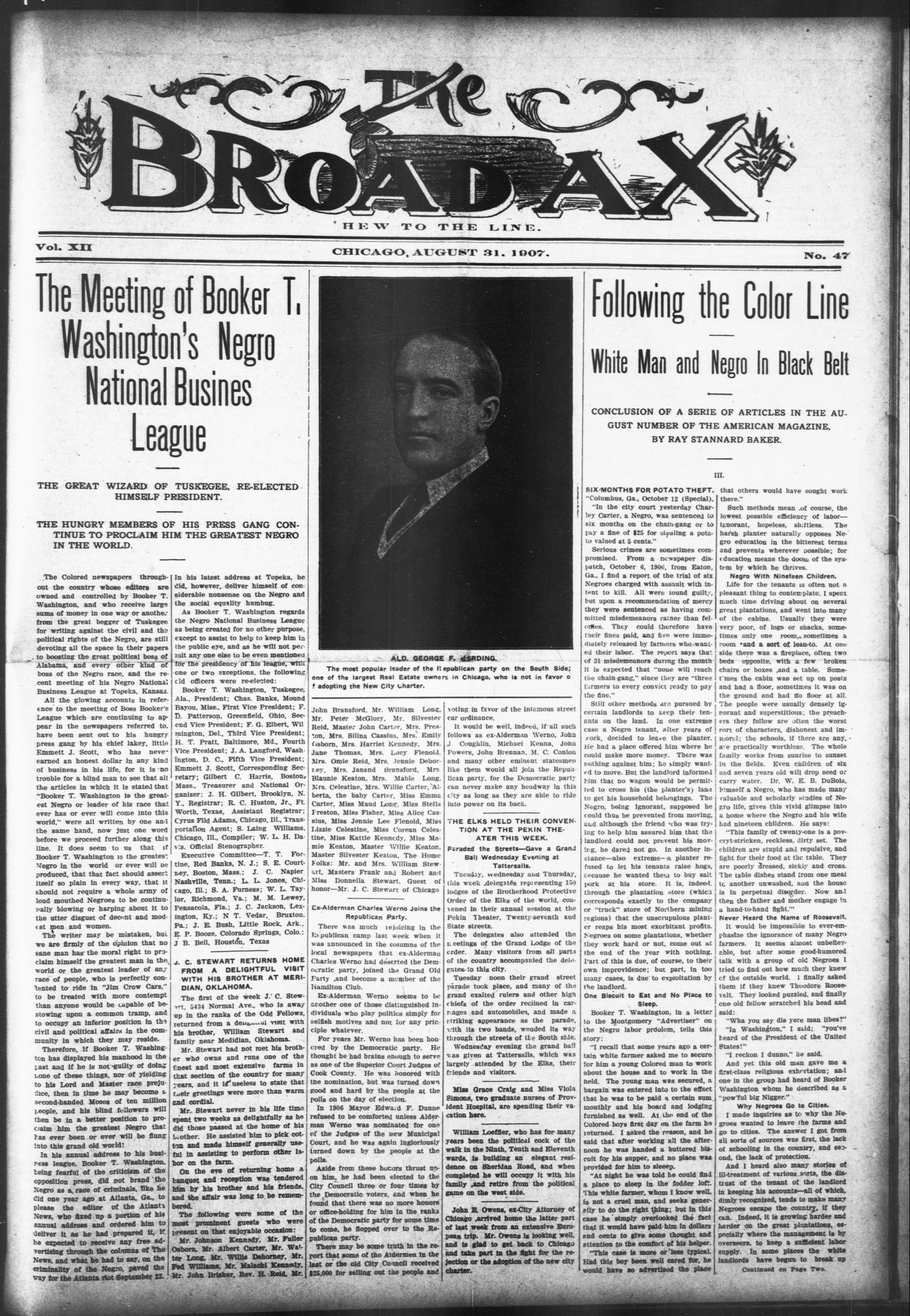
The Meeting of Booker T. Washington's Negro National Business League
THE GREAT WIZARD OF TUSKEGEE, RE-ELECTED HIMSELF PRESIDENT.
THE HUNGRY MEMBERS OF HIS PRESS GANG CONTINUE TO PROCLAIM HIM THE GREATEST NEGRO IN THE WORLD.
Vol. XII
The Meeting
Washington
National
Lea
THE GREAT WIZARD OF
HIMSELF H
THE HUNGRY MEMBERS OF
TINUE TO PROCLAIM H
IN THE WORLD.
The Colored newspapers throughout the country whose editors are owned and controlled by Booker T. Washington, and who receive large sums of money in one way or another from the great beger of Tuskegee for writing against the civil and the political rights of the Negro, are still devoting all the space in their papers to boosting the great political boss of Alabama, and every other kind of boss of the Negro race, and the recent meeting of his Negro National Business League at Topeka, Kansas.
All the glowing accounts in reference to the meeting of Boss Booker's League which are continuing to appear in the newspapers referred to, have been sent out to his hungry press gang by his chief lakey, little Emmett J. Scott, who has never earned an honest dollar in any kind of business in his life, for it is no trouble for a blind man to see that all the articles in which it is stated that "Booker T. Washington is the greatest Negro or leader of his race that ever has or ever will come into this world," were all written by one and the same hand, now just one word before we proceed further along this line. It does seem to us that if Booker T. Washington is the greatest Negro in the world or ever will be produced, that that fact should assert itself so plain in every way, that it should not require a whole army of loud mouthed Negroes to be continually blowing or harping about it to the utter disgust of decent and modest men and women.
The writer may be mistaken, but we are firmly of the opinion that no sane man has the moral right to proclaim himself the greatest man in the world or the greatest leader of any race of people, who is perfectly contented to ride in "Jim Crow Cars," to be treated with more contempt than anyone would be capable of bestowing upon a common tramp, and to occupy an inferior position in the civil and political affairs in the community in which they may reside. Therefore, if Booker T. Washington has displayed his manhood in the past and if he is not guilty of doing none of these things, nor of yielding to his Lord and Master race prejudice, then in time he may become a second-handed Moses of ten million people, and his blind followers will then be in a better position to proclaim him the greatest Negro that has ever been or ever will be flung into this grand old world!
In his annual address to his business league, Booker T. Washington, being fearful of the criticism of the opposition press, did not brand the Negro as a race of criminals, like he did one year ago at Atlanta, Ga., to please the editor of the Atlanta News, who fixed up a portion of his annual address and ordered him to deliver it as he had prepared it, if he expected to receive any free advertising through the columns of The News, and what he had to say, on the criminality of the Negro, paved the way for the Atlanta riot September 22.
In his latest address at Topeka, he did, however, deliver himself of considerable nonsense on the Negro and the social equality humbug.
As Booker T. Washington regards the Negro National Business League as being created for no other purpose, except to assist to help to keep him in the public eye, and as he will not permit any one else to be even mentioned for the presidency of his league, with one or two exceptions, the following old officers were re-elected:
Booker T. Washington, Tuskegee, Ala., President; Chas. Banks, Mound Bayon, Miss., First Vice President; F. D. Patterson, Greenfield, Ohio, Second Vice President; F. G. Elbert, Wilmington, Del., Third Vice President; H. T. Pratt, Baltimore, Fourth Vice President; J. A. Langford, Washington, D. C., Fifth Vice President; Emmett J. Scott, Corresponding Secretary; Gilbert C. Harris, Boston, Mass., Treasurer and National Organizer; J. H. Gilbert, Brooklyn, N. Y., Registrar; R. C. Huston, Jr., Ft. Worth, Texas, Assistant Registrar; Cyrus Fld Adams, Chicago, Ill., Transportation Agent; S. Laing Williams, Chicago, Ill., Compiler; W. L. H. Davis, Official Stenographer.
Executive Committee—T. T. Fortine, Red Banks, N. J.; S. E. Courtney, Boston, Mass.; J. C. Napier Nashville, Tenn.; L. L. Jones, Chicago, Ill.; S. A. Furness; W. L. Taylor, Richmond, Va.; M. M. Lewey, Pensacola, Fla.; J. C. Jackson, Lexington, Ky.; N. T. Vedar, Brutton Pa.; J. E. Bush, Little Rock, Ark.; E. P. Booze, Colorado Springs, Colo.; J. B. Bell, Houston, Texas
J. C. STEWART RETURNS HOME FROM A DELIGHTFUL VISIT WITH HIS BROTHER AT MERIDIAN, OKLAHOMA.
The first of the week J. C. Stewart, 5434 Normal Ave., who is away up in the ranks of the Odd Fellows, returned from a designeal visit with his brother, William Stewart and family near Medidian, Oklahoma.
Mr. Stewart had not met his brother who owns and runs one of the finest and most extensive farms in that section of the country for many years, and it is useless to state that their greetings were more than warm and cordial.
Mr. Stewart never in his life time spent two weeks as delightfully as he did those passed at the home of his brother. He assisted him to pick cotton and made himself generally useful in assisting to perform other labor on the farm.
On the eve of returning home a banquet and reception was tendered him by his brother and his friends, and the affair was long to be remembered.
The following were some of the most prominent guests who were present on that enjoyable occasion: Mr. Johnson Kennedy, Mr. Fuller Osborn, Mr. Albert Carter, Mr. Walter Long, Mr. Willis Dehorne, Mr. Fed Williams, Mr. Malschi Kennedy, Mr. John Brisker, Rev. H. Reid, Mr.
HEW TO THE LINE.
CHICAGO, AUGUST 31, 1907.
[Name]
ALD. GEORGE F. HERDING. The most popular leader of the Republican party on the South Side; one of the largest Real Estate owners in Chicago, who is not in favor of adopting the New City Charter.
The most popular leader of the Republican party on the South Side; one of the largest Real Estate owners in Chicago, who is not in favor of adopting the New City Charter.
John Bransford, Mr. William Long,
Mr. Peter McGlory, Mr. Silvester
Reid, Master John Carter, Mrs. Preston,
Mrs. Silina Cassius, Mrs. Emily
Gsborn, Mrs. Harriet Kennedy, Mrs.
Jane Thomas, Mrs. Lucy Flenoid,
Mrs. Omie Reid, Mrs. Jennie Dehorey,
Mrs. Janand Bransford, Mrs.
Blaunie Keaton, Mrs. Mable Long,
Mrs. Celestine, Mrs. Willie Carter,
Alberta, the baby Carter, Miss Emma Carter, Miss Maud Long, Miss Stella Preston, Miss Fisher, Miss Alice Cassius, Miss Jennie Lee Lefen, Miss Lizzie Celestine, Miss Corean Celestine, Miss Kattie Kennedy, Miss Mamie Keaton, Master Willie Keaton, Master Silvester Keaton, The Home Folks: Mr. and Mrs. William Stewart, Masters Frank and Robert and Miss Donnella Stewart. Guest of honor—Mr. J. C. Stewart of Chicago
Ex-Alderman Charles Werno Joins the Republican Party.
There was much rejoicing in the Republican camp last week when it was announced in the columns of the local newspapers that ex-Alderman Charles Werno had deserted the Democratic party, joined the Grand Old Party, and become a member of the Hamilton Club.
Ex-Alderman Werno seems to be another one of those distinguished individuals who play politics simply for selfish motives and not for any principle whatever.
For years Mr. Werno has been honored by the Democratic party. He thought he had brains enough to serve as one of the Superior Court Judges of Cook County. He was honored with the nomination, but was turned down good and hard by the people at the polls on the day of election.
In 1906 Mayor Edward F. Dunne refused to be comforted unless Alderman Werno was nominated for one of the Judges of the new Municipal Court, and he was again ingloriously turned down by the people at the polls.
Aside from these honors thrust upon him, he had been elected to the City Council three or four times by the Democratic voters, and when he found that there was no more honors or office-holding for him in the ranks of the Democratic party for some time to come, he flopped over to the Republican party. There may be some truth in the report that some of the Aldermen in the last or the old City Council received $25,000 for selling out the people and
voting in favor of the intamous street car ordinance.
It would be well, indeed, if all such fellows as ex-Alderman Werno, John J Coughlin, Michael Kenna, John Powers, John Brennan, M. C. Conlon and many other eminent statesmen like them would all join the Republican party, for the Democratic party can never make any headway in this city as long as they are able to ride into power on its back.
THE ELKS HELD THEIR CONVENTION AT THE PEKIN THEATER THIS WEEK.
Paradied the Streets—Gave a Grand Ball Wednesday Evening at Tattersalls.
Tuesday, wednesday and Thursday, this week, delegates representing 150 lodges of the Brotherhood Protective Order of the Elks of the world, convened in their annual session at the Pekin Theater, Twenty-seventh and State streets.
The delegates also attended the meetings of the Grand Lodge of the order. Many visitors from all parts of the country accompanied the delegates to this city.
Tuesday noon their grand street parade took place, and many of the grand exalted rulers and other high chiefs of the order recieved in carrages and automobiles, and made a striking appearance as the parade, with its two bands, wedded its way through the streets of the South side.
Wednesday evening the grand ball was given at Tattersalls, which was largely attended by the Elks, their friends and visitors.
Miss Grace Craig and Miss Viola Simons, two graduate nurses of Provident Hospital, are spending their vacation here.
William Loeffler, who has for many years been the political cock of the walk in the Ninth, Tenth and Eleventh wards, is building an elegant residence on Sheridan Road, and when completed he will occupy it with his family, and retire from the political game on the west side.
John E. Owens, ex-City Attorney of Chicago, arrived home the latter part of last week from an extensive European trip. Mr. Owens is looking well, and is glad to get back to Chicago and take part in the fight for the rejection or the adoption of the new city charter.
Following the Color Line White Man and Negro In Black Belt
CONCLUSION OF A SERIE OF ARTICLES IN THE AUGUST NUMBER OF THE AMERICAN MAGAZINE, BY RAY STANNARD BAKER.
SIX-MONTHS FOR POTATO THEFT.
"Columbus, Ga., October 12 (Special).
"In the city court yesterday Charley Carter, a Negro, was sentenced to six months on the chain-gang or to pay a fine of $25 for signaling a potato valued at 5 cents."
Serious crimes are sometimes compromised. From a newspaper dispatch, October 6, 1906, from Eaton, Ga., I find a report of the trial of six Negroes charged with assault with intent to kill. All were tound guilty, but upon a recommendation of mercy they were sentenced as having committed misdemeanors rather than felonies. They could therefore have their fines paid, and five were immediately released by farmers who wanted their labor. The report says that of 34 misdemeanors during the month it is expected that "none will reach the chain-gang," since they are "three farmers to every convict ready to pay the fine."
Still other methods are pursued by certain landlords to keep their tenants on the land. In one extreme case a Negro tenant, after years of work, decided to leave the planter. He had a place offered him where he could make more money. There was nothing against him; he simply wanted to move. But the landlord informed him that no wagon would be permitted to cross his (the planter's) land to get his household belongings. The Negro, being ignorant, supposed he could thus be prevented from moving, and although the friend who was trying to help him assured him that the landlord could not prevent his moving, he dared not go. In another instance—also extreme—a planter refused to let his tenants raise hogs, because he wanted them to buy salt pork at his store. It is, indeed, through the plantation store (which corresponds exactly to the company or "truck" store of Northern mining regions) that the unscrupulous planter reaps his most exorbitant profits. Negroes on some plantations, whether they work hard or not, come out at the end of the year with nothing. Part of this is due, of course, to their own improvidence; but part, in too many cases, is due to exploitation by the landlord.
One Biscuit to Eat and No Place to Sleep
Booker T. Washington, in a letter to the Montgomery "Advertiser" on the Negro labor problem, tells this story:
"I recall that some years ago a certain white farmer asked me to secure for him a young Colored man to work about the house and to work in the field. The young man was secured, a bargain was entered into to the effect that he was to be paid a certain sum monthly and his board and lodging furnished as well. At the end of the Colored boys first day on the farm he returned. I asked the reason, and he said that after working all the afternoon he was handed a buttered biscuit for his supper, and no place was provided for him to sleepe.
"At night he was told he could find a place to sleep in the fodder loft. This white farmer, whom I know well, is not a cruel man, and seeks generally to do the right thing; but in this case he simply overlooked the fact that it would have paid him in dollars and cents to give some thought and attention to the comfort of his helper.
"This case is more or less typical. Had this boy been well cared for, he would have so advertised the place
No. 47
The Color Line
Negro In Black Belt
ALE OF ARTICLES IN THE AU-
TE AMERICAN MAGAZINE,
BENARD BAKER.
III.
that others would have sought work there."
Such methods mean .of course, the lowest possible efficiency of labor—ignorant, hopeless, shiftless. The harsh planter naturally opposes Negro education in the bitterest terms and prevents wherever possible; for education means the doom of the system by which he thrives.
Negro With Nineteen Children. Life for the tenants is often not a pleasant thing to contemplate. I spent much time driving about on several great plantations, and went into many of the cabins. Usually they were very poor, of logs or shacks, sometimes only one room, sometimes a room and a sort of lean-to. At one side there was a fireplace, often two beds opposite, with a few broken chairs or boxes and a table. Sometimes the cabin was set up on posts and had a floor, sometimes it was on the ground and had no floor at all. The people were usually densely ignorant and superstitious; the preachers they follow are often the worst sort of characters, dishonest and immoral; the schools, if there are any, are practically worthless. The whole family works from sunrise to sunset in the fields. Even children of six and seven years old will drop seed or carry water. Dr. W. E. B. DuBols, himself a Negro, who has made many valuable and scholarly studies of Negro life, gives this vivid glimpse into a home where the Negro and his wife had nineteen children. He says:
"This family of twenty-one is a poverty-stricken, reckless, dirty set. The children are stupid and repulsive, and fight for their food at the table. They are poorly dressed, sickly and cross. The table dishes stand from one meal to another unwashed, and the house is in perpetual disorder. Now and then the father and mother engage in a hand-to-hand fight."
Never Heard the Name of Roosevelt. It would be impossible to ever-emphasize the ignorance of many Negro farmers. It seems almost unbelievable, but after some good-humored talk with a group of old Negroes I tried to find out how much they knew of the outside world. I finally asked them if they knew Theodore Roosevelt. They looked puzzled, and finally one old fellow scratched his head and said:
"Wha you say dis yere man libes?"
"In Washington," I said; "you've heard of the President of the United States!"
"I reckon I dunno," he said.
And yet this old man gave me a first-class religious exhortation; and one in the group had heard of Booker Washington whom he described as a "powful big Nigger."
Why Negroes go to cities
I made inquiries as to why the Negroes wanted to leave the farms and go to cities. The answer I got from all sorts of sources was first, the lack of schooling in the country, and second, the lack of protection.
And I heard also many stories of ill-treatment of various sorts, the distrust of the tenant of the landlord in keeping his accounts—all of which, dimly recognized, tends to make many Negroes escape the country, if they can. Indeed, it is growing harder and harder on the great plantations, especially where the management is by overseers, to keep a sufficient labor supply. In some places the white landlords have begun to break up
Will promulgate and at all times uphold the true principles of Democracy, but Catholic, Protestant, Polish, Indo-China, Furness, Single Taxes, Republics, Knights of Labor, or any one else can have responsibility is fixed. The Broad Idiot is a newspaper where platform is tested enough for all, ever distancing the editorial right to speak its own mind.
Entered at the Post Office at Chicago
Mil. as Second-class Matter.
FOLLOWING THE COLOR LINE.
their plantations, selling farms to ambitious Negroes—a significant sign, indeed, of the passing of the feudal system. An instance of this is found near Thomaston, Ga., where Dr. C. B. Thomas has long been selling land to Negroes, and encouraging them to buy by offering easy terms. Near Dayton, Messrs. Price and Allen have broken up their "Lockhart Plantation" and are selling it out to Negroes. I found similar instances in many places I visited. Commenting on this tendency, the Thomaston Post says:
"This is, in part, a solution of the ro-called Negro problem, for those of the race who have property interests at stake cannot afford to antagonize their white neighbors or transgress the laws. The ownership of land tends to make them better citizens in every way, more thoughtful of the right of others, and more amotious of their own advancement.
"At this place a number of neat and comfortable homes, a commodious High School and a large lodge building, besides a number of churches, testify to the enterprise and thrift of the best class of our Colored population. The tendency towards cutting up the large plantations is beginning to show itself and when all of them are so divided, there will be no agricultural labor problem, except, perhaps, in the gathering of an especially large crop."
III.
I have endeavored thus to give a picture of both sides of conditions in the black belt exactly as I saw them. I can now do no better in further illumination of the conditions I have described than by looking at them through the eyes and experiences of two exceptionally able white men of the South, both leaders in their respective walks of life, neither of them politicians, and both, incidentally, planters.
At Jackson, Miss., i met Major R. W. Millsaps, a leading citizen of the State. He comes of a family with the best Southern traditions behind it; he was born in Mississippi, graduated before the war at Harvard College, and although his father, a slave owner, had opposed secession, the son fought four years in the Confederate army, rising to the rank of Major. He came out of the war, as he says, "with no earthly possession but a jacket and a pair of pants, with a jole in them." But he was young and energetic; he began hauling cotton from Jackson to Natchez when cotton was worth almost its weight in gold. He received $10 a bale for doing it and made $4,000 in three months. He is now the president of one of the leading banks in Mississippi, interested in many important Southern enterprises, and the founder of Millsaps College at Jackson: a modest, useful, Christian gentleman.
An Experimenting in Trusting Negroes.
Near Greenville, Miss., Major Mill-saps owns a plantation of 500 acres, occupied by 20 tenants, some 75 people in all. It is one of the richest agricultural sections—the Mississippi Lottions—in the United States. Up to 1890 he had a white overseer, and he was constantly in trouble of one kind or another with his tenants. When the price of cotton dropped, he decided to dispense with the overseer entirely and try a rather daring experiment. In short, he planned to trust the Negroes. He got them together and said:
"I am going to try you. I'm going to give you every possible opportunity; if you don't make out, I will go back to the overseer system."
In the sixteen years since then no white man has been on that plantation except as a visitor. The land was rented direct to the Negroes on terms that would give both landlord and tenant a reasonable profit.
"Did it work?" I asked.
"I have never lost one cent," said Major Millsaps, "no Negro has ever failed to pay up, and you couldn't drive them off the place. When other farmers complain of shortage of labor and tenants, I never have had any trouble."
Every Negro on the place owns his own mules and wagons and is out of debt. Nearly every family has bough or is buying a home in the little town of Leland near by, some of which are comfortably furnished. They are all prosperous and contented.
"How did you do it?" I asked.
"The secret," he said, "is to treat the Negro well and give him a chance. I have found that a Negro, like a white man, is most responsive to good treatment. Even a dog responds to kindness! The trouble is that most planters want to make too much money out of the Negro; they charge him too much rent; they make too large profits on the supplies they furnish. I know merchants who expect a return of 50 per cent on supplies alone. The best Negroes I have known are those who are educated; Negroes need more education of the right kind—not less—and it will repay us well if we give it to them. it makes better, not worse workers."
I asked him about the servant problem.
"We never have any trouble," he said. "I apply the same rule to servants as to the farmers. Treat them well, don't talk insultingly of their people before them, don't expect them to do too much work. I believe in treating a Negro with respect. That doesn't mean to make equals of them. You people in the North don't make equals of your white servants."
Jefferson Davis's Way With Negroes.
Then he told a striking story of Jefferson Davis.
"I got a lesson in the treatment of Negroes when I was a young man returning South from Harvard. I stopped in Washington and called on Jefferson Davis, then United States Senator from Mississippi. We walked down Pennsylvania avenue. Many Negroes bowed to Mr. Davis and he returned the bow. He was a very polite man. I finally said to him that I thought he must have a good many friends among the Negroes. He replied:
"I can't allow any Negro to outdo me in courtesy."
Plain Words From a White Man.
A few days later on my way North I met at Clarksdale, Miss., Walter Clark, one of the well-known citizens of the State and President of the Mississippi Cotton Association. In the interests of his organization he has been speaking in different parts of the State on court-days and at fairs. And the burden of his talks has been, not only organization by farmers, but a more intelligent and progressive treatment of Negro labor. Recognizing the instability of the ordinary Negro, the crime he commits, the great difficulties which the best-intentioned Southern planters have to meet, Mr. Clark yet tells his Southern audiences some vigorous truths. He said in a recent speech:
"Every dollar I own those Negroes made for me. Our ancestors chased them down and brought them here. They are just what we made them. By our own greed and extravagance we have spoiled a good many of them. It has been popular here—now happily growing less so—to exploit the Negro by high store-prices and by encouraging him to get into debt. It has often made him hopeless. We have a low element of white people who are largely responsible for the Negro's condition. They sell him whisky and cocaine: they corrupt Negro women. A white man who shoot scraps with Negroes or who consorts with Negro women is worse than the meanest Negro that ever lived."
At Coffeyville, where Mr. Clark talked somewhat to this effect, an old man who sat in front suddenly jumped up and said: "That's the truth Bully for you; bully for you!" In his talk with me, Mr. Clark said other significant things:
"Our people have treated the Negroes as helpless children all their days. The Negro has not been encouraged to develop even the capacites he has. He must be made to use his own brains, not ours; put him on his responsibility and he will become more efficient. A Negro came to me not long ago complaining that the farmer for whom he worked would not give him an itemized account of his charges at the store I met the planner and asked him about it. He said to me:
I asked him—and the Negro got it. "The credit system has been the ruin of many Negroes. It keeps them in hopeless debt and it encourages the planter to exploit them. That's the truth. My plan is to put the Negro on a strict cash basis; give him an idea of what money is by letting him use it. Three years ago I started it on my plantation. A Negro would come to me and say: 'Boss, I want a pair of shoes,' 'All right,' I'd say. 'I'll pay you spot cash every night and you can buy your own shoes.' In the same way I made up my mind that we must stop paying Negroes' fines when they got into trouble. I know planters who expect regularly
every Monday to come into court and pay out about so many Negroes. It encourages the Negroes to do things they would not think of doing if they knew they would be regularly punished. I've quit paying fines; my Negroes, if they get into trouble, have got to recognize their own responsibility for it and take what follows. that's the only way to make men of them.
"What we need in the South is intelligent labor, more efficient labor. I believe in the education of the Negro industrial training is needed not only for the Negro, but for the whites as well. The white people down here have simply got to take the Negro and make a man of him; in the long it will make him more valuable to us."
(Having now outlined briefly the condition of the Negro in the South as it exists both in the city and in the country, Mr. Baker in his next articles, which will begin publication later in the fall, will treat of the Northern Negro and his place in the life of Northern communities. A more careful and detailed examination than was possible in the articles already published—the object of which was to give a swift general view—will be made later of the position and influence of the Mulatto, and there will also be articles on Negro Education, on the Negro in politics both South and North, on the Negro in city industries where the organization of labor prevails, and on several other phases of race relationship. In further illumination of the subject we shall hope to publish some of the numerous and significant letters which we have received from thoughtful Southern people.)
THE END
TILLMAN, THE BLACKGUARD.
Comrade L. B. Raymond Gives Him a Deserved Scorching.
(Editorial in the Hopton, Iowa, Ban ner.)
Senator Tillman gave his tirade on the Negro question at the Des Moines Chautauqua a week ago Sunday afternoon. It was as outrageous a performance as ever occurred in the State of Iowa. Tillman's statement that the Negro is not and never can be equal to the white man may be his honest opinion. As long as he discusses the question temperately and confines himself to facts he is entitled to respectful hearing. But when he transgresses all the bounds of decency, advises law breaking and justifies murder and mob rule, he forfeits all right to be heard by decent people. Among other things he said in his Des Moines tirade was that the citizens of the North amalgamated with the Negro to the full extent of their opportunities, and that the track of the route of Sherman's march to the sea could be traced on after years by the mulattoes born, after the soldiers passed that way.
Who is this man Tillman who talks about "amalgamating" with Negroes. Who is he who blackguards Union soldiers for alleged association with Colored women? If of the slaveholding family of South Carolina, the probability is that he has, or has had, if his father did not sell them off before the war, half-brothers and sisters of part Negro blood. If a slave owner before the war, it is safe to say that he cohabited with dirty, greasy, thick-lipped Negro women. If he had any property left to him upon arriving at his majority it is more than probable that it was largely the proceeds of the labor and sweat of these people whose chief misfortune was their color and who toiled that Tillman and his for-bears might accumulate. The chances are dollars to doughhuts that in the vicinity of Tillman's home there are persons of mixed blood who owe their paternity to him. Talk about the "amalgamating" of Northern people with the Negro race! Why, in Tillman's section it is the fashion; here in the North it brings disgrace. And Tillman and his kind evidently feel deprived of their rights, because they can no longer sell their half-brothers, or their illegitimate children or force them to labor for them without recompense.
Who is Tillman that he comes here and assumes to teach lawabiding citizens their duty? Less than five years ago he countenanced and upheld cold-blooded murder of a white man, by all accounts better than himself, the murder being committed by his brother. He advised the assassination beforehand, he appeared in court to overawe the Judge and jury, he subsidized the newspapers, he created public sentiment and in a civilized community he would have been indicted and punished as accessory to the crime.
This is not the worst feature of the case, nor is it the deepest disgrace connected with it. It is found in the fact that in the city of Des Moines, the capital city of Iowa, an audience was found on a Sunday afternoon to sit and listen to this red-handed, vituperative blackguard for two hours, and if the public prints are to be believed, to interrupt him with applause.
And at the close enough people were found to indorse his views by holding up their hands, to make a respectable showing as to numbers. But it was as discreditable to the audience as if Jesse James could have been resurrected to tell his story, or Orchard could have been brought from Idaho to repeat his tale of wholesale murder, and the people had applauded and cheered at the recital—National Tribune, Washington, D. C., August 22, 1907.
Poney Moore All In.
Sporting Texas; we imagine, will take cum grano salis the information that "Poney" Moore is "all in" at last. Chicago papers let Mr. Moore speak his valedictory in the following choice and instructive words:
"I am broke," said Moore yesterday. "I have been up against a stiff game for the last two years. At one time I had everything that a man could wish for. Now I have very little. However, I have played the game fairly, and the men who lost had no kick coming when I was dealing. My advice to young men is to cut out the sporting game. There is nothing in it. The man who seizes down to a good, legitimate business has a sporting man beaten. It is chicken one day, feathers the next for the sport. Be on the square and earn your money honestly and by hard work, and you will be happier than the man who risks his money on some game of chance."
Houston has had some paste board artists herself in her day, and when this was "a wide open town" certain of the "boys" used to give Mr. Moore the run of his life for his money on his more or less periodical visits; but no Houstonian ever heard him meet q. so and so much "better" with the picker's doxology—'all in.' The last time Colonel Moore old Houston the way he sent some of the boys to their "uncle" for more dough was the talk or the town weeks after rains had washed out his pedal imprints in this burg.
Poney Moore "all in:" It is not likely, at least not easily believed. Nevertheless he is in the bankruptcy court, and The Witness has scanned his sworn schedule of assets and liabilities, but candor compells us to say it looks much like a game "fixed" to feed the house. If Chicago has really bet Poney Moore down to his last white bone, it is not only a game sport, but a mighty sharp one.-The Witness, Houston, Texas.
Aside from this comment on Col.
"Pony" Moore by the Witness, Houston, Texas, the World and the Evening News, Columbus, Calo, and several other newspapers throughout the country devoted much of their space in elaborating on the Lowman of Col.
"Pony," which was brought on by his long drawn-out fight with Julius F. Taylor!
MRS. MIZNER GRANTED DIVORCE.
Widow of Chicago Traction Promoter
sume Name of Yerkes.
Justice Guy, of the Supreme Court of New York, last week signed a final decree in the suit brought by Mrs. Mary Adelalde Yerkes-Mizner for an absolute divorce from her husband, Wilson Mizner. By the decree Mrs. Mizner is permitted to resume the name of Yerkes, and she may marry again. Mizner is forbidden to marry during the lifetime of his former wife. Mrs. Yerkes was the wife of the late Charles T. Yerkes, the Chicago traction promoter.
It does not seem right to us that Mrs. Yerkes should be permitted to grab into any kind of a man whenever she feels that she wants and needs one, and at the same time prevents her ex-husband from catching onto a female whenever he wants to, for it appears to us that whatever is sauce for the goose is also sauce for the gander, and it is wrong to make flesh of one and fowl of the other.
Flat Building for Negroes.
An apartment building for the exclusive use of Colored people is being put up at the northeast corner of Armour avenue and Thirty-fifth street by M. Warriner, of New Orleans. There are to be thirty-seven apartments, for which a gross rental of $7,000 for a year is expected. The building will cost $45,000. It will be three stories and will measure 120 feet on each side. The apartments will be of three and four rooms each.
So it appears it remained for a Southern gentleman, who might have made some of his money in buying and selling Negroes, or in working them in the chain-gang, to come to Chicago and erect one of the finest flat buildings within the city for the exclusive use of Afro-Americans.—Editor.
Dr. James Alexander of Chattanooga, Tenn., is visiting the city for a week, stopping at 3217 Wabash Av. Dr. Shannon, of Jersey City, is in the city during the Elks' session, stopping at 3000 State St.
Mrs. Luther Moore, 3430 Vernon Ave. is on the slick list.
Miss Belle Jordan, of Louisville, Ky., is the guest of Mrs. McLain, 4722 Armour Ave.
Mr. Arthur Ellis, 3022 State St., after a pleasant visit to the southland, returned home.
Mrs. Daisy Dennis, of New Orleans, La., is visiting Mr. and Mrs. Geo. Swase, 5017 Armour Ave.
Mr. and Mrs. Benj. Gray, 594 Fulton St., are spending a month's vacation in northern Michigan.
Mr. and Mrs. Bert Barnett, 4516 St. Lawrence Ave., are spending a short vacation in Waukesha, Wis.
Mr. W. Wickliff, the popular druggist of Chattanooga, is visiting the city, stopping at 3217 Wabash Ave.
Mr. Edward Alexander a recent graduate of Chicago University, is practicing law in Terre Haute, Ind. Drs. Leonard Lewis and A. York entertained a small party of gentlemen at whist Saturday evening last.
Mr. Hiram Wheeler of St. Joe, Mo. formerly of this city, was made father of a fine ten-pound baby last Tuesday.
The Stock Co. of the Pekin Theater, was called back from New York on account of the great demand for them here.
Mr. Orrin Thomas, 2959 Armour Ave., received a painful cut on his arm while at work at the Union Stock yards.
Dr. Gordon and H. M Porter, attorney-at-law of Augusta, Ga., are visiting the city, stopping at 3022 State St.
Mrs. Virgil Cook and family, 6615
Vincennes avenue, have returned from
their summer vacation in the country.
Dr. J. Redmond of Jackson, Miss.
after a pleasant visit in California, as
spending a few days in Chicago, stopping
at 3024 Wabash.
Dr. John H. Williams of Buxton, Ia.
spent the week in the city, representing
"The Pride of the West" lodge
No. 103, I. B. P. O. E. W.
Mrs. Hattie Smith, 6618 Vernon avenue, returned home Sunday after a vacation of four weeks joyously spent among friends in Detroit, Mich.
Prof. Five Dollar, W. Kemper Hearld, seems to be growing sweeter every day, and they say the dear ladies just love to pat his pretty fax cheeks.
Mrs. Ellen Johnson, mother of John V. Johnson, 5832 Wabash avenue, is reported ill at Atlantic City, N. J., where she went to attend her sick son.
The Broad Ax will be on sale at the New England Restaurant, 2924 South State street, where swell theater parties are solicited and served in up-to-date fashion.
Prof. A. P. Lewis, of Washington, D. C., left Tuesday evening for his home, after a pleasant visit of six weeks as the guest of Mt. Chas. Pickett.
Mrs. Jenifer, of Baltimore, after visiting her daughter, Mrs. E. M. Blackwell, 3430 Vernon Ave., for a week has gone to Springfield, Ill., for a short stay.
When the Texas penitentiary board leased the convict labor for this year it was found that $31 per month was bid for Negro convicts as against $29 for white convicts.
Ald. James J. McCormick, the political war-horse of the 5th ward, is firmly convinced that the new city charter will be turned down at the poles September 17th.
Mr. and Mrs. James Parker have changed their residence from 6542 Vincennes avenue to 6508 St. Lawrence avenue, where they will be at home to their many friends.
Rev. H. Harrison of Meridian, Oklahoma, extended many courtesies to J. C. Stewart of 5434 Normal Ave., this city, while on his recent visit to that city.
Rev. Father John H. Dorsey of Pine Bluff, Ark., the second Colored Catholic priest ordained in the Cathedral at Baltimore, now the welcome guest of St. Monica Church, 36th and Dearborn St., will deliver a farewell address, 7:30 p. m., Sunday, September 1st, at St. Monica Church. All are welcome.
---
Mmes. Rosa Thompson Hardin and Florence Thompson Woodard, 6347 Rhodes avenue, entertained a party of ladies at a "Misses Dove Party" Tuesday afternoon and evening.
Mr. and Mrs. James Hi. Harris, who have been residing for some time past at 3807 Vincennes Ave., have removed to 3151 Forest Ave., where they are now comfortably located and where they will be pleased to see their many friends.
Prof. Wm. Emanuel entertained Prof. A. P. Lewis and Mr. Chas, Pickett, of Washington, D. C., at a box party at the Pekin Theatre Saturday evening. The party also enjoyed a elaborate supper at the Pekin Inn life after the show.
Dr. Robert Hardin left Sunday evening for Boston, Mass., where he will represent his order of Foresters in convention. On his way home the doctor will visit relatives and friends in Baltimore, Philadelphia, Washington and New York.
Miss Annabel Clarke, a teacher in the schools of Jackson, Miss., is spending a few weeks with relatives in the Windy City. Miss Clarke is the fiancee of Dr. Clarence M. Auter, of Palestine, Ark., formerly of Chicago.
Mr. and Mrs. John Linden, 62nd and Drexel Ave., returned home Thursday morning, from a pleasant visit with the parents of Mrs. Linden, Mr. and Mrs. Bloomfield, Toledo, DL., and Mrs. Linden is greatly improved in health from her month's vacation in the country
Mrs. C. Wilson and Miss Alice Vigries will leave Saturday for their home in New Orleans., La., after sepending a plasant vacation of five weeks as the guest of Miss Arville Williams, 3427 Dearborn street. The ladies declare Chicago is the finest summer resort in the country, and they have traveled some.
A Negro preacher addressed his flock with great earnestness on the subject of "Miracles" as follows: "My loved friends, de greatest of all miracles was 'bout de loaves and fishes. Dey was five thousand leaves and two thousand fishes, and de twelve 'postles had to eat 'em all. De miracle is, dey didn't bust. —Ex.
Monday evening a farewell concert and testimonial was tendered Prof. and Mrs. N. Clark Smith at Bethel church. Some of the most musical people took part in the affair. The church was well filled. The 8th of September Mr. and Mrs. Smith will depart for Tuskegee, Ala., where the Professor will become musical instructor and director of the band in connection with Tuskegee Institute.
Mr. and Mrs. Philip Green and Miss Gladys Williams will leave Chicago Tuesday for a visit to Niagara Falls and Buffalo, N. Y., after which as the guest of Mr. Edward Thompson, of Chicago, they will tour central New York in an automobile, and stop for a week's rest at Mr. Thompson's stock farm, which is situated about two hundred miles from the metropolis of the State.
The Leland Giants, under the matchless leadership of Rube Foster, has been putting it over the All Stars and other comers this week, except in one game, which was won by the All Stars in the series of games which have come off between these two crack teams. This coming Sunday afternoon the Normals will play the Giants in a hotly contested game at Auburn Park.
Miss Lottie Smith of New Orleans. La., is the guest of her aunt, Mrs. W. A. Spotsey, 5027 Armour Ave. Miss Smith has with her a friend, Mrs. Victorie Newill, also of New Orleans. A dinner was given in their honor by Mrs. Spotsey on Friday evenings. Among the other guests present were Mr. and Mrs. Peter Stokes. The dinner was all that could be desired after which Mr. Stokes entertained the guests by singing some of his finest and latest selections.
NOTICE FOR PARDON.
R. M. Mitchell will make application for the pardon of Joseph A. Kelley, who is now serving a one-year sentence in the Cook County jail for the crime of larceny.
"Did she weally call you a puppy?"
"Well—er—no, not exactly. She merely asked me if I liked dog-biscuit."
****
"This is a hard world," said the balloonist, as he dropped out of the basket and landed in a stone quarry.
****
I pity the man who can't learn anything from his own mistakes. Now, that's one thing. I can do," said Bragg.
"Ah! You're always learning something, aren't you?" replied Knox.
THE HALL OF FAME
Samuel Smeal of Cleardown county, Pa., is eighty-one years old and is serving his township for the twenty-seventh year as its tax collector. Senator Newlands of Nevada is fond of using flowery language in his speeches. He is rich and was formerly a strong advocate of free silver. The largest baby ever born in Chicago measures one foot eleven inches, weighs eighteen and one-half pounds and will be christened Fred Busse Ross in honor of the mayor of Chicago. Secretary Cortelyou proposes to apply civil service rules in the treasury department without reference to sex and has begun by promoting several deserving women to better places and higher salaries.
The Echo de Paris confirms the statement that the first visit of M. Rallieres abroad will be to London in April or May of 1908. The president's visit to England will have a semi-official character.
A young son of well known Castle Hill (Me.) parentage bears a combination of historical names. Millard Fillmore's son married Andrew Jackson's daughter and their first offspring was named Andrew Jackson Millard Fillmore.
Commander Nicholson, who navigated the Oregon on her famous record breaking trip around South America in the Spanish-American war, had been promoted to captain and was given command of the new battleship Nebraska on July 1.
N. Gilbert Whitmore of Eastondale, Mass., although seventy-one years old, is said to be the oldest weapon maker in the country. At one time he made and presented to General U. S. Grant a sporting rifle of exquisite workmanship valued at $1,000.
Professor W. A. Henry of Wisconsin, one of the leaders in American agriculture, has purchased a tract of land in Wallingford, Conn., and proposes to make his home there after thirty years' service in the State university of Wisconsin.
Following the custom of many years, "Old Man" Fritz, keeper at the St. Louis Country club, recently sold his crop of whiskers for $8. Fritz lets his whiskers grow to his waist every three years and then cuts them off and sells them to the hairdressers.
Francis Kay Pendleton, whom Mayor McCellan has appointed corporation counsel of New York city, is a son of the late Senator George Pendleton of Ohio, who was the candidate for vice president on the same ticket on which the mayor's father, General McCellan, was the nominee for president in 1864.
THE SPORTING WORLD.
Outfielder Jude, the Indian of Columbus, has twice this season made five hits in five times at bat. Sonoma Girl, with her heat in 2:06% at Libertyville, establishes a world's record in a race, trotting, for a green mare. It is now definitely settled that an international cricket match will be played in New York next fall between the Marylebone Cricket club of London and American club teams. Orby, the great colt that won the English and Irish Derbys in the colors of Richard Croker, may be retired to the stud at the end of the racing season. Croker is undecided whether or not to race him next year.
Comiskey employs no scout for his Chicago club. In fact, he takes players cast off by other major league clubs and makes stars of them, for instance, Hahn, Dougherty, Altrock, Donahue and McFarland. Commy never paid a cent for Sullivan, Tannehill, Davis, Jones or Isbell.
PITH AND POINT.
A little present is often but another name for a bribe. The larger the bluff the smaller it looks when called.
When a man earns his money he never has any to burn.
A fool doesn't envy wise men. A fool never meets a man who is wiser than himself.
Time gets away from an old man almost as quickly as money gets away from a young man.
When a man first makes a fool of himself he gets an awful jolt—but he soon gets used to it.
Remember, young man, if you are not satisfied with your job, the chances are that the boss will not refuse to accept your resignation.—Chicago News.
Editorial Flings.
The preservation of the mosquito was one of the most irritating of the numerous mistakes of Noah—Boston Globe.
A New York judge rules that it is not wrong to kiss a girl on the street. Not wrong perhaps, but one can think of better spots—Cleveland Leader.
"Men in this country sleep too much," says Dr. Wiley. What! Has that man been experimenting with night watchmen?—New York Herald.
Marie Corelli condemns man in general. She says he's no good and a coward and a mutt, but she omits to show her sisters how they can get along without him—New York American.
SHORT STORIES.
A boy of twelve in New York has five rows of teeth, or sixty teeth in all. Some expert has figured out that there are only 2,000 professional baseball players in the country. Dr. Thomas Darlington of New York says keeping dogs in the city is a crime against the city and cruelty to the animals. The sight of surgical instruments so frightened a man in a hospital at Norristown, Pa., that he leaped from the building and ran screaming into the street. By a formal order issued from the war department the memory of the late General Shafter, who commanded the American troops in Cuba during the Spanish war, has been honored by bestowing his name upon the military post on the Kahauikl reservation near Honolulu, Hawaiian Islands.
Thirty-two years ago Mrs. Thomas Buker of Bath, Me., wrote two letters to her husband, Captain Buker, who was then traveling along the Mexican coast in a sailing vessel. The letters were never received by the captain and were recently returned to Mrs. Buker by the Mexican government.
ENGLISH ETCHINGS
There are over 12,000 shops for the sale of milk in London.
Tithes were first instituted in England in the reign of King Egbert, about 600 A. D.
Cholera has not been epidemic in Europe since 1866, when it appeared in both London and Liverpool.
It is estimated that the total first cost of England's present navy was $670,000,000, and about $390,000,000 has been spent in the last ten years.
Before the trial of a suit for damages was begun in a London court the other day it was remarked incidentally that the defendant, a laundry proprietor, had been dead eleven years.
An innovation in English county cricket was seen in the Yorkshire versus Sussex match at Sheffield. Before each delivery the ball was wiped with a towel, which was intrusted to the care of the umpire while the ball was in play.
PLAYS AND PLAYERS
Shakespeare has been translated into Japanese, and the thespians of the mikado are making his plays popular.
As to vaudeville, way back in the early sixties Ellen Terry made quite a success in that popular style of amusement.
Burr McIntosh, who left the stage some time ago for professional life and the lecture field, is going to return and star in "Pudd'nhead Wilson" and other plays.
Boston gave the stamp of its critical approval to the first performance of Richard Carle's new play, "The Hurdy-Gurdy Girl." Both music and lines are said to be bright.
Among the twenty-two attractions which A. H. Woods will have on the road next season two are musical, and the list includes ten new melodramas. The others are old successes.
HOME NOTES.
If a narrow ribbon or tape is run into the facings of kimono sleeves, they may be tied in a bow and kept out of the way when one is working about the house.
You will need less laundry soap if it is thoroughly dried before using. For this pile it in such a way as to leave open space between the bars to allow free access of air.
When kerosene oil has been spilled on the carpet, cover the spot thickly with either fuller's earth or buckwheat flour and leave twenty-four hours at least before brushing it off.
In some households bureau scarfs have been laid aside and the top of the dresser covered with a heavy glass slab. This can be easily wiped off and polished. As this glass is so thick there is little danger of it being easily broken.
FACTS FROM FRANCE.
It is proposed to substitute solitary confinement during six years for the death penalty in France. No death sentence has been executed for some time.
Trial is now being made in Paris of a new system of paving. Steel is laid on a bed of cement after the fashion of wood paved roads, the interstices, too, being filled with cement.
A bird dealer in Paris raises canaries of an orange red tint by feeding the parent birds on cayenne pepper. In time he expects that the eggs will produce birds of a bright red hue.
About $80 per year is charged for an unlimited telephone service in Paris, but in addition to this the subscriber must purchase his own instrument, which may be any one of a number of different kinds.
The Plain Woman.
She need not appear plain.
She should experiment with her hair.
She must study her colfure from all points.
Well arranged hair may balance and annot a defect.
A woman should beware of choosing a pretty chapeau.
Badly arranged hair may greatly exaggerate a defect.
The choices of a hat has the same good or bad effect.
It is the same with a dress or anything else. St. Louis Republic.
Fisherman-Ah! That's a good beginning, a frying pan! I have only got to catch a fish now and I shall be all right-Bon Vivant.
The Wise Bachelor
Some men would be more independent if they recognized their wives as belligerents.
A woman will never believe anything very bad about a man she has once seen wiping his eyes at a pathetic play.
No man is ready to get married until he doesn't care how many times a week he has the same kind of meat for dinner.
No woman ever really knows her husband till she has heard him hunting in the top bureau drawer for a clean handkerchief.
Nothing in the world is so pathetic as a girl who has made up her mind to reform some man and first begins to doubt whether he is going to let her.—New York Press.
The Locksmith's Chance
On the park bench sat two lovers. The passing locksmith dropped his kit and laughed long and uproariously. "Why do you laugh?" asked the park policeman. "Oh, just to get even," confided the locksmith. "You know love always laughs at locksmiths, so I thought it would be a good chance for the locksmith to laugh at love." And then the old man laughed himself out of sight—Chicago News.
How It Happened.
Gyer—I was in a railway wreck seven years ago, and I never got over it.
Myer—You must have been badly hurt.
Gyer—I wasn't hurt at all. I didn't get over it because I crawled from under.
See?—Detroit Tribune.
Perfectly Proper.
Stickler—Here! You've started your note to Borroughs "Dr. Sir." Don't you know that sert of abbreviation is very slovenly? Markley—No, sir. "Dr." is all right in this case. He owes me money.—Philadelphia Press.
A Precaution.
"Do you believe in corporal punishment?"
"Well," answered the father of several sons, "perhaps it is just as well occasionally to convince our boys that we are not mollycoddles."—Washington Star.
In Suspense.
An escaped murderer wrote a friend: "Jim, do you think if I'd give myself up that they'd suspend judgment?" The latter replied: "No, John. I ruther thinks they'd suspend you?" -Atlanta Constitution.
An Ideal System:
"What is your impression of an ideal railway system?" "An ideal railway," answered the weary traveler, "is one whose trains arrive as punctually and safely as the dividends."—New York Life.
Tempting Odds
"Why is it that a fellow's friends always think he is making a mistake in selecting a wife?"
"Oh, I suppose they can't resist the temptation when they have so many chances of being right."
Why He Quit It.
Ferry- Are you still keeping up your deep breathing exercise, old chap? Ferry- I have discontinued it for a time, dear boy. I am rooming next door to a glue factory just at present- Judge.
What He Could Tell
Yeast—Can you tell anything about the weather?
Crimesbeak—Yes. I can tell there's a terrible lot of lying about it—Yankers Statesman.
Just Had to Let Him Do it.
Editor—I hated to refuse Scribbier's poem. It was a good one.
Subeditor—Then why did you refuse it?
Editor—Why, he said if I didn't take it he would kill himself—Judge.
"First rate until he tried the impossible. He hypnotized a tramp one day and tried to make him saw wood."—Brooklyn Life.
Frank H. Lewis, Prop.
Phone Oakland
THE RAILROAD
Imported and Dedicated
Liquors and
Cafe in Co
N. E. Corner Fifty-first and
Telephone Calumet 185
E. A. STACK
DRUGGIST AND CHEMIST
2842 South State Street
Cor. Twenty-Ninth CHICAGO
Open Day & Night
Private Rooms
PEKIN INN CAFE
Chas. Lett, Proprietor.
ALA CARTE & TABLE DE HOTE
SERVICE
Music Every Evening.
Special Attention to Parties and Weddings.
2704 State St. Phone Calumet 261
CHICAGO
PATENTED DENTISTRY
at Cost Until Sept. 1st.
We control patents and discoveries by which missing teeth can be replaced without the old-time removable plate or bridge and by which loose and falling teeth can be tightened by which pyrrohea (Riggs' disease) sore and bleeding gums, can be cured. Call and have examine your teeth and you will get set.
WHAT WE WANT
is to introduce our work among the
Colored people of Chicago. We will
make small charges for material until
Sept. 1st.
$3.00—FULL SET OF TEETH—$3.00
—GUARANTEED—
$6.00—BEST SET OF TEETH—$6.00
22k Gold Crowns
(cost material about $1.50)
Bridgework
(cost material about 2.00)
Re-Enameling
(cost material about 2.50)
Gold Fillings
75 cents
Silver Fillings
40 cents
Porcelain Crowns
(cost material about 1.50)
All work guaranteed 10 years. All
work done under direct personal sup-
ervision.
Read what a clergyman says about
us. I wish to say that we are well
satisfied with the work done in your
office. Your dentists are men who
understand their business and are
gentlemen." REV. J. L. JACKSON.
Hyde Park Baptist; Church.
Chicago.
NORTHWESTERN DENTAL GO
182 STATE STREET CHICAGO
Buy Your Houses and Flats From
Neighbors and Johnson.
Don't pay rent all your life.
Don't pay rent all your life.
Don't die and leave your children a bunch of receipts.
BE YOUR OWN LANDLORD.
We sell to every man according to his means. Terms to suit every purse. Before buying see
NEIGHBORS AND JOHNSON,
3916 State St.
Phone Douglas 4965.
YOUR HOUSE MAY BURN TONIGHT.
NEIGHBORS AND JOHNSON writes insurance in the BEST companies in the WORLD.
Have your household goods INSURED. Do it NOW.
Bright boys and girls can make money in every community by selling The Broad Ax. It will cost you nothing to begin, as we will send you a supply of papers for the first week free. If there are any bright boys and girls in any section of the country who want to start in business for themselves, make money and be independent, write to us at once, and we will send you ten papers free of charge. You can sell them for five cents each, this will give you the capital which you can buy more papers in order to find its way into the columns of this paper the same week it is written.
Write plainly on one side of the paper only, and address all communications to The Broad Ax, 5040 Armour avenue.
Thinking and progressive people read the Broad Ax. Your father, brothers, uncles and friends will buy the paper from you. If you mean business write to Julius F. Taylor, 5040 Armour avenue, Chicago.
His Idea.
"Rastus, you are southern bred, eh?"
"Yessah."
"Then what is your idea of a perfect gentleman?"
"A puffek gen'leman, suh, doesn't say nuffin else to de waiter 'sides his obdah, suh, 'ceppin' 'Yo' brack scoundrel, keep de change.'"
His Idea.
Not Practical.
"Why are you so dissatisfied with that young man?"
"He spends too much time committing to memory the advice of rich men on how to succeed in life instead of getting out and hustling for business."—Washington Star.
Lou Seldon, Mgr.
and 1787.
ROAD INN
Domestic Wines
& Cigars
Connection
Armour Avenue, Chicago, Ill.
THE NORMALS vs. THE LELAND GIANTS
Auburn Park Sunday, September 1st.
Games called at 3:30. Best of order maintained at
all times. Come and see real ball playing. Price, Admission 25c, Grand
Stand 35c, Boy's Beats 15c.
Fifty-First St. and Armour Ave.
BAL, YAHOO: JONT St. & L. S. & N. S. Rd.
JONT St. and Armour Ave.
CHICAGO
Gaskins'
Billiard and Pool Parlors
3004 STATE ST.
All Newly Furnished with Latest
Tables and Fixtures.
Will also carry a Fine Line of Cigars
and Tobacco
Chas Gaskins, Propa
First-Class Service Guaranteed our
Patrons.
Tile and Slate Hauling a specialty.
COAL
J. H. COLEMAN & CO.
Express & Van Moving
TRUNKS EVERYWHERE.
2540 State Street
Phone 699 Calumet CHICAGO
ICE CREAM CIGARS, TOBACCO
SHIRT WAISTS KIMONAS
MRS. A. E. BAKER
Underwear a
Specialty
CHICAQO
Niagara Falls
NEW YORK
First class in all appointments.
Rates $2.00 per day and upwards, near the Falls, parks and depots.
For further information address R. T. Dett, Niagara Falls, N. Y.
Telephone Harrison 5657
Davis Express
FURNITURE MOVING
TRUNKS DELIVERED
Claim Checks given
110 E. HARRISON ST. CHICAGO
Bet. Custom House Pl. & Clark St.
'TWAS EVER THUS.
I held a hand at poker
Which looked exceeding good,
Five handsome clubs consorting
In sable brotherhood.
Alack, my hated rival
Whom I would put to rout
Remained not for the slaughter,
But
I held a hand one evening
Ridiculously small.
Upon it flashed and glittered
One diamond—that was all.
Alack, my hated rival.
Despite my baleful glare.
Moved not to take departure,
But
Stayed
Right
There.
McLandburgh Wilson in New York
Times.
THE BROAD AX.
in for sale at the following news
stands:
L. L. Jones, barber shop and news stand, 3842 State st.
A. F. Tervalon, 134 W. 51st street Cigar Store and News Stand.
Mrs. Nellie Phelps, Cigars, Notions and News Stand, 131 W. 51st street.
T. B. Hall's Cigar Store and Laundry office, 381 39th st.
W. S. Cole, 354 Thirty-first street, elgars, tobacco and news stand.
J. R. Peters Cigars, Tobacco and News Stand, 338 E. 27th street.
Mrs. A. E. Baker, Notions and News Stand, 419, 36th street.
W. P. Johnson, Notion Store and News Stand 3704 State st.
Turner Williams' Shaving Parlor and News Stand, 2903 Armour ave.
R. Davis, cigars, tobacco, and consortium, 3833 State st.
C. C. McLain, cigars, tobacco and news stand, 2906 State street.
Mrs. J. W. Hadley 116 W. 51st st.
cigars, tobacco and news stand.
Mrs. Katherine R. Hamlet, Cigars, tobacco, and fancy groceries and news stand 5023 Armour ave.
The Standard News Op 131 W. 53rd st. New York, City, N. Y.
Auburn Ball Park
THE NORMALS vs. THE
Auburn Park Sunday,
Games called at 3:30. Best o
all times. Come and see real ball play
Stand 35c, Boy's So
GRAY & MORAN
ATTORNEYS AT LAW
Suite 1114 Ashland Block, Clark and Randolph Sts. Tel. Central 568.
CHICAGO.
Residence 57 MacMister Place
Telephone Ashland 388
Office Telephones
Central 1269 Automatic 5649
MILES J. DEVINE
ATTORNEY AT LAW
Suite 318-320 Reaper Block
CLARK AND WASHINGTON STS.
CHICAGO.
A. D. GASH
Attorney at Law,
04-06 La Salle Street, Chicago
Suite 615 to 619.
Telephone Main 3077.
JOHN E. OWENS
ATTORNEY & COUNSELOR
AT LAW
ASHLAND BLOCK
TELEPHONE CENTRAL 000 CHICAGO
Tel. Douglas 1565 Notary Public
REAL ESTATE, LOANS AND
RENTING
FIRE INSURANCE
Bates Building
3837 STATE STREET CHICAGO
THE ELITE BUFFET
FINE WINES, LIQJORS
AND CIGARS
3030 State Street CHICAGO
Phone 194 South
A. B. SCHULTZ, M. D.
PHYSICIAN AND SURGEON.
2710 State Street
Houses: 9 to 12 A. M.
3 to 5 and after 6 P. B.
CHICAGO
F. A. Rawlins
The Modern Embalmer
UNDERTAKER AND
FUNERAL DIRECTOR
When his work is finished
you have no displeasure.
4534 State St., CHICAGO
Phone Douglas 1559
Waiters and Cooks
Prefer Our Make
JACKETS AND LINEN
because they have found them
satisfactory.
Write for complete Catalogue
FREE.
giving full instructions how
to order.
Marcus Ruben (Inc.)
300 State St., CHICAGO.
79th St. and Wentworth Ave.
Best Games of Ball in the city by
leading Pros. & Semi-Pros. Clubs
THE LELAND GIANTS
day, September 1st
at of order maintained at
playing. Price, Admission 25c, Grand
Seats 15c.
THE DIET DRILL
Ancient Method of Making Brave Soldiers In China.
In robes of pale silk, delicate and cool, a fat young Chinese diplomat amused a half dozen pretty girls at a Bar Harbor tea.
"And," he was saying, "we find it hard to abolish the ancient diet drills of our soldiers. They still believe, you know, that it is food rather than work and study which makes the successful warrior.
"Our old laws bid the soldier on the thirteenth day before going into battle to eat tiger jelly, so as to possess the tiger's ferocity. On the twelfth day they tell him to eat lion liver in order to acquire the lion's bravery. For the eleventh day the ancient writings advise serpent soup, which will give the man the serpent's cunning; on the tenth day, chameleon custard, so that he may dazzle and confound the enemy by changing color like the chameleon; on the ninth day, a broth of crocodile that he may pursue the enemy in the water no less cleverly than on land.
"Next, jaguar spleen, which will give him the jaguar's fierce and rapid onslaught; next, kites' heads, for the eyesight; then hippopotamus brains, to toughen the skin against wounds; then roast monkey, for nimbleness in scaling the enemy's walls; then stewed scorpions, a dish that makes the eater capable of inflicting venomous wounds; then underdone venomous breast, so that the soldier may be cruel and pitiless. And finally on the day of battle the man is ordered to eat a red powder made of the desiccated blood of the leopard, so that he may tear the foe to pieces as the leopard tears his prey."
The young diplomat laughed.
"We have still," he said, "hundreds of mandarins and thousands of soldiers who think that this diet system makes better warriors than all the modern drilling and gunnery and science in the world."-Exchange.
Three Giant Locomotives.
Three locomotives, now building for the Erie railroad at the Schenectady works of the American Locomotive company, will be the heaviest and most powerful engines of their kind ever constructed. Each locomotive alone, without its tender, will weigh 205 tons, and will haul on the level 320 loaded freight cars, or a train two miles long.
These enormous machines are of the type known as Mallet compound, and will have sixteen drive wheels, arranged in two independent groups of eight each. The boilers used are more than forty-three feet long, and the inside diameter of the largest firebox foundation ring is eight feet. It is provided with 404 tubes two and one-quarter inches in diameter and twenty-one feet long. The water in the boiler will weigh 42,700 pounds and the tubes 23,700 pounds. One of the fireboxes would make a good sized living room, being ten and one-half feet long and nine and one-half feet wide inside, and having a grate area of 100 square feet—New York Herald.
The Tattered Flags
There is a curious reason for the order which the kaiser has just issued to the effect that the colors of regiments are to be taken from their cases only on the most important occasions. The flags of the German army are in a deplorable condition, even the new ones, for the colonels of regiments which have had new colors given them of late years to replace the old ones which went through the Franco-Prussian war hated parading with brand new colors, as if the regiment had never been in action. They winked at the subalterns, who slit the new flags and gave them the dilapidated air of the old colors. But the emperor was furious at this imitation, and so he has had the sham glories put back into the cases.
New Method Mirrors
Copper very closely resembles silver in many respects, but hitherto no method has been known of depositing it from aqueous solutions on glass so as to form mirrors like those so long made with silver. This is now accomplished by reducing cupric oxide by an aqueous solution of phenyl hydrazine in presence of potassium hydroxide. Some mirrors made in this way have been shown to the London Royal society by Dr. F. D. Chattaway and have a coherent metallic film as brilliant and uniform as that of the silver on glass reflectors used in telescopes and much more beautiful on account of the color.
Accidents on Warships
Occasional accidents are as much to be looked for on a warship as in an industrial plant. If the officers and crew are to be fit for service in time of war they must practice with the big guns. They must engage in work where momentary carelessness and the neglect of some seemingly trivial precaution may mean sudden death or permanent displacement. On a battleship, as in an iron or a powder mill, eternal vigilance is the price of safety, and in spite of the utmost vigilance deplorable casualties may happen.—Chicago Tribune.
A Sailor and His Grog.
At present every British sailor is allowed an eighth of a pint of rum per day, on. if he likes to go without grog, he gets nine-eighteenth of a penny. Total aluminium in future will get 1 penny.—London Saturday Barclays.
FACTS IN FEW LINES
One county in Malne last year shipped 10,700,000 bushels of potatoes. Carelessness of a workman in opening the sluices too soon sunk the French submarine boat Gymnote at Toulon, and she was ruined.
It is estimated that the total first cost of England's present navy was $670,000,000, and about $390,000,000 has been spent in the last ten years.
In 1832 there was a ten hour movement among the shipwrights and callers of New England, and several strikes resulted, which proved successful.
Having started its American series with the Amerika, the Hamburg-American steamship line continues with the President Lincoln and next fall will add the General Grant.
Theodore H. Davis, the archaeologist, has just brought to this country from Egypt an alabaster statue of Queen Tel which dates back to 1800 B. C. It is to be presented to the New York Museum of Art.
Work upon the tunnel which is to couple Turin with the Riviera has not yet begun. The railway line between Cuneo and Ventimeglia, by which it is approached on the Italian side, is, however, practically completed.
Work has been begun by German philologists on material collected during the last nine years for a dictionary of the Egyptian language. The language goes back more than 3,000 years, and there are more than 1,000,000 signs used in it.
In every room in a certain Maine hotel is pinned on the wall a large sized piece of sandpaper. Over it is this request: "Please don't scratch your matches here." Needless to say, that is where all the matches are scratched.
Two nine-pound shot were dug up by workmen in Waterville, Me., recently. It is thought that they were fired from British warships or from the American batteries across the harbor during the occupancy of the town by the English forces.
Out of a $3,000,000 appropriation by the Cuban congress for the relief of suffering occasioned by the last winter's floods in the different provinces of the island a Havana paper states that $303,000 has been allotted to road building in Pinar del Río province.
In the new disease known as "tennis elbow" there is usually local tenderness on pressure, with acute pain on extending the arm. There is seldom any swelling. The trouble is thought to be due to tearing of the muscular fiber, and it is very persistent, often recurring even after long rest. It is a woman, Miss M. E. Sullivan, who supplies the United States navy with its stationery, note paper, menu cards and invitations. She is a Connecticut girl, but she got the training that makes it possible for her to do this kind of work at Pratt institute. Making card plates in the beginning, she has worked up her splendid business.
Excavations in Rome being conducted on the Palatine hill have shown a curious and interesting circumstance. The Necropolis has been found to contain remains of the ninth, eighth, sixth and fourth centuries before Christ. All fragments of the seventh and fifth centuries are lacking, and archaeologists are engaged in a close study of the field in order to find the reason. In Arbury Park, Warwickshire, England, the ancestral seat of the Newdegates, a tapered pillar in gray granite on a three stepped pedestal has been erected to perpetuate the memory of George Eliot. Her birthplace is near by, and her father, brother and nephew served the Newdegate family in the office of land agent. The monument is the gift of F. A. N. Newdegate.
In the city of Springfield, Mass., is a private art collection which is the largest and most varied owned by any one person in the country. It is the property of G. W. V. Smith, who has spent over fifty years getting it together, and it is ranked with the New York Metropolitan museum and the Wallace museum of London. Mr. Smith has loaned his collection to the city of Springfield to make the pictures eventually the property of the citizens.
Senator Palmer P. Woods of the island of Hawaii is going to make an effort for the preserving of the Hawaiian language. There have been efforts in the past to preserve the language in its purity, but the encroachment of commercialism, the introduction of the English language as the official tongue and the exclusive use of English in the public schools have gradually undermined all efforts to preserve some semblance of the beautiful language of the native Hawaiians.
Probably not one person out of 500 entering the south car in the elevator shaft of the Fifth Avenue hotel ever stops to read the little framed notice which hangs in one corner, says the New York Sun. But to the observing few this little notice tells a story: "In this very space forty-eight years ago was placed the first passenger elevator ever built in the world." In 1850, when first installed, it was one of the curiosities of the city, and visitors from far and near came to witness its operation.
It is probable that no woman in the wide world possesses so many fearfully and wonderfully made gowns as Princess Tetchinsky. It is her boast that she never pays less than $1,000 for any costume. Recently she had a remarkable gown made in Paris, on which her family coat of arms was reproduced in jewels on a white satin gown. All the stones had to be pierced, but, though their value was thereby deteriorated, the costume as it was returned from the modiste's represented a value of at least $16,000.
CHOICE MISCELLANY
Seattle Doesn't Whistle.
New York is big, busy and bustling, but the metropolis, even while clipping coupons and driving the innocents to slaughter in the stock market, takes time to whistle. Chicago scampers along at a pace which has amazed the world, but the clear note of the whistler can be heard even above the grind of State street, while Michigan avenue is a perfect paradise for the whistling boulevard. Dropping down closer to the gulf littoral, there is New Orleans, languid, romantic, sensual, dreaming in the tropical sun, where between the lake and the river, between Carrollton and Barracks, one may never get beyond the range of the whistler's whistling.
Put Seattle to the test. Go to the corner of Pike street and First avenue, walk to Yester way and return through Second avenue to Pike and then add up the whistlers heard while making the journey. They will be fewer in number and more timid in execution than one may find in the same distance on the busier streets of perhaps any other American city. Seattle simply doesn't whistle as other cities whistle. —Seattle Post-Intelligencer.
Promoted After Death.
It is doubtful if there is any evidence in the history of the United States army of an officer being promoted after his death. It develops that there was at least one such case in the Confederate army, however. Senator Culberson of Texas, who is a close and accurate student of civil war history, particularly in so far as the Confederate's past in it is concerned, is the authority for this statement. Writing to the Confederate veteran regarding the south's famous artillerist, John Pelham—"the Gallant Pelham," as he was known in wartimes the senator says that after Pelham's death General Lee wrote to President Davis recommending that, notwithstanding the officer had passed away, he should be made a lieutenant colonel. Pursuant to the recommendation, Davis sent the promotion nomination to the senate, and it was confirmed. Senator Culberson expressed the opinion that this was the most remarkable honor conferred on any man during the civil war. The incident appears to be not well known, as most postbellum writers refer to Pelham as major, the rank he held when he died.—Washington Herald.
Wiser Now About Cigars.
Not long ago a man who smokes good cigars came back from Cuba. There is a law limiting the number of cigars that can be brought in free to fifty. This particular man hadn't declared his cigars, but he was found out all right. The customs inspectors told him about the law, and he was the maddest man in all New York. When he found there was no chance for him he started in to throw the extra cigars over into the water. The inspectors let him do it, and he finally started to walk off the pler. But the officers at once seized the cigars that were left. "You throw your cigars overboard, you know," was the explanation. The man funed and swore, but it was no use, and the last straw was added when he was arrested and later fined for throwing some of the government's cigars into the water. He buys his cigars right in New York now.-New York Tribune.
Thief's Ruse to Escape Arrest.
The Budapest police have arrested a confectioner's "housemaid" called Rosa. They accused Rosa of being Alexander Nemety, aged nineteen, who was wanted for a series of thefts, and the prisoner at once admitted the identity. Nemety explained that he was tired of hiding from the police and that he dressed himself in girl's clothes and took service with the confectioner on the strength of a servant's reference which he had stolen for the purpose. He acquitted himself excellently as a housemaid and might not have been detected if he had not slipped out in his own clothes to revisit old haunts and been traced back to the house.—London Standard.
Not For the Steut Woman.
A popular fashion that the stout woman of a certain figure should avoid is the new way of putting on the Japanese sleeves. They begin with the armhole proper and are made, as you probably know, quite straight without fullness, four inches deep, with a roll over cuff of contrasting fabric. The new way is to put them on at the shoulder at top, then run them down within three inches of the top of belt. The armhole proper is the usual size and finished with a binding. This sleeve gives the capelike effect that jackets and many blouses are striving to get.
Importance of the Little Coat. The little coat plays an immensely important part in the remodeling of all gowns. In a window there was displayed the other day a little dinner coat of Chinese blue silk. It was embroidered in the oriental colors. Scarcely a spot that was not touched with the embroiderer's needle. The little coat was cut like a kimono jacket, very short, with very loose front and straight back. There were chopped off sleeves made very wide.
The Doomed Paddle Wheel
Some particulars as to the cost of working turbine and paddle wheel steamers off the British coast have been published, showing that the turbine steamer burned 0.472 ton of coal per nautical mile and the paddle wheel steamer 0.614 ton. The average speed of the turbine steamer was 22.2 knots and that of the paddle steamer 20 knots, and the turbine steamer required less help.
HILLMAN'S STATE & WASHINGTON STS.
81st and State Streets
J. J. Bradley
BRADLEY &
REAL ESTATE,
AND INSURA
1909 S. Halsted Street
Sandy W. Trick
2918 State St
New Department
Why don't you get in the habit of doing you
here? Every Tuesday and Friday special sales
Stamps with each 10c purchase.
We carry a swell line of Ladies' Shirtwa
s. A spendiid assortment of Shoes, Hosiery
Sies, Ribbons, Gowns, Bracelets, Millinery and
We make a specialty of Men's Balbriggan
Histcoats, Pants, Shoes, Fedora and Derby Hat
A beautiful line of soft Percale Negligee Sh
A fancy line of Neckwear and Handkerchief
See our Novelties In Jewelry, Watch-chain
Safety Pins.
Why don't you get in the habit of doing your trading in the New Store? Every Tuesday and Friday special sales-day and two of Fish Trading Stamps with each 10c purchase.
We carry a swell line of Ladies' Shirtwaists, Underwear and Corsets. A spiendid assortment of Shoes, Hosiery, Gloves, Belts, fine Purses. Laces, Ribbons, Gowns, Bracelets, Millinery and everything you wear.
See our Novelties in Jewelry, Watch-chains, Fobs, Cuff-buttons, Studs and Safety Pins.
Boys' Suits, Pants, Hats, Shoes and Shirts.
American Br
President and Treasurer, THOMAS
Vice-President, JOHN SH
Secretary, WILLA
MANUFATURER
Common and Sev
Office and Yards:
45th and Rol
Yards running winter and sum
with the latest improved Wolf
put of Winter Yards
put of Summer Yards
Telephone Yar
ILLINOIS BR
American Brick Co.
Common and Sewer Brick Office and Yards:
45th and Robey Sts.
Output of Winter Yards ..... 140,000 per day
Output of Summer Yards ..... 300,000 per day
ILLINOIS BRICK CO.
994 N. Western Av
1994 N. Western Ave., Chicago.
unk's Bro M. JUNK, Proprietor JOS. P. JUNK.
M. JUNK, Proprietor JOS. P. JUNK, Manager 3700-3710 South Halsted Street and 897 to 929 Thirtyseventh Street CHICAGO
SCIENCE HAS A HUNCH.
Some scientists who represent
a strictly modern school
Declare that people should make love
and court and wed by rule.
The short would draw the taller ones,
the lean would get the fat,
And marriages would all be made
On some such plan as that.
The wise committee would go forth
And fix up every deal—
Select a blond for a brunette
And leave them no appeal.
The blue eyed man would match a maid
Whose eyes were dark as jet;
The gentleman with curly locks
A straight haired lass would get.
The dispositions of the two
Would also enter in—
One who had energy to burn
A slothful mate would win;
The woman with a temper built
Upon a generous plan
Would more than likely be hitched to
Some meek and lowly man.
No one selected might express
A preference or a doubt.
Each would be told: "Here is your
Now go and fight it out." I greatly fear these scientists Are too far in advance. But she will fall in love in love Themselves and take a chance.
"I never like to be on the ocean in a fog."
"Afraid of bumping into some other boat?"
"No, it isn't that so much as the constant blowing of the fog horn. It reminds me of the dinner horn and keeps me hungry all the time."
Couldn't Roost.
"You will have to go to bed with the chickens if you come to my place," said the jolly uncle from the rural districts to his nephews who were about to visit him.
"Uncle," said the overwise city boy,
"you have sized us up wrong. We are
no porch climbers."
Push Up In Front.
Don't be sitting round all day;
Get somewhere!
Make a stab at it some way.
Get somewhere!
Sameness sort of drives you mad;
Get a hobby or a fad.
Yes, and get it pretty bad.
Till you make the neighbors sad—
Get somewhere!
Don't get rooted to one spot.
Get somewhere!
Strike it rich as like as not.
Get somewhere!
At the risk of seeming blunt
Break away from use and wont.
Get a move and do a stunt;
See what things are like in front—
Get somewhere!
Eating It All.
"You are growing so stout you must have changed your boarding place."
"No, but they have changed the style of service."
"What is the difference?"
"They used to serve the meals a la carte and now it is table d'hote."
Presenting it to Strangers.
"Mosquitoes busy down your way?"
"Yes; they get a hump on themselves occasionally."
"Then they leave the hump on you, I presume."
Climb a Tree.
An auto car has been invented
That swims, they say, to beat the band
Or pounds as hard the boulevard.
Are we not safe on sea or land?
PERT PARAGRAPHS.
Some people may be bigger fools than others, but they will have to prove it before we believe it.
A woman usually thinks that it is up to her to make her husband either reform or conform.
If more people would cultivate its acquaintance truth wouldn't be stranger than fiction.
A man's heart is like a colt—not tractable until it is broken.
World
The girl who says she will never marry doubtless means hardly ever.
A short answer turns down the would be toucher.
The world is your oyster all right, but you generally have to go through a sea of trouble to get it.
WHERE EVERY PATRON
Jacob Feinberg
Telephone Yards 693
RADLEY & FIELDS
REAL ESTATE, LOANS
AND INSURANCE
Specialized Street CHICAGO
Lady W. Trice & Co.
2918 State Street
Department Store
Don't you get in the habit of doing your trading in the New
York Tuesday and Friday special sales-day and two of Fish Trad-
with each 10c purchase.
Buy a swell line of Ladies' Shirtwaists, Underwear and Cor-
nidid assortment of Shoes, Hosiery, Gloves, Belts, fine Purses,
Lons, Gowns, Bracelets, Millinery and everything you wear.
Be a specialty of Men's Balbriggan Underwear, Hosiery, swell
Pants, Shoes, Fedora and Derby Hats.
Ful line of soft Percale Negligee Shirts and Suspenders.
Line of Neckwear and Handkerchiefs.
Novelties in Jewelry, Watch-chains, Fobs, Cuff-buttons, Studs
Pins.
BRADLEY & FIELDS REAL ESTATE, LOANS AND INSURANCE
American Brick Co. -
President and Treasurer, THOMAS CAREY.
Vice-President, JOHN SHELHAMER,
Secretary, WILLIAM SULLIVAN.
MANUFATURERS OF
Lemon and Sewer Brick
Office and Yards:
H and Robey Sts.
Yards running winter and summer, equipped
with the latest improved Wolf Dryer.
Winter Yards ..... 14,400 per day
Summer Yards ..... 30,000 per day
Telephone Yards 128.
INOIS BRICK CO.
President and Treasurer, THOMAS CAREY.
Vice-President, JOHN SHELHAMER,
Secretary, WILLIAM SULLIVAN.
Yards running winter and summer, equipped with the latest improved Wolf Dryer.
Telephone Yards 128.
WILLIAM G. KUESTER.
SUPERINTENDENT.
N. Western Ave., Chicago.
Telephone Lake View 270.
Telephone Yards 718 nk's Brewery M. JUNK, Proprietor OS. P. JUNK. Manager
J. M. Fields
CHICAGO