The Broad Ax
Saturday, September 7, 1907
Chicago, Illinois
Page text (machine-generated)
Vol. XII
Men and De
Broad D
In the
Stand A
Gambling C
the City
Incapable
The Criminal
tinues To
Over Chi
Men and Defenseless Women At
Broad Daylight On the Public
In the Downtown District B
Stand Around and Look Wise
Gambling Continues To Run At
the City. Mayor Buss
Incapable to Cope With the C
The Criminal Wave Continues To Sweep Over Chicago
Men and Defenseless Women Are Held Up And Robbed In Broad Daylight On the Public Thoroughfares. Stores In the Downtown District Burglarized While Policemen Stand Around and Look Wise.
Gambling Continues To Run At Full Blast In All Sections of the City. Mayor Busse and Chief Shippy Seem Incapable to Cope With the Criminal or Lawless Element.
Prior to and during the late political contest between Mayor Edward F. Dunne and Fred Busse many of the holy men of God, both white and Colored, preached some powerful sermons in favor of the election of Fred Busse, and the defeat of Mayor Dunne, the holy men of God, claimed that the reason that they threw their divine support to the bedslat statesman and withheld it from Mayor Dunne, was that the former had promised in case he was elected to stop all kinds of gambling, to lessen crimes of every kind, and make this city a new heaven on earth, where the Weary could lie down to rest night or day without being annoyed with the holdup man, where no gambling would be permitted to exist for one day, and these holy men of God further declared that they were forced by God Himself to withhold their moral and spiritual support from Mayor Dunne, as he had failed to solemnly sware to the effect that he did not favor a wide open town, including gambling horse racing and that he had made no effort in the past to suppress crime and rid the city of its criminal classes.
So the result was that these holy men of God, shouted and prayed for the election of Fred Busse, and the deed was done. Mayor Dunne who had made an honest effort to make the town safe to live in was turned down, and from the very day that the true reformer from the 21st ward moved into the mayor's office, the criminal wave has continued to sweep over Chicago with much greater force than it ever has in the history of this great city. Within the past few months, and in fact every other day or so, men and defenseless women are held up and robbed in broadlight on many of the leading public thoroughfares, in many sections of the city it is worth any private citizen's life to walk abroad after dark, even in the early hours of the evening. Many men and women have also been shot down in cold blood, right in their homes since Fred Busse has been installed in the mayor's chair.
The thief and the robber have become so bold and daring that they have heaved bricks through glass windows in several of the large stores in the downtown district during business hours, while the streets are crowded with thousands of people, burglarized them and stole away with thousands of dollars worth goods, at the same time policemen have stood around and looked wise! Just as soon as it was announced on the night of April 2, that Fred Busse had really been elected mayor, the gamblers and the holdup men both black and white, began their march onto Chicago, and be it remembered that this same class of distinguished citizens residing in the city at that time, under the leadership of Alderman Mike Kenna, Pat O'Malley, John Coughlin, M. C. Conlon, big headed
---
---
Jim Dailey, John J. Brennan, and company marched under the banner of Fred Busse, and in order to pay these eminent citizens and their, follower, in some way or another for their loyal support, and it seems that the best way to discharge this debt is to permit gambling to run at full blast in all sections of the city.
Many white and Colored loafers or gamblers flock to this city, for the word has been passed along the line that "Chicago is a wide open town and that the crop or the harvest is ripe for thieves of every description, and whenever these desperate characters drop their money around the crap tables, and at other games of chance, they rush out into the street, snatch some woman's pocketbook, or hold up some prosperous looking individual, for his valuables, which they pawn or sell cheap in order to get a little money to resume their seats around the gambling tables.
It is clearly evident that Mayor Busse and Chief Shippy are incapable of coping with the criminal and lawless element which is and which will continue to infest this city during the coming winter months. It is high time for those holy men of God, who offered up prayers for Mayor Busse's success at the polls, to come forward and assist to devise some plan whereby the lives of innocent citizens and their property may be spared from falling into the hands of cut-throats and robbers!
DEATH OF REV. FATHER
FLANNIGAN.
A Long and Useful Life Ended.
Last Thursday evening, Rev. Father P. M. Flannigan, who for many years presided over St. Anne's church, Wentworth ave., and Garfield Blvd., quietly and peacefully closed his eyes in death, thus ending a long and useful life.
Father Flannigan, was one of the most beloved priests in the Town of Lake or the City of Chicago, and he was held in universal esteem throughout the country.
Thousands of people, viewed his remains as they laid in state in St. Anne's up unntil Monday morning at which time his body was transported to Marquette, Mich., where final services were held and where he was laid to rest.
All of the most distinguished leaders and members of his church, took part in the funeral exercises and being a modest man, it was his request that no eulogy be delivered over him.
The citizens of Chicago are everlastingly indebted to Fathers Flannigan and Edward A. Kelly, for the track elevation for they were the first to start the agitation, and to persistently continue the fight, in favor of the elevation of the railroad tracks throughout Chicago.
Father Flannigan was a man of broad sympathies and liberal ideas and he was never known to size a man up on account of his color or nationality. And his death is a distinct loss to his fellowmen!
CHICAGO, SEPTEMBER 7, 1907.
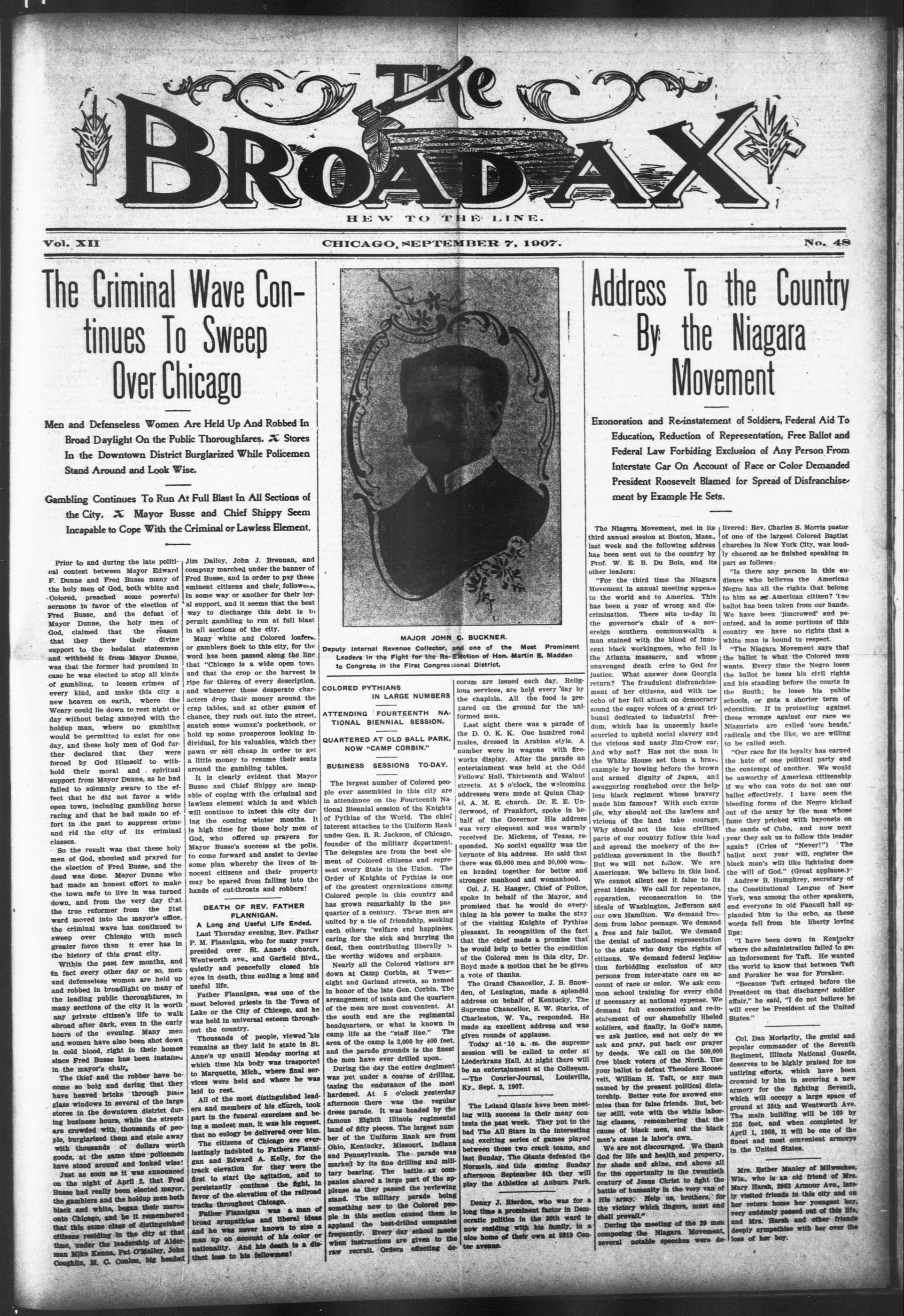
[Portrait of a man in formal attire, with a decorative frame and floral motifs].
MAJOR JOHN C. BUCKNER.
Deputy Internal Revenue Collector, and one of the Most Prominent Leaders in the Fight for the Re-Election of Hon. Martin B. Madden to Congress in the First Congressional District.
COLORED PYTHIANS
IN LARGE NUMBERS
ATTENDING FOURTEENTH NATIONAL BIENNIAL SESSION,
QUARTERED AT OLD BALL PARK,
NOW "CAMP CORBIN."
BUSINESS SESSIONS TO-DAY.
The largest number of Colored people ever assembled in this city are in attendance on the Fourteenth National Biennial session of the Knights of Pythias of the World. The chief interest attaches to the Uniform Rank under Gen. R. R. Jackson, of Chicago, founder of the military department. The delegates are from the best element of Colored citizens and represent every State in the Union. The Order of Knights of Pythias is one of the greatest organizations among Colored people in this country and has grown remarkably in the past quarter of a century. These men are united by a tie of friendship, seeking each others' welfare and happiness caring for the sick and burying the dead, then contributing liberally to the worthy widows and orphans.
Nearly all the Colored visitors are down at Camp Corbin, at Twen-eight and Garland streets, so named in honor of the late Gen. Corbin. The arrangement of tents and the quarters of the men are most convenient. At the south end are the regimental headquarters, or what is known in camp life as the "staff line." The area of the camp is 2,000 by 400 feet, and the parade grounds is the finest the men have ever drilled upon.
During the day the entire degiment was put under a course of drilling, taxing the endurance of the most hardened. At 5 o'clock yesterday afternoon there was the regular dress parade. It was headed by the famous Eighth Illinois regimental band of fifty pieces. The largest number of the Uniform Rank are from Ohio, Kentucky, Missouri, Indiana and Pennsylvania. The parade was marked by its fine drilling and military bearing. The battle ax companies shared a large part of the applause as they passed the reviewing stand. The military parade being something new to the Colored people in this section caused them to applaud the best-drilled companies frequently. Every day school meets when instructions are given to the raw recruit. Orders effecting de
corum are issued each day. Religious services, are held every day by the chaplain. All the food is prepared on the ground for the uniformed men.
Last night there was a parade of the D. O. K. K. One hundred road mules, dressed in Arabian style. A number were in wagons with fireworks display. After the parade an entertainment was held at the Odd Fellows' Hall, Thirteenth and Walnut streets. At 9 o'clock, the welcoming addresses were made at Quinn Chapel, A. M. E. church. Dr. E. E. Underwood, of Frankfort, spoke in behalf of the Governor His address was very eloquent and was warmly received Dr. Mickens, of Texas, responded. No social equality was the keynote of his address. He said that there was 65,000 men and 30,000 women banded together for better and stronger manhood and womanhood.
Col. J. H. Haager, Chief of Police, spoke in behalf of the Mayor, and promised that he would do everything in his power to make the stay of the visiting Knights of Pythias pleasant. In recognition of the fact that the chief made a promise that he would help to better the condition of the Colored men in this city, Dr. Boyd made a motion that he be given a vote of thanks.
The Grand Chancellor, J. B. Snowden, of Lexington, made a splendid address on behalf of Kentucky. The Supreme Chancellor, S. W. Starks, of Charleston, W. Va., responded. He made an excellent address and was given rounds of applause.
Today at 10 a.m. the supreme session will be called to order at Liederkranz Hall. At night there will be an entertainment at the Coliseum.
—The Courier-Journal, Louisville, Ky., Sept. 3, 1907.
The Leland Giants have been meeting with success in their many contests the past week. They put to the bad The All Stars in the interesting and exciting series of games played between those two crack teams, and last Sunday, The Giants defeated the Normals, and this coming Sunday afternoon September 8th they will play the Athletics at Auburn Park.
Denny J. Rierdon, who was for a long time a prominent factor in Democratic politics in the 30th ward is now residing with his family, in a nice home of their own at 5919 Center avenue.
Address To the Country By the Niagara Movement
Exonoration and Reinstatement of Soldiers, Federal Aid To Education, Reduction of Representation, Free Ballot and Federal Law Forbiding Exclusion of Any Person From Interstate Gar On Account of Race or Color Demanded President Roosevelt Blamed for Spread of Disfranchisement by Example He Sets.
The Niagara Movement, met in its third annual session at Boston, Mass., last week and the following address has been sent out to the country by Prof. W. E. B. Du Bois, and its other leaders:
"For the third time the Niagara Movement in annual meeting appears to the world and to America. This has been a year of wrong and discrimination. There sits to-day in the governor's chair of a sovereign southern commonwealth a man stained with the blood of innocent black workingmen, who fell in the Atlanta massacre, and whose unavenged death cries to God for justice. What answer does Georgia return? The fraudulent disfranchisement of her citizens, and with the echo of her fell attack on democracy sound the eager voices of a great tribunal dedicated to industrial freedom, which has in unseemly haste scurried to uphold social slavery and the vicious and nasty Jim-Crow car. And why not? Has not the man in the White House set them a brave example by bowing before the brown and armed dignity of Japan, and swaggering roughshod over the helpless black regiment whose bravery made him famous? With such example, why should not the lawless and vicious of the land take courage. Why should not the less civilized parts of our country follow this lead and spread the mockery of the republican government in the South? But we will not follow. We are Americans. We believe in this land. We cannot silent see it false to its great ideals. We call for repentance, reparation, reconsecration to the ideals of Washington, Jefferson and our own Hamilton. We demand freedom from labor peonage. We demand a free and fair ballot. We demand the denial of national representation to the state who deny the rights of citizens. We demand federal legislation forbidding exclusion of any persons from inter-state cars on account of race or color. We ask common school training for every child if necessary at national expense. We demand full exoneration and re-statement of our shamefully libelled soldiers, and finally, in God's name we ask justice, and not only do we ask and pray, put back our prayer by deeds. We call on the 500,000 free black voters of the North. Use your ballot to defeat Theodore Roosevelt, William H. Taft, or any man named by the present political dictatorship. Better vote for avoided enemies than for false friends. But, better still, vote with the white laboring classes, remembering that the cause of black men, and the black man's cause is labor's own.
We are not discouraged. We thank God for life and health and property, for shade and shine, and above all for the opportunity in the twentieth century of Jesus Christ to fight the battle of humanity in the very van of His army. Help us, brothers, for the victory which lingers, must and shall prevail."
During the meeting of the 29 men composing the Niagara Movement, several notable speeches were de
No. 48
the Country
Niagara
ement
ent of Soldiers, Federal Aid To
Representation, Free Ballot and
Exclusion of Any Person From
ent of Race or Color Demanded
ned for Spread of Disfranchise-
Ivered: Rev. Charles S. Morris pastor of one of the largest Colored Baptist churches in New York City, was loudly cheered as he finished speaking in part as follows:
"Is there any person in this audience who believes the American Negro has all the rights that belong to him as an American citizen? Ine ballot has been taken from our hands. We have been 'jimcrowed' end peonized, and in some portions of this country we have no rights that a white man is bound to respect.
"The Niagara Movement says that the ballot is what the Colored man wants. Every time the Negro loses the ballot he loses his civil rights and his standing before the courts in the South; he loses his public schools, or gets a shorter term of education. If in protesting against these wrongs against our race we Niagarists are called 'sore heads,' radicals and the like, we are willing to be called such.
"Our race for its loyalty has earned the hate of one political party and the contempt of another. We would be unworthy of American citizenship if we who can vote do not use our ballot effectively. I have seen the bleeding forms of the Negro kicked out of the army by the man whose fame they pricked with bayonets on the sands of Cuba, and now next year they ask us to follow this leader again? (Cries of "Never!") 'The ballot next year will, register the black man's will like lightning does the will of God." (Great applause.)' Andrew B. Humphrey, secretary of the Constitutional League of New York, was among the other speakers, and everyone in old Faneucil hall applauded him to the echo, as these words fell from his liberty loving lips:
"I have been down in Kentucky where the administration failed to get an endorsement for Taft. He wanted the world to know that between Taft and Foraker he was for Foraker.
"Because Taft cringed before the President on that discharged soldier affair," he said, "I do not believe he will ever be President of the United States."
Col. Dan Moriarity, the genial and popular commander of the Seventh Regiment, Illinois National Guards, deserves to be highly praised for his untiring efforts, which have been crowned by him in securing a new armory for the fighting Seventh, which will occupy a large space of ground at 35th and Wentworth Ave. The main building will be 160 by 258 feet, and when completed by April 1, 1908, it will be one of the finest and most convenient armorys in the United States.
Mrs. Esther Manley of Milwaukee, Wis., who is an old friend of Mrs. Mary Harsh, 2633 Armour Ave., lastly visited friends in this city and on her return home her youngest boy, very suddenly passed out of this life, and Mrs. Harsh and other friends deeply sympathise with her over the loss of her boy.
Will promulgate and set all times uphold the true principles of Democracy, but Catholic, Protestant, and Creed, and ensure that no one can give them any say, so long as their language is proper and responsibilities is fixed.
The Brood *B* is a newspaper whose platform is to inform the public of the truth, challenging the official right to speak its own mind.
Local communications, with receive situation, write only on one side of the paper.
Subscriptions are sold on the paper.
SULIUS P. TAYLOR, Editor and Publisher.
Received at the Post Office at Chicago,
M. on second-class Mail.
Before the War White Southerner Declared in Public Press That Due to Actions of White Southern Men No Man Could Be Sure Any Southern White woman He Married Did Not Have African Blood in Her Veins—White and Colored People of One Town All Blood Relations —White Southerner's Talk Bank Humorism
In December, 1859, The Sentinel published at Marshal Co., Va., said: The South is becoming so mixed up that a man cannot feel safe any more in marrying there for fear his wife will prove to have black blood in her veins. Negroes are so fully kept in their sphere by northern white men that as a rule persons can always find out Negro blood by tradition, and it is comparatively safe to marry dark complexioned women in the North without danger of the amalgamation so very common in the South." In the same year and month, the Charleston, S. C., correspondent of the Police Gazette wrote to his paper:
"If the morals of this city continue as at present in a century there will be no Negroes here. At present you will see yellow girls in this city that cannot be told from white women when it becomes general. Slavery is but a name for being white; they are less submissive and of less value. Among my own slaves there are ten females, who have fifteen children, and but two of the number are black."
Here we have a pretty faithful picture of the morals of the precious "superior" white man drawn by himself 58 years ago. And yet blatant demagogues like the familiar bunch whom we all know by reputation, and who need not be mentioned here, are constantly filling the air with words, words, words, about the purity of the Anglo-Sexon race. There is scarcely a white man or woman in the eleven old slave states who hasn't a strain of Negro blood—and it is knowledge of the existence of their African re-inforcement that is responsible in large measure for all the so-called race troubles in that section.
I was in the town of Cuffeyville in Virginia many years ago, and was surprised (?) to be told that nearly all the Colored and white inhabitants thereof were blood relations, and those pointed out to me looked up part—Ex.
It is about time for brother Ben Tillman, Jim Vardaman, John Temple Graves, Rev. Thomas Dixon Jr. and Co. to come forward and pick out this blood relations among the real light and very dark sons and daughters of Africa.—Editor.
NEW TOWN WILL BAR WHITES.
To Be Created in Vicinity of West Virginia Colored Institute.
Wheeling, W. Va., Sept. 1.—A city exclusively for Negroes is to be built in West Virginia if the plans of the projectors do not miscarry. Partially intended as a solution of the race problem, the promoters of the black city believe their project will meet with instant favor among the Colored people of West Virginia, and they expect within a year's time to have a city of several thousand persons, without a white person among its population.
Eight miles from Charleston, the state capital, is the West Virginia Colored Institute, an institution for the higher education of the Colored people, maintained by the state. Former State Tax Commissioner C. W. Dillon of Fayette county has purchased some 500 acres immediately adjoining the Colored institute property. He is having it cut up into city property, grading streets, laying cement alleywalks, putting in electric lights and sewerage, and is constructing a large city park. He will refuse to sell a lot in his town to any but a Colored person, and with the distinct understanding that no white man is to be allowed to live in the city. It is believed the Negroes will take to the man, as the place is close enough to Charleston to enable them to retain their positions in Charleston and live in the Negro community.
The city will give a splendid object lesson in the capacity of the Negro to govern his own race, for a full city government will have to be provided."
OBLIGATION TO PAY FOR A PUBL
LICATION RECEIVED.
An inquiry received by the New York Journal of Commerce, and the reply, are as follows:
Please tell me the legal rights in a case of this kind: A publication, costing by subscription about 50 cents a year, is subscribed for for two consecutive years, and then when the renewal blank is sent, it is not filled out and the subscriber supposes he is through. The publication continues to arrive and is thrown into the waste paper basket. After a year or two propositions are made that if the subscription is paid an additional term for sending the publication will be given free. No notice is taken of this, when a letter is received stating that unless the amount equal to one or two years, which have elapsed of unpaid subscription price is paid, the matter will be put in the hands of the publisher's attorney.
Reply—The legal rights involved in a case of this kind are these: A person is under a legal obligation to pay for a publication, or for any other item of personal property, in either of the following cases: 1) If he orders it to be sent to him; (2) If he does not order it sent or even if he orders it not to be sent, but it is sent and he accepts it. Our correspondent in the case, refused, or at least failed to continue his subscription for the year for which he is now asked to pay. If he had also refused to accept the paper when it was sent to him he would be under no obligation to the publisher now. Inasmuch as he has taken the paper he can be required to pay, with out regard to the disposition he may have made of the paper after he did accept it."
THE PEKIN.
It would seem as though the clientele of the Pekin Theater, State and 27th Sts., would never tire of J. Ed. Green's big dramatic and musical triumph, "Captain Rufus." This play is now entering its third month, having played to unprecedented business during the entire summer, including two weeks' enormous business in New York City. This play has afforded a clear insight into the capabilities of the clever Pekin Stoe Company as it covers a range from intense melodrama to broad burlesque. Since the return from New York several musical numbers have been interpolated and the Colored players are giving a well-rounded performance. Harrison Stewart, Mat Marshall, Jerry Mills, Lawrence Chenault, and Lottie Grady still have the principal parts, and they leave nothing to be desired in the interpretation of their several roles. The battle scene which comes as a climax to the second act, is as full of thrills and excitement as ever and never fails to bring from eight to ten curtain calls. Any one who has not seen this remarkable production should not fall to visit the Pekin at least once as it is without doubt one of the best shows in town and the long run will soon be terminated.—"P."
SOUND WORDS OF WISDOM
Let the white people of the North and the South conquer their prejudices. Let the great northern press and the pulpit proclaim the gospel of justice and truth against war now being made upon the Negro. Let the American people cultivate kindness and humanity. Let them give up the idea that they can be free while making the Negro a slave—Fredrick Douglass.
CHIPS
Mr. and Mrs. Chas. Williams of the Original Dixie Jubilee Co., are in town for a week's vacation.
Mr. Robert Motts owner of the Pekin Theater, is in Cincinnati, O., this week on theatrical business.
Miss Mabel Wilson left Monday a.m. for East St. Louis, Ill., where she will teach in the city high school.
Mrs. W. Sampson Brooks of Des Moines, Iowa, is making an extended visit with friends in this city.
Mrs. Florence Kemp of Nashville, Tennessee is spending her vacation in the city and boarding at 2024 State Street.
Says an exchange, "A Missouri man eloped with his mother-in-law, but it is not known what asylum he escaped from."
William Hale Thompson, president of the Illinois Athletic Association, and one of the big leaders of the republican party, spent the past week in New York City.
The business men who want to reach the people in and around Chicago, and throughout the country should advertise their business in The Broad Ax.
Prof. W. Herrald five dollars Kemper believes in holding onto his money so long until he fails to divide it up with some of the newspaper men.
Mrs. L. D. Glass of Des Moines, Iowa, is in the city, and will spend three weeks in visiting with her sister, Mrs. J. S. Woods, 6132 Ada street.
Mrs. W. B. Darbey, 315 30th street. is a lady of high culture, full of race pride, and she believes in patronizing enterprises, run in the interest of the Afro-American race.
A large number of young society folks were out Monday afternoon and witnessed the defeat of the Presbyterian base ball team by "Avendorph's Emergences" with a score of 18 to 14.
Willie Strange, of Pittsburg, Pa., has been visiting his uncle William Robinson, 3511 Armour ave. He left for his home Wednesday evening, and later on he will enter school in South Carolina.
Miles E. Bish was given a surprise party by a number of his young friends at his home Wednesday evening, Sept. 4th, in honor of his birthday, of which he prides himself of twenty-one years.
Dr. Ida Gray-Nelson, 3552 Wabash ave., arrived home Saturday morning, from a two weeks vacation at Glencoe, Ill., and she reflects the very picture of health from her outing in the country.
Mr. Arthur S. Shaw was tendered a "Dutch Lunch" by his brother, Dr. John Shaw Friday evening Aug 30th, at the Shaw residence, 5747 La Fayette Ave. A large number of gentlemen attended.
Miss Edythe Madden, 5748 Dearborn St. entertained a large number of her friends at a dancing party Friday evening in honor of Miss Edna French, who will leave Chicago next week for Fisk University.
Mrs. Ellen Johnson, mother of Mr. John J. Johnson is reported seriously ill at Atlantic City, New Jersey. Mrs. Rae, Mrs. Johnson, eldest daughter, left for Atlantic City the first of the week to attend her sick mother and brother.
R. T. Dett, proprietor of the Hotel Vancouver, Niagara Falls, N. Y., announces a grand opening of his hotel, Monday September 9th, and he has sent out invitations to many prominent people to be present on that occasion.
John W. Hardy, who has proven himself to be, one of the best "Fly Cops on Chief Shippy's staff, has recently purchased a fifty foot lot corner 61st and Ada streets, and he will in the near future construct two stores and a flat building on it.
Rev. J. S. Woods pastor' of St. John's A. M. E. church Englewood, has worked exceedingly hard this past year and he has succeeded in getting enough money together, to commence constructing a new house of worship.
Last Monday, Rev. J. S. Woods, and his flock, gave a successful and enjoyable barbecue in the grove near 62nd and Ada streets. Considerable money was realized from the many good things to eat for the benefit of his church.
A. E. Stack, the popular druggist 29th and State street, returned home Monday, from a successful fishing trip and outing among the beautiful lakes of Northern Wisconsin, and he shipped in a great many fish, which were distributed among his numerous friends.
After being entertained by several of her friends at a champaign dinner, Mrs. Clara Belle Burley, 4157 Ellis Ave., left Chicago Tuesday at 5 p.m., for New York City where she will do considerable shopping before making her annual tour of the eastern pleasure resorts.
Rev. and Mrs. D. P. Roberts were given a surprise at their home, 3553 Vernon Ave., last Friday evening. Mrs. J. E. Bish and forty members of Quinn Chapel, went in quietly and unwrapped some of the most beautifully Decorated China ware as a present to Mrs. Roberts, served a fine lunch for those present.
NOTICE FOR PARDON
R. M. Mitchell will make application for the pardon of Joseph A. Kelley, who is now serving a one-year sentence in the Cook County Jail for the crime of larceny. R. M. Mitchell, Counsel for applicant. 79 Clark St. Chicago, August 31, 1907.
Special Correspondence 1
[Special Correspondence.]
Small pay is the main reason for desertions from the army, according to the annual report of Major General A. W. Greely, commanding the northern division, which includes the departments of the lakes, the Dakotas and Missouri.
This factor, General Greely says, is seconded by the lack of the canteen, resultant trouble in dives surrounding the army posts, and "the low standard and general worthlessness of recruits."
The moral deterioration of the recruits is characterized as a corollary of the small pay.
The Pay of Soldiers.
General Greely urges increase of pay of officers and men, a five year term of enlistment, a material increase in strength of the infantry and restoration of the canteen privileges to the extent of selling beer. He recommends that the pay proper to all enlisted men, except recruits of less than one year's service, be increased from 20 to 50 per cent, and that the minimum penalty for desertion should never be less than the unexpired term of enlistment. General Greely urges the necessity of materially increasing the pay of officers and declares that unless it is contemplated the army shall be officered from an aristocracy of wealth, for an officer's position is fast becoming impossible for a man without private income, increased pay should be given him. He says the minimum infantry strength should be fifteen regiments, but if duty in Cuba and on the isthmus is to be part of the army work it should be twenty regiments.
Army Ration Criticised.
General Greely holds that the army ration, while excellent in quality and doubtless of sufficient nutritive value, in quantity and variety does not satisfy the American soldier. He suggests that various edibles found on every American table, even of the poorest people, are entirely lacking in the army ration, although they appear on the naval list.
Max Change Army Uniform
The plan to provide the enlisted men of the army with a more serviceable uniform is engaging the attention of officials of the war department. This subject has been agitated for some time, and the need of a uniform more practical for everyday service purposes is gradually becoming more apparent. Various recommendations are made by officials of the department as to the style to be adopted. Colonel L. M. Maus, who has had much experience with soldiers in the field, believes that the present regulation felt hat is not adapted for campaigning purposes in a hot or tropical climate. The infantry marching trousers, he declares, should be made full around the knees and the cuff extended down the leg far enough to be inclosed by the top of the marching shoe, thus doing away with the legging.
Government Workers Organize.
The Government Employees' Mutual Relief and Co-operative association has been launched by employees of the national government in this city, and plans are now being perfected for the permanent organization of the association.
Only employees of the United States government and of the government of the District of Columbia, employed within the District, are entitled to membership. It is proposed to establish an insurance department, whereby a member can obtain insurance protection based upon the plan of "old line" life insurance companies without having to pay the charge of those companies for agents' commissions, maintenance, etc. The policies will have guarantee cash surrender and loan values and will offer all of the advantages of the policy of a regular insurance company—insurance protection to be extended to life, health, accident and old age insurance.
To Establish Savings Bank.
It is also proposed to establish a savings bank building association, in which the reserve necessary to protect the insurance policies in force will be invested and which will be required to earn 4 per cent interest. It is proposed to lend money to members of the association on proper security at a rate in excess of the required earnings as will pay the operating expenses of the bank. Other features will be added from time to time as good business methods direct. A two-thirds vote of the total membership is necessary for the election of officers, all of whom are to be bonded.
Homage to the President.
The new union railroad station here will be supplied with a unique feature—a special entrance and reception room for the president of the United States. The president's entrance is an archway of marble thirty feet in width.
On alighting from his carriage beneath it the foremost citizen of the nation will step into a vestibule of noble proportions—of the same width as the archway and twenty feet in depth. In this vestibule the persons who accompany him will be waited upon by trained attendants, while the president himself will seek privacy in a room set apart for his exclusive use on the right hand adjoining.
The president's room, as it is called, will be most beautifully and luxuriously furnished. Costly oriental rugs will cover the floor. The ceiling will be done in gold and color, and the walls will be paneled in blue silk. In the middle will be a table suitable for writing, provided with a solid silver inkstand and other appurtenances to match, this and all the other articles of furniture being of mahogany. All of this luxury will not cost the chief executive a penny, but will be paid for out of the pockets of the railroad companies. CARL SCHOFFELD.
A. Boaring Lion.
In order to get a good model for a roaring lion which will be a part of a monument now being modeled by Josef Tuch the sculptor arranged with the superintendent of the zoological garden at Schonbrunn to make sketches in the lion house at that place.
"The big, beautiful animal," says the keeper who tells the story, "occupies a cage with five lionesses, and he seems to be so perfectly happy that the sculptor might with ease have made a picture of the conventional lion, and the more the artist stared at him the more friendly and docile the animal appeared. When the sculptor became discouraged we told him that he had chosen the wrong time for observation. 'Come at feeding time and do your staring,' we advised him, and this he did, bringing another man with him. With two men watching him at close range and one jabbing him with an iron rod while he was taking his dinner the roaring lion, tearing at the bars, even making lunges at his cage mates, soon took the place of the sleepy king, and the sculptor secured a good model.
The Chihuahua Dog.
The Chihuahua dog, which as late as twenty-five years ago was commonly to be found in Mexico, is rapidly becoming extinct. It is a curious little creature, popularly supposed to be a cross between the prairie dog and the jack rabbit. The animal resembles a small dog. Its weight is sometimes not more than a pound and a half, and it has a disproportionately large head, bulging eyes and long ears. The hair is usually scanty, showing the pink skin underneath, and from this characteristic it has been known as the Mexican hairless dog. It seldom shows the usual dog traits of sagacious and intelligent attachment. It is now difficult to find in Mexico a purely bred Chihuahua dog, and those that are found are often sold at prices ranging from $100 upward. Even in Chihuahua these dogs are rare. A few specimens sold in the City of Mexico recently are said to have been of the true breed.—Argonaut.
Queen of Siam's Jewels.
The queen of Siam possesses the finest collection of jewels in the world. The walls of her bedchamber are literally ablaze with precious stones, while in a safe in her majesty's apartments are diamonds, rubies, pearls and emeralds fashioned into quaint necklaces of fabulous value. One little article alone, intended to serve as a thimble, is in the shape of a lotus flower and is valued at £15,000. The king, too, possesses a wonderful stock of jewels, and not only is his throne, which is made of pure gold, thickly incrusted with diamonds, pearls and rubies, but his majesty's state mantle is covered with jewels. In fact, this cloak is the most wonderful garment in the world. In spite of his enormous collection of jewels, however, the king of Siam is constantly adding to them and spends something like £120,000 per annum in purchasing new stones—London Tit-Bits.
The Artist's Mistake.
A trained nurse was looking through the advertising pages of a magazine. Presently she came to a picture which arrested her attention.
"It's pretty," she said, showing it to her patient, "but can you see what's wrong with it?"
The patient saw a picture of a very attractive trained nurse about to hand a cup of something to an equally attractive patient who reclined in bed.
"No," she admitted. "It looks all right to me. What's the matter with it?"
"The nurse's apron has big strings, whereas it should be fastened with a trim belt. I never saw a nurse in my life who wore big strings on her apron. The artist probably never noticed."—New York Press.
In Search of Ancestors
Some years ago the remains of an apelike creature possessing unusual human resemblances were discovered in Java, and the animal was named pithecanthropus. Professor Haeckel and some others accepted this as representing an ancestral human form closely allied to the apes. Now a special expedition under the combined auspices of the Academy of Sciences of Berlin and the Dutch East Indian government is being organized to make a thorough exploration of Java in search of additional specimens of pithecanthropus. The geological formation in which the original discovery was made is widely extended among the mountains of that island. Youth's Companion.
The Inventor of Esperanto.
It is twenty years since Dr. Zamenhof published his first little book about Esperanto. This is the full title of it. "Dr. Esperanto. An International Language. Introduction and complete textbook for Russians, with a label on the second page of the cover. Permitted by the Censor, Warsaw, May 21, 1887." The word Esperanto literally means "one who hopes," and the name was afterward given to the language. Zamenhof did not wish his practice—he is an oculist—to be affected by suspicions of his being a dreamer and therefore did not give his right name.
Wireless For Clocks.
The regulation of clocks by wireless telegraphy seems to have been quite successful. In the experiments at Vienna of Reilthoffer and Morawetz the clock was controlled by wireless impulses from a regulator three and three-quarter miles away, and it kept perfect time, with no interference from stray currents. — St. Louis Post-Dispatch.
SHORT STORIES.
At the Pittsburgh morgue the body of a man who was killed trying to hold up a collector was viewed by 7,000 people.
Henry Price, an aged musician of Mount Vernon, N. Y., applied to New York hospitals for permission to photograph the soul in transit, but his request was refused.
In Fayetteville, N. Y., lives a fat hen that has no fear of the ax. In the will of Charles Brown, who died not long ago, was a provision that his residuary legatee, Mrs. Lucinda Brown, must take the hen and care for it until it died.
A young Bath (Me.) couple presented themselves before a minister recently and asked to be married. After the knot was tied the groom coolly informed the preacher that he expected to get a job soon and would then pay his fee.
A Cleveland skyscraper twenty stories high will be topped by a Goddess of Liberty holding a torch, from which a leaping flame of gas will be burning at all times. The exact hour of the day and night will be indicated by causing the flame to shoot high into the air during the minute preceding each hour.
SPORTING NOTES.
Sonoma May, 2:29%, the full sister to Sonoma Girl, 2:06%, is the property of Arthur Brown, Napa, Cal.
Alice Pointer, 2:05%, cost David Shaw of Pittsburg $110 a little more than a year ago. He bought her for a brood mare.
Fred Tenney and Roy Thomas have thrown their scruples aside and are now playing Sunday ball with the rest of the National league.
England has 2,000 golf clubs with 300,000 members who use 500,000 golf balls per week and walk over the links about 250,000,000 miles per year.
One of the candidates for the Cornell football team will be a real prince. His name is Victor Marayaha and he halls from the province of Cooch Behar, India, of which his father is the maharaja.
The smallest golf links in the world are at Hoylake, England. They are in close proximity to the railway station and consist of three holes. The players are the cabbies who wait therabouts for their fares.
MODES OF THE MOMENT.
In silk and lace gowns there is a disposition to favor white and cream.
Automobile coats with sleeves of Japanese cut are conspicuous in the new designs.
The empire and the princess will have the greatest vogue in cloth gowns for the coming season.
Very pretty little silk coats are being worn of all colors with thin dresses. They are eminently French and require to be most daintily made.
Sashes figure on nearly all silk gowns either of plain color or chine, and one hardly sees a dress without a faint glimmer of gold or silver embroidery.
A shoemaker has introduced a novelty in the form of seamless shoes of antelope skin, which is, like suede, the color of golden brown. The toes are pointed, and there is a narrow binding of tan kid which ties in a small bow in front. These shoes are of French manufacture—Brooklyn Eagle.
EDITORIAL FLINGS
For 5 cents you can ride all day in the New York subway—if you are that big a fool.—Baltimore Sun.
You can quote almost anything as from the Bible these days and not get caught at it.—Detroit Free Press.
Now they say that "laughing is a lost art in England." Does everybody read Punch over there?—New York Herald.
However foolish kissing may seem, the effort to regulate it on scientific principles is still more so.—Washington Star.
It has become impossible to eat or drink without colliding with a Harvey W. Wiley warning.—Charleston News and Courier.
While the national bureau of fisheries is trying most laudably to solve the future of the lobster, the whole question does not come within its jurisdiction.—Philadelphia Ledger.
NEW YORK CITY.
There is an average of 102 immigrants from Russia landing in New York city each day.
It is estimated that New York city will require the expenditure of $4,000,000 for police and fire engine houses during the next three years.
Though it may seem strange, there is hardly to be found in New York city a trunk store that is not perpetually advertising a "special sale."
There are now fewer household goods in storage in New York city, than in five years because there are more New Yorkers than ever going into suburban homes. New York Herald.
ENGLISH ETCHINGS
Less than 8,000 people own all the land of Great Britain.
Some of the London theaters send motor buses into the suburbs to gather up patrons.
In Queen Anne's reign a tax was put upon advertisements. For many years it was 2s. 6d. per advertisement in England and 2s. 6d. in Ireland.
The Ladies' Park club of London, one of the exclusive organizations of that city, has decided that members may neither smoke cigarettes nor play bridge.
QUAKER TURNED PAINTER.
Led Who Has Become One of America's Greatest Artists.
The magnificent mural paintings of C. Y. Turner are among America's art treasures. How near this famous artist came to being forbidden an artistic career because his Quaker parents objected on religious grounds is told in the New Broadway Magazine. When it came time for the small son to take his place among the wage earners of the family—and that time came early—he communicated to his father his intention of an artist. As has happened so often, the father objected. Not only did it seem to him most unpracticable from a monetary standpoint, but also contrary to the Quaker doctrines. In a family where brass handles on furniture were removed because they were considered frivolous and were replaced by knobs of dark walnut this was not a matter of small importance. Moreover, the father had intended that the boy should be a pharmacist.
A compromise was at last reached. The painting of pictures was out of the question, but architecture recommended itself to the Quaker mind as serving a utilitarian purpose. At the same time, with the possibility of making infinite charts and drawings, it approached closely enough to the pictorial to satisfy the young Charles. Three years of apprenticeship to an architect followed. Then, having come to the realization that the construction of buildings and the painting of pictures are decidedly different phases of art, the boy took a position with a photographer and eventually accompanied him to New York.
From the tinting of photographs, a phase of work at that time immensely popular, he drifted into pastel work and water colors, finally taking up oil portraiture. His success overcame even the Quaker principles and dignified the work as a profession in the eyes of his father.
Keeping Shop by Machine
Near Amsterdam a traveler—who does not know a word of Dutch—perceiving the announcement "English spoken," entered a shop. "English, sir?" asked a youth behind the counter. Then he picked up a cylinder, placed it in a gramophone, and the instrument duly sung out—but in German: "Sir (or Madam), the proprietor, who speaks German, will be telephoned for and will return to the establishment in less than five minutes. Will you please be seated?" The tourist, who knows German, seated himself. In came the principal, who speaks excellent English. The stranger asked why the gramophone did not talk English. The explanation was: "It's my stupid assistant! I have a cylinder on which is recorded the message in English; he used the wrong one. There is no excuse for him; my English cylinder is tinted red at the ends, and the German one blue. Lucky for me, sir, that you know German, else I might have lost an esteemed patron." After all, that horrible engine has its sordid use—London Chronicle.
The Cecelian Waltz
"From the English descriptions of the Cecelian waltz we judge," says a writer in a Berlin paper, "that there will be a sixteen step prelude to the regular waltz, that this introduction will have some of the old time minuet features and that when the waltz proper begins it will be something like the dance which was in vogue when we who are now middle aged and a little more were dancers. The fast and furious waltz which came from the country where everything is rush is beloved by the young people only because they do not know the dance of their parents. It was this, the graceful, slow and dreamy, that made the dance a soulful pleasure. It was this real poetry of motion that inspired Lanner, Gungl and Strauss. Welcome, new waltz, if you are like the old!"
Areas of Our Largest Cities.
New York is our largest city in area, with 209,000 acres. New Orleans has 125,000; Chicago, 122,000; Philadelphia, 82,000, and San Francisco, 77,000. Seattle has 49,920. Washington is next to Seattle, having 44,000 acres in its city limits. St. Louis, with more than 600,000 population, has an area of 39,276 acres; Boston, with 594,000, has 30,000 acres; Cleveland, with 414,000, has 22,422 acres; Pittsburgh, with 345,000, has 19,418 acres; Cincinnati, with 332,000 inhabitants, has 23,616; Detroit, with a population of 309,000, has 18,398 inhabitants, Minneapolis, with 214,000 people, has 34,105 acres, and St. Paul, with 172,000, has 35,483 acres.-Seattle Post-Intelligencer.
Annette and Longevity.
A great appetite has been generally regarded as a sign of fine health, but of recent years, since the experiments of Horace Fletcher, Professor Chittender, Dr. Wylie, Dr. Kellogg and others, opinions have much changed in this particular. It is the man who eats little who is healthiest and whose prospect of a long life is best. The voracious appetite of many persons is from habit, not necessity, and the experiences of the Trappists show that the cravings of nature may be fully satisfied with little food.
Bie Dry Docks
Belfast, Ireland, now has the largest dry dock in the world. San Francisco will shortly possess a dock of even greater dimensions. The new dry dock in the latter city will be 1,000 feet long from gate to the landward extremity; width at coping, 144 feet, and at bottom 92 feet; depth over sill and below coping, 89 feet 10 inches, or 344 feet 6 inches at high water. The interior facing of the dock will be of re-enforced concrete of an average thickness of 8-
WHAT HE GETS
He spends his money, likes to blow
His coin-in fact, to burn it-
To lend it to his friends, although
He knows they'll not return it.
Great admiration they evince
When they incur such debts.
They all declare that he's a prince—
That's what he gets.
Each time he in his pocket dips
He shows his money, power.
On funkies, one at all his tips
Fall in a golden shower.
To plunge at something is his forte;
He makes most foolish bets;
But people say, "Well, he's a sport!"
That's what he gets.
You've noticed how the world will cool
To former fortune's pets;
You'll hear them say, "That silly fool!
That's what he gets. _____ Chicago News.
_____
In the Trough of the Waves.
A man is being stretched out on a stretcher. A doctor is attending to him.
The Heroic Bodgers (in horse trough to would be rescuer)—Neve' mind me I can s-shwlm. Save the women and children (continues to strike out manfully for the shore)—Sketch.
A Hard Job.
There is an old Irishman in Baltimore who for many years was prosperous as a grocer. Not long ago, however, the old fellow lost his all in "a side line" and was compelled to look for a job. Through the influence of a friend he was offered the position of crossing tender at a small railroad station in Maryland.
The Celt looked dubious as the duties of the office were explained to him and the meaning of the various flags was stated.
"In case of danger you wave the red flag," explained the man told off to instruct Mike.
"Wait a bit, wait a bit," interrupted Mike, with a doubtful shake of the head. "I'm afraid this job'd be too much for me. I could never trust melsi to remember to wave a red flag whin there was a green wan hand."—Harper's Weekly.
Once a Boy Himself.
"That man remembers that he was once a boy himself," a Broadway jeweler remarked as a customer left the store. "He came in just now and said he wanted a watch for his boy for a birthday present and that he wanted the cheapest I had."
"The old skinflint! And I know he is well fixed, too," the jeweler's friend commented.
The other smiled. "I told him that those very cheap ones wouldn't keep good time," the other continued. "But he said: 'Oh, that's all right. Just give me one that has the back fixed on so that he can get it off. He will be satisfied.'" - Woman's Home Companion.
Fixed.
During the recent stay in camp of the national guard of the District of Columbia one of the captains called a sergeant one day, saying: "Sergeant, note down Private Mooney—one day on bread and water for slovenly turnout on parade." "Beg pardon, captain," responded the sergeant, "but that won't make any difference to Mooney. He's a vegetarian." "Then," said the captain, "give him one day on meat and soup."—Harper's Weekly.
Anything Better Than Home.
"I am sick to death of everything," said the society woman. "Let's spend this evening where we've never spent one before."
"Agreed!" said her husband. "Shall we try home or church?"
"Church," she replied, sighing... Judge.
So Singular.
"Funny," said Baretop, "but there was a time when the barbers used to speak of my hair."
"You mean before you began to get bald?" asked his friend.
At the Reception.
Casual Caller (to one next him)—I was introduced to that squint eyed, red haired woman over there as Mrs. Somebody or other. Don't you think the man was an idiot that married her's Next One (meekly)—I can't just say, I'm the man—Baltimore American.
What He Meant.
"Mr. Nervy tried to hug me last night," said Tyes.
"Oh," remarked Jesc, "that's what he meant then when I saw him hurrying toward your house. He told me he had a 'pressing engagement.'"—Des Moines Register.
Too Much For Him.
Huggins—Why did Peckem apply for a divorce?
Muggins—He happened to be home one wash day when it rained.—Chicago News.
Imported and Domestic Wines LIQUORS & CIGARS Cafe in Connection N.E. Corner, Fifthfirst and Armour Avenue, Chicago, Ill.
LURE OF THE CIRCUS.
What Do Kids Care For "Lickin'e"
When Traveling Show is Around?
"Hello, Jimmy."
"Hello, Johnny."
"Goln' t' th' circus?"
"Nope, Gota work."
"Aw, g'wan, y' don't have t' work.
Come on with me."
"Ma said I had t' clean th' back
yard t'day er git licked. She said I
couldn't go t' th' circus too."
"What d'ye care what ya ma said?
Be a sport and take a lickin'. Ye can't
go to a circus only once a year."
"Gee! I'd like t' go. I ain't seen a
circus--since last summer."
"Aw, come on with me t' th' circus,
Jimmy."
"They ain't no parade, is there?"
"Nope, Jes' th' circus. Come on,
Jimmy."
"I ain't got no money."
"Neither've L. Ye don't need no money.
I'll show ye how t' git in fer nothin."
"S a long way out there."
"Yep."
"S a long walk."
"Aw, cut it out, baby. Can't we hop a car?"
"Y-yes, I suppose we could."
"Then come on t' th' circus."
"I'll git licked."
"Aw, what d'ye care for a little thing like that? I've been licked lots o' times. Lickin's don't hurt much."
"N-no. N-not m-uch."
"Come on, then, Jimmy."
"Th' back yard's gota de cleaned up."
"We'll come back early, an' I'll help ye."
"Honest?"
"Cross my heart; honest an' true; black and blue."
"I don't care much if I do git licked."
"That's right, Jimmy. Be a sport."
They reached the circus grounds. They gazed in youthful wonder at the tents, the crowds, the barkers, the big banners in front of the slideshow.
"I don't think they've got a woman as fat as that one up there," said Johnny, gazing up at one of the banners.
"Aw, yes, they have. I seen a woman bigger'n that in a circus oncel."
"A real live woman?"
"Ub-huh."
"Did she walk an' talk jes' like other women?"
"Ub-huh. Honest she did."
"I'll bet a million dollars they ain't no man in there eats sords like that pitcher."
"I'll bet they have. I seen a man do that once too."
"I'd like to see him do it."
"So'd I."
"I tho't ye said ye had seen one oncet."
"I mean I'd like to see it again. Of course I seen it oncet."
"I'd like to be in a circus, wouldn't you?"
"Aw, I'd ruther be a clown. They have all th' fun an' make everybody laugh."
"I'm goln' to be a circus man when I grow up."
"So'm I—a clown."
"How're we goin' t' get into th' circus?"
"Come on with me. I'll show ye. I done it onctet before."
They skirted the big tents, but husky and alert canvasmen and guards were everywhere.
"I'd rather stay outside, anyway."
"So'd I. Circuses are all alike. I heard pa say so."
"I don't care much 'bout seein' it, anyway."
"Neither do I. Let's go home, Jimmy."
"All right, Johnny. Let's."—Milwaukee Free Press.
The Length of Eternity.
Mrs. C. W. McCulloch of Chicago on taking up her new office of justice of the peace told a Chicago reporter that in the performance of marriage ceremonies she proposed to cmit the word "obey." "In these enlightened days," said Mrs. McCulloch, "the word 'obey' has lost its meaning in the marriage contract. The best wife does not propose to 'obey' her husband any more than the best husband proposes to 'obey' his wife. Obedience is for dogs, horses-creatures without reason. "So I think we should drop this meaningless word—as meaningless as a certain other word was to a certain boorish husband. "The husband had been particularly nasty one rainy Sunday at home, and his wife finally began to cry.
"Bight years ago,' she sobbed, 'you swore eternal love, and now—" "Oh,' growled the man, 'how long do you expect eternal love to last anyway?"
Frank H. Lewis, Prop.
Phone Oak
THE RAIL
Imported and Dried
Liquors
Cafe in C
N. E. Corner Fifty-Grst and
Telephone Calumet 185
E. A. STACK
DRUGGIST AND CHEMIST
2842 South State Street
Cor. Twenty-Ninth CHICAGO
Open Day & Night
PEKIN INN CAFE
Chas. Lett. Proprietor.
ALA CARTE & TABLE DE HOTEL
SERVICE
Music Every Evening.
Special Attention to Parties and Wed-
dings.
2704 State St. Phone Calumet 261
CHICAGO
PATENTED DENTISTRY
We control patents and discoveries by which missing teeth can be replaced without the old-time removable plate or bridge and by which looses and falling teeth can be tightened sore and brittle ripphea (Riggs' disease) sore and brittle ripphea may be cured Call and have us examine our teeth and you will get satisfaction.
WHAT WE WANT
Is to introduce our work among the Colored people of Chicago. We will make small charges for material until Sept. 1st.
$3.00 - FULL SET OF TEETH - $3.00 - GUARANTEED - $6.00 - BEST SET OF TEETH - $6.00 - $22k Gold Crowns (cost material about $1.50)
Bridgework (cost material about $2.00)
Re-Enameling (cost material about $2.50)
Gold Fittner $75 cents Silver Fittner $40 cents Percelain Crowns (cost material about $1.50)
All work guaranteed 10 years. All work done under direct personal supervision.
Read what a clergyman says about us—I wish to say that I am well satisfied with the work done in your office. Your dentists are men who understand their business and are gentlemen." REV. J. L. JACKSON.
Pastor Hyde Park Baptist Church Chicago.
NORTHWESTERN DENTAL CO.
Roused Her Irs.
Stubb—I am glad to say that the foolish old custom of fighting at the drop of a hat has completely died out.
Penn—Don't you believe it. I dropped my wife's white summer hat while I was looking for my collar yesterday and she has been fighting ever since.
—Detroit Tribune.
One Good Meal.
"Yes," said Kandor, "I told my friend that I have a room here."
"But," asked Mrs. Starvem, "didn't you also tell him that you eat here?"
"Certainly not. I told him I eat breakfast and supper here, but that I eat at a restaurant near the office."—Catholic Standard and Times.
Circumlocution.
"Grandpa, if you were a little boy and your ma had promised you a penny if you got your lessons right what would you think was the best way to spell cat?"—Woman's Home Companion.
Front Bedroom to Rent.
For rent, front bedroom for man and wife, or two gentlemen, must furnish good reference. Apply to Mrs. Gardner, 3546 State street, top flat front.
Trade Mark
Guaranteed Hair-dressing for hash, stoubborn or dry hair and scalp. Makes the hair grow, soft, straight and glossy. Cleans and nourches the scalp. Send 10c for sample. 10c and 25c. Write or call. Mail orders filled.
GEO. W. FIELDS & CO.
3916 State St.
Chicago, IL.
Phone Douglas 4965
Lou Seldon, Mgr.
and 1787.
ROAD INN
Domestic Wines
& Cigars
connection
Armour Avenue, Chicago, Ill.
THE LELAND GIANTS VS. THE ATHLETICS, AUBURN PARK, SUNDAY, SEPTEMBER 5TH.
Fifty-First St. and Armour Ave.
BAL YARD: 1ST St. & L. B. & R. R. B.
2ND St. and Armour Ave.
CHICAGO
Gaskins'
Billiard and Pool Parlors
Dilhurd and Pool Patrons
3004 STATE ST.
All Newly Furnished with Latest
Tables and Fixtures.
Will also carry a Fine Line of Cigars
and Tobacco
Chas Gaskins, Prop.
First-Class Service Guaranteed our
Patrons.
Tile and State Hauling a specialty.
COAL
J. H. COLEWAN & CO.
Express & Van Moving
TRUNKS EVERYWHERE.
2540 State Street
Phone 699 Calumet CHICAGO
ICE CREAM CIGARS, TOBACCO
SHIRT WAISTS KIMONAS
NOTIONS
419-36TH STREET
Underwear a
Specialty
HICAGO
Niagara Falls
First class in all appointments.
Rates $2.00 per day and upwards, near
the Falls, parks and depots.
For further information address R.
T. Dett, Niagara Falls, N. Y.
Davis Express
FURNITURE MOVING
TRUNKS DELIVERED
Claim Checks given
110 E. HARRISON ST. CHICAGO
Bet. Custom House Pl. & Clark St.
'TWAS EVER THUS.
I held a hand at poker
Which looked exceeding good,
Five handsome clubs consorting
In sable brotherhood.
Alack, my hated rival
Whom I would put to rout
Remained not for the slaughter,
But
I held a hand one evening
Ridiculously small.
Upon it flashed and glittered
One diamond—that was all.
Alack, my hated rival.
Despite my baleful glare.
Moved not to take departure,
But
Stayed
Right
There.
McLandburgh Wilson in New York
Times.
THE BROAD AX.
is for sale at the following news stands:
J. W. Hagan, cigars, tobacco and news stand, 2718 State st.
L. L. Jones, barber shop and news stand, 3842 State st.
A. F. Tervalon, 134 W. 51st street Cigar Store and News Stand.
Mrs. Nellie Phelps, Cigars, Notions and News Stand, 131 W. 51st street
T. B. Hall's Cigar Store and Laundry office, 281 39th St.
W. S. Cole, 354 Thirty-first street. cigars, tobacco and news stand.
J. R. Peters Cigars, Tobacco and News Stand, 338 E. 27th street.
Mrs. A. E. Baker, Notions and News Stand, 419, 36th street.
W. P. Johnson, Notion Store and News Stand 2704 State st.
Turner Williams' Shaving Parlor and News Stand, 2903 Armour ave.
B. Davis, cigars, tobacco, and confectionery, 3582 State st.
C. C. McLain, cigars, tobacco and news stand, 2906 State street.
Mrs. Katherine R. Hamlet, Cigars, tobacco, and fancy groceries and news stand 5028 Armour ave. M. A. Johnson, news stand, cigars and tobacco, 3812 State Street.
The Informer News Co., 188 Bandolph St., Detroit, Mich.
The Standard News Co 131 W. 53rd st., New York, City, N. Y.
Auburn Ball Park
THE LELAND GIANTS VS. THE
SUNDAY, SEPTT
Games called at 3:30. B
all times. Come and see real ball
Stand 350, Boy
ATTORNEYS AT LAW
Suite 1114 Ashland Block, Clark and Randolph Sts. Tel. Central 568.
CHICAGO.
Residence 87 Mossallister Place
Telephone Ashland 363
Office Telephones
Central 1239 Automatic 5640
MILES J. DEVINE
ATTORNEY AT LAW
Suite 315-320 Reaper Block
CLARK AND WASHINGTON STS.
CHICAGO.
A. D. GASH
Attorney at Law,
84-86 La Salle Street, Chicago
Suite 615 to 619.
Telephone Main 3077.
JOHN E. OWENS
ATTORNEY & COUNSELOR
AT LAW
900 AGHLAND BLOCK
TELEPHONE CENTRAL 900 CHICAGO
Tel. Douglas 1565 Notary Public
Jesse Binga
REAL ESTATE, LOANS AND
RENTING
Bates Building
3637 STATE STREET CHICAGO
J. GARNER Tel. Douglas 325
FINE WINES, LIQJORS
AND CIGARS
3030 State Street CHIGAQC
Phone 194 South
A. B. SCHULTZ, M. D.
PHYSICIAN AND SURGEON.
2719 State Street
Hours: 9 to 12 A. M.
3 to 9 and after 6 P. m.
CHICAO
Phone Oakland 1328
UNDERTAKER AND
FUNERAL DIRECTOR
When his work is finished
you have no displeasure.
4834 State St., CHICAGO
Phone Douglas 1550
RECALL PATTERN
10
15
MINE BROOK
RECALL MARKETING
50
YEAR
INCLUDING AFTER SILVER
The company McCall Pottery will be in the business of making pottery and pottery in all amount of their size, quantity and simplicity.
McCall's Regina (The Store of Published Art and Manufacture) in Regina, Canada, is a company that makes 500 pottery pieces. It also offers a variety of services, including a delivery member gets a delivery fee.
By Appointed Wanted, Hydromes company Paint and Decorating. Paint Catalog of all decorated and Furnished Paintings. Address THE McCALL CO., New York.
Waiters and Cooks
Prefer Our Make
JACKETS AND LINEN
because they have found then
satisfactory.
giving full instructions how to order.
Marcus Ruben (Inc.)
390 State St, CHICAGO.
79th St. and Wentworth Ave.
Best Games of Ball in the city by
leading Pros. & Semi-Pros. Clubs
ATHLETICS, AUBURN PARK,
NUMBER 8TH.
Best of order maintained at
playing. Price, Admission 25c, Grand
P's Seats 15c.
Brevities
THE HALL OF FAME.
It is reported that C. B. Jefferson of the theatrical family has retired and will devote his time to growing fruits in Florida.
High Constable William Jaby of Shamokin, Pa., who has only one leg, thrashed, unaided, two thugs who attacked him and landed both in prison.
At eighty-one Gorton Anderson of Newport, R. I., still wields the razor. He is the oldest active barber in the United States and perhaps in the world.
Thomas F. Ryan has offered to pay a pension of $5 a month to the 200 Confederate veterans who now live in Nelson county, Va., where Mr. Ryan has his home.
William H. Baldwin, who had been for thirty-nine years president of the Boston Young Men's Christian union, has resigned after reaching his eightieth birthday anniversary.
Dr. Warre, late head master of Eton college, has been presented with an album containing the signed photographs of nearly every master and boy who was at Eton at the time of his resignation.
Thomas W. Lawson, the famous Boston operator in copper, is a grandfather. The little girl is the child of Mr. and Mrs. Arnold Lawson. Mrs. Lawson was formerly Mrs. Herbert Barnum Seeley of New York.
George H. Ware, seventy-three years old, an expert accountant of Providence, R. L., figures that in the last forty years he has smoked nearly three tons of tobacco in his meerschau plipe, from which he is inseparable.
William Livesay of Preston, the son of Joseph Livesay, the famous founder of teetotalism in England, has just celebrated his ninety-second birthday. Mr. Livesay is in good health and as stanch a temperance champion as was his celebrated father.
Captain Speltenini, the Swiss aeronaut, has just finished a wonderful achievement, the crossing of the Alps in a balloon. This was his five hundred and thirty-ninth ascent, and his notebook does not record a single accident in any of them.
One of the most remarkable personalities in Russia is Prince Khilkoff. He is called in Russian society "the American" because when young he shipped to America as a stoker and there set himself to learn all he could about railways by working as conductor, stoker, driver, brakeman and mechanic in the engine shops without allowing his princely rank to be suspected.
PLAYS AND PLAYERS.
Richard Sterling, an American actor, has been engaged for the London production of "The Earl of Pawtucket." It is said that Mrs. Langtry will be a Belasco star next season and that the manager believes her strength lies in tragic roles.
Madge Lessing has been engaged for a new production, called "The Belle of Hong Kong," which is to be seen in Philadelphia in October.
A new vaudeville amusement company has been organized in New York with a capital of $500,000. William Morris is the president of the organization.
Thomas Thorne and Harry Burkart, both well known to Baltimore theater goers, will be in the company supporting Miss Maude Fealey when she goes on her starring tour.
Octavia Broske, a San Francisco girl, who had the prima donna role in "The Sultan of Sulu" last season, has been engaged for a prominent role in "The Prince of Pilsen."
FACTS FROM FRANCE.
The president of the senate was recently petitioned in the shape of a flood of 400,000 post cards. France has no old age insurance measure, but a large amount is annually spent in relief to aged natives. There are to be no ceremonies when Paul W. Bartlett's equestrian statue of Lafayette in Paris is placed on its pedestal next October. In all France there are only 1,100 persons who are millionaires in our sense of the word (in dollars). Of millionaires in france there are about 15,000, apart from the 1,100 already counted. A philanthropist at Bordeaux has accepted $400,000 from M. Hifa with which to found a day refuge for aged workmen and indigent of both sexes. The refuge is to be a vessel moored in the middle of the Garonne, where soups are to be dispensed apparently in midstream.
GERMAN GLEANINGS.
Of the 51,000 breweries estimated to be in the world 26,000 are in Germany.
Germany employs some hundreds of women in its secret service. Several of them draw salaries of $10,000 a year.
In Germany glass baths are taking the place of the enameled metal variety. They are both cheap and artistic.
A woman dentist recently stopped with gold a hole in the tusk of a circus elephant at Iunshnack, but a few nights later the filling, worth $70, was stolen.
A monument has been erected to Anna Hokel in the Schlossgarten at Mannheim. She was the wife of a carpenter who in 1784 saved the poet Schiller from a debtor's prison.
The Majesty of the Family.
Every one who has lived south knows that peculiar brand of loyalty among old servants that expresses itself in a profound conviction that their family is the "fust family." Consequently every southern town and city is still full of "fust families." This particular "fust family" was making its annual pilgrimage to the White Sulphur Springs, the great coach laden with children and trunks as well as the mistress, with her nearest and dearest relatives.
Old Simon, mindful of the glory of his house and filled with the all powerful dignity of an old retainer, drove the fat cat horses and admonished his small charges, who, edged in beside him on the box, crowded him to deser
His master rode on horseback a little distance behind the coach and as they approached a railroad crossing was astonished to see Simon drive calmly before a passing train, which hurled the coach one way, horses another and family and trunks in all directions. Galloping up, he called to his coachman:
"Simon, you old nigger, didn't you see that train coming?"
"Yassuh."
"You saw it coming and deliberately drove upon the track! What made you do such a crazy thing?"
"Well, you see, Marse George," explained that bewildered individual, scratching his gray wool, "Ah thought when dey see it's we all's ka'dge dey'd ston."-Saturday Evening Post.
Come In Handy.
"Tell me, sir," said the self made man, "did you ever find any practical use for what you learned at college?" "Sure. I did," replied the college graduate. "One time when burglargs got into the house I scared them off with a college yell." -Detroit Tribune.
The Borrower
"Choofers, can I borrow your auto tonight? I feel just like taking it easy and having a good time."
"I'm sorry, but I've made arrangements to use it myself."
"Well, will you lend me your lawn mower?"—Cleveland Plain Dealer.
Familiar to Her.
Rev. Dr. Howells-I have preached several sermons on the killing of Goliath by David.
Mrs. Dashaway-Yes, I have frequently heard that there were sermons in stones.-Philadelphia Press.
A Studious Career.
"I suppose a great artist has to be studying constantly."
"Yes," answered the prima donna.
"If one isn't studying economy one is usually getting so much money that getting rid of it becomes a study."—Washington Star.
In Self Defense.
Brown—I met Short on the street this morning and struck him in self-defense?
Green—Why, how was that?
Brown—Before he had a chance to say a word I asked him to loan me a dollar.
The Wise Father.
"But I can't live properly on an allowance of $10 a week," protested the son.
"Of course you can," replied the father. "You want an increase so you can live improperly."—Detroit Tribune.
Among Girls.
"All the fools are not dead yet," said the girl who had recently become a brunette.
"No," replied her companion, "but I notice a good many of 'em are dyeing every day."—Yonkers Statesman.
"A man's importance used to be judged by the number of servants he kept."
"Yes, and now it is estimated by the number of detectives that follow him about."—Washington Star.
Out and In.
Mrs. White (sympathetically)—So your husband is in trouble again, Maud?
Mrs. Black (cheerly)—No'm; he's out o' trouble dess now. De scoun'rel's inail—Puck.
And it has a cooling savor
That tends much to make you braver
When you face midsummer heat!
When you're cap-a-pile, immacul-
ate, like a snowball, you
if heat could not attack you.
No so satty and so neat.
And cause most distressing fils.
But 'till soon be called upon that
the white suit is of the kind that
Makes enormous laundry bills.
In Russia there are eighty-six general holidays. Birthdays were celebrated as far back as the time of Pharaoh.
Cape Colony has now 20,000 acres of vineyard, with 60,000,000 vines. Prince Bismarck of Germany would never sit down to a dinner with thirteen at the table. In Australia engagement rings are lent out by certain jewelers as part of their ordinary trade. No one in Saxony is allowed to shoe horses unless he has passed a public examination and is duly qualified. In Holland it is illegal for a cyclist to use a horn, as this instrument is reserved for the exclusive use of motorists. Moji, Japan, an obscure place a generation ago, is now a large city, with a foreign commerce worth $45,000,000 a year. It exports sugar, coal, timber, cotton yarn and cement and imports rice, wheat, sugar, raw cotton, oil cake, machinery and kerosene.
The Alaska-Yukon exposition, to be held in Seattle in 1909, is to be located on university heights. The buildings and their collections of Alaskan products are to become the permanent property of the university after the exposition closes.
Mrs. Katharine S. Hueppe complained to Magistrate Corrigan in New York that her husband was making a fool of himself by his odd way of doing business. "Don't interfere," said the magistrate. "If he wants to make a fool of himself let him do so."
Professor A. L. Kroeber of the University of California is an expert on Indian languages, and he says that instead of being mere jargon, as is popularly supposed, they are well defined languages. He declares that California has more distinct Indian languages to the square mile than any other state.
Miss Ellen Terry was born in Coventry fifty-nine years ago. Two houses in that English city claim to be her birthplace. One house has the sign, "This is the birthplace of Miss Ellen Terry;" the other, just opposite, bears the legend, "This is the original birthplace of Miss Ellen Terry."
The biggest cannon ball ever made weighed 2,600 pounds and was manufactured at the Krupp works, Essen, for the government of the czar. The gun from which this projectile was fired is also the largest in the world and is placed in the fortifications of Cronstadt. This gun has a range of twelve miles, and it has been estimated that each shot costs $1,500.
Professor Francis Brown of Union Theological seminary has become a member of the general committee of the Palestine Exploration fund, which now has ten American members. Dr. Brown will be in charge the coming year of the American school at Jerusalem, and this, it is thought, will promote the co-operation of England and America in the work of verifying and illustrating the Bible.
Only a few years ago America imported more portland cement than it manufactured. Now the tables have been turned, and this country has taken the front rank both in the production of cement and its use in construction. It has been estimated that the quantity of portland cement used in this country in 1905 would be sufficient to lay a sidewalk sixteen feet broad all around the earth at the equator.
An ingenious device has been invented by a street railway employee and is being tested. Whenever a passenger stands on the lower step a buzzer sounds in the motorman's compartment and warns him not to start the car until the signal ceases, which it does the instant the passenger reaches the platform or the ground. Contact points are placed in the step which are brought together by the weight of the passenger.
C. Parker Woodbury, a New York banker, will build for himself a glass house. He has engaged an architect to draw plans for the novel dwelling, which is to be erected at Beechhurst, N. Y. Bricks of compressed opalescent glass will form the walls. The interior and partitions are to be of the same material worked into thin slabs, and the roof is to be of glass. In fact, wherever it is possible glass is to be employed, as Mr. Woodbury is a great believer in sunlight.
King Edward carries a gold key that has no duplicate. It opens his private writing desk. Every time the king quits his personal apartment an assistant secretary destroys the contents of the wastebasket, the blotting pads and even the wrappers of the newspapers that come from every capital of Europe. His majesty takes no risks of spying eyes, and it is an unwritten law that private secretaries shall not indulge in gossip diaries, after the manner of Samuel Peony.
The historic house of Benjamin Franklin in Paris is for sale. This house which Benjamin Franklin built for himself is situated at 6 Rue de Penthlevre, in the Faubourg St. Honore, not far from the round point of the Champs Elysees in the eighth arrondissement. It bears on its facade the name of Benjamin Franklin, surmounted by his portrait in a medallion. It was also the residence of the Bonapartes and of Josephine and Hortense de Beauharnais.
Boston is said to have the only woman guide in the United States to places of historic interest. She has equipped herself with so much useful information that she believes herself to be able to answer any reasonable question about Boston. Her specialty is taking about parties of women teachers and school children. Though an unusual thing in this country, woman guides are to be found in foreign cities. A number earn their living by showing visitors about London.
WOMAN AND FASHION
A. Fall Coiffure.
This loose and fluffy mode of hairdressing is particularly comfortable and is especially desirable because of its simplicity, for a woman who has any knack in making her own collures can easily copy this fashion and with the various changes needed to suit
M.
BECOMING STYLE of each individual face can arrange her tresses in a becoming style. The hair is drawn loosely from the face and arranged pompadour fashion on the forehead and at either side of the head. At the back it is fixed in a loose, sack-like way, and the ends are twisted and colled into a figure eight and pinned in place at an attractive distance from the pompadour.
Making a Hat Smaller.
Making a Hat Smaller.
A large hat may easily be made smaller in this day, when blas bands on the edge are fashionable. When the rim has been cut it should first be bound with tarlatan so the rough straw will not cut through the ribbon. The strips should form a true bias and be wide enough to turn in about a quarter of an inch on each side after the binding is on. An inch on each side of the brim is the approved width, though this is more or less a matter of taste. Be careful in cutting, especially if velvet is used, to match the pieces carefully so that the nap and material run the same way. Measure the amount that just fits the hat, sew it together at the end and fit over the brim, stretching it in the middle and being careful not to stretch the sides or it will pucker. When measured sew the ends together and snap over the brim. Turn in the edges on both sides and blind stitch on. Be sure the seams come at each side. A binding may also be put on by sewing one side rather tightly to the top of the brim and then turning over and blind stitching on the under side, but the first way is more satisfactory.
Correct Colors For Autumn.
Correct Colors For Autumn.
Whatever the correct colors will be for early fall wear they are to lend themselves to combinations. The few selections already shown are inclined this way, and it is pretty certain that such combinations will rather take the form of harmonies than of direct contrasts, the wide stripes or fine stripings having the preference over the narrow effects which disported themselves in the realm of fashion last winter. French contouriers are loyal to a mode when they like it, and the way they have clung to stripes of all kinds and conditions is a flattering tribute to the beauty of the fabrics so patterned.
The New Collar:
Stylish women have abandoned the dressy stock worn with their blouses in favor of the new starched linen collar in bat shape. This has no turnover piece. It is the straight, high collar that men wear with two "wings" turned back in the front. They are worn a little loose, not very high, and the cravat under it is very dressy and dainty. It is made of the sheer batiste or mull, folded into a half inch band to go around the neck at the base of the collar, then arranged into a fulted butterfly bow in front, lace edged.
New Style Jumper Waist.
A smart and very attractive variation of the jumper mode which has reigned a favorite during the past summer is the pictured waist of white lansdowne, trimmed with butter colored valenciennes insertions and edgings. The shallow yoke of fagoted
J. H.
WHITE LANSDOWN AND LACE.
landowne folds and embroidery
pliques is applied to the underbody,
made of valenciennes insertions,
and the edges of the jumper are outlined
with white silk soutache and valenciennes edging. The sleeves are full puffs of rose patterned fine net over
white silk, gathered into wide cuffs of
the insertion and finished with double
plaitings of white chiffon.
HILLMAN'S STATE & WASHINGTON STS. WHERE EVERY PATRON Saves ON EVERY PURCHASE
Jacob Feinberg
81st and State Streets
J. J. Bradley
BRAD
REAL
AM
BRADLEY & REAL ESTATE, AND INSURA
BADLEY & FIELDS
REAL ESTATE, LOANS
AND INSURANCE
United Street CHICAGO
Hly W. Trice & Co.
2918 State Street
Department Store
If you get in the habit of doing your trading in the New
Tuesday and Friday special sales-day and two of Fish Trad-
tion each 10c purchase.
A swell line of Ladies' Shirtwaists, Underwear and Cor-
did assortment of Shoes. Hosiery, Gloves, Belts, fine Purses.
Gowns, Bracelets, Millinery and everything you wear.
A specialty of Men's Balbriggan Underwear, Hosiery, swell
ants, Shoes, Fedora and Derby Hats.
A line of soft Percale Negligee Shirts and Suspenders.
A line of Neckwear and Hardkerchiefs.
Novelties in Jewelry, Watch-chains, Fobs, Cuff-buttons, Studs
BRADLEY & FIELDS REAL ESTATE, LOANS AND INSURANCE 4700 8. Halsted Street CHI
Sandy T.
29
New De
Why don't you get it
Store? Every Tuesday a
ing Stamps with each 1
We carry a swell I
sects. A spiendid assort
Laces, Ribbons, Gowns,
We make a specialty
Waistcoats, Pants, Shoes
A beautiful line of s
A fancy line of Neck
See our Novelties in
and Safety Pins.
Sandy W. Trick
2918 State St
New Department
Why don't you get in the habit of doing you
re? Every Tuesday and Friday special sales
Stamps with each 10c purchase.
We carry a swell line of Ladies' Shirtwa
s. A spendiid assortment of Shoes. Hosiery
Jes, Ribbons, Gowns, Bracelets, Millinery and
We make a specialty of Men's Balbriggan
istcoats, Pants, Shoes, Fedora and Derby Hat
A beautiful line of soft Percale Negligee Sh
A fancy line of Neckwear and Handkerchie
See our Novelties in Jewelry, Watch-chain
and Safety Pins.
Why don't you get in the habit of doing your trading in the New Store? Every Tuesday and Friday special sales-day and two of Fish Trading Stamps with each 10c purchase.
We carry a swell line of Ladies' Shirtwaists, Underwear and Corrects. A spiendid assortment of Shoes, Hosiery, Gloves, Belts, fine Purses, Laces, Ribbons, Gowns, Bracelets, Millinery and everything you wear.
We make a specialty of Men's Balbriggan Underwear, Hosiery, swell Waistcoats, Pants, Shoes, Fedora and Derby Hats.
See our Novelties in Jewelry, Watch-chains, Fobs, Cuff-buttons, Studs and Safety Pins. Boys' Suits, Pants, Hats, Shoes and Shirts.
America
President and T
Vice
MA
Gommor
45th a
Yards run
with the
Output of Winter Yards
Output of Summer Yards
Teleph
ILLINO
WILL
1994 N. W.
American Br
President and Treasurer, THOMAS
Vice-President, JOHN SH
Secretary, WIL
American Brick Co. Inc. and Treasurer, THOMAS CAREY. Vice-President, JOHN SHELHAMER. Secretary, WILLIAM SULLIVAN.
American Brick Co.
President and Treasurer, THOMAS CAREY.
Vice-President, JOHN SHELHAMER,
Secretary, WILLIAM SULLIVAN.
Common and Sev
Office and Yards
45th and Ro
Yards running winter and suu
with the latest improved Wol
output of Winter Yards
output of Summer Yards
Telephone Y
ILLINOIS BR
mon and Sewer Brick
Office and Yards:
h and Robey Sts
Yards running winter and summer, equipped
with the latest improved Wolf Dryer.
Water Yards ..... 14,000 per da
Summer Yards..... 30,000 per da
telephone Yards 128.
NOIS BRICK CO
Common and Sewer Brick Office and Yards:
Yards running winter and summer, equipped with the latest improved Wolf Dryer.
Output of Winter Yards ..... 14400 per day
Output of Summer Yards..... 30000 per day
Telephone Yards 128.
ILLINOIS BRICK CO.
WILLIAM G. KUESTER
SUPERINTENDENT.
1994 N. Western Ave., C
N. Western Ave., Chicago
1994 N. Western Ave., Chicago.
Telephone Lake View 270.
Telephone Yards: 718
Junk M. JU JOS.
Junk's Br M. JUNK, Prop JOS. P. JUNK.
k's Brewery M. JUNK, Proprietor OS. P. JUNK. Manager
Junk's Brewery
M. JUNK, Proprietor JOS. P. JUNK, Manager 3700-3710 South Halsted Street and 897 to 929 Thirtyseventh Street CHICAGO
Telephone Yards 693
MANUFATURERS OF
J. M. Fields
CHICAGO