The Broad Ax
Saturday, September 21, 1907
Chicago, Illinois
Page text (machine-generated)
THE BROAD AX
HEW TO THE LINE.
The New City Charter Overwhelmingly Defeated
A Great Victory for the Common People
Mayor Fred Busse and His Gang of Rascally Politicians are on the Dead Run.
Movement Started to Frame Up a New Charter in the Interest of Ordinary Citizens. Gov. Charles S. Deneen on Top in the New Political Upheaval.
The New City Charter was overwhelmingly defeated at the pol's on Tuesday, a majority of the voters in 31 out of the 35 wards in the city rose up in their might and struck it down. Its defeat was a great victory for the common people, and the election returns show that whenever they rise up in their might and assert their power with their ballots they can come mighty near carrying the day and crushing under their feet those who would oppose their onward march.
Mayor Fred Busse, who made a first class coal merchant, but who is a complete failure as Mayor of the great City of Chicago, and his gang of rascally politicians, are unable to tell what struck them last Tuesday and they are still on the dead run, and one thing is more certain than all others, and that is if the people would have been permitted to vote in favor of unseating the "bedslat" statesman, instead of knocking out his infamous Charter, he would not have been in the running for a little bit and there would be a new mayor of Chicago today, for the people have plainly indicated that they have already had more than enough of Boss Busse, and his gang of mushroom politicians, ward heelers and their mangers-on who are hell-bent upon robbing and plundering the common people out of their just rights, and relieving them of their property by increasing their taxes so high that they would be unable to pay them, thereby reducing them to poverty, while their political lords would grow slick and fat and growing richer and richer at their expense.
Mayor Busse and his crowd of thick-headed henchmen are to blame themselves for the defeat of the New Charter. After meeting with unexpected success at the polls on April 2, they were unwilling to let well enough alone, but they wanted to hog it all, so they rushed to Springfield, and after much labor on their part with the corrupt members of the Legislature, both Democrats and Republicans, they finally succeeded in having the New Charter, which was all right at the time it left the hands of its framers, and was plenty good enough for everybody except Mayor Busse and his crowd of pinheaded machine politicians, chopped up into a thousand pieces and thrown together to suit themselves, utterly regardless of the likes or dislikes of the great mass of the people, residing in Chicago—Mayor Busse was so hungry to hold onto his office that he even wanted the members of the Legislature to extend his time for one or two years longer than he was elected for, but as they still had a little decency left they refused to please him to that extent.
All of these things still being fresh in the minds of the voters in this city, they felt it was their duty to
use the "bedslat" on him and his pet Charter, which they did good and then some, and by this time the fates have taught him that it is a very dangerous thing to attempt to oversee the rights of the people in such a raw manner.
It is true that Chicago is sadly in need of a New Charter, one that will be much nearer to the ordinary citizen than the one that was knocked out at the polls last Tuesday, and a new movement is on foot to accomplish that object.
The latest political upheaval in this city, unmistakably indicates that Gov. Charles S. Deneen has bested Mayor Busse and that he will be re-nominated and re-elected to his present exalted office which he has filled with great credit to himself and the people of Illinois, in 1908.
GET IN AND HELP.
We have given a deal of our space in this issue to a vehement report of the National Negro Business League, by Julius F. Taylor, editor of the Chicago Broad Ax.
Editor Taylor, with his blinding hate of Dr. Washington goes out of the way to spew out some of his rabid vittuation on the Negro Editors for publishing the proceedings of the League meetings, and claims that they received large sums of money from Dr. Washington to write against the manhood rights of the Negro. In this Brother Taylor is wrong. He lets his prejudice against Dr. Washington lead him to accuse wrongfully, men who have been the moulders of race sentiment in this country; men who would not stoop one whit to surrender the Negroes' rights for anybody.
The reports sent out from this meeting were not sent by Mr. Emmett Scott, as the erudite editor of The Broad Ax claims, but by Mr. R. W. Thompson, the able and efficient newspaper correspondent. The editor of The Broad Ax should have more regard for the truth than to make such open false statements.
We don't say this in defense of Dr. Washington, for he is amply able to take care of himself, but we would like to know what has Editor Taylor done in a tangible way to better the conditions of the Negro? Will his loud editorial mouthing at long range help? What is Dr. Washington's record? Has he not spent his time, his talent and energy for the betterment of the Negroes in the South? While Editor Taylor has done nothing but complained.
The National Negro Business League has done a great good in stimulating the business in the Negro and evidence can be pointed to for proof.
Editor Taylor with his talent and his paper should lay aside his prejudice against Dr. Washington and help
[Name not provided]
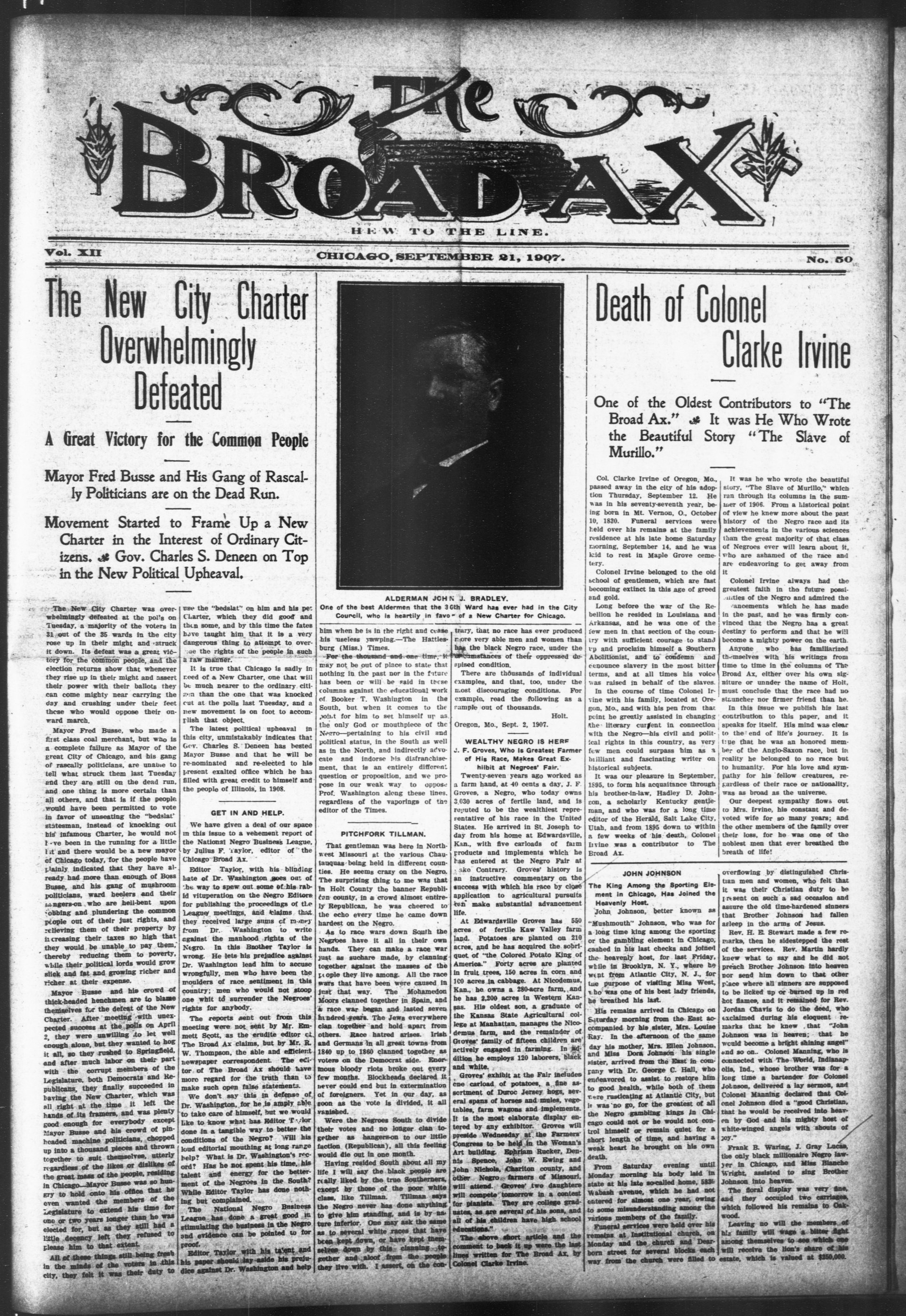
ALDERMAN JOHN J. BRADLEY.
One of the best Aldermen that the 30th Ward has ever had in the City Council, who is heartily in favor of a New Charter for Chicago.
him when he is in the right and cease his useless yawping.—The Hattiesburg (Miss.) Times.
For the thousand and one time, it may not be out of place to state that nothing in the past nor in the future has been or will be said in these columns against the educational work of Booker T. Washington in the South, but when it comes to the point for him to set himself up as the only God or mouthpiece of the Negro—pertaining to his civil and political status, in the South as well as in the North, and indirectly advocate and indorse his disfranchisement, that is an entirely different question or proposition, and we propose in our weak way to oppose Prof. Washington along these lines, regardless of the vaporings of the editor of the Times.
tary, that no race has ever produced more very able men and women than has the black Negro race, under the circumstances of their oppressed disspired condition.
There are thousands of individual examples, and that, too, under the most discouraging conditions. For example, read the following as a sample out of thousands.
Holt.
Oregon, Mo., Sept. 2, 1907.
WEALTHY NEGRO IS HERE.
J. F. Groves, Who is Greatest Farmer of His Race, Makes Great Exhibit at Negroes' Fair.
Twenty-seven years ago worked at a farm hand, at 40 cents a day, J. F. Groves, a Negro, who today owns 3,030 acres of fertile land, and is reputed to be the wealthiest repre
PITCHFORK TILLMAN.
That gentleman was here in Northwest Missouri at the various Chautauquas being held in different counties. He seems crazy on the Negro. The surprising thing to me was that in Holt County the banner Republican county, in a crowd almost entirely Republican, he was cheered to the echo every time he came down hardest on the Negro.
As to race wars down South the Negroes have it all in their own hands. They can make a race war just as suchare made, by clanning together against the masses of the people they live among. All the race wars that have been caused in just that way. The Mohamedon Moors claned together in Spain, and a race war began and lasted seven hundred years. The Jews everywhere clan together and hold apart from others. Race hatred arises. Irish and Germans in all great towns from 1840 up to 1860 claned together as voters on the Democrat side. Enormous bloody riots broke out every few months. Blockheads declared it never could end but in extermination of foreigners. Yet in our day, as soon as the vote is divided, it all vanished.
Were the Negroes South to divide their votes and no longer clan together as hangers-on to our little faction (Republican), all this feeling would die out in one month.
Having resided South about all my life I will say the black people are really liked by the true Southerners, except by those of the poor white class, like Tillman. Tillman says the Negro never has done anything to give him standing, and is by nature inferior. One may ask the same as to several white races that have been kept down, or have kept themselves down by this clanning together and aloof from the people they live with. I assert, on the con-
trary, that no race has ever produced more very able men and women than has the black Negro race, under the circumstances of their oppressed despised condition.
There are thousands of individual examples, and that, too, under the most discouraging conditions. For example, read the following as a sample out of thousands.
Holt.
Oregon, Mo., Sept. 2, 1907.
WEALTHY NEGRO IS HERE
J. F. Groves, Who Is Greatest Farmer of His Race, Makes Great Ex-
Twenty-seven years ago worked as a farm hand, at 40 cents a day, J. F. Groves, a Negro, who today owns 3,030 acres of fertile land, and is reputed to be the wealthiest representative of his race in the United States. He arrived in St. Joseph today from his home at Edwardsville, Kan., with five carloads of farm products and implements which he has entered at the Negro Fair atako Contrary. Groves' history is an instructive commentary on the success with which his race by close application to agricultural pursuits can make substantial advancement life.
At Edwardsville Groves has 550 acres of fertile Kaw Valley farm land. Potatoes are planted on 210 acres, and he has acquired the sobriquet of "the Colored Potato King of America." Forty acres are planted in fruit trees, 150 acres in corn and 100 acres in cabbage. At Nicodemus, Kan., he owns a 280-acre farm, and he has 2,200 acres in Western Kansas. His oldest son, a graduate of the Kansas State Agricultural college at Manhattan, manages the Nicodemus farm, and the remainder of Groves' family of fifteen children are actively engaged in farming. In addition he employs 120 laborers, black and white
Groves' exhibit at the Fair includes one carload of potatoes, a fine assortment of Duroc Jersey hogs, several spans of horses and mules, vegetables, farm wagons and implements. It is the most elaborate display entered by any exhibitor. Groves will preside Wednesday at the Farmers' Congress to be held in the Woman's Art building. Ephriam Rucker, Dennis Spence, John W. Ewing and John Nichols, Chariton county, and other Negro farmers of Missouri, will attend. Groves' two daughters will compete tomorrow in a contest for pianists. They are college graduates, as are several of his sons, and all of his children have high school educations."
The above short article and the comment to back it up were the last lines written for The Broad Ax, by Colonel Clarke Irvine.
Death of Colonel Clarke Irvine
One of the Oldest Contributors to "The Broad Ax." It was He Who Wrote the Beautiful Story "The Slave of Murillo."
Col. Clarke Irvine of Oregon, Mo., passed away in the city of his adoption Thursday, September 12. He was in his seventy-seventh year, being born in Mt. Vernon, O., October 10, 1830. Funeral services were held over his remains at the family residence at his late home Saturday morning, September 14, and he was kid to rest in Maple Grove cemetery.
Colonel Irvine belonged to the old school of gentlemen, which are fast becoming extinct in this age of greed and gold.
Long before the war of the Rebellion he resided in Louisiana and Arkansas, and he was one of the few men in that section of the country with sufficient courage to stand up and proclaim himself a Southern Abolitionist, and to condemn and ennounce slavery in the most bitter terms, and at all times his voice was raised in behalf of the slaves.
In the course of time Colonel Irvine with his family, located at Oregon, Mo., and with his pen from that point he greatly assisted in changing the literary current in connection with the Negro—his civil and political rights in this country, as very few men could surpass him as a brilliant and fascinating writer on historical subjects.
It was our pleasure in September, 1895, to form his acquaintance through his brother-in-law, Hadley D. Johnson, a scholarly Kentucky gentleman, and who was for a long time editor of the Herald, Salt Lake City, Utah, and from 1895 down to within a few weeks of his death, Colonel Irvine was a contributor to The Broad Ax.
The King Among the Sporting Element in Chicago, Has Joined the Heavenly Host.
John Johnson, better known as "Mushmouth" Johnson, who was for a long time king among the sporting or the gambling element in Chicago, cashed in his last checks and joined the heavenly host, for last Friday, while in Brooklyn, N. Y., where he went from Atlantic City, N. J., for the purpose of visiting Miss West, who was one of his best lady friends, he breathed his last.
His remains arrived in Chicago on Saturday morning from the East accompanied by his sister, Mrs. Louise Ray. In the afternoon of the same day his mother, Mrs. Ellen Johnson, and Miss Dora Johnson his single sister, arrived from the East in company with Dr. George C. Hall, who endeavored to assist to restore him to good health, while both of them were rusticating at Atlantic City, but it was no go, for the greatest of all the Negro gambling kings in Chicago could not or he would not control himself or remain quiet for a short length of time, and having a weak heart he brought on his own death.
From Saturday evening until Monday morning his body laid in state at his late so-called home, 5836 Wabash avenue, which he had not entered for almost one year, owing to some misunderstanding among the various members of the family. Funeral services were held over his remains at Institutional church, on Monday and the church and Dearborn street for several blocks each way from the church were filled to
---
It was he who wrote the beautiful story, "The Slave of Murillo," which ran through its columns in the summer of 1906. From a historical point of view he knew more about the past history of the Negro race and its achievements in the various sciences than the great majority of that class of Negroes ever will learn about it, who are ashamed of the race and are endeavoring to get away from it.
Colonel Irvine always had the greatest faith in the future possibilities of the Negro and admired the anecdements which he has made in the past, and he was firmly convinced that the Negro has a great destiny to perform and that he will become a mighty power on the earth.
Anyone who has familiarized themselves with his writings from time to time in the columns of The Broad Ax, either over his own signature or ununder the name of Holt, must conclude that the race had no stuncher nor firmer friend than he.
In this issue we publish his last contribution to this paper, and it speaks for itself. His mind was clear to the end of life's journey. It is true that he was an honored member of the Anglo-Saxon race, but in reality he belonged to no race but to humanity. For his love and sympathy for his fellow creatures, regardless of their race or nationality, was as broad as the universe.
Our deepest sympathy flows out to Mrs. Irvine, his constant and devoted wife for so many years; and the other members of the family over their loss, for he was one of the noblest men that ever breathed the breath of life!
overflowing by distinguished Christian men and women, who felt that it was their Christian duty to be present on such a sad occasion and assure the old time-hardened sinners that Brother Johnson had fallen asleep in the arms of Jesus.
Rev. H. E. Stewart made a few remarks, then he sidestepped the rest of the services. Rev. Martin hardly knew what to say and he did not preach Brother Johnson into heaven nor send him down to that other place where all sinners are supposed to be licked up or burned up in red hot flames, and it remained for Rev. Jordan Chavis to do the deed, who exclaimed during his eloquent remarks that he knew that "John Johnson was in heaven; that he would become a bright shining angel" and so on. Colonel Manning, who is connected with The World, Indianapolis, Ind., whose brother was for a long time a bartender for Colonel Johnson, delivered a lay sermon, and Colonel Manning declared that Colonel Johnson died a "good Christian, that he would be received into heaven by God and his mighty host of white-winged angels with shouts of joy."
Frank B. Waring, J. Gray Lucas, the only black millionaire Negro lawyer in Chicago, and Miss Blanche Wright, assisted to sing Brother Johnson into heaven.
The floral display was very fine, and they occupied two carriages, which followed his remains to Oakwood. Leaving no will the members of his family will wage a bitter fight among themselves to see which one will receive the Lion's share of his estate, which is valued at $250,000.
Wilfred presidents and all those present held the two ceremonies of Dumboque, but Cattleya, Providence, Kew, Isledu, Tumware, St Helens, Regentstown, Knights of Lance, or any one else and have been invited to speak. The language is proper and responsive to land.
The Royal Art is a newspaper whose platform is based upon all, ever existing the official right to speak to its own mind.
Bachelor of the Post Office of Chicago
MA, at Boston University.
GIRL SVENGALI DRIVES MAN
TO STEAL $100,000.
New Orleans, Sept. 14.—Charles E.
Letten, the aged tax collector and
churchman, who embuzzled $100,00
declared today that he had been hypnotized to steal by a pretty young Colored woman, Virginia Reed.
This amazing confession was made shortly after he was found in a patch of woods on the Mississippi River, where he had been hiding without food for three days.
He had removed his shoes and was standing on the bank, fearing to jump, when policemen who had been pursuing him since Tuesday swooped down on him and balked the suicide.
Hypnotized Four Years
Letten, who is sixty years old and has a wife and three grown children, confessed that for four years he had been under the hypnotic influence of Virginia Reed, a beautiful young mullato woman, whom he first met while promenading Call street on Sunday afternoon.
"She had a remarkable attraction for me," said Letten. "I could not resist her. I stole $100,000 systematically through 'kiting' the accounts each month, and found it easy to deceive the State Auditor for four years.
"Most of the stolen money I turned over to Virginia Reed and she invested it. She owns several blocks of valuable reality in Baton Rouge and New Orleans."
Here is another case wherein a Southern white gentleman placed himself on social equality with a Colored woman, but if any Negro residing near New Orleans should happen to be caught in the act of making love to a common white woman or even found talking to one, this same Letten would be the first to come forward to head a gang of gentlemen for the purpose of mobbing and lynching the Negro, for daring to put himself on social equality with white people.—Editor.
THE SOUTH AND McKINLEY.
The Gate City Guard of Atlanta has been invited to participate in the dedication exercises of the McKinley Memorial at Canton, and in commenting on the matter the Atlanta Constitution recalls the fact that it was during a visit to Georgia that McKinley made "his memorable declaration that the time had come when the nation should aid the South in taking care of the graves of Confederate soldiers." Again, the paper refers to the dead President's generous soul and his tender feeling for the South.
That he did much to heal the wounds caused by war and a century of strife is certain. The time was fortunate because the states, "discovered, discordant, belligerent," had been steadily growing into a new union of the spirit, and an external war served to hasten the growth and the fulfillment of that prophetic vision of Webster which was described with incomparable eloquence seventy years before. But the personal influence of the President while he held his high office was deeply felt and gladly recognized throughout the South.
He had what was of inestimable advantage to him in his patriotic purpose, a large acquaintance among Southern statesmen with whom he had been on kindly terms for many years. The representatives of the new South, the younger man just coming into public life, were attracted by his unfailing courtesy and lovable character. And as the comment we have quoted shows, the impression he made has been lasting. His place in the hearts of the Southern people is secure.—The Record-herald, September 20.
President McKinley. After owing his first election to the Negro, threw him overboard in order to receive the appease of his white fellow citizens of the South, who would not vote for him—Editor.
Col. A. D. Gash, this week moved into his beautiful brand new home in Edgewater, which he has just purchased.
NEGRO BAPTISTS INCREASE
BY 131,114 IN SINGLE YEAR.
Report to Convention Shows That
Church Membership Has Reached
2,245,548.
Washington, D. C. Special.—An increase of 131,114 in the membership of the Negro Baptist church, raising the total to 2,245,548, was reported at last Saturday's session of the national convention. In the church educational work the report showed that there are 612 instructors and 12,261 students. The principal speakers were Dr. E. C. Morris, president of the convention; Dr. Bacote, W. T. Vernon, the registrar of the treasury, and Dr W. R. Tolliver of Greensboro, N. C. All of them spoke in a tone of hopefulness regarding the advancement of the Negro. Dr. Morris urged his people to continue their efforts for improvement along race lines.
"I have," he said, "no respect for a man who will attempt to make an excuse for being a Negro. We have it in our power to climb in this country, and climb we must."
Dr. Tolliver contended that the Negro has his destiny in his own hands. He said:
"The Negro must lift himself. He must do more work and less talk. Talk never yet made a people and never will."
THEY FAVORED THE
The following prominent Afro-American citizens resolved themselves into a committee with Oscar DePriest, who will be a dead one in politics in 1908, and who has endeavored to secure county and city jobs for most of the members of his family, aside from eating at the public crib himself, was Chairman of the Committee, and Col. Louis B. Anderson, Secretary; Edward D. Green, Dr. A. A. Wesley, Wm. R. Cowan, Albert B. George, F. A. Denison, Dr. C. E. Bentley, Dr. A. Lane, Emanuel Jackson, James W. Camp, Rev. A. Carey, Rev. D. P. Roberts, Bishop Saffner; Rev. E. J. Fisher, R. W. Lacy, A. L. Williams, Montrose Rankin, Dr. M. J. Brown, S. Laing Williams, Dr. D. H. Williams, Dr. Geo. C. Hail, Jas. S. Madden, Mat. J. C. Buckner.
It was too bad that these eminent citizens grabbed hold of a dead wire and threw their votes away on the worthless new City Charter!
Colonel Marshall Surrenders.
Col. John R. Marshall of the Eighti- Infantry, Illinois National Guard, surrendered himself to the police yesterday on a warrant charging him with assault and battery. Robert Harper, 2903 State street, a member of the infantry and Marshall's former orderly, charges that Marshall assaulted him in a quarrel over family matter.—The Record-Herald, Friday. September 20.
CHIPS
Mrs. Susie Everett of Montgomery, Ala., is visiting with Mrs. Ed. Nixon, 2b27 Wabash avenue.
Mr. George Rhodes has returned to the city after spending the summer in Michigan.
Mrs. Dudley Griffiths of Milwaukee is confined to her bed in Provident Hospital.
Mrs. D. H. Anderson, 3308 Rhodes av-ne, entertained a few friends at whist Friday eve.
Mrs. Fred Leber of Denver, Colo. is the guest of Mrs. J. B. Frost, 2730 Pearborn street.
Mr. A. N. Meredith has opened a chiropodist's parlor at 3101 State street.
Mr. Thom Boger of Aurora, Ill. will attend Northwestern Dental School this year.
Mr. Walter Quinn of Jersey City spent a few days in the city last week en route to the West.
Mr. John Slaughter of Milwaukee is spending a few days in the city stopping at the Keystone Hotel.
Mr. and Mrs. Nathaniel Black of Washington, Ia., are the guests of Mrs. Woods, 4742 Dearborn street.
Mrs. David Manson, 4409 Vincennes avenue, entertained a number of young folks at whist Wednesday eve.
It makes a woman very proud of her husband's business ability to have him know how to hook her up the back.
Mrs. Fannie Houston, 5032 Armour avenue, returned home last Saturday morning from an extended visit with relatives and friends in Missouri.
Mr. and Mrs. Fred Summers, 327 Thirty-seventh street entertained a number of young people at whist and carving Friday evening.
Mr. and Mrs. B. G. Johnson, 6316 Champlain avenue, entertained a small party at whist Thursday evening.
Mrs. Mary Goodlow Ellison, 2962 LaBalle street, and Mrs. Grant Gardner, 3546 State street, have arrived home, having spent twelve days visiting friends in Muskegon, Grand Haven and Grand Rapids, Mich.
Mr. R. A. Dobson of Omaha spent a few days in the city last week en route to Nashville, Tenn, where he will enter his junior year in the Meharry Medical School.
In case you desire to enjoy a good meal at the Pekin Inn Cafe, 2704 State street, on Sunday evenings, you should secure your seats in advance. Phone Calumet 261.
Mr. and Mrs. James Madden, 5711 Wabash avenue, entertained a large number of friends at whist Friday evening in honor of Mrs. Leland, of Cincinnati, O.
John B. Hart, 4841 Armour avenue, has been confined to his home for the past ten days with illness, and he was forced to undergo a skilful operation by Dr. W. E. Mackey and he is now much better.
Last Thursday evening the Old Settlers' Club was entertained at the home of Mrs. Peter Bruin, 4717 Armour avenue, by S. H. and C. H. Bond. More than 80 Old Settlers were present, and they spent a delightful evening.
Dr. Daniel H. Williams, the father of Provident Hospital, returned home last Saturday from a ten days' hunting trip through the woods of North Dakota and Northern Canada, and being a good shooter he bagged a lot of game while absent.
Mrs. Elizabeth Johnson, 2825 Walash avenue, gave a dinner Wednesday evening in honor of Mrs. Mary Tibbs, Mrs. Neeley, of Buxton, Ia.; Mrs. A. Wilberforce Williams, Mrs. Louis B. Anderson, Mrs. Sarah Barr and Mrs. Ed. Nixon The dinner was served in eight courses
It is said that J. B. Bell, a leading Colored citizen of Houston, Tex., is one of the largest property owners in Texas. He owns 43 rent houses in his city, from which he draws rent each month $450. Mr. Bell is both a church member and a leading society man. He is said to be worth fully $85,000.—Exchange.
While burying $675 in his cellar recently, Sam Westerfield, a Colored restaurante of Lincoln, Neb., was slugged by two unknown robbers and his money taken from him. The receipts of his restaurant had been very large because of the State Fair, and he banked in the cellar each night.
George W. Fields, head member of George W. Fields and Company, 3916 State street, whose ad. appears in a other column of this paper, is quite an inventor. He has just put the finishing touchs on a new toy, and when he secures his patent on it, and puts it in the market, it will fill the hearts of children with gladness.
Rupe Foster, head of the Leland Giants, pitched a hot game of ball lost Sunday afternoon and won out against the South Chicago team by a score of 1 to 0. This afternoon the Giants play the West Ends at Auburn Park, and on Sunday afternoon at the same place they go up against the Oak Leas.
Under the auspices of Messrs. Ferdinand Barnett, Jr.; Theo E. Jones, and Charles E. McGooden, the "last outing of the season!" was given at Pasch's Grove Monday evening last. The charge of admission was thirty-five cents, and quite a number of the personal friends of "the committee" attended. A member of the committee says "the affair was a financial success. Thanks."
Dr. George C. Hall, after attending the meeting of the National Medical Association, which met at Baltimore, Md., visiting the Jamestown Exposition and spending several weeks at the leading Eastern summer resorts, arrived in the city last Saturday afternoon. He was accompanied by Mrs. Johnson, mother of the kite "Mushmouth" Johnson, who has been very ill since the death of her son.
Mr. and Mrs. William Emanuel, 6252 Rhodes avenue, entertained about one hundred guests at a formal card and dancing party Wednesday evening. A string orchestra dispensed strains of sweet music during the two hours' card contest, in which Mrs. Albert Lee, Messrs. Jos. Crumb and Mr. Wm. R. Sobers proved the successful winners of the handsome prizes. A fine colation was served by Caterer Smiley, after which the guests danced until their vehicles called to carry them home.
FOR SALE TWO FLAT BRICK
BUILDING.
A two flat brick building for sale
on Berkley ave., near 41st street.
Price $4,000. Modern except heat,
$1,000 to 1,200 cshh required to make
the deal. Balance easy payments or
terms to suit purchaser. The flats
will bring in $40 to $45 a month rent.
This is a snap. Wake up and act
quick before it is too late.
For further information call or
address Julius F. Taylor, 6040 Armour
ave.
NOTICE FOR PARDON.
R. M. Mitchell will make application for the pardon of Joseph A. Kelley, who is now serving a one-year sentence in the Cook County Jail for the crime of larceny. R. M. Mitchell, Counsel for applicant.
Roused Her Irs.
Stubb—I am glad to say that the foolish old custom of fighting at the drop of a hat has completely died out.
Penn—Don't you believe it. I dropped my wife's white summer hat while I was looking for my collar yesterday and she has been fighting ever since.
—Detroit Tribune.
One Good Meal.
"Tee," said Kandor, "I told my friend that I have a room here."
"But," asked Mrs. Starvem, "didn't
you also tell him that you eat here?"
you also tell him that you eat here?" "Certainly not. I told him I get breakfast and supper here, but that I eat at a restaurant near the office."—Catholic Standard and Times.
"Grandpa, if you were a little boy and your ma had promised you a penny if you got your lessons right what would you think was the best way to spell cat?"—Woman's Home Companion.
Editorial Flings.
The preservation of the mosquito was one of the most irritating of the numerous mistakes of Noah.—Boston Globe.
A New York judge rules that it is not wrong to kiss a girl on the street. Not wrong perhaps, but one can think of better spots.—Cleveland Leader.
"Men in this country sleep too much," says Dr. Wiley. What! Has that man been experimenting with night watchmen?—New York Herald.
Marle Corell condemns man in general. She says he's no good and a coward and a mutt, but she omits to show her sisters how they can get along without him.—New York American.
SPORTING NOTES.
Sonoma May, 2:29%, the full sister to Sonoma Girl, 2:06%, is the property of Arthur Brown, Napa, Cal.
Alice Pointer, 2:05%, cost David Shaw of Pittsburg $110 a little more than a year ago. He bought her for a brood mare.
Fred Tenney and Roy Thomas have thrown their scruples aside and are new playing Sunday ball with the rest of the National league.
England has 2,000 golf clubs with 300,000 members who use 500,000 golf balls per week and walk over the links about 250,000,000 miles per year.
One of the candidates for the Cornell football team will be a real prince. His name is Victor Marayah and he halls from the province of Cooch Behar, India, of which his father is the maharaiah.
The smallest golf links in the world are at Hoylake, England. They are in close proximity to the railway station and consist of three holes. The players are the cabbies who wait thereabouts for their fares.
MODES OF THE MOMENT.
In silk and lace gowns there is a disposition to favor white and cream.
Automobile coats with sleeves of Japanese cut are conspicuous in the new designs.
The empire and the princess will have the greatest vogue in cloth gowns for the coming season.
Very pretty little silk coats are being worn of all colors with thin dresses. They are eminently French and require to be most daintily made.
Sashes figure on nearly all silk gowns either of plain color or chine, and one hardly sees a dress without a faint glimmer of gold or silver embroidery.
A shoemaker has introduced a novelty in the form of seamless shoes of antelope skin, which is, like suede, the color of golden brown. The toes are pointed, and there is a narrow binding of tan kid which ties in a small bow in front. These shoes are of French manufacture. Brooklyn York.
HUMOR OF THE HOUR
The Majesty of the Family. Everyone who has lived south knows that peculiar brand of loyalty among old servants that expresses itself in a profound conviction that their family is the "fust family." Consequently every southern town and city, is still full of "fust families."
This particular "cust family" was making its own pilgrimage to the White Sulphur Springs, the great coach laden with children and trunks as well as the mistress, with her nearest and nearest relatives.
Old Simon, mindful of the glory of his house and diled with the all powerful dignity of an old retainer, drove the fat coach horses and admonished his small charges, who, edged in beside him on the box, crowded him to despair.
His master rode on horseback a little distance behind the coach and as they approached a railroad crossing was astonished to see Simon drive calmly before a passing train, which hurried the coach one way, horses another and family and trunks in all directions.
Galloping up, he called to his coachman:
"Simon, you old nigger, didn't you see that train coming?"
"You saw it coming and deliberately drove upon the track! What made you do such a crazy thing?" "Well, you see, Marse George." explained that bewildered individual, scratching his gray wool, "Ah thought when dey see it's we all's ka'ldge day'd stop."-Saturday Evening Post.
Game In Handy.
"Tell me, sir," said the self made man, "did you ever find any practical use for what you learned at college?" "Sure, I did," replied the college graduate. "One time when burglaries got into the house I scared them off with a college yell."-Detroit Tribune.
The Borrower.
"Choofers, can I borrow your auto tonight? I feel just like taking it easy and having a good time."
"I'm sorry, but I've made arrangements to use it myself."
"Well, will you lend me your lawn mower?"—Cleveland Plain Dealer.
Familiar to Her.
HP
Rev. Dr. Howells-I have preached several sermons on the killing of Goliath by David. Mrs. Dashaway-Yes, I have frequently heard that there were sermons in stones.-Philadelphia Press.
A Studious Carer
"I suppose a great artist has to be studying constantly."
"Yes," answered the prima donna.
"If one isn't studying economy one is usually getting so much money that getting rid of it becomes a study."—Washington Star.
Brown-I met Short on the street this morning and struck him in self-defense?
Green-Why, how was that?
Brown-Before he had a chance to say a word I asked him to loan me a dollar.
The Wise Father.
"But I can't live properly on an allowance of $10 a week," protested the son.
"Of course you can," replied the father. "You want an increase so you can live improperly."—Detroit Tribune.
Among Girls.
"All the fools are not dead yet," said the girl who had recently become a brunette.
"No," replied her companion, "but I notice a good many of 'em are dyeing every day."—Yonkers Statesman.
Times Have Changed.
"A man's importance used to be judged by the number of servants he kept."
"Yes, and now it is estimated by the number of detectives that follow him about."—Washington Star.
Mrs. White (sympathetically)—So your husband is in trouble again, Maud?
Mrs. Black (cheerily)—No'm; he's out of trouble dees now. De scoutrel's in jail—Puck.
Summery.
The white suit gains in favor, And it has a cooling savor
That tends much to make you braver
When you face midsummer heat.
When you're cap-a-pile, immacul-
Like late from cap-a-pile, book you,
As if heat could not attack you,
All so natty and so neat.
But until you've tried it never
Do you think 'twont' last forever
Or from cap-a-pile, yet?
And cause most distracting file.
But 'twill soon be called to mind that
Other factors bear. You'll find that
The white suit is of the kind that
Makes enormous laundry bills.
-Indianagolla News.
SHORT STORIES
A boy of twelve in New York has five rows of teeth, or sixty teeth in all. Some expert has figured out that there are only 2,000 professional baseball players in the country. Dr. Thomas Darlington of New York says keeping dogs in the city is a crime against the city and cruelty to the animals. The sight of surgical instruments so frightened a man in a hospital at Norristown, Pa., that he leaped from the building and ran screaming into the street. By a formal order issued from the war department the memory of the late General Shafter, who commanded the American troops in Cuba during the Spanish war, has been honored by bestowing his name upon the military post on the Khaahuki reservation near Honolulu, Hawaiian islands.
Thirty-two years ago Mrs. Thomas Buker of Bath, Me., wrote two letters to her husband, Captain Buker, who was then traveling along the Mexican coast in a sailing vessel. The letters were never received by the captain and were recently returned to Mrs. Buker by the Mexican government.
ENGLISH ETCHINGS
There are over 12,000 shops for the sale of milk in London.
Tithes were first instituted in England in the reign of King Egbert, about 600 A. D.
Cholera has not been epidemic in Europe since 1866, when it appeared in both London and Liverpool.
It is estimated that the total first cost of England's present navy was $670,000,000, and about $380,000,000 has been spent in the last ten years.
Before the trial of a suit for damages was begun in a London court the other day it was remarked incidentally that the defendant, a laundry proprietor, had been dead eleven years.
An innovation in English county cricket was seen in the Yorkshire versus Sussex match at Sheffield. Before each delivery the ball was wiped with a towel, which was intrusted to the care of the umpire while the ball was in play.
PLAYS AND PLAYERS.
Shakespeare has been translated into Japanese, and the thespians of the milkado are making his plays popular.
As to vaudeville, way back in the early sixties Ellen Terry made quite a success in that popular style of amusement.
Burr McIntosh, who left the stage some time ago for professional life and the lecture field, is going to return and star in "Pudd'nhead Wilson" and other plays.
Boston gave the stamp of its critical approval to the first performance of Richard Carle's new play, "The Hurdy-Gurdy Girl." Both music and lines are said to be bright.
Among the twenty-two attractions which A. H. Woods will have on the road next season two are musical, and the list includes ten new melodramas. The others are old successes.
HOME NOTES.
If a narrow ribbon or tape is run into the facings of kimono sleeves, they may be tied in a bow and kept out of the way when one is working about the house.
You will need less laundry soap if it is thoroughly dried before using. For this pile it in such a way as to leave open space between the bars to allow free access of air.
When kerosene oil has been spilled on the carpet, cover the spot thickly with either fuller's earth or buckwheat flour and leave twenty-four hours at least before brushing it off.
In some households bureau scarfs have been laid aside and the top of the dresser covered with a heavy glass slab. This can be easily wiped off and polished. As this glass is so thick there is little danger of it being easily broken.
FACTS FROM FRANCE
It is proposed to substitute solitary confinement during six years for the death penalty in France. No death sentence has been executed for some time.
Trial is now being made in Paris of a new system of paving. Steel is laid on a bed of cement after the fashion of wood paved roads, the interstices, too, being filled with cement.
A bird dealer in Paris raises canaries of an orange red tint by feeding the parent birds on cayenne pepper. In time he expects that the eggs will produce birds of a bright red hue.
About $80 per year is charged for an unlimited telephone service in Paris, but in addition to this the subscriber must purchase his own instrument, which may be any one of a number of different kinds.
The Plain Woman.
She should experiment with her hair. She must study her coiffure from all points. Well arranged hair may balance and annul a defect.
QUAKER TURNED PAINTER.
Led Who Has Become One of America's Greatest Artists.
The magnificent mural paintings of G. Y. Turner are among America's art treasures. How near this famous artist came to being forbidden an artistic career because his Quaker parents objected on religious grounds is told in the New Broadway Magazine. When it came time for the small son to take his place among the wage earners of the family—and that time came early—he communicated to his father his intention of being an artist. As has happened so often, the father objected. Not only did it seem to him most unpracticable from a monetary standpoint, but also contrary to the Quaker doctrines. In a family where brass handles on furniture were removed because they were considered frivolous and were replaced by knops of dark walnut this was not a matter of small importance. Moreover, the father had intended that the boy should be a pharmacist.
A compromise was at last reached. The painting of pictures was out of the question, but architecture recommended itself to the Quaker mind as serving a utilitarian purpose. At the same time, with the possibility of making infinite charts and drawings, it approached closely enough to the pictorial to satisfy the young Charles. Three years of apprenticeship to an architect followed. Then, having come to the realization that the construction of buildings and the painting of pictures are decidedly different phases of art, the boy took a position with a photographer and eventually accompanied him to New York.
From the tinting of photographs, a phase of work at that time immensely popular, he drifted into pastel work and water colors, finally taking up oil portraiture. His success overcame even the Quaker principles and dignified the work as a profession in the eyes of his father.
Keeping Shoe by Machine
Near Amsterdam a traveler—who does not know a word of Dutch—perfecting the announcement "English spoken," entered a shop, "English, sir!" asked a youth behind the counter. Then he picked up a cylinder, placed it in a gramophone, and the instrument duly sung out—but in German: "Sir (or Madam), the proprietor, who speaks German, will be telephoned for and will return to the establishment in less than five minutes. Will you please be seated?" The tourist, who knows German, seated himself. In came the principal, who speaks excellent English. The stranger asked why the gramophone did not talk English. The explanation was: "It's my stupid assistant! I have a cylinder on which is recorded the message in English; he used the wrong one. There is no excuse for him; my English cylinder is tinted red at the ends, and the German one blue. Lucky for me, sir, that you know German, else I might have lost an esteemed patron." After all, that horrible engine has its sordid use—London Chronicle.
The Cecelian Waltz
"From the English descriptions of the Coccelian waits we judge," says a writer in a Berlin paper, "that there will be a sixteen step prelude to the regular waits, that this introduction will have some of the old time minuet features and that when the waits proper begins it will be something like the dance which was in vogue when we who are now middle aged and a little more were dancers. The fast and furious waits which came from the country where everything is rush is beloved by the young people only because they do not know the dance of their parents. It was this, the graceful, slow and dreamy, that made the dance a soulful pleasure. It was this real poetry of motion that inspired Lanner, Gungi and Strans. Welcome, new waits, if you are like the old!"
Areas of Our Largest Cities.
New York is our largest city in area, with 200,000 acres. New Orleans has 125,000; Chicago, 122,000; Philadelphia, 82,000, and San Francisco, 77,000. Seattle has 49,920. Washington is next to Seattle, having 44,000 acres in its city limits. St. Louis, with more than 600,000 population, has an area of 89,278 acres; Boston, with 594,000, has 84,000 acres; Cleveland, with 414,000, has 29,422 acres; Pittsburgh, with 345,000, has 19,418 acres; Cincinnati, with 332,000 inhabitants, and 23,616; Detroit, with a population of 309,000, has 18,888 people; Minneapolis, with 214,000 people, has 34,105 acres, and St. Paul, with 172,000, has 85,483 acres—Seattle Post-Intelligencer.
Annotate and Longevity.
A great appetite has been generally regarded as a sign of fine health, but of recent years, since the experiments of Horace Fletcher, Professor Chittender, Dr. Wylie, Dr. Kellogg and others, opinions have much changed in this particular. It is the man who eats little who is healthiest and whose prospect of a long life is best. The voracious appetite of many persons is from habit, not necessity, and the experiences of the Trappists show that the cravings of nature may be fully entailed with little food.
Big Dry Docka
Belfast, Ireland, now has the largest dry dock in the world. San Francisco will shortly possess a dock of even greater dimensions. The new dry dock in the latter city will be 1,050 feet long from gate to the landward extremity; width at coping, 144 feet, and at bottom 82 feet; depth over sill and below coping, 80 feet 10 inches, or 344 feet 6 inches at high water. The interior facing of the dock will be of re-enforced concrete of an average thickness of 12ft inches.
WHAT HE GETS.
He spends his money, like to blow
His coin—to tag, to burn it—
To lead it to his friends, although
He knows they'll not return it.
Great admiration they evince.
When they incur such debts.
They all declare that he's a prince.
That's what he gets.
Each time he in his pocket tips
He shows his money's power.
On鼎鼎, one and all, his tips
Fall in a golden shower.
To plunge at something in his feet; He makes most foolish bets; But people say, "Well, he's a sport!" That's what he gets.
He thinks that it is worth his white, But I can see his finish. For day by day his little pile Will wefully diminish. You're not noticed how the world will cool To former fortune's pets;
Pablo Picasso
The Heroic Bodgers (in horse trough to would be rescuer)-Neve' mind me I can s-shwlm. Save the women and children (continues to strike out manfully for the shore)-Sketch.
A Hard Job
There is an old Irishman in Baltimore who for many years was prosperous as a grocer. Not long ago, however, the old fellow lost his all in "a side line" and was compelled to look for a job. Through the influence of a friend he was offered the position of crossing tender at a small railroad station in Maryland.
The Celt looked dubious as the duties of the office were explained to him and the meaning of the various flags was stated.
"In case of danger you wave the red flag," explained the man told off to instruct Mike.
"Wait a bit, wait a bit," interrupted Mike, with a doubtful shake of the head.
"I'm afraid this job'd be too much for me. I could never trust myself to remember to wave a red flag whin there was a green wan handy."—Harper's Weekly.
Once a Boy Himself.
"That man remembers that he was once a boy himself," a Broadway jeweler remarked as a customer left the store. "He came in just now and said he wanted a watch for his boy for a birthday present and that he wanted the cheapest I had."
"The old skinflint! And I know he is well fixed, too," the jeweler's friend commented.
The other smiled. "I told him that those very cheap ones wouldn't keep good time," the other continued. "But he said: 'Oh, that's all right. Just give me one that has the back fixed on so that he can get it off. He will be satisfied.'" Woman's Home Companion.
Fixed.
During the recent stay in camp of the national guard of the District of Columbia one of the captains called a sergeant one day, saying:
"Bergeant, note down Private Mooney—one day on bread and water for slovenly turnout on parade."
"Beg pardon, captain," responded the sergeant, "but that won't make any difference to Mooney. He's a vegetarian."
"Then," said the captain, "give him one day on meat and soup."—Harper's Weekly.
Anything Better Than Home.
"I am sick to death of everything," said the society woman. "Let's spend this evening where we've never spent one before."
"Agreed!" said her husband. "Shall we try home or church?"
So Singular.
"Funny," said Baretop, "but there was a time when the barbers used to sneak of my hair."
"You mean before you began to get hold?" asked his friend.
At the Reception.
Casual Caller (to one next him)—I was introduced to that squint eyed, red haired woman over there as Mrs. Somebody or other. Don't you think the man was an illiot that married her? Next One (weekly)—I can't just say. I'm the man—Baltimore American.
What He Mount.
"Mr. Nurvey tried to hug me last night," said Tess.
"Oh," remarked Jess, "that's what he meant then when I saw him hurrying toward your house. He told me he had a pressing engagement.'"—Des Moines Register.
Too Much For Him.
Huggins—Why did Peckem apply for a divorce?
Muggins—He happened to be home one wash day when it rained.—Chicago
THE RAILROAD INN Imported and Domestic Wines Liquors & Cigars Cafe in Connection N. E. Corner Fifty-first and Armour Avenue, Chicago, Ill.
Humor
LURE OF THE CIRCUS.
What Do Kids Care For "Lickin'e"
When Traveling Show Is Around?
"Hello, Jimmy."
"Aw, g'wan, y' don't have 't work
Come on with me."
"Ma said I had t' clean th' back yard t'day er git licked. She said I couldn't go t' th' circus too."
"What d'ye care what yer ma said? Be a sport and take a lickin. You can't go to a circus only once a year."
"Gee! I'd like t' go. I ain't seen a
circus—since last summer."
"Aw, come on with me t' th' circus,
Jimmy."
"They ain't no parade, is there?"
"Nope. Jes' th' circus. Come on,
Jimmy."
"I ain't got no money."
"Neither I've l. Ye don't need no money.
I'll show ye how t' git in fer nothin."
"'S a long way out there."
"Yep."
"'S a long walk."
"Aw, cut it out, baby. Can't we hop
a car?"
"Y-yes, I suppose we could."
"Aw, what'dye care for a little thing like that? I've been licked lots o' times. Lickin's don't hurt much."
"Th' back yard's gota de cleaned up."
"We'll come back early, an' I'll help ye."
"Honest?"
"Cross my heart; honest an' true; black and blue."
"I don't care much if I do git licked."
"That's right. Jimmy. Be a sport."
They reached the circus grounds. They gazed in youthful wonder at the tents, the crowds, the barkers, the big banners in front of the sideshow. "I don't think they've got a woman as fat as that one up there," said Johnny, gazing up at one of the banners. "Aw, yes, they have. I see a woman bigger'n that in a circus once."
"A real live woman?"
"Ub-huh."
"Did she walk an' talk jes' like other women?"
"Ub-huh. Honest she did."
"I'll bet a million dollars they ain't no man in there eats sords like that pitcher."
"I'll bet they have. I seen a man do that once too."
"I'll like to see him do it."
"So'd L."
"I tho't ye said ye had seen one oncet."
"I mean I'd like to see it again. Of course I seen it oncet."
"I'd like to be in a circus, wouldn't you?"
"Gee! I'd give most anything if I could be a circus actor. I like to wear pink tites and ride horseback all the time."
"Aw, I'd rather be a clown. They have all th' fun an' make everybody laugh."
"I'm goin' to be a circus man when I grow up."
"So'm I—a clown."
"How're we goin' t' get into th' circus?"
"Come on with me. I'll show ye. I done it once before."
They skirted the big tents, but husky and alert canvasmen and guards were everywhere.
"I'd rather stay outside, anyway."
"So'd L. Circuses are all alike. I heard pa say so."
"I don't care much 'bout seein' it, anyway."
"Neither do I. Let's go home, Jimmy."
"All right, Johnny. Let's"—Milwaukee Free Press.
Front Bedroom to Rent.
For rent, front bedroom for man and wife, or two gentlemen, must furnish good reference. Apply to Mrs. Gardner, 3546 State street, top flat front.
Frank H. Lewis, Prop.
Phone Oak
THE RAILLE
Imported and D
Liquors o
Cafe in C
N. E. Corner Fifty-first and
POOL AND
BILLIARDS
Open Day & Night
Chas. Lett. Proprietor.
ALA CARTE & TABLE DE HOTE
SERVICE
Music Every Evening.
Special Attention to Parties and Wed-
dings.
2704 State St. Phone Calumet 261
CHICAGO
PATENTED
DENTISTRY
at Cost Until Sept. 1st.
We control patents and discoveries by which missing teeth can be replaced without the old-time removable plate or bridge and by which loops and falling teeth can be tightened by which pyrorhea (Riggs' disease). Feeding gums, can be cured. Call and hear your teeth and you will get satisfaction.
WHAT WE WANT
is to introduce our work among the
Colored people of Chicago. We will
make small charges for material until
Sept. 1st.
$3.00 — FULL SET OF TEETH — $3.00
$5.00 — BEST SET OF TEETH — $6.00
22k Gold Crowns
(cost material about $1.50
Bridgework
(cost material about) 2.00
Re-Enamelling
(cost material about) 2.50
Gold Fillings
(75 cents
Silver Fillings
40 cents
Porcelain Crowns
(cost material about) 1.50
All work guaranteed 10 years. All
work done under direct personal
supervision.
What a clergyman says about
us:—I wish to say that I am well
satisfied with the work done in your
office. Your dentists are men who
understand their business and are
men." REV J. L. JACKSON.
Pastor Hyde Park Baptist Church.
Chicago.
SHORT STORIES.
At the Pittsburgh morgue the body of a man who was killed trying to hold up a collector was viewed by 7,000 people.
Henry Price, an aged musician of Mount Vernon, N. Y., applied to New York hospitals for permission to photograph the soul in transit, but his request was refused.
In Fayetteville, N. Y., lives a fat hen that has no fear of the ax. In the will of Charles Brown, who died not long ago, was a provision that his residuary legatee, Mrs. Lucinda Brown, must take the hen and care for it until it died.
A young Bath (Me.) couple presented themselves before a minister recently and asked to be married. After the knot was tied the groom coolly informed the preacher that he expected to get a job soon and would then pay his fee.
A Cleveland skyscraper twenty stories high will be topped by a Goddess of Liberty holding a torch, from which a leaping flame of gas will be burning at all times. The exact hour of the day and night will be indicated by causing the flame to shoot high into the air during the minute preceding each hour.
SA-BAN-DY
GUARANTEED HAIR DRESSING.
For dry hair and scalp.
Makes the hair grow soft, straight and glossy. Cures and prevents dandruff.
Cleans and nourishes the scalp. 10c.
25c and 50c. Send 10c for sample.
Money back if not satisfied. Mail orders filled. Write or call
GEO. W. FIELDS & CO.
3916 State St. Chicago, Ill.
Phone Douglas 4965
Lou Seldon, Mgr.
and 1787.
ROAD INN
Domestic Wines
& Cigars
connection
Armour Avenue, Chicago, Ill.
CIGARS AND
THE LELAND GIANTS vs. OAK LEAS, AUBURN PARK, SUNDAY,
SEPTEMBER 22.
Games colled at 3:30. Best of order maintained at
all times. Come and see real ball playing. Price, Admission 25c, Grand
Stand 25c, Boy's Seats 15c.
Established 1879. Phone Oakland 490-222-2222
John J. Dunn
Wholesale
and Retail
Dealer In...
COAL
WOOD
Fifty-First St. and Armour Ave.
Rail Vans: just St. & L. D. & H. D. Bp.
Joint St. and Armour Ave.
CHICAGO
Gaskins'
Billiard and Pool Parlors
3004 STATE ST.
All Newly Furnished with Latest
Tables and Fixtures.
Will also carry a Fine Line of Cigars
and Tobacco
Chas Gaskins, Prop.
First-Class Service Guaranteed our
Patrons.
Tile and State Hauling a specialty.
COAT.
J. H. COLEMAN & CO.
Express & Van Moving
TRUNKS EVERYWHERE.
2540 State Street
Phone 699 Calumet CH1CAGO
ICE CREAM CIGARS, TOBACCO
SHIRT WAISTS KIMONAS
MRS. A E. BAKER
NOTIONS
419-36TH STREET
Underwear a
Specialty CHICAGO
Telephone Harrison 5637
Davis Express
FURNITURE MOVING
TRUNKS DELIVERED
110 E. HARRISON ST. CHICAGO
Bet. Custom House Pl. & Clark St.
'TWAS EVER THUS.
I held a hand at poker
Which looked exceeding good,
Five handsome clubs consorting
In sable brotherhood.
Alack, my hated rival
Whom I would put to rout
Remained not for the slaughter,
But
Dropped
I held a hand one evening
Ridiculously small.
Upon it flashed and glittered
One diamond—that was all.
Alack, my hated rival,
Despite my baleful glare,
Moved not to take departure,
But
I pity the man who can't learn anything from his own mistakes. Now, that's one thing I can do," said Bragg. "Ah! You're always learning something then, aren't you?" replied Knox.
THE BROAD AX.
Auburn Ball Park
THE LELAND GIANTS vs. OAK LINES
SEPTEMBER 22
Games colled at 3:30. Be
all times. Come and see real ball
Stand 28c. Boj
ATTORNEYS AT LAW
Suite 1114 Ashland Block, Clark and Randolph Sts. Tel. Central 808.
CHICAGO.
Residence 87 MacMillan Place
Telephone Ashland 808
Office Telephone
Central 1809 Automatic 800
MILES J. DEVINE
ATTORNEY AT LAW
Suite 815-820 Moner Block
CLARK AND WASHINGTON STS.
CHICAGO.
A. D. GASH
Attorney at Law,
84-86 La Salle Street, Chicago
Suite 616 to 619.
Telephone Main 3077.
JOHN E. OWENS
ATTORNEY & COUNSELOR:
AT LAW
820 ACHLAND BLOCK
Tet. Douglas 1565
REAL ESTATE, LOANS AND
RENTING
FIRE INSURANCE
Bates Building
3637 STATE STREET CHICAGO
J. GARNER Tel. Draglas 325
THE ELITE BUFFET
FINE WINES, LIQ'ORS
AND CIGARS
3030 State Street CHICAGO
A. B. SCHULTZ, M. D.
PHYSICIAN AND SURGEON.
2719 State Street
Hours: 9 to 12 A. M.
3 to 8 and after 6 P. M.
CHICAO
Phone Oakland 1828
F. A. Rawlins
The Modern Embalmer
UNDERTAKER AND
FUNERAL DIRECTOR
When his work is finished
you have no displeasure.
4834 State St., CHICAGO
Phone Douglas 1828
10
15
50
YEAR
THE BANK OF THE UNITED STATES OF AMERICA
THE BANK OF THE UNITED STATES OF AMERICA
THE BANK OF THE UNITED STATES OF AMERICA
COOK
Waiters and Cooks
Prefer Our Make
JACKETS AND LINEN
because they have found them
satisfactory.
Write for complete Catalogue
FREE.
giving full instructions how
to order.
Marcus Ruben (Inc.)
390 State St., CHICAGO.
79th St. and Wentworth Ave.
Best Games of Ball in the city by
leading Pros, & Semi-Pros. Clubs
KAS, AUBURN PARK, SUNDAY,
est of order maintained at
playing, Price, Admission 25c, Grand
Ye's Gate 15c.
A Rearing Lion.
In order to get a good model for a bearing lion which will be a part of a monument now being modeled by Josef Tuch the sculptor arranged with the superintendent of the zoological garden at Schoubrunn to make sketches in the lion house at that place.
"The big, beautiful animal," says the keeper who tells the story, "occupies a cage with five lionesses, and he seems to be so perfectly happy that the sculptor might with ease have made a picture of the conventional lion, and the more the artist stared at him the more friendly and docile the animal appeared. When the sculptor became discouraged we told him that he had chosen the wrong time for observation. Come at feeding time and do your staring, we advised him, and this he did, bringing another man with him. With two men watching him at close range and one jabbing him with an iron rod while he was taking his dinner the roaring lion, tearing at the bars, even making lunges at his cage mates, soon took the place of the sleepy king, and the sculptor secured a good model.
The Chihuahua Dog.
The Chihuahua dog, which as late as twenty-five years ago was commonly to be found in Mexico, is rapidly becoming extinct. It is a curious little creature, popularly supposed to be a cross between the prairie dog and the jack rabbit. The animal resembles a small dog. Its weight is sometimes not more than a pound and a half, and it has a disproportionately large head, bulging eyes and long ears. The hair is usually scanty, showing the pink skin underneath, and from this characteristic it has been known as the Mexican hairless dog. It seldom shows the usual dog traits of sagacious and intelligent attachment. It is now difficult to find in Mexico a purely breed Chihuahua dog, and those that are found are often sold at prices ranging from $100 upward. Even in Chihuahua these dogs are rare. A few specimens sold in the City of Mexico recently are said to have been of the true breed.—Argonaut.
Queen of Siam's Jewels.
the queen or Siam possesses the finest collection of jewels in the world. The walls of her bedchamber are literally ablaze with precious stones, while in a safe in her majesty's apartments are diamonds, rubles, pearls and emeralds fashioned into quaint necklaces of fabulous value. One little article alone, intended to serve as a thimble, is in the shape of a lotus flower and is valued at £15,000.
The king, too, possesses a wonderful stock of jewels, and not only is his throne, which is made of pure gold, thickly incrusted with diamonds, pearls and rubles, but his majesty's state mantle is covered with jewels. In fact, this cloak is the most wonderful garment in the world. In spite of his enormous collection of jewels, however, the king of Siam is constantly adding to them and spends something like £120,000 per annum in purchasing new stones—London Tit-Bits.
The Artist's Mistake
A trained nurse was looking through the advertising pages of a magazine. Presently she came to a picture which arrested her attention.
"It's pretty," she said, showing it to her patient, "but can you see what's wrong with it?"
The patient saw a picture of a very attractive trained nurse about to hand a cup of something to an equally attractive patient who reclined in bed.
"No," she admitted. "It looks all right to me. What's the matter with it?"
"The nurse's apron has big strings, whereas it should be fastened with a trim belt. I never saw a nurse in my life who wore big strings on her apron. The artist probably never noticed."—New York Press.
Some years ago the remains of an apelike creature possessing unusual human regimens were discovered in Java, and the animal was named pithecanthropus. Professor Haeckel and some others accepted this as representing an ancestral human form closely allied to the apes. Now a special expedition under the combined auspices of the Academy of Sciences of Berlin and the Dutch East Indian government is being organized to make a thorough exploration of Java in search of additional specimens of pithecanthropus. The ecological formation in which the original discovery was made is widely extended among the mountains of that island—Youth's Companion.
The Inventor of Esperanto.
It is twenty years since Dr. Zamenhof published his first little book about Esperanto. This is the full title of it: "Dr. Esperanto. An International Language. Introduction and complete textbook for Russians, with a label on the second page of the cover. Permitted by the Censor, Warsaw, May 21, 1887." The word Esperanto literally means "one who hopes," and the name was afterward given to the language. Zamenhof did not wish his practice—he is an oculist—to be affected by suspicions of his being a dreamer and therefore did not give his right name.
[Special Correspondence.]
Small pay is the main reason for detritious from the army, according to the annual report of Major General A. W. Greely, commanding the northern division, which includes the departments of the lakes, the Dakotas and Missouri.
This factor, General Greely says, is seconded by the lack of the canteen, resultant trouble in dives surrounding the army posts, and "the low standard and general worthlessness of recruits."
The moral deterioration of the recruits is characterized as a corollary of the small pay.
The Pay of Soldiers.
General Greely urges increase of pay of officers and men, a five year term of enlistment, a material increase in strength of the infantry and restoration of the canteen privileges to the extent of selling beer. He recommends that the pay proper to all enlisted men, except recruits of less than one year's service, be increased from 20 to 50 per cent, and that the minimum penalty for desertion should never be less than the unpaid term of enlistment.
General Greely urges the necessity of materially increasing the pay of officers and declares that unless it is contemplated the army shall be officered from an aristocracy of wealth, for an officer's position is fast becoming impossible for a man without private income, increased pay should be given him. He says the minimum infantry strength should be fifteen regiments, but if duty in Cuba and on the isthmus is to be part of the army work it should be twenty regiments.
Army Ration Criticised.
General Greely holds that the army ration, while excellent in quality and doubtless of sufficient nutritive value, in quantity and variety does not satisfy the American soldier. He suggests that various edibles found on every American table, even of the poorest people, are entirely lacking in the army ration, although they appear on the naval list.
May Change Army Uniform.
The plan to provide the enlisted men of the army with a more serviceable uniform is engaging the attention of officials of the war department. This subject has been agitated for some time, and the need of a uniform more practical for everyday service purposes is gradually becoming more apparent. Various recommendations are made by officials of the department as to the style to be adopted. Colonel L. M. Mans, who has had much experience with soldiers in the field, believes that the present regulation felt hat is not adapted for campaigning purposes in a hot or tropical climate. The infantry marching trousers, he declares, should be made full around the knees and the cuff extended down the leg far enough to be inclosed by the top of the marching shoe, thus doing away with the legging.
Government Workers Organize.
The Government Employees' Mutual Relief and Co-operative association has been launched by employees of the national government in this city, and plans are now being perfected for the permanent organization of the association.
Only employees of the United States government and of the government of the District of Columbia, employed within the District, are entitled to membership. It is proposed to establish an insurance department, whereby a member can obtain insurance protection based upon the plan of "old line" life insurance companies without having to pay the charge of those companies for agents' commissions, maintenance, etc. The policies will have guarantee cash surrender and loan values and will offer all of the advantages of the policy of a regular insurance company-insurance protection to be extended to life, health, accident and old age insurance.
To Establish Saving Bank
It is also proposed to establish a savings bank building association, in which the reserve necessary to protect the insurance policies in force will be invested and which will be required to earn 4 per cent interest. It is proposed to lend money to members of the association on proper security at a rate in excess of the required earnings as will pay the operating expenses of the bank.
Other features will be added from time to time as good business methods direct. A two-thirds vote of the total membership is necessary for the election of officers, all of whom are to be bonded.
Mortage to the President. The new union railroad station here will be supplied with a unique feature—a special entrance and reception room for the president of the United States. The president's entrance is an archway of marble thirty feet in width.
On alighting from his carriage beneath it the foremost citizen of the nation will step into a vestibule of noble proportions...of the same width as the archway and twenty feet in depth. In this vestibule the persons who accompany him will be waited upon by trained attendants, while the president himself will seek privacy in a room set apart for his exclusive use on the right hand adjoining.
The president's room, as it is called, will be most beautifully and luxuriously furnished. Costly oriental rugs will cover the floor. The ceiling will be done in gold and color, and the walls will be paneled in blue silk. In the middle will be a table suitable for writing, provided with a solid silver inlaid and other appertensions to match, this and all the other articles of furniture being of mahogany. All of this luxury, will not cost the chief executive a penny, but will be paid for out of the pocket of the railroad companies. CARL SCHOFFELD.
FACTS IN FEW LINES
In Russia there are eighty-six general holidays.
Birthdays were celebrated as far back as the time of Pharaoh.
Cape Colony has now 20,000 acres of vineyard, with 60,000,000 vines.
Prince Bismarck of Germany would never sit down to a dinner with thirteen at the table.
In Australia engagement rings are lent out by certain jewelers as part of their ordinary trade.
No one in Saxony is allowed to shoe horses unless he has passed a public examination and is duly qualified.
In Holland it is illegal for a cyclist to use a horn, as this instrument is reserved for the exclusive use of motorists.
Moji, Japan, an obscure place a generation ago, is now a large city, with a foreign commerce worth $45,000,000 a year. It exports sugar, coal, timber, cotton yarn and cement and imports rice, wheat, sugar, raw cotton, oil cake, machinery and kerosene.
The Alaska-Yukon exposition, to be held in Seattle in 1900, is to be located on University heights. The buildings and their collections of Alaskan products are to become the permanent property of the university after the exposition closes.
Mrs. Katharine S. Hueppe complained to Magistrate Corrigan in New York that her husband was making a fool of himself by his odd way of doing business. "Don't interfere," said the magistrate. "If he wants to make a fool of himself let him do."
Professor A. L. Kroeber of the University of California is an expert on Indian languages, and he says that instead of being mere jargon, as is popularly supposed, they are well defined languages. He declares that California has more distinct Indian languages to the square mile than any other state. Miss Ellen Terry was born in Coventry fifty-nine years ago. Two houses in that English city claim to be her birthplace. One house has the sign, "This is the birthplace of Miss Ellen Terry;" the other, just opposite, bears the legend, "This is the original birthplace of Miss Ellen Terry."
The biggest cannon ball ever made weighed 2,600 pounds and was manufactured at the Krupp works, Essen, for the government of the czar. The gun from which this projectile was fired is also the largest in the world and is placed in the fortifications of Cronstadt. This gun has a range of twelve miles, and it has been estimated that each shot costs $1,500.
Professor Francis Brown of Union Theological seminary has become a member of the general committee of the Palestine Exploration fund, which now has ten American members. Dr. Brown will be in charge the coming year of the American school at Jerusalem, and this, it is thought, will promote the co-operation of England and America in the work of verifying and illustrating the Bible.
Only a few years ago America imported more portland cement than it manufactured. Now the tables have been turned, and this country has taken the front rank both in the production of cement and its use in construction. It has been estimated that the quantity of portland cement used in this country in 1905 would be sufficient to lay a sidewalk sixteen feet broad all around the earth at the equator.
An ingenious device has been invented by a street railway employee and is being tested. Whenever a passenger stands on the lower step a buzzer sounds in the motorman's compartment and warms him not to start the car until the signal ceases, which it does the instant the passenger reaches the platform or the ground. Contact points are placed in the step which are brought together by the weight of the passenger.
C. Parker Woodbury, a New York banker, will build for himself a glass house. He has engaged an architect to draw plans for the novel dwellings, which is to be erected at Beechhurst, N. X. Bricks of compressed opalescent glass will form the walls. The interior and partitions are to be of the same material worked into thin slabs, and the roof is to be of glass. In fact, wherever it is possible glass is to be employed, as Mr. Woodbury is a great believer in sunlight.
King Edward carries a gold key that has no duplicate. It opens his private writing desk. Every time the king quits his personal apartment an assistant secretary destroys the contents of the wastebasket, the blotting pads and even the wrappers of the newspapers that come from every capital of Europe. His majesty takes no risks of spying eyes, and it is an unwritten law that private secretaries shall not indulge in gossip diaries, after the manner of Samuel Peel.
The historic house of Benjamin Franklin in Paris is for sale. This house which Benjamin Franklin built for himself is situated at 6. Bus de Penthievre, in the Faunbourg St. Honore, not far from the round point of the Champs Elysees in the eighth arrondissement. It bears on its façade the name of Benjamin Franklin, surmounted by his portrait in a medallion. It was also the residence of the Bonapartes and of Josephine and Hortense de Beauharnais.
Boston is said to have the only woman guide in the United States to places of historic interest. She has equipped herself with so much useful information that she believes herself to be able to answer any reasonable question about Boston. Her specialty is taking about parties of women teachers and school children. Though an unusual thing in this country, woman guides are to be found in foreign cities. A number earn their living by showing visitors to London.
WOMAN AND FASHION
This loose and fluffy mode of hairdressing is particularly comfortable and is especially desirable because of its simplicity, for a woman who has any knack in making her own collures can easily copy this fashion and with the various changes needed to suit
J.
BECOMING STYLE OF HAIRDRESSING.
each individual face can arrange her tresses in a becoming style. The hair is drawn loosely from the face and arranged pompadour fashion on the forehead and at either side of the head. At the back it is fixed in a loose, sack-like way, and the ends are twisted and colled into a figure, eight and pinned in place at an attractive distance from the pompadour.
Making a Hat Smaller.
Making a Hat Smaller.
A large hat may easily be made smaller in this day, when bias bands on the edge are fashionable. When the rim has been cut it should first be bound with tariatan so the rough straw will not cut through the ribbon. The strips should form a true bias and be wide enough to turn in about a quarter of an inch on each side after the binding is on. An inch on each side of the brim is the approved width, though this is more or less a matter of taste. Be careful in cutting, especially if velvet is used, to match the pieces carefully so that the nap and material run the same way. Measure the amount that just fits the hat, sew it together at the end and fit over the brim, stretching it in the middle and being careful not to stretch the sides or it will pucker. When measured sew the ends together and snap over the brim. Turn in the edges on both sides and blind stitch on. Be sure the seams come at each side. A binding may also be put on by sewing one side rather tightly to the top of the brim and then turning over and blind stitching on the under side, but the first way is more satisfactory.
Correct Colors For Autumn.
Whatever the correct colors will be for early fall wear they are to lend themselves to combinations. The few selections already shown are inclined this way, and it is pretty certain that such combinations will rather take the form of harmonies than of direct contrasts, the wide stripes or fine stripings having the preference over the narrow effects which disported themselves in the realm of fashion last winter. French couturieres are loyal to a mode when they like it, and the way they have clung to stripes of all kinds and conditions is a flattering tribute to the beauty of the fabrics so patterned.
The New Collar.
Stylish women have abandoned the dressy stock worn with their blouses in favor of the new starched linen collar in but shape. This has no turnover piece. It is the straight, high collar that men wear with two "wings" turned back in the front.
They are worn a little loose, not very high, and the cravat under it is very dressy and daly.
It is made of the sheer batiste or mull, folded into a half inch band to go around the neck at the base of the collar, then arranged into a fluted butterfly bow in front, lace edged.
New Style Jumper Waist
A smart and very attractive variation of the jumper mode which has reigned a favorite during the past summer is the pictured waist of white landdowne, trimmed with butter colored valenciennes insertions and edgings. The shallow voke of fagoted
THE WORLD'S FINEST
lansdowne folds and embroidery appliques is applied to the underbody, made of valenciennes insertions, and the edges of the jumper are outlined with white silk soutache and valenciennes edging. The sleeves are full poffs of rose patterned hiss not over white silk, gathered into wide cuffs of the desertion and finished with double plittings of white chiffon.
HILLMAN'S
STATE & WASHINGTON STS.
WHERE EVERY PATRON
Saves
ON EVERY PURCHASE
Jacob Feinberg
Wholesale and Retail
MARKET AND GROCERY
TELEPHONE DOUGLAS 565
81st and State Streets
BADLEY & FIELDS
REAL ESTATE, LOANS
AND INSURANCE
United Street CHICAGO
REAL ESTATE for sale
$300 FIRST PAYMENT, BALANCE L'KE RENT.
PLAIN OF HIGH RENTS?
See us and get a home of your own.
M. D. NEIGHBORS & CO.
Douglas 3916 STATE ST., CHICAGO.
Hly W. Trice & Co.
2918 State Street
Department Store
you get in the habit of doing your trading in the New
Tuesday and Friday special sales-day and two of Fish Trad-
each 10c purchase.
A swell line of Ladies' Shirtwaists, Underwear and Cor-
ld assortment of Shoes. Hosiery, Gloves, Belts, fine Purses.
Gowns, Bracelets, Millinery and everything you wear.
Specialty of Men's Balbriggan Underwear, Hosiery, swell
ants, Shoes, Fedora and Derby Hats.
Line of soft Percale Negligee Shirts and Suspenders.
Line of Neckwear and Handkerchiefs.
Velvetles in Jewelry, Watch-chains, Fobs, Cuff-buttons, Studs
Pants, Hats, Shoes and Shirts.
American Brick Co.
Agent and Treasurer, THOMAS CAREY.
Vice-President, JOHN SHELHAMER,
Secretary, WILLIAM SULLIVAN.
MANUFATURERS OF
Lemon and Sewer Brick
Office and Yards:
Lemon and Robey Sts.
Yards running winter and summer, equipped
with the latest improved Wolf Dryer.
Telephone Yards 128.
NOIS BRICK CO.
BRADLEY & FIELDS REAL ESTATE, LOANS AND INSURANCE
$300 FIRST PAYMENT, BALANCE L'KE RENT. WHY COMPLAIN OF HIGH RENTS?
Why don't you get in the habit of doing your trading in the New Store? Every Tuesday and Friday special sales-day and two of Fish Trading Stamps with each 10c purchase.
We carry a swell line of Ladies' Shirtwaists, Underwear and Corsets. A spendiid assortment of Shoes. Hosiery, Gloves, Belts, fine Purses. Laces, Ribbons, Gowns, Bracelets, Millinery and everything you wear.
See our Novelties in Jewelry, Watch-chains, Fobs, Cuff-buttons, Studs and Safety Pins.
President and Treasurer, THOMAS CAREY. Vice-President, JOHN SHELHAMER, Secretary, WILLIAM SULLIVAN. MANUFATURERS OF
WILLIAM G. KUESTER,
SUPERINTENDENT.
N. Western Ave., Chicago.
Telephone Lake View 276.
J. J. Bradley
BRAD
REAL
AN
4900 S. Halsted Street
REAL
$300 FIRST
WHY COMPLAIN OR
WM. D.
Phone 4965 Douglas
Sandy
29
New De
Why don't you get in
store? Every Tuesday a
ing Stamps with each 10
We carry a swell l
ets. A spendid assortm
aces, Ribbons, Gowns,
We make a specialty
Alstcoats, Pants, Shoes,
A beautiful line of so
A fancy line of Neck
See our Novelties In
and Safety Pins.
Boys' Suits, Pants, H
Americ
President and T
Vice-
MA
Common
45th and
Yards run
with the l
output of Winter Yards
output of Summer Yards
Teleph
ILLINO
1994 N. W.
Teleph
J. M. Fields
Telephone Yards 698
CHICAGO