The Broad Ax
Saturday, October 12, 1907
Chicago, Illinois
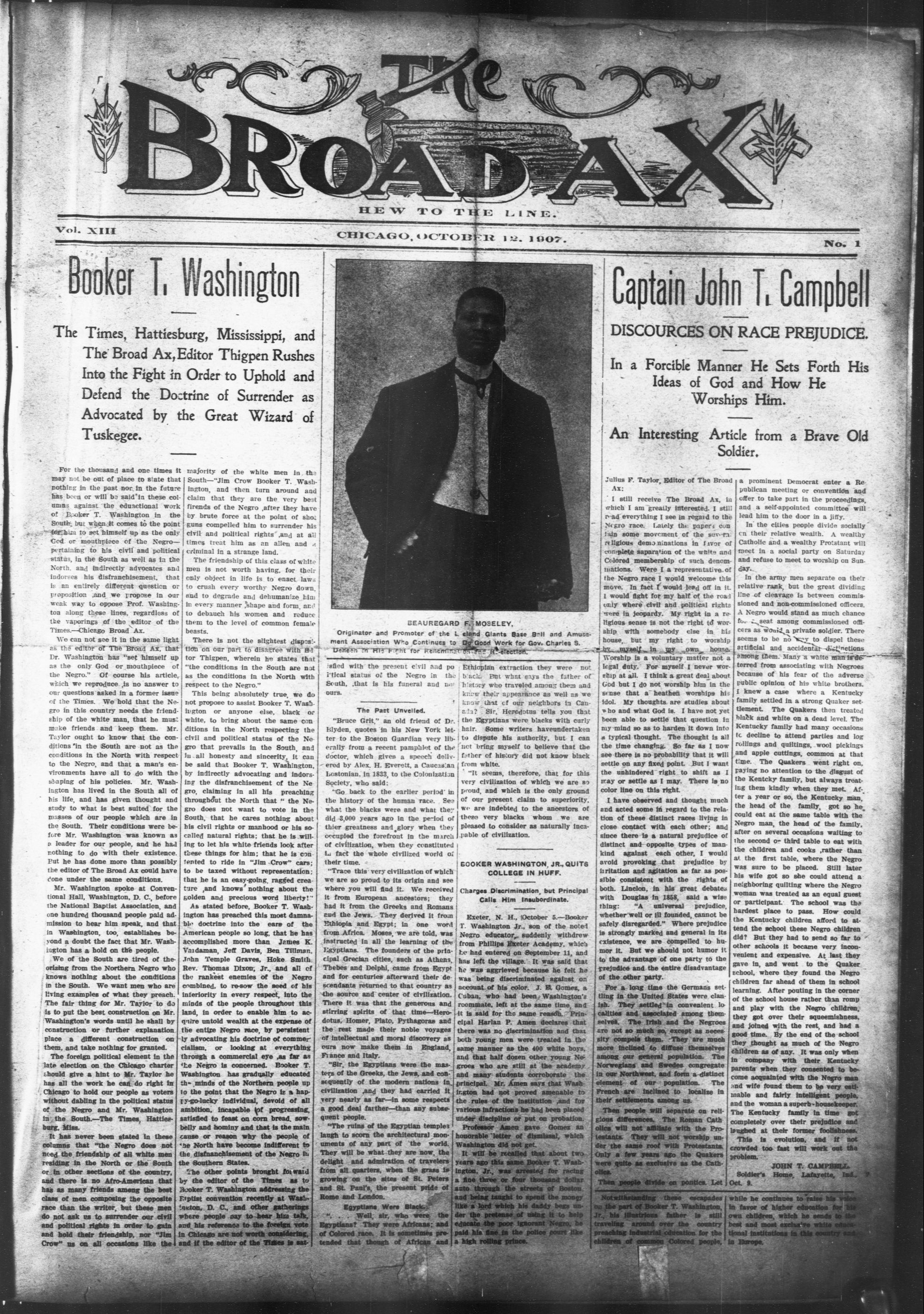
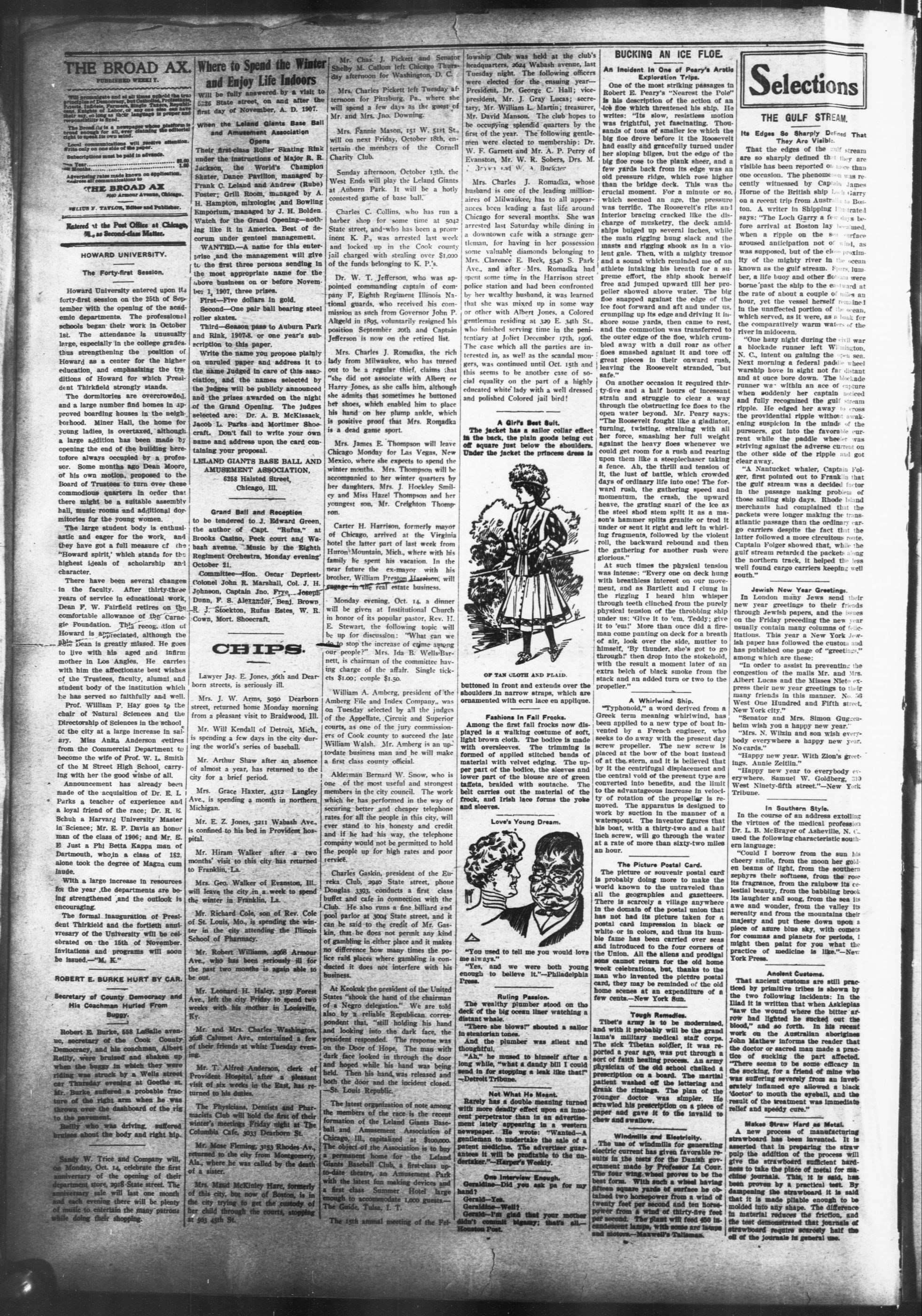
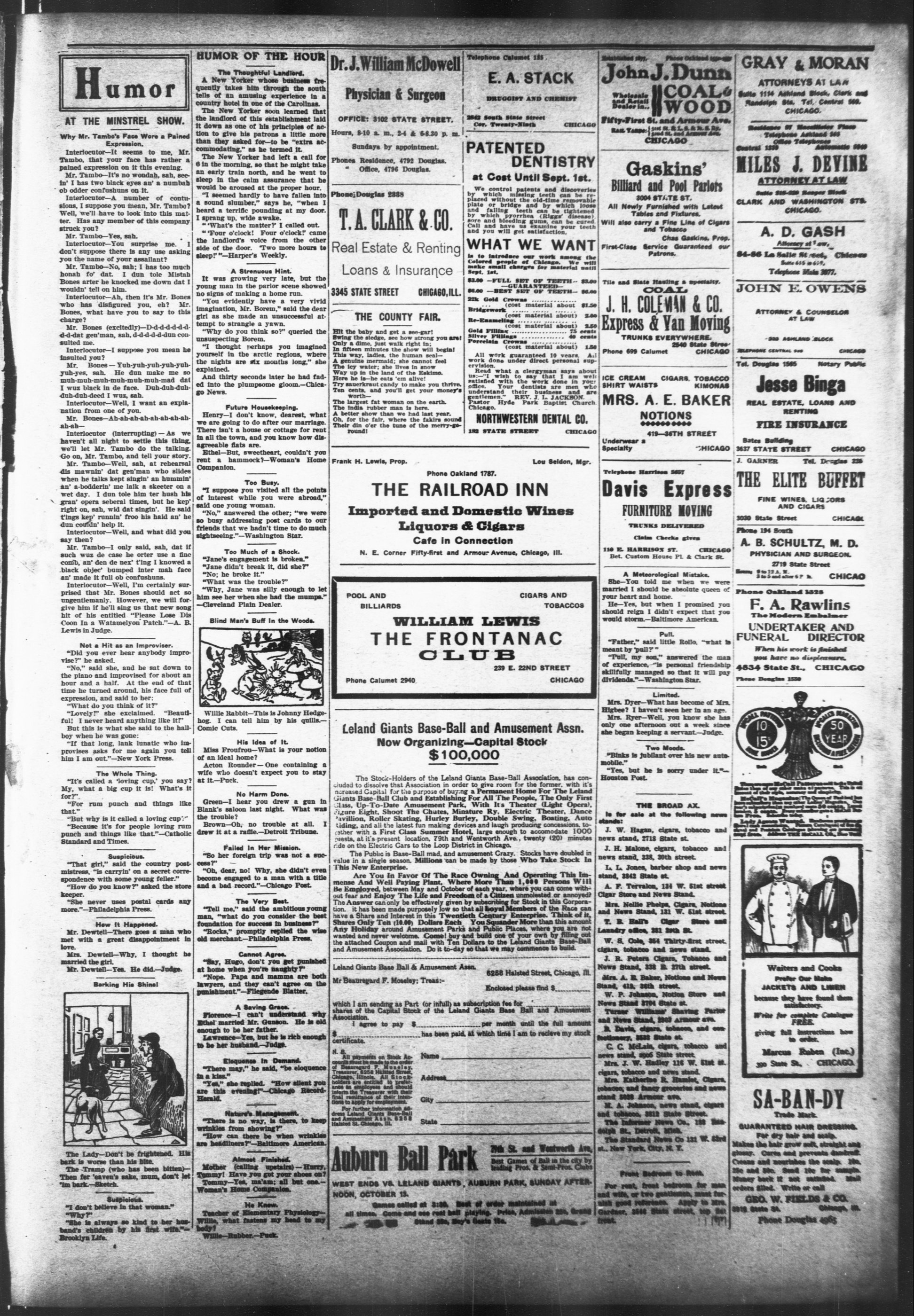
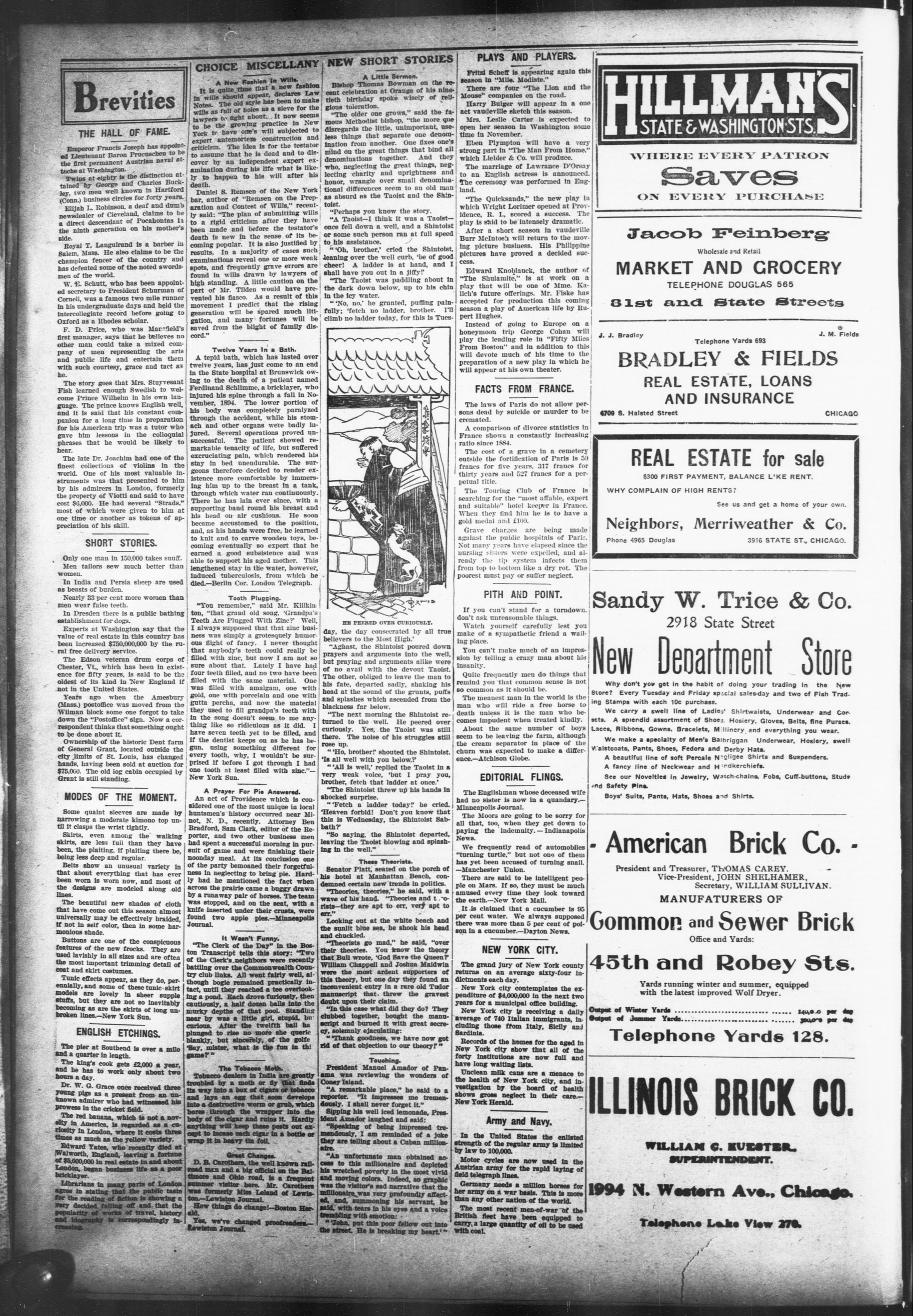
Page text (machine-generated)
Booker T. Washington
The Times, Hattiesburg, Mississippi, and The Broad Ax,Editor Thigpen Rushes Into the Fight in Order to Uphold and Defend the Doctrine of Surrender as Advocated by the Great Wizard of Tuskegee.
Booker T.
The Times, Hattiesb
The Broad Ax, I
Into the Fight in
Defend the Do
Advocated by t
Tuskegee.
For the thousand and one times it may not be out of place to state that nothing in the past nor in the future has been or will be said in these columns against the educational work of Booker T. Washington in the South, but when it comes to the point for him to set himself up as the only God or mouthpiece of the Negro—pertaining to his civil and political status, in the South as well as in the North, and indirectly advocates and indores his disfranchisement, that is an entirely different question or proposition, and we propose in our weak way to oppose Prof. Washington along these lines, regardless of the vaporings of the editor of the Times.—Chicago Broad Ax.
We can not see it in the same light as the editor of The Broad Ax, that Dr. Washington has "set himself up as the only God or mouthpiece of the Negro." Of course his article, which we reproduce, is no answer to our questions asked in a former issue of the Times. We hold that the Negro in this country needs the friendship of the white man, that he must make friends and keep them. Mr. Taylor ought to know that the conditions 'in the South are not as the conditions in the North with respect to the Negro, and that a man's environments have all to do with the shaping of his policies. Mr. Washington has lived in the South all of his life, and has given thought and study to what is best suited for the masses of our people which are in the South. Their conditions were before Mr. Washington was known as a leader for our people, and he had nothing to do with their existence. Put he has done more than possibly the editor of The Broad Ax could have done under the same conditions.
Mr. Washington spoke at Conventional Hall, Washington, D. C., before the National Baptist Association, and one hundred thousand people paid admission to hear him speak, and that in Washington, too, establishes beyond a doubt the fact that Mr. Washington has a hold on the people. We of the South are tired of theorizing from the Northern Negro who knows nothing about the conditions in the South. We want men who are living examples of what they preach. The fair thing for Mr. Taylor to do is to put the best construction on Mr. Washington's words until he shall by construction or further explanation place a different construction on them, and take nothing for granted.
The foreign political element in the late election on the Chicago charter should give a hint to Mr. Taylor he has all the work he can do right in Chicago to hold our people as voters without dabbling in the political status of the Negro and Mr. Washington in the South.—The Times, Hattiesburg, Miss.
It has never been stated in these columns that "the Negro does not need the friendship of all white men residing in the North or the South or in other sections of the country, and there is no Afro-American that has as many friends among the best class of men composing the opposite race than the writer, but these men do not ask us to surrender our civil and political rights in order to gain and hold their friendship, nor "Jim Crow" us on all occasions like the
majority of the white men in the South—"Jim Crow Booker T. Washington, and then turn around and claim that they are the very best friends of the Negro after they have by brute force at the point of shotguns compelled him to surrender his civil and political rights" and at all times treat him as an alien and a criminal in a strange land.
The friendship of this class of white men is not worth having, for their only object in life is to enact laws to crush every worthy Negro down, and to degrade and dehumanize him in every manner shape and form, and to debauch his women and reduce them to the level of common female beasts.
There is not the slightest disposition on our part to disagree with Editor Thigpen, wherein he states that "the conditions in the South are not as the conditions in the North with respect to the Negro."
This being absolutely true, we do not propose to assist Booker T. Washington or anyone else, black or white, to bring about the same conditions in the North respecting the civil and political status of the Negro that prevails in the South, and in all honesty and sincerity, it can be said that Booker T. Washington, by indirectly advocating and indorsing the disfranchisement of the Negro, claiming in all his preaching throughout the North that " the Negro does not want to vote in the South, that he cares nothing about his civil rights or manhood or his so-called natural rights; that he is willing to let his white friends look after these things for him; that he is contented to ride in "Jim-Crow" cars; to be taxed without representation; that he is an easy-going, ragged creature and knows nothing about the golden and precious word liberty."
As stated before, Booker T. Washington has preached this most damnable doctrine into the ears of the American people so long, that he has accomplished more than James K. Vaidaman, Jeff Davis, Ben Tillman, John Temple Graves, Hoke Smith, Rev. Thomas Dixon, Jr., and all of the rankest enemies of the Negro combined, to re-sow the seed of his inferiority in every respect, into the minds of the people throughout this land, in order to enable him to acquire untold wealth at the expense of the entire Negro race, by persistently advocating his doctrine of commercialism, or looking at everything through a commercial eye as far as the Negro is concerned. Booker T. Washington has gradually educated the minds of the Northern people up to the point that the Negro is a happy-go-lucky individual, devoid of all ambition, incapable of progressing, satisfied to feast on corn bread, sow-belly and hominy and that is the main cause or reason why the people of the North have become indifferent to the disfrenchishment of the Negro in the Southern States.
The other points brought forward by the editor of the Times as to Booker T. Washington addressing the Baptist convention recently at Washington, D. C., and other gatherings where people say to hear him talk, and his reference to the foregoing vote in Chicago are not worth considering, and if the editor of the Times is sat-
Originator and Promoter of the Lament Association Who Continues to Denise in His Fight for Renminia
Isfied with the present civil and political status of the Negro in the South, that is his funeral and not ours.
The Past Unvelled.
"Bruce Grit," an old friend of Dr. Blyden, quotes in his New York letter to the Boston Guardian very liberally from a recent pamphlet of the doctor, which gives a speech delivered by Alex H. Everett, a Caucasian Lostonian, in 1833, to the Colonization Society, who said:
"Go back to the earlier period in the history of the human race. See what the blacks were and what they did 3,000 years ago in the period of their greatness and glory when they occupied the forefront in the march of civilization, when they constituted in fact the whole civilized world of their time.
"Trace this very civilization of which we are so proud to its origin and see where you will find it. We received it from European ancestors; they had it from the Greeks and Romans and the Jews. They derived it from Ethiopia and Egypt; in one word from Africa. Moses, we are told, was instructed in all the learning of the Egyptians. The founders of the principal Grecian cities, such as Athens, Thebes and Delphi, came from Egypt and for centuries afterward their descendants returned to that country as the source and center of civilization. There it was that the generous and stirring spirits of that time—Herdotus, Homer, Plato, Pythagoras and the rest made their noble voyages of intellectual and moral discovery as curs now make them in England, France and Italy.
"Sir, the Egyptians were the masters of the Greeks, the Jews, and consequently of the modern nations in civilization and they had carried it very nearly as far—in some respects a good deal farther—than any subsequent people.
"The ruins of the Egyptian temples laugh to scorn the architectural monuments of any part of the world. They will be what they are now, the delight and admiration of travelers from all quarters, when the grass is growing on the sites of St. Peters and St. Paul's, the present pride of Rome and London.
eland Giants Base Ball and Amuse-
Do Good Work for Gov. Charles S.
Garcia Re-election.
Ethiopian extraction they were not
black. But what says the father of
history who traveled among them and
know their appearance as well as we
know that of our neighbors in Canada? Sir, Heredotus tells you that the Egyptians were blacks with curly
hair. Some writers have undertaken
to dispute his authority, but I can
not bring myself to believe that the
father of history did not know black
from white.
"It seems, therefore, that for this
very civilization of which we are so
proud, and which is the only ground
of our present claim to superlority,
we are indebted to the ancestors of
these very blacks whom we are
pleased to consider as naturally incan-
able of civilization.
BOOKER WASHINGTON, JR., QUITS
COLLEGE IN HUFF.
Charges Discrimination, but Principal Calls Him Insubordinate.
Exeter, N. H., October 5.—Booker T. Washington Jr., son of the noted Negro educator, suddenly withdrew from Phillips Exeter Academy, which he had entered on September 11, and has left the village. It was said that he was aggrieved because he felt he was being discriminated against on account of his color. J. E. Gomez, a Cuban, who had been Washington's roommate, left at the same time and it is said for the same reason. Principal Harlan P. Amen declares that there was no discrimination and that both young men were treated in the same manner as the 400 white boys, and that half dozen other young Negroes who are still at the academy and many students corroborate the principal. Mr. Amen says that Washington had not proved amenable to the rules of the institution, and for various infractions he had been placed under discipline or put on probation. Professor Amen gave Gomez an honorable letter of dismissal, which Washington did not get.
It will be recalled that about two years ago this same Booker T. Washington, Jr., was arrested for racing a fine three or four thousand dollar auto through the streets of Boston, and being taught to spend the money like a lord which his daddy begs under the pretense of using it to help educate the poor ignorant Negro, he paid his fine in the police court like a high rolling prince.
Captain John T. Campbell
DISCOURCES ON RACE PREJUDICE.
In a Forcible Manner He Sets Forth His Ideas of God and How He Worships Him.
An Interesting Article from a Brave Old Soldier.
Julius F. Taylor, Editor of The Broad Ax:
I still receive The Broad Ax, in which I am greatly interested. I still read everything I see in regard to the Negro race. Lately the papers contain some movement of the several religious denominations in favor of complete separation of the white and Colored membership of such denominations. Were I a representative of the Negro race I would welcome this move. In fact I would lead off in it. I would fight for my half of the road only where civil and political rights were in jeopardy. My right in a religious sense is not the right to worship with somebody else in his house, but my right to worship by myself in my own house. Worship is a voluntary matter not a legal duty. For myself I never worship at all. I think a great deal about God but I do not worship him in the sense that a heathen worships his idol. My thoughts are studies about who and what God is. I have not yet been able to settle that question in my mind so as to harden it down into a typical thought. The thought is all the time changing. So far as I now see there is no probability that it will settle on any fixed point. But I want the unhindered right to shift as I may or settle as I may. There is no color line on this right.
I have observed and thought much and acted some in regard to the relation of these distinct races living in close contact with each other; and since there is a natural prejudice of distinct and opposite types of mankind against each other, I would avoid provoking that prejudice by irritation and agitation as far as possible consistent with the rights of both. Lincion, in his great debates with Douglas in 1858, said a wise thing: "A universal prejudice, whether well or ill founded, cannot be safely disregarded." Where prejudice is strongly marked and general in its existence, we are compelled to humor it. But we should not humor it to the advantage of one party to the prejudice and the entire disadvantage of the other party.
For a long time the Germans settling in the United States were clanish. They settled in convenient lo-calities and associated among them selves. The Irish and the Negroes are not so much so, except as neces-sity compels them. They are much more inclined to diffuse themselves among our general population. The Norwegians and Swedes congregate in our Northwest, and form a distinct element of our population. The French are inclined to localize in their settlements among us.
Then people will separate on religious differences. The Roman Catholics will not affiliate with the Protestants. They will not worship under the same roof with Protestants. Only a few years ago the Quakers were quite as exclusive as the Catholics.
Then people divide on pontics. Let
Notwithstanding these escapades on the part of Booker T. Washington, Jr. his illustrious father is still traveling around over the country preaching industrial education for the children of common Colored people,
a prominent Democrat enter a Republican meeting or convention and offer to take part in the proceedings, and a self-appointed committee will lead him to the door in a jiffy. In the cities people divide socially on their relative wealth. A wealthy Catholic and a wealthy Prostant will meet in a social party on Saturday and refuse to meet to worship on Sunday.
In the army men separate on their relative rank, but the great dividing line of cleavage is between commissioned and non-commissioned officers. A Negro would stand as much chance for a seat among commissioned officers as would a private soldier. There seems to be no way to dispel these artificial and accidental distinctions among them. Many a white man is deterred from associating with Negroes because of his fear of the adverse public opinion of his white brothers. I knew a case where a Kentucky family settled in a strong Quaker settlement. The Quakers then treated black and white on a dead level. The Kentucky family had many occasions to decline to attend parties and log rollings and quiltings, wool pickings and apple cuttings, common at that time. The Quakers went right on, paying no attention to the disgust of the Kentucky family, but always treating them kindly when they met. After a year or so, the Kentucky man, the head of the family, got so he could eat at the same table with the Negro man, the head of the family, after several occasions waiting to the second or third table to eat with the children and cooks, rather than at the first table, where the Negro was sure to be placed. Still later his wife got so she could attend a neighboring quilting where the Negro woman was treated as an equal guest or participant. The school was the hardest place to pass. How could the Kentucky children afford to attend the school these Negro children did? But they had to send far to other schools it became very inconvenient and expensive. At last they gave in, and went to the Quaker school, where they found the Negro children far ahead of them in school learning. After pouting in the corner of the school house rather than romp and play with the Negro children, they got over their squeeishness, and joined with the rest, and had a good time. By the end of the school they thought as much of the Negro children as of any. It was only when in company with their Kentucky parents when they consented to become acquainted with the Negro man and wife found them to be very estimable and fairly intelligent people, and the woman a superb-housekeeper. The Kentucky family in time got completely over their prejudice and laughed at their former foolishness. This is evolution, and if not crowded too fast will work out the problem.
JOHN T. CAMPBELL
Soldier's Home Lafayette, Ind.
while he continues to raise his voice in favor of higher education for his own children, which he sends to the best and most exclusive white educational institutions in this country and in Europe.
Will inculpate and as all times uphold the true
principle of Democracy, but Castellion, Prison,
and Conviction. We will not allow the editorial
Rights of Labor, or any one else can have
their say, so no long as their language is proper
and responsibilities is fixed.
The Broad AX is a newspaper whose platform is
to sell all news, claiming the editorial
eight to speak its own mind.
Local communications will receive attention.
Write only on one side of the paper.
Subscriptions must be paid in advance.
Year. $2.00
Month. 1.00
Adverzing rates made known on application,
address all communications to
THE BROAD AX
400 Armour Avenue, Chicago.
WILLIE N. TAYLOR, Editor and Publisher.
Entered at the Post Office at Chicago,
M. as Second-class Matter.
HOWARD UNIVERSITY.
Howard University entered upon its forty-first session on the 25th of September with the opening of the academic departments. The professional schools began their work in October 1st. The attendance is unusually large, especially in the college grades thus strengthening the position of Howard as a center for the higher education, and emphasizing the traditions of Howard for which President Thirkfield strongly stands.
The dormitories are overcrowded, and a large number find homes in approved boarding houses in the neighborhood. Miner Hall, the home for young ladies, is overtaxed, although a large addition has been made by opening the end of the building herefore always occupied by a professor. Some months ago Dean Moore, of his own motion, proposed to the Board of Trustees to turn over these commodious quarters in order that there might be a suitable assembly hall, music rooms and additional dormitories for the young women.
The large student body is enthusiastic and eager for the work, and they have got a full measure of the "Howard spirit", which stands for the highest ideals of scholarship and character.
There have been several changes in the faculty. After thirty-three years of service in educational work, Dean F. W. Fairfield retires on the comfortable allowance of the Carnegie Foundation. This recognition of Howard is appreciated, although the able Dean is greatly missed. He goes to live with his aged and infirm mother in Los Angles. He carries with him the affectionate best wishes of the Trustees, faculty, alumni and student body of the institution which he has served so faithfully and well.
Prof. William P. Hay goes to the chair of Natural Sciences and the Directorship of Sciences in the school of the city at a large increase in salary. Miss Anita Anderson retires from the Commercial Department to become the wife of Prof. W. L. Smith of the M Street High School, carrying with her the good wishes of all.
Announcement has already been made of the acquisition of Dr. E. L. Parks a teacher of experience and a loyal friend of the race; Dr. R. E. Schuh a Harvard University Master in Science; Mr. E. P. Davis an honor man of the class of 1906; and Mr. E. Just a Phi Beta Kappa man of Dartmouth, who in a class of 182, alone took the degree of Magna cum laude.
With a large increase in resources for the year, the departments are being strengthened and the outlook is encouraging.
The formal inauguration of President Thirkield and the fortieth anniversary of the University will be celebrated on the 15th of November. Invitations and programs will soon be issued.—"M. K."
ROBERT E. BURKE HURT BY CAR.
Secretary of County Democracy and His Coachman Huried From Buggy.
Robert E. Burke, 558 LaSalle avenue, secretary of the Cook County Democracy, and his coachman, Albert Reilly, were bruised and shaken up when the buggy in which they were riding was struck by a Wells street car Thursday evening at Goethe st. Mr. Burke suffered a probable fracture of the right arm when he was thrown over the dashboard of the rig to the pavement.
Reilly who was driving, suffered bruises about the body and right hip.
Sandy W. Trice and Company will, on Monday, Oct. 14, celebrate the first anniversary of the opening of their department store, 2918-State street. The anniversary sale will last one month and each evening there will be plenty of music to entertain the many patrons while doing their shopping.
1
and Enjoy Life Indoors Will be fully answered by a visit to 5526 State street, on and after the first day of November, A. D. 1907.
When the Leland Giants Base Ball
Opens
Their first class Roller Skating Rink under the instructions of Major R. R. Jackson, the World's Champion Skater, Dance Pavilion, managed by Frank C. Leland and Andrew (Rube) Foster; Grill Room, managed by A. H. Hampton, mixologist, and Bowling Emporium, managed by J. H. Bolden. Watch for the Grand Opening—nothing like it in America. Best of decorum under genteel management. WANTED.—A name for this enterprise, and the management will give to the first three persons sending in the most appropriate name for the above business on or before November 1, 1907, three prizes.
First-Five dollars in gold.
Second—One pair ball bearing steel roller skates.
Third—Season pass to Auburn Park and Rink, 1907-8. or one year's subscription to this paper.
Write the name you propose plainly on unruled paper and address it to the name Judged in care of this association, and the names selected by the judges will be publicly announced and the prizes awarded on the night of the Grand Opening. The judges selected are: Dr. A. B. McKissack, Jacob L. Parks and Mortimer Shoecraft. Don't fall to write your own name and address upon the card containing your proposal.
LELAND GIANTS BASE BALL AND AMUSEMENT ASSOCIATION
Grand Ball and Reception
to be tendered to J. Edward Green,
the author of Capt. "Rufus," at Brooks Casino, Peck court and Wabash avenue. Music by the Eighth Regiment Orchestra, Monday evening
October 21.
Committee—Hon. Oscar Depriest,
Colonel John R. Marshall, Col. J. H.
Johnson, Captain Jno. Frye, Joseph
Dunn, F. S. Alexander, Benj. Brown,
R. J. Stockton, Rufus Estes, W. R.
Cown, Mort. Shoecraft.
CHIPS
Lawyer Jas. E. Jones, 36th and Dearborn streets, is seriously ill.
Mrs. J. W. Arms, 5050 Dearborn street, returned home Monday morning from a pleasant visit to Braidwood, Ill.
Mr. Will Kendall of Detroit, Mich., is spending a few days in the city during the world's series of baseball.
Mr. Arthur Shaw after an absence of almost a year, has returned to the city for a brief period.
Mrs. Grace Haxter, 4312 Langley Ave., is spending a month in northern Michigan.
Mr. E. Z. Jones, 3211 Wabash Ave., is confined to his bed in Provident hospital.
Mr. Hiram Walker after a two months' visit to this city has returned to Franklin, La.
Mrs. Geo. Walker of Evanston, Ill. will leave the city in a week to spend the winter in Franklin, La.
Mr. Richard Cole, son of Rev. Cole of St. Louis, Mo., is spending the winter in the city attending the Illinois School of Pharmacy.
Mr. Robert Williams, 2968 Armour Ave., who has been seriously ill for the past two months is again able to be out.
Mr. Leonard H. Haley, 3159 Forest Ave., left the city Friday to spend two weeks with his mother in Louisville, Ky.
Mr. and Mrs. Charles Washington, 3628 Calumet Ave., entertained a few of their friends at whist Tuesday evening.
Mr. T. Alfred Anderson, clerk of Provident Hospital, after a pleasant visit of six weeks in the East, has returned to his duties.
The Physicians, Dentists and Pharmacists Club will hold the first of their winter's meetings Friday night at The Columbia Cafe, 3033 Dearborn St.
Mr. Mose Fleming, 3153 Rhodes Av., returned to the city from Montgomery, Ala., where he was called by the death of a sister.
Mrs. Maud McKinley Hare, formerly of this city, but now of Boston, is in the city trying to get the custody of her child through the courts, stopping at 503 45th St.
Mr. Chas. J. Pickett and Senator Shelby M. Cullom left Chicago Thursday afternoon for Washington, D. C.
Mrs. Charles Pickett left Tuesday afternoon for Pittsburg, Pa., where she will spend a few days as the guest of Mr. and Mrs. Jno. Downing.
Mrs. Fannie Mason, 151 W. 51st St., will on next Friday, October 18th, entertain the members of the Cornell Charity Club.
Sunday afternoon, October 13th, the West Ends will play the Leland Giants at Auburn Park. It will be a hotly contested game of base ball.
Charles C. Collins, who has run a barber shop for some time at 5042 State street, and who has been a prominent K. P., was arrested last week and locked up in the Cook county jail charged with stealing over $1,000 of the funds belonging to K. P.'s.
Dr. W. T. Jefferson, who was appointed commanding captain of company F, Eighth Regiment Illinois National guards, who received his commission as such from Governor John P. Altgeld in 1895, voluntarily resigned his position September 20th and Captain Jefferson is now on the retired list.
Mrs. Charles J. Romadka, the rich lady from Milwaukee, who has turned out to be a regular thief, claims that "she did not associate with Albert or Harry Jones, as she calls him, although she admits that sometimes he buttoned her shoes, which enabled him to place his hand on her plump ankle, which is positive proof that Mrs. Romadka is a dead game sport.
Mrs. James E. Thompson will leave Chicago Monday for Las Vegas, New Mexico, where she expects to spend the winter months. Mrs. Thompson will be accompanied to her winter quarters by her daughters. Mrs. J. Hockley Smiley and Miss Hazel Thompson and her youngest son, Mr. Creighton Thompson.
Carter H. Harrison, formerly mayor of Chicago, arrived at the Virginia hotel the latter part of last week from Huron Mountain, Mich., where with his family he spent his vacation. In the near future the ex-mayor with his brother, William Preston Harrison, will engage in the real estate business.
Monday evening, Oct. 14, a dinner will be given at Institutional Church in honor of its popular pastor, Rev. H. E. Stewart, the following topic will be up for discussion: "What can we do to stop the increase of crime among our people?" Mrs. Ida B. Wells-Barnett, is chairman of the committee having charge of the affair. Single tickets $1.00; couple $1.50.
William A. Amberg, president of the Amberg File and Index Company, was on Tuesday selected by all the judges of the Appellate, Circuit and Superior courts, as one of the jury commissioners of Cook county to succeed the late William Walsh. Mr. Amberg is an up-to-date business man and he will make a first class county official.
Alderman Bernard W. Snow, who is one of the most useful and strongest members in the city council. The work which he has performed in the way of securing better and cheaper telephone rates for all the people in this city, will ever stand to his honesty and credit and if he had his way, the telephone company would not be permitted to hold the people up for high rates and poor service.
Charles Gaskin, president of the Eureka Club, 2940 State street, phone Douglas 3393, conducts a first class buffet and cafe in connection with the Club. He also runs a fine billiard and pool parlor at 3004 State street, and it can be said to the credit of Mr. Gaskin, that he does not permit any kind of gambling in either place and it makes no difference how many times the police raid places where gambling is conducted it does not interfere with his business.
At Keokuk the president of the United States "shook the hand of the chairman of a Negro delegation." We are told also by a reliable Republican correspondent that, "still holding his hand and looking into the dark face, the president responded. The response was on the Door of Hope. The man with dark face looked in through the door and hoped while his hand was being held. Then his hand was released and both the door and the incident closed. —St. Louis Republic.
The latest organization of note among the members of the race is the recent formation of the Leland Giants Baseball and Amusement Association of Chicago, Ill., capitalized at $100,000. The object of the Association is to buy a permanent home for the Leland Giants Baseball Club, a first-class up-to-date theatre, an Amusement Park with the latest fun making devices and a first class Summer Hotel large enough to accommodate 1,000 guests. —The Guide, Tulsa, I. T.
lowship Club was held at the club's headquarters, 2024 Wabash avenue, last Tuesday night. The following officers were elected for the ensuing year—President, Dr. George C. Hall; vicepresident, Mr. J. Gray Lucas; secretary, Mr. William L. Martin; treasurer, Mr. David Manson. The club hopes to be occupying splendid quarters by the first of the year. The following gentlemen were elected to membership: Dr. W. F. Garnett and Mr. A. P. Perry of Evanston, Mr. W. R. Sobers, Drs. M. Stryva and W. A. Buckner
Mrs. Charles J. Romadka, whose husband is one of the leading millionaires of Milwaukee, has to all appearances been leading a fast life around Chicago for several months. She was arrested last Saturday while dining in a downtown cafe with a strange gentleman, for having in her possession some valuable diamonds belonging to Mrs. Clarence E. Beck, 5540 S. Park Ave., and after Mrs. Romadka had spent some time in the Harrison street police station and had been confronted by her wealthy husband, it was learned that she was mixed up in some way or other with Albert Jones, a Colored gentleman residing at 329 E. 34th St., who finished serving time in the penitentiary at Joliet December 17th, 1906. The case which all the parties are interested in, as well as the scandal mongers, was continued until Oct. 15th and this seems to be another case of social equality on the part of a highly educated white lady with a well dressed and polished Colored jail bird!
A Girl's Best Suit
The jacket has a sailor collar effect in the back, the plain goods being cut off square just below the shoulders. Under the jacket the princess dress is OF TAN CLOTH AND PLAID. buttoned in front and extends over the shoulders in narrow straps, which are ornamented with ecru lace en applique.
Fashions In Fall Frocks
Among the first fall frocks now displayed is a walking costume of soft, light brown cloth. The bodice is made with oversleeves. The trimming is formed of applied stitched bands of material with velvet edging. The upper part of the bodice, the sleeves and lower part of the blouse are of green taffeta, braided with soutache. The belt carries out the material of the frock, and Irish lace forms the yoke and sleeves.
"You used to tell me you would love me always."
"Yes, and we were both young enough to believe it."—Philadelphia Press.
Ruling Passion.
The wealthy plumber stood on the deck of the big ocean liner watching a distant whale.
"There she blows!" shouted a sailor in stentorian tones.
And the plumber was silent and thoughtful.
"Ah," he mused to himself after a long while, "what a dandy bill I could send in for stopping a leak like that!"—Detroit Tribune.
Not What He Meant.
Rarely has a double meaning turned with more deadly effect upon an innocent perpetrator than in an advertisement lately appearing in a western newspaper. He wrote: "Wanted—A gentleman to undertake the sale of a patent medicine. The advertiser guarantees it will be profitable to the undertaker."—Harper's Weekly.
One Interview Enough.
Geraldine—Did you ask pa for my hand?
Gerald—Yes.
Geraldine—Well?
Gerald—I'm gind that your mother
didn't commit bigamy; that's all.—
Honest Post
An Incident in One of Peary's Aristia Exploration Trials.
One of the most striking passages in Robert E. Peary's "Nearest the Pole" is his description of the action of an ice floe which threatened his ship. He writes: "Its slow, resistless motion was frightful, yet fascinating. Thousands of tons of smaller ice which the big floe drove before it the Roosevelt had easily and gracefully turned under her sloping bilges, but the edge of the big floe rose to the plank sheer, and a few yards back from its edge was an old pressure ridge, which rose higher than the bridge deck. This was the crucial moment. For a minute or so, which seemed an age, the pressure was terrific. The Roosevelt's ribs and interior bracing cracked like the discharge of musketry, the deck amidships bulged several inches, while the main rigging hung slack and the masts and rigging shook as in a violent gale. Then, with a mighty tremor and a sound which reminded me of an athlete intaking his breath for a supreme effort, the ship shook herself free and jumped upward till her propeller showed above water. The big floe snapped against the edge of the ice foot forward and aft and under us, crumpling up its edge and driving it inshore some yards, then came to rest, and the commotion was transferred to the outer edge of the floe, which crumbled away with a dull roar as other floes smashed against it and tore off great pieces in their onward rush, leaving the Roosevelt stranded, but safe."
On another occasion it required thirty-five and a half hours of incessant strain and struggle to clear a way through the obstructing ice floes to the open water beyond. Mr. Peary says: "The Roosevelt fought like a gladiator, turning, twisting, straining with all her force, smashing her full weight against the heavy floes whenever we could get room for a rush and rearing upon them like a steepechaser taking a fence. Ah, the thrill and tension of it, the lust of battle, which crowded days of ordinary life into one! The forward rush, the gathering speed and momentum, the crash, the upward heave, the grating snarl of the ice as the steel shod stem split it as a mason's hammer splits granite or trot it under or sent it right and left in whirling fragments, followed by the violent roll, the backward rebound and then the gathering for another rush were glorious."
At such times the physical tension was intense: "Every one on deck hung with breathless interest on our movement, and as Bartlett and I clung in the rigging I heard him whisper through teeth clinched from the purely physical tension of the throbbing ship under us: 'Give it to 'em, Teddy; give it to 'em.' More than once did a fireman come panting on deck for a breath of air, look over the side, mutter to himself, 'By thunder, she's got to go through' then drop into the stokehold, with the result a moment later of an extra belch of black smoke from the stack and an added turn or two to the propeller."
A Whirlwind Ship.
"Typhonoid," a word derived from a Greek term meaning whirlwind, has been applied to a new type of boat invented by a French engineer, who seeks to do away with the present day screw propeller. The new screw is placed at the bow of the boat instead of at the stern, and it is believed that by it the centrifugal displacement and the central void of the present type are converted into benefits, and the limit to the advantageous increase in velocity of rotation of the propeller is removed. The apparatus is designed to work by suction in the manner of a waterspout. The inventor figures that his boat, with a thirty-two and a half inch screw, will go through the water at a rate of more than sixty-two miles an hour.
The Picture Postal Card.
The picture or souvenir postal card is probably doing more to make the world known to the untraveled than all the geographies and gazetteers. There is scarcely a village anywhere in the domain of the postal union that has not had its picture taken for a postal card impression in black or white or in colors, and thus its humble fame has been carried over seas and introduced to the four corners of the Union. All the aliens and prodigal sons cannot return for the old home week celebrations, but, thanks to the man who invented the picture postal card, they may be reminded of the old home scenes at an expenditure of a few cents. New York Sun.
Tough Remedies
Tibet's army is to be modernised, and with it probably will be the grand lama's military medical staff corps. The sick Tibetan soldier, it was reported a year ago, was put through a sort of faith healing process. An army physician of the old school chalked a prescription on a board. The martial patient washed off the lettering and drank the rinsings. The plan of the younger doctor was simpler. He scrawled his prescription on a piece of paper and gave it to the invalid to chew and swallow.
Windmills and Electricity
Windows and electricity.
The use of windmills for generating electric current has given favorable results in the tests for the Danish government made by Professor La Cour.
The four wing-wheel proves to be the best form. With such a wheel having fifteen square yards of surface he obtained two horsepower from a wind of twenty feet per second and ten horsepower from a wind of thirty-five feet per second. The plant will feed 450 incandescent lamps, with some are lamps and motors. Maxwell's Tallaman
Selections
Its Edges So Sharply Defined That They Are Visible.
That the edges of the gulf streams are so sharply defined that they are visible has been reported on more than one occasion. The phenomenon was recently witnessed by Captain James Horne of the British ship Loch Garry on a recent trip from Australia to Boston. A writer in Shipping Illustrated says: "The Loch Garry a few days before arrival at Boston lay became, when a ripple on the sea surface aroused anticipation not of wind, as was supposed, but of the close proximity of the mighty river in the ocean known as the gulf stream. Spurs, lumber, a life buoy and other floats were borne past the ship to the eastward at the rate of about a couple of miles an hour, yet the vessel herself remained in the unaffected portion of the ocean, which served, as it were, as a bank for the comparatively warm waters of the river in midocean.
"One hazy night during the civil war a blockade runner left Wilmington, N. C., intent on gaining the open sea. Next morning a federal paddle wheel warship hove in sight not far distant and at once bore down. The blockade runner wore within an ace of capture when suddenly her captain noticed and fully recognized the gulf stream ripple. He edged her away to cross the providential ripple without awakening suspicion in the minds of the pursurers, got into the favorable current while the paddle wheeler was striving against the adverse current on the other side of the ripple and got clear away.
"A Nantucket whaler, Captain Folger, first pointed out to Franklin that the gulf stream was a decided factor in the passage making problem of those sailing ship days. Rhode Island merchants had complained that the packets were longer making the transatlantic passage than the ordinary cargo carriers despite the fact that the latter followed a more circuitous route. Captain Folger showed that, while the gulf stream retarded the packets along the northern track, it helped the less well found cargo carriers keeping well south."
Jewish New Year Greetings
In London many Jews send their new year greetings to their friends through Jewish papers, and the issues on the Friday preceding the new year usually contain many columns of festifications. This year a New York Jewish paper has followed the custom and has published one page of "greetings," among which are these:
"In order to assist in preventing the congestion of the mails Mr. and Mrs. Albert Lucas and the Misses Nieto express their new year greetings to their many friends in this manner. No. 50 West One Hundred and Fifth street, New York city."
"Senator and Mrs. Simon Gugruehelm wish you a happy new year."
"Mrs. N. Wilzin and son wish everybody everywhere a happy new year. No cards."
"Happy new year. With Zion's greetings. Annie Zeltlin."
"Happy new year to everybody everywhere. Samuel W. Goldberg, 310 West Ninety-fifth street."—New York Tribune.
In Southern Style.
In the course of an address extolling the virtues of the medical profession Dr. L. B. McBrayer of Asheville, N. C. used the following characteristic southern language:
"Could I borrow from the sun his cheery smile, from the moon her golden beams of light, from the southern zephyr their softness, from the rose its fragrance, from the rainbow its celestial beauty, from the babbling brook its laughter and song, from the sea its awe and wonder, from the valley its serenity and from the mountains their majesty and put these down upon a piece of azure blue sky, with comets for commas and planets for periods. I might then paint for you what the practice of medicine is like."—New York Press.
Ancient Customs
That ancient customs are still practiced by primitive tribes is shown by the two following incidents: In the Iliad it is written that when Asklepias "saw the wound where the bitter arrow had lighted he sucked out the blood," and so forth. In his recent work on the Australian aborigines John Matthew informs the reader that the doctor or sacred man made a practice of sucking the part affected. "There seems to be some efficacy in the sucking, for a friend of mine who was suffering severely from an inveterately inflamed eye allowed a black 'doctor' to mouth the eyeball, and the result of the treatment was immediate relief and speedy cure."
Makes Straw Hard as Metal
A new process of manufacturing strawboard has been invented. It is asserted that in preparing the straw pulp the addition of the process will give the strawboard sufficient hardness to take the place of metal for machine journals. This, it is said, has been proven by a practical test. By dampening the strawboard it is said that it is made pliable enough to be molded into any shape. The difference in material reduces the friction, and the test demonstrated that journals of strawboard require scarcely half the oil of the journals in general use.
AT THE MINSTREL SHOW.
Why Mr. Tambo's Face Wore a Pained Expression.
Interlocutor-It seems to me, Mr. Tambo, that your face has rather a pained expression on it this evening.
Mr. Tambo-It's no wondah, sah, seein' I has two black eyes an' a numbah ob odder confushuns on it.
Interlocutor-A number of contusions, I suppose you mean, Mr. Tambo? Well, we'll have to look into this matter. Has any member of this company struck you?
Mr. Tambo-Yes, sah.
Interlocutor—You surprise me. I don't suppose there is any use asking you the name of your assailant?
Mr. Tambo—No, sah; I has too much honah fo' dat. I dun tole Mistah Bones arter he knocked me down dat I wouldn't tell on him.
Interlocutor—Ah, then it's Mr. Bones who has disfigured you, eh? Mr. Bones, what have you to say to this charge?
Mr. Bones (excitedly)—D-d-d-d-d-d-d-d-d-dat gen'man, sah, d-d-d-d-d-dun consulted me.
Interlocutor—I suppose you mean he insulted you?
Mr. Bones — Yuh-yuh-yuh-yuh-yuh-yuh-yes, sah. He dun make me so muh-muh-muh-muh-muh-mad dat I wuz black in de face. Duh-duh-duh-duh-deed I wuz, sah.
Interlocutor—Well, I want an explanation from one of you.
Mr. Bones—Ah-ah-ah-ah-ah-ah-ah-ah-
Interlocutor (interrupting)—As we haven’t all night to settle this thing, we’ll let Mr. Tambo do the talking. Go on, Mr. Tambo, and tell your story.
Mr. Tambo—Well, sah, and rehearsal dis mawnin’ dat gen'man who slides when he talks kept singin’ an hummil’ an‘bodderin’ me lak a skeeter on a wet day. I dun tole him ter hush his gran’ opera sebelal times, but he kep’ right on, sah, wid dat singin’. He said ‘tings kep’ runnin’ froo his haid an’ he dun could’ help it.
Interlocutor—Well, and what did you say then?
Mr. Tambo—I only said, sah, dat if such uw de case he orter use a fine comb, an’ den de nex’ ‘ting I knew a black object’ bumped inter mah face an’ made it full ob confushuns.
Interlocutor—Well, I'm certainly surprised that Mr. Bones should act so ungentlemanly. However, we will forgive him if he'll sing us that new song hit of his entitled "Please Lose Dis Coon In a Watamelyon Patch."—A. B. Lewis in Judge.
Not a Hit as an Improvise
Not a Hit as an improviser.
"Did you ever hear anybody improvise?" he asked.
"No," said she, and he sat down to the piano and improvised for about an hour and a half. At the end of that time he turned around, his face full of expression, and said to her:
"What do you think of it?"
"Lovely!" she exclaimed. "Beautiful! I never heard anything like it!"
But this is what she said to the hallboy when he was gone:
"If that long, lank lunatic who improvises asks for me again you tell him I am out"—New York Press.
The Whole Thing.
"It's called a 'loving cup,' you say? My, what a big cup it is! What's it for?" "For rum punch and things like that." "But why is it called a loving cup?" "Because it's for people loving rum punch and things like that."—Catholic Standard and Times.
Suspicious.
"That girl," said the country postmistress, "is carryin' on a secret correspondence with some young feller." "How do you know?" asked the store keeper. "She never uses postal cards any more." -Philadelphia Press.
Mr. Dewtell-There goes a man who met with a great disappointment in love.
Mrs. Dewtell-Why, I thought he married the girl.
Mr. Dewtell—Yes. He did.—Judge
A man is talking to a woman in a room. A dog is standing on the floor.
The Lady--Don't be frightened. His bark is worse than his bite.
The Tramp (who has been bitten)—
Then fer 'eaven's sake, mum, don't let 'im bark.—Sketch.
HUMOR OF THE HOUR
The Thoughtful Landlord.
A New Yorker whose business frequently takes him through the south tells of an amusing experience in a country hotel in one of the Carolinas.
The New Yorker soon learned that the landlord of this establishment laid it down as one of his principles of action to give his patrons a little more than they asked for—to be "extra accommodating," as he termed it.
The New Yorker had left a call for 6 in the morning, so that he might take an early train north, and he went to sleep in the calm assurance that he would be aroused at the proper hour.
"I seemed hardly to have fallen into a sound slumber," says he, "when I heard a terrific pounding at my door. I sprang up, wide awake.
"What's the matter? I called out.
"Four o'clock! Four o'clock! came
the landlord's voice from the other
side of the door. Two more hours to
sleep!"--Harper's Weekly.
A Strenuous Hint:
It was growing very late, but the young man in the parlor scene showed no signs of making a home run.
"You evidently have a very vivid imagination, Mr. Borem," said the dear girl as she made an unsuccessful attempt to strangle a yawn.
"Why do you think so?" queried the unsuspecting Borem.
"I thought perhaps you imagined yourself in the arctic regions, where the nights are six months long," she explained.
And thirty seconds later he had faded into the plumpsome gloom.—Chicago News.
Future Housekeeping.
Henry—I don't know, dearest, what we are going to do after our marriage. There isn't a house or cottage for rent in all the town, and you know how disagreeable flats are.
Ethel—But, sweetheart, couldn't you rent a hammock?—Woman's Home Companion.
Too Busy.
"I suppose you visited all the points of interest while you were abroad," said one young woman.
"No," answered the other; "we were so busy addressing poet cards to our friends that we hadn't time to do much sightseeing."—Washington Star.
Too Much of a Shock.
"Jane's engagement is broken."
"Jane didn't break it, did she?"
"No; he broke it."
"What was the trouble?"
"Why, Jane was silly enough to let him see her when she had the mumps."
—Cleveland Plain Dealer.
Blind Man's Buff In the Woods.
Willie Rabbit—This is Johnny Hedgehog. I can tell him by his quills.—Comic Cuts.
His Idea of It.
Miss Froufrou—What is your notion of an ideal home?
Acton Rounder—One containing a wife who doesn't expect you to stay at it.—Puck.
No Harm Done.
Green—I hear you drew a gun in Blank's saloon last night. What was the trouble? Brown—Oh, no trouble at all. I drew it at a raffle—Detroit Tribune.
Failed In Her Mission.
"So her foreign trip was not a success?"
"Oh, dear, no! Why, she didn't even become engaged to a man with a title and a bad record."—Chicago Post.
The Very Best
"Tell me," said the ambitious young man, "what do you consider the best foundation for success in business?" "Rocks," promptly replied the wise old merchant.—Philadelphia Press.
Cannot Agree.
"Say, Judge, don't you get pumme
at home when you're naughty?"
"Nope. Papa and mamma are both
lawyers, and they can't agree on the
punishment."—Fliegende Blatter.
A Saving Grace.
Florence—I can't understand why
Ethel married Mr. Gunson. He is old
enough to be her father.
Lawrence—Yes, but he is rich enough
to be her husband—Judge.
Eloquence in Demand.
"There may," he said, "be eloquence
in a kiss."
"Yes," she replied. "How silent you are this evening!"—Chicago Record-Herald.
Nature's Management.
"There is no way, is there, to keep wrinkles from showing?"
"How can there be when wrinkles are headliners?"—Baltimore American.
Almost Finished.
Mother (calling upstairs)—Hurry, Tummy! Have you got your shoes on?
Tommy—Yes, ma'm; all but one.—Woman's Home Companion.
He Know.
Teacher of Elementary Physiology—Willie, what fastens my head to my body?
Willie—Rubber.—Puck.
N. E. Corner Fifty-first and Armour Avenue, Chicago, Ill.
The Stock-Holders of the Leland Giants Base-Ball Association, has concluded to dissolve that Association in order to give room for the former, with it's increased Capital for the purpose of buying a Permanent Home For The Leland Giants Base-Ball Club and Establishing For All The People, The Only First Class, Up-To-Date Amusement Park, With Its Theater (Light Opera), Figure Eight, Shoot The Chutes, Minature Ry, Electric Theater, Dance Pavilion, Roller Skating, Hurley Burley, Double Swing, Boating, Auto Riding, and all the latest fun making devices and laugh producing concessions, together with a First Class Summer Hotel, large enough to accommodate 1000 guests, at its present location, 79th and Wentworth Ave., twenty (20) minutes ride on the Electric Cars to the Loop District in Chicago.
The Public is Base-Ball mad, and amusement Crazy. Stocks have doubled in value in a single season. Millions can be made by those Who Take Stock In This New Enterprise.
Are You In Favor Of The Race Owning And Operating This Imense And Well Paying Plant, Where More Than 1,000 Persons Will Be Employed, between May and October of each year, where you can come without fear and Enjoy The Life and Freedom of a Citizen unmolested or annoyed? The Answer can only be effectively given by subscribing for Stock in this Corporation. it has been made purposely low so that all Royal Members of the Race can have a Share and Interest in the Twentieth Century Enterprise. Think of it, Shares Only Ten (10.00) Dollars Each. You Squander More than this amount Any Holiday around Amusement Parks and Public places, where you are not wanted and never welcome. Come! buy and build one of your own by filling out the attached Coupon and mail with Ten Dollars to the Leland Giants Base-Ball and Amusement Association. Do it to-day so that we may commence to build.
which I am sending as Part (or infull) as subscription fee for shares of the Capital Stock of the Leland Giants Bass Ball and Amusement Association.
Dr.J.William McDowell
Physician & Surgeon
OFFICE: 3102 STATE STREET.
Hours, 8-10 a. m., 2-4 & 6-8.20 p. m.
Phones Residence, 4792 Douglas.
" Office, 4796 Douglas.
Phone:Douglas 2888
T. A. CLARK & CO.
Real Estate & Renting
Loans & Insurance
THE COUNTY FAIR.
Hit the baby and get a seo-gar!
Swing the sieve, see how strong you are!
Only a dime, just walk right in;
In fifteen minutes the show will begin!
This way, ladies, the human seal—
A genuine mermal; she cannot feel
the wind, she lives in space.
Way up in the land of the Eskimo.
Here he is—he eats 'em alive!
Try suerkraut candy to make you thrive.
Ten cents, and you'll get your money's
worth—
The largest fat woman on the earth.
The india rubber man is here.
A ladder than we had just year,
Ah, of the fair' the tune of the merry-go-
round!
Frank H. Lewis, Prop.
Phone Oak
THE RAILI
Imported and D
Liquors
Cafe in O
N. E. Corner Fifty-first and
POOL AND
BILLIARDS
WILLIAM
THE FRO
CL
Phone Calumet 2940
Leland Giants Base-Ball
Now Organizing
$100
We control patents and discoveries by which missing teeth can be replaced without the old-time removable plate or bridge and by which loose and falling teeth can be tightened with the pyrrorea (Higgs disease) sore and blister can be cured. Call and have us examine our teeth and you will get satisfaction.
WHAT WE WANT
NORTHWESTERN DENTAL CO.
182 STATE STREET CHICAGO
Lou Seldon, Mgr.
and 1787.
ROAD INN
Domestic Wines
& Cigars
Connection
Armour Avenue, Chicago, Ill.
CIGARS AND
TOBACCOS
M LEWIS
ONTANAC
UB
239 E. 22ND STREET
CHICAGO
John J. Dunn
Wholesale and Retail Dealer in...
COAL
WOOD
Fifty-First St. and Armour Ave.
BANK TANDEE, sent St. R. L. S. & D. S. R.
GARDEN ST. and ARMOUR AVE.
CHICAGO
Gaskins'
Billiard and Pool Parlors
3004 STATE ST.
All Newly Furnished with Latest
Tables and Fixtures.
Will also carry a Fine Line of Cigars
and Tobacco
Chas Gaskins, Prop.
First-Class Service Guaranteed our
Patrons.
Tile and State Hearing a specialty. COAL
COAL
J. H. COLEMAN & CO.
Express & Van Moving
TRUNKS EVERYWHERE.
2540 State Street
Phone 699 Calumet
CHICAGO
ICE CREAM CIGARS TOBACCO
SHIRT WAIST$ KIMONAS
MRS. A. E. BAKER
NOTIONS
419-36TH STREET
Underwear a
Specialty CHICAGO
Telephone Harrison 5057
Davis Express
FURNITURE MOVING
TRUNKS DELIVERED
Claim Checks given
110 E. HARRISON ST. CHICAGO
Bet. Custom House Pl. & Clark St.
A Meteorological Mistake.
She—You told me when we were married I should be absolute queen of your heart and home.
He—Yes, but when I promised you should reign I didn't expect that you would storm.—Baltimore American.
"Father," said little Rollo, "what is meant by 'pull?' "Pull, my son," answered the man of experience, "is personal friendship skillfully managed so that it will pay dividends."—Washington Star.
Limited.
Limited.
Mrs. Dyer—What has become of Mrs. Higbee? I haven't seen her in an age.
Mrs. Ryer—Well, you know she has only one afternoon out a week since she began keeping a servant.—Judge.
Two Moods.
"Binks is jubilant over his new automobile."
"Yes, but he is sorry under it."—Houston Post.
THE BROAD AX.
In for sale at the following news stands:
J. W. Hagan, cigars, tobacco and news stand, 2718 State st.
J. H. Malone, cigars, tobacco and news stand, 338, 30th street.
I. L. Jones, barber shop and news stand, 3843 State st.
A. F. Tervalon, 134 W. 51st street
Cigar Store and News Stand.
Mrs. Nellie Phlope, Cigara, Notions and News Stand, 131 W. 51st street.
T. R. Hall's Cigar Store and Laundry office, 281 39th St.
W. S. Cole, 354 Thirty-first street.
cigars, tobacco and news stand.
J. R. Peteri Cigars, Tobacco and
News Stand, 338 R. 27th street.
Mrs. A. R. Baker, Notions and News
Stand, 418, 36th street.
W. P. Johnson, Notice Store and
News Stand 3794 State st.
Turner William Shaving Parlor
and News Stand, 2809 Armour ave.
R. Davin, cigars, tobacco, and con-
fectories, 3588 State st.
C. C. McLain, cigars, tobacco and
news stand, 3906 State street.
Mrs. J. W. Haller 116 W. 51st st.
ATTORNEYS AT LAW
Suite 1114 Ashland Block, Clark and
Randolph Sts. Tel. Central 509.
CHICAGO.
Randolph W. Macallister Place
Telephone Ashland 266
Officer Telephone
Central 1239
Automatic 5660
MILES J. DEVINE
Suite 215-620 Reeper Blvd.
CLARK AND WASHINGTON STS.
CHICAGO.
A. D. GASH
Attorney at 1 law.
84-86 La Salle St. New York, Chicago
Suite 616 in 619.
Telephone Wake 3077.
JOHN E. OWENS
ATTORNEY & COUNSELOR
AT LAW
203 ASHLAND BLOCK
TELEPHONE CENTRAL 508 CHICAGO
Tel. Douglas 1505 Notary Public
Jesse Binga
REAL ESTATE, LOANS AND
RENTING
FIRE INSURANCE
Bates Building
2637 STATE STREET CHICAGO
J. GARNER Tel. Douglas 236
FINE WINES, LIQSORS AND CIGARS
A. B. SCHULTZ, M. D.
PHYSICIAN AND SURGEON.
2719 State Street
Houston 8 to 12 A.M.
3 to 5 and after 6 P.M.
CHICAO
Phone Oakland 1328
F. A. Rawlins
The Modern Embalmer
UNDERTAKER AND
FUNERAL DIRECTOR
When his work is finished
you have no displeasure.
4834 State St., CHICAGO
Phone Douglas 1350
PUBLIC NOTICE
10
15
ONE MIDDLE
PUBLIC NOTICE
50
YEAR
WESTERN AFRICA STATUTE
McCarthy's Restaurant The Game of Pub and
Buffet that may alter Lily's Regal,
their own restaurant, just one more year. We
are proud to announce that our guest will be
the first to be served at McCarthy's.
In the Agnes Warehouse, Baldwin's restaurant
of the Biltmore and Fulton Colleges, serving an
unlimited menu. Admission will be $10. New York
Waiters and Cooks
Prefer Our Make
JACKETS AND LINEN
because they have found them
satisfactory.
Write for complete Catalogue
FREE.
giving full instructions how
to order.
Marcus Ruben (Inc.)
320 State St. CHICAGO.
SA-BAN-DY
Trade Mark.
GUARANTEED HAIR DRESSING.
For dry hair and scalp.
Makes the hair grow soft, straight and glossy. Cures and prevents dandruff.
Creams and nourishes the scalp. 10c.
30c and 50c. Sand 10c for sample.
Money back if not satisfied. Mail orders filled. Write or call
GEO. W. FIELDS & CO.
6919 State 34.
Chicago, Ill.
Phone Douglas 4965
Beevities
THE HALL OF’ FAME.
Bs ‘Francis Jesepe one ree be
“ed Linatenant Baron Pracaschen to be
"the first permanent Austrian naval at-
‘tuche at Washington. |
“Sing at elgBty M Oe e ack.
tained by George and Charles Buck-
Jey, two men well known in Hartford
(Conn.) business circles for forty years.
Elijah L. Robinson, a deaf and dum
newsdealer of Cleveland, claims to be
2 direct descendant of Pocahontas 12
the ninth generation on bis mother’s
side.
‘Royal T, Languirand is a barber in
‘Salem, Mass. He also claims to be the
champion fencer of the country and
has defeated some of the noted swords-
men of the world.
‘W. £. Schutt, who has been appoint-
ed secretary to President Scburman of
Cornell, was a famous two mile runner
im his undergraduate days and held the
intercollegiate record before going to
Oxford as a Rhodes scholar.
F. D. Price, who was Marv‘eld’s
first manager, says that he believes no
other man could take a mixed com-
pany of men representing the arts
‘and public life and entertain them
with such courtesy, grace and tact as
he.
‘The story goes that Mrs. Stuyvesant
Fish learned enough Swedish to wel-
come Prince Wilhelm in his own lan-
guage. The prince knows English well,
and it is said that his constant com-
panion for a long time in preparation
for his American trip was a tutor who
gave him lessons in the colloguial
phrases that he would be likely to
hear.
The late Dr. Joachim had one of the
finest collections of violins In the
‘world. One of his most valuable in-
struments was that presented to him
by his admirers in London, formerly
the property of Viotti and said to have
cost $6,000. He had several “Strads,”
most of which were given to him at
one time or another as tokens of ap-
preciation of his skill.
SHORT STORIES.
‘Only one man in 150,000 takes snuff.
‘Men tailors sew much better than
women.
In India and Persia sheep are used
as beasts of burden.
Nearly 33 per cent more women than
men wear false teeth.
In Dresden there is a public bathing
establishment for dogs.
Experts at Washington say that the
‘Yalue of real estate in this country bas
‘been increased $750,000,000 by the ru-
Tal free delivery service.
‘The Edson veteran drum corps of
‘Chester, Vt, which has been in exist-
ence for fifty years, is said to be the
oldest of its kind in ‘New England if
not in the United States.
Yeats ago when the Amesbury
Gfass.) postoffice was moved from the
‘Wiiman block some one forgot to take
down the “Postoffice” sign. Now a cor-
respondent thinks that something ought
to be done about it.
Ownership of the historic Dent farm
‘of General Grant, located outside the
ity limits of St. Louis, has changed
hands, having been sold at auction for
‘$75,000. The old iog cabin occupied by
Grant is still standing.
' MODES OF THE MOMENT.
Some quaint sleeves are made by
narrowing a moderate kimono top un-
til it clasps the wrist tightly.
Skirts, even among the walking
skirts, are less full than they have
deen, the plaiting, if plaiting there be,
being less deep and regular.
Belts show an unusual variety in
that about everything that has ever
been worn is worn now, and most of
the designs are modeled along old
Hines.
The beautiful new shades of cloth
‘that have come out this season almost
universally may be effectively braided,
if not in self color, then in some har-
monious shade.
Buttons are one of the conspicuous
features of the new frocks. They are
‘used lavishly in all sizes and are oftea
the most important trimming detail of
oat and skirt costumes.
‘Tunic effects appear, as they do, per-
ennially, and some of these tunic-skirt
Shey) lovely in sheer supple
stofts, they are not so inevitably
‘Decoming as are the skirts of long un-
broken lines.—New York Sun.
ee
_ ENGLISH ETCHINGS.
| ‘The pier at Southend is over a milo
and a quarter in length.
The king's cook gets £2,000 « year,
and he has to work only about two
hours a day.
Dr. W. G. Grace once received three
young. pigs as a present from- an t-
Snown admirer who bad witmeused hie
Drowess in the cricket field.
‘The red banana, which i# not a nov-
elty in America, is regarded as .& ct-
Hosity in London, where it costs three
Caen ere
Edward Yates, who recently
Walworth, England, leaving # fortune
‘of $5,000,000 in real estate in. and about
London, began business life as a poor
Reiekdager me ae
_ Librarians tn my. arts St Sontion
$uree in stating: that the public tact
3 es ing-eff and-that the
a oF torr
e : oat
‘CHOICE MISCELLANY
ae eee ae
Tee Tet het tas
Soma. The ed stale has been to make
‘wills as full of holes 28 a sieve for the
inwyers tv fight about. It now seems
‘to be the growing practice in New
York tr have ome’s will subjected to
expert antemortem construction and
griticlsm. ‘The idea 1s for the testator
to assume that he s dead and to dis-
cover by an independent expert ex-
amination during his Ife what ts like-
Ty to happen to his will after bis
death.
Daniel 8. Remsen of the New York’
par, author of “Remsen on the Prep-
aration and Contest of Wills,” recent-
ly said: “The plan of submitting wills,
to a rigid criticism after they have
been made and before the testator’s
death is new In the sense of its be-
coming popular. It is also Justifed by
results. In a majority of cases such
examinations reveal one or more weak
spots, and frequently grave errors are
found in wills drawn by lawyers of
high standing. A little caution on the |
pert of Mr. ‘Tilden would have pre-|
vented his fiasco. As a result of this
movement I predict that the rising|
generation will be spared much liti-
gation, and many! fortunes will be’
saved from the blight of family dis-
ordi” {
‘Twelve Years In a Bath.
A tepid bath, which has lasted over
twelve years, has just come to an end
in the State hospital at Brunswick ow-
ing to the death of a patient named
Ferdinand Schlimme, a bricklayer, who
injured his spine through a fall in No-
vember, 1804. The lower portion of
his boiy was completely paralyzed
through the accident, while his stom-
‘ach and other organs were badly In-
fared. Several operations proved un-
Successful. The patient showed re-
markable tenacity of Ilfe, but suffered
excruciating pain, which rendered his
stay in bed unendurable. The sur-
geons therefore decided to render ex-
istence more comfortable by immers-
ing him up to the breast In a tank,
through which water ran continuously.
There he has lain ever since, with a
supporting band round his breast and
his head on air cushions. He soon
Decame accustomed to the position,
and, as his hands were free, he learned
to knit and to carve wooden toys, be-
coming eventually so expert that he
earned a good subsistence and was
able to support his aged mother. This
lengthened stay in tlie water, however,
induced tuberculosis, from which he
@ied.—Berlin Cor. London Telegraph.
Tooth Pluccina.
“You remember,” said Mr. Killkin
ton, “that grand old song, ‘Grandpa's
Teeth Are Plugged With Zinc? Well,
I always supposed that that zine busi-
‘ness was simply a grotesquely humor-
ous flight of fancy. I never thought
that anybody's teeth could really be
filled with zinc, but now I am not so
sure about that. Lately I have had
four teeth filled, and no two have been
filled with the same material. One
was filled with amalgam, one with
gold, one with porcelain and one with
gutta percha, and now the material
they used to fill grandpa’s teeth with
4m the song doesn't seem to me any-
thing like so ridiculous as it did. I
have seven teeth yet to be filled, and
if the dentist keeps on as he has be-
gun, using something different for
every tooth, why, I wouldn't be sur-
prised if before I got through I had
One tooth at least filled with zinc.”—
New York Sun.
A Prayer For Pic Answered,
An act of Providence which is con-
sidered one of the most unique ia local
huntsmen's history occurred near Mi-
not, N. D., recently. Attorney Ben
Bradford, Sam Clark, editor of the Re-
Porter, and two other business men
had spent a successful morning in pur-
suit of game and were finishing their
Roonday meal. At its conclusion one
of the party bemoaned their forgetful-
hess in neglecting to bring ple. Hard-
ly had he mentioned the fact when
across the prairie came a buggy drawn
by a runaway pair of horses. The team
was stopped, and on the seat, with a
knife inserted under their crusts, were
found two appie ples.—Minneapolis
Journal.
te Ween Bomex.
“The Clerk of the Day” in the Bos-
ton Transcript tells this story: “Two
of the Clerk's neighbors were recently
battling over the Commonwealth Coun-
try club links. All went fairly well, al-
though bogie remained practically in-
tact, until they reached a tee overiook-
ing a pond. Each drove furigusly, then
cautiously, a half dozen balls into the
murky depths of that pool. Standing
near by was « little girl, stupid, bu’
curious. After the twelfth ball ba
plunged to rise mo-more she queric
blankly, but sincefely, of the golfe
‘Say, mister, what is the fun in thi
gamer”
‘The Tobacco Moth.
‘Tobacco dealers in India rr
troubled by a moth or fy finds
tts way into a box of cigars of t
and lays an egg that soom develops
into a destructive worm or grub, which
ores through the wrapper into the
body of the cigar and ruins it. Hardty
‘anything Will keep these pests out ex-
‘capt to incase each cigar in a bottle or
ore =
@inet Chceess >
D. B. Carothers, the well known rafl-
toad men and a big official on the Bal-
timore and Ohio road, is a frequent
summer visitor bere. Mr. Carothers
was formerty Miss Leland of Lewis-
ton—Lewiston Journal.
aalo™ things do change!—Boston Her.
‘Yes, we've changed proofreaders—
Lewiston Journal. Sac
ee a IRE
NEW SHORT STORIES
eee ee a
- ‘Bishop ‘Thomas Bowman on the Te-
‘cent celebration at Orange of his nine-
‘tleth birthday spoke wisely of rell-
gious toleration.
“The older one grows,” said the fa-
‘mous Methodist bishop, “the more que
Aisregards the little, unimportant, use-
Jess things that separate one denom-
ination from another. One fixes one’s
niind on the great things that bind all
denominations together. And they
who, neglecting the great things, neg-
lecting ‘charity and uprightness and
honor, wrangle over small denomina-
tional differences seem to an old man
as absurd xs the Taoist and the Shin-
toist.
“Perhaps you know the story.
“A Taolst—I think it was a Taolst—
once fell down a well, and a Shintolst
or some such person ran at full speed
to his assistance. /
“‘Ob, brother,’ cried the Shintolst,
leaning over the well curb, ‘be of good
cheer! A ladder fs at hand, and I
shall have you out in a jiffy!”
“The Taoist was paddling about tn
the dark down below, up to his chin
in the icy water.
“No, no,’ he grunted, puffing pain-
folly; ‘fetch no ladder, brother. I'l
climb no ladder today, for this is Tues-
ee a at
i {
SO .
—
Ss om a a
a AL
Se] ee 4
me & Wi
A fie
TX Hie
Foy ae he
[ooh ey
oe ie i
=o Ht
Foe
HE PEERED OVER CURIOUSLY.
ee a ee
‘believers to the Most High.’
| “Aghast, the Shintoist poured down
‘prayers and arguments into the well,
but praying and arguments alike were
of no avail with the devout Taoist.
‘The other, obliged to leave the man to
his fate, departed sadly, shaking his
head at the sound of the grunts, puffs
and splashes which ascended from the
blackness far below.
“The next morning the Shintoist re-
turned to the well. He peered over
curiously. Yes, the Taoist was still
there. The noise of his struggles still
Tose up.
“ ‘Ho, brother!’ shouted the Shintoist.
‘Is all well with you below.”
“All is well,’ replied the Taoist in a
very weak voice, ‘but I pray you,
brother, fetch that ladder at once.”
“The Shintoist threw up his hands in
shocked surprise.
“‘Fetch a ladder today! he cried.
‘Heaven forbid! Don’t you know that
this is Wednesday, the Shintoist Sab-
bath?
“So saying, the Shintoist departed,
leaving the Taoist blowing and spiash-
ing in the well.”
‘These Theorists.
Senator Platt; seated on the porch of
his hotel at Manhattan Beach, con-
Gemned certain new trends In politics.
“Theories, theories,” he said, with a
wave of his hand. “Theories and t .-o-
rists—they are apt to err, verf apt to
err.” -
‘Looking out at the white beach and
the sunlit blue sea, he shook his bead
and chuckled.
“Theorists go mad,” he said, “over
their theories. You know the theory
that Bull wrote, ‘God Save the Queen?
William Chappell and Joshua. Maidwin
were the most ardent supporters of
this theory, but one day they found an
inconvenient entry in a rare old Tudor
manuscript that. threw the gravest
Goubt upon their claim.
“In this case what did they do? They
clubbed together, bought the manu-
ecript and burned it with great secre-
cy, solemnly ejaculating:
“Thank goodness, we have now got
id of that objection to our theory!”
Touching.
reviewing the ‘wouders of
ame of
Coney Talend.
“A remarkable place,” he said to a
reporter. “It impresses me tremen-
Sipping hs well lod itnonad
‘well iced lemonade, Pres-
ident Amador laughed and said:
_ “Bpeaking of being impressed tre-
mendously, I am reminded of a joke
they are telling about a Cuban million-
“AD unfortunate man obtained ac-
cess to this millionaire and depicted
his wretched poverty in the most vivid
ne Indeed, so graphic
— ‘sad narrative that the
, and, summoning his servant, te
said, with tears in his eyes and a voice
ee Ss |
as Sen, But thle Door fallow out into”
o street. He is | ‘my beart’”—
‘PLAYS AND -PLAYERS.
H SING LMANS
Saves
Fritel Scheff is appearing again this
feason in “Mlle. Modiste.”
‘There are four “The Lion and the
Mouse” companies on the road.
Harry Bulger will appear in a one
act vaudeville sketch this season.
‘Mrs, Leslie Carter 1s expected to
open her season in Washington some
time in November.
Eben Plympton will have a very
strong part in “The Man From Home,”
which Liebler & Co. will produce.
‘The marriage of Lawrance D’Orsay
to an English actress is announced.
‘The ceremony was performed in Eng-
land.
“The Quicksands,” the new play in
which Wright Lorimer opened at Prov-
idence, R. 1, scored a success. The
play is suid to be Intensely dramatic.
After a short season in vaudeville
Burr McIntosh will return to the mov-
ing picture business. His Philippine
pictures have proved a decided suc-
cess.
Edward Knoblauck, the author of
“The Shulamite,” is at work on a
play that will be one of Mme. Ka-
lich’s future offerings. Mr. Fiske has
accepted for production this coming
season a play of American life by Ru-
pert Hughes.
Instead of going to Europe on a
honeymoon trip George Cohan will
play the leading role in “Fifty Mlies
From Boston” and in addition to this
will devote much of his time to the
preparation of a new play in which he
‘will appear at his own theater.
Jacob F*einberg
MARKET AND GROCERY
TELEPHONE DOUGLAS 565
Bist and State Strects
BRADLEY & FIELDS
REAL ESTATE, LOANS
AND INSURANCE
4709 S. Halsted Street CHICAGO
FACTS FROM FRANCE.
‘The laws of Paris do not allow per
sons dead by suicide or murder to be
cremated.
A comparison of divorce statistics In
France shows a constantly increasing
ratio since 1884.
‘The cost of a grave in a cemetery
outside the fortification of Parts is 50
franes for five years, 317 francs for
thirty years and 527 francs for a per-
petual title.
The Touring Club of France Is
searching for the “most affable, expert
and suitable” hotel keeper in France.
When they find him he is to have a
gold medal and £109.
Grave charges are being made
against the public hospitals of Paris.
Not many years have elapsed since the
hursiug sisicrs were expelled, and al-
ready the tip system infects them
from top to bottom like a dry rot. The
poorest must pay or suffer neglect.
REAL ESTATE for sale
$300 FIRST PAYMENT, BALANCE L'KE RENT.
WHY COMPLAIN OF HIGH RENTS?
See us and get a home of your own.
Neighbors, Merriweather & Co.
Phone 4965 Douglas 3916 STATE ST., CHICAGO.
a
Sandy W. Trice & Co.
2918 State Street
New Deoartment Store
|
Why don’t yow get in the habit of doing your trading in the New
Store? Every Tuesday and Friday sp:cial sales-day and two of Fish Trad-
ing Stamps with each 10¢ purchase.
We carry a swell line of Ladies’ Shirtwaists, Underwear and Gor
sets. A sprendid assortment of Shoes. Hosiery, Gloves, Belts, fine Purses.
Laces, Ribbons, Gowns, Bracelets, Millinery and everything you wear.
We make a specialty of Men’s Balbriggan Underwear, Hosiery, swell
Waistcoats, Pants, Shoes, Fedora and Derby Hats.
A beautiful line of soft Percale N°cligee Shirts and Suspenders.
A fancy line of Neckwear and H 'rdkerchiefs.
See our Novelties in Jewelry, Watch-chaina Fobs, Cuff-buttons, Stude
4nd Safety Pins.
Boys’ Suits, Pants, Hats, Shoes and Shirts.
PITH AND POINT.
If you can’t stand for a turndown.
don't ask unreasonable things.
Watch yourself carefully lest you
make of sympathetic friend a wail-
ing place.
You can't make much of an Impres-
sion by telling a crazy man about his
insanity.
Quite frequently men do things that
remind you that common sense Is not
80 common as it should be.
‘The meanest man in the world is the
man who will ride a free horse to
death unless it is the man who be-
comes impudent when treated kindly.
About the same number of boys
seem to be leaving the farm, although
the cream separator in place of the
churn was expected to make a differ-
ence.—Atehison Globe.
EDITORIAL FLINGS.
‘The Englishman whose deceased wif:
had no sister is now in a quandary.
‘Minneapolis Journal.
‘The Moors are going to be sorry for
all that, too, when they get down t
paying ‘the ‘indemnity. — Indianapolis
News.
We frequently read of automobiles
“turning turtle,” but not one of them
bas yet been accused of turning snail.
—Manchester Union.
‘There are said to be intelligent peo
ple on Mars. If so, they must be much
amused every time they look toward
the earth.—New York Mail.
Itis claimed that 2 cucumber ts 9%
per cent water. We always supposed
there was more than 5 per cent of pol-
son in a cucumber—Dayton News.
- American Brick Co. -
President and Treasurer, THOMAS CAREY. -
Vice-President, JOHN SHELHAMER,
Secretary, WILLIAM SULLIVAN.
MANUFATURERS OF
Gommor and Sewer Brick
Office and Yards:
45th and Robey Sts.
erie ening itr wad veneer, ensined
Output of Winter Yards ........0....-seeceeeeeseees seeeee 140.0 per Gap
Telephone Yards 128.
NEW YORK CITY.
‘The grand jury of New York county
returns on an average sixty-four in-
dictments each day.
New York city contemplates the ex
Denditure of $4,000,000 in the next tw«
years for a municipal office building.
New York city {s recetving a daily
average of 140 lisiien imugeanter 1
cluding those ftom Italy, Sicily anJ
Sardinia.
Records of the homes for the aged tn
New York city show that all of the
forty institutions are now full and
have long waiting lists.
Unclean milk cans are a menace tc
the health of New York city, and in
Yestigation by the board of bealth
shows gross neglect in thelr care—
New York Herald.
ILLINOIS BRICK CO.
Army and Navy.
In the United States the enlisted
strength of the regular army is limited
‘by law to 100,000.
Motor cycles are now used in the
Austrian army for the rapid laying of
field telegraph lines.
Germany needs a million horses for
her army on a war basis. This is more
than any other nation of the world.
‘The most recent: men-of-war of the
Sarr. ate quant of oes
2 ont
‘with coal