The Broad Ax
Saturday, February 8, 1908
Chicago, Illinois
Page text (machine-generated)
THE COLOR LINE IN THE NORTH
BY RAY STANNARD BAKER, IN THE FEBRUARY NUMBER OF THE AMERICAN MAGAZINE.
THAT NOTED WRITER LOOKS AT THE NEGRO THROUGH SMOKED GLASSES WHILE WRITING IN RELATION TO HIS STATUS IN THE CIVIC AND INDUSTRIAL WORLD. AT SO MUCH PER LINE.
Vol. XII
THE COLOR
BY RAY STANNARD BAKER
BER OF THE AMERICA
THAT NOTED WRITER L
THROUGH SMOKED GL
RELATION TO HIS STA
DUSTRIAL WORLD, AT
The February number of The American Magazine, contains the first installment of a series of articles, which will appear in it each month for some time in the future, by Ray Stannard Baker on "The Color Line in the North."
It is almost needless to say, that we are greatly disappointed in this much heralded article on the important subject in question. In his former articles on "Following the Color Line in the South," Mr. Baker seemed disposed to treat the subject in a broader and deeper vein than he has in his latest contribution.
After reading his article, it clearly indicates to one who is capable of sizing it up from all sides, that he is bending his energies to create race prejudice and strife between the races in the North, instead of contending for harmony, and the disappearance of the color line in the civic and industrial avenues.
Mr. Baker states in his article, that during the past summer, he has visited Chicago, Indianapolis, Philadelphia, New York, Boston and other cities and towns in the North, in order to study the true condition of the Negro.
If he has visited Chicago, as he states, none of its better or progressive class of Colored people came in contact with him or even heard that he was in town. This being true, it is the height of presumption on his part, to attempt to write an intelligent account of the condition, the progress, the substantiability or the unsubstantiability of the Afro-Americans in Chicago.
It is self-evident that he visited Indianapolis, Ind., for he interestingly refers to Bucktown, in that city, which is principally inhabited by the worst element of the race, and it was there that Mr. Baker seemed to be at home with his own. He failed to mention the fact, that there are hundreds of Colored men who live in fine homes of their own in Indianapolis and are successfully established in various lines of business.
He has illustrated his article on a typical Negro alley in Philadelphia, and he holds up that illustration to prove that Colored people in that city reside in alleys, at least the majority of them.
Notwithstanding the fact that hundreds of Colored people in that city reside in their own fine homes which are located on some of its best and finest streets, and that these same Colored people pay taxes on several million dollars worth of property.
These facts are carefully ignored by Mr. Baker.
This holds true in reference to what he has to say in relation to the Colored people of New York City. The magazine in question contains an illustration of a narrow street in New York City in which thousands of Colored people of the poorest and lowest class are supposed to reside.
Not the slightest reference is made by Mr. Baker to the Metropolitan Mercantile and Realty Company, which is composed of Colored men, who are successfully conducting a large department store, corner of
Eighth avenue and Forty-sixth street employing more than two hundred Colored men and women, and who are rated by both Dun and Bradstreet, between $350,000 and $400,000. Aside from the Metropolitan Mercantile and Realty Company, there are many other successful business men in New York City, and real estate owners, who pay taxes on property which run far beyond the million mark. All of these facts are silently passed over by Mr. Baker, and in reading his article, one is led to believe that all the Colored people in New York City reside on a narrow street, known as "San Juan Hill."
In following his "Color Line in the North," Mr. Baker reminds us of a good story told on a Southern senator some years ago. This Southern Senator, who always boasted that he knew all about the Negro, was positive that Colored men and women were incapable of deporting themselves like real ladies and gentlemen, so a Colored man who knew him quite well, made arrangements to escort him to a swell function which was given by the leaders of Colored society of Washington, and on being ushered into the finely furnished drawing-room, this Southern Senator was introduced to the hostess, who in turn presented him to her guests, and after listening to several classical selections on the piano, and staring with open-eyed wonderment at the entire surroundings, the Southern Senator turned to his Colored friend and exclaimed, "John, let's be going, for this is no place for me, for I never met so many 'Nigger' doctors, lawyers, business men and richly dressed, and high-stepping Colored women in all mv life, and I did not know that so many of this class of 'Niggers' was in the world."
So John assisted the Southern Senator out of the house, and then they walked four or five blocks, and entered a low dive or gin mill, which was filled full of the lowest type of Negro with a sprinkling of white men who were on the same level or plane, and they were all shooting craps, drinking cheap fighting whisky, talking loud, and cussing to beat the band, and on entering this low dive, the Southern Senator exclaimed, "These are the kind of 'Niggers' I like!" and he immediately ordered drinks for everybody in the house.
So it appears to us, that Ray Stannard Baker prefers to write about this class of Negroes at so much per line, in "Following His Color Line in the North!"
Alderman John J. Bradley, who has served three successful terms in the city council, from the 30th ward, has finally decided to retire from that body, much to the regret of his many friends, and former Alderman Charles J. Boyd, no doubt will be the next alderman to represent the people residing in the 30th ward in the new council.
Mr. J. E. Allen, the popular shoe-
maker, 2029 Armour ave., has been
confined to the house the last week
with the la gripe.
HEW TO THE LINE.
CHICAGO, FEBRUARY 8, 1908.
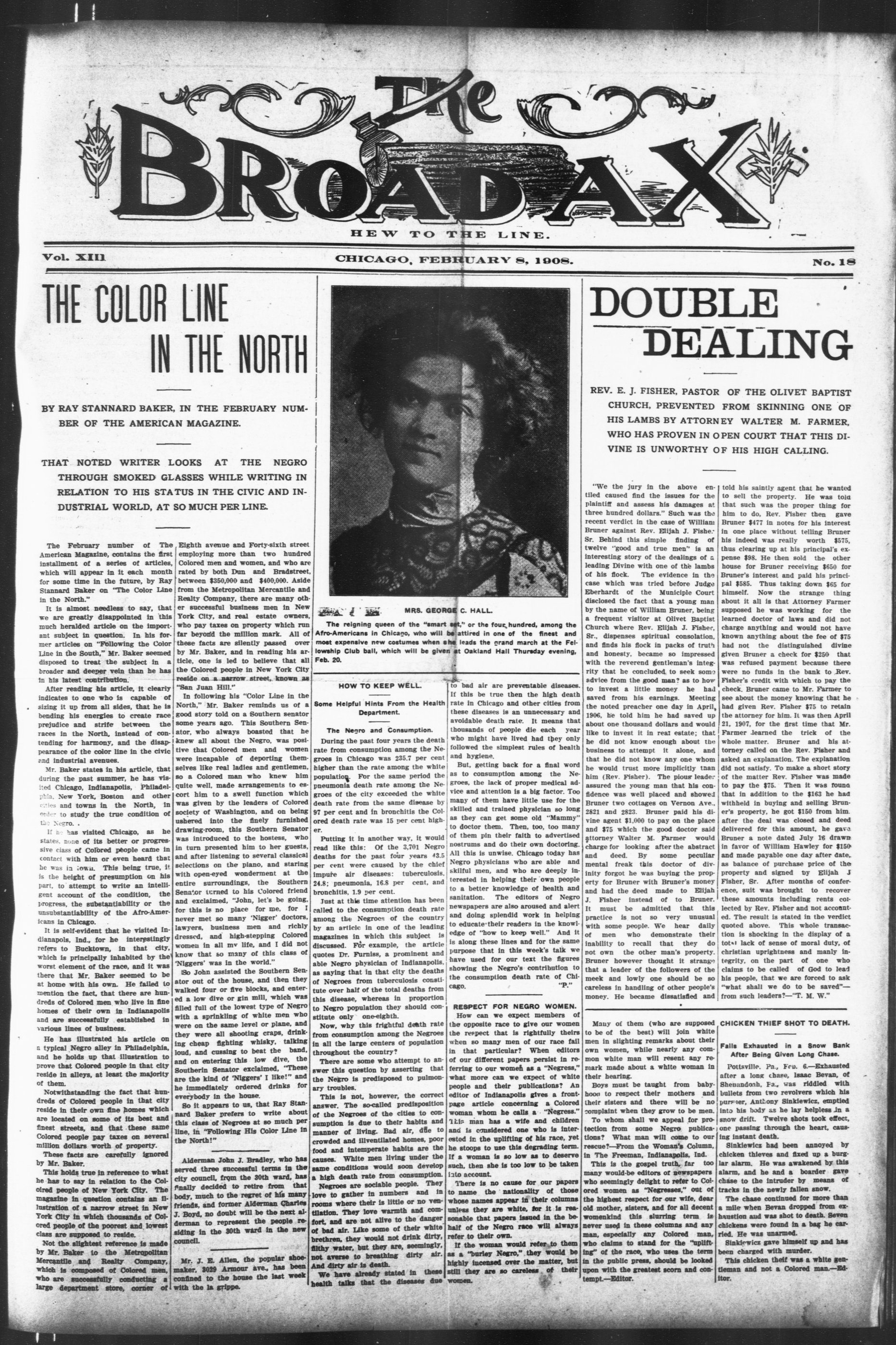
The reigning queen of the "smart set," or the four hundred, among the Afro-Americans in Chicago, who will be attired in one of the finest and most expensive new costumes when she leads the grand march at the Fellowship Club ball, which will be given at Oakland Hall Thursday evening, Feb. 20.
The Negro and Consumption
During the past four years the death rate from consumption among the Negroes in Chicago was 235.7 per cent higher than the rate among the white population. For the same period the pneumonia death rate among the Negroes of the city exceeded the white death rate from the same disease by 97 per cent and in bronchitis the Colored death rate was 15 per cent higher.
Putting it in another way, it would read like this: Of the 3,701 Negro deaths for the past four years 43.5 per cent were caused by the chief impure air diseases: tuberculosis, 24.8; pneumonia, 16.8 per cent, and bronchitis, 1.9 per cent.
Just at this time attention has been called to the consumption death rate among the Negroes of the country by an article in one of the leading magazines in which this subject is discussed. For example, the article quotes Dr. Furniss, a prominent and able Negro physician of Indianapolis, as saying that in that city the deaths of Negroes from tuberculosis constitute over half of the total deaths from this disease, whereas in proportion to Negro population they should constitute only one-eighth.
Now, why this frightful death rate from consumption among the Negroes in all the large centers of population throughout the country?
There are some who attempt to answer this question by asserting that the Negro is predisposed to pulmonary troubles.
This is not, however, the correct answer. The so-called predisposition of the Negroes of the cities to consumption is due to their habits and manner of living. Bad air, due to crowded and illventilated homes, poor food and intemperate habits are the causes. White men living under the same conditions would soon develop a high death rate from consumption.
Negroes are sociable people. They love to gather in numbers and in rooms where their is little or no ventilation. They love warmth and comfort, and are not alive to the danger of bad air. Like some of their white brethren, they would not drink dirty, filthy water, but they are, seemingly, not averse to breathing dirty air. And dirty air is death.
We have already stated in these health talks that the diseases due
to bad air are preventable diseases. If this be true then the high death rate in Chicago and other cities from these diseases is an unnecessary and avoidable death rate. It means that thousands of people die each year who might have lived had they only followed the simplest rules of health and hygiene.
But, getting back for a final word as to consumption among the Negroes, the lack of proper medical advice and attention is a big factor. Too many of them have little use for the skilled and trained physician so long as they can get some old "Mammy" to doctor them. Then, too, too many of them pin their faith to advertised nostrums and do their own doctoring. All this is unwise. Chicago today has Negro physicians who are able and skilful men, and who are deeply interested in helping their own people to a better knowledge of health and sanitation. The editors of Negro newspapers are also aroused and alert and doing splendid work in helping to educate their readers in the knowledge of "how to keep well." And it is along these lines and for the same purpose that in this week's talk we have used for our text the figures showing the Negro's contribution to the consumption death rate of Chicago. "P."
RESPECT FOR NEGRO WOMEN.
RESPECT FOR NEGRO WOMEN.
How can we expect members of the opposite race to give our women the respect that is rightfully theirs when so many men of our race fall in that particular? When editors of our different papers persist in referring to our women as a "Negress," what more can we expect of white people and their publications? An editor of Indianapolis gives a front-page article concerning a Colored woman whom he calls a "Negress." This man has a wife and children and is considered one who is interested in the uplifting of his race, yet he stoops to use this degrading term. If a woman is so low as to deserve such, then she is too low to be taken into account.
There is no cause for our papers to name the nationality of those whose names appear in their columns unless they are white, for it is reasonable that papers issued in the behalf of the Negro race will always refer to their own.
If the woman would refer to them as a "burley Negro," they would be highly incensed over the matter, but still they are so careless of their
DOUBLE DEALING
REV. E. J. FISHER, PASTOR OF THE OLIVET BAPTIST CHURCH, PREVENTED FROM SKINNING ONE OF HIS LAMBS BY ATTORNEY WALTER M. FARMER, WHO HAS PROVEN IN OPEN COURT THAT THIS DIVINE IS UNWORTHY OF HIS HIGH CALLING.
"We the jury in the above entitled caused find the issues for the plaintiff and assess his damages at three hundred dollars." Such was the recent verdict in the case of William Bruner against Rev. Elijah J. Fisher. Sr. Behind this simple finding of twelve "good and true men" is an interesting story of the dealings of a leading Divine with one of the lambs of his flock. The evidence in the case which was tried before Judge Eberhardt of the Municipal Court disclosed the fact that a young man by the name of William Bruner, being a frequent visitor at Olivet Baptist Church where Rev. Elijah J. Fisher, Sr., dispenses spiritual consolation, and finds his flock in packs of truth and honesty, became so impressed with the reverend gentleman's integrity that he concluded to seek some advice from the good man? as to how to invest a little money he had saved from his earnings. Meeting the noted preacher one day in April, 1906, he told him he had saved up about one thousand dollars and would like to invest it in real estate; that he did not know enough about the business to attempt it alone, and that he did not know any one whom he would trust more implicitly than him (Rev. Fisher). The pious leader assured the young man that his confidence was well placed and showed Bruner two cottages on Vernon Ave., 2821 and 2823. Bruner paid his divine agent $1,000 to pay on the place and $75 which the good doctor said attorney Walter M. Farmer would charge for looking after the abstract and deed. By some peculiar mental freak this doctor of divinity forgot he was buying the property for Bruner with Bruner's money and had the deed made to Elijah J. Fisher instead of to Bruner. It must be admitted that this practice is not so very unusual with some people. We hear daily of men who demonstrate their inability to recall that they do not own the other man's property. Bruner however thought it strange that a leader of the followers of the meek and lowly one should be so careless in handling of other people's money. He became dissatisfied and
Many of them (who are supposed to be of the best) will join white men in slighting remarks about their own women, while nearly any common white man will resent any remark made about a white woman in their hearing.
Boys must be taught from babyhood to respect their mothers and their sisters and there will be no complaint when they grow to be men.
To whom shall we appeal for protection from some Negro publications? What man will come to our rescue?—From the Woman's Column, in The Freeman, Indianapolis, Ind.
This is the gospel truth, far too many would-be editors or newspapers who seemingly delight to refer to Colored women as "Negresses," out of the highest respect for our wife, dear old mother, sisters, and for all decent womenkind this slurring term is never used in these columns and any man, especially any Colored man, who claims to stand for the "uplifting" of the race, who uses the term in the public press, should be looked upon with the greatest scorn and contempt—Editor.
ABLE
CALING
R OF THE OLIVET BAPTIST
FROM SKINNING ONE OF
NEY WALTER M. FARMER,
OPEN COURT THAT THIS DI-
OF HIS HIGH CALLING.
told his saintly agent that he wanted to sell the property. He was told that such was the proper thing for him to do, Rev. Fisher then gave Bruner $477 in notes for his interest in one place without telling Bruner his indeed was really worth $575, thus clearing up at his principal's expense $98. He then sold the other house for Bruner receiving $650 for Bruner's interest and paid his principal $585. Thus taking down $65 for himself. Now the strange thing about it all is that Attorney Farmer supposed he was working for the learned doctor of laws and did not charge anything and would not have known anything about the fee of $75 had not the distinguished divine given Bruner a check for $250 that was refused payment because there were no funds in the bank to Rev. Fisher's credit with which to pay the check. Bruner came to Mr. Farmer to see about the money knowing that he had given Rev. Fisher $75 to retain the attorney for him. It was then April 21, 1907, for the first time that Mr. Farmer learned the trick of the whole matter. Bruner and his attorney called on the Rev. Fisher and asked an explanation. The explanation did not satisfy. To make a short story of the matter Rev. Fisher was made to pay the $75. Then it was found that in addition to the $163 he had withheld in buying and selling Bruner's property, he got $150 from him after the deal was closed and deed delivered for this amount, he gave Bruner a note dated July 16 drawn in favor of William Hawley for $150 and made payable one day after date, as balance of purchase price of the property and signed by Elijah J Fisher, Sr. After months of conference, suit was brought to recover these amounts including rents collected by Rev. Fisher and not accounted. The result is stated in the verdict quoted above. This whole transaction is shocking in the display of a total lack of sense of moral duty, of christian uprightness and manly integrity, on the part of one who claims to be called of God to lead his people, that we are forced to ask "what shall we do to be saved"—from such leaders?—"T. M. W."
CHICKEN THIEF SHOT TO DEATH
Falls Exhausted in a Snow Bank After Being Given Long Chase.
Pottsville. Pa., Feb. 6.—Exhausted after a long chase, Isaac Bevan, of Shenandoah, Fa., was riddled with bullets from two revolvers which his pursuer, Anthony Sinklewicz, emptied into his body as he lay helpless in a snow drift. Twelve shots took effect, one passing through the heart, causing instant death.
Sinklewicz had been annoyed by chicken thieves and fixed up a burglar alarm. He was awakened by this alarm, and he and a boarder gave chase to the intruder by means of tracks in the newly fallen snow.
The chase continued for more than a mile when Bevan dropped from exhaustion and was shot to death. Seven chickens were found in a bag he carried. He was unarmed.
Sinklewicz gave himself up and has been charged with murder.
This chicken theft was a white gentleman and not a Colored man—Editor.
---
Will promulgate and at all times uphold the true principles of Democracy, but Castellano, Protestante, Prensa Infilda, Farmara, Single Taxes, Republicans, Knights of Labor, or any can, or any can, have their own language is proper and responsible to be used.
The Broad, *x* is a newspaper whose platform is true for all, ever claiming the editorial right to speak its own mind.
"Entered as Second-Class Matter,
Aug. 19, 1902 at the Post Office at
Chicago, Illinois, under Act of March
3, 1879.
OUR GIRLS.
The future hope of our race is in our girls. Blessed is the family that hath within its fold a good girl. She is a blessing, a comfort, a gift of inestimable value. She should be watched, nurtured and surrounded by the best that parents can provide and especially by the very best companionship.
Association means so much more to your girl than it does to your boy. The world will permit your boy to "sow his wild oats," it will permit him to indulge in sin, shame and even crime, and then will let him arise, wash it off, change his habits, and every door is open to receive him; every tongue is silent as to his past: "he used to be a bit wild," they may say, "but he is all right now."
But, with your girl, the world deals differently. If she falls she is doomed. She may sin, and God, Himself, may forgive her, but the world will never forget that fall. She will go through life marked and stricken. Every mother and father knows this, and yet mothers, especially, will permit their girls to be companions of girls of whom they know but little; they permit them to attend theaters, parties, concerts and churches day and night, with hardly a serious thought as to how and with whom they will go, or as to how and when, or with whom they will return.
When your girl is seen in a crowd of wild, romping, vulgar boys and girls by day, or hanging and dodging around the corner at dark with some boy, what does the world say? When your girl, for whom you have and are still sacrificing to educate and to dress is seen in company with another girl, notorious and ill-mannered, what does the world say?
You can't be too careful with your girl. She is the idol of your heart. Be kind to her; make a companion of her; know all about her associates and the places she visits. Love your girl; encourage her to come to you with all her affairs, especially her love affairs. Throw your arms around her, kiss and caress her; look into her eyes, down into her heart, and tell her all that she is to you, and all that you expect her to be. Be her best friend, so that she will come to you, instead of going to the neighbors for sympathy, advice and love.
Oh, mothers, fathers, push not your girls out of your hearts and out of your lives, but throw around them, every protection, every safeguard, that love can suggest. The girl, who fears her mother and is afraid of her father, who has no parents to whom she can go for love and guidance, is one of the most pitiable objects in this life.
Is your girl your companion? Do you know where and how she spends her time? Do you know her associates, male and female? Do you love your girl? If so, it is not enough to feed her and clothe her in costly raiment, it is not enough to educate her, but you must be her closest and best friend, and let her always feel that your arms and heart are open to receive her and sympathize with her in all her troubles.
Now, are you doing your whole duty to your girl?—The St. Luke Herald, Richmond, Va.
There are many mothers in Chicago, who should heed this sound advice and look more closely after their girls and not permit them to roam the streets at all hours of the night, and to frequent some of the most notorious resorts in town—Editor.
ATTACKS HIS MOTHER'S WILL
"Mushmouth" Johnson's Brother Suss Estate Owned by Colored Gambler at Death.
Elijah Johnson, brother of the late John V. ("Mushmouth") Johnson, Colored, fled a suit yesterday attacking the will left by his mother, who died a few weeks after her son's death. The bill states that his sister, Eldora Johnson and Mrs. Louse A. Ray, "exercised many undue art, acts and fraudulent practices" to get passes.
sion of the property, which consists of a dozen business and residence buildings.—The Chicago Tribune Feb. 4.
Col: Ed. Morris, attorney for the "Gamblers' Trust," will represent Mr. Johnson, and his late understudy, Ed. Wilson, will look after the interest of Miss Johnson and her sister Mrs. Ray, and they will fight like two he tom cats and make the fur fly when they get into court.
DIED IN CHICAGO.
"The Voice of the Negro."
Some years ago a magazine was published in Atlanta Ga., and launched upon the people of the country, and bid fair to stay. A few white men put up the money and a talkative Negro took the stump to tell the people that this was the "only" thing. In a short while the publishers moved to Chicago. Then began a lecture tour begging money from the different churches. He came to St. Louis, and a few of our leading pastors lionized the lecturer. The Palladium knew it was only a graft. The Voice made its appearance under another head, by dropping the word "Negro," then being known as the "Voice." In the meantime Brother T. Thomas Fortune sold The Age, which was published in New York, came to Chicago and bought the majority of stock. In due time this journalist, T. Thomas Fortune, obtained the mailing list, and left Chicago and went back to New York, there to start another magazine on the ruins of the "Voice of the Negro." Now comes a few other magazines upon the people. We hope these new magazines are not a skin game.-The Palladium, St. Louis, Mo.
In serving his connection with the "Dead Voice," its former editor, Mr. J. Max Barber, over his own signature, gave the following sketch of its down fall, which appeared in the columns of a local newspaper a few weeks ago:
"I take this occasion to thank my friends for the loyal way in which they stood by me during the four years that I was editor of The Voice. The main reason why I hesitated to leave The Voice, and tried in so many ways to save it, was to protect those friends who stood so nobly by me.
Loyal friends will nerve one to stand a great deal that he could not otherwise endure, and I flatter myself that I have made some of the best friends as editor of The Voice that any man can boast of in the word.
A word about The Voice. There are those who say and believe that our coming to Chicago seriously crippled us and ultimately wrecked The Voice. Nothing is farther from the truth. The Voice would have gotten into straitened circumstances quicker in Atlanta than it did in Chicago. The Voice was founded by white men. Into it two white men poured no less than $8,000 during the two and a half years that they were actively interested. That was the reason we could always come out promptly with such an attractive periodical. But these white men, Hertel and Jenkins, are not rich men. They did not know that the magazine was going to cost so much when they started it. The drain was too heavy upon them. Consequently, in the spring of 1907 they decided that they had given all they could to establish a Negro magazine, and that if the Colored people wanted the magazine to live they would have to help it live. Then we formed a stock company, each of these men holding stock proportionate to what he had put into the concern. We bought out Mr Jenkins with an advertising contract but Mr. Hertel held on to his stock. The withdrawal of financial support from these men soon placed us in difficult straits, and we were on the venge of suspending when we had to leave Atlanta. Coming to Chicago gave us wide advertisement and great sympathy was evinced for us. Our friends rallied to us and gave The Voice new life for a few months. But when the rally ceased we were again without enough support to keep The Voice up to its former standard. A dollar is not enough to pay for a magazine like The Voice unless it can command 100,000 subscribers. We never had more than 15,000.
In September certain of our friends rallied to our support. They rallied generously. We were able to get out an issue for October and to promise a continuance or the magazine because of the pledges for monthly donations. But the panic came on and our friends could not keep their pledges.
Then came Fortune on the scene—and we had hoped fortune also. You all know Mr. T. Thomas Fortune, formerly of the New York Age. Well, he came to Chicago in October, bought the stock of Mr. J. A. Hertel, which was a majority of all the stock sold, and by virtue of his holdings in the company became the director
force in the company. He stated that he had come to us free of entangling alliances and that with certain money which was coming to him, in conjunction with me, he meant to resume the publication or the magazine with all of its old ideals. From October until January we sat and waited upon Mr. Fortune's motions. There was nothing else for us to do. He held four times as much stock in the concern as I held. Then Mr. Fortune took a copy of our mailing list, shook the dust of Chicago from his feet, and hied himself away to New York. We are informed that he is starting a newspaper called The Freeman in New York. He is the majority stockholder in The Voice company and no doubt intends to take care of The Voice subscribers. I have severed my relations with the company and advise those who wisen to ask about The Voice to address their letters to Mr. T. Thomas Fortune, 4 Cedar street, New York City.
Again thanking my friends for their loyal support. I beg to remain.
Sincerely
J. MAX BARBER.
The editor of The Palladium, seems to be on the right track when he states that there was a whole lot of "graft in it for the raikative fellow who traveled around over the country and lectured in the churches in behalf of the Voice of the Negro."—Editor.
DEATH OF MRS. ALBERTA
FISHER
Last Monday morning at 4 o'clock Mrs. Alberta Fisher, wife of Robert Fisher, who was much beloved by a large circle of friends, closed her eyes in death, at the home of her mother, Mrs. S. C. Wooton, 5001 Dearborn street.
Mrs. Fisher was 23 years and 16 days old. Tuberculosis was the immediate cause of her untimely death. She had only been married four years
and she was idolized by her husband. For some time she and her husband have kept house at 54th and Dearborn streets but several weeks ago she was removed to the home of her mother, where she passed away. She was a devoted member of St. Thomas Church, where funeral services were conducted over her remains by Rev. Father J. B. Massiah, Wednesday morning. Undertaker F. A. Rawilins, 4834 State street, was in charge, and she was laid to rest in the family lot at Oakwood. The floral offerings were many and of every artistic designs.
MASS MEETING OF COLORED
CITIZENS
There will be a mass meeting in Fullerton Hall, Art Institute, Michigan avenue, at the foot of Adams St. Sunday, February 9th, at 2 p. m., to consider the organization of a "Committee of Negro Citizens of Chicago on the Prevention of Tuberculosis. Dr. Henry B. Favill will preside. Among those who will speak are Dr. Wm. A. Evans, Commissioner of Health of Chicago; Dr. George F. Shears, Dr. George C. Hall, Dr. A. W. Springs, Dr. A. Wilberforce Williams, Mr. Ferdinand L. Barnett and Mr. Oscar De Priest. You and your friends are cordially invited to be present. Alexander M. Wilson, Supt. Chicago Tuberculosis Institute, 51 La Salle St.
DUNNE BOARD WINS AGAIN
Supreme Court Refuses to. Rehear Case Involving Ousting of School Trustees
Springfield, ill., Feb. 6.—The Supreme court today denied the petition for a rehearing of the Chicago board of education case, in which at the last term the court held that Mayor Bussee had no power to remove members of that board.
This ruling of the supreme court is positive proof that Mayor Busse, at the time he assumed office surrounded himself with a lot of cheap lawyers, who imparted to him unsound legal advice at the time he thought he was firing the members of the board of education.
WEST SIDE NEWS.
By Prof. A. L. Simpson
The West Side Sunday club has to turn people away every Sunday. Dr. Chas. H. Pickett, Hon. Solomon Bruce and Col. Russell White, the hustling program committee, are probably the cause of it all. The West Side Co-operative Co. is now incorporated, and have $2,000 on hand ready to do business with. Now is your chance; shares $10 each. I Harris, president, 915 W. Lake St. The Colored government employees seem to have had bad luck in not finding much money in the letters they disturb. Mr. Robert Thomas, the big West Side politician, has just arrived in the city from Buffalo, and hasn't as yet made up his mind what he will do.
Mr. Thomas still has plenty of the world's good and dont seem to be bothered.
Mr. Wm. Puckett, who for a number of years has been in the employ of the Tuckhorn Cash Register Co., 117 E. Madison St., in the capacity of porter, now enjoys the honor of being one of the company's city salesmen. He is the only Colored man in the company's employ that fills such a high position.
Mrs. Irene Camp, wife of one of the leading West Side business men, is still travelling extensively in behalf of the many lodges she belongs to. She is a busy woman.
Prof. Hall is now teaching the young folks how to dance on the West Side.
Order your Broad Ax in advance and you will get them on time. A. L. Simpson, 73 S. Halsted street.
The West Side Churches are doing a great work. Come over and be saved.
Miss Sadie Skinner of 3024 Indiana avenue, who until a few months ago, was employed on the West Side by Prof. A. L. Simpson in the capacity of manacuring, is lying quite ill at her Indiana avenue home, and hopes to get her old position on the West Side when she recovers.
You should all stick with The Broad Ax. It has stuck by you for a number of years. Get it at 73 S. Halsted street. Phone Monroe 3920.
West Side people are not worried about where they will get their next meal. They are all doing well and then some.
Bad boys, behave yourselves, then you won't have to be on the inside looking out.
Wanted—Girls, boys, men and women to learn manacuring and chiropcdy. Simpson's quick system, Terms very easy. Call at 73 S. Halsted St., cor. Madison. Phone Monroe 3970.
BLACK DIAMOND DEVELOPMENT
STOCK FOR SALE.
For sale, 1,333 1-3 shares of the Black Diamond Development Company stock, which is successfully operating gas wells near Chanute, Kan. at 40 cents per share. The company is selling the same stock at 50 cents per share. For terms and further information address E. C. Duensing and Company, 1129 Armitage avenue. Phone Humboldt 3333.
CHIPS
Mr. Romey Bradford has moved to 2909 Vernon ave.
Mr. G. Martin, 5127 Dearborn street, is on the sick list.
Dr. Ida Nelson, 3652 Wabash ave., is the proud possessor of a touring car.
Attorney Robert M. Mitchell left for Texas Sunday evening on law business.
Mrs. Knight, 2816 Vernon avenue, entertained a number of friends at whist last Wednesday eve.
Mr. and Mrs. August Todd of Detroit, Mich., are in the city the guests of S. James, 3222 Wabash ave.
Mrs. Walter M. Farmer, 4856 Langley avenue, left the city Thursday evening for St. Louis, Mo., in order to be at the bedside of her sick mother.
The Broad Ax (Chicago) is among our latest exchanges, and is an able advocate for our cause.-The News, Waycross, Ga.
R. B. Caldwell, 4733 Dearborn St., is honest, clear through to his backbone, and is a loyal supporter of all race interprises, and he is a warm admirer of The Broad Ax.
Mr. A. C. Harris, who was formerly with Mr. Jesse Binga in the real estate business is now associated with the real estate firm of Cowan Bros. at number 260 So. Clark St. Phone Harrison 1075.
Mr. D. P. French was suddenly called the first of the week to Painesville, Ohio, where his wife was grief stricken, because of the death of her mother, Mrs. Geddy, who was buried last Sunday.
Mr. George W. Claussenius, one of Chicago's best and brightest business men, who always conducts himself like a highly polished gentleman, has been selected as foreman of the February Grand Jury.
The Forum, Springfield, Ill., says that All Hash Roberts "may be the next Colored Representative from Cook county. This will never be for Mr. Robert's record at the Harrison Street Police Station will put him out of the running.
J. W. Anderson, 79 El 32nd street, is no loyalty constituted that he does not need to be dunned or buldozed a dozen times in order to induce him to
pay his subscription to The Broad Ax, but whenever it is due he cheerfully forwards his check for the same.
At the last monthly meeting of The Chripodist Society of Illinois, held in McVicker's Theater building, Prof. Wm. Emanuel lectured on "Malformation of the Feet." It was said to be one of the most interesting and instructive meetings that was ever held during the four years of the organization.
The Democrats will hold their primaries March 4, and the Aldermanic conventions will be held in the various wards March 5. The Republicans will hold their Aldermanic caucuses Thursday, March 6. There will be some hot fights between the contending forces in many wards.
The city council Monday evening passed the "wheel tax" and the "wide tire" ordinances, and both measures will go into effect May 1. The money which will be gathered in from these channels will be expended for improving the streets, and we presume this will only apply to streets east of State street.
Mr. and Mrs. Sam'l J. Carter entertained Sunday afternoon at an eight-course dinner at their palatial residence, 168 E. 32nd St. The following persons, Mr. and Mrs. Jos. Brent, Mr. and Mrs. Doc. Smith, Mrs. Rosa Lively, Mr. Richard Moore, Jr., and others. The guests were seated at 3 o'clock and rose at 8:30 p. m. "too full for utterance."
Some mullet-headed fool, writing from Chicago to the Defender, Milwaukee, Wis., last week, says that James Edgar French, late editor of the Old Church Organ, has secured a job as janitor in the postoffice, and that The Broad Ax is for sale. The writer cannot speak for Mr. French, but he does know that only advertising space and single copies of The Broad Ax is for sale.
Charles Boesenstein, chairman of the Democratic State Committee of Illinois, spent a few days in the city last week, and before returning to his home at Edwardsville he declared that either "Fred Kern, Douglas Pattison or Col. James Hamilton Lewis, will be nominated to make the race for Governor of Illinois against Governor Charles S. Deneen.
The following gentlemen were elected Monday evening to serve the Triangle-Inner Circle Club as officers for the ensuing year: Captain, R. F. Radcliffe, president; R. W. Lacey, vice-president; J. H. Ward, treasurer; R. McAllister, steward, and James Parker, secretary. The report from the president and secretary of the Home for the Aged and Infirm Colored People showed that the Home has been benefited to the extent of nine hundred and eighty some dollars through the efforts of the members of the club. The officers and members of the club resolved to work harder than ever for the charitable institutions in the future.
FURNISHED ROOMS TO RENT.
Nicely furnished rooms, strictly modern for rent 3212 Wabash ave.
Mrs. A. T. Peterson, Phone 7051.
SIX ROOM HOUSE FOR SALE
For Sale.-Six room house at Maywood, Ill., $2750.00, new, modern, oak trim, bath, two blocks from Aurora & Elgin Depot, small payment down, balance monthly. A number of good Colored families have settled in this neighborhood. O. J. Westcott, 200 So Fifth Ave., Maywood, Ill., or 1107 Security Bldg., Chicago, Ill.
The Wonders of Medical Science.
"Doctor, can I eat between meals if I feel a craving for the food?"
"Certainly."
"But last summer you said that I should eat only at mealtime."
"Yes, but at that time you had no craving."—Cleveland Plain Dealer.
Real Sentiment
"What you need most," said the kind old lady, "is a change of shirt."
Thoughtful Man
Mr. Stubb (reading)—Marla, here is an account of a man who jumped off a high building with an open umbrella. Mrs. Stubb—Gracious! How thoughtful of him to take his umbrella along. —Chicago News.
The Late Staver.
The Lake Stayer.
Ethel—But, papa, I don't see why you should object to Percy Pink. He is such a retiring young man.
Papa—H'm! When does he retire—at
Papa- H'm! When does he retire-at
burriage?-Chicago News.
Debtor -Haven't time. It keeps me busy getting in -Detroit Tribune
SHORT STORIES.
Dates thrive on the Colorado desert
In Holland fifteen out of every thousand inhabitants are foreigners.
The newly formed Chinese cabinet has decided on the regular publication of a government newspaper.
The great Guadalupe artesian well at Guadalupe, Mexico, which used to squirt a hundred feet high, is tired and only goes half that now.
There is one American book which should be counted among the best sellers. Over 3,000,000 copies have been sold. It is "The Horse Book," issued by the government.
Judge Tuthill of Chicago decided that it is as much the duty of a father as a mother to walk the floor with a crying baby and warm the infant's milk bottle at night.
Rockingham Junction, N. H., until recently a thriving railroad center, has practically ceased to exist. The railroad station cafe has been closed and the telegraph wires taken out.
Few persons realize the amount of work required to give an automobile body its completed dress. To obtain new blue finish, for instance, it is stated that no less than thirty-two painting operations are required.
English Etchings.
Deaths from hunger and destitution in the United Kingdom average more than 500 every year. A letter addressed to "The Man Who Wears the Tallest Hat In Bristol" has been correctly delivered in that English city. A London physician asserts that cigarette smoking is increasing among women to such an extent as to be causing a change in their diet. They now want spiced and highly seasoned dishes where they used to take creams and icees. An interesting experiment is in progress at Sunderland, England. The thousands of unemployed continue to suffer more from the cold than from hunger. To mitigate this the elementary schools are opened every evening and provided with light, fires, reading matter and games.
Modes of the Moment.
Shoes are to be much observed this spring, for the street skirts are shorter, and shoes are more elaborate.
Bright colors are promised for spring and summer millinery to give tone to the darker shades, which are prophesied for gowns and suits.
The negligees of the season are very sheer, which means that one must wear very fine underwear, and this indicates that the petticoat must be of lace and the corset cover of equally beautiful material.
A touch of gift is upon the gowns of the season, and the prettiest costumes both for the house and the street are those enlivened by a little gold to waken them from their dullness and make them accord with the brilliancy of the modes.—Brooklyn Eagle.
Tales They Tell.
A live snake five feet eight inches long kept in the barber shop of Louis Schulz of Trenton, N. J., is petted by the barber's customers.
Irvin H. Whaley of Galestown, Md., ate two ounces of black pepper on a wager, but the services of a physician were needed immediately.
Adolph Goldblatt of McKeesport, Pa., has a boy unineteen months old who weighs sixty-five pounds and who is said to eat more than a pound of meat a day.
John Smith of Traverse City, Mich., set out a trap for mink recently. When he went to see what he had got he found a trout ten inches long securely caught by the lower jaw.
Plays and Players.
Amy Ricard is to be a member of the cast of "Pald In Full." Edgar Selwyn has written a play called "The Energetic West." William Morris is to head a western company to play in "The Witching Hour." Albert Parr has replaced Van Rensselaer Wheeler in the cast of "Tom Jones." Arrangements are being made to produce "The Secret Orchard" in England, Australia, Germany and South Africa.
Industrial Items.
Canada has begun to make tin plate. The demand for aluminium still exceeds the supply. Prussia's zinc mines produce half the zinc of the world. A plant will be established at Milwaukee, Wis., to make gas from old straw, corncobs, cornstalks, etc. Germany takes the credit for having the largest trades union in the world. It is composed of metal workers and has a membership of 385,000, a large proportion of whom are women.
Pith and Point.
It sounds doubly bad when a smiling man is profane.
If you get along, you must do well today; you can't always be waiting until tomorrow.
After a man has made a mistake and been found out how he does long for time to fly!
Whenever you give another fellow the best of it without its costing you anything, you have made a good investment—Atchison Globe.
Brevities
THE HALL OF FAME.
Jeremiah Meeker or South Orange, N. J., is ninety-three, but never misses a local baseball game.
B. J. Lang, the Boston organist, is seventy years old. He began playing in churches when he was only fifteen.
Peter O'Connor, aged eighty-seven years, of Fint, Mich., who is averse to cold weather, goes to bed late in the fall incased in blankets and remains there all winter.
Mark F. Hoffman is one of the most agile mail carriers in New Hampshire. With a 100 pound bag on his shoulders he made his trip to Manchester to New Boston and Bedford on foot, beating his schedule over the same route with a team.
The French Academy of Sciences has elected as corresponding member of the geographical section Sir George Darwin of Cambridge. Sir George, who is the second son of Charles Darwin, is professor of astronomy at Cambridge. Dr. George Alexander, pastor of the University Place Presbyterian church of New York, acting president of Union college, has declined the permanent presidency of the institution. He says he is too far on in life to hazard a step demanding the efforts of a younger and more active man. John B. Martin, proprietor of the safe Martin, in New York, who offered money to his employees who would marry and who agreed to give premiums for children, has been compelled to pay out in a year $5,150. There were twenty-six marriages, fortune babies and one pair of twins.
The venerable W. J. Rolfe is hard at work upon a volume of Shakespeare proverbs and also upon another work relative to Shakespeare about which he is silent at present. At eighty years of age Mr. Rolfe is a robust and vigorous personage. One of his comfortable morning walks is from Cambridge to Boston and back again.
William: James Bryan, the new senator from Florida, is just one year older than the law requires to make a man eligible to a seat in the United States senate. He is tall and of athletic build, with a frank smile and of the type which has made the drawings of Howard Chandler Christy famous. He is a fine lawyer, a splendid speaker and a hard worker.
The Sporting World.
The Buffalo Derby, run at the Kenilworth track, will be worth $5,000 this year instead of $3,500.
May Sutton, the tennis champion of the world, is now famous. A horse has been named after her in California.
George R. Iliff, the noted legless athlete, succeeded in lowering the world's walking record at Akron, O., not long ago. He covered the mile in 12 minutes 12 seconds.
At the Castleton stud in Kentucky, the property of James R. Keene, are now three stallions each of which has won more than $100,000 on the turf. They are Peter Pan, Kingston and Delhi.
Dr. Joseph H. Rellly has been selected as the track team leader of Georgetown university for the present season. Dr. Rellly was on the Georgetown team for several years and has carried the blue and gray colors to victory in many contests.
Flippant Flings
If the raw food fad prevails, there may soon be enough cooks to go round.—Baltimore Sun.
Positive, dodging street cars; competitive, dodging automobiles; supervise, dodging the water wagon.—St. Louis Globe-Democrat.
They called comic opera in 1905 words and music; in 1906, words and music; in 1907, chatter and tunes; in 1908, drivel and slush.—Washington Post.
Women have pledged themselves to wear no wings on their hats but those of crowds. We will soon discover that the crow is a bird of amazing plumage in size, shape and color.—Washington Times.
Church Work.
It took thirty five years to build up a church of six members in China, but since 1900 50,000 natives have been converted to Christianity.
The new Calvary Episcopal church of Pittsburgh, a handsome structure, was recently opened. The chancel furniture alone cost $15,000.
An original plan has been devised for rebuilding the Holy Trinity church in Kingston, Jamaica, destroyed by the storms a year ago. Five young men are to take out twenty year employment insurance policies aggregating $3,000 in favor of the church, the provisions to be paid by 200 members in weekly installments of 40 cents each.
New York City.
Jerry's telephone "central" an-
d 1,000 calls each hour.
New York city consumes 970 gallons
wine, spirit and malt liquors each
day in the day.
New York's city municipal courts
will cost $800,950 this year, which is
$800 more than they cost last year.
New York paid last year $21,000,000
in interest and will pay this year $24,
about the same as the federal
government—New York Herald.
WINDMILL SIGNALING
May Be Utilized by the Dutch For Military Purposes.
To the casual observer viewing a Dutch landscape there is nothing to arrest the attention in the fact that possibly one or more out of a dozen windmills in sight are to all appearances simply standing idle while the others continue their never ending task.
If one watches the sails of the idle mills closely, it may perhaps be noticed that they move slightly from time to time and then remain for awhile at a different angle. If this is so, the miller is in all probability engaged in holding a conversation with the proprietor of the other mill, which may be miles away—in fact, possibly barely visible on the horizon.
Quite recently the Dutch government carried on a series of experiments in order to ascertain the value of windmill signaling for military purposes and were surprised to find that communication could readily be established with far distant centers and that confidential messages could be sent on from one mill to another and so forwarded throughout the length and breadth of Holland in an incredibly short time by means of secret codes known only to the millers themselves.
These codes have been handed down from generation to generation and jealously guarded from outsiders with all the intense conservatism for which the provincial Dutch are proverbial. Apart, however, from these secret codes, understood only by the millers and local groups of mill owners, there exists a series of windmill signals with which every one of the inhabitants of the country districts is familiar.
At times, for instance, a mill may stop working suddenly and the miller be seen to come out and with the aid of a long pole with an iron hook at the end, like a gigantic boat hook, reach up and drag down the descending sail until the arms assume a certain position. Every one knows immediately that some accident has happened to the wooden machinery of the mill and that the services of the local carpenter are required.—Windsor Magazine
Old Horseshoes
Vice Consul Ernest Vollmer reports that one of the constantly growing imports into the Chinese province of Shangtung through the port of Tsingtao is old horseshoes, which leads him to give the following particulars: "One steamer alone in November brought 300 tons of this scrap iron from Hamburg. The market for these wormout shoes seems to be almost without limit. Chinese iron dealers buy the horseshoes and sell them to knife and tool manufacturers all over the province. It is claimed by the Chinese that the temper of this class of iron makes it the best obtainable for knives and cutlery and also good for other tools. The reason ascribed for this is that the constant beating the shoes have received under the feet of horses has given them a peculiar temper absolutely unobtainable in any other way and that tools made from them are superior to all others."
New Way to Collect Fares
There is a new wrinkle in New York on the ten cent automobile buses of Fifth avenue which is warranted to give any one a start the first time one meets it. It is an automatic coin receiver, looking more like a revolver than anything else, through which the conductor is required to receive all fares. When he comes along and instead of holding out his hand for the dime shoves the muzzle of the nickel plated weapon in your face the shock is considerable. The contrivance is of course designed to prevent the conductors from dipping into the cash. A rule is posted declaring that the conductor may not touch anybody's fare. If you need change, he is authorized to return the full amount, and then you must tuck the dime into the slot of the machine yourself.-New York Sun.
The Demonstratin' Car.
This story may not be true. The downtown motor car dealer on whom it is laid denies it, but a certain polignancy still remains.
The dealer got out of his car at Eighth and Main streets Friday morning to buy a toy motor car from a hawker who has a stand under the viaduct.
"I'll take that car," said the dealer, pointing at a toy which was spinning around on the table.
The hawker reached in his sack and drew out another.
"That one ain't for sale," he said, grinning. "It's my demonstratin' car."
It is related that after the hawker and the motor car dealer cordially shook hands, but no sale was made—New Orleans Picayune.
A Theatrical Experiment
An interesting experiment has been initiated at. Boumemouth. A grand hall has been built on to the Theater Royal, in which people can wait before the theater doors open for the performance and to which the audience are requested to retire between the acts to permit of the theater being thoroughly ventilated. Tea will be served in this hall, and the orchestra will play there during the intervals. London Globe.
Tea Maniacs
"Nipping," the curse of the "business man," has gone out or is going out in London. Tea is one of the substitutes for it. It produces a race of tea maniacs; but, after all, that is a milder form of disease than the alcohol habit of a generation ago.—London Eastern Press
THE BROKER'S VALENTINE.
I send you herewith, by a messenger small,
In case you should, think it worth while.
It's issued by me as a share in my heart,
And, though listed at par, my advice
Is to buy it dirt cheap, as you may at the start.
I know we won't split on the price.
You ask if I ever have offered before
The stock that I'm offering you here.
Ahem—well, the truth is I'm offering you more
Than I've offered for many a year.
In fact, you may have what is known on the market.
As "a controlling interest." How strange!
You insist on the price for the issue complete?
The First Nature Fakir.
On the Job.
A Baltimore man who was recently a passenger on a Cunarder tells of an incident of his trip that led him to the conclusion that your average seaman is not apt to waste much thought on his personal troubles.
This sailor had met with an accident the second day out, the result of which was a bad cut on the head. The Baltimorean was most solicitous in his inquiries as to the seaman's welfare when he next saw the captain and would undoubtedly have continued his sympathy had not a rough sea called to mind his own sufferings.
Several days later, when he emerged, white and weak, from his stateroom, he suddenly remembered the poor sailor. In the course of the day the Baltimore man saw the man with a strip of plaster on his forehead.
"How is your head?" he asked sympathetically.
"West by south, sir," was the reply.
"Harper's Weekly."
Ways and Means.
A couple of girls, after the manner of girls since the world was young, were recently discussing the affairs of their various friends.
"I don't see why in the world Clara lets that little snob Charlie Blank come to see her so often!" the dark haired one said. "They are together almost constantly."
"Hum!" the blond commented, with a worldly wise little smile.
"Well, I don't. I wouldn't," her friend asserted. "He is not good looking and has such ugly ways."
"Well, perhaps he has ugly ways, but such handsome means," the other said, and something very near a sigh got past the piece of fudge she hastened to put into her mouth—St. Louis Republic.
Warned.
"My friends," said the campaign orator, "beware of the unscrupulous heeler. [Applause.] "There are men so lost to shame that they will offer you a dollar for your vote. [Hisses.] Do not listen to them. Spurn them. Be on your dignity. Demand more." [Continued applause.]—Philadelphia Ledger.
They Tried It.
"I read in the papers of a professional debate where one team refused to meet the other team while they kept a feminine member on the ground that they could not argue with a woman.
"The objectors must be a married men's team."—Baltimore American.
Sporific.
Irate Wife—But what is the use of my talking when you just go to sleep? Do you hear? (Bang!) What is the use of my talking when you just go to sleep? Tired Husband — On the contrary, Jenny, it was only because I was listening to you that I dozed off.—Judge.
Real Skin Game
"There goes a man who has been working a skin game all his life."
"Ever been arrested?"
"Nope."
"That's strange. What kind of a skin game does he work—shell game?"
"No, he is a tattoo artist."—Pittsburg Post.
Good Colored Tenants Appreciated
I have stove heated flats to suit every man's income. I am no agent, I rent only my own property, you will save many a useless step when you want a flat if you first call on me. Samuel Richardson, 142 La Salle St., S-W. Cor., Madison, Room 1, Tel Main 2133, Otis Block.
To the Readers of The Broad Ax
I wish to announce to my many friends I have from 4 to 8 rooms, stove heafed flats to rent on the South and West Side, call if you are desirous and has not the rent, I will loan on your personal effects. See the Rev. T. A. Clark, 3742 State St. Please cut this out.
Dr.J. William McDowell
Physician & Surgeon
OFFICE: 3102 STATE STREET.
Hours, 8-10 a. m., 2-4 & 6-8.30 p. m.
Sundays by appointment.
Phones Residence, 4792 Douglas.
" Office, 4796 Douglas.
C. E. Kreyssler
Chemist and Druggist
5059 STATE STREET
N. E. Cor. 51st St. CHICAGO
Telephones:
Oakland 246 and Oakland 245
Dr. W. E. MACKEY
3111 STATE STREET
Phone Doug. 4101
HOURS: 9 to 11 A. M. 2 to 4 and 7 to
9 P. M.
RESIDENCE: 4842 ARMOUR AVENUE
Phone Blue 6871
HOURS: 7 to 9 A. M. and Nights
CHICAGO.
City Office, 500 Burton Bldg.
39 State Street
Hours 4-7 P. M. Phone Central 3207
W.D. Langford, M.D.
HOURS - 9-12 m. 1: 10 p. m. After
7: 30 p. m. Phone Galumet 264
Telephone Calumet 185
E. A. STACK
DRUGGIST AND CHEMIST
2043 South State Street
Cor. Twenty-Ninth CHI
GRAND
ROLLER
SKATING
EVERY AFTERNOON and EVENING
——At——
CHATEAU de la PLAISANCE
5324—26 State Street
BEST RESTAURANT IN THE CITY
IN CONNECTION
MUSIC BY ARMANT
ADMISSION 15 CENTS
Leland Giants B. B. & A. Asen.
6258 Halsted Street
THE BROAD AX.
!s for sale at the following news stands:
A. F. Tervalon, 134 W. 51st street
Cigar Store and News Stand.
Geo. I. Martin, maker of fine cigars,
and news stand, 342 East 31st St.
C. H. Green, cigars, tobacco and
news stand, 2718 State st.
Mrs. Nellie Phelps, Cigars, Notions
and News Stand, 131 W. 51st st.
T. B. Hall, Cigar Store and
Laundry office, 281 29th St.
Mrs. Alma A. Simpson, news agent,
1255 State street.
W. S. Cole, 354 Thirty-first street, cigars, tobacco and news stand. J. R. Peters Cigars, tobacco and News Stand, 338 B. 27th street. Mrs. A. B. Baker, Notions and News Stand, 419, 36th street. W. P. Johnson, Notion Store and News Stand 3704 State st. Turner Williams' Shaving Parior and News Stand, 2903 Armour ave. B. Davis, cigars, tobacco, and confectionery, 3882 State st. C. C. McLain, cigars, tobacco and news stand, 2906 State street. Mrs. J. W. Hailey 116 W. 51st st. cigars, tobacco and news stand. Mrs. Katherine R. Hamlet, Cigars, tobacco and fancy groceries and news stand 5028 Armour ave. M. A. Johnson, news stand, cigars and tobacco, 3812 State Street. The Informer News Co., 188 Randolph St. Detroit, Mck. The Standard News Co 131 W. 53rd st., New York, City, N. Y. Standard News Company, 49 W. 135th street, New York City, N. Y.
W.S. EDWARDS MFG. CO.
Makers of
Gas & Electric Light Fixtures
21 E. Lake St.
Benton Waite & Michigan Avenue
Telephone...Central 329...Automatic 6746
Fifty-First St. and Armour Ave.
EARL YARDS: 151st St. & L. S. & N. S. RY.
152nd St. and Armour Ave.
CHICAGO
W. R. Cowan M. C. Cowan
W. R. Cowan & Co.
Real Estate, Loans and
Insurance
260 S. CLARK STREET
Tel. Harrison 1075 CHICAGO
Tile and State Hauling a specialty.
COAL
J. H. COLEMAN & CO.
Express & Van Moving
TRUNKS EVERYWHERE.
2540 State Street
Phone 699 Calumet
CHICAGO
ICE CREAM CIGARS, TOBACCO
SHIRT WAISTS KIMONAS
NOTIONS
419—36TH STREET
Underwear a
Specialty
CHICAGO
Gaskins'
Bilhard and Pool Parlors
3004 STATE ST.
All Newly Furnished with Latest
Tables and Fixtures.
Will also carry a Fine Line of Cigare
and Tobacco
Chas Gaskine, Prop.
First-Class Service Guaranteed our
Patrones.
I will Freeze to Please
MARSHAL
Ice Cream, Sherbetts or Frappes, $1.00
per gallon and up.
Special prices to churches.
SODA FOUNTAIN PUT IN FREE
OF CHARGE.
The only Ice Cream Factory owned
and operated by Colored People
in Chicago
E. P. MARSHALL
2922 STATE STREET
Phone Douglas 2190
WESTERN PORTLAND
10
15
WESTERN PORTLAND
50
YEAR
WESTERN PORTLAND
PLEASE PAY THE FOLLOWING PAYMENTS AND IN THE DATE
OF THE FOLLOWING PAYMENTS. This is in
amount of fifty shillings, twenty and sixty pence.
If Custodie Mentioned, The Surcharge of Purchased
Offer will be paid to the Custodie Mentioned.
If Custodie Mentioned, The Surcharge of Purchased
Offer will be paid to the Custodie Mentioned.
Lady Anness Wanted. Named proprietor of
Bury and Community. Man Custodian of the
Address: 100 Westport Road, Bury, New York 10501.
M. MILLER
Expressing, Moving
COAL AND
Packing and Shipping a Specialty. T
all Depots, Boats and
3345 STATE STREET
Packing and Shipping a Specialty. Three Trips Daily to and from all Depots, Boats and Freight Houses.
3345 STATE STREET Telephone Douglas 2338
SOMETHING WORTH KNOWING
The Broad Ax can be bought through the STANDARD NEWS COMPANY, retail and wholesale agents. All goods shipped promptly to all parts of the country. Subscriptions, Advertisements, and news items taken at office rates.
For the convenience of travelers, they can have their mail addressed care of The STANDARD NEWS COMPANY BUREAU DEPARTMENT. All visitors when in the city should call and register on our visitors book for publication.
THE STANDARD NEWS COMPANY
131 West 53rd Street.
Cass. Gary, President.
A. J. Gary, General Superintendent.
PATRICK H. O'DONNELL
WILLIAM DILLON
CLARENCE A. TOOLEN
O'Donnell, Dillon & Toolen
ATTORNEYS AT LAW
Suite 1218-1219 Ashland Block
RANDOLPH & CLARK STREETS
CHICAGO
GRAY & MORAN
ATTORNEYS AT LAW
Suite 1114 Ashland Block, Clark and Randolph Sts. Tel. Central 569.
CHICAGO.
Residence 57 Macallister Place
Telephone Ashland 363
Office Telephones
Central 1239 Automatic 5940
MILES J. DEVINE
ATTORNEY AT LAW
Suite 319-320 Reaper Block
CLARK AND WASHINGTON STS.
CHICAGO.
A. D. GASH
Attorney at Law,
84-86 La Salle Street, Chicago
Suite 615 to 619,
Telephone Main 3077.
JOHN E. OWENS
ATTORNEY & COUNSELOR
AT LAW
823 ASHLAND BLOCK
TELEPHONE CENTRAL 828 CHICAGO
J. GARNER Tel. Douglas 335
THE ELITE BUFFET
FINE WINES, LIQJORS
AND CIGARS
3030 State Street CHICAGO
Phone Oakland 1528
F. A. Rawlins
The Modern Embalmer
UNDERTAKER AND
FUNERAL DIRECTOR
When his work is finished
you have no displeasure.
4834 State St., CHICAGO
Phone Douglas 1859
COOK
Waiters and Cooks
Prefer Our Makes
JACKETS AND LINEN
because they have found them
satisfactory.
Write for complete Catalogue
FREE.
giving full instructions how
'to order.
Marcus Ruben (Inc.)
390 State St., CHICAGO.
and Storage
WOOD
Three Trips Daily to and from
Freight Houses.
Telephone Douglas 2338
Tel. Central 4660
HER MESSAGE
It Would Take a Load Off John's Mind
When He Got It.
After a bitter family quarrel the husband had declared that he wouldn't speak to his better half again in five years. As usual, she went film a few better and retorted that it would be a good ten years before he would hear her gentle voice again. A few days later the wife called up her brother on the telephone, and the following conversation took place:
"Hello! Is this you, John?"
"Yes. What is it, Sis?"
"You know, John, that Dick and I have quarreled?"
"What! Again?"
"Yes, and it's all his fault."
"Oh, certainly! What's the trouble this time?"
"Why, he got angry just because he received a bill for a fifty dollar hat I ordered."
"I don't bl— That is, the wretch?"
"Isn't he? We are not going to speak to each other again for years and years."
"Bosh! Slap him on the back and call him old sport and make it up. You folks can't go along that way."
"We managed all right until the hired girl left last night, but now there is no one to deliver our messages to each other."
"Gee, it must be tough to have to call in one of the neighbors to ask your husband for car fare to go shopping."
"Oh, it's not as bad as that. He sees that I have plenty of money without asking for it. Now, John, I want you to give Dick a message from me."
"Sure! I'll come up tonight and spank both of you for acting so childish."
"No, the message can't wait that long. I want you to phone him immediately after I leave the instrument. I'll hurry upstairs so he will have to answer it."
"All right, Sis. Where is he now?"
"He's trying to cook himself an egg. You know the girl left."
"Poor dev-I mean the fool! Well, what shall I tell him?"
"Tell him, John, that there is a can of sardines in the pantry and that I will make the coffee just as soon as he gets out of the kitchen."—A. B. Lewis in Judge.
It Was a Stage Brand.
Gertrude, aged four, had been to the matinee. Later she tried to describe the play to a grownup friend.
"They drank wine," said Gertrude,
"and then they all went out."
"Well," said the friend expectantly,
"and what happened next?"
Gertrude worked her small brain hard.
"I guess," she said, "they spit it out"—New York Press.
A Cordial Cook:
"How do you like that new cook of yours?" asks the neighbor. "Is she nice?" "Nice?" enthusiastically echoes the other. "Nice? Why, she treats me as though she considered me her equal." With a sigh of envy the neighbor changes the subject--Lippincott's.
His Difficulty
"You wrong me," said Plodding Pete, "when you say I ain't willin' to work. I'm Jes' dyn' to work." "Then what's the trouble?" "Tm too conscientious. Whenever I git a job I'm so anxious to fill it well dat I gits stage fright."—Washington Star.
But Not For Paying Back
"I see Slickman has bought an automobile. I didn't think he had sufficient means to spend money that way."
"Oh, he has all kinds of means of borrowing and spending money."—Bobhemian Magazine
"Yes, Genevieve!"
"These hats with the feathers make us look like little birds, don't they, Harold!"—New York Press.
She in Calice.
"Your husband, the poet, must take great pleasure in seeing himself in print."
TWINE ECONOMY.
One Ball Served a Busy Postal Employee Seven Years
Though it handles some thousand million dollars a year, the United States government is not unappreciative of the value of small things, such, for example, as a piece of secondband twine. Perhaps the ordinary rapgieper wouldn't regard it as a good business principle to stoop for a discarded twelve inch string when he is hurrying through the city at dawn in keen competition with all classes of rapgiepers for what there is of commercial value in the ash barrels and scrap heaps. But that may be due wholly to his inability to foresee some of the future possibilities in the practice of noticing such trivial things. Similarly it may be that a certain government employee who attached himself to the New England division of the United States railway mail service six or seven years ago did not pin much faith in little dingy string pieces, for he was some grades above the trained rapgieper in the social scale. Yet he stooped to pick up such string pieces as came under his observation in the ordinary routine of his business, and it resulted in the bestowal upon him of a distinction which has not come to his companions of less economical tendencies. How much it counts toward his promotion in the service is problematical, but it has carried his name and fame with favorable comments to the attention of the United States postoffice authorities, says the Boston Transcript.
When this man reaches the next step up and his salary is increased accordingly, he will have some difficulty in dissociating his luck from the little string pieces he has picked up in his years of service, and his mind may be coached by a little justified pride in the following official paragraph clipped from the most prominent position in a recent general order of the New England division of the United States railway mail service, over the signature of his superintendent:
"A clerk in this division, appointed in 1901, with the exception of having been furnished with one ball of twine, has never made a requisition for an additional supply, having reused the twine which he saved from packages received by him."
A Fight For Moonlight.
Under the headline "A Fight For Moonlight" the Morgenpost of Berlin says: "Artists and all lovers of the beautiful are arrayed against the municipal authorities of Venice, by whom it has been proposed to illuminate the Grand canal with gas. The canal has never been brilliantly lighted except on festival occasions, but who caret? The moonlight has been sufficient. Modernism in all its forms has been at work along the waterways, and now the moon is to be eclipse, probably because it frowns upon the motor boat. The charm of the Venetian night, the indescribable light and shadow effects, the mystery, romance and imagination lurking in the dark corners of the palace walls, all these will vanish before the loud. shrill, poetry destroying light." The protest movement has taken the form of a monster petition to the city authorities, and the artists, authors and lovers of the beautiful who have signed it say that this is a "fight for Venetian moonlight."
Paris Not a Gay City.
It is a fixed idea in the mind of the average Anglo-Saxon that Paris is the gay city, the home of engaging frivolity, the spot where the grasshopper perennially chirps and dances in prosperity, defying the fabulist. The truth is far different. The visitor may figure the gay city to himself as a siren in plink, but the resident knows her as a shrewd old lady, stuffing an old stocking with fat coppers or fatter silver pieces. She is, indeed, enriching herself at the expense of her long suffering inhabitants, for "everything is becoming dearer" is the cry of the housekeepers in. Paris. Articles of consumption and other necessaries have increased alarmingly in price since the year 1902. In five years bread has risen 15 per cent, beef 22 per cent, veal 14 per cent, mutton 25 per cent, pork 27 per cent, butter 14 per cent, cheese 25 per cent, fish 50 per cent, etc.—Modern Society.
A Showman's Proposal.
"Have I had many proposals?" laughed Blanche Bates when she was lately asked the question by an inquisitive acquaintance. "I should think I had! Got lots of fun out of some of them too. The most comical one I ever had was from a man who owned a traveling show. I didn't care for him one atom, but he was extremely importunate. One day he made a frantic appeal to me, using, as he thought, an unanswerable argument. "You'd better have me," he urged. Now, think over it. Take a few days, but think over it. You know you won't have to go in the parade."—St. Louis Republic.
The Cute Jap.
It is the ambition of every up to date Jap to learn English at the first opportunity. At one or two of the Japanese hotels I was rather puzzled and a little flattered by the eager and almost anxious politeness with which Japanese youths offered to come for a walk with me. But I discovered that they only wanted a free lesson in English—Strand Magazine.
Telephone
DOUGLAS ... 1965
REALING
INSURANCE
REAL ESTATE LOANS
3637 STATE STREET
CHICAGO.
LEASES NEGOTIATED, EXCHANGES MADE, PROPERTY MANAGED.
FOR SALE.
$9,000—3444-3446 Wabash Ave., 2-9 room stone front residences; will sell separate. Make terms.
$5,000—4034 Dearborn St., 2-flat brick building, stone foundations, 6-6 rooms
$2,150—3718 La Salle St., 6 rooms, frame, brick foundation.
$2,250—3720 La Salle St. 2-flat frame and brick, 5-5 rooms.
$2,250—3722 La Salle St., frame building, 6 rooms, modern improvements.
$4,000—Forest Ave., near 32nd, 10 room residence, $500 cash. Terms to suit.
JESSE BINGA. 3637 STATE ST. Phone Douglas 1565.
Leland Giants Base-Ball and Amusement Assn.
Now Organizing-Capital Stock
$100,000
The Stock-Holders of the Leland Giants Base-Ball Association, has concluded to dissolve that Association in order to give room for the former, with its increased Capital for the purpose of buying a Permanent Home For The Leland Giants Base-Ball Club and Establishing For All The People, The Only First Class, Up-To-Date Amusement Park, With Its Theater (Light Opera), Figure Eight, Shoot The Chutes, Minature Ry, Electric Theater, Dance Pavilion, Roller Skating, Hurley Burley, Double Swing, Boating, Auto Riding, and all the latest fun making devices and laugh producing concessions, together with a First Class Summer Hotel, large enough to accommodate 1000 guests, at its present location, 79th and Wentworth Ave., twenty (20) minutes ride on the Electric Cars to the Loop District in Chicago.
The Public is Base-Ball mad, and amusement Crazy. Stocks have doubled in value in a single season. Millions can be made by those Who Take Stock In This New Enterprise.
Are You In Favor Of The Race Owning and Operating This Imense And Well Paying Plant. Where More Than 1,000 Persons Will Be Employed, between May and October of each year, where you can come without fear and enjoy The Life and Freedom of Citizen unimposed or annoyed? The Answer can only be effectively given by subscribing for Stock in this Company.
it has been made purposefully low so that all Loyal Members of the Race can have a Share and Interest, in this Twentieth Century Enterprise. Think of it, Shares Only Ten (10.00) Dollars Each. You Squander More than this amount Any Holiday around Amusement Parks and Public Places, where you are not wanted and never welcome. Come! buy and build one of your own by filling out the attached Coupon and mail with Ten Dollars to the Leland Giants Base-Ball and Amusement Association. Do it to-day so that we may commence to build.
which I am sending as Part (or infall) as subscript
shares of the Capital Stock of the Leland Giant
Association.
I agree to pay $.....per
$.....has been paid, at which
certificate.
which I am sending as Part (or infull) as subscription fee for
shares of the Capital Stock of the Leland Giants Base Ball and Amusement
Association.
I agree to pay $.....per month until the full amount
$.....has been paid, at which time I am to recieve my stock
certificate.
The leaning tower was first to go.
And when it hit the floor below
The havoc was appalling!
At once another crash occurred,
And then, alas, we knew we heard
The campanile falling!
I see its shattered remnants yet.
Twas half our wedding dinner set—
The other half was Pisa.
My chateaine her protest filed.
"Pray leave," she cried, "are I go wild,
For Pelion on Ossa plied
Would be your next, Louisa!"
-Earle Hooker Eaton in Harper's Weekly
Cogge
should
"How foolish of you to contend that the ancient Irish were more advanced than the ancient Egyptians," said his friend. "Why, the Egyptians must wedge of dried ex.
Mr Beauregard F. Moseley; Treas:-
All payments on Stock Accounts must be made to the order Treasurer, 6258 Halsted Street, Chicago, Illinois. All Stock-accounts must be in accordance as employees and should inform the Treasurer with their information to apply for employment. For further information address Land Iceland Bank Base-Ball St, Chicago, IL 6258 Halsted St, Chicago, IL.
LINES TO LOUISA
[The same being our forty-seventh male who has gone to smash elsewhere.]
A week ago we had a maid Whose memory will never fade. You should have seen Louisa! She piled the plates on which we dined So very high they called to mind The leaning tower of Pisa.
At other times they did not lean When carried by our kitchen queen (Whose other name was Dennib). But rose as straight as spire or tree. And then her model seemed to be The campanile, Venice.
Evidently.
She—This wine doesn't seem to go to your head as quickly as it does to mine.
He—No. That is probably because it has farther to go.
Modern Archaeology.
Moonland Archaeology
Pat was having an argument with a friend who was well posted in ancient history.
6258 Halsted Street, Chicago, Ill.
Enclosed please find $
subscription fee for
and Giants Base Ball and Amusement
per month until the full amount
d, at which time I am to recieve my stock
have even understood electricity, as wires corresponding to our own telegraph wires have been found in Egypt." "That may be," answered Pat, "but the fact that no wires have been found in Ireland prove beyond a doubt that the Irish were in the habit of using wireless telegraphy." —Philadelphia Ledger.
Prejudice.
"Robert, this spelling paper is very poor," complained the small boy's teacher. "Nearly every word is marked wrong."
"It wouldn't have been so bad," protested Robert, "but Annie corrected my paper, and she's mad at me, and for every little letter that I got wrong she crossed out the whole word."—Lippincott's.
Catching the Wayfarer
Cogger-The good parson told me I should always be trying to lift up my fellow man.
Motorwood-What did you answer?
Cogger-I told him I would put a scoop on my automobile at the earliest opportunity-Chicago News.
Accounts For It.
"The star actress in the play was a discovery by the manager. He found her working in a laundry."
"That accounts for it."
"Accounts for what?"
"The way she mangles her part."—Baltimore American.
As Times Change
"Politics is getting to be wonderfully interesting," said the observer.
"Yes," answered Senator Sorghum, "it is mighty interesting; but, between you and me, it isn't near so much of an investment as it used to be."—Washington Star.
The Nibblers.
The Storekeeper—Let's see. Half a wedge of cheese, peck of prunes, pint of dried peaches and a pound of crack- es.
HILLMAN'S
STATE & WASHINGTON STS.
WHERE EVERY PATRON
Saves
ON EVERY PURCHASE
Jacob Feinberg
Wholesale and Retail
MARKET AND GROCERY
TELEPHONE DOUGLAS 565
81st and State Streets
BRADLEY & FIELDS REAL ESTATE, LOANS AND INSURANCE
THE RAILROAD INN Imported and Domestic Wines Liquors & Cigars Cafe in Connection N. E. Corner Fifty-first and Armour Avenue, Chicago, Ill.
Sandy W. Trice & Co. 2918 State Street New Department Store
Why don't you get in the habit of doing your trading in the New Store? Every Tuesday and Friday special sales-day and two of Fish Trading Stamps with each 10c purchase.
We carry a swell line of Ladies' Shirtwaists, Underwear and Concepts. A spiendid assortment of Shoes, Hosiery, Gloves, Belts, fine Purses, Laces, Ribbons, Gowns, Bracelets, Millinery and everything you wear.
We make a speciality of Men's Balbriggan Underwear, Hosiery, swell Waistcoats, Pants, Shoes, Fedora and Derby Hats.
See our Novelties in Jewelry, Watch-chains, Fobs, Cuff-buttons, Studs and Safety Pins.
American Brick Co.
President and Treasurer, THOMAS CAREY.
Vice-President, JOHN SHELHAMER,
Secretary, WILLIAM SULLIVAN.
MANUFATURERS OF
Common and Sewer Brick
Office and Yards:
45th and Robey Sts.
Yards running winter and summer, equipped
with the latest improved Wolf Dryer.
Output of Winter Yards ..... no,0.0 per day
Output of Summer Yards..... no,0.0 per day
Telephone Yards 128.
J. J. Bradley
BRADLE
REAL
AND
4709 8. Halsted Street
Frank H. Lewis, Prop.
THE
Imported
Li
N. E. Corner F
POOL AND
BILLIARDS
WITH
THE
Phone Callnet 2940
Telephone Yards 693
J. M. Fields
FIELDS
MANS
E
CHICAGO
Lou Seldon, Mgr.
INN
C Wines
Chicago, Ill.
CIGARS AND
TOBACCOS
NAC