The Broad Ax
Saturday, March 28, 1908
Chicago, Illinois
Page text (machine-generated)
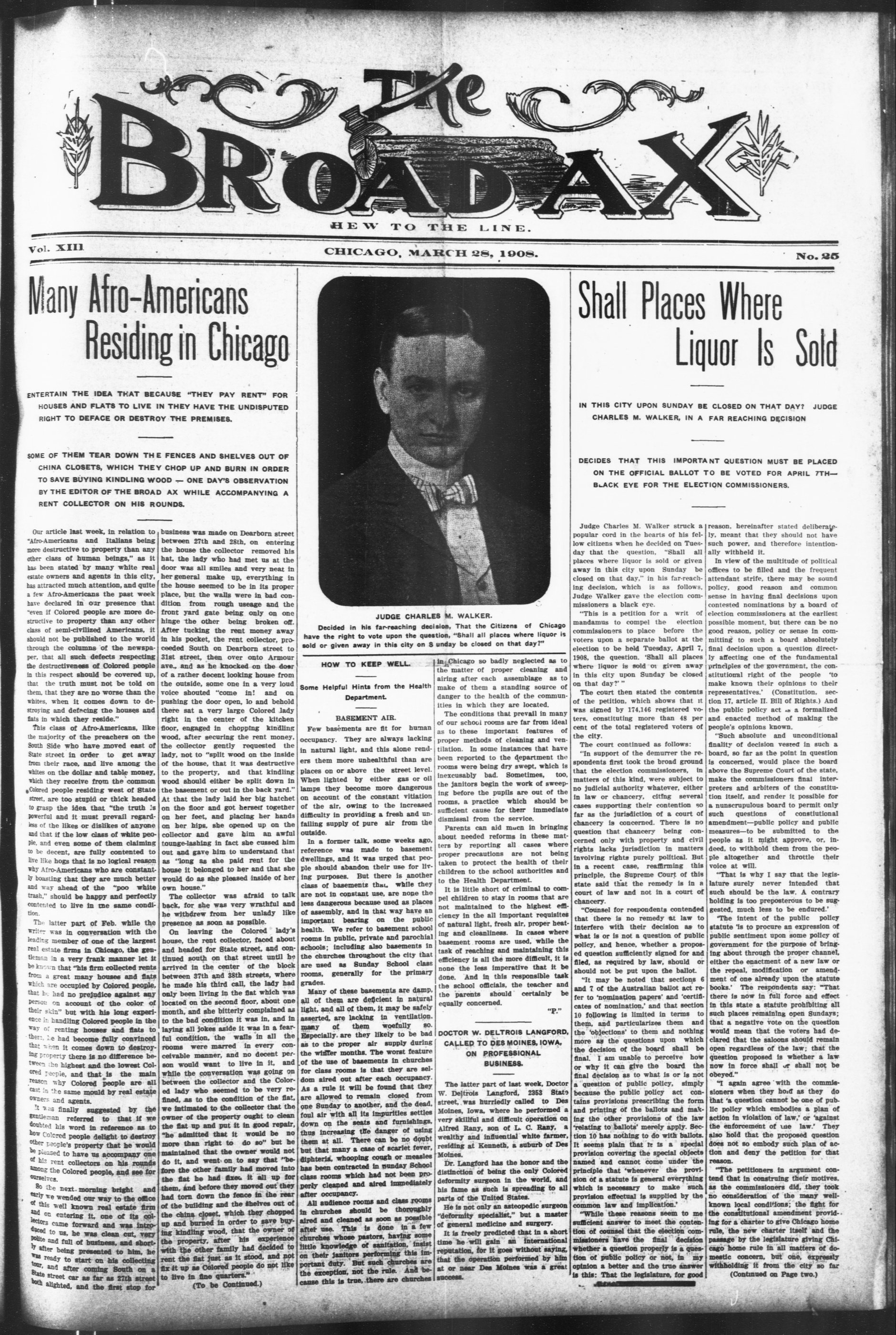
Many Afro-Americans Residing in Chicago
ENTERTAIN THE IDEA THAT BECAUSE "THEY PAY RENT" FOR HOUSES AND FLATS TO LIVE IN THEY HAVE THE UNDISPUTED RIGHT TO DEFACE OR DESTROY THE PREMISES.
SOME OF THEM TEAR DOWN THE FENCES AND SHELVES OUT OF CHINA CLOSETS, WHICH THEY CHOP UP AND BURN IN ORDER TO SAVE BUYING KINDLING WOOD — ONE DAY'S OBSERVATION BY THE EDITOR OF THE BROAD AX WHILE ACCOMPANYING A RENT COLLECTOR ON HIS ROUNDS.
Vol. XIII.
Many Afro-African Residin
ENTERTAIN THE IDEA THAT BECOME HOUSES AND FLATS TO LIVE RIGHT TO DEFACE OR DESTROY
SOME OF THEM TEAR DOWN THE CHINA CLOSETS, WHICH THEY TO SAVE BUYING KINDLING WILL BY THE EDITOR OF THE BROAD RENT COLLECTOR ON HIS R
Our article last week, in relation to "Afro-Americans and Italians being more destructive to property than any other class of human beings," as it has been stated by many white real estate owners and agents in this city, has attracted much attention, and quite a few Afro-Americans the past week have declared in our presence that "even if Colored people are more destructive to property than any other class of semi-civilized Americans, it should not be published to the world through the columns of the newspaper, that all such defects respecting the destructiveness of Colored people in this respect should be covered up, that the truth must not be told on them, that they are no worse than the whites, when it comes down to destroying and defacing the houses and faats in which they reside."
This class of Afro-Americans, like the majority of the preachers on the South Side who have moved east of State street in order to get away from their race, and live among the whites on the dollar and table money, which they receive from the common Colored people residing west of State street, are too stupid or thick headed to grasp the idea that "the truth is powerful and it must prevail regardless of the likes or dislikes of anyone and that if the low class of white people, and even some of them claiming to be decent, are fully contented to live like hogs that is no logical reason why Afro-Americans who are constantly boasting that they are much better and way ahead of the "poo white trash," should be happy and perfectly contented to live in the same condition.
The latter part of Feb. while the writer was in conversation with the leading member of one of the largest real estate firms in Chicago, the gentleman in a very frank manner let it be known that "his firm collected rents from a great many houses and flats which are occupied by Colored people, that he had no prejudice against any person on account of the color of their skin" but with his long experience in handling Colored people in the way of renting houses and flats to them, he had become fully convinced that when it comes down to destroying property there is no difference between the highest and the lowest Colored people, and that is the main reason why Colored people are all cast in the same mould by real estate owners and agents.
It was finally suggested by the gentleman referred to that if we doubted his word in reference as to how Colored people delight to destroy other people's property that he would be pleased to have us accompany one of his rent collectors on his rounds among the Colored people, and see for ourselves.
So the next.morning bright and early we wended our way to the office of this well known real estate firm and on entering it, one of its collectors came forward and was introduced to us, he was clean cut, very polite and full of business, and shortly after being presented to him, he was ready to start on his collecting tour, and after coming South on a State street car as far as 27th street both alighted, and the first stop for
business was made on Dearborn street between 27th and 28th, on entering the house the collector removed his hat, the lady who had met us at the door was all smiles and very neat in her general make up, everything in the house seemed to be in its proper place, but the walls were in bad condition from rough useage and the front yard gate being only on one hinge the other being broken off. After tucking the rent money away in his pocket, the rent collector, proceeded South on Dearborn street to 31st street, then onto Armour ave., and as he knocked on the door of a rather decent looking house from the outside, some one in a very loud voice shouted "come in! and on pushing the door open, lo and behold there sat a very large Colored lady right in the center of the kitchen floor, engaged in chopping kindling wood, after securing the rent money, the collector gently requested the lady, not to "split wood on the inside of the house, that it was destructive to the property, and that kindling wood should either be split down in the basement or out in the back yard." At that the lady laid her big hatchet on the floor and got herseir together on her feet, and placing her hands on her hips, she opened up on the collector and gave him an awful tounge-lashing in fact she cussed him out and gave him to understand that as "long as she paid rent for the house it belonged to her and that she would do as she pleased inside of her own house."
The collector was afraid to talk back, for she was very wrathful and he withdrew from her unlady like presence as soon as possible.
On leaving the Colored lady's house, the rent collector, faced about and headed for State street, and continued south on that street until he arrived in the center of the block between 37th and 38th streets, where he made his third call, the lady had only been living in the flat which was located on the second floor, about one month, and she bitterly complained as to the bad condition it was in, and in laying all jokes aside it was in a fearful condition, the walls in all the rooms were marred in every conceivable manner, and no decent person would want to live in it, and while the conversation was going on between the collector and the Colored lady who seemed to be very refined, as to the condition of the flat, we intimated to the collector that the owner of the property ought to clean the flat up and put it in good repair, "he admitted that it would be no more than right to do so" but he maintained that the owner would not do it, and went on to say that "before the other family had moved into the flat he had fixed it all up for them, and before they moved out they had torn down the fence in the rear of the building and the shelves out of the china closet, which they chopped up and burned in order to save buying kindling wood, that the owner of the property, after his experience with the other family had decided to rent the flat just as it stood, and not fix it up as Colored people do not like to live in fine quarters."
(To be Continued.)
HEW TO THE LINE.
CHICAGO, MARCH 28, 1908.
[Picture of a man in a suit with a bow tie].
JUDGE CHARLES M. WALKER.
Decided in his far-reaching decision, That the Citizens of Chicago have the right to vote upon the question, "Shall all places where liquor is sold or given away in this city on Sunday be closed on that day?"
Few basements are fit for human occupancy. They are always lacking in natural light, and this alone renders them more unhealthful than are places on or above the street level. When lighted by either gas or oil lamps they become more dangerous on account of the constant vitiation of the air, owing to the increased difficulty in providing a fresh and unfailing supply of pure air from the outside.
In a former talk, some weeks ago, reference was made to basement dwellings, and it was urged that people should abandon their use for living purposes. But there is another class of basement that, while they are not in constant use, are none the less dangerous because used as places of assembly, and in that way have an important bearing on the public health. We refer to basement school rooms in public, private and parochial schools; including also basements in the churches throughout the city that are used as Sunday School class rooms, generally for the primary grades.
Many of these basements are damp, all of them are deficient in natural light, and all of them, it may be safely asserted, are lacking in ventilation, many of them woefully so. Especially, are they likely to be bad as to the proper air supply during the winter months. The worst feature of the use of basements in churches for class rooms is that they are seldom dawned out after each occupancy. As a rule it will be found that they are allowed to remain closed from one Sunday to another, and the dead, foul air with all its impurities settles down on the seats and furnishings, thus increasing the danger of using them at all. There can be no doubt but that many a case of scarlet fever, diphtheria, whooping cough or measles has been contracted in sunday School class rooms which had not been properly cleaned and aired immediately after occupancy.
All audience rooms and class rooms in churches should be thoroughly aired and cleaned as soon as possible after use. This is done in a few churches whose pastors, having some little knowledge of sanitation, insist on their janitors performing this important duty. But such churches are the exception, not the rule. And because this is true, there are churches
BASEMENT AIR.
in Chicago so badly neglected as to the matter of proper cleaning and airing after each assemblage as to make of them a standing source of danger to the health of the communities in which they are located.
The conditions that prevail in many of our school rooms are far from ideal as to these important features of proper methods of cleaning and ventilation. In some instances that have been reported to the department the rooms were being dry swept, which is inexcusably bad. Sometimes, too, the janitors begin the work of sweeping before the pupils are out of the rooms, a practice which should be sufficient cause for their immediate dismissal from the service.
Parents can aid mcn in bringing about needed reforms in these matters by reporting all cases where proper precautions are not being taken to protect the health of their children to the school authorities and to the Health Department.
It is little short of criminal to compel children to stay in rooms that are not maintained to the highest efficiency in the all important requisites of natural light, fresh air, proper heating and cleanliness. In cases where basement rooms are used, while the task of reaching and maintaining this efficiency is all the more difficult, it is none the less imperative that it be done. And in this responsible task the school officials, the teacher and the parents should certainly be equally concerned.
DOCTOR W. DELTROIS LANGFORD
CALLED TO DES MOINES, IOWA,
ON PROFESSIONAL
The latter part of last week, Doctor W. Deltrois Langford, 2353 State street, was hurriedly called to Des Moines, Iowa, where he performed a very skillful and difficult operation on Alfred Rany, son of L. C. Rany, a wealthy and influential white farmer, residing at Kenneth, a suburb of Des Moines.
Dr. Langford has the honor and the distinction of being the only Colored deformity surgeon in the world, and his fame as such is spreading to all parts of the United States.
He is not only an osteopedic surgeon "deformity specialist," but a master of general medicine and surgery.
It is freely predicted that in a short time he will gain an international reputation, for it goes without saying, that the operation performed by him at or near Des Moines was a great success.
Shall Places Where Liquor Is Sold
IN THIS CITY UPON SUNDAY BE CLOSED ON THAT DAY? JUDGE CHARLES M. WALKER, IN A FAR REACHING DECISION
DECIDES THAT THIS IMPORTANT QUESTION MUST BE PLACED ON THE OFFICIAL BALLOT TO BE VOTED FOR APRIL 7TH—BLACK EYE FOR THE ELECTION COMMISSIONERS.
Judge Charles M. Walker struck a popular cord in the hearts of his fellow citizens when he decided on Tuesday that the question. "Shall all places where liquor is sold or given away in this city upon Sunday be closed on that day," in his far-reaching decision, which is as follows, Judge Walker gave the election commissioners a black eye.
"This is a petition for a writ of mandamus to compel the election commissioners to place before the voters upon a separate ballot at the election to be held Tuesday, April 7, 1908, the question. 'Shall all places where liquor is sold or given away in this city upon Sunday be closed on that day?'"
The court then stated the contents of the petition, which shows that it was signed by 174,146 registered voters, constituting more than 48 per cent of the total registered voters of the city.
The court continued as follows:
"The court continued as follows.
"In support of the demurrer the respondents first took the broad ground that the election commissioners, in matters of this kind, were subject to no judicial authority whatever, either in law or chancery, citing several cases supporting their contention so far as the jurisdiction of a court of chancery is concerned. There is no question that chancery being concerned only with property and civil rights lacks jurisdiction in matters involving rights purely political. But in a recent case, reaffirming this principle, the Supreme Court of this state said that the remedy is in a court of law and not in a court of chancery.
"Counsel for respondents contended that there is no remedy at law to interfere with their decision as to what is or is not a question of public policy, and hence, whether a proposed question sufficiently signed for and filed, as required by law, should or should not be put upon the ballot.
"It may be noted that sections 6 and 7 of the Australian ballot act refer to 'nomination papers' and 'certificates of nomination,' and that section 10 following is limited in terms to them, and particularizes them and the 'objections' to them and nothing more as the questions upon which the decision of the board shall be final. I am unable to perceive how or why it can give the board the final decision as to what is or is not a question of public policy, simply because the public policy act contains provisions prescribing the form and printing of the ballots and making the other provisions of the law 'relating to ballots' merely apply. Section 10 has nothing to do with ballots. It seems plain that it is a special provision covering the special objects named and cannot come under the principle that 'whenever the provision of a statute is general everything which is necessary to make such provision effectual is supplied by the common law and implication.'
"While these reasons seem to me sufficient answer to meet the contention of counsel that the election commissioners have the final decision whether a question properly is a question of public policy or not, in my opinion a better and the true answer is this: That the legislature, for good
Where liquor Is Sold
BE CLOSED ON THAT DAY? JUDGE FAR REACHING DECISION
ANT QUESTION MUST BE PLACED TO BE VOTED FOR APRIL 7TH—TION COMMISSIONERS.
reason, hereinafter stated deliberately, meant that they should not have such power, and therefore intentionally withheld it. In view of the multitude of political offices to be filled and the frequent attendant strife, there may be sound policy, good reason and common sense in having final decisions upon contested nominations by a board of election commissioners at the earliest possible moment, but there can be no good reason, policy or sense in committing to such a board absolutely final decision upon a question directly affecting one of the fundamental principles of the government, the constitutional right of the people 'to make known their opinions to their representatives.' (Constitution, section 17, article II. Bill of Rights.) And the public policy act is a formalized and enacted method of making the people's opinions known.
"Such absolute and unconditional finality of decision vested in such a board, so far as the point in question is concerned, would place the board above the Supreme Court of the state, make the commissioners final interpreters and arbiters of the constitution itself, and render it possible for a nunscrupulous board to permit only such questions of constitutional amendment—public policy and public measures—to be submitted to the people as it might approve, or, indeed, to withhold them from the people altogether and throttle their voice at will.
"That is why I say that the legislature surely never intended that such should be the law. A contrary holding is too preposterous to be suggested, much less to be endured."
"The intent of the public policy statute 'is to procure an expression of public sentiment upon some policy of government for the purpose of bringing about through the proper channel, either the enactment of a new law or the repeal, modification or amendment of one already upon the statute books.' The respondents say: "That there is now in full force and effect in this state a statute prohibiting all such places remaining open Sundays; that a negative vote on the question would mean that the voters had declared that the saloons should remain open regardless of the law; that the question proposed is whether a law now in force shall or shall not be obeyed."
"I again agree with the commissioners when they hold as they do that 'a question cannot be one of public policy which embodies a plan of action in violation of law,' or 'against the enforcement of one law.' They also hold that the proposed question does not so embody such plan of action and deny the petition for that reason.
"The petitioners in argument contend that in construing their motives, as the commissioners did, they took no consideration of the many well-known local conditions; the fight for the constitutional amendment providing for a charter to give Chicago home rule, the new charter itself and the passage by the legislature giving Chicago home rule in all matters of domestic concern, but one, expressly withholding it from the city so far (Contnued on Page two.)
PUBLISHED WEEKIY.
Will promulgate and at all times uphold the true principles of Democracy, but Catholicism, Protestantism, Pentecost, Infidelity, Farmers, Single, Homeless, and others can also have their say, so long as their language is proper and responsibility is fixed.
The Broads is a newspaper whose platform is broad enough to claim the editorial newark of its own mind.
Newark communications will receive attention.
Write only on one side of the paper.
Subscriptions must be paid in advance.
"Entered as Second-Class Matter, Aug. 19, 1902 at the Post Office at Chicago, Illinois, under Act of March 3, 1879.
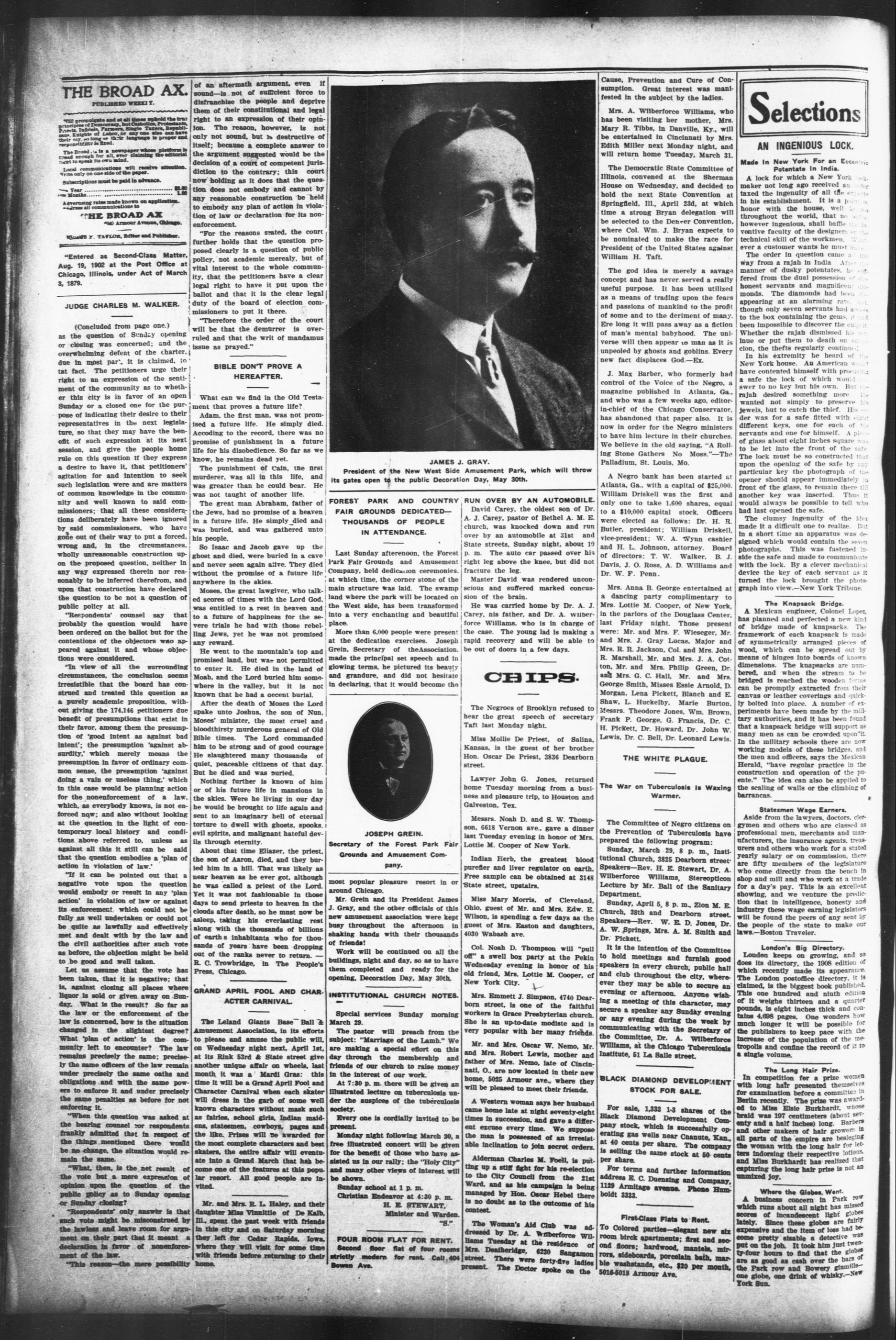
JUDGE CHARLES M. WALKER.
(Concluded from page one.) as the question of Sunday opening or closing was concerned; and the overwhelming defeat of the charter, due in most part, it is claimed, to tat fact. The petitioners urge their right to an expression of the sentiment of the community as to whether this city is in favor of an open Sunday or a closed one for the purpose of indicating their desire to their representatives in the next legislature, so that they may have the benefit of such expression at its next session, and give the people home rule on this question if they express a desire to have it, that petitioners' agitation for and intention to seek such legislation were and are matters of common knowledge in the community and well known to said commissioners; that all these considerations deliberately have been ignored by said commissioners, who have gone out of their way to put a forced, wrong and, in the circumstances, wholly unreasonable construction upon the proposed question, neither in any way expressed therein nor reasonably to be inferred therefrom, and upon that construction have declared the question to be not a question of public policy at all.
"Respondents" counsel say that probably the question would have been ordered on the ballot but for the contentions of the objectors who appeared against it and whose objections were considered.
"In view of all the surrounding circumstances, the conclusion seems irresistible that the board has construed and treated this question as a purely academic proposition, without giving the 174,146 petitioners due benefit of presumptions that exist in their favor, among them the presumption of 'good intent as against bad intent'; the presumption 'against absurdity', which merely means the presumption in favor of ordinary common sense, the presumption 'against doing a vain or useless thing', which in this case would be planning action for the nonenforcement of a law, which, as everybody knows, is not enforced now; and also without looking at the question in the light of contemporary local history and conditions above referred to, unless as against all this it still can be said that the question embodies a 'plan of action in violation of law.'
'If it can be pointed out that a negative vote upon the question would embody or result in any 'plan action' in violation of law or against its enforcement, which could not be fully as well undertaken or could not be quite as lawfully and effectively met and dealt with by the law and the civil authorities after such vote as before, the objection might be held to be good and well taken.
Let us assume that the vote has been taken, that it is negative; that it is against closing all places where liquor is sold or given away on Sunday. What is the result? So far as the law or the enforcement of the law is concerned, how is the situation changed in the slightest degree? What 'plan of action' is the community left to encounter? The law remains precisely the same; precisely the same officers of the law remain under precisely the same oaths and obligations and with the same powers to enforce it and under precisely the same penalties as before for not enforcing it.
"When this question was asked at the hearing counsel or respondents frankly admitted that in respect of the things mentioned there would be no change, the situation would remain the same.
"What, then, is the net result of the vote but a mere expression of opinion upon the question of the public policy as to Sunday opening or Sunday closing?
"Respondents' only answer is that such vote might be misconstrued by the lawless and leave room for argument on their part that it meant a declaration in favor of nonenforcement of the law.
"This means the more possibility
of an aftermath argument, even if sound-is not of sufficient force to disfranchise the people and deprive them of their constitutional and legal right to an expression of their opinion. The reason, however, is not only not sound, but to destructive of itself; because a complete answer to the argument suggested would be the decision of a court of competent jurisdiction to the contrary; this court now holding as it does that the question does not embody and cannot by any reasonable construction be held to embody any plan of action in violation of law or declaration for its non-enforcement.
"For the reasons stated, the court further holds that the question proposed clearly is a question of public policy, not academic merealy, but of vital interest to the whole community, that the petitioners have a clear legal right to have it put upon the ballot and that it is the clear legal duty of the board of election commissioners to put it there.
"Therefore the order of the court will be that the demurrer is overruled and that the writ of mandamus issue as prayed."
BIBLE DON'T PROVE A
HEREAFTER.
What can we find in the Old Testament that proves a future life?
Adam, the first man, was not promised a future life. He simply died. According to the record, there was no promise of punishment in a future life for his disobedience. So far as we know, he remains dead yet.
The punishment of Cain, the first murderer, was all in this life, and was greater than he could bear. He was not taught of another life.
The great man Abraham, father of the Jews, had no promise of a heaven in a future life. He simply died and was buried, and was gathered unto his people.
So Isaac and Jacob gave up the ghost and died, were buried in a cave and never seen again alive. They died without the promise of a future life anywhere in the skies.
Moses, the great lawgiver, who talked scores of times with the Lord God, was entitled to a rest in heaven and to a future of happiness for the severe trials he had with those rebelling Jews, yet he was not promised any reward.
He went to the mountain's top and promised land, but was not permitted to enter it. He died in the land of Moab, and the Lord buried him somewhere in the valley, but it is not known that he had a decent burial.
After the death of Moses the Lord spake unto Joshua, the son of Nun, Moses' minister, the most cruel and bloodthirsty murderous general of Old Bible times. The Lord commanded him to be strong and of good courage He slaughtered many thousands of quiet, peaceable citizens of that day. But he died and was buried.
Nothing further is known of him or of his future life in mansions in the skies. Were he living in our day he would be brought to life again and sent to an imaginary hell of eternal torture to dwell with ghosts, spooks, evil spirits, and malignant hateful devils through eternity.
About that time Eliazer, the priest, the son of Aaron, died, and they buried him in a hill. That was likely as near heaven as he ever got, although he was called a priest of the Lord. Yet it was not fashionable in those days to send priests to heaven in the clouds after death, so he must now be asleep, taking his everlasting rest along with the thousands of billions of earths inhabitants who for thousands of years have been dropping out of the ranks never to return. R. C. Trowbridge, in The People's Press, Chicago.
GRAND APRIL FOOL AND CHAR-
ACTER CARNIVAL
The Leland Giants Base Ball & Amusement Association, in its efforts to please and amuse the public will, on Wednesday night next, April 1st, at its Rink 53rd & State street give another unique affair on wheels, last month it was a Mardi Gras: this time it will be a Grand April Fool and Character Carnival when each skater will dress in the garb of some well known characters without mask such as fairies, school girls, Indian maidens, statesmen, cowboys, pages and the like. Prizes will be awarded for the most complete characters and best skaters, the entire affair will eventuate into a Grand March that has become one of the features at this popular resort. All good people are invited.
Mr. and Mrs. R. L. Haley, and their daughter Miss Vinnittie of De Kabl, Ill, spent the past week with friends in this city and on Saturday morning they left for Cedar Rapids, Iowa, where they will visit for some time with friends before returning to their home.
President of the New West Side Amusement Park, which will throw its gates open to the public Decoration Day, May 30th.
FOREST PARK AND COUNTRY FAIR GROUNDS DEDICATED—THOUSANDS OF PEOPLE IN ATTENDANCE.
Last Sunday afternoon, the Forest Park Fair Grounds and Amusement Company, held dedication ceremonies, at which time, the corner stone of the main structure was laid. The swamp land where the park will be located on the West side, has been transformed into a very enchanting and beautiful place.
RUN OVER BY AN AUTOMOBILE
David Carey, the oldest son of Dr. A. J. Carey, pastor of Bethel A. M. E. church, was knocked down and run over by an automobile at 31st and State streets, Sunday night, about 1 p. m. The auto car passed over his right leg above the knee, but did not fracture the leg.
Master David was rendered unconscious and suffered marked concussion of the brain.
He was carried home by Dr. A. J. Carey, nis father, and Dr. A. wilber force Williams, who is in charge of
More than 6,000 people were present at the dedication exercises. Joseph Grein, Secretary of the Association, made the principal set speech and in glowing terms, he pictured its beauty and grandure, and did not hesitate in declaring, that it would become the
JOSEPH GREIN.
Secretary of the Forest Park Fair Grounds and Amusement Company.
most popular pleasure resort in or around Chicago.
Mr. Grein and its President James J. Gray, and the other officials of this new amusement association were kept busy throughout the afternoon in shaking hands with their thousands of friends!
Work will be continued on all the buildings, night and day, so as to have them completed and ready for the opening, Decoration Day, May 30th.
INSTITUTIONAL CHURCH NOTES.
Special services Sunday morning March 29.
The pastor will preach from the subject: "Marriage of the Lamb." We are making a special effort on this day through the membership and friends of our church to raise money in the interest of our work.
At 7:30 p. m. there will be given an illustrated lecture on tuberculosis under the auspices of the tuberculosis society.
Every one is cordially invited to be present.
Monday night following March 30, a free illustrated concert will be given for the benefit of those who have assisted us in our rally; the "Holy City" and many other views of interest will be shown.
Sunday school at 1 p. m.
FOUR ROOM FLAT FOR RENT.
Second floor flat of four rooms
strictly modern for rent. Call 404
Bowen Ave.
RUN OVER BY AN AUTOMOBILE.
David Carey, the oldest son of Dr. A. J. Carey, pastor of Bethel A. M. E. church, was knocked down and run over by an automobile at 31st and State streets, Sunday night, about 19 p. m. The auto car passed over his right leg above the knee, but did not fracture the leg.
Master David was rendered unconscious and suffered marked concussion of the brain.
He was carried home by Dr. A. J. Carey, nis father, and Dr. A. wilberforce Williams, who is in charge of the case. The young lad is making a rapid recovery and will be able to be out of doors in a few days.
CHIPS.
The Negroes of Brooklyn refused to hear the great speech of secretary Taft last Monday night.
Miss Mollie De Priest, of Salina, Kansas, is the guest of her brother Hon. Oscar De Priest, 3836 Dearborn street.
Lawyer John G. Jones, returned home Tuesday morning from a business and pleasure trip, to Houston and Galveston, Tex.
Messrs. Noah D. and S. W. Thompson, 6618 Vernon ave., gave a dinner last Tuesday evening in honor of Mrs. Lottie M. Cooper of New York.
Indian Herb, the greatest blood purefier and liver regulator on earth. Free sample can be obtained at 3148 State street, upstairs.
Miss Mary Morris, of Cleveland, Ohio, guest of Mr. and Mrs. Edw. E. Wilson, is spending a few days as the guest of Mrs. Easton and daughters, 4030 Wabash ave.
Col. Noah D. Thompson will "pull off" a swell box party at the Pekin Wednesday evening in honor of his old friend, Mrs. Lottie M. Cooper, of New York City.
Mrs. Emmett J. Simpson, 4740 Dearborn street, is one of the faithful workers in Grace Presbyterian church. She is an up-to-date modiste and is very popular with her many friends.
Mr. and Mrs. Oscar W. Nemo, Mr. and Mrs. Robert Lewis, mother and father of Mrs. Nemo, late of Cincinnati, O., are now located in their new home, 5025 Armour ave., where they will be pleased to meet their friends.
A Western woman says her husband came home late at night seventy-eight times in succession, and gave a different excuse every time. We suppose the man is possessed of an irresistible inclination to join secret orders.
Alderman Charles M. Foel, is putting up a stiff fight for his re-election to the City Council from the 21st Ward, and as his campaign is being managed by Hon. Oscar Hebel there is no doubt as to the outcome of his contest.
The Woman's Aid Club was addressed by Dr. A. Writerforce Williams Tuesday at the residence of Mrs. Deutheridge, 6220 Sangamon street. There were forty-five ladies present. The Doctor spoke on the
Cause, Prevention and Cure of Consumption. Great interest was manifested in the subject by the ladies.
Mrs. A. Wilberforce Williams, who has been visiting her mother, Mrs. Mary R. Tibbs, in Danville, Ky., will be entertained in Cincinnati by Mrs. Edith Miller next Monday night, and will return home Tuesday, March 31.
The Democratic State Committee of Illinois, convened at the Sherman House on Wednesday, and decided to hold the next State Convention at Springfield, Ill., April 23d, at which time a strong Bryan delegation will be selected to the Denver Convention, where Col. Wm. J. Bryan expects to be nominated to make the race for President of the United States against William H. Taft.
The god idea is merely a savage concept and has never served a really useful purpose. It has been utilized as a means of trading upon the fears and passions of mankind to the profit of some and to the deriment of many. Ere long it will pass away as a fiction of man's mental babyhood. The universe will then appear to man as it is unpeeled by ghosts and goblins. Every new fact displaces God—Ex.
J. Max Barber, who formerly had control of the Voice of the Negro, a magazine published in Atlanta, Ga., and who was a few weeks ago, editor-in-chief of the Chicago Conservator, has abandoned that paper also. It is now in order for the Negro ministers to have him lecture in their churches. We believe in the old saying, "A Rolling Stone Gathers No Moss."—The Palladium, St. Louis, Mo.
A Negro bank has been started at Atlanta, Ga., with a capital of $25,000. William Driskell was the first and only one to take 1,600 shares, equal to a $10,000 capital stock. Officers were elected as follows: Dr. H. R. Butler, president; William Driskell, vice-president; W. A. Wynn cashier and H. L. Johnson, attorney. Board of directors: T. W. Walker, B. J. Davis, J. O. Ross, A. D. Williams and Dr. W. F. Penn.
Mrs. Anna B. George entertained at a dancing party complimentary to Mrs. Lottie M. Cooper, of New York, in the parlor of the Douglass Center, last Friday night. Those present were: Mr. and Mrs. F. Wieseger, Mr. and Mrs. J. Gray Lucas, Major and Mrs. R. R. Jackson, Col. and Mrs. John R. R. Marshall, Mr. and Mrs. J. A. Cotton, Mr. and Mrs. Philip Green, Dr. and Mrs. G. C. Hall, Mr. and Mrs. George Smith, Misses Essie Arnold, D. Morgan, Lena Pickett, Blanch and E. Shaw, L. Huckelby, Marie Burton, Messrs. Theodore Jones, Wm. Brown, Frank P. George, G. Francis, Dr. C. H. Pickett, Dr. Howard, Dr. John W. Lewis, Dr. C. Bell, Dr. Leonard Lewis
THE WHITE PLAGUE
The War on Tuberculosis Is Waxing Warmer.
The Committee of Negro citizens on the Prevention of Tuberculosis have prepared the following program:
Sunday, March 29, 8 p. m., Institutional Church, 3825 Dearborn street.
Speakers—Rev. H. E. Stewart, Dr. A. Wilberforce Williams, Stereopticon Lecture by Mr. Ball of the Sanitary Department.
Sunday, April 5, 8 p. m., Zion M. E. Church, 38th and Dearborn street.
Speakers—Rev. W. E. D. Jones, Dr. A. W. Springs, Mrs. A. M. Smith and Dr. Pickett.
It is the intention of the Committee to hold meetings and furnish good speakers in every church, public hall and club throughout the city, wherever they may be able to secure an evening or afternoon. Anyone wishing a meeting of this character, may secure a speaker any Sunday evening or any evening during the week by communicating with the Secretary of the Committee, Dr. A. Wilberforce Williams, at the Chicago Tuberculosis Institute, 51 La Salle street.
BLACK DIAMOND DEVELOPMENT
STOCK FOR SALE
For sale, 1,333 1-3 shares of the Black Diamond Development Company stock, which is successfully operating gas wells near Chanute, Kan., at 40 cents per share. The company is selling the same stock at 50 cents per share.
For terms and further information address E. C. Duensing and Company, 1129 Armitage avenue. Phone Humboldt 3333.
First-Class Flats to Rent
To Colored parties—elegant new six room birch apartments; first and second floors; hardwood, mantels, mirrors, sideboards, porcelain bath, marble washstands, etc., $20 per month, 5016-5018 Armour Ave.
Selections
AN INGENIOUS LOCK.
Made In New York For an Eccentric Potentate in India.
A lock for which a New York maker not long ago received an taxed the ingenuity of all the crafts in his establishment. It is a point honor with the house, well throughout the world, that no however ingenious, shall baffle the ventive faculty of the designer's technical skill of the workmen. ever a customer wants he must be
The order in question came at the way from a rajah in India. After manner of dusky potentates, he suffered from the dual possession of honest servants and magnificent diamonds. The diamonds had been appearing at an alarming rate, though only seven servants had access to the box containing the gems, which been impossible to discover the culprit. Whether the rajah dismissed his virtue or put them to death on sonston, the thefts regularly continued.
In his extremity he heard of the New York house. An American would have contented himself with procuring a safe the lock of which would swer to no key but his own. But the rajah desired something more. He wanted not simply to preserve his jewels, but to catch the thief. His order was for a safe fitted with eight different keys, one for each of his servants and one for himself. A piece of glass about eight inches square was to be let into the front of the safe. The lock must be so constructed that upon the opening of the safe by any particular key the photograph of the opener should appear immediately in front of the glass, to remain there till another key was inserted. Thus it would always be possible to tell who had last opened the safe.
The clumsy ingenuity of the idea made it a difficult one to realize. But in a short time an apparatus was designed which would contain the seven photographs. This was fastened inside the safe and made to communicate with the lock. By a clever mechanical device the key of each servant as it turned the lock brought the photograph into view.—New York Tribune.
The Knapsack Bridge.
A Mexican engineer, Colonel Lopez has planned and perfected a new kind of bridge made of knapsacks. The framework of each knapsack is made of symmetrically arranged pieces of wood, which can be spread out by means of hinges into boards of known dimensions. The knapsacks are numbered, and when the stream to be bridged is reached the wooden forms can be promptly extracted from their canvas or leather coverings and quickly bolted into place. A number of experiments have been made by the military authorities, and it has been found that a knapsack bridge will support as many men as can be crowded upon it. In the military schools there are now working models of these bridges, and the men and officers, says the Mexican Herald, "have regular practice in the construction and operation of the puente." The idea can also be applied to the scaling of walls or the climbing of barrancas.
Statesmen Wage Earners.
Aside from the lawyers, doctors, clergymen and others who are classed as professional men, merchants and manufacturers, the insurance agents, treasurers and others who work for a stated yearly salary or on commission, there are fifty members of the legislature who come directly from the bench in shop and mill and who work at a trade for a day's pay. This is an excellent showing, and we venture the prediction that in intelligence, honesty and industry these wage earning legislators will be found the peers of any sent by the people of the state to make our laws.-Boston Traveler.
London's Big Directory
London keeps on growing, and so does its directory, the 1908 edition of which recently made its appearance. The London postoffice directory, it is claimed, is the biggest book published. This one hundred and ninth edition of it weighs thirteen and a quarter pounds, is eight inches thick and contains 4,608 pages. One wonders how much longer it will be possible for the publishers to keep pace with the increase of the population of the metropolis and confine the record of it to a single volume.
The Long Hair Prize
In competition for a prize women with long hair presented themselves for examination before a committee in Berlin recently. The prize was awarded to Miss Elsie Burkhardt, whose braid was 197 centimeters (about seventy and a half inches) long. Barbers and other makers of hair growers in all parts of the empire are besieging the woman with the long hair for letters indorsing their respective lotions, and Miss Burkhardt has realized that capturing the long hair prize is not an unmixed joy.
Where the Globe Went
A business concern in Park row which runs about all night has missed scores of incandescent light globes lately. Since these globes are fairly expensive and the item of loss had become pretty sizable a detective was put on the job. It took him just twenty-four hours to find that the globes are as good as cash over the bars of the Park row and Bowyer ginmills—one globe, one drink of whisky.—New York Sun.
Brevities
ee
THE HALL OF FAME.
* genstor Henry Cabot Lodge is said
epee more Jegrees than any man tn
cater 7 of Georgia 1s ome of the
picnic the senate, and thle hair,
worn sta0INE straight up, makes him
Toa at vist two tnches taller then
Mrcserick Wheeler, © capitalist of
teases. Cal, 1S Delng talked of
Tes Tooisation for the presidency by
fe Prosiition national convention at
Colambes O., next July.
Dr ene: A. Craig, profesor of
genitie sozaages at Amm Arbor, in-
Seed « system of shorthand when a
Toucot 2: McGUll university. He has
sep it constantly for thirty years.
jim Martin of Reading, Pa, with
spot ‘snife made two miniature
fur, ve a steamer and the other a
SSrics: each nearly four feet long,
Sho. year was devoted to the task
fens rare moments.
mitho.ch he iS several years past the
qasrs retiring age, Admiral Dewey,
$e hishest officer in our navy, still re-
Sens in active service. The age limit
fe: or apply to him because he re-
Girei ibe formal thanks of congress
gq sccount of his victory in the Philip-
poes. He is still one of the most eff
dent of workers.
Professor Jobn Bassett Moore, who
yecame world famous for his know!-
tize of international law and has been
joiding the chair of professor of inter-
nitions! law at Columbia, university,
Sew York city, bas been compelled to
tesporsrily retire from his duties be-
cause of an affection of the eyes. Pre-
uur Moore is a native of Delaware.
Plays and Players.
Cyril Scott, now starring in “The
Prince Chap.” is an excellent cross
country rider.
Herman and Hans Schumann-Heink,
fhe sons of the great singer, are study-
tng for grand opera.
Jebn E. Henshaw and bis wife, May
Tea Broeck, have a new musical com-
ay with a rea! plot called “The Hum-
ues”
It ts now auneunced that in the
spring Josephine Cohan wilt return to
der brother's company as leading wo-
man, and it will be once mere “the
four Cohans.”
Grace Ellistom has been engaged to
sepport Dustin Farnum when he ap-
peers in “The Recter’s Garden” Miss
Elliston created the role of Shirley
Rossmore in “The Lion and the
Mouse.”
The Cookbook.
A little currant jelly beaten inte the
fake or padding frosting will add
geatly to its appearance and taste.
String beams which ean be bought
ttroughout the winter are often wilted,
‘22 when this happens the beans
thould be soaked in cold water for
vers} hours, when they will appear
te fresh and crisp.
A cup of chocolate is much improv-
‘by 2 dash of cinnamon or by add-
ga third of a pint of coffee te each
pitet milk. Very rich chocolate may
be made by pouring a quart over the
yels of two eggs, beating constantly
prevent curdling. Some prefer a
fev drops or vanilla either tm the
hipped cream or chocolate.
English Etchings.
‘Exrisnd bas 192 prisons.
Taree hundred English fishermen are
owned every year—nearly gjne in
1000 ct these engaged.
The city of London possesses a rate
‘aliector named White who tes held
fice for Just seventy years and is now
Tapidly epproaching his fivescore years.
J hisctnabes, Gomes sues, te
dled at Grantham, England,
age ci seventy-eight, was employed
by the sume firm for sixty-seven years.
Be no: only worked im the same shop,
but eccually at the same bench. Murr
teot che only holiday of his tife twen-
au pearsage. |
Tales They Tell.
40 0:4 woman ia Hannibal, Me. re-
qty used a rafirend ticket bought
‘twenty-five years ago.
4 prisoner at Marshall, Mich, ate
Gree Cectric light Bulbs and a day
Pie i: en effort to Kill Bimestf, bat
A be: owned by W. #. Gresham, a
farmer ving asst Eosie Als, iad @
Zo which were “¥. B.G., WB" The
‘ben ts oomed Vie. <
A sant inspector found in the
Sieten resident oeeciet be ee
0. « cow stabled fm the cellar of #
fous: ond a stz-weekold calf in the
‘Watlor upstairs.
Flippant Flings.
Ei-iy « day passes now that astute
Diticans fal $0 000 2 leew egal
xe” in something or other —indian-
ets News, =
Dr. Gc. ‘Waterman, who says
fee is oot 0 germ, Du a condition
Sv be right, But sometimes it ts
May » heritage —Louteville Courler-
Seartor Davis sayé that no man on
SE ever “nade $1,000000. honesty.
0% we don't know shout that! ‘Watt
SS tor « rich relative to ie x honest
Serb. ond it's hard work besides —
Meshington Post aoe
Bow of the Nery Finest Ones Are Left
tm the Orient.
_Astonishingly few superiative an-
tiques ere left in the country that
‘wove them. Except the one in the
‘Palace of the Forty Pillars in Ispahan
‘there seems to be none remaining of
the essentially Persian types of the
sixteenth century. ‘The crutaders
‘brought away the best of the eleventh
gentury. You may see them in early
Venetian, Flemish and Dutch paint-
‘ings of palace interiors. At this day
New York has more good rugs than
‘Constantinople or Ispahan. Last year
Robert Levy, a dealer, and R. & Par-
dow of the Musee Orientale, both of
Constantinople, came here for rugs.
A Teberan, of which the center ts
now being used as 2 model for draw-
ing in American public schools, is
valned at $35,000. A Stanford White
‘Hispano-Ispaban—made in Spain by
‘Mohammedan conquerors who founded
‘the caliphate of Cordova—auctioned
last year on Fifth avenue for $4,000.
Frederick Ames has gathered a lot.
It was he who gave to the Boston mu-
seum its bunting rug, the like of
which auctioned later for $35,000.
While studying oriental gypsies A. TT.
Sinclair collected an odd hundred rugs.
‘Sidney Colvin, Myron J. Bird and Mr.
Allis own excellent examples. J. Pier.
Pont Morgan has in his London house
$100,000 worth of rugs, which he no
@oubt will bring here when the tariff
permits.
‘The Yerkes collection is one of the
finest In the world. It is a Bagdad of
& sort limited in number, go far as is
‘known, to four. One is in the Lyons
museum, end two are in possession
of noble European families. Yerkes
also got the two Susanhards found
with the Ardebil of the South Ken-
sington museum. All three once could
have been had for $700. The South
Kensington museum paid $12,500 for
the Ardebil. I don't know what
Yerkes paid Vincent Robinson for the
other two. It's a curious fact that one
of the Yerkes rugs has the border of
the Ardebil, while the Ardebil fteelf
has a Farahan border.
The Benquait collection, which you
may see on Fifth avenue, is valued at
$1,000,000. Several rarities were dis-
ersed at the Marquand sale. H. O.
‘Havemeyer left some well known Chi-
Bese pieces. Senator Clark has eight
of different weaves which cost him
$200,000, and the other day Henry Clay
Frick paid $150,000 for six antiques.
‘Throughout the country are scattered
counties numbers, their value unsus-
ected by their possessors.—Frankiin
Glark in Everybody's Magazine.
Buurget and Germany.
Pau! Bourgets attack en Germany
and Germans has aroused mach criti-
cism not only in German newspapers,
but im the papers where he expected
to receive support. The Paris Revue
says that Bourget’s words arouse only
painful sensations. “When he speaks
f the venom of the miserable Kant
‘and of the musical misdeeds of Wag-
ner, he harms himself only and does
nothing to lessen the fame of these
men of genius. France smiles at the
assertion that she is under obligations
to Germany for nothing, for it is well
known and has been proudly prociaim-
ed by Bourget that his maternal an-
cestors came from Alsatis amd origi-
nally from Germany. If for nothing
else, France is indebted te Germany,
then, for Bourget.”
Pics’ Bathrooms.
“And this is the pigs’ bathroom?
said the twentieth century farmer.
“I have heard of hog wash, bat I
@idn't know pigs bathed. Do they?
“Yes, the modern pigs bathe,” he
said. “With squeals of rage and dis
gust he tumbles once 2 week into s
hot bath and is thoroughly scrubbed
with stiff brasbes dipped into strong
soft soap. This cleanliness keeps him
always well, and ft increeses his
weight 20 per cent.
“all our agricultural colleges now
edvise the pig to bathe. By expert
ments they continually show that
baths cause him to fatten « fifth bet
ter. The pigs’ bathroom is a feature
of the twentieth century farm.”—Cin-
qimnati Enguirer.
tes abt Tetiecion,
‘The tattooing craze was the rage
‘among the smart set in London at the
time of the South African war. It ts
now the rage in the slums among the
humbler classes, especially girts, whe
pay threepence for the operation. A
tattocer tells the London Sphere that
‘this business thrives on love. A girl
‘came into bis studio the other day and
ad “I love Jim Carly” tattooed on ber
arm. About 530 the next morning
the girl knocked at his door and, on
being remonstrated with, said: “I
4on't care if yer charges me 5 shillin’s.
"Ere, kiver this up,” she exclaimed,
baring the tattooed arm.
Flooding the Patent Office.
Tt is undoubtedly a fact that an
American will take out a patent on less
provocation than any other man or Wo
‘man in the world. As s consequence
‘the patent office is piling up « swollen
which makes it a bloated bond-
among the government depart-
‘ments. It bas achieved « surplus of
(98,000,000 and ts growing richer every
dy. Yankee ingenuity is gorging the
patent office with records and piling up
models by the bundred thousand.
Be At Find.
4n oi4 painting which hes been
‘hanging on the walls of the Puritan
@ub of Boston for twenty years past
fo “Bll up the blank space” hes been
G@iscovered to bo. genuine old master,
none igss than the portrait of the greet
| ee ee, by Aa
ido! Brentinn ‘The ciub hes refused
‘en offer of $25,000 for the painting.
IN LEAP YEAR.
He loves me! He loves me not!
The wind blows cold, the wind blows het
I watch his lps, his eyes and nose
And wonder if I dare propose.
I wonder if he'd answer “Tee
Or would he tal me'te toe eet
me to see mother
Or volunteer to be my brether?
Last night I took Jack unawares
ot ins otruseied ons ten seen
course teen
Because his nice mustache was mussed.
But in his roguish eye the while
I saw the portent of emile—
The pardon of the robber bold
Before the booty had grown cold.
He always gladly wears my Sowers
And lets me call and stay for hours,
pat ween. st last, I rise to we
oes ae eee er
But put it off from week to week
And watch his lips and eyes and nose
‘nd wonder if I dare propose.
—Paul C. Willard in Judge.
A Matter of Horsepower.
ie |
: 2
ha eS 4
ea Ls / 1 eH
>
4! a ef
4 hy Wao. ONS
me OO
4 Te \,
eee eS
Country Yokel (to motorist}—Coward!
Forty to one.—Pele Mele.
Reserved For a Purpose.
A certain Kentucky justice of the
Peace was called upon to marry a run-
away couple who drove up to his
house. When the final words were
said the bridegroom fumbled in his
Pockets and finally fished out a silver
dollar.
“Jedge,” said be; “this here's all the
cash I've got In the world. If you
‘wants it, you kin have it. But I don’t
mind tellin’ you that I set it aside for
the honeymoon expenses.”"—Woman's
Home Companion. .
== Say
“This thermometer,” complained the
ld lady, “ain't no good. I can never
tell by ft how cold the room is.”
“My dear madam,” said the rascally
Gealer, with a pitying air, “do you not
know the word ‘thermometer’ is deriv-
ed from two Greek words meaning “a
measure of heat? Naturally, there-
fore, it Isn't»meant to measure cold.”—
Catholic Standard and Times.
Hard to Weather It.
Inquiring Friend—So your last play
was a failure Well, it won't make
much difference to yeu, I presume.
You have something tal by for 2
rainy day, haven't you?
Gifted Tragedian—Yes, but I'm net
prepared to meet a continuous frost—
Chicago Tribune.
Wait.
Gramercy—If their rich uncle has ac-
quired a mania for fast motor cars and
flying machines, why don't they try to
have him placed under restraint?
Park—They think they'll get a quick-
er decision if they bide their time and
await developments—Harper’s Week-
v.
re
“You know the story of the hare and
‘the tortoise?”
“Yes,” answered the jockey, “but it
Goesn’t point any moral that I can see.
At any, respectable track that rabbit
‘would have been outlawed for pulling
‘the race.”—Washington Star.
Only Wanted « Chance.
She—I see where a fellow married a
girl on his deathbed just so she could
have his millions when he was gone.
Could you love a girl like that?
He—Sure, I could lore # girl lke
that! Where does she live}-Puck.
A Serious Mistake.
“Doesn't that man over there be-
long to the drawing room entertain-
or
“To the drawing room, but hardly
the entertainment. You see, e's #
Gentist.”—Pittsburg Post.
A Slip.
Jack (studying geography)—Father,
what is a strait?
Father - (reading the paper)—Five
cards of e—that is, a narrow strip of
water connecting two larger bodies. —
Harper's Weekly.
f
Jee Cream, Sherbet or Frappes, $1.00
per gallon and up.
‘Special prices to churches.
SODA FOUNTAIN PUT IN FREE
‘OF CHARGE.
The only ice Cream Factory owned
‘and opetated by Colored People
ta Chicago
E. ?. MARSHALL.
2022 STATE STREET
Phone Douglas 2190
This Should Interest You
An opportunity to show your race loyalty and at the same
time to make a profitable investment in The Parkwood Cemetery
Association, Capital Stock $15,000.00, Shares $10.00 each. Now
is the time to subscribe for stock; plenty of time will be given
in which to pay it. For particulars call at the office, 3160 State
St. Tel.-Doug. 3522. See circulars or consult the commission-
ers. Names of Commissioners:
J. L. PARKS, FRANK W. KING,
MATTHEW M. HULETT, A. N. SIMPSON,
ENOCH COOPER, E. S. MILLER.
R. M. LEACH, 2
E. S. MILLER, Secretary.
=
SOMETHING WORTH KNOWING
‘The Broad Ax can be bought through the STANDARD NEWS COM-
PANY, retail and wholesale agents. All goods shipped prompetly to
all parts of the country. Subseriptions, Advertisements, and news
ftems taken st office rates,
For the convenience of travelers, they can hsve their mail addressed
care of The STANDARD NEWS COMPANY BUREAU DEPARTMENT.
All visitors when in the elty should call and register on our visitors
‘book for publication.
‘THE STANDARD NEWS COMPANY
181 West Sird Street. : New York City.
(Chas. Gary, President. _. A J. Gary, General Superintendent.
PATRICK H. O'DONNELL
WILLIAM DILLON
CLARENCE A. TOOLEN
Tél, Central 4680
.
O'Donnell, Dillon &
' Toolen
ATTORNEYS AT LAW
Sulte 1218-1219 Ashland Block
RANDOLPH & CLARK STREETS
CHICAGO
GRAY g MORAN
ATTORNEYS AT LAw
‘Sulte 1114 Ashland Block, Clark ang
Randolph Sts. Tel, Central 660.
CHICAGC.
Residence 57 Macallister Pince
‘Telephone Ashland 363
cate a es we
MILES J. DEVINE
ATTORNEY AT LAW
‘Suite 318-330 Reaper Bleck
CLARK AND WASHINGTON 8T&
CHICAGO.
A. D. GASH
Attorney at Taw,
84-86 La Salle Street, Chicece
peti
‘Telephone Main 3077.
JOHN E. OWENS
ATTORNEY & COUNSELOR
aT Law
(323 ASHLAND (BLOCK
smarwons ccwrnas oo cmcans
Phone Main 4153 | NOTARY PUBLIC
Phone residence, Gray 5670
Walter M. Farmer
ATTORNEY AT Law
‘Suite 708, 171 Washington St.
Res, 4856 Langley Av. CHICAGO
Phone Oskland 1828
F. A. Rawlins
‘The Modern Embalmer
UNDERTAKER AND
FUNERAL DIRECTOR
When his work is finished
you have no displeasure, .
4834 State St.. CHICAGO
|Pheme Dougias 1550
Phone Calumet 1579
Morgue and Private Chapel.
C. JOHNSON
UNDERTAKER AND LIVERY
R. W. GREEN, MGR.
2712 State Street Chicago
y ne
meee
eee
Steers
5
Dr.J. William McDowell
Physician & Surgeon
OFFICE: 3102 STATE STREET.
Hours, 10 a m., 24 & 68.30 p.m.
Sundays by appointment.
Phones Residence, 4792 Douglas.
“ Office, 4796 Douglas.
aise etesea ek LL
Dr. W. & MACKEY
_ 3141 STATE STREET
Phone Douz. 4101
HOURS: 9 to 11 A. M. 2 to 4 and ? to
PM
amsIDEXce, San ARMOUR AVESUE
Phone Blue 6571
| HOURS: 7 to 9 A M. and Nights
| CHICAGO.
City Office, 500 Burton Bidg.
39 State Street
Hours 47 P.M. Phone Central 3207
W.D. Langford, M0.
PHYSICIAN AND SURGEON
Home Office, 2353 State Street
FOURS—912.m. 1:30 p.m. After
7:30 p.m. Phone Calumet 264
————_____
Telephone, Calumet 194
Or A.B. Schultz
Hours: 2719 STATE STREET
9to 12 A M,3 tos CHICAGO
and after 6 p. m.
C. E. Kreyssler
Chemist and Druggist
5059 STATE STREET
N. E. Cor. Sist st. CHICAGO
Telephones:
Oakland 246 and Oakland 245
———
Good Colored Tenants Appreciated
I have stove heated flats to suit every
Sev se rere ee
2 fat if you frst ell on me Samael
Richardson, 142 La Salle St, S-W.
Cor., Madison, Room 1, Tel Main
2133. Otis Block. :
To the Readers of The Broad Ay
I wish to announce to my many
friends I Rawe from 4 to 8 rooms, stove
heated flats to meat on the South and
West Side, call if you are desirious
and has not the rent, I will loan on
Cle ses Sine St Phance cat
this out.
GRAND
ROLLER
SKATING
EVERY AFTERNOON and EVENING
—At— '
CHATEAU de la PLAISANCE
§324—26 State Street
BEST RESTAURANT IN THE CITY
IN CONNECTION
MUSIC BY ARMANT
ADMISSION 15 =
Leland Giants B. B. & +. Assn,
6258 Halsted Street
(aad. oun
wire PCOALS
mz |[Woop
morn fsaetne™
W. R. Cowan & Co.
Real Estate Laans and
Insurance
‘Tile and vcutan ‘wpecialty.
J, H. COLEMAN & C0.
Express & Van Moving
MRS. A. E. BAKER
eae
rdenar phot ae
3. GARNER i “Teb Derglas 325
THE ELITE BUFFET
Phone Douglas 3393
CHAS. GASKIN, Prop.
2940 State Street
CHOICE WINBS, LIQUORS AND
CIGARS
Cafe In Connection Chicago
= >
‘| “4
‘ir — 4 \
| Waiters and Cooks
Prefer Dur Make
JACKETS AND LINEN
because they have found them
satisfactory.
Writ Cataloy
wn be Saar oot
giving ful) instructions how
J ‘ooler,
Marcus Ruben (Inc.)
goo State St, CHICAGO.
TME BROAD AX.
ts for sale at the following news
stands:
‘A. F. Tervalon, 134 W. Gist street
Cigar Store and News Stand.
Geo, L Martin, maker of fine cigars,
and news stand, $42 Bast dist St
C HL. Green, cigars, tobacco and
news stand, 2718 State st.
‘Mra, Nellie Phelps, Cigars, Notions
and News Stand, 131 W. Gist street.
T. B Balls Cigar Store and
‘Laandty office, 351 t9th Bt
‘Mrs. Alma A. Simpson, news agent,
1255 State street.
‘W. 8, Cole, 354 Thirty-first street,
cigars, tobscco and news stand.
J. R Peters Cigars, ‘robacco and
News Stand, 338 E. 27th street.
Mrs. A. B. Baker, Notions and News
Stand, 419, 36th street.
W. P. Johnson, Notion Store and
News Stand 3704 Gtate st.
‘Turner Williams’ Shaving Parlor
end News Stand, $903 armour sve.
B Davis, cigars, tobaccc, and con
fectionery, $5323 State st.
C C McLain, cigars, tobacco and
news stand, 2906 State street.
Mrs, J. W. Hadley 116 W. Sist =.
cigars, tobacco and news stand.
‘Mrs. Katherine R. Hamlet, Cigars,
tobaceo, and fancy groceries and news
stard 6028 Armour sve.
‘M. A. Johnson, news stand, cigars
and tobacco, 3812 State Street.
‘The Informer Wows Co, 188 Ran
Goigh St, Detrolt, Mick.
‘The Standard News Co 131 W. Stra
at, New York, City, ®. ¥.
Standard News Company, 49 W.
138th street, New York City, M. ¥.
)
Hamor
WERE DEATH ON CORN.
The Doc Gives a Little Lesson In
Natural History.
“There used to be an eccentric old
character in our neighborhood,” said
‘2 planter from one of the upper par
ishes, “who went by the name of Dox
‘Johnson. He hat! sever tein sie
miles from the settlement in his lite
and was barely able to read and write
but he was naturally a sort of Jack of
ail trades, and somehow or other he
acquired a tremendous reputation for
sagacity.
“Whenever an argument arose among
the country folks Doc Johnson was
pretty certain to be called in to decide
it, and as be would rather have died
then to have admitted ignorance on
= eee
‘were amazing in the extreme.
“One day a farmer in the vicinity
received a letter from his son, who had
moved up to Iowa, saying, among oth-
e things, that the corn crop was look-
fg bed and the country was being
overrun by immigrants. The last word
stumped the old man, and after pur-
sling in vain over its meaning be hap
pened to see Doc and called him in.
Jebnson knew from tte peculiar
warmth of his greeting that he was
going to be asked to solve some knotty
problem and at once assumed the
‘wisest air.
“Doc,” said the farmer, pointing tc
the mysterious passage in the letter
‘what in thunder does that boy mear
by immigrants? What air they lke
anyhow?
“Johnson spelled through the para
graph and, noting the reference to th
‘bad corn crop, began rapidly to pu
‘two and two together.
“‘immyegrants! he exclaimed t
gain time. “Why, I thought everybod;
Knowed what they was
“‘air they critters? asked the farm
cautiously.
“They is,’ replied the Doc, ‘a kin¢
ef 2 cross between a possum and «
coon, and I'll tell you what,’ be adde:
impressively—‘they're jest simply death
oa corn.’"—New Orleans Times-Demo
—
A Difficult Trick.
‘When the new trolley line first ran
through the Iittle town It was regarded
with mingled pride, admiration and
fear, for many of the townsfolk stood
ewe of the mysterious powers of the
dlectric it.
“Would I get 2 shock if I pat my
foot on that rail?” queried a nervous
eld lady after hovering on one side of
the read, not quite daring to attempt
the dangerous crossing.
“No, madam,” answered the polite
coniuctor, “not unless you put your
‘ther foot on the trolley wire."—Wo-
man’s Home Companion.
Only Human.
Harvey—You should have seen Hot.
ayre swell up at that mind reading
seance the other night when the blind-
folded lady actually told him the num-
ber of bis automobile.
‘Beattie—But he has no auto.
Harvey—Of course not. But he look-
@4 astounded and acknowledged she
was right—Puck.
Another Argument.
“What do you regard as the most im.
Dortant thing in favor of the theory
that Mars is inhabited?”
“The fact” answered the popula:
ectentist, “that an article assuming
‘that eide of the question cam be made
‘three times as readable as one taking
‘the opposite view.”—Washington Star.
A GCoctly Fall.
‘“Ghe appears to have ve faiien love
with him.”
“Ob, yes, some time ago. But now
Sea eee st ane:
‘Oounting upon getting damages for
‘the fall, eh?’—Philadelphia Press.
For Her Hearers.
“Don’t you think my daughter aang
‘with great feeling at the musicale
Yast night?”
“Tee. I moticed thet the sang caly
two of the four verses of the song"—
‘Ghiengo Record-Herald.
—_—__—
Petite Amonitien.
‘He (orusquely}—I cannot enderstand
why so many foolish women sm se
‘tend of dogs,
‘Bho Geweetls)—Ner I that so many
‘feolish women stick eo to curs—Baltt-
‘mort American.
Wandering Philosophers.
_ | ea 9
| 7 ;
“Wot did Ge lady up at Ge tast house
““Siuart say nothin’. Just
Od f a
ea wood ihe ax? T beat nt Sow sors
Werit.
nn
R Dida Appest to Him.
“Don't you thik det Aime ia
“Peache bas 2 complexion like ivory?”
‘“Pechaps so, but I sever cared mach
fer painting” on lvory."—Cleveland
‘Pigin Desler.
1 SHORT STORIES.
‘A knife in the making passes througt
seventy different hands.
‘The lynching record in this country
for 1907 shows a reduction of about 20
per cent over that of the year pre
‘vious.
| F. M. Bverett of Penacook, N. H,
bas an old cider tumbler of the date of
1755, of quart size, which was used
&8 @ communion cup.
‘The task of rearing banana trees
and raising the fruit has been success-
fully accomplished by Edward B.
‘Beals in his greenhouses in Springfield,
‘Mass.
‘Nashua has the most expensive ward
room in New Hampshire. The voters
of the Second ward assemble once
every two years to bring in their bal-
lots for governor and other state off-
cers. For the privilege of using one
Toom for about eleven hours biennially
the city pays $120 a year.
Perhaps the most novel quilt in ex-
istence was presented to Rev. E. Bruce
Lytle, pastor of the Memorial Reform-
ed church of York, Pa., recently. The
quilt is of normal size, and the thirty-
six different colored patches have the
mames of 674 of York's well known
citizens worked on with Silk.
The Sporting World.
‘The Harvester, at $9,000, comes near
‘to being the high water figure at pub-
Ue auction for a practically unbroken
youngster.
Manager McGraw of the New York
‘Nationals declares that be will increase
Fred Tenney’s stolen base record of
‘sixteen in 1907 to thirty-two in 1908.
Willie Keeler is said to be the
‘wealthiest player in the national
game. He is reputed to be worth any-
where between $100,000 and $200,000.
‘Most of his investments are in real es-
‘tate in Brooklyn.
Joseph E. Widener of Philadelphia is
sending his crack steeplechaser, El
Cachillo, to France to compete in the
Diggest event of the year. He figures
that owing to the horse’s success in
America be would be handicapped out
of all events over here.
Jimmy Barry, the Chicago heavy-
‘weight pugilist, and Bili Papke are
old pals. The two athletes acquired
much of their brawn bustling coal wag.
ms around the mines in the vicinity
Of Spring Valley, where “The Thun-
Gerboit” originally hailed from.
German Gleanings.
| Gas poisoning from gas engines has
become so common that German av-
thorities urge that cylinders of orygen
be kept near and that engineers be
tanght to apply inhalations to resus-
ettate victims.
Three hundred streets in Berlin are
planted with 44,000 trees, which rep-
‘Fesent a value of $200,000. The care
of the municipal parks and gardens
Fequires 250 gardeners and 700 as-
sistants, male and females, principally
‘the latter. =
‘There is a tradition in Germany that
it was customary in the middie ages
‘to put an elderberry plant over buried
treasure. A farmer at Oclsdorf while
Plowing close to such a bush unearth-
ea a vessel containing 2,300 silver
eains of the eleventh century.
Modes of the Moment.
| Plenty of black silk jackets trimmed
With braid ornaments and braid em-
‘broideries will be seen.
‘The tallored coat and skirt of striped
loth, with the lingerie waist and Dnen
collar, the gauntlet glove and broad
brimmed sailor hat. are rushing to the
forefront of popularity.
"The. difficulties of tailoring light
weight goods have been so far over
come that now chiffon panamss, vollet,
the Iightest of worsteds, taffetas and
tussahs are shown in tailored suits.
‘Jackets both in cloth and silk models
are short, the majority in twenty-five
fuch lengths, and the “high” style will
tend toward the close Sitting garments,
‘while the general demand will be for
sunifitting conts—New York Tribune.
Industrial Items.
_ Buropeans expect a slump tn auto
‘Mobile prices and a crisis in the én-
Gustty this year.
A Nottingham (Engiand) miner bas
patented @ safety pit cage which &
Guid to be a grent advance en all otb-
~~
‘Women have obtained many post
tions under the New York city gov-
emment as the result of competitive
qqamtaations.
A new ice machine has been invent-
ed at Grasse, France. It requires nei-
ther steam nor fuel, and it saves $6
Der cent of cooling water and 1D per
cant of motive power as compared with
‘any other freesing system known. The
|maller models may be worked by
hand. .
—.
he Fasmoned
Se Se
dens =be wore =
Gerwear?
What thas become of the oid fash
femed man who was referred to es 1
gest old soul?
‘What bas become of the old fash-
feved women who refered to her
efothes as “dads?”
‘What has became of the oid fasb-
fone town family that bought «
Gressed hog every winter?
‘What hgs become of the olf fusb-
Sens man who before leaving home
eee Sa
a ;
= now tacteg mt reamed aust
gon Globe. 4
ats Doe 288
ee 5637 STATE STREET ———
Cnicaco.
(BAses NEOCTIATED EXCHANGES MADE, PROPERTY MANAGED.
For Sale
$4,500—S. W. cor. 57th and La Fayette Ave., 2 flats 5-6 rooms,
modern, hardwood throughout.
$5,250—6337 Langley Ave., 2 flat brick and stone, 5-6 rooms, steam
heat, hardwood throughout.
$9,000—3444-45 Wabash Ave., 2-9 room stone front residences ; will
sell separate. Make terms.
$2,000—3718 LaSalle St., 6 rooms, frame, brick foundation.
$2,000—3720 LaSalle St., 2 flat, brick and frame, 5-5 rooms.
$2,000—3722 LaSalle St., frame building, 6 rooms, modern im
provements.
$2,800—3940 Dearborn St., 2 flat frame, 5-6 rooms, bath.
JESSE BINGA, 3637 State St. Phone, Douglas 1565
ieland Giants Base-Ball and Amusement Assn.
Now Organizing—Capital Stock
$100,000
‘The Stock-Holders of the Leland Giants Base-Ball Association, has con-
ciuded to dissolve that Association in order to give room for the former. with it's
ncrease:i Capital for the parpose of buy-ng a Permanent Home For The Leland
Gants Base Ball Club and tstablishing For All The People, The Only First
Class, Up-To-Date Amusement Park, With Its Theater (Light Opera),
Tigure Eight, Shoot The Chutes, Minature Ry, Electric Theater, Dance
»avillion, Rajler Skating, Hurley Burley, Double Swing, Boating, Auto
Riding, and all the lacest fun making devices and laugh producing concessions. to-
rather with a First Class Summer Hotel, large enough to accomodate 1000
quests. at it’s present location, 79th and Wentworth Ave., twenty (20) minutes
cde on the Electric Cars to the Loop District in Chicago. .
The Public is Bas3-Ball mad, and amusement Crazy. Stocks have doubled in
value in a single season. Millions can be made by those Who Take Stock In
This New Enterprise.
‘Are You In Favor Of The Race jing And Operating This Im-
mense And Well Paying Plant, Wits bonnes 1,000 Persons Will
Be Employed, between May and October of each yeat. where you can come with-
out fear and Enjoy The Life and Freedom of a Citizen unmolested or annoyed?
The Answer can only be effectively given by subscribing for Stock in this Corpora-
tion. it has been made purposely low so that all Loyal Members of the Race can
have a Share and Interest in this Twentieth Century Enterprise. Think of it,
Shares Only Ten (16.0@) Dollars Each You Squander More than this amount
Any Holiday around Amusement Parks and Public Places. where yor are not
wanted and never welcome. Come! buy and build one of your »wn by filling out
the attached oS and mail with Ten Dollars to the Lelars Giants Base-Bali
and Amusement Association. Do it to-day so that we may commence to build.
Leland Giants Base Bal! & Amusament Assn. peeeae es a a
jalsted Street, Chicago. Ill.
Mr Beauregard F. Moseley; Treas:~
Enclosed please find $_....
which I am sending as Part (or infull) as eubscription fee for 4
shares of the Capital Stock of the Leland Giants Base Ball and Amusement
I agree to pay $s per month until the full amount
WR iiateesossboncumeenrste has been paid, at which time I am to recieve my stock
certificate.
uB
‘All payments of Stock Ac- Name hcbivecitcinnsca eels
F Desuregara Fe Moseley.
Serres sees:
folder are gee ‘prefer. Address
Ree
Sons to apply foremployment,” City
ooo Sa eS
Hiisted 6 Chicage ee
‘The Simple Things.
“Miss Gowitt surprised me by say-
ing that sbe had tired of society and
Row Ukes the simple things best.”
“Yes, Didn't zou know she’ going
Pisin Dealer.
After the Wedding,
‘Mrs. Benbam—And I am really your
witet
Benha:—Well, that's the under
standing I bad with the minister when
‘I paid him $% for you—New York
Pes.
Cash in Adverse.
“I pay an I £0,” Zeclared the pomp-
00s citteen
ener retary ag gy nt
ments,” declared the janitor.
a7 98 you move in.”—-St. Paul Plone
ee
She Was Net « Beouty.
I don’t see what excuse you had for
‘Kasing this women”
“I Gan", judge, now that I see her tn
tee daytime."—Town and Country.
—
{ndustrial ftems.
‘Gunada has begun to make tin pists
‘The demand for alaminizn still es.
cone the supply.
Pramia’s xinc mines pronce haf the
mine of the world.
A plant will be estabtished at 23.
‘waukes, Wis, to make gas from oid
‘straw, corncobs, cornstaika, etc. -
Germany trikes the credit for having
fy agp mation pe peer ie ee
ee: ao *
(Sewportion of whom are women.
Pith and Point.
‘® sounds doubly bad when 2 emis
maa bs protzse,
‘BF you get along, yeu mast do wel
— ee
chdoens. toed oak to te aati
Gnd how tend cut how be dons
Go dat of R without He costing
sagt fon hove pte 2 goed
Rad D)
HILLMANS
[ii STATE & WASHINGTON STS.
WHERE EVERY PATRON
Saves
ON EVERY PURCHASE
Jacob F'einbereg
MARKET AND GROCER‘
TELEPHONE DOUGLAS 565
Sist and State Stree.
4. J. Bradley eelagueea aces aoe dM ty
BRADLEY & FIELDS
REAL ESTATE, LOANS
AND INSURANCE
O09 &. Halsted Street CHICAGO
_ THE RAILROAD INN
~ Imported and Domestic Wines
Liquors & Cigars
Cafe in Connection
N. E. Corner Fiftyfirst and Armour Avenue, Chicago, tlt.
WILLIAM LEWIS
THE FRONTANAC
cLuUB
a — en oes oi en ee
ete ed
Oe ns ee eo
_ a sues ar eect terre a
ene cad ee Li ee ete 7 7
peas ede fk d ee
etek ees ger ata :
Pea rae ee eae
ee ee
eee eee vo ee a
ee) - Se ele ben ee ae
pean ee biees ed, al
Bir a as ints ween tee
eee Tonge hi
ita eh hear geo creme gece
aoa en ea ee
3 See ae eee =o
‘ as ‘ i een
1 ge hnmenars ee = a
eb eae es gene ENN ag liebe ecb
Pee co) ae eee ay eee eee
pes ee nee
Osea ecm ate.
ee ee
eer on pene ere Sh
thie cel ee ‘
fo. y Ale eNeae esr. wae ee = oo
Rave even understood electricity, as
‘Wires corresponding to our own tele-
=" have been found in
may be,” answered Pat, “but
‘the fact that no wires hve been found
‘im Ireland proves beyond doubt that
the Irish were in the habit of using
Wirelcas telegraphy.” — Phifladeiphis
Ledger.
Prejudice.
“Bobert, this spelling paper ts
poor,” complained the smell says
teacher. “Nearly every word is mark-
ed wrong”
“It woulda’t have been 0 bad,” prp-
‘ested Robert, “but Aanie cenected
‘my paper, and she’s mad at me, and
for every little letter that I got wreng
(ho crossed out the whole word."—Lip-
Pincotrs.
—_—
‘Catchine the Waevéeres_
Cogger—The good parson told me 1
should afways be trying te lift ap my
‘Motorwood— What i4 you enewer?
Ongger-i told him "yond pat a
‘Geeop on my automobile at the eartiest
epportunity —Chicago News.
- American Brick Co. -
President and Treasurer, ThOMAS CAREY.
we Seoy, WILLIAM SUELVAS
MANUFATURERS OF
Gommon and Sewer Brick
Office and Yards:
45th and Robey Sts.
Se Stee
Telephone Yarde 128.
Tho star actress in the play
was 5
by the manager. He fount
or i. ”
Sos
| io say che renge ber push
‘Baiimere American,
—_———
As Times Chane,
| “Politics is getting t be wonderfully
.” said the observer.
“Zen” answered Senator Sorghum,
“tt & mighty interesting; bet, between
Tint he & eat near oo wash of an
‘As it used to be"—Waahing.
‘tm Star.
——————
‘The Nitien.
‘Hizum Ryetop—fo the checker cin
Sem thens Be Pena comet tay?
ow long (pe
ap ft ance pon et
LGitet peaches end’e pound ot exact.