The Broad Ax
Saturday, July 18, 1908
Chicago, Illinois
Page text (machine-generated)
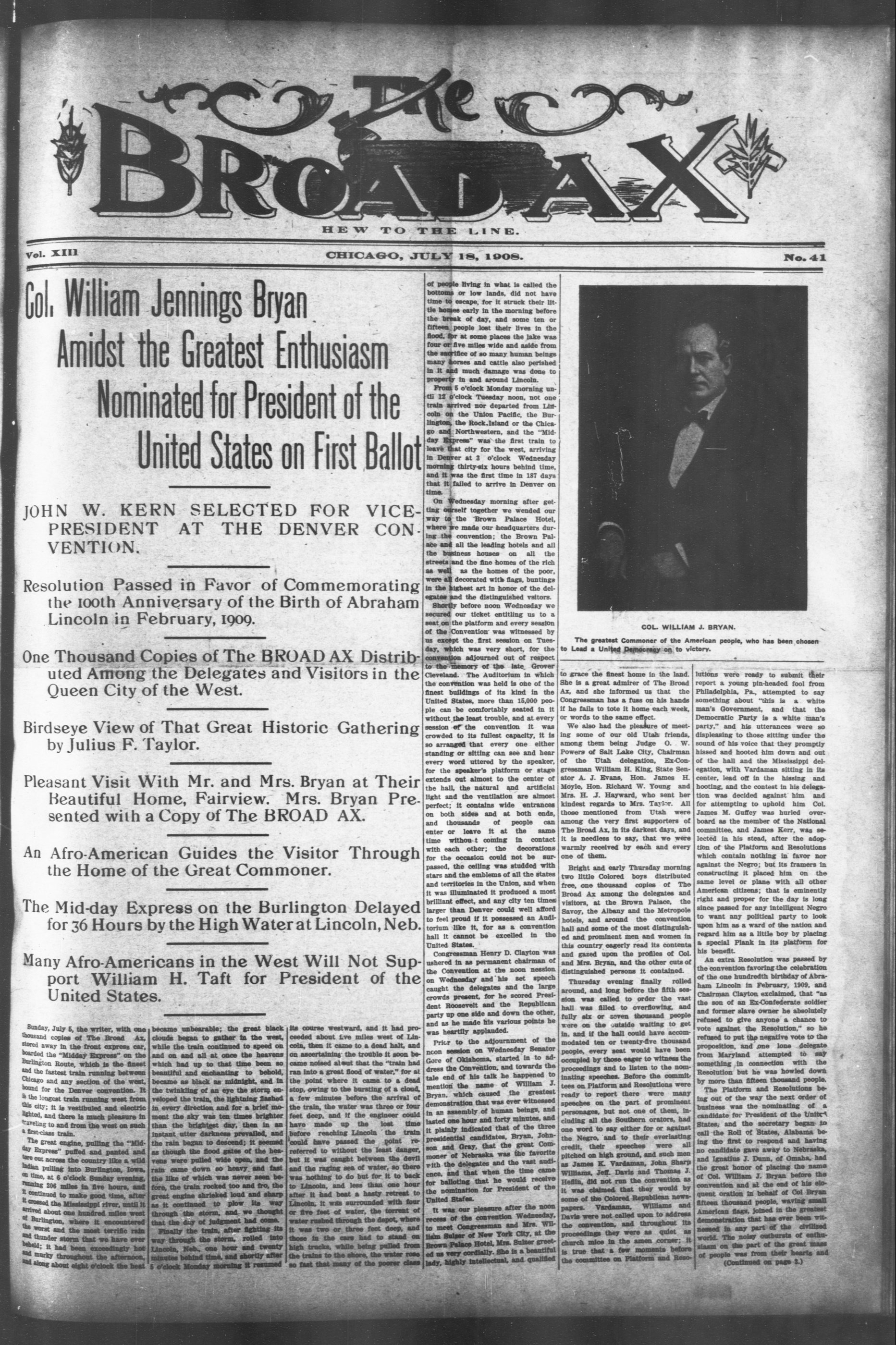
Col. William Jennings Bryan Amidst the Greatest Enthusiasm Nominated for President of the United States on First Ballot
JOHN W. KERN SELECTED FOR VICE PRESIDENT AT THE DENVER CONVENTION.
Resolution Passed in Favor of Commemorating the 100th Anniversary of the Birth of Abraham Lincoln in February, 1909.
One Thousand Copies of The BROAD AX Distributed Among the Delegates and Visitors in the Queen City of the West.
Birdseye View of That Great Historic Gathering by Julius F. Taylor.
Pleasant Visit With Mr. and Mrs. Bryan at Their Beautiful Home, Fairview. Mrs. Bryan Presented with a Copy of The BROAD AX.
An Afro-American Guides the Visitor Through the Home of the Great Commoner.
The Mid-day Express on the Burlington Delayed for 36 Hours by the High Water at Lincoln, Neb.
Many Afro-Americans in the West Will Not Support William H. Taft for President of the United States.
Sunday, July 5, the writer, with one thousand copies of The Broad Ax, stored away in the front express car, boarded the "Midday Express" on the Burlington Route, which is the finest and the fastest train running between Chicago and any section of the west, bound for the Denver convention. It is the longest train running west from this city; it is vestibulated and electric lighted, and there is much pleasure in traveling to and from the west on such a first-class train.
The great engine, pulling the "Midday Express" puffed and panted and tore out across the country like a wild Indian pulling into Burlington, Iowa, on time, at 6 o'clock Sunday evening, running 206 miles in five hours, and it continued to make good time, after it crossed the Mississippi river, until it arrived about one hundred miles west of Burlington, where it encountered the worst and the most terrific rain and thunder storm that we heard; it had been exceedingly hot and murky throughout the afternoon, and along about eight o'clock the heat
became unbearable; the great black clouds began to gather in the west, while the train continued to speed on and on and all at once the heavens which had up to that time been so beautiful and enchanting to behold, became as black as midnight, and in the twinkling of an eye the storm enveloped the train, the lightning flashed in every direction and for a brief moment the sky was ten times brighter than the brightest day, then in an instant utter darkness prevailed, and the rain began to descend; it seemed as though the flood gates of the heavens were pulled wide open, and the rain came down so heavy, and fast the like of which was never seen before, the train rocked too and tro, the great engine shrieked loud and sharp as it continued to plow its way through the storm, and we thought that the day of judgment had come. Finally the train, after fighting its way through the storm, rolled into Lincoln, Neb., one hour and twenty minutes behind time, and shortly after 5 o'clock Monday morning it resumed
its course westward, and it had proceeded about five miles west of Lincoln, then it came to a dead halt, and on ascertaining the trouble it soon became noised about that the "train had ran into a great flood of water," for at the point where it came to a dead stop, owing to the bursting of a cloud, a few minutes before the arrival of the train, the water was three or four feet deep, and if the engineer could have made up the lost time before reaching Lincoln the train could have passed the point re-referred to without the least danger, but it was caught between the devil and the raging sea of water, so there was nothing to do but for it to back to Lincoln, and less than one hour after it had beat a hasty retreat to Lincoln, it was surrounded with four or five feet of water, the torrent of water rushed through the depot, where it was two or three feet deep, and those in the case had to stand on high trucks, while being pulled from the trains to the shore, the water rose so fast that many of the poorer class
of people living in what is called the bottoms or low lands, did not have time to escape, for it struck their little homes early in the morning before the break of day, and some ten or fifteen people lost their lives in the flood, for at some places the lake was four or five miles wide and aside from the sacrifice of so many human beings many horses and cattle also perished in it and much damage was done to property in and around Lincoln.
From 5 o'clock Monday morning until 12 o'clock Tuesday noon, not one train arrived nor departed from Lincoln on the Union Pacific, the Burlington, the Rock Island or the Chicago and Northwestern, and the "Midday Express" was the first train to leave that city for the west, arriving in Denver at 3 o'clock Wednesday morning thirty-six hours behind time, and it was the first time in 187 days that it failed to arrive in Denver on time.
On Wednesday morning after getting ourselves together we wended our way to the Brown Palace Hotel, where we made our headquarters during the convention; the Brown Palace and all the leading hotels and all the business houses on all the streets and the fine homes of the rich as well as the homes of the poor, were all decorated with flags, buntings in the highest art in honor of the delegates and the distinguished visitors.
Shortly before noon Wednesday we secured our ticket entitling us to a seat on the platform and every session of the Convention was witnessed by us except the first session on Tuesday, which was very short, for the convention adjourned out of respect to the memory of the late Grover Cleveland. The Auditorium in which the convention was held is one of the finest buildings of its kind in the United States, more than 15,000 people can be comfortably seated in it without the least trouble, and at every session of the convention it was crowded to its fullest capacity, it is so arranged that every one either standing or sitting can see and hear every word uttered by the speaker, for the speaker's platform or stage extends out almost to the center of the hall, the natural and artificial light and the ventilation are almost perfect; it contains wide entrances on both sides and at both ends, and thousands of people can enter or leave it at the same time without coming in contact with each other; the decorations for the occasion could not be surpassed, the ceiling was studded with stars and the emblems of all the states and territories in the Union, and when it was illuminated it produced a most brilliant effect, and any city ten times larger than Denver could well afford to feel proud if it possessed an Auditorium like it, for as a convention hall it cannot be excelled in the United States.
Congressman Henry D. Clayton was ushered in as permanent chairman of the Convention at the noon session on Wednesday and his set speech caught the delegates and the large crowds present, for he scored President Roosevelt and the Republican party up one side and down the other, and as he made his various points he was heartily applauded.
Prior to the adjournment of the noon session on Wednesday Senator Gore of Oklahoma, started in to address the Convention, and towards the tale end of his talk he happened to mention the name of William J. Bryan, which caused the greatest demonstration that was ever witnessed in an assembly of human beings, and lasted one hour and forty minutes, and it plainly indicated that of the three presidential candidates, Bryan, Johnson and Gray, that the great Commoner of Nebraska was the favorite with the delegates and the vast audience, and that when the time came for balloting that he would receive the nomination for President of the United States.
It was our pleasure after the noon recess of the convention Wednesday, to meet Congressman and Mrs. William Sulzer of New York City, at the Brown Palace Hotel, Mrs. Sulzer greeted us very cordially. She is a beautiful lady, highly intellectual, and qualified
The greatest Commander of the American people, who has been chosen to Lead a United Democracy on to victory.
to grace the finest home in the land. She is a great admirer of The Broad Ax, and she informed us that the Congressman has a fuss on his hands if he fails to tote it home each week, or words to the same effect.
We also had the pleasure of meeting some of our old Utah friends, among them being Judge O. W. Powers of Salt Lake City, Chairman of the Utah delegation, Ex-Congressman William H. King, State Senator A. J. Evans, Hon. James H. Moyle, Hon. Richard W. Young and Mrs. H. H. J. Hayward, who sent her kindest regards to Mrs. Taylor. All those mentioned from Utah were among the very first supporters of The Broad Ax, in its darkest days, and it is needless to say, that we were warmly received by each and every one of them.
utions were ready to submit their report a young pin-headed fool from Philadelphia, Pa., attempted to say something about "this is a white man's Government, and that the Democratic Party is a white man's party," and his utterances were displeasing to those sitting under the sound of his voice that they promptly hissed and hooted him down and out of the hall and the Mississippi delegation, with Vardaman sitting in its center, lead off in the hissing and hooting, and the contest in his delegation was decided against him and for attempting to uphold him Co James M. Guffey was hurled over board as the member of the National committee, and James Kerr, was selected in his stead, after the adoption of the Platform and Resolution which contain nothing in favor n
Bright and early Thursday morning two little Colored boys distributed free, one thousand copies of The Broad Ax among the delegates and visitors, at the Brown Palace, the Savoy, the Albany and the Metropole hotels, and around the convention hall and some of the most distinguished and prominent men and women in this country eagerly read its contents and gazed upon the profiles of Col. and Mrs. Bryan, and the other cuts of distinguished persons it contained.
Thursday evening finally rolled around, and long before the fifth session was called to order the vast hall was filled to overflowing, and fully six or seven thousand people were on the outside waiting to get in, and if the hall could have accommodated ten or twenty-five thousand people, every seat would have been occupied by those eager to witness the proceedings and to listen to the nominating speeches. Before the committees on Platform and Resolutions were ready to report there were many speeches on the part of prominent personages, but not one of them, including all the Southern orators, had one word to say either for or against the Negro, and to their everlasting credit, their speeches were all pitched on high ground, and such men as James K. Vardaman, John Sharp Williams, Jeff. Davis and Thomas J. Heflin, did not run the convention as it was claimed that they would by some of the Colored Republican newspapers. Vardaman, Williams and Davis were not called upon to address the convention, and throughout its proceedings they were as quiet as church mice in the amen corner; it is true that a few moments before the committee on Platform and Reso-
lutions were ready to submit their report a young pin-headed fool from Philadelphia, Fa., attempted to say something about "this is a white man's Government, and that the Democratic Party is a white man's party," and his utterances were so displeasing to those sitting under the sound of his voice that they promptly hissed and hooted him down and out of the hall and the Mississippi delegation, with Vardaman sitting in its center, lead off in the hissing and hooting, and the contest in his delegation was decided against him and for attempting to uphold him Col. James M. Guffey was hurled overboard as the member of the National committee, and James Kerr, was selected in his stead, after the adoption of the Platform and Resolutions which contain nothing in favor nor against the Negro; but its framers in constructing it placed him on the same level or plane with all other American citizens; that is eminently right and proper for the day is long since passed for any intelligent Negro to want any political party to look upon him as a ward of the nation and regard him as a little boy by placing a special Plank in its platform for his benefit.
An extra Resolution was passed by the convention favoring the celebration of the one hundredth birthday of Abraham Lincoln in February, 1909, and Chairman Clayton exclaimed, that "as the son of an Ex-Confederate soldier and former slave owner he absolutely refused to give anyone a chance to vote against the Resolution," so he refused to put the negative vote to the proposition, and one lone delegate from Maryland attempted to say something in connection with the Resolution but he was howled down by more than fifteen thousand people.
The Platform and Resolutions being out of the way the next order of business was the nominating of a candidate for President of the United States; and the secretary began to call the Roll of States, Alabama being the first to respond and having no candidate gave away to Nebraska, and Ignatius J. Dunn, of Omaha, had the great honor of placing the name of Col. William J. Bryan before the convention and at the end of his eloquent oration in behalf of Col Bryan fifteen thousand people, waving small American flags, joined in the greatest demonstration that has ever been witnessed in any part of the civilized world. The noisy outbursts of enthusiasm on the part of the great mass of people was from their hearts and (Continued on page 3.)
“pale the
‘but.
Enyone else r say, 8
jong as 2 ‘iw proper ‘and
Broad Ax is-& new whose
uiscm ie bropd enceaefor sitvente
ee ae m
Local communications will
2S
Subscriptions must be paid ta ad-
vance. :
Advertising fates made known on
application.
‘Address all communteations to
THE BROAD AX -
S038 Armour Avenue, Chicago.
ah
JULIUS ¥, TAYLOR; Béttor ana Pub-
ilsher. - oa
“Entered as. Second-Ciase Matter,
Aig. 19, 1902 at the Post Office at
Chicago, Hlinols, under Act of March
‘3, 1878 -
DO You KNOW
_ That there are more -wage workers
‘in Chicago than there are inhabitants
‘m Louisville, Jersey City, Indianapo-
Us, St. Paul, Providence, Rochester,
Kansas City, Mo., or Toledo?
‘That there is no important seaport
between Portland, Maine, and Port:
land, Ore., that has not one or more
through railway passenger trains
from Chicago daily?
‘That Chicago produces more steel
rails for railroads than any other city
on earth?
‘That deposits of the Chicago banks
on May 1¢ were $698,335,473, which
is almost three times the cash balance
of the United ‘States Treasury, exclu-
sive of reserve Gnd trust funds?
_ That it pequires 980 suburban trains
to carry passengers from the sur
rounding towns and villages to and
‘trout Chicago daily? ‘
That Chicago has sixty-nine ~ hos-
pitals, © larger aumber in proportion
to population thin any large city in
the country, notwithstanding ft has
the lowest death rate of any_of them?
That Chicago has the largest car
factory, the largest telephone factory
and the largest plano and organ fac-
tory om the continent? a8
That.the universities and colleges
within the corporate limits of Cificago
‘have 10,000 students, making this the
educational center of the country?
“That ‘the Young Men's Christian
‘Association of Chicago, the second
Jargest.in the world, has a member-
hip of more than 13,000, sustains
‘eighteen branches, and owns property
walued at $2,022,0007
‘That. criminal-statistics prove that
there is less crime in Chicago in pro-
portion to population than in Balti
‘more, Boston, Cleveland, Indianapolis,
Kansas City, Mo., New York, Omaha,
Philadelphia, Pittsburg and several
‘other. important cities?
That The Broad Ax is the obly
‘Negro newspaper in Chicago which
you can depend on receiving regularly
‘every week?
INSTITUTIONAL CHURCH.
3825 Dearborn Street, Chicago, fll.
‘he tterest.in the work at this
cliureh is growing if out is to judge
by the Sunday congregation which
attended the service inst Sunday at
10:45 2: m.~ The pastor was greeted
by & large and appreciative audience
‘gt Jeast one-half of the congregation
were strangers. At $ p. m. and 7:45
-p. m the auditorium was crowded to
hear Mre. Mazon on the inspiring
‘theme, “Going to Heaven.”
Sunday, July 19th, Rev. H. E. Stew-
‘art will preach at 10:45 a m. Subject,
“Empty Cisterns.” These striking
swords are taken from the book of
Jeremiah. Two ovils committed, For-
saking God. Turning to empty cis-
eras as a source of supply. .It will be
‘shown who and what are the empty
‘dsterns. At the evening service the
subject -will be Reunion, taken from
ee ae ee ee
ira. Fannie Hall Clint, Miss Gertrude
Jackson, Master Huston, violinist. A
grama reception to Mr. Work ‘and all
fvonwere ithe ly wh wil aad.
pee rae excellent, fine: 2
eee acer
See ven the, eee
eS ee oe aes Se
ae eee ae ee a ees
tne Ree pley “Meade ae
Pence es ec |
COL. WILLIAM J. BRYAN CHOSEN
“TO LEAD THE COMMON PEO-
PLE ON TO VicToRY.
(Concluded trom page 1.)
luring the grext demon-
4 to restére order and proceed
‘with the ‘Roll éall of states, but he
made no better headway than if he
had attempted single handed and
to check the on rushing of «
mighty tide. Then the famous Cowboy
‘Bend would strike up “My Old Ken-
tucky Home,” and other soul-stirring
‘airs, with a view of drowning out the
ase tet bo mee Dore. tee
simply ‘added to the commotion and
excitement and each time the band
ceased playing the enthusiasm would
break out again stronger than ever,
for men would snatch up banners
and march afound the bell, behind a
Jarge portrait of Col. Bryan, which
‘was held aloft by strong arms. Ladies
mounted ‘thelr seats and, waving their
fiags, shouted themselves doarse on
Dehalf of the plumed knight of the
west.
Finally about haltpast two o'clock
in the morning the great sea of hu-
manity, wore itself out, 2 semblance
of -order was restord, and the Roll
call of the states was continued. Gov.
ernor Join A. Johnson of Minnesota,
and Judge’ Gray of Delaware, were
tlie text to be placed in nomination,
then the balloting began and at 3:40
in the morning Col Bryan received
892° 12 votes as against 46 for Gov.
Johnson and §9 1-2 for Judge Gray,
and his nomination was made by ac-
clamation, and the great sea of bu-
manity af 4 o'clock in the morning,
trom physical-exhaustion, staggered
out of the convention hall to their va-
rious homes and lodging places.
Friday at 1 o'clock the convention
reconvened for the purpose of sc
lecting © Vice-Presidential candidate,
and John W. Kern of Indiana, after s
spirited contest, was chosen by ac-
elamation as Col. Bryan's running
mate, and the great Democratic con-
vention of 1908 passed into history.
Right here we must pause for a
few moments to state that we were
never treated any better in our life
than while attending the Denver con-
vention. It was our pleasure to be
presented to ladies from Kentucky,
Louisiana and other southern states,
and they all greeted us very cordially
and no one intfmated that this “Col-
ored man is out of his place and seek-
ing social equality with the whites.”
‘The ladies of Denver were also very
polite and agreeable, and they did
not hestitate in conversing with the
delegates and visitors; in short, we
@id not feel that we belonged to the |
Colored race until we gazed into the
looking glass.
Saturday evening, July 11th, we
took our departure from Denver for
Lincoln, Neb., arriving in that city
at 2 o'clock Sunday afternoon, and
early on Monday morning we wended
our way to Fairview, the beautiful
home of Col and Mrs. W. J. Bryan,
arriving there just as Col. Bryan was
starting to the train to meet Vice
Presidential Candidate John W. Kern.
Col Bryan warnily grasped us by the
hand and requested us to accompany
him, which we did, aif on the way we
were followed by a crowd of newspa-
per men.
Arriving at the station, the great
Commoner and ourself, rushed sway
from the crowd, and stood under »
large shade tree, and conversed in
jow t0hes so that no one could over-
hear the conversation. ‘Then the train
pulled in begring John W. Kern,
Samuel.Gompers, President of the
American Federation of Labor, and
other distinguished men. After Col.
Bryan had s short conference with
Mr. Gompers, 2 reception was held,
and Mrs. Bryan was presented to the
xuests.
‘When it came our turn to be tntro-
duced to her, she cordially extended
her hand and Geclared that she still
remembered us, and we presented her
with a copy of The Broad Ax con-
aining her picture, and she highly
complimented us for continuing to
stand by Col. Bryan, Then the Col.
onducted us through the house,
mid Mrs, Bryan called Miss Grace,
rho has develop’d from & little eri,
oto a charming young lady, to meet
wre and jast as we Were in the sct
eS “the steps of Fairview
sonnet fsa de
receives
the visitpre through Fairview, the
home of the great Commoner, and
he informed us that he waa treated
as well as any one could be treated
by Col. and Mrs. Bryan, the members
of the family std all. visitors. He
sleeps and eats right in the big house,
and Mrs. Bryan declares that “she
could mot get slong’ Without Wiliam
Ford.”
Tt can be truthfully aid, that dur
ing our pleasant trip through the
West; we came in contset with tany
substantial Afro-Americans who will
Pot support William H. Taft for’ Prés-
ident of the United States.
NEGROES TURN FROM PARTIES
TO INDEPENDENT LEAcue.
_ Notable was the gathering of the
Independence party _committeemen
‘and ward workers last night. The meet-
ing was called for the Independence
headquarters in the Security Butld-
ing, Fifth avenue and Madison street,
but the crowd was so large it was
necessary to adjourn to Vogeisang’s
banquet room, which the enthusiastic
gathering filled and also crowded the
wide passageways.
Almost as striking as the general
enthusiasm was the presence of a
number of Negro men who came with
tidings from thelr race to the new
barty, tidings which told ‘of the ap-
Proaching revolt of the Negroes trom
tbe Republican party and their alle-
siance with the new political organ-
ization that offers them an equal op-
portunity. 73
After an announcement of details
of Saturday's plenie, the audience de-
manded speeches.
William Johnson, a well-known Ne-
gro speaker, was introduced. He told
of the wrongs his people had suffered
from the’ Republican party, and how
they had nothing to hope for at the
hands of the Democrats. They did
not come seeking social equality, he
declared. All the Negro wanted was
political equality, and they would cre-
ate their own social equality among
themselves.
“We think, we hope,” he concluded,
“the Independent party will be our
L. A. Newby, a Negro lawyer of
Chicago, followed in similar strain.
Edward Strauss, Western organizer
for the American Federation of Labor,
declared that Bryan and his follow-
ers were nothing more than crafty
politicians, who, afraid of the hold
that William Randolp Hearst had
upon the hearts of the working peo-
ple, had adopted the anthinjunetion
plank solely in the hope of fooling
the people into voting for Bryan.
Dr. Gfbson, chairman of the picnic
committee, praised the magnificent
work that William Randolph Hearst
had done in the behalf of the common
people. Brief speeches also were made
by J. C. La Bell, candidate for the
N. S. Boynton, Frank Leonard and
W D. Casey. Among the well-known
Negroes present was-W. H. Smith of
Chicago, a brother of Bishop C. 8.
Smith, founder of the A. M.-E. Sun-
day School Union of the world. Mrs.
Laicy Thurman, formerly president
ot the Negro W. C. T. U., and who &
few months ago defeated Mrs. Booker
T. Washington for the presidency of
the Colored Women’s National
League, is his sister—The Chicago
Examiner, July 16.
LITERARY NOTES.
| Within the next two weeks The
Orion Pubiishiig Company of Nash
ville, Tenn., will issue a new book
from the pen of Sutton B. Griggs, al
ready known to the reading public
as the author of “Imperium In Im-
perio,” “Overshadowet,” . “Untetter
ed,” “The Hindered Hand,” and “The
One Great Question,” the more nota
ble of his works.:
The title of the forthcoming book
18 “Pointing the Way.” It is written
tm story form, and the plot is said to
Be one of the most unique that has
e¥er appeared in American literature.
‘The general aim of the book is to
‘point the way for the solution of the
‘race question at its most scute
Doint,, the question of suffrage at the
South. But wrapped abont this queé-
tion is a story of general human inter-
est.
Having ripened with the years, it
{s now confidently expected that Dr.
Griggs will more than ever challenge
the attention of the best thought of
the reading nation. -
As an indication of the impression
Mr. Griggs hag already made on the
thinking public we cite the following
“He is undoubtedly & man of keen
brain, determined opinion, true
épirit."-Chicago Record-Herala =<"
“He is without @oubt one .of the
men of his race."—Rev. P. B. Gus
sey, A. M. Ex-Prosident of Roger Wil~
lames University. Se eae
_ "Tl regard Mr. G # one of the}
; eScietir Geemieied
cee og linn aged eeapnpienger
Miarkable gift in getting at the phil-
osophy underlying the situation make
an authority in the solution of
‘this vexed and vital problem of our
‘Ume-"—Rev, J. @,. Merrill, D. D., Pres-
dent of Fisk University.
“His work is uniformly strong and
‘Bealthy, bis “Imperium In Imperio”
& powerful ‘novel, full of the
of _genius."—T. Thomas Fortune.
THE NEW DUNBAR THEATER Iq
RUNNING AT FULL BLAST.
The Hew Dunbar Theater, 2220
‘State street; has been running at full
blast ever since the pening night.
It ts one of the most beautiful lit-
tle play houses on the South Side, and
tt is playing to crowded houses each
night. Its exhibition of moving pic-
tures are the best to be found in
the city.
Tt te the only five-cent theater in
Chicago owned and conducted by an
Afro-American, and Dr. W. A. Rich-
ardson, its owner and proprietor, re-
flects great credit upon himself by
the intelligent manner in which he
has -brought forth the Dunbar Thea-
ter.
MAN AND SISTER, PARTED IN
1650 AS SLAVES, MEET.
Thomas Washington of Arkansas is
‘Awed by Chicago's Elevated
Roads. a
Separated in slave days, Thomas
Washington, an aged Negro, and Vic-
toria Washington Demoss, brother
and sister, met yesterday for the first
time in 58 years. Washington, who is
seventy-nine years old and has lived
all his life in Pine Bluff, Ark, came
to Chicago to visit Mrs. .Demoss, 3645
Armour avenue, It is the first time he
has visited a large city~ He was
amazed when he saw the skyscrapers
and the immense stores. It was with
difficulty that his relatives induced
him to ride on the elevated railway.
CHiPs
Mrs. 5. A. T. Watkins and son, 3632
Caiumet avenue, bave gone to Glen-
coe to spend a part of their vavation
period. .
8. A. T. Watkins, the Supreme at-
torney for the K. of P., left Sunday
for Georgia for a period of two weeks
on business.
Messrs. Henry Hart, of Indianapo-
His, Dewitt Curtis, Tony Langston and
J. L. Fry made a trip to Milwaukee
‘on the Whaleback, Tuesday.
Mr. Robert Motts is spending his
vacation in Hot Springs, Ark., where
he expects to greatly benefit his
health by frequent use of the baths.
Mrs. George Cleveland Hall enter-
tained formally a large number of la-
dies at an afternoon reception Fri-
ay afternoon in honor of Mrs. Hattie
[Curtis Hall and her guest of Boston,
Mass
| With a score of 5 to 3 and 6 to 0,
the Leland Giants defeated the Cleve-
Jand, Ohio, baseball team at their
home on Monday and Tuesday of this
week. It doesn’t seem possible to
find a match for the Leland’s at
home or abroad.
‘The Appomattox Club will give its
eighth annual outing Monday, July
27th, at Northwestern Park, a most
Golightful and cool spot for a picnic.
Trains. leave Northwestern depot,
Wells and Kinsie street, 9:30 and 10
am.
Mrs. Asalia Smith Hackley, of
Philadelphia, Pa, was the guest of
Mr. and Mrs. Edward Mead, 6351
Vincennes avenue, the first two days
of the week Mrs. Hackley was en
route to her home in Philadelphie,
after spending two-weeks in Los An-
geles, California, as the guest of
Mrs. Samuel W. Thompson.
C. H. Coll is one of the leading
Afro-American barbers, 216 N. 7th
street, ‘Lincoln, Neb. and for many
years he has assisted to pull chest-
nuts .out of the fire for the leaders
of the Republican party, but he is
getting tired of his job, and is be-
sinning to assume an independent at-
iutde in polities. He is one of the
new gubscribers to The Broad Ax.
‘Mr. and Mrs. Edward Mead gave
_ ;
to about one hundred of their
pee y so of their guest, Mrs.
A. Hackley, of Philadelphia, Pa.
Attorney. B. F. Moseley is enjoying
the t at. Mt, Clemens, Mich,
, Ohio, Mr. Moseley ts ex
Ee eee ee
aera as site: Sonenat Se
Stes of its cot teaachenie aoe
re ee en
ha atk ae eat a one ras
ee eed
Se ee eee
ee OE Pe: SO
he will support: Mr. Bryan for Presi-
dent, and act ag the agent for The
Broad Ax in Lincoln.
Richard H. ¥: is one the
= 2 ‘oung among
im Lincoln, Neb. He lived in a nice
home of his own, 1315 Wishington
street, in that city, and for the past
‘six years he has been in charge of
the drapery and rug department for
Miller and Paine, who conduct the
largest dry goods store in Lincoln,
corner O and 13th street, and Mr.
‘Young bas the honor of holding the
Most responsible -position of any
Afro-American in thé capitol city of
the west. He is one of the new sub-
scribers to The Broad Ax, and will
‘support William J. Bryan for Presi-
dent. i
Miss Marie Burton, who has re-
cently secured a teacher's certificate
from the Chicago Conservatory of
Music, has been selected by Mme. BE.
A. Hackley, of Philadelphia, to rep-
resent Chicago at a “Song Festival”
which will be held in Philadelphia
about the middle of October, and at
which singers will appear from all
parts of the country. Miss Burton has
a well-trained voice, and her many
Chicago friends are proud of the dis-
tinction she hes gained at such an
early age in life. After the “Song
Festival” Miss Burton will tour sev-
eral of the eastern states im high
clags song recitals, under the direc
tion of Mr. Noah D. Thompson.—“T.”
. SHORT STORIES.
Eaward Thompson, a watchman at
Perth Amboy, N. J., says a rat comes
to him every day and gets a cliew of
tobacco.
At a Hungarian wedding at High-
land, TL, In a parade through the
‘stre@is the bride and groom were at-
tended by a band and seventy brides-
maids.
For nearly five miles along the Bev-
arly Qfass.) shore the land is owned
exclusively by wealthy summer resi-
dents representing more than $100.
000,000.
Harry E. Elliott of Rehoboth Beach,
Del. says be found in a house buried
by sand on the beach, used sixty years
‘ago for storing oll, ice in a good state
of preservation.
In 1895 only one country in the world
was infected with the bubonic plague,
while in 1908 dfty-one countries are
more or less infected, so Surgeon Gen-
eral Wyman reports.
A white robin, an albino, bas made
his home on Winter island, Salem,
‘Mass., for this season. The curious
bird has attracted much attention. He
has got so used to bird students fol-
Jowing him that he now allows persons
‘te get close to him.
pee ae
“There is a remarkable charm about
Von Flutie.”
“That's true. He's the only man
I've ever seen who could crawl under
an automobile gracefully.”—Cleveland
Piain Dealer.
rnppant Flings.
‘The reason we dislike the end seat
bog is that we want his place.—Detroit
News.
Man's conquest of the air has provid-
ed him with another element In which
to have accidents—Chicago News,
“Paris is thronged with Americans,”
says a cablegram. But nothing is said
about the churches being crowded —
Rochester Post-Express.
One of the transatlantic lines has_
mow put trained nurses on its ships.
Pretty soon no man of moderate means.
can afford even to be seasick while
crossing the ocean.—Kennebec Journal,
‘The fly ts being roundly abused for
carrying microbes on its feet. It real-
Jy does seem that the fly might carry
its germs in- gripsack or its overcoat
pocket or somewhere besides its feet—_
‘Washington Herald.
German Gleanings.
‘The town of Westhofen, in Germany,
still enforces an old ordinance which
forbids any one walking in the street
with a lighted cigar.
‘The Prussiau government has issued
& proclamation warning people against
@rinking ice cold soda and mineral
waters because of the injury they are
lkely to inflict on the digestive organs.
A man named Niedband, at Marburg,
Germany, who was left a widower
some years ago, married his wife's sis-
ter. “She died last spring, and now be
has married the mother of his two pre-
vious wives.
One of the effects of the German old
age pension scheme is rather peculiar.
pension is forfelted if the work-
mar does not work forty-eight or forty-
ning weeks out of the fifty-two on an
average, and this provision has been a
Geterrent to strikes. —
——
New York City.
In 1885 New York had only twenty-
eight ‘millionaires; now it has over
About 45,000 marriages are solem-
niged every year, one in overy eleven
minutes.
Over 476,000,000 gallons of water are
teed every day fo Greater New York.
‘There are 112 theaters and two grand
people.
& ebiid i» born every four minutes
anda death occurs every seven min-
tes in New Tork <ity—Gucenas Mag
WASHINGTON Lipp,
LETH
Sieenial Corress..-)......
ee ey Minds shat os
Fears PASS a new resileoe gee
President of the United s:. 5 yi)
come & necessity. s. ea
fooms of the White ites. ay
ave always been devo), ot
‘and official business tha: ; ti
and thelr families, the tenons at we
Of the: people, have alwa:s teen pe
ited as to sleeping roo. _
A Future Possivility,
‘The cloudy idea whici, the ftary
may be embodied tn anoi'er sma
fs that the nation slonii soy; 0"
Tesidences for the chief ae:
Official and a personal or =
‘The White House, rie \ ‘sta ty
torle associations, coulis sat
the public office butldine + tic pre
ent, be more accessible 1 (gummy
Dablie than ft now ts sr! i the op
ficlal theater of state fins iy
addition, and separate fo.) :hic tte
executive and his family stout te
given a private residence to some ge
strable section of the city
The item in the appropri inns tm
which some interpret a< 1 fee,
‘ward to. this provides for 0 ymtag
of a tract of land for pi: nna
This tract is about two i tory
of the White House and e9) gonat
ble by the Sixteenth stree! nlerany
Over a Century O1:
It is almost 106 years si.» Gore
Washington presided at the ‘sing
the cornerstone of the exer: ‘\e mm.
sion in the “federal city." 9 ie cain,
the city which was afterw: "| (0 tear
his mame. This ceremony ‘i play
on Oct. 13, 1792, the three} undreity
anniversary of the landins of Chriss
pher Columbus. Eight years wore oop
sumed in building the “presi ars pa:
ace,” and Washington bil bv deat
almost a year when the se pret
dent, John Adams, and his wife. ati
‘gail, took possession of the 1 ::\sion
Despite the cries of ¢\!rivague
$800,000 had been granted! |: castes
for the building and furnis!:< of the
house, in those days no si! <u
Architect of the White House.
‘The plans of the buildin aitted
fm a competition for a pr if Sm,
Were drawn by a young Ir) srchitect
of Charleston, 8. C., name! Jes He
ban. Since it gained it< we. the
White House, from a coat of white
Paint bestowed after its soking an
burning by the British in i). war of
1812, some inlanders of ry :reoti!
mind cherish the fond ide: :lut the
batiding is of marble. 1 mu: lose a
artistic and poetic value Wie: they
Jearn that it is built of sands!ove from
Maryland and Virginia quarti:
It was not Hoban’s fault th: the o&
eupants of the nation’s house !)..\! space
Mmitations placed upon their icon
ing and social instincts. {lis tint
plans called for's three story !»0'\ling
and in the third story were to be the
sleeping apartments. An eco mic
democracy decided that this wes gir
ing the executive too much; that tm
stories and a basement should «:tisy
all requirements. That Hoban p!insel
well is shown in the fact thot ust
1902, when the executive offices were
removed to the annex provile! fr
them, the building was unchans e
cept for the addition of porcics at
conservatories and for repairs.
A Historic Herb Patch.
Close to the Dutch garden whit
decorates the south side of tii: White
House isa little space where berté
have been raised ever since tlic int
mistress of the executive ans
marked off a spot for a flower
closure. There grow mints, sir
marjoram and other plants, many
which, tradition says, still come fo
the roots originally planted. ll
dishes for the presidential tables
seasoned with the products of this
He patch. and the present mistress ¢
the White House is as carefu! of ‘8
section of the grounds as of the bank
somest flower bed. She has tien
roots of spearmint, marjorsm. svet
basil, tarragon and thyme «© Oss?
Bay, and she now has at the sumo
place one of tlie best herb <1niens
Long Island. Parsley, of oi".
ares in the collection, {n-uiins *
French variety, unusually pv:nea'-
New Treasury Pillars.
Long delayed work of tring ost
the thirty fouic pillars which ornamest
the east front of the treasury tuildint
and replacing them with cranite cot
gmns.is now going on, ani «on tb
ast of the sandstone work will bave
fisappeared, and the entire structt
will be of granite and marble
‘The contract was let for $2%..65aal
calls for the replacing of the sandstom®
pillars with monolith granite.
‘The granite cet nich that of
which the nofth, south and west wing
wre constructed and was quarried #
Milford, N. H.
<A Costly Building.
‘The contract calls for the completion
if the work by the end of this Tee
put in view of the delay the tue
0
‘The contract calls for the completion
ot ie Oat We ton wo of this year,
Rebs view of the detay the Une =
extended.
‘The granite pillars are a perfect
eodntion Of the historic sand columss
‘are finished by hand. Toes bs
slightly in the middie, and 2°
Chine hex been invented which <0 4
this Kind of work. ‘The tate of tbe od
columns hias'not been decided. |
ean be removed in sufficiently perfect
senttton Saey Twill be used for ome
mental _ fm the parks
found batiings th 720
grounds, Uke the new wer colic”
‘The treasury bollding as ic sae
eee ‘an outlay of aboat $7.00"
DOO: Its history hax been one of O°
want change and enlargemen'. TS
Se eae or
ee the steoe
: ‘and sides.
PEER o- ohae. Ee HOFIELD:
WOMAN AND FASHION
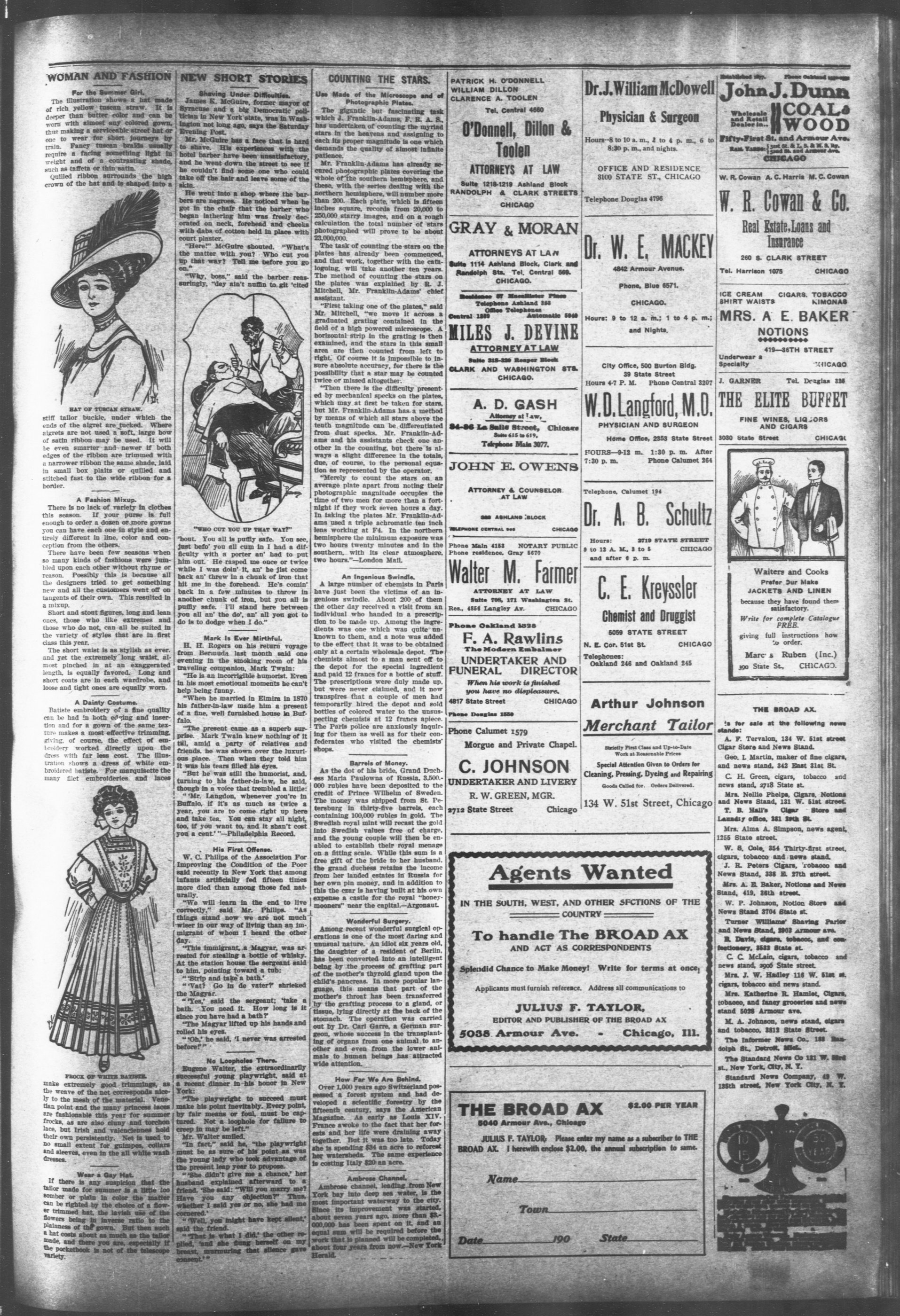
The illustration shows a hat made of rich yellow tuscan straw. It is deeper than butter color and can be worn with almost any colored gown, thus making a serviceable street hat or one to wear for short journeys by train. Fancy tuscan braids usually require a facing something light in weight and of a contrasting shade, such as taffeta or thin satin.
Quilled ribbon surrounds the high crown of the hat and is shaped into a
X
HAT OF TUSCAN STRAW.
stiff tailor buckle, under which the ends of the aligret are fucked. Where aligrets are not used a soft, large bow of satin ribbon may be used. It will be even smarter and newer if both edges of the ribbon are trimmed with a narrower ribbon the same shade, laid in small box plats or quilled and stitched fast to the wide ribbon for a border.
A Fashion Mixup
There is no lack of variety in clothes this season. If your purse is full enough to order a dozen or more gowns you can have each one in style and entirely different in line, color and conception from the others.
There have been few seasons when so many kinds of fashions were jumbled upon each other without rhyme or reason. Possibly this is because all the designers tried to get something new and all the customers went off on tangents of their own. This resulted in a mixup.
Short and stout figures, long and lean ones, those who like extremes and those who do not, can all be suited in the variety of styles that are in first class this year.
The short waist is as stylish as ever, and yet the extremely long waist, almost pinched in at an exaggerated length, is equally favored. Long and short coats are in each wardrobe, and loose and tight ones are equally worn.
A Dainty Costume.
Batiste embroidery of a fine quality can be had in both edging and insertion and for a gown of the same texture makes a most effective trimming, giving, of course, the effect of embroidery worked directly upon the dress with far less cost. The illustration shows a dress of white embroidered batiste. For marquisette the many filet embroideries and lace
V
make extremely good trimmings, as the weave of the net corresponds nicely to the mesh of the material. Venetian point and the many princess lace are fashionable this year for summer frocks, as are also cluyn and torchon lace, but Irish and valenciennes hold their own persistently. Net is used to no small extent for gumpes, collars and sleeves, even in the all white wash dresses.
Wear a Gay Hat.
If there is any suspicion that the tailor made for summer is a little too somber or plain in color the matter can be righted by the choice of a flower trimmed hat, the lavish use of the flowers being in inverse ratio to the plainness of the gown. But then such a hat costs about as much as the tailor made, and there you are, especially if the pocketbook is not of the telescope variety.
NEW SHORT STORIES
Shaving Under Difficulties.
James K. McGuire, former mayor of Syracuse and a big Democratic politician in New York state, was in Washington not long ago, says the Saturday Evening Post.
Mr. McGuire has a face that is hard to shave. His experiences with the hotel barber have been unsatisfactory, and he went down the street to see if he couldn't find one who could take off the hair and leave some of the skin.
He went into a shop where the barbers are negroes. He noticed when he got in the chair that the barber who began lathering him was freely decorated on neck, forehead and cheeks with dabs of cotton held in place with court plaster.
"Here!" McGuire shouted. "What's the matter with you? Who cut you up that way? Tell me before you go on."
"Way, boss," said the barber reassuringly, "dey ain't nuffin to git' cited
J.
"WHO OUT YOU UP THAT WAY?"
'bout. You all is puffy safe. You see, just befo' you all cum in I had a difficulty with a porter an' had to put him out. He rasped me once or twice while I was doin' it, an' he jlist come back an' threw in a chunk of iron that hit me in the forehead. He's comin' back in a few minutes to throw in another chunk of iron, but you all is puffy safe. I'll stand here between you all an' the do', an' all you got to do is to dodge when I do."
Mark Is Ever Mirtful
H. H. Rogers on his return voyage from Bermuda last month said one evening in the smoking room of his travelling companion, Mark Twain: "He is an incorrigible humorist. Even in his most emotional moments he can't help being funny.
"When he married in Elmira in 1870 his father-in-law made him a present of a fine, well furnished house in Buffalo.
"The present came as a superb surprise. Mark Twain knew nothing of it till, amid a party of relatives and friends, he was shown over the luxurious place. Then when they told him it was his tears filled his eyes.
"But he was still the humorist, and, turning to his father-in-law, he said, though in a voice that trembled a little: "Mr. Langdon, whenever you're in Buffalo, if it's as much as twice a year, you are to come right up here and take tea. You can stay all night, too, if you want to, and it shan't cost you a cent."--Philadelphia Record.
His First Offense.
W. C. Philips of the Association For Improving the Condition of the Poor said recently in New York that among infants artificially fed fifteen times more died than among those fed naturally.
"We will learn in the end to live correctly," said Mr. Philips. "As things stand now we are not much wiser in our way of living than an immigrant of whom I heard the other day.
"This immigrant, a Magyar, was arrested for stealing a bottle of whisky. At the station house the sergeant said to him, pointing toward a tub:
"Strip and take a bath."
"Vat? Go in de vater? shrieked the Magyar.
"Yes,' said the sergeant; 'take a bath. You need it. How long is it since you have had a bath?
"The Magyar lifted up his hands and rolled his eyes.
"Oh,' he said, 'I never was arrested before!"
No Loopholes There.
Eugene Walter, the extraordinarily successful young playwright, said at a recent dinner in his honor in New York:
"The playwright to succeed must make his point inevitably. Every point, by fair means or foul, must be captured. Not a loophole for failure to creep in may be left."
Mr. Walter smiled.
"In fact," said he, "the playwright must be as sure of his point as was the young lady who took advantage of the present leap year to propose.
"She didn't give me a chance," her husband explained afterward to a friend. "She said: 'Will you marry me? Have you any objection?' Thus, whether I said yes or no, she had me cornered."
"Well, you might have kept silent,' said the friend.
"That is what I did,' the other replied, 'and she fung herself on my breast murmuring that silence gave scream."
COUNTING THE STARS
Use Made of the Microscope and of
Photographs/Photos
Photographic Plates.
The gigantic but fascinating task which J. Franklin-Adams, F. R. A. S., has undertaken of counting the myriad stars in the heavens and assigning to each its proper magnitude is one which demands the quality of almost infinite patience.
Mr. Franklin-Adams has already secured photographic plates covering the whole of the southern hemisphere, and these, with the series dealing with the northern hemisphere, will number more than 200. Each plate, which is fifteen inches square, records from 20,000 to 250,000 starry images, and on a rough calculation the total number of stars photographed will prove to be about 23,000,000.
The task of counting the stars on the plates has already been commenced, and that work, together with the cataloguing, will take another ten years. The method of counting the stars on the plates was explained by R. J. Mitchell, Mr. Franklin-Adams' chief assistant.
"First taking one of the plates," said Mr. Mitchell, "we move it across a graduated grating contained in the field of a high powered microscope. A horizontal strip in the grating is then examined, and the stars in this small area are then counted from left to right. Of course it is impossible to insure absolute accuracy, for there is the possibility that a star may be counted twice or missed altogether;
"Then there is the difficulty presented by mechanical specks on the plates, which may at first be taken for stars, but Mr. Franklin-Adams has a method by means of which all stars above the tenth magnitude can be differentiated from dust specks. Mr. Franklin-Adams and his assistants check one another in the counting, but there is always a slight difference in the totals, due, of course, to the personal equation as represented by the operator.
"Merely to count the stars on an average plate apart from noting their photographic magnitude occupies the time of two men for more than a fortnight if they work seven hours a day. In taking the plates Mr. Franklin-Adams used a triple achromatic ten inch lens working at F4. In the northern hemisphere the minimum exposure was two hours twenty minutes and in the southern, with its clear atmosphere, two hours."-London Mall.
An Ingenious Swindle
A large number of chemists in Paris have just been the victims of an ingenious swindle. About 200 of them the other day received a visit from an individual who handed in a prescription to be made up. Among the ingredients was one which was quite unknown to them, and a note was added to the effect that it was to be obtained only at a certain wholesale depot. The chemists almost to a man sent off to the depot for the special ingredient and paid 12 francs for a bottle of stuff. The prescriptions were duly made up, but were never claimed, and it now transpires that a couple of men had temporarily hired the depot and sold bottles of colored water to the unsuspecting chemists at 12 francs apiece. The Paris police are anxiously inquiring for them as well as for their confederates who visited the chemists' shops.
Barrels of Money.
As the dot of his bride, Grand Duchess Maria Paulowna of Russia, 3,500,000 rubles have been deposited to the credit of Prince Wilhelm of Sweden. The money was shipped from St. Petersburg in thirty-five barrels, each containing 100,000 rubles in gold. The Swedish royal mint will recast the gold into Swedish values free of charge, and the young couple will then be enabled to establish their royal menage on a fitting scale. While this sum is a free gift of the bride to her husband, the grand duchess retains the income from her landed estates in Russia for her own pln money, and in addition to this the czar is having built at his own expense a castle for the royal "honeymooners" near the capital—Argonaut
Wonderful Surgery.
Among recent wonderful surgical operations is one of the most daring and unusual nature. An idiot six years old, the daughter of a resident of Berlin, has been converted into an intelligent being by the process of grafting part of the mother's thyroid gland upon the child's pancreas. In more popular language, this means that part of the mother's throat has been transferred by the grafting process to a gland, or tissue, lying directly at the back of the stomach. The operation was carried out by Dr. Carl Garre, a German surgeon, whose success in the transplanting of organs from one animal to another and even from the lower animals to human beings has attracted wide attention.
How Far We Are Behind.
Over 1,000 years ago Switzerland possessed a forest system and had developed a scientific forestry by the fifteenth century, says the American Magazine. As early as Louis XIV. France awoke to the fact that her forests and her life were draining away together. But it was too late. Today she is spending $84 an acre to reforest her watershed. The same experience is costing Italy $20 an acre.
Ambrose Channel.
Ambrose channel, leading from New York bay into deep seas water, is the most important waterway to the city. Since its improvement was started, about seven years ago, more than $3,000,000 has been spent on it, and an equal sum will be required before the work that is planned will be completed, about four years from now.—New York
Agents Wanted
IN THE SOUTH, WEST, AND OTHER SFCTIONS OF THE
COUNTRY
To handle The BROAD AX
AND ACT AS CORRESPONDENTS
Splendid Chance to Make Money! Write for terms at once,
Applicants must furnish reference. Address all communications to
JULIUS F. TAYLOR,
EDITOR AND PUBLISHER OF THE BROAD AX
5038. Armour Ave. Chicago, Ill.
PATRICK H. O'DONNELL
WILLIAM DILLON
CLARENCE A. TOOLEN
Tel. Central 4660
O'Donnell, Dillon &
Toolen
ATTORNEYS AT LAW
Suite 1218-1219 Ashland Block
RANDOLPH & CLARK STREETS
CHICAGO
GRAY & MORAN
ATTORNEYS AT LAW
Suite 1114 Ashland Block, Clark and
Randolph Sta. Tel. Central 569.
CHICAGO.
Residence 87 Macallister Place
Telephone Ashland 368
Office Telephones
Central 1889 Automatic 5840
MILES J. DEVINE
ATTORNEY AT LAW
Suite 315-330 Reeper Block
CLARK AND WASHINGTON STS.
CHICAGO.
A. D. GASH
Attorney at Law,
84-86 La Salle Street, Chicago
States 615 to 619.
Telephone Main 3077.
JOHN E. OWENS
ATTORNEY & COUNSELOR
AT LAW
AGHLAND BLOCK
TELEPHONE CENTRAL 908 CHICAGO
Phone Main 4153 NOTARY PUBLIC
Phone residence. Gray 5670
ATTORNEY AT LAW
Suite 708, 171 Washington St.
Res. 4856 Langley Av. CHICAGO
Phone Oakland 1328
F. A. Rawlins
The Modern Embalmer
UNDERTAKER AND
FUNERAL DIRECTOR
When his work is finished
you have no displeasure.
4817 State Street CHICAGO
Phone Douglas 1550
Phone Calumet 1579
Morgue and Private Chapel.
C. JOHNSON
UNDERTAKER AND LIVERY
R. W. GREEN, MGR.
2712 State Street Chicago
Hours--8 to 10 a. m., 2 to 4 p. m., 6 to
8:30 p. m., and nights.
OFFICE AND RESIDENCE
3100 STATE ST., CHICAGO
Telephone Douglas 4796
Dr. W. E. MACKEY
4842 Armour Avenue.
Phone, Blue 6571.
CHICAGO.
Hours: 9 to 12 a. m.; 1 to 4 p. m.;
and Nights.
City Office, 500 Burton Bldg.
39 State Street
Hours 4-7 P. M. Phone Central 3207
W.D.Langford, M.D.
PHYSICIAN AND SURGEON
Home Office, 2353 State Street
HOURS—9-12 m. 1:30 p. m. After
7:30 p. m. Phone Calumet 264
Dr. A. B. Schultz
Hours: 2719 STATE STREET
9 to 12 A. M. 3 to 5 CHICAGO
and after 6. P. m.
C. E. Kreyssler
Chemist and Druggist
5059 STATE STREET
N. E. Cor. 51st St. CHICAGO
Telephones:
Oakland 246 and Oakland 245
Arthur Johnson
Merchant Tailor
Strictly First Class and Up-to-Date
Work at Reasonable Prices
Special Attention Given to Orders for
Cleaning, Pressing, Dyeing and Repairing
Goods Called for. Orders Delivered.
134 W. 51st Street, Chicago
Wanted
Fifty-First St. and Armour Ave.
Rand, Vanderbilt: and St. & L. S. & M. & Rg.
gand St. and Armour Ave.
CHICAGO
W. R. Cowan A. C. Harris M. C. Cowan
W. R. Cowan & Co.
Real Estate, Loans and
Insurance
260 S. CLARK STREET
Tel. Harrison 1078 CHICAGO
ICE CREAM CIGARS. TOBACCO
SHIRT WAISTS KIMONAS
MRS. A. E. BAKER
NOTIONS
419-36TH STREET
Underwear a
Specialty CHICAGO
J. GARNER Tel. Douglas 328
THE ELITE BUFFET
FINE WINES, LIQUORS
AND CIGARS
3030 State Street CHICAGO
A
Waiters and Cooks
Prefer Dur Make
JACKETS AND LINEN
because they have found them
satisfactory.
Write for complete Catalogue
FREE.
giving full instructions how
to order.
Marc s Ruben (Inc.)
390 State St. CHICAGO.
THE BROAD AX
!a for sale at the following news
stande:
A. F. Tervalon, 134 W. 51st street
Cigar Store and News Stand.
Geo. L Martin, maker of fine cigars,
and news stand, 342 East 31st St.
C. H. Green, cigars, tobacco and
news stand, 2718 State st.
Mrs. Nellie Phelps, Cigars, Notions
and News Stand, 131 W. 51st street.
T. B. Hall's Cigar Store and
Laundry office, 281 29th St.
Mrs. Alma A. Simpson, news agent,
1255 State street.
W. S. Cole, 354 Thirty-first street,
cigars, tobacco and news stand.
J. R. Peters Cigars, 'robacco and
News Stand, 338 E. 27th street.
Mrs. A. E. Baker, Notions and News
Stand, 419, 36th street.
W. P. Johnson, Notion Store and
News Stand 2704 State st.
Turner William' Shaving Parlor and News Stand, 2903 Armour ave.
R. Davis, cigars, tobacco, and confectionery, 3532 State st.
C. C. McLain, cigars, tobacco and news stand, 2906 State street.
Mrs. J. W. Hadley 116 W. 51st st.
cigars, tobacco and news stand.
Mrs. Katherine R. Hamlet, Cigars, tobacco, and fancy groceries and news stand 5028 Armour ave.
M. A. Johnson, news stand, cigars and tobacco, 3812 State Street.
The Informer News Co., 188 Randolph St., Detroit, Md.
The Standard News Co. 121 W. 58rd st., New York City, N. Y.
Standard News Company, 49 W. 135th street, New York City, N. Y.
10
15
50
YEAR
---
Selections
“Boon-a Railway Will Mount to the Top
of the Great Penk.
In about four years’ time, when you
wish to climb the Matterhorn, instead
of engaging a guide and waiting days
for fair weather and thea risking your
peck in a ireathless, glorious scram-
ble over the giaciers and cliffs, you
‘will simply press a button and shout,
“Gong up!” The railway to the top
f the mountain, which is to be com-
pleted at a cost of $1,250,000, will be
the most interesting of the world's
great elevators and will carry the
“rocking chair climber” to those grand
‘viewpoints which deGed all mountain-
eers until the memorable ascent in
1865 by Mr. Whymper, Lord Dougias
and thetr companions, which ended
tragically. The road will pierce its
way upward through tunnels im the
living rock to a poiat within sixty
feet of the summit, at an altitude of
14,780 feet, where a number of rooms
wil be cut. The: sgnouncement ts
made that the terminus will be pro-
vided with various novel contrivances,
not the least of which will be a special
chamber filled with compressed oxygen
‘for tourists suffering from mountain
‘Sickness. It is needless to say that the
true mountain ellmbers, whose pride
and joy it ts to conquer the mighty
Alpine snow peaks, look upon this
prospective intrusion of the railroad
and hordes of “trippers” with 1 dis-
gulsed grief. It was bed enough, Bay
‘they, to have Jungfrau desecrated, but
‘the Matterhorn, that superb peak, pro-
mounced by Ruskin to be the perfect
“mountain, should have been left alone.
‘On the other hand, thousands of peo-
ple for whom the climb would be s
physical impossibility are fully caps-
‘ble of appreciating the giories of the
‘outlook and the uplift that comes from
standing on so renowned a summit.
‘No one has an exclusive property in
such 2 peak as the Matterhorn —Bos-
“ton Transcript.
‘The Radium Supply.
‘Mime. Curle possesses 15 milligrams
of radium; Professor Bordas, 10; M.
‘Boecquere!, 10; Sir William Ramsay,
‘20; Sir William Crookes, 20; Professor
‘@Arsonval, 20, snd Thomas A. Edison
“20. milligrams. About twenty mill!
grams more are in the possession of
other professors. All this is in the
form of pure or nearly pure radium
ané tts salts, and the entire amount is
‘185 milligrams, or about two grains
‘Commercial low grade radium ts dis
eee cesta 5 poet cnt Sue
and its is very variable; bence
efkct statistics are not obtainable, bu!
Mt fs eatimated that the entire amoon!
-et commercial radium contains les:
ure radium than the quantity in the
possession of scientists, as stajed
‘To these supplies must be added the
~eomparatively enormous quantity o!
‘Three grams of radium which Profess
ors Exner and Wien have lately ex
tracted trom balf a ton of Joachimstal
‘pitehblende, the value of which is estl
mated at $80,000. One gram of this is
to be sent to Sir William Ramsay for
‘experiments on radium emanation—
(Belentific American.
Sein i ai
Bome a seaport! This ideal whieh
‘has been long under discussion, is, ac
¢ording to « British consul's report,
about to be realized. Several schemes
have been brought forward, incinding
ee for a ship canal something like
that which has opened Manchester to
the see. The royal commission ap-
pointed to stady the question has, how-
ver, adopted the project proposed by
‘the Italian board of works, which is to
Gredge the Tiber sufficiently to allow
‘ steamers to approach Rome
‘the river's. mouth at Fiumicino,
important entrance works are to
be undertaken. Thus the transfer of
from steamer to rail at Civite
J tty miles off, will be ne
‘Becessary.
‘The Great Little Pin,
“Que Gundred and thirty-three mil
‘gross of pins—nineteen billior
‘The census bureau is the author
for the statement that the output of
‘Bins in the United States for the yea!
‘ROT alone reached these stupendous
‘It,is not strange that man.
has for many years wondered
‘the pins ‘go to. Nineteen bil
supplies 225 pins for every
‘and child in America
F all ‘These.figures are for
(eatin, py an he oot tens
safety pins nor the importa.
a Sees ee
Lenden’s One Mores Tram Car~
‘Bermondsey enjoys the distinction of
Possessing the last one horse tram car
4a Ionéon, It ts a cariosity which
Phould attract “rubber neck” ‘sight
seers. From “Old Kent road to St
‘“Jusves’ church, Bermondsey, this, the
gly cer on the route, runs slowly
Sees et
4 a a
Sr alpehsesbi uckun sees ion
Gown. on the ground and minus top
seate—Loodon Tit-Bits.
eee!
In sfthia year, the tercentenary of
Mo ‘Dirth, it ts interesting to note
‘hat the only one of the several |
jwhich be ts. known to bave
<¢-Cibentons ‘St. Gtlen. whiire be canta’
Septee meen oe passe ape
PS? ee ——_
A COLOR BEARER, =
Most people cease to celebrate
sates
‘With James Augustus North,
‘T calcd on bim one afternou.
Pep ye
A-ftying at the mast. t
‘Wis face—all I could see of t—
Was burning red,
A
(Of bandage round his head.
pp mcg any) ~ ar ee
ee dat
Ge alertnay Soe
ee
Prudent.
1 fg’
| (foo Wa
SOLA:
PATE Bs Xi 7
Whidbgod es
By K /
Sf (Hi ee Wy
YY, 7 7 7
| “lf BA:
ae
geet oe Oh he te,
“Mamma, you told me that when
‘one of the boys wanted to pick a fight
with me I must turn around and burry
away.”
“Yes, dear.”
“Weil, Willie Jones tried to pick 2
fight, and when I turned around he
Kicked me. Then I hurried away.”
“That was right, dear.”
“Yes, mamma. T hurried around the
Uttle circle in which is the fountain,
an’ Willie Jones burried after me. But
you see, I can burry twice as fast as
‘Bim, an’ pretty soon I catched up to
‘Willie an’ grabbed him by the hair an’
slapped bim good an’ plenty. : Wasn't
that right, mamima—‘cause I did just
‘what you told me to do?"
And whet could mamma say ?}—Cleve-
Jand Piain Dealer.
Strange Actions of a Steam Cer.
Our ite four-year-old has always
Itved in an inland village and there-
fore is not much acquainted with nac-
tical affairs, though deeply interested
tm refiroad trains and other forms of
terrestrial locomotion. Recently _he
‘visited in a neighboring town which
4s situated on 2 river. Standing on
‘the shore, he saw a little fetryboat ap-
proaching and became much excited.
Selzing his mother's skirts, be exciaim-
‘@4: “Oh, look, mamma! Here comes a
ehoochoo car in swimming!” — Wom-
an's Home Companion.
‘The Tender Thought.
Barry is six years old. “Pa,” he
asked one day, “if I get married will I
have a wife like ma?”
“Very likely,” replied the father.
“And if I don't get married will I
have to be an old bachelor like Uncle
Tom?"
“Very Ukely.”
“Well, pa.” he said after a moment
of deep thought, “it's a mighty tough
‘world for us men, ain't it?’—Success
Magazine.
Pe i teeta
| “What made you draw yob rasuer
“when dat man said he didn’ have no
Kino” soda water favorin’ ’ceppin’
chocolate?’ inquired Miss Miam!
Brown.
“I's tired o' hearin’ "bout drawin’ de
color line,” answered Erastus Pinkley.
“I wanted to give notice dat I ain’
sgwineter stand fob no Jim Crow soda
fountains.” —Washington Star.
. Real Circus.
“Mister, aid you ever see « circus
train?” drawied the station master at
Bald Eagle Junction.
“I should say so,” laughed the soap
salesman. “I came down here on &
train with fourteen honeymoon cov-
‘ples. Talk about a circus train! Well,
You should have seen those couples
‘when we entered a tunnei.”—Chicago
FO gt
dust Like a Man.
‘Mrs. Stubb—John, how about the
‘Rew shades? i
‘Mr, Stubb (pettishiy)}—Oh, bang the
‘shades! ‘
‘Mrs. Stubb (sweetly) — Why, Jobn.
‘that is just what I bave been trying to
ed et cater eee
a ee,
Gendy Pikes—You didn't remain at
Ge wayside cottage long.
Gritty George—No. De lady was too
poetical. She pointed over to de sun-
‘eet and said de clouds reminded her of
‘bars of steel. I thought it was time to
‘beat it—Denver News-Times.
Classifying It
“T seo that ballooning is to become
S toclety sport.”
“Bather more elevating than moukey
=. ; ats
“Exactly. 2 sport
Piigag tery Sah om
es
| Timbiecute—Smawley strikes me as
Betas ‘in of thee chaos who are al
2 pe Nerrowing tenets wy,
_eaietate-9 what, Why,
‘he Gix't Reve any door to keep the
got from be'é bors fo enamine
Fz “epee. ee
Bese, Rae
Cnicaco.
ARABE® MEOOTIATER, EXCHANGES MADE, PROPERTY MANAOES.
EF'or Sale
$4,500—S. W. cor. 57th and La Fayette Ave., 2 flats 5-6 rooms,
_modern, hardwood throughout.
$5,250—6337 Langley Ave., 2 flat brick and stone, 5-6 rooms, steam
heat, hardwood throughout.
$9,000—3444-45 Wabash Ave., 2-9 room stone front residences ; will
sell separate. Make terms. :
$2,000—3718 LaSalle St., 6 rooms, frame, brick foundation.
$2,000>-3720 LaSalle St., 2 flat, brick and frame, 5-5 rooms.
$2,000—3722 LaSalle St., frame building, 6 rooms, modern in:
provements.
$2,800—3940 Dearborn St, 2 flat frame, 5-6 rooms, bath.
JESSE BINGA, 3637 State St. Phone, Douglas 1565
(eland Giarts Bese-Ball and Amusement Assn.
Now Organizing—Capital Stook
$100,000
‘The Stock-Holders of the Leland Giants Base-Ball Association, has con-
cluded to dissolve that Association in order to give roor for the former, with it’s
faereased Cuptel fx tho purpose of baying 9 Becmmeneat Honse Per The Leland
Giants Base-Ball Club and ‘For All The People, The First
Gis, Up-To-Date Amusement Fark, With Ite” ‘Temter_ ight" Oper
Figure Eight, Shoot The Chutes, Minature, Ry, Electric Theater,
Pavillion, Skating, Hurley Burley, Double Swing, Boating, Auto
Riding, and ali the latest fun making devices and laugh producing to-
ether with 2 First Class Summer Hotel, large enough to accomodate 1000
quests, at it's present location, 79th and Wentworth Ave., twenty (20) minutes
ride-on the Electric Cars to the Loop District in Chicago.
‘The Public is Base-Ball mad, and amusement Crazy. Stocks have doubled in
value in a single season. Millions can be made by those Who Take Stock In
This New Enterprise.
Are You In Favor Of The Race Owning And Operating This Im-
mense And Well Paying Plant, Where More 1,000 Persons Will
Be Employed, between May and October of each year, where you can come with-
out fear and Enjoy The Life and Freedom of a Citizen unmolested or annoyed?
‘The Aaewer can only be effectively given by subscribing for Stack in this Corpora
tion. it has been made purposely low so that all Loyal of the Race can
have a Share and Interest id this Twentieth Century Enterprise. Think of it,
Shares Only Ten (18.88) Dollars Each You Squander More than this amount
‘Any Holiday around Amugement Parks and Public Places. where yor are not
Wanted and never weicoms. Come! bay and build one of your 2wn by filing cut
the attached Coupon and, mail with Ten Dollars to the Lalar.s Giants Base-Ball
and Amusement Do it to-day so that we may commence to build.
Leland Giants Base Ball & Amusament Assn.
6258 Halsted Street, Chicago, Ill
Mr Beauregard F. Moseley; Treas:-
: Enclosed please find $___.____
which Iam as Part (or infull) as subscription fee for
Binres of the Captal Stock of the Lalped Giants Hise’ Ball and” Ammasameat
T agree to pay $_...___)__per month until the full amount
Bonin nn---onees-neeeeeene~-- has bon paid, at which time I am to recieve my stock
as
pee eke
¢ LA Mossiey, .
Guicago, Illinois. "All Stook-
Keer are gottid to peer 8 ses
Smorm ag Traore wid tt
‘Snel remittance of thelr inten
Amneey inet Cty
Pens mane Asan e288 s
‘Twe Littl Wevtersrs.
‘The boy and girl had spent the half
osen years of their tranquil Hves im
& country home on the banks of the
James river.
‘The contrast when their parents
moved to the great, bustling northern
city was exciting in a thousand ways,
Dut reached its climax when they
found themselves two indistinguisbed
midgets in an enormous public school
bufiding among handreds of other chil-
Gren representing almost every nation
‘under heaven.
Tt was opening Gay, and the teacher
to whose grade they were assigned
‘was inscribing names and nationalities
ta ber book.
She came at last to the little brother
‘nd sister clasping each other's hand
tightly under the Gest.
“Americans, of course” she conctad-
of hurriedly as she wrote Gown their
‘ames in the book.
Edward's eye sought Evelyn's tn-
q@utringly, and she telegraphed back
her doubt. ‘Then she rose to her little
feet in the interests of trath, her knees
smniting together.
“Please, Miss Teacher,” she quaver-
‘ed, “I think we're Americans, but Pm
Bot sure, but I know for certain we're
‘Virginians."— Woman's Home Compan
‘Rodrick—Man at the seashore discov-
ed diamonds in the surf. Did you
ever discover any jewels when you
‘were there?
‘Van Albert—I thought I discovered a
jewel last summer, bat after she jilted
me I zame to the conclusion that she
‘was only an imitation —Chicago News.
rs ee
“You must watch my feet clonely.”
‘eel the ballet teacher to her pupil
“tor when your turn comes, I tell you,
ou will have to toe the mark.”
“Then,” said the totelligent pupii,
“you go ahead and I will mark ths
te."—Balttmore American.
Always Pisening mt.
‘Teas—Inn't May the lucky girl?
Jees—Yes. Khe's got an engagement
vie and, what's more, she’s
teft handed —Phiiadeiphia Press,
IW STATE G WASHINGTON STS Ny
WHERE EVERY PATRON
Saves
ON EVERY PURCHA*+E
Jacob Feinberg
MARKET AND GROCERY
TELEPHONE DOUGLAS 565
81st and State Streets
4. 4. Bresiey ‘Tetophone Yards 008 4. Fielde
BRADLEY & FIELDS
| REAL ESTATE, LOANS
AND INSURANCE
(FO B. Halsted Street CHICAGO
os Tea
| THE RAILROAD INN
_ Imported and Domestic Wines
Liquors & Cigars
Cafe in Connection
i N. E. Corner Fiftyfirst and Armour Avenue, Chicage, it.
WEREECARE LEWIS
THE FRONTANAC
crLiUuUsB
BASE BALL
THE LELAND GIANTS
VINITING. TEARS
ti Say
Fly Catohes.
Gheckard’s given name i's Samuel
Det be has always been known as
‘James or Jimmy for some reason never
fully explained by the player.
Moxey Manuel, the ambidextrous
twirler Grafted by the Chicago Amert-
‘cans from New Orleans, showed some
veal baseball class recently at St. Lov-
4's, Where Manager Fielder Jones sent
iim into a breach unexpectedly.
‘The acquisition of Pitcher Charles
Rhodes by the Cincinnati Nationals
from St. Louis recalls the fact that
‘Pitcher “Dusty” Rhodes, now of Cleve-
land, once wore a Cincimnati uniform.
‘George Stone of the Bt. Louis Amer-
Scans fs not only a great hitter, 2 grand
chap and an honest man, but he can
wantpulate the turgid udder of the
‘wulley cow, harvest the esculent roast.
ing ear and make the industrious pote-
to bug get a bustle on. In other words,
‘Btone is some pumpkins as a farmer.
Facets From France.
- American Brick Co. -
ee eis JORY SHEER,
Z MANUFATURERS OF
Gommonr and Sewer Brick
~ Office and Yards:
45th and Robey Sts.
foe ae eS
| Telephone Yards 128.
Southern France sent to Paris last
year over 58,000 tons of fruits and to
foreign countries nearly 46,000 tons.
‘The French have now prohibited the
importation of the dodder, a leafless,
twining perasitic plant, because of Its
wavages. It destroys hops, peas and
simost anything, and it 1s almost im-
possible to eliminate it.
42 author who was assisting at «
rebeareal of his play in a small Paris
theater ventured to make some re
marks on the performance. The map
ager had him torned out of the house
and told him that he was not there to
extticino.
‘The minister of fine arts in France
has signed a decree authorizing the ap-
peintment of women as attendants in
ea eae ee
‘Mike the men candidates, must
examination, which varies eo-
ping to the post applied for.
‘Subscribe for The Broad Ax.