The Broad Ax
Saturday, September 19, 1908
Chicago, Illinois
Page text (machine-generated)
THE BROAD AX
HEW TO THE LINE.
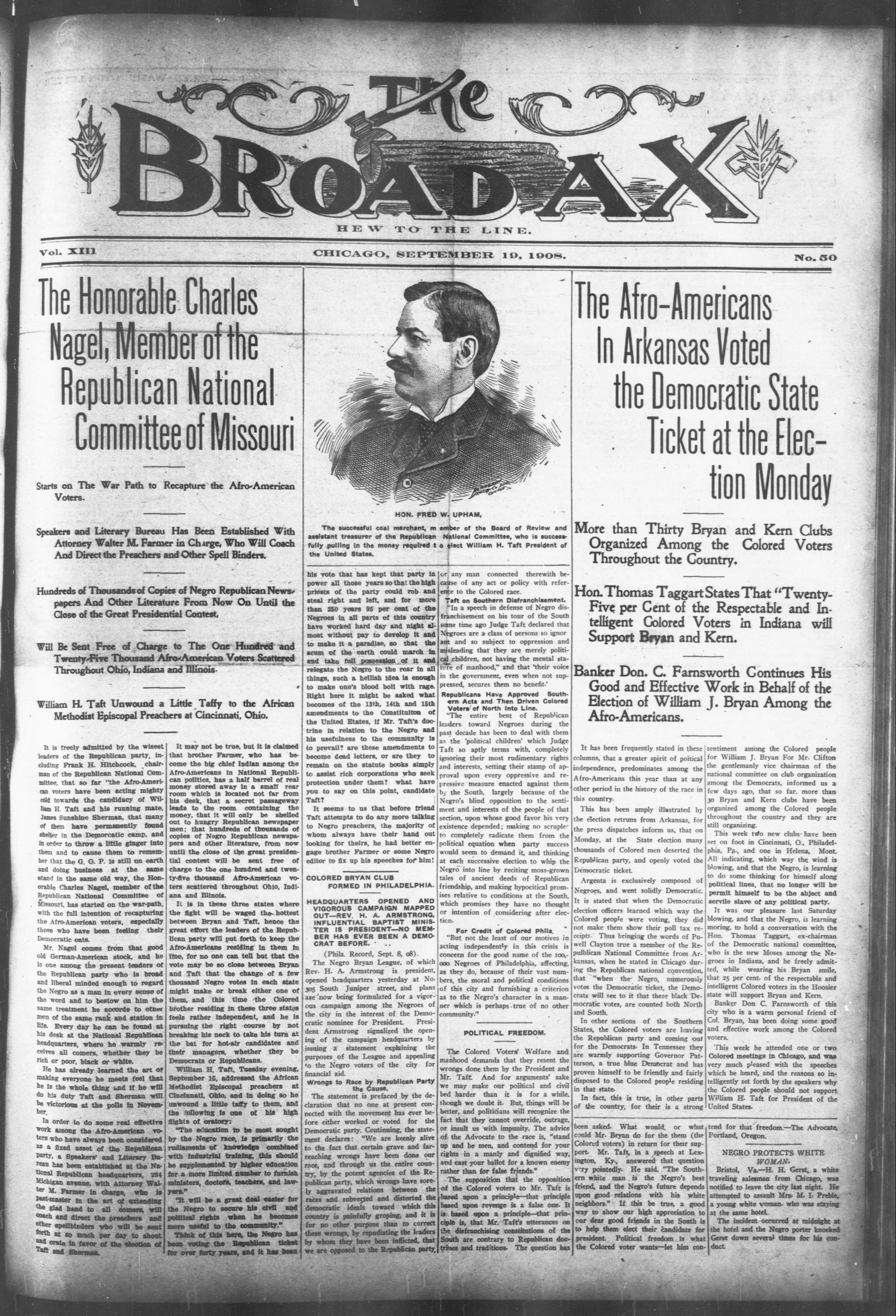
The Honorable Charles Nagel, Member of the Republican National Committee of Missouri
Starts on The War Path to Recapture the Afro-American Voters.
Speakers and Literary Bureau Has Been Established With Attorney Walter M. Farmer in Charge, Who Will Coach And Direct the Preachers and Other Spell Binders.
Hundreds of Thousands of Copies of Negro Republican Newspapers And Other Literature From Now On Until the Close of the Great Presidential Contest.
Will Be Sent Free of Charge to The One Hundred and Twenty-Five Thousand Afro-American Voters Scattered Throughout Ohio, Indiana and Illinois.
William H. Taft Unwound a Little Taffy to the African Methodist Episcopal Preachers at Cincinnati, Ohio.
Vol. XII]
The Honorable
Nagel, Mem
Republican
Committe
Starts on The War Path to
Voters.
Speakers and Literary Bureau
Attorney Walter M. Farm
And Direct the Preachers
Hundreds of Thousands of Cop
papers And Other Literat
Close of the Great Presiden
Will Be Sent Free of Charge
Twenty-Five Thousand A
Throughout Ohio, Indiana
William H. Taft Unwound a
Methodist Episcopal Preach
It is freely admitted by the wisest leaders of the Republican party, including Frank H. Hitchcock, chairman of the Republican National Committee, that so far "the Afro-American voters have been acting mighty cold towards the candidacy of William H. Taft and his running mate, James Sunshine Sherman, that many of them have permanently found shelter in the Demorcatic camp, and in order to throw a little ginger into them and to cause them to remember that the G. O. P. is still on earth and doing business at the same stand in the same old way, the Honorable Charles Nagel, member of the Republican National Committee of Missouri, has started on the war-path, with the full intention of recapturing the Afro-American voters, especially those who have been feeling their Democratic oats.
Mr. Nagel comes from that good old German-American stock, and he is one among the present leaders of the Republican party who is broad and liberal minded enough to regard the Negro as a man in every sense of the word and to bestow on him the same treatment he accords to other men of the same rank and station in life. Every day he can be found at his desk at the National Republican headquarters, where he warmly receives all comers, whether they be rich or poor, black or white.
He has already learned the art of making everyone he meets feel that he is the whole thing and if he will do his duty Taft and Sherman will be victorious at the polls in November.
In order to do some real effective work among the Afro-American voters who have always been considered as a fixed asset of the Republican party, a Speakers' and Literary Bureau has been established at the National Republican headquarters, 254 Michigan avenue, with Attorney Walter M. Farmer in charge, who is past-master in the art of extending the glad hand to all comers, will coach and direct the preachers and other spellbinders who will be sent forth at so much per day to shout and orate in favor of the election of Taft and Sherman.
It may not be true, but it is claimed that brother Farmer, who has become the big chief Indian among the Afro-Americans in National Republican politics, has a half barrel of real money stored away in a small rear room which is located not far from his desk, that a secret passageway leads to the room containing the money, that it will only be shelled out to hungry Republican newspaper men; that hundreds of thousands of copies of Negro Republican newspapers and other literature, from now until the close of the great presidential contest will be sent free of charge to the one hundred and twenty-five thousand Afro-American voters scattered throughout Ohio, Indiana and Illinois.
It is in these three states where the fight will be waged the hottest between Bryan and Taft, hence the great effort the leaders of the Republican party will put forth to keep the Afro-Americans residing in them in line, for no one can tell but that the vote may be so close between Bryan and Taft that the change of a few thousand Negro votes in each state might make or break either one of them, and this time the Colored brother residing in these three states feels rather independent, and he is pursuing the right course by not breaking his neck to take his turn at the bat for hot-air candidates and their managers, whether they be Democrats or Republicans.
William H. Taft, Tuesday evening, September 15, addressed the African Methodist Episcopal preachers at Clincinnati, Ohio, and in doing so he unwound a little taffy to them, and the following is one of his high flights of oratory:
"The education to be most sought by the Negro race, is primarily the rudiments of knowledge combined with industrial training, this should be supplemented by higher education for a more limited number to furnish ministers, doctors, teachers, and lawyers."
"It will be a great deal easier for the Negro to secure his civil and political rights when he becomes more useful to the community."
Think of this here, the Negro has been voting the Republican ticket for over forty years, and it has been
HEW TO THE LINE.
CHICAGO, SEPTEMBER 19, 1908.
The successful coal merchant, member of the Board of Review and assistant treasurer of the Republican National Committee, who is successfully pulling in the money required to elect William H. Taft President of the United States.
his vote that has kept that party in power all those years so that the high priests of the party could rob and steal right and left, and for more than 250 years 95 per cent of the Negroes in all parts of this country have worked hard day and night almost without pay to develop it and to make it a paradise, so that the scum of the earth could march in and take full possession of it and relegate the Negro to the rear in all things, such a hellish idea is enough to make one's blood boil with rage. Right here it might be asked what becomes of the 13th, 14th and 15th amendments to the Constitution of the United Etates, if Mr. Taft's doctrine in relation to the Negro and his usefulness to the community is to prevail? are these amendments to become dead letters, or are they to remain on the statute books simply to assist rich corporations who seek protection under them? what have you to say on this point, candidate Taft?
or any man connected therewith because of any act or policy with reference to the Colored race.
Taft on Southern Disfranchisement.
"In a speech in defense of Negro disfranchisement on his tour of the South some time ago Judge Taft declared that Negroes are a class of persons so ignorant and so subject to oppression and misleading that they are merely political children, not having the mental state of manhood," and that "their voice in the government, even when not suppressed, secures them no benefit."
Republicans Have Approved Southern Acts and Then Driven Colored Voters of North Into Line.
"The entire bent of Republican leaders toward Negroes during the past decade has been to deal with them as the 'political children' which Judge Taft so aptly terms with, completely ignoring their most rudimentary rights and interests, setting their stamp of ap proval upon every oppressive and repressive measure enacted against them by the South, largely because of the Negro's blind opposition to the senti
It seems to us that before friend Taft attempts to do any more talking to Negro preachers, the majority of whom always have their hand out looking for theirs, he had better engage brother Farmer or some Negro editor to fix up his speeches for him!
COLORED BRYAN CLUB
HEADQUARTERS OPENED AND VIGOROUS CAMPAIGN MAPPED OUT—REV. H. A. ARMSTRONG, INFLUENTIAL BAPTIST MINISTER IS PRESIDENT—NO MEMBER HAS EVER BEEN A DEMOCRAT BEFORE. . .
(Phila. Record, Sept. 8, 08).
The Negro Bryan League, of which Rev. H. A. Armstrong is president, opened headquarters yesterday at No. 305 South Juniper street, and plans are now being formulated for a vigorous campaign among the Negroes of the city in the interest of the Democratic nominee for President.
President Armstrong signalized the opening of the campaign headquarters by issuing a statement explaining the purposes of the League and appealing to the Negro voters of the city for financial aid.
Wrongs to Race by Republican Party the Cause.
The statement is prefaced by the declaration that no one at present connected with the movement has ever before either worked or voted for the Democratic party. Continuing, the statement declares: "We are keenly alive to the fact that certain grave and far-reaching wrongs have been done our race, and through us the entire country, by the potent agencies of the Republican party, which wrongs have sorely aggravated relations between the races and subverted and distorted the democratic ideals toward which this country is painfully groping, and it is for no other purpose than to correct these wrongs, by repudiating the leaders by whom they have been inflicted, that we are opposed to the Republican party
or any man connected therewith because of any act or policy with reference to the Colored race.
Taft on Southern Disfranchisement.
"In a speech in defense of Negro disfranchisement on his tour of the South some time ago Judge Taft declared that Negroes are a class of persons so ignorant and so subject to oppression and misleading that they are merely political children, not having the mental stature of manhood," and that 'their voice in the government, even when not suppressed, secures them no benefit.'
Republicans Have Approved Southern Acts and Then Driven Colored Voters' of North Into Line.
"The entire bent of Republican leaders toward Negroes during the past decade has been to deal with them as the 'political children' which Judge Taft so aptly terms with, completely ignoring their most rudimentary rights and interests, setting their stamp of approval upon every oppressive and repressive measure enacted against them by the South, largely because of the Negro's blind opposition to the sentiment and interests of the people of that section, upon whose good favor his very existence depended; making no scruple to completely radiate them from the political equation when party success would seem to demand it, and thinking at each successive election to whip the Negro into line by reciting moss-grown tales of ancient deeds of Republican friendship, and making hypocritical promises relative to conditions at the South, which promises they have no thought or intention of considering after election.
For Credit of Colored Phila.
"But not the least of our motives in acting independently in this crisis is concern for the good name of the 100,000 Negroes of Philadelphia, affecting as they do, because of their vast numbers, the moral and political conditions of this city and furnishing a criterion as to the Negro's character in a manner which is perhaps true of no other community."
POLITICAL FREEDOM.
The Colored Voters' Welfare and manhood demands that they resent the wrongs done them by the President and Mr. Taft. And for arguments' sake we may make our political and civil bed harder than it is for a while, though we doubt it. But, things will be better, and politicians will recognize the fact that they cannot override, outrage, or insult us with impunity. The advice of the Advocate to the race is, "stand up and be men, and contend for your rights in a manly and dignified way, and cast your ballot for a known enemy rather than for false friends."
The supposition that the opposition of the Colored voters to Mr. Taft is based upon a principle—that principle based upon revenge is a false one. It is based upon a principle—that principle is, that Mr. Taft's utterances on the disfranchising constitutions of the South are contrary to Republican doctrines and traditions. The question has
The Afro-Americans In Arkansas Voted the Democratic State Ticket at the Elec tion Monday
More than Thirty Bryan and Kern Clubs Organized Among the Colored Voters Throughout the Country.
Hon. Thomas Taggart States That "Twenty Five per Cent of the Respectable and Intelligent Colored Voters in Indiana will Support Bryan and Kern.
Banker Don. C. Farnsworth Continues His Good and Effective Work in Behalf of the Election of William J. Bryan Among the Afro-Americans.
It has been frequently stated in these columns, that a greater spirit of political independence, predominates among the Afro-Americans this year than at any other period in the history of the race in this country.
This has been amply illustrated by the election retruns from Arkansas, for the press dispatches inform us, that on Monday, at the State election many thousands of Colored men deserted the Republican party, and openly voted the Democratic ticket.
Argenta is exclusively composed of Negroes, and went solidly Democratic. It is stated that when the Democratic election officers learned which way the Colored people were voting, they did not make them show their poll tax receipts. Thus bringing the words of Powell Clayton true a member of the Republican National Committee from Arkansas, when he stated in Chicago during the Republican national convention, that "when the Negro, numerously votes the Democratic ticket, the Democrats will see to it that these black Democratic votes, are counted both North and South.
In other sections of the Southern States, the Colored voters are leaving the Republican party and coming out for the Democrats. In Tennessee they are warmly supporting Governor Patterson, a true blue Democrat and has proven himself to be friendly and fairly disposed to the Colored people residing in that state.
In fact, this is true, in other parts of the country, for their is a strong been asked. What would or what could Mr. Bryan do for the them (the Colored voters) in return for their support. Mr. Taft, in a speech at Lexington, Ky., answered that question very pointedly. He said, "The Southern white man is the Negro's best friend, and the Negro's future depends upon good relations with his white neighbors." If this be true, a good way to show our high appreciation to our dear good friends in the South is to help them elect their candidate for president. Political freedom is what the Colored voter wants—let him con-
No.50
Americans has Voted Democratic State at the Elec- tion Monday
Bryan and Kern Clubs in the Colored Voters country.
States That "Twenty- e Respectable and In- oters in Indiana will Kern.
worth Continues His Work in Behalf of the J. Bryan Among the
sentiment among the Colored people for William J. Bryan For Mr. Clifton the gentlemanly vice chairman of the national committee on club organization among the Democrats, informed us a few days ago, that so far, more than 30 Bryan and Kern clubs have been organized among the Colored people throughout the country and they are still organizing.
This week two new clubs have been set on foot in Cincinnati, O., Philadelphia, Pa., and one in Helena, Mont. All indicating, which way the wind is blowing, and that the Negro, is learning to do some thinking for himself along political lines, that no longer will he permit himself to be the object and servile slave of any political party.
It was our pleasure last Saturday blowing, and that the Negro, is learning moring, to hold a conversation with the Hon. Thomas Taggart, ex-chairman of the Democratic national committee, who is the new Moses among the Negroes in Indiana, and he freely admitted, while wearing his Bryan smile, that 25 per cent. of the respectable and intelligent Colored voters in the Hoosier state will support Bryan and Kern.
Banker Don C. Farnsworth of this city who is a warm personal friend of Col. Bryan, has been doing some good and effective work among the Colored voters.
This week he attended one or two Colored meetings in Chicago, and was very much pleased with the speeches which he heard, and the reasons so intelligently set forth by the speakers why the Colored people should not support William H. Taft for President of the United States.
tend for that freedom.—The Advocate, Portland, Oregon.
Bristol, Va.-H. H. Gerst, a white traveling salesman from Chicago, was notified to leave the city last night. He attempted to assault Mrs. M. I. Preble, a young white woman who was staying at the same hotel. The incident occurred at midnight at the hotel and the Negro porter knocked Gerst down several times for his conduct.
THE BROAD AX
Will promulgate and at all times uphold the true principles of Democracy, but Catholics, Protestants, Priests, Inhabitants, Templar Populists, anyone else can have their say, as long as their language is proper and responsibility is fixed.
The Broad Ax is a newspaper whose platform is broad enough for all, ever claiming the editorial right to speak its own mind.
Local communications will receive attention. Write only on one side of the paper.
Subscriptions must be paid in advance.
One Year.....$2.00
Six Months.....1.00
Advertising rates made known on application.
THE BROAD AX
5038 Armour Avenue, Chicago.
JULIUS F. TAYLOR, Editor and Publisher.
Entered as Second-Class Matter,
Aug. 19, 1902 at the Post Office at
Chicago, Illinois, under Act of March
3, 1879.
TAFT MUST PROMISE EVEN-
HANDED JUSTICE.
The Sandusky, Ohio, Register speaks of Mr. Taft's weakness in this manner: "One of the weak spots is the Brownsville affair, for which his chief and not himself is directly responsible. It is true that Taft, as the Secretary of War and the servant of Roosevelt, submitted and in a certain sense endorsed the President's action in disgracefully discharging from the service three companies of Colored soldiers, but it is possible for Taft to surmount that difficulty. One of the leading Colored men and Republicans of New York says that the Colored men realize that there is little or no hope for their race in the event of a Democrat election, but that the Brownsville question still rankles in every Negro's heart, and the Negroes will not drop it. They expect that the order of Roosevelt will be rescinded by Taft if he is elected, and they propose to call on him through a committee that cannot be questioned to exact a promise to help the dismissed soldiers back to their places. The Colored man recalls the fact that even as Secretary of War, while Roosevelt was in Panama, the Secretary held up the order dismissing the soldiers, but he was promptly overruled by the President and submitted. It Taft should say to the Colored men that he will rescind that order if he is elected President, or, to put it in milder form, that he will see that even-handed justice is done them, and that no innocent man shall be punished for the sins of others, he will go a long ways toward placating the Colored ranks of the Republican party, where they naturally belong, but no Colored man who respects himself and his race ought to support Taft without a satisfactory statement from the candidate that if elected he will see that justice is done the black man as well as the white man, and that they shall be treated alike so far as the Presidnet of the United States has the power to treat them.
There is a broad feeling among them, and it is shared by thousands upon thousands of white men, that Theodore Roosevelt would not have dismissed three companies of white soldiers from the service in disgrace and deprived them of their vested rights as soldiers as he did those black men, that he would not have dared to do so, and that if he had a storm of indignation would have arisen among the white men of the country that would have made life a burden to him. We do not believe in speaking of dignitaries, but we have no hesitation in saying that a more disgraceful act was never committed officially by a President of the United States than the President's treatment of the black men.
HOLD NEGRO ON GIRLS' CHARGE.
Black Accused of Insulting Frances Poruba and Marion Wilder While Shining Their Shoes.
Sam Davis, a 19 year old Negro, was arrested by the town hall police yesterday afternoon on the charge of insulting two young girls whose shoes he was shining.
Frances Poruba, 14 years old, daughter of Mrs. Albina Wilder, 2561 Kimbell avenue, and Marion Wilder, 11 years old, daughter of Mrs. Anna Stern, 1266 Sheridan road, told Acting Lieutenant John J. Benson that the Negro had not attempted to lay hands on them, but had talked to them in a too familiar manner.
Davis is employed by Herman Johnsno, another Colored man, who owns a shoe shining shop on Evanston avenue north of Irving Park boulevard. Mrs. Johnson has told the Poruba girl that she and her friend could have their shoes shined free, and when they entured the shop they found Davis there alone. He told the Wilder girl she ought to
have a sweetheart, and while he was busy with Frances Poruba's shoes he asked her to adjust her skirts in a manner which she resented.
In the afternoon the two children met Patrolman Doran, whom they knew, and told him the story. He arrested Davis, and after Lieut. Benson had investigated, he had the Neerro booked on disorderly conduct—Chicago Tribune, Sept. 13.
Parents of young girls should keep them at home and teach them, to polish their own shecos, for there are thousands of fresh young girls in all parts of this city, who think it is smart to set up in bootchair chairs, pull their dresses and skirts high up, so that their legs will be exposed to public view, and if the mothers of these girls, who claimed, that they have been insulted by a Colored bootblack would keep them home the chances are that they would be much better off n every way. For many girls think they can make a mash on girls are prone to be very fresh if they think they can make a mash, on some man whom they think will spend a little money on them.
The Democratic State Convention, held forth at Rochester, New York, Tuesday and Wednesday of this week, and after a red hot contest between the factions led by Charles F. Murphy, head of Tammany Hall, New York, and State Senator Patrick McCarren, political boss of Brooklyn, the following ticket was nominated: For Governor, Lewis Stuyvesant Chamler. For Lieutenant-Governor, John A. Dix. For Secretary of State, John S. Whalen. For Controller, Martin H. Glynn. For Attorney-General, George M. Palmer. For Treasurer, Julius Hanser. For State Engineer and Surveyor, P. P. Farley.
The nominee for Governor, Lewis Stuyvesant Chanler, is one of the most popular and strongest leaders of his party in the state.
He was elected Lieutenant-Governor two years ago, and now the people of New York can witness the spectacle of their present Governor and Lieutenant-Governor running against each other on opposition tickets.
Mr. Chanler has made a splendid state official, and the chances are ten to one that he will put Governor Hughes out of business the 3rd of November.
Col. William J. Bryan addressed the convention on the last night of its labors and was well pleased with the selections it made and thought the ticket would be a winner. He also warmly expressed his satisfaction over the way he has been received during his tour through the east.
GOVERNOR CHARLES E. HUGHES
HEADS THE REPUBLICAN
The first of the week the Republican State Convention of New York convened at Saratoga, and in accordance with the command of Boss Theodore Roosevelt, Governor Charles E. Hughes was re-nominated and the following ticket selected to go down to defeat with him:
For Governor, Charles E. Hughes.
For Lieutenant-Governor, Horace White.
For Secretarw of State, Samuel S. Koenig.
For Attorney-General, Edward R. O'Malley.
For Controller, Charles H. Gaus.
For State Engineer and Surveyor, Frank M. Williams.
For State Treasurer, Thomas B. Dunn.
For Associate Justice of the Court of Appeals, Albert Haight.
NEGROES ORGANIZE FOR CHAFIN
Wesley Edwards, Who Was Saved from Mob by Prohibition Candidate, Leads the Move.
Wesley L. Edwards, the Negro who was saved from a Springfield mob by Eugene W. Chafin, the prohibition candidate for president, has been elected president of the Chafin Prohibition club. The club, which has an initial membership of forty, will seek to organize Chicago Negroes to support the prohibition ticket. Its plan of campaign will be announced at a meeting at 5524 Lake avenue on Sept. 28.
This is a good move on the part of Mr. Edwards, for just as long as the Negro, is bunched like sheep in the Republican party, he never will amount to anything politically but when he begins to divide up, the leaders of all the political parties will seek his vote—editor.
[Name]
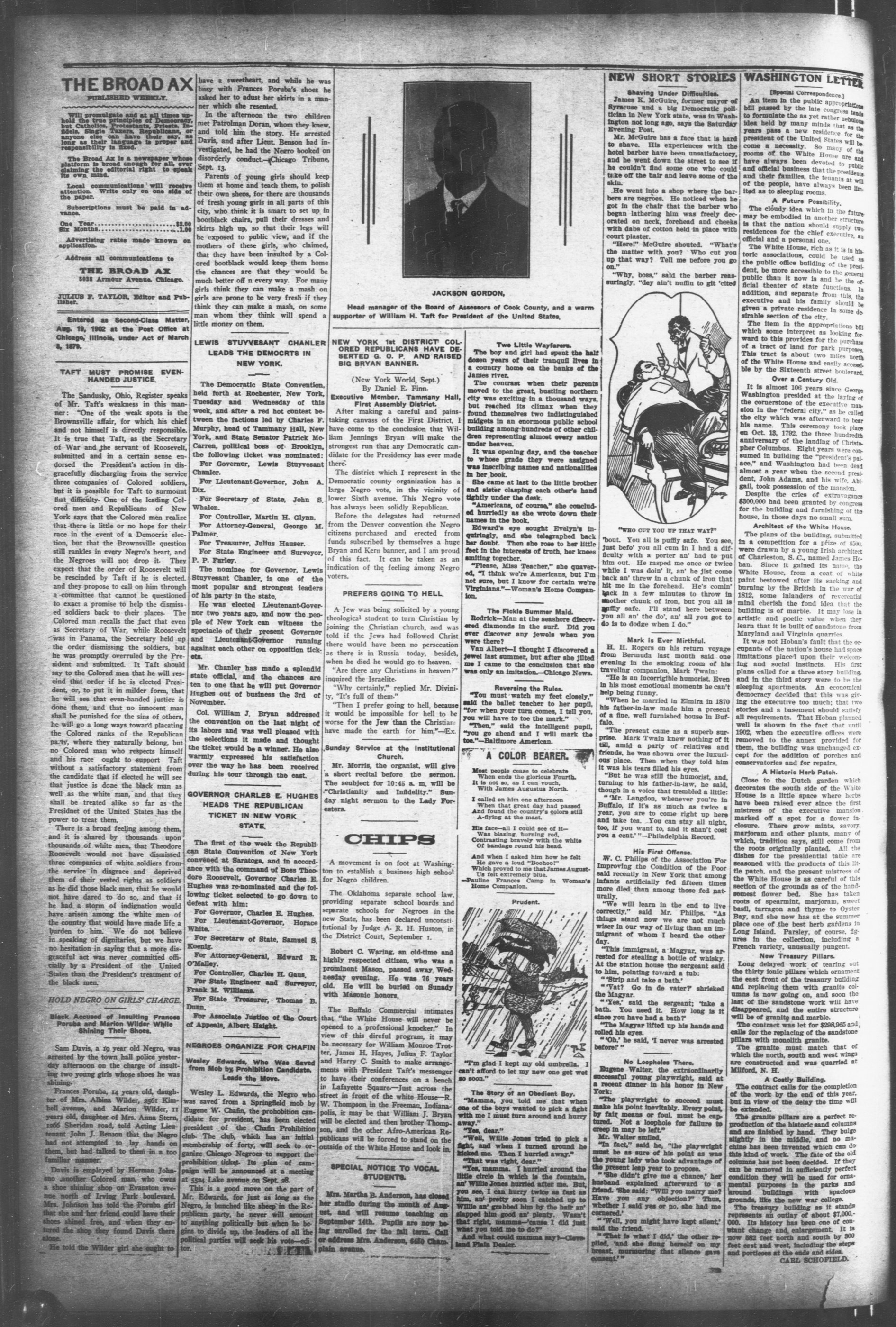
JACKSON GORDON,
Head manager of the Board of Assessors of Cook County, and a warm supporter of William H. Taft for President of the United States
NEW YORK 1st DISTRICT COL
ORED REPUBLICANS HAVE DE
SERTED G. O. P. AND RAISED
BIG BryAN BANNER.
Executive Member, Tammany Hall, First Assembly District.
After making a careful and painstaking canvass of the First District, I have come to the conclusion that William Jennings Bryan will make the strongest run that any Democratic candidate for the Presidency has ever made there.
The district which I represent in the Democratic county organization has a large Negro vote, in the vicinity of lower Sixth avenue. This Negro vote has always been solidly Republican.
Before the delegates had returned from the Denver convention the Negro citizens purchased and erected from funds subscribed by themselves a huge Bryan and Kern banner, and I am proud of this fact. It can be taken as an indication of the feeling among Negro voters.
PREFERS GOING TO HELL.
A Jew was being solicited by a young theological student to turn Christian by joining the Christian church, and was told if the Jews had followed Christ there would have been no persecution as there is in Russia today, besides, when he died he would go to heaven.
"Are there any Christians in heaven?" inquired the Israelite.
"Why certainly," replied Mr. Divinity, "It's full of them."
"Then I prefer going to hell, because it would be impossible for hell to be worse for the Jew than the Christian have made the earth for him."—Ex.
Sunday Service at the Institutional Church.
Mr. Morris, the organist, will give a short recital before the sermon. The subject for 10:45 a.m. will be "Christianity and Infidelity." Sunday night sermon to the Lady Foresters.
CHIPS
CHIPS
A movement is on foot at Washington to establish a business high school for Negro children.
The Oklahoma separate school law, providing separate school boards and separate schools for Negroes in the new State, has been declared unconstitutional by Judge A. R. H. Huston, in the District Court, September 1.
Robert C. Waring, an old-time and highly respected citizen, who was a prominent Mason, passed away Wednesday evening. He was 76 years old. He will be buried on Sunady with Masonic honors.
The Buffalo Commercial intimates that "the White House will never be opened to a professional knocker." In view of this direful program, it may be necessary for William Monroe Trotter, James H. Hayes, Julius F. Taylor and Harry C. Smith to make arrangements with President Taft's messenger to have their conferences on a bench in Lafayette Sqaure—Just across the street in front of the white House—R. W. Thompson in the Freeman, Indianapolis, it may be that William J. Bryan will be elected and then brother Thompson, and the other Afro-American Republicans will be forced to stand on the outside of the White House and look in.
SPECIAL NOTICE TO VOCAL STUDENTS.
Mrs. Martha B. Anderson, has closed her studio during the month of August, and will resume teaching on September 14th. Pupils are now being enrolled for the fall term. Call or address Mrs. Anderson, 6450 Champlain avenue.
---
Two Little Wayfarers.
The boy and girl had spent the half dozen years of their tranquil lives in a country home on the banks of the James river.
The contrast when their parents moved to the great, busiling northern city was exciting in a thousand ways, but reached its climax when they found themselves two indistinguished midgets in an enormous public school building among-hundreds of other children representing almost every nation under heaven.
It was opening day, and the teacher to whose grade they were assigned was inscribing names and nationalities in her book.
She came at last to the little brother and sister clasping each other's hand tightly under the desk.
"Americans, of course," she concluded hurriedly as she wrote down their names in the book.
Edward's eye sought Evelyn's inquiringly, and she telegraphed back her doubt. Then she rose to her little feet in the interests of truth, her knees smiling together.
"Please, Miss Teacher," she quavered, "I think we're Americans, but I'm not sure, but I know for certain we're Virginians."—Woman's Home Companion.
The Fickle Summer Maid.
Rodrick-Man at the seashore discovered diamonds in the surf. Did you ever discover any jewels when you were there? Van Albert-I thought I discovered a jewel last summer, but after she flipped me I came to the conclusion that she was only an imitation-Chicago News.
Reversing the Rules
"You must watch my feet closely," said the ballet teacher to her pupil, "for when your turn comes, I tell you, you will have to toe the mark." "Then," said the intelligent pupil, "you go ahead and I will mark the toe." -Baltimore American.
A COLOR BEARER.
Most people cease to celebrate
When ends the glorious Fourth.
It is not so, as I can vouch,
With James Augustus North.
I called on him one afternoon
When that great day had passed
And found the country's colors still
A-flying at the mast.
His face—all I could see of it—
Was blasting, ringing, red.
Contrasting bravely with the white
Of bandage round his head.
And when I asked how he felt
He gave a loud "Boohoo!"
Which proved to me that James Augustus
was clearly blue.
-Pauline Frances Camp in Woman's
Home Companion.
"I'm glad I kept my old umbrella. I can't afford to let my new one get wet so soon."
"Mamma, you told me that when one of the boys wanted to pick a fight with me I must turn around and hurry away."
"Yes, dear."
"Well, Willie Jones tried to pick a fight, and when I turned around he kicked me. Then I hurried away."
"That was right, dear."
"Yes, mamma. I hurried around the little circle in which is the fountain, an' Willie Jones hurried after me. But you see, I can hurry twice as fast as him, an' pretty soon I catched up to Willie an' grabbed him by the half an' slapped him good an' plenty. W wasn't that right, mamma—cause I did just what you told me to do?"
And what could mamma say?—Cleveland Plain Dealer.
---
Shaving Under Difficulties.
James K. McGuire, former mayor of Syracuse and a big Democratic politician in New York state, was in Washington not long ago, says the Saturday Evening Post.
Mr. McGuire has the face that is hard to shave. His experiences with the hotel barber have been unsatisfactory, and he went down the street to see if he couldn't find one who could take off the hair and leave some of the skin.
He went into a shop where the barbers are negroes. He noticed when he got in the chair that the barber who began lathering him was freely decorated on neck, forehead and cheeks with dabs of cotton held in place with court plaster.
"Here!" McGuire shouted. "What's the matter with you? Who cut you up that way? Tell me before you go on."
"Why, boss," said the barber reassuringly, "dey ain't nuffin to sit' cited
A barber shaves a man's hair.
"WHO CUT YOU UP THAT WAY?"
'bout. You all is puffy safe. You see, just befo' you all cum in I had a difficulty with a porter an' had to put him out. He rasped me once or twice while I was doin' it, an' he jist come back an' threw in a chunk of iron that hit me in the forehead. He's comin' back in a few minutes to throw in another chunk of iron, but you all is puffy safe. I'll stand here between you all an' the do', an' all you got to do is to dodge when I do."
Mark Is Ever Mirthful.
H. H. Rogers on his return voyage from Bermuda last month said one evening in the smoking room of his traveling companion, Mark Twain: "He is an incorrigible humorist. Even in his most emotional moments he can't help being funny. "When he married in Elmira in 1870 his father-in-law made him a present of a fine, well furnished house in Buffalo. "The present came as a superb surprise. Mark Twain knew nothing of it till, amid a party of relatives and friends, he was shown over the luxurious place. Then when they told him it was his tears filled his eyes.
"But he was still the humorist, and, turning to his father-in-law, he said, though in a voice that trembled a little: "Mr. Langdon, whenever you're in Buffalo, if it's as much as twice a year, you are to come right up here and take tea. You can stay all night, too, if you want to, and it shouldn't cost you a cent."—Philadelphia Record.
His First Offense
W. C. Philips of the Association For Improving the Condition of the Poor said recently in New York that among infants artificially fed fifteen times more died than among those fed naturally. "We will learn in the end to live correctly," said Mr. Philips. "As things stand now we are not much wiser in our way of living than an immigrant of whom I heard the other day. "This immigrant, a Magyar, was arrested for stealing a bottle of whisky. At the station house the sergeant said to him, pointing toward a tub:
"Strip and take a bath."
"Yat? Go in de vater?" shrieked the Magyar.
"Yes,' said the sergeant; 'take a bath. You need it. How long is it since you have had a bath?"
"The Magyar lifted up his hands and rolled his eyes.
"Oh,' he said, 'I never was arrested before!"
Eugene Walter, the extraordinarily successful young playwright, said at a recent dinner in his honor in New York:
"The playwright to succeed must make his point inevitably. Every point, by fair means or foul, must be captured. Not a loophole for failure to creep in may be left."
Mr. Walter smiled.
"In fact," said he, "the playwright must be as sure of his point as was the young lady who took advantage of the present leap year to propose.
"She didn't give me a chance,' her husband explained afterward to a friend. 'She said: "Will you marry me? Have you any objection?" Thus, whether I said yes or no, she had me cornered.'
"Well, you might have kept silent," said the friend.
"That is what I did," the other replied, "and she fung herself on my breast, murmuring that silence gave expect!"
[Special Correspondence]
An item in the public appropriations bill passed by the late congress tends to formulate the as yet rather nebulous idea held by many minds that as the years pass a new residence for the president of the United States will become a necessity. So many of the rooms of the White House are and have always been devoted to public and official business that the presidents and their families, the tenants at will of the people, have always been limited as to sleeping rooms.
A Future Possibility
The cloudy idea which in the future may be embodied in another structure is that the nation should supply two residences for the chief executive, an official and a personal one.
The White House, rich as it is in historic associations, could be used as the public office building of the president, be more accessible to the general public than it now is and be the official theater of state functions. In addition, and separate from this, the executive and his family should be given a private residence in some desirable section of the city.
The item in the appropriations bill which some interpret as looking forward to this provides for the purchase of a tract of land for park purposes. This tract is about two miles north of the White House and easily accessible by the Sixteenth street boulevard.
Over a Century Old.
It is almost 106 years since George Washington presided at the laying of the cornerstone of the executive mansion in the "federal city," as he called the city which was afterward to bear his name. This ceremony took place on Oct. 13, 1792, the three hundredth anniversary of the landing of Christopher Columbus. Eight years were consumed in building the "president's palace," and Washington had been dead almost a year when the second president, John Adams, and his wife, Abigail, took possession of the mansion. Despite the cries of extravagance $300,000 had been granted by congress for the building and furnishing of the house, in those days no small sum.
Architect of the White House
The plans of the building, submitted in a competition for a pize of $500, were drawn by a young Irish architect of Charleston, S. C., named James Hoban. Since it gained its name, the White House, from a coat of white paint bestowed after its sacking and burning by the British in the war of 1812, some inlanders of reverential mind cherish the fond idea that the building is of marble. It may lose in artistic and poetic value when they learn that it is built of sandstone from Maryland and Virginia quarries.
It was not Hoban's fault that the occupants of the nation's house had space limitations placed upon their welcoming and social instincts. His first plans called for a three story building, and in the third story were to be the sleeping apartments. An economical democracy decided that this was giving the executive too much; that two stories and a basement should satisfy all requirements. That Hoban planned well is shown in the fact that until 1902, when the executive offices were removed to the annex provided for them, the building was unchanged except for the addition of porches and conservatories and for repairs.
A Historic Herb Patch.
Close to the Dutch garden which decorates the south side of the White House is a little space where herbs have been raised ever since the first mistress of the executive mansion marked off a spot for a flower incclosure. There grow mints, savory, marjoram and other plants, many of which, tradition says, still come from the roots originally planted. All the dishes for the presidential table are seasoned with the products of this little patch, and the present mistress of the White House is as careful of this section of the grounds as of the handsome flower bed. She has taken roots of spearmint, marjoram, sweet basil, tarragon and thyme to Oyster Bay, and she now has at the summer place one of the best herb gardens in Long Island. Parsley, of course, figures in the collection, including a French variety, unusually pungent.
New Treasury Pillars.
Long delayed work of tearing out the thirty ionic pillars which ornament the east front of the treasury building and replacing them with granite columns is now going on, and soon the last of the sandstone work will have disappeared, and the entire structure will be of granite and marble. The contract was let for $298,965 and calls for the replacing of the sandstone pillars with monolith granite. The granite must match that of which the north, south and west wings are constructed and was quarried at Milford, N. H.
A Costly Building.
The contract calls for the completion of the work by the end of this year, but in view of the delay the time will be extended.
The granite pillars are a perfect reproduction of the historic sand columns and are finished by hand. They bulge slightly in the middle, and no machine has been invented which can do this kind of work. The fate of the old columns has not been decided. If they can be removed in sufficiently perfect condition they will be used for ornamental purposes in the parks and around buildings with spacious grounds, like the new war college.
The treasury building as it stands represents an outlay of about $7,000,000. Its history has been one of constant change and enlargement. It is now 582 feet north and south by 300 feet east and west, including the steps and porticoes at the ends and sides.
CARL SCHOFIELD.
FURNISHED ROOMS TO RENT.
FURNISHED ROOMS TO RENT.
Nicely furnished rooms to rent.
Mrs. G. Johnson, 5238 Dearborn street.
WAMSLEY & SON'S
Bed Bug and Moth Liquid.
Will destroy chicken lice, fleas on cats and dogs, lice on horses and other animals. The liquid is a disinfectant as well as a healer. "Does not stain." The 15c and 25c bottles and 25c packages of Cockroach and Ant Feed are the small orders referred to in our ad. In another column, for which we will accept stamps in payment by out of town orders if desired.
BOOKINGS OF THE LELAND
GIANTS FOR SEPTEMBER.
Sept. 19th—At Gunther Park.
Sept. 20th—Spauldings at Auburn
Park.
Sept. 26th—Rogers Parks at Rogers
Park.
Sept. 27th—Rogers Parks at Auburn
Park.
What Becomes of the Coins?
What becomes of all the metal money? We know that paper money is worn out or destroyed from time to time, but what happens to the coins which Uncle Sam turns out yearly by the tens and tens of millions?
The Philadelphia mint in the fiscal year ended June 30 made 137,133,777 separate pieces of money. These coins are worth $126,755,848. Now, it happens that this same mint has been converting gold and silver bullion or metal alloys into coins for many years, and several other mints in the country have also been working steadily.
If the nation's population increased 1,000,000 in the past year the Philadelphia mint made for each person 137 coins. Who has that money in his possession? More than 81,000,000 pieces of the new money were pennies, so that every citizen of the United States got a new cent since last June.—Philadelphia Press.
New Use For Gum
A member of the firm of Romandka Bros. received an order one day last week that he could not fill.
A woman came into his place of business and handed him a card, on which was a chewing gum model.
"I have lost the key to my trunk," she said, "and I pushed that gum into the lock and got a model of it. I suppose you can make me a key that will unlock my trunk with that model to go by, can you not?" Mr. Romandka owned that he could not. The gum was in a rather pliable condition, he told the customer, from the heat, and he would fit a key by another method. The woman was satisfied, and Mr. Romandka dispatched a man with a bunch of trunk keys to try the lock till he found one which fitted.—Milwaukee Free Press.
Bearded Indians.
It has been written over and over again that the North American Indian was always beardless. New light comes from an unearthed letter from Captain Amos Stoddard, United States arillery and engineers, in 1806, to Dr. Mitchell of New London, Conn., in which Stoddard tells of a tribe of "yellow men, not in the least tawny, who lived near the lake on the west side of the Rocky or Shinning mountains and who wore their beards and a great number of whom had red hair on their heads." They were great experts with the bow and arrow. The lake referred to must have been Flathead lake, in northwestern Montana. — New York Press
Plays and Players.
Doris Mitchell will be Norman Hackett's leading lady in "Classmates." George Broadhurst has written a new play, called "An International Marriage." A dramatization of "David Copperfield" may be produced in Paris the coming season. Dallas Welford is to appear in a new piece under the Shubert management called "Her Highness Radish." Andrew Mack will star the coming season again under the management of William Harris in the repertory including "Arrah-na-Pogue" and a new comedy.
London's One Horse Tram Car-
Bermondsey enjoys the distinction of
possessing the last one horse tram car
in London. It is a curiosity which
should attract "rubber neck" sight-
saws. From Old Kent road to St.
James' church, Bermondsey, this,
the only car on the route, runs slowly
backward and forward all day long,
and the fare is only a halfpenny. It
is a pantomime looking vehicle, low
down on the ground and minns top
south - London Tit-Hits.
Milton's Cottage
In this year, the tercentenary of Bishop's birth, it is interesting to note that the only one of the several houses in which he is known to have lived still exists. That is the little cottage at Chafont St. Giles, where he resided for a time when the plague raged in London in 1605. London Builders.
THE HALL OF FAME
John C. Godding of Gardiner, Me, the oldest living papermaker in New England and probably in the United States, recently celebrated his ninety-fifth birthday.
Bear Admiral Joseph Philibert, the French commander in Moroccan waters, has been promoted to the grade of vice admiral. Bear Admiral Berryer succeeds him in command of the Moroccan division.
James Sherburne Weymouth of Laconia, N. H., is the last survivor of a family of thirteen children, twelve of whom lived to maturity and had families. He has seen seven generations of his maternal family.
Young Cornellius Vanderbilt declares, "The happiest time in my life was when I was wearing overalls in the Baldwin Locomotive works in Philadelphia one hot summer a few years ago studying locomotive construction."
Alvin F. Smith of Montpellier, Vt., aged ninety-three, claims that the use of tobacco has prolonged his life. Luther P. Wood of the same town, aged ninety, disagrees with Mr. Smith, and to prove that he was in good condition Mr. Wood, who has never used tobacco, recently walked two miles.
Andrew Forrester, Sr., eighty-one years old, and his son, Andrew, aged forty-six, recently called at the office of the clerk of the district court, Kansas City, Kan., and took out their first naturalization papers. The senior Forrester has been a resident of the United States for nearly half a century.
Sir Charles Matthews has been appointed by the British government as director of public prosecutions, with a salary of $15,000 a year. He was born in New York, where his father, Charles Matthews, the famous actor, was filling a theatrical engagement at the time, his mother having as Lizzie Davenport also been a footlight favorite.
Charles L. Kimmens of Bolton, Mass., has resigned as town sexton after serving for four years. His brother was sexton four years; his father was sexton forty-five years; Jesse W. Babcock, Mr. Kimmens' stepson, was sexton two years; George Babcock, his brother, was sexton two years, making a total of fifty-seven years that the office has been filled by the Kimmens family.
English Etchings.
The Cremation Society of England has decided to lower its membership fees and otherwise to extend its operations.
The drapery trade has supplied more lord mayors of London than any other business, the total being seventy-four.
The foundation stone of the first skyscraper in England was laid at Liverpool recently. The new building, which will be 300 feet high, is being constructed on a site overlooking the Mersey.
After sixty years of doing without a complete Young Men's Christian association building London, the birthplace of the movement, is to have what it needs in this particular. The new headquarters in Tottenham Court road will be a stately pile of buildings designed by Rowland Plumbe.
Home Notes.
If old keys are kept in a box by themselves some of them will frequently come into play in unlocking a trunk or other receptacle the key to which has been lost.
If your cellar is dark and you are afraid of accidents when going down the steps have the last step whitened so that you will easily know when you are at the bottom. You can see this step plainly in a dim light.
The under oven in the range is a most convenient place in which to keep frons. They may be taken hot from the stove and placed there where they are out of the way. They are usually warm when taken out, thus heating up rapidly.
Pith and Point
Freedom is like blue roses—there is no such thing.
People don't care for explanations and don't believe them.
It is not what you think of your employer, but what your employer thinks of you.
Some men don't know much, but they always know enough to think of the meanest thing.
A grouchy man may not be agreeable, but he is a joy in comparison with the facetious man.
Don't despise the ignorant man. If it were not for him the smart people would not have a chance to show how much they know.-Atkinson Globa.
Plays and Players
Joseph Hart, the well known vandeville top liner, has made a big hit in London. Edward E. Kidder has written a play for Marguerite Clark called "The Moon Child."
A theater in Meriden, Conn., is to be hamed "The Merry Widow." Marie Doré may continue to play abroad, as she has made a big social success in London.
Beguiald Barlow has retired from the stage to enter the ministry. He is a son of the old minstrel, Milton Barlow.
WAITING FOR ANOTHER.
How a Borrower Expects to Square a Debt.
The impecunious man got the attention of a group of friends long enough to tell them a little joke on himself. At first they regarded him with deep suspicion, most of them having suffered more or less from his sorry habit of borrowing. When he had convinced them that he had no designs on their pocketbooks they consented to listen to his story.
"Well," he began, "I have a very dear friend whom I long hesitated to borrow from because of my regrettable absentmindedness in such matters.
[Heavy slighs from the assemblage.]
However, being in desperate straits one day, I mustered up courage to 'touch' him for a five spot. Guess he hadn't heard much about me, for he went right down into his pocket and dug up the requested sum.
"All right, old chap,' said he. 'Any time I can help you out in a pinch I'll be glad to do so.'
"That was some three weeks ago, and of course I had tried to forget it, not having managed to gather the amount of the loan meanwhile. The other morning my friend approached me with a genuinely serious air.
"Say,' he said, 'I had a funny dream last night, and you were in it.'
"That so?' said I. 'What was I doing—returning money that I had borrowed?
"That's just what you were doing in part of the dream,' replied my friend. 'We were at a social gathering, and I could plainly see you hand me the five—by the way,' he broke off, 'have you really paid me that five?'
"No,' I responded, and I could have kicked myself the moment the word escaped my lips.
"Well," said my friend, "that dream made so strong an impression upon me that I was half convinced you had really paid me, and if you had said you did I would not have doubted your word."
"I took very little interest in the remainder of the dream," said the impecunious man sadly.
"Have you paid him yet?" one of the listeners asked.
"No," was the reply. "I am waiting for him to have another dream."—Detroit Free Press.
Hardships of the Very Poor
Little Marion, having few real playmates, has supplied herself with several imaginary ones, with whom she has many surprising experiences. Her mother recently overheard her playing with her large family of dolls and entertaining a visionary caller.
"Yes, Mrs. Smif," she said, heaving a deep sigh. "we are poor-terribly poor. We are so poor that I have to spank my babies to keep them warm." —Woman's Home Companion.
For the Meek Man
"I buy all of John's shirts," said the tall, firm jawed woman, "and I don't allow him to wear loud colors. Show me some subdued shirts."
"Yes, ma'am," hastened the witty clerk. "Just step this way. Here are some subdued shirts for subdued husbands."—Detroit Tribune.
The Trouble
Lowe Comerdy—Yes, Starman, the tragedian, is hopelessly mad.
Hi Tragedry—Overstudy?
Lowe Comerdy—No, his understudy.
He made a bigger hit in the part than
Starman. — Catholic Standard and
Times.
CLICK 'EM
INN
The Parson-Ah, Pat, wasting your money in there again! You ought to put by for a rainy day.
Pat—Sure, thin, Ol'd never spen.' ut at all, at all. It's laid up wd rheumatism Ol am when the weather's wet an' can't go out o' the house. Sketch.
Speed Mania.
"How fast do you usually travel?"
"I don't pay much attention to that."
answered the motorist. "I get most of my excitement in watching the rapidity with which pedestrians move out of my way."—Boston Post.
A Paradox.
"What a flat situation that new house has which Mr. Plungit, the bold speculator, is building for himself."
"Yes, it is flat, and yet he built it on a bluff."—Pittsburg Post.
Agents Wanted
To handle The BROAD AX AND ACT AS CORRESPONDENTS
JULIUS F. TAYLOR; Please enter my name as a subscriber to THE BROAD AX. I herewith enclose $2.00, the annual subscription to same.
PATRICK H. O'DONNELL
WILLIAM DILLON
CLARENCE A. TOOLEN
Tel. Central 4680
O'Donnell, Dillon &
Toolen
ATTORNEYS AT LAW
Suite 1218-1219. Ashland Block
RANDOLPH & CLARK STREETS
GRAY & MORAN
ATTORNEYS AT LAW
Suite 1114 Ashland Block, Clark and Randolph Sts. Tel. Central 569.
CHICAGO.
Residence 57 MoonLister Place
Telephone Ashland 366
Office Telephones
Central 1369
Automatic 5940
MILES J. DEVINE
ATTORNEY AT LAW
Suite 315-320 Reeper Block
CLARK AND WASHINGTON STS.
CHICAGO.
A. D. GASH
Attorney at Law.
84-86 La Bould Street, Chicago
Suite 616 to 619.
Telephone Main 3077.
JOHN E. OWENS
ATTORNEY & COUNSELOR
AT LAW
380. ASHLAND.BLOCK
TELEPHONE CENTRAL 998 CHICAGO
Phone Main 4153 NOTARY PUBLIC
Phone residence, Gray 5670
Walter M. Farmer
ATTORNEY AT LAW
Suite 708, 171 Washington St.
Res., 4556 Langley Av. CHICAGO
Phome Oakland 1828
F. A. Rawlins
The Modern Embalmer
UNDERTAKER AND
FUNERAL DIRECTOR
When his work is finished
you have no displeasure.
4817 State Street CHICAGO
Phone Douglas 1550
Agents
IN THE SOUTH, WEST, AND
COUR
4842 Armour Avenue.
Phone, Blue 6571.
CHICAGO.
Hours: 9 to 12 a. m.; 1 to 4 p. m.; and Nights.
Telephone, Calumet 194
Dr. A. B. Schultz
Hours: 2719 STATE STREET
9 to 12 A. M., 3 to 5 CHICAGO
and after 6 p. m.
C. E. Kreyssler
Chemist and Druggist
5059 STATE STREET
N. E. Cor. 51st St. CHICAGO
Telephones:
Oakland 246 and Oakland 245
Arthur Johnson
Merchant Tailor
Strictly First Class and Up-to-Date
Work as Reasonable Prices
Special Attention Given to Orders for
Cleaning, Pressing, Dyeing and Repairing
Goods Called for. Orders Delivered.
134 W. 51st Street, Chicago
THE
CONTINENTAL
NATIONAL
BANK
OF
CHICAGO
Foreman Bros.
6. E. Cor. LaSalle and Madison Sts.
CAPITAL, - - $500,000
SURPLUS, - - $500,000
Accounts of corporations, firms and individuals are solicited and will be received upon the most favorable terms consistent with conservative banking.
Wanted
OTHER SECTIONS OF THE
ENTRY
Fifty-First St. and Armour Ave.
Ravil Vance
gent St. & I. B. & M. B. Rg.
gent St. and Armour Ave.
CHICAGO
W. R. Cowan A. C. Harris M. C. Cowan
W. R. Cowan & Co.
Real Estate,Loans and Insurance
260 S. CLARK STREET
Tel. Harrison 1075 CHICAGO
ICE CREAM CIGARS, TOBACCO
SHIRT WAISTS KIMONAS
MRS. A. E. BAKER
NOTIONS
419-36TH STREET
Underwear a
Specialty CHICAGO
THE ELITE BUFFET
COOK
Waiters and Cooks
Prefer Our Make
JACKETS AND LINEN
because they have found them
satisfactory.
Write for complete Catalogue
FREE.
giving full instructions how
to order.
Marcus Ruben (Inc.)
390 State St., CHICAGO.
THE BROAD AX.
is for sale at the following news stands:
A. F. Tervalon, 134 W. 51st street
Cigar Store and News Stand.
Geo. L Martin, maker of fine cigars,
and news stand, 342 East St. 1st.
C. H. Green, cigars, tobacco and
news stand, 2718 St. st.
Mrs. Nellie Phelps, Cigars, Notions
and News Stand, 131 W. 51st street.
T. B. Hall's Cigar Store and
Laundry office, 321 29th St.
Mrs. Alma A. Simpson, news agent,
1255 State street.
W. S. Cole, 354 Thirty-first street,
cigars, tobacco and news stand.
J. R. Peters Cigars, 'robacco and
News Stand, 338 E. 27th street.
Mrs. A. E. Baker, Notions and News
Stand, 419, 36th street.
W. P. Johnson, Notion Store and
News Stand 2704 State st.
Turner Williams' Shaving Parlor
and News Stand, 2803 Armour ave.
B. Davia, cigars, tobacco, and con-
fectionery, 3833 State st.
C. C. McLain, cigars, tobacco and
news stand, 2906 State street.
Mrs. J. W. Hadley 116 W. 51st st.
cigars, tobacco and news stand.
Mrs. Katherine R. Hamlet, Cigars,
tobacco, and fancy groceries and news
stand 5028 Armour ave.
M. A. Johnson, stand, cigars
and tobacco, 3812 State Street.
The Informer News Co. 138 Randolph St, Detroit, Mich.
The Standard News Co 121 W. 58rd
st., New York City, N. Y.
Standard News Company, 49 W.
185th street, New York City, N. Y.
10
15
70
16:30
Selections
FISHING FOR OIL
Curious Spectacle on the Coast of California.
In the neighborhood of Summerland, on the coast of California, ten miles south of Santa Barbara, the visitor may behold at the present time a strange and interesting spectacle the like of which was never seen in the world before. It is nothing more or less than a fishery for petroleum.
Out from the smooth, sandy beach and extending at right angles therewith into the ocean are many long docks or piers supporting old derricks. The latter are like any other derricks constructed for such a purpose, but instead of being used to bring up oil from the dry land they are made to serve for fetching the fluid from beneath the waters of the sea.
The piers described are, many of them, of great length, stretching a quarter of a mile or more out into the Pacific, in order to tap the oil bearing strata under the sea. Derricks are set all along the beach itself, upheld by plies, in order that the breakers may flow back and forth beneath them.
One might imagine that the discovery of the oil under the sea came about through observation of petroleum floating on the waves. Such does not seem, however, to have been the case. Prospectors for the precious fluid, having come upon a productive oil field on terra firma in the neighborhood of Summerland, were naturally led down to the ocean beach by the circumstance that the oil producing area appeared to extend in that direction.
Finding that there was oil beneath the very breakers, it occurred to them to seek it farther out.
The petroleum obtained from under the sea is remarkable, like all the oil in the neighborhood, for containing a great deal of asphalt. It is, in fact, very impure and thick owing to this admixture of an extraneous substance. But the asphalt itself is decidedly valuable when separated and is being utilized for paving and other such purposes—Saturday Evening Post.
A Bored Floor.
Mr. Reeder of Kansas told a story to the house of representatives about a Kansas settler and a trick he played. "I think we sent him on to the state of Wyoming," he said. "We have a lot of bad people in our state from Kansas," suggested Mr. Wendell of Wyoming. "This was a pretty smart fellow, and I wonder they did not send him to congress," answered Mr. Reeder. "The law required the settler to build a house with a board floor and a board roof. So he dug into the bank a space of three feet wide and six feet long and put poles across the top for a roof. Then he sharpened a stick and bored holes in the ground of the dugout. Next he bored holes through the roof and made an affidavit that he had a bored floor and a bored roof."—Detroit Free Press.
Many Names of Hingham's Hall
Hingham has one hall with three names, the largest in the town and the one where all the town business is transacted, where Company K, Fifth regiment, M. V. M., has its armory and where the Hingham Agricultural society holds its deliberations.
The hall has the distinction of having three names—Hingham town hall, the armory and agricultural hall. If it is a public performance or town meeting, the notice reads, "At the town hall;" If it is a rose and strawberry show or an agricultural meeting, then they read, "At agricultural hall," and if Company K is drilling or entertaining its friends the invitations say, "At the armory." No other hall in Plymouth county has so many official titles—Boston Herald.
Honduran Hard Wood.
A railroad in Honduras, which has just been opened to traffic as far as Celba, thirty-five miles, was built with crossoled pine ties from the United States. It is worthy of note that, while crossoled pine ties are being shipped from the United States to Honduras, hard woods are coming to the United States from that country. Americans are doing the shipping both ways. A tract of 8,000 acres in Honduras has been secured by an American company, which will cut the mahogany and other valuable hard woods and ship them to the United States—Forest and Stream.
English Musical Taste.
The London Evening News in order to determine the musical taste of the English people asked its readers to name the musical compositions the performance of which gave them the most pleasure. The answers showed these to be the most popular in the order named: The overture to "Tannhause," the overture to "William Tell," Tschalkowak's "1812," Grieg's "Peer Gym Suite," Thomas' "Mignon Gavotte," "The Mikado," Mendelsohn's "Midsummer Night's Dream."
A skyscraper structure, without a nail or a screw in it, has been put up around and above the great southwestern gate of the city of Pekn. It is made entirely of bamboo poles and cords. The enormous scaffolding was necessary for the rebuilding of the Chiswanen gate, which was badly bathed in the Boxer troubles. The new gate is to be an imposing affair, twice the height of the great wall of the famous Chinese city.
CLASS CONSCIOUSNESS.
Pilkins, full of petty hauteur,
Bought a yellow auto motor-
Think of it, a yellow!
hate the yellow!
For his poise "honk" comes bossing
Every time I touch crossing,
And in automobilebess.
There's no honk for "If you please."
So I (by financial rigor)
Bought a yellower and bigger—
Faster also when it please.
And the chair who used me
Wallow in the back behind me.
He's the fellow now who sneezes!
And my "honk" is quite as raucous
In the automobile caucus.
So I wave my hand and bow.
Quite politely to him now.
(P. S.—Why do people visit
On a crosswalk? Say, why is it?)
-Edmund Vance Cooke in Woman's Home
Companion.
On the Highway.
Waggles—Gee, I wonder why dat dorg bit me?
His Friend—Oh, well, dere's no accountin' fer tastes, you know!—St. Louis Post-Dispatch.
Smashing Her Baggage.
A series of terrific crashes against the front door brought the mistress to that exit, and, flinging it open, she beheld standing calmly before it the new cook, her baggage lying about in confusion, while driving off with a black countenance was the baggageman.
"Mercy!" exclaimed the startled mistress. "Why did that rude man hurt your baggage after you like that, Mary? Wouldn't you pay him?"
"Oh, it ain't that, mum; but me last job wor at his house."—Judge.
A Useful Tool.
Gyer—Lots of inventors never fully realize the importance of their inventions.
Myer—Don't they?
Gyer—No. Take the hairpin, for example. It is said the inventor never intended it to be used in dressing the hair—Minneapolis Journal.
A Reason Now.
"Oh, Arizona, will be admitted, all right," said the gentleman from that territory.
"Been turned down pretty regularly, hasn't it?"
"Don't let that worry you. They'll need the name for a battleship now."
—Philadelphia Ledger.
Deluding Himself
Towne- It doesn't seem to have done Gagley any good to join church. He appears to be grouchier than ever since he got religion. Brown-I don't believe he's got it at all. I'll bet what he takes for religion is merely dyspepsia. - Philadelphia Press.
Proverb Practically Applied.
"A man is judged by the company he keeps," said the aphorist.
"Yes," answered the man with a boom. "Which makes it undesirable sometimes to print the names of all the contributors to your campaign fund."-Washington Star.
What He Does.
"Pa, what does a king or an emperor do when he grants anybody an audience?" "He does about what your mother does when she grants me an audience—talks most of the time."—Denver News-Times.
A Churchgoer.
"Do you attend church regularly?" inquired the solitious friend: "I've been a regular churchgoer of late," answered Mr. Cumrox. "Mother and the girls took me on a guidebook tour through Europe." — Washington Star.
The Easiest Way.
"The easiest way to succeed, my boy, is to give the people what they want." "No, sr; you are mistaken. The easiest way to succeed is to make the people think they want what you are giving them."—Chicago Record-Herald.
Signs and Symptoms
"Do you believe the countenance is indicative of character?"
"In some respects. For instance, when you see a hatched faced woman, ten to one you'll find her temper on edge."—Baltimore American.
Man as a Shopper.
A gentleman undertook to purchase a waist for his wife.
"What bust?" inquired the saleswoman.
"Why, I didn't hear anything."—Everybody's.
Not Worth Repeating.
Kind Lady—But that isn't the same story you told me the last time you were here.
The Hobo—Course it ain't. Youse didn't bearlee de odder one.—Chicago News.
Obviously.
"Aunt Hepsy, what do they use invisible hairpins for?"
"To fasten up invisible hair, of course, child."—Town Topics.
Telephone
DOUGLAS ... 1866
JESSE BINGA
INSURANCE
REAL ESTATE LOANS
3637 STATE STREET
CHICAGO.
LEASES NEGOTIATED, EXCHANGES MADE, PROPERTY MANAGED.
ForSale
$4,500—S. W. cor. 57th and La Faye modern, hardwood through
$5,250—6337 Langley Ave., 2 flat brick heat, hardwood through
$9,000—3444-45 Wabash Ave., 2-9 room sell separate. Make term
$2,000—3718 LaSalle St., 6 rooms, f
$2,000—3720 LaSalle St., 2 flat, brick
$2,000—3722 LaSalle St., frame bu
provements.
$2,800—3940 Dearborn St., 2 flat fr
JESSE BINGA, 3637 State
Good Colored Tenants A
AND TREATED AC
Stove Heat
Mr. 57th and La Fayette Ave., 2
hardwood throughout.
Gley Ave., 2 flat brick and stone,
hardwood throughout.
Vabash Ave., 2-9 room stone from
oparate. Make terms.
Walle St., 6 rooms, frame, brick
Walle St., 2 flat, brick and frame,
Walle St., frame building, 6 roo
ments.
Arborn St., 2 flat frame, 5-6 room
3637 State St. Pho
Stored Tenants Always Ade
AND TREATED ACCORDINGLY
Heated
$4,500—S. W. cor. 57th and La Fayette Ave., 2 flats 5-6 rooms, modern, hardwood throughout.
$5,250—6337 Langley Ave., 2 flat brick and stone, 5-6 rooms, steam heat, hardwood throughout.
$9,000—3444-45 Wabash Ave., 2-9 room stone front residences; will sell separate. Make terms.
$2,000—3718 LaSalle St., 6 rooms, frame, brick foundation.
$2,000—3720 LaSalle St., 2 flat, brick and frame, 5-5 rooms.
$2,000—3722 LaSalle St., frame building, 6 rooms, modern improvements.
$2,800—3940 Dearborn St., 2 flat frame, 5-6 rooms, bath.
JESSE BINGA, 3637 State St. Phone, Douglas 1565
Stove Heated Flats
TO SUIT EVERY MAN'S INCOME
I am no Agent. I Rent on
You will save many a weary step
if you first call
MONEY TO LOAN ON REAL ESTATE
Samuel Richardson,
Telephone Main 2183 CHICAGO
(Please out to
Office Phone, Douglas 727
E. JACK
FUNERAL L
2959-61 STATE S
Branch: 1310 Bingham S
Fine Garriages for Hire to P
"CAN'T SLEEP,
WILL YOU scratch and tumble a
and Moth Liquid will clear beds a
vermin? Also kills lice on chicke
gallon, 75c; gallon, $1.25; 5 gallon
of Cockroach and Agt Feed banish
mination of Insects," sent postpaid
for small orders, large by P. O. orc
WAMSLEY & SO
Leland Giants Base-Ball and
Now Organizing—¢
$100,00
The Stock-Holders of the Leland Giants
cluded to dissolve that Association in order to
increased Capital for the purpose of buying a
Giants Base-Ball Club and Establishing For-
lass, Up-To-Date Amusement Park, W
Figure Eight, Shoot The Chutes, Minutur
Pavilion, Roller Skating, Hurley Burley,
Riding, and all the latest fun making devices
together with a First Class Summer Hotel,
guests, at its present location, 79th and Wet
ride on the Electric Cars to the Loop District.
The Public is Base-Ball mad, and amuse
value in a single season. Millions can be ma-
This New Enterprise.
Are You In Favor Of The Race Omene
And Well Paying Plant, Where Me
Be Employed, between May and October of e
out fear and Enjoy The Life and Freedom
The Answer can only be effectively given by s
sition. it has been made purposely low so that
have a Share and Interest in this Twentieth
Shares Only Ten (10.00) Dollars Each. Yo
Any Holiday around Amusement Parks and
wanted and never welcome. Comel buy and
the attached Coupon and mail with Ten Doll
and Amusement Association. Do it to-day so th
ENT. I Rent only my or
save many a weary step when you want
if you first call on me.
MAN ON REAL ESTATE OR PERSON
Richardson, 142 Ln.
in 2183 CHICAGO Room 1,
(Please out this out)
Douglas 727 Res. Phone,
H. JACKSON
GENERAL DIRECTOR
661 STATE ST., CHICAGO
Arch: 1310 Bingham St., Pittsburg
images for Hire to Parties and W
T SLEEP, BED W
scratch and tumble all night, when
will clear beds and walls of the
kills lice on chickens, cow or c
gallon, $1.25; 5 gallon can, $4.50.
And An Feed banishes them. Be
ects," sent postpaid on request.
large by P. O. order or register.
LEY & SON, 3344 St.
Telephone
Tools Base-Ball and Amuse-
organizing—Capital St
$100,000
Members of the Leland Giants Base-Ball A
Association in order to give room for
the purpose of buying a Permanent Host
and Establishing For All The People
Amusement Park, With It's Thea
The Chutes, Minature Ry, Electri-
tating, Hurley Burley, Double Swine
best making devices and laugh product
class Summer Hotel, large enough to
location, 79th and Wentworth Ave., t
tors to the Loop District in Chicago.
Base-Ball mad, and amusement Crazy.
Stone Millions can be made by those W
flavor Of The Race Owning And Ouy-
gaging Plant, Where More Than 1,00
in May and October of each year, where
the Life and Freedom of a Citizen unn
effectively given by subscribing for S
purposely low so that all Loyal Members
rest in this Twentieth Century Enter-
(00) Dollars Each You Squander Me
Amusement Parks and Public Places.
come. Comel buy and build one of you
and mail with Ten Dollars to the Lela-
lation. Do it-to-day so that we may com
I am no Agent. I Rent only my own Property
You will save many a weary step when you want a Flat
if you first call on me.
MONEY TO LOAN ON REAL ESTATE OR PERSONAL PROPERTY
Samuel Richardson, 142 La Salle Street
Telephone Main 2183 CHICAGO Room 1, OTIS BLOCK
(Please out this out)
2959-61 STATE ST., CHICAGO Branch: 1310 Bingham St., Pittsburg, Pa. Fine Garriages for Hire to Parties and Weddings.
"CAN'T SLEEP. BED BUGS"
WILL YOU scratch and tumble all night, when our Bed Bug and Moth Liquid will clear beds and walls of these miserable vermin? Also kills lice on chickens, cow or colt. Cost, half gallon, 75c; gallon, $1.25; 5 gallon can, $4.50. A 50c package of Cockroach and Ant Feed banishes them. Booklet, "Extermination of Insects," sent postpaid on request. Remit stamps for small orders, large by P. O. order or registered mail.
WAMSLEY & SON, 3344 State St., Chicago Telephone Douglas 6100
The Stock-Holders of the Leland Giants Base-Ball Association, has concluded to dissolve that Association in order to give room for the former, with its increased Capital for the purpose of buying a Permanent Home For The Leland Giants Base-Ball Club and Establishing For All The People, The Only First Class, Up-To-Date Amusement Park, With It's Theater (Light Opera), Figure Eight, Shoot The Chutes, Minature Ry, Electric Theater, Dance Pavilion, Roller Skating, Hurley Burley, Double Swing, Boating, Auto Riding, and all the latest fun making devices and laugh producing concessions, together with a First Class Summer Hotel, large enough to accommodate 1000 guests, at its present location, 29th and Wentworth Ave., twenty (20) minutes ride on the Electric Cars to the Loop District in Chicago.
The Public is Base-Ball mad, and amusement Crazy. Stocks have doubled in value in a single season. Millions can be made by those Who Take Stock In This New Enterprise.
Are You In Favor Of The Race Owning And Operating This Immeense And Well Paying Plant, Where More Than 1,000 Persons Will Be Employed, between May and October of each year, where you can come without fear and Enjoy The Life and Freedom of a Citizen unmolested or annoyed? The Answer can only be effectively given by subscribing for Stock in this Corporation. it has been made purposely low so that all Loyal Members of the Race can have a Share and Interest in the Twentieth Century Enterprise. Think of it, Shares Only Ten (10.00) Dollars Each. You Squander More than this amount Any Holiday around Amusement Parks and Public Places, where you are not wanted and never welcome. Come! buy and build one of your own by filling out the attached Coupon and mail with Ten Dollars to the Leland Giants Base-Ball and Amusement Association. Do it to-day so that we may commence to build.
Leland Giants Base Ball & Amusement Assn.
Mr Beauregard F. Moseley; Treas:--
which I am sending as Part (or infall) as subs
shares of the Capital Stock of the Leland C
Association.
I agree to pay $_____
has been paid, at
certificate.
eley; Treas:~
6258 Halsted
Enclosed please
Part (or infall) as subscription fee for
Stock of the Leland Giants Base B
$_____ per month un-
_____ has been paid, at which time I am
Name _____
Address _____
City _____
which I am sending as Part (or infull) as subscription fee for shares of the Capital Stock of the Leland Giants Base Ball and Amusement Association.
```markdown
```
All payments on Stock Accounts must be made to the order of Beaugrand P. M. Mosely, Treasurer, 6858 Halsted Street, Chicago, Illinois 60610. Please provide as employees, and should inform the Treasurer with their final remittance of their intentions to apply for employment. For further information addRESS to the Attn: Treasurer, and amendment Assn. 6228 Halsted St. Chicago, Ill.
HILLMAN'S STATE & WASHINGTON STS. WHERE EVERY PATRON Saves ON EVERY PURCHASE
Jacob Feinberg
Wholesale and Retail
MARKET AND GROCERY
TELEPHONE DOUGLAS 565
81st and State Streets
Telephone Yards 693 BRADLEY & FIELDS REAL ESTATE, LOANS AND INSURANCE
BRAD
REAL
AND
S. Halsted Street
THE
Imported
L
N. E. Corner
THE RAILROAD INN
ported and Domestic Wine
Liquors & Cigars
Cafe in Connection
E. Corner Fifty-first and Armour Avenue, Chicago
ND CIGARS
HARDS T
WILLIAM LEWIS
THE FRONTANAC
CLUB
239 E. 22ND ST
net 2940
BASE BAL
THE RAILROAD INN Imported and Domestic Wines Liquors & Cigars Cafe in Connection N. E. Corner Fifty-first and Armour Avenue, Chicago, IL.
THE
WILLIAM LEWIS
THE FRONTANAC
CLUB
239 E. 22ND STREET
Phone Callnet 2940 CH
BA
THE
VIE
Satur
AUBURN
Take St
AK
Cha
The only
Ameri
President and T
Vice
Gomm
45th an
BASE BALL
THE LELAND GIANT
AND
VISITING TEAMS
EVERY
Saturday and Sunday
AT 8 P.M.
UBURN PARK, 79th AND WENTWORTH A
Take State Street and Wentworth Avenue Car
to the Park.
AFTER THE GAME VISIT THE
Chauteau De Plaisance
The only Summer Resort of its kind in the World
5222-24-26 STATE STREET.
American Brick Co
Client and Treasurer, THOMAS CAREY.
Vice-President, JOHN SHELHAMER,
Secretary, WILLIAM SULLY
Saturday and Sunday
American Brick Co.
President and Treasurer, THOMAS CAREY.
Vice-President, JOHN SHELHAMER.
Secretary, WILLIAM SULLIVAN.
mon and Sewer B Office and Yards:
Common and Sewer Brick Office and Yards:
Yards running winter and summer, equipped with the latest improved Wolf Dayer.
Output of Winter Yards
Output of Summer Yards
Toloph
Phone Yards 12
Telephone Yards 128.
J. J. Bradley
Frank H. Lewis, Prop.
POOL AND BILLIARDS
Phone Oakland 1787.
America's Greatest Sport BETWEEN
MANUFATURERS OF
J. M. Fields
ELDS
ANS
CE
CHICAGO
Lou Seldon, Mgr.
INN
C Wines
ers
e, Chicago, IL.
CIGARS AND
TOBACC08
WIS
NAC
22ND STREET
CHICAGO
ALL
at
GIANTS
RMS
sunday
NORTH AVE.
enue Car
THE
scance
the World.
k Co. -
NY.
CAMER,
SULLIVAN.
OF
r Brick
ey Sts.
128.