The Broad Ax
Saturday, November 14, 1908
Chicago, Illinois
Page text (machine-generated)
THE BROAD AX
HEW TO THE LINE.
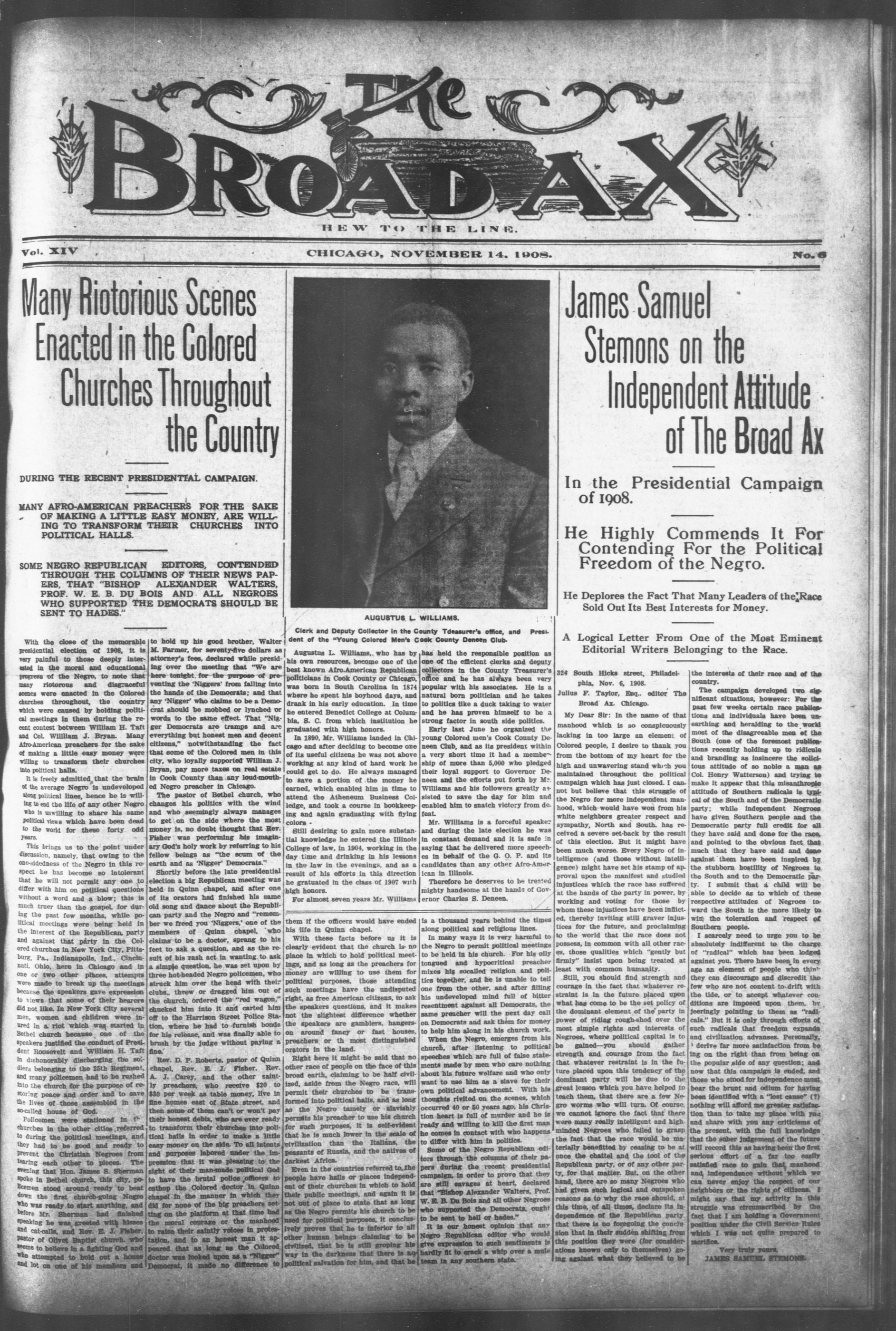
Many Riotorious Scenes Enacted in the Colored Churches Throughout the Country
DURING THE RECENT PRESIDENTIAL CAMPAIGN
MANY AFRO-AMERICAN PREACHERS FOR THE SAKE OF MAKING A LITTLE EASY MONEY, ARE WILLING TO TRANSFORM THEIR CHURCHES INTO POLITICAL HALLS.
SOME NEGRO REPUBLICAN EDITORS, CONTENDED THROUGH THE COLUMNS OF THEIR NEWS PAPERS, THAT "BISHOP ALEXANDER WALTERS, PROF. W. E. B. DU BOIS AND ALL NEGROES WHO SUPPORTED THE DEMOCRATS SHOULD BE SENT TO HADES."
With the close of the memorable presidential election of 1908, it is very painful to those deeply interested in the moral and educational progress of the Negro, to note that many riotorous and disgraceful scenes were enacted in the Colored churches throughout, the country which were caused by holding political meetings in them during the recent contest between William H. Taft and Col. William J. Bryan. Many Afro-American preachers for the sake of making a little easy money were willing to transform their churches into political halls.
It is freely admitted that the brain of the average Negro is undeveloped along political lines, hence he is willing to end the life of any other Negro who is unwilling to share his same political views which have been dead to the world for these forty odd years.
This brings us to the point under discussion, namely, that owing to the one-sidedness of the Negro in this respect he has become so intolerant that he will not permit any one to differ with him on political questions without a word and a blow; this is much truer than the gospel, for during the past few months, while political meetings were being held in the interest of the Republican, party and against that party in the Colored churches in New York City, Pittsburg, Pa., Indianapolis, Ind., Cincinnati, Ohio, here in Chicago and in one or two other places, attempts were made to break up the meetings because the speakers gave expression to views that some of their hearers did not like. In New York City several men, women and children were injured in a riot which was started in Bethel church because one of the speakers justified the conduct of President Roosevelt and William H. Taft in dishonorably discharging the soldiers belonging to the 25th Regiment, and many policemen had to be rushed into the church for the purpose of restoring peace and order and to save the lives of those assembled in the so-called house of God.
Policemen were stationed in 17 churches in the other cities, referred to during the political meetings, and they had to be good and ready to prevent the Christian Negroes from tearing each other to pieces. The evening that Hon. James S. Sherman spoke in Bethel church, this city, policemen stood around ready to beat down the first church-going Negro who was ready to start anything, and before Mr. Sherman had finished speaking he was greeted with kisses and cat-calls, and Rev. E. J. Fisher, pastor of Olivet Baptist church, who seems to believe in a fighting God and who attempted to hold out a house and lot on one of his members and
to hold up his good brother, Walter M. Farmer, for seventy-five dollars as attorney's fees, declared while presiding over the meeting that "We are here tonight, for the purpose of preventing the 'Niggers' from falling into the hands of the Democrats; and that any 'Nigger' who claims to be a Democrat should be mobbed or lynched or words to the same effect. That "Niger Democrats are tramps and are everything but honest men and decent citizens," notwithstanding the fact that some of the Colored men in this city, who loyally supported William J. Bryan, pay more taxes on real estate in Cook County than any loud-mouthed Negro presacher in Chicago.
The pastor of Bethel church, who changes his politics with the wind and who seemingly always manages to get on the side where the most money is, no doubt thought that Rev. Fisher was performing his imaginary God's holy work by referring to his fellow beings as "the scum of the earth and as 'Niger' Democrats."
Shortly before the late presidential election a big Republican meeting was held in Quinn chapel, and after one of its orators had finished his same old song and dance about the Republican party and the Negro and "remember we freed you 'Niggers,' one of the members of Quinn chapel, who claims to be a doctor, sprang to his feet to ask a question, and as the result of his rash act in wanting to ask a simple question, he was set upon by three hot-headed Negro policemen, who struck him over the head with their clubs; threw or dragged him out of the church, ordered the "red wagon," chucked him into it and carted him off to the Harrison Street Police Station, where he had to furnish bonds for his release, and was finally able to brush by the judge without paying a fine.
Rev. D. P. Roberts, pastor of Quinn chapel, Rev. E. J. Fisher, Rev. A. J. Carey, and the other saintly preachers, who receive $20 to $80 per week as table money, live in fine homes east of State street, and then some of them can't or won't pay their honest debts, who are ever ready to transform their churches into political halls in order to make a little easy money on the side. To all intents and purposes labored under the impression that it was pleasing to the sight of their man-made political God to have the brutal police officers to cathop the Colored doctor in Quinn chapel in the manner in which they did for none of the big preachers setting on the platform at that time had the moral courage or the manhood to raise their saintly voices in protestation, and to an honest man it appeared that as long as the Colored doctor was looked upon as a "Nigger" Democrat it made no difference to
[Name]
Augustus L. Williams, who has by his own resources, become one of the best known Afro-American Republican politicians in Cook County or Chicago, was born in South Carolina in 1874 where he spent his boyhood days, and drank in his early education. In time he entered Benedict College at Columbia, S. C. from which institution he graduated with high honors.
In 1890, Mr. Williams landed in Chicago and after deciding to become one of its useful citizens he was not above working at any kind of hard work he could get to do. He always managed to save a portion of the money he earned, which enabled him in time to attend the Atheneum Business College, and took a course in bookkeeping and again graduating with flying colors.
Still desiring to gain more substantial knowledge he entered the Illinois College of law, in 1904, working in the day time and drinking in his lessons in the law in the evenings, and as a result of his efforts in this direction he graced in the class of 1907 with high honors.
has held the responsible position as one of the efficient clerks and deputy collectors in the County Treasurer's office and he has always been very popular with his associates. He is a naturalborn politician and he takes to politics like a duck taking to water and he has proven himself to be a strong factor in south side politics.
Early last June he organized the young Colored men's Cook County Deene Club, and as its president within a very short time he had a membership of more than 5,000 who pledged their loyal support to Governor Deene and the efforts put forth by Mr. Williams and his followers greatly assisted to save the day for him and enabled him to snatch victory from defeat.
Mr. Williams is a forceful speaker and during the late election he was in constant demand and it is safe in saying that he delivered more speeches in behalf of the G. O. P. and its candidates than any other Afro-American in Illinois.
Therefore he deserves to be treated mighty handsome at the hands of Gov
them if the officers would have ended his life in Quinn chapel. With these facts before us it is clearly evident that the church is no place in which to hold political meetings, and as long as the preachers for money are willing to use them for political purposes, those attending such meetings have the undisputed right, as free American citizens, to ask the speakers questions, and it makes not the slightest difference whether the speakers are gamblers, hangers on around fancy or fast houses, preachers or th most distinguished orators in the land. Right here it might be said that no other race of people on the face of this broad earth, claiming to be half civilized, aside from the Negro race, will permit their churches to be transformed into political halls, and as long as the Negro tamely or slavishly permits his preacher to use his church for such purposes, it is self-evident that he is much lower in the scale of civilization than the Italians, the peasants of Russia, and the natives of darkest Africa.
Even in the countries referred to, the people have halls or places independent of their churches in which to hold their public meetings, and again it is not out of place to state that as long as the Negro permits his church to be used for political purposes, it conclusively proves that he is inferior to all other human beings claiming to be civilized, that he is still groping his way in the darkness that there is no political salvation for him, and that he
has held the responsible position as one of the efficient clerks and deputy collectors in the County Treasurer's office and he has always been very popular with his associates. He is a natural born politician and he takes to politics like a duck taking to water and he has proven himself to be a strong factor in south side politics.
Early last June he organized the young Colored men's Cook County Deene Club, and as its president within a very short time it had a membership of more than 5,000 who pledged their loyal support to Governor Deene and the efforts put forth by Mr. Williams and his followers greatly assisted to save the day for him and enabled him to snatch victory from defeat.
Mr. Williams is a forceful speaker and during the late election he was in constant demand and it is safe in saying that he delivered more speeches in behalf of the G. O. P. and its candidates than any other Afro-American in Illinois.
Therefore he deserves to be treated mighty handsome at the hands of Governor Charles S. Deneen.
is a thousand years behind the times along political and religious lines.
In many ways it is very harmful to the Negro to permit political meetings to be held in his church. For his olly tongued and hypocritical preacher mixes his socalled religion and politics together, and he is unable to tell one from the other, and after filling his undeveloped mind full of bitter resentment against all Democrats, the same preacher will the next day call on Democrats and ask them for money to help him along in his church work. When the Negro, emerges from his church, after listening to political speeches which are full of false statements made by men who care nothing about his future welfare and who only want to use him as a slave for their own political advancement. With his thoughts riveted on the scenes, which occurred 40 or 50 years ago, his Christian heart is full of murder and he is ready and willing to kill the first man he comes in contact with who happens to differ with him in politics.
Some of the Negro Republican editors through the columns of their papers during the recent presidential campaign, in order to prove that they are still savages at heart, declared that "Bishop Alexander Walters, Prof. W. E. B. Du Bois and all other Negroes who supported the Democrats, ought to be sent to hell or hades." It is our honest opinion that any Negro Republican editor who would give expression to such sentiments is hardly fit to crack a whip over a mule team in any southern state.
James Samuel Stemons on the Independent Attitude of The Broad Ax
In the Presidential Campaign of 1908.
He Highly Commends It For Contending For the Political Freedom of the Negro.
He Deplores the Fact That Many Leaders of the Race Sold Out Its Best Interests for Money.
A Logical Letter From One of the Most Eminent Editorial Writers Belonging to the Race.
324 South Hicks street, Philadelphia, Nov. 6, 1908.
Julius F. Taylor, Esq.. editor The Broad Ax. Chicago.
the interests of their race and of the country.
The campaign developed two significant situations, however: For the
My Dear Sir: In the name of that manhood which is so conspicuously lacking in too large an element of Colored people, I desire to thank you from the bottom of my heart for the high and unwavering stand which you maintained throughout the political campaign which has just closed. I cannot but believe that this struggle of the Negro for more independent manhood, which would have won from his white neighbors greater respect and sympathy, North and South, has received a severe set-back by the result of this election. But it might have been much worse. Every Negro of intelligence (and those without intelligence) might have set his stamp of approval upon the manifest and studied injustices which the race has suffered at the hands of the party in power, by working and voting for those by whom these injustices have been inflicted, thereby inviting still graver injustices for the future, and proclaiming to the world that the race does not possess, in common with all other races, those qualities which "gently but firmly" insist upon being treated at least with common humanity.
Still, you should find strength and courage in the fact that whatever restraint is in the future placed upon what has come to be the set policy of the dominant element of the party in power of riding rough-shod over the most simple rights and interests of Negroes, where political capital is to be gained—you should gather strength and courage from the fact that whatever restraint is in the future placed upon this tendency of the dominant party will be due to the great lesson which you have helped to teach them, that there are a few Negro worms who will turn. Of course, we cannot ignore the fact that there were many really intelligent and high-minded Negroes who failed to grasp the fact that the race would be materially benefited by ceasing to be at once the chattel and the tool of the Republican party, or of any other party, for that matter. But, on the other hand, there are so many Negroes who had given such logical and outspoken reasons as to why the race should, at this time, of all times, declare its independence of the Republican party; that there is no foregoing the conclusion that in their sudden shifting from this position they were (for considerations known only to themselves) going against what they believed to be
the interests of their race and of the country.
The campaign developed two significant situations, however: For the past few weeks certain race publications and individuals have been unearthing and heralding to the world most of the disagreeable men of the South (one of the foremost publications recently holding up to ridicule and branding as insincere the solicitous attitude of so noble a man as Col. Henry Watterson) and trying to make it appear that this misanthropic attitude of Southern radicals is typical of the South and of the Democratic party; while independent Negroes have given Southern people and the Democratic party full credit for all they have said and done for the race, and pointed to the obvious fact that much that they have said and done against them have been inspired by the stubborn hostility of Negroes to the South and to the Democratic party. I submit that a child will be able to decide as to which of these respective attitudes of Negroes toward the South is the more likely to win the toleration and respect of Southern people.
I scarcely need to urge you to be absolutely indifferent to the charge of "radical" which has been lodged against you. There have been in every age an element of people who think they can discourage and discredit the few who are not content to drift with the tide, or to accept whatever conditions are imposed upon them, by jeeringly pointing to them as "radicals." But it is only through efforts of such radicals that freedom expands and civilization advances. Personally, derive far more satisfaction from being on the right than from being on the popular side of any question; and now that this campaign is ended, and those who stood for independence must bear the brunt and odium for having been identified with a "lost cause" (?) nothing will afford me greater satisfaction than to take my place with you and share with you any criticisms of the present, with the full knowledge that the sober judgement of the future will record this as having been the first serious effort of a far too easily satisfied race to gain that manhood and independence without which we can never enjoy the respect of our neighbors or the rights of citizens. I might say that my activity in this struggle was circumscribed by the fact that I am holding a Government position under the Civil Service Rules which I was not quite prepared to sacrifice.
Very truly yours.
Very truly yours,
JAMES SAMUEL STEMONS.
THE BROADAX
Will promulgate and as all times uphold the true principles of Democracy, best Catholic, Protestants, Priests, Insulds, Single Taxes, Republicans, or anyone else can have their say, as we are the same in proper and responsibility is fixed.
The Broad ax is a newspaper whose platform is broad enough for all, ever claiming the editorial right to speak its own mind.
Local communications will receive attention. Write only on one side of the paper.
Advertising rates made known on application.
Address all communications to
THE BROAD AX
5633 Armour Avenue, Chicago.
JULIUS F. TAYLOR, Editor and Publisher.
Entered as Second-Glass Matter,
Aug. 19, 1802 at the Post Office at
Chicago, Illinois, under Act of March
4, 1879.
STRONG PLEA FOR RACE JOURNALS.
Every Nationality Loyally Supports Its Paper Except the Colored Race —Abuse and Cures Reward for Championing Their Cause—Read White Journals That Stir up Prejudice to the Exclusion of Their Own —Colored Editor Has Hard Row to Hoe—He Must Fight the Prejudice of the White Man, the Ignorance and Superstition of the Black Man.
Read the press as it is printed and Colored by most of the prejudiced white presses, make him full, but full of the wrong misconceptions of the true character of the Negro. And yet the thoughtless, non-race loving, egoistic, prideless, know-nothing and dooming Negro will abuse, villify and cause the Negro press, whilst he will read, absorb, pay for and digest all of the slander vituperation and venom of white journals.
We heartily endorse the reading of white journals, but the Negro who reads them to the exclusion of the Negro journals is whetting the knife for racial suicide. Breathhes there in Negro with a soul so dead that he cannot feel the rythm of Paul Dunbar's pen, or with one so inharmonious, that he cannot feel the tender ness of a Phyllis Wheatley, as well as he can that of Kipling and Wilcox. The most potent factor in civilizing and Christianizing the people of last century, was the press of the country, and if true in the later, doubly so this, the twentieth.
There is but one side of the Negro question printed in most of our white journals, and that is the dark side. There can be no bright side, only through the medium of the Negro press, and there can be no Negro press unless supported, both influentially and pecuniarily by the Negro. Whenever you hear a Negro stand on the street, rare back and exclaim there is nothing in a Negro paper, or that there is nothing in a Negro anyway, that is a pure sign that he has swallowed a cartoon or disgraceful pen picture of the Negro from some white "yellow journal." Thinking it is pleasant, but dying all the same time
Nine-tenths of the reading class our people subscribe for weekly papers and they can get the same current news from a Negro weekly they get from a white weekly, and be sides they get from the Negro weekly all of the important and interesting news of the race. We have professional men, business men and race leaders (so-called) that will not sub scribe for, read and pay for a Newspaper. We may petition, wall and cry aloud against the wrongs that are being perpetrated upon us but in vain.
"We are the architects of our own fortune." If the Negro expects success, he must win it by his own undamned efforts. Cursed be he who would rise to yonder heights and rests lethagically in the vale of know nothingness and do-nothingness. Remember the axiomatic chanting of the poet:
If we make the race a success we will stand everlastingly prominent though we dwell in the vales of prejudice, hatred and malice on account of previous condition of servitude. A Negro professional man or woman, be he preacher, lawyer or doctor finds no time to read a Negro journal whilst he reads others by the score in a racial nuisance, and does not deserve the support of the race. The sooner he is ticked out of his profession and out of creation the latter it will be for the race.
"A home without a newspaper is a hundred years behind. Every Negro should take his home paper, and "possible other prominent Negro journals. A Negro who would endure."
to solve the race problem by eliminating the Negro press, might as well try to secure a note by giving a gage on a cyclone. Yet there are Nooses who will resolute and resolve the conventions on the Negro problem who will not subscribe for a Negro paper. The Negro press is worth the support of the race."
COLOR LINE DRAWN BY SUPREME COURT.
Federal Tribunal Saya Kentucky Can Separate Races at Berea College. Washington, D. C., Nov. 9.—In deciding the case of Berea college vs. the state of Kentucky favorably to the state, the Supreme court of the United States today held that the states of the union may constitutionally legislate to prevent the coeducation of the white and black races.
The case was instituted to test the validity of the state law of 1904, prohibiting white and black children from attending the same schools. The higher state court took the position that the white and black races are naturally antagonistic and that the enforced separation of the children c the two is in the line of the preservation of peace.
The opinion of the Supreme court was handed down by Justice Brewer, and affirmed the finding of both the Kentucky Circuit court and the Court of Appeals. Justice Harlan and Day dissented.
Justice Brewer's opinion dealt entirely with corporations as affected by the Kentucky statute, and did not consider the question of its applicability to individuals. Proceeding upon the theory that a state has complete control over corporations as its own creations, he then construed the law of 1904 as in effect an amendment to the charter of Berea college.
He said: "It is settled that a power reserved to the legislature to alter amend, or repeal any alteration or amendment of a charter granted subject to it."
Dissent or Justice Harlan.
Justice Harlan in his dissenting opinion said: "How we become so inoculated with prejudice of race that an American government, professedly based on the principles of freedom, and charged with the protection of all citizens alike, can make distinction between such citizens.
"If the lower court be right, then a state may make it a crime for white and Colored persons to frequent the same market, or appear in an assemblage of citizens convened to consider questions of a public or political nature in which all citizens, without regard to race, are equally interested."
The members of the Supreme court displayed their political cunning by withholding their decision in the Berea college case until after the presidential election.
With this court, which is controlled by its Republican members, in all its opinions affecting the civil and political status of the Negro, and with their leader hands raised against him at every turn of the road, still there are many of the ignorant would be leaders of the race, including some of the preachers, who are willing to stand on their heads all day long, by holding out their clr mits, for a little politica' money, froth at the mouth and bowed out, that "it would not do to elect William J. Bryan president of the United States, for he might appoint some southern Democrats to the Supreme bench, who would rule against the Negro."
But no Democratic members of that court could deal the Negro a more stunning blow than its Republican member.
All honor to Justice Harlan for standing up for right and justice!
Last Tuesday's election concluded a national campaign which differed from its immediate predecessors in no particular more sharply than in the attitude of the Negro voter. Starting out on his political career unanimously and undiscriminately Republican, he may well be excused under the circumstances for committing this grave mistake. There was much reason for the Negro at that time supporting Republicans, though there was also much reason for his opposing many Republican candidates for office and supporting many Democrats. The fact that Charles Summer and William Lloyd Garrison about this time became Democrats indicates that. Owing to the widespread ignorance of the race at that time, and in view of its absolute lack of political experience, the Negro cannot be harbly blamed for the grave mistake he made of sticking so unintelligently to Republican candidates for office.
For the present generation of Negroes to support the Republican party so blindly, so stupidly and from such abject partisan prejudice there is absolutely no excuse. And one of the most hopeful signs for the Negro which the present campaign presented was the phenomenon of large numbers of upright, sober, industrious Colored men in all parts of the country actively supporting the Democratic na-
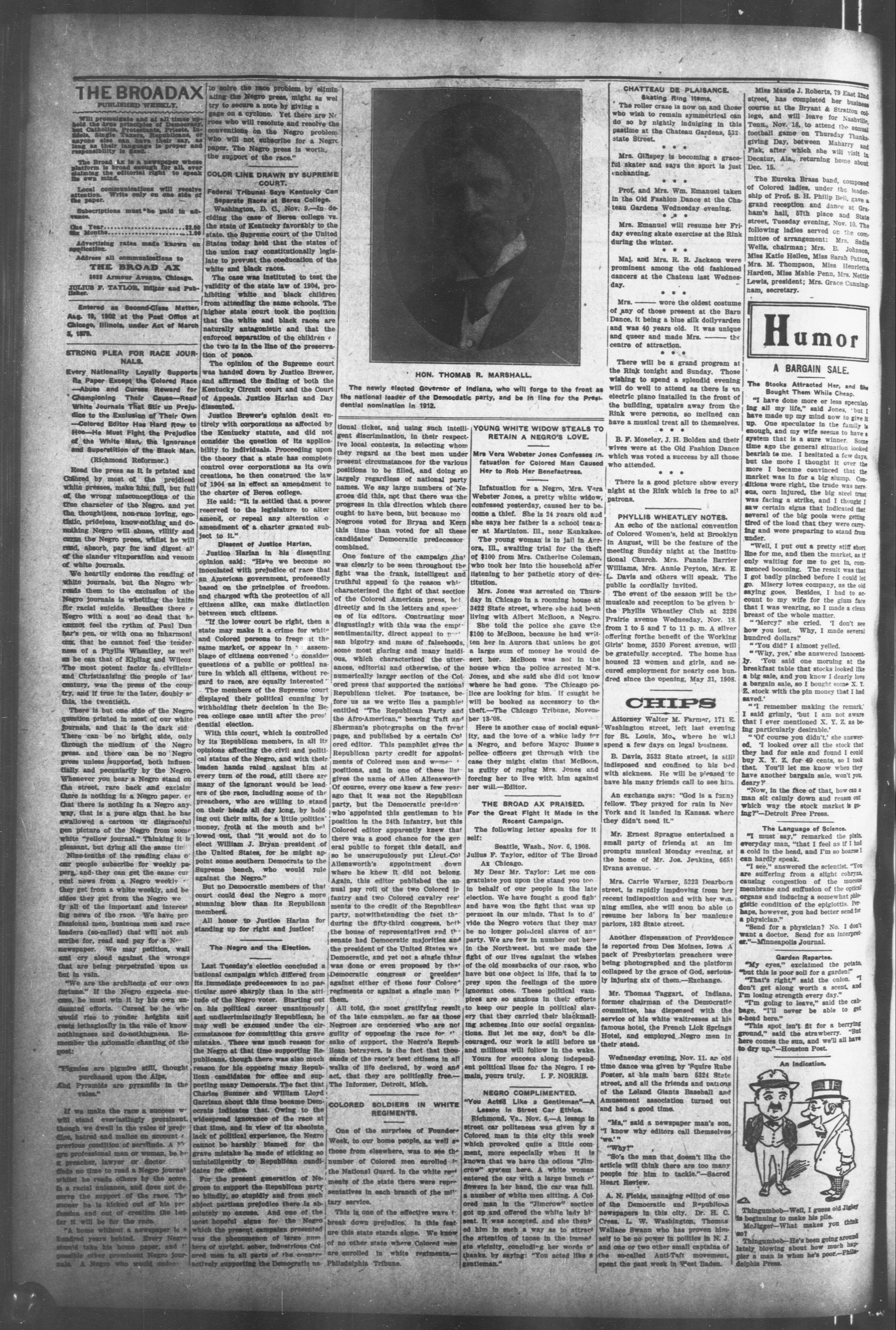
[Picture of a man with a mustache and a suit].
tional ticket, and using such intelligent discrimination, in their respective local contests, in selecting whom they regard as the best men under present circumstances for the various positions to be filled, and doing so largely regardless of national party names. We say large numbers of Negroes did this, not that there was the progress in this direction which there ought to have been, but because mo Negroes voted for Bryan and Kern this time than voted for all these candidates' Democratic predecessor combined.
YOUNG WHITE WIDOW STEALS TO RETAIN A NEGRO'S LOVE.
Mrs Vera Webster Jones Confesses infatuation for Colored Man Caused Her to Rob Her Benefactress.
Infatuation for a Negro, Mrs. Vera Webster Jones, a pretty white widow, confessed yesterday, caused her to become a thief. She is 24 years old and she says her father is a school teacher at Martinton. Ill., near Kankakee.
The young woman is in jail in Aurora. Ill., awaiting trial for the theft
One feature of the campaign that was clearly to be seen throughout the fight was the frank, intelligent and truthful appeal to the reason which characterized the fight of that section of the Colored American press, but directly and in the letters and speeches of its editors. Contrasting most disgustingly with this was the empiric sentimentality, direct appeal to man san bigotry and mass of falsehoods some most glaring and many insidious, which characterized the utter ances, editorial and otherwise, of the numerically larger section of the Colored press that supported the national Republican ticket. For instance, before us as we write lies a pamphlet entitled "The Republican Party and the Afro-American," bearing Taft and Sherman's photographs on the front page, and published by a certain Colored editor. This pamphlet gives the Republican party credit for appointments of Colored men and women, positions, and in one of these lists gives the name of Allen Allensworth Of course, every one knew a few year ago that it was not the Republican party, but the Democratic president who appointed this gentleman to his position in the 24th infantry, but this Colored editor apparently knew that there was a good chance for the general public to forget this detail, and so he unscrupulously put Lieut.-Col Allensworth's appointment down where he knew it did not belong. Again, this editor published the annual pay roll of the two Colored infantry and two Colored cavalry regiments to the credit of the Republican party, notwithstanding the fact that during the fifty-third congress, both the house of representatives and the senate had Democratic majorities and the president of the United States was Democratic, and yet not a single thing was done or even proposed by the Democratic congress or president against either of these two Colored regiments or against a single man in them.
All told, the most gratifying result of the late campaign, so far as those Negroes are concerned who are not guilty of opposing the race for "sake of support, the Negro's Republican betrayers, is the fact that thousands of the race's best citizens in all walks of life declared, by word and act, that they are politically free.—The Informer, Detroit, Mich.
COLORED SOLDIERS IN WHITE REGIMENTS.
One of the surprises of Founders Week, to our home people, as well as those from elsewhere, was to see the number of Colored men enrolled in the National Guard. In the white regiments of the state there were representatives in each branch of the military service.
This is one of the effective wavs to break down prejudice. In this feature this state stands alone. We know of no other state where Colored men are enrolled in white regiments.—Philadelphia Tribune.
YOUNG WHITE WIDOW STEALS TO RETAIN A NEGRO'S LOVE.
Mrs Vera Webster Jones Confesses infatuation for Colored Man Caused Her to Rob Her Benefactress.
Infatuation for a Negro. Mrs. Vera Webster Jones, a pretty white widow, confessed yesterday, caused her to become a thief. She is 24 years old and she says her father is a school teacher at Martinton. Ill., near Kankakee.
The young woman is in jail! in Anora, Ill., awaiting trial for the theft of $100 from Mrs. Catherine Coleman, who took her into the household after listening to her pathetic story of destitution.
Mrs. Jones was arrested on Thursday in Chicago in a rooming house at 3422 State street, where she had been living with Albert McBoon, a Negro. She told the police she gave the $100 to McBoon, because he had written her in Aurora that unless he got a large sum of money he would desert her. McBoon was not in the house when the police arrested Mrs. Jones, and she said she did not know where he had gone. The Chicago police are looking for him. If caught he will be booked as accessory to the theft.—The Chicago Tribune, November 13'08.
Here is another case of social equality, and the love of a white lady for a Negro, and before Mayor Busses police officers get through with the case they might claim that McBoon, is guilty of raping Mrs. Jones and forcing her to live with him against her will.—Editor.
THE BROAD AX PRAISED.
For the Great Fight It Made in the Recent Campaign.
The following letter speaks for it self:
Seattle, Wash., Nov. 6, 1908.
Julius F. Taylor, editor of The Broad
Ax, Chicago.
My Dear Mr. Taylor: Let me congratulate you upon the stand you took in behalf of our people in the late election. We have fought a good fight and have won the fight that was up permost in our minds. That is to divide the Negro voters that they may be no longer political slaves of any party. We are few in number out here in the Northwest, but we made the fight of our lives against the wishes of the old mossbacks of our race, who have but one object in life, that is to prey upon the feelings of the more ignorant ones. These political vampires are so anxious in their efforts to keep our people in political slavery that they carried their blackmailing schemes into our social organizations. But let me say, don't be discouraged, our work is still before us and millions will follow in the wake. Yours for success along independent political lines for the Negro, I remain, yours truly. I. F. NORRIS.
Lesson in Street Car Ethics.
Richmond, Va. Nov. 6. A lesson in street car politeness was given by a Colored man in this city this week which provoked quite a little comment, more especially when it is known that we have the odious "Jimcrow" system here. A white woman entered the car with a large bunch of flowers in her hand, the car was full, a number of white men sitting. A Colored man in the "Jimcrow" section got up and offered the white lady his seat. It was accepted, and she thanked him in such a way as to attract the attention of those in the immediate vicinity, concluding her words of thanks, by saying: "You acted like a gentleman."
Skating Ring Items.
The roller craze is now on and those who wish to remain symmetrical can do so by nightly indulging in this pastime at the Chateau Gardens, 532 state Street.
Mrs. Gillspey is becoming a graceful skater and says the sport is just enchanting.
Prof. and Mrs. Wm. Emanuel taken in the OM Fashion Dance at the Chateau Gardens Wednesday evening.
Mrs. Emanuel will resume her Friday evening skate exercise at the Rink during the winter.
Maj. and Mrs. R. R. Jackson were prominent among the old fashioned dancers at the Chateau last Wednesday.
Mrs. —— wore the oldest costume of any of those present at the Barn Dance, it being a blue silk dollyvarden and was 40 years old. It was unique and queer and made Mrs. —— the centre of attraction.
There will be a grand program at the Rink tonight and Sunday. Those wishing to spend a splendid evening will do well to attend as there is an electric piano installed in the front of the building, upstairs away from the Rink were persons, so inclined can have a musical treat all to themselves.
B. F. Moseley, J. H. Bolden and their wives were at the Old Fashion Dance which was voted a success by all those who attended.
There is a good picture show every night at the Rink which is free to all patrons.
PHYLLIS WHEATLEY NOTES.
An echo of the national convention of Colored Women's, held at Brooklyn in August, will be the feature of the meeting Sunday night at the Institutional Church. Mrs. Fannie Barrler Williams, Mrs. Annie Peyton, Mrs. E. L. Davis and others will speak. The public is cordially invited.
The event of the season will be the musicale and reception to be given by the Phyllis Wheatley Club at 3226 Prairie avenue Wednesday, Nov. 18. from 1 to 5 and 7 to 11 p. m. A silver offering for the benefit of the Working Girls' home, 3530 Forest avenue, will be gratefully accepted. The home has housed 23 women and girls, and secured employment for nearly one hundred since the opening, May 31, 1983.
CHIPS
Attorney Walter M. Farmer, 171 E. Washington street, left last evening for St. Louis, Mo., where he will spend a few days on legal business. B. Davis, 3532 State street, is still indisposed and confined to his bed with sickness. He will be pleased to have his many friends call to see him. An exchange says: "God is a funny fellow. They prayed for rain in New York and it landed in Kansas, where they didn't need it." Mr. Ernest Sprague entertained a small party of friends at an impromptu musical Monday evening, at the home of Mr. Jos. Jenkins, 6651 Evans avenue.
Mrs. Carrie Warner, 5223 Dearborn street, is rapidly impdoving from her recent indisposition and with her winning smiles, she will soon be able to resume her labors in her manicure parlors, 182 State street.
Another dispensation of Providence is reported from Des Moines, Iowa A pack of Presbyterian preachers were being photographed and the platform collapsed by the grace of God, seriously injuring six of them—Exchange.
Mr. Thomas Taggart, of Indiana, former chairman of the Democratic committee, has dispensed with the service of his white waitresses at his famous hotel, the French Lick Springs Hotel, and employed Negro men in their stead.
Wednesday evening, Nov. 11. an old time dance was given by 'Squire Rube Foster, at his main barn 5324 State street, and all the friends and patrons of the Leland Glants Baseball and Amusement association turned out and had a good time.
"Ma," said a newspaper man's son, "I know why editors call themselves 'we.'"
"Why?"
"So's the man that doesn't like the article will think there are too many people for him to tackle."—Sacred Heart Review.
A. N. Fields, managing edited of one of the Democratic and Republican newspapers in this city. Dr. H. C. Cress, L. W. Washington, Thomas. Wallace Swann who has proven himself to be no power in politics in N. J. and one or two other small captains of the so-called Anti-Taft movement, spent the past week in West Baden.
Miss Maude J. Roberts, 79 East 32nd street, has completed her business course at the Bryant & Stratton college, and will leave for Nashville, Tenn., Nov. 18, to attend the annual football game on Thursday Thanksgiving Day, between Maharry and Fisk, after which she will visit in Decatur, Ala., returning home about Dec. 15.
The Eureka Brass band, composed of Colored ladies, under the leadership of Prof. S. H. Philip Bell, gave a grand reception and dance at Graham's hall, 57th place and State street, Tuesday evening, Nov. 10. The following ladies served on the committee of arrangement: Mrs. Sadie Wells, chairman; Mrs. B. Johnson, Miss Katie Hellen, Miss Sarah Patton, Mrs. M. Thompson, Miss Henrietta Harden, Miss Mable Penn, Mrs. Nettie Lewis, president; Mrs. Grace Cunningham, secretary.
Humor
A BARGAIN SALE
The Stooks Attracted Her, and She Bought Them While Chao.
"I have done more or less speculating all my life," said Jones, "but I have made up my mind now to give it up. One speculator in the family is enough, and my wife seems to have a system that is a sure winner. Some time ago the general situation looked bearish to me. I hesitated a few days, but the more I thought it over the more I became convinced that the market was in for a big slump. Conditions were right, the trade was nervous, corn injured, the big steel trust was facing a strike, and I thought I saw certain signs that indicated that several of the big pools were getting tired of the load that they were carrying and were preparing to stand from under.
"Well, I put out a pretty stiff short line for me, and then the market, as if only waiting for me to get in, commenced booming. The result was that I got badly pinched before I could let go. Misery loves company, as the old saying goes. Besides, I had to account to my wife for the glum face that I was wearing, so I made a clean breast of the whole matter.
"Mercy!" she cried. "I don't see how you lost. Why, I made several hundred dollars!"
"You did! I almost yelled.
"Why, yes," she answered innocently. "You said one morning at the breakfast table that stocks looked like a big sale, and you know I dearly love a bargain sale, so I bought some X. Y. Z. stock with the pin money that I had saved."
"I remember making the remark, I said grimly, 'but I am not aware that I ever mentioned X. Y. Z as being particularly desirable.' "Of course you didn't, she answered. I looked over all the stock that they had for sale and found I could buy X. Y. Z. for 49 cents, so I took that. You'll let me know when they have another bargain sale, won't you, deary? "Now, in the face of that, how can a man sit calmly down and reason out which way the stock market is going?"—Detroit Free Press.
"I must say," remarked the plain, everyday man, "that I feel as if I had a cold in the head, and I'm so hoarse I can hardly speak.
"I see," answered the scientist. "You are suffering from a slight cochrysa causing congestion of the mucous membrane and suffusion of the optical organs and inducing a somewhat phlegistic condition of the epiglottis. Perhaps, however, you had better send for a physician."
"Send for a physician? No. I don't want a doctor. Send for an interpreter."—Minneapolis Journal.
Garden Repartes
"My eyes," exclaimed the potato,
"but this is poor soil for a garden!"
"That's right," said the onion. "I
don't get along worth a scent, and
I'm losing strength every day."
"I'm going to leave," said the cabbage.
"I'll never be able to get
a-head here."
"This spot isn't fit for a berrying
ground," said the strawberry. "But
here comes the sun, and we'll all have
to dry up."-Houston Post.
An Indication.
Thingumbob—He's been going around lately, blowing about how much happier a man is when he's poor. Phils-delbis Press.
By JEANNETTE S. BENTON.
The office boy heard the doctor in the annex and went out." Her face was buried in a basin of water, and the formaldehyde bottle stood open.
"How's the smallpox?" he asked.
"Bad," she replied, emerging rosy from the towel. "Is any one waiting?
"No one now but Mr. Doane Aldrich. Been three or four, but they got tired waiting."
"Very well. Tell him I will be there in a minute."
As the boy closed the door she walked to the mirror and regarded herself attentively, spraying violet water over her hands and hair.
"I wish I had some powder," she murmured. "I am afraid I look blowy."
To the tall young man in the reception room she looked discouragingly cool and unperturbed as he arose at her entrance.
"It is a little matter, doctor," he explained. "I have just been transferred to the Y mine, and they have smallpox down there, so I suppose it is necessary to be vaccinated."
"It certainly is if you haven't been lately. Things are in bad shape at the Y. I have put in the whole afternoon there. There's a good deal of smallpox and more dissatisfaction. I suppose the dissatisfaction is what sent you there."
"I suppose so. What's at the bottom of the trouble anyway?"
"Sickening hovels and the company store. If you can get the company to do anything before those people murder you as its nearest representative you will be doing good work. However, come into the office, and I will vaccinate you."
He followed her in.
"This is the first time I ever came here as a subject," he remarked.
He bared his arm and looked dubiously at its white surface.
How could she be a doctor? Still, he had sometimes wished he could be sick a week or two. It would be such a good chance to see her every day. What was she going to do with that razor looking little knife? It had been so long since he was vaccinated he had forgotten all about it. Did she jab the stuff in at the end of that? If she was going to jab he wished she would and stop that scratching. He watched the scratching knife, fascinated. Suddenly it began to describe erratic circles in his vision. Dr. Richle felt his arm relaxing under her grasp. With a movement as quiet as it was quick she eased his stalwart body to the floor, then loosened his collar and dashed a little water in his face. He opened his eyes slowly. "Oh, I say," he gasped, "what's the matter?"
The doctor stood a little way off regarding him with professional gravity. "I was vaccinating you, and you faltered," she explained. "You will be all right in a moment." He got rather uncertainly to his feet and leaned against a convenient case of drawers. "Good Lord!" he groaned. "What do you think of me? I hope you don't think it was because it hurt. I don't know what it was. I was watching that little knife; then I was here on the floor. Please finish the job" he concluded irritably. "I'll try to stand up under it." As she adjusted the small bandage he thought savagely:
"If I should lift you off your feet, my sweet doctor, and kiss that diabolical dimple you might at least respect my muscle. How can a fellow make love to a woman doctor anyway?" Aloud he said, "Thank you, doctor," rather abruptly, hurried into his coat, settled with the office boy and got away with all speed. The doctor strolled to the window and watched him go striding off, his big shoulders squared.
"Poor old fellow!" she said softly. Then she flushed and smiled in a way that little befitted a member of the medical profession.
"He is bashful and stupid, too," she pouted. Doane Aldrich squared his shoulders against his troubles often that winter. His recognized powers as a pacificator seemed to have signally failed. One day he swing into the cart as the doctor was trotting home.
"See here," he said. "I must talk with you. I don't know what to do with those people. Heaven knows they have reason enough to be sore, and I am helpless. Of course they can't realize that, but the company pays no attention to my representations. I am the nearest thing the poor brutes have to hate, and they hate me well. Tomorrow I have got to discharge McGuire and Kearney"—The doctor interrupted: "That means a strike, to begin with. Then Kate McGuire and Dilsey Kearney—why, they would as soon have a riot enough to eat." "But what can I do? The men have come on the shift twice within a week drunk and quarrelsome. Overlook it and they will all see drunk and..."
"Ralse haden" gently suggested the doctor. Then her face grew mischievous. "Don't you think you had better follow your predecessor's example and throw it up!" she suggested. He looked at her with decided sternness.
"I suppose that was about the opin-
jon you entertained of me. Excuse me. There is a man I want to see." And Mr. Aldrich had checked the horse enough to depart. It was cold, with a driving mist, when the doctor drove up to her gata several evenings later.
"Poor Bess!" she said to the panting horse. "Tired, aren't you?"
A small, tattered boy came down the road, running wearily, as though nearly spent.
"Oh, Miss Doctor," he shrilled, "walt!"
His face shone pale through the dirt. As he came up she recognized the pit boss' boy.
"Ma sent me to tell you to do something' quick. Kate an' Dilsey is out with a lot of wimin, an' they are runnin' wild. Mr. Aldrich went down with the new shift. Pa told him he better watch things on top, but he thought pa needed help. Now they are goin' to git hold of the shaft house an' when Mr. Aldrich comes up with the new men either drop the cage or rock 'em."
The doctor's face had grown white as the boy talked.
"The shift will come up at 67" she asked.
The boy nodded.
"Come into the house. You must be dried and fed. I will telephone the police, but Bess and I will get there half an hour ahead of them. Heaven knows what we will do, but we will do something or die!" she half whispered.
"Now, go, Bess!" she cried as she sprang into the buggy.
As she approached the little town she could hear a swelling din of discordant voices. She dashed through an alley and came out in the street in front of the shaft house. The women were sweeping around the corner just below her, fifteen or twenty of them. Their tossing arms and distorted faces held her a second fascinated. Then her brown eyes brightened mischievously, and she wheeled the horse and cart directly in front of the howling crowd.
"Kate McGuire!" she called, pointing an accusing whip at her. Their momentum carried them nearly to the cart. Then, as they could not conveniently climb it and the "darlin' doctor" was a person to respect anyway, they stopped.
"What do you mean," she demanded sternly, "yelling around in this cold rain? What do you think it will do for your neuralgia? You will be crazy with it. Your cheek is all swelled up now, and your eye looks as though you had broken a blood vessel. I knew a woman once"—her voice grew deeply impressive"—whose eye burst, and she didn't expose herself the way you are doing either. And you, too, Dilsey, just nicely over the smallpox—do you know what you will have? You will have a relapse!
She fairly hurried the word at her, and Dilsey received it with a moan of terror.
"Holy mother, doctor!" she wailed.
"Do it be fatal!"
Kate had shut her mouth and was whining softly, cuddling her face in her damp shawl. She turned reproachfully to the women behind her.
"The doctor's right. This do be a sorry night for poor wimmin cratures to be out in, an' ye ought to be ashamed, me head's crazy already wild the pain." She came close to the buggy.
"Doctor, dear, do be givin' me something!" she entreated.
"How many of you have vaccinations that you'll be taking cold in? And you, Jerusalem—I thought you told me you couldn't speak a loud word?"
"No more I can," croaked Jerusiah hoarsely.
"Go home, every one of you!" she waved imperiously. "You ought to be ashamed, running around like a lot of lunatics. I'll come around presently and give you something for that neuralgia, Kate, and you a dose, too, Dilsey."
Five minutes later there wasn't a woman in sight save the doctor.
She drove the trembling horse into one of the sheds.
"Poor old girl!" she said, loosening up the harness. "I nearly killed you, didn't I?" There was a sound of hurrying feet, and Mr. Aldrich came in breathlessly. "Are you safe?" he cried. She gave him one quick glance, her white chin and red lips set with becoming gravity. "I think I am," she replied, with a mild note of inquiry. "Do you feel dangerous?" He strode up to her and looked down into the provoking face. "A man who faints when he is vaccinated is a fit subject to be saved from a mob of women, isn't he?" he questioned. "Don't think I don't realize how serious it was. I know you probably saved me from a very unpleasant death, but I wish you hadn't."
He searched her face an instant, then suddenly drew her to him and kissed almost roughly the derisive dimple that was faunting at him. "I have been tempted a hundred times," he said defiantly.
"And you were too—too stupid to—er—fall"
Draughts as an Education.
There is no game extant which so admirably combines educational and recreative features or which is in every way so well adapted for a popular and profitable amusement among refined and appreciative classes as draughts.
Its influences are of an elevating character. It not only teaches, but practically enforces, the necessity of patience and perseverance, courage and courtship, self reliance and self control.
The game is also peculiarly and self evidently worthy of paternal encouragement, as a knowledge of its incomparable beauties will destroy the taste for demoralizing games of chance—Exchange.
Selections
SUNKEN REEFS.
Sweeping the Ocean Floor Instead of Sounding.
The mishap of the cruiser Yankee brings forth the comment that it is the more remarkable as occurring on the coast "perfectly charted." Premising that the Yankee got off her course in a dense fog, it may be said that, while our coast is as well charted as that of any nation, "perfect" is not the characterization yet to be employed. The methods of surveying the ocean floor to locate reefs and shoals are now undergoing a revolution which, when fully accomplished, will reveal to the mariner many danger points which have heretofore escaped record. The old way of finding out reefs and rocks not evident to the eye was by sounding. Now the coast survey proceeds by "sweeping"—that is, by sinking to the depth a pipe bar, which is trailed along by two boats, one at each end of the cable passing through it. Any obstruction encountered is immediately perceptible and is at once noted, located and observed. Coastal waters are carefully "platted," and each plat is thoroughly gone over. The superiority of "sweeping" over "sounding" is made evident by the fact that in a comparatively limited area of the Maine coast, covering rather more than forty linear miles, fifteen reefs have been discovered heretofore uncharted. It often happens in sounding that the lead line avoids some narrow spindle of rock whose point is just below the surface of the water and which goes uncharted. When the cruiser Brooklyn was gashed by one of these unsuspected pinnacles on our coast a few years ago it was found to be isolated and surrounded with deep water up to within a few feet of its sides. Sweeping will minimize the probability of repetitions of such accidents—Boston Transcript.
Umbrella as a Weapon.
In one of the women's fencing schools of Paris instruction in the art of attack and defense with folls has been discontinued and umbrellas instituted, says Popular Mechanics.
The first lesson the pupils learn in this up to date means of defense from attack on the streets is to baffle the watchfulness of the aggressor by skillful blows. The most simple and at the same time most effective consists in applying a flat stroke of the umbrella upon his headgear. Surprised by this stroke and perhaps blinded by the rim of the hat, he has not the time nor the presence of mind to seize the umbrella. The lunges which follow such a blow are not only effective, but dangerous. The first is known as the horsde combat blow. Selizing her umbrella the near handle with one hand and near the point with the other and advancing a step well forward, the point if well directed against the center of the aggressor's neck will drop him to the ground senseless and probably badly hurt. The same blow aimed at the pit of the stomach will probably send the recipient to the hospital and perhaps cripple him for life.
Municipal Theaters.
The first municipal, uncommercial theater in America—an endowed institution—is in successful operation in Red Wing, Minn. Red Wing is a town of only 10,000 persons, forty miles down the Mississippi river from St. Paul, and to it several years ago a citizen left $50,000 to found a municipal theater. A citizens' committee under the terms of the bequest manages the playhouse, and so well has it done its work that for the last three years a dividend on the capital invested has been paid to the town. Professor Richard Burton in a lecture on the drama, using the Red Wing experiment as a criterion, predicts that "in ten years probably and in twenty-five years certainly every considerable city in the United States will have its municipal theater."
Milk Bricks.
Milk bricks are sold in Belgium and Denmark. These bricks are milk frozen solid, and when intended for use as soon as received in the household the lactate fluid for the tea or coffee has to be chipped off according to the quantity desired in the drink. This brick milk has grown to be a necessity in the warmer countries of Europe. The Belgium government has given a yearly subsidy to increase the trade. In Copenhagen a firm engaged in this business makes a weekly delivery of 800,000 pounds. A great deal of this goes to distant countries.
The Comet Now and Then
The Comet Now and Then.
Times have changed since 450 years ago, when Halley's comet, for whose reappearance astronomers are now looking, was in the heavens. Then the Christian world prayed to be delivered from "the devil, the Turk and the comet." Now it says the devil is not so black as he has been painted, the Turk is a negligible quantity, and the comet would be rather welcome than otherwise—Boston Transcript.
Balloons and Bullets.
Experiments conducted abroad have demonstrated that balloons traveling at a height of from 400 to 2,000 yards could be hit only once out of six shots, while they were absolutely safe at a height of 3,000 yards. Even when struck the damage to the gas bag was no small that the balloon was able to continue its journey for hours before the escaping gas made a landing necessary.
NATURE AS A FAKER.
The Sometimes Deceives Even the Eye of the Scientist.
On the so called table mounds of Iowa are numerous impressions of what look exactly like cloven feet. It is not surprising that superstitious people should attribute them to the devil taking his walks abroad, though as a matter of fact they are not footprints of any kind whatsoever, but merely weather worn impressions left by a species of mollusk-like animal known to science as pentamerus.
To the Smithsonian institution not long ago somebody sent from the Bad Lands of Nebraska what purported to be a fossil ham. It did in very truth look like a ham, and, to render the verismilitude complete, the bone was actually sticking out at one end of it. Nevertheless an investigation showed that the alleged bone was in reality a "vaculite"—an extinct mollusk's shell, rolike in form—and the rest of the "ham" was a mere accidental agglomeration of stony stuff.
One day quite recently a young man walked into the National museum at Washington and presented to the anthropologist in charge a petrified foot. It was received with many thanks, though recognized at a glance as a water worn fragment of rock which had accidentally assumed a shape resembling a foot. Such chance imitations as these frequently occur in nature. Another one, deposited in the same institution, was supposed by the finder to be a petrified oyster. It looks as if on the half shell. All its parts are wonderfully distinct, and there is even a small pearl in it seemingly. Yet it is not an oyster at all.
Many years ago the "oozoon" was introduced as a fossil to a wondering world by Sir William Dawson, an eminent geologist. It was accepted by science for quite awhile as the earliest and oldest of known animals—the "dawn animal," as its name signifies. Recent scientific investigation, however, has proved that it is not and never was an animal at all. It is merely a curious crystalline combination of two minerals which has the look of something that once upon a time was alive.
It has recently been proved that many markings on sedimentary rocks long supposed to be fossil prints of algae and other plants are in reality tracks left by insects, mollusks and worms. Some of these alleged "plants" had actually received names and been classified into genera and species.
But it has been sufficiently shown that markings exactly similar can be produced by allowing such animals as those above mentioned to creep across a surface of moist plaster or wet clay, counterfeiting rock in a plastic and not yet hardened condition, and one well known vegetable frequently noted as fossil has in this way been satisfactorily identified with the trail of the larva of the dragon fly. — Saturday Evening Post.
A. Busty Iron Nail.
It has been discovered that a happy miller's family living in the vicinity of the battlefield of Waterloo has derived a regular income since 1815 from the sale of a rusty iron nail. It was not many years after the battle that an eccentric Englishman on the strength of an eyewitness' evidence discovered that Napoleon's hat had been hanging on that nail, the emperor having rested awhile at the mill during the battle. An offer for the old nail was immediately accepted by the previously guilleless miller, who after the deal replaced it by another old nail and painted an inscription round it on the wall pointing out its historical value. One nail after another has gone to enrich collections as priceless Napoleonic relics.—Argonaut.
Without Orientation
The late Josiah W. Leeds of Philadelphia was notable for his lifelong fight against immodesty. He loved simplicity as he loved modesty. Ostentation he abhorred, especially the ossertation of funerals and cemeteries. He used often to quote an epitaph that he had once seen in a secluded graveyard.
This epitaph, which was cut on the simplest, cheapest stone it is possible to imagine, said:
"The monument is very plain, no doubt, but all the money in the world would not have brought our poor dear father back to us again."—Washington Star
A Famous Perfume
Queen Alexandra's favorite perfume, it is well known, is a certain scent which is a combination of rare essences, the secret of which is so carefully guarded that no money can purchase the recipe. The late Queen Victoria used this same perfume for more than fifty years. Nobody but the manufacturer knows the formula, but a Paris perfumer of long experience has pronounced it a blend of rose, violet, jasmine, lavender and orange blossom.
London's Feeble Minded Children.
There are eighty-four schools in London for the education of children who are not included under the extreme term "idiots or imbeciles," but are "feeble minded and defective." They are attended by 6,000 children, of whom about two-thirds learn some useful manual work, while the rest are hopeless and require permanent custodial-care—London Telegraph.
Persian Humor.
A recent Pariskan caricature shows a bearded Turk in a turban upon the cranelated roof of his house looking through a fieldglass. "Allah is just," he exclaims. "Now that my neighbors wives go about with faces uncovered I see that they are quite as homely as my own."
PATRICK H. O'DONNELL
WILLIAM DILLON
CLARENCE A. TOOLEN
Tel. Central 4660
O'Donnell, Dillon &
Toolen
ATTORNEYS AT LAW
Suite 1218-1219 Ashland Block
RANDOLPH & CLARK STREETS
CHICAGO
ATTORNEYS AT LAW
Suite 1114 Ashland Block, Clark and Randolph Sts. Tel. Central 568.
CHICAGO.
Residence 87 MacMillan Pines
Telephone Ashland 388
Office Telephone
Central 1389
Automatic 5840
MILES J. DEVINE
ATTORNEY AT LAW
Suite 315-320 Reeper Block
CLARK AND WASHINGTON STS.
CHICAGO.
Phone Main 4153 NOTARY PUBLIC
Phone residence, Gray 5670
ATTORNEY AT LAW
Suite 706, 171 Washington St.
Res., 4856 Langley Av. C81CAGO
JOHN E. OWENS
ATTORNEY & COUNSELOR.
AT LAW
328 ASHLAND BLOCK
A. D. GASH
Attorney at Law,
84-96 La Salle Street, Chicago
Suite 615 in 619.
Telephone Main 3077.
"We have got as far as the fireless stove, I see."
"Yes, but the acme of human domestic happiness will never be reached until we have the coalless furnace."—Baltimore American.
His Little Joke.
Grocer—I'm doing myself an injustice when I let you have six onions for a nickel.
Customer—Why, how is that?
Grocer—I give you six scents for five.
Chicago News.
"Wish I could bump up against something like that," said the bald-headed druggist—Detroit Tribune.
What He Got.
Egbert—Oh, yes; his wife gives him
the laugh—Yonkers Statesman.
I heard in the Dressing Room.
"Say, aren't you going out today?"
asked the derby hat.
"Because it's your business to go on a head," replied the shoes.—Detroit Tribune.
Shame to Take It
"Well, I'm going to take a little railroad trip. So I bet one man that the train would be wrecked. Then another man bet me that it wouldn't be robbed. I can't lose, can I?"—Cleveland Leader.
WAMSLEY & SON'S
Bed Bug and Moth Liquid.
Will destroy chicken lice, fleas on cats and dogs, lice on horses and other animals. The liquid is a disinfectant as well as a healer. "Does not stain." The 15c and 25c bottles and 25c packages of Cockroach and Ant Feed are the small orders referred to in our ad. in another column, for which we will accept stamps in payment by out of town orders if desired.
A Peasant Winter Evening
ARE YOU IN SEARCH OF ONE?
Then Visit the "Chateau," 5324 State Street, Tonight.
There is a fine Picture Show, Roller Skating, Dancing and superb music, refreshments and a jolly good time for good people. No proscription. Special prize program every Saturday and Sunday.
Admission, 10 cents—one dime
LELAND GIANTS' BASEBALL AND AMUSEMENT ASS'N.
Established 1919. House Oakland 450-222-7777
John J. Dunn
COAL &
WOOD
Wholesale
and Retail
Dealer in...
Fifty-First St. and Armour Ave.
East Yardst. just St. & L. & R. & Rg.
good St. and Armour Ave.
CHICAGO
Dr. W. E. MACKEY
4842 Armour Avenue.
Phone, Blue 6571.
CHICAGO.
Hours: 9 to 12 a.m.; 1 to 4 p.m.;
and Nights.
C. E. Kreyssler
Chemist and Druggist
6060 STATE STREET
N. E. Cor. 51st St. CHICAGO
Telephones:
Oakland 246 and Oakland 245
Arthur Johnson Merchant Tailor
Strietly First Class and Up-to-Date
Work at Reasonable Prices
Special Attention Given to Orders for
Cleaning, Pressing, Dyeing and Repairing
Goods Called for. Orders Delivered.
134 W. 51st Street, Chicago
W. R. Cowan A. C. Harris M. C. Cowan
W. R. Cowan & Co.
Real Estate, Renting, Loans
and Insurance
260 S. CLARK STREET
Tel. Harrison 1075 CHICAGO
J. GARNER Tel. Douglas 326
THE ELITE BUFFET
FINE WINES, LIQ. ORS
AND CIGARS
3030 State Street CHICAGO
F. A. Rawlins
The Modern Embalmer
UNDERTAKER AND
FUNERAL DIRECTOR
When his work is finished
you have no displeasure.
4817 State Street CHICAGO
Phone: Douglas 1550
THE BROAD AX.
is for sale at the following news stands:
A. F. Tervalon, 134 W. 51st street
Cigar Store and News Stand.
Geo. L. Martin, maker of fine cigars,
and news stand, 342 East 31st St.
C. H. Green, cigars, tobacco and
news stand, 2718 State st.
Mrs. Nellie Phelpa, Cigars, Notions
and News Stand, 131 W. 51st street.
T. B. Hall's Cigar Store and
Laundry of Ocea, 281 39th St.
Mrs. Alma A. Simpton, news agent,
1255 State street.
W. S. Cole, 354 Thirty first street,
cigars, tobacco and news stand.
J. B. Petars Cigars, tobacco and
News Stand, 388 E. 27th street.
Mrs. A. M. Baker, Notions and News
Stand, 419, 36th street.
W. P. Johnson, Notion Store and
News Stand 3704 State st.
Turner Williams Shaving Parlor
and News Stand, 2803 Armour ave.
R. Davin, cigars, tobacco, and con-
struction, 3833 State st.
C. C. McLain, cigars, tobacco and
news stand, 2906 State street.
Mrs. J. W. Hadley 116 W. 51st st.
cigars, tobacco and news stand.
Standard News Company, 49 W.
1838 street, New York City, N. E.
M. A. Johnson, news stand, cigars
and tobacco, 3812 State Street.
The Informer News Co., 185 Nant-
olph St., Detroit, Mich.
The Standard News Co. 131 W. 51st
st., New York City, N. Y.
tobacco, and fancy groceries and news
stand 5828 Armour ave.
```markdown
```
Mrs. Chatter's Instructions to Hubby
Were Long Drawn Out.
"Henry, dear," said little Mrs. Chatter to her husband while he was drawing on his top coat preparing to make the rush for the train that was to take him into the city. "You know our phone isn't working this morning, and I do want to send Sister Sue a message in regard to meeting her this afternoon in the city. Could you, dear, ring Sue up on your phone in the office and give her a message from me? You can as well as not? Thank you, dear. Well, tell her that if it doesn't set in to rain and if Cousin Em doesn't come to take me to ride in her auto this afternoon, as she said she might, but you know how reckless Cousin Em is with her promises, and it wouldn't surprise me if she never thought of it again, but if she should come I don't want to miss the ride, and I try to get Sue on the phone by that time and let her know if I go to ride, or if Libbie Brayton doesn't come over to have me help her on that programme we are arranging for the benefit of the day nursery. Tell Sue I will meet her in the waiting room at Ridgeley's or, it may be at Ridgeley's or a quarter before, or if she'd rather have me meet her some place else tell her to try to ring me up and let me know. I guess our phone will be working by that time. Tell her it wasn't working this morning and that is the reason I didn't ring her up, as I said I would, and tell her to try to think to bring me my hatpin and my lace handkerchief that I left when we stayed all night with her Monday night, and ask her if I didn't leave one of my gloves there, and tell her that, after all, I think we'd better meet at some other than Ridgeley's because that is so far from where we are going, and ask her to try to think to bring me the recipe for that new kind of cake we had at dinner Monday night, for I'd like to try a loaf of it when we have the Brynlys here to dinner Friday. Yes, yes, of course you must get your train, dear. Run along. Only be sure to ring Sue up and tell her that she'd better ring me about noon, and-goodly! Don't forget!-Puck.
Future Peril.
Terrified Passenger (on ocean liner)—Captain, why is the steamer going so slowly and using its searchlight? Captain—Don't be alarmed, madam. The ship is in no danger. But in a dog like this we are always likely to run into somebody's blooming old balloon and make a nasty mess of it—Chicago Tribune.
1 Gritty George -Ah, lady, at one time
2 was a prosperous dentist.
Kind Lady-How can I believe you, my poor man?
Gritty George-How can you doubt me, mum? Why, even de dog shows his teeth when I am around. — St. Louis Post-Dispatch.
Mr. Patterson (as sounds of weeping come from the laundry)—Gracious, dear! Who is that crying?
Mrs. Patterson—The washerwoman, John. She has sued for divorce and is afraid the judge will order her to pay her husband alimony. — Lippincott's Magazine.
Chief of Them All.
"No? You're a greater flatterer than he is then, aren't you?"
"How do you mean?"
"You flatter yourself that you can't be flattered."—Catholic Standard and Times.
An Old Family.
"You must be proud of your ancestry. Does it go back very far?"
"Oh, yes! To the reign of terrier."—Browning's Magazine.
Tommy was about to leave the school where he had spent his first years. He went to the teacher to say goodbye and added: "I am awfully sorry to leave this school. I've had such good times at recess."—Lippincott's Magazine.
Mabel pushes me a lot.
Mabel's changeable, I ween.
Pretty Mabel, who is not
Any more than fair eighteen.
Mabel has such ruby lips.
Oh, her charms are very many!
Last year she had rounded hips.
This year Mabel hasn't any.
Mabel's eyes are azure blue.
Mabel's cheeks are rosy pink.
She would take you home from you
If she only smiled, I think.
Yet a fickle maid she trips
Through the world in ways un-
canny.
Last year she had rounded hips.
This year Mabel hasn't any.
Mabel's smile is still the same.
Mabel says her heart is mine.
Seeing her you would not blame
Me for kneeling at her shrine.
But the changes Mabel slips
Over me are far too many.
Last year she had rounded hips.
This year Mabel hasn't any.
—Detroit Free Press.
The Ingenious Maiden.
She—Why don't you marry, Mr. Scratch?
He—I'm too nervous, and a faint heart never won a fair lady, don't cher know.
She—Yes, but I'm dark—Tatler.
Getting a Substitute.
"Never get out of trouble by bringing it on some one else," remarked a man on the train the other day. "I remember," he continued, "when I was a small boy I was one day going along the road when I came upon a man holding a ram by the horns. As I came up he said, 'Here, sonny, hold this ram till I climb over the fence and unlock the gate.' I took hold of the ram, and he went over the fence. When safely over he said: 'Thanks. I've been holding him for an hour. I hope you get rid of him as easily as I did.'"—Lippincott's Magazine.
Not Fit For Publication.
"Isn't it scandalous about the Wappesleys?"
"What about them? I understand that Mrs. Wappesley has secured a divorce, but I haven't learned any of the particulars."
"Nobody else has. The case is such a nasty one that the records have all been hidden." — Chicago Record-Herald.
"Before we were married you used to steal kisses from me."
"You mean when your face was turned away?"
"Yes."
"Well, if you'll turn your face away I'll see if I can get up enough courage to steal one now."—Houston Post.
The Knowledge That Hurts.
Towne—So Dumley married a college woman. My, it must be fierce for him to be tied to a woman who knows so much that he doesn't know!
Browne—Oh, that doesn't hurt him so much as the fact that she knows "how" much he doesn't know.—Catholic Standard and Times.
Striving to Please
"Yes," said the housewife, "yours is a sad story. But it isn't the same story you told last year."
"Well, lady," answered Plodding Pete, "you surely wouldn't expect a man to go all dat time an' not show any improvement!"—Washington Star.
A Strictly Feminine Comment.
"I notice that a leading actress telephoned that her automobile was broken down and she couldn't attend a meeting of her creditors."
"Wasn't that sweet of her? Going to all that trouble for a lot of fussy old creditors?"—Pittsburgh Post.
Notice it?
"People usually try to do as they are done by."
"For instance?"
"Whenever some one is run down by a motor car a lot of folks begin running down the cars." — Kansas City Times.
A Great Difference.
"Margaret, it was very naughty of you to make such a fuss. You said if I'd buy you that new dolly you'd go to the dentist's without a murmur."
"I didn't murmur, muver. I scream."
Wise Youth.
"Come," said the reckless rounder, "get in the push and be a high filer." "Not me," replied the wise youth. "I've noticed that it is usually the high filer who drops the hardest."—Pittsburg Post.
"Probably because she was in a pickle at her pretty rival's being so successful in her preserves."—Baltimore American.
An Odd Combination.
"Young De Peyster's match with that girl who so unexpectedly fell into a fortune was a brilliant stroke."
"To what way?"
"He made a lucky hit with a lucky miss."
GENERAL
BAN KING
nt allowed on Savings A
deposit Vaults, $3.00 per
3 per cent allowed
Safety Deposit Va
3 per cent allowed on Savings Accounts Safety Deposit Vaults, $3.00 per Year
REAL ESTATE DEPARTMENT
Office Phone, Douglas 727
E. JACK
FUNERAL
2959-61 STATE
Branch: 1310 Bingh
Fine Garriages for Hire
ROBERT
FUNERAL
2821-23 Archer A
Telephone
FIRST CLA
"CAN'T SLEEP
WILL YOU scratch and tum
and Moth Liquid will clear b
vermin? Also kills lice on cl
gallon, 75c; gallon, $1.25; 5 g
of Cockroach and Ant Feed b
mination of Insects," sent pos
for small orders, large by P. C.
WAMSLEY &
Douglas 727 Res. Phone, D.
M. JACKSON
GENERAL DIRECTOR
661 STATE ST., CHICAGO
Ch: 1310 Bingham St., Pittsburg, R.
isges for Hire to Parties and We
ERT K. SLO
GENERAL DIRECTOR
Archer Ave. -
Telephone Yards 721
ST CLASS LIVEN
SLEEP, BED B
scratch and tumble all night, when a
rid will clear beds and walls of the
kills lice on chickens, cow or colt
lon, $1.25; 5 gallon can, $4.50. A
and Ant Feed banishes them. Boo
ects," sent postpaid on request. R
large by P. O. order or registered
LEY & SON, 3344 State
Telephone
Old Sol
is at his merriest,
jolliest best right
now in
California
Why not take a trip
there this Winter?
booklets on Cali
write
Union Pacific
SouthernPacific
E. L. LOMAX, Gen. Pass. Agen.
Omaha, Neb.
As agent buy and sell Real Estate on commission, manages estates for non-residents, including payment of taxes and looking after assessments. Money to loan on Chicago Real Estate.
Especially Invites the patronage of Chicago business men.
2959-61 STATE ST., CHICAGO Branch: 1310 Bingham St., Pittsburg, Pa.
2821-23 Archer Ave. Chicago
Telephone Yards 721
FIRST CLASS LIVERY
"CAN'T SLEEP, BED BUGS"
WILL YOU scratch and tumble all night, when our Bed Bug and Moth Liquid will clear beds and walls of these miserable vermin? Also kills lice on chickens, cow or colt. Cost, half gallon, 75c; gallon, $1.25; 5 gallon can, $4.50. A 50c package of Cockroach and Ant Feed banishes them. Booklet, "Extermination of Insects," sent postpaid on request. Remit stamps for small orders, large by P. O. order or registered mail.
WAMSLEY & SON, 3344 State St., Chicago Telephone Douglas 6100
Old Sol
is at his merriest,
jolliest best right
now in
California
Why not take a trip out
there this Winter? For
booklets on California
write
Union Pacific
SouthernPacific
E. L. LOMAX, Gen. Pass. Agent
Omaha, 'Not.
An Uncertain Speculation.
"Jane has a caustic tongue. I asked her the other day why she didn't marry some old man for his money."
"What did she say?"
"She said the increase in the duration of human life and the depression in stocks made the speculation too uncertain. But she added that she would marry a rich old man under one condition."
"What was that?"
"He must be a chronic aeroplanist."
Cleveland Plain Dealer.
---
BROADWAY
S. E. Cor. State and 36th Place, Chicago
Telephone Douglas 1565
GENERAL
N KING
owed on Savings Accounts
at Vaults, $3.00 per Year
STATE on commission, manages estates for non-resi-
tives and looking after assessments. Money to loan
the patronage of Chicago business men.
727 Res. Phone, Douglas 5998
JACKSON
MAL DIRECTOR
STATE ST., CHICAGO
Bingham St., Pittsburg, Pa.
for Hire to Parties and Weddings.
KT K. SLOAN
MAL DIRECTOR
Ave. - Chicago
Phone Yards 721
CLASS LIVERY
LEEP, BED BUGS"
and tumble all night, when our Bed Bug
clear beds and walls of these miserable
pie on chickens, cow or colt. Cost, half
25; 5 gallon can, $4.50. A 50c package
Feed banishes them. Booklet, "Exter-
ent postpaid on request. Remit stamps
by P. O. order or registered mail.
& SON, 3344 State St., Chicago
Telephone Douglas 6100
Old Sol
is at his merriest,
jolliest best right
now in
California
Why not take a trip out
there this Winter? For
booklets on California
write
Union Pacific
SouthernPacific
E. L. LOMAX, Gen. Pass. Agent
Omaha, Neb.
I asked 'n't mar-
he dura-
pression too un-
e would one con-
lanist."
A man hates faint praise worse than
he hates abuse.
The little things get together and
cause big troubles.
Every one thinks he gives as much
to the poor as his means will allow.
A genius is a man who knows how
to do only one thing and knows how
to do that well.
A man is never so humble that his
opinion is not worth quoting when
favorable to you.
Roosters are a good deal like men.
A rooster never gives notice of having
found a worm until after he has swal-
lowed it—Atchison Globa.
HILLMAN'S STATE & WASHINGTON STS. WHERE EVERY PATRON Saves ON EVERY PURCHASE
Jacob Feinberg
Wholesale and Retail
MARKET AND GROCERY
TELEPHONE DOUGLAS 565
81st and State Streets
BRADLEY & FIELDS REAL ESTATE, LOANS AND INSURANCE
THE RAILROAD INN Imported and Domestic Wines Liquors & Cigars Cafe In Connection N. E. Corner Fifty-first and Armour Avenue, Chicago, IL.
- American Brick Co.
President and Treasurer, THOMAS CAREY. Vice-President, JOHN SHELHAMER, Secretary, WILLIAM SULLIVAN. MANUFATURERS OF Common and Sewer Brick Office and Yards:
Yards running winter and summer, equipped with the latest improved Wolf Dryer.
Telephone Yards 128.
Good Colored Tenants Always Appreciated
Stove Heated Flats
I am no Agent. I Rent only my own Property You will save many a weary step when you want a Flat if you first call on me.
Frank H. Lewis, Prop.
THE
Imported
L
N. E. Corner
POOL AND
BILLIARDS
W1
THE
Phone Calcnet 2949
AND TREATED ACCORDINGLY
J. M. Fields
HELDS
MANS
CE
CHICAGO
Lou Seldon, Ugr.
INN
to Wines
e, Chicago, IL.
CIGARS AND
TOBACCO
NAC