The Broad Ax
Saturday, December 5, 1908
Chicago, Illinois
Page text (machine-generated)
THE BROAD AX
HEW TO THE LINE.
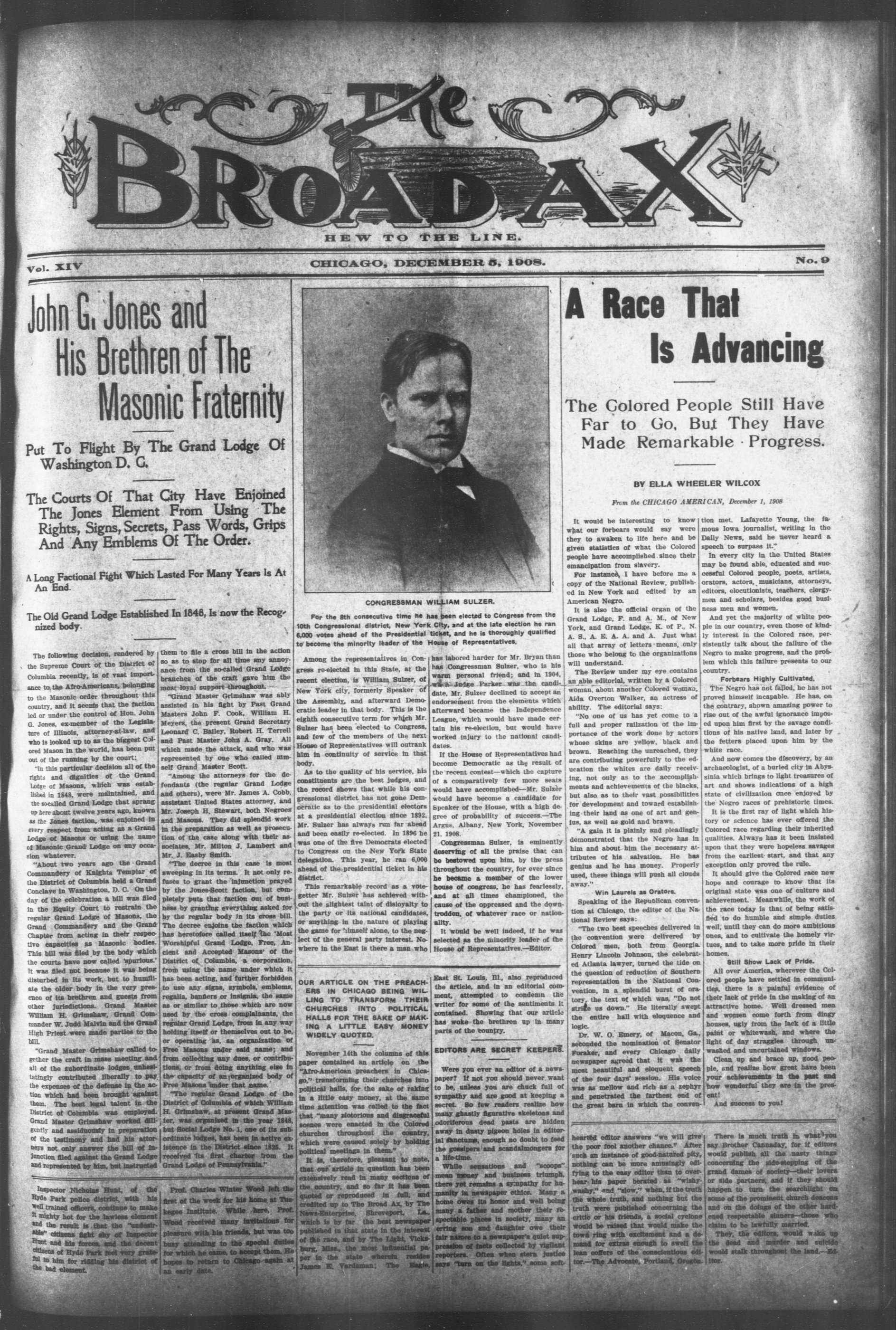
John G. Jones and His Brethren of The Masonic Fraternity
Put To Flight By The Grand Lodge Of Washington D. G.
The Courts Of That City Have Enjoined The Jones Element From Using The Rights, Signs, Secrets, Pass Words, Grips And Any Emblems Of The Order.
A Long Factional Fight Which Lasted For Many Years Is At An End.
The Old Grand Lodge Established In 1848, Is now the Recognized body.
The following decision, rendered by the Supreme Court of the District of Columbia recently, is of vast importance to the Afro-Americans, belonging to the Masonic order throughout this country, and it seems that the faction led or under the control of Hon. John G. Jones, ex-member of the Legislature of Illinois, attorney-at-law, and who is looked up to as the biggest Colored Mason in the world, has been put out of the running by the court:
"In this particular decision all of the rights and dignities of the Grand Lodge of Masons, which was established in 1848, were maintained, and the socalled Grand Lodge that sprang up here about twelve years ago, known as the Jones faction, was enjoined in every respect from acting as a Grand Lodge of Masons or using the name of Masonic Grand Lodge on any occasion whatever.
"About two years ago the Grand Commandery of Knights Templar of the District of Columbia held a Grand Conclave in Washington, D. C. On the day of the celebration a bill was filed in the Equity Court to restrain the regular Grand Lodge of Masons, the Grand Commandery and the Grand Chapter from acting in their respective capacities as Masonic bodies. This bill was filed by the body which the courts have now called 'spurious.' It was filed not because it was being disturbed in its work, but to humiliate the older body in the very presence of its brethren and guests from other jurisdictions. Grand Master William H. Grimshaw, Grand Commander W. Judd Malvin and the Grand High Priest were made parties to the bill.
"Grand Master Grimshaw called together the craft in mass meeting and all of the subordinate lodges, unhesitatingly contributed liberally to pay the expenses of the defense in the action which had been brought against them. The best legal talent in the District of Columbia was employed. Grand Master Grimshaw worked diligently and assiduously in preparation of the testimony and had his attorneys not only answer the bill of injunction filed against the Grand Lodge and represented by him, but instructed
Inspector Nicholas Hunt, of the Hyde Park police district, with his well trained officers, continue to make it mighty hot for the lawless element and the result is that the "undesirable" citizens fight shy of Inspector Hunt and his forces, and the decent citizens of Hyde Park took very grateful to him for ridding his district of the bad element.
them to file a cross bill in the action so as to stop for all time any annoyance from the so-called Grand Lodge branches of the craft gave him the most loyal support throughout. "Grand Master Grimshaw was ably assisted in his fight by Past Grand Masters John F. Cook, William H. Meyers, the present Grand Secretary Leonard C. Bailey, Robert H. Terrell and Past Master John A. Gray. All which made the attack, and who was represented by one who called himself Grand Master Scott. "Among the attorneys for the defendants (the regular Grand Lodge and others), were Mr. James A. Cobb, assistant United States attorney, and Mr. Joseph H. Stewart, both Negroes and Masons. They did splendid work in the preparation as well as prosecution of the case along with their associates, Mr. Milton J. Lambert and Mr. J. Easby Smith.
"The decree in this case is most sweeping in its terms. It not only refuses to grant the injunction prayed by the Jones-Scott faction, but completely puts that faction out of business by granting everything asked for by the regular body in its cross bill. The decree enjoins the faction which has heretofore called itself the 'Most Worshipful Grand Lodge, Free, Ancient and Accepted Masons' of the District of Columbia, a corporation, from using the name under which it has been acting, and further forbidden to use any signs, symbols, emblems, regalia, bankers or insignia, the same as or similar to those which are now used by the cross complainants, the regular Grand Lodge, from in any way holding itself or themselves out to be, or operating as, an organization of Free Masons under said name; and from collecting any dues, or contributions, or from doing anything else in the capacity of an organized body of Free Masons under that name.
"The regular Grand Lodge of the District of Columbia of which William H. Grimshaw, at present Grand Master, was organized in the year 1848, but Social Lodge No. 1, one of its subordinate lodges, has been in active existence in the District since 1825. It received its first charter from the Grand Lodge of Pennsylvania."
Prof. Charles Winter Wood left the first of the week for his home at Tuskegee Institute. While here, Prof. Wood received many invitations for pleasure with his friends, but was too busy attending to the special duties for which he came, to accept them. He hopes to return to Chicago again at an early date.
CHICAGO, DECEMBER 5, 1908.
A. H.
CONGRESSMAN WILLIAM SULZER.
For the 8th consecutive time he has been elected to Congress from the 10th Congressional district, New York City, and at the late election he ran 6,000 votes ahead of the Presidential ticket, and he is thoroughly qualified to become the minority leader of the House of Representatives.
Among the representatives in Congress re-elected in this State, at the recent election, is William Sulzer, of New York city, formerly Speaker of the Assembly, and afterward Democratic leader in that body. This is the eighth consecutive term for which Mr. Sulzer has been elected to Congress, and few of the members of the next House of Representatives will outrank him in continuity of service in that body.
As to the quality of his service, his constituents are the best judges, and the record shows that while his congressional district has not gone Democratic as to the presidential electors at a presidential election since 1892, Mr. Sulzer has always run far ahead and been easily re-elected. In 1896 he was one of the five Democrats elected to Congress on the New York State delegation. This year, he ran 6,000 ahead of the presidential ticket in his district.
has labored harder for Mr. Bryan that has Congressman Sulzer, who is his warm personal friend; and in 1900 when Judge Parker was the candidate, Mr. Sulzer declined to accept an endorsement from the elements while afterward became the Independent League, which would have made certain his re-election, but would have worked injury to the national candidates.
If the House of Representatives has become Democratic as the result of the recent contest—which the capture of a comparatively few more seats would have accomplished—Mr. Sulzer would have become a candidate for Speaker of the House, with a high degree of probability of success.—The Argus, Albany, New York, November 21, 1908.
Congressman Sulzer, is eminent deserving of all the praise that can be bestowed upon him, by the press throughout the country, for ever since he became a member of the low
This remarkable record as a votegetter Mr. Sulzer has achieved without the slightest taint of disloyalty to the party or its national candidates, or anything in the nature of playing the game for himself alone, to the neglect of the general party interest. Nowhere in the East is there a man who
OUR ARTICLE ON THE PREACHERS IN CHICAGO BEING WILLING TO TRANSFORM THEIR CHURCHES INTO POLITICAL HALLS FOR THE SAKE OF MAKING A LITTLE EASY MONEY WIDELY QUOTED.
November 14th the columns of this paper contained an article on the "Afro-American preachers in Chicago," transforming their churches into political halls, for the sake of raking in a little easy money, at the same time attention was called to the fact that "many pliotorious and disgraceful scenes were enacted in the Colored churches throughout the country, which were caused solely by holding political meetings in them."
It is, therefore, pleasant to note, that our article in question has been extensively read in many sections of the country, and so far it has been quoted or reproduced in full, and credited up to The Broad Ax, by The News-Enterprise, Shreveport, La, which is by far the best newspaper published in that state in the interest of the race, and by The Light, Vicksburg, Miss, the most influential paper in the state wherein resides James K. Vardaman; The Eagle,
has labored harder for Mr. Bryan than has Congressman Sulzer, who is his warm personal friend; and in 1904, who a Judge Parker was the candidate, Mr. Sulzer declined to accept an endorsement from the elements which afterward became the Independence League, which would have made certain his re-election, but would have worked injury to the national candidates.
If the House of Representatives had become Democratic as the result of the recent contest—which the capture of a comparatively few more seats would have accomplished—Mr. Sulzer would have become a candidate for Speaker of the House, with a high degree of probability of success.—The Argus, Albany, New York, November 21, 1908.
Congressman Sulzer, is eminently deserving of all the praise that can be bestowed upon him, by the press throughout the country, for ever since he became a member of the lower house of congress, he has fearlessly, and at all times championed, the cause of the oppressed and the downtrodden, of whatever race or nationality.
It would be well indeed, if he was selected as the minority leader of the House of Representatives.—Editor.
East St. Louis, Ill., also reproduced the article, and in an editorial comment, attempted to condemn the writer for some of the sentiments it contained. Showing that our article has woke the brethren up in many parts of the country.
Were you ever an editor of a newspaper? If not you should never want to, unless you are chuck full of sympathy and are good at keeping a secret. So few readers realize how many ghastly figurative skeletons and odoriferous dead pasts are hidden away in dusty pigeon holes in editorial sanctums, enough no doubt to feed the gossipers and scandalmongers for a life-time.
While sensations and "scoops" mean money and business triumph, there yet remains a sympathy for humanity in newspaper ethics. Many a home owes its honor and well being many a father and mother their respectable places in society, many an erring son and daughter owe their fair names to a newspaper's quiet suppression of facts collected by vigilant reporters. Often when stern justice says "turn on the lights," some soft-
A Race That Is Advancing
The Colored People Still Have Far to Go, But They Have Made Remarkable Progress.
BY ELLA WHEELER WILCOX
From the CHICAGO AMERICAN, December 1, 1908
It would be interesting to know what our forbears would say were they to awaken to life here and be given statistics of what the Colored people have accomplished since their emancipation from slavery.
For instance, I have before me a copy of the National Review, published in New York and edited by an American Negro.
It is also the official organ of the Grand Lodge, F. and A. M., of New York, and Grand Lodge, K. of P., N. A. S., A. E. A. A. and A. Just what all that array of letters means, only those who belong to the organizations will understand.
The Review under my eye contains an able editorial, written by a Colored woman, about another Colored woman, Aida Overton Walker, an actress of ability. The editorial says:
tion met. Lafayette Yomous Iowa journalist, w Daily News, said he m speech to surpass it."
In every city in the may be found able, edu cessful Colored people, orators, actors, musicia editors, elocutionists, te mmen and scholars, besi ness men and women.
And yet the majority ple in our country, even interest in the Colo ristently talk about the Negro to make progress, lem which this failure p country.
Forbears Highly C
The Negro has not fail proved himself incapable the contrary, shown am
"No one of us has yet come to a full and proper ralization of the importance of the work done by actors whose skins are yellow, black and brown. Reaching the unreached, they are contributing powerfully to the education the whites are daily receiving, not only as to the accomplishments and achievements of the blacks, but also as to their vast possibilities for development and toward establishing their land as one of art and genius, as well as gold and brawn.
"A gain it is plainly and pleadingly demonstrated that the Negro has in him and about him the necessary attributes of his salvation. He has genius and he has money. Properly used, these things will push all clouds away."
Win Laurels as Orators.
Speaking of the Republican convention at Chicago, the editor of the National Review says:
"The two best speeches delivered in the convention were delivered by Colored men, both from Georgia. Henry Lincoln Johnson, the celebrated Atlanta lawyer, turned the tide on the question of reduction of Southern representation in the National Convention, in a splendid burst of oratory, the text of which was, "Do not strike us down." He literally swept the entire hall with eloquence and logic.
Dr. W. O. Emery, of Macon, Ga., seconded the nomination of Senator Foraker, and every Chicago daily newspaper agreed that it was the most beautiful and eloquent speech of the four days' session. His voice was as mellow and rich as a zephyr and penetrated the farthest end of the great burn in which the conven-
hearted editor answers "we will give the poor fool another chance." After such an instance of good-natured pity, nothing can be more amusingly edifying to the easy editor than to overhear his paper berated as "wishy-washy," and "slow," when, if the truth the whole truth, and nothing but the truth were published concerning the critic or his friends, a social cyclone would be raised that would make the town ring with excitement and a demand for extra enough to swell the loan coffers of the conscientious editor—The Advocate, Portland, Oregon.
tion met. Lafayette Young, the famous Iowa journalist, writing in the Daily News, said he never heard a speech to surpass it." In every city in the United States may be found able, educated and successful Colored people, poets, artists, orators, actors, musicians, attorneys, editors, elocutionists, teachers, clergymen and scholars, besides good business men and women. And yet the majority of white people in our country, even those of kindly interest in the Colored race, persistently talk about the failure of the Negro to make progress, and the problem which this failure presents to our country.
Forbears Highly Cultivated.
The Negro has not failed, he has not proved himself incapable. He has, on the contrary, shown amazing power to rise out of the awful ignorance imposed upon him first by the savage conditions of his native land, and later by the fetters placed upon him by the white race.
And now comes the discovery, by an archaeologist, of a buried city in Abyssinia which brings to light treasures of art and shows indications of a high state of civilization once enjoyed by the Negro races of prehistoric times. It is the first ray of light which history or science has ever offered the Colored race regarding their inherited qualities. Always has it been insisted upon that they were hopeless savages from the earliest start, and that any exception only proved the rule.
It should give the Colored race new hope and courage to know that its original state was one of culture and achievement. Meanwhile, the work of the race today is that of being satisfied to do humble and simple duties well, until they can do more ambitious ones, and to cultivate the homely virtues, and to take more pride in their homes.
All over America, wherever the Colored people have settled in communities, there is a painful evidence of their lack of pride in the making of an attractive home. Well dressed men and women come forth from dingy houses, ugly from the lack of a little paint or whitewash, and where the light of day straggles through unwashed and uncurtained windows. Clean up and brace up, good people, and realize how great have been your achievements in the past and how wonderful they are in the present!
And success to you!
There is much truth in what you say Brother Cannaday, for if editors would publish all the nasty things concerning the side-stepping of the grand dames of society—their lovers or side partners, and if they should happen to turn the searchlight on some of the prominent church deacons and on the doings of the other hardened respectable sinners—those who claim to be lawfully married. They, the editors, would wake up the dead and murder and suicide would stalk throughout the land—Editor.
THE BROADAX
Will promulgate and at all times uphold the true principles of Democracy but Catholics, Protestants, Priests, Indeles, Single Taxers, Republicans, or anyone else can have their say, or long as their language is proper and responsibility is fixed.
The Broad Ax is a newspaper whose platform is broad enough for all, ever claiming the editorial right to speak its own mind.
Local communications will receive attention. Write only on one side of the paper.
Advertising rates made known on application.
Address all communications to
Entered an Second-Class Matter, ALg. 19, 1902 at the Post Office at Chicago, Illinois, under Act of March 3, 1879.
HEALTH DEPARTMENT TALKS.
Importance of Air in Work-Places.
It Pays to Ventilate.
The one all-important matter to be looked after in work-places is that of the air supply. In the dust producing occupations it is of no less importance that all proper means be provided for the protection of the employees from the dust.
Air that is filled with dust particles is dangerous. In machine shops, metal polishing rooms, type foundries, brass works, etc., there is much dust made that is very injurious to those exposed and who inhale it into the lungs and air passages. Investigations made in eastern industrial institutions disclose some interesting facts as showing the effects of a dust laden atmosphere upon those compelled to work in poorly ventilated shops and where no protective devices are employed.
Out of twenty-four establishments visited it was found that in those places where the air was filled with dust, the employees were pale and sickly in appearance and all complained of the irritating effects of the dust which they were compelled to breathe. In other places where the conditions were model as to light, ventilation and general sanitation, the employees were in good health and able to turn out more work per person than in the places where conditions were bad.*
This means that with no increased cost as to wages paid, the employer who spends money to provide sanitary conditions for his help is increasing his output. In other words, without adding to his pay roll he is able to turn out more finished material than he would with the same number of employees working under bad conditions as to light, air and general clean-lines. Now, we have said this much to bring out the fact that it pays in dollars and cents to provide clean, light and well ventilated work places.
Overcrowding is another crying evil in many work places for the reason that it always means that the employees will be compelled to breathe bad air, and this means loss of efficiency in work performed, loss of time through illness and enforced absence. So it is clear that overcrowding does not pay. In fact, nothing pays that tends to injure the health of the employees. And this is looking at the matter from purely the standpoint of economy.
No workman can do as much work nor as good in quality on foul air as he can when supplied with good air. If this is true, and it will not be questioned, what is the answer? The answer is this:
See to it that your employees are provided with clean, well ventilated work rooms. See to it, too, that the rooms are not overcrowded. Also, if your business is one of the dust producing trades, don't begrudge the money to adopt devices that will protect your employees and give them a better, cleaner atmosphere to work in.
Health is / wealth, and time is money; and good sanitary surroundings for work people mean more health for them and more money for both employers and employees—"P."
Tuesday and Friday afternoon mat-
nacles are quite popular and are atten-
ted by Chicago's best.
Mr. Jerry Millis of the Smart Set
and Mr. Ed Green of the same com-
pany, who will be remembered as this
leading characters in the late Pekin
Stock Company, were visitors at the
Chateau this week. They are contem-
plating putting in a stock company
show and roof garden at the Chateau next summer. The treasurer, Mr. Moseley, now has the plan under consideration. Miss Marle Burton, the great soprano, and escort, were at the Rink Saturday night. Miss Burton has flattering offers to go with the Williams & Walker show, but so far has refused to consider any propositions except to continue her studies at the Conservatory. The Moving Picture Show at the Rink is the best in the city and can be seen free gratis by skaters and others every evening at 10:30.
The cafe at the Rink has changed hands and is now under the management of Mr. T. H. Ford, late of the Pekin Inn. Mr. Ford is undoubtedly one of the best cooks in the city, and those desiring a toothsome, delectable meal will do well to give him a call. His Sunday dinners are specialties and are served from 1 to 7 each Sunday afternoon.
Big program tonight and tomorrow night. Don't fall to attend.
NOTES OF RACIAL PROGRESS.
As Reported by the National Negro Business League.
The total assets of the Pioneer Building and Loan Association of Greensboro, N. C., as shown by the recently issued annual report, are $18,565.73. The total value of the eleven series up to that time was $15,336.70. Mr. J. E. Dellinger is president and Prof. James B. Dudley is secretary and treasurer.
Mr. Jesse Binga, 3633 State street, Chicago, has recently opened a private bank, which is meeting with success and with prospects favorable. Before embarking in the banking business Mr. Binga had been conducting a realty and loan business, which he will also continue just the same.
The Negroes of Temple, Texas, own more nice homes than in any other city of its size in the state. Their dwellings are of the most approved and modern style.
M. D. Butts, near Calvert, Texas, owns 600 acres of Robertson county land. He gathered 50 bales of cotton this year. He has 20 mules, 50 cows, 25 horses, 30 hogs and hundreds of chickens, etc. He is said to be worth fully $30,000.
The Baltimore Steam Boat Company, incorporated under the laws of Maryland with an authorized capital stock of $60,000, makes its initial bow to the public. Their certificate of incorporation authorizes them to engage in water excursions, bathing, beach and hotel business. The whole outfit is owned and managed by a company of energetic business men of the race, with Mr. George W. Brown as president.
The first regularly organized state fair the Negroes ever held in South Carolina was opened the 10th of November and continued throughout the week. The press, both white and Colored, pronounced it a decided success, not only in point of attendance but in the extensive display of exhibits representing almost every kind of industry, and at the same time making an excellent showing in the educational field. Governor Ansel was the principal speaker of the occasion; and his encouraging remarks were enthusiastically cheered by the 10,000 visitors present on the grounds. The Governor and hundreds of other white visitors expressed themselves as being agreeably surprised at the abundance, the variety and the excellence of the exhibits. To add to the credit and good reputation of the race, the local papers observed that during the week the streets were crowded with well dressed and prosperous looking Negroes; that perfect order prevailed and not a drunken or disorderly one was seen anywhere.
The Local Negro Business League of Louisville, Ky., is beginning to make preparations for the entertainment of the National body next August. There was a large and enthusiastic meeting of the leading business and professional men on the night of the 12th of November. In this meeting the officers of the league who are to have charge of affairs during the session of the National Organization were elected. Mr. D. L. Knight was made president. Rev. Dr. L. G. Jordan, corresponding secretary, and Mr. Cary B. Lewis, public agent. Mr. Lewis is correspondent of the Courier-Journal and of the Indianapolis Freeman. The citizens and press, both white and Colored, are with the local League; and as soon as President Knight appoints his different com-
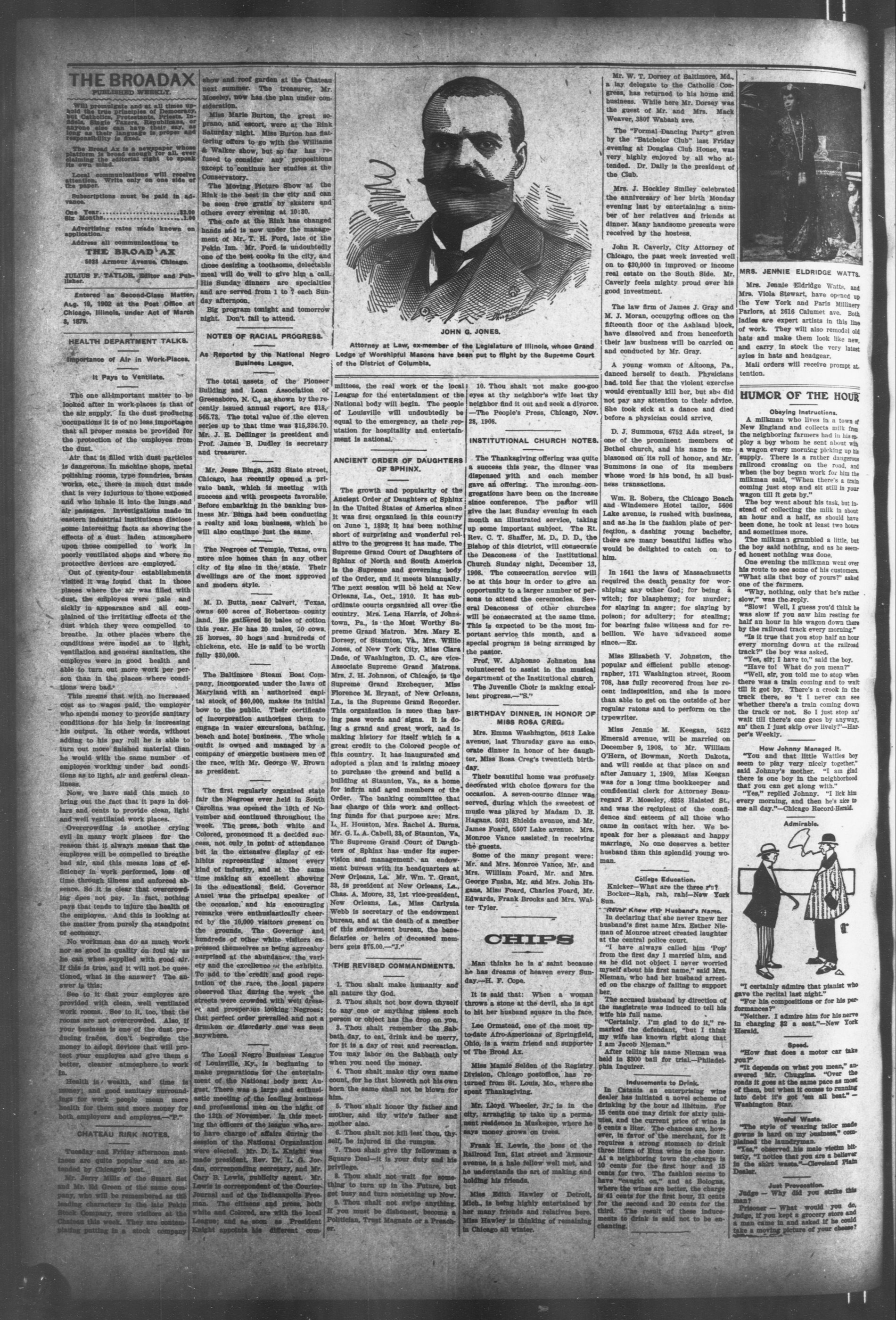
JOHN G. JONES
Attorney at Law, ex-member of the Legislature of Illinois, whose Grand Lodge of Worshipful Masons have been put to flight by the Supreme Court of the District of Columbia.
mittees, the real work of the local League for the entertainment of the National body will begin. The people of Louisville will undoubtedly be equal to the emergency, as their reputation for hospitality and entertainment is national.
10. Thou shalt not make goo-goo eyes at thy neighbor's wife lest the neighbor find it out and seek a divorce—The People's Press, Chicago, Nov 28, 1908.
INSTITUTIONAL CHURCH NOTES
ANCIENT ORDER OF DAUGHTERS
OF $PHINX.
The growth and popularity of the Ancient Order of Daughters of Sphinx in the United States of America since it was first organized in this country on June 1, 1893, it has been nothing short of surprising and wonderful relative to the progress it has made. The Supreme Grand Court of Daughters of Sphinx of North and South America is the Supreme and governing body of the Order, and it meets biannually. The next session will be held at New Orleans, La., Oct. 1910. It has subordinate courts organized all over the country. Mrs. Lena Harris, of Johnstown, Pa., is the Most Worthy Supreme Grand Matron. Mrs. Mary E. Dorsey, of Staunton, Va., Mrs. While Jones, of New York City, Miss Clara Dade, of Washington, D. C., are vice-Associate Supreme Grand Matrons. Mrs. J. H. Johnson, of Chicago, is the Supreme Grand Exchequer, Miss Florence M. Bryant, of New Orleans, La., is the Supreme Grand Recorder. This organization is more than having pass words and signs. It is doing a grand and great work, and is making history for itself which is a great credit to the Colored people of this country. It has inaugurated and adopted a plan and is raising money to purchase the ground and build a building at Staunton, Va., as a home for infirm and aged members of the Order. The banking committee that has charge of this work and collecting funds for that purpose are; Mrs. L. H. Houston, Mrs. Rachel A. Burns, Mr. G. L. A. Cabell, 33, of Staunton, Va. The Supreme Grand Court of Daughters of Sphinx has under its supervision and management an endowment bureau with its headquarters at New Orleans, La. Mr. Wm. T. Grant, 33, is president at New Orleans, La., Chas. A. Moore, 33, 1st vice-president, New Orleans, La., Miss Carlysia Webb is secretary of the endowment bureau, and at the death of a member of this endowment bureau, the beneficiaries or heirs of deceased members gets $75.00.—"J."
THE REVISED COMMANDMENTS.
1. Thou shalt make humanity and all nature thy God.
2. Thou shalt not bow down thyself to any one or anything unless such person or object has the drop on you.
3. Thou shalt remember the Sabbath day, to eat, drink and be merry, for it is a day of rest and recreation. You may labor on the Sabbath only when you need the money.
4. Thou shalt make thy own name count, for he that bloweth not his own horn the same shall not be blown for him.
5. Thou shalt honor thy father and mother, and thy wife's father and mother also.
6. Thou shalt not kill lest thou, thyself, be injured in the rumpus.
7. Thou shalt give thy fellowman a Square Deal—it is your duty and his privilege.
8. Thou shalt not wait for something to turn up in the Future, but get busy and turn something up Now.
9. Thou shalt not swipe anything. If you must be dishonest, become a Politician, Trust Magnate or a Preacher.
JOHN G. JONES.
10. Thou shalt not make goo-goo eyes at thy neighbor's wife lest thy neighbor find it out and seek a divorce. —The People's Press, Chicago, Nov. 28, 1908.
INSTITUTIONAL CHURCH NOTES.
The Thanksgiving offering was quite a success this year, the dinner was dispensed with and each member gave an offering. The mering congregations have been on the increase since conference. The pastor will give the last Sunday evening in each month an illustrated service, taking up some important subject. The Rt. Rev. C. T. Shaffer, M. D., D. D., the Bishop of this district, will consecrate the Deaconess of the Institutional Church Sunday night, December 13, 1908. The consecration service will be at this hour in order to give an opportunity to a larger number of persons to attend the ceremonies. Several Deaconess of other churches will be consecrated at the same time. This is expected to be the most important service this month, and a special program is being arranged by the pastor.
Prof. W. Alphonso Johnston has volunteered to assist in the musical department of the Institutional church. The Juvenile Choir is making excellent progress.—"S."
BIRTHDAY DINNER. IN HONOR OF
MISS ROSA CREG.
Mrs. Emma Washington, 5618 Lake avenue, last Thursday gave an emb orate dinner in honor of her daughter, Miss Rosa Creg's twentieth birthday.
Their beautiful home was profusely decorated with choice flowers for the occasion. A seven-course dinner was served, during which the sweetest of music was played by Madam D. B. Hagans, 5031 Shields avenue, and Mr. James Foard, 5507 Lake avenue. Mrs. Monroe Vance assisted in receiving the guests.
Some of the many present were: Mr. and Mrs. Monroe Vance, Mr. and Mrs. William Foard, Mr. and Mrs. George Fusha, Mr. and Mrs. John Hagans, Miss Foard, Charles Foard, Mr. Edwards, Frank Brooks and Mrs. Walter Tyler.
CHIPS
Man thinks he is a saint because he has dreams of heaven every Sunday—H. F. Cope.
Lee Ormstead, one of the most up-to-date Afro-Americans of Springfield, Ohio, is a warm friend and supporter of The Broad Ax.
Miss Mamie Selden of the Registry Division, Chicago postoffice, has returned from St. Louis, Mo., where she spent Thanksgiving.
Mr. Lloyd Wheeler, Jr., is in the city, arranging to take up a permanent residence in Muskegee, where he says money grows on trees.
Frank H. Lewis, the boss of the Railroad Inn, 51st street and Armour avenue, is a hale fellow well met, and he understands the art of making and holding his friends.
Miss Edith Hawley of Detroit, Mich., is being highly entertained by her many friends and relatives here. Miss Hawley is thinking of remaining in Chicago all winter.
Mr. W. T. Dorsey of Baltimore, Md., a lay delegate to the Catholic Congress, has returned to his home and business. While here Mr. Dorsey was the guest of Mr. and Mrs. Mack Weaver, 3807 Wabash ave.
The "Formal-Dancing Party" given by the "Batchelor Club" last Friday evening at Douglas Club House, was very highly enjoyed by all who attended. Dr. Daily is the president of the Club.
Mrs. J. Hockley Smiley celebrated the anniversary of her birth Monday evening last by entertaining a number of her relatives and friends at dinner. Many handsome presents were received by the hostess.
John R. Caverly, City Attorney of Chicago, the past week invested well on to $30,000 in improved or income real estate on the South Side. Mr. Caverly feels mighty proud over his good investment.
The law firm of James J. Gray and M. J. Moran, occupying offices on the fifteenth floor of the Ashland block, have dissolved and from henceforth their law business will be carried on and conducted by Mr. Gray.
A young woman of Alitoona, Pa., danced herself to death. Physicians had told her that the violent exercise would eventually kill her, but she did not pay any attention to their advice. She took sick at a dance and died before a physician could arrive.
D. J. Summons, 6752 Ada street, is one of the prominent members of Bethel church, and his name is emblazoned on its roll of honor, and Mr. Summons is one of its members whose word is his bond, in all business transactions.
Wm. R. Sobers, the Chicago Beach and Windemere Hotel tailor, 5606 Lake avenue, is rushed with business, and as he is the fashion plate of perfection, a dashing young bachelor, there are many beautiful ladies who would be delighted to catch on to him.
In 1641 the laws of Massachusetts required the death penalty for worshiping any other God; for being a witch; for blasphemy; for murder; for slaying in anger; for slaying by poison; for adultery; for stealing; for bearing false witness and for rebellion. We have advanced some since.—Ex.
Miss Elizabeth V. Johnston, the popular and efficient public stenographer, 171 Washington street, Room 708, has fully recovered from her recent indisposition, and she is more than able to get on the outside of her regular ratons and to perform on the typewriter.
Miss Jennie M. Keegan, 5622
Emerald avenue, will be married on
December 9, 1908, to Mr. William
O'Hern, of Bowman, North Dakota,
and will reside at that place on and
after January 1, 1909. Miss Keegan
was for a long time bookkeeper and
confidential clerk for Attorney Beau-
regard F. Moseley. .6258 Halsted St.,
and was the recipient of the con-
fidence and esteem of all those who
came in contact with her. We be-
speak for her a pleasant and happy
marriage. No one deserves a better
husband than this splendid young
woman.
College Education.
Nickler-What are the three r's?
Bocker-Rah, rah, rah!-New York Sun.
"Never knew her Husband's name.
In declaring that she never knew her husband's first name Mrs. Esther Nieman of Monroe street created laughter at the central police court.
"I have always called him 'Pop' from the first day I married him, and as he did not object I never worried myself about his first name," said Mrs. Nieman, who had her husband arrested on the charge of falling to support her.
The accused husband by direction of the magistrate was induced to tell his wife his full name.
"Certainly, I'm glad to do it." remarked the defendant, "but I think my wife has known right along that I am Jacob Nieman."
After telling his name Nieman was held in $300 ball for trial—Philadelphia Inquirer.
In Catania an enterprising wine dealer has initiated a novel scheme of drinking by the hour ad libitum. For 15 cents one may drink for sixty minutes, and the current price of wine is 5 cents a liter. The chances are, however, in favor of the merchant, for it requires a strong stomach to drink three liters of Etna wine in one hour. At a neighboring town the charge is 10 cents for the first hour and 15 cents for two. The fashion seems to have "caught on," and at Bologna, where the wines are better, the charge is 41 cents for the first hour, 31 cents for the second and 20 cents for the third. The result of these inducements to drink is said not to be enchanting.
THE MAYOR OF THE CITY OF NEW YORK
MRS. JENNIE ELDRIDGE WATTS.
Mrs. Jennie Eldridge Watts, and Mrs. Viola Stewart, have opened up the Yew York and Paris Millinery Parlors, at 2616 Calumet ave. Both ladies are expert artists in this lines of work. They will also remodel old hats and make them look like new, and carry in stock the very latest styles in hats and headgear.
Mail orders will receive prompt attention.
HUMOR OF THE HOUR
Obeying Instructions.
A milkman who lives in a town of New England and collects milk from the neighboring farmers had in his employ a boy whom he sent about with a wagon every morning picking up his supply. There is a rather dangerous railroad crossing on the road, and when the boy began work for him the milkman said, "When there's a train coming just stop and sit still in your wagon till it gets by."
The boy went about his task, but instead of collecting the milk in about an hour and a half, as should have been done, he took at least two hours and sometimes more.
The milkman grumbled a little, but the boy said nothing, and as he seemed honest nothing was done.
One evening the milkman went over his route to see some of his customers. "What alls that boy of yours?" asked one of the farmers.
"Why, nothing, only that he's rather slow," was the reply.
"Slow! Well, I guess you'd think he was slow if you saw him resting for half an hour in his wagon down there by the railroad track every morning."
"Is it true that you stop half an hour every morning down at the railroad track?" the boy was asked.
"Yes, sir; I have to," said the boy.
"Have to! What do you mean?"
"Well, sir, you told me to stop when there was a train coming and to wait till it got by. There's a crook in the track there, so 't I never can see whether there's a train coming down the track or not. So I just stop an' wait till there's one goes by anyway, an' then I just skip over lively!"—Harper's Weekly.
"You and that little Wettles boy seem to play very nicely together," said Johnny's mother. "I am glad there is one boy in the neighborhood that you can get along with." "Yes," replied Johnny. "I lick him every morning, and then he's nice to me all day."—Chicago Record-Herald.
Admirable.
"I certainly admire that pianist who gave the recital last night."
"For his compositions or for his performances?"
"Neither. I admire him for his nerve in charging $2 a seat."—New York Herald.
Speed.
"How fast does a motor car take you?"
"It depends on what you mean," answered Mr. Chuggins. "Over the roads it goes at the same pace as most of them, but when it comes to running into debt it's got 'em all beat." — Washington Star.
Woofful Waste.
"The style of wearing tailor made gowns is hard on my business," complained the laundryman.
"Sex," observed his male victim bitterly, "I notice that you are a believer in the shirt wasta."—Cleveland Flam Dealer.
Just Prevocation.
Judge — Why did you strike this man?
Prisoner — What would you do, judge, if you kept a grocery store and a man came in and asked if he could take a moving picture of your cheese?
By GARFIELD MACNEAL
Lillian Treadwell awoke on the morning of her thirtieth birthday to the sickening consciousness that she was an old maid. She parted the cretonne curtains of her bed, curtains covered with red roses, suggestive of summer sunshine, and turned her eyes toward the window. Rain beating against the panes and dull gray sky proclaimed a cheerless November day. She sighed. Then, stretching out a shapely arm, she took a silver hand mirror from the nearby dressing table and carefully studied her features. In the language of Shakespeare, she saw "no deeper wrinkles yet," face long and oval, patrician in outline and expression, skin rather olive, eyes brown, deep and luminous, a mouth generously molded and a wealth of brown hair. On the whole, it was a notable face and one of character.
Dropping the mirror on the bed, she called "Lolls!" A French maid, neat, trim and smiling, appeared with the breakfast tray.
"Ah, ma'm'selle! A thousand congratulations on your birthday."
"My thirtieth, Lols. But thank you just the same."
"Ma'm'selle is still young, and already fame has come to you. And when your novel is published the world will be at your feet," said Lols, with a comprehensive sweep indicating the world.
"Oh, yes, the novel!" murmured her mistress, sitting up and staring in on her coffee and rolls, while the maid laid a bundle of letters and manuscripts on the bed.
Miss Treadwell opened the one bulky package and looked at the accompanying letter. It was from a great publishing house formally expressing regret that they were unable to accept her novel.
She gulped down something in her throat. Her novel declined—her first really original work, to which she had given the leisure hours of six years. Truly, this was a most delightful birthday gift.
"Lois," she said, and her voice trembled—"Lois, my novel has been declined."
"Ah, ma'm'selle, I am too sorry"—with quick sympathy—"but some other publisher will accept it."
Her mistress shook her head. "I shall not send it out again. I shall stick to hack work. I can at least make a living at that." Then she added reflectively, "My life has been a failure."
Lois protested. She worshiped her mistress. "Ma'm'selle has been successful. You have a pretty apartment and everything you want."
"Other women, too, have pretty apartments and everything they want."
"Ah, yes, but they did not work for them," said Lois, with a worldly shrug, as she went in response to the electric bell, which at this moment buzzed loudly in the hall.
She reappeared with a huge white box. "Flowers, ma'mselle, and a note," she said gayly.
Miss Treadwell cut the ribbon that held the box and disclosed a mass of violets. They seemed to look up at her tenderly, yet shrinking, as she bent over them. With a sigh of pleasure she took the note and studied the bold handwriting of the superscription. Her heart jumped. Surely it was Jack's! Dear old. Jack had remembered her!
She slit across the end of the envelope while her fingers trembled and eagerly unfolded the paper.
"Dear Lillian," she read, "may I hope that this remembrance of your birthday will prove that I have not forgotten you? I have been in town two days. I secured your address from C's Magazine and send these flowers to warn you that I am coming to invade your sanctum sanctorum and talk over old times. Always your friend, Jack Alnsworth."
She started up, scattering letters and manuscripts on the floor. "Lots," she said decidedly, "I want you to lay out my new morning gown, the sea green one with the train."
Sitting down at her dressing table, she began a careful toilet. Her thoughts were busy with the past. Jack had been her girlhood friend in the little inland town where they were both born and bred. Again she was twenty-four and he was twenty-six. Why had he never spoken? She knew he loved her, and perhaps she had loved him, too, then. But when her mother's death left her alone in the world she was seized with the desire to come to New York to try her fortune. Jack had advised against it, but a strange perversity made her deaf to his warnings.
At first they had kept up a correspondence. Soon even that link was broken as she was drawn more and more into the absorbing whirl of newspaper and magazine work. For five years no letters had passed between them. To be sure, she had heard of him indirectly—how he gradually forged ahead from clerk in the railroad office to manager of the whole system, and she had been glad for his sake.
And now, after all this time, they were to meet. She wondered what he would be like. Doubtless he had lost the fresh boyish beauty she so well remembered. He was past thirty now, she reflected with a sigh. Doubtless, too, his career as a man of affairs had
glade him brusque and cold. She had visions of bearded cheek and chin and perhaps glasses. Horrors! Had it really come to that? Well, she would live in the old days and pay no attention to externals.
When at last Lols announced that Mr. Alnsworth was in the drawing room she swept to her mirror and surveyed the graceful figure reflected there. Her gown of sea green fell in shimmering folds. Her hair was done beautifully, and some of the violets were clasped in the silver girdle at her waist. She could not fall to be satisfied.
This consciousness helped her to enter the drawing room with the perfect self possession of a woman of the world. With outstretched hand she greeted him as if they had parted but yesterday.
"Jack! How good of you to some to see me on my birthday and to send me these lovely flowers!" turning to a center table where the violets were displayed.
Jack Alnsworth gasped. Could this elegant woman, with her perfect hair and silvery voice, be his old friend?
"Lillian," he said, still grasping her hand, "is it really you?"
She smiled, and it was her old smile. "Yes, Jack, it is I. You see, I am going the way of the world." "Nonsense! You are perfect!" he cried vehemently.
She was no less charmed. There was no evidence of beard or glasses, though the boy had grown into the man—tall, athletic, clean shaven, with strong jaw and deep voice. His honest gray eyes feasted on her beauty. She flushed.
"Tell me what you have been doing all these years, Jack," she said finally.
"Oh, working hard and following your career!"
"Yes," she said, "you have done well for yourself, and I am proud of you. As for my career, it has not amounted to much."
"Lillian," Ainsworth said, leaning forward eagerly, "do you know that you have not written a line I have not read! You ceased to write to me, but I did not forget, dear."
Miss Treadwell had forgotten the rain and the unfeeling publisher.
"Tell me, Jack, what brings you to New York?" she asked.
"I have been elected vice president of the road and must live here," he replied.
"Then I suppose you will marry and keep up an establishment?" with a pretense of lightness.
"I don't know," he said dubiously.
"There never was but one girl for me, and she—she has achieved fame. She would not think of giving up glory to become the wife of a railroad man."
A feeling long dead woke in the woman. "But she might be willing, Jack, if you asked her," she said almost wistfully. "She might gladly give up all her false glory to find real happiness."
"If I thought that," said Alnsworth breathlessly, "T'd ask her in a minute."
She thought of the novel, of the hack work, of the loneliness of her life which this friend of the past brought sharply before her.
"Jack," she said, "I've decided"—she paused, then went on rapidly, fingering the violets in her belt—"to give up literature for good."
Ainsworth started forward. "Do you really mean it, Lillian?" "Yes, I do," she replied bravely. "But why?" he inquired, doubting puzzled.
She looked up at him, and he read it in her shining eyes.
He leaped forward and folded her in his arms, crushing the violets in his eagerness. "My darling!" was all he could say in trembling tones.
As for Miss Treadwell, with that embrace came the realization that woman was not made to live on mind alone.
"Lois," she called after a little, "bring me the manuscript of my novel!" She took it from the wondering maid and turned to Jack, with a radiant smile. "Come," she cried gaily—"come to my study fire and help me make dust and ashes of my literary pretensions."
Courtesy In Business
The man who solicits your advertisement, the salesman who has samples to exhibit, the life insurance agent whose hair trigger tongue pleads eloquently for your family, even the seductive canvasser who tries to inveigle you into buying a history of the world in twenty-five volumes, can be listened to for a courteous minute or two and politely dismissed without seriously clogging the wheels of business. Perhaps they may really have something worth while to offer. Above all, the tellers and the cashiers of every bank need a course in the art of gracious expression. Why should the depositor of money be regarded with frowning suspicion and why should his mistake in indorsing checks wrong side up or his failure to have his books balanced regularly call forth shouts of correction instead of a few words of kindly instruction? After all, he is only ignorant or only forgetful. No dark scheme for defrauding the bank lurks behind his failure to follow the bank's rules. Courtesy is its own reward. It pays in personal satisfaction, in minimizing friction, in making friends and in raising you in the eyes of your business associates—Scientific American.
Looks Like It.
Howell—Three hundred men attended a dog fight last Sunday, and there were less than fifty at our church. Powell—It's no wonder they say that the country is going to the dogs.—New York Press.
A thousand times listen to the counsel of your friend, but seek it only once.—Hardy.
WM. D. NEIGHBORS & CO REAL ESTATE AT LOWEST PRICES
CHOICE MISCELLANY
Smart Boys of Long Age
It is often asserted nowadays that our young men and women attain intellectual maturity much later than did their parents and grandparents, and in support of this theory the precocity of distinguished personages who flourished a generation or two ago is cited. Now, somebody who has probably been bored like the rest of us with this yarn about the phenomenal brightness of the old fashioned boys has looked up the-records of eleven leading colleges to see what changes have taken place in the age of graduates. From 1850 to 1860 the average age at graduation was 23 years 1.3 months. From 1890 to 1900 it was 23 years 1.9 months. In 180 years at Dartmouth the average age at graduation has fallen three months. This average age, it appears, has changed as little as the average weather. Thus one or two precocious youths of the long ago are sufficient to endure all their contemporaries with the same qualities. But the fact is the twentieth century boy is smarter than any of his predecessors, and (unfortunately) in nine cases out of ten he knows it—Pittsburgh Gazette-Times
A Fatal Paraphrase
General Sheridan, says the Philadelphia Ledger, used to take dight in telling the following:
"A young man seated at dinner one time said to his wife:
"Ellen, if you are good at guessing here is a conundrum for you. If the devil should lose his tail where would he go to get another one?
"After some time spent in guessing she gave it up.
"Well,' said he, 'where they retail spirits."
"Eager to get it off, she hastened to a lady friend with:
"Oh, Marian! I have such a nice conundrum. Joe just told me of it. I know you can't guess it. If the devil should lose his tail where would he go to get another one?
"Her friend Marian having given it up, she said:
"Where they sell liquor by the glass."
"Marian couldn't see the point of the joke."
Once Chinaman Always Chinaman.
China is yet a land and a people ruled by ancestors. A Chinaman belongs, soul and body, to his home land because his ancestors belonged there. The wandering Mogul who dies in a strange land has paid tribute all his toiling years to a brotherhood whose sacred duty is to coffin his bones and send him back to his native land for burial. Not even after death will his country relinquish her claims to him. Why should the Chinese government be interested in keeping American born Chinese familiar with the reading and writing of the old language when it is presumed that they and their children will remain in America henceforth? The answer is that such is never the presumption. The government's theory is that a Chinaman is here only by the accident of birth or to get money, and when it becomes possible he will take his money and go to live and enjoy it in the Flowery Kingdom—Washington Post.
Chicago's Maiden Aunts
Chicago is boasting of its "five malden anuits" and deciding that they have done more toward securing better industrial conditions in that city and in the country at large than any other like number of citizens, men or women, in the world. The "five malden anuits" are Jane Addams of Hull House, Julia Lathrop, a charity expert; Mary McDowell of the University settlement; Margaret Haley, who organized the Teachers' federation, and Dr. Cornella De Bey, a practicing physician, who secured the settlement of the great stockyard strike by arbitration. Dr. De Bey has also been prominent in investigating factory violations of the child labor law and is a member of the Chicago board of education.
One of the objections urged against turbine engines has been their inability to run backward as well as forward. John Ogg of Aberdeen has invented a form of turbine which avoids this difficulty. The steam enters the machine through a hollow axic and thence acts upon the wings of the rotating disks mounted upon the axic. When it is desired to reverse the motion a new set of disks, having their wings set at a reverse angle, are brought into play, and by means of grooved valves the steam is projected against them, thus producing a backward motion. The reversal of motion can be produced instantaneously.
THE IRISH BIRD CHARMER.
Wid more or less o' tuneful grace,
As it fits a Celtic singer,
I've praised the "great bird of our
race."
The stork, the blessin' bringer.
When first to me my poor roof he came
How sweet he was!
I called him every dacent name
That I could say my tongue to.
But, glory be, that praise from me
So pleased the simple crayture
His visits here have come to be
a sort o' second nature!
I'm sure she is in it then,
But, glory be to heaven.
If here he isn't back again,
An' this is number seven!
Och, though this gift o' song may be
In heaven, this is blessin'.
It brings some nonlaity!
But now when all these mouths to feed
Ate up our little savin's
we need the we need
Are ould Elsaha's ravens.
Begor, if they were round these days
An' I/could make them hear me
I'd sing them such a song o' praise
Twould keep them always near me!
-T. Mary in Catholic Standard
Times.
"Do be careful, Ernest. There won't be any wine left for luncheon."—Pele Mele.
Uncle Hiram's Deduction.
"Who are them people livin' next door?" asked Mrs. Gadsby's uncle Hiram.
"I don't know," she replied.
"I 'spose they've just moved in."
"No. I think they have lived there for a good many years."
"Aln't they decent?"
"I really don't know. I have never heard anything about them."
"Hm! Gosh, you people must be mighty well off!"
"What has our financial condition to do with the people who live next door?"
"Why, you don't seem to ever have to borrow anything."—Chicago Record-Herald.
Must Have Meant Him.
"I wish I knew," said Cholly Saphead, "if I have any show of winning Miss Roxie Swellman."
"Well, replied Miss Pepprey, "from a remark of hers I think you're her choice."
"Aw! Really? What did she say?"
"She said nobody was good enough to be her husband"—Catholic Standard and Times.
His Explanation:
A boy was asked to explain the difference between animal instinct and human intelligence. "If we had instinct," he said, "we should know everything we needed to know without learning it, but we've got reason, and so we have to study ourselves most blind or be a fool."
What He Wanted.
"Well, what do you want?" queried the stereoscopic lecturer as a stranger appeared before him.
"Oh, I merely came to get your views," replied the stranger—who proved to be a constable—as he proceeded to levy on the outfit—Chicago News.
Reverberating.
"Ha, Mrs. Tankaway, I'm not the only one who snores. I just heard you sawing wood."
"You're mistaken again, Mr. Taukaway. That was the echo of your own snoring that didn't die away for some seconds after you woke up."—Kansas City Times.
He started back with indignation. "I am a gentleman, sir," he hotly said, "and I never, could demean myself by washing windows. But if you'll hold the job open for a half hour I'll see if I can't get my wife to do it."—Cleveland Plain Dealer.
Saving the Piece.
"Why did you steal the horse?"
"I was drunk."
"Confess the circumstance, and ask the mercy of the court."
"Never! The only thing I have left now is my reputation for sobriety."—Cleveland Leader.
PATRICK H. O'DONNELL
WILLIAM DILLON
CLARENCE A. TQOLEN
Tel. Central 4680
O'Donnell, Dillon &
Toolen
ATTORNEYS AT LAW
Suite 1218-1219 Ashland Block
RANDOLPH & CLARK STREETS
CHICAGO
JAMES J. GRAY
ATTORNEY AT LAW
Suite 1518 Ashland Block
RANDOLPH AND CLARK STREETS
CHICAGO
Tel. Central 4728
Residence 87 MacMillan Pines
Telephone Ashland 388
Office Telephones
Central Telephone 5040
ATTORNEY AT LAW
Suite 315-329 Reeper Block
CLARK AND WASHINGTON STS.
CHICAGO.
Phone Main 4153 NOTARY PUBLIC
Phone residence, Gray 5670
Walter M. Farmer
ATTORNEY AT LAW
Suite 705, 171 Washington St.
Res., 4856 Langley Av. CHICAGO
JOHN E. OWENS
ATTORNEY & COUNSELOR
AT LAW
320 ASHLAND.BLOCK
A. D. GASH
Attorney at Law,
84-86 La Salle Street, Chicago
Suite 615 to 619.
Telephone Main 3077.
Musically Expressed.
Westend—What did your wife say
when you got home from the stag the
other night?
Broadway—Nothing at all. She just
sat down at the piano and played
"Tell Me the Old Story."—Puck.
Pertinent Query.
"Man's work is from sun to sun, but woman's work is never done," quoted her husband's wife.
"Well, why doesn't she stay home occasionally and do it?" queried his wife's husband.—St. Louis Republic.
Something In Luck.
"Do you believe there is anything in luck?" asked the young man.
hack, asked the young man.
"Yes," answered the home grown philosopher. "There is a lot of intelligence and perseverance in it."—Detroit Tribune.
A Philippine Snack House.
A fine little snack can be built in the Philippines for about $50, one that will last for seven or eight years and even longer with proper care. Bananas and rice grow while you wait. The law requires a native to wear a certain amount of clothing and no more. It never gets cold, so there is no need to save up and provide for long, hard winters, and the sun shines on the just and the unjust alike over there.—Travel Magazine.
Relative Valuea In Testimony.
If Split Finney and Dr. Lyman Abbott differed diametrically in their relation of an incident observed on a race track the issue might well be decided in favor of the testimony of Finney upon the presumption that he would be the more accurate observer of an occurrence within his special sphere of knowledge.-Law Notes.
Among the smart models shown for a service coat is one of thin tweed in a two toned stripe of gendarne blue. It is not fastened all the way down, but has extra wide fronts and is fastened slightly double breasted from the brooch to within four inches of the waist. Large buttons are used with braid buttonholes for ornament. There are many pockets, two of which are in the sleeves just below the elbow.
ARE YOU IN SEARCH OF ONE? Then Visit the "Chateau," 5824 State Street, Tonight.
There is a fine Picture Show, Roller Skating, Dancing and superb music, refreshments and a jolly good time for good people. No proscription. Special prize program every Saturday and Sunday.
Admission, to cents--one dl me
LELAND GIANTS' BASEBALL
AND AMUSEMENT ASS'N.
Established 1877. Phone Oakland 439-439-439
John J. Dunn
Wholesale
and Retail
Dealer in...
COAL'S
WOOD
Fifty-First St. and Armour Ave.
Ram Yantse.
J41 St. & L. S. & M. S. Bn.
J41 St. and Armour Ave.
CHICAGO
Dr. W. E. MACKEY
4842 Armour Avenue.
Phone, Blue 6571.
CHICAGO.
Hours: 9 to 12 a. m.; 1 to 4 p. m.; and Nights.
C. E. Kreyssler
Chemist and Druggist
5059 STATE STREET
N. E. Cor. 51st St. CHICAGO
Telephones:
Oakland 246 and Oakland 245
Arthur Johnson
Merchant Tailor
Strictly First Class and Up-to-Date
Work at Reasonable Prices
Special Attention Given to Orders for
Cleaning, Pressing, Dyeing and Repairing
Goods Called for. Orders Delivered.
134 W. 51st Street, Chicago
J. GARNER Tel. Douglas 320
THE ELITE BUFFET
FINE WINES, LIGSORS
AND CIGARS
3030 State Street CHICAGO
Phone Oakland 1328
UNDERTAKER AND
FUNERAL DIRECTOR
When his work is finished
you have no displeasure.
4817 State Street CHICAGO
Phone Douglas 1520
THE BROAD AX.
is for sale at the following news stands:
A. F. Tervalon, 134 W. 51st street
Cigar Store and News Stand.
Geo. L Martin, maker of fine cigars,
and news stand, 342 East 31st St.
C. H. Green, cigars, tobacco and
news stand, 2718 State st.
Mrs. Nellie Phelps, Cigars, Notions
and News Stand, 131 W. 51st street.
T. R. Hall's Cigar Store and
Laundry office, 281 39th St.
Mrs. Alma A. Simpson, news agent, 1255 State street.
W. S. Cole, 354 Thirty-first street, cigars, tobacco and news stand.
J. R. Peters Cigars, tobacco and News Stand, 338 E. 27th street.
Mrs. A. E. Baker, Notions and News Stand, 419, 36th street.
W. P. Johnson, Notion Store and News Stand 5704 State st.
Turner Williams' Shaving Parlor and News Stand, 3909 Armour ave.
R. Davis, cigars, tobacco, and consortium, 3533 State st.
C. C. McLain, cigars, tobacco and news stand, 2906 State street.
Mrs. J. W. Hadley 116 W. 51st st. cigars, tobacco and news stand.
Standard News Company, 49 W. 138th street, New York City, N. I.
M. A. Johnson, news stand, cigars and tobacco, 3512 State Street.
The Informer News Co., 188 Randolph St. Detroit, Mich.
The Standard News Co 121 W. Strd st., New York, City, M. Y.
tobacco, and fancy groceries and news stand 50$8 Armour ave.
---
Athie's Old Financial Contract With Lyman Jennings
By the terms of a contract entered into thirty-one years ago between Lyman Jennings, then fifty-nine years old, and the town of Athol, in Massachusetts, he gave the town $9,000 outright on its agreement to pay him interest on it at 6 per cent as long as he lived-$540 a year—and then to continue after his death to pay to his widow $180 a year and to each of his three children $120 a year, an amount equal to that which Jennings would receive yearly during his lifetime, as long as each of these four beils might live. The results of the contract are being widely commented upon as a rugously reckless deal by that thrifty New England town. The selectmen decided to take up with Jennings' offer after applying the figures of a life insurance mortuary table to the five proposed beneficaries. Jennings lived thirty years instead of the fourteen and a half years that they had credited him with. The town meantime had paid out to him $19,200. His wife and one daughter now survive him, and the town is paying them together $300 a year and must continue to pay one $180 a year and the other $120 so long as each lives. In other words, it is now getting the use of $9,000 for only about 3 1-3 per cent interest. If it invested the principal properly there ought to be a good profit in this. But, supposing Jennings had put that $9,000 in a good savings bank back in 1877, he would have drawn $540 a year on it for at least fifteen years or so and after that only 5 per cent or 4 per cent or perhaps as low as $3½ per cent at times, but on an average interest of 4½ per cent for the full period he would have drawn $12,500 in all, and his widow and daughter would now be drawing 4 per cent on it, or $360 a year instead of $300, and, besides this, they, not the town, would own the $9,000. Lyman Jennings wasn't nearly as good a "gaggerer" as the town of Athol was, after all—New York Commercial.
A Lucky Investment
John Roberts of Watkins, Schuyler county, a well driller, recently purchased of Angelo Dupree, a junk dealer, an old pump for 10 cents. It was apparently of no value, but he thought there might be some parts that he could use in his business. When Mr. Roberts and his assistant took the pump to one of the wells they were drilling and started breaking it up, they were greatly surprised to see gold coins drop out of the holes they made. They at once finished the job and found $4,000, nearly all in twenty dollar gold pieces. Whom the pump belonged to at the time the money was hidden or how long it had been there is a mystery. The latest date of any of the coins was 1888. Mr. Roberts at once deposited his find in the Farmers and Merchants' bank at Watkins.—Utica (N. Y.) Press.
Before leaving for France, after his recent visit to England, King Alfonso made a call on a well known firm of jewelers in Regent street, London. After a cursory glance around the showrooms he looked at his watch and exclaimed: "I wish to buy a few things, but am in a great hurry."
He purchased a number of sets of game bird menu holders in silver and enamel, a gold elephant charm, some handsome diamond ornaments and other pieces of jewelry, then, remarking that he had only ten minutes in which to catch his train, suddenly swept up all the articles from the counter and, without waiting for them to be put in paper, thrust them into his pockets, a war game, the visit occupying just three minutes.
Ceylon's Camphor Tree.
It is estimated that the planting of between 15,000 and 20,000 acres to camphor trees in Ceylon would develop a production of 8,000,000 pounds, which according to most authorities, is the quantity of camphor demanded annually at present. The camphor tree naturally grows to a height of forty feet, but in Ceylon it is being kept at the more convenient height of four to five feet.
Japan's Enormous Debt.
The public debt of Japan amounted on March 31, 1908, to about $1,108,861,375. Her population, exclusive of her island colonies, Formosa, the Pescadores and Sakhalin, is about 48,000,000. The national debt, therefore, amounts to about $24 per capita, the greater part of which is owed abroad, and the cost of her civil and military establishments is enormous.
Eggshell Gas Mantle.
Eggshell as gas mantle is an idea from Germany. The contents are drawn or blown out, the ends are neatly cut off, and the body of the shell is fixed in position like the regular article. The light thus obtained is very good, while the new form of mantle is durable.
The New Game.
They say that there is a new game in the academic department. It is called the James game. You read a chapter of Henry James and count one for Mr. James when you can't understand a line and one for yourself when you can - Yale Alumni Weekly.
Europe's "Slick Man."
It has been the custom to refer to the sultan of Turkey as the "slick man of Europe." It has been moved and seconded that the word "slick" be inserted in place of the word "slick."
Are you ready for the question!—Buffalo Times.
WOMAN AND FASHION
A Hat That Makes a Picture.
The huge hat that settles bandeauless about the head is relieved from any suggestion of heaviness by the upturning side roll which shows the hair. Over the brim of this big hat of satin in the deep electric or Edison blue falls a superb black willow
OF EDINBURGH BLUE SATIN
feather. About the low crown is folded a wide scarf of silver tissue, on which are embroidered motifs in the rich blue color. A hat for ceremonious wear could scarcely be more simple, yet the very simplicity of this lovely model forms its chief distinction.
Feathers and Velvet.
The feathers of last year's chapeau can be freshened up by holding them in the steam from boiling water. This loosens up all the fuzzy particles, and if on colored feathers salt is sprinkled it cleans them. They should then be dried with hot air and for this purpose can either be held in front of a register or over a hot stove. When the latter method is used be careful not to singe the ends.
After this each strand should be placed over the back of a silver knife and drawn between it and the thumb of the right hand. Put through this process, they will have a slight curl.
The Popular Moleskin.
The extraordinary popularity of moleskin nowadays sets people wondering how they ever get along without it. In the past it was called iron or elephant gray, and there was a great rage some dozen years ago for suits of mole color in covert coating, a material which, except for covert coats, is seldom thought of in these times. Mole seems to have taken an established place among the colors.
Young Girl's Dancing Frock.
A dainty accordion plaited dancing dress for a little girl is fashioned of fine china silk. The skirt is afforded a decorative finish by three graduated tucks and is set on to a tiny decollete yoke of the silk, that is enhanced by a trailing floral embroidery, flanked by delicate feathersitching. For the gulme and elbow length pouf sleeves—an entirely separate affair—a fine spot net is used.
Black and Green.
The dead black coat suit has returned to its own. It will not be left alone, however, as the triple revers and cuffs on it will be of the brightest apple green. Some tallors go so far as to add a three inch shaped band of green on the skirt. It is prettier without it.
Jet Ornaments Popular.
Every type of ornament imaginable is reproduced in brilliant and dull jet. For the colfurte are coronets, Mercury wings, butterflies, serpents, combs, pins and barettes, some developed wholly of the fascinating composition and others mingled or set with rhinestone, seed and fresh water pearls or opals. Frequently the center of an
M.
BRILLIANT JET HAIR AND COBRA GIRMEMENT.
ornament is of jet and its border of
color, or the colored stones are set at
regular intervals among the black cuttings.
When the smooth jet is used
pearls and diamonds are sunken into
it precisely as in the case of gold or
silver settings. Bracelets, dog collars,
chains, necklets and plastron decorations
of jet repeat all the different
types of settings used for hair decorations.
The Diplomat.
"We have imported a few directorel gowns," announced the conservative merchant. "Only the more daring will wear these advanced garments, but we are ready to supply them."
And about three of the gowns were sold.
"We have received a large importation of directorel gowns," announced his rival. "Only the prettiest women can wear them to advantage."
3 per cent allowed on Savings Accounts Safety Deposit Vaults, $3.00 per Year
Office Phone, Douglas 727 Res. Phone, Douglas 5998
E. JACKSON
FUNERAL DIRECTOR
2959-61 STATE ST., CHICAGO
Branch: 1310 Bingham St., Pittsburg, Pa.
Fine Carriages for Hire to Parties and Weddings.
FIRST CLASS LIVERY
"CAN'T SLEEP, BED BUGS"
WILL YOU scratch and tumble all night, when our Bed Bug and Moth Liquid will clear beds and walls of these miserable vermin? Also kills lice on chickens, cow or colt. Cost, half gallon, 75c; gallon, $1.25; 5 gallon can, $4.50. A 50c package of Cockroach and Ant Feed banishes them. Booklet, "Extermination of Insects," sent postpaid on request. Remit stamps for small orders, large by P. O. order or registered mail.
WAMSLEY & SON, 3344 State St., Chicago Telephone Douglas 6100
Old Sol
is at his merriest,
jolliest best right
now in
California
Why not take a trip out
there this Winter? For
booklets on California
write
Union Pacific
SouthernPacific
E. L. LOMAX, Gen. Pass, Agent
Omaha, Neb.
THE MUSEUM OF THE ARTS
S. E. Cor. State and 36th Place, Chicago Telephone Douglas 1565
WHERE EVERY PATRON Saves ON EVERY PURCHASE
Jacob Feinberg
Wholesale and Retail
MARKET AND GROCERY
TELEPHONE DOUGLAS 565
81st and State Streets
Telephone Yards 693
JOHN J. BRADLEY
Real Estate
Loans
Fire and Plate Glass Insurance
4709 S. HALSTED ST
CHICAGO
Good Colored Tenants Always Appreciated
Stove Heated Flats
I am no Agent. I Rent only my own Property
You will save many a weary step when you want a Flat
if you first call on me.
MONEY TO LOAN ON REAL ESTATE OR PERSONAL PROPERTY
Samuel Richardson, 142 La Salle Street
Telephone Main 2133 CHICAGO Room 1, OTIS BLOCK
(Please cut this out)
THE RAILROAD INN Imported and Domestic Wines Liquors & Cigars Cafe in Connection N. E. Corner Fifty-first and Armour Avenue, Chicago, M.