The Broad Ax
Saturday, January 2, 1909
Chicago, Illinois
Page text (machine-generated)
THE BROAD AX
HEW TO THE LINE.
The Thirteenth Anniversary Edition of The Broad Ax
STILL LOOKING BACKWARD
It Is The Only Newspaper Published in the Interest of The Afro-American Race
In This City That Has Passed Through the Chicago Post office Each Week for the Past Nine Years.
It Stands Strictly on Its Merits, and It Is Not Offered For Sale In Any Church.
Vol. XIV
The Thirteenth Anniversary of The
STILL LOOKING
It is The Only N
lished in the
Afro-American
In This City That Has Passed
office Each Week for the
It Stands Strictly on Its Me
For Sale In Any Church.
October 3, 1908, The Broad Ax completed its thirteenth year in the Journalistic World. Thirteen years ago or more, properly speaking, the 31st of August, 1895, we began its publication in Salt Lake City, Utah, and continued its publication in that far away western city, each week until June 1, 1899. Then we discontinued its publication there and removed to this great metropolis, where we had formerly resided for seven years prior to 1895, and began its publication in this city July 15, 1899, and from that time to the present it has made its appearance once each week.
It is true that when "The Broad Ax" first appeared on the Journalistic sea it did not attract much attention except among its few friends, for it had no subscription list, but today it has hundreds of staunch friends and supporters in many parts of this broad land, and its bright and sparkling editorials have been eagerly read by the most distinguished men and women in this country and in Europe, and with the aid of the Associated Press, and the great daily newspapers whose editors have ever since its inception freely commented on its bright appearance, it has become known in all parts of the civilized world.
During the thirteen years that have gone by The Broad Ax, has waged a long and persistent fight against wrong and oppression. It has manfully contended for freedom and justice and the equality of all men before the law. It has always fought on the side of the masses, as against the classes. It has never hesitated in denouncing those who have endeavored to ride rough shod over the rights and the liberties of the common people; it has made not the slightest difference to it whether those who attempted to do so were Democrats, Republicans or what nots. It has been fearless and out-spoken on all the leading topics or questions of the day. It has faithfully performed its part during the thirteen years which have rolled into eternity, in assisting to create a healthy public sentiment in favor of permitting the Afro-American to freely enjoy his civil and political rights in all parts of the United States.
Its terrific and memorable fight on Benjamin R. Tillman in 1906, is still fresh in the minds of the people, and it forced him to practically retire from the lecture platform; for he has not been conspicuous before the footlights in any section of this country, since his last appearance in Orchestra Hall November 27th, 1906.
And that fight or incident is an evidence of the power and influence of The Broad Ax.
---
Within the past nine years, or since the 15th of July 1899, more than 25 newspapers published in the interest of the Afro-America race have startled up, flourished for awhile, and then disappeared, as gentley and as silently as the morning dew.
But The Broad Ax, is still doing business at the same old stand and in the same old way, and it is the only newspaper, published in the interest of the Afro-American race in this city, that has passed through the Chicago Postoffice once each week, which record causes us to feel very proud; although it has caused us to hustle early and late, in order for us to brush by at all times.
The Broad Ax, stands strictly on its merits, and it does not slobber over any one, unless they are half O. K. and attempt to paint them as bright shining angels, or the great Iams.
In the nine years and over of its existence in this city, it has never been offered for sale in any church in order to rake in a little easy money.
In conclusion, from the bottom of our warm and sympathetic heart, we again wish to heartily thank all those, who have assisted in enabling us, to present them with a copy of the Thirteenth anniversary edition of The Broad Ax!
MRS. THOMAS CAREY, GRAND BOULEVARD, ENTERTAINED FOR HER DAUGHTER.
Mrs. Thomas Carey, 4427 Grand boulevard, entertained sixty younge people at a dancing party, New Year's eve in honor of her daughter, Laura, who is home from school for the holidays. Mrs. Carey was assisted in receiving by Miss Loretto Leyden and Miss Mary Carey. Among the guests were the Misses Mae O'Rourke, Loretto Rogers, Jeanette and Esther Carey, Genevieve and Florence Kelley Marjorie Swart, Mae Manner, Joanna Crane, Elleen and Mona Dunne, and Ages Conway.
William P. Lundy, chief engineer for the Majestic Building, 73 Monroe street, has for many years been a prominent figure in Democratic politics at Chicago Lawn, and Mr. Lundy has many friends who would like to see him enter the contest at the primaries in February for City Clerk of Chicago.
Ex-Congressman George W. Murray was recently united in marriage to Mrs. Martin, a pretty and dashing widow, who conducts a fashionable boarding and rooming house, corner 33rd and Wushab avenue.
HEW TO THE LINE.
CHICAGO, JANUARY 2, 1909.
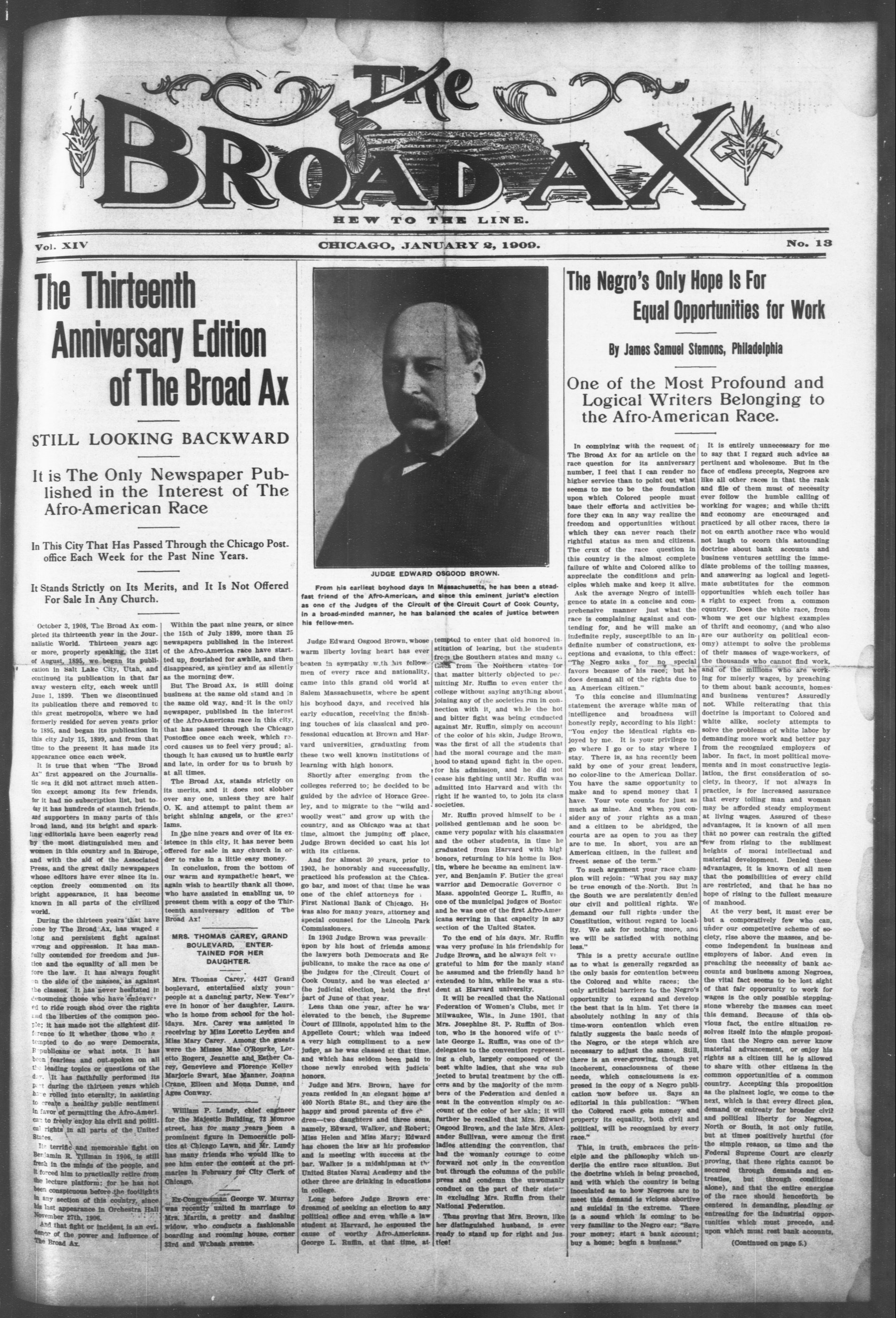
JUDGE EDWARD OSGOOD BROWN.
From his earliest boyhood days in Massachusetts, he has been a steadfast friend of the Afro-American, and since this eminent jurist's election as one of the Judges of the Circuit of the Circuit Court of Cook County, in a broad-minded manner, he has balanced the scales of justice between his fellow-men.
Judge Edward Osgood Brown, whose warm liberty loving heart has ever beaten in sympathy with his fellowmen of every race and nationality, came into this grand old world at Salem Massachusetts, where he spent his boyhood days, and received his early education, receiving the finishing touches of his classical and professional education at Brown and Harvard universities, graduating from these two well known institutions of learning with high honors.
tempted to enter that old honored institution of learing, but the student from the Southern states and many of them from the Northern states for that matter bitterly objected to permitting Mr. Ruffin to even enter the college without saying anything about joining any of the societies run in connection with it, and while the he and bitter fight was being conducted against Mr. Ruffin, simply on account of the color of his skin, Judge Brown was the first of all the students that had the moral courage and the manhood to stand up and fight in the open.
Shortly after emerging from the colleges referred to; he decided to be guided by the advice of Horace Greeley, and to migrate to the "wild and woolly west" and grow up with the country, and as Chicago was at that time, almost the jumping off place, Judge Brown decided to cast his lot with its citizens.
And for almost 30 years, prior to 1903, he honorably and successfully practiced his profession at the Chicago bar, and most of that time he was one of the chief attorneys for First National Bank of Chicago. He was also for many years, attorney and special counsel for the Lincoln Park Commissioners.
In 1903 Judge Brown was prevail upon by his host of friends among the lawyers both Democrats and Republicans, to make the race as one of the judges for the Circuit Court of Cook County, and he was elected at the judicial election, held the first part of June of that year.
Less than one year, after he was elevated to the bench, the Supreme Court of Illinois, appointed him to the Appellate Court; which was indeed a very high compliment to a new judge, as he was classed at that time, and which has seldom been paid to those newly enrobed with judicia honors.
Judge and Mrs. Brown, have for years resided in an elegant home at 400 North State St., and they are the happy and proud parents of five children—two daughters and three sons, namely, Edward, Walker, and Robert; Miss Helen and Miss Mary; Edward has chosen the law as his profession and is meeting with success at the bar. Walker is a midshipman at the United States Naval Academy and the other three are drinking in educations in college.
Long before Judge Brown ever dreamed of seeking an election to any political office and even while a law student at Harvard, he espoused the cause of worthy Afro-Americans. George L. Ruffin, at that time, at
tempted to enter that old honored institution of learing, but the students from the Southern states and many cities from the Northern states for that matter bitterly objected to permitting Mr. Ruffin to even enter the college without saying anything about joining any of the societies run in connection with it, and while the hot and bitter fight was being conducted against Mr. Ruffin, simply on account of the color of his skin, Judge Brown, was the first of all the students that had the moral courage and the manhood to stand up and fight in the open for his admission, and he did not cease his fighting until Mr. Ruffin was admitted into Harvard and with the right if he wanted to, to join its class societies.
Mr. Ruffin proved himself to be a polished gentleman and he soon became very popular with his classmates and the other students, in time he graduated from Harvard with high honors, returning to his home in Boston, where he became an eminent lawyer, and Benjamin F. Butler the great warrior and Democratic Governor of Mass. appointed George L. Ruffin, as one of the municipal judges of Boston and he was one of the first Afro-Americans serving in that capacity in any section of the United States.
To the end of his days, Mr. Ruffin was very profuse in his friendship for Judge Brown, and he always felt grateful to him for the manly stand he assumed and the friendly hand he extended to him, while he was a student at Harvard university.
It will be recalled that the National Federation of Women's Clubs, met in Milwaukee, Wis., in June 1901, that Mrs. Josephine St. P. Ruffin of Boston, who is the honored wife of the late George L. Ruffin, was one of the delegates to the convention representing a club, largely composed of the best white ladies, that she was subjected to brutal treatment by the officers and by the majority of the members of the Federation and denied a seat in the convention simply on account of the color of her skin; it will further be recalled that Mrs. Edward Osgood Brown, and the late Mrs. Alexander Sullivan, were among the first ladies attending the convention, that had the womanly courage to come forward not only in the convention but through the columns of the public press and condemn the unwomanly conduct on the part of their sister in excluding Mrs. Ruffin from their National Federation.
Thus proving that Mrs. Brown, like her distinguished husband, is ever ready to stand up for right and justice!
The Negro's Only Hope Is For Equal Opportunities for Work
By James Samuel Stemons, Philadelphia
One of the Most Profound and Logical Writers Belonging to the Afro-American Race.
In complying with the request of The Broad Ax for an article on the race question for its anniversary number, I feel that I can render no higher service than to point out what seems to me to be the foundation upon which Colored people must base their efforts and activities before they can in any way realize the freedom and opportunities without which they can never reach their rightful status as men and citizens. The crux of the race question in this country is the almost complete failure of white and Colored alike to appreciate the conditions and principles which make and keep it alive. Ask the average Negro of intelligence to state in a concise and comprehensive manner just what the race is complaining against and contending for, and he will make an indefinite reply, susceptible to an indefinite number of constructions, exceptions and evasions, to this effect: "The Negro asks for no special favors because of his race; but he does demand all of the rights due to an American citizen."
To this concise and illuminating statement the average white man of intelligence and broadness will honestly reply, according to his light: "You enjoy the identical rights enjoyed by me. It is your privilege to go where I go or to stay where I stay. There is, as has recently been said by one of your great leaders, no color-line to the American Dollar. You have the same opportunity to make and to spend money that I have. Your vote counts for just as much as mine. And when you consider any of your rights as a man and a citizen to be abridged, the courts are as open to you as they are to me. In short, you are an American citizen, in the fullest and freest sense of the term."
To such argument your race champion will rejoin: "What you say may be true enough of the North. But in the South we are persistently denied our civil and political rights. We demand our full rights under the Constitution, without regard to locality. We ask for nothing more, and we will be satisfied with nothing less."
This is a pretty accurate outline as to what is generally regarded as the only basis for contention between the Colored and white races; the only artificial barriers to the Negro's opportunity to expand and develop the best that is in him. Yet there is absolutely nothing in any of this time-worn contention which even faintly suggests the basic needs of the Negro, or the steps which are necessary to adjust the same. Still, there is an ever-growing, though yet incoherent, consciousness of these needs, which consciousness is expressed in the copy of a Negro publication now before us. Says an editorial in this publication: "When the Colored race gets money and property its equality, both civil and political, will be recognized by every race."
This, in truth, embraces the principle and the philosophy which underlie the entire race situation. But the doctrine which is being preached, and with which the country is being inoculated as to how Negroes are to meet this demand is vicious abortive and suicidal in the extreme. There is a sound which is coming to be very familiar to the Negro ear: "Save your money; start a bank account; buy a home; begin a business."
No.13
Is For
Opportunities for Work
Demons, Philadelphia
It Profound and
ers Belonging to
can Race.
It is entirely unnecessary for me to say that I regard such advice as pertinent and wholesome. But in the face of endless precepts, Negroes are like all other races in that the rank and file of them must of necessity ever follow the humble calling of working for wages; and while thrift and economy are encouraged and practiced by all other races, there is not on earth another race who would not laugh to scorn this astounding doctrine about bank accounts and business ventures settling the immediate problems of the toiling masses, and answering as logical and legitimate substitutes for the common opportunities which each toiler has a right to expect from a common country. Does the white race, from whom we get our highest examples of thrift and economy, (and who also are our authority on political economy) attempt to solve the problems of their masses of wage-workers, of the thousands who cannot find work, and of the millions who are working for miserly wages, by preaching to them about bank accounts, homes and business ventures? Assuredly not. While reiterating that this doctrine is important to Colored and white alike, society attempts to solve the problems of white labor by demanding more work and better pay from the recognized employers of labor. In fact, in most political movements and in most constructive legislation, the first consideration of society, in theory, if not always in practice, is for increased assurance that every toiling man and woman may be afforded steady employment at living wages. Assured of these advantages, it is known of all men that no power can restrain the gifted few from rising to the sublimest heights of moral intellectual and material development. Denied these advantages, it is known of all men that the possibilities of every child are restricted, and that he has no hope of rising to the fullest measure of manhood.
At the very best, it must ever be but a comparatively few who can, under our competitive scheme of society, rise above the masses, and become independent in business and employers of labor. And even in preaching the necessity of bank accounts and business among Negroes, the vital fact seems to be lost sight of that fair opportunity to work for wages is the only possible steppingstone whereby the masses can meet this demand. Because of this obvious fact, the entire situation resolves itself into the simple proposition that the Negro can never know material advancement, or enjoy his rights as a citizen till he is allowed to share with other citizens in the common opportunities of a common country. Accepting this proposition as the plainest logic, we come to the next, which is that every direct plea, demand or entreaty for broader civil and political liberty for Negroes, North or South, is not only futile, but at times positively hurtful (for the simple reason, as time and the Federal Supreme Court are clearly proving, that these rights cannot be secured through demands and entreaties, but through conditions alone), and that the entire energies of the race should henceforth be centered in demanding, pleading or entreating for the industrial opportunities which must precede, and upon which must rest bank accounts,
(Continued on page 5.)
Evidences of Musical Progress Among Colored People
By Martha Broadus-Anderson An Efficient and Successful Figure In the Musical World.
Much has been said concerning the Negro in America and his progress. The race question has been discussed pro and con till at times it has taken on a rediculous aspect. We have been told by various writers and lecturers of the amount of property accumulated by him how many doctors, lawyers, milliners, dressmakers, mechanics, etc., he has produced in a little more than forty years of freedom, but it seems that very little or nothing has been said as to his musical progress. Is it because he has not made any? Absolutely no! Along with the steady progress in other lines he has not failed to advance just as steadily musically. Quite true that as a race, they have not reached the fullest development, but today they are far in advance of the place from whence they started. It has been proven that whatever has happened in this country that was of interest to the nation, the Negro has had a hand in it. It is none the less true in the musical field. America is fast becoming a power among the nations musically and just as the country grows so will the Negro grow. If it took two hundred years for Germany to produce a Johann Sebastian Bach, we are not surprised that the progress among the Colored
THE LADY OF THE ROOM
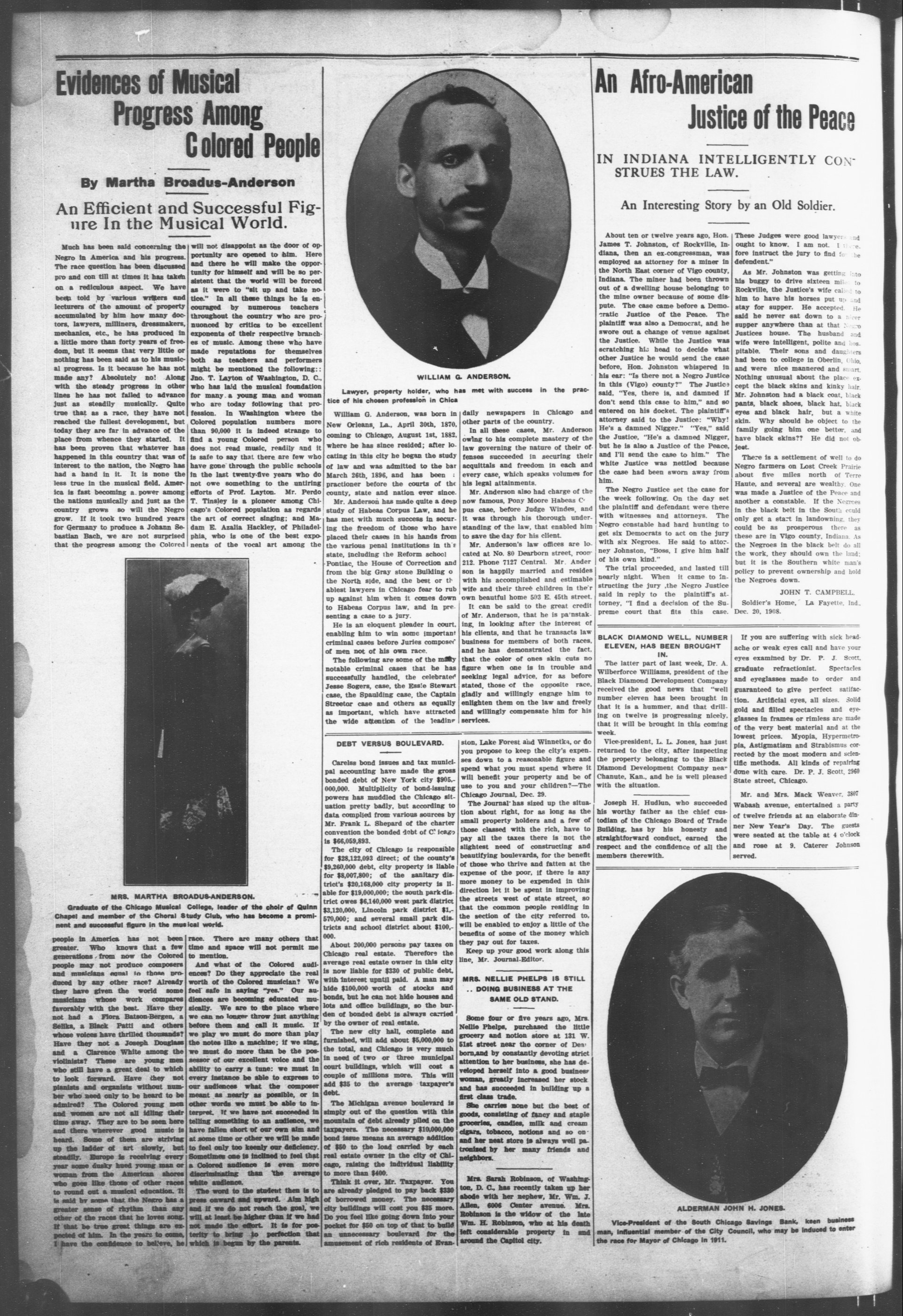
MRS. MARTHA BROADUS-ANDERSON. Graduate of the Chicago Musical College, leader of the choir of Quinn Chapel and member of the Choral Study Club, who has become a prominent and successful figure in the musical world.
people in America has not been greater. Who knows that a few generations, from now the Colored people may not produce composers and musicians equal to those produced by any other race? Already they have given the world some musicians whose work compares favorably with the best. Have they not had a Flora Batson-Bergen, a Sélika, a Black Patti and others whose voices have thrilled thousands? Have they not a Joseph Douglass and a Clarence White among the violinists? These are young men who still have a great deal to which to look forward. Have they not pianists and organists without number who need only to be heard to be admired? The Colored young men and women are not all idling their time away. They are to be seen here and there wherever good music is heard. Some of them are striving up the ladder of art slowly, but steadily. Europe is receiving every year some dusky hued young man or woman from the American shores who goes like those of other races to round out a musical education. It is said by some that the Negro has a greater sense of rhythm than any other of the races that he loves song. If that be true great things are expected of him. In the years to come, I have the confidence to believe, he
will not disappoint as the door of opportunity are opened to him. Here and there he will make the opportunity for himself and will be so persistent that the world will be forced as it were to "sit up and take notice." In all these things he is encouraged by numerous teachers throughout the country who are pronounced by critics to be excellent exponents of their respective branches of music. Among these who have made reputations for themselves both as teachers and performers might be mentioned the following:: Jno. T. Layton of Washington, D. C., who has laid the musical foundation for many.a young man and woman who are today following that profession. In Washington where the Colored population numbers more than 90,000 it is indeed strange to find a young Colored person who does not read music, readily and it is safe to say that there are few who have gone through the public schools in the last twenty-five years who do not owe something to the unifiring efforts of Prof. Layton. Mr. Perdo T. Tinsley is a pioneer among Chicago's Colored population as regards the art of correct singing; and Madam E. Azalia Hackley, of Philadelphia, who is one of the best exponents of the vocal art among the
race. There are many others that time and space will not permit me to mention.
And what of the Colored audiences? Do they appreciate the real worth of the Colored musician? We feel safe in saying "yes." Our audiences are becoming educated musically. We are to the place where we can no longer throw just anything before them and call it music. If we play we must do more than play the notes like a machine; if we sing, we must do more than be the possessor of our excellent voice and the ability to carry a tune: we must in every instance be able to express to our audiences what the composer meant as nearly as possible, or in other words we must be able to interpret. If we have not succeeded in telling something to an audience, we have fallen short of our own aim and at some time or other we will be made to feel only too keenly our deficiency. Sometimes one is inclined to feel that a Colored audience is even more discriminating than the average white audience.
The word to the student then is to press onward and upward. Aim high and if we do not reach the goal, we will at least be higher than if we had not made the effort. It is for posterity to bring to perfection that which is begun by the parents.
WILLIAM G. ANDERSON.
Lawyer, property holder, who has met with success in the practice of his chosen profession in Chica
William G. Anderson, was born in New Orleans, La., April 30th, 1870, coming to Chicago, August 1st, 1882, where he has since resided; after locating in this city he began the study of law and was admitted to the bar March 26th, 1896, and has been practioner before the courts of the county, state and nation ever since.
Mr. Anderson has made quite a deep study of Habeas Corpus Law, and he has met with much success in securing the freedom of those who have placed their cases in his hands from the various penal institutions in the state including the Reform school
daily newspapers in Chicago and other parts of the country.
In all these cases, Mr. Anderson owing to his complete mastery of the law governing the nature of their defenses succeeded in securing their acquittals and freedom in each and every case, which speaks volumes for his legal attainments.
Mr. Anderson also had charge of the now famous, Pony Moore Habeas Corpus case, before Judge Windes, and it was through his thorough understanding of the law, that enabled him to save the day for his client.
Mr. Anderson's law offices are located at No. 80 Dearborn street, room
Pontiac, the House of Correction and from the big Gray stone Building on the North side, and the best or the ablest lawyers in Chicago fear to rub up against him when it comes down to Habeas Corpus law, and in presenting a case to a jury.
He is an eloquent pleader in court, enabling him to win some important criminal cases before Juries composed of men not of his own race.
The following are some of the many notable criminal cases that he has successfully handled, the celebrated Jesse Sogers, case, the Essie Stewart case, the Spaulding case, the Captain Streetor case and others as equally as important, which have attracted the wide attention of the leading
DEBT VERSUS BOULEVARD.
Carelss bond issues and tax munich pal accounting have made the gross bonded debt of New York city $905,000,000. Multiplicity of bond-issuing powers has muddled the Chicago situation pretty badly, but according to data complied from various sources by Mr. Frank L. Shepard of the charter convention the bonded debt of C'icago is $66,059,893. The city of Chicago is responsible for $28,122,093 direct; of the county's $9,260,000 debt, city property is liable for $8,007,800; of the sanitary district's $20,168,000 city property is liable for $19,000,000; the south park district owes $6,140,000 west park district $3,120,000, Lincoln park district $1,-570,000; and several small park districts and school district about $100,-000.
About 200,000 persons pay taxes on Chicago real estate. Therefore the average real estate owner in this city is now liable for $330 of public debt, with interest upntil paid. A man may hide $100,000 worth of stocks and bonds, but he can not hide houses and lots and office buildings, so the burden of bonded debt is always carried by the owner of real estate.
The new city hall, complete and furnished, will add about $5,000,000 to the total, and Chicago is very much in need of two or three municipal court buildings, which will cost a couple of millions more. This will add $35 to the average taxpayer's debt.
The Michigan avenue boulevard is simply out of the question with this mountain of debt already piled on the taxpayers. The necessary $10,000,000 bond issue means an average addition of $50 to the load carried by each real estate owner in the city of Chicago, raising the individual liability to more than $400.
Think it over, Mr. Taxpayer. You are already pledged to pay back $330 of borrowed money. The necessary city buildings will cost you $25 more. Do you feel like going down into your pocket for $50 on top of that to build an unnecessary boulevard for the amusement of rich residents of Evan-
daily newspapers in Chicago and other parts of the country. In all these cases, Mr. Anderson owing to his complete mastery of the law governing the nature of their offenses succeeded in securing their acquittals and freedom in each and every case, which speaks volumes for his legal attainments. Mr. Anderson also had charge of the now famous, Pony Moore Habeas Cpus case, before Judge Windes, and it was through his thorough understanding of the law, that enabled him to save the day for his client.
Mr. Anderson's law offices are located at No. 80 Dearborn street, room 212. Phone 7127 Central. Mr. Anderson is happily married and resides with his accomplished and estimable wife and their three children in their own beautiful home 503 E. 45th street. It can be said to the great credit of Mr. Anderson, that he is painstaking, in looking after the interest of his clients, and that he transacts law business for members of both races, and he has demonstrated the fact, that the color of ones skin cuts no figure when one is in trouble and seeking legal advice, for as before stated, those of the opposite race, gladly and willingly engage him to enlighten them on the law and freely and willingly compensate him for his services.
ston, Lake Forest and Winnetka, or do you propose to keep the city's expenses down to a reasonable figure and spend what you must spend where it will benefit your property and be of use to you and your children?—The Chicago Journal, Dec. 29.
The Journal has sized up the situation about right, for as long as the small property holders and a few of those classed with the rich, have to pay all the taxes there is not the slightest need of constructing and beautifying boulevards, for the benefit of those who thrive and fatten at the expense of the poor, if there is any more money to be expended in this direction let it be spent in improving the streets west of state street, so that the common people residing in the section of the city referred to, will be enabled to enjoy a little of the benefits of some of the money which they pay out for taxes. Keep up your good work along this line. Mr. Journal-Editor.
MRS. NELLIE PHELPS IS STILL
..DOING BUSINESS AT THE
SAME OLD STAND.
Some four or five years ago, Mrs. Nellie Phelps, purchased the little grocery and notion store at 131 W. 51st street near the corner of Dearborn, and by constantly devoting strict attention to her business, she has developed herself into a good business woman, greatly increased her stock and has succeeded in building up a first class trade.
She carries none but the best of goods, consisting of fancy and staple groceries, candies, milk and cream cigars, tobacco, notions and so on and her neat store is always well patronized by her many friends and neighbors.
Mrs. Sarah Robinson, of Washington, D. C., has recently taken up her abode with her nephew, Mr. Wm. J. Allen, 6006 Center avenue. Mrs. Robinson is the widow of the late Wm. H. Robinson, who at his death left considerable property in and around the Capitol city.
An Afro-American Justice of the Peace
IN INDIANA INTELLIGENTLY CONSTRUES THE LAW.
An Interesting Story by an Old Soldier.
About ten or twelve years ago, Hon. James T. Johnston, of Rockville, Indiana, then an ex-congressman, was employed as attorney for a miner in the North East corner of Vigo county, Indiana. The miner had been thrown out of a dwelling house belonging to the mine owner because of some dispute. The case came before a Democratic Justice of the Peace. The plaintiff was also a Democrat, and he swore out a change of venue against the Justice. While the Justice was scratching his head to decide what other Justice he would send the case before, Hon. Johnston whispered in his ear: "Is there not a Negro Justice in this (Vigo) county?" The Justice said, "Yes, there is, and damned if don't send this case to him," and so entered on his docket. The plaintiff's attorney said to the Justice: "Why! He's a damned Nigger." "Yes," said the Justice, "He's a damned Nigger, but he is also a Justice of the Peace, and I'll send the case to him." The white Justice was nettled because the case had been sworn away from him.
The Negro Justice set the case for the week following. On the day set the plaintiff and defendant were there with witnesses and attorneys. The Negro constable had hard hunting to get six Democrats to act on the jury with six Negroes. He said to attorney Johnston, "Boss, I give him half of his own kind."
The trial proceeded, and lasted till nearly night. When it came to instructing the jury, the Negro Justice said in reply to the plaintiff's attorney, "I find a decision of the Supreme court that fits this case.
BLACK DIAMOND WELL, NUMBER ELEVEN, HAS BEEN BROUGHT IN
The latter part of last week, Dr. A. Wilberforce Williams, president of the Black Diamond Development Company received the good news that "well number eleven has been brought in that it is a hummer, and that drilling on twelve is progressing nicely, that it will be brought in this coming week.
Vice-president, L. L. Jones, has just returned to the city, after inspecting the property belonging to the Black Diamond Development Company near Chanute, Kan., and he is well pleased with the situation.
Joseph H. Hudlun, who succeeded his worthy father as the chief custodian of the Chicago Board of Trade Building, has by his honesty and straightforward conduct, earned the respect and the confidence of all the members therewith.
[Name]
[Name not provided]
ALDERMAN JOHN H. JONES.
Vice-President of the South Chicago man, Influential member of the City of the race for Mayor of Chicago in 1911.
Vice-President of the South Chicago Savings Bank, keen business man, influential member of the City Council, who may be induced to enter the race for Mayor of Chicago in 1911.
These Judges were good lawyers and ought to know. I am not. I therefore instruct the jury to find for the defendant."
As Mr. Johnston was getting into his buggy to drive sixteen miles to Rockville, the Justice's wife called to him to have his horses put up and stay for supper. He accepted. He said he never sat down to a nice supper anywhere than at that Negro Justices house. The husband and wife were intelligent, polite and hospitable. Their sons and daughters had been to college in Oberlin, Ohio, and were nice mannered and smart. Nothing unusual about the place except the black skins and kinky hair, Mr. Johnston had a black coat, black pants, black shoes, black hat, black eyes and black hair, but a white skin. Why should he object to the family going him one better, and have black skins?? He did not object.
There is a settlement of well to do Negro farmers on Lost Creek Prairie about five miles north of Terre Haute, and several are wealthy. One was made a Justice of the Peace and another a constable. If the Negroes in the black belt in the South could only get a start in landowning, they could be as prosperous there as these are in Vigo county, Indiana. As the Negroes in the black belt do all the work, they should own the land; but it is the Southern white man's policy to prevent ownership and hold the Negroes down.
Soldier's Home, La Fayette, Ind.
Dec. 20, 1908.
If you are suffering with sick head ache or weak eyes call and have your eyes examined by Dr. P. J. Scott graduate refractionist. Spectacles and eyeglasses made to order and guaranteed to give perfect satisfaction. Artificial eyes, all sizes. Solid gold and filled spectacles and eye glasses in frames or rimless are made of the very best material and at the lowest prices. Myopia, Hypermetropia, Astigmatism and Strabismus corrected by the most modern and scientific methods. All kinds of repairing done with care. Dr. P. J. Scott, 2960 State street, Chicago.
Mr. and Mrs. Mack Weaver. 3307 Wabash avenue, entertained a party of twelve friends at an elaborate dinner New Year's Day. The guests were seated at the table at 4 o'clock and rose at 9. Caterer Johnson served.
```markdown
```
Mago Savings Bank, keen business Council, who may be induced to enter
JOHN T. CAMPBELL.
Fiction
TWO LUNATICS.
By P. Y. BLACK.
"It was a shameful trap," he said,
"on the part of my people. The doctors were very careless in their diagnosis. To shut me up in a place like this was really too bad. In a very short time, however, I expect to leave."
"Oh, dear," she thought, her eyes dimming, "they all say that! To think that the poor man will never, never, never leave! I am so glad—for you," she said aloud. "You will be over-joyed."
"Oh I—yes. But do you know this sanitarium is not so bad?"
"Do you mean," she said gently, surprised, "that you will—er—have any regrets in leaving?"
"No," he said, "not exactly that, of course—not regrets so far as concerns myself, for it is so humiliating to be committed, you know." He paused.
"But," he went on, "even in asylums one makes friends, and—one regrets—for them."
He looked down with a tenderness and a pity he could not hide, and she blushed, and for a moment there was silence. Then she said, with an obviously strained laugh:
"We are friends, of course, Mr. St. John. What an awful existence it would be here if one had no sympathetic friends! But you must not regret so much on my account. In a very short time I think my friends will take me home."
He choked a groan before she could hear it.
"The poor little thing!" he thought.
"They all say that. And that decent young fellow, the doctor, assures me her case is very puzzling and her friends fear incurable. I am so glad for you," he said. "Would it not be jolly if we became friends in the world as we have been when out of the world?"
Then he blamed himself again.
"If she really likes me," he thought,
"and I think the unhappy child does, I should never had said that. It is cruel, brutal, to put such thoughts in her head."
She was looking at him with the tearful smile we essay when we encourage one who does not realize that death is near.
"It would be nice—very nice indeed."
They were silent again, each sorrowing for the other.
There were many other patients strolling on the lawns or sitting in the summer houses, patients of all kinds.
Miss Tracy and St. John stood together, silent now and unostentatiously observant. A sturdily built (all the attendants were that) man was taking a patient to the iron barred house. He did not do it violently. He did it as one may see a policeman occasionally escort a quiet prisoner with a light touch on the captive's arm above the elbow. The patient was a little excited, but there was no disturbance at all. A visitor might never have noticed it. The strange thing was the unanimous backward withdrawal from the attendant's path of the patients encountered, the look of flight or dislike on their faces directed not at the captive, but at the guard. "How they all dread him—instinctively, it seems," said the young woman who "expected to leave soon." "He is polite enough and not ill looking, but"—
"A man of great experience in his peculiar work, I'm told," said St. John musingly.
"It's his eye and mouth that do it, I fancy."
"A thoroughly ill dispositioned man, with a plausible exterior," said St. John. "I believe him capable of it."
"Of murder? Do-oh, what are you talking of, Mr. St. John?"
St. John looked very uncomfortable. Miss Tracy looked vexedly embarrassed.
"I heard some rumor of a strange death in the institution just before I came. I was thinking of it. Were you here? Have you heard anything of it?"
He was a little eager.
"How could I be here? We came on the same day. Don't you remember?"
"Ah, true!"
So they watched the attendant out of sight and turned to go inside themselves.
They shook hands, although there was no reason for it. They would meet at the dinner table in a few minutes, but—they shook hands, and that lingeringly.
"It's awfully sad," St. John pondered. "So sweet a face, seemingly so intelligent. I wish-oh, pahaw! What's the use of wishing? These things are not to be remedied. I wonder if she'd give me a photograph."
Miss Tracy went to her room slowly. "I am silly to be so affected by an ordinary case. There are thousands like him. But-oh, dear; oh, dear! If I known I was to have this sad experience I would never have consented to come—never!"
They had no opportunity to meet alone for several days. Perhaps they might have made opportunities, but they did not. Doubtless it occurred to each of these two lunatics that it was the wiser thing to stifle at once any friendship which each thought likely to cause useless pain in the future to the other.
Dr. Bell found these two of his resi-
dents particularly interesting in those
days, and so did the attendant. It was strange that they both so markedly preferred the company of the sanitarium people to that of their fellow fortunates. The young house doctor thought Miss Tracy charming and never was abrupt with her.
"Very puzzling case," he mused. "Now, why does she dwell so on that recent death? It seems to excite her too. That's morbidity, I'm afraid; bad sign."
The doctor liked St. John too. St. John's friends acted very nicely in sending him new books and boxes of cigars. The books were well chosen; the cigars were unexceptionable.
"Like all these paretics," he pondered, "in the first stages you would not think there was anything much wrong with the man, but it is a little singular that he should be so interested in that unlucky death also."
As for the attendants, Miss Tracy had flowers and little things and could teach the women quite a number of new fads in hairdressing, and so forth. For the men St. John's cigar box and full pocketbook sufficed to make them extremely courteous. The man with the wicked eyes and mouth benefited most, however. It was wonderful what a lot of little things he could do for Miss Tracy. It was strange that St. John should find anything in the man to talk about with common interest.
Just once the two lunatics met. It was just before bedtime in the music room. He had sung to her accompaniment. When she rose to say good night he almost whispered to her:
"I expect to go to New York tomorrow."
"I am so glad for your sake," she said.
"And—and you—you have made my stay almost tolerable. Is there nothing you will allow me to do for you?"
"Oh," she answered, with sprightfulness, "I shall not be long in going myself."
"Poor, poor little dear," he said to his pillow, "it breaks me all up to think of her staying here incurable."
Miss Tracy packed her trunk, and tears dropped on silk and linen indifferently.
"Oh," she murmured, "I do so wish I had never come here. I can never, never forget the sad, gentle way he used to look at me."
There was lively work next afternoon in the building of the Gazette. A young man sat at a desk apart in the reporters' room, and he scribbled and he scribbled. By and by the managing editor came in and looked over the busy writer's shoulder and told him that he had only an hour to finish up. Then the great presses began to clatter, and in a little while the first edition of the Gazette was ready for the street, with an enormous black scare head on the front page.
And in the office of the Morning Jury there was also a very lively bustling, and there, at a retired desk, a young woman sat, and she scribbled and she scribbled, and late at night the presses began to rumble, and in a little while the first edition of the Jury was ready for the street, with an enormous black scare head on the front page.
The Gazette and the Jury were within in a few minutes of each other in getting out. A copy of each paper was hustled into the office of the other, for rival editors watch each other's work with catlike intentness. And the Gazette office read with dismay that the great asylum mystery had been solved by the indefatigable efforts of a Jury reporter, while the Jury night staff tore its editorial hair over the faring boast of the Gazette that its "special commissioner" had given to a waiting world the first and only enlightenment of the famous crime. There had been no time for one paper to lift the news from the other. How had the expected scoop been spooled?
Tumultuous was the wrath in the two offices. Miss Tracy was explaining to her managing editor, with tears in her eyes, that she could not understand at all, at all, how the Gazette had got hold of it. In the Gazette office Mr. St. John stormed and swore and said that for the life of him he could not understand how the Jury had got almost the same story.
"Good heavens!" shouted St. John suddenly, and he dashed out to the Jury office. There he found a friend, with whom he conferred. The two lunatics were introduced to each other and a minute or two afterward were alone together.
They laughed a great deal at the idea of two reporters on the same strange assignment, never suspecting each other, but their laugh was not very loud. The tender plly for each other of yesterday was still in mind.
"The attendant is arrested," said St. John. "You did not get it quite right. The patient he poisoned when nursing him was an old enemy. It was not done through trouble arising between them in the sanitarium."
"Oh, bother!" she said. "It doesn't matter. We've done our appointed work. Let's talk of something more pleasant."
So they did, and when he was about to go away he said:
"You said once we might be friends in the world as well as out of the world. Will we be friends, dear Miss Tracy?"
She looked at him so smilingly, yet so tremblingly that he put his arm around her.
"Will you be more than friend, darling?" he whispered.
"Yes," she said, and it was quite five minutes after, when some one's feet were heard approaching, that she jumped away and held up a warning finger.
"If your friend came in he'd think us mad," she said.
"Two lunatics!" he answered, laughing as the door opened.
WM. D. NEIGHBORS & CO REAL ESTATE AT LOWEST PRICES
Easiest Term to be had in Chicago Loans on first and second Mortgages Fire Insurance placed in any company
THE SEA BAT.
Specimen of a Fish That Is Both Queer and Rare.
One of the rarest specimens of the fish kingdom known to waters contiguous to the North Carolina coast was captured in a seine at Masonboro sound by William Hewlett, a fisherman, says the Wilmington Dispatch. The fish, which was brought to the city, is what is called "the sea bat," and it is a perfect-reproduction of a leather wing bat on a large scale. The fish is about fifteen inches long and about thirty inches across the back.
Strange to state, it had a thin, threadlike tail about fifteen inches in length, and on each side of the rear appendage were two perfectly formed gloved feet, with a smaller dimension having the exact appearance of a thumb with the other part of the hand mittened. The mouth of the strange specimen was about five inches across, and on each side of the mouth or the underside of the body there were five "strainers," or holes, through which the fish is said to rid itself of refuse products resulting from the forage it picks up at the bottom of the sea. The top of the fish was a dark slate color, and the under part of the body was white.
One old negro fisherman more than seventy years old declared that this was only the second specimen of the sea bat he had ever seen in his long experience as a fisherman. The specimen, which had a truly uncanny appearance, will probably be sent to the state museum at Raleigh.
Frying Pan Stage
"The late Mrs. William Aster," said a colonial dame, "took, after all, an optimistic view of American society. She criticised our faults, but she believed in our future. American society, she used to say, would eventually be the finest in the world. Once she declared at a dinner that it was the proper social sequence to get, like us, the money first and the refinement and culture afterward. She said that when she looked at the uncouth millionaire of today and thought of the splendid creature to come after him she felt as optimistic as the fisherman who, casting his line, brought up a frying pan and said: "Oh, that's a good beginning—a frying pan! I have only to catch a fish now and I shall be all right."—Washington Post.
Ancient Mariners
That the Egyptians made sea voyages long before the time of Solomon, hitherto considered the first ocean traveler on a large scale, is declared by Professor James H. Breasted to be conclusively proved by a tablet found by him in Palermo, Sicily, during the three years' exploring trip from which he recently returned. Professor Breasted asserts that the inscriptions on the tablet show that the Egyptian king who built the first pyramids made a voyage with forty ships across the Mediterranean to Lebanon to obtain cedar for a temple. This journey, according to the professor, was made in the thirtieth century B. C., or 2,000 years before Solomon made his voyage for a similar purpose.
An Ocean Sanitarium
Some particulars are given in the British Medical Journal of a proposal to provide an ocean sanitarium for tuberculosis. The suggestion is to fit up a sailing ship of about 2,000 tons for not less than fifty patients, each to be provided with a large and well ventilated cabin. The deck would be used for what is commonly called the veranda treatment. The intention of the promoters is that the ship shall cruise in the neighborhood of the Canaries, where it will have the advantage of the trade winds and of an equable climate, while a port will not be far distant in case of the onset of bad weather.
A Majestic Ice Wall.
In a letter from Professor Edgeworth Davis, a member of the British antarctic expedition now seeking a way toward the south pole, there occurs a vivid description of the great antarctic ice barrier, which was encountered by the little ship Nimrod. "It is a sight," says Professor Davis, "that beggars all description. Imagine a continuous ice wall 500 miles long and one to two hundred feet high, the exquisite blue of the crevasses contrasting finely with the dazzling white of the weathered ice on either side of them."
Branch Office:
3220 State Street
NEW SHORT STORIES
The Magnate's Surrender.
One of the boasts of James J. Hill, the railroad magnate, has been that he has no telephone in his house. "My office is the place to do business," he has declared, "and my office hours the time in which to do business. When I am behind the door of my home I am safe from the world."
He has been, too, as can be proved by many a reporter who tried to interview him there at night. The best the reporter ever got was a sarcastic grin from the butler, who buttled the reporter out to the cold world and a hot city editor. But the other day, according to Mr. Hill's own statement, his butler approached him. "The man is here to put in the telephone," said the butler.
Mr. Hill promptly wilburwrighted. He wanted no telephone, he said. He would have no telephone. He regarded it as a piece of gross impertinence on
WILL IGAR
"WHY DIDN'T YOU TELL HIM SO?"
the part of the telephone company to assume that he wanted a telephone. "Why didn't you tell him so?" he demanded of the butler. Now, you would think that this mental, convicted of error, would have wilted beneath the magnate's frown. He did not. "Hi told him, sir," said the butler calmly, "that this telephone was wanted by the servants, sir. Hi told 'im you didn't desire hit, sir, but that we 'ad to 'ave it." James J. Hill, magnate, looked at Mr. Hill's butler's impassive face. He twiddled his fingers for a moment on the mahogany desk. Then, confronted with the certainty of a servant's strike, he weakened. "Put it in, then," he said, and, with a return of courage, he growled at the butler. "But if I'm ever bothered by it I'll fire every one of you."
And the butler bowed in meekness and said, "Very good, sir."—Cincinnati Times-Star.
Tillman's Favorite Dish.
A year or two ago Senator Tillman gave to a chef in the senate restaurant a recipe for an excellent corned beef hash, the fame of which speedily penetrated to the uttermost recesses of the capitol.
When the head waiter wants this hash prepared with unusual care he orders it in this wise:
"One corned beef hash for Senator Tillman."
One day recently during the lunch-hour the restaurant was doing a land office business, and everybody seemed to want corned beef hash. Ten times at least did a waiter approach the serving table with the order for Senator Tillman's corned beef hash.
Finally the thing got on the chef's nerves. "Look heah," he shouted to one waiter, bringing the same old order. "Dat's de twelfth order for Senator Tillman. He better watch out or he'll founder hisself"—Lippincott's.
He Was Too Frank
Uncle Joe Cannon was discussing jocularly our society leader's claim that too many statesmen appear to rely on their uncouthness—on the absence of socks, etc.—for their fame.
"I would point out," said he, "that neither Caesar nor Alexander wore socks, and if I attacked New York society as frankly as this person has attacked public life I might—But after all, perfect frankness is invariably a bad thing.
"You have heard perhaps of the young man who admired perfect frankness? Calling on a pretty girl, he said:
"If there is one thing that I reverence in this world perfect frankness is that thing."
"Yes?" said the girl. "Then I'll at once grasp the opportunity to urge you to shave off your mustache before you eat another soft boiled egg."
Fifty-First St. and Armour Ave.
EARL YARD: 1st St. & L. B. & M. R. Ry.
Sand St. and Armour Ave.
CHICAGO
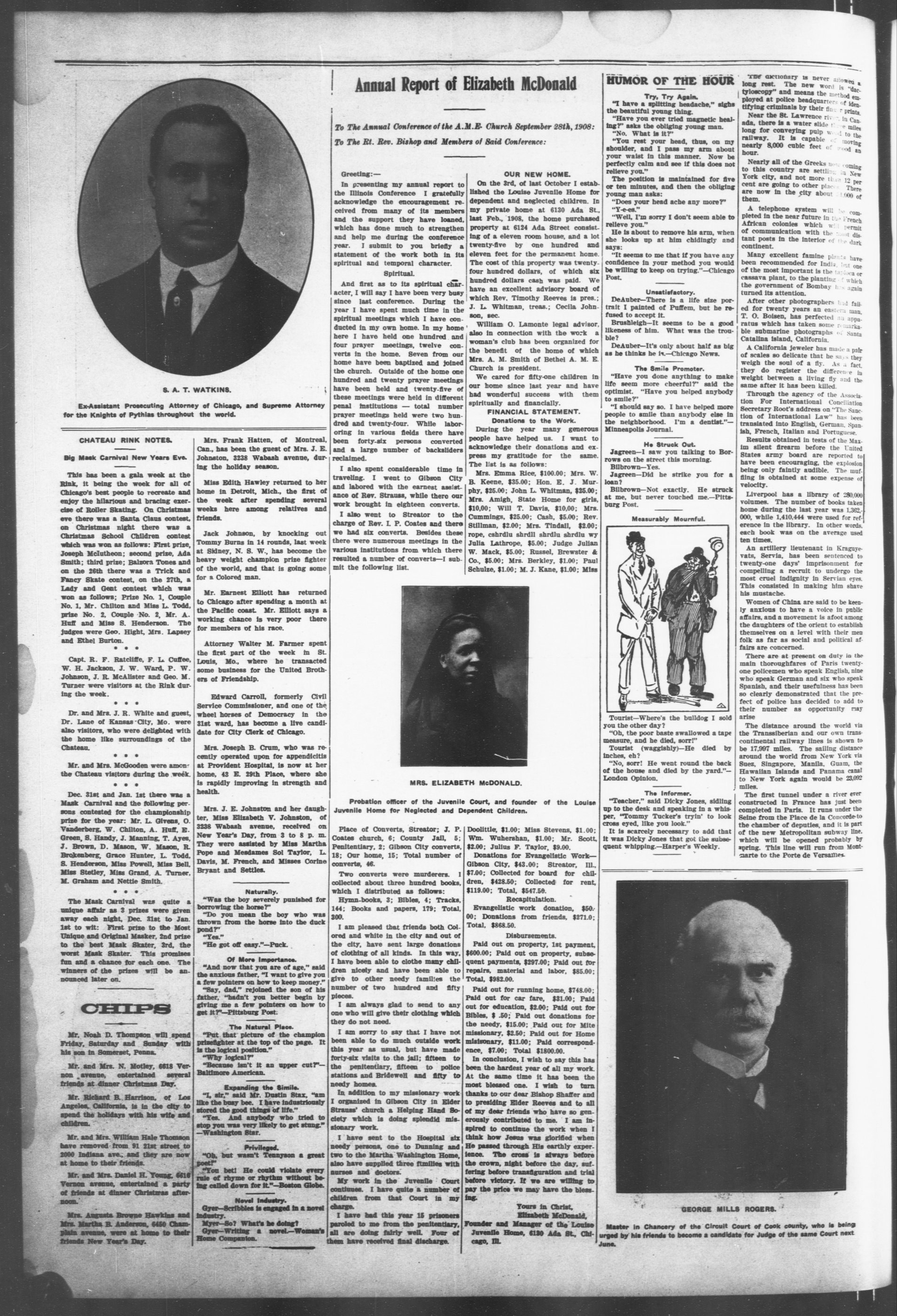
S.A.T. WATKINS
LAWYER
Suite 411
59 DEARBORN STREET, CHICAGO
Telephone Central 8142
Residence Telephone, Douglas 9181
Dr. W. E. MACKEY
4842 Armour Avenue.
Phone, Blue 6571.
CHICAGO.
Hours: 9 to 12 a. m.; 1 to 4 p. m.; and Nights.
C. E. Kreyssler
Chemist and Druggist
5059 STATE STREET
N. E. Cor. 51st St. CHICAGO
Telephones:
Oakland 246 and Oakland 245
Arthur Johnson
Merchant Tailor
Strictly First Class and Up-to-Date
Work at Reasonable Prices
Special Attention Given to Orders for
Cleaning, Pressing, Dyeing and Repairing
Goods Called for. Orders Delivered.
134 W. 51st Street, Chicago
THE ELITE BUFFET
FINE WINES, LIQJORS
AND CIGARS
3030 State Street CHICAGO
Phone Oakland 1528
F. A. Rawlins
The Modern Embalmer
UNDERTAKER AND
FUNERAL DIRECTOR
When his work is finished
you have no displeasure.
4817 State Street CHICAGO
Phone Douglas 1520
THE BROAD AX.
!s for sale at the following news
stands:
A. F. Tervalon, 134 W. 51st street
Cigar Store and News Stand.
Geo. L Martin, maker of fine cigars
and news stand, 342 East 31st St.
C. H. Green, cigars, tobacco and
news stand, 2718 State st.
Mrs. Nellie Phelps, Cigars, Notions
and News Stand, 131 W. 51st street
T. B. Hall's Cigar Store and
PATRICK H. O'DONNELL
WILLIAM DILLON
CLARENCE A. TOOLEN
Tel. Central 4660
O'Donnell, Dillon &
Toolen
ATTORNEYS AT LAW
Suite 1218-1219 Ashland Block
RANDOLPH & CLARK STREETS
CHICAGO
JAMES J. GRAY
ATTORNEY AT LAW
Suite 1518 Ashland Block
RANDOLPH AND CLARK STREETS
CHICAGO
Tel. Central 4728
Residence 57 Macallister Place
Telephone Ashland 363
Office Telephones
Central 1239 Automatic 5940
MILES J. DEVINE
ATTORNEY AT LAW
Suite 318-320 Reaper Block
CLARK AND WASHINGTON STS.
CHICAGO.
Phone Main 4153 NOTARY PUBLIC
Phone residence, Gray 5670
Walter M. Farmer
ATTORNEY AT LAW
Suite 708, 171 Washington St.
Res., 4356 Langley Av. CHICAGO
JOHN E. OWENS
ATTORNEY & COUNSELOR:
.AT LAW
323 ASHLAND BLOCK
A. D. GASH
Attorney at Law,
84-86 La Salle Street, Chicago
Suite 615 to 619,
Telephone Main 3077.
THE NEGRO QUESTION SOLVED
Lynching, mob violence, Negro crime and the horrors of civil, political and industrial estrangement all find a simple and logical remedy in THE KEY
By James Samuel Stemons
Comprising his treatise, WHY CRIME INCREASES THE KEY OF OWNERS OF THE NORTH HOLDS THE KEY TO THE RACE QUESTION, formerly published in booklet form.
Your treatment of the question is remarkable. You have found the answer. Hon. Wm. H. Berry, ex-State Treasurer of Penna.
By mail 27c. Per doz. $2.50. Most liberal terms to agents. Address.
James Samuel Stemons
524 5. Hicks Street Philadelphia
The Sting In the Tail.
Vu Koo, the brilliant young Chinese editor of the Daily Spectator of Columbia university, said the other day of a criticism:
"When I began to read I thought the article was laudatory. I soon discovered my mistake, however. That article recalled to me a motor ride that I took with a junior last month.
"The junior's car was not a remarkable one, and out in the country after luncheon the young man was rather pleased when a farmer said to him:
"I guess that that automobile o'yourn is a hundred horsepower, isn't it?
"Oh, no,' said the junior, with a pleasant smile. 'Oh, no, my friend. It is only a five horsepower. A hundred horsepower would be ever so much larger."
"I wa'n't jedgin' by the size, but by the noise,' said the farmer."
Good Word For Veils.
"It is those big vells that fasten down tight under the chin and ears that I want to put in a good word for," said the bacteriologist. "It may be that they ruin the eyes and shut out a lot of fresh air, as some folk claim, but they prevent women from putting dirty pieces of money into their mouths and so keep enough germs out of the system to make up for the other disadvantages."—New York Press.
Bull of the Irish Secretary.
A genuine bull is credited to Augustine Birrell, secretary for Ireland, by a Bristol correspondent of the London News. "It is easier," Mr. Birrell affirmed in the course of a public speech at Bristol, "to face your foes in front of you than your friends behind your back."
A Pleasant Winter Evening.
Then Visit the "Chateau," 5324 State Street, Tonight.
There is a fine Picture Show,
Roller Skating, Dancing and superb music, refreshments and a jolly good time for good people. No proscription. Special prize program every Saturday and Sunday.
LELAND GIANTS' BASEBALL AND AMUSEMENT ASS'N.
THE BROADAX
Will promulgate and at all times uphold the principles of Democracy, but Catholics, Protestants, Priests, Insiders, Single Taxes, Republicans, or anyone else can have their say, as long as their language is proper and responsibility is fixed.
The Broad Ax is a newspaper whose platform is broad enough for all, ever claiming the editorial right to speak its own mind.
Local communications will receive attention. Write only on one side of the paper.
Subscriptions must be paid in advance.
One Year.....$2.00
Six Months.....1.00
Advertising rates made known on application.
Address all communications to
THE BROAD AX
5038 Armour Avenue, Chicago.
JULIUS F. TAYLOR, Editor and Publisher.
Entered as Second-Class Matter,
Aug. 19, 1902 at the Post Office at
Chicago, Illinois, under Act of March
3, 1879.
NOTES ON RACIAL PROGRESS.
As Reported by the National Negro Business League.
A new Colored drug store was opened in Chicago, November 1st, with Messrs. Miller and Jenkins as proprietors.
It is stated that the Negro people have 30,000 teachers, 16,000 preachers, 1,700 physicians, 1,000 lawyers, and 400 journalists and literary men.
The state of Tennessee has granted a charter to the Pythian Bank and Trust Company, of Shelby County. The capital stock is $25,000 and the headquarters will be in Memphis.
What is said to be the finest Negro office building in the United States is located in the heart of Philadelphia, and is owned by the Grand United Order of Odd Fellows. It was built and furnished at a cost of $135,000.
Miss Eva Ross of Washington, D.C., has opened a drug store in that city; is thoroughly complete and up-to-date in every appointment. Miss Ross was formerly a Kindergarten teacher, but gave up the work to enter this business.
Wichita, Kansas, has a large Colored population, which is prosperous and well satisfied. Many are engaged in different kinds of business pursuits, while most of them own their homes, which in many instances are quite beautiful.
Hard times is seemingly an unknown quantity to the average Negro farmer of Texas; for, according to the Texas Freeman, a large number of them came into Houston, last week with many bales of cotton and large quantities of country produce, such as dressed hogs, sweet potatoes, butter, chickens, eggs, etc.
Allensworth California, is a new Negro town already surveyed. It is now being populated and built up by a Negro company in honor of whose president, Col. Allensworth, the town is named. The site of the new town is on the mainline of the Sante Fe Railroad and seven miles west of the Southern Pacific at a point half way between Los Angeles and San Francisco, and in one of the most fertile parts of San Joaquin Valley.
According to the Washington City Bee, the local Negro Business League is arranging for a banquet of the Negro business men to take place some time during the holiday season. It is the intention and hope that this banquet will be one of the largest and most representative of its kind, that has ever taken place in the district. The main object in holding this and other banquets contemplated, is for the purpose of bringing the larger business men in closer touch with each other. Mr. W. Sidney Pittman, the architect, is president of the local Negro Business League.
Mr. Thomas M. Campbell of Tuskegee Institute, Alabama, who is spending a portion of his vacation in our city, is a field agent for the Department of Agriculture of the United States Government, with headquarters at Tuskegee Institute, where he graduated in 1906. While co-operating with the farmers of Macon County, Alabama, Mr. Campbell teaches the students of Tuskegee Institute scientific farming and makes very valuable agricultural demonstrations for both the Institute and the United States Government. The famous Jessup Agricultural wagon is of great value to Mr. Campbell in his "concrete illustrative work". throughout the county."T."
```markdown
```
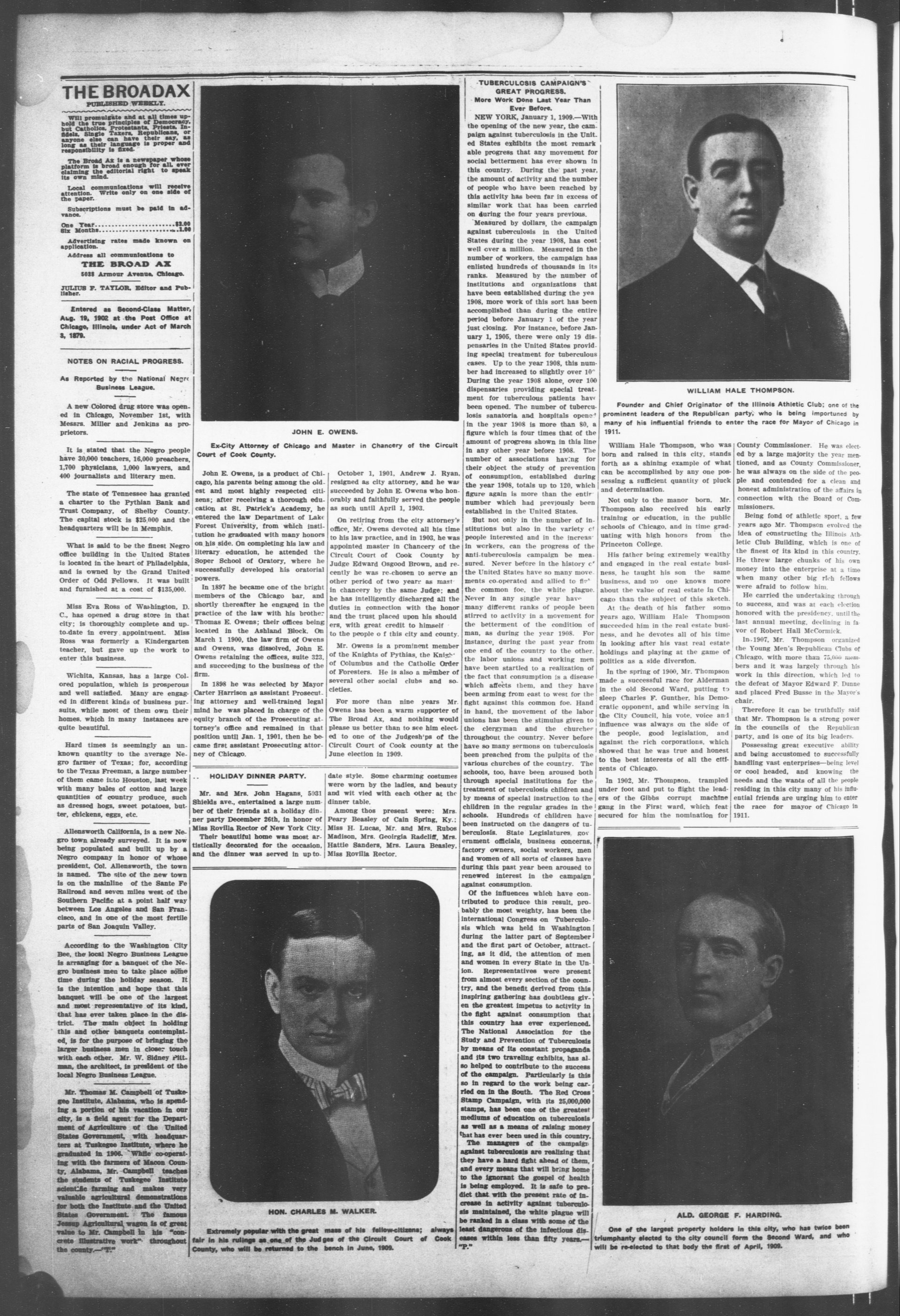
JOHN E. OWENS.
Ex-City Attorney of Chicago and Master in Chancery of the Circuit Court of Cook County.
John E. Owens, is a product of Chicago, his parents being among the oldest and most highly respected citizens; after receiving a thorough education at St. Patrick's Academy, he entered the law Department of Lake Forest University, from which institution he graduated with many honors on his side. On completing his law and literary education, he attended the Soper School of Oratory, where he successfully developed his oratorial powers.
October 1, 1901, Andrew J. Ryan resigned as city attorney, and he was succeeded by John E. Owens who honored and faithfully served the people as such until April 1, 1903.
On retiring from the city attorney's office, Mr. Owens devoted all his time to his law practice, and in 1903, he was appointed master in Chancery of the Circuit Court of Cook County by Judge Edward Osggood Brown, and recently he was re-chosen to serve and
In 1897 he became one of the bright members of the Chicago bar, and shortly thereafter he engaged in the practice of the law with his brother; Thomas E. Owens; their offices being located in the Ashland Block. On March 1 1900, the law firm of Owens and Owens, was dissolved, John E. Owens retaining the offices, suite 323, and succeeding to the business of the firm.
In 1898 he was selected by Mayor Carter Harrison as assistant Prosecuting attorney and well-trained legal mind he was placed in charge of the equity branch of the Prosecuting attorney's office and remained in that position until Jan. 1, 1901, then he became first assistant Prosecuting attorney of Chicago.
HOLIDAY DINNER PARTY.
Mr. and Mrs. John Hagans, 5031 Shields ave., entertained a large number of their friends at a holiday dinner party December 26th, in honor of Miss Rovilla Rector of New York City Their beautiful home was most artistically decorated for the occasion, and the dinner was served in up to-
```markdown
```
A.
Extremely popular with the great mass of his fair in his rulings as one of the Judges of the Circ County, who will be returned to the bench in June,
Extremely popular with the great mass of his fellow-citizens; always fair in his rulings as one of the Judges of the Circuit Court of Cook County, who will be returned to the bench in June, 1809.
Extremely popular with the great mass of his fellow-citizens; always fair in his rulings as one of the Judges of the Circuit Court of Cook County, who will be returned to the bench in June, 1809.
October 1, 1901, Andrew J. Ryan resigned as city attorney, and he was succeeded by John E. Owens who honorably and faithfully served the people as such until April 1, 1903.
On retiring from the city attorney's office, Mr. Owens devoted all his time to his law practice, and in 1903, he was appointed master in Chancery of the Circuit Court of Cook County by Judge Edward Osgood Brown, and recently he was re-chosen to serve an other period of two years as mast in chancery by the same Judge; and he has intelligently discharged all the duties in connection with the honor and the trust placed upon his shoulders, with great credit to himself
Mr. Owens is a prominent member of the Knights of Pythias, the Knight of Columbus and the Catholic Order of Foresters. He is also a member of several other social clubs and societies.
For more than nine years Mr. Owens has been a warm supporter of The Broad Ax, and nothing would please us better than to see him elected to one of the Judges'ps of the Circuit Court of Cook county at the June election in 1909.
date style. Some charming costumes were worn by the ladies, and beauty and wit vied with each other at the dinner table.
Among those present were: Mrs
Peary Beasley of Cain Spring, Ky.
Miss H. Lucas, Mr. and Mrs. Rubos
Madison, Mrs. Georgia Radcliff, Mrs.
Hattie Sanders, Mrs. Laura Beasley.
Miss Roville Rector.
THE NEW YORKER
mass of his fellow-citizens; always ages of the Circuit Court of Cook bench in June, 1909.
TUBERCULOSIS CAMPAIGN'S GREAT PROGRESS.
More Work Done Last Year Than Ever Before.
NEW YORK, January 1, 1909.—With the opening of the new year, the campaign against tuberculosis in the United States exhibits the most remarkable progress that any movement for social betterment has ever shown in this country. During the past year, the amount of activity and the number of people who have been reached by this activity has been far in excess of similar work that has been carried on during the four years previous.
Measured by dollars, the campaign against tuberculosis in the United States during the year 1908, has cost well over a million. Measured in the number of workers, the campaign has enlisted hundreds of thousands in its ranks. Measured by the number of institutions and organizations that have been established during the year 1908, more work of this sort has been accomplished than during the entire period before January 1 of the year just closing. For instance, before January 1, 1905, there were only 19 dispensaries in the United States providing special treatment for tuberculous cases. Up to the year 1908, this number had increased to slightly over $10^7$ During the year 1908 alone, over 100 dispensaries providing special treatment for tuberculous patients have been opened. The number of tuberculosis sanatoria and hospitals opened in the year 1908 is more than 80, a figure which is four times that of the amount of progress shown in this line in any other year before 1908. The number of associations having for their object the study of prevention of consumption, established during the year 1908, totals up to 120, which figure again is more than the entire number which had previously been established in the United States.
But not only in the number of institutions but also in the variety of people interested and in the increase in workers, can the progress of the anti-tuberculosis campaign be measured. Never before in the history of the United States have so many movements co-operated and allied to fight the common foe, the white plague. Never in any single year have many different ranks of people been stirred to activity in a movement for the betterment of the condition of man, as during the year 1908. For instance, during the past year from one end of the country to the other the labor unions and working men have been startled to a realization of the fact that consumption is a disease which affects them, and they have been arming from east to west for the fight against this common foe. Hand in hand, the movement of the labor unions has been the stimulus given to the clergyman and the churches throughout the country. Never before have so many sermons on tuberculosis been preached from the pulpits of the various churches of the country. The schools, too, have been aroused both through special institutions for the treatment of tuberculosis children and by means of special instruction to the children in the regular grades in the schools. Hundreds of children have been instructed on the dangers of tuberculosis. State Legislatures, government officials, business concerns, factory owners, social workers, men and women of all sorts of classes have during this past year been aroused to renewed interest in the campaign against consumption.
Of the influences which have contributed to produce this result, probably the most weighty, has been the international Congress on Tuberculosis which was held in Washington during the latter part of September and the first part of October, attracting, as it did, the attention of men and women in every State in the Union. Representatives were present from almost every section of the country, and the benefit derived from this inspiring gathering has doubtless given the greatest impetus to activity in the fight against consumption that this country has ever experienced. The National Association for the Study and Prevention of Tuberculosis by means of its constant propaganda and its two traveling exhibits, has also helped to contribute to the success of the campaign. Particularly is this so in regard to the work being carried on in the South. The Red Cross Stamp Campaign, with its 25,000,000 stamps, has been one of the greatest mediums of education on tuberculosis as well as a means of raising money that has ever been used in this country. The managers of the campaign against tuberculosis are realizing that they have a hard fight ahead of them, and every means that will bring home to the ignorant the gospel of health is being employed. It is safe to predict that with the present rate of increase in activity against tuberculosis maintained, the white plague will be ranked in a class with some of the least dangerous of the infectious diseases within less than fifty years.—"P."
M.
WILLIAM HALE THOMPSON.
Founder and Chief Originator of prominent leaders of the Republican many of his influential friends to en 1911.
Founder and Chief Originator of the Illinois Athletic Club; one of the prominent leaders of the Republican party; who is being importuned by many of his influential friends to enter the race for Mayor of Chicago in 1911.
William Hale Thompson, who was born and raised in this city, stands forth as a shining example of what can be accomplished by any one possessing a sufficient quantity of pluck and determination.
Not only to the manor born, Mr. Thompson also received his early training or education, in the public schools of Chicago, and in time graduating with high honors from the Princeton College.
County Commissioner. He was elected by a large majority the year men-tioned, and as County Commissioner he was always on the side of the people and contended for a clean and honest administration of the affairs in connection with the Board of Commissioners.
Being fond of athletic sport, a few years ago Mr. Thompson evolved the idea of constructing the Illinois Athletic Club Building, which is one of
His father being extremely wealthy and engaged in the real estate business, he taught his son the same business, and no one knows more about the value of real estate in Chicago than the subject of this sketch. At the death of his father some years ago, William Hale Thompson succeeded him in the real estate business, and he devotes all of his time in looking after his vast real estate holdings and playing at the game of politics as a side diversion.
In the spring of 1900, Mr. Thompson made a successful race for Alderman in the old Second Ward, putting to sleep Charles F. Gunther, his Democratic opponent, and while serving in the City Council, his vote, voice and influence was always on the side of the people, good legislation, and against the rich corporations, which showed that he was true and honest to the best interests of all the offenses of Chicago.
In 1902, Mr. Thompson, trampled under foot and put to flight the leaders of the Gibbs corrupt machine gang in the First ward, which feat secured for him the nomination for
[Name]
[Name]
ALD. GEORGE F. HARDING.
One of the largest property holders in this city,
triumphanty elected to the city council form the Seco
will be re-elected to that body the first of April, 1909.
One of the largest property holders in this city, who has twice been triumphantly elected to the city council form the Second Ward, and who will be re-elected to that body the first of April, 1909.
One of the largest property holders in this city, who has twice been triumphantly elected to the city council form the Second Ward, and who will be re-elected to that body the first of April, 1909.
of the Illinois Athletic Club; one of the party, who is being importuned by enter the race for Mayor of Chicago in County Commissioner. He was elected by a large majority the year mentioned, and as County Commissioner, he was always on the side of the people and contended for a clean and honest administration of the affairs in connection with the Board of Commissioners.
Being fond of athletic sport, a few years ago Mr. Thompson evolved the idea of constructing the Illinois Athletic Club Building, which is one of the finest of its kind in this country. He threw large chunks of his own money into the enterprise at a time when many other big rich fellows were afraid to follow him. He carried the undertaking through to success, and was at each election honored with the presidency, until the last annual meeting, declining in favor of Robert Hall McCormick.
In.1907, Mr. Thompson organized the Young Men's Republican Clubs of Chicago, with more than 75,000 members and it was largely through his work in this direction, which led to the defeat of Mayor Edward F. Dunne and placed Fred Busse in the Mayor's chair. Therefore it can be truthfully said that Mr. Thompson is a strong power in the councils of the Republican party, and is one of its big leaders. Possessing great executive ability and being accustomed to successfully handling vast enterprises—being level or cool headed, and knowing the needs and the wants of all the people residing in this city many of his influential friends are urging him to enter the race for mayor of Chicago in 1911.
in this city, who has twice been form the Second Ward, and who of April, 1909.
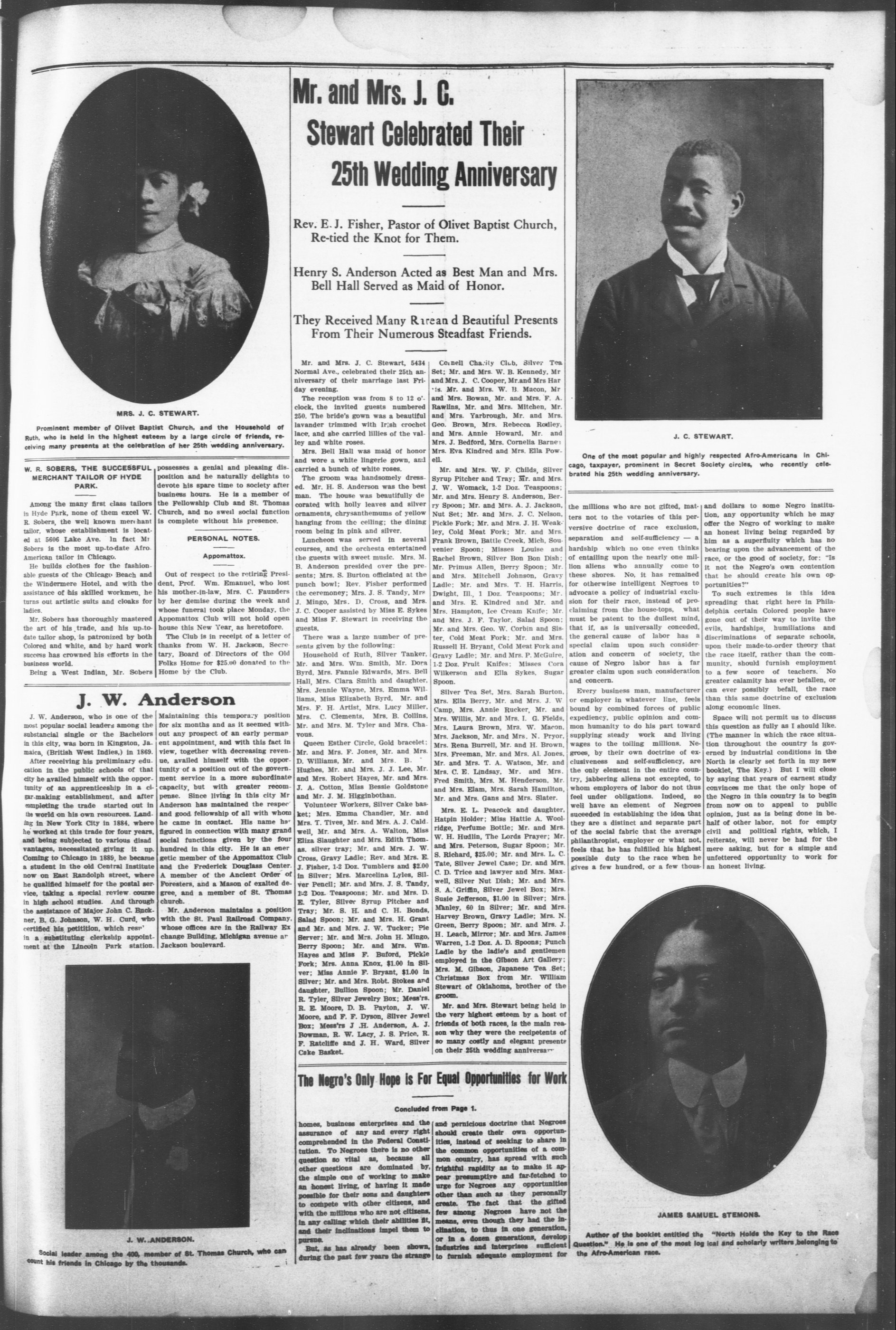
[Picture of a young woman with a large bow in her hair and a white flower in her hair. She is wearing a light-colored dress with ruffled sleeves.]
MRS. J. C. STEWART.
Prominent member of Olivet Baptist Church, and the Household of Ruth, who is held in the highest esteem by a large circle of friends, receiving many presents at the celebration of her 25th wedding anniversary.
W. R. SOBERS, THE SUCCESSFUL MERCHANT TAILOR OF HYDE PARK.
Among the many first class tailors in Hyde Park, none of them excel W. R. Sobers, the well known merchant tailor, whose establishment is located at 5606 Lake Ave. In fact Mr. Sobers is the most up-to-date Afro-American tailor in Chicago.
He builds clothes for the fashionable guests of the Chicago Beach and the Windermere Hotel, and with the assistance of his skilled workmen, he turns out artistic suits and cloaks for ladies.
Mr. Sobers has thoroughly mastered the art of his trade, and his up-to-date tailor shop, is patronized by both Colored and white, and by hard work success has crowned his efforts in the business world.
Being a West Indian, Mr. Sobers
J. W. Anderson
J. W. Anderson, who is one of the most popular social leaders among the substancial single or the Bachelors in this city, was born in Kingston, Jamaica (British West Indies.) in 1869.
After receiving his preliminary education in the public schools of that city he availed himself with the opportunity of an apprenticeship in a cigar-making establishment, and after completing the trade started out in the world on his own resources. Landing in New York City in 1884, where he worked at this trade for four years, and being subjected to various disad vantages, necessitated giving it up. Coming to Chicago in 1889, he became a student in the old Central Institute now on East Randolph street, where he qualified himself for the postal service, taking a special review course in high school studies. And through the assistance of Major John C. Buckner, B. G. Johnson, W. H. Curd, who certified his petition, which res' in a substituting clerkship appointment at the Lincoln Park station.
[Name]
J. W. ANDERSON.
Social leader among the 400, member of St. Thomas Church, who can hunt his friends in Chicago by the thousands.
ist Church, and the Household of em by a large circle of friends, reion of her 25th wedding anniversary. possesses a genial and pleasing disposition and he naturally delights to devote his spare time to society after business hours. He is a member of the Fellowship Club and St. Thomas Church, and no swell social function is complete without his presence.
PERSONAL NOTES.
Appomattox.
Out of respect to the retiring President, Prof. Wm. Emanuel, who lost his mother-in-law, Mrs. C. Faunders by her demise during the week and whose funeral took place Monday, the Appomattox Club will not hold open house this New Year, as heretofore. The Club is in receipt of a letter of thanks from W. H. Jackson, Secretary, Board of Directors of the Old Folks Home for $25.00 donated to the Home by the Club.
Maintaining this temporary position for six months and as it seemed without any prospect of an early permanent appointment, and with this fact in view, together with decreasing revenue, availed himself with the opportunity of a position out of the government service in a more subordinate capacity, but with greater recompense. Since living in this city Mr Anderson has maintained the respect and good fellowship of all with whom he came in contact. His name has figured in connection with many grand social functions given by the four hundred in this city. He is an energetic member of the Appomattox Club and the Frederick Douglass Center. A member of the Ancient Order of Foresters, and a Mason of exalted degree, and a member of St. Thomas church.
Mr. Anderson maintains a position with the St. Paul Railroad Company whose offices are in the Railway Exchange Building, Michigan avenue and Jackson boulevard.
Mr. and Mrs. J. C. Stewart Celebrated Their 25th Wedding Anniversary
Rev. E.J. Fisher, Pastor of Olivet Baptist Church, Re-tied the Knot for Them.
Henry S. Anderson Acted as Best Man and Mrs. Bell Hall Served as Maid of Honor.
They Received Many Rureand Beautiful Presents From Their Numerous Steadfast Friends.
Mr. and Mrs. J. C. Stewart, 5434
Normal Ave., celebrated their 25th anniversary of their marriage last Friday evening.
The reception was from 8 to 12 o'clock, the invited guests numbered 250. The bride's gown was a beautiful lavender trimmed with Irish crochet lace, and she carried lillies of the valley and white roses.
Mrs. Bell Hall was maid of honor and wore a white lingerie gown, and carried a bunch of white roses.
The groom was handsomely dressed. Mr. H. S. Anderson was the best man. The house was beautifully decorated with holly leaves and silver ornaments, chrysanthemums of yellow hanging from the ceiling; the dining room being in pink and silver.
Lancheon was served in several courses, and the orchestra entertained the guests with sweet music. Mrs. M. B. Anderson presided over the presents; Mrs. S. Burton officiated at the punch bowl; Rev. Fisher performed the ceremony; Mrs. J. S. Tandy, Mrs. J. Mingo, Mrs. D. Cross, and Mrs. J. C. Cooper assisted by Miss E. Sykes and Miss F. Stewart in receiving the guests.
There was a large number of presents given by the following:
Household of Ruth, Silver Tanker, Mr. and Mrs. Wm. Smith, Mr. Dora Byrd, Mrs. Fannie Edwards, Mrs. Bell Hall, Mrs. Clara Smith and daughter, Mrs. Jennie Wayne, Mrs. Emma Williams, Miss Elizabeth Byrd, Mr. and Mrs. F. H. Artist, Mrs. Lucy Miller, Mrs. C. Clements, Mrs. B. Collins, Mr. and Mrs. M. Tyler and Mrs. Chavous.
Queen Esther Circle, Gold bracelet; Mr. and Mrs. F. Jones, Mr. and Mrs. D. Williams, Mr. and Mrs. B. Hughes, Mr. and Mrs. J. J. Lee, Mr. and Mrs. Robert Hayes, Mr. and Mrs. J. A. Cotton, Miss Bessie Goldstone and Mr. J. M. Higginbothan.
Volunteer Workers, Silver Cake basket; Mrs. Emma Chandler, Mr. and Mrs. T. Tives, Mr. and Mrs. A. J. Caldwell, Mr. and Mrs. A. Walton, Miss Eliza Slaughter and Mrs. Edith Thomas, silver tray; Mr. and Mrs. J. W. Cross, Gravy Ladle; Rev. and Mrs. E. J. Fisher, 1-2 Doz. Tumblers and $2.00 in Silver; Mrs. Marcelina Lyles, Silver Pencil; Mr. and Mrs. J. S. Tandy, 1-2 Doz. Teaspoons; Mr. and Mrs. D. E. Tyler, Silver Syrup Pitcher and Tray; Mr. S. H. and C. H. Bonds, Salad Spoon; Mr. and Mrs. H. Grant and Mr. and Mrs. J. W. Tucker; Pie Server; Mr. and Mrs. John H. Mingo, Berry Spoon; Mr. and Mrs. Wm. Hayes and Miss F. Buford, Pickle Fork; Mrs. Anna Knox, $1.00 in Silver; Miss Annie F. Bryant, $1.00 in Silver; Mr. and Mrs. Robt. Stokes and daughter, Bullion Spoon; Mr. Daniel R. Tyler, Silver Jewelry Box; Mess'rs R. E. Moore, D. B. Payton, J. W. Moore, and F. F. Dyson, Silver Jewel Box; Mess'rs J. H. Anderson, J. J. Rowman, R. W. Lacy, J. S. Price, R. F. Ratcliffe and J. H. Ward, Silver Cake Basket.
The Negro's Only Hope is For Equal Opportunities for Work
Concluded from Page 1.
homes, business enterprises and the assurance of any and every right comprehended in the Federal Constitution. To Negroes there is no other question so vital as, because all other questions are dominated by, the simple one of working to make an honest living, of having it made possible for their sons and daughters to compete with other citizens, and with the millions who are not citizens, in any calling which their abilities fit, and their inclinations impel them to pursue.
But, as has already been shown, during the past few years the strange
Cornell Charity Club, Silver Tea Set; Mr. and Mrs. W. B. Kennedy, Mr. and Mrs. J. C. Cooper, Mr. and Mrs. Haris. Mr. and Mrs. W. B. Macon, Mr. and Mrs. Bowan, Mr. and Mrs. F. A. Rawlins, Mr. and Mrs. Mitchen, Mr. and Mrs. Yarbrough, Mr. and Mrs. Geo. Brown, Mrs. Rebecca Rodley, and Mrs. Annie Howard, Mr. and Mrs. J. Bedford, Mrs. Cornelia Barnes, Mrs. Eva Kindred and Mrs. Ella Powell.
Mr. and Mrs. W. F. Childs, Silver Syrup Pitcher and Tray; Mr. and Mrs. J. W. Womack, 1-2 Doz. Teaspoons; Mr. and Mrs. Henry S. Anderson, Berry Spoon; Mr. and Mrs. A. J. Jackson, Nut Set; Mr. and Mrs. J. C. Nelson, Pickle Fork; Mr. and Mrs. J. H. Weakley, Cold Meat Fork; Mr. and Mrs. Frank Brown, Battle Creek, Mich, Souvenir Spoon; Misses Louise and Rachel Brown, Silver Bon Bon Dish; Mr. Primus Allen, Berry Spoon; Mr. and Mrs. Mitchell Johnson, Gravy Laddle; Mr. and Mrs. T. H. Harris, Dwight, Ill., 1 Doz. Teaspoons; Mr. and Mrs. E. Kindred and Mr. and Mrs. Hampton, Ice Cream Knife; Mr. and Mrs. J. F. Taylor, Salad Spoon; Mr. and Mrs. Geo. W. Corbin and Sister, Cold Meat Fork; Mr. and Mrs. Russell H. Bryant, Cold Meat Fork and Gravy Laddle; Mr. and Mrs. P. McGuire, 1-2 Doz. Fruit Knifes; Misses Cora Wilkerson and Ella Sykes, Sugar Spoon.
Silver Tea Set, Mrs. Sarah Burton, Mrs. Ella Berry, Mr. and Mrs. J. W Camp, Mrs. Annie Rucker, Mr. and Mrs. Willis, Mr. and Mrs. I. G. Fields, Mrs. Laura Brown, Mrs. W. Macon Mrs. Jackson, Mr. and Mrs. N. Pryor Mrs. Rena Burrell, Mr. and H. Brown Mrs. Freeman, Mr. and Mrs. Al. Jones Mr. and Mrs. T. A. Watson, Mr. and Mrs. C. E. Lindsay, Mr. and Mrs. Fred Smith, Mrs. M. Henderson, Mr and Mrs. Elam, Mrs. Sarah Hamilton Mr. and Mrs. Gans and Mrs. Slater.
Mrs. E. L. Peacock and daughter, Hatpin Holder; Miss Hattie A. Woolridge, Perfume Bottle; Mr. and Mrs. W. H. Hudlin, The Lords Prayer; Mr. and Mrs. Peterson, Sugar Spoon; Mr. S. Richard, $25.00; Mr. and Mrs. L. C. Tate, Silver Jewel Case; Dr. and Mrs. C. D. Trice and lawyer and Mrs. Maxwell, Silver Nut Dish; Mr. and Mrs. S. A. Griffin, Silver Jewel Box; Mrs. Susie Jefferson, $1.00 in Silver; Mrs. Manley, 60 in Silver; Mr. and Mrs. Harvey Brown, Gravy Ladle; Mrs. N. Green, Berry Spoon; Mr. and Mrs. J. H. Leach, Mirror; Mr. and Mrs. James Warren, 1-2 Doz. A. D. Spoons; Punch Ladle by the ladie's and gentlemen employed in the Gibson Art Gallery; Mrs. M. Gibson, Japanese Tea Set; Christmas Box from Mr. William Stewart of Oklahoma, brother of the groom.
Mr. and Mrs. Stewart being held in the very highest esteem by a host of friends of both races, is the main reason why they were the recipientents of so many costly and elegant presents on their 25th wedding anniversary
and pernicious doctrine that Negroes should create their own opportunities, instead of seeking to share in the common opportunities of a common country, has spread with such frightful rapidity as to make it appear presumptive and far-fetched to urge for Negroes any opportunities other than such as they personally create. The fact that the gifted few among Negroes have not the means, even though they had the inclination, to thus in one generation, or in a dozen generations, develop industries and interprises sufficient to furnish adequate employment for
[Name not visible in the image]
J. C. STEWART.
One of the most popular and highly respected Afro-Americans in Chicago, taxpayer, prominent in Secret Society circles, who recently celebrated his 25th wedding anniversary.
the millions who are not gifted, matters not to the votaries of this pervasive doctrine of race exclusion, separation and self-sufficiency — a hardship which no one even thinks of entailing upon the nearly one million aliens who annually come to these shores. No, it has remained for otherwise intelligent Negroes to advocate a policy of industrial exclusion for their race, instead of proclaiming from the house-tops, what must be patent to the dullest mind, that if, as is universally conceded, the general cause of labor has a special claim upon such consideration and concern of society, the cause of Negro labor has a far greater claim upon such consideration and concern.
Every business man, manufacturer or employer in whatever line, feels bound by combined forces of public expediency, public opinion and common humanity to do his part toward supplying steady work and living wages to the toiling millions. Negroes, by their own doctrine of exclusiveness and self-sufficiency, are the only element in the entire country, jabbering aliens not excepted, to whom employers of labor do not thus feel under obligations. Indeed, so well have an element of Negroes succeeded in establishing the idea that they are a distinct and separate part of the social fabric that the average philanthropist, employer or what not, feels that he has fulfilled his highest possible duty to the race when he gives a few hundred, or a few thou-
The quick brown fox jumps over the lazy dog.
[Name not visible in the image]
JAMES SAMUEL & TEMONS
Author of the booklet entitled the Question." He is one of the most lo- the Afro-American race.
Author of the booklet entitled the "North Holde the Key to the Race Question." He is one of the most logical and scholarly writers belonging to the Afro-American race.
and dollars to some Negro institution, any opportunity which he may offer the Negro of working to make an honest living being regarded by him as a superfluity which has no bearing upon the advancement of the race, or the good of society, for: "Is it not the Negro's own contention that he should create his own opportunities?"
To such extremes is this idea spreading that right here in Philadelphia certain Colored people have gone out of their way to invite the evils, hardships, humiliations and discriminations of separate schools, upon their made-to-order theory that the race itself, rather than the community, should furnish employment to a few score of teachers. No greater calamity has ever befallen, or can ever possibly befall, the race than this same doctrine of exclusion along economic lines.
Space will not permit us to discuss this question as fully as I should like. (The manner in which the race situation throughout the country is governed by industrial conditions in the North is clearly set forth in my new booklet, The Key.) But I will close by saying that years of earnest study convinces me that the only hope of the Negro in this country is to begin from now on to appeal to public opinion, just as is being done in behalf of other labor, not for empty civil and political rights, which, I reiterate, will never be had for the mere asking, but for a simple and unfettered opportunity to work for an honest living.
```markdown
```
"North Holds the Key to the Race logical and scholarly writers belonging to
[Name]
S. A. T. WATKINS.
Ex-Assistant Prosecuting Attorney of Chicago, and Supreme Attorney for the Knights of Pythias throughout the world.
Big Maek Carnival New Years Eve.
This has been a gala week at the Rink, it being the week for all of Chicago's best people to recreate and enjoy the hilarious and bracing exercise of Roller Skating. On Christmas eve there was a Santa Claus contest, on Christmas night there was a Christmas School Children contest which was won as follows: First prize, Joseph McLutheon; second prize, Ada Smith; third prize; Balzora Tones and on the 26th there was a Trick and Fancy Skate contest, on the 27th, a Lady and Gent contest which was won as follows; Prize No. 1, Couple No. 1, Mr. Chilton and Miss L. Todd, prize No. 2, Couple No. 2, Mr. A. Huff and Miss S. Henderson. The judges were Geo. Hight, Mrs. Lapsey and Ethel Burton.
Capt. R. F. Ratcliffe, F. L. Cuffee,
W. H. Jackson, J. W. Ward, P. W.
Johnson, J. R. McAllister and Geo. M.
Turner were visitors at the Rink during the week.
Dr. and Mrs. J. R. White and guest,
Dr. Lane of Kansas City, Mo. were also visitors, who were delighted with the home like surroundings of the Chateau.
Mr. and Mrs. McGooden were amon-
the Chateau visitors during the week.
Dec. 31st and Jan. 1st there was a Mask Carnival and the following persons contested for the championship prize for the year: Mr. L. Givens, O. Vanderberg, W. Chilton, A. Huff, E. Green, S. Handy, J. Manning, T. Ayes, J. Brown, D. Mason, W. Mason, R. Brokenberg, Grace Hunter, L. Todd, S. Henderson, Miss Powell, Miss Bell, Miss Stetley, Miss Grand, A. Turner, M. Graham and Nettie Smith.
The Mask Carnival was quite a unique affair as 3 prizes were given away each night, Dec. 31st to Jan. 1st to wit: First prize to the Most Unique and Original Masker, 2nd prize to the best Mask Skater, 3rd, the worst Mask Skater. This promises fun and a chance for each one. The winners of the prizes will be announced later on.
Mr. Noah D. Thompson will spend Friday, Saturday and Sunday with his son in Somerset, Penna.
Mr. and Mrs. N. Motley, 6618 Vernon avenue, entertained several friends at dinner Christmas Day.
Mr. Richard B. Harrison, of Los Angeles, California, is in the city to spend the holidays with his wife and children.
Mr. and Mrs. William Hale Thomson have removed from 91 21st street to 2000 Indiana ave., and they are now at home to their friends.
Mr. and Mrs. Daniel H. Young, 6616 Vernon avenue, entertained a party of friends at dinner Christmas afternoon.
Mrs. Augusta Browne Hawkins and Mrs. Martha B. Anderson, 6450 Champlain avenue, were at home to their friends New Year's Day.
CHATEAU RINK NOTES.
---
---
---
...
---
CHIPS
Mrs. Frank Hatten, of Montreal, Can., has been the guest of Mrs. J. E. Johnston, 3238 Wabash avenue, during the holiday season.
Miss Edith Hawley returned to her home in Detroit, Mich., the first of the week after spending several weeks here among relatives and friends.
Jack Johnson, by knocking out Tommy Burns in 14 rounds, last week at Skiney, N. S. W., has become the heavy weight champion prize fighter of the world, and that is going some for a Colored man.
Mr. Earnest Elliott has returned to Chicago after spending a month at the Pacific coast. Mr. Elliott says a working chance is very poor there for members of his race.
Attorney Walter M. Farmer spent the first part of the week in St. Louis, Mo., where he transacted some business for the United Brothers of Friendship.
Edward Carroll, formerly Civil Service Commissioner, and one of the wheel horses of Democracy in the 31st ward, has become a live candidate for City Clerk of Chicago.
Mrs. Joseph B. Crum, who was recently operated upon for appendicitis at Provident Hospital, is now at her home, 43 E. 29th Place, where she is rapidly improving in strength and health.
Mrs. J. E. Johnston and her daughter, Miss Elizabeth V. Johnston, of 3238 Wabash avenue, received on New Year's Day, from 3 to 8 p. m. They were assisted by Miss Martha Pope and Mesdames Sol Taylor, L. Davis, M. French, and Misses Corne Bryant and Settles.
"Was the boy severely punished for borrowing the horse?"
"Do you mean the boy who was thrown from the horse into the duck pond?"
"And now that you are of age," said the anxious father, "I want to give you a few pointers on how to keep money." "Say, dad," rejoined the son of his father, "hadn't you better begin by giving me a few pointers on how to get it!" -Pittsburg Post.
"Put that picture of the champion princefighter at the top of the page. It is the logical position."
"Why logical?"
"Because isn't it an upper cut?"—Baltimore American.
Expanding the Simile.
"I, sir," said Mr. Dustin Stax, "am like the buny bee. I have industriously stored the good things of life."
"Yes. And anybody who tried to stop you was very likely to get stung."—Washington Star.
"Oh, but wasn't Tennyson a great post!"
"You bet! He could violate every rule of rhyme or rhythm without being called down for it"—Boston Globe.
Myer—So? What's he doing?
Gyer—Writing a novel.—Woman's Home Companion.
Naturally.
Of More Importance
The Natural Place.
Annual Report of Elizabeth McDonald
To The Annual Conference of the A.M.E. Church September 28th, 1908:
To The Rt. Rev. Bishop and Members of Said Conference:
In presenting my annual report to the Illinois Conference I gratefully acknowledge the encouragement received from many of its members and the support they have loaned, which has done much to strengthen and help me during the conference year. I submit to you briefly a statement of the work both in its spiritual and temporal character.
And first as to its spiritual character, I will say I have been very busy since last conference. During the year I have spent much time in the spiritual meetings which I have conducted in my own home. In my home here I have held one hundred and four prayer meetings, twelve converts in the home. Seven from our home have been baptized and joined the church. Outside of the home one hundred and twenty prayer meetings have been held and twenty-five of these meetings were held in different penal institutions — total number prayer meetings held were two hundred and twenty-four. While labororing in various fields there have been forty-six persons converted and a large number of backsliders reclaimed.
I also spent considerable time in traveling. I went to Gibson City and labored with the earnest assistance of Rev. Strauss, while there our work brought in eighteen converts. I also went to Streator to the charge of Rev. I. P. Coates and there we had six converts. Besides these there were numerous meetings in the various institutions from which there resulted a number of converts—I submit the following list.
V
MRS. ELIZABETH McDONALD.
Probation officer of the Juvenile Court, and founder of the Louise Juvenile Home for Neglected and Dependent Children.
Place of Converts, Streator; J. P. Coates church, 6; County Jail, 5; Penitentiary, 2; Gibson City converts, 18; Our home, 15; Total number of converts, 46.
Two converts were murderers. 1 collected about three hundred books, which I distributed as follows:
Hymn-books, 3; Bibles, 4; Tracks, 144; Books and papers, 179; Total, 300.
Doolittle, $1.00; Miss Stevens, $1.00; Wm. Wuhershers, $1.00; Mr. Scott, $2.00; Julius F. Taylor, $9.00.
Donations for Evangelistic Work—Gibson City, $43.00; Streator, Ill. $7.00; Collected for board for children, $428.50; Collected for rent, $119.00; Total, $547.50.
Recapitulation.
Evangelistic work donation, $50.00; Donations from friends, $271.00.
I am pleased that friends both Colored and white in the city and out of the city, have sent large donations of clothing of all kinds. In this way, I have been able to clothe many children nicely and have been able to give to other needy families the number of two hundred and fifty pieces.
I am always glad to send to any one who will give their clothing which they do not need.
I am sorry to say that I have not been able to do much outside work this year as usual, but have made forty-six visits to the jail; fifteen to the penitentiary, fifteen to police stations and Bridewell and fifty to needy homes.
In addition to my missionary work I organized in Gibson City in Elder Strauss' church a Helping Hand Society which is doing splendid missionary work.
I have sent to the Hospital six needy persons, one to Dunning and two to the Martha Washington Home, also supplied three fmilies with nurses and doctors.
My work in the Juvenile Court continues. I have quite a number of children from that Court in my charge.
I have had this year 15 prisoners paroled to me from the penitentiary, all are doing fairly well. Four of them have received final discharge.
Greeting:—
Spiritual.
OUR NEW HOME
On the 3rd, of last October I established the Louise Juvenile Home for dependent and neglected children. In my private home at 6130 Ada St. last Feb., 1908, the home purchased property at 6124 Ada Street consisting of a eleven room house, and a lot twenty-five by one hundred and eleven feet for the permanent home. The cost of this property was twenty-four hundred dollars, of which six hundred dollars cash was paid. We have an excellent advisory board of which Rev. Timothy Reeves is pres.; J. L. Whitman, treas.; Cecilia Johnson, sec.
William O. Lamonte legal advisor, also in connection with the work a woman's club has been organized for the benefit of the home of which Mrs. A. M. Smith of Bethel A. M. E. Church is president.
We cared for fifty-one children in our home since last year and have had wonderful success with them spiritually and financially.
FINANCIAL STATEMENT.
Donations to the Work.
During the year many generous people have helped us. I want to acknowledge their donations and express my gratitude for the same. The list is as follows:
Mrs. Emma Rice, $100.00; Mrs. W. B. Keene, $35.00; Hon. E. J. Murphy, $25.00; John L. Whitman, $25.00; Mrs. Amigh, State Home for girls, $10.00; Will T. Davis, $10.00; Mrs. Cummings, $25.00; Cash, $5.00; Rev. Stillman, $2.00; Mrs. Tindall, $2.00; rope, cshrdlu shrdll shrdlu drwu Julia Lathrop, $5.00; Judge Julian W. Mack, $5.00; Russel, Brewster & Co., $5.00; Mrs. Berkley, $1.00; Paul Schulze, $1.00; M. J. Kane, $1.00; Miss
Doolittle, $1.10; Miss Stevens, $1.10;
Wm. Wuhershan, $1.10; Mr. Scott
$2.10; Julius F. Taylor, $9.00;
Donations for Evangelistic Work—
Gibson City, $43.00; Streator, Ill.
$7.10; Collected for board for children,
$428.50; Collected for rent,
$119.00; Total, $547.50.
Recapitulation.
Evangelistic work donation, $50.00;
Donations from friends, $271.0;
Total, $868.50.
Disbursements.
Paid out on property, 1st payment,
$600.00; Paid out on property, subsequent payments, $297.00; Paid out for repairs, material and labor, $85.00;
Total, $882.00.
Paid out for running home, $748.00;
Paid out for car fare, $31.00; Paid out for education, $2.00; Paid out for Bibles, $ .50; Paid out donations for the needy, $15.00; Paid out for Mite missionary, $2.50; Paid out for Home missionary, $11.00; Paid correspondence, $7.00; Total $1800.00.
In conclusion, I wish to say this has been the hardest year of all my work. At the same time it has been the most blessed one. I wish to turn thanks to our dear Bishop Shaffer and to presiding Elder Reeves and to all of my dear friends who have so generously contributed to me. I am inspired to continue the work when I think how Jesus was glorified when He passed through His earthly experience. The cross is always before the crown, night before the day, suffering before transfiguration and trial before victory. If we are willing to pay the price we may have the blessing.
Elizabeth McDonald,
Founder and Manager of the Louise
Juvenile Home, 6130 Ada St., Chicago, Ill.
Recapitulation
Disbursements
Yours in Christ,
HUMOR OF THE HOUR
HUMOR OF THE HOUR
"I have a splitting headache," sighs the beautiful young thing.
"Have you ever tried magnetic healing?" asks the obliging young man.
"No. What is it?"
"You rest your head, thus, on my shoulder, and I pass my arm about your waist in this manner. Now be perfectly calm and see if this does not relieve you."
The position is maintained for five or ten minutes, and then the obliging young man asks:
"Does your head ache any more?"
"Y-e-es."
"Well, I'm sorry I don't seem able to relieve you."
He is about to remove his arm, when she looks up at him chidingly and says:
"It seems to me that if you have any confidence in your method you would be willing to keep on trying."—Chicago Post.
DeAuber-There is a life size portrait I painted of Puffem, but he refused to accept it.
Brushleigh-It seems to be a good likeness of him. What was the trouble?
DeAuber-It's only about half as big as he thinks he is.-Chicago News.
The Smile Promoter
"Have you done anything to make life seem more cheerful?" said the optimist. "Have you helped anybody to smile?"
"I should say so. I have helped more people to smile than anybody else in the neighborhood. I'm a dentist."—Minneapolis Journal.
Jagreen—I saw you talking to Borrows on the street this morning.
Bilbrown—Yes.
Jagreen—Did he strike you for a loan?
Bilbrown—Not exactly. He struck at me, but never touched me.—Pittsburg Post.
Measurably Mournful.
A
Tourist—Where's the bulldog I sold you the other day?
"Oh, the poor baste swallowed a tape measure, and he died, sorr!"
Tourist (waggishly)—He died by inches, eh?
"No, sorr! He went round the back of the house and died by the yard."—London Opinion.
"Teacher," said Dicky Jones, sidling up to the desk and speaking in a whisper, "Tommy Tucker's tryin' to look cross eyed, like you look." It is scarcely necessary to add that it was Dicky Jones that got the subsequent whipping--Harper's Weekly.
1930
[Name]
GEORGE MILLS ROGERS.
Master in Chancery of the Circuit Court of Cooke surged by his friends to become a candidate for Judge of June.
Master in Chancery of the Circuit Court of Cook county, who is being urged by his friends to become a candidate for Judge of the same Court next June.
Unsatisfactory.
He Struck Out.
The Informer.
The dictionary is never allowed a long rest. The new word is "dactyloscopy" and means the method employed at police headquarters of identifying criminals by their fist prints. Near the St. Lawrence river in Canada, there is a water slide three miles long for conveying pulp wood to the railway. It is capable of moving nearly 8,000 cubic feet of wood an hour. Nearly all of the Greeks now coming to this country are settling in New York city, and not more than 12 percent are going to other places. There are now in the city about 10,000 of them. A telephone system will be completed in the near future in the French African colonies which will permit of communication with the most distant posts in the interior of the dark continent.
Many excellent famine plants have been recommended for India, but one of the most important is the tarloca or cassava plant, to the planting of which the government of Bombay has again turned its attention.
After other photographers but failed for twenty years an eastern man, T. O. Boisen, has perfected an apparatus which has taken some remarkable submarine photographs of Santa Catalina Island, California.
A California jeweler has made a pair of scales so delicate that he says they weigh the soul of a fly. As a fact, they do register the difference in weight between a living fly and the same after it has been killed.
Through the agency of the Association For International Conciliation Secretary Root's address on "The Sanction of International Law" has been translated into English, German, Spanish, French, Italian and Portuguese.
Results obtained in tests of the Maxim silent firearm before the United States army board are reported to have been encouraging, the explosion being only faintly audible. The muffling is obtained at some expense of velocity.
Liverpool has a library of 280,000 volumes. The number of books taken home during the last year was 1,362,000, while 1,410,444 were used for reference in the library. In other words, each book was on the average used ten times.
An artillery lieutenant in Kraguyevats, Servia, has been sentenced to twenty-one days' imprisonment for compelling a recruit to undergo the most cruel indignity in Servian eyes. This consisted in making him shave his mustache.
Women of China are said to be keenly anxious to have a voice in public affairs, and a movement is afoot among the daughters of the orient to establish themselves on a level with their men folk as far as social and political affairs are concerned.
There are at present on duty in the main thoroughfares of Paris twenty-one policemen who speak English, nine who speak German and six who speak Spanish, and their usefulness has been so clearly demonstrated that the perfect of police has decided to add to their number as opportunity may arise
The distance around the world via the Transsiberian and our own transcontinental railway lines is shown to be 17,997 miles. The sailing distance around the world from New York via Suez, Singapore, Manila, Guam, the Hawaiian Islands and Panama canal to New York again would be 23,092 miles.
The first tunnel under a river ever constructed in France has just been completed in Paris. It runs under the Seine from the Place de la Concorde to the chamber of deputies, and it is part of the new Metropolitan subway line, which will be opened probably by spring. This line will run from Montarte to the Porte de Versailles.
HENRY H. HARRIS
court of Cook county, who is being
ate for Judge of the same Court next
EVENTS IN 1908
Notable Occurrences the World Over.
CRISES IN GOVERNMENT
4 Carefully Classified Summary of Affairs at Home and Abroad—Miscellaneous Happenings—Fatal Explosions on Land and Sea—Losses by Fire—The Field of Sports.
POLITICAL AND PERSONAL
JANUARY.
4. Mulai Haifid proclaimed sultan of Morocco at Fez.
2. Gladys Vanderbilt married to Count Lassio Szechenyi of Hungary in New York city.
PEBRUARY.
1. King Carlos of Portugal and the crown prince Luis Filippe assassinated at Lisbon.
2. Manuel, second son of the assassinated monarch, proclaimed king as Manuel II. of Portugal.
MARCH.
15. Several Haitian revolutionists shot by order of President Alexis.
17. At the demand of the powers President Alexis allowed revolutionist suspects to leave Haiti.
APRIL.
1. Thomas E. Watson of Georgia nominated for president by the People's party at St. Louis.
2. Sir Henry Campbell-Bannerman, prime minister of England, resigned.
3. Herbert S. Asquith appointed prime minister of King Edward.
5. Sir Cathal Loge, head of the Roman Catholic church in Ireland, arrived in New York to participate in the centennial of the New York archdiocese.
MAY.
4. Manuel, the boy king of Portugal, formally invested with the royal crown and the royal scepter of the realm.
5. Rear Admiral Robley D. Evans relinquished command of the Atlantic battleship fleet.
15. The Socialist party nominated Eugene V. Debs and Benjamin Hanford at Chicago.
18. The emergency currency bill signed by the president. Congress adjourned.
1. King Edward VII. of England and Emperor Nicholas II. of Russia met for an official conference at Revel.
2. Gen. Clement A. Evans of Georgia elected commander in chief of the United Confederate Veterans.
3. W. H. Taft nominated for president at the Republican convention in Chicago.
4. Persian parliament overthrown by force for refusing the demands of the act.
5. New parliament ordered in Persia and general amnesty proclaimed.
JULY.
1. Secretary of War W. H. Taft resigned and was succeeded by Gen. Luke E. Wright.
2. Diplomatic relations severed between the United States and Venezuela.
3. William Jennings Bryan nominated for the presidency by the Democratic convention at Denver.
4. Obalia elected president of Panama.
5. Eugene W. Chadin and Aaron S. Watkins nominated president by the Prohibitionists convention at Columbus, O.
12 The Prince of Wales landed at Quebec to attend the tercentenary celebration.
13 Constitutional government restored in Turkey.
12 Thomas L. Hisgen and John Temple Graves nominated for president and vice president by the Independence convention at Chicago.
AUGUST.
13 Rear Admiral Robley D. Evans,
U. S. N., placed on the retired list,
having reseched the age limit of 6 years.
R. D. Evans.
The Kongo annexation treaty adopted by the Belgian chamber of deputies.
22. Mutual Hafid, pretender to the throne of Morocco, proclaimed sultan following defeat of the army of Abdul Aziz, the sultan of record.
SEPTEMBER
1. Col. Henry M. Nevius elected com-
mander in chief of the G. A. R. at Tellede.
OCTOBER
OCTOBER.
6. Bulgaria declared independent of Turkey by Prince Ferdinand, who proclaimed himself "czar of the Bulgars."
6. Austria annexed the nominally Turkish provinces of Bosnia and Herzegovina to the territory of the empire.
NOVEMBER.
NOVEMBER
3. The national election resulted in the choice of W. H. Taft. Popular vote: Republican, 7,577,676; Democrat, 6,338,182; Socialist, 448,653; Prohibitionist, 241,258; Independence league, 68,156; People's party, 31,971; Socialist leader, 14,831. 12. Death of Kwang Su, emperor of China, announced at Peking. 14. Gen. Jose Miguel Gomez elected president of Cuba by the Liberals.
DECEMBER
2. Pu Yi enthroned as emperor Houstung of China, with Prince Chun resigned. Revolutionists deposed President Alexis of Haiti.
The president explained and defended the Panama canal purchase in a special message to congress.
GAMES AND RACES
MARCH.
Mecklick won the $10,000 Crescent Derby at New Orleans.
APRIL.
Gotch defeated Hackenschmidt for world's heavyweight wrestling championship at Chicago.
Jack Atkin won the $10,000 Carter handicap on the Aqueduct track, New York.
MAY.
Calvin Demarest of Chicago won the international amateur billiard cham-
morship in New York, defeating Razelle, the Frenchman, by the score of 60 to 26 points. Katonia won the Kentucky Derby at Louisville. 12. Jack Atkinson won the Metropolitan handicap at Belmont park, New York. 15. Jay Gould defeated Eugene Miles, the English player, for the world's amateur tennis championship in London.
14. W. K. Vanderbilt's horse Northeast won the Grand Prix de Paris, the championship.
25. Harvard won the varsity boat race at New London.
JULY.
4. Battling Nelson defeated Joe Gans for the lightweight championship of the world in 17 rounds at San Francisco.
18. Martin J. Sheridan of New York made a new world record by hurling the discus 125 feet 6 inches at the London Olympic games.
24. John J. Hayes, an American, won the Olympic Mar-
15. Martin J. Sheridan of New York made a new world record by hurling the discus 123 feet 8 inches at the London Olympic games.
16. John J. Hayes, an American, won the Olympic Marathon in London.
J. J. Hayes
AUGUST.
25. Allen Winter won the American Trut-
ting Derby at Readville, Mass.
20. Maskette won the Futurity at Sheeps-
head Bay, N. Y.
SEPTEMBER.
AUGUST.
AEPTEMBER
8. Papke defeated Ketchel in 12 rounds for middleweight championship at Los Angeles.
OCTOBER.
14. The Chicago National league baseball club (Cubs) won the world's championship by defeating the Detroit American league club (Tigers) at Detroit; score 2-0.
24. George Robertson, driving a 20 horsepower Locomobile, won the Vanderbilt cup in the auto race at the Motor parkway. New York; speed average 64 miles an hour.
NOVEMBER.
7. Harvard defeated Carlisle Indians at football at Cambridge, 17 to 0. Wisconsin defeated Minnesota at football, 0 to 8, at Minneapolis.
14. Yale defeated Boston, 11 to 6, at football. Chicago and Cornell played to a tie score of 6 to 6 at football. Pennsylvania defeated Michigan, 29 to 0, on the gridiron at Ann Arbor.
21. Harvard defeated Yale at football on Yale field; score 4 to 0.
26. Pennsylvania defeated Cornell at foot-
ball, 17 to 4, in Philadelphia. Wagner in a Flat car won the Grand
Banks Mobile club driving
402 miles in 6 hours 10 minutes 21
seconds, at Savannah.
28. West Point defeated Annapolis at football in Philadelphia, 6 to 4.
29. Pat McDonald tossed the 56 pound weight 16 feet three-eighths inch in New York, smashing the world's record of 15 feet 7 inches, held by Matt McGrath.
Norman Brooks and A. F. Wilding, American defenders of the international lawn tennis trophy, defeated the American challengers at Melbourne.
DECEMBER
1. Tom Collins made a new American record for 5 mile run in New York; time 25 minutes 19 2-5 seconds.
2. MacFarland and Moran, the Pacific-Atlantic team, won the 6 day bicycle race in New York: distance, 2,737 miles, 1 lap, beating the record 8 miles and 7 laps.
STORM AND FLOOD
JANUARY.
JANUARY.
1. 25 deaths in a tornado near Wesson,
Miss.
FEBRUARY.
15. Highest water of the Pittsburg flood,
which caused damage estimated at
$2,500,000.
MARCH.
1. An avalanche crushed a hotel at Goppenstein, Switzerland, killing 13 persons and injuring 15.
22-4. Nearly 400 persons killed, many thousands injured and much property destroyed by a tornado which swept the southern states from Texas to Georgia.
12. 50 deaths by a tornado in Louisiana.
13. 10 persons killed by a tornado in Al-
alfa county, Oklahoma.
JUNE.
6. Windstorms and flood caused heavy
loss of life in Oklahoma, Kansas, Nebraska and Iowa.
AUGUST.
27. Climax of flood in North Carolina,
South Carolina and Georgia, which
resulted in the loss of many lives; dam
in the three states estimated at
over $200,000.
21. Destructive cloudburst and flood in Oklahoma.
NOVEMBER.
22. 26 killed and 46 injured by a tornado in Arkansas.
DISASTERS AT SEA
FEBRUARY.
2. Phoenix line steamship St. Cuthbert destroyed by explosion off Nova Scotia; 15 deaths.
16. American ship Emily Beed wrecked off the Oregon coast; 10 sailors lost.
17. British steamer Asikl wrecked on the Norwegian coast; 14 sailors lost.
APRIL.
2. British torpedo boat destroyer Tiger cut in two by collision with the cruiser Berwick off the Isle of Wight; 38 men drowned.
15. 16 persons drowned by the capizing of the steamer Marion near the mouth of the St. Francis river, Arkansas.
23 sailors killed and missing in a collision between the British cruiser Gladiator and the American liner St. Paul off the Isle of Wight.
24 Japan's protected cruiser Matsushima destroyed by explosion off Pascadores islands; over 20 deaths reported.
MAY.
25. The fishing schooner Fame run down by the Dominion Atlantic line steamer Boston off the coast of Maine; 18 sailors drowned.
JUNE.
26. Spanish steamer Larache wrecked near Muroa, with heavy loss of life among passengers and crew.
AUGUST.
27. 40 passengers lost in the wrecking of the Norwegian steamer Folgshunden off Norway.
22. British steamer Dunearn wrecked in a typhoon off the island of Kihulu, Japan; SI lives lost.
20. The salmon cannery ship Star of Bengal wrecked in a storm off Coronation island, 110 people drowned.
21. 20 sailors of the British ship Loch Finlas drowned by the wrecking of that vessel off Foster island.
OCTOBER.
1. The French schooner Juniata wrecked on the Grand bank; 25 sailors lost.
2. The Hudson river steamer New York burned at Newburg; loss $600,000.
NOVEMBER.
OCTOBER
NOVEMBER
21. 10 killed and 20 injured in the river steamer H. M. Carter, destroyed by boiler explosion and fire at Bayou Goula, La.
25. Steamer Sardinia, from Liverpool, burned at sea off Malta; over 100 deaths.
DECEMBER.
2. Steamer D. M. Clemson wrecked on Lake Michigan off Duluth; 25 sailors lost.
ACCIDENTS ON LAND
JANUARY.
11. 16 children killed in a theater crush at Barnsley, England.
13. 173 deaths by the burning of the Rhoads Opera House at Boyerstown, Pa.
FEBRUARY.
20. 28 deaths by explosion at the Hercules Powder works at Pinole, Cal.
MARCH.
4. 174 school children killed in a schoolhouse fire in North Collinwood, on the outskirts of Cleveland.
28. 70 lives lost by explosions in a coal mine at Hanna, Wyo.
APRIL.
6. 40 deaths by the collapse of a tenement in London.
3. 15 killed and 20 seriously injured by the burning of the Aveline hotel at Fort Wayne, Ind.
12. 7 miners killed and many injured by explosion in the Mount Lookout colliding with a train.
20. 60 killed and 100 injured in a Belgian railroad collision near Antwerp.
JUNE.
6. By the explosion of a boiler tube on the cruiser Tennessee, cruising near San Pedro, Cal., 6 of the crew were killed and several injured.
AUGUST.
18. 18 workmen killed and many injured
by the collapse of a brick block under
construction in Chelsea square, Boston.
26. 20 miners suffocated in the Halley Ola
mine at McAlester, Okla.
SEPTEMBER.
17. Orville Wright, the airship inventor,
injured and his
companion, Lleut.
Thomas E. Sel-
fridge, U. S. A.
killed by the fall
of aeroplane at
Fort Myer.
PETER H. BURTON
25. skilled and many injured in a head-on collision on the Northern Pacific at Young's Point, Mont.
Orville Wright.
M. Young's Point, Orville Wright.
Mont.
OCTOBER.
7. Explosion and fire in a grain elevator at Richford, Vt., resulted in the death of 13 persons and a loss of $400,000.
15. Train of refugees from the forest fires wrecked near Metz, Mich. Many lives lost.
NOVEMBER.
11. 9 killed in a wreck on the New Orleans and Northeastern railroad at Little Woods, La.
15. Over 200 miners killed by an explosion in the Radbad mine at Hamm, Germany.
20. A landslide following a gas explosion caused a loss of a score of lives in Brooklyn.
28. 188 miners killed by coal gas explosion at Marianna, Pa.
WORK OF THE FLAMES
JANUARY.
JANUARY
11. Loss of $,500,000 by the burning of the Parker building in New York city; 3 firemen killed and many injured.
12. City hall and police building destroyed at Portland, Ma.; loss $1,000,000.
17. Fire caused a loss of over $800,000 in the wholesale district of Portland, Ma.
1. Fire swept over an area of 55 acres at
Tampa, Fl., causing a loss of $000,000.
2. The famous Drury Lane theater burned
in London.
APRIL.
12. Fire destroyed 20 blocks in Chelsea,
Mass; 13 deaths and a property loss of
$10,000,000.
15. Loss of $1,250,000 by fire in the Omaha Packing Co.'s plant at South Omaha.
3. Fire on the Boston piers caused a loss of $1,500,000.
AUGUST.
1. Bush fires started a conflagration which swept a square mile of township in British Columbia, $400,000, and many deaths reported.
2. Forest fires wrought destruction to towns and villages in Minnesota and Wisconsin; damage estimated at upward of $5,000,000.
4. Fire destroyed the business section of Rawhide, Nev., causing a loss of $260,000.
5. Fire destroyed the plant of the Cosmodale Cement Co. near Louisville, Ky.; loss $2,000,000.
OCTOBER.
14. Loss of $500,000 by fire which nearly destroyed the town of Blubee, Ark.
Loss of $500,000 by the burning of the Jenkins lumber mill plant at Blaine, Wash.
12. Fire in a lumber plant at Rock Island, Ill., caused a loss of $200,000.
13. The Colonnade and other buildings on the Chautauqua assembly grounds at Jamestown, N. Y., destroyed by fire; loss $150,000.
12. The Park theater, Brooklyn's oldest playhouse, burned.
13. Fire in the Tom Moore distillery warehouses at Bardstown, Ky., caused a loss of $400,000 on stock and $750,000 government tax.
DECEMBER.
4. Malvern Hill, historic mansion on the site of the battlefield of July 1, 1863, destroyed. Loss of $500,000 by names at the Grand Trunk railway docks, Portland, Me.
CONVENTIONS.
MARCH.
MARCH
10. The International Congress of Mothers convened in Washington.
APRIL.
20. The National Society, Daughters of the American Revolution, met in annual convention in Washington.
21. The general society, Daughters of the American Revolution, met in New York city.
20. The national congress, Sons of the American Revolution, opened in Buffalo.
12. Congress of governors met in Washington.
19. The Southern Baptists met in convention at Hot Springs, Ark.
21. The general assembly of the Presbyterian Church in the United states met in Kansas City, Mo.
22. International congress of aeronauts met in London.
JUNE
8. Eighth biennial convention of the Brotherhood of Locomotive Engineers at Columbus, O.
International Woman's Suffrage alliance met in Amsterdam.
18. International Sunday school convention in Louisville.
22. The general Federation of Women's Clubs met in Boston.
29. National Educational association met in Cleveland.
JULY.
7. National good roads convention met in Buffalo.
2. Federation of American Zionists met at Atlantic City.
3. Federation of the Western Federation
19. National congress of Esperantists met at Chauatoua, N. Y.
AUGUST.
10. Annual conventions of the International Typographical and of the Stereotypers and Electrotypers' unions, also the American Federation of Catholic Societies, opened in Boston.
16. The 33d annual convention of the National Editorial association opened at St. Paul.
17. International Esperanto congress met in Dresden, Saxony.
25. National society, Sons of Veterans, met at Niagara Falls.
26. Annual encampment of the United Spanish War Veterans opened in Boston.
31. 42d annual encampment of the G. A. R. opened in Toledo.
SEPTEMBER.
9. 19th annual international eucharistic congress convened in London.
24. 28th annual meeting of the farmers' national congress opened at Madison, WI.
29. Triennial international congress on tuberculosis opened in Washington.
Convention of the American Bankers' association opened in Denver.
29. 16th session of the national irrigation congress opened in Albuquerque, N. M. OCTOBER.
6. 19th transmississippi commercial congress met in San Francisco.
15. 40th annual convention of the National American Woman Suffrage association opened in Buffalo.
22. Convention of the National Woman's Christian Temperance union met in Denver.
9. 28th annual session of the American Federation of Labor opened in Denver.
11. 15th annual convention United Daughters of the Confederacy met at Atlanta.
28. American Association For the Advancement of Science met in Baltimore.
DECEMBER.
2. American mining congress opened in Pittsburgh.
14. American Civic Federation met in New York.
28. American Association For the Advancement of Science opened in Baltimore.
FINANCIAL TROUBLES
JANUARY.
2. Receivers appointed for the Chicago and Great Western railway.
22. The New York Stock Exchange firm of Coster, Knapp & Co. failed for nearly $4,000,000.
MAY.
1. W. A. Stetson, leather dealer, failed in Boston; liabilities about $5,000,000.
2. Inman & Co., cotton brokers, failed in Augusta, Ga.; liabilities $1,500,000.
3. The Euclid Avenue Trust Co. of Cleveland assigned with liabilities of $1,700,000.
4. The Amador Mining and Development Co. of Montana failed in Chicago.
JULY.
1. Cameron, Currie & Co. of Detroit, members of the New York Stock Exchange, placed in hands of a receiver, owing $1,000,000.
AUGUST.
1. The Pillsbury-Washburn Flour Mills Co. in Minneapolis placed in receiver's hands; liabilities $3,000,000.
2. A. O. Brown & Co., Stock Exchange brokers in New York, failed with heavy liabilities.
SEPTEMBER.
12. A. Booth & Co., fish and oyster firm,
placed in receiver's hands in Chicago;
liabilities $1,500,000.
OCTOBER.
13. E. H. Gray & Co., stockbrokers in
Boston, thrown into bankruptcy, owing nearly $8,000,000.
NOVEMBER.
14. A. Boardman & Co., brokers, failed in
Philadelphia; liabilities $1,000,000.
Work of the Dread Destroyer In 1908.
MANY NOTABLE VICTIMS
Distinguished Statesmen and Dip-
lomata, Brilliant Authore, Famous
Artists and Gallant Soldiers on the
List—All Social Ranks Invaded.
OBITUARY
JANUARY.
4 Charles Augustus Young, noted Amer-
ican astronomer, at Hanover, N. H.
aged 74.
16 James Ryder Randall, author of the
"My Maryland,"
at Augusta, Ga.;
P.
15. Edmund Clarence
Stedman, Ameri-
can author and
critic known as
the "banker
pier." New
York city; age
74.
23. Dr. Edward A.
MacDowell, noted
American composer
and pianist, in
New York city;
age 43.
New York city; E. C. Stedman.
aged 48.
24 August Wilhelmj, noted violinist, in
London; aged 42.
Mrs. Antonio Yznaga, noted for her beauty, wealth and noble connections, in Natches, Miss. 25. Louise Ramsay (Ouila), the nov. star at Flint, Italy.
28. Pauline Lucca (Baroness Wallhofen),
the opera singer, in Vienna; aged 68.
MARCH.
4. Senator Redfield Proctor of Vermont,
in Washington; aged 77.
11. Senator William Pinkney Whyte of
New York; aged 84.
20. Joseph Howard, Jr., noted newspaper
man, in New York city; aged 75.
APRIL
12. Leut, Charles A. L. Totten, U. S. A., retired, noted for his prophecies of the coming of the end of the world, at Milford, Conn.; aged 57.
Gen. Byron M. Cutcheon, noted veteran of the civil war, at Ypsilantia, Mich.; aged 72.
Henry Chadwick, writer on field sports and known as the "father of baseball," in Brooklyn; aged 84.
Sir Henry Campbell-Bannerman, who resigned the premiership of England April 4, in London; aged 72.
Bishop Ellison Capers, noted civil war warrior of 84, Ct.; aged 70.
Gen. Nikolai Linevitch, who was successor to Kuropatkin in command of the Russian army in Manchuria in 1965, at St. Petersburg; aged 69.
Rev. Dr. Morgan Dix, son of the late Gen. Dr. John A. Dix and rector of Trinity parish, New York, over 45 years, in that city; aged 81.
MAY.
2. Gen. Sir Henry Redvers Buller, British commander at the siege of Lady-smith in the Boe war, in London; aged 69.
14. Frank C. Bangs an actor associated with Edwin Booth, Charlotte Cushman and Laura Keene, in Philadelphia; aged 71.
22. Ellen M. Ames, an author known as Eleanor Kirk.
14. Frank C. Bangs,
an actor associated
with Edwin
Booth, Charlotte
Cushman and
Laura Keene,
in Philadelphia; aged
71.
22. Ellen M. Ames,
an author known
as Eleanor Kirk,
at Weekapaug. R.
L. ared? 16.
Grover Cleveland. L; aged 75.
25. Grover Cleveland, president of the United States from 1855 to 1889 and from 1893 to 1897, at Princeton, N. J.; aged 71.
JULY.
2. Murat Halstead, veteran newspaper editor and magazine writer, in Cincinnati; aged 79.
2. Rear Admiral Charles M. Thomas, U. S. N., retired, second in command of the battleship fleet on the Pacific coast at the keyway Cal.; aged 83.
4. Joel Chandler Harris, author of "Uncle Remus" and other stories, in Atlanta; aged 60.
2. Bishop Henry C. Potter of the diocese of New York, at Cooperstown, N. Y.; aged 73.
AUGUST.
4. Bronson Howard, American play-wright, author of "Saratoga," "Shenandoah" and other popular plays, at Avon-by-the-Sea, N. J.; aged 66.
11. Ira D. Sankey, singing evangelist and author of hymns, in Brooklyn; aged 68.
12. Baron Speck von Sternburg, German ambassador to the United States, at Heidelberg, Germany; aged 68.
13. Tony Pastor, popular theatrical man, Era-United States Senator William P. Vilas of Wisconsin, who served in Cleveland's first cabinet, at Madison; aged 68.
14. Lieut. Gen. Alexander P. Stewart, noted Confederate leader, at Bloxol, Miss.; aged 87.
15. George P. Rowell, prominent newspaper advertising agent, publisher of American Newspaper Directory, at Poland Springs, Ma.; aged 70.
## SEPTEMBER
16. Sir Ldonel Sackville-West, former British ambassador to the United States, in London; aged 81.
17. Frank P. Sargent, United States commissioner of immigration, in Washington; aged 64.
18. Joseph Wheelock, well known American actor, at Navesink Highlands, N. J.; aged 63.
Alfred Thompson Bricher, American painter of marine pictures, at New Dorp, N. Y.; aged 11. OCTOBER.
M. Gen. Gene Hope Hippie Conferencate veteran lung distinguished in Virginia public life, at Richmond; aged 18.
12. Dr. Daniel Cott Gilman, eminent American educator, at Norwich, Conn.; aged 77.
13. Mrs. George C. Howard, an old time actress and the original Topsy in "Uncle Tom's Cabin," in Cambridge, Mass.; aged 79.
14. Count Michtisura Nodus, a prominent Japanese emperor in the late war with Japan, at Tokyo; aged 68.
15. Dr. Charles Eliot Norton, well known Harvard lecturer and critic, in Cambridge, Mass.; aged 81.
20. Mrs. William Astor, formerly a social leader in New York society, in New York city; aged 78.
NOVEMBER.
4. Tomas Estrada Palma, first president of the Cuban republic, at Santiago; aged 72.
5. Victorien Sardou, French dramatist, author of numerous popular plays seen on the American stage, in Paris; aged 77.
6. Taze Hsi An, dowager empress of China, in Pekin; aged 74.
DECEMBER.
6. Bear Admiral Joseph Bullock Coghlan, U. S. N., retired, at New Rochelle, N. Y.; aged 64.
15. Donald G. Mitchell (Ik Marvel), noted essayist and novelist, at Edgewood, Conn.; aged 88.
MISCELLANEOUS ITEMS
JANUARY.
JANUARY.
9. Conviction of Mayor Schmitz set aside in San Francisco.
11. Henry Kenny, president of the Delaware County School District, to travel journey of President Elect Abraham Lincoln on his way to Washington in 1861, died at Ridley Park, Pa.
FEBRUARY.
20. Gen. Stoessel, Russian commander in the defense of Port Arthur, sentenced to death by a military court at St. Petersburg, with a recommendation of mercy.
21. Trelley tunnel under the Hudson from Hoboken, N. J., to New York opened.
MARCH.
22. Germany launched her biggest battle-ship, the Nassau, at Wilhelmshaven.
23. The death sentence of Gen. Stoessel for the surrender of Port Arthur commuted to imprisonment for ten years.
APRIL
21. Beginning of the Roman Catholic centennial celebration in New York city.
15. Prof. Walter A. Wyckoff, sociologist student and author, died at Princeton, N. J.
United States battleship Michigan launched at Camden, N. J.
JUNE.
1. Dr. Williamson Boykin, a protege of Andrew Jackson and at one time on the star of Gen, U. S. Grant in the civil war, died at Marysville, Tenn.; aged 102.
13. Thomas Wiggins (Blind Tom), noted negro piano player, died in Hoboken, N. J.; aged about 60.
JULY.
1. Count Zeppelin made a new world record by a 220 mile airship flight over Switzerland.
1. The battleship fleet sailed from San Francisco bound for the orient.
19. Opening of the celebration of the 200th anniversary of the founding of the city of Quebec.
22. Decision of the United States court of appeals overruled the $29,200,000 Standard Oil fine imposed by Judge Landis.
AUGUST
4. Count Zeppelin traveled 261 miles over southern Germany in a dirigible balloon, which was afterward destroyed by fire.
19. The battleship fleet arrived at Sydney, N. S. W.
20. Fifteenth anniversary of the opening of the great debate between Abraham Lincoln and Stephen A. Douglas celebrated at Ottawa, Ill.
21. The battleship fleet reached Melbourne.
SEPTEMBER.
23. Orville Wright made an airplane flight of 1 hour 14 minutes at Fort Myer, Va.
20. 150th anniversary of the founding of Pittsburg celebrated.
6. 820,000 acres of government land opened for settlement on the Rosebud Indian reservation, South Dakota.
11. 23 balloons started in the international balloon race at Berlin, the British Panshee winning.
23. The battleship fleet welcomed by the Chinese at Amoy.
NOVEMBER
1. Julia A. F. Carney, author of the schoolhouse classic "Little Drops of Water" and other poems, died at Galesburg, Ill.; aged 65.
2. United States battleship North Dakota, the largest warship in the world to date, launched at Quincy, Mass.
3. Government's appeal for a rehearing in the Standard Oil fine case denied by the federal circuit court in Chicago.
PETER H. BURGESS
16 Fifthth anniversary of Pope Pius ordination and residence arranged at
years ago, died in London; aged 18. Statue to Gen. P. H. Sheridan unveiled in Washington. Identical notes regarding the far east exchanged by United States and Japan at Washington and Tokyo.
DECEMBER
1. Battleship fleet sailed from Manila, homeward bound.
2. Tercentenary of the birth of John Milton, author of "Paradise Lost," celebrated in England and America.
10. Abraham Rusf convicted of bribery in San Francisco.
14. The Dutch cruiser Gelderland captured the Venezuelan coast guard ship Alcarol Punta Cabello.
17. Gen. Simon elected president of Haiti.
18. Wilbur Wright made a new aerospace record by remaining in the air 1 hour 54 minutes at Le Mans, France.
Peoples Pharmacy Company
DR. M. J. BROWN AND GEORGE M. PORTER, Phrg.
Own and conduct, two first class drug stores, corner 29th and Armour ave., and corner 27th and Dearborn street. Both stores are stocked to the rim with first class drugs and chemicals, toilet articles, fine perfumes, choice and select brands of cigars and everything that can be found with modern up-to-date drug stores. In either store, prescriptions are carefully compounded at rock bot tom prices. For a square deal patronize the stores conducted by the
Humor
A LIVELY CHASE
And the Poor Dear Girls Didn't Enjoy It a Bit.
"Aren't you afraid to go home alone, girls? If you'll wait just a few minutes John will be home, and he will be glad to go over with you."
Thus spoke Mrs. Smith to three young ladies who lived 200 yards down the road and who were about to leave her house after an evening call.
"Oh, no, we're not afraid! We'll just get out our hatpins, and then if any one comes for us we'll give battle." This was from the youngest of the three, and she flourished a long and dangerous looking pin, finally jabbing it into an imaginary foe. The two others took their hatpins in their hands, and the three, bidding good night to their hostess, made their way down the path to the gate, all on the alert and in readiness to repel attack. They were as brave and bold as ever warriors were. They turned from the front yard into the road and started toward home.
"Girls, what's that?"
The three stopped and listened, but only for a moment. Away back on the road they could hear the footfalls of a man. They went on at a rapid walk. The footsteps of the man grew nearer, and they could hear that he was walking more quickly than he had been.
The girls walked faster.
The man walked faster.
The girls almost ran.
The man was coming nearer, and he almost ran.
The girls broke from their walk and scurried rapidly on. They were but a little distance from their front gate now.
Then, oh, horrible! The man began to run after them! They did not have the strength to scream out. It was all they could do to keep on running. The villain was almost on them now, but they were just a few feet away from their front gate. They got to the gate, opened it, and their pursuer was upon them. They would probably have fainted, but they caught a glimpse of the man who had chased them, and—it was the brother of two of them.
“Well,” said he, all out of breath, “you’re nice ones to run away from me that way. I was going to stop in at Mrs. Smith’s to bring you home, and then I saw you starting out.”
The girls did not speak just then, nor for many months did they say anything of the fact that two of them could never afterward find their hatpins.-Detroit Free Press.
The Root of the Trouble
Crabshaw was too crippled with the rheumatism to leave the house, so his wife went to the doctor's to get something for him.
"So your husband would rather have a medicine to take internally for his rheumatism," remarked the doctor.
"Why does he object to the liniment?"
"He doesn't." replied Mrs. Crabshaw, with a weary sigh. "You see, doctor, I object to it, because I have to do the rubbing."-Harper's Weekly.
All the Same.
"What is the size of your large men's handkerchiefs?" asks the shopper.
"They are just the same size as the small men's handkerchiefs, madam," explains the affable sales person. "The size of the man doesn't make any difference in his handkerchief."—Judge.
The Gentle Art.
"I'm going to have one of these artificial figures made to have my new gowns fitted over," states the first lovely damsel.
"Going to?" smiles the second. "I thought you had one made every time you got a new gown."—Chicago Post.
Mr. Elephant Treats His Threat.
A
A
Sam Sleek-It's dead easy to make money when you know how.
Tom Toots—Why don't you make some?
Sam Sleek—I'm afraid I might get caught while trying to pass it—Philadelphia Press.
Easily Arranord.
The eminent musician halted the seedy looking man.
"Sharp," he said, "you are just the man I want to see. I have an engagement to play at an afternoon affair at Mrs. De Plunk's, and I can't possibly go there. It means a couple of hundred. If you'll take my place I'll divide with you. Wait; I'll see that you are made up so nobody can detect the difference."
"But the playing! they will detect the difference there."
"Not a bit of it. This is a fashionable gathering, and everybody talks so loud that nobody hears a note!"—Cleveland Plain Dealer.
Why and Wherefore.
A minister one day found a little boy in tears and questioned him as to the cause of his distress. The youngster replied that his father had punished him for being naughty, and he was mighty glad that his mother had not done it.
"Why do you prefer to have your father whip you?" questioned the minister. "Is it because he is less severe than your mother?"
"No," replied the boy, "but when he licks me ma says he's a brute and always gives me money to buy candy."-Harper's Weekly.
Her Idea of It.
"So you are going to marry Swell-head?" asks the erstwhile suitor.
"I am," replies the beauteous creature.
"I don't see how—pardon me for being so frank—I don't see how you can admire him at all. He is so insufferably conceited."
"Well, if you were engaged to me it would make you insufferably conceited yourself!"—Chicago Post.
Head Troubles.
"She got so much praise for her attractiveness that her head began to swell."
"Tоо bad! Did she get worse?"
"Oh, yes. Her head began to be turned by it all."
"What happened then?"
"Then she lost her head."—Baltimore, American.
Not the Same.
Meeks—My wife's front name is Emma.
Bleeks—Well, what if it is?
Meeks—Oh, I merely mentioned it for the purpose of setting myself right. You may think I am henpecked, but I'm not, even if I do feel slightly Em-bossed at times.—Detroit Tribune.
In His Pocket.
"Gee whiz," exclaimed Luschman the next morning, "I haven't a cent in my pocket this morning!"
"Well," remarked his wife sharply, "who's to blame for that but yourself?"
"I—er—think somebody else has had a hand in it."-Philadelphia Press.
Professional Advice.
"Doctor," said the convalescent, smiling weakly, "you may send in your bill any day now."
"Tut, tut," replied the M. D. silencing his patient with a wave of his hand. "You're not strong enough yet."-Judge.
Greene—Oh, yes; she was stifling right over the gasoline tank!—Yonkers Statesman.
CITY OF NEW YORK
GENERAL BANKING
3 per cent all
Safety Deposit
REAL
As agent buy and sell Real
Students, including payment of the
on Chicago Real Estate.
Especially Invite
Office Phone, Doug
E. &
FUNERAL
2959-61
Branch: 13
Fine Carriages
ROBERT
FUNERAL
2821-23 Arch
Te
FIRST
M. F.
Plumbing
S
4740 STAT
Recent allowed on Savings Acc
Deposit Vaults, $3.00 per
REAL ESTATE DEPARTMENT
sell Real Estate on commission, manages estate
payment of taxes and looking after assessments,
Estate.
Specially Invites the patronage of Chicago business
ne, Douglas 727 Res. Phone, Dou
E. JACKSON
GENERAL DIRECTOR
159-61 STATE ST., CHICAGO
Branch: 1310 Bingham St., Pittsburg, Pa.
Marriages for Hire to Parties and Wed
BERT K. SLO
GENERAL DIRECTOR
13 Archer Ave. - C
Telephone Yards 721
F. F. LYNCH
Lubing, Gas Fitting
Sewerage
STATE STREET, CHICAGO
ven Prompt Attention
3 per cent allowed on Savings Accounts Safety Deposit Vaults, $3.00 per Year
As agent buy and sell Real Estate on commission, manages estates for non-residents, including payment of taxes and looking after assessments. Money to loan on Chicago Real Estate.
Especially Invites the patronage of Chicago business men.
FUNERAL DIRECTOR
2959-61 STATE ST., CHICAGO
Branch: 1310 Bingham St., Pittsburg, Pa.
Fine Garriages for Hire to Parties and Weddings.
FUNERAL DIRECTOR
2821-23 Archer Ave. Chicago
Telephone Yards 721
FIRST CLASS LIVERY
Plumbing, Gas Fitting and Sewerage 4740 STATE STREET, CHICAGO
TEL
TELEPHONE DREXEL 3633
BARTLETT & S
Real Estate
ing, Loans and Insur
e Street
NOTARY PUBLIC
Renting, Loans and Insurance
5126 State Street Chicago
NOTARY PUBLIC
Telephone Oakland 1061
"Klein's Trading Stamps are the Best."
"Always Ask for Them."
Chas. Klein Co
Telephone Oakland 1061
Klein's Trading Stamps are the Best
"Always Ask for Them."
as. Klein
DEALERS IN
everything to Wear
"Klein's Trading Stamps are the Best." "Always Ask for Them."
Everything to Wear for Men, Women and Children Also a Full Line of Household Goods 4706-4708 State St. Chicago
Estimates Given
J. S. Bartlett
```markdown
```
S. E. Cor. State and 36th Place, Chicago Telephone Douglas 1565
Bowed on Savings Accounts
at Vaults, $3.00 per Year
ESTATE DEPARTMENT
State on commission, manages estates for non-resi-
tives and looking after assessments. Money to loan
the patronage of Chicago business men.
727 Res. Phone, Douglas 5998
JACKSON
FINAL DIRECTOR
ESTATE ST., CHICAGO
Bingham St., Pittsburg, Pa.
For Hire to Parties and Weddings.
RT K. SLOAN
FINAL DIRECTOR
Per Ave. - Chicago
Phone Yards 721
CLASS LIVERY
LYNCH
, Gas Fitting and
Beverage
STREET, CHICAGO
Prompt Attention to Jobbing
L. E. Bartlett
BERTLETT & SON
Real Estate
loans and Insurance
Chicago
NOTARY PUBLIC
ding Stamps are the Best." says Ask for Them." Klein Co. DEALERS IN
Chicago
HILLMAN'S
STATE & WASHINGTON STS.
WHERE EVERY PATRON
Saves
ON EVERY PURCHASE
Jacob Feinberg
Wholesale and Retail
MARKET AND GROCERY
TELEPHONE DOUGLAS 565
81st and State Streets
OHN J. BRADLE
JOHN J. BRADLEY
Real Estate
Loans
Fire and Plate Glass Insurance
4709 S. HALSTED ST
CHICAGO
Good Colored Tenants Always Appreciate
Colored Tenants Always Appreciate
Good Colored Tenants Always Appreciated AND TREATED ACCORDINGLY Stove Heated Flat
ve Heated F
Stove Heated Flats
TO SUIT EVERY MAN'S INCOME
I am no Agent. I
You will save many yea
if you
MONEY TO LOAN ON REA
Samuel Richard
Telephone Main 2133
(Plea
Agent. I Rent only my own Rent
you will save many a weary step when you want a Flat
if you first call on me.
LOAN ON REAL ESTATE OR PERSONAL PRO
Richardson,
142 La Salle
Main 2133 CHICAGO Room 1, OTIS I
(Please cut this out)
You will save many a weary step when you want a Flat
if you first call on me.
MONEY TO LOAN ON REAL ESTATE OR PERSONAL PROPERTY
Samuel Richardson, 142 La Salle Street
Telephone Main 2133 CHICAGO Room I, OTIS BLOCK
(Please cut this out)
THE RAIL
Imported and
Liquor
Cafe
N. E. Corner Fifty-first
American
President and Treasurer
Vice-President
MANU
Common and
45th and
Yards running
with the latest
Output of Winter Yards .....
Output of Summer Yards.....
Telephon
THE RAILROAD INN
Imported and Domestic Wine
Liquors & Cigars
Cafe in Connection
Corner Fifty-first and Armour Avenue, Chicago,
American Brick Co.
Agent and Treasurer, THOMAS CAREY.
Vice-President, JOHN SHELHAMER,
Secretary, WILLIAM SULLI
MANUFATURERS OF
Lemon and Sewer B
Office and Yards:
In and Robey S
Yards running winter and summer, equipped
with the latest improved Wolf Dryer.
Telephone Yards 12
THE RAILROAD INN
Imported and Domestic Wines LIQUORS & CIGARS Cafe in Connection N. E. Corner Fifty-first and Armour Avenue, Chicago, IL.
American Brick Co.
President and Treasurer, THOMAS CAREY. Vice-President, JOHN SHELHAMER, Secretary, WILLIAM SULLIVAN. MANUFATURERS OF Common and Sewer Brick Office and Yards:
45th and Robey Sts.
Yards running winter and summer, equipped
with the latest improved Wolf Dryer.
Output of Winter Yards ..... no. o per day
Output of Summer Yards ..... gno. o per day
Telephone Yards 128.
THE
CONTINENTAL
NATIONAL
BANK
OF
CHICAGO
---
---
Frank H. Lewis, Prop.
Telephone Yards 693
N J. BRADLEY
ts Always Appreciated
D ACCORDINGLY
ated Flats
at only my own Property
my step when you want a Flat
call on me.
STATE OR PERSONAL PROPERTY
11, 142 La Salle Street
CAGO Room 1, OTIS BLOCK
(but this out)
Oakland 1787.
ROAD INN
Domestic Wines
& Cigars
Connection
Armour Avenue, Chicago, IN.
Brick Co..
THOMAS CAREY.
JOHN SHELHAMER,
Mary, WILLIAM SULLIVAN.
TURERS OF
Sewer Brick
and Yards:
Robey Sts.
and summer, equipped
loved Wolf Dryer.
Yards 128.
Phone Oakland 1787.
FULL Weight
That's merely honesty
City Weighmasters Certificate PROVES IT
QUALITY COUNTS
Is the Secret of REAL Saving-Cat it
We for which the BEST at the cost of the
other kind
WHOLESAIL
RETAIL
MINES ARTS
CHARLES R. PRICE CO.
MAIL YARDS
CHARLES R. PRICE CO.
Senior Officer: 532 W. 43rd St.
Virginia 957-487
OUR GUARANTEE-City Weighmasters Certificate
With each Load, 2000 Pounds TO EACH TON.
Lou Seldon, 4gr.