The Broad Ax
Saturday, January 9, 1909
Chicago, Illinois
Page text (machine-generated)
Fifteen Thousand Dollars Spent by The Government
UNDER- THE DIRECTION OF PRESIDENT ROOSEVELT AND WILLIAM H. TAFT.
IN A VAIN EFFORT TO FASTEN THE CRIME OF THE "SHOOTING UP" OF BROWNSVILLE UPON THE COLORED SOLDIERS.
SENATOR J. F. FORAKER WILL CONTINUE HIS FIGHT FOR THE MEN WHO WORE THE BLUE AFTER HE RETIRES FROM OFFICE.
MEMBERS OF THE 25TH REGIMENT HAVE NO STANDING IN THE UNITED STATES SUPREME COURT
CONGRESSMAN THEODORE E. BURTON WILL BE ELECTED TO THE UNITED STATES SENATE FROM OHIO
Vol. XIV
Fifteen Thous
Dollars S
The
UNDER- THE DIRECTION OF
AND WILLIAM H. TAR
IN A VAIN EFFORT TO FA
"SHOOTING UP" OF
COLORED SOLDIERS.
SENATOR J. F. FORAKER WILL
THE MEN WHO WORE
TIRES FROM OFFICE.
MEMBERS OF THE 25TH REG
IN THE UNITED STATE
CONGRESSMAN THEODOR
ELECTED TO THE UNI
OHIO.
On Tuesday of this week Hon. Luke E. Wright, the ex-Rebel Democratic Secretary of War, in accordance with the resolution introduced into the United States Senate by Senator J. B. Foraker, shortly before the holidays, requesting the Secretary to furnish that body with all the information in relation to the amount of money expended for detective work in the "Brownsville affair" and by whom was the contract signed employing detectives Browne and Baldwin and other detectives, including Colored men, to spend money freely for whisky for the discharged soldiers, in order to induce them to confess that they "shot up Brownsville, Texas."
It turns out according to the communication of the Hon. Luke Wright to the Senate, that near the middle of April, 1908, William H. Taft, at that time Secretary of War, urged President Roosevelt to enter into a contract with Browne and Baldwin for which they received $15,000 for the dirty work which they were supposed to perform in this connection, that they and other detectives are still on the government pay roll; that money to pay these liar-and worthless detectives who have not so far brought forth one bit of new evidence to prove that the members of the 25th Regiment "shot up" the Texas town, comes out of the pockets of the people.
For be it remembered that Boyd Conyers, who resides at Monroe, Ga., whom President Roosevelt, in his recent message to Congress on the "Brownsville affair" declared had made a full confession of his connection with the whole affair, at the same time naming many of the men who joined him in the shooting, now comes forward and states that "the confession is bogus; that he at no time made a confession to anyone; that he was asleep at the time the shooting took place; that he knew nothing of it until he was awakened by the shots and ordered to get his gun."
Conyers further states: "I, was in no way connected with the riot, and I don't know anything of the guilty parties. The alleged confession secured from me is bogus, and the story that I tried to take my life, as told by the government detective, is laughable. I have told all investigators that I know nothing of the shoot.
```markdown
```
ing, and that is all there is to it. I was promised the broadest kind of immunity by Mr. Browne, but I have seen no reason why I should confess something I did not do."
So it seems beyond the least doubt that Roosevelt, Taft, Wright and Co. have spent a lot of money along the lines of investigation and so far they have not enough direct evidence against any soldier to hang a sheep killing dog.
Senator J. B. Foraker, who will continue his fight for the men who wore the blue after he retires from office March 4, 1909, in speaking against the dirty method resorted to by President Roosevelt, in order to fasten the crime of "shooting up Brownsville" upon the Colored soldiers, exclaimed in the United States Senate recently:
"Oh, shame on a government that would employ all its power, every power that it commands, not for the purpose of the protection of men in their right to be presumed innocent until they are proved guilty, but to prove men who claim they are innocent to be guilty of a heinous crime, and to do it behind the door and in the dark! Shooting a man out of the dark, and in the back, is the most cowardly and indefensible procedure of which I have any conception."
Not since the days of Charles Sumner has anyone stood up in the United States Senate and contended for right and justice like unto Senator Foraker.
The United States Supreme Court, which is strongly Republican in its "make up," this week joined hands with President Roosevelt in the Brownsville affair, for Mr. Justice Holmes handed down an opinion to the effect that Oscar Reid, one of the discharged soldiers, who was suing the government for his back pay, had no standing in the Supreme Court, and in dismissing his case, Mr. Justice Holmes practically declared in striking out at Oscar Reid, that he was merely hired by the government and that the President, as the commander in chief of the army and the navy, had the right to discharge him without honor.
The political fates have decreed that Congressman Theodore E. Burton, who made the nominating speech in behalf of William H. Taff, at the Chicago convention, will be the next United States Senator from Ohio.
CHICAGO, JANUARY 9, 1909.
O
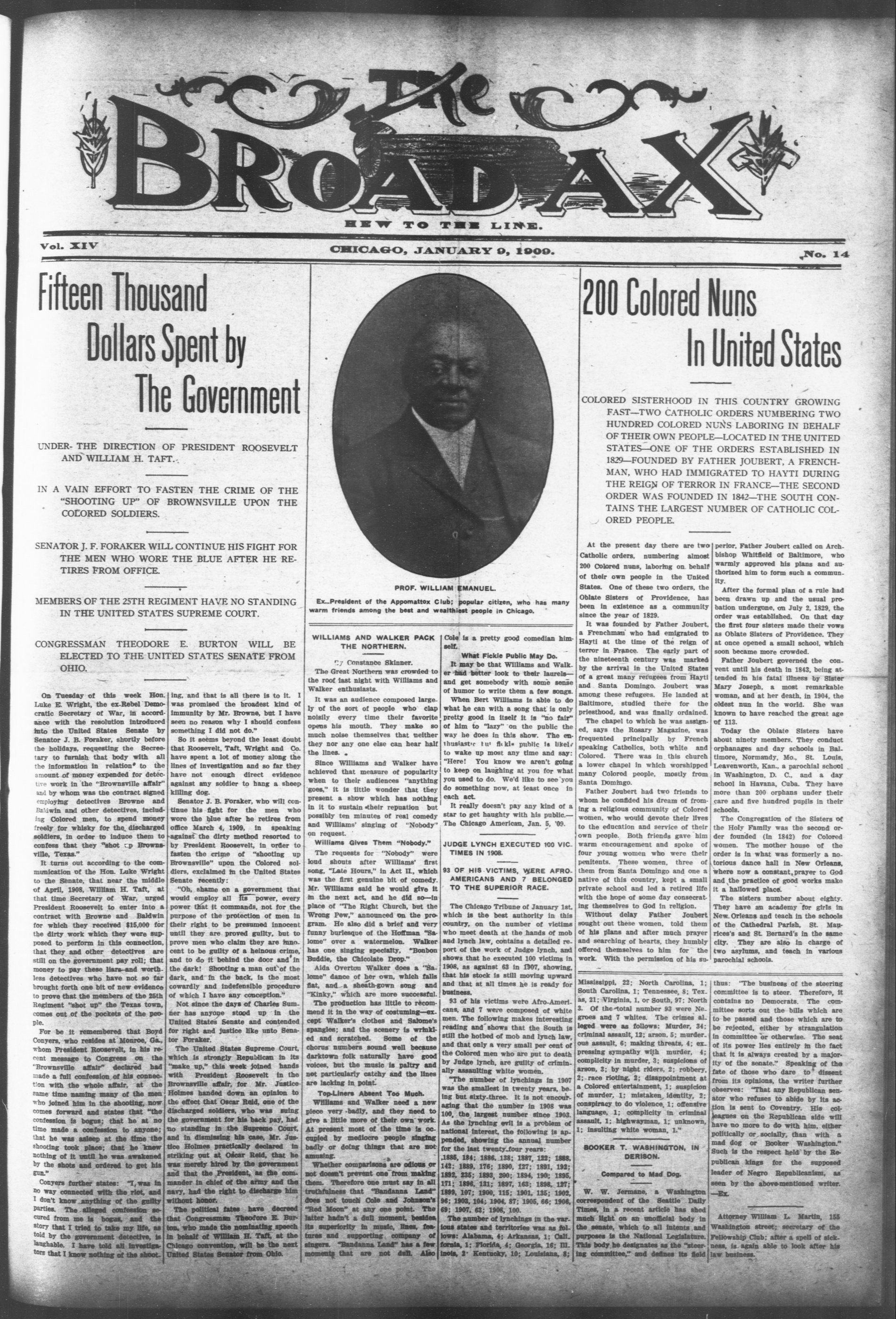
Ex.President of the Appomattox Club; popular citizen, who has many warm friends among the best and wealthiest people in Chicago.
WILLIAMS AND WALKER PACK
THE NORTHERN.
By Constance Skinner.
The Great Northern was crowded to
the roof last night with Williams and
Walker enthusiasts.
It was an audience composed largely
of the sort of people who clap
noisily every time their favorite
opens his mouth. They make so
much noise themselves that neither
they nor any one else can hear half
the lines.
Since Williams and Walker have
achieved that measure of popularity
when to their audiences "anything
goes," it is little wonder that they
present a show which has nothing
in it to sustain their reputation but
possibly ten minutes of real comedy
and Williams' singing of "Nobody"
on request.
Williams Gives Them "Nobody."
The requests for "Nobody" were loud shouts after Williams' first song, "Late Hours," in Act II, which was the first genuine bit of comedy. Mr. Williams said he would give it in the next act, and he did so—in place of "The Right Church, but the Wrong Pew," announced on the program. He also did a brief and very funny burlesque of the Hoffman "Salome" over a watermelon. Walker has one singing specialty, "Bonbon Buddie, the Chilcolate Drop."
Aida Overton Walker does a "Salome" dance of her own, which falls flat, and a sheath-gown song and "Kinky," which are more successful.
The production has little to recommend it in the way of costuming—except Walker's clothes and Salome's spangles; and the scenery is wrinkled and scratched. Some of the chorus numbers sound well because darktown folk naturally have good voices, but the music is paltry and not particularly catchy and the lines are lacking in point.
Top-Linners Absent Too Much.
Williams and Walker need a new piece very badly, and they need to give a little more of their own work. At present most of the time is occupied by mediocre people singing badly or doing things that are not amusing.
Whether comparisons are odious or not doesn't prevent one from making them. Therefore one must say in all truthfulness that "Bandanna Land" does not touch Cole and Johnson's "Red Moon" at any one point. The latter hadn't a dull moment, besides its superiority in music, lines, features and supporting company of singers. "Bandanna Land" has a few moments that are not dull. Also
Cole is a pretty good comedian himself.
What Fickle Public May Do.
It may be that Williams and Walker had better look to their laurels—and get somebody with some sense of humor to write them a few songs.
When Bert Williams is able to do what he can with a song that is only pretty good in itself it is "no fair" of him to "lazy" on the public the way he does in this show. The enthusiastic but fickle public is likely to wake up most any time and say: "Here! You know we aren't going to keep on laughing at you for what you used to do. We'd like to see you do something now, at least once in each act.
It really doesn't pay any kind of a star to get haughty with his public.—The Chicago American, Jan. 5, '09.
JUDGE LYNCH EXECUTED 100 VIC-TIMES IN 1908.
93 OF HIS VICTIMS, WERE AFRO-AMERICANS AND 7 BELONGED TO THE SUPERIOR RACE.
The Chicago Tribune of January 1st, which is the best authority in this country, on the number of victims who meet death at the hands of mob and lynch law, contains a detailed report of the work of Judge Lynch, and shows that he executed 100 victims in 1908, as against 63 in 1907, showing, that his stock is still moving upward and that at all times he is ready for business.
93 of his victims were Afro-Americans, and 7 were composed of white men. The following makes interesting reading and shows that the South is still the hotbed of mob and lynch law, and that only a very small per cent of the Colored men who are put to death by Judge lynch, are guilty of criminally assaulting white women.
"The number of lynchings in 1907 was the smallest in twenty years, being but sixty-three. It is not encouraging that the number in 1908 was 100, the largest number since 1903. As the lynching evil is a problem of national interest, the following is appended, showing the annual number for the last twenty-four years:
1885, 184; 1886, 183; 1887, 122; 1888,
142; 1889, 176; 1890, 127; 1891, 192;
1892, 235; 1893, 200; 1894, 190; 1895,
171; 1896, 131; 1897, 163; 1898, 127;
1899, 107; 1900, 115; 1901, 135; 1902,
96; 1903, 104; 1904, 87; 1905, 66; 1906,
69; 1907, 63; 1908, 100.
The number of lynchings in the various states and territories was as follows: Alabama, 4; Arkansas, 1; Calli-
fornia, 1; Florida, 4; Georgia, 16; Illinois,
2; Kentucky, 10; Louisiana, 8;
200 Colored Nuns In United States
COLORED SISTERHOOD IN THIS COUNTRY GROWING FAST-TWO CATHOLIC ORDERS NUMBERING TWO HUNDRED COLORED NUNS LABORING IN BEHALF OF THEIR OWN PEOPLE-LOCATED IN THE UNITED STATES-ONE OF THE ORDERS ESTABLISHED IN 1829-FOUNDED BY FATHER JOUBERT, A FRENCHMAN, WHO HAD IMMIGRATED TO HAYTI DURING THE REIGN OF TERROR IN FRANCE-THE SECOND ORDER WAS FOUNDED IN 1842-THE SOUTH CONTAINS THE LARGEST NUMBER OF CATHOLIC COL-ORED PEOPLE.
At the present day there are two Catholic orders, numbering almost 200 Colored nuns, laboring on behalf of their own people in the United States. One of these two orders, the Oblate Sisters of Providence, has been in existence as a community since the year of 1829.
It was founded by Father Joubert, a Frenchman who had emigrated to Hayti at the time of the reign of terror in France. The early part of the nineteenth century was marked by the arrival in the United States of a great many refugees from Hayti and Santa Domingo. Joubert was among these refugees. He landed at Baltimore, studied there for the priesthood, and was finally ordained.
The chapel to which he was assigned, says the Rosary Magazine, was frequented principally by French speaking Catholics, both white and Colored. There was in this church a lower chapel in which worshipped many Colored people, mostly from Santa Domingo.
Father Joubert had two friends to whom he confided his dream of froming a religious community of Colored women, who would devote their lives to the education and service of their own people. Both friends gave him warm encouragement and spoke of four young women who were their penitents. These women, three of them from Santa Domingo and one native of this country, kept a small private school and led a retired life with the hope of some day consecrating themselves to God in religion. Without delay Father Joubert sought out these women, told them of his plans and after much prayer and searching of hearts, they humbly offered themselves to him for the work. With the permission of his su
Mississippi, 22; North Carolina, 1; South Carolina, 1; Tennessee, 8; Texas, 21; Virginia, 1, or South, 97; North 3. Of the total number 93 were Negroes and 7 whites. The crimes alleged were as follows: Murder, 3; criminal assault, 12; arson, 5; murder, ous assault, 6; making threats, 4; expressing sympathy with murder, 4; complicity in murder, 3; suspicions of arson, 3; by night riders, 2; robbery, 2; race rioting, 2; disappointment at a Colored entertainment, 1; suspicion of murder, 1; mistaken identity, 2; conspiracy to do violence, 1; offensive language, 1; complicity in criminal assault, 1; highwayman, 1; unknown, 1; insulting white woman, 1."
BOOKER T. WASHINGTON, IN DERISON.
W. W. Jermane, a Washington correspondent of the Seattle Daily Times, in a recent article has shed much light on an unofficial body in the senate, which to all intents and purposes is the National Legislature. This body he designates as the "steering committee," and defines its field
No.14
Nuns
United States
IN THIS COUNTRY GROWING
C ORDERS NUMBERING TWO
NUNS LABORING IN BEHALF
E—LOCATED IN THE UNITED
E ORDERS ESTABLISHED IN
EATHER JOUBERT, A FRENCH-
GRATED TO HAYTI DURING
ER IN FRANCE—THE SECOND
D IN 1842—THE SOUTH CON-
NUMBER OF CATHOLIC COL-
perlor, Father Joubert called on Archbishop Whitfield of Baltimore, who warmly approved his plans and authorized him to form such a community.
After the formal plan of a rule had been drawn up and the usual probation undergone, on July 2, 1829, the order was established. On that day the first four sisters made their vows as Oblate Sisters of Providence. They at once opened a small school, which soon became more crowded.
Father Joubert governed the convent until his death in 1843, being attended in his fatal illness by Sister Mary Joseph, a most remarkable woman, and at her death, in 1904, the oldest nun in the world. She was known to have reached the great age of 113.
Today the Oblate Sisters have about ninety members. They conduct orphanages and day schools in Baltimore, Normandy, Mo., St. Louis, Leavenworth, Kan., a parochial school in Washington, D. C., and a day school in Havana, Cuba. They have more than 200 orphans under their care and five hundred pupils in their schools.
The Congregation of the Sisters of the Holy Family was the second order founded (in 1842) for Colored women. The mother house of the order is in what was formerly a notorious dance hall in New Orleans, where now a constant, prayer to God and the practice of good works make it a hallowed place.
The sisters number about eighty. They have an academy for girls in New Orleans and teach in the schools of the Cathedral Parish, St. Maurices's and St. Bernard's in the same city. They are also in charge of two asylums, and teach in various parochial schools.
thus: "The business of the steering committee is to steer. Therefore, it contains no Democrats. The committee sorts out the bills which are to be passed and those which are to be rejected, either by strangulation in committee or otherwise. The seat of its power lies entirely in the fact that it is always created by a majority of the senate." Speaking of the fate of those who dare to dissent from its opinions, the writer further observes: "That any Republican senator who refuses to abide by its action is sent to Coventry. His colleagues on the Republican side will have no more to do with him, either politically or socially, than with a mad dog or Booker Washington." Such is the respect held by the Republican kings for the supposed leader of Negro Republicanism, as seen by the above-mentioned writer.
Ex.
Attorney William L. Martin, 155 Washington street; secretary of the Fellowship Club; after a spell of sickness, is again able to look after his law business.
---
WILL MEET IN NASHVILLE.
Nashville, Tenn. January 5.—At a special meeting held in this city today a decision was reached with respect to holding the fourth annual session of the great Sunday-School Congress and Young People's Chautauqua. Nashville has once more out-stripped her competitors, being awarded this important religious gathering. The last session of the Chautauqua was held in Jacksonville, Fla. Since that time the boards under whose management the Sunday-school movement is fostered have been constantly flooded with requests from cities throughout the country asking for the Congress. In giving out notice the secretary of the Congress movement, Henry A. Boyd, said: "Nashville has given better assurance for properly entertaining this meeting than the other cities. Then, too, the city has the advantage in its geographical location as to the Baptists. The Congress will be held from June 2nd to the 7th, 1909, inclusive. All of the Sunday-schools throughout the country will have special letters and special invitations. The call for the meeting will be out officially signed by Rev. C. H. Clark, chairman of the Publishing Board; Rev. E. W. D. Isaac, secretary of the B. Y. P. U. Board; and Rev. R. H. Boyd, of the Home Mission Board, as the meeting is held under the anspies of these three boards. It is not known definitely what other arrangements with respect to his meeting have been made, but the assurance is given that it will excel both in point of interest and attendance any other distinct denominational gathering for young people. Nashville will have the opportunity once more to entertain a national body.
Among the recent achievements of the Negro publishing concerns established, operated and owned by the different denominations of the race is the National Baptist Sunday-School Lesson Commentary, a book, a treatise, a complete egresses, on the Sunday-school lessons for 1909, published by the National Baptist Publishing Board, at Nashville, Tenn. The book this year contains over four hundred pages and is easily the superior of any of its predecessors. The book is in its fifth volume, and it seems that the Baptist Publishing Board doubled its energy this year in its effort to make this book just what the Sunday-school superintendent, teachers and advanced scholars need, a complete, suggestive, illustrative and copernative Commentary on the Sunday-school lessons. Not only this, but it is evident that the book is of invaluable service to the ministers of the Gospel. It has been used more than once to aid in the preparation of sermons because of the facts and the extra amount of biblical research to be found within its pages. The book contains a preface, an article on Sunday-school Methods; an introduction for each quarter and an introduction for every lesson, together with the Exposition. Following these there come "Truths Gleaned from the Lesson." "Hints for the Primary Teachers," and an array of questions upon each lesson. There are three beautifully colored maps showing Paul's journeys. Nearly every lesson for the year is illustrated. Attention is at once attracted to a particular lesson in next year, the one which comes on March 4, subject: "Phillip and the Ethiopian, which is illustrated on page 82, showing Philip and the Ethiopian council as they rise in a christian draught by
two horses. One almost sees the Ethiopian pointing to the water and asking why he cannot be baptized. This is the first time that Negro publishers have attempted to portray in their Sunday-school lessons the Ethiopian in a dark skin. This book has for its editor, Rev. R. H. Boyd, D. D., LL. D., and as associate editor, Rev. W. S. Ellington, B. A., D. D. They seem to have wonderfully outstripped the times and have evidently commended themselves to the Sunday-school.—"R."
JAMES E. STANLEY SECURES
JUDGMENT AGAINST PROF.
WILLIAM EMANUEL, FOR
TWENTY-NINE HUNDRED
DOLLARS.
James E. Stanley, 5215 Union avenue, the past week secured a judgment against Prof. William Emanuel, 169 Wabash avenue, for $2,900. Mr. Stanley claiming, that after having his feet treated blood poison resulted therefrom, causing him great pain and agony. Hence the suit and the judgment.
John C. King and James D. Power, 87 Washington street, ably looked after the interest of Mr. Stanley, and Joseph R. Burres, Ashland Block, fought the legal battle for Prof. Emanuel.
Mr. King made the closing argument for his client, and there was nothing to it but the verdict.
It is expected that Pro. Emanuel will fight the case on up through the Appellate Court of Cook County and the Supreme Court of Illinois, before he will bring forth the $2,900.
PRISONER FINDS HIS THIRTEEN
TOES UNLUCKY.
Negro Accused of Burglary Makes Police Lieutenant Doubt His
Eyesight.
Baltimore, Md., Jan. 5.—"I must get a new pair of eyeglasses," said Lieut. John A. Casey, superintendent of the Bertillon bureau, as he was measuring the pedal extremities of Herman Green, a Negro, charged with burglary.
The lieutenant took off his glasses, wiped them and took another look at Green's dusky feet.
"What's the matter, lieutenant?" asked his assistant, Sergt. William Higgins.
"Something's wrong with my eyes," said the man who measures criminals and takes their finger prints and photographs. "I keep looking at this man's feet, and it looks to me as if he had seven toes on his right foot and six toes on his left."
"Taint nothin' matter wild' yo' glasses, de trouble's wid me. I done got thirteen toes, I was bo'n dat away," said Green, who had been silent during the dialogue between the two officials.
"Hit's a onlucky numbah, too," continued the Colored man; "hease Ile done 'rested fo' nothin' and brung down heah an my pixter took; I can't help havin' thirteen toes."
"You were not arrested because you had thirteen toes," said Lieut. Casey, "but you ought to be a good runner."
HARRY TAYLOR SKIPS.
Leaves His Creditors With the Bag to Hold.
Harry Taylor, the kindergarten politician who has served as turnkey under Shriff Werner skipped the town last week for parts unknown and left his creditors to mourn their loss. Before leaving he borrowed and otherwise secured every dollar he could from friends and acquaintances, and drew his quarter's salary. He did not delay to pay any of his many debts.
Harry's get away did not surprise any one who knew him well, for such persons knew that he was too crooked to lie straight in bed; but lots of good people have been a number of years finding him out. As a politician he was a zero mark, having no influence or following because he was for Harry only.—The Leader, Springfield, Ill., Dec. 31, '08. Robert Lincoln Taylor who has been holding down an unimportant political position in the rovines of the election commissioners this city, in a brother of Harry Taylor, and like
Hot Springs, Ark.. Jan. 7.—Physicians and hotel interests of this city have started a movement to supplant Negro bath attendants with white men. It has been discovered that the Negro attendants have become careless and possess little knowledge of anatomy. Visitors from all sections of the globe have made general complaint. It has been decided, therefore, to introduce attendants who will be skilled in scientific bathing. One hotel already has engaged a white "scientific bathing master."
Washington, Jan. 7.—Senator J. B. Foraker gave notice today in the Senate that he would speak next Monday on the new phase of the Brownsville incident.
CHIPS
J. W. Anderson, 79 East 32nd street, has returned home from New York City, where he spent the holidays. Mrs. Lulu Williams., 2415 Wabash ave., gave a whist party Tuesday evening, in honor of Mr. Charles Campbell.
Mr. Will Marlon Cook, the music composer of New York City entertained Mr. and Mrs. George Walker, Misses Reed and Meyers, Mr. Walker's mother and mother-in-law, Miss Marie E. Burton and Mr. Noah D. Thompson at an informal musical at Lett's Hotel, Sunday evening last. The musical program was furnished by a special quartet from New York City which makes a specialty of rendering music composed by our leading song writers. The entertainment was greatly enjoyed by both guest and host.
Dr. M. J. Brown, last evening at his batchelor quarters, 2701 Dearborn street, gave a banquet in honor of the members of the Fellowship Club. The royal feast which was served in the finest style and most lavish manner, was greatly enjoyed by its members. During the feasting and light wine drinking, the hatchet was buried and harmony and good fellowship now reigns supreme among the members. It is expected that in the nea rfuture, the club will give its annual and exclusive ball.
Hon. Edward D. Shurtleff, was on Wednesday for the third time elected speaker of the House of Representatives of Illinois. Sixty Democrats voted for him, and with 25 bolting Republicans, enabled him to capture the speakership from Governor Deneen and his band of hope forces. It was a sharp political shuffling of the cards, and it means in the end the political undoing of the present governor, who may be forced to retire from office after the recount is completed in the Deneen and Stevenson contest.
The earthquake the past week at Messina and other large and small cities in Italy, was one of the most destructive in the history of the world. In the twinkling of an eye, more than a 100,000 people, in fact the exact number will never be known, were wiped out of existence, and massive buildings which had stood for hundreds of years, and every sign of habitation disappeared from the face of the earth leaving in its stead thereof a vast expanse of wreck and ruin. The heart of the world, continues to go out to the sufferers of the disaster, and money and supplies from every civilized nation under the sun, are being fushed to their relief.
Thomas Carey, who was in his 44th year, father of Michael and Ex-Alderman Thomas Carey, passed away the first of the week at the home of his daughter, 1705 W. Garfield Blvd. Funeral services were held Thursday morning. High Mass was celebrated over his remains at St. Basil's church, interment at Mt. Olivet, and he is survived by his wife, Mrs. Catherine Carey, and his two daughters, Mrs. Catherine O'ourke, Mrs. Mary Roth and the two sons first mentioned.
Elijah Raffty, who threw his wife into a red hot furnace at 5412 Cornell ave, and burned her body up, admitted to Inspector Nicholas Hunt of the Hyde Park district, that he committed the henious crime. Raffty accused his wife of being on too friendly terms with a railroad porter by the name of Carter, even if she was he had no right whatever to end her life, in such a horrible and savage manner. Inspector Hunt, and his assistants, deserve to be highly commended for running down and apprehending the perpetrator of one of the most revolting crimes in the history of Chicago. Raffty, is now confined in the Cook County jail, and not much time should be lost in sending him out of this world.
I FLEE MY PEN.
FACTS IN FEW LINES
WASHINGTON LETTER
The new office building for the members of the house is receiving the enlashing touches. It is now in quite comfortable shape. The senate office building the contractors hope to have ready for occupancy by March 4. Senators will each have two rooms; representatives have only one room allowed them. Senators always have voiced themselves what they pleased. There are no accommodations at present in either the Capitol or the old Matty building, which is occupied by senators not chairmen of committees, for the more recently elected, and Messrs. Cummins of Iowa, Page of Vermont and Fletcher of Florida, who take their seats this session, will have their quarters in the new office building rushed to completion.
Quarters For Census Bureau.
The understanding is that when the Maltyb building is vacated by seminars the census bureau will take it and quarter a large portion of the clerks therein. This used to be a hotel and was rented and subsequently purchased by the government. It is not far from the ugly brick shack that is used by the census bureau and is itself dilapidated. The force of the census bureau is being increased right along as the next enumeration of the population is to be made in 1910. There is a modified examination of all men and women who secure clerkships in this bureau, but as senators and representatives have a good deal to say as to who shall be selected for the temporary positions the pressure for appointments will be intense from now until the time for getting the work well under way.
New Man In the House.
According to the unofficial list compiled by the clerk, seventy new faces will be seen among the members of the next house when it meets in extra session in March under a call from President Taft. At the recent election Indiana made more changes in its house delegation than any other state, amounting to eight, the Democrats securing eleven out of thirteen members. In the next house new men will be present from the states named below as follows: Pennsylvania, 7; New York and Ohio, 6; Missouri and Iowa, 5; each; Colorado, Illinois, Mississippi and North Carolina, 3 each; Kentucky, Louisiana, Maryland, Nebraska, New Jersey, Oklahoma, Tennessee and Wisconsin, 2 each; Alabama, Arkansas, Connecticut, Delaware, Florida, Georgia, Idaho, Maine, Michigan, Minnesota, Montana, Rhode Island, Texas, Vermont and Washington, 1 each.
The Saint Gaudens Coins.
President Roosevelt has at last replied to the ridicule and criticism that were caused by the "bloomer eagle" and other peculiarities of design on the recent issue of gold coins. He attended an exhibition of the works of Augustus Saint Gaudens at the Corcoran Gallery of Art and paid eulogium to that artist's mastery of his craft. He declared that his works will stand in the very forefront among the masterpieces of the greatest periods and the greatest peoples.
As to the gold coins, he declared Saint Gaudens "gave us for the first time a beautiful eofnage, not yet properly appreciated, but up to which the official and the popular mind will in the end grow." The president contended that the first few thousands of these coins are more beautiful than any coins since the days of the Greeks and that frequent comments on the bonnet of "eagle plunes on the figure of Liberty" illustrate curiously the exceedingly conventional character of much of our orfricism and the frequent inability to understand originality until it has won its place.
The Senator Puzzled 'Em
A saloist and an antisaloost happened to run into the same senator up at the capitol the other day. Both were anxious to have their views prevail in the matter of liquor legislation for the District, and both were trying to get the senator to express his views on the matter.
The senator smiled and was nice to both, and he remarked as he bade them adieu, "You know, I have always been a strong believer in putting down drink."
Both the anti and the anti-anti are wondering yet.
Art Above the Weather.
In one of Washington's art galleries there hangs a large canvas in an imposing frame. The painting shows a waterfall in one of the states famous for startling natural scenery. The picture has occupied its present place for several years.
"Does it belong here?" asked the visitor of the man in charge.
"No more than the others you see."
"Seems to me it should be in the capitol of the state where this scenery is."
paid the visitor.
"It was painted for the state," replied the man in charge, "but when it was submitted to the art committee they refused to accept it." "What was the objection?" "You see the sky is overcast. The artist put in a gathering storm like an impending calamity. The art committee said it was a reflection on the reputation of the state; that a storm such as is represented was unknown in that attitude."
"Couldn't the artist put in another sky, one that accorded with the state's reputation for sunshine?"
"I suppose he could, but he refused. He said that the rumpus kicked up by the art committee warranted the storm effect on the canvans, and he refused to budge. He sent it here, and here it rumpled." CARL SCHOFIELD.
By P. Y. BLACK.
"It was a shameful trap," he said,
"on the part of my people. The doctors were very careless in their diagnosis. To shut me up in a place like this was really too bad. In a very short time, however, I expect to leave."
"Oh, dear," she thought, her eyes dimming, "they all say that! To think that the poor man will never, never leave! I am so glad-for you," she said aloud. "You will be overjoyed."
"Oh, I—yes. But do, you know this sanitarium is not so bad."
"Do you mean," she said gently, surprised, "that you will—er—have any regrets in leaving."
"No," he said, "not exactly that, of course—not regrets so far as concerns myself, for it is so humiliating to be committed, you know." He paused, "But," he went on, "even in asylums one makes friends, and—one regrets—for them."
He looked down with a tenderness and a pity he could not hide, and she blushed, and for a moment there was silence. Then she said, with an obviously strained laugh:
"We are friends, of course, Mr. St. John. What an awful existence it would be here if one had no sympathetic friends! But you must not regret so much on my account. In a very short time I think my friends will take me home."
He choked a groan before she could hear it.
"The poor little thing!" he thought. "They all say that. And that decent young fellow, the doctor, assures me her case is very pussy and her friends fear incurable. I am so glad for you," he said. "Would it not be jolly if we became friends in the world as we have been when out of the world?" Then he blamed himself again. "If she really likes me," he thought, "and I think the unhappy child does, I should never had said that. It is cruel, brutal, to put such thoughts in her head." She was looking at him with the tearful smile we essay when we encourage one who does not realize that death is near. "It would be nice—very nice indeed." They were silent again, each sorrowing for the other.
There were many other patients strolling on the lawns or sitting in the summer houses, patients of all kinds.
Miss Tracy and St. John stood together, silent now and unostentatiously observant. A sturdily built (all the attendants were that) man was taking a patient to the iron barred house. He did not do it violently. He did it as one may see a policeman occasionally escort a quiet prisoner with a light touch on the captive's arm above the elbow. The patient was a little excited, but there was no disturbance at all. A visitor might never have noticed it. The strange thing was the unanimous backward withdrawal from the attendant's path of the patients encountered, the look of fright or dislike on their faces directed not at the captive, but at the guard. "How they all dread him—instinctively, it seems," said the young woman who "expected to leave soon." "He is polite enough and not ill looking, but"—
"A man of great experience in his peculiar work, I'm told," said St. John musingly.
"It's his eye and mouth that do it. I fancy."
"A thoroughly ill dispositioned man, with a plausible extorter," said St. John. "I believe him capable of it."
"Of murder? Do-oh, what are you
"Of murder? Do-oh, what are you talking of, Mr. St. John?"
St. John looked very uncomfortable.
Miss Tracy looked vexed embarrassed.
"I heard some rumor of a strange death in the institution just before I came. I was thinking of it. Were you here? Have you heard anything of it?"
He was a little eager.
"How could I be here? We came on the same day. Don't you remember?"
"Ah, true!"
So they watched the attendant out of sight and turned to go inside themselves.
They shook hands, although there was no reason for it. They would meet at the dinner table in a few minutes, but they shook hands, and that lingered.
"It's awfully sad," St. John pondered. "So sweet a face, seemingly so intelligent. I wish—oh, pshaw! What's the use of wishing? These things are not to be remedied. I wonder if—she'd give me a photograph."
Miss Tracey went to her room slowly. "I am silly to be so affected by an ordinary case. There are thousands like him. But—oh, dear; oh, dear! If I'd known I was to have this sad experience I would never have consented to come—never!"
"They had no opportunity to meet alone for several days. Perhaps they might have made opportunities, but they did not. Doubtless it occurred to each of these two junties that it was the wiser thing to stifle at once any friendship which each thought likely to cause useless pain in the future to the other.
Dr. Bell found these two of his residents particularly interesting in those
days, and so did the attendant. It was strange that they both so markedly preferred "he company of the sanitation people to that of their fellow fortunate. The young house doctor thought Miss Tracy charming and never was abrupt with her.
"Very punishing case," he mused. "Now, why does she dwell so on that recent death? It seems to excite her too. That's morbidity, I'm afraid; bad sign."
The doctor liked St. John too. St. John's friends acted very nicely in sending him new books and boxes of cigars. The books were well chosen; the cigars were unexceptionable.
"Like all these paretics," he pondered, "in the first stages you would not think there was anything much wrong with the man, but it is a little singular that he should be so interested in that unlucky death also."
As for the attendants, Miss Tracy had flowers and little things and could teach the women quite a number of new fads in hairdressing, and so forth. For the men St. John's cigar box and full pocketbook sufficed to make them extremely courteous. The man with the wicked eyes and mouth benefited most, however. It was wonderful what a lot of little things he could do for Miss Tracy. It was strange that St. John should find anything in the man to talk about with common interest.
Just once the two lunatics met. It was just before bedtime in the music room. He had sung to her accompaniment. When she rose to say good night he almost whispered to her:
"I expect to go to New York tomorrow."
"I am so glad for your sake," she said.
"And—and you—you have made my stay almost tolerable. Is there nothing you will allow me to do for you?"
"Oh," she answered, with sprightfulness, "I shall not be long in going myself."
"Poor, poor little dear," he said to his pillow, "it breaks me all up to think of her staying here incurable."
Miss Tracy packed her trunk, and tears dropped on silk and linen indifferently.
"Oh," she murmured, "I do so wish I had never come here. I can never, never forget the sad, gentle way he used to look at me."
There was lively work next afternoon in the building of the Gazette. A young man sat at a desk apart in the reporters' room, and he scribbled and he scribbled. By and by the managing editor came in and looked over the busy writer's shoulder and told him that he had only an hour to finish up. Then the great presses began to clatter, and in a little while the first edition of the Gazette was ready for the street, with an enormous black scare head on the front page.
And in the office of the Morning Jury there was also a very lively bustling, and there, at a retired desk, a young woman sat, and she scribbled and she scribbled, and late at night the presses began to rumble, and in a little while the first edition of the Jury was ready for the street, with an enormous black scare head on the front page.
The Gazette and the Jury were within a few minutes of each other in getting out. A copy of each paper was hustled into the office of the other, for rival editors watch each other's work with catlike intentness. And the Gazette office read with dismay that the great asylum mystery had been solved by the indefatigable efforts of a Jury reporter, while the Jury night staff tore its editorial hair over the faring bonust of the Gazette that its "special commissioner" had given to a waiting world the first and only enlightenment of the famous crime. There had been no time for one paper to lift the news from the other. How had the expected scoop been smelled?
Tumultuous was the wrath in the two offices. Miss Tracy was explaining to her managing editor, with tears in her eyes, that she could not understand at all, at all, how the Gazette had got hold of it. In the Gazette office Mr. St. John stormed and swore and said that for the life of him he could not understand how the Jury had got almost the same story.
"Good heavens!" shouted St. John suddenly, and he dashed out to the Jury office. There he found a friend, with whom he conferred. The two lunatics were introduced to each other and a minute or two afterward were alone together.
They laughed a great deal at the idea of two reporters on the same strange assignment, never suspecting each other, but their laugh was not very loud. The tender plly for each other of yesterday was still in mind.
"The attendant is arrested," said St. John. "You did not get it quite right. The patient he poisoned when nursing him was an old enemy. It was not done through trouble arising between them in the sanitarium." "Oh, bother!" she said. "It doesn't matter. We've done our appointed work. Let's talk of something more pleasant." So they did, and when he was about to go away he said:
"You said once we might be friends in the world as well as out of the world. Will we be friends, dear Miss Tracy?"
She looked at him so smilingly, yet so tremblingly that he put his arm around her.
"Will you be more than friend, darling?" he whispered.
"Yes," she said, and it was quite five minutes after, when some one's feet were heard approaching, that she jumped away and held up a warning finger.
"If your friend came in he'd think us mad," said she.
"Two lunatics!" he answered, laughter as the door opened.
WM. D. NEIGHBORS & CO REAL ESTATE AT LOWEST PRICES
Easiest Term to be had in Chicago Loans on first and second Mortgages Fire Insurance placed in any company
Selections
Specimen of a Fish That Is Both Queer and Rare.
One of the rarest specimens of the fish kingdom known to waters contiguous to the North Carolina coast was captured in a seine at Masonboro sound by William Hewlett, a fisherman, says the Wilmington Dispatch. The fish, which was brought to the city, is what is called "the sea bat," and it is a perfect reproduction of a leather wing bat on a large scale. The fish is about fifteen inches long and about thirty inches across the back.
Strange to state, it had a thin, threadlike tail about fifteen inches in length, and on each side of the rear appendage were two perfectly formed gloved feet, with a smaller dimension having the exact appearance of a thumb with the other part of the hand mittened. The mouth of the strange specimen was about five inches across, and on each side of the mouth or the underside of the body there were five "strainers," or holes, through which the fish is said to rid itself of refuse products resulting from the forage it picks up at the bottom of the sea. The top of the fish was a dark slate color, and the under part of the body was white.
One old negro fisherman more than seventy years old declared that this was only the second specimen of the sea bat he had ever seen in his long experience as a fisherman. The specimen, which had a truly uncanny appearance, will probably be sent to the state museum at Raleigh.
Frying Pan Stage.
"The late Mrs. William Astor," said a colonial dame, "took, after all, an optimistic view of American society. She criticised our faults, but she believed in our future. American society, she used to say, would eventually be the finest in the world. Once she declared at a dinner that it was the proper social sequence to get, like us, the money first and the refinement and culture afterward. She said that when she looked at the uncount millionaire of today and thought of the splendid creature to come after him she felt as optimistic as the fisherman who, casting his line, brought up a frying pan and said:
"Oh, that's a good beginning—a frying pan! I have only to catch a fish now and I shall be all right."—Washington Post.
Ancient Mariners.
That the Egyptians made sea voyages long before the time of Solomon, hitherto considered the first ocean traveler on a large scale, is declared by Professor James H. Breasted to be conclusively proved by a tablet found by him in Palermo, Sicily, during the three years' exploring trip from which he recently returned. Professor Breasted asserts that the inscriptions on the tablet show that the Egyptian king who built the first pyramids made a voyage with forty ships across the Mediterranean to Lebanon to obtain cedar for a temple. This journey, according to the professor, was made in the thirtieth century B. C., or 2,000 years before Solomon made his voyage for a similar purpose.
An Ocean Sanitarium.
Some particulars are given in the British Medical Journal of a proposal to provide an ocean sanitarium for tuberculosis. The suggestion is to fit up a sailing ship of about 2,000 tons for not less than fifty patients, each to be provided with a large and well ventilated cabin. The deck would be used for what is commonly called the veranda treatment. The intention of the promoters is that the ship shall cruise in the neighborhood of the Canaries, where it will have the advantage of the trade winds and of an equable climate, while a port will not be far distant in case of the onset of bad weather.
A Malastic ice Wall.
In a letter from Professor Edworth Davis, a member of the British antarctic expedition now seeking a way toward the south pole, there occurs a vivid description of the great antarctic ice barrier, which was encountered by the little ship Nimrod. "It is a sight," says Professor Davis, "that bears all description. Imagine a continuous ice wall 500 miles long and one to two hundred feet high, the exquisite blue of the crevasses contrasting finely with the dazzling white of the weathered ice on either side of them."
Branch Office:
3220 State Street
NEW SHORT STORIES
The Magnate's Surrender.
The Magnate's Surrender.
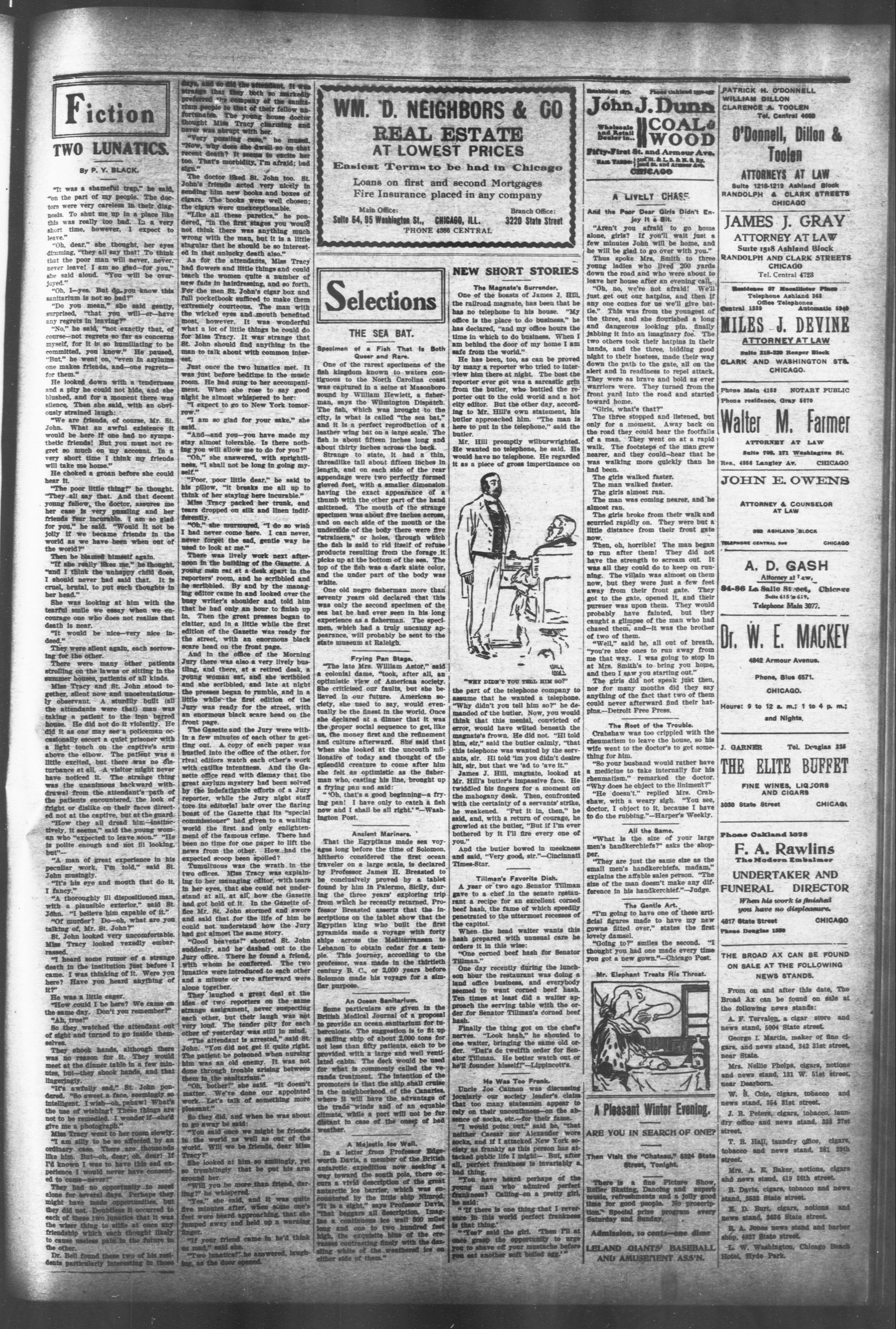
One of the boasts of James J. Hill, the railroad magnate, has been that he has no telephone in his house. "My office is the place to do business," he has declared, "and my office hours the time in which to do business. When I am behind the door of my home I am safe from the world."
He has been, too, as can be proved by many a reporter who tried to interview him there at night. The best the reporter ever got was a sarcastic grin from the butler, who buttled the reporter out to the cold world and a hot city editor. But the other day, according to Mr. Hill's own statement, his butler approached him. "The man is here to put in the telephone," said the butler.
Mr. Hill promptly wilburwrighted. He wanted no telephone, he said. He would have no telephone. He regarded it as a piece of gross impertinence on
WILL
1963
the part of the telephone company to assume that he wanted a telephone. "Why didn't you tell him so?" he demanded of the butler. Now, you would think that this menial, convicted of error, would have wilted beneath the magnate's frown. He did not. "Hi told him, sir," said the butler calmly, "that this telephone was wanted by the servants, sir. Hi told 'im you didn't desire hit, sir, but that we 'ad to 'ave it." James J. Hill, magnate, looked at Mr. Hill's butler's impassive face. He twiddled his fingers for a moment on the mahogany desk. Then, confronted with the certainty of a servant's strike, he weakened. "Put it in, then," he said, and, with a return of courage, he growled at the butler. "But if I'm ever bothered by it I'll fire every one of you." And the butler bowed in meekness and said, "Very good, sir."—Cincinnati Times-Star.
Tillman's Favorite Dish.
A year or two ago Senator Tillman gave to a chef in the senate restaurant a recipe for an excellent corned beef hash, the fame of which speedily penetrated to the uttermost successes of the capitol.
When the head waiter wants this hash prepared with unusual care he orders it in this wise:
"One corned beef hash for Senator Tillman."
One day recently during the lunch-oon hour the restaurant was doing a land office business, and everybody seemed to want corned beef hash. Ten times at least did a waiter approach the serving table with the order for Senator Tillman's corned beef hash.
Finally the thing got on the chef's nerves. "Look heah," he shouted to one waiter, bringing the same old order. "Dat's de twelfth order for Senator Tillman. He better watch out or he'll founder himself."—Lippincott's.
He Was Too Frank
Me Wan Too Frank
Uncle Joe Cannon was discussing jocularly our society leader's claim that too many statesmen appear to rely on their uncontainment—on the absence of socks, etc.—for their fame.
"I would point out," said he, "that neither Caesar nor Alexander wore socks, and if I attacked New York society as frankly as this person has attacked public life I might—But after all, perfect frankness is invariably a bad thing.
"You have heard perhaps of the young man who admired perfect frankness? Calling-on a pretty girl, he said:
"If there is one thing that I reverence in this world perfect frankness is that thing."
"Yes!" said the girl. "Then I'll at once grasp the opportunity to urge you to shave off your mustache before you eat another soft boiled egg."
Fifty-First St. and Armour Ave.
and St. S. & L. B. & N. R. by
RALF YASON | JAMES ST. and Armour Ave.
CHICAGO
A LIVELY CHASE
And the Poor Dear Girls Didn't Enjoy It a Bit.
"Aren't you afraid to go home alone, girls? If you'll wait just a few minutes John will be home, and he will be glad to go over with you."
Thus spoke Mrs. Smith to three young ladies who lived 200 yards down the road and who were about to leave her house after an evening call.
"Oh, no, we're not afraid! We'll just get out our hatpins, and then if any one comes for us we'll give battle." This was from the youngest of the three, and she flourished a long and dangerous looking pln, finally jabbing it into an imaginary foe. The two others took their hatpins in their hands, and the three, bidding good night to their hostess, made their way down the path to the gate, all on the alert and in readiness to repel attack. They were as brave and bold as ever warriors were. They turned from the front yard into the road and started toward home.
"Girls, what's that?"
Girls, what's that?
The three stopped and listened, but only for a moment. Away back on the road they could hear the footfalls of a man. They went on at a rapid walk. The footsteps of the man grew nearer, and they could—hear that he was walking more quickly than he had been.
The girls walked faster.
The man walked faster.
The girls almost ran.
The man was coming nearer, and he almost ran.
The girls broke from their walk and scurried rapidly on. They were but a little distance from their front gate now.
Then, oh, horrible! The man began to run after them! They did not have the strength to scream out. It was all they could do to keep on running. The villain was almost on them now, but they were just a few feet away from their front gate. They got to the gate, opened it, and their pursuer was upon them. They would probably have fainted, but they caught a glimpse of the man who had chased them, and—it was the brother of two of them.
"Well," said he, all out of breath, "you're nice ones to run away from me that way. I was going to stop in at Mrs. Smith's to bring you home, and then I saw you starting out."
The girls did not speak just then, nor for many months did they say anything of the fact that two of them could never afterward find their hatpins—Detroit Free Press.
The Root of the Trouble
Crabshaw was too crippled with the rheumatism to leave the house, so his wife went to the doctor's to get something for him.
"So your husband would rather have a medicine to take internally for his rheumatism." remarked the doctor.
"Why does he object to the liniment?"
"He doesn't." replied Mrs. Crabshaw, with a weary sigh. "You see, doctor. I object to it, because I have to do the rubbing."—Harper's Weekly.
All the Same.
"What is the size of your large men's handkerchiefs?" asks the shopper. "They are just the same size as the small men's handkerchiefs, madam," explains the affable sales person. "The size of the man doesn't make any difference in his handkerchief." - Judge.
The Gentle Art.
"I'm going to have one of these artificial figures made to have my new gowns fitted over," states the first lovely damsel.
"Going to?" smiles the second. "I thought you had one made every time you got a new gown."—Chicago Post.
MILK
PATRICK H. O'DONNELL
WILLIAM DILLON
CLARENCE A. TOOLEN
Tel. Central 4680
O'Donnell, Dillon &
Toolen
ATTORNEYS AT LAW
Suite 1218-1219 Ashland Block
RANDOLPH & CLARK STREETS
CHICAGO
JAMES J. GRAY
ATTORNEY AT LAW
Suite 1518 Ashland Block
RANDOLPH AND CLARK STREETS
CHICAGO
Tel. Central 4728
Residence 57 Macallister Pines
Telephone Ashland 363
Office Telephones
Central 1239 Automatic 5940
MILES J. DEVINE
ATTORNEY AT LAW
Suite 218-320 Reaper Block
CLARK AND WASHINGTON STS.
CHICAGO.
Phone Main 4153 NOTARY PUBLIC
Phone residence, Gray 5870
Walter M. Farmer
ATTORNEY AT LAW
Suite 708, 171 Washington St.
Res. 4856 Langley Av. CHICAGO
JOHN E. OWENS
ATTORNEY & COUNSELOR
AT LAW
999 ASHLAND BLOCK
TELEPHONE CENTRAL 999 CHICAGO
A. D. GASH
Attorney at Law,
84-86 La Salle Street, Chicago
Suite 615 to 619,
Telephone Main 3077.
Dr. W. E. MACKEY
4842 Armour Avenue.
Phone, Blue 6571.
CHICAGO.
Hours: 9 to 12 a. m.; 1 to 4 p. m.;
and Nights.
THE ELITE BUFFET
FINE WINES, LIQSORS
AND CIGARS
3030 State Street CHICAGO
Phone Oakland 1328
F. A. Rawlins
The Modern Embalmer
UNDERTAKER AND
FUNERAL DIRECTOR
When his work is finished
you have no displeasure.
4817 State Street CHICAGO
Phone Douglas 1500
THE BROAD AX CAN BE FOUND
ON SALE AT THE FOLLOWING
NEWS STANDS.
From on and after this date, The
Broad Ax can be found on sale at
the following news stands:
A. F. Tervalon, a cigar store and news stand, 5004 State street.
George L. Martin, maker of fine cigars, and news stand, 342 31st street, near State.
Mrs. Nellie Phelps, cigars, notions and news stand, 131 W. 51st street, near Dearborn.
W. S. Cole, cigars, tobacco and news stand, 354 31st street.
J. R. Peters, cigars, tobacco, laundry office and news stand, 338 27st street.
T. B. Hall, laundry office, cigars, tobacco and news stand, 281 29th street.
Mrs. A. E. Baker, notions, cigars and news stand, 419 36th street.
B. Davis, cigars, tobacco and news stand, 3532 State street.
E. D. Burt, cigars, notions and news stand, 2636 State street.
R. A. Jones news stand and barber shop, 4827 State street.
L. W. Washington, Chicago Beach Hotel, Hyde Park.
Proposed Monument For the Alaska
Vakon, Peninsula Exhibition
Yukon-Pacific Expedition.
The Alaska-Yukon-Pacific exposition monument, to be the crowning work of sculpture of the international exhibition of 1900, will be covered with gold gold leaf. Gold donations to the amount of $7,000, necessary to completely cover the great shaft with the shining metal, will be solicited from Alaskans, Yukoners and the people of Seattle.
An appropriation to cover the cost of building the monument in staff has been authorized, the drawings made and the sculptor is engaged in building his clay model. The monument is to stand in the center of the plaza in front of the magnificent group of United States government buildings and directly at the head of the Cascades.
Looking south from the monument will be first the central features of the exposition, and then the eye will travel over a panorama of eighty miles of mountain, lake and woodland scenery to Rainier and the Cascade range.
The exposition monument is to be more than seventy feet in height. The monument proper will stand on a pedestal twenty feet high. This column will be of Corinthian design, on the top of which will be a globe giving the signs of the zodiac. On top of this globe will be a huge American eagle with outstretched wings, as in flight. Grouped about the base of the monument will be three seated female figures symbolic of the northland, the south seas and the orient. Every foot of this great monument will have the appearance of having been hammered out of pure gold if the donations are sufficient to complete the undertaking.—Seattle Times.
Youthful Suicides
There is a shocking proneness among youthful Bengalis to kill themselves on the least pretext. It seems to be an exaggerated form of sultiness, and one would like to have a medical opinion on the matter. A student is reprimanded by his parent because his studies don't show the advancement expected. The boy swallows some opium and ends his studies. A girl wife in Howrah takes a dislike to the second choice of her husband. She also secures an exit by the easy means of opium. A Bengal woman in Howrah wanted to go on a pilgrimage to Gays. Her mother said she could not advance the railway fare, and the girl went out to a tree and hanged herself. These are all recent cases.—Calcutta Empire.
A Pleasant Prison.
The prison at Cetinje, Montenegro, has been described as surely the most extraordinary one in existence. It presents little to indicate that it is a place of confinement, there being apparently nothing between the prisoners and absolute liberty. There are no outer prison walls, and in the cells the men-about eight or ten to each-are as contentedly and comfortably housed as their own personal domestic belongings can make them. Moreover, they are generously fed, and cigarettes without stint, wine occasionally and no work at all combine to check any desire to escape more effectually than would strong walls, iron bars and an army of jailers—London Globe.
Here is a story speaking better for the German emperor's goodness of heart than his knowledge of the ancient and royal game of golf. "So you want ground for your golf club, Sir Frank" said the kaler to the British ambassador at Berlin. "We haven't got nice grass meadows round Berlin, as you have in England, but I'll give you a bit of the Grunewald" a pine forest near Berlin and a great Sunday resort of the Berliners. "Ah, sire," Sir Frank Lascelles replied, "I am afraid there would be too many trees!" "Trees!" instantly replied the emperor, with bonhomme. "All the better to keep the sun off you when you are playing in the summer!"
Cold Storage Poultry
Cold Storage Poultry.
The state board of health of Massachusetts has issued a bulletin on cold storage poultry in which this advice is given to housekeepers: "In order to avoid obtaining waterlogged and refrozen fowl the consumer should demand the frozen bird and thaw it himself. If thawed quickly by immersion in a bucket of hot water it may be eaten with impunity and with relish the same day it is purchased, or if hung overnight at room temperature it may be ready for use the day following." _____
The Funny English.
The Punty Egghorn.
James S. Palmer, vice president elect of the United States, may possibly look forward to filling one day the position of president. It will be remembered that on the death of President McKinley, Mr. Roosevelt, who was then vice president, succeeded automatically to the presidency without opposition. Should anything happen to Mr. Taft (which we sincerely trust, for his sake, may not be the case) Mr. Palmer would probably. If precedent were followed, take his place. — Illustrated London News.
The Moving in Party.
"Yes, they have a new sort of func-
ton in Chicago that is quite the rage."
"What is it called?"
"It's called a moving in party. When
the hostess learns that the empty
house next door is to be occupied she
sells her guests by telephone, and
they come and draw cuts for the
front windows and then sit, there and
she up the new neighbor's stuff as the
movers carry it in."—Cleveland Plain
Dealer.
The Wealth of Our Nation.
In 1880 the United States held the fourth rank among the manufacturing nations. Great Britain, France and Germany were ahead of us, in the order named. We passed Great Britain in 1880, and today the aggregate of our manufactures equals that of Great Britain, Germany and France combined. The value of our products of manufactures has doubled since 1888. The value of our exports of manufactures has doubled since 1898. In the value of the property represented manufactures rank third among the great activities of the United States, agriculture being first and the railroads being second, but in the number of persons employed agriculture is the only interest which leads manufactures. Manufactures are far ahead of agriculture in the value of the products. The money invested in manufactures represents an eighth of the value of all the real and personal property in the country. The United States manufactures 35 per cent of all the manufactured products of the world. The value of the farm property of the United States increased from $7,980,000,000 in 1880 to $20,514,000,000 in 1900 and about $25,000,000,000 in 1908.
A Disgusted Dog.
A family downtown, having a false grate in one of the rooms of the house, placed some red paper behind it to give it the effect of fire. On one of the coldest days the dog belonging to the household came in from out of doors, and seeing the paper in the grate, deliberately walked up to it and laid down before it, curling up in the best way to receive the glowing heat as it came from the fire. He remained motionless for a few moments. Feeling no warmth, he raised his head and looked over his shoulder at the grate. Still feeling no heat, he went across and carefully applied his nose to the grate and smelt of it. It was cold as ice. With a look of the most supreme disgust, his tall curled down between his legs, every hair on his body saying "Tm sold," the dog trotted out of the room, not even deigning to cast a look at the party in the room who had watched his actions and laughed so heartily at his misfortune. That dog had reason as well as instinct—Troy Times.
New Use of Electricity in Printing. Printed sheets as delivered from the press frequently "offset" or smear from undried ink. An electrical method of preventing this has recently been patented. The sheets as they leave the press first pass over electric heaters and also over a conductor carrying a current of very high tension, from which a silent discharge or "leakage" of electricity passes to the paper. The combined effects of the heat and of the electrical discharge, together with the chemical action of the ozone generated in the air by the latter, "set" the ink so that it cannot smear. Besides this, the effect of any frictional electricity already present on the sheets, preventing their piling properly, is neutralized by the discharge.—New York Herald.
Harmful Precedent.
"There are no telephones in English banks," said a banker. "Even the great Bank of England itself has no telephone.
"That sort of thing is what sets England behind the times--that observance of tradition, that refusal of new things, as though simply because they are new they must of necessity be vulgar and bad.
"A London bank and its branches were swindled out of a large sum the other day. The swindle would have failed had a system of telephones connected these banks.
"But in the past banks had no telephones in England. Therefore precedent requires that they do without them still."
Bulgaria's Eclipse.
Bulgaria is sufficiently in the public eye just now to compensate her for a total eclipse that lasted for three or four centuries. Between the obliteration of mediaeval Bulgaria by the conquering Turk and her very modern resurrection she disappeared more completely than Poland ever has. The very name of Bulgaria was remembered only by the learned. Sir Charles Elliot points out that in journeying from Belgrade to Constantinople in 1884 Kinglake must have passed straight across Bulgaria, yet when describing his travels in "Eothen" he makes no allusion to the country or its inhabitants.
Refusing to "Feed the Brute."
"If" says Lady Frances Balfour,
"women who cook and do laundry
work refused to cook and wash shirts
for their men folk before they return
home they would get the suffrage very
quickly." Our own impression is that
a good many of the recalcitrant
women folk would get something else
first, for if you refuse to "feed the
brute" the brute is very apt to wax
brutal. As to the less brutal brute,
he would probably be content to put his
washing out, decline to "come home to
his tea" and stop supplies while waiting
for the clouds to roll by.—Pall Mall Garnet.
Australian Barmalds.
The barrals of Sydney and Melbourne are the prettiest in the world. They are mostly recruited from Tasmania, the inland state of the commonwealth, which has been christened the "Circassia of the Colonies" on account of the surpassing loveliness of its daughter, several of whom have found their way into the select pages of Dod and Debrett-London Chronicle.
3 per cent allowed on Savings Accounts Safety Deposit Vaults, $3.00 per Year
As agent buy and sell Real Estate on commission, manages estates for non-residents, including payment of taxes and looking after assessments. Money to loan on Chicago Real Estate.
Office Phone, Douglas 727 Res. Phone, Douglas 5998
E. JACKSON
FUNERAL DIRECTOR
2959-61 STATE ST., CHICAGO
Branch: 1310 Bingham St., Pittsburg, Pa.
Fine Carriages for Hire to Parties and Weddings.
ROBERT K. SLOAN
FUNERAL DIRECTOR
2821-23 Archer Ave. - Chicago
Telephone Yards 721
FIRST CLASS LIVERY
M. F. LYNCH
Plumbing, Gas Fitting and Sewerage
J. S. BARTLETT & SON Real Estate
Chas. Klein Co.
THE MUSEUM OF THE WORLD
S. E. Cor. State and 36th Place, Chicago Telephone Douglas 1565
HILLMAN'S
STATE & WASHINGTON STS.
WHERE EVERY PATRON
Saves
ON EVERY PURCHASE
Jacob Feinberg
Wholesale and Retail
MARKET AND GROCERY
TELEPHONE DOUGLAS 565
81st and State Streets
JOHN J. BRADLEY
Real Estate
Loans
Fire and Plate Glass Insurance
4709 S. HALSTED ST
CHICAGO
Good Colored Tenants Always Appreciated
Stove Heated Flats
I am no Agent. I Rent only my own Property You will save many a weary step when you want a Flat if you first call on me.
Samuel Richardson, 142 La Salle Street
Telephone Main 2133 CHICAGO Room 1, OTIS BLOCK
(Please cut this out)
THE RAILROAD INN Imported and Domestic Wines Liquors & Cigars Cafe in Connection N. E. Corner Fifty-first and Armour Avenue, Chicago, M.
- American Brick Co.
President and Treasurer, THOMAS CAREY.
Vice-President, JOHN SHELHAMER,
Secretary, WILLIAM SULLIVAN.
MANUFATURERS OF
45th and Robey Sts.
Output of Winter Yards ..... per day
Output of Summer Yards..... per day
Telephone Yards 128.
THE
CONTINENTAL
NATIONAL
BANK
OF
CHICAGO