The Broad Ax
Saturday, January 16, 1909
Chicago, Illinois
Page text (machine-generated)
THE BROAD AX
NEW TO THE LINE.
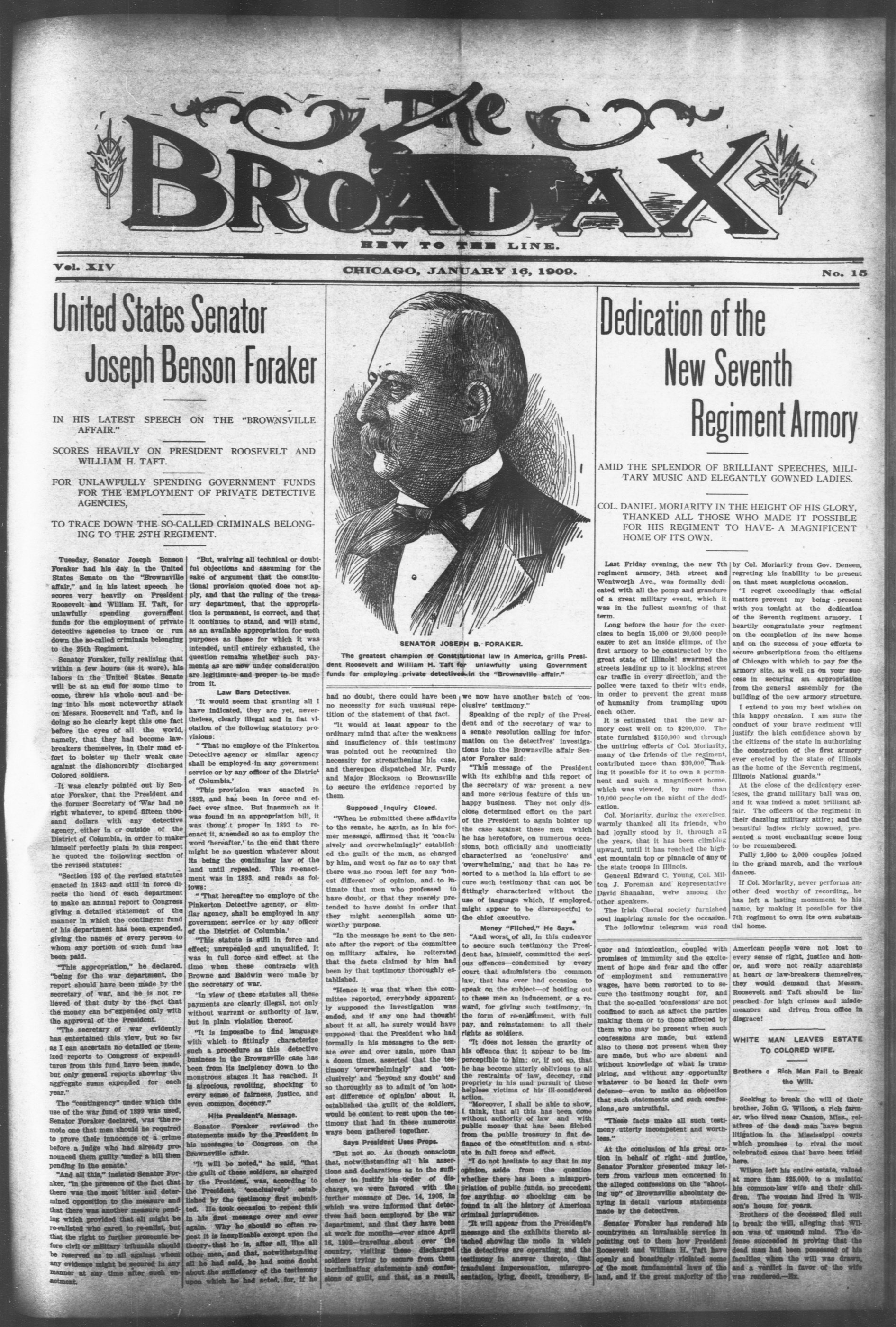
United States Senator Joseph Benson Foraker
IN HIS LATEST SPEECH ON THE "BROWNSVILLE AFFAIR."
SCORES HEAVILY ON PRESIDENT ROOSEVELT AND WILLIAM H. TAFT.
FOR UNLAWFULLY SPENDING GOVERNMENT FUNDS FOR THE EMPLOYMENT OF PRIVATE DETECTIVE AGENCIES,
TO TRACE DOWN THE SO-CALLED CRIMINALS BELONGING TO THE 25TH REGIMENT.
Tuesday, Senator Joseph Benson Foraker had his day in the United States Senate on the "Brownsville affair," and in his latest speech he scores very heavily on President Roosevelt and William H. Taft, for unlawfully spending government funds for the employment of private detective agencies to trace or run down the so-called criminals belonging to the 25th Regiment.
Senator Foraker, fully realizing that within a few hours (as it were), his labors in the United States Senate will be at an end for some time to come, throw his whole soul and being into his most noteworthy attack on Messrs. Roosevelt and Taft, and in doing so he clearly kept this one fact before the eyes of all the world, namely, that they had become lawbreakers themselves, in their mad effort to bolster up their weak case against the dishonorably discharged Colored soldiers.
It was clearly pointed out by Senator Foraker, that the President and the former Secretary of War had no right whatever, to spend fifteen thousand dollars with any detective agency, either in or outside of the District of Columbia, in order to make himself perfectly plain in this respect he quoted the following section of the revised statutes:
"Section 193 of the revised statutes enacted in 1842 and still in force directs the head of each department to make an annual report to Congress giving a detailed statement of the manner in which the contingent fund of his department has been expended, giving the names of every person to whom any portion of such fund has been paid.
"This appropriation," he declared, "being for the war department, the report should have been made by the secretary of war, and he is not relieved of that duty by the fact that the money can be expended only with the approval of the President."
"The secretary of war evidently has entertained this view, but so far as I can ascertain no detailed or itemized reports to Congress of expenditures from this fund have been made, but only general reports showing the aggregate sums expended for each year."
"The 'contingency' under which this use of the war fund of 1889 was used, Senator Foraker declared, was 'the remote one that men should be required to prove their innocence of a crime before a judge who had already pronounced them guilty 'under a bill then pending in the senate.'"
"And all this," insisted Senator Foraker, "in the presence of the fact that there was the most bitter and determined opposition to the measure and that there was another measure pending which provided that all might be re-enlisted who cared to re-enlist, but that the right to further prosecute before civil or military tribunals should be reserved as to all against whom any evidence might be secured in any manner at any time after such enactment.
"But, waiving all technical or doubtful objections and assuming for the sake of argument that the constitutional provision quoted does not apply, and that the ruling of the treasury department, that the appropriation is permanent, is correct, and that it continues to stand, and will stand, as an available appropriation for such purposes as those for which it was intended, until entirely exhausted, the question remains whether such payments as are now under consideration are legitimate and proper to be made from it.
Law Bars Detectives.
"It would seem that granting all I have indicated, they are yet, nevertheless, clearly illegal and in flat violation of the following statutory provisions:
"That no employee of the Pinkerton Detective agency or similar agency shall be employed-in any government service or by any officer of the District of Columbia."
"This provision was enacted in 1892, and has been in force and effect ever since. But inasmuch as it was found in an appropriation bill, it was thought proper in 1893 to re-enact it, amended so as to employ the word 'hereafter,' to the end that there might be no question whatever about its being the continuing law of the land until repealed. This re-enactment was in 1893, and reads as follows:
"That hereafter no employee of the Pinkerton Detective agency, or similar agency, shall be employed in any government service or by any officer of the District of Columbia."
"This statute is still in force and effect; unrepealed and unqualified. It was in full force and effect at the time when these contracts with Browne and Baldwin were made by the secretary of war.
"In view of these statutes all these payments are clearly illegal, not only without warrant or authority of law, but in plain violation thereof.
"It is impossible to find language with which to fittingly characterize such a procedure as this detective business in the Brownsville case has been from its incipiency down to the monstrous stages it has reached. It is atrocious, revolting, shocking to every sense of fairness, justice, and even common decency."
Hits President's Message.
Senator Foraker reviewed the statements made by the President in his messages to Congress on the Brownsville affair.
"It will be noted," he said, "that the guilt of these soldiers, as charged by the President, was, according to the President, 'conclusively' established by the testimony first submitted. He took occasion to repeat this in his first message over and over again. Why he should so often repeat it is inexplicable except upon the theory--that he is, after all, like all other men, and that, notwithstanding all he had said, he had some doubt about the sufficiency of the testimony upon which he had acted, for, if he
CHICAGO, JANUARY 16, 1909.
The greatest champion of Constitutional law in America, grills President Roosevelt and William H. Taft for unlawfully using Government funds for employing private detectives in the "Brownsville affair."
had no doubt, there could have been no necessity for such unusual repetition of the statement of that fact.
"It would at least appear to the ordinary mind that after the weakness and insufficiency of this testimony was pointed out he recognized the necessity for strengthening his case, and thereupon dispatched Mr. Purdy and Major Blocksom to Brownsville to secure the evidence reported by them.
we now have another batch of 'conclusive' testimony."
Speaking of the reply of the President and of the secretary of war to a senate resolution calling for information on the detectives' investigations into the Brownsville affair Senator Foraker said:
"This message of the President with its exhibits and this report of the secretary of war present a new and more serious feature of this un
Supposed Inquiry Closed.
"When he submitted these affidavits to the senate, he again, as in his former message, affirmed that it 'conclusively and overwhelmingly' established the guilt of the men, as charged by him, and went so far as to say that there was no room left for any 'honest difference' of opinion, and to intimate that men who professed to have doubt, or that they merely pretended to have doubt in order that they might accomplish some unworthy purpose.
"In the message he sent to the senate after the report of the committee on military affairs, he reiterated that the facts claimed by him had been by that testimony thoroughly established.
"Hence it was that when the committee reported, everybody apparently supposed the investigation was ended, and if any one had thought about it at all, he surely would have supposed that the President who had formally in his messages to the senate over and over again, more than a dozen times, asserted that the testimony 'overwhelmingly' and 'conclusively' and 'beyond any doubt' and so thoroughly as to admit of 'on honest difference of opinion' about it, established the guilt of the soldiers, would be content to rest upon the testimony that had in these numerous ways been gathered together.
"But not so. As though conscious that, notwithstanding all his assertions and declarations as to the sufficiency to justify his order of discharge, we were favored with the further message of Dec. 14, 1908, in which we were informed that detectives had been employed by the war department, and that they have been at work for months—ever since April 16, 1908—travelling about over the country, visiting these discharged soldiers trying to secure from them incriminating statements and confessions of guilt, and that, as a result,
we now have another batch of 'conclusive' testimony."
Speaking of the reply of the President and of the secretary of war to a senate resolution calling for information on the detectives' investigations into the Brownsville affair Senator Foraker said:
"This message of the President with its exhibits and this report of the secretary of war present a new and more serious feature of this unhappy business. They not only disclose determined effort on the part of the President to again bolster up the case against these men which he has heretofore, on numerous occasions, both officially and unofficially characterized as 'conclusive' and 'overwhelming,' and that he has resorted to a method in his effort to secure such testimony that can not be fittingly characterized without the use of language which, if employed, might appear to be disrespectful to the chief executive.
Money "Filched," He Says.
"And worst of all, in this endeavor to secure such testimony the President has, himself, committed the serious offences—condemned by every court that administers the common law, that has ever had occasion to speak on the subject—of holding out to these men an inducement, or a reward, for giving such testimony, in the form of re-enlistment, with full pay, and reinstatement to all their rights as soldiers.
"It does not lessen the gravity of his offence that it appear to be imperceptible to him; or, if not so, that he has become utterly oblivious to all the restraints of law, decency, and propriety in his mad pursuit of these helpless victims of his ill-considered action.
"Moreover, I shall be able to show, I think, that all this has been done without authority of law and with public money that has been filched from the public treasury in flat defiance of the constitution and a statute in full force and effect.
"I do not hesitate to say that in my opinion, aside from the question whether there has been a misappropriation of public funds, no precedent for anything so shocking can be found in all the history of American criminal jurisprudence.
"It will appear from the President's message and the exhibits thereto attached showing the mode in which the detectives are operating, and the testimony in answer thereto, that fraudulent impersonation, misrepresentation, lying, deceit, treachery, il-
Dedication of the New Seventh Regiment Armory
AMID THE SPLENDOR OF BRILLIANT SPEECHES, MILITARY MUSIC AND ELEGANTLY GOWNED LADIES.
COL. DANIEL MORIARITY IN THE HEIGHT OF HIS GLORY, THANKED ALL THOSE WHO MADE IT POSSIBLE FOR HIS REGIMENT TO HAVE- A MAGNIFICENT HOME OF ITS OWN.
Last Friday evening, the new 7th regiment armory, 34th street and Wentworth Ave., was formally dedicated with all the pomp and grandure of a great military event, which it was in the fullest meaning of that term.
Long before the hour for the exercises to begin 15,000 or 20,000 people eager to get an inside glimps, of the first armory to be constructed by the great state of Illinois! swarmed the streets leading up to it blocking street car traffic in every direction, and the police were taxed to their wits ends, in order to prevent the great mass of humanity from trampling upon each other.
It is estimated that the new armory cost well on to $200,000. The state furnished $150,000 and through the uniring efforts of Col. Mortiarity, many of the friends of the regiment, contributed more than $30,000, making it possible for it to own a permanent and such a magnificent home, which was viewed, by more than 10,000 people on the night of the dedication.
Col. Moriarity, during the exercises warmly thanked all its friends, who had loyally stood by it, through all the years, that it has been climbing upward, until it has reached the highest mountain top or pinnacle of any of the state troops in Illinois.
General Edward C. Young, Col. Milton J. Foreman and 'Representative David Shanahan, were among the other speakers.
The Irish Choral society furnished soul inspiring music for the occasion.
The following telegram was read
quor and intoxication, coupled with promises of immunity and the excitement of hope and fear and the offer of employment and remunerative wages, have been resorted to to secure the testimony sought for, and that the so-called 'confessions' are not confined to such as affect the parties making them or to those affected by them who may be present when such confessions are made, but extend also to those not present when they are made, but who are absent and without knowledge of what is transpiring, and without any opportunity whatever to be heard in their own defense—even to make an objection that such statements and such confessions, are untruthful.
"These facts make all such testimony utterly incompetent and worthless."
At the conclusion of his great oration in behalf of right and justice, Senator Foraker presented many letters from various men concerned in the alleged confessions on the "shooting up" of Brownsville absolutely denying in detail various statements made by the detectives.
Senator Foraker has rendered his countrymen an invaluable service in pointing out to them how President Roosevelt and William H. Taft have openly and boastingly violated some of the most fundamental laws of the land, and if the great majority of the
No.15
OF the
seventh
iment Armory
RILLIANT SPEECHES, MILI-
GANTLY GOWNED LADIES.
THE HEIGHT OF HIS GLORY,
THE WHO MADE IT POSSIBLE
TO HAVE- A MAGNIFICENT
by Col. Moriarity from Gov. Deneen, regretting his inability to be present on that most auspicious occasion.
"I regret exceedingly that official matters prevent my being present with you tonight at the dedication of the Seventh regiment armory. I heartily congratulate your regiment on the completion of its new home and on the success of your efforts to secure subscriptions from the citizens of Chicago with which to pay for the armory site, as well as on your success in securing an appropriation from the general assembly for the building of the new armory structure.
I extend to you my best wishes on this happy occasion. I am sure the conduct of your brave regiment will justify the high confidence shown by the citizens of the state in authorizing the construction of the first armory ever erected by the state of Illinois as the home of the Seventh regiment, Illinois National guards."
At the close of the dedicatory exercises, the grand military ball was on, and it was indeed a most brilliant affair. The officers of the regiment in their dazzling military attire; and the beautiful ladies richly gowned, presented a most enchanting scene long to be remembered.
Fully 1,500 to 2,000 couples joined in the grand march, and the various dances.
If Col. Morlarity, never performs another deed worthy of recording, he has left a lasting monument to his name, by making it possible for the 7th regiment to own its own substantial home.
American people were not lost to every sense of right, justice and honor, and were not really anarchists at heart or law-breakers themselves, they would demand that Messrs. Roosevelt and Taft should be impeached for high crimes and misdemeanors and driven from office in disgrace!
WHITE MAN LEAVES ESTATE TO COLORED WIFE.
Brothers o Rich Man Fail to Break the Will.
Seeking to break the will of their brother, John G. Wilson, a rich farmer, who lived near Canton, Miss., relatives of the dead man have begun litigation in the Mississippi courts which promises to rival the most celebrated cases that have been tried here.
Wilson left his entire estate, valued at more than $25,000, to a mulatto; his common-law wife and their children. The woman had lived in Wilson's house for years.
Brothers of the deceased filed suit to break the will, alleging that Wilson was of unsound mind. The defense succeeded in proving that the dead man had been possessed of his faculties when the will was drawn, and a verdict in favor of the wife was rendered.—Ex.
Will promulgate and at all times upheld the example of Dumont, but Catholica, Protestants, Priests, Inside, Simple Taxa, Republicans, or anyone else can have their say, as the proper and responsibility is fixed.
The Broad Ax is a newspaper whose editor is claiming the editorial right to speak its own mind.
Entered as Second-Class Matter Aug. 19, 1902 at the Post Office at Chicago, Illinois, under Act of March 9, 1879.
MASONIC COLUMN.
Almost ever since the introduction of Free masonry among the Colored men of the United States, a little more than a century ago, there have been buncosteeres of the race who having by some means wormed themselves into the lodges, have seceded or been kicked out from them, and thence forward have made a dishonest living themselves by peddling bogus masonry around the country and thereby plundering the thoughtless and ignorant. Some of these wretches have gone to their final account, and we do not purpose to mention their dishonest names. But there is one survivor of the class who is still pursuing his nefarious course and deceiving many well meaning and worthy men and who deserves to be denounced and exposed by every means in possession of legitimate Freemasons. We refer to John G. Jones, of Chicago, Ill., and the purpose of this article is to proclaim to the world the awful "set back" he recently experienced in the District of Columbia. In that jurisdiction there has existed for a century a Grand Lodge known throughout the country as a regular and legitimate organization, held in the greatest esteem by all the regular, Colored Freemasons. Some four or five years ago Jones had the monumental impudence to invade that jurisdiction, and raking up all the "maggot" defunct Masons to establish what he called, a Grand Lodge. And, moreover, Jones had the additional Grand impudence to enter an action in the district Court to restrain the original Grand Lodge from using the title of Free and Accepted Masons of the District of Columbia. Jones professes to be a lawyer, and he thought he was putting up a fine job when he had his "chebang" incorporated but Jones soon found out that he had made a big mistake; for the court decreed that Jones and his "tatter-demalions" should be restrained from using the title of a Grand Lodge of Freemasons and from collecting any dues or contributions under that name. His downfall complete, we fall to find that Jones meets with any sympathy in this hour of his exposure and abasement. The "Afro-American Ledger," of Baltimore says: "This Grand Lodge was composed of a number of expelled Masons from the M. W. Grand Lodge and was set up by John G. Jones, the notorious huckster of Masonic degrees." "The Bee" of Washington, D. C., expresses itself as follows:
"John G. Jones of Chicago, Ill., several years ago got it into his head that he would like to be "boss" of all the Colored Masons in the world, so he caused a split in the Virginia Street Masons, which was the only legitimate organization in the city at that time. Bro. W. H. Grimahaw, Grand Master of the legal Grand Lodge of D. C., thus writes: "I have the honor to inform you that I have achieved a signal victory over John G. Jones bogus Mason in the United States Court. The decision rendered puts them entirely out of the business." They are prohibited from meeting, collecting dues, using the name of Freemasons, of wearing a pin or emblem of the Order."—From the Enterprise, Omaha, Neb. Jan. 9, 1909.
Joe Warner, the promising and dutiful son of Mrs. Carrie Warner, 5223 Dearborn St., who has been working for Uncle Sem, for some time, left last evening for Hot Springs, Ark., where he will rest up for several weeks, and enjoy a hot bath every day.
TUBERCULOSIS EXHIBIT FOR PORTO RICO.
National Association Overseas Spanish
New York, January 14th:—Another step in the campaign against consumption in the United States will be taken next week, when the National Association for the Study and Prevention of Tuberculosis opens its fight against this disease in the island of Porto Rico. A traveling tuberculosis exhibit was shipped to San Juan a few days ago and will be used in a campaign about to be commenced.
The exhibit will be shown first in San Juan, after which it will be taken to all of the important coast cities and also to many of the interior towns. As there are 6,000 cases of tuberculosis among the million inhabitants of Porto Rico at the present time, the movement promises much good. The Anti-Tuberculosis League of Porto Rico is co-operating with the National Association, and has furnished a special physician who will be director of the exhibition during its itinerary about the island. In connection with the exhibit, numerous public meetings will be held. The exhibit is entirely in Spanish and was prepared in New York under the direction of the National Association.
The preliminary arrangements for the exhibition were made by Mrs. Albert Morton Wood, the acting President of the Porto Rico League, who was a delegate to the recent International Congress on Tuberculosis. The membership of the League includes most of the American residents and many prominent Porto Ricans.
The exhibit to be used in Porto Rico is the third of its kind owned and conducted by the National Association for the Study and Prevention of Tuberculosis. One of the other two is at present being used in a "Ninety-day Campaign" in Florida. The other is being shown in Topeka, Kansas. After a three months campaign in Porto Rico, the third exhibit will be carried to other Spanish-speaking parts of the West Indies and the United States.—"P."
DR. HENRY CLAY CRESS SEPER
ATED FROM HIS OFFICES AT
32ND AND STATE STREET.
Dr. Henry Clay Cress, who was the grand chief president or general manager of the middle west division of the late Anti-Taft movement, who transformed his offices 32nd and State street, into political headquarters during the presidential election and, it is said that he lost many of his former patients, by so doing. It will also be recalled that Dr. Cress blossomed out in the newspaper business and as an editor, near the close of the campaign, he brought out one issue of the Chicago Leader, and not having a live wet nurse, then it died before it had really seen the light of day.
Not many nights after William H. Taft was elected president of the United States, the faithful aids and followers of Dr. Cress, gave a grand banquet in his honor at Lett's hotel, 34th and Wubash Ave., and on that glorious and history making occasion the best and the rarest wines flowed as freely as water, and in order that he would always remember the place in which he was given the time of his life, he was presented with a fine gun metal watch, and many of those called on to respond to the various toasts, all wound up by saying that "Dr. Cress, during his fearless leadership of the Anti-Taft movement, had accomplished more in the way of bringing about the political freedom of the Afro-Americans, than all their preachers, politicians, leaders and editors in this country."
Cheerfully admitting that the foregoing is true, it is therefore very painful to note the fact, that after Dr. Cress, has had so many high honors thrust upon him, that on last Saturday morning officers connected with the municipal court ordered him to vacate his offices and make room for other parties who would be, so it is claimed a little more prompt in paying their rent.
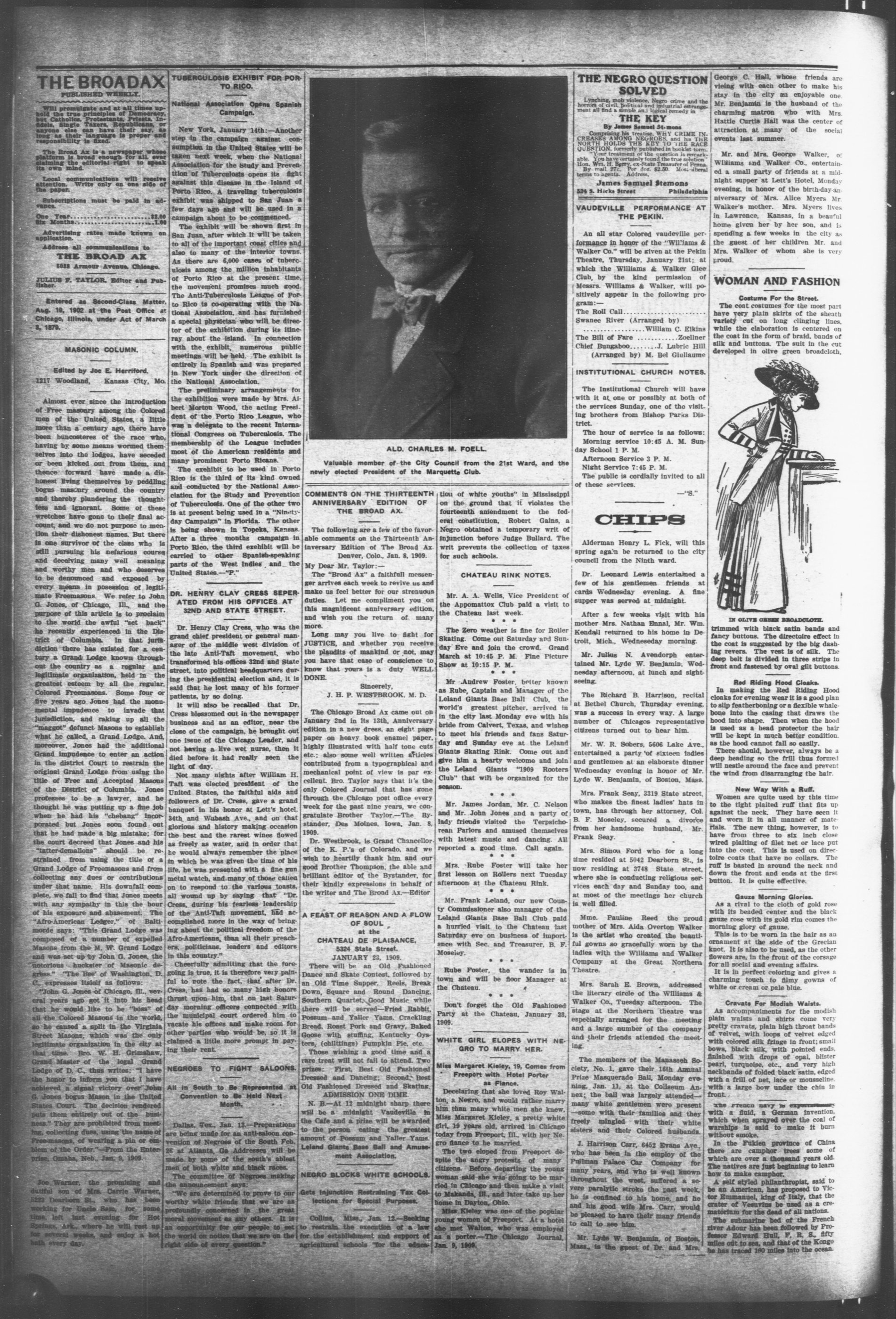
ALD. CHARLES M. FOELL
Valuable member of the City newly elected President of the Ma
COMMENTS ON THE THIRTEENTH ANNIVERSARY EDITION OF THE BROAD AX.
Valuable member of the City Council from the 21st Ward, and the newly elected President of the Marquette Club.
The following are a few of the favorable comments on the Thirteenth Anniversary Edition of The Broad Ax. Denver, Colo., Jan. 8, 1909.
My Dear Mr. Taylor:—
The "Broad Ax" a faithfull messenger arrives each week to revive us and make us feel better for our strenuous duties. Let me compliment you on this magnificent anniversary edition, and wish you the return of, many more.
Long may you live to fight for JUSTICE, and whether you receive the plaudits of mankind or not, may you have that ease of conscience to know that yours is a duty WELL DONE.
J. H. P. WESTBROOK, M. D.
The Chicago Broad Ax came out on January 2nd in its 13th, Anniversary edition in a new dress, an eight page paper on heavy book enamel paper, highly illustrated with half tone cuts etc.; also some well written articles contributed from a typographical and mechanical point of view is par excellent. Bro. Taylor says that it's the only Colored Journal that has gone through the Chicago post office every week for the past nine years, we congratulate Brother Taylor.-The Bystander, Des Molnes, Iowa, Jan. 8, 1909.
Dr. Westbrook, is Grand Chancellor of the K. P.'s of Colorado, and we wish to heartily thank him and our good Brother Thompson, the able and brilliant editor of the Bystander, for their kindly expressions in behalf of the writer and The Broad Ax—Editor
A FEAST OF REASON AND A FLOW OF SOUL
at the
CHATEAU DE PLAISANCE,
5324 State Street.
JANUARY 22 1909
There will be an Old Fashioned Dance and Skate Contest, followed by an Old Time Supper, Reels, Break Down, Square and Round Dancing, Southern Quartet, Good Music while there will be served—Fried Rabbit, Possum and Yaller Yams, Crackling Bread, Roast Pork and Gravy, Baked Goose with stuffing, Kentucky Oysters, (chillings) Pumpkin Pie, etc. Those wishing a good time and a rare treat will not fall to attend. Two prizes: First, Best Old Fashioned Dressed and Dancing; Second, Best Old Fashioned Dressed and Skating.
N. B.—At 12 midnight sharp there will be a midnight Vaudeville in the Cafe and a prize will be awarded to the person eating the greatest amount of Possum and Yaller Yams. Leland Giants Base Ball and Amusement Association.
NEGRO BLOCKS WHITE SCHOOLS.
Gets Injunction Restraining Tax Collections for Special Purposes.
Collins, Miss., Jan. 12—Seeking to restrain the execution of a law for the establishment and support of agricultural schools "for the educa-
---
Sincerely
tion of white youths" in Mississippi on the ground that it violates the fourteenth amendment to the federal constitution, Robert Gains, a Negro obtained a temporary writ of injunction before Judge Bullard. The writ prevents the collection of taxes for such schools.
CHATEAU RINK NOTES.
Mr. A. A. Wells, Vice President of
the Appomattox Club paid a visit to
the Chateau last week.
* * *
The Zero weather is fine for Roller
Skating. Come out Saturday and Sunday Eve and join the crowd. Grand
March at 10:45 P. M. Fine Picture
Show at 10:15 P. M.
Mr. Andrew Foster, better known as Rube, Captain and Manager of the Leland Giants Base Ball Club, the world's greatest pitcher, arrived in in the city last Monday eve with his bride from Calvert, Texas, and wishes to meet his friends and fans Saturday and Sunday eve at the Leland Giants Skating Rink. Come out and give him a hearty welcome and join the Leland Giants "1909 Rooters Club" that will be organized for the season.
Mr. James Jordan, Mr. C. Nelson and Mr. John Jones and a party of lady friends visited the Terpsichorean Parlors and amused themselves with latest music and dancing. All reported a good time. Call again.
Mrs. Rube Foster will take her first lesson on Rollers next Tuesday afternoon at the Chateau Rink.
Mr. Frank Leland, our new County Commissioner also manager of the Leland Giants Base Ball Club paid a hurried visit to the Chateau last Saturday eve on business of importance with Sec. and Treasurer, B. F. Moseiey.
Rube Foster, the wander is in town and will be floor Manager at the Chateau.
Don't forget the Old Fashioned Party at the Chateau, January 23, 1909.
WHITE GIRL ELOPES WITH NE-
GRO TO MARRY HER.
Decelaring that she loved Roy Walton, a Negro, and would rather marry him than many white men she knew, Miss Margaret Kieley, a pretty white girl, 19 years old, arrived in Chicago today from Freeport, Ill., with her Negro fance to be married. The two eloped from Freeport despite the angry protests of many citizens. Before departing the young woman said she was going to be married in Chicago and then make a visit to Makanda, Ill., and later take up her home in Dayton, Ohio. Miss Kieley was one of the popular young women of Freeport. At a hotel she met Walton, who was employed as a porter—The Chicago Journal, Jan. 9, 1909.
Lynching, mob violence, Negro crime and the horrors of civil, political and industrial entrapment all find a sample and logical remedy in THE KEY
By James Samuel St-mons
Comprising his treatise, WHY CRIME INCREASES A MAN'S TRAINING NORTH HOLDS THE KEY TO THE RACE QUESTION, formerly published in hooklet form.
Your treatment of the question is remarkable. You have certainly found the true solution" Hon. Wm. H. Berry, ex-State Treasurer of Pima.
By mail 27c. Per dog. $2.50. Moss-ideal terms to agents. Address.
James Samuel Stemons
524 5. Hicks Street
Philadelphia
VAUDEVILLE PERFORMANCE AT
THE PEKIN.
An all star Colored vaudeville performance in honor of the "Williams & Walker Co." will be given at the Pekin Theatre, Thursday, January 21st; at which the Williams & Walker Glee Club, by the kind permission of Messrs. Williams & Walker, will positively appear in the following program:—
The Roll Call.....
Swanee River (Arranged by)
.....
William C. Elkins
The Bill of Fare .....
Zoellner
Chief Bungaboo.....J. Lubric Hill
The Institutional Church will have with it at one or possibly at both of the services Sunday, one of the visiting brothers from Bishop Parks District.
The hour of service is as follows:
Morning service 10:45 A. M. Sunday School 1 P. M.
Afternoon Service 3 P. M.
Night Service 7:45 P. M.
The public is cordially invited to all of these services.
CHIPS
Alderman Henry L. Fick, will this spring again be returned to the city council from the Ninth ward.
Dr. Leonard Lewis entertained a few of his gentlemen friends at cards Wednesday evening. A fine supper was served at midnight.
After a few weeks visit with his mother Mrs. Nathan Ennal, Mr. Wm. Kendall returned to his home in Detroit, Mich., Wednesday morning.
Mr. Julius N. Avendorph entertained Mr. Lyde W. Benjamin, Wednesday afternoon, at lunch and sightseeing.
The Richard B. Harrison, recital at Bethel Church, Thursday evening, was a success in every way. A large number of Chicagos representative citizens turned out to hear him.
Mr. W. R. Sobers, 5606 Lake Ave., entertained a party of sixteen ladies and gentlemen at an elaborate dinner Wednesday evening in honor of Mr. Lyde W. Benjamin, of Boston, Mass.
Mrs. Frank Seay, 3319 State street, who makes the finest ladies' hats in town, has through her attorney, Col. B. F. Moseley, secured a divorce from her handsome husband, Mr. Frank Seay.
Mrs. Simoa Ford who for a long time resided at 5042 Dearborn St., is now residing at 3748 State street, where she is conducting religious services each day and Sunday too, and at most of the meetings her church is well filled.
Mme. Pauline Reed the proud mother of Mrs. Aida Overton Walker is the artist who created the beautiful gowns so gracefully worn by the ladies with the Williams and Walker Company at the Great Northern Theatre.
Mrs. Sarah E. Brown, addressed the literary circle of the Williams & Walker Co., Tuesday afternoon. The stage at the Northern theatre was especially arranged for the meeting and a large number of the company and their friends attended the meeting.
The members of the Manasseh Society, No. 1, gave their 16th Annual Prize Masquerade Ball, Monday evening, Jan. 11, at the Coilseum Annex; the ball was largely attended—many white gentlemen were present—some with their families and they freely mingled with their white sisters and their Colored husbands.
J. Harrison Carr, 6452 Evans Ave., who has been in the employ of the Pulsiman Palace Car Company for many years, and who is well known throughout the west, suffered a severe paralytic stroke the past week, he is confined to his home, and he and his good wife Mrs. Carr, would be pleased to have their many friends to call to see him.
Mr. Lyde W. Benjamin, of Boston, Mass., is the guest of Dr. and Mrs.
George C. Hall, whose friends are vicing with each other to make his stay in the city an enjoyable one. Mr. Benjamin is the husband of the charming matron who with Mrs. Hattle Curtis Hall was the center of attraction at many of the social events last summer.
Mr. and Mrs. George Walker, of Wiliams and Walker Co., entertained a small party of friends at a midnight supper at Lett's Hotel, Monday evening, in honor of the birth-day anniversary of Mrs. Alice Myers Mr. Walker's mother. Mrs. Myers lives in Lawrence, Kansas, in a beautiful home given her by her son, and is spending a few weeks in the city as the guest of her children Mr. and Mrs. Walker of whom she is very proud.
WOMAN AND FASHION
Costume For the Street.
The coat costumes for the most part have very plain skirts of the sheath variety cut on long clinging lines, while the elaboration is centered on the coat in the form of braid, bands of silk and buttons. The suit in the cut developed in olive green broadcloth.
1
trimmed with black satin bands and fancy buttons. The directorel effect in the coat is suggested by the big dashing revers. The vest is of silk. The deep belt is divided in three strips in front and fastened by oval gilt buttons.
Red Riding Hood Cloaks
In making the Red Riding Hood cloaks for evening wear it is a good plan to slip featherboning or a flexible whalebone into the casing that draws the hood into shape. Then when the hood is used as a head protector the hair will be kept in much better condition, as the hood cannot fall so easily. There should, however, always be a deep heading so the frill thus formed will nestle around the face and prevent the wind from disarranging the hair.
New Way With a Ruff.
Women are quite used by this time to the tight plaited ruff that fits up against the neck. They have seen it and worn it in all manner of materials. The new thing, however, is to have from three to six inch close wired plaiting of filet net or lace put into the coat. This is used on directoire coats that have no collars. The ruff is basted in around the neck and down the front and ends at the first button. It is quite effective.
Gauze Morning Glories.
As a rival to the cloth of gold rose with its beaded center and the black gauze rose with its gold rim comes the morning glory of gauze.
This is to be worn in the hair as an ornament at the side of the Grecian knot. It is also to be used, as the other flowers are, in the front of the corsage for all social and evening affairs.
It is in perfect coloring and gives a charming touch to filmy gowns of white or cream or pale blue.
Cravats For Modish Waists.
As accompaniments for the modish plain waists and shirts come very pretty cravats, plain high throat bands of velvet, with loops of velvet edged with colored silk fringe in front; small bows, black silk, with pointed ends, finished with drops of opal, blister pearl, turquoise, etc., and very high neckbands of folded black satin, edged with a frill of net, lace or mousseline, with a large bow under the chin in front.
The french navy in experiments with a fluid, a German invention, which when sprayed over the coal of warships is said to make it burn without smoke.
In the Fukien province of China there are camphor trees some of which are over a thousand years old. The natives are just beginning to learn how to make camphor.
A self styled philanthropist, said to be an American, has proposed to Victor Emmanuel, king of Italy, that the crater of Vesuvius be used as a crematorium for the dead of all nations. The submarine bed of the French river Adour has been followed by Professor Edward Hull, F. R. S., fifty miles out to sea, and that of the Kongo he has traced 160 miles into the ocean.
By P. Y. BLACK.
"It was a shameful trap," he said,
"on the part of my people. The doctors were very careless in their diagnosis. To shut me up in a place like this was really too bad. In a very short time, however, I expect to leave."
"Oh, dear," she thought, her eyes dimming, "they all say that! To think that the poor man will never, never leave! I am so glad—for you," she said aloud. "You will be over-forced."
"Oh. I—yes. But do you know this situation is not so bad?"
"Do you mean," she said gently, surprised. "that you will—er—have any regrets in leaving."
"No," he said, "not exactly that, of course—not regrets so far as concerns myself, for it is so humiliating to be committed, you know." He paused. "But" he went on, "even in asylums one makes friends, and—one regrets—for them." He looked down with a tenderness and a pity he could not hide, and she blushed, and for a moment there was silence. Then she said, with an obviously strained laugh: "We are friends, of course, Mr. St. John. What an awful existence it would be here if one had no sympathetic friends! But you must not regret so much on my account. In a very short time I think my friends will take me home." He choked a groan before she could hear it.
"The poor little thing!" he thought.
"They all say that. And that decent young fellow, the doctor, assures me her case is very puzzling and her friends fear incurable. I am so glad for you." he said. "Would it not be jolly if we became friends in the world as we have been when out of the world?"
Then he blamed himself again.
"If she really likes me," he thought,
"and I think the unhappy child does, I should never had said that. It is cruel, brutal, to put such thoughts in her head."
She was looking at him with the tearful smile we essay when we encourage one who does not realize that death is near.
"It would be nice—very nice indeed."
They were silent again, each sorrowing for the other.
There were many other patients strolling on the lawns or sitting in the summer houses, patients of all kinds.
Miss Tracy and St. John stood together, silent now and unostentatiously observant. A sturdy built (all the attendants were that) man was taking a patient to the iron barred house. He did not do it violently. He did it as one may see a policeman occasionally escort a quiet prisoner with a light touch on the captive's arm above the elbow. The patient was a little excited, but there was no disturbance at all. A visitor might never have noticed it. The strange thing was the unanimous backward withdrawal from the attendant's path of the patients encountered, the look of fright or dislike on their faces directed not at the captive, but at the guard.
"How they all dread him—instinctively, it seems," said the young woman who "expected to leave soon." "He is polite enough and not ill looking, but!"—
"A man of great experience in his peculiar work, I'm told," said St. John musingly.
"It's his eye and mouth that do it. I fancy."
"A thoroughly ill disposifloned man, with a plausible exterior," said St. John. "I believe him capable of it."
"Of murder? Do—oh, what are you talking of, Mr. St. John?"
St. John looked very uncomfortable. Miss Tracy looked vexedly embarrassed.
"I heard some rumor of a strange death in the institution just before I came. I was thinking of it. Were you here? Have you heard anything of it?"
So they watched the attendant out of sight and turned to go inside themselves.
They shook hands, although there was no reason for it. They would meet at the dinner table in a few minutes, but—they shook hands, and that lingeringly.
"I's awfully sad," St. John pondered. "So sweet a face, seemingly so intelligent. I wish—oh pshaw! What's the use of wishing? These things are not to be remedied. I wonder if she'd give me a photograph."
Miss Tracy went to her room slowly.
"I am silly to be so affected by an ordinary case. There are thousands like him. But—oh, dear; oh dear! If I known I was to have this sad experience I would never have consented to come—perver."
They had no opportunity to meet alone for several days. Perhaps they might have made opportunities, but they did not. Doubless it occurred to each of these two lunettes that it was the wiser thing to stile at once any friendship which each thought likely to cause useless pain in the future to the other. Do
Dr. Bell found these two of his realities particularly interesting in these
"Very puzzling case," he mused. "Now, why does she dwell on that recent death? It seems to excite her too. That's morbidity, I'm afraid; bad sign."
The doctor liked St. John too. St. John's friends acted very nicely in sending him new books and boxes of cigars. The books were well chosen; the cigars were unexceptionable.
"Like all these paretics," he pondered, "in the first stages you would not think there was anything much wrong with the man, but it is a little singular that he should be so interested in that unlucky death also."
As for the attendants, Miss Tracy had flowers and little things and could teach the women quite a number of new fads in hairdressing, and so forth. For the men St. John's cigar box and full pocketbook sufficed to make them extremely courteous. The man with the wicked eyes and mouth benefited most, however. It was wonderful what a lot of little things he could do for Miss Tracy. It was strange that St. John should find anything in the man to talk about with common interest.
Just once the two lunatics met. It was just before bedtime in the music room. He had sung to her accompaniment. When she rose to say good night he almost whispered to her:
"I expect to go to New York tomorrow."
"I am so glad for your sake," she said.
"And—and you—you have made my stay almost tolerable. Is there nothing you will allow me to do for you?"
"Oh," she answered, with sprightfulness, "I shall not be long in going myself."
"Poor, poor little dear," he said to his pillow, "it breaks me all up to think of her staying here incurable."
Miss Tracy packed her trunk, and tears dropped on silk and linen indifferently.
"Oh," she murmured, "I do so wish I had never come here. I can never, never forget the sad, gentle way he used to look at me."
There was lively work next afternoon in the building of the Gazette. A young man sat at a desk apart in the reporters' room, and he scribbed and he scribbed. By and by the managing editor came in and looked over the busy writer's shoulder and told him that he had an hour to finish up. Then the great presses began to clatter, and in a little while the first edition of the Gazette was ready for the street, with an enormous black scare head on the front page.
And in the office of the Morning Jury there was also a very lively bustling, and there, at a retired desk, a young woman sat, and she scribbed, and late at night the presses began to ramble, and in a little while the first edition of the Jury was ready for the street, with an enormous black scare head on the front page.
The Gazette and the Jury were within in a few minutes of each other in getting out. A copy of each paper was hustled into the office of the other, for rival editors watch each other's work with catlike intentness. And the Gazette office read with dismay that the great asylum mystery had been solved by the indefatigable efforts of a Jury reporter, while the Jury night staff tore its editorial hair over the flaring boast of the Gazette that its "special commissioner" had given to a waiting world the first and only enlightenment of the famous crime. There had been no time for one paper to lift the news from the other. How had the expected scoop been spoiled?
Tumultuous was the wrath in the two offices. Miss Tracy was explaining to her managing editor, with tears in her eyes, that she could not understand at all, at all, how the Gazette had got hold of it. In the Gazette office Mr. St. John stormed and swore and said that for the life of him he could not understand how the Jury had got almost the same story,
"Good heavens!" shouted St. John suddenly, and he dashed out to the Jury office. There he found a friend, with whom he conferred. The two lunatics were introduced to each other and a minute or two afterward were alone together.
They laughed a great deal at the idea of two reporters on the same strange assignment, never suspecting each other, but their laugh was not very loud. The tender pity for each other of yesterday was still in mind.
"The attendant is arrested," said St. John. "You did not get it quite right. The patient he poisoned when nursing him was an old enemy. It was not done through trouble arising between them in the sanitarium."
"Oh, bother!" she said. "It doesn't matter. We've done our appointed work. Let's talk of something more pleasant."
So they did, and when he was about to go away he said:
"You said once we might be friends in the world as well as out of the world. Will we be friends, dear Miss Tracy?"
"Yes," she said, and, it was quite five minutes after, when some one's feet were heard approaching, that she jumped away and held up a warning finger.
"If your friend came in he'd think us mad," said she.
"Two funnials!" he answered, laughing, as the door opened.
Easiest Termato be had in Chicago Loans on first and second Mortgages Fire Insurance placed in any company
Selections
THE SEA BAT.
Specimen of a Fish That Is Both Queer and Rare.
One of the rarest specimens of the fish kingdom known to waters contiguous to the North Carolina coast was captured in a seine at Masonboro sound by William Hewlett, a fisherman, says the Wilmington Dispatch. The fish, which was brought to the city, is what is called "the sea bat," and it is a perfect reproduction of a leather wing bat on a large scale. The fish is about fifteen inches long and about thirty inches across the back.
Strange to state, it had a thin, threadlike tail about fifteen inches in length, and on each side of the rear appendage were two perfectly formed gloved feet, with a smaller dimension having the exact appearance of a thumb with the other part of the hand mittened. The mouth of the strange specimen was about five inches across, and on each side of the mouth or the underside of the body there were five "strainers," or holes, through which the fish is said to rid itself of refuse products resulting from the forage it picks up at the bottom of the sea. The top of the fish was a dark slate color, and the under part of the body was white.
One old negro fisherman more than seventy years old declared that this was only the second specimen of the sea bat he had ever seen in his long experience as a fisherman. The specimen, which had a truly uncanny appearance, will probably be sent to the state museum at Raleigh.
Frying Pan Stage
"The late Mrs. William Astor," said a colonial dame, "took, after all, an optimistic view of American society. She criticised our faults, but she believed in our future. American society, she used to say, would eventually be the finest in the world. Once she declared at a dinner that it was the proper social sequence to get, like us, the money first and the refinement and culture afterward. She said that when she looked at the uncouth millionaire of today and thought of the splendid creature to come after him she felt as optimistic as the fisherman who, casting his line, brought up a frying pan and said: "Oh, that's a good beginning—a frying pan! I have only to catch a fish now and I shall be all right."—Washington Post.
Ancient Mariners
That the Egyptians made sea voyages long before the time of Solomon, hitherto considered the first ocean traveler on a large scale, is declared by Professor James H. Breasted to be conclusively proved by a tablet found by him in Palermo, Sicily, during the three years' exploring trip from which he recently returned. Professor Breasted asserts that the inscriptions on the tablet show that the Egyptian king who built the first pyramids made a voyage with forty ships across the Mediterranean to Lebanon to obtain cedar for a temple. This journey, according to the professor, was made in the thirtieth century B. C., or 2,000 years before Solomon made his voyage for a similar purpose.
An Ocean Sanitarium.
Some particulars are given in the British Medical Journal of a proposal to provide an ocean sanitarium for tuberculosis. The suggestion is to fit up a sailing ship of about 2,000 tons for not less than fifty patients, each to be provided with a large and well ventilated cabin. The deck would be used for what is commonly called the veranda treatment. The intention of the promoters is that the ship shall cruise in the neighborhood of the Canaries, where it will have the advantage of the trade winds and of an equable climate, while a port will not be far distant in case of the onset of bad weather.
A Majestic ice Wall.
In a letter from Professor Edgeworth Davis, a member of the British antarctic expedition now seeking a way toward the south pole, there occurs a vivid description of the great antarctic ice barrier, which was encountered by the little ship Nimrod. "It is a skight," says Professor Davis, "that beggars all description. Imagine a continuous ice wall 500 miles long and one to two hundred feet high, the exquatile blue of the crevasses contrasting finely with the dazzling white of the weathered ice on either side of them."
Branch Office:
3220 State Street
Selections
NAVAL SHARPSHOOTERS.
Change Six Years Has Made In Our
Men Behind the Guns.
The American navy now leads the world in accuracy and rapidity of shooting. Six years ago it was behind the navy of every first class power. Six years ago the standard for firing heavy turret guns, which are now a battleship's sole weapon of consequence in battle, was once in five minutes. The average of hits on the target now in use would not have been once an hour. At present these guns fire an average of one and a half shots a minute. They hit the target once a minute. Six years ago the standard rate of fire for six inch guns was less than two shots a minute. As shown by the tests of 1002, less than one shot in six hit the target. Today these guns frequently make as many as twelve hits a minute, and the average of the whole navy is six hits a minute. These are the records at the 1,600 yard range. At the last long range target practice in Massachusetts bay the battleships of the north Atlantic fleet, firing at a target from three to five miles away, averaged nearly 20 per cent of hits. With a target one-third the size of the ships at Santiago at distances from two to three times as great our fleet made more than fifteen times the percentage of hits.
Translated into terms of war these changes mean this: Six years ago an American battleship would not hit an enemy's vessel at a battle range of three miles or more oftener than twice an hour. Today every ship of an enemy's fleet steaming into range would be struck by two tons of steel shell every minute by every modern American ship firing at her. Solid metal spatters like mud when these great projectiles strike it. When charged with their high explosives these shells are swept through the ship in fragments of from 200 pounds in weight down to the finest steel dust. In all human probability no ship in the world could stand such a fire fifteen minutes.—McClure's.
The Knowledge That Hurts.
Towne-So Dumley married a college woman. My, it must be fierce for him to be tled to a woman who knows so much that he doesn't know!
Browne—Oh, that doesn't hurt him so much as the fact that she knows "how" much he doesn't know.—Catholic Standard and Times.
Striving to Please
"Yes," said the housewife, "yours is a sad story. But it isn't the same story you told last year."
"Well, lady," answered Plodding Pete, "you surely wouldn't expect a man to go all dat time an' not show any improvement!"—Washington Star.
A Strictly Feminine Comment.
"I notice that a leading actress telephoned that her automobile was broken down and she couldn't attend a meeting of her creditors."
"Wasn't that sweet of her? Going to all that trouble for a lot of fussy old creditors!"—Pittsburg Post.
"People usually try to do as they are done by."
"For instance?"
"Whenever some one is run down by a motor car a lot of folks begin running down the cars." — Kansas City Times.
A Great Difference.
"Margaret, it was very naughty of you to make such a fuss. You said if I'd buy you that new dolly you'd go to the dentist's without a murmur."
"I didn't murmur, muvver. I screamed."—Lippincott's Magazine.
Wise Youth.
"Come," said the reckless rounder, "get in the push and be a high flier."
"Not me," replied the wise youth.
"Tre noticed that it is usually the high flier who drops the hardest."—Pittsburg Poet.
A Mixup.
"What made Miss Flit> look so sour at the ball last night?"
"Probably because she was in a pickle at her pretty rival's being so successful in her preserves"—Baltimore American.
An Odd Combination.
"Young De Peyster's match with that girl who so unexpectedly fell into a fortune was a brilliant stroke."
"In what way?"
"He made a lucky hit with a lucky miss."
Fifty-First St. and Armour Ave.
Ram Yarnes
gst St. & L. & M. & S. R.
gst St. and Armour Ave.
CHICAGO
FACTS IN FEW LINES
The British salmon is said to be worth $550 a ton.
Denmark has a population of 2,598,000. Of these 500,000 are in Copenhagen and its suburbs.
There is a great shortage of officers in the Russian army. In the infantry alone it amounts to 3,000.
During each month for the last two years about 21,000 Russian immigrants have entered the port of New York.
Britain, Canada, Australia and New Zealand had to pay a deficiency of $311,810 on last year's working of the Pacific cable.
An air gun of large size, working on the principle of the pneumatic hammer, has been devised for killing animals in a humane manner.
On her preliminary trials the British destroyer Swift maintained for several hours a speed of 38.3 knots, or nearly forty-five miles an hour. She is the fastest vessel ever built.
Seven hundred of the persons who died in Ireland last year were sited to be ninety-five years of age or upward, and no fewer than 145 were reported to be centenarians or upward. The British built but German owned ship Columbia, dismasted by a hurricane off Cape Flattery, has been purchased by Americans and converted into the first six masted barkentine in the world. Lassa, the mysterious capital of Tibet, is beginning to show longings for the amenities of western civilization. It has just placed a contract with a Calcutta firm to supply a large number of European band instruments.
Mme. Poppova is a Russian woman who has invented an airship and has called it the Annulated Dragon, which gives one an idea of its shape. There is a system of hoops that serves to steer it, and the ship is said to adapt itself to every sort of wind very readily.
A Pittfield (Mass.) business house has adopted the policy of having a young woman bill collector. The girl is meeting with more success than three men, it is said. Her favorite form of salutation is to smile prettily and ask, "Don't you want to pay your bill today?" The answer is nearly always yes.
A few years ago the currency of Austria was changed from gudels and kreutzers to crowns and hellers. To deceive customers figures are still sometimes placed in shop windows in such a way that florins are mistaken for crowns and bills made accordingly. By a recent ordinance this has been made a punishable act. There has died in the workhouse at Dorchester, England, a woman named Harriet Hammett, a native of Tolpuddle, who was admitted to the workhouse in 1844. As her age at death was sixty-nine, she must have donned workgarb when five years old. The only home she ever remembered was "the house."
The beneficial effect of storage on the sanitary quality of water now seems to be well established, and a further contribution to the data on the subject has just been made by one of the experts of the London water board. He has shown that typhoid bacillus put in river water gradually disappear as the water remains longer in storage. Sweden has three factories building limitations of American mowers and reapers. The largest of these built 6,000 to 7,000 machines for the season of 1908, copying almost exclusively one of the best selling American mowers. Their reaper is an exact copy of the American original, Swedish made parts fitting American built machines.
The new Turkish minister of education says: "We have compulsory education at present, but we lack primary schools. We shall establish them. We shall develop the existing higher education. The study of history will now be allowed. We want a regime of liberty of the press, even with all the evils it means, for it is a necessary evil."
There has been opened in Mannheim, Germany, a tuberculosis museum, the object of which is to educate the public as to the causes, cure and prevention of consumption. The museum is opened three a week for a period of two hours, and during that time physicians are present, who instruct visitors in the manner of fighting the disease.
A Pleasant Winter Evening.
PATRICK H. O'DONNELL
WILLIAM DILLON
CLARENCE A. TOOLEN
Tel. Central 4600
O'Donnell, Dillon &
Toolen
ATTORNEYS AT LAW
Suite 1218-1219 Ashland Block
RANDOLPH & CLARK STREETS
CHICAGO
JAMES J. GRAY
ATTORNEY AT LAW
Suite 1518 Ashland Block
RANDOLPH AND CLARK STREETS
CHICAGO
Tel. Central 4728
Residence 57 Macallister Place
Telephone Ashland 363
Office Telephones
Central 1339 Automatic 5940
MILES J. DEVINE
ATTORNEY AT LAW
suite 318-320 Reper Block
CLARK AND WASHINGTON STS.
CHICAGO.
Phone Main 4153 NOTARY PUBLIC
Phone residence, Gray 5670
Walter M. Farmer
ATTORNEY AT LAW
Sulta 706, 171 Washington St.
Res. 4856 Langley Av. CHICAGO
JOHN E. OWENS
ATTORNEY & COUNSELOR
AT LAW
TELEPHONE CENTRAL 908 CHICAGO
A. D. GASH
Attorney at Law.
84-86 La Salle Street, Chicago
Suite 615 to 619.
Telephone Main 3077.
Dr. W. E. MACKEY
4842 Armour Avenue.
Phone, Blue 6571.
CHICAGO.
Hours: 9 to 12 a. m.; 1 to 4 p. m.; and Nights.
J. GARNER Tel. Douglas 325
THE ELITE BUFFET
FINE WINES, LIQJORS
AND CIGARS
3030 State Street CHICAGO
Phone Oakland 1828
F. A. Rawlins
The Modern Embalmer
UNDERTAKER AND
FUNERAL DIRECTOR
When his work is finished
you have no displeasure.
4817 State Street CHICAGO
Phone Douglas 1850
THE BROAD AX CAN BE FOUND
ON SALE AT THE FOLLOWING
NEWS STANDS.
From on and after this date, The Broad Ax can be found on sale at the following news stands:
A. F. Tervalon, a cigar store and news stand, 5004 State street.
George I. Martin, maker of fine cigars, and news stand, 342 31st street, near State.
Mrs. Nellie Phelps, cigars, notions and news stand, 131 W. 51st street, near Dearborn.
W. S. Cole, cigars, tobacco and news stand, 354 31st street.
J. R. Peters, cigars, tobacco, laundry office and news stand, 338 27st street.
T. B. Hall, laundry office, cigars, tobacco and news stand, 281 29th street.
Mrs. A. E. Baker, notions, cigars and news stand, 419 36th street.
R. Davis, cigars, tobacco and news stand, 3533 State street.
E. D. Burt, cigars, notions and news stand, 3533 State street.
R. A. Jones news stand and barber shop, 4887 State street.
L. W. Washington, Chicago Beach Hotel, Hyde Park.
---
LIKE HAMMERED GOLD.
Yukon-Pacific Exposition.
The Alaska-Yukon-Pacific exposition monument, to be the crowning work of sculpture of the international exhibition of 1000, will be covered with solid gold leaf. Gold donations to the amount of $7,000, necessary to completely cover the great shaft with the shining metal, will be solicited from Alaskans, Yukoners and the people of Seattle.
An appropriation to cover the cost of building the monument in staff has been authorized, the drawings made and the sculptor is engaged in building his clay model. The monument is to stand in the center of the plaza in front of the magnificent group of United States government buildings and directly at the head of the Cascades.
Looking south from the monument will be first the central features of the exposition, and then the eye will travel over a panorama of eighty miles of mountain, lake and woodland scenery to Rainier and the Cascade range. The exposition monument is to be more than seventy feet in height. The monument proper will stand on a pedestal twenty feet high. This column will be of Corinthian design, on the top of which will be a globe giving the signs of the zodiac. On top of this globe will be a huge American eagle with outstretched wings, as in flight. Grouped about the base of the monument will be three seated female figures symbolic of the northland, the south seas and the orient. Every foot of this great monument will have the appearance of having been hammered out of pure gold if the donations are sufficient to complete the undertaking.—Seattle Times.
Youthful Suicides
There is a shocking preneness among youthful Bengalis to kill themselves on the least pretext. It seems to be an exaggerated form of suikiness, and one would like to have a medical opinion on the matter. A student is reprimanded by his parent because his studies don't show the advancement expected. The boy swallows some opium and ends his studies. A girl wife in Howrah takes a dislike to the second choice of her husband. She also secures an exit by the easy means of opium. A Bengali woman in Howrah wanted to go on a pilgrimage to Gayas. Her mother said she could not advance the railway fare, and the girl went out to a tree and hanged herself. These are all recent cases.—Calcutta Empire.
A Pleasant Prison.
The prison at Cetinje, Montenegro, has been described as surely the most extraordinary one in existence. It presents little to indicate that it is a place of confinement, there being apparently nothing between the prisoners and absolute liberty. There are no outer prison walls, and in the cells the men—about eight or ten to each—are as contentedly and comfortably housed as their own personal domestic belongings can make them. Moreover, they are generously fed, and cigarettes without stint, wine occasionally and no work at all combine to check any desire to escape more effectually than would strong walls, iron bars and an army of jailers—London Globe.
Tees In the Treetops.
Here is a story speaking better for the German emperor's goodness of heart than his knowledge of the ancient and royal game of golf. "So you want ground for your golf club, Sir Frank?" said the kaler to the British ambassador at Berlin. "We haven't got nice grass meadows round Berlin, as you have in England, but I'll give you a bit of the Grunewald" a pine forest near Berlin and a great Sunday resort of the Berliners. "Ah, sire," Sir Frank Lascelles replied, "I am afraid there would be too many trees!" "Trees!" instantly replied the emperor, with bonhomme. "All the better to keep the sun off you when you are playing in the summer."
Cold Storage Poultry. The state board of health of Massachusetts has issued a bulletin on cold storage poultry in which this advice is given to housekeepers: "In order to avoid obtaining waterlogged and refrozen fowls the consumer should demand the frozen bird and thaw it himself. If thawed quickly by immersion in a bucket of hot water it may be eaten with impunity and with relish the same day it is purchased, or if hung overnight at room temperature it may be ready for use the day following."
The Funny English.
James 8. Palmer, vice president elect of the United States, may possibly look forward to filling one day the position of president. It will be remembered that on the death of President McKinley, Mr. Roosevelt, who was then vice president, succeeded automatically to the presidency without opposition. Should anything happen to Mr. Taft (which we sincerely trust, for his sake, may not be the case) Mr. Palmer would probably, if precedent were followed, take his place. — Illustrated London News.
The Moving in Party.
"Yes, they have a new sort of function in Chicago that is quite the rage."
"What is it called?"
"It's called a moving in party. When the hostess learns that the empty Mouse next door is to be occupied she calls her guests by telephone, and they come and draw cuts for the front windows and then sit there and size up the new neighbor's stall as the movers carry it in"—Cleveland Plain Dealer.
The Wealth of Our Nation.
In 1900 the United States held the fourth rank among the manufacturing nations. Great Britain, France and Germany were ahead of us, in the order named. We passed Great Britain in 1880, and today the aggregate of our manufactures equals that of Great Britain, Germany and France combined. The value of our products of manufactures has doubled since 1888. The value of our exports of manufactures has doubled since 1898. In the value of the property represented manufactures rank third among the great activities of the United States, agriculture being first and the railroads being second, but in the number of persons employed agriculture is the only interest which leads manufactures. Manufactures are far ahead of agriculture in the value of the products. The money invested in manufactures represents an eighth of the value of all the real and personal property in the country. The United States manufactures 35 per cent of all the manufactured products of the world. The value of the farm property of the United States increased from $7,980,000,000 in 1860 to $20,514,000,000 in 1900 and about $25,000,000,000 in 1908.
A Disgusted Dog.
A family downtown, having a false grate in one of the rooms of the house, placed some red paper behind it to give it the effect of fire. On one of the coldest days the dog belonging to the household came in from out of doors and, seeing the paper in the grate, deliberately walked up to it and laid down before it, curling up in the best way to receive the glowing heat as it came from the fire. He remained motionless for a few moments. Feeling no warmth, he raised his head and looked over his shoulder at the grate. Still feeling no heat, he went across and carefully applied his nose to the grate and smelt of it. It was cold as ice. With a look of the most supreme disgust, his tall curled down between his legs, every hair on his body saying "Tm sold," the dog trotted out of the room, not even deigning to cast a look at the party in the room who had watched his actions and laughed so heartily at his misfortune. That dog had reason as well as instinct—Troy Times.
New Use of Electricity in Printing. Printed sheets as delivered from the press frequently "offset" or smear from undried ink. An electrical method of preventing this has recently been patented. The sheets as they leave the press first pass over electric heaters and also over a conductor carrying a current of very high tension, from which a silent discharge or "leakage" of electricity passes to the paper. The combined effects of the heat and of the electrical discharge, together with the chemical action of the ozone generated in the air by the latter, "set" the ink so that it cannot smear. Besides this, the effect of any frictional electricity already present on the sheets, preventing their piling properly, is neutralized by the discharge.—New York Herald.
Harmful Precedent.
"There are no telephones in English banks," said a banker. "Even the great Bank of England itself has no telephone. "That sort of thing is what sets England behind the times—that observance of tradition, that refusal of new things, as though simply because they are new they must of necessity be vulgar and bad.
Bulgaria's Eclipse.
Bulgaria is sufficiently in the public eye just now to compensate her for a total eclipse that lasted for three or four centuries. Between the obliteration of mediaeval Bulgaria by the conquering Turk and her very modern resurrection she disappeared more completely than Poland ever has. The very name of Bulgaria was remembered only by the learned. Sir Charles Elliot points out that in journeying from Belgrade to Constantinople in 1834 Kinglake must have passed straight across Bulgaria, yet when describing his travels in "Eothen" he makes no allusion to the country or its inhabitants.
Refusing to "Feed the Brute."
"If," says Lady Frances Balfour,
"women who cook and do laundry
work refused to cook and wash shirts
for their men folk before they return
home they would get the suffrage very
quickly." Our own impression is that
a good many of the rectalcitrant women
folk would get something else
first, for if you refuse to "feed the
brute" the brute is very apt to wax
brust. As to the less brutal brute, he
would probably be content to put his
washing out, decline to "come home to
his tea" and stop supplies while waiting
for the clouds to roll by—Fall
Mall Gazette.
Australian Barmaids. The barmaids of Sydney and Melbourne are the prettiest in the world. They are mostly recruited from Tasmania, the insular state of the commonwealth, which has been christened the "Circassia of the Colonies" on account of the surpassing loveliness of its daughters, several of whom have found their way into the select pages of Dod and Debrett—London Chronicle.
3 per cent allowed on Savings Accounts Safety Deposit Vaults, $3.00 per Year
Office Phone, Douglas 727 Res. Phone, Douglas 5998
E. JACKSON
FUNERAL DIRECTOR
2959-61 STATE ST., CHICAGO
Branch: 1310 Bingham St., Pittsburg, Pa.
Fine Garriages for Hire to Parties and Weddings.
ROBERT K. SLOAN
FUNERAL DIRECTOR
2821-23 Archer Ave. Chicago
Telephone Yards 721
FIRST CLASS LIVERY
Plumbing, Gas Fitting and Sewerage
J. S. BARTLETT & SON Real Estate
"Klein's,Trading Stamps are the Best." "Always Ask for Them."
THE MUSEUM
S. E. Cor. State and 36th Place, Chicago Telephone Douglas 1565
WHERE EVERY PATRON Saves ON EVERY PURCHASE
Jacob Feinberg
Wholesale and Retail
MARKET AND GROCERY
TELEPHONE DOUGLAS 565
81st and State Streets
Telephone Yards 693
JOHN J. BRADLEY
Real Estate
Loans
Fire and Plate Glass Insurance
4709 S. HALSTED ST
CHICAGO
Good Colored Tenants Always Appreciated
Stove Heated Flats
I am no Agent. I Rent only my own Property You will save many a weary step when you want a Flat if you first call on me.
THE RAILROAD INN
Imported and Domestic Wines
Liquors & Cigars
Cafe in Connection
N. E. Corner Fifty-first and Armour Avenue, Chicago, IL.
President and Treasurer, THOMAS CAREY. Vice-President, JOHN SHELHAMER, Secretary, WILLIAM SULLIVAN. MANUFATURERS OF
THE
CONTINENTAL
NATIONAL
BANK
OF
CHICAGO