The Broad Ax
Saturday, January 30, 1909
Chicago, Illinois
Page text (machine-generated)
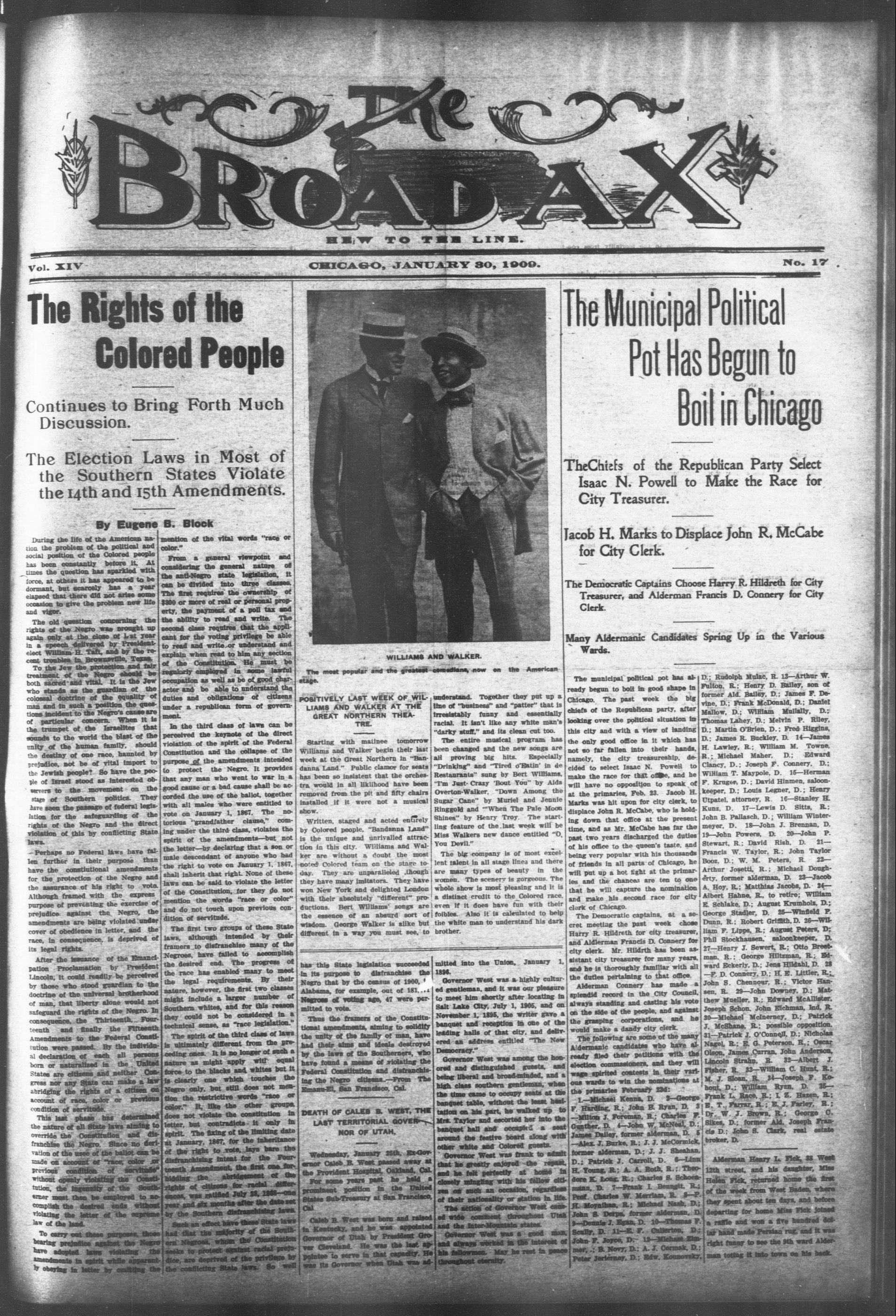
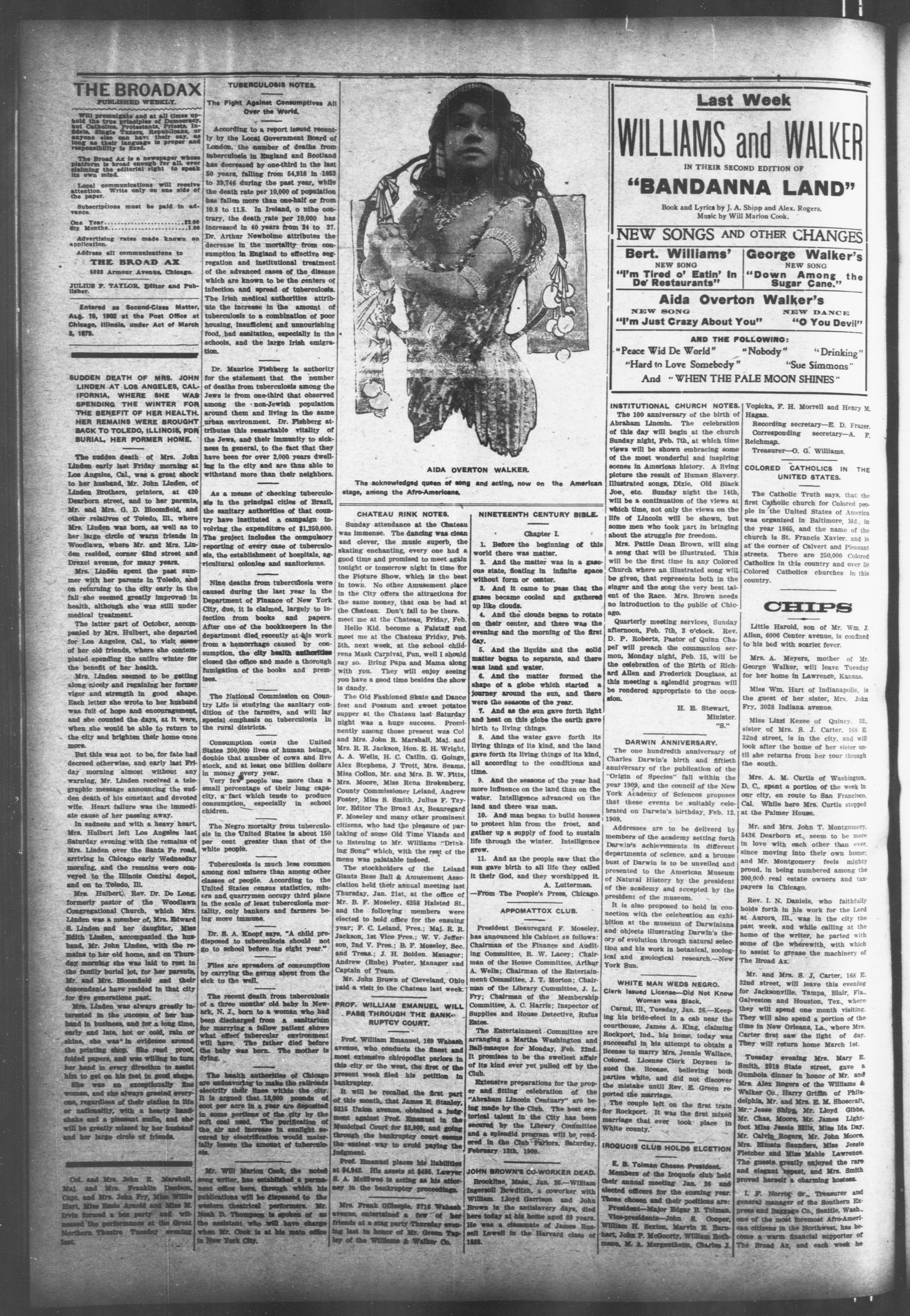
THE BROAD AX
NEW TO THE LINE.
Vol. XIV
CHICAGO, JANUARY 30, 1909.
No. 17
The Rights of the Colored People
Continues to Bring Forth Much Discussion.
The Election Laws in Most of the Southern States Violate the 14th and 15th Amendments.
During the life of the American nation the problem of the political and social position of the Colored people has been constantly before it. At times the question has sparkled with force, at others it has appeared to be dormant, but scarcely has a year elapsed that there did not arise some occasion to give the problem new life and vigor. The old question concerning the rights of the Negro was brought up again only at the close of last year in a speech delivered by President elect William H. Taft, and by the recent troubles in Brownsville, Texas.
To the Jew the protection and fair treatment of the Negro should be both sacred and vital. It is the Jew who stands as the guardian of the colossal doctrine of the equality of man and in such a position the questions incident to the Negro's cause are of particular concern. When it is the trumpet of the Israelites that sounds to the world the blast of the unity of the human family, should the destiny of one race, haunted by prejudice, not be of vital import to the Jewish people? So have the people of Israel stood as interested observers to the movement on the stage of Southern politics. They have seen the passage of federal legislation for the safeguarding of the rights of the Negro and the direct violation of this by conflicting State laws.
Perhaps no Federal laws have fallen further in their purpose than have the constitutional amendments for the protection of the Negro and the assurance of his right to vote. Although framed with the express purpose of preventing the exercise of prejudice against the Negro, the amendments are being violated under cover of obedience in letter, and the race, in consequence, is deprived of its legal rights.
After the issuance of the Emancipation Proclamation by President Lincoln, it could readily be perceived by those who stood guardian to the doctrine of the universal brotherhood of man, that liberty alone would not safeguard the rights of the Negro In consequence, the Thirteenth, Fourteenth and finally the Fifteenth Amendments to the Federal Constitution were passed. By the individual declaration of each all persons born or naturalized in the United States are citizens and neither Congress nor any State can make a law abridging the rights of a citizen on account of race, color or previous condition of servitude.
This last phase has determined the nature of all State laws aiming to override the Constitution and disfranchise the Negro. Since no derivation of the use of the ballot can be made on account of "race; color or previous condition of servitude" without openly violating the Constitution, the ingenuity of the Southern must then be employed to no-compile the desired ends without violating the letter of the supreme law of the land.
To carry out these purposes, those bearing prejudice against the Negro have adopted laws violating the amendments in spirit while apparently obeying in letter by omitting the
mention of the vital words "race or color."
From a general viewpoint and considering the general nature of the anti-Negro state legislation, it can be divided into three classes. The first requires the ownership of $800 or more of real or personal property, the payment of a poll tax and the ability to read and write. The second class requires that the applicant for the voting privilege be able to read and write or understand and explain when read to him any section of the Constitution. He must be regularly employed in some lawful occupation as well as be of good character and be able to understand the duties and obligations of citizens under a republican form of government.
In the third class of laws can be perceived the keynote of the direct violation of the spirit of the Federal Constitution and the collapse of the purpose of the amendments intended to protect the Negro. It provides that any man who went to war in a good cause or a bad cause shall be accorded the use of the ballot, together with all males who were entitled to vote on January 1, 1867. The notorious "grandfather clause," coming under the third class, violates the spirit of the amendments—but not the letter—by declaring that a son or male descendant of anyone who had the right to vote on January 1, 1867, shall inherit that right. None of these laws can be said to violate the letter of the Constitution, for they do not mention the words "race or color" and do not touch upon previous condition of servitude.
The first two groups of these State laws, although intended by their framers to disfranchise many of the Negroes, have failed to accomplish the desired end. The progress of the race has enabled many to meet the legal requirements. By their nature, however, the first two classes might include a larger number of Southern whites, and for this reason they could not be considered in a technical sense, as "race legislation."
The spirit of the third class of laws is ultimately different from the preceding ones. It is no longer of such nature as might apply with equal force to the blacks and whites but it is clearly one which touches the Negro only, but still does not mention the restrictive words "race or color." It, like the other groups, does not violate the constitution in letter, but contradicts it only in spirit. The faxing of the limiting data at January, 1867, for the inheritance of the right to vote, lays bare the disfranchising intent for the Fourteenth Amendment, the first one for bidding the abridgement of the rights of citizens for racial differences, was ratified July 28, 1868 one year and six months after the date set by the Southern disfranchising laws.
Such an effect have these State laws had that the majority of the Southern Negroes, whom the Constitution seeks to protect against racial prejudice, are deprived of the privilege by the conflicting State laws. So well
A
POSITIVELY LAST WEEK OF WILLIAMS AND WALKER AT THE GREAT NORTHERN THEA-
Starting with matinee tomorrow Williams and Walker begin their last week at the Great Northern in "Bandanna Land." Public clamor for seats has been so insistent that the orchestra would in all likelihood have been removed from the pit and fifty chairs installed if it were not a musical show.
Written, staged and acted entirely by Colored people, "Bandanna Land" is the unique and unrivalled attraction in this city. Williams and Walker are without a doubt the most noted Colored team on the stage today. They are unparalleled, though they have many imitators. They have won New York and delighted London with their absolutely "different" productions. Bert Williams' songs are the essence of an absurd sort of wisdom. George Walker is alike but different in a way you must see, to
has this State legislation succeeded in its purpose to disfranchise the Negro that by the census of 1900, Alabama, for example, out of 181... Negroes of voting age, 47 were permitted to vote.
Thus the framers of the Constitutional amendments, aiming to solidify the unity of the family of man, have had thes alms and ideals destroyed by the laws of the Southerners, who have found a means of violating the Federal Constitution and distranchising the Negro citizens.—From The Emanu-El, San Francisco, Cal.
DEATH OF CALEB B. WEST, THE LAST TERRITORIAL GOVERNOR OF UTAH.
Wednesday, January 25th, Ex-Gov
understand. Together they put up a line of "business" and "patter" that is irresistibly funny and essentially racial. It isn't like any white man's "darky stuff," and its clean cut too. The entire musical program has been changed and the new songs are all proving big hits. Especially "Drinking" and "Tired E'atin' in de Restaurants" sung by Bert Williams, "I'm Just Crazy 'Bout You" by Aida Overton-Walker, "Down Among the Sugar Cane" by Muriel and Jennie Ringgold and "When The Pale Moon Shines" by Henry Troy. The startling feature of the last week will be Miss Walkers new dance entitled "O, You Devil."
The big company is of most excellent talent in all stage lines and there are many types of beauty in the women. The scenery is gorgeous. The whole show is most pleasing and it is a distinct credit to the Colored race, even if it does have fun with their foibles. Also it is calculated to help the white man to understand his dark brother.
mitted into the Union, January 1
1896.
Governor West was a highly cultured gentleman, and it was our pleasure to meet him shortly after locating in Salt Lake City, July 1, 1905, and on November 1, 1895, the writer gave a banquet and reception in one of the leading halls of that city, and delivered an address entitled "The New Democracy."
Governor West was among the honored and distinguished guests, and being liberal and broad-minded, and a high class southern gentleman, when the time came to occupy seats at the banquet table, without the least hesitation on his part, he walked up to Mrs. Taylor and escorted her into the banquet hall and occupied a seat around the festive board along with other white and Colored guests.
Governor West was frank to admit that he greatly enjoyed the repast, and he felt perfectly at home in closely mingling with his fellow children on such an occasion, regardless of their nationality or station in life. The action of Governor West caused wide comment throughout Utah and the Inter-Mountain states.
Governor West was a good man and always worked in the interest of his fellowmen. May he rest in peace throughout eternity.
The Municipal Political Pot Has Begun to Boil in Chicago
TheChiefs of the Republican Party Select Isaac N. Powell to Make the Race for City Treasurer.
Jacob H. Marks to Displace John R. McCabe for City Clerk.
The Democratic Captains Choose Harry R. Hildreth for City Treasurer, and Alderman Francis D. Connery for City Clerk.
Many Aldermanic Candidates Spring Up in the Various Wards.
The municipal political pot has already begun to boil in good shape in Chicago. The past week the big chiefs of the Republican party, after looking over the political situation in this city and with a view of landing the only good office in it which has not so far fallen into their hands, namely, the city treasureship, decided to select Isaac N. Powell to make the race for that office, and he will have no opposition to speak of at the primaries, Feb. 23. Jacob H. Marks was hit upon for city clerk, to displace John R. McCabe, who is holding down that office at the present time, and as Mr. McCabe has far the past two years discharged the duties of his office to the queen's taste, and being very popular with his thousands of friends in all parts of Chicago, he will put up a hot light at the primaries and the chances are ten to one that he will capture the nomination and make his second race for city clerk of Chicago.
The Democratic captains, at a secret meeting the past week chose Harry R. Hildreth for city treasurer, and Alderman Francis D. Connery for city clerk. Mr. Hildreth has been assistant city treasurer for many years, and he is thoroughly familiar with all the duties pertaining to that office. Alderman Connery has made a splendid record in the City Council, always standing and casting his vote on the side of the people, and against the grasping corporations, and he would make a dandy city clerk.
The following are some of the many Aldermanic candidates who have already filed their petitions with the election commissioners, and they will wage spirited contests in their various wards to win the nominations at the primaries February 23d:
1.—Michael Kenna, D. 2.—George F. Harding, R.; John R. Ryan, D. 3.—Milton J. Foreman, R.; Charles F. Gunther, D. 4.—John W. McNeal, D.; James Dalley, former alderman, D. 5.—Alex J. Burke, R.; J. J. McCormick, former alderman, D.; J. J. Sheahan, D.; Patrick J. Carroll, D. 6.—Linn H. Young, R.; A. A. Roth, R.; Theodora K. Long, R.; Charles S. Schoenmann, D. 7.—Frank I. Benngtt, R.; Prof. Charles W. Merrlman, R. 8.—P. Moynihan, R.; Michael Nash, D.; John S. Derpa, former alderman, D. 9.—Dennis J. Egan, D. 10.—Thomas F. Scully, D. 11.—E. F. Cullerton, D.; John F. Joyce, D. 12.—Michael Emmar, B. Novy, D.; A. J. Cormak, D.; Peter Joriermay, D.; Edw. Kounovsky
D.; Rudolph Mulac, R. 13–Arthur W. Fulton, R.; Henry D. Bailey, son of former Ald. Bailey, D.; James F. Devine, D.; Frank McDonald, D.; Daniel Mallow, D.; William Mullally, D.; Thomas Lahey, D.; Melvin P. Riley, D.; Martin O'Brien, D.; Fred Higgins, D.; James R. Buckley, D. 14–James H. Lawley, R.; William M. Towne, R.; Michael Maher, D.; Edward Clancy, D.; Joseph F. Connery, D.; William T. Maypole, D. 15–Herman F. Kruger, D.; David Hinmen, saloonkeeper, D.; Louis Legner, D.; Henry Uptatel, attorney, R. 16–Stanley H. Kunz, D. 17–Lewis D. Slits, R.; John B. Pallasch, D.; William Wintermeyer, D. 18–John J. Brennan, D. 19–John Powers, D. 20–John P. Stewart, R.; David Rish, D. 21–Francis W. Taylor, R.; John Taylor Booz, D.; W. M. Peters, R. 22–Arthur Josetti, R.; Michael Dougherty, former alderman, D. 23–Jacob A. Hoy, Matthias Jacobs, D. 24–Albert Hahne, R., to retire; William E. Schlake, D.; August Krumholz, D.; George Stadler, D. 25–Winfield P. Dunn, R.; Robert Krumholz, D. 26–William F. Lipps, R.; August Peters, D; Phil Stockhausen, saloonkeeper, D. 27–Henry J. Sewert, R.; Otto Manner, R.; George Hiltzman, R.; Edward Eckery, D.; Jens Hildahl, D. 28–F. Connery, D.; H. E. Littler, R.; John S. Chennour, R.; Victor Hansen, R. 29–John Downey, D.; Matthew Mueller, R.; Edward McAllister, Joseph Schon, John Eichman, Ind. R. 30–Michael Meinerney, D.; Patrick J. McShane, R.; possible opposition. 31–Patrick J. O'Connell, D.; Nicholas Nagel, R.; E. G. Peterson, R.; Oscar Olson, James Curran, John Anderson, Lincoln Strahn, R. 32–Albert J. Fisher, R. 33–William C. Hunt, R. M. J. Sloan, R. 34–Joseph F. Kohnt, D.; William Ryan, D. 35–Frank L. Race, R.; I. Z. Hazen, R. E. T. Farrar, R.; E. J. Farley, R. Dr. W. J. Brown, R.; George O. Sikes, D.; former Ald. Joseph Francis D.; John S. Clark, real estate broker, D.
Alderman Henry L. Fick, 33 West 12th street, and his daughter, Miss Helen Fick, returned home the first of the week from West Baden, where they spent about ten days, and before departing for home Miss Fick joined a raggle and won a five hundred dollar hand made Persian rug, and it was right funny to see the 9th ward Alderman toting it into town on his back.
Will promulgate and at all times uphold the true principles of Democracy, but Catholics, Protestants, Priests, Inclides, Single Taxers, Republicans, or anyone else can have their say, because the law is proper and responsibility is fixed.
The Broad Ax is a newspaper whose platform is broad enough for all, ever claiming the editorial right to speak its own mind.
Local communications will receive attention. Write only on one side of the paper.
Subscriptions must be paid in advance.
One Year.....$2.00
Six Months.....1.00
Advertising rates made known on application.
JULIUS P. TAYLOR, Editor and Publisher.
Entered as Second-Class Matter,
Aug. 19, 1902 at the Post Office at
Chicago, Illinois, under Act of March
3, 1879.
SUDDEN DEATH OF MRS. JOHN
LINDEN-AT LOS ANGELES, CAL-
IFORNIA, WHERE SHE WAS
SPENDING THE WINTER FOR
THE BENEFIT OF HER HEALTH.
HER REMAINS WERE BROUGHT
BACK TO TOLEDO, ILLINOIS, FOR
BURIAL, HER FORMER HOME.
The sudden death of Mrs. John Linden early last Friday morning at Los Angeles, Cal., was a great shock to her husband, Mr. John Linden, of Linden Brothers, printers, at 420 Dearborn street, and to her parents, Mr. and Mrs. G. D. Bloomfield, and other relatives of Toledo, Ill., where Mrs. Linden was born, as well as to her large circle of warm friends in Woodlawn, where Mr. and Mrs. Linden resided, corner 62nd street and Drexel avenue, for many years. Mrs. Linden spent the past summer with her parents in Toledo, and on returning to the city early in the fall she seemed greatly improved in health, although she was still under medical treatment.
The latter part of October, accompanied by Mrs. Hulbert, she departed for Los Angeles, Cal., to visit some of her old friends, where she contemplated spending the entire winter for the benefit of her health.
Mrs. Linden seemed to be getting along nicely and regaining her former vigor and strength in good shape. Each letter she wrote to her husband was full of hope and encouragement, and she counted the days, at it were, when she would be able to return to the city and brighten their home once more.
But this was not to be, for fate had decreed otherwise, and early last Friday morning almost without any warning, Mr. Linden received a telegraphic message announcing the sudden death of his constant and devoted wife. Heart failure was the immediate cause of her passing away.
In sadness and with a heavy heart. Mrs. Hulbert left Los Angeles last Saturday evening with the remains of Mrs. Linden over the Santa Fe road, arriving in Chicago early Wednesday morning, and the remains were conveyed to the Illinois Central depot, and on to Toledo, Ill.
Mrs. Hubert, Rev. Dr. De Long, formerly pastor of the Woodlawn Congregational Church, which Mrs. Linden was a member of, Mrs. Edward S. Linden and her daughter, Miss Edith Linden, accompanied the husband, Mr. John Linden, with the remains to her old home, and on Thursday morning she was laid to rest in the family burial lot, for her parents, Mr. and Mrs. Bloomfield and their descendants have resided in that city for five generations past.
Mrs. Linden was always greatly interested in the success of her husband in business, and for a long time, early and late, hot or cold, rain or shine, she was* in evidence around the printing shop. She read proof, folded papers, and was willing to turn her hand in every direction to assist him to get on his feet in good shape. She was an exceptionally fine woman, and she always greeted everyone, regardless of their station in life or nationality, with a hearty hand-shake and a pleasant smile, and she will be greatly missed by her husband and her large circle of friends.
Col. and Mrs. John R. Marshall,
Maj. and Mrs. Franklin Danison,
Capt. and Mrs. John Fry, Miss Willie
Hart, Miss Basie Armold and Miss M.
Irvin formed a box party and witnessed the performance at the Great Northern Theatre Tuesday evening last.
TUBERCULOSIS NOTES.
According to a report issued recently by the Local Government Board of London, the number of deaths from tuberculosis in England and Scotland has decreased by one-third in the last 50 years, falling from 54,918 in 1853 to 39,746 during the past year, while the death rate per 10,000 of population has fallen more than one-half or from 10.8 to 11.5. In Ireland, o the contrary, the death rate per 10,000 has increased in 40 years from 24 to 27. Dr. Arthur Newholme attributes the decrease in the mortality from consumption in England to effective segregation and institutional treatment of the advanced cases of the disease which are known to be the centers of infection and spread of tuberculosis. The Irish medical authorities attribute the increase in the amount of tuberculosis to a combination of poor housing, insufficient and unnourishing food, bad sanitation, especially in the schools, and the large Irish emigration.
Dr. Maurice Fishberg is authority for the statement that the number of deaths from tuberculosis among the Jews is from one-third that observed among the non-Jewish population around them and living in the same urban environment. Dr. Fishberg attributes this remarkable vitality of the Jews, and their immunity to sickness in general, to the fact that they have been for over 2,000 years dwelling in the city and are thus able to withstand more than their neighbors.
As a means of checking tuberculosis in the principal cities of Brazil the sanitary authorities of that country have instituted a campaign involving the expenditure of $1,250,000. The project includes the compulsory reporting of every case of tuberculosis, the establishment of hospitals, agricultural colonies and sanitariums.
Nine deaths from tuberculosis were caused during the last year in the Department of Finance of New York City, due, it is claimed, largely to infection from books and papers. After one of the bookkeepers in the department died recently at his work from a hemorrhage caused by consumption, the city health authorities closed the office and made a thorough fumigation of the books and premises.
The National Commission on Country Life is studying the sanitary condition of the farmers, and will lay special emphasis on tuberculosis in the rural districts.
Consumption costs the United States 200,000 lives of human beings, double that number of cows and live stock, and at least one billion dollars in money every year. Very few people use more than a small percentage of their lung capacity, a fact which tends to produce consumption, especially in school children.
The Negro mortality from tuberculosis in the United States is about 150 per cent greater than that of the white people.
Tuberculosis is much less common among coal miners than among other classes of people. According to the United States census statistics, miners and quarrymen occupy third place in the scale of least tuberculosis mortality, only bankers and farmers being more immune.
Dr. S. A. Knopf says, "A child predisposed to tuberculosis should not go to school before its eight year."
Files are spreaders of consumption by carrying the germs about from the sick to the well.
The recent death from tuberculosis of a three months' old baby in Newark, N. J., born to a woman who had been discharged from a sanitarium for marrying a fellow patient shows what effect tubercular environment will have. The father died before the baby was born. The mother is dying.
The health authorities of Chicago are endeavoring to make the railroads electrify their lines within the city. It is argued that 12,000 pounds of soot per acre in a year are deposited in some portions of the city by the soft coal used. The purification of the air and increase in sunlight secured by electrification would materially lessen the amount of tuberculosis.
Mr. Will Marion Cook, the noted song writer, has established a permanent office here, through which his publications will be dispensed to the western theatrical performers. Mr. Noah D. Thompson is spoken of as the assistant who will have charge when Mr. Cook is at his main office in New York City.
A
AIDA OVERTON WALKER. The acknowledged queen of song and acting, now on the American stage, among the Afro-Americans.
Sunday attendance at the Chateau was immense. The dancing was clean and clever; the music superb, the skating enchanting, every one had a good time and promised to meet again tonight or tomorrow night in time for the Picture Show, which is the best in town. No other Amusement place in the City offers the attractions for the same money, that can be had at the Chateau. Don't fall to be there. meet me at the Chateau, Friday, Feb. Hello Kid, become a Falstaff and meet me at the Chateau Friday, Feb. 5th, next week, at the school childrens Mask Carnival, Fun, well I should say so. Bring Papa and Mama along with you. They will enjoy seeing you have a good time besides the show is dandy.
The Old Fashioned Skate and Dance fest and Possum and sweet potato supper at the Chateau last Saturday night was a huge success. Prominently among those present was Col and Mrs. John R. Marshall, Maj. and Mrs. R. R. Jackson, Hon. E. H. Wright. A. A. Wells, H. C. Catlin, G. Golings, Alex Stephens, J Trott, Mrs. Seams, Miss Collon, Mr. and Mrs. B. W. Fitts, Mrs. Moore, Miss Rena Brokenberg, County Commissioner Leland, Andrew Foster, Miss S. Smith, Julius F. Taylor, Editor The Broad Ax, Beauregard F. Moseley and many other prominent citizens, who had the pleasure of partaking of some Old Time Viands and to listening to Mr. Williams "Drinking Song" which, with the rest of the menu was palatable indeed.
The stockholders of the Leland Giants Base Ball & Amusement Association held their annual meeting last Thursday, Jan. 21st, at the office of Mr. B. F. Moseley, 6258 Halsted St. and the following members were elected to hold office for the ensuing year; F. C. Leland, Pres.; Maj. R. R. Jackson, 1st Vice Pres.; W. V. Jefferson, 2nd V. Pres.; B. F. Moseley, Sec. and Treas.; J. H. Bolden. Manager; Andrew (Rube) Foster, Manager and Captain of Team.
Mr. John Brown of Cleveland, Ohio paid a visit to the Chateau last week.
PROF. WILLIAM EMANUEL WILL
PASS THROUGH THE BANK
RUPTCY COURT.
Prof. William Emanuel, 169 Wabash avenue, who conducts the finest and most extensive chirropodist parlorls in this city or the west, the first of the present week filed his petition in bankruptcy.
It will be recalled the first part of this month, that James E. Stanley, 5215 Union avenue, obtained a judgment against Prof. Emanuel in the Municipal Court for $2,900, and going through the bankruptcy court seems the easiest way to avoid paying the judgment.
Prof. Emanuel places his liabilities at $4,942. His assets at $495. Lawyer S. A. McElwee is acting as his attorney in the bankruptcy proceedings.
Mrs. Frank Gillespie, 3716 Wabash avenue, entertained a few of her friends at a stag party Thursday evening last in honor of Mr. Green Taylor of the Williams & Walker Co.
1. Before the beginning of this world there was matter.
2. And the matter was in a gaseous state, floating in infinite space without form or center.
3. And it came to pass that the gases became cooled and gathered up like clouds.
4. And the clouds began to rotate on their center, and there was the evening and the morning of the first day.
5. And the liquids and the solid matter began to separate, and there was land and water.
6. And the matter formed the shape of a globe which started a journey around the sun, and there were the seasons of the year.
7. And as the sun gave forth light and heat on this globe the earth gave birth to living things.
8. And the water gave forth its living things of its kind, and the land gave forth its living things of its kind, all according to the conditions and time.
9. And the seasons of the year had more influence on the land than on the water. Intelligence advanced on the land and there was man.
10. And man began to build houses to protect him from the frost, and gather up a supply of food to sustain life through the winter. Intelligence grew.
11. And as the people saw that the sun gave birth to all life they called it their God, and they worshiped it.
—From The People's Press, Chicago
APPOMATTOX CLUB:
President Beauregard F. Moseley, has announced his Cabinet as follows: Chairman of the Finance and Auditing Committee, R. W. Lacey; Chairman of the House Committee, Arthur A. Wells; Chairman of the Entertainment Committee, J. T. Morton; Chairman of the Library Committee, J. L. Fry; Chairman of the Membership Committee, A. C. Harris; Inspector of Supplies and House Detective, Rufus Estes.
The Entertainment Committee are arranging a Martha Washington and Ball-masque for Monday, Feb. 22nd. It promises to be the swellest affair of its kind ever yet pulled off by the Club.
Extensive preparations for the proper and fitting celebration of the "Abraham Lincoln Centuary" are being made by the Club. The best oratorical talent in the City has been secured by the Library Committee and a splendid program will be rendered in the Club Parlors, Saturday, February 13th, 1909.
JOHN BROWN'S CO-WORKER DEAD.
Brookline, Mass., Jan. 25.—William Ingersoll Bewditch, a coworker with William Lloyd Garrison and John Brown in the antislavery days, died here today at his home aged 89 years. He was a classmate of James Russell Lowell in the Harvard class of 1888.
Last Week MS and WALKER
WILLIAMS and WALKER
IN THEIR SECOND EDITION OF
"BANDANNA LAND"
Book and Lyrics by J. A. Shipp and Alex. Rogers.
Music by Will Marion Cook.
NEW SONGS AND OTHER CHANGES
Bert. Williams'
NEW SONG
"I'm Tired o' Eatin' In De' Restaurants"
George Walker's
NEW SONG
"Down Among the Sugar Cane."
ton Walker's
NEW DANCE
You" "O You Devil"
FOLLOWING:
"Nobody" "Drinking"
"Sue Simmons"
PALE MOON SHINES"
"Peace Wid De World" "Nobody" "Drinking"
"Hard to Love Somebody" "Sue Simmons"
And "WHEN THE PALE MOON SHINES"
Vopicka, F. H. Morrell and Henry M. Hagan.
Recording secretary—E. D. Frazer.
Corresponding secretary—A. F. Reichman.
Treasurer—O. G. Williams.
COLORED CATHOLICS IN THE UNITED STATES.
The Catholic Truth says, that the first Catholic church for Colored people in the United States of America was organized in Baltimore, Md., in the year 1865, and the name of the church is St. Francis Xavier, and is at the corner of Calvert and Pleasant streets. There are 250,000 Colored Catholics in this country and over 50 Colored Catholics churches in this country.
CHIPS
Little Harold, son of Mr. Wm. J. Allen, 6006 Center avenue, is confined to his bed with scarlet fever.
Mrs. A. Meyers, mother of Mr. George Walker, will leave Tuesday for her home in Lawrence, Kansas.
Miss Wm. Hart of Indianapolis, is the guest of her sister, Mrs. John Fry, 3028 Indiana avenue.
Miss Lizzi Kezee of Quincy. Ill. sister of Mrs. S. J. Carter, 168 E 32nd street, is in the city, and will look after the home of her sister until she returns from her tour through the south.
Mrs. A. M. Curtis of Washington, D. C., spent a portion of the week in our city, en route to San Francisco, Cal. While here Mrs. Curtis stopped at the Palmer House.
Mr. and Mrs. John T. Montgomery, 5436 Dearborn st., seem to be more in love with each other than ever, since moving into their own home, and Mr. Montgomery feels mighty proud, in being numbered among the 200,000 real estate owners and tax payers in Chicago.
Rev. I. N. Daniels, who faithfully holds forth in his work for the Lord at Aurora, Ill., was in the city the past week, and while calling at the home of the writer, he parted with some of the wherewith, with which to assist to grease the machinery of The Broad Ax.
Mr. and Mrs. S. J, Carter, 168 E. 32nd street, will leave this evening for Jacksonville, Tampa, Blair, Fla. Galveston and Houston, Tex., where they will spend one month visiting. They will also spend a portion of the time in New Orleans, La., where Mrs. Carter first saw the light of day. They will return home March 1st.
Tuesday evening Mrs. Mary E. Smith, 2918 State street, gave a Gumbola dinner in honor of Mr. and Mrs. Alex Rogers of the Williams & Walker Co., Harry Griffin of Philadelphia, Mr. and Mrs. E. M. Shoecraft, Mr. Jesse Shipp, Mr. Lloyd Glibbs, Mr. Chas, Moore, Mr. James Lightfoot Miss Jessie Ellis, Miss Ida Day, Mr. Calvin Rogers, Mr. John Moore, Mrs. Elimata Saunders, Miss Jessie Fletcher and Miss Mable Lawrence. The guests greatly enjoyed the rare and elegant repast, and Mrs. Smith proved herself a charming hostess.
L. F. Norris Sr., Treasurer and general manager of the Southern Express and Baggage Co., Seattle, Wash., one of the most foremost Afro-American citizens in the Northwest, has become a warm financial supporter of The Broad Ax, and each week he
Bert. Williams'
NEW SONG
"I'm Tired o' Eatin' In De' Restaurants"
INSTITUTIONAL CHURCH NOTES.
INSTITUTIONAL CHURCH NOTES.
The 100 anniversary of the birth of Abraham Lincoln. The celebration of this day will begin at the church Sunday night, Feb. 7th, at which time views will be shown embracing some of the most wonderful and inspiring scenes in American history. A living picture the result of Human Slavery. Illustrated songs, Dixie, Old Black Joe, etc. Sunday night the 14th, will be a continuation of the views at which time, not only the views on the life of Lincoln will be shown, but some men who took part in bringing about the struggle for freedom.
Mrs. Pattie Dean Brown, will sing a song that will be illustrated. This will be the first time in any Colored Church where an illustrated song will be given, that represents both in the singer and the song the very best talent of the Race. Mrs. Brown needs no introduction to the public of Chicago.
Quarterly meeting services, Sunday afternoon, Feb. 7th, 3 o'clock. Rev. D. P. Roberts, Pastor of Quinn Chapel will preach the communion sermon, Monday night, Feb. 15, will be the celebration of the Birth of Richard Allen and Frederick Douglass, at this meeting a splendid program will be rendered appropriate to the occasion.
H. E. Stewart,
Minister
“S.”
DARWIN ANNIVERSARY.
The one hundredth anniversary of Charles Darwin's birth and fiftieth anniversary of the publication of the "Origin of Species" fall within the year 1909, and the council of the New York Academy of Sciences proposes that these events be suitably celebrated on Darwin's birthday, Feb. 12, 1909. Addresses are to be delivered by members of the academy setting forth Darwin's achievements in different departments of science, and a bronze bust of Darwin is to be unveiled and presented to the American Museum of Natural History by the president of the academy and accepted by the president of the museum.
It is also proposed to hold in connection with the celebration an exhibition at the museum of Darwiniana and objects illustrating Darwin's theory of evolution through natural selection and his work in botanical, zoological and geological research.—New York Sun.
WHITE MAN WEDS NEGRO.
Clerk Issued License—Did Not Know Woman was Black.
Carmi, Ill., Tuesday, Jan. 26.—Keeping his bride-elect in a cab near the courthouse, James A. King, claiming Rockport, Ind., his home, today was successful in his attempt to obtain a license to marry Mrs. Jennie Wallace, Colored. License Clerk Doynen issued the license, believing both parties white, and did not discover the mistake until Rev. E. Green reported the marriage.
The couple left on the first train for Rockport. It was the first mixed marriage that ever took place in White county.
E. B. Tolman Chosen President.
Members of the Iroquois club held their annual meeting Jan. 26 and elected officers for the ensuing year. Those chosen and their positions are:
President—Major Edgar H. Tolman.
Vice-presidents—John S. Cooper.
William H. Sexton, Marvin E. Barnhart, John P. McGoorty, William Rothmann, M. A. Mergentheim, Charles J.
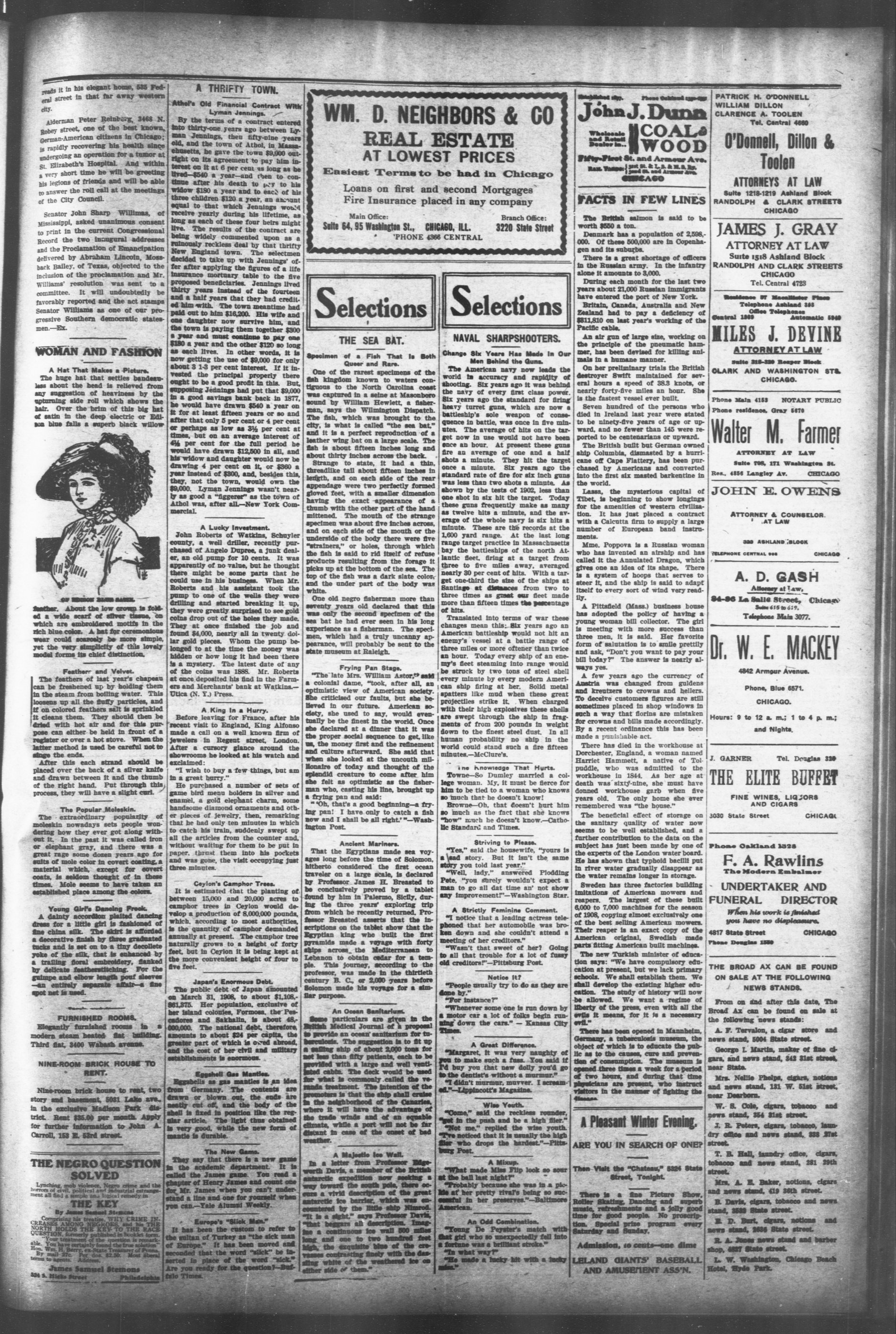
reads it in his elegant home, 585 Federal street in that far away western city.
Alderman Peter Reinberg, 3468 N. Robey street, one of the best known, German-American citizens in Chicago; is rapidly recovering his health since undergoing an operation for a tumor at St. Elizabeth's Hospital. And within a very short time he will be greeting his legions of friends and will be able to answer the roll call at the meetings of the City Council.
Senator John Sharp Willimas, of Mississippi, asked unanimous consent to print in the current Congressional Record the two inaugural addresses and the Proclamation of Emancipation delivered by Abraham Lincoln, Mossback Bailey, of Texas, objected to the inclusion of the proclamation and Mr. Williams' resolution was sent to a committee. It will undoubtedly be favorably reported and the act stamps Senator Williams as one of our progressive Southern democratic statesmen—Ex.
WOMAN AND FASHION
A Hat That Makes a Picture
The huge hat that settles bandesuless about the head is relieved from any suggestion of heaviness by the upturning side roll which shows the hair. Over the brim of this big hat of satin in the deep electric or Edition blue falls a superb black willow
ON MIDWICH BAY DAILY
feather. About the low crown is folded a wide scarf of silver tissue, on which are embroidered motifs in the rich blue color. A hat for ceremonious wear could scarcely be more simple, yet the very simplicity of this lovely model forms its chief distinction.
Feathers and Velvet.
The feathers of last year's chapeau can be freshened up by holding them in the steam from boiling water. This loosens up all the fuzzy particles, and if on colored feathers salt is sprinkled it cleans them. They should then be dried with hot air and for this purpose can either be held in front of a register or over a hot stove. When the latter method is used be careful not to singe the ends.
After this each strand should be placed over the back of a silver knife and drawn between it and the thumb of the right hand. Put through this process, they will have a slight curl.
The Popular Molekla
The extraordinary popularity of molekins nowadays sets people wondering how they ever got along without it. In the past it was called iron or elephant gray, and there was a great rage some dozen years ago for suits of mole color in covert coating, a material which, except for covert coats, is seldom thought of in these times. Mole seems to have taken an established place among the colors.
Young Olga's Dancing Brook
Young Girls Dancing Freak.
A dainty accordion plaited dancing dress for a little girl is fashioned of fine china silk. The skirt is afforded a decorative finish by three graduated tucks and is set on to a tiny decollete yoke of the silk, that is enhanced by a trailing floral embroidery, flanked by delicate featherswitching. For the gulpe and elbow length pouf sleeves—an entirely separate affair—a fine spot is used.
FURNISHED ROOMS. Elegantly furnished rooms in a modern steam heated flat building. Third flat, $400 Wabash avenue.
Nine-room brick house to rent, two story and basement, 5031 Lake ave. in the exclusive Madison Park district. Rent $35.00 per month. Apply for further information to John A. Carroll, 159 E. 53rd street.
Lynching, mob violence, Negro crime and the horrors of civil, industrial and industrial entrapment all find a simple and logical remedy in
THE KEY
By James Samuel Stemons
Comprises his treatise, WHY CRIME INCREASES CREATING A NORTH HOLDS THE KEY TO THE RACE QUESTION, formerly published in booklet form.
Your treatment of the question is remarkable. Hon. Wen H. Berry, ex-State Treasurer of Punna.
By mail 27c. Per dox. $2.50. Most liberal terms to agents. Address.
James Samuel Stemons
504 S. Hicks Street
Philadelphia
A THRIFTY TOWN.
Athe's Old Financial Contract With
Lyman Jennings
By the terms of a contract entered into thirty-one years ago between Lyman Jennings, then fifty-nine years old, and the town of Athol, in Massachusetts, he gave the town $9,900 outright on its agreement to pay him interest on it at 6 per cent as long as he lived—$540 a year and then to continue after his death to pay to his widow $180 a year and to each of his three children $120 a year, an amount equal to that which Jennings would receive yearly during his lifetime, as long as each of these four belts might live. The results of the contract are being widely commented upon as a ruinously reckless deal by that thrifty New England town. The selectmen decided to take up with Jennings' offer after applying the figures of a life insurance mortuary table to the five proposed beneficiaries. Jennings lived thirty years instead of the fourteen and a half years that they had credited him with. The town meantime had paid out to him $16,200. His wife and one daughter now survive him, and the town is paying them together $300 a year and must continue to pay one $180 a year and the other $120 so long as each lives. In other words, it is now getting the use of $9,000 for only about 3 1/3 per cent interest. If it invested the principal properly there ought to be a good profit in this. But, supposing Jennings had put that $9,000 in a good savings bank back in 1877, he would have drawn $540 a year on it for at least fifteen years or so and after that only 5 per cent or 4 per cent or perhaps as low as 3½ per cent at times, but on an average interest of 4½ per cent for the full period he would have drawn $12,500 in all, and his widow and daughter would now be drawing 4 per cent on it, or $360 a year instead of $800, and, besides this, they, not the town, would own the $9,000. Lyman Jennings wasn't nearly as good a "giggerer" as the town of Athol was, after all—New York Commercial.
A Lucky Investment.
John Roberts of Watkins, Schuyler county, a well driller, recently purchased of Angelo Dupree, a junk dealer, an old pump for 10 cents. It was apparently of no value, but he thought there might be some parts that he could use in his business. When Mr. Roberts and his assistant took the pump to one of the wells they were drilling and started breaking it up, they were greatly surprised to see gold coins drop out of the holes they made. They at once finished the job and found $4,000, nearly all in twenty dollar gold pieces. Whom the pump belonged to at the time the money was hidden or how long it had been there is a mystery. The latest date of any of the coins was 1888. Mr. Roberts at once deposited his find in the Farmers and Merchants' bank at Watkins.—Utica (N. Y.) Press.
Before leaving for France, after his recent visit to England, King Alfonso made a call on a well known firm of jewelers in Regent street, London. After a cursory glance around the showrooms he looked at his watch and exclaimed: "I wish to buy a few things, but am in a great hurry."
He purchased a number of sets of game bird menu holders in silver and enamel, a gold elephant charm, some handsome diamond ornaments and other pieces of jewelry, then, remarking that he had only ten minutes in which to catch his train, suddenly swept up all the articles from the counter and, without waiting for them to be put in paper, thrust them into his pockets and was gone, the visit occupying just three minutes.
Ceylon's Gamphor Trees.
It is estimated that the planting of between 15,000 and 20,000 acres to camphor trees in Ceylon would develop a production of 8,000,000 pounds, which, according to most authorities, is the quantity of camphor demanded annually at present. The camphor tree naturally grows to a height of forty feet, but in Ceylon it is being kept at the more convenient height of four to five feet.
Japan's Enormous Debt.
The public debt of Japan amounted on March 31, 1908, to about $1,108,861,875. Her population, exclusive of her island colonies, Formosa, the Pescadores and Sakhalin, is about 48,000,000. The national debt, therefore, amounts to about $24 per capita, the greater part of which is owed abroad, and the cost of her civil and military establishments is enormous.
Eushell Gas Mantle
Eggshells as gas mantles is an idea from Germany. The contents are drawn or blown out, the ends are neatly cut off, and the body of the shell is fixed in position like the regular article. The light thus obtained is very good, while the new form of mantle is durable.
The New Gamo
They say that there is a new game in the academic department. It is called the James game. You read a chapter of Henry James and count one for Mr. James when you can't understand a line and one for yourself when you can—Yale Alumni Weekly.
Europe's "Slick Man."
It has been the custom to refer to the sultan of Turkey as "the sick man of Europe." It has been moved and seconded in place of the word "slick." Are you ready for the question?—Buffalo Times.
WM. D. NEIGHBORS & GO REAL ESTATE AT LOWEST PRICES
Easiest Terms to be had in Chicago Loans on first and second Mortgages Fire Insurance placed in any company
Selections
THE SEA BAT.
Specimen of a Fish That Is Both Queer and Rare.
One of the rarest specimens of the fish kingdom known to waters contiguous to the North Carolina coast was captured in a seine at Masonboro sound by William Hewlett, a fisherman, says the Wilmington Dispatch. The fish, which was brought to the city, is what is called "the sea bat," and it is a perfect reproduction of a leather wing bat on a large scale. The fish is about fifteen inches long and about thirty inches across the back.
Strange to state, it had a thin, threadlike tail about fifteen inches in length, and on each side of the rear appendage were two perfectly formed gloved feet, with a smaller dimension having the exact appearance of a thumb with the other part of the hand mittened. The mouth of the strange specimen was about five inches across, and on each side of the mouth or the underside of the body there were five "strainers," or holes, through which the fish is said to rid itself of refuse products resulting from the forage it picks up at the bottom of the sea. The top of the fish was a dark slate color, and the under part of the body was white.
One old negro fisherman more than seventy years old declared that this was only the second specimen of the sea bat he had ever seen in his long experience as a fisherman. The specimen, which had a truly uncanny appearance, will probably be sent to the state museum at Raleigh.
Frying Pan Stage
"The late Mrs. William Astor," said a colonial dame, "took, after all, an optimistic view of American society. She criticised our faults, but she believed in our future. American society, she used to say, would eventually be the finest in the world. Once she declared at a dinner that it was the proper social sequence to get, like us, the money first and the refinement and culture afterward. She said that when she looked at the uncount millionaire of today and thought of the splendid creature to come after him she felt as optimistic as the fisherman who, casting his line, brought up a frying pan and said: "Oh, that's a good beginning—a frying pan! I have only to catch a fish now and I shall be all right."—Washington Post.
Ancient Mariners
That the Egyptians made sea voyages long before the time of Solomon, hitherto considered the first ocean traveler on a large scale, is declared by Professor James H. Breasted to be conclusively proved by a tablet found by him in Palermo, Sicily, during the three years' exploring trip from which he recently returned. Professor Breasted asserts that the inscriptions on the tablet show that the Egyptian king who built the first pyramids made a voyage with forty ships across the Mediterranean to Lebanon to obtain cedar for a temple. This journey, according to the professor, was made in the thirtieth century B. C., or 2,000 years before Solomon made his voyage for a similar purpose.
An Ocean Sanitarium
Some particulars are given in the British Medical Journal of a proposal to provide an ocean sanitarium for turbulences. The suggestion is to fit up a calling ship of about 2,000 tons for not less than fifty patients, each to be provided with a large and well ventilated cabin. The deck would be used for what is commonly called the veranda treatment. The intention of the promoter is that the ship shall cruise in the neighborhood of the Canaries, where it will have the advantage of the trade winds and of an equable climate, while a port will not be far distant in case of the onset of bed weather.
A Malastio Ice Wall.
In a letter from Professor Midgeworth Davis, a member of the British antarctic expedition now seeking a way toward the south pole, there occurs a vivid description of the great antarctic ice barrier, which was encountered by the Little ship Nimrod. "It is a sight," says Professor Davis, "that beggars all description. Imagine a continuous ice wall 500 miles long and one to two hundred feet high, the exquisite blue of the crevasses contrasting finely with the desoling white of the weathered ice on either side of them."
Branch Office:
3220 State Street
6 CENTRAL
Selections
NAVAL SHARPSHOOTERS.
Change Six Years Has Made In Our
Men Behind the Guns.
The American navy now leads the world in accuracy and rapidity of shooting. Six years ago it was behind the navy of every first class power. Six years ago the standard for firing heavy turret guns, which are now a battleship's sole weapon of consequence in battle, was once in five minutes. The average of hits on the target now in use would not have been once an hour. At present these guns fire an average of one and a half shots a minute. They hit the target once a minute. Six years ago the standard rate of fire for six inch guns was less than two shots a minute. As shown by the tests of 1902, less than one shot in six hit the target. Today these guns frequently make as many as twelve hits a minute, and the average of the whole navy is six hits a minute. These are the records at the 1,600 yard range. At the last long range target practice in Massachusetts bay the battleships of the north Atlantic fleet, firing at a target from three to five miles away, averaged nearly 30 per cent of hits. With a target one-third the size of the ships at Santiago at distances from two to three times as great our fleet made more than fifteen times the percentage of hits.
Translated into terms of war these changes mean this: Six years ago an American battleship would not hit an enemy's vessel at a battle range of three miles or more oftener than twice an hour. Today every ship of an enemy's fleet steaming into range would be struck by two tons of steel shell every minute by every modern American ship firing at her. Solid metal spatters like mud when these great projectiles strike it. When charged with their high explosives these shells are swept through the ship in fragments of from 200 pounds in weight down to the finest steel dust. In all human probability no ship in the world could stand such a fire fifteen minutes. -McClure's.
The knowledge That Hurts.
Towne- So Dumley married a college woman. My, it must be fierce for him to be tied to a woman who knows so much that he doesn't know! Browne-Oh, that doesn't hurt him so much as the fact that she knows "how" much he doesn't know. Catholic Standard and Times.
Striving to Please
"Yes," said the housewife, "yours is a sad story. But it isn't the same story you told last year."
"Well, lady," answered Plodding Pete, "you surely wouldn't expect a man to go all dat time an' not show any improvement!"—Washington Star.
A Strictly Feminine Comment.
"I notice that a leading actress telephoned that her automobile was broken down and she couldn't attend a meeting of her creditors."
"Wasn't that sweet of her? Going to all that trouble for a lot of fussy old creditors!"—Pittsburg Post.
Notice It?
"People usually try to do as they are done by."
"For instance?"
"Whenever some one is run down by a motor car a lot of folks begin running down the cars." — Kansas City Times.
"Margaret, it was very naughty of you to make such a fuss. You said if I'd buy you that new dolly you'd go to the dentist's without a murmur." "I didn't murmur, muvver. I screamed."-Linplncott's Magazine.
Wise Youth.
"Come," said the reckless rounder,
"got in the push and be a high filer."
"Not me," replied the wise youth.
"I've noticed that it is usually the high
filer who drops the hardest."—Pitts-
burg Post.
"Probably because she was in a pli-
kie at her pretty rival's being so suc-
culent in her preserves."—Baltimore
American.
An Odd Combination.
"Young De Peyster's match with
that girl who so unexpectedly fell into
a fortune was a brilliant stroke."
"In what way?"
"He made a lucky hit with a lucky
man."
FIFTY-FIRST St. and Armour Ave.
Bax. Fargo | gst St. & L. & M. & R. &
gnd St. and Armour dve.
CACAGO
FACTS IN FEW LINES
The British salmon is said to be worth $550 a ton.
Denmark has a population of 2,598,000. Of these 500,000 are in Copenhagen and its suburbs.
There is a great shortage of officers in the Russian army. In the infantry alone it amounts to 3,000.
During each month for the last two years about 21,000 Russian immigrants have entered the port of New York.
Britain, Canada, Australia and New Zealand had to pay a deficiency of $811,810 on last year's working of the Pacific cable.
An air gun of large size, working on the principle of the pneumatic hammer, has been devised for killing animals in a humane manner.
On her preliminary trials the British destroyer Swift maintained for several hours a speed of 38.3 knots, or nearly forty-five miles an hour. She is the fastest vessel ever built.
Seven hundred of the persons who died in Ireland last year were stated to be ninety-five years of age or upward, and no fewer than 145 were reported to be centenarians or upward. The British built but German owned ship Columbia, dismasted by a hurricane off Cape Flattery, has been purchased by Americans and converted into the first six masted barkentine in the world. Lassa, the mysterious capital of Tibet, is beginning to show longings for the amenities of western civilization. It has just placed a contract with a Calcutta firm to supply a large number of European band instruments.
Mme. Poppova is a Russian woman who has invented an airship and has called it the Annulated Dragon, which gives one an idea of its shape. There is a system of hoops that serves to steer it, and the ship is said to adapt itself to every sort of wind very readily.
A Pittsfield (Mass.) business house has adopted the policy of having a young woman bill collector. The girl is meeting with more success than three men, it is said. Her favorite form of salutation is to smile prettily and ask, "Don't you want to pay your bill today?" The answer is nearly always yes.
A few years ago the currency of Austria was changed from gudels and kreutzers to crowns and hellers. To deceive customers figures are still sometimes placed in shop windows in such a way that florins are mistaken for crowns and bills made accordingly. By a recent ordinance this has been made a punishable act.
There has died in the workhouse at Dorchester, England, a woman named Harriet Hammett, a native of Tolpuddle, who was admitted to the workhouse in 1844. As her age at death was sixty-nine, she must have donned workgarb when five years old. The only home she ever remembered was "the house."
The beneficial effect of storage on the sanitary quality of water now seems to be well established, and a further contribution to the data on the subject has just been made by one of the experts of the London water board. He has shown that typhoid bacilli put in river water gradually disappear as the water remains longer in storage. Sweden has three factories building imitations of American mowers and reapers. The largest of these built 6,000 to 7,000 machines for the season of 1908, copying almost exclusively one of the best selling American mowers. Their reaper is an exact copy of the American original, Swedish made parts fitting American built machines.
The new Turkish minister of education says: "We have compulsory education at present, but we lack primary schools. We shall establish them. We shall develop the existing higher education. The study of history will now be allowed. We want a regime of liberty of the press, even with all the evils it means, for it is a necessary evil."
There has been opened in Mannheim, Germany, a tuberculosis museum, the object of which is to educate the public as to the causes, cure and prevention of consumption. The museum is opened three times a week for a period of two hours, and during that time physicians are present, who instruct visitors in the manner of fighting the disease.
A Pleasant Winter Evening.
PATRICK H. O'DONNELL
WILLIAM DILLON
CLARENCE A. TOOLEN
Tel. Central 4680
O'Donnell, Dillon &
Toolen
ATTORNEYS AT LAW
Suite 1218-1219 Ashland Block
RANDOLPH & CLARK STREETS
CHICAGO
JAMES J. GRAY
ATTORNEY AT LAW
Suite 1518 Ashland Block
RANDOLPH AND CLARK STREETS
CHICAGO
Tel. Central 4723
Residence 97 MacMaster Flnss
Telephone Ashland 388
Office Telephones
Central 1889 Automatic 5949
MILES J. DEVINE
ATTORNEY AT LAW
Suite 318-320 Reeper Block
CLARK AND WASHINGTON ST.
CHICAGO.
Phone Main 4153 NOTARY PUBLIC
Phone residence, Gray 5670
Walter M. Farmer
ATTORNEY AT LAW
Suite 708, 171 Washington St.
Res. 4856 Langley Av. CHICAGO
JOHN E. OWENS
ATTORNEY & COUNSELOR
AT LAW
TELEPHONE CENTRAL 998 CHICAGO
A. D. GASH
Attorney at Law.
84-86 La Salle Street, Chicago
Suite 615 to 619.
Telephone Main 3077.
Dr. W. E. MACKEY
4842 Armour Avenue.
Phone, Blue 6571.
CHICAGO.
Hours: 9 to 12 a. m.; 1 to 4 p. m.; and Nights.
J. GARNER Tel. Douglas 320
THE ELITE BUFFET
FINE WINES, LIQSORS
AND CIGARS
3030 State Street CHICAGO
Phone Oakland 1528
F. A. Rawlins
The Modern Embalmer
UNDERTAKER AND
FUNERAL DIRECTOR
When his work is finished
you have no displeasure.
4817 State Street CHICAGO
Phone Douglas 1529
THE BROAD AX CAN BE FOUND
ON SALE AT THE FOLLOWING
NEWS STANDS.
From on and after this date, The
Broad Ax can be found on sale at
the following news stands:
A. F. Tervalon, a cigar store and
news stand, 5004 State street.
George I. Martin, maker of fine cigars, and news stand, 542 31st street, near State.
Mrs. Nellie Phelps, cigars, notions and news stand, 131 W. 51st street, near Dearborn.
W. S. Cole, cigars, tobacco and news stand, 354 31st street.
J. B. Peters, cigars, tobacco, laundry office and news stand, 333 37st street.
T. B. Hall, laundry office, cigars, tobacco and news stand, 281 29th street.
Mrs. A. E. Baker, notions, cigars and news stand, 419 36th street.
B. Davis, cigars, tobacco and news stand, 2839 State street.
B. D. Burt, cigars, notions and news stand, 2638 State street.
R. A. Jones news stand and barber shop, 4827 State street.
L. W. Washington, Chicago Beach Hotel, Hyde Park.
---
Yukon-Pacific Exposition.
The Alaska-Yukon-Pacific exposition monument, to be the crowning work of sculpture of the international exhibition of 1900, will be covered with solid gold leaf. Gold donations to the amount of $7,000, necessary to completely cover the great shaft with the shining metal, will be solicited from Alaskans, Yukoners and the people of Seattle.
An appropriation to cover the cost of building the monument in staff has been authorized, the drawings made and the sculptor is engaged in building his clay model. The monument is to stand in the center of the plaza in front of the magnificent group of United States government buildings and directly at the head of the Cascades. Looking south from the monument will be first the central features of the exposition, and then the eye will travel over a panorama of eighty miles of mountain, lake and woodland scenery to Balmer and the Cascade range.
The exposition monument is to be more than seventy feet in height. The monument proper will stand on a pedestal twenty feet high. This column will be of Corinthian design, on the top of which will be a globe giving the signs of the zodiac. On top of this globe will be a huge American eagle with outstretched wings, as in flight. Grouped about the base of the monument will be three seated female figures symbolic of the northland, the south seas and the orient. Every foot of this great monument will have the appearance of having been hammered out of pure gold if the donations are sufficient to complete the undertaking.—Seattle Times.
Youthful Suicides
There is a shocking proneness among youthful Bengalis to kill themselves on the least pretext. It seems to be an exaggerated form of silliness, and one would like to have a medical opinion on the matter. A student is reprimanded by, his parent because his studies don't show the advancement expected. The boy swallows some opium and ends his studies. A girl wife in Howrah takes a dislike to the second choice of her husband. She also secures an exit by the easy means of opium. A Bengali woman in Howrah wanted to go on a pilgrimage to Gays. Her mother said she could not advance the railway fare, and the girl went out to a tree and hanged herself. These are all recent cases. Calcutta Empire.
A Pleasant Prison.
A PRESENT PRISON.
The prison at Cottenje, Montenegro, has been described as surely the most extraordinary one in existence. It presents little to indicate that it is a place of confinement, there being apparently nothing between the prisoners and absolute liberty. There are no enter prison walls, and in the cells the man—about eight or ten to each—are contentedly and comfortably housed as their own personal domestic belongings can make them. Moreover, they are generously fed, and cigarettes without stint, wine occasionally and no work at all combine to check any desire to escape more effectually than would strong walls, iron bars and an army of jailera—London Globe.
Here is a story speaking better for the German emperor's goodness of heart than his knowledge of the ancient and royal game of golf. "So you want ground for your golf club, Sir Frank?" said the kalser to the British ambassador at Berlin. "We haven't got nice grass meadows round Berlin, as you have in England, but I'll give you a bit of the Grunewald." a pine forest near Berlin and a great Sunday resort of the Berliners. "Ah, sire," Sir Frank Lascelles replied, "I am afraid there would be too many trees!" "Trees!" instantly replied the emperor, with bonhomie. "All the better to keep the sun off you when you are playing in the summer!"
Cold Storage Poultry.
The state board of health of Massachusetts has issued a bulletin on cold storage poultry in which this advice is given to housekeepers: "In order to avoid obtaining waterlogged and frozen fowls the consumer should demand the frozen bird and thaw it himself. If thawed quickly by immersion in a bucket of hot water it may be eaten with impunity and with relish the same dill it is purchased, or if lung overnight at room temperature it may be ready for use the day following."
The Wealth of Our Nation.
In 1880 the United States held the fourth rank among the manufacturing nations, Great Britain, France and Germany were ahead of us, in the order named. We passed Great Britain in 1880, and today the aggregate of our manufactures equals that of Great Britain, Germany and France combined. The value of our products of manufactures has doubled since 1888. The value of our exports of manufactures has doubled since 1898. In the value of the property represented manufactures rank third among the great activities of the United States, agriculture being first and the railroads being second, but in the number of persons employed agriculture is the only interest which leads manufactures. Manufactures are far ahead of agriculture in the value of the products. The money invested in manufactures represents an eighth of the value of all the real and personal property in the country. The United States manufactures 35 per cent of all the manufactured products of the world. The value of the farm property of the United States increased from $7,960,000,000 in 1880 to $20,514,000,000 in 1900 and about $25,000,000 in 1908.
A Disgusted Dog.
A family downtown, having a false grate in one of the rooms of the house, placed some red paper behind it to give it the effect of fire. On one of the coldest days the dog belonging to the household came in from out of doors and, seeing the paper in the grate, deliberately walked up to it and laid down before it, curling up in the best way to receive the glowing heat as it came from the fire. He remained motionless for a few moments. Feeling no warmth, he raised his head and looked over his shoulder at the grate. Still feeling no heat, he went across and carefully applied his nose to the grate and smelt of it. It was cold as ice. With a look of the most supreme disgust, his tall curled down between his legs, every hair on his body saying "Tm sold," the dog trothed out of the room, not even deigning to cast a look at the party in the room who had watched his actions and laughed so heartily at his misfortune. That dog had reason as well as instinct—Troy Times.
New Use of Electricity in Printing.
Printed sheets as delivered from the press frequently "offset" or smear from undried ink. An electrical method of preventing this has recently been patented. The sheets as they leave the press first pass over electric heaters and also over a conductor carrying a current of very high tension, from which a silent discharge or "leakage" of electricity passes to the paper. The combined effects of the heat and of the electrical discharge, together with the chemical action of the osone generated in the air by the latter, "let" the ink so that it cannot smear. Besides this, the effect of any frictional electricity already present on the sheets, preventing their piling properly, is neutralized by the discharge—New York Herald.
Harmful Precedent.
"There are no telephones in English banks," said a banker. "Even the great Bank of England itself has no telephone.
"That sort of thing is what sets England behind the times—that observance of tradition, that refusal of new things, as though simply because they are new they must of necessity be vulgar and bad.
"A London bank and its branches were swindled out of a large sum the other day. The swindle would have failed had a system of telephones connected these banks.
"But in the past banks had no telephones in England. Therefore precedent requires that they do without them still."
Bulgaria's Eclipse.
Bulgaria is sufficiently in the public eye just now to compensate her for a total eclipse that lasted for three or four centuries. Between the obliteration of medieval Bulgaria by the conquering Turk and her very modern resurrection she disappeared more completely than Poland ever has. The very name of Bulgaria was remembered only by the learned. Sir Charles Elliot points out that in journeying from Belgrade to Constantinople in 1884 Kinskia must have passed straight across Bulgaria, yet when describing his travels in "Eothen" he makes no allusion to the country or its inhabitants.
Refusing to "feed the Brute."
"If," says Lady Frances Balfour,
"women who cook and do laundry
work refused to cook and wash shirts
for their men folk before they return
home they would get the suffrage very
quickly." Our own impression is that
a good many of the recalcitrant
women folk would get something else
first, for if you refuse to "feed the
brute" the brute is very apt to wax
brutal. As to the less brutal brute,
he would probably be content to put his
washing out, decline to "come home to
his tea" and stop supplies while waiting
for the clouds to roll by—Fall
Mall Gasette.
Australian Barmalde.
The barmalde of Sydney and Melbourne are the prettiest in the world. They are mostly recruited from Tasmania, the singular state of the commonwealth, which has been christened the "Citrusia of the Colonies" on account of the surprising loveliness of its daughters, several of whom have found their way into the select pages of Dell and Debrett—London Chronicle.
3 per cent allowed on Savings Accounts Safety Deposit Vaults, $3.00 per Year
Office Phone, Douglas 727 Res. Phone, Douglas 5998
E. JACKSON
FUNERAL DIRECTOR
2959-61 STATE ST., CHICAGO
Branch: 1310 Bingham St., Pittsburg, Pa.
Fine Garriages for Hire to Parties and Weddings.
ROBERT K. SLOAN
FUNERAL DIRECTOR
2821-23 Archer Ave. - Chicago
Telephone Yards 721
FIRST CLASS LIVERY
BROOKLYN MUSEUM
S. E. Cor. State and 36th Place, Chicago Telephone Douglas 1565
WHERE EVERY PATRON Saves ON EVERY PURCHASE
Jacob Feinberg
Wholesale and Retail
MARKET AND GROCERY
TELEPHONE DOUGLAS 565
81st and State Streets
Telephone Yards 693
JOHN J. BRADLEY
Real Estate
Loans
Fire and Plate Glass Insurance
4709 S. HALSTED ST
CHICAGO
Stove Heated Flats
I am no Agent. I Rent only my own Property You will save many a weary step when you want a Flat if you first call on me.
Phone Oakland 1787.
THE RAILROAD INN
Imported and Domestic Wines
Liquors & Cigars
Cafe In Connection
N. E. Corner Fifty-first and Armour Avenue, Chicago, I.