The Broad Ax
Saturday, February 6, 1909
Chicago, Illinois
Page text (machine-generated)
THE BROAD AX
HEW TO THE LINE.
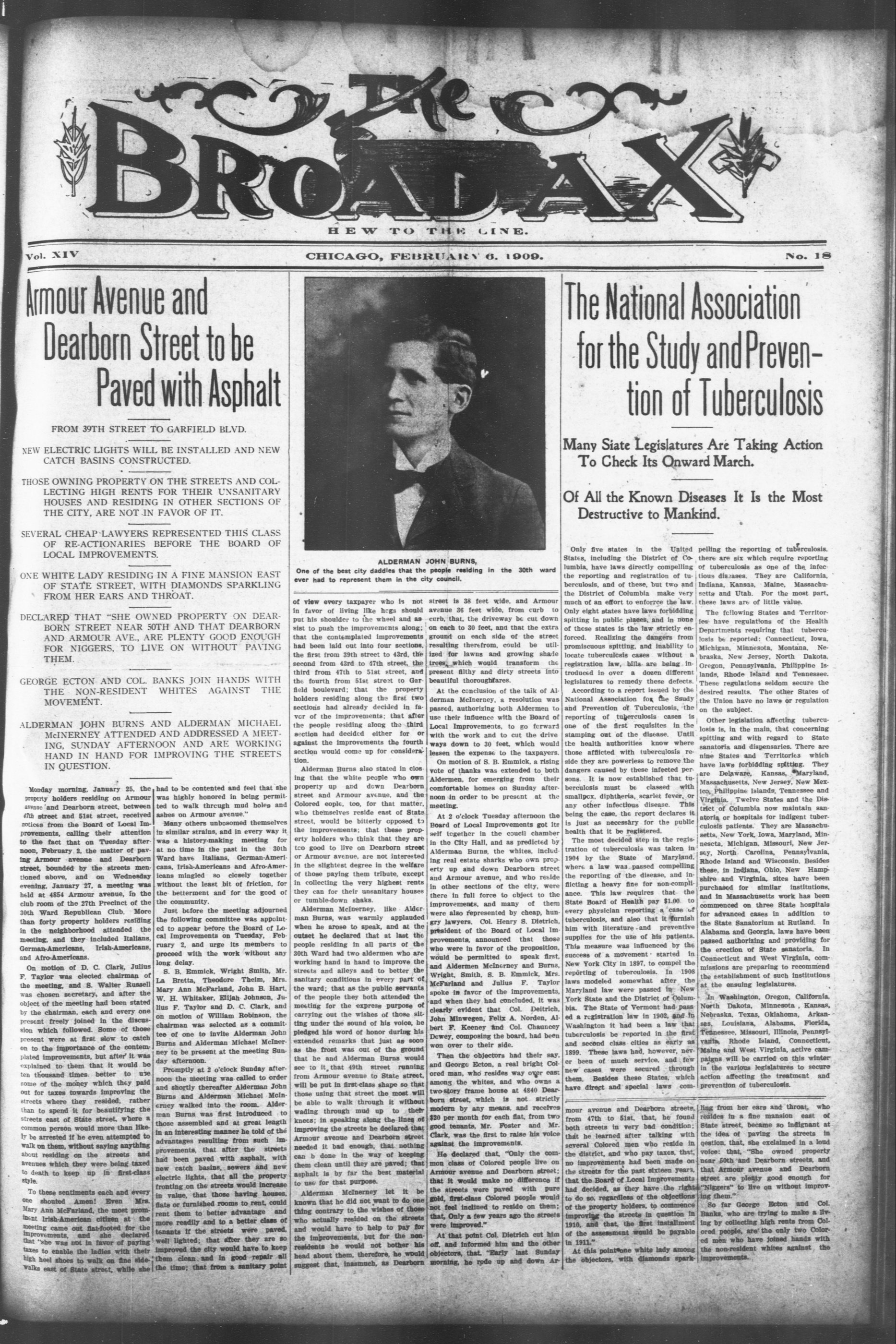
Armour Avenue and Dearborn Street to be Paved with Asphalt
FROM 39TH STREET TO GARFIELD BLVD.
NEW ELECTRIC LIGHTS WILL BE INSTALLED AND NEW CATCH BASINS CONSTRUCTED.
THOSE OWNING PROPERTY ON THE STREETS AND COLLECTING HIGH RENTS FOR THEIR UNSANITARY HOUSES AND RESIDING IN OTHER SECTIONS OF THE CITY, ARE NOT IN FAVOR OF IT.
SEVERAL CHEAP LAWYERS REPRESENTED THIS CLASS OF RE-ACTIONARIES BEFORE THE BOARD OF LOCAL IMPROVEMENTS.
ONE WHITE LADY RESIDING IN A FINE MANSION EAST OF STATE STREET, WITH DIAMONDS SPARKLING FROM HER EARS AND THROAT.
DECLARED THAT "SHE OWNED PROPERTY ON DEARBORN STREET NEAR 50TH AND THAT DEARBORN AND ARMOUR AVE., ARE PLENTY GOOD ENOUGH FOR NIGGERS, TO LIVE ON WITHOUT PAVING THEM.
GEORGE ECTON AND COL. BANKS JOIN HANDS WITH THE NON-RESIDENT WHITES AGAINST THE MOVEMENT.
ALDERMAN JOHN BURNS AND ALDERMAN MICHAEL McINERNEY ATTENDED AND ADDRESSED A MEETING, SUNDAY AFTERNOON AND ARE WORKING HAND IN HAND FOR IMPROVING THE STREETS IN QUESTION.
Vol. XIV
Armour Avenue
Dearborn St.
Paved
FROM 39TH STREET
NEW ELECTRIC LIGHTS WILL
CATCH BASINS CONSTANT
THOSE OWNING PROPERTY O
LECTING HIGH RENTS
HOUSES AND RESIDING
THE CITY, ARE NOT IN
SEVERAL CHEAP LAWYERS
OF RE-ACTIONARIES
LOCAL IMPROVEMENTS
ONE WHITE LADY RESIDING
OF STATE STREET, WI
FROM HER EARS AND
DECLARED THAT "SHE OW
BORN STREET NEAR 5
AND ARMOUR AVE., A
FOR NIGGERS, TO LIE
THEM.
GEORGE ECTON AND COL.
THE NON-RESIDENT
MOVEMENT.
ALDERMAN JOHN BURNS
McINERNEY ATTENDED
ING, SUNDAY AFTER
HAND IN HAND FOR
IN QUESTION.
Monday morning, January 25, the property holders residing on Armour avenue and Dearborn street, between 47th street and 51st street, received notices from the Board of Local Improvements, calling their attention to the fact that on Tuesday afternoon, February 2, the matter of paving Armour avenue and Dearborn street, bounded by the streets mentioned above, and on Wednesday evening, January 27, a meeting was held at 4854 Armour avenue, in the club room of the 27th Precinct of the 30th Ward Republican Club. More than forty property holders residing in the neighborhood attended the meeting, and they included Italians, German-Americans, Irish-Americans, and Afro-Americans.
On motion of D. C. Clark, Julius F. Taylor was elected chairman of the meeting, and S. Walter Russell was chosen secretary, and after the object of the meeting had been stated by the chairman, each and every one present freely joined in the discussion which followed. Some of those present were at first slow to catch on to the importance of the contemplated improvements, but after it was explained to them that it would be ten thousand times, better to use some of the money which they paid out for taxes towards improving the streets where they resided, rather than to spend it for beautifying the streets east of Státe street, where a common person would more than likely be arrested if he even attempted to walk on them, without saying anything about residing on the streets and avenues which they were being taxed to death to keep up in first-class style.
To these sentiments each and every one shouted Amen! Even Mrs. Mary Ann McFarland, the most prominent Irish-American citizen at the meeting came out flat-footed for the improvements, and she declared that 'she was not in favor of paying taxes to enable the ladies with their high heel shoes to walk on fine side-walks east of State street, while she
had to be contented and feel that she was highly honored in being permitted to walk through mud holes and ashes on Armour avenue." Many others unbosomed themselves in similar strains, and in every way it was a history-making meeting for at no time in the past in the 30th Ward have Italians, German-Americans, Irish-Americans and Afro-Americans mingled so closely together without the least bit of friction, for the betterment and for the good of the community.
Just before the meeting adjourned the following committee was appointed to appear before the Board of Local Improvements on Tuesday, February 2, and urge its members to proceed with the work without any long delay.
S. B. Emmick, Wright Smith, Mr. La Bretta, Theodore Theim, Mrs. Mary Ann McFarland, John B. Hart, W. H. Whitaker, Elijah Johnson, Julius F. Taylor and D. C. Clark, and on motion of William Robinson, the chairman was selected as a committee of one to invite Alderman John Burns and Alderman Michael McInerney to be present at the meeting Sunday afternoon.
Promptly at 2 o'clock Sunday afternoon the meeting was called to order and shortly thereafter Alderman John Burns and Alderman Michael McInerney walked into the room. Alderman Burns was first introduced to those assembled and at great length in an interesting manner he told of the advantages resulting from such improvements, that after the streets had been paved with asphalt, with new catch basins, sewers and new electric lights, that all the property fronting on the streets would increase in value, that those having houses, flats or furnished rooms to rent, could rent them to better advantage and more readily and to a better class of tenants if the streets were paved, lighted; that after they are so improved the city would have to keep them clean and in good repair all the time; that from a sanitary point
CHICAGO, FEBRUARY 6. 1909.
[Name not visible]
of view every taxpayer who is not in favor of living like hegs should put his shoulder to the wheel and assist to push the improvements along; that the contemplated improvements had been laid out into four sections, the first from 39th street to 43rd, the second from 43rd to 47th street, the third from 47th to 51st street, and the fourth from 51st street to Garfield boulevard; that the property holders residing along the first two sections had already decided in favor of the improvements; that after the people residing along the third section had decided either for or against the improvements the fourth section would come up for consideration.
street is 38 feet wide, and Armour avenue 36 feet wide, from curb to curb, that, the driveway be cut down on each to 30 feet, and that the extra ground on each side of the street resulting therefrom, could be utilized for lawns and growing shade trees, which would transform the present filthy and dirty streets into beautiful thoroughfares.
At the conclusion of the talk of Alderman McInerney, a resolution was passed, authorizing both Aldermen to use their influence with the Board of Local Improvements, to go forward with the work and to cut the drive ways down to 30 feet, which would lessen the expense to the taxpayers.
On motion of S. B. Furnick a rising
Alderman Burns also stated in closing that the white people who own property up and down Dearborn street and Armour avenue, and the Colored eople, too, for that matter, who themselves reside east of Stata street, would be bitterly opposed to the improvements; that these property holders who think that they are too good to live on Dearborn street or Armour avenue, are not interested in the slightest degree in the welfare of those paying them tribute, except in collecting the very highest rents they can for their unsanitary houses or tumble-down shaks.
Alderman McInerney, like Alderman Burns, was warmly applauded when he arose to speak, and at the outset he declared that at last the people residing in all parts of the 30th Ward had two aldermen who are working hand in hand to improve the streets and alleys and to better the sanitary conditions in every part of the ward; that as the public servants of the people they both attended the meeting for the express purpose of carrying out the wishes of those sitting under the sound of his voice, he pledged his word of honor during his extended remarks that just as soon as the frost was out of the ground that he and Alderman Burns would see to it that 49th street running from Armour avenue to State street, will be put in first-class shape so that those using that street the most will be able to walk through it without wading through mud up to their knees; in speaking along the lines of improving the streets he declared that Armour avenue and Dearborn street needed it bad enough, that nothing can be done in the way of keeping them clean until they are paved; that asphalt is by far the best material to use for that purpose.
Alderman McInerney let it be known that he did not want to do one thing contrary to the wishes of those who actually resided on the streets and would have to help to pay for the improvements, but for the non-residents he would not bother his head about them, therefore, he would suggest that, inasmuch, as Dearborn
street is 38 feet wide, and Armour avenue 36 feet wide, from curb to curb, that, the driveway be cut down on each to 30 feet, and that the extra ground on each side of the street resulting therefrom, could be utilized for lawns and growing shade trees, which would transform the present filthy and dirty streets into beautiful thoroughfares.
At the conclusion of the talk of Alderman McInerney, a resolution was passed, authorizing both Aldermen to use their influence with the Board of Local Improvements, to go forward with the work and to cut the driveways down to 30 feet, which would lessen the expense to the taxpayers.
On motion of S. B. Emmick, a rising vote of thanks was extended to both Aldermen, for emerging from their comfortable homes on Sunday afternoon in order to be present at the meeting.
At 2 o'clock Tuesday afternoon the Board of Local Improvements got its self together in the coucil chamber in the City Hall, and as predicted by Alderman Burns, the whites, including real estate sharks who own property up and down Dearborn street and Armour avenue, and who reside in other sections of the city, there in full force to object to the improvements, and many of them were also represented by cheap, hungry lawyers. Col. Henry S. Dietrich president of the Board of Local Improvements, announced that those who were in favor of the proposition, would be permitted to speak first, and Aldermen McInerney and Burns, Wright, Smith, S. B. Emmick, Mrs McFarland and Julius F. Taylor spoke in favor of the improvements, and when they had concluded, it was clearly evident that Col. Deitrich, John Minwegen, Felix A. Norden, Albert F. Keeney and Col. Chauncey Dewey, composing the board, had been won over to their side.
Then the objectors had their say, and George Ecton, a real bright Colored man, who resides way over east among the whites, and who owns a two-story frame house at 4840 Dearborn street, which is not strictly modern by any means, and receives $20 per month for each flat, from two good tenants, Mr. Foster and Mr. Clark, was the first to raise his voice against the improvements.
He declared that, "Only the common class of Colored people live on Armour avenue and Dearborn street; that it would make no difference if the streets were paved with pure gold, first-class Colored people would not feel inclined to reside on them; that, Only a few years ago the streets were improved."
At that point Col. Dietrich cut him off, and informed him and the other objectors, that, "Early last Sunday morning, he rode up and down Ar-
The National Association for the Study and Preven- tion of Tuberculosis
Many Siate Legislatures Are Taking Action To Check Its Onward March.
Of All the Known Diseases It Is the Most Destructive to Mankind.
Only five states in the United States, including the District of Columbia, have laws directly compelling the reporting and registration of tuberculosis, and of these, but two and the District of Columbia make very much of an effort to enforce the law. Only eight states have laws forbidding spitting in public places, and in none of these states is the law strictly enforced. Realizing the dangers from promiscuous spitting, and inability to locate tuberculosis cases without a registration law, bills are being introduced in over a dozen different legislatures to remedy these defects.
According to a report issued by the National Association for the Ssudy and Prevention of Tuberculosis, the reporting of tuberculosis cases is one of the first requisites in the stamping out of the disease. Until the health authorities know where those afflicted with tuberculosis reside they are powerless to remove the dangers caused by these infected persons. It is now established that tuberculosis must be classed with smallpox, diphtheria, scarlet fever, or any other infectious disease. This being the case, the report declares it is just as necessary for the public health that it be registered.
The most decided step in the registration of tuberculosis was taken in 1904 by the State of Maryland, where a law was passed compelling the reporting of the disease, and inflicting a heavy fine for non-compliance. This law requires that the State Board of Health pay $1.00 to every physician reporting a case of tuberculosis, and also that it furnish him with literature and preventive supplies for the use of his patients. This measure was influenced by the success of a movement started in New York City in 1897, to compel the reporting of tuberculosis. In 1908 laws modeled somewhat after the Maryland law were passed in New York State and the District of Columbia. The State of Vermont had passed a registration law in 1902, and in Washington it had been a law that tuberculosis be reported in the first and second class cities as early as 1899. These laws had, however, never been of much service, and few new cases were secured through them. Besides these States, which have direct and special laws com-
mour avenue and Dearborn streets, from 47th to 51st, that, he found both streets in very bad condition; that he learned after talking with several Colored men who reside in the district, and who pay taxes, that, no improvements had been made on the streets for the past sixteen years, that the Board of Local Improvements had decided, as they have the right to do so, regardless of the objections of the property holders, to commence improving the streets in question in 1910, and that, the first installment of the assessment would be payable in 1911."
At this point one white lady among the objectors, with diamonds spark-
pelling the reporting of tuberculosis, there are six which require reporting of tuberculosis as one of the infectious diseases. They are California, Indiana, Kansas, Maine, Massachusetts and Utah. For the most part, these laws are of little value. The following States and Territories have regulations of the Health Departments requiring that tuberculosis be reported: Connecticut, Iowa, Michigan, Minnesota, Montana, Nebraska, New Jersey, North Dakota, Oregon, Pennsylvania, Philippine Islands, Rhode Island and Tennessee. These regulations seldom secure the desired results. The other States of the Union have no laws or regulation on the subject.
Other legislation affecting tuberculosis is, in the main, that concerning spitting and with regard to State sanatoria and dispensaries. There are nine States and Territories which have laws forbidding spitting. They are Delaware, Kansas, Maryland, Massachusetts, New Jersey, New Mexico, Philippine Islands, Tennessee and Virginia. Twelve States and the District of Columbia now maintain sanatoria or hospitals for indigent tuberculosis patients. They are Massachusetts, New York, Iowa, Maryland, Minnesota, Michigan, Missouri, New Jersey, North Carolina, Pennsylvania, Rhode Island and Wisconsin. Besides these, in Indiana, Ohio, New Hampshire and Virginia, sites have been purchased for similar institutions, and in Massachusetts work has been commenced on three State hospitals for advanced cases in addition to the State Sanatorium at Rutland. In Alabama and Georgia, laws have been passed authorizing and providing for the erection of State sanatoria. In Connecticut and West Virginia, commissions are preparing to recommend the establishment of such institutions at the ensuing legislatures.
In Washington, Oregon, California, North Dakota, Minnesota, Kansas, Nebraska, Texas, Oklahoma, Arkansas, Louisiana, Alabama, Florida, Tennessee, Missouri, Illinois, Pennsylvania, Rhode Island, Connecticut, Maine and West Virginia, active campaigns will be carried on this winter in the various legislatures to secure action affecting the treatment and prevention of tuberculosis.
ling from her ears and throat, who resides in a fine mansion east of State street, became so indignant at the idea of paving the streets in question, that, she exclaimed in a loud voice: that, "She owned property near 50th and Dearborn streets, and that Armour avenue and Dearborn street are plenty good enough for "Niggers" to live on without improving them."
THE BROADAX
Will promulgate and at all times uphold the true principles of Democracy, but Catholic Protestants, Priests, Insiders, Single Taxers, Republicans, or anyone else can have their say, as long as their language is proper and responsibility is fixed.
The Broad Ax is a newspaper whose platform is broad enough for all, ever claiming the editorial right to speak its own mind.
Local communications will receive attention. Write only on one side of the paper.
Subscriptions must be paid in advance.
One Year. $2.00
Six Months. 1.00
Advertising rates made known on application.
JULIUS F. TAYLOR, Editor and Publisher.
Entered as Second-Class Matter,
Alg. 19, 1902 at the Post Office at
Chicago, Illinois, under Act of March
3, 1879.
NOTHING FOR THE NEGRO.
Those among the Negro race who are shaking hands with themselves upon the recent utterances of Mr. Taft on disfranchisement in the South can see more of comfort or consolation for themselves in whatever Mr., Taft has said or implied than can the Southern American.
First, the disfranchising laws were enacted more with the end in view of enabling the Bourbon regime to manipulate and perpetuate political control than for mere Negro disfranchisement. By the written and unwritten avenues open for chicanery in these new state constitutions it is possible to keep the present political aristocracy, which is no more than the progeny of the old slave-owning oligarchy, well entrenched in the saddle in that the process eliminates the masses of the whites and practically mows down all of the blacks.
Appealing to the moral sense of men who fall to recognize such a thing when it stands between the Bourbon Democracy and success, appealing to men who subject men to taxation and give them no voice in representation, this is as effective as that proposition of pouring water upon the back of a duck. Either will effect as much as the other to change the situation.
Day by day and year by year the Negro is drifting further from any political privilege or opportunity in the South. It is right into the hands of those who have brought this about for Mr. Taft to talk about this thing of equality of application of injustice, and denying voice in representation where there is taxation is injustice. The disfranchising statesmen have all along broadly proclaimed fairness in the application of these laws. These people can find no difficulty in linging up with Mr. Taft. Pretense and practice, however, are far apart.
We are not unwilling that the 175,000 disfranchised Negro voters in Alabama, if they want to swallow the dose prepared for them by Mr. Tatt, but we protest for the 100,000 disfranchised whites that this disfranchisement is no tonly not a blessing, but it is a positive curse in that men feel the less the responsibility of government when they lose their sovereign governing power.
It is to be hoped that Mr. Taft will be president long enough to know that these Bourbon colonels are not the South, not at all, either of the the South, not all of it, either of the white or the black South. They are a deceptive, ingenious, cunning set of political geniuses, however, and their smile will smile every while with the Taft smile. They will wind up with the best of the political diplomacy and with a good share of the offices. Mr. Taft can not expect votes from the disfranchised South. He will get the laugh, in the end, instead of votes from the Bourbon colonel South.
Mark this political prediction of the Southern American. This gang down here will nibble about Mr. Taft's book until they have gotten off the bait and then the school of fish that he has taken for Taft suckers will swim away.
Every inch of ground that, the Republican party ever gains in the South will be gained by hard fighting. It will be gained by going up against the gang and espousing the cause of the suppressed white South as well as by granting simple justice to the Negro.
This is just what the Southern American believes about it, and no sort of Taftism will change this conviction. The giving of the editor's postoffice to another is insufficient to browbeat him into line with the fal-
lacy of this new-fangled Republican policy of acquiescence into Bourbon distranchisement. — The Southern American, Alexander City, Alabama.
URGE STATE STREET PAVING.
Property Owners Demand Quick South Side Improvement.
SAY IT IS NOW A MUDHOLE.
Point to Conditions Between Thirty-ninth and Sixty-third.
Property owners along State street, from Thirty-ninth to Sixty-third street, are up in arms against the delays attendant upon the paving of that thoroughfare.
At a meeting held at 4300 State street Tuesday evening, strong objections were voiced against the attitude of the board of local improvements on the subject and action, was taken to bring about a pressure for reform. A committee of twenty-five property owners was appointed to keep constant watch over the matter and to take necessary steps before the board and the County court.
John Burns, who is in business at Thirty-ninth and State streets, presided over this meeting, which was attended by 200 thoroughly aroused property owners and business men. They declared that State street was a mud hole in the winter time and a desert of Sahara in the summer.
Robert Burck acted as secretary of the meeting, and its outcome was the organization of the 'State Street Property Owners' and Business Men's Improvement Association," and on Wednesday morning John V. Burns, P. J. Cummings, Julius C. Birck, John Weber and other well known business men along on South State street, appeared before Judge Hinchbaugh and declared the improvements are demanded by all save a few misguided property owners.
The delegation also called on the members of the board of local improvements and urged them to proceed with the paving of State street from 39th to 63rd street without any further delay.
Speakers Criticize Lawyers.
Considerable indignation was expressed over the fact that certain lawyers have secured signatures of a number of property owners under false pretenses and now are responsible for the holding up of action by the board of local improvements.
"I was visited by lawyers, who said they could save me money if I would let them object to the improvement," said P. J. Cummings. "These fellows collect a $3 appearance fee, and then enter the appearance of all their victims in court for $3 and pocket the difference. If there is a rebate coming to the property owner they take part of it as fees."
It is a burning disgrace to Chicago to permit State street to remain in its present condition and the business men in the district referred to should keep up a bitter fight day and night until it is repaired and put in first-class condition.
THE CLOSING WEEK OF THE EN GAGEMENT OF WILLIAMS AND WALKER, AT THE GREAT NORTHERN THEATRE.
At the end of this week, Williams and Walker close their engagement at the Great Northern Theatre, where they have been playing to crowded houses for the past five weeks.
Monday evening, the editor and Mrs. Tayler took in the show for the first time, and were very favorably impressed with it.
The costumes worn by the beautiful ladies were very fine and pleasing to the eye.
There is nothing in connection with Bandanna Land, as portrayed by Williams and Walker and their star performer s,that the most sensitive Colored person could take exception to.
On the whole the play undoubtedly raises the Afro-American in the estimation of those who witness it.
Mrs. Aida Overton Walker, in her latest and newest song, "O, you Devil," is the real thing, and with glittering diamonds and a flaming red spangled costume and most artistic and graceful dancing, she caught the eye of the ladies, as well as the bald-headed men who invariably occupy front seats at each performance.
Williams and Walker are both very clever in their respective roles, and of the two, Bert Williams seems to be the favorite with the audience.
There is much good talent scattered among the other members of the show. The music rendered by a Colored orchestra was exceptionally superb, and for our part, we greatly enjoyed it and would rather have been separated from a ten spot than have missed witnessing "Bandanna Land."
M. H.
ALDERMAN MICHAEL McI NERNEY,
Continues to labor for the best interests of all his constituents in the 30th ward and he will be re-elected to the city council at the April election without any opposition.
NEGROES IN BUSINESS.
One of the drawbacks among Negroes in business is the low economic ideals of the race as a whole. Few Negroes will attempt to build up a really large business. When they have a few hundred dollars' income, as much as they would earn at the trade or occupation at which they were formerly employed, they often then aspire for social rather than business leadership, and, being better off than the great mass of their race, they merely attempt to remain the "social leaders" of the group. This has been the rock on which many Negro caterers and barbers have wrecked their business. Then there is carelessness and indifference to business methods. The early co-operation results very often resulted in the accumulation of two or three hundred dollars of the money of a dozen or more individuals; then dissatisfaction followed on the part of the share holders because of fancied or real reasons, often because they were not receiving fabulous amounts in dividends, or because they received no dividend the first month or so; and often because their unbonded treasurer misappropriated the funds or left town. Thus have groceries, factories and "syndicates" gone down in nearly every part of the country, and a kind of distrust is still felt in many communities.
But each year better trained men are entering the field, and more success is assured; the day of wholesale failure of corporate efforts is rapidly passing, especially failure because of lack of business knowledge. While the signs do not point to anything especially remarkable, yet there is every evidence in Northern cities that an increasing number of Negroes will build-up businesses catering chiefly to those of their own race, and employing a large number of their own people.—R. R. Wright, Jr., in the Southern Workman.
THE NATIONAL ASSOCIATION FOR THE STUDY AND PREVENTION OF TUBERCULOSIS PRAISES THE BROAD AX.
It can be truly said that The Broad Ax, for more than a year past has given more space in its columns than any other weekly paper in the Middle West, to the articles on tuberculosis and talks on health and how to keep well, which have been sent forth by the National Association for the Study and Prevention of Tuberculosis, with their headquarters at 105 E. 22nd street, New York City, N. Y. In appreciation of our efforts in that direction, Dr. Livingston Farrand; secretary of the executive committee of the association, forwarded us a letter the past week thanking us and praising The Broad Ax for the great work it is accomplishing along the lines indicated.
Some of the most prominent M. Ds. and laymen in the United States are members, and contribute financially to the National Association for the Study and Prevention of Tuberculosis, and for our part, we feel highly honored to receive a letter of commendation from its secretary, and will continue to assist in the work by publishing all articles and information pertaining deoqnrdlu rdlu fwyp hrdluf pertaining to the campaign against tberculosis.
See article in another column of The Broad Ax.
It is reported that a woman has closed the dives and gambling joints at Denver. She is a Colored woman and complained to Chief Armstrong that her husband, who earns good wages, gambled away all his money
Woman Closes Dives
In these dives and left her and her children destitute. The chief closed them at one.
MORTALITY OF COLORED PEOPLE.
District Health Officer Makes Report. The Colored population of the District of Columbia, according to the recent report of Dr. Woodward, District Health Officer, made 29.2 per cent. of the entire population, but contributed 42.73 per cent of all the deaths.
He attributes the excessive mortality to "the bad food, bad clothing, bad housing, ignorance and poverty," and says further that to "that extent it may be said to be preventable."—The New American, Washington, D. C. The same conditions largely prevail among the Colored people in Chicago, as is evidenced among them in Washington, and the result is that the death rate is very high here also, and from now henceforth all who are opposed to improving the sanitary condition of the houses and street where the great majority of the Colored people reside will be fought right and left through the columns of The Broad Ax.
APPOMATTOX CLUB.
Chief Justice Harry Olson and the Hon. J. W. E. Bowen have been secured by the Library Committee to address the Club on Lincoln and Douglass night, Feb. 13th. These two eminent characters will make it well worth spending the evening with the Appomattox Club, should you be fortunate enough to secure an invitation. The Secretary has been authorized to call in subscriptions to the building fund and is kept busy these days counting and banking the cash as the Club purpose building and be in a home of its own ere the summer time.
At the last meeting of the Board of Directors a dispensation of $5.00 for initiation fees instead of $10.00, was voted for sixty days, and the House Membership Committee, under Chairman A. C. Harris, has been kept quite busy since.
DEATH OF DR. PRATHER
To the Editor of The Broad Ax.
Dr. T. W. Prather, formerly of Evanston, Ill., who for the past five years has been practicing medicine in Louisville, Ky., departed this life January 25th last, and his body brought to this city and interred at Rose Hill Cemetery on Sunday, January 31, 1909. Funeral services was held at Baptist church of Evanston, Illinois.
Many resolutions were read by the pastor prior to this or during the services from the Masonic Order, the Red Cross Society of Louisville, and other charitable organizations in which he was connected, extolling the many ways in which he had rendered his services in a most commendable manner.
Card of Thanks.
I wish to return my sincere thanks to Lady Elliott Circle of the Ancient Order of Foresters and the many friends for their kind words of sympathy and beautiful floral tributes in my late bereavement of my father, who passed away at my home, Jan. 27, and was buried in Oak Hill Cemetery.
Miss Elizabeth V. Johnson.
3238 Wabash Ave.
CHATEAU RINK NOTES.
Special Program Tonight and Tomor-
row Night.
Mr. Noah D. Thompson and Mr. H.
Battist and escort were at the Chateau this week.
---
E. J. Prather
The Falstaffan Mask Skate Fest at the Chateau Friday night last was a grand success. School children as well as adults had a splendid time and all are clamoring for its repetition.
The next feature of unusual interest at the Chateau will be the Mask Mardigras Carnival, Tuesday, Feb. 23rd. This carnival on a small scale will equal the pageant at New Orleans and those wishing rare treat should not fall to take in this function.
CHIPS
Mrs. Franklin, 329 34th street, is on the sick list.
Mrs. Mamie Smith, 439 36th street, is confined to her house with a badly sprained ankle.
Mrs. Lottle Williams, of Williams & Walker, is confined to her bed in Provident Hospital.
Mr. Arthur Richardson who has been confined at the Dunning Tubercular Hospital, died Feb. 3.
Mrs. Harriet Dade, 95 26th Place who was recently injured by a street car is again able to about.
Mr. and Mrs. B. F. Jameson have bought a farm near Riverview, where they intend making their future home.
Mrs. Laura Lapsley, 5120 Dearborn street, will spend the month of February in Hot Springs, Ark.
Mrs. Lulu Obleton, 3219 Dearborn street, member of Mysterious Ten, No. 22, is confined to her bed with pneumonia.
Mr. Fred Colby, of St. Paul, who has been the guest of Mr. Thos. Green, 3736 Forest avenue, left the city Monday for his home.
Miss Hattie Winslow, who has been identified with "The Smart Set" for the past three months is ill at her home 4528 St. Lawrence avenue.
Mr. Thos. Galloway, 5216 Dearborn street, who has been ill for the past two weeks, is again able to resume work.
Mr. Jacob Parks, 3151 State street, will leave the city the last of the month for Washington, D. C., to see Mr. Taft seated.
Mr. and Mrs. Frank James, 3348 Dearborn street, entertained a few friends at whist Tuesday Eve in honor of Miss Gertrude Reilly, of Freeport, Ill.
Ex-Alderman James J. McCormick will not enter the aldermanic contest in the 5th ward, but he will stand aside in favor of his friend, John J. Shean.
Alderman John W. Downey has considerable opposition to go up against in the 29th ward. But he feels cock sure of winning out at the primaries February 23d over his opponents and retaining his seat in the city council.
Alderman P. J. O'Connell has served the people residing in the 31st ward well and faithfully for a long time, and they will stick to him at the primaries on the day of the election making it possible for him to be a winner.
Edward Carroll, 6022 Carpenter street, formerly Civil Service Commissioner under Mayor Carter H. Harrison, is not bothering his head much with politics these days, but he is devoting all his time to his contracting business.
Fred A. Wescott, general manager of the Black Diamond Development Company, near Chanute, Kan., is a keen business man, and also as the head member of the firm of Wescott Stone and Company. He is in a position to show capitalists how they can make a lot of easy money, by making investments in oil and gas lands in Kansas.
Officer John W. Hardy, who was the first Afro-American to serve as policeman in the Town of Lake, has been placed on the retired list, and for his faithful services in the past, he will receive a pension the rest of his days. Mr. Hardy was recently elected president of the North Fork Coal and Iron Company, with offices at 3421 Wabash avenue, and in the future he will bend his energies along business lines.
THE NEGRO QUESTION SOLVED
Lynching, mob violence. Negro crime and the horrors of civil, political and industrial estrangement all find a sample and logical remedy in
THE KEY
By James Samuel Stemons
Comprising his treatise, WHY CRIME IN THE NORTH HOLDS THE KEY TO THE RACE QUESTION, formerly published in booklet form.
Your treatment of the question is remarkable. Hon. Wm. H. Berry, ex-State Treasurer of Penna.
By mail 27c. Per doz. $2.50. Most liberal terms to agents. Address.
James Samuel Stemons
$24 5. Hieks Street Philadelphia
WASHINGTON LETTER
[Special Correspondence]
The new office building for the members of the house is receiving the finishing touches. It is now in quite comfortable shape. The senate office building the contractors hope to have ready for occupancy by March 4. Senators will each have two rooms; representatives have only one room allowed them. Senators always have voted themselves what they pleased. There are no accommodations at present in either the Capitol or the old Maltyb building, which is occupied by senators not chairmen of committees, for the more recently elected, and Messrs. Cummins of Iowa, Page of Vermont and Fletcher of Florida, who take their seats this session, will have their quarters in the new office building rushed to completion.
Quarters For Census Bureau
The understanding is that when the Maltby building is vacated by senators the census bureau will take it and quarter a large portion of the clerks therein. This used to be a hotel and was rented and subsequently purchased by the government. It is not far from the ugly brick shack that is used by the census bureau and is itself dilapidated. The force of the census bureau is being increased right along, as the next enumeration of the population is to be made in 1910. There is a modified examination of all men and women who secure clerkships in this bureau, but as senators and representatives have a good deal to say as to who shall be selected for the temporary positions the pressure for appointments will be intense from now until the time for getting the work well under way.
New Men In the House.
According to the unofficial list compiled by the clerk, seventy new faces will be seen among the members of the next house when it meets in extra session in March under a call from President Taft. At the recent election Indiana made more changes in its house delegation than any other state amounting to eight, the Democrats securing eleven out of thirteen members. In the next house new men will be present from the states named below as follows: Pennsylvania, 7; New York and Ohio, 6; Missouri and Iowa, 5; each; Colorado, Illinois, Mississippi and North Carolina, 3 each; Kentucky, Louisiana, Maryland, Nebraska, New Jersey, Oklahoma, Tennessee and Wisconsin, 2 each; Alabama, Arkansas, Connecticut, Delaware, Florida, Georgia, Idaho, Maine, Michigan, Minnesota, Montana, Rhode Island, Texas, Vermont and Washington, 1 each.
The Saint Gaudens Coins.
The Saint Gaudens Coins.
President Roosevelt has at last replied to the ridicule and criticism that were caused by the "bloomer eagle" and other peculiarities of design on the recent issue of gold coins. He attended an exhibition of the works of Augustus Saint Gaudens at the Coronar Gallery of Art and paid eulogium to that artist's mastery of his craft. He declared that his works will stand in the very forefront among the masterpieces of the greatest periods and the greatest peoples.
As to the gold coins, he declared Saint Gaudens "gave us for the first time a beautiful coinage, not yet properly appreciated, but up to which both the official and the popular mind will in the end grow." The president contended that the first few thousands of these coins are more beautiful than any coins since the days of the Greeks and that frequent comments on the bonnet of "eagle plumes on the figure of Liberty" illustrate curiously the exceedingly conventional character of much of our criticism and the frequent inability to understand originality until it has won its place.
The Senator Puzzled 'Em.
A saloonist and an antisaloonist happened to run into the same senator up at the capitol the other day. Both were anxious to have their views prevail in the matter of liquor legislation for the District, and both were trying to get the senator to express his views on the matter.
The senator smiled and was nice to both, and then he remarked as he had them adieu, "You know, I have always been a strong believer in putting down drink."
Both the anti and the anti-anti are wondering yet.
Art Above the Weather
In one of Washington's art galleries there hangs a large canvas in an imposing frame. The painting shows a waterfall in one of the states famous for startling natural scenery. The picture has occupied its present place for several years.
"Does it belong here?" asked the visitor of the man in charge.
"No more than the others you see."
"Seems to me it should be in the capitol of the state where this scenery is," said the visitor.
"It was painted for the state," replied the man in charge, "but when it was submitted to the art committee they refused to accept it."
"What was the objection?"
"You see the sky is overcast. The artist put in a gathering storm like an impending calamity. The art committee said it was a reflection on the reputation of the state; that a storm such as is represented was unknown in that latitude."
"Couldn't the artist put in another sky, one that accorded with the state's reputation for sunshine?"
"I suppose he could, but he refused. He said that the rumpus kicked up by the art committee warranted the storm effect on the canvas, and he refused to budge. He sent it here, and here it remains."
CARL SCHOFIELD.
Humor
HER MESSAGE TO SISTER SUE
Mrs. Chatter's Instructions to Hubby Were Long Drawn Out.
"Henry, dear," said little Mrs. Chatter to her husband while he was drawing on his top coat preparing to make the rush for the train that was to take him into the city. "You know our phone not working this morning, and I do want to send Sister Sue a message in regard to meeting her this afternoon in the city. Could you, dear, ring Sue up on your phone in the office and give her a message from me? You can as well as not? Thank you dear. Well, tell her that if it doesn't set in to rain and if Cousin Em doesn't come to take me to ride in her auto this afternoon, as she said she might, but you know how reckless Cousin Em is with her promises, and it wouldn't surprise me if she never thought of it again, but if she should come I don't want to miss the ride, and I'll try to get Sue on the phone by that time and let her know if I go to ride, or if Lible Brayton doesn't come over to me help her on that programme we are arranging for the benefit of the day nursery. Tell Sue I will meet her in the waiting room at Ridgelye's in or it may be a quarter after or a quarter before, or if she'd rather have me meet her some place else tell her to try to ring me up and let me know. I guess our phone will be working by that time. Tell her it wasn't working this morning and that is the reason I didn't ring her up, as I said I would, and tell her to try to think to bring me my hatpin and my lace handkerchief that I left when we stayed all night with her Monday night, and ask her if I didn't leave one of my gloves there, and tell her that, after all, I think we'd better meet at some place other than Ridgelye's because that is so far from where we are going, and ask her to try to think to bring me the recipe for that new kind of cake we had at dinner Monday night, for I'd like to try a loaf of it when we have the Brynlias here to dinner Friday. Yes, yes, of course you must get your train, dear. Run along. Only be sure to ring Sue up and tell her that she'd better ring me about noon and—goodby! Don't forget!-Puck.
Future Peril.
Terrified Passenger (on ocean liner)—Captain, why is the steamer going so slowly and using its searchlight? Captain—Don't be alarmed, madam. The ship is in no danger. But in a fog like this we are always likely to run into somebody's blooming old balloon and make a nasty mess of it—Chicago Tribune.
Proof.
Gritty George—Ah, lady, at one time
it was a prosperous dentist.
Kind Lady—How can I believe you,
my poor man?
Gritty George—How can you doubt
me, mum? Why, even'd dog shows
its teeth when I am around. — St.
Louis Post-Dispatch.
A Dreaded Vordict
Mr. Patterson (as sounds of weeping come from the laundry)—Gracious, dear! Who is that crying?
Mrs. Patterson—The washerwoman. John. She has sued for divorce and is afraid the judge will order her to pay her husband alimony. — Lippincott's Magazine.
Chief of Them All.
"He tried to natter me, but I
proud to say he couldn't.
"Batter than
"No? You're a greater flatterer than he is, then, aren't you?"
"How do you mean?"
"You flatter yourself that you can't be flattered."—Catholic Standard and Times.
An Old Family.
"You must be proud of your ancestry. Does it go back very far?"
Tommy's Regret.
Tommy was about to leave the school where he had spent his first years. He went to the teacher to say goodbye and added: "I am awfully sorry to leave this school. I've had such good times at recess." -Lippincott's Magazine.
A Useful Institution
"Do you believe in such a thing as luck?"
"Of course," answered Miss Cayenne.
"Otherwise it would be impossible to explain the success of people we don't like."—Washington Star.
One Was Enough.
"There are quite a number of reasons, Mr. Mushie. The first is that I don't like you."—Cleveland Plain Dealer.
Serious Ailment.
"Yes," said Mrs. Lapsling, "my husband is much better now. For a day or two, though, he was threatened with tubaculosis of the lungs."—Chicago Tribune.
NATURE AS A FAKER.
The Sometimes Decives Even the Eye of the Scientist.
On the so called table mounds of Iowa are numerous impressions of what look exactly like cloven feet. It is not surprising that superstitious people should attribute them to the devil taking his walks abroad, though as a matter of fact they are not footprints of any kind whatsoever, but merely weather worn impressions left by a species of molusk-like animal known to science as pentamerus.
To the Smithsonian institution not long ago somebody sent from the Bad Lands of Nebraska what purported to be a fossil ham. It did in very truth look like a ham, and, to render the verismilitude complete, the bone was actually sticking out at one end of it. Nevertheless an investigation showed that the alleged bone was in reality a "vaculite"—an extinct mollusk's shell, rodlike in form—and the rest of the "ham" was a mere accidental agglomeration of stony stuff.
One day quite recently a young man walked into the National museum at Washington and presented to the anthropologist in charge a petrified foot. It was received with many thanks, though recognized at a glance as a water worn fragment of rock which had accidentally assumed a shape resembling a foot.
Such chance imitations as these frequently occur in nature. Another one, deposited in the same institution, was supposed by the finder to be a petrified oyster. It looks as if on the half shell. All its parts are wonderfully distinct, and there is even a small pearl in it seemingly. Yet it is not an oyster at all.
Many years ago the "eozoon" was introduced as a fossil to a wondering world by Sir William Dawson, an eminent geologist. It was accepted by science for quite awhile as the earliest and oldest of known animals—the "dawn animal," as its name signifies. Recent scientific investigation, however, has proved that it is not and never was an animal at all. It is merely a curious crystalline combination of two minerals which has the look of something that once upon a time was altru
It has recently been proved that many markings on sedimentary rocks long supposed to be fossil prints of algae and other plants are in reality tracks left by insects, mollusks and worms. Some of these alleged "plants" had actually received names and been classified into genera and species. But it has been sufficiently shown that markings exactly similar can be produced by allowing such animals as those above mentioned to creep across a surface of moist plaster or wet clay, counterfeiting rock in a plastic and not yet hardened condition, and one well known vegetable frequently noted as fossil has in this way been satisfactorily identified with the trail of the larva of the dragon fly. — Saturday Evening Post.
A. Rusty Iron Nail.
It has been discovered that a happy miller's family living in the vicinity of the battlefield of Waterloo has derived a regular income since 1815 from the sale of a rusty iron nail. It was not many years after the battle that an eccentric Englishman on the strength of an eyewitness' evidence discovered that Napoleon's hat had been hanging on that nail, the emperor having rested awhile at the mill during the battle. An offer for the old nail was immediately accepted by the previously guilleless miller, who after the deal replaced it by another old nail and painted an inscription round it on the wall pointing out its historical value. One nail after another has gone to enrich collections as priceless Napoleonic relics.—Argonaut.
Without Orientation.
The late Josiah W. Leeda, of Philadelphia was notable for his lifelong fight, against immodesty. He loved simplicity as he loved modesty. Ostentation he aborbed, especially the ossertation of funerals and cemeteries. He used often to quote an epitaph that he had once seen in a secluded graveyard.
This epitaph, which was cut on the simplest, cheapest stone it is possible to imagine, said:
"The monument is very plain, no doubt, but all the money in the world would not have brought our poor dear father back to us again."—Washington Star
'A Famous Perfume
Queen Alexandra's favorite perfume, it is well known, is a certain scent which is a combination of rare essences, the secret of which is so carefully guarded that no money can purchase the recipe. The late Queen Victoria used this same perfume for more than fifty years. Nobody but the manufacturer knows the formula, but a Paris perfumer of long experience has pronounced it a blend of rose, violet, jasmine, lavender and orange blossom.
London's Feeble Minded Children.
There are eighty-four schools in London for the education of children who are not included under the extreme term "idiots or imbeciles" but are "feeble minded and defective." They are attended by 6,000 children, of whom about two-thirds learn some useful manual work, while the rest are hopeless and require permanent custodial care.-London Telegraph.
Persian Humor:
A recent Parisian caricature shows a bearded Turk in a turban upon the crenulated roof of his house looking through a fieldglass, "Allah is just," he exclaims. "Now that my neighbors' wives go about with faces uncovered I see that they are quite as homely as my own."
WM. D. NEIGHBORS & CO REAL ESTATE AT LOWEST PRICES
Easiest Term to be had in Chicago
Suite 64, 95 Washington St., CHICAGO, ILL.
'PHONE 4866 CENTRAL
FACTS IN FEW LINES
A boy's hair grows at half the rate of a girl's.
Bosnia was incorporated with Turkey in 1463.
Belgium employs 37,000 men in its stone and marble quarries.
In Austria prizes are offered to farmers to encourage them to recover waste lands and lay them out as pasturage.
Only one president of the United States has ever entered the White House without the electoral vote of his own state. That was James K. Polk.
The sedan chairs which were in general use in the seventeenth century are still used in Dresden by noblewomen, who are carried to the opera in them.
There are so few files in England that there is a regular business in importing dried ones from South America for food for poultry and captive birds and fish.
Under the revised law governing the employment of women and children in Italy night work is forbidden for all females and for males of less than fifteen years.
Never Knew Her Husband's Name.
In declaring that she never knew her husband's first name Mrs. Esther Nieman of Monroe street created laughter at the central police court.
"I have always called him 'Pop' from the first day I married him, and as he did not object I never worried myself about his first name," said Mrs. Nieman, who had her husband arrested on the charge of failing to support her.
The accused husband by direction of the magistrate was induced to tell his wife his full name.
"Certainly. I'm glad to do it," remarked the defendant, "but I think my wife has known right along that I am Jacob Nieman."
After telling his name Nieman was held in $300 bail for trial.—Philadelphia Inquirer.
In Catania an enterprising wine dealer has initiated a novel scheme of drinking by the hour ad libitum. For 15 cents one may drink for sixty minutes, and the current price of wine is 5 cents a liter. The chances are, however, in favor of the merchant, for it requires a strong stomach to drink three liters of Etna wine in one hour. At a neighboring town the charge is 10 cents for the first hour and 15 cents for two. The fashion seems to have "caught on," and at Bologna, where the wines are better, the charge is 41 cents for the first hour, 31 cents for the second and 20 cents for the third. The result of these inducements to drink is said not to be enchanting.
I FLEE MY PEN.
I flee my pen when heavy grows the brain,
When for a happy rhyme I search in vain.
The ink well closed, the pen laid in its place,
I seek for other scenes in outer space.
What though the wind be keen, what though it rain?
I asked a change, nor can I well complain
If by a wetting I my end attain.
So at a steady, blood bewarming pace I flee my pen.
Yes; just as piglets see a tempting lane
Leading to meadows ripe with golden grain.
Break from their sodden sty and, grunting, race.
Glitter escape their confines, pent and base.
"It is those big veils that fasten down tight under the chin and ears that I want to put in a good word for," said the bacterologist. "It may be that they ruin the eyes and shout out a lot of fresh air, as some folk claim, but they prevent women from putting dirty pieces of money into their mouths and so keep enough germs out of the system to make up for the other disadvantages."—New York Press.
A genuine bull is credited to Augustine Birrell, secretary for Ireland, by a Bristol correspondent of the London News.
"It is easier," Mr. Birrell affirmed in the course of a public speech at Bristol, "to face your foes in front of you than your friends behind your back."
Ahead of the Game.
Ahead of the Game
Byker-I attended a successful sleight
of hand performance last night.
Byker-So?
Byker-Yes. I lent the conjurer a
counterfeit dollar and he gave me
back a good one.-Chicago News.
HUMOR OF THE HOUR
Try, Try Again.
"I have a splitting headache," sighs the beautiful young thing.
"Have you ever tried magnetic healing?" asks the obliging young man.
"No. What is it?"
"You rest: your head, thus, on my shoulder, and I pass my arm about your waist in this manner. Now be perfectly calm and see if this does not relieve you."
The position is maintained for five or ten minutes, and then the obliging young man asks:
"Well, I'm sorry I don't seem able to relieve you." He is about to remove his arm, when she looks up at him chidingly and says: "It seems to me that if you have any confidence in your method you would be willing to keep on trying."—Chicago Post.
Unsatisfactory.
DeAuber—There is a life size portrait I painted of Puffem, but he refused to accept it.
Brushleigh—It seems to be a good likeness of him. What was the trouble?
DeAuber—It's only about half as big as he thinks he is.—Chicago News.
The Smile Promoter
"Have you done anything to make life seem more cheerful?" said the optimist. "Have you helped anybody to smile?" "I should say so. I have helped more people to smile than anybody else in the neighborhood. I'm a dentist."—Minneapolis Journal.
He Struck Out
Jagreen—I saw you talking to Borrows on the street this morning.
Bilbrown—Yes.
Jagreen—Did he strike you for a loan?
Bilbrown—Not exactly. He struck at me, but never touched me.—Pittsburg Post.
Measurably Mournful.
A
Tourist—Where's the bulldog I sold you the other day?
"Oh, the poor baste swallowed a tape measure, and he died, sorr!"
Tourist (waggishly)—He died by inches, eh?
"No, sorr! He went round the back of the house and died by the yard."—London Opinion.
The Informer
"Teacher," said Dicky Jones, siding up to the desk and speaking in a whisper, "Tommy Tucker's tryin' to look cross eyed, like you look." It is scarcely necessary to add that it was Dicky Jones that got the subsequent whipping.-Harper's Weekly.
He Was a Mean Man.
"Before we were married you used to steal kisses from me."
"You mean when your face was turned away?"
"Yes."
"Well, if you'll turn your face away I'll see if I can get up enough courage to steal one now." - Houston Post
The Knowledge That Hurts.
Towne-So Dumley married a college woman. My, it must be fierce for him to be tied to a woman who knows so much that he doesn't know!
Browne-Oh, that doesn't hurt him so much as the fact that she knows now, much he doesn't know.-Catholic Standard and Times.
"Yes," said the housewife, "yours is a sad story. But it isn't the same story you told last year." "Well, lady," answered Plodding Pete, "you surely wouldn't expect a man to go all dat time an' not show any Improvement!"—Washington Star.
Branch Office:
3220 State Street
Inducements to Drink
-Charles Battell Loomis in Judge.
Good Word For Veils.
Bull of the Irish Secretary.
Fifty-First St. and Armour Ave.
SAN YARDS. 1st St. & L. & N. & S. RY.
2nd St. and Armour Ave.
CHICAGO
HUMOR OF THE HOUR
Obeying Instructions.
A milkman who lives in a town of New England and collects milk from the neighboring farmers had in his employ a boy whom he sent about with a wagon every morning picking up his supply. There is a rather dangerous railroad crossing on the road, and when the boy began work for him the milkman said, "When there's a-train coming just stop and sit still in your wagon till it gets by." The boy went about his task, but instead of collecting the milk in about an hour and a half, as should have been done, he took at least two hours and sometimes more.
The milkman grumbled a little, but the boy said nothing, and as he seemed honest nothing was done.
One evening the milkman went over his route to see some of his customers. "What alls that boy of yours?" asked one of the farmers.
"Why, nothing, only that he's rather slow," was the reply.
"Slow! Well, I guess you'd think he was slow if you saw him resting for half an hour in his wagon down there by the railroad track every morning."
"Is it true that you stop half an hour every morning down at the railroad track?" the boy was asked.
"Yes, sir; I have to," said the boy.
"Have to! What do you mean?"
"Well, sir, you told me to stop when there was a train coming and to wait till it got by. There's a crook in the track there, so 't I never can see whether there's a train coming down the track or not. So I just stop an' wait till there's one goes by anyway, an' then I just skip over lively!"—Harper's Weekly.
How Johnny Managed It.
"You and that little Wattles boy seem to play very nicely together," said Johnny's mother. "I am glad there is one boy in the neighborhood that you can get along with." "Yes," replied Johnny. "I lick him every morning, and then he's nice to me all day."—Chicago Record-Herald.
Admirable.
"I certainly admire that pianist who gave the recital last night."
"For his compositions or for his performances?"
"Neither. I admire him for his nerve in charging $2 a seat." - New York
CHOICE MISCELLANY
Smart Boya of Long Ago.
It is often asserted nowadays that our young men and women attain intellectual maturity much later than did their parents and grandparents, and in support of this theory the precocity of distinguished personages who flourished a generation or two ago is cited. Now, somebody who has probably been bored like the rest of us with this yarn about the phenomenal brightness of the old fashioned boys has looked up the records of eleven leading colleges to see what changes have taken place in the age of graduates. From 1850 to 1800 the average age at graduation was 23 years 1.3 months. From 1890 to 1900 it was 23 years 1.9 months. In 130 years at Dartmouth the average age at graduation has fallen three months. This average age, it appears, has changed as little as the average weather. Thus one or two precocious youths of the long age are sufficient to endure all their contemporaries with the same qualities. But the fact is the twentieth century boy is smarter than any of his predecessors, and (unfortunately) in nine cases out of ten he knows it—Pittsburg Gazette Times.
A Pleasant Winter Evening.
ARE YOU IN SEARCH OF ONE?
Then Visit the "Chateau," 5324 State Street, Tonight.
There is a fine Picture Show, Roller Skating, Dancing and superb music, refreshments and a jolly good time for good people. No proscription. Special prize program every Saturday and Sunday.
LELAND GIANTS' BASEBALL AND AMUSEMENT ASS'N.
PATRICK H. O'DONNELL
WILLIAM DILLON
CLARENCE A. TOOLEN
Tel. Central 4660
O'Donnell, Dillon &
Toolen
ATTORNEYS AT LAW
Suite 1218-1219 Ashland Block
RANDOLPH & CLARK STREETS
CHICAGO
JAMES J. GRAY
ATTORNEY AT LAW
Suite 1518 Ashland Block
RANDOLPH AND CLARK STREETS
CHICAGO
Tel. Central 4728
Residence 57 Macallister Place
Telephone Ashland 363
Office Telephones
Central 1239 Automatic 5940
MILES J. DEVINE
Suite 315-320 Reeper Block
CLARK AND WASHINGTON STS.
CHICAGO.
Phone Main 4153 NOTARY PUBLIC
Phone residence, Gray 5670
Walter M. Farmer
ATTORNEY AT LAW
Suite 706, 171 Washington St.
Res., 4856 Langley Av. CHICAGO
JOHN E. OWENS
ATTORNEY & COUNSELOR
AT LAW
323 ASHLAND BLOCK
TELEPHONE CENTRAL 908 CHICAGO
A. D. GASH
Attorney at Law,
84-86 La Salle Street, Chicago
Suite 615 to 619.
Telephone Main 3077.
Dr. W. E. MACKEY
4842 Armour Avenue.
Phone, Blue 6571.
CHICAGO.
Hours: 9 to 12 a. m.; 1 to 4 p. m.; and Nights.
J. GARNER Tel. Douglas 325
FINE WINES, LIQJORS
AND CIGARS
3030 State Street CHICA@
Phone Oakland 1528
F. A. Rawlins
The Kodansha Bulletins
UNDERTAKER AND FUNERAL DIRECTOR
4817 State Street CHICAGO
Phone Douglas 1550
THE BROAD AX CAN BE FOUND ON SALE AT THE FOLLOWING NEWS STANDS.
From on and after this date, The Broad Ax can be found on sale at the following news stands:
A. F. Tervalon, a cigar store and news stand, 5004 State street.
George I. Martin, maker of fine cigars, and news stand, 342 31st street, near State.
Mrs. Nellie Phelps, cigars, notions and news stand, 131 W. 51st street, near Dearborn.
W. S. Cole, cigars, tobacco and news stand, 354 31st street.
J. R. Peters, cigars, tobacco, laundry office and news stand, 338 27st street.
T. B. Hall, laundry office, cigars, tobacco and news stand, 281 29th street.
Mrs. A. E. Baker, notions, cigars and news stand, 419 36th street.
B. Davis, cigars, tobacco and news stand, 3532 State street.
E. D. Burt, cigars, notions and news stand, 2636 State street.
R. A. Jones news stand and barber shop, 4537 State street.
L. W. Washington, Chicago Beach Hotel, Hyde Park.
Sympathy For a Bachelor.
A bachelor member of the senate who recently addressed a young woman and had his offer rejected, went to Senator Hopkins of Illinois for sympathy and advice. Senator Hopkins is known to have a very sympathetic nature, and he listened patiently to the bachelor senator's tale of woe. When the whole harrowing narrative was finished Mr. Hopkins looked at his lovesick friend critically. The latter would not be classed as a handsome man. As a matter of fact, he is probably one of the homelest men in the senate.
"Guess I'll tell you a story," said the junior Illinois senator, with a smile. "You have beard of Uncle Dick Ogleby, of course? Well, he was a very famous man in his day and one of the biggest governors my state has
L. W.
"GUESS ILL TELL YOU A STORY."
ever had. One day Uncle Dick, as every one affectionately called him, visited the state penitentiary at Jailet to hear complaints of prisoners, inspect the premises, etc. The governor stopped before a cell containing an unusually ugly man.
"My man,' said Governor Oglesby pleasantly, 'how did you get here?"
"For abducting a girl,' growled the man.
"Governor-Oglesby looked him over critically and then said:
"Well, I'll pardon you as soon as I get back to Springfield. You could not get a girl in any other way!"
The bachelor senator laughed at first, but a moment later, when the application of the story dawned on him, he flew into a rage and hastened away. It was fully a week before he would deign to speak to the junior senator from Illinois.
Teft's Latest Fish Story.
Justice Harlan, says Joe Mitchell Chapple in the National Magazine, told a story to Judge Taft of how he went out to play golf in a fog. He thought he would drive the ball and sent it off at a "hazard." He came to the caddle and asked him to find the ball, looking within a radius of 300 yards. The caddle's eyes stuck out. "I found dat ball, judge. It am in a hole sure 'nough. It jest wiggle in like." It was certainly remarkable that a drive through the fog should place a ball where the most earnest effort of two to twenty strokes may fall in broad daylight.
Judge Taft responded with a fishing story, also about a fog. He went out one day in a wagon to fish, and the fog came down thick. He drew up where he thought the stream ought to be, cast his line, felt a pull and hauled in a fine trout—another bite and another, until the wagon was filled. The fog lifted, and the wagon was 300 yards from the river! There was a silence which might be felt when Judge Taft concluded, and Justice Harlan told no more fog stories.
Thought Him a Mollycoddle.
John D. Rockefeller rebuked a Cleveland man one day for swearing.
"Don't swear," he said. "Say 'durn' or 'pshaw.' There is as much comfort in those mild words as in the reddest oaths.
"I know," said Mr. Bockefeller, "that such is not the prevalent opinion. The prevalent opinion—but it is a wrong one—was expressed the other morning, by my caddy.
"My caddy had just been around with a minister. After I drove off I said to him:
"What kind of a player is the minister, Joseph?
"Joseph snorted.
"Him?" he sneered. "He'll never make a golfer. Do you know what he says when he misses the ball?
"No. What does he say? I asked.
"He says. 'Tut, tut,'" Joseph sneered."
Embarrassing For Colonel.
General F. D. Grant says that on account of the abolition of the canteen the health of the United States army is the worst in the world.
"The temperance people," said General Grant at a dinner in New York, "can advance what claims they will. We silence them effectually when we point out our wretched bill of health. "It is like the colonel, and the corporal.
"Any complaints, corporal?" said the colonel, making a personal inspection one morning.
"Yes, sir. 'Taste that, sir!' said the corporal promptly.
[Special Correspondence]
The liveliest question in Washington just now is that of a change in the District form of government. As everybody probably well knows, affairs are administered now by a commission of three men appointed by the president, one of whom must be an army engineer. Those opposing the present form of government argue that it lacks in concentration and efficiency, that public matters are delayed by reason of having three heads and that the whole plan is inherently weak and has long been outgrown by the city.
There is undoubtedly a growing opinion that a concentration of authority in the District government would simplify the municipal situation and produce better results. The commission plan has its good features. It has long been held up as a model, ideally suited to the needs of the District of Columbia, where suffrage is denied.
Favor Single Head.
Many substantial citizens and large taxpayers are convinced that a one headed government would work more smoothly and satisfactorily. This is no new conviction on their part. It has been emphasized by recent exhibitions of division in the present triumvirate, it is true, but the advisability of concentrated authority has appealed to them for years. These citizens, however, who honestly believe in the wisdom of a change for the public good, see great danger in going before congress and asking for a change at this time. If by simple act one commissioner or governor could be substituted for the triumvirate they would urge it earnestly and heartily.
Fear Unrestricted Suffrage.
Fear Unrestricted Suffrage.
But they fear the proposition would mean the opening up of the whole question of the relations between the District and federal government, with a possible alteration of the organic act and perchance the granting of unrestricted suffrage.
Better suffer the ills we have, they argue, than invite ills we know not of, especially as the ills we now have, though vexatious, impose no heavy burdens and involve no maladministration. In other words, they are reluctant to take the chance of jumping from the frying pan into the fire.
If the present form of government makes for discord, which is freely admitted, it has, at any rate, not resulted in graft and corruption of affairs here—often clumsy and slow and unsatisfactory, nevertheless has been almost uniformly free from scandal, save in minor places. The integrity of the commissioners themselves has never been brought into question.
To Plant Thousands of Trees.
There will be more and better trees lining the streets of Washington by next spring-than ever before if the plans of the division of trees and parking of the District government are materialized. The officials are busily engaged in planting trees throughout the city, both in the residential and business sections, and it is expected that, if the weather will permit, the department will place in the ground more trees of all varieties this fall than have been planted during any one season in twenty-five years.
From District Nurseries.
The nurseries of the District government at the foot of E street southeast and in Georgia avenue will supply the trees to be used in beautifying the city. Of the 2,100 to be set out, European sycamores, elms, Norway maples, sugar maples, pin-oaks, gingkos and lindens will be in the majority.
During the summer the requests of residents for trees to be placed in front of their homes were carefully considered, and whenever it was found advisable to grant the requests workmen were sent to these locations and excavations made. These excavations are seven feet long, three and a half feet wide and four feet deep.
These were filled with rich earth at the time they were dug. They are now ready for the reception of the trees.
Preparing For Inauguration.
Already Washington is agitated over the inaugural ceremonies and the initiation of William H. Taft into the office of president March 4.
Commissioner Macfarland has suggested that a departure be made from the time honored custom of holding the inaugural ball in the pension office. He believes it should be held in the new National museum building, which will be finished in all probability by March 4.
Schools of Long Ago.
Schools of Long Ago. The public schools in the District of Columbia were established in 1804, Thomas Jefferson, president of the United States, being the first president of the board. In those early days two kinds of pupils attended the schools, those who paid for instruction and those who did not. Nothing could have been devised to promote class distinction more effectively than such a system. The civil war changed it and made the public school a public school, where all pupils stand on the same equality—that of worth. The awards of merit in those early days suggest the poor boy and girl as winners, for under action of the board in 1825 a suit of clothes was authorized to be presented to the most proficient boy and a frock to the girl.
The first real effort to establish public schools in the county was under the law of Aug. 11, 1856, which provided for primary instruction of white children outside of Washington and Georgetown. A dislike on the part of the property owners to be taxed for the education of the poor and to avoid having their children associate with their inferiorls in wealth caused the plan to fall. CARL SCHOFIELD.
MILITARY ACADEMY
GENERAL BANKING
3 per cent a
Safety Depo
REAL
As agent buy and sell Real
dents, including payment of
on Chicago Real Estate.
Especially Invite
Office Phone, Doug
E.
FUNER
2959-61
Branch: 1
Fine Garriages
ROBE
FUNER
2821-23 Are
T
FIRST
M. F
Plumbing
4740 STA
Estimates Given
3 per cent allowed on Savings Accounts Safety Deposit Vaults, $3.00 per Year
As agent buy and sell Real Estate on commission, manages estates for non-residents, including payment of taxes and looking after assessments. Money to loan on Chicago Real Estate.
Office Phone, Douglas 727 Res. Phone, Douglas 5998
E. JACKSON
FUNERAL DIRECTOR
2959-61 STATE ST., CHICAGO
Branch: 1310 Bingham St., Pittsburg, Pa.
Fine Carriages for Hire to Parties and Weddings.
ROBERT K. SLOAN
FUNERAL DIRECTOR
2821-23 Archer Ave. Chicago
Telephone Yards 721
FIRST CLASS LIVERY
4740 STATE STREET, CHICAGO
Estimates Given Prompt Attention to Jobbing
TELEPHONE DREXEL 3633
J. S. Bartlett
J. S. BAY
Renting,
5126 State Street
J. S. BARTLETT & SON Real Estate
Renting, Loans and Insurance
"Klein's Trading Stamps are the Best." "Always Ask for Them."
Chas. Klein Co.
Everything to Wear for Men, Women and Children
JESSE BINGA BANKER
S. E. Cor. State and 36th Place, Chicago Telephone Douglas 1565
allowed on Savings Accounts
at Vaults, $3.00 per Year
ESTATE DEPARTMENT
state on commission, manages estates for non-resi-
tives and looking after assessments. Money to loan
the patronage of Chicago business men.
US 727 Res. Phone, Douglas 5998
JACKSON
GENERAL DIRECTOR
ESTATE ST., CHICAGO
to Bingham St., Pittsburg, Pa.
For Hire to Parties and Weddings.
RT K. SLOAN
GENERAL DIRECTOR
Inner Ave. - Chicago
Telephone Yards 721
CLASS LIVERY
T. LYNCH
Gas, Gas Fitting and
Sewerage
E STREET, CHICAGO
Prompt Attention to Jobbing
TEPHONE DREXEL 3633
L. E. Bartlett
BARTLETT & SON
Real Estate
Loans and Insurance
Chicago
HILLMANS
STATE & WASHINGTON STS.
WHERE EVERY PATRON
Saves
ON EVERY PURCHASE
Jacob Feinberg
Wholesale and Retail
MARKET AND GROCERY
TELEPHONE DOUGLAS 565
81st and State Streets
JOHN J. BRADLEY
Real Estate
Loans
Fire and Plate Glass Insurance
4709 S. HALSTED ST
CHICAGO
Good Colored Tent
AND TREAT
Stove Hear
TO SUIT E
I am no Agent. I R
You will save many a day if you
MONEY TO LOAN ON REAL
Samuel Richards
Telephone Main 2133
(Plea
Frank H. Lewis, Prop.
Phone
THE RAY
Imported and
Liquor
Cafe
N. E. Corner Fifty-first
American
President and Treasure
Vice-President
MANU
Common and
45th and
Yards running with the latest
output of Winter Yards ......
output of Summer Yards......
Telephone
Colored Tenants Always Appreciate
AND TREATED ACCORDINGLY
Save Heated FIRE
TO SUIT EVERY MAN'S INCOME
To Agent. I Rent only my own land.
You will save many a weary step when you want a Flat if you first call on me.
TO LOAN ON REAL ESTATE OR PERSONAL PROPERTY
El Richardson, 142 La Saline
One Main 2133 CHICAGO Room 1, OT15
(Please cut this out)
Evie, Prop. Louis
Phone Oakland 1787.
THE RAILROAD INN
Supported and Domestic Wine
Liquors & Cigars
Cafe in Connection
A. Corner Fifty-first and Armour Avenue, Chicago
American Brick Co.
President and Treasurer, THOMAS CAREY.
Vice-President, JOHN SHELHAMER.
Secretary, WILLIAM SULLY.
MANUFATURERS OF
Lemon and Sewer Bath and Robey
Office and Yards:
Yards running winter and summer, equipped with the latest improved Wolf Dryer.
Winter Yards ... No
Summer Yards ... No
Telephone Yards 12
Good Colored Tenants Always Appreciated
Stove Heated Flats
I am no Agent. I Rent only my own Property You will save many a weary step when you want a Flat if you first call on me.
Samuel Richardson, 142 La Salle Street
Telephone Main 2133 CHICAGO Room 1, OTIS BLOCK
(Please cut this out)
THE RAILROAD INN Imported and Domestic Wines Liquors & Cigars Cafe in Connection N. E. Corner Fifty-first and Armour Avenue, Chicago, M.
American Brick Co.
President and Treasurer, THOMAS CAREY. Vice-President, JOHN SHELHAMER. Secretary, WILLIAM SULLIVAN. MANUFATURERS OF
45th and Robey Sts.
Yards running winter and summer, equipped with the latest improved Wolf Dryer.
Output of Winter Yards ..... no o per day
Output of Summer Yards..... no o per day
Telephone Yards 128.
THE
CONTINENTAL
NATIONAL
BANK
OF
CHICAGO
---
---
Always Appreciated
ACCORDINGLY
Lated Flats
MAN'S INCOME
only my own Property
step when you want a Flat
call on me.
STATE OR PERSONAL PROPERTY
142 La Salle Street
MAGO Room 1, OTIS BLOCK
(at this out)
Lou Seldon, Mgr.
land 1787.
ROAD INN
Domestic Wines
& Cigars
Connection
Armour Avenue, Chicago, IL.
Brick Co.
THOMAS CAREY.
JOHN SHELHAMER,
Bry, WILLIAM SULLIVAN.
SURERS OF
Sewer Brick
and Yards:
Robey Sts.
and summer, equipped
ved Wolf Dryer.
Yards 128.
FULL Weight
That's a purely honesty
City Weighmasters Certificate PROVES IT
QUALITY COUNTS
(Is the Secret of REAL Saving-Got it
We will furnish the) BEST at the cost of the
other kind
WHOLESAIL
TAIL
MINES AREN'
CHARLES R. PRICE CO.
TAIL YARDS
CHARLES R. PRICE CO.
Social Officer: 833 W. 43rd St. Yards 957-837
OUR GUARANTEE-City Weighmasters Certificate
With Each Load, 2000 Pounds To Each Ton.
---