The Broad Ax
Saturday, February 13, 1909
Chicago, Illinois
Page text (machine-generated)
THE BROAD AX
HEW TO THE LINE.
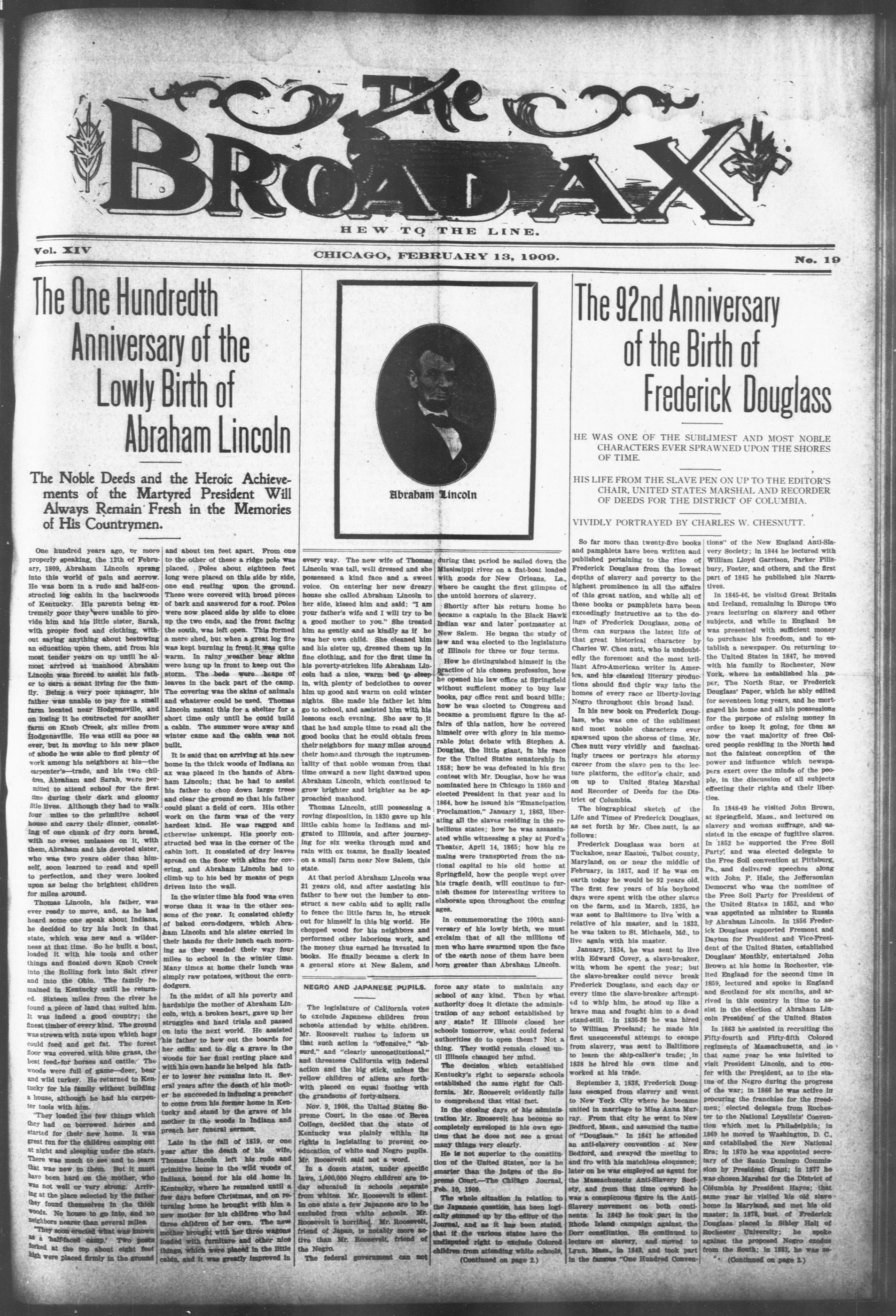
The One Hundredth Anniversary of the Lowly Birth of Abraham Lincoln
The Noble Deeds and the Heroic Achievements of the Martyred President Will Always Remain Fresh in the Memories of His Countrymen.
Vol. XIV
The One Hundred Anniversa Lowly Abra
The Noble Deeds and ments of the Man Always Remain F of His Countrymen
One hundred years ago, or more properly speaking, the 12th of February, 1809, Abraham Lincoln sprang into this world of pain and sorrow. He was born in a rude and half-constructed log cabin in the backwoods of Kentucky. His parents being extremely poor they were unable to provide him and his little sister, Sarah, with proper food and clothing, without saying anything about bestowing an education upon them, and from his most tender years on up until he almost arrived at manhood Abraham Lincoln was forced to assist his father to earn a scant living for the family. Being a very poor manager, his father was unable to pay for a small farm located near Hodgensville, and on losing it he contracted for another farm on Knob Creek, six miles from Hodgensville. He was still as poor as ever, but in moving to his new place of abode he was able to find plenty of work among his neighbors at his—the carpenter's—trade, and his two children, Abraham and Sarah, were permitted to attend school for the first time during their dark and gloomy little lives. Although they had to walk four miles to the primitive school house and carry their dinner, consisting of one chunk of dry corn bread, with no sweet molasses on it, with them, Abraham and his devoted sister, who was two years older than himself, soon learned to read and spell to perfection, and they were looked upon as being the brightest children for miles around.
Thomas Lincoln, his father, was ever ready to move, and, as he had heard some one speak about Indiana he decided to try his luck in that state, which was new and a wilderness at that time. So he built a boat loaded it with his tools and other things and floated down Knob Creek into the Rolling fork into Salt river and into the Ohio. The family remained in Kentucky until he returned. Sixteen miles from the river he found a piece of land that suited him. It was indeed a good country; the finest timber of every kind. The ground was strewn with nuts upon which hogs could feed and get fat. The forest floor was covered with blue grass, the best feed-for horses and cattle. The woods were full of game—deer, bear and wild turkey. He returned to Kentucky for his family without building a house, although he had his carpenter tools with him.
"They loaded the few things which they had on borrowed horses and started for their new home. It was great fun for the children camping out at night and sleeping under the stars. There was much to see and to learn that was new to them. But it must have been hard on the mother, who was not well or very strong. Arriving at the place selected by the father they found themselves in the thick woods. No house to go into, and no neighbors nearer than several miles.
"They soon erected what was known as a half-faced camp.' Two posts forked at the top about eight feet high were placed firmly in the ground
and about ten feet apart. From one to the other of these a ridge pole was placed. Poles about eighteen feet long were placed on this side by side, one end resting upon the ground. These were covered with broad pieces of bark and answered for a roof. Poles were now placed side by side to close up the two ends, and the front facing the south, was left open. This formed a mere shed, but when a great log fire was kept burning in front it was quite warm. In rainy weather bear skins were hung up in front to keep out the storm. The beds were heaps of leaves in the back part of the camp. The covering was the skins of animals and whatever could be used. Thomas Lincoln meant this for a shelter for a short time only until he could build a cabin. The summer wore away and winter came and the cabin was not built.
It is said that on arriving at his new home in the thick woods of Indiana an ax was placed in the hands of Abraham Lincoln; that he had to assist his father to chop down large trees and clear the ground so that his father could plant a field of corn. His other work on the farm was of the very hardest kind. He was ragged and otherwise unkempt. His poorly constructed bed was in the corner of the cabin loft. It consisted of dry leaves spread on the floor with skins for covering, and Abraham Lincoln had to climb up to his bed by means of pegs driven into the wall.
In the winter time his food was even worse than it was in the other seasons of the year. It consisted chiefly of baked corn-dodgers, which Abraham Lincoln and his sister carried in their hands for their lunch each morning as they wended their way four miles to school in the winter time. Many times at home their lunch was simply raw potatoes, without the corn-dodgers.
In the midst of all his poverty and hardships the mother of Abraham Lincoln, with a broken heart, gave up her struggles and hard trials and passed on into the next world. He assisted his father to hew out the boards for her coffin and to dig a grave in the woods for her final resting place and with his own hands he helped his father to lower her remains into it. Several years after the death of his mother he succeeded in inducing a preacher to come from his former home in Kentucky and stand by the grave of his mother in the woods in Indiana and preach her funeral sermon.
Late in the fall of 1819, or one year after the death of his wife, Thomas Lincoln left his rude and primitive home in the wild woods of Indiana, bound for his old home in Kentucky, where he remained until a few days before Christmas, and on returning home he brought with him a new mother for his children who had three children of her own. The new mother brought with her three wagons loaded with furniture and other nice things, which were placed in the little cabin, and it was greatly improved in
CHICAGO, FEBRUARY 13, 1909.
Abraham Lincoln
every way. The new wife of Thomas Lincoln was tall, well dressed and she possessed a kind face and a sweet voice. On entering her new dreary house she called Abraham Lincoln to her side, kissed him and said: "I am your father's wife and I will try to be a good mother to you." She treated him as gently and as kindly as if he was her own child. She cleaned him and his sister up, dressed them up in fine clothing, and for the first time in his poverty-stricken life Abraham Lincoln had a nice, warm bed to sleep in, with plenty of bedclothes to cover him up good and warm on cold winter nights. She made his father let him go to school, and assisted him with his lessons each evening. She saw to it that he had ample time to read all the good books that he could obtain from their neighbors for many miles around their home and through the instrumentality of that noble woman from that time onward a new light dawned upon Abraham Lincoln, which continued to grow brighter and brighter as he approached manhood.
Thomas Lincoln, still possessing a roving disposition, in 1830 gave up his little cabin home in Indiana and migrated to Illinois, and after journeying for six weeks through mud and rain with ox teams, he finally located on a small farm near New Salem, this state.
At that period Abraham Lincoln was 21 years old, and after assisting his father to hew out the lumber to construct a new cabin and to split rails to fence the little farm in, he struck out for himself in this big world. He chopped wood for his neighbors and performed other laborious work, and the money thus earned he invested in books. He finally became a clerk in a general store at New Salem, and
The legislature of California votes to exclude Japanese children from schools attended by white children. Mr. Roosevelt rushes to inform us that such action is "offensive," "absurd," and "clearly unconstitutional," and threatens California with federal action and the big stick, unless the yellow children of aliens are forthwith placed on equal footing with the grandons of forty-niners.
Nov. 9, 1908, the United States Supreme Court, in the case of Berea College, decided that the state of Kentucky was plainly within its rights in legislating to prevent coeducation of white and Negro pupils. Mr. Roosevelt said not a word.
In a dozen states, under specific laws, 1,000,000 Negro children are today educated in schools separate from whites. Mr. Roosevelt is silent. In one state a few Japanese are to be excluded from white schools. Mr. Roosevelt is horrified. Mr. Roosevelt, friend of Japan, is notably more active than Mr. Roosevelt, friend of the Negro.
The federal government can not
during that period he sailed down the Mississippi river on a flat-boat loaded with goods for New Orleans, La., where he caught the first glimpse of the untold horrors of slavery. Shortly after his return home he became a captain in the Black Hawk Indian war and later postmaster at New Salem. He began the study of law and was elected to the legislature of Illinois for three or four terms.
How he distinguished himself in the practice of his chosen profession, how he opened his law office at Springfield without sufficient money to buy law books, pay office rent and board bills; how he was elected to Congress and became a prominent figure in the affairs of this nation, how he covered himself over with glory in his memorable joint debate with Stephen A. Douglas, the little giant, in his race for the United States senatorship in 1858; how he was defeated in his first contest with Mr. Douglas, how he was nominated here in Chicago in 1860 and elected President in that year and in 1864, how he issued his "Emancipation Proclamation," January 1, 1863, liberating all the slaves residing in the rebellious states; how he was assassinated while witnessing a play at Ford's Theater, April 14, 1865; how his remains were transported from the national capital to his old home at Springfield, how the people wept over his tragic death, will continue to furnish themes for interesting writers to elaborate upon throughout the coming ages.
In commemorating the 100th anniversary of his lowly birth, we must exclaim that of all the millions of men who have swarmed upon the face of the earth none of them have been born greater than Abraham Lincoln.
force any state to maintain any school of any kind. Then by what authority does it dictate the administration of any school established by any state? If Illinois closed her schools tomorrow, what could federal authorities do to open them? Not a thing. They would remain closed until Illinois changed her mind.
The decision which established Kentucky's right to separate schools established the same right for California. Mr. Roosevelt evidently falls to comprehend that vital fact.
In the closing days of his administration Mr. Roosevelt has become so completely enveloped in his own egoism that he does not see a great many things very clearly.
He is not superior to the constitution of the United States, nor is he smarter than the judges of the Supreme Court—The Chicago Journal, Feb. 10, 1909.
The whole situation in relation to the Japanese question, has been logically summed up by the editor of the Journal, and as it has been stated, that if the various states have the undisputed right to exclude Colored children from attending white schools, (Continued on page 2.)
The 92nd Anniversary of the Birth of Frederick Douglass
HE WAS ONE OF THE SUBLIMEST AND MOST NOBLE CHARACTERS EVER SPRAWNED UPON THE SHORES OF TIME.
HIS LIFE FROM THE SLAVE PEN ON UP TO THE EDITOR'S CHAIR, UNITED STATES MARSHAL AND RECORDER OF DEEDS FOR THE DISTRICT OF COLUMBIA.
VIVIDLY PORTRAYED BY CHARLES W. CHESNUTT.
So far more than twenty-five books and pamphlets have been written and published pertaining to the rise of Frederick Douglass from the lowest depths of slavery and poverty to the highest prominence in all the affairs of this great nation, and while all of these books or pamphlets have been exceedingly instructive as to the doings of Frederick Douglass, none of them can surpass the latest life of that great historical character by Charles W. Ches nutt, who is undoubtedly the foremost and the most brilliant Afro-American writer in America, and his classical literary productions should find their way into the homes of every race or liberty-loving Negro throughout this broad land.
tions" of the New England Anti-Slavery Society; in 1844 he lectured with William Lloyd Garrison, Parker Pillbury, Foster, and others, and the first part of 1845 he published his Narratives.
In 1845-46, he visited Great Britain and Ireland, remaining in Europe two years lecturing on slavery and other subjects, and while in England he was presented with sufficient money to purchase his freedom, and to establish a newspaper. On returning to the United States in 1847, he moved with his family to Rochester, New York, where he established his paper, The North Star, or Frederick Douglass' Paper, which he ably edited for seventeen long years, and he more
In his new book on Frederick Douglass, who was one of the sublimest and most noble characters ever spawned upon the shores of time. Mr. Ches nutt very vividly and fascinatingly traces or portrays his stormy career from the slave pen to the lecture platform, the editor's chair, and on up to United States Marshal and Recorder of Deeds for the District of Columbia.
The biographical sketch of the Life and Times of Frederick Douglass, as set forth by Mr. Ches nutt, is as follows:
Frederick Douglass was born at Tuckahoe, near Easton, Talbot county, Maryland, on or near the middle of February, in 1817, and if he was on earth today he would be 92 years old. The first few years of his boyhood days were spent with the other slaves on the farm, and in March, 1825, he was sent to Baltimore to live with a relative of his master, and in 1833, he was taken to St. Michaels, Md., to live again with his master.
January, 1834, he was sent to live with Edward Covey, a slave-breaker, with whom he spent the year; but the slave-breaker could never break Frederick Douglass, and each day or every time the slave-breaker attempted to whip him, he stood up like a brave man and fought him to a dead stand-still. In 1835-36 he was hired to William Freeland; he made his first unsuccessful attempt to escape from slavery, was sent to Baltimore to learn the ship-calker's trade; in 1838 he hired his own time and worked at his trade.
September 3, 1838, Frederick Douglass escaped from slavery and went to New York City where he became united in marriage to Miss Anna Murray. From that city he went to New Bedford, Mass, and assumed the name of "Douglass." In 1841 he attended an anti-slavery convention at New Bedford, and swayed the meeting to and fro with his matchless eloquence; later on he was employed as agent for the Massachusetts Anti-Slavery Society, and from that time onward he was a conspicuous figure in the Anti-Slavery movement on both continents. In 1842 he took part in the Rhode Island campaign against the Dorr constitution. He continued to lecture on slavery, and moved to Lynn, Mass., in 1843, and took part in the famous "One Hundred Conven-
No. 19
anniversary
birth of
rick Douglass
BLIMEST AND MOST NOBLE
RAWNED UPON THE SHORES
OPEN ON UP TO THE EDITOR'S
S MARSHAL AND RECORDER
STRICT OF COLUMBIA.
CHARLES W. CHESNUTT.
tions" of the New England Anti-Slavery Society; in 1844 he lectured with William Lloyd Garrison, Parker Pillsbury, Foster, and others, and the first part of 1845 he published his Narratives. In 1845-46, he visited Great Britain and Ireland, remaining in Europe two years lecturing on slavery and other subjects, and while in England he was presented with sufficient money to purchase his freedom, and to establish a newspaper. On returning to the United States in 1847, he moved with his family to Rochester, New York, where he established his paper, The North Star, or Frederick Douglass' Paper, which he ably edited for seventeen long years, and he mortgaged his home and all his possessions for the purpose of raising money in order to keep it going, for then as now the vast majority of free Colored people residing in the North had not the faintest conception of the power and influence which newspapers exert over the minds of the people, in the discussion of all subjects effecting their rights and their liberties.
In 1848-49 he visited John Brown at Springfield, Mass., and lectured on slavery and woman suffrage, and assisted in the escape of fugitive slaves. In 1852 he supported the Free Soil Party, and was elected delegate to the Free Soil convention at Pittsburg, Pa., and delivered speeches along with John P. Hale, the Jeffersonian Democrat who was the nominee of the Free Soil Party for President of the United States in 1852, and who was appointed as minister to Russia by Abraham Lincoln. In 1856 Frederick Douglass supported Fremont and Dayton for President and Vice-President of the United States, established Douglass' Monthly, entertained John Brown at his home in Rochester, visited England for the second time in 1859, lectured and spoke in England and Scotland for six months, and arrived in this country in time to assist in the election of Abraham Lincoln President of the United States
In 1863 he assisted in recruiting the Fifty-fourth and Fifty-fifth Colored regiments of Massachusetts, and in that same year he was invited to visit President Lincoln, and to confer with the President, as to the status of the Negro during the progress of the war; in 1866 he was active in procuring the franchise for the freedmen; elected delegate from Rochester to the National Loyalists' Convention which met in Philadelphia; in 1869 he moved to Washington, D. C., and established the New National Era; in 1870 he was appointed secretary of the Santo Domingo Commission by President Grant; in 1877 he was chosen Marshal for the District of Columbia by President Hayes; that same year he visited his old slave home in Maryland, and met his old master; in 1878, bust of Frederick Douglass placed in Sibley Hall of Rochester University; he spoke against the proposed Negro exodus from the South; in 1881, he was se- (Continued on page 2.)
---
Will promulgate and at all times uphold the true principles of Democracy, but Catholics, Protestants, Priests, Insides, Single Taxes, Republicans, or anyone else can have their say, as long as their language is proper and responsibility is fixed.
The Broad Ax is a newspaper whose platform is broad enough for all ever claiming the editorial right to speak its own mind.
Local communications will receive attention. Write only on one side of the paper.
Subscriptions must be paid in advance.
JULIUS F. TAYLOR, Editor and Publisher.
Entered as Second-Class Matter,
Aug. 19, 1902 at the Post Office at
Chicago, Illinois, under Act of March
3, 1879.
DEMOCRATIC JUDGES INDORSED.
NINE OCCUPANTS OF CIRCUIT
BENCH TO BE RENOMINATED.
FIVE OTHER CANDIDATES PICKED
TO MAKE THE RACE FOR
CIRCUIT COURT JUDGES.
WILLIAM BROWN, JR., CHOSEN
FOR JUDGE OF SUPERIOR
COURT TO SECCEED JUDGE
THEODORE BRENTANO.
REPUBLICAN CANDIDATES ALSO
NAMED FOR THE JUDGESHIPS.
The nine Democratic judges of the Circuit court of this city and county have been indorsed for renomination at the April primaries by the Democratic County Executive Committee. The judges so honored are as follows: Thomas G. Windes, Edward Osgood Brown, Lockwood Honore, George Kersten, Frank Baker, Charles M. Walker, Julian W. Mack, Francis Adams and Richard W. Clifford. The Executive Committee of the Democratic party of Cook county have also selected the following candidates for the other five Circuit court judgeships: William H. Arthur, Donald L. Morrill, Richard E. Burke, John P. McGoory and Sigmund Zeisler.
William Brown, Jr., with law offices in the Hartford building, 140 Dearborn street, and residing at 369 Chicago avenue, who is a tip-top lawyer and very popular with his fellow members at the bar, has been chosen for judge of the Superior court to succeed Judge Theodore Brentano, and Mr. Brown will make an ideal candidate. The high priests of the Republican party in this city and county the past week also named the following candidates to make the race for the judgeships: Superior Court—Judge Theodore Brentano
Circuit Court—George A. Carpenter, John Gibbons, M. W. Pickney, Richard S. Tuthill, Fred A. Smith, Jesse A. Baldwin, Charles Alling, Jg. John E. Holland Henry W. Price, Kickham Scanlan, Frank P. Schmitt, Jr., Edwin H. Olson, Homer E. Tinsman, Adelor J. Petit.
It is said that the bosses of the Republican party are anxious to capture every Circuit and Superior court judgeship in Cook county and that they are willing to spend $75,000 in order to put the Democratic candidates to the bad.
DR. M. J. BROWN'S DELIGHTFUL VISIT TO CAIRO ILINOIS.
Entertained in that City by Mr. and Mrs. William F. Taylor.
Dr. M. J. Brown, the power behind the throne of the People's Pharmacy Company, corner of Twenty-seventh and Dearborn streets and Twenty-ninth street and Armour avenue, spent Thursday, Friday, Saturday and Sunday in Cairo, Ill., and while on his delightful visit to that city he was entertained in a royal manner at the home of Mr. and Mrs. William F. Taylor.
Mr. Taylor at one time ran the drug store at the corner of Twenty-ninth street and Armour avenue, and for the past four or five years he has conducted one of the best drug stores in that city and is making money.
During his delightful visit Dr. Brown also had the pleasure of meeting Dr. and Mrs. Fields, Dr. and Mrs. Dickerson and many other prominent citizens, and he was perfectly charmed with the fair ladies and the attention they showered upon him.
From a business point of view, as well as socially, Dr. Brown is very favorably impressed with Cairo.
M. C. H.
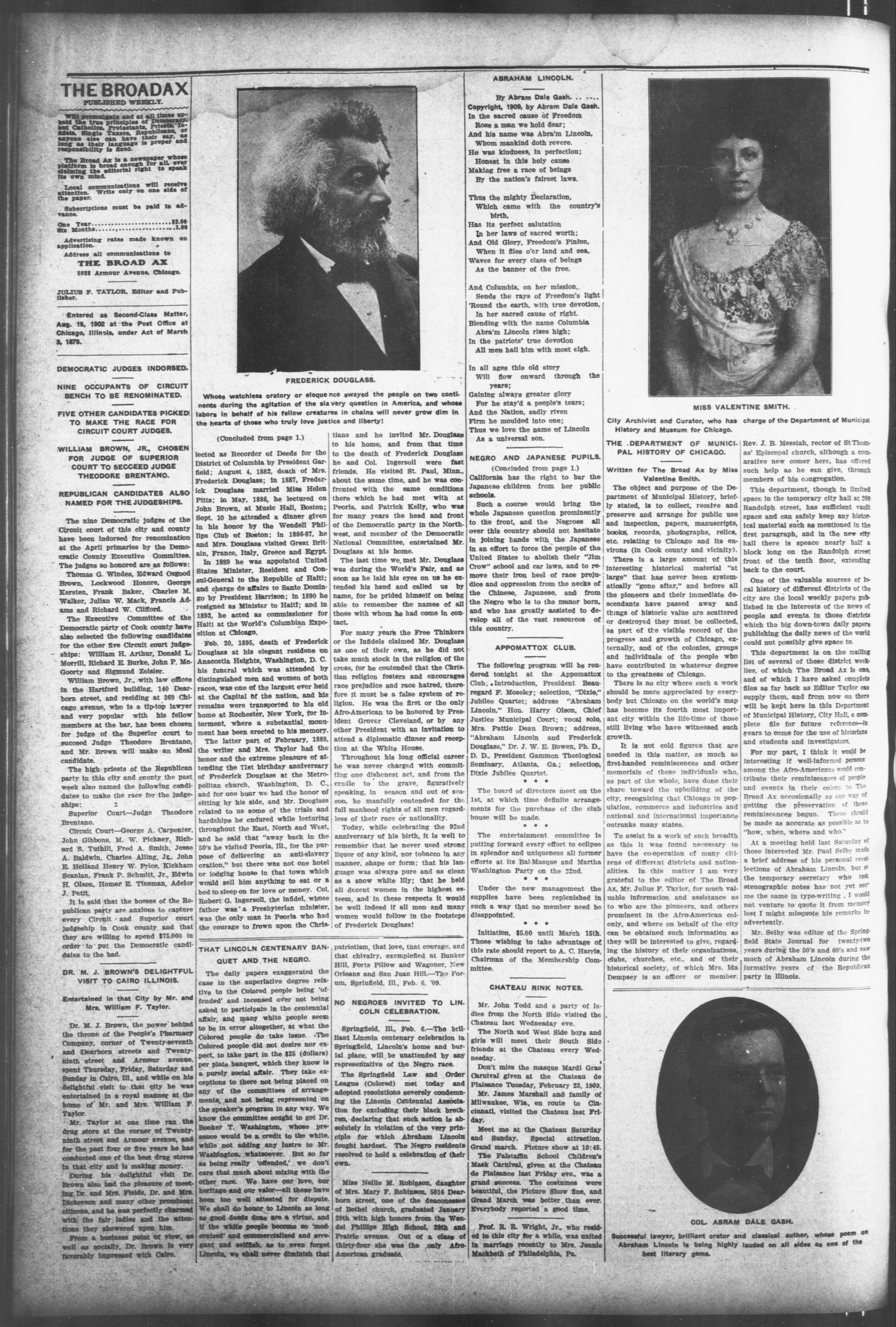
FREDERICK DOUGLASS.
Whose watchless oratory or eloquence swayed the people on two continents during the agitation of the slavery question in America, and whose labors in behalf of his fellow creatures in chains will never grow dim in the hearts of those who truly love justice and liberty!
(Concluded from page 1.)
lected as Recorder of Deeds for the District of Columbia by President Garfield; August 4, 1882, death of Mrs. Frederick Douglass; in 1887, Frederick Douglass married Miss Helen Pitts; in May, 1886, he lectured on John Brown, at Music Hall, Boston; Sept. 10 he attended a dinner given in his honor by the Wendell Phillips Club of Boston; in 1886-87, he and Mrs. Douglass visited Great Britain, France, Italy, Greece and Egypt. In 1889 he was appointed United States Minister, Resident and Consul-General to the Republic of Haiti; and charge de affairs to Santo Domingo by President Harrison; in 1890 he resigned as Minister to Haiti; and in 1893, he acted as commissioner for Haiti at the World's Columbian Exposition at Chicago.
Feb. 20, 1895, death of Frederick Douglass at his elegant residene on Anacostia Heights, Washington, D. C. his funeral which was attended by distinguished men and women of both races, was one of the largest ever held at the Capital of the nation, and his remains were transported to his old home at Rochester, New York, for interment, where a substantial monument has been erected to his memory.
The latter part of February, 1888, the writer and Mrs. Taylor had the honor and the extreme pleasure of attending the 71st birthday anniversary of Frederick Douglass at the Metropolitan church, Washington, D. C., and for one hour we had the honor of sitting by his side, and Mr. Douglass related to us some of the trials and hardships he endured while lecturing throughout the East, North and West, and he said that "away back in the 50's he visited Peoria, Ill., for the purpose of delivering an anti-slavery eration," but there was not one hotel or lodging house in that town which would sell him anything to eat or a bed to sleep on for love or money. Col. Robert G. Ingersoll, the infidel, whose father was a Presbyterian minister, was the only man in Peoria who had the courage to frown upon the Chris-
THAT LINCOLN CENTENARY BANQUE AND THE NEGRO.
The daily papers exaggerated the case in the superlative degree relative to the Colored people being 'offended' and incensed over not being asked to participate in the centennial affair, and many white people seem to be in error altogether, at what the Colored people do take issue. The Colored people did not desire nor expect, to take part in the $25 (dollars) per plate banquet, which they know is a purely social affair. They take exceptions to that not being placed on any of the committees of arrangements, and not being represented on the speaker's program in any way. We know the committee sought to get Dr. Booker T. Washington, whose presence would be a credit to the white, while not adding any lustre to Mr. Washington, whatsoever. But so far as being really 'offended,' we don't care that much about mixing with the other race. We have our love, our heritage and our valor—all these have been too well attested for dispute. We shall do honor to Lincoln as long as good deeds done are a virtue, and if the white people become so 'modernized' and commercialized and arrogant and selfish, as to even forget Lincoln, we shall never diminish that
tians and he invited Mr. Douglass to his home, and from that time to the death of Frederick Douglass he and Col. Ingersoll were fast friends. He visited St. Paul, Minn., about the same time, and he was confronted with the same conditions there which he had met with at Peoria, and Patrick Kelly, who was for many years the head and front of the Democratic party in the Northwest, and member of the Democratic National Committee, entertained Mr. Douglass at his home.
The last time we, met Mr. Douglass was during the World's Fair, and as soon as he laid his eyes on us he extended his hand and called us by name, for he prided himself on being able to remember the names of all those with whom he had come in contact.
For many years the Free Thinkers or the Infidels claimed Mr. Douglass as one of their own, as he did not take much stock in the religion of the cross, for he contended that the Christian religion fosters and encourages race prejudice and race hatred, therefore it must be a false system of religion. He was the first or the only Afro-American to be honored by President Grover Cleveland, or by any other President with an invitation to attend a diplomatic dinner and reception at the White House.
Throughout his long official career he was never charged with committing one dishonest act, and from the cradle to the grave, figuratively speaking, in season and out of season, he manfully contended for the full manhood rights of all men regardless of their race or nationality. Today, while celebrating the 92nd anniversary of his birth, it is well to remember that he never used strong liquor of any kind, nor tobacco in any manner, shape or form; that his language was always pure and as clean as a snow white lily; that he held all decent women in the highest esteem, and in these respects it would be well indeed if all men and many women would follow in the footsteps of Frederick Douglass!
patriotism, that love, that courage, and that chivalry, exemplified at Bunker Hill, Forts Pillow and Wagoner, New Orleans and San Juan Hill—The Forum, Springfield, Ill. Feb. 6. 09.
NO NEGROES INVITED TO LIN COLN CELEBRATION.
Springfield, Ill., Feb. 6.—The brilliant Lincoln centenary celebration in Springfield, Lincoln's home and burial place, will be unattended by any representative of the Negro race.
The Springfield Law and Order League (Colored) met today and adopted resolutions severely condemning the Lincoln Centennial Association for excluding their black brethren, declaring that such action is absolutely in violation of the very principle for which Abraham Lincoln fought hardest. The Negro residents resolved to hold a celebration of their own.
Miss Nelle M. Robinson, daughter of Mrs. Mary F. Robinson, 5016 Dearborn street, one of the deaconsesses of Bethel church, graduated January 29th with high honors from the Wendel Phillips High School, 39th and Prairie avenue. Out of a class of thirty-four she was the only Afro-American graduate.
ABRAHAM LINCOLN.
By Abram Dale Gash. .....
Copyright, 1909, by Abram Dale Gash.
In the sacred cause of Freedom
Rose a man we hold dear;
And his name was Abra'm Lincoln,
Whom mankind doth revere.
He was kindness, in perfection;
Honest in this holy cause
Making free a race of beings
By the nation's fairest laws.
Thus the mighty Declaration,
Which came with the country's
birth,
Has its perfect salutation
In her laws of sacred worth;
And Old Glory, Freedom's Pinton,
When it files o'er land and sea.
Waves for every class of beings
As the banner of the free.
And Columbia, on her mission,
Sends the rays of Freedom's light
'Round the earth, with true devotion,
In her sacred cause of right.
Blending with the name Columbia
Abra'm Lincoln rises high;
In the patriots' true devotion
All men hail him with most eigh.
In all ages this old story
Will flow onward through the
years;
Gaining always greater glory
For he stay'd a people's tears;
And the Nation, sadly riven
Firm he moulded into one;
Thus we love the name of Lincoln
As a universal son.
NEGRO AND JAPANESE PUPILS.
(Concluded from page 1.1) California has the right to bar the Japanese children from her public schools.
Such a course would bring the whole Japanese question prominently to the front, and the Negroes all over this country should not hesitate in joining hands with the Japanese in an effort to force the people of the United States to abolish their "Jim Crow" school and car laws, and to remove their iron heel of race prejudice and oppression from the necks of the Chinese, Japanese, and from the Negro who is to the manor born, and who has greatly assisted to develop all of the vast resources of this country.
APPOMATTOX CLUB
The following program will be rendered tonight at the Appomattox Club. Introduction, President Beauregard F. Moseley; selection, "Dixie," Jubilee Quartet; address "Abraham Lincoln." Hon. Harry Olson, Chief Justice Municipal Court; vocal solo, Mrs. Pattle Dean Brown; address, "Abraham Lincoln and Frederick Douglass," Dr. J. W. E. Bowen, Ph. D., D. D. President Gammon Theological Seminary, Atlanta, Ga.; selection, Dixie Jubilee Quartet.
The board of directors meet on the 1st, at which time definite arrangements for the purchase of the club house will be made.
The entertainment committee is putting forward every effort to eclipse in splendor and uniqueness all former efforts at its Bal-Masque and Martha Washington Party on the 22nd.
Under the new management the supplies have been replenished in such a way that no member need be disappointed.
Initiation, $5.00 until March 15th. Those wishing to take advantage of this rate should report to A. C. Harris, Chairman of the Membership Committee.
CHATEAU RINK NOTES.
Mr. John Todd and a party of ladies from the North Side visited the Chateau last Wednesday eve.
The North and West Side boys and girls will meet their South Side friends at the Chateau every Wednesday.
Don't miss the masque Mardi Gras Carnival given at the Chateau de Plaisance Tuesday, February 23, 1909.
Mr. James Marshall and family of Milwaukee, Wis., en route to Cincinnati, visited the Chateau last Friday.
Meet me at the Chateau Saturday and Sunday. Special attraction. Grand march. Picture show at 10:45. The Falstaffin School Children's Mask Carnival, given at the Chateau de Plaisance last Friday eve., was a grand success. The costumes were beautiful, the Picture Show fine, and Grand March was better than ever. Everybody reported a good time.
Prof. R. R. Wright, Jr., who resided in this city for a while, was united in marriage recently to Mrs. Jennie Mackbeth of Philadelphia, Pa.
Mary
MISS VALENTINE SMITH.
City Archivist and Curator, who has charge of the Department of Municipal History and Museum for Chicago.
THE .DEPARTMENT OF MUNICIPAL HISTORY OF CHICAGO.
Rev. J. B. Messiah, rector of St Thomas' Episcopal church, although a com
Written for The Broad Ax by Miss Valentine Smith.
The object and purpose of the Department of Municipal History, briefly stated, is to collect, receive and preserve and arrange for public use and inspection, papers, manuscripts, books, records, photographs, relics, etc. relating to Chicago and its environs (in Cook county and vicinity).
There is a large amount of this interesting historical material "at large" that has never been systematically "gone after," and before all the pioneers and their immediate descendants have passed away and things of historic value are scattered or destroyed they must be collected, as part of the visible record of the progress and growth of Chicago, externally, and of the colonies, groups and individuals of the people who have contributed in whatever degree to the greatness of Chicago.
There is no city where such a work should be more appreciated by everybody but Chicago on the world's map has become its fourth most important city within the life-time of those still living who have witnessed such growth.
It is not cold figures that are needed in this matter, as much as first-handed reminiscences and other memorials of those individuals who, as part of the whole, have done their share toward the upbuilding of the city, recognizing that Chicago in population, commerce and industries and national and international importance outranks many states.
To assist in a work of such breadth as this it was found necessary to have the co-operation of many citizens of different districts and nationalities. In this matter I am very grateful to the editor of The Broad Ax, Mr. Julius F. Taylor, for much valuable information and assistance as to who are the pioneers, and others prominent in the Afro-American colony, and where on behalf of the city can be obtained such information as they will be interested to give, regarding the history of their organizations, clubs, churches, etc., and of their historical society, of which Mrs. Ida Dempsey is an officer or member.
```markdown
```
COL. ABRAM DÁLE GASH
COL. ABRAM DALE GASH.
Successful lawyer, brilliant orator a Abraham Lincoln is being highly best literary gems.
Successful lawyer, brilliant orator and classical author, whose poem or Abraham Lincoln is being highly lauded on all sides as one of the best literary gems.
Rev. J. B. Messiah, rector of St Thomas' Episcopal church, although a comparative new comer here, has offered such help as he can give, through members of his congregation.
This department, though in limited space in the temporary city hall at 200 Randolph street, has sufficient vault space and can safely keep any historical material such as mentioned in the first paragraph, and in the new city hall there is spece nearly half a block long on the Randolph street front of the tenth floor, extending back to the court.
One of the valuable sources of local history of different districts of the city are the local weekly papers published in the interests of the news of people and events in those districts which the big down-town daily papers publishing the daily news of the world could not possibly give space to. This department is on the mailing list of several of these district weeklies, of which The Broad Ax is one, and of which I have asked complete files as far back as Editor Taylor can supply them, and from now on there will be kept here in this Department of Municipal History, City Hall, a complete file for future reference—in years to come for the use of historians and students and investigators.
For my part, I think it would be interesting if well-informed persons among the Afro-Americans would contribute their reminiscences of people and events in their colony to The Broad Ax accessionally as one way of getting the preservation of these reminiscences begun. These should be made as accurate as possible as to "how, when, where and who."
At a meeting held last Saturday of those interested Mr. Paul Selby made a brief address of his personal recollections of Abraham Lincoln, but as the temporary secretary who took stenographic notes has not yet sent me the same in type-writing, I would not venture to quote it from memory lest I might misquote his remarks in advertently.
Mr. Selby was editor of the Spring field State Journal for twenty-two years during the 50's and 60's and saw much of Abraham Lincoln during the formative years of the Republican party in Illinois.
1.
and classical author, whose poem on lauded on all sides as one of the
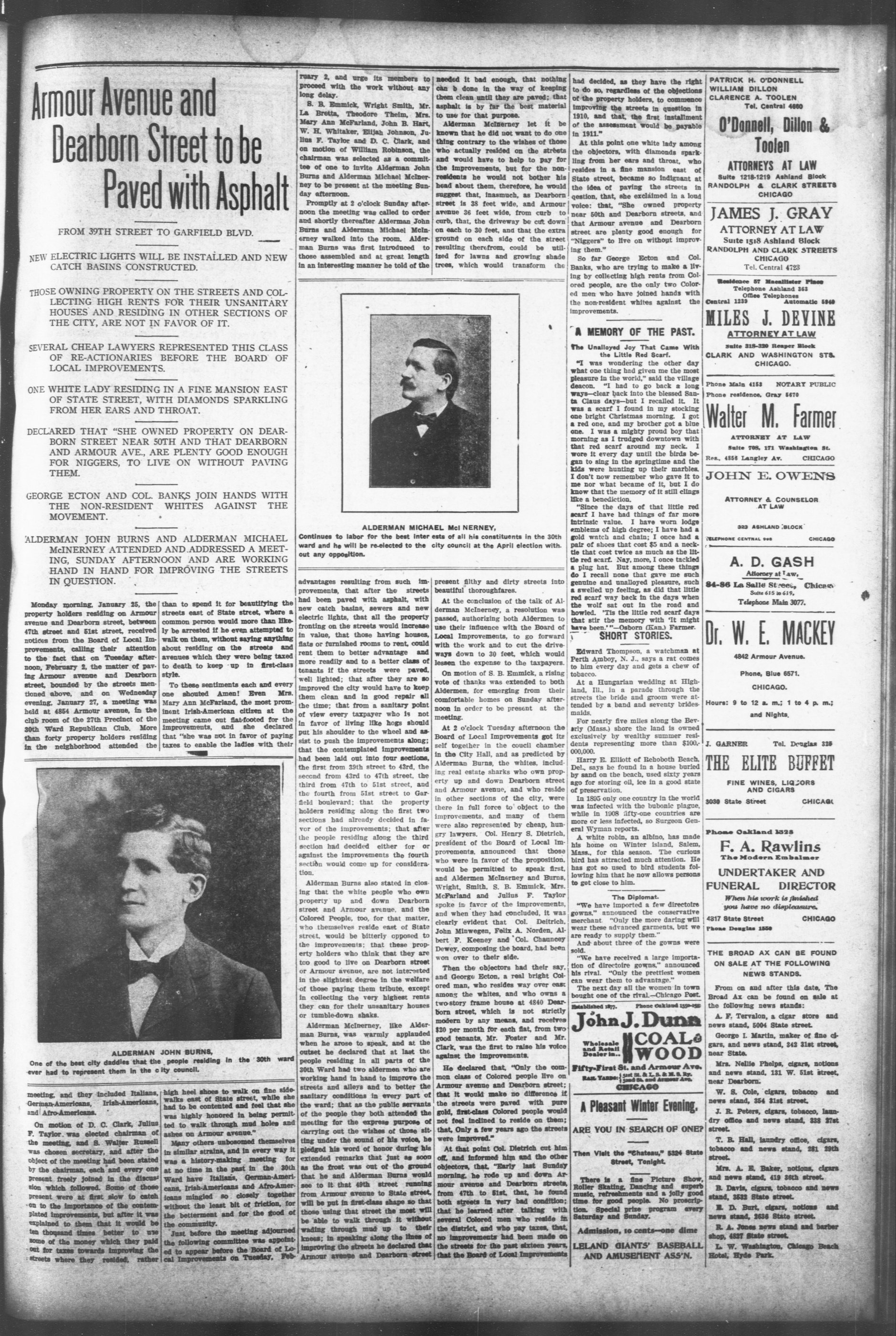
Armour Avenue and Dearborn Street to be Paved with Asphalt
FROM 39TH STREET TO GARFIELD BLVD
NEW ELECTRIC LIGHTS WILL BE INSTALLED AND NEW CATCH BASINS CONSTRUCTED.
THOSE OWNING PROPERTY ON THE STREETS AND COLLECTING HIGH RENTS FOR THEIR UNSANITARY HOUSES AND RESIDING IN OTHER SECTIONS OF THE CITY, ARE NOT IN FAVOR OF IT.
SEVERAL CHEAP LAWYERS REPRESENTED THIS CLASS OF RE-ACTIONARIES BEFORE THE BOARD OF LOCAL IMPROVEMENTS.
ONE WHITE LADY RESIDING IN A FINE MANSION EAST OF STATE STREET, WITH DIAMONDS SPARKLING FROM HER EARS AND THROAT.
DECLARED THAT "SHE OWNED PROPERTY ON DEARBORN STREET NEAR 50TH AND THAT DEARBORN AND ARMOUR AVE., ARE PLENTY GOOD ENOUGH FOR NIGGERS, TO LIVE ON WITHOUT PAVING THEM.
GEORGE ECTON AND COL. BANKS JOIN HANDS WITH THE NON-RESIDENT WHITES AGAINST THE MOVEMENT.
ALDERMAN JOHN BURNS AND ALDERMAN MICHAEL McINERNEY ATTENDED AND ADDRESSED A MEETING, SUNDAY AFTERNOON AND ARE WORKING HAND IN HAND FOR IMPROVING THE STREETS IN QUESTION.
[Name not visible in the image]
One of the best city daddies that the people residing in the 30th ward ever had to represent them in the city council.
Monday morning, January 25, the property holders residing on Armour avenue and Dearborn street, between 47th street and 51st street, received notices from the Board of Local Improvements, calling their attention to the fact that on Tuesday afternoon, February 2, the matter of paving Armour avenue and Dearborn street, bounded by the streets mentioned above, and on Wednesday evening, January 27, a meeting was held at 4854 Armour avenue, in the club room of the 27th Precinct of the 30th Ward Republican Club. More than forty property holders residing in the neighborhood attended the
ALDERMAN
One of the best city daddies that the ever had to represent them in the c
meeting, and they included Italians, German-Americans, Irish-Americans, and Afro-Americans.
On motion of D. C. Clark, Julius F. Taylor, was elected chairman of the meeting, and S. Walter Russell was chosen secretary, and after the object of the meeting had been stated by the chairman, each and every one present freely joined in the discussion which followed. Some of those present were at first slow to catch on to the importance of the contemplated improvements, but after it was explained to them that it would be ten thousand times better to use some of the money which they paid out for taxes towards improving the streets where they resided, rather
---
than to spend it for beautifying the streets east of State street, where a common person would more than likely be arrested if he even attempted to walk on them, without saying anything about residing on the streets and avenues which they were being taxed to death to keep up in first-class style.
To these sentiments each and every one shouted Amen! Even Mrs. Mary Ann McFarland, the most prominent Irish-American citizen at the meeting came out flat-footed for the improvements, and she declared that "she was not in favor of paying taxes to enable the ladies with their
JOHN BURNS,
people residing in the 30th ward
city council.
high heel shoes to walk on fine sidewalks east of State street, while she had to be contented and feel that she was highly honored in being permitted to walk through mud holes and ashes on Armour avenue."
Many others unbosomed themselves in similar strains, and in every way it was a history-making meeting for at no time in the past in the 30th Ward have Italians, German-Americans, Irish-Americans and Afro-Americans mingled so closely together without the least bit of friction, for the betterment and for the good of the community.
Just before the meeting adjourned the following committee was appointed to appear before the Board of Local Improvements on Tuesday, Feb-
ruary 2, and urge its members to proceed with the work without any long delay. S. B. Emmick, Wright Smith, Mr. La Bretta, Theodore Theim, Mrs. Mary Ann McFarland, John B. Hart, W. H. Whitaker, Elijah Johnson, Julius F. Taylor and D. C. Clark, and on motion of William Robinson, the chairman was selected as a committee of one to invite Alderman John Burns and Alderman Michael McInerney to be present at the meeting Sunday afternoon.
Promptly at 2 o'clock Sunday afternoon the meeting was called to order and shortly thereafter Alderman John Burns and Alderman Michael McInerney walked into the room. Alderman Burns was first introduced to those assembled and at great length in an interesting manner he told of the
D
[Name not visible in the image]
ALDERMAN MICHAEL McI NERNEY,
Continues to labor for the best interests of all his constituents in the 30th ward and he will be re-elected to the city council at the April election with out any opposition.
Continues to labor for the best inter ests of all his constituents in the 30th ward and he will be re-elected to the city council at the April election with out any opposition.
Continues to labor for the best inter ward and he will be re-elected to the out any opposition.
advantages resulting from such improvements, that after the streets had been paved with asphalt, with new catch basins, sewers and new electric lights, that all the property fronting on the streets would increase in value, that those having houses, flats or furnished rooms to rent, could rent them to better advantage and more readily to a better class of tenants if the streets were paved, well lighted; that after they are so improved the city would have to keep them clean and in good repair all the time; that from a sanitary point of view every taxpayer who is not in favor of living like hogs should put his shoulder to the wheel and assist to push the improvements along; that the contemplated improvements had been laid out into four sections, the first from 39th street to 43rd, the second from 43rd to 47th street, the third from 47th to 51st street, and the fourth from 51st street to Garfield boulevard; that the property holders residing along the first two sections had already decided in favor of the improvements; that after the people residing along the third section had decided either for or against the improvements the fourth section would come up for consideration.
Alderman Burns also stated in closing that the white people who own property up and down Dearborn street and Armour avenue, and the Colored People, too, for that matter, who themselves reside east of State street, would be bitterly opposed to the improvements; that these property holders who think that they are too good to live on Dearborn street or Armour avenue, are not interested in the slightest degree in the welfare of those paying them tribute, except in collecting the very highest rents they can for their unsanitary houses or tumble-down shaks.
Alderman McInerney, like Alderman Burns, was warmly applauded when he arose to speak, and at the outset he declared that at last the people residing in all parts of the 30th Ward had two aldermen who are working hand in hand to improve the streets and alleys and to better the sanitary conditions in every part of the ward; that as the public servants of the people they both attended the meeting for the express purpose of carrying out the wishes of those sitting under the sound of his voice, he pledged his word of honor during his extended remarks that just as soon as the frost was out of the ground that he and Alderman Burns would see to it that 49th street running from Armour avenue to State street will be put in first-class shape so that those using that street the most will be able to walk through it without wading through mud up to their knees; in speaking along the lines of improving the streets he declared that Armour avenue and Dearborn street
---
needed it bad enough, that nothing can b done in the way of keeping them clean until they are paved; that asphalt is by far the best material to use for that purpose.
Alderman McInerney let it be known that he did not want to do one thing contrary to the wishes of those who actually resided on the streets and would have to help to pay for the improvements, but for the non-residents he would not bother his head about them, therefore, he would suggest that, inasmuch, as Dearborn street is 38 feet wide, and Armour avenue 36 feet wide, from curb to curb, that, the driveway be cut down on each to 30 feet, and that the extra ground on each side of the street resulting therefrom, could be utilized for lawns and growing shade trees, which would transform the
[Name]
ests of all his constituents in the 30th city council at the April election with.
present filthy and dirty streets into beautiful thoroughfares.
At the conclusion of the talk of Alderman McInerney, a resolution was passed, authorizing both Aldermen to use their influence with the Board of Local Improvements, to go forward with the work and to cut the driveways down to 30 feet, which would lessen the expense to the taxpayers.
On motion of S. B. Emmick, a rising vote of thanks was extended to both Aldermen, for emerging from their comfortable homes on Sunday afternoon in order to be present at the meeting.
At 2 o'clock Tuesday afternoon the Board of Local Improvements got its self together in the coul chamber in the City Hall, and as predicted by Alderman Burns, the whites, including real estate sharks who own property up and down Dearborn street and Armour avenue, and who reside in other sections of the city, were there in full force to object to the improvements, and many of them were also represented by cheap, hungry lawyers. Col. Henry S. Dietrich, president of the Board of Local improvements, announced that those who were in favor of the proposition, would be permitted to speak first, and Aldermen McInerney and Burns, Wright, Smith, S. B. Emmick, Mrs. McFarland and Julius F. Taylor spoke in favor of the improvements and when they had concluded, it was clearly evident that Col. Deitrich John Minwegen, Felix A. Norden, Albert F. Keeney and Col. Chancey Dewey, composing the board, had been won over to their side.
Then the objectors had their say, and George Ecton, a real bright Colored man, who resides way over east among the whites, and who owns a two-story frame house at 4840 Dearborn street, which is not strictly modern by any means, and receives $20 per month for each flat, from two good tenants, Mr. Foster and Mr. Clark, was the first to raise his voice against the improvements.
He declared that, "Only the common class of Colored people live on Armour avenue and Dearborn street; that it would make no difference if the streets were paved with pure gold, first-class Colored people would not feel inclined to reside on them; that, Only a few years ago the streets were improved."
At that point Col. Dietrich cut him off, and informed him and the other objectors, that, "Early last Sunday morning, he rode up and down Armour avenue and Dearborn streets, from 47th to 51st, that, he found both streets in very bad condition; that he learned after talking with several Colored men who reside in the district, and who pay taxes, that, no improvements had been made on the streets for the past sixteen years, that the Board of Local Improvements
had decided, as they have the right to do so, regardless of the objections of the property holders, to commence improving the streets in question in 1910, and that, the first installment of the assessment would be payable in 1911."
At this point one white lady among the objectors, with diamonds sparkling from her ears and throat, who resides in a fine mansion east of State street, became so indignant at the idea of paving the streets in question, that, she exclaimed in a loud voice: that, "She owned property near 50th and Dearborn streets, and that Armour avenue and Dearborn street are plenty good enough for "Niggers" to live on without improving them."
So far George Ecton and Col. Banks, who are trying to make a living by collecting high rents from Colored people, are the only two Colored men who have joined hands with the non-resident whites against the improvements.
A MEMORY OF THE PAST.
The Unalloyed Joy That Came With the Little Red Scarf.
"I was wondering the other day what one thing had given me the most pleasure in the world," said the village deacon. "I had to go back a long ways—clear back into the blessed Santa Claus days—but I recalled it. It was a scarf I found in my stocking one bright Christmas morning. I got a red one, and my brother got a blue one. I was a mighty proud boy that morning as I trudged downtown with that red scarf around my neck. I wore it every day until the birds began to sing in the springtime and the kids were hunting up their marbles. I don't now remember who gave it to me nor what became of it, but I do know that the memory of it still clings like a benediction.
SHORT STORIES.
Edward Thompson, a watchman at Perth Amboy, N. J., says a rat comes to him every day and gets a chew of tobacco.
At a Hungarian wedding at Highland, Ill., in a parade through the streets the bride and groom were attended by a band and seventy bridesmales.
For nearly five miles along the Beverly (Mass.) shore the land is owned exclusively by wealthy summer residents representing more than $100,000,000.
Harry E. Elliott of Rehoboth Beach, Del., says he found in a house buried by sand on the beach, used sixty years ago for storing oil, ice in a good state of preservation.
In 1895 only one country in the world was infected with the bubonic plague, while in 1908 fifty-one countries are more or less infected, so Surgeon General Wyman reports.
A white robin, an albino, has made his home on Winter island, Salem, Mass., for this season. The curious bird has attracted much attention. He has got so used to bird students following him that he now allows persons to get close to him.
The Diplomat
"We have imported a few directoire gowns," announced the conservative merchant. "Only the more daring will wear these advanced garments, but we are ready to supply them." And about three of the gowns were sold.
"We have received a large importation of directoire gowns," announced his rival. "Only the prettiest women can wear them to advantage."
The next day all the women in town bought one of the rival.-Chicago Post.
Established 1877. Phone Oakland 1539-833
John J. Dunn
COAL &
WOOD
Wholesale and Retail Dealer in...
Fifty-First St. and Armour Ave.
RAIL YARDS.
Sixth St. & L. S. & M. S. RY.
Jand St. and Armour Ave.
CHICAGO
A Pleasant Winter Evening.
ARE YOU IN SEARCH OF ONE?
Then Visit the "Chateau," 5324 State Street, Tonight.
There is a fine Picture Show, Roller Stating, Dancing and superb music, refreshments and a jolly good time for good people. No prosecution. Special prize program every Saturday and Sunday.
Admission, 10 cents--one dime
LELAND GIANTS' BASEBALL AND AMUSEMENT ASS'N.
PATRICK H. O'DONNELL
WILLIAM DILLON
CLARENCE A. TOOLEN
Tel. Central 4660
O'Donnell, Dillon &
Toolen
ATTORNEYS AT LAW
Suite 1218-1219 Ashland Block
RANDOLPH & CLARK STREETS
CHICAGO
JAMES J. GRAY
ATTORNEY AT LAW
Suite 1518 Ashland Block
RANDOLPH AND CLARK STREETS
CHICAGO
Tel. Central 4723
Residence 57 Macallister Place
Telephone Ashland 363
Office Telephones
Central 1239 Automatic 5949
MILES J. DEVINE
Suite 31S-320 Reaper Block
CLARK AND WASHINGTON STS.
CHICAGO.
Phone Main 4153 NOTARY PUBLIC
Phone residence, Gray 5670
Walter M. Farmer
ATTORNEY AT LAW
Suite 708, 171 Washington St.
Res., 4856 Langley Av. CHICAGO
JOHN E. OWENS
ATTORNEY & COUNSELOR
AT LAW
323 ASHLAND 'BLOCK'
A. D. GASH
Attorney at Law,
84-86 La Salle Street, Chicago
Suite 615 to 619,
Telephone Main 3077.
Dr. W. E. MACKEY
4842 Armour Avenue.
Phone, Blue 6571.
CHICAGO.
Hours: 9 to 12 a. m.; 1 to 4 p. m.;
and Nights.
J. GARNER Tel. Douglas 325
FINE WINES, LIQJORS
AND CIGARS
3030 State Street CHICA@
F. A. Rawlins
The Modern Embalmer
UNDERTAKER AND
FUNERAL DIRECTOR
When his work is finished
you have no displeasure.
4817 State Street CHICAGO
Phone Douglas 1550
THE BROAD AX CAN BE FOUND
ON SALE AT THE FOLLOWING
NEWS STANDS.
From on and after this date, The
Broad Ax can be found on sale at
the following news stands:
A. F. Tervalon, a cigar store and
news stand, 5004 State street.
George I. Martin, maker of fine cigars, and news stand, 342 31st street, near State.
Mrs. Nellie Phelps, cigars, notions and news stand, 131 W. 51st street, near Dearborn.
W. S. Cole, cigars, tobacco and news stand, 354 31st street.
J. R. Peters, cigars, tobacco, laundry office and news stand, 338 27st street.
T. B. Hall, laundry office, cigars, tobacco and news stand, 281 29th street.
Mrs. A. E. Baker, notions, cigars and news stand, 419 36th street.
B. Davis, cigars, tobacco and news stand, 3532 State street.
E. D. Burt, cigars, notions and news stand, 2636 State street.
R. A. Jones news stand and barber shop, 4837 State street.
L. W. Washington, Chicago Beach Hotel, Hyde Park.
WM. D. NEIGHBORS & GO REAL ESTATE AT LOWEST PRICES
Easiest Terms to be had in Chicago Loans on first and second Mortgages Fire Insurance placed in any company
INSTITUTIONAL CHURCH.
The pastor will preach at the morning service on the subject, "The Greatest Thing in This Life That Teach Men to Pray." This subject is one among a series that has been discussed at this church for the last three months.
Special Features for the Evening Services
Mrs. Jessie Smith has been selected as leader of the choir and will present for the first time a choir who will render the music for the evening service. Mrs. Pattie Dean Brown, the well known soprano, will sing a song that will be illustrated.
The last part of the views celebrating the '100th anniversary of the birth of Abraham Lincoln, will be given, Aside from the views on the life of Lincoln will be shown, Confederate officer leaving and returning home; The capture of Jeff Davis; The 8th Ohio dead around the flag. Miss Lillian Tooley, special reader of monologue, will recite a selection entitled "Perfect Tribute to Abraham Lincoln."
In order to save time a silver of
fering will be taken at the door Sunday
night. Because of the importance
and length of the program the services
will begin at 7:30 p. m.—H. E.
Stewart, Minister.—"S."
RESENT MENTION OF NEGRO.
Booker Washington's Name in Text-
Book Causes Unfavorable Comment
New Orleans, La., Feb. 6.—Because one of the text-books submitted for use in the schools of Louisiana contains a direction to pupils to write an essay on Booker Washington, it is declared that the book will get into the schools only over the vigorous protest of the Confederate bodies of this state.
CHIPS
Alderman Michael McInerney and his large army of friends feel dead sure of his re-election to the city council this spring from the 30th ward.
Mrs. Jennie Eldridge Watts has gone to housekeeping for herself at 2816 Dearborn street, where she will be pleased to meet her many friends.
Mr. and Mrs. S. J. Carter, 168 E. 32nd street, are greatly enjoying their vacation trip through the South. At the present writing they are at Belleair, Fla.
Joseph J. Healy, 436 W. 47th street, who is well and favorably known throughout the Town of Lake, has become a candidate for Alderman of the 30th ward, and he is making active preparations to wage a hot contest against all coimers at the primaries February 23rd.
Ex-Alderman John J. Bradley, who has always been popular with the Afro-American voters residing in the Town of Lake and in the 30th ward, is with Alderman Michael McInerney in his contest for re-election to the city council, and he looks upon him as an easy winner.
It is freely predicted by Erust Hummel, who was the best city treasurer that this city has ever had, and who is one of the most popular and influential German-American citizens in Chicago, that Harry R. Hildreth will be its next city treasurer.
Miss Meta vaux Warrwick, the noted Afro-American sculptress of Philadelphia, Pa., who is a member of one of the oldest families in that city, was on Tuesday, February 9th, married to Doctor Fuller of Boston, Mass., where she will reside in the future.
Doctor W. A. Buckner has removed his office from 2$th and Armour avenue, to 3160 State street, corner 32nd street, occupying the rooms formerly used by Dr. H. C. Greas. His quarters are fitted very nicely, and he is ready for business for all his old pa
Branch Office:
3220 State Street
tients and new ones. His phone number is Aldine 1538.
Frank Jensen, for a long time manager for Alderman Henry L. Fick, 38 W. 12th street, has been visiting the city the past week. Mr. Jensen now resides at Los Angeles, Cal., where he has a large ranch and a fine string of race horses, and the past year cleaned up $50,000 aside from selling two of his young ponies for $3,000.
It is reported that Mrs. John R. Marshall, 3630 Calumet avenue, is having four of the swellest and most stunning gowns built for her by one of the most fashionable dressmakers in Chicago, and that none of the society ladies in this city will be permitted to peep at them until after she returns from Washington from participating in the festivities in connection with the nauguraton of William H. Taft as President of the United States.
Tuesday evening Col. and Mrs. John R. Marshall, 3630 Calumet avenue, in honor of Miss Willie Hart of Indianapolis, Ind., gave a fine dinner. The others who enjoyed the repast were: Capt. and Mrs. John L. Fry, Col. W. R. Sobers, Miss Essie Arnold, Miss Lucy Lindsay, Miss Irvin. A part of the dinner was sent to Mrs. Lotte Williams, wife of that hale fellow well met, Bert Williams, of the Williams and Walker Company, who is at Provident Hospital, where she has been very ill.
NINE-ROOM BRICK HOUSE TO RENT.
Nine-room brick house to rent, two story and basement, 5031 Lake ave. in the exclusive Madison Park district. Rent $35.00 per month. Apply for further information to John A. Carroll, 153 E. 53rd street.
CHOICE MISCELLANY
Smart Boys of Long Ago. It is often asserted nowadays that our young men and women attain intellectual maturity much later than did their parents and grandparents, and in support of this theory the precocity of distinguished personages who flourished a generation or two ago is cited. Now, somebody who has probably been bored like the rest of us with this yarn about the phenomenal brightness of the old fashioned boys has looked up the records of eleven leading colleges to see what changes have taken place in the age of graduates. From 1850 to 1860 the average age at graduation was 28 years 1.3 months. From 1890 to 1900 it was 23 years 1.9 months. In 130 years at Dartmouth the average age at graduation has fallen three months. This average age, it appears, has changed as little as the average weather. Thus one or two precocious youths of the long age are sufficient to endure all their contemporaries with the same qualities. But the fact is the twentieth century boy is smarter than any of his predecessors, and (unfortunately) in nine cases out of ten he knows it—Pittsburgh Gazette Times.
Finnick—No, I don't like him. For one thing, I don't think he has any mental balance.
Finnick—What? Why, that's his strong point! It's the only kind he has.
Finnick—What do you mean?
Sinnick—He imagines he has thousands to his credit in bank.—Catholic Standard and Times.
Reserve Backing.
"Now," said the head of the firm to the new clerk, "yonder is a very complete encyclopedia for the use of our employees."
"What do you mean, sir?"
"That you are not expected to knew it all."—Chicago Record-Herald.
His Clever Explanation.
"The wife, severely," "Why did you leave your shoes in the vestibule last night?"
BROADWAY BANK
GENERAL BANKING
3 per cent a
Safety Depo
REA
As agent buy and sell Real
dents, including payment of
on Chicago Real Estate.
Especially Invite
Office Phone, Doug
E. C
FUNERAL
2959-61
Branch: 13
Fine Garriages
ROBEN
FUNERAL
2821-23 Arc
Te
FIRST
M. F
Plumbing
S
4740 STAT
Estimates Given
TEL
cent allowed on Savings Ac Deposit Vaults, $3.00 per
3 per cent allowed on Savings Accounts Safety Deposit Vaults, $3.00 per Year
REAL ESTATE DEPARTMENT
Monsell Real Estate on commission, manages estate
payment of taxes and looking after assessments.
Estate.
Specially Invites the patronage of Chicago business
E. JACKSON
GENERAL DIRECTOR
19-61 STATE ST., CHICAGO
Branch: 1310 Bingham St., Pittsburg, Pa.
Marriages for Hire to Parties and Weddings
ABERT K. SLOAN
GENERAL DIRECTOR
38 Archer Ave. - CHICAGO
Telephone Yards 721
FIRST CLASS LIVERY
E. F. LYNCH
Building, Gas Fitting,
Sewerage
STATE STREET, CHICAGO
Prompt Attention
TELEPHONE DREXEL 3633
Bartlett
L. E. Bartlett
BARTLETT & S.
Real Estate
Building, Loans and Insur
Street
NOTARY PUBLIC
As agent buy and-sell Real Estate on commission, manages estates for non-residents, including payment of taxes and looking after assessments. Money to loan on Chicago Real Estate.
Especially Invites the patronage of Chicago business men.
2959-61 STATE ST., CHICAGO Branch: 1310 Bingham St., Pittsburg, Pa. Fine Garriages for Hire to Parties and Weddings.
2821-23 Archer Ave. Chicago Telephone Yards 721 FIRST CLASS LIVERY
M. F. LYNCH
Plumbing, Gas Fitting and Sewerage 4740 STATE STREET, CHICAGO
J. S. BAI Rea Renting, L
J. S. BARTLETT & SON Real Estate
Renting, Loans and Insurance
5126 State Street Chicago
NOTARY PUBLIC
Telephone Oakland 1061
"Klein's Trading Stamps are the Best."
"Always Ask for Them."
Telephone Oakland 1061
Klein's Trading Stamps are the Best.
"Always Ask for Them."
as. Klein C
DEALERS IN
"Klein's Trading Stamps are the Best." "Always Ask for Them."
Chas. Klein Co.
Everything to Wear for Men, Women and Children
J. S. Bartlett
S. E. Cor. State and 36th Place, Chicago Telephone Douglas 1565
owed on Savings Accounts at Vaults, $3.00 per Year
727 Res. Phone, Douglas 5998
ACKSON
FINAL DIRECTOR
STATE ST., CHICAGO
Bingham St., Pittsburg, Pa.
For Hire to Parties and Weddings.
KT K. SLOAN
FINAL DIRECTOR
Ever Ave. - Chicago
Phone Yards 721
CLASS LIVERY
LYNCH
Gas Fitting and
Beverage
STREET, CHICAGO
Prompt Attention to Jobbing
PHONE DREXEL 3633
L. E. Bartlett
BETLETT & SON
Real Estate
ans and Insurance
Chicago
OTARY PUBLIC
ing Stamps are the Best." Always Ask for Them." Klein Co. DEALERS IN
Chicago
HILLMAN'S
STATE & WASHINGTON STS.
WHERE EVERY PATRON
Saves
ON EVERY PURCHASE
Jacob Feinberg
Wholesale and Retail
MARKET AND GROCERY
TELEPHONE DOUGLAS 565
81st and State Streets
JOHN J. BRADLE Real Estate
JOHN J. BRADLEY
Loans
Fire and Plate Glass Insurance
4709 S. HALSTED ST
CHICAGO
Good Colored Tenants Always Appreciate
Colored Tenants Always Appreciate
Good Colored Tenants Always Appreciated AND TREATED ACCORDINGLY
Stove Heated Flats
TO SUIT EVERY MAN'S INCOME
I am no Agent. I
You will save many
if you
MONEY TO LOAN ON RE
Samuel Richard
Telephone Main 2183
(Plc
To Agent. I Rent only my own Rent.
You will save many a weary step when you want a Flat,
if you first call on me.
TO LOAN ON REAL ESTATE OR PERSONAL PRO
el Richardson, 142 La Salle
Phone Main 2183 CHICAGO Room 1, OTIS B
(Please cut this out)
Wis, Prop. Lou
Phone Oakland 1787.
THE RAILROAD INN
Ported and Domestic Wine
Liquors & Cigars
Cafe in Connection
E. Corner Fifty-first and Armour Avenue, Chicago,
American Brick Co.
Agent and Treasurer, THOMAS CAREY.
Vice-President, JOHN SHELHAMER,
Secretary, WILLIAM SULLIVEN
MANUFATURERS OF
Lemon and Sewer B
Office and Yards:
h and Robey S
I am no Agent. I Rent only my own Property You will save many a weary step when you want a Flat if you first call on me. MONEY TO LOAN ON REAL ESTATE OR PERSONAL PROPERTY
THE RA
Imported and
Liquor
Café
N. E. Corner Fifty-fifth
American
President and Treasurer
Vice-President
MANU
Common a
ON
45th and
THE RAILROAD INN Imported and Domestic Wines Liquors & Cigars Cafe in Connection N. E. Corner Fifty-first and Armour Avenue, Chicago, IL.
American Brick Co.
President and Treasurer, THOMAS CAREY. Vice-President, JOHN SHELHAMER, Secretary, WILLIAM SULLIVAN. MANUFATURERS OF Common and Sewer Brick Office and Yards:
45th and Robey Sts.
Yards running winter and summer, equipped with the latest improved Wolf Dryer.
Output of Winter Yards ..... B
Output of Summer Yards ..... J
Telephone Yards 12
Enter Yards ..... 2000
Summer Yards..... 2000
Telephone Yards 12
THE
CONTINENTAL
NATIONAL
BANK
OF
CHICAGO
---
With Each Load, 3000 Pounds To
Frank H. Lewis, Prop.
Telephone Yards 693 N J. BRADLEY Real Estate
ts Always Appreciated
not only my own Property
every step when you want a Flat
not call on me.
STATE OR PERSONAL PROPERTY
N, 142 La Salle Street
CHICAGO Room 1, OTIS BLOCK
(but this out)
Oakland 1787.
ROAD INN
Domestic Wines
& Cigars
Connection
Armour Avenue, Chicago, IA.
Brick Co.
THOMAS CAREY.
JOHN SHELHAMER,
Mary, WILLIAM SULLIVAN.
STURERS OF
Sewer Brick
and Yards:
Robey Sts.
Yards 128.
FULL Weight
That's merely honesty
City Weighmasters Certificate PROVES IT
QUALITY COURTS
Is the Secret of REAL Saving-Get it
We have with the BEST at the cost of the
other kind
WHOLESALE
RETAIL
CHARLES R. PRICE CO.
MINES AEROS
RETAIL YARDS
CHARLES R. PRICE CO.
General Officer: 532 W. 49rd Bt.
Toronto 857-897
OUR GUARANTEE - City Weighmasters Certificate
With Zach Load, 2000 Pounds To EACH TON.
Lou Seiden, Mgr.