The Broad Ax
Saturday, February 20, 1909
Chicago, Illinois
Page text (machine-generated)
THE BROAD AX
HEW TO THE LINE.
Many Afro-Americans In Chicago Fail to Carry Any Life Insurance
THEY SPEND THEIR MONEY IN EXTRAVAGANT LIVING AND MAKE NO PROVISIONS FOR THEMSELVES IN CASE OF SICKNESS.
THEREFORE WHEN THEY PASS OVER TO THE GREAT DIVIDE, COLLECTIONS HAVE TO BE TAKEN UP TO BURY THEM.
THEIR PREACHERS ARE TOO BUSY IN RAKING IN THEIR TABLE AND DOLLAR MONEY, TO ADVISE THEIR HEARERS.
TO SAVE A SUFFICIENT AMOUNT OF THEIR EARNINGS TO GIVE THEM A DECENT BURIAL WHEN THEY ARE FACE TO FACE WITH THE GRIM MONSTER OF DEATH.
Vol. XIV
Many Afro-Americans in Chicago live Any L
THEY SPEND THEIR MONEY AND MAKE NO PROVISION CASE OF SICKNESS.
THEREFORE WHEN THEY DIVIDE, COLLECTIONS, BURY THEM.
THEIR PREACHERS ARE TOO TABLE AND DOLLAR HEARERS.
TO SAVE A SUFFICIENT AMOUNT TO GIVE THEM A DEED ARE FACE TO FACE WHAT DEATH.
No one can successfully dispute this well known fact, namely, that few civilized people in any part of the world are in the habit of talking about death and make as little real preparation to actually meet it as the Afro-Americans, for right here in Chicago, there are thousands of them who fall to carry any life insurance, whatever.
To their discredit, it can be said that hundreds of this class of Afro-Americans spend their money in extravagant living and in having what they call a good time, and the result is that they make not the slightest provisions for themselves in case of a short or long spell of sickness.
Therefore, when they are suddenly called upon to pass over to the great devide, collections have to be taken up in order to bury them.
Right at this point, we must pause to state that while residing in this city for the past ten years, we have come in contact with many Afro-Americans, many of them holding good positions, receiving from one hundred and fifty dollars per month for their labor, some of those whom we have come in contact with are men who are working for the Pullman Palace Car Company, earning as high as one hundred and fifty dollars per month, and even more in good times.
Many of these men have been in the service of this company steadily, for 15 or 20 years. Yet when they are suddenly taken sick, or are called upon, without any warning to give up the ghost, they have not one dollar saved up, to buy a cheap coffin, or a $10 grave in any cemetery, or to pay the undertaker for his services.
The money that they have earned in all those years of service they have foolishly blowed it in, on wine, wo- men, high living and gambling. not carrying any life insurance and not carrying any life insurance and without one dollar saved up for a rainy day, sickness or death when it overtakes them; their relatives and friends are forced to tramp from place to place, and beg every person they meet to give them 5 or 10 cents, to
Alderman Joseph F. Kohout, who had been a valuable member of the city council from the 34th ward, for some years, ended all his earthly troubles, early last Friday morning, by taking his own life at his home, 787 Douglas Blvd. He was in the thick of the contest, for re-election to the city council, and as many of his former supporters had deserted him, for his opponent, William F. Ryan. He decided to end it all by taking his own life. Funeral services were held over his remains, Sunday morning from his late home, and Mayor Buse, Ex-Mayor Dume and every member of the city coun-
---
wards helping to raise sufficient means to bury their relative or friend who has been in the service of the Pullman Palace Car Company for fifteen or twenty years, and all that time, had failed to save enough money to buy a $10 pine coffin or a $5 space in some lonely graveyard.
This picture, is not overdrawn one particle. For less than one month ago, one of the Colored undertakers on South State street, had seven dead bodies in his undertaking establishment at one time, holding them until their relatives and friends could collect in enough money by begging from 3 cents on up to $1.00 from every Tom, Dick and Harr y, from those who never associated with them while living and were not interested n them in any way whatever. None of those seven dead persons, carried $1.00 of life insurance while they were on earth.
It will be re-called, that, recently one of the prominent Afro-American citizens of this city, who spent much money the past year, riding around in autos, and giving his so-called friends a good time, expired almost without a moments warning. He had been an active and influential member of one of the large churches, giving his money to it freely, for he was one of its high officers and pillars. But he failed to carry any life insurance, and being cut off, right in the prime of life, his widow with her one little child was forced to call upon the public for sufficient money to provide him with a coffin and a resting place. His sad ending and the humiliation visited upon his family should be a great lesson to all Afro-Americans, to invest some of their money in life insurance.
Without the slightest desire, to do anyone an injustice. But it must be admitted that the majority of the Afro-American preachers in Chicago, are too busy in raking in their table and dollar money to advise their members or hearers to save a sufficient amount of their earnings, in order to give them a decent burial when they are face to face with the grim monster of death!
cil and other prominent citizens were present. His remains were laid to rest in the Bohemian National cemetery. His death, all in all is a great loss to Chicago.
Alderman Michael McInerney, is more confident than ever, of winning out at the primaries Tuesday, February 23d. In all parts of the 30th ward, he has staunch friends who are doing everything in their power to aid him in his re-election to the city council, and they look upon him as being a dead sure winner.
CHICAGO, FEBRUARY 20, 1909.
1910
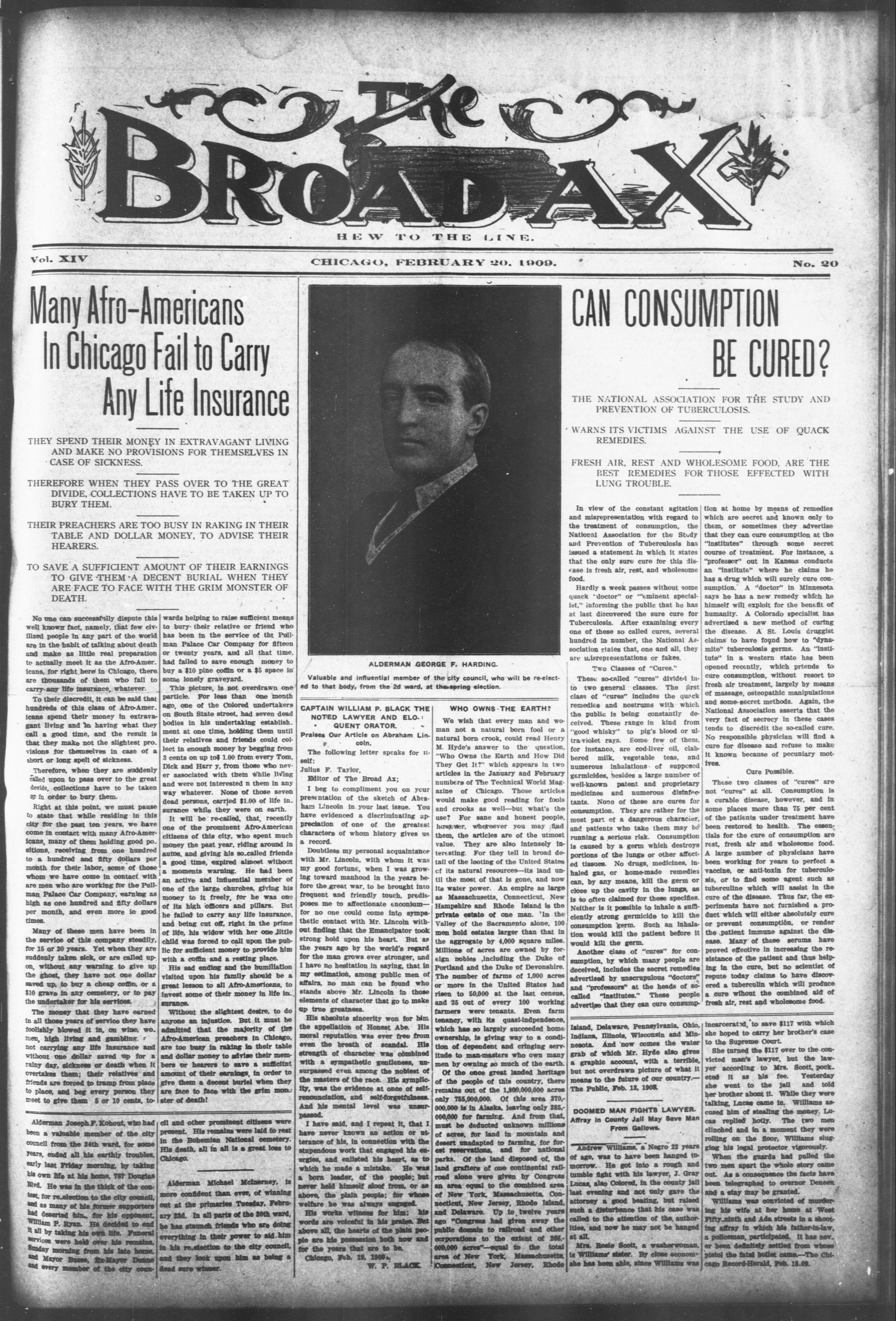
ALDERMAN GEORGE F. HARDING.
Valuable and influential member of the city council, who will be re-elected to that body, from the 2d ward, at the spring election.
CAPTAIN WILLIAM P. BLACK THE NOTED LAWYER AND ELOQUENT ORATOR.
Praises Our Article on Abraham Lincoln.
The following letter speaks for itself:
WHO OWNS THE EARTH?
We wish that every man and woman not a natural born fool or a natural born crook, could read Henry M. Heyde's answer to the question "Who Owns the Earth and How Do They Get It?" which is in
I beg to compliment you on your presentation of the sketch of Abraham Lincoln in your last issue. You have evidenced a discriminating appreciation of one of the greatest characters of whom history gives us a record.
Doubtless my personal acquaintance with Mr. Lincoln, with whom it was my good fortune, when I was growing toward manhood in the years before the great war, to be brought into frequent and friendly touch, predisposes me to affectionate conium—for no one could come into sympathetic contact with Mr. Lincoln without finding that the Emancipator took strong hold upon his heart. But as the years ago by the world's regard for the man grows ever stronger, and I have no hesitation in saying, that in my estimation, among public men of affairs, no man can be found who stands above Mr. Lincoln in those elements of character that go to make up true greatness.
His absolute sincerity won for him the appellation of Honest Abe. His moral reputation was ever free from even the breath of scandal. His strength of character was combined with a sympathetic gentleness, unsurpassed even among the noblest of the masters of the race. His symplicity, was the evidence at once of self-renunciation, and self-forgetfulness. And his mental level was unsurpassed.
I have said, and I repeat it, that I have never known an action or utterance of his, in connection with the stupendous work that engaged his energies, and enlisted his heart, as to which he made a mistake. He was a born leader, of the people; but never held himself aloof from, or above, the plain people; for whose welfare he was always engaged.
His works witness for him; his words are voiceful in his praise. But above all, the hearts of the plain people are his possession both now and for the years that are to be.
Julius F. Taylor
WHO OWNS·THE EARTH?
We wish that every man and woman not a natural born fool or a natural born crook, could read Henry M. Hyde's answer to the question, "Who Owns the Earth and How Did They Get It?" which appears in two articles in the January and February numbers of The Technical World Magazine of Chicago. Those articles would make good reading for fools and crooks as well—but what's the use? For sane and honest people, however, wherever you may find them, the articles are of the utmost value. They are also intensely interesting. For they tell in broad detail of the looting of the United States of its natural resources—its land until the most of that is gone, and now its water power. An empire as large as Massachusetts, Connecticut, New Hampshire and Rhode Island is the private estate of one man. In the Valley of the Sacramento alone, 100 men hold estates larger than that in the aggregate by 4,000 square miles. Millions of acres are owned by foreign nobles, including the Duke of Portland and the Duke of Devonshire. The number of farms of 1,000 acres or more in the United States had risen to 50,000 at the last census, and 35 out of every 100 working farmers were tenants. Even farm tenancy, with its quasi-indpendence, which has so largely succeeded home ownership, is giving way to a condition of dependent and cringing servitude to man-masters who own many men by owning so much of the earth.
Of the once great landed heritage of the people of this country, there remains out of the 1,800,000,000 acres only 755,000,000. Of this area $70,000,000 is in Alaska, leaving only 385,000,000 for farming. And from that, must be deducted unknown millions of acres, for land in mountain and desert unadapted to farming, for forest reservations, and for national parks. Of the land disposed of, the land grafters of one continental railroad alone were given by Congress an area equal to the combined area of New York, Massachusetts, Connecticut, New Jersey, Rhode Island, and Delaware. Up to twelve years ago "Congress had given away the public domain to railroad and other corporations to the extent of 266,000,000 acres"—equal to the total area of New York, Massachusetts, Connecticut, New Jersey, Rhode
CAN CONSUMPTION BE CURED?
THE NATIONAL ASSOCIATION FOR THE STUDY AND PREVENTION OF TUBERCULOSIS.
WARNS ITS VICTIMS AGAINST THE USE OF QUACK REMEDIES.
FRESH AIR, REST AND WHOLESOME FOOD, ARE THE BEST REMEDIES FOR THOSE EFFECTED WITH LUNG TROUBLE.
In view of the constant agitation and misrepresentation with regard to the treatment of consumption, the National Association for the Study and Prevention of Tuberculosis has issued a statement in which it states that the only sure cure for this disease is fresh air, rest, and wholesome food. Hardly a week passes without some quack "doctor" or "eminent specialist," informing the public that he has at last discovered the sure cure for Tuberculosis. After examining every one of these so called cures, several hundred in number, the National Association states that, one and all, they are misrepresentations or fakes.
Two Classes of "Cures."
These so-called "cures" divided into two general classes. The first class of "cures" includes the quick remedies and nostrums with which the public is being constantly deceived. These range in kind from "good whisky" to pig's blood or ultra-violet rays. Some few of them, for instance, are cod-liver oil, clabbered milk, vegetable teas, and numerous inhalations of supposed germicides, besides a large number of well-known patent and proprietary medicines and numerous disinfectants. None of these are cures for consumption. They are rather for the most part of a dangerous character, and patients who take them may be running a serious risk. Consumption is caused by a germ which destroys portions of the lungs or other affected tissues. No drugs, medicines, inhaled gas, or home-made remedies can, by any means, kill the germ or close up the cavity in the lungs, as is so often claimed for these specifies. Neither is it possible to inhale a sufficiently strong germicide to kill the consumption germ. Such an inhalation would kill the patient before it would kill the germ.
Another class of "cures" for consumption, by which many people are deceived, includes the secret remedies advertised by unscrupulous "doctors" and "professors" at the heads of so-called "institutes." These people advertise that they can cure consump-
Island, Delaware, Pennsylvania, Ohio, Indiana, Illinois, Wisconsin and Minnesota. And now comes the water grab of which Mr. Hyde also gives a graphic account, with a terrible, but not overdrawn picture of what it means to the future of our country.—The Public, Feb. 13, 1908.
DOOMED MAN FIGHTS LAWYER.
Affray in County Jail May Save Man From Gallows.
Andrew Williams, a Negro 22 years of age, was to have been hanged tomorrow. He got into a rough and tumble fight with his lawyer, J. Gray Lucas, also Colored, in the county jail last evening and not only gave the attorney a good beating, but raised such a disturbance that his case was called to the attention of the authorities, and now he may not be hanged at all.
Mrs. Rosie Scott, a washerwoman, is Williams' sister. By close econom- she has been able, since Williams was
IMPTION
BE CURED?
ON FOR THE STUDY AND
ARCULOSIS.
TEST THE USE OF QUACK
OLESOME FOOD, ARE THE
THOSE EFFECTED WITH
tion at home by means of remedies which are secret and known only to them, or sometimes they advertise that they can cure consumption at the "institutes" through some secret course of treatment. For instance, a "professor" out in Kansas conducts an "institute" where he claims he has a drug which will surely cure consumption. A "doctor" in Minnesota says he has a new remedy which he himself will exploit for the benefit of humanity. A Colorado specialist has advertised a new method of curing the disease. A St. Louis druggist claims to have found how to "dynamite" tuberculosis germs. An "institute" in a western state has been opened recently, which prends to cure consumption, without resort to fresh air treatment, largely by means of massage, osteopathic manipulations and some-secret methods. Again, the National Association asserts that the very fact of secrecy in these cases tends to discredit the so-called cure. No responsible physician will find a cure for disease and refuse to make it known because of pecuniary motives.
Cure Possible.
These two classes of "cures" are not "cures" at all. Consumption is a curable disease, however, and in some places more than 75 per cent of the patients under treatment have been restored to health. The essentials for the cure of consumption are rest, fresh air and wholesome food. A large number of physicians have been working for years to perfect a vaccine, or anti-toxin for tuberculosis, or to find some agent such as tuberculine which will assist in the cure of the disease. Thus far, the experiments have not furnished a product which will either absolutely cure or prevent consumption, or render the patient immune against the disease. Many of these serums have proved effective in increasing the resistance of the patient and thus helping in the cure, but no scientist of repute today claims to have discovered a tuberculin which will produce a cure without the combined aid of fresh air, rest and wholesome food.
incarcerated, to save $117 with which she hoped to carry her brother's case to the Supreme Court.
She turned the $117 over to the convicted man's lawyer, but the lawyer according to Mrs. Scott, pocketed it as his fee. Yesterday she went to the jail and told her brother about it. While they were talking, Lucas came in. Williams accused him of stealing the money. Lucas replied hotly. The two men clinched and in a moment they were rolling on the floor, Williams slugging his legal protector vigorously. When the guards had pulled the two men apart the whole story came out. As a consequence the facts have been telegraphed to overnor Deneen and a stay may be granted.
Williams was convicted of murdering his wife at her home at West Fifty_ninth and Ada streets in a shooting affray in which his father-in-law, a policeman, participated. It has never been definitely settled from whose pistol the fatal bullet came.—The Chicago Record-Herald, Feb. 18.09.
THEBROADAX
Will promulgate and at all times uphold the true principles of Democracy, but Catholics, Protestants, Priests, Insiders, Single Taxers, Republicans, or anyone else can have their say, as long as their language is proper and responsibility is fixed.
The Broad Ax is a newspaper whose platform is broad enough for all over claiming the editorial right to speak its own mind.
Local communications will receive attention. Write only on one side of the paper.
Subscriptions must be paid in advance.
One Year.....$2.00
Six Months.....1.00
Advertising rates made known on application.
Address all communications to
THE BROAD AX
5028 Armour Avenue, Chicago.
JULIUS F. TAYLOR, Editor and Publisher.
Entered as Second-Class Matter,
Aug. 19, 1902 at the Post Office at
Chicago, Illinois, under Act of March
3, 1879.
Call for Convention Issued to People of All Parts of the Nation.
Appeal Says Blacks Are Robbed of Right to Vote in the Southern States.
New York, Feb. 12.—Signatures of many prominent men and women are attached to a call issued today for a national "Lincoln conference on the Negro question." The object of the conference, as outlined in the call, is "a full discussion of present evils, and to awaken a renewed interest and activity in behalf of the Colored race, and to secure for it perfect equality."
The question is put in the call: "How far has the nation lived up to the obligation imposed upon it by the emancipation proclamation!" It deprecates "the spread of lawless attacks upon the Negro, north, south and west," and says "Silence under these conditions makes tacit approval."
Says Negro is Disfranchised.
"If Mr. Lincoln could revisit this country in the flesh" continues the call, "he would be disheartened and discouraged. He would learn that on Jan. 1, 1909, Georgia had rounded out a new confederacy by disfranchising the Negro after the manner of all the other southern states.
"He would learn that the Supreme Court of the United States, supposedly a bulwark of American liberties, had refused every opportunity to press squarely upon this disfranchisement of millions, by laws avowedly discriminatory and openly enforced in such manner that the white man may vote and the black man be without a vote in their government; he would discover, therefore, that taxation without representation is the lot of millions of wealth producing American citizens in whose hands rests the economic progress and welfare of an entire section of the country."
Among the signers of the call are Miss Jane Addams, Chicago; Samuel Bowles, Springfield, Mass.; Mrs. Ida Wells Barnett, Chicago; William Lloyd Garrison, Boston; Prof. W. E. B. Dubois, Atlanta; the Rev. Francis J. Grimke, Washington, D. C.; Rabbi Emil G. Hirsch, Chicago; Louis F. Post, Chicago; William M. Salter, Chicago; Mrs. Rodman Warton, Philadelphia; Miss Sucan Warton, Philadelphia; Prof. Charles Zueblin, Boston; and many prominent New Yorkers.
If those interested in this new movement can in time succeed in restoring the ballot to the Negro, and wipe out all the "Jim Crow Laws" then they highly deserve to be showered with blessings from on high.—Editor.
Clause Barring White Men.
Springfield, Mass. Feb. 5.—The Colored people of this city intend to shut out all white people from taking part or investing in the Mutual Housing Association. This association is working to give the Colored people better house accommodations. Already two houses have been secured, and others will be purchased or built as soon as the funds accumulate.
One of the provisions of the association is that none of the stock shall fall into the hands of a white man. This is not done in the spirit of retaliation or spite, but merely to insure that the control of the association shall remain in the hands of Colored men. The Rev. William N. De Berry is one of the leaders in the movement—The Herald, Boston, Mass.
---
Mrs. Frances Earl Chapman, residing in her own large flat building at 5948 Prairie ave., has for sometime been laboring under the impression that her flickled-minded husband, George Alfred Chapman, who is 54 years old, being quite a few years older than his beautiful looking wife, has been doing a little too much sidestepping in the past and bestowing too many of his sweet kisses on his "soulmates" or affinities Colored and white.
So at last she decided to engage detectives to hit his trall, and after they had shadowed him for some time, they caught him and Miss Mary Servis, his Colored affinity, residing at 3120 Wabash ave., in a rooming or bed house at 3201 Dearborn street, last Sunday evening and they were placed under arrest; Miss Servis, who does not claim to be any higher than a servant girl, is only 22 years old and she must be a warm baby.
Monday morning they faced Judge Hume, in the Municipal court, at the Harrison street police station, and Mr. Chapman, who is real rich, was fined $15 and cost and Miss Servis, was taxed $10 and cost, for embracing and hugging and kissing each other, in the rooming house on Sunday evening.
And now Mrs. Chapman, feels so sore or hurt to think that her husband would persist in turning her down for a common Colred lady, that she has made up her mind to secure a divorce from him.
$210,000,000 FINES FOR DIRT
Seven Negroes Given Bigger Sentences than the Oil Trust.
PAY WITH $7 AND PROMISE.
August Judge Shows His Mercy by Not Hanging Blacks.
Augusta, Ga. Feb. 14.—Seven Negroes convicted of allowing refuse to collect in their yards today felt the mercy of Recorder Picquet when he fined them only $30,000,000 each—or a total of $210,000,000. The recorder was merciful in that under the letter of the law, he could have sentenced them to hanging.
Having surpassed Judge Landis' famous $29,000,000 fine, the recorder then suspended payment until a second offense, each defendant depositing $1 as guarantee of his promise to keep his home spick and span hereafter.
Inspector Shechan of the board of health brought the Negroes before the recorder for violation of the sixth and eleventh sections of the law of the board of health, in keeping an unclean yard. Every Negro had an excuse, but these did not go with his honor.
. Negroes Long in Susppense.
When he arose to sentence the blacks Judge Plicquet read the ordinances to the effect that he could visit any punishment he saw fit on any person found guilty of having an unclean yard. The judge mildly informed the blacks he could sentence them to hang if he wished to but that he would not.
"I am a merciful man," he added; "and have no desire to place an unusual punishment upon you. I will make the fine for each of you only $80,000,000."
Appreciating their inability to pay any such fine—figures absolutely beyond their comprehension the Negroes sank to the bench with groans and staring eyes. They feared that failure to meet the court's demands in the coin of the realm meant life servitude in the penitentiary.
Pledges and Deposits Given.
When the laughter which the announcement of the court's decision had caused subsided. Recorder Picquet suspended the sentences upon condition that each of the defendants deposit $1 with the clerk and promise, not to offend again.
They all promised, and hurriedly left the court room as if they were afraid the recorder might change his mind.
The ordinance under which the sentence was imposed provides that the court "may impose any punishment he sees at."
The time may come when the Judges of the Municipal court, in this city will-round up both the white and Colored people, for permitting their front and rear yards to remain in a filthy condition and it would be a mighty good thing if many of the people residing in Chicago are compelled to spruce up in this respect, like they are forced to do in Augusta, Ga.—Editor.
---
Far in the west, in forest wild,
Was born one day to us a child,
A man most truly great to be,
Although of humble birth was he.
No herald the event proclaimed.
No royal scribe wrote down his name.
A hut of logs rough hewn and bare.
With scarce enough of light and air;
A bed of straw, a floor of earth—
Such was the place of birth
Of him whose name the world reveres.
That grows in greatness with the
years.
Uncouth, unlettered, yet a prince,
That God vouchsaefed no right divina
To man his fellows to confine,
To mark their bounds, their course dictate,
A royal road to greatness make,
The cabin floor, the pine knots' blaze.
Might be the medium fit to raise
Ambitious man from low estate
To heights ennobling, truly great,
From raft of logs with peers to stand,
The applause of senates to command
A grateful nation now in praise
From loyal heart a song must raise
To God for those who blazed the way
For Freedom's universal sway;
For those who prayed on Plymouth's rock,
For those who felt the awful shock
Of war with savage fierce and wild,
Who gazed in death's grim face and smiled
Because from tyranny's haughty sway
The sacrifice would pave the way.
Yet few were they who rose above
The common trend of thought and strove
To tear away the pall of shame
That blurred their country's sacred name,
A sleeping conscience sought to wake,
The alien's galling chain to break,
Who braved the scorn of bigot's base
To succor a benighted race.
Foremost among this stalwart few
Stood old Abe Lincoln, staunch and true
In every fiber of his frame.
He waited till the hour came.
Then raised on high the fiery brand
To scourge the evil from the land.
The awful storm of blood and tears
Did rage and beat for four long years.
The world looked on in blank dismay
As brothers struggled in the fray.
All reverence for his wisdom fled.
They heaped reproaches on his head.
Foes lurked his pathway, stormed his door,
And wise men deemed his judgment poor
Yet firm and undismayed he stood,
This rustic lawyer, hew'r of wood
Although at times defeat he saw,
Yet still he deemed it Saxon war.
Reluctantly he gave the word
Which called forth the immortal horde.
The alien host, unshackled, free,
Rose like an angry, billowy sea
And grateful for the longed chance
To check the sullen foe's advance.
Let Wagner and Fort Pillow tell
The glorious story how they fell.
Newmarket Heights—oh, gory field!
In Freedom's cause they could not yield.
Up, up that rugged steep and wide
They climbed to glory side by side
Or calmly laid them down to rest,
Clasped to a Spartan mother's breast.
Brave chattles from the auction block!
They faced alone the "Crater's" shock
And turned the scoffer's laugh to cheers,
The skeptic's eyes made wet with tears.
And when 'twas o'er, the strife, the pain,
There lay their great commander, slain!
They raised the blazing torch on high
To light his pathway to the sky.
Be hushed forever, lips of scorn!
In generations yet unborn
Parents to children still will tell,
While love and pride their bosoms swell;
The rough backswoodsman of the west
Was he who served his country best,
And nations still shall gather there,
Around the martyr's sepulcher.
JACK THORNE.
—The Recorder, Indianapolis, Ind.
Feb. 13. '09.
No other newspaper in Chicago, the past week, aside from The Broad Ax, had sufficient enterprise to publish one line, in reference to the 92d anniversary of the birth of Frederick Douglass, and we pride ourselves in stating, that more space was devoted in its columns in setting forth his wonderful career, than any fifty papers, published in the various parts of the country which have so far fallen under our notice.
Thus the mighty Declaration.
Which came with the country birth,
Has its perfect salutation
In her laws of sacred worth;
And Old Glory, Freedom's Pimlon,
When it files o'er land and sea,
Waves for every class of beings
As the banner of the free.
And Columbia, on her mission,
Sends the rays of Freedom's light
Round the earth, with true devotion
In her sacred cause of right.
Blending with the name Columbia
Abra'm Lincoln rises high;
In the patriots' true devotion
All men hall him with most elgh.
In all ages this old story
Will flow onward through the years.
Gaining always greater glory
For he stay'd a people's tears;
And the Nation, sadly riven
Firm he moulded into one;
Thus we love the name of Lincoln
As a universal son.
APPOMATTOX CLUB
With all of its Old Time prestige dignity and merit the Appomattox Club swung into line last Saturday with one of the most comprehensive and complete Lincoln & Douglass Memorial service of the week. Press B. F. Moseley was in fine feather, so was the Hon. Judge W. N. Gemmil who addressed the Club in Chief Justice, Olson's stead. Mrs. Ida Wells Barnett also made a splendid short talk upon Douglass, while Prof. J. W. E. Bowen of Atlanta, Georgia demonstrated his deep and profound learning by his masterly deductions of the life of Lincoln & Douglass. Most of the members were present with their wives, a fact, which indicates the organization is again wide awake.
Invitations are out for the Martha Washington Ball-Masque Party next Monday. The Entertainment Committee are determined to make it the swellest of affairs.
President Beauregard F. Moseley received an invitation to be all to the Marshal of the dav of the Third Division of the Inaugural Parade, March 4th at Washington, D. C. Mr. Moseley's health, however, will prevent him from accepting or participating in the inaugural as he has been for the past week, and is now upon the Sick List.
CHATEAU RINK NOTES.
Mr. Ollie Curry and a party of friends paid a visit to the Chateau last Sunday evening.
Every person visiting the Chateau reports a good time. The attendance is growing.
Tuesday and Friday Matinees are quite popular.
Mr. S. Hamilton of the West Side visited the Club Parlors last Sunday Eve.
You will find no Zero weather at the Chateau, come out and join the crowd and have a good time. Grand March on rollers at 10:45. Picture Show at 10:30.
The many friends of Mr. B. F. Moseley, Sec. and Treas. of the Chateau are sorry to hear of his recent illness and hope him a speedy recovery.
Something new at the Chateau every Saturday and Sunday Eve.
Meet me at the Chateau Tuesday, Feb. 23rd. A good time in store for all.
AT THE CHATEAU DE PLAI-SANCE RINK, 5324.26
STATE STREET.
MASQUE MARDIGRAS CARNIVAL,
Tuesday, February 23rd, 1909.
9 to 9:30 p. m. the Mystick Crews of Nereus, Falstaffian, Alanteans and Comus will arrive on rollers at 9:30. His Majesty "Rex" the King of the Carnival, accompanied by his famous Brass Band on Rollers, in search of a Queen, will appear.
10 to 10:15 Crowning of Queen and Grand March led by King and Queen.
followed by General Skate Fest and the awarding of prizes which will be for the best characters. $1.00 each, the best skater in Mask Costume and the poorest skater in Mask Costume $1.00.
Midnight Vaudeville, Dance and Supper and farewell to Flesh Meats in the Cafe. These functions will positively take place. Rehersals now going on.
All good people invited, good picture show, best of decorum and a good time guaranteed. Admission 10 cents, One Dime. Leland Giants Base Ball and Amusement Association.
ILLINOIS MISCENGENATION BILL
AIMED AT JAPS AND CHINESE.
Representative Robinson Introduces Measure in House to Prevent Intermarriage of Whites and Asiastics.
Springfield, Ill. Feb. 17.—Representative Robinson desires to call the attention of President Roosevelt to the fact hat Illinois has a perfectly good and well working geneerla assembly. He has introduced a bill to prohibit the intermarriage of Japanese, Chinese, Asiastics of all descriptions, and Negroes with white persons.
Representative Robinson evidently wants to make an effort to earn his salary, hence the introduction of his bill which will never pass the Republican legislature of Illinois.
THE INSTITUTIONAL A. M. E.
CHURCH, 3825 DEARBORN ST.
By urgent request some of the views given last Sunday night will be repeated Sunday Night, March 7th. Quite a few other views will be added. Mrs. Patti Dean Brown sang with excellent effect. Miss Lillian Tooley recited with feeling, a very appropriate selection. The audience heard her with appreciation. The Pastor will preach at both services Sunday. The new choir under the direction of Mrs. Jessie Smith will sing some selections Sunday evening Mrs. Bessie Weisiger Organist. Mr. Wm. E. Wright, will sing a tenor solo; Mrs. Clark, a soprano solo.
Arrangements have been made by which the illustrated services will be continued every month the first Sunday; also Saturday nights for the children from 7 to 8:30 p. m., showing some useful views on practical subjects free.
CONDEMNED NEGRO GETS RE.
PRIEVE.
Andrew Williams, 23 years old, a Negro, sentenced to be hanged today, was granted a respite for two weeks by Governor Deneen. This will give the prisoner an opportunity to appeal his case to the Supreme Court. Williams' execution had been delayed twice, and it was said Governor Deneen had refused to allow him another reprieve until he learned of the charges made by the prisoner against J. Gray Lucas, his attorney, who is alleged to have retained money given him for the purpose of appealing the case.—Th Chicago Record Herald, Feb. 19, 1909.
CHIPS
Noah D. Thompson, 6618 Vernon av., has been on the sick list for the past week, being confined to the house with a severe cold.
Attorney Edward E. Wilson, 3552 Forest ave., after being indisposed for a short while, is now able to look after his increasing law business.
An exchange says that a fellow who is soared into heaven because he is afraid to go to hell will doubtless have a sneaking appearance when he arrives.
Dunn and Hight, 5050 State street, have opened up a first class cafe and English chop house above their Buffet, and meals will be served at all hours in the most tempting manner.
King Jefferson, who has executed some clever stunts in poetry, has removed from the 2nd ward into the 31st ward, and he is now residing at 5516 Armour ave.
Miss Bessie Bryant, 5027 Armour ave., who is extremely bright in every respect, is progressing rapidly in her studies at the Farrand school, and recently she advanced to the head of her class in the 7th grade.
Alderman P. J. O'Connell, will jump over the highest rail at the primaries Tuesday, February 23d, and again be victorious at the polls, April 1st, and continue to represent the 31st ward in the city council.
Jon. J. Healy, Aldermann candidate of the 30th ward, is making an active fight all along the line, and laying all jokes aside, he is receiving strong
support from quarters least expected by him, and he feels that he will make a good showing at the primaries Tuesday, February 23d.
Mrs. Adolph Howien, 3807 Wabashave, will in the near future, give a select dinner party, to a number of her lady friends.
Mrs. Carrie Warner, 5223 Dearborn street, the past week, expressed her great pleasure, in reading our articles in the last issue of The Broad Av. on "Abraham Lincoln, and Frederick Douglass." She declared, that "in her opinion, that, they were the best and most interesting that she had read in any of the newspapers in Chicago."
W. E. Carlmore, 51st and Dearborn street, has instituted divorce proceedings against his new sixteen year old wife, Miss Lucy Flynn. The couple were married about one month ago, and Mr. Carlmore hasasked for his divorce on the grounds of infidelity. Hale G. Parker, is Attorney for Mr. Carlmore.
The Advisory Board of the Phyllis Wheatley Home Association, 3530 Forrest ave., met Tuesday evening and the topic under discussion was "Publicity as an aid toth e work," and it would seem that as the home becomes better known and the efforts put forth by the Phylliss Wheatley Club, through the columns of the public press, the better it will be for it.
Grace Presbyterian, Bible Class and Base Ball Team, will hold their second annual musical services at the church corner Dearborn and 34th street, Sun day evening, February 21st. Mr. William Sharp, chairman of the base ball league will deliver an address. Attorney Albert B. George will also speak. The musical numbers include some of the following talented musicians. Miss Virgiline Sharp, A. C. Brown and church quartette, also the young musical genius, Master Frank Jorden Woods, who will render some choice selections on his violin.
Taft's Latest Fish Story.
Justice Harlan, says Joe Mitchell Chapple in the National Magazine, told a story to Judge Taft of how he went out to play golf in a fog. He thought he would drive the ball and sent it off at a "hazard." He came to the caddie and asked him to find the ball, looking within a radius of 300 yards. The caddie's eyes stuck out. "I done found dat ball, judge. It am in a hole sure 'nough. It jest wiggled in like." It was certainly remarkable that a drive through the fog should place a ball where the most earnest effort of two to twenty strokes may fall in broad daylight.
Judge Taft responded with a fishing story, also about a fog. He went out one day in a wagon to fish, and the fog came down thick. He drew up where he thought the stream ought to be, cast his line, felt a pull and hauled in a fine trout—another bite and another, until the wagon was filled. The fog lifted, and the wagon was 300 yards from the river! There was a silence which might be felt when Judge Taft concluded, and Justice Harlan told no more fog stories.
Thought Him a Mollycoddle.
John D. Rockefeller rebuked a Cleveland man one day for swearing.
"Don't swear," he said. "Say 'durn' or 'pshaw.' There is as much comfort in those mild words as in the redest oaths.
"I know," said Mr. Rockefeller, "that such is not the prevalent opinion. The prevalent opinion—but it is a wrong one—was expressed the other morning by my caddy.
"No. What does he say?" I asked.
"He says, "Tut, tut." Joseph
sneered."
CHOICE MISCELLANY
Smart Boys of Long Ago. It is often asserted nowadays that our young men and women attain intellectual maturity much later than did their parents and grandparents, and in support of this theory the precocity of distinguished personages who flourished a generation or two ago is cited. Now, somebody who has probably been bored like the rest of us with this yarn about the phenomenal brightness of the old fashioned boys has looked up the records of eleven leading colleges to see what changes have taken place in the age of graduates. From 1850 to 1890 the average age at graduation was 23 years 1.3 months. From 1890 to 1900 it was 23 years 1.9 months. In 180 years at Dartmouth the average age at graduation has fallen three months. This average age, it appears, has changed as little as the average weather. Thus one or two precocious youths of the long age are sufficient to endure all their contemporaries with the same qualities. But the fact is the twentieth century boy is smarter than any of his predecessors, and (unfortunately) in nine cases out of ten he knows it—Pittsburgh Gazette Times.
[Special Correspondence.]
The new office building for the members of the house is receiving the finishing touches. It is now in quite comfortable shape. The senate office building the contractors hope to have ready for occupancy by March 4. Senators will each have two rooms; representatives have only one room allowed them. Senators always have voted themselves what they pleased. There are no accommodations at present in either the Capitol or the old Maliby building, which is occupied by senators not chairmen of committees, for the more recently, elected, and Messrs. Cummins of Iowa, Page of Vermont and Fletcher of Florida, who take their seats this session, will have their quarters in the new office building rushed to completion.
Quarters For Census Bureau.
The understanding is that when the Malty building is vacated by senators the census bureau will take it and quarter a large portion of the clerks therein. This used to be a hotel and was rented and subsequently purchased by the government. It is not far from the ugly brick shack that is used by the census bureau and is itself dilapidated. The force of the census bureau is being increased right along as the next enumeration of the population is to be made in 1910. There is a modified examination of all men and women who secure clerkships in this bureau, but as senators and representatives have a good deal to say as to who shall be selected for the temporary positions the pressure for appointments will be intense from now until the time for getting the work well under way.
New Men In the House
According to the unofficial list compiled by the clerk, seventy new faces will be seen among the members of the next house when it meets in extra session in March under a call from President Taft. At the recent election Indiana made more changes in its house delegation than any other state, amounting to eight, the Democrats securing eleven out of thirteen members. In the next house new men will be present from the states named below as follows: Pennsylvania, 7; New York and Ohio, 6 each; Missouri and Iowa, 5 each; Colorado, Illinois, Mississippi and North Carolina, 3 each; Kentucky, Louisiana, Maryland, Nebraska, New Jersey, Oklahoma, Tennessee and Wisconsin, 2 each; Alabama, Arkansas, Connecticut, Delaware, Florida, Georgia, Idaho, Maine, Michigan, Minnesota, Montana, Rhode Island, Texas Vermont and Washington, 1 each.
The Saint Gaudens Coins.
President Roosevelt has at last replied to the ridicule and criticism that were caused by the "bloomer eagle" and other peculiarities of design on the recent issue of gold coins. He attended an exhibition of the works of Augustus Saint Gaudens at the Corcoran Gallery of Art and paid eulogium to that artist's mastery of his craft. He declared that his works will stand in the very forefront among the masterpieces of the greatest periods and the greatest peoples.
As to the gold coins, he declared Saint Gaudens "gave us for the first time a beautiful coinage, not yet properly appreciated, but up to which both the official and the popular mind will in the end grow." The president contended that the first few thousands of these coins are more beautiful than any coins since the days of the Greeks and that frequent comments on the bonnet of "eagle plumes on the figure of Liberty" illustrate curiously the exceedingly conventional character of much of our criticism and the frequent inability to understand originality until it has won its place.
The Senator Puzzled 'Em.
A saloonist and an antislaomist happened to run into the same senator up at the capitol the other day. Both were anxious to have their views prevail in the matter of liquor legislation for the District, and both were trying to get the senator to express his views on the matter.
The senator smiled and was nice to both, and then he remarked as he hade them adieu. "You know, I have always been a strong believer in putting down drink."
Both the anti and the anti-anti are wondering yet.
Art Above the Weather.
In one of Washington's art galleries there hangs a large canvas in an imposing frame. The painting shows a waterfall in one of the states famous for startling natural scenery. The picture has occupied its present place for several years. "Does it belong here?" asked the visitor of the man in charge.
"No more than the others you see."
No more than the others you see.
"Seems to me it should be in the capitol of the state where this scenery is," said the visitor.
"It was painted for the state," replied the man in charge, "but when it was submitted to the art committee they refused to accept it."
"What was the objection?"
"You see the sky is overcast. The artist put in a gathering storm like an impending calamity. The art committee said it was a reflection on the reputation of the state; that a storm such as is represented was unknown in that latitude."
"Couldn't the artist put in another sky, one that accorded with the state's reputation for sunshine?"
"I suppose he could, but he refused. He said that the rumpus kicked up by the art committee warranted the storm effect on the canvas, and he refused to budge. He sent it here, and here it remains."
OAKL SCHOFFELD
LIKE HAMMERED GOLD
Proposed Monument For the Alaska-
Yukon-Pacific Exposition.
The Alaska-Yukon-Pacific exposition monument, to be the crowning work of sculpture of the international exhibition of 1000, will be covered with solid gold leaf. Gold donations to the amount of $7,000, necessary to completely cover the great shaft with the shining metal, will be solicited from Alaskans, Yukoners and the people of Seattle.
An appropriation to cover the cost of building the monument in staff has been authorized, the drawings made and the sculptor is engaged in building his clay model. The monument is to stand in the center of the plaza in front of the magnificent group of United States government buildings and directly at the head of the Cascades.
Looking south from the monument will be first the central features of the exposition, and then the eye will travel over a panorama of eighty miles of mountain, lake and woodland scenery to Rainier and the Cascade range.
The exposition monument is to be more than seventy feet in height. The monument proper will stand on a pedestal twenty feet high. This column will be of Corinthian design, on the top of which will be a globe giving the signs of the zodiac. On top of this globe will be a huge American eagle with outstretched wings, as in flight. Grouped about the base of the monument will be three seated female figures symbolic of the northland, the south seas and the orient. Every foot of this great monument will have the appearance of having been hammered out of pure gold if the donations are sufficient to complete the undertaking.
—Seattle Times
Youthful Suicides
There is a shocking proneness among youthful Bengalis to kill themselves on the least pretext. It seems to be an exaggerated form of sultiness, and one would like to have a medical opinion on the matter. A student is reprimanded by his parent because his studies don't show the advancement expected. The boy swallows some opium and ends his studies. A girl wife in Howrah takes a dislike to the second choice of her husband. She also secures an exit by the easy means of opium. A Bengal woman in Howrah wanted to go on a pilgrimage to Gays. Her mother said she could not advance the railway fire, and the girl went out to a tree and hanged herself. These are all recent cases.—Calcutta Empire.
A. Pleasant Prison.
The prison at Cetinje, Montenegro, has been described as surely the most extraordinary one in existence. It presents little to indicate that it is a place of confinement, there being apparently nothing between the prisoners and absolute liberty. There are no outer prison walls, and in the cells the men—about eight or ten to each—are contentedly and comfortably housed as their own personal domestic belongings can make them. Moreover, they are generously fed, and cigarettes without stint, wine occasionally and no work at all combine to check and desire to escape more effectually than would strong walls, iron bars and an army of fallers—London Globe.
Tees In the Treatops
Here is a story speaking better for the German emperor's goodness of heart than his knowledge of the ancient and royal game of golf. "So you want ground for your golf club, Sir Frank!" said the kaiser to the British ambassador at Berlin. "We haven't got nice grass meadows round Berlin as you have in England, but I'll give you a bit of the Grunewald." a pine forest near Berlin and a great Sunday resort of the Berlinera. "Ah, sire," Sir Frank Lascelles replied, "I am afraid there would be too many trees!" "Trees!" instantly replied the emperor, with bonhomie. "All the better to keep the sun off you when you are playing in the summer!"
Cold Storage Poultry
The state board of health of Massachusetts has issued a bulletin on cold storage poultry in which this advice is given to housekeepers: "In order to avoid obtaining waterlogged and frozen fowls the consumer should demand the frozen bird and thaw it himself. If thawed quickly by immersion in a bucket of hot water it may be eaten with impunity and with relish the same day it is purchased, or if hung overnight at room temperature it may be ready for use the day following."
The Funny English.
James S. Palmer, vice president elect of the United States, may possibly look forward to filling one day the position of president. It will be remembered that on the death of President McKinley, Mr. Roosevelt, who was then vice president, succeeded automatically to the presidency without opposition. Should anything happen to Mr. Taft (which we sincerely trust, for his sake, may not be the case) Mr. Palmer would probably, if precedent were followed, take his place. -- Illustrated London News.
The Moving In Party
The Moving in Party
"Yes, they have a new sort of function in Chicago that is quite the rage."
"What is it called?"
"It's called a moving in party. When the hostess learns that the empty house next door is to be occupied she calls her guests by telephone, and they come and draw cuts for the front windows and then sit there and also up the new neighbor's stuff as the movers carry it in"—Cleveland Plain Daleer.
WM. D. NEIGHBORS & CO REAL ESTATE AT LOWEST PRICES
Easiest Terms to be had in Chicago
Loans on first and second Mortgages
Fire Insurance placed in any company
Main Office:
Suite 64, 95 Washington St., CHICAGO, ILL.
Branch Office:
3220 State Street
'PHONE 4866 CENTRAL
HUMOR OF THE HOUR
"I have a splitting headache," sighs the beautiful young thing.
"Have you ever tried magnetic healing?" asks the obliging young man.
"No. What is it?"
"You rest your head, thus, on my shoulder, and I pass my arm about your waist in this manner. Now be perfectly calm and see if this does not relieve you."
The position is maintained for five or ten minutes, and then the obliging young man asks:
"Does your head ache any more?"
"Y-ees."
"Well, I'm sorry I don't seem able to relieve you."
He is about to remove his arm, when she looks up at him chidingly and says:
"It seems to me that if you have any confidence in your method you would be willing to keep on trying."—Chicago Post.
DeAuber—There is a life size portrait I painted of Puffem, but he refused to accept it.
Brushleigh—It seems to be a good likeness of him. What was the trouble?
DeAuber—It's only about half as big as he thinks he in—Chicago News.
"Have you done anything to make life seem more cheerful?" said the optimist. "Have you helped anybody to smile?"
"I should say so. I have helped more people to smile than anybody else in the neighborhood. I'm a dentist."—Minneapolis Journal.
He Struck Out.
Jagreen—I saw you talking to Bor rows on the street this morning.
Bilbrown—Not exactly. He struck at me, but never touched me.—Pittsburg Post.
A
I flee my pen when heavy grows the brain.
When for a happy rhyme I search in vain.
The ink well closed, the pen laid in its place.
I seek for other scenes in outer space.
What though the wind be keen, what though it rain?
Tourist—Where's the bulldog I sold you the other day?
"Oh, the poor baste swallowed a tape measure, and he died, sorr!"
Tourist (waggishly)—He died by inches, eh?
"No, sorr! He went round the back of the house and died by the yard."—London Opinion.
Break from their sodden sty and, grunting, race.
Glad to escape their confines, pent and base.
I-for the taste of freedom that I gain—
I flee my pen.
—Charles Bittell Loomis in Judge.
"Teacher,' up to the deper. "Tomm cross eyed, It is scarce
"Teacher," said Dicky Jones, siding up to the desk and speaking in a whisper, "Tommy Tucker's tryin' to look cross eyed, like you look." It is scarcely necessary to add that it was Dicky Jones that got the subsequent whipping-"Harper's Weekly.
He Was a Mean Man.
"What's the matter now?"
"Before we were married you used to steal kisses from me."
"You mean when your face was turned away?"
"Yes."
"Well, if you'll turn your face away I'll see if I can get up enough courage to steal one now."-Houston Post.
The Knowledge That Hurts.
Toyne-Se Dumley married a college woman. Ms. it must be-denies for him to be tied to a woman who knows so much that he doesn't know!
Browne—Oh, that doesn't hurt him so much as the fact that she knows "how much he doesn't know—Cathe McStandard and Times.
Striving to Please.
"You," said the housewife, "yours is a sad story. But it isn't the same story you told last year."
"Well, lady," answered Plodding Pete, "you surely wouldn't expect a man to go all dat time an' not show any improvement!" Washington Star.
Ahead of the Game.
Byker—I attended a successful sleight of hand performance last night.
Pyhke—So?
Byker—Yes. I lent the conjurer a counterfeit dollar and he gave me a good one—Chicago News.
---
FACTS IN FEW LINES
A boy's hair grows at half the rate of a girl's.
Bosnia was incorporated with Turkey in 1463.
Belgium employs 37,000 men in its stone and marble quarries.
Banana skins are utilized in soapmaking on the west coast of Africa.
In Austria prizes are offered to farmers to encourage them to recover waste lands and lay them out as pasture.
Only one president of the United States has ever entered the White House without the electoral vote of his own state. That was James K. Polk.
The sedan chairs which were in general use in the seventeenth century are still used in Dresden by noblewomen, who are carried to the opera in them.
There are so few files in England that there is a regular business in importing dried ones from South America for food for poultry and captive birds and fish.
Under the revised law governing the employment of women and children in Italy night work is forbidden for all females and for males of less than fifteen years.
Never knew Her Husband's Name.
In declaring that she never knew her husband's first name Mrs. Esther Nieman of Monroe street created laughter at the central police court.
"I have always called him 'Pop' from the first day I married him, and as he did not object I never worried myself about his first name," said Mrs. Nieman, who had her husband arrested on the charge of failing to support her.
The accused husband by direction of the magistrate was induced to tell his wife his full name.
"Certainly. I'm glad to do it," remarked the defendant, "but I think my wife has known right along that I am Jacob Nieman."
After telling his name Nieman was held in $300 ball for trial.—Philadelphia Inquirer.
Inducements to Drink
In Catania an enterprising wine dealer has initiated a novel scheme of drinking by the hour ad libitum. For 15 cents one may drink for sixty minutes, and the current price of wine is 5 cents a liter. The chances are, however, in favor of the merchant, for it requires a strong stomach to drink three liters of Etna wine in one hour. At a neighboring town the charge is 10 cents for the first hour and 15 cents for two. The fashion seems to have "caught on," and at Bologna, where the wines are better, the charge is 41 cents for the first hour, 31 cents for the second and 20 cents for the third. The result of these inducements to drink is said not to be enchanting.
I FLEE MY PEN.
I asked a change, nor can I well complain
Fee: just as piglets see a. tempting lane.
Leading to meadows ripe with gold.
Good Word For Vells
"It is those big veils, that fasten down tight under the chin and ears that I want to put in a good word for," said the bacteriologist. "It may be that they ruin the eyes and shout out a lot of fresh air, as some folk claim, but they prevent women from putting dirty pieces of money into their mouths and so keep enough germs out of the system to make up for the other disadvantages."—New York Press.
Bull of the Irish Secretary.
A genuine bull is credited to Augustine Birrell, secretary for Ireland, by a Bristol correspondent of the London News.
"It is easier." Mr. Birrell affirmed in the course of a public speech at Brisbane, "to face your foes in front of you than your friends behind your back."
Branch Office:
3220 State Street
Unsatisfactory
The Smile Promoter
He Struck Out
Measurably Mournful.
Fifty-First St. and Armour Ave.
RAIL YARDS: 1st St. & L. & N. & R. B.
2nd St. and Armour Ave.
CHICAGO
A Pleasant Winter Evening.
ARE YOU IN SEARCH OF ONE?
Then Visit the "Chatsau," 5324 State Street, Tonight.
There is a fine Picture Show, Roller Skating, Dancing and superb music, refreshments and a jolly good time for good people. No prescription. Special prize program every Saturday and Sunday.
Admission, 10 cents--one dime
LELAND GIANTS' BASE BALL AND AMUSEMENT ASS'N.
A MEMORY OF THE PAST.
The Unalloyed Joy That Came With the Little Red Scarf.
"I was wondering the other day what one thing had given me the most pleasure in the world," said the village deacon. "I had to go back a long ways—clear back into the blessed Santa Claus days—but I recalled it. It was a scarf I found in my stocking one bright Christmas morning. I got a red one, and my brother got a blue one. I was a mighty proud boy that morning as I trudged downtown with that red scarf around my neck. I wore it every day until the birds began to sing in the springtime and the kids were hunting up their marbles. I don't now remember who gave it to me nor what became of it, but I do know that the memory of it still clings like a benediction.
"Since the days of that little red scarf I have had things of far more intrinsic value. I have worn lodge emblems of high degree; I have had a gold watch and chain; I once had a pair of shoes that, cost $5 and a necktie that cost twice as much as the little red scarf. Nay, more, I once tackled a plug hat. But among these things do I recall none that gave me such genuine and unalloyed pleasure, such a swelled up feeling, as did that little red scarf way back in the days when the wolf sat out in the road and howled. 'Tis the little red scarf days that stir the memory with 'It might have been."—Osborn (Kan.) Farmer.
SHORT STORIES.
Edward Thompson, a watchman at Perth Amboy, N. J., says a rat comes to him every day and gets a chew of tobacco.
At a Hungarian wedding at Highland, Ill., in a parade through the streets the bride and groom were attended by a band and seventy bridesmales.
For nearly five miles along the Beervly (Mass.) shore the land is owned exclusively by wealthy summer residents representing more than $100,000,000.
Harry E. Elliott of Rehoboth Beach, Del., says he found in a house buried by sand on the beach, used sixty years ago for storing oil, ice in a good state of preservation.
In 1895 only one country in the world was infected with the bubonic plague, while in 1908 fifty one countries are more or less infected, so Surgeon General Wyman reports.
A white robin, an albino, has made his home on Winter island, Salem, Mass., for this season. The curious bird has attracted much attention. He has got so used to bird students following him that he now allows persons to get close to him.
An Insinuation.
Chapligh—Surgery is making wonderful strides, Miss Cutting. Why, it has actually enabled men to live without their normal quantity of bwains, doncher know.
Miss Cutting—Indeed! Are you speaking from personal experience, Mr. Chapligh?—Detroit-Tribune.
Taking It Literally
"Bingle hasn't been himself since the stock slump."
"Bingle was one of the meanest curmudgeons I ever met. It must be a great relief to his wife when he isn't himself."—Cleveland Plain Dealer.
At the Insect Congress
At the time the news.
Ant—I hear they tore the centiped up so that he was completely out of the running.
Spider—Yes. They didn't leave him a leg to stand on—Baltimore American.
Western P. 17. Grant says that on account of the abolition of the canteen the health of the United States army is the worst in the world.
"The temperance people," said General Grant at a dinner in New York, "can advance what claims they will. We allege them effectually when we point out our wretched bill of health.
"It is like the colonel and the corporal.
"Any complaints, corporal," said the colonel, making a personal inspection one morning.
"Yes, sir. Taste that, sir!" said the coronal promptly.
"The colonel put the liquid to his lips.
"Why," he said, "that's the best soup I ever tasted!
"Yes, sir.' said the corporal, and the cook wants to call it coffee."
PATRICK H. O'DONNELL
WILLIAM DILLON
CLARENCE A. TOOLEN
Tel. Central 4660
O'Donnell, Dillon &
Toolen
ATTORNEYS AT LAW
Suite 1218-1219 Ashland Block
RANDOLPH & CLARK STREETS
CHICAGO
JAMES J. GRAY
ATTORNEY AT LAW
Suite 1518 Ashland Block
RANDOLPH AND CLARK STREETS
CHICAGO
Tel. Central 4728
Residence 57 Macallister Pines
Telephone Ashland 363
Office Telephones
Central 1239 Automatic 5940
MILES J. DEVINE
suite 315-320 Reeper Block
CLARK AND WASHINGTON STS.
CHICAGO.
Phone Main 4153 NOTARY PUBLIC
Phone residence, Gray 5670
Walter M. Farmer
ATTORNEY AT LAW
Suite 708, 171 Washington St.
Rea. 4856 Langley Av. CHICAGO
JOHN E. OWENS
ATTORNEY & COUNSELOR
AT LAW
333 ASHLAND .BLOCK
A. D. GASH
Attorney at Law.
84-86 La Salle Street, Chicago
Suite 615 to 619.
Telephone Main 3077.
Dr. W. E. MACKEY
4842 Armour Avenue.
Phone, Blue 6571.
CHICAGO.
Hours: 9 to 12 a. m.; 1 to 4 p. m.; and Nights.
THE ELITE BUFFET
FINE WINES, LIQUORS
AND CIGARS
3030 State Street CHICAGO
Phone Oakland 1828
F. A. Rawlins
The Modern Embalmer
UNDERTAKER AND
FUNERAL DIRECTOR
When his work is finished
you have no displeasure.
4517 State Street CHICAGO
Phone Duggin 1509
THE BROAD AX CAN BE FOUND
ON SALE AT THE FOLLOWING
NEWS STANDS.
From on and after this date, The Broad Ax can be found on sale at the following news stands:
A. F. Tervalon, a cigar store and news stand, 5004 State street.
George I. Martin, maker of fine cigars, and news stand, 342 31st street, near State.
Mrs. Nellie Phelps, cigars, notions and news stand, 131 W. 51st street, near Dearborn.
W. S. Cole, cigars, tobacco and news stand, 254 31st street.
J. R. Peters, cigars, tobacco, llan-
Humor
Were Long Drawn Out.
"Henry, dear," said little Mrs. Charter to her husband while he was drawing on his top coat preparing to make the rush for the train that was to take him into the city. "You know our phone isn't working this morning, and I do want to send Sister Sue a message in regard to meeting her this afternoon in the city. Could you, dear, sing Sue up on your phone in the office and give her a message from me? You can as well as not? Thank you, dear. Well, tell her that if it doesn't set in to rain and if Cousin Em doesn't come to take me to ride in her auto this afternoon, as she said she might, but you know how reckless Cousin Em is with her promises, and it wouldn't surprise me if she never thought of it again, but if she should come I want to miss the ride, and I try to get Sue on the phone by that time and let her know if I go to ride, or if Lilie Brayton doesn't come over to have me help her on that programme we are arranging for the benefit of the nursery. Tell Sue I will meet her in the waiting room at Ridgeley's or, it may be a quarter after or a quarter before, or if she'd rather have me meet her some place else tell her to try to ring me up and let me know. I guess our phone will be working by that time. Tell her it wasn't working this morning and that is the reason I didn't ring her up, as I said I would, and tell her to try to think to bring me my hatpin and my lace handkerchief that I left when we stayed all night with her Monday night, and ask her if I didn't leave one of my gloves there, and tell her that, after all, I thought we better meet at some place other than Ridgeley's because that is so far from where we are going, and ask her to try to think to bring me the recipe for that new kind of cake we had at dinner Monday night, for I'd like to try a loaf of it when we have the Brynlys here to dinner Friday. Yes, yes, of course you must get your train, dear. Run along. Only be sure to ring Sue up and tell her that she'd better ring me about noon, and--goodby! Don't forget--Puck.
Future Peril.
Terrified Passenger (on ocean liner)—Captain, why is the steamer going so slowly and using its searchlight? Captain—Don't be alarmed, madam. The ship is in no danger. But in a dog like this we are always likely to run into somebody's blooming old balloon and make a nasty mess of it—Chicago Tribune.
Proof.
Gritty George—Ah, lady, at one time it was a prosperous dentist.
Kind Lady—How can I believe you, my poor man?
Gritty George—How can you doubt me, mum? Why, even de dog shows his teeth when I am around. — St. Louis Post-Dispatch.
A Dreaded Verdict.
Mr. Patterson (as sounds of weeping come from the laundry)—Gracious, dear! Who is that crying?
Mrs. Patterson — the washerwoman,
John. She has sued for divorce and is
afraid the judge will order her to pay
her husband alimony. — Lippincott's
Magazine.
Chief of Them All.
"He tried to flatter me, but I'm
proud to say he couldn't."
"No? You're a greater flatterer than
he is, then, aren't you?"
"How do you mean?"
"You flatter yourself that you can't
be flattered."—Catholic Standard and
Times.
An Old Family.
"You must be proud of your ancestry. Does it go back very far?"
"Oh, yes! To the reign of terrier."—Browning's Magazine.
Tommy's Regret.
"Tommy was about to leave the school where he had spent his first years. He went to the teacher to say goodbye and added: 'I am awfully sorry to leave this school. I've had such good times at recess.'—Lippincott's Magazine.
A Useful Institution.
"Do you believe in such a thing as luck?"
"Of course," answered Miss Cayenne. "Otherwise it would be impossible to explain the success of people we don't like."—Washington Star.
One Was Enough.
"Will you tell me why you treat me so coldly, Miss Green?"
"There are quite a number of reasons, Mr. Mushie. The first is that I don't like you."—Cleveland Plain Dealer.
Serious Alliment.
"Yes," said Mrs. Lupeling. "my husband is much better now. For a day or two, though, he was threatened with abscesses of the lungs."—Chicago Tribune.
---
NATURE AS A FAKER.
of the Scientist.
On the so called table mounds of Iowa are numerous impressions of what look exactly like cloven feet. It is not surprising that superstitious people should attribute them to the devil taking his walks abroad, though as a matter of fact they are not footprints of any kind whatsoever, but merely weather worn impressions left by a species of mollusk-like animal known to science as pentamerus.
To the Smithsonian institution not long ago somebody sent from the Bad Lands of Nebraska what purported to be a fossil ham. It did in very truth look like a ham, and, to render the verismilitude complete, the bone was actually sticking out at one end of it. Nevertheless an investigation showed that the alleged bone was in reality a "vaculite"—an extinct mollusk's shell, rodilike in form—and the rest of the "ham" was a mere accidental agglomeration of stony stuff.
One day quite recently a young man walked into the National museum at Washington and presented to the anthropologist in charge a petrified foot. It was received with many thanks, though recognized at a glance as a water worm fragment of rock which had accidentally assumed a shape resembling a foot.
Such chance imitations as these frequently occur in nature. Another one, deposited in the same institution, was supposed by the finder, to be a petrified oyster. It looks as if on the half shell. All its parts are wonderfully distinct, and there is even a small pearl in it seemingly. Yet it is not an oyster at all.
Many years ago the "ozoon" was introduced as a fossil to a wondering world by Sir William Dawson, an eminent geologist. It was accepted by science for quite awhile as the earliest and oldest of known animals—the "dawn animal," as its name signifies. Recent scientific investigation, however, has proved that it is not and never was an animal at all. It is merely a curious crystalline combination of two minerals which has the look of something that once upon a time was alive.
It has recently been proved that many markings on sedimentary rocks long supposed to be fossil prints of algae and other plants are in reality tracks left by insects, mollusks and worms. Some of these alleged "plants" had actually received names and been classified into genera and species.
But it has been sufficiently shown that markings exactly similar can be produced by allowing such animals as those above mentioned to creep across a surface of moist plaster or wet clay, counterfeiting rock in a plastic and not yet hardened condition, and one well known vegetable frequently noted as fossil has in this way been satisfactorily identified with the trail of the larva of the dragon fly.—Saturday Evening Post.
A Rusty Iron Nail.
It has been discovered that a happy miller's family living in the vicinity of the battlefield of Waterloo has derived a regular income since 1815 from the sale of a rusty iron nail. It was not many years after the battle that an eccentric Englishman on the strength of an eyewiness' evidence discovered that Napoleon's hat had been hanging on that nail, the emperor having rested awhile at the mill during the battle. An offer for the old nail was immediately accepted by the previously guilleless miller, who after the deal replaced it by another. old nail and painted an inscription round it on the wall pointing out its historical value. One nail after another has gone to enrich collections as priceless Napoleonic relics.—Argonaut
Without Orientation
The late Josiah W. Leeds of Philadelphia was notable for his lifelong fight against immodesty. He loved simplicity as he loved modesty. Ostentation he abhorred, especially the ossertation of funerals and cemeteries. He used often to quote an epitaph that he had once seen in a secluded graveyard. This epitaph, which was cut on the simplest cheapest stone it is possible to imagine, said: "The monument is very plain, no doubt, but all the money in the world would not have brought our poor dear father back to us again."—Washington Star.
A Famous Perfume.
A Famous Perfume.
Queen Alexandra's favorite perfume, it is well known, is a certain scent which is a combination of rare essences, the secret of which is so carefully guarded that no money can purchase the recipe. The late Queen Victoria used this same perfume for more than fifty years. Nobody but the manufacturer knows the formula, but a Perfume perfumer of long experience has pronounced it a blend of rose, violet, jasmine, lavender and orange blossom.
London's Feeble-Minded Children.
There are eighty-four schools in London for the education of children who are not included under the extreme term "idiots or imbeciles," but are "feeble minded and defective." They are attended by 6,000 children, of whom about two-thirds learn some useful manual work, while the rest are hopeless and require permanent custodial care.-London Telegraph.
Persian Humer.
A recent Parisian caricature shows a hearded Turk in a turban upon the cramped roof of his house looking through a fieldglass. "Allah is just" he exclaims. "Now that my neighbor" wives go, about with faces uncovered I see that they are quite as homely as my own."
3 per cent allowed on Savings Accounts Safety Deposit Vaults, $3.00 per Year
As agent buy and sell Real Estate on commission, manages estates for non-residents, including payment of taxes and looking after assessments. Money to loan on Chicago Real Estate.
Office Phone, Douglas 727 Res. Phone, Douglas 5998
E. JACKSON
FUNERAL DIRECTOR
2959-61 STATE ST., CHICAGO
Branch: 1310 Bingham St., Pittsburg, Pa.
Fine Carriages for Hire to Parties and Weddings.
2821-23 Archer Ave. Chicago Telephone Yards 721 FIRST CLASS LIVERY
M. F. LYNCH
Plumbing, Gas Fitting and Sewerage 4740 STATE STREET, CHICAGO
J. S. BARTLETT & SON Real Estate
Renting, Loans and Insurance
5126 State Street Chicago
"Klein's Trading Stamps are the Best." "Always Ask for Them."
DEALERS IN Everything to Wear for Men, Women and Children
BROADWAY MUSEUM
3 per cent a
Safety Depo
REAL
As agent buy-and sell Real
Students, including payment of
on Chicago Real Estate.
Especially Invite
Office Phone, Doug
E. J
FUNER
2959-61
Branch: 13
Fine Garriages
ROBERT
FUNER
2821-23 Arch
Te
FIRST
M. F
Plumbing
S
4740 STAT
Estimates Given
TELE
J. S. Bartlett
J. S. BAR
Rea
Renting, L
5126 State Street
S. E. Cor. State and 36th Place, Chicago Telephone Douglas 1565
HILLMAN'S
STATE & WASHINGTON STS.
WHERE EVERY PATRON
Saves
ON EVERY PURCHASE
Jacob Feinberg
Wholesale and Retail
MARKET AND GROCERY
TELEPHONE DOUGLAS 565
81st and State Streets
JOHN J. BRADLEY
Real Estate
Loans
Fire and Plate Glass Insurance
4709 S. HALSTED ST
CHICAGO
Good Colored Tenants Always Appreciated
Stove Heated Flats
I am no Agent. I Rent only my own Property You will save many a weary step when you want a Flat if you first call on me.
THE RAILROAD INN Imported and Domestic Wines Liquors & Cigars Cafe in Connection N. E. Corner Fifty-first and Armour Avenue, Chicago, ML
American Brick Co.
President and Treasurer, THOMAS CAREY. Vice-President, JOHN SHELHAMER, Secretary, WILLIAM SULLIVAN. MANUFATURERS OF Common and Sewer Brick Office and Yards:
Appreciated
Flats
Own Property
a Flat
AL PROPERTY
Salle Street
TIS BLOCK
Lou Seidon, Mgr.
IN
Wines