The Broad Ax
Saturday, March 6, 1909
Chicago, Illinois
Page text (machine-generated)
THE BROAD AX
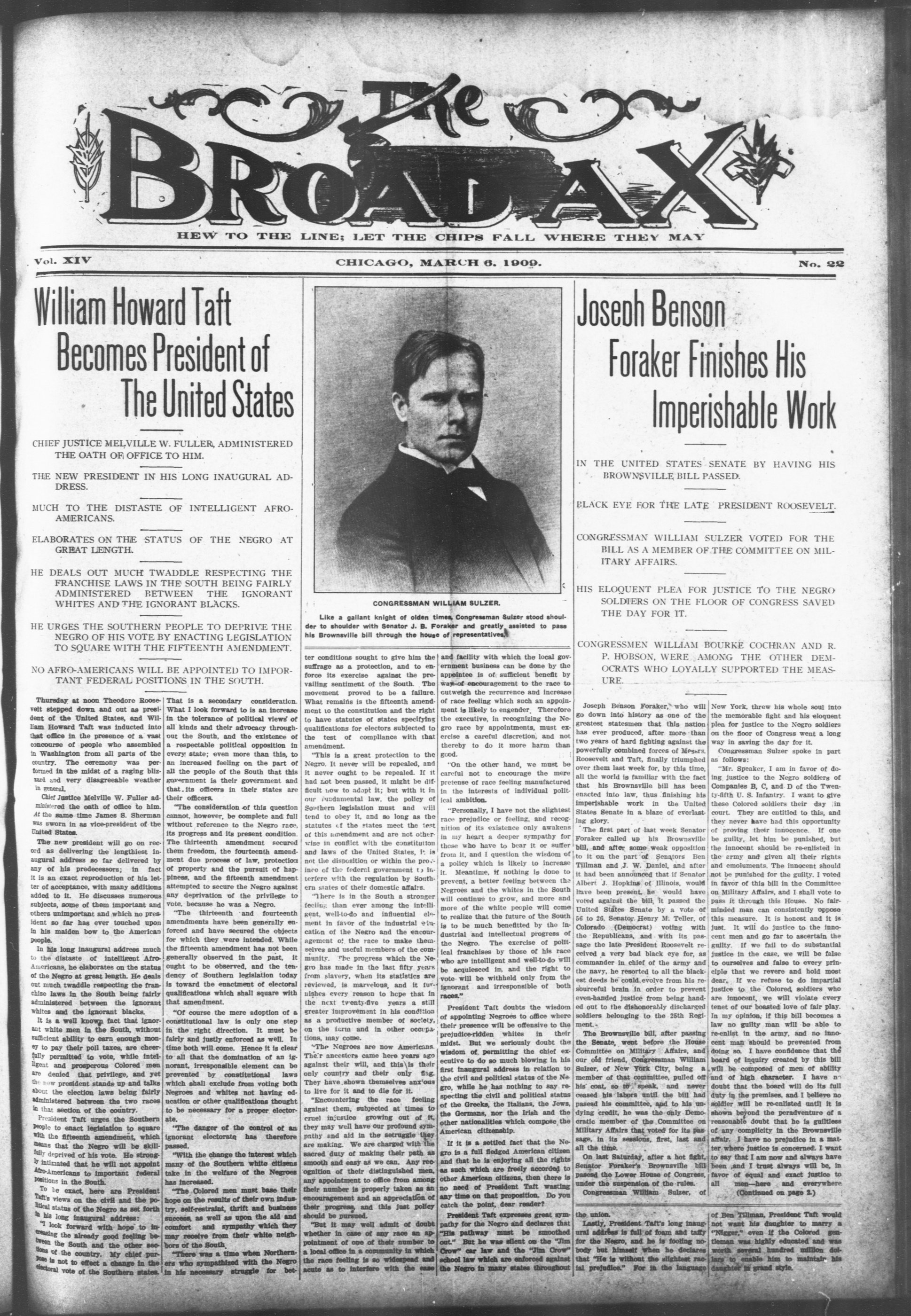
William Howard Taft Becomes President of The United States
CHIEF JUSTICE MELVILLE W. FULLER, ADMINISTERED THE OATH OF OFFICE TO HIM.
THE NEW PRESIDENT IN HIS LONG INAUGURAL ADDRESS.
MUCH TO THE DISTASTE OF INTELLIGENT AFRO-AMERICANS.
ELABORATES ON THE STATUS OF THE NEGRO AT GREAT LENGTH.
HE DEALS OUT MUCH TWADDLE RESPECTING THE FRANCHISE LAWS IN THE SOUTH BEING FAIRLY ADMINISTERED BETWEEN THE IGNORANT WHITES AND THE IGNORANT BLACKS.
HE URGES THE SOUTHERN PEOPLE TO DEPRIVE THE NEGRO OF HIS VOTE BY ENACTING LEGISLATION TO SQUARE WITH THE FIFTEENTH AMENDMENT.
NO AFRO-AMERICANS WILL BE APPOINTED TO IMPORTANT FEDERAL POSITIONS IN THE SOUTH.
Vol. XIV
William Howard
Becomes F
The
CHIEF JUSTICE MELVILLE W
THE OATH OF OFFICE
THE NEW PRESIDENT IN H
DRESS.
MUCH TO THE DISTASTE
AMERICANS.
ELABORATES ON THE STA
GREAT LENGTH.
HE DEALS OUT MUCH TW
FRANCHISE LAWS IN
ADMINISTERED BET
WHITES AND THE IGN
HE URGES THE SOUTHERN
NEGRO OF HIS VOTE H
TO SQUARE WITH THE
NO AFRO-AMERICANS WILL
TANT FEDERAL POSIT
Thursday at noon Theodore Roosevelt stepped down and out as president of the United States, and William Howard Taft was inducted into that office in the presence of a vast concourse of people who assembled in Washington from all parts of the country. The ceremony was performed in the midst of a raging blizzard and very disagreeable weather in general.
Chief Justice Melville W. Fuller administered the oath of office to him. At the same time James S. Sherman was sworn in as vice-president of the United States.
The new president will go on record as delivering the lengthiest inaugural address so far delivered by any of his predecessors; in fact it is an exact reproduction of his letter of acceptance, with many additions added to it. He discusses numerous subjects, some of them important and others unimportant and which no president so far has ever touched upon in his maiden bow to the American people.
In his long inaugural address much to the distaste of intelligent Afro-Americans, he elaborates on the status of the Negro at great length. He deals out much twaddle respecting the franchise laws in the South being fairly administered between the ignorant whites and the ignorant blacks.
It is a well known fact that ignorant white men in the South, without sufficient ability to earn enough money to pay their poll taxes, are cheerfully permitted to vote, while intelligent and prosperous Colored men are denied that privilege, and yet the new president stands up and talks about the election laws being fairly administered between the two races in that section of the country.
President Taft urges the Southern people to enact legislation to square with the fifteenth amendment, which means that the Negro will be skillfully deprived of his vote. He strongly intimated that he will not appoint Afro-Americans to important federal positions in the South.
To be exact, here are President Taft's views on the civil and the political status of the Negro as set forth in his long inaugural address:
I look forward with hope to increasing the already good feeling between the South and the other sections of the country. My chief purpose is not to effect a change in the electoral vote of the Southern states.
That is a secondary consideration. What I look forward to is an increase in the tolerance of political views of all kinds and their advocacy throughout the South, and the existence of a respectable political opposition in every state; even more than this, to an increased feeling on the part of all the people of the South that this government is their government and that its officers in their states are their officers.
"The consideration of this question cannot, however, be complete and full without reference to the Negro race, its progress and its present condition. The thirteenth amendment secured them freedom, the fourteenth amendment due process of law, protection of property and the pursuit of happiness, and the fifteenth amendment attempted to secure the Negro against any deprivation of the privilege to vote, because he was a Negro.
"The thirteenth and fourteenth amendments have been generally enforced and have secured the objects for which they were intended. While the fifteenth amendment has not been generally observed in the past, it ought to be observed, and the tendency of Southern legislation today is toward the enactment of electoral qualifications which shall square with that amendment.
"Of course the mere adoption of a constitutional law is only one step in the right direction. It must be fairly and justly enforced as well. In time both will come. Hence it is clear to all that the domination of an ignorant, irresponsible element can be prevented by constitutional laws which shall exclude from voting both Negroes and whites not having education or other qualifications thought to be necessary for a proper electorate.
"The danger of the control of an ignorant electorate has therefore passed.
"With the change the interest which many of the Southern white citizens take in the welfare of the Negroes has increased.
"The Colored men must base their hope on the results of their own industry, self-restraint, thrift and business success, as well as upon the aid and comfort and sympathy which they may receive from their white neighbors of the South.
"There was a time when Northerners who sympathized with the Negro in his necessary struggle for bet-
CHICAGO, MARCH 6. 1909.
ter conditions sought to give him the suffrage as a protection, and to enforce its exercise against the prevailing sentiment of the South. The movement proved to be a failure. What remains is the fifteenth amendment to the constitution and the right to have statutes of states specifying qualifications for electors subjected to the test of compliance with that amendment.
and facility with which the local government business can be done by the appointee is of sufficient benefit by way of encouragement to the race to outweigh the recurrence and increase of race feeling which such an appointment is likely to engender. Therefore the executive, in recognizing the Negro race by appointments, must exercise a careful discretion, and not thereby to do it more harm than
"This is a great protection to the Negro. It never will be repealed, and it never ought to be repealed. If it had not been passed, it might be difficult now to adopt it; but with it in our fundamental law, the policy of Southern legislation must and will tend to obey it, and so long as the statutes of the states meet the test of this amendment and are not otherwise in conflict with the constitution and laws of the United States, it is not the disposition or within the province of the federal government to interfere with the regulation by Southern states of their domestic affairs.
"There is in the South a stronger feeling; than ever among the intelligent, well-to-do and influential element in favor of the industrial education of the Negro and the encouragement of the race to make themselves and useful members of the community. The progress which the Negro has made in the last fifty years from slavery, when its statistics are reviewed, is marvelous, and it furnishes every reason to hope that in the next twenty-five years a still greater improvement in his condition as a productive member of society, on the farm and in other occupations, may come.
"The Negroes are now Americans. Their ancestors came here years ago against their will, and this is their only country and their only flag. They have shown themselves anxious to live for it and to die for it."
"Encountering the race feeling against them, subjected at times to cruel injustice growing out of it, they may well have our profound sympathy and aid in the setruggle they are making. We are charged with the sacred duty of making their path as smooth and easy as we can. Any recognition of their distinguished men, any appointment to office from among their number is properly taken as an encouragement and an appreciation of their progress, and this just policy should be pursued.
"But it may well admit of doubt whether in case of any race an appointment of one of their number to a local office in a community in which the race feeling is so widespread and acute as to interfere with the case
and facility with which the local government business can be done by the appointee is of sufficient benefit by way of encouragement to the race to outweigh the recurrence and increase of race feeling which such an appointment is likely to engender. Therefore the executive, in recognizing the Negro race by appointments, must exercise a careful discretion, and not thereby to do it more harm than good.
"On the other hand, we must be careful not to encourage the mere pretense of race feeling manufactured in the interests of individual political ambition.
"Personally, I have not the slightest race prejudice or feeling, and recognition of its existence only awakens in my heart a deeper sympathy for those who have to bear it or suffer from it, and I question the wisdom of a policy which is likely to increase it. Meantime, if nothing is done to prevent, a better feeling between the Negroes and the whites in the South will continue to grow, and more and more of the white people will come to realize that the future of the South is to be much benefitted by the industrial and intellectual progress of the Negro. The exercise of political franchises by those of his race who are intelligent and well-to-do will be acquiesced in, and the right to vote will be withheld only from the ignorant and irresponsible of both races."
President Taft doubts the wisdom of appointing Negroes to office where their presence will be offensive to the prejudice-ridden whites in their midst. But we seriously doubt the wisdom of permitting the chief executive to do so much blowing in his first inaugural address in relation to the civil and political status of the Negro, while he has nothing to say respecting the civil and political status of the Greeks, the Italians, the Jews, the Germans, nor the Irish and the other nationalities which compose the American citizenship.
If it is a settled fact that the Negro is a full fieded American citizen and that he is enjoying all the rights as such which are freely accorded to other American citizens, then there is no need of President Taft wasting any time on that proposition. Do you catch the point, dear reader?
President Taft expresses great sympathy for the Negro and declares that "His pathway must be smoothed out." But he was silent on the "Jim Crow" car law and the "Jim Crow" school law which are enforced against the Negro in many states throughout
Joseph Benson Foraker Finishes His Imperishable Work
IN THE UNITED STATES SENATE BY HAVING HIS BROWNSVILLE BILL PASSED.
BLACK EYE FOR THE LATE PRESIDENT ROOSEVELT
CONGRESSMAN WILLIAM SULZER VOTED FOR THE BILL AS A MEMBER OF THE COMMITTEE ON MILITARY AFFAIRS.
HIS ELOQUENT PLEA FOR JUSTICE TO THE NEGRO SOLDIERS ON THE FLOOR OF CONGRESS SAVED THE DAY FOR IT.
CONGRESSMEN WILLIAM BOURKE COCHRAN AND R. P. HOBSON, WERE AMONG THE OTHER DEMOCRATS WHO LOYALLY SUPPORTED THE MEASURE.
Joseph Benson Foraker, who will go down into history as one of the greatest statesmen that this nation has ever produced, after more than two years of hard fighting against the powerfully combined forces of MESSRS Roosevelt and Taft, finally triumphed over them last week for, by this time, all the world is familiar with the fact that his Brownsville bill has been enacted into law, thus finishing his imperishable work in the United States Senate in a blaze of everlasting glory.
The first part of last week Senator Foraker called up his Brownsville bill, and after some weak opposition to it on the part of Senators Ben Tillman and J. W. Daniel, and after it had been announced that if Senator Albert J. Hopkins of Illinois, would have been present, he would have voted against the bill, it passed the United States Senate by a vote of 56 to 26, Senator Henry M. Teller, of Colorado (Democrat) voting with the Republicans, and with its passage the late President Roosevelt received a very bad black eye for, as commander in chief of the army and the navy, he resorted to all the blackest deeds he could evolve from his resourceful brain in order to prevent even-handed justice from being handed out to the dishonorably discharged soldiers belonging to the 25th Regiment.
The Brownsville bill, after passing the Senate, went before the House Committee on Military Affairs, and our old friend, Congressman William Sulzer, of New York City, being a member of that committee, pulled off his coat, so to speak, and never ceased his labors until the bill had pased his committee, and to his undying credit, he was the only Democratic member of the Committee on Military Affairs that voted for its passage, in its sessions, first, last and all the time.
On last Saturday, after a hot fight, Senator Foraker's Brownsville bill passed the Lower House of Congress, under the suspension of the rules.
the union.
Lastly, President Taft's long inaugural address is full of foam and taffy for the Negro, and he is fooling nobody but himself when he declares that "He is without the slightest racial prejudice." For in the language
No.22
on
finishes His
wishable Work
SENATE BY HAVING HIS
ASSSED.
PRESIDENT ROOSEVELT.
SULZER VOTED FOR THE
THE COMMITTEE ON MIL-
JUSTICE TO THE NEGRO
OOR OF CONGRESS SAVED
BOURKE COCHRAN AND R.
MONG THE OTHER DEM-
LY SUPPORTED THE MEAS-
New York, threw his whole soul into the memorable fight and his eloquent plea for justice to the Negro soldiers on the floor of Congress went a long way in saving the day for it. Congressman Sulzer spoke in part as follows:
"Mr. Speaker, I am in favor of doing justice to the Negro soldiers of Companies B, C, and D of the Twenty-fifth U. S. Infantry. I want to give these Colored soldiers their day in court. They are entitled to this, and they never have had this opportunity of proving their innocence. If one be guilty, let him be punished, but the innocent should be re-enlisted in the army and given all their rights and emoluments. The innocent should not be punished for the guilty. I voted in favor of this bill in the Committee on Military Affairs, and I shall vote to pass it through this House. It is honest and it is just. It will do justice to the innocent men and go far to ascertain the guilty. If we fail to do substantial justice in the case, we will be false to ourselves and false to every principle that we revere and hold most dear. If we refuse to do impartial justice to the Colored soldiers who are innocent, we will violate every tenet of our boasted love of fair play. In my opinion, if this bill becomes a law no guilty man will be able to re-enlist in the army, and no innocent man should be prevented from doing so. I have confidence that the board of inquiry created by this bill will be composed of men of ability and of high character. I have no doubt that the board will do its full duty in the premises, and I believe no soldier will be re-enlisted until it is shown beyond the peradventure of a reasonable doubt that he is guiltless of any complicity in the Brownsville affair. I have no prejudice in a matter where justice is concerned. I want to say that I am now and always have been, and I trust always will be, in favor of equal and exact justice to all men—here and everywhere. (Continued on page 2.)
of Ben Tillman, President Taft would not want his daughter to marry a "Nigger," even if the Colored gentleman was highly educated and was worth several hundred million dollars to enable him to maintain his daughter in grand style.
THE BROADAX
Will promulgate and at all times uphold the true principles of Democracy, but Catholics, Protestants, Roman Catholics, Single Taxes Republicans, or others may have their say, as long as their language is proper and responsibility is fixed.
The Broad Ax is a newspaper whose pages are broad enough for all, ever claiming the editorial right to speak its own mind.
Local communications will receive attention. Write only on one side of the paper.
Subscriptions must be paid in advance.
One Year.....$2.00
Six Months.....1.00
Advertising rates made known on application.
Address all communications to
THE BROAD AX
5038 Armour Avenue, Chicago.
JULIUS F. TAYLOR, Editor and Publisher.
Entered as Second-Class Matter,
Alg. 19, 1902 at the Post Office at
Chicago, Illinois, under Act of March
3, 1879.
THE BLACKEST SPOT IN PRESIDENT ROOSEVELT'S ADMINISTRATION.
Having first committed the blunder of discharging the Negro troops, known as the Black Battalion, without honor and in disgrace instead of ordering a court martial to try the accused men, President Roosevelt has persisted until the last in a vain endeavor to justify the error into which he had fallen. He even became, himself, an open violator of the law in his frantic attempts to find evidence to justify his position in branding a hundred and sixty-seven faithful soldiers in the service of the government, as "midnight assassins" without the warrant of law.
The United States statutes explicitly deny the government or any of its agents the use of "detective agencies" in such cases. And the common law repudiates all "confessions" drawn from accused persons either by bribe or fear.
Yet all of these infamous means were employed by Mr. Roosevelt in his vain attempt, not to learn who really did in fact shoot up Brownsville, but to fasten the diabolical crime upon some of the three companies of Negro soldiers.
The contract authorized by the president and drawn by Secretary of War William H. Taft required the detective agency employed to learn "which of the accused soldiers" shot up Brownsville and entailed no other duty in ferreting out who in fact did "shoot up Brownsville."
All sorts of promises and threats were made to those accused men, but in not a single instance did the detectives succeed in securing either "confessions" or other information from the soldiers. Falling in this the detectives reported confessions and information said to have been made and given by some of the men, but which has been proved absolutely false and the pure inventions of the detectives themselves, and yet these detectives were the direct agents of the president of the nation.
Foraker's Opportunity:
This false report made by the detectives and transmitted in apparent triumph to the congress by President Roosevelt was Senator Foraker's opportunity to deliver the whole miserable business a knock-out blow, and this he did on January 12th of this year, in an address in which he tore to pieces every shred of the evidence wherein the alleged confessions and information had been given.
Honest Southern White Men.
Mr. Foraker's speech was reinforced by affidavits of the strongest character from southern white men, including bankers and county officials, in which they not only confute the alleged confessions, but give the Colored soldiers in their cities charged with them, the highest character for peaceable and honest citizens.
Senator Foraker has won a fight that entitles him to the gratitude of the whole country, and the part played by the president is the blackest spot in his entire career, but not the only one—The Informer, Detroit, Mich.
Lexington, Ky., March 2.—John E. Madden, noted turfman, has turned philanthropist to the Negro race and has made a proposition to the Fayette County High School Board to contribute a sum of money for the erection of a Colored high school in the county, provided the board will raise an equal amount. The ground and buildings for the proposed new school will cost several thousand dollars.
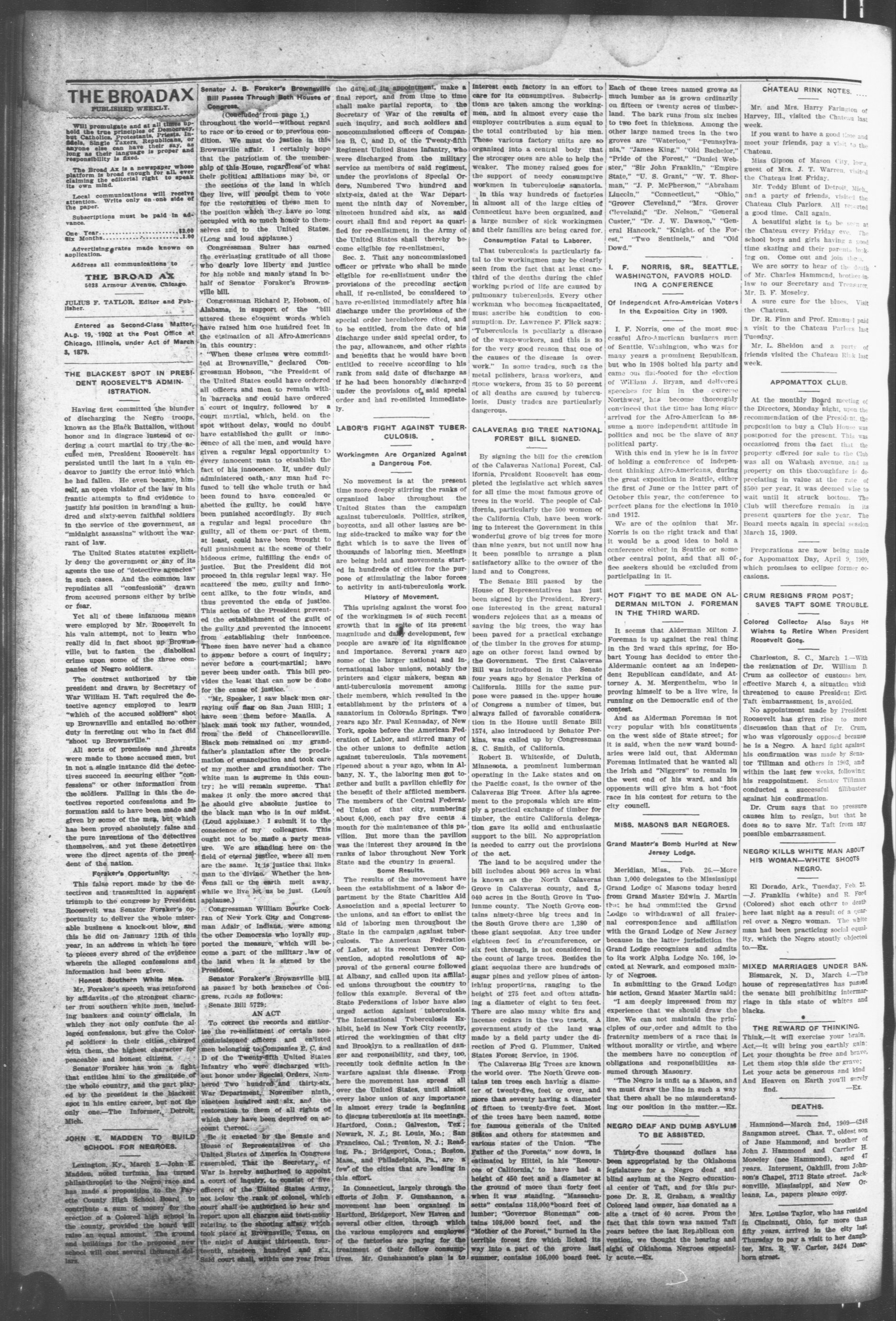
Senator J. B. Foraker's Brownsville Bill Passes Through Both Houses of Congress.
(Conscluded from page 1.) throughout the world—without regard to race or to creed or to previous condition. We must do justice in this Brownsville affair. I certainly hope that the patriotism of the membership of this House, regardless of what their political affiliations may be, or the sections of the land in which they live, will prompt them to vote for the restoration of these men to the position which they have so long occupied with so much honor to themselves and to the United States. (Long and loud applause.)
Congressman Sulzer has earned the everlasting gratitude of all those who dearly love liberty and justice for his noble and manly stand in behalf of Senator Foraker's Brownsville bill.
Congressman Richard P. Hobson, of Alabama, in support of the "bill uttered these eloquent words which have raised him one hundred feet in the estimation of all Afro-Americans in this country:
"When these crimes were committed at Brownsville," declared Congressman Hobson, "the President of the United States could have ordered all officers and men to remain within barracks and could have ordered a court of inquiry, followed by a court martial, which, held, on the spot without delay, would no doubt have established the guilt or innocence of all the men, and would have given a regular legal opportunity to every innocent man to establish the fact of his innocence. If, under duly administered oath, any man had refused to tell the whole truth or had been found to have concealed or abetted the guilty, he could have been punished accordingly. By such a regular and legal procedure the guilty, all of them or part of them, at least, could have been brought to full punishment at the scene of their hideous crime, fulfilling the ends of justice. But the President did not proceed in this regular legal way. He scattered the men, guilty and innocent alike, to the four winds, and thus prevented the ends of justice. This action of the President prevented the establishment of the guilt of the guilty and prevented the innocent from establishing their innocence. These men have never had a chance to appear before a court of inquiry; never before a court-martial; have never been under oath. This bill provides the least that can now be done for the cause of justice.
"Mr. Speaker, I saw black men carrying our flag on San Juan Hill; I have seen them before Manila. A black man took my father, wounded, from the field of Chancellorsville. Black men remained on my grandfather's plantation after the proclamation of emancipation and took care of my mother and grandmother. The white man is supreme in this country; he will remain supreme. That makes it only the more sacred that he should give absolute justice to the black man who is in our midst. (Loud applause.) I submit it to the conscience of my colleagues. This ought not to be made a party measure. We are standing here on the field of eternal justice, where all men are the same. It is justice that links man to the divine. Whether the heavens fall or the earth melt away, while we live let us be just. (Loud applause.)
Congressman William Bourke Cockran of New York City and Congressman Adair of Indiana, were among the other Democrats who loyally supported the measure, which will become a part of the military, law of the land when it is signed by the President. Senator Foraker's Brownsville bill, as passed by both branches of Congress, reads as follows: Senate Bill 5729:
To correct the records and anteriorize the re-enlistment of certain noncommissioned officers and enlisted men belonging to Companies P, C, and D of the Twenty-fifth United States Infantry who were discharged without honor under Special Orders, Numbered Two hundred and thirty-six, War Department, November ninth, nineteen hundred and six, and the restoration to them of all rights of which they have been deprived on account thereof.
Be it enacted by the Senate and House of Representatives of the United States of America in Congress assembled, That the Secretary, of War is hereby authorized to appoint a court of inquiry, to consist of five officers of the United States Army, not below the rank of colonel, which court shall be authorized to hear and report upon all charges and test-monty relating to the shooting affray, which took place at Brownsville, Texas, on the night of August thirteenth, fourteenth, nineteen hundred and six, Seid court shall, within one year from
the date of its appointment, make a final report, and from time to time shall make partial reports, to the Secretary of War of the results of such inquiry, and such soldiers and noncommissioned officers of Companies B, C, and D, of the Twenty-fifth Regiment United States Infantry, who were discharged from the military service as members of said regiment, under the provisions of Special Orders, Numbered Two hundred and sixty-six, dated at the War Department the ninth day of November, nineteen hundred and six, as said court shall find and report as quarified for re-enlistment in the Army of the United States shall thereby become eligible for re-enlistment.
Sec. 2. That any noncommissioned officer or private who shall be made eligible for re-enlistment under the provisions of the preceding section shall, if re-enlisted, be considered to have re-enlisted immediately after his discharge under the provisions of the special order hereinbefore cited, and to be entitled, from the date of his discharge under said special order, to the pay, allowances, and other rights and benefits that he would have been entitled to receive according to his rank from said date of discharge as if he had been honorably discharged under the provisions of said special order and had re-enlisted immediately.
LABOR'S FIGHT AGAINST TUBER CULOSIS.
Workingmen Are Organized Against a Dangerous Foe.
No movement is at the present time more deeply stirring the ranks of organized labor throughout the United States than the campaign against tuberculosis. Politics, strikes, boycotts, and all other issues are being side-tracked to make way for the fight which is to save the lives of thousands of laboring men. Meetings are being held and movements started in hundreds of cities for the purpose of stimulating the labor forces to activity in anti-tuberculosis work.
History of Movement.
This uprising against the worst foe of the workingmen is of such recent growth that in spite of its present magnitude and daily development, few people are aware of its significance and importance. Several years ago some of the larger national and international labor unions, notably the printers and cigar makers, began an anti-tuberculosis movement among their members, which resulted in the establishment by the printers of a sanatorium in Colorado Springs. Two years ago Mr. Paul Kennaday, of New York, spoke before the American Federation of Labor, and stirred many of the other unions to definite action against tuberculosis. This movement ripened about a year ago, when in Albany, N. Y., the laboring men got together and built a pavilion chiefly for the benefit of their afflicted members. The members of the Central Federated Union of that city, numbering about 6,000, each pay five cents a month for the maintenance of this pavilion. But more than the pavilion was the interest they aroused in the ranks of labor throughout New York State and the country in general.
Some Results.
The results of the movement have been the establishment of a labor department by the State Charities Aid Association and a special lecturer to the unions, and an effort to enlist the aid of laboring men throughout the State in the campaign against tuberculosis. The American Federation of Labor, at its recent Denver Convention, adopted resolutions of approval of the general course followed at Albany, and called upon its affiliated unions throughout the country to follow this example. Several of the State Federations of labor have also urged action against tuberculosis. The International Tuberculosis Exhibit, held in New York City recently, stirred the workingmen of that city and Brooklyn to a realization of danger and responsibility, and they, too, recently took definite action in the warfare against this disease. From here the movement has spread all over the United States, until almost every labor union of any importance in almost every trade is beginning to discuss tuberculosis at its meetings. Hartford, Conn.; Galveston, Tex.; Newark, N. J.; St. Louis, Mo.; San Francisco, Cal.; Trenton, N. J.; Reading, Pa.; Bridgeport, Conn.; Boston, Mass., and Philadelphia, Pa., are a few of the cities that are leading in this effort.
In Connecticut, largely through the efforts of John F. Gunshannon, a movement has been organized in Hartford, Bridgeport, New Haven and several other cities, through which the various employers and employees of the factories are paying for the treatment of their fellow consumptives. Mr. Gunshannon's plan is to
interest each factory in an effort to care for its consumptives. Subscriptions are taken among the workingmen, and in almost every case the employer contributes a sum equal to the total contributed by his men. These various factory units are so organized into a central body that the stronger ones are able to help the weaker. The money raised goes for the support of needy consumptive workmen in tuberculosis sanatoria. In this way hundreds of factories in almost all of the large cities of Connecticut have been organized, and a large number of sick workingmen and their families are being cared for.
Consumption Fatal to Laborer.
That tuberculosis is particularly fatal to the workingmen may be clearly seen from the fact that at least one third of the deaths during the chief working period of life are caused by pulmonary tuberculosis. Every other workman who becomes incapacitated, must ascribe his condition to consumption. Dr. Lawrence F. Flick says: "Tuberculosis is peculiarly a disease of the wage-workers, and this is so for the very good reason that one of the causes of the disease is overwork." In some trades, such as the metal polishers, brass workers, and stone workers, from 35 to 50 percent of all deaths are caused by tuberculosis. Dusty trades are particularly dangerous.
CALAVERAS BIG TREE NATIONAL
FOREST BILL SIGNED.
By signing the bill for the creation of the Calaveras National Forest, California, President Roosevelt has completed the legislative act which saves for all time the most famous grove of trees in the world. The people of California, particularly the 500 women of the California Club, have been working to interest the Government in this wonderful grove of big trees for more than nine years, but not until now has it been possible to arrange a plan satisfactory alike to the owner of the land and to Congress.
The Senate Bill passed by the House of Representatives has just been signed by the President. Everyone interested in the great natural wonders rejoices that as a means of saving the big trees, the way has been paved for a practical exchange of the timber in the groves for stumpage on other forest land owned by the Government. The first Calavera Bill was introduced in the Senate four years ago by Senator Perkins of California. Bills for the same purpose were passed in the upper house of Congress a number of times, but always failed of favorable consideration in the House until Senate Bill 1574, also introduced by Senator Perkins, was called up by Congressman S. C. Smith of California.
Robert B. Whiteside, of Duluth, Minnesota, a prominent lumberman operating in the Lake states and on the Pacific coast, is the owner of the Calaveras Big Trees. After his agreement to the proposals which are simply a practical exchange of timber for timber, the entire California delegation gave its solid and enthusiastic support to the bill. No appropriation is needed to carry out the provisions of the act.
The land to be acquired under the bill includes about 960 acres in what is known as the North Calaveras Grove in Calaveras county, and 3,040 acres in the South Grove in Tuolumne county. The North Grove contains ninety-three big trees and in the South Grove there are 1,380 of these giant sequolias. Any tree under eighteen feet in circumference, or six feet through, is not considered in the count of large trees. Besides the giant sequolias there are hundreds of sugar pines and yellow pines of astonishing proportions, ranging to the height of 275 feet and often attaining a diameter of eight to ten feet. There are also many white firs and incense cedars in the two tracts. A government study of the land was made by a field party under the direction of Fred G. Plummer, United States Forest Service, in 1906.
The Calaveras Big Trees are known the world over. The North Grove contains ten trees each having a diameter of twenty-five, feet or over, and more than seventy having a diameter of fifteen to twenty-five feet. Most of the trees have been named, some for famous generals of the United States and others for statesmen and various states of the Union. "The Father of the Forests," now down, is estimated by Hittel, in his "Resources of California," to have had a height of 450 feet and a diameter at the ground of more than forty feet when it was standing. "Massachusetts" contains 118,000*board feet of lumber; "Governor Stoneman" contains 108,000 board feet, and the "Mother of the Forest," burned in the terrible forest fire which licked its way into a part of the grove last summer, contains 105,000 board feet.
Each of these trees named grows as much lumber as is grown ordinarily on fifteen or twenty acres of timberland. The bark runs from six inches to two feet in thickness. Among the other large named trees in the two groves are "Waterloo," "Pennsylvania," "James King," "Old Bachelor," "Pride of the Forest," "Daniel Webster," "Sir John Franklin," "Empire State," "U. S. Grant," "W. T. Sherman," "J. P. McPherson," "Abraham Lincoln," "Connecticut," "Ohio," "Grover Cleveland," "Mrs. Grover Cleveland," "Dr. Nelson," "General Custer," "Dr. J. W. Dawson," "General Hancock," "Knight of the Forest," "Two Sentinels," and "Old Dowd."
I. F. NORRIS, SR., SEATTLE WASHINGTON, FAVORS HOLD. ING A CONFERENCE
Of Independent Afro-American Voters In the Exposition City in 1909.
I. F. Norris, one of the most successful Afro-American business men of Seattle, Washington, who was for many years a prominent Republican, but who in 1908 bolted his party and came out flat-footed for the election of William J. Bryan, and delivered speeches for him in the extreme Northwest, has become thoroughly convinced that the time has long since arrived for the Afro-American to assume a more independent attitude in politics and not be the slave of any political party.
With this end in view he is in favor of holding a conference of independent thinking Afro-Americans, during the great exposition in Seattle, either the first of June or the latter part of October this year, the conference to perfect plans for the elections in 1010 and 1912.
We are of the opinion that Mr. Norris is on the right track and that it would be a good idea to hold a conference either in Seattle or some other central point, and that all office seekers should be excluded from participating in it.
HOT FIGHT TO BE MADE ON ALDERMAN MILTON J. FOREMAN IN THE THIRD WARD.
It seems that Alderman Milton J. Foreman is up against the real thing in the 3rd ward this spring, for Hobart Young has decided to enter the Aldermanic contest as an independent Republican candidate, and Attorney A. M. Mergenthelm, who is proving himself to be a live wire, is running on the Democratic end of the contest.
And as Alderman Foreman is not very popular with his constituents on the west side of State street; for it is said, when the new ward boundaries were laid out, that Alderman Foreman intimated that he wanted all the Irish and "Niggers" to remain in the west end of his ward, and his opponents will give him a hot-foot race in his contest for return to the city council.
MISS. MASONS BAR NEGROES.
Grand Master's Bomb Hurled at New Jersey Lodge.
Meridian, Miss., Feb. 26.—More than 1,000 delegates to the Mississippi Grand Lodge of Masons today heard from Grand Master Edwin J. Martin that he had committed the Grand Lodge to withdrawal of all fraternal correspondence and affiliation with the Grand Lodge of New Jersey because in the latter jurisdiction the Grand Lodge recognizes and admits to its work Alpha Lodge No. 166, located at Newark, and composed mainly of Negroes. In submitting to the Grand Lodge his action, Grand Master Martin said;
his action, Grand Master Martin said: "I am deeply impressed from my experience that we should draw the line. We can not maintain the principles of our, order and admit to the fraternity members of a race that is without morality or virtue, and where the members have no conception of obligations and responsibilities assumed through Masonry. "The Negro is unfit as a Mason, and we must draw the line in such a way that there shall be no misunderstanding our position in the matter—Ex.
NEGRO DEAF AND DUMB ASYLUM
TO BE ASSISTED.
Thirty-five thousand dollars has been appropriated by the Oklahoma legislature for a Negro deaf and blind asylum at the Negro educational center of Taft, and for this purpose Dr. R. E. Graham, a wealthy Colored land owner, has donated as a site a tract of 40 acres. From the fact that this town was named Taft years before the last Republican convention, we thought the hearing and sight of Oklahoma Negroes especially acute.—Ex.
Mr. and Mrs. Harry Farington of Harvey, Ill., visited the Chateau last week.
If you want to have a good time and meet your friends, pay a visit to the Chateau.
Miss Gipson of Mason City, Iowa, guest of Mrs. J. T. Warren, visited the Chateau last Friday.
Mr. Teddy Blunt of Detroit, Mich., and a party of friends, visited the Chateau Club Parlors. All reported a good time. Call again.
A beautiful sight is to be seen at the Chateau every Friday eve. The school boys and girls having a good time skating and their parents looking on. Come out and join them.
We are sorry to hear of the death of Mr. Charles Hammond, brother-in-law to our Secretary and Treasurer, Mr. B. F. Moseley.
A sure cure for the blues. Visit the Chateau.
Dr. R. Finn and Prof. Emanuel paid a visit to the Chateau Parlors last Tuesday.
Mr. L. Sheldon and a party of friends visited the Chateau Rikk last week.
APPOMATTOX CLUB
At the monthly Board meeting of the Directors, Monday night, upon the recommendation of the President, the proposition to buy a Club House was postponed for the present. This was occasioned from the fact that the property offered for sale to the Club was all on Wabash avenue, and as property on this thoroughfare is depreciating in value at the rate of $500 per year, it was deemed wise to wait until it struck bottom. The Club will therefore remain in its present quarters for the year. The Board meets again in special session March 15, 1909.
Preparations are now being made for Appomattox Day, April 9, 1909, which promises to eclipse former occasions.
SAVES TAFT SOME TROUBLE.
Colored Collector Also Says He Wishes to Retire When President Roosevelt Goes.
Charleston, S. C., March 1—With the resignation of Dr. William D. Crum as collector of customs here, effective March 4, a situation which threatened to cause President Elect Taft embarrassment is avoided.
No appointment made by President Roosevelt has given rise to more discussion than that of Dr. Crum, who was vigorously opposed because he is a Negro. A hard fight against his confirmation was made by Senator Tillman and others in 1903, and within the last few weeks, following his reappointment. Senator Tillman conducted a successful fillibuster against his confirmation.
Dr. Crum says that no pressure causes him to resign, but that he does so to save Mr. Taft from any possible embarrassment.
NEGRO' KILLS WHITE MAN ABOUT
HIS WOMAN—WHITE SHOOTS
NEGRO.
El Dorado, Ark., Tuesday, Feb. 23.
—J. Franklin (white) and R. Ford
(Colored) shot each other to death
here last night as a result of a quarrel over a Negro woman. The white man had been practicing social equality, which the Negro stoutly objected to.—Ex.
MIXED MARRIAGES UNDER BAN
Bismarck, N. D., March 4.—The house of representatives has passed the senate bill prohibiting intermarriage in this state of whites and blacks.
THE REWARD OF THINKING.
Think,—it will exercise your brain.
Act,—it will bring you earthly gain;
Let your thoughts be free and brave;
Let them stop this side the grave;
Let your acts be generous and kind
And Heaven on Earth you'll surely
find.
—Ex.
DEATHS
Hammond—March 2nd, 1909—6248
Sangamon street. Chas. T., oldest son of Jane Hammond, and brother of John J. Hammond and Carrier H.
Moseley (nee Hammond), aged 47
years. Interment, Oakhill, from Johnson's Chapel, 2712 State street. Jacksonville, Mississippi, and New Orleans, La., papers please copy.
Mrs. Louise Taylor, who has resided in Cincinnati, Ohio, for more than fifty years, arrived in the city last Thursday to pay a visit to her daughter, Mrs. R. W. Carter, 2424 Dearborn street.
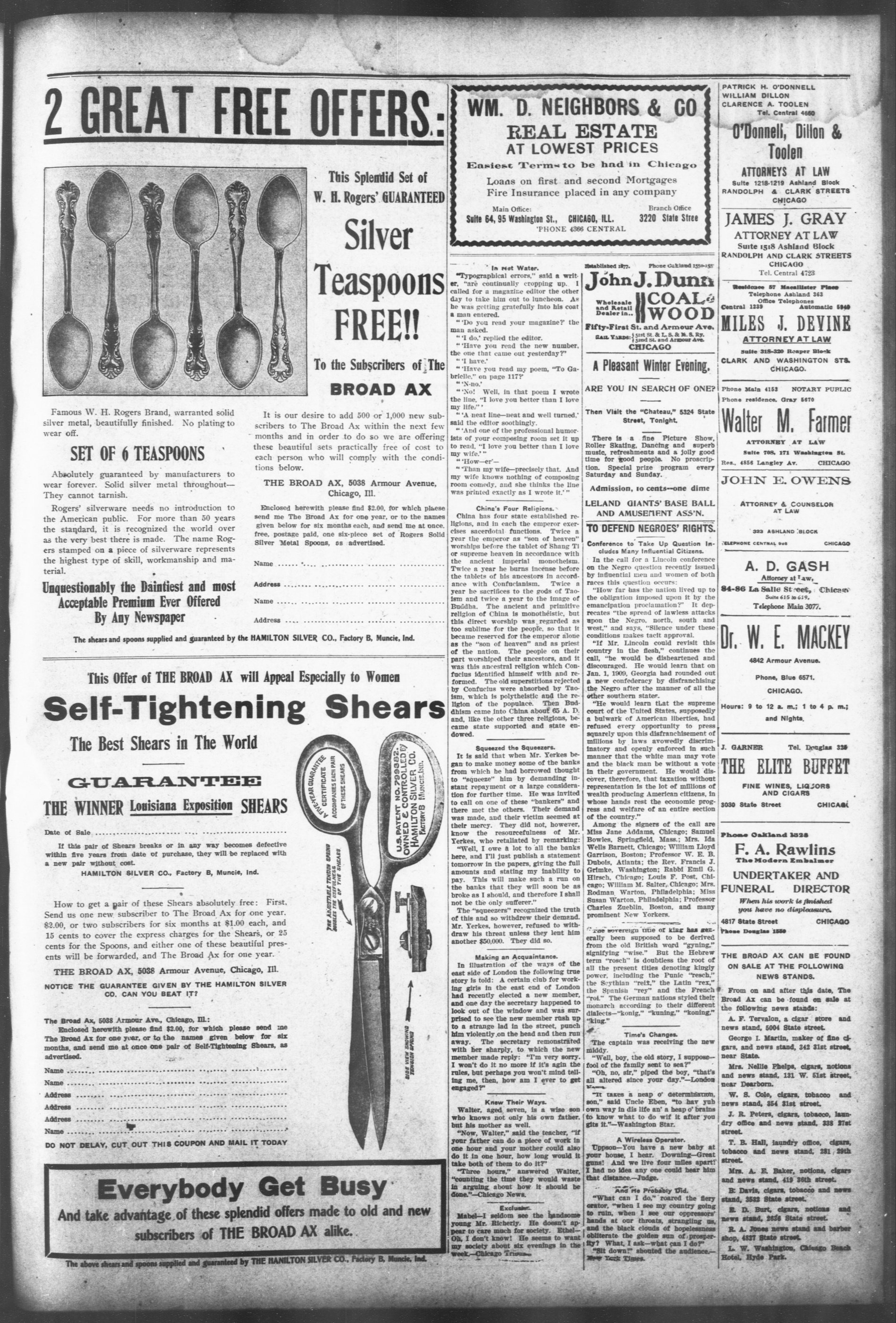
2 GREAT FREE OFFERS:
The shears and spoons supplied and guaranteed by the HAMILTON SILVER CO., Factory B, Muncie, Ind.
This Offer of THE BROAD AX will Appeal Especially to Women
Self-Tightening Shears
And take advantage of these splendid offers made to old and new subscribers of THE BROAD AX alike.
```markdown
```
Famous W. H. Rogers Brand, warranted solid silver metal, beautifully finished. No plating to wear off.
SET OF 6 TEASPOONS
Absolutely guaranteed by manufacturers to wear forever. Solid silver metal throughout They cannot tarnish. Rogers' silverware needs no introduction to the American public. For more than 50 years the standard, it is recognized the world over as the very best there is made. The name Rogers stamped on a piece of silverware represents the highest type of skill, workmanship and material. Unquestionably the Daintiest and most Acceptable Premium Ever Offered By Any Newspaper
Date of Sale ..... If this pair of Shears breaks or in any way becomes defective within five years from date of purchase, they will be replaced with a new pair without cost.
HAMILTON SILVER CO., Factory B, Muncie, Ind.
How to get a pair of these Shears absolutely free: First, Send us one new subscriber to The Broad Ax for one year. $2.00, or two subscribers for six months at $1.00 each, and 15 cents to cover the express charges for the Shears, or 25 cents for the Spoons, and either one of these beautiful presents will be forwarded, and The Broad Ax for one year.
THE BROAD AX, 5038 Armour Avenue, Chicago, Ill.
NOTICE THE GUARANTEE GIVEN BY THE HAMILTON SILVER CO. CAN YOU BEAT IT?
The Broad Ax, 5088 Armour Ave., Chicago, III.:
Enclosed herewith please find $2.00, for which please send me
The Broad Ax for one year, or to the names given below for six
months, and send me at once one pair of Self-Tightening Shears, as
advertised.
This Splendid Set of W. H. Rogers' GUARANTEED
Silver Teaspoons FREE!!
To the Subscribers of The
for desire to add 500 or 1,000 new sub-
poise The Broad Ax within the next few
and in order to do so we are offering
faultful sets practically free of cost to
men who will comply with the condi-
tion.
BROAD AX, 5038 Armour Avenue,
Chicago, Ill.
herewith please find $2.00, for which please
the Broad Ax for one year, or to the names
for six months each, and send me at once.
We paid, one six-piece set of Rogers Solid
Spoons, as advertised.
SILVER CO., Factory B, Muncie, Ind.
Especially to Women
g Shears
It is our desire to add 500 or 1,000 new subscribers to The Broad Ax within the next few months and in order to do so we are offering these beautiful sets practically free of cost to each person who will comply with the conditions below.
THE BROAD AX, 5038 Armour Avenue,
Chicago, Ill.
Enclosed herewith please find $2.00, for which please send me The Broad Ax for one year, or to the names given below for six months each, and send me at once, free, postage paid, one six-piece set of Rogers Solid Silver Metal Spoons, as advertised.
THE ADJUSTABLE TENSION SPRING
SHOULDS THE USEFULNESS
OF THE SHEARS
A FIVE-YEAR GUARANTEE
CERTIFICATE
ACCOMPANIES EACH PAIR
OF THESE SHEARS
SIDE VIEW SHOWING
TENSION SPRING
U.S. PATENT NO. 799382
OWNED & CONTROLLED
HAMILTON SILVER CO.
FACTORY B MUNCIELND.
t Busy
ers made to old and new
AX alike.
WM. D. NEIGHBORS & CO REAL ESTATE AT LOWEST PRICES
Easiest Terms to be had in Chicago
Loans on first and second Mortgages
Fire Insurance placed in any company
Main Office:
Suite 64, 95 Washington St., CHICAGO, ILL. 3220 State Street
'PHONE 4866 CENTRAL
In Hot Water
"Typographical errors," said a writer, "are continually cropping up. I called for a magazine editor the other day to take him out to luncheon. As he was getting gratefully into his coat a man entered. "Do you read your magazine? the man asked. "I do.' replied the editor.
"‘Have you read the new number, the one that came out yesterday?’"
"‘I have.’"
"‘Have you read my poem, “To Gabrielle.” on page 117?’"
"‘N-no.’"
"‘No! Well, in that poem I wrote the line, “I love you better than I love my life.”’"
"‘A neat line—neat and well turned.’ said the editor soothingly."
"‘And one of the professional humorists of your composing room set it up to read, “I love you better than I love my wife.”’"
"‘How—er—’"
"‘Than my wife—precisely that. And my wife knows nothing of composing room comedy, and she thinks the line was printed exactly as I wrote it.’"
China's Four Religions.
China has four state established religions, and in each the emperor exercises sacerdotal functions. Twice a year the emperor as "son of heaven" worships before the tablet of Shang Ti or supreme heaven in accordance with the ancient imperial monotheism. Twice a year he burns incense before the tablets of his ancestors in accordance with Confucianism. Twice a year he sacrifices to the gods of Taism and twice a year to the image of Buddha. The ancient and primitive religion of China is monotheistic, but this direct worship was regarded as too sublime for the people, so that it became reserved for the emperor alone as the "son of heaven" and as priest of the nation. The people on their part worshiped their ancestors, and it was this ancestral religion which Confucius identified himself with and reformed. The old superstitions rejected by Confucius were absorbed by Taism, which is polytheistic and the religion of the populace. Then Buddhism came into China about 65 A. D. and, like the other three religions, became state supported and state endowed.
Squeezed the Squeezers.
It is said that when Mr. Yerkes began to make money some of the banks from which he had borrowed thought to "squeeze" him by demanding instant repayment or a large consideration for further time. He was invited to call on all of these "bankers" and there met the others. Their demand was made, and their victim seemed at their mercy. They did not, however, know the resourcefulness of Mr. Yerkes, who retaliated by remarking: "Well, I owe a lot to all the banks here, and I just publish a statement tomorrow in the papers, giving the full amounts and stating my inability to pay. This will make such a run on the banks that they will soon be as broke as I should, and therefore I shall not be the only sufferer."
The "squeezers" recognized the truth of this and so withdrew their demand. Mr. Yerkes, however, refused to withdraw his threat unless they lent him another $50,000. They did so.
Making an Acquaintance
In illustration of the ways of the east side of London the following true story is told: A certain club for working girls in the east end of London had recently elected a new member, and one day the secretary happened to look out of the window and was surprised to see the new member rush up to a strange lad in the street, punch him violently on the head and then run away. The secretary remonstrated with her sharply, to which the new member made reply: "I'm very sorry. I won't do it no more if it's agin the rules, but perhaps you won't mind telling me, then, how am I ever to get engaged?"
Knaw Their Ways.
Walter, aged seven, is a wise son who knows not only his own father, but his mother as well.
"Now, Walter," said the teacher, "if your father can do a piece of work in one hour and your mother could also do it in one hour, how long would it take both of them to do it?"
"Three hours," answered Walter, "counting the time they would waste in arguing about how it should be done."—Chicago News.
Exclusus
Mabel—I seldom see the handsome young Mr. Richerly. He doesn't appear to care much for society. Ethel—Oh, I don't know! He seems to want my society about six evenings in the week.—Chicago Tribune.
Fifty-First St. and Armour Ave.
SAIL YARDS: 1st St. & L. S. & M. S. RY.
2nd St. and Armour Ave.
CHJCAGO
A Pleasant Winter Evening.
ARE YOU IN SEARCH OF ONE?
Then Visit the "Chateau," 5324 State Street, Tonight.
There is a fine Picture Show, Roller Skating, Dancing and superb music, refreshments and a jolly good time for good people. No prescription. Special prize program every Saturday and Sunday.
Admission, 10 cents--one dime
LELAND GIANTS' BASE BALL AND AMUSEMENT ASS'N.
TO DEFEND NEGROES' RIGHTS.
Conference to Take Up Question Includes Many Influential Citizens.
In the call for a Lincoln conference on the Negro question recently issued by influential men and women of both races this question occurs:
"How far has the nation lived up to the obligation imposed upon it by the emancipation proclamation?" It deprecates "the spread of lawless attacks upon the Negro, north, south and west," and says, "Silence under these conditions makes tacit approval.
"If Mr. Lincoln could revisit this country in the flesh," continues the call, "he would be disheartened and discouraged. He would learn that on Jan. 1, 1900, Georgia had rounded out a new confederacy by disfranchising the Negro after the manner of all the other southern states.
"He would learn that the supreme court of the United States, supposedly a bulwark of American liberties, had refused every opportunity to press squarely upon this disfranchisement of millions by laws avowedly discriminatory and openly enforced in such manner that the white man may vote and the black man be without a vote in their government. He would discover, therefore, that taxation without representation is the lot of millions of wealth producing American citizens, in whose hands rest the economic progress and welfare of an entire section of the country."
Among the signers of the call are Miss Jane Addams, Chicago; Samuel Bowles, Springfield, Mass.; Mrs. Ida Wells Barnett, Chicago; William Lloyd Garrison, Boston; Professor W. E. B. Dubois, Atlanta; the Rev. Francis J. Grimke, Washington; Rabbi Eml G. Hirsch, Chicago; Louis F. Post, Chicago; William M. Salter, Philadelphia; Mrs. Rodman, Warton, Philadelphia; Miss Susan Warton, Philadelphia; Professor Charles Zueblin, Boston, and many prominent New Yorkers.
The sovereign title of king has generally been supposed to be derived from the old British word "gyning," signifying "wise." But the Hebrew term "rosch" is doubtless the root of all the present titles denoting kingly power, including the Punic "resch," the Scythian "reix," the Latin "rex," the Spanish "rey" and the French "roi." The German nations styled their monarch according to their different dialects—"konig," "kuning," "koning," "king"
Time's Changes.
The captain was receiving the new mildy.
"Well, boy, the old story, I suppose--fool of the family sent to sea?"
"Oh, no, sir," piped the boy, "that's all altered since your day."—London Name.
"It takes a neap o' determination, son," said Uncle Eben, "to have yuh own way in uncle life an' a heap o' brains to know what to do wif it after you gits it."—Washington Star.
Uppson—You have a new baby at your house, I hear. Downing—Great guns! And we live four miles apart! I had no idea any one could hear him that distance—Judge.
And He Probably Did.
"What can I do," roared the fiery orator, "when I see my country going to ruin, when I see our oppressors' hands at our throats, strangling us, and the black clouds of hopelessness obliterate the golden sun of prosperity? What, I ask—what can I do?" "Sit down!" shouted the audience—
PATRICK H. O'DONNELL
WILLIAM DILLON
CLARENCE A. TOOLEN
Tel. Central 4660
O'Donnell, Dillon &
Toolen
ATTORNEYS AT LAW
Suite 1218-1219 Ashland Block
RANDOLPH & CLARK STREETS
CMICAGO
JAMES J. GRAY
ATTORNEY AT LAW Suite 1518 Ashland Block RANDOLPH AND CLARK STREETS CHICAGO Tel. Central 4723
MILES J. DEVINE
ATTORNEY AT LAW
Suite 318-320 Reaper Block
CLARK AND WASHINGTON STS.
CHICAGO.
Phone Main 4153 NOTARY PUBLIC
Phone residence. Gray 5670
Walter M. Farmer
ATTORNEY AT LAW
Suite 708, 171 Washington St.
Res., 4856 Langley Av. CHICAGO
JOHN E. OWENS
ATTORNEY & COUNSELOR
AT LAW
323 ASHLAND BLOCK
TELEPHONE CENTRAL 908 CHICAGO
A. D. GASH
Attorney at Law,
84-86 La Salle Street, Chicago
Suite 615 to 619.
Telephone Main 3077.
Dr. W. E. MACKEY
4842 Armour Avenue.
Phone, Blue 6571.
CHICAGO.
Hours: 9 to 12 a. m.; 1 to 4 p. m.; and Nights.
J. GARNER Tel. Douglas 326
THE ELITE BUFFET
FINE WINES, LIQSORS
AND CIGARS
3030 State Street CHICAGO
Phone Oakland 1328
UNDERTAKER AND FUNERAL DIRECTOR
4817 State Street CHICAGO
Phone Douglas 1559
THE BROAD AX CAN BE FOUND ON SALE AT THE FOLLOWING NEWS STANDS.
From on and after this date, The Broad Ax can be found on sale at the following news stands:
A. F. Tervalon, a cigar store and news stand, 5004 State street.
George I. Martin, maker of fine cigars, and news stand, 342 31st street, near State.
Mrs. Nellie Phelps, cigars, notions and news stand, 131 W. 51st street, near Dearborn.
W. S. Cole, cigars, tobacco and news stand, 354 31st street.
J. R. Peters, cigars, tobacco, laundry office and news stand, 338 37st street.
T. B. Hall, laundry office, cigars, tobacco and news stand, 281, 29th street.
Mrs. A. E. Baker, notions, cigars and news stand, 419, 36th street.
B. Davis, cigars, tobacco and news stand, 3532 State street.
B. D. Burt, cigars, notions and news stand, 2836 State street.
R. A. Jones news stand and barber shop, 4827 State street.
L. W. Washington, Chicago Beach Hotel, Hyde Park.
THE INSTITUTIONAL CHURCH.
2005 Daphne Street.
3260 Dearborn Street
The pastor will begin Sunday morning a series of sermons on the subject, "The Curse of Modern Slavery," Some of the evils that undermine the religious, moral and social life of the Colored people will be discussed. A personal canvass has been made looking into certain conditions. These facts will be brought out in this series of sermons.
"Ruth and Boaz" will be the subject of an illustrated service Sunday night, March 7th. Illustrated songs and scenes from the Bible, as well as from the life and events of great men in every century of the world's history. The flight of the soul. Dissolving views revealing the mysteries of the heavenly land.
"Jephthah and His Daughter" will be rendered at the church March 15th, and some scenes from this remarkable story will be shown on canvas Sunday night.
"Joseph's Bondage" will be given in three acts March 25th; therefore a few views from this subject will be shown Sunday night. This will be a most interesting service as well as historical.
Silver offering at the door has been found the most practical way to lift the collection and thus avoid taking time in lifting a collection during service. Promptly at 7:45 p. m. Mr. J. D. Robinson will operate the stereo opticon. Rev. H. E. Stewart will give the description of the views.
The president of Wilberforce, Prof. Scarborough, will address the citizens and graduates and undergraduates at the Church Wednesday night; March 10th. The New Wilberforce. Special arrangements are being made to make this a great affair. No admission fee. All persons receiving degrees from the university as well as all persons who have at any time attended Wilberforce, are urgently requested to be present. Program at 8 o'clock—"S."
CHIPS
Mrs. J. B. Foster, 5243 Armour avenue, is regaining her health again after a severe spell of sickness.
Dr. and Mrs. Bert Anderson, 3018 State street, left for Washington, D.C., Monday, where they will take in the sights for a few weeks.
Mrs. Geo. C. Hall is the center of attraction at many great social events at Tuskegee Institute, where she is the guest of Dr. and Mrs. Booker T. Washington at "The Oakes."
Alderman P. J. O'Connell will have smooth sailing in the 31st ward, which means that he will answer at roll call in the city council after the April election.
Mrs. Mary Harsh, 2963 Armour avenue, who is prominently connected with several secret societies, and she always manages to have, enough money on hand to pay her honest debts.
Every time a man takes the law into his own hands instead of employing the machinery provided by civilization he becomes a barbarian and stabs society.—Louisville Courier-Journal.
Wm. J. Trent, an Afro-American, of Philadelphia, has opened a shoe store at 1731 Columbia avenue. He carries a first-class stock, valued at $3,500, comprising every variety of footwear, with his name stamped in every shoe.
Mr. Hugh Buchanan has recently moved from 6318 Champlain avenue to 6553 Langley avenue, where, with his mother, Mrs. Brown, he occupies a spacious ten-room house, in which he intends to do some elaborate entertaining this summer.
Alderman John W. Downey put up a game fight at the Primaries in the 29th ward and successfully won out against strong opposition, and his friends and workers in that ward feel confident of his re-election to the City Council at the April election.
Robert Cooper, son of Mr. and Mrs. J. C. Cooper, 5438 Normal avenue, departed this life February 22, his funeral being held at the family residence February 24, and his parents received condolences from their friends, many of them sending floral tributes to express their sympathy.
Col. William J. Bryan will, on Monday evening, March 15th, deliver one of his eloquent lectures at the 7th Regiment Armory for the benefit of the Cook County Democracy. Prior to the lecture, Col. Bryan will be tendered a reception at the Grand Pacific Hotel by 100 of the most beautiful ladies in this city. Robert E. Burke, secretary of the Cook County Democracy, will bestir himself to make the event a great success.
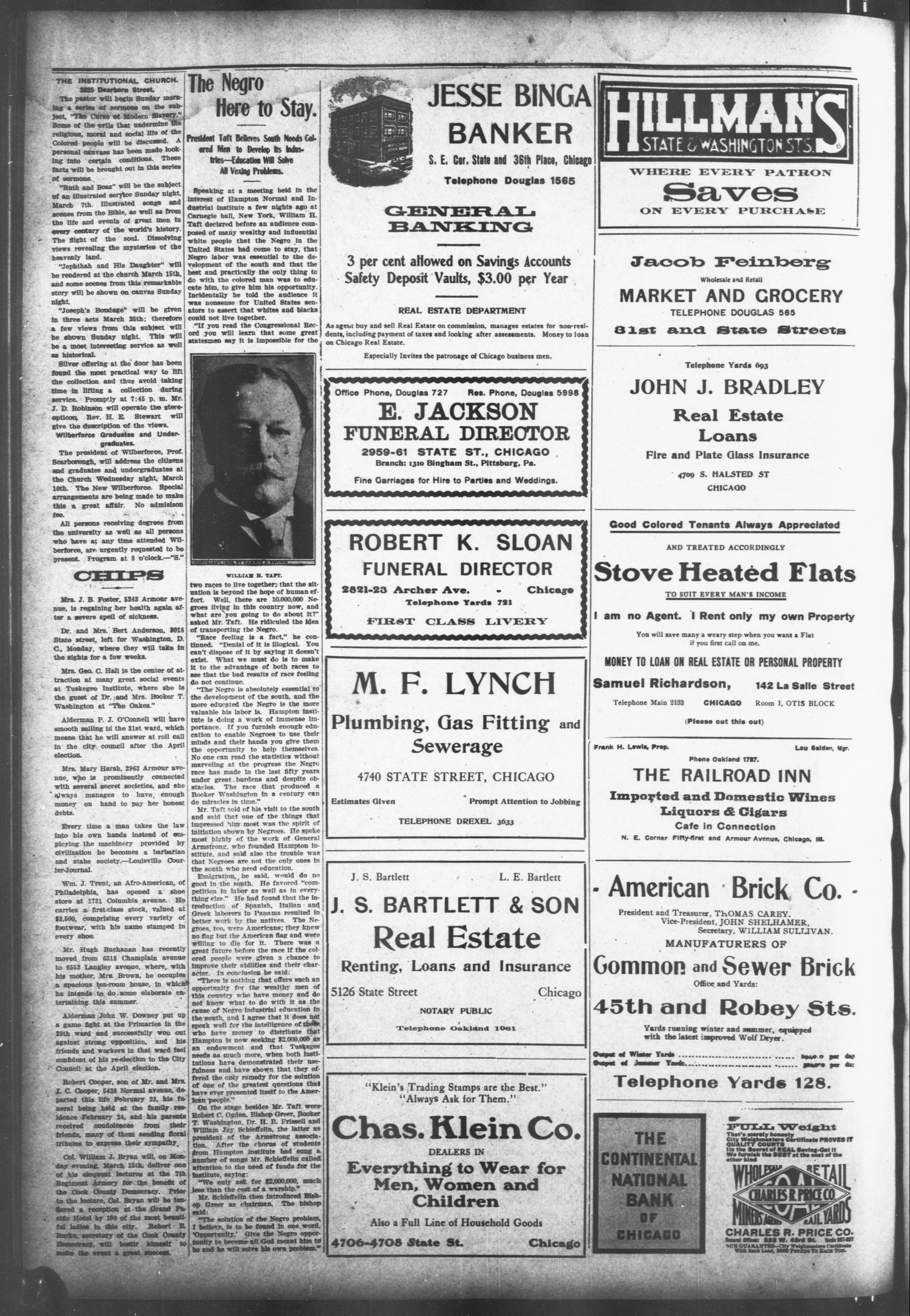
Speaking at a meeting held in the interest of Hampton Normal and Industrial institute a few nights ago at Carnegie hall, New York, William H. Taft declared before an audience composed of many wealthy and influential white people that the Negro in the United States had come to stay, that Negro labor was essential to the development of the south and that the best and practically the only thing to do with the colored man was to educate him, to give him his opportunity. Incidentally he told the audience it was nonsense for United States senators to assert that whites and blacks could not live together. "If you read the Congressional Record you will learn that some great statesmen say it is impossible for the
BROOKLYN, N.Y. JULY 15, 1901.
two races to live together; that the situation is beyond the hope of human effort. Well, there are 10,000,000 Negroes living in this country now, and what are you going to do about it?" asked Mr. Taft. He ridiculed the idea of transporting the Negro.
"Race feeling is a fact," he continued. "Denial of it is illogical. You can't dispose of it by saying it doesn't exist. What we must do is to make it to the advantage of both races to see that the bad results of race feeling do not continue.
"The Negro is absolutely essential to the development of the south, and the more educated the Negro is the more valuable his labor is. Hampton institute is doing a work of immense importance. If you furnish enough education to enable Negroes to use their minds and their hands you give them the opportunity to help themselves. No one can read the statistics without marveling at the progress the Negro race has made in the last fifty years under great, burdens and despite obstacles. The race that produced a Booker Washington in a century can do miracles in time."
Mr. Taft told of his visit to the south and said that one of the things that impressed him most was the spirit of initiation shown by Negroes. He spoke most highly of the work of General Armstrong, who founded Hampton institute, and said also the trouble was that Negroes are not the only ones in the south who need education.
Emigration, he said, would do no good in the south. He favored "competition in labor as well as in everything else." He had found that the introduction of Spanish, Italian and Greek laborers in Panama resulted in better work by the natives. The Negroes, too, were Americans; they knew no flag but the American flag and were willing to die for it. There was a great future before the race if the colored people were given a chance to improve their abilities and their character. In conclusion he said:
"There is nothing that offers such an opportunity for the wealthy men of this country who have money and do not know what to do with it as the cause of Negro industrial education in the south, and I agree that it does not speak well for the intelligence of those who have money to distribute that Hampton is now seeking $2,000,000 as an endowment and that Tuskegee needs as much more, when both institutions have demonstrated their usefulness and have shown that they offered the only remedy for the solution of one of the greatest questions that have ever presented itself to the American people."
On the stage besides Mr. Taft were Robert C. Ogden, Bishop Greer, Booker T. Washington, Dr. H. E. Frissell and William Jay Schieffellin, the latter as president of the Armstrong association. After the chorus of students from Hampton institute had sung a number of songs Mr. Schieffellin called attention to the need of funds for the institute, saying: "We only ask for $2,000,000, much less than the cost of a warship." Mr. Schieffellin then introduced Bishop Greer as chairman. The bishop said: "The solution of the Negro problem, I believe, is to be found in one word, 'Opportunity.' Give the Negro opportunity to become all God meant him to and be he will solve his own problem."
3 per cent allowed on Savings Accounts Safety Deposit Vaults, $3.00 per Year
As agent buy and sell Real Estate on commission, manages estates for non-residents, including payment of taxes and looking after assessments. Money to loan on Chicago Real Estate.
Especially Invites the patronage of Chicago business men.
Office Phone, Douglas 727 Res. Phone, Douglas 5998
E. JACKSON
FUNERAL DIRECTOR
2959-61 STATE ST., CHICAGO
Branch: 1310 Bingham St., Pittsburg, Pa.
Fine Garriages for Hire to Parties and Weddings.
2821-23 Archer Ave. Chicago Telephone Yards 721 FIRST CLASS LIVERY
M. F. LYNCH
Plumbing, Gas Fitting and Sewerage 4740 STATE STREET, CHICAGO
J. S. BARTLETT & SON Real Estate
Renting, Loans and Insurance
"Klein's Trading Stamps are the Best." "Always Ask for Them."
Everything to Wear for Men, Women and Children
THE BANK OF THE UNITED STATES
3 per cent and Safety Deposit
As agent buy and sell Real Estate students, including payment of on Chicago Real Estate.
Especially Invite
Office Phone, Doug
E. FUNER
2959-61
Branch: 13
Fine Garriages
ROBER FUNER
2821-23 Arc
To
FIRST
M. F
Plumbing
4740 STAT
Estimates Given
TEL
J. S. Bartlett
J. S. BA
Rea
Renting, I
5126 State Street
S. E. Cor. State and 36th Place, Chicago Telephone Douglas 1565
HILLMAN'S
STATE & WASHINGTON STS.
WHERE EVERY PATRON
Saves
ON EVERY PURCHASE
Jacob Feinberg
Wholesale and Retail
MARKET AND GROCERY
TELEPHONE DOUGLAS 565
81st and State Streets
JOHN J. BRADLEY
Real Estate
Loans
Fire and Plate Glass Insurance
4709 S. HALSTED ST
CHICAGO
Good Colored Tenants Always Appreciate
Colored Tenants Always Apprec
Good Colored Tenants Always Appreciated AND TREATED ACCORDINGLY
Stove H
TO SUIT ME
I am no Agent. I will save many if you
MONEY TO LOAN ON REAL
Samuel Richard
Telephone Main 2183
(Plea
Heve Heated Flat
TO SUIT EVERY MAN'S INCOME
To Agent. I Rent only my own P
You will save many a weary step when you want a Flat
if you first call on me.
TO LOAN ON REAL ESTATE OR PERSONAL PRO
Al Richardson, 142 La Salle
Nine Main 2133 CHICAGO Room 1, OTIS B
(Please cut this out)
Vivis, Prop. Lou 8
Phone Oakland 1787.
THE RAILROAD INN
Ported and Domestic Wine
Liquors & Gigars
Cafe in Connection
Corner Fifty-first and Armour Avenue, Chicago,
American Brick Co.
Agent and Treasurer, THOMAS CAREY.
Vice-President, JOHN SHELHAMER,
Secretary, WILLIAM SULLIVEN
MANUFATURERS OF
Lemon and Sewer B
Office and Yards:
h and Robey S
Stove Heated Flats
I am no Agent. I Rent only my own Property
You will save many a weary step when you want a Flat
if you first call on me.
MONEY TO LOAN ON REAL ESTATE OR PERSONAL PROPERTY
Samuel Richardson, 142 La Salle Street
Telephone Main 2133 CHICAGO Room I, OTIS BLOCK
(Please cut this out)
THE RA
Imported and
Liquor
Cafe
N. E. Corner Fifty-first
- American
President and Treasurer
Vice-President
MANU
Common a
Of
45th and
THE RAILROAD INN Imported and Domestic Wines Liquors & Cigars Cafe in Connection N. E. Corner Fifty-first and Armour Avenue, Chicago, IL.
American Brick Co.
President and Treasurer, THOMAS CAREY. Vice-President, JOHN SHELHAMER, Secretary, WILLIAM SULLIVAN. MANUFATURERS OF Common and Sewer Brick Office and Yards:
45th and Robey Sts.
Yards running winter and summer, equipped with the latest improved Wolf Dryer.
Output of Winter Yards ..... 1000
Output of Summer Yards..... 3000
Telephone Yards 12
Enter Yards ..... 1000
Summer Yards..... 2000
Telephone Yards 12
THE
CONTINENTAL
NATIONAL
BANK
OF
CHICAGO
---
With Each Load, 2000 Pounds T
Frank H. Lewis, Prop.
Telephone Yards 693
Appreciated
Flats
Own Property
a Flat
AL PROPERTY
Salle Street
TIS BLOCK
Lou Saldon, Wgr.
IN
Wines
Chicago, Ill.
Co.
NER,
BULLIVAN.
Brick
Sts
128.
7eight