The Broad Ax
Saturday, June 12, 1909
Chicago, Illinois
Page text (machine-generated)
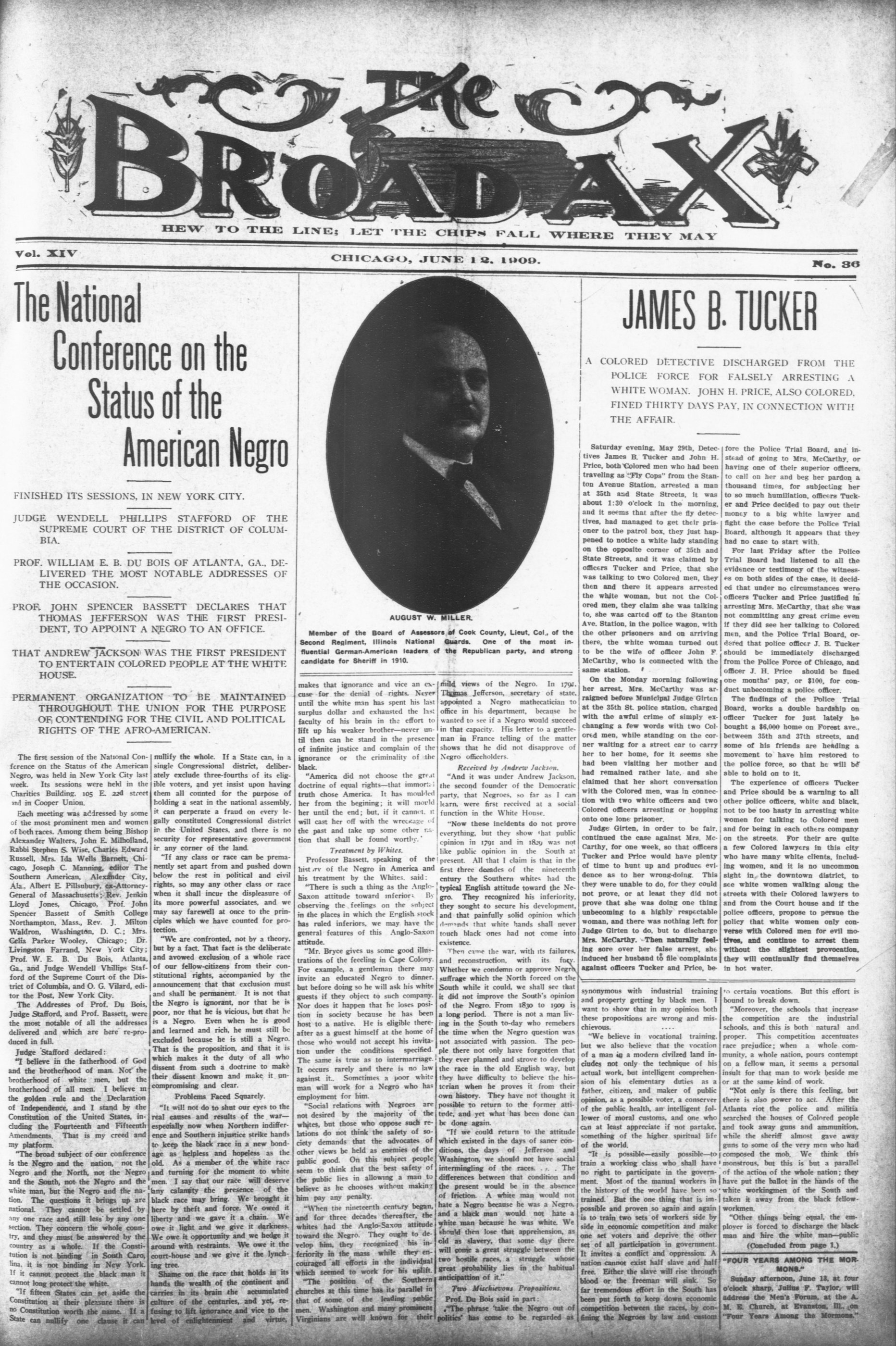
The National Conference on the Status of the American Negro
FINISHED ITS SESSIONS, IN NEW YORK CITY.
JUDGE WENDELL PHILLIPS STAFFORD OF THE SUPREME COURT OF THE DISTRICT OF COLUMBIA.
PROF. WILLIAM E. B. DU BOIS OF ATLANTA, GA., DELIVERED THE MOST NOTABLE ADDRESSES OF THE OCCASION.
PROF. JOHN SPENCER BASSETT DECLARES THAT THOMAS JEFFERSON WAS THE FIRST PRESIDENT, TO APPOINT A NEGRO TO AN OFFICE.
THAT ANDREW JACKSON WAS THE FIRST PRESIDENT TO ENTERTAIN COLORED PEOPLE AT THE WHITE HOUSE.
PERMANENT ORGANIZATION TO BE MAINTAINED THROUGHOUT THE UNION FOR THE PURPOSE OF CONTENDING FOR THE CIVIL AND POLITICAL RIGHTS OF THE AFRO-AMERICAN.
Vol. XIV
The National Conference Status Am
FINISHED ITS SESSIONS, IN
JUDGE WENDELL PHILLIP SUPREME COURT OF BIA.
PROF. WILLIAM E. B. DU LIVERED THE MOST THE OCCASION.
PROF. JOHN SPENCER B THOMAS JEFFERSON DENT, TO APPOINT A
THAT ANDREW JACKSON W TO ENTERTAIN COLO HOUSE.
PERMANENT ORGANIZATION THROUGHOUT THE USE OF CONTENDING FOR RIGHTS OF THE AFRO
The first session of the National Conference on the Status of the American Negro, was held in New York City last week. Its sessions were held in the Charities Building, 105 E. 22d street and in Cooper Union.
Each meeting was addressed by some of the most prominent men and women of both races. Among them being Bishop Alexander Walters, John E. Milholland, Rabbi Stephen S. Wise, Charles Edward Russell, Mrs. Ida Wells Barnett, Chicago, Joseph C. Manning, editor The Southern American, Alexander City, Ala., Albert E. Pillsbury, ex Attorney-General of Massachusetts; Rev. Jenkin Lloyd Jones, Chicago, Prof. John Spencer Bassett of Smith College Northampton, Mass., Rev. J. Milton Waldron, Washington, D. C.; Mrs. Cella Parker Wooley, Chicago; Dr. Livingston Farrand, New York City; Prof. W. E. B. Du Bois, Atlanta, Ga., and Judge Wendell Phillips Stafford of the Supreme Court of the District of Columbia, and O. G. Vilard, editor the Post, New York City.
The Addresses of Prof. Du Bois, Judge Stafford, and Prof. Bassett, were the most notable of all the addresses delivered and which are here re-produced in full.
Judge Stafford declared:
"I believe in the fatherhood of God and the brotherhood of man. Not the brotherhood of white men, but the brotherhood of all men. I believe in the golden rule and the Declaration of Independence, and I stand by the Constitution of the United States, including the Fourteenth and Fifteenth Amendments. That is my creed and my platform.
"The broad subject of our conference is the Negro and the nation, not the Negro and the North, not the Negro and the South, not the Negro and the white man, but the Negro and the nation. The questions it brings up are national. They cannot be settled by any one race and still less by any one section. They concern the whole country, and they must be answered by the country as a whole. If the Constitution is not binding in South Caro, lina, it is not binding in New York. If it cannot protect the black man it cannot harm the white man."
"If fifteen States can set aside the Constitution at their pleasure there is no Constitution worth the name. If a State can nullify one clause it can
HEW TO THE LINE; LET THE CHIPS FALL WHERE THEY MAY
nullify the whole. If a State can, in a single Congressional district, deliberately exclude three-fourths of its eligible voters, and yet insist upon having them all counted for the purpose of holding a seat in the national assembly, it can perperate a fraud on every legally constituted Congressional district in the United States, and there is no security for representative government ir any corner of the land.
"If any class or race can be premanently set apart from and pushed down below the rest in political and civil rights, so may any other class or race when it shall incur the displeasure of its more powerful associates, and we may say farewell at once to the principles which we have counted for protection.
"We are confronted, not by a theory, but by a fact. That fact is the deliberate and avowed exclusion of a whole race of our fellow-citizens from their constitutional rights, accompanied by the announcement that that exclusion must and shall be permanent. It is not that the Negro is ignorant, nor that he is poor, nor that he is vicious, but that he is a Negro. Even when he is good and learned and rich, he must still be excluded because he is still a Negro. That is the proposition, and that it is which makes it the duty of all who dissent from such a doctrine to make their dissent known and make it uncompromising and clear.
Problems Faced Squarely.
"It will not do to shut our eyes to the real causes and results of the war—especially now when Northern indifference and Southern injustice strike hands to keep the black race in a new bondage as helpless and hopeless as the old. As a member of the white race and turning for the moment to white men. I say that our race will deserve any calamity the presence of the black race may bring. We brought it here by theft and force. We owed it liberty and we gave it a chain. We owe it light and we give it darkness. We owe it opportunity and we hedge it around with restraints. We owe it the court-house and we give it the lynching tree.
Shame on the race that holds in its hands the wealth of the continent and carries in its brain the accumulated culture of the centuries, and yet, refusing to lift ignorance and vice to the level of enlightenment and virtue,
CHICAGO, JUNE 12, 1909.
AUGUST W. MILLER
Member of the Board of Assessors of Cook County, Lieut. Col., of the Second Regiment, Illinois National Guards. One of the most influential German-American leaders of the Republican party, and strong candidate for Sheriff in 1910.
makes that ignorance and vice an excuse for the denial of rights. Never until the white man has spent his last surplus dollar and exhausted the last faculty of his brain in the effort to lift up his weaker brother—never until then can he stand in the presence of infinite justice and complain of the ignorance or the criminality of the black.
"America did not choose the great doctrine of equal rights—that immortal truth chose America. It has moulded her from the beginning; it will mould her until the end; but, if it cannot, it will cast her off with the wreckage of the past and take up some other nation that shall be found worthy."
Treatment by Whites
Professor Bassett, speaking of the hist of the Negro in America and his treatment by the Whites, said:
"There is such a thing as the Anglo-Saxon attitude toward inferior. By observing the feelings on the subject in the places in which the English stock has ruled inferior, we may have the general features of this Anglo-Saxon attitude.
"Mr. Bryce gives us some good illustrations of the feeling in Cape Colony. For example, a gentleman there may invite an educated Negro to dinner, but before doing so he will ask his white guests if they object to such company. Nor does it happen that he loses position in society because he has been host to a native. He is eligible thereafter as a guest himself at the home of those who would not accept his invitation under the conditions specified. The same is true as to intermarriage. It occurs rarely and there is no law against it. Sometimes a poor white man will work for a Negro who has employment for him.
"Social relations with Negroes are not desired by the majority of the whites, but those who oppose such relations do not think the safety of society demands that the advocates of other views be held as enemies of the public good. On this subject people seem to think that the best safety of the public lies in allowing a man to believe as he chooses without making him pay any penalty.
"When the nineteenth century began, and for three decades thereafter, the whites had the Anglo-Saxon attitude toward the Negro. They ought to develop him, they recognized his inferiority in the mass while they encouraged all efforts in the individual which seemed to work for his uplift.
"The position of the Southern churches at this time has its parallel in that of some of the leading public men. Washington and many prominent Virginians are well known for their
mild views of the Negro. In 1791, Thomas Jefferson, secretary of state, appointed a Negro mathecatician to office in his department, because he wanted to see if a Negro would succeed in that capacity. His letter to a gentleman in France telling of the matter shows that he did not disapprove of Negro officeholders.
Received by Andrew Jackson.
"And it was under Andrew Jackson, the second founder of the Democratic party, that Negroes, so far as I can learn, were first received at a social function in the White House.
"Now these incidents do not prove everything, but they show that public opinion in 1791 and in 1829 was not like public opinion in the South at present. All that I claim is that in the first three decades of the nineteenth century the Southern whites had the typical English attitude toward the Negro. They recognized his inferiority, they sought to secure his development, and that painfully solid opinion which demands that white hands shall never touch black ones had not come into existence.
Then came the war, with its failures, and reconstruction, with its fury. Whether we condemn or approve Negro suffrage which the North forced on the South while it could, we shall see that it did not improve the South's opinion of the Negro. From 1830 to 1909 is a long period. There is not a man living in the South to-day who remebers the time when the Negro question was not associated with passion. The people there not only have forgotten that they ever planned and strove to develop the race in the old English way, but they have difficulty to believe the historian when he proves it from their own history. They have not thought it possible to return to the former attitude, and yet what has been done can be done again.
"If we could return to the attitude which existed in the days of saner conditions, the days of Jefferson and Washington, we should not have social intermingling of the races. . . . The differences between that condition and the present would be in the absence of friction. A white man would not hate a Negro because he was a Negro, and a black man would not hate a white man because he was white. We should then lose that apprehension, as old as slavery, that some day there will come a great struggle between the two hostile races, a struggle whose great probability lies in the habitual anticipation of it."
Two Mischievous Propositions.
Prof. Du Bois said in part:
"The phrase 'take the Negro out of
JAMES B. TUCKER
A COLORED DETECTIVE DISCHARGED FROM THE POLICE FORCE FOR FALSELY ARRESTING A WHITE WOMAN. JOHN H. PRICE, ALSO COLORED, FINED THIRTY DAYS PAY, IN CONNECTION WITH THE AFFAIR.
Saturday evening, May 29th, Detectives James B. Tucker and John H. Price, both Colored men who had been traveling as "Fly Cops" from the Stanton Avenue Station, arrested a man at 35th and State Streets, it was about 1:30 o'clock in the morning, and it seems that after the fly detectives, had managed to get their prisoner to the patrol box, they just happened to notice a white lady standing on the opposite corner of 35th and State Streets, and it was claimed by officers Tucker and Price, that she was talking to two Colored men, they then and there it appears arrested the white woman, but not the Colored men, they claim she was talking to, she was carted off to the Stanton Ave. Station, in the police wagon, with the other prisoners and on arriving there, the white woman turned out to be the wife of officer John F. McCarthy, who is connected with the same station.
On the Monday morning following her arrest, Mrs. McCarthy was arraigned before Municipal Judge Gliten at the 35th St. police station, charged with the awful crime of simply exchanging a few words with two Colored men, while standing on the corner waiting for a street car to carry her to her home, for it seems she had been visiting her mother and had remained rather late, and she claimed that her short conversation with the Colored men, was in connection with two white officers and two Colored officers arresting or hopping onto one lone prisoner.
Judge Girten, in order to be fair, continued the case against Mrs. McCarthy, for one week, so that officers Tucker and Price would have plenty of time to hunt up and produce evidence as to her wrong-doing. This they were unable to do, for they could not prove, or at least they did not prove that she was doing one thing unbecoming to a highly respectable woman, and there was nothing left for Judge Girten to do, but to discharge Mrs. McCarthy. Then naturally feeling sore over her false arrest, she induced her husband to file complaints against officers Tucker and Price, be synonymous with industrial training and property getting by black men. I want to show that in my opinion both these propositions are wrong and mischievous.
"We believe in vocational training, but we also believe that the vocation of a man in a modern civilized land includes not only the technique of his actual work, but intelligent comprehension of his elementary duties as a father, citizen, and maker of public opinion, as a possible voter, a conserver of the public health, an intelligent follower of moral customs, and one who can at least appreciate if not partake, something of the higher spiritual life of the world.
"It is possible—easily possible—to train a working class who shall have no right to participate in the government. Most of the manual workers in the history of the world have been so trained. But the one thing that is impossible and proven so again and again is to train two sets of workers side by side in economic competition and make one set voters and deprive the other set of all participation in government. It invites a conflict and oppression. A nation cannot exist half slave and half free. Either the slave will rise through blood or the freeman will sink. So far tremendous effort in the South has been put forth to keep down economic competition between the races, by confining the Negroes by law and custom
DISCHARGED FROM THE FALSELY ARRESTING A N H. PRICE, ALSO COLORED, PAY, IN CONNECTION WITH before the Police Trial Board, and instead of going to Mrs. McCarthy, or having one of their superior officers, to call on her and beg her pardon a thousand times, for subjecting her to so much humiliation, officers Tucker and Price decided to pay out their money to a big white lawyer and fight the case before the Police Trial Board, although it appears that they had no case to start with.
For last Friday after the Police Trial Board had listened to all the evidence or testimony of the witnesses on both sides of the case, it decided that under no circumstances were officers Tucker and Price justified in arresting Mrs. McCarthy, that she was not committing any great crime even if they did see her talking to Colored men, and the Police Trial Board, ordered that police officer J. B. Tucker should be immediately discharged from the Police Force of Chicago, and officer J. H. Price should be fined one months' pay, or $100, for conduct unbecoming a police officer.
The findings of the Police Trial Board, works a double hardship on officer Tucker for just lately he bought a $6,000 home on Forest ave., between 35th and 37th streets, and some of his friends are heading a movement to have him restored to the police force, so that he will be able to hold on to it.
The experience of officers Tucker and Price should be a warning to all other police officers, white and black, not to be too hasty in arresting white women for talking to Colored men and for being in each other company on the streets. For their are quite a few Colored lawyers in this city who have many white clients, including women, and it is no uncommon sight in the downtown district, to see white women walking along the streets with their Colored lawyers to and from the Court house and if the police officers, propose to persuade the policy that white women only converse with Colored men for evil motives, and continue to arrest them without the slightest provocation, they will continually find themselves in hot water.
"Moreover, the schools that increase the competition are the industrial schools, and this is both natural and proper. This competition accentuates race prejudice; when a whole community, a whole nation, pours contempt on a fellow man, it seems a personal insult for that man to work beside me or at the same kind of work.
"Not only is there this feeling, but there is also power to act. After the Atlanta riot the police and militia searched the houses of Colored people and took away guns and ammunition, while the sheriff almost gave away guns to some of the very men who had composed the mob. We think this monstrous, but this is but a parallel of the action of the whole nation; they have put the ballot in the hands of the white workingmen of the South and taken it away from the black fellow-workmen.
"Other things being equal, the employer is forced to discharge the black man and hire the white man—public
"FOUR YEARS AMONG THE MORMONS."
Sunday afternoon, June 13, at four o'clock sharp, Julius F. Taylor, will address the Men's Forum, at the A. M. E. Church, at Evanston, Ill., on "Four Years Among the Mormons."
THE BROADAX
Will promulgate and at all times update a single of Democracy, but Catholicism, Protestants, Priests, Insolita, Taxale Taxiers, Republicans, or anyone else can have their say, as long as their language is proper and responsibility is fixed.
The Broad Axis is a newspaper whose platform is broad enough for all, ever claiming the editorial right to speak its own mind.
Local communications will receive attention. Write only on one side of the paper.
Subscriptions must be paid in advance.
JULIUS F. TAYLOR, Editor and Publisher.
Entered as Second-Class Matter
Aug. 10, 1902 at the Post Office at
Chicago, Illinois, under Act of March
3, 1879.
NATIONAL BAPIST .SUNDAY-
SCHOOL CONGRESS.
Religious Workers From All Over
the United States Holding Ses-
sions in Nashville, Tenn.
Stewart's Press Special
Nashville, Tenn., June 9.—Nashville, the capital city of Tennessee, is entertaining the most distinguished gathering of Sunday-School and young people's workers that ever assembled in the United States. The delegates came from every part of the country. This is the fourth annual gathering and from present indications will eclipse both in point of attendance and interest the previous sessions. The entire city is a unit in welcoming and entertaining these religious workers. The sessions are being held with Mt. Olive Baptist Church on Cedar street. The opening was elaborate in every respect, and the welcome the delegates are receiving makes it possible for the Congress Movement to take on new life and cover a more fertile field of labor. The Committee on the Assignment of Homes succeeded in sending out all of the assignment cards prior to the arrival of the delegates, and to the surprise of all yet to their convenience, they left the railroad stations and went direct to their stopping-places.
The first day's session of the Sunday-school Congress was conspicuous for the presence of almost the entire Executive Board of the National Baptist Convention, which is here for the purpose of making its program. Presiding over this distinguished body of religious workers is Rev. Clark, D. D., pastor of the church entertaining the Congress. Principal among the speakers to-day is Rev. R. H. Boyd, D. D., LL. D. organizer of the Sunday-School Congress and B. Y. P. U. Chautauqua. The officers of the Congress are as follows: Rev. P. James Bryant, D. D., of Atlanta, Ga. from the B. Y. P. U. Board; Rev. E. W. D. Isaac, D. D., Nashville, Tenn. Secretary of the B. Y. P. U. Board, is Blackboard Critic; Rev. J. P. Robinson, D. D., Little Rock, Ark., Chairman of the Home Mission Board; Rev. W. S. Ellington, B. A., D. D., Nashville, Tenn., Congress Arbiter; Prof. R. B. Hudson, Selma, Ala., Recording Secretary; Rev. C. H. Clark, D. D., Chairman of the National Baptist Publishing Board and and President of the Congress, and Henry A. Boyd, Secretary of the Congress Movement. One of the most charming features of this religious gathering is the religious subjects that are being discussed touching every phase of Sunday-school work. These subjects will no doubt be uplifting and inspiring to thousands of missionaries, educators and Sunday-school workers. Another feature of the meeting is the music furnished by a chorus of one hundred voices, under the skilled direction of Rev. N. H. Pius, D. D., of Springfield, Ohio, singing songs which are the production of Negro brain throughout the United States. The most attractive feature of this meeting will be the great Sunday-school Missionary Mass-meeting to be held at the Ryman Auditorium on next Sunday, of which Rev. Charles T. Walker, D. D., of Augusta, Ga., will be the central figure. Already it is calculated that six thousand people will listen to this distinguished and eloquent divine give out advice and instruction along religious lines.
Mrs. Greenleaf of Atlanta, Ga., will arrive in the city in the near future, and spend one month in visiting at the lovely home of her brother and sister-in-law, Mr. and Mrs. Charles Smith. 5363 Dearborn Street.
THE STATUS OF THE AMERICAN NEGRO.
(Continued on page 2.)
opinion demands it, the administrators of government, including police, magistrates, etc., render it easier, since, by preferring the white, many intricate questions of social contact are avoided and political influence is vastly increased.
Must Work for Less Wages.
"Under such circumstances there is nothing for the Negro to do but to bribe the employer by underbidding his white fellow; to work not only for less money wages, but for longer hours and under worse conditions.
"Does he want to do this. Does he like long hours and under worse conditions.
"Does he want to do this? Does he like longer hours. Ignorant as he is as a mass, has he not intelligence enough to perceive the value of labor unions and the meaning of the labor movement? No, it is not because the black man is a fool, but because he is a victim that he drags labor down.
"Judges and juries in the South are at the absolute mercy of the white voters. Few ordinary judges would dare to oppose the momentary whim of the white mob, and practically only now and then will a jury convict a white man for aggression on a Negro. Not only is this true in criminal but also in civil suits, so much so that it is a widespread custom among Negroes of property never to take a civil suit to court but to let the white complainant settle it. In all public benefits like schools and parks and gathering and institutions, Negroes are regularly taxed for what they cannot enjoy. I am taxed for the Carnegie Public Library of Atlanta where I cannot enter to draw my own books. The Negroes of Memphis are taxed for public parks where they cannot sit down.
Barred From Engines and Autos.
"Witness the strike of the white locomotive firemen in Georgia to-day; Negro firemen get from fifty cents to one dollar a day less than the white firemen, have to do menial work, and cannot become engineers. They can, however, by good service and behavior, be promoted to the best runs by the rule of seniority. Even this the white firemen now object to, and say in a manifesto; the "white people of this State refuse to accept Negro equiv."
This is worse than that. The other day the white automobile drivers of Atlanta made a frantic appeal in the papers for persons to stop hiring black drivers. The black drivers replied, "We have had fewer accidents than you and get less wages," but the whites simply said, "This ought to be a white man's job."
"The voteless Negro is a provocation, an invitation, to oppression, a plaything for mobs, and a bonanza for demagogues. They serve always to distract attention from real issues and to ride fools and rascal into political power. The political campaign in Georgia before the last was avowedly and openly a campaign, not against Negro crime and ignorance, but against Negro intelligence and property owning and industrial competition, as shown by an 83 per cent, increase in their property in ten years. It swept the State, and if it had not culminated in riot and bloodshed and thus scared capital, it would still be triumphant. As it is, the end is not yet.
"Fourteen years ago Mississippi began disfranchising Negroes. You were promised that the result would be to settle the Negro problem. Is it settled? No, and it never will be until you give black men the power to be men, until you give them the power to defend that manhood. When the Negro casts a free and intelligent vote in the South, then, and not until then will the Negro problem be settled."
THE EDITOR'S SOFT SNAP.
The editor is a man with a soft snap. He reads the papers and magazines says the Girard Anchor, writes most of things he knows least about, and meets the people who desire to know him. He loves them because they are so forgetful of self and so solicitous of his well being. They all want to help him. One-half of them want him to print news which he does not recognize as news, and the other half wants him to suppress what he recognizes as good news, because they do not regard it of any value or importance. The editor has more people trying to help him do what he doesn't care to do and induce him to do what they want him to do than any other individual on earth. In the midst of it all he keeps his poise, seldom reveals the fact that he has any mind to speak of, and lets his visitors leave him with a feeling of having achieved something which they haven't. That is why they say he doesn't do as he agreed when he agreed to do nothing. They do not realize how independent he can keep by being agreeable, they still have to learn that being agreeable is not akin to being a fool.
THE REPUBLICANS ELECTED EIGHT AND THE DEMOCRATS CHOOSED SIX OF THE CIRCUIT COURT JUDGES.
JUDGE THEODORE BRENTANO RE-ELECTED SUPERIOR COURT JUDGE.
Judges Edward Osgood Brown, Francis Adams And Richard W. Clifford to the Regret of Their Many Friends Dropped on the Outside of the Breastworks.
The Judicial election Monday, held many surprises in store for the politicians of both parties, many of whom thought that the candidates of either the Democratic or the Republican party would make a clean sweep, but thanks to the non-party voters such was not the case and the Republicans elected eight Circuit Court Judges and the Democrats six, namely, Judge John Gibbons, R.; Judge Richard S. Tuthill, R.; Judge George A. Carpenter, R.; Judge Merrit W. Pinckney, R.; Judge Frederick A. Smith, R.; Hon. Kickham Scanlan, R.; Hon. Jesse A. Baldwin, R.; former municipal Judge Adelor J. Petit, R.; Judge George Kersten D.; Judge Lockwood Honore, D.; Judge Charles M. Walker, D.; Judge Thomas G. Windes, D.; Judge Julian W. Mack, D.; and Judge Frank Baker, D.
Judge Theodore Brentano, R.; defeated William Brown, Jr., Democrat, and was re-elected Judge of the Superior Court. Judges Edward Osgood Brown, Francis Adams and Richard W. Clifford, to the great regret of their many friends dropped on the outside of the breastworks in their race for re-election to the Circuit Court bench, and we feel that the voters did not act wisely in shelving Judge Brown, for he is a high class gentleman, an able lawyer and he has made an ideal judge and all in all, the voters should have put him over and permitted him to continue to serve them as one of their honorable judges.
John P. McGoorty and Charles Alling Jr., were among the other defeated candidates, who have always stood by the people and at all times have worked for their best interest and the voters regardless of their politics, proved themselves to be ungrateful, by side tracking them.
It is pleasing to note, that Kickham Scanlan, Adelor J. Petit and Jesse A. Baldwin, came in under the wires in good shape. They are all three highly cultured gentlemen and eminent lawyers, free from race prejudice, and will make tip top judges. The Broad Ax was with them from the beginning to the end, and it is highly pleased over their election, for all litigants will receive a square deal before them.
CHATEAU, RINK NOTES.
Mr. Wm. Brown, of Omaha, Neb,
was among the many guests at the
Chateau Garden last Sunday eve.
Every week an entire new bill of
smart, clever vaudeville will be rend
ered the patrons of the Chateau Garden.
Come out and join the crowd
and have a good time.
Mr. Taylor, Editor of The Broad
Ax, in making his rounds, paid a visit
to the Chateau Garden. Call again
editor, you are always welcome.
The Garden spot of Chicago with
free seats in the Balcony, sheltered
dancing free and high class vaude-
ville, is the Chateau Garden, visit it
tonight.
Good wholesome food and splendid service by Bell & Daniels at the Chateau Garden.
Mr. Chas. Perkins, the Chateau comedian made his first appearance last Sunday eve., and held the audience spell-bound for more than a half hour with his funny jokes and songs. Come and hear him tonight at the Chateau Garden.
After witnessing the ball game Sunday between the Leland Giants vs. Gunters, visit the Chateau and dine with Bell & Daniels.
APPOMATTOX CLUB NOTES.
At the Monday session of the Board of Directors 25 new members were elected, among them some of Chicago's best citizens became members of the club.
Owing to the treacherous weather conditions prevailing now, it was deemed unwise to run a boat excursion and that idea was given up and in its stead arrangements were made by the Board for the Annual Outing to take place the latter part of July in Fox River Grove on Fox River on the line of the North Western Ry.
Those who have moved, will do well to get in touch with the Secretary of the Club as only invited guests receiving invitations through the mail and whose name appears on the Club roster will be permitted to attend this outing. This rule will be strictly enforced.
The Board will meet again next Monday to consider the Annual Outing and other emergency matters passed over from last meeting. The committee on arrangements for the picnic will meet Sunday evening, at 6 p. m. at the club parlors. President Moseley requests the full attendance.
The club members will attend Sunday's ball game between the Leland Giants and the Gunthers, at 79th and Wentworth Ave. in a body, to witness the Leland Giants win first place in the Chicago League.
INSTITUTIONAL CHURCH NOTES
Woman's Day was a grand success last Sunday, all the services were well attended. Mrs. Amanda Smith preached an excellent sermon at the morning service. Mrs. Bethune and women from the various clubs were on the program at afternoon service. Miss Hallie Q. Brown delivered a fine discourse at 8 p. m.
Mr. Ed. F. Morris, organist for the morning hour has prepared an excellent program which will be rendered Sunday morning, June 13.
Subject for the morning sermon will be "The Power of the Endless Life." Mrs. Jessie Smith and Miss Beecher will have charge of the music Sunday night. Subject of the sermon will be "Midnight Scenes from the Bible."
A grand organ benefit will be given at the church Thursday night, July 1st. The Anniversary Day of the Organization of the Church will be held on the first Sunday in July. Watch for programs.—"S."
THE ELEVENTH ANNIVERSARY OF THE AMANDA SMITH IN- DUSTRIAL HOME.
Monday, June 28th, the Amanda Smith Industrial Home, Harvey, Ill., will celebrate its 11th Anniversary and its founder, Mrs. Amanda Smith, cordially invites the friends and financial supporters of the home residing in Chicago, and the surrounding towns near Harvey, to be present on that occasion, and help to enjoy an old-fashioned pot pie dinner.
After the dinner there will be speaking and singing. Rev. C. E. Cornell, pastor of the First Nazarene church of Chicago, will preside. Mrs. M. Hill, Cook County president of the W. C. T. U. Chicago and Mrs. A. M. Taylor, South Bend, Indiana, will be among the speakers. The Winstons will sing, also the children of the home will take part by singing some of the old time jubilee songs.
NO FRIEND LIKE THE DOG.
Where will you find a man always grateful, always affectionate, never selfish, pushing the abnegation of self to the utmost limits of possibility, forgetful of injuries and mindful only of benefits received? Seek him not; it would be a useless task. But take the first dog you meet, and from the moment he adopts you for his master, you will find in him all these qualities. He will love you without calculation. His greatest happiness will be to be near you; and should you be reduced to beg your bread, not only will he aid you, but he will not abandon you to follow a king to his palace. Your friends may quit you in misfortune, but your dog/ will remain; he will die at your feet, or if you depart before him on the great voyage he will accompany you to your last abode.—From "History of the Dog."
DOGS IN BAGGAGE CARS.
Railroads that do not allow dogs to accompany their owners in passenger coaches are justly being urged, as summer approaches, to change this rule or furnish better accommodations than the ordinary baggage car. Dogs that travel on trains are generally pets. As such, they deserve some special care for their ease and comfort. As we journey, we find the dog well-behaved, courteous, and an agreeable fellow-traveler. We do not approve of his being classed and carried with that matter which "baggage smashers" handle.
When there is objection to dogs in passenger cars, then there should be provided other quarters that will insure all the protection, care, and comfort for which owners are willing to pay.—From Our Dumb Animals, Boston, Mass.
The Frederick Douglass Centre is pleased to announce that Prof. Kelly Miller of Howard University, Washington, D. C., will deliver his thrilling lecture on "Race Loyalty" on the evening of June 11, 1909, at 8 p. m., at the Institutional Church, 3825 Dearborn St.
Prof. Kelly Miller is one of the most interesting and scholarly men in the Negro race. He is an author of high recognition and a most captivating speaker.
We are anxious to give Prof Miller a fine audience and trust you will kindly co-operate in making the attendance worthy of this splendid representative of our race.
C. P. Wooley, Pres.,
S. Laing Williams, Sec'y
THE ST. MARK CONGREGATION
HELD FORTH IN ITS NEW
CHURCH LAST SUNDAY.
The members and friends of St. March Church, 47th and State Street, which they recently sold, moved into their new home which they bought at 50th and Wabash ave., and held their first services there last Sunday morning and evening and as each member was supposed to pay in $1.00 on entering the church, almost enough money was raised on the first Sunday to wipe out the $1,000 debt against it.
The new home of St. Mark is quite an improvement over the old one, but the white Christians residing near 50th and Wabash ave., are not too well pleased to have the Colored Christians rubbing up so close to them.
TAFT DISPLACES NEGRO
TAFT DISPLACES NEGRO.
That the South is a white man's country in the new Taft southern policy, was demonstrated recently when T. R. Dunham was appointed postmaster at Darien, Ga. Negroes far outnumber whites in that town, and Negro postmasters have been the rule for years. The appointment is all the more significant as it is in the jurisdiction of the postmaster general, Mr. Hitchcock, formerly Republican national chairman, who is opposed to white rule in the South when it interferes with the keeping up of the "machine." The appointment was ordered by Mr. Taft personally.
At this rate, President Taft seems to be helping out his Negro, followers in good shape.
MARRIES COLORED WOMAN.
Delaware, O., June 6.—Putting into practice his theory for the solution of the race problem. Mr. George Wells, brother of Deputy Sheriff William Wells, has just returned home with an Afro-American wife. His parents are well-to-do and highly respected. He believes the human race has deteriorated since the time of Christ through the failure of the races to intermarry. He is 35 years of age and far above the average in points of intelligence and good common sense.
CHIPS
Mr. Samuel J. Evans has just returned from an extensive western trip.
Mr. N. P. Miller has returned from a southern trip, where he took in Brownsville, Atlanta and other points of interest.
Little Katherine Crum, daughter of Mr. and Mrs. Jos. B. Crum, 3637 Dearborn St. is rapidly improving in health.
Mrs. Lulu Williams, 2415 Wabash Ave., is contemplating spending her vacation in Cincinnati, O. with her brother.
The Dunbar Memorial exercises will be held at the Institutional Church Sun. afternoon, June 27th, under the direction of Mr. Julius N. Avendorf. The program will appear in a later issue of this paper.
Mrs. Henry Young, 4922 Wentworth Ave., announces the marriage of her sister, Mrs. Anna Beatrice George to Dr. Howard M. Smith of Baltimore, Md.
Col. and Mrs. "Pony" W. Moore, have vacated their elegant home at 3314 Calumet Ave., and they are now residing on the second floor of the Palace Theater and Saloon, 359 31st Street.
Mrs. Neal Hawkins Buckner, is visiting friends in Peoria, Ills. Before returning to Chicago, Mrs. Buckner will charm many audiences with her sweet voice in the towns of Kentucky and Ohio.
Mr. Albert A. Williams of San Diego, California, brother of Mr. Iverson Williams is the guest of Mr. Wm.
Allen, 6006 Center Ave. Before returning to his California home Mr. Williams will visit relatives and friends in Kentucky and Ohio.
Mrs. Maggie L. Walker, president of St. Luke's Bank, at Richmond, Va., recently presented Miss Nannie Burroughs with a check for $500 to aid in pushing along her work in founding a training school for Colored girls at Washington, D. C.—Ex.
Mrs. Olivia E. Montier, 725 South Cleveland Ave., Philadelphia, Pa. who is a member of one of the oldest Afro-American families in the Quaker City, announces the engagement of her highly accomplished niece, Miss Rachel Catherine Montier, to Mr. Thomas Brown, also of that city
William Loeffler, 1919 Barry Ave. formerly City Clerk of Chicago, and prominent Democratic politician, has been at deaths door for the past two weeks. But to the delight of his many friends the doctors hold our much stronger hope at the present writing of his ultimate recovery. S. A. T. Watkins, Supreme Attorney for the K. Ps. throughout the world, left Wednesday evening, for New Orleans, La., Atlanta, Ga., and Nashville, Tenn., for the purpose of looking after some important legal business in connection with his order, he will be absent about ten days.
J. S. Dorsey, who runs a neat drug store at 116 1-2 W. 51st Street, has a new and able assistant in the person of Miss Hawkins, who is quite pretty, very amiable and popular with his customers. Miss Hawkins hails from Lincoln, Neb., and so far, she has fallen in love with Chicago and its people.
It is claimed by many of the big ones who are in a position to know what they are talking about, that "Rev. Archibald J. Carey, who has lately succeeded Sandy W. Trice, as general manager of the Old Church Organ, is in line to become one of the new bishops of the A. M. E. Church; if this is true, then the rank sinners will be requested to move up another peg on the mourner's bench.
J. C. Clark, who with his esteemable wife, Mrs. Clark, own a fine two flat building at 6510 St. Lawrence Ave. has the respect and the confidence of Mr. E. P. Ripley, president of the Atchison, Topeka and Santa Fe Railroad, and as Mr. Clark has always proven himself to be honest and truthful, he accompanies president Ripley on his long journeys to all parts of the country.
The Ladies' Auxiliary of the Eighth Regiment Illinois Guards, will give an informal dancing party, at Masonic hall, 3954 State Street, Thursday evening, June 15. The following ladies will have charge of the affair: Mrs. John R. Marshall, President; Dr. Ida Gray Nelson, Vice-President; Mrs. James H. Johnson, Treasurer; Mrs. John L. Fry, Secretary; Mrs. Louis B. Anderson, Mrs. R. F. Ratcliffe, Mrs. James R. White, Mrs. Clinton L. Hill Mrs. Franklin A. Denison, Mrs. William T. Jefferson, and Mrs. R. R. Jackson.
The Pickwick Club gave its first initial dancing party Thursday evening, June 10th, at Oakland Music Hall, 40th Street and Cottage Grove Ave. It was a full dress affair and admission by card only. In every sense of the word it was a very swell function. The active officers of the Pickwick Club follow: Robert Turnley, President; L. R. Waples, Vice President; F. L. Brown, Secretary and N. N. Francis Treasurer. This new club promises to outdistance all the other social clubs in the city.
The earliest trotting or pacing rate of which any record has been found was started from a New York road house called the De Lancey Arms. This wayside tavern stood in the Bowery lane, near what is now the corner of Fourth avenue and Eighteenth street. It seems to have been an all around sporting resort in colonial days, for in 1763 it was the scene of a bull baiting, and in the previous year it was the meeting place for four horses that raced up the road about half a mile to Watt's gate, near the present corner of Fourth avenue and Twenty-ninth street. The Jamaica turnpike was the first famous speeding ground in the vicinity of New York. Until the New York Trotting club's track came into existence, in 1826, it was the accepted course for the decision of match races, and as early as 1818 it was the scene of the first match against time of which there is any record.—Exchange.
DR. A. WILBERFORCE WILLIAM;
announces the Removal
of his office to
3255 State Street, N. F. cor. 33d Street
Suite A
CHICAGO, ILL.
Fours 10 to 12 m., 2 to 5, 6:30 to 8:30
YOURSELF AND FRIENDS WILL BE CORDIALLY-RECEIVED
Phone Aldine 2203
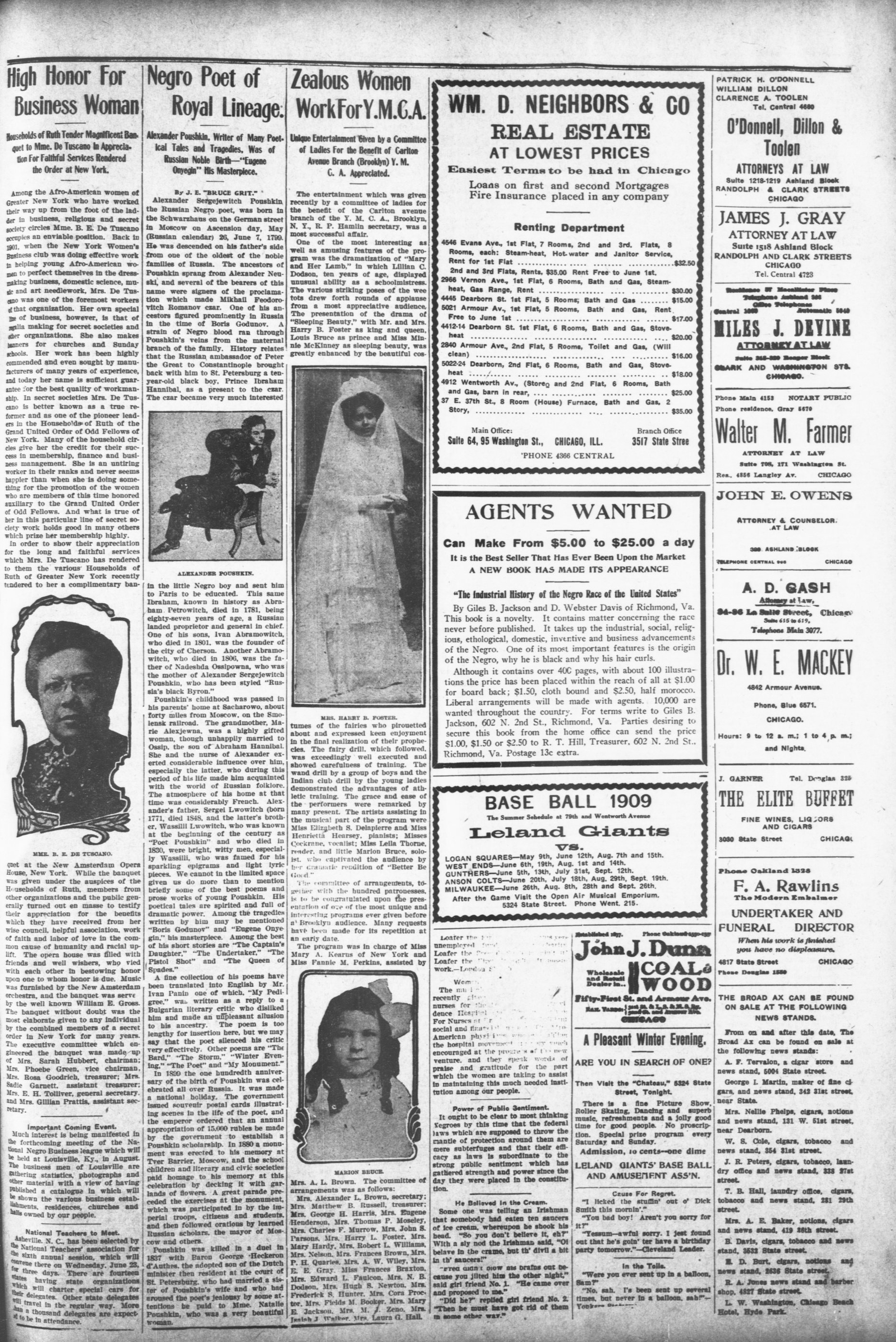
High Honor For Business Woman
Households of Ruth Tender Magnificent Banquet to Mme. De Tuscano In Appreciation For Faithful Services Rendered the Order at New York.
Among the Afro-American women of Greater New York who have worked their way up from the foot of the ladder in business, religious and secret society circles Mme. B. E. De Tuscan occupies an enviable position. Back in 1901, when the New York Women's Business club was doing effective work in helping young Afro-American women to perfect themselves in the dress-making business, domestic science, music and art needlework, Mrs. De Tuscan was one of the foremost workers of that organization. Her own special line of business, however, is that of regalia making for secret societies and other organizations. She also makes hanners for churches and Sunday schools. Her work has been highly commended and even sought by manufacturers of many years of experience, and today her name is sufficient guarantee for the best quality of workmanship. In secret societies Mrs. De Tuscan is better known as a true reformer and as one of the pioneer leaders in the Households of Ruth of the Grand United Order of Odd Fellows of New York. Many of the household circles give her the credit for their success in membership, finance and business management. She is an uniting worker in their ranks and never seems happier than when she is doing something for the promotion of the women who are members of this time honored auxiliary to the Grand United Order of Odd Fellows. And what is true of her in this particular line of secret society work holds good in many others which prize her membership highly.
which her membership mighty.
In order to show their appreciation for the long and faithful services which Mrs. De Tuscano has rendered to them the various Households of Ruth of Greater New York recently tendered to her a complimentary ban-
[Name]
MME. B. E. DE TUSCANO.
queet at the New Amsterdam Opera House, New York. While the banquet was given under the auspices of the Households of Ruth, members from other organizations and the public generally turned out en masse to testify their appreciation for the benefits which they have received from her wise council, helpful association, work of faith and labor of love in the common cause of humanity and racial uplift. The opera house was filled with friends and well wishers, who vied with each other in bestowing honor upon one to whom honor is due. Music was furnished by the New Amsterdam orchestra, and the banquet was serve by the well known William E. Gross. The banquet without doubt was the most elaborate given to any individual by the combined members of a secret order in New York for many years. The executive committee which engineered the banquet was made up of Mrs. Sarah Hubbert, chairman; Mrs. Phoebe Green, vice chairman; Mrs. Rosa Goodrich, treasurer; Mrs. Sadie Garnett, assistant treasurer; Mrs. E. H. Tolliver, general secretary; and Mrs. Gillian Prattis, assistant secretary.
Important Coming Event.
Important Coming Event. Much interest is being manifested in the forthcoming meeting of the National Negro Business league which will be held at Louisville, Ky., in August. The business men of Louisville are gathering statistics, photographs and other material with a view of having published a catalogue in which will be shown the various business establishments, residences, churches and halls owned by our people.
National Teachers to Meet.
Ashleigh, N. C., has been selected by the National Teachers' association for the sixth annual session, which will convene there on Wednesday, June 23, for three days. There are fourteen states having state organizations which will charter special cars for their delegates. Other state delegates will travel in the regular way. More than a thousand delegates are expected to be in attendance.
Negro Poet of Royal Lineage.
Alexander Poushkin, Writer of Many Poetical Tales and Tragedies, Was of Russian Noble Birth—"Eugene Onygin" His Masterpiece.
Alexander Sergejewitch Poushkin the Russian Negro poet, was born in the Schwarzhaus on the German street in Moscow on Ascension day, May (Russian calendar) 26, June 7, 1799. He was descended on his father's side from one of the oldest of the noble families of Russia. The ancestors of Poushkin sprang from Alexander Neuski, and several of the bearers of this name were signers of the proclamation which made Mikhail Feodorovitch Romanov czar. One of his ancestors figured prominently in Russia in the time of Boris Godunov. A strain of Negro blood ran through Poushkin's veins from the maternal branch of the family. History relates that the Russian ambassador of Peter the Great to Constantinople brought back with him to St. Petersburg a ten-year-old black boy, Prince Ibraham Hannibal, as a present to the czar. the czar became very much interested
ALEXANDER POUSHKIN.
in the little Negro boy and sent him to Paris to be educated. This same Ibraham, known in history as Abraham Petrowitch, died in 1781, being eighty-seven years of age, a Russian landed proprietor and general in chief. One of his sons, Ivan Abramowitch, who died in 1801, was the founder of the city of Cherson. Another Abramowitch, who died in 1806, was the father of Nadeshda Ossipowna, who was the mother of Alexander Sergejewitch Poushkin, who has been styled "Russia's black Byron."
Poushkin's childhood was passed in his parents' home at Sacharowo, about forty miles from Moscow, on the Smolensk railroad. The grandmother, Marie Alexjewna, was a highly gifted woman, though unhappily married to Ossip, the son of Abraham Hannibal. She and the nurse of Alexander exerted considerable influence over him, especially the latter, who during this period of his life made him acquainted with the world of Russian folklore. The atmosphere of his home at that time was considerably French. Alexander's father, Sergel Lwowitch (born 1771, died 1848, and the latter's brother, Wassill Lwowitch, who was known at the beginning of the century as "Poet Poushkin" and who died in 1830, were bright, witty men, especially Wassillii, who was famed for his sparkling epigrams and light lyric pieces. We cannot in the limited space given us do more than to mention briefly some of the best poems and prose works of young Poushkin. His poetical tales are spirited and full of dramatic power. Among the tragedies written by him may be mentioned "Boris Godunov" and "Eugene Onyegin," his masterpiece. Among the best of his short stories are "The Captain's Daughter," "The Undertaker," "The Pistol Shot" and "The Queen of Spades."
A fine collection of his poems have been translated into English by Mr. Ivan Panin one of which, "My Pedigree," was written as a reply to a Bulgarian literary critic who disliked him and made an unpleasant allusion to his ancestry. The poem is too lengthy for insertion here, but we may say that the poet silenced his critic very effectively. Other poems are "The Bard," "The Storm," "Winter Evening," "The Poet," and "My Monument."
In 1890 the one hundredth anniversary of the birth of Poushkin was celebrated all over Russia. It was made a national holiday. The government issued souvenir postal cards illustrating scenes in the life of the poet, and the emperor ordered that an annual appropriation of 15,000 rubles be made by the government to establish a Poushkin scholarship. In 1880 a monument was erected to his memory at Tver Barrier, Moscow, and the school children and literary and civic societies paid homage to his memory at this celebration by decking it with garlands of flowers. A great parade preceded the exercises at the monument, which was participated in by the imperial troops, citizens and students, and then followed orations by learned Russian scholars, the mayor of Moscow and others.
Poushkin was killed in a duel in 1837 with Baron George Heckeron d'Authes, the adopted son of the Dutch minister then resident at the court of St. Petersburg, who had married a sister of Poushkin's wife and who had aroused the poet's jealousy by some attention he paid to Mme. Natalie Poushkin, who was a very beautiful woman.
Zealous Women WorkForY.M.C.A.
Unique Entertainment Given by a Committee of Ladies For the Benefit of Carlton Avenue Branch (Brooklyn) Y. M. C. A. Appreciated.
The entertainment which was given recently by a committee of ladies for the benefit of the Carlton avenue branch of the Y. M. C. A., Brooklyn, N. Y., R. P. Hamlin secretary, was a most successful affair.
One of the most interesting as well as amusing features of the program was the dramatization of "Mary and Her Lamb," in which Lillian C. Dodson, ten years of age, displayed unusual ability as a schoolmistress. The various striking poses of the wee tots drew forth rounds of applause from a most appreciative audience. The presentation of the drama of "Sleeping Beauty," with Mr. and Mrs. Harry B. Foster as king and queen, Louis Bruce as prince and Miss Minnie McKinney as sleeping beauty, was greatly enhanced by the beautiful cos-
THE BRIDE
tumes of the fairies who prouetted about and expressed keen enjoyment in the final realization of their prophecies. The fairy drill, which followed, was exceedingly well executed and showed carefulness of training. The wand drill by a group of boys and the Indian club drill by the young ladies demonstrated the advantages of athletic training. The grace and ease of the performers were remarked by many present. The artists assisting in the musical part of the program were Miss Elizabeth S. Delapierre and Miss Henrietta Hearsey, pianists; Misses Cockrane, vocalist; Miss Lella Thorne, reader, and little Marion Bruce, soloist, who captivated the audience by her dramatic rendition of "Better Be Good."
The committee of arrangements, together with the hundred patronesses, is to be congratulated upon the presentation of one of the most unique and interesting programs ever given before a Brooklyn audience. Many requests have been made for its repetition at an early date.
The program was in charge of Miss Mary A. Kearns of New York and Miss Fannie M. Perkins, assisted by
[Image of a young girl with long hair and a bow, wearing a light-colored dress with a decorative border].
Mrs. A. L. Brown. The committee of arrangements was as follows:
Mrs. Alexander L. Brown, secretary;
Mrs. Matthew B. Russell, treasurer;
Mrs. George H. Harris, Mrs. Eugene Henderson, Mrs. Thomas P. Moseley,
Mrs. Charles F. Murrow, Mrs. John S. Parsons, Mrs. Harry L. Foster, Mrs.
Mary Hardy, Mrs. Robert L. Williams,
Mrs. Nelson, Mrs. Frances Brown, Mrs.
P. H. Quaries, Mrs. A. W. Wiley, Mrs.
E. E. Gray. Miss Frances Braxton,
Mrs. Edward L. Faulcon, Mrs. N. B. Dodson, Mrs. Hugh S. Newton, Mrs.
Frederick S. Hunter, Mrs. Cora Proctor, Mrs. Fields M. Booker, Mrs. Mary
E. Jackson, Mrs. M. J. Zeno, Mrs.
Iesiah J. Walker, Mrs. Laura G. Hall.
WM. D. NEIGHBORS & CO REAL ESTATE AT LOWEST PRICES
Easiest Terms to be had in Chicago Loans on first and second Mortgages Fire Insurance placed in any company
Renting Department
4546 Evane Ave., 1st Flat, 7 Rooms, 2nd and 3rd Rooms, each: Steam-heat, Hot-water and Janitor Rent for 1st Flat ..... 2nd and 3rd Flats, Rents, $35.00 Rent Free to A
2966 Vernon Ave., 1st Flat, 6 Rooms, Bath and Heat, Gas Range, Rent ..... 4445 Dearborn St. 1st Flat, 5 Rooms; Bath and C
5021 Dearborn Av., 1st Flat, 5 Rooms, Bath and Free to June 1st ..... 4412-14 Dearborn St. 1st Flat, 6 Rooms, Bath and heat ..... 2840 Armour Ave., 2nd Flat, 5 Rooms, Toilet and clean) ..... 5022-24 Dearborn, 2nd Flat, 6 Rooms, Bath and heat ..... 4912 Wentworth Av., (StoreQ and 2nd Flat, 6 H and Gas, barn in rear, ..... 37 E. 37th St., 8 Room (House) Furnace, Bath Story, ..... Main Office:
2nd and 3rd. Flats, 8
water and Janitor Service,
... $32.50
Rent Free to June 1st.
rooms, Bath and Gas, Steam-
... $30.00
rooms, Bath and Gas ... $15.00
rooms, Bath and Gas, Rent
... $17.00
rooms, Bath and Gas, Stove-
... $20.00
rooms, Toilet and Gas, (Will
... $16.00
rooms, Bath and Gas, Stove-
... $18.00
2nd Flat, 6 Rooms, Bath
... $25.00
Curnace, Bath and Gas, 2
... $35.00
4546 Evans Ave., 1st Flat, 7 Rooms, 2nd and 3rd. Flats, 8
Rooms, each: Steam-heat, Hot-water and Janitor Service,
Rent for 1st Flat ..... $32.50
2nd and 3rd Flats, Rents, $35.00 Rent Free to June 1st.
2966 Vernon Ave., 1st Flat, 6 Rooms, Bath and Gas, Steam-
heat, Gas Range, Rent ..... $30.00
4445 Dearborn St. 1st Flat, 5 Rooms; Bath and Gas ..... $15.00
5021 Armour Av., 1st Flat, 5 Rooms, Bath and Gas, Rent,
Free to June 1st ..... $17.00
4412-14 Dearborn St. 1st Flat, 6 Rooms, Bath and Gas, Stove-
heat ..... $20.00
2840 Armour Ave., 2nd Flat, 5 Rooms, Toilet and Gas, (Will
clean) ..... $16.00
5022-24 Dearborn, 2nd Flat, 6 Rooms, Bath and Gas, Stove-
heat ..... $18.00
4912 Wentworth Av., (StoreQ and 2nd Flat, 6 Rooms, Bath
and Gas, barn in rear, ..... $25.00
37 E. 37th St., 8 Room (House) Furnace, Bath and Gas, 2
Story, ..... $35.00
Suite 64, 95 Washington St., CHICAGO, ILL.
'PHONE 4366 CENTRAL
AGENTS WANT
Can Make From $5.00 to $2.00
It is the Best Seller That Has Ever Been Up
A NEW BOOK HAS MADE ITS APPROVED
"The Industrial History of the Negro Race of the North"
By Giles B. Jackson and D. Webster Davis of this book is a novelty. It contains matter never before published. It takes up the industrial, ethological, domestic, inventive and business of the Negro. One of its most important features of the Negro, why he is black and why his race is black. Although it contains over 400 pages, with all the features the price has been placed within the real for board back; $1.50, cloth bound and $2.00. Liberal arrangements will be made with agendas wanted throughout the country. For terms of Jackson, 602 N. 2nd St., Richmond, Va. Please secure this book from the home office card $1.00, $1.50 or $2.50 to R. T. Hill, Treasurer, Richmond, Va. Postage 13c extra.
BASE BALL 19
The Summer Schedule at 79th and Wentworth
Leland Giants vs.
LOGAN SQUARES—May 9th, June 12th, Aug. 7th
WEST ENDS—June 6th, 19th, Aug. 1st and 14th
GUNTHERS—June 5th, 13th, July 31st, Sept. 12th
ANSON COLTS—June 20th, July 18th, Aug. 29th
MILWAUKEE—June 26th, Aug. 8th, 28th and Seventh
After the Game Visit the Open Air Musical Ensemble at 5324 State Street. Phone Went.
WANTED
200 to $25.00 a day
Ever Been Upon the Market
DE ITS APPEARANCE
"Gro Race of the United States"
Webster Davis of Richmond, Va.
maint matter concerning the race
is up the industrial, social, religi-
tive and business advancements
important features is the origin
and why his hair curls.
pages, with about 100 illustra-
within the reach of all at $1.00
round and $2.50, half morocco.
made with agents. 10,000 are
For terms write to Giles B.
Richmond, Va. Parties desiring to
home office can send the price
Hill, Treasurer, 602 N. 2nd St.,
a.
FALL 1909
12th and Wentworth Avenue
Giants
12th, Aug. 7th and 15th.
1st and 14th.
31st, Sept. 12th.
18th, Aug. 29th, Sept. 19th.
28th and Sept. 26th.
Air Musical Emporium.
Phone Went. 215.
AGENTS WANTED
Can Make From $5.00 to $25.00 a day It is the Best Seller That Has Ever Been Upon the Market A NEW BOOK HAS MADE ITS APPEARANCE
"The Industrial History of the Negro Race of the United States"
By Giles B. Jackson and D. Webster Davis of Richmond, Va. This book is a novelty. It contains matter concerning the race never before published. It takes up the industrial, social, religious, ethological, domestic, inventive and business advancements of the Negro. One of its most important features is the origin of the Negro, why he is black and why his hair curls.
Although it contains over 400 pages, with about 100 illustrations the price has been placed within the reach of all at $1.00 for board back; $1.50, cloth bound and $2.50, half morocco. Liberal arrangements will be made with agents. 10,000 are wanted throughout the country. For terms write to Giles B. Jackson, 602 N. 2nd St., Richmond, Va. Parties desiring to secure this book from the home office can send the price $1.00, $1.50 or $2.50 to R. T. Hill, Treasurer, 602 N. 2nd St., Richmond, Va. Postage 13c extra.
LOGAN SQUARES—May 9th, 12th, Aug. 7th and 15th.
WEST ENDS—June 6th, 19th, Aug. 1st and 14th.
GUNTHERS—June 5th, 13th, July 31st, Sept. 12th.
ANSON COLTS—June 20th, July 18th, Aug. 29th, Sept. 19th.
MILWAUKEE—June 26th, Aug. 8th, 28th and Sept. 26th.
After the Game Visit the Open Air Musical Emporium.
5324 State Street. Phone Went. 215.
Established 1877. Phone Oakland 139-129
John J. Dunn
COAL &
WOOD
Wholesale
and Retail
Dealer in...
Fifty-First St. and Armour Ave.
MAK. VARDO.
121st St. & L. R. & M. R.
JAMES C. and Armour Ave.
CHICAGO
A Pleasant Winter Evening.
Then Visit the "Chateau," 5324 State Street, Tonight.
There is a fine Picture Show. Roller Skating, Dancing and superb music, refreshments and a jolly good time for good people. No proscription. Special prize program every Saturday and Sunday.
LELAND GIANTS' BASE BALL
AND AMUSEMENT ASS'N.
Cause For Regret.
"I licked the stuff' out o' Dick
Smith this mornin'."
"You bad boy! Aren't you sorry for
it?"
"Yessum—awful sorry. I jest found
out that he's goln' ter have a birthday
party tomorrow."—Cleveland Leader.
In the Toils.
"Were you ever sent up in a balloon,
Sam?"
"No, sah. I's been sent up several
times, but never in a balloon, sah!"—
Yorkshire Stater.
VS.
Loafter the first unemployed
Loafter the first Loafter the first work.—London
Women
The muilt recently nurses for the dence Hospital For Nurses at social and financial American physi encouraged at the progres s of new venture, and they speak words of praise and gratitude for the part which the women are taking to assist in maintaining this much needed institution among our people.
Power of Public Sentiment
Power of Public Commitment It ought to be clear to most thinking Negroes by this time that the federal laws which are supposed to throw the mantle of protection around them are mere subterfuges and that their efficacy as laws is subordinate to the strong public sentiment which has gathered strength and power since the day they were placed in the constitution.
He Believed In the Cream.
He Believed in the Cream.
Some one was telling an Irishman that somebody had eaten ten saucers of ice cream, whereupon he shook his head. "So you don't believe it, eh?" With a sly nly the Irishman said, "Of belave in the crame, but th' divil a bit in th' saucers!"
"Frened and now our brains out because you jilted him the other night," said girl friend No. 1. "He came over and proposed to me."
"Did he?" replied girl friend No. 2. "Then he must have got rid of them in some other way."
Branch Office
3517 State Stree
PATRICK H. O'DONNELL
WILLIAM DILLON
CLARENCE A. TOOLEN
Tel. Central 4690
O'Donnell, Dillon &
Toolen
ATTORNEYS AT LAW
Suite 1218-1219 Ashland Block
RANDOLPH & CLARK STREETS
CHICAGO
JAMES J. GRAY
ATTORNEY AT LAW
Suite 1518 Ashland Block
RANDOLPH AND CLARK STREETS
CHICAGO
Tel. Central 4723
Residence W. Macallister Place
Telephone Ashland 308
Office Telephones
Central 1800 Automatic 5040
MILES J. DEVINE
Radio 325-320 Beaver Block
CLARK AND WASHINGTON ST. &
CHICAGO.
Phone Main 4153 NOTARY PUBLIC
Phone residence, Gray 5670
Walter M. Farmer
ATTORNEY AT LAW
Suite 708, 171 Washington St.
Rea., 4856 Langley Av. CHICAGO
JOHN E. OWENS
ATTORNEY & COUNSELOR.
AT LAW.
300. ASHLAND ,BLOCK
TELEPHONE CENTRAL 900
A. D. GASH
Attorney at Law,
34-96 Lo Suite Street, Chicago
Suite 615 to 619,
Telephone Main 3077.
Dr. W. E. MACKEY
4842 Armour Avenue.
Phone, Blue 6571.
CHICAGO.
Hours: 9 to 12 a. m.; 1 to 4 p. m.;
and Nights.
THE ELITE BUFFET
FINE WINES, LIQUORS
AND CIGARS
3030 State Street CHICAGO
Phone Oakland 1328
F. A. Rawlins
The Modern Embalmer
UNDERTAKER AND
FUNERAL DIRECTOR
When his work is finished
you have no displeasure.
4817 State Street CHICAGO
Phone Douglas 1550
THE BROAD AX CAN BE FOUND ON SALE AT THE FOLLOWING NEWS STANDS.
From on and after this date, The Broad Ax can be found on sale at the following news stands:
A. F. Tervalion, a cigar store and news stand, 5004 State street.
George I. Martin, maker of fine cigars, and news stand, 342 31st street, near State.
Mrs. Nellie Phelps, cigars, notions and news stand, 131 W. 51st street, near Dearborn.
W. S. Cole, cigars, tobacco and news stand, 354 31st street.
J. R. Peters, cigars, tobacco, laundry office and news stand, 333 27st street.
T. B. Hall, laundry office, cigars, tobacco and news stand, 281 29th street.
Mrs. A. E. Baker, notions, cigars and news stand, 419 38th street.
B. Davis, cigars, tobacco and news stand, 3532 State street.
E. D. Burt, cigars, notions and news stand, 2636 State street.
R. A. Jones news stand and barber shop, 4827 State street.
L. W. Washington, Chicago Beach Hotel, Hyde Park.
The Acrobat Artist.
It is in the visible expression of strength, grace and vitality that the artist of the circus holds himself at one with the painter and sculptor, but his art, like that of the actor, is necessarily alive and impermanent. Let the painter set on canvas his fixed presentment of lion, tiger or leopard, and the trainer, by his dangerous medium of whip and training stick, will make the living animals exhibit endless graces of subtle line and lovely color. When he puts his head in the lion's mouth, believe me, he considers it nothing better than a concession to the groundlings, a mere vulgar, necessary potbeller. When he compels the great tawny thing to repeat the grace of a natural movement, the training of wild animals being always along the line of what they do naturally, and leap in a long, gracious curve across the arena to an unstable landing on a rolling sphere, he feels that he is doing something worthy of himself and his animals. Or, again, let the sculptor depict a flying Mercury; Mercury must at least have a point of arrival or departure. But for one brief moment the young woman of the circus, swinging through space from one trapeze to another, is the grace of the flying Mercury. To attain this moment of self expression she has given as long and arduous an apprenticeship as the artist who works in clay, bronze or marble.-Ralph Bergengren in Atlantic.
Wild Dogs In Africa
The wild dogs in Africa are more feared by the natives than any other beasts, for, while they are not to be dignified by the term of game, they run in packs and seem to know that the native is afraid of them. Native burden bearers will often take their chances in passing around a buffalo herd and will hardly notice a lion, but when they hear the howl of the wild dogs they drop whatever they may be balancing on their heads and take to the trees. There they are frequently held captive until their cries summon assistance. Crossing the trail of large game, these dogs often interfere with the pursuit. At a distance the hunter is likely to mistake them for leopards or some of the smaller game. Intense disgust follows the wounding of a wild dog, for then, according to the ethics of the chase, the true sportsman must pursue and kill the beast. These dogs are not degenerates, but are natural mongrels. They have low bodies covered with hair of coach dog growth, bushy tails and powerful paws.—McClure's Magazine.
Suburban Suburba.
A flat dweller, having selected what he thought was a pretty good thing in one of the suburban towns as a place of residence, took his wife out to look at it. The rent was delightful, but the house was on the very rim of the town. The wife disapproved.
"What's the matter with it?" he asked testily, for he had had a hard time finding it.
"Well," she replied with feminine firmness, "I am willing for your sake to live in a suburb of the city, but I positively will not live in the suburb of a suburb. It's asking too much, George, and—and"—
She didn't cry, but George prevented it only by superhuman efforts.—New York Press.
Had Sure Chance
A patient with a malignant disease of the throat consulted a London specialist. The surgeon recommended the removal of the larynx. The patient expressed a fear that the operation was dangerous. "Oh, no!" said the surgeon. "You are sure to recover." "But," said the patient, "I understood that the operation was serious indeed." "Well," said the surgeon, "my reason for saying that you are sure to recover is this: the mortality is nineteen out of twenty, and I've had nineteen deaths already."
"What is it. Theobald?"
"What is it, Theobald?"
"May I ask you a question?"
"Certainly you may, my child. It is only by asking questions that we can improve our minds and prepare ourselves for our work in the world. I am glad to note a spirit of inquiry in you, and I hope you may never arrive at the place where you think you know it all and cease to solicit information from others. What is your question, my son?"
"I forget, papa."—Newark Newa.
An Odd Slip.
Dr. Johnson once met the village postman trudging along the dutty road on a hot summer afternoon. The postman observed that he had still a mile to walk just to deliver one newspaper. "My goodness," exclaimed the sympathetic doctor, "I'd never go all that distance for such a trifle! Why don't you send it by post?"
The Loafer.
"Does the new office boy loaf or make mischief?"
"Loafa."
"Discharge him. We can direct a mischievous lad's efforts into some useful channel, but we can't do anything with a loafer."—Buffalo Express.
"Women prisoners is quippy," said the jailer. "One had a quip toward writin', and she was always swipin' ink out of the schoolroom.
"She swiped ink in her thimble. She'd fill the thimble up to the brim and then stand it carefully in her hair. Mighty good balancin' was required on the way back to her cell. Still, what if she did spill a drop or two on her scalp? A female convictn't on view like a society woman, is she?
"Of course as soon as we got on to the thimble game we put a stop to it. That didn't put a stop to the ink stealin', though. I says to her one day on the way back from the schoolroom:
"Well, Russell, no more poetry writin' with ink what don't belong to ye, hey?
"She just smiled and mumbled somethin'.
"Speak up,' says I. 'Do ye miss yer ink—yes or no?'
"Bub-ub-ub,' says she, tryin' to brush past me. But I grabbed her arm. I noticed a thin black thread of sump'n tricklin' from her lips. Yes, sr! Would ye believe it? She was stealin' the people's ink now in her mouth!"—New Orleans Times-Democrat
Poor Billiards.
"One summer in the country," said a well known amateur billiardist, "another man and I were overtaken by a storm and had to go into a tavern for shelter. The rain fell steadily. We had three or four long hours before us. Time began to hang heavily on our hands.
"Landlord," said I, 'do you happen to have a billiard table?'
"Sure," said the landlord. 'Sure. Just step this way, gents.'
"He proudly threw open the door of a dark, stuffy room. We saw an antiquated table with a patched cloth, and in the corner was a rack of crooked cues.
"Any balls?" said I.
"Sure," said the landlord, and he unlocked a closet and laid on the table three white balls, all alike—there was no spot, you know.
"But, see here," I remonstrated, 'how do you tell these balls apart?'
"Oh, that's all right," said he. "You soon get to know 'em by their shape." —St. Louis Globe-Democrat.
To Be Sharp.
The Aryan root "ak" meant "to be sharp," and the idea of sharpness has followed it at least through 10,000 years into all of the family of languages of that tongue. It is quite likely that the property of sharpness was conceived of by these ancestors from handling shells, the first knives that man knew. That cutting edge was referred to by "ak" long before the most primitive people had learned to put an edge on flint. When these Aryans wanted to express the idea of sharpness of mind they used the same word. This root went into the Greek, where it became "akros," meaning pointed. In Sanskrit it is "acre," meaning the same thing. In the Latin we find "acrimonia," signifying sharpness, from which our "acrid" comes. The Latin also has "acer," meaning sharp, and "acua," a needle. In the Anglo-Saxon it became "eag," an edge. So the idea of sharpness runs all the way through, and we have it in our "acid," "acute," "edge" and "ax" as well as in "acrid" and "acumen."—Argonaut.
The Alexandrian Library.
Omar, a fanatical caliph who overran Egypt about the middle of the seventh century, proclaimed that, since the Koran contained everything that human beings ought to read, no other books had any right to exist, so he condemned to destruction the immense library at Alexandria founded by the Ptolemies and constantly enlarged by their successors until the advent of the Saracens. How enormous it was can be imagined from the fact that for six months the manuscripts supplied the fuel of 4,000 public baths. It was the most terrible blow ever inflicted upon literature.
Genius Rewarded.
A schoolmaster not famous for his personal beauty swooped down on the inattentive boy and found him drawing caricatures. He picked up one and asked the boy in a voice of thunder, "Is this meant for me?"
"Please, sir," said the victim, in a state of terror—"please, sir, I did not mean to make it so like."
The master destroyed the picture and let the matter drop.—London Globe.
Thought It Was a Proposal.
Scene—Cab stand near London. Lady distributing tracts, hands one to cabby, who glances at it, hands it back and says politely, "Thank you, lady, but I'm a married man." Lady nervously looks at the title and, reading "Abide with me," hurriedly departs, to the great amusement of cabby.—London Spare Moments.
GENERAL BANKING
ent allowed on Saving Deposit Vaults, $3.00
REAL ESTATE DEPARTMENT
Rea Estate on commission, manage ment of taxes and looking after assessa tate.
Invites the patronage of Chicago bu
Telephone Blue 4601
H. JOHNSON AND EXPRESS
are Moving a Specialty Storage W
E STREET
Douglas 727 Res. Phone
J. JACKSON GENERAL DIRECT
-61 STATE ST., CHIC
ch: 1310 Bingham St., Pittsburg
pages for Hire to Parties and
F. LYNG
ing, Gas Fitt
Sewerage
STATE STREET, CHI
3 per cent allowed on Savings Accounts Safety Deposit Vaults, $3.00 per Year
As agent buy and sell Rea Estate on commission, manages estates for non-residents, including payment of taxes and looking after assessments. Money to loan on Chicago Real Estate.
Especially Invites the patronage of Chicago business men.
Telephone Blue 4601
B. H. JOHNSON
VAN AND EXPRESS
Furniture Moving a Specialty Storage Warehouse
4915 STATE STREET CHICAGO
Office Phone, Douglas 727 Res. Phone, Douglas 5998
M. F. LYNCH
Plumbing, Gas Fitting and Sewerage 4740 STATE STREET, CHICAGO
TELEPHONE DREXEL 3633
lett L. BARTLETT &
real Estate
g, Loans and In
street
NOTARY PUBLIC
J. S. BARTLETT & SON Real Estate
Renting, Loans and Insurance
Telephone Oakland 1061
element.
headache," sighs
thing.
had magnetic heal-
ing young man.
head, thus, on my
is my arm about
manner. Now be
see if this does not
tainted for five or
when the obliging
she are most."
"I made enough
street last week
lot."
"Did you buy it?
Well, no; but I
York Herald.
Why $?
"Why is it, it, that
let your husband
in everything?"
"Because," she
have some one to
go wrong."
encouragement.
"I have a splitting headache," sighs the beautiful young thing.
"Have you ever tried magnetic healing?" asks the obliging young man.
"No. What is it?"
"You rest your head, thus, on my shoulder, and I pass my arm about your waist in this manner. Now be perfectly calm and see if this does not relieve you."
The position is maintained for five or ten minutes, and then the obliging young man asks:
"Does your head ache any more?"
"To see."
"Well, I'm sorry I don't seem able to relieve you."
He is about to remove his arm when she looks up at him chidingly and says:
"It seems to me that if you have any confidence in your method you would be willing to keep on trying."—Chicago
"I made enough money in Wah street last week to buy a house and lot."
"Did you buy it?"
"Well, no; but I wish I had."—New York Herald.
Why She Did It.
"Why is it," they asked, "that you let your husband have his own way in everything?"
"Because," she replied, "I like to have some one to blame when things go wrong."
Proof.
"I guess their honeymoon is about over."
"What makes you think so?"
"He's quit coming home for his noon lunch."—Detroit Free Press.
Zeal without knowledge is like expedition to a man in the dark—Newton
THE MIDDLE EAST MUSEUM
3 per cent a
Safety Deposit
REAL
As agent buy and sell Real
Presents, including payment of u
on Chicago Real Estate.
Especially Invite
B. H.
VAN AND
Furniture Moving
4915 STATE ST
Office Phone, Dougl
E. J
FUNERAL
2959-61
Branch: 13
[Fine Carriages
M. F
Plumbing
S
4740 STAT
Estimates Given
TELL
J. S. Bartlett
J. S. BAR
Rea
Renting, L
5126 State Street
Telef
encouragement.
"I have a splitting heada
he beautiful young thing.
"Have you ever tried mag-
ing?" asks the obliging youn
"No. What is it?"
"You rest your head, the
shoulder, and I pass my
your waist in this manner
perfectly calm and see if th
believe you."
S. E. Cor. State and 36th Place, Chicago Telephone Douglas 1565
GENERAL
BANKING
owed on Savings Accounts
Vaults, $3.00 per Year
ESTATE DEPARTMENT
State on commission, manages estates for non-resi-
sions and looking after assessments. Money to loan
the patronage of Chicago business men.
Telephone Blue 4601
JOHNSON
EXPRESS
Specialty Storage Warehouse
STREET CHICAGO
727 Res. Phone, Douglas 5998
ACKSON
COL DIRECTOR
STATE ST., CHICAGO
Bingham St., Pittsburg, Pa.
Hire to Parties and Weddings
LYNCH
Gas Fitting and
Beverage
STREET, CHICAGO
Prompt Attention to Jobbing
---
TLETT & SON
Real Estate
ans and Insurance
Chicago
OTARY PUBLIC
"I made enough money in Wah street last week to buy a house and lot."
"Did you buy it?"
"Well, no; but I wish I had."—New York Herald.
Why She Did It.
"Why is it," they asked, "that you let your husband have his own way in everything?"
"Because," she replied, "I like to have some one to blame when things go wrong."
L. E. Bartlett
Chicago
HILLMANS
STATE & WASHINGTON STS.
WHERE EVERY PATRON
Saves
ON EVERY PURCHASE
Jacob Feinberg
Wholesale and Retail
MARKET AND GROCERY
TELEPHONE DOUGLAS 505
81st and State Streets
OHN J. BRADLEY Real Estate
JOHN J. BRADLEY
Loans
Fire and Plate Glass Insurance
4709 S. HALSTED ST
CHICAGO
Colored Tenants Always Appreciated
Good Colored Tenants Always Appreciated
ve Heated Flat
Stove Heated Flats
Agent. I Rent only my own Property
you will save many a weary step when you want a Flat
if you first call on me.
LOAN ON REAL ESTATE OR PERSONAL PROPERTY
Richardson, 142 La Salle Street
e Main 2133 CHICAGO Room 1, OTIS BLOCK
(Please cut this out)
, Prop. Lou Seldon, Mgr.
I am no Agent. I Rent only my own Property
You will save many a weary step when you want a Flat
if you first call on me.
MONEY TO LOAN ON REAL ESTATE OR PERSONAL PROPERTY
Samuel Richardson, 142 La Salle Street
Telephone Main 2133 CHICAGO Room 1, OTIS BLOCK
(Please cut this out)
THE RAILROAD INN
orted and Domestic Wines
Liquors & Cigars
THE RAILROAD INN Imported and Domestic Wines Liquors & Cigars Cafe in Connection N. E. Corner Fifty-first and Armour Avenue, Chicago, IL.
American Brick Co.
President and Treasurer, THOMAS CAREY. Vice-President, JOHN SHELHAMER, Secretary, WILLIAM SULLIVAN. MANUFATURERS OF Common and Sewer Brick Office and Yards:
45th and Robey Sts.
Yards running winter and summer, equipped
with the latest improved Wolf Dryer.
Output of Winter Yards ..... hours o per day
Output of Summer Yards ..... hours o per day
THE CONTINENTAL NATIONAL BANK OF CHICAGO
FULL Weight
That’s merely honesty
City Weighmasters Certificate PROVES IT QUALITY COURT
In the Decimal REAL Saving-Cut It
We furnish the BEST at the cost of the other kind
WHOLESAIL RETAIL CHARLES R. PRICE CO.
MINES ARENT RAIL YARDS
CHARLES R. PRICE CO.
General Office: 832 W. 43rd BL. Tords 857-837
UR GUARANTEE-City Weighmasters Certificate
With each Load, 2000 FOUNDS To Each TOM.
Good Colo
Stove
I am no Agent
You will s
MONEY TO LOAN
Samuel Rich
Telephone Main
Frank H. Lewis, Prep. THE Importa
Telephone Yards 693
AND TREATED ACCORDINGLY
TO SUIT EVERY MAN'S INCOME
Lou Seldon, 49gr.
Phone Oakland 1787.