The Broad Ax
Saturday, June 26, 1909
Chicago, Illinois
Page text (machine-generated)
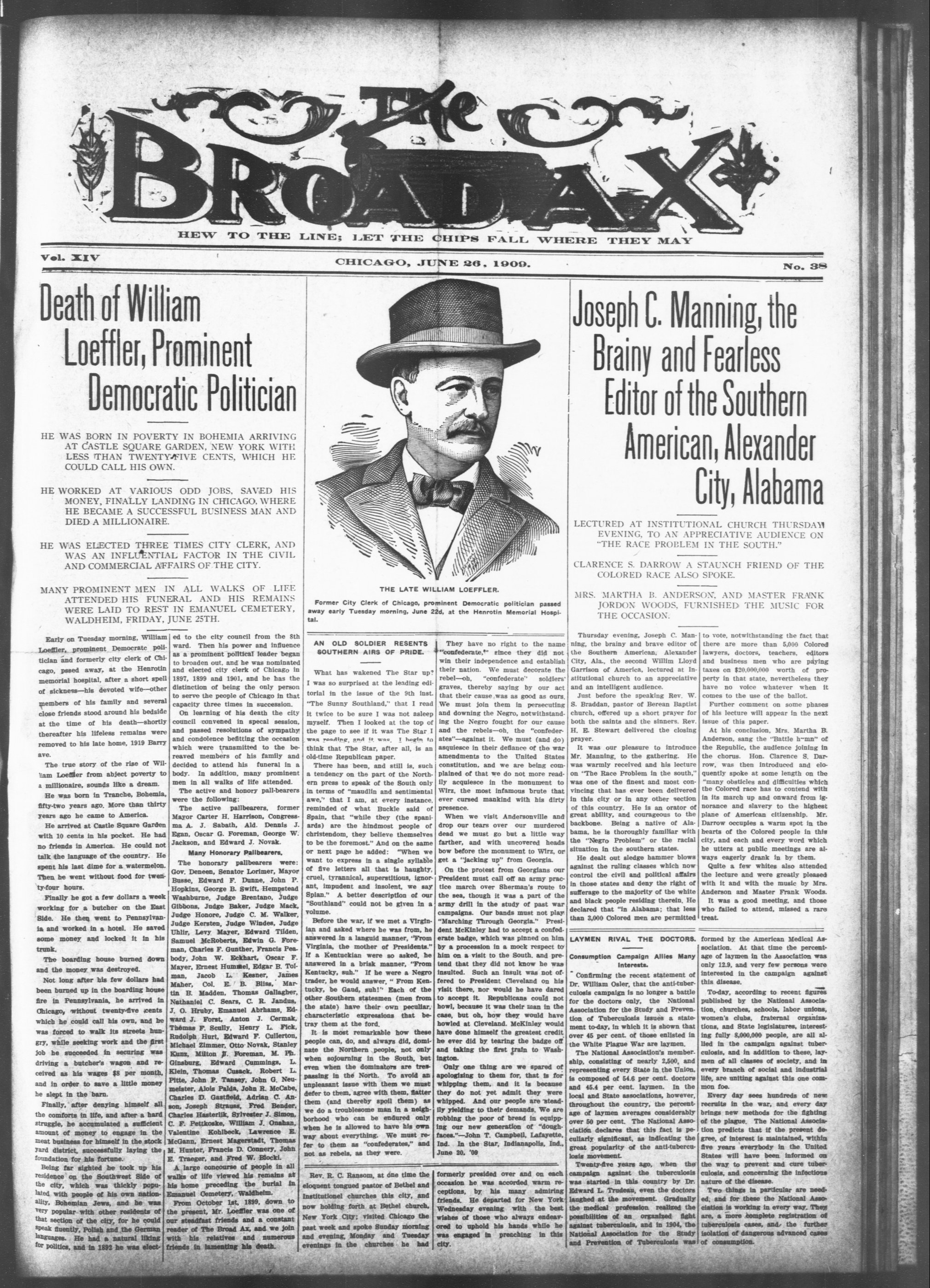
Death of William Loeffler, Prominent Democratic Politician
HE WAS BORN IN POVERTY IN BOHEMIA ARRIVING AT CASTLE SQUARE GARDEN, NEW YORK WITH LESS THAN TWENTY FIVE CENTS, WHICH HE COULD CALL HIS OWN.
HE WORKED AT VARIOUS ODD JOBS, SAVED HIS MONEY, FINALLY LANDING IN CHICAGO, WHERE HE BECAME A SUCCESSFUL BUSINESS MAN AND DIED A MILLIONAIRE.
HE WAS ELECTED THREE TIMES CITY CLERK, AND WAS AN INFLUENTIAL FACTOR IN THE CIVIL AND COMMERCIAL AFFAIRS OF THE CITY.
MANY PROMINENT MEN IN ALL WALKS OF LIFE ATTENDED HIS FUNERAL AND HIS REMAINS WERE LAID TO REST IN EMANUEL CEMETERY, WALDHEIM, FRIDAY, JUNE 25TH.
Vol. XIV
Death of Willie
Loeffler, P
Democrat
HE WAS BORN IN POVERTY
AT CASTLE SQUARE OF
LESS THAN TWENTY
COULD CALL HIS OWNER
HE WORKED AT VARIOUS
MONEY, FINALLY LAST
HE BECAME A SUCCEED
DIED A MILLIONAIRE
HE WAS ELECTED THREE
WAS AN INFLUENTIAL
AND COMMERCIAL AFFECTOR
MANY PROMINENT MEN
ATTENDED HIS FUN
WERE LAID TO REST
WALDHEIM, FRIDAY,
Early on Tuesday morning, William Loeffler, prominent Democrat politician and formerly city clerk of Chicago, pssed away, at the Henrotin memorial hospital, after a short spell of sickness—his devoted wife—other members of his family and several close friends stood around his bedside at the time of his death—shortly thereafter his lifeless remains were removed to his late home, 1919 Barry ave.
The true story of the rise of William Loeffler from abject poverty to a millionaire, sounds like a dream.
He was born in Tranche, Bohemia, fifty-two years ago. More than thirty years ago he came to America.
He arrived at Castle Square Garden with 10 cents in his pocket. He had no friends in America. He could not talk the language of the country. He spent his last dime for a watermelon. Then he went without food for twenty-four hours.
Finally he got a few dollars a week working for a butcher on the East Side. He then went to Pennsylvania and worked in a hotel. He saved some money and locked it in his trunk.
The boarding house burned down and the money was destroyed.
Not long after his few dollars had been burned up in the boarding house fire in Pennsylvania, he arrived in Chicago, without twenty-five cents which he could call his own, and he was forced to walk its streets hungry, while seeking work and the first job he succeeded in securing was driving a butcher's wagon and received as his wages $8 per month, and in order to save a little money he slept in the barn.
Finally, after denying himself all the comforts in life, and after a hard struggle, he accumulated a sufficient amount of money to engage in the meat business for himself in the stock yard district, successfully laying the foundation for his fortune.
Being far sighted he took up his residence on the Southwest Side of the city, which was thickly populated with people of his own nationality, Bohemian Jews, and he was very popular with other residents of that section of the city, for he could speak fluently, Polish and the German languages. He had a natural liking for politics, and in 1892 he was elect-
ed to the city council from the 8th ward. Then his power and influence as a prominent political leader began to broaden out, and he was nominated and elected city clerk of Chicago in 1897, 1899 and 1901, and he has the distinction of being the only person to serve the people of Chicago in that capacity three times in succession.
On learning of his death the city council convened in special session, and passed resolutions of sympathy and condolence befitting the occasion which were transmitted to the bereaved members of his family and decided to attend his funeral in a body. In addition, many prominent men in all walks of life attended.
The active and honorary pall-bearers were the following:
The active pall-bearers, former Mayor Carter H. Harrison, Congressma A. J. Sabath, Ald. Dennis J. Egan, Oscar G. Foreman, George W. Jackson, and Edward J. Novak.
Many Honorary Pallbearers.
The honorary pallbearers were: Gov. Deneen, Senator Lorimer, Mayor Busse, Edward F. Dunne, John P. Hopkins, George B. Swift, Hempstead Washburne, Judge Brentano, Judge Gibbons, Judge Baker, Judge Mack Judge Honore, Judge C. M. Walker Judge Kersten, Judge Windes, Judge Uhlir, Levy Mayer, Edward Tilden, Samuel McRoberts, Edwin G. Foreman, Charles F. Gunther, Francis Peabody, John W. Eckhart, Oscar F. Mayer, Ernest Hummel, Edgar B. Tolman, Jacob L. Kesner, James Maher, Col. E. B. Bliss, Martin B. Madden, Thomas Gallagher, Nathaniel C. Sears, C. R. Jandus, J. O. Hruby, Emanuel Abhams, Edward J. Forst, Anton J. Cermak, Thomas F. Scully, Henry L. Fick, Rudolph Hurt, Edward F. Cullerton, Michael Zimmer, Otto Novak, Stanley Kunz, Milton J. Foreman, M. Ph. Ginsburg, Edward Cummings, L. Klein, Thomas Cusack, Robert L. Pittte, John P. Tanssey, John G. Neumester, Alols Palda, John R. McCabe, Charles D. Gastfield, Adrian C. Anson, Joseph Strauss, Fred Bender, Charles Hasterlik, Sylvester J. Simon, C. F. Pettikoske, William J. Onahan, Valentine Kohlbeck, Lawrence E. McGann, Ernest Magerstadt, Thomas M. Hunter, Francis D. Connery, John E. Traeger, and Fred W. Blocki.
A large concourse of people in all walks of life viewed his remains at his home preceding the burial in Emanuel Cemetery, Waldheim. From October 1st, 1899, down to the present, Mr. Loefler was one of our steadfast friends and a constant reader of The Broad Ax, and we join with his relatives and numerous friends in lamenting his death.
CHICAGO, JUNE 26, 1909.
D. W.
THE LATE WILLIAM LOEFFLER. Former City Clerk of Chicago, prominent Democratic politician passed away early Tuesday morning, June 22d, at the Henrotin Memorial Hospital.
What has wakened The Star up? I was so surprised at the leading editorial in the issue of the 9th inst. "The Sunny Southland," that I read it twice to be sure I was not asleep myself. Then I looked at the top of the page to see if it was The Star I was reading, and it was. I begin to think that The Star, after all, is an old-time Republican paper.
There has been, and still is, such a tendency on the part of the Northern press to speak of the South only in terms of "maudlin and sentimental awe," that I am, at every instance, reminded of what Buckle said of Spain, that "while they (the spanials) are the hindmost people of christendom, they believe themselves to be the foremost." And on the same or next page he added: "When we want to express in a single syllable of five letters all that is haughty, cruel, tyrannical, superstitious, ignorant, impudent and insolent, we say Splan." A better description of our "Southland" could not be given in a volume.
Before the war, if we met a Virginian and asked where he was from, he answered in a languid manner. "From Virginia, the mother of Presidents." If a Kentuckian were so asked, he answered in a brisk manner. "From Kentucky, suh." If he were a Negro trader, he would answer. "From Kentucky, be Gaud, suh!" Each of the other Southern statesmen (men from the state) have their own peculiar, characteristic expressions that betray them at the Ford.
It is most remarkable how these people can, do, and always did, dominate the Northern people, not only when sojourning in the South, but even when the dominators are trespassing in the North. To avoid an unpleasant issue with them we must defer to them, agree with them, flatter them (and thereby spoil them) as we do a troublesome man in a neighborhood who can be endured only when he is allowed to have his own way about everything. We must refer to them as "confederates," and not as rebels, as they were.
Rev. R. C. Ransom, at one time the eloquent tongued pastor of Bethel and institutionel churches this city, and now holding forth at Bethel church, New York City; visited Chicago the past week and spoke Sunday morning and evening, Monday and Tuesday evenings in the churches he had
They have no right to the name "confederate," since they did not win their independence and establish their nation. We must decorate the rebel—oh, "confederate" soldiers graves, thereby saying by our act that their cause was as good as ours. We must join them in persecuting and downing the Negro, notwithstanding the Negro fought for our cause and the rebels—oh, the "confederates"—against it. We must (and do) asquiesce in their defiance of the war amendments to the United States constitution, and we are being complained of that we do not more readily acquiesce in the monument to Wirz, the most infamous brute that ever cursed mankind with his dirty presence. When we visit Andersonville and drop our tears over our murdered dead we must go but a little way farther, and with uncovered heads bow before the monument to Wirz, or get a "jacking up" from Georgia.
On the protest from Georgians our President must call off an army practice march over Sherman's route to the sea, though it was a part of the army drill in the study of past war campaigns. Our bands must not play "Marching Through Georgia." President McKinley had to accept a confederate badge, which was pinned on him by a procession in a mock respect to him on a visit to the South, and pretend that they did not know he was insulted. Such an insult was not offered to President Cleveland on his visit there, nor would he have dared to accept it. Republicans could not howl, because it was their man in the case, but oh, how they would have howled at Cleveland. McKinley would have done himself the greatest credit he ever did by tearing the badge off and taking the first train to Washington.
Only one thing are we spared of apologizing to them for, that is for whipping them, and it is because they do not yet admit they were whipped. And our people are steadily yielding to their demands. We are robbing the poor of bread in equipping our new generation of "doughfaces."—John T. Campbell, Lafayette, Ind. In the Star, Indianapolis, Ind., June 20, '09
formerly presided over and on each occasion he was accorded warm receptions, by his many admiring friends. He departed for New York Wednesday evening with the best wishes of those who always endeavored to uphold his hands while he was engaged in preeching in this city.
Joseph C. Manning, the Brainy and Fearless Editor of the Southern American, Alexander City, Alabama
LECTURED AT INSTITUTIONAL CHURCH THURSDAY EVENING, TO AN APPRECIATIVE AUDIENCE ON "THE RACE PROBLEM IN THE SOUTH."
CLARENCE S. DARROW A STAUNCH FRIEND OF THE COLORED RACE ALSO SPOKE.
MRS. MARTHA B. ANDERSON, AND MASTER FRANK JORDON WOODS, FURNISHED THE MUSIC FOR THE OCCASION.
Thursday evening, Joseph C. Manning, the brainy and brave editor of the Southern American, Alexander City, Ala., the second William Lloyd Garrison of America, lectured at Institutional church to an appreciative and an intelligent audience.
Just before the speaking Rev. W. S. Braddan, pastor of Berean Baptist church, offered up a short prayer for both the saints and the sinners. Rev. H. E. Stewart delivered the closing prayer.
to vote, notwithstanding the fact that there are more than 5,000 Coloreau lawyers, doctors, teachers, editor and business men who are paying taxes on $20,000,000 worth of property in that state, nevertheless the have no voice whatever when it comes to the use of the ballot.
Further comment on some phase of his lecture will appear in the next issue of this paper.
At his conclusion, Mrs. Martha B. Anderson, sang the "Battle hymn"
It was our pleasure to introduce Mr. Manning, to the gathering. He was warmly received and his lecture on "The Race Problem in the south," was one of the finest and most convincing that has ever been delivered in this city or in any other section of this country. He is an orator of great ability, and courageous to the backbone. Being a native of Alabama, he is thoroughly familiar with the "Negro Problem" or the racial situation in the southern states.
He dealt out sledge hammer blows against the ruling classes which now control the civil and political affairs in those states and deny the right of sufferage to the majority of the white and black people residing therein. He declared that "in Alabama; that less than 3,000 Colored men are permitted
Consumption Campaign Allies Many Interests.
Confirming the recent statement of Dr. William Osler, that the anti-tuberculosis campaign is no longer a battle for the doctors only, the National Association for the Study and Prevention of Tuberculosis issues a statement to-day, in which it is shown that over 45 per cent. of those enlisted in the White Plague War are laymen.
The National Association's membership, consisting of nearly 2,500, and representing every State in the Union, is composed of 54.6 per cent. doctors and 45.4 per cent. laymen. In the local and State associations, however, throughout the country, the percentage of laymen averages considerably over 50 per cent. The National Association declares that this fact is peculiarly significant, as indicating the great popularity of the anti-tuberculosis movement.
Twenty-five years ago, when the campaign against the tuberculosis was started in this country by Dr. Edward L. Trudeau, even the doctors laughed at the movement. Gradually the medical profession realized the possibilities of an organized fight against tuberculosis, and in 1904, the National Association for the Study and Prevention of Tuberculosis was
No.38
anning, the
Fearless
the Southern
An, Alexander
City, Alabama
NATIONAL CHURCH THURSDAY
PRECIATIVE AUDIENCE ON
IN THE SOUTH."
STAUNCH FRIEND OF THE
SPOKE.
SON, AND MASTER FRANK
ARNISHED THE MUSIC FOR
to vote, notwithstanding the fact that there are more than 5,000 Colored lawyers, doctors, teachers, editors and business men who are paying taxes on $20,000,000 worth of property in that state, nevertheless they have no voice whatever when it comes to the use of the ballot.
Further comment on some phases of his lecture will appear in the next issue of this paper.
At his conclusion, Mrs. Martha B. Anderson, sang the "Battle h-mn" of the Republic, the audience joining in the chorus. Hon. Clarence S. Darrow, was then introduced and eloquently spoke at some length on the "many obstacles and difficulties which the Colored race has to contend with in its march up and onward from ignorance and slavery to the highest plane of American citizenship. Mr. Darrow occupies a warm spot in the hearts of the Colored people in this city, and each and every word which he utters at public meetings are always eagerly drank in by them.
Quite a few whites also attended the lecture and were greatly pleased with it and with the music by Mrs. Anderson and Master Frank Woods. It was a good meeting, and those who failed to attend, missed a rare treat.
formed by the American Medical Association. At that time the percentage of laymen in the Association was only 12.9, and very few persons were interested in the campaign against this disease.
To-day, according to recent figures published by the National Association, churches, schools, labor unions, women's clubs, fraternal organizations, and State legislatures, interesting fully 8,000,000 people, are all allied in the campaign against tuberculosis, and in addition to these, laymen of all classes of society, and in every branch of social and industrial life, are uniting against this one common foe.
Every day sees hundreds of new recruits in the war, and every day brings new methods for the fighting of the plague. The National Association predicts that if the present degree, of interest is maintained, within five years everybody in the United States will have been informed on the way to prevent and cure tuberculosis, and concerning the infectious nature of the disease.
Two things in particular are needed, and for these the National Association is working in every way. They are, a more complete registration of tuberculosis cases, and the further isolation of dangerous advanced cases of consumption.
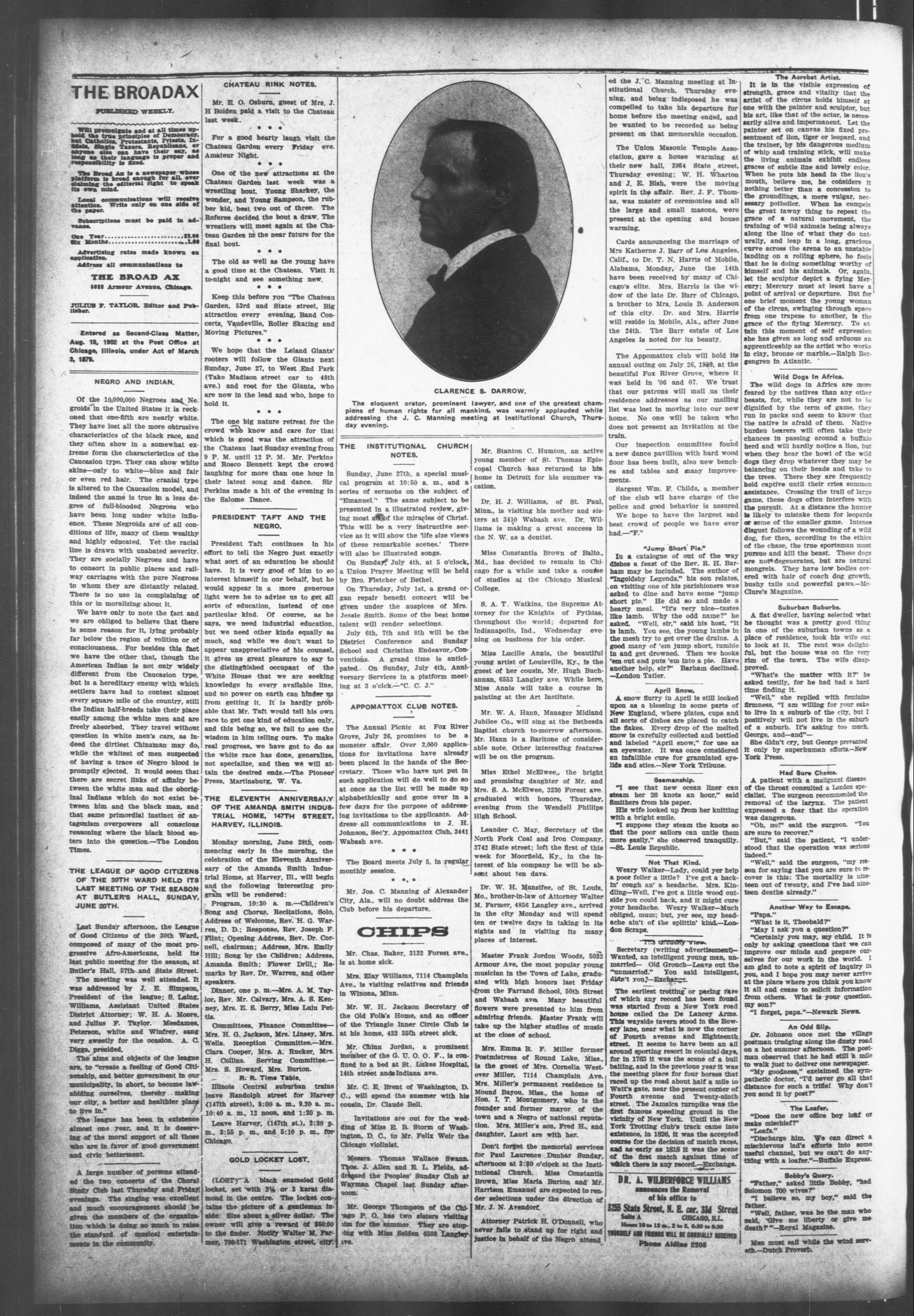
THE BROADAX
PUBLISHED WEEKLY.
Will promulgate and at all times uphold the true principles of Democracy, but Catholic, Protestants, Priests, In-Christian, Single Taxes, Republican or anyone else can have their say, as long as their language is proper and responsibility is fired.
The Broad Ax is a newspaper whose platform is broad enough for all, ever claiming the editorial right to speak its own mind.
Local communications will receive attention. Write only on one side of the paper.
Subscriptions must be paid in advance.
One Year. $2.00
Six Months. 1.00
Advertising rates made known on application.
Address all communications to
THE BROAD AX
5032 Armour Avenue, Chicago.
JULIUS F. TAYLOR, Editor and Publisher.
Entered as Second-Class Matter,
Aug. 19, 1902 at the Post Office at
Chicago, Illinois, under Act of March
3, 1879.
NEGRO AND INDIAN
Of the 10,000,000 Negroes and Negroids in the United States it is reckoned that one-fifth are nearly white. They have lost all the more obtrusive characteristics of the black race, and they often show in a somewhat extreme form the characteristics of the Caucasian type. They can show white skins—only to white–blue and fair or even red hair. The cranial type is altered to the Caucasian model, and indeed the same is true in a less degree of full-blooded Negroes who have been long under white influence. These Negroids are of all conditions of life, many of them wealthy and highly educated. Yet the racial line is drawn with unabated severity. They are socially Negroes and have to consort in public places and railway carriages with the pure Negroes to whom they are distantly related. There is no use in complaining of this or in moralizing about it.
We have only to note the fact and we are obliged to believe that there is some reason for it, lying probably far below the region of volition or of consciousness. For besides this fact we have the other that, though the American Indian is not only widely different from the Caucasian type, but is a hereditary enemy with which settlers have had to contest almost every square mile of the country, still the Indian half-breeds take their place easily among the white men and are freely absorbed. They travel without question in white men's cars, as indeed the dirtiest Chinaman may do, while the whitest of men suspected of having a trace of Negro blood is promptly ejected. It would seem that there are secret links of affinity between the white man and the oboriginal Indians which do not exist between him and the black man, and that same primordial instinct of antagonism overpowers all conscious reasoning where the black blood enters into the question—The London Times.
THE LEAGUE OF GOOD CITIZENS OF THE 30TH WARD HELD ITS LAST MEETING OF THE SEASON AT BUTLER'S HALL, SUNDAY, JUNE 20TH.
Last Sunday afternoon, the League of Good Citizens of the 30th Ward, composed of many of the most progressive Afro-Americans, held its last public meeting for the season, at Butler's Hall, 57th and State Street. The meeting was well attended. It was addressed by J. E. Simpson, President of the league; S. Leing, Williams, Assistant United States District Attorney; W. H. A. Moore, and Julius F. Taylor, Mesdames, Peterson, white and Winfrey, sang very sweetly for the occasion. A. C. Diggs, presided
The aims and objects of the league are, to "create a feeling of Good Citizenship, and better government in our municipality, in short, to become law abiding ourselves, thereby making our city, a better and healthier place to live in."
The league has been in existence almost one year, and it is deserving of the moral support of all those who are in favor of good government and civic betterment.
A large number of persons attended the two concerts of the Choral Study Club last Thursday and Friday evenings. The singing was excellent and much encouragement should be given the members of the organization which is doing so much to raise the standard of musical entertainments in the community.
Mr. E. O. Osburn, guest of Mrs. J.
H Bolden paid a visit to the Chateau
last week.
* * *
For a good hearty laugh visit the
Chateau Garden every Friday eve.
Amateur Night.
* * *
One of the new attractions at the
Chateau Garden last week was a
wrestling bout. Young Sharkey, the
wonder, and Young Sampson, the rubber
kid, best two out of three. The
Referee decided the bout a draw. The
wrestlers will meet again at the
Chateau Garden in the near future for the
final bout.
---
The old as well as the young have a good time at the Chateau. Visit it to-night and see something new.
Keep this before you "The Chateau Garden, 53rd and State street, Big attraction every evening, Band Concerts, Vaudeville, Roller Skating and Moving Pictures."
We hope that the Leland Giants' rooters will follow the Giants next Sunday, June 27, to West End Park (Take Madison street car to 48th ave.) and root for the Giants, who are now in the lead and who, hope to hold it.
---
The one big nature retreat for the crowd who know and care for that which is good was the attraction of the Chateau last Sunday evening from 9 P. M. until 12 P. M. Mr. Perkins and Rosco Bennett kept the crowd laughing for more than one hour in their latest song and dance. Sir Perkins made a hit of the evening in the Salome Dance.
PRESIDENT TAFT AND THE NEGRO.
President Taft continues in his effort to tell the Negro just exactly what sort of an education he should have. It is very good of him to so interest himself in our behalf, but he would appear in a more generous light were he to advise us to get all sorts of education, instead of one particular kind. Of course, as he says, we need industrial education, but we need other kinds equally as much, and while we don't want to appear unappreciative of his counsel, it gives us great pleasure to say to the distinguished occupant of the White House that we are seeking knowledge in every available line, and no power on earth can hinder us from getting it. It is hardly probable that Mr. Taft would tell his own race to get one kind of education only, and this being so, we fail to see the wisdom in him telling ours. To make real progress, we have got to do as the white race has done, generalize, not specialize, and then we will attain the desired ends.—The Pioneer Press, Martinsburg, W. Va.
THE ELEVENTH ANNIVERSARY OF THE AMANDA SMITH INDUSTRIAL HOME, 147TH STREET, HARVEY, ILLINOIS.
Monday morning, June 28th, commencing early in the morning, the celebration of the Eleventh Anniversary of the Amanda Smith Industrial Home, at Harvey, Ill., will begin and the following interesting program will be rendered:
Program, 10:30 a. m.—Children's Song and Chorus, Recitations, Solo, Address of Welcome, Rev. H. G. Warren, D. D.; Response, Rev. Joseph F. Flint; Opening Address, Rev. Dr. Cornell, chairman; Address, Mrs. Emily Hill; Song by the Children; Address, Amanda Smith; Flower Drill; Remarks by Rev. Dr. Warren, and other speakers.
Dinner, one p. m.—Mrs. A. M. Taylor, Rev. Mr. Calvary, Mrs. A. S. Kenney, Mrs. E. S. Berry, Miss Lulu Pettis.
Committees, Finance Committee—Mrs. H. G. Jackson, Mrs. Linsey, Mrs. Wells. Reception Committee—Mrs. Clara Cooper, Mrs. A. Rucker, Mrs. H. Collins. Serving Committee—Mrs. S. Howard, Mrs. Burton.
Illinois Central suburban trains leave Randolph street for Harvey (147th street), 8:00 a.m., 9.20 a.m., 10:40 a.m., 12 noon, and 1:20 p.m. Leave Harvey, (147th st.), 2:30 p.m., 3:55 p.m., and 5:10 p.m., for Chicago.
GOLD LOCKET LOST
(LOST) A black enameled Gold locket, set with $2\frac{1}{2}$ or 3 karat diamond in the centre. The locket contains the picture of a gentleman inside. Size about a silver dollar. The owner will give a reward of $60.00 to the finder. Notify Walter M. Farmer, 708-171 Washington street city.
.
CLARENCE S. DARROW.
The eloquent orator, prominent lawyer, and one of the greatest champions of human rights for all mankind, was warmly applauded while addressing the J. C. Manning meeting at Institutional Church, Thursday evening.
Sunday, June 27th, a special musical program at 10:50 a. m., and a series of sermons on the subject of "Emanuel." The same subject to be presented in a illustrated review, giving most all of the miracles of Christ. This will be a very instructive service as it will show the life size views of these remarkable scenes.' There will also be illustrated songs.
On Sunday, July 4th, at 5 o'clock, a Union Prayer Meeting will be held by Bro. Fletcher of Bethel.
On Thursday, July 1st, a grand organ repair benefit concert will be given under the auspices of Mrs. Jessie Smith. Some of the best home talent will render selections.
July 6th, 7th and 8th will be the District Conference and Sunday School and Christian Endeavor Conventions. A grand time is anticipated. On Sunday, July 4th, Anniversary Services in a platform meeting at 3 o'clock-"C. C. J."
APPOMATTOX CLUB NOTES
The Annual Picnic at Fox River Grove, July 26, promises to be a monster affair. Over 2,000 applications for invitations have already been placed in the hands of the Secretary. Those who have not put in such application will do well to do so at once as the list will be made up alphabethically and gone over in a few days for the purpose of addressing invitations to the applicants. Address all communications to J. H. Johnson, Sec'y. Appomattox Club, 3441 Wabash ave.
The Board meets July 5, in regular monthly session.
Mr. Jos. C. Manning of Alexander City, Ala., will no doubt address the Club before his departure.
Mr. Chas. Baker, 3132 Forest ave., is at home sick.
Mrs. Elay Williams, 7114 Champlain Ave., is visiting relatives and friends in Winona, Minn.
Mr. W. H. Jackson Secretary of the Old Folk's Home, and an officer of the Triangle Inner Circle Club is at his home, 432 35th street sick.
Mr. Chinn Jordan, a prominent member of the G. U. O. F., is confined to a bed at St. Lukes Hospital, 14th street and Indiana ave.
Mr. C. E. Brent of Washington, D. C., will spend the summer with his cousin, Dr. Claude Bell.
Invitations are out for the wedding of Miss E. B. Storm of Washington, D. C., to Mr. Felix Weir the Chicago violinist.
Messrs. Thomas Wallace Swann. Thos. J. Allen and E. L. Fields, addressed the Peoples' Sunday Club at Wayman Chapel last Sunday afternoon.
Mr. George Thompson of the Chicago P. O. has two sisters visiting him for the summer. They are stopping with Miss Selden 6508 Langley ave.
---
CHIPS
Mr. Stanton C. Humton, an active young member of St. Thomas Episcopal Church has returned to his home in Detroit for his summer vacation.
Dr. H. J. Williams, of St. Paul Minn., is visiting his mother and sisters at 3410 Wabash ave. Dr. William is making a great success in the N. W. as a dentist.
Miss Constantia Brown of Balto. Md., has decided to remain in Chicago for a while and take a course of studies at the Chicago Musical College.
S. A. T. Watkins, the Supreme Attorney for the Knights of Pythias, throughout the world; departed for Indianapolis, Ind., Wednesday evening on business for his order.
Miss Lucille Annis, the beautiful young artist of Louisville, Ky., is the guest of her cousin, Mr. Hugh Buchann, 6553 Langley ave. While here, Miss Annis will take a course in painting at the Art Institute.
Mr. W. A. Hann, Manager Midland Jubilee Co., will sing at the Bethesda Baptist church to-morrow afternoon. Mr. Hann is a Baritone of considerable note. Other interesting features will be on the program.
Miss Ethel McElwee., the bright and promising daughter of Mr. and Mrs. S. A. McElwee, 3230 Forest ave. graduated with honors, Thursday, evening from the Wendell Phillips High School.
Leander C. May, Secretary of the North Fork Coal and Iron Company, 3742 State street; left the first of this week for Moorfield, Ky., in the interest of his company he will be absent about ten days.
Dr. W. H. Mansifee, of St. Louis, Mo., brother-in-law of Attorney Walter M. Farmer, 4856 Langley ave., arrived in the city Monday and will spend ten or twelve days in taking in its sights and in visiting its many places of Interest.
Master Frank Jordon Woods, 5082 Armour Ave, the most popular young musician in the Town of Lake, graduated with high honors last Friday from the Farrand School, 50th Street and Wabash ave. Many beautiful flowers were presented to him from admiring friends. Master Frank will take up the higher studies of music at the close of school.
Mrs. Emma B. F. Miller former Postmistress of Round Lake, Miss., is the guest of Mrs. Cornelia Westover Miller, 7114 Champlain Ave. Mrs. Miller's permanent residence is Mound Bayou, Miss., the home of Hon. I. T. Montgomery, who is the founder and former mayor of the town and a Negro of national reputation. Mrs. Miller's son, Fred H., and daughter, Lauri are with her.
Don't forget the memorial services for Paul Laurence Dunbar Sunday, afternoon at 3:30 o'clock at the Institutional Church. Miss Constantia Brown, Miss Maria Burton and Mr. Harrison Emanuel are expected to render selections under the direction of Mr. J. N. Avendorf.
Attorney Patrick H. O'Donnell, who never falls to stand up for right and justice in behalf of the Negro attend
ed the J. C. Manning meeting at Institutional Church. Thursday evening, and being indisposed he was compelled to take his departure for home before the meeting ended, and he wanted to be recorded as being present on that memorable occasion. The Union Masonic Temple Association, gave a house warming at their new hall, 3964 State street, Thursday evening; W. H. Wharton and J. E. Bish, were the moving spirit in the affair. Rev. J. F. Thomas, was master of ceremonies and all the large and small masons, were present at the opening and house warming.
Cards announcing the marriage of Mrs Katherine J. Barr of Los Angeles, Calif., to Dr. T. N. Harris of Mobile, Alabama, Monday, June the 14th have been received by many of Chicago's elite. Mrs. Harris is the widow of the late Dr. Barr of Chicago, a brother to Mrs. Louis B. Anderson of this city. Dr. and Mrs. Harris will reside in Mobile, Ala., after June the 24th. The Barr estate of Los Angeles is noted for its beauty.
The Appomattox club will hold its annual outing on July 26, 1999, at the beautiful Fox River Grove, where it was held in '06 and 07. We trust that our patrons will mail us their residence addresses as our mailing list was lost in moving into our new home. No one will be taken who does not present an invitation at the train.
Our inspection committee found a new dance pavilion with hard wood floor has been built, also new benches and tables and many improvements.
Sargent Wm. F. Childs, a member of the club will have charge of the police and good behavior is assured
We hope to have the largest and best crowd of people we have ever had—"F."
"Jump Short Pie."
In a catalogue of out of the way dishes a feast of the Rev. R. H. Barham may be included. The author of "Ingolshoy Legends," his son relates, on visiting one of his parishioners was asked to dine and have some "jump short pie." He did so and made a hearty meal. "It's very nice—tastes like lamb. Why the odd name?" he asked. "Well, sir," said his host, "it is lamb. You see, the young lambs in the mesh try to get over the drains. A good many of 'em jump short, tumble in and get drowned. Then we hooks 'em out and puts 'em into a pie. Have another help, sir?" Barham declined.—London Tatler.
April Snow.
A snow flurry in April is still looked upon as a blessing in some parts of New England, where plates, cups and all sorts of dishes are placed to catch the flakes. Every drop of the melted snow is carefully collected and bottled and labeled "April snow," for use as an eyewater. It was once considered an infallible cure for granulated eyelids and sites.—New York Tribune.
Seamanship.
"I see that new ocean liner can steam her 28 knots an hour," said Smithers from his paper.
"His wife looked up from her knitting with a bright smile.
"I suppose they steam the knots so that the poor sailors can untie them more easily," she observed tranquilly.
-St. Louis Republic.
Not That Kind.
Weary Walker—Lady, could yer help a poor feller a little? I've got a hackin' cough an' a headache. Mrs. Kindling—Well, I've got a little wood outside you could hack, and it might cure your headache. Weary Walker—Much obliged, mum; but, yer see, my headache ain't of the splittin' kind—London Scraps.
100% Satisfaction Guarantee
Secretary (writing advertisement)—Wanted, an intelligent young man, unmarried—Old Grouch—Leave out the "unmarried." You said intelligent, didn't you?—Exchange.
the earliest trotting or pacing rate of which any record has been found was started from a New York road house called the De Lancey Arms. This wayside tavern stood in the Bowery lane, near what is now the corner of Fourth avenue and Eighteenth street. It seems to have been an all around sporting resort in colonial days, for in 1783 it was the scene of a bull baiting, and in the previous year it was the meeting place for four horses that raced up the road about half a mile to Watt's gate, near the present corner of Fourth avenue and Twenty-ninth street. The Jamala turnipwake was the first famous speeding ground in the vicinity of New York. Until the New York Trotting club's track came into existence, in 1826, it was the accepted course for the decision of match races, and as early as 1818 it was the scene of the first match against time of which there is any record—Exchange.
3255 State Street, N. H. cor. 33d Street
Suite A
CHICAGO, ILL.
Hours 10 to 12 m., 2 to 5, 8:30 to 8:30
TOUSEELF AND FRIENDS WILL BE CORONALLY RECEIVED
Phone Aladdin 2908
The Acrobat Artist
It is in the visible expression of strength, grace and vitality that the artist of the circus holds himself at one with the painter and sculptor, but his art, like that of the actor, is necessarily alive and impermanent. Let the painter set on canvas his fixed presentment of lion, tiger or leopard, and the trainer, by his dangerous medium of whip and training stick, will make the living animals exhibit endless graces of subtle line and lovely color. When he puts his head in the lion's mouth, believe me, he considers it nothing better than a concession to the groundlings, a mere vulgar, necessary poteller. When he compels the great tawny thing to repeat the grace of a natural movement, the training of wild animals being always along the line of what they do naturally, and leap in a long, gracious curve across the arena to an unstable landing on a rolling sphere, he feels that he is doing something worthy of himself and his animals. Or, again, let the sculptor depict a flying Mercury; Mercury must at least have a point of arrival or departure. But for one brief moment the young woman of the circus, swinging through space from one trapeze to another, is the grace of the flying Mercury. To attain this moment of self expression she has given as long and arduous an apprenticeship as the artist who works in clay, bronze or marble.-Ralph Bergengren in Atlantic.
Wild Dogs In Africa.
The wild dogs in Africa are more feared by the natives than any other beasts, for, while they are not to be dignified by the term of game, they run in packs and seem to know that the native is afraid of them. Native burden bearers will often take their chances in passing around a buffalo herd and will hardly notice a lion, but when they hear the howl of the wild dogs they drop whatever they may be balancing on their heads and take to the trees. There they are frequently held captive until their cries summon assistance. Crossing the trail of large game, these dogs often interfere with the pursuit. At a distance the hunter is likely to mistake them for leopards or some of the smaller game. Intense disgust follows the wounding of a wild dog, for then, according to the ethics of the chase, the true sportsman must pursue and kill the beast. These dogs are not* degenerates, but are natural mongrels. They have low bodies covered with hair of coach dog growth, bushy tails and powerful paws—McClure's Magazine.
Suburban Suburba
A flat dweller, having selected what he thought was a pretty good thing in one of the suburban towns as a place of residence, took his wife out to look at it. The rent was delightful, but the house was on the very rim of the town. The wife disapproved.
"What's the matter with it?" he asked testily, for he had had a hard time finding it.
"Well," she replied with feminine firmness, "I am willing for your sake to live in a suburb of the city, but I positively will not live in the suburb of a suburb. It's asking too much, George, and—and"—
She didn't cry, but George prevented it only by superhuman efforts.—New York Press.
Had Sure Chance
A patient with a malignant disease of the throat consulted a London specialist. The surgeon recommended the removal of the larynx. The patient expressed a fear that the operation was dangerous. "Oh, no!" said the surgeon. "You are sure to recover." "But," said the patient, "I understood that the operation was serious indeed." "Well," said the surgeon, "my reason for saying that you are sure to recover is this: The mortality is nine teen out of twenty, and I've had nine teen deaths already."
Another Way to Escape.
"What is it, Theobald?"
"May I ask you a question?"
"Certainly you may, my child. It is only by asking questions that we can improve our minds and prepare ourselves for our work in the world. I am glad to note a spirit of inquiry in you, and I hope you may never arrive at the place where you think you know it all and cease to solicit information from others. What is your question, my son?"
"I forget, papa."—Newark Newa
An Odd Slip.
Dr. Johnson once met the village postman trudging along the dusty road on a hot summer afternoon. The postman observed that he had still a mile to walk just to deliver one newspaper. "My goodness," exclaimed the sympathetic doctor, "I'd never go all that distance for such a trifle! Why don't you send it by post?"
The Loafar.
"Does the new office boy loaf or make mischief?"
"Loafs."
"Discharge him. We can direct a mischievous lad's efforts into some useful channel, but we can't do anything with a loafer."—Buffalo Express.
Bobby's Query.
"Father," asked little Bobby, "had Solomon 700 wives?"
"I believe so, my boy," said the father.
"Well, father, was he the man who said, 'Give me liberty or give me death?'"—Royal Magazine.
Men must sail while the wind serveth—Dutch Proverb.
I was sitting one morning in a quiet corner at Monte Carlo when two elderly men sat down beside me. One was evidently a Scotchman, and the other, I gathered, was from Yorkshire. The former remarked, "I have just managed it." This, I discovered, meant a win of 20 francs. Their daily routine was to appear at the same roulette table at an early hour and play the lowest stake of 5 francs on even chances—that is, on black or red or on the odd or even numbers. They would lose and win and win and lose, but they remained calm and self contained and persevered until they had each 20 francs to the good. I observed them daily. Some mornings they scooped in the amount in twenty minutes, and at other times it was a tough struggle until luncheon time before they managed it. I never saw them fall once, and I learned that they had pursued the same plan for four months. One thing was clear—nothing could tempt them to go beyond the modest stake, and they had the will to stop when they won the stipulated amount. It was really one of the best illustrations of will power I have ever seen, for few, indeed, who enter the portals of the casino are able to resist the compelling atmosphere of the tables to play on if losing and to plunge if winning—Chambers' Journal.
Family Jars.
Schoolmaster (to his wife)—My dear, I wish you would speak more carefully. You say that Henry Jones came to this town from Sunderland. Wife—Yes. Schoolmaster—Well, now, wouldn't it be better to say that he came from Sunderland to this town? Wife—I don't see any difference in the two expressions. Schoolmaster—But there is a difference, a rhetorical difference. You don't hear me make use of such awkward expressions By the way, I have a letter from your father in my pocket. Wife—But my father is not in your pocket. You mean you have in your pocket a letter from my father. Schoolmaster—There you go with your little quibbles. You take a delight in harassing me. You are always taking up a thread and representing it as a rope.
Wife--Representing it to be rope,
you mean.
Schoolmaster--For goodness' sake,
be quiet. Never saw such a quarrelsome woman in my life.—London Scraps.
Pretty Slow.
Honice L. Moore was lieutenant colonial of the noted Nineteenth Kansas cavalry. He could lead men for a longer period without rest on a single ration of cheerful good humor than any other officer. Though not given to jokes, he was the reputed author of as many astonishers as the great Lincoln.
One time, on the march, he sent an orderly with a message to an officer at some distance. Before the man was out of hearing Moore shouted: "Hey, orderly! Come back here!"
He came galloping back, sitting limply in the saddle.
Moore dropped his voice and, assuming a half confidential manner, inquired: "Orderly, in the course of your life have you ever seen a snail?"
"Yes, sir," was the astonished reply. "You met him, then," replied Moore, "for you'd never overtake one!"—Kansas City Journal.
His Business Ability.
In the Adriodracks lives a man too easy to work, but evidently of great business ability. One winter when he was sitting around smoking his family came near starvation that some of his neighbors, who could ill afford to help him, took up a collection and bought for the suffering family a barrel of flour, a barrel of pork and a boat of wood. They were not considerate enough to cut the wood, but the business man knew how to manage. He hired some of the neighbors who had not contributed to his donation to cut the wood and paid them with half the pork and half the flour—Lippincott's.
Admirably Equipped
Cardinal Mezzofanti, the famous Italian linguist, who died at the age of seventy-five, knew and could speak more than fifty languages. He could entertain his English friends with specimens of the Yorkshire dialect and his French or German visitors with the patois of their respective countries. "Dear me!" exclaimed Lord Byron, to whom this was told. "He ought to have been the custodian of the tower of Babel!"
Breakfast Months
A traveler stopped at a hotel in Greenland, where the nights are six months long, and as he registered asked a question of the clerk.
"What time do you have breakfast?"
"From half past March to a quarter to May."-Harper's Weekly.
A Bone.
"What sort of an after dinner speaker is Bliggins?"
"One of the kind who start in by saying they didn't expect to be called on and then proceed to demonstrate that they can't be called off."—Exchange.
The Quarrel.
"Last night we parted forever." "Then I suppose Ferdy will not call tonight." "No, but he'll spend the evening behind a tree across the street."—Louisville Courier Journal.
General John C. Fremont, "the Pathfinder," is buried in Rockland cemetery, Nyack, on the Hudson.
DEFENDS NEGRO RIGHTS.
New York Congressman's Brave Stand Not Forced by Patronage.
Like a faint echo of neglected party campaign cries and of the forgotten eloquence of the stump is the bill which was introduced by Congressman Bennet of New York some time ago providing for a reduction of representation in states which have disfranchised the Negro. Mr. Bennet's voice is a small one. It falls upon dull ears, but it is a challenge nevertheless to all Republicans in executive and legislative station.
Fortified though he may be by party platforms and party traditions, Mr. Bennet must know that in proposing this policy he defies presidential power, never so great as it is today. He must know that in speeches in New York and in the south Mr. Taft has virtually approved the nullification of the fourteenth and fifteenth amendments. He must know that the president has openly announced that no Negroes shall be appointed to office in opposition to the wishes of the whites. He must know that of all the Republican officeholders and expectant officeholders he is the only one who has had the courage to adhere to the published principles of his party. He must know that no important Republican newspaper will venture to support him.
For these reasons the world hails Mr. Bennet as the last of the true Republicans, the sole survivor of the days when moral ideas prevailed, the one man not intimidated by power, not influenced by patronage and not corrupted by ambition or by privilege. Others have been beguiled by expectations of a break in the solid south, by office, by privilege and by tariff, and still others are naturally servile and trifling, but Mr. Bennet, alone among the hosts that draw their inspiration from Republican national conventions, stands stanch and true for the principles that are written in the party book of faith.
As real heroes are rare in public life, Mr. Bennet is entitled to more than passing notice. Surrounded by time servers and self seekers and overshadowed by executive power which lightly sets aside platforms, seemingly nullifies law and revolutionizes party principles and practices, he cannot fall to become an object of increasing interest.-Boston Guardian.
HELP FOR NEGRO COLLEGE.
Mr. Carnegie's Conditional Gift Being Met by Atlanta Institution. At a recent meeting which was held at Mount Gilead Baptist church, New York, in the interest of Morris Brown college, Atlanta, Ga., the Rev. Richard D. Stinson, vice president of the college, said that Mr. Andrew Carnegie had promised to give the institution $12,500 when it had obtained a specified subscription. The vice president told of the founding of the college and said it was receiving support from the white people of Atlanta. About 1,000 pupils attend the institution, but the attendance would be 2,500 if there were accommodations for them. The work of the college is to prepare each student for work in a useful trade.
He said a continuance of the progress of the Negro race must be along lines of character building, practical with regard to home life, a love for honest toll and a cultivation of friendly relations in the community where they live.
"I do not believe," he said, "that the Negro's eternal salvation, so far as this world is concerned, rests in Washington or in the legislative halls of the states, but in his capacity to win even his enemies to be his friends by worth of character.
Arithmetic For African Tribe.
At the recent meeting of the Presbyterian general assembly at Denver the reports on education showed that $185,000 was spent in 1908 for work among our people. Although this sum seems large, it was not sufficient to carry out properly the plans of the educational department for Negro education. The American Tract society presented a report through the Rev. Judson Swift, secretary, showing that $100,000 of the floating indebtedness of the association was lifted in the last four months through careful management of finances.
He was emphatic in speaking of the necessity for tract work. He told of the application of a tribe in southern Africa for an arithmetic printed in the native tongue and said that, while the furnishing of text books to the natives was a little outside the realm of the tract society, he presumed that until the Africans were able to compute the number of lions and elephants slain by the ex-president they would be unwilling to settle down to a study of Christianity.
Professor Miller's Western Trin
Professor Kelly Miller, dean of the College of Arts and Sciences at Howard university, Washington, is on an extended speaking tour which will take him as far west as Denver. The trip will be a notable one from the fact that Professor Miller is booked to make a commencement address for the high school at Kansas City, Mo., Western university at Quindaro, Kan.; lecture at Kansas City, Mo., deliver commencement address as well as Y. M. O. A. lecture in Topeka, Kan.; lecture in Lawrence, Kan., Denver, Colorado Springs and Pueblo, Colo.; Omaha, Neb.; Des Moines, Ia.; Chicago, St. Louis, Indianapolis, Chiccinnati and Columbus. This trip will be completed in time to deliver the commencement address to the Baltimore high school June 18.
Free Advice.
The telephone in the office of a prominent New York lawyer rang, and when a clerk answered it the lady on the other end refused to give her name, saying she wanted to see the lawyer himself on private business. As soon as the lawyer himself picked up the receiver, before he could make any inquiries, she began, "Oh, please tell me, must there not be two copies of a lease?"
"Why," he answered, "it is usual to give one to the landlord's agent and one to the lessee. But who are"—
"Yet the fact that the wife of the lessee had never seen a copy of the lease wouldn't keep it from being legally binding?"
"No," slipped from the lawyer, who quickly added, "But before I discuss the matter further may I ask to whom"—
There was a pretty little laugh. He admits it was pretty even now. "Oh, I'm Mrs. Brown, and I live on Broadway. You don't know me"—it was obvious likewise that he wouldn't—"but I've always heard your advice was so very valuable, and I wanted a lawyer, and so I just called you up. Goodbyy." And when he asked for the number central gave him the Grand Central station—New York Times.
The Canary's Toilet.
Just watch your canary after he has had his daily bath. See how each separate feather is cleaned, pulled and looked over and how all the loose ones are taken out and dropped. All this is done by the bill, for a bird's neck is so flexible that it can be turned in all directions, but the bill cannot reach the head, and so Mr. Canary uses his foot. With it he combs his hair first on one side, on the other, scratching very fast, as if to get all the tangles out. Then he uses his hair oil, for, although complexion powders are not known in the bird world, hair oil certainly is. Ladies and gentlemen alike carry it about with them. They have a little pouch or sack on the back near the tall for the purpose. When Mme. Bird wishes to use it she squeezes it out with her beak, just as you would press a rubber bulb. Then she lays the oil on her back just above her wings and rubs her head against it, turning her neck in all directions until every feather in her head is straight and shining.—Exchange.
Red Cheeks In Addison's Day.
It seems that the "beauty doctor" is by no means a modern invention. The Atlantic cites an amusing advertisement to this effect printed in Addison's Spectator:
The famous Bavarian Red Liquor:
Which gives such a delightful, blushing Colour to the Cheeks of those that are White or Pale, that it is not to be distinguished from a natural fine Complexion, nor perceived to be artificial by the nearest Friend. Is nothing of Paint, or in the least hurtful, but good in many Cases to be taken inwardly.
It renders the Face delightfully handsome and beautiful; is not subject to be rubb'd off like Paint, therefore cannot be discovered by the nearest Friend. It is certainly the best Beautifier in the World. Is sold only at Mr. Payn's Toyshop at the Angel and Crown in St. Paul's Church-yard, near Cheapside, at 3s. 6d. a Bottle, with Directions.
The Yaws.
On the west coast of Africa the natives call the raspberry a yaw. It happens that one of the pleasing diseases that come out from that quarter of the globe is characterized by dusky red spots that appear on the body and soon grow into ulcers about the size and looks of the raspberry. So this disease is called the yaws. It is contagious and downright disagreeable. White sailors bring it back with them to their own discomfort and the disgust of those at home. Yaws prevails also in the Fiji islands and in Samoa, but in these two places children mainly are attacked, and the natives regard the disease in the same light as civilized persons look at measles—almost a certainty to have and the sooner over with the better.
Satisfied.
"People praise my work," said the artist boastingly. "And they laugh at mine," rejoined the sad faced party, "but I don't mind."
"What is your line?" queried the artist.
"Tm a professional humorist," replied the other—Chicago News.
Run Over Him.
"Oh, Mrs. Smith, do you know that your son Billy has been run over by a train?"
"Oh, dear, dear! My poor boy! Whatever shall I do? Where did it happen?"
"Underneath the railway arch. Billy's standing there now!"—London Telegraph.
Not In His Line.
"They tell me," said the new reporter, who was doing an interview, "that you have succeeded in forging your way to the front."
"Bir," replied the self made man coldly, "you have been misinformed. I'm no forger."
An Obstinate Mold.
Mr. Sappleigh—I wouldn't marry that Miss Gabby. She is terribly set in her waya. Mr. Softleigh—Is that so? Mr. Sappleigh—Yes, indeed. Why, she has refused me nine times! — Baltimore American.
The Treatment.
"Yes," said Mrs. Lapiling, "Johnny's all right now. When he was bitten by that strange dog I took him to a doctor's and had the wound estracized right away."—Chicago Tribune.
Easiest Terms to be had in Chicago Loans on first and second Mortgages Fire Insurance placed in any company
Main Office:
Sulte 64, 95 Washington St., CHICAGO, ILL.
'PHONE 4366 CENTRAL
AGENTS WAIT
Can Make From $5.00 to $10.
It is the Best Seller That Has Ever Been.
A NEW BOOK HAS MADE ITS
"The Industrial History of the Negro Race"
By Giles B. Jackson and D. Webster D.
This book is a novelty. It contains matter never before published. It takes up theious, ethological, domestic, inventive and of the Negro. One of its most important of the Negro, why he is black and why he is black.
Although it contains over 400 pages, tions the price has been placed within the for board back; $1.50, cloth bound and Liberal arrangements will be made will wanted throughout the country. For the Jackson, 602 N. 2nd St., Richmond, Va. secure this book from the home office $1.00, $1.50 or $2.50 to R. T. Hill, Trest Richmond, Va. Postage 13c extra.
BASE BALL
The Summer Schedule at 79th and West
Leland G.
vs.
LOGAN SQUARES—May 9th, June 12th, A.
WEST ENDS—June 6th, 19th, Aug. 1st and GUNTHERS—June 5th, 13th, July 31st, Se.
ANSON COLTS—June 20th, July 18th, Aug.
MILWAUKEE—June 26th, Aug. 8th, 28th and
After the Game Visit the Open Air Mus.
5324 State Street. Phone
AGENTS WANTED
AGENTS WANTED
Can Make From $5.00 to $25.00 a day It is the Best Seller That Has Ever Been Upon the Market A NEW BOOK HAS MADE ITS APPEARANCE
"The Industrial History of the Negro Race of the United States"
By Giles B. Jackson and D. Webster Davis of Richmond, Va. This book is a novelty. It contains matter concerning the race never before published. It takes up the industrial, social, religious, ethological, domestic, inventive and business advancements of the Negro. One of its most important features is the origin of the Negro, why he is black and why his hair curls.
Although it contains over 400 pages, with about 100 illustrations the price has been placed within the reach of all at $1.00 for board back; $1.50, cloth bound and $2.50, half morocco. Liberal arrangements will be made with agents. 10,000 are wanted throughout the country. For terms write to Giles B. Jackson, 602 N. 2nd St., Richmond, Va. Parties desiring to secure this book from the home office can send the price $1.00, $1.50 or $2.50 to R. T. Hill, Treasurer, 602 N. 2nd St., Richmond, Va. Postage 13c extra.
LOGAN SQUARES—May 9th, 12th, Aug. 7th and 15th.
WEST ENDS—June 6th, 19th, Aug. 1st and 14th.
GUNTHERS—June 5th, 13th, July 31st, Sept. 12th.
ANSON COLTS—June 20th, July 18th, Aug. 29th, Sept. 19th.
MILWAUKEE—June 28th, Aug. 8th, 28th and Sept. 26th.
After the Game Visit the Open Air Musical Emporium.
5324 State Street. Phone Went. 215.
"A remarkable and lucky thing happened to me once when I was dead broke," imparted the aspiring poet. "It was near to the Christmas holidays, and I, needing money badly, sent a poem to a certain magazine. On the third night after I dreamed that my poem had been accepted for $50. Of course, when I woke up I was much disappointed. But the very next day, lo, there came the fifty dollar check for verses!
"Ah, you were in luck."
"Walt. Two days subsequent back came my poem, accompanied by an explanatory epistle from the editor. In this he said that owing to a dream his treasurer had dreamed the third night previous (same night as mine) the treasurer, under the impression that his dream was a reality, forwarded my check on his own hook."
"Remarkable indeed! Did you return the check?"
"Oh, no! I sent back the poem, together with a note stating that under no circumstances could I dream of returning the fifty." - Lippincott's.
The deep sea naturalist when preparing the skeletons of small birds and fishes for mounting calls the sea fleas to his ald. These active little crustaceans swarm on the bottom of the sea in both tropical and temperate waters and are possessed of voracious appetites. So the naturalist, after removing the skin and loose flesh from the specimen, ties it in a coarse net and lowers it into the sea until it hangs just clear of the bottom. It is immediately discovered by the sea fleas, and countless myriads of the little creatures come swarming to the work of denuding the bones. In a short time the skeleton is clean and ready to be packed or mounted. Care must be taken to haul it up at just the right moment, as if left too long to the sea fleas they will attack and devour the small bones as soon as they have finished the soft parts. A little watchfulness on the part of the naturalist will prevent this, however, and the tiny scavengers of the deep will save him a lot of unpleasant work—Chicago Inter Ocean.
"There is one loss that a man never advertises," says the Philosopher of Folly, "that of his reputation. But he can always be sure that kind friends will attend to that for him."—Cleveland Leader.
Dreams
"Ab, von were in luck."
Sea Fleas.
WANTED
200 to $25.00 a day
Ever Been Upon the Market
DE ITS APPEARANCE
"Gro Race of the United States"
Webster Davis of Richmond, Va.
mains matter concerning the race
up the industrial, social, religi-
tive and business advancements
important features is the origin
and why his hair curls.
pages, with about 100 illustra-
tively within the reach of all at $1.00
round and $2.50, half morocco.
made with agents. 10,000 are
For terms write to Giles B.
Richmond, Va. Parties desiring to
home office can send the price
Hill, Treasurer, 602 N. 2nd St.,
a.
ILL 1909
th and Wentworth Avenue
Giants
12th, Aug. 7th and 15th.
1st and 14th.
31st, Sept. 12th.
18th, Aug. 29th, Sept. 19th.
28th and Sept. 26th.
Air Musical Emporium.
Phone Went. 215.
Established city. Name established age.
John J. Dunn
COAL
WOOD
Windpaddle
and Railway
Dresden Inc.
Fifty-First St. and Annexe Acre.
Bast. Venue.
A Pleasant Winter Evening.
ARE YOU IN SEARCH OF ONE?
Then Visit the "Chateau," 5324 State Street, Tonight.
There is a fine Picture Show, Roller Skating, Dancing and superb music, refreshments and a jolly good time for good people. No proscription. Special prize program every Saturday and Sunday.
Admission, 10 cents—one dime
LELAND GIANTS' BASE BALL AND AMUSEMENT ASS'N.
The best Negroes and the "best whites of the south are getting together, not in open convention, with heated resolutions flying through the ambient, but in the seclusion of a convenient city office, the leaders of thought and morals are holding quiet race conferences and putting their heads together for the good of the whole people. Through the wholesome influence of these practical heart to heart talks the industrious Negro is being helped to secure a comfortable home, the criminal Negro is being suppressed and the ignorant ones are being educated. These are the brand of "race conferences" that do real good for all concerned—Indianapolis Freemen.
Monument For Dunbar.
Paul Laurence Dunbar, in whom the Negro race produced a true poet, is to have a worthy monument. On June 26, the anniversary of his birth, the memorial will be unveiled in the Woodlawn cemetery, Dayton, O. It will take the form of a granite bowler, with a bronze tablet bearing a stanza from Dunbar's "Death Song." Many distinguished people will participate in the exercises. This deserved recognition of the poetical gifts of the Afro-American who sang the joys and sorrows of his race in lyrics of poignant paths or frolicsome humor is a most creditable proceeding.
Branch Office 3517 State Street
PATRICK H. O'DONNELL
WILLIAM DILLON
CLARENCE A. TOOLEN
Tel. Central 4600
O'Donnell, Dillon &
Toolen
ATTORNEYS AT LAW
Suite 1218-1219 Ashland Block
RANDOLPH & CLARK STREETS
CHICAGO
JAMES J. GRAY
ATTORNEY AT LAW
Suite 1518 Ashland Block
RANDOLPH AND CLARK STREETS
CHICAGO
Tel. Central 4728
Residence ST Macmillan Place
Telephone Ashland 888
Office Telephone
Central 2890 Automatic 5049
MILES J. DEVINE
ATTORNEY AT LAW
Suite 285-289 Reagan Block
CHARK AND WASHINGTON STA.
OHIOAG.
Phone Main 4153 NOTARY PUBLIC
Phone residence, Gray 5670
ATTORNEY AT LAW
Suite 708, 171 Washington St.
Res., 4856 Langley Av. CHICAGO
JOHN E. OWENS
ATTORNEY & COUNSELOR
IAT LAW
GARPHONE CENTRAL 900 CHICAGO
A. D. GASH
Attorney at Law,
94-06 La Salle Street, Chicago
Suite 465 to 619.
Telephone Main 3077.
Dr. W. E. MACKEY
Phone, Blue 6571.
CHICAGO.
Heures: 9 to 12 a. m.; 1 to 4 p. m.;
and Nights.
THE ELITE BUFFET
FINE WINES, LAGOORS
AND CIGARS
2080 State Street CHICAGO
Phone Oakland 1526
UNDERTAKER AND
FUNERAL DIRECTOR
When his work is finished
you have no displeasure.
4817 State Street CHICAGO
Phone Dongles 1850
THE BROAD AX CAN BE FOUND
ON SALE AT THE FOLLOWING
NEWS STANDS.
From on and after this date, The Broad Ax can be found on sale at the following news stands:
A. F. Tervalon, a cigar store and news stand, 5004 State street.
George I. Martin, maker of fine cigars, and news stand, 342 31st street, near State.
Mrs. Nellie Phelps, cigars, notions and news stand, 131 W. 51st street, near Dearborn.
W. S. Cole, cigars, tobacco and news stand, 354 31st street.
J. R. Peters, cigars, tobacco, laundry office and news stand, 338 27st street.
T. B. Hall, laundry office, cigars, tobacco and news stand, 231 29th street.
Mrs. A. E. Baker, notions, cigars and news stand, 419 36th street.
B. Davis, cigars, tobacco and news stand, 3533 State street.
B. D. Burt, cigars, notions and news stand, 2638 State street.
R. A. Jones news stand and barber shop, 4837 State street.
L. W. Washington, Chicago Beach Hotel, Hyde Park.
Many were the interesting experiences belonging to the first Northfield conference called by D. L. Moody. One especially showed Mr. Moody himself in his varying phases. It was the conversation hour at noon, and about 100 men were sitting under the tent on Round Ton.
Mr. Moody, leaning sturfully against the tent pole, led the meeting. Suddenly there came from him the plump question, "Brethren, how many of you have so grown in grace that you can bear to have your faults told?" Many hands went up. Quick as a flash, but neither sharply nor insultingly, Mr. Moody turned to a young minister and said: "Brother, you have spoken thirteen times in twelve days here and perhaps shut out twelve other good men from speaking."
It was true. The young man had been presuming and officious. He had held up his hand, but he could not bear to be childen, and now he stoutly defended himself, only making matters worse. Then another minister broke forth and berated Mr. Moody for his bluntness. The latter blushed, but listened until the reproof was done. Then he suggestively covered his face and spoke through his fingers, "Brethren, I admit the fault my friend charges me with; but, brethren, I did not hold up my hand!"
World's Largest Barometer
The biggest barometer in the world is in the city of Fenza, Italy. It is a monument to Torricelli, inventor of the barometer, who was born in that city 300 years ago. The scale of this barometer is on a basis of feet where the ordinary barometer is measured in inches. The liquid column is thirty-seven feet high at normal. It was intended to use a thirty-two foot column of water, but this was abandoned because water evaporated too quickly. Then glycerin was tried, but with this liquid the normal height was only twenty-seven feet, which was not enough. Olive oil was chosen finally. The tube rests against a monumental pillar of stone. Olive oil is the lightest liquid yet used for a barometer. When a lighter one is made available a taller barometer may be constructed. Pascal made barometers of water and wine mixed. Zophar Mills of New York made a glycerin barometer, and Jaubert set up one of water in the famous Tour St. Jacques, the weather bureau center of Paris.-Detroit Free Press.
Don't Abbreviate States.
"Your letter to Napoleon village went wrong, eh?" said the postmaster. "Well, it's your own fault. You should have written out the name of the state in full."
"Ah, what for?" snarled the complainant. "I put 'Tenn.' on the envelope. That couldn't be confused with any other state name."
"How about 'Penn.'?" said the postmaster. "Aren't 'Penn.' and 'Tenn.' a lot alike? Of course they are, and if people want their letters to go straight and prompt they ought always to write states out in full, for 'Cal.' and 'Col.' get confused continually; so do 'Nov.' and 'Neb.', N. Y.' and N. J.', Miss.' and 'Mass.' and 'Minn.', Pa.' and 'Va.', 'Me.' and 'Mo.'"—Cincinnati Enquirer.
History.
History is a running account of how King Somebody-or-other either did or did not get to a certain place, which nobody ever heard of, before King Somebody-alse got there, from which we are usually supposed to conclude that it would have made quite a difference whether he did or not.
Like nearly everything else, history has two sides. The history of the garden of Eden depends upon whether it is related by a man or a woman.
The history of the American Revolution reads quite different in English books from the way it reads in our own books.
History is a bore, not only because you are unacquainted with the people who figure in it, but because it repeats itself.-Life.
Her Base Ingratitude.
When Duchenois, the great French actress, died some one met an old man who had been her intimate friend and who was apparently crushed with sorrow. Kindly meant professions of sympathy and conolation failed to cheer him. "For," said he, "it is not so much her loss which troubles me as her base ingratitude. Can you credit it? She left me nothing in her will, and yet I dined with her at her own house three times a week regularly for thirty years."
The Human Touch.
"But, my dear sir, your play does not even touch the chords of humanity!" remarked a theatrical lessee, referring to a comedy that he had designed to scan.
"What! No human touch? Great Scott!" exclaimed the dramatist. "And the hero is always borrowing money from his friends."
Vengeance.
"I wonder at your allowing Hix to marry your daughter. I thought you were mortal enemies."
"That's just the reason. Now he will have my wife for his mother-in-law."—Exchange.
She Got a New One
She Got a New One.
"Mr. Hornbill—Do you know, darling, I could pick you out of a crowd of women just by your style! Mrs. Hornbill—I don't wonder, and me with this same old dress for the last two years!"
A French actor named Hyacinthe once illustrated the saying, "Discretion is the better part of valor." It was in the month of June, and a company of the national guard of which Hyacinthe was a sergeant was engaging a body of insurgents behind a barricade at the other end of a short street. One of the insurgents in particular, from a corner of the barricade, was making remarkably effective practice on the assailants. At that moment up came a general.
"We must get him to expose himself," said the general. "One of you must clamber up on top of the barricade; then, when our friend at the other end of the street shows himself to take aim, two or three of you fetch him down. Up with you, sergeant!"
"Beg your pardon, general, but perhaps, you see, an insignificant noncommissioned officer like myself may have no attraction for him, but a handsome, distinguished man like you, in that stylish and becoming uniform—he'd be more than mortal if he could resist the temptation. I'll lend you a hand, general."
A Quaint London Custom.
It is curious how few persons have noticed the ancient and quiet custom which is observed every evening during the term in the walks of the Middle Temple of sounding the call that warns members of the inn that it is time to dress for dinner in the hall at 6. The custom is as old as the Middle Temple itself, where it alone exists. At about 5:30 p. m. the warden on duty emerges from a side door of the hall with an old fashioned cow horn, richly ornamented with silver, and, commencing in Fountaincourt, blows a sustained blast on it, which he repeats in New court, Essex court, Brick court, Pump court, Elm court and at the entrance to Crown office row. The whole operation lasts about ten minutes, and when it is over the warden, who is a kind of beadle in plain livery, returns the horn to the butler's pantry. Nobody seems to take any notice of the horn blowing except small boys and ticket porters, who occasionally chaff the warden while he is engaged in his musical efforts.—Westminster Gazette.
She Was the Boiler.
Topnoody made up his mind that he was not going to be ruled any longer by his wife, so when he went home at noon he called out imperiously:
"Mrs. Topnoody, Mrs. Topnoody"
Mrs. Topnoody came out of the kitchen, a dish rag tied round her head and a rolling pin in her hand.
"Well, sir," she said, "what'll you have?"
Topnoody staggered, but braced up.
"Jane, I want you to understand, madam," and he tapped his breast dramatically, "I am the engineer of this establishment."
"Oh, you are, are you? Well, William, I want you to understand that I," and she looked dangerous—"I am the boiler that will blow up and throw the engineer over into the next county. Do you hear the steam escaping, William?"
William heard it, and he meekly inquired if there was any assistance he could render in the housework—Pearson's Weekly.
Wherein They Were Alike.
A country minister who in Scotland was notoriously defective and hesitating in his style of delivery in the pulpit was sitting having a cup of tea with one of the old spinsters connected with his congregation when he observed that the spout of the teapot was either choked or too narrow.
"Your teapot, Miss Kennedy," he remarked, "disna—disna rin weel."
"Aye, jist like yourself," Mr. Broon, retorted the nettled lady. "It has an uncoir pu delivery."
Knots In Her French.
Johnson—Does your wife speak French?
Thompson—She thinks she does.
"You don't speak it, do you?"
"No."
"Then how do you know she doesn't?"
"I watched a French waiter's face the other day when she was talking to him, and I'll be blamed if he didn't look as if he had the toothache."—Detroit Free Press.
Land Assessment In England.
The evils of under assessment of land are perhaps more glaring in Cardiff than anywhere else. Cardiff castle, with its huge park, lodges and gardens, with a boundary wall of three quarters of a mile situated right in the heart of the town, is rated at £924 a year. The land is worth millions. Within sight of the castle and not more than 200 yards away is a tailor's shop which is rated at £947.-London Chronicle.
The Only Way He Could Go.
The Only Way He Could Go.
A man fearfully addicted to stuttering stapped up to the ticket window at a railroad station and asked what it would cost him to go to New York by freight.
GENERAL BANKING
ent allowed on Saving Deposit Vaults, $3.00
REAL ESTATE DEPARTMENT
Real Estate on commission, management of taxes and looking after assessment rate.
Invites the patronage of Chicago bu
Telephone Blue 4601
H. JOHNSON AND EXPRESS
are Moving a Specialty Storage W
E STREET
Douglas 727 Res. Phone,
J. JACKSON GENERAL DIRECTOR
-61 STATE ST., CHICAGO
Church: 1310 Bingham St., Pittsburg
messages for Hire to Parties and
F. LYNG
ing, Gas Fitting Sewerage
STATE STREET, CHI
Prompt Att
3 per cent allowed on Savings Accounts Safety Deposit Vaults, $3.00 per Year
As agent buy and sell Real Estate on commission, manages estates for non-residents, including payment of taxes and looking after assessments. Money to loan on Chicago Real Estate.
Especially Invites the patronage of Chicago business men.
Telephone Blue 4601
B. H. JOHNSON
VAN AND EXPRESS
Furniture Moving a Specialty Storage Warehouse
4915] STATE STREET CHICAGO
Office Phone, Douglas 727 Res. Phone, Douglas 1856
E. JACKSON
FUNERAL DIRECTOR
2959-61 STATE ST., CHICAGO
Branch: 1310 Bingham St., Pittsburg, Pa.
Fine Carriages for Hire to Parties and Weddings
M. F. LYNCH
Plumbing, Gas Fitting and Sewerage 4740 STATE STREET, CHICAGO
TELEPHONE DREXEL 3633
HARTLETT &
Real Estate
g, Loans and In
street
NOTARY PUBLIC
J. S. BARTLETT & SON Real Estate
Renting, Loans and Insurance
Telephone Oakland 1061
agement.
headache," sighs
thing.
died magnetic heal-
ing young man.
read, thus, on my
arm about
manner. Now be
cases if this does not
contained for five or
then the obliging
che any more?"
"I made enough
street last week
lot."
"Did you buy it?
Well, no; but I
York Herald.
Why S
"Why is it," thie
let your husband
in everything?"
"Because," she
have some one to
go wrong."
THE MUSEUM
3 per cent a
Safety Depos
REAL
As agent buy and sell Real E
ents, including payment of u
on Chicago Real Estate.
Especially Invite
B. H.
VAN AND
Furniture Moving
4915] STATE ST
Office Phone, Dougl
E. J
FUNER
2959-61
Branch: 131
Fine Carriages
M. F
Plumbing
S
4740 STAT
Estimates Given
TELL
J. S. Bartlett
J. S. BAR
Real
Renting, L
5126 State Street
Telec
encouragement.
"I have a splitting head,
the beautiful young thing.
"Have you ever tried mast-
ing?" asks the obliging youn-
No. What is it?
"You rest your head, the
shoulder, and I pass my
your waist in this manner
perfectly calm and see if tha-
believe you."
JESSE BINGA BANKER
S. E. Cor. State and 36th Place, Chicago Telephone Douglas 1565
GENERAL BANKING:
Borrowed on Savings Accounts
Vaults, $3.00 per Year
ESTATE DEPARTMENT
State on commission, manages estates for non-resi-
sions and looking after assessments. Money to loan
the patronage of Chicago business men.
Telephone Blue 4601
JOHNSON
EXPRESS
a Specialty Storage Warehouse
STREET CHICAGO
727 Res. Phone, Douglas 1856
ACKSON
CALL DIRECTOR
STATE ST., CHICAGO
Bingham St., Pittsburg, Pa.
Hire to Parties and Weddings
LYNCH
Gas Fitting and
Beverage
STREET, CHICAGO
Prompt Attention to Jobbing
---
TLETT & SON
Real Estate
Loans and Insurance
Chicago
NOTARY PUBLIC
"I made enough money in Wah street last week to buy a house and lot."
"Did you buy it?"
"Well, no; but I wish I had."—New York Herald.
Why She Did it.
"Why is it," they asked, "that you let your husband have his own way in everything?"
"Because," she replied, "I like to have some one to blame when things go wrong."
L. E. Bartlett
Chicago
HILLMAN'S
STATE & WASHINGTON STS.
WHERE EVERY PATRON
Saves
ON EVERY PURCHASE
Jacob Feinberg
Wholesale and Retail
MARKET AND GROCERY
TELEPHONE DOUGLAS 565
81st and State Streets
JOHN J. BRADLEY
Real Estate
Loans
Fire and Plate Glass Insurance
4709 S. HALSTED ST
CHICAGO
Good Colored Tenants Always Appreciate
Good Colored Tenants Always Appreciated
Save Heated FI
TO SUIT EVERY MAN'S INCOME
Agent. I Rent only my own R
you will save many a weary step when you want a Flat
if you first call on me.
LOAN ON REAL ESTATE OR PERSONAL PR
Richardson, 142 La Salle
e Main 2133 CHICAGO Room 1, OTIS B
(Please cut this out)
a, Prop. Lou 8
Phone Oakland 1787.
THE RAILROAD INN
Ported and Domestic Wine
Liquors & Cigars
Cafe in Connection
Corner Fifty-first and Armour Avenue, Chicago,
American Brick Co.
Agent and Treasurer, THOMAS CAREY.
Vice-President, JOHN SHELHAMER,
Secretary, WILLIAM SULLI
MANUFATURERS OF
Lemon and Sewer B
Office and Yards:
In and Robey S
Yards running winter and summer, equipped
with the latest improved Wolf Dyer.
Telephone Yards 12
Stove Heated Flats
You will save many a weary step when you want a Flat if you first call on me.
MONEY TO LOAN ON REAL ESTATE OR PERSONAL PROPERTY
THE RAILROAD INN
Imported and Domestic Wines
Liquors & Cigars
Cafe in Connection
N. E. Corner Fifty-first and Armour Avenue, Chicago, M.
American Brick Co.
President and Treasurer, THOMAS CAREY.
Vice-President, JOHN SHELHAMER,
Secretary, WILLIAM SULLIVAN.
MANUFATURERS OF
Common and Sewer Brick
Office and Yards:
Yards running winter and summer, equipped with the latest improved Wool Dyer.
INFORMAL
ANK
OF
CA80
WHOLESAL
CHARLES R. PR
MINES AGENTS
CHARLES R. PR
General Office: 632 W. 49rd St.
WUB GUARANTEE-City Weighman
With Each Load, 2000 Pounds T
Good Colour
Stove
I am no Agent
You will say
MONEY TO LOAN
Samuel Rich
Telephone Main
Frank H. Lewis, Prop.
THE
Imports
Fored Tenants Always Appreciated AND TREATED ACCORDINGLY
Rated Flats
MY MAN'S INCOME
not only my own Property
my step when you want a Flat
call on me.
STATE OR PERSONAL PROPERTY
10, 142 La Salle Street
CAGO Room 1, OTIS BLOCK
(at this out)
Oakland 1787.
ROAD INN
Domestic Wines
& Gigars
Connection
Armour Avenue, Chicago, IL.
Brick Co. -
THOMAS CAREY.
JOHN SHELHAMER,
Mary, WILLIAM SULLIVAN.
STURERS OF
Sewer Brick
and Yards:
Robey Sts.
and summer, equipped
ved Wolf Dyer.
Yards 128.
FULL Weight
That's merely honesty
City Weighmasters Certificate PROVES IT
QUALITY COURTS
Is the Secret of REAL Saving-Got it
We furnish the DEST at the cost of the
other kind
WHOLESAIL
RETAIL
CHARLES R. PRICE CO.
MINES AGREEMENT
WAILY YARDS
CHARLES R. PRICE CO.
General Officer: 682 W. 43rd St. Thurs. 857-897
SUB GUARANTIZE - City Weighmasters Certificate
With Each Load, 3000 POUNDS TO EACH TON.
Lou Seldon, Mgr.