The Broad Ax
Saturday, July 3, 1909
Chicago, Illinois
Page text (machine-generated)
BROAD AX
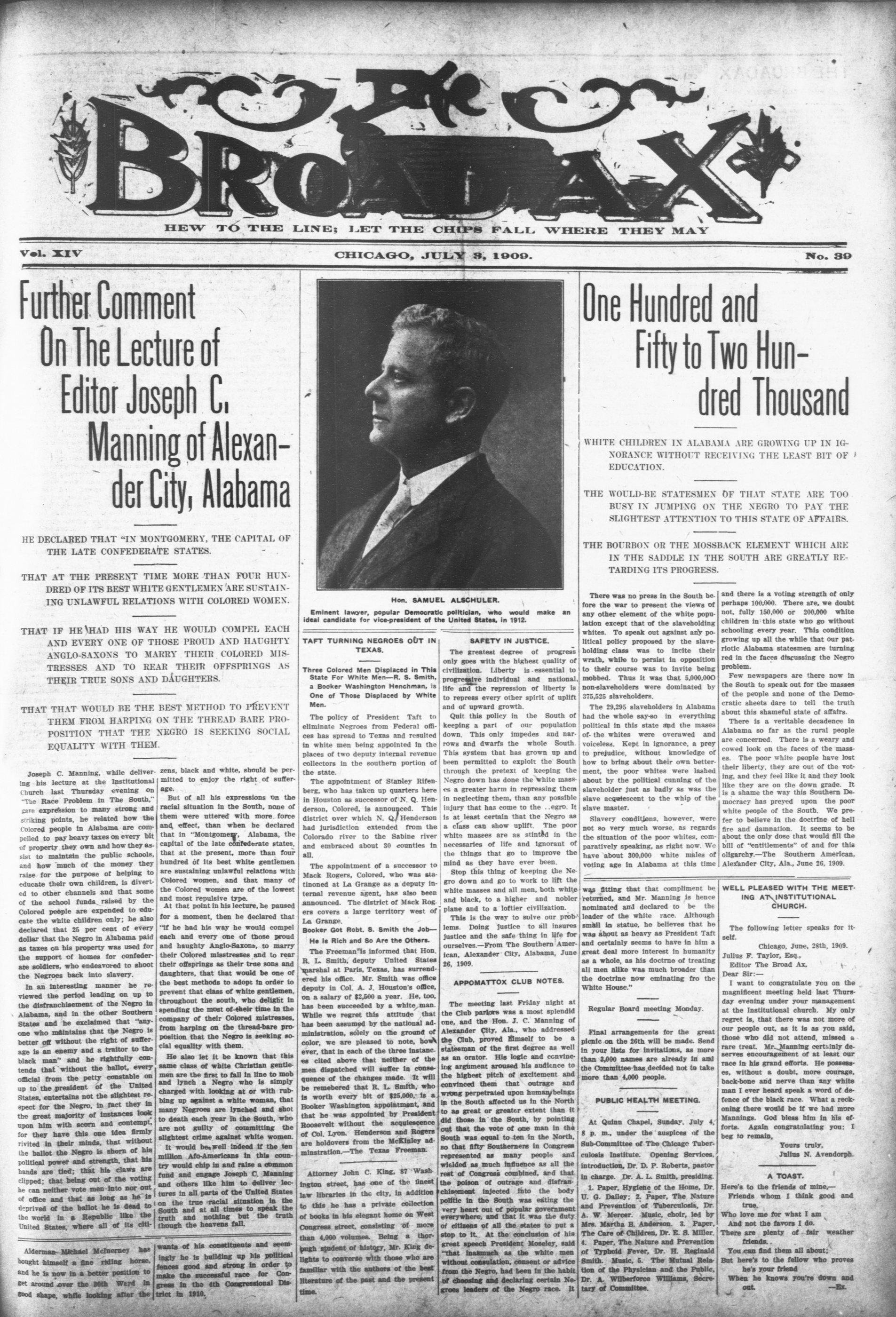
Further Comment On The Lecture of Editor Joseph C. Manning of Alexander der City, Alabama
HE DECLARED THAT "IN MONTGOMERY, THE CAPITAL OF THE LATE CONFEDERATE STATES.
THAT AT THE PRESENT TIME MORE THAN FOUR HUNDRED OF ITS BEST WHITE GENTLEMEN ARE SUSTAINING UNLAWFUL RELATIONS WITH COLORED WOMEN.
THAT IF HE HAD HIS WAY HE WOULD COMPEL EACH AND EVERY ONE OF THOSE PROUD AND HAUGHTY ANGLO-SAXONS TO MARRY THEIR COLORED MISTRESSES AND TO REAR THEIR OFFSPRINGS AS THEIR TRUE SONS AND DAUGHTERS.
THAT THAT WOULD BE THE BEST METHOD TO PREVENT THEM FROM HARPING ON THE THREAD BARE PROPOSITION THAT THE NEGRO IS SEEKING SOCIAL EQUALITY WITH THEM.
Vol. XIV
Further Comment
On The Lecture
Editor José
Mannin
der C
HE DECLARED THAT "IN MON
THE LATE CONFEDERA
THAT AT THE PRESENT TIME
DRED OF ITS BEST WHIT
ING UNLAWFUL RELATI
THAT IF HE HAD HIS WAY
AND EVERY ONE OF THE
ANGLO-SAXONS TO MA
TRESSES AND TO RE
THEIR TRUE SONS AND
THAT THAT WOULD BE THE
THEM FROM HARPING
POSITION THAT THE
EQUALITY WITH THEM
Joseph C. Manning, while delivering his lecture at the Institutional Church last Thursday evening on "The Race Problem in The South," gave expression to many strong and striking points, he related how the Colored people in Alabama are compelled to pay heavy taxes on every bit of property they own and how they assist to maintain the public schools, and how much of the money they raise for the purpose of helping to educate their own children, is diverted to other channels and that some of the school funds raised by the Colored people are expended to educate the white children only; he also declared that 25 per cent of every dollar that the Negro in Alabama paid as taxes on his property was used for the support of homes for confederate soldiers, who endeavored to shoot the Negroes back into slavery.
In an interesting manner he reviewed the period leading on up to the disfranchisement of the Negro in Alabama, and in the other Southern States and he exclaimed that "anyone who maintains that the Negro is better off without the right of sufferage is an enemy and a traitor to the black man" and he rightfully contends that without the ballot, every official from the petty constable on up to the president of the United States, entertains not the slightest respect for the Negro, in fact they in the great majority of instances look upon him with scorn and contempt, for they have this one idea firmly rivited in their minds, that without the ballot the Negro is shorn of his political power and strength, that his hands are tied; that his claws are clipped; that being out of the voting he can neither vote men into nor out of office and that as long as he is deprived of the ballot he is dead to the world in a Republic like the United States where all of its citi-
Alderman-Michael McInerney has bought himself a fine riding horse, and he is now in a better position to get around over the 80th Ward in good shape, while looking after the
zens, black and white, should be permitted to enjoy the right of sufferage.
But of all his expressions on the racial situation in the South, none of them were uttered with more force and effect, than when he declared that in "Montgomery, Alabama, the capital of the late confederate states, that at the present, more than four hundred of its best white gentlemen are sustaining unlawful relations with Colored women, and that many of the Colored women are of the lowest and most repulsive type.
At that point in his lecture, he paused for a moment, then he declared that "if he had his way he would compel each and every one of those proud and haughty Anglo-Saxons, to marry their Colored mistresses and to rear their offsprings as their true sons and daughters, that that would be one of the best methods to adopt in order to prevent that class of white gentlemen, throughout the south, who delight in spending the most of their time in the company of their Colored mistresses, from harping on the thread-bare proposition that the Negro is seeking social equality with them.
He also let it be known that this same class of white Christian gentlemen are the first to fall in line to mob and lynch a Negro who is simply charged with looking at or with rubbing up against a white woman, that many Negroes are lynched and shot to death each year in the South, who are not guilty of committing the slightest crime against white women.
It would be well indeed if the ten million Afo-Americans in this country would chip in and raise a common fund and engage Joseph C. Manning and others like him to deliver lectures in all parts of the United States on the true racial situation in the South and at all times to speak the truth and nothing but the truth though the heavens fall.
wants of his constituents and seemingly he is building up his political fences good and strong in order to make the successful race for Congress in the 4th Congressional District in 1910.
CHICAGO, JULY 3, 1909.
Hon. SAMUEL ALSCHULER. Eminent lawyer, popular Democratic politician, who would make an ideal candidate for vice-president of the United States. in 1912.
Eminent lawyer, popular Democratic politician, who would make an ideal candidate for vice-president of the United States, in 1912.
TAFT TURNING NEGROES OUT IN TEXAS.
Three Colored Men Displaced in This State For White Men—R. S. Smith, a Booker Washington Henchman, is One of Those Displaced by White Men.
The policy of President Taft to eliminate Negroes from Federal offices has spread to Texas and resulted in white men being appointed In the places of two deputy internal revenue collectors in the southern portion of the state.
The appointment of Stanley Rifenberg, who has taken up quarters here in Houston as successor of N. Q. Henderson, Colored, is announced. This district over which N. Q. Henderson had jurisdiction extended from the Colorado river to the Sabine river and embraced about 30 counties in all.
SAFETY IN JUSTICE.
The greatest degree of progress only goes with the highest quality of civilization. Liberty is essential to progressive individual and national life and the repression of liberty is to repress every other spirit of uplift and of upward growth.
Quit this policy in the South of keeping a part of our population down. This only impedes and narrows and dwarfs the whole South. This system that has grown up and been permitted to exploit the South through the pretext of keeping the Negro down has done the white masses a greater harm in repressing them in neglecting them, than any possible injury that has come to the .egro. L is at least certain that the Negro as a class can show uplift. The poor white masses are as stinted in the necessaries of life and ignorant of the things that go to improve the
The appointment of a successor to Mack Rogers, Colored, who was stationed at La Grange as a deputy internal revenue agent, has also been announced. The district of Mack Rogers covers a large territory west of La Grange.
Booker Got Robt. S. Smith the Job—He is Rich and So Are the Others.
The Freeman is informed that Hon. R. L. Smith, deputy United States marshal at Paris, Texas, has surrendered his office. Mr. Smith was office deputy in Col. A. J. Houston's office, on a salary of $2,500 a year. He, too, has been succeeded by a white man. While we regret this attitude that has been assumed by the national administration, solely on the ground of color, we are pleased to note, however, that in each of the three instances cited above that neither of the men dispatched will suffer in consequence of the changes made. It will be remembered that R. L. Smith, who is worth every bit of $25,000, is a Booker Washington appointment, and that he was appointed by President Roosevelt without the acquiescence of Col. Lyon. Henderson and Rogers are holdovers from the McKinley administration—The Texas Freeman.
Attorney John C. King, 87 Washington street, has one of the finest law libraries in the city, in addition to this he has a private collection of books in his elegant home on West Congress street, consisting of more than 4,000 volumes. Being a thorough student of history, Mr. King delights to converse with those who are familiar with the authors of the best literature of the past and the present time.
SAFETY IN JUSTICE.
The greatest degree of progress only goes with the highest quality of civilization. Liberty is essential to progressive individual and national life and the repression of liberty is to repress every other spirit of uplift and of upward growth.
Quit this policy in the South of keeping a part of our population down. This only impedes and narrows and dwarfs the whole South. This system that has grown up and been permitted to exploit the South through the pretext of keeping the Negro down has done the white masses a greater harm in repressing them in neglecting them, than any possible injury that has come to the .egro. It is at least certain that the Negro as a class can show uplift. The poor white masses are as stinted in the necessaries of life and ignorant of the things that go to improve the mind as they have ever been.
Stop this thing of keeping the Negro down and go to work to lift the white masses and all men, both white and black, to a higher and nobler plane and to a loftier civilization.
This is the way to solve our problems. Doing justice to all insures justice and the safe thing in life for ourselves.—From The Southern American, Alexander City, Alabama, June 26. 1909.
APPOMATTOX CLUB NOTES.
The meeting last Friday night at the Club parliaments was a most splendid one, and the Hon. J. C. Manning of Alexander City, Ala., who addressed the Club, proved himself to be a statesman of the first degree as well as an orator. His logic and convincing argument aroused his audience to the highest pitch of excitement and convinced them that outrage and wrong perpetrated upon human beings in the South affected us in the North to as great or greater extent than it did those in the South, by pointing out that the vote of one man in the South was equal to ten in the North, so that fifty Southerners in Congress represented as many people and wielded as much influence as all the rest of Congress combined, and that the poison of outrage and disfranchisement injected into the body politic in the South was eating the very heart out of popular government everywhere, and that it was the duty of citizens of all the states to put a stop to it. At the conclusion of his great speech President Moseley, said "that inasmuch as the white men without consultation, consent or advice from the Negro, had been in the habit of choosing and declaring certain Negroes leaders of the Negro race. It
One Hundred and Fifty to Two Hundred Thousand
WHITE CHILDREN IN ALABAMA ARE GROWING UP IN IGNORANCE WITHOUT RECEIVING THE LEAST BIT OF EDUCATION.
THE WOULD-BE STATESMEN OF THAT STATE ARE TOO BUSY IN JUMPING ON THE NEGRO TO PAY THE SLIGHTEST ATTENTION TO THIS STATE OF AFFAIRS.
THE BOURBON OR THE MOSSBACK ELEMENT WHICH ARE IN THE SADDLE IN THE SOUTH ARE GREATLY RETARDING ITS PROGRESS.
There was no press in the South before the war to present the views of any other element of the white population except that of the slaveholding whites. To speak out against any political policy proposed by the slaveholding class was to incite their wrath, while to persist in opposition to their course was to invite being mobbed. Thus it was that 5,000,000 non-slaveholders were dominated by 375,525 slaveholders.
The 29,295 slaveholders in Alabama had the whole say-so in everything political in this state and the mases of the whites were overawed and voiceless. Kept in ignorance, a prey to prejudice, without knowledge of how to bring about their own betterment, the poor whites were lashed about by the political cunning of the slaveholder just as badly as was the slave acquiescent to the whip of the slave master.
Slavery conditions, however, were not so very much worse, as regards the situation of the poor whites, comparatively speaking, as right now. We have about 300,000 white males of voting age in Alabama at this time
was fitting that that compliment be returned, and Mr. Manning is hence nominated and declared to be the leader of the white race. Although small in statue, he believes that he was about as heavy as President Taft and certainly seems to have in him a great deal more interest in humanity as a whole, as his doctrine of treating all men alike was much broader than the doctrine now eminating fro the White House."
Regular Board meeting Monday.
Final arrangements for the great picnic on the 26th will be made. Send in your lists for invitations, as more than 3,000 names are already in and the Committee has decided not to take more than 4,000 people.
PUBLIC HEALTH MEETING
At Quinn Chapel, Sunday, July 4, 8 p. m., under the auspices of the Sub-Committee of The Chicago Tuberculosis Institute. Opening Services, introduction, Dr. D. P. Roberts, pastor in charge. Dr. A. L. Smith, presiding. 1. Paper, Hygiene of the Home, Dr. U. G. Dalley; 2. Paper, The Nature and Prevention of Tuberculosis, Dr. A. W. Mercer. Music, choir, led by Mrs. Martha B. Anderson. 3. Paper, The Care of Children, Dr. E. S. Miller. 4. Paper, The Nature and Prevention of Typhoid Fever, Dr. H. Reginald Smith. Music. 5. The Mutual Relation of the Physician and the Public, Dr. A. Wilberforce Williams, Secretary of Committee.
No.39
and
two Hun-
ed Thousand
MA ARE GROWING UP IN IG-
CEIVING THE LEAST BIT OF
OF THAT STATE ARE TOO
THE NEGRO TO PAY THE
TO THIS STATE OF AFFAIRS.
BACK ELEMENT WHICH ARE
THE SOUTH ARE GREATLY RE-
and there is a voting strength of only perhaps 100,000. There are, we doubt not, fully 150,000 or 200,000 white children in this state who go without schooling every year. This condition growing up all the while that our patriotic Alabama statesmen are turning red in the faces discussing the Negro problem.
Few newspapers are there now in the South to speak out for the masses of the people and none of the Democratic sheets dare to tell the truth about this shameful state of affairs.
There is a veritable decadence in Alabama so far as the rural people are concerned. There is a weary and cowed look on the faces of the masses. The poor white people have lost their liberty, they are out of the voting, and they feel like it and they look like they are on the down grade. It is a shame the way this Southern Democracy has preyed upon the poor white people of the South. We prefer to believe in the doctrine of hell fire and damnation. It seems to be about the only dose that would fill the bill of "entitlements" of and for this oligarchy.—The Southern American, Alexander City, Ala., June 26, 1909.
WELL PLEASED WITH THE MEETING AT INSTITUTIONAL CHURCH
The following letter speaks for itself.
Chicago, June, 28th, 1909.
Julius F. Taylor, Esq.
Editor The Broad Ax,
Dear Sir:—
I want to congratulate you on the magnificent meeting held last Thursday evening under your management at the Institutional church. My only regret is, that there was not more of our people out, as it is as you said, those who did not attend, missed a rare treat. Mr. Manning certainly deserves encouragement of at least our race in his grand efforts. He possesses, without a doubt, more courage, back-bone and nerve than any white man I ever heard speak a word of defence of the black race. What a reckoning there would be if we had more Mannings. God bless him in his efforts. Again congratulating you: I beg to remain,
Yours truly,
Julius N. Avendorph.
A TOAST.
Here's to the friends of mine.—
Friends whom I think good and
true.
Who love me for what I am
And not the favors I do.
There are plenty of fair weather
friends.
You can find them all about;
But here's to the fellow who proves
he's your friend
When he knows you're down and
out. —Ex.
THE BROADAX
Serer
ete
Entered as Second-Ciass Matter,
Aug. %, 1902 at the Post Office at
Chieage, IIlleole, under Act of March
& 27.
ee
MANY REVERE THE MEMORY OP
PAUL LAURENCE DUNBAR.
Attorney &. Laing Williams ang the
Rev. H. €. Stewart Speakers at
+ Memorial Services fer Col.
lored Poet.
Reminiscences of Paul Laurence
Dunbar, interwoven into glowing tri
butes, and a musical program com
prised the memorial services held
‘Sunday afternoon at the Institution
al church in honor of the Colored
bard, whom William Dean Howells
Tanked with Whittier, Lowell, and
other American poets.
The leading spirit of the gathering
‘was Julius Avendorph, an employe ot
Robert T. Lincoln, who is anxious tc
Preserve the memory of Dunbar and
arouse a proper appreciation of him
among his people. He had arranged
to have Clarence S. Darrow and Ed
ward H. Wright present, but the lat
ter was unable to attend on account
of the serious illness of his wife and
‘Mr. Darrow was called out of the city
8. Laing Williams, assistant Unite:
States district attorney, and the Rev.
H. E. Stewart, who were friends of the
poet, delivered addresses. Musical
tumbers were given by Marie Burton,
Béward F. Morris, Harrison E. Man
uel, and Ada Lou Mitchell,
‘The pastor said the thing tha
struck him most forcibly in his ac
quaintance with Dunbar was his great
respect for his aged mother, who the
poet declared was largety respons!
bie for his inspirations. Mr. William:
‘told of the bard's visit to Chicago
when he was impecunious and un.
known and praised his exemplary
qualities and genius. Frederick Doug:
Jass, he said, gave him a home and
encouragement while here and aided
him @inancially in bringing out his
first Book, which latter attracted the
attention of Mr. Howells.
BOOKER TAFT WASHINGTON EN.
TERTAINS THE VULGAR IDEA.
‘That “There is Nothing Under the Sun
‘That Money Cannot Buy.”
One of our exchanges quotes Dr.
Booker T. Washington as saying.”
“Not in religion, nor in politics, not
in higher education lies the race solu:
tion of the race problem, but in busi-
ness.”
Did Mr. Washington say this?
Then he uttered a misleading and
dangerous fallacy. Why all this clap
trap about business anyhow? Who
ever heard of this term being used to
represent all the good and desirable
in life.
Business has its place, nor can the
Negro any more than other foiks suc-
ceed without business, but to place
it béfore religion, ones relations to
God, or before politics, ones civic and
ciyl status, or before intelligence,
ones “supremacy over beasts and
brutes, is to say thé least surprising.
‘This constant jingle of silver, this
eternal flaunting of greembacks is
enough to make the very graves of
the immortals burst asunder.
To nccept this preachment is to
sive the le to the whole system of
religion, as given to us in Jewish his
tory and tradition and in Gospel plan
‘and purpose,
‘To remain silent in the face of this
sordid cult is treachery “to the,
eis pees >
The writer of the aboye article bas
“hit the nail square on the head, in
Teference to the teaching or preach-
ing of Booker Taft Washington, who
Seema sank ac fa eee als
‘eum that money cannot buy.” — =
= a doctrine as advocated by the
Re Rem ote ee OR See.
NEGRO FIREMEN vVicTORIOUS
GEORGIA BOARD UPHOLDS
7HEM.
‘Rules Against Seniority of White
Workers on Purely Racial Lines
and Fixes Pay of Alt Allke,
Atlanta, Ga, June 29.—The Georgia
Fallroad strike arbitration bosrd to
decided against the sentority of
white firemen over Negroes. The ar-
Ditrators, however, placed a premium
on intelligence among firemen, which,
it ts believed, will result ultimately
im the gradual elimination of all ex-
cept the mbst expert Negroes.
‘The arbitration board was composed
of Hilary Herber of Montgomery, re
presenting the Georgia rialroad; Con-
gressman Thomas Hardwick of Georg.
ia representing the firemen, and
‘Chancellor David C. Darrow of the
Georgia university, es umpire.
‘Their decision was worded guard:
edly and did not in any case deal
directly with the race problem. Their
‘most direct reference to the seniority
problem was in the words: “We find
against proposition C.”.
This proposition read: “All fire
men when hired shall be placed in
freightyards or hostling service and
senior white firemen shall have pre
ference of engines and runs.”
The award made the pay of Negrc
firemen equal to that of whites. The
Negroes have been receiving from 2¢
to 50 cents per day less than whites.
FIND NEGRO PLEA I$ BASEL'S8.
Commerce Commission Heads See Nc
Discrimination Against Bishops
by Southern Railroads.
Washington, D. C, June 29.—Five
Dishops of the African Methodist
Episcopal church, who complained to
the interestate commerce commission
that they were discriminated against
by southern railroads and by the Pull
‘man company in transportation, din
‘img car, and sleeping car facilities,
have been informed by the commis
‘sion that their complaint was not
warranted.
The bishops were Wesley J. Gaines.
H. M. Turner, Evans Tyree, C. S.
‘Smith, and E. W. Lampton.
It was alleged that coaches furn
ished Negroes were not equal to
‘those for whites; that Negroes were
‘denied sleeping cars, and that they
were refused food in dining cars. It
is bel ibx sl evmmstanion tat sae
prejudice was not shown.
It seems to us that the fact that
the five bishops were absolutely de
nied first class service on the dining
car and in every other respect, on
account of the color of their skin,
that it was a manifestation of race
prejudice on the part of those having
charge of the train on which they
were traveling on, pure and simple—
Eaitor.
| CHATEAU RINK NOTES.
‘The greatest vaudeville of the sea-
me wit be gies at the Conan Gar
den July 3rd, 4th and 6th. The mar-
‘agement has carefully selected some
of Chicago's best talent tor the oc-
= Come and become convinced.
Everybody smiles when they visit
the Chateau Gardens and are sorry
when the time comes to return home.
A good time for all. Visit it tonight.
‘The caslest and coziest spot in Chi-
cago is the Chateau Gardens. Come
out and ‘bring your friends.
Don’t forget the baseball game at
Anson's Park, Gist and Champlain
avenue, Sunday, 2 double header, Le
land Giants vs. Anson Colts. After
the game visit the Chateau Gardens
amd spend a pleasant evening.
Mr. Jerry Mills of the Pekin Thea-
tre, will manage the vaudeville show
at the Chateau Gardens and wishes
‘to meet his many friends any evening
fromr 7 to 12 p. m.
GEORGIA BILL BARS NEGROES.
Whites Seek to Exclude Them Aito
gether from Employment as
» ‘Trainmen on Southern Roads.
Atlanta, Ga, June 29—The’ prepar
ation of @ bill to exclude Negroes
from employment as firemen and
trainmen in this state was begun to
‘day by a committee representing the
firemen and trainmen of the Georgia
Tailroad. The measure will be pre
sented to the Georgia legislature, now
in session, A bill already introduced
4m the house requires an educational
test for Negro firemen,
INSTITUTIONAL CHURCH NOTES.
Sunday the Ninth Anniversary Ux.
jon Prayer Meeting, 5 p. m., led by
Brother Fletcher; Anniversary Ser:
oe eee ee ee
form meeting at 3 p.m, oy
the pastors of city churches at .7;45
P. m. Sermon by Sister Nora Taylor,
tes ‘Wetieater wight, Say 3:
ooo a wt, minister.
BISHOP ALEXANDER WALTERS.
| ‘The newly elected president of the National Negro American Political
OnrPws
Mrs. Bila Henderson Walker, a
teacher in the Lexington public
schools, is in the city, the guest of
Mrs. A. W. Williams.
Miss Alta Gray Davis, of Fredertek
M4, will make her future home with
her aunt, Mrs. E. L. Davis, 3226
Prairie ave.
Prof. Roy W. Tibbs of Lou'sville,
Ky., is epending the summer with his
cousins, Dr. and Mrs. A. Wilbe:force
Williams, 3408 Vernon avenue.
Mrs. Elizabeth Lindsay, mother o
Mrs. W. H. Davis, 3226 Pratrie ave.
left the city Friday morning for
Peoria, Ill, her old home where she
will spend the summer. ;
Jacob L. Park}, 3155 State street,
has recently bad his undertaking es-
tablishment redecorated, and cvery-
thing in connection with it wears an
air of prosperity.
‘William Clark, one of the! bigh
chiefs of the Standard Literary Soct-
ety of Olivet Baptist church, har re
moved from 2635 La Salle street, to
2828 La Salle street.
Dr. A. Wilberforce Williams will
deliver an address at Grace Tresby:
terian Church, 34th and Dearborn
streets, Sunday night, July 4th, on
“The Lack of Chivalry.”
Mrs, B. Davis, 3532 State Street, re
turned home the first of the week
from Memphis, Tenn. where she de
lightfally spent two weeks in visiting
with her dear father and with her
many old friends,
Misses Nellie L. Brown amd Ledley
‘Ford of Oklahoma City, are in Chicago
taking special courses at the Chicago
University, and while here ,they are
the guests of Mr. and Mrs. H. S. An-
derson, 6450 Champlain avenue.
. J. W. Jenkins, 6442 Evans avenue,
“who hits the rail” between this city
and Ciocinnati, O., is quite popular
with his associates, and he deserves
to be classed among the goo! and
honorabl¢ citizens.
Miss E. B. Shipley, of Louisville,
Ky., will be the guest of Miss E. Es
telle Webster. 6041 Champlain avenue,
for the summer. Both young ladies
are taking advanced work at the Unt-
versity of Chicago.
Mr. Willis A. Colter of the Minne-
apolis postoffice, passed through the
city thisweek en route to Atlantic
City, N. J., and other eastern points,
where hhe will spend his vacation.
Qn’ Tuesday evening last the pu:
Charles Jackson has severed his
connection with the undertaking es-
tablishment of his father, Emanuel
Jackson, 2959 State strect, and in the
near future he will engage m the
same line of business for himself at
3249 State street.
~\ Frank L. Gale {s meeting with suc-
cess in the plano and music bosness
at 3140 State street. He has only
had hie sipre open two weeks, but
80 far he has sold three fine rusical
instruments. See his ad In another
emnne this paper.
‘The PreNuptial High Tea and
Dance given in honor of Miss Lena
Pickett-by Miss Clark of the Chicago
postoffice, at the Douglass Center
Monday eve, was an elegant affair
and greatly enjoyed by ‘all who at-
tended. : Z
‘The. rary Fane Rose Concert” at
“Was successful in every partic-
ular, Mrs.M. B. Anderson and James
w. Se with Dr. D. PL
Roberts, the commi-tee of
‘ 8 Foe oo Se
resided for & long time st 26
oo. o have been prominent
ae society circles tor ‘many
years, are now tes 4
‘a nice home of their own. ,
J. M. Higginbothan, 226 E. 26th
latrest, the most. progressive 1000
‘md genetal contractor among the
Afro-Americans in Chicago, is just as
Dusy as he can be in constructing sev-
‘eral good sized buildings at the same
time. %
pils of Miss Estella C. Bonds, rendered
musical program at the Berean
Baptist Church for the benefit of the
Music fund of the church. Misses B.
Childers, Ruby Clark, Helen Bonds
‘and Gladys Williams, played piano
solos, which were very pleasing to
the audience.
It is not possible to distinguish be-
tween the brain of a black mun and
that of a white man, and I defy any
person to make such a distinction
with certainty. I am talking now of
= Negroes and male whites, all of
fae North America of the present day.
—Prof. Burt G. Wilder of Cornell
University.
Roger C. Sullivan, member of the
Democratic National Committee and
his close political friend, former
Mayor John P. Hopkins, struck out
last Saturday on a tour of Europe. and
they will spend two or three months
in the old country.
’
| The Joint Entertainment given
Wednesday evening by the Eder Dis-
trict H. H. of Ruth No. 18 and the
United Odd Feltows' Hall Assoca:ion,
‘was greatly enjoyed by the many at-
tendants. Short speeches and a mu-
sical program with dancing wee the
features of the evening.
A race of people, whose leaders go
around among the well to do white
people with their hats in their hands
cannot command the esteem and the
respect that is due it. Independence
means independence in finance as
Well as in religion. A race of beggars
has always invited contemp!—The
Planet, Richmond, Va. Will Prof.
Booker T. Washington please stand
up and lead us in prayer?
'
Mrs. R. L. LeCasse, thirty-three
years old, wife of R. L. LeCasse, 3727
Armour avenue, died early Wednesday
morning from the effects of ptomaine
poison, after she had eaten some ice
cream on Sunday evening. tr. Le
Casse is one of the officers of the
Chicago Conservator Publishing and
Printing Company, and his many
friends extend their sympathy to him
over the loss of his devoted wife.
The Second Annual Outing fir Vis-
itors, at Rasch’s Grove, 79th street
and Bond avenue, was pulled off last
night. A large number of persyas at-
temied and a good time was enjoyed
ty all. Mrs. Ferdinand L. Barnett,
Jr., and Theo. E. Jones, who managed
the affair, are delighted with its so-
cial success.
THE APPOMATTOX CLUB PICNIC.
The Appomattox club will hold its
annual outing on July 26, 1909, at the
peautiful Fox River Grove, where it
was held in "06 and 07. We trust
that our patrons will mail us thelr
Fesidence addresses as our mailing
list was lost in moving into our new
home. No one will be taken who
does not present an invitation at the
trait
/ Our “inspection committee found
2 new dance pavillion with hard wood
foor has been built, also new bench-
es and tables and many improve-
ments. 5
Sergant Wm. F. Childs, a member
of twe-ciub wil have charge of the
police and good ovhavior is assured
‘We hope io have the largest and
DR. A. WILBERFORCE WILLIAMS
ammounces the Removal
of his office to ~/
3255 State Street, N. E. cor. 334 Street
‘Seite A *, CHICAGO, LL.
Howse 10 to 12 m.. 2 to 5,28:30 te 2:30
YOURSELF ANO FRIENDS WLI GE COMBULLT RECEIVED
| Phone Aldtuez220g ——==
Micke’ Story.
6 eon 2 M007 thet Hicks Set mods
county name as a witty raconteur
‘Yu that year 8.r Samuel Bpry, who bad
bees membe: for Bodmin since the
Great reform: bill, lost hig seat and tr
® petulant mood took legal proceeding:
‘against Hicks op the ground that he
had abused his official position to im
fluence voters at the poll. In the
course of the trial Hicks was called
upon to state what he bad to say in
his defense. In the course of bis state
ment he asked leave of the court t
{ijustrate bis position by a story. His
request being assented to, he resated
how a few days previously he had
been to see a lad whom he knew wel
who was laid up from a fall from
vicous donkey, which had kicked ou
all his front teeth. The lad, «aic
Hicks, bad taken the matter in the
most kindly way and had said to aim
“*Tisn’t the fall, MrA Hicks, and "tan't
the vally of the teeth what annoys
me, but ‘tis the nashty, ghastly,
wishous disposition of the jackass.”
Sir Samuel Spry sprang up in the
well of the court in a fury ana ex.
clainied, “He has called me a jack.
ass!” The court was convulsed with
laughter. and Hicks was promptly and
fully acquitted of the trumpery charge
brought against him—Cornhill Maga-
sine.
Great Ware Fram Trifes,
Great wars, pregnant with bloodshed
and all the horrors accruing thereto
have very often been the outcome of
trif_ing incidents which might, had they
been treated properly, have been
smoothed over and the slaughter avert
4. More often was this the case in
earlier times than ft is now. Every
one knows that William the Conqueror
lost his life in France through his
‘horse treading on @ redhot cinder
‘while be was superintending the burn-
ing of Mantes, but few people know
the fact which gave rise to the cam-
paign that cost William his life.
During the latter part of his reign
he became abnormally stout and con-
sequently the laughingstock of not
only his subjects, but bis neighbors
across the water, One day his con-
temporary, Philip of France, compared
him to a fillet of veal on casters and
suggested that he should be exhibited
‘at a prize monarch show. This so en-
Taged William that he straightway
made war upon his ridiculer, and the
loss of thousands of Iives was the re-
sult—London Tit-Bits.
Gestures Part af Talk.
‘There is a man who from a very
early age has lived in countries where
Spanish is the almost untversal tongue.
From force of this training he speaks
Spanish perfectly. He has not the
alightest trace of an English accent,
and persons who do not know that he
is of American parentage are willing
to believe he is a Spaniard, merely
from hearing him talk. He is so per-
feetly bilingual that it shows even in
his gestures. When talking with Bng-
lish speaking persons he sits quietly
and does his conversing with his mouth
alone. Only in case of making a point
‘most emphatically does he use a ges
ture. But the moment he drops into
Spanish his every word is accompa-
nied by 2 movement of the hands or
arms. It is interesting to watch the
change from the English to the Span-
tah side of him. because it comes so
suddenly. He really can’t speak Span-
sh without gesturing—New York Sun.
Beme Slane Werdc
‘A remarkable fact is that many slang
words have a classical origin. For
example, the word “mill” « vulgariam
for a fight, is traceable to the Greek
word “hamilla,” which means a com-
Dat. s
“Uncle,” the afectionate term for a
pawnbroker, is derived from the Latin
“uncus,” 2 hook on which the articie
pledged was bung.
‘To go before “the beak” is a distinct
reference to the old Roman custom of
adorning the platform from which jus-
tice dispensed with the beaks of ships.
which platform came to be called the
rostrum, that being the Latin for a
beak or prow.
Cruel.
| The rich bachelor sighed and looked
at the beautiful girl fixedly. : “Things
are at sixes und sevens with me. I
feel the great need of a woman in my
home, one who could straighten out
‘my tangled affairs and make life worth
ving again.” Her glance spoke an
interest which approximately expecta-
ton. “Yes?” she queried softly. He
blurted oui. “Do you know of any
‘geod, ablebodied woman whom I could
get to clean house?"—Argonaut.
A Sure Scheme.
Young Wife—I am determined to
learn at what hour my husband comes
heme at nights. Yet do what 1 will
I cannot keep awake, and he is always
careful not to make a particle of noise.
Is there any drug whieh produces
wakefulness? Old Wife—No need to
buy drugs. Sprinkle the floor with
tacks. = \
——“—_—
Aristocratic Fowls,
“Do animals have their social cus-
toms and institutions?” #
“I presume so. I bave no doubt that
the geese have their descendants of
the cacklers who saved Rome.”—Puck.
‘ont ak
Friend—That new gardener seems to
be a very bani worker. Suburbanite
~—Yes, thet's his specialty. Friend—
What? Working? Suburbantte—No,
seeming to—Town Topics.
+. Oil of Bergamot.
‘The world’s supply of off of berga-
mot comes from a
Sama teoes oe
of Italy, fronting om the strait of Mas
Neo Time For Retreat.
In an Irish garrison town a theatrica)
‘company was giving performances, aq
‘some soldiers from the local barracks
aaa ‘Thetr
duties waging of a tierce
oe ae Se vaoae os os
gle, ove army was defeated on a giv
signal from the prompter. For ¢ (ow
aights all went well, but on the Priqay
evening a special performance oft).
Diece was to be given under the patron,
Age of the colonel and other oticer,
of the garrison. The two armies :..,
‘as usual at the end of the secvnd at
when they fought and fought ani \;;
on fighting, regardless of the agoaizes
glare in the eye of their (actor) con.
eral, who hoarsely ordered the proper
army to “Retreat, confound you.” jut
the fight still went om, and soon the
horrified manager saw the wrong orny
‘being driven slowly off the stage, stil)
fighting desperately. Down came the
‘curtain amid roars of laughter, aoq
‘the fuming manager hastened to ui
‘the delinquents why they had failed
retreat on hearing’ the signal.
“Hetraite,” roared a burly fustleg
‘whose visage had been badly battery
“and is it retraite ye'd have us, wid
the colonel and all the officers in the
boxes?”"—London Scraps.
Sind Your Own Business.
Ap oid custom once prevailed in 4
remote place in England of giving
clock to any one who would truthfully
wear that he had minded bis own
business alone for # year and a day
and had not meddled with his ceigh.
bors. Many came, but few, {f any,
gained the prize, which was more dit
cult to win than the Dunmow fitch
of bacon. Though they swore on the
four gospels and held out their bands
tm certain hope, some hitch was sur
to be found somewhere, and for ai
their asseverations the clock remained
stationary on the shelf, no one being
able to prove his absolute immunity
from uncalled for interference tn things
not in any way concerning himself. At
last 2 young man came with 2 per.
fectiy clear record, and the clock
seemed as if it was at last about to
change owners. Then said the custo.
dian, “Oh, a yotng man was here yes-
terday and made mighty sure be was
woing to have the clock, but he didn't”
“and why didn’t be get it?” “What's
that to you?" snapped the custodian.
“That's not your business, and you
don’t get the clock.”
a
In Canton 400,000 people spend their
whole existence in boats, which are
there called sampans. They are born
im them, live in them from infancy to
old age and finally die in them. Col.
lectively these boats form a floating
suburb to the city proper, one of the
most amazing human settlements io
the world. Every creek is crammed
with them. Along the main banks of
the river they are huddled twenty deep
—s0 close together that the covering
of mats appears continuous as far 4s;
the eye can reach. And each sampan
houses a separate family, with its own
big brazier lamp, which serves for
heating, lighting and cooking the even-
ing meal. The scene when « really
serious conflagration once gets & prop-
er bolé in the midst of these floating
wooden homes may be imagined. Es-
cape is impossible except for those
moored at the outermost edge. In one
of these confiagrations orer # thou
sand persons lost their lives.
Wanted Mer.
“An old couple from the east.” says
the Detroit Free Press, “are visiting
their son in this city. If the mother
gets out of sight of the father, be is
constantly asking for ber and 1s not
content till they are together again.
‘The other evening she went to another
part of the house while he was in the
‘parlor and after be had asked for ber
&@ balf dozen times the son said, rather
curtly:
“‘It seems as though you coulda
be without mother five minutes st *
time.”
“*You're right,’ said the old gentle
man slowly. “That's the reason I mar-
tied her.”
A Suit of Ratskin.
A thrifty Welshman at one time e*
hibited himself publiely in Ehgland st
tired in a costume composed from top
to bottom of ratskins, which he bad
spent three years and & half in collect:
ing. The dress was made entirely b:
himself. It consisted of hat, necker
chief, coat, waistcoat, trousers, tippet
gaiters and shoes. ‘The number of
rats required to complete the sult w2:
‘570. Most curious of the garmexts
was the tippet, composed, entirely of
rate’ tails,
eel AS dal alk
Small Johnny had been ill for sev-
eral weeks when one day an aunt from
@ distance came to visit the family.
“Why, Jobnny,” she exclaimed, “bow
thin you ere! Have you been sick?”
“Yes'm,” replied the little fellow. “I
had the brain fever and right in my
head, too, the very worst place I could
eae Se
His Secret.
| Student—How would you advise me
‘to go about collecting « iibrary? Pro-
fessor—Well. 11 tell you how I man-
aged it. When I was young I bought
books.and loaned them. Now I bor-
Tow books and keep them—Stray
Stories.
st Ri ena ie ort,
never tell another man I'd ratbe
ance than ent.” 1
“Why not?”
“He kept me waltzing until all th
restaurants were closed.”—Exchange.
ee
‘Wherever there ts a failure there 's
about luck. some 1 omitted, which
‘They Hed Will Power.
\ twas one morning in &
couse ts tek neo ek toe be
ly men sat down beside me. Qpe was
evidently 2 Scotchman, and the other,
1 gathered, was from Yorksbipe, The
former remarked, “I have just mgn-
aged it" This, I discovered, meant a
win of 20 francs. Their daily routine
was to appear at the same roulette ta-
‘ble at an early hour and play the low-
est stake of 5 francs on even chances—
that is, on black or red or on the odd
or even numbers. They would lose
and win and win and lose, but they
remained calm and self contained and
persevered until they had each 20
francs to the good. I observed them
Gsily. Some mornings they scooped in
the amount In twenty minutes, and at
jether times it was @ tough struggle
jentil luncheon time before they man-
jaged it. I never saw them fail once,
jand I learned that they had pursued
ithe same plan for four months. One
(zing was clear—nothing could tempt
them to ge beyond the modest stake,
and they had the will to stop when
they won the stipulated amount. It
aves vesity one of the best {Itustrations
ef wil power I bave ever seen, for
few, indeed, who enter the portals of
the casino are able to resist the com-
ipelling atmosphere of the tables to
play on if losing and to plunge if win-
e@ing—Chambers’ Journal.
Family Jars.
‘Schoolmaster (to his wife)—-My dear,
I wish you would speak more careful-
ty. You say that Henry Jones came to
‘this town from Sunderland.
‘Wife—Yes.
Schoolmaster—Well, now, wouldn't
it be better to say that he came from
‘Sunderland to this town?
‘Wife—I don’t see any difference in
the two expressions.
Schoolmaster—But there is s differ-
quce, a rhetorical difference. You
don't hear me make use of such awk-
qward expressions. By the way, I have
eletter from your father in my pocket.
‘Wife—But my father is not in your
pocket. You mean you have in your
pocket a letter from my father.
Schoolmaster—There you go with
your little quibbles. You take « de
Might in harassing me. You are al-
(ways taking up a thread and repre-
“wife _Seprecentng
it to be rope,
yeu mean.
Schoolmaster— For goodness’ sake,
fee quiet. Never saw such a quarrel-
@ome womes fn my life—London
Omg ee
Pretty Slew.
Horace L. Moore was lieutenant colo-
fal of the noted Nineteenth Kansas
cexvalry. He could lead men for a long-
period without rest on a single ra-
fen of cheerful good humor than any
—— ‘Though not given w
he was the reputed author of
‘es many astonishers as the great Lin-
One time, on the march, he sent an
‘eréeriy with message to an officer at
Gistance. Before the man was
reso beering Moore sbosted: “Hey,
seederiy! Come back here!”
‘He came galloping back, sitting limp-
fy tm the saddle.
‘Moore dropped his voice and, assum-
fg 0 half confidential manner, inguir-
eed, “Orderly, in the course of your life
fasve you ever seen « enail?”
| “Yes, sir,” was the astonished reply.
“You met him, then,” replied Moore,
‘for you'd never overtake onef'—Kan-
gas City Journsl.
—_sa—_
Bie Resinece Ability.
In the Adirondacks lives a mgn too
lasy to work, but evidently of great
business ability. One winter when he
‘was sitting around smoking bis family
came so near starvation that some of
hkis neighbors, who could fl! afford to
help him, took up @ collection and
bought for the suffering family a ber-
tel of flour, a barrel of pork and a
load of wood. They were not consid-
erate enough to cut the wood, but the
business man knew ‘how to manage.
He hired some of the neighbors who
had not contributed to his donation to
ut the wood and paid them with half
the pork and half the four—Lippin-
cott’s.
Admirably Equipped.
Cardinal Mezzofanti, the famous
‘Italian linguist, who died at the age
ef seventy-five, knew and could speak
more than fifty languages. He could
emtertain his English friends with
specimens of the Yorkshire dialect and
‘his French or German visitors with
the patois of their respective coun-
‘tries. “Dear me! exclaimed Lord
‘Byron, to whom this was told “He
eught to have been the custodian of
‘the tower of Babel!”
Breskfast Months.
A traveler stopped at 2 hotel in
Greenland, where the nights are six
months long, and as he registered
asked « question of the clerk.
“What time do you have breakfast?”
“From half past March to a quarter
to May.”"—Harper’s Weekly.
'
A Bone.
“What sort of an after dinner spsek-
] is Bliggins?"
“One of the kind who start in by
saying they didn’t expect to be called
on and then proceed to demonstrate
that they can’t be called off”—Ex-
change.
‘The Quarrel.
, “Last night we parted forever.”
“Then I suppose Ferdy will not. call
nt ee ee ei
‘ville Courier-Journal. -
ee tee
General John C. the: J
one teeta oe
New York Congreseman's Brave Stand
| Not Porepd by Patronage.
Like & taint echo of negiectad party
Se Se ont of fer Soren
‘eloquence of the stump is the pill
‘Which was introduced hy Congressman
Bennet of New York some time ago
Providing for 2 reduction of represen-
tation in states which have disfran-
ehised the Negro. Mr. Bennet’s voice
ts a small one. It falls upon dull ears,
Dut it is a challenge nevertheless to
all Republicans in executive and legis-
lative station.
Fortified though be may be by party
platforms and party traditions, Mr.
Bennet must know that in proposing
‘this policy be defies presidential pow-
, never so great as it is today. He
must know that im speeches in New
York and in the south Mr. Taft has
virtually approved the nullification of
the fourteenth and fifteenth amend-
ments. He must know that the presi-
Gent has openly announced that no
Negroes ehall be appeinted to office in
position to the wishes of the whites.
He must know that of all the Repub-
Mean officeholders and expectant office.
holders he ts the only one who has
hed the courage to adhere to the pub-
Usbed principles of his party. He mast
‘mow that no important Republican
Dewspaper will venture to support him.
‘For these reasons the world hails
‘Mr. Bennet as the last of the true Re-
Dublicans, the sole survivor of the days
‘when mora] ideas prevailed, the one
man not intimidated by power, not tn-
fuenced by patronage and not cor
rapted by ambition or by privilege.
Others bave been beguiled by expecta-
tions of a break in the solid south, by
office, by privilege and by tariff, and
stl others are naturally servile and
teifiing, but Mr. Bennet, plone among
‘the hosts thet drew their inspiration
from national conventions,
stands and true for the princi-
ples that are written im the party book
of faith.
As real heroes are rare in public life,
Mr. Bennet is entitled to more than
passing notice. Surrounded by time
servers and self seekers and over
shadowed by executive power which
lightly sets aside platforms, seemingly
mullifies law and revolutionises party
principles and practices, he cannot fail
to become an object of increasing tn-
terest. —Boston Guardian.
HELP FOR NEGRO COLLEGE
Mr. Carnegie’s Conditional Gift Being
Met by Atlanta institution.
At a recent meeting which was beld
at Mount Gilead Baptist church, New
‘York, in the interest of Morris Brown
college, Atlanta, Ga., the Rev. Richard
D. Stinson, vice president of the col-
lege, said that Mr. Andrew Carnegie
hed promised to give the institution
$22,500 when it bed obteined a spec-
{fied subscription. The vice presi-
Gent told of the founding of the col-
lege and said it was receiving support
from the white people of Atlanta.
Adout 1,000 pupils attend the institu-
tion, but the attendance would be
2,500 if there were accommodations
for them. The work of the college is
to prepare each for work in
* student,
‘He said a continuance of the prog-
reap of the Negro race must be along
Mines of character building, practical
with regard to home life, a love for
honest toll and a cultivation of friend-
ly relations in the community where
they live.
“I do not believe,” he said. “that the
Negro’s eternal salvation, so far as
this world is concerned, rests in Wasb-
ington or in the legislative halls of the
states, but in his capacity to win even
his enemies to be his friends by worth
of character.
Arithmetic For African Tribe.
At the recent meeting of the Presby-
terian general assembly at Denver the
reports on education showed that
$185,000 was spent in 1908 for work
among our people. Although this sum
seems large. it was not sufficient to
carry ont properly the plans of tbe ed-
ucational department for Negro educa-
tion. .
The American Tract society present-
ed & report through the Rev. Judson
Swift, secretary, showing that $100.-
000 of the Soating indebtedness of the
association was lifted in the last four
months through careful management
of finances.
‘He was emphatic in speaking of the
necessity for tract work. He told of
the application of a tribe in somthern
Africa for an arithmetic printed in the
native tongue and said that, while the
furnishing of text books to the natives
was a little outside the realm of the
tract ‘society. be presumed that until
the Africans were able to compute the
number of lions and elephants siain by
the ex-president they would be unwill-
ing to settie down to a study of Chris-
tantty.
Profesor Miller’a Western Tris.
Professor Kelly Miller, dean of the
College of Arts end Sciences at How-
ard university, Washington, is on en
extended speaking tour which wi!
take bim es far west as Denver. The
trip will be a notable one from the
fact that Professor Miller is booked to
make a commencement address for the
high school at Kansas City. Mo.. West-
erp university at Quindaro. Kan.; lec-
ture at Kansas City, Mo., deliver com-
mencement address as well as Y. MC.
A lecture fo Toptka, Kan.; jecture ip
Lawrence. Kan. Denver. Colorado
Springs and Pueblo, Colo; ou
‘Nebd.; Des Moines. ia.; Chicago,
‘Louis, Indianapolis, Cincinnati and
Columbus,
ee iba eoeetnk cs
dain tae comaronement abarem Io
the Balt ‘Righ schuol June 18
Free Advice.
The telephoue tm the oflice oa
ment ork yer rang and wig
2 clerk angwered it the lady on
Seams See sebenek to tien Set. amee
saying she wanted to see the lawyer
imeeif on private business. As soon
as the lawyer himself picke¢ up.the
reestver, before he could make any
inquiries, she began, “Ob, please tell
me, must there not be two copies of
& lease?” .
“Why,” be answered, “It is usual to
‘give one to the landlonl's agent and
one to the lessee. But who are”—
“Yet the fact that the wife of the
‘lessee bad never seen a copy of the
lease wouldn't keep it from being te-
gally binding?”
“No,” slipped from the lawyer, who
quickly added, “But before I discuss
the matter further may I ask to
whom"—
‘There was a pretty little laugh. He
admits it was pretty even now. “Ob,
Tm Mra. Brown, and I live ap Breed
‘way. You don’t know me”—It was ob-
Vious Wkewise that he wouldn't—“bpt
Tve always heard your advice was so
‘Very valuable, and I wanted a lawyer,
nd 20 I just called you up. Goodby.”
And when be asked for the number
central gave him the Grand Central
‘station!—New York Times.
‘The Canary’s Toilet.
Just watch your canary after he has
bad his daily bath. See how each sep-
arate feather is cleaned, pulled and
looked over and how all the loose ones
are taken out and dropped. All this is
Gone by the bill, for a bird's neck is so
Gexible that it can be turned tm all ét-
yections, but the bill cannot reach the
ead, and so Mr. Canary uses his foot.
With it he combs his hair first on one
fide, then on the other, scratching very
ee
‘Then he uses his bub? ell, for, although
complexion powders are not known in
the bird world, hair off certainly is.
Ladies and gentlemep alike carry it
about with them. They have 2 littie
ouch or sack on the back near the
‘el for the purpose. When Mme. Bird
‘Wishes to use it she equeeses it out
‘with her beak, just as you would press
&@ rubber bulb. Then she lays the off
om her back just above her wings and
rubs her head against tt, turning ber
neck in all directions until every fegth-
@ in her head is straight and shining.
—Zixrchange.
Red Cheeks In Aceiwewes Way.
‘It seems that the “beauty doctor” is
by Do means a modern invention. The
Afiantic cites an amusing advertise-
ment to this effect printed in Addison's
Spectator:
‘The famous Bavarian Red Liquor:
‘Which gives such a delightful, blusb-
ng Colour to the Cheeks of those that
are White or Pale, that it is not to be
Gistinguished from a natural fine Com-
plexion, nor perceived to be artificial
by the nearest Friend. Is nothing of
Paint, or in the least hurtful, but good
fm many Cases to be taken inwardly.
‘It renders the Face delightfully band-
gome and beautiful; is not subject to
De rubb’d off like Paint, therefore can-
Bot be discovered by the nearest
Frieot It is certainly the best Beau-
‘ifier tm the World. Is sold caly at
Mr. Payn's Toyshop at the Angel and
Cxpwa in St. Paul's Oburch-yard, pear
‘Cheapside, at 35. 64. a Bottle, with
Directions
i Gi
On the west coast of Africa the na-
tives call the raspberry a yaw. It bap-
pens that one of the pleasing diseases
‘that come out from that quarter of
the globe is characterized by dusky
red spots that appear om the body and
soon grow into ulcers about the size
and looks of the raspberry. So this
Cisease is cailed the yaws. It ts con-
talus and downright disagreeable.
¥ bite sailors bring it back with them
t thew own discomfort and the dis
rut cf those at home. Yaws prevails
2» ty the PU islands and in Samoa,
Unt In these two places children main:
ly ave attacked, and the natives re
gant the disease In the same light 21
civilized persons look at measies—al
most a certainty to have and the soon-
er over with the better.
Satisfied.
“People praise) my work.” said the
artist boastingly.
“And they laugh at mine,” rejoined
the sad faced party, “but I don't
mind.”
“What 1s your line?” queried the
artist.
“I'm a professional humorist,” re-
plied the other—Chicago News.
Ran Over Hin.
“Oh, Mrs. Smith, do you know that
your son Billy has been run over by
train?”
“Oh, Gear, dear! My poor boy!
‘Whatever shall I do? Where did it
happes?”
“Underneath the railway srcb. Bil-
ys standing there now!"—London Tel-
Mee es
Not In His Line,
“They tell me,” said the new report-
ex, who was doing an interview, “that
you Lave succeeded in forging your
‘way to the front” -
“Bir,” replied the self ‘msde man
coldly, “you have been misinformed.
fm no forger.”
An Obstinate Maid.
‘Mx. Seppeigh—I wouldn't marry that
‘Mist Gebby. She is terribly set in her
‘ways. Mr. Softieigh—Is that #0? Mr.
‘Sappeigh—Yes, indeed. Why, she bas
refused me nine times! — Baltimore
American. Ms
Yeu sail ra bapsling, “Jobang's
‘al right now. When he was bitten
‘by that strange dog 1 took bim to 8
Goctor’s end had the wound cstracised
“taht away."—Chricago Tribore”
WM. D. NEIGHBORS & GO
| REAL &STATE
} AT LOWEST PRICES
Easiest Termsto be had in Chicago
: Loaas on first and second Mortgages
Fire Insurance placed in any company
A a ;
: Main Office: Branch Office
Seite, 64, 95 Warblagion Si., CHICAGO, ILL. 3517 State Street
"PHONE 4986 CENTRAL
Can Make From $5.00 to $25.00 a day
It is the Best Seller That Has Ever Been Upon the Market
A NEW BOOK HAS MADE [fS APPBARANCE
“The indystrial History of the Nogre Race of the United States”
By Giles B. Jackson and D. Webster Davis of Richmond, Va.
This book is a novelty. It coptains matter concerning the race
never before published. It takes up the industrial, social, relig-
ious, ethological, domestic, inventive and business advancements
of the Negro. One of its most important features is the origin
of the Negro, why he is black and why his hair curls.
Although it contains over 400 pages, with about 100 illustra-
tions the price has been placed within the reach of all at $1.00
for board back; $1.50, cloth bound and $2.50, half morocco.
Libera] arrangements will be made with agents. 10,000 are
wanted throughout the country. For terms write to Giles B.
Jackson, 602 N. 2nd St., Richmond, Va. Parties desiring to
secure this book from the home office can send the price
$1.00, $1.50 or $2.50 to R. T. Hill, Treasurer, 602 N. 2nd St.,
Richmond, Va. Postage 13c extra.
ee ee eee
BASE BALL 1909
} ‘The Summer Schedule at 79th and Wentworth Avenue
Leland Giants
; vs.
LOGAN SQUARES—May 9th, June 12th, Aug. 7th and 15th.
WEST ENDS—June 6th, 19th, Aug. ist and 14th.
GUNTHERS—June 5th, 13th, July 3ist, Sept. 12th.
ANSON COLTS—June 20th, July 18th, Aug. 29th, Sept. 19th.
: MILWAUKEE—June 28th, Aug. 8th, 28th and Sept. 26th.
After the Game Visit the Open Air Musical Emporium.
5324 State Street. Phone Went. 215.
f
At the Right Price and Place, This Week's Bargains in New and Seconds
: ae te ee eer ae es $198-88
One Vose & Son's, ebony case, good condition .... $175.00
‘One Haines Bros, walnut case, extra good ....... $185.00
One extra fine Upright Fisher................++++-- $280.00
EASY TERMS AND EASY PAYMENTS
3140 STATE STREET
ON ee ne AE ao ee RE
"HERE | AM AGAIN jSahitete _ sescoumetsenas
IN A SMALL BUSINESS ON A JehnJ. Duns
aes Whelesaic <
cra race, cmanaet) Boe I Se
die<, Toilet Supplies and Laundry Pitty-Fiest St, and A an
w. 8. COLE nan tenon | Fale iesd ance
is; Stat Se. : Chicage|
Oreame
“A remarkable and lucky thing bap
pened to me once when I was dead
broke,” imparted the aspiring poet
“It was near to the Christmas holl-
days, and 1, needing money badly, sent
a poem to a certain magazine. On the
third night after 1 dreamed that my
poem had been accepted for $50. Of
course when I woke up I was much
disappointed. But the very next day,
lo, there came the fifty dollar check
for verses!”
“Ab, you were in Juck.”
“Wait. Two days subsequent back
came my poem, accompanied by an ex-
planatory epistie from the editor. In
this he said that owing to « dream his
treasurer had dreamed the third night
previous (same night as mine) the
treasurer, under the impression that
his dream was a reality, forwarded my
cheek on his own book.”
“Bemarkable indeed! Did you return
the check?”
“Oh, aol I sent back the poem, to-
gether with a note stating that under
no eireumstances could I dream of re-
ges ote corannlg
- ersty nes.
Secretary (writing advertisement-
ond. woe oot ie
“ oe Son said Intelligent,
JehaJ. Duna
mez JCOALS
sc WOOD
Fifty-First St. and Acmeur Ave.
Ram Yanwer} fo aad anor ie,
CIBEASS
The best Negroes and wid “bit
whites of the south are getting to
gether, not in ppen convention, with
Seen
ambient, but in the seclusion of a con-
venient city office, the leaders of
thought and morals are holding quiet
Face conferences and putting their
heads together for the good of the
whole people. Through the wholesome
infuence of these practical heart to
heart talks the industrious Negro is
beng helped to secure a comfortable
home, the criminal Negro is being sup-
pressed and the ignorant ones are be
img educated. These are the brand of
“race conferences” that do real good
for all concerned.—Indianapolis Free
ma + :
Monument For Dunbar.
Paul Laurence Dunbar, in whom the
‘Negro race produced a true poet, is
to bave a worthy monument. On June
26, the anniversary of his birth, the
memorial will be unveiled in the Wood-
a er See it wR
take the form of « dowlder.
with a bronze tablet bearing a stanza
pen Se eee Many
fm the exercises. This deserved recog-
mition of the poetical gifts of the Afro-
American who sang the joys and sor-
Bows of his race in lyrics of poignant
‘pathos or frolicsome humor is a most
ereditable proceeding. a
PATRICK H. O'DONNELL
‘WILLIAM DILLON
CLARENCE A. TOOLEN
‘Tel, Central 4een
O'Donnell, Dillon &
Toolen .
ATTORNEYS AT LAW
Sulte 1218-1219 Ashland Block
RANDOLPH 4& CLARK STREETS
CHICAGO
JAMES J. GRAY
ATTORNEY AT LAW
Surte 1518 Ashland Bleck
RANDOLPH AND CLARK STREETS
CHICAGO
Tel. Central 4723
a —— ie
MILES J. DEVINE
Seno aT
Walter M. Farmer
a
| eS
eee Rear ae
A. D. GASH
erties
eee
‘Tedaghons Maia 3077.
7. GARNER Tel. Bougias 335
THE ELITE BUFEET
FINE WINES, LIQZORS
AND CIGARS
(ORO Bate Btree CCAR
Phome Qoxtland 36
F. A. Rawlins
‘The Modern Embalmer
UNDERTAKER AND
ae DIRECTOR
When his work 1s fleveatect
ow Reve no duspleamere.
eorenassenne cmcaag
‘These Dougie 1880
- A Pleasant Summer Evening
ARE YOU IN SEARCH OF ONE?
Then Visit the “Chateau,” 5324 State
Street, Tonight
There is a fine Picture Show,
Roller Skating, Dancing and superb
music, refreshments and a jolly good
time for good people. No proscrip-
tion. Special prize program every
Saturday and Sunday.
Admission, 10 cents--one dime
LELAND GIANTS’ BASE BALL
AND AMUSETFIENT ASS’N.
THE BROAD AX CAN BE FOUND
ON SALE AT THE FOLLOWING
NEWS STANDS.
From on and after this date, The
Broad Ax can be found om sale at
the following news stands:
4 F. Tervalon, a cigar store and
news stand, 6004 State strest.
George L Martin, maker of fine c+
gars, and news stand, 343 Sist street,
near State.
Mrs. Nellie Phelps, cigars, actions
and news stand, 131 W. Gist street,
mear Dearborn.
‘W. & Cole, cigars, tobacco. and
news stand, 354 Sist street.
J. R. Peters, cigars, tobacco, lau
Gry office and news. stand, 338 Bist
strest.
‘T. B. Hall, taundry office, cigars,
tobacco and news stand, 281 Sth
street.
Mrs. A. B Baker, notions, cigars
and news stand, 419 26th street.
‘B. Davis, cigars, tobacco and mews
stand, 3582 State street.
B D. Burt, cigars, notions and
RA. Joves news stand and barber
shop, 4827 State street, :
1. W. Washington, Caleago Beach
Hotel, Hyde Park , r.
“Pi Moody Get Gor of TL
‘Many were the interesting expert
exces belonging to the first Northteld
conference called by D. L. Moody. ne
expecially showed Mr. Moody bimeelt
‘tm bis varying phases. It was the con-
‘Versation hour-at noon, and about 100
ree ae
‘Mr. Moody, leaning sturdily against
the tent pole, led the meeting. Sudden-
Wy there Came from him the plump
question, “Brethren, how many of you
Rave so grown in grace that you can
Dear to have your faults told?”
‘Many hands went pp. Quick as 2
fash, but neither sharply nor insult-
ingly, Mr. Moody turned to a young
minister and said:
“Brother, you have spoken thirteen
‘times in twelve Gays here and perhaps
shut out twelve other good men from
xing” mages
It was true. The young man had
been presuming and officious. He had
held up his band, but be could not
Dear to be chidden, and now he stoutly
Gefended himself, only, making . mat-
ters wopse. Then another minister
broke forth and berated..Mr. Moody for
his ‘biuntness. ‘The latter blushed, but
Ustened until the reproof was done.
‘Then he suggestively covered his face
and spoke through his fingers, “Brett:
Ten, I-admit; the fault my. friend
charges me with; but, brethren, I did
‘Bot bold up my hand!”
World's Largest Barometer.
‘The biggest barometer in the world
ts tn the city of Faenza, Italy. It is a
Mouument to Torricelli, inventor of
‘the barometer, who was born in that
ity 300 years ago. The scale of this
Darometer is on a basis of feet whete
‘the ordinary barometer is measured ‘ir
fmches. The liguid column ts thirty-
weven feet high at normal. It was tp-
tended to use a thirty-two foot cojrmn
of water, butthis was abandoned be-
eause water evaporated too quickly.
‘Then giycerin was tried, but with this
quid the normal height was only
‘twenty-seven feet, which was not
qnough. Olive ofl was chosen finally.
‘The tube rests against a monumental
Pillar of stone. Olive off ts the lightest
Uqaid yet used fora barometer. When
a lighter one is made available a taller
Darometer may pe constructed. Pas-
eal made barometers of water and
‘wine mixed. Zophar Mills of New
‘York made a glycerin barometer, and
Jaubert set up one of water in the fa-
mous Tour St. Jacques, the weather
bureau center of Paris.—Detrolt Free
‘Press.
' Den® Abbrevinte States.
“Tour letter to Napoleon village went
wrong, “eb?” said the postmaster.
“Wall, tt's your own fault. You should
have written oat the name of the state
im full”
“ab, what ‘for?" snarled the com-
Wsinant. “I put ‘Tenn.’ on the envel
pe. ‘That couldn't be confused with
‘guy Other state name”
“How about ‘Penn.?” said the post-
master, “Aren't ‘Penn.’ and ‘Tenn.’
@lotalike? Of course they are, and if
people want their letters to go straight
‘and prompt they ought: always. to
‘write states out in full, for ‘Cal.’ and
“Col” get confused continually; so do
‘Nev! and Neb? N.Y! and ‘NK. J,;
and "Ve." ‘Me’ and “Mo” "—Cinchinat!
Bequirer.
‘History.
History is 2 running account of how
‘Sing Somedody-or-other either did ot
@i4 not get to a certain place, which
nobody ever heard of, before King
Somebody-else got there, from which
we are usually supposed to conclude
that it would have made quite a dif.
ference whether he did or not.
ime monty ayaetins cep aneny
has two sides. The history of the gar-
Gen of Eden depends upon whether i
‘ts related by a man or a woman.
‘The history of the American Revolv-
tion reads quite different in English
aes ene ony ome aoe
own books.
‘History is a bore, not only because
you are unacquainted with the people
who figure in it, but because it re
peats itself.—Life.
s, eras
Her Base ingratitude.
‘When Duchenois, the great French
actress, died some one met an old man
‘who had been her intimate friend and
‘who was apparently crushed with sor-
wow. Kindly meant professions of
gympathy and consolation failed to
cheer him. “For,” said he, “I is not
so much ber loss which troubles me as
her base ingratitude, Can you credit
‘M2? She left me nothing in ber will,
end yet I dined with her at her own
‘house three times a week regularly for
‘thirty years!”
ee a. |
“Bat, my dear sir, your play does
mot even touch the chords of buman-
ity?” remarked « theatrical lessee, re-
erring to a comedy that be had
@cigned to-sean.
“What! No human touch? Grest
Scott! exclaimed the Gramatist. “And
the hero is always borrowing money
from his friends!”
Vengeance.
“I wonder at your allowing Hix to
marry your daughter. I thought you
‘were mortal enemies.”
“That's just the reasop. Now be
‘will have my wife for his mother-in-
Sew."—Exchange.
——
- ‘She Got 2 New Ons.
“Mr. Hornbilli—De you know, éar-
‘Eng, I could pick you out of a crowd
ot ‘women just by your style! Mrs.
ean ite sat. devas ter Coe aget
: vf same
mse he x
Mile ts a tie of time between
en es aoe
"Weta Good Mark,
ok, Fin actor mame Hyacaine
‘ice illustrated the saying, “Discretian
48 the better part of valor.” It was
{m the month of June, and a company
of the national “guard of which Hys-
cinthe was @ sergeant was engaging &
body of insurgents behind a barricade
at the other end of a short street. One
of the insurgents in ‘particular, from
‘& corner of the barricade, was making
remarkably effective-practice on the
assailants. At that moment up came
| general.
“We must get him to expose him-
self,” said the general. “One of you
Must clamber up on top of the bar-
Tieade; then, when our friend at the
other end of the street shows himself
to take aim, two or three of you fetch
im down. Up with you, sergeant!”
“Beg your pardon, general, but per-
bape, you see, an insignificant noncom-
missioned officer lke myself may have
no attraction for him, but a handsome,
@istinguished man lke you, in that
stylish and ‘becoming uniform—he’d be
more than mortal if he could resist
the temptation. I'll lend you a hand,
general.” .
A Gusher tamies Cates,
It ts curious how few persons have
noticed the ancient and quaint custom
which is observed every evening dur
ing the termin the walks of the Mid-
tle Temgle of sounding the call that
warns members of the inn that it 1s
time to dress for dinner in the hall at
6. The custom fs as old as the Mid.
die Temple itself, where it alone exists.
At about 5:30 p. m. the warder on duty
emerges from 2 side door of the hall
‘with an old fashioned cow horn, richly
ornamented with silver, and, com-
mencing in Fountaincourt, blows a
sustained blast on it, which he repeats
in New court, Essex court, Brick court,
Pump court, Elm court and at the en-
trance to Crown office row. The whole
‘operation lasts about ten minutes, and
when it is over the warder, who is 2
Kind of beadie in plain livery, returns
the horn to the butler’s pantry. No
body seems to take any notice of the
horn blowing except small boys and
ticket porters, who occasionally chaff
the warder while he is engaged in his
wusical efforts —Westminster Gasette.
& She Was the Boller,
“Topnoody made up his mind that he
‘was not going to be ruled any longer
by his wife, so when he went home a!
moon he called out imperiously:
“Mrs. Topnoody, Mrs. Topnoody?”
‘Mrs. Topnoody came out of the kitch-
ea, a dish rag tied round her head and
rolling pin in her hand.
“Well, sir,” she said, “what'll you
have?”
/ Topnoody staggered, but braced up.
“Jane, I want you to understand,
madam.” and he tapped his breast dra-
‘matically, “I am the engineer of this
establishment.”
“Oh, you are, are you? Well, Wi-
Sane centre sometieonnes oaY
and she looked dangerous—“I am
boller that will blow up and throw the
engineer over into the next county. Do
you hear the steam escaping, Wil-
“am?”
‘William beard it, and he meekly in-
quired if there was any assistance he
could render in the housework —Pear-
son's Weekly.
Wherein They Were Alike.
A country minister who in Scotland
‘Wes notoriously defective and hesitat
tag in his style of delivery in the pul-
pit was sitting having a cup of tea
‘with one of the old spinsters connect.
e@ with bis congregation when he ob-
served that the spout of the teapot
Se cone ee eee
four teapot, Miss Kennedy,” be re-
marked, “disna—disna rin weel.”
“aye, jist like yoursel’, Mr. Broon,”
retorted ‘the nettied lady. “It has an
‘unco puir delivery.”
Knots In Her French.
Johnson— Does .your wife speak
French?
‘Thompson—She thinks she does.
“You don’t speak it, do you?’
“No.”
“Then how do you know \sbe
Goesn't?”
“I watched a French waiter’s face
‘the other day when she was talking
to him, and I'll be blamed if he didn’t
Jook as if be had the toothache.”—De-
trolt Free Press. ©
Rend Acossement ta Gaciend.
‘The evils of under assessment of
land are more glaring in Car
Gr then caywieee alot ‘Qardift cas-
te, with its huge park, lodges and gar-
Gens, with a boundary wall of three
quarters of 2 mile aitnated right in tho
hheart of the town, is rated at £924 2
year. ‘The land is worth millions.
‘Within sight of the castle and not
more than 200 yards away is a tailor’s
‘shop which is rated at £947—London
Chronicle,
‘The Only Way He Could Go.
4 man fearfully addicted to stutter.
Ang stepped up to the ticket window at
@ railroad station and asked what it
‘would cost him to go to New York by
OS cast exteaibe ths ate
fehed ticket agent. “What in thunder
do you want to go by freight for?”
‘“Beo-c-c-c-ause,” stammered the man.
“I eccccan't expppres my-secelf
very w-well, c-c-can I?’"—Ladies’ Home
SS
No Reciprocity.
“Annie Nibbins is the meanest kind
‘a goesip.”
, “What shat?”
eee goa
‘xything Berself, but gets you to tell
all you know.”
No success is attained by « leap and
® bound, but by patient plodding and
many resolves.
‘S23 JESSE BINGA
8. E. Cor, State and 36th Place, Chicago
; Telephone Douglas 1565
| 7GENERAL
_ BANEING:
> 3 per cent allowed on Savings Accounts
Safety Deposit Vaults, $3.00 per Year
a es
| REAL ESTATE DEPARTMENT |
As ageut buy and sell Rea Estate on commission, manages estates for non-resi-
dents, including payment of taxes and looking after assessments. Money to loan
n Chicago Real Estate.
Especially Invites the patronage of Chicago business men.
B. H. JOHNSON
VAN*°E XPRESS
Furniture Moving a Specialty Storage Warehouse
4915]}STATE STREET : CHICAGO
Office Phone, Douglas 727 _—~Res. Phone, Douglas 1856
_E. JACKSON
FUNERAL DIRECTOR
eee Soop
M. F. LYNCH
Plumbing, Gas Fitting ana
Sewerage
4740 STATE STREET, CHICAGO
TELEPHONE DREXEL 3633 <
J. S. Bartlett ~ L. E. Bartlett
J.S. BARTLETT & SON
Real Estate
Renting, Loans and Insurance
5126 State Street’ Chicago
“I have a splitting headache,” sighs
the beantiful young thing.
“Have you evertried magnetic heal
ing?” asks the obliging young man.
“No. What is th
“You rest your head, thus, on my
shoulder, and I pass my arm about
your waist in this menner. Now be
Derfectiy calm and ses if this Goes not
"the pont » for five
Position or
Bp yg
young man asks:
“Does your head ache-any more?”
“Teoes.”
“Well, I'm sorry I Gon’t seem able to
relieve you.”
Be is aboat to remove his arm when
sho looks up at him ehidingty and
exys:
Galerie ee es
So waltng to keep Ear
: om trying.”—Chieago
ee | 7 =
ee ae aoe ae
coe a ome
“Did you buy it?”
“Well, no: but I wish I had."—ew
York. Herald.
way ta 1 they eaed, “that
let your husband have his ows way
im everything?”
“Because,” she replied, “I lke to
‘have some one to blame when things
eae
Proof.
“1 guess their honeymeon is about
“What makes‘you think so?”
“He's quit coming home for his-neon
."—Detrolt Free Press.
Weal withoat knowiedge is ke expe
fition to a man im the ark —Newten.
BIE fae? Wn nee lee
WHERE EVERY PATRON
Saves
ON EVERY PURCHASE
Jacob Feinberg
MARKET AND GROCERY
TELEPHONE DOUGLAS 565
Sist anda State Streets
Telephone Yards 693
JOHN J. BRADLEY
Real Estate
Loans
Fire and |Plate Glass Insurance
4709 S. HALSTED ST
cnicaao
Good Colored Tenants Always Appreciated
ee ee
AND TREATED ACCORDINGLY
Stove Heated Flats
TO SUIT EVERY MAN'S INCOME
I am no Agent. | Rent only my own Property
You;will save many a weary step when you want Flat
if you first call on me.
MONEY TO LOAN ON REAL ESTATE OR PERSONAL PROPERTY
Samuel Richardson, 142 La Salle Street
Telephone Main 2133 CHICAGO Room 1, OTIS BLOCK
(Please cut this out)
= H. Lewis, Prop. + Lew Selden, sar
THE RAILROAD INN
Imported and Domestic Wines
Liquors & Cigars
Cafe in Connection
N, E Corner Fiftyfiret and Armour Avenue, Chicage, Mi
- American Brick Co. -
President and Treasurer, ThOMAS CAREY.
5 Vice-President, JOHN SHELHAMER,
Seeretary, WILLIAM SULLIVAN.
MANUFATURERS OF
Gommor and Sewer Brick
Office and Yards: p
45th and Robey Sts.
- “wi tanlaied Inpeeeed Welt es ee
ne eee eee ee re eo
Telephone Yards 128.
"| THE
CONTINENTAL
- NATIONAL
Pe eo
ie Al
ae Na