The Broad Ax
Saturday, December 25, 1909
Chicago, Illinois
Page text (machine-generated)
BROAD AX
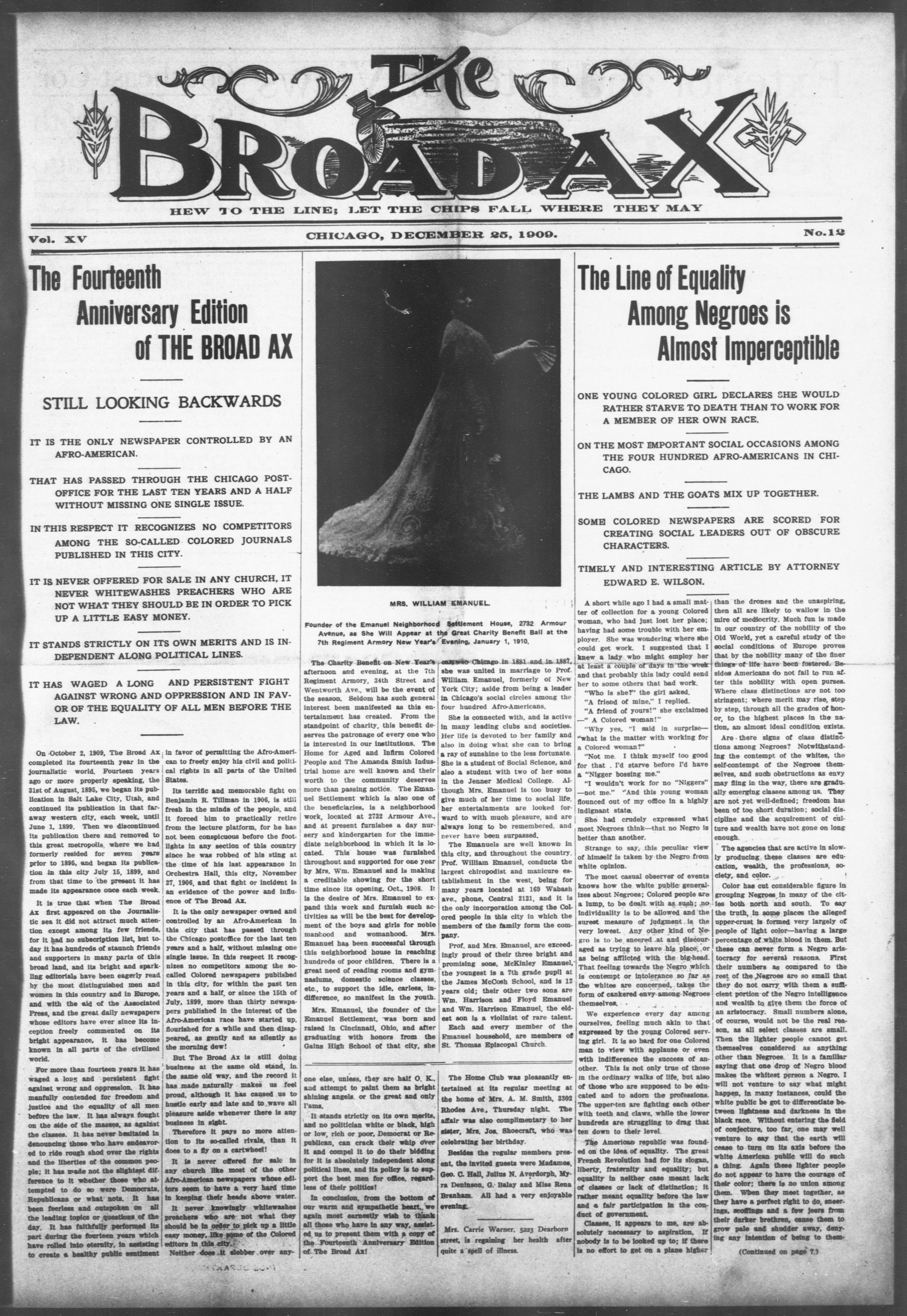
The Fourteenth Anniversary Edition of THE BROAD AX
STILL LOOKING BACKWARDS
IT IS THE ONLY NEWSPAPER CONTROLLED BY AN AFRO-AMERICAN.
THAT HAS PASSED THROUGH THE CHICAGO POST OFFICE FOR THE LAST TEN YEARS AND A HALF WITHOUT MISSING ONE SINGLE ISSUE.
IN THIS RESPECT IT RECOGNIZES NO COMPETITORS AMONG THE SO-CALLED COLORED JOURNALS PUBLISHED IN THIS CITY.
IT IS NEVER OFFERED FOR SALE IN ANY CHURCH, IT NEVER WHITEWASHES PREACHERS WHO ARE NOT WHAT THEY SHOULD BE IN ORDER TO PICK UP A LITTLE EASY MONEY.
IT STANDS STRICTLY ON ITS OWN MERITS AND IS INDEPENDENT ALONG POLITICAL LINES.
IT HAS WAGED A LONG AND PERSISTENT FIGHT AGAINST WRONG AND OPPRESSION AND IN FAVOR OF THE EQUALITY OF ALL MEN BEFORE THE LAW.
Vol. XV
STILL LOOKING
IT IS THE ONLY NEWSPAPER
AFRO-AMERICAN.
THAT HAS PASSED THROUGH
OFFICE FOR THE LAST
WITHOUT MISSING OTHERS.
IN THIS RESPECT IT RECORDS
AMONG THE SO-CALLED
PUBLISHED IN THIS CITY.
IT IS NEVER OFFERED FOR
NEVER WHITEWASHING
NOT WHAT THEY SHOOT
UP A LITTLE EASY MODE.
IT STANDS STRICTLY ON ITS
DEPENDENT ALONG PRACTICE.
IT HAS WAGED A LONG
AGAINST WRONG AND
OR OF THE EQUALITY
LAW.
On-October 2, 1909, The Broad Ax completed its fourteenth year in the journalistic world. Fourteen years ago or more properly speaking, the 31st of August, 1895, we began its publication in Salt Lake City, Utah, and continued its publication in that faraway western city, each week, until June 1, 1899. Then we discontinued its publication there and removed to this great metropolis, where we had formerly resided for seven years prior to 1895, and began its publication in this city July 15, 1899, and from that time to the present it has made its appearance once each week.
It is true that when The Broad Ax first appeared on the Journalistic sea it did not attract much attention except among its few friends, for it had no subscription list, but today it has hundreds of staunch friends and supporters in many parts of this broad land, and its bright and sparkling editors have been eagerly read by the most distinguished men and women in this country and in Europe, and with the aid of the Associated Press, and the great daily newspapers whose editors have ever since its inception freely commented on its bright appearance, it has become known in all parts of the civilized world.
For more than fourteen years it has waged a long and persistent fight against wrong and oppression. It has manfully contended for freedom and justice and the equality of all men before the law. It has always fought on the side of the masses, as against the classes. It has never hesitated in denouncing those who have endeavored to ride rough shod over the rights and the liberties of the common people; it has made not the slightest difference to it whether those who attempted to do so were Democrats, Republicans or what nots. It has been fearless and outspoken on all the leading topics or questions of the day. It has faithfully performed its part during the fourteen years which have rolled into eternity, in assisting to create a healthy public sentiment
HEW TO THE LINE; LET THE CHIPS FALL WHERE THEY MAY
in favor of permitting the Afro-American to freely enjoy his civil and political rights in all parts of the United States.
Its terrific and memorable fight on Benjamin R. Tillman in 1906, is still fresh in the minds of the people, and it forced him to practically retire from the lecture platform, for he has not been conspicuous before the footlights in any section of this country since he was robbed of his sting at the time of his last appearance in Orchestra Hall, this city, November 27, 1906, and that fight or incident is an evidence of the power and influence of The Broad Ax.
It is the only newspaper owned and controlled by an Afro-American in this city that has passed through the Chicago postoffice for the last ten years and a half, without missing one single issue. In this respect it recognizes no competitors among the so-called Colored newspapers published in this city, for within the past ten years and a half, or since the 15th of July, 1899, more than thirty newspapers published in the interest of the Afro-American race have started up, flourished for a while and then disappeared, as gently and as silently as the morning dew!
But The Broad Ax is still doing business at the same old stand, in the same old way, and the record it has made naturally makes us feel proud, although it has caused us to hustle early and late and to wave all pleasure aside whenever there is any business in sight.
Therefore it pays no more attention to its so-called rivals, than it does to a fly on a cartwheel!
It is never offered for sale in any church like most of the other Afro-American newspapers whose editors seem to have a very hard time in keeping their heads above water. It never knowingly whitewashes preachers who are not what they should be in order to pick up a little easy money, like some of the Colored editors in this city. Neither does it clobber over any-
CHICAGO, DECEMBER 25, 1909.
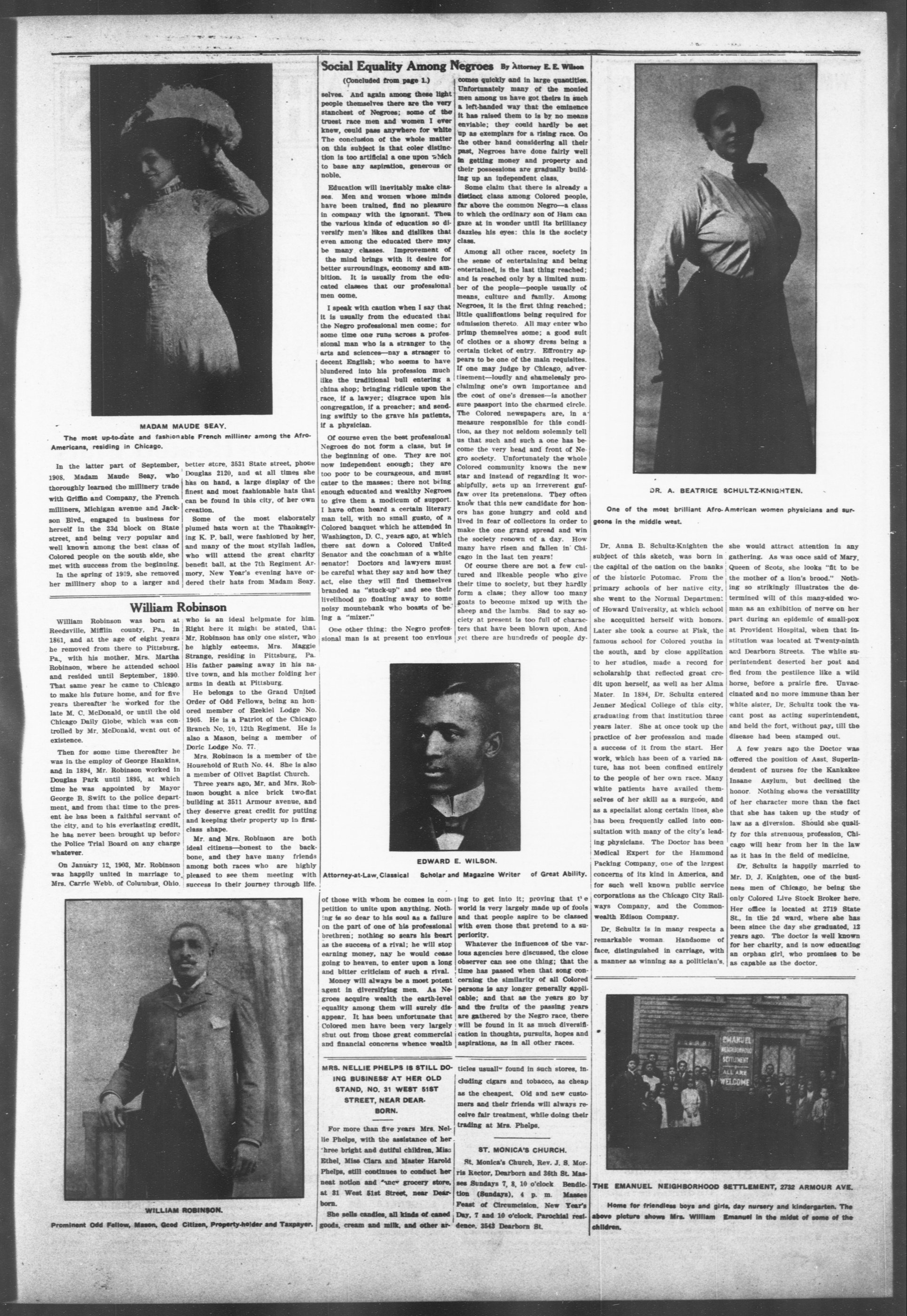
Founder of the Emanuel Neighborhood Settlement House, 2732 Armour Avenue, as She Will Appear at the Great Charity Benefit Ball at the 7th Regiment Armory New Year's Evening, January 1, 1910.
The Charity Benefit on New Year's afternoon and evening, at the 7th Regiment Armory, 34th Street and Wentworth Ave., will be the event of the season. Seldom has such general interest been manifested as this entertainment has created. From the standpoint of charity, this benefit deserves the patronage of every one who is interested in our institutions. The Home for Aged and Infirm Colored People and The Amanda Smith Industrial home are well known and their worth to the community deserves more than passing notice. The Emanuel Settlement which is also one of the beneficiaries, is a neighborhood work, located at 2732 Armour Ave., and at present furnishes a day nursery and kindergarten for the immediate neighborhood in which it is located. This house was furnished throughout and supported for one year by Mrs. Wm. Emanuel and is making a creditable showing for the short time since its opening, Oct., 1908. It is the desire of Mrs. Emanuel to expand this work and furnish such activities as will be the best for development of the boys and girls for noble manhood and womanhood. Mrs. Emanuel has been successful through this neighborhood house in reaching hundreds of poor children. There is a great need of reading rooms and gymnasiums, domestic science classes, etc., to support the idle, carless, indifference, so manifest in the youth
Mrs. Emanuel, the founder of the Emanuel Settlement, was born and raised in Cincinnati, Ohio, and after graduating with honors from the Gains High School of that city, she
one else, unless, they are half O. K., and attempt to paint them as bright shining angels, or the great and only Iams.
It stands strictly on its own merits, and no politician white or black, high or low, rich or poor, Democrat or Republican, can crack their whip over it and compel it to do their bidding for it is absolutely independent along political lines, and its policy is to support the best men for office, regardless of their politics!
In conclusion, from the bottom of our warm and sympathetic heart, we again most earnestly wish to thank all those who have in any way, assisted us to present them with a copy of the Fourteenth Anniversary Edition of The Broad Ax!
angelo Chicago in 1881 and in 1887, she was united in marriage to Prof. William Emanuel, formerly of New York City; aside from being a leader in Chicago's social circles among the four hundred Afro-Americans.
She is connected with, and is active in many leading clubs and societies. Her life is devoted to her family and also in doing what she can to bring a ray of sunshine to the less fortunate. She is a student of Social Science, and also a student with two of her sons in the Jenner Medical College. Although Mrs. Emanuel is too busy to give much of her time to social life, her entertainments are looked forward to with much pleasure, and are always long to be remembered, and never have been surpassed.
The Emanuels are well known in this city, and throughout the country. Prof. William Emanuel, conducts the largest chiropodist and manicure establishment in the west, being for many years located at 169 Wabash ave., phone, Central 2121, and it is the only incorporation among the Colored people in this city in which the members of the family form the company.
Prof. and Mrs. Emanuel, are exceedingly proud of their three bright and promising sons, McKinley Emanuel, the youngest is a 7th grade pupil at the James McCosh School, and is 12 years old; their other two sons are Wm. Harrison and Floyd Emanuel and Wm. Harrison Emanuel, the eldest son is a violinist of rare talent. Each and every member of the Emanuel household, are members of St. Thomas Episcopal Church.
The Home Club was pleasantly entertained at its regular meeting at the home of Mrs. A. M. Smith, 3302 Rhodes Ave., Thursday night. The affair was also complimentary to her sister, Mrs. Jos. Shoecraft, who was celebrating her birthday.
Besides the regular members present, the invited guests were Madames, Geo. C. Hall, Julius N. Averdorph, Myra Deninson, G. Balay and Miss Rena Branham. All had a very enjoyable evening.
Mrs. Carrie Warner, 5223 Dearborn street, is regaining her health after quite a spell of illness.
The Line of Equality Among Negroes is Almost Imperceptible
ONE YOUNG COLORED GIRL DECLARES SHE WOULD RATHER STARVE TO DEATH THAN TO WORK FOR A MEMBER OF HER OWN RACE.
ON THE MOST IMPORTANT SOCIAL OCCASIONS AMONG THE FOUR HUNDRED AFRO-AMERICANS IN CHICAGO.
THE LAMBS AND THE GOATS MIX UP TOGETHER
SOME COLORED NEWSPAPERS ARE SCORED FOR CREATING SOCIAL LEADERS OUT OF OBSCURE CHARACTERS.
TIMELY AND INTERESTING ARTICLE BY ATTORNEY EDWARD E. WILSON.
A short while ago I had a small matter of collection for a young Colored woman, who had just lost her place; having had some trouble with her employer. She was wondering where she could get work. I suggested that I knew a lady who might employ her at least a couple of days in the week and that probably this lady could send her to some others that had work.
"Who is she?" the girl asked.
"A friend of mine," I replied.
"A friend of yours!" she exclaimed—"A Colored woman!"
"Why yes, "I said in surprise—"what is the matter with working for a Colored woman?"
"Not me. I think myself too good for that. I'd starve before I'd have a "Nigger bossing me."
than the drones and the unaspiring then all are likely to wallow in the mire of mediocrity. Much fun is made in our country of the nobility of the Old World, yet a careful study of the social conditions of Europe prove that by the nobility of the fine things of life have been fostered. Besides Americans do not fail to run a ter this nobility with open purse. Where class distinctions are not to stringent; where merit may rise, step by step, through all the grades of honor, to the highest places in the nation, an almost ideal condition exist.
Are there signs of class distinctions among Negroes? Notwithstanding the contempt of the whites, the self-contempt of the Negroes then selves, and such obstructions as env
"I wouldn't work for no "Niggers"—not me." "And this young woman flounced out of my office in a highly indignant state. She had crudely expressed what most Negroes think—that no Negro is better than another. Strange to say, this peculiar view of himself is taken by the Negro from white opinion. The most casual observer of events knows how the white public generalizes about Negroes; Colored people are a lump, to be dealt with as such; no individuality is to be allowed and the surest measure of judgment is the very lowest. Any other kind of Negro is to be sneered at and discouraged as trying to leave his place, or as being afflicted with the big-head. That feeling towards the Negro which is contempt or intolerance so far as the whitee are concerned, takes the form of cankered envy among Negroes themselves.
We experience every day among ourselves, feeling much akin to that expressed by the young Colored serving girl. It is so hard for one Colored man to view with applause or even with indifference the success of another. This is not only true of those in the ordinary walks of life, but also of those who are supposed to be educated and to adorn the professions. The upper-ten are fighting each other with teeth and claws, while the lower hundreds are struggling to drag that ten down to their level.
The American republic was founded on the idea of equality. The great French Revolution had for its slogan, liberty, fraternity and equality; but equality in neither case meant lack of classes or lack of distinction; it rather meant equality before the law and a fair participation in the conduct of government.
Classes, it appears to me, are absolutely necessary to aspiration. If nobody is to be looked up to; if there is no effort to get on a plane higher
No.12
Reality
Negroes is
Not Imperceptible
ALL DECLARES SHE WOULD
BEATH THAN TO WORK FOR
OWN RACE.
SOCIAL OCCASIONS AMONG
AFRO-AMERICANS IN CHI-
ITS MIX UP TOGETHER.
PERS ARE SCORED FOR
READERS OUT OF OBSCURE
G ARTICLE BY ATTORNEY
than the drones and the unaspiring, then all are likely to wallow in the mire of mediocrity. Much fun is made in our country of the nobility of the Old Work, yet a careful study of the social conditions of Europe proves that by the nobility many of the finer things of life have been fostered. Besides Americans do not fail to run after this nobility with open purses. Where class distinctions are not too stringent; where merit may rise, step by step, through all the grades of honor, to the highest places in the nation, an almost ideal condition exists. Are there signs of class distinctions among Negroes? Notwithstanding the contempt of the whites, the self-contempt of the Negroes themselves, and such obstructions as envy may fling in the way, there are gradually emerging classes among us. They are not yet well-defined; freedom has been of too short duration; social discipline and the acquirement of culture and wealth have not gone on long enough.
The agencies that are active in slowly producing these classes are education, wealth, the professions, society, and color.
Color has cut considerable figure in grouping Negroes in many of the cities both north and south. To say the truth, in some places the alleged upper-crust is formed very largely of people of light color—having a large percentage of white blood in them. But these can never form a Negro aristocracy for several reasons. First their numbers as compared to the rest of the Negroes are so small that they do not carry with them a sufficient portion of the Negro intelligence and wealth to give them the force of an aristocracy. Small numbers alone, of course, would not be the real reason, as all select classes are small. Then the lighter people cannot get themselves considered as anything other than Negroes. It is a familiar saying that one drop of Negro blood makes the whitest person a Negro. I will not venture to say what might happen, in many instances, could the white public be got to differentiate between lightness and darkness in the black race. Without entering the field of conjecture, too far, one may well venture to say that the earth will cease to turn on its axis before the white American public will do such a thing. Again these lighter people do not appear to have the courage of their color; there is no union among them. When they meet together, as they have a perfect right to do, sneerings, scoffings and a few jeers from their darker brethren, cause them to grow pale and shudder away, denying any intention of being to them-
(Continued on page 7.)
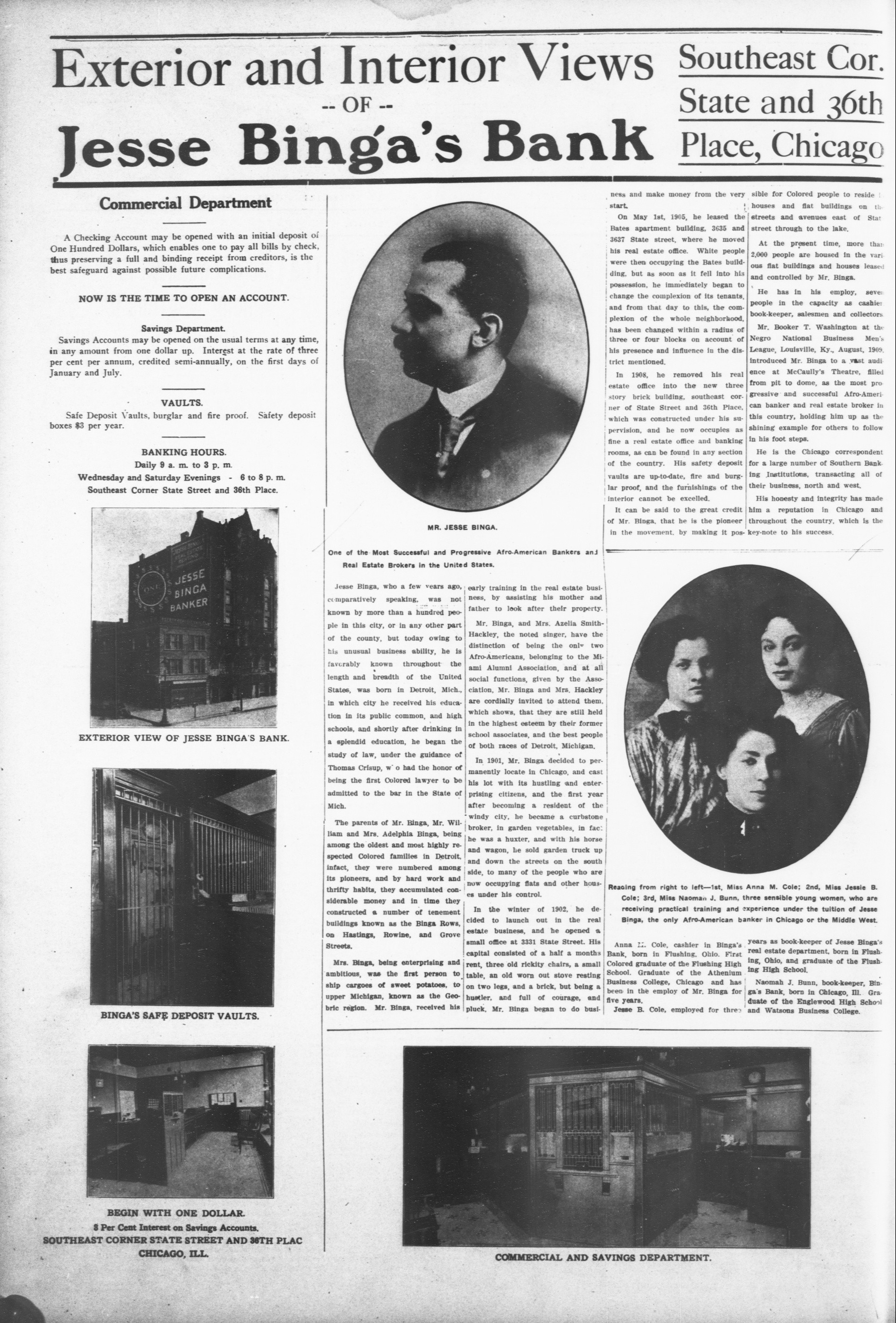
Exterior and Interior Views Southeast Cor. -- OF -- State and 36th Jesse Binga's Bank Place, Chicago
10
Commercial Department
Biting Account may be opened with an initial Dollars, which enables one to pay all bill giving a full and binding receipt from credit card against possible future complications.
N IS THE TIME TO OPEN AN ACCOUNT
A Checking Account may be opened with an initial deposit of One Hundred Dollars, which enables one to pay all bills by check, thus preserving a full and binding receipt from creditors, is the best safeguard against possible future complications.
NOW IS THE TIME TO OPEN AN ACCOUNT.
Savings Department.
Savings Accounts may be opened on the usual terms at any time, in any amount from one dollar up. Interest at the rate of three per cent per annum, credited semi-annually, on the first days of January and July.
Accounts may be opened on the usual terms to account from one dollar up. Interest at the rate annum, credited semi-annually, on the first July.
VAULTS.
Deposit Vaults, burglar and fire proof. Safe for year.
BANKING HOURS.
Daily 9 a. m. to 3 p. m.
Wednesday and Saturday Evenings - 6 to 8 p.
Southeast Corner State Street and 36th Place
TERIOR VIEW OF JESSE BINGA'S BANK
Safe Deposit Vaults, burglar and fire proof. Safety deposit boxes $3 per year.
BANKING HOURS.
Daily 9 a.m. to 3 p.m.
Wednesday and Saturday Evenings - 6 to 8 p.m.
Southeast Corner State Street and 36th Place.
JESSE BINGA
BANKER
REAL ESTATE REITING
ONE
EXTERIOR VIEW OF JESSE BINGA'S BANK
P
BINGA'S SAFE DEPOSIT VAULTS.
THE CENTER
BEGIN WITH ONE DOLLAR. 8 Per Cent Interest on Savings Accounts. SOUTHEAST CORNER STATE STREET AND 36TH PLAC CHICAGO. ILL.
BEGIN WITH ONE DOLLAR. 8 Per Cent Interest on Savings Accounts. SOUTHEAST CORNER STATE STREET AND 36TH PLAC CHICAGO. ILL.
[Name]
MR. JESSE BINGA
One of the Most Successful and Progressive Afro-American Bankers and Real Estate Brokers in the United States.
Jesse Binga, who a few years ago, comparatively speaking, was not known by more than a hundred people in this city, or in any other part of the county, but today owing to his unusual business ability, he is favorably known throughout the length and breadth of the United States, was born in Detroit, Mich., in which city he received his education in its public common, and high schools, and shortly after drinking in a splendid education, he began the study of law, under the guidance of Thomas Crisup, w o had the honor of being the first Colored lawyer to be admitted to the bar in the State of Mich.
The parents of Mr. Binga, Mr. William and Mrs. Adelphia Binga, being among the oldest and most highly respected Colored families in Detroit, infact, they were numbered among its pioneers, and by hard work and thrifty habits, they accumulated considerable money and in time they constructed a number of tenement buildings known as the Binga Rows, on Hastings, Rowine, and Grove Streets.
Mrs. Binga, being enterprising and ambitious, was the first person to ship cargoes of sweet potatoes, to upper Michigan, known as the Georic region. Mr. Binga, received his
early training in the real estate business, by assisting his mother and father to look after their property. Mr. Binga, and Mrs. Azelia Smith-Hackley, the noted singer, have the distinction of being the only two Afro-Americans, belonging to the Miami Alumni Association, and at all social functions, given by the Association, Mr. Binga and Mrs. Hackley are cordially invited to attend them, which shows, that they are still held in the highest esteem by their former school associates, and the best people of both races of Detroit, Michigan.
In 1901, Mr. Binga decided to permanently locate in Chicago, and cast his lot with its hustling and enterprising citizens, and the first year after becoming a resident of the windy city, he became a curbstone broker, in garden vegetables, in fact: he was a huxter, and with his horse and wagon, he sold garden truck up and down the streets on the south side, to many of the people who are now occupying flats and other houses under his control.
In the winter of 1902, he decided to launch out in the real estate business, and he opened a small office at 3331 State Street. His capital consisted of a half a month rent, three old rickity chairs, a small table, an old worn out stove resting on two legs, and a brick, but being a hustler, and full of courage, and pluck, Mr. Binga began to do busi-
COMMERCIAL AND SAVINGS DEPARTMENT.
A. B. C.
Reading from right to left—1st, Miss Anna M. Cole; 2nd, Miss Jessie B. Cole; 3rd, Miss Naoman J. Bunn, three sensible young women, who are receiving practical training and experience under the tuition of Jesse Binga, the only Afro-American banker in Chicago or the Middle West.
Reading from right to left—1st, Miss Anna M. Cole; 2nd, Miss Jessie B. Cole; 3rd, Miss Naoman J. Bunn, three sensible young women, who are receiving practical training and experience under the tuition of Jesse Binga, the only Afro-American banker in Chicago or the Middle West.
ness and make money from the very start.
On May 1st, 1905, he leased the Bates apartment building, 3635 and 3637 State street, where he moved his real estate office. White people were then occupying the Bates building, but as soon as it fell into his possession, he immediately began to change the complexion of its tenants, and from that day to this, the complexion of the whole neighborhood, has been changed within a radius of three or four blocks on account of his presence and influence in the district mentioned.
In 1908, he removed his real estate office into the new three story brick building, southeast corner of State Street and 36th Place, which was constructed under his supervision, and he now occupies as fine a real estate office and banking rooms, as can be found in any section of the country. His safety deposit vaults are up-to-date, fire and burglar proof, and the furnishings of the interior cannot be excelled.
It can be said to the great credit of Mr. Binga, that he is the pioneer in the movement, by making it pos
Reaoting from right to left—1st, Miss Cole; 3rd, Miss Naoman J. Bunn, receiving practical training and Binga, the only Afro-American ba
Anna L. Cole, cashier in Binga's Bank, born in Flushing, Ohio. First Colored graduate of the Flushing High School. Graduate of the Athenium Business College, Chicago and has been in the employ of Mr. Binga for five years. Jesse B. Cole, employed for three
---
sible for Colored people to reside in houses and flat buildings on the streets and avenues east of Stat street through to the lake.
At the present time, more than 2,000 people are housed in the various flat buildings and houses leased and controlled by Mr. Binga.
He has in his employ, seven people in the capacity as cashier book-keeper, salesmen and collectors Mr. Booker T. Washington at the Negro National Business Men's League, Louisville, Ky., August, 1909 introduced Mr. Binga to a vast audience at McCaully's Theatre, filled from pit to dome, as the most progressive and successful Afro-American banker and real estate broker in this country, holding him up as the shining example for others to follow in his foot steps.
He is the Chicago correspondent for a large number of Southern Banking Institutions, transacting all of their business, north and west. His honesty and integrity has made him a reputation in Chicago and throughout the country, which is the key-note to his success.
Anna M. Cole; 2nd, Miss Jessie B. three sensible young women, who are experience under the tuition of Jesse banker in Chicago or the Middle West.
years as book-keeper of Jesse Binga's real estate department, born in Flushing, Ohio, and graduate of the Flushing High School.
Naomah J. Bunn, book-keeper, Binga's Bank, born in Chicago, Ill. Graduate of the Englewood High School and Watsons Business College.
---
THE F. & P. DEPARTMENT STORE
THERE IS NO PLACE IN THE CITY WHERE YOU CAN INVEST YOUR CHRISTMAS MONEY TO BETTER ADVANTAGE THAN RIGHT HERE.
Be sure and come in and look over our stocks before buying your Christmas presents, even if you don't purchase, you will be assured courteous treatment and a warm welcome. Feinberg & Peck CORNER OF STATE AND THIRTY-FIRST ST.
CHRISTMAS
HANDKERCHIEFS.
No gift, can be more appropriate than a dainty handkerchief. You will find a wide selection here in Initial Handkerchiefs, Embroidered Handkerchiefs and Hemstitched Handkerchiefs.
Be sure and come in an
ents, even if you don't purc
welcome.
Feinb
CORNER OF ST
Phone Douglas 2234 NOTARY PUBLIC
Henry T. Wells
Real Estate, Loans,
Renting and Insurance
3221 STATE STREET CHICAGO, IL
Katherine R. Hamlet
CIGARS, TOBACCOS and CONFECTIONERY, NOTIONS, GROCERIES and BAKERY
5036 Armour Avenue CHICAGO
E. A. Stack
Prescription Druggist
Deutsche Apotheke
2842 S. State Street, CHICAGO
Corner Twenty-ninth Street
Telephone, Calumet 185
Chateau De La Plaisance
5324-26 State Street
Offers for the Winter Unique and
Superb
ROLLER SKATE PROGRAM
Every night in the week from 7 to
12 P. M. with the following
variations:
SKATING from 7 to 10:30—Dancing
from 10:30 to 12 P. M. every Tuesday,
Friday and Saturday night, with
the best Orchestra music. Cash Skate
Prize Content every Wednesday, Sunday
and Monday night.
Go where you will, pay what you may; but the CHATEAU leads in real wholesome health-giving entertainment. Come away from the stuffy, tubercular, 5 cent death given, cheap theatre and enjoy the invigorating, health-giving atmosphere of the CHATEAU.
Admission, 10 cents--one dime
LELAND GIANTS BASE BALL
& AMUSEMENT ASS'N.
One who is well acquainted on the south side, to sell suits, overcoats and trousers on salary, and commission.
Good job for the right man. N. S. Gross, importing tailor, 3018 State street, phone Douglas 172.
Adv. 4 times. Dec. 18.
Leach's Express & Vans ALL PHONES 2840 DOUGLAS
LEACHS STORAGE WAREHOUSE
LEACHS STORAGE WAREHOUSE
LEACHS STORAGE
EXPRESS VANS
LEACHS STORAGE
MISCELLANEOUS WAREHOUSE
FACKING & SHIPING
Private Rooms for Furniture, Heated Piano Rooms. Money Loaned on Furniture in Storage Main Office, 3228 State St. Warehouse, 4430 State St.
PRETTY MODELS IN LADIES' WAISTS.
Hand embroidered lingerie waists .....98c to $5.40
Taffeta and Messaline Waists .....$3.98 to $6.98
Tailored Waists, Plaited and trimmed with pockets and pearl buttons .....$1.98
and look over our stocks before b
purchase, you will be assured court
Leach's Exp
ALL PHONES
LEACH'S STORAGE WAREHOUSE
Private Rooms for Furnit
Money Loaned on
Main Office, 3228 State
A. E.
B. H. JOHNSON
Van and Express
Furniture Moving a Specialty
STORAGE WAREHOUSE
4915 STATE ST. CHICAGO
Women's White Aprons—
Great varieties in fancy and
practical styles ..... 25c, 35c, & 50.
Christmas Candies, All candies usually sold at 18c and
20c our price, ..... 10c
All candies usually sold at
40c and 50c our price ..... 20c.
buying your Christmas pres-
rteous treatment and a warm
Peck
PRTY-FIRST ST.
press & Vans
S 2840 DOUGLAS
LEACHS STORAGE WAREHOUSE
LEACHS
STORAGE
WASHING, REMOVALS
PACKING & BEDFING
iture, Heated Piano Rooms.
Furniture in Storage
te St. Warehouse, 4430 State St.
SPECIAL
One Life Size Picture with each order of $3.00 Photos.
GET YOUR PHOTO
TAKEN FOR XMAS
Peter P. Jones
3519 STATE ST.
Telephone Douglas 4332
Phone Calumet 526
George M. Porter, Ph. G.
Pharmacist
2842 Armour Avenue, - CHICAGO
U. S. Sub Postal Station
P.
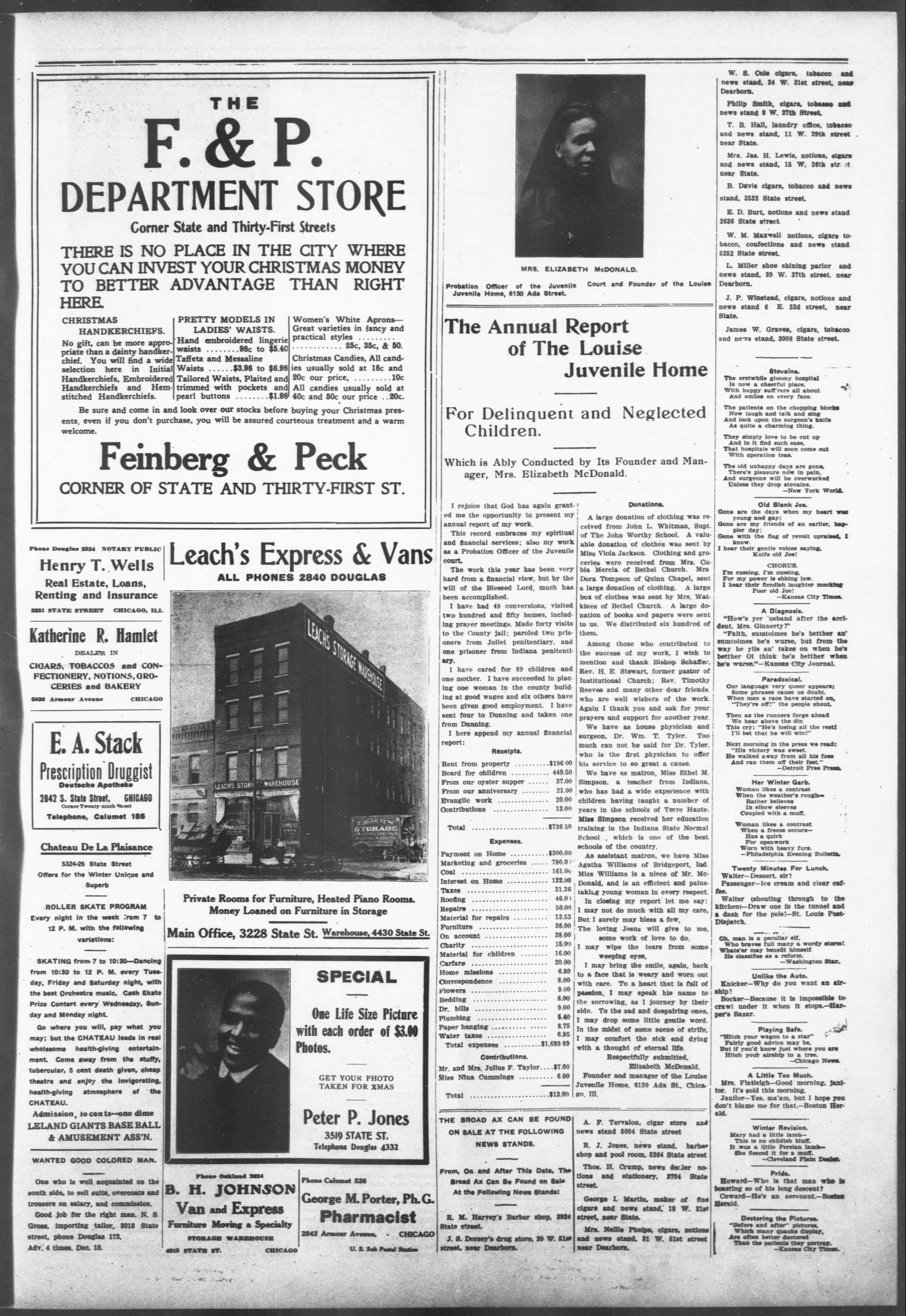
MRS. ELIZABETH McDONALD.
Probation Officer of the Juvenile Juvenile Home, 6130 Ada Street.
The Annual R of The J
For Delinquent Children.
Which is Ably Conducted ager, Mrs. Elizabeth N
Probation Officer of the Juvenile Court and Founder of the Louise Juvenile Home, 6130 Ada Street.
The Annual Report of The Louise Juvenile Home
For Delinquent and Neglected Children.
Which is Ably Conducted by Its Founder and Manager. Mrs. Elizabeth McDonald.
I rejoice that God has again granted me the opportunity to present my annual report of my work.
This record embraces my spiritual and financial services; also my work as a Probation Officer of the Juvenile court.
The work this year has been very hard from a financial view, but by the will of the Blessed Lord, much has been accomplished.
I have had 49 conversions, visited two hundred and fifty homes, including prayer meetings. Made forty visits to the County jail; paroled two prisoners from Joliet penitentiary, and one prisoner from Indiana penitentiary.
I have cared for 89 children and
one mother. I have succeeded in placing
one woman in the county building
at good wages and six others have
been given good employment. I have
sent four to Dunning and taken one
from Dunning.
I here append my annual financial
report:
Receipts.
Rent from property ..... $196.00
Board for children ..... 449.50
From our oyster supper ..... 37.00
From our anniversary ..... 21.00
Evanglic work ..... 20.00
Contributions ..... 13.00
Payment on Home ..... $300.00
Marketing and groceries ..... 780.01
Coal ..... 161.00
Interest on Home ..... 122.00
Taxes ..... 31.36
Roofing ..... 46.01
Repairs ..... 50.00
Material for repairs ..... 12.53
Furniture ..... 36.00
On account ..... 38.00
Charity ..... 15.00
Material for children ..... 16.00
Carfare ..... 20.00
Home missions ..... 6.80
Correspondence ..... 8.00
Flowers ..... 9.00
Bedding ..... 8.00
Dr. bills ..... 9.00
Plumbing ..... 5.40
Paper hanging ..... 8.75
Water taxes ..... 6.95
Total expenses ..... $1,689.89
Mr. and Mrs. Jullus F. Taylor.....$7.00
Miss Nina Cummings ..... 6.00
Total ..... $13.00
THE BROAD AX CAN BE FOUND ON SALE AT THE FOLLOWING NEWS STANDS.
From, On and After This Date, The Broad Ax Can Be Found on Sale At the Following News Stands:
R. M. Harvey's Barber shop, 3924 State street.
J. S. Dorsey's drug store, 20 W. 51st street, near Dearborn.
Receipts.
Expenses.
Report
Louise
Nuvenile Home
and Neglected
by Its Founder and Man-
McDonald.
Donations.
A large donation of clothing was received from John L. Whitman, Suptu of The John Worthy School. A valuable donation of clothes was sent by Miss Viola Jackson. Clothing and groceries were received from Mrs. Cubia Mercia of Bethel Church. Mrs. Dora Tompson of Quinn Chapel, sent a large donation of clothing. A large box of clothes was sent by Mrs. Watkines of Bethel Church. A large donation of books and papers were sent to us. We distributed six hundred of them.
Among those who contributed to the success of my work, I wish to mention and thank Bishop Schaffer; Rev. H. E. Stewart, former pastor of Institutional Church; Rev. Timothy Reeves and many other dear friends, who are well wishers of the work. Again I thank you and ask for your prayers and support for another year. We have as house physician and surgeon, Dr. Wm. T. Tyler. Too much can not be said for Dr. Tyler, who is the first physician to offer his service to so great a cause.
We have as matron, Miss Ethel M. Simpson, a teacher from Indiana, who has had a wide experience with children having taught a number of years in the schools of Terre Haute. Miss Simpson received her education training in the Indiana State Normal School , which is one of the best schools of the country.
As assistant matron, we have Miss Agatha Williams of Bridgeport, Ind. Miss Williams is a niece of Mr. McDonald, and is an efficient and painstaking young woman in every respect.
In closing my report let me say:
I may not do much with all my care, But I surely may bless a few, The loving Jesus will give to me.
The loving Jesus will give to me,
some work of love to do.
some work of love to do.
I may wipe the tears from some weeping eyes,
I may bring the smile, again, back to a face that is weary and worn out with care. To a heart that is full of passion, I may speak his name to the sorrowing, as I journey by their side. To the sad and despairing ones, I may drop some little gentle word. In the midst of some scene of strife, I may comfort the sick and dying with a thought of eternal life.
Founder and manager of the Louise Juvenile Home, 6130 Ada St., Chicago, Ill.
A. F. Tervalon, cigar store and news stand 5004 State street
Thos. H. Crump, news dealer notions and stationery, 3704 State street.
George I. Martin, maker of fine cigars and news stand, 18 W. 31st street, near State.
Mrs. Nellie Phelps, cigars, notions and news stand, 31 W. 51st street near Dearborn.
Donations.
W. S. Cole cigars, tobacco and news stand, 34 W. 31st street, near Dearborn.
Philip Smith, cigars, tobacco and news stand 8 W. 27th Street.
T. B. Hall, laundry office, tobacco and news stand, 11 W. 29th street near State.
Mrs. Jas. H. Lewis, notions, cigars and news stand, 15 W. 36th street near State.
B. Davis cigars, tobacco and news stand, 3532 State street.
E. D. Burt, notions and news stand 2636 State street.
W. M. Maxwell notions, cigars tobacco, confections and news stand 5252 State street.
L. Miller shoe shining parlor and news stand, 39 W. 37th street, near Dearborn.
J. P. Winstead, cigars, notions and news stand 6 E. 33d street, near State.
James W. Graves, cigars, tobacco and news stand, 3008 State street.
The erstwhile gloomy hospital
Is now a cheerful place.
With happy suffers all about
And smiles on every face.
The patients on the chopping blocks
Now laugh and talk and sing
And look upon the surgeon's knife
As quite a charming thing.
They simply love to be cut up
And in it find such ease.
That hospitals will soon come out
With operation teas.
The old unhappy days are gone,
There's pleasure now in pain.
And surgeons will be overworked
Unless they drop stovaine.
—New York World.
Old Blank Joe.
Gone are the days when my heart was
young and gay;
Gone are my friends of an earlier, hap-
pler day;
Gone with the flag of revolt upraised, I
know.
I hear their gentle voices saying,
Gone are the old Joe.
CHORUS.
I'm cussing. I'm cussing.
For my power is ebbing low.
I hear their fendish laughter mocking
Poor old Joe!
-Kansas City Times.
A Diagnosis.
"How's yer 'usband after the accident, Mrs. Glnerty?"
"Faith, sumtuloes he's better an' sumtuloes he's wurse, but from the way he yils an' takes on when he' bether Oi think he's better when he' wurse."-Kansas City Journal.
Paradoxical.
Our language very queer appears;
Some phrases cause us doubt.
When men a race have started on,
"They're off!" the people shout.
Then as the runners forge ahead
We hear above the din
This cry: "He's losing all the rest!
I bet that he will win!"
Next morning in the press we read:
"His wife was away from all his foes
And ran them off their feet."
—Detroit Free Press.
Her Winter Garb.
Woman likes a contrast
When the weather's rough—
Rather believes
In elbow sleeves
Coupled with a muff.
Woman likes a contrast
When a freeze occurs—
Has a quirk
For openwork
Worn with heavy furs.
—Philadelphia Evening Bulletin.
Twenty Minutes For Lunch.
Waiter—Dessert, sir?
Passenger—Ice cream and clear coffee.
Waiter (shouting through to the kitchen)—Draw one in the tunnel and a dash for the pole!—St. Louis Post-Dispatch.
Oh, man is a peculiar elf.
Who braves full many a wordy storm!
What'er may benefit himself.
He classifies as a reform.
—Washington Star.
Unlike the Auto.
Knicker—Why do you want an airship?
Bocker—Because it is impossible to crawl under it when it stops.—Harper's Bazar.
Playing Safe.
"Hitch your wagon to a star"
Fairly good advice may be.
But if you'd know just where you are
Hitch your airship to a tree.
-Chicago News.
A Little Too Much.
Mrs. Flatleigh—Good morning, janitor. It's gold this morning.
Janitor—Yes, ma'am, but I hope you don't blame me for that.—Boston Herald.
Winter Revision.
Mary had a little lamb—
This is no childish bluff.
It was a little Persian lamb—
She fleeced it for a muff.
-Cleveland Plain Dealer.
Pride.
Howard—Who is that man who is boasting so of his long descent?
Coward—He's an aeronaut.—Boston Herald.
Doctoring the Pictures.
"Before and after" pictures.
Which many quacks display.
Are often better doctored
Than the patients they portray.
—Kansas City Times.
THE BROADAX
PUBLISHED WEEKLY.
Will promulgate and at all times uphold the true principles of Democracy, but Catholicism, Protestants, Priests, In-Sols, Single Taxes, Republicans, or anyone else can have their say, as long their language is proper and responsibility is fixed.
The Broad Ax is a newspaper whose platform is broad enough for all, ever claiming the editorial right to speak its own mind.
Local communications will receive attention. Write only on one side of the paper.
Subscriptions must be paid in advance.
One Year.....$2.00
Six Months.....1.00
Advertising rates made known on application.
Address all communications to
THE BROAD AX
5022 Armour Avenue, Chicago.
JULIUS F. TAYLOR, Editor and Publisher.
Entered as Second-Class Matter,
Aug. 10, 1902 at the Post Office at
Chicago, Illinois, under Act of March
3, 1879.
THE HOTEL BRUNSWICK, GEORGE
W. HOLT, PROPRIETOR, TWENTY
ELEGANTLY FURNISHED
ROOMS FOR GUESTS.
It Is the Finest Hotel Conducted By
An Afro-American, in Chicago.
Something like one year ago, George W. Holt, who is in business in St. Louis, Mo., purchased the brick building at 3004 State street, paying $15,000 cash for it. Then he started in to remodel it from bottom to top, at an outlay of $15,000 to $20,000 more. He did not stop at these expenses however, and he transformed the second and third floors into a hotel, containing twenty elegantly furnished rooms for guests, which are constantly kept in a thorough sanitary condition.
The interior finish of the first floor, which contains the Buffet, pool and billiard parlor, is without the least question a hundred times finer than any establishment of its kind conducted by an Afro-American in any section of the country—in fact it is a dream, and no one can give a correct description of the magnificence of the expensive furnishings.
Again it can be said that it cannot be approached by any establishment run by an Afro-American in Chicago. Mr. Holt, possesses very cultured manners. He is unassuming and keeps a big pile of money in the First National Bank. His army of friends throughout the country never visit Chicago, without dropping into the Hotel Brunswick.
HAVE YOU VISITED THE OFFICE OF THE NORTH FORK COAL & IRON CO., 3724 STATE ST., IF NOT, WHY NOT?
This gigantic Negro corporation, with a capital stock of $500,000 in its ability to make good, is determined to restore confidence to the people.
The basis upon which this Corporation has maintained its standard is shown in its increased assets of the Company, which raised its stock from $2.50 market value to $5 per share, all of which are issued fully paid and non-assessible.
Persons seeking honest investment where their money is safe and has an unlimited earning value, had better buy now, because as the stock rises in value, it always gets further away from the ability of those who desire to purchase.
Our mines are now in operation and we will have 3,000 tons of coal ready for market in thirty days.
For further information call or write us.
John W. Hardy,
President.
Tel. Aldine 2286.
JOSEPH O. LANE, THE PRACTICAL JEWELER AND WATCH-MAKER
Mr. Joseph O. Lane, the well known, practical watch maker and jeweler, who was for many years engaged in business on South Clark street, between Harrison and Polk streets, who four years ago, removed his place of business to 76 E. 31st street, near Michigan ave., and his store is well stocked with a nice line of goods for the holiday season; such as ladies and gents gold and silver watches, diamond rings, elegant silverware, with the names of the purchaser engraved on each article, ladies fine combs, highly ornamented set with brilliant stones.
Mr. Lane takes great pleasure in stating; that "he will be delighted to greet his many old friends and patrons during the holiday season; that they will receive full value for every dollar's worth of goods purchased from him and that he is fully prepared to do watch and jewelry repairing.
[Image of a woman seated in a chair, wearing a large hat and a dark dress with decorative patterns.]
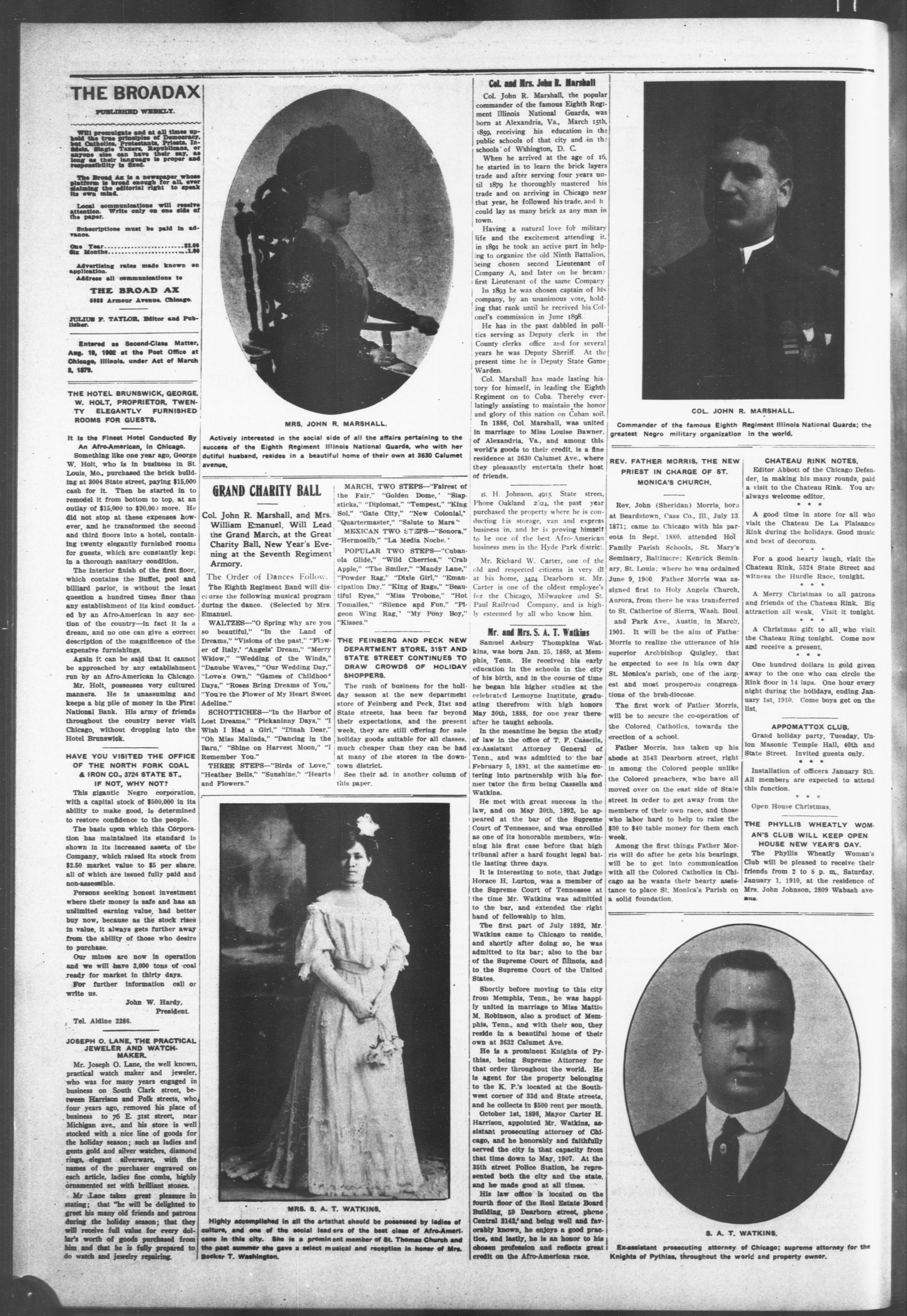
MRS. JOHN R. MARSHALL.
Actively interested in the social si success of the Eighth Regiment III dutiful husband, resides in a beautifl avenue.
ly interested in the social side of all the affa of the Eighth Regiment Illinois National C husband, resides in a beautiful home of theirs
Actively interested in the social side of all the affairs pertaining to the success of the Eighth Regiment Illinois National Guards, who with her dutiful husband, resides in a beautiful home of their own at 3630 Calumet avenue.
GRAND CHARITY BALL
GRAND CHARITY BALL
Col. John R. Marshall, and Mrs. William Emanuel, Will Lead the Grand March, at the Great Charity Ball, New Year's Evening at the Seventh Regiment Armory.
The Order of Dances Follow.
The Eighth Regiment Band will discourse the following musical program during the dance. (Selected by Mrs. Emanuel.
WALTZES—"O Spring why are you so beautiful," "In the Land of Dreams," "Visions of the past," "Flower of Italy,' Angels' Dream," "Merry Widow," "Wedding of the Winds," "Danube Waves," "Our Wedding Day," "Love's Own," "Games of Childhood Days," "Roses Bring Dreams of You," "You're the Flower of My Heart Sweet Adeline."
SCHOTTICHES—"In the Harbor of Lost Dreams," "Pickinny Days," "I Wish I Had a girl," "Dinah Dear," "Oh Miss Malinda," "Dancing in the Barn," "Shine on Harvest Moon," "I Remember You."
THREE STEPS—"Birds of Love," "Heather Bells," "Sunshine," "Hearts and Flowers."
The image provided does not contain any text. It appears to be a photograph of a person wearing a dress.
Mary
Mary
MRS. 6. A. T. WATKINS.
Highly accomplished in all the art that should be culture, and one of the social leaders of the be cane in this city. She is a prominent member of the past summer she gave a select musical and rec Booker T. Washington.
accomplished in all the artthat should be pro and one of the social leaders of the best this city. She is a prominent member of B summer she gave a select musical and recep Washington.
Highly accomplished in all the art that should be possessed by ladies of culture, and one of the social leaders of the best class of Afro-Americans in this city. She is a prominent member of St. Thomas Church and the past summer she gave a select musical and reception in honor of Mrs. Booker T. Washington.
Highly accomplished in all the art that should be possessed by ladies of culture, and one of the social leaders of the best class of Afro-Americans in this city. She is a prominent member of St. Thomas Church and the past summer she gave a select musical and reception in honor of Mrs. Booker T. Washington.
de of all the affairs pertaining to the Illinois National Guards, who with her home of their own at 3630 Calumet
MARCH, TWO STEPS—"Falrest of the Fair," "Golden Dome," "Slap sticks," "Diplomat," "Tempest," "King Sol," "Gate City," "New Colonial," "Quartermaster," "Salute to Mars"
MEXICAN TWO STEPS—"Sonora," "Hermosil," "La Media Noche."
POPULAR TWO STEPS—"Cubanola Glide," "Wild Cherries," "Crab Apple," "The Smiler," "Mandy Lane," "Powder Rag," "Dixie Girl," "Emancipation Day," "King of Rags," "Beautiful Eyes," "Miss Trobone," "Hot Tomalies," "Silence and Fun," "Plgeon Wing Rag," "My Pony Boy," "Kisses."
THE FEINBERG AND PECK NEW DEPARTMENT STORE, 31ST AND STATE STREET CONTINUES TO DRAW CROWD'S OF HOLIDAY SHOPPERS.
The rush of business for the holiday season at the new department store of Feinberg and Peck, 31st and State streets, has been far beyond their expectations, and the present week, they are still offering for sale holiday goods suitable for all classes, much cheaper than they can be had at many of the stores in the downtown district. See their ad. in another column of this paper.
THE FLOWER OF THE WEEK
that should be possessed by ladies of hers of the best class of Afro-Ameri- ment member of St. Thomas Church and musical and reception in honor of Mrs.
Col. and Mrs. John R. Marshall
Col. John R. Marshall, the popular commander of the famous Eighth Regiment Illinois National Guards, was born at Alexandria, Va., March 15th, 1899, receiving his education in the public schools of that city and in the schools of Wshington, D. C. When he arrived at the age of 16, he started in to learn the brick layers trade and after serving four years until 1879 he thoroughly mastered his trade and on arriving in Chicago near that year, he followed his trade, and he could lay as many brick as any man in town.
Having a natural love for military life and the excitement attending it, in 1891 he took an active part in helping to organize the old Ninth Battalion, being chosen second Lieutenant of Company A, and later on he became first Lieutenant of the same Company. In 1893 he was chosen captain of his company, by an unanimous vote, holding that rank until he received his Colonel's commission in June 1898.
He has in the past dabbled in politics serving as Deputy clerk in the County clerks office and for several years he was Deputy Sheriff. At the present time he is Deputy State Game Warden.
Col. Marshall has made lasting history for himself, in leading the Eighth Regiment on to Cuba. Thereby ever-latently assisting to maintain the honor and glory of this nation on Cuban soil. In 1886, Col. Marshall, was united in marriage to Miss Louise Bawner, of Alexandria, Va., and among this world's goods to their credit, is a fine residence at 3630 Calumet Ave., where they pleasantly entertain their host of friends.
B. H. Johnson, 4915 State street, Phone Oakland 2524, the past year purchased the property where he is conducting his storage, van and express business in, and he is proving himself to be one of the best Afro-American business men in the Hyde Park district.
Mr. Richard W. Carter, one of the old and respected citizens is very ill at his home, 3424 Dearborn st. Mr. Carter is one of the oldest employee's for the Chicago, Milwaukee and St. Paul Railroad Company, and is highly esteemed by all who know him.
Mr. and Mrs. S. A. T. Watkius
Samuel Asbury Thompkins Watkins, was born Jan. 25, 1869, at Memphis, Tenn. He received his early education in the schools in the city of his birth, and in the course of time he began his higher studies at the celebrated Lemoyne Institute, graduating therefrom with high honors May 30th, 1888, for one year thereafter he taught schools.
In the meantime he began the study of law in the office of T. F. Cassells, ex-Assistant Attorney General of Tenn., and was admitted to the bar February 5, 1891, at the sametime entering into partnership with his former tutor the firm being Cassells and Watkins.
He met with great success in the law, and on May 30th, 1892, he appeared at the bar of the Supreme Court of Tennessee, and was enrolled as one of its honorable members, winning his first case before that high tribunal after a hard fought legal battle lasting three days.
It is interesting to note, that Judge Horace H. Lurton, was a member of the Supreme Court of Tennessee at the time Mr. Watkins was admitted to the bar, and extended the right hand of fellowship to him.
The first part of July 1892, Mr. Watkins came to Chicago to reside, and shortly after doing so, he was admitted to its bar; also to the bar of the Supreme Court of Illinois, and to the Supreme Court of the United States.
Shortly before moving to this city from Memphis, Tenn., he was happily united in marriage to Miss Mattie M. Robinson, also a product of Memphis, Tenn., and with their son, they reside in a beautiful home of their own at 3632 Calumet Ave.
He is a prominent Knights of Pythias, being Supreme Attorney for that order throughout the world. He is agent for the property belonging to the K. P.'s located at the Southwest corner of 33d and State streets, and he collects in $500 rent per month
October 1st, 1898, Mayor Carter H. Harrison, appointed Mr. Watkins, assistant prosecuting attorney of Chicago, and he honorably and faithfully served the city in that capacity from that time down to May, 1907. At the 35th street Police Station, he represented both the city and the state, and he made good at all times. His law office is located on the fourth floor of the Real Estate Board Building, 59 Dearborn street, phone Central 3142,' and being well and favorably known, he enjoys a good practice, and lastly, he is an honor to his chosen profession and reflects great credit on the Afro-American race.
L.
COL. JOHN R. MARSHALL.
Commander of the famous Eighth Regiment Illinois National Guards; the greatest Negro military organization in the world.
REV. FATHER MORRIS, THE NEW PRIEST IN CHARGE OF ST. MONICA'S CHURCH.
Rev. John (Sheridan) Morris, born at Beardstown, Cass Co., Ill., July 13, 1871; came to Chicago with his parents in Sept. 1880, attended Holt Family Parish Schools, St. Mary's Seminary, Baltimore; Kenrick Seminary, St. Louis; where he was ordained June 9, 1900. Father Morris was assigned first to Holy Angels Church, Aurora, from there he was transferred to St. Catherine of Sierra, Wash. Boul, and Park Ave., Austin, in March, 1901. It will be the aim of Father Morris to realize the utterance of his superior Archbishop Quigley, that he expected to see in his own day St. Monica's parish, one of the largest and most prosperous congregations of the brsh-diocese.
The first work of Father Morris, will be to secure the co-operation of the Colored Catholics, towards the erection of a school.
Father Morris, has taken up his abode at 3543 Dearborn street, right in among the Colored people unlike the Colored preachers, who have all moved over on the east side of State street in order to get away from the members of their own race, and those who labor hard to help to raise the $30 to $40 table money for them each week.
Among the first things Father Morris will do after he gets his bearings, will be to get into communication with all the Colored Catholics in Chicago as he wants their hearty assistance to place St. Monica's Parish on a solid foundation.
[Name]
S. A. T. WATKINS.
Ex-assistant prosecuting attorney of Chicago; supreme attorney for the Knights of Pythias, throughout the world and property owner.
Regiment Illinois National Guards; the in the world.
CHATEAU RINK NOTES.
Editor Abbott of the Chicago Defender, in making his many rounds, paid a visit to the Chateau Rink. You are always welcome editor.
A good time in store for all who visit the Chateau De La Plaisance Rink during the holidays. Good music and best of decorum.
For a good hearty laugh, visit the Chateau Rink, 5324 State Street and witness the Hurdle Race, tonight.
A Merry Christmas to all patrons and friends of the Chateau Rink. Big attraction all weak. Visit it tonight.
* * *
A Christmas gift to all, who visit the Chateau Ring tonight. Come now and receive a present.
* * *
One hundred dollars in gold given away to the one who can circle the Rink floor in 14 laps. One hour every night during the holidays, ending January 1st, 1910. Come boys get on the list.
APPOMATTOX CLUB
Grand holiday party, Tuesday, Union Masonic Temple Hall, 40th and State Street. Invited guests only.
Installation of officers January 8th. All members are expected to attend this function.
* * *
Open House Christmas.
THE PHYLLIS WHEATLY WOMAN'S CLUB WILL KEEP OPEN HOUSE NEW YEAR'S DAY.
The Phyllis Wheatly Woman's Club will be pleased to receive their friends from 2 to 8 p. m., Saturday, January 1, 1910, at the residence of Mrs. John Johnson, 2809 Wabash ave.
---
[Picture of a woman with a high hairstyle, wearing a light-colored dress with a high collar. She is looking slightly to the side.]
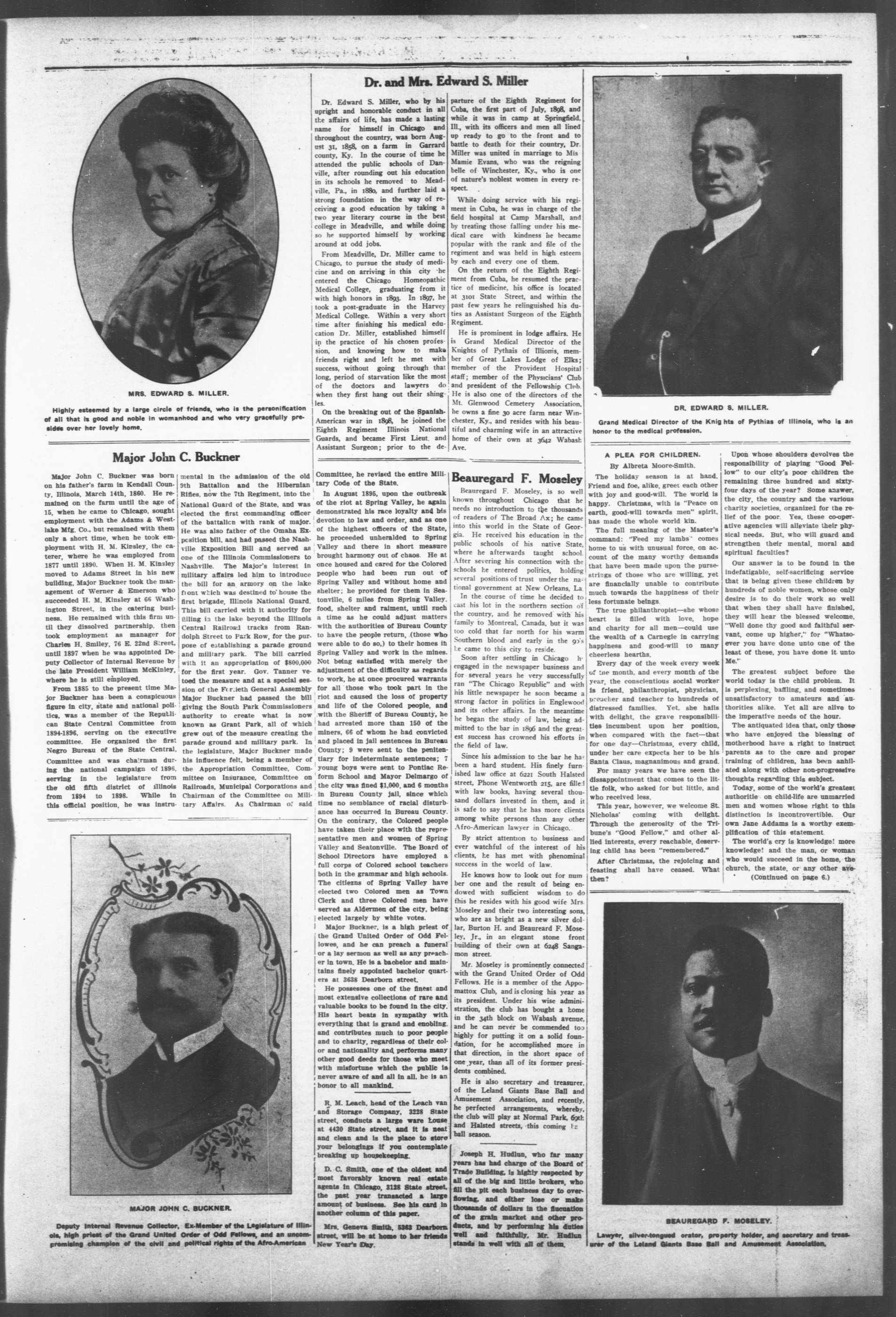
MRS. EDWARD S. MILLER.
Highly esteemed by a large circle of all that is good and noble in womans sides over her lovely home.
Highly esteemed by a large circle of friends, who is the personification of all that is good and noble in womanhood and who very gracefully presides over her lovely home.
Major John C. Buckner
Major John C. Buckner was born on his father's farm in Kendall County, Illinois, March 14th, 1860. He remained on the farm until the age of 15, when he came to Chicago, sought employment with the Adams & Westlake Mfg. Co., but remained with them only a short time, when he took employment with H. M. Kinsley, the caterer, where he was employed from 1877 until 1890. When H. M. Kinsley moved to Adams Street in his new building, Major Buckner took the management of Werner & Emerson who succeeded H. M. Kinsley at 66 Washington Street, in the catering business. He remained with this firm until they dissolved partnership, then took employment as manager for Charles H. Smiley, 76 E. 22nd Street until 1897 when he was appointed Deputy Collector of Internal Revenue by the late President William McKinley where he is still employed.
From 1885 to the present time Major Buckner has been a conspicuous figure in city, state and national politics, was a member of the Republican State Central Committee from 1894-1896, serving on the executive committee. He organized the first Negro Bureau of the State Central Committee and was chairman during the national campaign of 1896 serving in the legislature from the old fifth district of Illinois from 1894 to 1898. While in this official position, he was instruc
```markdown
```
[Portrait of a man in formal attire, framed by an ornate decorative border with floral motifs].
MAJOR JOHN C. BUCKNER.
Deputy Internal Revenue Collector oia, high priest of the Grand United promising champion of the civil an
Deputy Internal Revenue Collector, Ex-Member of the Legislature of Illinois, high priest of the Grand United Order of Odd Fellows, and an uncompromising champion of the civil and political rights of the Afro-American
of friends, who is the personification
hood and who very gracefully pre-
mental in the admission of the old 9th Battallion and the Hibernian Rifles, now the 7th Regiment, into the National Guard of the State, and was elected the first commanding officer of the battalion with rank of major. He was also father of the Omaha Exposition bill, and had passed the Nashville Exposition Bill and served as one of the Illinois Commissioners to Nashville. The Major's interest in military affairs led him to introduce the bill for an armory on the lake front which was destined to house the first brigade, Illinois National Guard. This bill carried with it authority for filling in the lake beyond the Illinois Central Railroad tracks from Randolph Street to Park Row, for the purpose of establishing a parade ground and military park. The bill carried with it an appropriation of $800,000 for the first year. Gov. Tanner vetoed the measure and at a special session of the Fri. ieth General Assembly Major Buckner had passed the bill giving the South Park Commissioners authority to create what is now known as Grant Park, all of which grew out of the measure creating the parade ground and military park. In the legislature, Major Buckner made his influence felt, being a member of the Appropriation Committee, Committee on Insurance, Committee on Railroads, Municipal Corporations and Chairman of the Committee on Military Affairs. As Chairman of said
1
Ex-Member of the Legislature of Illin-
Order of Odd Fellows, and an uncom-
political rights of the Afro-American
Dr. and Mrs. Edward S. Miller
Dr. Edward S. Miller, who by his upright and honorable conduct in all the affairs of life, has made a lasting name for himself in Chicago and throughout the country, was born August 31, 1858, on a farm in Garrard county, Ky. In the course of time he attended the public schools of Danville, after rounding out his education in its schools he removed to Meadville, Pa., in 1880, and further laid a strong foundation in the way of receiving a good education by taking a two year literary course in the best college in Meadville, and while doing so he supported himself by working around at odd jobs.
From Meadville, Dr. Miller came to Chicago, to pursue the study of medicine and on arriving in this city he entered the Chicago Homeopathic Medical College, graduating from it with high honors in 1893. In 1897, he took a post-graduate in the Harvey Medical College. Within a very short time after finishing his medical education Dr. Miller, established himself in the practice of his chosen profession, and knowing how to make friends right and left he met with success, without going through that long, period of starvation like the most of the doctors and lawyers do when they first hang out their shingles.
On the breaking out of the Spanish-American war in 1898, he joined the Eighth Regiment Illinois National Guards, and became First Lieut. and Assistant Surgeon; prior to the de-
Committee, he revised the entire Military Code of the State.
In August 1895, upon the outbreak of the riot at Spring Valley, he again demonstrated his race loyalty and his devotion to law and order, and as one of the highest officers of the State, he proceeded unheralded to Spring Valley and there in short measure brought harmony out of chaos. He at once housed and cared for the Colored people who had been run out of Spring Valley and without home and shelter; he provided for them in Seatonville, 6 miles from Spring Valley, food, shelter and raiment, until such a time as he could adjust matters with the authorities of Bureau County to have the people return, (those who were able to do so.) to their homes in Spring Valley and work in the mines. Not being satisfied with merely the adjustment of the difficulty as regards to work, he at once procured warrants for all those who took part in the riot and caused the loss of property and life of the Colored people, and with the Sheriff of Bureau County, he had arrested more than 150 of the miners, 66 of whom he had convicted and placed in jail sentences in Bureau County; 9 were sent to the penitentiary for indeterminate sentences; 7 young boys were sent to Pontiac Reform School and Mayor Delmargo of the city was fined $1,000, and 6 months in Bureau County jail, since which time no semblance of racial disturbance has occurred in Bureau County. On the contrary, the Colored people have taken their place with the representative men and women of Spring Valley and Seatonville. The Board of School Directors have employed a full corps of Colored school teachers both in the grammar and high schools. The cityitzes of Spring Valley have elected two Colored men as Town Clerk and three Colored men have served as Aldermen of the city, being elected largely by white votes.
Major Buckner, is a high priest of the Grand United Order of Odd Fellows, and he can preach a funeral or a lay sermon as well as any preacher in town. He is a bachelor and maintains finely appointed bachelor quarters at 3638 Dearborn street.
He possesses one of the finest and most extensive collections of rare and valuable books to be found in the city. His heart beats in sympathy with everything that is grand and enobling, and contributes much to poor people and to charity, regardless of their color and nationality and performs many other good deeds for those who meet with misfortune which the public is never aware of and all in all, he is an honor to all mankind.
R. M. Leach, head of the Leach van and Storage Company, 3228 State street, conducts a large ware Louse at 4430 State street, and it is neat and clean and is the place to store your belongings if you contemplate breaking up housekeeping.
D. C. Smith, one of the oldest and most favorably known real estate agents in Chicago, 3128 State street, the past year transacted a large amount of business. See his card in another column of this paper.
Mrs. Geneva Smith, 5363 Dearborn street, will be at home to her friends New Year's Day.
parture of the Eighth Regiment for Cuba, the first part of July, 1898, and while it was in camp at Springfield, Ill., with its officers and men all lined up ready to go to the front and to battle to death for their country, Dr. Miller was united in marriage to Mis Mamie Evans, who was the reigning belle of Winchester, Ky., who is one of nature's noblest women in every respect.
While doing service with his regiment in Cuba, he was in charge of the field hospital at Camp Marshall, and by treating those falling under his medical care with kindness he became popular with the rank and file of the regiment and was held in high esteem by each and every one of them.
On the return of the Eighth Regiment from Cuba, he resumed the practice of medicine, his office is located at 3101 State Street, and within the past few years he relinguished his duties as Assistant Surgeon of the Eighth Regiment.
He is prominent in lodge affairs. He is Grand Medical Director of the Knights of Pythais of Illionis, member of Great Lakes Lodge of Elks; member of the Provident Hospital staff; member of the Physicians' Club and president of the Fellowship Club. He is also one of the directors of the Mt. Glenwood Cemetery Association, he owns a fine 30 acre farm near Winchester, Ky., and resides with his beautiful and charming wife in an attractive home of their own at 3642 Wabash Ave.
Beauregard F. Moseley
Beauregard F. Moseley, is so well known throughout Chicago that he needs no introduction to the thousands of readers of The Broad Ax; he came into this world in the State of Georgia. He received his education in the public schools of his native State, where he afterwards taught school. After severing his connection with the schools he entered politics, holding several positions of trust under the national government at New Orleans, La. In the course of time he decided to cast his lot in the northern section of the country, and he removed with his family to Montreal, Canada, but it was too cold that far north for his warm Southern blood and early in the 90's he came to this city to reside.
Soon after settling in Chicago he engaged in the newspaper business and for several years he very successfully ran "The Chicago Republic" and with his little newspaper he soon became a strong factor in politics in Englewood and its other affairs. In the meantime he began the study of law, being admitted to the bar in 1896 and the greatest success has crowned his efforts in the field of law.
Since his admission to the bar he has been a hard student. His finely furnished law office at 6221 South Halsted street, Phone Wentworth 215, are filled with law books, having several thousand dollars invested in them, and it is safe to say that he has more clients among white persons than any other Afro-American lawyer in Chicago.
By strict attention to business and ever watchful of the interest of his clients, he has met with phenominal success in the world of law.
He knows how to look out for number one and the result of being endowed with sufficient wisdom to do this he resides with his good wife Mrs. Moseley and their two interesting sons, who are as bright as a new silver dollar, Burton H. and Beaureard F. Moseley, Jr., in an elegant stone front building of their own at 6248 Sangamon street.
Mr. Moseley is prominently connected with the Grand United Order of Odd Fellows. He is a member of the Appomattox Club, and is closing his year as its president. Under his wise administration, the club has bought a home in the 34th block on Wabash avenue, and he can never be commended too highly for putting it on a solid foundation, for he accomplished more in that direction, in the short space of one year, than all of its former presidents combined.
He is also secretary and treasurer, of the Leland Giants Base Ball and Amusement Association, and recently, he perfected arrangements, whereby the club will play at Normal Park, 69th and Halsted streets, this coming ball season.
Joseph H. Hudlun, who far many years has had charge of the Board of Trade Building, is highly respected by all of the big and little brokers, who fill the pit each business day to overflowing, and either lose or make thousands of dollars in the fluctuation of the grain market and other products, and by performing his duties well and faithfully, Mr. Hudlun stands in well with all of them.
DR. EDWARD S. MILLER.
Grand Medical Director of the Knight honor to the medical profession.
Grand Medical Director of the Knights of Pythias of Illinois, who is an honor to the medical profession.
Grand Medical Director of the Knights of Pythias of Illinois, who is an honor to the medical profession.
A PLEA FOR CHILDREN.
The holiday season is at hand, Friend and foe, alike, greet each other with joy and good-will. The world is happy. Christmas, with is "Peace on earth, good-will towards men" spirit, has made the whole world kin.
The full meaning of the Master's command: "Feed my lambs" comes home to us with unusual force, on account of the many worthy demands that have been made upon the pursestrings of those who are willing, yet are financially unable to contribute much towards the happiness of their less fortunate beings.
The true philanthropist—she whose heart is filled with love, hope and charity for all men—could use the wealth of a Carnegie in carrying happiness and good-will to many cheerless hearths.
Every day of the week every week of the month, and every month of the year, the conscientious social worker is friend, philanthropist, physician, preacher and teacher to hundreds of distressed families. Yet, she halls with delight, the grave responsibilities incumbent upon her position, when compared with the fact—that for one day—Christmas, every child, under her care expects her to be his Santa Claus, magnanimous and grand. For many years we have seen the dissappointment that comes to the little folk, who asked for but little, and who received less.
This year, however, we welcome St. Nicholas' coming with delight. Through the generosity of the Tribune's "Good Fellow," and other allied interests, every reachable, deserving child has been "remembered."
After Christmas, the rejoicing and feasting shall have ceased. What then?
[Image of a man with dark hair and a mustache, wearing a suit and a white shirt. The background is a plain, light color.]
[Portrait of a man in formal attire, facing forward.]
BEAUREGARD F. MOSELEY. Lawyer, silver-tongued orator, property holder, an auer of the Leland Giants Base Ball and Amuseme
Lawyer, silver-tongued orator, property holder, and secretary and treasurer of the Leland Giants Base Ball and Amusement Association.
hts of Pythias of Illinois, who is an Upon whose shoulders devolves the responsibility of playing "Good Fellow" to our city's poor children the remaining three hundred and sixty-four days of the year? Some answer, the city, the country and the various charity societies, organized for the relief of the poor. Yes, these co-operative agencies will alleviate their physical needs. But, who will guard and strengthen their mental, moral and spiritual faculties?
Our answer is to be found in the indefatigable, self-sacrificing service that is being given these children by hundreds of noble women, whose only desire is to do their work so well that when they shall have finished, they will hear the blessed welcome, "Well done thy good and faithful servant, come up higher," for "Whatsoever you have done unto one of the least of these, you have done it unto Me."
The greatest subject before the world today is the child problem. It is perplexing, baffling, and sometimes unsatisfactory to amateurs and authorities alike. Yet all are alive to the imperative needs of the hour.
The antiquated idea that, only those who have enjoyed the blessing of motherhood have a right to instruct parents as to the care and proper training of children, has been anhilated along with other non-progressive thoughts regarding this subject. Today, some of the world's greatest authorite on child-life are unmarried men and women whose right to this distinction is incontrovertible. Our own Jane Addams is a worthy exemplification of this statement. The world's cry is knowledge! more knowledge! and the man, or woman who would succeed in the home, the church, the state, or any other ave- (Continued on page 6)
(Continued on page 6.)
property holder, and secretary and treas- and Amusement Association.
Anti-Mob Bill
WHICH WAS GOTTEN THRO
ILLINOIS IN 1905, BY
WHO HAS IMMORTAL
HEROIC WORK IN THE
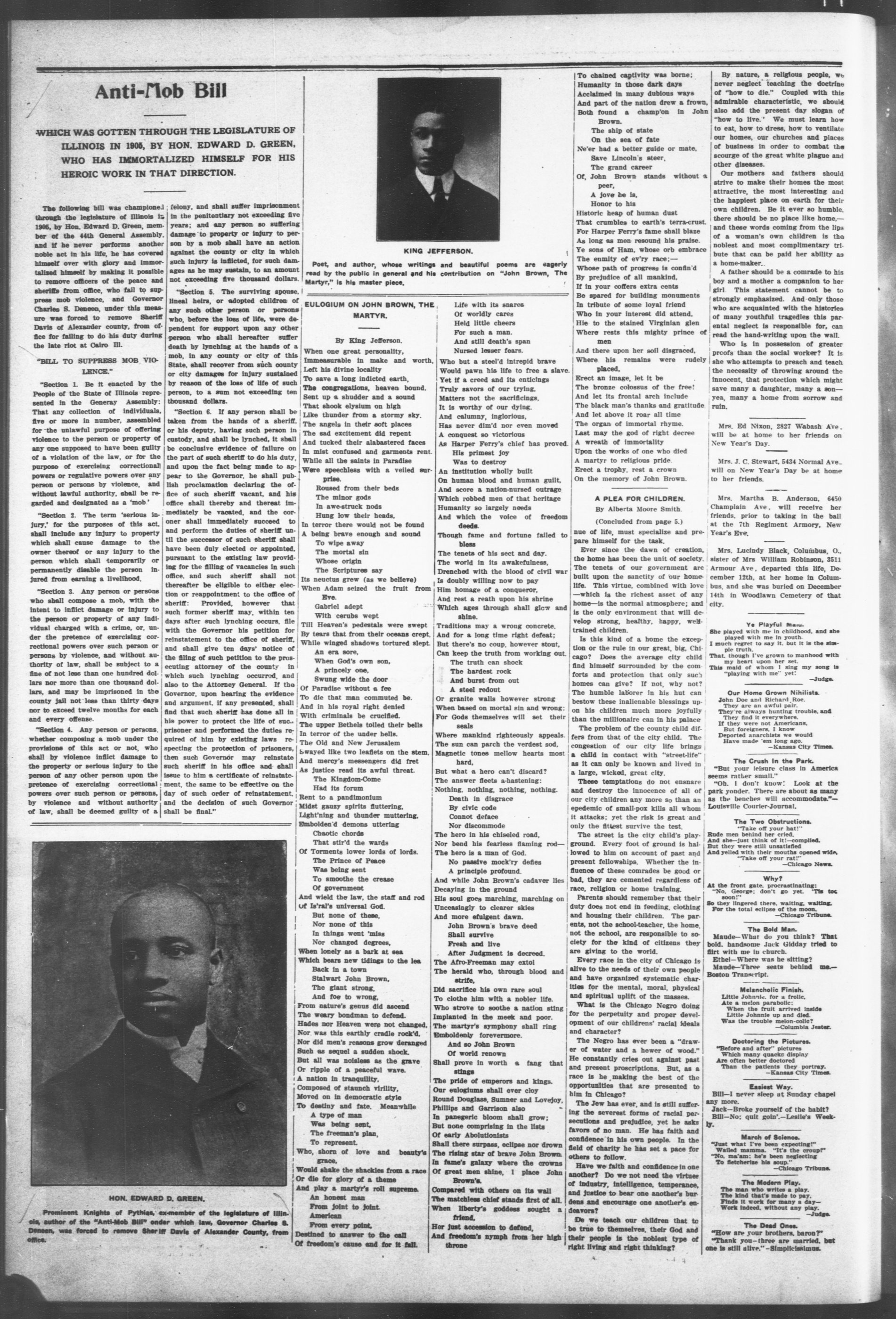
WHICH WAS GOTTEN THROUGH THE LEGISLATURE OF ILLINOIS IN 1905, BY HON. EDWARD D. GREEN, WHO HAS IMMORTALIZED HIMSELF FOR HIS HEROIC WORK IN THAT DIRECTION.
The following bill was championed through the legislature of Illinois in 1905, by Hon. Edward D. Green, member of the 44th General Assembly, and if he never performs another noble act in his life, he has covered himself over with glory and immortalized himself by making it possible to remove officers of the peace and sheriffs from office, who fail to suppress mob violence, and Governor Charles S. Deneen, under this measure was forced to remove Sheriff Davis of Alexander county, from office for falling to do his duty during the late riot at Cairo Ill.
"BILL TO SUPPRESS MOB VIOLENCE."
"Section 1. Be it enacted by the People of the State of Illinois represented in the Generay Assembly: That any collection of individuals, five or more in number, assembled for the unlawful purpose of offering violence to the person or property of any one supposed to have been guilty of a violation of the law, or for the purpose of exercising correctional powers or regulative powers over any person or persons by violence, and without lawful authority, shall be regarded and designated as a 'mob.'
"Section 2. The term 'serious injury,' for the purposes of this act, shall include any injury to property which shall cause damage to the owner thereof or any injury to the person which shall temporarily or permanently disable the person injured from earning a livelihood.
"Section 3. Any person or persons who shall compose a mob, with the intent to inflict damage or injury to the person or property of any individual charged with a crime, or, under the pretence of exercising correctional powers over such person or persons by violence, and without authority of law, shall be subject to a fine of not less than one hundred dollars nor more than one thousand dollars, and may be imprisoned in the county jail not less than thirty days nor to exceed twelve months for each and every offense.
"Section 4. Any person or persons, whether composing a mob under the provisions of this act or not, who shall by violence inflict damage to the property or serious injury to the person of any other person upon the pretence of exercising correctional powers over such person or persons, by violence and without authority of law, shall be deemed guilty of a
---
[Name not visible]
Prominent Knights of Pythian, ex-member of the legislature of Illinois, author of the "Anti-Mob Bill" order which law, Governor Charles S. Densen, was forced to remove Sheriff Davie of Alexander County, from
felony, and shall suffer imprisonment in the penitentiary not exceeding five years; and any person so suffering damage to property or injury to person by a mob shall have an action against the county or city in which such injury is inflicted, for such damages as he may sustain, to an amount not exceeding five thousand dollars.
"Section 5. The surviving spouse, lineal heirs, or adopted children of any such other person or persons who, before the loss of life, were dependent for support upon any other person who shall hereafter suffer death by lynching at the hands of a mob, in any county or city of this State, shall recover from such county or city damages for injury sustained by reason of the loss of life of such person, to a sum not exceeding ten thousand dollars.
"Section 6. If any person shall be taken from the hands of a sheriff, or his deputy, having such person in custody, and shall be lynched, it shall be conclusive evidence of failure on the part of such sheriff to do his duty, and upon the fact being made to appear to the Governor, he shall publish proclamation declaring the office of such sheriff vacant, and his office shall thereby and threat immediately be vacated, and the coroner shall immediately succeed to and perform the duties of sheriff until the successor of such sheriff shall have been duly elected or appointed, pursuant to the existing law providing for the filling of vacancies in such office, and such sheriff shall not thereafter be eligible to either election or reappointment to the office of sheriff: Provided, however that such former sheriff may, within ten days after such lynching occurs, file with the Governor his petition for reinstatement to the office of sheriff, and shall give ten days' notice of the filing of such petition to the prosecuting attorney of the county in which such lynching occurred, and also to the Attorney General. If the Governor, upon hearing the evidence and argument, if any presented, shall find that such sheriff has done all in his power to protect the life of such prisoner and performed the duties required of him by existing laws respecting the protection of prisoners, then such Governor may reinstate such sheriff in his office and shall issue to him a certificate of reinstatement, the same to be effective on the day of such order of reinstatement, and the decision of such Governor shall be final."
[Name]
KING JE
Poet, and author, whose writings
read by the public in general and his
Martyr," is his master piece.
KING JEFFERSON. in whose writings and beautiful p. on general and his contribution on other piece.
Poet, and author, whose writings and beautiful poems are eagerly read by the public in general and his contribution on "John Brown, The Martyr," is his master piece.
EULOGIUM ON JOHN BROWN, THE
MARTYR.
Life with its snares
Of worldly cares
By King Jefferson.
When one great personality,
Immeasurable in make and worth
Left his divine locality
To save a long indicted earth,
The congregations, heaven bound.
Sent up a shudder and a sound
That shook elysium on high
Like thunder from a stormy sky.
The angels in their soft places
The sad excitement did repent
And tucked their alabastered faces
In mist confused and garments rent
While all the saints in Paradise
Were speechless with a veiled sur
prise.
Roused from their beds
The minor gods
In awe-struck nods
Hung low their heads,
In terror there would not be found
A being brave enough and sound
To wipe away
The mortal sin
Whose origin
The Scriptures say
Its nectus grew (as we believe)
When Adam seized the fruit from
Eve.
Gabriel adept
With cerubs wept
Till Heaven's pedestals were swept
By tears that from their oceans crept.
While winged shadows tortured slept.
An era sore,
When God's own son,
A princely one.
our beds
his
meads,
not be found
th and sound
ay
(we believe)
the fruit from
it
els were swept
our oceans crept.
its tortured slept
son,
An institution with
On human blood d
And score a natio
Which robbed men
Humanity so large
And which the w
deeds.
Though fame and
bless
The tenets of his
The world in its
Drenched with the
Is doubly willing to
Him homage of a
And rest a reath
Which ages through
shine.
Traditions may a
And for a long time
But there's no cou
Can keep the truth
The truth can
The hardest r
Swung wide the door
Of Paradise without a fee
To die that man commuted be.
And in his royal right denied
With criminals be crucified.
The upper Bethels tolled their bells
In terror of the under hells.
The Old and New Jerusalem
Swayed like two leaflets on the stem,
And mercy's messengers did fret
As justice read its awful threat.
The Kingdom-Come
Had its forum
Rent to a pandimonium
Midst gauzy spirits fluttering,
Light'ning and thunder muttering,
Embolden'd demons uttering
Chaotic chords
That stir'd the wards
Of Torments lower lords of lords.
The Prince of Peace
Was being sent
To smoothhe the crease
Of government
And wield the law, the staff and rod
Of Is'ral's universal God.
But none of these,
Nor none of this
In things went 'miss
Non shaped demes
John Brown's
Shall survive
Fresh and live
After Judgmen
The Afro-Freeman
The herald who, t
miss
trees,
at sea
leaps to the lea
grow deranged
en shock.
has the grave
soul wave.
v.
virility,
mic style
Meanwhile
,
and beauty's
ties from a race
theme
And so John But
Of world renow
Shall prove in wor
stings
The pride of emper
Our eulogiums shall
Round Douglass, Su
Phillips and Garris,
In panegeric bloom
But none comprising
Of early Abolutioni
Shall there surpass,
The rising star of k
In fame's galaxy w
Of great men shine
Brown's.
EFFERSON.
is and beautiful poems are eagerly
is contribution on "John Brown, The
E Life with its snares
Of worldly cares
Held little cheers
For such a man.
And still death's span
Nursed lesser fears.
Who but a steel'd intrepid brave
Would pawn his life to free a slave
Yet if a creed and its enticings
Truly savors of our trying.
Matters not the sacrificils.
It is worthy of our dying.
And calumny, inglorious,
Has never dim'd nor even moved
A conquest so victorious
As Harper Ferry's chief has proved. His primest joy Was to destroy An institution wholly built On human blood and human guilt, And score a nation-nursed outrage Which robbed men of that heritage Humanity so largely needs And which the voice of freedom deeds. Though fame and fortune failed to bless The tenets of his sect and day. The world in its awakefulness, Drenched with the blood of civil war Is doubly willing now to pay Him homage of a conqueror, And rest a reath upon his shrine Which ages through shall glow and shine. Traditions may a wrong concrete, And for a long time right defeat; But there's no coup, however stout. Can keep the truth from working out. The truth can shock The hardest rock And burst from out A steel redout Or granite walls however strong When based on mortal sin and wrong; For Gods themselves will set their seals Where mankind righteously appeals. The sun can parch the verdest sod, Magnetic tones mellow hearts most hard, But what a hero can't discard? The answer fleets a-hastening: Nothing, nothing, nothing, nothing Death in disgrace By civic code Connot deface Nor discomode
The hero in his chiseled road,
Nor bend his fearless flaming rod—
The hero is a man of God.
No passive mock'ry defies
A principle profound.
And while John Brown's cadaver lies
Decaying in the ground
His soul goes marching, marching on
Unceasingly to clearer skies
And more efulgent dawn.
John Brown's brave deed
Shall survive
Fresh and live
After Judgment is decreed.
The Afro-Freeman may extol
The herald who, through blood and
strike.
Did sacrifice his own rare soul
To clothe him with a nobler life.
Who strove to soothe a nation sting
Implanted in the meek and poor.
The martyr's symphony shall ring
Emboldenly forevermore.
And so John Brown
Of world renown
Shall prove in worth a fang that
stings
The pride of emperors and kings.
Our eulogiums shall ever cloy
Round Douglass, Sumner and Lovejoy,
Phillips and Garrison also
In panegeric bloom shall grow;
But none comprising in the lists
Of early Abolutionists
Shall there surpass, eclipse nor drown
The rising star of brave John Brown.
In fame's galaxy where the crowns
Of great men shine, 1 place John
Brown's.
To chained captivity was borne;
Humanity in those dark days
Acclaimed in many dubious ways
And part of the nation drew a frown,
Both found a champ'on in John
Brown
Of, John Brown stands without a neer.
Historic heap of human dust
That crumbles to earth's terra-crust.
For Harper Ferry's fame shall blaze
As long as men resound his praise.
Ye sons of Ham, whose orb embrace
The enmity of ev'ry race;—
Whose path of progress is confin'd
By prejudice of all mankind.
If in your coffers extra cents
Be spared for building monuments
In tribute of some loyal friend
Who in your interest did attend.
Hie to the stained Virginian glen
Where rests this mighty prince of
men
And there upon her soil disgraced,
Where his remains were rudely
placed.
Erect an image, let it be
The bronze colossus of the free!
And let its frontal arch include
The black man's thanks and gratitude
And let above it roar all time
The organ of immortal rhyme.
Last may the god of right decree
A wreath of immortality
Upon the works of one who died
A martyr to religious pride.
Erect a trophy, rest a crown
On the memory of John Brown.
A PLEA FOR CHILDREN.
By Alberta Moore Smith.
nue of life, must specialize and prepare himself for the task. Ever since the dawn of creation, the home has been the unit of society. The tenets of our government are built upon the sanctity of our home-life. This virtue, combined with love—which is the richest asset of any home—is the normal atmosphere; and is the only environment that will develop strong, healthy, happy, well-trained children.
Is this kind of a home the exception or the rule in our great, big, Chicago? Does the average city child find himself surrounded by the comforts and protection that only such homes can give? If not, why not? The humble laborer in his hut can bestow these inalienable blessings upon his children much more joyfully than the millionaire can in his palace The problem of the county child differs from that of the city child. The congestion of our city life brings a child in contact with "street-life" as it can only be known and lived in a large, wicked, great city.
These temptations do not ensnare and destroy the innocence of all of our city children any more so than an epidemic of small-pox kills all whom it attacks; yet the risk is great and only the fittest survive the test. The street is the city child's playground. Every foot of ground is hallowed to him on account of past and present fellowships. Whether the influence of these comrades be good or bad, they are cemented regardless of race, religion or home training. Parents should remember that their duty does not end in feeding, clothing and housing their children. The parents, not the school-teacher, the home, not the school, are responsible to society for the kind of citizens they are giving to the world.
Every race in the city of Chicago is alive to the needs of their own people and have organized systematic charities for the mental, moral, physical and spiritual uplift of the masses.
What is the Chicago Negro doing for the perpetuity and proper development of our childrens' racial ideals and character?
The Negro has ever been a "drawer of water and a hewer of wood."
He constantly cries out against past and present proscriptions. But, as a race is he making the best of the opportunities that are presented to him in Chicago?
The Jew has ever, and is still suffering the severest forms of racial persecutions and prejudice, yet he asks favors of no man. He has faith and confidence in his own people. In the field of charity he has set a pace for others to follow.
Have we faith and confidence in one another? Do we not need the virtues of industry, intelligence, temperance, and justice to bear one another's burdens and encourage one another's endeavors?
Do we teach our children that to be true to themselves, their God and their people is the noblest type of right living and right thinking?
By nature, a religious people, we never neglect teaching the doctrine of "how to die." Coupled with this admirable characteristic, we should also add the present day slogan of "how to live." We must learn how to eat, how to dress, how to ventilate our homes, our churches and places of business in order to combat the scourge of the great white plague and other diseases.
Our mothers and fathers should strive to make their homes the most attractive, the most interesting and the happiest place on earth for their own children. Be it ever so humble, there should be no place like home, and these words coming from the lips of a woman's own children is the noblest and most complimentary tribute that can be paid her ability as a home-maker.
A father should be a comrade to his boy and a mother a companion to her girl. This statement cannot be to strongly emphasized. And only those who are acquainted with the histories of many youthful tragedies this parental neglect is responsible for, can read the hand-writing upon the wall.
Who is in possession of greater profs than the social worker? It is she who attempts to preach and teach the necessity of throwing around the innocent, that protection which might save many a daughter, many a son—yea, many a home from sorrow and ruin.
Mrs. Ed Nixon, 2827 Wabash Ave. will be at home to her friends on New Year's Day.
Mrs. J. C. Stewart, 5434 Normal Ave. will on New Year's Day be at home to her friends.
Mrs. Martha B. Anderson, 6450 Champlain Ave., will receive her friends, prior to taking in the ball at the 7th Regiment Armory, New Year's Eve.
Mrs. Lucindy Black, Columbus, O., sister of Mrs William Robinson, 3511 Armour Ave., departed this life, December 12th, at her home in Columbus, and she was buried on December 14th in Woodlawn Cemetery of that city.
Ye Playful Man.
She played with me in childhood, and she played with me in youth.
I much regret to say it, but it is the simple truth.
This thing I've grown to manhood with my heart upon her set.
This mald of whom I sing my song is "playing with me" yet!
—Judge.
Our Home Grown Nihilists.
John Doe and Richard, Roe.
They are an awful pair.
They're always hunting trouble, and they find it everywhere.
If they were not Americans, but foreigners, I know.
Deported anarchists we would.
Have made 'em long ago.
—Kansas City Times.
The Crush In the Park.
"But your leisure class in America seems rather small."
"Oh. I don't know! Look at the park parken. There are about as many as the benches will accommodate."—Louisville Courier Journal.
The Two Obstructions.
"Take off your hat!"
Rude men behind her cried.
And she—just think of it!—compiled.
But they were still unsatisfied
And yelled with their mouths opened wide,
"Take off your rat!"
-Chicago News.
The Bold Man.
Maude—What do you think? That bold, handsome Jack Gidday tried to firt with me in church.
Ethel—Where was he sitting?
Maude—Three seats behind me.—Boston Transcript.
Melancholic Finish.
Little Johnnie, for a frolic,
Ate a melon parabolic;
When the fruit arrived inside
Little Johnnie up and died.
Was the trouble melon-colle?
—Columbia Jester.
Doctoring the Pictures.
"Before and after" pictures
Which many quacke display
Are often better doctored
Than the patients they portray.
—Kansas City Times.
Easiest Way.
Bill—I never sleep at Sunday chapel any more.
Jack—Broke yourself of the habit?
Bill—No; quit goin'.-Leslie's Weekly.
March of Science.
"Just what I've been expecting!"
Wailed mamma. "It's the croup!"
No, ma'am: he's been neglecting
To fletcherize his soup.
-Chicago Tribune.
The Modern Play.
The man who writes a play.
The kind that's made to pay.
Finda it work for many a day.
Work indeed, without any play.
-Judge.
The Dead Ones.
The Dead Ones.
"How are your brothers, baron?"
"Thank you--three are married, but one is still alive."-Simplificius.
```markdown
```
MADAM MAUDE SEAY.
The most up-to-date and fashionable French milliner among the Afro-Americans, residing in Chicago.
In the latter part of September, 1908, Madam Maude Seay, who thoroughly learned the millinery trade with Griffin and Company, the French milliners, Michigan avenue and Jackson Blvd., engaged in business for herself in the 33d block on State street, and being very popular and well known among the best class of Colored people on the south side, she met with success from the beginning. In the spring of 1909, she removed her millinery shop to a larger and better store, 3531 State street, phoou Douglas 2120, and at all times she has on hand, a large display of the finest and most fashionable hats that can be found in this city, of her own creation.
Some of the most elaborately plumed hats worn at the Thanksgiving K. P. ball, were fashioned by her and many of the most stylish ladies who will attend the great charity benefit ball, at the 7th Regiment A mory, New Year's evening have o dered their hats from Madam Seay
William Robinson
William Robinson was born at Reedsville, Mifflin county, Pa., in 1861, and at the age of eight years he removed from there to Pittsburg, Pa., with his mother, Mrs. Martha Robinson, where he attended school and resided until September, 1890. That same year he came to Chicago to make his future home, and for five years thereafter he worked for the late M. C. McDonald, or until the old Chicago Daily Globe, which was controlled by Mr. McDonald, went out of existence.
Then for some time thereafter he was in the employ of George Hankins, and in 1894, Mr. Robinson worked in Douglas Park until 1895, at which time he was appointed by Mayor George B. Swift to the police department, and from that time to the present he has been a faithful servant of the city, and to his everlasting credit, he has never been brought up before the Police Trial Board on any charge whatever.
On January 12, 1903, Mr. Robinson was happily united in marriage to Mrs. Carrie Webb, of Columbus Ohio.
Prominent Odd Fellow, Mason, Good Citizen, Property-holder and Taxpayer.
better store, 3531 State street, phone Douglas 2120, and at all times she has on hand, a large display of the finest and most fashionable hats that can be found in this city, of her own creation. Some of the most elaborately plumed hats worn at the Thanksgiving K. P. ball, were fashioned by her, and many of the most stylish ladies, who will attend the great charity benefit ball, at the 7th Regiment Armory, New Year's evening have ordered their hats from Madam Seay.
who is an ideal helpmate for him. Right here it might be stated, that Mr. Robinson has only one sister, who he highly esteems, Mrs. Maggie Strange, residing in Pittsburg, Pa. His father passing away in his native town, and his mother folding her arms in death at Pittsburg. He belongs to the Grand United Order of Odd Fellows, being an honored member of Ezekiel Lodge No. 1905. He is a Patriot of the Chicago Branch No. 10, 12th Regiment. He is also a Mason, being a member of Doric Lodge No. 77. Mrs. Robinson is a member of the Household of Ruth No. 44. She is also a member of Olivet Baptist Church.
Three years ago, Mr. and Mrs. Robinson bought a nice brick two-flat building at 3511 Armour avenue, and they deserve great credit for putting and keeping their property up in first-class shape.
Mr. and Mrs. Robinson are both ideal citizens—honest to the backbone, and they have many friends among both races who are highly pleased to see them meeting with success in their journey through life.
Social Equality Among Negroes By Attorney E. E. Wilson
(Concluded from page 1.)
selves. And again among these light people themselves there are the very stanchest of Negroes; some of the truest race men and women I ever knew, could pass anywhere for white. The conclusion of the whole matter on this subject is that color distinction is too artificial a one upon which to base any aspiration, generous or noble.
Education will inevitably make classes. Men and women whose minds have been trained, find no pleasure in company with the ignorant. Then the various kinds of education so diversify men's likes and dislikes that even among the educated there may be many classes. Improvement of the mind brings with it desire for better surroundings, economy and ambition. It is usually from the educated classes that our professional men come.
I speak with caution when I say that it is usually from the educated that the Negro professional men come; for some time one runs across a professional man who is a stranger to the arts and sciences—nay a stranger to decent English; who seems to have blundered into his profession much like the traditional bull entering a china shop; bringing ridicule upon the race, if a lawyer; disgrace upon his congregation, if a preacher; and sending swiftly to the grave his patients, if a physician.
Of course even the best professional Negroes do not form a class, but is the beginning of one. They are not now independent enough; they are too poor to be courageous, and must cater to the masses; there not being enough educated and wealthy Negroes to give them a modicum of support. I have often heard a certain literary man tell, with no small gusto, of a Colored banquet which he attended in Washington, D. C., years ago, at which there sat down a Colored United Senator and the coachman of a white senator! Doctors and lawyers must be careful what they say and how they act, else they will find themselves branded as "stuck-up" and see their livelihood go floating away to some noisy mountebank who boasts of being a "mixer."
One other thing: the Negro professional man is at present too envious
[Name]
EDWARD E. WILSON.
Attorney-at-Law Classical Scholar and Magazine Writer of Great Ability.
of those with whom he comes in competition to unite upon anything. Nothing is so dear to his soul as a failure on the part of one of his professional brethren; nothing so sears his heart as the success of a rival; he will stop earning money, nay he would cease going to heaven, to enter upon a long and bitter criticism of such a rival. Money will always be a most potent agent in diversifying men. As Negroes acquire wealth the earth-level equality among them will surely disappear. It has been unfortunate that Colored men have been very largely shut out from those great commercial and financial concerns whence wealth
MRS. NELLIE PHELPS IS STILL DOING BUSINESS AT HER OLD STAND, NO. 31 WEST 5187 STREET, NEAR DEAR.
For more than five years Mrs. Nellie Phelps, with the assistance of her three bright and dutiful children, Miss Ethel, Miss Clara and Master Harold Phelps, still continues to conduct her neat notion and "unc" grocery store, at 31 West 51st Street, near Dearborn.
She sells candies, all kinds of caned goods, cream and milk, and other ar-
comes quickly and in large quantities. Unfortunately many of the monied men among us have got theirs in such a left-handed way that the eminence it has raised them to is by no means enviable; they could hardly be set up as exemplars for a rising race. On the other hand considering all their past, Negroes have done fairly well in getting money and property and their possessions are gradually building up an independent class. Some claim that there is already a distinct class among Colored people, far above the common Negro—a class to which the ordinary son of Ham can gaze at in wonder until its brilliancy dazzles his eyes: this is the society class.
Among all other races, society in the sense of entertaining and being entertained, is the last thing reached; and is reached only by a limited number of the people—people usually of means, culture and family. Among Negroes, it is the first thing reached; little qualifications being required for admission thereto. All may enter who primp themselves some; a good suit of clothes or a showy dress being a certain ticket of entry. Effrontry appears to be one of the main requisites. If one may judge by Chicago, advertisement—loudly and shamelessly proclaiming one's own importance and the cost of one's dresses—is another sure passport into the charmed circle. The Colored newspapers are, in a measure responsible for this condition, as they not seldom solemnly tell us that such and such a one has become the very head and front of Negro society. Unfortunately the whole Colored community knows the new star and instead of regarding it worshipfully, sets up an irreverent guffaw over its pretensions. They often know that this new candidate for honors has gone hungry and cold and lived in fear of collectors in order to make the one grand spread and win the society renown of a day. How many have risen and fallen in Chicago in the last ten years!
Of course there are not a few cultured and likeable people who give their time to society, but they hardly form a class; they allow too many goats to become mixed up with the sheep and the lambs. Sad to say society at present is too full of characters that have been blown upon. And yet there are hundreds of people dy
ing to get into it; proving that t'e world is very largely made up of fools and that people aspire to be classed with even those that pretend to a superiority. Whatever the influences of the various agencies here discussed, the close observer can see one thing; that the time has passed when that song concerning the similarity of all Colored persons is any longer generally applicable; and that as the years go by and the fruits of the passing years are gathered by the Negro race, there will be found in it as much diversification in thoughts, pursuits, hopes and aspirations, as in all other races.
ticles usually found in such stores, including cigars and tobacco, as cheap as the cheapest. Old and new customers and their friends will always receive fair treatment, while doing their trading at Mrs. Phelps.
ST. MONICA'S CHURCH.
St. Monica's Church, Rev. J. S. Morris Rector, Dearborn and 36th St. Masses Sundays 7, 8, 10 o'clock Bendiction (Sundays), 4 p. m. Masses Feast of Circumcision, New Year's Day, 7 and 10 o'clock. Parochial residence. 3543 Dearborn St.
THE WOMEN'S HISTORY MUSEUM
DR. A. BEATRICE SCHULTZ-KNIGHTEN.
One of the most brilliant Afro-American women physicians and surgeons in the middle west.
One of the most brilliant Afro-American women physicians and surgeons in the middle west.
Dr. Anna B. Schultz-Knighten the subject of this sketch, was born in the capital of the nation on the banks of the historic Potomac. From the primary schools of her native city, she went to the Normal Department of Howard University, at which school she acquitted herself with honors. Later she took a course at Fisk, the famous school for Colored youths in the south, and by close application to her studies, made a record for scholarship that reflected great credit upon herself, as well as her Alma Mater. In 1894, Dr. Schultz entered Jenner Medical College of this city, graduating from that institution three years later. She at once took up the practice of her profession and made a success of it from the start. Her work, which has been of a varied nature, has not been confined entirely to the people of her own race. Many white patients have availed themselves of her skill as a surgeon, and as a specialist along certain lines, she has been frequently called into consultation with many of the city's leading physicians. The Doctor has been Medical Expert for the Hammond Packing Company, one of the largest concerns of its kind in America, and for such well known public service corporations as the Chicago City Railways Company, and the Commonwealth Edison Company.
Dr. Schultz is in many respects a remarkable woman. Handsome of face, distinguished in carriage, with a manner as winning as a politician's.
CHANUEL
WELCOME
SETTLENENT
ALL ARE
WELCOME
THE EMANUEL NEIGHBORHOOD SETTLEMENT, 2732 ARMOUR AVE. Home for friendless boys and girls, day nursery and kindergarten. The above picture shows Mrs. William Emanuel in the midst of some of the children.
she would attract attention in any gathering. As was once said of Mary, Queen of Scots, she looks "fit to be the mother of a lion's brood." Nothing so strikingly illustrates the determined will of this many-sided woman as an exhibition of nerve on her part during an epidemic of small-pox at Provident Hospital, when that institution was located at Twenty-ninth and Dearborn Streets. The white superintendent deserted her post and fled from the pestilence like a wild horse, before a prairie fire. Unvaccinated and no more immune than her white sister, Dr. Schultz took the vacant post as acting superintendent, and held the fort, without pay, till the disease had been stamped out.
A few years ago the Doctor was offered the position of Asst. Superindependent of nurses for the Kankakee Insane Asylum, but declined the honor. Nothing shows the versatility of her character more than the fact that she has taken up the study of law as a diversion. Should she qualify for this strenuous profession, Chicago will hear from her in the law as it has in the field of medicine.
Dr. Schultz is happily married to Mr. D. J. Knighten, one of the business men of Chicago, he being the only Colored Live Stock Broker here. Her office is located at 2719 State St., in the 2d ward, where she has been since the day she graduated, 12 years ago. The doctor is well known for her charity, and is now educating an orphan girl, who promises to be as capable as the doctor.
THE BANK OF NEW YORK
HILLMANS
STATE & WASHINGTON STS.
GENERAL BANKING
Telephone Yards 693
3 per cent allowed on Savings Accounts Safety Deposit Vaults, $3.00 per Year
As agent buy and sell Real Estate on commission, manages estates for non-residents, including payment of taxes and locking after assessments. Money to loan on Chicago Real Estate.
Office Phone, Douglas 727 Res. Phone, Douglas 1856
E. JACKSON
FUNERAL DIRECTOR
2959-61 STATE ST., CHICAGO
Branch: 1310 Bingham St., Pittsburg, Pa.
Fine Carriages for Hire to Parties and Weddings
Stove Heated Flats
and houses to suit your income. I rent only my own property. When you want to rent, you will save many a weary step, if you first call on
We do not claim to be the biggest, best or oldest Drug Store on Earth
Samuel Richardson, 142 La Salle Street Telephone Main 2133 CHICAGO Room 1, OTIS BLOCK
But we are doing everything we can to make this a Drug Store where Customers will always feel that they are being well treated and getting full value received.
Frank H. Lewie, Prop. Lou Seldon, Mgr.
Phone Oakland 1787.
THE RAILROAD INN
We most cordially invite you to come here and buy whatever you use from a Drug Store. We would like to have you feel perfectly at home in our store. Bring your friends with you. You will always be welcome.
Customers may rely upon obtaining pure medicines. Physicians' Prescriptions and Family Recipes Accurately Prepared.
Our best Bargain White Rose Pomade 10c
FOR THE HAIR—ELEGANTLY PERFUMED, PURE AND HARMLESS.
Invigorates the Scalp and renders the Hair pliable and silky. The reliable Pomade for Ladies and Gentlemen.
John H. Montgomery, Druggist
Gerald Bldg., 26th and State Street, Chicago
Frank H. Lewia, Prop.
- American Brick Co. -
EDWARD'S WHITE PINE and TAR
for the relief and treatment of affections of the Throat and Lungs such as Coughs, Colds, Croup, Whooping Cough, Hoarseness, Bronchitis, Tickling in Throat, etc.
MANUFATURERS OF Common and Sewer Brick Office and Yards:
Cut out and bring this advertisement and receive a bottle of this Syrup for 20c.
We do not claim to be the biggest, best and oldest Drug Store on Earth, but will make Customers feel that they are being well treated and getting full value.
C. E. KREYSSLER, CHEMIST and DRUGGIST
5059 State Street, N. E. Corner 51st St., Chicago. Phones Oakland 245 and 246
45th and Robey Sts.
JOHN B. ROGERS, Pres. THOS. McCAIN, Sec'y
Kentucky Club Cafe
2260 State Street (Up-Stairs)
Phone Calumet 3527
Chicago's Newest and Finest Dining Parlors
Best to Eat. Best to Drink.
Best Service. Best Music.
Best Decorum. Best of Everything
Phooe Aldine 871
D. C. SMITH
Real Estate, Loans, Renting and Insurance
PLATE GLASS AND LIFE INSURANCE
DEBTS COLLECTED NOTARY PUBLIC
3128 State St., Chicago, Ill.
Phone Main 6158 NOTARY PUBLIC
Phone residence, Gray 5670
Walter M. Farmer
ATTORNEY AT LAW
Suite 708, 271 Washington St.
Res. 4806 Langley Av. CHICAGO
Residence 87 Macallister Place
Telephone Ashland 263
Office Telephones
Central 1229 Automatic 6965
MILES J. DEVINE
ATTORNEY AT LAW
Suite 218-220 Reeper Block
CLARK AND WASHINGTON STS.
CHICAGO
RES. 2809 WABASH
Tel. Douglas 116
HOURS
DR. A. L. S.
Physician and
Assistant County
OFFICE
10 to 12 a. m.
7 to 9 p. m. Sund
Phones Calum
COR. 29th & 31st CHICAGO
RES. 3809 WABASH AVE.
Tel. Douglas 1165.
HOURS UNTIL 9 a. m.
and after 9 p. m.
DR. A. L. SMITH
Physician and Surgeon
Assistant County Physician
OFFICE HOURS;
10 to 12 a. m. 2 to 4 p. m.
7 to 9 p. m. Sunday 1 to 3 p. m.
Phones Calumet 185 & 2252
COR. 29th & STATE STS.
CHICAGO, IL.
Office Phone Douglas 3706
NOTARY PUBLIC
Frank W. King
Undertaker
LADY ASSISTANT
3004 STATE STREET CHICAGO
REAL ESTATE AT LOWEST PRICES
Loans on first and second Mortgages Fire Insurance placed in any company
Main Office:
Suite 64, 95 Washington St., CHICAGO, ILL.
Branch Office
3517 State Street
PHONE 4366 CENTRAL
Office Phone, 2445 Aldine Residence Phone 5998 Douglas
Charles S. Jackson
Undertaker and Embalmer
3249 State St., Chicago, Ill.
Fine Funeral Furnishing Goods and Livery in Connection. Open Day and Night
Pianos
ALL KINDS OF NEW AND SECOND HAND
PIANOS ON EASY PAYMENTS THIS MONTH
CALL BEFORE YOU BUY
Local Branch Agent for Bissell, Cowen Co.
Easy Terms and Easy Payments
FRANKL.GALE
3140 State Street
Joseph R.Dunn PROPRIETORS George Hight
The
"Budweiser"
5050 State Street, Chicago
English Chop House
Ghop Suey and All Chinese Dishes Served in the Highest Culinary Art by a First Class Chinese Cook. The After Theater Parties will find the "Budwiser," The Proper Place To Enjoy A Delightful Repast, and all Patrons will be served by Polite Attendants.
Dorsey's WHITE ROSE Petrolatum
For Chapped Hands, Face and Lips.
KINGSTON PHARMACY
J. S. DORSEY, R. Ph., proprietor
116½ W. 51st Street, near Dearborn, Chicago
TELEPHONE OAKLAND 802
Our Motto is Purity and Accuracy
Tel. Central 6007 Res. Tel. Canal 1756
C. J. WARING
ATTORNEY-AT-LAW
SUITE 310
O. DEARBORN ST. CHICAGO
Residence 2802 S. 42nd Court
PATRICK H. O'DONNELL
WILLIAM DILLON
CLARENCE A. TOOLEN
Tel. Central 4600
O'Donnell, Dillon &
Toolen
ATTORNEYS AT LAW
Suite 1218-1219 Ashland Block
RANDOLPH & CLARK STREET
JOHN E. OWEN
ATTORNEY & COUNSELOR
AT LAW
923 ASHLAND BLOCK
TELEPHONE CENTRAL 900 CHICAGO
A. D. GASH
ATTORNEY AT LAW
84-85 La Salle Street, Chicago
Suite 615 to 616
Telephone Main 3077
Tel. Calumet 3221
Dr. M. J. Brown
Physician and Surgeon
2701 Dearborn Street, - CHICAGO
Hours: 10 to 12 m.; 2 to 4; 7 to 9 p. m.
General Expressing
To and From All Depets
Ice Coal
Wholesale and
Retail
By Bags, Basket
and Toes
Henry M. Turner
Crystal Ice Company
3023 BEANBORN ST., CHICAGO Phone Douglas 4883
F. A. Rawlins
THE MODERN EMBALMER
Undertaker and
Funeral Director
When his work is finished
you have no displeasure.
4817 State Street CHICAGO
Phone Douglas 1550
S. E. Cor. State and 36th Place, Chicago Telephone Douglas 1565
Especially Invites the patronage of Chicago business men.
A Good Drug Store to Trade At.
Special Trial Offer
WHERE EVERY PATRON Saves ON EVERY PURCHASE
JOHN J. BRADLEY
Real Estate
Loans
Fire and Plate Glass Insurance
4709 S. HALSTED ST
CHICAGO
Good Colored Tenants Always Appreciated
Lou Solden, Wgr.
Imported and Domestic Wines LIQUORS & CIGARS Cafe in Connection N. E. Corner Fifty-first and Armour Avenue, Chicago, MI.
President and Treasurer, THOMAS CAREY.
Vice-President, JOHN SHELHAMER,
Secretary, WILLIAM SULLIVAN.
Yards running winter and summer, equipped with the latest improved Wolf Dryer.
Telephone Yards 128.