The Broad Ax
Saturday, July 23, 1910
Chicago, Illinois
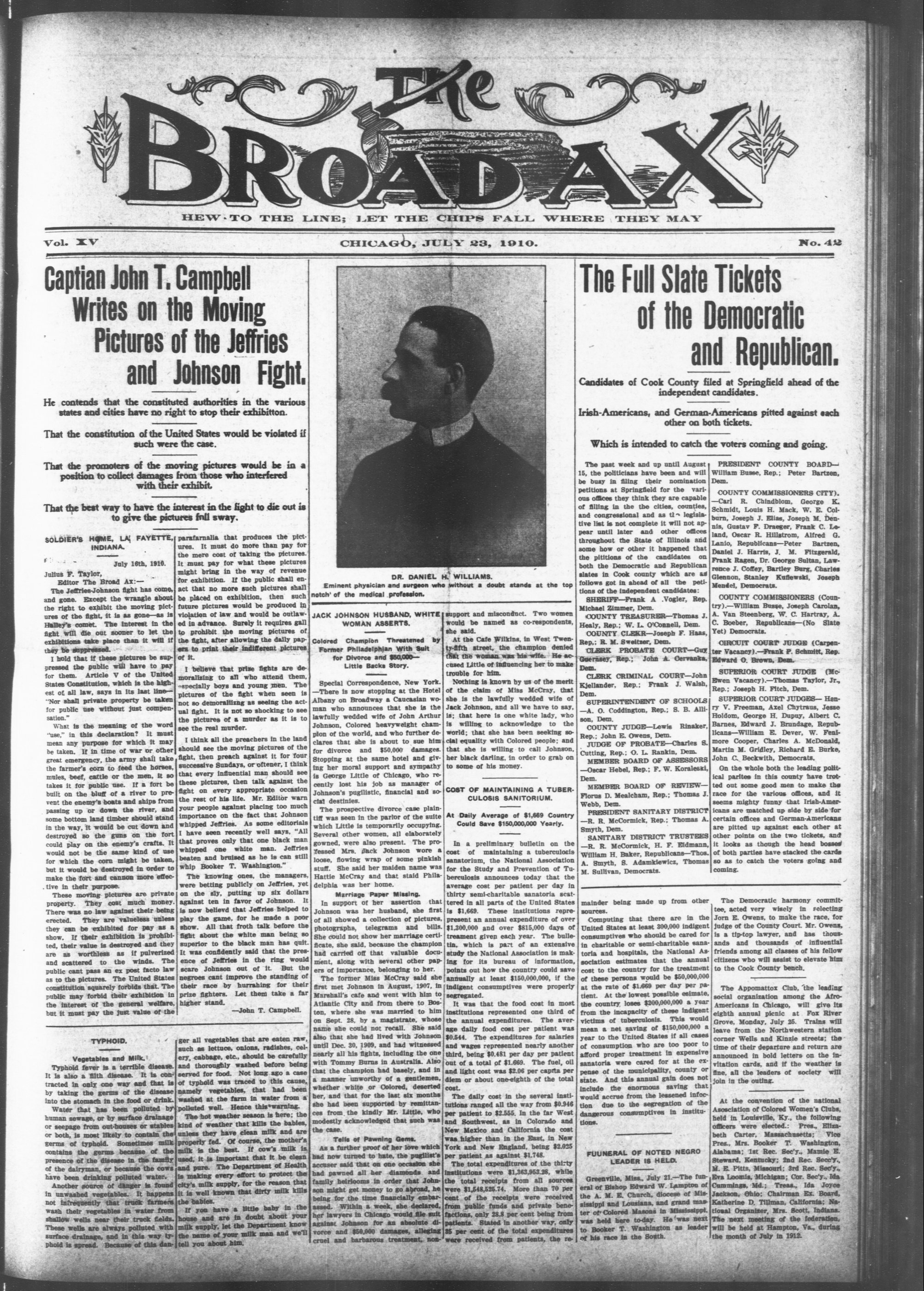
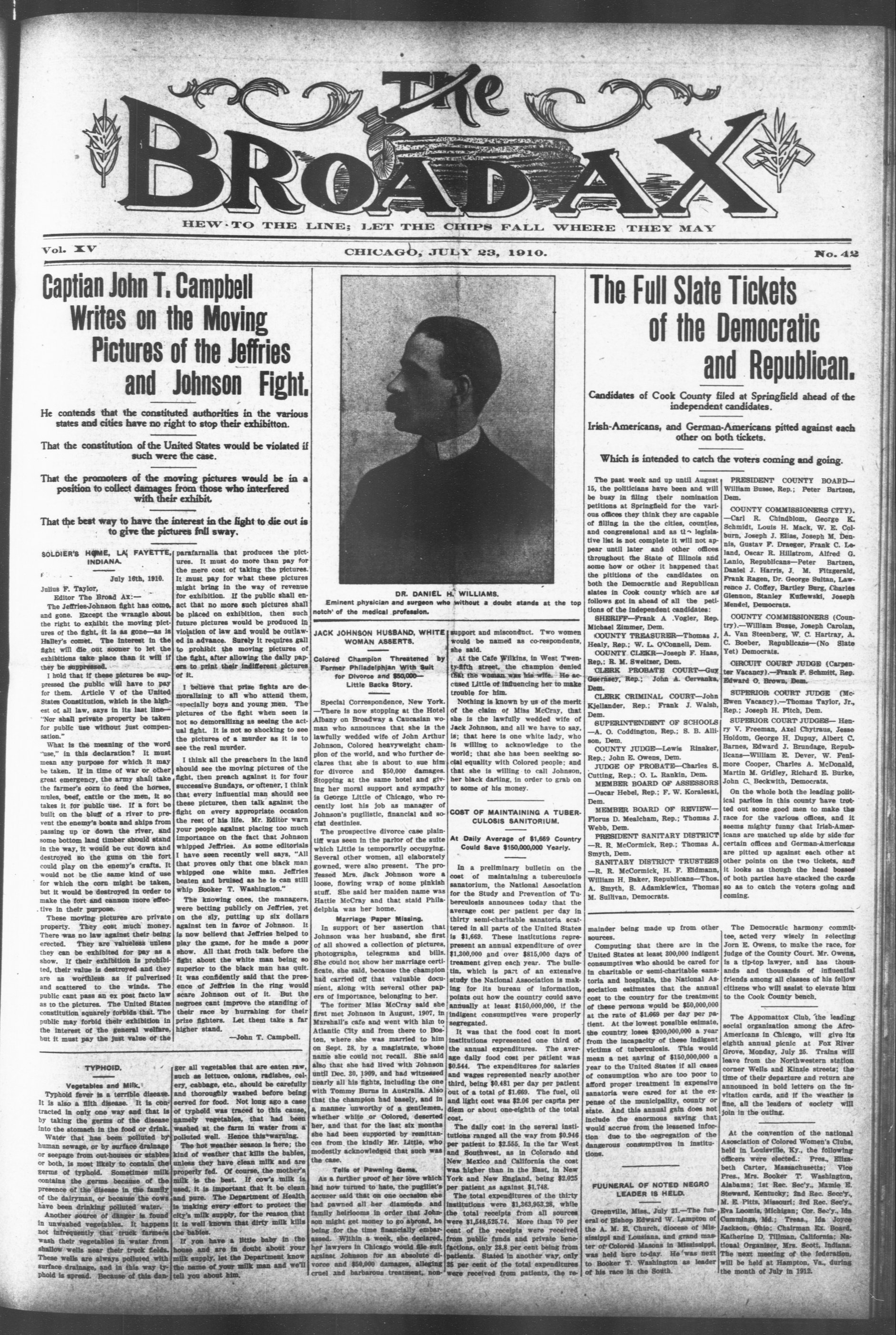
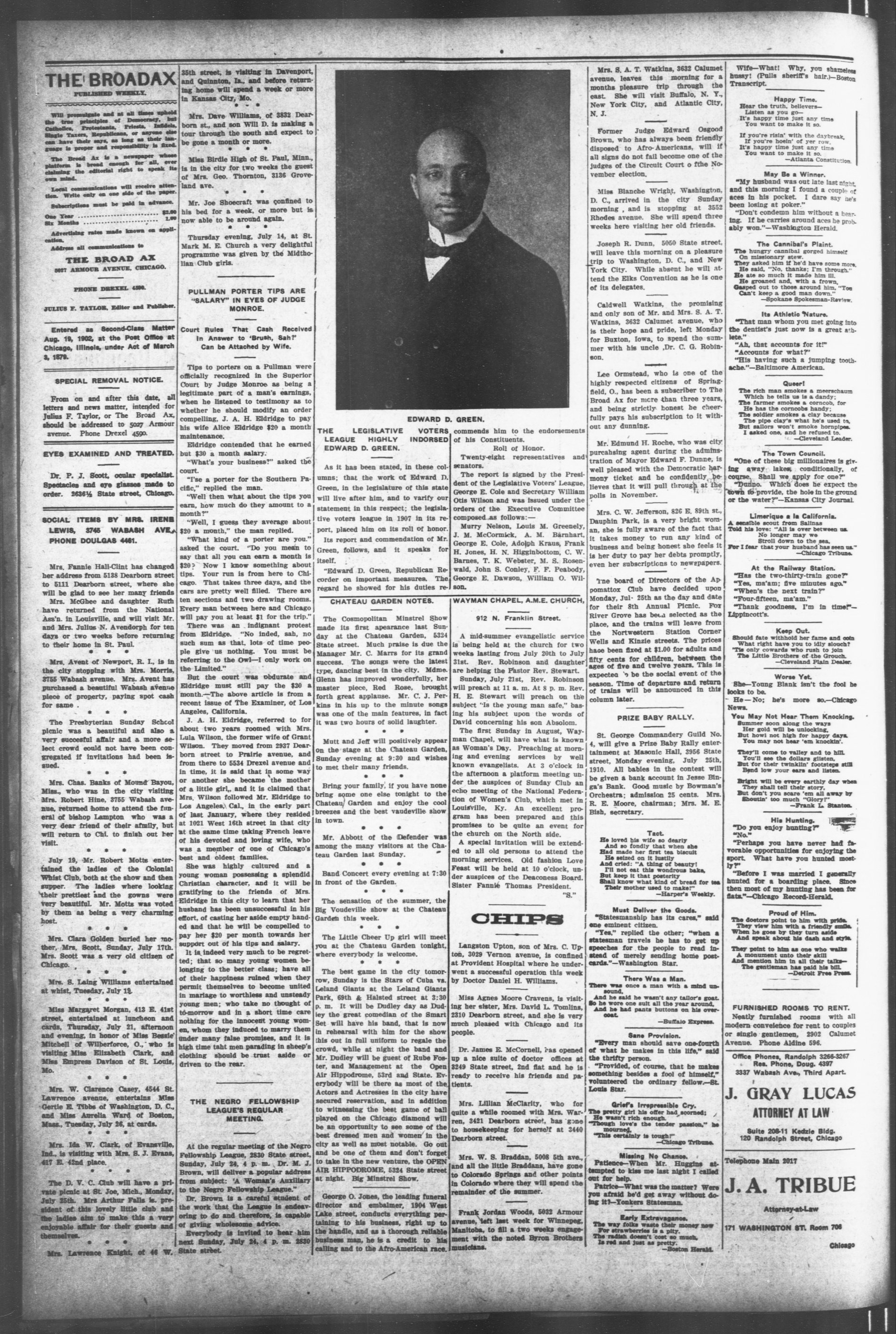
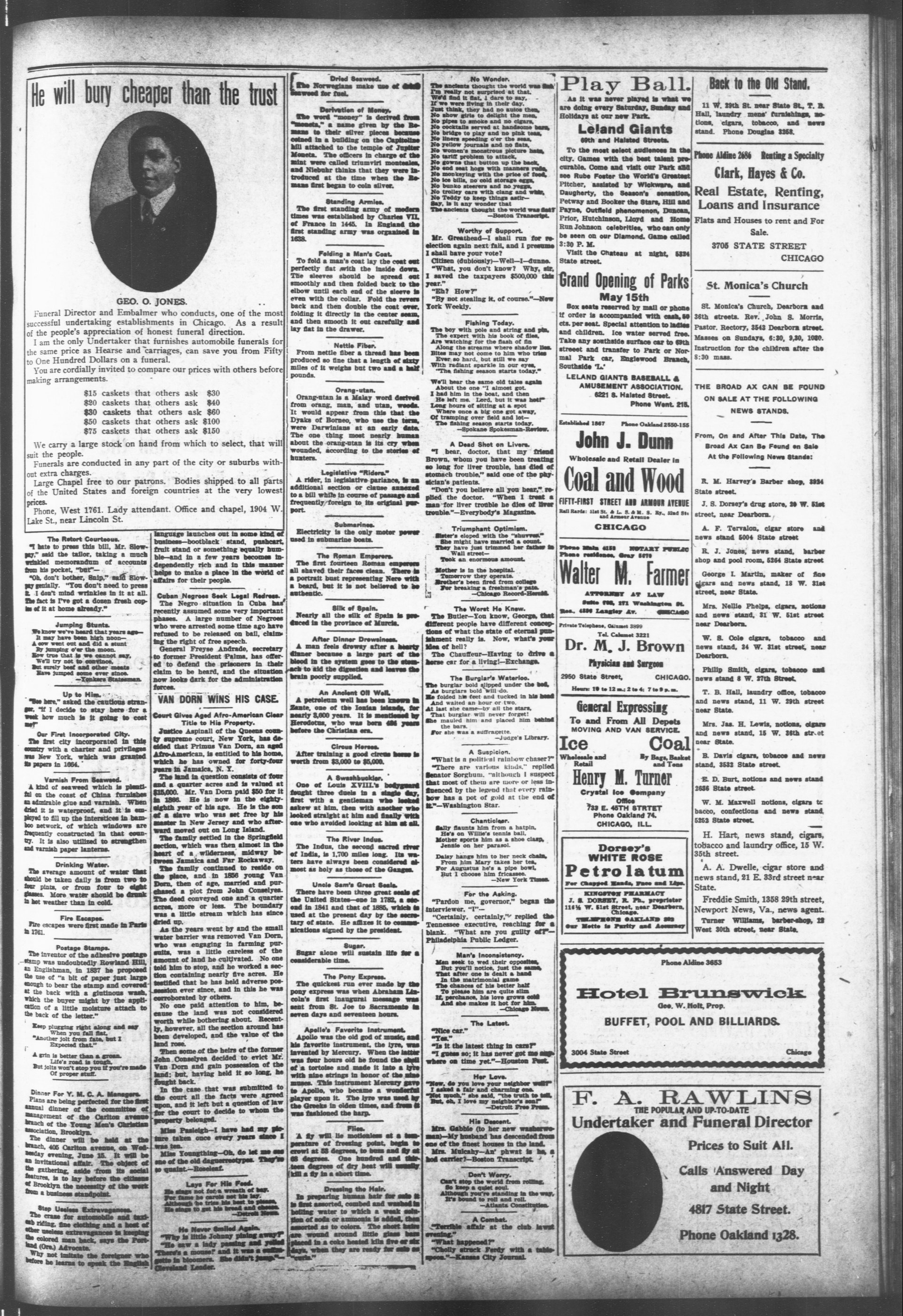
Page text (machine-generated)
Captian John T. Campbell Writes on the Moving Pictures of the Jeffries and Johnson Fight.
He contends that the constituted authorities in the various states and cities have no right to stop their exhibitton.
That the constitution of the United States would be violated if such were the case.
That the promoters of the moving pictures would be in a position to collect damages from those who interfered with their exhibit.
That the best way to have the interest in the fight to die out is to give the pictures full sway.
Vol. XV
Captian John T.
Writes on the
Pictures
and
He contends that the constituent
states and cities have no right
That the constitution of the U
such were
That the promoters of the m
position to collect damages
with their
That the best way to have the i
to give the pict
SOLDIER'S HOME, LA. FAYETTE,
INDIANA.
July 16th, 1910.
Jullus F. Taylor,
Editor The Broad Ax:—
The Jeffries Johnson fight has come,
and gone. Except the wrangle about
the right to exhibit the moving pictures
of the fight, it is as gone—as is
Halley's comet. The interest in
the fight will die out sooner to let the
exhibitions take place than it will if
they be suppressed.
I hold that if these pictures be suppressed the public will have to pay
for them. Article V of the United
States Constitution, which is the highest
of all law, says in its last line—
"Nor shall private property be taken
for public use without just compensation."
What is the meaning of the word "use," in this declaration? It must mean any purpose for which it may be taken. If in time of war or other great emergency, the army shall take the farmer's corn to feed the horses, mules, beef, cattle or the men, it so takes it for public use. If a fort be built on the bluff of a river to prevent the enemy's boats and ships from passing up or down the river, and some bottom land timber should stand in the way, it would be cut down and destroyed so the guns on the fort could play on the enemy's crafts. It would not be the same kind of use for which the corn might be taken, but it would be destroyed in order to make the fort and cannon more effective in their purpose.
These moving pictures are private property. They cost much money. There was no law against their being erected. They are valueless unless they can be exhibited for pay as a show. If their exhibition is prohibited, their value is destroyed and they are as worthless as if pulverized and scattered to the winds. The public cant pass an ex post facto law as to the pictures. The United States constitution squarely forbids that. The public may forbid their exhibition in the interest of the general welfare, but it must pay the just value of the
TYPHOID.
TYPHOID.
Vegetables and Milk.
Vegetables and Milk.
Typhoid fever is a terrible disease. It is also a fifth disease. It is contracted in only one way and that is by taking the germs of the disease into the stomach in the food or drink.
Water that has been polluted by human sewage, or by surface drainage or seepage from out-houses or stables or both, is most likely to contain the germs of typhoid. Sometimes milk contains the germs because of the presence of the disease in the family of the dairyman, or because the cows have been drinking polluted water.
Another source of danger is found in unwashed vegetables. It happens not infrequently that truck farmers wash their vegetables in water from shallow wells near their truck fields. These wells are always polluted with surface drainage, and in this way typhoid is spread. Because of this dan-
parafarnalia that produces the pictures. It must do more than pay for the mere cost of taking the pictures. It must pay for what these pictures might bring in the way of revenue for exhibition. If the public shall enact that no more such pictures shall be placed on exhibition, then such future pictures would be produced in violation of law and would be outlawed in advance. Surely it requires gall to prohibit the moving pictures of the fight, after allowing the daily papers to print their indifferent pictures of it.
I believe that prize fights are demoralizing to all who attend them, especially boys and young men. The pictures of the fight when seen is not so demoralizing as seeing the actual fight. It is not so shocking to see the pictures of a murder as it is to see the real murder.
I think all the preachers in the land should see the moving pictures of the fight, then preach against it for four successive Sundays, or offener, I think that every influential man should see these pictures, then talk against the fight on every appropriate occasion the rest of his life. Mr. Editor warn your people against placing too much importance on the fact that Johnson whipped Jeffries. As some editorials I have seen recently well says, "All that proves only that one black man whipped one white man. Jeffries beaten and bruised as he is can still whip Booker T. Washington."
The knowing ones, the managers, were betting publicly on Jeffries, yet on the sly, putting up six dollars against ten in favor of Johnson. It is now believd that Jeffries helped to play the game, for he made a poor show. All that froth talk before the fight about the white man being so superior to the black man has quit. It was confidently said that the presence of Jeffries in the ring would scare Johnson out of it. But the negroes cant improve the standing of their race by hurrahing for their prize fighters. Let them take a far higher stand.
—John T. Campbell.
ger all vegetables that are eaten raw, such as lettuce, onions, radishes, celery, cabbage, etc., should be carefully and thoroughly washed before being served for food. Not long ago a case of typhoid was traced to this cause, namely vegetables, that had been washed at the farm in water from a polluted well. Hence this warning. The hot weather season is here; the kind of weather that kills the babies, unless they have clean milk and are properly fed. Of course, the mother's milk is the best. If cow's milk is used, it is important that it be clean and pure. The Department of Health is making every effort to protect the city's milk supply, for the reason that it is well known that dirty milk kills the babies. If you have a little baby in the house and are in doubt about your milk supply, let the Department know the name of your milk man and we'll tell you about him.
CHICAGO, JULY 23, 1910.
P.
DR. DANIEL H. WILLIAMS.
Eminent physician and surgeon who without a doubt stands at the top notch' of the medical profession.
JACK JOHNSON HUSBAND, WHITE support and misconduct. Two women would be named as co-respondents. WOMAN ASSERTS.
Special Correspondence, New York.—There is now stopping at the Hotel Albany on Broadway a Caucasian woman who announces that she is the lawfully wedded wife of John Arthur Johnson, Colored heavyweight champion of the world, and who further declares that she is about to sue him for divorce and $50,000 damages. Stopping at the same hotel and giving her moral support and sympathy is George Little of Chicago, who recently lost his job as manager of Johnson's pugilistic, financial and social destinies. The prospective divorce case plaintiff was seen in the parlor of the suite which Little is temporarily occupying. Several other women, all elaborately gowned, were also present. The professed Mrs. black Johnson wore a loose, flowing wrap of some pinkish stuff. She said her maiden name was Hattie McCray and that staid Philadelphia was her home.
Marriage Paper Missing.
In support of her assertion that Johnson was her husband, she first of all showed a collection of pictures, photographs, telegraphs and bills. She could not show her marriage certificate, she said, because the champion had carried off that valuable document, along with several other papers of importance, belonging to her. The former Miss McCray said she first met Johnson in August, 1907, in Marshall's cafe and went with him to Atlantic City and from there to Boston, where she was married to him on Sept. 28, by a magistrate, whose name she could not recall. She said also that she had lived with Johnson until Dec. 30, 1909, and had witnessed nearly all his fights, including the one with Tommy Burns in Australia. Also that the champion had basely, and in a manner unworthy of a gentlemen, whether white or Colored, deserted her, and that for the last six months she had been supported by remittances from the kindly Mr. Little, who modestly acknowledged that such was the case.
Tells of Pawning Gems.
As a further proof of her love which had now turned to hate, the pugilist's accuser said that on one occasion she had pawned all her diamonds and family heirlooms in order that Johnson might get money to go abroad, he being for the time financially embarrassed. Within a week, she declared, her lawyers in Chicago would file suit against Johnson for an absolute divorce and $50,000 damages, alleging cruel and barbarous treatment, non
support and misconduct. Two women would be named as co-respondents, she said.
At the Cafe Wilkins, in West Twenty-fifth street, the champion denied that the woman was his wife. He accused Little of influencing her to make trouble for him.
Nothing is known by us of the merit of the claim of Miss McCray, that she is the lawfully wedded wife of Jack Johnson, and all we have to say, is; that here is one white lady, who is willing to acknowledge to the world; that she has been seeking social equality with Colored people; and that she is willing to call Johnson, her black darling, in order to grab on to some of his money.
COST OF MAINTAINING A TUBER
CULOSIS SANITORIUM.
At Daily Average of $1,669 Country
Could Save $150,000,000 Yearly.
In a preliminary bulletin on the cost of maintaining a tuberculosis sanatorium, the National Association for the Study and Prevention of Tuberculosis announces today that the average cost per patient per day in thirty semi-charitable sanatoria scattered in all parts of the United States is $1,669. These institutions represent an annual expenditure of over $1,300,000 and over $815,000 days of treatment given each year. The bulletin, which is part of an extensive study the National Association is making for its bureau of information, points out how the country could save annually at least $150,000,000, if the indigent consumptives were properly segregated.
It was that the food cost in most institutions represented one third of the annual expenditures. The average daily food cost per patient was $0.544. The expenditures for salaries and wages represented nearly another third, being $0.481 per day per patient out of a total of $1.669. The fuel, oil and light cost was $2.06 per capita per diem or about one-eighth of the total cost.
The daily cost in the several institutions ranged all the way from $0.946 per patient to $2.555. In the far West and Southwest, as in Colorado and New Mexico and California the cost was higher than in the East, in New York and New England, being $2.025 per patient as against $1.748.
The total expenditures of the thirty institutions were $1,363,953.28, while the total receipts from all sources were $1,548,525.74. More than 70 per cent of the receipts were received from public funds and private benefactions, only 28.8 per cent being from patients. Stated in another way, only 35 per cent of the total expenditures were received from patients, the re-
The Full Slate Tickets of the Democratic and Republican.
Candidates of Cook County filed at Springfield ahead of the independent candidates.
Irish-Americans, and German-Americans pitted against each other on both tickets.
Which is intended to catch the voters coming and going.
The past week and up until August 15, the politicians have been and will be busy in filing their nomination petitions at Springfield for the various offices they think they are capable of filling in the the cities, counties, and congressional and as the legislative list is not complete it will not appear until later and other offices throughout the State of Illinois and some how or other it happened that the pititions of the candidates on both the Democratic and Republican slates in Cook county which are as follows got in ahead of all the petitions of the independent candidates:
SHERIFF—Frank A. Vogler, Rep. Michael Zimmer, Dem.
COUNTY TREASURER—Thomas J. Healy, Rep.; W. L. O'Connell, Dem.
COUNTY CLEKR—Joseph F. Haas, Rep.; R. M. Swetzer, Dem.
PRESIDENT COUNTY BOARD—William Busse, Rep.; Peter Bartzen, Dem.
COUNTY COMMISSIONERS CITY).—Carl R. Chindblom, George K. Schmidt, Louis H. Mack, W. E. Colburn, Joseph J. Elias, Joseph M. Dennis, Gustav F. Draeger, Frank C. Lealand, Oscar R. Hillstrom, Alfred G. Lanoi, Republicans—Peter Bartzen, Daniel J. Harris, J. M. Fitzgerald, Frank Ragen, Dr. George Sultan, Lawrence J. Coffey, Bartley Burg, Charles Glennon, Stanley Kuflewski, Joseph Mendel, Democrats.
COUNTY COMMISSIONERS (Country).—William Busse, Joseph Carolan, A. Van Steenberg, W. C. Hartray, A. C. Boeber, Republicans—(No Slate Yet) Democrats.
CLERK PROBATE COURT—Guy
Guernsey, Rep.; John A. Cervanka,
Dem.
CLERK CRIMINAL COURT—John
Kjellander, Rep.; Frank J. Walsh,
Dem.
SUPERINTENDEINT OF SCHOOLS
—A. O. Coddington, Rep.; S. B. Alli-
son, Dem.
COUNTY JUDGE—Lewis Rinaker,
Rep.; John E. Owens, Dem.
JUDGE OF PROBATE—Charles S.
Cutting, Rep.; O. L. Rankin, Dem.
MEMBER BOARD OF ASSESSORS
—Oscar Hebel, Rep.; F. W. Koraleski,
Dem.
MEMBER BOARD OF REVIEW—
Florus D. Mealcham, Rep.; Thomas J.
Webb, Dem.
PRESIDENT SANITARY DISTRICT
—R. R. McCormick, Rep.; Thomas A.
Smyth, Dem.
SANITARY DISTRICT TRUSTEES
—R. R. McCormick, H. F. Eldmann,
William H. Baker, Republicans—Thos.
A. Smyth, S. Adamklewicz, Thomas
M. Sullivan, Democrats.
mainder being made up from other sources.
Computing that there are in the United States at least 300,000 indigent consumptives who should be cared for in charitable or semi-charitable sanatoria and hospitals, the National Association estimates that the annual cost to the country for the treatment of these persons would be $50,000,000 at the rate of $1.669 per day per patient. At the lowest possible estimate, the country, loses $200,000,000 a year from the incapacity of these indigent victims of tuberculosis. This would mean a net saving of $150,000,000 a year to the United States if all cases of consumption who are too poor to afford proper treatment in expensive sanatoria were cared for at the expense of the municipality, county or state. And this annual gain does not include the enormous saving that would accrue from the lessened infection due to the segregation of the dangerous consumptives in institutions.
FUUNERAL OF NOTED NEGRO
LEADER IS HELD.
Greenville, Miss., July 21.—The funeral of Bishop Edward W. Lampton of the A. M. E. Church, diocese of Mississippi and Louisiana, and grand master of Colored Masons in Mississippi was held here to-day. He 'was next to Booker T. Washington as leader of his race in the South.
Tickets
Democratic
and Republican.
led at Springfield ahead of the
candidates.
Americans pitted against each
both tickets.
the voters coming and going.
PRESIDENT COUNTY BOARD
William Busse, Rep.; Peter Bartzen,
Dem.
COUNTY COMMISSIONERS CITY).—Carl R. Chindblom, George K. Schmidt, Louis H. Mack, W. E. Colburn, Joseph J. Elias, Joseph M. Dennis, Gustav F. Draeger, Frank C. Leland, Oscar R. Hillstrom, Alfred G.兰尼, Republicans—Peter Bartzen, Daniel J. Harris, J. M. Fitzgerald, Frank Ragen, Dr. George Sultan, Lawrence J. Coffey, Bartley Burg, Charles Glennon, Stanley Kuffewski, Joseph Mendel, Democrats.
COUNTY COMMISSIONERS (Country).—William Busse, Joseph Carolan, A. Van Steenberg, W. C. Hartray, A. C. Boeber, Republicans—(No Slate Yet) Democrats.
OHCOURT COURT JUDGE (Carpenter Vacancy).—Frank P. Schmitt, Rep. Edward O. Brown, Dem.
SUPERIOR COURT JUDGE (McEwen Vacancy).—Thomas Taylor, Jr., Rep.; Joseph H. Fitch, Dem.
SUPERIOR COURT JUDGES—Henry V. Freeman, Axel Chytraus, Jesse Holdom, George H. Dupuy, Albert C. Barnes, Edward J. Brundage, Republicans—William E. Dever, W. Fenlmore Cooper, Charles A. McDonald, Martin M. Gridley, Richard E. Burke, John C. Beckwith, Democrats.
On the whole both the leading political parites in this county have trotted out some good men to make the race for the various offices, and it seems mighty funny that Irish-Americans are matched up side by side for certain offices and German-Americans are pitted up against each other at other points on the two tickets, and it looks as though the head bosses of both parties have stacked the cards so as to catch the voters going and coming.
The Democratic harmony committee, acted very wisely in selecting Jorn E. Owens, to make the race, for judge of the County Court. Mr. Owens, is a tip-top lawyer, and has thousands and thousands of influential friends among all classes of his fellow citizens who will assist to elevate him to the Cook County bench.
The Appomattox Club, the leading social organization among the Afro-Americans in Chicago, will give its eighth annual picnic at Fox River Grove, Monday, July 25. Trains will leave from the Northwestern station corner Wells and Kinzie streets; the time of their departure and return are announced in bold letters on the invitation cards, and if the weather is fine, all the leaders of society will join in the outing.
At the convention of the national Asociation of Colored Women's Clubs, held in Louisville, Ky., the following officers were elected: Pres., Elizabeth Carter, Massachusetts; Vice Pres., Mrs. Booker T. Washington, Alabama; 1st Rec. Sec'y, Mamie E. Steward, Kentucky; 2nd Rec. Sec'y, M. E. Pitts, Missouri; 3rd Rec. Sec'y, Eva Loomis, Michigan; Cor. Sec'y, Ida Cummings, Md.; Treas., Ida Joyce Jackson, Ohio; Chairman Ex. Board, Katherine D. Tillman, California; National Organizer, Mrs. Scott, Indiana. The next meeting of the federation, will be held at Hampton, Va., during the month of July in 1912.
Captian John T. Campbell Writes on the Moving Pictures of the Jeffries and Johnson Fight.
He contends that the constituted authorities in the various states and cities have no right to stop their exhibitton.
That the constitution of the United States would be violated if such were the case.
That the promoters of the moving pictures would be in a position to collect damages from those who interfered with their exhibit.
That the best way to have the interest in the light to die out is to give the pictures full sway.
Vol. XV
Captian John T.
Writes on the
Pictures
and
He contends that the constitut
states and cities have no ri
That the constitution of the U
such were
That the promoters of the m
position to collect damages
with their
That the best way to have the
to give the pict
SOLDIER'S HOME, LA FAYETTE,
INDIANA.
July 16th, 1910.
Julius F. Taylor,
Editor The Broad Ax:—
The Jeffries-Johnson fight has come,
and gone. Except the wrangle about
the right to exhibit the moving pictures
of the fight, it is as gone—as is
Halley's comet. The interest in the
fight will die out sooner to let the
exhibitions take place than it will if
they be suppressed.
I hold that if these pictures be suppressed the public will have to pay for them. Article V of the United States Constitution, which is the highest of all law, says in its last line—"Nor shall private property be taken for public use without just compensation."
What is the meaning of the word "use," in this declaration? It must mean any purpose for which it may be taken. If in time of war or other great emergency, the army shall take the farmer's corn to feed the horses, mules, beef, cattle or the men, it so takes it for public use. If a fort be built on the bluff of a river to prevent the enemy's boats and ships from passing up or down the river, and some bottom land timber should stand in the way, it would be cut down and destroyed so the guns on the fort could play on the enemy's crafts. It would not be the same kind of use for which the corn might be taken, but it would be destroyed in order to make the fort and cannon more effective in their purpose.
These moving pictures are private property. They cost much money. There was no law against their being erected. They are valueless unless they can be exhibited for pay as a show. If their exhibition is prohibited, their value is destroyed and they are as worthless as if pulverized and scattered to the winds. The public cant pass an ex post facto law as to the pictures. The United States constitution squarely forbids that. The public may forbid their exhibition in the interest of the general welfare, but it must pay the just value of the
TYPHOID.
TYPHOID
Vegetables and Milk.
Typhoid fever is a terrible disease. It is also a fifth disease. It is contracted in only one way and that is by taking the germs of the disease into the stomach in the food or drink. Water that has been polluted by human sewage, or by surface drainage or seepage from out-houses or stables or both, is most likely to contain the germs of typhoid. Sometimes milk contains the germs because of the presence of the disease in the family of the dairyman, or because the cows have been drinking polluted water. Another source of danger is found in unwashed vegetables. It happens not infrequently that truck farmers wash their vegetables in water from shallow wells near their truck fields. These wells are always polluted with surface drainage, and in this way typhoid is spread. Because of this dan-
---
HEW·TO THE LINE; LET THE CHIPS FALL WHERE THEY MAY
parafarnalia that produces the pictures. It must do more than pay for the mere cost of taking the pictures. It must pay for what these pictures might bring in the way of revenue for exhibition. If the public shall enact that no more such pictures shall be placed on exhibition, then such future pictures would be produced in violation of law and would be outlawed in advance. Surely it requires gall to prohibit the moving pictures of the fight, after allowing the daily papers to print their indifferent pictures of it.
I believe that prize fights are demoralizing to all who attend them, especially boys and young men. The pictures of the fight when seen is not so demoralizing as seeing the actual fight. It is not so shocking to see the pictures of a murder as it is to see the real murder.
I think all the preachers in the land should see the moving pictures of the fight, then preach against it for four successive Sundays, or offender, I think that every influential man should see these pictures, then talk against the fight on every appropriate occasion the rest of his life. Mr. Editor warn your people against placing too much importance on the fact that Johnson whipped Jeffries. As some editorials I have seen recently well says, "All that proves only that one black man whipped one white man. Jeffries beaten and bruised as he is can still whin Booker T. Washington."
The knowing ones, the managers, were betting publicly on Jeffries, yet on the sly, putting up six dollars against ten in favor of Johnson. It is now believed that Jeffries helped to play the game, for he made a poor show. All that froth talk before the fight about the white man being so superior to the black man has quit. It was confidently said that the presence of Jeffries in the ring would scare Johnson out of it. But the negroes cant improve the standing of their race by hurrahing for their prize fighters. Let them take a far higher stand. —John T. Campbell.
ger all vegetables that are eaten raw, such as lettuce, onions, radishes, celery, cabbage, etc., should be carefully and thoroughly washed before being served for food. Not long ago a case of typhoid was traced to this cause, namely vegetables, that had been washed at the farm in water from a polluted well. Hence this warning.
The hot weather season is here; the kind of weather that kills the babies, unless they have clean milk and are properly fed. Of course, the mother's milk is the best. If cow's milk is used, it is important that it be clean and pure. The Department of Health is making every effort to protect the city's milk supply, for the reason that it is well known that dirty milk kills the babies. If you have a little baby in the house and are in doubt about your milk supply, let the Department know the name of your milk man and we'll tell you about him.
CHICAGO, JULY 23, 1910.
P.
DR. DANIEL H. WILLIAMS.
Eminent physician and surgeon who without a doubt stands at the top notch' of the medical profession.
JACK JOHNSON HUSBAND, WHITE WOMAN ASSERTS.
Colored Champion Threatened by Former Philadelphia With Suit for Divorce and $50,000—Little Backs Story.
support and misconduct. Two women would be named as co-respondents, she said.
At the Cafe Wilkins, in West Twenty-fifth street, the champion denied that the woman was his wife. He accused Little of influencing her to make
Special Correspondence, New York. There is now stopping at the Hotel Albany on Broadway a Caucasian woman who announces that she is the lawfully wedded wife of John Arthur Johnson, Colored heavyweight champion of the world, and who further declares that she is about to sue him for divorce and $50,000 damages. Stopping at the same hotel and giving her moral support and sympathy is George Little of Chicago, who recently lost his job as manager of Johnson's pugilistic, financial and sociat destinies.
The prospective divorce case plaintiff was seen in the parlor of the suite which Little is temporarily occupying. Several other women, all elaborately gowned, were also present. The professed Mrs. black Johnson wore a loose, flowing wrap of some pinkish stuff. She said her maiden name was Hattie McCray and that staid Philadelphia was her home.
Marriage Paper Missing.
In support of her assertion that Johnson was her husband, she first of all showed a collection of pictures, photographs, telegrams and bills. She could not show her marriage certificate, she said, because the champion had carried off that valuable document, along with several other papers of importance, belonging to her.
The former Miss McCray said she first met Johnson in August, 1907, in Marshall's cafe and went with him to Atlantic City and from there to Boston, where she was married to him on Sept. 28, by a magistrate, whose name she could not recall. She said also that she had lived with Johnson until Dec. 30, 1909, and had witnessed nearly all his fights, including the one with Tommy Burns in Australia. Also that the champion had basely, and in a manner unworthy of a gentlemen, whether white or Colored, deserted her, and that for the last six months she had been supported by remittances from the kindly Mr. Little, who modestly acknowledged that such was the case.
Tells of Pawning Gems.
As a further proof of her love which had now turned to hate, the pugilist's accuser said that on one occasion she had pawned all her diamonds and family heirlooms in order that Johnson might get money to go abroad, he being for the time financially embarrassed. Within a week, she declared, her lawyers in Chicago would file suit against Johnson for an absolute divorce and $50,000 damages, alleging cruel and barbarous treatment, non-
support and misconduct. Two women would be named as co-respondents, she said.
At the Cafe Wilkins, in West Twenty-fifth street, the champion denied that the woman was his wife. He accused Little of influencing her to make trouble for him.
Nothing is known by us of the merit of the claim of Miss McCray, that she is the lawfully wedded wife of Jack Johnson, and all we have to say, is; that here is one white lady, who is willing to acknowledge to the world; that she has been seeking social equality with Colored people; and that she is willing to call Johnson, her black darling, in order to grab on to some of his money.
COST OF MAINTAINING A TUBERCULOSIS SANITORIUM.
At Daily Average of $1,669 Country
Could Save $150,000,000 Yearly.
In a preliminary bulletin on the cost of maintaining a tuberculosis sanatorium, the National Association for the Study and Prevention of Tuberculosis announces today that the average cost per patient per day in thirty semi-charitable sanatoria scattered in all parts of the United States is $1,669. These institutions represent an annual expenditure of over $1,300,000 and over $815,000 days of treatment given each year. The bulletin, which is part of an extensive study the National Association is making for its bureau of information, points out how the country could save annually at least $150,000,000, if the indigent consumptives were properly segregated.
It was that the food cost in most institutions represented one third of the annual expenditures. The average daily food cost per patient was $0.544. The expenditures for salaries and wages represented nearly another third, being $0.481 per day per patient out of a total of $1.669. The fuel, oil and light cost was $2.06 per capita per diem or about one-eighth of the total cost.
The daily cost in the several institutions ranged all the way from $0.946 per patient to $2.555. In the far West and Southwest, as in Colorado and New Mexico and California the cost was higher than in the East, in New York and New England, being $2.025 per patient as against $1.748.
The total expenditures of the thirty institutions were $1,363,953.28, while the total receipts from all sources were $1,548,525.74. More than 70 per cent of the receipts were received from public funds and private benefactions, only 28.8 per cent being from patients. Stated in another way, only 35 per cent of the total expenditures were received from patients, the re-
The Full Slate Tickets of the Democratic and Republican.
Candidates of Cook County filed at Springfield ahead of the independent candidates.
Irish-Americans, and German-Americans pitted against each other on both tickets.
Which is intended to catch the voters coming and going.
The past week and up until August 15, the politicians have been and will be busy in filing their nomination petitions at Springfield for the various offices they think they are capable of filling in the the cities, counties, and congressional and as tl- legislative list is not complete it will not appear until later and other offices throughout the State of Illinois and some how or other it happened that the pititions of the candidates on both the Democratic and Republican slates in Cook county which are as follows got in ahead of all the petitions of the independent candidates: SHERIFF—Frank A. Vogler, Rep. Michael Zimmer, Dem. COUNTY TREASURER—Thomas J. Healy, Rep.; W. L. O'Connell, Dem.
COUNTY CLEKR—Joseph F. Haas,
Rep.; R. M. Sweltzer, Dem.
CLERK PROBATE COURT—Guy
Guerasey, Rep.; John A. Cervanka,
Dem.
CLERK CRIMINAL COURT—John
Kjellander, Rep.; Frank J. Walsh,
Dem.
SUPERINTENDENT OF SCHOOLS
—A. O. Coddington, Rep.; S. B. Allison,
Dem.
COUNTY JUDGE—Lewis Rinaker,
Rep.; John E. Owens, Dem.
JUDGE OF PROBATE—Charles S.
Cutting, Rep.; O. L. Rankin, Dem.
MEMBER BOARD OF ASSESSORS
—Oscar Hebel, Rep.; F. W. Koraleski,
Dem.
MEMBER BOARD OF REVIEW—
Florus D. Mealcham, Rep.; Thomas J.
Webb, Dem.
PRESIDENT SANITARY DISTRICT
—R. R. McCormick, Rep.; Thomas A. Smyth, Dem.
SANITARY DISTRICT TRUSTEES
—R. R. McCormick, H. F. Eidmann, William H. Baker, Republicans—Thos. A. Smyth, S. Adamklewicz, Thomas M. Sullivan, Democrats.
malander being made up from other sources.
Computing that there are in the United States at least 300,000 indigent consumptives who should be cared for in charitable or semi-charitable sanatoria and hospitals, the National Association estimates that the annual cost to the country for the treatment of these persons would be $50,000,000 at the rate of $1.669 per day per patient. At the lowest possible estimate, the country, loses $200,000,000 a year from the incapacity of these indigent victims of tuberculosis. This would mean a net saving of $150,000,000 a year to the United States if all cases of consumption who are too poor to afford proper treatment in expensive sanatoria were cared for at the expense of the municipality, county or state. And this annual gain does not include the enormous saving that would accrue from the lessened infction due to the segregation of the dangerous consumptives in institutions.
FUUNERAL OF NOTED NEGRO LEADER IS HELD.
Greenville, Miss., July 21.—The funeral of Bishop Edward W. Lampton of the A. M. E. Church, diocese of Mississippi and Louisiana, and grand master of Colored Masons in Mississippi, was held here to-day. He was next to Booker T. Washington as leader of his race in the South.
No.42
Tickets
Democratic
and Republican.
filed at Springfield ahead of the
candidates.
Americans pitted against each
both tickets.
the voters coming and going.
PRESIDENT COUNTY BOARD—William Busse, Rep.; Peter Bartzen, Dem.
COUNTY COMMISSIONERS CITY).
—Carl R. Chindblom, George K. Schmidt, Louis H. Mack, W. E. Colburn, Joseph J. Elias, Joseph M. Dennis, Gustav F. Draeger, Frank C. Leland, Oscar R. Hillstrom, Alfred G.兰尼, Republicans—Peter Bartzen, Daniel J. Harris, J. M. Fitzgerald, Frank Ragen, Dr. George Sultan, Lawrence J. Coffey, Bartley Burg, Charles Glennon, Stanley Kuffewski, Joseph Mendel, Democrats.
COUNTY COMMISSIONERS (Country).
—William Busse, Joseph Carolan, A. Van Steenberg, W. C. Hartray, A. C. Boeber, Republicans—(No Slate Yet) Democrats.
CIRCUIT COURT JUDGE (Carpenter Vacancy)—Frank P. Schmitt, Rep. Edward O. Brown, Dem.
SUPERIOR COURT JUDGE (McEwen Vacancy)—Thomas Taylor, Jr., Rep.; Joseph H. Fitch, Dem.
SUPERIOR COURT JUDGES—Henry V. Freeman, Axel Chyraus, Jesse Holdom, George H. Dupuy, Albert C. Barnes, Edward J. Brundage, Republicans—William E. Dever, W. Fenimore Cooper, Charles A. McDonald, Martin M. Gridley, Richard E. Burke, John C. Beckwith, Democrats.
On the both both the leading political parites in this county have trotted out some good men to make the race for the various offices, and it seems mighty funny that Irish-Americans are matched up side by side for certain offices and German-Americans are pitted up against each other at other points on the two tickets, and it looks as though the head bosses of both parties have stacked the cards so as to catch the voters going and coming.
The Democratic harmony committee, acted very wisely in selecting Jorn E. Owens, to make the race, for judge of the County Court. Mr. Owens, is a tip-top lawyer, and has thousands and thousands of influential friends among all classes of his fellow citizens who will assist to elevate him to the Cook County bench.
The Appomattox Club, the leading social organization among the Afro-Americans in Chicago, will give its eighth annual picnic at Fox River Grove, Monday, July 25. Trains will leave from the Northwestern station corner Wells and Kinzie streets; the time of their departure and return are announced in bold letters on the invitation cards, and if the weather is fine, all the leaders of society will join in the outing.
At the convention of the national Asociation of Colored Women's Clubs, held in Louisville, Ky., the following officers were elected: Pres., Elizabeth Carter, Massachusetts; Vice Pres., Mrs. Booker T. Washington, Alabama; 1st Rec. Sec'y., Manie E. Steward, Kentucky; 2nd Rec. Sec'y., M. E. Pitts, Missouri; 3rd Rec. Sec'y., Eva Loomis, Michigan; Cor. Sec'y., Ida Cummings, Md.; Treas., Ida Joyce Jackson, Ohio; Chairman Ex. Board, Katherine D. Tillman, California; National Organizer, Mrs. Scott, Indiana. The next meeting of the federation will be held at Hampton, Va., during the month of July in 1912.
---
ioe
Ee
“THE! BROADAX
meena
| WID promulgate and ot all times upheld
the ‘tres principics of Democracy. but
‘Cathoticn, Protestants, Priests, EnSéele
‘ingic Taxers, Republicans, or anyone cis
‘can have their says, 02 long os their tan.
Gense ts proper and responsibilty ts Sxed
“Whe Brest Ax te = newspaper whose
Pintiorm Js bread cneurh for sil. ever
Eatuing the editorial right to speak tt
‘own mind.
Lees commenications will recive stten-
tion Write only on one side of the paper
ebecriptions mast be paid in edvance,
‘Aavertising rates made Known on appl
cation,
‘Adarese all communications to
THE BROAD AX
sett ARMOUR AVENUE, CHICAGO.
PHONE DEEXEL 4500.
JULIUS F. TAYLOR, Balter and Publisher.
_ Entered as SecondClass Matter
‘Aug. 19, 1902, at the Post Office at
Chicago, tlinels, under Act of March
ee
ee
SPECIAL REMOVAL NOTICE.
‘From on and after this date, all
letters and news matter, intended for
Julius F. Taylor, or The Broad Ax,
should be addressed to sozy Armour
avenue. Phone Drexel 4590.
———
EVES EXAMINED AND TREATED.
Dr. P. J. Scott, ocular specialist.
Spectacies and eye glasses made to
order. 2636% State street, Chicago.
ooo
SOCIAL ITEMS BY MRS. IRENE
LEWIS, $75 WABASH AVE,
PHONE DOULGAS 4461.
Mrs, Fannie Hall-Clint has changed
her address from 5138 Dearborn street
to 5111 Dearborn street, where she
will be giad to see her many friends
‘Mrs. McGhee and daughter Ruth
have returned from the National
Ass'n. in Louisville, and will visit Mr.
and Mrs. Julius N. Avendorph for ten
ays or two weeks before returning
to their home in St. Paul.
see
Mrs, Avent of Newport, R. L, is in
the city stopping with Mrs. Morris,
3755 Wabash avenue. Mrs. Avent has
purchased a beautiful Wabash a¥enne
Blece of property, paying spot cash
for same .
“2
‘The Presbyterian Sunday Schcol
plenic was a beautiful and also a
‘very succesful affair and a more se-
Ject crowd eould not have been con-
Gregated if invitations had been is-
sued.
es 2
Mrs. Chas. Banks of Mound Bayou,
Miss, who was in the city visiting
Mrs. Robert Hine, 3755 Wabash ave-
ue, returned home to attend the fun-
eral of bishop Lampton who was a
very dear friend of their afmily, but
will return to Chi to finish out ber
visit.
Jaly 19, Mr. Robert Motts enter-
tained the ladies of the Colonial
‘Whist Club, both at the show and then
supper. The ladies where looking
‘their prettiest and the gowns were
Very beautifel. Mr. Motts was voted
by them as being a very charming
host.
es 2
‘Mrs. Clara Golden buried her no
ther, Mrs. Scott, Sunday, July 17th.
‘Mrs. Scott was a very old citizen of
‘Chicago. ,
e 2
_ Mrs. S. Laing ‘Williams entertained
at whist, Tuesday, July 12
2 2 eo
‘Miss Margaret Morgan, 413 E. 4ist
street, entertained at luncheon and
cards, Thursday, July 21, afternoon
‘and evening, in honor of Miss Bessie
“Mitchell of Wilberforce, 0.," who is
‘visiting Miss Elizabeth Clark, and
‘Miss Empress Davison of St. Louis,
Mo.
AS * 2 8
‘Mrs. W. Clarence Casey, 4544 St
“Lawrence avenue, entertains Miss
*Gertie E. ‘Tibbs of Washington, D. C.,
and Miss Anrelia Ward of Boston,
‘Mass., Tuesday, July 26, at cards.
‘Mrs. Ida W. Clark, of Evansville,
‘Ind, is visiting with Mrs. S. J. Evans,
AAT B. 42nd place.
. +
‘The D. V. C. Club will have a pri-
wate plenic at St Joe, Mich, Monday,
“Sely 35th. Mrs Arthur Falls ts. pre-
ot: this lovely little club and
ine taties tie $5 make Cis very
enjoyable affair for their guests and
ee . |
ia 2 2 8 a
Mrs. Lawrence Knight, of 4¢ W.
me Z } :
pei 4 >
pea oe a 5 5 hat
35th street, is visiting in Davenport,
ing home will spend s week or more
in Kansas City, ‘Mo.
a)
‘Mrs. Dave Williams, of 3832 Dear
born st., and son Will D. is making a
tour through the south and expect to
be gone a month or more.
; fe
‘Miss Birdie High of St. Paul, Minn.,
is in the city for two weeks the guest
of Mrs. Geo, Thornton, 3136 Grove-
land ave.
ex's
Mr. Joe Shoecraft was confined to
his bed for a week, or more but is
now able to be around again.
Bec
‘Thursday evening, July 14, at St.
Mark M. E. Church a very delightful
programme was given by thé Midtho-
Vian \Club girls.
PULLMAN PORTER TIPS ARE
“SALARY” IN EYES OF JUDGE
MONROE.
Court Rules That Cash Received
In Answer to ‘Brush, Sah?”
Can be Attached by Wife.
‘Tips to porters on a Pullman were
officially recognized in the Superior
Court by Judge Monroe as being 3
legitimate part of a man’s earnings,
when he listened to testimony as to
whether he should modify an order
compelling, J. A. H. Eldridge to pay
his wife Alice Eldridge $20 a month
maintenance.
Eldridge contended that he earned
but $30 a month salary:
“What's your business?” asked the
court.
“I'se a porter for the Southern Pa-
cific,” replied the man.
“Well then what about the tips you
earn, how much do they amount to a
month?”
“Well, I guess they average about
$20 2 month,” the man replied.
“What kind of a porter are you.”
asked the court. “Do you mean to
say that all you can earn a month is
$20? Now I know something about
tips. Your run is from here to Chi-
cago. That takes three days, and the
cars are pretty well filled. There are
ten sections and two drawing rooms.
Every man between here and Chicago
will pay you at least $1 for the trip.”
‘There was an indignant protest
from Eldridge. “No inded, sab, no
such sum as that, lots of time peo
ple give ‘us nothing. You must be
referring to the Owl—I only work on
the: Limited.” ee
But the court was obdurate and
Eldridge must still pay the $20 2
‘month—The above article is from a
recent issue of The Examiner, of Los
Angeles, California.
J. A. H. Eldridge, referred to for
about two years roomed with Mrs.
Lula Wilson, the former wife of Grant
‘Wilson. They moved from 2937 Dear-
born street to Prairie avenue, and
from there to 5534 Drexel avenue and
in time, it is said that in some way
or another she became ‘the mother
of a little girl, and it is claimed that
‘Mrs, Wilson followed Mr. Eldridge to
Los Angeles) Cal., in the early part
Of last January, where they resided
at 1021 West 16th street in that city
‘at the same time taking French leave
of his devoted and loving wife, who
was a member of one of Chicago's
best and oldest families.
She was highly cultured and a
young woman possessing a splendid
Christian character, and it will be
gratifying to the friends of Mrs.
Eldridge in this city to learn that her
husband has been unsuccessful in his
effort, of casting her aside empty hand-
ed and that he will be compelled to
pay her $20 per month towards her
‘support out of his tips and salary.
‘It in indeed very much to be regret-
ted; that so many young women be-
longing to the better class; have all
of their happiness ruined when they
permit themselves to become united
in mariage to worthless and unsteady
young men; who take no thought of
té-morrow and in a short time care
nothing for the innocesit young wom-
en, whom they induced to marry them
‘ander many false promises, and it is
high time taht men parading in sheep's
‘lothing should be trust aside or
driven to the rear.
THE NEGRO FELLOWSHIP
LEAGUE'S REGULAR
MEETING. o
At the regular meeting of the Negro
Fellowship League, 2830 State street
Sunday, July 24, 4 p.m. Dr. M. J.
Brown, will deliver # popular address
from subject: ‘A Woman's -Auxiliary
to the Negro Fellowship League.”
Dr, Brown is a careful student of
the work that the League is endeav-
oring to do and therefore, is capabie
of giving wholesome advice. 2
Everybody is invited to hear bim
next Sunday, July 24,:4 p. m. 2830
State street =
c *
Be 3 eae s < Agee
: wR see
gre : Beye al
2 ns Se os seis
Pak gies Nee, es She Bs
era —_ Bs ns Seah
(erat 1 erie
LS 3 ae AS,
s —_ é “ee
| |
J
3 |
:
|
EDWARD D. GREEN.
As it has been stated, in these col-
umns; that the work of Edward D.
Green, in the legislature of this state
will live after him, and to varify our
statement in this respect; the legisla
tive voters league in 1907 in its re
port, placed him on its roll of honor.
Its report and commendation of Mr.
Green, follows, and it speaks for
itself. *
“Edward D. Green, Republican Re
corder on important measures, The
regard he showed for his duties re-
CHATEAU GARDEN NOTES.
The Cosmopolitan Minstrel Show
made its first apearance last Sun-
day at the Chateau Garden, 532
[State street. Much praise is due the
Manager Mr. C. Marrs for its grand
success. The songs were the latest
type, dancing best in the city. Mdme.
Glenn has improved wonderfully, her
master piece, Red Rose, brought
forth great applause. Mr. C. J. Per-
kins in his up to the minute songs
was one of the main features, in fact
it was two hours of solid laughter.
af gee
Mutt and Jeff will positively appear
on the’stage at the Chateau Garden,
Sunday evening at 9:30 and wishes
to met their many friends.
eee
Bring your family; if you have none
bring some one else tonight to the
Chateau) Garden and enjoy the cool
breezes and the best vaudeville show
in town.
se: s
Mr. Abbott of the Defender was
among the many visitors at the Cha-
teau Garden last Sunday. S
www
Band Concert every evening at 7:30
in front of the Garden.
eo ©
‘The sensation of the summer, the|
Big Voudeville show at the Chateau|
Garden this week.
a raw
‘The Little Cheer Up girl will meet
you at the Chateau Garden tonight,
where everybody is welcome.
8 @
The best game in the city tomor
row, Sunday is the Stars of Cuba vs.
Leland Giants at the Leland Giants
Park, 69th & Halsted street at 3:30)
p. m. It will be Dudley day as Dud-
ley the great comedian of the Smart]
Set will have his band, that is now
in rehearsal with him for the show,
this out in full uniform to regale the
crowd, while at night the band and
Mr. Dudley will be guest of Rube Fos-
ter, and Management at the Open
Air Hippodrome, 53rd and State. Ev-
erybody will be there as most of the
Actors and Actresses in the city have
secured reservation, and in addition
to witnessing the best game of ball
played on the Chicago diamond will
be an opportunity to see some of the
best dressed men and women in the
city as well as most notable. Go out
and be one of them and don't forget
to take in the new venture, the OPEN
AIR HIPPODROME, 5324 State street
at night. Big Minstrel Show.
George O. Jones, the leading funeral
director and embalmer, 1904 West
Lake street, conducts everything per-
taining to his business, right up to
the handle, and as a thorough reliable
business man, he is a credit to his
calling and to the Afro-American race.
THE LEGISLATIVE
LEAGUE HIGHLY
EDWARD D. GREEN.
commends him to the endorsements
of his Constituents.
Roll of Honor.
‘Twenty-eight representatives and
senators.
The report is signed by the Presi-
dent of the Legislative Voters’ League,
George E. Cole and Secretary William
Otis Wilson and was issued under the
orders of the Executive Committee
composed.as follows:—
Murry Nelson, Louis M. Greenely,
J. M. McCormick, A. M. Barnhart,
George E. Cole, Adojph Kraus, Frank
H. Jones, H. N. Higginbottom, C. W.
Barnes, T. K. Webster, M. S. Rosen-
wald, John S. Conley, F. F. Peabody,
George E. Dawson, William 0. Wil-
son.
WAYMAN CHAPEL, A.M.E. CHURCH,
A mid-summer evangelistic service
is being held at the church for two
weeks lasting from July 20th to July
3ist. Rev. Robinson and daughter
are helping the Pastor Rev. Stewart.
Sunday, July 21st, Rev. Robinson
will preach at 11 a. m. At 8 p. m. Rev.
H. E. Stewart will preach on the
subject “Is the young man safe,” bas
ing his subject upon the words of
David concerning his son Absolom.
The first Sunday in August, Way:
man Chapel, will have what is known
as Woman's Day. Preaching at morn.
ing and evening services by well
known evangelists. At 3 o'clock in
the afternoon a platform meeting un-
der the auspices of Sunday Club an
echo meeting of the National Federa-
tion of Women’s Club, which met in
Louisville, Ky. An excellent pro-
gram has been prepared and this
promises to be quite an event for
the church on the North side.
A special invitation will be extend-
ed to all old persons to attend the
morning services. Old fashion Love
Feast will be held at 10 o'clock, un-
der auspices of the Deaconess Board.
Sister Fannié Thomas President.
mane
CHIPS
Langston Upton, son of Mrs. C. Up-
ton, 3029 Vernon avenue, is confined
at Provident Hospital where he under-
‘went @ successful operation this week
by Doctor Daniel H. Williams. .
Miss Agnes Moore Cravens, is visit-
ing her sister, Mrs. David L. Tomlins,
2310 Dearborn street, and she is very
much pleased with Chicago and its
people.
Dr. James E. McCornell, ras opened
up a nice suite of doctor offices at
3249 State street, 2nd fiat and he is
ready to receive his friends and pa-
tients.
Mrs. Lillian McClarity, who for
quite a while roomed with Mrs. War-
ren 24 Dearborn tre, bs ne
to housekeeping for herself at 2440
Dearborn street.
| Mrs. W. S. Braddan, 5008 Sth ave.,
Jand all the little Braddans, have gone
ito Colorado Springs and other points
lin Colorado where they will spend the
remainder of the summer.
Jordan Woods, 5032 Armour
Palin Eg echpsheonphone Resor
Manitoba, to fill a two weeks engage-
‘ment with the noted Byron Brothers
912 N. Franklin Street.
Mrs. 8, A. T. Watkins, 3632 Calumet
avenue, leaves this morning for a
months pleasure trip through the
east. She will visit Buffalo, N. ¥.,
‘New York City, and Atlantic City,
N.S. é
Former Judge Edward Osgood
Brown, who has always been friendly
disposed to Afro-Americans, will if
all signs do not fail become one of the
judges of the Circuit Court o fthe No-
vember election.
| Miss Blanche Wright, Washington,
D. C, arrived in the city Sunday
morning , and is stopping at 3552
Rhodes avenue. She will spend three
weeks here visiting her old friends.
Joseph R. Dunn, 5050 State street,
will leave this morning on a pleasure
trip to Washington, D. C., and New
‘York City. While absent he will at
tend the Elks Convention as he is one
‘of its delegates.
Caldwell Watkins, the promising
‘and only son of Mr. and Mrs. 8. A. T.
‘Watkins, 3632 Calumet avenue, who
is their hope and pride, left Monday
for Buxton, Iowa, to spend the sum-
mer with his uncle ,Dr. C. G. Robin-
son.
Lee Ormstead, who is one of the
highly respected citizens of Spring-
field, O., has been a subscriber to The
Broad Ax for mcre than three years,
and being strictly honest be cheer-
fully pays his subscription to it with-
out any dunning.
Mr. Edmund H. Roche, who was city
pureahsing agent during the admins-
tration of Mayor Edward F. Dunne, is
well pleased with the Democratic her-
mony ticket and he conseatty Fe
lieves that it will pull through at he
polls in November. . ;
Mrs. C. W. Jefferson, 826 E, 89th st,
Dauphin Park, is a very bright wom-
an, she is fully aware of the fact that
it takes money to run any kind of
business and being honest she feels it
is her duty to pay her debts promptly,
even her subscriptions to newspapers.
‘rne board of Directors of the Ap
pomattor Club have decided upon
Monday, Jul- 25th as the day and date
for their 8th Annual Picnic. For
River Grove has beta selected as the
place, and the trains will leave from
the Nortwestern Station Corner
Wells and Kinzie streets. The prices
hace been fixed at $1.00 for adults and
fifty cents for children, between the
ages of five and twelve years. This is
expectea ‘> be the social event of the
season. Time of departure and return
of trains will be announced in this
column later.
PRIZE BABY RALLY.
St. George Commandery Guild No.
4, will give a Prize Baby Rally enter
tainment at Masonic Hall, 3956 State
street, Monday evening, July 26th,
1910. All babies in the contest will
be given a bank account in Jesse Bin-
ga's Bank. Good music by Bowman's
Orchestra; admission 25 cents. Mrs.
R. E. Moore, chairman; Mrs. M. E.
Bish, secretary.
Tect.
‘Be loved bis wife so dearly
And so fondly that when she
Had made her frst tea biscult
‘He seized on it tustily
And cried: “A thing of beauty!
Bat beep fe at poste
‘Shall know what kind of bread for tes
‘Their mother used to make!”
Harper's Weekly.
Must Deliver the Goods.
“Statesmanship has its cares,” said
ne eminent citizen.
“Yes,” replied the other; “when a
statesman travels he has to get up
Speeches for the people to read in-
stead of merely sending homie post-
cards.”—Washington Star.
ie
‘There was once « man with « mind up
And he said he wasn’t any tallor’s goat.
fo be wore one sult all the year around,
And he had pants buttons on his over-
—Buffaio Express.
‘Qune Pendicfen.
“Every man should save one-fourth
of what he makes in this life,” said
the thrifty person.
“Provided, of course, that he makes
something besides a fool of himself,”
Yolunteered the ordinary fellow—St.
pe
Griefs Ii r
ap re ae,
He wasn't rich enough.
‘Though love's the tender passion,” he
=e a tough”
—Chicago Tribune,
Missing No Chance. +
Patience—When Mr. Huggins at-
tempted to kiss me last night I called
‘out for help.
Patrice—What was the matter? Were
you afraid he'd get away without do-
ing it?—Yonkers Statesman.
Rarly Extrevecence.
‘The way folks waste their money
Fer ecrawberries fs « pity, —"
"Sane ee
‘Boston Herat.
‘Wife—What! Why, you shameles
bussy! (Pulls sheriff's hair,—Bostos
Transcript
Happy Time.
Hear the truth, dellevers—
Listen as you go—
‘It's happy time just any time
‘You want to make it 20.
If you're risin’ with the daybreak,
If you're hoein’ of yer row.
‘It's happy time just any time
‘You want to make it 0.
Atlanta Constite:ion
May Be 2 Winner.
“My husband was out late last ntzot,
and this morning I found a couple of
faces in his pocket. I dare say c's
been losing at poker.”
“Don't condemn him without a bear.
ing. If be carries around aces he prob.
ably won.”"—Washington Herald.
‘The Cannibal’s Plaint.
‘The hungry cannibal gorged himseit
On missionary stew.
‘They asked him if he'd have some more,
He said, “No, thanks: I'm through”
‘Be ate so much it made him il,
‘He groaned and, with a frown,
Gasped out to those around him, “Tou
‘Can't keep a good man down.”
—Spokane Spokesman-Review.
ee Athletic Nature
“That man whom you met going into
the dentist's just now 1s a great arb.
lete.”
“Ah, that accounts for it!”
“accounts for what?”
“His having such 2 jumping tooth-
ache.”—Baltimore American.
Queert
‘The rich man smokes a meerschaum
‘Which he tells us is a dandy;
‘The farmer smokes a corncod, for
‘He has the corncobs handy;
‘The soldier smokes a clay decause
‘The pipe clay’s what he's used ta,
But sailors won't smoke hornpipes.
T asked one, and he refused to.
Cleveland Leader.
The Town Council.
“One of these big millionaires is giv-
ing away: lakes conditionally, of
Spal ms apely fox cnet
os Which he expect the
provide, the hole in the ground
or the water?’—Kansas City Journal.
Limerique a la California.
A sensible scout from Salinas
‘Told his love: “All is over between ux
No longer may wo
Stroll down to the sea,
‘For I fear that your husband has seen ua”
Chicago Tribune.
Se Ge Mites Cetin
s the two-thirty-train gone?”
“Yes, ma’am; five minutes ago.”
“When's the next train?”
“Four-fifteen, ma'am.”
“Thank goodness, I'm in timer
Lippincott’s.
Keep Out.
Should fate withhold her fame and cota
‘What right have you to idly slouch?
"Tis only cowards who rush to join
‘The Little Brothers of the Grouch.
—Cleveland Plain Dealer.
eed
‘Cis Oe
‘She—Young Blank isn’t the fool be
looks to be.
~ He—No; he's more so—Chicago
News.
‘You May Not Hear Them Knocking.
‘Bummer soon along the ways
Her gold will be unlocking,
But how! not high for happy dave
‘You may not hear ‘em knockin’.
‘They'll come to valley and to hill
‘You'll see the dollars glisten,
‘But for their twinklin’ footsteps still
‘Bend low your ears and listen.
‘Bright will be every earthly day when
‘They shall tell their story,
‘But don't you scare ‘em all away by
@houtin® too much “Giory!*
—Frank L. Staaten,
His Hunting. | SRF
‘Do you enjoy bunting” =
“Perhaps you have never had fe
Yorable opportunities for enjoying the
sport, What have you hunted most-
yr 8
“Before I was married I generally
hunted for 2 boarding place. Since
then most of my hunting has been for
fiata."—Chicago Record-Herald.
‘Sha dostoen poet So ae 2 pride,
to him with
‘They view him with a friendly smile,
‘When he goes by they turn aside
And speak about his dash and styia
‘They point to him as one who walks
‘A monument unto their skill
454 mention him tn all their talke—
‘The gentleman has paid his bil
‘Detroit Free Press.
FURNISHED ROOMS TO RENT.
Neatly furnished rooms with all
modern convelehce for rent to couples
or single gentlemen, 2902 Calumet
Avenue. Phone Aldine 596.
Office Phones, Randolph 3266-3267
+ Res. Phone, Doug. 4397
$337 Wabash Ave., Third Apart.
’
J. GRAY LUCAS
ATTORNEY AT LAW
Suite 206-11 Kedzie Bidg.
120 Randolph Street, Chicago
ange
J.A. TRIBUE
* AttorneyatLaw
171 WASHINGTON 87. Room 708
He will bury cheaper than the trust
[Name]
GEO. O
Funeral Director and Embalm
successful undertaking establish
of the people's appreciation of H
I am the only Undertaker that
the same price as Hearse and c
to One Hundred Dollars on a fun
You are cordially invited to com
making arrangements.
We carry a large stock on hand suit the people. Funerals are conducted in any out extra charges. Large Chapel free to our patr of the United States and foreign prices. Phone, West 1761. Lady atten Lake St., near Lincoln St.
We carry a large stock on hand from which to select, that will suit the people.
Funerals are conducted in any part of the city or suburbs without extra charges.
Large Chapel free to our patrons. Bodies shipped to all parts of the United States and foreign countries at the very lowest prices.
Phone, West 1761. Lady attendant. Office and chapel, 1904 W. Lake St., near Lincoln St.
The Retort Courteous.
"I hate to press this bill, Mr. Slow-pay," said the tailor, taking a much wrinkled memorandum of accounts from his pocket, "but—" "Oh, don't bother, Snip," said Slow-pay genially. "You don't need to press it. I don't mind wrinkles in it at all. The fact is I've got a dozen fresh copies of it at home already."
language launches out in some kind of business—bootblack stand, pushcart, fruit stand or something equally humble—and in a few years becomes independently rich and in this manner helps to make a place in the world of affairs for their people.
Cuban Negroes Seek Legal Redress.
The Negro situation in Cuba has recently assumed some very important
Jumping Stunts
We know we've heard that years ago—
It may have been high noon—
A cow went out and did a stunt
By jumping o'er the moon.
How true that is we cannot say,
We'll try not to continue.
But surely beef and other meats
Have jumped some ever since.
—Yonkers Statesman.
Up to Him.
"Boo here," asked the cautious stranger. "if I decide to stay here for a week how much is it going to cost me?"
Our First Incorporated City. The first city incorporated in this country with a charter and privileges was New York, which was granted its papers in 1684.
Varnish From Seaweed. A kind of seaweed which is plentiful on the coast of China furnishes an admirable glue and varnish. When dried it is waterproof, and it is employed to fill up the interstices in bamboo network, of which windows are frequently constructed in that country. It is also utilized to strengthen and varnish paper lanterns.
The average amount of water that should be taken daily is from two to four pints, or from four to eight glasses. More water should be drunk in hot weather than in cold.
Fire escapes were first made in Paris in 1761.
Postage Stamps
The inventor of the adhesive postage stamp was undoubtedly Rowland Hill, an Englishman, in 1837 he proposed the use of "a bit of paper just large enough to bear the stamp and covered at the back with a glutinous wash, which the buyer might by the application of a little moisture attach to the back of the letter."
Keep plugging right along and say
When you fall flat.
"Another jolt from fate, but I
Expected that."
A grin is better than a groan.
Life's road is tough.
But joils won't stop you if you're made
Of proper stuff.
Dinner For Y. M. C. A. Managers.
Plans are being perfected for the first annual dinner of the committee of management of the Carlton avenue branch of the Young Men's Christian association. Brooklyn
The dinner will be held at the branch, 405 Carlton avenue, on Wednesday evening, June 15. It will be an invitational affair. The object of the gathering, aside from its social features, is to lay before the citizens of Brooklyn the necessity of the work from a business standpoint.
Stop Useless Extravagances. The crane for automobile and taxi cab riding, fine clothing and a host of other useless extravagances is keeping the colored man back, says the Portland (Ore.) Advocate.
Why not imitate the foreigner who before he learns to speak the English
Drinking Water.
Fire Escapes.
JONES. . .
er who conducts, one of the most
ments in Chicago. As a result
honest funeral direction.
furnishes automobile funerals for
carriages, can save you from Fifty
general.
compare our prices with others before
and from which to select, that will be part of the city or suburbs with- ons. Bodies shipped to all parts gn countries at the very lowest dant. Office and chapel, 1904 W. language launches out in some kind of business—bootblack stand, pushcart, fruit stand or something equally hum- ble—and in a few years becomes independently rich and in this manner helps to make a place in the world of affairs for their people.
Cuban Negroes Seek Legal Redress. The Negro situation in Cuba has recently assumed some very important phases. A large number of Negroes who were arrested some time ago have refused to be released on ball, claiming the right of free speech. General Freyse Andrade, secretary to former President Palma, has offered to defend the prisoners in their claim to be heard, and the situation now looks dark for the administration forces.
VAN DORN WINS HIS CASE.
Court Gives Aged Afro-American Clear Title to His Property.
Justice Aspinall of the Queens county supreme court, New York, has decided that Primus Van Dorn, an aged Afro-American, is entitled to his home, which he has owned for forty-four years in Jamaica, N. Y.
The land in question consists of four and a quarter acres and is valued at $15,000. Mr. Van Dorn paid $50 for it in 1886. He is now in the eighty-eighth year of his age. He is the son of a slave who was set free by his master in New Jersey and who afterward moved out on Long Island.
The family settled in the Springfield section, which was then almost in the heart of a wilderness, midway between Jamaica and Far Rockaway.
The family continued to reside on the place, and in 1856 young Van Dorn, then of age, married and purchased a plot from John Conselyea. The deed conveyed one and a quarter acres, more or less. The boundary was a little stream which has since dried up.
As the years went by and the small water barrier was removed Van Dorn, who was engaging in farming pursuits, was a little careless of the amount of land he cultivated. No one told him to stop, and he worked a section containing nearly five acres. He testified that he has held adverse possession ever since, and in this he was corroborated by others.
No one paid attention to him, because the land was not considered worth while bothering about. Recently, however, all the section around has been developed, and the value of the land rose.
Then some of the heirs of the former John Conselyea decided to evict Mr. Van Dorn and gain possession of the land; but, having held it so long, he fought back. In the case that was submitted to the court all the facts were agreed upon, and it left but a question of law for the court to decide to whom the property belonged.
Miss Youngthing—Oh, do let me see one of the old daggerstypex. They're so quaint—Roseleaf.
Lays For His Feed.
He sings not for a wreath of bay.
For fame he carols not his say.
Although he tries his best, he sings to get his head and choose—
-Detroit Norm.
He Never Smiled Again.
"Why is little Johnny pining away?"
"He saw a lady passing and yelled 'There's a mouse!' and it was a cute gritte in bloomers. She didn't jump"—Hearland Leader.
Dried Seaweed. The Norwegians make use of dried seaweed for fuel.
Derivation of Money
The word "money" is derived from "moneta," a name given by the Romans to their silver pieces because coined in a building on the Capitoline hill attached to the temple of Jupiter Moneta. The officers in charge of the mint were called triumviri monteales, and Niebuhr thinks that they were introduced at the time when the Romans first began to coin silver.
Standing Armies
The first standing army of modern times was established by Charles VII. of France in 1445. In England the first standing army was organized in 1638.
Folding a Man's Coat.
To fold a man's coat lay the coat out perfectly flat with the inside down. The sleeves should be spread out smoothly and then folded back to the elbow until each end of the sleeve is even with the collar. Fold the reverse back and then double the coat over, folding it directly in the center seam, and then smooth it out carefully and lay flat in the drawer.
Nettle Fiber
From nettle fiber a thread has been produced so fine that a length of sixty miles of it weighs but two and a half pounds.
Orang-utan.
Orang-utan is a Malay word derived from orang, man, and utan, weeds. It would appear from this that the Dyaks of Borneo, who use the term, were Dwarwinians at an early date. The one thing most nearly human about the orang-utan is its cry when wounded, according to the stories of hunters.
Legislative "Riders"
A rider, in legislative pariance, is an additional section or clause annexed to a bill while in course of passage and frequently/foreign to its original purport.
Submarines.
Electricity is the only motor power used in submarine boats.
The Roman Emperors
The first fourteen Roman emperors all shaved their faces clean. There is a portrait bust representing Nero with a beard, but it is not believed to be authentic.
Silk of 8nain.
Nearly all the silk of Spain is produced in the province of Murcia.
After Dinner Drawing
A man feels drowsy after a hearty dinner because a large part of the blood in the system goes to the stomach to aid the digestion and leaves the brain poorly supplied.
An Ancient Oil Well
A petroleum well has been known in Zante, one of the Ionian islands, for nearly 3,000 years. It is mentioned by Herodotus, who was born 486 years before the Christian era.
Circus Heroes
After training a good circus horse is worth from $3,000 to $5,000.
A. Swashbuckler.
One of Louis XVIII.'s bodyguard fought three duels in a single day, first with a gentleman who looked askew at him, then with another who looked straight at him and finally with one who avoided looking at him at all.
The River Indus.
The Indus, the second sacred river of India, is 1,700 miles long. Its waters have always been considered almost as holy as those of the Ganges.
Uncle Sam's Great Saale.
There have been three great seals of the United States—one in 1782, a second in 1841 and that of 1885, which is used at the present day by the secretary of state. He affixes it to communications signed by the president.
Sugar.
Sugar alone will sustain life for a considerable time.
The Peny Express
The quickest run ever made by the pony express was when Abraham Lincoln's first inaugural message was sent from St. Joe to Sacramento in seven days and seventeen hours.
Apollé's Faverite Instrument.
Apollo was the old god of music, and his favorite instrument, the lyre, was invented by Mercury. When the latter was four hours old he found the shell of a tortoise and made it into a lyre with nine strings in honor of the nine muses. This instrument Mercury gave to Apollo, who became a wonderful player upon it. The lyre was used by the Greeks in olden times, and from it was fashioned the horn.
A fly will lie motionless at a temperature of freezing point, begin to crowl at 83 degrees, to buns and fly at 68 degrees. One hundred and thirteen degrees of dry heat will usually kill a fly in a short time.
Dressing the Hair.
In preparing human hair for sale it is first assorted, combed and washed in boiling water to which a weak solution of soda or ammonia is added, then assorted as to colors. The short hairs are wound around little glass bases placed in a coke heated kiln five or six days, when they are ready for sale as "worms."
No Wonder.
The ancients thought the world was flat.
I'm really not surprised at that.
We'd find it flat, I dare to say,
If we were living in their day.
Just think, they had no autos then,
No show girls to delight the men,
No pipes to smoke and no cigars,
No bride to play and no pink teen,
No liners speeding o'er the seat,
No yellow journals and no flats,
No women's monstrous picture hate,
No tariff problem to attack,
No gowns that button up the back,
No end seat hogs with manners rules,
No driving, saving, price food,
No ice boll, cold stone ice,
No bunko steeers and no yeggs,
No trolley cars with clang and white,
No Teddy to keep things asif—
Say, is it any wonder that
The ancients thought the world was flat?
Worthy of Support.
Mr. Greathead—I shall run for reelection again next fall, and I presume I shall have your vote?
"Citizen (dubiously)—Well—I—dunne.
"What, you don't know? Why, sir,
I saved the taxpayers $500,000 this year."
"Eh? How?"
"By not stealing it, of course."—New York Weekly.
Fishing Today.
The boy with pole and string and pin,
The expert with his book of files,
Are watching for the flash of fin
Along the streams where shadow lies.
Bites may not come to him who tries
Ever so hard, but still we say
With radiant sparkle in our eyes,
"The fishing season starts today."
We'll hear the same old tales again
About the one I "lmost got.
I had him in the boat, and then
He left me. Lord, but it was hot"
Long hours of sitting at a spot
Where once a big one got away,
Of tramping over field and lot—
The fishing season starts today.
—Spokane Spokesman-Review.
A Dead Shot on Livers
"I bear, doctor, that my friend Brown, whom you have been treating so long for liver trouble, has died of stomach trouble," said one of the physician's patients.
"Don't you believe all you hear," replied the doctor. "When I treat a man for liver trouble he dies of liver trouble."—Everybody's Magazine.
Triumphant Optimism.
Sister's elbow with the "shurrows."
She might have married a count.
They have just trimmed her father to Wall street.
Took an enormous amount.
Mother is in the hospital.
Queen Mary operates.
Brother's been fired from college.
For breaking a freshman's pate.
—Chicago Record-Herald.
The Worst He Knew.
The Butler—You know, George, that different people have different conceptions of what the state of eternal punishment really is. Now, what's your idea of hell? The Chauffeur—Having to drive a horse car for a living!—Exchange.
The Burgiar's Waterloo.
she maudled him and placed him behind the bars.
A Suspicion.
"What is a political rainbow chaser?" "There are various kinds," replied Senator Sorghum, "although I suspect that most of them are more or less influenced by the legend that every rainbow has a pot of gold at the end of it."—Washington Star.
Chanticleer.
Sally flaunts him from a hatpin. He's on Willie's tennis ball. Mother sports him as a shoe clasp. Jennie on her parasol. Deisy hangs him to her neck chalk. From him Mary takes her tea. For Augustus he's a pipe bowl. But I choose him a bottle. — New York Times
For the Asking.
"Pardon me, governor," began the interviewer, "I"— "Certainly, certainly," replied the Tennessee executive, reaching for a blank. "What are you guilty of?" Philadelphia Public Ledger.
Man's Inconsistency.
Man seek to wed their opposition,
But you'll notice, just the same.
That after one is dealt a hand
In the matrimonial game
The chances of his better half
To please him are quite slim
In perchance, his love grows cold
And she makes it hard to
Chicago
The Latest.
"Is it the latest thing in cars?"
"I guess so; it has never got me up
where on time yet."—Houston Post.
Her Love.
"New, do you love your neighbor well?"
And a friend said, "Not much," she said, "the truth to tell,
But, oh, I love my neighbor's son!"
—Detroit Free Press.
His Descent
Mrs. Gabble (to her new washerwoman)—My husband has descended from one of the finest houses in the land.
Mrs. Mulcahy—An' phwat is he, a hod carrier?—Boston Transcript.
Don't Worry.
Can't stop the world from rolling, So keep your goal real.
Although you're standing in the way, It's bound to roll and roll.
—Atlanta Constitution.
A Combat.
"Terrible affair at the club lawst evening."
"What happened?"
"Cholly struck Ferdy with a tablepoon."—Kansas City Journal.
As it was never played is what we are doing every Saturday, Sunday and Holidays at our new Park.
To the most select audiences in the city. Games with the best talent procurable. Come and visit our Park and see Rube Foster the World's Greatest Pitcher, assisted by Wickware, and Daugherty, the Season's sensation, Petway and Booker the Stare, Hill and Payne, Outfield phenomenon, Duncan, Prior, Hutchinson, Lloyd and Home Run Johnson celebrities, who can only be seen on our Diamond. Game called 3:30 P. M. Visit the Chateau at night, 5324 State street.
Grand Opening of Parks
Box seats reserved by mail or phone if order is accompanied with cash, 80 cts. per seat. Special attention to ladies and children. Ice water served free. Take any southside surface car to 69th streeet and transfer to Park or Normal Park car, Englewood Branch, Southside 'L.'
LELAND GIANTS BASEBALL &
AMUSEMENT ASSOCIATION.
6221 S. Halsted Street.
Phone Went. 215.
Established 1867 Phone Oakland 2550-155
John J. Dunn
Wholesale and Retail Dealer in
Coal and Wood
FIFTY-FIRST STREET AND ARMOUR AVENUE
Rail Rards: 51st St. & L. S. & M. S. By., 52nd St.
and Armour Avenue
CHICAGO
Phone Main 4158 NOTARY PUBLIC
Phone residence, Gray 5078
Walter M. Farmer
ATTORNEY AT LAW
Suite 708, 171 Washington St.
Ros., 4890 Langley Av. CHICAGO
Private Telephone, Glumet 3899
Tel. Calumet 3221
Dr. M. J. Brown
Physician and Surgeon
2950 State Street, CHICAGO.
Hours: 10 to 12 m.; 2 to 4; 7 to 9 p.m.
To and From All Depots
MOVING AND VAN SERVICE
Ice Coal
Wholesale and
Retail
By Bags, Basket
and Tens
Henry M. Turner
Crystal Ice Company
Office
733 E. 45TH STRTET
Phone Oakland 74.
CHICAGO, ILL.
Dorsey's
WHITE ROSE
Petrolatum
For Chapped Hands, Face and Lips.
KINGSTON PHARMACY
J. S. DORSEY, R. Ph., proprietor
114% W. List Street, near Dearborn,
Chicago.
TELPHONE OAKLAND 502
Our Motto is Purity and Accuracy
Phone Al
Hotel Br
Gee, W. H.
BUFFET, POOL
3004 State Street
F. A. R
THE POPULAR A
Undertaker and
Phone Aldine 3653
Hotel Brunswick
Gee, W. Holt, Prop.
F. A. RAWLINS THE POPULAR AND UP-TO-DATE Undertaker and Funeral Director
---
Leland Giants
May 15th
General Expressing
O
Back to the Old Stand.
11 W. 29th St. near State St., T. B. Hall, laundry mens' furnishings, notions, cigars, tobacco, and news stand. Phone Douglas $258.
Phone Aldine 2686 Renting a Specialty
Clark, Hayes & Co.
Real Estate, Renting, Loans and Insurance
Flats and Houses to rent and For Sale.
St. Monica's Church
St. Monica's Church, Dearborn and 36th streets. Rev. John S. Morris, Pastor. Rectory, 3543 Dearborn street. Masses on Sundays, 6:30, 9,30, 1080. Instruction for the children after the 8:30 mass.
THE BROAD AX CAN BE FOUND ON SALE AT THE FOLLOWING NEWS STANDS.
From, On and After This Date, The Broad Ax Can Be Found on Sale At the Following News Stands:
R. M. Harvey's Barber shop, 3924 State street.
J. S. Dorsey's drug store, 29 W. 51st street, near Dearborn.
A. F. Tervalon, cigar store and news stand 5004 State street
R. J. Jones, news stand, barber shop and pool room, 5264 State street
George I. Martin, maker of fine cigars and news stand, 18 W. 31st street, near State.
Mrs. Nellie Phelps, cigars, notions and news stand, 31 W. 51st street near Dearborn.
W. S. Cole cigars, tobacco and news stand, 34 W. 31st street, near Dearborn.
Philip Smith, cigars, tobacco and news stand 8 W. 27th Street.
T. B. Hall, laundry office, tobacco and news stand, 11 W. 29th street near State.
Mrs. Jas. H. Lewis, notions, cigars and news stand, 15 W. 36th street near State.
B. Davis cigars, tobacco and news stand, 3532 State street.
E. D. Burt, notions and news stand 2636 State street.
W. M. Maxwell notions, cigars to bacco, confections and news stand, 5252 State street.
H. Hart, news stand, cigars, tobacco and laundry office, 15 W. 35th street.
A. A. Dwelle, cigar store and news stand, 21 E. 33rd street near State.
Freddie Smith, 1358 29th street, Newport News, Va., news agent.
Turner Williams, barber-shop, 12 West 30th street, near State.
line 3653
unswick
olt, Prop.
AND BILLIARDS.
Chicago
3705 STATE STREET CHICAGO
Easiest Terms to be had in Chicago Loans on first and second Mortgages Fire Insurance placed in any company
Main Office:
Branch Office
Salute 64, 95 Washington St., CHICAGO, ILL. 3517 State Street
PHONE 4966 CENTRAL
H. C. Conley Phone Oakland 1452 John T. Jenifer
Conley & Jenifer
511 S. State St.
Real Estate, Loans, Renting
Insurance
Property carefully managed
Get our prices, they are free. Confer with us before you invest your
savings in Chicago, Real Estate.
Insure your household goods to day, to night you may have a fire!
Notary Public
Money to Loan. Collections,
William Thomas, Gen. Mgr. and Troas.
Kentucky Club Cafe
2260 State Street (Up-Stairs)
Phone Cflumet 3527
Chicago's Newest and Finest Dining Parlors
Best to Eat. Best to Drink.
Best Service. Best Music.
Best Decorum. Best of Everything
Frank L. Gale Sam'll Lee
THE GALE PIANO CO.
3159 STATE STREET
Pianos, Organs, Talking Machines and Supplies.
Brass and String Instruments. Cash or Easy
Payments. XOpen Evenings till 10.30.
Phone Doug. 975.
TUNING REPAIRING
THE MIDDLE EAST MUSEUM
S. E. Cor. State and 36th Place, Chicago
Telephone Douglas 1565
GENERAL BANKING
3 per cent allowed on Savings Accounts
Safety Deposit Vaults, $3.00 per Year
REAL ESTATE DEPARTMENT
As agent buy and sell Real Estate on commission, manages estates for non-residents, including payment of taxes and looking after assessments. Money to loan on Chicago Real Estate.
Especially Invites the patronage of Chicago business men.
The Cranford Apartment Building. 3600 Wabash Ave.
THE HOTEL
The finest building ever opened to Colored tenants in Chicago. Steam heat, electric light, tile baths, marble entrance.
Not a Tender Tie.
At last the tie is broken,
Severed for eyel!
He turns from its parting
With never a sigh.
He feels, though she loved him,
She knew it must sever;
That she never 's'en hoped
'Twould be lasting forever—
The tie that she gave him
In the Christmastide's glow,
Which he's worn ever since,
And that's six months since.
—Browning's Magazine
Boy's Question.
"Pop."
"Yes, my son."
"Will you please tell me something?"
"What is it, my boy?"
"Why when you scratch your face it leaves a mark and when you scratch your head it doesn't."—Yonkers Statesman.
gine, which is the smallest on the road.
Marshall M. Kirkman, who has retired on a pension from the service of the Northwestern railroad after fifty-one years of service, has been second vice president of the road for twenty years and had charge of finance and accounts.
Jens I. Westangard, general advisor to his Siamese majesty's government, Bangkok, was born in Chicago. He has been a stenographer, lawyer, teacher at Harvard and is now the only American in the employ of the Siamese government.
William Frederick, Jr., a traveling salesman for a flour concern in Duluth, is thought to be the only man who has ever committed the Bible to memory. It is said that he can repeat any passage in it from Genesis to Revelation.
Slow, but Sure.
"Try with me! her lover pleaded
As he presses her to sleep.
But his wishes unheeded.
For she calmly answered, "Nope;
Not while aeros, as at present,
Are so apt to plunge and balk.
But," said she, "the weather's pleasant.
Don't you think we'd better walk?"
SIRES AND SONS.
August Bebel, leader of the German
Social Democratic party, recently en-
cultrated his seventieth birthday.
M. Dupin de Laforcade is the new
official guide of royal visitors in
France, succeeding M. Raoll in that
capacity.
William Johnstone of Sydney, M. R.
w. who is 106 years old, was cadden
boy on the vessel which took Napoleon
to St. Helena ninety-five years ago.
Emil Blorn and Dr. Niles T. Quesen,
leaders in the Chicago Norwegian col-
ow have been decorated by King Hoe
Animal Oddities.
Sparrows have three broods in a
year.
Horses seldom suffer from decayed
teeth.
Snails bore through rocks by means
of an acid they exude.
The harpy eagle of Brazil feeds ex-
clusively on monkeys.
A mouse can gnaw a hole through a
one inch board in three hours.
The Way New.
Oh, rubby-dub-dub!
Three men at the club,
and who do you suppose they be?
The butcher, the baker,
The candlestick maker,
And prices go up a degree.
"A STORE FOR EVERYBODY"
HILLMAN'S
STATE & WASHINGTON STS.
WHERE EVERY PATRON
Saves
ON EVERY PURCHASE
Telephone Yards 693
JOHN J. BRADLEY
Real Estate
Loans
Fire and Plate Glass Insurance
4709 S. HALSTED ST
CHICAGO
Rent Direct from the Owner.
Four, Five and Six Room Flats
Convenient to Surface and Elevated Roads. Honest working Colored people always appreciated and treated respectfully.
If you desire to live where you won't be ashamed to have your friends call on you before you rent either on South, West or North Side, cut this Ad out and present it to
Samuel Richardson
141 LA SALLE STREET, Room I. CHICAGO, ILL.
Southwest Corner of Madison & LaSalle Sts.
Frank H. Lowin, Prep. Leo Golden, Mgr.
Phone Oakland 1767.
THE RAILROAD INN
Imported and Domestic Wines
Liquors & Cigars
Cafe in Connection
N. H. Corner Fifty-Fifth and Armour Avenue, Chicago, IL.
American Brick Co.
President and Treasurer, THOMAS CAREY.
Vice-President, JOHN SHELMAMER.
Secretary, WILLIAM SULLIVAN.
Common and Sewer Brick
Office and Yards:
45th and Robey Sts.
Yards running winter and summer, equipped
with the latest improved Wolf Buyer.
Telephone Yards 128.