The Broad Ax
Saturday, September 24, 1910
Chicago, Illinois
Page text (machine-generated)
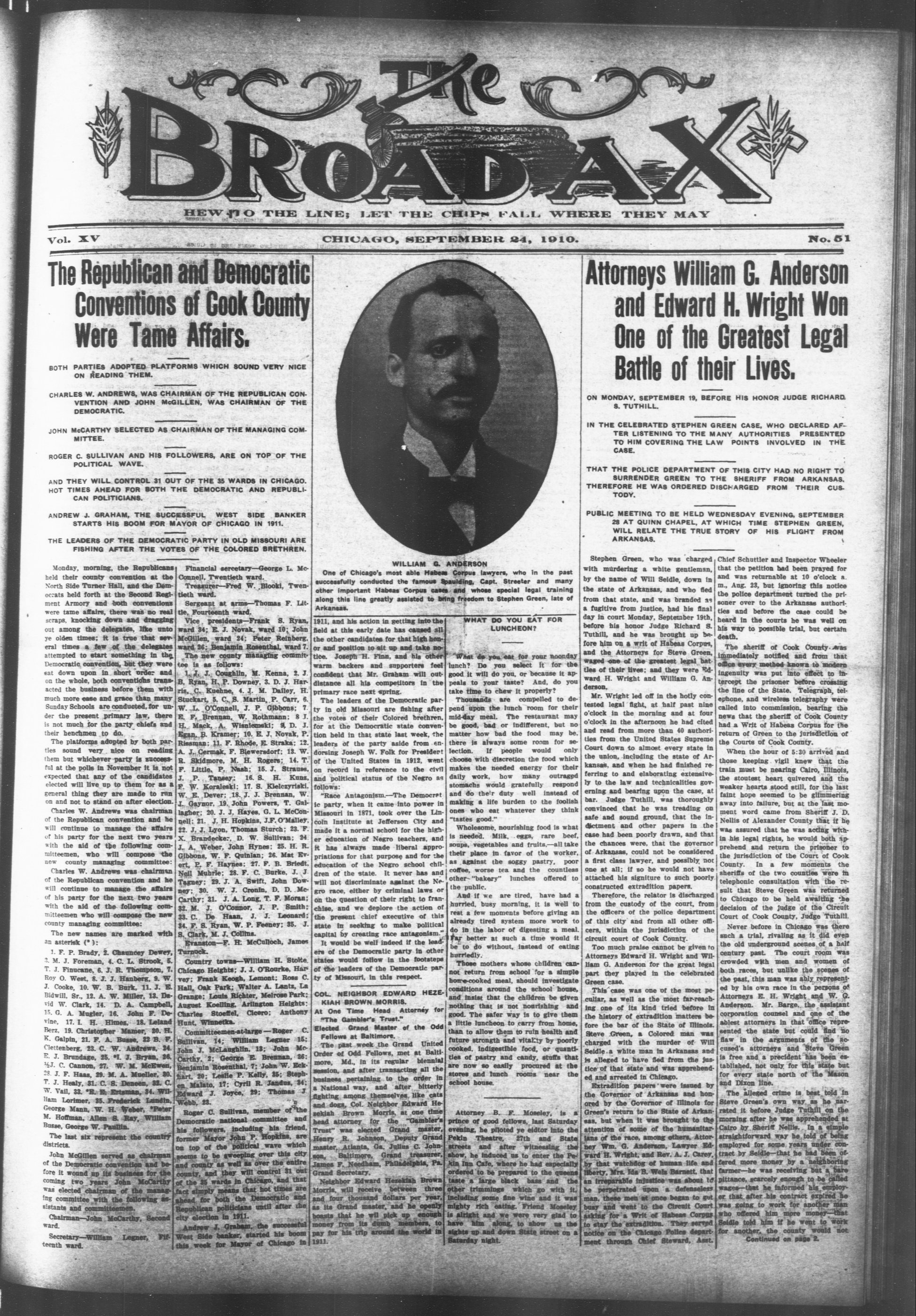
The Republican and Democratic Conventions of Cook County Were Tame Affairs.
BOTH PARTIES ADOPTED PLATFORMS WHICH SOUND VERY NICE ON READING THEM.
CHARLES W. ANDREWS, WAS CHAIRMAN OF THE REPUBLICAN CONVENTION AND JOHN McGILLEN, WAS CHAIRMAN OF THE DEMOCRATIC.
JOHN McCARTHY SELECTED AS CHAIRMAN OF THE MANAGING COMMITTEE.
ROGER C. SULLIVAN AND HIS FOLLOWERS, ARE ON TOP OF THE POLITICAL WAVE.
AND THEY WILL CONTROL 31 OUT OF THE 35 WARDS IN CHICAGO.
HOT TIMES AHEAD FOR BOTH THE DEMOCRATIC AND REPUBLICAN POLITICIANS.
ANDREW J. GRAHAM, THE SUCCESSFUL WEST SIDE BANKER STARTS HIS BOOM FOR MAYOR OF CHICAGO IN 1911.
THE LEADERS OF THE DEMOCRATIC PARTY IN OLD MISSOURI ARE FISHING AFTER THE VOTES OF THE COLORED BRETHREN.
Vol. XV
The Republican
Conventions
Were Tame
BOTH PARTIES ADOPTED PLATTER
ON READING THEM.
CHARLES W. ANDREWS, WAS CH
VENTION AND JOHN McC
DEMOCRATIC.
JOHN McCARTHY SELECTED AS O
MITTEE.
ROGER C. SULLIVAN AND HIS F
POLITICAL WAVE.
AND THEY WILL CONTROL 31 O
HOT TIMES AHEAD FOR BOTH THE
CAN POLITICIANS.
ANDREW J. GRAHAM, THE SUCK
STARTS HIS BOOM FOR M
THE LEADERS OF THE DEMOCR
FISHING AFTER THE VOT
Monday, morning, the Republicans held their county convention at the North Side Turner Hall, and the Democrats held forth at the Second Regiment Armory and both conventions were tame affairs, there was no real scraps, knocking down and dragging out among the delegates, like unto ye olden times; it is true that several times a few of the delegates attempted to start something in the Democratic convention, but they were sat down upon in short order and on the whole, both conventions transacted the business before them with much more ease and grace than many Sunday Schools are conducted, for under the present primary law, there is not much for the party chiefs and their henchmen to do.
The platforms adopted by both parties sound very nice on reading them but whichever party is successful at the polls in November it is not expected that any of the candidates elected will live up to them for as a general thing they are made to run on and not to stand on after election
Charles W. Andrews was chairman of the Republican convention and he will continue to manage the affairs of his party for the next two years with the aid of the following committeeen, who will compose the new county managing committee:
Charles W. Andrews was chairman of the Republican convention and he will continue to manage the affairs of his party for the next two years with the aid of the following committeeen who will compose the new county managing committee:
The new names are marked with an asterik (*):
1. F. P. Brady, 2. Chauncey Dewey,
3. M. J. Foreman, 4. C. L. Strook, 5. T. J. Finucare, 6. J. R. Thompson, 7. Roy O. West, 8. J. J. Hanberg, 9. W. J. Cooke, 10. W. B. Burk, 11. J. E. Bidwil, Sr., 12. A. W. Miller, 13. David W. Clark, 14. D. A. Campbell,
15. G. A. Mugler, 16. John F. Devine, 17. I. H. Himes, 18. Leland Berz, 19. Christopher Mamer, 20. H. K. Galpin, 21. F. A. Busse, 22. B. F. Clettenberg, 23. C. W. Andrews, 24. E. J. Brundage, 25. *I. J. Bryan, 26. *J. C. Cannon, 27. W. M. McEwen, 28. J. F. Haas, 29. M. A. Mueller, 30. T. J. Healy, 31. C. S. Dencen, 32. C. W. Vail, 33. *E. E. Ertsman, 34. William Lorimer, 35. Frederick Landin, George Mann, W. H. Weber, *Peter M. Hoffman, Allen S. Ray, William Busse, George W. Paulin.
The last six represent the country districts.
John McGillen served as chairman of the Democratic convention and before it wound up its business for the coming two years John McCarthy was elected chairman of the managing committee with the following assistants and committeemen.
Chairman—John McCarthy, Second ward.
Secretary—William Legner, Fifteenth ward.
Financial secretary—George L. McConnell, Twentieth ward.
Treasurer—Fred W. Blooki, Twentheth ward.
Sergeant at arms—Thomas F. Little, Fourteenth ward.
Vice presidents—Frank S. Ryan, ward 24; E. J. Novak, ward 10; John McGillen, ward 24; Peter Reinberg, ward 26; Benjamin Rosenthal, ward 7.
The new county managing committee is as follows:
1. J. J. Coughlin, M. Kenna, 2. J. B. Ryan, H. P. Downey, 3. D. J. Harris, C. Kuehne, 4. J. M. Dalley, H. Stuckart, 5. C. S. Martin, P. Carr, 6. W. L. O'Connell, J. P. Gibbons, 7. E. F. Brennan, W. Rothmann; 8. J. H. Mack, A. Wisnlemski; 9. D. J. Egan, B. Kramer; 10. E. J. Novak, P. Rissman; 11. F. Rhode, E. Straka; 12. A. J. Cermak, F. Biewersdorf; 13. W. R. Skidmore, M. H. Rogers; 14. T. F. Little, P. Nash; 15. J. Straus, J. P. Tansey; 16. S. H. Kunz, F. W. Koraleski; 17. S. Kielczyriski, W. E. Dever; 18. J. J. Brennan, W. J. Gaynor, 19. John Powers, T. Gallagher; 20. J. J. Hayes, G. L. McConnell; 21. J. H. Hopkins, J.F. O'Malley; 22. J. J. Lyon, Thomas Sturch; 23. F. X. Brandecker, D. W. Sullivan; 24. J. A. Weber, John Hynes; 25. H. R. Gibbons, W. F. Quinlan; 26. Mat Evert, P. F. Haynes; 27. F. B. Briedt, Nell Muhrle; 28. F. C. Burke, J. J. Tagney; 29. J. A. Swift, John Downey; 30. W. J. Cronin, D. D. McCarthy; 31. J. A. Long, T. F. Moran; 32. M. J. O'Connor, J. P. Smith; 33. C. De Haan, J. J. Leonard; 34. F. S. Ryan, W. P. Feeney; 35. J. S. Clark, M. J. Collins.
Evanston—F. H. McCulloch, James Turnock.
Country towns—William H. Stoke, Chicago Heights; J. J. O'Rourke, Harvey; Frank Keogh, Lemont; Ross C. Hall, Oak Park; Walter A. Lantz, La Grange; Louis Richter, Melrose Park; August Koelling, Arlington Heights; Charles Stoeffel, Cicero; Anthony Hunt, Winnetka.
CHICAGO, SEPTEMBER 24, 1910.
WILLIAM G. ANDERSON One of Chicago's most able Habeas Corpus law successfully conducted the famous Spaulding, Cal other important Habeas Corpus cases and whose along this line greatly assisted to bring freedom Arkansas.
One of Chicago's most able Habeas Corpus lawyers, who in the past successfully conducted the famous Spaulding, Capt. Streeter and many other important Habeas Corpus cases and whose special legal training along this line greatly assisted to bring freedom to Stephen Green, late of Arkansas.
1911, and his action in getting into the field at this early date has caused all the other candidates for that high honor and position to sit up and take notice. Joseph H. Finn, and his other warm backers and supporters feel confident that Mr. Graham will outdistance all his competitors in the primary race next spring.
The leaders of the Democratic party in old Missouri are fishing after the votes of their Colored brethren, for at the Democratic state convention held in that state last week, the leaders of the party aside from endorsing Joseph W. Folk for President of the United States in 1912, went on record in reference to the civil and political status of the Negro as follows:
WHAT DO YOU EAT FOR LUNCHEON?
What do you eat for your noonday lunch? Do you select it for the good it will do you, or because it appeals to your taste? And, do you take time to chew it properly?
Thousands are compelled to do pend upon the lunch room for their mid-day meal. The restaurant may be good, bad or indifferent, but no matter how bad the food may be there is always some room for selection. If people would only choose with discretion the food which makes the needed energy for their daily work, how many outrage stomachs would gratefully respond
"Race Antagonism.—The Democrat ic party, when it came into power in Missouri in 1871, took over the Lincoln Institute at Jefferson City and made it a normal school for the higher education of Negro teachers, and it has always made liberal appropriations for that purpose and for the education of the Negro school children of the state. It never has and will not discriminate against the Negro race, either by criminal laws or on the question of their right to franchise, and we deplore the action of the present chief executive of this state in seeking to make political capital by creating race antagonism." It would be well indeed if the leaders of the Democratic party in other states would follow in the footsteps of the leaders of the Democratic party of Missouri, in this respect.
COL. NEIGHBOR EDWARD HEZEKIAH BROWN MORRIS.
At One Time Head Attorney for "The Gambler's Trust."
Elected Grand Master of the Odd Fellows at Baltimore.
The past week the Grand United Order of Odd Fellows, met at Baltimore, Md., in its regular biennial session, and after transacting all the business pertaining to the order in a National way, and after bitterly fighting among themselves, like cats and dogs, Col. Neighbor Edward Hezekiah Brown Morris, at one time head attorney for the "Gambler's Trust" was elected Grand master, Henry R. Johnson, Deputy Grand master, Atlanta, Ga. Julius C. Johnson, Baltimore, Grand treasurer, James F. Needham, Philadelphia, Pa. Grand Secretary.
Neighbor Edward Hezekiah Brown Morris, will receive between three and four thousand dollars per year, as its Grand master, and he openly boasts that he will pick up enough money from its dumb members, to pay for his trip around the world in 1911.
Corpus lawyers, who in the past paulding, Capt. Streeter and many and whose special legal training freedom to Stephen Green, late of
WHAT DO YOU EAT FOR LUNCHEON?
What do you eat for your noonday lunch? Do you select it for the good it will do you, or because it appeals to your taste? And, do you take time to chew it properly?
Thousands are compelled to depend upon the lunch room for their mid-day meal. The restaurant may be good, bad or indifferent, but no matter how bad the food may be, there is always some room for selection. If people would only choose with discretion the food which makes the needed energy for their daily work, how many outraged stomachs would gratefully respond and do their duty well instead of making a life burden to the foolish ones who eat whatever they think "tastes good."
Wholesome, nourishing food is what is needed. Milk, eggs, rare beef, soups, vegetables and fruits—all take their place in favor of the worker, as against the soggy pastry, poor coffee, worse tea and the countless other—'bakery' lunches offered to the public.
And if we are tired, have had a hurried, busy morning, it is well to rest a few moments before giving an already tired system more work to do in the labor of digesting a meal. Far better at such a time would it be to do without, instead of eating hurriedly.
Those mothers whose children cannot return from school for a simple home-cooked meal, should investigate conditions around the school house, and insist that the children be given nothing that is not nourishing and good. The safer way is to give them a little luncheon to carry from home, than to allow them to ruin health and future strength and vitality by poorly cooked, indigestible food, or quantities of pastry and candy, stuffs that are now so easily procured at the stores and lunch rooms near the school house.
Attorney B. F. Moseley, is a prince of good fellows, last Saturday evening, he piloted ye eldor into the Pekin Theatre, 27th and State streets and after witnessing the show, he induced us to enter the Pekin Inn Cafe, where he had especially ordered to be prepared to the queens taste a large black bass and the other trimmings which go with it, including some fine wine and it was mighty rich eating. Friend Moseley is alright and we were very glad to have him along, to show us the sights up and down State street on a Saturday night.
Attorneys William G. Anderson and Edward H. Wright Won One of the Greatest Legal Battle of their Lives.
ON MONDAY, SEPTEMBER 19, BEFORE HIS HONOR JUDGE RICHARD S. TUTHILL.
IN THE CELEBRATED STEPHEN GREEN CASE, WHO DECLARED AFTER LISTENING TO THE MANY AUTHORITIES PRESENTED TO HIM COVERING THE LAW POINTS INVOLVED IN THE CASE.
THAT THE POLICE DEPARTMENT OF THIS CITY HAD NO RIGHT TO SURRENDER GREEN TO THE SHERIFF FROM ARKANSAS. THEREFORE HE WAS ORDERED DISCHARGED FROM THEIR CUSTODY.
PUBLIC MEETING TO BE HELD WEDNESDAY EVENING, SEPTEMBER 28 AT QUINN CHAPEL, AT WHICH TIME STEPHEN GREEN, WILL RELATE THE TRUE STORY OF HIS FLIGHT FROM ARKANSAS.
Stephen Green, who was charged with murdering a white gentleman, by the name of Will Seidle, down in the state of Arkansas, and who fled from that state, and was branded as a fugitive from justice, had his final day in court Monday, September 19th, before his honor Judge Richard S. Tuthill, and he was brought up before him on a writ of Habeas Corpus, and the Attorneys for Steve Green, waged one of the greatest legal battles of their lives; and they were Edward H. Wright and William G. Anderson.
Mr. Wright led off in the hotly contested legal fight, at half past nine o'clock in the morning and at four o'clock in the afternoon he had cited and read from more than 40 authorities from the United States Supreme Court down to almost every state in the union, including the state of Arkansas, and when he had finished referring to and elaborating extensively to the law and technicalities governing and bearing upon the case, at bar. Judge Tuthill, was thoroughly convinced that he was treading on safe and sound ground, that the indictment and other papers in the case had been poorly drawn, and that the chances were, that the governor of Arkansas, could not be considered a first class lawyer, and possibly not one at all; if so he would not have attached his signature to such poorly constructed extradition papers.
Therefore, the relator is discharged from the custody of the court, from the officers of the police department of this city and from all other officers, within the jurisdiction of the circuit court of Cook County.
Too much praise cannot be given to Attorneys Edward H. Wright and William G. Anderson for the great legal part they played in the celebrated Green case. This case was one of the most peculiar, as well as the most far-reaching one of its kind tried before in the history of extradition matters before the bar of the State of Illinois. Steve Green, a Colored man was charged with the murder of Will Seidle, a white man in Arkansas and is alleged to have fled from the justice of that state and was apprehended and arrested in Chicago.
Extradition papers were issued by the Governor of Arkansas and honored by the Governor of Illinois for Green's return to the State of Arkansas, but when it was brought to the attention of some of the humanitarians of the race, among others, Attorney Wm. G. Anderson, Lawyer Edward H. Wright, and Rev. A. J. Carey, by that watchdog of human life and liberty, Mrs. Kia B. Wels Barnett, that an irreparable injustice was about to be perpetrated upon a defenseless man, these men at once began to get busy and went to the Circuit Court asking for a Writ of Habesas Corpus to stay the extradition. They served notice on the Chicago Police department through Chief Steward, Asst.
No.51
am G. Anderson
H. Wright Won
Greatest Legal
their Lives.
FORE HIS HONOR JUDGE RICHARD.
GREEN CASE, WHO DECLARED AF-
ANY AUTHORITIES PRESENTED
NEW POINTS INVOLVED IN THE
OF THIS CITY HAD NO RIGHT TO
THE SHERIFF FROM ARKANSAS.
ISCHARGED FROM THEIR CUS-
EDNESDAY EVENING, SEPTEMBER
WHICH TIME STEPHEN GREEN,
STORY OF HIS FLIGHT FROM
Chief Schuttler and Inspector Wheeler that the petition had been prayed for and was returnable at 10 o'clock a.m., Aug. 23, but ignoring this notice the police department turned the prisoner over to the Arkansas authorities and before the case could be heard in the courts he was well on his way to possible trial, but certain death.
The sheriff of Cook County was immediately notified and from that office every method known to modern ingenuity was put into effect to intercept the prisoner before crossing the line of the State. Telegraph, telephone, and wireless telegraph were called into commission, bearing the news that the sheriff of Cook County had a Writ of Habeas Corpus for the return of Green to the jurisdiction of the Courts of Cook County.
When the hour of 5:30 arrived and those keeping vigil knew that the train must be nearing Cairo, Illinois, the stoutest heart quivered and the weaker hearts stood still, for the last faint hope seemed to be glimmering away into failure, but at the last moment word came from Sheriff J. D. Nellis of Alexander County that if he was assured that he was acting within his legal rights, he would both prehend and return the prisoner to the jurisdiction of the Court of Cook County. In a few moments the sheriffs of the two counties were in telephonic consultation with the result that Steve Green was returned to Chicago to be held awaiting the decision of the judge of the Circuit Court of Cook County, Judge Tuthill.
Never before in Chicago was there such a trial, rivaling as it did even the old underground scenes of a half century past. The court room was crowded with men and women of both races, but unlike the scenes of the past, this man was ably represented by his own race in the persons of Attorneys E. H. Wright and W. G. Anderson. Mr. Barge, the assistant corporation counsel and one of the ablest attorneys in that office represented the state but could find no flaw in the arguments of the accused's attorneys and Steve Green is free and a president has been established, not only for this state but for every state north of the Mason and Dixon line.
The alleged crime is best told in Steve Green's own way as he narrated it before Judge Tuthill on the morning after he was apprehended at Calro by Sheriff Nellis. In a simple straightforward way he told of being employed for some years under contract by Seidle—that he had been offered more money by a neighboring farmer—he was receiving but a bare pittance, scarcely enough to be called wages—that he informed his employer that after his contract expired he was going to work for another man who offered him more money—that Seidle told him if he went to work for another, the county would not
Continued on page 2.
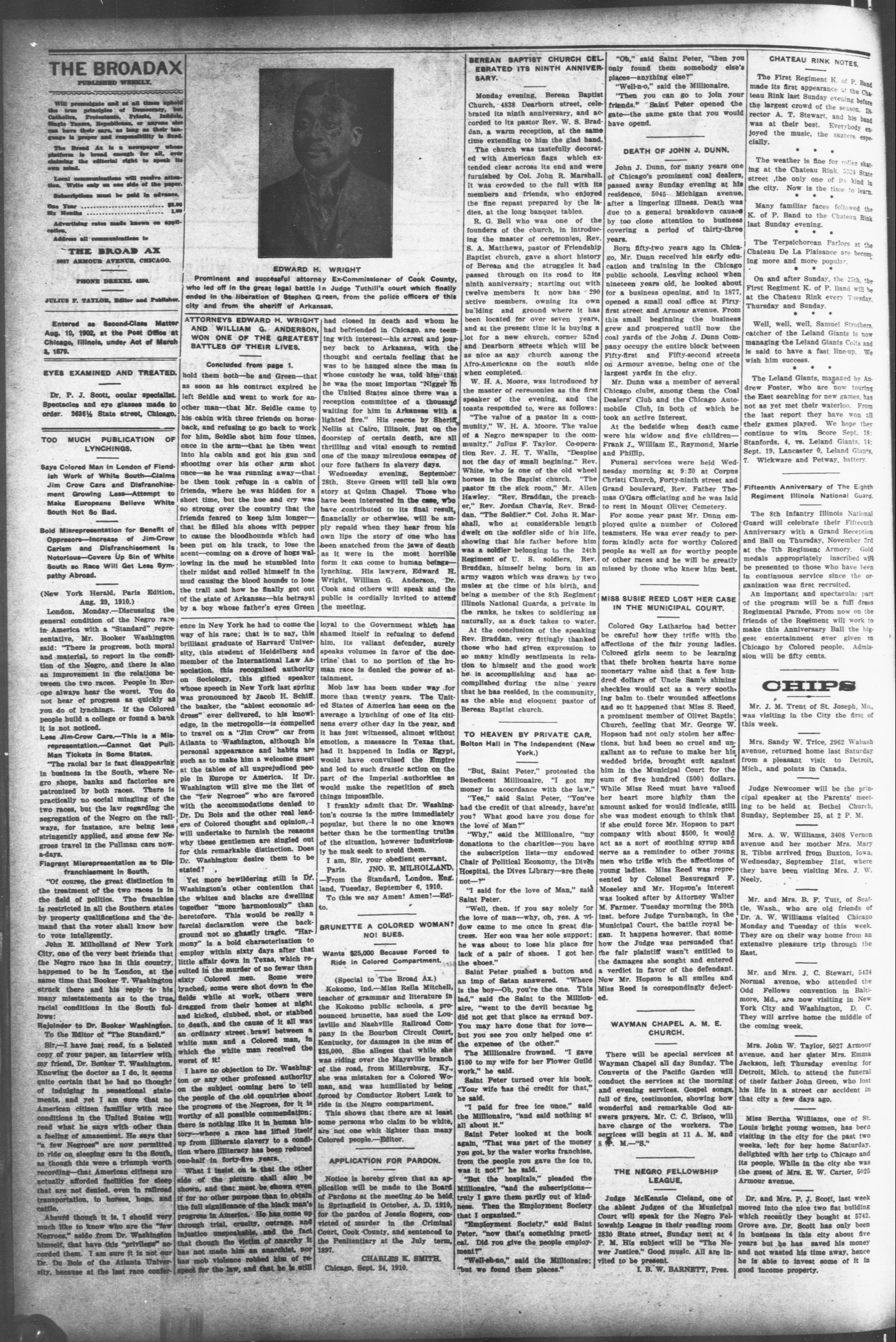
THE BROADAX
Will promulgate and at all times uphold the true principles of Democracy, but Catholics, Protestants, Prides, Indies, Single Taxes, Republicans, or anyone else can have their say, as long as their language is proper and responsibility is fixed. The Broad Ax is a newspaper whose platform is broad enough for all, ever claiming the editorial right to speak its own mind.
Local communications will receive attention. Write only on one side of the paper.
Subscriptions must be paid in advance.
One Year ..... $8.00
Six Months ..... 1.00
Advertising rates made known on application.
Address all communications to
THE BROAD AX
5027 ARMOUR AVENUE, CHICAGO.
PHONE DREXEL 4500.
JULIUS F. TAYLOR, Editor and Publisher.
Entered as Second-Class Matter
Aug. 10, 1902, at the Post Office at
Chicago, Illinois, under Act of March
3, 1879.
EYES EXAMINED AND TREATED.
Dr. P. J. Scott, ocular specialist. Spectacles and eye glasses made to order. 2636½ State street, Chicago.
TOO MUCH PUBLICATION OF LYNCHINGS.
Says Colored Man in London of Fiendish Work of White South—Claims Jim Crow Cars and Disfranchisement Growing Less—Attempt to Make Europeans Believe White South Not So Bad.
Bold Misrepresentation for Benefit of
Oppressors—Increase of Jim-Crow
Carism and Disfranchisement Is
Notorious—Covers Up Sin of White
South so Race Will Get Less Sympathy Abroad.
(New York Herald, Paris Edition,
Aug. 29, 1910.)
London, Monday.—Discussing the general condition of the Negro race in America with a "Standard" representative, Mr. Booker Washington said: "There is progress, both moral and material, to report in the condition of the Negro, and there is also an improvement in the relations between the two races. People in Europe always hear the worst. You do not hear of progress as quickly as you do of lynchings. If the Colored people build a college or found a bank it is not noticed.
Less Jim-Crow Cars.—This is a Misrepresentation.—Cannot Get Pull-Man Tickets in Some States.
"The racial bar is fast disappearing in business in the South, where Negro shops, banks and factories are patronized by both races. There is practically no social mingling of the two races, but the law regarding the segregation of the Negro on the railways, for instance, are being less stringently applied, and some few Negroes travel in the Pullman cars now-a-days.
Flagrant Microrepresentation as to Disfranchisement in South.
"Of course, the great distinction in the treatment of the two races is in the field of politics. The franchise is restricted in all the Southern states by property qualifications and the demand that the voter shall know how to vote intelligently.
John E. Milholland of New York City, one of the very best friends that the Negro race has in this country, happened to be in London, at the same time that Booker T. Washington etruck there and his reply to his many misstatements as to the true, racial conditions in the South follows:
Rejoinder to Dr. Booker Washington. To the Editor of "The Standard." Sir.-I have just read, in a belated copy of your paper, an interview with my friend, Dr. Booker T. Washington. Knowing the doctor as I do, it seems quite certain that he had no thought of indulging in sensational statements, and yet I am sure that no American citizen familiar with race conditions in the United States will read what he says with other than a feeling of amazement. He says that "a few Negroes" are now permitted to ride on sleeping cars in the South, as though this were a triumph worth recording—that American citizens are actually afforded facilities for sleep that are not denied, even in railroad transportation, to horses, hogs, and cattle.
Absurd though it is, I should very much like to know who are the "few Negroes," aside from Dr. Washington himself, that have this "privilege" accorded them. I am sure it is not our Dr. Du Bois of the Atlanta University, because at the last race confer-
[Name]
Prominent and successful attorney Ex-Commissioner of Cook County, who led off in the great legal battle in Judge Tuthill's court which finally ended in the liberation of Stephen Green, from the police officers of this city and from the sheriff of Arkansas.
ATTORNEYS EDWARD H. WRIGHT AND WILLIAM G. ANDERSON, WON ONE OF THE GREATEST BATTLES OF THEIR LIVES. had closed in death and whom he had befriended in Chicago, are teeming with interest—his arrest and journey back to Arkansas, with the
Concluded from page 1.
hold them both—he and Green—that as soon as his contract expired he left Seidle and went to work for another man—that Mr. Seidle came to his cabin with three friends on horseback, and refusing to go back to work for him, Seidle shot him four times, once in the arm—that he then went into his cabin and got his gun and shooting over his other arm shot once—as he was running away—that he then took refuge in a cabin of friends, where he was hidden for a short time, but the hue and cry was so strong over the country that the friends feared to keep him longer—that he filled his shoes with pepper to cause the bloodhounds which had been put on his track, to lose the scent—coming on a drove of hogs wallowing in the mud he stumbled into their midst and rolled himself in the midst and blood hounds to lose the trail and how he finally got out of the state of Arkansas—his betrayal by a boy whose father's eyes Green
ence in New York he had to come the way of his race; that is to say, this brilliant graduate of Harvard University, this student of Heidelberg and member of the International Law Association, this recognized authority on Sociology, this gifted speaker whose speech in New York last spring was pronounced by Jacob H. Schiff, the banker, the "ablest economic address" ever delivered, to his knowledge, in the metropolis—is compelled to travel on a "Jim Crow" car from Atlanta to Washington, although his personal appearance and habits are such as to make him a welcome guest at the tables of all unprejudiced people in Europe or America. If Dr. Washington will give me the list of the "few Negroes" who are favored with the accommodations denied to Dr. Du Bois and the other real leaders of Colored thought and opinion, I will undertake to furnish the reasons why these gentlemen are singled out for this remarkable distinction. Does Dr. Washington desire them to be stated?
Yet more bewildering still is Dr. Washington's other contention that the whites and blacks are dwelling together "more harmoniously" than heretofore. This would be really a faecal declaration were the background not so ghastly tragic. "Harmony" is a bold characterization to employ within sixty days after that little affair down in Texas, which resulted in the murder of no fewer than sixty Colored men. Some were lynched, some were shot down in the fields while at work, others were dragged from their homes at night and kicked, clubbed, shot, or stabbed to death, and the cause of it all was an ordinary street, brawl between a white man and a Colored man, in which the white man received the worst of it!
I have no objection to Dr. Washington or any other professed authority on the subject coming here to tell the people of the old countries about the progress of the Negroes, for it is worthy of all possible commendation; there is nothing like it in human history—where a race has lifted itself up from illiterate slavery to a condition where illiteracy has been reduced one-half in forty-five years.
What I insist on is that the other side of the picture shall also be shown, and that must be shown even if for no other purpose than to obtain the full significance of the black man's progress in America. He has come up through trial, cruelty, outrage, and injustice unspeakable, and the fact that though the victim of anarchy it has not made him an anarchist, nor has mob violence robbed him of respect for the law, and that he is still
had closed in death and whom he had befriended in Chicago, are teaming with interest—his arrest and journey back to Arkansas, with the thought and certain feeling that he was to be hanged since the man in whose custody he was, told him that he was the most important "Nigger in the United States since there was a reception committee of a thousand waiting for him in Arkansas with a lighted fire." His rescue by Sheriff Nellis at Cairo, Illinois, just on the doorstep of certain death, are all thrilling and vital enough to remind one of the many miraculous escapes of our fore fathers in slavery days.
Wednesday evening, September 28th, Steve Green will tell his own story at Quinn Chapel. Those who have been interested in the case, who have contributed to its final result, financially or otherwise, will be amply repaid when they hear from his own lips the story of one who has been snatched from the jaws of death as it were in the most horrible form it can come to human beings—lynching. His lawyers, Edward H. Wright, William G. Anderson, Dr. Cook and others will speak and the public is cordially invited to attend the meeting.
loyal to the Government which has shamed itself in refusing to defend him, its valiant defender, surely speaks volumes in favor of the doctrine that to no portion of the human race is denied the power of attainment.
Mob law has been under way for more than twenty years. The United States of America has seen on the average a lynching of one of its citizens every other day in the year, and it has just witnessed, almost without emotion, a massacre in Texas that, had it happened in India or Egypt, would have convulsed the Empire and led to such drastic action on the part of the Imperial authorities as would make the repetition of such things impossible.
I frankly admit that Dr. Washington's course is the more immediately popular, but there is no one knows better than he the tormenting truths of the situation, however industriously he mak seek to avoid them.
BRUNETTE A COLORED WOMAN?
NO! SUES.
Wants $25,000 Because Forced to
Ride in Colored Compartment.
(Special to The Broad Ax.)
Kokomo, Ind.—Miss Rella Mitchell,
teacher of grammar and literature in
the Kokomo public schools, a pronounced brunette, has sued the Louisville and Nashville Railroad Company in the Bourbon Circuit Court,
Kentucky, for damages in the sum of
$25,000. She alleges that while she
was riding over the Maysville branch
of the road, from Millersburg, Ky.
she was mistaken for a Colored Woman, and was humiliated by being forced by Conductor Robert Lusk to ride in the Negro compartment.
This shows that there are at least some persons who claim to be white, are not one whit lighter than many Colored people.—Editor.
APPLICATION FOR PARDON.
Notice is hereby given that an application will be made to the Board of Pardons at the meeting to be held in Springfield in October, A. D. 1910, for the pardon of Jessie Sogers, convicted of murder in the Criminal Court, Cook County, and sentenced to the Penitentiary at the July term, 1897.
CHARLES K. SMITH.
Chicago. Sept. 24. 1910.
BEREAN BAPTIST CHURCH CEL
EBRATED ITS NINTH ANNIVERSARY.
Monday evening, Berean Baptist
Church, 4838 Dearborn street, celebrated its ninth anniversary, and accorded to its pastor Rev. W. S. Braddan, a warm reception, at the same time extending to him the glad hand.
The church was tastefully decorated with American flags which extended clear across its end and were furnished by Col. John R. Marshall. It was crowded to the full with its members and friends, who enjoyed the fine repast prepared by the ladies, at the long banquet tables.
R. G. Bell who was one of the founders of the church, in introducing the master of ceremonies, Rev S. A. Matthews, pastor of Friendship Baptist church, gave a short history of Berean and the struggles it had passed through on its road to its ninth anniversary; starting out with twelve members It now has 290 active members. owning its own building and ground where it has been located for over seven years, and at the present time it is buying a lot for a new church, corner 52nd and Dearborn streets which will be as nice as any church among the Afro-Americans on the south side when completed.
W. H. A. Moore, was introduced by the master of ceremonies as the first speaker of the evening, and the toasts responded to, were as follows:
"The value of a pastor in a community," W. H. A. Moore. The value of a Negro newspaper in the community." Julius F. Taylor. Co-operation Rev. J. H. T. Walls, "Despise not the day of small beginning." Rev. White, who is one of the old wheel horses in the Baptist church. "The pastor in the sick room," Mr. Allen Hawley. "Rev. Braddan, the preacher," Rev. Jordan Chavis, Rev. Braddan, "The Soldier." Col. John R. Marshall, who at considerable length dwelt on the soldier side of his life, showing that his father before him was a soldier belonging to the 24th Regiment of U. S. soldiers, Rev. Braddan, himself being born in an army wagon which was drawn by two mules at the time of his birth, and being a member of the 8th Regiment Illinois National Guards, a private in the ranks, he takes to soldiering as naturally, as a duck takes to water.
At the conclusion of the speaking Rev. Braddan, very fittingly thanked those who had given expression to so many kindly sentiments in relation to himself and the good work he is accomplishing and has accomplished during the nine years that he has resided, in the community, as the able and eloquent pastor of Berean Baptist church.
TO HEAVEN BY PRIVATE CAR. Bolton Hall in The Independent (New York.)
"But, Saint Peter," protested the Beneficient Millionaire, "I got my money in accrdance with the law." "Yes," said Saint Peter, "You've had the credit of that already, haven't you? What good have you done for the love of Man?" "Why," said the Millionaire, "my donations to the charities—you have the subscription lists—my endowed Chair of Political Economy, the Dives Hospital, the Dives Library—are these not—?" "I said for the love of Man," said Saint Peter.
"Well, then, if you say solely for the love of man—why, oh, yes. A window came to me once in great distress. Her son was her sole support; he was about to lose his place for lack of a pair of shoes. I got her the shoes."
Saint Peter pushed a button aud an imp of Satan answered. "Where is the boy—Oh, you're the one. This lad," said the Saint to the Millionaire, "went to the devil because he did not get that place as errand boy. You may have done that for love—but you see you only helped one at the expense of the other."
The Millionaire frowned. "I gave $100 to my wife for her Flower Guild work," he said.
Saint Peter turned over his book, "Your wife has the credit for that," he said.
"I paid for free ice once," said the Millionaire, "and said nothing at all about it."
Saint Peter looked at the book again, "That was part of the money you got, by the water works franchise, from the people you gave the ice to, was it not?" he said.
"But the hospitals," pleaded the Millionaire, "and the subscriptions—truly I gave them partly out of kindness. Then the Employment Society that I organized."
"Employment Society," said Saint Peter, "now that's something practical. Did you give the people employment!"
"Well-eh-no," said the Millionaire; "but we found them places."
"Oh," said Saint Peter, "then you only found them somebody else's places—anything else?"
"Well-n-o," said the Millionaire.
"Then you can go to join your friends." Saint Peter opened the gate—the same gate that you would have opend.
DEATH OF JOHN J. DUNN.
John J. Dunn, for many years one of Chicago's prominent coal dealers, passed away Sunday evening at his residence, 5045 Michigan avenue, after a lingering illness. Death was due to a general breakdown caused by too close attention to business covering a period of thirty-three years.
Born fifty-two years ago in Chicago, Mr. Dunn received his early education and training in the Chicago public schools. Leaving school when nineteen years old, he looked about for a business opening, and in 1877, opened a small coal office at Fifty-first street and Armour avenue. From this small beginning the business grew and prospered until now the coal yards of the John J. Dunn Company occupy the entire block between Fifty-first and Fifty-second streets on Armour avenue, being one of the largest yards in the city. Mr. Dunn was a member of several Chicago clubs, among them the Coal Dealers' Club and the Chicago Automobile Club, in both of which he took an active interest.
At the bedside when death came were his widow and five children. Frank J. William E., Raymond, Marle and Phillip.
Funeral services were held Wednesday morning at 9:30 at Corpus Christi Church, Forty-ninth street and Grand boulevard, Rev. Father Thomas O'Gara officiating and he was laded to rest in Mount Olivet Cemetery.
For some year past Mr. Dunn employed quite a number of Colored teamsters. He was ever ready to perform kindly acts for worthy Colored people as well as for worthy people of other races and he will be greatly missed by those who knew him best.
MISS SUSIE REED LOST HER CASE
IN THE MUNICIPAL COURT.
Colored Gay Latharios had better be careful how they trifle with the affections of the fair young ladies. Colored girls seem to be learning that their broken hearts have some monetary value and that a few hundred dollars of Uncle Sam's shining sheckles would act as a very soothing balm to their wounded affections and so it happened that Miss S. Reed, a prominent member of Olivet Baptis' Church, feeling that Mr. George W. Hopson had not only stolen her affections, but had been so cruel and ungallant as to refuse to make her his wedded bride, brought suit against him in the Municipal Court for the sum of five hundred (500) dollars. While Miss Reed must have valued her heart more highly than the amount asked for would indicate, still she was modest enough to think that if she could force Mr. Hopson to part company with about $500, it would act as a sort of soothing syrup and serve as a reminder to other young men who trifle with the affections of young ladies. Miss Reed was represented by Colonel Beauregard F. Moseley and Mr. Hopson's interest was looked after by Attorney Walter M. Farmer. Tuesday morning the 20th inst. before Judge Turnbaugh, in the Municipal Court, the battle royal began. It happens however, that somehow the Judge was persuaded that the fair plaintiff wasn't entitled to the damages she sought and entered a verdict in favor of the defendant. Now Mr. Hopson is all smiles and Miss Reed is correspondingly dejected.
WAYMAN CHAPEL A. M. E.
CHURCH.
There will be special services at Wayman Chapel all day Sunday. The Converts of the Pacific Garden will conduct the services at the morning and evening services. Gospel songs, full of fire, testimonies, showing how wonderful and remarkable God answers prayers. Mr. C: C. Brisco, will have charge of the workers. The services will begin at 11 A. M. and 8 P. M.—"S."
THE NEGRO FELLOWSHIP
LEAGUE.
Judge McKenzie Cleland, one of the ablest Judges of the Municipal Court will speak for the Negro Fellowship League in their reading room 2830 State street, Sunday next at 4 P. M. His subject will be "The Newer Justice." Good music. All are invited to be present. I. B. W. BARNETT, Pres.
The First Regiment K. of P. Band made its first appearance at the Chateau Rink last Sunday evening before the largest crowd of the season. Director A. T. Stewart, and his band was at their best. Everybody enjoyed the music, the skaters especially.
The weather is fine for roller skating at the Chateau Rink, 5324 State street the only one of its kind in the city. Now is the time to learn.
Many familiar faces followed the K. of P. Band to the Chateau Rink last Sunday evening.
The Terpsichorean Parlors at the Chateau De La Plaisance are becoming more and more popular.
On and after Sunday, the 25th, the First Regiment K. of P. Band will be at the Chateau Rink every Tuesday, Thursday and Sunday.
Well, well, well, Samuel Strothers, catcher of the Leland Giants is now managing the Leland Giants Colts and is said to have a fast line-up. We wish him success.
The Leland Giants, managed by Andrew Foster, who are now touring the East searching for new games, has not as yet met their waterloo. From the last report they have won all their games played. We hope they continue to win. Score Sept. 18: Stanford, 4, vs. Leland Giants, 14: Sept. 19. Lancaster 0, Leland Giants, 7. Wickware and Petway, battery.
Fifteenth Anniversary of The Eighth
Regiment Illinois National Guard
The 8th Infantry Illinois National Guard will celebrate their Fifteenth Anniversary with a Grand Reception and Ball on Thursday, November 3rd at the 7th Regiment Armory. Gold medals appropriately inscribed will be presented to those who have been in continuous service since the organization was first recruited.
An important and spectacular part of the program will be a full dress Regimental Parade. From now on the friends of the Regiment will work to make this Anniversary Ball the biggest entertainment ever given in Chicago by Colored people. Admission will be fifty cents.
CHIPS
Mr. J. M. Trent of St. Joseph, Mo., was visiting in the City the first of this week.
Mrs. Sandy W. Trice, 2962 Wabash avenue, returned home last Saturday from a pleasant visit to Detroit, Mich., and points in Canada.
Judge Newcomer will be the principal speaker at the Parents' meeting to be held at Bethel Church, Sunday, September 25, at 2 P. M.
Mrs. A. W. Williams, 3408 Vernon avenue and her mother Mrs. Mary R. Tibbs arrived from Buxton, Iowa, Wednesday, September 21st, where they have been visiting Mrs. J. W. Neely.
Mr. and Mrs. B. F. Tutt, of Seattle, Wash., who are old friends of Dr. A. W. Williams visited Chicago Monday and Tuesday of this week. They are on their way home from an extensive pleasure trip through the East.
Mr. and Mrs. J. C. Stewart, 5434 Normal avenue, who attended the Odd Fellows convention in Baltimore, Md., are now visiting in New York City and Washington, D. C. They will arrive home the middle of the coming week.
Mrs. John W. Taylor, 5027 Armour avenue, and her sister Mrs. Emma Jackson, left Thursday evening for Detroit, Mich. to attend the funeral of their father John Green, who lost his life in a street car accident in that city a few days ago.
Miss Bertha Williams, one of St. Louis bright young women, has been visiting in the city for the past two weeks, left for her home Saturday, delighted with her trip to Chicago and its people. While in the city she was the guest of Mrs. E. W. Carter, 5025 Armour avenue.
Dr. and Mrs. P. J. Scott, last week moved into the nice two flat building which recently they bought at 5742. Grove ave. Dr. Scott has only been in business in this city about five years but he has saved his money and not wasted his time away, hence he is able to invest some of it in good income property.
He will bury cheaper than the trust
He will bury cheaper than the trust
P.
GEO. O.
Funeral Director and Embalmment successful undertaking establish of the people's appreciation of I I am the only Undertaker that the same price as Hearse and c to One Hundred Dollars on a fun You are cordially invited to com making arrangements.
We carry a large stock on hand suit the people. Funerals are conducted in any out extra charges. Large Chapel free to our patr of the United States and foreign prices. Phone, West 1761. Lady atten Lake St., near Lincoln St.
We carry a large stock on hand from which to select, that will suit the people. Funerals are conducted in any part of the city or suburbs without extra charges. Large Chapel free to our patrons. Bodies shipped to all parts of the United States and foreign countries at the very lowest prices. Phone, West 1761. Lady attendant. Office and chapel, 1904 W. Lake St., near Lincoln St.
The class of 1905 and 1906, presents violin class and orchestra of Prof. W. Kemper Harreld. Miss C. C. Hunter, reader will hold forth at Berean Baptist church, 4838 Dearborn street, Wednesday evening, September 28th. Admission will be 15 cts. Mr. Charles S. Smith, 5363 Dearborn street will manage the affair, which promises to be very interesting to lovers of music.
Lepold Grand, formerly superintendent of the 30th ward, who has lately been in charge of the loading station, Chicago ave., was this week transferred to the 5th ward, and he will become its superintendent, the people residing in the 30th ward, would be greatly pleased to have Mr. Grand back with them again for he was the best superintendent that the 30th ward ever had.
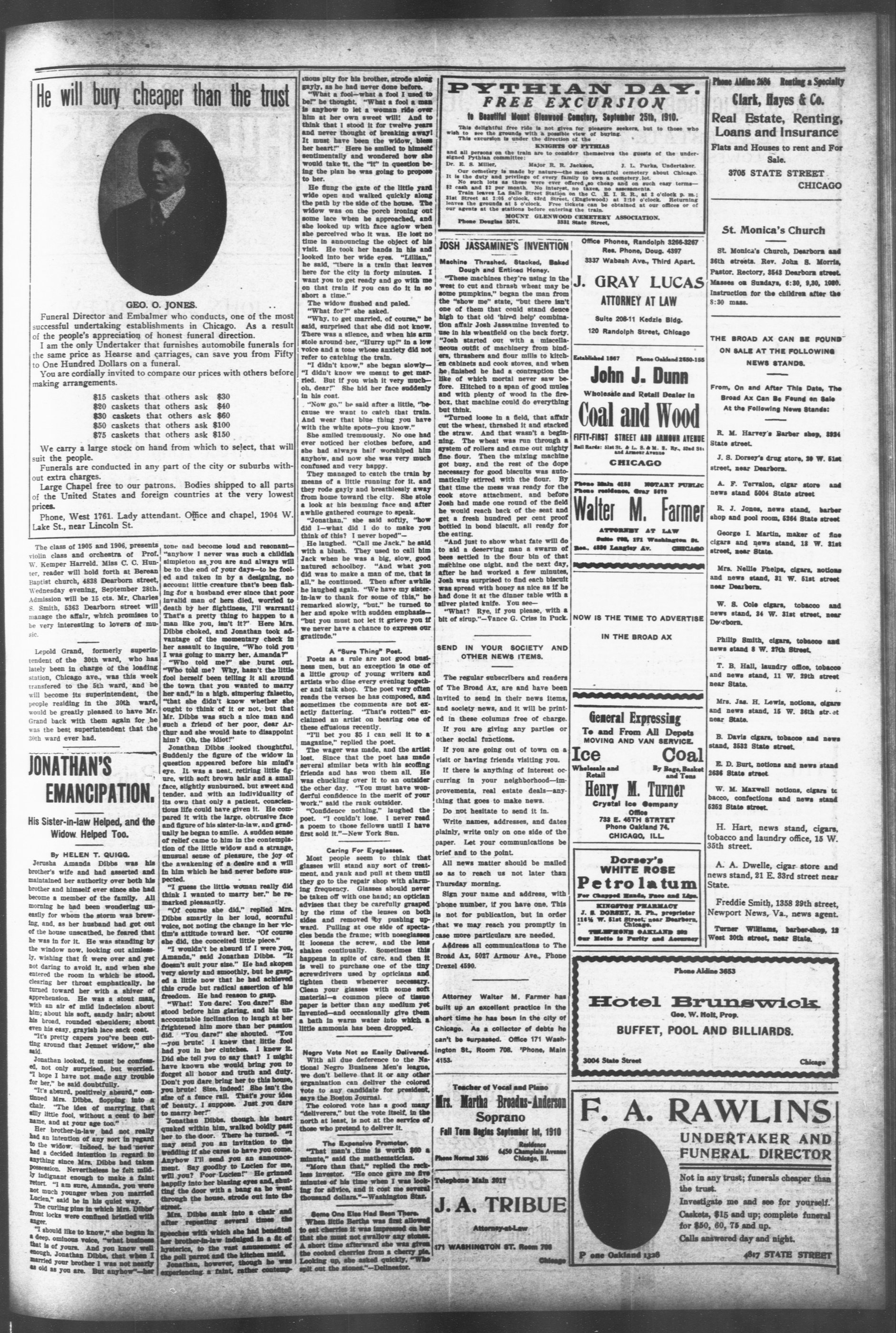
JONATHAN'S EMANCIPATION.
His Sister-in-law Helped, and the Widow. Helped Too.
By HELEN T. QUIGG.
Jerusha Amanda Dibbs was his brother's wife and had asserted and maintained her authority over both his brother and himself ever since she had become a member of the family. All morning he had been wondering unceasingly for whom the storm was brewing, and, as her husband had got out of the house unscathed, he feared that he was in for it. He was standing by the window now, looking out aimlessly, wishing that it were over and yet not daring to avoid it, and when she entered the room in which he stood, clearing her throat emphatically, he turned toward her with a shiver of apprehension. He was a stout man, with an air of mild indecision about him; about his soft, sandy hair; about his broad, rounded shoulders; about even his easy grazvish face sack cost.
"It's pretty capers you've been cutting around that Jennet widow," she said.
Jonathan looked, it must be confessed, not only surprised, but worried. "I hope I have not made any trouble for her," he said doubtfully.
"It's absurd, positively absurd," continued Mrs. Dibbs, flopping into a chair. "The idea of marrying that silly little fool, without a cent to her name, and at your age too."
Her brother-in-law had not really had an intention of any sort in regard to the widow. Indeed, he had never had a decided intention in regard to anything since Mrs. Dibbs had taken possession. Nevertheless he felt mildly indignant enough to make a faint retort. "I am sure, Amanda, you were not much younger when you married Lucien," said he in his quiet way.
The curling pins in which Mrs. Dibbe front locks were confined bristled with anger.
"I should like to know," she began in a deep, ominous voice, "what business that is of yours. And you know well enough, Jonathan Dibbe, that when I married your brother I was not nearly as old as you are. But anyhow"—her
---
D. JONES. . .
mer who conducts, one of the most
moments in Chicago. As a result
honest funeral direction.
It furnishes automobile funerals for
carriages, can save you from Fifty
funeral.
Compare our prices with others before
and from which to select, that will be part of the city or suburbs with- irons. Bodies shipped to all parts sign countries at the very lowestendant. Office and chapel, 1904 W.
tone and become loud and resonant—"anyhow I never was such a childish simpleton as you are and always will be to the end of your days—to be fooled and taken in by a designing, no account little creature that's been fishing for a husband ever since that poor invalid man of hers died, worried to death by her flightiness, I'll warrant! That's a pretty thing to happen to a man like you, isn't it?" Here Mrs. Dibbs choked, and Jonathan took advantage of the momentary check in her assault to inquire, "Who told you I was going to marry her, Amanda?"
"Who told me?" she burst out. "Who told me? Why, hasn't the little fool herself been telling it all around the town that you wanted to marry her and," in a high, simpering falsetto, "that she didn't know whether she ought to think of it or not, but that Mr. Dibbs was such a nice man and such a friend of her poor, dear Arthur and she would hate to disappoint him? Oh, the idiot!"
Jonathan Dibbs looked thoughtful. Suddenly the figure of the widow in question appeared before his mind's eye. It was a neat, retiring little figure, with soft brown hair and a small face, slightly sunburned, but sweet and tender, and with an individuality of its own that only a patient, conscientious life could have given it. He compared it with the large, obtrusive face and figure of his sister-in-law, and gradually he began to smile. A sudden sense of relief came to him in the contemplation of the little widow and a strange, unusual sense of pleasure, the joy of the awakening of a desire and a will in him which he had never before suspected.
"I guess the little woman really did think I wanted to marry her," he remarked pleasantly.
"Of course she did," replied Mrs. Dibbs smartly in her loud, scornful voice, not noting the change in her victim's attitude toward her. "Of course she did, the conceited little piece."
"I wouldn't be absurd if I were you, Amanda," said Jonathan Dibbs. "It doesn't suit your size." He had skopen very slowly and smoothly, but he gasped a little now that he had achieved this crude but radical assertion of his freedom. He had reason to gasp.
"What! You dare! You dare!" She stood before him glaring, and his unaccountable inclination to laugh at her frightened him more than her passion did. "You dare!" she shouted. "You--you brute! I knew that little fool had you in her clutches. I knew it. Did she tell you to say that? I might have known she would bring you to forget all honor and truth and duty. Don't you dare bring her to this house, you brute! Size, indeed! She isn't the size of a fence rail. That's your idea of beauty. I suppose. Just you dare to marry her."
Jonathan Dibbs, though, his heart quaked within him, walked boldly past her to the door. There he turned. "I may send you an invitation to the wedding if she cares to have you come. Anyhow I'll send you an announcement. Say goodbyy to Lucien for me, will you? Poor Lucien!" He grinned happily into her blasting eyes and, shutting the door with a bang as he went through the house, strode out into the street.
Mrs. Dibbs sank into a chair and after repeating several times the speeches with which she had benefited her brother-in-law indulged in a fit of hysteria, to the vast amusement of the poll parrot and the kitchen maid. Jonathan, however, though he was experiencing a faint, rather contemp-
mous pity for his brother, strode along gayly, as he had never done before.
"What a fool—what a fool I used to be!" he thought. "What a fool a man is anyhow to let a woman ride over him at her own sweet will! And to think that I stood it for twelve years and never thought of breaking away! It must have been the widow, bless her heart!" Here he smiled to himself sentimentally and wondered how she would take it, the "it" in question being the plan he was going to propose to her.
He flung the gate of the little yard wide open and walked quickly along the path by the side of the house. The widow was on the porch ironing out some lace when he approached, and she looked up with face aglow when she perceived who it was. He lost no time in announcing the object of his visit. He took her hands in his and looked into her wide eyes. "Lillian," he said, "there is a train that leaves here for the city in forty minutes. I want you to get ready and go with me on that train if you can do it in so short a time."
The widow widowed and pailed.
"What for?" she asked.
"Why, to get married, of course," he said, surprised that she did not know. There was a silence, and when his arm stole around her, "Hurry up!" in a low voice and a tone whose anxiety did not refer to catching the train.
"I didn't know," she began slowly—"I didn't know we meant to get married. But if you wish it very much—oh, dear!" She hid her face suddenly in his coat.
"Now go," he said after a little, "because we want to catch that train. And wear that blue thing you have with the white spots—you know."
She smiled tremuously. No one had ever noticed her clothes before, and she had always half worshiped him anyhow, and now she was very much confused and very happy.
They managed to catch the train by means of a little running for it, and they rode gayly and breathlessly away from home toward the city. She stole a look at his beaming face and after a while gathered courage to speak.
"Jonathan," she said softly, "how did I—what did I do to make you think of this? I never hoped"—
He laughed. "Call me Jack," he said with a blush. They used to call him Jack when he was a big, slow, good natured schoolboy. "And what you did was to make a man of me, that is all," he continued. Then after awhile he laughed again. "We have my sister-in-law to thank for some of this," he remarked slowly, "but," he turned to her and spoke with sudden emphasis—"but you must not let it grieve you if we never have a chance to express our gratitude."
A "Sure Thing" Poet
Poets as a rule are not good business men, but an exception is one of a little group of young writers and artists who dine every evening together and talk shop. The poet very often reads the verses he has composed, and sometimes the comments are not exactly flattering. "That's rotten!" exclaimed an artist on hearing one of these effusions recently.
"I'll bet you $5 I can sell it to a magazine," replied the poet.
The wager was made, and the artist lost. Since that the poet has made several similar bets with his scoffing friends and has won them all. He was chuckling over it to an outsider the other day. "You must have wonderful confidence in the merit of your work," said the rank outsider.
"Confidence nothing." laughed the poet. "I couldn't lose. I never read a poem to those fellows until I have first sold it."—New York Sun.
Caring For Eyeglasses.
Most people seem to think that glasses will stand any sort of treatment, and yank and pull at them until they go to the repair shop with alarming frequency. Glasses should never be taken off with one hand; an optician advises that they be carefully grasped by the rims of the lenses on both sides and removed by pushing upward. Pulling at one side of spectacles bends the frame; with noseglasses it loosens the screw, and the lens shakes continually. Sometimes this happens in spite of care, and then it is well to purchase one of the tiny screwdrivers used by opticians and tighten them whenever necessary. Clean your glasses with some soft material—a common piece of tissue paper is better than any medium yet invented—and occasionally give them a bath in warm water into which a little ammonia has been dropped.
Negro Vote Not so Easily Delivered.
With all due deference to the National Negro Business Men's league,
we don't believe that it or any other organization can deliver the colored vote to any candidate for president,
says the Boston Journal.
The colored vote has a good many "deliverers," but the vote itself, in the north at least, is not at the service of those who pretend to deliver it.
The Expensive Prometer.
"That man's time is worth $00 a minute," said the mathematician.
minute," said the mathematician.
"More than that," replied the reckless investor. "He once gave me five minutes of his time when I was looking for advice, and it cost me several thousand dollars."—Washington Star.
Some One Else Had Been There. When little Betta was first allowed to eat cherries it was impressed on her that she must not swallow any stones. A short time afterward she was given the cooked cherries from a cherry pie. Looking up, she asked quickly, "Who out cut the stones?"—Delineator.
PYTHIAN DAY.
FREE EXCURSION
to Beautiful Mount Glenwood Cemetery, September 25th, 1910.
This delightful free ride is not given for pleasure seekers, but to those who wish to see the grounds with a possible view of buying.
This excursion is under the direction of the
KNIGHTS OF PYTHIAS
and all persons on the train are to consider themselves the guests of the under-signed Pythian committee:
Dr. E. S. Miller, Major R. R. Jackson, J. L. Parks, Undertaker.
Our cemetery is made by nature—the most beautiful cemetery about Chicago.
It is the duty and privilege of every family to own a cemetery lot.
No such lots as these were ever offered so cheap and on such easy terms—$2 cash and $2 per month. No interest, no taxes, no assessments.
31st Street is La Salle Street on the C. E. I. R. R., at 2 o'clock p. m.; 31st Street at 2:06 o'clock, 31st Street (Greenville) at 2:10 o'clock. Returning leaves the grounds at 5 o'clock. Free tickets can be at our offices or of our agents at the stations before entering the train.
MOUNT GLENWOOD CEMETERY ASSOCIATION.
Phone Douglas 5574. 3331 Street Street.
JOSH JASSAMINE'S INVENTION
Machine Thrashed, Stacked, Baked Dough and Enticed Honey.
"These machines they're using in the west to cut and thrash wheat may be some pumpkins," began the man from the "show me" state, "but there isn't one of them that could stand deuce high to that old 'hired help' combination affair Josh Jassamine invented to use in his wheatfield on the back forty. "Josh started out with a miscellaneous outfit of machinery from binders, thrashers and flour mills to kitchen cabinets and cook stoves, and when he finished he had a contraption the like of which mortal never saw before. Hitched to a span of good mules and with plenty of wood in the firebox, that machine could do everything but think.
"Turned loose in a field, that affair cut the wheat, thrashed it and stacked the straw. And that wasn't a beginning. The wheat was run through a system of rollers and came out mighty fine four. Then the mixing machine got busy, and the rest of the dope necessary for good biscuits was automatically stirred with the four. By that time the mess was ready for the cook stove attachment, and before Josh had made one round of the field he would reach back of the seat and get a fresh hundred per cent proof bottled in bond biscuit, all ready for the eating.
"And just to show what fate will do to aid a deserving man a swarm of bees settled in the flour bin of that machine one night, and the next day, after he had worked a few minutes, Josh was surprised to find each biscuit was spread with honey as nice as if he had done it at the dinner table with a silver plated knife. You see— "What? Rye, if you please, with a bit of sirup."—Vance G. Criss in Puck.
SEND IN YOUR SOCIETY AND
OTHER NEWS ITEMS.
The regular subscribers and readers of The Broad Ax, are and have been invited to send in their news items, and society news, and it will be printed in these columns free of charge. If you are giving any parties or other social functions. If you are going out of town on a visit or having friends visiting you. If there is anything of interest occurring in your neighborhood—improvements, real estate deals—anything that goes to make news. Do not hesitate to send it in. Write names, addresses, and dates plainly, write only on one side of the paper. Let your communications be brief and to the point.
All news matter should be mailed so as to reach us not later than Thursday morning.
Sign your name and address, with 'phone number, if you have one. This is not for publication, but in order that we may reach you promptly in case more particulars are needed.
Address all communications to The Broad Ax, 5027 Armour Ave., Phone Drexel 4590.
Attorney Walter M. Farmer has built up an excellent practice in the short time he has been in the city of Chicago. As a collector of debts he can't be surpassed. Office 171 Washington St., Room 708. 'Phone, Main 4153.
Office Phones, Randolph 3266-3267
Res. Phone, Doug. 4397
3337 Wabash Ave., Third Apart.
J. GRAY LUCAS
ATTORNEY AT LAW
Suite 208-11 Kedzie Bldg.
120 Randolph Street, Chicago
Established 1867 Phone Oakland 2650-155
John J. Dunn
Wholesale and Retail Dealer in
Coal and Wood
FIFTY-FIRST STREET AND ARMOUR AVENUE
Rail Rdards: 51st St. & L. S. & M. S. Ry., 52nd St.
and Armour Avenue
CHICAGO
Phone Main 4158 NOTARY PUBLIC
Phone residence, Gray 5670
Walter M. Farmer
ATTORNEY AT LAW
Suite 708, 171 Washington St.
Bee, 4836 Langley Av. CHICAGO
NOW IS THE TIME TO ADVERTISE
General Expressing
To and From All Depots
MOVING AND VAN SERVICE.
Ice Coal
Whelesale and
Retail
By Bags, Basket
and Tons
Henry M. Turner
Crystal Ice Company
Office
733 E. 45TH STRTET
Phone Oakland 74.
CHICAGO, ILL.
Dorsey's
WHITE ROSE
Petrolatum
For Chapped Hands, Face and Lips.
KINGSTON PHARMACY
J. S. DORSEY, R. Ph., proprietor
116% W. 51st Street, near Pearborn,
Chicago.
TELEPHONE OAKLAND 303
Our Motto is Purity and Accuracy
Phone All
Hotel Br
Gee, W. N
BUFFET, POOL
Phone Aldine 3653
Brunswick
ee, W. Holt, Prop.
OOL AND BILLIARDS.
Chicago
Hotel Brunswick Gee, W. Holt, Prop. BUFFET, POOL AND BILLIARDS.
F. A. RA
F. A. RAWLINS
UNDERTAKER AND FUNERAL DIRECTOR
Not in any trust; funerals cheaper than the trust.
Investigate me and see for yourself.
Caskets, $15 and up; complete funeral for $50, 60, 75 and up.
Calls answered day and night.
4817 STATE STREET
P OLE CALIFA 1930
IN THE BROAD AX
3004 State Street
O
Phone Aline 2886 Renting a Specialty
Clark, Hayes & Co.
Real Estate, Renting,
Loans and Insurance
Flats and Houses to rent and For
Sale.
St. Monica's Church
St. Monica's Church, Dearborn and 36th streets. Rev. John S. Morris, Pastor. Rectory, 8543 Dearborn street. Masses on Sundays, 6:30, 9,30, 1080. Instruction for the children after the 8:30 mass.
THE BROAD AX CAN BE FOUND ON SALE AT THE FOLLOWING NEWS STANDS.
From, On and After This Date, The Broad Ax Can Be Found on Sale At the Following News Stands:
R. M. Harvey's Barber shop, 3924 State street.
J. S. Dorsey's drug store, 20 W. 51st street, near Dearborn.
A. F. Tervalon, cigar store and news stand 5004 State street
R. J. Jones, news stand, barber shop and pool room, 5264 State street
George I. Martin, maker of fine cigars and news stand, 18 W. 31st street, near State.
Mrs. Nellie Phelps, cigars, notions and news stand, 31 W. 51st street near Dearborn.
W. S. Cole cigars, tobacco and news stand, 34 W. 31st street, near Dearborn.
Philip Smith, cigars, tobacco and news stand 8 W. 27th Street.
T. B. Hall, laundry office, tobacco and news stand, 11 W. 29th street near State.
Mrs. Jas. H. Lewis, notions, cigars and news stand, 15 W. 36th street near State.
B. Davis cigars, tobacco and news stand, 3532 State street.
E. D. Burt, notions and news stand 2636 State street
W. M. Maxwell notions, cigars to bacco, confections and news stand 5252 State street.
H. Hart, news stand, cigars, tobacco and laundry office, 15 W. 35th street.
A. A. Dwelle, cigar store and news stand, 21 E. 33rd street near State.
Freddie Smith, 1358 29th street, Newport News, Va., news agent.
Turner Williams, barber-shop, 12 West 30th street, near State.
3705 STATE STREET CHICAGO
asiest Terms to be had in Chicago
Loans on first and second Mortgages
Fire Insurance placed in any company
Main Office:
Suite 84, 95 Washington St., CHICAGO, ILL.
Branch Office
3517 State Street
'PHONE 4366 CENTRAL
H. C. Conley Phone Oakland 1452 John T. Jenifer
Conley & Jenifer
5111 S. State St.
Real Estate, Loans, Renting
Insurance
Property carefully managed
Get our prices, they are free. Confer with us before you invest your
savings in Chicago, Real Estate.
Insure your household goods to day, to night you may have a fire.
Notary Public
Money to Loan. Collections,
William Thomas, Gen. Mgr. and Treas.
Kentucky Club Cafe
2260 State Street (Up-Stairs)
Phone Calumet 3527
Chicago's Newest and Finest Dining Parlors
Best to Eat. Best to Drink.
Best Service. Best Music.
Best Decorum. Best of Everything
THE GALE PIANO CO.
3159 STATE STREET
Pianos, Organs, Talking Machines and Supplies.
Brass and String Instruments. Cash or Easy
Payments. COpen Evenings till 10.30.
Phone Doug. 975.
mate in the matter of ill health. Repeatedly for this reason he has had to cancel lengthy engagements worth scores of thousands of pounds. An attack of spotted fever five years ago caused him to lose a three months' tour in America at a fabulous salary. This was followed by a railway accident necessitating two operations. One of Paderewski's minor worries is the persistent autograph hunter, who gets terribly on his nerves. George Grossmith once came to his relief when he was being pestered by the signature seekers. Grossmith ruffled his hair to make it like the musician's picturesque mane and rushed wildly into the hall of the hotel, screaming, "I can sign no more; I will sign no more."
EMOTIONAL PADEREWSKL
His sensitive nerves and His Herrr of Autograph Floats.
Mr. Paderewski will receive a considerable amount from the insurance company on account of the attack on notwithin his right arm, which obliged him to cancel the London engagements. The great panic health is always ammonia may be insecurity mounts.
Next day everybody was talking of the sad case of poor Paderewski, whose mind was becoming quite unhinged—London M. A. P.
AN OLD SONG REJUVENATED.
I cannot wear the old half. I must some months gone by. I saw it on the topmost shelf With many a weary sigh. No longer are they wearing puffs, and rats are quite devouring. I cannot wear the old half. Oh, what a cruel blow!
I cannot wear the old half. For which good reason I am. And half a good reason when
BROOKLYN MUSEUM
S. E. Cor. State and 36th Place, Chicago Telephone Douglas 1565
3 per cent allowed on Savings Accounts Safety Deposit Vaults, $3.00 per Year
REAL ESTATE DEPARTMENT
A large buy and sell Real Estate on commission, manages estates for non-residents, including payment of taxes and looking after assessments. Money to loan on Chicago Real Estate.
Especially Invites the patronage of Chicago business men.
The Oranford Apartment Building. 3600 Wabash Ave.
2011/12/25 08:00:50 AM
The finest building ever opened to Colored tenants in Chicago. Steam heat, electric light, tile baths, marble entrance.
to Have Local Organization.
BY N. BARNETT DODSON.
The National, Independent, Political league at its recent annual meeting in Atlantic City, N. J., adopted a new constitution by the terms of which local leagues are to be organized in every state.
The committee on resolutions, of which William Monroe Trotter, editor of the Boston Guardian, was chairman, concluded its report, as follows:
"It is time, therefore, for an independent movement in politics.
"We should refuse alliance with either of the two dominant parties at present and confine our attention to men. We should vote and vote only
Governors Harmon of Ohio and Deneen of Illinois were commended for their course against lynching; harmony among the race-rights organizations was urged and a hearing for Rev. Harvey Johnson on his Texas purchase plan urged. A committee of seven was appointed on the fiftieth anniversary of emancipation to confer with other bodies.
QUEBRAE, ONION 7
The executive committee is composed of members representing forty states. The next annual meeting of the league will be held in Boston.
The newly elected officers are the following: President, Bishop Alexander Walters, New York; organizer, Rev J. M. Walldon, Washington; assistant organizer, W. C. Payne, Alexandra, Va.; recording secretary, W. C. Nell, Washington; corresponding secretary, W. M. Trotter, Boston; treasurer, M. W. Gibbs, Arkansas; financial secretary, Rev S. S. L. Corrothers, Washington; chaplain, Rev L. G. Jordan, Louisville, Ky.; servant-at-arms, Rev J. F. Moreland, Atlantic City, N. J.; vice presidents, Rev Byron Gunner, Hillburn, N. Y.; Dr. J. L. Johnson, Ohio; W. T. Ferguson, Washington; Rev J. H. Wiley, Providence, R. L.; William D. Johnson, Boston, and W. F. S. Cook, Maryland.
We Furnish You Money
to Protect Your Property or Business
Mortgage Banking
and
General Brokerage
All Business Strictly Confidential
Northern Assets Realization Company
Office, 3517 State St. Phone, Aldine 2532.
"A STORE FOR EVERYBODY"
HILLMAN'S
STATE & WASHINGTON STS.
WHERE EVERY PATRON
Saves
ON EVERY PURCHASE
Telephone Yards 693
JOHN J. BRADLEY
Real Estate
Loans
Fire and Plate Glass Insurance
4709 S. HALSTED ST
CHICAGO
Rent Direct from the Owner.
Four, Five and Six Room Flats
Convenient to Surface and Elevated Roads. Honest working Colored people always appreciated and treated respectfully. If you desire to live where you won't be ashamed to have your friends call on you before you rent either on South, West or North Side, cut this Ad out and present it to
Samuel Richardson
142 LA SALLE STREET, Room I. CHICAGO, ILL.
Southwest Corner of Madison & LaSalle Sts.
Frank H. Lewis, Prop. Lou Solden, Ngr.
Phone Oakland 1767.
THE RAILROAD INN
Imported and Domestic Wines
Liquors & Cigars
Cafe In Connection
N. E. Corner Fifty-Fifth and Armour Avenue, Chicago, M.
American Brick Co.
President and Treasurer, THOMAS CAREY. Vice-President, JOHN SHELMAMER. Secretary, WILLIAM SULLIVAN.
Common and Sewer Brick
Office and Yards:
45th and Robey Sts.
Yards running winter and summer, equipped
with the latest improved Wolf Dryer.
Telephone Yards 128.
PATRICK H. O'DONNELL
WILLIAM DILLON
CLARENCE A. TOOLEN
Tol. Central 4600
D'Donnell, Dillon &
Toolen
ATTORNEYS AT LAW
Suite 1210-1219 Ashland Block
RANDOLPH & CLARK STREETS
A. D. GASH
ATTORNEY AT LAW
84-86 La Salle Street, Chicago
John 815 to 816
Telephone Main 8077
JOHN E. OWENS
ATTORNEY & COUNSELOR
AT LAW
880. ASHLAND BLOCK
CHIPHONE CONTROL 880 CHICAGO
Broadway by Macmillan Place
Telephone Ashland 880
Office Telephone
Central 1800 Allentown 1840
MILES J. DEVINE
ATTORNEY AT LAW
John 815-820 Regan Blvd
CLARK AND WASHINGTON 880 CHICAGO
Now is the Time to Advertise in THE BROAD AX