The Broad Ax
Saturday, November 19, 1910
Chicago, Illinois
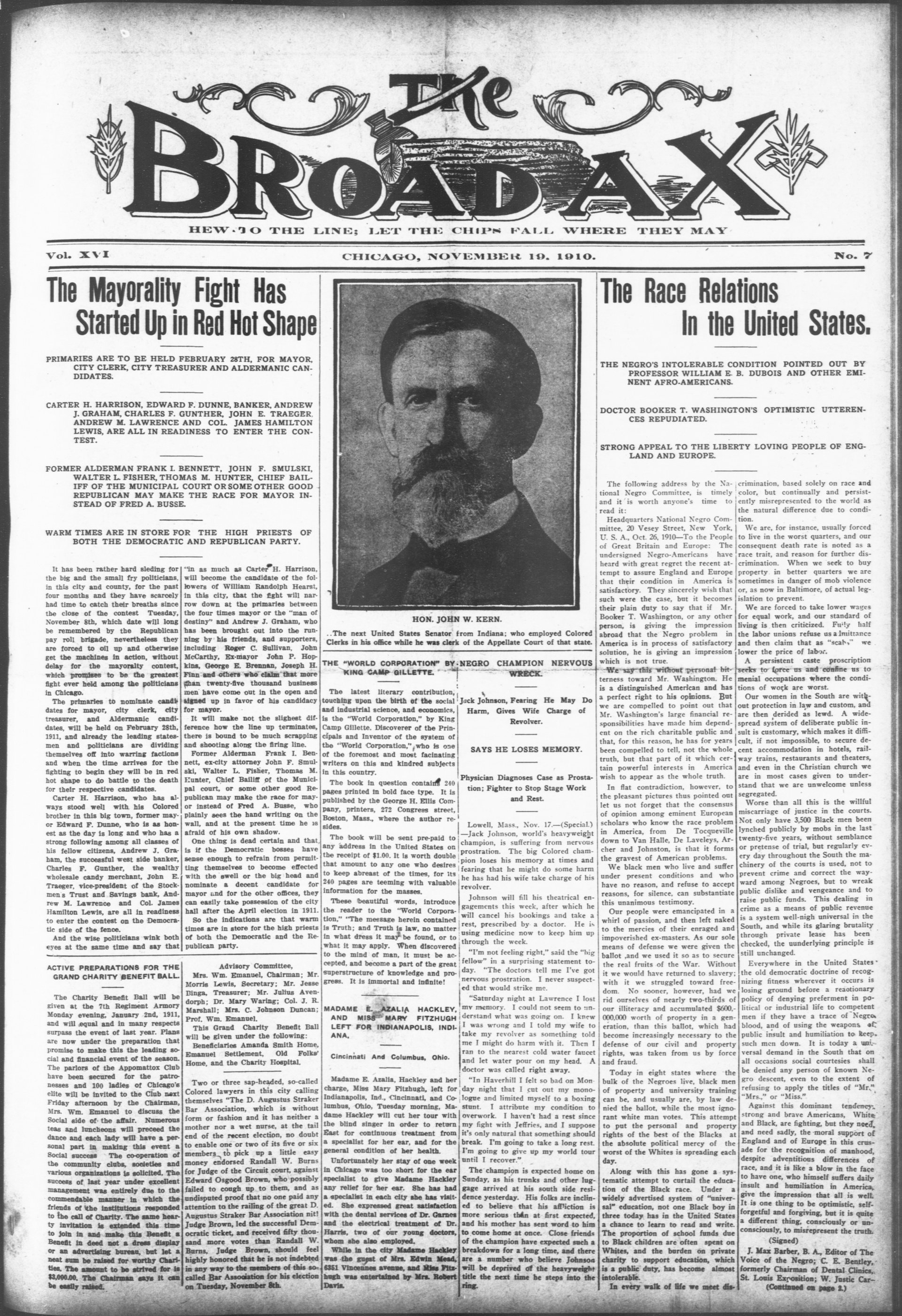
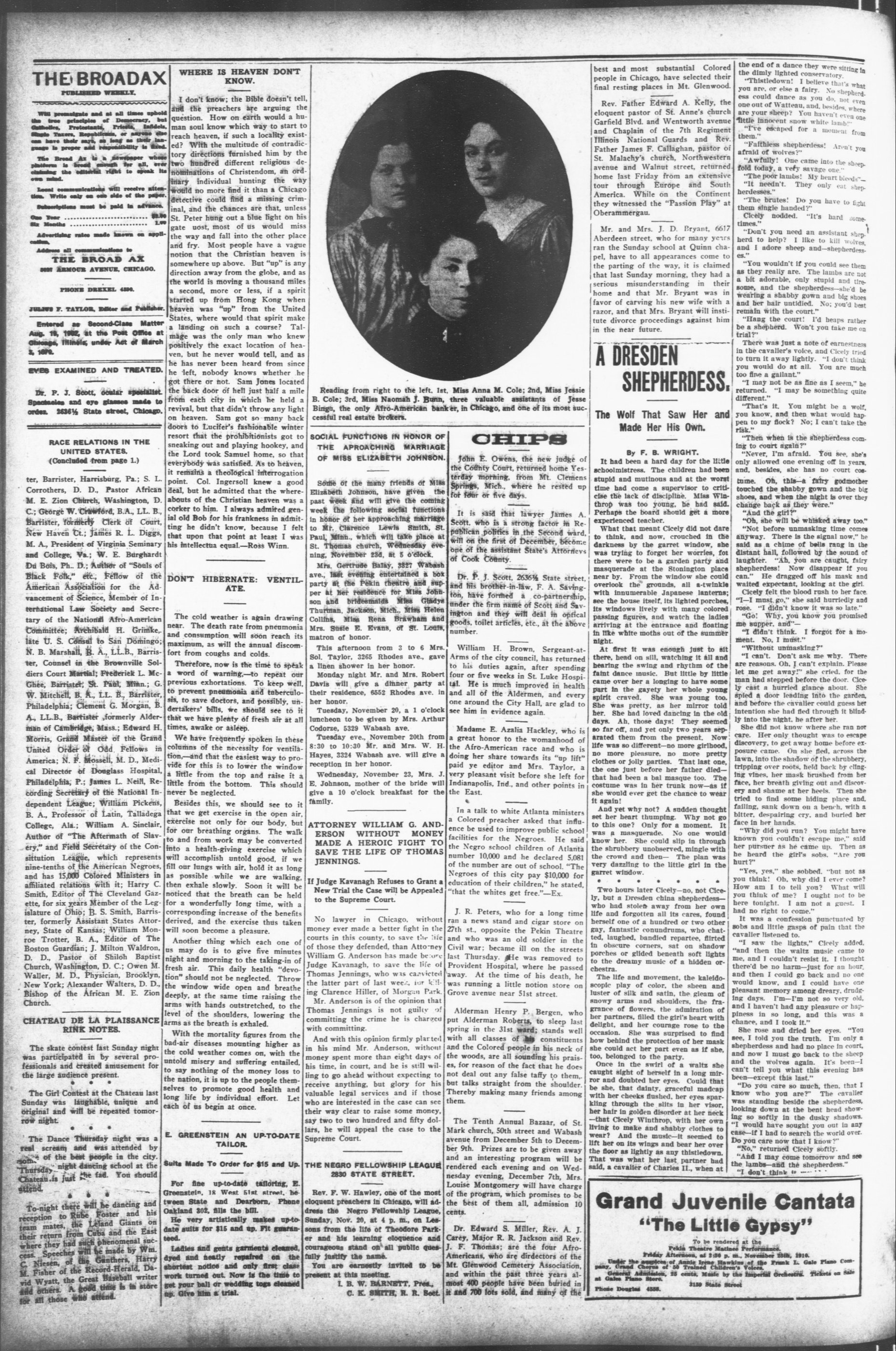
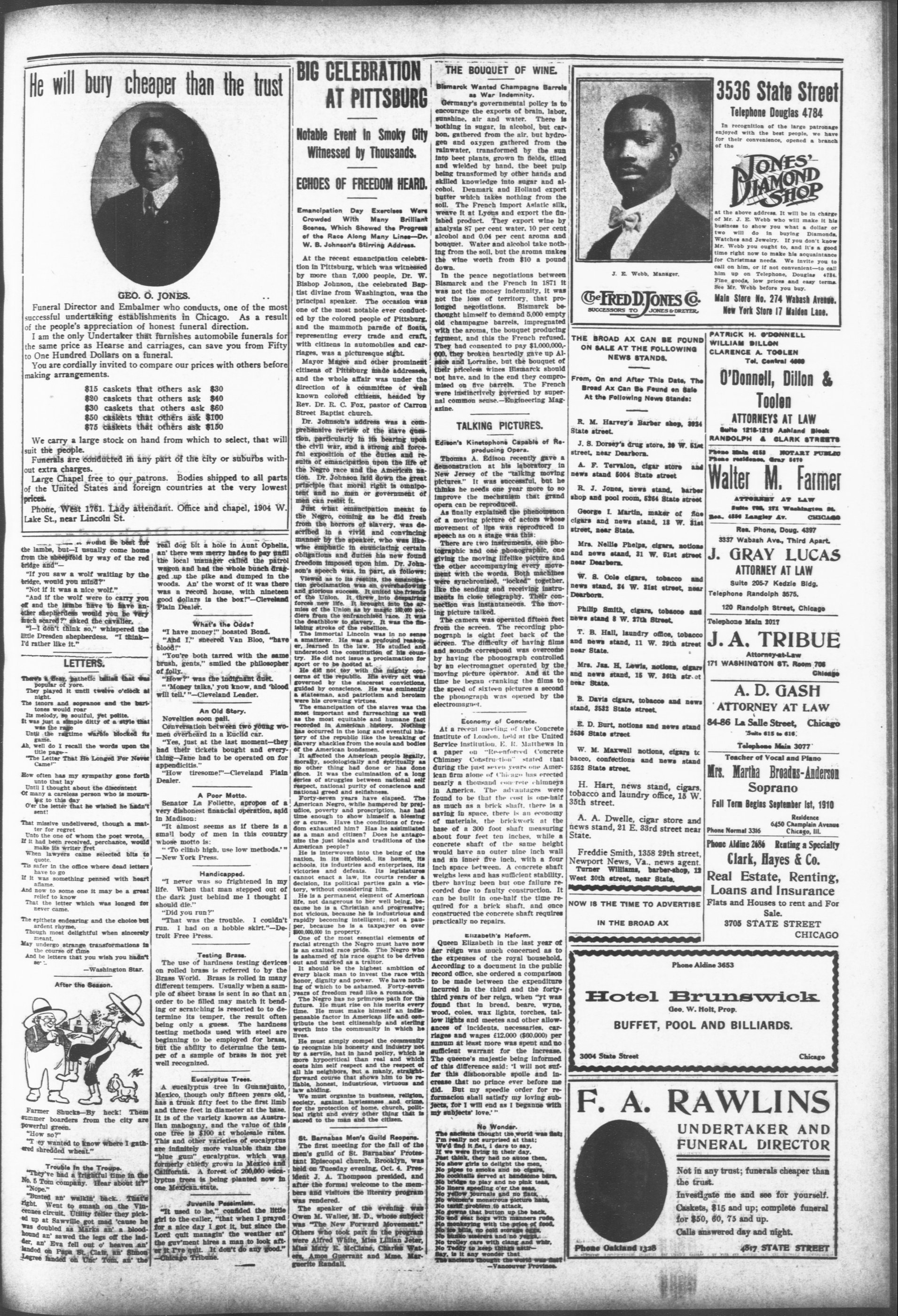
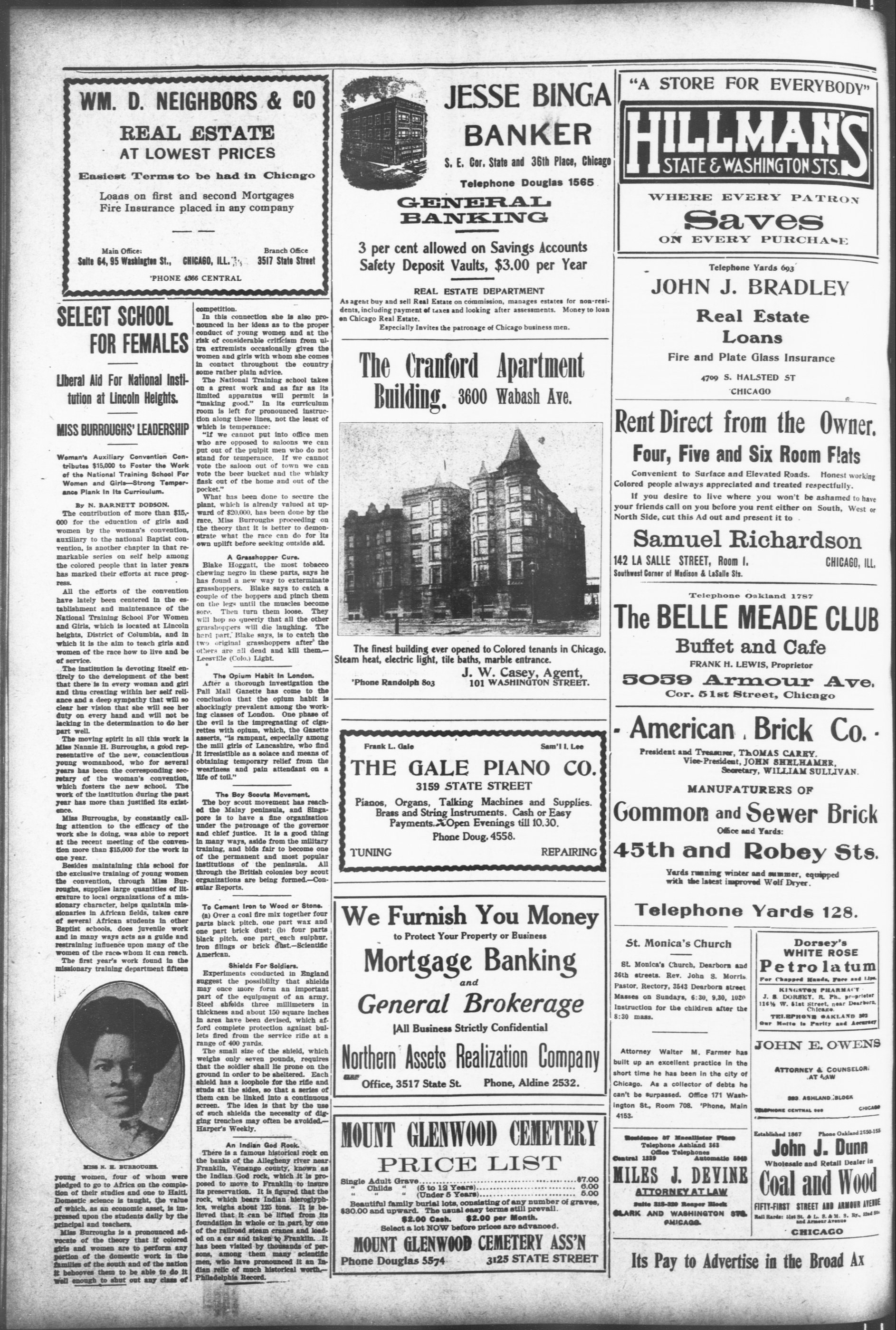
Page text (machine-generated)
THE BROAD AX
The Mayorality Fight Has Started Up in Red Hot Shape
PRIMARIES ARE TO BE HELD FEBRUARY 28TH, FOR MAYOR, CITY CLERK, CITY TREASURER AND ALDERMANIC CANDIDATES.
CARTER H. HARRISON, EDWARD F. DUNNE, BANKER, ANDREW J. GRAHAM, CHARLES F. GUNTHER, JOHN E. TRAEGER, ANDREW M. LAWRENCE AND COL. JAMES HAMILTON LEWIS, ARE ALL IN READINESS TO ENTER THE CONTEST.
FORMER ALDERMAN FRANK I. BENNETT, JOHN F. SMULSKI, WALTER L. FISHER, THOMAS M. HUNTER, CHIEF BAILIFF OF THE MUNICIPAL COURT OR SOME OTHER GOOD REPUBLICAN MAY MAKE THE RACE FOR MAYOR INSTEAD OF FRED A. BUSSE.
WARM TIMES ARE IN STORE FOR THE HIGH PRIESTS OF BOTH THE DEMOCRATIC AND REPUBLICAN PARTY.
Vol. XVI
The Mayorality Started Up in
PRIMARIES ARE TO BE HELD IN CITY CLERK, CITY TREAS DIDATES.
CARTER H. HARRISON, EDWAR J. GRAHAM, CHARLES F. ANDREW M. LAWRENCE LEWIS, ARE ALL IN REAL TEST.
FORMER ALDERMAN FRANK L. WALTER L. FISHER, THOM IFF OF THE MUNICIPAL REPUBLICAN MAY MAKE STEAD OF FRED A. BUSSE
WARM TIMES ARE IN STORE FOR BOTH THE DEMOCRATIC
It has been rather hard sledging for the big and the small fry politicians, in this city and county, for the past four months and they have scarcely had time to catch their breaths since the close of the contest Tuesday, November 8th, which date will long be remembered by the Republican pay roll brigade, nevertheless they are forced to oil up and otherwise get the machines in action, without delay for the mayoralty contest, which promises to be the greatest fight ever held among the politicians in Chicago.
The primaries to nominate candidates for mayor, city clerk, city treasurer, and Aldermanic candidates, will be held on February 28th, 1911, and already the leading statesmen and politicians are dividing themselves off into warring factions and when the time arrives for the fighting to begin they will be in red hot shape to do battle to the death for their respective candidates.
Carter H. Harrison, who has always stood well with his Colored brother in this big town, former mayor Edward F. Dunne, who is as honest as the day is long and who has a strong following among all classes of his fellow citizens, Andrew J. Graham, the successful west side banker, Charles F. Gunther, the wealthy wholesale candy merchant, John E. Traeger, vice-president of the Stockmen's Trust and Savings bank, Andrew M. Lawrence and Col. James Hamilton Lewis, are all in readiness to enter the contest on the Democratic side of the fence. And the wise politicians wink both eyes at the same time and say that
ACTIVE PREPARATIONS FOR THE GRAND CHARITY BENEFIT BALL
The Charity Benefit Ball will be given at the 7th Regiment Armory Monday evening, January 2nd, 1911, and will equal and in many respects surpass the event of last year. Plans are now under the preparation that promise to make this the leading social and financial event of the season. The parlors of the Appomattox Club have been secured for the patronesses and 100 ladies of Chicago's elite will be invited to the Club next Friday afternoon by the Chairman, Mrs. Wm. Emanuel to discuss the Social side of the affair. Numerous teas and luncheons will proceed the dance and each lady will have a personal part in making this event a Social success. The co-operation of the community clubs, societies and various organizations is solicited. The success of last year under excellent management was entirely due to the commendable manner in which the friends of the institutions responded to the call of Charity. The same hearty invitation is extended this time to join in and make this Benefit a Benefit in deed not a dress display or an advertising bureau, but let a neat sum be raised for worthy Charities. The amount to be strived for is $3,000.00. The Chairman says it can be easily raised.
HEW TO THE LINE: LET THE CHIPS FALL WHERE THEY MAY
"in as much as Carter H. Harrison, will become the candidate of the followers of William Randolph Hearst, in this city, that the fight will narrow down at the primaries between the four times mayor or the "man of destiny" and Andrew J. Graham, who has been brought out into the running by his friends, and supporters, including Roger C. Sullivan, John McCarthy, Ex-mayor John P. Hopkins, George E. Brennan, Joseph H. Finn and others who claim that more than twenty-five thousand business men have come out in the open and signed up in favor of his candidacy for mayor.
It will make not the slighest difference how the line up terminates, there is bound to be much scrapping and shooting along the firing line.
Former Alderman Frank I. Bennett, ex-city attorney John F. Smulski, Walter L. Fisher, Thomas M. Kunter, Chief Balli of the Municipal court, or some other good Republican may make the race for mayor instead of Fred A. Busse, who plainly sees the hand writing on the wall, and at the present time he is afraid of his own shadow.
One thing is dead certain and that is if the Democratic bosses have sense enough to refrain from permitting themselves to become effected with the swell or the big head and nominate a decent candidate for mayor and for the other offices, they can easily take possession of the city hall after the April election in 1911. So the indications are that warm times are in store for the high priests of both the Democratic and the Republican party.
Advisory Committee.
Mrs. Wm. Emanuel, Chairman; Mr. Morris Lewis, Secretary; Mr. Jesse Binga, Treasurer; Mr. Julius Avendorph; Dr. Mary Waring; Col. J. R. Marshall; Mrs. C. Johnson Duncan; Prof. Wm. Emanuel.
This Grand Charity Benefit Ball will be given under the following:
Beneficiaries Amanda Smith Home, Emanuel Settlement, Old Folks' Home, and the Charity Hospital.
Two or three sap-headed, so-called Colored lawyers in this city calling themselves "The D. Augustus Straker Bar Association, which is without form or fashion and it has neither a mother nor a wet nurse, at the tail end of the recent election, no doubt to enable one or two of its five or six members to pick up a little easy money endorsed Randall W. Burns for Judge of the Circuit court, against Edward Osgood Brown, who possibly failed to cough up to them, and as undisputed proof that no one paid any attention to the railing of the great D. Augustus Straker Bar Association nith Judge Brown, led the successful Democratic ticket, and received fifty thousand more votes than Randall W. Burns, Judge Brown, should feel highly honored that he is not indebted in any way to the members of this so-called Bar Association for his election on Tuesday, November 8th.
CHICAGO, NOVEMBER 19. 1910.
J.
HON. JOHN W. KERN.
..The next United States Senator from Indiana
Clerks in his office while he was clerk of the App
THE "WORLD CORPORATION" BY NEGRO C
KING CAMP GILLETTE.
The next United States Senator from Indiana; who employed Colored Clerks in his office while he was clerk of the Appellate Court of that state.
The latest literary contribution, touching upon the birth of the social and industrial science, and economics, is the "World Corporation," by King Camp Gillette. Discoverer of the Principals and Inventor of the system of the "World Corporation," who is one of the foremost and most fascinating writers on this and kindred subjects in this country.
The book in question contains 240 pages printed in bold face type. It is published by the George H. Ellis Company, printers, 272 Congress street, Boston, Mass., where the author resides.
The book will be sent pre-paid to any address in the United States on the receipt of $1.00. It is worth double that amount to any one who desires to keep abreast of the times, for its 240 pages are teeming with valuable information for the masses.
These beautiful words, introduce the reader to the "World Corporation." "The message herein contained is Truth; and Truth is law, no matter in what dress it may be found, or to what it may apply. When discovered to the mind of man, it must be accepted, and become a part of the great superstructure of knowledge and progress. It is immortal and infinite!
MADAME E. AZALIA HACKLEY,
AND MISS MARY FITZHUGH
LEFT FOR INDIANAPOLIS, INDIANA.
Cincinnati And Columbus, Ohio.
Madame E. Azalia, Hackley and her charge, Miss Mary Fitzhugh, left for Indianapolis, Ind., Cincinnati, and Columbus, Ohio, Tuesday morning, Madame Hackley will cut her tour with the blind singer in order to return East for continuous treatment from a specialist for her ear, and for the general condition of her health.
Unfortunately her stay of one week in Chicago was too short for the ear specialist to give Madame Hackley any relief for her ear. She has had a specialist in each city she has visited. She expressed great satisfaction with the dental services of Dr. Garnes and the electrical treatment of Dr. Harris, two of our young doctors, whom she also employed.
While in the city Madame Hackley was the guest of Mrs. Edwin Mead, 6351 Vincentnes avenue, and Miss Fitzhugh was entertained by Mrs. Robert Davis.
from Indiana; who employed Colored
of the Appellate Court of that state.
NEGRO CHAMPION NERVOUS
WRECK.
Jack Johnson, Fearing He May Do
Harm, Gives Wife Charge of
SAYS HE LOSES MEMORY.
Physician Diagnoses Case as Prostation; Fighter to Stop Stage Work and Rest.
Lowell, Mass., Nov. 17.—(Special.)—Jack Johnson, world's heavyweight champion, is suffering from nervous prostration. The big Colored champion loses his memory at times and fearing that he might do some harm he has had his wife take charge of his revolver.
Johnson will fill his theatrical engagements this week, after which he will cancel his bookings and take a rest, prescribed by a doctor. He is using medicine now to keep him up through the week.
"I'm not feeling right," said the "big fellow" in a surprising statement today. "The doctors tell me I've got nervous prostration. I never suspected that would strike me.
"Saturday night at Lawrence I lost my memory. I could not seem to understand what was going on. I knew I was wrong and I told my wife to take my revolver as something told me I might do harm with it. Then I ran to the nearest cold water faucet and let water pour on my head. A doctor was called right away.
"In Haverhill I felt so bad on Monday night that I cut out my monologue and limited myself to a boxing stunt. I attribute my condition to overwork. I haven't had a rest since my fight with Jeffries, and I suppose it's only natural that something should break. I'm going to take a long rest. I'm going to give up my world tour until I recover."
The champion is expected home on Sunday, as his trunks and other luggage arrived at his south side residence yesterday. His folks are inclined to believe that his affliction is more serious than at first expected, and his mother has sent word to him to come home at once. Close friends of the champion have expected such a breakdown for a long time, and there are a number who believe Johnson will be deprived of the heavyweight title the next time he steps into the ring.
The Race Relations In the United States.
THE NEGRO'S INTOLERABLE CONDITION POINTED OUT BY PROFESSOR WILLIAM E. B. DUBOIS AND OTHER EMINENT AFRO-AMERICANS.
DOCTOR BOOKER T. WASHINGTON'S OPTIMISTIC UTTERENCES REPUDIATED.
STRONG APPEAL TO THE LIBERTY LOVING PEOPLE OF ENGLAND AND EUROPE.
The following address by the National Negro Committee, is timely and it is worth anyone's time to read it: Headquarters National Negro Committee, 20 Vesey Street, New York, U. S. A., Oct. 26, 1910—To the People of Great Britain and Europe: The undersigned Negro-Americans have heard with great regret the recent attempt to assure England and Europe that their condition in America is satisfactory. They sincerely wish that such were the case, but it becomes their plain duty to say that if Mr. Booker T. Washington, or any other person, is giving the impression abroad that the Negro problem in America is in process of satisfactory solution, he is giving an impression which is not true.
We say this without personal bitterness toward Mr. Washington. He is a distinguished American and has a perfect right to his opinions. But we are compelled to point out that Mr. Washington's large financial responsibilities have made him dependent on the rich charitable public and that, for this reason, he has for years been compelled to tell, not the whole truth, but that part of it which certain powerful interests in America wish to appear as the whole truth.
In flat contradiction, however, to the pleasant pictures thus pointed out let us not forget that the consensus of opinion among eminent European scholars who know the race problem in America, from De Tocqueville down to Van Halle, De Laveleys, Archer and Johnston, is that it forms the gravest of American problems.
We black men who live and suffer under present conditions and who have no reason, and refuse to accept reasons, for silence, can substantiate this unanimous testimony.
Our people were emancipated in a whirl of passion, and then left naked to the mercies of their enraged and impoverished ex-masters. As our sole means of defense we were given the ballot, and we used it so as to secure the real fruits of the War. Without it we would have returned to slavery; with it we struggled toward freedom. No sooner, however, had we rid ourselves of nearly two-thirds of our illiteracy and accumulated $600,000,000 worth of property in a generation, than this ballot, which had become increasingly necessary to the defense of our civil and property rights, was taken from us by force and fraud.
Today in eight states where the bulk of the Negroes live, black men of property and university training can be, and usually are, by law denied the ballot, while the most ignorant white man votes. This attempt to put the personal and property rights of the best of the Blacks at the absolute political mercy of the worst of the Whites is spreading each day.
Along with this has gone a systematic attempt to curtail the education of the Black race. Under a widely advertised system of "universal" education, not one Black boy in three today has in the United States a chance to learn to read and write. The proportion of school funds due to Black children are often spent on Whites, and the burden on private charity to support education, which is a public duty, has become almost intolerable. In every walk of life we meet dis-
No. 7
crimination, based solely on race and color, but continually and persistently misrepresented to the world as the natural difference due to condition.
We are, for instance, usually forced to live in the worst quarters, and our consequent death rate is noted as a race trait, and reason for further discrimination. When we seek to buy property in better quarters we are sometimes in danger of mob violence or, as now in Baltimore, of actual legislation to prevent.
We are forced to take lower wages for equal work, and our standard of living is then criticized. Fully half the labor unions refuse us a imitance and then claim that as "seab," we lower the price of labor.
A persistent caste proscription seeks to force us and confine us to menial occupations where the conditions of work are worst.
Our women in the South are without protection in law and custom, and are then derided as lewd. A widespread system of deliberate public insult is customary, which makes it difficult, if not impossible, to secure decent accommodation in hotels, railway trains, restaurants and theaters, and even in the Christian church we are in most cases given to understand that we are unwelcome unless segregated.
Worse than all this is the willful miscarriage of justice in the courts. Not only have 3,500 Black men been lynched publicly by mobs in the last twenty-five years, without semblance or pretense of trial, but regularly every day throughout the South the machinery of the courts is used, not to prevent crime and correct the wayward among Negroes, but to wreak public dislike and vengeance and to raise public funds. This dealing in crime as a means of public revenue is a system well-nigh universal in the South, and while its glaring brutality through private lease has been checked, the ununderlying principle is still unchanged.
Everywhere in the United States the old democratic doctrine of recognizing fitness wherever it occurs is losing ground before a reactionary policy of denying preferment in political or industrial life to competent men if they have a trace of Negro blood, and of using the weapons of public insult and humiliation to keep such men down. It is today a universal demand in the South that on all occasions social courtesies shall be denied any person of known Negro descent, even to the extent of refusing to apply the titles of "Mr." "Mrs." or "Miss."
Against this dominant tendency strong and brave Americans, White and Black, are fighting, but they need, and need sadly, the moral support of England and of Europe in this crusade for the recognition of manhood, despite adventitious differences of race, and it is like a blow in the face to have one, who himself suffers daily insult and humiliation in America, give the impression that all is well. It is one thing to be optimistic, self-forgetful and forgiving, but it is quite a different thing, consciously or unconsciously, to misrepresent the truth.
J. Max Barber, B. A., Editor of The Voice of the Negro; C. E. Bentley, formerly Chairman of Dental Clinics, St. Louis Exposition; W. Justic Car- (Continued on page 2.)
Will promulgate and as all times uphold the true principles of Democracy, but Catholics, Protestants, Priests, Infidels, single Taxes, Republicans, or anyone who can have their say, as long as their language is proper and responsibility is fired. The Broad Ax is a newspaper whose photogram is broad enough for all, ever claiming the editorial right to speak its own mind. Local communications will receive attention. Write only on one side of the paper.
Subscriptions must be paid in advance.
One Year ..... $2.99
Six Months ..... 1.99
Advertising rates made known on appli-
cation.
Address all communications to
THE BROAD AX
5027 ARMOUR AVENUE, CHICAGO.
PHONE DREXEL 4590.
JULIUS F. TAYLOR, Editor and Publisher.
Entered as Second-Class Matter
Aug. 18, 1902, at the Post Office at
Chicago, Illinois, under Act of March
3, 1970.
EYES EXAMINED AND TREATED.
Dr. P. J. Scott, ocular specialist. Speculales and eye ginases made to order. 2826½ State street, Chicago.
RACE RELATIONS IN THE UNITED STATES.
(Concluded from page 1.)
ter, Barrister, Harrisburg, Pa.; S. L. Corrothers, D. D., Pastor African M. E. Zion Church, Washington, D. C.; George W. Crawford, B.A., LL. B. Barrister, formerly Clerk of Court New Haven Ct.; James R. L. Diggs, M. A., President of Virginia Seminary and College, Va.; W. E. Burghards Du Bois, Ph. D.; Author of "Souls of Black Folk," etc. Fellow of the American Association for the Advancement of Science, Member of International Law Society and Secretary of the National Afro-American Committee; Archibald H. Grinikke, late U. S. Consul to San Domingo; N. B. Marshall, B. A., LL.B., Barrister, Counsel in the Brownville Soldiers Court Martial; Frederick L. McChiee, Barrister; St. Paul, Minn.; G. W. Mitchell, B. A., LL.B., Barrister, Philadelphia; Clement G. Morgan, B. A., LL.B., Barrister, formerly Alderman of Cambridge, Mass.; Edward H. Morris, Grand Master of the Grand United Order of Odd Fellows in America; N. F. Mossell, M. D., Medical Director of Douglass Hospital Philadelphia, P.; James L. Neill, Recording Secretary of the National Independent League; William Pickens, B. A., Professor of Latin, Talladega College, Ala.; William A. Sinclair, Author of "The Aftermath of Slavery," and Field Secretary of the Constitution League, which represents nine-tenths of the American Negroes, and has 15,000 Colored Ministers in affiliated relations with it; Harry C. Smith, Editor of The Cleveland Gazette, for six years Member of the Legislature of Ohio; B. S. Smith, Barrister, formerly Assistant States Attorney, State of Kansas; William Monroe Trotter, B. A., Editor of The Boston Guardian; J. Milton Waldron, D. D., Pastor of Shiloh Baptist Church, Washington, D. C.; Owen M. Waller, M. D., Physician, Brooklyn, New York; Alexander Walters, D. D., Bishop of the African M. E. Zion Church.
CHATEAU DE LA PLAISSANCE
RINK NOTES
The skate contest last Sunday night was participated in by several professionals and created amusement for the large audience present.
The Girl Contest at the Chateau last Sunday was laughable, unique and original and will be repeated tomorrow night.
The Dance Thursday night was a real scream and was attended by some of the best people in the city. Thursday night dancing school at the Chateau is just the fad. You should attend
To-night there will be dancing and reception to Rune Foster and his team mates, the Leand Giants on their return from Cuba and the East where they had such phenomenal success. Speeches will be made by Wm. C. Niesen, of the Gunthers, Harry M. Fisher of the Record-Herald, David Wyatt, the Great Baseball writer and others. A good time is in store for all those who attend.
WHERE IS HEAVEN DON'T
KNOW.
I don't know; the Bible doesn't tell and the preachers are arguing the question. How on earth would a human soul know which way to start to reach heaven, if such a locality existed? With the multitude of contradictory directions furnished him by the two hundred different religious denominations of Christendom, an ordinary individual hunting the way would no more find it than a Chicago detective could find a missing criminal, and the chances are that, unless St. Peter hung out a blue light on his gate nost, most of us would miss the way and fall into the other place and fry. Most people have a vague notion that the Christian heaven is somewhere up above. But "up" is any direction away from the globe, and as the world is moving a thousand miles a second, more or less, a spirit started up from Hong Kong when heaven was "up" from the United States, where would that spirit make a landing on such a course? Talmage was the only man who knew positively the exact location of heaven, but he never would tell, and as he has never been heard from since he left, nobody knows whether he got there or not. Sam Jones located the back door of hell just half a mile from each city in which he held a revival, but that didn't throw any light on heaven. Sam got so many back doors to Lucifer's fashionable winter resort that the prohibitionists got to sneaking out and playing hookey, and the Lord took Samuel home, so that everybody was satisfied. As to heaven, it remains a theological interrogation point. Col. Ingersoll knew a good deal, but he admitted that the whereabouts of the Christian heaven was a corker to him. I always admitted genial old Bob for his frankness in admitting he didn't know, because I felt that upon that point at least I was his intellectua equal.—Ross Winn.
DON'T HIBERNATE: VENTIL
ATE.
The cold weather is again drawing near. The death rate from pneumonia and consumption will soon reach its maximum, as will the annual discomfort from coughs and colds.
Therefore, now is the time to speak a word of warning—to repeat our previous exhortations. To keep well, to prevent pneumonia and tuberculosis, to save doctors, and possibly, undertakers' bills, we should see to it that we have plenty of fresh air at all times, awake or asleep.
We have frequently spoken in these columns of the necessity for ventilation, and that the easiest way to provide for this is to lower the window a little from the top and raise it a little from the bottom. This should never be neglected.
Besides this, we should see to it that we get exercise in the open air, exercise not only for our body, but for our breathing organs. The walk to and from work may be converted into a health-giving exercise which will accomplish untold good, if we fill our lungs with air, hold it as long as possible while we are walking, then exhale slowly. Soon it will be noticed that the breath can be held for a wonderfully long time, with a corresponding increase of the benefits derived, and the exercise thus taken will soon become a pleasure.
Another thing which each one of us may do is to give five minutes night and morning to the taking-in of fresh air. This daily health "devotion" should not be neglected. Throw the window wide open and breathe deeply, at the same time raising the arms with hands outstretched, to the level of the shoulders, lowering the arms as the breath is exhaled.
With the mortality figures from the bad-air diseases mounting higher as the cold weather comes on, with the untold misery and suffering entailed, to say nothing of the money loss to the nation, it is up to the people themselves to promote good health and long life by individual effort. Let each of us begin at once.
E. GREENSTEIN AN UP-TO-DATE
TAILOR.
Suita Made To Order for $15 and Up.
For fine up-to-date tailoring, E. Greenstein, 18 West 51st street, between State and Dearborn, Phone Oakland 302, fills the bill.
He very artistically makes up-to-date suits for $15 and up. Fit guaranteed.
Ladies and gents garments cleaned, dyed and neatly repaired on the shortest notice and only first class work turned out. Now is the time to get your ball or wedding togs cleaned up. Give him a trial.
Mary
Reading from right to the left. 1st, Miss Anna M. Cole; 2nd, Miss Jessie B. Cole; 3rd, Miss Naomah J. Bunn, three valuable assistants of Jesse Bingh, the only Afro-American banker, in Chicago, and one of its most successful real estate brokers.
Reading from right to the left. 1st, Miss Anna M. Cole; 2nd, Miss Jessie B. Cole; 3rd, Miss Naomah J. Bunn, three valuable assistants of Jesse Bingo, the only Afro-American banker, in Chicago, and one of its most successful real estate brokers.
SOCIAL FUNCTIONS IN HONOR OF THE APROACHING MARRIAGE OF MISS ELIZABETH JOHNSON.
Some of the many friends of Miss Elizabeth Johnson, have given the past week and will give the coming week the following social functions in honor of her approaching marriage to Mr. Clarence Lewis Smith, St. Paul, Minn., which will take place at St. Thomas church, Wednesday evening, November 23d, at 5 o'clock.
CHIPS
John E. Owens, the new judge of the County Court, returned home Yesterday morning, from Mt. Clemens Springs, Mich., where he rested up for four or five days.
It is said that lawyer James A. Scott, who is a strong factor in Republican politics in the Second ward, will on the first of December, become one of the assistant State's Attorneys.
Mrs. Gerrude Halay, 3827 Wabash ave., last evening entertained a box party at the Pekin theatre and supper at Her residence for Miss Johnson and bridesmaids Miss Gladys Thurman, Jackson, Mich., Miss Helen Collins, Miss Rena Brawham and Mrs. Susie E. Evans, of St. Louis, matron of honor.
This afternoon from 3 to 6 Mrs. Sol. Taylor, 3265 Rhodes ave., gave a linen shower in her honor.
Monday night Mr. and Mrs. Robert Davis will give a dinner party at their residence, 6552 Rhodes ave. in her honor.
Tuesday, November 20, a 1 o'clock luncheon to be given by Mrs. Arthur Codorze, 5329 Wabash ave.
Tuesday eve., November 20th from
8:30 to 10:30 Mr. and Mrs. W. H.
Hayes, 3324 Wabash ave. will give a
reception in her honor.
Wednesday, November 23, Mrs. J.
E. Johnson, mother of the bride will
give a 10 o'clock breakfast for the
family.
ATTORNEY WILLIAM G. AND
ERSON WITHOUT MONEY
MADE A HEROIC FIGHT TO
SAVE THE LIFE OF THOMAS
JENNINGS.
If Judge Kavanagh Refuses to Grant a New Trial the Case will be Appealed to the Supreme Court.
No lawyer in Chicago, without money ever made a better fight in the courts in this county, to save the life of those they defended, than Attorney William G. Anderson has made before Judge Kavanagh, to save the life of Thomas Jennings, who was canvicted the latter part of last week, for killing Clarence Hiller, of Morgan Park. Mr. Anderson is of the opinion that Thomas Jennings is not guilty of committing the crime he is charged with committing.
And with this opinion firmly platted in his mind Mr. Anderson, without money spent more than eight days of his time, in court, and he is still willing to go ahead without expecting to receive anything, but glory for his valuable legal services and if those who are interested in the case can see their way clear to raise some money, say two to two hundred and fifty dollars, he will appeal the case to the Supreme Court.
THE NEGRO FELLOWSHIP LEAGUE
2830 STATE STREET.
Rev. F. W. Hawley, one of the most eloquent preachers in Chicago, will address the Negro Fellowship League, Sunday, Nov. 20, at 4 p.m., on Lessons from the life of Theodore Parker and his learning eloquence and courageous stand on all public quests fully justify the name.
You are earnestly invited to be present at this meeting.
I. B. W. BARNETT, Pres.,
C. K. SMITH, R. R. Sect.
CHIPS
John E. Owens, the new judge of the County Court, returned home Yesterday morning, from Mt. Clemens Springs, Mich., where he rested up for four or five days.
It is said that lawyer James A. Scott, who is a strong factor in Republican politics in the Second ward, will on the first of December, become one of the assistant State's Attorneys of Cook County.
Dr. P. J. Scott, 2636½ State street, and his brother-in-law, F. A. Savington, have formed a co-partnership, under the firm name of Scott and Savington and they will deal in optical goods, toilet articles, etc., at the above number.
William H. Brown, Sergeant-at-Arms of the city council, has returned to his duties again, after spending four or five weeks in St. Luke Hospital. He is much improved in health and all of the Aldermen, and every one around the City Hall, are glad to see him in evidence again.
Madame E. Azalia Hackley, who is a great honor to the womanhood of the Afro-American race and who is doing her share towards its "up lift" paid ye editor and Mrs. Taylor, a very pleasant visit before she left for Indianapolis, Ind., and other points in the East.
In a talk to white Atlanta ministers a Colored preacher asked that influence be used to improve public school facilities for the Negroes. He said the Negro school children of Atlanta number 10,000 and he declared 5,081 of the number are out of school. "The Negroes of this city pay $10,000 for education of their children," he stated, "that the whites get free."—Ex.
J. R. Peters, who for a long time ran a news stand and cigar store on 27th st., opposite the Pekin Theatre and who was an old soldier in the Civil war; became ill on the streets last Thursday. He was removed to Provident Hospital, where he passed away. At the time of his death, he was running a little notion store on Grove avenue near 51st street.
Alderman Henry P. Bergen, who put Alderman Roberts, to sleep last spring in the 31st ward; stands well with all classes of lab constituents and the Colored people in his neck of the woods, are all sounding his praises, for reason of the fact that he does not deal out any false taffy to them, but talks straight from the shoulder. Thereby making many friends among them.
The Tenth Annual Bazaar, of St. Mark church, 50th street and Wabash avenue from December 5th to December 9th. Prizes are to be given away and an interesting program will be rendered each evening and on Wednesday evening, December 7th, Mrs. Louise Montgomery will have charge of the program, which promises to be the best of them all, admission 10 cents.
Dr. Edward S. Miller, Rev. A. J. Carey, Major R. R. Jackson and Rev. J. F. Thomas; are the four Afro-Americans, who are directors of the Mt. Glenwood Cemetery Association, and within the past three years almost 400 people have been buried in it and 700 lots sold, and many of the
Grand Juvenile Cantata
"The Little Gypsy"
To be rendered at the
Pelik Theatre Matinee Performance.
Friday Afternoon, at 2:30 p.m., November 28th, 1910.
Under the auspices of Annie Iriney Hawkins of the Frank L. Gale Piano Company, Grand Chorus of 50 Trained Children's Voices.
General Admission, 25 cents. Music by the Imperial Orchestra. Tickets on Sale at Gale Piano Store.
Phone Douglas 4538. 3150 State Street
best and most substantial Colored people in Chicago, have selected their final resting places in Mt. Glenwood.
Rev. Father Edward A. Kelly, the eloquent pastor of St. Anne's church Garfield Blvd. and Wentworth avenue and Chaplain of the 7th Regiment Illinois National Guards and Rev. Father James F. Callaghan, pastor of St. Malachy's church, Northwestern avenue and Walnut street, returned home last Friday from an extensive tour through Europe and South America. While on the Continent they witnessed the "Passion Play" at Oberammergau.
Mr. and Mrs. J. D. Bryant, 6617 Aberdeen street, who for many years ran the Sunday school at Quinn chapel, have to all appearances come to the parting of the way, it is claimed that last Sunday morning, they had a serious misunderstanding in their home and that Mr. Bryant was in favor of carving his new wife with a razor, and that Mrs. Bryant will institute divorce proceedings against him in the near future.
A DRESDEN SHEPHERDESS.
The Wolf That Saw Her and Made Her His Own.
By F. B. WRIGHT.
It had been a hard day for the little schoolmistress. The children had been stupid and mutinous and at the worst time had come a supervisor to criticise the lack of discipline. Miss Winthrop was too young, he had said. Perhaps the board should get a more experienced teacher.
What that meant Cleely did not dare to think, and now, crouched in the darkness by the garret window, she was trying to forget her worries, for there were to be a garden party and masquerade at the Stonington place near by. From the window she could overlook the grounds, all a-twinkle with innumerable Japanese lanterns; see the house itself, its lighted porches, its windows lively with many colored passing figures, and watch the ladies arriving at the entrance and floating in like white moths out of the summer night.
At first it was enough just to sit there, head on sill, watching it all and hearing the swing and rhythm of the faint dance music. But little by little came over her a longing to have some part in the gayety her whole young spirit craved. She was young too. She was pretty, as her mirror told her. She had loved dancing in the old days. Ah, those days! They seemed so far off, and yet only two years separated them from the present. Now life was so different—no more girlhood, no more pleasure, no more pretty clothes or jolly parties. That last one, the one just before her father died—that had been a bal masque too. The costume was in her trunk now—as if she would ever get the chance to wear it again!
And yet why not? A sudden thought set her heart thumping. Why not go to this one? Only for a moment. It was a masquerade. No one would know her. She could slip in through the shrubbery unobserved, mingle with the crowd and then— The plan was very dazzling to the little girl in the garret window.
Two hours later Cicely—no, not Cicely, but a Dresden china shepherdess—who had stolen away from her own life and forgotten all its cares, found herself one of a hundred or two other gay, fantastic conundrums, who chatted, laughed, banded reparsee, flirted in obscure corners, sat on shadow porches or glided beneath soft lights to the dreamy music of a hidden orchestra.
The life and movement, the kaleidoscopic play of color, the sheen and luster of silk and satin, the gleam of snowy arms and shoulders, the fragrance of flowers, the admiration of her partners, filled the girl's heart with delight, and her courage rose to the occasion. She was surprised to find how behind the protection of her mask she could act her part even as if she, too, belonged to the party.
Once in the swirl of a waltz she caught sight of herself in a long mirror and doubted her eyes. Could that be she, that dainty, graceful madcap with her cheeks flushed, her eyes sparkling through the slits in her visor, her hair in golden disorder at her neck
—that Cleely Winthrop, with her own living to make and shabby clothes to wear? And the music—it seemed to lift her on its wings and bear her over the floor as lightly as any thirstledown. That was what her last partner had said, a cavalier of Charles II, when at
the end of a dance they were sitting in the dimly lighted conservatory.
"Thistledown! I believe that's what you are, or else a fairy. No shepherdess could dance as you do, not even one out of Watteau, and, besides, where are your sheep? You haven't even one little innocent snow white lamb."
"I've escaped for a moment from them."
"Faithless shepherdess! Aren't you afraid of wolves?"
"Awfully! One came into the sheep-fold today, a very savage one."
"The poor lambs! My heart bleeds"—"It needn't. It only eat shepherdesses."
"The brutes! Do you have to fight them single handed?"
Clearly nodded. "It's hard sometimes."
"Don't you need an assistant shepherd to help? I like to kill wolves, and I adore sheep and—shepherdesses."
"You wouldn't if you could see them as they really are. The lambs are not a bit adorable, only stupid and tiresome, and the shepherdess—she'd be wearing a shabby gown and big shoes and her hair untied. No; you'd best remain with the court."
"Hang the court! I'd heaps rather be a shepherd. Won't you take me on trial?"
There was just a note of earnestness in the cavaller's voice, and Cicely tried to turn it away lightly. "I don't think you would do at all. You are much too fine a gallant."
"I may not be as fine as I seem," he returned. "I may be something quite different."
"That's it. You might be a wolf, you know, and then what would happen to my flock? No; I can't take the risk."
"Then when is the shepherdess coming to court again?"
"Never, I'm afraid. You see, she's only allowed one evening off in years, and, besides, she has no court costume. Oh, this—a fairy godmother touched the shabby, gown and the big shoes, and when the night is over they change back as they were."
"And the girl?"
"Oh, she will be whisked away too."
"Not before unmasking time comes anyway. There is the signal now," he said as a chime of bells rang in the distant hall, followed by the sound of laughter. "Ah, you are caught, fairy shepherdess! Now disappear if you can." He dragged off his mask and waited expectant, looking at the girl.
Cicely felt the blood rush to her face. "I must go," she said hurriedly and rose. "I didn't know it was so late."
"Go! Why, you know you promised me supper, and"—
"I didn't think. I forgot for a moment. No, I must."
"Without unmasking?"
"I can't. Don't ask me why. There are reasons. Oh, I can't explain. Please let me get away!" she cried, for the man had stepped before the door. Clearly cast a hurried glance about. She spied a door leading into the garden, and before the cavalier could guess her intention she had fled through it blindly into the night, he after her.
She did not know where she run not care. Her only thought was to escape discovery, to get away home before exposure came. On she fled, across the lawn, into the shadow of the shrubberry, tripping over roots, held back by clinging vines, her mask brushed from her face, her breath giving out and discovery and shame at her heels. Then she tried to find some hiding place and, falling, sank down on a bench, with a blitter, despairing cry, and buried her face in her hands.
"Why did you run? You might have known you couldn't escape me," said her pursuer as he came up. Then as he heard the girl's sobs. "Are you hurt?"
"Yes, yes," she sobbed. "but not as you think! Oh, why did I ever come? How am I to tell you? What will you think of me? I ought not to be here tonight. I am not a guest. I had no right to come."
It was a confession punctuated by sobs and little gasps of pain that the cavaller listened to.
"I saw the lights," Cicely added, "and then the waltz music came to me, and I couldn't resist it. I thought there'd be no harm—just for an hour, and then I could go back and no one would know, and I could have one pleasant memory among dreary, drudging days. I'm—I'm not so very old, and I haven't had any pleasure or happiness in so long, and this was a chance, and I took it."
She rose and dried her eyes. "You see, I told you the truth. I'm only a shepherdess and had no place in court, and now I must go back to the sheep and the wolves again. It's been—I can't tell you what this evening has been—except this last."
"Do you care so much, then, that I know who you are?" The cavallier was standing beside the shepherdess, looking down at the bent head showing so softly in the dusky shadows. "I would have sought you out in any case—if I had to search the world over. Do you care now that I know?"
"No," returned Clcely softly.
"And I may come tomorrow and see the lambs—and the shepherdess."
"I don't think it will."
He will bury cheaper than the trust
P. M.
Large Chapel free to our patrons. Bodies shipped to all parts of the United States and foreign countries at the very lowest prices. Phone, West 1761. Lady attendant. Office and chapel, 1904 W. Lake St., near Lincoln St.
real dog bit a hole in Aunt Ophelia,
an' there was merry hades to pay until
the local manager called the patrol
wagon and had the whole bunch dragged
up the pike and dumped in the woods.
An' the worst of it was there
was a record house, with nineteen
good dollars in the box!"—Cleveland
Plain Dealer.
it would be best for the lambs, but-I usually come home from the sheepfold by way of the red bridge and"—
"If you saw a wolf waiting by the bridge, would you mind?"
"Not if it was a nice wolf."
"And if the wolf were to carry you off and the lambs have to have another shepherdess would you be very much scared?" asked the cavalier.
What's the Odds?
"I—I don't think so," whispered the little Dresden shepherdess. "I think—I'd rather like it."
"And I," sneered Van Bloo, "have blood!"
"You're both tarred with the same brush, gents," smiled the philosopher of folly.
LETTERS.
There a dear, pathetic ballad that was popular of yore.
They played it until twelve o'clock at night.
The tenors and sopranos and the harb-
tones would roar
Its melody, so soulful, yet polite.
It was just a simple ditty of a style that was the rage.
Until the ragtime warble blocked its game.
Ah, make do I recall the words upon the title page—
"The Letter That He Longed For Never Came!"
How often has my sympathy gone forth unto that lay
Until I thought about the discontent
Of many a careless person who is mourn-
lag to this day
'Oer the letter that he wished he hadn't sent!
That missive undelivered, though a matter for regret
Unto the one of whom the poet wrote.
If it had been received, perchance, would make its writer fret
When lawyers came selected bits to quote.
Tis safer in the office where dead letters have to go
If it was something penned with heart alame.
And now to some one it may be a great relief to know
That the letter which was longed for never came.
The epithets endearing and the choice but ardent rhyme.
Though most delightful when sincerely meant
May undergo strange transformations in the course of time
And be letters that you wish you hadn't see.
"How?" was the indignant duet.
"‘Money talks,’ you know, and ‘blood will tell.’" -Cleveland Leader.
An Old Story.
Conversation between two young women overheard in a Euclid car.
"Yes, just at the last moment—they had their tickets bought and everything—Jane had to be operated on for appendicitis."
"How tiresome!"—Cleveland Plain Dealer.
A Poor Motto.
Senator La Follette, apropos of a very dishonest financial operation, said in Madison:
"It almost seems as if there is a small body of men in this country whose motto is:
"To climb high, use low methods.""
—New York Press.
Handicapped.
"I never was so frightened in my life. When that man stepped out of the dark just behind me I thought I should die."
"Did you run?"
"That was the trouble. I couldn't run. I had on a hobble skirt."—Detroit Free Press.
Testing Brasa.
The use of hardness testing devices on rolled brass is referred to by the Brass World. Brass is rolled in many different tempers. Usually when a sample of sheet brass is sent in so that an order to be filled may match it bending or scratching is resorted to to determine its temper, the result often being only a guess. The hardness testing methods used with steel are beginning to be employed for brass, but the ability to determine the temper of a sample of brass is not yet well recognized.
-Washington Star.
A farmer and a goat.
Eucalyptus Trees.
A eucalyptus tree in Gunnajuato, Mexico, though only fifteen years old, has a trunk fifty feet to the first limb and three feet in diameter at the base. It is of the variety known as Australian mahogany, and the value of this one tree is $100 at wholesale rates. This and other varieties of eucalyptus are infinitely more valuable than the "blue gum" eucalyptus, which was formerly chiefly grown in Mexico and California. A forest of 200,000 eucalyptus trees is being planted now in one Mexican state.
Farmer Shucks-By heck! Them summer boarders from the city are powerful green.
"How so?"
"Tey wanted to know where I gathered shredded wheat."
Trouble In the Troupe
"They've had a frightful time in the No. 5 Tom company. Hear about it?" "Nope."
'Busted an' walkin' back. That's right. Went to smash on the Vincennes circuit. Utility feller they picked up at Sawville, got mad 'cause he was doubled as Marks an' a bloodhound an' sawed the legs off the ladder, an' Eva fell out o' heaven an' landed on Papa St, Clait, an' Simon Legree landed on Dne 'Tom an' the
Juvenile Pestimism
"It it used to be," confided the little girl to the caller, "that when I prayed for a nice day I got it, but since the Lord quit managin' the weather an' the guv'ment hired a man to look after it I've quit. It don't do any good." — Obeses to Tribune.
BIG CELEBRATION AT PITTSBURG
Notable Event In Smoky City Witnessed by Thousands.
ECHOES OF FREEDOM HEARD.
Emancipation Day Exercises Were Crowded With Many Brilliant Scenes, Which Showed the Progress of the Race Along Many Lines—Dr W. B. Johnson's Stirring Address.
At the recent emancipation celebration in Pittsburg, which was witnessed by more than 7,000 people, Dr. W. Bishop Johnson, the celebrated Baptist divine from Washington, was the principal speaker. The occasion was one of the most notable ever conducted by the colored people of Pittsburg, and the mammoth parade of floats, representing every trade and craft, with citizens in automobiles and carriages, was a picturesque sight.
Mayor Magee and other prominent citizens of Pittsburg made addresses, and the whole affair was under the direction of a committee of well known colored citizens, headed by Rev. Dr. R. C. Fox, pastor of Carron Street Baptist church. Dr. Johnson's address was a comprehensive review of the slave question, particularly in its bearing upon the civil war, and a strong and forceful exposition of the duties and results of emancipation upon the life of the Negro race and the American nation. Dr. Johnson laid down the great principle that moral right is omnipotent and no man or government of men can resist it.
Just what emancipation meant to the Negro, coming as he did fresh from the horrors of slavery, was described in a vivid and convincing manner by the speaker, who was likewise emphatic in enunciating certain obligations and duties his new found freedom imposed upon him. Dr. Johnson's speech was, in part, as follows: Viewed as to its results, the emancipation proclamation obscured shadowing and glorious success. It unified the forces of the Union. It threw into despairing forces new life. It brought into the armies of the Union as by magic 100,000 soldiers from the enfranchised race. It was the deathblow to slavery. It was the finishing stroke of the rebellion. The immortal Lincoln was in no sense a smatterer. He was a profound reasoner. In him he inspired and understood the constitution of his country. He did not issue a proclamation for sport or to be bootted at.
He did not toy with the mighty concerns of the republic. His every act was governed by the sincerest convictions, guided by conscience. He was eminently a statesman, and patriotism and heroism were his crowning virtues.
The emancipation of the slaves was the most important and farreaching as well as the most equitable and humane fact recorded in American history. Nothing has captured the heart of the history of the republic like the breaking of slavery shackles from the souls and bodies of the American bondmen.
It affected the American people legally, morally, sociologically and spiritually as no other thing had done or has done since. It was the culmination of a long series of struggles between national self respect, national purity of conscience and national greed and selfishness.
Forty-seven years have elapsed. The American Negro, while hampered by prejudice, poverty and proscription, has had time enough to show himself a blessing or a curse. Have the conditions of freedom been assimilated to a man and citizen? Does he antagonize the just ideals and traditions of the American people?
He is interwoven into the being of the nation, in its lifeblood, its homes, its schools, its industries and enterprises, its victories and defeats. Its legislatures cannot enact a law, its courts render a decision, its political parties gain a victory, without considering him.
He is a permanent element of American life, bringing him well being, because he is Christian and progressive; not vicious, because he is industrious and rapidly becoming intelligent; not a pauper, because he is a taxpayer on over $800,000,000 in property.
One of the most essential elements of racial strength the Negro must have now is an exalted race pride. The Negro who is ashamed of his race ought to be driven out and marked as a traitor. The ambition of every black man to invest the race with honor, dignity and power. We have nothing of which to be ashamed. Forty-seven years of freedom read like a romance.
The Negro has no primrose path for the future. He must rise on his merits every time. He must make himself an indispensable factor in American life and contribute the best citizenship and sterling worth into the community in which he lives.
He must simply compel the community to recognize his honesty and industry not by a servile, hat in hand policy, which is more hypocritical than real and which costs him self respect and the respect of all his neighbors, but a manly, straightforward course that shows him to be welcoming, honest, industrious, virtuous and insistent. We must organize in business, religion, society, against lawlessness and crime, for the protection of home, church, political right and every other thing that is sacred to the man and the citizen.
St. Barnabas Men's Guild Happen.
The first meeting for the fall of the men's guild of St. Barnabas' Protestant Episcopal church, Brooklyn, was held on Tuesday evening, Oct. 4. President J. A. Thompson presided, and after the formal welcome to the members and visitors the literary program was rendered.
The speaker of the evening was Owen M. Waller, M. D., whose subject was "The New Forward Movement" Others who took part in the program were Alfred E. Miss Lillian Jeter, Miss Mary E. McClane, Charles Waters, Amos Guerrant and Mme. Marguerite Randall.
THE BOUQUET OF WINE
Bismarck Wanted Champagne Barrels
aa War Indemnity.
Germany's governmental policy is to encourage the exports of brain, labor, sunshine, air and water. There is nothing in sugar, in alcohol, but carbon, gathered from the air, but hydrogen and oxygen gathered from the rainwater, transformed by the sun into beet plants, grown in fields, tilled and welded by hand, the beet pulp being transformed by other hands and skilled knowledge into sugar and alcohol. Denmark and Holland export butter which takes nothing from the soil. The French import Aslatic silk, weave it at Lyons and export the finished product. They export wine by analysis 87 per cent water, 10 per cent alcohol and 0.04 per cent aroma and bouquet. Water and alcohol take nothing from the soil, but the aroma makes the wine worth from $10 a pound down.
In the peace negotiations between Bismarck and the French in 1871 it was not the money indemnity, it was not the loss of territory, that prolonged negotiations. Bismarck be thought himself to demand 5,000 empty old champagne barrels, impregnated with the aroma, the bouquet producing ferment, and this the French refused. They had consented to pay $1,000,000,000, they broken heartedly gave up Alsace and Lorraine, but the bouquet of their priceless wines Bismarck should not have, and in the end they compromised on five barrels. The French were instinctively governed by superal common sense.—Engineering Magazine.
TALKING PICTURES.
Edison's Kinetophone Capable of Reproducing Opera.
Thomas A. Edison recently gave a demonstration at his laboratory in New Jersey of the "talking moving pictures." It was successful, but he thinks he needs one year more to so improve the mechanism that grand opera can be reproduced.
As finally explained the phenomenon of a moving picture of actors whose movement of lips was reproduced in speech as on a stage was this:
There are two instruments, one photographic and one phonographic, one giving the moving lifelike picture and the other accompanying every movement with the words. Both machines were synchronized, "locked" together, like the sending and receiving instruments in close telegraphy. Their connection was instantaneous. The moving picture talked.
The camera was operated fifteen feet from the screen. The recording phonograph is eight feet back of the screen. The difficulty of having films and sounds correspond was overcome by having the phonograph controlled by an electromagnet operated by the moving picture operator. And at the time he began cranking the films to the speed of sixteen pictures a second the phonograph was opened by the electromagnet.
Economy of Concrete.
At a recent meeting of the Concrete institute of London, held at the United Service institution, E. R. Matthews in a paper on "Re-enforced Concrete Chimney Construction" stated that during the past seven years one American firm alone of Chicago has erected nearly a thousand concrete chimneys in America. The advantages were found to be that the cost is one-half as much as a brick shaft, there is a saving in space, there is an economy of materials, the brickwork at the base of a 300 foot shaft measuring about four feet ten inches, while a concrete shaft of the same height would have an outer nine inch wall and an inner five inch, with a four inch space between. A concrete shaft weighs less and has sufficient stability, there having been but one failure recorded due to faulty construction. It can be built in one-half the time required for a brick shaft, and once constructed the concrete shaft requires practically no repairs.
Elizabeth's Keform.
Queen Elizabeth in the last year of her reign was much concerned as to the expenses of the royal household. According to a document in the public record office, she ordered a comparison to be made between the expenditure incurred in the third and the forly third years of her reign, when "yt was found that in bread, beare, wyne, wood, coles, wax lights, torches, tallow lights and meetes and other allowances of incidents, necessaries, carriages and wages £12,000 ($80,000) per annum at least more was spent and no sufficient warrant for the increase. The queene's majestie being informed of this difference said: 'I will not suffer this dishonorable spoile and increase that no prince ever before me did. But my speedie order for reformacion shall satisfy my loving subjects, for I will end as I beganne with my subjects' love.'
No Wonder.
The ancients thought that world was flat.
I'm really not surprised at that;
We'd find it flat, I dare to say.
If we were living in their day.
Just think, they had no autos then,
No show girls to delight the men,
No pipes to smoke and no cigars,
No cocktails served at handsome bars,
No bridge to play and no pink tea,
No liners speeding 'o'er the sea,
No yellow journals and no flatts,
No monuments, no picture hats,
No tariff problems to attack,
No gown that button up the back,
No and seat hats with manners rude,
No monkeying with the price of food,
No ice bells, no cold storage eggs,
No hunky stedera and no yeggs,
No trolley cars with clang and whir,
No Teddy to keep things astir-
Bay, is it any wonder that
uight the world was in
-Vancouver Province
A.
O'Donnell, Dillon & Toolen
W. S. Cole cigars, tobacco and news stand, 24 W. 31st street, near Dearborn.
Philip Smith, cigars, tobacco and news stand 8 W. 27th Street.
T. B. Hall, laundry office, tobacco and news stand, 11 W. 29th street near State.
Mrs. Jas. H. Lewis, notions, cigars and news stand, 15 W. 36th street near State.
B. Davis cigars, tobacco and news stand, 3582 State street.
E. D. Burt, notions and news stand 2636 State street.
W. M. Maxwell notions, cigars to bacco, confections and news stand 5252 State street.
H. Hart, news stand, cigars, tobacco and laundry office, 15 W. 35th street.
Mrs. Martha Broadus-Anderson
Soprano
Fall Term Begins September 1st, 1910
cigars,
15 W.
Phone Aldine 3653
Brunswick
ee. W. Holt, Prop.
COOL AND BILLIARDS.
Chicago
RAWLINS
Phone Aldin
Hotel Bru
Gee. W. Holt
BUFFET, POOL AN
3004 State Street
F. A. RA
Phone Aldine 3653
Hotel Brunswick
Geo. W. Holt, Prop.
BUFFET, POOL AND BILLIARDS.
3004 State Street Chicago
F. A. RAWLINS
UNDERTAKER AND FUNERAL DIRECTOR
Not in any trust; funerals cheaper than the trust.
Investigate me and see for yourself.
Caskets, $15 and up; complete funeral for $50, 60, 75 and up.
Calls answered day and night.
4817 STATE STREET
a. above (not below) (above or below) (above or below)
J. E. Webb, Manager.
The FRED D. JONES CO.
SUCCESSORS TO
JONES & DREYER.
THE BROAD AX CAN BE FOUND ON SALE AT THE FOLLOWING NEWS STANDS.
From, On and After This Date, The Broad Ax Can Be Found on Sale At the Following News Stands:
R. M. Harvey's Barber shop, 3024
State street.
J. S. Dorsey's drug store, 20 W. 51st
street, near Dearborn.
A. F. Tervalon, cigar store and
news stand 5004 State street
R. J. Jones, news stand, barber
shop and pool room, 5264 State street
George I. Martin, maker of fine
cigars and news stand, 18 W. 31st
street, near State.
Mrs. Nelle Phelps, cigars, notions
and news stand, 31 W. 51st street
near Dearborn.
A. A. Dwelle, cigar store and news stand, 21 E. 33rd street near State. Freddie Smith, 1358 29th street, Newport News, Va.. news agent. Turner Williams, barber-shop, 12 West 30th street, near State.
IN THE BROAD AX
Phone Oakland 1328
3536 State Street
Telephone Douglas 4784
In recognition of the large patronage enjoyed with the best people, we have for their convenience, opened a branch of the
JONES' DIAMOND SHOP
at the above address. It will be in charge of Mr. J. E. Webb who will make it his business to show you what a dollar or two will do in buying Diamonds, Watches and Jewelry. If you don't know Mr. Webb you ought to, and it's a good time right now to make his acquaintance for Christmas needs. We invite you to call on him, or if not convenient—to call him up on Telephone, Douglas 4784. Fine goods, low prices and easy terms. See Mr. Webb before you buy.
Main Store No. 274 Wabash Avenue.
New York Store 17 Maiden Lane.
PATRICK H. O'DONNELL
WILLIAM DILLON
CLARENCE A. TOOLEN
Tel. Central 4600
ATTORNEYS AT LAW
Suite 1218-1210 Ashland Block
RANDOLPH & CLARK STREETS
Phone Main 4153 NOTARY PUBLIC
Phone residence, Gray 5670
Walter M. Farmer
ATTORNEY AT LAW
Suite 708, 171 Washington St.
Bea. 6856 Langley Av. CHICAGO
Res. Phone, Doug. 4397
3337 Wabash Ave., Third Apart.
ATTORNEY AT LAW
Suite 205-7 Kedzie Bldg.
Telephone Randolph 3575.
120 Randolph Street, Chicago
Telephone Main 2017
Attorney-at-Law
171 WASHINGTON ST. Room 708
Chicago
A. D. GASH
ATTORNEY AT LAW
84-86 La Salle Street, Chicago
'Suite 615 to 616'
Telephone Main 3077
Teacher of Vocal and Plano
Phone Normal 3316 Residence
6450 Champlain Avenue
Chicago, Ill.
Phone Aldine 2686 Renting a Specialty
Clark, Hayes & Co.
Real Estate, Renting,
Loans and Insurance
Flats and Houses to rent and For
Sale.
3705 STATE STREET
CHICAGO
Easiest Terms to be had in Chicago Loans on first and second Mortgages Fire Insurance placed in any company
SELECT SCHOOL FOR FEMALES
MISS BURROUGHS' LEADERSHIP
Woman's Auxiliary Convention Contributes $15,000 to Foster the Work of the National Training School For Women and Girls—Strong Temperance Plank In Its Curriculum.
By N. BARNETT DODSON.
The contribution of more than $15,000 for the education of girls and women by the woman's convention, auxiliary to the national Baptist convention, is another chapter in that remarkable series on self help among the colored people that in later years has marked their efforts at race progress.
All the efforts of the convention have lately been centered in the establishment and maintenance of the National Training School For Women and Girls, which is located at Lincoln heights, District of Columbia, and in which it is the aim to teach girls and women of the race how to live and be of service.
The institution is devoting itself entirely to the development of the best that there is in every woman and girl and thus creating within her self reliance and a deep sympathy that will so clear her vision that she will see her duty on every hand and not be lacking in the determination to do her part well.
The moving spirit in all this work is Miss Nannie H. Burroughs, a good representative of the new, conscientious young womanhood, who for several years has been the corresponding secretary of the woman's convention, which fosters the new school. The work of the institution during the past year has more than justified its existence.
Miss Burroughs, by constantly calling attention to the efficacy of the work she is doing, was able to report at the recent meeting of the convention more than $15,000 for the work in one year. Besides maintaining this school for the exclusive training of young women the convention, through Miss Burroughs, supplies large quantities of literature to local organizations of a missionary character, helps maintain missionaries in African fields, takes care of several African students in other Baptist schools, does juvenile work and in many ways acts as a guide and restraining influence upon many of the women of the race whom it can reach. The first year's work found in the missionary training department fifteen
MISS N. H. BURROUGHS
young women, four of whom were pledged to go to Africa on the completion of their studies and one to Haiti. Domestic science is taught, the value of which, as an economic asset, is impressed upon the students daily by the principal and teachers. Miss Burroughs is a pronounced advocate of the theory that if colored girls and women are to perform any portion of the domestic work in the families of the south and of the nation it behoves them to be able to do it well enough to shut out any class of
Branch Office
3517 State Street
In this connection she is also pronounced in her ideas as to the proper conduct of young women and at the risk of considerable criticism from ultra extremists occasionally gives the women and girls with whom she comes in contact throughout the country some rather plain advice.
The National Training school takes on a great work and as far as its limited apparatus will permit is "making good." In its curriculum room is left for pronounced instruction along these lines, not the least of which is temperance:
"If we cannot put into office men who are opposed to saloons we can put out of the pulpit men who do not stand for temperance. If we cannot vote the saloon out of town we can vote the beer bucket and the whisky flask out of the home and out of the pocket."
What has been done to secure the plant, which is already valued at upward of $20,000, has been done by the race. Miss Burroughs proceeding on the theory that it is better to demonstrate what the race can do for its unplift before seeking outside aid.
A Grasshopper Cure.
Blake Hoggatt, the most tobacco chewing negro in these parts, says he has found a new way to exterminate grasshoppers. Blake says to catch a couple of the hoppers and pinch on the legs until the muscles become sore. Then turn them loose. They will hop so queerly that all the other grasshoppers will die laughing. The hard part, Blake says, is to catch the two original grasshoppers after$^2$ the others are all dead and kill them—Leesville (Colo.) Light.
The Opium Habit In London.
The Opium Habit in London. After a thorough investigation the Pall Mall Gazette has come to the conclusion that the opium habit is shockingly prevalent among the working classes of London. One phase of the evil is the impregnating of cigarettes with opium, which, the Gazette asserts, "is rampant, especially among the mill girls of Lancashire, who find it irresistible as a solace and means of obtaining temporary relief from the weariness and pain attendant on a life of toil."
The Boy Scouts Movement.
The boy scout movement has reached the Malay peninsula, and Singapore is to have a fine organization under the patronage of the governor and chief justice. It is a good thing in many ways, aside from the military training, and bids fair to become one of the permanent and most popular institutions of the peninsula. All through the British colonies boy scout organizations are being formed.—Consular Reports.
To Cement Iron to Wood or Stone.
(a) Over a coal fire mix together four parts black pitch, one part wax and one part brick dust; (b) four parts black pitch, one part each sulphur, iron filings or brick dust.—Scientific American.
Shields For Soldiers.
Experiments conducted in England suggest the possibility that shields may once more form an important part of the equipment of an army. Steel shields three millimeters in thickness and about 150 square inches in area have been devised, which afford complete protection against bullets fired from the service rifle at a range of 400 yards.
The small size of the shield, which weighs only seven pounds, requires that the soldier shall lie prone on the ground in order to be sheltered. Each shield has a loophole for the rifle and studs at the sides, so that a series of them can be linked into a continuous screen. The idea is that by the use of such shields the necessity of digging trenches may often be avoided.—Harper's Weekly.
An Indian God Rock.
There is a famous historical rock on the banks of the Allegheny river near Franklin, Venango county, known as the Indian God rock, which it is proposed to move to Franklin to insure its preservation. It is figured that the rock, which bears Indian hieroglyphics, weighs about 125 tons. It is believed that it can be lifted from its foundation in whole or in part by one of the railroad steam cranes and loaded on a car and taken to Franklin. It has been visited by thousands of persons, among them many scientific men, who have pronounced it an Indian relic of much historical worth—Philadelphia Record.
THE MUSEUM OF THE ARTS
GENERAL BANKING cent allowed on Savings Ac Deposit Vaults, $3.00 per
3 per cent allowed on Savings Accounts Safety Deposit Vaults, $3.00 per Year
As agent buy and sell Real Estate on commission, manages estates for non-residents, including payment of taxes and looking after assessments. Money to loan on Chicago Real Estate. Especially Invites the patronage of Chicago business men.
THE FORTY-FOURTH STREET
The finest building ever opened to Colored tenants in Chicago. Steam heat, electric light, tile baths, marble entrance.
Frank L. Gale Sam'l I. Lee
THE GALE PIANO CO.
3159 STATE STREET
Pianos, Organs, Talking Machines and Supplies.
Brass and String Instruments. Cash or Easy
Payments. Open Evenings till 10.30.
Phone Doug, 4558.
TUNING REPAIRING
We Furnish You Money
to Protect Your Property or Business
Mortgage Banking
and
General Brokerage
All Business Strictly Confidential
Northern Assets Realization Company
Office, 3517 State St. Phone, Aldine 2532.
MOUNT GLENWOOD CEMETERY ASS'N Phone Douglas 5574 3125 STATE STREET
S. E. Cor. State and 36th Place, Chicago Telephone Douglas 1565
at allowed on Savings Accounts Deposit Vaults, $3.00 per Year REAL ESTATE DEPARTMENT
"A STORE FOR EVERYBODY"
HILLMAN'S
STATE & WASHINGTON STS.
WHERE EVERY PATRON
Saves
ON EVERY PURCHASE
JOHN J. BRADLEY
Real Estate
Loans
Fire and Plate Glass Insurance
4709 S. HALSTED ST
CHICAGO
Direct from the Ov
er, Five and Six Room F
rent to Surface and Elevated Roads. Hon
ble always appreciated and treated respectf
desire to live where you won't be ashar
call on you before you rent either on South
cut this Ad out and present it to
Samuel Richards
LE STREET, Room I.
of Madison & LaSalle Sts.
Convenient to Surface and Elevated Roads. Honest working Colored people always appreciated and treated respectfully.
If you desire to live where you won't be ashamed to have your friends call on you before you rent either on South, West or North Side, cut this Ad out and present it to
142 LA SALLE STREET, Room I. CHICAGO, ILL.
Southwest Corner of Madison & LaSalle Sts.
Telephone Oakland 1787
BELLE MEADE C
Buffet and Cafe
FRANK H. LEWIS, Proprietor
59 Armour A
Cor. 51st Street, Chicago
American Brick Co
Agent and Treasurer, THOMAS CAREY.
Vice-President, JOHN SHELHAMER,
Secretary, WILLIAM SULLY
The BELLE MEADE CLUB
5059 Armour Ave.
Cor. 51st Street, Chicago
- American Brick Co.
President and Treasurer, THOMAS CAREY.
Vice-President, JOHN SHELHAMER,
Secretary, WILLIAM SULLIVAN.
MANUFATURERS OF
Common and Sewer Brid
Office and Yards:
5th and Robey St
Common and Sewer Brick Office and Yards:
Yards running winter and summer, equipped with the latest improved Wolf Driver.
Telephone Yards 128.
St. Monica's Church
St. Monica's Church, Dearborn and 36th streets. Rev. John S. Morris. Pastor. Rectory, 3543 Dearborn street Masses on Sundays, 6:30, 9:30, 10:20 Instruction for the children after the 8:30 mass.
Attorney Walter M. Farmer has built up an excellent practice in the short time he has been in the city of Chicago. As a collector of debts he can't be surpassed. Office 171 Washington St., Room 708. 'Phone, Main 4153.
Residence 07 Macallister Place
Telephone Ashland 363
Office Telephones
Central 1239
Automatic 5049
MILES J. DEVINE
ATTORNEY AT LAW
Suite 218-320 Reaper Block
CLARK AND WASHINGTON 978. CHICAGO.
Dorsey's WHITE ROSE Petrolatum
For Chapped Hands, Face and Lips.
KINGSTON PHARMACY
J. S. DORSEY. R. Ph., proprietor
116½ W. 51st Street, near Dearborn, Chicago.
TELEPHONE OAKLAND 302
Our Mutte is Parity and Accuracy
JOHN E. OWENS
ATTORNEY & COUNSELOR
AT LAW
383. ASHLAND.BLOCK
TELEPHONE CENTRAL 968 CHICAGO
Established 1867 Phone Oakland 2550-155
John J. Dunn
Wholesale and Retail Dealer in Coal and Wood
FIFTY-FIRST STREET AND ARMOUR AVENUE
Rail Rards: 31st St. & L. S. & M. S. Ry., 22nd St. and Armour Avenue
CHICAGO
Its Pay to Advertise in the Broad Ax