The Broad Ax
Saturday, December 10, 1910
Chicago, Illinois
Page text (machine-generated)
THE BROAD AX
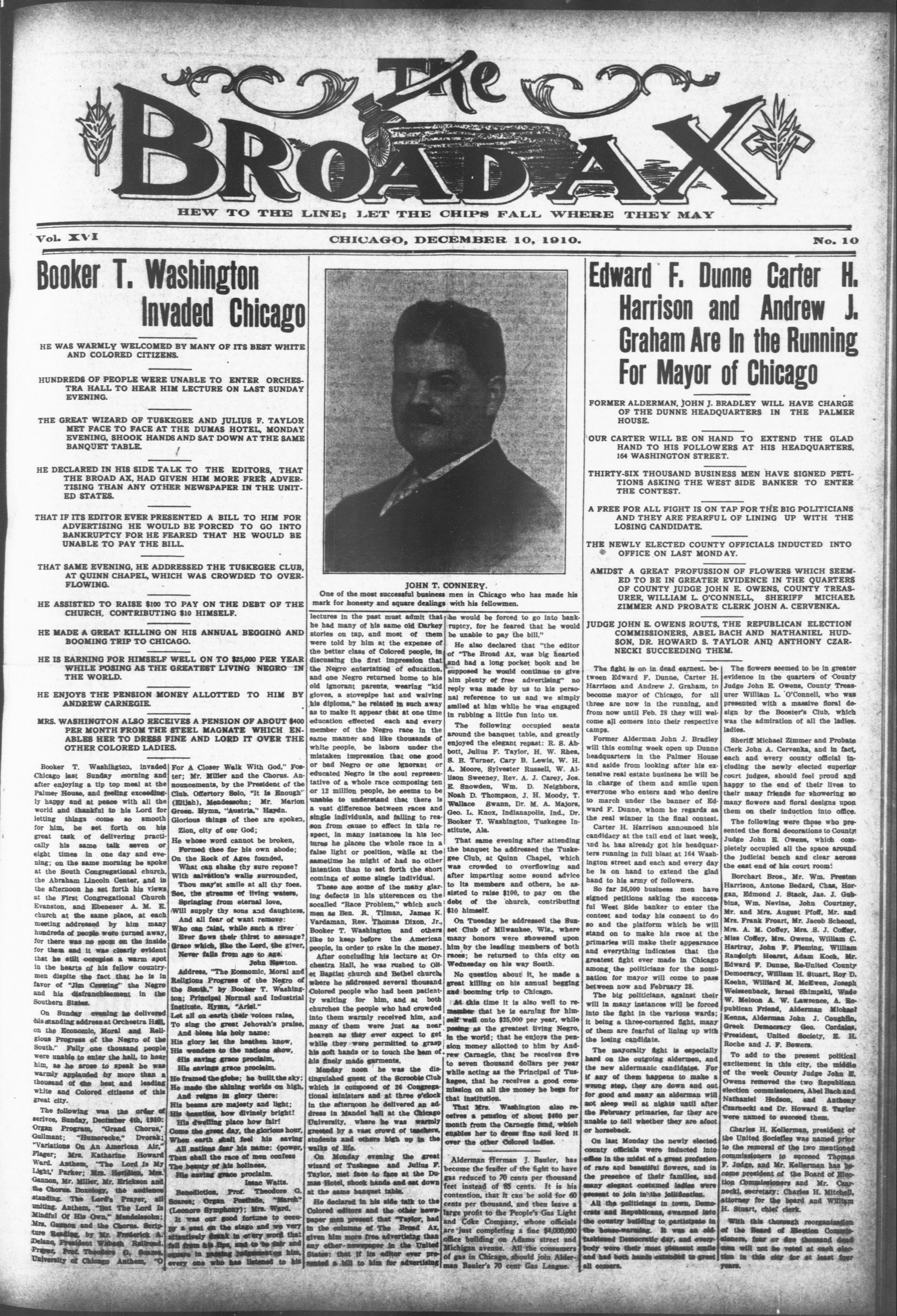
Booker T. Washington Invaded Chicago
HE WAS WARMLY WELCOME BY MANY OF ITS BEST WHITE AND COLORED CITIZENS.
HUNDREDS OF PEOPLE WERE UNABLE TO ENTER ORCHESTRA HALL TO HEAR HIM LECTURE ON LAST SUNDAY EVENING.
THE GREAT WIZARD OF TUSKEGEE AND JULIUS F. TAYLOR MET FACE TO FACE AT THE DUMAS HOTEL, MONDAY EVENING, SHOOK HANDS AND SAT DOWN AT THE SAME BANQUET TABLE.
HE DECLARED IN HIS SIDE TALK TO THE EDITORS, THAT THE BROAD AX, HAD GIVEN HIM MORE FREE ADVERTISING THAN ANY OTHER NEWSPAPER IN THE UNITED STATES.
THAT IF ITS EDITOR EVER PRESENTED A BILL TO HIM FOR ADVERTISING HE WOULD BE FORCED TO GO INTO BANKRUPTCY FOR HE FEARED THAT HE WOULD BE UNABLE TO PAY THE BILL.
THAT SAME EVENING, HE ADDRESSED THE TUSKEGEE CLUB, AT QUINN CHAPEL, WHICH WAS CROWDED TO OVER-FLOWING.
HE ASSISTED TO RAISE $100 TO PAY ON THE DEBT OF THE CHURCH, CONTRIBUTING $10 HIMSELF.
HE MADE A GREAT KILLING ON HIS ANNUAL BEGGING AND BOOMING TRIP TO CHICAGO.
HE IS EARNING FOR HIMSELF WELL ON TO $25,000 PER YEAR WHILE POSING AS THE GREATEST LIVING NEGRO IN THE WORLD.
HE ENJOYS THE PENSION MONEY ALLOTTED TO HIM BY ANDREW CARNEGIE.
MRS. WASHINGTON ALSO RECEIVES A PENSION OF ABOUT $400 PER MONTH FROM THE STEEL MAGNATE WHICH ENABLES HER TO DRESS FINE AND LORD IT OVER THE OTHER COLORED LADIES.
Vol. XVI
HE WAS WARMLY WELCOME AND COLORED CITIZEN.
HUNDREDS OF PEOPLE WERE TRA HALL TO HEAR HE EVENING.
THE GREAT WIZARD OF TUSK MET FACE TO FACE AT EVENING, SHOOK HAND BANQUET TABLE.
HE DECLARED IN HIS SIDE TAKING THE BROAD AX, HAD GREAT TISING THAN ANY OTHER ED STATES.
THAT IF ITS EDITOR EVER PREVENED ADVERTISING HE WOULD BANKRUPTCY FOR HE REUNABLE TO PAY THE BENEFIT.
THAT SAME EVENING, HE ADDED AT QUINN CHAPEL, WHILE FLOWING.
HE ASSISTED TO RAISE $100 CHURCH, CONTRIBUTING.
HE MADE A GREAT KILLING OR BOOMING TRIP TO CHICAGO.
HE IS EARNING FOR HIMSELF WHILE POSING AS THE WORLD.
HE ENJOYS THE PENSION MORE ANDREW CARNEGIE.
MRS. WASHINGTON ALSO RECIEVED PER MONTH FROM THE ABLES HER TO DRESS OTHER COLORED LADIES.
Booker T. Washington, invaded Chicago last Sunday morning and after enjoying a tip top meal at the Palmer House, and feeling exceedingly happy and at peace with all the world and thankful to his Lord for letting things come so smooth for him, he set forth on his great task of delivering practically his same talk seven or eight times in one day and evening; on the same morning he spoke at the South Congregational church, the Abraham Lincoln Center, and in the afternoon he set forth his views at the First Congregational Church Evanston, and Ebenezer A. M. E. church at the same place, at each meeting addressed by him many hundreds of people were turned away, for there was no room on the inside for them and it was clearly evident that he still occupies a warm spot in the hearts of his fellow countrymen dispute the fact that he is in favor of "Jim Crowing" the Negro and his disfranchisement in the Southern States.
On Sunday evening he delivered this standing address at Orchestra Hall, on the Economic, Moral and Religious Progress of the Negro of the South." Fully one thousand people were unable to enter the hall, to hear him, as he arose to speak he was warmly applauded by more than a thousand of the best and leading white and Colored citizens of this great city.
The following was the order of service, Sunday, December 4th, 1910: Organ Program, "Grand Chorus," Gullmant; "Humorecke," Dvorak; "Variations On An American Air," Flager; Mrs. Katharine Howard Ward. Anthem, "The Lord Is My Light," Parker; Mrs. Heridian, Mrs. Gannon, Mr. Miller, Mr. Erickson and the Chorus Doxology, the audience standing. The Lord's Prayer, all uniting. Anthem, "But The Lord Is Mindful Of His Own," Mendelssohn; Mrs. Gannon and the Chorus. Scripture Reading, by Mr. Frederick A. Delano, President Washoe Railroad, Prayer, Theodore G. Sources, University of Chicago Anthem, "O
---
For A Closer Walk With God," Foster; Mr. Miller and the Chorus. Announcements, by the President of the Club. Offertory Solo, "It Is Enough" (Elijah), Mendessohn; Mr. Marion Green. Hymn, "Austria," Haydn. Glorious things of thee are spoken, Zion, city of our God;
He whose word cannot be broken, Formed thee for his own abode;
On the Rock of Ages founded, What can shake thy sure repose? With salvation's walls surrounded, Thou may'st smile at all thy toes. See, the streams of living waters, Springing from eternal love, Will supply thy sons and daughters, And all fear of want remove: Who can caint, while such a river Ever flows their thirst to assuage? Grace which, like the Lord, the giver, Never falls from age to age.
John Newton. Address, "The Economic, Moral and Religious Progress of the Negro of the South," by Booker T. Washington; Principal Normal and Industrial Institute. Hymn, "Ariel."
Let all on earth their voices raise,
To sing the great Jehovah's praise,
And bless his holy name:
His glory let the heathen know,
His wonders to the nations show,
His saving grace proclaim,
His saving grace proclaim.
He framed the globe; he built the sky;
He made the shining worlds on high,
And reigns in glory there:
His beams are majesty and light;
His beauties, how divinely bright!
His dwelling place how fair!
Come the great day, the glorious hour,
When earth shall feel his saving
All nations fear his name: (power,
Then shall the race of men confess
The beauty of his holiness,
His saving grace proclaim.
Isaac Watts.
Benediction, Prof. Theodore G.
Scares; Organ Poetude, "March"
(Leonard Symphony); Mrs. Ward.
It was our good fortune to occupy
a seat on the stage and we very
attentively thank in every word that
fell from his lips, and to be fair and
square in passing judgement on him,
every one who has listened to his
---
CHICAGO, DECEMBER 10, 1910.
[Image of a man with a mustache and a suit].
One of the most successful business men in Chicago who has made his mark for honesty and square dealings with his fellowmen.
lectures in the past must admit that he had many of his same old Darkey stories on tap, and most of them were told by him at the expense of the better class of Colored people, in discussing the first impression that the Negro entertained of education, and one Negro returned home to his old ignorant parents, wearing "kid gloves, a stovepipe hat and wailing his diploma," he related in such away as to make it appear that at one time education effected each and every member of the Negro race in the same manner and like thousands of white people, he labors under the mistaken impression that one good or bad Negro or one ignorant or educated Negro is the soul representative of a whole race composing ten or 12 million people, he seems to be unable to understand that there is a vast difference between races and single individuals, and failing to reason from cause to effect in this respect, in many instances in his lectures he places the whole race in a false light or position, while at the sametime he might of had no other intention than to set forth the short comings of some single individual.
These are some of the many glaring defects in his utterences on the so-called "Race Problem," which such men as Ben. R. Tilman, James K. Vardaman, Rev. Thomas Dixon, Jr., Booker T. Washington and others like to keep before the American people, in order to rake in the money. After concluding his lecture at Orchestra Hall, he was rushed to Olet Baptist church and Bethel church where he addressed several thousand Colored people who had been patiently waiting for him, and at both churches the people who had crowded into them warmly received him, and many of them were just as near heaven as they ever expect to get while they were permitted to grasp his soft hands or to touch the hem of his finally made garments.
Monday noon he was the distinguished guest of the Scroobie Club which is composed of 26 Congregational ministers and at three o'clock in the afternoon he delivered an address in Mandel hall at the Chicago University, where he was warmly greeted by a vast crowd of teachers, students and others high up in the walks of life.
On Monday evening the great wizard of Tuskegee and Julius F. Taylor, met face to face at the Dumas Hotel, shook hands and set down at the same banquet table.
He declared in his side talk to the Colored editors and the other newspaper men present that "Taylor, had in the columns of The Broad Ax, given him more free advertising than any other newspaper in the United States: that if its editor ever presented a bill to him for advertising
he would be forced to go into bankruptcy, for he feared that he would be unable to pay the bill."
He also declared that "the editor of "The Broad Ax, was big hearted and had a long pocket book and he supposed he would continue to give him plenty of free advertising" no reply was made by us to his personal reference to us and we simply smiled at him while he was engaged in rubbing a little fun into us.
The following occupied seats around the banquet table, and greatly enjoyed the elegant repast: R. S. Abbott, Julius F. Taylor, H. W. Rhea, S. B. Turner, Cary B. Lewis, W. H. A. Moore, Sylvester Russell, W. Allison Sweeney, Rev. A. J. Carey, Jos. E. Snowden, Wm. D. Neighbors, Noah D. Thompson, J. H. Moody, Wallace Swann, Dr. M. A. Majors, Geo. L. Knox, Indianapolis, Ind., Dr. Booker T. Washington, Tuskegee Institute, Ala.
That same evening after attending the banquet he addressed the Tuskegee Club, at Quinn Chapel, which was crowded to overflowing and after imparting some sound advice to its members and others, he assisted to raise $100, to pay on the debt of the church, contributing $10 himself.
On Tuesday he addressed the Sunset Club of Milwaukee, Wis., where many honors were showered upon him by the leading members of both races; he returned to this city on Wednesday on his way South.
No question about it, he made a great killing on his annual begging and booming trip to Chicago.
At this time it is also well to remember that he is earning for himself well onto $25,000 per year, while posing as the greatest living Negro, in the world; that he enjoys the pension money allotted to him by Andrew Carnegie, that he receives five to seven thousand dollars per year while acting as the Principal of Tuskegee, that he receives a good commission on all the money he begs for that institution.
That Mrs. Washington also receives a pension of about $400 per month from the Carnegie fund, which enables her to dress fine and lord it over the other Colored ladies.
Alderman Herman J. Bauler, has become the leader of the fight to have gas reduced to 70 cents per thousand feet instead of 85 cents. It is his contention, that it can be sold for 60 cents per thousand, and then leave a large profit to the People's Gas Light and Coke Company, whose officials are just completing a fine $4,000,000 office building on Adams street and Michigan avenue. All the consumers of gas in Chicago, should join Alderman Bauler's 70 cent Gas League.
Edward F. Dunne Carter H. Harrison and Andrew J. Graham Are In the Running For Mayor of Chicago
FORMER ALDERMAN, JOHN J. BRADLEY WILL HAVE CHARGE OF THE DUNNE HEADQUARTERS IN THE PALMER HOUSE.
OUR CARTER WILL BE ON HAND TO EXTEND THE GLAD HAND TO HIS FOLLOWERS AT HIS HEADQUARTERS, 164 WASHINGTON STREET.
THIRTY-SIX THOUSAND BUSINESS MEN HAVE SIGNED PETIIONS ASKING THE WEST SIDE BANKER TO ENTER THE CONTEST.
A FREE FOR ALL FIGHT IS ON TAP FOR THE BIG POLITICIANS AND THEY ARE FEARFUL OF LINING UP WITH THE LOSING CANDIDATE.
THE NEWLY ELECTED COUNTY OFFICIALS INDUCTED INTO OFFICE, ON LAST MONDAY.
AMIDST A GREAT PROFUSSION OF FLOWERS WHICH SEEMED TO BE IN GREATER EVIDENCE IN THE QUARTERS OF COUNTY JUDGE JOHN E. OWENS, COUNTY TREASURER, WILLIAM L. O'CONNELL, SHERIFF MICHAEL ZIMMER AND PROBATE CLERK JOHN A. CERVENKA.
JUDGE JOHN E. OWENS ROUTS, THE REPUBLICAN ELECTION COMMISSIONERS, ABEL BACH AND NATHANIEL HUDSON, DR. HOWARD S. TAYLOR AND ANTHONY CZARNECKI SUCCEEDING THEM.
The fight is on in dead earnest. between Edward F. Dunne, Carter H. Harrison and Andrew J. Graham, to become mayor of Chicago, for all three are now in the running, and from now until Feb. 28 they will welcome all comers into their respective camps.
Former Alderman John J. Bradley will this coming week open up Dunne headquarters in the Palmer House and aside from looking after his extensive real estate business he will be in charge of them and smile upon everyone who enters and who desire to march under the banner of Edward F. Dunne, whom he regards as the real winner in the final contest.
Carter H. Harrison announced his candidacy at the tail end of last week, and he has already got his headquarters running in full blast at 164 Washington street and each and every day he is on hand to extend the glad hand to his army of followers.
So far 36,000 business men have signed petitions asking the successful West Side banker to enter the contest and today his consent to do so and the platform which he will stand on to make his race at the primaries will make their appearance and everything indicates that the greatest fight ever made in Chicago among the politicians for the nomination for mayor will come to pass between now and February 28.
The big politicians, against their will in many instances will be forced into the fight in the various wards; it being a three-cornered fight, many of them are fearful of lining up with the losing candidate.
The mayoralty fight is especially hard on the outgoing aldermen, and the new aldermanic candidates. For if any of them happens to make a wrong step, they are down and out for good and many an alderman will not sleep well at nights until after the February primaries, for they are unable to tell whether they are afoot or horseback.
On last Monday the newly elected county officials were inducted into office in the midst of a great profusion of rare and beautiful flowers, and in the presence of their families, and many elegant costumed ladies were present to join in the jollification.
All the politicians in town, Democrats and Republicans, swarmed into the country building to participate in the house-warming. It was an old-fashioned Democratic day, and everybody wore their most pleasant smile and had both hands extended to greet all comers.
No.10
Jenne Carter H. and Andrew J. In the Running of Chicago
BRADLEY WILL HAVE CHARGE QUARTERS IN THE PALMER
AND TO EXTEND THE GLAD MERS AT HIS HEADQUARTERS, AT.
NESS MEN HAVE SIGNED PETIEST SIDE BANKER TO ENTER
TAP FOR THE BIG POLITICIANS OF LINING UP WITH THE
Y OFFICIALS INDUCTED INTO DAY.
ON OF FLOWERS WHICH SEEM-EVIDENCE IN THE QUARTERS IN E. OWENS, COUNTY TREASONNELL, SHERIFF MICHAEL CLERK JOHN A. CERVENKA.
THE REPUBLICAN ELECTION BACH AND NATHANIEL HUD-AYLOR AND ANTHONY CZAR-EM.
The flowers seemed to be in greater evidence in the quarters of County Judge John E. Owens, County Treasurer William L. O'Connell, who was presented with a massive floral design by the Booster's Club, which was the admiration of all the ladies, ladies.
Sheriff Michael Zimmer and Probate Clerk John A. Cervenka, and in fact, each and every county official including the newly elected superior court judges, should feel proud and happy to the end of their lives to their many friends for showering so many flowers and floral designs upon them on their induction into office.
The following were those who presented the floral decorations to County Judge John E. Owens, which completely occupied all the space around the judicial bench and clear across the east end of his court room:
Borchart Bros., Mr. Wm. Preston Harrison, Antone Bedard, Chas, Horgan, Edmond J. Stack, Jas. J. Gubbins, Wm. Nevine, John Courtney, Mr. and Mrs. August Pfloff, Mr. and Mrs. Frank Froart, Mr. Jacob Scheoul, Mrs. A. M. Coffey, Mrs. S. J. Coffey, Miss Coffey, Mrs. Owens, William C. Hartray, John F. Fleming, William Randolph Hearst, Adam Koch, Mr. Edward F. Dunne, Re-United County Democracy, William H. Stuart, Roy D. Keehn, Williard M. McEwen, Joseph Welssenback, Israel Shimpaki, Wade W. Meloon A. W. Lawrence, A. Hepublican Friend, Alderman Michael Kenna, Alderman John J. Coughlin, Greek Democracy Geo. Cordalos, President, United Society, E. H. Roche and J. F. Bowers.
To add to the present political excitement in this city, the middle of the week County Judge John E. Owens removed the two Republican election commissioners, Abel Bach and Nathaniel Hudson, and Anthony Czarnecki and Dr. Howard S. Taylor were named to succeed them.
Charles H. Kellerman, president of the United Socleies was named prior to the removal of the two mentioned commissioners to succeed Thomas F. Judge, and Mr. Kellerman has become president of the Board of Election Commissioners and Mr. Czarnecki, secretary; Charles H. Mitchell, attorney for the board and William H. Stuart, chief clerk.
With this thorough reorganization of the Board of Election Commissioners, four or five thousand dead men will not be voted at each election in this city for at least four years.
Mr. Broad Ax is a newspaper whose
photograph is based enough for all, ever
claiming the editorial right to speak its
own mind.
Broad communications will receive attention. Write only on one side of the paper.
Subscriptions must be paid in advance.
One Year ..... $2.50
One Month ..... 1.00
Advertising rates made known on application.
Address all communications to
THE BROAD AX
800 ARMOUR AVENUE, CHICAGO.
PHONE DREXEL 4100.
JULIAN F. TAYLOR, Editor and Publisher.
Enclosed as Second-Class Matter
Aug. 18, 1882, at the Post Office at
Chicago, Illinois, under Act of March
3, 1882.
ENDED EXAMINED AND TREATED.
Dr. P. J. Scott, ocular specialist.
Squinthes and eye glances made to
order. 2806½ State street, Chicago.
The Johnson-Smith Wedding.
Owing to devoting so much time to politics last week, it was impossible to get around to write about the Johnson-Smith wedding, which occurred recently at St. Thomas' Church, $8th and Wabash avenue, in which Miss Elizabeth V. Johnson was united in marriage to Mr. Clarence Smith, of St. Paul, Minn., in the presence of the cream of the four hundred in Chicago.
The church was decorated with white carnations and ferns. Mrs. R. B. Harrison presided at the organ. The Rev. J B. Massiah read the service, assisted by Rev. David Wallace. The sweet-voiced choir proceeded the bridal party, and rendered three selections during the ceremony. The service was the first of its kind ever performed in the present St. Thomas' Episcopal Church.
The bride was becomingly attired in a beautiful creation of white liberty satin with long train veiled in Marquisette trimmed in marbout and sea pearls. The bridal veil was caught with orange blossoms. She carried a shower boquet of white roses and knots of ribbon, the only ornament being a diamond pendant.
The matron of honor, Mrs. Susie E. Evans, of St. Louis, daughter of Bishop and Mrs. C. S. Smith, of Detroit, and a cousin of the bride, wore a handsome wedding gown. She being a bride of three months Mrs. Evans carried a bouquet of pink bridal roses.
The bridesmaids were the Misses Rena Bracaham, Helen Collinns and Gladys Thurman, of Jackson, Mich, each one of them wore pretty white gowns touched with yellow in keeping with the color scheme of the wedding and carried bouquets of white carnations.
Mrs. J. E. Johnson, the mother of the bride, was handsome7 attired in a gown of Alice Blue Crepe De Chene, with a white beaded overdress and diamond ornaments.
The grom was attended by Mr. Fred McCracken, of St. Paul, best man; Messrs. Will Brown, Theodore Cowan and Ellis Burton, of St. Paul were groomsmen. Tom Boger of Aurora, and Charles Settles served as ushers and stretched the ribbons.
A large reception followed at the residence, 2443 Wabash avenue, the house was beautifully decorated with flowers and ferns in parlors and library, the spacious dining room and its beautiful decorations were in charge of W E. Thornton, the well-known caterer of Englewood. Prof. Garfield Wilson rendering sweet music during the evening.
The out-of-town guests were all relatives of the bride and groom. Mrs. Catherine Smith, of Detroit, Mich., grandmother of the bride, who is eight years of age, this being the second wedding she has witnessed in three months' time, both being grandchildren; Mrs. Amanda Brown, of Omaha, great aunt to the bride, seventy-five years old; Mrs. Lucy Thurman, Jackson, Mich., aunt of the bride; Mrs. Bishop Smith, aunt of the bride, Detroit, Mich.; Mrs. S. E. Evans, of St. Louis, cousin of the bride; Mrs. G. E. Perkins, of Omaha, Neb., cousin of the bride; Miss Gladys Thurman, Jackson, Mich., cousin of the bride; Mrs. O. Allen, of St. Paul, aunt of the groom; Mrs. O. Smith, of Lafayette, Ind., aunt of the groom. The presents were numerous and costly, among them being an Otter coat, gift of the groom; a diamond ring from the mother of the bride; a white heaver hat, entirely covered
---
with willow plumes, from Mrs. Arthur Codozoe; twenty dollars in gold, Mr. and Mrs. Robert Davis.
The groom was presented with fifty dollars by his firm, in which he holds a responsible position.
The newly married couple, after the reception, and after receiving the hearty congratulations and best wishes of their many friends, departed for their new home in St. Paul, Minn.
PICTURE FILMS FIGHT TUBER-CULOSIS.
"The Red Cross Seal" Portrays Interesting Drama
Moving picture theatres have been enlisted in the army of crushers fighting tuberculosis by selling Red Cross Christmas Seals, and on December 16th in all parts of the United States a film entitled "The Red Cross Seal" will be exhibited for the first time, according to an announcement of the National Association for the Study and Prevention of Tuberculosis.
The picture drama has been produced by the Edison Manufacturing Company in co-operation with the National Association for the Study and Prevention of Tuberculosis and the American National Red Cross. It portrays an interesting story of New York life, and is besides filled with educational scenes that show how tuberculosis is contracted and how it may be prevented and cured. The film is 1,000 feet long. The tuberculosis workers in every state of the United States are urging their local theatres to exhibit the picture.
The plot of the story centers about the winning of the prize of $100 for the best design for the Red Cross Seal for 1911, by Ellen Williams, a poor girl of the tenements who makes her living decorating lampshades for very meagre wages. She has applied to the art school where she longs to take a course of study, but finds that the cost, $100, is too much for her purse. As she turns to leave the school, a young man of wealth sees her in the office and is struck by the pathos of her beauty and disappointment. Tired of his purposeless life, Jordan resolves to see for himself "how the other half lives." Dressed as an ordinary day laborer, therefore, he rents a room in the same tenement with Ellen and soon becomes greatly attached to her. He sees her struggle to win the $100 prize for the Red Cross Seal design, and finally sees her win it. Then he sees her give up all the ambitions of her life, when she turns over the $100 to a neighbor, so that her consumptive boy might have a chance to be cured at a sanatorium.
Struck by the noble sacrifice, Jordan unknown to Ellen, buys the tenement, renovates the neighboring apartments, enlists the co-operation of a district nurse, and helps thus to restore the consumptive to health and remove from his family the danger of further infection.
Thus, in the end, when Jordan reveals to Ellen his identity, she finds in his proposal that she share with him his palatial Fifth Avenue mansion, she has gained a great love, a home, and the satisfaction of her ambition, all because of the Red Cross Seal.
Chateau Rink Notes.
The roller skating rink contest last Sunday was a spirited affair, participated in by some of the best Semi Pro skaters in the city. The contest tomorrow night promises to be equally as interesting.
Col. Radcliff and friends were callers at the rink last Sunday and spent an enjoyable evening, looking at the skaters and the many figures they cut on wheels. They promise to call again soon.
Arrangements have now been made so that the restaurant department will be kept open all night as late as 2 A. M. any way, and late parties can be served to the latest delicacies of the season. Pay us a visit.
The Christmas program promises to be a monster one, as there will be competitive skating every night during the holidays and cash prizes awarded.
Those who believe in race integrity should frequent the Pekin, Lett's Cafe, Holts' New Brunswick and the Keystone, enterprises run by and for our people and not to exploit like the other notorious would be places of amusement now found along the stroll.
Washington, Dec. 6.—Holding that eight-year-old Isabel Wall, who has one-sixteenth Negro blood in her veins, is a Negro and not entitled to admission to a Washington public school for white children, Chief Justice Shepard of the District Court of Appeals fixed the racial status for school children in the District of Columbia.
On Wednesday morning, December 7, Mrs. Mary Church Teurrell, and Madame E. Azelia Hackley, gave a lecture and recital at the Berkeley Theatre, 21 West 44th street, New York City, N. Y., under the patronage of the following prominent society ladies of that city. It was a most brilliant function and it was the first time in the history of New York that the wives and daughters of its millionaires had the pleasure of coming in close contact with two of the most highly educated and foremost women of the Afro-American race.
Mrs. Wm. H. Baldwin, Jr., Mrs. O. H. P. Belmont, Mrs. Harriot Stanton Blatch, Mrs. Walston R. Brown, Mrs. John Dewey, Mrs. Clinton P. Farrell, Mrs. Ida Husted Harper, Mrs. Robert G. Ingersoll, Miss Maud R. Ingersoll, Mrs. John E. Milholland, Mrs. Max Morgenthau, Jr., Mrs. Frederick Nathan, Mrs. Edwin R. A. Seligman, Mrs. V. G. Simkhovitch, Miss Lillian D. Wald, Mrs. Henry Villard, and Mrs. Diana Belais.
Little or nothing is known by the general public about the development of the Colored woman since the abolition of slavery. Economically and socially her progress has been almost unnoted in the many studies of our national life.
Mrs. Terrell, who is a graduate of Oberlin College, is peculiarly well fitted to speak on this subject. She is an eloquent, magnetic speaker, and was the first president of the National Association of Colored Women, with which more than 150,000 members are now affiliated.
Madame Hackley is a pupil of Jean de Reszke, and has a brilliant, thoroughly cultivated high soprano voice.
Madame Hackley has for a number of years maintained a scholarship for the training abroad of especially gifted Colored musicians.
S. H. DUDLEY AND THE SMART SET AT THE GLOBE THEATRE.
S. H. Dudley the greatest of all comedians, who is ably supported by Aida Overton Walker, and the Smart Set; made his appearance at the Globe Theater, Wabash avenue and Hubbard Court, last Sunday afternoon, in "His Honor, the Barber," and at each performance, they have been playing to crowded houses, and the interest in the show is not abating one whit, and it will lap over into the second week, which ends Saturday, December 17.
From the beginning to the end of the play, each scene and act are chuck full of exciting events. Mr. Dudley, is at his best at all times, and no Afro-American on the American Vaudeville stage, can put anything over on him.
The cast of characters are superb, and they all perform their several parts in "His Honor The Barber," to perfection.
Aida Overton Walker, in her specialities, comes up, and in fact surpasses herself as a unique and bewitching little figure, who understands thoroughly, how to captivate her audience by her artistic singing and dancing.
Lottie Grady, is at her best in singing, "Rubbernecking Moon."
The stage effects, in "His Honor The Barber," are very striking. The musical program is away beyond the average; and on the whole the play is of a high order.
The women, throughout the play; are richly and most brilliantly, costumed and anyone witnessing it will naturally form a higher opinion of the ability of Colored women to get themselves up neat and attractive, and to acquire all of the facinating graces possessed by the most highly cultured women of other races.
Bargain matinees this coming week, as usual, Sunday, Tuesday, Thursday and Saturday.
Luncheon In Honor of Mrs. William Blevins.
Mrs. Hattle Arrant, 11 E. 42nd street, gave a luncheon last Thursday evening from 2 to 7 P. M., in honor of her sister, Mrs. Wm. Blevins, of Columbus, O.
Those who were present: Mrs. John Robinson, Mrs. Mary Bowman, Mrs. E. B. Locket, Mrs. Jessie Johnson, Miss Anna Turner, Mrs. Helen Townley, Mrs. Mamie Black, Mrs. Wm. Emanuel, Mrs. Mary Fisher.
All expressed themselves as having a delightful afternoon. Mrs. Arrant served the ladies in elegant style, her favors were calendars for 1911. Each lady was called on to discuss the monogram on her calendar, which was very interesting. Mrs. Blevins left for her home Monday evening, and expressed to all that her visit will long be remembered.
A Race Congress particularly for the Colored races will meet at the University of London, London, England, July 29-30, 1911. The president of the Congress is Lord Weardale and the chairman of the general committee is our American philosopher, Felix Adler of New York. Representatives of the white and Colored races are to meet on a level and discuss conditions,, relations, and remedies. Each race is to speak for itself. They are coming from China, Japan, Turkey, Persia, India, Egypt and Haiti and from all parts of Africa. Dr. Blyden, the great Negro linguist, will speak on West Africa; Dr. W. E. B. DuBois will speak on the Negro in America, and Dr. Jabavo, a learned native, will conditions in South Africa
Two secretaries for America have been appointed—the Rev. Frederick J. Lynch and Dr. W. E. B. DuBois. Dr. DuBois is specially concerned with arousing interest among Colored people.
He plans to organize a select committee of leading Colored people, who are going to be asked to attend the congress in person. Of course, all others who wish may attend, but it is particularly desired that the attendance shall be representative.
The speeches of the congress will be issued in bound volume before the congress convenes.
Informal dinner, December 5th, 1910,
at Hotel Dumas, given in honor of
Mr. Noah D. Thompson, special guest,
Dr. Booker T. Washington, Monday
afternoon, 5:30 o'clock, by the Illinois
Chronicle.
The menu was as follows: Oyster
cocktail, soup, cream tomato; meats,
roast turkey, cranberry sauce; vegetables, French peas, asparagus tips,
mashed potatoes, celery, pickles,
olives; desert, lemon gelatine, black coffee.
Speakers—"Has the Negro Press Made Progress?" S. B. Turner; "Negro Newspapers and the Public," R. S. Abbott; "The Influence of the Press," Julius F. Taylor; "How Best to Conserve the Mutual Interest of the Negro Press," R. H. Rhea; "Press and Pulpit," Rev. A. J. Carey. William H. A. Moore, to master.
Mrs. James Barnett Becomes the Owner of the Owl Restaurant, 3119 State Street.
Mrs. James Barnett, who has for some years very successfully conducted the Pullman Cafe, 140 and 142 West 51st street, last week became the owner of the Owl Restaurant, 3119 State street, and she has changed its name to the Pullman Cafe, No. 2. She has started in to have it remodeled, and in a very short time under the skillful management, it will become more popular than Pullman No 1.
An Old-Fashioned Donation Party.
Be a good fellow and attend the Old-Fashioned Donation Party, at the home of Mrs. Marshall Drish, 4623 Dearborn street, Tuesday evening, December 20th.
The affair is for the benefit of The Amanda Smith Home and should be well attended. Admission free.
Mrs. H. G. Jackson, president; Mrs. H. T. Wells, secretary of Guild No. 1.
Colored Railroad Porter Worth
$140,000.
Steven Bundy, after 27 years of service as porter on the New York Central lines, has retired. During his employment as private care man he has purchased property in Philadelphia, Jersey City and New York City that is estimated at $140,000.
He Takes the Air.
"The aviator is not a selfish man."
"Cause he doesn't want the earth?
The Best Present.
What would I like for Christmas?
Quite carelessly you ask.
This picking out of presents
Is something of a task.
There is so much of beauty,
So many wondrous things.
Yet round one simple picture
My fondest memory clings.
Miss Alice Thomas, 3728 Wabash avenue, is seriously ill.
Madame Tyler, 3158 Wabash avenue, will return to the city next week.
Mr. John R. Hypsher, 2962 Wabash avenue, spent Sunday in Evanston, the guest of Mr. Baker Depew.
Mr. Jesse Fleming of the West Side, a waiter in the Palmer House Cafe has resumed his work after being sick for three weeks.
The Midlothian Club is rehearsing a drama to be given in February. The young ladies are being assisted by Edward J. McCoo.
Rev. J. J. Colbert former pastor of Zion A. M. E. Church, 38th and Dearborn St., now residing Elder of Louisville District, will visit this city next week.
Mr. A. M. Thomas and Frank L. De Man of Washington, D. C., were the guests of Miss Almeta Sears, 3147 Forest avenue. They were on their way to San Antonio, Texas, where they will spend a few weeks.
Bishop G. H. Blackwell of the Michigan District was the guest of honor at a banquet given by Zion A. M. E. Church and Institutional church at the former church on Thursday evening, Dec. 8th.
Harry W. Boss, elected to the state legislature of Pennsylvania at the recent election. He is a practicing attorney of Philadelphia, and he has the honor of being the first Afro-American to be selected to serve the people of that state in that capacity.
George L. Knox, owner of The Freeman, Indianapolis, Ind., spent the past week in Chicago and was one of the guests at the Brunswick Hotel, 3004 State street and attended the banquet, Monday evening at the Dumas Hotel, 3312 Wabash avenue, given in honor of Noah D. Thompson, now of Tuskegee, Ala.
Frank S. Ryan, for a long time connected with the city treasurer's office; as its paymaster, and one of the main clogs in the Democratic machine of the 34th ward; was this week selected to succeed James L. Monaghan, as deputy county controller. His selection is well pleasing to his many friends.
Globe Theatre
Starting Sun. B
Second and
of the
SMART
S. H. DUDLEY—AIDI
and 50 Colored S
The Greatest Show of
Bargain Matinees Sun., Tue
Night Prices 2
Second
Charity
You are cordially invited to attend the second annual charity ball at the Street and Wentworth Avenue, M. The features of the evening will be cert music, from eight to nine. Gliding the maltese cross formation of calceum light. A foral clock will charity during the evening.
Globe Theatre Wabash Ave. & Hubbard Court
Starting Sun. Mat. Dec. 11th
Second and Last Week
of the
SMART SET
S. H. DUDLEY—AIDA OVERTON WALKER
and 50 Colored Singers and Dancers
The Greatest Show of it's kind in Existence
Bargain Matinees Sun., Tues., Thurs. and Sat. 25c.
Night Prices 25c and 50c.
Second Annual Charity Ball
You are cordially invited to attend and to interest others to attend the second annual charity ball at the seventh regiment armory, 34th Street and Wentworth Avenue, Monday evening January 2nd, 1911. The features of the evening will be the eighth regiment band in concert music, from eight to nine. Grand march at nine forty-five including the maltese cross formation and the grand moonlight effect of calceum light. A foral clock will signal the amount raised for charity during the evening.
Beneficiares
Emanuel Neighborhood Settleme Home and the Home for Aged and Mrs. Fannie Emanuel, Chairman,
Emanuel Neighborhood Settlement, Amanda Smith Orphanage Home and the Home for Aged and Infrim Colored People. Mrs. Fannie Emanuel, Chairman, Morris Lewis, Secretary.
Advisory Board
Prof. Wm. Emanuel, Julius N. A.
Jesse Binga, Col. James Johns
A. C. Richardson.
General Adn
Prof. Wm. Emanuel, Julius N. Avendorph, Col. John R. Marshall, Jesse Binga, Col. James Johnson, Mrs. Sarah Duncan and Mrs. A. C. Richardson.
AS SHE TOLD IT.
Life Story of a Woman Who Wanted a
Short Monologue.
"Are you the funny editor?" she asked, pausing for a moment in the doorway. "I want you to write a vaudeville sketch for me. I hope you're going to be more sympathetic than you look, and that reminds me that of all the stony hearted people I ever met in all my life a certain theatrical manager in this town—But I don't suppose you care to hear about that, and I presume I ought to tell you at the start that I have been married. It was a very sad experience, and really it seems to me that any one with the instincts of a gentleman would at least have given me a hearing, but when I offered to read a scene from Shakespeare he called for help, and, as I was saying, it was a very and experience—I mean my married life. Why, he treated me as if I had been the merest scum of the street and didn't even stop smoking or ask me to sit down when I went into his office, but I suppose he must be bothered a great deal by all kinds of people who think they can act. I had to leave him on account of his insane jealousy. If I merely spoke pleasantly to the postman he would fly into a passion, and almost the first thing he asked me was whether I'd be willing to wear tight, because he thought with my figure he might get me into some company, no matter whether I had talent or not. Just think of it! I don't believe we would ever have had any trouble if it hadn't been for his mother. She was always throwing out sly hints and insinuating that I cared more for dress than I did for him, and all that, but it does seem to me that he might at least have taken his feet down from his desk, and, oh, his language was something awful! I never was so insulted in all my life, but I suppose he had been used to dealing with a class of people who had to be talked to in that way. He might have seen by my appearance that I was used to something different, and he looked me over as if I had been merely a piece of furniture. His sister was partly to blame, too, and I can't help feeling awfully thankful that we never had any children for it's such a pity when people who have little ones can't live together. Do you think you could fix up a monologue that would keep me talking for about fifteen minutes?"—Chicago Record Herald.
Auto Suggestions
It's a long road that has no nacks. A tack avoided is a tire repaired. The race is to the swift, provided the constable doesn't telephone ahead. On an auto honeymoon love makes the world go round, but the engine demands gasoline. A honk in time may prevent a fine. The loudest horn doesn't always belong to the biggest car. Motorists swear by their cars, pedestrians at them. It's a rare car that doesn't carry more than one crank—Judge.
atre Wabash Ave. & Hubbard Court
Mat. Dec. 11th
Last Week
the SET
A OVERTON WALKER
Dancers and Dancers
it's kind in Existence
Thurs. and Sat. 25c.
55c and 50c.
Annual
Day Ball
and to interest others to attend
the seventh regiment armory, 34th
Monday evening January 2nd, 1911.
the eighth regiment band in con-
mand march at nine forty-five in-
and the grand moonlight effect
signal the amount raised for
nt, Amanda Smith Orphanage
Infirm Colored People.
Morris Lewis, Secretary.
endorph, Col. John R. Marshall, on, Mrs. Sarah Duncan and Mrs. mission 50c.
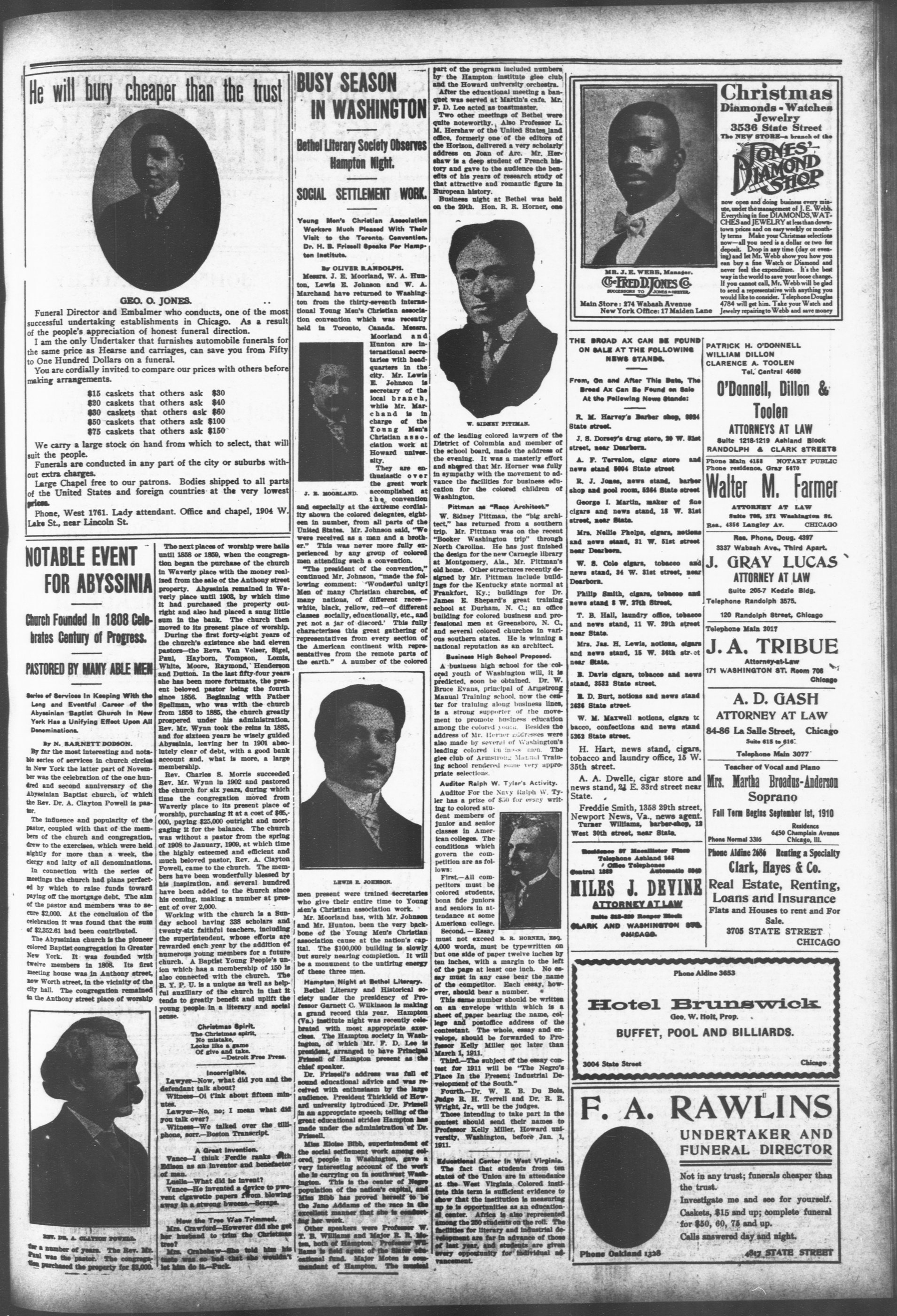
He will bury cheaper than the trust
P.
GEO. O.
Funeral Director and Embalmment successful undertaking establish of the people's appreciation of I I am the only Undertaker that the same price as Hearse and c to One Hundred Dollars on a fun You are cordially invited to con making arrangements.
We carry a large stock on hand suit the people. Funerals are conducted in any out extra charges. Large Chapel free to our path of the United States and foreign grieces. Phone, West 1761. Lady atten Lake St., near Lincoln St.
We carry a large stock on hand from which to select, that will suit the people. Funerals are conducted in any part of the city or suburbs without extra charges. Large Chapel free to our patrons. Bodies shipped to all parts of the United States and foreign countries at the very lowest prices. Phone, West 1761. Lady attendant. Office and chapel, 1904 W. Lake St., near Lincoln St.
NOTABLE EVENT FOR ABYSSINIA
Church Founded In 1808 Celebrates Century of Progress.
PASTORED BY MANY ABLE MEN
Series of Services In Keeping With the Leng and Eventful Career of the Abyssinian Baptist Church in New York Has a Unifying Effect Upon All Denominations.
By N. BARNETT DODSON.
By far the most interesting and notable series of services in church circles in New York the latter part of November was the celebration of the one hundred and second anniversary of the Abyssinian Baptist church, of which the Rev. Dr. A. Clayton Powell is pastor.
The influence and popularity of the pastor, coupled with that of the members of the church and congregation, drew to the exercises, which were held slightly for more than a week, the clergy and laity of all denominations.
In connection with the series of meetings the church had plans perfected by which to raise funds toward paying off the mortgage debt. The aim of the pastor and members was to secure $2,000. At the conclusion of the celebration it was found that the sum of $2,352.61 had been contributed.
The Abyssinian church is the pioneer colored Baptist congregation in Greater New York. It was founded with twelve members in 1808. Its first meeting house was in Anthony street, now Worth street, in the vicinity of the city hall. The congregation remained in the Anthony street place of worship
REV. DR. A. CLAYTON POWELL,
for a number of years. The Rev. Mr.
Paul was the pastor. The congregation
purchased the property for $3,000.
JONES. . .
er who conducts, one of the most
ments in Chicago. As a result
honest funeral direction.
It furnishes automobile funerals for
marriages, can save you from Fifty
mural.
apare our prices with others before
and from which to select, that will be part of the city or suburbs with- ons. Bodies shipped to all parts sign countries at the very lowest dant. Office and chapel, 1904 W.
The next places of worship were halls until 1558 or 1859, when the congregation began the purchase of the church in Waverly place with the money realised from the sale of the Anthony street property. Abyssinia remained in Waverly place until 1903, by which time it had purchased the property outright and also had placed a snug little sum in the bank. The church then moved to its present place of worship.
During the first forty-eight years of the church's existence she had eleven pastors—the Revs. Van Velser, Sigel, Paul, Hayborn, Tompson, Lomis, White, Moore, Raymond, Henderson and Dutton. In the last fifty-four years she has been more fortunate, the present beloved pastor being the fourth since 1856. Beginning with Father Spellman, who was with the church from 1856 to 1885, the church greatly prospered under his administration. Rev. Mr. Wynn took the reins in 1885, and for sixteen years he wisely guided Abyssinia, leaving her in 191 absolutely clear of debt, with a good bank account and, what is more, a large membership.
Rev. Charles S. Morris succeeded Rev. Mr. Wynn in 1902 and pastored the church for six years, during which time the congregation moved from Waverly place to its present place of worship, purchasing it at a cost of $65,000, paying $25,000 outright and mortgaging it for the balance. The church was without a pastor from the spring of 1908 to January, 1909, at which time the highly esteemed and efficient and much beloved pastor, Rev. A. Clayton Powell, came to the church. The members have been wonderfully blessed by his inspiration, and several hundred have been added to the church since his coming, making a number at present of over 2,000.
Working with the church is a Sunday school having 338 scholars and twenty-six faithful teachers, including the superintendent, whose efforts are rewarded each year by the addition of numerous young members for a future church. A Baptist Young People's union which has a membership of 150 is also connected with the church. The B. Y. P. U. is a unique as well as helpful auxiliary of the church in that it tends to greatly benefit and uplift the young people in a literary and social sense.
Christmas Spirit.
The Christmas spirit,
No mistake,
Looks like a game
Of give and take.
-Detroit Free Press.
Incorrigible.
Lawyer—Now, what did you and the defendant talk about?
Witness—Ol tink about fifteen minutes.
Lawyer—No, no; I mean what did you talk over?
Witness—We talked over the tilli-
phone, sorr.—Boston Transcript.
A Great invention.
Vance—I think Ferdie ranks with Edison as an inventor and benefactor of man.
Luisle—What did he invent?
Vance—He invented a device to pwe-
vent cigawette papers from blowing away in a stwong breeze.—Scrapa.
Now the Tree Was Trimmed.
Mrs. Crawford--However did she get her husband to trim the Christmas tree?
Mrs. Crabshew--She told him his tents was so bad that she wouldn't let him do it--Puck.
Bethel Literary Society Observes Hampton Night.
Young Men's Christian Association
Workers Much Pleased With Their
Visit to the Torenta Convention.
Dr. H. B. Frisell Speaks For Hampton
Institute.
By OLIVER RANDOLPH.
Messrs. J. E. Moorland, W. A. Hunton, Lewis E. Johnson and W. A. Marchand have returned to Washington from the thirty-seventh international Young Men's Christian association convention which was recently held in Toronto, Canada. Messrs.
Moorland and Hunton are international secretaries with headquarters in the city. Mr. Lewis M. Johnson is secretary of the local branch, while Mr. Marchand is in charge of the Young Men's Christian association work at Howard university.
```markdown
```
They are enthusiastic over the great work accomplished at the convention
J. E. MOOBLAND. accomplished at the convention and especially at the extreme cordiality shown the colored delegates, eighteen in number, from all parts of the United States. Mr. Johnson said, "We were received as a man and a brother." This was never more fully experienced by any group of colored men attending such a convention.
"The president of the convention," continued Mr. Johnson, "made the following comment: 'Wonderful unity! Men of many Christian churches, of many nations, of different races—white, black, yellow, red—of different classes socially, educationally, etc., and yet not a jar of discord.' This fully characterizes this great gathering of representatives from every section of the American continent with representatives from the remote parts of the earth." A number of the colored
4.
LEWIS E. JOHNSON.
men present were trained secretaries who give their entire time to Young men's Christian association work.
Mr. Moorland has, with Mr. Johnson and Mr. Hunton, been the very backbone of the Young Men's Christian association cause at the nation's capital. The $100,000 building is slowly but surely nearing completion. It will be a monument to the untiring energy of these three men.
Hampton Night at Bethel Literary.
Hampton Night at Bethel Library.
Bethel Literary and Historical society under the presidency of Professor Garnett C. Wilkinson is making a grand record this year. Hampton (Va.) institute night was recently celebrated with most appropriate exercises. The Hampton society in Washington, of which Mr. F. D. Lee is president, arranged to have Principal Frisell of Hampton present as the chief speaker.
Dr. Frisell's address was full of sound educational advice and was received with enthusiasm by the large audience. President Thirkield of Howard university introduced Dr. Frisell in an appropriate speech; telling of the great educational strides Hampton has made under the administration of Dr. Frisell.
Miss Eloise Bibb, superintendent of the social settlement work among colored people in Washington, gave a very interesting account of the work she is carrying on in southwest Washington. This is the center of Negro population of the nation's capital, and Miss Bibb has proved herself to be the Jane Addams of the race in the excellent manner that she is conducting her work.
Other speakers were Professor W. T. B. Williams and Major R. B. Moton, both of Hampton. Professor Williams is field agent of the Slater educational fund. Major Moton is commander of Hampton. The musical
part of the program included numbers by the Hampton institute glee club and the Howard university orchestra. After the educational meeting a banquet was served at Martin's cafe. Mr. F. D. Lee acted as toastmaster. Two other meetings of Bethel were quite noteworthy. Also Professor L. M. Hershaw of the United States land office, formerly one of the editors of the Horizon, delivered a very scholarly address on Joan of Arc. Mr. Hershaw is a deep student of French history and gave to the audience the benefits of his years of research study of that attractive and romantic figure in European history. Business night at Bethel was held on the 29th. Hon. R. R. Horner, one
PETER H.
W. SIDNEY PITMAN. of the leading colored lawyers of the District of Columbia and member of the school board, made the address of the evening. It was a masterly effort and showed that Mr. Horner was fully in sympathy with the movement to advance the facilities for business education for the colored children of Washington.
Pittman aa "Race Architect."
W. Sidney Pittman, the "big architect," has returned from a southern trip. Mr. Pittman was on the recent "Booker Washington trip" through North Carolina. He has just finished the design for the new Carnegie library at Montgomery, Ala., Mr. Pittman's old home. Other structures recently designed by Mr. Pittman include buildings for the Kentucky state normal at Frankfort, Ky.; buildings for Dr. James E. Shepard's great training school at Durham, N. C.; an office building for colored business and professional men at Greensboro, N. C., and several colored churches in various southern states. He is winning a national reputation as an architect.
Business High School Proposed.
A business high school for the colored youth of Washington will, it is predicted, soon be obtained. Dr. W. Bruce Evans, principal of Armstrong Manual Training school, now the center for training along business lines, is a strong supporter of the movement to promote business education among the colored youth. Besides the address of Mr. Hermer addresses were also made by several of Washington's leading colored business men. The glee club of Armstrong Manual Training school rendered some very appropriate selections.
Auditor Ralph W. Tyler's Activity.
Auditor For the Navy Ralph W. Tyler has a prize of $50 for essay writ-
ler has a prize of
colored student members
of junior and senior
classes in American
colleges. The
conditions which
govern the competition are as follows:
M. B.
First.—All competitors must be colored students, bona fide juniors and seniors in attendance at some American college.
Second.—Essay must not exceed R. R. HORNER, ESQ. 4,000 words, must be typewritten on but one side of paper twelve inches by ten inches, with a margin to the left of the page at least one inch. No essay must in any case bear the name of the competitor. Each essay, however, should bear a number.
This same number should be written on an envelope within which is a sheet of paper bearing the name, college and postoffice address of the contestant. The whole, essay and envelope, should be forwarded to Professor Kelly Miller not later than March 1, 1911.
Third—The subject of the essay contest for 1911 will be "The Negro's Place In the Present Industrial Development of the South."
Fourth—Dr. W. E. B. Du Bois, Judge R. H. Terrell and Dr. R. R. Wright Jr., will be the judges.
Those intending to take part in the contest should send their names to Professor Kelly Miller, Howard university, Washington, before Jan. 1, 1911.
Educational Center in West Virginia. The fact that students from ten states of the Union are in attendance at the West Virginia Colored institute this term is sufficient evidence to show that the institution is measuring up to is opportunities as an educational center. Africa is also represented among the 260 students on the roll. The facilities for literary and industrial development are far in advance of those of last year, and students are given every opportunity for individual advancement.
A.
Main Store: 274 Wabash Avenue
New York Office: 17 Malden Lane
O'Donnell, Dillon & Toolen
R. J. Jones, news stand, barber shop and pool room, 5264 State street
George I. Martin, maker of fine cigars and news stand, 18 W. 31st street, near State.
Mrs. Nellie Phelps, cigars, notions and news stand, 31 W. 51st street near Dearborn.
W. S. Cole cigars, tobacco and news stand, 34 W. 31st street, near Dearborn.
Philip Smith, cigars, tobacco and news stand 8 W. 27th Street.
T. B. Hall, laundry office, tobacco and news stand, 11 W. 29th street near State.
Mrs. Jas. H. Lewis, notions, cigars and news stand, 15 W. 36th street near State.
B. Davis cigars, tobacco and news stand, 3532 State street.
B. D. Burt, notions and news stand 2636 State street.
W. M. Maxwell notions, cigars to bacco, confections and news stand 5262 State street.
H. Hart, news stand, cigars, tobacco and laundry office, 15 W. 35th street.
street, agent, shop, 12 Fall Term Begins September 1st, 1910 Residence Phone Normal 3316 6450 Champlain Avenue Chicago, Ill. Phone Aldine 2686 Renting a Specialty
Residence 87 Macallister Fines
Telephone Ashland 248
/ Office Telephones
Central 1829 Automatic 8849
MILES J. DEVINE
ATTORNEY AT LAW
Suite 815-829 Reeper Block
CLARK AND WASHINGTON 878
PHICAGO.
Phone Aldine
Hotel Bru
Geo. W. Holt
BUFFET, POOL AN
3004 State Street
F. A. RA
Phone Aldine 3653
Brunswick
lee. W. Holt, Prop.
COOL AND BILLIARDS.
Chicago
RAWLINS
UNDERTAKER AND
FUNERAL DIRECTOR
Phone Aldine 3653
Hotel Brunswick
Geo. W. Holt, Prop.
BUFFET, POOL AND BILLIARDS.
3004 State Street Chicago
Not in any trust; funerals cheaper than the trust.
Investigate me and see for yourself.
Caskets, $15 and up; complete funeral for $50, 60, 75 and up.
Calls answered day and night.
4817 STATE STREET
---
THE BROAD AX CAN BE FOUND ON SALE AT THE FOLLOWING NEWS STANDS.
From, On and After This Data, The
Broad Ax Can Be Found on Sale
At the Following News Stands:
R. M. Harvey's Barber shop, 6024
State street.
J. S. Dorsay's drug store, 20 W. Stist
street, near Dearborn.
A. F. Tervalon, cigar store and
news stand 6004 State street
A. A. Dwelle, cigar store and news stand, 21 E. 33rd street near State.
Freddie Smith, 1358 29th street, Newport News, Va., news agent.
Turner Williams, barber shop, 12 West 30th street, near State.
O
Phone Oakland 1328
JONES' DIAMOND SHOP now open and doing business every minute, under the management of J. E. Webb. Everything in fine DIAMONDS, WATCHES and JEWELRY at less than downtown prices and on easy weekly or monthly terms. Make your Christmas selections now—all you need is a dollar or two for deposit. Drop in any time (day or evening) and let Mr. Webb show you how you can buy a fine Watch or Diamond and never feel the expenditure. It's the best way in the world to save your loose change. If you cannot call, Mr. Webb will be glad to send a representative with anything you would like to consider. Telephone Douglas 4784 will get him. Take your Watch and Jewelry repairing to Webb and save money
PATRICK H. O'DONNELL
WILLIAM DILLON
CLARENCE A. TOOLEN
Tel. Central 4600
ATTORNEYS AT LAW
Suite 1218-1219 Ashland Block
RANDOLPH & CLARK STREETS
Phone Main 4158 NOTARY PUBLIC
Phone residence, Gray 5670
ATTORNEY AT LAW
Suite 705, 171 Washington St.
Res., 4356 Langley Av. CHICAGO
Res. Phone, Doug. 4397
3337 Wabash Ave., Third Apart.
J. GRAY LUCAS
ATTORNEY AT LAW
Suite 205-7 Kedzie Bidg.
Telephone Randolph 3575.
120 Randolph Street, Chicago
Telephone Main 2017
Attorney-at-Law
171 WASHINGTON ST. Room 706
Chicago
A. D. GASH
ATTORNEY AT LAW
84-86 La Salle Street, Chicago
Suite 615 to 616:
Mrs. Martha Broadus-Anderson Soprano
Clark, Hayes & Co.
Real Estate, Renting,
Loans and Insurance
Flats and Houses to rent and For
Sale.
3705 STATE STREET
CHICAGO
WM. D. NEIGHBORS & CO
REAL ESTATE
AT LOWEST PRICES
Easiest Terms to be had in Chicago
Loans on first and second Mortgages
Fire Insurance placed in any company
3517 State Street CHICAGO, ILL.
Phone Aldine 2532
A Christmas Present That He Didn't Expect.
By FRITZ KORSMEYER.
When the maid opened the door a gust of December wind, carrying with it a few flakes of snow, followed the tall, stiff form of Crancer through the vestibule and into the hall. As the maid had spent years in the service of the Garrisons, she ventured a restrained "Good evening," but Crancer calmly stalked by her over to the hall tree. When he had put aside his things and turned to her again she said:
"Mr. Robert is in his room, sir. Shall I tell him you are here or will you"—"Til go up. He's expecting me."
At the head of the stairs he knocked at his friend's room and entered.
"Sorry to keep you waiting, old man; ready in a few minutes. Sit down and make yourself comfortable, won't you?"
Craneer took the proffered cigar and smoked in silence a few minutes while his friend worked at his cravat.
"I had a rather peculiar talk with Miles today," began Craneer in a tone that led Garrison to stop whistling and mumble an encouraging monosyllable; "happened to meet him on the street, you know, just as I was going into Hope's to look at a few Christmas things. He had such a long face on that I thought he needed jollying up a bit. Not like him to need cheering, is it?"
"Scarcely," assented Garrison, with an uneasy laugh. "But of course you know that Charlie has had some occasion to look grum lately."
"Oh, yes! I've heard the family fortunes have been rather going to pot. Well, as I said, I started in to chaff him about Christmas gifts. I bought a few trifles, but most of the time I was showing Miles things that I said a man with a fiancee ought to be interested in, and he was. Several times I thought he was in the point of buying something worth giving, but he finally said he couldn't decide. We walked up the street together, and Miles fell to speculating in a general way as to what girls expected of their fancies at Christmas time. He seemed to want my opinion. Queen of him to come to me with that sort of talk, wasn't it Bob?"
"Yes, but I suppose he thought you didn't know enough about his affairs to suspect that he was talking of his own case. Men who are in love always glittering generalities, while they haven't a thing in mind but their own particular affair, supposing other people won't know it. What did you tell him?"
"Well, I said it depended largely upon what girls had been taught to expect. From that we drifted into a discussion as to what a man should do when his prospects changed during his engagement. Miles said that to the sort of girl a man would really care for it would make no difference. Good Lord—the sort of girl a man would really care for? I told him a man never knows what kind of girl he is likely to care for or what kind he is caring for, so far as that goes, and I said that if I were engaged to a girl I wouldn't take any chances at Christmas. He responded rather weakly that most girls of our acquaintance already had everything they wanted." "Which is quite true," put in Garri
"Oh, yes, true as far as it goes, but you know very well that the average girl likes to think her lover has searched of the town over for something out of the ordinary. Now, we men know that nothing remains to be bought as a Christmas gift that we wouldn't just as soon be without, but women don't know it and never will, and so they go on, expecting joyous astonishment every year."
"Still, I don't believe Martha's just like other girls in that respect."
think she's downstairs." Garrison went to the door and called his sister's name. Receiving no response, he returned.
"Her door was open, but she didn't answer, so she isn't upstairs. Shall we go now?"
At the foot of the stairs they encountered Miles, who had just come in. The three men chatted a moment. Then young Garrison and Cranger went out.
Miles thought Martha looked at him more seriously than usual as she gave him her hand, but her eyes were bright, and when she spoke there was a touch of gayety in her voice.
"Sit by the fire, won't you?" she urged. "You must be nearly frozen. I like snow for Christmas, but without this freezing temperature." She pushed a chair nearer the fire and then crossed to a stand where huge roses were nodding over the edge of a cut glass jar and gathered them in her arms.
"How do you always manage to find the most perfect blossoms for me, Charles?" the girl asked indistinctly, her face hidden in the roses. She raised her head for an answer, but the man was looking into the fire. She moved the stand nearer him.
"I want these close to us this evening. Don't you think they should be? Why don't you reprove me for being sentimental, as you always do? Or are you already under the influence of tomorrow and kindly disposed toward every one, even me?"
"Oh, well. I'll take it back if you don't like it," she hastened to say, laughing, then in a tone of almost bantering tenderness: "My dear, I wanted to tell you about some plans for tomorrow, but how can I talk Christmas when you are in such a solemn state? You'd dishearten Santa Claus himself." "I've been thinking," answered Miles slowly, "that perhaps you may have thought the roses—may have taken them in a way—may perhaps have misunderstood them a little." He rose, took a few steps around the room and then began again with better courage. "It occurred to me after I had sent them that as they would arrive this evening you might not take them as—as my gift. I must tell you something that has been troubling me for a long time. Things are not quite the same with father and me as they were when I first met you. Perhaps you knew it?"
There was a questioning inflection in his last words. The girl's face had paled a little, but just the faintest smile curved her lips. She was gazing steadfastly at the rose jar, on which her hand rested, and she made no answer.
"Until Christmas came I did not realize the change in our prospects," he went on steadily. "Perhaps I did not want to think of that, but if it does make a difference, why, then"—Martha was looking straight into his eyes with an expression of infinite tenderness.
"It has made a difference, Charles, all the difference in the world. I have been wondering for weeks what you would like for a Christmas gift, and what you have said tonight solves the problem." There was a queer little catch in her voice, but she went on heavily. "And I've decided, sweetheart, to give you that which I think you need most of all"—her hand crept tremulously into his—"myself."
Miles stared at her in a dazed fashion, and she smiled at him gently.
I realize now, dear, how selfish I was to insist on being a June bride just because my mother and Neil had been married in June. The family will all be here tomorrow, even Aunt Helen from Toronto. Of course it would be such a quiet wedding—no finery, no gifts—but I thought that now, when you were in trouble, you might need me and I.
The matter of fact Miles was alive to the whole glorious meaning of her words now, and, drawing her to him, he murmured brokenly:
THE MUSEUM OF THE ARTS
GENERAL BANKING 3 per cent allowed on Savings Accounts Safety Deposit Vaults, $3.00 per Year
As agent buy and sell Real Estate on commission, manages estates for non-residents, including payment of taxes and looking after assessments. Money to loan on Chicago Real Estate.
The Cranford Apartment Building. 3600 Wabash Ave.
THE NEW YORK MUSEUM
The finest building ever opened to Colored tenants in Chicago. Steam heat, electric light, tile baths, marble entrance.
Northern Assets Realization Company
Office, 3517 State St. Phone:Aldine]2532.
S. E. Cor. State and 36th Place, Chicago Telephone Douglas 1565
"A STORE FOR EVERYBODY"
HILLMAN'S
STATE & WASHINGTON STS.
WHERE EVERY PATRON
Saves
ON EVERY PURCHASE
JOHN J. BRADLEY
Real Estate
Loans
Fire and Plate Glass Insurance
4709 S. HALSTED ST
CHICAGO
Rent Direct from the Owner.
Convenient to Surface and Elevated Roads. Honest working Colored people always appreciated and treated respectfully.
If you desire to live where you won't be ashamed to have your friends call on you before you rent either on South, West or North Side, cut this Ad out and present it to
The BELLE MEADE CLUB
President and Treasurer, THOMAS CARNEY.
Vice-President, JOHN SHELHAMER,
Secretary, WILLIAM SULLIVAN.
Common and Sewer Brick Office and Yards:
Yards running winter and summer, equipped with the latest improved Wolf Dipur.
Budweiser Buffet
5050 STATE STREET
CHICAGO, ILL.
Fine Wines, Liquors, Imported
and Domestic Cigars Cafe Up-stairs. Open All Night.
Service First Class.