The Broad Ax
Saturday, December 31, 1910
Chicago, Illinois
Page text (machine-generated)
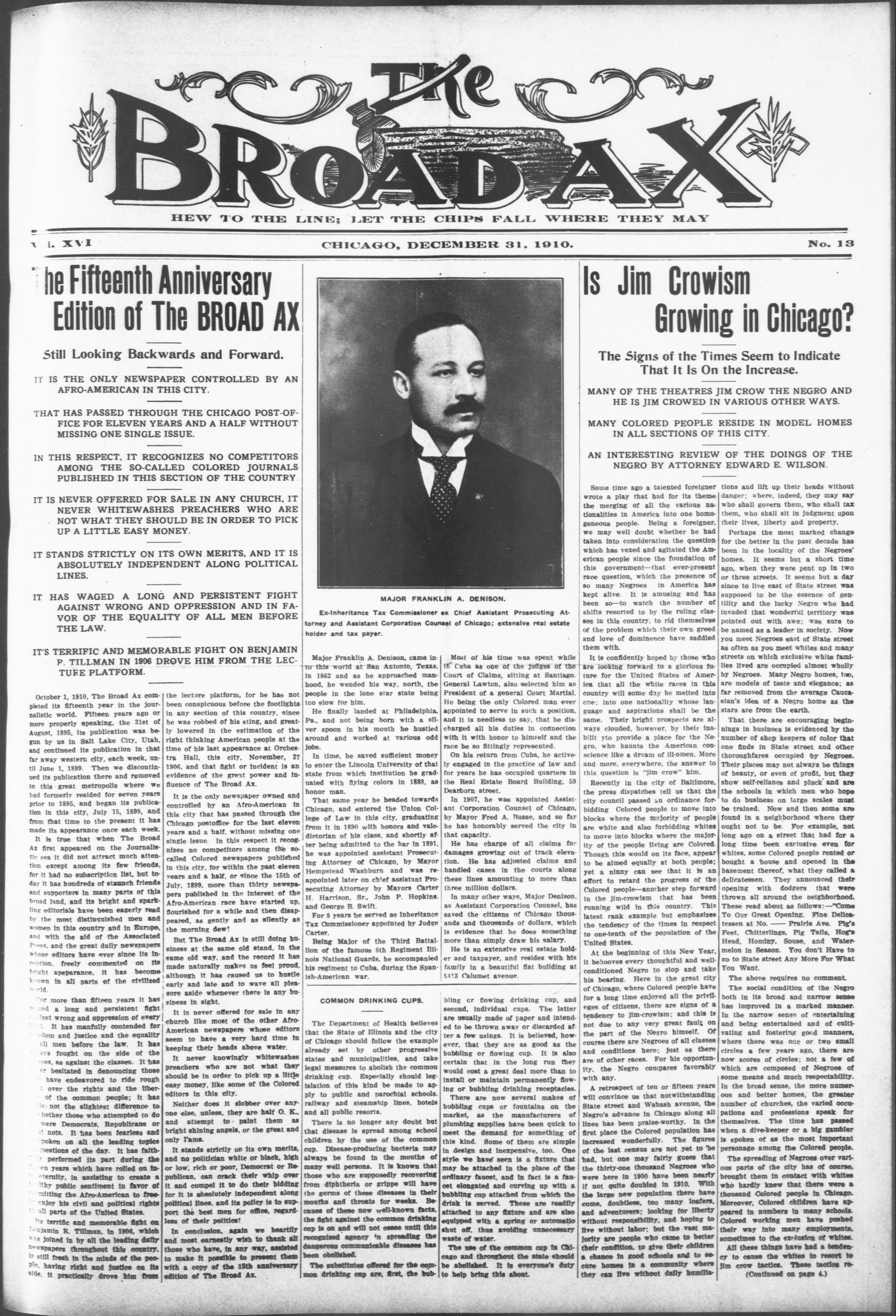
THE BROAD AX
The Fifteenth Anniversary Edition of The BROAD AX
Still Looking Backwards and Forward.
IT IS THE ONLY NEWSPAPER CONTROLLED BY AN AFRO-AMERICAN IN THIS CITY.
THAT HAS PASSED THROUGH THE CHICAGO POST-OFFICE FOR ELEVEN YEARS AND A HALF WITHOUT MISSING ONE SINGLE ISSUE.
IN THIS RESPECT, IT RECOGNIZES NO COMPETITORS AMONG THE SO-CALLED COLORED JOURNALS PUBLISHED IN THIS SECTION OF THE COUNTRY.
IT IS NEVER OFFERED FOR SALE IN ANY CHURCH, IT NEVER WHITEWASHES PREACHERS WHO ARE NOT WHAT THEY SHOULD BE IN ORDER TO PICK UP A LITTLE EASY MONEY.
IT STANDS STRICTLY ON ITS OWN MERITS, AND IT IS ABSOLUTELY INDEPENDENT ALONG POLITICAL LINES.
IT HAS WAGED A LONG AND PERSISTENT FIGHT AGAINST WRONG AND OPPRESSION AND IN FAVOR OF THE EQUALITY OF ALL MEN BEFORE THE LAW.
IT'S TERRIFIC AND MEMORABLE FIGHT ON BENJAMIN P. TILLMAN IN 1906 DROVE HIM FROM THE LECTURE PLATFORM.
1. XVI
Still Looking Back
IT IS THE ONLY NEWSPAPER AFRO-AMERICAN IN T
THAT HAS PASSED THROUGH FICE FOR ELEVEN YEARS MISSING ONE SINGLE
IN THIS RESPECT, IT RECOMMENDS AMONG THE SO-CALLED PUBLISHED IN THIS
IT IS NEVER OFFERED FOR NEVER WHITEWASH, NOT WHAT THEY SHOULD UP A LITTLE EASY M
IT STANDS STRICTLY ON ABSOLUTELY INDEPENDENT LINES.
IT HAS WAGED A LONG AGAINST WRONG AND VOR OF THE EQUALITY LAW.
IT'S TERRIFIC AND MEMORIAL P. TILLMAN IN 1906 IN TURE PLATFORM.
October 1, 1910, The Broad Ax completed its fifteenth year in the journalistic world. Fifteen years ago or more properly speaking, the 31st of August, 1895, its publication was begun by us in Salt Lake City, Utah, and continued its publication in that far away western city, each week, until June 1, 1899. Then we discontinued its publication there and removed to this great metropolis where we had formerly resided for seven years prior to 1895, and began its publication in this city, July 15, 1899, and from that time to the present it has made its appearance once each week.
It is true that when The Broad Ax first appeared on the Journalistic sea it did not attract much attention except among its few friends, for it had no subscription list, but today it has hundreds of staunch friends and supporters in many parts of this broad land, and its bright and sparkling editorials have been eagerly read by the most distinguished men and women in this country and in Europe, and with the aid of the Associated Press, and the great daily newspapers whose editors have ever since its inception, freely commented on its bright apearance, it has become known in all parts of the civilized world.
For more than fifteen years it has used a long and persistent fight against wrong and oppression of every man. It has manfully contended for wisdom and justice and the equality of all men before the law. It has always fought on the side of theses, as against the classes. It has ever hesitated in denouncing those who have endeavored to ride rough over the rights and the liberation of the common people; it has not the slightest difference to whether those who attempted to do were Democrats, Republicans or not nots. It has been fearless and spoken on all the leading topics questions of the day. It has faithfully performed its part during the ten years which have rolled on in eternity, in assisting to create aithy public sentiment in favor of uniting the Afro-American to free-enjoy his civil and political rights all parts of the United States.
Its terrific and memorable fight on benjamin R. Tillman, in 1906, which was joined in by all the leading daily newspapers throughout this country, is still fresh in the minds of the people, having right and justice on its side, it practically drove him from
HEW TO THE LINE: LET THE CHIPS FALL WHERE THEY MAY
the lecture platform, for he has not been conspicuous before the footlights in any section of this country, since he was robbed of his sting, and greatly lowered in the estimation of the right thinking American people at the time of his last appearance at Orchestra Hall, this city, November, 27 1906, and that fight or incident is an evidence of the great power and influence of The Broad Ax.
It is the only newspaper owned and controlled by an Afro-American in this city that has passed through the Chicago postoffice for the last eleven years and a half, without missing one single issue. In this respect it recognizes no competitors among the so-called Colored newspapers published in this city, for within the past eleven years and a half, or since the 15th of July, 1899, more than thirty newspapers published in the interest of the Afro-American race have started up, flourished for a while and then disappeared, as gently and as silently as the morning dew!
But The Broad Ax is still doing business at the same old stand, in the same old way, and the record it has made naturally makes us feel proud, although it has caused us to hustle early and late and to wave all pleasure aside whenever there is any business in sight.
It is never offered for sale in any church like most of the other Afro-American newspapers whose editors seem to have a very hard time in keeping their heads above water.
It never knowingly whitewashes preachers who are not what they should be in order to pick up a little easy money, like some of the Colored editors in this city.
Neither does it slobber over anyone else, unless, they are half O. K., and attempt to paint them as bright shining angels, or the great and only Tams.
It stands strictly on its own merits and no politician white or black, high or low, rich or poor, Democrat or Republican, can crack their whip over it and compel it to do their bidding for it is absolutely independent along political lines, and its policy is to support the best men for office, regardless of their politics!
In conclusion, again we heartily and most earnestly wish to thank all those who have, in any way, assisted to make it possible to present them with a copy of the 15th anniversary edition of The Broad Ax.
CHICAGO, DECEMBER 31, 1910.
7
MAJOR FRANKLIN A. DENISON.
Ex-Inheritance Tax Commissioner ex Chief Assistant Prosecuting Attorney and Assistant Corporation Counsel of Chicago; extensive real estate holder and tax payer.
Major Franklin A. Denison, came into this world at San Antonio, Texas, in 1862 and as he approached manhood, he wended his way, north, the people in the lone star state being too slow for him.
He finally landed at Philadelphia, Pa., and not being born with a silver spoon in his mouth he hustled around and worked at various odd jobs.
In time, he saved sufficient money to enter the Lincoln University of that state from which institution he graduated with flying colors in 1888, as honor man.
That same year he headed towards Chicago, and entered the Union College of Law in this city, graduating from it in 1890 with honors and valedictorian of his class, and shortly after being admitted to the bar in 1891, he was appointed assistant Prosecuting Attorney of Chicago, by Mayor Hempstead Washburn and was re-appointed later on ch'ef assistant Prosecuting Attorney by Mayors Carter H. Harrison, Sr., John P. Hopkins, and George B. Swift.
For 8 years he served as Inheritance Tax Commissioner appointed by Judge Carter
Being Major of the Third Battalion of the famous 8th Regiment Illinois National Guards, he accompanied his regiment to Cuba, during the Spanish-American war.
COMMON DRINKING CUPS.
The Department of Health believes that the State of Illinois and the city of Chicago should follow the example already set by other progressive states and municipalities, and take legal measures to abolish the common drinking cup. Especially should legislation of this kind be made to apply to public and parochial schools, railway and steamship lines, hotels and all public resorts.
There is no longer any doubt but that disease is spread among school children by the use of the common cup. Disease-producing bacteria may always be found in the mouths of many well persons. It is known that those who are supposedly recovering from diphtheria or gripe will have the germs of these diseases in their mouths and throats for weeks. Because of these now well-known facts, the fight against the common drinking cup is on and will not cease until this recognized agency in spreading the dangerous communicable diseases has been obolished.
The substitutes offered for the common drinking cup are, first, the bub
Most of his time was spent while in Cuba as one of the judges of the Court of Claims, sitting at Santiago, General Lawton, also selected him as President of a general Court Martial. He being the only Colored man ever appointed to serve in such a position, and it is needless to say, that he discharged all his duties in connection with it with honor to himself and the race he so fittingly represented.
On his return from Cuba, he actively engaged in the practice of law and for years he has occupied quarters in the Real Estate Board Building, 59 Dearborn street.
In 1907, he was appointed Assistant Corporation Counsel of Chicago by Mayor Fred A. Busse, and so far he has honorably served the city in that capacity.
He has charge of all claims for damages growing out of track elevation. He has adjusted claims and handled cases in the courts along these lines amounting to more than three million dollars.
In many other ways, Major Denison, as Assistant Corporation Counsel, has saved the citizens of Chicago thousands and thousands of dollars, which is evidence that he does something more than simply draw his salary. He is an extensive real estate holder and taxpayer, and resides with his family in a beautiful flat building at 5413 Calumet avenue.
bling or flowing drinking cup, and second, individual cups. The latter are usually made of paper and intended to be thrown away or discarded after a few usings. It is believed, however, that they are as good as the bubbling or flowing cup. It is also certain that in the long run they would cost a great deal more than to install or maintain permanently flowing or bubbling drinking receptacles. There are now several makes of bubbling cups or fountains on the market, as the manufacturers of plumbing supplies have been quick to meet the demand for something of this kind. Some of them are simple in design and inexpensive, too. One style we have seen is a fixture that may be attached in the place of the ordinary faucet, and in fact is a faucet elongated and curving up with a bubbling cup attached from which the drink is served. These are readily attached to any fixture and are also equipped with a spring or automatic shut off, thus avoiding unnecessary waste of water.
The use of the common cup in Chicago and throughout the state should be abolished. It is everyone's duty to help bring this about.
Is Jim Crowism Growing in Chicago?
The Signs of the Times Seem to Indicate That It Is On the Increase.
MANY OF THE THEATRES JIM CROW THE NEGRO AND HE IS JIM CROWED IN VARIOUS OTHER WAYS.
MANY COLORED PEOPLE RESIDE IN MODEL HOMES IN ALL SECTIONS OF THIS CITY.
AN INTERESTING REVIEW OF THE DOINGS OF THE NEGRO BY ATTORNEY EDWARD E. WILSON.
Some time ago a taileded foreigner wrote a play that had for its theme the merging of all the various nationalities in America into one homogeneous people. Being a foreigner, we may well doubt whether he had taken into consideration the question which has vexed and agitated the American people since the foundation of this government—that ever-present race question, which the presence of so many Negroes in America has kept alive. It is amusing and has been so—to watch the number of shifts resorted to by the ruling classes in this country, to rid themselves of the problem which their own greed and love of dominence have saddled them with.
It is confidently hoped by those who are looking forward to a glorious future for the United States of America that all the white races in this country will some day be melted into one; into one nationality whose language and aspirations shall be the same. Their bright prospects are always clouded, however, by their inability yto provide a place for the Negro, who haunts the American conscience like a dream of ill-omen. More and more, everywhere, the answer to this question is "jim crow" him.
Recently in the city of Baltimore, the press dispatches tell us that the city council passed an ordinance forbidding Colored people to move into blocks where the majority of people are white and also forbidding whites to move into blocks where the majority of the people living are Colored. Though this would on its face, appear to be aimed equally at both people; yet a ninny can see that it is an effort to retard the progress of the Colored people—another step forward in the jim-crowism that has been running wild in this country. This latest rank example but emphasizes the tendency of the times in respect to one-tenth of the population of the United States.
At the beginning of this New Year, it behooves every thoughtful and well-conditioned Negro to stop and take his bearing. Here in the great city of Chicago, where Colored people have for a long time enjoyed all the privileges of citizens, there are signs of a tendency to jim-crowism; and this is not due to any very great fault on the part of the Negro himself. Of course there are Negroes of all classes and conditions here; just as there are of other races. For his opportunity, the Negro compares favorably with any.
A retrospect of ten or fifteen years will convince us that notwithstanding State street and Wabash avenue, the Negro's advance in Chicago along all lines has been praise-worthy. In the first place the Colored population has increased wonderfully. The figures of the last census are not yet to be had, but one may fairly guess that the thirty-one thousand Negroes who were here in 1900 have been nearly if not quite doubled in 1910. With the large new population there have come, doubtless, too many loafers, and adventurers; looking for liberty without responsibility, and hoping to live without labor; but the vast majority are people who came to better their condition, to give their children a chance in good schools and to secure homes in a community where they can live without daily humiliation.
Isism
ing in Chicago?
Times Seem to Indicate
the Increase.
JIM CROW THE NEGRO AND
IN VARIOUS OTHER WAYS.
RESIDE IN MODEL HOMES
THIS CITY.
W OF THE DOINGS OF THE
BY EDWARD E. WILSON.
tions and lift up their heads without danger; where, indeed, they may say who shall govern them, who shall tax them, who shall sit in judgment upon their lives, liberty and property.
Perhaps the most marked change for the better in the past decade has been in the locality of the Negroes' homes. It seems but a short time ago, when they were pent up in two or three streets. It seems but a day since to live east of State street was supposed to be the essence of gentility and the lucky Negro who had invaded that wonderful territory was pointed out with awe; was sure to be named as a leader in society. Now you meet Negroes east of State street as often as you meet whites and many streets on which exclusive white families lived are occupied almost wholly by Negroes. Many Negro homes, too, are models of taste and elegance; as far removed from the average Caucasian's idea of a Negro home as the stars are from the earth.
That there are encouraging beginnings in business is evidenced by the number of shop keepers of color that one finds in State street and other thoroughfares occupied by Negroes. Their places may not always be things of beauty, or even of profit, but they show self-reliances and pluck and are the schools in which men who hope to do business on large scales must be trained. Now and then some are found in a neighborhood where they ought not to be. For example, not long ago on a street that had for a long time been exclusive even for whites, some Colored people rented or bought a house and opened in the basement thereof, what they called a delicatessen. They announced their opening with dodgers that were thrown all around the neighborhood. These read about as follows:—"Come To Our Great Opening. Fine Delicatessen at No. — Prairie Ave. Pig's Feet, Chitterlings, Pig Tails, Hog's Head, Homnny, Souse, and Water melon in Season. You don't Have to go to State street Any More For What You Want.
The social condition of the Negro both in its broad and narrow sense has improved in a marked manner. In the narrow sense of entertaining and being entertained and of cultivating and fostering good manners, where there was one or two small circles a few years ago, there are now scores of circles; not a few of which are composed of Negroes of some means and much respectability. In the broad sense, the more numerous and better homes, the greater number of churches, the varied occupations and professions speak for themselves. The time has passed when a dive-keeper or a big gambler is spoken of as the most important personage among the Colored people.
The spreading of Negroes over various parts of the city has of course, brought them in contact with whites who hardly knew that there were a thousand Colored people in Chicago. Moreover, Colored children have appeared in numbers in many schools. Colored working men have pushed their way into many employments, sometimes to the exclusion of whites. All these things have had a tendency to cause the whites to resort to Jim crow tactics. These tactics re- (Continued on page 4.)
1900
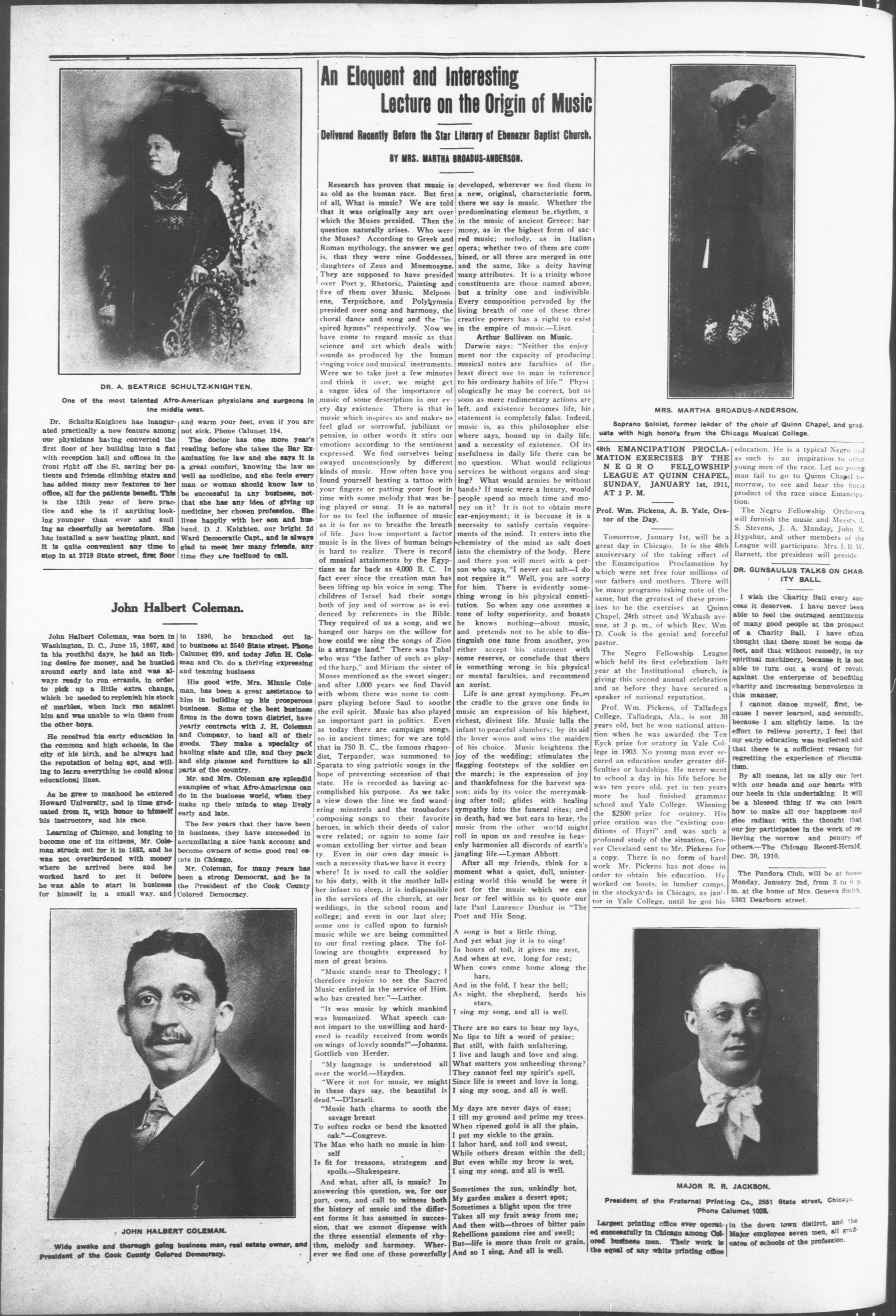
DR. A. BEATRICE SCHULTZ-KNIGHTEN.
One of the most talented Afro-American physicians and surgeons in the middle west.
Dr. Schultz-Knighten has inaugurated practically a new feature among our physicians having converted the first floor of her building into a flat with reception hall and offices in the front right off the St. saving her patients and friends climbing stairs and has added many new features to her office, all for the patients benefit. This is the 13th year of here practice and she is if anything looking younger than ever and smiling as cheerfully as heretofore. She has installed a new heating plant, and it is quite convenient any time to stop in at 2719 State street first floor
and warm your feet, even if you are not sick. Phone Calumet 194.
The doctor has one more year's reading before she takes the Bar Examination for law and she says it is a great comfort, knowing the law as well as medicine, and she feels every man or woman should know law to be successful in any business, not that she has any idea of giving up medicine, her chosen profession. She lives happily with her son and husband, D. J. Knighten, our bright 2d Ward Democratic Capt., and is always glad to meet her many friends, any time they are inclined to call.
---
John Halbert Coleman.
John Halbert Coleman.
John Halbert Coleman, was born in Washington, D. C., June 15, 1867, and in his youthful days, he had an itching desire for money, and he hustled around early and late and was always ready to run errands, in order to pick up a little extra change, which he needed to replenish his stock of marbles, when luck ran against him and was unable to win them from the other boys.
He received his early education in the common and high schools, in the city of his birth, and he always had the reputation of being apt, and willing to learn everything he could along educational lines.
As he grew to manhood he entered Howard University, and in time graduated from it, with honor to himself his instructors, and his race.
Learning of Chicago, and longing to become one of its citizens, Mr. Coleman struck out for it in 1882, and he was not overburdened with money where he arrived here and he worked hard to get it before he was able to start in business for himself in a small way, and
THE MASTER OF THE WORLD
Wide awake and thorough going business man, President of the Cook County Colored Democracy.
Wide awake and thorough going business man, real estate owner, and President of the Cook County Colored Democracy.
and warm your feet, even if you are not sick. Phone Calumet 194.
The doctor has one more year's reading before she takes the Bar Examination for law and she says it is a great comfort, knowing the law as well as medicine, and she feels every man or woman should know law to be successful in any business, not that she has any idea of giving up medicine, her chosen profession. She lives happily with her son and husband, D. J. Knighten, our bright 2d Ward Democratic Capt., and is always glad to meet her many friends, any time they are inclined to call.
in 1890, he branched out into business at 2540 State street. Phone Calumet 699, and today John H. Coleman and Co. do a thriving expressing and teaming business.
His good wife. Mrs. Minnie Coleman, has been a great assistance to him in building up his prosperous business. Some of the best business firms in the down town district, have yearly contracts with J. H. Coleman and Company, to haul all of their goods. They make a specialty of hauling slate and tile, and they pack and ship pianos and furniture to all parts of the country.
Mr. and Mrs. Coleman are splendid examples of what Afro-Americans can do in the business world, when they make up their minds to step lively early and late.
The few years that they have been in business, they have succeeded in accumulating a nice bank account and become owners of some good real estate in Chicago.
Mr. Coleman, for many years has been a strong Democrat, and he is the President of the Cook County Colored Democracy.
```markdown
```
business man, real estate owner, and
ed Democracy.
---
An Eloquent and Interesting Lecture on the Origin of Music
Delivered Recently Before the Star Literary of Ebenezer Baptist Church. BY MRS. MARTHA BROADUS-ANDERSON.
Research has proven that music is as old as the human race. But first of all, What is music? We are told that it was originally any art over which the Muses presided. Then the question naturally arises. Who were the Muses? According to Greek and Roman mythology, the answer we get is, that they were nine Goddesses, daughters of Zeus and Mnemosyne. They are supposed to have presided over Poet y, Rhetoric, Painting and five of them over Music. Melpomene, Terpsichore, and Polyhymnia presided over song and harmony, the choral dance and song and the "inspired hymns" respectively. Now we have come to regard music as that science and art which deals with sounds as produced by the human singing voice and musical instruments. Were we to take just a few minutes and think it over, we might get a vague idea of the importance of music of some description in our every day existence. There is that in music which inspires us and makes us feel glad or sorrowful, jubilant or pensive, in other words it stirs our emotions according to the sentiment expressed. We find ourselves being swayed unconsciously by different kinds of music. How often have you found yourself beating a tattoo with your fingers or patting your foot in time with some melody that was being played or sung. It is as natural for us to feel the influence of music as it is for us to breathe the breath of life. Just how important a factor music is in the lives of human beings is hard to realize. There is record of musical attainments by the Egyptians as far back as 4,000 B. C. In fact ever since the creation man has been lifting up his voice in song. The children of Israel had their songs both of joy and of sorrow as is evidenced by references in the Bible. They required of us a song, and we hanged our harps on the willow for how could we sing the songs of Zion in a strange land." There was Tubal who was "the father of such as played the harp," and Miriam the sister of Moses mentioned as the sweet singer; and after 1,000 years we find David with whom there was none to compare playing before Saul to soothe the evil spirit. Music has also played an important part in politics. Even as today there are campaign songs, so in ancient times; for we are told that in 750 B. C., the famous rhapsodist, Terpander, was summoned to Sparata to sing patriotic songs in the hope of preventing secession of that state. He is recorded as having accomplished his purpose. As we take a view down the line we find wandering minstrels and the troubadors composing songs to their favorite heroes, in which their deeds of valor were related; or again to some fair woman extolling her virtue and beauty. Even in our own day music is such a necessity that we have it everywhere! It is used to call the soldier to his duty, with it the mother lulls her infant to sleep, it is indispensable in the services of the church, at our weddings, in the school room and college; and even in our last sleep; some one is called upon to furnish music while we are being committed to our final resting place. The following are thoughts expressed by men of great brains.
"Music stands near to Theology; I therefore rejoice to see the Sacred Music enlisted in the service of Him, who has created her."—Luther.
"It was music by which mankind was humanized. What speech cannot impart to the unwilling and hardened is readily received from words on wings of lovely sounds!"—Johanna Gottlieb von Herder.
"My language is understood all over the world.—Hayden.
"Were it not for music, we might in these days say, the beautiful is dead."—D'Israeli.
"Music hath charms to sooth the savage breast
To soften rocks or bend the knotted oak."—Congreve.
The Man who hath no music in himself
Is fit for treasons, strategem and spoils.—Shakespeare.
And what, after all, is music? In answering this question, we, for our part, own, and call to witness both the history of music and the different forms it has assumed in succession, that we cannot dispense with the three essential elements of rhythm, melody and harmony. Wherever we find one of these powerfully
developed, wherever we find them in a new, original, characteristic form, there we say is music. Whether the predominating element be.rhythm, a in the music of ancient Greece; harmony, as in the highest form of sacred music; melody, as in Italian opera; whether two of them are combined, or all three are merged in one and the same, like a deity having many attributes. It is a trinity whose constituents are those named above, but a trinity one and indivisible. Every composition pervaded by the living breath of one of these three creative powers has a right to exist in the empire of music—Liszt.
Arthur Sullivan on Music.
Darwin says: "Neither the enjoyment nor the capacity of producing musical notes are faculties of the least direct use to man in reference to his ordinary habits of life." Physiologically he may be correct, but as soon as mere rudimentary actions are left, and existence becomes life, his statement is completely false. Indeed, music is, as this philosopher elsewhere says, bound up in daily life, and a necessity of existence. Of its usefulness in daily life there can be no question. What would religious services be without organs and singing? What would armies be without bands? If music were a luxury, would people spend so much time and money on it? It is not to obtain mere ear-enjoyment; it is because it is a necessity to satisfy certain requirements of the mind. It enters into the chemistry of the mind as salt does into the chemistry of the body. Here and there you will meet with a person who says, "I never eat salt—I do not require it." Well, you are sorry for him. There is evidently something wrong in his physical constitution. So when any one assumes a tone of lofty superiority, and boasts he knows nothing—about music, and pretends not to be able to distinguish one tune from another, you either accept his statement with some reserve, or conclude that there is something wrong in his physical or mental faculties, and recommend an aurist.
Life is one great symphony. From the cradle to the grave one finds in music an expression of his highest, richest, divinest life. Music lulls the infant to peaceful slumbers; by its aid the lover woos and wins the maiden of his choice. Music heightens the joy of the wedding; stimulates the flagging footsteps of the soldier on the march; is the expression of joy and thankfulness for the harvest season; aids by its voice the merrymaking after toil; glides with healing sympathy into the funeral rites; and in death, had we but ears to hear, the music from the other world might roll in upon us and resolve in heavenly harmonies all discords of earth's jangling life—Lyman Abbott.
After all my friends, think for a moment what a quiet, dull, uninteresting world this would be were it not for the music which we can hear or feel within us to quote our late Paul Laurence Dunbar in "The Poet and His Song.
A song is but a little thing,
And yet what joy it is to sing!
In hours of toil, it gives me zest,
And when at eve, long for rest;
When cows come home along the bars
bars,
And in the fold, I hear the bell;
As night, the shepherd, herds his
stars,
I sing my song, and all is well.
There are no ears to hear my lays,
No lips to lift a word of praise;
But still, with faith unfaltering,
I live and laugh and love and sing.
What matters you unheeding thong?
They cannot feel my spirit's spell,
Since life is sweet and love is long,
I sing my song, and all is well.
My days are never days of ease;
I till my ground and prime my trees.
When ripened gold is all the plain,
I put my sickle to the grain.
I labor hard, and toil and sweat,
While others dream within the dell;
But even while my brow is wet,
I sing my song, and all is well.
Sometimes the sun, unkindly hot,
My garden makes a desert spot;
Sometimes a blight upon the tree
Takes all my fruit away from me;
And then with—throes of bitter pain
Rebellions passions rise and 'swell;
But—life is more than fruit or grain.
And so I sing. And all is well.
M.
MRS. MARTHA BROADUS-ANDERSON.
Soprano Soloist, former leader of the choir of Quinn Chapel, and graduate with high honors from the Chicago Musical College.
48th EMANCIPATION PROCLA-MATION EXERCISES BY THE N E G R O FELLOWSHIP LEAGUE AT QUINN CHAPEL, SUNDAY, JANUARY 1st, 1911, AT 3 P. M.
education. He is a typical Negro and as such is an inspiration to other young men of the race. Let no young man fail to go to Quinn Chapel to morrow, to see and hear the fines product of the race since Emancipa
Prof. Wm. Pickens, A. B. Yale, Ora-
tor of the Day.
Tomorrow, January 1st, will be a great day in Chicago. It is the 48th anniversary of the taking effect of the Emancipation Proclamation by which were set free four millions of our fathers and mothers. There will be many programs taking note of the same, but the greatest of these promises to be the exercises at Quinn Chapel, 24th street and Wabash avenue, at 3 p. m., of which Rev. Wm. D. Cook is the genial and forceful pastor.
The Negro Fellowship League which held its first celebration last year at the Institutional church, is giving this second annual celebration and as before they have secured a speaker of national reputation.
Prof. Wm. Pickens, of Talladega College, Talladega, Ala., is not 30 years old, but he won national attention when he was awarded the Ten Eyck prize for oratory in Yale College in 1903. No young man ever secured an education under greater difficulties or hardships. He never went to school a day in his life before he was ten years old, yet in ten years more he had finished grammar school and Yale College. Winning the $2500 prize for oratory. His prize oration was the "existing conditions of Hayti" and was such a profound study of the situation, Grover Cleveland sent to Mr. Pickens for a copy. There is no form of hard work Mr. Pickens has not done in order to obtain his education. He worked on boots, in lumber camps, in the stockyards in Chicago, as janitor in Yale College, until he got his
```markdown
```
[Name]
MAJOR R. R. JACKSON.
President of the Fraternal Printing Co., 255
Phone Calumet 1028.
Largest printing office ever operat ed successfully in Chicago among Col- ored business men. Their work is the equal of any white printing office in the down- Major empl oquates of sch
President of the Fraternal Printing Co., 2561 State street, Chicago. Phone Calumet 1028. Largest printing office ever operated successfully in Chicago among Colored business men. Their work is the equal of any white printing office in the down town district, and the Major employ seven men, all graduates of schools of the profession.
education. He is a typical Negro and as such is an inspiration to other young men of the race. Let no young man fail to go to Quinn Chapel tomorrow, to see and hear the finest product of the race since Emancipation.
The Negro Fellowship Orchestra will furnish the music and Messrs. L. S. Stevens, J. A. Munday, John R. Hypshur, and other members of the League will participate. Mrs. I. B. W. Barnett, the president will preside.
DR. GUNSAULUS TALKS ON CHAR
ITY BALL.
I wish the Charity Ball every success it deserves. I have never been able to feel the outraged sentiments of many good people at the prospect of a Charity Ball. I have often thought that there must be some defect, and that without remedy, in my spiritual machinery, because it is not able to turn out a word of revolt against the enterprise of benefiting charity and increasing benevolence in this manner.
I cannot dance myself, first, because I never learned, and secondly, because I am slightly lame. In the effort to relieve poverty, I feel that my early education was neglected and that there is a sufficient reason for regretting the experience of rheumatism.
By all means, let us ally our feet with our heads and our hearts with our heels in this undertaking. It will be a blessed thing if we can learn how to make all our happiness and glee radiant with the thought that our joy participates in the work of relieving the sorrow and penury of others.-The Chicago Record-Herald, Dec. 30, 1910.
The Pandora Club, will be at home Monday, January 2nd, from 3 to 6 p.m. at the home of Mrs. Geneva Smith, 5363 Dearborn street.
Mrs. James Wilson 4850 Armour
avenue is on the sick list.
Mr. Tenny Blunt of Milwaukee,
Wis. spent a few days in the city this
week.
Mr. Hunter Newsome 3022 State st.,
spent the holidays in his home in W.
Virginia.
Dr. Huff of Denver, Colo., spent a
few days in the city enroute to Baltimore
Md.
Mr. Geo. Holt 3004 State st., who
has been spending a few days in St.
Louis returned to the city.
M. D. H. Anderson 3018 State st. entertained twenty friends at cards and luncheon, Monday night.
Mrs. Mosely 3520 Dearborn st., who has been seriously ill for the past month is much better.
Mr. Dave Nufy 3072 Wabash avenue will spend the month of Jan. in Old Mexico on business.
Mrs. Amanda Fite, 3758 Rhodes avenue entertained friends at cards and luncheon, Wednesday evening.
Mrs. James Wheeler 4818 Grand Bird, entertained a number of friends at cards and luncheon, Thursday eve.
Mr. Tom Gray one of the oldest residents of Chicago, is very ill at the home of his son, George Gray, 4905 Wabash avenue.
Miss Lottie Grady wha has been with the Smart Set for the past season will again star at the Pekin Theatre in the near future.
Mrs. Watson of Springfield, Ill., is in the city spending the holidays with her daughter, Mrs. Jno. Howard 2552 State street.
Dr. D. H. Anderson 3018 State st.. says he is still doing business at the same number. The fire in the tailor store under him never touched him.
Mr. Dominick La Blanc the popular bartender of the "Keystone" left the city with his little son to make a two weeks visit to his parents in New Orleans.
It is reported that Mr. James Tuppins the popular State Street barber will not bust another egg in a customers head after this summer, but will be found back of a plow on his own farm in Michigan.
The Pickwick Club gave an informal dance at Oakland Music Hall at 40th and Cottage Grove avenue. on Thursday evening, Dec. 29th. Bowman's Orchestra furnished the music and all present reported a delightful evening spent.
---
Mrs. John H. Coleman, 2540 State street, has been seriously ill for more than a week but under the skillful medical treatment of Dr. A. Beatrice Schultz, she is rapidly improving.*
---
Mrs. I. B. Wittenberg, manager of the New Orleans Cafe, No. 8 West 51st street near State is proving herself to be quite a business woman. She sees to it, that everything in connection with it is kept nice and clean; and that is one of the best means of making and keeping customers.
John P. Tansey, business manager of The Democratic Bulletin, has been selected by Robert M. Sweitzer, clerk of the County Court, as treasurer of the office of the County clerk's office. Mr. Tansey, will draw $2,400 per year salary.
N. Blackshear, 2945 Groveland
avantage, has for more than eleven
years, been one of the steady and
intelligent clerks in the office of the
London Board of Improvements. Mr.
Blackshear, reflects great credit on
Afro-American race, and he is a
supporter of The Broad Ax.
Joseph H. Hudlun, who has been in
charge of the Board of Trade Build-
ing for many years, is always, Johnny
of the spot, with his job, and like his
father, whom he succeeded he never
pleasure interfere with his work,
he is well liked by all the mem-
bies of the Board of Trade.
Miss Marie Burton left last Tuesday. Evening for Nashville, Tenn., where she will remain for two weeks and will give a recital at Walden University. The affair is expecting to be a brilliant one and no doubt Miss Burton will please her audience with her melodious singing, as well as her charming personality.
Scott and Savington, are the only Afro-Americans in this city, who carry a complete line of optical goods, toilet articles, etc. Spectacles and eye glasses made to order; they are hustling business men, and they take pleasure in inviting their many friends and the public in general to call at their neat store $2636\frac{1}{2}$ State street and have a friendly chat with them during the remainder of the holiday season.
Mrs. Mary Webster, 6430 Vincennes avenue, entertained at whist in honor of her daughter, Miss Estelle Webster, who is visiting her parents for the holidays. A musical programme was arranged after the game in which Miss Lena Webster rendered several beautiful instrumental selections and Mr. Hugh Buchanan, also sang several numbers and was requested specially to sing his latest composition "Taint No Use in Cryin" which was delightfully appreciated by everyone present.
---
Mr. & Mrs. Chas, Washington, entertained at their residence 6538 Evans avenue in honor of their niece, Miss Emma Williams, last Tuesday evening, at whist, dancing was indulged in after the game, those present were, Misses Crocan, Hunter, Harsch, Mrs. Wilkes & Mrs. Bosley, of Nashville, Tenn., Messrs. McKinley, Huggins, Buchanan, White, Harsch and Dr. Thorne; all seemingly had a delightful time and departed at a very late hour, Miss Crocan carried away the booby and Miss Vivian Harsch won first prize.
MARRIED TO A PUBIST.
Wiggles and Wife as Overheard by the Dubbsse
Mrs. Wiggles has the very great misfortune to be married to a purist, and what she has to endure, so her neighbors say, passes all belief. For instance, here is a conversation said to have been overheard by the Dubbsse, who live next door, one morning last week.
"Henry," called Mrs. Wiggles from upstairs, addressing Mr. Wiggles, who had got up early to start the furnace, "what's the thermometer this morning?
"Same as usual, my dear," Mr. Wiggles replied, calling up through the flue. "It is a little instrument made of metal, glass and mercury designed to show degrees of heat and cold. It is a simple and inexpensive little contrivance, and no home should be without one."
"I mean what does it say?" returned Mrs. Wiggles, with an expression of countenance which, not having been seen, can only be imagined.
"It does not say anything, my love," replied Mr. Wiggles, brushing some soot out of his locks. "Up to this time nobody has thought to invent a talking thermometer, though I suppose that it would be possible by means of a photographic attachment operated by a delicately adjusted device of some sort to get the results which you seem to believe are already attained."
"Oh, you know what I mean!" retorted Mrs. Wiggles, somewhat stridently. "Where is the thermometer, then, if you are going to be so very, very particular."
"It is just where we left it last night, dear heart," returned Wiggies; "screwed on to the left hand jamb of the front door. I fancy that if it had not been screwed on it would have disappeared long ago. Where did you think it was?"
"Has it risen or fallen?" demanded the lady.
"Not that I know of," said Wiggies.
"If it had risen I think we should have seen the old screw holes in the place where it had been, and as for falling. I know it hasn't done that, because thermometers are rather fragile things, and if it had fallen at any time there would have been signs of fracture at least, even if the whole thing had not been shattered to pieces. Don't worry about it anyhow. I fastened it on the door jam myself, and with four screws it can hardly come loose—that is, not all at once."
"Henry Wiggles," roared the lady's voice, growing more than severe and having about it certain qualities of ice sharpness, "do you mean to tell me where the mercury stands or not?" "Of course I do, lovey," replied Wiggles, lighting the fire at last. "It stands in the little glass tube that runs from the bulb at the base of the thermometer up to the top. Where did you suppose it stood—on its head?" Here the conversation stopped. Later in the day Mrs. Dubbs, meeting Wiggles with his head bandaged upon his way to catch the trolley, smiled sweetly. "Ah, Mr. Wiggles," said she archly, "has Mrs. Wiggles been taking the broomstick to you that you have your head bandaged up?" "No, madam," said Wiggles coldly. "We do not use brooms in my household. We use vacuum cleaners."
Dealer in cigars, tobacco, confectionaries and notions.
Colored journals, songs, jokes and stationery. Investigate our time laundry, something new.
18 WEST 31ST STREET.
Near State,
Phone Aldine 294.
prate, sart Mrs. Dubbs significantly. "It started in very warm this morning, didn't it?" "You bet it did!" said Wiggles as he moved on. "Some cloudy too."—Harper's Weekly.
Walker—The bride was quite a popular girl, wasn't she?
Watkinson-Yes, indeed. The Evening Sacrificer sent its sporting man to report the wedding. He printed a list of rejected lovers half a column long under the heading. "Among Those Who Also Ran."—New York Journal.
With Good Reason.
Speeder—Werent you nervous at all going up to such a height?
Filler-Well. I'll admit that when I was about 10,000 feet up I began to get cold feet.—St. Louis Times.
A Bride's First Kick.
Probably the first thing a bride finds fault with after her marriage is the newspaper account of her wedding.—Atchison Globe.
Lightweights In Literature.
"G. Bernard Shaw's scheme to have books sold by the pound is a novelty." "But if it is adopted many authors will have to get a lot of ballast between the covers to make a living."
Could Be Worse
Said the African gnu: "What can I do?
I never felt quite so bad.
I never tell quite so bad.
They crippled me when they shot off my G.
And that's why I'm looking so sad."
Said the wise old fox: "Your ears we should box
For allowing yourself to feel small.
If they had shot off your U what could you do?
Why, we couldn't pronounce you at all!"
-Chicago News.
The Medicins are extremely religious, and their faith enters into their daily lives to a remarkable extent. During Holy Week the native women who are anxious to do penance for their sins go on their knees from one shrine to another, devoting hours to the painful task. At this time temporary shrines are set up, and in the remote villages it is no in'requent sight to see half a dozen parties of penitents traveling in this manner over the sharp stones and gravel from one shrine to the other, apparently oblivious to the burning rays of the sun and the discomforts of their progress. Sometimes an attendant spreads a serapo or blanket before them to protect their knees, but this is considered to detract from the merit of the penance, and most of the women—it is always the females who undertake the task—go through with it scorning any such protection.—Wide World Magazine.
Teacher of Vocal and Piano
Mrs. Martha Broadus-Anderson Soprano
Fall Term Begins September 1st, 1910
Residence
6450 Champlain Avenue
Chicago, Ill.
Phone Normal 3316
Phone Wentworth 215
Office Hours: 8:30 a.m. to 8:30 p.m.
Beauregard F. Moseley
Law Office
6221 S. Halsted Street
National Theatre Bldg., Suite 15 16 and 17
CHICAGO
PATRICK H. O'DONNELL
WILLIAM DILLON
CLARENCE A. TOOLEN
Tel. Central 4660
O'Donnell, Dillon &
Toolen
ATTORNEYS AT LAW
Suite 1218-1219 Ashland Block
RANDOLPH & CLARK STREET
Tel. Central 6067 Res. Tel. Canal 1756
C. J. Waring
Attorney-At-Law
SUITE 310
50 DEARBORN ST.
CHICAGO
Residence 2802 S. 42nd Court
S. A. T. WATKINS
LAWYER
Suite 411, 59 Dearborn St.
Tel. Central 3142
Rea. Tel. Douglas 3634
CHICAGO
Renting, Loans, Insurance & Mortgage Banker
Wines, Liquors and Cigars Pool and Billiards 464 State Street
Mr. McGowan, extends the greetings of the season to his many friends and patrons.
The Old Oak Inn
24 West 51st Street, Corner of Dearborn. At home to their many friends during the holiday season.
Patrick J. O'Brien Buffet
4701 State Street Chicago, Illinois.
Phone Main 4153 NOTARY PUBLIC
Phone residence, Gray 5670
Notary Public
ATTORNEY AT LAW
Suite 708, 171 Washington St.
Res. 4856 Langley Av. CHICAGO
A. D. GASH
ATTORNEY AT LAW
84-86 La Salle Street, Chicago
Suite 615 to 616
Telephone Main 3077
Res. Phone, Doug. 4397
3337 Wabash Ave., Third Apart.
J. GRAY LUCAS
ATTORNEY AT LAW
Suite 205-7 Kedzie Bldg.
Telephone Randolph 3575.
120 Randolph Street, Chicago
Telephone Main 2017
Attorney-at-Law
171 WASHINGTON ST. Room 706
Chicago
Residence 97 Macallister Place
Telephone Ashland 363
Office Telephones
Central 1239 Automatic 694
MILES J. DEVINE
ATTORNEY AT LAW
Suite 318-320 Reaper Block
CLARK AND WASHINGTON ST.
CHICAGO
Phone Oakland 4662
Dr. Theo. R. Mozee
DENTIST
4711 State Street
CHICAGO
Office Hours: 9 a. m. to 5 p. m.; 7 p. m. to
9 p. m. Sundays by Appointment.
Phone Aldine 1555
Dr. Jas. Elliott McCornell
Physician & Surgeon
3958 State Street
Office Hours: Afternoons Only; 2 to 4 p. m.,
and by Appointment
CHICAGO
DR. M. J. BROWN
Physician & Surgeon
3000 St. Street
Chicago
Phone Aldine 2058 S. W. Corner
OFFICE HOURS: 10 to 12, 3 to 5.7 to 9
DR. W. W. BRADLEY
29 W. 51st Street.
S. W. Corner Dearborn & 51st St.
Office Hours: 9 to 11 a. m.; 2 to 4 p. m.
7 to 9 p. m. Sunday 1 to 3 p. m.
CHICAGO
Dr. A. Wilberforce Williams
Physician & Surgeon
3255 State Street, N. E. Cor. 33rd Street, Chicago
Suite A Tel. Aldine 2203
Hours: 10 to 12 M , 2 to 4, 6:30 to 8:30
Sunday 1 to 3
W. M. WEBSTER
BARBER SHOP
34 W. Fifty-First Street, Chicago
Phone Aldine 2686 Renting a Specialty
Clark, Hayes & Co.
Real Estate, Renting,
Loans and Insurance
Flats and Houses to rent and For
Sale.
3705 STATE STREET
CHICAGO
FIRST CLASS MEALS OPEN NIGHTS
New Orleans Cate
8 West 51st Street
Chicago
Jas, W. Orr, Proprietor
Mrs. I. Wittenberg, Manager
Sol. Livingston Real Estate
Real Estate Bought, Sold and Exehanged on Commission
4711 State Street, Chicago, Illinois.
Elegantly furnished rooms, either single or in suite, for gentlemen only. Everything first-class and up-to-date.
Fine Buffet and Billiard Parlor.
JOHN L. FRY
Phone Douglas 1360 Proprietor and Manager
W. E. CARLMORE, W. R. CARSON,
Mr. O'Brien desires to extend the compliments of the season to his many friends.
It Pays to Advertise in The Broad Ax.
4819 St. St.
M. L. Clinkscale, Manager
Tel. Oakland 2083
ingston
Estate
ce & Mortgage Banker
Exehanged on Commission
Chicago, Illinois.
BE HOTEL
E STREET
fitted rooms, either
or gentlemen only.
less and up-to-date.
d Billiard Parlor.
L. FRY
Proprietor and Manager
Waiters and Porters Exchange
McGowan
the Room
rs and Cigars
Billiards
e Street
greetings of the season to his
and patrons.
Oak Inn
W. R. CARSON,
etors.
Liquors and
Cigars.
Corner of Dearborn.
is during the holiday season.
O'Brien
ffet
Chicago, Illinois.
and the compliments of the
many friends.
Advertise in
oad Ax.
Established 1867 Phone Oakland 2550-155
John J. Dunn
Wholesale and Retail Dealer in
Coal and Wood
FIFTY-FIRST STREET AND ARMOUR AVENUE
Rail Rards: 51st St. & L. S. & M. S. Ry., 32nd St.
and Armour Avenue
CHICAGO
THE BROADAX PUBLISHED WEEKLY.
Will promulgate and at all times uphold the true principles of Democracy, but Catholics, Protestants, Priests, Infidels, Singie Taxers, Republicans, or anyone else can have their say, as long as their language is proper and responsibility is fixed. The Broad Ax is a newspaper whose platform is broad enough for all, ever claiming the editorial right to speak its own mind. Local communications will receive attention. Write only on one side of the paper. Subscriptions must be paid in advance. $0.00
One Year ..... $2.00
Six Months ..... 1.00
Advertising rates made known on application.
Address all communications to
THE BROAD AX
5027 ARMOUR AVENUE, CHICAGO.
PHONE DREXEL 4590.
JULIUS F. TAYLOR, Editor and Publisher.
Entered as Second-Class Matter
Aug. 19, 1902, at the Post Office at
Chicago, Illinois, under Act of March
3, 1879.
EYES EXAMINED AND TREATED.
Dr. P. J. Scott, ocular specialist Spectacles and eey glasses made to order. 2636½ State street, Chicago.
C. E. KREYSSLER MANUFACTURING CHEMIST AND POULAR DRUGGIST.
For carefully compounded prescriptions, C. E. Kreyssler, chemist and manufacturing druggist, 5059 State street, north-east corner, 51st street. Telephone Oakland 246, is the place to get them.
Edwards' favorite cream, an exquisite preparation for the skin, cures chapped hands, chaffed and scalded skin, removes tan and freckles, is prepared only by him
Edwards' magnetic oil, a ready limi ment for external use, is exclusively manufactured and put on the market by Mr. Kreyssler. He also carries a large stock of the best toilet articles and perfumery and etc., which he is constantly selling at the very lowest cash prices.
WILLIAM R. SOBERS, THE UP-TO- DATE MERCHANT TAILOR OF HYDE PARK.
William R. Sobers, the up-to-date merchant tailor of Hyde Park, 5606 Lake avenue, phone H. P. 1626, is always rushed with business; he employs three or four assistants, all the time and he has a well established reputation for turning out first class work, at reasonable prices.
He does cleaning, pressing and repairing for ladies and gentlemen, at all times; he will call for and deliver work promptly.
He is known as the Chicago Beach Hotel tailor and its hundreds of guests would never think of permitting any other tailor to renovate their fine garments but him.
ATTORNEY HARRIS F. WILLIAMS
RANKS HIGH AT THE CHICAGO
BAR.
Attorney Harris F. Williams, who
occupies a fine suite of law offices
in the Young Men's Christian Association Building, 153 La Salle street,
phone Central 4407, ranks high at the Chicago Bar and during the last ten
or twelve years that he has been engaged in the practice of law in this
city he has made a reputation second to none, for honesty and square dealing while conducting important litigation for his numerous clients.
Mr. Williams, hails from Missouri,
and his brother lawyers have got to
show him, when they meet face to
face, in the courts.
CHARLES SUMNER'S CELEBRATION.
The undersigned committee most respectfully invite the people of Chicago to the 100 anniversary of the birth of Charles Sumner, which will be held at the Ebenezer Baptist Church, Friday evening, January 6th, 1911. The Hon. Richard T. Greener and Rev. John F. Thomas will be the speakers for the evening. Respectfully submitted, John G. Jones, Benjamin G. Johnson, C. T. Foster, Benjamin B. Bagby, W. M. Farmer, Julius F. Taylor, W. W. Johnson, S. B. Turner, and B. W. Pitts.
Mary E.
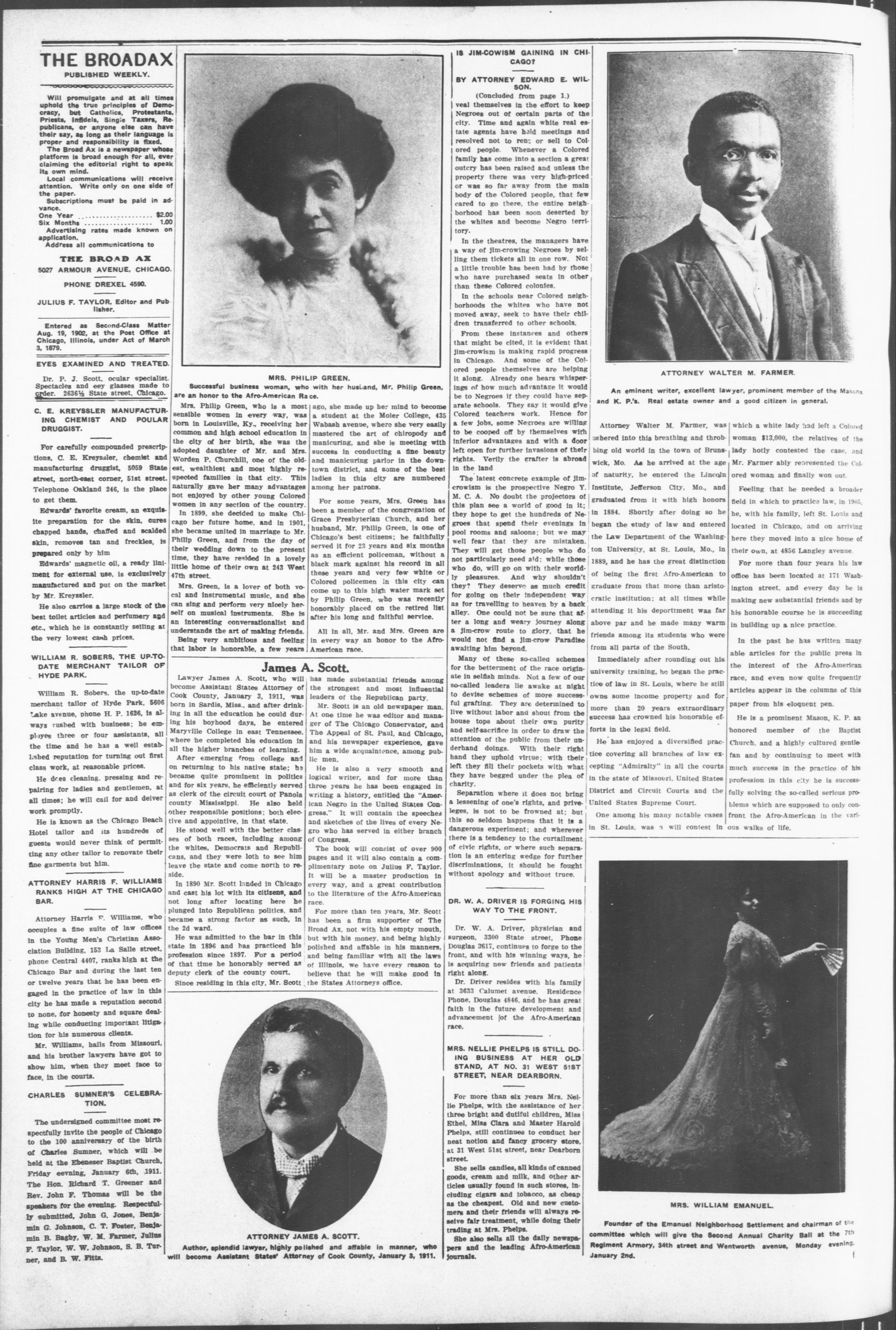
MRS. PHILIP GREEN.
Successful business woman, who with her husband, Mr. Philip Green, are an honor to the Afro-American Race.
Mrs. Philip Green, who is a most sensible women in every way, was born in Louisville, Ky., receiving her common and high school education in the city of her birth, she was the adopted daughter of Mr. and Mrs. Worden P. Churchill, one of the oldest, wealthiest and most highly respected families in that city. This naturally gave her many advantages not enjoyed by other young Colored women in any section of the country.
ago, she made up her mind to become a student at the Moler College, 43 Wabash avenue, where she very easily mastered the art of chiropody and manicuring, and she is meeting with success in conducting a fine beauty and manicuring parlor in the downtown district, and some of the best ladies in this city are numbered among her patrons.
For some years, Mrs. Green has
In 1899, she decided to make Chicago her future home, and in 1901, she became united in marriage to Mr. Philip Green, and from the day of their wedding down to the present time, they have resided in a lovely little home of their own at 243 West 47th street.
Mrs. Green, is a lover of both vocal and instrumental music, and she can sing and perform very nicely herself on musical instruments. She is an interesting conversationalist and understands the art of making friends. Being very ambitious and feeling that labor is honorable, a few years
James A. Scott.
Lawyer James A. Scott, who will become Assistant States Attorney of Cook County, January 3, 1911, was born in Sardis, Miss., and after drinking in all the education he could during his boyhood days, he entered Maryville College in east Tennessee, where he completed his education in all the higher branches of learning. After emerging from college and on returning to his native state; he became quite prominent in politics and for six years, he efficiently served as clerk of the circuit court of Panola county Mississippi. He also held other responsible positions; both elective and appointive, in that state.
He stood well with the better classes of both races, including among the whites, Democrats and Republicans, and they were loth to see him leave the state and come north to reside.
In 1890 Mr. Scott landed in Chicago and cast his lot with its citizens, and not long after locating here he plunged into Republican politics, and became a strong factor as such, in the 2d ward.
He was admitted to the bar in this state in 1896 and has practiced his profession since 1897. For a period of that time he honorably served as deputy clerk of the county court.
Since residing in this city, Mr. Scott
[Picture of a man with a mustache and a bow tie. He is wearing a dark suit with a white shirt and a bow tie. The background is plain and light-colored.]]
ATTORNEY JAMES A. SCOTT.
Author, splendid lawyer, highly polished and affable in manner, who will become Assistant States' Attorney of Cook County, January 3, 1911.
Author, splendid lawyer, highly polished and affable in manner, who will become Assistant States' Attorney of Cook County, January 3, 1911.
ago, she made up her mind to become a student at the Moler College, 435 Wabash avenue, where she very easily mastered the art of chiropody and manicuring, and she is meeting with success in conducting a fine beauty and manicuring parlor in the downtown district, and some of the best ladies in this city are numbered among her patrons.
For some years, Mrs. Green has been a member of the congregation of Grace Presbyterian Church, and her husband, Mr. Philip Green, is one of Chicago's best citizens; he faithfully served it for 23 years and six months as an efficient policeman, without a black mark against his record in all these years and very few white or Colored policemen in this city can come up to this high water mark set by Philip Green, who was recently honorably placed on the retired list after his long and faithful service.
All in all, Mr. and Mrs. Green are in every way an honor to the Afro-American race.
has made substantial friends among the strongest and most influential leaders of the Republican party. Mr. Scott is an old newspaper man. At one time he was editor and manager of The Chicago Conservator, and The Appeal of St. Paul, and Chicago, and his newspaper experience, gave him a wide acquaintence, among public men. He is also a very smooth and logical writer, and for more than three years he has been engaged in writing a history, entitled the "American Negro in the United States Congress." It will contain the speeches and sketches of the lives of every Negro who has served in either branch of Congress.
The book will consist of over 900 pages and it will also contain a complimentary note on Julius F. Taylor. It will be a master production in every way, and a great contribution to the literature of the Afro-American race. For more than ten years, Mr. Scott has been a firm supporter of The Broad Ax, not with his empty mouth, but with his money, and being highly polished and affable in his manners, and being familiar with all the laws of Illinois, we have every reason to believe that he will make good in the States Attorneys office.
IS JIM-COWISM GAINING IN CHI CAGO?
BY ATTORNEY EDWARD E. WILSON.
(Continued from page 1.2)
veal themselves in the effort to keep Negroes out of certain parts of the city. Time and again white real estate agents have held meetings and resolved not to rent or sell to Colored people. Whenever a Colored family has come into a section a great outcry has been raised and unless the property there was very high-priced or was so far away from the main body of the Colored people, that few cared to go there, the entire neighborhood has been soon deserted by the whites and become Negro territory.
In the theatres, the managers have a way of Jim-crowing Negroes by selling them tickets all in one row. Not a little trouble has been had by those who have purchased seats in other than these Colored colonies.
In the schools near Colored neighborhoods the whites who have not moved away, seek to have their children transferred to other schools.
From these instances and others that might be cited, it is evident that jim-crowism is making rapid progress in Chicago. And some of the Colored people themselves are helping it along. Already one hears whisperings of how much advantage it would be to Negroes if they could have separate schools. They say it would give Colored teachers work. Hence for a few jobs, some Negroes are willing to be cooped off by themselves with inferior advantages and with a door left open for further invasions of their rights. Verily the grafter is abroad in the land
The latest concrete example of jim-crowism is the prospective Negro Y. M. C. A. No doubt the projectors of this plan see a world of good in it; they hope to get the hundreds of Negroes that spend their evenings in pool rooms and saloons; but we may well fear that they are mistaken. They will get those people who do not particularly need aid; while those who do, will go on with their worldly pleasures. And why shouldn't they? They deserve as much credit for going on their independent way as for travelling to heaven by a back alley. One could not be sure that after a long and weary journey along a Jim-crow route to glory, that he would not find a Jim-crow Paradise awaiting him beyond.
Many of these so-called schemes for the betterment of the race originate in fish minds. Not a few of our so-called leaders lie awake at night to devise schemes of more successful grafting. They are determined to live without labor and shout from the house tops about their own purity and self-sacrifice in order to draw the attention of the public from their underhand doings. With their right hand they uphold virtue; with their left they fill their pockets with what they have begged under the plea of charity.
Separation where it does not bring a lessening of one's rights, and privileges, is not to be frowned at; but this so seldom happens that it is a dangerous experiment; and wherever there is a tendency to the curtailment of civil rights, or where such separation is an entering wedge for further discriminations, it should be fought without apology and without truce.
DR. W. A. DRIVER IS FORGING HIS WAY TO THE FRONT.
Dr. W. A. Driver, physician and surgeon, 3300 State street, Phone Douglas 3617, continues to forge to the front, and with his winning ways, he is acquiring new friends and patients right along. Dr. Driver resides with his family at 3633 Calumet avenue. Residence Phone, Douglas 4846, and he has great faith in the future development and advancement of the Afro-American race.
MRS. NELLIE PHELPS IS STILL DOING BUSINESS AT HER OLD STAND, AT NO. 31 WEST 51ST STREET, NEAR DEARBORN.
For more than six years Mrs. Nellie Phelps, with the assistance of her three bright and dutiful children, Miss Ethel, Miss Clara and Master Harold Phelps, still continues to conduct her neat notion and fancy grocery store, at 31 West 51st street, near Dearborn street.
She sells candies, all kinds of canned goods, cream and milk, and other articles usually found in such stores, including cigars and tobacco, as cheap as the cheapest. Old and new customers and their friends will always receive fair treatment, while doing their trading at Mrs. Phelps.
She also sells all the daily newspapers and the leading Afro-American journals.
ATTORNEY WALTER M. FARMER.
An eminent writer, excellent la and K. P.'s. Real estate owner an
An eminent writer, excellent lawyer, prominent member of the Masons and K. P.'s. Real estate owner and a good citizen in general.
Attorney Walter M. Farmer, was ushered into this breathing and throbbing old world in the town of Brunswick, Mo. As he arrived at the age of naturity, he entered the Lincoln Institute, Jefferson City, Mo., and graduated from it with high honors in 1884. Shortly after doing so he began the study of law and entered the Law Department of the Washington University, at St. Louis, Mo., in 1889, and he has the great distinction of being the first Afro-American to graduate from that more than aristocratic institution; at all times while attending it his deporttment was far above par and he made many warm friends among its students who were from all parts of the South.
Immediately after rounding out his university training, he began the practice of law in St. Louis, where he still owns some income property and for more than 20 years extraordinary success has crowned his honorable efforts in the legal field.
He has enjoyed a diversified practice covering all branches of law excepting "Admiralty" in all the courts in the state of Missouri, United States District and Circuit Courts and the United States Supreme Court.
One among his many notable cases in St. Louis, was a will contest in
```markdown
```
Founder of the Emanuel Neighborhood Settlement committee which will give the Second Annual C Regiment Armory, 34th street and Wentworth ave January 2nd.
Founder of the Emanuel Neighborhood Settlement and chairman of the committee which will give the Second Annual Charity Ball at the 7th Regiment Armory, 34th street and Wentworth avenue, Monday evening. January 2nd.
Wyer, prominent member of the Masons and a good citizen in general.
which a white lady had left a Colored woman $13,000, the relatives of the lady hotly contested the case, and Mr. Farmer ably represented the Colored woman and finally won out.
Feeling that he needed a broader field in which to practice law, in 1905, he, with his family, left St. Louis and located in Chicago, and on arriving here they moved into a nice home of their own, at 4856 Langley avenue.
For more than four years his law office has been located at 171 Washington street, and every day he is making new substantial friends and by his honorable course he is succeeding in building up a nice practice.
In the past he has written many able articles for the public press in the interest of the Afro-American race, and even now quite frequently articles appear in the columns of this paper from his eloquent pen.
He is a prominent Mason, K. P. an honored member of the Baptist Church, and a highly cultured gentlefan and by continuing to meet with much success in the practice of his profession in this city he is successfully solving the so-called serious problems which are supposed to only confront the Afro-American in the various walks of life.
```markdown
```
hood Settlement and chairman of the and Annual Charity Ball at the 7th centworth avenue, Monday evening.
ARGENT ARCHER
PHOTO
KENSINGTON
LONDON
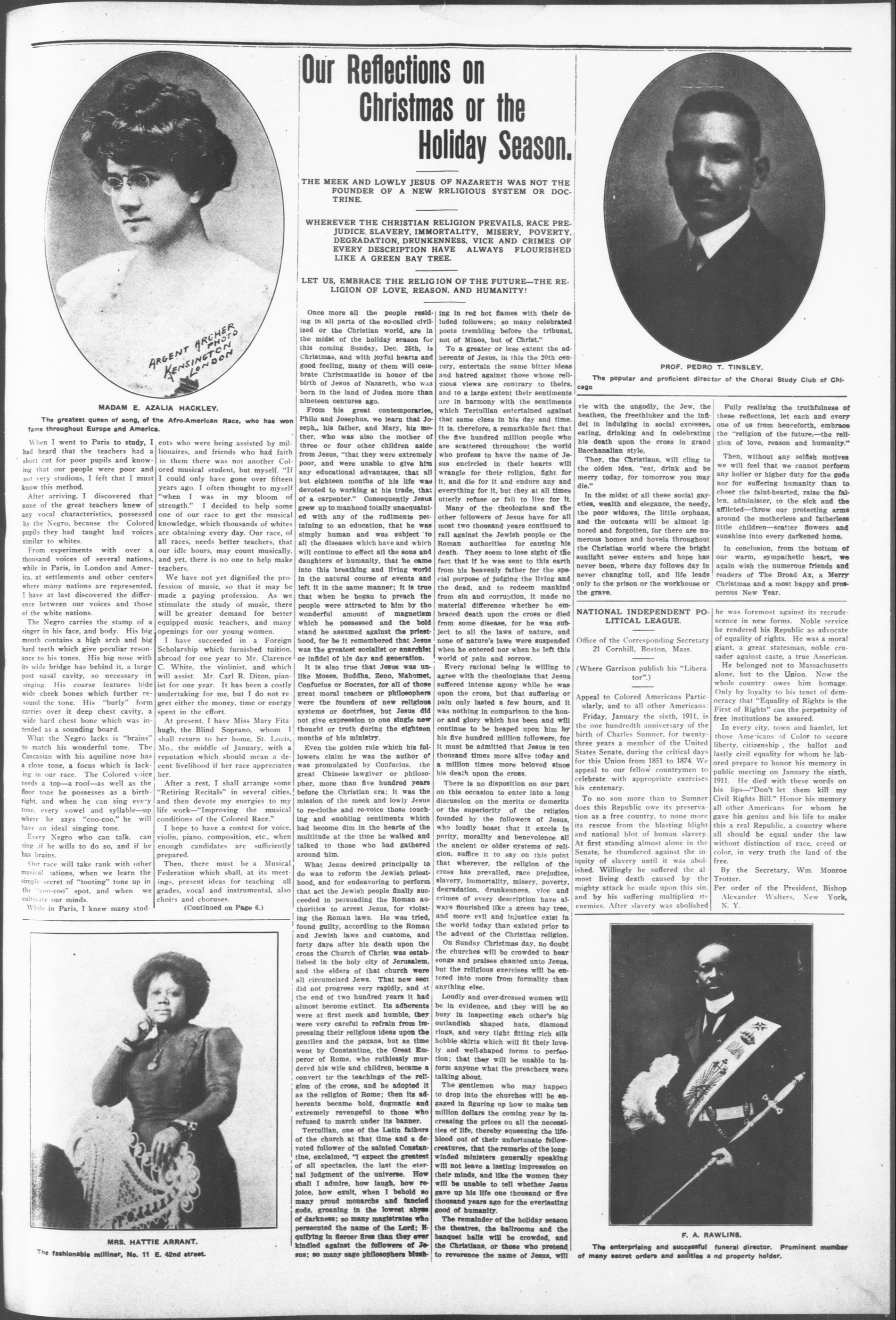
MADAM E. AZALIA HACKLEY.
The greatest queen of song, of the Afro-American Race, who has won fame throughout Europe and America.
When I went to Paris to study, I had heard that the teachers had a short cut for poor pupils and knowing that our people were poor and not very studious, I felt that I must know this method.
After arriving, I discovered that one of the great teachers knew of any vocal characteristics, possessed by the Negro, because the Colored pupils they had taught had voices similar to whites.
From experiments with over a thousand voices of several nations, while in Paris, in London and America who were being assisted by millionaires, and friends who had faith in them there was not another Colored musical student, but myself. "If I could only have gone over fifteen years ago. I often thought to myself "when I was in my bloom of strength." I decided to help some one of our race to get the musical knowledge, which thousands of whites are obtaining every day. Our race, of all races, needs better teachers, that our idle hours, may count musically, and yet, there is no one to help make teachers.
We have not yet dignified the profession of music, so that it may be made a paying profession. As we stimulate the study of music, there will be greater demand for better equipped music teachers, and many openings for our young women.
I have succeeded in a Foreign Scholarship which furnished tuition, abroad for one year to Mr. Clarence C. White, the violinist, and which will assist. Mr. Carl R. Diton, pianist for one year. It has been a costly undertaking for me, but I do not regret either the money, time or energy spent in the effort.
At present, I have Miss Mary Fitzhugh, the Blind Soprano, whom I shall return to her home, St. Louis, Mo., the middle of January, with a reputation which should mean a decent livelihood if her race appreciates her.
After a rest, I shall arrange some "Retiring Recitals" in several cities, and then devote my energies to my life work—"Improving the musical conditions of the Colored Race."
I hope to have a contest for voice, violin, piano, composition, etc., when enough candidates are sufficiently prepared.
Then, there must be a Musical Federation which shall, at its meetings, present ideas for teaching all grades, vocal and instrumental, also choirs and choruses.
THE WOMEN'S HERITAGE
MARTHA MURRAY
MRS. HATTIE ARRANT.
The fashionable milliner, No. 11 E. 42nd street.
---
When I went to Paris to study, I had heard that the teachers had a short cut for poor pupils and knowing that our people were poor and not very studious, I felt that I must know this method.
After arriving, I discovered that none of the great teachers knew of any vocal characteristics, possessed by the Negro, because the Colored pupils they had taught had voices similar to whites.
From experiments with over a thousand voices of several nations, while in Paris, in London and America, at settlements and other centers where many nations are represented, I have at last discovered the difference between our voices and those of the white nations.
The Negro carries the stamp of a singer in his face, and body. His big mouth contains a high arch and big hard teeth which give peculiar resonance to his tones. His big nose with its wide bridge has behind it, a large post nasal cavity, so necessary in singing. His coarse features hide wide cheek bones which further resound the tone. His "burly" form carries over it deep chest cavity, a wide hard chest bone which was intended as a sounding board.
What the Negro lacks is "brains" to match his wonderful tone. The Caucasian with his aquiline nose has a close tone, a focus which is lacking in our race. The Colored voice needs a top—a roof—as well as the floor tone he possesses as a birthright, and when he can sing every tone, every vowel and syllable—up where he says "coo-coo," he will have an ideal singing tone.
Every Negro who can talk, can sing if he wills to do so, and if he has brains.
Our race will take rank with other musical nations, when we learn the simple secret of "tooting" tone up in the "coo-coo" spot, and when we cultivate our minds.
While in Paris, I knew many stud-
(Continued on Page 6.)
Our Reflections on Christmas or the Holiday Season.
THE MEEK AND LOWLY JESUS OF NAZARETH WAS NOT THE FOUNDER OF A NEW RRLIGIOUS SYSTEM OR DOCTRINE.
WHEREVER THE CHRISTIAN RELIGION PREVAILS, RACE PREJUDICE. SLAVERY, IMMORTALITY, MISERY, POVERTY, DEGRADATION, DRUNKENNESS, VICE AND CRIMES OF EVERY DESCRIPTION HAVE ALWAYS FLOURISHED LIKE A GREEN BAY TREE.
LET US, EMBRACE THE RELIGION OF THE FUTURE—THE RELIGION OF LOVE, REASON, AND HUMANITY!
Once more all the people residing in all parts of the so-called civilized or the Christian world, are in the midst of the holiday season for this coming Sunday, Dec. 25th, is Christmas, and with joyful hearts and good feeling, many of them will celebrate Christmastide in honor of the birth of Jesus of Nazareth, who was born in the land of Judea more than nineteen centuries ago.
From his great contemporaries, Philo and Josephus, we learn that Joseph, his father, and Mary, his mother, who was also the mother of three or four other children aside from Jesus, "that they were extremely poor, and were unable to give him any educational advantages, that all but eighteen months of his life was devoted to working at his trade, that of a carpenter." Consequently Jesus grew up to manhood totally unacquainted with any of the rudiments pertaining to an education, that he was simply human and was subject to all the diseases which have and which will continue to effect all the sons and daughters of humanity, that he came into this breathing and living world in the natural course of events and left it in the same manner; it is true that when he began to preach the people were attracted to him by the wonderful amount of magnetism which he possessed and the bold stand he assumed against the priesthood, for be it remembered that Jesus was the greatest socialist or anarchist or infidel of his day and generation.
It is also true that Jesus was unlike Moses, Buddha, Zeno, Mahomet, Confucius or Socrates, for all of those great moral teachers or philosopher were the founders of new religious systems or doctrines, but Jesus did not give expression to one single new thought or truth during the eighteen months of his ministry.
Even the golden rule which his followers claim he was the author of was promulgated by Confucius, the great Chinese lawgiver or philosopher, more than five hundred years before the Christian era; it was the mission of the meek and lowly Jesus to re-clothe and re-voice those touching and enobling sentiments which had become dim in the hearts of the multitude at the time he walked and talked to those who had gathered around him.
What Jesus desired principally to do was to reform the Jewish priesthood, and for endeavoring to perform that act the Jewish people finally succeeded in persuading the Roman authorities to arrest Jesus, for violating the Roman laws. He was tried, found guilty, according to the Roman and Jewish laws and customs, and forty days after his death upon the cross the Church of Christ was established in the holy city of Jerusalem, and the elders of that church were all circumcized Jews. That new sect did not progress very rapidly, and at the end of two hundred years it had almost become extinct. Its adherents were at first meek and humble, they were very careful to refrain from impressing their religious ideas upon the gentiles and the pagans, but as time went by Constantine, the Great Emperor of Rome, who ruthlessly murdered his wife and children, became a convert to the teachings of the religion of the cross, and he adopted it as the religion of Rome; then its adherents became bold, dogmatic and extremely revengeful to those who refused to march under its banner.
Tertullian, one of the Latin fathers of the church at that time and a devoted follower of the salted Constantine, exclaimed, "I expect the greatest of all spectacles, the last the eternal judgment of the universe. How shall I admire, how laugh, how rejoice, how exult, when I behold so many proud monarchs and fancied gods, groaning in the lowest abyss of darkness; so many magistrates who persecuted the name of the Lord; Quilifying in fiercer fires than they ever kindled against the followers of Jesus; so many sage philosophers blush
ing in red hot flames with their de- luded followers; so many celebrated poets trembling before the tribunal, not of Minos, but of Christ."
To a greater or less extent the adherents of Jesus, in this the 20th century, entertain the same bitter ideas and hatred against those whose religious views are contrary to theirs, and to a large extent their sentiments are in harmony with the sentiments which Tertullian entertained against that same class in his day and time. It is, therefore, a remarkable fact that the five hundred million people who are scattered throughout the world who profess to have the name of Jesus encircled in their hearts will wrangle for their religion, fight for it, and die for it and endure any and everything for it, but they at all times utterly refuse or fail to live for it.
Many of the theologians and the other followers of Jesus have for all most two thousand years continued to rail against the Jewish people or the Roman authorities for causing his death. They seem to lose sight of the fact that if he was sent to this earth from his heavenly father for the special purpose of judging the living and the dead, and to redeem mankind from sin and corruption, it made no material difference whether he embraced death upon the cross or died from some disease, for he was subject to all the laws of nature, and none of nature's laws were suspended when he entered nor when he left this world of pain and sorrow.
Every rational being is willing to agree with the theologians that Jesus suffered intense agony while he was upon the cross, but that suffering or pain only lasted a few hours, and it was nothing in comparison to the honor and glory which has been and will continue to be heaped upon him by his five hundred million followers, for it must be admitted that Jesus is ten thousand times more alive today and a million times more beloved since his death upon the cross.
There is no disposition on our part on this occasion to enter into a long discussion on the merits or demerits or the superiority of the religion founded by the followers of Jesus, who loudly boast that it excels in purity, morality and benevolence all the ancient or older systems of religion, suffice it to say on this point that wherever, the religion of the cross has prevailed, race prejudice, slavery, immortality, misery, poverty, degradation, drunkenness, vice and crimes of every description have always flourished like a green bay tree, and more evil and injustice exist in the world today than existed prior to the advent of the Christian religion
On Sunday Christmas day, no doubt the churches will be crowded to hear songs and praises chanted unto Jesus, but the religious exercises will be entered into more from formality than anything else.
Loudly and over-dressed women will be in evidence, and they will be so busy in inspecting each other's big outlandish shaped hats, diamond rings, and very tight fitting rich silk hobble skirts which will fit their lovely and well-shaped forms to perfection; that they will be unable to inform anyone what the preachers were talking about.
The gentlemen who may happen to drop into the churches will be engaged in figuring up how to make ten million dollars the coming year by increasing the prices on all the necessities of life, thereby squeezing the lifeblood out of their unfortunate fellow-creatures, that the remarks of the long-winded ministers generally speaking will not leave a lasting impression on their minds, and like the women they will be unable to tell whether Jesus gave up his life one thousand or five thousand years ago for the everlasting good of humanity. The remainder of the holiday season the theatres, the ballrooms and the banquet halls will be crowded, and the Christians, or those who pretend to reverence the name of Jesus, will
[Name]
PROF. PEDRO T. TINSLEY. The popular and proficient director of the Choral Study Club of Chicago
The popular and proficient director of the Choral Study Club of Chicago
vie with the ungodly, the Jew, the heathen, the freethinker and the infidel in indulging in social excesses, eating, drinking and in celebrating his death upon the cross in grand Bacchanalian style.
They, the Christians, will cling to the olden idea, "eat, drink and be merry today, for tomorrow you may die."
Fully realizing the truthfulness of these reflections, let each and ever one of us from henceforth, embrace the "religion of the future," the religion of love, reason and humanity.
Then, without any selfish motive we will feel that we cannot perform any holier or higher duty for the god nor for suffering humanity than t
In the midst of all these social gayeties, wealth and elegance, the needy, the poor widows, the little orphans, and the outcasts will be almost ignored and forgotten, for there are numerous homes and hovels throughout the Christian world where the bright sunlight never enters and hope has never been, where day follows day in never changing toll, and life leads only to the prison or the workhouse or the grave.
NATIONAL INDEPENDENT POLITICAL LEAGUE.
Office of the Corresponding Secretary
21 Cornhill, Boston, Mass.
(Where Garrison publish his "Libera-
tor".)
Appeal to Colored Americans Partic-
ularly, and to all other Americans:
Friday, January the sixth, 1911, is
the one hundredth anniversary of the
birth of Charles Sumner, for twenty-
three years a member of the United
States Senate, during the critical days
for this Union from 1851 to 1874. We
appeal to our fellow countrymen to
celebrate with appropriate exercises
his centenary.
To no son more than to Sunner does this Republic owe its preservation as a free country, to none more its rescue from the blasting blight and national blot of human slavery. At first standing almost alone in the Senate, he thundered against the iniquity of slavery until it was abolished. Willingly he suffered the almost living death caused by the mighty attack he made upon this sin, and by his suffering multiplied enemies. After slavery was abolished
圣羅馬
F. A. RAWLINS.
The enterprising and successful funeral director. Prominent member of many secret orders and societies and property holder.
Fully realizing the truthfulness of these reflections, let each and every one of us from henceforth, embrace the "religion of the future," the religion of love, reason and humanity."
Then, without any selfish motives we will feel that we cannot perform any holier or higher duty for the gods nor for suffering humanity than to cheer the faint-hearted, raise the fallen, administer, to the sick and the afflicted—throw our protecting arms around the motherless and fatherless little children—scatter flowers and sunshine into every darkened home.
In conclusion, from the bottom of our warm, sympathetic heart, we again wish the numerous friends and readers of The Broad Ax, a Merry Christmas and a most happy and prosperous New Year.
he was foremost against its recrudescence in new forms. Noble service he rendered his Republic as advocate of equality of rights. He was a moral giant, a great statesman, noble crusader against caste, a true American. He belonged not to Massachusetts alone, but to the Union. Now the whole country owes him homage. Only by loyalty to his tenet of democracy that "Equality of Rights is the First of Rights" can the perpetuity of free institutions be assured.
In every city, town and hamlet, let those Americans of Color to secure liberty, citizenship, the ballot and lastly civil equality for whom he labored prepare to honor his memory in public meeting on January the sixth, 1911. He died with these words on his lips—"Don't let them kill my Civil Rights Bill." Honor his memory all other Americans for whom he gave his genius and his life to make this a real Republic, a country where all should be equal under the law without distinction of race, creed or color, in very truth the land of the free.
By the Secretary, Wm. Monroe Trotter.
Per order of the President, Bishop Alexander Walters, New York, N.Y.
RECORD OF 1910
The Events of the World In Paragraphs.
AVIATION ACHIEVEMENTS
A Summary of Affairs at Home and Abroad — Miscellaneous Happenings — Explosions — Storms and Shipwrecks—Games and Races.
POLITICAL AND PERSONAL
JANUARY.
7. Gifford Pinchot, chief forester, removed by President Taft.
FEBRUARY.
15. Herbert Gladstone, whose father, W. E. Gladstone, "the great commoner," twice declined a seat in the house of lords, elevated to the peerage.
MARCH.
14. Ex-President Roosevelt reached Khartum on his return from Africa.
23. The British house of lords passed the notorious Liberal budget bill.
MAY.
9. King George V. proclaimed throughout the British empire.
31. South African union proclaimed at Pretoria.
1890
18. Ex-President Theodore Roosevelt welcomed in New York on his return from his American and European trip. The "roadrail" bill, creating a court of commerce and amending the in-
George V. amending the Interstate commerce act of 1887, became a law.
25. Congress adjourned.
25. Gen. Porfirio Diaz re-elected president of Mexico.
SEPTEMBER.
19. Emperor William of Germany and Francis Joseph of Austria met at Vienna.
OCTOBER.
4. Republican uprising in Lisbon. King Manuel of Portugal dethroned. The army and navy sided with the revolutionists, who proclaimed a republic.
10. Ex-Governor Charles E Hughes took the oath of office as justice of the United States supreme court at Washington.
22. Crown Prince Chowfa Maha Vajiravudh, who visited this country in 1902, proclaimed king of Siam.
NOVEMBER.
8. Insults to the American flag in the City of Mexico. American citizens attacked.
8. Democratic landslide in several states in state elections and a Democratic house of representatives in congress returned. Massachusetts, Connecticut, New York and New Jersey elected Democratic government to succeed Republican governors, and Ohio re-elected a Democratic governor.
16 President Taft sailed from Charleston on the cruiser Tennessee on an official visit to the republic of Panama and the canal zone.
16 President Taft addressed the Panamans at a state banquet and declared that there would be no annexation of the republic of Panama to the United States.
20. The British parliament dissolved by royal proclamation.
DECEMBER
6. President Taft's message recommended that the Pana-na canal be fortified, a ship subsidy, limited parcels post and a halt in legislation on corporations.
12. Associate Justice Edward Douglass White of the United States supreme court appointed chief justice. Judge Willis Van Devanter of Wyoming and Judge J. R. Lamar of Georgia nominated associate justices.
NATURE'S MOODS.
JANUARY.
24. The river Seine exceeded high water mark in Paris endangering the city and paralyzing traffic.
25. Rising of the waters of the Seine in Paris checked by the cessation of rain; 9 square miles inundated; loss estimated over $200,000.00.
28. Over 50 deaths in snowyides in the mountains of northern Idaho.
5. Snowslide in Rogers pass, British Columbia, caused the loss of upward of 60 lives.
APRIL.
2. Violent snowstorm, wind and freezing temperature caused destruction of budding fruits in the central lake region, extending south to Tennessee.
MAY.
4. Earthquake in Costa Rica; province of Cartago nearly destroyed; estimated loss of life over 2,500.
19. Violent earthquake shock at Salt Lake City.
JUNE.
6. Cloudburst wiped out several villages in eastern Hungary and destroyed about 300 lives.
7. Destructive earthquake in southern Italy; upward of 100 deaths.
12. Cloudburst in the Ahr valley, Prussia, destroyed 150 lives.
15. Windstorm caused death of 16 people in New York city.
JULY.
24. 60 persons killed and hundreds injured by a tornado near Milan, Italy.
AUGUST.
28. Flood in Tokyo destroyed over 3,000 houses and shops and over 1,000 lives.
12. A force storm swept over Europe, causing a heavy loss of life on the English coast and on the Baltic.
14. A hurricane caused widespread devastation in Cuba.
18. A West India hurricane struck the coasts of Florida and South Carolina.
12. Ischia, an island in the Mediterranean, and Napies swept by a hurricane; 100 dead in Ischia.
DECEMBER
6. Heavy storm of rain and snow in the northern and eastern states.
MISCELLANEOUS ITEMS
JANUARY.
2. Charles W. Morse, convicted New York banker, began a 15 year sentence in the United States penitentiary at Atlanta.
2. The organized volunteer militia of the United States became a permanent adjunct of the regular army establishment by the operation of the Dick law.
2. John R. Walsh, convicted Chicago banker, began serving his 5 year term in the federal prison at Leavenworth, Pa.
2. Indictment of the New York World in the Panama libel case quashed in the United States circuit court in New York
FEBRUARY
2. Edward Payson Weston started from Los Angeles, Cal., on his walk to New York.
4. The Connecticut "hatters boycott" case decided in favor of the plaintiff, with an award of damages against the individuals who instituted the boycott amounting to $22,000
1. Strike of the street car men began in Philadelphia.
2. Rioting in Philadelphia due to the car men's strike resulted in the death of five people; 10 injured
22 The Niceraguan revolutionists defeated at Tasma, losing 800 in all
MARCH
9. Nicholas Techalkovsky, Russian revolutionist, acquitted on charge of criminal activity.
State wide sympathy declared in Pennsylvania, sympathy with the Philadelphia car men's strike.
15. George Cannon, cousin of Leroy Cannon. American, who was executed by Zelaya, hanged for conspiracy at Corinto, Nicaragua, by order of President Madriz.
25. State wide sympathy strike to aid the Philadelphia car men declared off by the Pennsylvania labor unions.
APRIL
13. Col. Duncan B. Cooper, one of the convicted murderers of Senator E. W. Carmack, pardoned by Gov. Patterson of Tennessee
14. A tricked foreigners and burned missions at Changsha, Hunan province, China
2 Edward Payson Weston arrived at city hall, New York, having made the 3,500 mile trip from Los Angeles in 78 walking days.
16 Edward declared guilty of the murder of Col Swope and sentenced to life imprisonment.
JUNE
1. Capt. Scott's antarctic expedition sailed from London.
2. JULY.
3. Numerous riots in which many people were killed followed the news of the ring event at Reno.
4. Riot and lynching in Newark, O.
5. Estrela revolutionists d feated the Nicaraguan forces at Acropa.
AUGUST
6. Mayor William J. Gormer shot on board the ocean
7. Erik Kisser Willis shot by Grosse
8. Loren I. Gallaert charged cities and loved
9. Estrela revolutionists d feated the Madre forces in front of Manguna
10. Manzanera capital of Nicaragua, occupied by the victorious revolution-takers
Major William J. Gavory shot on board the ocean from Kaiser Wilhelm II. Grosser Grosse Lions Galla-chaussed charged city armor. Artillery revolutions, attacked the Madrid forces in front of Managua. Managua capital of Nicaragua, occupied by the vicious revolutionists. Estrada Madrida. Madrida the president fled.
Mayor Gaynor.
SEPTEMBER
B. J. L. Hutchinson, former circus partner with Barnum & Bailey, dled at the circus.
OCTOBER
20. The White Star line steamship Olympic, the largest in the world, was launched at Belfast.
21. Dr. Hawley H. Crippen found guilty of the murder of his Belle Elmhurst in the Old Bailey criminal court, London.
NOVEMBER
1. The Coeur d'Alene reservation opened up to general settlement.
14. Prince Victor Napoleon Bonaparte, pretender to the throne of France, married Princess Clementine of Belgium at Moncalieri, Italy.
Count Tolstoy, who disappeared from his home mysteriously in October, discovered in a railway station in an enfeebled condition.
24. The crews of two Brazilian warships mutinied in the harbor of Rio Janeiro and opened fire on the city.
27. The magnificent new Pennsylvania railroad station at Thirty-second street and Seymour ave.
M. R. H.
Mexican troops defeated 400 revolutionists in battle at Chihuahua. 10. The government asked for the dissolution of the sugar trust as "a corporation in restraint of trade." 10. The memorial ceremonies took place in Carnegie hall. New York
Mark Twain
DECEMBER
7. Statue of Gen. Frederick Wilhelm von Steuben, a noted figure in Washington's army during the Revolutionary war, unveiled in Washington
10. Mutiny of Brazilian marines at Rio de Janeiro resulted in a battle, causing 400 casualties
10. Figures of the 12th census published. Population, exclusive of Alaska, 91,720,381; including all possessions, 101,100,000; gain since 1900, 15,559,860
14. Andrew carnegie gave $10,000,000 to the cause of peace
JANUARY
12. Steamer Czarina wrecked on Coos bay bar, Oregon coast, 30 drowned.
FEBUARY
8. The United States naval tug Nina lost on the voyage from Hampton Roads to Boston with crew of 32 on board.
11. French liner General Chanzy wrecked at a pier in the island of Minorca: 156 persons perished.
MARCH
28. 8 sailors killed by explosion on the
dock of the USS Arizona during
practice in Philippine waters.
MAY.
26. 18 deaths by the sinking of the steamer Frank H. Goodyear near Port aux Barquas, Lake Huron.
26. The French submarine Pluviose rammed by a ferryboot and sunk with all her crew of 27 in Dover strait.
OCTOBER
22. British steamship Wally wrecked off the Brazilian coast; 50 passengers and sailors drowned.
25. The Haitian gunboat La Liberté was wrecked by explosion off Port aux Paix and sank with 70 persons, including 10 generals.
DECEMBER
11. German steamer Palermo wrecked on the Spanish coast, carrying down 24 persons
AVIATION
JANUARY.
AVIATION
JANUARY
4. Leon Delagrange, pioneer aeroplane experimenter, killed by the fall of a Bleriot monoplane at Bordeaux, France.
7. Hubert Latham, French aviator, beat the records for height of heavier than air machines by ascending nearly 3,000 feet at Mourmelon, France.
10. Aviation meet opened at Los Angeles, Cal.
APRIL
27. Louis Paulhan, French aviator, won the Daily Mall $50,000 prize by flying from London to Manchester, England. 185 miles, in 252 minutes actual time.
MAT
29. Glenn H. Curtiss flew from Albany to New York, following the course of the Hudson river, winning the New York World's prize of $10,000.
PETER HENRY
13. Walter S. Brookins established new world's altitude record by ascending 4,384 feet in a Wright aeroplane at 13. C. Hamilton drove a C.urtiss blc.
Glenn H. Curtiss
Glenn H. Curtiss. 13. C. K. Hamilton drove a Curtiss biplane from New York to Philadelphia and return, winning $10,000 prize; time, New York to Philadelphia, 86 miles, 1 hour 51 minutes; Philadelphia to New York, 1 hour 35 minutes.
17. William Brooks made new world's altitude record by ascending 4,800 feet at Indianapolis.
20. Count Zeppelin's dirigible Deutschland sailed 300 miles from Friedrichshaven to Dusseldorf, carrying 11 passengers.
JULY
2. Clifford B. Harmon broke the American amateur long flight record this own) by remaining in the air 2 hours 25 minutes at Mineola.
3. Sandra B. Aviation meet opened at Rheims, France Aviator Wachter killed by the fall of his machine.
4. Walter R. Brookins flew 6.25 feet up air at Atlantic City.
12. Radley, an English aviator, broke the world's speed flight record by flying a mile in 47.25 seconds.
13. C. F. Willard carried three passengers on a quarter mile biplane trip at Garden City, heating the world's record on the number of passengers.
14. Glenn H. Curtiss made an over water record by flying 60 miles over Lake Erie in 1 hour 15 minutes, an average of 46.1 miles an hour
**SEPTEMBER**
17. 13 balloons started from Indianapolis in an American championship race. Balloon America II landed near Warrenton, Va., after a flight of 44 hours.
18. Weymann, an American, and George Chavez, a Peruvian, attempted to fly over the Alps. Chavez succeeded, but was mortally hurt in landing.
SEPTEMBER
29 Walter S. Brookins broke the cross country distance record by flying from Chicago to Springfield, 186 miles, winning a $10,000 prize
OCTOBER
1. Avilator Wymnahel made a world's record for height by ascending 9,186 feet at Mourmelon, France
15. Wellman's balloon America started on its oversea flight at Atlantic City
17. 10 balloons, representing four nations, started from St. Louis in the international race for the Bennett cup and $4,750 in prizes.
The dirigible balloon Clement-Bayard, carrying 7,150 people, sailed from a Paris to London 6 hours.
Wellman abandoned his airship 300 miles off Hatteras after sailing about 500 miles in 72 hours; farthest eastern point reached was 140 miles northeast of Nantucket.
Balloon America II, Post and Hawley aeronauts, landed in the province of Quebec, 1,355 miles from St. Louis, winning the Bennett cup for distance.
The international aviation meet opened at Belmont park, New York
Ralph Johnstone broke the American aeroplane record for flight by ascending 7,303 feet at Belmont park, beating the record of 7,293 feet at Belmont park.
Ralph Johnstone ascended 9,000 feet in an aeroplane at Belmont park (The world's record was 9,186).
23. Claude Grahame-White won the speed race at Belmont park; time for 62.1 miles, 61 minutes 14 seconds.
24. J. B. Molsant won the race from Belmont park to the statue of Liberty and return, covering 34 miles in 34 minutes.
25. Ralph Johnstone ascended 9.714 feet at Belmont park, establishing a world's record for altitude.
NOVEMBER
14. Eugene B. Ely in the Curtiss biplane Hudson Flier flew from the deck of the United States cruiser Birmingham, in Hampton Roads, to Willoughby beach, 7 miles distant.
15. Ralph Johnstone, the aviator, killed by the fall of his biplane at Denver, aged 52.
16. J Armstrongd Drexel ascended 9.851 feet in a monoplane at Philadelphia, breaking the world's record.
DEVEMBER
8. Legagneux, French aviator, soared 10.-408 feet at Pau making a new world's record for altitude.
---
10. Capt. Bellanger, French army aviator, broke the world's speed record by making an average of over 86 miles an hour in a 100 mile flight from Vincennes to Mourmelon.
GAMES AND RACES
JANUARY.
JANUARY
12. Fred Eames won the three cushion billiard championship of the world from Alfredo D Ero, the Cuban champion, in New York; final score 150 to 120.
FEBRUARY.
P
22. Ad Wolgast defeated Battling Nelson for the lightweight championship at Richmond. Cal., in 40 rounds.
MARCH.
1. Thure Johansen, Swede, set a world's Marathon record by running 26 miles 55 yards in 2 hours 35 minutes and seconds.
2. Barney Oldfield, Irish-American autoist, broke the world's auto rec.
Ad Wolgast. autoist, broke the world's auto record for a mile by driving car Danny the course in 27.33 seconds at Daytona Beach, Fla.
Tom Hueston won 3 cushion billiard title from Fred Eames at Denver.
22 Barney Oldfield won the 20 mile auto event at Daytona Beach, Fla., cover-
31. Fitzherbert won the Brooklyn handi-
cap at Gravesend
JUNE
1. Lemberg won the English Derby.
2. Cornell won the varsity eight, four
coared race and freshman's eight at
Poughkeepsie
3. Nuage, owned by Mme Cheremeteff,
won the French Grand Prix, beating
W. K Vanderbilt's Reinhart by a neck
4. Harvard won the varsity races over
Yale at New London
JULY
4. Jack Johnson defeated Jeffries in 15
rounds at Reno for the world's heavy-
weight championship.
AUGUST
24. Harvester lowered the world's record for stallions by trotting a mile in 2:03 at the Empire City track. Yonkers.
25. William A. Larned, national lawn tennis champion, defended his title at Newport, defeating Thomas C. Bundy of California.
26. Novelty won the Futurity and $25,300 at Saratoga, with Bashti second.
SEPTEMBER
27. Paul Sorg broke the four-in-hand record by driving a mile in 2:40% at White Plains, N. Y.
28. Harvester lowered the trotting record for stallions to 2:01 at Columbus.
OCTOBER
1. The Vanderbilt cup auto race for 1910 was won by Harry F. Grant; time 4 hours 15 minutes 58 seconds.
15. The Army football team beat Yale, 9 to 4 at Point Pointe.
16. The Philadelphia Athletics beat the Chicago Nationals for the world's baseball championship, 7 to 2 at Chicago.
NOVEMBER.
12 Harvard beat Dartmouth, 15 to 0, in a football game at Cambridge.
Yale defeated Princeton, 5 to 3, at Princeton.
Michigan and Pennsylvania played a tie game at Franklin field; score 0-0.
Minnesota defeated Wisconsin by score of 28 to 0 at Minneapolis.
NOVEMBER
Cornell beat Chicago in football at Ithaca by score of 18 to 0
19. Yale and Harvard's football match resulted in a no score game at New Haven.
Michigan captured the western football championship from Minnesota by a score of 8 to 0 on Ferry Bank, Ann Arbor.
7. George Moore made a new world's record run of 15 at 3 cushion carom billiards in New York.
10. Root and Moran, the Irish American team, won the 6 day bicycle race in New York, score 2,35 miles 3 laps.
ACCIDENTS ON LAND
JANUARY
JANUARY
22. 11 killed by dynamite explosion in the Ashokan tunnel at Cold Spring, N. Y.
48 killed and 28 injured in the wreck of a passenger train on the Canadian Pacific at the crossing of Spanish river, Ontario.
21. 10 miners killed by explosion in the Colorado Fuel and Iron company's mine at Primero, Colo
FREQUENCY
1. 33 miners killed by an explosion in the Browder mine near Drakesboro, Ky.
14. 12 killed and 29 injured in a head-on collision near Macon, Ga., on the Georgia Southern and Florida railroad
MARCH
2. 33 miners killed by explosion in the gold diggings on Douglas Island, Alaska.
44 deaths in a wreck of Rock Island railroad trains at Green Mountain, Ia
MAY
6. Explosion in a coal mine at Palos, Ala., entombed 180 miners
12. 7 boilers of the American Tin Plate company at Canton, O. exploded, killed in the and injuring unarmed of 50.
18. Dynamite explosion in the guard brackets at Pinar del Rio, Cuba, destroyed over 100 lives.
18. 19 people killed and nearly 100 injured in a railway collision near Versailles, France
JULY
4. Cincinnati section of the Twentieth Century Limited wrecked in collision at Middletown, O.; 22 killed and many injured
SEPTEMBER
2. Collision on the Wabash Traction line near Kingsland, Ind., caused the death of 46 passengers
OCTOBER
4. Collision of electric cars at Springfield, Ill., caused the death of 37 persons, chiefly passengers
5. 50 miners were trapped by an explosion in the Colorado Fuel and Iron company's mine at Starkville, Colo
DECEMBER
9 Explosion in the Canada collieries mines at Bellevue Alberta, buried 60 miners
10 Explosion in a power house at Grand Central station. New York caused extensive damage in the vicinity and the loss of many lives
THEDEATHROLL
People Who Passed Away In 1910.
EDWARD VII. A VICTIM.
Renowned Authors, Famous Artists, Distinguished Statesmen and Rulers and Noted Soldiers on the List-All Ranks Leveled.
ORITUARY
JANUARY
2. Agnes Booth, widow of Junius Brutus Booth and at one time a star actress, in Brookline, Mass.; aged 64.
3. Darlus Ogden Mills, banker and capitalist, at San Francisco; aged 34.
4. Francesco di Paola Satelli, noted cardinal, in Rome.
Gen. Newton Martin Curtis, "hero of Fort Fisher," in New York city; aged 74
5. Ezra Kendall, well known comedian, at Martinsville, Ind.; aged 49
FEBRUARY
16. George Holland, the actor, in Philadelphia; aged 61
19. Nell Burress, the actor, in New York city, aged 61
23. City Clement, actor, in Kansas City, Mo., aged 61
MARCH
1. Luis Jose Domingo de Obaldia, president of the republic of Panama, at Columbia, aged 66
2. Louis James, actor, at Helena, Mont.; aged 64
3. Thomas Collier Flatt, former United States senator from New York and a noted political leader, in New York city; aged 77
8. Jake Schaefer, noted billiard player, at Denver
14. Phil Daly, noted gambler, at Long Branch, N. J.
22. Alexander Agassiz, naturalist, son of the celebrated Louis Agassiz of Har-
ter.
1. Robert W. Patterson, president of the Chicago Tribune company, in Philadelphia, aged 60.
2. Professor William Graham Sumner, social scientist of Yale, at Englewood, N. J.; aged 70.
3. Michael Langhorn Clemens (Mark Twain, the author, at Relding, Conn.; aged 75.
23 Gen. E P Alexander, noted Confederate veteran and writer on the civil war, at Savannah, Ga.; aged 75.
MAT
1. Gen. J. P S. Gobin, civil war veteran and national guard commander, at Lebanon, Pa.; aged 72.
Nord Alexis, deputy president of Haiti, at Kingston, Jamaica; aged about 90.
6. Edward VII. of England, at Buckingham palace; aged 63.
17. Pauline Violet-Garcia, sister of the late Manuel Garcia and, like him, a noted opera singer, in Paris.
Nord Alexis, deposed president of Hafti, at Kingston, Jamaica; aged about 50. 60. VII. of England, at Buckingham palace; aged 69. 17. Pauline Vardot-Garcia, sister of the late Manuel Garcia and, like him, a noted opera singer, in Berlin. 28. Dr Robert Koch, eminent bacteriologist, discov-
erer of a consumption cure, at Baden-
Baden; aged 67
JUNE
1. Edward Jenkins, English editor and
writer, author of the sensational polit-
ical pamphlet "Glinx's Baby," in Lon-
don; aged 72.
Dr. Elizabeth Blackwell, pioneer woman
physician in England and the United
States, in London; aged 89.
5. William Sydney Porter, novelist known
as O. Henry," in New York city;
aged 70.
7. Prof Goldwin Smith, Anglo-American
author and educator, at Toronto; aged
19. Henry Neville, noted actor and dramatist, in London.
28. United States Senator Samuel Douglas McEnery of Louisiana, in New Orleans, aged 68.
29. United States Senator John W. Daniel of Virginia, at Lynchburg; aged 68
JULY
2. Dr. Frederick James Furnival, noted English philologist, lexicographer, commemorator and critic, in London; aged 68
Ove Gude, Norwegian minister to the United States at White Sulphur Springs.
4. Chief Justice Melville Weston Fuller of the United States supreme court, at Bar Harbor, age: 68
7. Dr William James Rolfe, noted author and Shakespearean scholar, in Tisbury, Mass., aged 83
11. John Gottfried Galle, noted astronomer, at Potsdam, Germany; aged 88
12. Kate Tannatt Wood, author, in Boston; aged 70
13. Polger Bigelow, noted American artist and art leader, in Chicago, aged 57
13. Z. B Knight, who is said to have named the Republican party in 1854, in Omaha; aged 89
26. Prof. Samuel Ross Wunns, dean of Princeton, university, at Princeton; aged 55
27. Sir Henry Tichborne, infant defendant in the notorious Arthur Orton claim to the Tichborne title and estates in 1854 and notated a bited game hunter, in London; aged 44
28. John G. Carlisle, statesman and member of Grover Cleveland's cabinet, in New York city; aged 55
AUGUST
7. J. B Studley, once noted actor, in New York city
Col. Harvey W. Scott, editor of the
11. Mrs J. Ellen Foster, noted woman lawyer, in Washington; aged 70
12. Edmund D. Lewis, noted artist and art collector, in Philadelphia, aged 73
Florence Nightingale, famous nurse of the Crimean war, in London, aged 90.
15. Rev E. P. Hammond, more famous evangelist, at Hartford, CT.
16. President Pedro Montt of Chille, in Bremen
SEPTEMBER
17. William Holman-Hunt, noted artist, in London; aged 81
18. Dr. Emily Blackwell, noted woman physician, at York Cliffs, NY.
19. Lloyd W. Bowers, solicitor general of the United States, in Boston; aged 51.
20. Winslow Homer, famous American painter, at Scarborough, ME.
21. Mrs. Rebecca Harding Dodd, the author, at Mount Kisco, N.Y.; aged 78.
OCTOBER
22. Ex-Governor Napoleon Broward of Florida, a former filbuster, at Jacksonville, FL.
23. Former Governor and United States Senator David Bennett Albany, aged 67.
24. Joseph Abner Harper, member of the old firm of Harper & Browne in New York publishers, at New York, N.Y.; aged 77.
9. William Vaughn Moody, author and playwright, author of "The Great Divide," in Colorado Springs, 41.
10. Larkin G. Mead, notorious American sculptor, in Florence, Italy, 35.
11. United States Senator John P. Dolloy, Iowa, at Louis Dodge, aged 17.
12. Julia Howe, author of "The Battle of the Bastion," at Middletown, R.I., aged 20.
13. Cecilius T. Eckert, manager of the military trophic in the elevator and later president of the Western Union, at Locustran, N. J.; aged 55.
14. Chulalongkorn, king of Shangri-la Bangkok, after a reign of 40 years, aged 57.
15. Victor Massena, Prince of Bossing, grandson of Marshal Massena of France and himself a notorious soldier under Napoleon III, at Paris, aged 44.
NOVEMBER
13. United States Senator Alexander Stephens Clay of Georgia, at Atlanta; aged 57.
14. John, La Farge, distinguished mural painter and stained glass artist, in Providence, R. L.; aged 67.
20. Count Leo Tolstoy, famous Russian novelist, at Astapova, Russia, aged 82.
23. Octave Chanute, originator of the aeroplane, at Chicago; aged 88.
DECEMBER
2. Gen. E. A. Carr, U. S. A., retired, distinguished on the border before the civil war as well as in that conflict, at Washington; aged 80
3. Mary Baker Glover Eddy, founder of the Christian Science church, in Boston; aged 40
4. Gen. Wesley Merritt, U. S. A., retired, witness of the civil and Spanish-American wars, at Natural Bridge, Va.; aged 74
5. The Duke of Chartres, grandson of Louis Philippe of France and one of the Orleans princes who served in America in 1862, in Paris; aged 70
6. Ludwig Knaus, noted genre painter, in Berlin; aged 81
7. Gen. Wallace F. Randolph, U. S. A., retired, noted artillerist of the civil war, in Washington; aged 63
11. Burl Walsh Reichs, author and lecturer, noted for illustrations of American women, in London; aged 56
13. Melville D. Landon, humorous writer and lecturer, known as Eli Perkins, in Yonkers, N. Y.; aged 71
CONVENTIONS
17. United Mine Workers of North America met at Indianapolis.
APRIL
18. Annual congress of the Daughters of the American Revolution held in Washington.
19. World's Sunday School association met in Washington.
JULY.
4. Society of Descendants of the Signers of the Declaration met in Philadelphia.
5. National Education association met in Boston
SEPTEMBER
19. 44th national encampment of the Grand Army of the Republican met at Atlantic City.
20. National camp. Sons of Veterans, met at Atlantic City.
21. National good roads convention met in St. Louis
OCTOBER
22. The international convention of the Y. M. C. A. of North America opened in Toronto.
15. Conference on international disputes met in Washington
27. American Historical association at Indianapolis. Association For the Advancement of Science at Minneapolis
28. Meeting at St. Louis of the Association For Labor Legislation
Madam E. Azalia Hackley.
I hope to see more "Choral Societies" among our people, and more musical festivals that our young artists may have proper public appearance.
My especial work shall be Summer Session and a Winter Session, to teach a condensed course of voice culture which shall prepare students with brains for vocal teachers, with a minimum expense of living. I hope to place these students in colored schools, while in training, and I expect to visit them at their pools, and assist them in every possible way.
We need a Musical Conventory for the thousands who cannot afford to go to Oberlin and to Boston. Fisk University is the logical site for such an Institution. Tradition, location, and present equipment all point to this location. I expect to make this my war cry, A National Musical School at Fisk."
I am praying that all of these plans work out successfully. None are particularly difficult, and all are needed.
E. AZALIA HACKLEY.
---
Complete List of the Patrons and Patronesses of the Second Annual Grand Charity Benefit Ball
To Be Given at the Seventh Regiment Armory, 34th St. and Wentworth Ave.
MONDAY EVENING. JANUARY 2. 1911
UNDER THE MANAGEMENT OF MBS. WILLIAM EMANUEL.
Ace, Rucker, Mrs. Kennedy, Mrs.
Mason, Mrs. Jas, Early, Mrs. Jullus
Avorchlor, Miss Estelle Clark, Miss
Bintje Stevens, Mrs. R. A. J. Shaw,
Mr. Valetta Dresden, Mrs. Louis
Anderson, Mrs. E. H. Wright, Mrs. Mary
Wilson, Mrs. Morris Lewis, Mrs.
Grace Alexander, Mrs. Geo. Thornton,
Mrs. Soi Taylor, Mrs. C. J. Martin,
Mrs. Rufus Stokes, Mrs. E. Lewis,
Mrs. J. E. Bish, Mrs. Geo. Cleveland
Hall Mrs. Alone Townsend, Mrs. Jessie
Johnson, Mrs. Adams, Mrs. M. E.
Swift, Mrs. A. A. Wells, Mrs. Sherman
Blackwell, Miss Gertrude Hart, Mrs.
C. W. Knight, Mrs. J. H. Johnson,
Mrs. J. T. Robinson, Mrs. Kate Crump,
Mrs. Dan Wallace, Mrs. P. G. Taylor,
Mrs. T. H. Allen, Mrs. Monroe Manning,
Mrs. W. H. Hayman, Mrs. E.
BIG NEGRO NATIONAL BASEBALL LEAGUE FORMED.
Beauregard F. Moseley, of Chicago, With F. H. Payne, of Kansas City Heads the New Organization. Next Meeting February 28th, At New Orleans, La.
Another Baseball League was added to the already long list of organizations that call Chicago their headquarters when the Negro National Baseball League adopted a circuit of eight cities Wednesday, December 28th, at a meeting held at 5324' State street.
The new League selected Beauregard F. Moseley as its temporary chairman, and Felix H. Payne, of Kansas City, Mo., as temporary Secretary. The eight towns that were represented at Wednesday's meeting and that will probably be the ports of call of the Colored Association, were Chicago, Louisville, New Orleans, Mobile, St. Louis, Kansas City, Mo., Kansas City, Kan., and Columbus, Ohio.
Under the suggested plans of the League it will incorporat in Illinois, with $2,500 capital, each Club paying $300.00 for its franchise. Other resolutions that went through were to have at least half of the umpires Colored men and pay them $5.00 a game; to establish a black list of players who may jump a reserve list to be agreed upon by the Clubs at the next meeting; to limit the League to one franchise in each city. A lot of informal discussion was indulged in at the meeting, among other points brought out being that a other points brought out being that a finance the League heavily if it needed support.
Outside representatives present at the meeting when lawyer Moseley called it to order were Tobe Smith, of Kansas City, Kan., Frank Walker, of New Orleans, La., Felix H. Payne, of Kansas City, Kan., other Clubs being represented by proxies, held by local Colo-ed ball fans. The league elected an executive committee to wind up all details and accept applications from cities desiring to get in the league which will meet in New Orleans sometime during Mardi Gras week not later than February 15th. The committee consists of B. F. Moseley, Chicago, Felix H. Payne, Kansas City, and Frank Walker, New Orleans.
SMARUEL
WELCOME
BETTLEMENT
ALL ARE
WELCOME
THE EMANUAL NEIGHBORHOOD S ETTLEMENT, 2732 ARMOUR AVE.
Home for Friendless Boys and Girls, day nursery and kindergarten, many of the little children who frequent the home are standing in front of it in this picture with Mrs. Emanuel.
Home for Friendless Boys and Girls, day nursery and kindergarten, many of the little children who frequent the home are standing in front of it in this picture with Mrs. Emanuel.
OF MRS. WILLIAM EMANUEL.
Fitzgerald, Mrs Robert H. Jones, Mrs Belle Patton, Mrs Moses P. Samuels, Mrs W. D. W. Henderson, Mrs G. W. Miller, Mrs Cordella West, Mrs Edna Bunn, Mrs Harry Scott, Mrs Samuel Carter, Mrs Anna Cabell, Mrs Josephine Gordon, Mrs Geo W. Lacey, Mrs Wm. Drivers, Mrs Bertha Doyle, Mrs Rudolph Schaffer, Mrs Beauregard F. Moseley, Mrs Frank Waring, Mrs A. C. Richardson, Mrs Geo Golns, Mrs Alice Lewis, Mrs Moten, Mrs Dickerson, Mrs Jas R. White Mrs Mayo, Mrs Henry Young, Mrs Sabbie Bell, Mrs Gertrude Balay, Mrs Wm Hayes, Mrs Geo W. Holt, Mrs Beger, Mrs Robt. Davis, Mrs Delia Young, Mrs Lena Lewis, Mrs Chas Jackson, Mrs P. G. Ida Lewis, and Mrs Clara Moore, Mrs Hattle Arrant
CHATEAU RINK NOTES .
The Holiday festivities at the Rink were splendid.
* * * *
For visitors Mr. Tobe Smith of Kansas City, and that prince of good fellows, Felix H. Payne of Missouri, and Frank Walker of New Orleans were all with us during the week and pronounced the Rink the mecca for pleasure seekers.
* * * *
There will be a Big Skate Program tonight, cash prizes awarded to contestants. Mr. Settles and escort won last Sunday's event. A large list has been entered and tonight and tomorrow night's contest promises to be hotly contended for.
Don't fail to visit the Rink tonight and watch the old year out and the New Year in. Splendid arrangements have been made by Mrs. Reed where refreshments will be served until the we small hours of the morning.
POSTPONED.
The Benefit Matinee announced to be held at the Vaudette Theatre in aid of establishing the Paul Laurence Dunbar Memorial Sanitarium for Tuberculars has been postponed and transferred on account of fire and an Entertainment and Dance will be given on Wednesday night, January 11, 1911, at Woods' Annex Academy, 63rd St. and Washington Ave. ground floor. Music by Prof. Garfield Wilson's Orchestra. Directors: Anna R. Cooper, M. D., President; Louise Waller, Secretary; Fannie Turner, Treasurer.
GEORGE O. JONES THE PROSPEROUS WEST SIDE UNDERTAKER, HAS MADE A SUCCESSFUL FIGHT AGAINST THE FUNERAL TRUST.
About One year ago, the high priests of the funeral "Trusts," in this city; started in to put George O. Jones, the prosperous west side funeral director, 1904 West Lake Street, Phone West 1761, out of business. But they missed their mark, and Mr. Jones got an extra move on himself and he is able to handle first class funerals cheaper than any other funeral director in Chicago.
MARUEL
CATHEDRAL
TUEMEN
ALL ARE
WELCOME
. . .
The Sequel to the Dream of Little Miss Mouse.
By KEITH GORDON.
The partition was not very thick, and the girl often heard him whistling or singing in the next room. His repertory was extensive and confusing. "She's the bestest girl that is, and I need her in my bliz," would float in to her, followed perhaps by the strains of "Samson et Dailla" or some music equally fine.
One knew the sort of man who would sing coon songs with gusto; also the sort that would hum bits from the grand operas. The puzzling thing was to know what sort of man would take an impartial delight in both. So in the intervals of her work she began to speculate about her unknown neighbor.
[Name]
EDWARD E. WILSON.
Attorney at law, 184 Dearborn St.
and special contributor to The Broad Ax.
At the end of two months she tabulated her knowledge of him. He was gay and debonair. Witness the scraps of song that floated in to her. He was carelessly indifferent to women. This she gleaned from the fact that five days out of seven she could bear him tunefully asserting:
If she be not fair to me,
What care I how far she be!
He smoked inveterately—a pipe, she fancied. Sometimes the faint, elusive spirit of the thing seemed to float about her hall bedroom, and she sniffed again and again, her small head well in the air, but could never be quite sure. The partition bore her startled scrutiny imperturbably, but—well, she was sure she smelled smoke.
He was about thirty. This she divined from the freshness of his voice and his boyish delight in the chatter of the elderly chambermaid, whose Irish wit would send him into peals of laughter.
Also he was a man of the world, since she heard him come in early many evenings and move about his room as if dressing for dinner. Then at half past 6 or 7 he would go out again, leaving her with an absurd sense of desolation.
They never encountered each other in the halls, much to her satisfaction, but she came to have a very distinct idea of his appearance. He was tall, broad and straight, with a clear cut face and an air of knowing his way about.
"Sure, an' he' is a faine gintleman," Maggie informed her once; but, though she might have verified her idea of him, she refrained with a fine sense of personal reserve. Sometimes through the open door she caught a glimpse of his room, and her interested eyes took in the dark green walls, covered with handsome photographs, the low bookcases on either side of the fireplace and the low, broad table with its litter of books and papers.
"It certainly looks as if he were an interesting man," she thought to herself, and thereupon she entered her own room, and, taking out a sheet of paper bearing the mystical heading "My Knight In Spain," she wrote: "Evidently educated—a college man; profession, law, literature or something of the kind."
"Maggie, is there any one in the next room?" she heard him inquire one Sunday morning. Then in answer to Maggie's muffled reply: "Little Miss Mouse, I should call her. I didn't know there was any one there, though once or twice I've thought I heard some one."
The girl blushed guiltily. Apparently he had no idea how plainly she could hear him. Then she smiled to herself. So he would call her Little Miss Mouse. Well, it was fair enough, since she called him her gentleman of Spain.
For awhile after this she noticed a decided effort on her neighbor's part to go softly. In the midst of a stave he would cease abruptly, only to begin afresh and stop again with an impatient exclamation, as if he were annoyed at not being able to remember to be quiet. At all of which, in the seclusion of her room, Little Miss Mouse laughed immoderately, though in silence.
Then one morning Maggie found her in bed, her usually pale face flushed, her heavy hair covering the pillow in a tossed and tangled mass.
"It's nothing, but perhaps you'd better get a doctor!" gasped Miss Mouse. "My head's so queer, and, oh, I'm so warm!"
Soon after a se: e faced nurse in a striped uniform and white apron was installed in the room, and to her Little Miss Mouse, down with brain fever, talked an unending jargon.
"If you can have a castle in Spain you can certainly have a knight in Spain, can't you?" she demanded over and over again.
"Of course you can." soothed the nurse.
"I'd be very lonely if he vanished, as castles in Spain do." she said at another time, with wistful, puzzled eyes. "You don't think he will vanish, do you? Because I'm all alone here. He's the only person I really know.
"Don't you ever tell, upon your honor," she rambled on. "It's very strange. I don't just understand it, but actually I have never seen him! Can you believe it. I've never seen him, and yet I know him so well? I don't understand it, and my head is splitting. Hold it! Hold it!" The man in the next room was very quiet these days. From Maggie he had learned of the little artist's illness, and from her also he heard of the strange hallucination about the man in Spain. When she told him he shot a quick, piercing look from his deep set eyes, but evidently there was no connection in her mind between the sick girl's fancy and himself.
Instinctively he knew the truth. "Poor little girl," he mused, "lonely, struggling, with nothing to feed her love of companionship and romance upon but the sense of fellowship with the unseen occupant of the next room! It is well that she hasn't seen this ugly mug of mine," he concluded grimly.
So he fell into the way of stopping to inquire about her of the nurse each morning and then of sending great bunches of violets, upon which the slick girl's half conscious eyes rested later on with dreamy pleasure.
"Who picked them?" were her first intelligent words when the fever left her and she became herself. Then, realizing where she was and what had happened, she laughed weakly and corrected herself. "Who sent them, I mean?"
At the reply a faint color crept into her cheeks, and she murmured something the nurse did not catch.
Then came the days when she sat up, feeling like a new creature come to a new world, though in appearance she was more than ever like a frail child.
"Come in; I think she would like to thank you." said the nurse when one day the man stopped to make his usual inquiry, and a moment later he was standing before Little Miss Mouse, his heart thumping at the gaze of two dark fringed eyes that reminded him of violets.
She stammered out her thanks, scarcely knowing what she said, so great was her astonishment, for, in fact, the knight in Spain, whose face she thought she knew as well as her own, was dark and most uncompromisingly ugly. Besides, he was old-forty if he was a day—and—
In another moment her surprise was forgotten. A big, strong hand was holding hers, and the voice that she liked so much was speaking. There was a vibrant tenderness in it that she had never noticed before—that seemed personal, that suggested, outlandish as the idea was, that to her of all the women in the world would be ever speak in just that tone.
* * * * * * * * *
It was on their honeymoon that, longing to hear over and over again the beautiful truth, he questioned:
"You're sure you don't regret marrying an ugly brute like me?"
She laughed softly, laying her cheek against his, but she did not speak. With quick pain he pulled the face down where he could look into the depths of those dark fringed eyes. His lips touched her hair, and he murmured brokenly. "Oh. Little Miss Mouse!"
The Meaning of Millions.
In astronomical calculations it is most difficult to grasp the meaning of millions of miles, but some idea in this connection may be gathered from the statement of the time that would be consumed by an express train or the shot from common to cover celestial space. Now, the distance from the earth to the sun is about 92,000,000 miles, and light traveling from the solar luminosity comes to us at the rate of 186,700 miles a second in vacuo. It traverses this distance in eight and a quarter minutes, but a railway train proceeding at sixty miles an hour would take 175 years to cover the distance to the sun. The circumference of the ellipse forming the orbit of the earth around the sun is about 577,760,000 miles in length, and the earth covers this distance in 365½ days, traveling at the rate of 65,910 miles an hour or 1,098 miles a minute, or nearly 1,100 times as fast as a train going at a mile a minute. It is therefore clear that a train proceeding at this speed would require nearly 1,100 years to accomplish the journey around the earth's orbit.-London Tit-Bits.
The Place.
Wanting a copy of "Tales From Shakespeare," by Charles and Mary Lamb, and being in a great hurry, we cut the title down and asked the clerk at the book counter of one of our large department shops whether she had "Lambs' Tales." He said he should never forget the faraway look she gave him as she remarked in a most superior tone: "Lambs' tails? Fur department—third floor."—Tit-Bits.
Second Annual Charity Ball
You are cordially invited to attend and to interest others to attend the second annual charity ball at the seventh regiment armory, 34th Street and Wentworth Avenue, Monday evening January 2nd, 1911. The features of the evening will be the eighth regiment band in concert music, from eight to nine. Grand march at nine forty-five including the maltese cross formation and the grand moonlight effect of calceum light. A foral clock will signal the amount raised for charity during the evening.
Neighborhood Settlement, Amanda Smith Home for Aged and Infirm Colored People Emanuel, Chairman, Morris Lewis, Sec
Emanuel Neighborhood Settlement, Amanda Smith Orphanage Home and the Home for Aged and Infirm Colored People. Mrs. Fannie Emanuel, Chairman, Morris Lewis, Secretary.
Advisory Board
General Admission
The
etherwood
finest and most up-to-date cafe
up stairs. Meals served to o
very latest and improved meth
e and gentlemenly waiters.
class music and entertainers,
in you while enjoying your m
best liqiud refreshments in the
Hard S. Riehl, Pro
06 State Street, Chicago
Phone Calumet 5270
A. Sta
Prof. Wm. Emanuel, Julius N. Avendorph, Col. John R. Marshall, Jesse Binga, Col. James Johnson, Mrs. Sarah Duncan and Mrs. A. C. Richardson. General Admission 50c.
Netherwood
The finest and most up-to-date cafe in the city, up stairs. Meals served to order in the very latest and improved method by polite and gentlemenly waiters.
First class music and entertainers, to entertain you while enjoying your repast. The best liqiud refreshments in the city.
Howard S. Riehl, Proprietor
2806 State Street, Chicago.
Phone Calumet 5270
Prescription Druggist
2842 South
Ph
South State Street, C
Corner 29th
2842 South State Street, Chicago Corner 29th
Phone Calumet 185
te Buffet and C
3030 State Street
Elite 1 30
Elite Buffet and Cafe 3030 State Street
Phone Douglas 3256
It pays to advertise in The Broad Ax.
A. F. Godozoe
Beneficiares
vision 50c.
ate cafe in the
used to order in
and method by
ers.
tainers, to en-
your repast.
ts in the city.
, Proprietor
Chicago.
5270
ack
eet, Chicago
and Cafe
street
Chas. Harris, Manager
Advertise ad Ax.
Henry Jones
Easiest Term to be had in Chicago
Loans on first and second Mortgages
Fire Insurance placed in any company
3517 State Street CHICAGO, ILL.
Phone Aldine 2532
3517 State Street CHICAGO, ILL.
Phone Aldine 2532
It Pays to Trade where Satisfaction is Absolutely Guaranteed or Money Cherfully Refunded
CHAS. KLEIN CO.
Dry Goods, Shoes, Ladies' and Men's Furnishings, Millinery
Housefurnishing Goods
4706-4708 State Street
"KLEIN'S" TRADING STAMPS are the Best
J. S. BAL Real Estate and
J. S. BARTLETT & SON Real Estate, Renting, Loans and Insurance 5126 STATE STREET CHICAGO
He will bury cheaper than the trust
O
Large Chapel free to our patrons. Bodies shipped to all parts of the United States and foreign countries at the very lowest prices. Phone, West 1761. Lady attendant. Office and chapel, 1904 W. Lake St., near Lincoln St.
American Brick Co. President and Treasurer, ThOMAS CAREY. Vice-President, JOHN SHELHAMER Secretary, WILLIAM SULLIVAN.
Common and Sewer Brick Office and Yards:
Yards running winter and summer, equipped with the latest improved Wolf Dryer.
Telephone Yards 128.
---
J. S. Bartlett
L. E. Bartlett
Telephone Oakland 1061 Notary Public
BROOKLYN MUSEUM
GENERAL BANKING
3 per cent allowed on Savings Accounts
Safety Deposit Vaults, $3.00 per Year
REAL ESTATE DEPARTMENT
As agent buy and sell Real Estate on commission, manages estates for non-residents, including payment of taxes and locking after assessments. Money to loan on Chicago Real Estate.
Especially Invites the patronage of Chicago business men.
The Cranford Apartment Building. 3600 Wabash Ave.
THE FORTY-FOURTH STREET
The finest building ever opened to Colored tenants in Chicago. Steam heat, electric light, tile baths, marble entrance.
J. W. Casey, Agent,
'Phone Randolph 803
101 WASHINGTON STREET.
Frank L. Gale Sam'll I. Lee
THE GALE PIANO CO.
3159 STATE STREET
Pianos, Organs, Talking Machines and Supplies.
Brass and String Instruments. Cash or Easy
Payments. Open Evenings till 10.30.
Phone Doug. 4558.
TUNING REPAIRING
We Furnish You Money
to Protect Your Property or Business
Mortgage Banking
and
General Brokerage
'All Business Strictly Confidential
Northern Assets Realization Company
Office, 3517 State St. Phone, Aldine 2532.
F. A. RAWLINS
[Name]
It pays to advertise in The Broad Ax.
---
CHICAGO
S. E. Cor. State and 36th Place, Chicago Telephone Douglas 1565
REPAIRING
UNDERTAKER AND FUNERAL DIRECTOR
Not in any trust; funerals cheaper than the trust.
Investigate me and see for yourself.
Caskets, $15 and up; complete funeral for $50, 60, 75 and up.
Calls answered day and night.
"A STORE FOR EVERYBODY"
HILLMAN'S
STATE & WASHINGTON STS.
WHERE EVERY PATRON
Saves
ON EVERY PURCHASE
Telephone Yards 693
JOHN J. BRADLEY
Real Estate
Loans
Fire and Plate Glass Insurance
4709 S. HALSTED ST
CHICAGO
Rent Direct from the Owner. Four, Five and Six Room Flats
Rent Direct from the Owner.
Four, Five and Six Room Flats
Convenient to Surface and Elevated Roads. Honest working Colored people always appreciated and treated respectfully.
If you desire to live where you won't be ashamed to have your friends call on you before you rent either on South, West or North Side, cut this Ad out and present it to
142 LA SALLE STREET, Room I. CHICAGO, ILL.
Southwest Corner of Madison & LaSalle Sts.
Telephone Oakland 1787
The BELLE MEADE CLUB
Buffet and Cafe
FRANK H. LEWIS, Proprietor
Telephone Oakland 1787
The BELLE MEADE CLUB
Buffet and Cafe
FRANK H. LEWIS, Proprietor
5059 Armour Ave.
Cor. 51st Street, Chicago
J. R. Dunn Phone Oakland 1014 Geo. Hight Budweiser Buffet
1014 Geo. Hight Buffet
5050 STATE STREET
CHICAGO, ILL.
Fine Wines, Liquors, Imported
and Domestic Cigars
Cafe Up-stairs. Open All Night.
Service First Class.
Phone Aldine 3653
Phone Aldine 3653
Hotel Brunswick
Geo. W. Holt, Prop.
BUFFET, POOL AND BILLIARDS.
3004 State Street Chicago
Chicago
Christmas
Diamonds - Watches
Jewelry
3536 State Street
The NEW STORE--a branch of the
JONES'
DIAMOND
SHOP
now open and doing business every time, under the management of J.E. Wheeler. Everything in fine DIAMONDS, WASHES and JEWELRY at less than downtown prices and on easy weekly or monthly terms. Make your Christmas selection now—all you need is a dollar or two deposit. Dip in any time (day or evening) and let Mr. Webb show you how you can buy a fine Watch or Diamond and never feel the expenditure. It's the best way in the world to save your loose change. If you cannot call, Mr. Webb will be glad to send a representative with anything you would like to consider. Telephone Douglas 4784 will get him. Take your Watch and Jewelry repairing to Webb and save money
Branch Store: 3208 State Street.
---
'Phone Oakland 1014
Phone Aldine 3653
MR. J. E. WEBB, Manager.
C. FRED D. JONES C.
BUCCESSORS TO
JONES & WEBER.
Main Store: 274 Wabash Avenue
New York's Office: 17 Maiden Lane