The Broad Ax
Saturday, January 7, 1911
Chicago, Illinois
Page text (machine-generated)
THE BROAD AX
The Second Annual Grand Charity Benefit Ball, Held at the Seventh Regiment Armory, Monday Evening, January 2
Was a Most Brilliant and Long to be Remembered Pleasant Affair.
MRS. WILLIAM EMANUEL AND JULIUS N. AVENDORPH LED THE GRAND MARCH.
AND BETWEEN FIVE AND SEVEN HUNDRED MEN AND WOMEN WHO WERE MOST RICHLY AND ELEGANTLY COSTUMED AND JEWELEDPARTICIPATED IN IT.
PRODUCING A MOST DAZZLING AND BEWITCHING EFFECT.
THE CREAM OF THE FOUR HUNDRED WAS OUT IN FULL FORCE.
A DETAILED REPORT AS TO ITS FINANCIAL SUCCESS WILL APPEAR IN THE NEXT ISSUE OF THE BROAD AX.
MRS. EMANUEL CANNOT BE PRAISED TOO LOUDLY FOR THE GREAT EFFORT SHE HAS PUT FORTH IN BEHALF OF THE CHARITABLE INSTITUTIONS AMONG COLORED PEOPLE IN CHICAGO.
Vol. XVI
The Second Annual Ball, Held at the Armory, Monday
Was a Most Brilliant and Long
MRS. WILLIAM EMANUEL AND THE GRAND MARCH.
AND BETWEEN FIVE AND SEVEN EN WHO WERE MOST TUMED AND JEWELED.
PRODUCING A MOST DAZZLIN
THE CREAM OF THE FOUR HU FORCE.
A DETAILED REPORT AS TO APPEAR IN THE NEXT
MRS. EMANUEL CANNOT BE THE GREAT EFFORT S HALF OF THE CHARITA COLORED PEOPLE IN
The Second Annual Grand Charity Benefit Ball, under the management of Mrs. William Emanuel, which was held at the 7th Regiment Armory, last Monday evening, was in every way a most brilliant and long to be remembered pleasant affair.
Promptly at half past eight, the celebrated 8th Regiment Band, under the direction of Captain Berry, struck up the dancing music, and the ball was on in full force, and from that time until after 10 o'clock, the people continued to pour into the Armory notwithstanding the fact, that it was a bitter cold night, and two or three other balls were being held in other places.
The grand march was formed at 10 o'clock. It was led by Mrs. Emanuel, and Julius N. Avendorph, the Ward McAllister of Chicago, and between five and seven hundred, men and women, who were most richly and elegantly costumed and jeweled participated in it.
The calcium light was brought into play during the grand march producing a most dazzling and bewitching effect.
The cream of the four hundred was out in full force and never in the history of Chicago in the past, have so many well deported Colored people assembled together under one roof. No rudeness of any description appeared above the surface, to mar the slightest pleasure of the evening, and it is safe to say, that, well on to twelve or fifteen hundred people were present.
In every way, it was a social function, long to be remembered and as the 2nd annual charity benefit ball under the management of Mrs. Emanuel far surpassed the first one a year ago. It is freely predicted that her third effort in this direction, January 1, 1812, will far surpass the two that have now passed into history.
A detailed report, as to its financial success and the expenses in connection with it will appear in the next issue of The Broad Ax.
Mrs. Emanuel cannot be praised too loudly for the great effort she has put forth, in behalf of the charitable institutions among the Colored people in Chicago.
The following were the most richly, elegantly and jeweled ladies in evidence at the 2nd annual Grand Benefit Charity Ball.
Mrs. Wm. Emanuel was stunningly attired in a French gown of white chiffon; the skirt had a deep band effect of silver and blue embroidery, finished around the lowered edge with a narrow band of blue satin, pesant decollete corsage of the same silver embroidery terminated in an impertinent little point in the back, which extended just a little below the waist line, finished with a tassle of silver, undersleeve, and girdle of embroideries; scarf of white satin
HEW TO THE LINE: LET THE CHIPS FALL WHERE THEY MAY
lined with blue satin finished, with white marabou, carried large bunch of American beauties, (diamonds); Little Jaunita Aucion Emanuel, baby blue silk with insertion of Valencinnes lace; Mrs. Jackson Gordon, black spangle net over black silk, gold trimmings, black picture hat, willow plumes; Mrs. Odessa Shrivley, lavender satin; Miss M. Reid, white Irish crochet lace semi-princess over white silk, the skirt drapery finished in pouts from which hung hard chuet pendants, lower portion being of the Irish lace demi-train, around her neck was a chain of pearls; Miss Birdie Stevens, black marquisette over black satin, trimmed in embroidery bands, diamonds; Dr. A. B. Schultz-Knighten, gown of black point de esprit semi-princess effect, over blue satin, fullness of the skirt was of a wide band of black satin-demi-train, decollette, pearls and diamonds; Mrs. E. Fitzgerald, canary marquisette over canary satin, semi-princess, skirt drapery was held in place by bunches of pink roses, the same finished around bottom with band mink fur, under sleeves of Irish lace, finished with same fur, decollette.
Mrs. Gondeit, grey cloth gown, decollette marabou trimmings, diamonds; Mrs. D. H. Anderson, white hand embroidered lace over cloth of gold, trimmed with bands of mink, pearls; Madam Bridges, black message, gold trimmings, studded yoke, diamonds; Mrs. A. L. Trent, black broadcloth, black picture hat, willow plumes, diamonds; Mrs. George Popp, white embroidered princess, coral necklace; Mrs. Grace Alexander, peach chiffon over satin, gold trimmings, diamond necklace; Mrs. Geo. W. Holt, broadcloth and diamonds; Miss Viola Bass, pale green satin; Mrs. Rhoda Gates, old rose messageine rose trimmings; Mrs. Sade Cave, ecrue voll, cluny lace, bands of gold embroidery; Mrs. T. H. Allen, Persian grenadine over white satin, with trimmings of gold and bands of marabon diamonds.
Miss Bernice Kennedy, canary crepe dechene, skirt had deep foot band of black velvet collarless yoke and cuffs, finished with the same, trimmings of gold; Miss Norma Kennedy, pink silk trimmed with bands of gold embroidery, pearls; Miss Milred Kennedy, orange satin; Mrs. A. F. Codozoe, pink marquette over pink silk, diamonds; Miss Laura Sample of Minneapolis, Minn, was beautifully attired in a hand painted white marquette over yellow satin, trimmed in spangled net; Miss Hattie Edwards wore a beautiful pink marquette gown over pink satin, trimmed with hand embroidered flowers and spangled net. She wore diamonds and rubies; Mrs. Mayo wore a gown of black marquette over lavender silk, trimmed with cluny lace; Miss Lea Tyler wore a handsome gown
CHICAGO, JANUARY 7, 1911.
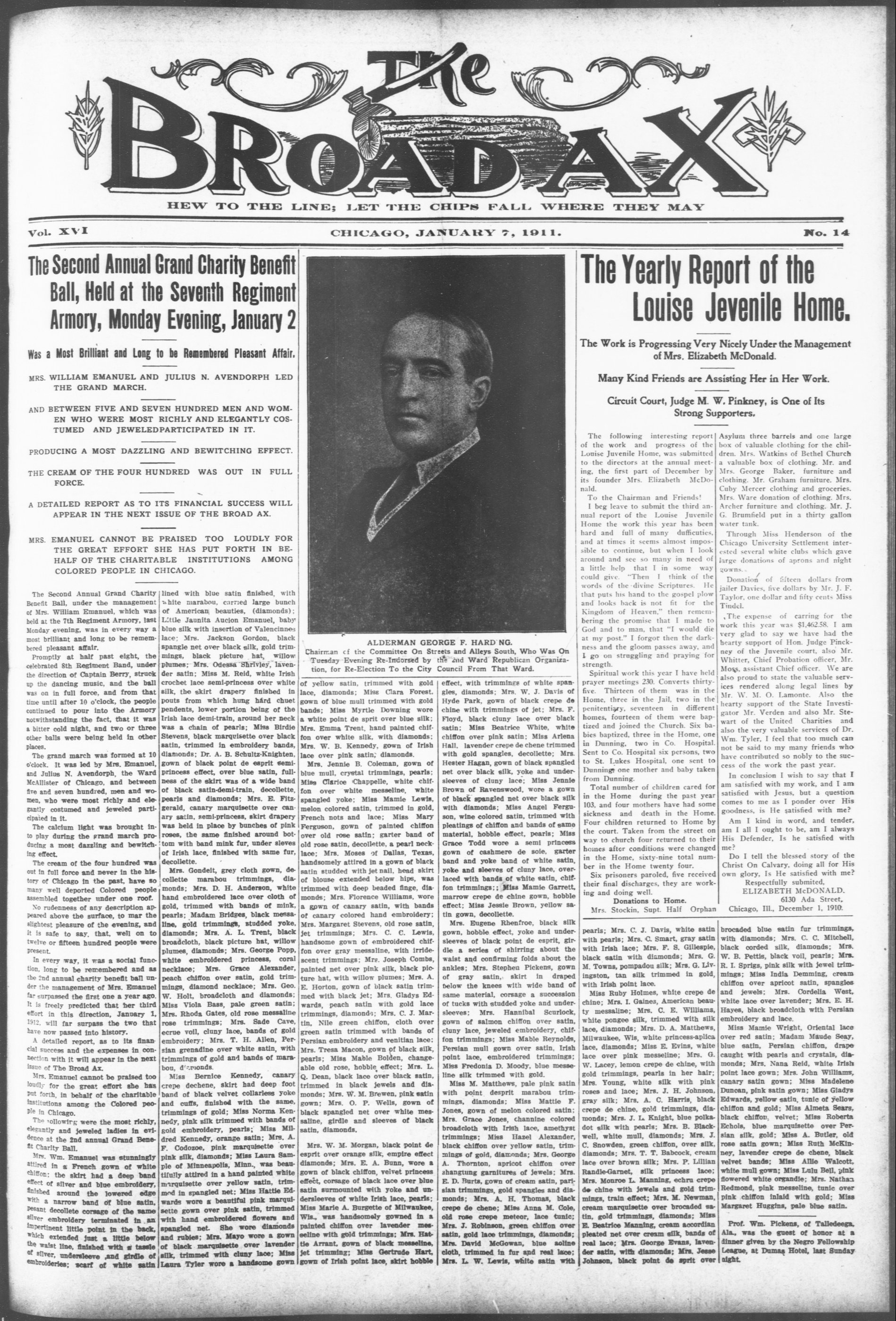
ALDERMAN GEORGE F. HARD NG.
Chairman of the Committee On Streets and Alleys South, Who Was On Tuesday Evening Re-Indorsed by the 2nd Ward Republican Organization, for Re-Election To the City Council From That Ward.
of yellow satin, trimmed with gold lace, diamonds; Miss Clara Forest. gown of blue mull trimmed with gold bands; Miss Myrtle Downing wore a white point de sprit over blue silk; Mrs. Emma Trent, hand painted chiffon over white silk, with diamonds; Mrs. W. B. Kennedy, gown of Irish lace over pink satin; diamonds.
effect, with trimmings of white spangles, diamonds; Mrs. W. J. Davis of Hyde Park, gown of black crepe and chine with trimmings of jet; Mrs. I. Floyd, black cluny lace over black satin; Miss Beatrice White, chiffon over pink satin; Miss Arlen Hall, lavender crepe de chene trimmed with gold spangles, decollette; Mr.
Mrs. Jennie B. Coleman, gown of blue mull, crystal trimmings, pearls; Miss Clarice Chappelle, white chiffon over white messeline, white spangled yoke; Miss Mamie Lewis, melon colored satin, trimmed in gold, French nots and lace; Miss Mary Ferguson, gown of painted chiffon over old rose satin; garter band of old rose satin, decollette, a pearl necklace; Mrs. Moses of Dallas, Texas, handsomely attired in a gown of black satin studded with jet nail, head skirt of blouse extended below hips, was trimmed with deep beaded finger, diamonds; Mrs. Florence Williams, wore a gown of canary satin, with bands of canary colored hand embroidery; Mrs. Margaret Stevens, old rose satin jet trimmings; Mrs. C. C. Lewis, handsome gown of embroidered chiffon over gray messeline, with iridescent trimmings; Mrs. Joseph Combs, painted net over pink silk, black picture hat, with willow plumes; Mrs. A. E. Horton, gown of black satin trimmed with black jet; Mrs. Gladys Edwards, peach satin with gold lace trimmings, diamonds; Mrs. C. J. Martin, Nile green chiffon, cloth over green satin trimmed with bands of Persian embroidery and venitian lace; Mrs. Tresa Macon, gown of black silk pearls; Miss Mable Bolden, changeable old rose, hobble effect; Mrs. L. Q. Dean, black lace over black satin, trimmed in black jewels and diamonds; Mrs. W. M. Brewen, pink satin gown; Mrs. O. P. Wells, gown of black spangled net over white messeline, girdle and sleeves of black satin, diamonds.
Mrs. W. M. Morgan, black point desprit over orange silk, empire effect diamonds; Mrs. E. A. Bunn, wore a gown of black chiffon, velvet princess effect, corsage of black lace over blue satin surmounted with yoke and undersleeves of white Irish lace, pearls; Miss Marie A. Burgette of Milwaukee, Wis., was handsomely gowned in a painted chiffon over lavender messeline with gold trimming;s Mrs. Hattie Arrant, gown of black messeline, jet trimming; Miss Gertrude Hart, gown of Irish point lace, skirt hobbie
effect, with trimmings of white spangles, diamonds; Mrs. W. J. Davis of Hyde Park, gown of black crepe de chine with trimmings of jet; Mrs. F. Floyd, black cluny lace over black satin; Miss Beatrice White, white chiffon over pink satin; Miss Arlena Hall, lavender crepe de chene trimmed with gold spangles, decollette; Mrs. Hester Hagan, gown of black spangled net over black silk, yoke and undersevees of cluny lace; Miss Jennie Brown of Ravenswood, wore a gown of black spangled net over black silk with diamonds; Miss Angel Ferguson, wine colored satin, trimmed with pleatings of chiffon and bands of same material, hobble effect, pearls; Miss Grace Todd wore a semi princess gown of cashmere de sole, garter band and yoke band of white satin, yoke and sleeves of cluny lace, overlaced with bands of white satin, chiffon trimmings;; Miss Mamie Garrett, marrow crepe de chine gown, hobble effect; Miss Jessie Brown, yellow satin gown, decollette.
Mrs. Eugene Rhenfroe, black silk gown, hobble effect, yoke and under sleeves of black point de esprit, girdle a series of shirring about the waist and confirming folds about the ankles; Mrs. Stephen Pickens, gown of gray satin, skirt in draped below the knees with wide band of same material, corsage a succession of tucks with studded yoke and under sleeves; Mrs. Hannibal Scurlock, gown of salmon chiffon over satin, cluny lace, jeweled embroidery, chiffon trimmings; Miss Mable Reynolds, Persian mull gown over satin, Irish point lace, embroidered trimmings; Miss Fredonia D. Moody, blue messeel silk trimmed with gold.
Miss M. Matthews, pale pink satin with point desprit marabou trimmings, diamonds; Miss Mattie F. Jones, gown of melon colored satin; Mrs. Grace Jones, channine colored broadcloth with Irish lace, amethyst trimmings; Miss Hazel Alexander, black chiffon over yellow satin, trimmings of gold, diamonds; Mrs. George A. Thornton, apricot chiffon over anguht garnitures of jewels; Mrs. E. D. Burts, gown of cream satin, parisian trimmings, gold spangles and diamonds; Mrs. A. H. Thomas, black crepe de chene; Miss Anna M. Cole, old rose crepe meteor, lace tunic; Mrs. J. Robinson, green chiffon over satin, gold lace trimmings, diamonds; Mrs. David McGowan, blue soline cloth, trimmed in fur and real lace; Mrs. L. W. Lewis, white satin with
The Yearly Report of the Louise Jevenile Home.
The Work is Progressing Very Nicely Under the Management of Mrs. Elizabeth McDonald.
Many Kind Friends are Assisting Her in Her Work.
Circuit Court, Judge M. W. Pinkney, is One of Its Strong Supporters.
The following interesting report of the work and progress of the Louise Juvenile Home, was submitted to the directors at the annual meeting, the first part of December by its founder Mrs. Elizabeth McDonald.
Asylum three barrels and one large box of valuable clothing for the children. Mrs. Watkins of Bethel Church a valuable box of clothing. Mr. and Mrs. George Baker, furniture and clothing. Mr. Graham furniture. Mrs. Cuby Mercer clothing and groceries.
To the Chairman and Friends!
I beg leave to submit the third annual report of the Louise Juvenile Home the work this year has been hard and full of many dufficulties, and at times it seems almost impossible to continue, but when I look around and see so many in need of a little help that I in some way could give. "Then I think of the words of the divine Scriptures. He that puts his hand to the gospel plow and looks back is not fit for the Kingdom of Heaven," then remembering the promise that I made to God and to man, that "I would die at my post." I forgot then the darkness and the gloom passes away, and I go on struggling and praying for strength.
Spiritual work this year I have held prayer meetings 230. Converts thirty-five. Thirteen of them was in the Home, three in the Jail, two in the penitentiary, seventeen in different homes, fourteen of them were baptized and joined the Church. Six babies baptized, three in the Home, one in Dunning, two in Co. Hospital. Sent to Co. Hospital six persons, two to St. Lukes Hospital, one sent to Dunning, one mother and baby taken from Dunning.
Total number of children cared for in the Home during the past year 103, and four mothers have had some sickness and death in the Home. Four children returned to Home by the court. Taken from the street on way to church four returned to their homes after conditions were changed in the Home, sixty-nine total number in the Home twenty four.
Six prisoners paroled, five received their final discharges, they are working and doing well.
Donations to Home.
Mrs. Stockin. Supt. Half Orphan
pearls; Mrs. C. J. Davis, white satin with pearls; Mrs. C. Smart, gray satin with Irish lace; Mrs. F. S. Gillesple, black satin with diamonds; Mrs. G. M. Towns, pompadou silk; Mrs. G. Livingston, tan silk trimmed in gold, with Irish point lace.
Miss Ruby Holmes, white crepe de chine; Mrs. I. Gaines, American beauty messaline; Mrs. C. E. Williams, white pongee silk, trimmed with silk lace, diamonds; Mrs. D. A. Matthews, Milwaukee, Wis, white princess-aplica lace, diamonds; Miss E. Evins, white lace over pink messaline; Mrs. G. W. Lacey, lemon crepe de chine, with gold trimmings, pearls in her hair; Mrs. Young, white silk with pink roses and lace; Mrs. J. H. Johnson, gray silk; Mrs. A. C. Harris, black crepe de chine, gold trimmings, diamonds; Mrs. J. L. Knight, blue polkadot silk with pearls; Mrs. B. Blackwell, white mull, diamonds; Mrs. J. C. Snowden, green chiffon, over silk, diamonds; Mrs. T. T. Babcock, cream lace over brown silk; Mrs. P. Lillian Randle-Garnet, silk princess lace; Mrs. Monroe L. Manning, echru crepe de chine with jewels and gold trimmings, train effect; Mrs. M. Newman, cream marquette over brocaded satin, gold trimmings, diamonds; Miss E. Beatrice Manning, cream accordian pleated net over cream silk bands of real lace; Mrs. George Evans, lavender satin, with diamonds; Mrs. Jesse Johnson, black point de spire over
port of the
sevenile Home.
Nicely Under the Management
with McDonald.
assisting Her in Her Work.
W. Pinkney, is One of Its
supporters.
Asylum three barrels and one large box of valuable clothing for the children. Mrs. Watkins of Bethel Church a valuable box of clothing. Mr. and Mrs. George Baker, furniture and clothing. Mr. Graham furniture. Mrs. Cuby Mercer clothing and groceries. Mrs. Ware donation of clothing. Mrs. Archer furniture and clothing. Mr. J. G. Brumfield put in a thirty gallon water tank.
Through Miss Henderson of the Chicago University Settlement interested several white clubs which gave large donations of aprons and night gowns.
Donation of fifteen dollars from jailer Davies, five dollars by Mr. J. F. Taylor, one dollar and fifty cents Miss Tindel.
The expense of carring for the work this year was $1,462.58. I am very glad to say we have had the hearty support of Hon. Judge Pinckney of the Juvenile court, also Mr. Whitter, Chief Probation officer, Mr. Moss, assistant Chief officer. We are also proud to state the valuable services rendered along legal lines by Mr. W. M. O. Lamonte. Also the hearty support of the State Investigator Mr. Verden and also Mr. Stewart of the United Charities and also the very valuable services of Dr. Wm. Tyler, I feel that too much can not be said to my many friends who have contributed so nobly to the success of the work the past year.
In conclusion I wish to say that I am satisfied with my work, and I am satisfied with Jesus, but a question comes to me as I ponder over His goodness, is He satisfied with me?
Am I kind in word, and tender, am I all I ought to be, am I always His Defender, Is he satisfied with me?
Do I tell the blessed story of the Christ On Calvary, doing all for His own glory, Is He satisfied with me?
ELIZABETH MCDONALD.
6130 Ada Street,
Chicago, Ill., December 1, 1910.
brocaded blue satin fur trimmings,
with diamonds; Mrs. C. C. Mitchell,
black corded silk, diamonds; Mrs.
W. B. Pettis, black voil, pearls; Mrs.
R. I. Sprigs, pink silk with jewel trimmings;
Miss India Demming, cream
chiffon over apricot satin, spangles
and jewels; Mrs. Cordella West,
white lace over lavender; Mrs. E. H.
Hayes, black broadcloth with Persian
embroidery and lace.
Miss Mamie Wright, Oriental lace over red satin; Madam Maude Seay, blue satin, Persian chiffon, drape caught with pearls and crystals, diamonds; Mrs. Nana Reid, white Irish point lace gown; Mrs. John Williams, canary satin gown; Miss Madelene Duncan, pink satin gown; Miss Gladys Edwards, yellow satin, tunic of yellow chiffon and gold; Miss Almeta Sears, black chiffon, velvet; Miss Roberta Echols, blue marquiseette over Persian silk, gold; Miss A. Butler, old rose satin gown; Miss Ruth McKinney, lavender crepe de chene, black velvet bands; Miss Allie Walcott, white mull gown; Miss Lulu Bell, pink flowered white organdie; Mrs. Nathan Redmond, pink messeline, tunic over pink chiffon inlaid with gold; Miss Margaret Huggins, pale blue satin.
Prof. Wm. Pickens, of Talledeega, Ala., was the guest of honor at a dinner given by the Negro Fellowship League, at Dumas Hotel, last Sunday night.
---
Will promulgate and at all times uphold the true principles of Democracy, but Catholics, Protestants, Priests, Infidels, Single Taxers, Republicans, or anyone else can have their say, as long as their language is proper and responsibility is fixed. The Broad Ax is a newspaper whose platform is broad enough for all, ever claiming the editorial right to speak its own mind. Local communications will receive attention. Write only on one side of the paper. Subscriptions must be paid in advance. $2.00
Address all communications to
PHONE DREXEL 4590.
JULIUS F. TAYLOR, Editor and Publisher.
Entered as Second-Class Matter Aug. 19, 1902, at the Post Office at Chicago, Illinois, under Act of March 3, 1879.
EYES EXAMINED AND TREATED.
Dr. P. J. Scott, ocular specialist. Spectacles and eey glasses made to order. 2636½ State street, Chicago.
BIG COMMITTEE TO AID HARRISON FOR MAYORAL BOOM.
Increased activity in the furtherance of the candidacy of Carter H. Harrison for the Democratic nomination for Mayor is expected to follow the naming of an organization committee of forty-five and the opening of two new headquarters. As each ward is given a representative on the committee, the work of organizing the precincts of each will be expedited. The personnel of the Carter H. Harrison central organization was announced as follows:
President—Alderman Peter Reinberg; Vice-Presidents, Congressman A. J. Sabath, Phillip J. M'Kenna, Alderman Charles Twigg, Dr. W. A. Kuflewski, John G. Garibaldi, Aldermen James Donohoe and Thomas J. Powers; Treasurer, James J. Bowers; Secretary, Maclay Hoyne,
Ward Committeemen.
First Ward—Alderman John Coughlin; Second Ward—A. B. Perrigo; Third Ward—Robert Redfield; Fourth Ward—P. J. Wall; Fifth Ward—James J. M'Cormick; Sixth Ward—Mark Solamon; Seventh Ward—S. Crawford Ross; Eighth Ward—Edward Cohen; Ninth Ward—Emanuel Abrahams; Tenth Ward—F. J. Skala; Eleventh Ward—Alderman Frank P. Danisch; Twelfth Ward—Sheriff Michael Zimmer; Thirteenth Ward—Daniel Donohoe; Fourteenth Ward — Christopher M'Gurn; Fifteenth Ward—J. M. Laventhal; Sixteenth Ward—William Kozlowski; Seventeenth Ward—Richard M'Grath; Eighteenth Ward—B. J. Grogan; Nineteenth Ward—John F. Powers; Twentieth Ward—John T. Murray; Twenty-first Ward—Robert E. Burke; Twenty-Second Ward—Alderman Herman J. Bauler; Twenty-third Ward—Otto Spankuch; Twenty-fourth Ward—William H. Ehemann; Twenty-fifth Ward—William H. Sexton. Twenty-seventh Ward—Charles C. Breyer; Twenty-eighth Ward—Frank Paschen; Twenty-ninth Ward—John Downey; Thirtieth Ward—Russell; Thirty-first Ward—William M. Davis; Thirty-second Ward—J. H. Madigan; Thirty-third Ward—Peter S. Goodman; Thirty-fourth Ward—Dr. J. F. Chwatal; Thirty-fifth Ward—George R. Bruce.
Two Campaign Headquarters.
The campaign will be directed from the Briggs House, where headquarters have been opened.
Another Harrison headquarters has been opened by the Reunited County Democracy, at 81 Cark street, and it will be in charge of Robert E. Burke.
CHARLES SUMNER DAY AT THE NEGRO FELLOWSHIP LEAGUE.
Frank S. Stewart, Editor of the League Journal will speak Sunday, January 8th, at 4 P. M., at the Reading Room, 2830 State street. As this is the one Hundredth Anniversary of the birth of Charles Sumner, his subject will be "Life and Times" of Charles Sumner. Music by the Negro Fellowship League, Orchestra. All invited. The regular business meeting at the close of the session. Welcome to all.
IDA B. WELLS, Pres.
C. K. SMITH, Sec.
MANY OF THE LEADING AFRO-AMERICAN JOURNALS ISSUED FINE AND INTERESTING HOLIDAY EDITIONS.
The New York Age, issued by far the best and most interesting holiday edition. It was brimful of live and instructive reading matter.
Its stage notes and theatrical news, by Lester Walton, was its leading feature.
The Freeman, Indianapolis, Ind., consisted of 12 pages, and contained the cuts of many prominent theatrical people and much space was devoted to Booker T. Washington and his work at Tuskegee.
On the whole, the Freeman was not as good as in former years.
The Bystander, Des Moines, Iowa was very neat and attractive and it showed that editor and brother Thompson, had done some tall hustling to keep it up to its high standard.
Our Review, of Little Rock, Ark.. is worthy of mention. Its editor and owner, E. M. Woods, deserves much credit for turning out such a bright holiday number. It contained a full article from The Broad Ax, on the new play the "Nigger" by Attorney Walter M. Farmer.
The Independent, of Denver, Colo, was by far the best of all the western papers. It consisted of 12 pages, of a high quality of paper; and contained cuts representing the homes, owned by well onto 50 or 60 of the leading Colored people of that city. It is an interesting and valuable number and reflects much credit on its owners and publishers. The Illinois Chronicle of December 31 contained a very interesting review and notes as to the number of Colored people engaged in various lines of business in this city. It would well repay any one to familiarize themselves with the holiday issues of the above mentioned papers
COMPLIMENTARY BANQUET
GIVEN IN HONOR OF SENA-
TOR WILLIAM LORIMER.
At The Institutional Church Monday
Evening, January 2nd.
REV. A. J. CARY TOASTMASTER
Sunday evening. January 1. United States Senator William Lorimer, was the speaker on the Emancipation at the Institutional Church, 3825 Deadborn street.
It was well filled and Senator Lorimer made the practical talk, which was indeed more than suitable for the occasion, and he was listened to with rapt attention by his large audience.
Col. B. F. Moseley, followed him with some of his eloquent remarks which woke the people up.
On Monday evening a complimentary banquet was tendered to Senator Lorimer, at the same place. Rev. A. J. Cary, presided as Toastmaster.
The Menu, was par excellent, and the eatables were greatly enjoyed by those sitting around the banquet table.
The following after-dinner toasts were heartily responded to.
"The Institutional Church, Its Mission to the State" Hon. Martin B. Madden; The Bright Side of a Dark Subject"; Attorney J. Gray Lucas; "The Day we Celebrate." Lawyer B. F. Moseley; "Some Phases of Our City Life." Hon. E. E. J. Magerstadt; "He Who Would Have a Friend Must be a Friend," Judge John R. Newcomer; "Illinois," editor S. B. Turner; "The Pulpit and Politics," Rev. H. E. Stewart; "Looking Forward," Thomas Wallace Swann, short remarks by Lawyers Patrick H. O'Donnell and Walter M. Farmer.
"Our Guest—The Junior Senator from Illinois, Hon. Elbridge Hanecy. Response Hon. William Lorimer, United States Senator, Illinois.
PAUL LAURENCE DUNBAR
MEMORIAL SANITARIUM.
Dr. Anna R. Cooper is putting forth every effort and is meeting with every encouragement towards establishing a Sanitarium, where special attention can be given to the prevention, care and treatment of Tuberculosis. This Sanitarium is to be known as the Paul Laurence Dunbar Memorial, an ideal sight has been selected in a nearby suburb. The sum of $25,000 is needed to purchase this beautiful building and 9 acres of ground and to erect some cottages necessary equipped for persons in need of Recreation and Recuperation, as well as care for Tuberculosis. To aid in this worthy cause a series of social affairs are being arranged for among the Smart Set.
An Entertainment and Dance will be given on Wednesday night, Jan. 11th, 1911, at Woods Annex Academy, 63rd street and Washington avenue. Music by Prof. Garfield Wilson Orchestra, Director. Admission 25 cents. Anna R. Cooper, M. D., Pres. Mrs. Louise Waller, Sec., Mrs. Fannie Turner, Treas.
WHICH SHALL IT BE: DOLLARS
OR DEATHS?
Cities having increasing appropriations for health work show a decreasing death rate. Of these New York is a good example, as a large city, having a great density of population and at the same time a large foreign eelment. Here with an appropriation for health service nearly three times as great as Chicago's there has been effected a steady reduction of the death rate. The comparison is shown by the following table: New York City—Decreasing Death Rates, 1908, 16:8; 1909, 16.0; 1900, 15.9. Chicago—Increasing Death Rates, 1908, 14.0; 1909, 14.6; 1910, 15.2.
New York's deaths have decreased 9 per cent 10,000 of population in two years; Chicago's deaths have increased 12 per 10,000 of population in two years. Chicago's appropriation for health conservation decreased 35 per cent during this period.
The preventable diseases killed about 15,000 Chicagoans during 1910, these being nearly one-half of the total deaths from all causes. Pneumonia and all other causes with 5679 deaths, tuberculosis comes second in order of highest mortality with 3812 deaths, while diarrheal diseases hold third position, having claimed 3084 little children under two years of age as victims during the twelve months. Other preventable diseases killed as follows : Diphtheria, 840; scarlet fever, 367; typhoid fever, 302; measles, 176, and whooping cough, 175. Six thousand, eight hundred and three children under one year of age and 3269 between the ages of one and five years died during the year. About 65 per cent of these deaths were unnecessary; they were caused by the preventable diseases, the chief of which were the diarrheal diseases.
Chicago now has a twenty-one cent per capita Health Department. Some of this money is spent for things not closely connected with health; some part of it is relief. A twenty-one cent Health Department for Chicago can hold the gross death rate under 16 per 1000 for a few years. It can hold the number of deaths from diphtheria at about 800; from scarlet fever at about 600; typhoid at about 300 and baby deaths from summer complaint at about 3000. It can keep smallpox epidemics about twelve years apart and paralyzing epidemics of diphtheria or scarlet fever about four or six years apart.
A Health Department spending fifty cents per capita should put diphtheria down to say, 100 deaths per year; scarlet fever to about 500; typhoid to 120; and cut off 5 per cent from the consumption mortality. It should be able to add 10 years to the smallpox intervals, and 3 or 4 years to the diphtheria and scarlet fever intervals.
The final conclusion is that we can have freedom from preventable diseases in proportion as we are willing to pay for it. We cannot have something for nothing. A twenty-one cent Health Department means about 15,000 deaths from preventable disease a year. If we pay more, we will have fewer. If we pay less we will have more.
AMANDA SMITH'S BIRTHDAY.
Amanda Smith birthday occurs January 23rd, and it finds her still active and bringing forth fruit at the ripe age of seventy-four. As the founder and manager of the Orphanage bearing her name, Mrs. Smith has been giving all her time and energies to the care of this institution. During the summer a complete breakdown was threatened, but fortunately the way was opened for her to take a trip to her old "stamping ground" in the east. After an absence of two months she returned very much refreshed, and just in time to superintend the completion of a much-needed dormitory, funds for which have been forthcoming. Her right hand of power is an executive committee, whose purpose is to assist in placing the Orphanage upon a sound basis financially and otherwise.
CHATEAU RINK NOTES.
Big Mask Carnival on Thursday night at the Chateau was a grand success and made a great hit.
* * * *
Don't forget that there is dancing after the skate program tonight and tomorrow night.
* * * *
The talk of the town, the Big Negro National League. Detroit is negotiating to get into the League which will make a ten city circuit and promises to be the best move vet by our magnates.
GRAHAM BANK OFFICERS
OPEN $100,000 HOME.
Graham & Sons, bankers, opened their new $100,000 building at 659 West Madison street, the first of this week, the bank having moved from its old quarters next door since it closed Saturday. A large crowd of depositors was on hand, as well as financiers and personal friends, and all inspected the new structure with approval. Joseph W. Graham, son of Andrew J. Graham, founder of the bank, opened the institution in its new location by making the first deposit. The building is a handsome structure of concrete, with bronze and marble finishings, and with a heavy granite front.
The bank now has 18,000 depositors, having grown twenty-four per cent during the last year. It was founded twenty-two years ago by Andrew J. Graham, the old number being 174 West Madison street. Frank J. Graham and Ralph Graham are the sons associated with Andrew Graham in the bank. The former was married last May to Miss Carlye Gray. Mr. Graham, Sr., celebrated his twenty-fifth wedding anniversary last November. Mr. Graham expressed himself as delighted with the outlook at the opening of his new building, said to be the handsomest banking structure outside of the Loop district.
TUBERCULOSIS MILLIONS DOUB
LED IN 1910.
$15,000,000 Spent in Consumption Fight
—Over 62 Per Cent. Public Money.
How the money spent last year in the anti-tuberculosis campaign practically doubled that spent in 1969, is shown in the second annual statistical statement published today by the National Association for the Study and Prevention of Tuberculosis, in its official organ, the Journal of the Outdoor Life.
The statement, which is based on reports from all parts of the United States, shows that in 1910, nearly $15,000,000 was spent in the fight against tuberculosis, as opposed to $8,000,000 spent in 1909. The largest item of expense in 1910 was for treatment in sanatoria and hospitals, $11,376,500 being expended for that purpose, or more than double the amount for 1909. The anti-tuberculosis associations spent $760,500, and the tuberculosis dispensaries, $889,000. The special municipal and state expenditures aggregate $1,750,000.
The statement declares that the most significant fact in the survey of the year's work is the increase in the percentage of public money spent. While in 1909, 53.5 per cent of the total expenditures was from federal state, municipal or county funds. 62.6 per cent. came from public appropriations in 1910. The actual amount of public money spent in tuberculosis work this past year was $9,267,900, or more than double the amount from this same source in 1909. This fact indicates, the National Association declares, that anti-tuberculosis associations are gaining ground, by securing increased appropriations from public money.
New York State again leads the country in the money spent, her total of $4,245,000 being more than double her expenditures for tuberculosis work in 1909. Pennsylvania is the second state and Massachusetts comes third.
RECEPTION AND WHIST PARTY
IN HONOR OF MISS W. H.
COOPER.
There was a grand reception given in honor of Miss Willie H. Cooper, of Nashville, Tenn., a school teacher who is here visiting during the holidays and who left Sunday evening, Jan. 1. The reception was given by Mrs. Mary Tribute at her residence, 5436 Drexel Avenue, Friday, Decembr 30. There were many present. All seemed to enjoy themselves nicely. Orchestra selections and whist playing were the features of the evening.
DINNER PARTY IN HONOR OF MR J. B. HAGANS, OF SPOKANE, WASHINGTON.
Mr. and Mrs. John Hagans, 5031 Shields Avenue, the latter part of last week, gave a very elaborate dinner from 4 to 7:30 in honor of J. B. Hangan, of Spakone, Washington, brother of the host who was the guest of honor, who recited several recitations to the delight of all present.
Mrs. R. Sanders, rendered some very choice selections on the piano. Madame Hagans was at her very best at entertaining her friends. Mrs. Hattie Madison, Mr. Stephen Buckner and Mr. and Mrs. Joe Gordon, were among the many guests present.
Mrs. Richard E. Moore Hostess
The beautiful home of Mrs. Albreta M. Smith was a scene of beauty, Monday, Jan. 2nd, when her mother, Mrs. R. E. Moore, acted hostess to forty charming ladies who were her guests from 1 to 7 p.m.
Dancing and whist were the pleasures indulged in. The prizes were won by Madams Senora Yerby and Geo. C. Hall and Miss Ada Lou Mitchell.
A delightful repast was served by the Terry Catering Co.
Mrs. Moore was gowned in black chiffon over white satin and was assisted by her daughters, Mrs. A. M. Smith and Mrs. J. W. Shoecraft.
CHIPS
The friends of Miss Rosalee Eddie will be pleased to learn that she is recovering from her illness.
Several young men have purchased beautiful diamond rings, so we can expect to hear from them in early June.
Capt. and Mrs. James S. Nelson, 3552 Wabash avenue, recently bought a fine eight flat building at 3518 and 3520 Rhodes avenue.
Mrs. Carrie Warner, 5223 Dearborn street, returned home Tuesday morning from St. Louis, Mo., where she spent the holidays in visiting with her mother and sister.
Mrs. A. T. Zedricks, 3536 State St., has returned to this city after visiting her sick uncle, Mr. Henry Bland in Milwaukee, Wis.
Mr. and Mrs. E. W. Carter. 5025 Armour avenue, returned Saturday morning from a most enjoyable trip with relatives and friends at St. Louis, Mo.
Mrs. W. H. Hayman, 3236 Wabash avenue, was confined to her home through sickness New Years day and she was unable to attend the 2nd Annual Charity Ball, at the 7th Regiment Armory, Monday evening.
Miss Anna M. Cole, cashier for Jesse Binga, the banker, on Wednesday evening fell on the ice at 36th and State street and severely cut the side of her head, she is slowly recovering from its effect.
Madame Corinne Brown the celebrated robust tenor singer left the city Monday with the S. H. Lane Box Ton Company with which she will travel through Ohio and adjacent States. She will be assisted by a chorus of good singers.
Mrs. Alice Thomas, wife of Rev. P. R. Thomas, 3738 Wabash avenue, died Sunday, January 1st. Funeral from residence, Tuesday morning to Mt. Glenwood cemetery. Rev. E. T. Martin of Bethesda Baptist Church officiated.
Mrs. Walter M. Farmer, 4856 Langley avenue, entertained at luncheon. Saturday. December 31st, Misses Thomas and Dickson of St. Louis, Mo. quite a number of young ladies were present and spent an enjoyable evening.
Mr. David Lillard, a well-known business man of Gary, Ind., died Tuesday, Jan. 3rd. He was a member of Hiram Lodge, F. A. M., of Chicago. His body is now in charge of Jacob L. Parks, undertaker and will be shipped to Bowling Green, Ky., where it will be interred.
Mrs. S. Blackwell entertained thirty-five guests at the Appomattox Club House on Wednesday afternoon, Dec. 28th, from 2 to 5 p. m. The ladies played whist and all present reported a delightful afternoon spent. Mrs. Blanch Cornwell won first prize and Mrs. Maud Lawrence won second prize.
Mr. and Mrs. S. A. McElwee, 3230 Forest Ave., have given in marriage their daughter, Miss Helen to Mr. Green Carter of San Antonia, Texas. The wedding took place Saturday, Dec. 31st, at high noon. Both Mr. and Mrs. Carter are well know among the younger social set and their many friends wish them much happiness and success.
The I-Will-Boosters Club is one of the coming organizations among our people. It has been organized under the laws of the State of Illinois, its object is to promote sociability, cooperation, true friendship, and benevo
---
lence among and for its members, in
other words to boost every Negro
Enterprise that warrants its support.
It meets every Sunday in Gordon Hall.
3152 Dearborn street. Public always
invited.
One of the jollest parties who were out calling New Year's day was one made up a few Chicago Tuskegee Club boys. Their auto was decorated with the famous Tuskegee colors gold and red. Messrs. A. G. Chandler, Claude Barnett, W. E. Mitchell, C. S. Twitty, W. K. Fleming and A. B. Washington composed the bunch and they made everybody's house from Englewood to New Street.
Mr. Alonzo G. Chandler, the retiring president of the Chicago Tuskegee Club, who is leaving the city, was tendered a farewell surprise party by the club last Wednesday evening at his residence, 6504 St. Lawrence ave. ave. he was presented with a silk pennant, a token from the members who appreciate his sterling work as the leader of the club. Many a very pleasant evening was enjoyed, a feature being the pledging by the members, present, of $50.00 toward the Y M C. A. building fund.
The American Beauty Club entertained at cards in honor of Mrs. M Humphrey, 3666 Wabash avenue Thursday evening, December 29th, 1910. After an interesting progressive game, the following program was rendered: Instrumental Solo; Little Gertrude Barber; Reading Toussaint L'Ouverture, Mr. John G Burns; Instrumental Solo, Miss Cora Spriggs; Reading, Bro Ephirim's Plain Talk, Mrs. Geo. A Tenny Solo, Miss Cora Spriggs; Reading, Monologues on Ladies Clubs and Societies, Mrs. J. O. Barber. Every one enjoyed the evening. Mrs. M Humphrey, Pres. Mrs. J. G. Burns, Secretary.
DODGING THE TAX MAN
How One Wealthy New York Family Laughs at His Bill.
One method by which the rich man evades his legal taxes and leaves the poor man to bear the tax burden alone Mr. A. T. Nock describes in the American Magazine as follows:
"Let me tell you a story of a wealthy New York family, one of the many resident nonresident families whose legal headquarters are in New Jersey, but who are New Yorkers for every purpose but taxation.
"The family consists of three persons—man, wife and mother. They have a magnificent home in New York and under the nonresident law were assessed moderately on their household goods and ornaments.
"The assessment, $10,000, was entered against the man as head of the family. He appeared before the commissioners, swore that he did not own the property, and the assessment lapsed for that year.
"Next year it was entered against all three—man, wife and mother. Each appeared and swore that he (or she) did not own the property, and again the assessment lapsed. When asked who the owner of the property was they replied, by advice of counsel, that it was the commissioners' business to find out.
"The long and short of it was that to save the tax bill of about $170 a year the three had incorporated themselves as a New Jersey corporation for the sole purpose of holding those household goods. The property was owned by the family as corporation property, and none of the three was personally liable."
BUMPED IN A BAG.
The Newest Scheme For Stealing Gold From Uncle Sam's Coins.
Secret service agents of the United States government have been working for some time in Maiden lane, New York, in an effort to trace robbers who have devised a new form of coin trimming.
Gold coins are put in a burlap bag and shaken briskly for an hour or two. The result is that tiny pieces of the metal are knocked off the surfaces and edges and cling to the bag. The coins are then put into circulation apparently no more worn or battered than most money that has been in use for a year or two. The bag is burned up, and this leaves the melted gold, which is gathered up and sold to the jewelry manufacturers.
The subtreasury and the treasury department at Washington have been receiving large quantities of gold coins of recent date which are short in weight from 5 to 15 per cent and which seem worse battered than coins subjected to the usual wear and tear. On microscopic investigation they discovered that the gold pieces had been subjected to some violent treatment, and they sought clews and discovered the method of stealing from the coins by shaking them in a sack.—Christian Herald.
A Quaint Specimen.
What's the matter now?
"A magazine has just printed a football story accepted from me in 1880."
"What of it?"
"Well, it was couched in the sporting slang of thirty years ago."—Louisville Courier-Journal.
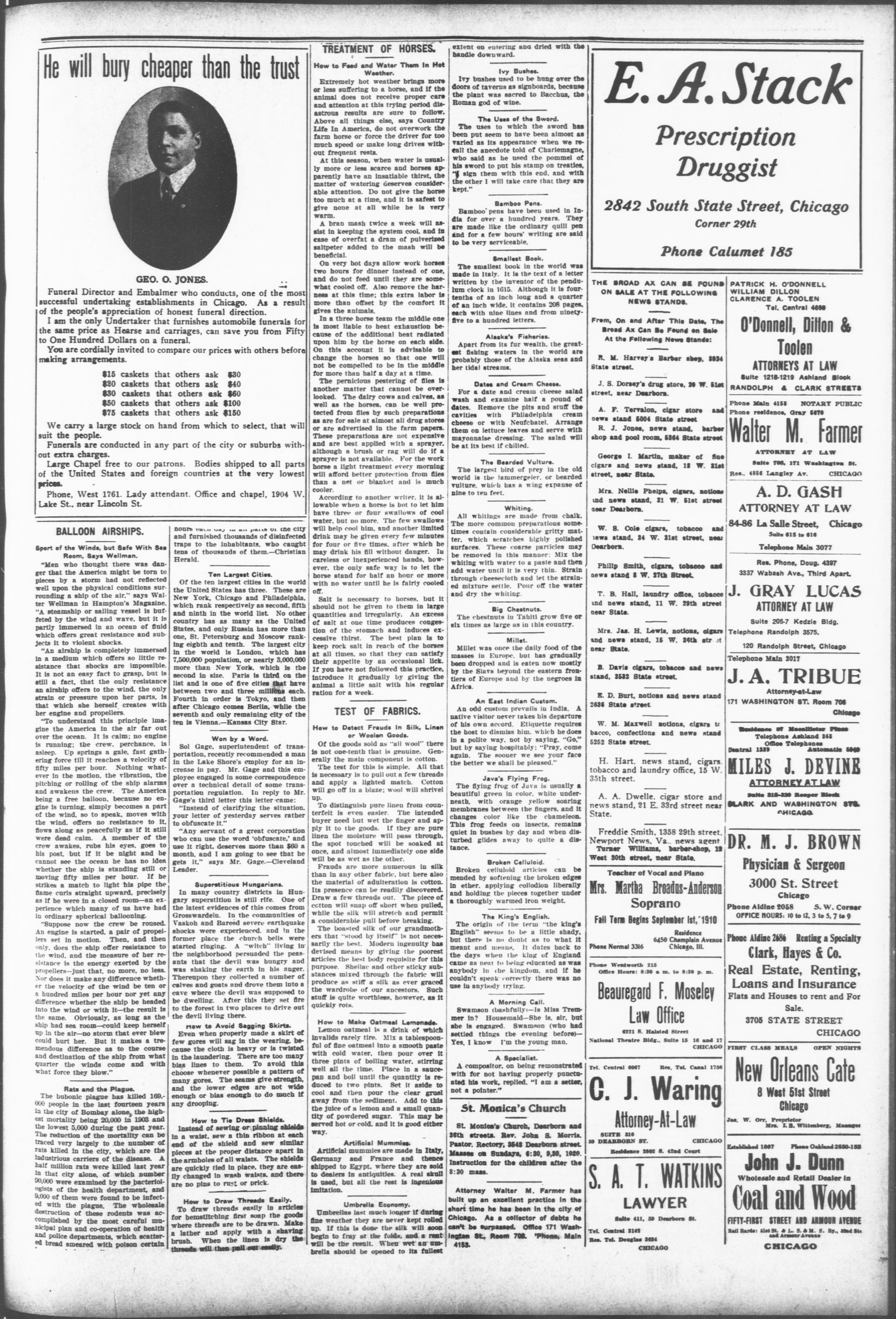
He will bury cheaper than the trust
[Name]
GEO. C
Funeral Director and Embalm
successful undertaking establish
of the people's appreciation of
I am the only Undertaker that
the same price as Hearse and o
to One Hundred Dollars on a fu
You are cordially invited to com
making arrangements.
We carry a large stock on ha suit the people. Funerals are conducted in any out extra charges. Large Chapel free to our path of the United States and forest prices. Phone, West 1761. Lady attes Lake St., near Lincoln St.
We carry a large stock on hand from which to select, that will suit the people. Funerals are conducted in any part of the city or suburbs without extra charges.
Phone, West 1761. Lady attendant. Office and chapel, 1904 W. Lake St., near Lincoln St.
BALLOON AIRSHIPS.
Sport of the Winds, but Safe With Sea Room, Says Wellman.
"Men who thought there was danger that the America might be torn to pieces by a storm had not reflected well upon the physical conditions surrounding a ship of the air." says Walter Wellman in Hampton's Magazine. "A steamship or sailing vessel is butfeted by the wind and wave, but it is partly immersed in an ocean of fluid which offers great resistance and subjects it to violent shocks.
"An airship is completely immersed in a medium which offers so little resistance that shocks are impossible. It is not an easy fact to grasp, but is still a fact, that the only resistance an airship offers to the wind, the only strain or pressure upon her parts, is that which she herself creates with her engine and propellers.
"To understand this principle imagine the America in the air far out over the ocean. It is calm; no engine is running; the crew, perchance, is asleep. Up springs a gale, fast gathering force till it reaches a velocity of fifty miles per hour. Nothing whatever in the motion, the vibration, the pitching or rolling of the ship alarms and awakens the crew. The America being a free balloon, because no engine is turning, simply becomes a part of the wind, so to speak, moves with the wind, offers no resistance to it, flows along as peacefully as if it still were dead calm. A member of the crew awakes, rubs his eyes, goes to his post, but if it be night and he cannot see the ocean he has no idea whether the ship is standing still or moving fifty miles per hour. If he strikes a match to light his pipe the flame curls straight upward, precisely as if he were in a closed room—an experience which many of us have had in ordinary spherical ballooning.
"Suppose now the crew be roused. An engine is started, a pair of propellers set in motion. Then, and then only, does the ship offer resistance to the wind, and the measure of her resistance is the energy exerted by the propellers—just that, no more, no less. Nor does it make any difference whether the velocity of the wind be ten or a hundred miles per hour nor yet any difference whether the ship be headed into the wind or with it—the result is the same. Obviously, as long as the ship had sea room—could keep herself up in the air—no storm that ever blew could hurt her. But it makes a tremendous difference as to the course and destination of the ship from what quarter the winds come and with what force they blow."
Rats and the Plague
The bubonic plague has killed 160,000 people in the last fourteen years in the city of Bombay alone, the highest mortality being 20,000 in 1903 and the lowest 5,000 during the past year. The reduction of the mortality can be traced very largely to the number of rats killed in the city, which are the industrious carriers of the disease. A half million rats were killed last year in that city alone, of which number 90,000 were examined by the bacteriologists of the health department, and 9,000 of them were found to be infected with the plague. The wholesale destruction of these rodents was accomplished by the most careful municipal plan and co-operation of health and police departments, which scattered bread smeared with poison certain
---
A. JONES.
oer who conducts, one of the most moments in Chicago. As a result, honest funeral direction.
It furnishes automobile funerals for carriages, can save you from Fifty general.
Compare our prices with others before
and from which to select, that will be part of the city or suburbs with- rons. Bodies shipped to all parts sign countries at the very lowest antant. Office and chapel, 1904 W. hours each day in all parts of the city and furnished thousands of disinfected traps to the inhabitants, who caught tens of thousands of them.—Christian Herald.
Ten Largest Cities
Of the ten largest cities in the world the United States has three. These are New York, Chicago and Philadelphia, which rank respectively as second, fifth and ninth in the world list. No other country has as many as the United States, and only Russia has more than one, St. Petersburg and Moscow ranking eighth and tenth. The largest city in the world is London, which has 7,500,000 population, or nearly 3,000,000 more than New York, which is the second in size. Paris is third on the list and is one of five cities that have between two and three millions each. Fourth in order is Tokyo, and then after Chicago comes Berlin, while the seventh and only remaining city of the ten is Vienna.-Kansas City Star.
Won by a Word.
Sol Gage, superintendent of transportation, recently recommended a man in the Lake Shore's employ for an increase in pay. Mr. Gage and this employee engaged in some correspondence over a technical detail of some transportation regulation. In reply to Mr. Gage's third letter this letter came: "Instead of clarifying the situation, your letter of yesterday serves rather to obfuscate it." "Any servant of a great corporation who can use the word 'obfuscate,' and use it right, deserves more than $60 a month, and I am going to see that he gets it," says Mr. Gage.-Cleveland Leader.
Superstitious Hungarians.
In many country districts in Hungary superstition is still rife. One of the latest evidences of this comes from Grosswardein. In the communities of Vaskoh and Baresd severe earthquake shocks were experienced, and in the former place the church bells were started ringing. A "witch" living in the neighborhood persuaded the peasants that the devil was hungry and was shaking the earth in his anger. Thereupon they collected a number of calves and goats and drove them into a cave where the devil was supposed to be dwelling. After this they set fire to the forest in two places to drive out the devil living there.
rnew to Avoid Sagging Skirts.
Even when properly made a skirt of few gores will sag in the wearing, because the cloth is heavy or is twisted in the laundering. There are too many bias lines to them. To avoid this choose whenever possible a pattern of many gores. The seams give strength, and the lower edges are not wide enough or bias enough to do much if any drooping.
How to Tie Dress Shields
Instead of sewing or pinning shields in a waist, sew a thin ribbon at each end of the shield and sew similar pieces at the proper distance apart in the armholes of all waists. The shields are quickly tied in place, they are easily changed in wash walsts, and there are no pins to rust or prick.
How to Draw Threads Easily.
To draw threads easily in articles for hemstitching first soap the goods where threads are to be drawn. Make a lather and apply with a shaving brush. When the linen is dry the threads will then pull out easily.
TREATMENT OF HORSES.
How to Feed and Water Them In Hot Weather.
Extremely hot weather brings more or less suffering to a horse, and if the animal does not receive proper care and attention at this trying period disastrous results are sure to follow. Above all things else, says Country Life In America, do not overwork the farm horse or force the driver for too much speed or make long drives without frequent rests.
At this season, when water is usually more or less scarce and horses apparently have an insatiable thirst, the matter of watering deserves considerable attention. Do not give the horse too much at a time, and it is safest to give none at all while he is very warm.
A bran mash twice a week will assist in keeping the system cool, and in case of overfat a dram of pulverized saltpeter added to the mash will be beneficial.
On very hot days allow work horses two hours for dinner instead of one, and do not feed until they are somewhat cooled off. Also remove the harness at this time; this extra labor is more than offset by the comfort it gives the animals.
In a three horse team the middle one is most liable to heat exhaustion because of the additional heat radiated upon him by the horse on each side.
On this account it is advisable to change the horses so that one will not be compelled to be in the middle for more than half a day at a time.
The pernicious pestering of files is another matter that cannot be overlooked. The dairy cows and calves, as well as the horses, can be well protected from flies by such preparations as are for sale at almost all drug stores or are advertised in the farm papers. These preparations are not expensive and are best applied with a sprayer, although a brush or rag will do if a sprayer is not available. For the work horse a light treatment every morning will afford better protection from flies than a net or blanket and is much cooler.
According to another writer, it is allowable when a horse is hot to let him have three or four swallows of cool water, but no more. The few swallows will help cool him, and another limited drink may be given every few minutes for four or five times, after which he may drink his fill without danger. In careless or inexperienced hands, however, the only safe way is to let the horse stand for half an hour or more with no water until he is fairly cooled off.
Salt is necessary to horses, but it should not be given to them in large quantities and irregularly. An excess of salt at one time produces congestion of the stomach and induces excessive thirst. The best plan is to keep rock salt in reach of the horses at all times, so that they can satisfy their appetite by an occasional lick. If you have not followed this practice, introduce it gradually by giving the animal a little salt with his regular ration for a week.
TEST OF FABRICS.
How to Detect Frauds In Silk, Linen or Woolen Goods.
Of the goods sold as "all wool" there is not one-tenth that is genuine. Generally the main component is cotton. The test for this is simple. All that is necessary is to pull out a few threads and apply a lighted match. Cotton will go off in a blaze; wool will shrivel up.
To distinguish pure linen from counterfeit is even easier. The intended buyer need but wet the finger and apply it to the goods. If they are pure linen the moisture will pass through, the spot touched will be soaked at once, and almost immediately one side will be as wet as the other.
Frauds are more numerous in silk than in any other fabric, but here also the material of adulteration is cotton. Its presence can be readily discovered. Draw a few threads out. The piece of cotton will snap off short when pulled, while the silk will stretch and permit a considerable pull before breaking. The boasted silk of our grandmothers that "stood by itself" is not necessarily the best. Modern ingenuity has devised means by giving the poorest articles the best body requisite for this purpose. Shellac and other sticky substances mixed through the fabric will produce as stiff a silk as ever graced the wardrobe of our ancestors. Such stuff is quite worthless, however, as it quickly rots.
How to Make Oatmeal Lemonade.
Lemon oatmeal is a drink of which invalids rarely tire. Mix a tablespoonful of fine oatmeal into a smooth paste with cold water, then pour over it three pints of boiling water, stirring well all the time. Place in a saucepan and boil until the quantity is reduced to two pints. Set it aside to cool and then pour the clear gruel away from the sediment. Add to this the juice of a lemon and a small quantity of powdered sugar. This may be served hot or cold, and it is good either way.
Artificial Mummies:
Artificial mummies are made in Italy, Germany and France and thence shipped to Egypt, where they are sold to dealers in antiquities. A real skull is used, but all the rest is ingenious imitation.
Umbrella Economy.
Umbrellas last much longer if during fine weather they are never kept rolled up. If this is done the silk will soon begin to fray at the folds, and a rent will be the result. When wet an umbrella should be opened to its fullest
extent on entering and dried with the handle downward.
Ivy Bushes.
Ivy bushes used to be hung over the doors of taverns as signboards, because the plant was sacred to Bacchus, the Roman god of wine.
The Uses of the Sword.
The uses to which the sword has been put seem to have been almost as varied as its appearance when we recall the anecdote told of Charlemagne, who said as he used the pommel of his sword to put his stamp on treaties, "sign them with this end, and with the other I will take care that they are kept."
Bamboo Pens.
Bamboo' pens have been used in India for over a hundred years. They are made like the ordinary quill pen and for a few hours' writing are said to be very serviceable.
Smallest Book.
The smallest book in the world was made in Italy. It is the text of a letter written by the inventor of the pendulum clock in 1615. Although it is four-tenths of an inch long and a quarter of an inch wide, it contains 208 pages, each with nine lines and from ninety-five to a hundred letters.
Alaska's Fisheries
Apart from its fur wealth, the greatest fishing waters in the world are probably those of the Alaska seas and her tidal streams.
Dates and Cream Cheese
For a date and cream cheese salad wash and examine half a pound of dates. Remove the pits and stuff the cavities with Philadelphia cream cheese or with Neufchatel. Arrange them on lettuce leaves and serve with mayonnaise dressing. The salad will be at its best if chilled.
The Bearded Vulture
The largest bird of prey in the old world is the lambmeier, or bearded vulture, which has a wing expanse of nine to ten feet.
Whiting.
All whitings are made from chalk. The more common preparations sometimes contain considerable gritty matter, which scratches highly polished surfaces. These coarse particles may be removed in this manner: Mix the whiting with water to a paste and then add water until it is very thin. Strain through cheesecloth and let the strained mixture settle. Pour off the water and dry the whiting.
Big Chestnuts
The chestnuts in Tabtii grow five or six times as large as in this country.
Millet.
Millet was once the daily food of the masses in Europe, but has gradually been dropped and is eaten now mostly by the Slavs beyond the eastern frontiers of Europe and by the negroes in Africa.
An East Indian Custom.
An odd custom prevails in India. A native visitor never takes his departure of his own accord. Etiquette requires the host to dismiss him, which he does in a polite way, not by saying, "Go," but by saying hospitably: "Pray, come again. The sooner we see your face the better we shall be pleased."
Java's Flying Frog.
The flying frog of Java is usually a beautiful green in color, white underneath, with orange yellow soaring membranes between the fingers, and it changes color like the chameleon. This frog feeds on insects, remains quiet in bushes by day and when disturbed glides away to quite a distance.
Broken Celluloid
Broken celluloid articles can be mended by softening the broken edges in ether, applying collodion liberally and holding the pieces together under a thoroughly warmed iron weight.
The King's English.
The origin of the term "the king's English" seems to be a little shady, but there is no doubt as to what it meant and means. It dates back to the days when the king of England came as neat to being educated as was anybody in the kingdom, and if he couldn't speak correctly there was no use in anybody trying.
A. Morning Call.
Swamson (bashfully)—Is Miss Tremmer in? Housemaid—She is. sir, but she is engaged. Swamson (who had settled things the evening before)—Yes, I know. I'm the young man.
A. Specialist.
A compositor, on being demonstrated with for not having properly punctated his work, replied. "I am a setter, not a pointer."
St. Monica's Church
St. Monica's Church, Dearborn and 36th streets. Rev. John S. Morris, Pastor. Rectory, 3543 Dearborn street Masses on Sundays, 6:30, 9:30, 10:30. Instruction for the children after the 8:30 mass.
Attorney Walter M. Farmer has built up an excellent practice in the short time he has been in the city of Chicago. As a collector of debts he can't be surpassed. Office 171 Washington St., Room 708. 'Phone, Main 4153.
---
E.A.Stack
Prescription Druggist
2842 South State Corner
South State Street, C
Corner 29th
2842 South State Street, Chicago Corner 29th
Phone Calumet 185
THE BROAD AX CAN BE FOUND ON SALE AT THE FOLLOWING NEWS STANDS.
From, On and After This Date, The Broad Ax Can Be Found on Sale At the Following News Stands:
Phone Main 4153
Phone residence. Gr
State street
news stand, barber
m. 5264 State street
Walter M
notions, cigars to
news and news stand
news stand, cigars.
andry office, 15 W.
cigar store and
E. 33rd street near
1358 29th street.
Va.. news agent
us, barber-shop, 19
near State.
local and Plano
Broadus-Anderson
Grano
September 1st, 1910
Residence 57 Madison
Telephone A
Office Tel-
Central 1319
MILES J.
ATTORNEY
Suite 318-320 B
CLARK AND WA-
CHIC
DR. M. J.
Physician &
3000 St.
Chicag
Phone Aldine 2058
OFFICE HOURS: 10 00
CHICAGO
22 S. 42nd Court
Established 1867 PH
John J.
Wholesale and R
Coal and
FIFTY-FIRST STREET A
Ball Rards: 61st St. & L.
and Armory
WATKINS
WYER
Dearborn St.
64
CHICAGO
e Street, Chicago 29th
PATRICK H. O'DONNELL
WILLIAM DILLON
CLARENCE A. TOOLEN
Tel. Central 4600
O'Donnell, Dillon &
Toolen
ATTORNEYS AT LAW
Suite 1218-1219 Ashland Block
RANDOLPH & CLARK STREETS
Phone Main 4158 NOTARY PUBLIC
Phone residence, Gray 5670
Walter M. Farmer
ATTORNEY AT LAW
Suite 708, 171 Washington St.
Res., 4856 Langley Av. CHICAGO
A. D. GASH
ATTORNEY AT LAW
84-86 La Salle Street, Chicago
Suite 615 to 616
Telephone Main 3077
Res. Phone, Doug. 4397
3337 Wabash Ave., Third Apart.
J. GRAY LUCAS
ATTORNEY AT LAW
Suite 205-7 Kedzie Bldg.
Telephone Randolph 3575.
120 Randolph Street, Chicago
Telephone Main 2017
Attorney-at-Law
171 WASHINGTON ST. Room 706
Chicago
Residence 67 Macallister Place
Telephone Ashland 363
Office Telephones
Central 1389 Automatic 5040
MILES J. DEVINE
ATTORNEY AT LAW
Suite 318-330 Reeper Block
CLARK AND WASHINGTON ST.
CHICAGO
DR. M. J. BROWN
Physician & Surgeon
3000 St. Street
Chicago
Phone Aldine 2058 S. W. Corner
OFFICE MOURS: 10 to 12, 3 to 5, 7 to 9
Phone Aldine 2686 Renting a Specialty
Clark, Hayes & Co.
Real Estate, Renting,
Loans and Insurance
Flats and Houses to rent and For
Sale.
3705 STATE STREET
CHICAGO
New Orleans Cate
8 West 51st Street
Chicago
Jas, W. Orr, Proprietor
Mrs. I.B. Wittenberg, Manager
Established 1867 Phone Oakland 2650-158
John J. Dunn
Wholesale and Retail Dealer in
Coal and Wood
FIFTY-FIRST STREET AND ARMOUR AVENUE
Rail Rards: 61st St. & L. S. & M. S. By., 82nd St.
and Armour Avenue
CHICAGO
WM. D. NEIGHBORS & CO
REAL ESTATE
AT LOWEST PRICES
Easiest Terms to be had in Chicago
Loans on first and second Mortgages
Fire Insurance placed in any company
3517 State Street CHICAGO, ILL.
Phone Aldine 2532
ZEKE BARNES.
Old Zeke Barnes to the city rode
On that thar nag o' his,
An' by his cunnin' look you knowed
That he wus out fer bliz.
"Twus swippin' day upon the squar',
An' many plugs wus gathered thar.
He praised the fine p'ints o' the nag
An' her long pedergree.
He traced her breed with words o' brag
To sires that used to be.
Sez he, "Yes, she's a mare o' blood,
As fine as on four huffs has stood."
Abe Scott winked in his wicked way.
His grin you should ha' seen.
He viewed the old flea bitten gray,
Ewe necked an' long an' lean.
"But aln't it best to have," sez he,
"More hoss an' less o' pedergree?
L'ENVOY.
Indeed! An' when some folks I see—
Some two by fours an' sich—
Wha' boasts about their fambly tree,
Ewe great and many.
I think what he fervent to do
Is jest to some punkins too.
—Will T. Hale in Farm and Ranch.
The question of what to do with our
exact situation is still unsettled."
"Yes and also the problem of what
our expressants will do with us."
Daal Baby Food.
"And how are we feeling today—eh?" asked Dr. Overdose.
"Worse than ever, sir." his patient answered gloomily. "It's no use, doctor; my case is hopeless."
"Come, come! You mustn't say that!" said Dr. Overdose. "Tell me, what have you been doing since your last visit?"
"All you told me, sir. And I'm afraid the diet hasn't agreed with me."
"That's nonsense!" exclaimed the doctor. "It can't possibly have upset you. I told you to confine yourself to such foods as would be taken by an ordinary three-year-old child."
"Yes, and I obeyed your orders to the letter," groaned the sick man.
"During the last twenty-four hours I've eaten five apple cores, sixteen ends of burnt matches, seventy-eight boot buttons and a threepenny bit!"—Answers.
As He Remembered It.
"Did any of you ever hear the song," asked the elderly boarder, "entitled The Laugh of a Child?" It appeared that nobody present ever had heard it. "It was very popular fifty years ago," he said, "but I don't suppose it's in any of our modern collections of music. It was a great favorite of mine." "How does it go?" timidly inquired the new boarder. "I don't remember it all, but a part of it goes like this." Clearing his throat, he sang: "Oh, the lah-hah-hahf of a chi-hi-hild, So wi-hi-hild and so free-hee-hee. In the meh-heh-heriest sow-how-hound In the wuh-huh-huh-hurd to me!" "Dinner's ready" gasped the landlady, although it was a full quarter of an hour earlier than the regular time.—Chicago Tribune.
If!
Three scientific men from an eastern college visited a certain Montana mine. On the ascent, by means of the usual bucket, one professor thought he perceived signs of weakness in the rope by which the bucket was suspended. "How often," he inquired of the attendant, "do you change these ropes?" "Every three months," carelessly re-plied the other. Then he added thoughtfully, "This must have been forgotten. We must change it today if we get up."—Christian Register.
Emergency Lights at Sea.
The possibility that the regular lighting circuits of ships may be thrown out of commission by the flooding of the engine rooms or other accident has called forth many methods of providing emergency lighting. One of the most interesting is that in use on the passenger steamship Alabama, which runs out of Chicago to
ports across Lake Michigan. A storage battery of fifty-six cells capable of supplying twenty-five four candle power lamps for ten hours is mounted at the highest point of the upper deck and charged during the day from the ship's generators. The lamps distributed along the corridors are kept lighted every night so that should the regular plant be rendered useless sufficient illumination is assured without the manipulation of switches or automatic devices.—Popular Mechanics.
Famished Felines
Cats suffer much in the big cities. The forum of Trajan in Rome was some years ago an inclusion for cats that could never climb the walls and that multiplied there in no very happy circumstances. Now there is a similar prison near the Pantheon. But the worst case of such captivity is in Venice, where wild and savage cats are hemmed in by water in a certain disused cloister. Strangers are apt on seeing the poor animals in a state of famine to run to a neighboring butcher's for meat, but must distribute it warily for fear of ravenous jaws. The butcher seems well used to this whim of tourists.
Hunting Season's Death Roll.
The hunting season of 1910 cost 113 lives, according to statistics from twenty-three states collected by the Chicago Tribune. This is considerably more than were killed in any previous season of which there is a record. The loss of life in 1900 was eighty-seven, in 1908 it was fifty-seven, in 1907 it was eighty-two, and in 1906 it was seventy-four.
The number of injured this season was less than a year ago, only eighty-one.
"Mistaken for a deer" and "shot by a companion" continue to lead as the reasons for the shooting of hunters.
Kaiser Improves His Shooting.
The kaiser has become more expert than ever with the rifle. He has had a new steel hand or fork fastened around the elbow of his short left arm with the express purpose of serving as a gun rest. He is thus able to regulate his rifle solely with his right hand. So delighted was he with the new apparatus and the good results he achieved in shooting that he embraced all his friends—Reynolds' Newspapers.
CANNING SEASON HINTS.
How the Vegetables and Cans Should Be Prepared.
Absolute sanitary cleanliness and the best materials procurable are the first essentials for success in canning. The vegetables should be as fresh from the garden as possible. They are better picked in the early morning with the dew still on them. As a general rule, young vegetables are superior in flavor and texture to the more mature ones. Corn and beans should be canned as soon as possible after gathering, as sweetness and flavor are absorbed by their pods and husks. If for any reason the canning of spinach or other greens, string beans, asparagus or okra cannot be attended to at once, put in cold water or a cold, damp place until ready to attend to them.
All root vegetables and greens must be thoroughly washed. Have the kitchen well swept and clean before beginning canning and the towels and aprons of the workers beyond suspicion. Even if the cans to be used were clean when put away sterilize them afresh, together with all the other utensils used in the work. The best way to do this is to put cans and covers, together with any other glass that is to be used. into a kettle of cold water and bring gradually to the boiling point. Then boil fifteen minutes. Leave the cans in this hot bath until ready to use, then take out one at a time and fill. Be sure tops and cans are a perfect fit and that the can rubbers are new. Black rubbers are more durable than the white.
Glass is the most satisfactory jar to use in canning. Not only will a good glass can last indefinitely with intelligent care, but tin is more or less soluble in the acids or juices of fruits and vegetables. While there are many kinds of glass jars, the one with a glass top and spring clamp proves most satisfactory. In selecting a jar give the preference to those with the wide mouths.—Dellineator For Angust.
How to Clean Tan Shoes.
Tan shoes will not turn dark, but will retain their color and may be kept clean, by washing with cold water and rubbing with a clean cloth. No polish should be used.
GENERAL BANKING
3 per cent all
Safety Deposit
REAL
As agent buy and sell Real Estate
Students, including payment of tax
on Chicago Real Estate.
Especially Invites
The Crane
Building
The finest building e
Steam heat, electric light
'Phone Randolph 803
We Furnish
to Protect
Mortgage Bank
All Business
Northern Asset
Office, 3517 St
America
President and Treas
Vice-Pres
MAN
Common
45th and
Yards running
with the late
Telepho
F. A.
Recent allowed on Savings Acc. Deposit Vaults, $3.00 per person.
REAL ESTATE DEPARTMENT
and sell Real Estate on commission, manages estate payment of taxes and locking after assessments.
Estate.
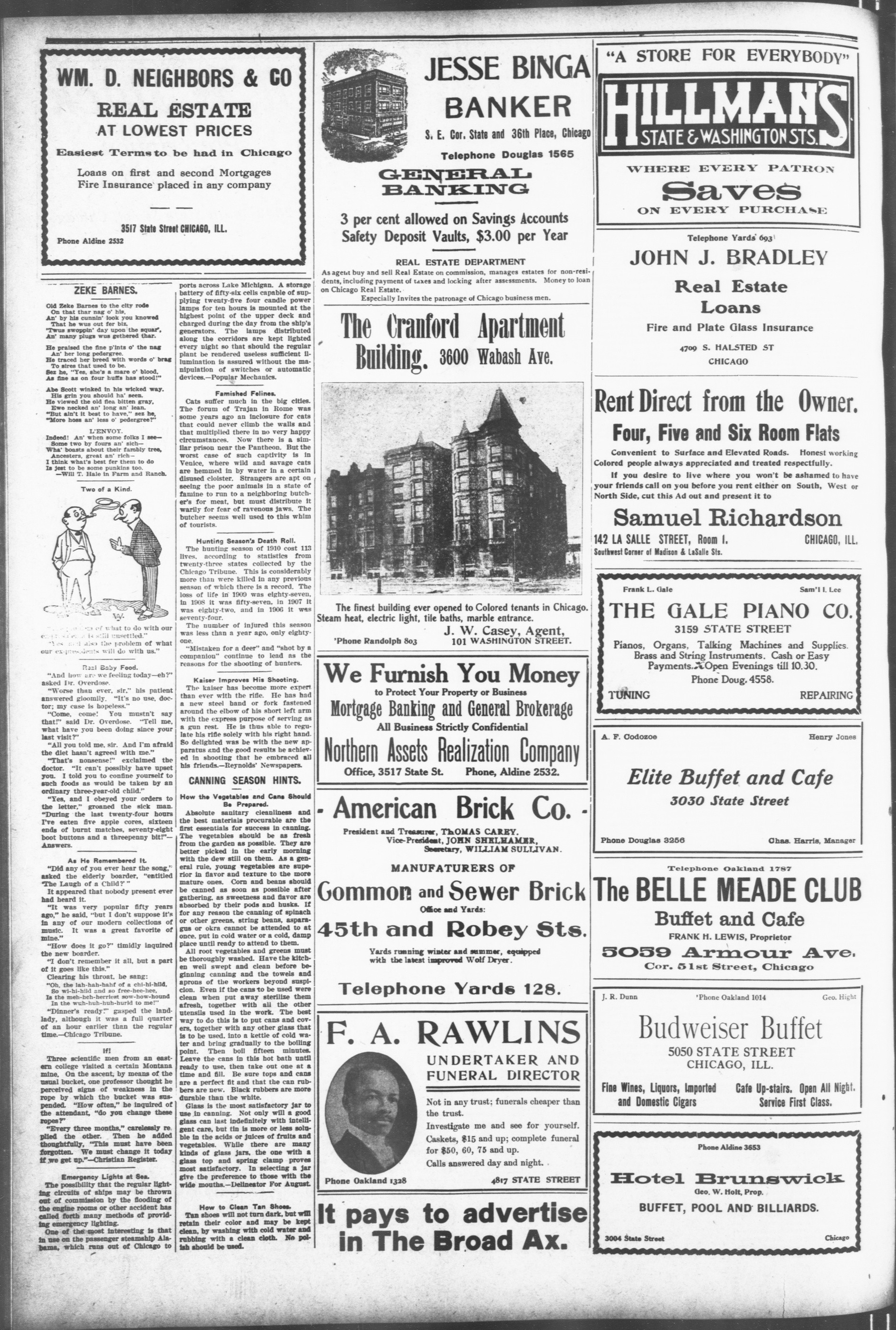
Cranford Apartment Building. 3600 Wabash Ave.
building ever opened to Colored tenant, electric light, tile baths, marble entrance.
J. W. Casey, A.
Indolph 803
101 WASHINGTON
Furnish You Me!
to Protect Your Property or Business
the Banking and General Brokerage
All Business Strictly Confidential
Assets Realization Co.
13517 State St. Phone, Aldine
American Brick Co.
and Treasurer, THOMAS CAREY.
Vice-President, JOHN SHELHAMER
Secretary, WILLIAM SULLY
MANUFATURERS OF
Lion and Sewer
Office and Yards:
and Robey
Yards running winter and summer, equipped with the latest improved Wolf Dryer.
ephone Yards 1
A. RAWLI
3 per cent allowed on Savings Accounts Safety Deposit Vaults, $3.00 per Year
As agent buy and sell Real Estate on commission, manages estates for non-residents, including payment of taxes and locking after assessments. Money to loan on Chicago Real Estate.
Especially Invites the patronage of Chicago business men.
THE NEW YORK MUSEUM
The finest building ever opened to Colored tenants in Chicago Steam heat, electric light, tile baths, marble entrance.
We Furnish You Money to Protect Your Property or Business Mortgage Banking and General Brokerage All Business Strictly Confidential Northern Assets Realization Company Office, 3517 State St. Phone, Aldine 2532.
President and Treasurer, THOMAS CAREY.
Vice-President, JOHN SHELHAMER.
Secretary, WILLIAM SULLIVAN.
Yards running winter and summer, equipped with the latest improved Wolf Dryer.
Telephone Yards 128.
F. A. RAWLINS
[Name]
ys to adver
The Broad A
It pays in The
It pays to advertise in The Broad Ax.
THE BANK OF NEW YORK
Phone Oakland 1328
S. E. Cor. State and 36th Place, Chicago Telephone Douglas 1565
Bowed on Savings Accounts
at Vaults, $3.00 per Year
ESTATE DEPARTMENT
State on commission, manages estates for non-resi-
ses and locking after assessments. Money to loan
the patronage of Chicago business men.
Ford Apartment
3600 Wabash Ave.
Her opened to Colored tenants in Chicago.
Tile baths, marble entrance.
J. W. Casey, Agent,
101 WASHINGTON STREET.
Wish You Money
Your Property or Business
ing and General Brokerage
ness Strictly Confidential
s Realization Company
e St. Phone, Aldine 2532.
Brick Co.
Surer, THOMAS CAREY.
President, JOHN SHELHAMER,
Secretary, WILLIAM SULLIVAN.
JUFATURERS OF
and Sewer Brick
Office and Yards:
d Robey Sts.
winter and summer, equipped
it improved Wolf Dryer.
Ne Yards 128.
RAWLINS
UNDERTAKER AND FUNERAL DIRECTOR
Not in any trust; funerals cheaper than the trust.
Investigate me and see for yourself.
Caskets, $15 and up; complete funeral for $50, 60, 75 and up.
Calls answered day and night.
4817 STATE STREET
to advertise Broad Ax.
"A STORE FOR EVERYBODY"
OHN J. BRADLE Real Estate
JOHN J. BRADLEY
Loans
Fire and Plate Glass Insurance
4709 S. HALSTED ST
CHICAGO
Rent Direct
Four, Five
Convenient to Sun-
colored people always s
If you desire to
your friends call on your
North Side, cut this Ad
Samuel
42 LA SALLE STREET
Southwest Corner of Madison &
Frank L. Gale
THE GAL
311
Pianos, Organs,
Brass and S
Payment
TUNING
Direct from the Ow
ier, Five and Six Room F
ent to Surface and Elevated Roads. Hom
eole always appreciated and treated respect
desire to live where you won't be ashamed
call on you before you rent either on South
out this Ad out and present it to
Samuel Richards
GALE STREET, Room I.
Ch
of Madison & LaSalle Sts.
L. Gale
Sam
GALE PIANO
3159 STATE STREET
Organs, Talking Machines and S
ass and String Instruments. Cash or E
Payments. Open Evenings till 10.30
Phone Doug. 4558.
RE
zoe
Elite Buffet and Caf
3030 State Street
glas 3256
Chas. Harr
Rent Direct from the Owner.
Four, Five and Six Room Flats
Convenient to Surface and Elevated Roads. Honest working Colored people always appreciated and treated respectfully.
If you desire to live where you won't be ashamed to have your friends call on you before you rent either on South, West or North Side, cut this Ad out and present it to
Samuel Richardson
142 LA SALLE STREET, Room I. CHICAGO, ILL.
Southwest Corner of Madison & LaSalle Sts.
Frank L. Gale Sam'll Lee
THE GALE PIANO CO.
3159 STATE STREET
Pianos, Organs, Talking Machines and Supplies.
Brass and String Instruments. Cash or Easy
Payments. Open Evenings till 10.30.
Phone Doug. 4558.
TUNING REPAIRING
Elite 1 30
Elite Buffet and Cafe 3030 State Street
Phone Douglas 32561
Tele
The BELL
Buff
FRAN
5059 1
Cor. 5
Telephone Oakland 1787
BELLE MEADE C
Buffet and Cafe
FRANK H. LEWIS, Proprietor
59 Armour A
Cor. 51st Street, Chicago
The BELLE MEADE CLUB
Buffet and Cafe
FRANK H. LEWIS, Proprietor
5059 Armour Ave.
Cor. 51st Street, Chicago
Budw
505
Fine Wines, Liquors, and Domestic Cigars
Budweiser Buffer
5050 STATE STREET
CHICAGO, ILL.
Liquors, Imported
Cafe Up-stairs. Open
Domestic Cigars
Service First C
Budweiser Buffet
5050 STATE STREET
CHICAGO, ILL.
Fine Wines, Liquors, Imported
and Domestic Cigars Cafe Up-stairs. Open All Night.
Service First Class.
Hotel Brunswick Geo. W. Holt, Prop. BUFFET, POOL AND BILLIARDS.
A. F. Codozoe
J. R. Dunn
The Owner.
Room Flats
Roads. Honest working
rated respectfully.
don't be ashamed to have
other on South, West or
o
Hardson
CHICAGO, ILL.
Sam'l I. Lee
MANO CO.
STREET
Lines and Supplies.
Cash or Easy
ages till 10.30.
8.
REPAIRING
and Cafe
street
Chas. Harris, Manager
1787
DE CLUB
Cafe
Telephone Yards' 693
'Phone Oakland 1014
Henry Jones