The Broad Ax
Saturday, May 25, 1912
Chicago, Illinois
Page text (machine-generated)
THE BROAD AX
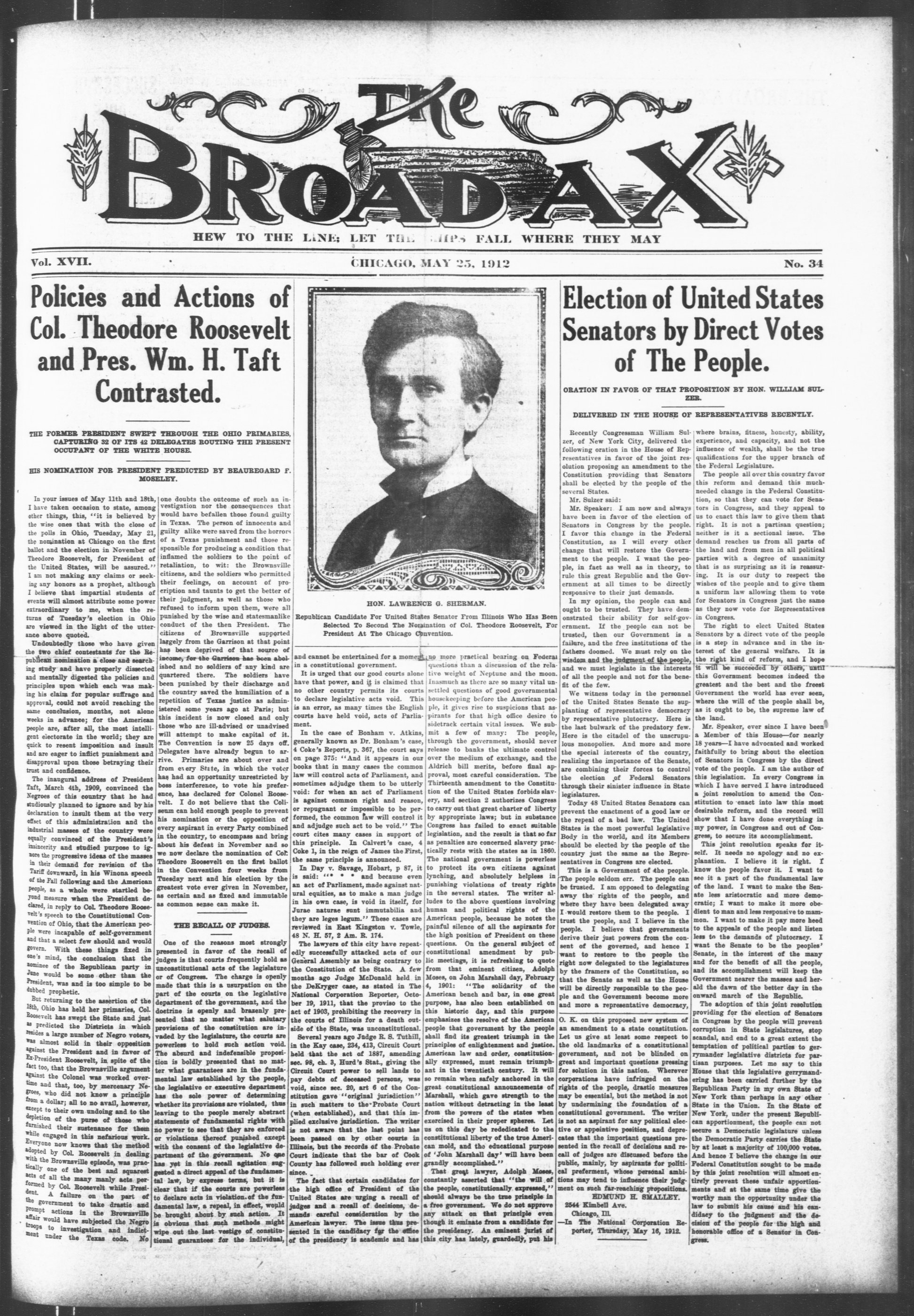
Policies and Actions of Col. Theodore Roosevelt and Pres. Wm. H. Taft Contrasted.
THE FORMER PRESIDENT SWEPT THROUGH THE OHIO PRIMARIES
CAPTURING 32 OF ITS 42 DELEGATES ROUTING THE PRESENT
OCCUPANT OF THE WHITE HOUSE.
HIS NOMINATION FOR PRESIDENT PREDICTED BY BEAUREGARD F
MOSELEY.
Vol. XVII.
Policies and
Col. Theodore
and Pres. W
Contr
THE FORMER PRESIDENT SWEPT
CAPTURING 32 OF ITS 42 D
OCCUPANT OF THE WHITE
HIS NOMINATION FOR PRESIDENT
MOS
In your issues of May 11th and 18th I have taken occasion to state, among other things, this, "it is believed by the wise ones that with the close of the polls in Ohio, Tuesday, May 21, the nomination at Chicago on the first ballot and the election in November of Theodore Roosevelt, for President of the United States, will be assured." I am not making any claims or seeking any honors as a prophet, although I believe that impartial students of events will almost attribute some power extraordinary to me, when the returns of Tuesday's election in Ohio are viewed in the light of the utterance above quoted.
Undoubtedly those who have given the two chief contestants for the Republican nomination a close and searching study and have properly dissected and mentally digested the policies and principles upon which each was making his claim for popular suffrage and approval, could not avoid reaching the same conclusion, months, not alone weeks in advance; for the American people are, after all, the most intelligent electorate in the world; they are quick to resent imposition and insult and are eager to inflict punishment and disapproval upon those betraying their trust and confidence.
The inaugural address of President Taft, March 4th, 1909, convinced the Negroes of this country that he had studiously planned to ignore and by his declaration to insult them at the very offset of this administration and the industrial masses of the country were equally convinced of the President's insincerity and studied purpose to ignore the progressive ideas of the masses in their demand for revision of the Tariff downward, in his Winona speech of the Fall following and the American people, as a whole were startled beyond measure when the President declared, in reply to Col. Theodore Roosevelt's speech to the Constitutional Convention of Ohio, that the American people were incapable of self-government and that a select few should and would govern. With these things fixed in one's mind, the conclusion that the nominee of the Republican party in June would be some other than the President, was and is too simple to be dubbed prophetic.
But returning to the assertion of the 18th, Ohio has held her primaries, Col. Roosevelt has swept the State and just as predicted the Districts in which resides a large number of Negro voters, was almost solid in their opposition against the President and in favor of Ex-President Roosevelt, in spite of the fact too, that the Brownsville argument against the Colonel was worked overtime and that, too, by mercenary Negroes, who did not know a principle from a dollar; all to no avail, however, except to their own undoing and to the depletion of the purse of those who furnished their sustenance for them while engaged in this nefarious work. Everyone now knows that the method adopted by Col. Roosevelt in dealing with the Brownsville episode, was practically one of the best and squarest acts of all the many manly acts performed by Col. Roosevelt while President. A failure on the part of the government to take drastic and prompt actions in the Brownsville affair would have subjected the Negro troops to investigation and indictment under the Texas code. No
---
HEW TO THE LINE; LET THE SHIPS FALL WHERE THEY MAY
one doubts the outcome of such an investigation nor the consequences that would have befallen those found guilty in Texas. The person of innocents and guilty alike were saved from the horror of a Texas punishment and those responsible for producing a condition that inflamed the soldiers to the point of retaliation, to wit: the Brownsville citizens, and the soldiers who permitted their feelings, on account of prosecution and taunts to get the better of their judgment, as well as those who refused to inform upon them, were all punished by the wise and statesmanlike conduct of the then President. The citizens of Brownsville supported largely from the Garrison at that point has been deprived of that source of income, for the Garrison has been abolished and no soldiers of any kind are quartered there. The soldiers have been punished by their discharge and the country saved the humiliation of a repetition of Texas justice as administered some years ago at Paris; but this incident is now closed and only those who are ill-advised or unadvised will attempt to make capital of it. The Convention is now 25 days off. Delegates have already begun to arrive. Primaries are about over and from every State, in which the voter has had an opportunity unrestricted by boss interference, to vote his preference, has declared for Colonel Roosevelt. I do not believe that the Coliseum can hold enough people to prevent his nomination or the opposition of every aspirant in every Party combined in the country, to encompass and bring about his defeat in November and so we now declare the nomination of Col. Theodore Roosevelt on the first ballot in the Convention four weeks from Tuesday next and his election by the greatest vote ever given in November, as certain and as fixed and immutable as common sense can make it.
THE RECALL OF JUDGES
One of the reasons most strongly presented in favor of the recall of judges is that courts frequently hold an unconstitutional acts of the legislature or of Congress. The charge is openly made that this is a usurpation on the part of the courts on the legislative department of the government, and the doctrine is openly and brazenly presented that no matter what salutary provisions of the constitution are invaded by the legislature, the courts are powerless to hold such action void. The absurd and indefensible proposition is boldly presented that no matter what guarantees are in the fundamental law established by the people, the legislative or executive department has the sole power of determining whether its provisions are violated, thus leaving to the people merely abstract statements of fundamental rights with no power to see that they are enforced or violations thereof punished except with the consent of the legislative department of the government. No one has yet in this recall agitation suggested a direct appeal to the fundamental law, by express terms, but it is clear that if the courts are powerless to declare acts in violation of the fundamental law, a repeal, in effect, would be brought about by such action. It is obvious that such methods might wipe out the last vestige of constitutional guarantees for the individual,
CHICAGO, MAY 25, 1912
B. T.
F.
HON. LAWRENCE G. SHERMAN.
Republican Candidate For United State
Selected To Second The Nora
President At The Chicago Co
Republican Candidate For United States Senator From Illinois Who Has Been Selected To Second The Norrination of Col. Theodore Roosevelt, For President At The Chicago Convention.
and cannot be entertained for a moment in a constitutional government.
It is urged that our good courts alone have that power, and it is claimed that no other country permits its courts to declare legislative acts void. This is an error, as many times the English courts have held void, acts of Parliament.
In the case of Bonham v. Atkins, generally known as Dr. Bonham's case, 4 Coke's Reports, p. 367, the court says on page 375: "And it appears in our books that in many cases the common law will control acts of Parliament, and sometimes adjudge them to be utterly void: for when an act of Parliament is against common right and reason, or repugnant or impossible to be performed, the common law will control it and adjudge such act to be void." The court cites many cases in support of this principle. In Calvert's case, 4 Coke 1, in the reign of James the First, the same principle is announced.
In Day v. Savage, Hobart, p 87, it is said: "**" * ** and because even an act of Parliament, made against natural equities, as to make a man judge in his own case, is void in itself, for Jurae naturae sunt immutabilia and they are leges legum." These cases are reviewed in East Kingston v. Towle, 48 N. H. 57. 2 Am. R. 174.
The lawyers of this city have repeatedly successfully attacked acts of our General Assembly as being contrary to the Constitution of the State. A few months ago Judge McDonald held in the DeKryger case, as stated in The National Corporation Reporter, October 19, 1911, that the proviso to the act of 1903, prohibiting the recovery in the courts of Illinois for a death outside of the State, was unconstitutional. Several years ago Judge R. S. Tuthill, in the Kay case, 234, 413, Circuit Court held that the act of 1887, amending sec. 98, ch. 3, Hurd's Stat., giving the Circuit Court power to sell lands to pay debts of deceased persons, was void, since sec. 20, art 6 of the Constitution gave "original jurisdiction" in such matters to the Probate Court (when established), and that this implied exclusive jurisdiction. The writer is not aware that the last point has been passed on by other courts in Illinois, but the records of the Probate Court indicate that the bar of Cook County has followed such holding ever since.
The fact that certain candidates for the high office of President of the United States are urging a recall of judges and a recall of decisions, demands careful consideration by the American lawyer. The issue thus presented in the candidacy for the office of the presidency is academic and has
CARL
States Senator From Illinois Who Has Been
inception of Col. Theodore Roosevelt, For
convention.
no more practical bearing on Federal questions than a discussion of the relative weight of Neptune and the moon Inasmuch as there are so many vital unsettled questions of good governmental housekeeping before the American people, it gives rise to suspicions that as pirants for that high office desire to sidetrack certain vital issues. We submit a few of many: The people through the government, should never release to banks the ultimate control over the medium of exchange, and the Aldrich bill merits, before final approval, most careful consideration. The Thirteenth amendment to the Constitution of the United States forbids slavery, and section 2 authorizes Congress to carry out that great charter of liberty by appropriate laws; but in substance Congress has failed to enact suitable legislation, and the result is that so far as penalties are concerned slavery practically rests with the states as in 1860. The national government is powerless to protect its own citizens against lynching, and absolutely helpless in punishing violations of treaty rights in the several states. The writer alludes to the above questions involving human and political rights of the American people, because he notes the painful silence of all the aspirants for the high position of President on these questions. On the general subject of constitutional amendment by public meetings, it is refreshing to quote from that eminent citizen, Adolph Moses, on John Marshall day, February 4, 1901: "The solidarity of the American bench and bar, in one great purpose, has also been established on this historic day, and this purpose emphasizes the resolve of the American people that government by the people shall find its greatest triumph in the principles of enlightenment and justice. American law and order, constitutionally expressed, must remain triumphant in the twentieth century. It will so remain when safely anchored in the great constitutional announcements of Marshall, which gave strength to the nation without detracting in the least from the powers of the states when exercised in their proper spheres. Let us on this day be rededicated to the constitutional liberty of the true American mold, and the educational purpose of 'John Marshall day' will have been grandly accomplished."
That great lawyer, Adolph Moses, constantly asserted that "the will of the people, constitutionally expressed," should always be the true principle in a free government. We do not approve any attack on that principle even though it eminate from a candidate for the presidency. An eminent jurist of this city has lately, guardedly, put his
Election of United States Senators by Direct Votes of The People.
ORATION IN FAVOR OF THAT PROPOSITION BY HON. WILLIAM SULZER.
DELIVERED IN THE HOUSE OF REPRESENTATIVES RECENTLY.
Recently Congressman William Sulzer, of New York City, delivered the following oration in the House of Representatives in favor of the joint resolution proposing an amendment to the Constitution providing that Senators shall be elected by the people of the several States.
Mr. Sulzer said:
Mr. Speaker: I am now and always have been in favor of the election of Senators in Congress by the people. I favor this change in the Federal Constitution, as I will every other change that will restore the Government to the people. I want the people, in fact as well as in theory, to rule this great Republic and the Government at all times to be directly responsive to their just demands.
where brains, fitness, honesty, ability, experience, and capacity, and not the influence of wealth, shall be the true qualifications for the upper branch of the Federal Legislature.
The people all over this country favor this reform and demand this much needed change in the Federal Constitution, so that they can vote for Senators in Congress, and they appeal to us to enact this law to give them that right. It is not a partisan question; neither is it a sectional issue. The demand reaches us from all parts of the land and from men in all political parties with a degree of unanimity that is as surprising as it is reassuring. It is our duty to respect the wishes of the people and to give them a uniform law allowing them to vote.
In my opinion, the people can and ought to be trusted. They have demonstrated their ability for self-government. If the people can not be trusted, then our Government is a failure, and the free institutions of the fathers doomed. We must rely on the wisdom and the judgment of the people, and we must legislate in the interests of all the people and not for the benefit of the few.
We witness today in the personnel of the United States Senate the supplanting of representative democracy by representative plutocracy. Here is the last bulwark of the predatory few. Here is the citadel of the unscrupulous monopolies. And more and more the special interests of the country, realizing the importance of the Senate, are combining their forces to control the election of Federal Senators through their sinister influence in State legislatures.
Today 48 United States Senators can prevent the enactment of a good law or the repeal of a bad law. The United States is the most powerful legislative Body in the world, and its Members should be elected by the people of the country just the same as the Representatives in Congress are elected.
This is a Government of the people. The people seldom err. The people can be trusted. I am opposed to delegating away the rights of the people, and where they have been delegated away I would restore them to the people. I trust the people, and I believe in the people. I believe that governments derive their just powers from the consent of the governed, and hence I want to restore to the people the right now delegated to the legislatures by the framers of the Constitution, so that the Senate as well as the House will be directly responsible to the people and the Government become more and more a representative democracy,
O. K. on this proposed new system of an amendment to a state constitution. Let us give at least some respect to the old landmarks of a constitutional government, and not be blinded on great and important questions pressing for solution in this nation. Wherever corporations have infringed on the rights of the people, drastic measures may be essential, but the method is not by undermining the foundation of a constitutional government. The writer is not an aspirant for any political elective or appointive position, and depreciates that the important questions presented in the recall of decisions and recall of judges are discussed before the public, mainly, by aspirants for political preferment, whose personal ambitions may tend to influence their judgment on such far-reaching propositions.
EDMUND H. SMALLEY.
2544 Kimbell Ave.
Chicago, Ill.
—In The National Corporation Reporter, Thursday, May 16, 1912.
No.34
where brains, fitness, honesty, ability, experience, and capacity, and not the influence of wealth, shall be the true qualifications for the upper branch of the Federal Legislature.
The people all over this country favor this reform and demand this much-needed change in the Federal Constitution, so that they can vote for Senators in Congress, and they appeal to us to enact this law to give them that right. It is not a partisan question; neither is it a sectional issue. The demand reaches us from all parts of the land and from men in all political parties with a degree of unanimity that is as surprising as it is reassuring. It is our duty to respect the wishes of the people and to give them a uniform law allowing them to vote for Senators in Congress just the same as they now vote for Representatives in Congress.
The right to elect United States Senators by a direct vote of the people is a step in advance and in the interest of the general welfare. It is the right kind of reform, and I hope it will be succeeded by others, until this Government becomes indeed the greatest and the best and the freest Government the world has ever seen, where the will of the people shall be, as it ought to be, the supreme law of the land.
Mr. Speaker, ever since I have been a Member of this House—for nearly 18 years—I have advocated and worked faithfully to bring about the election of Senators in Congress by the direct vote of the people. I am the author of this legislation. In every Congress in which I have served I have introduced a joint resolution to amend the Constitution to enact into law this most desirable reform, and the record will show that I have done everything in my power, in Congress and out of Congress, to secure its accomplishment.
This joint resolution speaks for itself. It needs no apology and no explanation. I believe it is right. I know the people favor it. I want to see it a part of the fundamental law of the land. I want to make the Senate less aristocratic and more democratic; I want to make it more obedient to man and less responsive to mammon. I want to make it pay more heed to the appeals of the people and listen less to the demands of plutocracy. I want the Senate to be the peoples' Senate, in the interest of the many and for the benefit of all the people, and its accomplishment will keep the Government nearer the masses and herald the dawn of the better day in the onward march of the Republic.
The adoption of this joint resolution providing for the election of Senators in Congress by the people will prevent corruption in State legislatures, stop scandal, and end to a great extent the temptation of political parties to gerrymander legislative districts for partisan purposes. Let me say to this House that this legislative gerrymandering has been carried further by the Republican Party in my own State of New York than perhaps in any other State in the Union. In the State of New York, under the present Republican apportionment, the people can not secure a Democratic legislature unless the Democratic Party carries the State by at least a majority of 100,000 votes. And hence I believe the change in our Federal Constitution sought to be made by this joint resolution will almost entirely prevent these unfair apportionments and at the same time give the worthy man the opportunity under the law to submit his cause and his candidacy to the judgment and the decision of the people for the high and honorable office of a Senator in Congress.
THE BROAD AX
PUBLISHED WEEKLY.
Will promulgate and at all times uphold the true principles of Democracy, but Catholics, Protestants, Priests, Infidels, Single Taxes, Republicans, or any other can have a different degree in their labor proper and responsibility is fixed.
The Broad Ax is a newspaper whose platform is broad enough for all, ever claiming the editorial right to speak its own mind.
Local communications will receive attention. Write only on one side of the paper.
Subscriptions must be paid in advance.
One Year $3.00
Six Months 1.00
Advertising rates made known on application.
Address all communications to
THE BROAD AX
5027 ARMOUR AVENUE, CHICAGO, ILL
PHONE DREXEL 4590.
JULIUS F. TAYLOR, Editor and Publisher
Entered as Second-Class Matter Aug. 19.
1902, at the Post Office at Chicago, Illinois,
under Act of March 3, 1879.
NEGEOES DESTITUTE; FLOOD
SPOTS CLEAN
Ninety-Two Per Cent of Refugees are Blacks and Have Absolutely Nothing — Sanitary Conditions Are Reported as Excellent.
Sufferers in Louisiana Are Well Taken Care of by Nurses and the Militia—June Rise May Prolong the Trouble. New Orleans, La., May 23.—Conditions sanitary and otherwise, of Mississippi river flood refugee camps at Atherton, Miliken's Bend, Vicksburg and Natchez are excellent, according to John M. Parker of this city, who returned this morning from an eight weeks' experience in the flooded district. Parker is the owner of a large plantation inundated by the Salem crevasse. He lost several herds of thoroughbred cattle.
Refugees Are Destitute.
"The refugees from the Salem break," he said, "are practically divided into four camps, Atherton, Milken's Bend, Vicksburg and Natchez, and 92 per cent. of the refugees are negroes, absolutely destitute. The sanitary conditions of these places are as good as could be expected, and, generally speaking, the health of the refugees has been excellent. Each camp has its corps of surgeons and Red Cross nurses, who see to it that sanitary regulations are complied with. Each camp is properly policed by details from the national guard, the members of which have given excellent service.
Water Will Fall Rapidly.
"With the rapid fall of the Mississippi river, these four camps can soon be dispensed with. From present indications the water will fall rapidly and by the end of May many refugees inundated by the Panther Forest, Salem and Beulah breaks will be able to return to their homes and resume work. The planters will feed them, but clothing and bedding will be badly needed, and soon, so that it can be carried back to their homes when they leave the camps. None can be purchased locally.
"The water from the Torras, Atchafalaya and Hymelia breaks is receding slowly, and it probably will be late in June before farming operations can be undertaken, and in the meanwhile some one must feed and care for the laborers, as they are now destitute.
June Rise May Prolong Flood.
June Rise May Prolong Flood.
"The government, the Red Cross, the King's Daughters, other societies and individuals have given assistance to the utmost. How much longer this assistance will be necessary depends upon the Mississippi river. The annual June rise may prolong the flood conditions many weeks."
Mr. Parker praised the self-sacrifice and individual heroism of the planters, who, having lost all their property, enlisted in the work of rescue.
He declared the daring exploits of white men in saving negro families caught in the flood without warning on the rainy, wind-swept night the Salem levee broke were the rule rather than the exception.
HEALTH NOTES
Of course you have cleaned up that back yard. Looks better, doesn't it?
How about the vacant lots in your vicinity? In bad condition are they? Well, why not organize a little neighborhood vigilance committee to get them cleaned up and to see to it that the miscreants who use these places as dumping grounds for their nasty, dirty and unsightly rubbish of every kind are properly prosecuted and punished under the provisions of Section 1435 of the Municipal Code.
The city scavenger service will remove rubbish and refuse from residence premises the same as it takes care of your garbage. All that is needed is that ashes and general refuse be placed in separate receptacles. By doing this you can keep your home surroundings neat and tidy and add to the general attractiveness of your neighborhood.
1
While we are carrying on a war of extermination against the dangerous and deadly house fly, why not include the equally flithy and dangerous old privy vault? These are nuisances of the most offensive kind and should not be permitted in any sewered community. If your streets are sewered, see to it that the nasty old privy vaults in your neighborhood are abolished. Notify the Department of Health and sanitary toilets will be ordered installed.
This has been a backward season and for that reason there is still time to plant flowers and thus add to the beauty and attractiveness of your home surroundings. It will also furnish you with some good, healthy out-door exercise.
THE CHORAL STUDY CLUB.
The Choral Study Club in their May Festival performance at Quinn Chapel Church, Monday night, May 27th, will present Coleridge Taylors's "Blind Girl of the Castle Cullie, which is one of the most important choral compositions of the present time and received its only two renditions in America by the Choral Study Club. The second work to be performed in Cowan's "St. John's Eve," rendered with much success by the Club in 1909. Soloists: Mrs. Martha Broadus Anderson, Mrs. Virginia Greene, Soprano; Mrs. Clara K. Williams, Contralto; Mr. George L. Johnson, Tenor; Mr. T. Theodore Taylor, Baritone; Mrs. Pelagie Blair, Miss Gertrude Jackson accompanists; and the Choral Study Club Orchestra. Admission 50 cents. No reserved seats.
COMMENCEMENT EXERCISES AT THE TUSKEGEE NORMAL AND INDUSTRIAL INSTITUTE.
The 31st anniversary exercises of the Tuskegee Normal and Industrial Institute, Tuskegee, Alabama, will be held from Sunday, May 26th, to Thursday, May 30th. Booker T. Washington, Principal.
The annual commencement sermon will be preached by Rt. Rev. Robert Strange of North Carolina, Sunday, May 26th.
FOUR NEW BISHOPS FOR THE A
M. E. CHURCH.
The general conference of the A. M. E. Church, held forth in Kansas City, Mo., last week and in winding up its affairs for the next four years, the following four new bishops were elected, namely, Dr. W. D. Chappelle, Dr. John F. Hurst, Dr. Joshua Jones and the Rev. J. M. Connors, all the sessions were largely attended and the general impression prevails that the very best men were selected to fill the various high offices.
CONGRESSMAN WILLIAM SULZER
EXPRESSES THE HOPE THAT THE EDITOR OF THE BROAD AX WILL SOON BE RESTORED TO GOOD HEALTH. THE FOLLOWING LETTER SPEAKS FOR ITSELF.
House of Representatives
Washington, D. C., May 20, 1912.
Julias F. F. Taylor, Esq.
Editor of The Broad Ax,
5027 Armour Ave., Chicago, Ill.
My dear sir:
I have just learnt of your illness
and write to extend my sympathy and
to indulge the hope that you have
fully recovered and are quite your
self again.
With best wishes, believe me very
sincerely yours
WILLIAM SULZER.
Thanks! Thanks Congressman Sulz
er, for those kind expressions—Editor
ST. MARY'S A. M. E. CHURCH
5251 Dearborn St.
Rev. Jas. Higgins, Pastor.
Services: 10:45, 7:45.
Sunday School: 2:00.
Christian Endeavor: 6:45.
We had quite a good attendance at our services last Sunday. The choir rendered excellent music.
May 29, 30, 31 the ladies will give their Annual Fair. Program each evening.
SPECIAL NOTICE
To the Readers of The Broad Ax:—
Here is your chance to get some
cheap property, all in best locations.
Cheap lots for cottages from $75 up
and other houses and lots for homes on
for business places. For particulars,
address with stamp.
GRANT GARDNER,
1440 Franklin Ave.
Grand Haven, Mich.
CHIPS
Mrs. Grant Gardner, of Grand Haven, Mich., spent the past week in visiting with her many friends in this city.
The 17 months old baby boy of Mrs. and Mrs. J. Gray Lucas, 508 E. 36th Street, is rapidly improving after being seriously sick.
Mrs. James H. Johnson, 3650 Prairie Avenue, penned a few lines to the editor this week; wishing him a speedy recovery from his illness.
Mrs. Elizabeth Lindsay Davis, 3226 Prairie Avenue, called a Sunday afternoon to wish the writer speedy restoration to good health.
Mrs. J. S. Tandy, 5145 Grove Avenue displayed her kindness during our serious illness and she is very much pleased that we are again able to be out and to look after business.
J. M. Blackshear, one of the efficient clerks in the office of the local board of improvements, arrived home Sunday morning, from a short visit to Chattanooga, Tenn.
Mrs. Etta Davis, of 6843 Perry Ave., is now enchanted over the new musical course she is taking at the Latona College of Music, presented her by her husband, Edward W. Davis as a birthday present.
J. C. Stewart, 5434 Norman Avenue, one of the oldest men in the service of the Northwestern Railroad Company; has recently been on an extensive trip to all parts of Canada. He is expected home today.
The Georgia Delegation under the leadership of Benj. J. Davis, will headquarter at the Washington Hotel, 3252 Wabash Ave., and Mrs. Evlyne Randolphs, 3254 Wabash Ave. They will arrive in the city about the 15th or 16th, so we are informed by Col. Moseley, an old Georgia boy.
Isaac Johnstone Reed, who was married in Richmond, Va., last winter and who was residing with his wife, at the home of Mr. and Mrs. Charles Jackson, Vernon Avenue, near 34th Street, died very suddenly last Monday evening. His remains were shipped to Richmond, Va., Thursday evening.
Last Saturday evening quite a number of those who were interested in the success of the Mt. Glenwood Chautauqua Association, held a meeting at 3330 S. State Street and many new members joined in the movement. Dr. Edward S. Miller, its secretary, is well pleased with the bright prospects of the association, for this coming season.
The Colored American Bible Class Anniversary in the Third Baptist Church at Aurora, Sunday, June 2nd, at 3 P. M. promises to be an interesting affair. Rev. Alton H. Blake, Pastor and Mr. Daniel McClain, president, promises to make it the event of the season. They are endeavoring to secure an address from Hon. Beauregard F. Moseley of this city, who is a favorite in Aurora.
Last December at Natchez, Miss,
an old Negro hack driver was brutally
murdered by a young white boy. The
boy was arrested and indicted, and in
the recent trial he was convicted and
sentenced to serve the rest of his life
in the penitentiary. When the sentence
was pronounced, the judge remarked
that law-abiding citizens in this country should receive protection
from the courts.
Tuesday afternoon, Miss Cecelia
Johnson, and Doctor Theo. R. Mozee,
were quietly united in marriage; they
are at home to their friends at 4715 S.
State Street.
Mrs. Mozee, is a graduate of the University of Chicago and for some time she has served as secretary of the Choral Study Club, and worked hard for its success. Dr. Mozee, is to be heartily congratulated for securing such a rare jewel for his life's companion.
Fly Catches.
The Pittsburgh club last fall insured Pitcher Marty O'Toole for its own benefit for $25,000. Recently O'Toole took a $10,000 policy for himself and at his own expense.
In the National league infielders predominate as "lead off" men—namely, Evers, Chicago; Huggins, St. Louis; Sweeney, Boston, and Knabe, Philadelphia, are second basemen, while Byrne of Pittsburgh plays third. Devore, Moran and Bescher, are the outfielders who lead off.
Of the eight "lead off" men in the American league seven are outfielders—Butcher or Graney, Cleveland; Vitt, Detroit, and Lord or Strong, Philadelphia, left field; Milan, Washington, and Shotten, St. Louis, center field; Hooper, Boston, and Wolter, New York, right field. Rath of Chicago is the only infielder honored.
Justin McCarthy, it is said, used to dream his stories. "When I awoke and recalled the whole," he is quoted as saying. "I wrote it word for word as if I were copying without taking my brain to provide ideas or word dressing."
The Caucasus.
No fewer than thirty languages are spoken in the Caucasus. The inhabitants are Russians, Armenians, Tartars, Georgians and divers - Mohammedan tribes.
Rochefort Chasse
Rochefort cheese gains its distinction and its flavor by ripening six months in a cave in the mountains near the little village of Rochefort, in southern France. Part of the process which it undergoes is the pricking full of little holes, into which the air of the cave penetrates. This air remains of the same temperature the year round. Only sheep's milk is used for making Rochefort.
Where They Don't Use False Scales. The name of Irkutsk, Russia, will not impress many of us, yet in that district he who is caught using false scales is deprived forever of the right to trade.
Queen Bess and Coal Fires.
Queen Elizabeth so disliked the smell of coal fires that the brewers of London decided not to use coal in their breweries near Westminster.
Japan In the Eighth Century.
Japan in the Eighth Century As early as the eighth century a university had already been established in Japan that included such modern divisions as schools of medicine, ethics, mathematics and history, and some of the textbooks employed at that remote period dealt with materia medica and veterinary surgery, types of textbooks which appear to have been unknown in European countries until about 1,000 years later.
Shantung Silk.
Shantung silk is produced by a species of worm which lives on the willow trees of that Chinese province and which differs from the mulberry tree silkworm.
The Swantians
The Swantians, who live in the inaccessible mountain range between the Black and Caspian seas, are probably the laziest people in the world. It is their invariable rule to observe holidays four times a week, with saints' days as extras.
Crackers.
Crackers enough are consumed throughout the world daily to fill a train of cars extending from New York to Baltimore.
Streets of Paris
It is a misdemeanor to throw a piece of waste paper upon a Paris street. If a policeman sees you drop a piece of paper he walks up to you, pats you on the shoulder, beeps your pardon for addressing you and tells you you have violated the law and asks you to pick up what you have thrown down.
Old Time Natural History
Nash, a writer of the sixteenth century, says, "If a dog loses an eye he dyeth presently:" also. "Goats take breath not at the mouth and nose only, but at ye earse (ears) also."
Greek Dress.
A lecturer on Greek dress said that a type of costume in early Hellenic times had been found which bore a distinct resemblance to the modern coat and skirt.
First Ohio Canal
The opening of the first Ohio canal was accomplished July 4, 1827. On that day the first boat descended from Akron to Cleveland. She was cheered on her passage by thousands of people, who assembled from the adjacent country to witness the novel and interesting sight.
Cane Sugar.
More than eight tons of cane are required to make one ton of sugar.
Kalamazoo.
The word Kalamazoo is said by some philologists to be a contraction of an Indian phrase descriptive of the stones seen through the water of a stream, a refractive power in the current causing the stones to resemble otters swimming beneath the surface. Other philologists say the word is a slight variation of the Ojibwa word "kikalamazo," meaning "he is inconvenienced by the smoke in his lodge."
Hickory Wood.
American hickory is the best wood in the world for fuel. If its value is reckoned at 100, oak is worth 84, beech 65 and white pine only 80.
A Fish Story.
Pike are supposed to live longer than any other fish. Gesner relates that in 1497 a pike was caught in Susiaba with a ring attached, inscribed. "I was first put into this lake by the hands of the governor of the universe, Frederick II., Oct. 5, 1230." This is the fish's story.
One Horse, Five Men
Five men's strength is equivalent to that of one average horse.
Hard Butter.
If you want to cut hard butter into squares and find you cannot do it without crumbing, fold a piece of waxed paper in which the butter was wrapped around the blade of the knife. You can then make a perfectly smooth cut.
Promoter Nelson Buuy With Inquiries From Prospective Settlers.
Havana.—The interest taken in commercial and agricultural pursuits by colored Americans is causing some uneasiness among some of the white people from the southern states of America. The influence of Mr. George Davis and family, who recently arrived from Bessmer. Ala., has given new impetus to the situation. Mr. Davis has already deposited $15,000 in the National Bank of Cuba. He has purchased eighty-three acres as the nucleus for other landholdings for the accommodation of fifteen families from his former home in Bessmer.
The aggregate wealth of the fifteen families is placed at $250,000. Arrangements are being made for their arrival, which is scheduled for the latter part of July.
R. M. R. Nelson Lista. Havana, says his mail is large and growing; that he has over $20,000 worth of buyers promised and thirty-seven pledged excursionists to visit Havana this summer with a view of investing if the "look over" proves satisfactory to them. Indications point to an awakening of the thinking Negro. He is slowly seeing that there are riches in Cuba and great opportunities without color barriers. The Clerks' club of Havana, with one of the world's finest ballrooms, has 25,000 members, several of whom are colored. Any Afro-American who knows mules and horses has before him an opportunity in Cuba.
Ten thousand Afro-American, colonists will need many mules and horses. Young George Davis, late of Bessemer, Ala., will take up the study of law at the University of Havana that he may be able to serve capably those who may need legal aid. Young Davis has a working knowledge of the Spanish language already.
WOMEN PREFER PARTY OF ACTION TO ONE OF PROMISE
Anti-lynching Society Questions Sincerity of National Republican Party.
Boston.-The Anti-lynching society, of which Mrs. M. C. Simpson is president, is not only working to create sentiment against the lynching of human beings as a substitute for punishment for offenders against the law instead of punishment according to law, but is welding a potent influence along political lines. The society is taking a leading part with those persons and organizations which have for their aim the securing of the franchise to those of our male citizens who in many sections of the country are denied the exercise of their suffrage rights according to the amendments to the constitution of the United States.
The members of the organization are in favor of a party of action rather than a party of promise—a political party that has the courage of its convictions, a party that will carry out as far as possible within the bounds of law its platform of principles in respect to securing just legislation for the benefit of the body politic and not simply as a means to personal ends for a few. Surely if this is the work which the women of the Anti-lynching society is endeavoring to do they deserve the hearty commendation and support of all persons of whatever race or political creed who favor equal justice and protection for all American citizens.
In a recent circular letter issued by the society to Afro-American voters particularly attention is called to some of the unfulfilled pledges made by the Republican national convention in its platform four years ago in Chicago. Portions of the platform alluded to are the following: "We demand equal justice for all men without regard to race or color. We declare again and without reservation for the enforcement in letter and spirit of the thirteenth, fourteenth and fifteenth amendments to the constitution, which were designed for the protection and advancement of the Negro, and condemn all devices that have for their real aim his disfranchisement for reason of color alone as unfair, un-American and repugnant to the supreme law of the land.
"The Republican party has been for more than fifty years the consistent friend of the American Negro. It gave him freedom and citizenship. It wrote into the organic law the declarations that proclaim for his civil and political rights and believes today that his noteworthy progress in intelligence, industry and good citizenship has earned the encouragement of the nation." As the party has not enforced the thirteenth, fourteenth and fifteenth amendments to the constitution or condemned all devices (advisedly) against the disfranchisement of colored citizens nor enforced or made laws to prevent their being lynched, the society asks for what purpose such declarations were made.
Major Cunningham's Work Appreciated
The colored people of Cadiz, O., were quick to recognize the efficient services of Major David Cunningham, member of the Ohio state constitutional convention, in his contention to have the word "white" stricken from the new constitution, which will come up for adoption at the fall election this year. Major Cunningham is a believer in equal rights and justice for all citizens without regard to race, color or creed. His success in the convention is the success of all Americans who believe in justice and equality according to law. Hon. Harry C. Smith also deserves much credit for the part which he has taken in co-operating with Major Cunningham in matters of legislation.
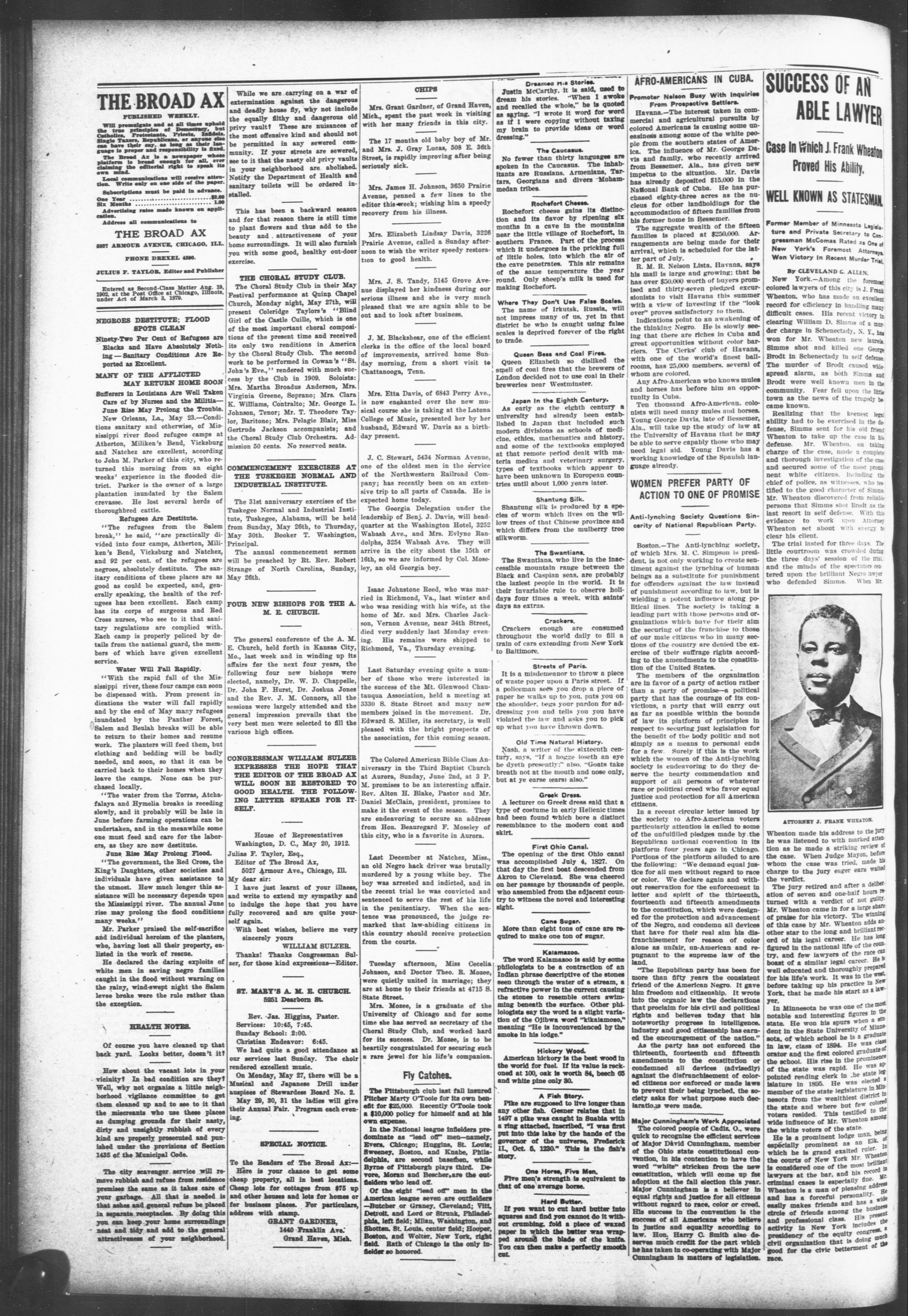
Case In Which J. Frank Wheaton Proved His Ability.
WELL KNOWN AS STATESMAN
Former Member of Minnesota Legislature and Private Secretary to Congressman McComas Rated as One of New York's Foremost Attorneys Won Victory In Recent Murder Trial
By CLEVELAND G. ALLEN
New York.—Among the foremost colored lawyers of this city is J. Frank Wheaton, who has made an excellent record for efficiency in handling many difficult cases. His recent victory in clearing William D. Simms of a murder charge in Schenectady, N. Y., has won for Mr. Wheaton new laurels. Simms shot and killed one George Brodt in Schenectady in self defense. The murder of Brodt caused widespread alarm, as both Simms and Brodt were well known men in the community. Fear fell upon the little town as the news of the tragedy be came known.
Realizing that the keenest legal ability had to be exercised in the defense, Simms sent for his old friend Wheaton to take up the case in his defense. Mr. Wheaton, on taking charge of the case, made a complete and thorough investigation of the case and secured some of the most prominent white citizens, including the chief of police, as witnesses, who testified to the good character of Simms. Mr. Wheaton discovered from reliable persons that Simms shot Brodt as the last resort in self defense. With this evidence to work upon Attorney Wheaton set about with energy to clear his client.
The trial lasted for three days. The little courtroom was crowded during the three days' session of the trial, and the minds of the spectators centered upon the brilliant Negro lawyer who defended Simms. When Mr.
[Name]
ATTORNEY J. FRANK WHEATON.
Wheaton made his address to the jury he was listened to with marked attention as he made a striking review of the case. When Judge Mayon, before whom the case was tried, made his charge to the jury eager ears waited the verdict.
The jury retired and after a deliberation of seven and one-half hours returned with a verdict of not guilty. Mr. Wheaton came in for a large share of praise for his victory. The winning of this case by Mr. Wheaton adds another star to the long and brilliant record of his legal career. He has long figured in the national life of the country, and few lawyers of the race can boast of a similar legal career. He is well educated and thoroughly prepared for his life's work. It was in the west, before taking up his practice in New York, that he made his start as a lawyer.
In Minnesota he was one of the most notable and interesting figures in the state. He won his spurs when a student in the State University of Minnesota, of which school he is a graduate in law, class of 1894. He was class orator and the first colored graduate of the school. His rise in the prominence of the state was rapid. He was appointed reading clerk in the state legislature in 1895. He was elected a member of the state legislature in Minnesota from the wealthiest district in the state and where but few colored voters resided. This testified to the wide influence of Mr. Wheaton among the white voters of the state.
He is a prominent lodge man, being especially prominent as an Elk, of which he is grand exalted ruler. In the courts of New York Mr. Wheaton is considered one of the most brilliant lawyers at the bar, and his record in criminal cases is especially fine. Mr. Wheaton is a man of pleasing address and has a forceful personality. He easily makes friends and has a wide circle of friends among the business and professional class. His present activity in New York includes the presidency of the equity congress, a civil organization that is doing much good for the civic betterment of the race.
Office Hours; 9 to 11 A. M., 2 to 5 P. M.
3158 State Street, Chicago
Office Hours—From 9 A. M. to 5 P. M.; from 7 P. M. to 9 P. M. Sunday by appointment.
DR. THEO. R. MOZEE
DENTIST
4715 SOUTH STATE STREET
CHICAGO
Phone, Oakland 4662; Automatic 73053
Frank Dunn and J. B. McCahey, Trustees,
Tel. Oakland 1550-1551-1552
Fax: Oakland 1857
John J. Dunn
Coal
Wholesale Retail
FIFTY-FIRST STREET and ARMOUR AVE.
Rallyarde;
51st St. and L. S. & M. S.
51st St. and Armour Ave. CHICAGO
Residence, 1262 Macalister Place
Telephone, Monroe 2714
Miles J. Devine
Attorney at Law
Suite 318-320 Reaper Block
Clark and Washington Streets CHICAGO
Phones, Central 1249; Auto, 41-913
Tel. Central 3142
Franklin A. Denison
36 W. RANDOLPH STREET
Suite 708
[ Delaware Building
CHICAGO
Office Phone; Central 6624.
Res. Phone, Doug. 4397.
3337 Wabash Ave.
Third Aprt.
J. GRAY LUCAS
Suite 405, 145 Clark St.
Cor. Randolph St.
WILLIAM L. MARTIN
LAWYER
Room 916-32 N. Clark St.
Telephones: Main 4352; Auto. 32-361
CHICAGO
Phones; Office, Main 4153
Res. Drexel, 7990
Auto, 33-736
ATTORNEY AT LAW
Suite 708, 184 Washington St.
Notary Public CHICAGO, ILL.
A. D. GASH
ATTORNEY AT LAW
118 North La Salle St. Chicago
Suite 615 to 616
Telephone Main 3077
SOME FINE POUR TO SEVEN ROOM
FLATS TO RENT.
TO RENT—Some fine 4 to 7 room
flats to honest Colored people who wish
to get away from the lower element.
Here is a few of them.
5754 Wentworth ave., 4 to 6 rooms.
Rent $11 to $18.
7228 Wentworth ave., 7 rooms and
bath. Rent $22.
7242 Wentworth ave., 7 rooms, and bath. Rent $22.
For more see George White, 2420 La Salle St. 1st flat.
AGENTS WANTED
Agents to sell lots in beautiful Mount Glenwood Cemetery, men and women employed who want to make good extra money by selling lots evenings and on our Sunday excursions. Big commissions paid. Ask for T. M. George, General Manager, Mount Glenwood Cemetery Association. 3125 S. State St.
REMOVAL NOTICE
Edward E. Wilson Attorney-at-Law announces that he has removed his law office to 115 South Dearborn Street. Room 307, Phone Central 6987.
RACE HAS BRIGHT FUTURE
People of Muskoges Pleased With Mrs.
M. C. Terrell's Work.
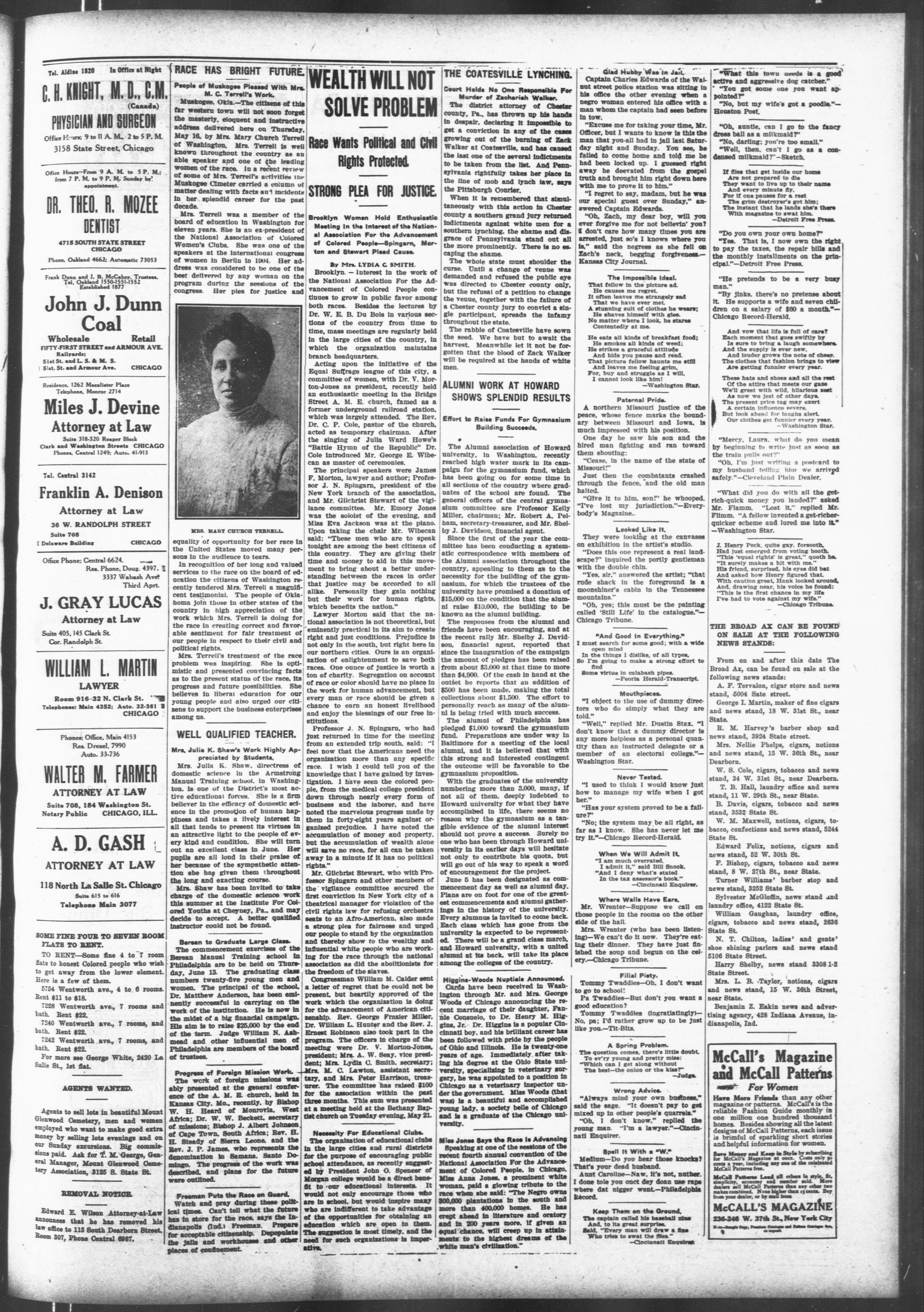
Muskogee, Okla.—The citizens of this far western town will not soon forget the mastery, eloquent and instructive address delivered here on Thursday, May 16, by Mrs. Mary Church Terrell of Washington. Mrs. Terrell is well known throughout the country as a able speaker and one of the leading women of the race. In a recent review of some of Mrs. Terrell's activities the Muskogee Cimeter carried a column of matter dealing with facts and incidents in her splendid career for the past decade.
Mrs. Terrell was a member of the board of education in Washington for eleven years. She is an ex-president of the National Association of Colored Women's Clubs. She was one of the speakers at the international congress of women in Berlin in 1904. Her address was considered to be one of the best delivered by any woman on the program during the sessions of the congress. Her plea for justice and
Mary C.
MRS. MARY CHURCH TERRELL. equality of opportunity for her race in the United States moved many persons in the audience to tears. In recognition of her long and valued services to the race on the board of education the citizens of Washington recently tendered Mrs. Terrell a magnificent testimonial. The people of Oklahoma join those in other states of the country in high appreciation of the work which Mrs. Terrell is doing for the race in creating correct and favorable sentiment for fair treatment of our people in respect to their civil and political rights.
Mrs. Terrell's treatment of the race problem was inspiring. She is optimistic and presented convincing facts as to the present status of the race, its progress and future possibilities. She believes in liberal education for our young people and also urged our citizens to support the business enterprises among us.
WELL QUALIFIED TEACHER.
Mrs. Julia K. Shaw Work Highly Appreciated by Students.
Mrs. Julia K. Shaw, directress of domestic science in the Armstrong Manual Training school, in Washington, is one of the District's most active educational forces. She is a firm believer in the efficacy of domestic science in the promotion of human happiness and takes a lively interest in all that tends to present its virtues in an attractive light to the people of every kind and condition. She will turn out an excellent class in June. Her pupils are all loud in their praise of her because of the sympathetic attention she has given them throughout the long and exacting course.
Mrs. Shaw has been invited to take charge of the domestic science work this summer at the Institute For Colored Youths at Cheyney, Pa., and may decide to accept. A better qualified instructor could not be found.
Berean to Graduate Large Class.
The commencement exercises of the Berean Manual Training school in Philadelphia are to be held on Thursday, June 13. The graduating class numbers twenty-five young men and women. The principal of the school, Dr. Matthew Anderson, has been emblently successful in carrying on the work of the institution. He is now in the midst of a big financial campaign. His aim is to raise $25,000 by the end of the term. Judge William N. Ashmead and other influential men of Philadelphia are members of the board of trustees.
Progress of Foreign Mission Work.
The work of foreign missions was ably presented at the general conference of the A. M. E. church, held in Kansas City, Mo., recently, by Bishop W. H. Heard of Monrovia, West Africa; Dr. W. W. Beckett, secretary of missions; Bishop J. Albert Johnson of Cape Town, South Africa; Rev. H. H. Steady of Sierra Leone, and the Rev. J. P. James, who represents the denomination in Samana. Santo Domingo. The progress of the work was described, and plans for the future were outlined.
Freeman Puts the战 on Guard.
Watch and pray during these political times. Can't tell what the future has in store for the race, says the Indianapolis (Ind.) Freeman. Prepare for acceptable citizenship. Depopulate the jails and workhouses and other places of confinement.
WEALTH WILL NOT SOLVE PROBLEM
Race Wants Political and Civil Rights Protected.
Brooklyn Women Hold Enthusiastic Meeting In the Interest of the National Association For the Advancement of Colored People—Spingarn, Morton and Stewart Plead Cause.
By Mrs. LYDIA C. SMITH.
Brooklyn. - Interest in the work of the National Association For the Advancement of Colored People continues to grow in public favor among both races. Besides the lectures by Dr. W. E. B. Du Bois in various sections of the country from time to time, mass meetings are regularly held in the large cities of the country, in which the organization maintains branch headquarters.
Acting upon the initiative of the Equal Suffrage league of this city, a committee of women, with Dr. V. Morton-Jones as president, recently held an enthusiastic meeting in the Bridge Street A. M. E. church, famed as a former underground railroad station, which was largely attended. The Rev. Dr. C. P. Cole, pastor of the church, acted as temporary chairman. After the singing of Julia Ward Howe's "Battle Hymn of the Republic" Dr. Cole introduced Mr. George E. Wilbecan as master of ceremonies.
The principal speakers were James F. Morton, lawyer and author; Professor J. N. Spingarn, president of the New York branch of the association, and Mr. Glicchrist Stewart of the vigilance committee. Mr. Emory Jones was the solist of the evening, and Miss Eva Jackson was at the piano. Upon taking the chair Mr. Wibecan said: "These men who are to speak tonight are among the best citizens of this country. They are giving their time and money to aid in this movement to bring about a better understanding between the races in order that justice may be accorded to all alike. Personally they gain nothing but their work for human rights, which benefits the nation."
Lawyer Morton said that the national association is not theoretical, but eminently practical in its aim to create right and just conditions. Prejudice is not only in the south, but right here in our northern cities. Ours is an organization of enlightenment to save both races. One ounce of justice is worth a ton of charity. Segregation on account of race or color should have no place in the work for human advancement, but every man or race should be given a chance to earn an honest livelihood and enjoy the blessings of our free institutions.
Professor J. N. Spingarn, who had just returned in time for the meeting from an extended trip south, said: "I feel now that the Americans need the organization more than any specific race. I wish I could tell you of the knowledge that I have gained by investigation. I have seen the colored people, from the medical college president down through nearly every form of business and the laborer, and have noted the marvelous progress made by them in forty-eight years against organized prejudice. I have noted the accumulation of money and property, but the accumulation of wealth alone will save no race, for all can be taken away in a minute if it has no political rights."
Mr. Gilchrist Stewart, who with Professor Spingarn and other members of the vigilance committee secured the first conviction in New York city of a theatrical manager for violation of the civil rights law for refusing orchestra seats to an Afro-American, also made a strong plea for fairness and urged our people to stand by the organization and thereby show to the wealthy and influential white people who are working for the race through the national association as did the abolitionists for the freedom of the slaves.
Congressman William M. Calder sent a letter of regret that he could not be present, but heartily approved of the work which the organization is doing for the advancement of American citizenship. Rev. George Frazier Miller, Dr. William L. Hunter and the Rev. J. Ernest Robinson also took part in the program. The officers in charge of the meeting were Dr. V. Morton-Jones, president; Mrs. A. W. Seay, vice president; Mrs. Lydia C. Smith, secretary; Mrs. M. C. Lawton, assistant secretary, and Mrs. Peter Harrison, treasurer. The committee has raised $100 for the association within the past three months. This sum was presented at a meeting held at the Bethany Baptist church on Tuesday evening, May 21.
Necessity For Educational Clubs
Necessity for Educational Clubs
The organization of educational clubs in the large cities and rural districts for the purpose of encouraging public school attendance, as recently suggested by President John O. Spencer of Morgan college would be a direct benefit to our educational interests. It would not only encourage those who are in school, but would inspire many who are indifferent to take advantage of the opportunities for obtaining an education which are open to them. The suggestion is most timely, and the need for such organizations is imperative.
Court Holds No One Responsible For
Murder of Zachariah Wallace
Murder of Zechariah Walker.
The district attorney of Chester county, Pa., has thrown up his hands in despair, declaring it impossible to get a conviction in any of the cases growing out of the burning of Zack Walker at Coatesville, and has caused the last one of the several indictments to be taken from the list. And Pennsylvania rightfully takes her place in the line of mob and lynch law, says the Pittsburgh Courler.
When it is remembered that simultaneously with this action in Chester county a southern grand jury returned indictments against white men for a southern lynching, the shame and disgrace of Pennsylvania stand out all the more prominently. There is no escaping the shame.
The whole state must shoulder the curse. Until a change of venue was demanded and refused the public eye was directed to Chester county only, but the refusal of a petition to change the venue, together with the failure of a Chester county jury to convict a single participant, spreads the infamy throughout the state.
The rabble of Coatesville have sown the seed. We have but to await the harvest. Meanwhile let it not be forgotten that the blood of Zack Walker will be required at the hands of white men.
ALUMNI WORK AT HOWARD SHOWS SPLENDID RESULTS
Effort to Raise Funds For Gymnasium Building Succeeds.
The Alumni association of Howard university, in Washington, recently reached high water mark in its campaign for the gymnasium fund, which has been going on for some time in all sections of the country where graduates of the school are found. The general officers of the central gymnasium committee are Professor Kelly Miller, chairman; Mr. Robert A. Pelham, secretary-treasurer, and Mr. Shelby J. Davidson, financial agent.
Since the first of the year the committee has been conducting a systematic correspondence with members of the Alumni association throughout the country, appealing to them as to the necessity for the building of the gymnasium, for which the trustees of the university have promised a donation of $15,000 on the condition that the alumni raise $10,000, the building to be known as the alumni building.
The responses from the alumni and friends have been encouraging, and at the recent rally Mr. Shelby J. Davidson, financial agent, reported that since the inauguration of the campaign the amount of pledges has been raised from about $3,000 at that time to more than $4,900. Of the cash in hand at the outset he reports that an addition of $500 has been made, making the total collections about $1,500. The effort to personally reach as many of the alumni is being tried with much success.
The alumni of Philadelphia has pledged $1,000 toward the gymnasium fund. Preparations are under way in Baltimore for a meeting of the local alumni, and it is believed that with this strong and interested contingent the outcome will be favorable to the gymnasium proposition.
With the graduates of the university numbering more than 3,000, many, if not all of them, deeply indebted to Howard university for what they have accomplished in life, there seems no reason why the gymnasium as a tangible evidence of the alumni interest should not prove a success. Surely no one who has been through Howard university in its earlier days will hesitate not only to contribute his quota, but will go out of his way to speak a word of encouragement for the project.
June 5 has been designated as commencement day as well as alumni day. Plans are on foot for one of the greatest commencements and alumni gatherings in the history of the university. Every alumnus is invited to come back. Each class which has gone from the university is expected to be represented. There will be a grand class march, and Howard university, with a united alumni at its back, will take its place among the colleges of the country.
Higginis-Woods Nuptials Announced.
Cards have been received in Washington through Mr. and Mrs. George Woods of Chicago announcing the recent marriage of their daughter, Fannie Consuelo, to Dr. Henry M. Higgins, Jr. Dr. Higgins is a popular Cincinnati boy, and his brilliant career has been followed with pride by the people of Ohio and Illinois. He is twenty-one years of age. Immediately after taking his degree at the Ohio State university, specializing in veterinary surgery, he was appointed to a position in Chicago as a veterinary inspector under the government. Miss Woods (that was) is a beautiful and accomplished young lady, a society belle of Chicago and is a graduate of the Chicago university.
Miss Jones Says the Race Is Advancing Speaking at one of the sessions of the recent fourth annual convention of the National Association For the Advancement of Colored People, in Chicago, Miss Anna Jones, a prominent white woman, paid a glowing tribute to the race when she said: "The Negro owns 300,000 plantations in the south and more than 400,000 homes. He has crept ahead in literature and oratory and in 200 years more. If given an equal chance, will creep up in attainments to the highest dreams of the white man's civilization."
Glad Hubby Was In Jail.
Captain Charles Edwards of the Walnut street police station was sitting in his office the other evening when a negro woman entered his office with a man whom the captain had seen before in tow.
"Excuse me for taking your time, Mr. Officer, but I wants to know is this the man that you-all had in jail last Saturday night and Sunday. You see, he failed to come home and told me he had been locked up. I guessed right away he deceived from the gospel truth and brought him right down here with me to prove it to him."
"I regret to say, madam, but he was our special guest over Sunday," answered Captain Edwards.
"Oh, Zach, my dear boy, will you ever forgive me for not believin' you? I don't care how many times you are arrested, just so's I knows where you is," said the negress as she fell on Zach's neck, begging forgiveness.—Kansas City Journal.
The Impossible ideal.
That fellow in the picture ad.
He causes me regret.
It often leaves me strangely sad
That we have ever met.
A stunning suit of clothes he wears;
He shaves himself with glee.
No matter where I look, he stares
Contentedly at me.
He eats all kinds of breakfast food;
He smokes all kinds of weed;
He strikes a graceful attitude
And bids you pause and read.
That picture fellow haunts me still
And leaves me feeling grim.
For, buy and struggle as I will.
I cannot look like him!
—Washington Star.
Paternal Pride.
A northern Missouri justice of the peace, whose fence marks the boundary between Missouri and Iowa, is much impressed with his position.
One day he saw his son and the hired man fighting and ran toward them shouting:
"Cease, in the name of the state of Missouri!"
Just then the combatants crashed through the fence, and the old man halted.
"Give it to him, son!" he whooped. "I've lost my jurisdiction."—Everybody's Magazine.
Looked Like It
They were looking at the canvases on exhibition in the artist's studio.
"Does this one represent a real landscape?" inquired the portly gentleman with the double chin.
"Yes, sir," answered the artist; "that rude shack in the foreground is a moonshiner's cabin in the Tennessee mountains."
"Oh, yes; this must be the painting called 'Still Life' in the catalogue."—Chicago Tribune.
"And Good In Everything."
I must search for some good; with a wide open mind
In the things I dislike, of all types.
So I'm going to make a strong effort to find
Some virtue in calabash pipes.
—Peoria Herald-Transcript.
Mouthpieces.
"I object to the use of dummy directors who do simply what they are told."
"Well," replied Mr. Dustin Stax. "I don't know that a dummy director is any more helpless as a personal quantity than an instructed delegate or a member of an electoral college."—Washington Star.
Never Tested.
"I used to think I would know just how to manage my wife when I got her."
"Has your system proved to be a failure?"
"No; the system may be all right, as far as I know. She has never let me try it."—Chicago Record-Herald.
When We Will Admit It,
"I am much overrated.
I admit it," said Bill Snook.
"And I deny what's stated
In the tax assessor's book."
—Cincinnati Enquirer.
Where Walls Have Ears
Mr. Wrenter—Suppose we call on those people in the rooms on the other side of the hall.
Mrs. Wrenter (who has been listening)—We can't do it now. They're eating their dinner. They have just finished the soup and begun on the celery.—Chicago Tribune.
Eilial Piety.
Tommy Twaddles-Ob, I don't want to go to school!
Pa Twaddles—But don't you want a good education?
Tommy Twaddles (ingratiatingly)—No, pa; I'd rather grow up to be just like you—Tit-Bits.
A. Spring Problem
A Spring Problem.
The question comes, there's little doubt, that you're trying to mimic: "Which can I get along without the best—the onion or the kiss?"
Wrong Advice.
"Always mind your own business," said the sage. "It doesn't pay to get mixed up in other people's quarrels." "Oh, I don't know," replied the young man. "I'm a lawyer."—Cincinnati Enquirer.
Aunt Caroline—Naw, it's not, nother.
I done to you ole too dey don use rape
where dat nigger went—Philadelphia
record.
Keep Them on the Ground,
The captain called his baseball nine
And, to its great surprise,
Said, "Every man will draw a fine
Who tries to swat the flies."
—Cincinnati Enquirer
"What this town needs is a good active and aggressive dog catcher."
"You got some one you want appointed?"
"No, but my wife's got a pooodle."—Houston Post.
"Oh, auntie, can I go to the fancy dress ball as a milkmaid?"
If files that get inside our home
Are not prepared to die
They want to live up to their name
And every minute fly.
For if one pauses for a rest
The grim destroyer's got him;
The instant that he lands she's there
With magazine to swat him.
—Detroit Free Press.
"Do you own your own home?"
"Yes. That is, I now own the right
to pay the taxes, the repair bills and
the monthly installments on the prin-
cipal."—Detroit Free Press.
"He pretends to be a very busy
man."
"By jinks, there's no pretense about
it. He supports a wife and seven children
on a salary of $60 a month."—Chicago Record-Herald.
And wow that life is full of care?
Each moment that goes swiftly by
Is sure to bring a laugh somewhere.
And the supply is ever new.
And louder grows the note of cheer. The clothes that fashion brings to view Are getting funnier every year.
These hats and shoes and all the rest Of the attire that meets our gaze We'll greet with wild, hilarious zeet As now we jest of other days. The present price tag may exert A certain influence severe. But look ahead for laughs alert Our clothes get funnier every year. -Washington Star.
"Mercy, Laura, what do you mean by beginning to write just as soon as the train pulls out"
"Oh, I'm just writing a postcard to my husband telling him we arrived safely." -Cleveland Plain Dealer.
"What did you do with all the get-rich-quick money you landed?" asked Mr. Flamm. "Lost it," replied Mr. Flimm. "A fellow invented a get-richer-quicker scheme and lured me into it." -Washington Star.
J. Henry Peck, quite gay, forsooth,
Had just emerged from voting booth.
"This 'equal rights' is great," quoah he.
"It surely makes a hit with me."
His friend, surprised, his eyes did bat
And asked how Henry figured that.
With caution great, Hank looked around,
And, drawing near, his voice he found:
"This is the first chance in my life
I've had to vote again!"
THE BROAD AX CAN BE FOUND ON SALE AT THE FOLLOWING NEWS STANDS:
From on and after this date The Broad Ax, can be found on sale at the following news stands:
A. F. Tervalon, cigar store and news stand, 5004 Sate street.
George I. Martin, maker of fine cigars and news stand, 18 W. 31st St., near State.
R. M. Harvey's barber shop and news stand, 3924 State street.
Mrs. Nellie Phelps, cigars, notions and news stand, 15 W. 36th St., near Dearborn.
W. S. Cole, cigars, tobacco and news stand, 34 W. 31st St., near Dearborn.
T. B. Hall, laundry office and news stand, 11 W. 29th St., near State.
B. Davis, cigars, tobacco and news stand, 3532 State St.
W. M. Maxwell, notions, cigars, tobacco, confections and news stand, 5244 State St.
Edward Felix, notions, cigars and news stand, 52 W. 30th St.
F. Bishop, cigars, tobacco and news stand, 8 W. 27th St., near State.
Turner Williams' barber stop and news stand, 3252 State St.
Sylvester McGloffin, news stand and laundry office, 4122 State St.
William Gaughan, laundry office, cigars, tobacco and news stand, 2636 State St.
N. T. Chilton, ladies' and gents' shoe shining parlors and news stand 5106 State Street.
Harry Shelby, news stand 3308 1-2 State Street.
Mrs. L. B. Taylor, notions, cigars and news stand, 15 W. 36th Street, near State.
Benjamin Z. Eakin news and advertising agency, 428 Indiana Avenue, indianapolis, Ind.
McCall's Magazine and McCall Patterns
Have More Friends than any other magazine or patterns. McCall's is the reliable Fashion Guide monthly in one million one hundred thousand homes. Besides showing all the latest designs of McCall Patterns, each issue is bimonthly of sparkling short stories and helpful information for women.
Save Money and Keep in Style by subscribing for McCall's Magazine at once. Costs only to buy including any one of the celebrated McCall Patterns free.
McCall Patterns Lead all others in style, simplicity, economy and number sold. More dealers sell McCall Patterns than any other two makes combined. None higher than 15 cents. Buy from your dealer, or by mail from
McCALL'S MAGAZINE
236-246 W. 37th St., New York City
Northeast-Southern Corp., Premium Catalogues and Pattern Catalogues Sea, on request.
---
Sir Charles Elliot, the newly appointed principal of Hongkong university, speaks twenty-three languages. James D. Preston, superintendent of the senate press gallery at Washington, began as messenger boy in the gallery.
Senator Smith, who conducted the investigation of the Titanic disaster, started out in life as a newsboy in Grand Rapids, but he always had one eye on the national capital.
Ex-Senator Chauncey M. Depew recently celebrated his seventy-eighth birthday. In replying to congratulations he announced that it was his ambition to live to be 100 years old.
Charles Horace Mayo and William James Mayo, the famous surgeons of Rochester, Minn., came by their profession by inheritance. Their father was a physician.
Archibald Astor Ferguson is the name given to a Washington baby born on the day the Titanic sank and whose parents especially admired the heroism of Major Butt and Colonel Astor.
Jacob B. Schmidlapp, a Cincinnati capitalist, says any family of five members or less can live on $15 a week and save $2. "When I was a young man," he says. "I lived on $2 a week. When I earned $1,000 a year I saved $600."
Town Topics.
The town of Ismay, Tex., wants to get its name changed and won't be satisfied with Yamsi either.—Washington Post.
Buffalo is maintaining its reputation as one of the most healthful cities in the country. The death rate last year was much less than that of any other city in the United States, and the figures for the first four months of this year show an even greater reduction.—Buffalo Times.
Now that Cincinnati is to have Dr. Erust Kunwald, who has been for five years conductor of the Berlin Philharmonic orchestra, to succeed Herr Leopold Stokowski as conductor of the Cincinnati Symphony orchestra she will very likely renew her claim to being the musical center of America.—Boston Herald.
Flippant Flings.
The old fashioned little boy who used to hide behind his mother's skirts would stick out on both sides if he tried it now.-Ohio State Journal.
The government reports are funny. One states that the average life of the dollar bill is fourteen months. About fourteen minutes is what it has always seemed.-Duluth Herald.
A Philadelphia explorer has gone to Brazil to obtain moving pictures of a boa constrictor, but we are inlined to think that the films will show some moving pictures of a Philadelphia explorer.-Washington Post.
The Royal Box.
The queen of Norway has a great fondness for the mandolin, which she plays exceedingly well.
Ex-Queen Alexandra's favorite hobbies are water color painting and needlework. Her majesty is an artist of considerable ability and is skilled embroiderer.
The kaiser does not dance himself, but he takes a great pleasure in watching others while they are dancing. He shows a predilection for ancient dances to the exclusion of others.
Household Helps.
Glue a tape measure firmly across the front edge of your sewing machine. It saves much time when sewing. When drawing from linen in hemstitching, save those long, even threads, as they come in handy when mending table linen. A dust brush, such as painters use before applying paint, will unearth lots of dirt from cracks about the house where no cloth or brooms will reach.
Political Pointers.
Dark horses are still eating their heads off in the stable.—Buffalo Times. The hide of the whale is two feet thick in some places. What a fine hide that would be for a man running for office—Philadelphia Press. Let us hope that something short of a Titanic disaster in politics will serve to awaken the people to the danger of speed mania there.—Albany Journal.
Facts From France.
There are in Paris 200,000 more women than men.
Paris is to raise a loan of $40,000,000 for improving its gas service.
In 1550 there were three public coaches in operation in the city of Paris.
It is proposed in France to pay a franc additional a day to all married army officers.
Bunched Hits.
Hank O'Day manages as well as heumpired, which is saying a good deal.—Chicago News. Speaking of "inside" baseball, a team has been organized by the inmates of the federal penitentiary at Leavenworth.—Topeka Capital. According to a physical culture sharp, there is no better exercise than rooting at a ball game. But the amount of exercise a fellow gets depends on the ability of the home team.—Pittsburgh Gazette-Times.
.
Feller in an easy chair
Lists the hours go by;
Looks across the bill o' fare
An' heaves a weary sigh.
Pictures hangin' on the wall;
Rugs upon the floor—
Has the best an' with it all
Says that life's a bore.
Feller standin' in a brook,
Wet clear to the skin;
Workin' hard with line an' hook—
Never sees a fin;
Tumbles from the mossy rock
That he tries to climb;
Trudges home at six o'clock—
Had a bully time!
—Washington Star.
He Stuttered Too.
Three strangers were in the Pullman smoker when one of them turned to another and asked:
"H-how f-f-f-far is it t-t-to P-P-P-ittsburgh?"
The man addressed made no reply, but got up and left the car. The stutterer then turned to the third man, who gave him the information.
A few moments afterward the third man met the one who had left the car and said:
"See here! Why did you go out without answering when that man asked you a civil question?"
"D-d do you think I w-w-wanted to g-g-get m-my head knocked off?" was the answer. "Ladies' Home Journal."
Pedigrees.
First Blooded Dog—Your master has a very long pedigree, I'm told.
Second Ditto—No longer than mine.
First Dog—They say he's inordinately proud of his family tree.
Second Dog—It doesn't show the variety of bark mine does. And, besides, I'm away ahead of him in another respect.
"Eh, how's that?"
"No ancestor of mine was ever hanged."—Cleveland Plain Dealer.
A Song and a Joke.
I breathed a song into the air.
It fell to the ground, I knew not where,
For nowadays not very long
Is the life of any old kind of song.
I breathed a joke into the air.
It fell to the ground, I knew not where,
But a hundred times since then, it's new.
I've read it and heard it sprout as new.
City Star
Fervent Pleading.
Presently he emerged into the lobby.
"That fellow was pleading pretty hard for a kiss," remarked a lounger who had overheard the conversation.
"Is that an engaged couple?"
"That couple," said another lounger.
"They're married. It was a dollar he was pleading for; not a kiss."—Kansas City Journal.
Too Dull.
"No," said Bill Squeezer, who was down from Bodie the other day. "No; I didn't go to Judge Podger's wedding. The notice said 'No cards,' and I'm darned if I can fool away a whole evening where there's no chance of a little four-bit ante."—Milwaukee Sentinel.
No Joke.
We're all so willing to do good
With money that we've spent;
We're all such excellent givers when
We haven't got a cent.
—Cincinnati Enquirer.
A Useful Tip.
"How did you get that fine spring overcoat?"
"I had a sure tip on a horse race."
"I never knew one of those sure tips to pan out."
"Neither did 1. So I didn't play it. Put the money into an overcoat instead."—Louisville Courier-Journal.
Logical Course.
"Yes, sir," said the expert accountant, who had spent a week in looking over the books. "I have found the key to your financial difficulties at last." "Then there's nothing to do, I suppose," sighed the despondent merchant, "but to wind up my affairs."—Chicago Tribune.
The Promoter.
The Promoter.
The promoter is a pleasant chap,
he likes all the lice.
He'll furnish you the ocean.
If you'll supply the ships.
Glad Prospect.
"I hear they're going to have moving pictures in the schools." said one youth.
"Yes," replied the other. "If they keep on making our studies so entertaining recess will seem fearfully monotonous."—Washington Star.
Passerby—What's the fuss in the schoolyard, boy?
The Boy—Why, the doctor has just been around examinin' us an' one of the deficient boys is knockin' an' everlastin' stuffin' out of a perfect kid.—Cleveland Plain Dealer.
Economize.
Bards who rime and never tire.
Writing paper has gone higher.
Cut your sonnets down in size.
Make the comma comma.
—Cleveland Plain Dealer.
Power of the Press
New Merchant-How big an ad. would you advise?
Advertising Man-That depends on how many tons of customers your store floor will sustain. You wouldn't want 'em to break through into the cellar, of course.-Puck.
Wasted Material
"England owns the Kohinoor, the finest diamond in the world."
"Owns the finest diamond in the world, eh? That seems a shame when she doesn't play baseball."—Louisville-Courier-Journal.
BROOKLYN MUSEUM OF ART
GENERAL BANKING
3 per cent allowed
Safety Deposit Va
REAL ESTATE
As agent buy and sell Real Estate on
dents, including payment of taxes and
on Chicago Real Estate.
Especially Invites the patr
The Cranfor
Building.
The finest building ever open
Steam heat, electric light, tile ba
cent allowed on Savings Acct.
Deposit Vaults, $3.00 per
REAL ESTATE DEPARTMENT
I sell Real Estate on commission, manages estat
payment of taxes and locking after assessments.
Estate.
Specially Invites the patronage of Chicago business
Cranford Apartn
uilding. 3600 Wabash A
building ever opened to Colored tenant
electric light, tile baths, marble entrance.
3 per cent allowed on Savings Accounts Safety Deposit Vaults, $3.00 per Year
As agent buy and sell Real Estate on commission, manages estates for non-residents, including payment of taxes and locking after assessments. Money to loan on Chicago Real Estate.
Especially Invites the patronage of Chicago business men.
The Cranford Apartment Building. 3600 Wabash Ave.
THE FORTY-FOURTH STREET
The finest building ever opened to Colored tenants in Chicago. Steam heat, electric light, tile baths, marble entrance.
J. W. Casey, Agent,
101 WASHINGTON STREET.
'Phone Randolph 803
Frank L. Gale Sam'l I. Lee
THE GALE PIANO CO.
3159 STATE STREET
Pianos, Organs, Talking Machines and Supplies.
Brass and String Instruments. Cash or Easy
Payments. Open Evenings till 10.30.
Phone Doug. 4558.
Organs, Talking Machines and Hes and String Instruments. Cash or Payments. Open Evenings till 10.30
Pianos, Organs, Talking Machines and Supplies. Brass and String Instruments. Cash or Easy Payments. Open Evenings till 10.30. Phone Doug. 4558.
Afford Sickness or Accident
people can. Your pay usually stops, and the bills keep rise
of accidents happen each day, and sickness may com-
pete your paymaster.
A SURE WAY TO AVOID THIS
policy in the Bankers Union. Then you can keep right
to see your paymaster.
ACCIDENT, HEALTH AND LIFE INSURANCE
$20 to $60 Benefits for $1.00.
Balance to protect contracts over $1,000,000.
Bankers Union
rate, or telephone Randolph 5461 for further information
"As good as the best better than all the rest."
400-1041 FIRST NATIONAL BANK BUILDING, CHICAGO
D-Reliable Agents Can make good salary. Write or
Test Manager, 1123 Harris Trust Bldg., Chicago, Ill.
Can You Afford Sick?
Vary few people can. Your pay us usual
in. Thousands of accidents happen each minute.
A SURE WAY
is by taking out a policy in the Bankers Uni-
bills, and make us be your paymaster.
ACCIDENT, HEALTH
$20 to $60 Be
Balance to protect com-
munity
Bankers
Call, write, or telephone Randolph
As good as the best b
HOME OFFICE: 1040-1041 FIRST NATION
WANTED—Reliable Agents Gus
McKENNA, District Manager, 1123 Harris
Can You Afford Sickness or Accidents?
Very few people can. Your pay usually stops, and the bills keep right on coming in thousands of accidents happen each day, and sickness may come almost any minute.
A SURE WAY TO AVOID THIS is by taking out a policy in the Emmeries Union. Then you can keep right on paying your bills, and make us be your paymaster.
As good as the best better than the all rest."
HOME OFFICE: 1040-1041 FIRST NATIONAL BANK BUILDING, CHICAGO, ILL.
WANTED—Reliable Agents Can make good salary. Write or apply to P. D. McKENNAN, District Manager, 1123 Harris Trust Blidge, Chicago, Ill.
TELEPHONES
Oakland 1609 Reservoir 1760 Auto. 79156
HENRY C. BOMAR & SON
FINE FURNITURE AND PIANO
MOVERS, PACKERS AND SHIPPERS
3 Trips Daily to All Depots
4706 Indiana Ave. CHICAGO
Phone Douglas SS20 Rooms by Day or Week
Room 25-35-50c
The Douglas Hotel
For Men Only
Baths, SteamHeat, Electric Light
2906 S. State Street. CHICAGO
---
Frank L. Gale
TUNING
JESSE BINGA BANKER
S. E. Cor. State and 36th Place, Chicago Telephone Douglas 1565
owed on Savings Accounts
at Vaults, $3.00 per Year
ESTATE DEPARTMENT
state on commission, manages estates for non-resi-
ces and locking after assessments. Money to loan
the patronage of Chicago business men.
Anford Apartment
3600 Wabash Ave.
her opened to Colored tenants in Chicago.
tile baths, marble entrance.
J. W. Casey, Agent,
101 WASHINGTON STREET.
Sam'll Lee
LE PIANO CO.
STATE STREET
Talking Machines and Supplies.
ing Instruments. Cash or Easy
Open Evenings till 10.30.
Sickness or Accidents?
pay usually stops, and the bills keep right on coming
open each day, and sickness may come almost any
WAY TO AVOID THIS
kers Union. Then you can keep right on paying your
r.
HEALTH AND LIFE INSURANCE
$60 Benefits for $1,00.
protect contracts over $1,000,000.
kers Union
Hendallph 5461 for further information
the best better than all the rest."
NATIONAL BANK BUILDING, CHICAGO, ILL.
Cats Can make good salary. Write or apply to P. D.
23 Harris Trust Bldg., Chicago, Ill.
For
Rent
High Class Modern Apartments.
3-4-6-7 and 8 rooms. Rent $20.00
$50.00 per month. The New
American, 28th and Wabash
Avenue.
WM. D. NEIGHBORS & CO.
3517 State Street
ALDINE 2533
TELEPHONES
AUTO. 75373
Sam'11. Lee
REPAIRING
"A STORE FOR EVERYBODY"
HILLMAN'S
STATE & WASHINGTON STS.
Telephone Yards 693
JOHN J. BRADLE
Real Estate
Loans
Fire and Plate Glass Insurance
JOHN J. BRADLEY
4709 S. HALSTED ST
CHICAGO
Telephone Oakland 1787
The BELLE
Buffet
FRANK H.
5059 Ar
Cor. 51st
BELLE MEADE
Buffet and Cafe
FRANK H. LEWIS, Proprietor
059 Armour
Cor. 51st Street, Chicago
5059 Armour Ave
Cor. 51st Street, Chicago
Phone Douglas 4482
The La Verdo
3100-2 STATE
First Class Chinese and An
High Cla
Phon
Hotel B
Geo. V
BUFFET, POOL
The La Verdo Cafe and B
3100-2 STATE STREET, CHICAGO
First Class Chinese and American Restaurant in C
High Class Entertainers
HARRY J. KELLY,
The La Verdo Cafe and Buffet
3100-2 STATE STREET, CHICAGO
First Class Chinese and American Restaurant in Connection
High Class Entertainers
HARRY J. KELLY, Proprietor.
Hotel Brunswick
Geo. W. Holt, Prop.
BUFFET, POOL AND BILLIARD
4 State Street
7. Codozoe
Elite Buffet and Ca
BUFFET, POOL AND BILLIARDS.
3004 State Street
Elite Buff
3030
3030 State Street
and Douglas 3256 Chas. Har
When the Bride of 11
Undertakes a Big Dirt
She can't make a mistake unless she falls asleep.
Her printed instructions tell her just how hot the oven should
And just how long each sort of food should cook.
The temperature dial on the oven door tells her when she
turned the fire to the right notch.
Phone Douglas 3256
When the
Undertakes
She can't make a mistake un
Her printed instructions tell her
And just how long each sort
The temperature dial on the c
turned the fire to the right
When the Bride of 1912 Undertakes a Big Dinner
She can't make a mistake unless she falls asleep.
Her printed instructions tell her just how hot the oven should be.
And just how long each sort of food should cook.
The temperature dial on the oven door tells her when she has turned the fire to the right notch.
The clock tells her when to take the food out.
The clock tells her when to take the food out.
To make success doubly certain she can watch the whole process of cooking through the glass oven windows.
The roast will be done to a turn in the lower oven while the same fire is cooking the rolls, potatoes and pudding in the upper oven.
Thus has this new type of gas range taken all the mystery, all the guess, all the uncertainty and most of the science out of the actual cooking of a dinner.
The type of range that has brought about this revolution in cooking is
The "Composite" Range
We carry a stock of 40,000 in 50 styles
tion is No. 18-39 in our new spring
phase of the gas range question.
Write us today to mail you a copy, or
for yourself all fifty styles of "Comp
monthly payment plan at any of our
The Peoples Gas Light and Coke Com
by a stock of 40,000 in 50 styles built to our order. The one
No. 18-39 in our new spring catalog—a complete text book
of the gas range question.
a today to mail you a copy, or better still, make a call of
yourself all fifty styles of "Composite" ranges side by side and
only payment plan at any of our stores or at our big sales ro
Peoples Gas Light and Coke Company, Peoples Gas Building,
We carry a stock of 40,000 in 50 styles built to our order. The one in the illustration is No. 18-39 in our new spring catalog—a complete text book covering every phase of the gas range question.
Write us today to mail you a copy, or better still, make a call of inspection—see for yourself all fifty styles of "Composite" ranges side by side and learn about our monthly payment plan at any of our stores or at our big sales room downtown. The Peoples Gas Light and Coke Company, Peoples Gas Building, Michigan Boul.
A. F. Codozoe
EVERYTHING TO WEAR
TO EAT
AND
FOR THE HOME
AT
THE VERY LOWEST PRICES
BRADLEY
Real Estate
Loans
State Glass Insurance
MEADE CLUB
and Cafe
LEWIS, Proprietor
Lymour Ave
Street, Chicago
Automatic Phone 74-478
do Cafe and Buffet
ATE STREET, CHICAGO
and American Restaurant in Connection
h Class Entertainers
HARRY J. KELLY, Proprietor.
runswick
V. Holt, Prop.
L AND BILLIARDS.
Chicago
Henry Jones
fet and Cafe
Bride of 1912
a Big Dinner
less she falls asleep.
her just how hot the oven should be.
food should cook.
oven door tells her when she has
notch.
T
built to our order. The one in the illustration catalog—a complete text book covering every better still, make a call of inspection—see "site" ranges side by side and learn about our stores or at our big sales room downtown, company, Peoples Gas Building, Michigan Boul
Chicago
Henry Jones
Chas. Harris, Manager