The Broad Ax
Saturday, June 1, 1912
Chicago, Illinois
Page text (machine-generated)
THE BROAD AX
Col. Theodore Roosevelt Routed President William H. Taft.
IN NEW JERSEY THE FORMER BOUGH RIDING PRESIDENT CAPTURED 22 OF ITS 28 DELEGATES TO THE REPUBLICAN NATIONAL CONVENTION.
THE MANAGERS OF THE PRESENT OCCUPANT OF THE WHITE HOUSE WILL BE FORCED TO RESORT
TO THE STEAM BOLLER METHODS IN THE CONVENTION IN ORDER TO LAND THE NOMINATION FOR HIM.
WOODBROW WILSON, GOVERNOR OF NEW JERSEY—THE STATE NOTED FOR SWEET POTATOES AND BIG CORPORATIONS SEEMS TO BE IN THE LEAD FOR THE DEMOCRATIC NOMINATION FOR PRESIDENT.
GOVERNOR CHARLES S. DENEEN TO NAME A SUCCESSOR TO JAMES A. ROSE, LATE SECRETARY OF THE STATE OF ILLINOIS.
Vol. XVII.
Col. Theodor
Routed
William
IN NEW JERSEY THE FORMER RO
22 OF ITS 28 DELEGATES TO THE
TION.
THE MANAGERS OF THE PRESENT
WILL BE FORCED TO RESORT
TO THE STEAM BOLLER METHOD
TO LAND THE NOMINATION FOR
WOODBROW WILSON, GOVERNOR OF
FOR SWEET POTATOES AND BE
THE LEAD FOR THE DEMOCRAT
GOVERNOR CHARLES S. DENEEN
A. ROSE, LATE SECRETARY OF
In spite of the fact that Col. Theodore Roosevelt, continues to deliver many unlogical speeches and sets forth many false statements as to how the government should be run and the part that the common people should play in it or occupy in it, nevertheless he sways the so-called sober-minded as well as the thoughtless people throughout the heavy Republican States to his way of thinking and the result is that he is breaking down all opposition to his onward march and he is carrying everything before him.
This week he routed President William H. Taft, in New Jersey, the former Rough-Riding President captured 22 of its 28 delegates to the Republican national convention and the Roosevelt boomers now claim that they have more than enough delegates to put him over in the convention.
To a blind man up a tree it does seem that the managers of the present occupant of the White House, who seemingly has lost his hold upon the great mass of the American people, who has never been close to their hearts, will be forced to resort to the steam-roller methods in the convention in order to land the nomination for him.
For with all the powerful forces behind him, and with all or nearly all the delegates selected, President Taft, is still about 40 votes short of having enough to nominate him and it is expected that his head managers will do considerable buying and trading of delegates on the floor of the convention in order to save him from defeat. Woodrow Wilson, Governor of New Jersey—the state noted for sweet potatoes and big corporations seems to
THE NATIONAL CONVENTION
CHAIRMANSHIP BY BEAUREGARD F. MOSLEY.
On Tuesday, June 18th, 1912, at the Coliseum in this city, the 56th National Convention of the Republican Party will assemble, and the burning question of the hour, the question that seems to be agitating the minds of the People, through the press and the Politicians, is who shall preside as Chairman of this great body of Republicans, gathered from the four winds of the earth, Maine, Porto-Rico, Key West, Philippines, Honolulu, Alaska, The Western, Middle, Eastern and Southern States. The question is important because it will, in my judgment, be the last and final effort of the re-actionaries, the Politicians to control a Republican National Convention against the expressed wish of the Bank and file of the Republican voters. It is now plainly seen that those who have been repudiated in every State where a popular preferential primary for delegates to the National Convention is held, are determined to over ride the voice and will of the People and continue in control; to do this, means a contest, the end of which will only come when the Polls close in November next. For be it understood that the people represented by the delegates from the States, holding popular Primaries, are in no mood to be baffled with, cailed, controlled, or longer, the willing tools of the Bosses, but are determined to fight until the People,
---
HEW TO THE LINE; LET THE CHIPS FALL WHERE THEY MAY
be in the lead for the Democratic nomination for president of the United States, the other candidates who are kicking up some dust are the Hon. Champ Clark, of Old Mo., Congressman Underwood of Ga., Governor Judson Harmon of Ohio, Gov. Thomas R. Marshall of Ind., Col. William J. Bryan of Lincoln, Neb., Mayor Carter H. Harrison of Chicago, William Randolph Hearst of New York and Chicago, Gov. John A. Dix of New York, Gov. Foss of Mass., and many others, it is our firm opinion that Messrs. Harmon and Foss, would be the proper team for the Democratic national convention to nominate, for with those two men as the standard bearers of the united Democracy, they could sweep the country from end to end and put either Taft or Roosevelt out of the running at the November election.
The unexpected and the untimely death of James A. Rose, secretary of state, which was a great shock to the people throughout Illinois, it devolves upon Gov. Charles S. Deneen, the duty of selecting his successor to fill out, the unrequived term of his office.
He was first elected secretary of state in 1896 and was re-elected in 1900, 1904 and 1908. He was one of the best known figures in public life in Illinois and his popularity is best known by the large majorities by which he was elected secretary of state time after time, holding the office longer than any man ever before him. In every sense of the word; James A. Rose, was an honest public official, and he will be greatly missed by a wide circle of friends, throughout this state.
and not the Bosses are in control of the Republican party, this means the nomination of Col. Theodore Roosevelt, either in the Coliseum or elsewhere in the City of Chicago, and his election in November. There are not enough People in all the camps of Col. Roosevelt's opponents were they united into one band, to defeat or even to disturb the Colonel's hold upon the confidence of the American people in November. If the Republican party is to survive, it has only the opportunity the nomination of Colonel Roosevelt affords; any other nominee will be as a man of straw, because the People, regardless of what may or may not take place at the Coliseum, are going to nominate Colonel Theodore Roosevelt and elect him in November.
THE CHORAL STUDY CLUB AT
QUINN CHAPEL.
Monday evening, the Choral Study Club, consisting of 75 voices, Prof. Pedro T. Tinsley, conductor, gave its 86th concert, the last one for the season of 1911 and 1912.
It was what might be called a May festival performance of Coleridge Taylor's Blind Girl of Castle Cullie, and Cowan's "St. John's Eve." Five soloists of considerable note, consisting of Mrs. Virginia Green, soprano, Mr. George L. Johnson, tenor, Mrs. Martina B. Anderson, soprano, Mr. T. Theodore Taylor, baritone, and Mrs. Clara K. Williams, contralto, were up
CHICAGO, JUNE 1, 1912
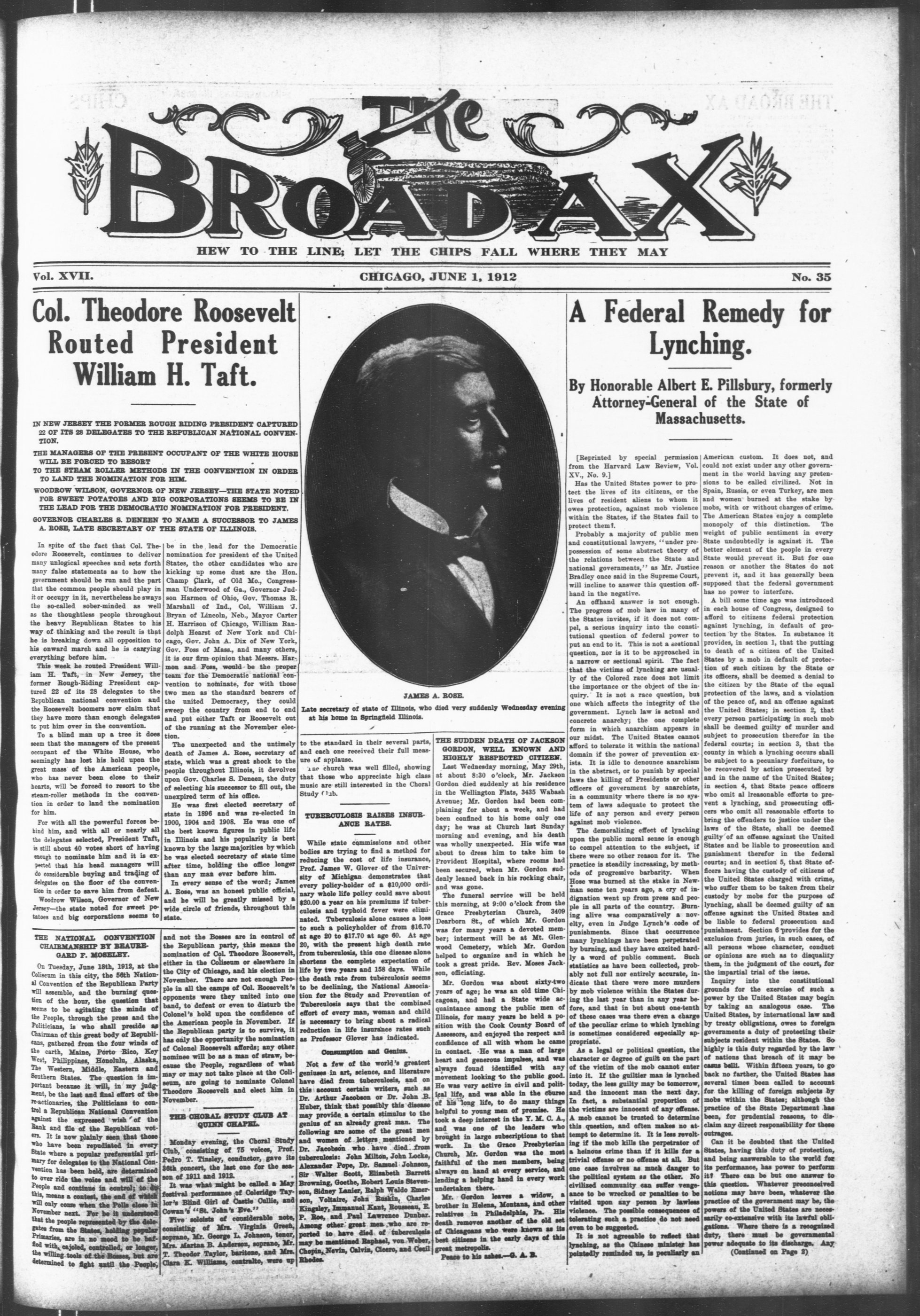
JAMES
Late secretary of state of Illinois, who
at his home in Springfield Illinois.
CANTERBURY
Late secretary of state of Illinois, who died very suddenly Wednesday evening at his home in Springfield Illinois.
to the standard in their several parts, and each one received their full measure of applause. The church was well filled, showing that those who appreciate high class music are still interested in the Choral Study Club.
TUBERCULOSIS RAISES INSURANCE RATES.
While state commissions and other bodies are trying to find a method for reducing the cost of life insurance, Prof. James W. Glover of the University of Michigan demonstrates that every policy-holder of a $10,000 ordinary whole life policy could save about $20.00 a year on his premiums if tuberculosis and typhoid fever were eliminated. Tuberculosis alone causes a loss to such a policy-holder of from $16.70 at age 20 to $17.70 at age 60. At age 20, with the present high death rate from tuberculosis, this one disease alone shortens the complete expectation of life by two years and 158 days. While the death rate from tuberculosis seems to be declining, the National Association for the Study and Prevention of Tuberculosis says that the combined effort of every man, woman and child is necessary to bring about a radical reduction in life insurance rates such as Professor Glover has indicated.
Consumption and Genius.
Not a few of the world's greatest geniuses in art, science, and literature have died from tuberculosis, and on this account certain writers, such as Dr. Arthur Jacobson or Dr. John B. Huber, think that possibly this disease may provide a certain stimulus to the genius of an already great man. The following are some of the great men and women of letters mentioned by Dr. Jacobson who have died from tuberculosis: John Milton, John Locke, Alexander Pope, Dr. Samuel Johnson, Sir Walter Scott, Elizabeth Barrett Browning, Goethe, Robert Louis Stevenson, Sidney Lanier, Ralph Waldo Emerson, Voltaire, John Ruskin, Charles Kingaley, Immanuel Kant, Bousseau, E. P. Roe, and Paul Lawrence Dunbar. Among other great men who are reported to have died of tuberculosis may be mentioned Raphael, von Weber, Chipin, Nevin, Calvin, Cleero, and Ceil Ehodes.
A. ROSE. died very suddenly Wednesday evening
THE SUDDEN DEATH OF JACKSON GORDON, WELL KNOWN AND HIGHLY RESPECTED CITIZEN.
Last Wednesday morning, May 29th, at about 8:30 o'clock, Mr. Jackson Gordon died suddenly at his residence in the Wellington Flats, 3435 Wabash Avenue; Mr. Gordon had been complaining for about a week, and had been confined to his home only one day; he was at Church last Sunday morning and evening, and his death was wholly unexpected. His wife was about to dress him to take him to Provident Hospital, where rooms had been secured, when Mr. Gordon suddenly leaned back in his rocking chair, and was gone.
The funeral service will be held this morning, at 9:00 o'clock from the Grace Presbyterian Church, 3409 Dearborn St., of which Mr. Gordon was for many years a devoted member; interment will be at Mt. Glenwood Cemetery, which Mr. Gordon helped to organize and in which he took a great pride. Rev. Moses Jackson, officiting.
Mr. Gordon was about sixty-two years of age; he was an old time Chicagoan, and had a State wide acquaintance among the public men of Illinois, for many years he held a position with the Cook County Board of Assessors, and enjoyed the respect and confidence of all with whom he came in contact. He was a man of large heart and generous impulses, and was always found identified with any movement looking to the public good. He was very active in civil and political life, and was able in the course of his long life, to do many things helpful to young men of promise. He took a deep interest in the Y. M. C. A., and was one of the leaders who brought in large subscriptions to that work. In the Grace Prebysterian Church, Mr. Gordon was the most faithful of the men members, being always on hand at every service, and lending a helping hand in every work undertaken there.
Mr. Gordon leaves a widow, a brother in Helena, Montana, and other relatives in Philadelphia, Pa. His death removes another of the old set of Chicagoans who were known as its best citizens in the early days of this great metropolis.
Peace to his ashes.—G. A. R.
A Federal Remedy for Lynching.
By Honorable Albert E. Pillsbury, formerly Attorney-General of the State of Massachusetts.
[Reprinted by special permission from the Harvard Law Review, Vol. XV., No. 9.]
Has the United States power to protect the lives of its citizens, or the lives of resident aliens to whom it owes protection, against mob violence within the States, if the States fail to protect them!
Probably a majority of public men and constitutional lawyers, "under prepossession of some abstract theory of the relations between the State and national governments," as Mr. Justice Bradley once said in the Supreme Court, will incline to answer this question off-hand in the negative.
An offhand answer is not enough. The progress of mob law in many of the States invites, if it does not compel, a serious inquiry into the constitutional question of federal power to put an end to it. This is not a sectional question, nor is it to be approached in a narrow or sectional spirit. The fact that the victims of lynching are usually of the Colored race does not limit the importance or the object of the inquiry. It is not a race question, but one which affects the integrity of the government. Lynch law is actual and concrete anarchy; the one complete form in which anarchism appears in our midst. The United States cannot afford to tolerate it within the national domain if the power of prevention exists. It is idle to denounce anarchism in the abstract, or to punish by special laws the killing of Presidents or other officers of government by anarchists, in a community where there is no system of laws adequate to protect the life of any person and every person against mob violence.
The demoralizing effect of lynching upon the public moral sense is enough to compel attention to the subject, if there were no other reason for it. The practice is steadily increasing, by methods of progressive barbarity. When Hose was burned at the stake in Newman some ten years ago, a cry of indignation went up from press and people in all parts of the country. Burning alive was comparatively a novelty, even in Judge Lynch's code of punishments. Since that occurrence many lynchings have been perpetrated by burning, and they have excited hardly a word of public comment. Such statistics as have been collected, indicate that there were more murders by mob violence within the States during the last year than in any year before, and that in but about one-tenth of these cases was there even a charge of the peculiar crime to which lynching is sometimes considered especially appropriate.
As a legal or political question, the character or degree of guilt on the part of the victim of the mob cannot enter into it. If the guiltier man is lynched today, the less guilty may be tomorrow, and the innocent man the next day. In fact, a substantial proportion of the victims are innocent of any offense. A mob cannot be trusted to determine this question, and often makes no attempt to determine it. It is less revolting if the mob kills the perpetrator of a heinous crime than if it kills for a trivial offense or no offense at all. But one case involves as much danger to the political system as the other. No civilized community can suffer vengeance to be wrecked or penalties to be visited upon any person by lawless violence. The possible consequences of tolerating such a practice do not need even to be suggested.
It is not agreeable to reflect that lynching, as the Chinese minister has pointedly reminded us, is peculiarly an
Remedy for thing.
E. Pillsbury, formerly of the State of Husetts.
American custom. It does not, and could not exist under any other government in the world having any pretensions to be called civilized. Not in Spain, Russia, or even Turkey, are men and women burned at the stake by mobs, with or without charges of crime. The American States enjoy a complete monopoly of this distinction. The weight of public sentiment in every State undoubtedly is against it. The better element of the people in every State would prevent it. But for one reason or another the States do not prevent it, and it has generally been supposed that the federal government has no power to interfere.
A bill some time ago was introduced in each house of Congress, designed to afford to citizens federal protection against lynching, in default of protection by the States. In substance it provides, in section 1, that the putting to death of a citizen of the United States by a mob in default of protection of such citizen by the State or its officers, shall be deemed a denial to the citizen by the State of the equal protection of the laws, and a violation of the peace of, and an offense against the United States; in section 2, that every person participating in such mob shall be deemed guilty of murder and subject to prosecution therefor in the federal courts; in section 3, that the county in which a lynching occurs shall be subject to a pecuniary forfeiture, to be recovered by action prosecuted by and in the name of the United States; in section 4, that State peace officers who omit all reasonable efforts to prevent a lynching, and prosecuting officers who omit all reasonable efforts to bring the offenders to justice under the laws of the State, shall be deemed guilty of an offense against the United States and be liable to prosecution and punishment therefor in the federal courts; and in section 5, that State officers having the custody of citizens of the United States charged with crime, who suffer them to be taken from their custody by mobs for the purpose of lynching, shall be deemed guilty of an offense against the United States and be liable to federal prosecution and punishment. Section 6 provides for the exclusion from juries, in such cases, of all persons whose character, conduct or opinions are such as to disqualify them, in the judgment of the court, for the impartial trial of the issue.
Inquiry into the constitutional grounds for the exercise of such a power by the United States may begin by taking an analogous case. The United States, by international law and by treaty obligations, owes to foreign governments a duty of protecting their subjects resident within the States. So highly is this duty regarded by the law of nations that breach of it may be casus belli. Within fifteen years, to go back no farther, the United States has several times been called to account for the killing of foreign subjects by mobs within the States; although the practice of the State Department has been, for prudential reasons, to disclaim any direct responsibility for these outrages.
Can it be doubted that the United States, having this duty of protection, and being answerable to the world for its performance, has power to perform it? There can be but one answer to this question. Whatever preconceived notions may have been, whatever the practice of the government may be, the powers of the United States are necessarily co-extensive with its lawful obligations. Where there is a recognized duty, there must be governmental power adequate to its discharge. Any
(Continued on Page 2)
THE BROAD AX
THE BROAD AX
PUBLISHED WEEKLY.
Will promulgate and at all times unbold
the true principles of Democracy, but
Catholicism, Protestantism, Christian, Indies,
can have their say, so as to their
gauge is proper and boundless in its
The Broad Ax is a newspaper where
platform is broad enough for all, owing
to the large number of readers who
own mind.
Local communications will receive attention. Write only on one side of the paper.
Subscriptions must be paid in advance.
One Year ..... $5.00
Six Months ..... 1.49
Advertising rates made known on application.
All communications to
Address all communications to
JULIUS F. TAYLOR, Editor and Publisher
Entered as Second-Class Matter Aug. 19
1902, at the Post Office at Chicago, Illinois
under Act of March 3, 1879.
A FEDERAL REMEDY FOR LYNCH-
ING
(Concluded from Page 1)
other rule would make the government a name of reproach.
The equality clause of the Fourteenth Amendment forbids the States to deny to any person within their jurisdiction the equal protection of the laws. This clause is judicially held to confer immunity from any discrimination, as a federal right. The protection which the State extends to one person must be extended to all. It does not forbid discrimination merely in the making of laws, but in the equal protection which the laws are designed to afford. Forbidding the State to deny equal protection is equivalent to requiring the State to provide it. Equal protection is withheld if a State fails to provide it, and the guaranteed immunity is infringed. The constitutional requirement may be violated by acts of omission, no less than by acts of commission. The omission of the proper officers of the State to furnish equal protection, in any case, is the omission of the State itself, since the State can act only by its officers. It would seem to follow that when a citizen or other person is put to death by a lawless mob, in default of the protection which the State is bound to provide for all alike, there is a denial of equal protection by the State, in the sense of the equality clause, which Congress may prevent or punish by legislation applying to any individuals who participate in or contribute to it, directly or indirectly.
The citizenship clause of the Fourteenth Amendment, by express declaration, creates and confers citizenship of the United States; as a federal right, upon all who are born or naturalized within and are subject to its jurisdiction. Formerly, citizens of the United States within the States was understood to follow only from State citizenship. The Fourteenth Amendment directly reversed the conditions. Citizenship of the United States is now the primary right and status, proceeding directly from the federal government; while State citizenship is secondary and derivative from it. This effected a change in the relations between the United States and its citizens which has received little direct judicial consideration. The power to protect the lives of its citizens or subjects is an inherent power of every government. It was never doubted that the United States has this power, as a power necessarily implied, and may exercise it throughout the world outside the States. It is now judicially established, as above noted, that it may exercise such power within the States, for the vindication of federal rights or duties. The duty of a government to protect the lives of its citizens is correlative with the power. The citizen is entitled, as of right, to claim such protection. If the United States cannot exercise this power to its full extent within the States, it can be for no other reason than that it is reserved to the States, so to the people. In meeting citizenship of the United States by the Fourteenth Amendment, there is no excuse reser-
vation of this power. The established rule of constitutional construction now is that the United States has the powers commonly incidental to sovereignty except the powers expressly denied or reserved to the States or people, and all implied powers properly incidental to the powers granted. The Fourteenth Amendment expressly authorizes Congress to enforce its provisions by appropriate legislation. Such legislation cannot, indeed, extend to establishing a complete code of laws. It must be limited to correction of the particular mischief resulting from violation of the amendment. Legislation to protect citizens in their lives against mob violence, in default of such protection by the States, apparently goes no farther than to correct the mischief resulting from the default.
It is now held that there is, in legal contemplation, a peace of the United States, existing within and throughout the States. It seems to be judicially regarded as comprehending at least the existence, exercise and undisturbed enjoyment of the rights derived from or under the United States. It this can be taken as established, it would seem to follow that citizens of the United States, whatever may be said of other persons, are entitled to live in its peace, and to have it preserved for the protection of their lives. If the United States can legislate directly for the preservation of its peace within the States, the pending bill appears to be within its power. If the power and duty to preserve the peace of the United States within the States belongs solely to the States, which it may not be wholly safe to concede, and which seems to be inconsistent with principles already established, the failure of the States to preserve it is a breach of duty toward the United States. In this view it may be contended that the United States has power to deal with such a breach as an offense against itself, on the part of all individuals who contribute to it, directly or indirectly.
The United States has, as all governments have, a political and legal interest in the lives of its citizens. If it has not full power to protect them in their lives, within the States as it has elsewhere, it can be, as already observed, only because that duty rests solely upon the States. If so, it is a duty owed to the United States, as well as to individual citizens. It would seem that open and notorious neglect or omission of this duty on the part of a State, by suffering lawless mobs to murder citizens for want of legal protection, may be declared an offense against the United States, and if so that the United States may punish all persons who contribute to it.
It may be said that if the United States has power to protect the lives of its citizens within the States, it must have power to protect their other personal and property rights, and so to supersede State laws by a system of federal legislation, which is impossible. This does not follow. There is no doubt that so far as the express provisions of the Fourteenth Amendment extend, federal legislation for its enforcement may extend whatever the consequences. For example, if a State should omit to enact any legislation for the protection of a certain class of citizens against crimes of violence, forbidding and punishing such crimes only when committed against the other class or classes, it can hardly be doubted that Congress, under the enforcement clause, may supply the omission by direct legislation, or may perhaps annul the whole system of discriminating laws, leaving the State to provide others which will conform to the requirement of equality. The consequences of the failure of a State to enforce laws made for protection against violence are no less disastrous to the unprotected class than the failure of the State to make any such laws. It is difficult to perceive why the power and the duty of Congress to interfere, under the enforcement clause, are not as clear in the one case as in the other.
Apart from the Fourteenth Amendment, it may well be that the United States owes its citizens protection in their lives while not owing them a complete system of laws for the protection of all personal and property rights, and that its power is coextensive with its duty, but extends no farther. Without attempting an exhaustive inquiry into this delicate and difficult subject, it can safely be assumed that preconceived opinions are not conclusive of the question. In view of express constitutional provisions, and in the present state of judicial decision, the existence or non-existence of this power in the federal government can be determined only by submitting a statute to the test of judicial examination.
HEALTH NOTES
Good habits make for good health. The outdoor season is here. Make the most of it.
Now is the time to suit your diet to the season. From now on until the coming of cold weather you will need less meats and rich grays and can make larger use of fruits and vegetables.
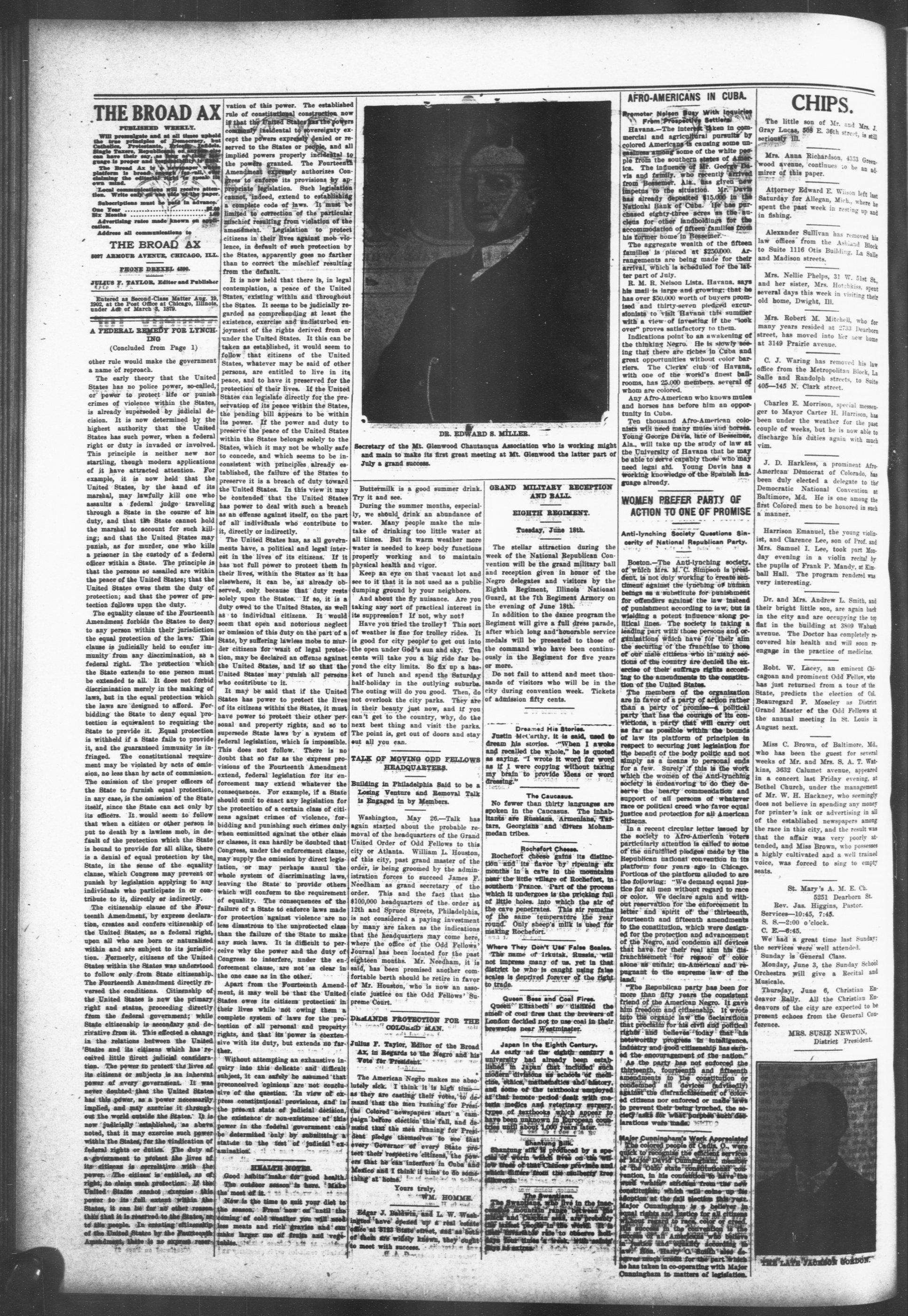
DR. EDWARD S. MILLER
Secretary of the Mt. Glenwood Chautauqua Association who is working might and main to make its first great meeting at Mt. Glenwood the latter part of July a grand success.
Buttermilk is a good summer drink. Try it and see.
During the summer months, especially, we should drink an abundance of water. Many people make the mistake of drinking too little water at all times. But in warm weather more water is needed to keep body functions properly working and to maintain physical health and vigor.
Keep an eye on that vacant lot and see to it that it is not used as a public dumping ground by your neighbors.
And about the fly nuisance. Are you taking any sort of practical interest in its suppression? If not, why not?
Have you tried the trolley? This sort of weather is fine for trolley rides. It is good for city people to get out into the open under God's sun and sky. Ten cents will take you a big ride far beyond the city limits. So fix up a basket of lunch and spend the Saturday half-holiday in the outlying suburbs. The outing will do you good. Then, do not overlook the city parks. They are in their beauty just now, and if you can't get to the country, why, do the next best thing and visit the parks. The point is, get out of doors and stay out all you can.
TALK OF MOVING ODD FELLOWS
HEADQUARTERS.
Building in Philadelphia Said to be a Losing Venture and Removal Talk is Engaged in by Members.
Washington, May 26.—Talk has again started about the probable removal of the headquarters of the Grand United Order of Odd Fellows to this city or Atlanta. William L. Houston, of this city, past grand master of the order, is being groomed by the administration forces to succeed James F. Needham as grand secretary of the order. This and the fact that the $100,000 headquarters of the order at 12th and Spruce Streets, Philadelphia, is not considered a paying investment by many are taken as the indications that the headquarters may come here, where the office of the Odd Fellows' Journal has been located for the past eighteen months. Mr. Needham, it is said, has been promised another comfortable berth should he retire in favor of Mr. Houston, who is now an associate justice on the Odd Fellows' Supreme Court.
DEMANDS PROTECTION FOR THE COLORED MAN.
Julius P. Taylor, Editor of the Broad AX, in regards to the Negro and his Vote for President.
The American Negro makes me absolutely sick. I think it is high time—as they are casting their votes, to demand that the men running for Presidethe Colored newspapers start a campaign before election this fall, and demand that the men running for President pledge themselves to see that every Governor of every State protect their respective citizens, the powers that he can interfere in Cuba and Mexico and I think it is time to do something at home.
Edgar J. Baldwin, and L. W. Washington have opened up a real estate office at 3123 State street, and as both of them are widely known, they ought to meet with success.
GRAND MILITARY RECEPTION
AND BALL.
EIGHTH REGIMENT
Tuesday, June 18th.
The stellar attraction during the week of the National Republican Convention will be the grand military ball and reception given in honor of the Negro delegates and visitors by the Eighth Regiment, Illinois National Guard, at the 7th Regiment Armory on the evening of June 18th.
In addition to the dance program the Regiment will give a full dress parade, after which long and honorable service medals will be presented to those of the command who have been continuously in the Regiment for five years or more.
Do not fail to attend and meet thousands of visitors who will be in the city during convention week. Tickets of admission fifty cents.
---
Justin McCarthy. it is said, used to dream his stories. "When I awoke and recalled the whole," he is quoted as saying. "I wrote it word for word as if I were copying without taring my brain to provide ideas or word dressing."
The Caucasus.
No fewer than thirty languages are spoken in the Caucasus. The inhabitants are Russians, Armenians, Tartars, Georgians and divers Mohammedan tribes.
Rochefort Cheese
Rochefort cheese gains its distinction and its flavor by ripening six months in a cave in the mountains near the little village of Rochefort, in southern France. Part of the process which it undergoes is the pricking full of little holes, into which the air of the cave penetrates. This air remains of the same temperature the year round. Only sheep's milk is used for making Rochefort.
Where They Don't Use False Scales.
The name of Irkutsk, Russia, will not impress many of us, yet in that district he who is caught using false scales is deprived forever of the right to trade.
Queen Bess and Coal Fires.
Queen Elizabeth so distilled the smelt of coal fires that the brewers-of-London decided not to use coal in their breweries near Westminster.
Japan In the Eighth Century.
As early as the eighth century a university had already been established in Japan that included such modern divisions as schools of medicine, ethics, mathematics and history, and some of the textbooks employed at that remote period dealt with materia medica and veterinary surgery, types of textbooks which appear to have been unknown in European countries until about 1000 years later.
Shantung Bilk.
Shantung silk is produced by a special sort of worm which lives on the yellow flesh of time Chinese provinces and which differs from the silkberry free silkworm.
The Swantiana.
The Swantiana who live in the inaccessible mountain range between the Miao and Chifun sands, are probably the highest people in the world. It is the invariable rule to observe holidays four times a week. With such days it means.
AFRO-AMERICANS IN CUBA.
Bromator Nelson Bugy With Inquiries
From Prospective Settlers
Havana.—The interest taken in commercial and agricultural pursuits by colored Americans is causing some uneasiness among some of the white people from the southern states of America. The influence of Mr. George Davis and family, who recently arrived from Bessemer, Ala., has given new impetus to the situation. Mr. Davis has already deposited $15,000 in the National Bank of Cuba. He has purchased eighty-three acres as the nucleus for other landholdings for the accommodation of fifteen families from his former home in Bessemer.
The aggregate wealth of the fifteen families is placed at $250,000. Arrangements are being made for their arrival, which is scheduled for the latter part of July.
R. M. R. Nelson Lista, Havana, says his mail is large and growing; that he has over $50,000 worth of buyers promised and thirty-seven pledged excursionists to visit Havana this summer with a view of investing if the "look over" proves satisfactory to them. Indications point to an awakening of the thinking Negro. He is slowly seeing that there are riches in Cuba and great opportunities without color barriers. The Clerks' club of Havana, with one of the world's finest ballrooms, has 25,000 members, several of whom are colored. Any Afro-American who knows mules and horses has before him an opportunity in Cuba.
Ten thousand Afro-American colonists will need many mules and horses. Young George Davis, late of Bessemer, Ala., will take up the study of law at the University of Havana (that he may be able to serve capably those who may need legal aid. Young Davis has a working knowledge of the Spanish language already.
WOMEN PREFER PARTY OF ACTION TO ONE OF PROMISE
Anti-lynching Society Questions Sincerity of National Republican Party.
Boston.-The Anti-lynching society, of which Mrs. M. C. Simpson is president, is not only working to create sentiment against the lynching of human beings as a substitute for punishment for offenders against the law instead of punishment according to law, but is wielding a potent influence along political lines. The society is taking a leading part with those persons and organizations which have for their aim the securing of the franchise to those of our male citizens who in many sections of the country are denied the exercise of their suffrage rights according to the amendments to the constitution of the United States.
The members of the organization are in favor of a party of action rather than a party of promise—a political party that has the courage of its convictions, a party that will carry out as far as possible within the bounds of law its platform of principles in respect to securing just legislation for the benefit of the body politic and not simply as a means to personal ends for a few. Surely if this is the work which the women of the Anti-lynching society is endeavoring to do they deserve the hearty commendation and support of all persons of whatever race or political creed who favor equal justice and protection for all American citizens.
In a recent circular letter issued by the society to Afro-American voters particularly attention is called to some of the unfilled pledges made by the Republican national convention in its platform four years ago in Chicago. Portions of the platform alluded to are the following: "We demand equal justice for all men without regard to race or color. We declare again and without reservation for the enforcement in letter and spirit of the thirteenth, fourteenth and fifteenth amendments to the constitution, which were designed for the protection and advancement of the Negro, and condemn all devices that have for their real aim his disfranchisement for reason of color alone as unfair, un-American and repugnant to the supreme law of the land.
"The Republican party has been for more than fifty years the consistent friend of the American Negro. It gave him freedom and citizenship. It wrote into the organic law the declarations that preamble for his civil and political rights and believes today that his noteworthy progress in intelligence, industry and good citizenship has earned the encouragement of the nation." As the party has not enforced the thirteenth, fourteenth and fifteenth amendments to the constitution or condemned all devices adversely against the distranchishment of colored citizens nor enforced or made laws to prevent their being tyned, the society asks for what purifies such declarations were made.
Major Cunningham's Work Appreciated
The colored people of Caddis O., who
quick to recognize the distinct services
of Major David Cunningham, member
of the Ohio state constitutional
convention, in his concession to have the
world "white" stricken from the new
constitution, which will come up the
adoption at the fall election this year.
Major Cunningham is a believer in
equal rights and justice for all citizens
without regard to race, color or creed.
His success in the convention is the
success of all Americans who believe
in justice and equality according to
law. Hon. Harry O. Smith also de-
grees much credit for the part which
he has taken in co-operating with Major
Cunningham in matters of legislation.
CHIPS.
The little son of Mr. and Mrs. J. Gray Lucas, 508 E. 36th street, is still seriously ill.
Mrs. Anna Richardson, 4333 Greenwood avenue, continues to be an admirer of this paper.
Attorney Edward E. Wilson left last Saturday for Allegan, Mich, where he spent the past week in resting up and in fishing.
Alexander Sullivan has removed his law offices from the Ashland Block to Suite 1116 Otis Building, La Salle and Madison streets.
Mrs. Nellie Phelps, 31 W. 51st St., and her sister, Mrs. Hotchkiss, spent several days this week in visiting their old home, Dwight, Ill.
Mrs. Robert M. Mitchell, who for many years resided at 2733 Dearborn street, has moved into her new home at 3149 Prairie avenue.
C. J. Waring has removed his law office from the Metropolitan Block, La Salle and Randolph streets, to Suits 405-145 N. Clark street.
Charles E. Morrison, special messenger to Mayor Carter H. Harrison, has been under the weather for the past couple of weeks, but he is now able to discharge his duties again with much vim.
J. D. Harkless, a prominent Afro-American Democrat of Colorado, has been duly elected a delegate to the Democratic National Convention at Baltimore, Md. He is one among the first Colored men to be honored in such a manner.
Harrison Emanuel, the young violinist, and Clarence Lee, son of Prof. and Mrs. Samuel I. Lee, took part Monday evening in a violin recital by the pupils of Frank P. Mandy, at Kimball Hall. The program rendered was very interesting.
Dr. and Mrs. Andrew L. Smith, and their bright little son, are again back in the city and are occupying the top flat in the building at 3809 Wabash avenue. The Doctor has completely recovered his health and will soon re engage in the practice of medicine.
Bobt. W. Lacey, an eminent Chicagoan and prominent Odd Fellow, who has just returned from a tour of the State, predicts the election of Col. Beauregard F. Moseley as District Grand Master of the Odd Fellows at the annual meeting in St. Louis in August next.
Miss C. Brown, of Baltimore, Md. who has been the guest for several weeks of Mr. and Mrs. S. A. T. Watkins, 3632 Calumet avenue, appeared in a concert last Friday evening, at Bethel Church, under the management of Mr. W. H. Hackney, who seemingly does not believe in spending any money for printer's ink or advertising in all of the established newspapers among the race in this city, and the result was that the affair was very poorly attended, and Miss Brown, who possessed a highly cultivated and a well trained voice, was forced to sing to empty seats.
St. Mary's A. M. E. Ch.
5251 Dearborn St.
Rev. Jas. Higgins, Pastor.
Services—10:45, 7:45.
S. S.—2:00 o'clock.
C. E.—6:45.
We had a great time last Sunday;
the services were well attended.
Sunday is General Class.
Monday, June 3, the Sunday School
Orchestra will give a Recital and
Musicale.
Thursday, June 6, Christian Endeavor Rally. All the Christian Endeavors of the city are expected to be present echoes from the General Conference.
MRS. SUSLE NEWTON,
District President.
WESTERN WESTERN WESTERN
THE LATE JACKSON GOLD
Tel. Aldine 1820 In Office at Night
C. H. KNIGHT. M. D., C.M.
Canada
PHYSICIAN AND SURGEON
Office Hours: 9 to 11 A.M. 2 to 5 P.M.
3158 State Street, Chicago
Office Hours—From 9 A. M. to 5 P. M. from 7 P. M. to 9 P. M. Sunday in appointment.
DR. THEO. R. MOZEE DENTIST
4715 SOUTH STATE STREET
CHICAGO
Phone, Oakland 4662; Automatic 73053
Frank Dunn and J. B. McCahery, Trustees
Tel. Oakland 1504514552
E-maildhed 1637
John J. Dunn
Coal
Wholesale Retail
FIFTY-FIRST STREET and ARMOUR AVE.
Rallyards;
51st St. and L. S. & M. S.
51st. St. and Armour Ave.
CHICAGO
Residence, 1262 Macallister Place
Telephone, Monroe 2714
Miles J. Devine
Attorney at Law
Suite 318-320 Reaper Block
Clark and Washington Streets CHICAGO
Phones, Central 1249 Auto. 4D913
Tel. Central 3142
Franklin A. Denison
Attorney at Law
36 W. RANDOLPH STREET
Suite 708
8 Delawake Building CHICAGO
Office Phone; Central 6624.
Rea. Phone. Doug. 4397.
3337 Wabush Ave.
Third Aprt.
J. GRAY LUCAS
Attorney at Law
Suite 405, 145 Clark St.
Cor. Randolph St.
WILLIAM L. MARTIN
LAWYER
Room 916-32 N. Clark St.
Telephone: Main 4352; Auto. 32-361
CHICAGO
Phone: Office, Main 4153
Rea. Drexel, 7990
Auto. 33-736
WALTER M. FARMER
ATTORNEY AT LAW
Suite 708, 184 Washington St.
Notary Public CHICAGO, ILL.
A. D. GASH
ATTORNEY AT LAW
118 North La Salle St. Chicago
Suite 615 to 616
Telephone Main 3077
TELEPHONES
Oakland 1609 Res. Oakland 1760 Auto. 79156
HENRY C. BOMAR & SON
FINE FURNITURE AND PIANO
MOVERS, PACKERS AND SHIPPERS
3 Tripe Daily to All Depots
4706 Indiana Ave. CHICAGO
SOME FINE POINT TO SEVEN BOOM
FLATS TO RENT.
TO RENT—Some fine 4 to 7 room
flats to honest Colored people who wish
to get away from the lower element.
Here is a few of them.
5764 Wentworth Ave. 4 to 6 rooms
Rent $11 to $18.
7228 Wentworth ave., 7 rooms and bath. Rent $22.
7240 Wentworth ave., 7 rooms, and bath. Rent $22.
7242 Wentworth ave., 7 rooms, and bath. Rent $22.
For more see George White, 2420 La Salle St., 1st flr.
REMOVAL NOTICE
Edward E. Wilson Attorneys-Law announces that he has removed his law office to 115 South Dearborn Street. Room 307, Phone Central 6987.
RACE HAS BRIGHT FUTURE. People of Muckeges Pleased With Mrs. G Terrella Morris.
Mr. G. Terrell's Wife
Muskegon, Ohio. The citizens of this far western town will not soon forget the masterly, docent and instructive address delivered here on Thursday, May 16, by Mrs. Mary Church Terrell of Washington. Mrs. Terrell is well known throughout the country as an able speaker and one of the leading women of the race. In a recent review of none of Mrs. Terrell's activities the Muskegon Chamber carried a column of matter dealing with facts and incidents in her splendid career for the past decade.
Mrs. Terrell was a member of the board of education in Washington for eleven years. She is an ex-president of the National Association of Colored Women's Clubs. She was one of the speakers at the international congress of women in Berlin in 1904. Her address was considered to be one of the best delivered by any woman on the program during the sessions of the congress. Her plea for justice and
BETTLEY
Butter
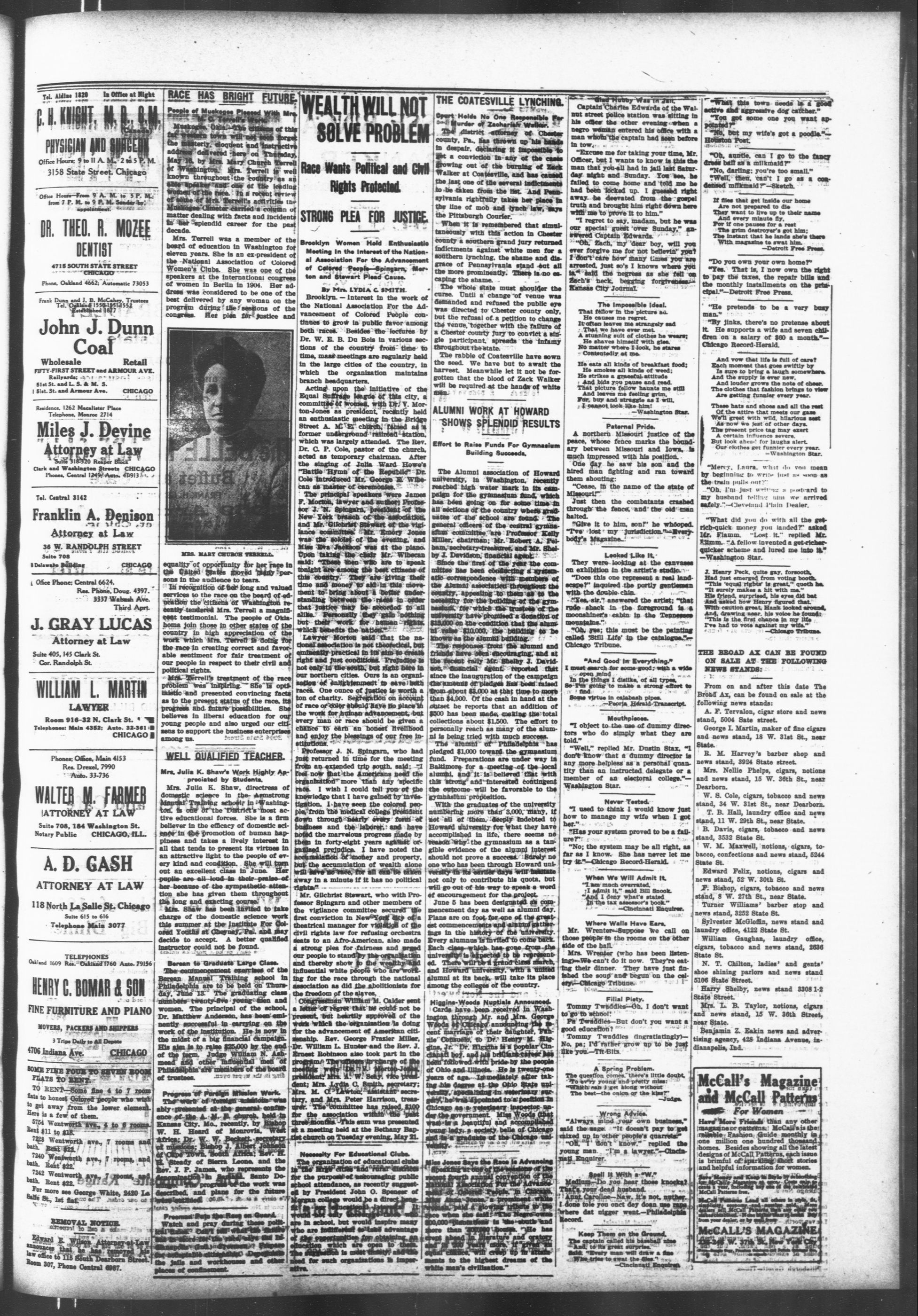
MRS. MARY CHURCH TERRELL.
equality of opportunity for her race in the United States moved many persons in the audience to tears.
In recognition of her long and valued services to the race on the board of education the citizens of Washington recently tendered Mrs. Terrell a magnificent testimonial. The people of Oklahoma join those in other states of the country in high appreciation of the work which Mrs. Terrell is doing for the race in creating correct and favorable sentiment for fair treatment of our people in respect to their civil and political rights.
Mrs. Kerrell's treatment of the race problem was inspiring. She is optimistic and presented convincing facts as to the present status of the race, its progress and future possibilities. She believes in liberal education for our young people and also urged our citizens to support the business enterprises among us.
WELL QUALIFIED TEACHER.
Mra, Julia K. Shave's Work Highly Appreciated by Students.
Mrs. Shaw has been invited to take charge of the domestic science work this summer at the Institute For Colored Youths at Chengayat, Pei, and may decide to accept. A better qualified instructor could not be found.
Berson to Graduate Large Class.
Beren to Graduate Large Class
The commencement exercise of the Berean Manual Training school in Philadelphia are to be held on Thursday, June 18. The gradating class numbers twenty-five young men and women. The principal of the school, Dr. Matthew Anderson, has been eminently successful in carrying on the work of the institution. He is now in the midst of a big financial campaign. His aim is to raise $25,000 by the end of the term. Judge William N. Ashmead and other industrial men of Philadelphia are members of the board of trustees.
Progress of Foreign Mission Work.
The work of foreign mission was ably presented at the general conference of the A. M. P. church, held in Kansas City, Mo., recently, by Bishop W. H. Heard of Monrovia, West Africa; Dr. W. W. Beckett, secretary of mission; Bishop J. Albert Johnson of Cape Town, South Africa; Ev. H. H. Steady of Sierra Leone, and the Rev. J. P. James, who represents the denomination in Brazil. Santo Domingo. The progress of the work was described and plans for the future were obtained.
Present: Paula the Race on Guard
Watch and pray during these political talks. O'Neill will later enter the military barricade for the vital battle in Chiang Kai-shek (India). Systematic Prepare for acceptable citizenship. Deposit the jails and workhouses and other places of confinement.
WEALTH WILL NOT SOLVE PROBLEM
Brooklyn Women Hold Enthusiastec Meeting In the Interest of the National Association For the Advancement of Colored People - Spingarn, Morton and Stewart Plead Cause.
By Mrn. LYDIA G. SMITH.
Brooklyn. - Interest in the work of the National Association For the Advancement of Colored People continues to grow in public favor among both races. Besides the lectures by Dr. W. E. B. Du Bols in various sections of the country from time to time, mass meetings are regularly held in the large cities of the country, in which the organization maintains branch headquarters.
Acting upon the initiative of the Equal Surrage league of this city, a committee of women, with Dr. V. Morton-Jones as president, recently held an enthusiastic meeting in the Bridge Street A. M. E. church, named as a former underground railroad station, which was largely attended. The Rev. Dr. C. P. Cole, pastor of the church, acted as temporary chairman. After the singing of Julia Ward Howe's "Battle Hymn of the Republic" Dr. Cole introduced Mr. George W. Wheean as master of ceremonies.
The principal speakers were James F. Morton, lawyer and author, Professor J. N. Spingarn, president of the New York branch of the association, and Mr. Gilchrist Stwart of the vigilance committee. Mr. Emory Jones was the solicist of the evening, and Miss Eva Jackson was at the plano. Upon taking the chair Mr. Wibecan said: "These men who are to speak tonight are among the best citizens of this country. They are giving their time and money to ask in this movement to bring about a better understanding between the races in order that justice may be recorded to all alike. Personally they gain nothing but their work for human rights, which benefits the nation."
Lawyer Morton said that the national association is not theoretical, but eminently practical in its aim to create right and just conditions. Prejudice is not only in the south, but right here in our northern cities. Ours is an organization of enlightenment to save both races. One ounce of justice is worth a ton of charity. Segregation on account of race or color should have no place in the work for human advancement, but every man or race should be given a chance to earn an honest livelihood and enjoy the blessings of our free institutions.
Professor J. N. Spingarn, who had just returned in time for the meeting from an extended trip south, said: "I feel now that the Americans need the organization more than any specific race. I wish I could tell you of the knowledge that I have gained by investigation. I have seen the colored people, from the medical college president down through nearly every form of business and the laborer, and have noted the marvelous progress made by them in forty-eight years against organized prejudice. I have noted the accumulation of money and property, but the accumulation of wealth alone will have no race, for all can be taken away in a minute if it has no political rights."
Mr. Gilchrist Stewart, who with Professor Spingarn and other members of the vigilance committee secured the first conviction in New York city of a theatrical manager for violation of the civil rights law for refusing orchestra seats to an Afro-American, also made a strong plea for fairness and urged our people to stand by the organization and thereby show to the wealthy did influential white people who are working for the race through the national association as did the abolitionists for the freedom of the slaves.
Congressman William M. Calder sent a letter of regret that he could not be present, but heartily approved of the work which the organization is doing for the advancement of American citizenship. Rev. George Frazier Miller, Dr. William L. Hunter and the Rev. J. Ernest Robinson also took part in the program. The ultimate charge of the meeting were Dr. L. Martin-Jones president; Mrs. A. W. Sey, the president; Mrs. Lydia C. Smith, secretary; Mrs. M. C. Lawton, assistant secretary, and Mrs. Peter Harrison, treasurer. The committee has raised $100 for the association within the past three months. This sum was presented at a meeting held at the Bethany Baptist church on Tuesday evening, May 21.
Necessity For Educational Clubs.
The organization of educational clubs in the large cities and rural districts for the purpose of encouraging public school attendance, as recently suggested by President John O. Spencer of Morgan college would be a direct benefit to your educational interests. It would not only encourage those who are in school, but would inspire many who are indifferent to take advantage of the opportunity for obtaining an education which are open to them. The suggestion is most timely, and the need for such organizations is imperative.
THE COATESVILLE LYNCHING.
Ospurt Holde No One Responsible For Murder of Zachariah Walker.
The district attorney of Oberster county, Pa., has thrown up his hands in despair, declaring it impossible to get a conviction in any of the cases growing out of the burning of Zack Walker at Coatesville, and has caused the last one of the several indictments to be taken from the list. and Pennsylvania rightfully takes her place in the line of mob and lynch law, says the Pittsburgh Courier.
When it is remembered that simultaneously with this action in Chester county a southern grand jury returned indictments against white men for a southern lynching, the shame and disgrace of Pennsylvania stand out all the more prominently. There is no escaping the shame.
The whole state must shoulder the curse. Until a change of venue was demanded and refused the public eye was directed to Chester county only, but the refusal of a petition to change the venue, together with the failure of a Chester county jury to convict a single participant, spreads the infamy throughout the state.
The rabble of Coatesville have sown the seed. We have but to await the harvest. Meanwhile let it not be forgotten that the blood of Zack Walker will be required at the hands of white men.
ALUMNI WORK AT HOWARD
SHOWS SPLENDID RESULTS
ALUMNI WORK AT HOWARD
SHOWS SPLENDID RESULTS
Effort to Raise Funds For Gymnasium Building Succeeds.
The Alumni association of Howard university, in Washington, recently reached high water mark in its campaign for the gymnasium fund, which has been going on for some time in all sections of the country where graduates of the school are found. The general officers of the central gymnasium committee are Professor Kelly Miller, chairman; Mr. Robert A. Pelham, secretary-treasurer, and Mr. Shelby J. Davidson, financial agent.
Since the first of the year the committee has been conducting a systematic correspondence with members of the Alumni association throughout the country, appealing to them as to the necessity for the building of the gymnasium, for which the trustees of the university have promised a donation of $12,000 on the condition that the alumni raise $10,000, the building to be known as the alumni building.
The responses from the alumni and friends have been encouraging, and at the recent rally Mr. Shalay J. Davidson, financial agent, reported that since the inauguration of the campaign the amount of pledges has been raised from about $3,000 at that time to more than $4,900. Of the cash in hand at the outset he reports that an addition of $500 has been made, making the total collections about $1,500. The effort to personally reach as many of the alumni is being tried with much success.
The alumni of Philadelphia has pledged $1,000 toward the gymnasium fund. Preparations are under way in Baltimore for a meeting of the local alumni, and it is believed that with this strong and interested contingent the outcome will be favorable to the gymnasium proposition.
With the graduates of the university numbering more than 3,000; many, if not all of them, deeply indebted to Howard university for what they have accomplished in life, there seems no reason why the gymnasium as a tangible evidence of the alumni interest should not prove a success. Surely no one who has been through Howard universally in its earlier days will hesitate not only to contribute his quotes, but will go out of his way to speak a word of encouragement for the project.
June 5 has been designated as commencement day as well as alumni day. Plans are on foot for one of the greatest commencements and alumni gatherings in the history of the university. Every alumnus is invited to come back. Each class which has gone from the university is expected to be represented. There will be a grand class march, and Howard university, with a united alumni at its back, will take its place among the colleges of the country.
Migines-Woods Nuptials Announced.
Cards have been received in Washington through Mr. and Mrs. George Woods be in Chicago announcing the recent marriage of their daughter, Fannie Cousinsie, to Dr. Henry M. Higgins, Jr. Dr. Higgins is a popular Chicagoian boy, and his brilliant career has been followed with pride by the people of Ohio and Illinois. He is twenty-one years of age. Immediately after taking his degree at the Ohio State university, specializing in veterinary surgery, he was appointed to a position in Chicago as a voluntary inspector under the government. Mig Woods that was a beautiful and accomplished young lady, a society belle of Chicago and is a graduate of the Chicago university.
Miss Jones Says the Race is Advancing
Speaking in our of the minutes of the
recent fourth annual convention of the
National Association For the Advancement
of Overseas People, in Chicago,
Miss Anna Jones, a prominent white
woman, paid a glowing tribute to
the race when she said: "The Negro own
800,000 Negroes is the white and
more than 800,000 South." He has
ever ahead in literature and oratory
and in 200 years more. If given an
equal chance, will creep up in attachments
to the highest dreams of the
white man's civilization."
Glad Hubby Was in Jail
Captain Charles Edwards of the Walnut street police station was sitting in his office the other evening when a negro woman entered his office with a man whom the captain had seen before in tow.
"Excuse me for taking your time, Mr. Officer, but I wants to know is this the man that you all had in jail last Saturday night and Sunday. You see, he failed to come home and told me he had been locked up. I guessed right away he deceived from the gospel truth and brought him right down here with me to prove it to him."
"I regret to say, madam, but he was our special guest 'over Sunday,' answered Captain Edwards.
"Oh, Zach, my dear boy, will you ever forgive me for not believin' you? I don't care how many times you are arrested, just so's I knows where you in, said the negress as she fell on Zach's neck, begging forgiveness--Kansas City Journal.
The Impossible Ideal
A stunning suit of clothes he wears;
He shaves himself with gles.
No matter where I look, he stares
- Contentedly at me.
He eats all kinds of breakfast food;
He smokes all kinds of weed;
He strikes a graceful attitude
And bids you pause and read.
Paternal Pride.
A northern Missouri justice of the peace, whose fence marks the boundary between Missouri and Iowa, is much impressed with his position.
One day he saw his son and the hired man fighting and ran toward them shouting:
"Cease, in the name of the state of Missouri"
Just then the combatants crashed through the fence, and the old man halted.
"Give it to him, son!" he whoooped.
"I've lost my jurisdiction." "Everybody's Magazine."
Looked Like It :
They were looking at the canvases on exhibition in the artist's studio.
"Does this one represent a real landscape?" inquired the portly gentleman with the double chin.
"Yes, sir," answered the artist; "that rude shack in the foreground is a moonhairer cabin in the Tennessee mountains."
"Oh, yes; this must be the painting called 'Still Life' in the catalogue."—Chicago Tribune.
"And Good Is Everything."
Open mine
In the things I dislike, of all types.
So I'm going to make a strong effort to
find
Some virtue in calabah pipes.
—Poorja Hérald-Transcript
Mouthpieces.
"I object to the use of dummy directors who do simply what they are told."
"Well," replied Mr. Dustin Stax, "I don't know that a dummy director is any more helpless as a personal quantity than an instructed delegate or a member of an electoral college."—Washington Star.
Never Tested.
"I used to think I would know just how to manage my wife when I got her."
"Has your system proved to be a failure?"
"No; the system may be all right, as far as I know. She has never let me try it."—Chicago Record-Herald.
When We Will Admit It,
"I am much overrated.
I admit it," said Bill Snook,
"and I do. I rated.
In the tax assessor's book."
—Cincinnati Enquirer.
Where Walls Have Ears,
Mr. Wrenter—Suppose we call on those people in the rooms on the other side of the hall.
Mrs. Wrenter (who has been listening)—We can't do it now. They're eating their dinner. They have just finished the soup and begun on the calefy—Chicago Tribune.
Filial Piety.
Tommy Twiddles-Oh, I don't want to go to school!
Pa' Twaddles—But don't you want a good education?
Tommy Twaddles (ingratiatingly)—No, pa; I'd rather grow up to be just like you—Tit-Bits.
A. Spring Problem
The question comes, there's little doubt,
"To early young and pretty miss:
"Whatch can I get along without
the best - the onion or the kiss?"
Wrong Advice.
"Always mind your own business," said the sage. "It doesn't pay to get mixed up in other people's quarrels." "Oh," "don't know," replied the young man. "I'm a lawyer."—Cincinnati Enquirer
Spell It With a "W."
Medium—Do you hear those knocks? That's your dead husband.
Aunt Caroline—New, it's not, nuther. I done tole you onct dey doan use rans where dat nigger went.—Philadelphia Record.
Keep Them on the Ground.
The captain called his baseball nine
And, to its great surprise,
said, "Every man will draw a fine
Who tries to swat the gles."
"What this town needs is a good active and aggressive dog catter."
"You got some one you want appointed?"
"No, but my wife's got a poodle."
Houston Post.
"Oh, auntie, can I go to the fancy dress ball as a milkmaid?"
"No, darling: you're too small."
"Well, then, can't I go as a condensed milkmaid?"—Sketch.
If files that get inside our home
Are not prepared to die
They want to live up to their name
And every minute fly.
For if one punches a rest
The grim destroyer's got him;
The instant that he lands she's there
With magazine to swat him.
—Detroit Free Press.
"Do you own your own home?"
"Yes. That is, I now own the right to pay the taxes, the repair bills and the monthly installments on the principal."—Detroit Free Press.
"He pretends to be a very busy man."
"By jinks, there's no pretense about it. He supports a wife and seven children on a salary of $00 a month."—Chicago Record-Herald.
And vow that life is full of care?
Each moment that goes swiftly by
Is sure to bring a laugh somewhere.
And the supply is ever new,
And louder grows the note of cheer.
The clothes that fashion brings to view
Are getting funnier every year.
These hats and shoes and all the rest
Of the attire that meets our game
We'll greet with wild, hilarious sest
As now we jest of other days.
The present price tag may exert
A certain influence severe.
But look ahead for laughs alert.
Our clothes get funnier every year.
—Washington Star.
"Mercy, Laura, what do you mean by beginning to write just as soon as the train pulls out?"
"Oh. I'm just writing a postcard to my husband telling him we arrived safely."—Cleveland Plain Dealer.
"What did you do with all the get-rich-quick money you landed?" asked Mr. Flamm. "Lost it." replied Mr. Zimm. "A fellow invented a get-rich-quicker scheme and lured me into it."—Washington Star.
J. Henry Peck, quite gay, forsooth, Had just emerged from voting booth. "This 'equal rights' is great," quoah he. "It surely makes a hit with me." His friend, surprised, his eyes did bat. After how Henry figured that, With caution great Hank looked around. And, drawing near, his voice he found: "This is the first chance in my life I've had to vote against my wife."—Chicago Tribune.
THE BROAD AX CAN BE FOUND ON SALE AT THE FOLLOWING NEWS STANDS:
From on and after this date The Broad Ax, can be found on sale at the following news stands:
A. F. Tervalon, cigar store and news stand, 5004 Sate street.
B. M. Harvey's barber shop and news stand, 3924 State street.
Mrs. Nellie Phelps, cigars, notions and news stand, 15 W. 36th St., near Dearborn.
W. S. Cole, cigars, tobacco and news stand, 34 W. 31st St., near Dearborn.
T. B. Hall, laundry office and news stand, 11 W. 29th St., near State.
B. Davis, cigars, tobacco and news stand, 3532 State St.
W. M. Maxwell, notions, cigars, tobacco, confections and news stand, 5244 State St.
Edward Felix, notions, cigars and news stand, 52 W. 30th St.
P. Bishop, cigars, tobacco and news stand, 8 W. 27th St., near State.
Turner Williams' barber stop and news stand, 3252 State St.
Sylvester McGloffin, news stand and laundry office, 4122 State St.
William Gaughan, laundry office,
cigars, tobacco and news stand, 2636
State St.
N. T. Chilton, ladies' and gents'
shoe shining parlors and news stand
5106 State Street.
Harry Shelby, news stand 3308 1-2
State Street.
Mrs. L. B. Taylor, notions, cigars
and news stand, 15 W. 36th Street,
near State.
Benjamin Z. Eakin news and advertising
agency, 428 Indiana Avenue, indianapolis, Ind.
McCall's Magazine and McCall Patterns
For Women
Have More Friends than any other magazine or patterns. McCall's is the valuable Fashion. Guide monthly in one million one hundred thousand homes. Besides showing all the latest designs of McCall Patterns, each issue is brimful of spirited short stories and helpful information for women.
Have More Friends than any other magazine or patterns. Create only a year, including any one of the celebrated McCall Patterns free.
McCall Patterns Lead all others in style, design, selling and McCall Patterns. All other patterns are made in-house. If one designer than to be hired, help from your designer, on by email.
McCALL'S MAGAZINE
222 W. 37th St. New York City
112-222-2222
- Halted dialysis Therapeutics
SIRES AND SONS.
Sir Charles Elliot, the newly appointed principal of Hongkong university, speaks twenty-three languages. James D. Preston, superintendent of the senate press gallery at Washington, began as messenger boy in the gallery.
Senator Smith, who conducted the investigation of the Titanic disaster, started out in life as a newsboy in Grand Rapids, but he always had one eye on the national capital.
Ex-Senator Chauncey M. Depew recently celebrated his seventy-eighth birthday. In replying to congratulations he announced that it was his ambition to live to be 100 years old.
Charles Horace Mayo and William James Mayo, the famous surgeons of Rochester, Minn., came by their profession by inheritance. Their father was a physician.
Archibald Astor Ferguson is the name given to a Washington baby born on the day the Titanic sank and whose parents especially admired the heroism of Major Butt and Colonel Astor.
Jacob B. Schmidlapp, a Cincinnati capitalist, says any family of five members or less can live on $15 a week and save $2. "When I was a young man," he says. "I lived on $2 a week. When I earned $1,000 a year I saved $600."
Town Topics.
The town of Ismay, Tex., wants to get its name changed and won't be satisfied with Yamsi either.—Washington Post.
Buffalo is maintaining its reputation as one of the most healthful cities in the country. The death rate last year was much less than that of any other city in the United States, and the figures for the first four months of this year show an even greater reduction.—Buffalo Times.
Now that Cincinnati is to have Dr. Ernst Kunwald, who has been for five years conductor of the Berlin Philharmonic orchestra; to succeed Herr Leopold Stokowski as conductor of the Cincinnati Symphony orchestra she will very likely renew her claim to being the musical center of America.—Boston Herald.
Flippant Flings.
The old fashioned little boy who used to hide behind his mother's skirts would stick out on both sides if he tried it now.-Ohio State Journal. The government reports are funny. One states that the average life of the dollar bill is fourteen months. About fourteen minutes is what it has always seemed-Duluth Herald. A Philadelphia explorer has gone to Brazil to obtain moving pictures of a boa constrictor, but we are inclined to think that the films will show some moving pictures of a Philadelphia explorer.-Washington Post.
The Royal Box.
The queen of Norway has a great fondness for the mandolin, which she plays exceedingly well.
Ex-Queen Alexandra's favorite hobbies are water color painting and needlework. Her majesty is an artist of considerable ability and is a skilled embroiderer.
The kaiser does not dance himself, but he takes a great pleasure in watching others while they are dancing. He shows a predilection for ancient dances to the exclusion of others.
Household Helps.
Glue a tape measure firmly across the front edge of your sewing machine. It saves much time when sewing. When drawing from linen in hemstitching, save those long, even threads, as they come in handy when mending table linen. A dust brush, such as painters use before applying paint, will unearth lots of dirt from cracks about the house where no cloth or brooms will reach.
Political Pointers.
Dark horses are still eating their heads off in the stable—Buffalo Times.
The hide of the whale is two feet thick in some places. What a fine hide that would be for a man running for office—Philadelphia Press.
Let us hope that something short of a Titanic disaster in politics will serve to awaken the people to the danger of speed mania there—Albany Journal.
Facts From France.
There are in Paris 200,000 more women than men.
Paris is to raise a loan of $40,000,000 for improving its gas service.
In 1550 there were three public coaches in operation in the city of Paris.
It is proposed in France to pay a frame additional a day to all married army officers.
Bunched Hits.
Hank O'Day manages as well as he supplied, which is saying a good deal. —Chicago News.
Speaking of "inside" baseball, a team has been organized by the imates of the federal penitentiary at Leavenworth—Topeka Capital.
According to a physical culture sharp, there is no better exercise than booting at a ball game. But the amount of exercise a fellow gets depends on the ability of the home team. =Pittsburgh Ganette-Timen.
7
The Life of Luxury.
Faller in an easy chair
Lets the hours go by;
Looks across the bill of fare
Ar be around every sigh.
Pictures hangin' on the wall,
Rugs upon the floor—
Has the best an' with it all
Says that life's a bore.
Faller standin' in a brook,
Wet clear to the skin,
Workin' hard with line an' hook—
Never sees a fin;
Tumbles from the moss rock
That he tries to climb;
Trudges home a six o'clock—
Had a bully time!
-Washington Star.
He Stuttered Too.
Three strangers were in the Pullman smoker when one of them turned to another and asked:
"H-how f-f-f-far is it t-t-to P-P-P-ittsburgh"
The man addressed made no reply, but got up and left the car. The stutterer then turned to the third man, who gave him the information.
A few moments afterward the third man met the one who had left the car and said:
"See here! Why did you go out without answering when that man asked you a civil question?"
"D-d-do you think I w-w-wanted to g-g-get m-my head knocked off?" was the answer.-Ladies' Home Journal.
Pedigrees.
First Blooded Dog—Your master has a very long pedigree, I'm told.
Second Ditto—No longer than mine.
First Dog—They say he's inordinately proud of his family tree.
Second Dog—It doesn't show the variety of bark mine does. And, besides, I'm away ahead of him in another respect.
"Eh, how's that?"
"No ancestor of mine was ever hanged."—Cleveland Plain Dealer.
A Song and a Joke.
I breathed a song into the air.
It fell to the ground, I knew not where.
For nowadays not very long
Is the life of any old kind of song.
I breathed a joke into the air.
It fell to the ground, I knew not where.
But a hundred times since then, it's true.
I've read it and heard it.
—Kansas City Star.
Fervent Pleading.
They sat in the hotel corridor.
"Gimme just one," he pleaded.
She shook her head.
Presently he emerged into the lobby.
"That fellow was pleading pretty hard for a kiss," remarked a louder who had overheard the conversation.
"Is that an engaged couple?"
"That couple," said another louder.
"They're married. It was a dollar he was pleading for; not a kiss."—Kansas City Journal.
Too Dull.
"No," said Bill Squeezer, who was down from Bodie the other day. "No; I didn't go to Judge Podger's wedding. The notice said 'No cards,' and I'm darned if I can fool away a whole evening where there's no chance of a little four-bill cante."—Milwaukee Sentinel.
No Joke.
We're all so willing to do good
With money that we've spent;
We're all such cheerful givers when
We haven't got a cent.
—Cincinnati Enquirer.
A Useful Tip.
"How did you get that fine spring overcoat?"
"I had a sure tip on a horse race."
"I never knew one of those sure tips to pan out."
"Neither did I. So I didn't play it. Put the money into an overcoat instead."—Louisville Courier Journal.
Logical Course
"Yes, sir," said the expert accountant, who had spent a week in looking over the books. "I have found the key to your financial difficulties at last." "Then there's nothing to do, I suppose," sighed the despondent merchant, "but to wind up my affairs."—Chicago Tribune.
The Promoter
The Prometer.
The promoter is a pleasant chap.
With ever smiling lips.
He'll furnish all the ocean
If you'll supply the ships.
Glad Prospect.
"I hear they're going to have moving pictures in the schools," said one youth.
"Yes," replied the other. "If they keep on making our studies so entertaining recess will seem fearfully monotonous."—Washington Star.
A Knockout For Science
Passerby—What's the fuss in the schoolyard, boy?
The Boy—Why, the doctor has just been around examinin' us an' one of the deficient boys is knockin' th' everlastin' stuffin' out of a perfect kid—Cleveland Plain Dealer.
Economize
Bards who rime and never tire,
Writing paper has gone higher.
Cut your sonnets down in size-
Make the muse economise.
Cleveland Plain Dealer.
Power of the Press.
New Merchant—How big an ad.
would you advise?
Advertising Man—That depends on
how many tons of customers your store
floor will sustain. You wouldn't want
'em to break through into the cellar, of
course—Fuck.
Wasted Material
"England owns the Kobnoor, the finest diamond in the world."
"Owns the finest diamond in the world. eh! That seems a shame when she doesn't play baseball" Louisville-Conover Journal
BROADWAY
BROADWAY
GENERAL BANKING
3 per cent allowed
Safety Deposit Va
REAL ESTATE
As agent buy and sell Real Estate on or
dents, including payment of taxes and
on Chicago Real Estate.
Especially Invites the patr
The Cranfor
Building.
The finest building ever open
Steam heat, electric light, tile ba
Recent allowed on Savings Acct.
Deposit Vaults, $3.00 per
REAL ESTATE DEPARTMENT
and sell Real Estate on commission, manages estat-
payment of taxes and looking after assessments
Estate.
Specially Invites the patronage of Chicago business.
Cranford Apartment
Building. 3600 Wabash A
The building ever opened to Colored tenant-
electric light, tile baths, marble entrance.
3 per cent allowed on Savings Accounts Safety Deposit Vaults, $3.00 per Year
As agent buy and sell Real Estate on commission, manages estates for non-residents, including payment of taxes and looking after assessments. Money to loan on Chicago Real Estate. Especially Invites the patronage of Chicago business men.
THE NEW YORK MUSEUM
The finest building ever opened to Colored tenants in Chicago. Steam heat, electric light, tile baths, marble entrance.
J. W. Casey, Agent,
'Phone Randolph 803 74 W. WASHINGTON STREET.
Frank L. Gale Sam'l I. Lee
THE GALE PIANO CO.
3159 STATE STREET
Pianos, Organs, Talking Machines and Supplies.
Brass and String Instruments. Cash or Easy
Payments. Open Evenings till 10.30.
Phone Doug. 4558.
GALE PIANO
3159 STATE STREET
Organs, Talking Machines and S
and String Instruments. Cash or E
payments. Open Evenings till 10.30
Phone Doug. 4558.
RE
Pianos, Organs, Talking Machines and Supplies. Brass and String Instruments. Cash or Easy Payments. Open Evenings till 10.30.
SUMMER
EXCURSION
TO THE
Coast and the Northwest
Here is the trip of your life. A chance
to spend your vacation among the
See for yourself what is in nature. So join WHITE's personally conducted EXCURSION July 14, '12
From Chicago, Illinois
to the Pacific Coast. Stope will be made going as follow:
Three days at St. Paul, Minn., to attend the NATIONAL HEGEO EDUCATIONAL CONGRESS which convenes JULY 15, 1912
ROUND TRIP FROM CHICAGO
First Class Sleeper $828.75
Tourist Sleeper $105.85
And in the Canadian National Park, the Great Glaciers of the Selkirk Mountains. Traveling in the mountains will be done by daylight. A day call down the Paget Sound (Vancouver-Steel) is purposed by none. Spending one day each at Seattle and Tacoma, Wash., and Portland, Ore. Over the great Mountain Shasta route to San Francisco, California, where a
STOP OF 60 HOURS WILL BE MADE
Return via Denver and Rio Grande RI., passing through the Canyon of the Grand River, Eagle River Canyon, over the Tennessee Pass and into the Great Salt Lake. Also at Salt Lake City, Denver, Colorado Springs, Kansas City, and St. Louis
For rates and particulars, write
C. T. WHITE
1050 Bernaby St., VANCOUVER, B. C.
R. B. ARBOTT, N59 State St., Chicago Reprintseller
```markdown
```
TUNING
GREAT
TO THE
S. E. Cor. State and 36th Place, Chicago Telephone Douglas 1565
owed on Savings Accounts
at Vaults, $3.00 per Year
ESTATE DEPARTMENT
State on commission, manages estates for non-resi-
tates and looking after assessments. Money to loan
the patronage of Chicago business men.
Anford Apartment
3600 Wabash Ave.
ver opened to Colored tenants in Chicago.
tile baths, marble entrance.
J. W. Casey, Agent,
74 W. WASHINGTON STREET.
Sam'l I. Lee
LE PIANO CO.
ESTATE STREET
Talking Machines and Supplies.
Instruments. Cash or Easy
Open Evenings till 10.30.
One Doug, 4558.
---
For Rent
High Class Modern Apartments. 3-4-6-7 and 8 rooms. Rent $20.00 $50.00 per month. The New American, 28th and Wabash Avenue.
WM. D. NEIGHBORS & CO.
3517 State Street
ALDINE 2533
TELEPHONES
AUTO. 75373
The Great valuing in L.A. day (Seattle) teamers, each at $228.75
teamers, each at $105.86
to Sea
Phone Douglas 5520 Reome by Day or Week
Room 25-35-50c
The Douglas Hotel
For Men Only
Baths, [SteamHeat, Electric Light
2096 S. State Street, CHICAGO
REPAIRING
"A STORE FOR EVERYBODY"
HILLMAN'S
STATE & WASHINGTON STS.
EVERYTHING TO WEAR
TO EAT
AND
FOR THE HOME
AT
THE VERY LOWEST PRICES.
Telephone Yards 693
JOHN J. BRADLE
Real Estate
Loans
Fire and Plate Glass Insurance
4709 S. HALSTED ST
CHICAGO
JOHN J. BRADLEY
Real Estate
Loans
Fire and Plate Glass Insurance
4709 S. HALSTED ST
CHICAGO
Telephone Oakland 1787
The BELLE
Buffet
FRANK H.
5059 Ar
Cor. 51st
Phone Douglas 4482
The La Verdo
3100-2 STATE S
First Class Chinese and Am
High Cla
Hotel B
Geo. V
BUFFET, POO
3004 State Street
The BELLE MEADE Cafe
Buffet and Cafe
FRANK H. LEWIS, Proprietor
059 Armour A
Cor. 51st Street, Chicago
The Douglas 4482 Automatic Ph
The La Verdo Cafe and Bu
3100-2 STATE STREET, CHICAGO
First Class Chinese and American Restaurant in C
High Class Entertainers
HARRY J. KELLY, P
5059 Armour Ave Cor. 51st Street, Chicago
The La Verdo Cafe and Buffet
3100-2 STATE STREET, CHICAGO
First Class Chinese and American Restaurant in Connection
High Class Entertainers
HARRY J. KELLY, Proprietor.
Hotel Brunswick
Geo. W. Holt, Prop.
BUFFET, POOL AND BILLIARDS
4 State Street
Codoxoe
Elite Buffet and Caf
Hotel Brunswick Geo. W. Holt, Prop. BUFFET, POOL AND BILLIARDS.
Elite Buff
3030 S
Elite Buffet and Cafe
3030 State Street
La Douglas 3256 Chas. Harri
When the Bride of 11
Undertakes a Big Dine
She can't make a mistake unless she falls asleep.
Her printed instructions tell her just how hot the oven should
And just how long each sort of food should cook.
The temperature dial on the oven door tells her when she has
turned the fire to the right notch.
Phone Douglas 3256
When the
Undertakes
She can't make a mistake un
Her printed instructions tell her
And just how long each sort
The temperature dial on the c
turned the fire to the right
When the Bride of 1912 Undertakes a Big Dinner
She can't make a mistake unless she falls asleep. Her printed instructions tell her just how hot the oven should be. And just how long each sort of food should cook. The temperature dial on the oven door tells her when she has turned the fire to the right notch.
The clock tells her when to take the food out.
To make success doubly certain she can watch the whole process of cooking through the glass oven windows.
The roast will be done to a turn in the lower oven while the same fire is cooking the rolls, potatoes and pudding in the upper oven.
Thus has this new type of gas range taken all the mystery, all the guess, all the uncertainty and most of the science out of the actual cooking of a dinner.
The type of range that has brought about this revolution in cooking is
The "Composite" Range
We carry a stock of 40,000 in 50 style
tion is No. 18-30 in our new spring
phase of the gas range question.
Write us today to mail you a copy, or
for yourself all fifty styles of "Comp
monthly payment plan at any of our
The Peoples Gas Light and Coke Co
by a stock of 40,000 in 50 styles built to our order. The one
No. 18-30 in our new spring catalog—a complete text book
of the gas range question.
As today to mail you a copy, or better still, make a call of
yourself all fifty styles of "Composites" ranges side by side and
only payment plan at any of our stores or at our big sales ro-
peoples Gas Light and Coke Company, Peoples Gas Building,
We carry a stock of 40,000 in 50 styles built to our order. The one in the illustration is No. 18-30 in our new spring catalog—a complete text book covering every phase of the gas range question.
Write us today to mail you a copy, or better still, make a call of inspection—see for yourself all fifty styles of "Composite" ranges side by side and learn about our monthly payment plan at any of our stores or at our big sales room downown.
The People's Gas Light and Coke Company, People's Gas Building, Michigan Book.
A. F. Codoxoe
BRADLEY
Real Estate
loans
State Glass Insurance
HALSTED ST
CHICAGO
MEADE CLUB
and Cafe
LEWIS, Proprietor
mour Ave
Street, Chicago
Automatic Phone 74-478
Do Cafe and Buffet
ATE STREET, CHICAGO
and American Restaurant in Connection
in Class Entertainers
HARRY J. KELLY, Proprietor.
runswick
V. Holt, Prop.
L AND BILLIARDS.
Chicago
Henry J
et and Cafe
Henry J
Chas. Harris, Ma
Bride of 1912
a Big Dinner
less she falls asleep.
her just how hot the oven should be.
of food should cook.
oven door tells her when she has
notch.
make the food out.
a built to our order. The one in the illustrat
catalog—a complete text book covering every
new better still, make a call of inspection—so
called" ranges side by side and learn about our
stores or at our big sales room downtown
company, Peoples Gas Building, Michigan Bou