The Broad Ax
Saturday, September 21, 1912
Chicago, Illinois
Page text (machine-generated)
THE BROAD AX
Mrs. Etta Duryea- Johnson Laid to rest in Graceland Cemetery
MORE THAN 50,000 PEOPLE OF ALL RACES AND NATIONALITIES TURNED OUT TO WITNESS THE FUNERAL CORTEGE AS IT WENDED ITS WAY.
FROM THE HOME OF MRS. TINY JOHNSON, 3344 WABASH AVENUE, TO ST. MARK CHURCH, 50TH AND WABASH AVENUE, AND ON TO THE CEMETERY.
MANY POLICEMEN, INCLUDING MOUNTED OFFICERS, WERE TAXED TO THEIR UTMOST TO RESTRAIN THE CURIOUS AND VULGAR CROWD FROM PRESSING OR FORCING THEMSELVES UP CLOSE TO THE HEARSE IN AN EFFORT TO SEE WHAT WAS ON THE INSIDE OF IT.
REVS. JOHN W. BOBINSON, J. C. PETERS AND C. L. SCOTT CONDUCTED THE SERVICES.
MRS. DAVID TERRY, AND MISS ELAINE TERRY OF BROOKLYN, NEW YORK, MOTHER AND SISTER OF MRS. JOHNSON, CAME ON TO ATTEND THE FUNERAL AND RODE IN THE LIMOUSINE WITH JACK JOHNSON.
WHITE AND COLORED MEN ACTED AS PALL BEARERS. A MIXED CHOIR SANG THE FAVORITE SONG OF MRS. JOHNSON, "TAKE THE NAME OF JESUS WITH YOU."
THE CHAMPION OF THE WORLD IN LOOKING AT HIS DEAD WIFE FOR THE LAST-TIME TENDERLY KISSED HER ON THE BROW.
MANY COLORED WOMEN WHO HAD BITTERLY DENOUNCED JACK
JOHNSON FOR HIS MARRIAGE WERE ANXIOUS TO OCCUPY THE
SEATS OF HONOR IN THE CHURCH AND IN THE HOUSE ON
WARASH AVENUE.
Vol. XVII.
MRS. Etta Dus
Johnson Lay
Graceland
MORE THAN 50,000 PEOPLE OF A
TURNED OUT TO WITNESS
WENDED ITS WAY.
FROM THE HOME OF MRS. TINY
TO ST. MARK CHURCH, 50TH A
THE CEMETERY.
MANY POLICEMEN, INCLUDING M
TO THEIR UTMOST TO BESTR
CROWD FROM PRESSING OR
TO THE HEARSE IN AN EFFO
INSIDE OF IT.
REVS. JOHN W. ROBINSON, J. C. P.
THE SE
MRS. DAVID TERRY, AND MISS EI
YORK, MOTHER AND SISTER
ATTEND THE FUNERAL AND
JACK JOHNSON.
WHITE AND COLORED MEN ACT
CHOIR SANG THE FAVORITE
THE NAME OF JESUS WITH Y
THE CHAMPION OF THE WORLD
FOR THE LAST-TIME TENDE
MANY COLORED WOMEN WHO H
JOHNSON FOR HIS MARRIAGE
SEATS OF HONOR IN THE O
WABASH AVENUE.
Last Saturday morning funeral services were held over the earthly remains of Mrs. Etta Duryea-Johnson the services were first held at the home of her mother-in-law, Mrs. Tiny Johnson, 3344 Wabash Ave. and later on at St. Mark Church, 50th and Wabash Ave., it was beyond a doubt one of the largest funerals ever held in this city, and more than 50,000 people of all races and nationalities, rich and poor, high and low turned out to witness the funeral cortege as it wended its way through the streets on its way to the final resting place of all that was mortal of Mrs. Johnson.
At the home of Mrs. Tiny Johnson, White and Colored people crowded in so thick around the house and out into the street, thereby delaying the services and nothing could be done nor no move could be made, until after a number of policemen from the Twenty-second St. station were rushed to the scene who forced the crowd back and cleared the way for the members of the family and the other mourners to emerge from the house and enter their antes; Mrs. David Terry and Miss Elaine Terry, mother and sister of Mrs. Johnson, 244 New York Ave., Brooklyn, New York, came on to attend the funeral and rode in the closed limousine with Jack Johnson.
Mrs. Terry was so overcome with sorrow and grief over the sad ending of the life of her once loving and beautiful daughter, that Mr. Johnson had to almost carry her from the house down the steps to the limousine with his strong arms.
On arriving at St. Mark Church the streets in every direction leading to and from it were densely blocked with a great mass of people and the police of the 50th street station, including many mounted officers all in charge of acting Lieutenant Thomas Farrell, were taxed to their utmost to clear the way for the funeral procession and to restrain the curious and vulgar crowd of people from pressing and forcing themselves up close to the hearse in an effort to see what was on the inside of it and to view the great and very costly floral display which was in evidence.
Long before the time set for holding the services in the little church it was full to the brim, not one vacant seat being in sight except those in front which were reserved for the family, mourners and invited friends.
Rev. Robinson, pastor of St. Mark
HEW TO THE LINE: LET THE CHIPS FALL WHERE THEY MAY
Church, who was assisted in conducting the services by Rev. J. C. Peters and Rev. C. L. Scott, and at the very outset in a low and very soft voice Rev. Robinson called on the mixed choir to sweetly sing the favorite song of Mrs. Johnson, "Take the Name of Jesus With You" the song which she had learned to sing and loved so much when a member of the congregation of St. James Methodist Church of Brooklyn, N. Y.
In the soft and low voice Rev. Robinson intimated that its theme emphasized the peace that had entered the life of one who had been troubled and who had found the struggle of life weary.
Very effectingly he exclaimed:
"Is there any one in this church who can be so cruel as to deny one star of hope to the weary one?" "Is there any who cannot let the great mantle of charity cover the call of a disquieted heart?"
"Lovable and Faithful Wife."
Rev. Robinson cleared up a point not generally known to the public when he declared in a short sketch of Mrs. Johnson that she was married to John Arthur Johnson on Feb. 11, 1910. He said she was born Sept. 25, 1881, at Hempsted, L. L., and eulogized her, speaking of her as a "lovable and faithful wife."
Mrs. George Washington and Miss Ada Vant Davis sang two beautiful solos and at the close of the services the coffin was opened in order to permit those in the church for the last time to gaze upon her fine chiseled features, and Mr. Johnson was the first one to pass in front of the bier and in doing so he bent over and kissed the brow of his dead wife, while that solemn scene was being enacted every voice was stilled and the church was as silent as the grave.
Being very small the church was awfully warm, so much so that Mrs. Rhodes, sister of Mr. Johnson, fainted and was carried out of the church by Jack Curley. Other ladies were prevented from fainting by constantly passing bottles of smelling salts around them.
Arthur Ross of Brooklyn, New York, an old friend of the Terry family, A. B. Aaron, "California Jack" Anderson, Jack Curley, Tom Flannigan, Johnson's fighting trainee, Jack Barry, ex-pugilist, Barney Purty, trainer of many lights, were among the White who attended the services at the
CHICAGO, SEPTEMBER 21, 1912
[Name]
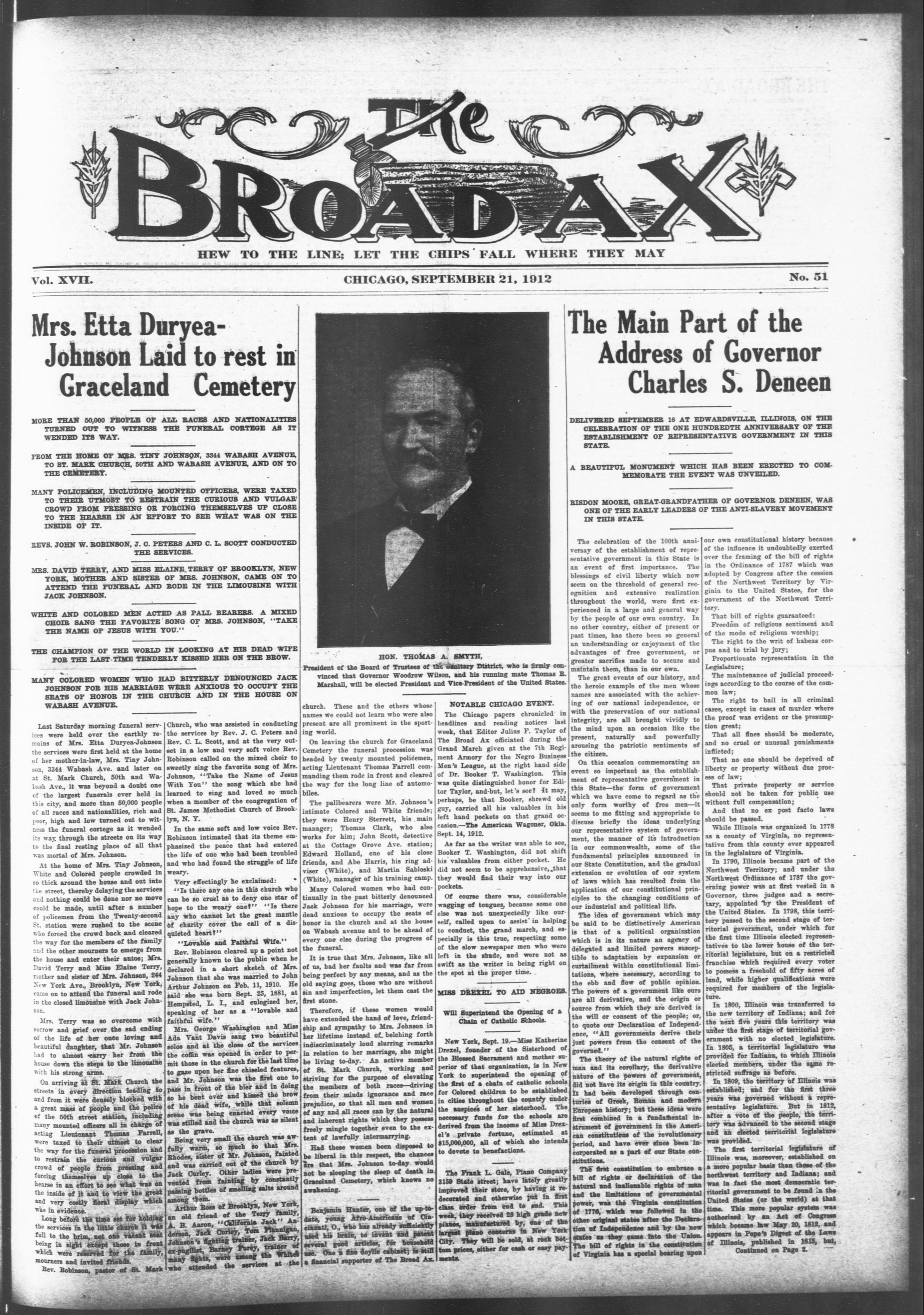
President of the Board of Trustees of the sanitary District, who is firmly convinced that Governor Woodrow Wilson, and his running mate Thomas B. Marshall, will be elected President and Vice-President of the United States.
President of the Board of Trustees of the sanitary District, who is firmly convinced that Governor Woodrow Wilson, and his running mate Thomas E. Marshall, will be elected President and Vice-President of the United States.
church. These and the others whose names we could not learn who were also present are all prominent in the sporting world.
On leaving the church for Graceland Cemetery the funeral procession was headed by twenty mounted policemen, acting Lieutenant Thomas Farrell commanding them rode in front and cleared the way for the long line of automobiles.
The pallbearers were Mr. Johnson's intimate Colored and White friends; they were Henry Sterrett, his main manager; Thomas Clark, who also works for him; John Scott, detective at the Cottage Grove Ave. station; Edward Holland, one of his close friends, and Abe Harris, his ring adviser (White), and Martin Sabloski (White), manager of his training camp.
NOTABLE CHICAGO EVENT.
The Chicago papers chronicled in headlines and reading notices last week, that Editor Julius F. Taylor of The Broad Ax officiated during the Grand March given at the 7th Regiment Armory for the Negro Business Men's League, at the right hand side of Dr. Booker T. Washington. This was quite distinguished honor for Editor Taylor, and-but, let's see! It may, perhaps, be that Booker, shrewd old guy, carried all his valuables in his left hand pockets on that grand occasion.—The American Wagoner, Okla. Sept. 14, 1912.
As far as the writer was able to see, Booker T. Washington, did not shift his valuables from either pocket. He did not seem to be apprehensive, that they would find their way into our
Many Colored women who had continually in the past bitterly denounced Jack Johnson for his marriage, were dead anxious to occupy the seats of honor in the church and at the house on Wabash avenue and to be ahead of every one else during the progress of the funeral.
It is true that Mrs. Johnson, like all of us, had her faults and was far from being perfect by any means, and as the old saying goes, those who are without sin and imperfection, let them cast the first stone.
Therefore, if these women would have extended the hand of love, friendship and sympathy to Mrs. Johnson in her lifetime instead of belching forth indiscriminately loud slurring remarks in relation to her marriage, she might be living to-day. An active member of St. Mark Church, working and striving for the purpose of elevating the members of both races-driving from their minds ignorance and race prejudice, so that all men and women of any and all races can by the natural and inherent rights which they possess freely mingle together even to the extent of lawfully intermarrying.
Had these women been disposed to be liberal in this respect, the chances are that Mrs. Johnson to-day would not be sleeping the sleep of death in Graceland Cemetery, which knows no awakening.
Benjamin Hunter, one of the up-to-date, young Artro-Americans of Cincinnati, O., who has already sufficiently used his brain, to invent and patent several good articles, for household use. One a fine doyle cabinet; is still a financial supporter of The Broad Ax.
NOTABLE CHICAGO EVENT.
The Chicago papers chronicled in headlines and reading notices last week, that Editor Julius F. Taylor of The Broad Ax officiated during the Grand March given at the 7th Regiment Armory for the Negro Business Men's League, at the right hand side of Dr. Booker T. Washington. This was quite distinguished honor for Editor Taylor, and-but, let's see! It may, perhaps, be that Booker, shrewd old guy, carried all his valuables in his left hand pockets on that grand occasion.—The American Wagoner, Okla. Sept. 14, 1912.
As far as the writer was able to see, Booker T. Washington, did not shift his valuables from either pocket. He did not seem to be apprehensive, that they would find their way into our pockets.
Of course there was, considerable wagging of tongues, because some one else was not unexpectedly like ourselves, called upon to assist in helping to conduct, the grand march, and especially is this true, respecting some of the slow newspaper men who were left in the shade, and were not as swift as the writer in being right on the spot at the proper time.
MISS DREXEL TO AID NEGROES
Will Superintend the Opening of a Chain of Catholic Schools.
New York, Sept. 19.—Miss Katherine Drexel, founder of the Sisterhood of the Blessed Sacrament and mother superior of that organization, is in New York to superintend the opening of the first of a chain of catholic schools for Colored children to be established in cities throughout the country under the auspices of her sisterhood. The necessary funds for the schools are derived from the income of Miss Drexel's private fortune, estimated at $15,000,000, all of which she intends to devote to benefactions.
The Frank L. Gale, Piano Company 3159 State street; have lately greatly improved their store, by having it re-decorated and otherwise put in first class order from end to end. This week, they received 28 high grade new pianos, manufactured by, one of the largest piano concerns in New York City. They will be sold, at rock bottom prices, either for cash or easy payments.
The Main Part of the Address of Governor Charles S. Deneen
DELIVERED SEPTEMBER 16 AT EDWARDSVILLE, ILLINOIS, ON THE CELEBRATION OF THE ONE HUNDREDTH ANNIVERSARY OF THE ESTABLISHMENT OF REPRESENTATIVE GOVERNMENT IN THIS STATE.
A BEAUTIFUL MONUMENT WHICH HAS BEEN ERECTED TO COMMEMORATE THE EVENT WAS UNVEILED.
RISDON MOORE, GREAT-GRANDFATHER OF GOVERNOR DENEEN, WAS ONE OF THE EARLY LEADERS OF THE ANTI-SLAVERY MOVEMENT IN THIS STATE.
The celebration of the 100th anniversary of the establishment of representative government in this State is an event of first importance. The blessings of civil liberty which now seem on the threshold of general recognition and extensive realization throughout the world, were first experienced in a large and general way by the people of our own country. In no other country, either of present or past times, has there been so general an understanding or enjoyment of the advantages of free government, or greater sacrifices made to secure and maintain them, than in our own.
The great events of our history, and the heroic example of the men whose names are associated with the achieving of our national independence, or with the preservation of our national integrity, are all brought vividly to the mind upon an occasion like the present, naturally and powerfully arousing the patriotic sentiments of the citizen.
On this occasion commemorating an event so important as the establishment of representative government in this State—the form of government which we have come to regard as the only form worthy of free men—it seems to me fitting and appropriate to discuss briefly the ideas underlying our representative system of government, the manner of its introduction in our commonwealth, some of the fundamental principles announced in our State Constitution, and the gradual extension or evolution of our system of laws which has resulted from the application of our constitutional principles to the changing conditions of our industrial and political life.
The idea of government which may be said to be distinctively American is that of a political organization which is in its nature an agency of delegated and limited powers susceptible to adaptation by expansion or curtailment within constitutional limitations, where necessary, according to the ebb and flow of public opinion. The powers of a government like ours are all derivative, and the origin or source from which they are derived is the will or consent of the people; or, to quote our Declaration of Independence, "All governments derive their just powers from the consent of the governed." The theory of the natural rights of man and its corollary, the derivative nature of the powers of government, did not have its origin in this country. It had been developed through centuries of Greek, Roman and modern European history; but these ideas were first combined in a fundamental instrument of government in the American constitutions of the revolutionary period, and have ever since been incorporated as a part of our State constitutions.
The first constitution to embrace a bill of rights or declaration of the natural and inalienable rights of man and the limitations of governmental power, was the Virginia constitution of 1776, which was followed in the other original states after the Declaration of Independence and by the new states as they came into the Union. The bill of rights in the constitution of Virginia has a special bearing upon
Part of the
of Governor
as S. Deneen
OWARDSVILLE, ILLINOIS, ON THE
FUNDREDIT ANNIVERSARY OF THE
INTEGRATIVE GOVERNMENT IN THIS
HAS BEEN ERECTED TO COM-
MENT WAS UNVEILED.
HER OF GOVERNOR DENEEN, WAS
OF THE ANTI-SLAVERY MOVEMENT
our own constitutional history because of the influence it undoubtedly exerted over the framing of the bill of rights in the Ordinance of 1787 which was adopted by Congress after the cession of the Northwest Territory by Virginia to the United States, for the government of the Northwest Territory.
That bill of rights guaranteed:
Freedom of religious sentiment and of the mode of religious worship;
The right to the writ of habeas corpus and to trial by jury;
Proportionate representation in the Legislature;
The maintenance of judicial proceedings according to the course of the common law;
The right to bail in all criminal cases, except in cases of murder where the proof was evident or the presumption great;
That all fines should be moderate, and no cruel or unusual punishments inflicted;
That no one should be deprived of liberty or property without due process of law;
That private property or service should not be taken for public use without full compensation:
And that no ex post facto laws should be passed.
While Illinois was organized in 1778 as a county of Virginia, no representative from this county ever appeared in the legislature of Virginia.
In 1790, Illinois became part of the Northwest Territory; and under the Northwest Ordinance of 1787 the governing power was at first vested in a Governor, three judges and a secretary, appointed by the President of the United States. In 1798, this territory passed to the second stage of territorial government, under which for the first time Illinois elected representatives to the lower house of the territorial legislature, but on a restricted franchise which required every voter to possess a freehold of fifty acres of land, while higher qualifications were required for members of the legislature.
In 1800, Illinois was transferred to the new territory of Indiana; and for the next five years this territory was under the first stage of territorial government with no elected legislature.
In 1805, a territorial legislature was provided for Indians, to which Illinois elected members, under the same restricted suffrage as before.
In 1809, the territory of Illinois was established; and for the first three years was governed without a representative legislature. But in 1812, after a vote of the people, the territory was advanced to the second stage and an elected territorial legislature was provided.
The first territorial legislature of Illinois was, moreover, established on a more popular basis than those of the northwest territory and Indiana; and was in fact the most democratic territorial government to be found in the United States (or the world) at that time. This more popular system was authorized by an Act of Congress which became law May 20, 1812, and appears in Pope's Digest of the Laws of Illinois, published in 1815, but, Continued on Page 2.
THE BROAD AX
Will promulgate and at all times uphold the true principles of Democracy, but Catholics, Protestants, Priests, Infidels Single Taxes, Republicans, or any other group that the range is greater and responsibility is fixed. The Broad Ax is a newspaper whose platform is broad enough for all, ever claiming the editorial right to speak its own mind. Local communications will receive attention. Write only on one side of the paper. Subscriptions must be paid in advance. One Year ..... $1.00 Six Months ..... 1.00 Advertising rates made known on application.
5007 ARMOUR AVENUE, CHICAGO, IL
JULIUS F. TAYLOR, Editor and Publisher
Entered as Second-Class Matter Aug. 19,
1802, at the Post Office at Chicago, Illinois,
under Act of March 8, 1870.
WOMEN IMMODEST, SAYS DIVINE
Extreme Dress Encourages Mashers
Asserts the Rev. Norman B. Barr.
"No woman who dresses modestly
and carries herself in a modest man-
ner need fear being annoyed by 'mashers'
on the streets," was the statement
made by the Rev. Norman B. Barr, pastor
of the Olivet Memorial church,
Penn and Vedder streets, in an address
at the weekly meeting of the Presbyterian Ministers' association in the Ohio Building Monday.
"The average 'masher' will not approach a woman on the street unless he receives some encouragement, either from her extreme manner of dressing or from her actions, such as loud talking or laughing or the bold manner in which she looks at persons on the streets," continued the pastor. "In the cases which have come under my observation, such has invariably been the cause of the woman being approached.
"If women could be induced to abandon the present-day fashions I believe the 'masher' would become a thing of the past. Twenty-five years ago a woman being accosted on the streets was an unheard of occurrence.
"Nowadays women are becoming active in every line of endeavor and are becoming less modest than formerly. No woman who wears a dress which exhibits every line of her figure can be called a modest woman."
Rev. Barr has boldly stated, the absolute truth, in relation, to the boldness of women in all things. In our boyhood days, the lady in old Virginia who was highly cultured in every respect, and represented the highest type, of Anglo-Saxon womanhood, who had charge of our early training taught us, to look upon women, as purified. Angels, and that idea was so thoroughly instilled in our mind at an early age, that it was horrifying to us, after coming North, to see women, or ladies if you please, conducting themselves, in a manner entirely unbecoming to those who claim to be decent and respectable.
It is needless to say, that it caused our eyes to open wide in wonderment when we first landed in Philadelphia, Pa. and in other large Northern cities, and finally in Chicago, to see women both White and Colored, who move in the upper society, rushing in and out, of the front doors of saloons and some of them standing up to the bar drinking as boldly as the men, smoking cigars, cigarettes, using vile or bad language, and staggering up and down the streets, just like drunken men.
Women who conducted themselves in this manner, only a few years ago, were eternally and forever disgraced. Now they are highly honored and considered to be real smart, if they can drink 20 or 30 highballs or Manhattan Cocktails at one sitting and otherwise debauch themselves in general.
Not so many years ago, the ladies would retire to their bedrooms, when they desired to powder their faces and arrange or re-arrange their toilets. Now it is no uncommon thing or sight to observe them painting or powdering up their faces while strolling and flirting on the downtown streets of Chicago.
The present modern woman and her style of dress is frightful to behold. She will persist, in stuffing herself into dresses which are about four times too small, and if she would walk on all fours like our former ancestors, she would resemble some of the fat or stout cows and other animals.
Men with their eyes and ears wide open possessing one ounce of brains cannot entertain the highest respect for the swaggering and staggering modern woman.
Mr. and Mrs. Henry Jones, 6041 Evans avenue; returned home Friday evening from Watske, Illinois; the former home of Mrs. Jones. On Tuesday evening Mr. Jones, again departed for that city to transect some business. He will arrive home this evening in time to rake in the cash, at the cash register in the Elite cafe, 3030 State street.
GOV. CHARLES S. DENEEN'S ADDRESS.
Concluded from Page 1.
strange to say, has been omitted from the later compilations of the Statutes of Illinois. Yet this Act may well be considered as the fundamental charter of the new government established in Illinois in 1812. By the terms of this Act, the right to vote was granted to all free white males twenty-one years of age, who had paid a county or territorial tax, no matter how small, and had resided in the territory one year. This Act also provided that not only the members of the Lower House but also the five councilors should be directly elected in five districts instead of being nominated by the representative body. Thirdly, the delegate to Congress was to be directly elected by the people, instead of by the legislature.
One hundred years ago last Saturday (September 14, 1812) Governor Edwards issued two proclamations providing for two of the events we are now celebrating. One of them established three new counties; Madison, Gallatin and Johnson, which, with the two former counties of St. Clair and Randolph, formed the five districts for electing the members of the council. The other ordered an election to be held October 8-10 for delegates to Congress, members of the council and representatives.
At the election, Shadrach Bond was elected as the first delegate to Congress from the territory of Illinois and took his seat December 2d. The first council consisted of Pierre Menard of Randolph, president; Benjamin Talbot of Gallatin, William Biggs of St. Clair, Samuel Judy of Madison and Thomas Perguson of Johnson. In the House of Representatives, Randolph county was represented by George Fisher (who was Speaker); Gallatin, by Alexander Wilson and Phillip Trammler; Johnson, by John Grammer; St. Clair, by Joshun Oglesby and Jacob Short; and Madison, by William Jones.
The first Legislature of Illinois Territory met at Kaskaskia on November 12, 1812. The session lasted one day over a month, and the principal law enacted was one continuing in force the laws previously enacted by the Governor and judges, and such of the Statutes of Indiana Territory as were not local in character or had not been repealed. Some of these had been laws of the Northwest Territory which had been re-enacted by each successive government. A second session of the first legislature was held in 1813; and there were two other territorial legislatures, 1814-16, and 1816-18, which held two short sessions each. Then Illinois was admitted as a State, and the territorial legislature was succeeded by the first General Assembly of the State.
It may be of interest here to relate the fact that in the year 1812 my great-grandfather, Risdon Moore, the first of our family to settle in Illinois, came from Georgia and settled in the neighboring county of St. Clair, about four miles cast of Belleville. He was very active in the political life of the times and was elected to the territorial legislature for the two sessions of 1814 and 1816 and was chosen speaker for the term. He was also a representative from St. Clair county to the first, second and third General Assemblies after the admission of Illinois to the Union. In the great struggle over the slavery question in 1823 and 1824 he was a pronounced anti-slavery advocate and incurred the enmity of the pro-slavery party to such a degree that he was burned by them in effigy at Troy, this county.
Since the establishment of the territorial legislature of Illinois in 1812, the people of Illinois have never been without representative government. We are therefore celebrating today the completion of one hundred years of continuous self-government, based on popular suffrage. Even the slight restrictions of the Act of 1812 were removed when the first State Constitution of 1818 went into effect.
The provisions of our Constitution of 1818 are the same, in general, as those of the other State constitutions; though some of the provisions in the bills of rights of the other state constitutions were omitted. For example—There is no positive declaration in the first Illinois Bill of Rights against slavery, such as is found in the Ohio constitution. There is no declaration of the right of the citizen to bear arms. There is no declaration against standing armies or the quartering of soldiers. There is no declaration against hereditary titles; and there is no statement (as in the constitutions of Pennsylvania, Kentucky and other states) excepting the bill of rights from the powers of government.
Nevertheless, that the general purposes of the establishment of a representative government, as declared in the Illinois Bill of Rights, namely: "That the general, great and essential principles of liberty and free government may be recognized and unalterably established" were well subserved by this instrument is apparent from the fact that it met all the requirements of our State government for thirty years.
One of the men most active in the organization of our State and its preparation for admission to the Union in 1818 was Nathaniel Pope, who was elected our territorial delegate to Congress in 1816. Not only are we indebted to him for his services in this connection but also for the fact that the northern boundary of our State was fixed at its present position. While the bill for an Act to enable Illinois to organize as a State was pending before Congress, it was so amended, upon motion of Nathaniel Pope, as to establish the northern boundary of the new State sixty-one miles north of the boundary fixed by the ordinance of 1787, which had placed it at a line parallel with the southern extremity of Lake Michigan.
This extension of our territory gave to Illinois a port upon Lake Michigan and in the course of events has given us at Chicago not only the greatest of lake ports but the greatest city of the interior and the greatest railroad center in the world.
The chief object which Nathaniel Pope had in view in securing for Illinois a position upon the Great Lakes was the uniting of our political fortunes with those of the eastern and northern states instead of with the southern states, thus casting our lot with the anti-slavery states and, in the event of civil disturbance over the slavery question, making our State, as he foresaw, the keystone to the perpetuity of the Union.
This was one of the most important instances of the wise adaptation of our laws and their territorial jurisdiction to our political conditions as foreseen by one of the most far-sighted of our early statesmen. As we all know now, Illinois did become, both in the stuggle of opinion which preceded the Civil War and in the Civil War itself, the keystone to the perpetuity of the Union. It was here that Lincoln and Douglas engaged in the great debates which, though futile to prevent the war, clearly defined its issues and undoubtedly controlled in a great measure the course of Lincoln on the question of emancipation and brought to his support his great opponent and his followers on the question of the preservation of the Union. It was from this State that Lincoln went to take charge of the government in the darkest hour of our history, and it was from this State that, when the call for troops was made, the great army of 260,000 men led by Grant and Logan went to join the northern forces.
The fact that our Declaration of Independence—our great national protest against tyranny and declaration of the rights of man—was proclaimed in the city of Philadelphia and that the constitutional convention afterwards met at that place to frame our national constitution, has caused every patriotic American to venerate that city as the cradle of our liberties and the birthplace of our national government. And in the same way the fact that the first steps toward the establishment of representative government in our State were taken here will make this city memorable in the annals of Illinois.
In closing, I will say a word about the beautiful monument which has been erected to commemorate the event we have gathered here to celebrate. Its symbolical figures representing Virtue, Law, Education and Plenty, fitly typify the origin and course of our State's progress. To the virtues of the men gathered here we are indebted for the law under which we live, for the educational opportunities which our children enjoy and for the plenty or abundance of all the good things of life, physical, spiritual, moral and social which flow from the sturdy virtues of the free citizen, his ready obedience to the law and his education or training for the duties and responsibilities of life.
WALTERS A. M. E. ZION CHURCH
Rev. H. J. Callia. Pastor.
The services at our church on last Sunday was up to the usual interest, the audiences, were large, the offerings were good and three persons joined the church.
Sunday is Woman's Day. The Woman's Home and Foreign Missionary Society, Mrs. H. J. Callis, President will have charge of the services all day. The pastor will preach at 11 a. m. Subject, "Christian Service." The society will serve a splendid dinner, beginning immediately after the close of the morning service. At the afternoon service at 3 p. m. Dr. Callis will preach Subject, "The Heroines of the Cross" the choir will render special music at all of the services. At the evening service a special woman's program will be rendered. The main address will be delivered by Miss E. M. Knox a Missionary from China. Miss Grace Dover of St. Paul, Minn., will render a solo.
'A special invitation is extended to the women of all the churches to be present at the afternoon service, this is to be the general service for representatives from all the churches. —'8'
STATE OF ILLINOIS, EXECUTIVE DEPARTMENT, PROCLAMATION BY THE GOVERNOR, AUGUST 30, 1912.
Chief among the great conservation problems which call upon our State for solution, none can be more important than that presented by present conditions in the matter of waste of the energy and resources of our State and Nation through destruction by fire. Commendable as is the movement to conserve our natural resources I am impressed also with the great necessity of conserving the properties of our people. Our natural resources merely awaited the discoverer. Our builted properties represent time and money and energy and every one-of these buildings destroyed through the agency of the red plague of fire is an irretrievable loss to the community at large.
Between 1901 and 1910 the per capita loss through fire in the United States was $2.71 as compared to the total European per capita loss during the same period of thirty-three cents and the German per capita loss of nineteen cents. Between 1900 and 1910 the population of the United States increased seventy-three per cent while the fire loss increased 134 per cent. Illinois and her citizens suffered a loss of property by fire last year of approximately $11,000,000. This loss increased the burden of taxation directly to the property owners who insure and, indirectly to the people at large in the loss of taxes on the property burned. It was a tremendous drain upon the resources of our State. In contrasting the conditions in Continental Europe, with their laws regulating the construction and protection of building and the general work of fire prevention, with the conditions in this country it appears that fifty per cent of the fire waste in Illinois and the nation is preventable. This Five and One-half Million Dollars should be saved to the people of this State by arousing the public mind into action in a concerted effort to minimize the causes of carelessness, ignorance and arson which have brought about prevailing conditions within our State.
Greater even than the loss of property is the tremendous loss of life through the agency of fire. More than five thousand lives were lost, according to the statistics, by fire last year in the United States and Canada. The citizenship of our State should unite to conserve the property of our people as we conserve the health and lives of the people of this State. To this end, therefore, it is most earnestly recommended that Wednesday the NINTH DAY OF OCTOBER, 1912, which is the forty-first anniversary of the great Chicago fire, be set aside and be known throughout the State of Illinois as
FIRE PREVENTION-DAY
FIRE PREVENTION DAY, that on said day all owners of property shall take steps to see that their buildings be thoroughly inspected for the purpose of discovery and removal of dangerous conditions therein; that the civic authorities concerned in the prevention of fires take steps to call the attention of the people of their community to the common fire dangers and co-operate with them in every possible way in correcting dangerous conditions and that our school authorities, both public and private, shall on the above day conduct such appropriate exercises as will impress upon the pupils of our schools the danger of fire and the methods of its prevention and, that in every, school in this State a fire drill shall that day be inaugurated and that these fire drills be made a permanent feature and practiced at frequent intervals through the school year.
In testimony whereof I have hereunto subscribed my name and caused the great seal of the State of Illinois to be affixed at the Capitol in the City of Springfield, this Thirtieth day of August, A. D. 1912.
CHARLES S. DENEEN
C. J. DOYLE, Secretary of State.
HEALTH NOTES
Health habits make healthy people.
Fresh air is free. Why not have it all the time?
The home may be only a humble cottage on a very small lot, but it can be kept as clean and its surroundings as tidy, as the more pretentious house and yard costing ten times the money.
In other words people do not have to be rich to be clean, healthy and happy.
Here is a good way to keep sick: Never open the windows in your sleeping chamber. See that they are carefully closed at night and the room made as close and stuffy as possible. Keep out of the sunshine and be careful not to take long deep breaths. Eat any kind of food relied on its nutritive value and be in regular as you can as to the time of taking your meals. Also eat hurriedly; no use wasting time over a matter of this kind. Wear an overcoat one day and go without it the next in winter
weather and change from heavy to light underwear any old time. Don't bathe oftener than once a month and never take exercise in the open air when you can play cards or billiards in a room filled with foul air and tobacco smoke. By following these few simple directions you will befriend the doctor and if they are rigidly followed, the undertaker will also have a chance to make a dollar.
Can you think of anything more absurd than this fact that not one person in every hundred gets his rightful supply of good, fresh air? This means that most of us do not get enough good air to keep us strong and vigorous and to enable us to ward off disease. And most absurd of all is the fact that people are themselves to blame for not getting at all times their share of fresh air. In most cases people work and sleep in bad air because they will not open doors and windows and thus help to make their indoor surroundings more like those they would have when working or living out of doors.
OPEN AIR SCHOOLS SHOW RAPID GROWTH.
Increase from 1 to 200 in five years—
Tuberculosis Causes Million Dollar
Educational loss.
With the opening of the fall school
term, over 200 open air schools and
fresh air classes for tuberculous, and
anaemic children, and also for all children
in certain rooms and grades, will
be in operation in various parts of the
United States, according to a statement
published to-day by The National
Association for the Study and Prevention
of Tuberculosis.
All of these schools, the association says, have been established since January, 1907, when the first institution of this character was opened in Providence, R. I. On January 1st, 1910, there were only 13 open air schools in this country and a year later the number had increased only to 29. Thus, the real growth in this movement has been with the last two years. Massachusetts now leads the states with 86 fresh air schools and classes for tuberculous, anaemic and other school children, Boston alone having over eighty. New York comes next with 29, and Ohio is third with 21. Open air schools have now been established in nearly 50 cities in 19 different states.
Based on figures of population and mortality furnished by the United States Bureau of the Census, it is estimated that not less than 100,000 children now in school in the United States will die of tuberculosis before they are eighteen years of age, or that about 7000 of these children die annually from this one disease. Estimating that on an average each child who dies from tuberculosis has had six years of schooling, the aggregate loss to this country in wasted education each year amounts to well over $1,000,000.
This loss and much of the incident suffering could be materially decreased if open air schools or classes for these children and those who are sickly and anaemic were provided. The National Association estimates that there should be one such school for every 25,000 population, especially in cities.
CHIPS.
Mrs. Jennie E. Lewis, 21 E. 33rd street; is visiting in Buffalo, N. Y. She will be absent several weeks.
Mr. and Mrs. B. J. Wilborn, have removed from 5325 Dearborn street to 5257 Wabash avenue; where they will be pleased to meet their friends.
Miss Elizabeth B. Slaughter, 3544 Dearborn street; who has spent the last two or three months at the summer home of Mr. and Mrs. Edward H. Morris, near Benton Harbor, Mich., will return home Sunday morning.
T. M. Grant, 3538 Dearborn street; who is quite a power in Republican politics, in the 2nd ward, has assumed the duties of the late Jackson Gordon, in the office of the Board of Assessors of Cook County.
Rev. John Wesley Hill, pastor, Tabernacle Methodist Church, New York City, will speak at Quinn Chapel Sunday evening, Sept. 22. Subject will be "International Peace." The meeting will be held under the auspices of the Negro Fellowship League.
Mrs. Virginia Green, the noted songstress, is stopping with her sister, Mrs. Nannie Duncan, 3248 Wabash avenue, and on October 1 Mrs. Green, will start on her annual winter singing tour; with the Williams' Jubilee Singers. Mrs. Green, possesses, a rich and sweet voice, and attracts attention wherever she appears.
Hon. Edward D. Green, member of the legislature of Illinois; opened up headquarters on the 5th floor of the La Salle Hotel, Tuesday and he will
wage an active campaign throughout this state among the Afro-American voters, in behalf of the reelection of Gov. Charles S. Deneen, Mr. Green states, "that Governor Deneen looks good to him as a winner, and that he will receive his usual strong vote among the Afro-American"
Mrs. Frank H. Lewis
Mrs. Frank H. Lewis, 5047 Armour avenue; "I desire to express my approval, of the article in the last issue of The Broad Ax, on the death of Mrs. John Arthur Johnson. I carefully read the articles in all of the other papers, but none of them, came up to the article in The Broad Ax. It did not condemn Mrs. Johnson, nor Mr. Johnson, on account of their marriage, both of them representing opposite races, but it gave each an even show, which is quite a point in favor of justice."
Johnson Carter, an exslave, who was born on a farm in old Virginia, and who for 47 years was employed in the family of Mr. and Mrs. Leander J. McCormick, passed away the first of the week. Funeral services were held over his remains at Graeceland Cemetery Tuesday afternoon. Rev. D. P. Roberts, pastor of Bethel church, oficiated. Mr. Carter, secured his freedom, through the Emancipation Proclamation. He left $2,000 to endow a bed at Provident Hospital. He was held in the highest esteem, by all the members of the McCormick family.
Officer J. V. Lace, who for a long time, was one of the expert dy copes, who traveled from the Central station but now serving as Sergt. at the Stanton avenue station; is doing some good work in getting after the thieves and pickpockets in that district. A few days ago; Judge Hugh Robinson, 3146 Lake Park ave., of the Municipal Court was relieved of his pocketbook, which contained a note for $2,000 and other valuable papers. He reported his loss to the Stanton avenue station, and Officer Lacy, was detailed to hit the trail of the holdup men. Some how or other they learned that he was after them; and on Tuesday morning Judge Robinson received by mail his pocketbook and notes. Sergt. Lace, will continue to endeavor to run down pickpockets.
The Yeast Plant
The smallest flower known to the botanist is said to be that of the yeast plant. It is microscopic in size and is said to be only one-hundredth of a milimeter in diameter.
Bricks.
There is no building material so durable as well made bricks. In the British museum are bricks taken from the buildings in Nineveh and Babylon which show no signs of decay or disintegration, although the ancients did not burn or bake them, but dried them in the sun. The baths of Caracalla and of Titus in Rome and the Thermae of Dioctetian have endured the ravages of time far better than the stones of the Coliseum.
Blush of the Rose
According to the poetical idea of Castullus, the rose was once white, but blushed red and remained so out of shame for allowing its thorns to inflict a wound on the feet of Venus.
The Fates.
Fable teaches that the fates were three goddesses, holding, one a spindle, another a distaff and the third a pair of shears. They spun the thread of human life, then cut it off, and men's destiny was either happy or unhappy according to the texture of the wool employed by these inexorable deities.
Pigeon Racing.
Pigeon racing, though known to the ancient Greeks, did not commence in modern times until 1818, when a match for a hundred miles was flown in Belgium.
First Glass Bottle
About 70 A. D. the first glass bottles was made by the Romans, although the manufacture was not taken up in England until 1558.
A. Big Mosquito.
Mosquitoes grow to great size in Burma. A young Scotchwoman who was making her first visit to that country had heard travelers' tales of the insect pest and was prepared for the worst. When she saw an elephant for the first time she said, "Will you be what's called a muskeetee?"
FOR SALE.
6 Room Cottage, good condition; 12
lots, Barn, shade Trees, Telephone,
City Water, 5c fare. Price $3,000.
Phone Longwood 1421. 9811 Sangamon
St., City.
PLATS TO RENT.
7240-7242 Wentworth Ave., first flat,
7 Rooms and Bath, $20.00. Second flat
nothing better seven rooms and bath
Rent $22.00. 5754 Wentworth Ave.,
5 Rooms and Bath front flats $18.00 four
room rear flats, Rent $10.00 Stone front
House 5521 Shields Ave., 5 Rooms and
Bath, $18.00 best resident district.
2811 Armour Ave., 2nd flat 5 Rooms
and bath, $16.00. 2412 La Salle Street,
5 Rooms, $15.00.
S. RICHARDSON,
160 N. 5th Ave., Room 506, Phone
Automatic 32-201.
"Your wife isn't looking well." "She is unable to sleep nights." "She doesn't look like a nervous woman." "It isn't that. I have had a secret pocket put in my clothes and she hasn't found it yet."-Houston Post.
Bill-Fishing is mighty good exercise. Jill-Where does the exercise come in. pray? "Digging the worms."-Yonkers Statesman.
Except that she doesn't seem somehow to care
To talk of the talents so great and so rare
Appertaining to me.
—Chicago Record-Herald.
"What is the first step toward remedying the discontent of the masses?"
"The first step," replied the energetic campaigner, "is to get out and make speeches to prove to them how discontented they are."—Washington Star.
Mrs. Willis—Is your husband of a literary turn of mind? Mrs. Gillis—Yes. Whenever an idea turns up, he turns it over in his mind, turns it out as a story, turns it into an editor, who turns it around and turns it down.—Puck.
Roughshod he rides and nothing balks;
He likes to spring surprises.
He's not content that money talks.
But also advertises.
—Judge.
"I wish you would stop that howling baby of yours!" "Why, the baby is very popular in the neighborhood." "It is a nuisance! When it cries, I can't hear myself sing." "That's why it's so popular."—Baltimore American.
"All men look alike," simpered the fuzzy young thing.
"To you?!" queried the mere man.
"No; at me."—Chicago Tribune.
I took her little hand in mine.
(She is my bride that is to be.) I slipped upon that mitt divine
The ring that tied that doll to me.
She piped the stone, she got all red—Say, she was something great to see! "I fear no future, kid," she said.
"This present is enough for me."
—Cleveland Plain Dealer.
"The automobile has certainly enabled me to catch up on my social engagements." "That so?" "Yes. If I am lucky enough to strike the people who are not at home, I can make eighteen calls in an afternoon."—Detroit Free Press.
"You don't avoid hot weather by going away from home." "No," replied Miss Cayenne; "but it's better to be among strangers where the formalities prevent giving way to the irritations of climate."—Washington Star.
I've had many a queer ambition. But believe me, now, my dear. I've never longed for that position On a motorcycle's rear.—Detroit News.
The Old Timer—Yes, sir; we had two ice crops this winter.
The Newcomer to the Country—That speaks pretty well for this section. I'm glad we moved out here. What kind of water did you plant?—Woman's Home Companion.
"Does your child always do what you tell him to do?" "He either does, or explains in detail how absurd my request is, and why he cannot comply."—Washington Herald.
The sea has its yachts, Through the waves to splash; The air has its ships, Through the winds to dash; The earth has its autos To stir up the dust; I have my two legs, And use them I must.—Judge's Library.
Poet (at stamp window)—You have no reduced rates for manuscript? Clerk—No, sir. Poet—Well, I want stamps for this. Clerk—One way or round trip?—Boston Transcript.
"A horse," said the kindly citizen, "Is man's most faithful friend." "Yes," replied Farmer Corntossel. "But if you'll figure up feed bills you'll see that a man is also a pretty good thing for a horse."—Washington Herald.
She sent a record with her voice
On it to her dear lover.
He sent her some cough sirup with
The hope that she'd recover.
—Boston Herald.
"Is your theory making any practical progress?" "Unquestionably," replied the socialist: "Already umbrellas, lead pencils and matches are regarded as common property."—Washington Star.
"Why have you never run for office?"
asked the reporter. "Well," said the wealthy citizen. "when I was younger
I was too poor to make a campaign;
now that I am rich I don't dare to."—Detroit Free Press.
"I used to have three bald spots
Up there on top of my head."
"You've only one there now, sir."
The barber soothingly said.
—Chicago Tribune.
"What party does that statesman belong to?" "He would be offended if he heard that question. You should ask what party belongs to him."—Washington Star.
Scientists are trying to discover a cure for the blues. Men who have tried to cure them by painting towns red find that scheme a decided failure.
—Nashville Tennessee.
Dar's allus sumpin' skewey
-A loomin' up each day.
If you ain't afraid o' sunstroke
Dar's a frost'bite on de way.
-Washington Star
Amaryllis.
Back where dandelions grow
Lives my Amaryllis.
From her head to tip of toe
I love my Amaryllis.
She is plain as plain can be.
But she's style enough for me.
A dearer one you'll rarely see
Than Amaryllis.
Through the woods and o'er the fields
Roams my Amaryllis.
Ecstasy her sweet voice yields—
Amaryllis.
Oft she lies there in the sun,
Gayly thinking happy one.
Glad the day is nearly done—
Amaryllis.
I've been offered prices great
For Amaryllis.
But to sell I somehow hate—
Amaryllis.
For to part I don't know how.
All my folks would kick, I trow.
So I guess I'll keep my cow—
Amaryllis.
—Judge
A Question of Weights.
Senator Borah was talking at a dinner in Boise about an embarrassing question that had been asked at Chicago.
"The question," he said, smiling, "went unanswered. It was like little Willie's query.
"A young gentleman was spending the week end at little Willie's cottage at Atlantic City, and on Sunday evening after dinner, there being a scarcity of chairs on the crowded plaza, the young gentleman took Willie on his lap.
"Then during a pause in the conversation little Willie looked up at the young gentleman and piped:"
"‘Am I as heavy as sister Mabel?’
—New York Tribune.
"No Successor?"
[The Cubs * * * smiled when they read that the refrain "Tinker to Evers to Chance" would have no successor.—Collier's Weekly]
wagler to Yerkes to stall
Wagner to Yerkes to stall
Even referred to as "stonewall defense."
Slip them a lyrical laurel wreath—hence,
"Wagner to Yerkes to Stahl."
His Job.
"When we had climbed to the top of the mountain we observed an old man sitting on a rock with a pair of glasses in his hands. Every now and then he would squint through them and then let out a yell. Finally I approached him and asked, 'Why do you rubber and holler?' He answered:
"Where be ye stopin'?"
"Down at the Cliff hotel," I answered.
"Then don't take up my time, or I'll lose my job. I'm the famous echo you read about in the advertisements of this here place. Git outer th' way while I squeal!" — Cleveland Plain Dealer.
Not the Proper Gait.
If your gate is bending double
Go and remedy the trouble.
Do not brace it with a prop—that's not
the proper way.
Shiftless habits are insidious,
And we hope it's not invidious
To tell you that to prop a gate will pre-
pagate delay.
—Chicago Tribune.
How It Was Done
At a luncheon in New York Dr. Lyman Abbott, sipping a glass of ice cold milk, told a woman suffrage story.
"I had heard a lot." he said, "about the wonderful success of woman suffrage in Australia, so, meeting an Australian woman one day, I asked:
"How did you vote, madam, at the last election?
"The Australian woman answered with a simper:
"In my mauve pannier gown, sir, with a large mauve hat trimmed with mauve ospreys."—Washington Post.
Changed.
The ladies do the marching now.
The men just sit around
And let the women show 'em how
To make th' skies resound.
There was a time when life and drum
Filled men an' boys with joy.
But customs new and strange have come
Since father was a boy.
Pleas Dealer
The Legal Mind.
"I don't see how a lawyer can enjoy a ball game under the present rules."
"What would a lawyer want?"
"I should think they'd want to stop the game after every decision and have it argued and ruled on, with a court of appeals sitting constantly on the side lines."—Kansas City Journal
Correct.
The men who say
Hard work is sweet
Are those who live
On Easy street.
—Cincinnati Enquirer.
The Retort Courteous
An Englishman in Dublin was asked by an Irish cab driver if he wished to ride through the city.
"No," replied the Englishman, "I am able to walk."
"Ah, well," remarked the jehu, "may your honor long be able, but seldom willing."—Boston Post.
Merely Prejudice.
We've said it once,
And we repeat,
Eggplant was never
Made to eat.
—Houston Post.
Embarrassment of Riches.
"What are you puzzling about?" "I'm writing a sketch for vauderville on the current political situation." "Well, you ought to have plenty of good stuff to put in." "That isn't what puzzles me. I've got so much good stuff I don't know what to leave out."—Louisville Courier-Journal.
Figs and Dates.
It is a good plan to wash figs and dates before giving them to children or, for that matter, to any one. Their sweetness attracts insects, and their stickiness makes them a perfect home for dust and its undesirable germs. Yet most people seem never to think of this at all. Washing will not impair the flavor. On the contrary, it makes them more agreeable to the sight and touch as well as to the taste.
The First Coins
The first coins were struck in brass about 1184 B. C. and in gold and silver by Pheidon, tyrant of Argos, about 862 B. C.
The Original "Village Blacksmith?" Dunchurch, near Rugby, England, claims that its smith is the original forge which inspired the famous verses on "The Village Blacksmith." It is a picturesque old place, and the "spreading chestnut tree" still flourishes in front of it.
Trousers.
Trouser in their present shape were introduced into the British army in 1813 and tolerated as a legitimate portion of evening dress in 1816.
The Gulf Stream.
Western Europe's climate would be changed entirely were the isthmus of Panama and adjacent territory to be submerged, for in that case the equatorial current would be carried into the Pacific ocean, and the gulf stream, which does so much to warm Europe, would not emerge into the Atlantic.
Oldest House In Paris
The oldest house in Paris, built in 1407, is still standing. The house was built by a philanthropist, Nicol Flamel, and was originally used as a hostelry for workingmen.
The game of "craps" is an old one. Is the word itself a corruption of the French "creps," a favorite game in the gambling halls of the Palais Royal in the eighteenth century? Bescherelle says it was a game played with dice and of English origin; that the name was sometimes written "krabs" and the word was spoken when one succeeded in throwing 2, 3, 11 or 12 at the first cast.
The Screw Cylinder
Invented about 236 B. C. the principle of the pumping screw, or screw cylinder, is still the same for those in use today.
Freezing Water.
Water contracts as it falls from the normal boiling point, 212 degrees, until it reaches 39 degrees. Below that degree it expands, and at 32 degrees, the freezing point, it will expand enough to burst pipes and vessels holding it.
Fruit Eating Is Healthful.
If people ate more fruit they would need less medicine and would have better health. Fruit eaten early in the morning on an empty stomach serves as a stimulant to the digestion, and apples and oranges eaten at any time in the day are good for billiousness. Stewed prunes and figs are also healthful at any time.
Preserving Beef
Strange as it may seem, beef may be kept for months if immersed in sour milk. The lactic acid destroys the germs of putrification.
Eclipses.
The average number of total and partial eclipses in any one year is four; that the maximum is seven and the minimum two. Where only two occur they are always both of the sun. There are a great many more eclipses of the sun in the course of a year or a hundred years than there are of the moon.
China.
Excluding Siberia, China is the largest empire in Asia.
Mica when reduced to a powder form is used as a lubricant for high speed machinery. It keeps the bearings free from dust and resists cold and dampness.
Jellyfish.
A jellyfish weighing one pound contains over fifteen ounces of water.
Stylish Raincoats
Instead of raincoats, the Nicaraguan wears a capote, which is a piece of impervious material almost square with a hole in the center large enough for the wearer to put his head through. It is made by pouring rubber over unbleached muslin.
First Encyclopedia
Pliny's "Natural History" may be regarded as the first encyclopedia, since it contained 30,000 facts compiled from 2,000 books by 100 authors.
London's Foos.
November is London's worst month for fogs. During a good year the Londoner may have to breathe only fifty fogs. In a very bad year he may have to endure as many as eighty. London's countless coal fires, mingling soot with mist, concoct the Londoner's fog for him. The great majority of fogs in the metropolis begin to form between 7 and 8 in the morning. Just when most fires are being lighted.
Typhoid.
If typhoid fever breaks out in your vicinity eat nothing that has not been subjected to heat above the scalding point.
An actor without funds managed in some way to get a second class ticket on a line of steamers running between Seattle and San Francisco. The voyage between these two points consumed the better part of three days, and in view of the fact that his money were at a low ebb he figured it out in this way. The first day out he slept all day to keep from eating and remained up all night to keep from sleeping. The second day he took physical culture exercises. On the third day he could stand the strain no longer and went down to the dining room and ordered the best meal the boat could afford. While tucking it under his belt he conjured up in his mind's eye a picture of a cell in the bustle in San Francisco.
After finishing the meal he said to the waiter, "How much do I owe you?" "Nothing," replied the waiter; "your meals are included in your ticket."—National Monthly.
Sue
I seen a piece that a feller wrote
About a girl he knew
'N the way he spoke about her eyes 'a'
hair
'N her nifty ways 'n face so fair
You could tell he'd been down Cedar
Branch.
Where the grass grows on Simp-
kins' ranch.
'N seen my sweetheart Sue.
Jim Todd, who's gone through college,
tried
To slip me a josh or two.
How that poet had lived a long ago.
Been buried a thousand years or so.
But I said: "Jim, you're a kidder, see?
'N you might fool some, but you can't
fool me."
That poet sure meant Sue.
—Philadelphia Public Ledger.
Logical Anyway.
A correspondent from Beren sends these:
"My father is the superintendent of the German Methodists' Orphan home here. This incident happened the other day. Wanting to know the time, I sent a youngster into the house to look at the clock. He came back and told me it was a quarter to 4. I didn't think it was quite that late, so I sent another child. He reported that it was twenty-five minutes of 4. Up speaks the first lad:
"I knew that; but if 25 cents is a quarter, why ain't twenty-five minutes a quarter?" —Cleveland Plain Dealer.'
A Slight Oversight.
He had eleven kinds of bait,
Three sorts of line.
He spent a wad to buy a rod
Of Norway pine.
He had a pair of rubber boots
That reached the hip;
Sent miles to get a special net
With which to dip.
He had most all they specify
In angling books.
He reached the ground, and then he
found
He had no hooks.
—Philadelphia Bulletin.
A Pen and Ink Shakespeare.
Woodrow Wilson, on a recent visit to
Atlantic City, referred good humoredly
to his rather illegible handwriting.
"But my hand is nothing," he said,
"to that of Horace Greeley.
"Poor Greeley once quoted from
Shakespeare in a leading article, 'Tis
true, 'tis pity, and pity 'tis, 'tis true.'
"This appeared the next day as
'Tis two, 'tis fifty, 'tis fifty, 'tis
fifty-two."—New York Tribune.
Oh. You Maud!
Oh, You Maud!
Maud Muller on a winter's day
Helped harvest ice instead of hay.
The judge slid up on gleaning skates.
Sent there perhaps by kindly fates.
He noticed Maud; he turned to look
And instantly a tumble took.
Maud never got a second glance.
And there, of course, was no romance.
—Washington Herald.
Their Worst Fault.
Uncle Joe Cannon, seated on the plaza of the Cape May hotel, condemned a certain improvement type of social reformer.
"They're great borrowers," he said, "these chaps who are going to make the world all over again.
"The worst thing about your Utopians is that they're all I-O-U-toplans."
-Detroit Free Press.
Difficult
A long hard coal famine is threatened,
alas,
In spite of the dealers' endeavor,
And it looks as though surely 'twere
coming to pass
That hard coal will be harder than ever.
-Detroit News.
Understood Argument
"So you took your wife to the baseball game?"
"Only part of it. She thought they wasted a great deal of time running around the lot, but she thought the arguments with the umpire were quite interesting."—Washington Star.
Badeviled.
For years I've gazed upon your face,
Your smile, your dimples and your grace
Although no word we've spoken yet—
In fact, although we've never met—
Your witching beauty drives me mad,
Oh, girlie of the tooth soap ad!
A Science Lesson.
"What was your little boy crying about last evening?"
"Over his lesson in natural history."
"A child of that age studying natural history? You astonish me!"
"It's so, just the same. He was learning the difference between a wasp and a fly."—Houston Post.
Same Old Story.
Whenever I go fishing
The story is the same;
The fishing always was immense
The week before I came.
—Cincinnati Enquirer,
Phone: Office, Main 4153
Rea. Drexel, 7990
Auto. 33-736
WALTER M. FARMER
ATTORNEY AT LAW
Suite 708, 184 Washington St.
Notary Public CHICAGO, ILL.
Office Phone; Central 6624.
Rn. Phone, Doug. 4397.
No. 508 East 36th Street
J. GRAY LUCAS
Attorney at Law
Suite 405, 145 Clark St.
Cor. Randolph St.
Tel. Aldine 1820 In Office at Night
C. H. KNIGHT, M. D., C.M.
(Canada)
PHYSICIAN AND SURGEON
Office Hours: 9 to 11 A.M., 2 to 5 P.M.
3158 State Street, Chicago
Office Hours-From 9 A. M. to 9 P. M. from 7 P. M. to 9 P. M. Sunday by appointment.
DR. THEO. R. MOZEE DENTIST
4718 SOUTH STATE STREET
CHICAGO
Phone, Oakland 4662; Automatic 73053
Frank Dunn and J. B. McCahay, Trustees
Tel Oakland 1550-1551-1552
Established 1877
John J. Dunn
Coal
Wholesale Retail
FIFTY-FIRST STREET and ARMOUR AVE.
Rallyards:
51st St. and L. S. & M. S.
51st St. and Armour Ave.
CHICAGO
Rentdmeen, 1262 Manalister Phane
Telephone, Monroe 2714
Miles J. Devine
Attorney at Law
Suite 918-320 Reeper Block
Clark and Washington Streets CHICAGO
Phones, Central 1249; Auto, 41-913
Tel. Central 3142
Attorney at Law
36 W. RANDOLPH STREET
Suite 708
Delaware Building CHICAGO
A. D. GASH
ATTORNEY?AT LAW
118 North La Salle St. Chicago
Suite 615 to 616
TelephoneMain 3077
TELEPHONES
Oakland 1609 Roseland 1760 Auto. 79156
FINE FURNITURE AND PIANO
MOVERS, 'PACKERS AND SHIPPERS
3.Tripe Daily to AlliDepots
4706 Indiana Ave. CHICAGO
Three Painters.
Darlin Cobb, noted Boston artist, is seventy-eight and still is at work with his brush.
A member of the Women's Social and Political union and a well known painter, Mme. Arsene Darmesteter has been elected associate of the Societe Nationale des Beaux Arts, Paris. Her picture in this year's Champ de Mars salon, "Le Tasse de The," is hung on the line and has made a considerable sensation.
Don Augusto Olive, a young painter of the Argentine Republic, has just been honored in an exceptional manner by the judges of the exhibition of fine arts at Madrid, who, enthusiastic over his work, proposed a prize for him, although as a foreigner he is not entitled to one. In recognition of his unusual talent a purse has been given him by the Argentine municipality of Boca.
---
THE BROAD AX CAN BE FOUND
ON SALE AT THE FOLLOWING
NEWS STANDS:
From on and after this date The
Broad Ax, can be found on sale at the
following news stands:
A. F. Tervalon, cigar store and news
stand, 5004 Sate street.
George L. Martin, maker of fine cigars
and news stand, 18 W. 31st St., near
State.
B. M. Harvey's barber shop and news stand, 3924 State street.
Mrs. Nellie Phelpie, cigars, notions and news stand, 15 W. 36th St., near Dearborn.
W. S. Cole, cigars, tobacco and news stand, 34 W. 31st St., near Dearborn.
T. B. Hall, laundry office and news stand, 11 W. 29th St., near State.
B. Davis, cigars, tobacco and news stand, 3532 State St.
W. M. Maxwell, notions, cigars, tobacco, confections and news stand, 5244 State St.
Edward Felix, notions, cigars and news stand, 53 W. 30th St.
F. Bishop, cigars, tobacco and news stand, 8 W. 27th St., near State.
Turner Williams' barber stop and news stand, 3253 State St.
Sylvester McGloffin, news stand and laundry office, 4123 State St.
William Gaughan, laundry office, cigars, tobacco and news stand, 2636 State St.
N. T. Chilton, ladies' and gents' shoe shining parlors and news stand 5106 State Street.
Harry Shelby, news stand 3308 1-2 State Street.
Mrs. L. B. Taylor, notions, cigars and news stand, 15 W. 36th Street, near State.
Benjamin Z. Eakin news and advertising agency, 428 Indiana Avenue, indianapolis, Ind.
THE AMERICAN LIFE INSURANCE COMPANY OF ILLINOIS.
Under State Government Supervision.
$100,000 deposited with the State 2 Policies of all kinds, ranging from five cents to ten thousand dollars. Our industrial Contracts give to the colored policy holder more than any other company for the same weekly premium.
Colored Agents to Write and Collect Your Business
Information of rates and values at your age will be furnished free, upon giving your name, age and address to
The American Life Insurance Co., of Illinois,
Tel. Randolph 5. 72 West Adams Street
McCall's Magazine
and McCall Patterns
For Women
Have More Friends than any other magazine or patterns. McCall's is the reliable Fashion Guide monthly in one million one hundred thousand homes. Besides showing all the latest designs of McCall Patterns, each issue is brimful of sparkling short stories and helpful information for women.
Save Money and Keep in Style by subscribing for McCall's Magazine at once. Costs only so cents a year, including any one of the celebrated McCall Patterns free.
McCall Patterns Lead all others in style, fit simplicity, economy and number seid. More dealers sell McCall Patterns than any other two makes combined. None higher than 15 cents. Buy from your dealer, or by mail from
McCALL'S MAGAZINE
236-246 W. 37th St, New York City
Norm-Sample Copy, Premium Catalogue and Pattern Catalogue Store,
on request.
Telephones, CALUMET 4401--4428
AUTOMATIC 75-655
Artesian Pharmacy
J. S. DORSEY, Druggist
2701 Dearborn St. CHICAGO
Use Dorsey's fine Pomade for the hair. It will make it soft and glossy. Prescriptions carefully compounded. Phone your ORDERS
Phone Douglas 5520 Rooms by Day or Week
Room 25-85-50e
The Douglas Hotel
For Men Only.
Baths, Steam Heat, Electric Light
2006 & State Street, CHICAGO
Family Repairs.
First Boy—where you goin?
Second Boy—I'm goin' to get a new inner tube for pa and have ma's pumps fixed.—Pathfinder.
Deceptive.
Things are not always what they seem,
I got from a book,
And Mamie's feet are not as large
As white shoes make them look.
—Detroit Free Press.
Free Entertainment.
A woman at Niagara Falls had twenty-eight children.
What a comfort it must have been to give all those kiddies a world's wonder for a playground.—Cleveland Plain Dealer.
Signor Caruso studied engineering when a youth and afterward served in the artillery. He is also a very clever black and white artist.
Lord Rosebery has the finest collection of snuffboxes in the world, including one which belonged to Napoleon and another which Pitt used.
Richard Sprague, United States consul at Gibraltar, occupies an office unique in consular annals from the fact that it has been held by the Sprague family practically since 1806.
It is said that Lord Morley never comes across a stray cat in the streets without endeavoring to give it a gentle pat, and his love for animals is so great that he will neither shoot nor fish.
Morris Sheppard, who will succeed the veteran Joseph W. Bailey of Texas in the United States senate, is only thirty-seven years old, but has already served as representative in the last six sessions of congress.
Dr. Siegfried Benginus, who will head a German expedition of exploration into the heart of Venezuela, will make a special effort to explore the source of the Orinoco river, which, it is said, has never yet been reached by a white man. He is an experienced South American traveler.
Captain Emmett W. Eddy, who recently won the world's championship in the offhand target shoot at Blairlitz, France, lives at Woster, O., where he is a student of engineering and chemistry at Wooster university. During the summer months he is occupied as inspector of small arms for the Eighth regiment. Ohio national guard.
Fly Catches.
Cincinnati critics have discovered that "Hank O'Day's failure as a manager is that he lacks diplomacy and is not a good mixer with his players." Catcher Larry McLean of the Cincinnati team may take up the pugilistic game at the end of the baseball season. McLean is six feet three inches tall and weighs 237 pounds. "The spitball is the hardest kind of pitching to catch," says Chief Meyers of the Glants, "and don't let anybody tell you different. I confess that I'm not fond of catching it and never shall be." "Germany" Schaefer is a natural comedian. Most baseball players of his temperament do not last long in baseball, but Schaefer goes along with as much ability as ever year after year.
Education Notes.
Shanghai has a modern kindergarten, and more are to be established. Better decoration of schoolrooms is one of the aims of an association for national culture recently formed in Italy. In European countries children attending private schools or being educated at home are obliged to pass a state examination identical with that prescribed for children in the public schools at the end of the course. Nearly one-fourth of the boys and girls who enter the American public schools reach the high school. This, too, when the work of the high school of today is almost as advanced as that of the college of a few years ago.
Tales of Cities.
Baltimore is to appoint a city forester to care for its trees.
Cleveland permits physicians to speed automobiles when making urgent sick calls.
St. Louis in last fiscal year expended $2,140,570 on street work and laid twenty miles of new paving.
It is planned to make Pittsburgh smokeless by using electrical power developed from nearby rivers and streams. Over 100,000 horsepower can be obtained this way.
The Royal Box.
King Victor Emmanuel III. of Italy is insured for $2,500,000.
Although the czar of Russia is said to prefer plain dishes, the salary of his chief cook is $48,000. Many of the kitchen hands are members of the secret police.
The czarina is the least luxurious of royal consorts. Having a predilection for black and a severe style that obviates trimming and accessories, her dressmaking bills are almost insignificant.
New York's Police
In New York those "higher up" seem to be very "low down" men.—Charleston News and Courier.
It takes a mind of chess playing type to follow the complications of New York's police imbroglio.—Boston Herald.
It's a heap easier for criminals to escape from the Tombs than it is for the New York police to put 'em there.
—Washington Post.
State Lines
Oregon and Washington are states where roses bloom all the year round.
Missouri is to improve 300,000 miles of highways in the next few years at a cost of $1,000,000,000.
Colorado is the principal coal producing state west of the Mississippi and ranks seventh among all the coal states.
Pennsylvania's state fire marshal is gathering statistics of all fires in the state as part of a campaign to check and punish arson.
DAMES AND DAUGHTERS.
Mrs. Caroline Humbird, who pays $291,750, is St. Paul's heaviest taxpayer.
Emilie Grigsby, once ward in New York of the late C. T. Yerkes, is devoting herself in London, England, to philanthropic work.
Vera Bernice Chesley of Philadelphia is said to be the youngest recital organist in the United States. She is seventeen years of age.
For nineteen years Miss Susannah G. Haydock has been in the drug business in Philadelphia. She was graduated from the College of Pharmacy in 1893 and was one of the first women pharmacists to make a success in the Onaker City.
Miss Mary Yates, recognized as the greatest living authority on table poultry, lives at Toronto, Canada, where she is on the government's lecturing staff. She was at one time a poultry lecturer at the Studley Agricultural college, England.
Miss Virginia Pope, known all over New York as the "bird doctor," owns and manages the only bird hotel and sanitarium in America. From caring for her own pets to offering to cure those of a friend was but a step and led to the work being taken up as a business.
Flippant Flings.
According to Professor Begoni of Paris, within the next generation the world will be, feeding on electricity instead of beef. Light lunch?
A Los Angeles scientist makes the prediction that in 500 years all men will be bald. He has doubtless been experimenting with a hair restorer.—Chicago Record-Herald.
A London girl says that as she was dying an angel met her at the pearly gates and brought her back to life, but we have a hunch that the doctor will present his bill just the same.—Washington Post.
"After the wife the husband is the next most important person in the house," according to a London police magistrate, which is very cheering news to some men who had no idea that they were so important.—Indianapolis News.
Current Comment.
The crops are almost big enough to make us think there should be a railroad sidetrack to every farm.—Omaha World-Herald. Everybody talks in favor of good roads. Is that why there is such a general disinclination to construct good roads?—Chicago Tribune. Word comes from London that side whiskers are coming back into style, but we thank the good Lord that there is no law compelling citizens of these United States to wear them.—Milwaukee Sentinel.
Town Topics.
'A waiters' strike in Boston seems queer. How much skill does it take to serve beans?—New York World. New York city wants route numbers on the trolley cars. Another case where Philadelphia has set the fashion for that town.—Philadelphia Record. "Safety don't's" for children in New York include twelve precepts for avoiding the perils of the streets, and the general direction, "Don't take any chances." How much simpler to say, Live elsewhere."—Boston Transcript.
Recent Inventions.
A memorandum tablet that can be mapped over the face of a watch has been patented. For signaling purposes a pocket flashlight has been invented with in terchangeable colored lenses, mounted on the end of a movable arm. To lessen the labor of one feature of housework there has been invented a combined implement that scrapes one side of a dish and mops the other at the same time.
The Writers.
Poet James Whitcomb Riley's royalties aggregate $250,000. George E. Buckle after twenty-eight years service has retired from the editorship of the London Times and is succeeded by Geoffrey Robinson. Arthur C. Train, the author, is as well known for his private law practice in New York as for his service as assistant district attorney and special deputy assistant attorney general.
Science Siftings
The rings of the planet Saturn may be electrical.
The California Inventor of a wave power motor has succeeded in pumping water forty feet high with it.
It would take 300,000 earths to equal the sun. The sun's diameter is reckoned at 863,000 miles, while that of the earth is only 8,000.
Foreign Affairs
If Central America is the neck of this hemisphere, Nicaragua is the boll on it—New York American. Italy proposes to return to Turkey all the Aegean islands which she has taken have one. But suppose that they object to being thus returned!—New York Tribune.
Various Central Americans have a certain instinctive antigonism to this country, owing to its uncompromising career as an organized and systematic government—Washington Sur.
THE MUSEUM OF THE ARTS
S. E. Cor. State and 36th Place, Chicago Telephone Douglas 1565
GENERAL BANKING
3 per cent allowed
Safety Deposit Vault
REAL ESTATE
As agent buy and sell Real Estate on condents, including payment of taxes and loan on Chicago Real Estate.
Especially Invites the patron
The Cranford Building. 36
The finest building ever open
Steam heat, electric light, tile bat
'Phone Randolph 803
Recent allowed on Savings Acct.
Deposit Vaults, $3.00 per
REAL ESTATE DEPARTMENT
and sell Real Estate on commission, manages estat-
payment of taxes and looking after assessment
Estate.
Specially Invites the patronage of Chicago business
Cranford Apartment
Building. 3600 Wabash A
This building ever opened to Colored tenant
electric light, tile baths, marble entrance
J. W. Casey, A
Indolph 803
74 W. WASHINGTON
Gale Chas.
GALE PIANO
owed on Savings Accounts
at Vaults, $3.00 per Year
ESTATE DEPARTMENT
state on commission, manages estates for non-resi-
tives and looking after assessments. Money to loan
the patronage of Chicago business men.
Fenford Apartment
25. 3600 Wabash Ave.
ver opened to Colored tenants in Chicago.
tile baths, marble entrance.
J. W. Casey, Agent,
74 W. WASHINGTON STREET.
3 per cent allowed on Savings Accounts Safety Deposit Vaults, $3.00 per Year
As agent buy and sell Real Estate on commission, manages estates for non-residents, including payment of taxes and looking after assessments. Money to loan on Chicago Real Estate. Especially Invites the patronage of Chicago business men.
The Cranford Apartment Building. 3600 Wabash Ave.
THE NEW YORK MUSEUM
The finest building ever opened to Colored tenants in Chicago. Steam heat, electric light, tile baths, marble entrance. J. W. Casey, Agent, Phone Randolph 803 74 W. WASHINGTON STREET.
3159 STATE STREET
Pianos, Organs, Talking Brass and String Instruments Payments. Open Phone De
Organs, Talking Machines and
Bells and String Instruments. Cash or
Payments. Open Evenings till 10.30
Phone Doug. 4558.
The Best Pie in the Woo
Talking Machines and Supplies. Ing Instruments. Cash or Easy Open Evenings till 10.30. Phone Doug. 4558.
Pianos, Organs, Talking Machines and Supplies. Brass and String Instruments. Cash or Easy Payments. Open Evenings till 10.30. Phone Doug. 4558.
Pie in the World
The Best Pie
A man and a woman sit at a table with plates of food. A woman in a white apron is reaching for a plate in front of them. A boy stands beside the table, looking at the woman.
Is Blueberry Pie
The best judges of pie in every home say so on "blueberry-pie-day."
There are other days of course when nice juicy cherry pie or golden brown pumpkin pie might get the verdict—from the same judges.
The judges have a mighty tough job, but nothing to what they would have if called upon to pin a diamond medal on the one mother who can bake pie better than any other mother.
In such a contest we fancy it would all simmer down to a question of ovenk.
The thousands of mothers who bake ples in "punk" ovens and trust to "nuck" would be badly handicapped.
On the other hand the mothers who are fortunate enough to own, 1912 "Composite" ranges would have all the best of it.
Frank L. Gale
TUNING
ranges all have double walls with intervening space filled with asbestos—to prevent heat waste. The heat is circulated, too, in an ingenious way that incinerate even top and bottom baking of every single pie.
The whole oven, too, can be kept at just the exact temperature (572 Degrees Fahren, for pies) with the aid of a dial temperature indicator on the oven door. While last and best the whole process of baking can be watched through the glass window in the oven door.
With such a range the September bride can make pie every bit as good as her mother. We will prove it to you if you will let us use our range—its range and its hundred and one features.
You can call and see our stock of 58y styles at any of our stores, where we sell them on easy payments—delivered and connected free for domestic use.
We have a handsomely illustrated catalog. The People Gas Lights Coats Company, People Gas Building.
Chas. L. Lewis
REPAIRING
A STORE FOREVERBODY
HILLMAN'S
STATE & WASHINGTON STS.
EVERYTHING TO WEAR, TO EAT
AND FOR THE HOME
QUALITY CONSIDERED OUR
PRICES ARE THE VERY LOWEST.
Telephone
JOHN J.
Telephone Yards 693
JOHN J. BRADLEY
Real Estate
Loans
Fire and Plate Glass Insurance
4709 S. HALSTED ST
CHICAGO
Telephone Oakland 1787
The BELLE
Buffet
FRANK H. L
5059 Ar
Cor. 51st S
BELLE MEADE C
Buffet and Cafe
FRANK H. LEWIS, Proprietor
59 Armour A
Cor. 51st Street, Chicago
The BELLE MEADE CLUB
5059 Armour Ave
Cor. 51st Street, Chicago
Phone Douglas 4482
La Verdo Cafe and Bu
3100-2 STATE STREET, CHIGAGO
Chinese and American Restaurant in C
High Class Entertainers
HARRY J. KELLY, P
The La Verdo
3100-2 STATE S
First Class Chinese and Am
High Class
Phone
Hotel B
Geo. W
BUFFET, POOL
The Verdo Cafe and Buffet
3100-2 STATE STREET, CHICAGO
First Class Chinese and American Restaurant in Connection
High Class Entertainers
HARRY J. KELLY, Proprietor.
Hotel Brunswick
Geo. W. Holt, Prop.
BUFFET, POOL AND BILLIARDS
Street
Lite Buffet and Caf
Hotel Brunswick Geo. W. Holt, Prop. BUFFET, POOL AND BILLIARDS.
A. F. Cedezee
Elite Buff
3030 S
Elite Buffet and Cafe
3030 State Street
Phone Douglas 8256 Chan, Har
WILLIAM LEWIS, Prop. HENRY C. SNE
Phone Douglas 330
MINERAL S
BUFFET
3517 S. State S
HIGH CLASS INTERTAL
Phone Douglas 3309 Automatic, 75-173
GENERAL SPRING C
FFET AND CAL
3517 S. State Street, CHICAGO
CLASS INTERTAINERS EVERY B
THE HOTEL
Phone Calumet 2918.
Calumet 2918. CHICAGO
3004 State Street
A. F. Cedezee
Phone Douglas $250
MEADE CLUB
and Cafe
WIS, Proprietor
Amour Ave;
Street, Chicago
Automatic Phone 74-478
Cafe and Buffet
STREET, CHICAGO
American Restaurant in Connection
Entertainers
MARRY J. KELLY, Proprietor.
line 3653
Bunswick
Lolt, Prop.
AND BILLIARDS.
Chicago
Phone Aldine 3653
t and Cafe
Chas. Harris, Manager
HENRY C. SNEED, Mgr
Automatic, 75-173
PRING CLUB
AND CAFE
street, CHICAGO
NERS EVERY EVENING
AMERICAN BANK
WILL NOT FAIL
PAYS 3% ON SAVINGS
WE SOLICIT YOUR PATRONAGE
Wm. D. Neighbors, Cashier
2728 Wabash Ave.,
CHICAGO
Chicago
Henry Jones