The Broad Ax
Saturday, October 12, 1912
Chicago, Illinois
Page text (machine-generated)
The Straw Vote from OceantoOcean Indicates the Electionof Governor Woodrow Wilson.
TO THE PRESIDENCY OF THE UNITED STATES WHO LEADS MESSERS TAPT AND BOOSEVELT, THE MANAGERS AND SUPPORTERS OF PRESIDENT TAPT.
WILL HAVE TO WORK EARLY AND LATE IN ORDER TO GET HIM UP IN THE RUNNING AHEAD OF THE FORMER BOOSEVELT PRESIDENT.
JUDGE ROBERT LOVETT SWEARS BEFORE THE SENATE INVESTIGATING COMMITTEE THAT COL. THEODORE BOOSEVELT URGED THE LATE EDWARD H. HARRIMAN TO RAISE $250,000 FOR HIS CAMPAIGN FUND IN 1904.
GOVERNOR WOODROW WILSON SPoke AT SPRINGFIELD, ILLINOIS, WEDNESDAY, DEMOCATIC DAY.
THE DEMOCRATIC PRESIDENTIAL CANDIDATE INVADED CHICAGO, THURSDAY MORNING AND WAS WELL RECEIVED BY ITS CITIZENS, REGARDLESS OF THEIR POLITICS.
CHARLES BOESCHENSTEIN, MEMBER OF THE NATIONAL DEMOCRATIC COMMITTEE OF ILLINOIS, IS WELL PLEASED WITH THE POLITICAL SITUATION IN THE MIDDLE WEST.
WILLIAM L. O'CONNELL, CAMPAIGN MANAGER FOR FORMER MAYOR EDWARD P. DUNNE, CLAIMS THAT HE IS, GAINING NEW VOTES EVERY DAY IN HIS RAGE FOR THE GOVERNORSHIP OF ILLINOIS.
Vol. XVIII.
The Straw
Oceanto Occ
the Election
Woodrow
TO THE PRESIDENCY OF THE U
TAFT AND BOOSEVELT, THE
PRESIDENT TAFT.
WILL HAVE TO WORK EARLY AND
IN THE RUNNING AHEAD OF
DENT.
JUDGE ROBERT LOVETT SWEARS
ING COMMITTEE THAT COL. T
LATE EDWARD H. HARRIMAN
PAIGN FUND IN 1904.
GOVERNOR WOODBOW WILSON S
WEDNESDAY, 1
THE DEMOCRATIC PRESIDENTIA
THURSDAY MORNING AND W
ZENS, REGARDLESS OF THEIE
CHARLES BOESCHENSTEIN, MEM
IC COMMITTEE OF ILLINOIS
POLITICAL SITUATION IN THE
WILLIAM L. O'CONNELL, CAMPAN
EDWARD F. DUNNE, CLAIMS
EVERY DAY IN HIS RACE FOR
The very wise politicians both Democrats and Republicans who always entertain the idea that what they do not know about politics is not worth knowing, were all away up in the air, when such strong and great Republican newspapers like the Chicago Tribune, the Chicago Record-Herald and the New York Herald announced the first of this week, that after carefully figuring and figuring on the returns of the straw vote, from ocean to ocean or from coast to coast, that it strongly indicates the election of Governor Woodrow Wilson to the presidency of the United States.
The straw vote also revealed the second shock to many of the wise politicians and that is that President Taft is far below high water mark in many of the strong Republican states and it goes without saying that his managers and supporters will have to work very hard early and late in order to get him up in the running ahead of the former Rough Riding President who occupies the second place at the present time and continues to crowd Woodrow Wilson, mighty hard for first place in the presidential race or contest.
It is our fondest hope that the vast majority of the American people are still sane and that they will after their second sober thought, on Tuesday, November 5, either elect Woodrow Wilson or re-elect William Howard Taft President of the United States and not Col. Theodore Roosevelt who is in every way the most dangerous man to the very best interests of all the people in this country, who has ever sought that high office.
Judge Robert Lovett, of New York City, for many years the personal attorney of the late Edward H. Harriman, one of the greatest railroad kings that this country has ever produced, was this week yanked in before the senate investigating committee, now in session at Washington, D. C., to tell what he knew in connection with the campaign funds in 1904, and under oath he swore that during the first part of October of that year that Col. Roosevelt urged his chief the late Edward H. Harriman, to go out among his millions friends and raise $250,000 for his campaign in 1904.
In view of all the recent developments before the senate investigating committee, in relation to the part played by the heads of the great trusts and the millionaire, in financing his campaign in 1904, it is clear to our mind that Col. Roosevelt, can lie ten thousand times faster than the head devil can run.
Gev. Woodrow Wilson, on returning from his speaking tour in the west,
HEW TO THE LINE; LET THE CHIPS FALL WHERE THEY MAY
was the central attraction at Springfield, Ill., Wednesday, Democratic day. He spoke in the old Sangamon county Court House, where Abraham Lincoln and Stephen A. Douglas, held their memorable joint debate in 1858. Six or eight thousand people, crowded in and around it to listen to the expressed views of Gov. Wilson and former mayor Edward F. Dunne, on the present political issues, which the American people are called on to decide, at the ballot box Tuesday, November 5.
The Democratic presidential candidate invaded Chicago Thursday morning and he was met at the depot by the Cook county Democracy marching Club five hundred strong, in their silk hats, frock coats, white gloves and canes and it with its famous band headed the parade which wound its way from the Union station through the downtown streets to the Congress hotel; several hundred thousand people regardless of their politics warmly greeted him as he rode through the streets in an auto in company with Elmore Hearst of Rock Island, Ill. and Charles Boeschenstein, the successful banker at Edwardsville, Ill., Arthur W. Charles, state chairman of the Democratic state committee of Ill. and Dudley Malone Fields.
Mayor Harrison and Judge Dunne rode in an automobile immediately behind the Governor and they huddled up close together to keep warm.
At 11 o'clock Governor Wilson was taken to the Southern club, where an informal reception was held, and he spoke briefly in acknowledging the warm greeting from the "boys from Dixie."
From the Southern club he was taken to McVicker's theater, where the first formal address of the day was given. Mayor Harrison introduced the speaker. Mr. Dunne spoke briefly at the conclusion of Governor Wilson's address.
The party went immediately to the Iroquois club on La Salle street after the theater meeting, where the presidential candidate lunched in the private dining-room with well-known members of the Democratic club. At the Governor's table Mayor Harrison, Judge Dunne, Harry Pindoll, Adlai E. Stevenson, A. F. Reschman, Charles E. Crane and Walter Mesaday.
On Thursday evening Gov. Wilson spoke at a great mass meeting at the 7th Regiment Armory, 34th and Wentworth ave. James J. Townsend, chairman of the Cook county Democratic managing committee presided at the meeting and introduced Gov. Wilson as the next president of the United
CHICAGO, OCTOBER 12, 1912
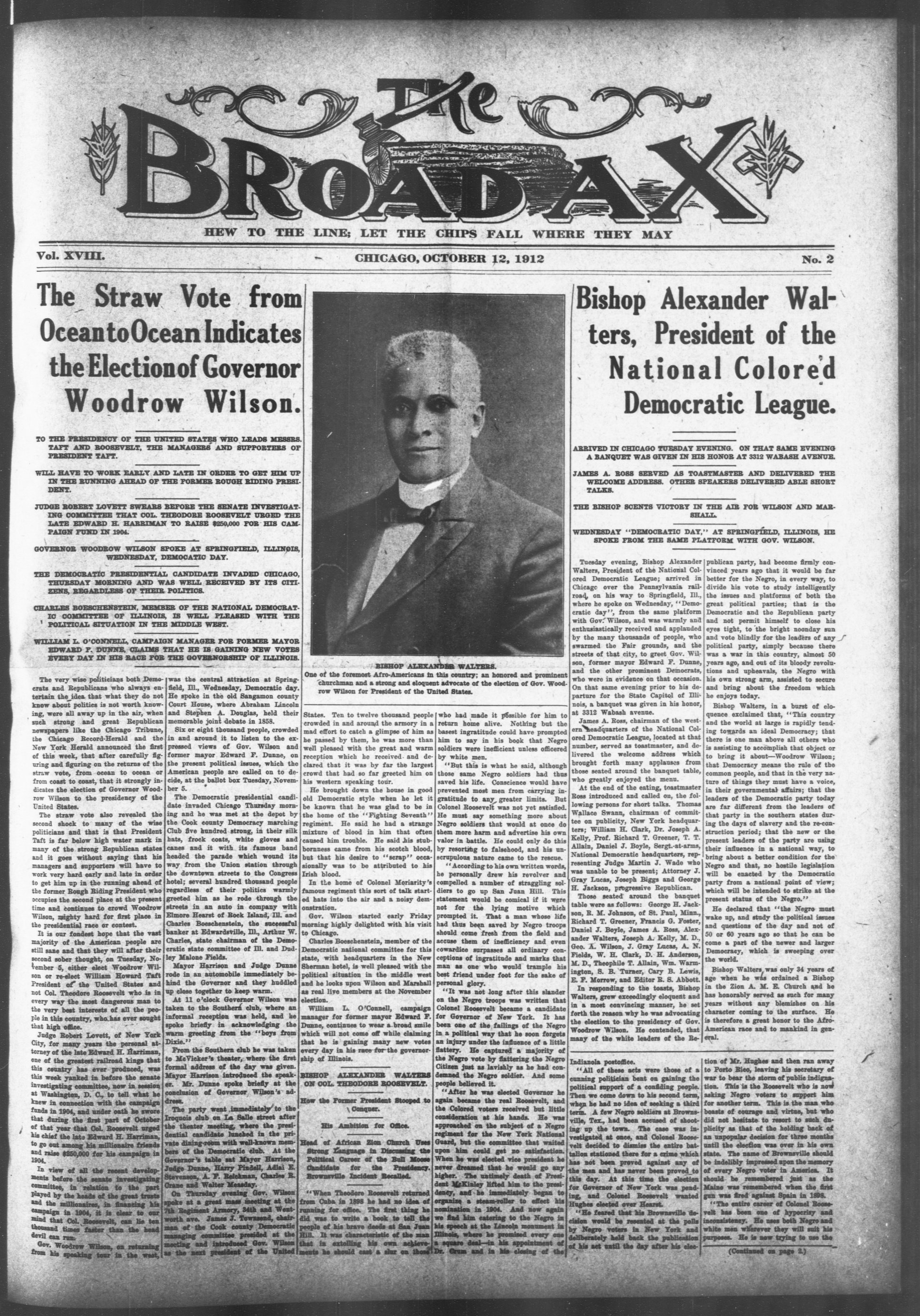
One of the foremost Afro-Americans in this country; an honored and prominent churchman and a strong and eloquent advocate of the election of Gov. Woodrow Wilson for President of the United States.
States. Ten to twelve thousand people crowded in and around the armory in a mad effort to catch a glimpse of him as he passed by them, he was more than well pleased with the great and warm reception which he received. and declared that it was by far the largest crowd that had so far greeted him on his western speaking tour.
He brought down the house in good old Democratic style when he let it be known that he was glad to be in the home of the "Fighting Seventh" regiment. He said he had a strange mixture of blood in him that often caused him trouble. He said his stubbornness came from his scotch blood, but that his desire to "scrap" occasionally was to be attributed to his Irish blood.
In the home of Colonel Moriarity's famous regiment this sort of talk started hats into the air and a noisy demonstration.
Gov. Wilson started early Friday morning highly delighted with his visit to Chicago.
Charles Boeschenstein, member of the Democratic national committee for this state, with headquarters in the New Sherman hotel, is well pleased with the political situation in the middle west and he looks upon Wilson and Marshall as real live members at the November election.
William L. O'Connell, campaign manager for former mayor Edward F. Dunne, continues to wear a broad smile which will not come off while claiming that he is gaining many new votes every day in his race for the governorship of Illinois.
BISHOP ALEXANDER WALTERS ON COL. THEODORE BOOSEVELT.
How the Former President Stooped to \ Conquer.
His Ambition for Office.
Head of African Zion Church Uses Strong Language in Discussing the Political Career of the Bull Moose Candidate for the Presidency. Brownsville Incident Recalled.
"When Theodore Roosevelt returned from Cuba in 1898 he had no idea of running for office. The first thing he did was to write a book to tell the people of his brave deeds at San Juan Hill. It was characteristic of the man that in extolling his own achievements he should cast a slur on those
who had made it possible for him to return home alive. Nothing but the basest ingratitude could have prompted him to say in his book that Negro soldiers were inefficient unless officered by white men.
"But this is what he said, although those same Negro soldiers had thus saved his life. Conscience would have prevented most men from carrying ingratitude to any greater limits. But Colonel Roosevelt was not yet satisfied. He must say something more about Negro soldiers that would at once do them more harm and advertise his own valor in battle. He could only do this by resorting to falsehood, and his unscrupulous nature came to the rescue.
"According to his own written words, he personally drew his revolver and compelled a number of straggling soldiers to go up San Juan Hill. This statement would be comical if it were not for the lying motive which prompted it. That a man whose life had thus been saved by Negro troops should come fresh from the field and accuse them of inefficiency and even cowardice surpasses all ordinary conceptions of ingratitude and marks that man as one who would trample his best friend under foot for the sake of personal glory.
"It was not long after this slander on the Negro troops was written that Colonel Roosevelt became a candidate for Governor of New York. It has been one of the failings of the Negro in a political way that he soon forgets an injury under the influence of a little flattery. He captured a majority of the Negro vote by flattering the Negro Citizen just as lavishly as he had condemned the Negro soldier. And some people believed it.
"After he was elected Governor he again became the real Roosevelt, and the Colored voters received but little consideration at his hands. He was approached on the subject of a Negro regiment for the New York National Guard, but the committee that waited upon him could get no satisfaction. When he was elected vice president he never dreamed that he would go any higher. The untimely death of President McKinley lifted him to the presidency, and he immediately began to organize a steam-roller to effect his nomination in 1904. And now again we find him catering to the Negro in his speech at the Lincoln monument in Illinois, where he promised every one a square deal-in his appointment of Dr. Crum and in his closing of the
Bishop Alexander Walters, President of the National Colored Democratic League.
ARRIVED IN CHICAGO TUESDAY EVENING. ON THAT SAME EVENING A BANQUET WAS GIVEN IN HIS HONOR AT 3312 WABASH AVENUE.
JAMES A. BOSS SERVED AS TOASTMASTER AND DELIVERED THE WELCOME ADDRESS. OTHER SPEAKERS DELIVERED ABLE SHOETALKS.
THE BISHOP SCENTS VICTORY IN THE AIR FOR WILSON AND MAESHALL.
WEDNESDAY "DEMOCRATIC DAY," AT SPRINGFIELD, ILLINOIS, HE SPOKE FROM THE SAME PLATFORM WITH GOV. WILSON.
Tuesday evening, Bishop Alexander Walters, President of the National Colored Democratic League; arrived in Chicago over the Pennsylvania railroad, on his way to Springfield, Ill., where he spoke on Wednesday, "Democratic day", from the same platform with Gov. Wilson, and was warmly and enthusiastically received and applauded by the many thousands of people, who swarmed the Fair grounds, and the streets of that city, to greet Gov. Wilson, former mayor Edward F. Dunne, and the other prominent Democrats, who were in evidence on that occasion. On that same evening prior to his departure for the State Capitol of Illinois, a banquet was given in his honor, at 3312 Wabash avenue.
James A. Ros, chairman of the western headquarters of the National Colored Democratic League, located at that number, served as toastmaster, and delivered the welcome address which brought forth many applauses from those seated around the banquet table, who greatly enjoyed the menu.
At the end of the eating, toastmaster Ross introduced and called on, the following persons for short talks. Thomas Wallace Swann, chairman of committee on publicity, New York headquarters; William H. Clark, Dr. Joseph A. Kelly, Prof. Richard T. Greener, T. T. Alain, Daniel J. Boyle, Sergt.-at-arms, National Democratic headquarters, representing Judge Martin J. Wade who was unable to be present; Attorney J. Gray Lucas, Joseph Biggs and George H. Jackson, progressive Republican. Those seated around the banquet table were as follows: George H. Jackson, R. M. Johnson, of St. Paul, Minn., Richard T. Greener, Francis G. Foster, Daniel J. Boyle, James A. Ross, Alexander Walters, Joseph A. Kelly, M. D., Geo. A. Wilson, J. Gray Lucas, A. N. Fields, W. H. Clark, D. H. Anderson, M. D., Theophile T. Allain, Wm. Warmington, S. B. Turner, Cary B. Lewis, E. F. Morrow, and Editor R. S. Abbott. In responding to the toasts, Bishop Walters, grew exceedingly eloquent and in a most convincing manner, he set forth the reason why he was advocating the election to the presidency of Gov. Woodrow Wilson. He contended, that many of the white leaders of the Re-
"All of these acts were those of a cunning politician bent on gaining the political support of a confiding people. Then we come down to his second term, when he had no idea of seeking a third term. A few Negro soldiers at Brownsville, Tex., had been accused of shooting up the town. The case was investigated at once, and Colonel Roosevelt decided to dismiss the entire battalion stationed there for a crime which has not been proved against any of the man and has never been proved to this day. At this time the election for Governor of New York was pending, and Colonel Roosevelt wanted Hughes elected over Hearst.
"He feared that his Brownsville decision would be resented at the polls by Negro voters in New York and deliberately held back the publication of his set until the day after his else-
No. 2
publican party, had become firmly convinced years ago that it would be far better for the Negro, in every way, to divide his vote to study intelligently the issues and platforms of both the great political parties; that is the Democratic and the Republican party and not permit himself to close his eyes tight, to the bright noonday sun and vote blindly for the leaders of any political party, simply because there was a war in this country, almost 50 years ago, and out of its bloody revolutions and upheavals, the Negro with his own strong arm, assisted to secure and bring about the freedom which he enjoys today.
Bishop Walters, in a burst of eloquence exclaimed that, "This country and the world at large is rapidly tending towards an ideal Democracy; that there is one man above all others who is assisting to accomplish that object or to bring it about—Woodrow Wilson; that Democracy means the rule of the common people, and that in the very nature of things they must have a voice, in their governmental affairs; that the leaders of the Democratic party today are far different from the leaders of that party in the southern states during the days of slavery and the re-construction period; that the new or the present leaders of the party are using their influence in a national way, to bring about a better condition for the Negro and that, no hostile legislation will be enacted by the Democratic party from a national point of view; which will be intended to strike at the present status of the Negro." He declared that "the Negro must wake up, and study the political issues and questions of the day and not of 50 or 60 years ago so that he can be come a part of the newer and larger Democracy, which is sweeping over the world.
Bishop Walters was only 34 years of age when he was ordained a Bishop in the Zion A. M. E. Church and he has honorably served as such for many years without any blemishes on his character coming to the surface. He is therefore a great honor to the Afro-American race and to mankind in general.
tion of Mr. Hughes and then ran away to Porto Bico, leaving his secretary of war to bear the storm of public indignation. This is the Roosevelt who is now asking Negro voters to support him for another term. This is the man who boasts of courage and virtue, but who did not hesitate to resort to such duplicity as that of the holding back of an unpopular decision for three months until the election was over in his own state. The name of Brownsville should be indelibly impressed upon the memory of every Negro voter in America. It should be remembered just as the Maine was remembered when the first gun was fired against Spain in 1898.
"The entire career of Colonel Roosevelt has been one of hypocrisy and inconsistency. He uses both Negro and white men wherever they will suit his purposes. He is now trying to use the
THE BROAD AX
THE BROAD AX
PUBLIC WORKS
Will promulgate and on all times uphold
Cathaline, Protezione, Franta, Inundata,
Single Taxman, Republicana, or anyone else
can have their say, as long as their langu-
age is proper and respettability is fixed.
The Broad Air is a newspaper, but all, even
claiming the editorial right to speak its
own mind.
Local communications will receive af-
tention. Write only on one side of the paper.
Subscriptions must be paid in advance.
One Year .$2.50
Six Months .$3.00
Advertising rates made known on application.
JULIUS F. TAYLOR, Editor and Publisher
Entered as Second-Class Matter Aug. 29,
1892, at the Post Office at Chicago, Illinois,
under Act of March 8, 1879.
(Concluded from page 1.)
BISHOP WALTERS ON COL. ROOSE
VELT.
Negro of the North, while trampling under foot the Negro of the South. Posing as a great moralist, who sees only the sublime side of all things, he nevertheless approves the disfranchisement of the Negro in the South all because the southern Negro refused to desert Taft at Chicago. Had the colonel himself been nominated by the Republican convention there would have been no cry of fraud, no Progressive party and no elimination of the Negro delegates from the South.
"The Progressive party is nothing but the wail of one unscrupulous man, drunk with a mixture of ambition and malice, determined to kill the party that thwarted his will. Theodore Roosevelt is neither a progressive nor a reactionary. He is anything and everything that suits his purposes for the time being—a demagogue of transcendent genius, a sublime hypocrite and pseudo-moralist who lives for the gratification of personal vanity."
EXAMINATION FOR RHODES
SCHOLARSHIP AT OXFORD
President Edmund J. James of the University of Illinois, chairman of the Rhodes Scholarship Committee of Illinois, announces that a qualifying examination for all candidates for the Oxford Rhodes scholarship will be held Tuesday October 15, and Wednesday October 16, 1912, in the office of. President A. W. Harris at the Northwestern University Building, corner of Lake and Dearborn streets, Chicago. This examination corresponds to the entrance examinations required by many American colleges. From those candidates who pass this examination a scholar will be selected for Illinois, who will begin work at Oxford in October 1913.
Papers will be sent in this examination in Latin, Greek and Mathematics, and only those candidates who pass in at least Latin and Mathematics will be eligible for a scholarship.
A Rhodes scholar is appointed for a period of three years and receives the sum of fifteen hundred dollars each year. A Rhodes scholarship at Oxford is therefore a prize of greater money value than any scholarship or fellowship at any American university.
The candidate for a Rhodes scholarship must be an unmarried male citizen of the United States with at least five years' domicile; must by the first of October, 1913, have passed his nineteenth but not his twenty-fifth birthday; and must have completed at least his sophomore year at some recognized degree-granting university or college.
In accordance with the wishes of Mr. Cecil Rhodes, the committee of selection, in selecting a student for appointment to a scholarship, takes into consideration, (1) his literary and scholastic attainments; (2) his fondness for and success in manly outdoor sports, such as football and the like; (3) his qualities of manhood—truth, courage, devotion to duty, sympathy for and protection of the weak, kindness, self-selfness and fellowship; and (4) his exhibition during school days of moral force of character and instincts to lead and to take an interest in his school-mates.
Candidates are expected to send written application at once to President Edmund J. James, Urbana, Illinois. All candidates will register in person between eight and ten p. m. Monday October 14, at the place of examination. The examination will begin at ten a. m., Tuesday, October 15.
Frank H. Funk, the Progressive party nominee for Governor of Illinois, will not have the support of his uncle, Lafayette Funk of Shirley, Ill., in the present campaign. That news this week occasioned much joy among the Republicans, who sent out copies of a letter written by the uncle. The elder Mr. Funk has been president of the State Board of Agriculture and, in a letter to A. P. Grout of Winchester,
WHAT COL. CHAUNCEY DEWEY SAID.
"The Negroes are making the come when the Republican party ocrats are their enemies. They have new Progressive party. If they o Democratic party and disfranchise Roosevelt said that he would not
By Phil H. Brown,
Bureau of Publicity,
Republican National Committee.
Chicago, October 10.
"The Negroes are making the mistake of their lives. The time has come when the Republican party cannot protect them, and the Democrats are their enemies. They had better make their peace with the new Progressive party. If they don't, we will join hands with the Democratic party and disfranchise the Negroes in the North. * * * Roosevelt said that he would not appoint any Negroes in the South."
The car is the very outset we have contended that the Progressives intended to do all in their power to disfranchise the northern Colored people, and that they were exploiting the candidacy of Col. Roosevelt in the interest of the Democratic party, but we never dreamed that they would brag about it.
Col. Chancey Dewey Talks.
The Hon. Chancey Dewey, Progressive National Committeeman from the State of Illinois, Director of the Roosevelt campaign in the western States, an intimate friend and personal adviser of Col. Theodore Roosevelt, has openly threatened that the Bull Moose party will join hands with the Democrats and accomplish the disfranchisement of the northern Negro. He gloated over the unholy alliance between the Progressives and the Democrats, and admitted that his party was trying to destroy the grand old party of Lincoln and Grant. He used the threat of disfranchisement to clout the intelligent Colored voters of the North into the corral of the Bull Moosers.
Prominent Negroes Present.
Last week several Colored men of local and national prominence gathered at the Progressive headquarters at the La Salle Hotel, and were discussing the political issues in an informal way. Those present were S. B. Turner, editor of the Illinois Idea; E. E. Wilson, a prominent lawyer and former partner of E. H. Morris; Major John R. Lynch, U. S. A. (retired), formerly paymaster in the army; Attorney Beauregard F. Moseley, an active Roosevelt man and a candidate for elector on the Progressive ticket, and some few others.
Finally Col. Chauncey Dewey, who is director of the headquarters, came and took part in the discussion. Remarking that the Colored people were generally fighting shy of the new party, Mr. Dewey declared with vehemence
nominee for trustee of the University of Illinois, he asserts his loyalty to Governor Deneen and his conviction that all farmers should vote for his re-election.
NEWSPAPER LAW IS ATTACKED IN COURT.
Journal of Commerce and Commercial Bulletin of New York to Test Right to Enforce Circulation Figures' Publication.
AMERICAN NEWSPAPER ASS'N. SAID TO BE BACK OF ACTION.
Alleged Statute Is Void Because It Violates Constitution of United States, Particularly First and Fifth Amendments.
New York, Oct. 10—Suit to test the right of the government to enforce the federal law of Aug. 24, 1912, requiring newspapers and periodicals to publish their circulation figures twice a year and imposing other publicity requirements, was filed in the United States District court here today by the Journal of Commerce and Commercial Bulletin company, publishers of the Journal of Commerce.
The suit is directed against Postmaster General Hitchcock, Attorney General Wickersham, United States District Attorney Wise and Postmaster Morgan of New York. The petitioner charges that the law is unconstitutional and prays for a temporary injunction restraining its enforcement until final adjudication. It also requests that the defendants be required by subpoena to answer.
Back of the action, according to Robert C. Morris of counsel for the complainant, is the American Newspaper Publishers' association. The association decided recently to file a test suit and the Journal of Commerce, Mr. Morris said, in filing its petition, has the sanction and co-operation of the association.
Affects 25,000 Newspapers.
The petition alleges that there are upward of 25,000 newspapers and periodicals in the country affected by the law. It charges that the law is void, because it violates the Constitution of the United States and particularly the first and fifth amendments, and abridges the freedom of the press. The law is characterized as of no benefit to the postoffice or any other department of the government, inasmuch as oblence by the periodicals and newspapers would not "aid or assist in the operation of the postoffice department or in the carrying of the mails or the regulation thereof." In its petition the complainant
nounces that it will not comply with
and striking his first violently upon the desk:
"The Negroes are making the mistake of their lives. The time has come when the Republican party cannot protect them, and the Democratic party is their enemy. They had better make their peace with the new Progressive party. If they don't, we will join hands with the Democratic party and disfranchise the Negroes in the North." A silence as dense as a pall fell upon the astonished Colored men. It took minutes for them to translate to their minds what their ears had heard. Mr. S. B. Turner, in speaking of the incident, said that it was almost dramatic.
At last, Major Lynch, who is a Progressive, said: "This may be your position, but I know that it is not the stand assumed by Col. Roosevelt." "Yes, it is, rejoined the Bull Moose leader, "I have had a personal talk with him and he declared that if he is elected President he will not appoint a single Colored man from the South." "I know the Colonel, too," said Major Lynch, "and I know that he does not mean that." "Well, he said it," retorted Mr. Dewey.
Negroes Stirred.
From mouth to mouth this remarkable threat made by the Bull Moose chief against the Colored voters of the North was circulated in Chicago until now it is the talk of the town. People who had known Mr. Dewey for years doubted the truth of the report. Several of them went to see him in reference to it, and he repeated what he had said at the La Salle to them.
If this assertion had come from an individual less prominently connected with Roosevelt and less active in the dissemination of his propaganda, it would be allowed to pass unnoticed, but coming from Col. Chauncey Dewey, it has created a sensation in Chicago's Colored community unequalled in this campaign.
the law for the reasons given and declares that the defendants are about to enforce the law by denying the complainants the use of the mails. With reference to that portion of the law which requires that all printed matter for which there is any compensation received shall be labeled "advertisement," the petition says:
Matters of Business Arrangement.
"All such matters are matters of business arrangement or of favor or otherwise between your complainant and its advertisers; and such provision of the act is not necessary or proper to assist the government or any department or official thereof to carry out or perform any power or duty intrusted or granted to the United States by the several states under the Constitution or otherwise."
It is charged also that the law, if enforced, would result in the confiscation of the complainants' property without due process.
"It is not within the power of Congress," the complainant continues, "to enact said act; and it is an usurpation by Congress of powers expressly reserved to the several states, and is legislation affecting matters with which the several states of the United States alone have the right to treat."
PRESIDENT TAFT ENDORSES TUBERCULOSIS DAY.
Says Churches Should Work to Eradicate Disease.
New York, October 10th:
Cordial approval and endorsement of Tuberculosis Day, which will be observed by the churches of the country on October 27th, is expressed by President Taft in a letter to Homer Folks of New York, President of The National Association for the Study and Prevention of Tuberculosis, made public to-day. President Taft, writing from Beverly, says:
"I have your letter of September 16th, and am very glad of an opportunity to testify to my belief in the importance of your campaign of education as to the means of preventing tuberculosis. You do well to enlist the active support of the churches and of all other agencies for the dissemination of information calculated to induce everyone to do his or her part toward the complete eradication of the dread disease. I hope and believe that a "Tuberculosis Day" in the churches will be productive of great good.
"Sincerely yours,
"William H. Tuff."
From present indications, Tuberculosis Day will be observed by alumt every religious denomination, in the
United States and not less than 50,000 sermons on tuberculosis will be preached on October 27th, or in the weeks preceding or following that date.
THINGS TO THINK ABOUT.
THINGS TO KEEP IN MIND If a room where you are compelled to work, sleep or live is dusty, dirty, overheated, poorly ventilated, damp or crowded, it is dangerous. These disease-producing conditions may be remedied without much trouble or expense. Soap, water, and "elbow grease" will remove dust and dirt; opening windows a little at the top and bottom will give you the fresh air; and an appeal to the Sanitary Bureau of the Department of Health will help you to have the dampness—usually due to defective drainage—corrected, and you will have the conditions that make for both health and comfort.
Oh, yes—another word about dust—Never sweep a room with a broom that raises dust—Don't have the old-fashioned, discarded, tacked-down carpets—Use rugs that can be taken up and are easily cleaned out of doors. In dusting woodwork and furniture never use a feather duster; use instead a dampened cloth that will take up the dust without flirting it all over the rooms. Never sweep a room with the windows closed. Remember that room dust is always dangerous.
A dust-laden air is always dangerous. Out-door air, street air that is full of dust is bad air for any one to breathe. Even dust that is free from disease germs is not good for the lungs. In many kinds of industries the dust is very harmful to those who are compelled to breathe it. This is particularly true in such trades as stone cutting, metal grinding and polishing, cigar making, etc., but in most of these trades there are protective devices that are required by law to be used that greatly lessen the dangers from dust. In the home, however, the dust may be more dangerous than that in most work shops and there is no law compelling the use of protective devices of any kind. The one protection is to be found in the intelligence and care exercised by those who have the care of the home.
Never allow the air in your living rooms to become stale or foul. If the weather is too cold to have a window or two open a little all the time, a good plan is to open up the house several times a day for a few minutes or long enough to blow out all the bad, foul air and make everything sweet and clean. It will be found, however, that by keeping one window open just a little all the time the air may be kept pure and fresh without increasing the coal bills and without producing discomfort.
THE LIBERAL CULTURE SOCIETY OPENS FOR THE SEASON.
The Liberal Culture Society, at its first meeting of the season installed its new officers as follows: Prof. Richard T. Greener, Pres.; Dr. E. D. Brown, Vice-Pres.; Dr. C. H. Knight, Treas.; Miss H. Evelyn Moseley, Sec.
This was the beginning of the third year of the Society, which meets weekly on Friday nights at 3226 Prairie Ave.
Its creed is: Toleration.
Its motto: To encourage frank, open discussion of every question which concerns any phase of human activity, and discourage any tendency toward dogmatic assertion.
Its pledge: To bring to each other what ver is novel, helpful, useful, or commendable in life and thought.
S. S. 1:45 Mrs. Minnie Clark, Supt.
C. E. 6:45 Mrs. Lalla Jones, Pres.
The Members of St. Mary's A. M. E.
Church were called together Wednesday
in a Church Conference to lay plans for
this Conference year, both spiritual and
financial.
Monday, Nov. 4th, There will be a
Revival Meeting conducted by Rev.
Cato of Elgin.
Oct. 14. The North Western Jubilee
Singers by Mme. Sallie Jones Douns.
"GRAND MUSICAL SOURCE"
GRAND MUSICAL SOURCE."
Mr. Hugh Buchanan, "America's Greatest Ballad Singer," assisted by all Star Artists, Mr. Harrison Emanuel, Violin; Mr. W. E. Gosset, Pipe-Organ; Mr. B. Emanual Johnson, Piano; and Mr. J. E. Mitchel, Reader; at Walters A. M. E. Zion Church, Monday Ave. Oct. 21st at 8:30. Admission 25 cents.
John G. Jones, one of the highest Colored Masons in the world; will leave the first of the week, for New York City, where he will sail on October 19 on one of the ships belonging to the Red Star line; for Luxenberg, Germany, where he will attend as a delegate the International Masonic Congress of the world. He is the first Colored Mason to be invited, to mingle with the White Masons in such a manner. He will be absent one month and will visit other interesting points in
M.
WILLIAM L. O'CONNELL
The up-to-date and progressive treasure manager, of the candidacy of the didate for Governor of Illinois.
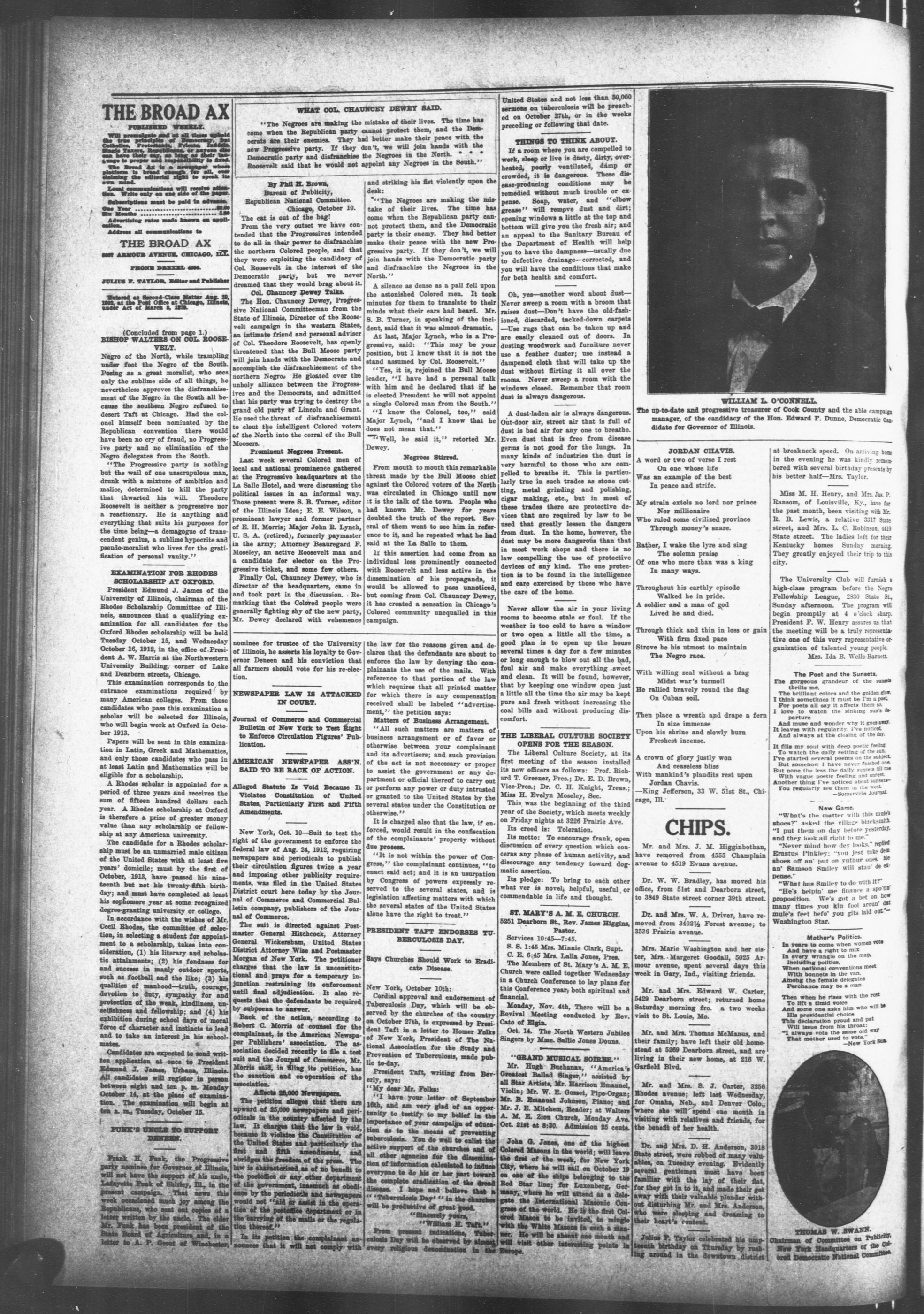
The up-to-date and progressive treasurer of Cook County and the able campaign manager, of the candidacy of the Hon. Edward F. Dunne, Democratic Candidate for Governor of Illinois.
The up-to-date and progressive treasurer of Cook County and the able campaign manager, of the candidacy of the Hon. Edward F. Dunne, Democratic Candidate for Governor of Illinois.
My strain extols no lord nor prince
Nor millionaire
Who ruled some civilized province
Through money's snare.
Bather, I wake the lyre and sing
The solemn praise
Of one who more than was a king
In many ways.
Throughout his earthly episode
Walked he in pride.
A soldier and a man of god
Lived he and died.
Through thick and thin in loss or gain
With firm fixed pace
Strove he his utmost to maintain
The Negro race.
With willing zeal without a brag
Midst war's turmoil
He rallied bravely round the flag
On Cuban soil.
Then place a wreath and drape a fern
In size immense
Upon his shrine and slowly burn
Freshest incense.
A crown of glory justly won
And ceaseless bliss
With mankind's plaudits rest upon
Jordan Chavis.
—King Jefferson, 33 W. 51st St., Chicago, Ill.
Mr. and Mrs. J. M. Higginbothan, have removed from 4555 Champlain avenue to 4519 Evans avenue.
Dr. W. W. Bradley, has moved his office, from 51st and Dearborn street, to 3849 State street corner 39th street.
Dr. and Mrs. W. A. Driver, have removed from 3402½ Forest avenue; to 3536 Prairie avenue.
Mrs. Marie Washington and her sister, Mrs. Margeret Goodall, 5025 Armour avenue, spent several days this week in Gary, Ind., visiting friends.
Mr. and Mrs. Edward W. Carter, 5429 Dearborn street; returned home Saturday morning fro. a two weeks visit to St. Louis, Mo.
Mr. and Mrs. Thomas McManus, and their family; have left their old homestead at 5269 Dearborn street, and are living in their new home, at 216 W. Garfield Blvd.
Mr. and Mrs. S. J. Carter, 3256 Rhodes avenue; left last Wednesday, for Omaha, Neb., and Denver Colo., where she will spend one month in visiting with relatives and friends, for the benefit of her health.
Dr. and Mrs. D. H. Anderson, 3018 State street, were robbed of many valuables, on Tuesday evening. Evidently several gentlemen must have been familiar with the lay of their flat, for they got in to it, and made their get away with their valuable plunder without disturbing Mr. and Mrs. Anderson, who were sleeping and dreaming to their heart's content.
Julius F. Taylor celebrated his untimely birthday on Thursday by rushing around in the downtown district
JORDAN CHAVIS.
A word or two of verse I rest
On one whose life
Was an example of the best
In peace and strife.
CHIPS.
at breakneck speed. On arriving home in the evening he was kindly remembered with several birthday presents by his better half—Mrs. Taylor.
Miss M. H. Henry, and Mrs. Jas. P. Ransom, of Louisville, Ky., have for the past month, been visiting with Mr. R. B. Lewis, a relative 3317 State street, and Mrs. L. C. Robinson, 4410 State street. The ladies left for their Kentucky homes Sunday morning. They greatly enjoyed their trip to this city.
The University Club will furnish a high-class program before the Negro Fellowship League, 2830 State St. Sunday afternoon. The program will begin promptly at 4 o'clock sharp, President F. W. Henry assures us that the meeting will be a truly representative one of this very representative or organization of talented young people.
Mrs. Ida B. Wells-Barnett.
The Poet and the Sunsets.
The gorgeous grandeur of the sunsets thrills me.
The brilliant colors and the golden glow.
I think sometimes it must be a I'm poet.
For poets all say it affects them so.
I love to watch the sinking sun's departure.
And I wonder and wonder why it goes away.
It leaves with regularity. I've noticed.
And always at the closing of the day.
It fills my soul with deep poetic feelings
To watch the daily settings of the
sunlight in my garden, I sit in
butchow I have never flushed one.
But none the less the daily sunsets fill me
"What's the matter with this mule's shoes?" asked the village blacksmith. "I put them on day before yesterday, and they look all right to me." "Never mind how dey looks," replied Erastus Pinkley; "you jest take dem shoes off an' put on yuthur ones. Me an' Samson Sunley will stun' de expense."
"What has Smiley to do with it?"
"He's helpin' me finance a spo'tin proposition. We's got a bet on how many times you kin fool aroun' dat mule's feet befo' you gifts laid out." Washington Star.
Mother's Politics.
In years to come when women vote
And have a right to mix
In life we want on the map.
Including politics
When national conventions meet
With bonnets in the van.
Among the female delegates
Perchance may be a man.
Then when he rises with the rest
To lift a timid voice
And some one asks him who will be
His presidential choice
This declaration proud and pat
Will issue from his throat:
"I always vote the same old way
That mother used to vote."
THOMAS W. SWANN.
Chairman of Committee on Publicity,
New York Headquarters of the Col-
ored Democratic National Committee.
---
New Game.
Between Five and Seven Thousand People were Eager to Enter Quinn Chapel.
DURING THE FUNERAL SERVICES OF THE LATE REV. JORDAN CHAVIS.
COL. JOHN R. MARSHALL, COMMANDING THE EIGHTH REGIMENT—HIS STAFF AND FIELD OFFICERS ACTED AS THE GUARD OF HONOR.
EX-UNITED STATES SENATOR WILLIAM LORIMER AND FRANK S. DICKSON THE ADJUTANT GENERAL OF ILLINOIS WERE PRESENT AND PAID GLOWING TRIBUTES TO HIS MEMORY.
MANY MEN AND WOMEN PROMINENT IN SECRET SOCIETY CIRCLES FROM ALL PARTS OF THE COUNTRY WERE PRESENT AND TOOK PART IN THE EXERCISES.
TWO CARRIAGES WERE USED TO TRANSPORT THE NUMEROUS FLORAL OFFERINGS TO AND FROM THE CHURCH WHICH EXTENDED CLEAR ACROSS THE PLATFORM IN IT.
CHARLES S. JACKSON THE UP-TO-DATE FUNERAL DIRECTOR WAS IN CHARGE.
JULIUS P. TAYLOR AS THE SPECIAL WAR CORRESPONDENT OF THE EIGHTH REGIMENT WALKED A LITTLE AHEAD OF THE FUNERAL PROCESSION FROM TWENTY-FOURTH AND WABASH AVENUE TO THIRTY-THIRD AND STATE STREET.
AND ASSISTED TO PREVENT THE GREAT MASS OF PEOPLE WHICH LINED BOTH SIDES OF THAT THOBOUGHPARE FROM CROWDING INTO THE STREET.
Promptly at 12:30 p. m. last Sunday the funeral procession started to wend its way from the home of the late Rev. Jordan Chavis, 3560 Vernon ave. headed for Quinn Chapel, 24th and Wabash ave. In solemn tread it moved north on Vernon ave. to 35th street, east on that street to Wabash ave., and then north to the church.
The officers and members of the Eighth Regiment acted as the guard of honor, Col. John R. Marshall commanding; he and his staff and field officers as follows: Lieut-Col. James H. Johnson, Captain Louis B. Anderson, Captain James S. Nelson, Captain Wm. T. Jefferson, Captain John L. Fry, Major Allen A. Wesley, Captain J. R. White, Captain L. W. Lewis marched at the head of it, and the Hon. Frank S. Dickson, the Adjutant General of Illinois, with bowed head, also walked close up by the side of Col. Marshall; the famous Eighth Regiment Band, with its grand and imposing looking Drum Major, followed the military chiefs and captains—then the two big color "Bearers"—the soldiers proper or the rank and file of the regiment, following them.
Many members of the various secret orders which Rev. Chavis belonged to, including Odd Fellows, K. P.'s, U. B. P.'s, Knights of Tabor and so on, headed by the K. P. Band, followed the soldiers—then the hearse which was slowly and noiselessly drawn by two very large slik black horses, heavily draped in mourning. Two of the 20 carriages which came next contained the mourners, the other two of that number were used to transport the numerous floral offerings to and from the church, which extended clear across the platform in it, making a solid and beautiful bank of fragrant flowers.
Between five and seven thousand people surrounded the church by 2 o'clock, at the time the funeral cortege arrived there, and it required the services of four or five policemen to press the people back and clear an entrance into the church. The Deaconesses of Quinn Chapel stood on either side of the passageway leading into the church and held aloft small American flags for the people to walk under.
Not many minutes after 2 o'clock, Rev. John F. Thomas, pastor of Ebenezer Baptist Church, who was always a close friend of Rev. Chavis, rose and announced that at a later date memorial services would be held over his remains, at which time all the Baptist ministers would be permitted to give full vent to their feelings while doing honor to his memory. He was actively in charge of the Baptist end of the funeral. He then requested the choir of Herman Baptist Church to sing, and Rev. F. A. McCoo, of St. John's Baptist Church, read the 900th Psalm. Dr. E W. McDaniel offered the opening prayer; Miss Laura Williams, of Cincinnati, Ohio, member of the U. B. F.'s, solo. Reading of resolution of Herman Baptist Church, C. P. Bland. Reading of resolution of John R. Tanner Camp, Veterans of the Spanish-American War. Dr. B.F. Harris, President of the State B.F. Association of Illinois, read the obituary, solo, Mr. Charles Bos, Herman Baptist Church. Short remarks by Rev. J. N. McGracken, Presiding Elder from Southern Illinois, in behalf of the A. M. E. preachers. Five minutes' talk, Rev. E. Martin, of Bethshea Baptist Church, in behalf of all the other Baptist dit
vines who were unable to raise their voices at that time.
Ex-United States Senator, William Lorimer, occupying a seat of honor in the pulpit, was next introduced by Rev. Thomas, and he very fittingly expressed his high regard which he had always entertained for Rev. Chavis, stating in plain and distinct language that he was his friend, that he knew him well, that he was a true and devoted husband, a kind and loving rather, a good loyal citizen, true to his country and his race; he expressed his deepest sympathy for Mrs. Chavis and other surviving members of his family over their sad berecavement. In winding up he declared that "God who is the reavenly Father of us all, both white and black, would stretch forth his hand of love and sympathy, and assist to lighten the burdens of those whose hearts at that time and place were sorely wrenched and weighted down with much pain and sorrow and that for one, he felt highly honored in being permitted to be present and to be numbered among those who mourned the death of Rev. Jordan Chavis."
Miss Fannie Wise followed Senator Lorimer with a beautiful solo, "Beyond the Gates of Paradise." Reading of resolutions, of Louisville Lodge No. 20 United Brothers of Friendship. Frank S. Dickson, the Adjutant General of Illinois, was next introduced by Rev. Thomas, and in the most eloquent and elegant language he paid a glowing tribute to the memory of Rev. Chavis; in one part of it he softly exclaimed that "The fragrance of the flower that has been will linger around the flower which will live forever; that the rainbow of infinite love is seen only through a sympathetic love, which will never die and which will never become stilled in the hearts of men and women.
Rev. Thomas at the conclusion of his eloquent tribute called on the audience to stand and sing one verse of the favorite song of Rev. Chavis, "Rock of Ages," and as the last notes faintly died away, three taps were given and the Soldier's Farwell by the trumpeters, Charles Walker and Milton Ford, of the Eighth Regiment. Milton T. Bailey, head of the True heformers, in this city, and one of the prominent officers of the Annie Walker Conscience Club of Chicago, read its resolutions which had been drafted by I. W. Warden. The Arnett Lodge of Odd Fellows No. 7455 then held their prolonged services over the remains.
Pythian Lodge No. 2 was the next to follow with all their rites and ceremonies pertaining to the burial of the dead, and when they had concluded, the remaining services were conducted by the United Brothers of Friendship and the Sisters of the Mysterious Ten; the first member of that order to speak was Captain Tandy of St. Louis, Mo., who is in his 76th year, who is one of its high past grand officers, and he let it be known that the U. B. F.'s had more than one million members, making it by far the largest secret organization among Colored people in the world.
T. H. Smith, Grand Chaplain of the U. B. F.'s of Illinois, was called on to preside and he presented Dr. W. D. Tandif, Grand Master of Kentucky, who read its resolutions; then Mrs. Mattie E. Whitlow of Cincinnati, Ohio, National Grand Princess of the U. B. F.'s, and S. M. T.; Mrs. E. Crosby of Cairo, III, State Grand Princess, was the next to speak; resolutions were also read by her and by one of the high
priests of the Grand Lodge of U. B. F.'s. A. Morris Williams of Springfield, III., Grand Attorney for the U. B. F.'s of this state, was on the platform and was about the only one who was not called upon to do some talking. Rev. E. C. Cole, a Baptist minister of Springfield, III., offered up the closing prayer. The coffin, which was a solid oak state casket with hand carved corners, with very heavy silver handles which was almost completely covered over during the services with the American flag, was opened and well onto three thousand people passed in front of it, to view the remains, while the Hermon Baptist Church choir sang mournful and saddening songs.
The pallbearers were J. W. White, George C. Higginbethin, James Thompson, Thomas Anderson, C. P. Bland, C. C. Clayton, Wm. Burdett and Austin Ross, all members of Hermon Baptist Church.
It was a few minutes after six o'clock before Charles S. Jackson, the up-to-date funeral director, who was in charge, closed the glass lid on the casket, and a little more than four hours were consumed from the time services began in the church until they were concluded, and the funeral procession was re-formed in the street in front of the church and darkness had settled down over the city long before it had reached 33rd and State streets.
As the special war correspondent of the Eighth Regiment, the writer walked a little ahead of it from 24th and Wabash ave. to the above mentioned street and assisted to prevent the great mass of people who lined both sides of that thoroughfare from crowding into the street.
On arriving at Jackson's undertaking rooms the remains of Rev. Chavis rested there for the rest of the night, part of the time laying in state, then on Monday morning his remains were transported onto their final resting place in Mt. Glenwood Cemetery.
Short Stories.
The United States spends $15,000,000 a year to see baseball games.
The Russian government has put the sable hunters out of business for three years.
From deep water in the Atlantic to deep water in the Pacific the Panama canal will be fifty miles in length.
The kitchens of the Emperor Francis Joseph's palace at Budapest are considered to be the most modern and in every way the finest in Europe.
In the United States there is one lawyer for every 700 persons, in England there is one to each 1,100 of population, in France one to 4,100 and in Russia one to 30,000.
Cost of Living.
The official government report shows that the high cost of living is almost equal to the cost of high living.-Chicago Inter Ocean. Now that a government commission has made an exhaustive examination and reported thereon, the public suspicion that the cost of living is high has been confirmed.-Philadelphia Ledger. It is true living costs more than it used to. The federal bureau of labor has issued a report confirming the rumor. We had hoped the story might at last have turned out to have been unfounded.-Chicago Record-Herald.
Town Topics.
Chicago is a queer city. It has even gone so far as to forbid "ad." displays in street cars—Boston Journal. Baltimore policemen must not play dominos on Sunday. Probably it is the one game that they don't play at all—Milwaukee Sentinel. Boston women are doing their own marketing and receiving lots of notoriety because of it. The wonder in Cleveland is that such a commonplace should deserve reporting—Cleveland Plain Dealer.
Aerial Flights.
The air continues to be a poor place in which to do fancy work.—Chicago Record-Herald.
There may be advancement in aviation, but at what cost of life!—New York American.
Doing fancy "stunts" in an aeroplane is taking dangerous chances, of course, but even the man who does nothing but plain, everyday, unornamental aviating is not regarded by the life insurance companies as a safe risk.—Chicago Tribune
FOR RENT.
Flat, 7114 Champlain Ave., first floor. Seven rooms, bath, gas, furnace heat. Cleaned last spring. Large yard and garden. Desirable neighborhood. Good transportation. Rent +.80 per month. Call or phone Central 4639.
7240-7242 Wentworth Ave., first flat,
7 Rooms and Bath, $20.00. Second flat
nothing, better seven rooms and bath
Rent $18.00. 5754 Wentworth Ave.
5 Rooms and Bath front flats $18.00 four
room rear flats, Rent $10.00 Stone front
House 5531 Shields Ave. 5 Rooms and
Bath, $18.00 best resident district.
2811 Armour Ave. 2nd flat 5 Rooms
and bath, $10.00. 2412 La Salle Street.
5 Rooms, $15.00.
S. BICHARDSON,
160 N. 8th Ave. 500. Phone
ODD FELLOWS' BIENNIAL
Johnson Tells Why B. J. Davis Was Not Elected Grand Master.
Washington—Henry Lincoln Johnson, deputy grand master of the Odd Fellows, says that the failure of the recent session of the biennial movable committee of the order held in Atlanta to elect officers will not make a division in the order.
He asserts that the failure of Benjamin J. Davis to be elected to the grand mastership was caused by Grand Master Edward H. Morris refusing to allow the calling of the roll of the Georgia delegates when the election was taking place.
"Davis had enough votes to elect him," said Mr. Johnson. "The votes of New York, Florida and Alabama had been taken when the name of Georgia was called. He had over 500 delegates in their seats, but Mr. Morris refused to allow the calling of the roll.
"He suggested that the accredited delegates, whose credentials the convention had received, if they were in their seats, be counted. But this was re-
[Name]
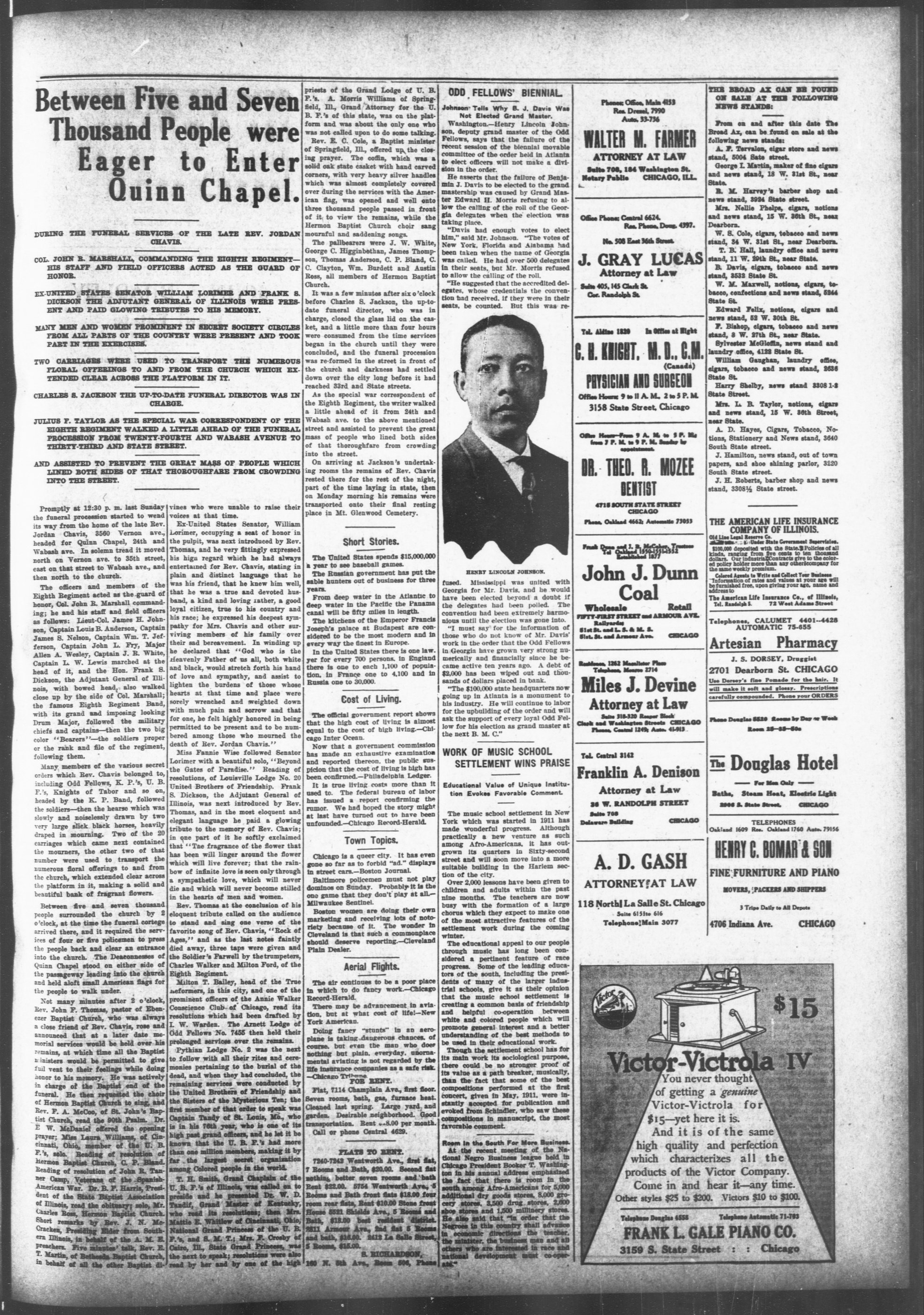
HENRY LINCOLN JOHNSON.
fused. Mississippi was united with Georgia for Mr. Davis, and he would have been elected beyond a doubt if the delegates had been polled. The convention had been extremely harmonious until the election was gone into.
"I must say for the information of those who do not know of Mr. Davis' work in the order that the Odd Fellows in Georgia have grown very strong numerically and financially since he became active ten years ago. A debt of $2,000 has been wiped out and thousands of dollars placed in bank.
"The $100,000 state headquarters now going up in Atlanta is a monument to his industry. He will continue to labor for the upbuilding of the order and will ask the support of every loyal Odd Fellow for his election as grand master at the next B. M. C."
WORK OF MUSIC SCHOOL
SETTLEMENT WINS PRAISE
Educational Value of Unique Institution Evokes Favorable Comment.
The music school settlement in New York which was started in 1911 has made wonderful progress. Although practically a new venture as such among Afro-Americans, it has outgrown its quarters in Sixty-second street and will soon move into a more suitable building in the Harlem section of the city.
Over 2,000 lessons have been given to children and adults within the past nine months. The teachers are now busy with the formation of a large chorus which they expect to make one of the most attractive features of the settlement work during the coming winter.
The educational appeal to our people through music has long been considered a pertinent feature of race progress. Some of the leading educators of the south, including the presidents of many of the larger industrial schools, give it as their opinion that the music school settlement is creating a common basis of friendship and helpful co-operation between white and colored people which will promote general interest and a better understanding of the best methods to be used in their educational work.
Though the settlement school has for its main work its sociological purpose, there could be no stronger proof of its value as a path breaker, musically, than the fact that some of the best compositions performed at the first concert, given in May, 1911, were instantly accepted for publication and evoked from Schindler, who saw these compositions in manuscript, the most favorable comment.
Room In the South For More Business
At the recent meeting of the National Negro Business league held in Chicago President Booker T. Washington in his annual address emphasized the fact that there is room in the south among Afro-Americans for 5,000 additional dry goods stores, 8,000 grocery stores, 3,500 drug stores, 2,600 shoe stores and 1,500 millinery stores. He also said that "In order that the Negroes in this country shall advance in economic directions the teacher, the minister, the business man and all others who are interested in race and national development must co-oper
$15
Victor-Victrola IV
You never thought of getting a genuine Victor-Victrola for $15—yet here it is.
And it is of the same high quality and perfection which characterizes all the products of the Victor Company.
Come in and hear it—any time.
Other styles $25 to $200. Victors $10 to $100.
Telephone Douglas 4555 Telephone Automatic 71-703
FRANK L. GALE PIANO CO.
3159 S. State Street : Chicago
Phone; Office, Main 4153
Ren. Drensel, 7990
Auto, 33-736
WALTER M. FARMER
ATTORNEY AT LAW
Suite 708, 184 Washington St.
Notary Public CHICAGO, ILL.
Office Phone; Central 6624.
Ren. Phone, Doug. 4397.
No. 508 East 36th Street.
J. GRAY LUCAS
Attorney at Law
Suite 405, 145 Clark St.
Cer. Randolph St.
Yel. Aldine 1830 In Office at Night C. H. KNIGHT, M. D., C.M.
Office Hours: 9 to 11 A.M. 2 to 5 P.M.
3158 State Street, Chicago
Office Home—From 9 A. M. to 5 P. M. from 7 P. M. to 9 P. M. Sunday by appointment.
DR. THEO. R. MOZEE DENTIST
4718 SOUTH STATE STREET
CHICAGO
Phone, Oakland 4662; Automatic 73053
Frank Dunn and J. B. McCahay, Trustees
Tel Oakland 1550-1551-1352
Established 1877
John J. Dunn
Coal
Wholesale Retail
FIFTY-FIRST STREET and ARMOUR AVZ.
Railyards
51st St. and L. S. & M. S.
51st, St. and Armour Ave.
CHICAGO
Randfenn, 1262 Magnister Place
Teliphone, Monroe 2714
Miles J. Devine
Attorney at Law
Suite 318-320 Reaper Block
Clash and Washington Streets CHICAGO
Fheneo, Central 1249; Auto, 41-919
TeL Central 3142
Attorney at Law
36 W. RANDOLPH STREET
Suite 768
Delaware Building CHICAGO
A. D. GASH
ATTORNEY AT LAW
118 North La Salle St. Chicago
Suite 6151to 616
Telephone]Main 3077
Victor
THE BROAD AX CAN BE FOUND
ON SALE AT THE FOLLOWING
NEWS STANDS:
From on and after this date The
Broad Ax, can be found on sale at the
following news stands:
A. F. Tervalon, cigar store and news
stand, 5004 Sate street.
George I. Martin, maker of fine cigars
and news stand, 18 W. 31st St., near
State.
B. M. Harvey's barber shop and
news stand, 3924 State street.
Mrs. Nellie Phelps, cigars, notions
and news stand, 15 W. 36th St., near
Dearborn.
B. Davis, cigars, tobacco and news stand, 3532 State St.
W. M. Maxwell, notions, cigars, tobacco, confections and news stand, 5244 State St.
Edward Felix, notions, cigars and news stand, 52 W. 30th St.
F. Bishop, cigars, tobacco and news stand, 8 W. 27th St., near State.
Sylvestar McGloffin, news stand and laundry office, 4123 State St.
William Gaughan, laundry office, cigars, tobacco and news stand, 2636 State St.
Harry Shelby, news stand 3308 1-2 State Street.
Mrs. L. B. Taylor, notions, cigars and news stand, 15 W. 36th Street, near State.
A. D. Hayes, Cigars, Tobacco, Notions, Stationery and News stand, 3640 South State street.
J. Hamilton, news stand, out of town papers, and shoe shining parlor, 3220 South State street. J. H. Roberts, barber shop and news stand, 3308 $ \frac{1}{4} $ State street.
THE AMERICAN LIFE INSURANCE COMPANY OF ILLINOIS.
**Legal Notes:** *U*: Under State Government Supervises.
*$100,000* deposited with the State*B* Policies of all kinds, ranging from five cents to ten thousand dollars. Our industrial contracts give to the coloration of the paint, and any other company for the same weekly premium.
*Colored Agents to Write and Collect Your Business*
*Information of rates and values at your age will be free, upon giving your age, name and address to
The American Life Insurance Co., of Illinois,
Randolph 5. 72 West Adams Street
Telephones, CALUMET 4401--4428
AUTOMATIC 75-655
Artesian Pharmacy
2701 Dearborn St. CHICAGO
Use Dorsey's fine Pomade for the hair. It
will make it soft and glossy. Prescriptions
carefully compounded. Phone your ORDERS
Phone Douglas 8830 Rooms by Day or Week
Room 38-48-56a
The Douglas Hotel
For Men Only
Baths, Steam Heat, Electric Light
2000 S. State Street. CHICAGO
TELEPHONES
Oakland 1609 Res. Oakland 1760 Auto. 79156
FINE FURNITURE AND PIANO
MOVERS, PACKERS AND SHIPPERS
3 Trips Daily to All Depots
4706 Indiana Ave. CHICAGO
$15
AFRO-AMERICANS AND THE BALLOT
Brief Review of the Reconstruction Period and the Beginning of the Nullification of the War Amendments to the Constitution—The Introduction of Jimrow Laws.
The fifteenth amendment to the federal constitution extends the right of franchise to all citizens of the United States. It also declares that this right shall not be denied or abridged by the United States or by any state on account of race, color or previous condition of servitude.
Claiming that the government has failed to carry out the provisions of the above amendment and the two preceding it with respect to the rights of the colored people, Bishop Alexander Walters of New York says:
"As was to be expected, the south opposed this legislation. Its training and traditions were all against the political equality of the black man, and it found it difficult to adjust itself to the new condition. Notwithstanding the opposition the good work continued. Public and private schools were established and the black man encouraged to protect himself by the use of the ballot.
"I might add here in support of the enfranchisement of the freedman that a voteless citizen is a greatly handicapped one—a pariah in the community. Especially is this true when such a citizen is a member of a weaker race. This state of affairs continued until 1876, when a change came about. The Republicans had nominated Rutherford B. Hayes of Ohio for the presidency, and the Democratic party had nominated Samuel J. Tilden of New York for the same office. The election was in doubt, and it was finally settled by a commission of fifteen-five justices of the supreme court, five senators and five members from the house of representatives.
The dispute was settled in favor of Rutherford B. Hayes, who was declared president of the United States. It was asserted that a deal had been made between the north and the south by which President Hayes was to withdraw the troops from the south, permitting home rule to obtain. The Negroes were loud in their protest against the dicker. They saw in it great sorrow and tribulation to the freedmen. The federal troops in the south had been their protection and guarantee in the use of the bailout, etc. Their removal meant the overthrow of the Republican administration in the south.
"Things were in a chaotic state for awhile, Kukuxism was rampant, but gradually this state of things passed away, and when lynchings shall have been a thing of the post the last vestige of this regime shall have disappeared. It came our turn to protest against restrictive legislation, such as the curtailment of political power, the nullification of the war amendments, the introduction of jimcrow laws, etc.
"As the Republican party had gone as far as it thought it wise to go in the way of legislation; hence it looked on with indifference while the Negro was being stripped of the privileges and immunities which the grand old party had given him. The American republic can never be an ideal one while some of its natives born and worthy citizens are denied their political rights guaranteed them by the constitution.
"The tendency of the age is toward democracy—true democracy, the democracy that recognizes no color or creed, but worth only. This leaven is at work and is as sure to result in the political emancipation of the black man as the sun shines. The late Justice Brewer said, 'The Negro will surely come into possession of the franchise in all sections of the country.' Mr. Henry Watterson, editor of the Courier-Journal, Louisville, Ky., one of the foremost leaders of the Democratic party—'I fact, its oracle—says, 'A new generation of blacks has come upon the scene, and they will finally be allowed their political rights."
"A distinguished Democrat said recently, 'The Democratic party is prepared to give to the black man all he merits.' The Negro is in possession of intelligence, property and character. Surely these entitle him to the ballot. Congressman Sulzer of New York in a recent speech said: 'Equal rights to all and special privilege to none is the fundamental principle of democracy, and the application of this principle to questions as they arise will solve them all in the interest of the plain people of our country.' It seems to me it should be the constant effort of colored men in season and out of season to keep this great principle to the front.'
"On so doing all the people, without regard to race, religion or previous condition, shall be equal before the law and the door of opportunity under the star of hope of free America ever remain open. The sentiment in favor of this idea is growing space throughout the country and means much for the future welfare of America. Democracy has no prejudices against any race, but wants to help all sorts and conditions of people to rise step by step to higher levels in the onward march of civilization."
MAN OF MART ADVENTURES.
Thrilling Story of Delaware Whiting's
man on a Seven
Experiences as a Seaman.
Washington-Delaware Whiting, the subject of this sketch, is a native of this city and received his early education in the well known Henry Highland Garnet public school. From a mere youth he seemed destined to become a child of the sea, and in 1889, at the age of sixteen, he enlisted in the United States navy receiving ship Dale, then stationed at Washington navy yard.
Mr. Whiting was rapidly promoted and transferred from ship to ship. It was just after passing the required examination as a wreck blower that he was assigned to the Yantic, then wreck blowing along the coast of the Delaware breakwater, when that ship received orders from the secretary of the navy to blow up the hull of the famous ship Waterloo, then lying off Chatham, Mass.
The fearless manner in which this lad went about his new duties would have done credit to a veteran, and the work was brilliantly performed. From that time on "Del," as he was wont to be called, could be relied upon whether the ship sank or swam. What Mr. Whiting is pleased to call the beginning of his foreign mission was in September, 1890, when he was transferred from the Yantic to the Pensacola, bound for Blufields, Nicaragua, when he was promoted to the rank of second class apprentice. While sailing through the strait of Magellan the Pensacola encountered a severe gale, in which the ship lost three men and two boats.
The storm lasted seventeen days and delayed them in reaching the west coast of Chile. The Pensacola's provisions ran low, and the crew for the first time knew what real hunger was. They cast anchor, prayed — a very strange thing for the sailors to do—and waited for the day.
While lying in port at Valparaiso the Pensacola was fired upon by the Chileans. Mr. Eagan, the American consul, was appealed to by Admiral McCann for protection. Mr. Whiting was then a signal boy on the Pensacola, and it was the signal given by this black boy that assembled the crew for the onslaught in which several Americans were killed as well as Chileans.
The United States had to pay an indemnity of $75,000 to Chile for loss of life and injury to her citizens. This was one of the most thrilling experiences our subject had during his career as a child of the sea. He speaks Spanish, French, Italian and Hawaiian and has circumnavigated the globe twice.
LIBERAL DISTRIBUTION OF THE AFRO-AMERICAN VOTE
Professor Greener Joins Democrats, Trend Toward Independence Grows.
The attitude of the colored voters in the various sections of the country toward the Democratic party has undergone a remarkable change during the past decade. Time was when any alliance with any other political organization except the Republican party would be frowned upon by the masses of our people.
But the race is advancing along all lines of activity and thought in the direction of equal justice and full constitutional rights for all Americans regardless of race. Public officials in the state and national government or those who are candidates for such position and are in favor of the just enforcement of the law as law and not according to color will receive reasonable support from Afro-Americans.
In the present political campaign our people are to be found in the ranks of all parties. Independence in voting is the trend of the age among the body politic in America. Strict party lines are no longer followed. The man or party that favors the best interest of all the people alike occupies a conspicuous place in the affections of the people and especially with those who are making an effort to become secured in those rights guaranteed to citizens of the United States by the constitution.
It will be news to the many friends of Professor Richard T. Greener, former United States consul to Bombay and later to Vladivostok, Russia, that he has renounced his allegiance to the Republican party. In a letter to a friend in New York from his home in Chicago, Oct. 1, Professor Greener says:
"You will not be surprised when you receive this letter to know that I have thrown off my Republican allegiance for good and all, an act possibly too long delayed, and shall take my chances in the open advocacy of Wilson and Marshall throughout the country in this campaign wherever I shall be heard."
Afro-Americans' Year of Jubilee. Sept. 22 was the fiftieth anniversary of the issuance of the emancipation proclamation by President Lincoln. Thus the year 1912 marks the beginning of the colored man's year of jubilee in America. The future of the race is bright and full of promise. We belong to a race which has come up through many hardships, but we have never yet lost faith in our ability to make progress commensurate with our opportunities.
Next World's W. C. T. U. Convention.
The next annual meeting of the world's convention of the Woman's Christian Temperance union will be held in Brooklyn in 1913. The organization has a large following among the coloured women in the City of Churches, and they will take an active part in the proceedings of the convention when it meets. The national body is presided over by Mrs. Lillian M. Stevens.
THE BANK OF THE UNITED STATES OF AMERICA
S. E. Cor. State and 36th Place, Chicago
Telephone Douglas 1565
GENERAL
BANKING
3 per cent allowed on
Safety Deposit Vault
REAL ESTATE
As agent buy and sell Real Estate on cond
dents, including payment of taxes and loc
on Chicago Real Estate.
Especially Invites the patron
The Cranford
Building. 360
The finest building ever open
Steam heat, electric light, tile bath
'Phone Randolph 803
Recent allowed on Savings Acc. Deposit Vaults, $3.00 per REAL ESTATE DEPARTMENT and sell Real Estate on commission, manages estate payment of taxes and looking after assessments Estate. Specially Invites the patronage of Chicago business.
Cranford Apartment Building. 3600 Wabash A.
A building ever opened to Colored tenant electric light, tile baths, marble entrance.
J. W. Casey, A.
Indolph 803
74 W. WASHINGTON
3 per cent allowed on Savings Accounts Safety Deposit Vaults, $3.00 per Year
As agent buy and sell Real Estate on commission, manages estates for non-residents, including payment of taxes and looking after assessments. Money to loan on Chicago Real Estate.
THE HOTEL
The finest building ever opened to Colored tenants in Chicago. Steam heat, electric light, tile baths, marble entrance.
A Running Ma
for the
Kitchen Rang
We are selling a little "Kitchen Heater" to be
hitched up on the "off side" of a gas range.
"Hooked double" they make a great Winter pair. In cold weather the range needs help to keep the kitchen warm. This is just what the little kitchen heater does—it supplies the heat to keep the kitchen warm and cozy while the faithful range gives all of its heat to the cooking of the dinner.
The total expense is only just what it was when you used the range alone in the Summer. For, strange to say, the little heater, while it will burn coal or coke, will do just as well on short rations
THE PEOPLES GAS LIGHT
Peoples Gas
PEOPLES GAS LIGHT COKE COR Peoples Gas Building
THE PEOPLES GAS LIGHT & COKE COMPANY
Peoples Gas Building
Education Notes.
Shanghai has a modern kindergarten, and more are to be established.
Better decoration of schoolrooms is one of the aims of an association for national culture recently formed in Italy.
In European countries children attending private schools or being educated at home are obliged to pass a state examination identical with that prescribed for children in the public schools at the end of the course.
Nearly one-fourth of the boys and girls who enter the American public schools reach the high school. This, too, when the work of the high school of today is almost as advanced as that of the college of a few years ago.
---
On Savings Accounts
Rents, $3.00 per Year
DEPARTMENT
Commission, manages estates for non-resi-
king after assessments. Money to loan
age of Chicago business men.
1 Apartment
100 Wabash Ave.
led to Colored tenants in Chicago.
as, marble entrance.
W. Casey, Agent,
W. WASHINGTON STREET.
A Running Mate
for the
Kitchen Range
"Kitchen Heater" to be
side" of a gas range.
of waste paper and garbage.
You simply throw in the paper and garbage you commonly carry to the alley—throw it in two or three times a day and the appliance yields all the heat needed for an ordinary sized kitchen.
Think of what this means—it means that you can cook all winter on a gas grill, keep free for the drudgey of handling wood, coal, ashes and dirt. At the same time you can heat your kitchen with waste you generally tote out into the cold and wet.
There won't be a home in this city without one of these kitchen heaters when the people learn about them. We expect to install thirty thousand this Fall—better order one now before the rush season.
HT & COKE COMPANY
is Building
The Burglar's Jimmy.
Why does the burglar call the tool
with which he opens windows and
doors a "Jimmy?" No one seems to be
sure. Perhaps it is merely a pet
name. The French burglar calls his
jimmy "Fere Jacques," which is first
cousin to "Jimmy."
Dates on Coins.
James V. of Scotland was the first
to put dates on his colnage.
The 6 e'Clock Club.
London once had a Six o'Clock club, which consisted of six members only, who met at 6 o'clock in the evening and separated at 6 o'clock in the morning. Dr. Brooks and the celebrated Greek scholar Porson were members of this club.
"A STORE FOR EVERYBODY"
HILLMAN'S
STATE & WASHINGTON STS.
Real Estate Loans
Fire and Plate Glass Insurance
4709 S. HALSTED ST
CHICAGO
Buffet and Cafe
FRANK H. LEWIS, Proprietor
5059 Armour Ave
Cor. 51st Street, Chicago
Phone Douglas 4482 Automatic Phone 74-478 The La Verdo Cafe and Buffet 3100-2 STATE STREET, CHICAGO First Class Chinese and American Restaurant in Connection High Class Entertainers HARRY J. KELLY, Proprietor.
Hotel Brunswick Geo. W. Holt, Prop. BUFFET, POOL AND BILLIARDS.
Elite Buffet and Cafe
WILLIAM LEWIS, Prop. HENRY C. SNEED, Mgr Phone Douglas 3309 Automatic 75-173
AMERICAN B'ANK
WILL NOT FAIL
PAYS 3% ON SAVINGS
WE SOLICIT YOUR BATRONAGE
Wm. D. Neighbors, Cashier
2728 Wabash Ave.,
CHICAGO
Phone Calumot 2918.
A. F. Codencee
Elite
Phone Douglas 8250
EVERYTHING TO WEAR, TO BAT AND FOR THE HOME QUALITY CONSIDERED OUR PRICES ARE THE VERY LOWEST.
Telephone Yards 693
JOHN J. BRADLEY
Real Estate Loans
Life and Plate Glass Insurance
4709 S. HALSTED ST
CHICAGO
Telephone Oakland 1787
ELLE MEADE CLUB
Buffet and Cafe
FRANK H. LEWIS, Proprietor
9 Armour Ave.
nr. 51st Street, Chicago
4482 Automatic Phone 74-473
Verdo Cafe and Buffet
0-2 STATE STREET, CHICAGO
Chinese and American Restaurant in Connection
High Class Entertainers
HARRY J. KELLY, Proprietor.
Phone Aldine 3653
el Brunswick
Geo. W. Holt, Prop.
FET, POOL AND BILLIARDS.
Henry Jones