The Broad Ax
Saturday, February 1, 1913
Chicago, Illinois
Page text (machine-generated)
THE BROAD AX
The Deadlock in the Illinois Legislature over the Election of the Speaker has been Unlocked
FOR WILLIAM MCKINLEY, OF THIS CITY WAS ELECTED SPEAKER ON THE SEVENTY-SIXTH BALLOT PORTY-SIX REPUBLICANS THIRTY-SIX DEMOCRATS AND ONE PROGRESSIVE REPUBLICAN JOINED HANDS AND PUT HIM OVER.
CHARLES BOESCHENSTEIN, MEMBER OF THE DEMOCRATIC NATIONAL COMMITTEE; COL. JAMES HAMILTON LEWIS AND THE HON. LAWRENCE Y. SHERMAN, WILL ENTER THE THREE CORNERED FIGHT FOR THE UNITED STATES SENATORSHIPS.
THE BALLOTING AND THE FIGHTING FOR THOSE TWO LONG AND SHORT HONORED PRIZES WILL BEGIN TUESDAY FEBRUARY 11.
GOVERNOR ELECT EDWARD F. DUNNE AND THE OTHER STATE OFFICERS WILL BE INDUCTED INTO OFFICE MONDAY FEBRUARY 3 IN THE MIDST OF A VAST CONCOURSE OF POLITICIANS AND THE PEOPLE IN GENERAL.
Vol. XVIII.
The Deadlock
Illinois Leg
the Election
Speaker Is
Unlocked
FOR WILLIAM McKINLEY, OF THE
THE SEVENTY-SIXTH BALLOT
SIX DEMOCRATS AND ONE H
HANDS AND PUT HIM OVER.
CHARLES BOESCHENSTEIN, MEME
COMMITTEE; COL. JAMES H
LAWRENCE Y. SHERMAN, WI
FIGHT FOR THE UNITED STAT
THE BALLOTING AND THE FIGHT
SHORT HONORED PRIZES WILL
GOVERNOR ELECT EDWARD F. D.
PICERS WILL BE INDUCTED
3 IN THE MIDST OF A VAST
THE PEOPLE IN GENERAL.
The long drawn out deadlock in the Legislature of this state which transformed itself into the greatest and the most bitter political fights that has so far been waged within its borders has at last come to an end for late on Wednesday afternoon it was unlocked by the election of William McKinley as speaker of the house of representatives. His election was accomplished on the seventy-sixth ballot by the combined efforts of forty-six Republicans, thirty-six Democrats and one Progressive Republican.
Mr. McKinley resides in Lake View in this city he is a lawyer and he stands well at the Chicago Bar. He is very brilliant and resolute and his army of friends freely predict that he will make a dandy or a first class presiding officer and that under his guiding hand everything will move along in the house of representatives as smoothly as a well oiled elock.
The final outcome in the long deadlock in the Legislature of this state plainly proves one thing, namely, that Democrats and Republicans understand how to get together when there is something at stake worth fighting for like the two senatorships and that there is nothing in the name of either Democrat or Republican.
Feb. 11, the greatest of all the fights will begin in both branches of the Legislature, for on that date the balloting will begin for the election of two United States senators and since
THE RISE AND GROWTH OF BANKING AMONG THE AFRO AMERICANS IN CHICAGO.
The position of the Colored man in the United States is in many respects analogous to that of the Jewish citizen. While all the nations of Europe have contributed each its quota of blood and brawn to create the White citizen of this country, the Jewish people like the Colored American stands separate and distinct from that amalgamated being known as the American. A Jew with centuries of high civilization behind him has mapped out and followed a course of life and action in America that has brought him the highest measure of wealth and happiness known in this country. The Colored American is fast awakening from the clouded darkness of his past, and while friends and well wishers have directed his way in education and religion, the thought and guidance necessary for the development and advancement of his material and economic welfare and condition have been largely left to chance.
In spite of this fact his native industry and thrift have made him a large producer of wealth, a useful and progressive citizen. But what real progress can be made in this day of organized competition. How can he hope to make real advancement without the organization, system and all the helps and machinery of modern busi-
HEW TO THE LINE; LET THE CHIPS FALL WHERE THEY MAY
the termination of the deadlock the wisest politicians claim—those who assist to shape the political affairs of this state, that the three cornered fight for the two senatorship prizes will be between the Hon. Charles Boeschenstein, member of the Democratic national committee; Col. James Hamilton Lewis and the Hon. Lawrence Y. Sherman; that Messrs. Boeschenstein and Sherman has a shade the best of the fight at the present time but what the members of the Legislature should do would be to nominate and elect Col. Lewis and Mr. Boeschenstein and cut out Sherman, for they would make a splendid team in the upper halls of congress.
This coming Monday Governor elect Edward F. Dunne and the other state officers will be inducted into office at the state capital in the midst of a vast concourse of politicians and the people in general.
The plain or the common people throughout the great state of Illinois feel that they have a friend at court in the person of Gov. Dunne and that at all times he will honestly endeavor to serve them and guard their interests to the best of his great ability—that he will not permit the Legislature to enact any vicious Laws striking at the civil and political status of any class of citizens residing in the grand old commonwealth of Illinois.
ness which his competitors enjoy? By comparison he may as well try to compete with the railroads of to-day in transportation, by the use of the ox cart of a hundred years ago, as to compete in general business without the help of wise organization and the creation of business institutions of the kind in use by his competitors.
The central system which gives life and vitality to the business of the Jew is his Bank. In it he gathers and conserves his resources and those of his friends and customers, it becomes their store-house, the safe depository of all funds not actually in use. In fact, the system of checking against this reserve has largely taken the place of the use of currency in the transactions of daily business.
The convenience of the Bank makes unnecessary the hiding away of savings and the worry of caring for current receipts by the system of making daily deposits in the bank.
In the payment of accounts the use of the check is to the careful, busy man an absolute necessity. Memory cannot be relied upon, and receipts become mislaid or lost, but the infallible record of the stub in the check book and the systematic return of your receipted checks from your Bank after payment constitutes a complete duplicate record of all payments made, indisputable convenient of access, and easily filed away for reference.
CHICAGO, FEBRUARY 1, 1913
M.
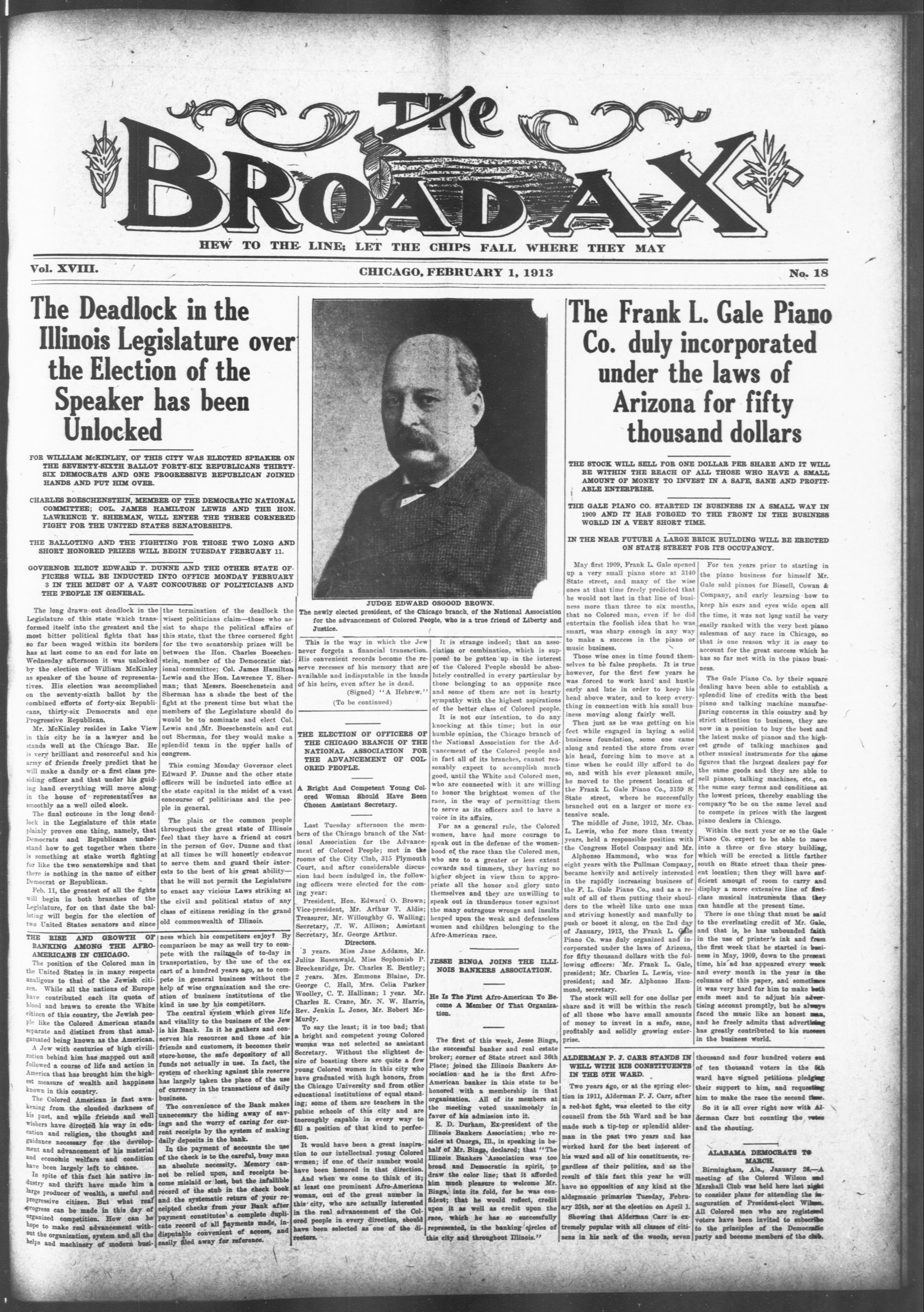
JUDGE EDWARD OSGOOD BROWN. The newly elected president, of the Chicago branch, of the National Association for the advancement of Colored People, who is a true friend of Liberty and Justice.
The newly elected president, of the Chicago branch, of the National Association for the advancement of Colored People, who is a true friend of Liberty and Justice.
This is the way in which the Jew never forgets a financial transaction. His convenient records become the reserve recesses of his memory that are available and indisputable in the hands of his heirs, even after he is dead.
(Signed) "A Hebrew." (To be continued)
THE ELECTION OF OFFICERS OF THE CHICAGO BRANCH OF THE NATIONAL ASSOCIATION FOR THE ADVANCEMENT OF COLORED PEOPLE.
A Bright And Competent Young Colored Woman Should Have Been Chosen Assistant Secretary.
It is strange indeed; that an association or combination, which is supposed to be gotten up in the interest of the Colored People should be absolutely controlled in every particular by those belonging to an opposite race and some of them are not in hearty sympathy with the highest aspirations of the better class of Colored people.
It is not our intention, to do any knocking at this time; but in our humble opinion, the Chicago branch of the National Association for the Advancement of the Colored people and in fact all of its branches, cannot reasonably expect to accomplish much good, until the White and Colored men, who are connected with it are willing to honor the brightest women of the race, in the way of permitting them
Last Tuesday afternoon the members of the Chicago branch of the National Association for the Advancement of Colored People; met in the rooms of the City Club, 315 Plymouth Court, and after considerable discussion had been indulged in, the following officers were elected for the coming year:
President, Hon. Edward O. Brown;
Vice-president, Mr. Arthur T. Aldis;
Treasurer, Mr. Willoughby G. Walling;
Secretary, T. W. Allison; Assistant Secretary, Mr. George Arthur.
Directors.
3 years. Miss Jane Addams, Mr. Julius Rosenwald, Miss Sophonisb P. Breckenridge, Dr. Charles E. Bentley; 2 years. Mrs. Emmons Blaine, Dr. George C. Hall, Mrs. Celia Parker Woolley, C. T. Hallinan; 1 year. Mr. Charles R. Crane, Mr. N. W. Harris, Rev. Jenkin L. Jones, Mr. Robert McMurdy.
To say the least; it is too bad; that a bright and competent young Colored woman was not selected as assistant Secretary. Without the slightest desire of boasting there are quite a few young Colored women in this city who have graduated with high honors, from the Chicago University and from other educational institutions of equal standing; some of them are teachers in the public schools of this city and are thoroughly capable in every way to fill a position of that kind to perfection.
It would have been a great inspiration to our intellectual young Colored women; if one of their number would have been honored in that direction.
And when we come to think of it; at least one prominent Afro-American woman, out of the great number in this city, who are actually interested in the real advancement of the Colored people in every direction, should have been selected as one of the directors.
It is strange indeed; that an association or combination, which is supposed to be gotten up in the interest of the Colored People should be absolutely controlled in every particular by those belonging to an opposite race and some of them are not in hearty sympathy with the highest aspirations of the better class of Colored people. It is not our intention, to do any knocking at this time; but in our humble opinion, the Chicago branch of the National Association for the Advancement of the Colored people and in fact all of its branches, cannot reasonably expect to accomplish much good, until the White and Colored men, who are connected with it are willing to honor the brightest women of the race, in the way of permitting them to serve as its officers and to have a voice in its affairs.
For as a general rule, the Colored women, have had more courage to speak out in the defense of the womenhood of the race than the Colored men, who are to a greater or less extent cowards and timmers, they having no higher object in view than to appropriate all the honor and glory unto themselves and they are unwilling to speak out in thunderous tones against the many outragous wrongs and insults heaped upon the weak and defenseless women and children belonging to the Afro-American race.
JESSE BINGA JOINS THE ILL
NOIS BANKERS ASSOCIATION.
He Is The First Afro-American To Become A Member Of That Organization.
The first of this week, Jesse Binga, the successful banker and real estate broker; corner of State street and 36th Place; joined the Illinois Bankers Association and he is the first Afro-American banker in this state to be honored with a membership in that organization. All of its members at the meeting voted unanimously in favor of his admission into it.
E. D. Durham, Ex-president of the Illinois Bankers Association; who resides at Onorga, Ill., in speaking in behalf of Mr. Binga, declared; that "The Illinois Bankers Association was too broad and Democratic in spirit, to draw the color line; that it afforded him much pleasure to welcome Mr. Binga, into its fold, for he was confident; that he would reflect, credit upon it as well as credit upon the race, which he has so successfully represented, in the banking circles of this city and throughout Illinois."
The Frank L. Gale Piano Co. duly incorporated under the laws of Arizona for fifty thousand dollars
THE STOCK WILL SELL FOR ONE DOLLAR PER SHARE AND IT WILL BE WITHIN THE REACH OF ALL THOSE WHO HAVE A SMALL AMOUNT OF MONEY TO INVEST IN A SAFE, SANE AND PROFITABLE ENTERPRISE.
THE GALE PIANO CO. STARTED IN BUSINESS IN A SMALL WAY IN 1909 AND IT HAS FORGED TO THE FRONT IN THE BUSINESS WORLD IN A VERY SHORT TIME.
IN THE NEAR FUTURE A LARGE BRICK BUILDING WILL BE ERECTED ON STATE STREET FOR ITS OCCUPANCY.
May first 1909, Frank L. Gale opened up a very small piano store at 3140 State street, and many of the wise ones at that time freely predicted that he would not last in that line of business more than three to six months, that no Colored man, even if he did entertain the foolish idea that he was smart, was sharp enough in any way to make a success in the piano or music business.
Those wise ones in time found themselves to be false prophets. It is true however, for the first few years he was forced to work hard and hustle early and late in order to keep his head above water, and to keep everything in connection with his small business moving along fairly well.
For ten years prior to starting in the piano business for himself Mr. Gale sold pianos for Bissell, Cowan & Company, and early learning how to keep his ears and eyes wide open all the time, it was not long until he very easily ranked with the very best piano salesman of any race in Chicago, so that is one reason why it is easy to account for the great success which he has so far met with in the piano business.
The Gale Piano Co. by their square dealing have been able to establish a splendid line of credits with the best piano and talking machine manufacturing concerns in this country and by
Then just as he was getting on his feet while engaged in laying a solid business foundation, some one came along and rented the store from over his head, forcing him to move at a time when he could ill afford to do so, and with his ever pleasant smile, he moved to the present location of the Frank L. Gale Piano Co., 3159 S. State street, where he successfully branched out on a larger or more extensive scale.
The middle of June, 1912, Mr. Chas. L. Lewis, who for more than twenty years, held a responsible position with the Congress Hotel Company and Mr. Alphonso Hammond, who was for eight years with the Pullman Company, became heavily and actively interested in the rapidly increasing business of the F. L. Gale Piano Co., and as a result of all of them putting their shoulders to the wheel like unto one man and striving honestly and manfully to push or boost it along, on the 2nd day of January, 1913, the Frank L. Gale Piano Co. was duly organized and incorporated under the laws of Arizona, for fifty thousand dollars with the following officers: Mr. Frank L. Gale, president; Mr. Charles L. Lewis, vice-president; and Mr. Alphonso Hammond, secretary.
The stock will sell for one dollar per share and it will be within the reach of all those who have small amounts of money to invest in a safe, sane, profitably and solidly growing enterprise.
ALDERMAN P. J. CARE STANDS IN WELL WITH HIS CONSTITUENTS IN THE 5TH WARD.
Two years ago, or at the spring election in 1911, Alderman P. J. Carr, after a red-hot fight, was elected to the city council from the 5th Ward and he has made such a tip-top or splendid alderman in the past two years and has worked hard for the best interest of his ward and all of his constituents, regardless of their politics, and as the result of this fact this year he will have no opposition of any kind at the aldermanic primaries Tuesday, February 25th, nor at the election on April 1.
Showing that Alderman Carr is extremely popular with all classes of citizens in his neck of the woods, seven
No.18
L. Gale Piano
incorporated
the laws of
for fifty
and dollars
THE DOLLAR PER SHARE AND IT WILL
ALL THOSE WHO HAVE A SMALL
TEST IN A SAFE, SANE AND PROFIT-
IN BUSINESS IN A SMALL WAY IN
TO THE FRONT IN THE BUSINESS
ME.
BRICK BUILDING WILL BE ERECTED
FOR ITS OCCUPANCY.
For ten years prior to starting in the piano business for himself Mr. Gale sold pianos for Bissell, Cowan & Company, and early learning how to keep his ears and eyes wide open all the time, it was not long until he very easily ranked with the very best piano salesman of any race in Chicago, so that is one reason why it is easy to account for the great success which he has so far met with in the piano business.
The Gale Piano Co. by their square dealing have been able to establish a splendid line of credits with the best piano and talking machine manufacturing concerns in this country and by strict attention to business, they are now in a position to buy the best and the latest make of pianos and the highest grade of talking machines and other musical instruments for the same figures that the largest dealers pay for the same goods and they are able to sell pianos, talking machines, etc., on the same easy terms and conditions at the lowest prices, thereby enabling the company to be on the same level and to compete in prices with the largest piano dealers in Chicago.
Within the next year or so the Gale Piano Co. expect to be able to move into a three or five story building, which will be erected a little farther south on State street than their present location; then they will have sufficient amount of room to carry and display a more extensive line of first-class musical instruments than they can handle at the present time.
There is one thing that must be said to the everlasting credit of Mr. Gale, and that is, he has unbounded faith in the use of printer's ink and from the first week that he started in business in May, 1909, down to the present time, his ad has appeared every week and every month in the year in the columns of this paper, and sometimes it was very hard for him to make both ends meet and to adjust his advertising account promptly, but he always faced the music like an honest man, and he freely admits that advertising has greatly contributed to his success in the business world.
thousand and four hundred voters out of ten thousand voters in the 6th ward have signed petitions pledging their support to him, and requesting him to make the race the second time. So it is all over right now with Alderman Carr but counting the votes and the shouting.
ALABAMA DEMOCRATS TO MARCH
Birmingham, Ala., January 26.—A meeting of the Colored Wilson and Marshall Club was held here last night to consider plans for attending the inauguration of President-elect Wilson. All Colored men who are registered voters have been invited to subscribe to the principles of the Democratic party and become members of the club.
THE BROADAX
PUBLISHED WEEKLY.
Will promulgate and at all times uphold the principles of Democracy, but Catholics, Protestants, Freights, Infidels, Single Taxes, Republicans, or anyone else can have their say, as long as their language is proper and responsibility is fixed.
The Broad Ax is a newspaper whose platform is broad enough for all, ever claiming the editorial right to speak its own mind.
Local communications will receive attention. Write only on one side of the paper.
Subscriptions must be paid in advance. One Year. Six Months. 1.00
Advertising rates made known on applications. Address all communications to
PHONE DREXEL 4500
JULIUS F. TAYLOR, Editor and Publisher
Entered as Second-Class Matter Aug. 19
1902, at the Post Office at Chicago, Illinois,
under Act of March 3, 1879.
CLEAN CHICAGO CLUBS
The Department of Health is now ready to aid the boys and girls of Chicago in the formation of Clean Chicago Clubs. The buttons are ready and the printed matter including plan of organization, membership application blanks and report blanks are now in the hands of the printers and will be available very soon.
. . .
The Department suggests that the clubs be limited to 25 members for the reason that a small body can do more effective neighborhood work than one made up of a large number of members. It is also recommended that boys and girls joining these clubs have the consent of their parents who should sign the applications with them, thus signifying their approval of their children engaging in the work.
---
It is believed that these Clean Chicago Clubs can do much good in the way of helping to make a cleaner Chicago. In addition, the boys and girls will be getting a splendid training in practical civic work. They will be required to report their observations to the Secretary of the Department of Health, who will see that the reports are sent to the proper bureaus for attention. It will be interesting to note the effect that work of this kind by keen-eyed boys and girls will have in correcting unsightly and insanitary neighborhood conditions.
---
The Commissioner of Health urges upon parents the need of their co-operation in forming the Clean Chicago Clubs. They offer a fine field of activity for the youth of any community. The work is pleasant and full of interest for the youngsters, besides its value in educating them in a knowledge of the things that make for community comfort and safety. Talk with your children about these clubs and encourage them to enlist in this movement for a clean city. The work need not interfere with their hours of recreation and as it will take them out of doors the children will get excellent physical and mental training out of it, together with a practical knowledge of the things that make for community beauty and cleanliness.
CELEBRATION OF ABRAHAM LIN
COLN'S BIRTHDAY.
Preparations are now being rapidly completed for the great public mass meeting which is to be held at Orchestra Hall on the evening of Lincoln's birthday, February 12, in honor of the fiftieth anniversary of Emancipation. There will be other celebrations in Chicago on that day, but the meeting at Orchestra Hall will be devoted especially to the celebration of the greatest act of Lincoln's life, the freeing of the slaves. Admission will be free to all, regardless of race or color.
Governor-elect Edward F. Dunne has promised to preside at the meeting if his official duties will permit his presence in Chicago on that evening. Addresses dealing with the Negro's progress for the past fifty years and with his present-day problems will be delivered by Dr. Emil G. Hirsch, of Sinai Temple; Dr. W. E. Burghardt DuBois, of New York, editor of The Crisis Miss Jane Addams, of Hull House.
Mayor Brand Whitlock of Toledo, an eloquent and radical speaker, has also been invited to take part in the meeting, but has not yet been heard from, it is said. Mr. Morefield Storey of Boston, president of the National Association for the Advancement of Colored People, has wired Judge Edward O. Brown, chairman of the arrangements committee, that he will attend the meeting if law business in Philadelphia that week will permit him to make a quick trip to Chicago.
An elaborate musical program is being arranged for that evening. The celebration promises to be stimulating and to make for better race feeling in Chicago.
OLD QUINN CHAPEL FOUNDER, 91
TO-DAY.
Rev. A. T. Hall Hopes to Round out a Century.
His ninety-first birthday anniversary was quietly celebrated last week by the Rev. A. T. Hall, well known Colored Preacher, the only survivor of the 12 founders of Quinn Chapel, Chicago, at the home of his daughter, Mrs. C. T. Boger, 228 Claim street. He was visited by his children, grandchildren, great grandchildren and many friends, including a delegation from Chicago, Mr. Hall is enjoying fair health, reads and writes without the use of glasses, and says he hopes to round out the century mark. He makes his home at his old residence in Batavia during the summer but spends the winters with his daughter, Mrs. Boger, in Aurora. His wife died 20 years ago.
Mr. Hall was born at Mifflington Pa., January 17, 1822, and came to Chicago in 1843 as a barber on a boat Two years later he located there, opening the first barber shop on the west side, at the corner of Lake and Canal streets. At that time there were only 25 Colored people in Chicago. He numbered among his customers many men prominent in the early history of Chicago, including "Long John" Wentworth, the Pecks, the Honores, Thomas B. Bryan, H. H. Yates, Orrington Lunt and Potter Palmer.
Mr. Hall was one of the founders of Quinn Chapel, the well known Colored church of Chicago, named for Bishop Quinn, of Richmond, Va., who came to Chicago and organized the church. The church was first a mission and held services in a blacksmith shop at the corner of State and Madison streets, later moving to where the Monadnock block now stands, and after the fire of 1871 to its present location in Wabash avenue.
In 1866 Mr. Hall moved his family to Batavia which city has been his home ever since. Six of his eleven children are living. They are: Mrs. Lizzie Dyer, of Sacramento, Cal., who visited her father the past summer; A. T. Hall, Jr., of Pittsburgh; Charles E. Ball, who has a place in the census bureau in Washington; Ollie Hall, of Rochester; N. Y.; Mrs. C. T. Boger and E. A. Hall of Aurora.
DAVID McGOWAN BECOMES THE NEW OWNER AND MANAGER OF THE KEYSTONE HOTEL.
On Thursday morning David McGowan, well-known among the high rollers and the sporting element, and who for some time ran the buffet at John Johnson's old place, 464 South State street, became the new owner and manager of the Keystone hotel, 3022 South State street.
Capt. John L. Fry, Howard F. Catlin and Sherman Blackwell breaking away and making room for him.
The sudden changes in the management of the Keystone buffet and hotel occasioned much surprise and comment on the part of its many patrons.
As it was for many years the headquarters for all the out of town men who visited Chicago, no women being allowed in it or around or about it.
Mr.' McGowan states that he will make an extraordinary effort to improve it in every way. To carry the best stock of wet goods, the best brand of cigars and to maintain it on a high standard, so that it will continue to be on a par and reputation imparted to it under the management of Capt. Fry.
MRS. JOSEPHINE B. VIRDEN HAS
LEASED THE AMERICAN APART-
MENT BUILDING, 28TH STREET
AND WARBASH AVENUE.
The first of the present week, Mrs. Josephine B. Virden, late of Klondike, who must be one of the wealthiest Afro-American women in this country, leased the American apartment building, corner 28th street and Wabash avenue, for a term of ten years.
She put up her own cash as security for the lease. The first year she will pay $12,000 and for the next nine years $13,200 per year.
The building contains about seventy apartments and she will transform a part of them into a hotel and continue to rent the rest out as flats. She took possession of the property Friday morning.
William D. Neighbors & Company made the deal for the owner, Mr. John W. Worthington, and it is the second or third largest real estate deal so far negotiated by any Afro-American real estate firm in Chicago.
WOMAN, 73, TAKES BOY 18, AS HER
FOURTH HUSBAND.
Fullerton, Ky., Jan. 30.—Mrs. Della Kitts, seventy three years old, was married to-day to Manford Nelson, an eighteen-year-old C. & O. section hand. The bride has been married three times, has eighteen children and has grandchildren older than the groom. Mrs. Nelson is all right, and she does not think it is wise for the dear ladies to live or be alone in this cruel and cold world—Editor.
The Origin Work and Plans of the Beaureu of Social Hygiene
JOHN D. BOCKEFELLER, JR., AND OTHER PROMINENT MEN AND WOMEN THROUGHOUT THE COUNTRY ARE INTERESTED IN THE MOVEMENT.
ON MONDAY MORNING JANUARY 27 THE FOLLOWING STATEMENT IN RELATION TO IT ITS AIMS AND ITS OBJECTS WAS PROMULGATED.
The Bureau of Social Hygiene came into existence about two years ago, as a result of the work of the Special Grand Jury appointed to investigate the White slave traffic in New York City, which served during the first half of the year 1910. One of the recommendations made by it in the presentment handed up at the termination of its labors was that a public commission be appointed to study the social evil. The foreman of that body subsequently gave careful consideration to the character of the work which might properly be done by such a commission and the limitations under which it would operate. In this connection, separate, personal conferences were held with over a hundred leading men and women in the city, among whom were lawyers, physicians, business men, bank presidents, presidents of commercial organizations, clergymen, settlement workers, social workers, labor leaders, and reformers. These conferences developed the feeling that a public commission would labor under a number of disadvantages, such as the fact that it would be short lived; that its work would be done publicly; that at best it could hardly do more than present recommendations. The conviction also grew that the main reason why more permanent results had not been obtained by the various organizations which had dealt with the subject of the social evil during the past ten or fifteen years was that most of them were temporary. While active, they materially improved the situation, but as their efforts were relaxed, there came the inevitable return to much the same conditions as before. The forces of evil are never greatly alarmed at the organization of investigating, or reform bodies, for they know that they are generally composed of busy people, who cannot turn aside from their own affairs for any great length of time to carry on reforms, and that sooner or later their efforts will cease, and the patient denizens of the underworld and their exploiters can then reappear and continue the traffic as formerly.
So the conviction grew that in order to make a real and lasting improvement in conditions, a permanent organization should be created, the continuation of which would not be dependent upon a temporary wave of reform, nor upon the life of any man or group of men, but which would go on, generation after generation, continuously making warfare against the forces of evil. It also appeared that a private organization would have, among other advantages, a certain freedom from publicity and from political bias, which a publicly appointed commission could not so easily avoid.
Therefore, as the initial step, in the winter of 1911 The Bureau of Social Hygiene was formed. Its present members are Miss Katharine Bement Davis, Superintendent of the New York State Reformatory for Women at Bedford Hills, New York; Paul M. Warburg, of the firm of Kuhn, Loeb & Company; Starr J. Murphy, of the New York Bar; and John D. Rockefeller, Junior. As the work develops, new members may be added.
One of the first things undertaken by the Bureau was the establishment at Bedford Hills, adjacent to the Reformatory, of a Laboratory of Social Hygiene, under Miss Davis's direction. In this Laboratory it is proposed to study from the physical, mental, social and moral side each person committed to the Reformatory. This study will be carried on by experts and each case will be kept under observation for from three weeks to three months, as may be required. When the diagnosis is completed, it is hoped that the Laboratory will be in position to recommend the treatment most likely to reform the individual, or, if reformation is impossible, to recommend permanent custodial care. Furthermore, reaching out beyond the individuals involved, it is believed that thus important contributions may be made to a fuller knowledge of the conditions ultimately responsible for vice. If this experiment is successful, the principle may prove applicable to all classes of criminals and the conditions precedent to crime, and lead to lines of action not only more scientific and humane but also less wasteful than those at present followed.
In entering upon its labor, the Bureau regard it of fundamental importance to make a careful study of the social evil in this country and in Europe, feeling that this problem, like any other great and difficult one, can
be intelligently approached only by means of a thorough and complete knowledge of all the factors involved, as well as all the methods and experiences of other cities and countries in dealing with it. Arrangements were made, therefore, in the early part of last winter to secure the services of George J. Kneeland, who had directed the Chicago Vice Commission investigation. Since that time, Mr. Kneeland, with a corps of assistants, has been making a thorough and comprehensive survey of the conditions of vice in New York City. This survey has covered not only houses of prostitution, Raines Law hotels, disorderly saloons, cafes and restaurants, massage parlors and other places where vicious people congregate, but also the personal histories of some two thousand prostitutes; and a study of all the case records for one year of a great majority of the hospitals and dispensaries in New York City, with a view to ascertaining the prevalence of venereal diseases and their ratio to all other diseases. Mr. Kneeland's report is now in progress of preparation and will be published within the next two months.
At the same time, the Bureau was fortunate in securing the services of Abraham Flexner, whose reports on the medical schools in this country and in Europe are so well known, to study the social evil and the various methods of dealing with it in the leading cities of Europe. Mr. Flexner spent the greater part of a year abroad, making a searching and exhaustive inquiry into the subject, and is now working on his report, which will be ready for publication this winter.
These studies are to be followed by others, in those cities in the United States where different conditions exist or where special methods of dealing with the social evil have been introduced, the object being to become familiar with all phases of the subject and all methods of handling it which have been tried in this country and in Europe.
Based upon all of these studies, which will probably be published by December of this year, it is the hope of the Bureau that there may be devised a practical plan for dealing with the social evil in New York City—a plan which public opinion can be brought to support.
In conclusion, it cannot be too strongly emphasized that the spirit which dominates the work of the Bureau is not sensational or sentimental or hysterical; that it is not a spirit of criticism of public officials; but that it is essentially a spirit of constructive suggestion and of deep scientific as well as humane interest in a great world problem.
John D. Rockefeller, Jr.
For the Bureau of Social Hygiene,
P. O. Box 579, New York City.
---
All persons desiring to get to Washington during the inaugural period may get information as to places to stop rates, etc., by writing to the sub-committee on Public Comfort, 1816 12th street, N. W., Washington, D. C.
CHIPS
A woman often becomes irresistible to a man merely because she wants him regardless of her own reason.
A Boston woman has undertaken to supply wives for bachelors. Now, if somebody will supply the bachelors the wedding bells can get busy.
Burton Moseley, oldest son of Lawyer and Mrs. B. F. Moseley, 6248 S. Sangamon street, is seriously ill and is confined to his room most all the time.
Louis Seldon, 5011 Armour avenue has so far succeeded in beating back death at the present time and he is on the road to recovery.
Miss Kate Fowler, of Atlanta, Georgia, will arrive in the city the first of the week, to make her home with her sister, Mrs. Geneva Smith, 5363 Dearborn street.
Mrs. William H. Hayman, 67 East 36th street, left the city Tuesday for New Orleans, La., where she will attend the Mardi Gras and visit for some time with her sister, Mrs. Grace Hart-Brown.
Dr. W. H. Marshall, 3102 State street, returned home last Friday morning from Cheraw, S. C., where he went to visit his parents. He also pleasantly spent some of his time in visiting with his old class or schoolmates at the Claflin University, Orangeburg, S. C.
John Q. Grant, who was one of the oldest and most highly respected Afro-Americans in Chiego; died at his home 3618 Vernon Avenue Tuesday morning after a long lingering illness. He was in his 71st year. He is survived by his wife Mrs. Grant and their daughter. Funeral services were held over his remains Friday morning at Quinn Chapel, of which church he was a member for many years. He was buried with Masonic honors.
Dr. H. Reginald Smith, 3401 State street, recently purchased an elegantly bound set of the eleventh edition of the Encyclopedia Britannica, consisting of 29 volumes, Cambridge University edition. The set is bound in green lamb leather. It is safe to say that very few Afro-American M. D.'s or any other class of M. Ds. for that matter, can surpass Dr. Smith in the ownership of such a valuable and useful set of books.
A Colored girl has recently been made captain of the basket ball team of the high school of Ann Arbor, Michigan. It is the first honor of the kind where 95 per cent of the students are white to be given a Colored girl. The name of the young woman is Phyllis W. Waters. She is the daughter of "Phil" Waters the "Boy Orator" of the Kanawha, who holds the position of chief deputy clerk of the Supreme Court of West Virginia.
The news from Kingston, Jamaica, that J. Alexander MacKenzie is dead is heard with deep regret by every one who had the pleasure of meeting this distinguished and affable gentleman during his sojourn in this country last year. He won eminence in Jamaica as superintendent of the business affairs of the United Fruit Company, and had an international reputation as an expert in constructive engineering. He was one of the most entertaining and informing speakers that appeared before the Chicago meeting of the National Negro Business League last August.—Ex.
Mrs. Fannie Jackson-Coppin, who was one of the most highly educated and foremost Afro-American women in this country, passed away last Thursday at her home 1913 Bainbridge street, Philadelphia, Pa. She was in her 76th year. She was a graduate of Oberlin College. She was for many years head instructor and principal or the institute for Colored youths in the Quaker City and proudly wearing the degree Bachelor of Arts, which was rightly bestowed upon her. She was a high authority on educational work. Some years ago she became united in marriage to Bishop Levi J. Coppin of the A. M. E. church. She traveled with him in South Africa and in other parts of the old world. She delivered several addresses in London, England, and was well received by its best people. At the time of her death she had just completed a book on her life and educational work.
Foreign Affairs.
The new republic of China wants to borrow $300,000,000. Why can't these young people start in modestly and buy one piece of furniture at a time?—Detroit News.
The difference between Italy and Russia is that the one can grab any amount of Turkish territory without exciting England, while the other can't—New York World.
When we learn that they have five meals a day in England we are reluctantly forced to concede that England's form of government is in some respects superior to our own—Ohio State Journal.
Pert Personals.
J. Bruce Ismay's salary is said to be $175,000 a year. But he has earned it the past few weeks if he reads the newspapers.—Dallas News.
According to the latest estimates, John D. Rockefeller's interest in the Standard, Oil company is worth $220,000,000. We believe he has other means of support too.—Chicago Record-Herald.
Andrew Carnegie says Eilhu Root is the wisest man on earth. Eilhu probably warned him of the consequences of calling a certain young woman the prettiest girl in the country.—Philadelphia Record.
High Prices.
If you do not go up to the price of meat the price of meat will come down to you.-Philadelphia Record. Uncle Sam has discovered the solution of the cost of high living problem "Eat the' English sparrow!" says an agricultural department bulletin.-Chicago Inter Ocean. Beef prices have broken all twenty year records. About time for consumers to get together and adopt a set of resolutions in favor of parsnips as the paramount issue.-Toledo Blade.
SIRES AND SONS.
Prince Kropotkin of Russia, now seventy, is living quietly in London.
Captain David Jackson, 104 years old, is believed to be the oldest inhabitant of London. He is a picture of health, and in spite of his age he steps out as blithely as a boy when he goes for his daily walk.
W. H. Surber, the first policeman of Seattle, recently celebrated his seventy-eighth birthday and is as active as a man of fifty. He was appointed in 1806 when Seattle had but one street and a population of only 200 people.
One of Lord Roberts' warmest admirers is the German emperor, proof of which was given some few years ago by the bestowal of the Order of the Red Eagle upon him, his lordship being the first non-German officer to receive this distinction.
Professor Willis Moore, frequently mentioned of late as a probable successor to Secretary of Agriculture Wilson, has been at the head of the government weather bureau since 1855 and has more than once been acting secretary of agriculture.
Captain Robert Chilcote Warr, commander of the Campania and commander of the Cunard line, has quit the sea after a career of forty-nine years, thirty-three of which were spent in the service of the Cunard company. He is an Englishman, sixty-three years of age, has commanded nineteen Cunard ships, navigated them 1,250,000 miles and has crossed the Atlantic no less than 550 times.
Sporting Notes.
Jockey Danny Mather will ride for Lord Rosebery again next season. Eastern Intercollegiate Basketball association players wear numbers on their backs to aid spectators to identify the players during the contests. Besides the American and National baseball leagues, there are forty-seven leagues in the United States and Canada, all operating under the same agreement, embracing 323 cities. New York Public School Athletic league has 500,000 boys actively interested in interclass athletics in the elementary schools. At present there are championship tournaments in baseball, soccer football, basketball, indoor baseball and track and field sports, which bring together all the schools in the city.
State Lines.
New Jersey is the first state where the legislature has provided for state wide special training for all subnormal children, retarded as well as defective. Oklahoma is a new state, but is very proud of its size. Seventy-five of its seventy-seven counties are equal to the area of New England, and the other two counties are each equal to a state the size of Rhode Island. According to latest reports, voting has done no harm to the maritalism market in California. During the past year it is said there were 2,000 more marriages in the state than the year before. It is just a year since the women of California were enfranchised.
The Writers.
Mrs. Rose Hartwick Thorpe, the author of "Curfew Shall Not Ring Tonight," is now sixty-two years of age. The Hon. John William Fortescue, whose business it is to select the books read by the queen of England, is the author of several works himself. Since 1906 he has been librarian at Windsor castle. William C. Smith of Delphi, Ind., widely celebrated as a farm author and soil doctor, who jumped into literary fame with his book. "How to Grow 100 Bushels of Corn Per Acre on Worn Soil," is being boomed for secretary of agriculture in the Wilson cabinet. Mr. Smith was a Bryan elector in 1806.
Styles and the Women.
The New York woman who wears a watch on her ankle must intend to keep step with time.—Omaha Bee.
A perfectly fitting gown seems to give a woman more comfort than is found in her religion. — Philadelphia Public Ledger.
A Washington debutante has sprung a "soul gown" on society. Lots of men would be tickled to death if their better halves would be satisfied with a sole gown.—Milwaukee Sentinel.
Flippant Flings.
Science says human beings can become mere vegetables. Almost everybody has known a dead beat.-New York American. A Louisville alderman seeks to have the date put on all eggs. They should be engraved. Ink fades after a few decades.-Milwaukee Sentinel. Dr. Ellot of Harvard says there is no hell. Evidently he has never encountered a clothesline in the back yard on a dark night.-Cleveland Leader.
English Etchings.
London women now feed their dogs at tables in restaurants. In the last fiscal year 3,186,800,000 letters were mailed and delivered in England. It is calculated that by 1950 there will be no coal left in Britain within 2,000 feet of the surface. Two hundred and ninety-nine umbrellas were left in the Central London tube during the past twelve months: also 566 pairs of gloves and one lamp shade.
MASONS MEET IN ASHEVILLE
GENERAL OFFICERS HONORED
Southern Railroad Runs Special Train From Raleigh For Accommodation of Delegates and Visitors—Reports of Colonel Young and Grand Master R. B. McRary Highly Encouraging.
By GEORGE F. KING
Asheville, N. C.-The forty-third annual session of the grand lodge of Free and Accepted Masons of the jurisdiction of North Carolina, held here recently, with the Hon. R. B. McRary, a successful capitalist and scholar and man with an international reputation as one of the prominent leaders of the Afro-American people, M. W. G. Master presiding, was a most notable event in the Masonic circles of this section of the state.
For the first time in the history of any organized movement in North Carolina the Southern Railroad company ran a Masonic special from Raleigh with Pullman service. The engine was decorated and bore the square and compass and the American eagle, and the engineer and fireman were Masons.
Colonel James H. Young, who was the illustrious head of the Third North Carolina regiment during the Hispano-American war and one of the most prominent Afro-Americans in the country, did much to make the meeting the great success, that it was. He is a potent factor in every activity that tends for the conserving of the Negro's best interest in the south and is regarded by the leading officials of the state and the best element of both races as a man of high character.
He has managed the endowment department upon a safe and comprehensive basis. In making his address Colonel Young said that it was his tenth annual report and that it was a pleasure for him to state that Masonry is still moving forward in the march of progress, as is shown by the formation of thirty-seven new lodges as well as the increase in the warranted lodges.
P. A.
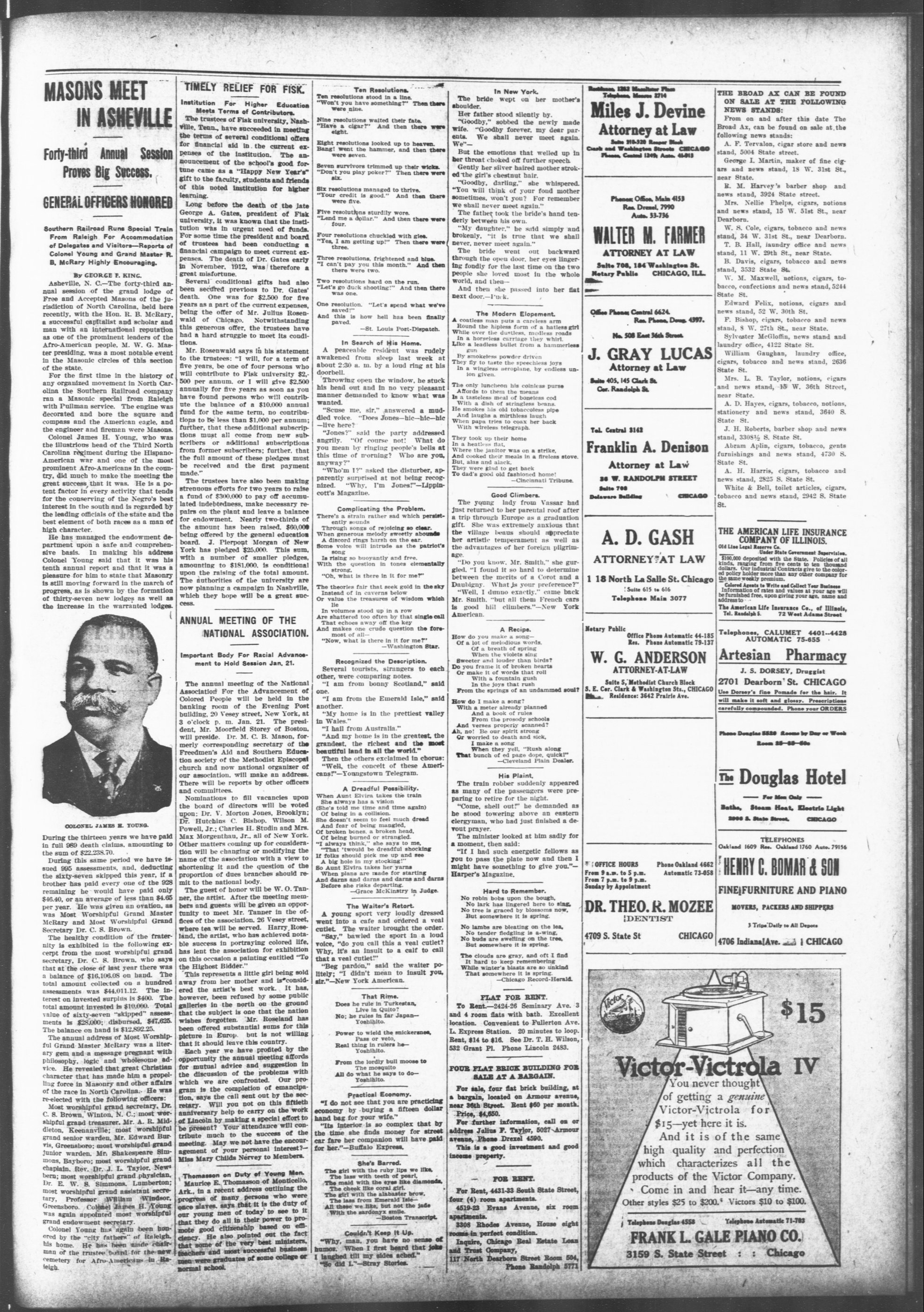
OOLONEL JAMES H. YOUNG.
During the thirteen years we have paid in full 989 death claims, amounting to the sum of $22,238.70.
During this same period we have issued 995 assessments, and, deducting the sixty-seven skipped this year, if a brother has paid every one of the 928 remaining he would have paid only $46.40, or an average of less than $4.65 per year. He was given an ovation, as was Most Worshipful Grand Master McRary and Most Worshipful Grand Secretary Dr. C. S. Brown.
The healthy condition of the fraternity is exhibited in the following excerpt from the most worshipful grand secretary, Dr. C. S. Brown, who says that at the close of last year there was a balance of $16,106.08 on hand. The total amount collected on a hundred assessments was $44,011.12. The interest on invested surplus is $400. The total amount invested is $10,000. Total value of sixty-seven "skipped" assessments is $28,000; disbursed, $47,625. The balance on hand is $12,892.25. The annual address of Most Worshipful Grand Master McRary was a literary gem and a message pregnant with philosophy, logic and wholesome advice. He revealed that great Christian character that has made him a propelling force in Masonry and other affairs of the race in North Carolina. He was re-elected with the following officers:
TIMELY RELIEF FOR FISK.
Institution For Higher Education Meets Terms of Contributors.
Meet Terms or Contributors.
The trustees of Fisk university, Nashville, Teen, have succeeded in meeting the terms of several conditional offers for financial aid in the current expenses of the institution. The announcement of the school's good fortune came as a "Happy New Year's" gift to the faculty, students and friends of this noted institution for higher learning.
Long before the death of the late George A. Gates, president of Fisk university, it was known that the institution was in urgent need of funds. For some time the president and board of trustees had been conducting a financial campaign to meet current expenses. The death of Dr. Gates early in November, 1912, was therefore a great misfortune.
Several conditional gifts had also been secured previous to Dr. Gates' death. One was for $2.500 for five years as a part of the current expenses, being the offer of Mr. Julius Rosenwald of Chicago. Notwithstanding this generous offer, the trustees have had a hard struggle to meet its conditions.
Mr. Rosenwald says in his statement to the trustees: "I will, for a term of five years, be one of four persons who will contribute to Fisk university $2,500 per annum, or I will give $2,500 annually for five years as soon as you have found persons who will contribute the balance of a $10,000 annual fund for the same term, no contributions to be less than $1,000 per annum; further, that these additional subscriptions must all come from new subscribers or additional subscriptions from former subscribers; further, that the full amount of these pledges must be received and the first payment made."
The trustees have also been making strenuous efforts for two years to raise a fund of $300,000 to pay off accumulated indebtedness, make necessary repairs on the plant and leave a balance for endowment. Nearly two-thirds of the amount has been raised, $60,000 being offered by the general education board. J. Pierpont Morgan of New York has pledged $25,000. This sum, with a number of smaller pledges, amounting to $181,000, is conditional upon the raising of the total amount. The authorities of the university are now planning a campaign in Nashville, which they hope will be a great success.
ANNUAL MEETING OF THE NATIONAL ASSOCIATION
Important Body For Racial Advancement to Hold Session Jan, 21.
The annual meeting of the National Association For the Advancement of Colored People will be held in the banking room of the Evening Post building, 20 Vesey street, New York, at 3 o'clock p. m. Jan. 21. The president, Mr. Moorfield Storey of Boston, will preside. Dr. M. C. B. Mason, formerly corresponding secretary of the Freedmen's Aid and Southern Education society of the Methodist Episcopal church and now national organizer of our association, will make an address. There will be reports by other officers and committees.
Nominations to fill vacancies upon the board of directors will be voted upon: Dr. V. Morton Jones, Brooklyn; Dr. Hutchins C. Bishop. Wilson M. Powell, Jr.; Charles H. Studin and Mrs. Max Morgenthau, Jr., all of New York. Other matters coming up for consideration will be changing or modifying the name of the association with a view to shortening it and the question of the proportion of dues branches should remit to the national body.
The guest of honor will be W. O. Tanner, the artist. After the meeting members and guests will be given an opportunity to meet Mr. Tanner in the offices of the association. 26 Vesey street, where tea will be served. Harry Roseland, the artist, who has achieved notable success in portraying colored life, has lent the association for exhibition on this occasion a painting entitled "To the Highest Bidder."
This represents a little girl being sold away from her mother and is considered the artist's best work. It has, however, been refused by some public galleries in the north on the ground that the subject is one that the nation wishes forgotten. Mr. Roseland has been offered substantial sums for this picture in Europe, but is not willing that it should leave this country.
Each year we have profited by the opportunity the annual meeting affords for mutual advice and suggestion in the discussion of the problems with which we are confronted. Our program is the completion of emancipation, says the call sent out by the secretary. Will you not on this fiftieth anniversary help to carry on the work of Lincoln by making a special effort to be present? Your attendance will contribute much to the success of the meeting. May we not have the encouragement of your personal interest?—Miss Mary Childs Nervy to Members.
Themaason on Duty of Young Men. Maurice E. Thomasson of Monticello, Ark., in a recent address outlining the progress of many persons who were once slaves, says that it is the duty of our young men of today to see to it that they do all in their power to promote good citizenship based on efficiency. He also pointed out the fact that some of the very best ministers, teachers and most successful business men were graduates of some college or normal school.
Ten resolutions stood in a line.
"Won't you have something?" Then there
were nine.
Nine resolutions waited their fate.
"Have a cigar?" And then there were
eight.
Eight resolutions looked up to heaven.
Bang! went the hammer, and then there
were seven.
Seven survivors trimmed up their wicks.
"Don't you play poker?" Then there were
six.
Six resolutions managed to thrive.
"Your credit is good." And then there
were five.
Five resolutions sturdily wore.
"Lend me a dollar." And then there were
four.
Four resolutions chuckled with glee.
"Yes, I am getting up!" Then there were
three.
Three resolutions, frightened and blue.
"I can't pay you this month." And then
there were two.
Two resolutions hard on the run.
"Let's go duck shooting!" And then there
was one.
One resolution. "Let's spend what we've
saved!"
And this is how hell has been finally
paved.
—St. Louis Post-Dispatch.
In Search of His Home.
A peaceable resident was rudely awakened from sleep last week at about 2:30 a.m. by a loud ring at his doorbell.
Throwning open the window, he stuck his head out and in no very pleasant manner demanded to know what was wanted.
"Scuse me, sir," answered a muddled voice. "Does Jones—hic—hic—hic—live here?
"Jones?" said the party addressed angrily. "Of course not! What do you mean by ringing people's bells at this time of morning? Who are you, anyway?"
"Who I'm?" asked the disturber, apparently surprised at not being recognized. "Why, I'm Jones!"—Lippincott's Magazine.
Complicating the Problem.
There's a strain rather sad which persist-entir sounds.
Through some of rejoicing so clear,
When generous melody sweetly abounds
A discord rings harsh on the ear.
Some voice will intrude as the patriot's
The theories fair that seek gold in the sky
Instead of in caverns below
Or value the treasures of wisdom which
lie
In volumes stood up in a row
Are shattered too often by that single call
That echoes away off the key
And makes one crude question the fore-
most of all—
"Now, what is there in it for me?"
—Washington Star.
Recognized the Description.
Several tourists, strangers to each
other, were comparing notes.
"I am from bonny Scotland," said
one.
"I am from the Emerald Isle," said another.
"My home is in the prettiest valley in Wales."
"I hall from Australia."
"And my home is in the greatest, the greatest, the richest and the most beautiful land in all the world."
Then the others exclaimed in chorus: "Well, the conceit of these Americans!"--Youngstown Telegram.
A Dreadful Possibility
A Dreadful Possibility.
When Aunt Elvira takes the train
She always has a vision
(She's told me time and time again)
Of being in a collision.
She doesn't seem to feel much dread
And fear of being mangled,
Of broken bones, a broken head,
Of broken arms, a strained arm.
"I always think," she says to me,
"That 'twould be dreadful shocking
If folks should pick me up and see
A big hole in my stocking!"
So Aunt Elvira takes her yarns
When plans are made for starting
And darns and darns and darns
Before she risks departing.
The Waiter's Retort
A young sport very loudly dressed went into a cafe and ordered a veal cutlet. The waiter brought the order. "Say," bawled the sport in a loud voice, "do you call this a veal cutlet? Why, it's an insult to a calf to call that a veal cutlet!" "Beg pardon," said the waiter politely; "I didn't mean to insult you, sir."—New York American.
That Rime.
Does he rule in Turkestan, Live in Quito?
No; he rules in far Japan—Yoshihito.
Power to wield the snickersnee, Pass or veto,
Real thing in rulers he—Yoshihito.
From the lordly bull moose to The mosquito
All do what he says to do—Yoshihito.
Practical Economy
"I do not see that you are practicing economy by -buying a fifteen dollar hand bag for your wife."
"It's interior is so complex that by the time she finds money for street car fare her companion will have paid for her."—Buffalo Express.
She's Barred.
The girl with the ruby lips we like,
The lass with teeth of pearl.
The maid with the eyes like diamonds,
The cheek like coral girl.
The girl with the alabaster brow,
The lass from Emerald Isle—
All these we like, but not the jade
With the sardonyx smile.
—Boston Transcript.
Couldn't Keep It Up.
"Why, man, you have no sense of
humor. When I first heard that joke
I laughed till my sides ached."
"So did L-" Stray Stories.
In New York.
The bride wept on her mother's shoulder.
Her father stood silently by.
"Goodby," sobbed the newly made wife. "Goodby forever, my dear parents. We shall never meet again. We"—
But the emotions that welled up in her throat choked off further speech.
Gently her silver haired mother stroked the girl's chestnut hair.
"Goodby, darling," she whispered.
"You will think of your fond mother sometimes, won't you? For remember we shall never meet again."
The father took the bride's hand tenderly between his own.
"My daughter," he said simply and brokenly, "it is true that we shall never, never meet again."
The bride went out backward through the open door, her eyes lingering fondly for the last time on the two people she loved most in the whole world, and then—
And then she passed into her flat next door.—Iuck.
The Modern Elopement
A coattess man puts a careless arm
Round the hipless form of a hailstress
While over the dustless, mudless roads
In a horseless carriage they whirl.
Like a leadless bullet from a hammerless
gun
By smokeless powder driven
They fly to taste the speechless joys
In a wingless aeroplane, by endless union given.
The only lunchon his colinless purse
Affords to them the means
Is a tasteless meal of boneless cod
With a dish of stringless beans.
He smokes his old tobaccoless pipe
And laughs a mirtless laugh
When papa tries to coax her back
With wireless telegraph.
They took up their home
In a heatless flat
Where the janitor was on a strike,
And cooked their meals in a fireless stove.
But alas and alas.
They were glad to get back
To dad's good old fashioned home!
—Cincinnati Tribune
Good Climbers.
The young lady from Vassar had just returned to her parental roof after a trip through Europe as a graduation gift. She was extremely anxious that the village beams should appreciate her artistic temperament as well as the advantages of her foreign pilgrimage.
"Do you know, Mr. Smith," she gurgled. "I found it so hard to determine between the merits of a Corot and a Daubigny. What is your preference?"
"Well, I dumno exactly," came back Mr. Smith. "but all them French cars is good hill climbers."—New York American.
A Recipe.
A Recipe.
How do you make a song—
Of a lot of melodious words.
Of a breath of spring
When the toil of singing
Sweeter than louder than birds?
Do you frame it of broken hearts
Or make it of words that roll
With a fountain gush
In the joys that rush
From the springs of an undammed soul?
How do I make a song?
With a meter already planned
And a book of rules
From the prosody schools
And verses properly scanned?
Ah, no! Be our spirit strong
Or worried to death and sick,
I make a song!
When they call, "Rush along
That bunch of ed page dope, quick!"
—Cleveland Plain Dealer.
His Plaint.
The train robber suddenly appeared as many of the passengers were preparing to retire for the night.
"Come, shell out!" he demanded as he stood towering above an eastern clergyman, who had just finished a devout prayer.
The minister looked at him sadly for a moment, then said:
"I If I had such energetic fellows as you to pass the plate now and then I might have something to give you."—Harper's Magazine.
Hard to Remember.
Hard to Remember.
No robin bobs upon the bough,
No lark has lingered here to sing,
No tree is graced by blossoms now,
But somewhere it is spring.
No lambs are beating on the lea,
No tender fledgling is a-wing,
No buds are swelling on the tree,
But somewhere it is spring.
The clouds are gray, and oft I find
It hard to keep remembering
While winter's blasts are so unkind
That somewhere it is spring.
—Chicago Record-Herald
FLAT FOR RENT.
To Rent.—2424-26 Seminary Ave. 3 and 4 room flats with bath. Excellent location. Convenient to Fullerton Ave. L. Express Station. 20 minutes to loop Rent, $14 to $16. See Dr. T. H. Wilson, 532 Grant Pl. Phone Lincoln 2483.
FOUR FLAT BRICK BUILDING FOR
SALE AT A BARGAIN.
For sale, four flat brick building, at a bargain, located on Armour avenue, near 36th Street. Rent $60 per month. Price, $4,650. For further information, call on or address Julius F. Taylor, 5027 Armour avenue, Phone Drexel 4590. This is a good investment and good income property.
FOR RENT.
For Rent, 4431-33 South State Street,
four (4) room apartments.
4519-23 Evans Avenue, six room
apartments.
3308 Rhodes Avenue, House eight
rooms in perfect condition.
Inquire, Chicago Real Estate Loan
and Trust Company,
117 North Dearborn Street Room 504,
Phone Randolph 5771
$15
Victor-Victrola IV
You never thought
of getting a genuine
Victor-Victrola for
$15—yet here it is.
And it is of the same
high quality and perfection
which characterizes all the
products of the Victor Company.
Come in and hear it—any time.
Other styles $25 to $200.¹ Victors $10 to $100.
Telephone Douglas 4558 Telephone Automatic 71-703
FRANK L. GALE PIANO CO.
3159 S. State Street : : Chicago
Suite 118-320 Remount Blank
Cabin and Washroom Bills
MISCAGO
Plaza Court 118-320, Apt. 8A, 118-320
Phones: Office, Main 4153
Rn. Drensel, 7990
Auto. 33-736
ATTORNEY AT LAW
Suite 708, 184 Washington St.
Notary Public CHICAGO, ILL.
Office Phone: Central 6624.
Res. Phone: Doug. 4597.
No. 508 East 36th Street.
J. GRAY LUCAS
Attorney at Law
Suite 405, 145 Clark St.
Cor. Randolph St.
Tol. Central 3142
Franklin A. Denison
Attorney at Law
36 W. RANDOLPH STREET
Suite 700
Delaware Building CHICAGO
A. D. GASH
ATTORNEY AT LAW
1 18 North La Salle St. Chicago
Suite 615 to 616
Telephone Main 3077
Notary Public
Office Phone Automatic 44-185
Res. Phone Automatic 79-137
W. G. ANDERSON
ATTORNEY-AT-LAW
Suite 5, Methodist Church Block
S. E. Cor. Clark & Washington St., CHICAGO
Residence: 3642 Prairie Ave.
---
OFFICE HOURS Phone Oakland 4652
From 9 a.m. to 5 p.m. Automatic 73-058
From 7 p.m. to 9 p.m.
Sunday by Appointment
DR. THEO. R. MOZEE
DENTIST
4709 S. State St CHICAGO
Victor
THE BROAD AX CAN BE FOUND ON SALE AT THE FOLLOWING NEWS STANDS:
From on and after this date The Broad Ax, can be found on sale at the following news stands:
A. F. Tervalon, cigar store and news stand, 5004 State street.
George I. Martin, maker of fine cigars and news stand, 18 W. 31st St., near State.
R. M. Harvey's barber shop and news stand, 3924 State street.
Mrs. Nellie Phelps, cigars, notions and news stand, 15 W. 51st St., near Dearborn.
W. S. Cole, cigars, tobacco and news stand, 34 W. 31st St., near Dearborn.
T. B. Hall, laundry office and news stand, 11 W. 29th St., near State.
B. Davis, cigars, tobacco and news stand, 3532 State St.
W. M. Maxwell, notions, cigars, tobacco, confections and news stand, 5244 State St.
Edward Felix, notions, cigars and news stand, 52 W. 30th St.
William Gaughan, laundry office, cigars, tobacco and news stand, 2636 State St.
Mrs. L. B. Taylor, notions, cigars and news stand, 15 W. 36th Street, near State.
A. D. Hayes, cigars, tobacco, notions, stationery and news stand, 3640 S. State St.
J. H. Roberts, barber shop and news stand, 3308½ S. State St.
Abram Aplin, cigars, tobacco, gents furnishings and news stand, 4730 S. State St.
White & Bell, toilet articles, cigars, tobacco and news stand, 2942 S. State St.
THE AMERICAN LIFE INSURANCE COMPANY OF ILLINOIS.
Under State Government Supervision,
$100,000 deposited with the State. Policies of all
kinds, ranging from five cents to ten thousand
dollars. Our Industrial Contracts give to the color-
er the same benefits than any other company for
the same weekly premium.
Colored Agents to Write and Collect Your Business
Information of rates and values at your age will
be furnished free, upon giving your age, name and
address to
The American Life Insurance Co., of Illinois,
Tel. Randolph 5. 72 West Adame Street
Telephones, CALUMET 4401-4428
AUTOMATIC 75-655
Artesian Pharmacy
2701 Dearborn' St. CHICAGO
Use Dorsey's fine Pomade for the hair. It will make it soft and glossy. Prescriptions carefully compounded. Phone your ORDERS
Phone Douglas $533 Rooms by Day or Week
Room 22-83-60s
The Douglas Hotel
For Men Only
Batha, Steam Heat, Eletric Light
2000 & State Street. CHICAGO
TELEPHONES
Oakland 1609 Res. Oakland 1760 Auto. 79156
HENRY C. BOMAR & SON
FINE FURNITURE AND PIANO
MOVERS, PACKERS AND SHIPPERS
3 Trips Daily to All Depots
4706 Indiana Ave. CHICAGO
$15
ctrola IV
BIDDLE SHOWS RAPID GROWTH
University In Charlotte Has Large Body of Students.
'ADVANCED COLLEGE COURSE
Success of Well Known Institution Reflects Credit Upon President H. L. McCrorey and His Efficient Corps of Teachers—Library and Lighting Plant Among Improvements.
Charlotte, N. C.-Dr. H. L. McCrorey, president of Biddle university, this city, and one of the ablest educators in the race, is making this university second to none among the educational institutions in the south for Afro-Americans. With the efficient assistance of Professor W. H. Stimson, a man of exceptional qualifications for educational work, and the splendid spirit of co-operation which is being exhibited by the faculty, President McCrorey is most fortunate.
The past year was decidedly a year of advancement for the institution, brought about largely on account of raising the curriculum by the addition
PETER H.
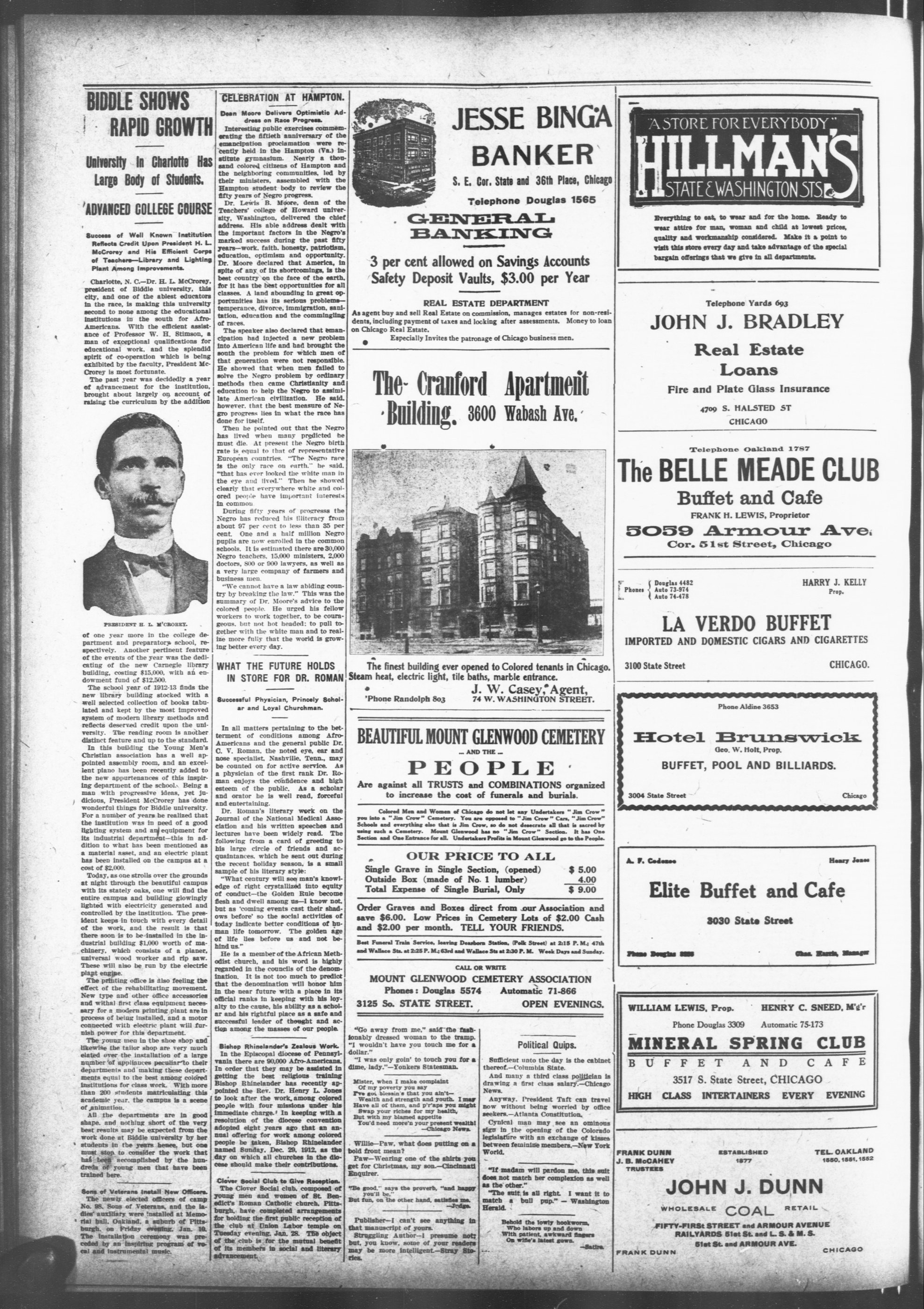
PRESIDENT H. L. M'CORREY.
of one year more in the college department and preparatory school, respectively. Another pertinent feature of the events of the year was the dedicating of the new Carnegie library building, costing $15,000, with an endowment fund of $12,500.
The school year of 1912-13 finds the new library building stocked with a well selected collection of books tabulated and kept by the most improved system of modern library methods and reflects deserved credit upon the university. The reading room is another distinct feature and up to the standard.
In this building the Young Men's Christian association has a well appointed assembly room, and an excellent piano has been recently added to the new appurtenances of this inspiring department of the school. Being a man with progressive ideas, yet judicious, President McCrorey has done wonderful things for Biddle university. For a number of years he realized that the institution was in need of a good lighting system and an equipment for its industrial department—this in addition to what has been mentioned as a material asset, and an electric plant has been installed on the campus at a cost of $2,000.
Today, as one strolls over the grounds at night through the beautiful campus with its stately oaks, one will find the entire campus and building glowingly lighted with electricity generated and controlled by the institution. The president keeps in touch with every detail of the work, and the result is that there soon is to be installed in the industrial building $1,000 worth of machinery, which consists of a planer, universal wood worker and rip saw. These will also be run by the electric plant engine. The printing office is also feeling the effect of the rehabilitating movement. New type and other office accessories and withal first class equipment necessary for a modern printing plant are in process of being installed, and a motor connected with electric plant will furnish power for this department.
The young men in the shoe shop and likewise the tailor shop are very much elated over the installation of a large number of appliances peculiar to their departments and making these departments equal to the best among colored institutions for class work. With more than 200 students matriculating this academic year, the campus is a scene of animation.
All the departments are in good shape, and nothing short of the very best results may be expected from the work done at Biddle university by her students in the years hence, but one must stop to consider the work that has been accomplished by the hundreds of young men that have been trained here.
Sons of Veterans Install New Officers
The newly elected officers of camp
No. 98. Sons of Veterans, and the ladies' auxiliary were installed at Memorial hall, Oakland, a suburb of Pittsburgh, on Friday evening, Jan. 10.
The installation ceremony was preceded by an inspiring program of vocal and instrumental music.
CELEBRATION AT HAMPTON.
Dean Moore Delivers Optimistic Address on Race Progress. Interesting public exercises commemorating the fifteenth anniversary of the emancipation proclamation were recently held in the Hampton (Va.) institute gymnasium. Nearly a thousand colored citizens of Hampton and the neighboring communities, led by their ministers, assembled with the Hampton student body to review the fifty years of Negro progress.
Dr. Lewis B. Moore, dean of the Teachers' college of Howard university, Washington, delivered the chief address. His able address dealt with the important factors in the Negro's marked success during the past fifty years—work, faith, honesty, patriotism, education, optimism and opportunity. Dr. Moore declared that America, in spite of any of its shortcomings, is the best country on the face of the earth, for it has the best opportunities for all classes. A land abounding in great opportunities has its serious problems—temperance, divorce, immigration, sanitation, education and the commingling of races.
The speaker also declared that emancipation had injected a new problem into American life and had brought the south the problem for which men of that generation were not responsible. He showed that when men failed to solve the Negro problem by ordinary methods then came Christianity and education to help the Negro to assimilate American civilization. He said, however, that the best measure of Negro progress lies in what the race has done for itself.
Then he pointed out that the Negro has lived when many predicted he must die. At present the Negro birth rate is equal to that of representative European countries. "The Negro race is the only race on earth." he said, "that has ever looked the white man in the eye and lived." Then he showed clearly that everywhere white and colored people have important interests in common.
During fifty years of progress the Negro has reduced his illiteracy from about 97 per cent to less than 35 per cent. One and a half million Negro pupils are now enrolled in the common schools. It is estimated there are 30,000 Negro teachers, 15,000 ministers, 2,000 doctors, 800 or 900 lawyers, as well as a very large company of farmers and business men.
"We cannot have a law abiding country by breaking the law." This was the summary of Dr. Moore's advice to the colored people. He urged his fellow workers to work together, to be courageous, but not hot headed; to pull together with the white man and to realize more fully that the world is growing better every day.
WHAT THE FUTURE HOLDS IN STORE FOR DR. ROMAN
Successful Physician, Princely Scholar and Loyal Churchman.
In all matters pertaining to the betterment of conditions among Afro-Americans and the general public Dr. C. V. Roman, the noted eye, ear and nose specialist, Nashville, Tenn., may be counted on for active service. As a physician of the first rank Dr. Roman enjoys the confidence and high esteem of the public. As a scholar and orator he is well read, forceful and entertaining.
Dr. Roman's literary work on the Journal of the National Medical Association and his written speeches and lectures have been widely read. The following from a card of greeting to his large circle of friends and acquaintances, which he sent out during the recent holiday season, is a small sample of his literary style:
"What century will see man's knowledge of right crystallized into equity of conduct—the Golden Rule become flesh and dwell among us—I know not, but as 'coming events cast their shadows before' so the social activities of today indicate better conditions of human life tomorrow. The golden age of life lies before us and not behind us."
He is a member of the African Methodist church, and his word is highly regarded in the councils of the denomination. It is not too much to predict that the denomination will honor him in the near future with a place in its official ranks in keeping with his loyalty to the cause, his ability as a scholar and his rightful place as a safe and successful leader of thought and action among the masses of our people.
Bishop Rhinelander's Zealous Work.
In the Episcopal diocese of Pennsylvania there are 90,000 Afro-Americans. In order that they may be assisted in getting the best religious training Bishop Rhinelander has recently appointed the Rev. Dr. Henry L. Jones to look after the work, among colored people with four missions under his immediate charge. In keeping with a resolution of the diocese convention adopted eight years ago that an annual offering for work among colored people be taken, Bishop Rhinelander named Sunday, Dec. 29, 1912, as the day on which all churches in the diocese should make their contributions.
Clover Social Club to Give Reception.
The Clover Social club, composed of young men and women of St. Benedict's Roman Catholic church, Pittsburgh, have completed arrangements for holding the first public reception of the club at Union Labor temple on Tuesday evening, Jan. 28. The object of the club is for the mutual benefit of its members in social and literary advancement.
THE BANK OF NEW YORK
S. E. Cor. State and 36th Place, Chicago
Telephone Douglas 1565
GENERAL
BANKING
3 per cent allowed on Savings Accounts
Safety Deposit Vaults, $3.00 per Year
cent allowed on Savings Acc Deposit Vaults, $3.00 per
owed on Savings Accounts at Vaults, $3.00 per Year
3 per cent allowed on Savings Accounts Safety Deposit Vaults, $3.00 per Year REAL ESTATE DEPARTMENT
As agent buy and sell Real Estate on co
dents, including payment of taxes and le
on Chicago Real Estate.
Especially Invites the patro
The Cranfor
Building.
The finest building ever open
Steam heat, electric light, tile ba
and sell Real Estate on commission, manages estate payment of taxes and locking after assessments, real Estate. Specially Invites the patronage of Chicago business.
Cranford Apartment Building. 3600 Wabash Ave.
It building ever opened to Colored tenant electric light, tile baths, marble entrance.
state on commission, manages estates for non-resi-
ties and locking after assessments. Money to loan
the patronage of Chicago business men.
Anford Apartment
St. 3600 Wabash Ave.
ver opened to Colored tenants in Chicago.
tile baths, marble entrance.
As agent buy and sell Real Estate on commission, manages estates for non-residents, including payment of taxes and locking after assessments. Money to loan on Chicago Real Estate. Especially Invites the patronage of Chicago business men.
The Cranford Apartment Building. 3600 Wabash Ave.
THE FORTY-FOURTH STREET
The finest building ever opened to Colored tenants in Chicago. Steam heat, electric light, tile baths, marble entrance. J. W. Casey, Agent, Phone Randolph 803 74 W. WASHINGTON STREET.
BEAUTIFUL MOUNT C
... AND
PEO
Are against all TRUSTS and
to increase the cost
Colored Men and Women of Chica
you into a "Jim Crow" Cemetery. You a
Schools and everything else that is Jim C
using such a Cemetery. Mount Glenwood
Section and One Entrance for all. Undertal
FUL MOUNT GLENWOOD CEM
... AND THE ...
PEOPLE
at all TRUSTS and COMBINATION
increase the cost of funerals and bu
Men and Women of Chicago do not let any Undertak
e Crow" Cemetery. You are opposed to "Jim Crow",
everything else that is Jim Crow, so do not desecrate all
cemetery. Mount Glenwood has no "Jim Crow" Sec
Entrance for all. Undertakers Profits in Mount Glenwood
UNT GLENWOOD CEMETERY
... AND THE ...
PEOPLE
TESTS and COMBINATIONS organized
the cost of funerals and burials.
of Chicago do not let any Undertakers "Jim Crow"
try. You are opposed to "Jim Crow" Cars, "Jim Crow"
is Jim Crow, so do not desecrate all that is sacred by
Glenwood has no "Jim Crow" Section. It has One
Undertakers Profits in Mount Glenwood go to the People.
BEAUTIFUL MOUNT GLENWOOD CEMETERY ... AND THE ... PEOPLE
Are against all TRUSTS and COMBINATIONS organized to increase the cost of funerals and burials.
Colored Men and Women of Chicago do not let any Undertakers "Jim Crow" you into a "Jim Crow" Cemetery. You are opposed to "Jim Crow" Cars, "Jim Crow" Schools and everything else that is Jim Crow, so do not desecrate all that is sacred by using such a Cemetery. Mount Glenwood has no "Jim Crow" Section. It has One Section and One Entrance for all. Undertakers Profits in Mount Glenwood go to the People.
OUR PRICE TO ALL
Single Grave in Single Seat
Outside Box (made of No
Total Expense of Single H
Order Graves and Boxes did
save $6.00. Low Prices in
and $2.00 per month. TEL
Best Funeral Train Service, leaving Deasbe
and Wallace Sts. at 2:25 P. M.; 63rd and Wail
CALL O
MOUNT GLENWOOD C
Phones : Douglas 5570
3125 So. STATE STREET.
Grave in Single Section, (opened)
Box (made of No. 1 lumber)
Expense of Single Burial, Only
Graves and Boxes direct from our Assoc.
D. Low Prices in Cemetery Lots of 2
per month. TELL YOUR FRIEND.
Main Service, leaving Dearborn Station, (Polk Street) at
at 2:25 P. M.; 63rd and Wallace Sts at 2:30 P. M. Week
CALL OR WRITE
AT GLENWOOD CEMETERY ASSOC.
Lines: Douglas 5574 Automatic 71
STATE STREET. OPEN
Single Section, (opened) $ 5.00
of No. 1 lumber) 4.00
Single Burial, Only $ 9.00
boxes direct from our Association and
places in Cemetery Lots of $2.00 Cash.
TELL YOUR FRIENDS.
Bing Deasborn Station, (Polk Street) at 2:15 P.M.; 47th
and Wallace Sts at 2:30 P.M. Week Days and Sunday.
CALL OR WRITE
FOD CEMETERY ASSOCIATION
No. 5574 Automatic 71-866
STREET. OPEN EVENINGS.
Single Grave in Single Section, (opened) $ 5.00
Outside Box (made of No. 1 lumber) 4.00
Total Expense of Single Burial, Only $ 9.00
Order Graves and Boxes direct from our Association and save $6.00. Low Prices in Cemetery Lots of $2.00 Cash and $2.00 per month. TELL YOUR FRIENDS.
Best Funeral Train Service, leaving Dearborn Station, (Polk Street) at 2:15 P. M.; 47th and Wallace Sts. at 2:25 P. M.; 63rd and Wallace Sts at 2:30 P. M. Week Days and Sunday.
MOUNT GLENWOOD CEMETERY ASSOCIATION Phones: Douglas 5574 Automatic 71-866 3125 So. STATE STREET. OPEN EVENINGS.
"Go away from me," said the fashionably dressed woman to the tramp. "I wouldn't have you touch me for a dollar." "I was only goin' to touch you for a dime, lady." -Yonkers Statesman.
I've got blesisn's that you ain't—
Wealth and strength and youth. I may
Have all of them, and p'japs you might
Strike richs for my health,
But with my blamed appetite
You'd need more'n your present wealth!
-Chicago News.
Willie—Paw, what does putting on a bold front mean?
Paw—Wearing one of the shirts you get for Christmas, my son—Cincinnati Enquirer.
"Be good," says the proverb, "and happy you'll be."
But fun, on the other hand, satisfies me.
-Judge.
Publisher—I can't see anything in that manuscript of yours.
Stranggling Author—I presume not; but, you know, some of your readers may be more intelligent—Stray Stories.
-Satra-
---
---
J. W. Casey, Agent, 74 W. WASHINGTON STREET.
Political Quips.
Sufficient unto the day is the cabinet thereof.—Columbia State.
And many a third class politician is drawing a first class salary.—Chicago News.
Anyway, President Taft can travel now without being worried by office seekers.—Atlanta Constitution.
Cynical man may see an ominous sign in the opening of the Colorado legislature with an exchange of kisses between feminine members.—New York World.
"If madam will pardon me, this suit does not match her complexion as well as the other."
"The suit is all right. I want it to match a bull pup." — Washington Herald.
Behold the lowly hookworm,
who labors up and down
With patient, awkward fingers
On wife's latest gown.
"A STORE FOR EVERYBODY"
HILLMAN'S
STATE & WASHINGTON STS.
Everything to eat, to wear and for the home. Ready to
wear attire for man, woman and child at lowest prices,
quality and workmanship considered. Make it a point to
visit this store every day and take advantage of the special
bargain offerings that we give in all departments.
Telephone Yards 693
JOHN J. BRADLEY
Real Estate
Loans
Fire and Plate Glass Insurance
4709 S. HALSTED ST
CHICAGO
Telephone Oakland 1787
The BELLE
Buffet
FRANK H.
5059 Ar
Cor. 51st
BELLE MEADE C
Buffet and Cafe
FRANK H. LEWIS, Proprietor
59 Armour A
Cor. 51st Street, Chicago
Anglas 4482
0 73-974
0 74-478
HARRY
LA VERDO BUFFET
ED AND DOMESTIC CIGARS AND CIGARS
Street
Buffet and Cafe
FRANK H. LEWIS, Proprietor
5059 Armour Ave
Cor. 51st Street, Chicago
IMPORTED AND DOMESTIC
Hotel B
Geo. V
BUFFET, POO
Hotel Brunswick
Geo. W. Holt, Prop.
BUFFET, POOL AND BILLIARDS
Street
lite Buffet and Caf
Hotel Brunswick Geo. W. Holt, Prop. BUFFET, POOL AND BILLIARDS.
A. F. Codenzio
Elite Buff
3030
Elite Buffet and Cafe
3030 State Street
Grine 3030 Chas. Harte
WILLIAM LEWIS, Prop. HENRY C. SN
Phone Douglas 3309 Automatic 75-173
MINERAL S
BUFFETT
3517 S. State
HIGH CLASS INTERT
GENERAL SPRING CITY
FFET AND CAL
3517 S. State Street, CHICAGO
CLASS INTERTAINERS EVERY E
MINERAL SPRING CLUB
HIGH CLASS INTERTAINERS EVERY EVENING
JOHN J. DUNN
WHOLESALE COAL RETAIL
FTY-FIRST STREET and ARMOUR AVENUE
RAILYARDS 51et St. and L. S. & M. S.
51et St. and ARMOUR AVE.
JOHN
WHOLESALE
FIFTY-FIRST STREET
RAILYARDS 51
51et St. and
FRANK DUNN
Phones {Douglas 4482
Auto 73-974
Auto 74-478
3100 State Street
3004 State Street
A. F. Codenzoe
Phone Douglas 8555
FRANK DUNN
J. B. McCAHEY
TRUSTEES
787
DE CLUB
Safe
Detor
ur Ave
Chicago
FFET AND CIGARETTES
swick
LIARDS.
Chicago
Cafe
Cha. Harris, Manager
C. SNEED, M'g'r
G CLUB
CAFE
CAGO
VERY EVENING
ANN
DETAIL
AVENUE
M. S.
CHICAGO
Phone Aldine 3653
ESTABLISHED
1877
HARRY J. KELLY Prop.
CHICAGO.
Henry Jones
TEL. OAKLAND
1550,1551,1552