The Broad Ax
Saturday, February 22, 1913
Chicago, Illinois
Page text (machine-generated)
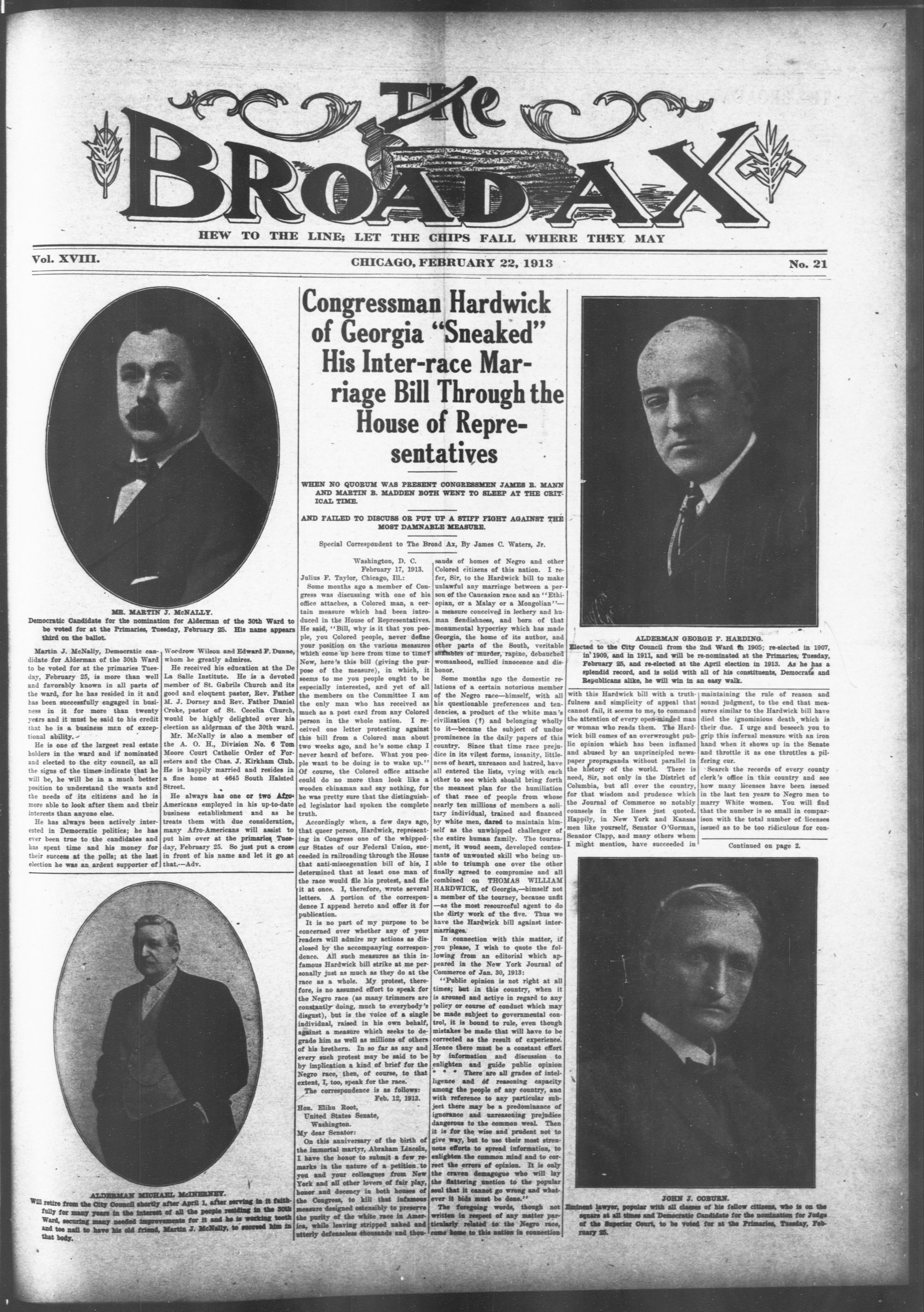
[Picture of a man in a suit with a bow tie].
Democratic Candidate for the nomination for Alderman of the 30th Ward to be voted for at the Primaries, Tuesday, February 25. His name appears third on the ballot.
Democratic Candidate for the nomination for Alderman of the 30th Ward to be voted for at the Primaries, Tuesday, February 25. His name appears third on the ballot.
[Portrait of a man in formal attire, wearing a suit and tie.]
ALDERMAN MICHAEL McINERNEY.
Will retire from the City Council shortly after April 1, after serving in it faithfully for many years in the interest of all the people residing in the 30th Ward, securing many needed improvements for it and he is working tooth and toe nail to have his old friend, Martin J. McNally, to succeed him in that body.
Vol. XVIII.
MR. MARTIN
Democratic Candidate for the nomination be voted for at the Primaries, Twelfth on the ballot.
Martin J. McNally, Democratic candidate for Alderman of the 30th Ward to be voted for at the primaries Tuesday, February 25, is more than well and favorably known in all parts of the ward, for he has resided in it and has been successfully engaged in business in it for more than twenty years and it must be said to his credit that he is a business man of exceptional ability.
He is one of the largest real estate holders in the ward and if nominated and elected to the city council, as all the signs of the times indicate that he will be, he will be in a much better position to understand the wants and the needs of its citizens and he is more able to look after them and their interests than anyone else.
He has always been actively interested in Democratic politics; he has ever been true to the candidates and has spent time and his money for their success at the polls; at the last election he was an ardent supporter of
---
Woodrow Wilson and Edward F. Dunne, whom he greatly admires.
He received his education at the De La Salle Institute. He is a devoted member of St. Gabrils Church and its good and eloquent pastor, Rev. Father M. J. Dorney and Rev. Father Daniel Croke, pastor of St. Cecelia Church, would be highly delighted over his election as alderman of the 30th ward.
Mr. McNally is also a member of the A. O. H., Division No. 6 Tom Moore Court Catholic Order of Foresters and the Chas. J. Kirkham Club. He is happily married and resides in a fine home at 4645 South Halsted Street.
He always has one or two Afro-Americans employed in his up-to-date business establishment and as he treats them with due consideration, many Afro-Americans will assist to put him over at the primaries Tuesday, February 25. So just put a cross in front of his name and let it go at that—Adv.
CHICAGO, FEBRUARY 22, 1913
Congressman Hardwick of Georgia "Sneaked" His Inter-race Marriage Bill Through the House of Representatives
WHEN NO QUORUM WAS PRESENT CONGRESSMEN JAMES B. MANN AND MARTIN B. MADDEN BOTH WENT TO SLEEP AT THE CRITICAL TIME.
AND FAILED TO DISCUSS OR PUT UP A STIFF FIGHT AGAINST THE MOST DAMNABLE MEASURE.
Special Correspondent to The Broad Ax, By James C. Waters, Jr.
Washington, D. C. sands of homes of Negro and other February 17, 1913. Colored citizens of this nation. I re-
Julus F. Taylor, Chicago, Ill.:
Some months ago a member of Congress was discussing with one of his office attaches, a Colored man, a certain measure which had been introduced in the House of Representatives He said, "Bill, why is it that you people, you Colored people, never define your position on the various measures which come up here from time to time! Now, here's this bill (giving the purpose of the measure), in which, it seems to me you people ought to be especially interested, and yet of all the members on the Committee I am the only man who has received as much as a post card from any Colored person in the whole nation. I received one letter protesting against this bill from a Colored man about two weeks ago, and he's some chap I never heard of before. What you people want to be doing is to wake up." Of course, the Colored office attache could do no more than look like a wooden chinaman and say nothing, for he was pretty sure that the distinguished legislator had spoken the complete truth.
Accordingly when, a few days ago, that queer person, Hardwick, representing in Congress one of the whipped-cur States of our Federal Union, succeeded in railroading through the House that anti-miscegenation bill of his, I determined that at least one man of the race would file his protest, and file it at once. I, therefore, wrote several letters. A portion of the correspondence I append hereto and offer it for publication.
It is no part of my purpose to be concerned over whether any of your readers will admire my actions as disclosed by the accompanying correspondence. All such measures as this infamous Hardwick bill strike at me personally just as much as they do at the race as a whole. My protest, therefore, is no assumed effort to speak for the Negro race (as many trimmers are constantly doing, much to everybody's disgust), but is the voice of a single individual, raised in his own behalf, against a measure which seeks to degrade him as well as millions of others of his brethern. In so far as any and every such protest may be said to be by implication a kind of brief for the Negro race, then, of course, to that extent, I too, speak for the race.
The correspondence is as follows:
Feb. 12, 1913.
Hon. Elibu Root.
On this anniversary of the birth of the immortal martyr, Abraham Lincoln, I have the honor to submit a few remarks in the nature of a petition to you and your colleagues from New York and all other lovers of fair play, honor and decency in both houses of the Congress, to kill that infamous measure designed ostensibly to preserve the purity of the white race in America, while leaving stripped naked and utterly defenseless thousands and thou-
sauds of homes of Negro and other Colored citizens of this nation. I refer, Sir, to the Hardwick bill to make unlawful any marriage between a person of the Caucasian race and an "Ethiopian, or a Malay or a Mongolian"—a measure conceived in lechery and human fiendishness, and born of that monumental hypocrisy which has made Georgia, the home of its author, and other parts of the South, veritable shunbles of murder, rapine, debauched womanhood, sullied innocence and dishonor.
Some months ago the domestic relations of a certain notorious member of the Negro race—himself, with all his questionable preferences and tendencies, a product of the white man's civilization (?) and belonging wholly to it—became the subject of undue prominence in the daily papers of this country. Since that time race prejudice in its vilest forms, insanity, littleness of heart, unreason and hatred, have all entered the lists, vying with each other to see which should bring forth the meanest plan for the humiliation of that race of people from whose nearly ten millions of members a solitary individual, trained and financed by white men, dared to maintain himself as the unwhipped challenger of the entire human family. The tournament, it would seem, developed contestants of unwonted skill who being unable to triumph one over the other finally agreed to compromise and all combined on THOMAS WILLIAM HARDWICK, of Georgia,—himself not a member of the tourney, because unfit—as the most resourceful agent to do the dirty work of the five. Thus we have the Hardwick bill against intermarriages.
In connection with this matter, if you please, I wish to quote the following from an editorial which appeared in the New York Journal of Commerce of Jan. 30, 1913:
"Public opinion is not right at all times; but in this country, when it is aroused and active in regard to any policy or course of conduct which may be made subject to governmental control, it is bound to rule, even though mistakes be made that will have to be corrected as the result of experience. Hence there must be a constant effort by information and discussion to enlighten and guide public opinion
* * * There are all grades of intelligence and of reasoning capacity among the people of any country, and with reference to any particular subject there may be a predominance of ignorance and unreasoning prejudice dangerous to the common weal. Then it is for the wise and prudent not to give way, but to use their most strenuous efforts to spread information, to enlighten the common mind and to correct the errors of opinion. It is only the craven demagogue who will lay the flattering unction to the popular soul that it cannot go wrong and whatever it bids must be done."
The foregoing words, though not written in respect of any matter particularly related to the Negro race, come home to this nation in connection
M. H.
Elected to the City Council from the 2nd Ward in 1905; re-elected in 1907, in 1909, and in 1911, and will be re-nominated at the Primaries; Tuesday, February 25, and re-elected at the April election in 1913. As he has a splendid record, and is solid with all of his constituents, Democrats and Republicans alike, he will win in an easy walk.
[Name]
Eminent lawyer, popular with all classes of his fellow citizens, who is on the square at all times and Democratic Candidate for the nomination for Judge of the Superior Court, to be voted for at the Primaries, Tuesday, February 25.
with this Hardwick bill with a truthfulness and simplicity of appeal that cannot fail, it seems to me, to command the attention of every open-minded man or woman who reads them. The Hardwick bill comes of an overwrought public opinion which has been inflamed and abused by an unprincedible newspaper propaganda without parallel in the history of the world. There is need, Sir, not only in the District of Columbia, but all over the country, for that wisdom and prudence which the Journal of Commerce so notably counsels in the lines just quoted. Happily, in New York and Kansas men like yourself, Senator O'Gorman, Senator Clapp, and many others whom I might mention, have succeeded in
No.21
2nd Ward in 1905; re-elected in 1907, re-nominated at the Primaries; Tuesday, April election in 1913. As he has all of his constituents, Democrats and an easy walk.
maintaining the rule of reason and sound judgment, to the end that measures similar to the Hardwick bill have died the ignominious death which is their due. I urge and beseech you to grip this infernal measure with an iron hand when it shows up in the Senate and throttle it as one throttles a pilfering cur.
Search the records of every county clerk's office in this country and see how many licenses have been issued in the last ten years to Negro men to marry White women. You will find that the number is so small in comparison with the total number of licenses issued as to be too ridiculous for con-
Continued on page 2.
THE BROADAX
Will promulgate and at all times uphold
the true principles of Democracy, but
Catholices, Protestants, Priests, Includes
can have their say, no long on their langu-
age is proper and responsibility is fixed.
The Broad Ax is a newspaper whose
platform is broad enough for all, ever
claiming the editorial right to speak its
own mind.
Local communications will receive atti-
tion. Write only on one side of the paper.
Subscriptions must be paid in advance.
One Year ..... $14
Six Months ..... $10
Advertising rates made known on appl-
Address all communications to
Entered as Second-Class Matter Aug. 19.
Born in Chicago, Illinois.
Under Act of March 8, 1975.
THE HARDWICK MARRIAGE BILL.
sideration. And not only that, but you will find that those who were the contracting parties in the marriages represented by the few licences issued to Negro men to marry White women were persons who had made up their minds to live together "according to the law and God's holy ordinance," if possible, and if not possible, then notoriously or in secret according as the needs of the situation dictated. They could not have been kept apart save by the murder or life imprisonment of one or the other of the parties. Unions of this sort are unusual and when attacked are apt to bring out the hidden human grain as few things can bring it out—even as was demonstrated at Chicago, when the threat of hell itself was not sufficient to keep apart the man and woman in the case, and so the one decent thing that could be done in the whole miserable affair, the marriage of the parties, was consummated under the laws of the State which forbade it not, and wisely no.
I make no mention of those licences which were issued to white men to marry Negro women because the number is even smaller than the number just referred to. Besides the Hardwick bill is aimed primarily at Negro men—as if White women needed to be guarded against saying "Yes" to offers of marriage from dusky Homees who come scarcely one in a million per annum. The whole idea is too preesterous to mention. But the Hardwick bill contains a source of degradation even more damnable than anything I have suggested to you as yet. It is this: in those rare occasions where sons of White men have seduced girls of the Negro race and seek to repair the injury by going through the legal form of a marriage ceremony, in these cases, Sir, the poor, blasted girl would be robbed of even this pro forma reparation, and set adrift a moral derelict upon the filthy tides of the underworld. Meanwhile, lechery, with white face and black heart, would forsake the protecting cover of secrecy as is now the case—to the eternal shame of Georgia and the entire South—and stepping forth into the open, would assume the role of Honor, wounded and fettered, saying, "I was willing to do what I could for the poor girl, and I'd do it even now, but the law forbids."
In the name of nearly ten millions of the men and women of my race in this nation, Sir, I urge you to do your utmost to throttle this infamous Hardwick bill when it comes up for consideration in the Senate.
Very respectfully,
Your very humble servant,
James C. Waters, Jr.
What do you Colored Men of Chicago think about Mann and Madden?
Feb. 14, 1913.
Washington, D. C.
When I note that the Hardwick bill, introduced ostensibly to preserve the purity of the Anglo-Saxon race, but designed as a matter of fact to humiliate and degrade the men of the Negro race and at the same time to blot out another of the few remaining sources of protection for the women of our race—when I note that this bill passed the House the other day without even a roll call to apprise us of the few friends we had in the House at the time the vote was taken; and when I recall the almost slavish political support which has been accorded you and Hen. Martin B. Madden by the men of my race in Chicago; when I note that, although there was not even a quorum present, neither you nor Mr. Madden had the courage to at least make the point of no quorum; and when I note that neither Mr. Mann nor Mr. Madden, although they both surely must feel that they own a little something to the Negroes of Chicago, had the hardlhood nor the good grace to make as much as a two minute speech
in opposition to the measure whose evil purport is as well known to them as it is to it; then, Sir, the words of that sterling MAN from Idaho, William E. Borah, come back to me with greater force than ever before.
Standing in Howard Theatre some two years ago, Senator Borah urged the throng of Negro men which packed that house, to turn from the ways of those who see "as through a glass darkly," and take on the habit of looking squarely in the face, every measure, every situation, that affects the interests of your race. Quoting as nearly as I can from memory, Senator Borah said: "For a long, long time to see it can matter very little to you men of the Negro race, whether a candidate be Democrat, Republican or anything else. My advice to you here today is this: VOTE FOR YOUR FRIENDS."
It would seem, Sir, that you have abandoned to the enemy the old guard that for years has stood by you through thick and thin. If the Negroes of Illinois do not treasure up this fact in their memories, it seems to me they will forfeit all right to be known as Men.
THAT MISCEGENATION LAW.
THE MISGENERATION LAW.
The Democratic House of Representatives at Washington, D. C. has passed a miscegenation bill, making the inter-marriage of White and Colored people in the District of Columbia and the territories a crime punished as a felony. This action handjeeps the average citizen of color who might feel disposed to protest in that it will be charged that such a citizen believes in the inter-marriage of the races.
It is argued, why should a Colored citizen protest, if he is opposed to miscegenation? At the risk of being misunderstood, we have always opposed the enactment of laws prohibiting the inter-marriage of citizens of the United States. We do so for the reason that it only serves to put a premium upon concubinage and makes the innocent off-spring suffer as the result of the immoral conduct of the parents.
We have misegement laws upon the statute books of Southern States and yet in this section there may be found more illegitimate mulattoes in these same States than can be located anywhere else in the country. White men serving in Congress, and many of whom no doubt voted for this measure are fathers of Colored children. As a Colored man cannot marry a White female without her consent, to our mind the bill is virtually a measure to prohibit white females from marrying Colored males and White males from marrying Colored females. The law is a dead letter so far as intermingling is concerned in houses of prostitution.
We are in favor of maintaining racial purity and if the solons will enact a law to keep White men from invading the sanctity of Colored men's homes and make it a felony for either a White person or a Colored person to cohabit one with the other the axe will have been laid at the root of this social cancer in our governmental fabric. Of course, we believe that the Jack Johnson episode has been used as an argument in the securing of the passage of this measure. It seems to us that Jack Johnson has had his roward and has paid the penalty. Colored men who want White women as wives are very scarce in this neck of the woods. We have never been able to understand why a Colored man should feel so inclined.
Still, it is a right and a privilege of the contracting parties and we have never been able to see where any good resulted from the stringent laws now upon the statute books.
Law or no law, Colored men should marry Colored women and Colored women should marry Colored men. We do not need any laws to make us do this. If the White women, of both high and low degree will keep away form Colored men and keep Colored men away from them, the suggestion of a miscegenation law will appear ridiculous and this howl in the country against us will cease.-The Planet, Richmond, Va., Feb. 15, 13.
They Make Advances, Mrs. Celia
Parker Woolley Tells Woman's
Club Audience.
Noted Settlement Worker Declares That
Negroes' Lack Is Not Racial But
Cultural.
Negro men should not be censured because of interracial marriages, it is the White women who make the advances, Mrs. Celia Parker Woolley, noted Chicago settlement worker told members of the Woman's Club in an address on Thursday, "No Negro would dare propose marriage to a White woman unless she made the advances," said Mrs. Woolley. "Luella Cameron, the girl who married Jack Johnson chased after him. My offices are but two blocks away of Johnson's saloon-cafe and with my own eyes I saw the Cameron girl seeking his place." Mrs. Woolley's statement took the breath of some of her auditors. They were even more startled when she do-
clared the lack of the Negro is not due to evil but to a lack of culture. They were reluctant to believe her right in her conclusions even though she has for years been putting all her energies into practical settlement work among the Negroes of Chicago. Mrs. Woolley is the founder of the Frederick Denglass social center in the Negro section of the city. Answering a query Mrs. Woolley said she believed interracial marriages unwise. "The Negro is not given a chance to maks good," Mrs. Woolley said. "He is fighting against tremendous odds. Even though he is capable and industrious and honest he is denied employment," Mrs. Woolley declared. "He is berated for fancied errors, he is reproved and scowled upon if he attempts to make anything of himself."
"True democracy," Mrs. Woolley said, is the ideal and aim of all reformers and the only solution of the vexing problems. Three of these she asserted were so distinctly analogous that the arguments in each are almost identical.
Blames Social Scheme.
The labor question, the woman, question and the race question all persist because of social chasms which should not exist. Employer and employed, man and women, White man and Black man are held apart by a chasm of what Mrs. Woolley calls caste—the employer, the woman and the Black man being all in a measure subject.
The race question is world-wide—a problem in south Africa and in the Philippines as well as our own country. Everywhere, said Mrs. Woolley, it is not a matter of color but of caste. In spite of one declaration of equality it is 'previous condition of servitude' which accounts for the Anglo-Saxon prejudice against the Negro.
We have freed the slaves but have not emancipated the Negro. Their emancipation can only come when class distinctions are swept away and the White man is willing to accord to the Black the opportunity which he seeks for himself.
Pleads for Black.
This was Mrs. Woolley's plea—equal opportunity—just a fair chance. Her audience was surprised to learn that no business college or kindergarten in Chicago would admit Colored students. The Negro office worker can seldom find employment owing to the prejudices of other White employees. Yet, said Mrs. Woolley, we are continually urging the Negro to fit himself for self-support and then close the doors in his face. The absolute essential in the solution of the race problem is the creating of just and amicable relations between the two races—a breadth of mind which will judge questions entirely upon their merits.
"The lacks in the Colored race are not racial but cultural and their reform waits only upon opportunity," said Mrs. Woolley. "Frederick Douglass said, 'I know of no race problem, it is a human problem.'" and it is for this attitude on the part of the White race that she and others like her are working for, Mrs. Woolley said.
Mrs. Woolley briefly sketched the work being done in her center and told of the 40 Colored women's clubs in Chicago which are trying to better conditions, working under the significant motto, "Lifting as we climb." Mrs. C. Francis sang a delightful group of songs.—The Aurora, Ill. Daily Beacon-News, Thursday February 13, 1913.
THE RISE AND PALL OF BANKING AMONG THE AFRO-AMERICANS.
As it is with the Jew, so it is with the American Negro. His success in making a place equal to that of other races, in America, will depend upon the concentration of his resources. There must be a concentration of all the forces at his command, in order that he may demand and receive the respect from his fellowmen, to which such concentration will entitle him.
The policy followed by the White man, and acquiesced in by the Colored man, has served to increase the disrespect, if not contempt with which the Negro is held in the commercial world. That policy has been one of permitting the White people to control not only his own financial resources, but has placed in the hands of the White bankers the funds of Colored people collected from all sources, and through every agency, with the result that the Negro assists in furnishing the club with which the White man has cracked his head financially.
It is reported that in one White financial institution, there is something over two and one half million dollars deposited by Colored people. This institution in which these funds are deposited, does not employ a single Colored person, loans extensively to many of the industrial and quasi public corporations, such as railroads, street railway, electric and gas light plants, etc., and these institutions employ thousands of white boys and girls in the more lucrative positions, and only employ Colored people in the most menial positions, this notwithstanding that the two and one half million dollars above mentioned, is loaned to these institutions
with which they pay salaries and other operating expenses to White people. This is a double loss to the Colored people, in that it keeps their own people from employment which could be easily furnished by the use in similar enterprises, of the money loaned to White institutions, and makes it possible for the White boy and girl to continually forge ahead and keep the Colored boy and girl in the menial positions which they now occupy.
Concentration of capital in the hands of financial institutions in sympathy with the Colored business enterprises and the Colored people generally, so that such funds can be easily obtained and used by such institutions, is the only means by which lucrative positions for Colored people can be obtained, because the institution that must depend for its support and success upon Colored patronage, must necessarily study the needs of the people upon whom it depends, in order that they may mutually succeed financially.
This financial loss, great though it may be, does not equal the moral loss by reason of the lack of independence, self-respect and the respect of others, which only financial independence can bring, and the Colored people will never be socially or politically free until they become financially independent, this can only be accomplished by organized concentration of their resources in the hands of those in sympathy with their needs.
THE POLITICAL ENEMIES OF
ROBERT E. BURKE ARE ON
THE DEAD RUN.
Along in the first part of January; out of pure meanness and cussness; some of the political enemies of Robert E. Burke, had him indicted by the grand jury, charging him with stealing between $5,000 and $6,000, belonging to the Cook County Democracy. At the same time he held properly signed notes showing that the club is at the present time indebted to him well onto $20,000.
After his indictment, he gave a bond and his case was set for trial. Then at the request of State's Attorney Hoyne, or some of his assistants, when the day arrived for the trial, it was continued to Monday, February 17, and on then that date, the State's Attorney, asked for another continuance so as to have the indictment hanging as a club over the head of Mr. Burke.
But Judge W. F. Cooper, sitting in the criminal branch of the Superior Court, would not "fall" for the second continuance; so he ordered the state to go to trial as its witnesses were all in the court room; at the same time ordering his clerk to call a jury and as Assistant State's Attorney observed that he could not run Judge Cooper, he had the case dismissed and Mr. Burke continues to wear a broad smile and to laugh at his political enemies.
State's Attorney Hoyne made a big or little Tom boy of himself by writing a letter to Judge Ben. M. Smith, chief justice of the Superior Court, requesting or demanding him, to remove Judge Cooper, from the criminal court simply because he could not run him to suit himself, which seems to indicate that Mr. Hoyne is not the proper gentleman for State's Attorney of Cook County.
Health Notes.
Antitoxin is a cure for diphtheria if only it is used soon enough. Delay means death. Don't delay.
Plenty of fresh air in the home is like having money in the bank; both give you that good feeling.
Our lungs are intended for air, not for dust. It is important, too, that the air we breathe should be pure.
There is little need of wasting sympathy on the person who gets smallpox for the reason that there is an absolute preventive for this terrible and loathsome disease. No one that has been properly vaccinated can have smallpox; why then, have it? In these days vaccination as performed by careful medical men is not as dangerous as trimming a corn.
Have you organized a Clean Chicago Club in your locality yet? Get busy, boys. The Department of Health has the buttons, membership application blanks, report blanks, stamped and addressed envelopes, plan of organization cards, etc., all ready for delivery. Any boy or girl desiring to organize a Clean Chicago Club may obtain the buttons and other supplies by applying to the Secretary of the Department of Health, Room 710, City Hall.
Dr. W. S. Rankin, Secretary of the North Carolina State Board of Health does not believe in quarantine for those who get smallpox. His idea is that only those who refuse to be vaccinated can possibly get the disease and that if they prefer smallpox to vaccination, then give them their choice. Whatever we may think of Dr. Rankin's position it must be admitted that he is right in his contention that a person with smallpox is a menace only to those who have not been vaccinated.
HURLS HER NEWBORN BABY TO STREET FROM THIRD FLOOR.
Miss Margaret Dobson, a 19 year old White lady rooming at the home of Aaron Widner, 1914 Indiana avenue, hurled her new born baby girl early Wednesday morning from her bedroom window on the third floor of the building. The child was born a short time before. There was no physician in attendance. She threw the child from her bed, which was ten feet from the window. The window was closed and the infant was hurled through the glass and its body struck on the pavement. Dr. J. H. Dennison Cook, 2139 South Wabash avenue, was called by a pedestrian who had seen the baby fall. The police of Twenty-second street station were notified, but made no attempt to get a report and not until night were detectives detailed to watch the girl.
It seems to us that Miss Dobson is rather a cold-blooded proposition and that she is not far removed from the lowest order of the female animal or the sow.—Editor.
THE MASQUEADE DANCE AND
EXHIBITION DRILL.
By the Young Ladie's Culture Drill Team Was a Very Successful Affair.
Last Friday evening the Young Ladie's Culture Drill Team gave their first Masquerade dance and exhibition drill, at the K. of P. Hall, 3856 State Street.
The music was furnished by the First Regiment Band and in every way it was a very enjoyable affair.
Col. H. H. Biggs conducted the drilling and the young ladies went through the various execution of it to perfection, or in true military style.
Each and every member looked ever so natty in their blue skirts, white waists, blue red neckties, capes and soldier caps ornamented with beautiful gold tassels. In place of guns they carried wands and they presented a very fascinating appearance.
The following are the officers and members of the Young Ladie's Culture Drill Team:
Mrs. W. A. Seames, President; Miss Nellie Platt, Treasurer; Mrs. Rose Howard, Miss Amelia Young, Miss A. B. Bowman, Mrs. H. S. Bramlett, Miss Rebecca Young, Miss A. M. Weaver, Miss S. C. Hudgens, Miss C. Daniels, Miss Etta Jones, Miss E. B. Harris, Miss M. Burnett, Miss Margrette Hanie, Miss R. Hamlet, Miss E. W. Walton, Mrs. W. E. Brown, Miss B. Boyd, Mrs. G. Biggs, Mrs. H. Mitchell, Secretary.
WAYMAN CHAPEL A. M. E.
CHURCH.
There will be held at this church all day Sunday Feb. 23rd, an extraordinary service. At 11 a. m. the Pastor will preach from the subject, "The Triumph of the Cross." Several important questions will be answered, one will be "Virtue and Christian piety among the Colored people, is it on the increase?" A second question will be "Why is it that some Colored people are leaving the evangelical church and followingisms?" At three o'clock in the afternoon, will be given by the morning choir, another one of their song recitals. At this recital will be heard some of the very best talent of the city, men and women who have made their mark in the musical circles. The choir will not give another recital until after the month of April.
At the evening services the Pastor will deliver the third sermon on the Book of Daniel, this one Sunday night will be "The Hand on the Wall and Its Significance in Modern Times." The church will give a banquet next Thursday night Feb. 27th, this promises to be a very important affair, it is given by the Trustee Aid of the church. The Pastor preached for Dr. Graves last Sunday morning, Brother Boyd preached at Wayman and gave an excellent sermon. The church has been divided into eleven sections for a special effort for the main debt of the church, to be known as the Main Debt Rally; $150.00 has already been raised, and it is expected to be the most successful rally in years.
IMPORTANT EVENTS DURING THE INAUGURAL WEEK AT WASHINGTON, D.C.
March 3rd—Suffragette Parade— Penna. Ave.
automobiles for sightseeing, at moderate rates, on request.
THE NEGRO FELLOWSHIP LEAGUE
FAVORS THE HARDWICK IN-
TERMARRIAGE BILL IF
IT IS AMENDED.
At the Negro Fellowship League's meeting at Quinn Chapel last Sunday afternoon, Mr. William D. Neighbors offered the following resolutions which were unanimously adopted.
Whereas the House of Representatives has passed the Hardwick Bill, prohibiting the intermarriage of races in the District of Columbia, and making the penalty fine or imprisonment,
Resolved, that the United States Senate be, and it is hereby petitioned to amend said Bill, so that the same penalty shall attach to all miscegenacious cohabitation between the races, and that the children of such relationship shall bear the name of the father
Resolved further, that the thanks of this assembly be extended to our representatives, Congressmen Mann and Madden especially, and to the six other Congressmen, namely, Fowler of Illinois, Mondell of Wyoming, Hamilton of Michigan, Bartholdt of Missouri, Kendall of Iowa and LaFollette of Wisconsin, for the broad statesmanship exhibited in voting against the Hardwick Bill.
Ida B. Wells Barnett, Pres.
THE INSTITUTIONAL CHURCH
3825 Dearborn St.
Rev. A. J. Carey, D. D., Ph. D., Minister
"The Contrasts of Life" was the theme of our pastor's last Sabbath's discourse. The text was chosen from the parable of Dives and Lazarus, "Remember that in thy life time thou hadst thy good things and Lazarus his evil things". The characters of these two were clearly analyzed and set forth, their condition typical of contrast today was lucidly presented and then the "fixed gulf". A deep and lasting impression was left upon the entire audience.
Sunday evening furnished another rare treat. Prof. Buchanan, principle of the State Normal Institute of Alabama delivered a most pleasing address, replete with facts and figures. He showed that 370,000 White children of Alabama have annually expended on their education by the state $2,400,000, while in the same state less than $300,000 are spent upon the education of 322,000 Negro children. He closed with a most earnest plea for the young men and women of the North to thoroughly equip themselves and "come to the South and help us". The pastor will preach tomorrow morning and evening.
U. S. D.
CHIPS
Miss Delphia Boger, of Aurora, Ill. spent the first part of this week in visiting friends in this city.
Mrs. King Jefferson of 33 West 51st Street, has taken suddenly ill. Her family and friends are very attentive.
Mrs. E. Azalia Hackley, the noted song bird, is basking in the sunshine this week at Habana, Cuba.
County clerk, Robert M. Switzer, returned home Monday morning from a pleasant visit to Chattanooga Tenn.
Attorney J. Gray Lucas has removed his law office from 145 N. Clark street, to 118 N. La Salle street, Oxford Bldg. Suite 506.
Hon. John E. Owens returned home to the city the latter part of last week, from a vacation trip to Panama and he was favorably impressed with the construction work of the great canal.
Mr. and Mrs. J. A. Jones, who conduct the Hotel Pullman, 3639 South State Street, in a business-like manner, and it is the largest hotel for Afro-Americans in the United States.
Mr. Richard B. Harrison will celebrate his twentieth anniversary in Chicago, by appearing in a recital at Qainn Chapel, Wabash avenue and 24th street, Monday evening, February 24.
Miss Anna Schulman, 2536 W. Division Street, will on Saturday, April 19th, celebrate her umpteenth birthday. She will give a Juvenile party in honor of the occasion.
Mrs. Nettie Lewis' Female Band, gave a grand musical concert and masquerade ball, Thursday evening at Johnson's Hall, 3522 S. State street. The affair was well attended and enjoyed by all who heard them.
Rev. D. D. Buck, who is now authorizing a History on the Colored Race, has taken Miss E. Jefferson as his assisting secretary. The daughter of Mr. and Mrs. K. Jefferson, 33 West 51st Street.
William F. Taylor, formerly in the drug business at 29th street and Ar-
mour avenue, and for some years in the same line of business at Cairo, Ill., visited the city this week, and he may decide to relocate here.
Col. H. H. Biggs will lead the grand march at the masquerade ball to be given by the First Regiment Uniform Rank Knights of Pythias, at Masonic Hall, 3954 South State Street, Monday evening, February 24.
Mr. and Mrs. Christopher L. Makle, 4832 Langley Ave., on Wednesday evening celebrated their twenty-fifth wedding anniversary. About one hundred and fifty of their many friends called during the evening to extend their hearty congratulations to them. They were the recipients of many costly and beautiful presents.
Rev. J. M. Webb, of Seattle Wash., has returned to the city, to reside for some time. He has opened up a studio at 3519 S. State street. He is the author of an interesting book that proves that the Black man was the father of civilization and that Jesus was a Black man. His home address is 3545 Prairie avenue. Phone Douglas 1569.
The funeral of Alderman John J. Brennan, who passed away at his home last Sunday evening, 227 South Center Avenue, was held on Wednesday and it was largely attended, by all of the politicians in town. He was a member of the City Council from the 18th Ward, for more than 20 years and he will be greatly missed by many of his old friends and associates.
President Walter S. Buechanan and his wife, Ida Councill Buchanan, of the Agricultural and Mechanical College at Normal, Alabama, met several of the graduates and ex-students of Normal Wednesday evening at the home of Mrs. E. Lindsay Davis, 3226 Prairie Ave., and organized a Normal Club. The Club decided to hold another meeting Saturday evening, February 22nd, at the residence of Mrs. Cleola Cook, 3638 Wabash Ave., Telephone, Auto, 71-010, for the purpose of enrolling any other graduates and ex-students who were not present at the first meeting. At the close of the Saturday evening session a photograph will be made of the Normal Club. Those interested are invited to be present.
ON TO WASHINGTON. D. C.
ON TO WASHINGTON, D. C.
All persons desiring to get to Washington during the inaugural period may get information as to places to stop, rates, etc., by writing to the sub-committee on Public Comfort, 1816 12th street, N. W., Washington, D. C.
London debating societies are discussing the question, "is Shaw Overrated?" Not in George Bernard Shaw's estimation.
As oil continues to go up, remember Mr. Rockefeller's advice and save your pennies. He evidently needs them—Boston Journal.
Of course the inveterate punster will be in wait for a chance to designate the man who put the "Tumult" in Tumulty—Washington Star.
Flippant Flings.
Dissolving trusts may be comparatively easy, but wait until they tackle the glue trust.
By a new device one can talk thirty-five miles without a wire. What chance has a benpecked man now?—Milwaukee Sentinel.
New York bankers are still favoring an elastic currency. Most of us, however, would favor a currency with the adhesiveness of chewing gum.—New Orleans Picayune.
Facts From France
Five france (66.5 cents) is more than the average laborer gets for a day's work in the Lyons district of France. The old fashioned smacks of French fishermen are being replaced rapidly by steam trawlers of from sixty to 600 tona.
A landlord in Sartouville, near Paris, has offered to let a three roomed cottage at a rental of $50 a year, with a reduction of $2 for every child in the family.
Train and Track.
Over 51,000 locomotives are daily operated in the United States. Chicago street railways yearly collect over $10,000,000 in fares.
American railways now carry a billion tons of freight annually. The London and Greenwich railway, the first in London, was opened in 1835 Swedish railroads have decided to adopt flashlight in the signaling system.
The Parcel Post.
If babies are to be shipped around by parcel post, as that one was to Ohio, the postmen ought to be supplied with gocarts.
The parcel post has its disappointments. A runaway boy to Oklahoma wrote home for money, but mother sent him sandwiches by mail instead. Cincinnati Commercial Tribune.
SIRES AND SONS.
Charles Tiege of New York, fourteen years old, is six feet tall.
Samuel Moore Felton, recently elected president of the Pore Marquette railroad, began his career in 1808 as a rodman for the Chester Creek line.
"Sally" Gordon of New York has persuaded the court to change his name to "Saul" because "the name Sally has frequently been mistaken for that of a female" and has caused great inconvenience.
A. Shadino, who has been appointed consul general at Boston by the Greek government, is president of the Fan-Hellenic Union of America. He is prominent in business, being engaged in the cotton trade.
Sir Thomas Henry Elliot, K. C. B., the new deputy master and comptroller of the British royal mint, has been secretary of the board of agriculture since 1892. Prior to that time he was in the inland revenue department.
General Powell Clayton, probably the only man alive who has sat as a delegate in every Republican national convention since the party came into being and for fifty years one of the leading political figures in the south, has resigned from the national committee, leaving Arkansas for Washington, where he will quietly spend the remainder of an active career. He is now eighty years of age.
Short Stories
Glycerin is a byproduct of soap.
Last season 133 tourists were accidentally killed in the Alps.
Manufacturers are seeking a substitute for glass which will not be brittle.
The centenary of the birth of David Livingstone will be celebrated in March by the geographers of the world.
Official figures show Africa led the world in the production of gold last year, with the United States second, Australasia third and Mexico fourth.
Postal department statistics show that the souvenir postal card is competing seriously with Uncle Sam's regulation product. Last year the number of government postal cards used was only a little more than one-half that of 1911.
Town Topics.
St. Joseph, Mo., has been awarded a bathtub from the wrecked Maine. Probably it will be accompanied by the necessary explanation of its use—Cleveland Plain Dealer.
Atlanta is proud of her decreased death rate. It may be safely assured that this is the first time in Atlanta's history that she is proud of a decrease in anything—Pensacola News.
Having taken an inventory of its sheep, steers, swine and other live stock, the city of New York might apply for permission to issue agricultural bonds against them—New York World.
Woman and Clothes.
Another reason a woman thinks heaven will be a place of bliss is because she thinks she won't have to lace tight.-Galveston News.
It is decreed that women's skirts this year shall be tighter than ever. Well, it's the women who have to wear them and suffer the inconvenience of being hobbled.-New York World.
There comes from Boston a suggestion to make women wear aluminium hats and save $400,000 a year in millinery. Then somebody would corner aluminium.-Chicago Post.
Tales of Cities.
Greater Boston claims a population of 1,022,912. Cleveland has one policeman to every 913 residents. Detroit has a dog catching automobile. It is a double decker with twenty-two compartments. There are over 700,000 men and women working in the factories of New York city, considerably more than the combined factory populations of Philadelphia and Chicago.
Three Kings.
King George of England has been elected an honorary member of the New York Yacht club.
King Alfonso of Spain will establish a home for aged officers on an estate at Bichon left to him by an admiring Frenchman.
The tastes of Haakon VII of Norway are quiet and chiefly domestic. He spends a good deal of money, though, on ships and horses.
Aerial Flights.
The latest design in air craft is the gyro-diable-hydra aeroplane. It is a heavier than English machine. Army aviators think they have discovered how to build invisible aeroplanes. Now if the bird man can disguise himself as a piece of blue sky all will be well-Chicago News.
Current Comment
Old Turks for counsel. Young Turks for war.-Boston Herald.
When a London newsboy shouts war news the public can't guess whether it is from Adriamone. Ulster or the suffragettes.-St. Louis Globe-Democrat.
The new president of the Finnish diet was for more than ten years a miner in the United States. The exportation to Europe of "made in America" products now includes almost every conceivable line of industry.-New York World.
A piece of mince pie is equal in food value to a slice of roast beef, a potato and a piece of bread and butter. If such a dessert follows an ordinary meal indigestion is the consequence.
Narrow Streets.
Chinese streets are often not more than eight feet wide.
Florida.
Florida is nearer sea level than any other state in the Union. Its greatest elevation is but 301 feet above sea level.
Music and Mosquitoes
In some parts of India where mosquitoes abound it is Impossible to play the violin because the music attracts the insects in great numbers. When the first notes are heard the mosquitoes swarm in clouds around the player and make the movements of the hand impossible.
Orange Peel.
Orange peel that is dried and grated makes a yellow powder that is a delicious flavoring for cakes and custards. It intensifies the yellow color which is desired in certain kinds of cakes.
Suicides In Russia
Fully 2,500 persons commit suicide in Russia every year.
Crown Gall.
The crown gall is a cancer of various plants. Investigations reported by the United States bureau of plant industry show that it is infections, due to an organism called Bacterium tunefaciens, and closely resembles the cancer of man and animals.
Alaska
Alaska is larger than Denmark, Sweden, Norway and Finland put together. It is about the same distance from the north pole as those countries. Much of it has a similar climate.
Fuller's Earth.
Fuller's earth, so named from its earliest use in fulling wool, is a rather rare, soft, friable rock whose value depends altogether on its texture and its filtering and absorbent properties. It has no definite composition, mineralogically, its physical properties rather than a chemical analysis determining its commercial value. Fuller's earth was first produced in the United States in the early nineteen.
Bad Temper.
Bad temper has an injurious effect on the digestion. Bad temper tends to a disposition of blood to the brain, and this leaves the stomach unable to perform its functions properly.
Napoleon's Almanac
In the time of Napoleon there was an almanac which every day recorded some achievement of the great emperor.
Chicago and Wind.
There are several points in the United States where the average hourly velocity of the wind is greater than that of Chicago, which is known as the "Windy City" but Chicago has a maximum record which has been exceeded but once.
Diamond Back Turtle
The diamond back turtle is about the gaint and best known fighter of the mud turtle family, and they range in weight from thirty to fifty pounds.
Honeycomb
There are 0.000 cells in a square foot of honeycomb.
Oyster Farming.
Hundreds of thousands of acres are now employed in oyster farming in the great bays and sounds of the country. Oyster farming under from thirty to sixty feet of water is conducted upon an enormous scale, with great expense and labor. While the natural oysters formerly grew in creeks and estuaries, where they were somewhat in danger from the water being impure, the present oyster production extends many miles from land in great bodies of salt water, where there is no chance of contamination.
The Teapot.
Always leave the teapot or coffeepot lid open a crack to admit the air and prevent mustiness when not in use. A piece of paper slipped in is sufficient to keep it open.
Lake Michigan.
Michigan is the deepest of the great lakes, with 1,800 feet.
Packing Glass.
Pack glass or china if to travel far in straw or hay made slightly damp. This will prevent the article from slipping about. Allow the largest and heaviest to be placed at the bottom of the box or hamper. Let there be plenty of straw and wrap each article separately.
Sacred Crocodiles.
The sacred crocodiles of Egypt were buried with her proudest kings.
Eneray.
Kinetic energy is the ability to do work, due to the motion of the body. Potential energy is the ability to do work, due to the position of the body.
Land and ice.
The sinking of land under a load of ice is believed by Professor Wegener of Marburg to explain some irregularities. He finds, for instance, that Greenland's shores have receded from Europe a thousand yards in eight-four years and that Cambridge, Muse, has added a hundred yards in twenty-six years to its separation from Greenwich.
Then They All Laughed.
A prosperous lawyer was recounting his career at a dinner party.
"When I took my first brief," said he, "I was very nervous and excited, especially as my client was a bad egg. He was a man of good family, whose name would have been fatally tarnished had the rascal been convicted. Luckily I managed to get the beggar off."
After dinner a millionaire entered. He was a friend of the host, who presented the lawyer to him.
"I do not need to be introduced to this gentleman," observed the millionaire patronizingly. "I met him long ago; in fact, I gave him a start in life. I was his first client."
The noisy bilarity which greeted the announcement was not explained to the late comer—New York Mall.
A Winter Tragedy.
A muffled figure softly stole
On hands and knees into a hole
As dark as night. The way was rough
With coal and cans and other stuff;
The place was clammy, damp and chill;
As in a dungeon, all was still
Excepting for the labored wheeze
Of the explorer on his knees.
Who sought a mystery to clear
In this deep, ghostly cavern drear.
A candle shed its trembling rays,
Distorting objects forty ways.
The grim explorer or the trail
With trembling limbs and features pale
Pressed ever on to be the first
One of his kin to know the worst.
Before him haunting fears did loom
That he was near financial doom.
He took a timely mental brace
And searched about from place to place
Until a pipe burst on his view.
He found his sad suspicions true.
He lost his moral courage then
And madly creamed, "Fris up again!"
Too Much Temptation
A pompous merchant, arrogantly carrying the signs of his prosperity about him, accosted an acquaintance of his who conducts a successful rescus mission and said:
"James, I'd like to attend one of your meetings."
"Certainly," rejoined the minister, "but leave your watch and diamonds with the hotel clerk."
"What?" asked the merchant in astonishment. "Are not the men of your mission converted thieves?"
"True," answered the mission leader softly, "but. George, you look so easy and wholesome. Really, I don't want my men to regret they promised me never to steal again."-Outlook.
Hail. Hail!
Awake, ye poeta, smite the lyre
And lift a song, we beg.
For royalty comes from the shire—
The haughty five cent egg.
—Denver Republican.
Another near divinity
Now claims a low salam.
It is the egg's affinity—
The thirty cent smoked ham,
—Youngstown Telegram.
With trumpet and the beat of drums
Obesence we make
To king of kings whence'er he comes—
The mighty two bit steak
—Seattle Post-Intelligence.
Impatient pards, just stop and think!
Don't kick to beat the carls
Just think how you can given up
On four for the cedars
—Yonkers Statesman.
His Record.
"I hope you like your work, my lad," said a benign elderly person to an errand boy as they waited to cross a street. "Men who take pride in their work are the men who succeed."
"Oh, I'm a record breaker, the manager says."
"That's the way for a boy to talk. Tell me how you do better than other boys."
"I take longer to carry a message than any of them."—Tit-Bits.
The World Improves.
Cap Kidd he was a sailor bold,
A reckless navigator.
He buried his ill gotten gold
Just north of the equator.
The cap's great wealth was much admired.
Though made me it.
When he be a subsidy desired
He went out and waylaid it.
It's lucky for the cap that he
Lived under a rude system.
When folks who lost their goods would be
Arraid to say they missed 'em.
Suffered from being told they had to
In days like these, 'the stated.
A man who did like old Cap Kidd—
He'd get investigated.
FLAT FOR RENT.
To Rent.-2424-26 Seminary Ave. 3 and 4 room flats with bath. Excellent location. Convenient to Fullerton Ave. L. Express Station. 20 minutes to loop. Rent, $14 to $16. See Dr. T. H. Wilson, 532 Grant Pl. Phone Lincoln 2483.
POUB FLAT BRICK BUILDING FOR SALE AT A BARGAIN.
For sale, four flat brick building, at a bargain, located on Armour avenue, near 90th Street. Rent $60 per month. Price, $4,650.
For further information, call on or address Julius F. Taylor, 5027 Armour avenue, Phone Dresel 4590.
This is a good investment and good income property.
FOR RENT.
For Rent, 4431-33 South State Street,
four (4) room apartments.
4519-33 Evans Avenue, six room
apartments.
3303 Rhodes Avenue, House eight
rooms in perfect condition.
Inquire, Chicago Real Estate Loan
and Trust Company,
117 North Dearborn Street Room 504,
Phone Randolph 6771
$15
Victor-Victrola IV
You never thought of getting a genuine Victor-Victrola for $15—yet here it is.
And it is of the same high quality and perfection which characterizes all the products of the Victor Company.
Come in and hear it—any time.
Other styles $25 to $200.* Victors $10 to $100.
Telephone Douglas 4558 Telephone Automobile 71-703
FRANK L. GALE PIANO CO.
3159 S. State Street : Chicago
Greek and Washington Bank
Phone: Central 1241) Auto: 414-8131
Phones Office, Malta 4153
Ree. D.renal, 7990
Auto. 33-736
ATTORNEY AT LAW
Suite 708, 184 Washington St.
Notary Public
CHICAGO, ILL
Office Phone: Central 6624.
Rn. Phane, Dong. 4397.
No. 508 East 36th Street.
J. GRAY LUCAS
Attorney at Law
Suite 405, 145 Clark St.
Cer. Randolph St.
Tel. Central 3143
Franklin A. Denison
Attorney at Law
30 W. RANDOLPH STREET
Suite 768
Delaware Building CHICAGO
A. D. GASH
ATTORNEY AT LAW
1 18 North La Salle St. Chicago
[Suite 615 to 616
Telephone Main 3077
Notary Public
Office Phone Automatic 44-185
Res. Phone Automatic 79-137
Suits 5, Methodist Church Black
S. E. Cor. Clark & Washington Sts., CHICAGO
Residence: 3642 Prairie Ave.
Phone Douglas 3688
First Class Accommodation for
Single or Married People
HOTEL PULLMAN
THE FINEST AND LARGEST
COLORED HOTEL IN AMERICA
Steam Heat and Bath
Everything New and Up-to-date
Rooms by the Day or Night 50c 75c and $1.00
Including Free Bath. Rates by Week $2.25 up
(EUROPEAN PLAN)
3639-41-43 So. State St. CHICAGO
J. A. JONES, Proprietor
OFFICE HOURS
DR. THEO. R. MOZEE
DENTIST
4709 S. State St CHICAGO
THE BROAD AX CAN BE FOUND
ON SALE AT THE FOLLOWING
NEWS STANDS:
From on and after this date The
Broad Ax, can be found on sale at the
following news stands:
A. F. Tervalon, cigar store and news
stand, 5004 State street.
George I. Martin, maker of fine cigars and news stand, 18 W. 31st St.,
near State.
R. M. Harvey's barber shop and
news stand, 3924 State street.
Mrs. Nellie Phelps, cigars, notions
and news stand, 15 W. 51st St., near
Dearborn.
W. S. Cole, cigars, tobacco and news
stand, 34 W. 31st St., near Dearborn.
T. B. Hall, laundry office and news
stand, 11 W. 29th St., near State.
B. Davis, cigars, tobacco and news
stand, 3532 State St.
W. M. Maxwell, notions, cigars, tobacco, confections and news stand, 5244 State St.
Edward Felix, notions, cigars and news stand, 52 W. 30th St.
William Gaughan, laundry office, cigars, tobacco and news stand, 2636 State St.
Mrs. L. B. Taylor, notions, cigars and news stand, 15 W. 36th Street, near State.
A. D. Hayes, cigars, tobacco, notions, stationery and news stand, 3640 S. State St.
J. H. Roberts, barber shop and news stand, 3308½ S. State St.
Abram Aplin, cigars, tobacco, gents furnishings and news stand, 4730 S. State St.
A. H. Harris, cigars, tobacco and news stand, 2825 S. State St.
White & Bell, toilet articles, cigars, tobacco and news stand, 2942 S. State St.
Fred M. Waterfield, cigars, tobacco and news stand. 1343 W. 61st street, near Ada.
THE AMERICAN LIFE INSURANCE COMPANY OF ILLINOIS.
Under State Government Supervision.
$100,000 deposited with the State's Policies of all kinds, ranging from five cents to ten thousand dollars, giving you give to the colored policy holder more than any other company for the same weekly premium.
Colored Agents to Write and Collect Your Business
Information of rates and values at your age will be furnished free, upon giving your age, name and address to
The American Life Insurance Co., of Illinois,
Tel. Randolph 5. 72 West Adams Street
Telephones, CALUMET 4401--4428
AUTOMATIC 75-655
Artesian Pharmacy
2701 Dearborn St. CHICAGO
Use Dorsay's fine Pomade for the hair. It will make it soft and glossy. Prescriptions carefully compounded. Phone your ORDERS
Phone Douglas $820 Room by Day or Week
Room 28 - 82-83
The Douglas Hotel
For Men Only
Batha, Steam Heat, Electric Light
1900 & State Street. CHICAGO
TELEPHONES
Oakland 1609 Res. Oakland 1760 Auto. 79156
HENRY C. BOMAR & SON
FINE FURNITURE AND PIANO
MOVERS, PACKERS AND SHIPPERS
3 Trips Daily to All Depots
4706 Indiana Ave. CHICAGO
$15
WIDELY KNOWN BUSINESS MAN
Motto by Which A. O. Smith Has Won Success.
BELIEVES IN RACE UPLIFT.
Many Sided Life of a Kentuckian Who Worked His Way From Humble Surroundings to Positions of Honor and Responsibility--Public School Teacher, Tax Collector and Politician.
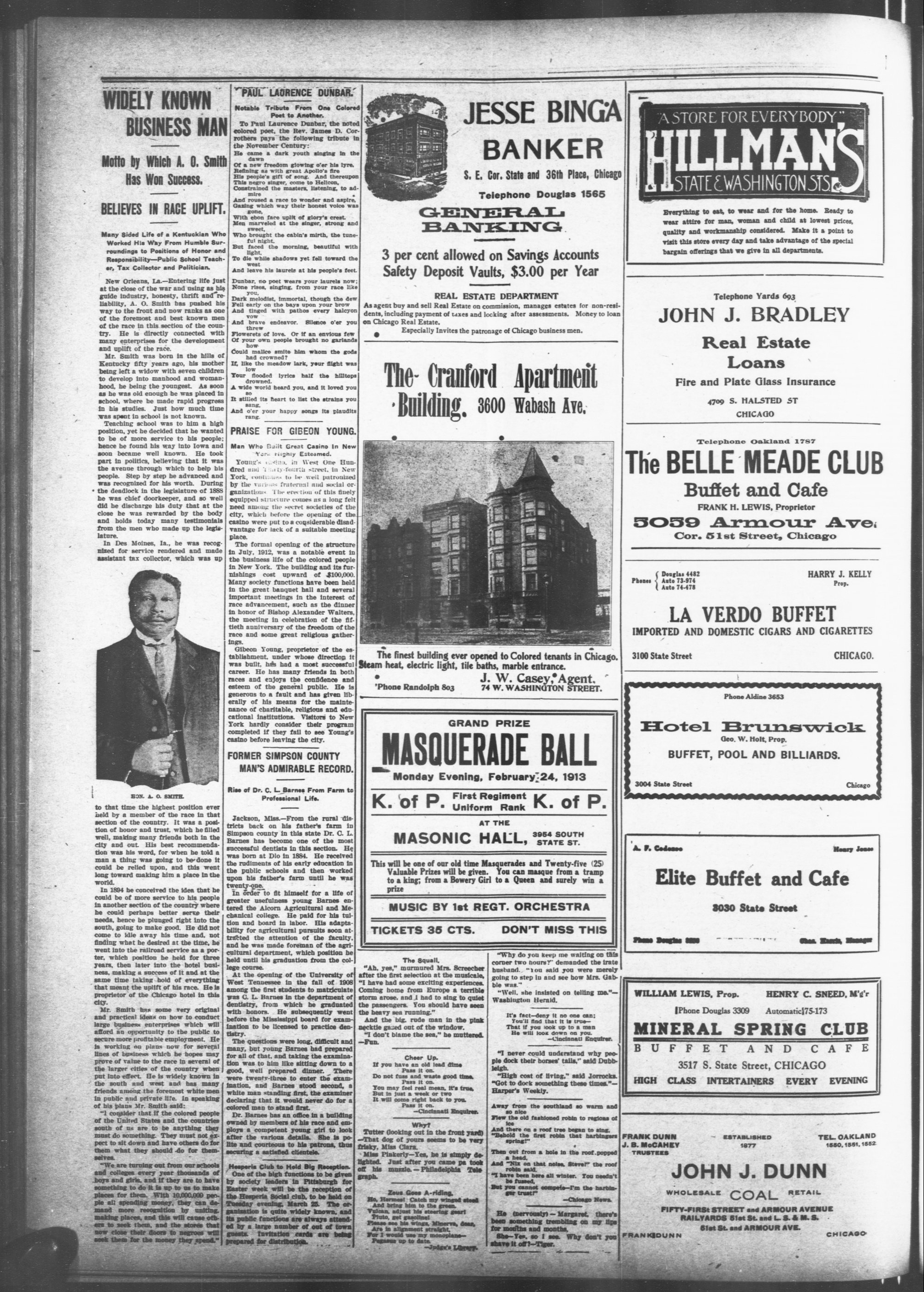
New Orleans, La.—Entering life just at the close of the war and using as his guide industry, honesty, thrift and reliability, A. O. Smith has pushed his way to the front and now ranks as one of the foremost and best known men of the race in this section of the country. He is directly connected with many enterprises for the development and uplift of the race.
Mr. Smith was born in the hills of Kentucky fifty years ago, his mother being left a widow with seven children to develop into manhood and womanhood, he being the youngest. As soon as he was old enough he was placed in school, where he made rapid progress in his studies. Just how much time was spent in school is not known.
Teaching school was to him a high position, yet he decided that he wanted to be of more service to his people; hence he found his way into Iowa and soon became well known. He took part in politics, believing that it was the avenue through which to help his people. Step by step he advanced and was recognized for his worth. During the deadlock in the legislature of 1888 he was chief doorkeeper, and so well did he discharge his duty that at the close he was rewarded by the body and holds today many testimonials from the men who made up the legislature.
In Des Moines, Ia., he was recognized for service rendered and made assistant tax collector, which was up
M. B.
HON. A. O. SMITH.
to that time the highest position ever held by a member of the race in that section of the country. It was a position of honor and trust, which he filled well, making many friends both in the city and out. His best recommendation was his word, for when he told a man a thing was going to be done it could be relied upon, and this went long toward making him a place in the world.
In 1894 he conceived the idea that he could be of more service to his people in another section of the country where he could perhaps better serve their needs, hence he plunged right into the south, going to make good. He did not come to idle away his time and, not finding what he desired at the time, he went into the railroad service as a porter, which position he held for three years, then later into the hotel business, making a success of it and at the same time taking hold of everything that meant the uplift of his race. He is proprietor of the Chicago hotel in this city.
Mr. Smith has some very original and practical ideas on how to conduct large business enterprises which will afford an opportunity to the public to secure more profitable employment. He is working on plans now for several lines of business which he hopes may prove of value to the race in several of the larger cities of the country when put into effect. He is widely known in the south and west and has many friends among the foremost white men in public and private life. In speaking of his plans Mr. Smith said:
"I consider that if the colored people of the United States and the countries south of us are to be anything they must do something. They must not expect to sit down and have others do for them what they should do for themselves.
"We are turning out from our schools and colleges every year thousands of boys and girls, and if they are to have something to do it is up to us to make places for them. With 10,000,000 people all spending money, they can demand more recognition by uniting, making places, and this will cause others to seek them, and the stores that now close their doors to negroes will seek them for the money they spend."
PAUL LAURENCE DUNBAR.
Notable Tribute From One Colored Poet to Another.
To Paul Laurence Dunbar, the noted colored poet, the Rev. James D. Corrothers pays the following tribute in the November Century:
He came a dark youth singing in the dawn
Of a new freedom glowing o'er his lyre.
Refraining as with great Apollo's fire
His people's gift of song. And thereupon
This negro singer, come to Hellon.
Constrained the masters, listening, to admire
And roused a race to wonder and aspire,
Gazing which way their honest voice was gone.
With open face uplift of glory's crest.
Men marveled at the singer, strong and sweet.
Who brought the cabin's mirth, the tune-
ful night.
But faced the morning, beautiful with
light.
To die while shadows yet fell toward the
west.
And leave his laurels at his people's feet.
Dunbar, no poet wears your laurels now;
None rises, singing, from your race like
you.
Dark melodist, immortal, though the dew
Fell early on the bays upon your brow
And tinged with pathos every halcyon
vow
And brave endeavor. Silence o'er you
threw
Flowers of love. Or if an envious few
Of your own people brought no garlands
how.
Could malice smite him whom the gods
had crowned?
If, like the meadow lark, your flight was
low
Your flooded lyrics half the hilltops
drowned.
A wide world heard you, and it loved you
so.
It stilled its heart to list the strains you
sang.
And o'er your happy songs its plaudits
rang.
PRAISE FOR GIBEON YOUNG.
Man Who Built Great Casino In New York, rightly Estesed.
Young's casino, in West One Hundred and thirty-fourth street, in New York, continues to be well patronized by the various fraternal and social organizations. The erection of this finely equipped structure comes as a long felt need among the secret societies of the city, which before the opening of the casino were put to a considerable disadvantage for lack of a suitable meeting place.
The formal opening of the structure in July, 1912, was a notable event in the business life of the colored people in New York. The building and its furnishings cost upward of $100,000. Many society functions have been held in the great banquet hall and several important meetings in the interest of race advancement, such as the dinner in honor of Bishop Alexander Walters, the meeting in celebration of the fifteenth anniversary of the freedom of the race and some great religious gatherings.
Gibeen Young, proprietor of the establishment, under whose direction it was built, hires had a most successful career. He has many friends in both races and enjoys the confidence and esteem of the general public. He is generous to a fault and has given liberally of his means for the maintenance of charitable, religious and educational institutions. Visitors to New York hardly consider their program completed if they fall to see Young's casino before leaving the city.
FORMER SIMPSON COUNTY MAN'S ADMIRABLE RECORD.
Rise of Dr. C. L. Barnes From Farm to Professional Life.
Jackson, Miss.—From the rural districts back on his father's farm in Simpson county in this state Dr. C. L. Barnes has become one of the most successful dentists in this section. He was born at Dlo in 1884. He received the rudiments of his early education in the public schools and then worked upon his father's farm until he was twenty-one.
In order to fit himself for a life of greater usefulness young Barnes entered the Alcorn Agricultural and Mechanical college. He paid for his tuition and board in labor. His adaptability for agricultural pursuits soon attracted the attention of the faculty, and he was made foreman of the agricultural department, which position he held until his graduation from the college course.
At the opening of the University of West Tennessee in the fall of 1908 among the first students to matriculate was C. L. Barnes in the department of dentistry, from which he graduated with honors. He subsequently went before the Mississippi board for examination to be licensed to practice dentistry.
The questions were long, difficult and many, but young Barnes had prepared for all of that, and taking the examination was to him like sitting down to a good, well prepared dinner. There were twenty-three to enter the examination, and Barnes stood second, a white man standing first, the examiner declaring that it would never do for a colored man to stand first.
Dr. Barnes has an office in a building owned by members of his race and employs a competent young girl to look after the various details. She is polite and courteous to his patrons, thus securing a satisfied clientele.
Hesperia Club to Hold Big Reception.
One of the high functions to be given by society leaders in Pittsburgh for Easter week will be the reception of the Hesperia Social club, to be held on Tuesday evening, March 25. The organization is quite widely known, and its public functions are always attended by a large number of out of town guests. Invitation cards are being prepared for distribution.
THE MUSEUM OF THE ARTS
GENERAL BANKING
3 per cent allowed on Savings Acc
Safety Deposit Vaults, $3.00 per
cent allowed on Savings Acc Deposit Vaults, $3.00 per
3 per cent allowed on Savings Accounts Safety Deposit Vaults, $3.00 per Year REAL ESTATE DEPARTMENT As agent buy and sell Real Estate on commission, manages estates for non-residents, including payment of taxes and locking after assessments. Money to loan on Chicago Real Estate.
As agent buy and sell Real Estate on or dents, including payment of taxes and on Chicago Real Estate.
Especially Invites the patr
The Cranfor Building.
The finest building ever open Steam heat, electric light, tile ba
and sell Real Estate on commission, manages estates payment of taxes and locking after assessments Estate. Specially Invites the patronage of Chicago business.
The Cranford Apartment Building. 3600 Wabash A
building ever opened to Colored tenant electric light, tile baths, marble entrance.
Especially Invites the patronage of Chicago business men.
The Cranford Apartment Building. 3600 Wabash Ave.
THE NEW YORK MUSEUM
The finest building ever opened to Colored tenants in Chicago Steam heat, electric light, tile baths, marble entrance. J. W. Casey, Agent. Phone Randolph 803 74 W. WASHINGTON STREET.
GRAND
MASQUER
Monday Evening,
K. of P. First F.
Uniform
MASONIC H
This will be one of our old time M
Valuable Prizes will be given
to a king; from a Bowery G
prize
MUSIC BY 1st R
TICKETS 35 CTS.
The Squall,
GRAND PRIZE
MASQUERADE BALL
Saturday Evening, February 24, 19
P. First Regiment
Uniform Rank K. c
AT THE
SONIC HALL, 3954 SO
STATE
one of our old time Masquerades and Twent
Prizes will be given. You can masque fro
from a Bowery Girl to a Queen and sur
IC BY 1st REGT. ORCHES
S 35 CTS. DON'T MIS
Monday Evening, February 24, 1913 K. of P. First Regiment Uniform Rank K. of P.
MASONIC HALL, 3954 SOUTH STATE ST.
This will be one of our old time Masquerades and Twenty-five (25) Valuable Prizes will be given. You can masque from a tramp to a king; from a Bowery Girl to a Queen and surely win a prize
MUSIC BY 1st REGT. ORCHESTRA
TICKETS 35 CTS. DON'T MISS THIS
"Ah, yes," murmured Mrs. Screecher after the first selection at the musicale,
"I have had some exciting experiences. Coming home from Europe a terrible storm arose, and I had to sing to quiet the passengers. You should have seen the heavy sea running."
And the big. rude man in the pink necktie ganged out of the window.
"I don't blame the sea," he muttered.
—Fun.
Cheer Up.
If you have an old lead dime
Pass it on.
Do not fuss and waste good time.
Pass it on.
You may feel real mean, it's true.
But in just a week or two
It will come right back to you.
Pass it on.
—Cincinnati Enquirer.
Why?
Tutter (looking out in the front yard)
—That dog of yours seems to be very frisky, Miss Clara.
Miss Pinkerly—Yes, he is simply delighted. Just after you came pe took off his muzzle. —Philadelphia Telegraph.
Zeus. Goes A-riding.
He, Harmel. Catch my winged steel
And bring him to the green.
Vulcan, adjust his steering gear!
Pluto, get gasoline!
Please see his wings, Minerva, deas,
Are in alignment straight.
For I would use my monoplane—
Pegasus up to data.
—Judge's Library.
Why?
Out in the front yard)
Its seems to be very
Yes, he is simply de-
fer you came pa to
Philadelphia Tele
A-riding,
catch my winged steed
to the green.
Is steering gear elk
limeel
anga, Minerva, deaz,
not straight,
my monoplanes-
date.
-Judges Library.
Flew the old fashioned ro-
lee
And there on a roof tree
"Behold the first robin
spring!"
Then out from a hole in
a head,
And "Nix on that noise,
robin said,
"I have been here all win
be fussed,
But you cannot compe-
ger trust!"
He (nervously) — Me
been something trembl
for months and months
She-Yes, so I see.
shave it off? — Tiger.
The Squall,
S. E. Cor. State and 36th Place, Chicago Telephone Douglas 1565
owed on Savings Accounts
t Vaults, $3.00 per Year
Anford Apartment
2. 3600 Wabash Ave.
Her opened to Colored tenants in Chicago. Tile baths, marble entrance.
J. W. Casey, Agent. 74 W. WASHINGTON STREET.
GRAND PRIZE
HERADE BALL
Evening, February 24, 1913
First Regiment
Uniform Rank K. of P.
AT THE
C HALL, 3954 SOUTH
STATE ST.
at time Masquerades and Twenty-five (25)
be given. You can masque from a tramp
every Girl to a Queen and surely win a
at REGT. ORCHESTRA
TS. DON'T MISS THIS
AT THE
"Why do you keep me waiting on this corner two hours?" demanded the irate husband. "I you said you were merely going to step in and see how Mrs. Gabble was."
"Well, she insisted on telling me."—Washington Herald.
It's fact—deny it no one can;
You'll find that it is true—
That if you look up to a man
He will look down on you.
—Cincinnati Enquirer.
"I never could understand why people dock their horses' tails," said Dubbleigh.
"High cost of living," said Jorrocks.
"Got to dock something these times."—Harper's Weekly.
Away from the southland so warm and so nice
Flew the old fashioned robin to regions of ice
And there on a roof tree began to sing.
"Behold the first robin that harbinger spring!"
Then out from a hole in the roof.popped a head,
And "Nix on that noise, Stevel!" the roof robin said.
"I have been here all winter. You needn't be fussed,
But you cannot compete—I'm the harbinger trust!"
—Chicago News.
He (nervously)—Margaret, there's been something trembling on my lips for months and months.
"A STORE FOR EVERYBODY"
HILLMAN'S
STATE & WASHINGTON STS.
Everything to eat, to wear and for the home. Ready to
wear attire for man, woman and child at lowest prices,
quality and workmanship considered. Make it a point to
visit this store every day and take advantage of the special
bargain offerings that we give in all departments.
Real Estate
Loans
Fire and Plate Glass Insurance
4709 S. HALSTED ST
CHICAGO
The BELLE MEADE CLUB
Buffet and Cafe
FRANK H. LEWIS, Proprietor
5059 Armour Ave
Cor. 51st Street, Chicago
LA VERDO BUFFET
Hotel Brunswick Geo. W. Holt, Prop. BUFFET, POOL AND BILLIARDS.
Elite Buffet and Cafe
MINERAL SPRING CLUB
Phones Douglas 4482
Auto 73-974
Auto 74-478
LA
IMPORTED AND
3100 State Street
Hotel
BUFFE
3004 State Street
A. F. Codense
Elite
Photo Douglass 8200
WILLIAM LEW
Phone
MINERA
BUFF
3517
HIGH CLASS
FRANK DUNN
J. B. MoCAHEY
TRUSTEES
JO
WHOLES
FIFTY-FIRST
RAIL
FRANK DUNN
IN J. BRADLE
Real Estate
Loans
and Plate Glass Insura
4709 S. HALSTED ST
CHICAGO
Telephone Oakland 1787
MILLE MEADE
Buffet and Café
FRANK H. LEWIS, Proprietor
O Armour
R. 51st Street, Chicago
VERDO BUFFET
AND DOMESTIC CIGARS AND
Bel Brunswick
Geo. W. Holt, Prop.
ET, POOL AND BILLIAR
Buffet and C
WIS, Prop. HENRY C. S.
The Douglas 3309 Automatic]75-1
AL SPRING
ET AND CO.
7 S. State Street, CHICAGO
INTERTAINERS EVERY
JOHN J. DUNN
RESALE COAL RETAIL
RST STREET and ARMOUR AVENUE
LYARDS 51st St. and L. S. & M. S.
51st St. and ARMOUR AVE.
Telephone Yards 693
Phone Aldine 3653
8030 State Street
ESTABLISHED 1877
HARRY J. KELLY
Prop.
FFET
AND CIGARETTES
CHICAGO.
swick
LIARDS.
Chicago
Henry Jones
I Cafe
Cha, Harris, Manager
C. SNEED, M'g'r
c]75-173
G CLUB
CA F E
CAGO
ERY EVENING
TEL. OAKLAND
1550, 1551, 1552
NN
DETAIL
AVENUE
M. S.