The Broad Ax
Saturday, March 29, 1913
Chicago, Illinois
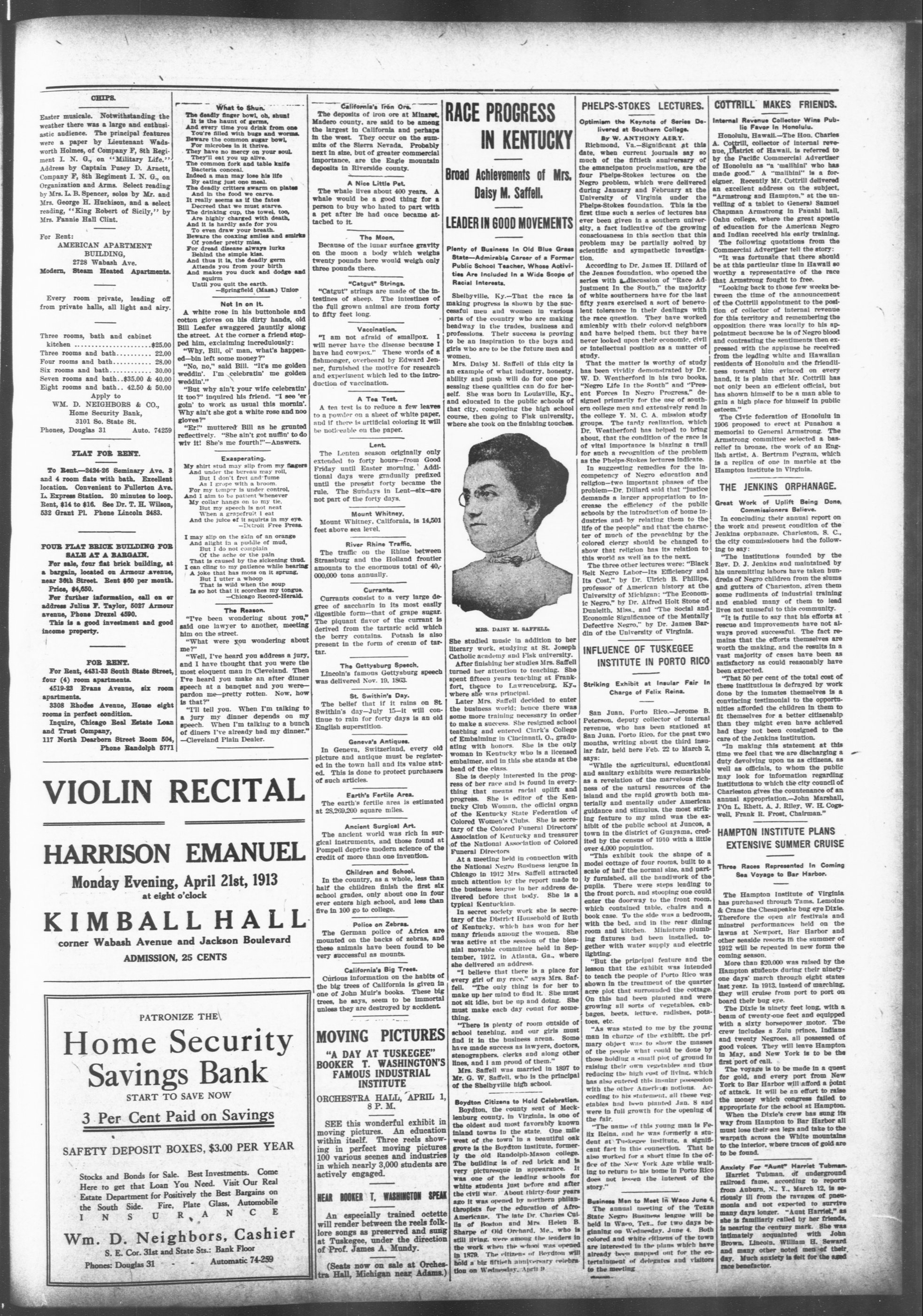
Page text (machine-generated)
THE BROAD AX
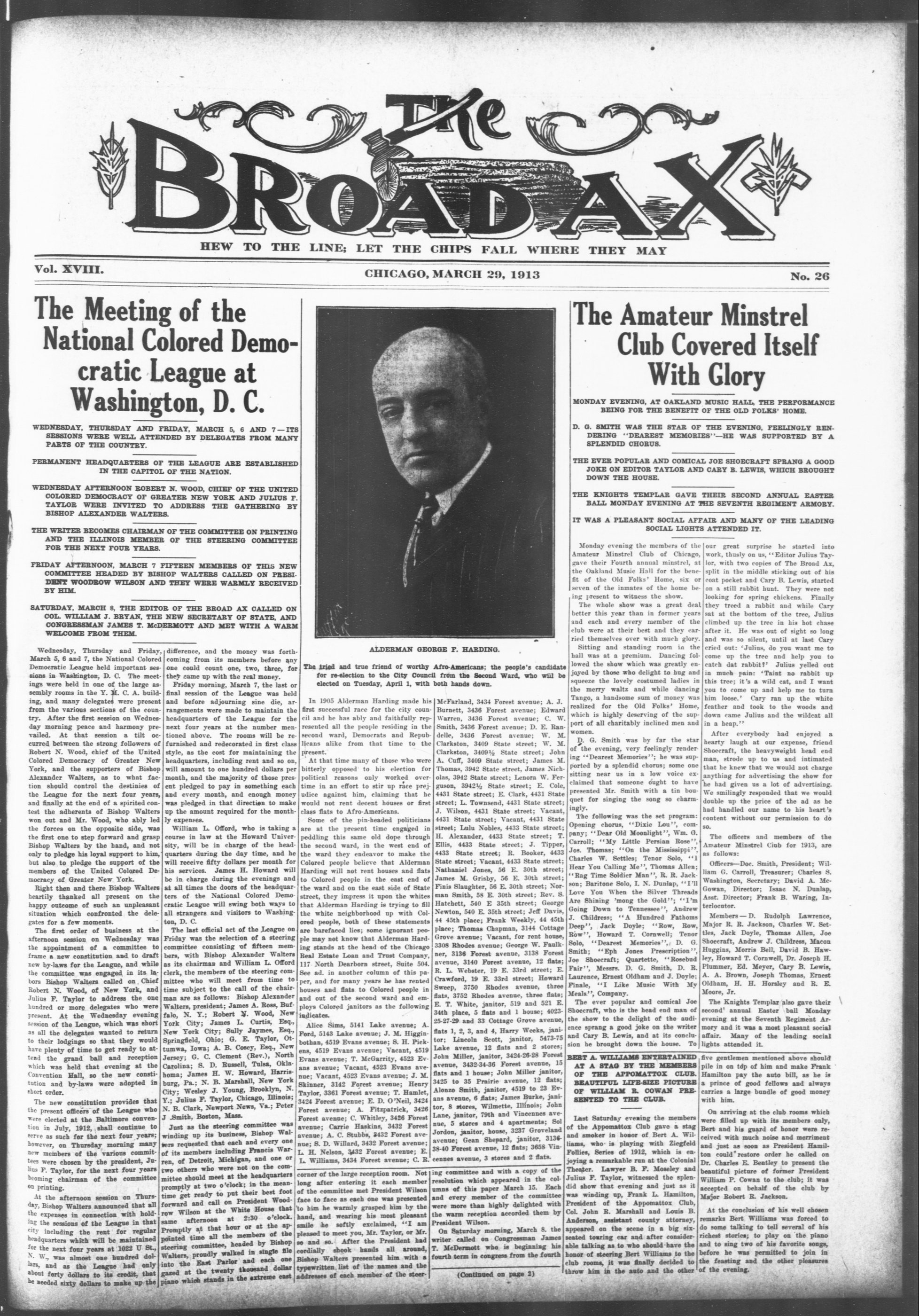
The Meeting of the National Colored Democratic League at Washington, D. C.
WEDNESDAY, THURSDAY AND FRIDAY, MARCH 5, 6 AND 7 — ITS SESSIONS WERE WELL ATTENDED BY DELEGATES FROM MANY PARTS OF THE COUNTRY.
PERMANENT HEADQUARTERS OF THE LEAGUE ARE ESTABLISHED IN THE CAPITOL OF THE NATION.
WEDNESDAY AFTERNOON ROBERT N. WOOD, CHIEF OF THE UNITED COLORED DEMOCRACY OF GREATER NEW YORK AND JULIUS F. TAYLOR WERE INVITED TO ADDRESS THE GATHERING BY BISHOP ALEXANDER WALTERS.
THE WRITER BECOMES CHAIRMAN OF THE COMMITTEE ON PRINTING AND THE ILLINOIS MEMBER OF THE STEERING COMMITTEE FOR THE NEXT FOUR YEARS.
FRIDAY AFTERNOON, MARCH 7 FIFTEEN MEMBERS OF THIS NEW COMMITTEE HEADED BY BISHOP WALTERS CALLED ON PRESIDENT WOODBOW WILSON AND THEY WERE WARMLY RECEIVED BY HIM.
SATURDAY, MARCH 8, THE EDITOR OF THE BROAD AX CALLED ON COL. WILLIAM J. BRYAN, THE NEW SECRETARY OF STATE, AND CONGRESSMAN JAMES T. McDERMOTT AND MET WITH A WARM WELCOME FROM THEM.
Vol. XVIII.
The Meeting
National Co-
cratic L
Washing
WEDNESDAY, THURSDAY AND FOUR
SESSIONS WERE WELL ATTEN-
PARTS OF THE COUNTRY.
PERMANENT HEADQUARTERS OF
IN THE CAPITOL
WEDNESDAY AFTERNOON ROBEE
COLORED DEMOCRACY OF GE
TAYLOR WERE INVITED TO
BISHOP ALEXANDER WALTER
THE WRITER BECOMES CHAIRMAN
AND THE ILLINOIS MEMBER
FOR THE NEXT FOUR YEARS.
FRIDAY AFTERNOON, MARCH 7
COMMITTEE HEADED BY BIS
DENT WOODBROW WILSON AND
BY HIM.
SATURDAY, MARCH 8, THE EDITOR
COL. WILLIAM J. BRYAN, THE
CONGRESSMAN JAMES T. McL
WELCOME FROM THEM.
Wednesday, Thursday and Friday March 5, 6 and 7, the National Colored Democratic League held important sessions in Washington, D. C. The meetings were held in one of the large assemblies rooms in the Y. M. C. A. building, and many delegates were present from the various sections of the country. After the first session on Wednesday morning peace and harmony prevailed. At that session a tilt occurred between the strong followers of Robert N. Wood, chief of the United Colored Democracy of Greater New York, and the supporters of Bishop Alexander Walters, as to what faction should control the destinies of the League for the next four years, and finally at the end of a spirited contest the adherents of Bishop Walters won out and Mr. Wood, who ably led the forces on the opposite side, was the first one to step forward and grasp Bishop Walters by the hand, and not only to pledge his loyal support to him, but also to pledge the support of the members of the United Colored Democracy of Greater New York. Right then and there Bishop Walters heartily thanked all present on the happy outcome of such an unpleasant situation which confronted the delegates for a few moments.
The first order of business at the afternoon session on Wednesday was the appointment of a committee to frame a new constitution and to draft new by-laws for the League, and while the committee was engaged in its labors Bishop Walters called on Chief Robert N. Wood, of New York, and Julius F. Taylor to address the one hundred or more delegates who were present. At the Wednesday evening session of the League, which was short as all the delegates wanted to return to their lodgings so that they would have plenty of time to get ready to attend the grand ball and reception which was held that evening at the Convention Hall, so the new constitution and by-laws were adopted in short order.
The new constitution provides that the present officers of the League who were elected at the Baltimore convention in July, 1912, shall continue to serve as such for the next four years; however, on Thursday morning many new members of the various committees were chosen by the president, Julius F. Taylor, for the next four years becoming chairman of the committee on printing.
At the afternoon session on Thursday, Bishop Walters announced that all the expenses in connection with holding the sessions of the League in that city including the rent for regular headquarters which will be maintained for the next four years at 1022 U St., N. W., was almost one hundred dollars, and as the League had only about forty dollars to its credit, that he needed sixty dollars to make up the
HEW TO THE LINE; LET THE CHIPS FALL WHERE THEY MAY
difference, and the money was forthcoming from its members before any one could count one, two, three, for they came up with the real money.
Friday morning, March 7, the last or final session of the League was held and before adjourning sine die, arrangements were made to maintain the headquarters of the League for the next four years at the number mentioned above. The rooms will be refurnished and redecorated in first class style, as the cost for maintaining the headquarters, including rent and so on, will amount to one hundred dollars per month, and the majority of those present pledged to pay in something each and every month, and enough money was pledged in that direction to make up the amount required for the monthly expenses.
William L. Offord, who is taking a course in law at the Howard University, will be in charge of the headquarters during the day time, and he will receive fifty dollars per month for his services. James H. Howard will be in charge during the evenings and at all times the doors of the headquarters of the National Colored Democratic League will swing both ways to all strangers and visitors to Washington, D.C.
The last official act of the League on Friday was the selection of a steering committee consisting of fifteen members, with Bishop Alexander Walters as its chairman and William L. Offord clerk, the members of the steering committee who will meet from time to time subject to the call of the chairman are as follows: Bishop Alexander Walters, president; James A. Ross, Buffalo, N. Y.; Robert N. Wood, New York City; James L. Curtis, Esq., New York City; Sully Jaymes, Esq., Springfield, Ohio; G. E. Taylor, Ottumwa, Iowa; A. B. Cosey, Esq., New Jersey; G. C. Clement (Rev.), North Carolina; S. D. Russell, Tulsa, Oklahoma; James H. W. Howard, Harrisburg, Pa.; N. B. Marshall, New York City; Wesley J. Young, Brooklyn, N. Y.; Julius F. Taylor, Chicago, Illinois; N. B. Clark, Newport News, Va.; Peter J. Smith, Boston, Mass.
Just as the steering committee was winding up its business, Bishop Walters requested that each and every one of its members including Francis Warren, of Detroit, Michigan, and one or two others who were not on the committee should meet at the headquarters promptly at two o'clock; in the meantime get ready to put their best foot forward and call on President Woodrow Wilson at the White House that same afternoon at 2:30 o'clock. Promptly at that hour or at the appointed time all the members of the steering committee, headed by Bishop Walters, proudly walked in single file into the East Parlor and each one gazed at the twenty thousand dollar piano which stands in the extreme east
CHICAGO, MARCH 29, 1913
WILLIAM H.
ALDERMAN GEORGE F. HARDING.
The tried and true friend of worthy Afro-Americans; the people's candidate for re-election to the City Council from the Second Ward, who will be elected on Tuesday, April 1, with both hands down.
In 1905 Alderman Harding made his first successful race for the city council and he has ably and faithfully represented all the people residing in the second ward, Democrats and Republicans alike from that time to the present.
At that time many of those who were bitterly opposed to his election for political reasons only worked overtime in an effort to stir up race prejudice against him, claiming that he would not rent decent houses or first class flats to Afro-Americans.
McFarland, 3434 Forest avenue; A. J. Burnett, 3436 Forest avenue; Edward Warren, 3436 Forest avenue; C. W. Smith, 3436 Forest avenue; D. E. Randelle, 3436 Forest avenue; W. M. Clarkston, 3409 State street; W. M. Clarkston, 3409½ State street; John A. Cuff, 3409 State street; James M. Thomas, 3942 State street, James Nicholas, 3942 State street; Lenora W. Ferguson, 3942½ State street; E. Cole, 4431 State street; E. Clark, 4431 State street; L. Townsend, 4431 State street; J. Wilson, 4431 State street; Vacant,
Some of the pin-headed politicians are at the present time engaged in peddling this same old dope through the second ward, in the west end of the ward they endeavor to make the Colored people believe that Alderman Harding will not rent houses and flats to Colored people in the east end of the ward and on the east side of State street, they impress it upon the whites that Alderman Harding is trying to fill the white neighborhood up with Colored people, both of these statements are barefaced lies; some ignorant people may not know that Alderman Harding stands at the head of the Chicago Real Estate Loan and Trust Company, 117. North Dearborn street, Suite 504. See ad. in another column of this paper, and for many years he has rented houses and flats to Colored people in and out of the second ward and employs Colored janitors as the following indicates.
Alice Sims, 5141 Lake avenue; A. Ford, 5143 Lake avenue; J. M. Higginbothan, 4519 Evans avenue; S. H. Pickens, 4519 Evans avenue; Vacant, 4519 Evans avenue; T. McGarrity, 4523 Evans avenue; Vacant, 4523 Evans avenue; Vacant, 4523 Evans avenue; J. M. Skinner, 3142 Forest avenue; Henry Taylor, 3361 Forest avenue; T. Hamlet, 3424 Forest avenue; E. D. O'Neil, 3424 Forest avenue; A. Fitzpatrick, 3426 Forest avenue; C. Whitley, 3426 Forest avenue; Carrie Haskins, 3432 Forest avenue; A. C. Stubbs, 3432 Forest avenue; S. D. Willard, 3432 Forest avenue; L. H. Nelson, 3432 Forest avenue; E. L. Williams, 3434 Forest avenue; C. R corner of the large reception room. Not long after entering it each member of the committee met President Wilson face to face as each one was presented to him he warmly grasped him by the hand, and wearing his most pleasant smile he softly exclaimed, "I am pleased to meet you, Mr. Taylor, or Mr. so and so. After the President had cordially shook hands all around, Bishop Walters presented him with a typewritten list of the names and the addresses of each member of the steer-
ing committee and with a copy of the resolution which appeared in the columns of this paper March 15. Each and every member of the committee were more than highly delighted with the warm reception accorded them by President Wilson. On Saturday morning, March 8. the writer called on Congressman James T. McDermott who is beginning his fourth term in congress from the fourth
(Continued on page 2)
The Amateur Minstrel Club Covered Itself With Glory
MONDAY EVENING, AT OAKLAND MUSIC HALL, THE PERFORMANCE BEING FOR THE BENEFIT OF THE OLD FOLKS' HOME.
D. G. SMITH WAS THE STAR OF THE EVENING, FEELINGLY BENDING "DEAREST MEMORIES"—HE WAS SUPPORTED BY A SPLENDID CHORUS.
THE EVER POPULAR AND COMICAL JOE SHOECRAFT SPRANG A GOOD JOKE ON EDITOR TAYLOR AND CARY B. LEWIS, WHICH BROUGHT DOWN THE HOUSE.
THE KNIGHTS TEMPLAR GAVE THEIR SECOND ANNUAL EASTER BALL MONDAY EVENING AT THE SEVENTH REGIMENT ARMORY.
IT WAS A PLEASANT SOCIAL AFFAIR AND MANY OF THE LEADING SOCIAL LIGHTS ATTENDED IT.
Monday evening the members of the Amateur Minstrel Club of Chicago, gave their Fourth annual minstrel, at the Oakland Music Hall for the benefit of the Old Folks' Home, six or seven of the inmates of the home being present to witness the show.
our great surprise he started into work, thusly on us, "Editor Julius Taylor, with two copies of The Broad Ax, split in the middle sticking out of his coat pocket and Cary B. Lewis, started on a still rabbit hunt. They were not looking for spring chickens. Finally
The whole show was a great deal better this year than in former years and each and every member of the club were at their best and they carried themselves over with much glory. Sitting and standing room in the hall was at a premium. Dancing followed the show which was greatly enjoyed by those who delight to hug and squeeze the lovely costumed ladies in the merry waltz and while dancing Tango, a handsome sum of money was realized for the Old Folks' Home, which is highly deserving of the support of all charitably inclined men and women.
D. G. Smith was by far the star of the evening, very feelingly rendering "Dearest Memories"; he was supported by a splendid chorus; some one sitting near us in a low voice exclaimed that someone ought to have presented Mr. Smith with a tin bouquet for singing the song so charmingly.
The following was the set program: Opening chorus, "Dixie Lou", company; "Dear Old Moonlight", Wm. G. Carroll; "My Little Persian Rose", Jos. Thomas; "On the Mississippi"; Charles W. Settles; Tenor Solo, "I Hear You Calling Me", Thomas Allen; "Rag Time Soldier Man", R. R. Jackson; Baritone Solo, I. N. Dunlap, "I'll Love You When the Silver Threads Are Shining 'mong the Gold"; "I'm Going Down to Tennessee", Andrew J. Childress; "A Hundred Fathoms Deep", Jack Doyle; "Row, Row, Row", Howard T. Cornwell; Tenor Solo, "Dearest Memories", D. G. Smith; "Eph Jones Prescription", Joe Shoecraft; Quartette, "Rosebud Fair", Messrs. D. G. Smith, D. R. Laurence, Ernest Oldham and J. Doyle; Finale, "I Like Music With My Meals", Company.
The ever popular and comical Joe Shoecraft, who is the head end man of the show to the delight of the audience sprang a good joke on the writer and Cary B. Lewis, and at its conclusion he brought down the house. To
BEST A. WILLIAMS ENTERTAINED AT A STAG BY THE MEMBERS OF THE APPOMATTOX CLUB. BEAUTIFUL LIFE-SIZE PICTURE OF WILLIAM R. COWAN PRESENTED TO THE CLUB.
Last Saturday evening the members of the Appomattox Club gave a stag and smoker in honor of Bert A. Williams, who is playing with Ziegfeld Follies, Series of 1912, which is enjoying a remarkable run at the Colonial Theater. Lawyer B. F. Moseley and Julius F. Taylor, witnessed the splendid show that evening and just as it was winding up, Frank L. Hamilton, President of the Appomattox Club, Col. John R. Marshall and Louis B. Anderson, assistant county attorney, appeared on the scene in a big six-seated touring car and after considerable talking as to who should have the honor of steering Bert Williams to the club rooms, it was finally decided to throw him in the auto and the other
No.26
our great surprise he started into work, thusly on us, "Editor Julius Taylor, with two copies of The Broad Ax, split in the middle sticking out of his coat pocket and Cary B. Lewis, started on a still rabbit hunt. They were not looking for spring chickens. Finally they treed a rabbit and while Cary sat at the bottom of the tree, Julius climbed up the tree in his hot chase after it. He was out of sight so long and was so silent, until at last Cary cried out: 'Julius, do you want me to come up the tree and help you to catch dat rabbit?' Julius yelled out in much pain: 'Taint no rabbit up this tree; it's a wild cat, and I want you to come up and help me to turn him loose.' Cary ran up the white feather and took to the woods and down came Julius and the wildcat all in a heap."
After everybody had enjoyed a hearty laugh at our expense,肩e Sheocraft, the heavyweight head end man, strode up to us and intimated that he knew that we would not charge anything for advertising the show for he had given us a lot of advertising. We smilingly responded that we would double up the price of the ad as he had handled our name to his heart's content without our permission to do so.
The officers and members of the Amateur Minstrel Club for 1913, are as follows:
Officers—Doc. Smith, President; William G. Carroll, Treasurer; Charles S. Washington, Secretary; David A. McGowan, Director; Isaac N. Dunlap, Asst. Director; Frank B. Waring, Interlocutor.
Members—D. Rudolph Lawrence, Major R. R. Jackson, Charles W. Settles, Jack Doyle, Thomas Allen, Joe Shoecraft, Andrew J. Childress, Macon Huggins, Morris Bell, David B. Hawley, Howard T. Cornwell, Dr. Joseph H. Plummer, Ed. Meyer, Cary B. Lewis, A. A. Brown, Joseph Thomas, Ernest Oldham, H. H. Horsley and R. E. Moore, Jr.
The Knights Templar also gave their second annual Easter ball Monday evening at the Seventh Regiment Armory and it was a most pleasant social affair. Many of the leading social lights attended it.
five gentlemen mentioned above should pile in on tdp of him and make Frank Hamilton pay the auto bill, as he is a prince of good fellows and always carries a large bundle of good money with him.
On arriving at the club rooms which were filled up with its members only, Bert and his guard of honor were received with much noise and merriment and just as soon as President Hamilton could restore order he called on Dr. Charles E. Bentley to present the beautiful picture of former President William P. Cowan to the club; it was accepted on behalf of the club by Major Robert R. Jackson.
At the conclusion of his well chosen remarks Bert Williams was forced to do some talking to tell several of his richest stories; to play on the piano and to sing two of his favorite songs, before he was permitted to join in the feasting and the other pleasures of the evening.
THE BROAD AX
PUBLISHED WEEKLY.
Will promulgate and at all times secure the true principles of Democracy, but Cathelebe, Protestants, Priests, Infidene Single Taxes, Republicans, or anyone else can have their say, as long as their language is proper and responsibility is fixed.
The Broad Ax is a newspaper whose platform is broad enough for all, even claiming the editorial right to speak its own mind.
Local communications will receive attention. Write only on one side of the paper.
Subscriptions must be paid in advance. One Year. $2.60 Six Months. 1.60
Advertising rates made known on application. Rate all communications to
THE BROAD AX
8027 ARMOUR AVENUE, CHICAGO, ILL.
JULIUS F. TAYLOE, Editor and Publisher
Entered as Second-Class Matter Aug. 19
Milwaukee, Chicago, Illinois
under Act of March 3, 1879.
MEETING OF THE COLORED NATIONAL DEMOCRATIC LEAGUE. (Concluded from page 1)
congressional district, and as in the past he is ever ready to look after his constituents to the best of his ability, and he made us walk right into his fine quarters in the Congress office building and make ourselves at home.
As a memento he presented us with a fine photograph of President Woodrow Wilson, the Hon. Thomas Gallagher and himself which was taken at Seagirt, N. J., July 20, 1912, with President Wilson sitting in between the two congressmen from Illinois.
In the afternoon of that same date or on Saturday, March 8, we had the honor of calling on Col. William J. Bryan, the new secretary of state, and finally after a long wait we were ushered into his presence by his Colored messenger, and he received us very pleasantly with his original Bryan smile. His desk sits right in the center of a very large room, and in his plain western way or style he has the doors leading into his inner room wide open, so that the humblest or the highest citizen, white or black, can without much trouble get to see him after they are admitted into his presence. Every once in a while the new secretary will arise from his easy chair, walk around among those in the room, crack a good joke with some one he knows real well, pat them on the back and in his old-fashioned democratic manner he earnestly endeavors to make all comers feel at home.
(To be continued)
ALDERMANIC TERMS SHOULD NOT
BE LENGTHENED.
At a recent meeting of the council the aldermen passed a bill making official terms of alderman four years instead of two, as at present. The bill in question is about to be presented to the legislature. There seems to be no great outcry for this extension on the part of the public, and it had been hoped that this proposition was shelved for good, as it is almost certain to be when it comes up for action in the General Assembly.
It would seem as though the intelligent citizen will have difficulty in discovering any reason why such a proposition should be given serious consideration for a moment. In the case of an alderman who is representing his ward in a fashion satisfactory to his constituents, there is nothing to prevent the latter from succeeding himself indefinitely or until he ceases to do aldermanic duty in harmony with their wishes and views.
On the other hand, a four-year term is obviously too long for an alderman, who, in spite of pre-election pledges, conducts himself in such a fashion as to displease those who were deceived into sending him to the council. For be it remembered that the voters have practically no power to rid themselves of such an incubus until four long years have elapsed. It is true they may express individual and collective disapproval of the man who misrepresents them, but a corrupt or otherwise inefficient alderman is not likely to pay more than contemptuous attention to demonstrations of that kind. He would be too busy feathering his nest, knowing full well that when next-election day comes around he will be forced into the undignified retirement he has earned. In the meantime the voters have had no means of closing the stable door before the horse was stolen.
Another point seems to have been overlooked. Two-year terms are regarded as sufficient for state legislators and members of the National House of Representatives. And it may be safe to say that, in a general way, these gentlemen are at least as valuable to their constituents as Chicago aldermen are to the wards they represent. From every point of view the proposition is one to be frowned down. Four years is not long enough for a good alderman; still more important, it is much too long for a bad one.
12
MUSICAL FESTIVAL AND DEMON-
STEATION IN VOICE CULTURE
GIVEN BY THE ATLANTA BAP-
TIST COLLEGE AUDITORIUM-
ARMORY ATLANTA, GEORGIA,
FRIDAY, MARCH 21, 1913.
Nearly 4,000 (four thousand) people present.
Features were—Male chorus of two
hundred fifty voices; college orchestra,
Glee Club, Quartette, Piano, Vocal and
Trombone Solos and the Demonstration
in Voice Culture.
The program consisted of new selections excepting the melodies and Swanee River. All were committed in two weeks' time.
The Colored composers represented were R. Nathaniel Dett, (Magnolia Suite for Piano); Will Marion Cook, Rosamond Johnson, Harry Burleigh, and Clarence Cameron White in vocal compositions.
The whole program aimed to show what Colored youth could do in even a short time of preparation.
The Festival was a courageous enterprising effort on the part of President John Hope of Atlanta Baptist College. His faith in the citizens of Atlanta well placed, as the immense audience attested.
Congratulations are due both President Hope, the Atlanta Baptist College and the progressive Colored citizens of Atlanta.
Since Madame Hackley had contributed her services for the two weeks' preparation and for the Festival, there was no effort made to reap financial gain. Popular prices of 25c and 50c were charged. It was a most remarkable audience in several ways. The late comers waited most patiently in the vestibule and inside the door, between numbers, until the ushers seated them, and made every effort not to disturb, some even "tiptoeing" to their seats. Although nearly one thousand public school children and orphans were the guests of the College, one could have heard a pin drop not only during a rendition but while Madame Hackley gave the Demonstration and put the chorus through the vocal exercise.
Madame Hackley was able assisted by Mr. Kemper Harreld, director of music of the Atlantic Baptist College. The boys presented Madame Hackley with a beautiful sterling silver chain and engraved coin purse, and a large bouquet of pink carnations, and gave her a "college yell". The affair marks an era—not only in the musical affairs of the Atlanta population but in the musical history of the race.—"D."
HEAR THE MAN WHO FOUNDED
TUSEKEE INSTITUTE.
See the Wonderful Moving Pictures of the World-Famed School. "A Day at Tuskegee," Exhibited at Orchestra Hall, Tuesday Evening, April 1.
Final arrangements have been completed for the moving pictures, "A Day at Tuskegee," at Orchestra Hall, April 1, at 8 p. m. No public affair given in Chicago in recent years has created as much interest as the coming of Dr. Booker T. Washington and the "movies," to be seen on the night of April 1st.
Tuskegee Institute and its various vocational activities will be brought within your vision, and the voice of Dr. Washington will make the scenes all the more perfect. Prof. James A. Mundy's especially traineed octette will sing folk-lore songs as sung and preserved at Tuskegee. The exhibit starts with the picture of Dr. Washington dismounting his famous charger at the executive building, then the shack in which the school started in 1881. This is followed with 100 vocational industries—the institute regiment and band, making you feel as though you were on the campus.
All the ministers, churches and their congregations, and citizens at large have been invited to see the pictures of this world-famed institution. The following clubs have been invited: Appomattox, University, Criterion, Tuskegee, Fisk, Swastika, Peerless, Pandora, Bethel Literary, Standard, Fellowship League, Navarre, Men's Civic, Midlothian, Phalaxn, Umbrian Glee, Federal Glee, Young Peoples' Progressive, Chicago Girls' Civic, Wendell Phillips Settlement Club, 20th Century, West Side Women's, and Federation of Women's Clubs of Chicago.
Mr. Cary B. Lewis, who is the press agent and promoter of this exhibition, states that the seats on sale at the box office are selling fast. Do not miss this wonderful exhibition—"C."
Attorney Edward H. Wright will Remove His Law Office to 312 South Clark Street.
On April 1st, Mr. E. H. Wright will move his law offices from the Omaha Building, to suite 419, Imperial Building, 312 South Clark Street, between Van Buren Street and Jackson Boulevard.
Eloquent Remarks in Part by Governor William Sulzer at the Complimentary Dinner.
IN HIS HONOR, TO CELEBRATE HIS FIFTIETH BIRTHDAY AT THE CAFE BOULEVARD, TENTH STREET AND SECOND AVENUE
NEW YORK CITY, SATURDAY, MARCH 22, 1913—MANY DISTINGUISHED CITIZENS GRACED THE OCCASION WITH THEIR PRESENCE.
Mr. Sulzer said in part:
"My friends: No words of mine—and I speak from the depths of a grateful heart—can tell you how much I appreciate this dinner in celebration of my birthday, and of all that I owe to you for all that you have done for me.
emplar of economical, an efficient and progressive administration. As its governor I shall, in so far as I can, give the people of the state an honest, an efficient, an economical and a business-like administration of public affairs. I say business-like advisedly, because I assure the business men in every part
"Here assembled are some of the best and the truest friends a man ever had. If I have done aught in the years gone by to justify this recognition of your kindness, of your generosity, and of your appreciation, the credit is yours, and the praise is yours because all that I am I owe, to a very large extent, to those around this festive board for the confidence they have reposed in me, and in the rectitude of my intentions, in all the years of the past when I represented this district in the congress of the United States.
"You know me as I am; and as I am, I ever hope to be. I would not be different if I could, and I could not if I would. You know that I have no race, no political, and no religious prejudice. The only prejudice I have is against intrenched wrongs, to remedy which I have struggled all my life. I am broad-minded in my views. I believe in my fellowman, in the good of society generally, and I know that the world is growing better. My face is to the dawning of the better and the brighter day that heralds the coming of the Brotherhood of Man.
"In the future, as in the past, you can count on me to struggle to help those who need help; to do my share in my day and generation for the general welfare; to aid oppressed humanity in every land and in every clime; and to raise the humble and the lowly te a higher level and a loftier plane in the onward march of progress and of civilization.
"Long ago I made a vow to the people that in the performance of my duty no influence would control me but the dictates of my conscience and my determination to do the right—as I see the light—day in and day out, regardless of the political future or personal consequences. Have no fear. I shall stick to that.
"Let me say again that I stand now, where I have always stood, and where I always will stand—for certain fundamental principles—for freedom of speech; for the right of lawful assembly; for the freedom of the press; for liberty under law; for civil and religious freedom; for constitutional government; for equality and justice to all; for home rule and local self government; for the reserved rights of the states; for equal rights to every one and special privileges to no one; and for unshackled opportunity as the beacon light of individual hope, and the best guarantee for the perpetuity of our free institutions.
"New York is the greatest state in the Union. It should always be an ex-
Soon we'll hear the familiar cry,
"Now all get busy and swat the fly."
Education in health matters given to
the child in the school is certain to
have its influence in the home.
* * *
Smallpox scars on a human face are
the unmistakable signs of ignorance
and needless suffering.
* * *
During these mild spring days don't
let the fires go out, but open the
windows and fill your home with the fresh
outside air.
* * *
It sounds a little inconsistent, doesn't
it, to hear a teacher talking to a room
full of pupils about the value of fresh
air, with the windows all carefully
closed and the ventilation about as bad
as could be?
Now is a good time to get out your fly screens and put them in readiness for use when fly time comes.
* * *
When we know that conditions that cause certain diseases are preventable and we take no steps to remove these conditions, are we living up to the light we have? For example, we know that filth breeds flies and that flies spread disease. So, if we tolerate flies and filth in our communities, we may expect to have a lot of sickness and many needless deaths.
* * *
Why should not the Department of Health have a branch office in every public school in the city? Such offices would be made neighborhood cen-
emplar of economical, an efficient and progressive administration. As its governor I shall, in so far as I can, give the people of the state an honest, an efficient, an economical and a business-like administration of public affairs. I say business-like advisedly, because I assure the business men in every part of our state that they can rely on me at all times to do my utmost to promote the commercial interests of our commonwealth. I realize how important they are, and shall always be exceedingly careful to take no step that will jeopardize the financial and the commercial supremacy of the first state in the Republic.
"Suffice it to say that I am a friend of every business, whether big or little, so long as it is legitimate, and will always have its welfare in view in the administration of state affairs. To this end I shall continue to work unceasingly for quicker and better transportation agencies in every part of the State, and for improved and larger terminal facilities, in order that New York shall continue to receive her just share of the trade and the commerce of the country.
"Whenever in doubt it is my purpose to confide in the people, and I indulge the hope that when my official term comes to an end I shall have accomplished something to merit their approval and to justify the confidence they have reposed in the rectitude of my intentions.
"As many of you know I have been over some of the celebrated trails of our country—the trails made by our heroic settlers in the pioneer days of the Republic. A few years ago I traveled over the famous 'Santa Fe Trail' stretching away from St. Louis westward and southward to the capital of New Mexico. There in the old Plaza, where the trail ends, is a small granite shaft to the memory of Kit Carson, the pathfinder, the scout and the guide of that world-renowned route. On it are inscribed these simple words, 'Well done, Kit.'
"When my career on earth is finished, and I am gathered to the fathers, I indulge the hope that if I have done aught for my fellowman, that those who appreciate my efforts for a common humanity will erect over my grave a similar simple shaft, and on it inscribe the words, 'Well done, Bill.' I want no greater reward—no greater glory—no more lasting fame.
"And so, my friends, in conclusion, I thank you again one and all, for what you have done for me; and God willing, I assure you that in the future, as in the past, I shall to the best of my ability fight on for truth; fight on for justice; fight on for progress; fight on for humanity; fight on for the cause that lacks assistance; against the wrongs that need resistance; for the future in the distance, and the good that I can do."
ters, from which the department could carry on many of its activities, especially along the lines of controlling contagious diseases and in educating the people in doing the things that make for community comfort and health.
BILL PASSES ASSEMBLY
Civil Rights Measure Introduced by Assemblyman Levy Designed to Give All Equal Accommodations, Favorably Considered by Lower House.
Albany, N. Y., March 17,—The Levy Bill, providing against discrimination in public places on account of race, creed or color was passed by the assembly Monday evening. The senate will now act on the measure.
The bill provides that no person being the owner, lessee, proprietor, manager, superintendent, agent or employee of a place of public accommodation shall directly or indirectly refuse any one accommodations, and that if found guilty shall be liable to a penalty of $500, to be recovered by the aggrieved person or shall be fined not less than $250 or no more than $1,000, or be sentenced to jail for not less than thirty days or no more than six months. Heretofore the proprietors of public places who have been made defendants in damage suits in which color or religious discrimination was charged have often put the blame on employees. The bill will be so amended as to make either the proprietor or employ liable.
EASTER SABBATH AT THE INSTITUTE
TUTIONAL CHURCH.
Notwithstanding the terrife downpour of rain and the manifest fury of the elements, two magnificent audiences assembled at the Institutional Church Easter Sabbath.
The new vested choir entered with the "Processional" and departed with "Recessional," and the music which they rendered was not only appropriate and beautiful, but perfect in its execution.
Bishop B. F. Lee preached upon "The Power of the Resurrection," and delivered a sermon advanced in thought, powerful in delivery, profound in its philosophy and that stirred and inspired his whole audience.
Dr. George Burnam Foster, professor of the Philosophy of Religion at the University of Chicago, spoke to a splendid audience Sunday evening on "Prejudices." To say that this subject was treated by this learned scholar to the delight and edification of all is putting it but mildly.
Next Sabbath evening Mrs. E. H. Ryder, of the Chicago D. N. A., will deliver a special address to mothers and wives, and to husbands and fathers.
The City Federation of Women's Clubs and the King's Daughters Circles have been invited as guests of honor on this occasion.
A cordial invitation is extended to the general public for all the services. Polite ushers, delightful music, congenial members, orthodox preaching and a homelike church await all who worship with us.—"O."
THE ALPHA SUFFRAGE CLUB
Will Give a Big Entertainment in Honor of Misses Belle Squire, Virginia Brooks and Mrs. Ida Wells-Barnett, Three Heroines of the Suffrage Parade in Washington.
The Alpha Suffrage Club, the only suffrage club among the colored women in Chicago, will give its first public entertainment at Quinn Chapel, Monday night, April 7th. This club is responsible for Mrs. Barnett going to Washington to represent the race in the great suffrage parade, March 3rd. The club made itself personally responsible for Mrs. Barnett's expenses, and this effort is for the purpose of raising the money to pay back that expense. The Progressive Club of Quinn Chapel is largely co-operating with the suffrage club to make this entertainment a great success. Misses Belle Squire and Virginia Brooks, the two white women who stood so loyally by Mrs. Barnett in her fight for colored representation, will be the chief speakers of the evening, after which a reception will be held downstairs.
There will be music by the Emancipation chorus, under the direction of Mr. James A. Mundy. Among other numbers, they will render Mr. Mundy's composition which was composed in honor of the fifteenth anniversary of freedom, and "Infammatus." Mrs. Barnett will preside. A rich treat is promised to all and it is expected that the church will be crowded with members of the City Federation of Women's Clubs and other organizations in the city which will be glad of the opportunity to do honor to the noble young women who stood for the right. Everybody invited. Admission, 25 cents.—"S."
EDITOR TAYLOR BACK IN "CHIL."
Editor Julius F. Taylor, of The Chicago Broad Ax, has returned to the city from a trip to Washington, D. C., to witness the inauguration of President Wilson and made a trip to Harrisburg, Pa., to see his relatives. Mr. Taylor is one of the few Colored democrats who, on a trip, goes in first-class style and fashion.
When Governor Dunne was inaugurated Mr. Taylor did not ride on a pass, used no money from the politicians to bear his expenses, was the honored guest to be received by the governor, attended the ball and left Springfield with the highest of commendations from those who knew him. Mr. Taylor went under similar circumstances to Washington, D. C. He rode on a fast train, had a sleeper and porters to wait on him, and everywhere he stopped was treated most cordially and pleasantly. The reports of his trip are well worth reading.—Cary B. Lewis, in the Freeman, Indianapolis, Ind., March 22, 1913.
BISHOP LEE LEAVES FOR SOUTH
CAROLINA.
Bishop Benjamin F. Lee, D.D., who spent last Sabbath in our city and preached a most profound and eloquent sermon at the Institutional church Sunday morning, was called to Charleston, South Carolina, Monday on account of the death of Bishop M. B. Salter of that city.
Bishop Salter's funeral was held yesterday in Emanuel church, Charleston.
terday in Emanuel church, Charleston. Bishop Lee, who was elected and ordained with Bishop Salter in Philadelphia, 1892, preached the funeral sermon. Other bishops present were Bishops H. M. Turney, H.' B. Parks, J. S. Flipper, L. J. Coppin, John Hurst, J. H. Jones, W. D. Chappelle, C. T. Shaffer, Evans, Tyree and J. M. Connor.
COLORADO KILLS JIM CROW.
The senate of California has defeated the bill which proposed the enactment of a constitutional amendment providing for separate schools for the colored and white people.
This is another instance of the mashing of the head of the monster which has been sent forth from the southern organization, the purpose of which is to influence northern legislatures against this measure in Colorado, however, like the killing of a jim crow car bill in Missouri is a tribute to the good sense which the democratic majority is showing under their present lease of power.—The Star, Denver, Colorado, March 15th.
HARRISBURG, PA., THE SECOND
HOME OF THE EDITOR
Harrisburg has reached a place of distinct honor by through the columns of The Broad Ax by Editor Julius P. Taylor in his description of his trip from "Chicago to Harrisburg."—The Advocate-Verdiet, Harrisburg, Pa., March 22, 1913.
Brother Craighead, just as long as our mother and our sister reside near the shadow of the capitol of the Keystone State we shall always regard Harrisburg as our second home—Editor.
ARRESTED WITH WHITE GIRL ON
MANN ACT CHARGE.
Minneapolis, Minn.--J. M. Bowen, a federal government inspector, has arrested Halbert Grant, a Negro, and Lottie Grant, aged seventeen years, white, at a local hotel. The Negro is charged with violating the Mann law.
CHIPS
Mr. Harrison Emanuel will give a violin recital at Kimball Hall, Monday evening, April 21. See ad. in another column of this paper.
The stork has presented Mr. and Mrs. Frank H. Lewis, 5047 Armour avenue, with a fine baby girl, and it and its mother, Mrs. Lewis, are doing very nicely at the present time.
Dr. Daniel H. Williams was on Monday evening hastily summoned to New York City for consultation in the case of Bishop William B. Derrick, who is dangerously ill at his home in Flushing, New York.
Attorney B. F. Moseley, 6221 South Halsted street, left Monday evening for St. Louis, Mo., where on Tuesday evening he delivered several addresses at the Progressive mass meeting held in the interest of the Progressive mayorality ticket. Two Colored men for the first time in the history of St. Louis are on the ticket for alderman and councilman.
Dr. A. J. Carey is in Racine, Wisconsin, this week filling an engagement for Bishop Lee, who was called to Charleston on account of the death of Bishop Salter. Next week he will be in attendance upon the district conference at Cedar Rapids, Iowa, on a similar mission.
Mrs. Grace Hart-Brown, of New Orleans, La., is still visiting with her parents, Mr. and Mrs. Joseph Hart, and with her two sisters, Mrs. William H. Hayman and Miss Gertrude Hart, 67 East 36th street, and Mrs. Brown was in evidence at the annual minstrel show and dance Monday evening at the Oakland Music Hall.
Mr. and Mrs. Harry A. Dunean, whose home was burned at 6041 Champlain avenue, are living at the home of Mr. and Mrs. Henry T. Wells, 6459 Evans avenue. Mr. and Mrs. Dunean wish to thank their friends for letters, telegrams and various expressions of sympathy shown them during the past three weeks.
Col. James Hamilton Lewis, and the Hon. Lawrence G. Sherman, were elected to the United States Senate at Springfield, Ill., by a combination of Democratic, Republican and Progressive members of the legislature. Both gentlemen are eminently qualified to represent the people of the great state of Illinois, in the upper house of con-
Burton Moseley, one of the sons of Mr. and Mrs. Beauregard F. Moseley, 6248 S. Sangamon street, died Wednesday, March 26th, after a long illness. He was 20 years 8 months and 5 days old at the time of his death. Funeral services will be held over his remains this morning at 10 o'clock, at Grace Presbyterian Church, Rev. Moses M. Jackson officiating. Interment at Lincoln Cemetery. Mr. and Mrs. Moseley have the deepest sympathy of a large circle of friends over their sad bereavement.
The Englewood Lyceum of Hope Presbyterian church rendered its special program Sunday, March 23. The exercises were Military Day and a grand
. PUBLISHED WEEKLY.
(WU promulgate and at all times apbold
a
Sane ae ati mean
Sa
Sp SS
inp
tom. Write only om one side of the paper.
- _ Advertising rates made Known on appli-
=
THE BROAD AX
81 ARMOUR AVENUE, CHICAGO, ILL.
PHONE DREXEL 4500.
FOLIO. TATLOR, iter ont Pubtiber
EN oeS SS tc
MEETING OF THE COLORED NA-
TIONAL DEMOCRATIC LEAGUE.
(Concluded from page 1)
congressional district, and as in the
past he is ever ready to look after his
constituents to the best of his ability,
and he made us walk right into his
fine quarters in the Congress office
building and make ourself at home.
As a memento he presented us with
& fine photograph of President Wood-
row Wilson, the Hon. Thomas Galla-
gher and himself which was taken at
Seagirt, N. J., July 20, 1912, with
President Wilson sitting in between
the two congressmen from Illinois.
In the afternoon of that same date
or on Saturday, March &, we had the
honor of calling on Col. William J.
Bryan, the new secretary of state, and
finally after a long wait we were ush-
ered into his presence by his Colored
messenger, and he received us very
pleasantly with his original Bryan
smile. His desk sits right in the cen-
ter of a very large room, and in his
plain western way or style be has the
doors leading into his inner room wide
open, so that the humblest or the high-
est citizen, white or black, can without
much trouble get to see him after they
are admitted into his presence. Every
once in a while the new secretary will
arise from his easy chair, walk around
‘among those in the room, crack a good
joke with some one he knows real well,
pat them on the back and in his old-
fashioned democratic manner he ear-
nestly endeavors to make all comers
feel at home.
(To be continued)
ALDERMANIC TEEMS SHOULD NOT
RE LENGTHENED.
At a recent meeting of the council
the aldermen passed a bill making
official terms of alderman four year:
instead of two, as at present. The
bill in question is about to be pre
sented to the legislature. There seems
to be no great outery for this extension
on the part of the public, and it had
been hoped that this proposition wa:
shelved for good, as it is almost certair
to be when it comes up for action in
the General Assembly.
It would seem as though the intelli-
gent citizen will have difficulty in dis-
covering any reason why such a prop-
osition should be given serious consid-
eration for a moment. In the case of
an alderman who is representing his
ward in a fashion satisfactory to his
constituents, there is nothing to pre-
vent the latter from succeeding himself
indefinitely or until he ceases to do al-
Germanic duty in harmony with their
wishes and views.
On thesother hand, a four-year term
is obviously too long for an alderman,
who, in spite of pre-election pledges,
conducts himself in such a fashion as
to displease those who were deceived
into sending him to the council. For
be it remembered that the voters have
practically no power to rid themselves
of such an incubus until four long
years have elapsed. It is true they may
express individual and collective dis-
approval of the man who misrepresents
them, but a corrupt or otherwise in-
efficient alderman is not likely to pay
more than contemptuous attention to
demonstrations of that kind. He would
be too busy feathering his nest, know:
ing foll well that when next election
aay comes around he will be forced
into the undignified fetirement be has
earned. In the meantime the voters
have had no means of closing the sta-
ble door before the horse was stolen.
‘Another point seems to have been
overlooked. Two-year terms are re
garded as sufficignt for state legisla
tors and members of the National
‘House of Representatives. see
be safe to say that, in a general Way,
these gentlemen are at least as valu-
able to their constituents as Chicago
aldermen are to the wards they repre-
sent. From every point of view the
‘proposition is one to be frowned down.
‘Four years is not long enongh for 2
alderman; still more important, it
eee ea ig tee tek oo
MUSICAL FESTIVAL AND DEMON-
STRATION IN VOICE CULTURE
GIVEN BY THE ATLANTA BAP.
TIST COLLEGE AUDITORIUM.
ARMORY ATLANTA, GEORGIA,
FRIDAY, MARCH 21, 1913.
| Nearly 4,000 (four thousand) peopl
present.
Features were—Male chorus of tw:
hundred fifty voices; eollege orchestra
Glee Club, Quartette, Piano, Vocal ané
‘Trombone Solos and the Demonstratio:
in Voice Culture.
‘The program consisted of new selec
tions excepting the melodies ani
‘Swanee River. All were conimitted in
two weeks? time.
The Colored composers represented
were R. Nathaniel Dett, (Magaolis
Suite for Piano); Will Marion Cook,
Rosamond Johnson, Harry Burleigh
and Clarence Cameron White in voca
compositions.
‘The whole program aimed to shon
what Colored youth could do in ever
‘8 short time of preparation.
‘The Festival was a courageous en
terprising effort on the part of Presi
dent John Hope of Atlanta Baptist
College. His faith in the citizens of
Atlanta well placed, as the immense
audience attested.
Congratulations are due both Presi-
dent Hope, the Atlanta Baptist Col-
lege and the progressive Colored citi
zens of Atlanta.
"Since, Madame Hackley bad con
tributed her services for the two
weeks’ preparation and for the Festi
val, there was no effort made to rea}
financial gain. Popular prices of 25
and 50c were charged.
It was a most remarkable audience
in several ways. The late comer:
Waited most patiently in the vestibule
‘and inside the door, between numbers,
‘until the ushers seated them, and made
every effort not to disturb, some even
““tiptoeing’’ to their seats. Although
nearly one thousand public school chil:
dren and orphans were the guests of
the College, one could have heard a pin
drop not only during a rendition but
while Madame Hackley gave the Dem-
onstration and put the chorus through
the vocal exereise.
Madame Hackley was ably assisted
by Mr. Kemper Harreld, director of
music of the Atlantic Baptist College.
The boys presented Madame Hack-
ley with a beautiful sterling silver
chain and engraved coin purse, and 2
large bouquet of pink carnations, and
gave her a ‘college yell’’.
‘The affair marks an era—not only
in the musical affairs of the Atlanta
population but in the musical history
of the race—“D.”?
HEAR THE MAN WHO FOUNDED
‘TUSKEGEE INSTITUTE.
‘See the Wonderful Moving Pictured of
‘the World-Pamed School. ‘‘A Day
at Tuskegee," Exhibited at Orches-
tra Hall, Tuesday Evening, April 1.
‘Final arrangements have been com:
pleted for the moving pictures, ‘A
Day at Tuskegee,”” at Orchestra Hall
April 1, at 8 p. m. No public affair
given in Chicago in recent years bas
created as much interest as the com-
ing of Dr. Booker T. Washington and
the ‘‘movies,’” to be seen on the night
of April Ist.
| ‘Tuskegee Institute and its various
‘vocational activities will be brought
‘within your vision, and the voice of
Dr. Washington will make the scenes
all the more perfect. Prof. James A.
‘Mundy’s especially trained oetette will
sing folk-lore songs as sung and pre-
served at Tuskegee. The exhibit starts
with the picture of Dr. Washington
dismounting his'famous charger at the
executive building, then the shack in
which the school started in 1881. This
is followed with 100 vocational indus-
‘tries—the institute regiment and band,
making you feel as though you were
on the campus.
‘All the ministers, churches and their
congregations, and citizens at large
have been invited to see the pictures
of this world-famed institution. The
following ¢lubs have been invited:
Appomattox, University, Criterion, Tus-
kegee, Fisk, Swastika, Peerless, Pan-
dora, Bethel Literary, Standard, Fellow-
ship League, Navarre, Men’s Civic,
‘Midlothian, Phalanx, Umbrian Glee,
‘Federal Glee, Young Peoples’ Progres
sive, Chieago Girls’ Civie, Wendell
Phillips Settlement Club, 20th Century,
‘West Side Women’s, and Federation
of Women’s Clubs of Chicago.
‘Mr. Cary B. Lewis, who is the press
agent and promoter of this exhibition,
states that the seats on sale at the box
office are selling fast. Do not miss this
wonderful exhibition —‘‘C.’?
Attorney Edward H. Wright will Be-
move His Law Office to 312 South
Clark Street.
On April Ist, Mr. E. H. Wright will
move his law offices from the Omaha
Building, to suite 419, Imperial Build-
ing, 312 South Clark Street, between
Van Buren Street and Jackson Boule-
vard.
Eloquent Remarks in
Part by Governor Will-
iam Sulzer at the Com-
plimentary Dinner.
‘Mr. Sulzer said in part:
“My friends: No words of mine—
and I speak from the depths of a
grateful heart—ean tell you how, much
I appreciate this dinner in celebration
of my birthday, and of all that I owe
to you for all that you have done for
me.
“‘Here assembled are some of the
best and the truest friends © man ever
had. If I have done aught in the
years gone by to justify this recogni-
tion of your kindness, of your gener-
osity, and of your appreciation, the
credit is yours, and the praise is yours,
because all that I am I owe, to a vers
large extent, to those around this fes
tive board for the confidence they have
reposed in me, and in the rectitude of
my intentions, in all the years of the
past when I represented this district
in the congress of the United States.
“You know me as I am; and as I
am, I ever hope to be. I would not
be different if I could, and I could not
if I would. You know that I have no
race, no political, and no religious prej-
udice. The only prejudice I have is
against intrenched wrongs, to remedy
which I have struggled all my life. I
am broad-minded in my views. I be-
lieve in my fellowman, in the good of
society generally, and I know that the
world is growing better. My face is
to the dawning of the better and the
brighter day that heralds the coming
of the Brotherhood of Man.
“In the future, as in the past, you
can count on me to struggle to help
those who need help; to do my share in
my day and generation for the general
welfare; to aid oppressed humanity in
every land and in every clime; and to
raise the humble and the lowly to a
higher level and a loftier plane in the
onward march of progress and of civi-
lization.
“Long ago I made a vow to the peo-
ple that in the performance of my duty
no influence would control me but the
dictates of my conscience and my de-
termination to do the right—as I see
the light—day in and day out, regard-
less of the political future or personal
consequences. Have no fear. I shall
stick to that.
“Let me say again that I stand now,
where I have always stood, and where
I always will stand—for certain funda-
mental principles—for freedom of
speech; for the right of lawful atsem-
bly; for the freedom of the press; for
liberty under law; for civil and relig-
ious freedom; for constitutional govern-
ment; for equality and justice to all;
for home rule and loeal self govern-
ment; for the reserved rights of the
states; for equal rights to every one
and special privileges to no one; and
for unshackled opportunity as the bea-
con light of individual hope, and the
best guarantee for the perpetuity of
our free institutions.
“(New York is the greatest state in
the Union. It should always be an ex-
HEALTH NOTES.
Soon we'll hear the familiar ery,
“Now all get busy and swat the fly.’’
Education in health matters given to
the child in the sehool is certain to
have its influence in the home.
Smallpox sears on a haman face are
the unmistakable signs of ignorance
and needless suffering.
During these mild spring days don’t
let the fires go out, but open the win-
dows and ill your home with the fresh
outside air.
It sounds a little inconsistent, doesn’t
it, to hear a teacher talking to a room
full of pupils about the value of fresh
air, with the windows all carefully
closed and the ventilation about as bad
as could bet
Now is a good time to get out your
fly sereens and put them in readiness
for use when fiy time comes.
‘When we know that conditions that
cause certain diseases are preventable
and we take no steps to remove these
conditions, are we living up to the light
we have? For example, we know that
filth breeds flies and that flies spread
disease. So, if we tolerate flies and
filth in our communities, we may ex-
peet to have 2 lot of sickness and
many needless deaths.
Sr
‘Why should not the Department of
Health have = branch office in every
public school in the city? Sneh off-
‘ces would be made neighborhood cen-
emplar of economical, an efficient and
progressive administration. As ts gov-
ernor I shall, in so far as I can, give
the people of the state an honest, an
efficient, an economical and a business.
like administration of public affairs, 1
say business-like advisedly, because I
assure the business men in every part
of our state that they can rely on me
at all times to do my utmost to pro-
mote the commercial interests of out
commonwealth. I realize how impor:
tant they are, and shall always be ex
ceedingly careful to take no step that
will jeopardize the financial and the
commercial supremacy of the first
state in the Republic.
“Suffice it to say that I am a friend
of every business, whether big or lit
tle, so long as it is legitimate, and will
always have its welfare in view in the
administration of state affairs. To this
ena I shall continue to work unceasing-
ly for quicker and better transporta-
tion agencies in every part of the
State, and for improved and larger ter:
minal facilities, in order that New
York shall continue to receive her just
share of the trade and the commerce
of the country.
«*Whenever in doubt it is my pur-
pose to confide in the people, and I in-
dulge the hope that when my official
term comes to an end I shall have ae-
complished something to merit their
approval and to justify the confidence
they have reposed in the rectitude of
my intentions.
‘«As many of you know I have been
over some of the celebrated trails of
our country—the trails made by our he-
roie settlers in the pioneer days of the
Republic. A few years ago I traveled
over the famous ‘Santa Fe Trail’
stretching away from St. Louis west-
ward and southward to the capital of
New Mexico. There in the old Plaza,
where the trail ends, is a small granite
shaft to the memory of Kit Carson, the
pathfinder, the scout and the guide of
that world-renowned route. On it are
inscribed these simple words, ‘Well
done, Kit.’
«When my career on earth is fin-
ished, and I am gathered to the fathers,
I indulge the hope that if I have done
aught for my fellowman, that those
who appreciate my efforts for a com-
mon humanity will erect over my grave
a similar simple shaft, and on it in-
seribe the words, ‘Well done, Bill.’ I
want no greater reward—no greater
glory—no more lasting fame.
“And so, my friends, in conclusion,
I thank you again one and all, for
what you have done for me; and God
willing, I assure you that in the future,
as in the past, I shall to the best of
my ability fight on for truth; fight on
for justice; fight on for progress; fight
on for humanity; fight on for the
cause that lacks assistance; against the
wrongs that need resistance; for the fu-
ture in the distance, and the good that
I ean do.’”
ters, from which the department could
carry on many of its activities, espe-
cially along the lines of controlling con.
tagious diseases and in educating the
people in doing the things that make
for community comfort and health.
BILL PASSES ASSEMBLY.
Civil Rights Measure Introduced by As
semblyman Levy Designed to Give
All Equal Accommodations, Favor-
ably Considered by Lower House.
Albany, N. ¥., March 17,—The Levy
Bill, providing against discrimination
in publie places on account of race,
creed or color was passed by the as
sembly Monday evening. The senate
will now act on the measure.
The bill provides that no person be
ing the owner, lessee, proprietor, man
ager, superintendent, agent or employe
of a place of public accommodation
shall directly or indirectly refuse any
one accommodations, and that if found
guilty shall be liable to a penalty of
$500, to be recovered by the aggrieved
person or shall be fined not less than
#250 or no more than $1,000, or be sen-
teneed to jail for not less than thirty
days or no more than six months.
Heretofore the proprietors of public
places who have been made defendants
in damage suits in which color or re-
ligious discrimination was charged have
often put the blame on employes. The
bill will be so amended as to make
either the proprietor or employe liable.
EASTER SABBATH AT THE INSTI
; TUTIONAL CHURCH.
Notwithstanding the terriffe down:
pour of rain and the manifest fury of
the elements, two magnificent audi-
ences assembled at the Institutional
Chureh Easter Sabbath.
‘The new vested choir entered with
the ‘Processional’? and departed with
“Recessional,’” and the music which
they rendered was not only appropriate
and besutifal, but perfect in its exeew-
tion.
Bishop B. F. Lee preached upon
<The Power of the Resurrection,’ and
delivered = sermon advanced in
thought, powerful in delivery, pro-
found in its philosophy and that stirred
and inspired his whole audience.
Dr. George Burnam Foster, professor
of the Philosophy of Religion at the
University of Chicago, spoke to a
splendid audience Sunday evening on
“«Prejudices.”? To say that this sub-
ject was treated by this learned scholar
to the delight and edification of all is
putting it but mildly.
Next Sabbath evening Mrs. E. H.
Ryder, of the Chicago D. N. A., will
deliver a special addre8s to mothers
and wives, and to husbands and fa
thers.
‘The City Federation of Women’s
Clubs and the King’a Daughters Cir-
cles have been invited as guests of
honor on this occasion.
‘A cordial invitation is extended to
the general public for all the services
Polite ushers, delightful music, con-
genial members, orthodox preaching and
a homelike church await all who wor-
ship with us—‘O.””
‘THE ALPHA SUFFRAGE CLUB
‘Will Give a Big Entertainment in Hon-
or of Misses Belle Squire, Virginia
Brooks and Mrs. Ida Wells Bamett,
Three Heroines of the Suffrage Pa-
rade in Washington.
‘The Alpha Suffrage Club, the only
suffrage club among the colored women
in Chieago, will give its first publie en-
tertainment at Quinn Chapel,. Monday
night, April 7th. This club is responsi-
ble for Mrs. Barnett going to Washing-
ton to represent the race in the great
suffrage parade, March 3rd. The club
made itself personally responsible for
Mrs. Barnett’s expenses, and this ef-
fort is for the purpose of raising the
money to pay back that expense. The
Progressive Club of Quinn Chapel is
largely co-operating with the suffrage
club to make this entertainment a
great success: Misses Belle Squire and
Virginia Brooks, the two white women
who stood so loyally by Mrs. Barnett
in her fight for colored representation,
will be the chief speakers of the eve-
ning, after which a reception will be
held downstairs.
‘There will be music by the Emanci-
pation chorus, under the direction of
Mr. James A. Mundy. Among other
numbers, they will render Mr. Mundy’s
composition which was composed in
honor of the fiftieth anniversary of
freedom, and ‘‘Inflammatus.’? Mrs.
Barnett will preside. A rich treat is
promised to all and it is expected that
the church will be crowded with mem-
bers of the City Federation of Women’s
Clubs and other organizations in the
‘city which’ will be glad of the oppor-
tunity to do honor to the noble young
women who stood for the right. Every-
body invited. Admission, 25 cents.
ee a
EDITOR TAYLOR BACK IN ‘‘CHI.’
Editor Julius F. Taylor, of The Chi-
cago Broad Ax, has returned to the city
from a trip to Washington, D. C., to
witness the inauguration of President
Wilson and made a trip to Harrisburg,
Pa., to see his relatives. Mr. Taylor
is one of the few Colored democrats
who, when on a trip, goes in first-class
style and fashion.
When Governor Dunne was inaugu-
rated Mr. Taylor did not ride on a
pass, used no money from the poli-
ticians to bear his expenses, was the
honored guest to be received by the
governor, attended the ball and left
Springfield with the highest of commen-
dations from those who knew him. Mr.
Taylor went under similar circum-
stances to Washington, D. C. He rode
on a fast train, had a sleeper and por-
ters to wait on him, and everywhere
he stopped was treated most cordially
and pleasantly. The reports of his trip
are well worth reading—Cary B. Lewis,
in the Freeman, Indianapolis, Ind.,
March 22, 1913.
BISHOP LEE LEAVES FOR souyE
CAROLINA.
Bishop Benjamin F. Lee, D.D., whe
spent last Sabbath in our city and
preached a most profound and eloquent
sermon at the Institutional church Sun.
day morning, was called to Charleston,
South Carolina, Monday on account of
the death of Bishop M. B. Salter of
that city.
Bishop Salter’s funeral was hela yes.
terday in Emanuel church, Charleston.
Bishop Lee, who .was elected and or.
dained with Bishop Salter in Philadel
Phia, 1892, preached the funeral ser-
Biabope HM. Tursey, at me
B. Parks,
a
J. 8. Flipper, L. J. Coppin, John Hurst,
J. H. Jones, W. D. Chappelle, ©. T.
Shaffer, Evans, Tyree and J. M. Con.
Ror,
COLORADO KILLS 31M crow
The senate of California hay &
feated the bill which propowt qo
enactment of & constitutions! anes
ment providing for separate schol ty
the colored and white people.
This is another instance of the nay,
ing of the head of the monster wiry
has been sent forth from the soother
organization, the purpose of y);
is to influence northern bests
against this measure in Coloraio, tac
ever, like the killing of a jim ee
car bill in Missouri is a tribute to ye
good sense which the demoratic ae
jority is showing under their preca
lease of power—The Star, Denver
Colorado, March 15th.
HARRISBURG, PA, THE secoyp
HOME OF THE Epirae
Harrisburg has reached a place og
distinct honor through the columns of
The Broad Ax by Editor Julius P. Tyy.
lor in his deseription of his trip from
“‘Chieago to Harrisburg.”"—The azo.
eate-Verdiet, Harrisburg, Pa, Mary
22, 1913.
Brother Craighead, just as long a5
our mother aid our sister reside near
the shadow of the capitol of the Ker
stone State we shall always regany
Harrisburg as our second bome—pi,
tor.
ARRESTED WITH WHITE Gini oy
MANN ACT CHARGE.
Minneapolis, Minn—J. M. Bowen,
federal government inspector, has ar
rested Halbert Grant, a Nezro, an
Lottie Grant, aged seventeen sears
white, at a local hotel. The Nezro i«
charged with violating the Mann lar.
Mr. Harrison Emanuel will gives
violin recital at Kimball Hall, Moods
evening, April 21. See ad. in auotie
column of this paper.
The stork has presented Mr. and Mn
Frank H. Lewis, 5047 Armour avenw,
with a fine baby girl, and it ani is
mother, Mrs. Lewis, are doing ver
nicely at the present time.
Dr. Daniel H. Williams was on Mox-
day evening hastily summoned to New
York City for consultation in the case
of Bishop William B. Derrick, who is
dangerously ill at his home in Flushing,
New York.
Attorney B. F. Moseley, 6221 South
Halsted street, left Monday evening
for St. Louis, Mo., where on Tuesiay
evening he delivered several addresses
‘at the Progressive mass meeting beli
im the interest of the Progressive may:
orality ticket. Two Colored mea for
the first time in the history of ©.
Louis are on the ticket for aliermm
and councilman.
| Dr. A. J. Carey is in Racine, Wis
consin, this week filling an engage
‘ment for Bishop Lee, who was calle
to Charleston on account of the death
of Bishop Salter. Next week be wil
be im attendance upon the distriet eo
ference at Cedar Rapids, Jows, on 3
Mrs. Grace Hart-Brown, of New Or
leans, La., is still visiting with ber
parents, Mr. and Mrs. Joseph Hart,
and with her two sisters, Mrs. Willis
H. Hayman and Miss Gertrude Hat,
67 East 36th street, and Mrs. Brow=
was in evidence at the annual mit
strel show and dance Monday evening
at the Oakland Music Hall.
Mr. and Mrs. Harry A. Dunett,
‘whose home was burned at 641 Cham
plain avenue, are living at the home
of Mr. and Mrs. Henry T. Wells, 6459
Evans avenue. Mr. and Mrs. Dusci#
wish to thank their friends for letters
telegrams and various expressions of
sympathy shown them during the ps*
three weeks.
Col. James Hamilton Lewis, and the
Hon. Lawrence G. Sherman, wer
elected to the United States Senate
Springfield, I, by a combination of
Demoeratie, Republican and Prost”
sive members of the legislature. Bot®
gentlemen are eminently qualifed
represent the people of the great sta!
of Dlinois, in the upper house of ©
gress. a
Burton Moseley, one of the sons °
‘Mr. and Mrs. Beauregard F. Moseley
6248 S. Sangamon street, died Weise
day, March 26th, after a long illnes
‘He was 20 years 8 months and 5 dsr
fold at the time of his death. Funert!
services will be held over his resins
‘this morning at 10 o'clock, st Grace
Presbyterian Church, Bev. Moses
Jackson offic ating. Tnterment at Lit
coln Cemetery. Mr. and Mrs. MoreleY
have the deepest sympathy of * ls"8
cirele of friends over their ss¢
Teavement.
‘The Englewood Lyceum of Hope Pr
byterian church rendered its specs!
Program Sunday, ‘March 23, The exe
tines were Military Day and 5 grad
Easter musicale. Notwithstanding the weather there was a large and enthusiastic audience. The principal features were a paper by Lieutenant Wadsworth Holmes, of Company F, 8th Regiment I. N. G., on "Military Life." Address by Captain Pusey D. Arnett, Company F, 8th Regiment I. N. G., on Organization and Arms. Select reading by Mrs. L. B. Spencer, solos by Mr. and Mrs. George H. Huchison, and a select reading, "King Robert of Sicily," by Mrs. Fannie Hall Clint.
For Rent:
AMERICAN APARTMENT
BUILDING,
2728 Wabash Ave.
Modern. Steam Heated Apartments.
Every room private, leading off from private halls, all light and airy.
Phones, Douglas 31 Auto. 74259
To Rent.—2424-26 Seminary Ave. 3 and 4 room flats with bath. Excellent location. Convenient to Fullerton Ave. L. Express Station. 20 minutes to loop. Rent. $14 to $16. See Dr. T. H. Wilson. 532 Grant Pl. Phone Lincoln 2483.
FOUR FLAT BRICK BUILDING FOR SALE AT A BARGAIN.
For sale, four flat brick building, at a bargain, located on Armour avenue, near 36th Street. Rent $60 per month.
Price, $4,650.
For further information, call on er address Julius F. Taylor, 5027 Armour avenue, Phone Drexel 4590.
This is a good investment and good income property.
4519-23 Evans Avenue, six room apartments.
3308 Rhodes Avenue, House eight rooms in perfect condition.
Inquire, Chicago Real Estate Loan and Trust Company,
117 North Dearborn Street Room 504,
Phone Randolph 5771
VIOLIN RECITAL
corner Wabash Avenue and Jackson Boulevard ADMISSION, 25 CENTS
PATRONIZE THE
3 Per Cent Paid on Savings
SAFETY DEPOSIT BOXES, $3.00 PER YEAR
Stocks and Bonds for Sale. Best Investments. Come Here to get that Loan You Need. Visit Our Real Estate Department for Positively the Best Bargains on the South Side. Fire, Plate Glass, Automobile I N S U R A N C E
Wm. D. Neighbors, Cashier
S. E. Cor. 31st and State Sts.: Bank Floor
Phones: Douglas 31 Automatic 74-259
CHIPS.
Three rooms, bath and cabinet
FLAT FOR RENT
FOR RENT
What to shun.
The deadly finger bowl, oh, shun!
It is the haunt of germs.
And every time you drink from one
You're filled with bugs and worms.
Beware the common sugar bowl,
For microbes in it thrive.
They try to eat your soul.
They'll eat you up alive.
The common fork and table knife
Bacteria conceal.
Indeed a man may lose his life
By eating just one meal.
The deadly critters swarm on plates
And in the food we carve.
It really seems as if the fates
Decreed that we must starve.
The drinking cup, the towel, too,
Are highly charged with death,
And it is hardly safe for you
To even draw your breath.
Beware the coaxing smiles and smirk
Of yonder pretty miss.
For dread disease always lurks
Behind the simple bliss
And thus it is, the dead germ
Attended from your birth
And makes you duck and dodge and
equirm
Until you quit the earth.
A white rose in his buttonhole and cotton gloves on his dirty hands, old Leaf Beaver swaggered juntily along the street. At the corner a friend stopped him, exclaiming incredulously:
"Why, Bill, ol' man, what's happened—bin left some money?"
"No, no," said Bill. "It's me golden weddin'. I'm celebratin' me golden weddin'."
"But why ain't your wife celebratin' it too?" Inquired his friend. "I see 'gain' to work as usual this mornin'. Why ain't she got a white rose and noo gloves?"
"Er!" muttered Bill as he grunted reflectively. "She ain't got nuffin' to do wiy it! She's me fourth."—Answers.
My shirt stud may slip from my fingers
And under the bureau may roll,
But I don't fret and fume
As I grope with a broom.
For my temper is under control.
And I aim to be patient whenever
My collar hangs on to my tie.
But my wrist is not near
When a grapefruit I eat
And the juice of it squirts in my eye.
—Detroit Free Press.
I may slip on the skin of an orange
And alight in a puddle of mud,
But I do not complain
Of the ache or the pain
That is caused by the sickening thud.
I can cling to my patience while hearing
A joke that has moss on it sprung,
But I utter a whoop
That is wild when the soup
Is so hot that records my tongue.
—Chicago Record-Herald.
"I've been wondering about you," said one lawyer to another, meeting him on the street.
"What were you wondering about me?"
"Well, I've heard you address a jury, and I have thought that you were the most eloquent man in Cleveland. Then I've heard you make an after dinner speech at a banquet and you were pardon me—pretty rotten. Now, how is that?"
"I'll tell you. When I'm talking to a jury my dinner depends on my speech. When I'm talking to a bunch of diners I've already had my dinner."—Cleveland Plain Dealer.
RECITAL
EMANUEL
g, April 21st, 1913
t o'clock
LL HALL
e and Jackson Boulevard
N, 25 CENTS
Security
igs Bank
O SAVE NOW
Paid on Savings
BOXES, $3.00 PER YEAR
What to Shun.
Not In on It.
Exasperating.
The Reason.
The deposits of iron ore at Minaret, Madera county, are said to be among the largest in California and perhaps in the west. They occur on the summits of the Sierra Nevada. Probably next in size, but of greater commercial importance, are the Eagle mountain deposits in Riverside county.
A Nice Little Pet.
The whale lives about 400 years. A whale would be a good thing for a person to buy who hated to part with a pet after he had once became attached to it.
The Moon.
Because of the lunar surface gravity on the moon a body which weighs twenty pounds here would weigh only three pounds there.
"Catout" Strings
"Catgut" strings are made of the intestines of sheep. The intestines of the full grown animal are from forty to fifty feet long.
Vaccination.
"I am not afraid of smallpox. I will never have the disease because I have had cowpox." These words of a fishmonger, overheard by Edward Jenner, furnished the motive for research and experiment which led to the introduction of vaccination.
A Tea Test.
A tea test is to reduce a few leaves to a powder on a sheet of white paper, and if there is artificial coloring it will be noticeable on the paper.
Lent.
The Lenten season originally only extended to forty hours—from Good Friday until Easter morning. Additional days were gradually prefixed until the present forty became the rule. The Sundays in Lent—six—are not part of the forty days.
Mount Whitney.
Mount Whitney, California, is 14,501 feet above sea level.
River Rhine Traffic
The traffic on the Rhine between Strassburg and the Holland frontier amounts to the enormous total of 40,000,000 tons annually.
Currants.
Currants consist to a very large degree of saccharin in its most easily digestible form—that of grape sugar. The piquant flavor of the currant is derived from the tartaric acid which the berry contains. Potash is also present in the form of cream of tartar.
The Gettysburg Speech
Lincoln's famous Gettyburg speech was delivered Nov. 19, 1883.
St. Swithin's Day.
The belief that if it rains on St. Swithin's day—July 15—it will continue to rain for forty days is an old English superstition.
Geneva's Antiques
In Geneva, Switzerland, every old picture and antique must be registered in the town hall and its value stated. This is done to protect purchasers of such articles.
Earth's Fertile Area
Earth's Fertile Area.
The earth's fertile area is estimated at 28,269,200 square miles.
Ancient Surgical Art.
The ancient world was rich in surgical instruments, and those found at Pompell deprive modern science of the credit of more than one invention.
Children and School
In the country, as a whole, less than half the children finish the first six school grades, only about one in four ever enters high school, and less than five in 100 go to college.
Police on Zebras.
The German police of Africa are mounted on the backs of zebras, and these animals have been found to be very successful as mounts.
California's Big Trees.
Curlious information on the habits of the big trees of California is given in one of John Muir's books. These big trees, he says, seem to be immortal unless they are destroyed by accident.
MOVING PICTURES
"A DAY AT TUSKEGEE"
BOOKER T. WASHINGTON'S
FAMOUS INDUSTRIAL
INSTITUTE
ORCHESTRA HALL, APRIL 1,
8 P. M.
SEE this wonderful exhibit in
moving pictures. An education
within itself. Three reels showing
in perfect moving pictures
100 various scenes and industries
in which nearly 3,000 students are
actively engaged.
NEAR BOOKER T, WASHINGTON SPEAK
An especially trained octette will render between the reels folklore songs as preserved and sung at Tuskegee, under the direction of Prof. James A. Mundy.
(Seats now on sale at Orchestra Hall, Michigan near Adams.)
RACE PROGRESS IN KENTUCKY
Broad Achievements of Mrs. Daisy M. Saffell.
LEADER IN GOOD MOVEMENTS
Plenty of Business In Old Blue Grass State—Admirable Career of a Former Public School Teacher, Whose Activities Are Included In a Wide Scope of Racial Interests.
Shelbyville, Ky.—That the race is making progress is shown by the successful men and women in various parts of the country who are making headway in the trades, business and professions. Their success is proving to be an inspiration to the boys and girls who are to be the future men and women.
Mrs. Dalsy M. Saffell of this city is an example of what industry, honesty, ability and push will do for one possessing these qualities can do for herself. She was born in Louisville, Ky., and educated in the public schools of that city, completing the high school course, then going to Fisk university, where she took on the finishing touches.
A. B.
MRS. DAISY M. SAFFELL.
She studied music in addition to her literary work, studying at St. Joseph Catholic academy and Fisk university.
After finishing her studies Mrs. Saffell turned her attention to teaching. She spent fifteen years teaching at Frankfort, thence to Lawrenceburg, Ky., where she was principal.
Later Mrs. Saffell decided to enter the business world; hence there was some more training necessary in order to make a success. She resigned school teaching and entered Clark's College of Embalming in Cincinnati, O., graduating with honors. She is the only woman in Kentucky who is a licensed embalmer, and in this she stands at the head of the class.
She is deeply interested in the progress of her race and is found in everything that means racial uplift and progress. She is editor of the Kentucky Club Woman, the official organ of the Kentucky State Federation of Colored Women's Clubs. She is secretary of the Colored Funeral Directors' Association of Kentucky and treasurer of the National Association of Colored Funeral Directors
At a meeting held in connection with the National Negro Business league in Chicago in 1912 Mrs. Saffell attracted much attention by the report made to the business league in her address delivered before that body. She is a typical Kentuckian.
In secret society work she is secretary of the District Household of Ruth of Kentucky, which has won for her many friends among the women. She was active at the session of the biennial movable committee held in September, 1912, in Atlanta, Ga., where she delivered an address.
"I believe that there is a place for every girl of my race." says Mrs. Saffell. "The only thing is for her to make up her mind to find it. She must not sit idle, but be up and doing. She must make each day count for something.
"There is plenty of room outside of school teaching, and our girls must find it in the business arena. Some have made success as lawyers, doctors, stenographers, clerks and along other lines, and I am proud of them."
Mrs. Saffell was married in 1897 to Mr. G. W. Saffell, who is the principal of the Shelbyville high school.
Boydton Citizens to Hold Celebration.
Boydton, the county seat of Mecklenburg county, in Virginia, is one of the oldest and most favorably known inland towns in the state. One mile west of the town in a beautiful oak grove is the Boydton institute, formerly the old Randolph-Mason college. The building is of red brick and is very picturesque in appearance. It was one of the leading schools for white students Just before and after the civil war. About thirty-four years ago it was opened by northern philanthropists for the education of Afro-Americans. The late Charles Cullis of Boston and Mrs Helen B Sharpe of Old Orchard, Me., who is still living, were among the leaders in the work when the school was opened in 1879. The citizens of Boydton will hold a big fifteenth anniversary celebration on Wednesday, April 9.
PHELPS-STOKES LECTURES.
Optimism the Keynote of Series Delivered at Southern College. By W. ANTHONY AERY. Richmond, Va.-Significant at this date, when current journals say so much of the fifteenth anniversary of the emancipaton proclamation, are the four Phelps-Stokes lectures on the Negro problem, which were delivered during January and February at the University of Virginia under the Phelps-Stokes foundation. This is the first time such a series of lectures has ever been given in a southern university, a fact indicative of the growing consciousness in this section that this problem may be partially solved by scientific and sympathetic investigation.
According to Dr. James H. Dillard of the Jeanes foundation, who opened the series with a discussion of "Race Adjustment In the South," the majority of white southerners have for the last fifty years exercised a sort of benevolent tolerance in their dealings with the race question. They have worked amicably with their colored neighbors and have helped them, but they have never looked upon their economic, civil or intellectual position as a matter of study.
That the matter is worthy of study has been vividly demonstrated by Dr. W. D. Weatherford in his two books, "Negro Life in the South" and "Present Forces In Negro Progress," designed primarily for the use of southern college men and extensively read in the college Y. M. C. A. mission study groups. The tardy realization, which Dr. Weatherford has helped to bring about, that the condition of the race is of vital importance is blazing a trail for such a recognition of the problem as the Phelps-Stokes lectures indicate.
In suggesting remedies for the incompetency of Negro education and religion—two important phases of the problem—Dr. Dillard said that "justice demands a larger appropriation to increase the efficiency of the public schools by the introduction of home industries and by relating them to the life of the people" and that the character of much of the preaching by the colored clergy should be changed to show that religion has its relation to this world as well as to the next.
The three other lectures were: "Black Belt Negro Labor-Its Efficiency and Its Cost," by Dr. Urich B. Phillips, professor of American history at the University of Michigan; "The Economic Negro," by Dr. Alfred Holt Stone of Dunleith, Miss., and "The Social and Economic Significance of the Mentally Defective Negro," by Dr. James Bardin of the University of Virginia.
INFLUENCE OF TUSKEGEE INSTITUTE IN PORTO RICO
Striking Exhibit at Insular Fair In Charge of Felix Reina.
San Juan. Forto Rico.-Jerome B. Peterson, deputy collector of internal revenue, who has been stationed at San Juan. Porto Rico, for the past two months, writing about the third insular fair, held here Feb. 22 to March 2, says:
"While the agricultural, educational and sanitary exhibits were remarkable as a revelation of the marvelous richness of the natural resources of the island and the rapid growth both materially and mentally under American guidance and stimulus, the most striking feature to my mind was the exhibit of the public school at Juncos, a town in the district of Guayama, credited by the census of 1910 with a little over 4,000 population.
"This exhibit took the shape of a model cottage of four rooms, built to a scale of half the normal size, and partly furnished, all the handwork of the pupils. There were steps leading to the front porch, and stooping one could enter the doorway to the front room, which contained table, chairs and a book case. To the side was a bedroom, with the bed, and in the rear dining room and kitchen. Miniature plumbing fixtures had been installed, together with water supply and electric lighting.
"But the principal feature and the lesson that the exhibit was intended to teach the people of Porto Rico was shown in the treatment of the quarter acre plot that surrounded the cottage. On this had been planted and were growing all sorts of vegetables, cabages, beets, lettuce, radishes, potatoes, etc.
"As was stated to me by the young man in charge of the exhibit, the primary object was to show the masses of the people what could be done by those holding a small plot of ground in raising their own vegetables and thus reducing the high cost of living, which has also entered this insular possession with the other American notions. According to his statement, all these vegetables had been planted Jan. 8 and were in full growth for the opening of the fair.
"The name of this young man is Felix Reina, and he was formerly a student at Tuskegee institute, a significant fact in this connection. That he also worked for a short time in the office of the New York Age while waiting to return to his home in Porto Rico does not lessen the interest of the story."
Business Men to Meet in Waco June 4. The annual meeting of the Texas State Negro Business league will be held in Waco, Tex. for two days beginning on Wednesday, June 4. Both colored and white citizens of the town are interested in the plans which have already been mapped out for the entertainment of delegates and visitors to the meeting
COTTRILL MAKES FRIENDS.
Internal Revenue Collector Wina Public Favor in Honolulu.
Honolulu, Hawaii.—The Hon. Charles A. Cottrell, collector of internal revenue, District of Hawaii, is referred to by the Pacific Commercial Advertiser of Honolulu as "a 'malihini' who has made good." A "malihini" is a foreigner. Recently Mr. Cottrell delivered an excellent address on the subject, "Armstrong and Hampton," at the unveiling of a tablet to General Samuel Chapman Armstrong in Pauaiah hall, Oahu college, where the great apostle of education for the American Negro and Indian received his early training.
The following quotations from the Commercial Advertiser tell the story:
"It it fortunate that there should be at this particular time in Hawaii so worthy a representative of the race that Armstrong fought to free.
"Looking back to those few weeks between the time of the announcement of the Cottrill appointment to the position of collector of internal revenue for this territory and remembering the opposition there was locally to his appointment because he is of Negro blood and contrasting the sentiments then expressed with the applause he received from the leading white and Hawaiian residents of Honolulu and the friendliness toward him evinced on every hand, it is plain that Mr. Cottrill has not only been an efficient official, but has shown himself to be a man able to gain a high place for himself in public esteem."
The Civic federation of Honolulu in 1906 proposed to erect at Punahou a memorial to General Armstrong. The Armstrong committee selected a basrelief in bronze, the work of an English artist. A. Bertram Pegram, which is a replica of one in marble at the Hampton institute in Virginia.
THE JENKINS ORPHANAGE.
Great Work of Uplift Being Done, Commissioners Believe.
In concluding their annual report on the work and present condition of the Jenkins orphanage, Charleston, S. C., the city commissioners had the following to say:
"The institutions founded by the Rev. D. J. Jenkins and maintained by his unremitting labors have taken hundreds of Negro children from the slums and gutters of Charleston, given them some rudiments of industrial training and enabled many of them to lead lives not unuseful to this community.
"It is futile to say that his efforts at rescue and improvements have not always proved successful. The fact remains that the efforts themselves are worth the making, and the results in a vast majority of cases have been as satisfactory as could reasonably have been expected.
"That 50 per cent of the total cost of these institutions is defrayed by work done by the inmates themselves is a convincing testimonial to the opportunities afforded the children in them to fit themselves for a better citizenship than they might even have achieved had they not been consigned to the care of the Jenkins institution.
"In making this statement at this time we feel that we are discharging a duty devolving upon us as citizens, as well as officials, to whom the public may look for information regarding institutions to which the city council of Charleston gives the countenance of an annual appropriation—John Marshall, I'On L. Rhett, A. J. Riley, W. H. Cogswell, Frank R. Frost, Chairman."
HAMPTON INSTITUTE PLANS
EXTENSIVE SUMMER CRUISE
HAMPTON INSTITUTE PLANS
EXTENSIVE SUMMER CRUISE
Three Races Represented In Coming Sea Voyage to Bar Harbor.
The Hampton Institute of Virginia has purchased through Tams, Lemolne and Crane the Chesapeake bug eye Dixie. Therefore the open air festivals and minstrel performances held on the lawns at Newport, Bar Harbor and other seaside resorts in the summer of 1912 will be repeated in new form the coming season.
More than $20,000 was raised by the Hampton students during their ninety-one days' march through eight states last year. In 1913, instead of marching, they will cruise from port to port on board their bug eye.
The Dixie is ninety feet long, with a beam of twenty-one feet and equipped with a sixty horsepower motor. The crew includes a Zulu prince, Indians and twenty Negroes, all possessed of good voices. They will leave Hampton in May, and New York is to be the first port of call.
The voyage is to be made in a quest for gold, and every port from New York to Bar Harbor will afford a point of attack. It will be an effort to raise the money which congress failed to appropriate for the school at Hampton. When the Dixie's crew has sung its way from Hampton to Bar Harbor all must lose their sea legs and take to the warppath across the White mountains to the interior, where traces of gold are to be found.
Anxiety For "Aunt" Harriet Tubman.
Harriet Tubman, of underground railroad fame, according to reports from Auburn, N., Y., March 12, is seriously ill from the ravages of pneumonia and not expected to survive many days longer. "Aunt Harriet," as she is familiarly called by her friends, is nearing the century mark. She was intimately acquainted with John Brown, Lincoln, William H. Seward and many other noted men of their day. Much anxiety is felt for the aged race benefactor.
Easter musicale. Notwithstanding the weather there was a large and enthusiastic audience. The principal features were a paper by Lieutenant Wadsworth Holmes, of Company F, 8th Regiment I. N. G., on "Military Life." Address by Captain Pusey D. Arnett, Company F, 8th Regiment I. N. G., on Organization and Arms. Select reading by Mrs. L. B. Spencer, solos by Mr. and Mrs. George H. Huchison, and a select reading, "King Robert of Sicily," by Mrs. Fannie Hall Clint.
For Rent:
AMERICAN APARTMENT
BUILDING,
2728 Wabash Ave.
And it is n
To even d
Beware th
Of yonder
For dread
Behind th
And thus it
ENT
Modern. Steam Heated Apartments
Every room private, leading off from private halls, all light and airy.
kitchen ..... $25.00
Three rooms and bath ..... 22.00
Four rooms and bath ..... 28.00
Six rooms and bath ..... 30.00
Seven rooms and bath.. $35.00 & 40.00
Eight rooms and bath.. 42.50 & 50.00
Phones, Douglas 31 Auto. 74259
To Rent.—2424-26 Seminary Ave. 3 and 4 room flats with bath. Excellent location. Convenient to Fullerton Ave. L. Express Station. 20 minutes to loop. Rent. $14 to $16. See Dr. T. H. Wilson, 532 Grant Pl. Phone Lincoln 2483.
FOUR FLAT BRICK BUILDING FOR SALE AT A BARGAIN.
For sale, four flat brick building, at a bargain, located on Armour avenue, near 30th Street. Rent $60 per month. Price, $4,650.
For further information, call on or address Julius F. Taylor, 5027 Armour avenue, Phone Drexel 4590.
This is a good investment and good income property.
FOR RENT.
For Bent, 4431-33 South State Street, four (4) room apartments.
4519-23 Evans Avenue, six room apartments.
3308 Rhodes Avenue, House eight rooms in perfect condition.
Inquire, Chicago Real Estate Loan and Trust Company,
117 North Dearborn Street Room 504
Phone Randolph 5771
VIOLIN
IN RECOR
TON EM
evening, April
at eight o'clock
ALL H
Avenue and Jack
MISSION, 25 CENT
VIOLIN RECITAL
Monday Evening, April 21st, 1913 at eight o'clock
corner Wabash Avenue and Jackson Boulevard ADMISSION, 25 CENTS
PATRONIZE THE
The Sec
ings B
START TO SAVE NO
ent Paid on
OSIT BOXES, $3.25
3 Per Cent Paid on Savings
Stocks and Bonds for Sale. Best Investments. Come Here to get that Loan You Need. Visit Our Real Estate Department for Positively the Best Bargains on the South Side. Fire, Plate Glass, Automobile I N S U R A N C E
CHIPS
Three rooms, bath and cabinet
FLAT FOR RENT
FOR RENT.
The deadly finger bowl, oh, shun!
It is the haunt of zerms.
And every time you drink from one
You're filled with bugs and worms.
Beware the common sugar bowl,
For microbes in it thrive.
They have no mercy on your soul.
They'll eat you up alive.
The common fork and table knife
Bacteria conceal with death.
Indeed a man may lose his life
By eating just one meal.
The deadly critters swarm on plates
And in the food we carve.
It really seems as if the fates
Decreed that we must starve.
The drinking cup, the towel, too,
A bottle with death,
And it is hardly safe for you
To even draw your breath.
Beware the coaxing smiles and smirks
Of yonder pretty miss.
For dread disease always lurks
Behind the simple kiss.
And thus it is, the deadly germ
Attends you from your birth
And dreads you duck and dodge and
squirm
Until you quit the earth.
—Springfield (Mass.) UniOP
A white rose in his buttonhole and cotton gloves on his dirty hands, old Bill Leafer swaggered jauntily along the street. At the corner a friend stopped him, exclaiming incredulously:
"Why, Bill, ol' man, what's happened—bin left some money?"
"No, no," said Bill. "It's me golden weddin'. I'm celebratin' me golden weddin'."
"But why ain't your wife celebratin' it too?" inquired his friend. "I see 'er goln' to work as usual this mornin'. Why ain't she got a white rose and noo gloves?"
"Er!" muttered Bill as he grunted reflectively. "She ain't got nuffin' to do wiv it! She's me fourth."—Answers.
My shirt stud may slip from my fingers
And under the bureau may roll,
But I don't fret and fume
As I grope with a broom.
For my temper is under control,
And I aim to be patient whenever
My collar hangs on to my tie.
But my posture is great
When a grapefruit I eat
And the juice of it squirts in my eye.
—Detroit Free Press.
I may slip on the skin of an orange
And alight in a puddle of mud,
But I滴满 a plumple
Of the ache or the pain
That is caused by the sickening thud.
I can cling to my patience while hearing
A joke that has moss on it sprung,
But I utter a whoop
That is wild when the soup
Is so hot that it scorches my tongue.
—Detroit Free Press.
"I've been wondering about you," said one lawyer to another, meeting him on the street.
"What were you wondering about me?"
"Well, I've heard you address a jury, and I have thought that you were the most eloquent man in Cleveland. Then I've heard you make an after dinner speech at a banquet and you were—pardon me—pretty rotten. Now, how is that?"
"I'll tell you. When I'm talking to a jury my dinner depends on my speech. When I'm talking to a bunch of diners I've already had my dinner."—Cleveland Plain Dealer.
RECITAL
EMANUEL
, April 21st, 1913
o'clock
LL HALL
and Jackson Boulevard
, 25 CENTS
Security
s Bank
O SAVE NOW
aid on Savings
OXES, $3.00 PER YEAR
What to Shun.
Not In on It.
Exasperating.
The Reason.
The deposits of iron ore at Minaret, Madero county, are said to be among the largest in California and perhaps in the west. They occur on the summits of the Sierra Nevada. Probably next in size, but of greater commercial importance, are the Engle mountain deposits in Riverside county.
A Nice Little Pet.
The whale lives about 400 years. A whale would be a good thing for a person to buy who hated to part with a pet after he had once became attached to it.
The Moon.
Because of the lunar surface gravity on the moon a body which weighs twenty pounds here would weigh only three pounds there.
"Catout" Strings
"Catgut" strings are made of the intestines of sheep. The intestines of the full grown animal are rrom forty to fifty feet long.
Vaccination.
"I am not afraid of smallpox. I will never have the disease because I have had cowpox." These words of a fishmonger, overheard by Edward Jenner, furnished the motive for research and experiment which led to the introduction of vaccination.
A Tea Test.
A tea test is to reduce a few leaves to a powder on a sheet of white paper, and if there is artificial coloring it will be noticeable on the paper.
Lent.
The Lenten season originally only extended to forty hours—from Good Friday until Easter morning. Additional days were gradually prefixed until the present forty became the rule. The Sundays in Lent—six—are not part of the forty days.
Mount Whitney.
Mount Whitney, California, is 14,501 feet above sea level.
River Rhine Traffic
The traffic on the Rhine between Strassburg and the Holland frontier amounts to the enormous total of 40,000,000 tons annually.
Currants.
Currants consist to a very large degree of saccharin in its most easily digestible form—that of grape sugar. The pliant flavor of the currant is derived from the tartaric acid which the berry contains. Potash is also present in the form of cream of tartar.
The Gettysburg Speech.
Lincoln's famous Gettytsburg speech was delivered Nov. 10, 1863.
St. Swithin's Day
The belief that if it rains on St. Swithin's day'-July 15-it will continue to rain for forty days is an old English superstition.
Geneva's Antiques
In Geneva, Switzerland, every old picture and antique must be registered in the town hall and its value stated. This is done to protect purchasers of such articles.
Earth's Fertile Area.
The earth's fertile area is estimated at 28,299,200 square miles.
Ancient Surgical Art
The ancient world was rich in surgical instruments, and those found at Pompell deprive modern science of the credit of more than one invention.
Children and School.
In the country, as a whole, less than half the children finish the first six school grades, only about one in four ever enters high school, and less than five in 100 go to college.
Police on Zebra
The German police of Africa are mounted on the backs of zebras, and these animals have been found to be very successful as mounts.
California's Big Trees
Curtious information on the habits of the big trees of California is given in one of John Muir's books. These big trees, he says, seem to be immortal unless they are destroyed by accident.
MOVING PICTURES
"A DAY AT TUSKEGEE"
BOOKER T. WASHINGTON'S
FAMOUS INDUSTRIAL
INSTITUTE
ORCHESTRA HALL, APRIL 1,
8 P. M.
SEE this wonderful exhibit in
moving pictures. An education
within itself. Three reels showing
in perfect moving pictures
100 various scenes and industries
in which nearly 3,000 students are
actively engaged.
HEAR BOOKER T, WASHINGTON SPEAK
An especially trained octette will render between the reels folklore songs as preserved and sung at Tuskegee, under the direction of Prof. James A. Mundy.
(Seats now on sale at Orchestra Hall, Michigan near Adams.)
RACE PROGRESS IN KENTUCKY
LEADER IN GOOD MOVEMENTS
Plenty of Business In Old Blue Grass State-Admirable Career of a Former Public School Teacher, Whose Activities Are Included In a Wide Scope of Racial Interests.
Shelbyville, Ky.-That the race is making progress is shown by the successful men and women in various parts of the country who are making headway in the trades, business and professions. Their success is proving to be an inspiration to the boys and girls who are to be the future men and women
Mrs. Daisy M. Saffell of this city is an example of what industry, honesty, ability and push will do for one possessing these qualities can do for herself. She was born in Louisville, Ky., and educated in the public schools of that city, completing the high school course, then going to Fisk university, where she took on the finishing touches.
A. B.
MRS. DAISY M. SAFFELL.
She studied music in addition to her literary work, studying at St. Joseph Catholic academy and Flsk university.
After finishing her studies Mrs. Saffell turned her attention to teaching. She spent fifteen years teaching at Frankfort, thence to Lawrenceburg, Ky., where she was principal.
Later Mrs. Saffell decided to enter the business world; hence there was some more training necessary in order to make a success. She resigned school teaching and entered Clark's College of Embalming in Cincinnati, O., graduating with honors. She is the only woman in Kentucky who is a licensed embalmer, and in this she stands at the head of the class.
She is deeply interested in the progress of her race and is found in everything that means racial uplift and progress. She is editor of the Kentucky Club Woman, the official organ of the Kentucky State Federation of Colored Women's Clubs. She is secretary of the Colored Funeral Directors' Association of Kentucky and treasurer of the National Association of Colored Funeral Directors
At a meeting held in connection with the National Negro Business league in Chicago in 1912 Mrs. Saffell attracted much attention by the report made to the business league in her address delivered before that body. She is a typical Kentuckian.
In secret society work she is secretary of the District Household of Ruth of Kentucky, which has won for her many friends among the women. She was active at the session of the biennial movable committee held in September, 1912, in Atlanta, Ga., where she delivered an address.
"I believe that there is a place for every girl of my race," says Mrs. Saffell. "The only thing is for her to make up her mind to find it. She must not sit idle, but be up and doing. She must make each day count for something.
"There is plenty of room outside of school teaching, and our girls must find it in the business arena. Some have made success as lawyers, doctors, stenographers, clerks and along other lines, and I am proud of them."
Mrs. Saffell was married in 1897 to Mr. G. W. Saffell, who is the principal of the Shelbyville high school.
Boydton Citizens to Hold Celebration.
Boydton, the county seat of Mecklenburg county, in Virginia, is one of the oldest and most favorably known inland towns in the state. One mile west of the town in a beautiful oak grove is the Boydton institute, formerly the old Randolph-Mason college. The building is of red brick and is very picturesque in appearance. It was one of the leading schools for white students just before and after the civil war. About thirty-four years ago it was opened by northern philanthropists for the education of Afro-Americans. The late Dr. Charles Cullis of Boston and Mrs Helen B Sharpe of Old Orchard, Me., who is still living, were among the leaders in the work when the school was opened in 1879. The citizens of Boydton will hold a big fifteenth anniversary celebration on Wednesday, April 9.
PHELPS-STOKES LECTURES.
Optimism the Keynote of Series Delivered at Southern College. By W. ANTHONY AERY. Richmond, Va.-Significant at this date, when current journals say so much of the fifteenth anniversary of the emancipaton proclamation, are the four Phelps-Stokes lectures on the Negro problem, which were delivered during January and February at the University of Virginia under the Phelps-Stokes foundation. This is the first time such a series of lectures has ever been given in a southern university, a fact indicative of the growing consciousness in this section that this problem may be partially solved by scientific and sympathetic investigation.
According to Dr. James H. Dillard of the Jeanes foundation, who opened the series with a discussion of "Race Adjustment In the South," the majority of white southerners have for the last fifty years exercised a sort of benevolent tolerance in their dealings with the race question. They have worked amicably with their colored neighbors and have helped them, but they have never looked upon their economic, civil or intellectual position as a matter of study.
That the matter is worthy of study has been vividly demonstrated by Dr. W. D. Weatherford in his two books, "Negro Life in the South" and "Present Forces In Negro Progress," designed primarily for the use of southern college men and extensively read in the college Y. M. C. A. mission study groups. The tardy realization, which Dr. Weatherford has helped to bring about, that the condition of the race is of vital importance is blazing a trail for such a recognition of the problem as the Phelps-Stokes lectures indicate.
In suggesting remedies for the incompetency of Negro education and religion—two important phases of the problem—Dr. Dillard said that "justice demands a larger appropriation to increase the efficiency of the public schools by the introduction of home industries and by relating them to the life of the people" and that the character of much of the preaching by the colored clergy should be changed to show that religion has its relation to this world as well as to the next. The three other lectures were: "Black Belt Negro Labor-Us Efficiency and Its Cost." by Dr. Ulrich B. Phillips, professor of American history at the University of Michigan; "The Economic Negro." by Dr. Alfred Holt Stone of Dunleith, Miss., and "The Social and Economic Significance of the Mentally Defective Negro." by Dr. James Bardin of the University of Virginia.
INFLUENCE OF TUSKEGEE INSTITUTE IN PORTO RICO
Striking Exhibit at Insular Fair In Charge of Felix Reina.
San Juan. Porto Rico.-Jerome B. Peterson, deputy collector of internal revenue, who has been stationed at San Juan. Porto Rico, for the past two months, writing about the third insular fair, held here Feb. 22 to March 2, says:
"While the agricultural, educational and sanitary exhibits were remarkable as a revelation of the marvelous richness of the natural resources of the island and the rapid growth both materially and mentally under American guidance and stimulus, the most striking feature to my mind was the exhibit of the public school at Juncos, a town in the district of Guayama, credited by the census of 1910 with a little over 4,000 population.
"This exhibit took the shape of a model cottage of four rooms, built to a scale of half the normal size, and partly furnished, all the handiwork of the pupils. There were steps leading to the front porch, and stooping one could enter the doorway to the front room, which contained table, chairs and a book case. To the side was a bedroom, with the bed, and in the rear dining room and kitchen. Miniature plumbing fixtures had been installed, together with water supply and electric lighting.
"But the principal feature and the lesson that the exhibit was intended to teach the people of Porto Rico was shown in the treatment of the quarter acre plot that surrounded the cottage. On this had been planted and were growing all sorts of vegetables, cabbages, beets, lettuce, radishes, potatoes, etc.
"As was stated to me by the young man in charge of the exhibit, the primary object was to show the masses of the people what could be done by those holding a small plot of ground in raising their own vegetables and thus reducing the high cost of living, which has also entered this insular possession with the other American notions. According to his statement, all these vegetables had been planted Jan. 8 and were in full growth for the opening of the fair.
"The name of this young man is Felix Reina, and he was formerly a student at Tuskegee institute, a significant fact in this connection. That he also worked for a short time in the office of the New York Age while waiting to return to his home in Porto Rico does not lessen the interest of the story."
Business Men to Meet in Waco June 4. The annual meeting of the Texas State Negro Business league will be held in Waco, Tex. for two days beginning on Wednesday, June 4. Both colored and white citizens of the town are interested in the plans which have already been mapped out for the entertainment of delegates and visitors to the meeting
COTTRILL MAKES FRIENDS.
Internal Revenue Collector Wina Public Favor In Honolulu.
Honolulu, Hawaii.—The Hon. Charles A. Cottrell, collector of internal revenue, District of Hawaii, is referred to by the Pacific Commercial Advertiser of Honolulu as "a 'mailhini' who has made good." A "malhini" is a foreigner. Recently Mr. Cottrell delivered an excellent address on the subject, "Armstrong and Hampton," at the unveiling of a tablet to General Samuel Chapman Armstrong in Pauahi hall, Oahu college, where the great apostle of education for the American Negro and Indian received his early training.
The following quotations from the Commercial Advertiser tell the story:
"It was fortunate that there should be at this particular time in Hawaii so worthy a representative of the race that Armstrong fought to free.
"Looking back to those few weeks between the time of the announcement of the Cottrill appointment to the position of collector of internal revenue for this territory and remembering the opposition there was locally to his appointment because he is of Negro blood and contrasting the sentiments then expressed with the applause he received from the leading white and Hawaiian residents of Honolulu and the friendliness toward him evinced on every hand, it is plain that Mr. Cottrill has not only been an efficient official, but has shown himself to be a man able to gain a high place for himself in public esteem."
The Civic federation of Honolulu in 1906 proposed to erect at Punahou a memorial to General Armstrong. The Armstrong committee selected a basrelief in bronze, the work of an English artist. A. Bertram Pegram, which is a replica of one in marble at the Hampton institute in Virginia.
THE JENKINS ORPHANAGE.
Great Work of Uplift Being Done, Commissioners Believe.
In concluding their annual report on the work and present condition of the Jenkins orphanage, Charleston, S. C., the city commissioners had the following to say:
"The institutions founded by the Rev. D. J. Jenkins and maintained by his unremitting labors have taken hundreds of Negro children from the slums and gutters of Charleston, given them some rudiments of industrial training and enabled many of them to lead lives not unuseful to this community.
"It is futile to say that his efforts at rescue and improvements have not always proved successful. The fact remains that the efforts themselves are worth the making, and the results in a vast majority of cases have been as satisfactory as could reasonably have been expected.
"That 50 per cent of the total cost of these institutions is defrayed by work done by the inmates themselves is a convincing testimonial to the opportunities afforded the children in them to fit themselves for a better citizenship than they might even have achieved had they not been consigned to the care of the Jenkins institution.
"In making this statement at this time we feel that we are discharging a duty devolving upon us as citizens, as well as officials, to whom the public may look for information regarding institutions to which the city council of Charleston gives the countenance of an annual appropriation.—John Marshall, I'On L. Rhetta, A. J. Riley, W. H. Cogswell, Frank R. Frost, Chairman."
HAMPTON INSTITUTE PLANS
EXTENSIVE SUMMER CRUISE
Three Races Represented In Coming Sea Voyage to Bar Harbor.
The Hampton Institute of Virginia has purchased through Tams, Lemonie and Crane the Chesapeake bug eye Dixle. Therefore the open air festivals and minstrel performances held on the lawns at Newport, Bar Harbor and other seaside resorts in the summer of 1912 will be repeated in new form the coming season.
More than $20,000 was raised by the Hampton students during their ninety-one days' march through eight states last year. In 1913, instead of marching, they will cruise from port to port on board their bug eye.
The Dixie is ninety feet long, with a beam of twenty-one feet and equipped with a sixty horsepower motor. The crew includes a Zulu prince, Indians and twenty Negroes, all possessed of good voices. They will leave Hampton in May, and New York is to be the first port of call.
The voyage is to be made in a quest for gold, and every port from New York to Bar Harbor will afford a point of attack. It will be an effort to raise the money which congress failed to appropriate for the school at Hampton.
When the Dixie's crew has sung its way from Hampton to Bar Harbor all must lose their sea legs and take to the warpath across the White mountains to the interior, where traces of gold are to be found.
Anxiety For "Aunt" Harriet Tubman.
Harriet Tubman, of underground railroad fame, according to reports from Auburn, N. Y., March 12, is seriously ill from the ravages of pneumonia and not expected to survive many days longer. "Aunt Harriet," as she is familiarly called by her friends, is nearing the century mark. She was intimately acquainted with John Brown, Lincoln, William H. Seward and many other noted men of their day. Much anxiety is felt for the aged race benefactor.
| Miles J. Devine
ett
see SSE
ese
WALTER M. FARMER
ATTORNEY AT LAW
Ofbes Phone: Contra! 6624.
‘Res Phone, Deus. 4997.
‘Ma. 508 East Séth Stress.
J. GRAY LUCAS
Attorney at Law
Suite 405, 145 Clark Sa
(Cor. Randolph Sa |
‘THE BEOAD AX CAN BE FOUND
OM SALE AT THE POLLQWING
‘NEWS STANDS:
‘From on and after this date The
Broad Ax, ean be found on sale at the
following news stands:
A. F. Tervalon, cigar store and. news
stand, 5004 State street... —~
George I. Martin, maker of fine cig
ars and news stand, 18 W. Sist St,
near State.
R. M. Harvey's barber shop and
news stand, 3924 State street.
Mrs. Nellie Phelps, cigars, notions
and news‘stand, 15 W. Sist St, near
Dearborn.
W. 8. Cole, cigars, tobacco and news
stand, 34 W. Sist St, near Dearborn.
T. B. Hall, laundry office and news
stand, 11 W. 20th St, near State.
B. Davis, cigars, tobaceo"and news
stand, 3532 State St.
‘W. M. Maxwell, notions, cigars, to-
baeco, confections and news stand, 5244
State St.
Edward Felix, notions, cigars and
news stand, 52 W. 30th St.
F. Bishop, cigars, tobacco and news
stand, 8 W. 27th St, near State.
Sylvester MeGloffin, news stand and
laundry office, 4122 State St.
William Gaughan, laundry office,
cigars, tobaeco and news stand, 2636
Btate St.
Mrs. L. B. Taylor, notions, cigars
and news stand, 15 W. 36th Street,
near State.
A. D. Hayes, cigars, tobacco, notions,
stationery and news stand, 3640 8.
State St.
J. H. Roberts, barber shop and news
stand, 3308% 8. State St.
Abram Aplin, cigars, tobacco, gents
furnishings ond news stand, 4730 8.
State St.
A. H. Harris, cigars, tobacco and
news stand, 2825 S. State St.
White & Bell, toilet articles, cigars,
tobacco and news stand, 2942 S. State
St.
Fred M. Waterfield, cigars, tobaceo
and news stand. 1343 W. Glst street,
near Ada.
Franklin A. Denison
arroamy ar Law
30 W, Rendaih Strest, ONCAGO
Suite 708 Delaware Bide. ‘Tel. Gentral 3142)
A. D. GASH
ATTORNEY AT LAW
118 North La Salle St. Chicago
‘TSuite 615 te 616
Telephone Main 3077
THE AMERICAN LIFE INSURANCE
COMPANY OF ILLINOIS.
tae a oe
eee
ceaieteerrtateties bers
Speers tien, upon eiving yeur aan, mae ad
‘The American Life Insurance Ce., of Illacis,
‘Tel. Randel ph 5. (72 West Adams Street
————. ee (4401--4428
Artesian Pharmacy
J. S, DORSEY, Draggist
2701 Dearborn St. CHICAGO
‘Use Dorsey's fine Pomade fer the hair. It
Sie aon ae poe ee
Sarefallyewmpounded. Phone yout ORDERS
Puave Doarlas KES0 fleems by De or Weer
Row 2o—BE he
m™ Douglas Hotel
—— Per Mes Only ——
Bethe, Steam Heat, Electric Light
‘BDO BR Pease Berest UCAGO
‘TELEPHONES
Osklend 1609 Res. Oskland 1760] Ante. 79156
HENRY ¢. BOMAR & SOM
FINE FURNITURE AND PIANO
‘MOVERS, PACKERS AND SHIPPERS
‘STetge Daily te All Depots
4706 Indiana Ave. {CHICAGO
Pa ors Phone Automatic 44-185
Res, Phone Automatic 79-137
W. G. ANDERSON
IATTORNEY-AT-LAW |
Suite 5, Methodist Church Block
8. E. Cor. Clark & Washington Sts., CHICAGO
Residence: 3642 Prairie Ave. |
Phone Donglas 3688 |
First Class Accommodation for
| Single or Married People
HOTEL PULLMAN
THE FINEST AND LARGEST
COLORED HOTEL IN AMERICA
Steam Heat and Bath. ana
Everything New and Up-to-date
Rooms by the Day or Night Se 7Se and $1.00
Including Free Bath. Rates by Week $2.25 ap
(EUROPEAN PLAN)
3639-41-43 So. State St. CHICAGO
J. A. JONES, Proprietor
OFFICE HOURS —Phone Oakland 4662
From 9a.m.toSp.m. Automatic 73-058
From 7 p.m. te 9 p.m.
Senday by Appolatmest
DR. THEO. R. MOZEE
DENTIST}
4769 S. State St aa,
= NS
SN —————— rt ee
a) Ww | $15
it \ | see
jue peek, \ Bea ee
Bee > 1 |S SD
: pe ee
LS MTtecbe Mia IV
a ViICtTOr- Buell IV)
ees a es of You never thought Cae
pe lof getting a genuine ae
fe -—s /Victor-Victrola for \ see oe: A
Bef $15—yet here it is. Vs
f eee And it is of the same aes
= -/ high quality and perfection 3 = |
© = / which: characterizes all the be.
ae products of the Victor Company. ee |
ex. / * Come in and hear it—any time. \ se]
E/ Other styles $25 to $200.° Victors $10 to $100. \ ae. |
FRANK L. GALE PIANO CO. : |
"| 8159S, State, Street : : Chicago ’
]
re °
@rS22 JESSE BINGA
meee: SE, Gor, Stat and 36th Place, Chicago
rr me
Telephone Douglas 1565
GENERAL
BANKING
3 per cent allowed on Savings Accounts
Safety Deposit Vaults, $3.00 per Year
REAL ESTATE DEPARTMENT
As agent buy and sell Real Estate on commission, manages estates for non-resi-
dents, including payment of taxes and locHing after assessments, Money to loan
on Chicago Real Estate.
Especially Invites the patronage of Chicago business men.
The- Cranford Apartmeit
Building, 3800 Wabash Ave;
fo a eke. 8.
pe ae SY ess -|
Po SAM ope:
Beek 8 ce ere Bere Soe
Se i Re Pee |
wages 8: J Fe an a
ee” F Le Si ea
ig a ee ee | a cee
oe ee te
ae
a % eI “i He
Le
The finest building ever opened to Colored tenants in Chicago.
Steam heat, electric light, tile baths, marble entrance.
JW. Casey Agent, z
*Phone Randolph 803 74 W. WASHINGTON STREET.
A Heating Plant for Spring Requirements
Costs But $3.50
eileen oe ae 4
% ee eee
< Pes as |
4 eric eee me]
5 eo oe Pe ae |
A aes 4
Be Fe bao eae
= ae sae
f ; eoeaetes A
—) —— eee A
/ re Ng ee ae |
Ke Met eee |
Furnishes Heat on Tap
Drives out the chill and dampness and makes a room warm and cozy
fnafew minutes. From now until summer you want heat only an hour
in the evening or an hour in the morning This $3.50 heater is
ideal for the purpose. For Spring requirements it is more practical and
‘much more economical than a coal-eating stove or furnace.
‘You can run one of these $3.50 gas heaters for an hour in the morn-
ing for less than two cents. .
$3.50 Gas Heaters
cae acehe ate ae eee
Deparment —or ber eh call and inapet our big assortment of cee
styles at our salesroom—or any of our district stores.
‘The Peoples Gas Light @ Coke Company
JOHN BLOCKI & SON
: PERFUMERS
C. E. Kreyssler, Druggist
5057 S. STATE STREET
NOT ON THE CORNER
For igh grade Drees, Chemicals, and Medicinal Preparations
Blocki’s Ideal & Blocki’s Flower
In Bottle Perfumes
| A STORE Dea ae
1 leas <
Bverything to eat, to wear and for the home. Ready to
wear attire for man, woman and child at lowest prices,
quality and workmanship considered. Make it a point to
visit this store every day and take advantage of the special
dargain offerings that we give in all departments.
—— elegeue Verdi@eg = == =
- JOHN J. BRADLEY
| Real Estate
Loans
Fire and Plate Glass Insurance
The BELLE MEADE CLUB
Buffet and Cafe
FRANK H. LEWIS, Proprietor
SOsS9 Armour Ave:
Cor. s 1st Street, Chicago
{ee et
LA VERDO BUFFET
IMPORTED AND DOMESTIC CIGARS AND CIGARETTES
F 3100 State Street CHICAGO.
Phone Aldine 3653 -
Eiotel Brunswick
Geo. W. Holt, Prop.
BUFFET, POOL AND BILLIARDS.
3004 State Street Chicago
ALF. Cadence Heary lowes
Elite Buffet and Cafe
3030 State Street
‘Pheos Deugies 2655 . (Chea Marr Masago
a eee
WILLIAM LEWIS, Prop. HENRY C. SNEED, M'¢'r
[Phone Douglas 3309 Automatic’75-173
MINERAL SPRING CLUB
— ——
e-U PIE RT <AIN eC RE EF
3517 S. State Street, CHICAGO
HIGH CLASS) INTERTAINERS EVERY EVENING
nae DUNN ESTABLISHED TEL. OAKLAND
J.B. MoCAHEY 877 18650, 1561, 1552
‘TRUSTEES
JOHN J. DUNN
WHOLESALE COAL RETAIL
FIFTY-FIRSt STREET and ARMOUR AVENUE
RAILYARDS Bist St. and L.S.& M.S.
| Gilet St. and ARMOUR AVE.
FRANKIDUNN = CHICAGO
Douglas 5574 Automatic 71-866
BEAUTIFUL MOUNT GLENWOOD CEMETERY.
‘The Most Perfect Burial Ground in the Northwest.
A new concrete two-story building is now being erected which will contain
‘& cosy reception room and a perfectly appointed lunch room.
A deep well for the purpose of supplying the purest and coolest water will
be drilled.
Purther, plans are being made for their new vault to be constructed during
‘the summer.
‘The Wise Ones will buy lots now before the improvements now being made
increase the prices.
‘Terms: $2.00 cash and $2.00 per month, with a free Sick and Accident Insur-
‘ance Policy to protect your payments.
‘Telephone for an agent to come, and tell you about it.
FREE To all Colored churches, Sunday-schools, lodges and clubs, besuti-
ful Oak Glen Grove for picnics or outings. ‘Train stops st the gate.
A day’s outing for young and old at Oak Glen, under oak trees, on the
‘banks of s nice stream of water, in the pure country air, will not soon be for-
gotten. Make dates at once.