The Broad Ax
Saturday, April 5, 1913
Chicago, Illinois
Page text (machine-generated)
THE BROAD AX
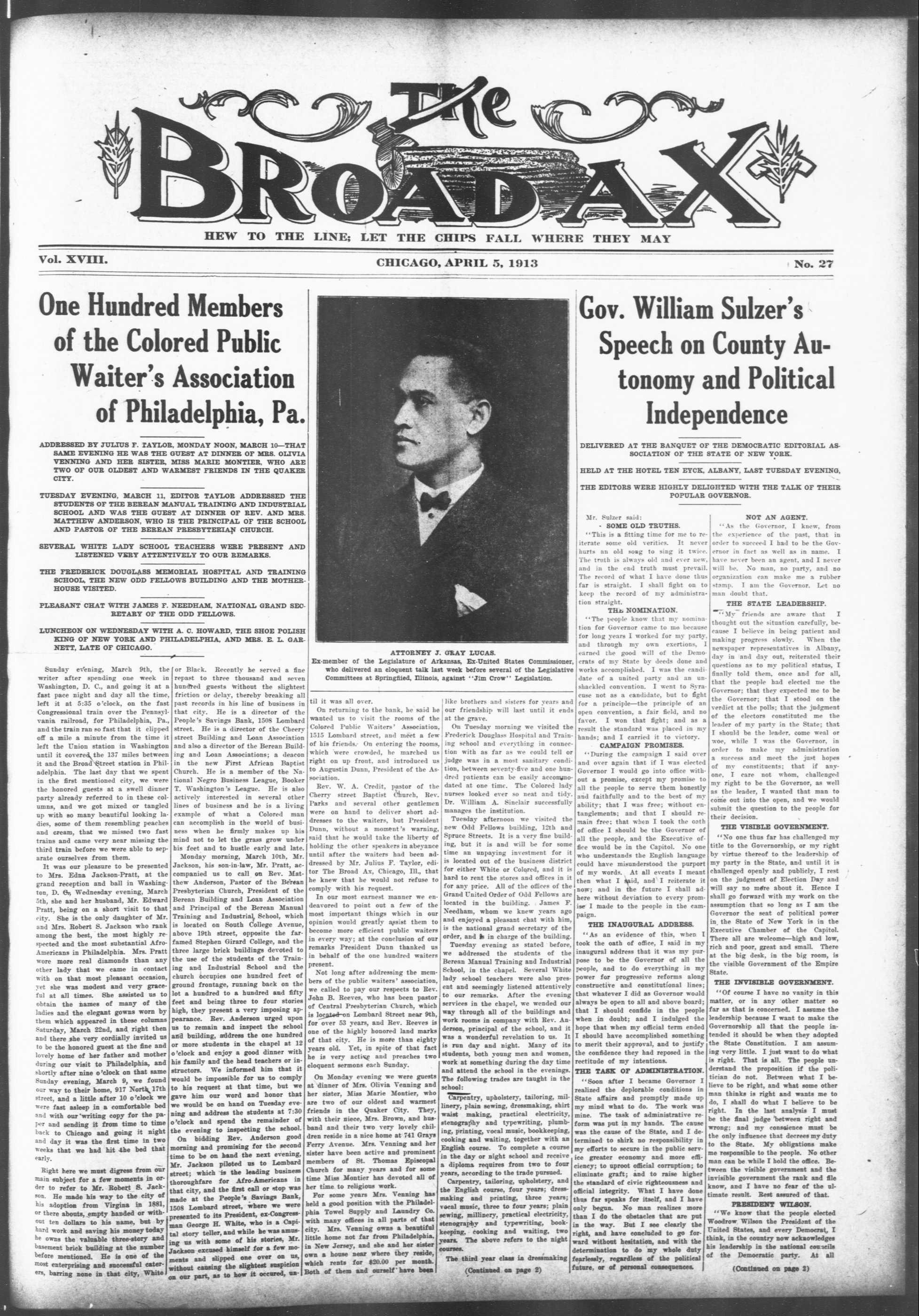
One Hundred Members of the Colored Public Waiter's Association of Philadelphia, Pa.
ADDRESSSED BY JULIUS F. TAYLOR, MONDAY NOON, MARCH 10—THAT SAME EVENING HE WAS THE GUEST AT DINNER OF MRS. OLIVIA VENNING AND HER SISTER, MISS MARIE MONTIER, WHO ARE TWO OF OUR OLDEST AND WARMEST FRIENDS IN THE QUAKER CITY.
TUESDAY EVENING, MARCH 11, EDITOR TAYLOR ADDRESSED THE STUDENTS OF THE BEREAN MANUAL TRAINING AND INDUSTRIAL SCHOOL AND WAS THE GUEST AT DINNER OF REV. AND MRS. MATTHEW ANDERSON, WHO IS THE PRINCIPAL OF THE SCHOOL AND PASTOR OF THE BEREAN PRESBYTERIAN CHURCH.
SEVERAL WHITE LADY SCHOOL TEACHERS WERE PRESENT AND LISTENED VERY ATTENTIVELY TO OUR REMARKS.
THE PREDERICK DOUGLASS MEMORIAL HOSPITAL AND TRAINING SCHOOL, THE NEW ODD FELLOWS BUILDING AND THE MOTHER-HOUSE VISITED.
PLEASANT CHAT WITH JAMES F. NEEDHAM, NATIONAL GRAND SECRETARY OF THE ODD FELLOWS.
LUNCHEON ON WEDNESDAY WITH A. C. HOWARD, THE SHOE POLISH KING OF NEW YORK AND PHILADELPHIA, AND MRS. E. L. GARNETT. LATE OF CHICAGO.
Vol. XVIII.
One Hundred
of the Color
Waiter's
of Phil
ADDRESSED BY JULIUS F. TAYLOR
SAME EVENING HE WAS THE
VENNING AND HER SISTER,
TWO OF OUR OLDEST AND W
CITY.
TUESDAY EVENING, MARCH 11,
STUDENTS OF THE BEREAN M
SCHOOL AND WAS THE GUEE
MATTHEW ANDERSON, WHO I
AND PASTOR OF THE BEREAN
SEVERAL WHITE LADY SCHOOL
LISTENED VERY ATTENT
THE FREDERICK DOUGLASS MEN
SCHOOL, THE NEW ODD FELLO
HOUSE VISITED.
PLEASANT CHAT WITH JAMES F.
RETABY OF THE
LUNCHEON ON WEDNESDAY WITH
KING OF NEW YORK AND PH
NETT, LATE OF CHICAGO.
Sunday evening, March 9th, the writer after spending one week in Washington, D. C., and going it at a fast pace night and day all the time, left it at 5:35 o'clock, on the fast Congressional train over the Pennsylvania railroad, for Philadelphia, Pa., and the train ran so fast that it clipped off a mile a minute from the time it left the Union station in Washington until it covered the 137 miles between it and the Broad Street station in Philadelphia. The last day that we spent in the first mentioned city, we were the honored guests at a swell dinner party already referred to in these columns, and we got mixed or tangled up with so many beautiful looking ladies, some of them resembling peaches and cream, that we missed two fast trains and came very near missing the third train before we were able to separate ourselves from them.
It was our pleasure to be presented to Mrs. Edna Jackson-Pratt, at the grand reception and ball in Washington, D. G., Wednesday evening, March 5th, she and her husband, Mr. Edward Pratt, being on a short visit to that city. She is the only daughter of Mr. and Mrs. Robert S. Jackson who rank among the best, the most highly respected and the most substantial Afro-Americans in Philadelphia. Mrs. Pratt wore more real diamonds than any other lady that we came in contact with on that most pleasant occasion, yet she was modest and very graceful at all times. She assisted us to obtain the names of many of the ladies and the elegant gowns worn by them which appeared in these columns Saturday, March 22nd, and right then and there she very cordially invited us to be the honored guest at the fine and lovely home of her father and mother during our visit to Philadelphia, and shortly after nine o'clock on that same Sunday evening, March 9, we found our way to their home, 917 North 17th street, and a little after 10 o'clock we were fast asleep in a comfortable bed and with our writing copy for the paper and sending it from time to time back to Chicago and going it night and day it was the first time in two weeks that we had hit the bed that early.
Right here we must digress from our main subject for a few moments in order to refer to Mr. Robert S. Jackson. He made his way to the city of his adoption from Virginia in 1881, or there abouts, empty handed or without ten dollars to his name, but by hard work and saving his money today he owns the valuable three-story and basement brick building at the number before mentioned. He is one of the most enterprising and successful caterers, barring none in that city. White
HEW TO THE LINE; LET THE CHIPS FALL WHERE THEY MAY
or Black. Recently he served a fine repast to three thousand and seven hundred guests without the slightest friction or delay, thereby breaking all past records in his line of business in that city. He is a director of the People's Savings Bank, 1508 Lombard street. He is a director of the Cheery street Building and Loan Association and also a director of the Berean Building and Loan Associations; a deacon in the new First African Baptist Church. He is a member of the National Negro Business League, Booker T. Washington's League. He is also actively interested in several other lines of business and he is a living example of what a Colored man can accomplish in the world of business when he firmly makes up his mind not to let the grass grow under his feet and to hustle early and late.
Monday morning, March 10th, Mr Jackson, his son-in-law, Mr. Pratt, accoained us to call on Rev. Matt thew Anderson, Pastor of the Berean Presbyterian Church, President of the Berean Building and Loan Association and Principal of the Berean Manual Training and Industrial School, which is located on South College Avenue above 19th street, opposite the far famed Stephen Girard College, and the three large brick buildings devoted to the use of the students of the Training and Industrial School and the church occupies one hundred feet of ground frontage, running back on the lot a hundred to a hundred and fifty feet and being three to four stories high, they present a very imposing appearance. Rev. Anderson urged upon us to remain and inspect the school and building, address the one hundred or more students in the chapel at 12 o'clock and enjoy a good dinner with his family and the head teachers or instructors. We informed him that it would be impossible for us to comply to his request at that time, but we gave him our word and honor that we would be on hand on Tuesday evening and address the students at 7:30 o'clock and spend the remainder of the evening to inspecting the school. On bidding Rev. Anderson good morning and promising for the second time to be on hand the next evening, Mr. Jackson piloted us to Lombard street; which is the leading business thoroughfare for Afro-Americans in that city, and the first call or stop was made at the People's Savings Bank, 1508 Lombard street, where we were presented to its President, ex-Congressman George H. White, who is a Capital story teller, and while he was amusing us with some of his stories, Mr. Jackson excused himself for a few moments and slipped one over on us, without causing the slightest suspicion on our part, as to how it occurred, un-
CHICAGO, APRIL 5. 1913
ATTORNEY J.
Ex-member of the Legislature of Arkansas who delivered an eloquent talk last Committee at Springfield, Illinois.
[Name]
ATTORNEY J. GRAY LUCAS.
Ex-member of the Legislature of Arkansas, Ex-United States Commissioner who delivered an eloquent talk last week before several of the Legislative Committees at Springfield, Illinois, against "Jim Crow" Legislation.
On returning to the bank, he said he wanted us to visit the rooms of the Colored Public Waiters' Association, 1515 Lombard street, and meet a few of his friends. On entering the rooms, which were crowded, he marched us right on up front, and introduced us to Augustin Dunn, President of the Association.
Rev. W. A. Credit, pastor of the Cherry street Baptist Church, Rev. Parks and several other gentlemen were on hand to deliver short addresses to the waiters, but President Dunn, without a moment's warning, said that he would take the liberty of holding the other speakers in abeyance until after the waiters had been addressed by Mr. Julius F. Taylor, editor The Broad Ax, Chicago, Ill., that he knew that he would not refuse to comply with his request.
In our most earnest manner we endeavored to point out a few of the most important things which in our opinion would greatly assist them to become more efficient public waiters in every way; at the conclusion of our remarks President Dunn thanked us in behalf of the one hundred waiters present.
Not long after addressing the members of the public waiters' association we called to pay our respects to Rev John B. Reeves, who has been pastor of Central Presbyterian Church, which is located on Lombard Street near 9th for over 53 years, and Rev. Reeves is one of the highly honored land marks of that city. He is more than eighty years old. Yet, in spite of that fact he is very active and preaches two eloquent sermons each Sunday.
On Monday evening we were guests at dinner of Mrs. Olivia Venning and her sister, Miss Marie Montier, who are two of our oldest and warmest friends in the Quaker City. They, with their niece, Mrs. Brown, and husband and their two very lovely children reside in a nice home at 741 Grays Ferry Avenue. Mrs. Venning and her sister have been active and prominent members of St. Thomas Episcopal Church for many years and for some time Miss Montier has devoted all of her time to religious work.
For some years Mrs. Venning has held a good position with the Philadelphia Towel Supply and Laundry Co. with many offices in all parts of that city. Mrs. Venning owns a beautiful little home not far from Philadelphia, in New Jersey, and she and her sister own a house near where they reside, which rents for $20.00 per month. Both of them and ourselves have been
til it was all over.
N. GRAY LUCAS.
Kansas, Ex-United States Commissioner,
last week before several of the Legislative
against "Jim Crow" Legislation.
like brothers and sisters for years and our friendship will last until it ends at the grave.
On Tuesday morning we visited the Frederick Douglass Hospital and Training school and everything in connection with as far as we could tell or judge was in a most sanitary condition, between seventy-five and one hundred patients can be easily accommodated at one time. The Colored lady nurses looked ever so neat and tidy. Dr. William A. Sinclair successfully manages the institution.
Tuesday afternoon we visited the new Odd Fellows building, 12th and Spruce Streets. It is a very fine building, but it is and will be for some time an unpaying investment for it is located out of the business district for either White or Colored, and it is hard to rent the stores and offices in it for any price. All of the offices of the Grand United Order of Odd Fellows are located in the building. James F. Needham, whom we knew years ago and enjoyed a pleasant chat with him, is the national grand secretary of the order, and in charge of the building.
Tuesday evening as stated before we addressed the students of the Berean Manual Training and Industrial School, in the chapel. Several White lady school teachers were also present and seemingly listened attentively to our remarks. After the evening services in the chapel, we wended our way through all of the buildings and work rooms in company with Rev. Anderson, principal of the school, and it was a wonderful revelation to us. It is run day and night. Many of its students, both young men and women, work at something during the day time and attend the school in the evenings. The following trades are taught in the school:
Carpentry, upholstery, tailoring, millinery, plain sewing, dressmaking, shirt waist making, practical electricity, stenography and typewriting, plumbing, printing, vocal music, bookkeeping, cooking and waiting, together with an English course. To complete a course in the day or night school and receive a diploma requires from two to four years, according to the trade pursued.
Carpentry, tailoring, upholstery, and the English course, four years; dressmaking and printing, three years; vocal music, three to four years; plain sewing, millinery, practical electricity, stenography and typewriting, bookkeeping, cooking and waiting, two years. The above refers to the night courses.
The third year class in dressmaking
(Continued on page 2)
Gov. William Sulzer's Speech on County Autonomy and Political Independence
DELIVERED AT THE BANQUET OF THE DEMOCRATIC EDITORIAL ASSOCIATION OF THE STATE OF NEW YORK.
HELD AT THE HOTEL TEN EYCK, ALBANY, LAST TUESDAY EVENING,
THE EDITORS WERE HIGHLY DELIGHTED WITH THE TALK OF THEIR POPULAR GOVERNOR.
Mr. Sulzer said:
- SOME OLD TRUTHS.
“This is a fitting time for me to reiterate some old verities. It never hurts an old song to sing it twice. The truth is always old and ever new, and in the end truth must prevail. The record of what I have done thus far is straight. I shall fight on to keep the record of my administration straight.
NOT AN AGENT.
“As the Governor, I knew, from the experience of the past, that in order to succeed I had to be the Governor in fact as well as in name. I have never been an agent, and I never will be. No man, no party, and no organization can make me a rubber stamp. I am the Governor. Let no man doubt that.
THE STATE LEADERSHIP
THE NOMINATION.
"The people know that my nomination for Governor came to me because for long years I worked for my party and through my own exertions, I earned the good will of the Democrats of my State by deeds done and works accomplished. I was the candidate of a united party and an unshackled convention. I went to Syracuse not as a candidate, but to fight for a principle—the principle of an open convention, a fair field, and no favor. I won that fight; and as a result the standard was placed in my hands; and I carried it to victory.
CAMPAIGN PROMISES.
"During the campaign I said over and over again that if I was elected Governor I would go into office with out a promise, except my promise to all the people to serve them honestly and faithfully and to the best of my ability; that I was free; without entanglements; and that I should remain free; that when I took the oath of office I should be the Governor of all the people, and the Executive office would be in the Capitol. No one who understands the English language could have misunderstood the purport of my words. At all events I meant then what I said, and I reiterate it now; and in the future I shall adhere without deviation to every promise I made to the people in the campaign.
THE INAUGURAL ADDRESS
“As an evidence of this, when I took the oath of office, I said in my inaugural address that it was my purpose to be the Governor of all the people, and to do everything in my power for progressive reforms along constructive and constitutional lines; that whatever I did as Governor would always be open to all and above board; that I should confide in the people when in doubt; and I indulged the hope that when my official term ended I should have accomplished something to merit their approval, and to justify the confidence they had reposed in the rectitude of my intentions.
THE TASK OF ADMINISTRATION
"Soon after I became Governor I realized the deplorable conditions in State affairs and promptly made up my mind what to do. The work was mine. The task of administrative reform was put in my hands. The cause was the cause of the State, and I determined to shirk no responsibility in my efforts to secure in the public service greater economy and more efficiency; to uproot official corruption; to eliminate graft; and to raise higher the standard of civic righteousness and official integrity. What I have done thus far speaks for itself, and I have only begun. No man realizes more than I do the obstacles that are put in the way. But I see clearly the right, and have concluded to go forward without hesitation, and with the determination to do my whole duty fearlessly, regardless of the political future, or of personal consequences.
In Sulzer's
County Au-
and Political
Dependence
OF THE DEMOCRATIC EDITORIAL AS-
STATE OF NEW YORK.
ALBANY, LAST TUESDAY EVENING,
LIGHTED WITH THE TALK OF THEIR
GOVERNOR.
NOT AN AGENT.
"As the Governor, I knew, from the experience of the past, that in order to succeed I had to be the Governor in fact as well as in name. I have never been an agent, and I never will be. No man, no party, and no organization can make me a rubber stamp. I am the Governor. Let no man doubt that.
THE STATE LEADERSHIP.
My friends are aware that I thought out the situation carefully, because I believe in being patient and making progress slowly. When the newspaper representatives in Albany, day in and day out, reiterated their questions as to my political status, I finally told them, once and for all, that the people had elected me the Governor; that they expected me to be the Governor; that I stood on the verdict at the polls; that the judgment of the electors constituted me the leader of my party in the State; that I should be the leader, come weal or woe, while I was the Governor, in order to make my administration a success and meet the just hopes of my constituents; that if anyone, I care not whom, challenged my right to be the Governor, as well as the leader, I wanted that man to come out into the open, and we would submit the question to the people for their decision.
THE VISIBLE GOVERNMENT.
"No one thus far has challenged my title to the Governorship, or my right by virtue thereof to the leadership of my party in the State, and until it is challenged openly and publicly, I rest on the judgment of Election Day and will say no more about it. Hence I shall go forward with my work on the assumption that so long as I am the Governor the seat of political power in the State of New York is in the Executive Chamber of the Capitol. There all are welcome—high and low, rich and poor, great and small. There at the big desk, in the big room, is the visible Government of the Empire State.
THE INVISIBLE GOVERNMENT.
"Of course I have no vanity in this matter, or in any other matter so far as that is concerned. I assume the leadership because I want to make the Governorship all that the people intended it should be when they adopted the State Constitution. I am assuming very little. I just want to do what is right. That is all. The people understand the proposition if the politician do not. Between what I believe to be right, and what some other man thinks is right and wants me to do, I shall do what I believe to be right. In the last analysis I must be the final judge between right and wrong; and my conscience must be the only influence that decrees my duty to the State. My obligations make me responsible to the people. No other man can be while I hold the office. Between the visible government and the invisible government the rank and file know, and I have no fear of the ultimate result. Best assured of that.
PRESIDENT WILSON.
"We know that the people elected Woodrow Wilson the President of the United States, and every Democrat, I think, in the country now acknowledges his leadership in the national councils of the Democratic party. At all (Continued on page 2)
THE BROAD AX
PUBLISHED WEEKLY.
Will promulgate and at all times uphold the true principles of Democracy, but Cathelicia, Prestigians, Priests, Infidels, Single Taxes, Republicans, or anyone else can have their say, as long on their language is proper and responsibility is fixed.
The Broad Ax is a newspaper whose platform is broad enough for all, even claiming the editorial right to speak its own mind.
Local communications will receive attention. Write only on one side of the paper.
Subscriptions must be paid in advance. Oversee the publication. Six Months ..... 1.00
Advertising rates made known on application.
Address all communications to
THE BROAD AX
5227 ARMOUR AVENUE. CHICAGO. ILL.
JULIUS F. TAYLOR, Editor and Publisher
Entered as Second-Class Matter Aug. 19, Illinois, Chicago, Illinois, under Ack of March 8, 1979. Under Ack of March 8, 1979.
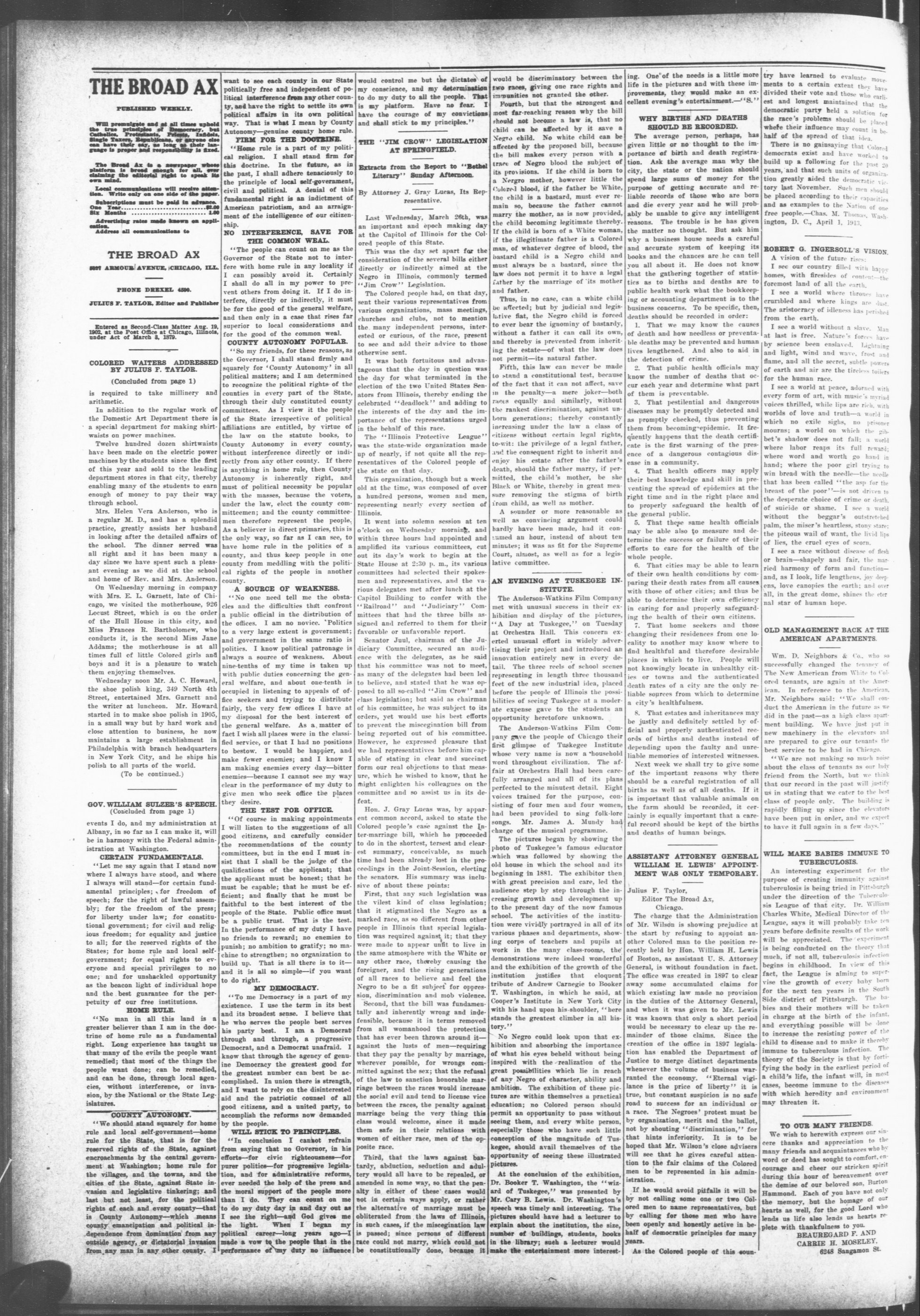
COLORED WAITERS ADDRESSED
BY JULIUS F. TAYLOR.
(Concluded from page 1)
is required to take millinery and arithmetic. In addition to the regular work of the Domestic Art Department there is a special department for making shirtwaists on power machines. Twelve hundred dozen shirtwaists have been made on the electric power machines by the students since the first of this year and sold to the leading department stores in that city, thereby enabling many of the students to earn enough of money to pay their way through school.
Mrs. Helen Vera Anderson, who is a regular M. D., and has a splendid practice, greatly assists her husband in looking after the detailed affairs of the school. The dinner served was all right and it has been many a day since we have spent such a pleasant evening as we did at the school and home of Rev. and Mrs. Anderson. On Wednesday morning in company with Mrs. E. L. Garnett, late of Chicago, we visited the motherhouse, 926 Locust Street, which is on the order of the Hull House in this city, and Miss Frances R. Bartholomew, who conducts it, is the second Miss Jane Addams; the motherhouse is at all times full of little Colored girls and boys and it is a pleasure to watch them enjoying themselves.
Wednesday noon Mr. A. C. Howard, the shoe polish king, 349 North 4th Street, entertained Mrs. Garnett and the writer at luncheon. Mr. Howard started in to make shoe polish in 1905, in a small way but by hard work and close attention to business, he now maintains a large establishment in Philadelphia with branch headquarters in New York City, and he ships his polish to all parts of the world.
GOV. WILLIAM SULZER'S SPEECH
(Concluded from page 1)
events I do, and my administration at Albany, in so far as I can make it, will be in harmony with the Federal administration at Washington.
CERTAIN FUNDAMENTALS
"Let me say again that I stand now where I always have stood, and where I always will stand—for certain fundamental principles; for freedom of speech; for the right of lawful assembly; for the freedom of the press; for liberty under law; for constitutional government; for civil and religious freedom; for equality and justice to all; for the reserved rights of the States; for home rule and local self-government; for equal rights to everyone and special privileges to no one; and for unshackled opportunity as the beacon light of individual hope and the best guarantee for the perpetuity of our free institutions.
HOME RULE.
"No man in all this land is a greater believer than I am in the doctrine of home rule as a fundamental right. Long experience has taught us that many of the evils the people want remedied; that most of the things the people want done; can be remedied, and can be done, through local agencies, without interference, or invasion, by the National or the State Legislatures.
COUNTY AUTONOMY.
"We should stand squately for home rule and local self-government—home rule for the State, that is for the reserved rights of the State, against encroachments by the central government at Washington; home rule for the villages, and the towns, and the cities of the State, against State invasion and legislative tinkering; and last but not least, for the political rights of each and every county—that is County Autonomy—which means county emancipation and political independence from domination from any outside agency, or dictatorial invasion from any man in any other county. I
want to see each county in our State politically free and independent of political interference from any other county, and have the right to settle its own political affairs in its own political way. That is what I mean by County Autonomy-genuine county home rule.
FIRM FOR THE DOCTRINE.
FIRM FOR THE DOCTRINE.
"Home rule is a part of my political religion. I shall stand firm for this doctrine. In the future, as in the past, I shall adhere tenaciously to the principle of local self-government, civil and political. A denial of this fundamental right is an indictment of American patriotism, and an arraignment of the intelligence of our citizenship.
NO INTERFERENCE, SAVE FOR
THE COMMON WEAL.
"The people can count on me as the Governor of the State not to interfere with home rule in any locality if I can possibly avoid it. Certainly I shall do all in my power to prevent others from doing it. If I do interfere, directly or indirectly, it must be for the good of the general welfare, and then only in a case that rises far superior to local considerations and for the good of the common weal.
"So my friends, for these reasons, as the Governor, I shall stand firmly and squarely for 'County Autonomy' in all political matters; and I am determined to recognize the political rights of the counties in every part of the State, through their duly constituted county committees. As I view it the people of the State irrespective of political affiliations are entitled, by virtue of the law on the statute books, to County Autonomy in every county, without interference directly or indirectly from any other county. If there is anything in home rule, then County Autonomy is inherently right, and must of political necessity be popular with the masses, because the voters, under the law, elect the county committeemen; and the county committeemen therefore represent the people. As a believer in direct primaries, this is the only way, so far as I can see, to have home rule in the politics of a county, and thus keep people in one county from meddling with the political rights of the people in another county.
A SOURCE OF WEAKNESS.
A SOURCE OF WEAKNESS.
"No one need tell me the obstacles and the difficulties that confront a public official in the distribution of the offices. I am no novice. 'Politics to a very large extent is government; and government in the same ratio is politics. I know political patronage is always a source of weakness. About nine-tenths of my time is taken up with public duties concerning the general welfare, and about one-tenth is occupied in listening to appeals of office seekers and trying to distribute fairly, the very few offices I have at my disposal for the best interest of the general welfare. As a matter of fact I wish all places were in the classified service, or that I had no positions to bestow. I would be happier, and make fewer enemies; and I know I am making enemies every day—bitter enemies—because I cannot see my way clear in the performance of my duty to give men who seek office the places they desire.
THE TEST FOR OFFICE
"Of course in making appointments I will listen to the suggestions of all good citizens, and carefully consider the recommendations of the county committees, but in the end I must insist that I shall be the judge of the qualifications of the applicant; that the applicant must be honest; that he must be capable; that he must be efficient; and finally that he must be faithful to the best interest of the people of the State. Public office must be a public trust. That is the test. In the performance of my duty I have no friends to reward; no enemies to punish; no ambition to gratify; no machine to strengthen; no organization to build up. That is all there is to it—and it is all so simple—if you want to do right.
MY DEMOCRACY.
"To me Democracy is a part of my existence. I use the term in its best and its broadest sense. I believe that he who serves the people best serves his party best. I am a Democrat through and through, a progressive Democrat, and a Democrat unafraid. I know that through the agency of genuine Democracy the greatest good for the greatest number can best be accomplished. In union there is strength, and I want to rely on the disinterested aid and the patriotic counsel of all good citizens, and a united party, to accomplish the reforms now demanded by the people.
WILL STICK TO PRINCIPLES
WILL STICK TO PRINCIPLES.
"In conclusion I cannot refrain from saying that no Governor, in his efforts—for civic righteousness—for purer politics—for progressive legislation, and for administrative reforms, ever needed the help of the press and the moral support of the people more than I do. They can count on me to do my duty day in and day out as I see the right—and God gives me the light. When I began my political career—long years ago—I made a vow to the people that in the performance of my duty no influence
would control me but the dictates of my conscience, and my determination to do my duty to all the people. That is my platform. Have no fear. I have the courage of my convictions and shall stick to my principles."
THE "JIM CROW" LEGISLATION
AT SPRINGFIELD.
Extracts from the Report to "Bethel Literary" Sunday Afternoon.
By Attorney J. Gray Lucas, Its Repa
resentative.
Last Wednesday, March 26th, was an important and epoch making day at the Capitol of Illinois for the Colored people of this State.
This was the day set apart for the consideration of the several bills either directly or indirectly aimed at the Negro in Illinois, commonly termed "Jim Crow" Legislation.
The Colored people had, on that day, sent their various representatives from various organizations, mass meetings, churches and clubs, not to mention the many independent persons, interested or curious, of the race, present to see and add their advice to those otherwise sent.
It was both fortuitous and advantageous that the day in question was the day for what terminated in the election of the two United States Senators from Illinois, thereby ending the celebrated "deadlock" and adding to the interests of the day and the importance of the representations urged in the behalf of this race.
The "Illinois Protective League" was the state-wide organization made up of nearly, if not quite all the representatives of the Colored people of the state on that day.
This organization, though but a week old at the time, was composed of over a hundred persons, women and men, representing nearly every section of Illinois.
It went into solemn session at ten o'clock on Wednesday morning, and within three hours had appointed and amplified its various committees, cut out its day's work to begin at the State House at 2:30 p. m., its various committees had selected their spokesmen and representatives, and the various delegates met after lunch at the Capitol Building to confer with the "Railroad" and "Judiciary" Committees that had the three bills assigned and referred to them for their favorable or unfavorable report.
Senator Juul, chairman of the Judiciary Committee, secured an audience with the delegates, as he said that his committee was not to meet, as many of the delegates had been led to believe, and stated that he was opposed to all so-called "Jim Crow" and class legislation; but said as chairman of his committee, he was subject to its orders, yet would use his best efforts to prevent the miscegination bill from being reported out of his committee. However, he expressed pleasure that we had representatives before him capable of stating in clear and succeed form our real objections to that measure, which he wished to know, that he might enlighten his colleagues on the committee and so assist us in its defeat.
Hon. J. Gray Lucas was, by apparent common accord, asked to state the Colored people's case against the Inter-marriage bill, which he proceeded to do in the shortest, tersest and clearest summary, conceivable, as much time had been already lost in the proceedings in the Joint-Session, electing the senators. His summary was inclusive of about these points:
First, that any such legislation was the vilest kind of class legislation; that it stigmatized the Negro as a marked race, as so different from other people in Illinois that special legislation was required against it; that they were made to appear unfit to live in the same atmosphere with the White or any other race, the weby causing the foreigner, and the rising generations of all races to believe and feel the Negro to be a fit subject for oppression, discrimination and mob violence. Second, that the bill was fundamentally and inherently wrong and indefensible, because it in terms removed from all womanhood the protection that has ever been thrown around it—against the lusts of men—requiring that they pay the penalty by marriage, wherever possible, for wrongs committed against the sex; that the refusal of the law to sanction honorable marriage between the races would increase the social evil and tend to license vice between the races, the penalty against marriage being the very thing this class would welcome, since it made them safe in their relations with women of either race, men of the opposite race.
Third, that the laws against bastardy, abduction, seduction and adultery would all have to be repealed, or amended in some way, so that the penalty in either of these cases would not in certain ways apply, or rather the alternative of marriage must be obliterated from the laws of Illinois, in such cases, if the misegination law is passed; since persons of different race could not marry, which could not be constitutionally done, because it
would be discriminatory between the two races, giving one race rights and immunities not granted the other. Fourth, but that the strongest and most far-reaching reason why the bill should not become a law is, that no child can be affected by it save a Negro child. No white child can be affected by the proposed bill, because the bill makes every person with a trace of Negro blood the subject of its provisions. If the child is born to a Negro mother, however little the Colored blood, if the father be White, the child is a bastard, must ever remain so, because the father cannot marry the mother, as is now provided, the child becoming legitimate thereby. If the child is born of a White woman, if the illegitimate father is a Colored man, of whatever degree of blood, the bastard child is a Negro child and must always be a bastard, since the law does not permit it to have a legal father by the marriage of its mother and father.
Thus, in no case, can a white child be affected; but by judicial and legislative flat, the Negro child is forced to ever bear the ignominy of bastardy, without a father it can call its own, and thereby is prevented from inheriting the estate—of what the law does not permit—its natural father.
Fifth, this law can never be made to stand a constitutional test, because of the fact that it can not affect, save in the penalty—a mere joker—both races equally and similarly, without the rankest discrimination, against unborn generations; thereby constantly increasing under the law a class of citizens without certain legal rights, to-wit: the privilege of a legal father, and the consequent right to inherit and enjoy his estate after the father's death, should the father marry, if permitted, the child's mother, be she Black or White, thereby in great measure removing the stigma of birth from child, as well as mother.
A sounder or more reasonable as well as convining argument could hardly have been made, had it consumed an hour, instead of about ten minutes; it was as fit for the Supreme Court, almost, as well as for a legislative committee.
AN EVENING AT TUSKEGEE IN
STITUTE.
The Anderson-Watkins Film Company met with unusual success in their exhibition and display of the pictures, "A Day at Tuskegee," on Tuesday at Orchestra Hall. This concern exerted unusual effort in widely advertising their project and introduced an innovation entirely new in every detail. The three reels of school scenes representing in length three thousand feet of the new industrial idea, placed before the people of Illinois the possibilities of seeing Tuskegee at a moderate expense gave to the students an opportunity heretofore unknown.
The Anderson-Watkins Film Company gave the people of Chicago their first glimpse of Tuskegee Institute whose very name is now a "household word throughout civilization. The affair at Orchestra Hall had been carefully arranged and all of its plans perfected to the minutest detail. Eight voices trained for the purpose, consisting of four men and four women, had been provided to sing folk-lore songs. Mr. James A. Mundy had charge of the musical programme.
The pictures began by showing the photo of Tuskegee's famous educator which was followed by showing the old house in which the school and its beginning in 1881. The exhibitor then with great precision and care, led the audience step by step through the increasing growth and development up to the present day of the now famous school. The activities of the institution were vividly portrayed in all of its various phases and departments, showing corps of teachers and pupils at work in the many class-rooms, the demonstrations were indeed wonderful and the exhibition of the growth of the institution justifies that eloquent tribute of Andrew Carnegie to Booker T. Washington, in which he said, at Cooper's Institute in New York City with his hand upon his shoulder, "here stands the greatest climber in all history."
No Negro could look upon that exhibition and absorbing the importance of what his eyes beheld without being inspired with the realization of the great possibilities which lie in reach of any Negro of character, ability and ambition. The exhibition of these pictures are within themselves a practical education; no Colored person should permit an opportunity to pass without seeing them, and every white person, especially those who have such little conception of the magnitude of Tuskegee, should avail themselves of the opportunity of seeing these illustrated pictures.
At the conclusion of the exhibition, Dr. Booker T. Washington, the "wizard of Tuskegee," was presented by Mr. Cary B. Lewis. Dr. Washington's speech was timely and interesting. The pictures should have had a lecturer to explain about the institution, the size, number of buildings, students, books in the library; such a lecturer would make the entertainment more interest-
ing. One of the needs is a little more life in the pictures and with these improvements, they would make an excellent evening's entertainment.—"S."
WHY BIRTHS AND DEATHS
SHOULD BE RECORDED.
The average person, perhaps, has given little or no thought to the importance of birth and death registration. Ask the average man why the city, the state or the nation should spend large sums of money for the purpose of getting accurate and reliable records of those who are born and die every year and he will probably be unable to give any intelligent reasons. The trouble is he has given the matter no thought. But ask him why a business house needs a careful and accurate system of keeping its books and the chances are he can tell you all about it. He does not know that the gathering together of statistics as to births and deaths are to public health work what the bookkeeping or accounting department is to the business concerns. To be specific, then, deaths should be recorded in order:
1. That we may know the causes of death and how needless or preventable deaths may be prevented and human lives lengthened. And also to aid in the detection of crime.
2. That public health officials may know the number of deaths that occur each year and determine what part of them is preventable.
3. That pestilential and dangerous diseases may be promptly detected and as promptly checked, thus preventing them from becoming-epidemic. It frequently happens that the death certificate is the first warning of the presence of a dangerous contagious disease in a community.
4. That health officers may apply their best knowledge and skill in preventing the spread of epidemies at the right time and in the right place and to properly safeguard the health of the general public.
5. That these same health officials may be able also to measure and determine the success or failure of their efforts to care for the health of the whole people.
6. That cities may be able to learn of their own health conditions by comparing their death rates from all causes with those of other cities; and thus be able to determine their own efficiency in caring for and properly safeguarding the health of their own citizens.
7. That home seekers and those changing their residences from one locality to another may know where to find healthful and therefore desirable places in which to live. People will not knowingly locate in unhealthy cities or towns and the authenticated death rates of a city are the only reliable supresses from which to determine a city's healthfulness.
8. That estates and inheritances may be justly and definitely settled by official and properly authenticated records of births and deaths instead of depending upon the faulty and unreliable memories of interested witnesses. Next week we shall try to give some of the important reasons why there should be a careful registration of all births as well as of all deaths. If it is important that valuable animals on the farm should be recorded, it certainly is equally important that a careful record should be kept of the births and deaths of human beings.
ASSISTANT ATTORNEY GENERAL
WILLIAM H. LEWIS' APPOINTMENT WAS ONLY TEMPORARY.
Julius F. Taylor.
The charge that the Administration of Mr. Wilson is showing prejudice at the start by refusing to appoint another Colored man to the position recently held by Hon. William H. Lewis of Boston, as assistant U. S. Attorney General, is without foundation in fact. The office was created in 1897 to clear away some accumulated claims for which existing law made no provision in the duties of the Attorney General, and when it was given to Mr. Lewis it was known that only a short period would be necessary to clear up the remainder of those claims. Since the creation of the office in 1897 legislation has enabled the Department of Justice to merge distinct departments whenever the volume of business warranted the economy. "Eternal vigilance is the price of liberty" it is true, but constant suspicion is no safe road to success for an individual or a race. The Negroes' protest must be by organization, merit and the ballot, not by shouting "discrimination," for that hints inferiority. It is to be hoped that Mr. Wilson's close advisers will see that he gives careful attention to the fair claims of the Colored men to be represented in his administration.
If he would avoid piffalls it will be by not calling some one or two Colored men to name representatives, but by calling for those men who have been openly and honestly active in behalf of democratic principles for many years.
As the Colored people of this coun-
try have learned to evaluate movements to a certain extent they have divided their vote and those who earliest and longest maintained that the democratic party held a solution for the race's problems should be placed where their influence may count in behalf of the spread of that idea.
There is no gainsaying that Colored democrats exist and have worked to build up a following for the past 20 years, and that such units of organization greatly aided the democratic victory last November. Such men should be placed according to their capacities and as examples to the Nation of one free people.—Chas. M. Thomas, Washington, D. C., April 1, 1913
ROBERT G. INGERSOLL'S VISION
A vision of the future rises:
I see our country filled with happy homes, with firesides of content—the foremost land of all the earth.
I see a world where thrones have crumbled and where kings are dust. The aristocracy of idleness has perished from the earth.
I see a world without a slave. Man at last is free. Nature's forces have by science been enslaved. Lightning and light, wind and wave, frost and flame, and all the secret, subtle powers of earth and air are the tireless toilers for the human race.
I see a world at peace, adorned with every form of art, with music's myriad voices thrilled, while lips are rich, with worlds of love and truth—a world in which no exile sighs, no prisoner mourns; a world on which the gibbet's shadow does not fall; a world where labor reaps its full reward; where word and worth go hand in hand; where the poor girl trying to win bread with the needle—the needle that has been called "the usp for the breast of the poor"—is not driven to the desperate choice of crime or death, of suicide or shame. I see a world without the beggar's outstretched palm, the miser's heartless, stony stare; the piteous wail of want, the livid lips of lies, the cruel eyes of scorn.
I see a race without disease of flesh or brain—shapely and fair, the married harmony of form and function—and, as I look, life lengthens, joy deepens, love canopies the earth; and over all, in the great dome, shines the eternal star of human hope.
OLD MANAGEMENT BACK AT THE AMERICAN APARTMENTS.
Wm. D. Neighbors & Co., who so successfully changed the tenancy of The New American from White to Colored tenants, are again at the American. In reference to the American, Mr. Neighbors said: "We shall conduct the American in the future as we did in the past—as a high class apartment building. We have just put in new machinery in the elevators and are prepared to give our tenants the best service to be had in Chicago.
"We are not making so much noise about the class of tenants as our lady friend from the North, but we think that our record in the past will justify us in stating that we cater to the best class of people only. The building is rapidly filling up since the elevators have been put in order, and we expect to have it full again in a few days."
WILL MAKE BABIES IMMUNE TO
TUBERCULOSIS.
An interesting experiment for the purpose of creating immunity against tuberculosis is being tried in Pittsburgh under the direction of the Tuberculosis League of that city. Dr. William Charles White, Medical Director of the League, says it will probably take ten years before definite results of the work will be appreciated. The experiment is being conducted on the theory that much, if not all, tuberculosis infection begins in childhood. In view of this fact, the League is alming to supervise the growth of every baby born for the next ten years in the South Side district of Pittsburgh. The babies and their mothers will be taken in charge at the birth of the infant, and everything possible will be done to increase the resisting power of the child to disease and to make it thereby immune to tuberculous infection. The theory of the Society is that by fortifying the body in the earliest period of a child's life, the infant will, in most cases, become immune to the diseases with which heredity and environment may threaten it.
TO OUR MANY FRIENDS
We wish to herewith express our sincere thanks and appreciation to the many friends and acquaintances who by word or deed has sought to comfort, encourage and cheer our stricken spirit during this hour of bereavement over the demise of our beloved son, Burton Hammond. Each of you have not only the memory, but the homage of our hearts as well, for the good Lord who lends us life also lends us hearts replete with thankfulness to you.
BEAUREGARD F. AND
CARRIE H. MOSELEY,
6248 Sangamon St.
VIOLIN RECITAL
Stocks and Bonds for Sale. Best Investments. Come Here to get that Loan You Need. Visit Our Real Estate Department for Positively the Best Bargains on the South Side. Fire, Plate Glass, Automobile I N S U R A N C E
Wm. D. Neighbors, Cashier
S. E. Cor. 31st and State Sts.: Bank Floor
Phones: Douglas 31 Automatic 74-259
EXTRACT FROM THE LECTURE RECENTLY DELIVERED BY C. L. AGNEW ON THE NEGRO AS A SOLDIER.
It has been said that the Negro is lacking in courage. If you believe that this is true I invite you to go to Hayti and look upon the graves of the fifty thousand Negro slave soldiers who bravely died fighting for their liberty.
Visit the mausoleum of France, go to San Juan Hill, then come home and you will find the soil of America has been wet with courageous Negro blood. In 1802 Napoleon attempted to reenslave the Negro of Hayti but the Negro stood by his guns and though the earth was red with the blood of fifty thousand, instead of being reenslaved the Negro set up a republic of their own and that republic stands today. Proud mistress of the seas and a Negro as its president. Napoleon first sent thirty thousand troops to Hayti under the command of Leclerc who married his sister Pauline. Leclerc sent word to Christophe, the Negro general, that he was about to land at Cape City. Christophe replied "Tousaient is governor of this island. I will send to him for permission, if without a French soldier sets foot on the shore I will burn the town and fight over its ashes." He did, but before he begun he led one thousand white men, women and children up into the mountains to safety. The battle was fought and the French went flying back to their boats. Napoleon then sent over thirty thousand more soldiers and the Negroes annihilated them. Finally Rochambeau in command of eight thousand French troops sent this word to Dessaline, another Negro general, "When I take you I will not shoot you like a soldier or hang you like a white man, I will whip you to death like a slave." And as a matter of course Dessaline, being a Negro, run, but the other fellow was in front. He chased him all over the island and finally hemed him up in Samana. Rochambeau begged an English Admiral to take him and his soldiers home under the protection of the British Flag.
A TUBERCULOSIS SANITORIUM AS
A HEALTH RESORT
There are good reasons to consider a well regulated sanatorium or a tuberculosis resort a much safer place of residence for healthy people than the average city, says the Saranac Lake Society for the Control of Tuberculosis in a recent publication. New cases of tuberculosis, according to statistics, seem to develop less often among the residential population of health resorts, such as Saranac Lake, than in ordinary towns of the same size. Some of the reasons which may be assigned for this slight danger of infection are: (1) Because the majority of tuberculosis patients in a resort take precautions often neglected at home. (2) Because the patients are for the most part out of doors where
they cannot so easily convey infection. (3) Because the breath of the consumptive does not contain germs. (4) Because persons in normal health, when living under favorable climatic conditions, have a strong natural resistance to tuberculosis.
DANCE FOR THE BENEFIT OF CHARITY.
Monday evening, April 7, the Phyllis Wheatly Home for Colored girls, 3530 Forest Avenue, under the management of some of its most active members, will give a "Charity Benefit" Ball at Masonic Hall, 3956 S. State Street. Committee—Mesdames E. Johnson, E. L. Davis, A. Foster, M. Adams, R. Taylor, Luella Young, E. August, B. Walters, A. Slaughter, B.-Wilson, T. A. Wheatley, Mary F. Waring, Chairman, Music by Garfield Wilson's Orchestra. Admission 35 cents.
Wednesday, J. J. Kaizer, 5041 Armour Avenue, after a long illness, gently closed his eyes in death. He was an honored member of the Grand Army of the Republic and his bosom friend, Daniel Clifford, and other members of his post held their services last evening at the house over his body. The regular funeral services will be held this morning at 9 o'clock, at St. Ann's Church, Wentworth avenue and Garfield boulevard, Rev. Father Edward A. Kelly officiating. Interment in Mt. Olivet. His good wife, Mrs. Kaizer, and their daughter, Miss Mamie Kaizer, devotedly and patiently administered to his wants and comforts, to the very last. Their many friends greatly sympathize with them over their sad loss.
FLAT FOR RENT.
To Rent.-2424-26 Seminary Ave. 3 and 4 room flats with bath. Excellent location. Convenient to Fullerton Ave. L. Express Station. 20 minutes to loop. Rent. $14 to $16. See Dr. T. H. Wilson. 532 Grant Pl. Phone Lincoln 2483.
A BANK ACCOUNT.
These words sound good.
Call and receive free of charge—no deposit required—a pocket coin saver that registers each coin you insert.
HOME SECURITY SAVING BANK,
3201 Se. State St.
POUR FLAT BRICK BUILDING FOR
SALE AT A BARGAIN.
For sale, four flat brick building, at
a bargain, located on Armour avenue,
near 36th Street. Rent $60 per month.
Price, $4,650.
For further information, call on or
address Julius F. Taylor, 5027 Armour
avenue, Phone Drexel 4590.
This is a good investment and good
income property.
RECITAL
SAVE DIMES
and dollars may save you. Call and receive, free of charge—no deposit required—a pocket saver that registers each coin you insert.
SECURITY SAVING BANK
S101 So. State St.
THE ALPHA SUFFRAGE CLUB
Will Give a Big Entertainment in Honor of Misses Belle Squire, Virginia Brooks and Mrs. Ida Wells-Barnett, Three Heroes of the Suffrage Parade in Washington.
The Alpha Suffrage Club, the only suffrage club among the Colored women in Chicago, will give its first public entertainment at Institutional Church, Monday night, Apr. 14. This club is responsible for Mrs. Barnett going to Washington to represent the race in the great suffrage parade, March 3rd. The club made itself personally responsible for Mrs. Barnett's expenses, and this effort is for the purpose of raising the money to pay back that expense. The Progressive Club of Quinn Chapel is largely co-operating with the suffrage club to make this entertainment a great success. Misses Belle Squire and Virginia Brooks, the two white women who stood so loyally by Mrs. Barnett in her fight for colored representation, will be the chief speakers of the evening, after which a reception will be held downstairs.
There will be music by the Emanciation chorus, under the direction of Mr. James A. Mundy. Among other numbers, they will render Mr. Mundy's composition which was composed in honor of the fiftieth anniversary of freedom, and "Inflammatus." Mrs. Barnett will preside. A rich treat is promised to all and it is expected that the church will be crowded with members of the City Federation of Women's Clubs and other organizations in the city which will be glad of the opportunity to do honor to the noble young women who stood for the right. Everybody invited. Admission, 25 cents. "S."
AN EASY WAY TO SAVE
AN EASY WAY TO SAVE
is to drop your change into one of our
pocket coin savers that registers each
coin you insert. They are yours for
the asking, without making a deposit
or obligating yourself in any way.
HOME SECURITY SAVING BANK,
FOR RENT.
FOR RENT.
For Bent, 4431-33 South State Street,
four (4) room apartments.
4519-23 Evans Avenue, six room
apartments.
3308 Rhodes Avenue, House eight
rooms in perfect condition.
Inquire, Chicago Real Estate Loan
and Trust Company,
117 North Dearborn Street Room 504,
For Rent:
AMERICAN APARTMENT
BUILDING,
2728 Wabash Ave.
Modern, Steam Heated Apartments.
Every room private, leading off from private halls, all light and airy.
Three rooms, bath and cabinet
kitchen ..... $25.00
Three rooms and bath ..... 22.00
Four rooms and bath ..... 28.00
Six rooms and bath ..... 30.00
Seven rooms and bath ..$35.00 & 40.00
Eight rooms and bath .. 42.50 & 50.00
Apply to
WM. D. NEIGHBORS & CO.,
Home Security Bank,
3101 So. State St.
Phones, Douglas 31 Auto. 74259
Childhood.
When he was just a little kid,
He'll frankly now confess,
He would reluctantly obey
His learned governess.
And when, a little later, he
Was sent away to school
He went rejoicing to be free
Forever from her rule.
But now he fears his childish woes
Are coming back once more
And that a most unhappy fate
Is yet for him in store.
So "Down with suffragettes!" he cries
"Let them no more progress!
Hanged if I will again be ruled
By any governess!"
—New York Times.
Tough Luck,
"What's doing?" asked the tall plumber. "You're all dolled up."
"Had a date with my best girl," explained the short bricklayer.
"But aren't you going to keep it?"
"I showed up, all right, but she wasn't there."
"That was pretty tough."
"I wouldn't care," said the short bricklayer. "only I went and had my shoes shined all for nothing"—Youngstown (O.) Telegram.
Monopoly.
Monopoly.
Pore ol' John H. Croesus he
Certainly must envy me—
Me with health and strength and youth,
Wife and chillun, love and truth.
No, I aln't what you'd call rich,
And I'm a worry for all sich.
Makes a feller money lustful,
Cold and cruel and distrustful,
For ol' Croesus my heart melts.
He's got millions, nothin' else.
I'd like for to share with him,
But the chance is mighty slim.
I can't give my joy and health,
And he won't divide his wealth.
—New York Globe.
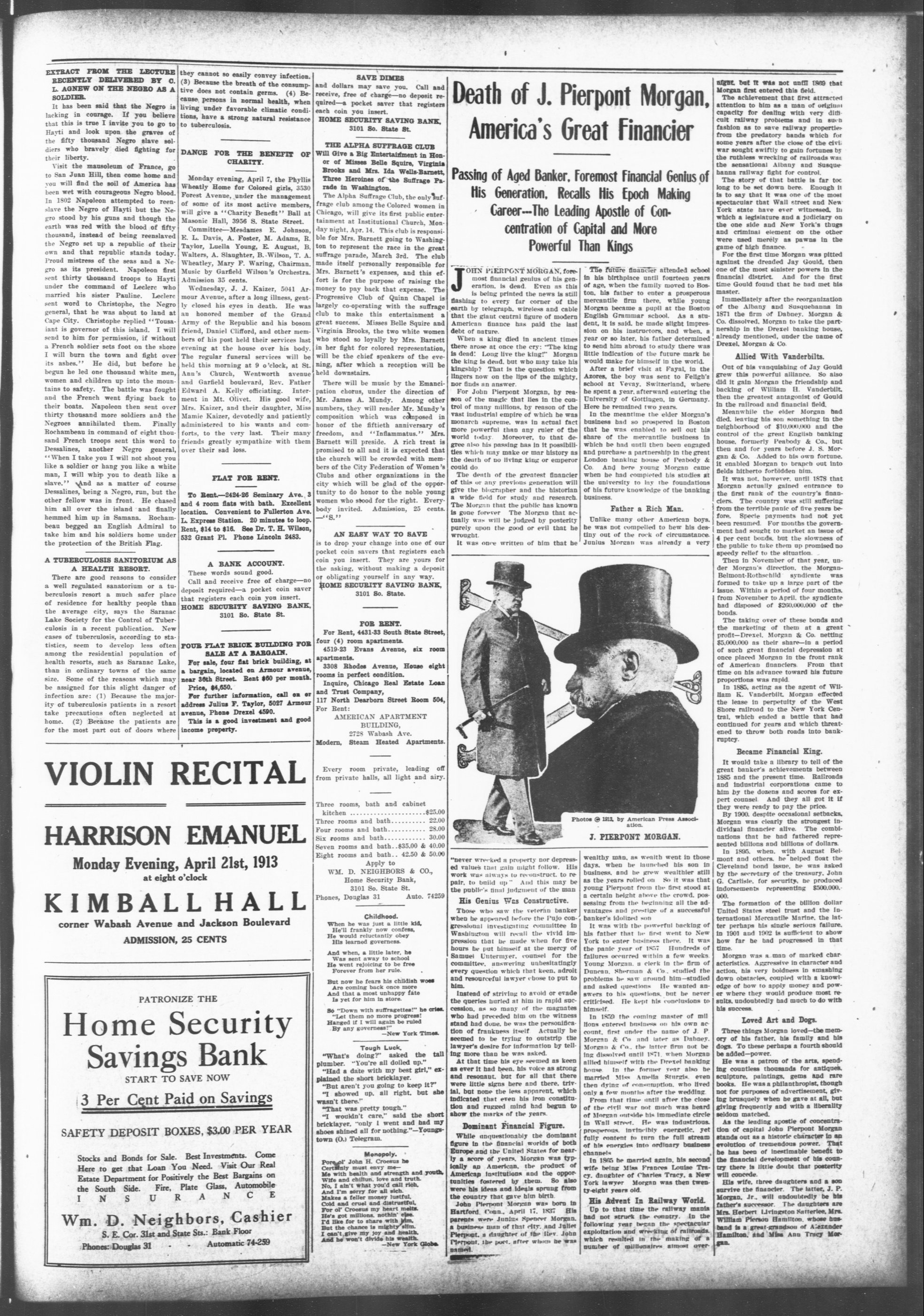
Death of J. Pierpont Morgan, America's Great Financier
Passing of Aged Banker, Foremost Financial Genius of His Generation, Recalls His Epoch Making Career---The Leading Apostle of Concentration of Capital and More Powerful Than Kings
Photos © 1913, by American Press Association.
J. PIERPONT MORGAN.
JOHN PIERPONT MORGAN, foremost financial genius of his generation, is dead. Even as this is being printed the news is still flashing to every far corner of the earth by telegraph, wireless and cable that the giant central figure of modern American finance has paid the last debt of nature.
When a king died in ancient times there arose at once the cry: "The king is dead! Long live the king!" Morgan the king is dead, but who may take his kingship? That is the question which lingers now on the lips of the mighty, nor finds an answer.
For John Pierpont Morgan, by reason of the magic that lies in the control of many millions, by reason of the vast industrial empire of which he was monarch supreme, was in actual fact more powerful than any ruler of the world today. Moreover, to that degree also his passing has in it possibilities which may make or mar history as the death of no living king or emperor could do.
The death of the greatest financier of this or any previous generation will give the biographer and the historian a wide field for study and research. The Morgan that the public has known is gone forever. The Morgan that actually was will be judged by posterity purely upon the good or evil that he wrought.
It was once written of him that he
P
"never wrecked a property nor depressed values that gain might follow. His work was always to reconstruct, to repair, to build up." And this may be the public's final judgment of the man
His Genius Was Constructive.
Those who saw the veteran banker when he appeared before the Pujo congressional investigating committee in Washington will recall the vivid impression that he made when for five hours he put himself at the mercy of Samuel Untermyer, counsel for the committee, answering unhesitatingly every question which that keen, adroit and resourceful lawyer chose to put to him.
Instead of striving to avoid or evade the queries hurled at him in rapid succession, as so many of the magnates who had preceded him on the witness stand had done, he was the personification of frankness itself. Actually he seemed to be trying to outstrip the lawyer's desire for information by telling more than he was asked.
At that time his eye seemed as keen as ever it had been, his voice as strong and resonant, but for all that there were little signs here and there, trivial, but none the less apparent, which indicated that even his iron constitution and rugged mind had begun to show the marks of the years.
Dominant Financial Figure.
While anquestionably the dominant figure in the financial worlds of both Europe and the United States for nearly a score of years, Morgan was typically an American, the product of American institutions and the opportunities fostered by them. So also were his ideas and ideals sprung from the country that gave him birth.
John Plerpont Morgan was born in Hartford, Conn., April 17, 1837. His parents were Junius Spencer Morgan, a business man of that city, and Juliet Plerpont, a daughter of the liev. John Plerpont, the poet, after whom he was named.
The future financier attended school in his birthplace until fourteen years of age, when the family moved to Boston, his father to enter a prosperous mercantile firm there, while young Morgan became a pupil at the Boston English Grammar school. As a student, it is said, he made slight impression on his instructors, and when, a year or so later, his father determined to send him abroad to study there was little indication of the future mark he would make for himself in the world. After a brief visit at Fayal, in the Azores, the boy was sent to Feligh's school at Vevay. Switzerland, where he spent a year, after entering the University of Gottingen, in Germany. Here he remained two years.
In the meantime the elder Morgan's business had so prospered in Boston that he was enabled to sell out his share of the mercantile business in which he had until then been engaged and purchase a partnership in the great London banking house of Peabody & Co. And here young Morgan came when he had completed his studies at the university to lay the foundations of his future knowledge of the banking business.
Father a Rich Man.
Unlike many other American boys, he was not compelled to hew his destiny out of the rock of circumstance. Junius Morgan was already a very
otos @ 1913, by American Press Association.
J. PIERPONT MORGAN.
wealthy man, as wealth went in those days, when he launched his son in business, and he grew wealthier still as the years rolled on. So it was that young Pierpont from the first stood at a certain height above the crowd, possessing from the beginning all the advantages and prestige of a successful banker's idolized son. It was with the powerful backing of his father that he first went to New York to enter business there. It was the panic year of 1857. Hundreds of failures occurred within a few weeks. Young Morgan, a clerk in the firm of Dunean, Sherman & Co., studied the problems he saw around him—studied and asked questions. He wanted answers to his questions, but he never criticised. He kept his conclusions to himself.
In 1850 the coming master of millions entered business on his own account, first under the name of J. P. Morgan & Co. and later as Dabney. Morgan & Co. the latter firm not being dissolved until 1871, when Morgan allied himself with the Drexel banking house. In the former year also he married Miss Amella Sturgis, even then dying of consumption, who lived only a few months after the wedding. From that time until after the close of the civil war not much was heard of Morgan outside his immediate circle in Wall street. He was industrious, prosperous, invincibly energetic, yet fully content to turn the full stream of his energies into ordinary business channels. In 1865 he married again, his second wife being Miss Frances Louise Tracy, daughter of Charles Tracy, a New York lawyer. Morgan was then twenty-eight years old.
His Advent In Railway World.
Up to that time the railway mania had not struck the country. In the following year began the spectacular exploitation and wrecking of railroads, which resulted in the making of a number of millionaires almost over-
night, but it was not until 1869 that Morgan first entered this field. The achievement that first attracted attention to him as a man of original capacity for dealing with very difficult railway problems and in such fashion as to save railway properties from the predatory hands which for some years after the close of the civil war sought swiftly to gain fortunes by the ruthless wrecking of railroads was the sensational Albany and Susquehanna railway fight for control. The story of that battle is far too long to be set down here. Enough it is to say that it was one of the most spectacular that Wall street and New York state have ever witnessed. In which a legislature and a jodicary on the one side and New York's thugs and criminal element on the other were used merely as pawns in the game of high finance.
For the first time Morgan was pitted against the dreaded Jay Gould, then one of the most sinister powers in the financial district. And for the first time Gould found that he had met his master.
Immediately after the reorganization of the Albany and Susquehanna in 1871 the firm of Dabney. Morgan & Co. dissolved. Morgan to take the partnership in the Drexel banking house, already mentioned, under the name of Drexel, Morgan & Co.
Allied With Vanderbilts.
Out of his vanquishing of Jay Gould grew this powerful alliance. So also did it gain Morgan the friendship and backing of William H. Vanderbilt, then the greatest antagonist of Gould in the railroad and financial field.
Meanwhile the elder Morgan had died, leaving his son something in the neighborhood of $10,000,000 and the control of the great English banking house, formerly Peabody & Co., but then and for years before J. S. Morgan & Co. Added to his own fortune, it enabled Morgan to branch out into fields hitherto forbidden him.
It was not, however, until 1878 that Morgan actually gained entrance to the first rank of the country's financiers. The country was still suffering from the terrible panic of five years before. Specie payments had not yet been resumed. For months the government had sought to market an issue of 4 per cent bonds, but the slowness of the public to take them up promised no speedy relief to the situation.
Then in November of that year, under Morgan's direction, the Morgan-Belmont-Rothschild syndicate was formed to take up a large part of the issue. Within a period of four months, from November to April, the syndicate had disposed of $260,000,000 of the bonds.
The taking over of these bonds and the marketing of them at a great profit—Drexel. Morgan & Co. netting $5,000,000 as their share—in a period of such great financial depression at once placed Morgan in the front rank of American financiers. From that time on his advance toward his future proportions was rapid.
In 1885, acting as the agent of William K. Vanderbilt, Morgan effected the lease in perpetuity of the West Shore railroad to the New York Central, which ended a battle that had continued for years and which threatened to throw both roads into bankruptcy.
Became Financial King.
It would take a library to tell of the great banker's achievements between 1885 and the present time. Railroads and industrial corporations came to him by the dozens and scores for expert counsel. And they all got it if they were ready to pay the price. By 1900, despite occasional setbacks, Morgan was clearly the strongest individual financier alive. The combinations that he had fathered represented billions and billions of dollars. In 1895, when, with August Belmont and others, he helped float the Cleveland bond issue, he was asked by the secretary of the treasury, John G. Carlisle, for security, he produced indorsements representing $500,000.00
The formation of the billion dollar United States steel trust and the International Mercantile Marine, the latter perhaps his single serious failure, in 1901 and 1902 is sufficient to show how far he had progressed in that time.
Morgan was a man of marked characteristics. Aggressive in character and action, his very boldness in smashing down obstacles, coupled with a knowledge of how to apply money and power where they would produce most results, undoubtedly had much to do with his success.
Loved Art and Dogs.
Three things Morgan loved—the memory of his father, his family and his dogs. To these perhaps a fourth should be added—power.
He was a patron of the arts, spending countless thousands for antiques, sculpture, paintings, gems and rare books. He was a philanthropist, though not for purposes of advertisement, giving brusquely when he gave at all, but giving frequently and with a liberality seldom matched.
As the leading apostle of concentration of capital John Pierpont Morgan stands out as a historic character in an evolution of tremendous power. That he has been of inestimable benefit to the financial development of his country there is little doubt that posterity will concede.
His wife, three daughters and a son survive the financier. The latter, J. P. Morgan, Jr., will undoubtedly be his father's successor. The daughters are Mrs. Herbert Livingston Satterlee, Mrs. William Plerson Hamilton, whose husband is a great-grandson of Alexander Hamilton, and Miss Ann Tracy Morgan.
$15
Victor-Victrola IV
You never thought of getting a genuine Victor-Victrola for $15—yet here it is.
And it is of the same high quality and perfection which characterizes all the products of the Victor Company.
Come in and hear it—any time.
Other styles $25 to $200.® Victors $10 to $100.
Telephone Douglas 4558 Telephone Automatic 71-703
FRANK L. GALE PIANO CO.
3159 S. State Street : : Chicago
THE BROAD AX CAN BE FOUND
ON SALE AT THE FOLLOWING
NEWS STANDS:
From on and after this date The
Broad Ax, can be found on sale at the
following news stands:
A. F. Tervalon, cigar store and news
stand, 5004 State street.
George I. Martin, maker of fine cig-
ars and news stand, 18 W. 31st St.,
near State.
R. M. Harvey's barber shop and
news stand, 3924 State street.
Mrs. Nellie Phelps, cigars, notions
and news stand, 15 W. 51st St., near
Dearborn.
B. Davis, cigars, tobacco and news stand, 5332 State St.
W. M. Maxwell, notions, cigars, tobacco, confections and news stand, 5244 State St.
Edward Felix, notions, cigars and news stand, 52 W. 30th St.
William Gaughan, laundry office, cigars, tobacco and news stand, 2636 State St.
Mrs. L. B. Taylor, notions, cigars and news stand, 15 W. 36th Street, near State.
A. D. Hayes, cigars, tobacco, notions, stationery and news stand, 3640 S. State St.
J. H. Roberts, barber shop and news stand, $3308\frac{1}{2}$ S. State St.
Abram Aplin, cigars, tobacco, gents furnishings and news stand, 4730 S. State St.
A. H. Harris, cigars, tobacco and news stand, 2825 S. State St.
White & Bell, toilet articles, cigars, tobacco and news stand, 2942 S. State St.
Fred M. Waterfield, cigars, tobacco and news stand. 1343 W. 61st street, near Ada.
THE AMERICAN LIFE INSURANCE COMPANY OF ILLINOIS.
Old Line Legal Reserve Co. Under State Government Supervision.
$100,000 deposited with the State. Policies of all kinds, ranging from five cents to ten thousand dollars. Our industrial Contracts give to the colored policy holder more than any other company for the same weekly premium.
Clered Agents to Write and Collect Your Business Information of rates and values at your age will be furnished free, upon giving your age, name and address to
The American Life Insurance Co., of Illinois,
Tel. Ralph 5. 72 West Adams Street
Telephones, CALUMET 4401--4428
AUTOMATIC 75-655
2701 Dearborn St. CHICAGO
Use Dorsey's fine Pomade for the hair. It will make it soft and glossy. Prescriptions carefully compounded. Phone your ORDERS
Phone Douglas 5820 Rooms by Day or Week
Room 28-08-00s
The Douglas Hotel
For Men Only
Betha, Steam Heat, Electric Light
2000 A. State Street. CHICAGO
TELEPHONES
Oakland 1609 Res. Oakland 1760 Auto. 79156
FINE FURNITURE AND PIANO
MOVERS, PACKERS AND SHIPPERS
3 Trips Daily to All Depots
4706 Indiana Ave. CHICAGO
Suite 310-320 Rampel Blush
Clark and Washington Streets CHICAGO
Phones Central 124th Auto. 41-013
Phones: Office, Main 4153
Ren. Drummel, 7990
Auto. 33-736
WALTER M. FARMER
ATTORNEY AT LAW
Suite 708, 184 Washington St.
Notary Public CHICAGO, ILL.
Office Phones: Central 6624.
Ren. Phones, Doug. 4397.
No. 508 East 36th Street.
J. GRAY LUCAS
Attorney at Law
Suite 405, 145 Clark St.
Cor. Randolph St.
Franklin A. Denison
ATTORNEY AT LAW
36 W, Randolph Street, CHICAGO
Suite 708 Delaware Bldg. Tel. Gentral 3142
A. D. GASH
ATTORNEY AT LAW
118 North La Salle St. Chicago
Suite 615 to 616
Telephone Main 3077
Notary Public
Office Phone Automatic 44-185
Res. Phone Automatic 79-137
W. G. ANDERSON
ATTORNEY-AT-LAW
Suite 5, Methodist Church Block
S. E. Cor. Clark & Washington St., CHICAGO
Residence: 3642 Prairie Ave.
Phone Douglas 3688
First Class Accommodation for
Single or Married People
HOTEL PULLMAN
THE FINEST AND LARGEST
COLORED HOTEL IN AMERICA
Steam Heat and Bath
Everything New and Up-to-date
Rooms by the Day or Night 50c 75c and $1.00
Including Free Bath. Rates by Week $2.25 up
(EUROPEAN PLAN)
3639-41-43 So. State St. CHICAGO
J. A. JONES, Proprietor
OFFICE HOURS Phone Oakland 4662
From 9 a.m. to 5 p.m. Automatic 73-058
From 7 p.m. to 9 p.m.
Sunday by Appointment
4709 S. State St CHICAGO
$15
GENERAL BANKING
3 per cent allow
Safety Deposit
REAL
As agent buy and sell Real Estate
dents, including payment of tax
on Chicago Real Estate.
Especially Invites
The Crane
Building
The finest building e
Steam heat, electric light
Recent allowed on Savings Accord
for Deposit Vaults, $3.00 per month.
REAL ESTATE DEPARTMENT
and sell Real Estate on commission, manages estate
payment of taxes and locking after assessments.
Estate.
Specially Invites the patronage of Chicago business m
Cranford Apartment
Building. 3600 Wabash Ave.
It building ever opened to Colored tenant
electric light, tile baths, marble entrance.
J. W. Casey, A.
andolph 803
74 W. WASHINGTON
Gating Plant for Spring Require
Costs But $3.50
3 per cent allowed on Savings Accounts Safety Deposit Vaults, $3.00 per Year
REAL ESTATE DEPARTMENT As agent buy and sell Real Estate on commission, manages estates for non-residents, including payment of taxes and locking after assessments. Money to loan on Chicago Real Estate. Especially Invites the patronage of Chicago business men.
The Cranford Apartment Building. 3600 Wabash Ave.
THE FORTY-FOURTH STREET
The finest building ever opened to Colored tenants in Chicago. Steam heat, electric light, tile baths, marble entrance. J. W. Casey, Agent, 'Phone Randolph 803 74 W. WASHINGTON STREET.
A Heating Plane
A Heating Plant for Spring Requirements Costs But $3.50
Furnishes Heat on Tap
Drives out the chill
in a few minutes. From
in the evening or an
ideal for the purpose. For
much more economical t
You can run one of
ing for less than two ce
$3.5
have put thousands of fur
order yours today. Tel
Department—or better s
and styles at our salesco
out the chill and dampness and makes a room warm
minutes. From now until summer you want heat or
morning or an hour in the morning. This $3.50
is our purpose. For Spring requirements it is more pr
e economical than a coal-eating stove or furnace.
Then run one of these $3.50 gas heaters for an hour it
is less than two cents.
Drives out the chill and dampness and makes a room warm and cozy in a few minutes. From now until summer you want heat only an hour in the evening or an hour in the morning. This $3.50 heater is ideal for the purpose. For Spring requirements it is more practical and much more economical than a coal-eating stove or furnace. You can run one of these $3.50 gas heaters for an hour in the morning for less than two cents.
$3.50 Gas Heaters
have put thousands of furnaces out of commission since March First. Better order yours today. Telephone Randolph 4567—ask for the Gas Heater Department—or better still, call and inspect our big assortment of sizes and styles at our salesroom—or any of our district stores.
The Peoples Gas Light & Coke Company
JOHN BLOCKI, Pres. F. W. BLOCKI, Treas.
JOHN BLOCKI & SONS
PERFUMERS
GO TO
C. E. Kreyssler, Druggist
5057 S. STATE STREET
NOT ON THE CORNER
BLOCKI, Pres. F. W. BLOCKI
IN BLOCKI & S
PERFUMERS
GO TO
L. Kreyssler, Drug
057 S. STATE STREET
NOT ON THE CORNER
JOHN BLOCKI, Pres. F. W. BLOCKI, Treas.1
JOHN BLOCKI & SON
PERFUMERS
GO TO
C. E. Kreyssler, Druggist
5057 S. STATE STREET
NOT ON THE CORNER
For high grade Drugs, Chemicals, and Medicinal Preparations
All Prescriptions Carefully Compounded
ALSO CARRY A FULL LINE OF
Blocki's Ideal & Blocki's Flower
In Bottle Perfumes
THE MUSEUM
JESSE BINGA BANKER
S. E. Cor. State and 36th Place, Chicago Telephone Douglas 1565
owed on Savings Accounts
at Vaults, $3.00 per Year
RESTATE DEPARTMENT
State on commission, manages estates for non-resi-
tues and locking after assessments. Money to loan
the patronage of Chicago business men.
Anford Apartment
5. 3600 Wabash Ave.
Over opened to Colored tenants in Chicago.
Tile baths, marble entrance.
J. W. Casey, Agent,
74 W. WASHINGTON STREET.
ant for Spring Requirements
Costs But $3.50
and dampness and makes a room warm and cory
blow until summer you want heat only an hour
hour in the morning This $3.50 heater is
or Spring requirements it is more practical and
than a coal-eating stove or furnace.
these $3.50 gas heaters for an hour in the morn-
nis.
F. W. BLOCKI, Treas.]
BLOCKI & SON
PERFUMERS
GO TO
eyssler, Druggist
STATE STREET
IN THE CORNER
"A STORE FOR EVERYBODY"
HILLMAN'S
STATE & WASHINGTON STS.
Everything to eat, to wear and for the home. Ready to
wear attire for man, woman and child at lowest prices,
quality and workmanship considered. Make it a point to
visit this store every day and take advantage of the special
bargain offerings that we give in all departments.
JOHN J. BRADLEY
Real Estate
Loans
Fire and Plate Glass Insurance
4709 S. HALSTED ST
CHICAGO
Telephone Oakland 1787
BELLE MEADE C
Buffet and Cafe
FRANK H. LEWIS, Proprietor
59 Armour A
Cor. 51st Street, Chicago
Duglas 4482
To 73-974
To 74-478
HARRY
ELA VERDO BUFFET
FED AND DOMESTIC CIGARS AND CIGARS
Street
Phone Aldine 3653
Hotel Brunswick
Geo. W. Holt, Prop.
BUFFET, POOL AND BILLIARDS
Street
Elite Buffet and Caf
The BELLE MEADE CLUB
Buffet and Cafe
FRANK H. LEWIS, Proprietor
5059 Armour Ave
Cor. 51st Street, Chicago
IMPORTED AND DOMESTIC CIGARS AND CIGARETTES
3100 State Street CHICAGO.
Hotel Brunswick Geo. W. Holt, Prop. BUFFET, POOL AND BILLIARDS.
Elite Buffet and Cafe
Engles 8856 Chen, Hamm
M LEWIS, Prop. HENRY C. SNER
WILLIAM LEWIS, Prop. HENRY C. SNEED, M'g'r
Phone Douglas 3309 Automatic]75-173
A deep well for the purpose of supplying the purest and coolest water will be drilled. Further, plans are being made for their new vault to be constructed during the summer.
Terms!: $2.00 cash and $2.00 per month, with a free Sick and Accident Insurance Policy to protect your payments.
A day's outing for young and old at Oak Glen, under oak trees, on the banks of a nice stream of water, in the pure country air, will not soon be forgotten. Make dates at once. Office 3125 S. State St.
The BELL
B
50591
Corp.
Phones { Douglas 4482
Auto 73-974
Auto 74-478
LA
IMPORTED AND
3100 State Street
Hotel
BUFFI
3004 State Street
A. F. Codense
Elite
Telephone Yards 693
3030 State Street
E CLUB
afe
tor
r Ave
Chicago
HARRY J. KELLY
Prop.
FET
AND CIGARETTES
CHICAGO.
wick
LIARDS.
Chicago
Henry Jones
Cafe
C. SNEED, M'g'r
175-173
CLUB
CA FE
AGO
ERY EVENING
TEL. OAKLAND
1550, 1551, 1552
NN
DETAIL
AVENUE
M. S.
CHICAGO
Automatic 71-866
METEERY.
Northwest.
Selected which will contain
room.
It and coolest water will
to be constructed during
movements now being made
Dick and Accident Insur-