The Broad Ax
Saturday, January 17, 1914
Chicago, Illinois
Page text (machine-generated)
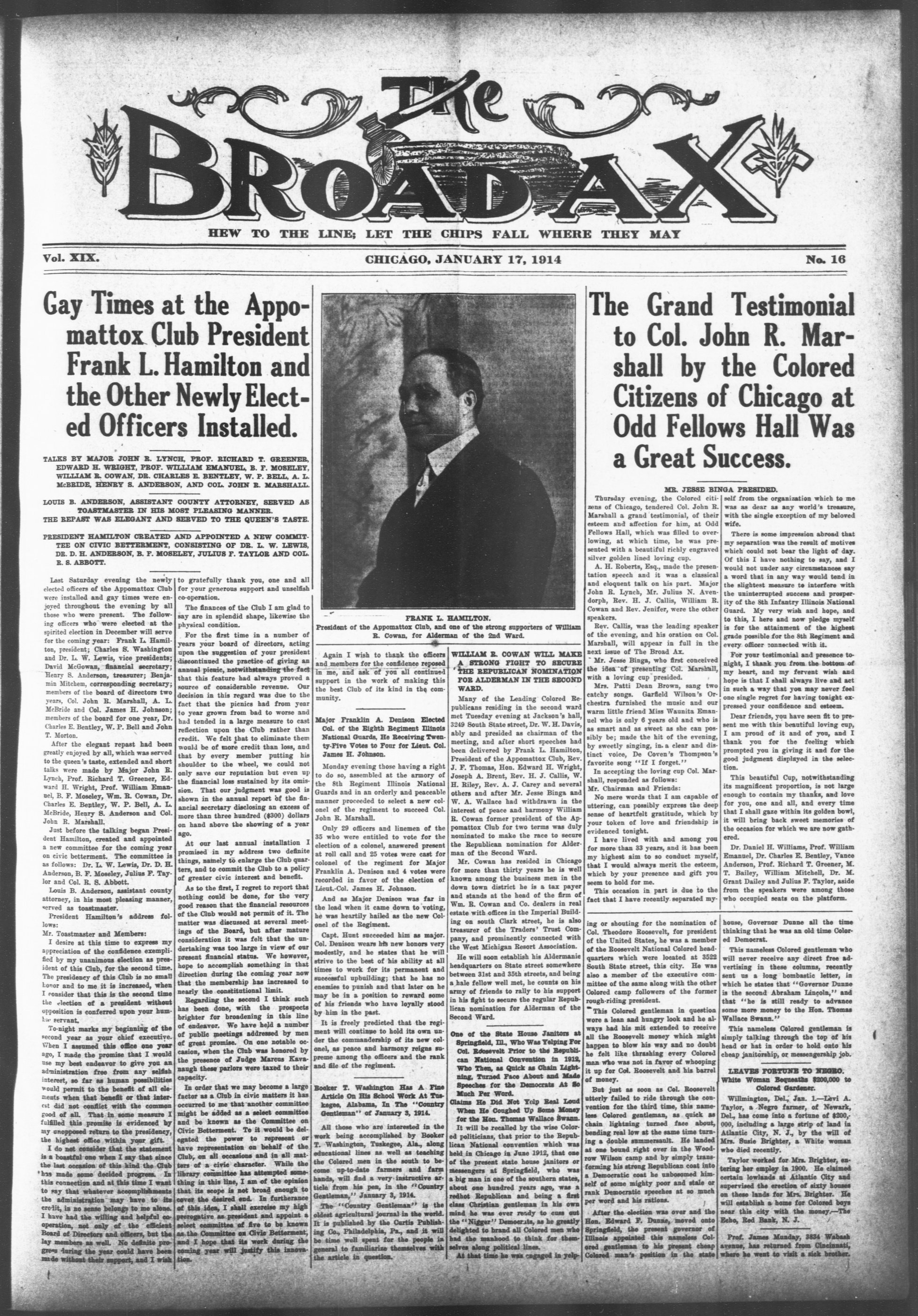
Gay Times at the Appomattox Club President Frank L. Hamilton and the Other Newly Elected Officers Installed.
TALKS BY MAJOR JOHN R. LYNCH, PROF. RICHARD T. GREENER,
EDWARD H. WRIGHT, PROF. WILLIAM EMANUEL, B. F. MOSELEY,
WILLIAM R. COWAN, DR. CHARLES E. BENTLEY, W. P. BELL, A. L.
McBRIDE, HENEY S. ANDERSON, AND JOHN R. MARSHALL.
LOUIS B. ANDERSON, ASSISTANT COUNTY ATTORNEY, SERVED AS
TOASTMASTER IN HIS MOST PLEASING MANNER.
THE REPAST WAS ELEGANT AND SEEVED TO THE QUEEN'S TASTE.
PRESIDENT HAMILTON CREATED AND APPOINTED A NEW COMMITTEE ON CIVIC BETTERMENT, CONSISTING OF DR. L. W. LEWIS, DE. D. H. ANDERSON, B. F. MOSELEY, JULIUS F. TAYLOE AND COL. B. S. ABBOTT.
Vol. XIX.
Gay Times and mattox Cl
Frank L. H
the Other ed Officer
TALKS BY MAJOB JOHN B. LYN
EDWARD H. WRIGHT, PROF. W.
WILLIAM R. COWAN, DR. CHAL
McBRIDE, HENRY S. ANDERSON
LOUIS B. ANDERSON, ASSISTANT
TOASTMASTER IN HIS M
THE REPAST WAS ELEGANT AND
PRESIDENT HAMILTON CREATED
TEE ON CIVIC BETTERMENT,
DR. D. H. ANDERSON, B. F. MOS
R. S. ABBOTT.
Last Saturday evening the newly elected officers of the Appomattox Club were installed and gay times were enjoyed throughout the evening by all those who were present. The following officers who were elected at the spirited election in December will serve for the coming year: Frank L. Hamilton, president; Charles S. Washington and Dr. L. W. Lewis, vice presidents; David McGowan, financial secretary; Henry S. Anderson, treasurer; Benjamin Mitchem, corresponding secretary; members of the board of directors two years, Col. John B. Marshall, A. L. McBride and Col. James H. Johnson; members of the board for one year, Dr. Charles E. Bentley, W. P. Bell and John T. Morton.
After the elegant repast had been greatly enjoyed by all, which was served to the queen's taste, extended and short talks were made by Major John R. Lynch, Prof. Richard T. Greener, Edward H. Wright, Prof. William Emanuel, B. F. Moseley, Wm. R. Cowan, Dr. Charles E. Bentley, W. P. Bell, A. L. McBride, Henry S. Anderson and Col. John R. Marshall.
Just before the talking began President Hamilton, created and appointed a new committee for the coming year on civic betterment. The committee is as follows: Dr. L. W. Lewis, Dr. D. H. Anderson, B. F. Moseley, Julius F. Taylor and Col. R. S. Abbott.
Louis B. Anderson, assistant county attorney, in his most pleasing manner, served as toastmaster.
President Hamilton's address follows:
Mr. Toastmaster and Members:
I desire at this time to express my appreciation of the confidence exemplified by my unanimous election as president of this Club, for the second time.
The presidency of this Club is no small honor and to me it is increased, when I consider that this is the second time the election of a president without opposition is conferred upon your humble servant.
To-night marks my beginning of the second year as your chief executive. When I assumed this office one year ago, I made the promise that I would use my best endeavor to give you an administration free from any selfish interest, so far as human possibilities would permit to the benefit of all elements when that benefit or that interest did not conflict with the common good of all. That in some measure I fulfilled this promise is evidenced by my unopposed return to the presidency, the highest office within your gift. I do not consider that the statement is a boastful one when I say that since the last occasion of this kind the Club has made some decided progress. In this connection and at this time I want to say whatever accomplishments the administration may have to its credit, in no sense belongs to me alone. I have had the willing and helpful cooperation, not only of the efficient Board of Directors and the efficient lay members as well. No definite progress during the year could have been made without their support, and I wish
---
HEW TO THE LINE: LET THE CHIPS FALL WHERE THEY MAY
to gratefully thank you, one and all for your generous support and unselfish co-operation.
The finances of the Club I am glad to say are in splendid shape, likewise the physical condition.
For the first time in a number of years your board of directors, acting upon the suggestion of your president discontinued the practice of giving an annual picnic, notwithstanding the fact that this feature had always proved a source of considerable revenue. Our decision in this regard was due to the fact that the picnics had from year to year grown from bad to worse and had tended in a large measure to cast reflection upon the Club rather than credit. We felt that to eliminate them would be of more credit than loss, and that by every member putting his shoulder to the wheel, we could not only save our reputation but even up the financial loss sustained by its omission. That our judgment was good is shown in the annual report of the financial secretary disclosing an excess of more than three hundred ($300) dollars on hand above the showing of a year ago.
At our last annual installation I promised in my address two definite things, namely to enlarge the Club quarters, and to commit the Club to a policy of greater civic interest and benefit.
As to the first, I regret to report that nothing could be done, for the very good reason that the financial resources of the Club would not permit of it. The matter was discussed at several meetings of the Board, but after mature consideration it was felt that the undertaking was too large in view of our present financial status. We however, hope to accomplish something in that direction during the coming year now that the membership has increased to nearly the constitutional limit.
Regarding the second I think such has been done, with the prospects brighter for broadening in this line of endeavor. We have held a number of public meetings addressed by men of great promise. On one notable occasion, when the Club was honored by the presence of Judge Marcus Kavanaugh these parlors were taxed to their capacity.
In order that we may become a large factor as a Club in civic matters it has occurred to me that another committee might be added as a select committee and be known as the Committee on Civic Betterment. To it would be delegated the power to represent or have representation on behalf of the Club, on all occasions and in all matters of a civic character. While the library committee has attempted something in this line, I am of the opinion that its scope is not broad enough to cover the desired end. In furtherance of this iden, I shall exercise my high prerogative as president and appoint a select committee of five to be known as the Committee on Civic Betterment, and I hope that its work during the coming year will justify this innovation.
CHICAGO, JANUARY 17, 1914
M.
President of the Appomattox Club, and one of the strong supporters of William R. Cowan, for Alderman of the 2nd Ward.
Again I wish to thank the officers and members for the confidence reposed in me, and ask of you all continued support in the work of making this the best Club of its kind in the community.
Major Franklin A. Denison Elected Col. of the Eighth Regiment Illinois National Guards, He Receiving Twenty-Five Votes to Four for Lieut. Col. James H. Johnson.
Monday evening those having a right to do so, assembled at the armory of the 8th Regiment Illinois National Guards and in an orderly and peaceable manner proceeded to select a new colonel of the regiment to succeed Col. John R. Marshall.
Only 29 officers and linemen of the 35 who were entitled to vote for the election of a colonel, answered present at roll call and 25 votes were cast for colonel of the regiment for Major Franklin A. Denison and 4 votes were recorded in favor of the election of Lieut.-Col. James H. Johnson.
WILLIAM R. COWAN WILL MAKE A STRONG FIGHT TO SECURE THE REPUBLICAN NOMINATION FOR ALDERMAN IN THE SECOND WARD.
Many of the Leading Colored Republicans residing in the second ward met Tuesday evening at Jackson's hall 3249 South State street, Dr. W. H. Davis ably and presided as chairman of the meeting, and after short speeches had been delivered by Frank L. Hamilton President of the Appomattox Club, Rev J. F. Thomas, Hon. Edward H. Wright Joseph A. Brent, Rev. H. J. Callis, W. H. Riley, Rev. A. J. Carey and several others and after Mr. Jesse Binga and W. A. Wallace had withdrawn in the interest of peace and harmony William R. Cowan former president of the Appomattox Club for two terms was duly nominated to make the race to secure the Republican nomination for Alderman of the Second Ward.
Mr. Cowan has resided in Chicago for more than thirty years he is well known among the business men in the down town district he is a tax payer
And as Major Denison was far in the lead when it came down to voting, he was heartily hailed as the new Colonel of the Regiment.
Capt. Hunt succeeded him as major. Col. Denison wears his new honors very modestly, and he states that he will strive to the best of his ability at all times to work for its permanent and successful upbuilding; that he has no enemies to punish and that later on he may be in a position to reward some of his friends who have loyally stood by him in the past.
It is freely predicted that the regiment will continue to hold its own under the commandership of its new colonel, as peace and harmony reigns supreme among the officers and the rank and file of the regiment.
Booker T. Washington Has A Fine Article On His School Work At Tuskegee, Alabama, In The "Country Gentleman" of January 3, 1914.
All those who are interested in the work being accomplished by Booker T. Washington, Tuskegee, Ala., along educational lines as well as teaching the Colored men in the south to become up-to-date farmers and farm hands, will find a very instructive article from his pen, in the "Country Gentleman," January 3, 1914.
The "Country Gentleman" is the oldest agricultural journal in the world. It is published by the Curtis Publishing Co., Philadelphia, Pa., and it will be time well spent for the people in general to familiarize themselves with the article in question.
WILLIAM R. COWAN WILL MAKE A STRONG FIGHT TO SECURE THE REPUBLICAN NOMINATION FOR ALDERMAN IN THE SECOND WARD.
Many of the Leading Colored Republicans residing in the second ward met Tuesday evening at Jackson's hall, 3249 South State street, Dr. W. H. Davis, ably and presided as chairman of the meeting, and after short speeches had been delivered by Frank L. Hamilton, President of the Appomattox Club, Rev. J. F. Thomas, Hon. Edward H. Wright, Joseph A. Brent, Rev. H. J. Callis, W. H. Riley, Rev. A. J. Carey and several others and after Mr. Jesse Binga and W. A. Wallace had withdrawn in the interest of peace and harmony William R. Cowan former president of the Appomattox Club for two terms was duly nominated to make the race to secure the Republican nomination for Alderman of the Second Ward.
Mr. Cowan has resided in Chicago for more than thirty years he is well known among the business men in the down town district he is a tax payer and stands at the head of the firm of Wm. R. Cowan and Co. dealers in real estate with offices in the Imperial Building on south Clark street, he is also treasurer of the Traders' Trust Company, and prominently connected with the West Michigan Resort Association.
He will soon establish his Aldermanie headquarters on State street somewhere between 31st and 35th streets, and being a hale fellow well met, he counts on his army of friends to rally to his support in his fight to secure the regular Republican nomination for Alderman of the Second Ward.
One of the State House Janitors at Springfield, Ill., Who Was Yelping For Col. Eloevelt Prior to the Republican National Convention in 1912, Who Then, as Quick as Chain Lightning, Turned Face About and Made Speeches for the Democrats At So Much Per Word.
Claims He Did Not Yelp Real Loud When He Coughed Up Some Money for the Hon. Thomas Wallace Swann.
It will be recalled by the wise Colored politicians, that prior to the Republican National convention which was held in Chicago in June 1912, that one of the present state house janitors or messengers at Springfield, who was a big man in one of the southern states, about one hundred years ago, was a redhot Republican and being a first class Christian gentleman in his own mind he was ever ready to cuss out the "Nigger" Democrats, as he greatly delighted to brand all Colored men who had the manhood to think for themselves along political lines. At that time he was engaged in velo-
The Grand Testimonial to Col. John R. Marshall by the Colored Citizens of Chicago at Odd Fellows Hall Was a Great Success.
MR. JESSE BINGA PRESIDED.
Thursday evening, the Colored citizens of Chicago, tendered Col. John R. Marshall a grand testimonial, of their esteem and affection for him, at Odd Fellows Hall, which was filled to overlowing, at which time, he was presented with a beautiful richly engraved silver golden lined loving cup.
A. H. Roberts, Esq., made the presentation speech and it was a classical and eloquent talk on his part. Major John R. Lynch, Mr. Julius N. Avendorph, Rev. H. J. Callis, William R. Cowan and Rev. Jenifer, were the other speakers.
Rev. Callis, was the leading speaker of the evening, and his oration on Col. Marshall, will appear in full in the next issue of The Broad Ax.
Mr. Jesse Binga, who first conceived the idea of presenting Col. Marshall, with a loving cup presided.
Mrs. Patti Dean Brown, sang two catchy songs. Garfield Wilson's Orchestra furnished the music and our warm little friend Miss Wauitaa Emanuel who is only 6 years old and who is as smart and as sweet as she can possibly be; made the hit of the evening, by sweetly singing, in a clear and distinct voice, Decen's Thompson's favorite song "If I forget."
In accepting the loving cup Col. Marshall, responded as follows:
Mr. Chairman and Friends:
No mere words that I am capable of uttering, can possibly express the deep sense of heartfelt gratitude, which by your token of love and friendship is evidenced tonight.
I have lived with and among you for more than 33 years, and it has been my highest aim to so conduct myself, that I would always merit the esteem, which by your presence and gift you seem to hold for me.
This occasion in part is due to the fact that I have recently separated my-
ing or shouting for the nomination of Col. Theodore Roosevelt, for president of the United States, he was a member of the Roosevelt National Colored headquarters which were located at 3522 South State street, this city. He was also a member of the executive committee of the same along with the other Colored camp followers of the former rough-riding president. This Colored gentleman in question wore a lean and hungry look and he always had his mit extended to receive all the Roosevelt money which might happen to blow his way and no doubt he felt like thrashing every Colored man who was not in favor of whooping it up for Col. Roosevelt and his barrel of money.
But just as soon as Col. Roosevelt utterly failed to ride through the convention for the third time, this nameless Colored gentleman, as quick as chain lightning turned face about, bending real low at the same time turning a double summersault. He landed at one bound right over in the Woodrow Wilson camp and by simply transforming his strong Republican coat into a Democratic coat he unbosomed himself of some mighty poor and stale or rank Democratic speeches at so much per word and his rations.
After the election was over and the Hon. Edward F. Dunnie, moved onto Springfield, the present governor of Illinois appointed this nameless Colored gentleman to his present cheap Colored man's position in the state
Testimonial
John R. Mar-
the Colored
of Chicago at
ws Hall Was
success.
NGA PRESIDED.
self from the organization which to me
was as dear as any world's treasure,
with the single exception of my beloved
wife.
There is some impression abroad that my separation was the result of motives which could not bear the light of day. Of this I have nothing to say, and I would not under any circumstances say a word that in any way would tend in the slightest measure to interfere with the uninterrupted success and prosperity of the 8th Infantry Illinois National Guard. My very wish and hope, and to this, I here and now pledge myself is for the attainment of the highest grade possible for the 8th Regiment and every officer connected with it.
For your testimonial and presence tonight, I thank you from the bottom of my heart, and my fervent wish and hope is that I shall always live and act in such a way that you may never feel one single regret for having tonight expressed your confidence and esteem.
Dear friends, you have seen fit to present me with this beautiful loving cup, I am proud of it and of you, and I thank you for the feeling which prompted you in giving it and for the good judgment displayed in the selection.
This beautiful Cup, notwithstanding its magnificent proportion, is not large enough to contain my thanks, and love for you, one and all, and every time that I shall gaze within its golden bowl, it will bring back sweet memories of the occasion for which we are now gathered.
Dr. Daniel H. Williams, Prof. William Emanuel, Dr. Charles E. Bentley, Vance Anderson, Prof. Richard T. Greener, M. T. Bailey, William Mitchell, Dr. M. Grant Dailey and Julius F. Taylor, aside from the speakers were among those who occupied seats on the platform.
house, Governor Dunne all the time thinking that he was an old time Colored Democrat.
This nameless Colored gentleman who will never receive any direct free advertising in these columns, recently sent us a long bombastic letter, in which he states that "Governor Dunne is the second Abraham Lincoln," and that "he is still ready to advance some more money to the Hon. Thomas Wallace Swann."
This nameless Colored gentleman is simply talking through the top of his head or hat in order to hold onto his cheap janitorship, or messengership job.
LEAVES FORTUNE TO NEGEO. White Woman Bequeaths $200,000 to Colored Gardener.
Willmington, Del., Jan. 1.—Lavi A. Taylor, a Negro farmer, of Newark, Del., has come into a fortune of $200,000, including a large strip of land in Atlantic City, N. J., by the will of Mrs. Susie Brighter, a White woman who died recently.
Taylor worked for Mrs. Brighter, entering her employ in 1900. He claimed certain lowlands at Atlantic City and supervised the erection of sixty houses on these lands for Mrs. Brighter. He will establish a home for Colored boys near this city with the money.—The Echo, Red Bank, N. J.
Prof. James Munday, 3834 Wabash avenue, has returned from Cincinnati, where he went to visit a sick brother.
No.16
PUBLISHED WEEKLY.
Will promulgate and at all times uphold the true principles of Democracy, but Catholics, Protestants, Palestine, Inlands, Single Taxes, Republics, Independence, and long on their language is proper and responsibility is fixed.
The Broad Axe is a newspaper whose platform is broad enough for all, ever claiming the editorial right to speak its own mind.
Local communications will receive attention. Write only on one side of the paper.
Subscriptions must be paid in advance.
One Year ..... $3.99
Six Months ..... $1.99
Advertising rates made known on application address all communications to
PHONE DREXEL 4500
JULIUS F. TAYLOR, Editor and Publisher
Entered as Second-Class Matter Aug. 18,
1958 under the supervision of Chicago, Illinois,
under Act of March 8, 1958.
Crowded conditions create community dangers.
Kentucky has passed a law prohibiting the public drinking cup.
It is a fine idea to teach children to think, but teaching them at the same time to use their hands helps them wonderfully in their thinking processes. Every school in the state of Oregon, whether in town or country, has its school garden where the children are taught to use their hands and at the same time to think out the things their hands are doing. In these schools a certain part of every day the pupils spend in the open air, where they laugh and talk and work and think and have a good time generally. The important thing about this method of education is that it tends to keep the children physically well and strong. In short it is a splendid idea from a health standpoint. Don't you think so?
Another excellent feature of the Oregon idea is that the public schools of that state are beautiful and attractive places for the reason that the children keep the grounds and surroundings in good order and with trees, shrubbery and flowers make of them veritable beauty spots that attract the delighted attention of all who see them. And all this is done without in any way interfering with or curtailing the children's study hours. Their work out of doors under the sun and sky only tends to broaden their views of life and helps them to grow bigger and stronger in both body and mind every day.
The stooping habit, when either sitting or standing, is one easily formed and if persisted in, like all other habits, hard to break. It is also an injurious habit, affecting bodily health and vigor and destroying the grace and symmetry of the human form. Physicians tell us that continual stooping throws the spine out of alignment, the body out of its proper poise, the circulation of the blood in the head is disturbed, the lungs are cramped and the work of the digestive organs seriously hindered. In addition, every one knows that round, stooping shoulders and sunken chest make those who have them appear inferior both in physical health and stature. The person who habitually walks and sits erect presents the appearance of vigor and alertness. The fact is, too, that such people as a rule have better health and are more vigorous than are those who are stoop shouldered and because of that fact are lacking in chest development.
The Commissioner of Health of Cincinnati, O., is issuing certificates of inspection to the bakeries of that city. The certificates are good for thirty days only and are revocable at any time for cause by the health officer. In discussing his action, Dr. Landis says that he sees no reason why the sanitary bakery should not have a certificate to that effect issued by the Department of Health. "I am also of the opinion," says Dr. Landis, "that as we are determined to have clean bakeries in Cincinnati, it will be up to the bakers themselves to decide what kind of certificates they get. We shall advertise the dirty bakeries and I see no reason why we should not certify to the clean ones."
The gentleman of the cloth in question spoke in Washington, D. C., and his remarks were duly set forth in the daily newspapers. The Chicago Tribune, however, in its issue of January 8, calls him to time in unmistakable English as follows:
"The Negro clergyman who advised his race to arm for the assertion of their rights is a glittering illustration of one's need to be defended from one's friends. A more vicious and destructive piece of advice—from the point of view of the Negro's progress and even safety—could not be conceived. Its injury to the Negro is not dependent upon its adoption. Grave injury will arise from the very face that an educated Negro, a Negro lender, voiced such a proposal. It will give every Negro baiter and illlydema
gogue new ammunition. At the same time it will give to the more ignorant of the younger Negroes an evil suggestion. The best weapons the Negro can resort to and the only ones are the justice of the American people and his own determination to show himself fit for the full privileges of citizenship."
GO-TO-CHURCH DAY IN CHICAGO- SUNDAY, FEB. 1, 1914.
The Negro Preachers Union of Chicago and Vichity Appoints a Committee to Make It A Success.
The Church of the Lord Jesus Christ is to have an unusual emphasis in the City of Chicago through a concerted effort of the Christians and church-going people on Sunday, Feb. 1, 1914. It will not be the effort of any single congregation to secure the attendance of its members and friends upon the preaching of some great church dignitary or whirlwind evangelist; it will not be the effort of any one denomination to test its strength numerically or spiritually through an appeal to the pastor, of every locality in the city; it is to be the effort of all the people of all the denominations to reach and interest all the church people to unite in a day of worship in God's house. What An Opportunity For Christians.
What shall this Go-to-Church Day mean to the churches among Negroes? Shall it be that we shall not plan and work at this task to make this an occasion of great spiritual and moral benediction to the Negroes of the City of Chicago? Shall we wait for the people of any race to come to our neighborhoods and go from door to door among our people and urge attendance upon our churches? If we remain apathetic this is exactly what will take place to the shame of our professions of christianity.
We are fortunate that for this movement our preachers are already organized as The Negro Preachers Union of Chicago and vicinity. Last Monday in their monthly meeting the president, Rev. John W. Robinson of St. Mark M. E. church called their attention to the "Go-to-Church Day" and the Union immediately decided to unite to make this day a success in all our churches. The Union will hold a special meeting at the Wabash Ave. Y. M. C. A. next Tuesday at 1 p. m. to which all our pastors are invited.
The following committee was appointed to arrange for the Go-to-Church Day among us: Dr. A. J. Carey, Dr. E. T. Martin, Father J. B. Massiah, Rev. Moses Jackson, Rev. E. C. Lawrence, Dr. J. C. Anderson, Rev. H. Knight, Rev. H. M. Carrol, and Rev. J. L. Blackshear.
It is hoped that the Negro Press of the city will emphasize this movement in their columns; that the business men among us will aid the committee on publicity by placing streamers on their wagons, automobiles, etc. There should be planned a monster parade for the Saturday night before. There should be raised immediately at least $100 for the purpose of advertisements, hangers, stickers, etc.
Let us take a hold of this in an earnest and vigorous manner. Let no one-excel us in heroic sacrifice and devotion to the success of this day. It means success for the church which will pay the price.—"B."
BAKES CEMETERY COLOB LINE.
Jenkin Lloyd Jones Scores Oakwood
Plan of Restriction
"How deep underground does the color line reach?"
That is the question which Jenkin Lloyd Jones, pastor of All Souls church and head resident of Abraham Lincoln Center, has propounded to the officials of Oakwoods cemetery. His letter was written several days ago and he is still waiting for an answer. He says he doesn't expect one.
The query was the result of Mr. Jones' perusal of a folder mailed to him from the offices of the cemetery and containing a recital of its advantages as a place of last rest for Chicagoans. Near the end was a paragraph which set forth that the association did not desire among its patrons those whose skins are other than white, and its effect on the man who heads an institution named for the president who freed the slaves was immediate. Hq at once dispatched this letter:
"Chicago, Jan. 7, 1914.—Mr. Fred M. Farwell, President Oakwoods Cemetery Association. Dear Sir: Your very attractive announcement of the cemetery, with pretty pictures, duly received, for which accept my thanks. It is a beautiful place and the sadness of many visits has often been ameliorated by its beauty. But I was astounded and pained beyond telling by reading this sentence in your announcement:
"'Chapel, vaults and crematory are for the exclusive use of people of the Caucasian race.'
"Heaven save the mark! Can class prejudice and racial conceit go farther? Pray, how deep underground does the color line reach? Is it to be presumed that St. Peter has also provided for the convenience of the 'Caucasians' a rear gate entrance into kingdom come for the benefit of the Colored people? "Seriously, I am pained at the mani-
An Appeal to the Afro-Americans of the UnitedStatesfor Help While Collecting Materials.
FOR THE INTERNATIONAL EXPOSITION OF THE BOOK INDUSTRY AND GRAPHIC ARTS TO BE HELD AT LEIPSIC GERMANY, IN 1914. THE EXHIBITS ARE BEING FORWARDED EAPIDLY.
THE FOLLOWING COMMUNICATION WAS SENT TO JULIUS F. TAYLOR FOR PUBLICATION FROM PASTOR PAUL HENTSCH ONE OF THE PROMOTERS OF THE EXPOSITION.
The collecting of the exhibition materials for the International Exposition of the Book Industry and Graphic Arts, which will take place April to November 1914 at the old University town of Leipsic, Germany, goes on very rapidly. A very important part of the exposition will be the department of the exhibits relating to the culture of the human races of all times and nations. From praehistoric times and primitive cultures the plan touches all people who ever lived on earth, up to Gutenberg, the father of the modern printing science, and to our days. Here the old Chinese and Japanese printing processes will be shown in operation. University and colleges will be shown in their day work with class exercises, laboratory work and student papers. This part will interest any visitor of the exhibition. Of no less importance are the different branches of the Book Industry and graphics. One of them will show "The Woman in the Book Industry," another the art of illustration and caricature, lithographics, photography, stenography, colors, wood carvings, book making and book trade, musical exhibits, writing materials, stereotypy, electrotypy, cinematographics, newspapers, advertising, canvassing, libraries, measures for the protection and welfare of the workers. People interested in public school matters will find a rare opportunity to study the development of the child from its first breath up to the time when it leaves the schoolroom. The black children of Australia will show their graphic arts as well as those from Greenland, the United States and Germany.
Sixty-three Classes.
The whole plan of the exhibition is now divided into 63 classes and several hundred groups with a historical and technical department. Models and apparatus for demonstrating will be shown. The publications of booksellers and music publishers will be brought directly to the notice of the public through the medium of the libraries and reading rooms, through lectures, public readings, recitations and concert recitals, so that anything in our minds will be under the banner of the "Black Art." Many learned societies and associations connected with the book industry will have their congresses and meetings at the exhibition ground.
festation of what seems to me an insult to the Christianity we profess and the trust in God and belief in brotherhood that is inscribed or implied in a thousand monuments within your enclosure. Am I to understand that Frederick Douglass, Booker T. Washington, the Hindu poet who has just received the Nobel prize for pre-eminent achievement in letters, were they to be presented at your gates would be denied the final courtesies which belong to the humblest and most despised and wickedest of the race?
"It is not for me to decide where my bones may crumble, but if it were for me to choose I would not care to have them under the ground from which are excluded many brave and dear friends of mine. Your ground is sacred as the resting place of hundreds of men and women who bravely and willingly died for the establishment of the brotherhood that crossed lines and the sanctities of the human soul, whether incased in skins black, white, yellow or half tints. Very respectfully yours,
"JENKIN LLOYD JONES."
—In the Chicago Daily News, Jan 13, 1914.
"JOHN THE UNAFRAID."
One of the most interesting little books that we have run across for many a day, is a book entitled, "John the Unafraid." It was presented to the writer by its author, the Hon. William E. Mason, former United States Senator from Illinois, and it is worth anyone's time to read it. It is for sale by A. C. McClurg & Co., this city.
An Opportunity For Everybody.
Being under the direct patronage of King Frederick August of Saxony the exhibition is a rare opportunity for anyone having some regular or irregular things relating to the book industry and graphic arts for exhibition. While many great concerns throughout the world are sending their exhibits, it should not be forgotten, that there is one department not for rent to business exhibitors, it is open only for exposition of exhibition materials, that will constitute afterwards a valuable part of the great Museum of the Book Industry at Leipzig, the only institution of its kind in the world, when the exhibition is over. Anyone may add to this department printings, writings, manuscripts, photos, pictures, book and graphics with no cost to himself.
School plans and pictures of student classes, professors, teachers and buildings, photos and models of schools, colleges, universities and publishing houses will still be heartily accepted; likewise drawings, lessons and papers of scholars and students. Authors and publishing houses should send of all books and pamphlets they have published a good copy with order blanks so that every exhibition-visitor may have a chance to order the exhibits shown. Also editors should send the best they have. The name of the sender should always be mentioned upon the exhibit. Here is an excellent opportunity for the Colored people of America and for those who have devoted their lives to the culture work among the Colored people, to demonstrate what they have already done and what they could do in the future. Another important feature while collecting exhibition materials is that it will have great value for the future, as the great Museum-library of Leipzig will participate in the exhibits when the fair is over. Readers of these lines who have some materials of any kind as mentioned above for this department should direct it to Fastor Paul Hentsch, Leipzig-Lindenau, Gundorferstr. 1, Germany, who as the only German specialist in Afro-Americanism is especially interested in the affairs of the Negro people in the United States.
Paul O. Hentsch, M. A.
Leipzig, December 30, 1913.
WALTERS A. M. E. ZION CHURCH
Corner 38th and Dearborn Streets
Rev. H. J. Callis, Pastor.
Our special revival services are continuing to meet with great success. Rev. S. S. S. Scisson who is assisting us in this effort, has been preaching stirring gospel sermons and his discourses have been meeting with great favor. During our meetings several persons have been converted and reclaimed to the Faith. Some few have seen fit to cast their lots in with us and have connected themselves with our church. The attendance and interest has kept up in our evening services continually. Our evening services are beginning at eight o'clock and are preceded by a half hour's service of prayer and praise.
Last Sunday morning the pastor occupied the pulpit and delivered a sermon that reached the very souls of those who were fortunate enough to be present. Rev. Scisson preached at the afternoon and evening services and was well equal to the task of sustaining the reputation he had made for himself during the previous week.
The services for Sunday will be as usual and it is hoped that every member of the church will make a special effort and sacrifice to attend the meetings and bring some one else with them. After two weeks of special religious services in which our attention has been turned wholly to things spiritual we should have such meetings Sunday as should long be remembered for the inspiration and encouragement of Believers and for the salvation of the Unsaved.—"C."
Mr. Fon Holly left the city Thursday to spend two weeks in Florida. Mrs. Holly, who has been ill will visit her parents in southern Illinois at the same time.
PHYLLIS WHEATLY CLUB NOTES.
Thirty-five members and visitor's of the Phyllis Wheatley Woman's Club were royally entertained at the residence of Mrs. J. J. Johnson, 3722 Forest Ave., Wednesday, Jan. 7. Mrs. Will Taylor read the story of Illinois. Mrs. M. Dukins and Mrs. J. C. Anderson sang, accompanists, Mrs. Taylor and Mrs. Araminta Thomas.
Committees for the year are: Institutions—Mrs. Ella Johnson, chairman; House—Mrs. Will Taylor, chairman; Industrial—Mrs. Grace Wilson, chairman.
Cooking classes will begin at the Home.
February 1st, Sewing Classes will meet at the homes of the Committee once a week. Those desiring to join these Classes should make application to Mrs. Grace Wilson, 3229 Dearborn St.
The next meeting will be held at the residence of Mrs. Minnie Mercer, 3335 Vernon Ave.
A Suffrage talk and instructions to women voters will be given by a member of the national suffrage organization. All women interested are invited. Mrs. Ophie Brown Wells will arrange the musical program.
A HOLIDAY GREETING
From Booker T. Washington, Friend of "The Man Farthest Down."
Among the many beautiful holiday greetings received by the writer, none was more timely or more attractive, than the holiday greeting from Booker T. Washington.
The greeting is a light oak-colored wood with beautiful sentiments printed in black on it and will make an attractive motto to hang on the walls of one's home.
CHIPS
Attorney Albert B. George, 5145 Federal street, is home again after a short visit to his parents, at Washington, D.C.
---
Hon. Carl Vrooman, of Bloomington, Ill., candidate for the United States Senate to succeed the Hon. Lawrence Y. Sherman, has become a subscriber to The Broad Ax.
Mrs. Gabriella Smith, 3404 Wabash avenue, is reported as "slowly improving" from the illness that necessitated a serious operation recently.
Mrs. Hattie Bell, 3118 South State street, returned home Sunday morning from Nashville, Tenn., where she went to attend the funeral of her sister.
Col. Franklin A. Denison left for Springfield, Ill., Tuesday evening and he will return with his new commission, either this morning or this evening.
Mrs. Lula L. Walton, 6449 Evans avenue, has departed for Sioux City, Iowa, where she will spend some time in visiting with her sister, Mrs. E. Johnson.
---
Mr. and Mrs. Willis Yocum and son, Master Levi Southe, have moved from Eureka, Ill., to make Chicago their future home. Mrs. Yocum is a sister of Mrs. E. L. Davis.
---
Editor James A. Ross, of Detroit, Mich., and Buffalo, N. Y., candidate for recorder of deeds to the District of Columbia, spent the past week in Chicago. He made his headquarters at the Palmer House.
Mrs. B. F. Moseley, 6248 South Sangamon street, and her son, B. F. Moseley, Jr., left Tuesday morning for Phoenix, Arizona, where they will spend some time for the benefit of his health.
In the matter of the false announcement of the death of the Editor Roscoe Conkling Simmons and the breaking of the Fob Church will, the editor of the Chicago Defender seems to be somewhat of a liar himself.—The American Wagoner, Okla., Jan. 10, 1914.
Rev. J. F. Thomas, pastor of Ebenezer Baptist Church, has been feeding the unemployed at his church daily for a week or more. He has had as his guests all races in great numbers, but the hobo who accepted his hospitality Monday and then stole the sexton's overcoat is Chicago's meanest man.
The North Side Colored Woman's Club, met Thursday evening last at Herman Baptist Church, 1754 North Clark street. Mrs. Heloise Wynne, a member of the Chicago Political Equality League, whose father, an army officer, was one of the first to take command of Negro troops, was the principal speaker.
Miss Ethel Phelp, daughter of Mrs. Nellie Phelp, 31 West 51st street, will become united in marriage to Mr. Fred Tessmer on Saturday evening, January 31. The recepti on to that same evening will be held: at Spregue's Hall, 4400 South State street. Her sister, Miss Clara Phelp, will be bridesmaid, Henry Tessmer, best man.
Chief of Police Glennson is being praised on all sides for the splendid work the department has done since he assumed charge of it. But everything will not "stay good" and his attention is called to the suggestive and oftimes vulgar talk allowed in a number of the theatres along the "stroll." Why not try out some of the police-women on this evil, which is growing to alarming proportions. What do you say, Chief!
Late one night last week Hon. George H. Webster answered a ring of his door bell at his residence, 2821 Prairie avenue and was severely beaten and kicked by the late caller. The miserant, a White man, fled, but was captured by the police and the punishment meted out to him this week in the municipal court was none too severe. Mr. Webster is a financier of prominence and one of the board of directors of Provident Hospital.
Fine feathers make fine bills for hus bands to growl over.
It is perhaps better to be green with verdancy than with envy.
Some married men make ideal companions—away from home.
In addition to other things, Mexico now seems to need the money.
Many a man would benefit more from a holiday if his wife took it for him.
Vaccination may keep people from taking things, but it won't cure kleptomania.
Cincinnati wants lamps on baby carriages. It'll want headlights on roller skates next.
It is costing more now even to look at an egg. Egg candlers are demanding higher wages.
And now Manhattan is to have a building taller than the Woolworth. The sky is the limit.
Harly to bed and early to rise—and you'll be surprised at the people you will meet going home.
At the same time if Vesuvius could cure her own bronchitis Italy would be able to breathe more freely.
Many large corporations are learning that it is both profitable and wise to make the people love them.
It begins to look as though a bad thing were now a good thing for the average New York play producer.
Switzerland may welcome Mrs. Pankhurst with full confidence that nobody will attempt to burn down the glacial scenery.
Midwinter surf bathing may be delightful, but a lot of people manage to get along without it with no discomfort whatever.
A Pennsylvania farmer boasts of a hen which laid an egg with a nickel inside. Another puzzle for the income tax collectors.
The new water cure for bichloriditis will doubtless prove effectual if the patients are fortunate enough to rally from the water.
Washington is to stop the use of profanity on the streets. This is a cold and unsympathetic world for disappointed office seekers.
It is reported that King George liked the first poem of Poet Laureate Bridges. Possibly the king liked it because it was rather short.
As a matter of fact, Mona Lisa has the peculiar smile of the wife who has lately riffed her husband's pockets in the still watches of the night.
Fashion notes for the coming year say that pianists will wear short hair hereafter. But how is the public to know that they are pianists?
Exploration may languish unless it is decided that a pole is so remote and difficult of observation as to need rediscovering from time to time.
Americans must be getting more contented with life. The increase of suicides has been at a slightly slower rate than the increase in population.
Turkey has purchased Brazil's newest Dreadnought. This will make a new and acceptable prize for the next country that gets into a row with Turkey.
The prize optimist is the man who advocates the singing of grand opera in English on the theory that it would then be possible to understand the words.
There is an exceptional taxi cab driver in Paris. He has inherited a fortune of $1,000,000. Usually the fortune is exacted from the unhappy customers.
There are few people to keep up the hunt for pirate gold, but there are a number of pirates of various kinds who are constantly on the lookout for the people's coin.
Douglas 73—TELEPHONES—Auto. 72775
"The Chateau"
Frank Hall, Prop.
Mr. Clarence Jones, Symphony Orchestra
Personally conducted by Mr. Clarence Jones
Grand SUNDAY EVE, Musicale
FROM 5 TO 10:30 P. M., EVERY SUNDAY
346 E. 35th Street, Opposite Grand Blvd.
JOE SHOECRAFT, MGR.
Finest Cafe in the City. Service Unexcelled.
DAMES AND DAUGHTERS
Mrs. L. W. Carpenter of Worcester, Mass., has celebrated her one hundred and seventh birthday. She is a member of the Michigan branch of the D. A. R. Frau von Bohlen und Halbach, who was Bertha Krupp before her marriage and now the owner of the great Krupp gun works at Essen, Germany, is one of the richest women in the world. She is only twenty-six years of age, and her estimated wealth is $100,000,000. Frau Emille Broome of Stockholm is said to be the best authority in Europe on the subject of continuation schools and is in charge of the schools of Stockholm, both as the head of the continuation schools and as supreme directress of the elementary schools of the city.
Professor Lillian J. Martin, on whom the honorary degree of doctor of philosophy has just been conferred by the University of Bonn, Germany, and said to be the first American woman to have received this distinction, is a member of the faculty of Stanford university, California.
Income Tax Quips.
Perhaps you belong to the class whose incomes are $3,000 a year. No!—Chicago Tribune.
Has any one studied the income tax provisions to see whether the profits of absconding cashiers are sufficiently taxed?—Washington Star.
Press agents who write about the fabulous salaries of their stars will have to be more cautious when the income tax becomes operative.—Washington Post.
Still, a good many people would be willing to pay the 7 per cent upon it if some one would only provide them with the million dollar income.—New York World.
Aerial Flights.
The faith of Count Zeppelin himself in the practicability of the dirigible balloon appears to be doomed to ultimate extinction. But it will die hard.—Chicago Tribune.
Nowadays the newspapers content themselves with reporting the death of an aviator without stopping to give us more theories on "Swiss cheese" atmosphere.—Des Moines Register and Leader.
The French aviator Pegoud, who has been looping the loop with his machine, is the sensation of the hour among flying men. After he breaks his neck everybody will draw the obvious moral—New York World.
College and School.
In the Munich schools attendance is compulsory for girls up to sixteen years.
Heads of colleges in British universities are variously known as "wardens," "masters," "principals," "rectors," "provosts," "presidents," "deans" and "censors."
The University of Pennsylvania had its beginning at Philadelphia in 1740. It was chartered in 1753 as the academy and charitable school in the province of Pennsylvania and received a further charter as a college in 1755. Its present title dates from 1791.
The Royal Box.
King George of England as a yachtman is to be shown on a series of new Rhodesian stamps. Dowager Queen Alexandra of England discards two pairs of gloves daily during the year. She spends $30,000 a year in Paris for her dresses and her jewels. The young Prince of Wales has been forced by his mother to resign from the Bullingdon club of Oxford university, this organization being a little too extravagant to suit the queen.
Fashion Frills.
Applying reverse English, one might say that the bud in the slit skirt has been nipped—Chicago News.
"Grandmother's hoops are coming back," says Modiste. Ought to make an all round improvement in woman's dress.—New York American.
If all the girls took as much interest in slitting the leaves of a good book as they do in the slit of their skirt they'd have something of more value.—Milwaukee News.
Two of Millet's famous pictures, the "Sower" and the "Binders," were produced in a damp studio, ineffectually warmed by a thy stove. In order to keep warm he would work with his feet in big wooden shoes stuffed with straw, himself enveloped in a heavy horse cloth with a hole in the center, through which he put his head! In these pictures Millet had simply sought to express with all his might one of the phases of man's unceasing combat with nature. But "political" parties drew their conclusions. The "labor" party declared that these pictures protested against the misery of the laborer, while official critics said that the artist sought to set class against class. At this time Millet willingly painted a signboard for a Parisian tradesman. But then he painted it so well in the end it figured in an exhibition of his works in the School of Fine Arts.
Nickel In Soapmaking
It will probably be news to the average ablutionist that the metal nickel is used in making his soap. And further, perhaps, he will be glad to learn that although the nickel, finely ground, is mixed with the other soap ingredients, the finished product contains none of it. This is so because the nickel acts as what the chemists call a catalyst—that it, its presence causes certain desirable changes to occur, although it takes no part in the chemical reaction. Offensive oils and those to thin for satisfactory use, when mixed with finely divided nickel and subjected to the action of a current of hydrogen, become deodorized and harder and suitable for the soap maker's use. Cottonseed oil, for example, after the nickel-hydrogen treatment, makes a satisfactory soap—New York Post.
"Come Ye to the Waters."
Julian Grande, who recently returned to England from Bible lands, has had some interesting things to say about Damascus. The pride of the district lies still in its rivers, Abana and Pharpar, but this does not hinder the citizens from polluting them with the refuse of the streets, making the water quite undrinkable in summer. Water is brought from a distance and sold in the streets at about a farthing a quart, and to buy a cupful of cold water and give it to "one of those little ones" is a typical act of eastern charity. Pious Moslems will buy water and then gather the thirsty children round them, using almost the very words of Isaiah-"Ho, every one that thirstest, come ye to the waters." -Homletic Review.
Force of Habit
There is at Princeton an instructor in mathematics who was country bred, a fact that is frequently betrayed by some homely saying of his.
One day an undergraduate had performed some peculiarly useless and complicated process in arriving at the solution of a problem when the instructor said:
"This reminds me of a colt once owned by an old friend of mine down east. This colt was put out to pasture after having been fed from its birth in a box stall and watered at a trough in the yard. The pasture lay across a small river, and in the middle of the day the colt would swim the stream to go up to the barn for a drink of water."—Harper's Magazine.
Oxford Terms
A Rhodes scholar of Denver, speaking of Oxford, said:
"Oxford is a funny place. Magdalen is pronounced Maudlin there. 'Full term' means three-quarters of a term. 'General admission' day is the day, not when you enter, but when you leave. An 'ordinary degree' is one obtained by a special examination. An 'inspector of arts' is not an inspector, but a student.
"Confused by these things, a new Rhodes scholar said:
"How queer, by jingo! How queer it all is! And if I go to the Oxford depot and ask for a ticket by train to London will they give me a passage by steamer—to Marseilles?" — Exchange.
The Great Violin Makers
Antonio Stradivari, the famous violin maker of Cremona, lived 1649-1737. He was the pupil of Nicholas Amati and carried the Cremona type of violin to its highest perfection. The Amati, Nicholas and his sons, Jerome and Antonio, rank next to Stradivari if not with him. The Tyrolese makers, Jakob Stainer, 1621-83, and Matthias Klots and his sons made violins that stand very high in the estimation of connoisseurs. Villeaume of Paris is the most celebrated modern maker.
SPECIAL NOTICE
All parties having social or personal items or other matter for publication. Such social items and so on must reach the editor not later than on Thursday morning, prior to the Saturday the articles are expected to appear.
Write plainly and on one side of the paper only.
Personal or social items and short church notices, will be published free. If you have friends visiting you, or if you are going on a visit out of the city, or move from one section of the city to another, or buy a new house or flat building, or if any of your near and dear friends become united in marriage to some one, or join the Heavenly host in the great beyond; or if you give a dancing party or other social functions and so on; all such information plainly and shortly written will be considered news matter.
And as stated before will be published free of all charges.
Remember that all communications along this line must be short and to the point. Address all communications to the editor of The Broad Ax, 5027 Federal street, Phone Drexel, 4590.
The Country Boy's Creed.
"I believe that the country, which God made, is more beautiful than the city, which man made; that life out of doors and in touch with the earth is the natural life of man. I believe that work is work wherever we find it, but that work with nature is more inspiring than work with the most intricate machinery. I believe that the dignity of labor depends, not on what you do, but on how you do it; that opportunity comes to a boy on the farm as often as to the boy in the city; that life is larger and freer and happier on the farm than in town; that my success depends, not upon my location, but upon myself; not upon my dreams, but upon what I actually do; not upon luck, but upon pluck. I believe in working when you work and in playing when you play and in giving and demanding a square deal in every act of life."—Suburban Life.
Conserve Your Steam
A man who never amounted to much once got a job running the engine of a sawmill. He was greatly impressed with the importance of his position and wanted every one to know that he was the man who made all the wheels go round. The first morning he steamed up the engine he jerked the whistle wide open and made the welkin ring for miles around, saying to himself as the echoes bounced over the hills, "I am certainly the big noise in this part of the country." Just then the foreman started the force on a big day's work and discovered that there was not enough steam left to start the machinery. He of the big noise was promptly canned, and the job was given to a hole. Moral—You can't saw wood if you use all the steam blowing your whistle.—Exchange.
Roe's Airship Heax
Edgar Allen Poe was a pioneer in the art of aerial hoaxing. In 1844 the New York Sun announced one morning: "Astounding news! Atlantic crossed in three days! Triumph of Mr. Monck Mason's flying machine!" Folks rushed for the paper, and found therein a long and detailed account of the crossing of the Atlantic in a steerable balloon by Mr. Monck Mason, Harrison Ainsworth and four others. The balloon was minutely described, long extracts were printed from a diary which Harrison Ainsworth was supposed to have kept on the way, and the whole story had such a touch of truth that it took some days for New Yorkers to realize how completely they had been hoaxed—London Chronicle.
Good Sitters.
Turkish women are said to have one accomplishment in which they excel the women of all other nationalities. They know how to sit. Hester Donaldson Jenkins calls attention to the fact that the Turkish verb to sit is used where occidentals would use to live, or stay, or visit. To the question, "Where are you living?" one gets the reply, "I am sitting in Stamboul." Or to the question, "Are you married?" the answer will be, "No, I am sitting at home." And when they sit they sit quietly, in the perfect repose of a sleeping cat." They don't have to keep their hands busy. They don't crochet or knit. They just sit.
Redeemed Himself.
Sir Charles Napier had an effective method of dealing with cowards. On one occasion a flying soldier was stopped by his fellows, who were about to shoot him when the general intervened. "Give the man another chance," he ordered. "Place him in the front rank, and if he turns again let him be shot."
The man eagerly embraced this chance of life, overcame his fears and fought bravely for the rest of the day.
Humbled Her Pride.
"Where did you learn French?" a Parisian asked a New York woman traveling abroad.
"From a native," was the proud answer.
"Ah." said the Frenchwoman. "A native of what?"
All Off.
Jack—So the doctor said you had to bacon heart. Have you told your fancies?
Tom—Yes, and she's given me the marble one.—Boston Transcript.
JOHN R. LYNCH AS HISTORIAN
Retired Army Officer Writes an Interesting Book.
HIS RISE TO PROMINENCE.
Story of a Former Louisiana Boy Who Has Rendered Valuable Services to His Country and Race—Well Known In Military and Political Circles Throughout the United States.
By CHARLES ALEXANDER.
One of the unique characters in the history of political life among Afro-Americans is John R. Lynch, a singularly gifted speaker, who was retired from service as paymaster in the regular army of the United States in 1911 with the rank of major. Our people are justly proud of his many conspicuous and honorable achievements in national politics.
As national committeeman in the Republican party he established the reputation of high minded statesmanship, while his splendid record as an army officer has brought him the sincere congratulations of some of the greatest men of the present day. In this last office he deported himself with dignity and unrivaled courage.
Major Lynch was born on a plantation in Louisiana Sept. 10, 1847. He suffered in his childhood all the serious handicaps of the awful system of enthrallment peculiar to the time. No opportunity was afforded him for the acquisition of a common school education. But he cherished, nevertheless, lofty aspirations, and immediately after the emancipation of the slaves he began to apply himself diligently to the study of books.
At a tremendous sacrifice to himself and mother he engaged a private instructor and for a season attended night school, working during the day in order that he might properly equip himself for some high and useful place in the body politic. Even while quite a young man he had formed opinions of his own, and he took his stand on the important public questions and showed a fortitude of spirit to support his own convictions.
Many books have been written about the civil war and the reconstruction period, some in the form of historical narratives, others as mere fiction, taking advantage of the thrilling episodes connected with the times. In many of these books racial characters figure, but up to the present time there is not a single book, as far as I can now recall, that has been written by a member of the race which adequately sets forth the Negro's viewpoint regarding that stirring epoch.
Major Lynch appreciated this fact, and so upon his retirement from the army, realizing that he owed it to his generation to tell of his remarkable experiences, he addressed himself to the task of writing a book—a much needed book—dealing with the days that tried men's souls. He has finished the work, and it will soon make its appearance from a publishing concern in New York city. This book, "Facts About Reconstruction," contains much valuable information bearing on the great political questions of today.
From 1862 to 1867 the questions which engrossed the attention of political leaders in both parties were: "Shall the Negro have the right to vote?" "Shall the Negro have the protection of the law?" "Shall the Negro enjoy the accommodations, advantages, facilities and privileges of inns, public conveyances on land and water, theaters and other places of public amusements?" "Shall the Negro have the right to serve as a witness and as a juror in the courts?" "Shall the Negro be provided with free public schools?"
Upon all these questions Senator Charles Sumner took the lead. He was in favor of our race having every right and privilege which others enjoyed. He was at the time our Moses in the United States senate, and Thaddeus Stevens was the boldest champion of the black man's rights in the house. The question which Major Lynch's book settles is this: "Which political party took the wiser course, the Democratic or the Republican party?"
The fact is, in this remarkable book the major has answered hundreds of important questions regarding the status of the Negro in the United States, and he has answered them wisely. The book will be eagerly read by every man who is in search of the truth and who is looking for a clean, clear, sane, practical view of the Negro's past political activities. This book should have a place in every man's library. Major John R. Lynch is now a resident of Chicago and resides at 4321 Forestville avenue.
Emancipation Day In Philadelphia. "A Forward and a Backward View of the Progress of the Colored People In the United States" was the subject of an able address delivered by the Rev. Dr. Charles S. Morris of Norfolk Va., at the Emancipation day celebration held in the Zion Baptist church. Philadelphia. Jan. 1. The exercises of the evening were preceded by a street parade in which over 2,000 persons took part. The emancipation preparation was read by Mrs. Alice Ruth Dunbar.
ON MISSION TO FOREIGN FIELD
Methodists Send Secretary Rankin to Africa. PLANS FOR GREATER WORK.
Head of Missionary Department of the A. M. E. Church to Review Conditions in Bishop Heard's Territory on the West Coast—Well Qualified For the Arduous Task.
By N. BARNETT DODSON.
New York.—One of the most prominent features in the work of the African Methodist Episcopal church is its great interest in home and foreign missions. The denomination has grown in numbers and influence more rapidly on account of this fact perhaps than from any other known cause. With competent bishops, well qualified presiding elders, pastors and secretaries, the work of the various churches and departments has shown many good results since the last general conference.
Particular attention just now is being focused on the work of the missionary department, of which the Rev. Dr. J. Warren Rankin is the efficient secretary. Dr. Rankin was elected to his present position at the general conference of the A. M. E. church held in Kansas City, Mo., in 1912. The department has accomplished a great deal of work under Dr. Rankin's management of less than two years. Much has been done to increase the efficiency and meet the demands of the work in both the home and foreign fields. When he took charge of the work the department was in debt, and there was no money on hand with which to pay the bills standing against the department. There were no funds out of which he was to receive his salary or
A. B.
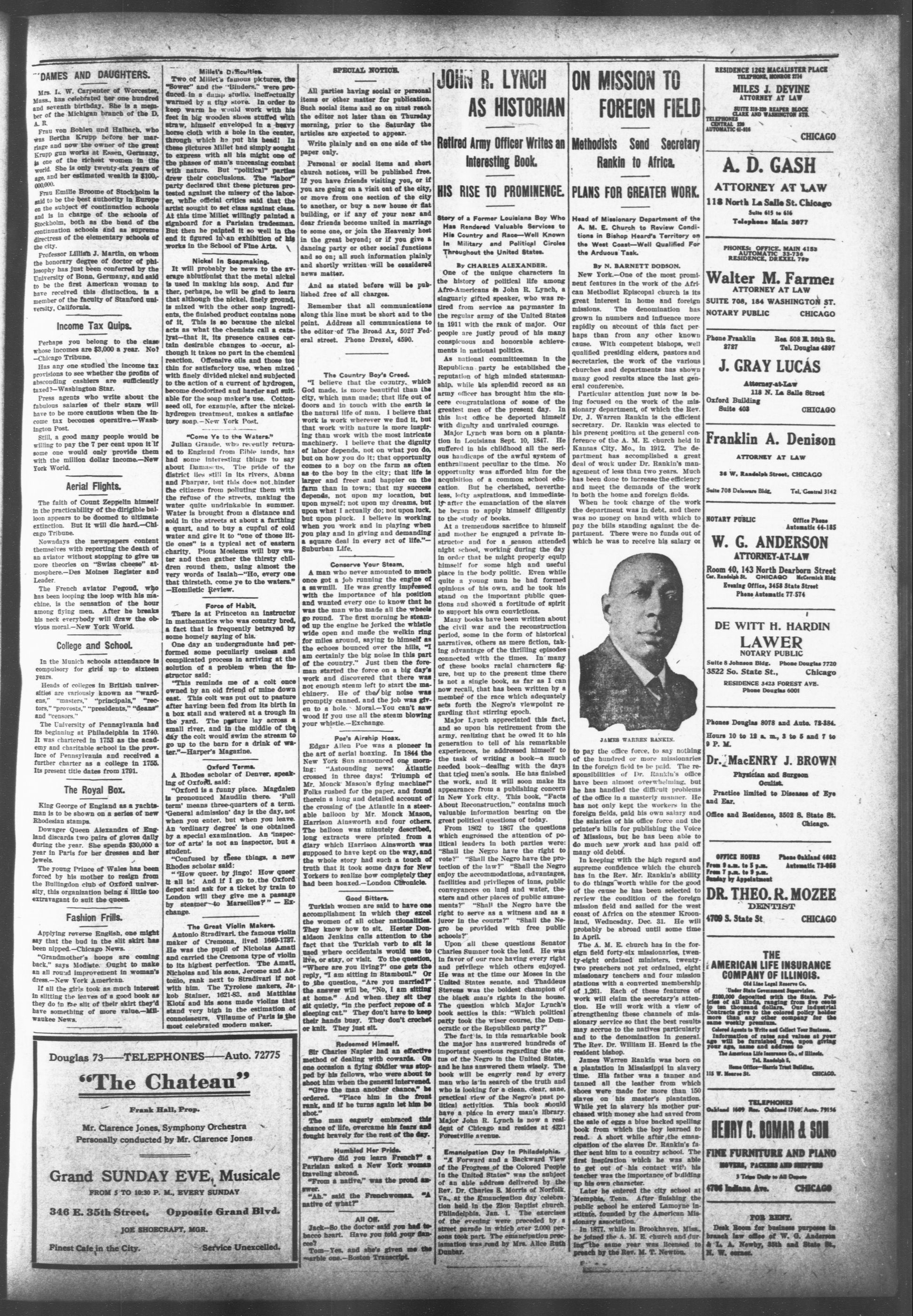
JAMES WARREN RANKIN.
to pay the office force, to say nothing of the hundred or more missionaries in the foreign field to be paid. The responsibilities of Dr. Rankin's office have been almost overwhelming, but he has handled the difficult problems of the office in a masterly manner. He has not only kept the workers in the foreign fields, paid his own salary and the salaries of his office force and the printer's bills for publishing the Voice of Missions, but he has been able to do much new work and has paid off many old debts.
In keeping with the high regard and supreme confidence which the church has in the Rev. Mr. Rankin's ability to do things worth while for the good of the cause he has been selected to review the condition of the foreign mission field and sailed for the west coast of Africa on the steamer Kroonland, Wednesday, Dec. 31. He will probably be abroad until some time in April.
The A. M. E. church has in the foreign field forty-six missionaries, twenty-eight ordained ministers, twenty-two preachers not yet ordained, eight missionary teachers and four mission stations with a converted membership of 1,261. Each of these features of work will claim the secretary's attention. He will work with a view of strengthening these channels of missionary service so that the best results may accrue to the natives particularly and to the denomination in general. The Rev. Dr. William H. Heard is the resident bishop.
James Warren Rankin was born on a plantation in Mississippi in slavery time. His father was a tanner and tanned all the leather from which shoes were made for more than 150 slaves on his master's plantation. While yet in slavery his mother purchased with money she had saved from the sale of eggs a blue backed spelling book from which the boy learned to read. A short while after the emancipation of the slaves Dr. Rankin's father sent him to a country school. The first inspiration which he was able to get out of his contact with his teacher was the importance of building up his own character. Later he entered the city school at Memphis, Tenn. After finishing the public school he entered Lamoyne institute, founded by the American Missionary association.
In 1877, while in Brookhaven, Miss. he joined the A. M. E. church and during the same year was licensed to preach by the Rev. M. T. Newton.
RESIDENCE 1262 MACALISTER PLACE
TELEPHONE, MONROE 2714
MILES J. DEVINE
ATTORNEY AT LAW
SUITE 318-320 REAPER BLOCK
CLARK AND WASHINGTON STS.
TELEPHONES
CENTRAL 320
AUTOMATIC 61-916
CHICAGO
A. D. GASH
ATTORNEY AT LAW
118 North La Salle St. Chicago
Suite 615 to 616
Telephone Main 3077
PHONE: OFFICE, MAIN 4153
AUTOMATIC 33-736
RESIDENCE, DREXEL 799
Walter M. Farmer
ATTORNEY AT LAW
SUITE 708, 184 WASHINGTON ST.
NOTARY PUBLIC CHICAGO
Phone Franklin Bea 508 M. 36th St.
2727 Tel. Douglas 4397
J. GRAY LUCÁS
Attorney-at-Law
118 N. La Salle Street
Oxford Building
Suite 403 CHICAGO
Franklin A. Denison
ATTORNEY AT LAW
36 W. Randolph Street. CHICAGO
NOTARY PUBLIC Office Phone
Automatic 44-185
W. G. ANDERSON
ATTORNEY-AT-LAW
Room 40, 143 North Dearborn Street
Cor. Randolph St. CHICAGO McCormick Blvd
Evening Office, 3458 State Street
Phone Automatic 77-574
DE WITT H. HARDIN
Suite 8 Johnson Bldg. Phone Douglas 7720
3522 So. State St., Chicago
RESIDENCE 3423 FOREST AVE.
Phone Douglas 6001
Phones Douglas 8078 and Auto. 72-384.
Hours 10 to 12 a. m., 3 to 5 and 7 to 9 P. M.
Dr. MacENRY J. BROWN
Physician and Surgeon
Oculist.
Practice limited to Diseases of Eye and Ear.
Office and Residence, 3502 S. State St.
Chicago.
OFFICE HOURS Phone Oakland 4662
From 8 a.m. to 5 p.m. Automatic 73-858
From 7 p.m. to 9 p.m.
Sunday by Appointment
DR. THEO. R. MOZEE
DENTIST
4709 S. State St CHICAGO
THE AMERICAN LIFE INSURANCE COMPANY OF ILLINOIS.
Old Line Legal Reserve Co.
Under State Government Supervision.
$100,000 deposited with the State. Policies of all kinds, ranging from five cents to ten thousand dollars. Our industrial Contracts give to the colored policy holder more than any other company for the same weekly premium.
Colored Agents to Write and Collect Your Business.
Information of rates and values at your age will be furnished free upon giving your age, name and address to
The American Life Insurance Co., of Illinois.
Tel. Randolph 5.
Home Office—Harris Trust Building.
115 W. Moorce St.
CHICAGO.
TELEPHONES
Oakland 1609 Rue. Oakland 1760f Auto. 79156
HENRY C. BOMAR & SON
FINE FURNITURE AND PIANO
MOVERS, PACKERS AND SHIPPERS
3 Trips Daily to All Deposits
4786 Indiana Ave. CHICAGO
FOR RENT.
Desk Room for business purposes in branch law office of W. G. Anderson & L. A. Newby, 35th and State St., M. W. corner.
---
KEYSTONE HOTEL
DAVID McGOWAN, Prop.
NEATLY FURNISHED ROOMS WITH BATH
FIRST CLASS BILLIARD PARLORS
3022 STATE STREET
DAMES AND DAUGHTERS.
Since her first appearance on the stage in Russia, fourteen years ago, Mme Nazimova has played 318 parts. Wahkinkum county, the smallest in the state of Washington, has a woman clerk, Miss Mary C. Cooper, and her work has been highly complimented in a recent report of the bureau of inspection. Mrs. Ernest Hart, the woman scientist of England who discovered the new system of waterproofing which made washable banknotes possible, is the presiding genius in a factory which is erected in London to carry through some of the chemical processes she has perfected.
Mme. Emmy Destinn, the prima donna who sang for a cinematograph company recently in a lion's cage, has received for this performance the largest salary ever paid to a singer. For singing a single aria from "Mignon" she has been paid $12,500. She was in the cage exactly five minutes, so that the payment works out at $2,500 a minute. In addition to this, the film company had to insure her for $125,000 against death or injury.
The Royal Box.
The Crown Prince Frederick of Denmark, who is aged fourteen, has been made "Translator of English" by the Danish boy scouts, of whom he is one. Queen Mary is an enthusiastic book lover, and whenever she pays short, informal visits to London she usually goes to a famous book shop in the west end, as nothing pleases her better than to be able to look through the new books at her leisure. Prince Alexis Karageorgevich, who has taken up his residence in America with his American bride, who was Mrs. Huger Pratt of Cleveland, is a claimant to the throne of Servia. He fought in the ranks of the Servian army as an enlisted man in the war with the Turks. The prince is a cousin of King Peter of Servia and asserts that he is entitled to the throne.
Current Comment.
Folks are queer. They light matches to find gas leaks and neglect to light the gas when hunting for medicine bottles.
Some enterprising newspaper man ought to send out an authoritative statement on "Who's Killing Who" in Mexico. — Memphis 'Commercial Appeal.
The season of swimming and boat rocking fatalities is past, but that of skating disasters has begun, while the automobile we have always with us.—New York Tribune.
Typhoid fever has practically been driven from the army and navy, and some day it should be driven from civil life, when the facilities for prophylactic vaccine treatment become more general.—New York World.
Aerial Flights.
The use of looping the loop in an aeroplane is problematical unless it is expected to help in military action by throwing the enemy into a state of dazed admiration—Washington Star. The "automatic stabilizer" invented by Orville Wright is said to make it possible to learn to fly in twenty minutes. If flying is made too easy and too safe will there be the same incentive to learn?—New York World. The French have figured it to show that in 1908 there was one death of an aviator for every 1,600 kilometers flown, while in 1912 there was one death for every 140,000 kilometers only. As we see it, they simply fly a little farther now to come to the same end.—Buffalo Commercial.
Flippant Flings.
The coal man will make things warm for you, even if you don't pay his bills.—Philadelphia Record.
The proposition to tax bachelors to provide pensions for widows is enough to provoke the bachelors to marry the widows out of revenge.—Baltimore American.
Another English literary man has been knighted. Soon there will be nothing to read in England but "A Thousand and One Knights."—New York American.
It is being argued in New York that a lemon trust exists. This is a hard case to prove. If anything, there is too much competition in lemons—you can pick 'em anywhere.—Boston Globe.
Phone Douglas 883
THOMAS COLE
PROPR
C. C. HOTEL
3449 So. State St.!
Automatic 72-377 Phone
KEYSTONE
DAVID McGEE
NEATLY FURNISHED
FIRST CLASS BILL
3022 STAT
PLATES TO RENT.
STOVE HEATED FLATS TO SUIT
INCOME.
You will save many tired steps when
you want a four or five room flat if
you first call on me. Good Tenants
Appreciated. Good tenants Pay rent
from the first of each month. Please
be among the many good tenants paid
for renting the same as agents.
2720 Dearborn St., 2nd flat, 7 rooms,
$19.00.
3741 LaSalle St., 2nd flat, front, 5
rooms and bath, $20.00.
2406 LaSalle St., 1st flat, 6 rooms,
$12.00.
If you want a landlord that will do
the same to all honest men you wont
rent until you see Samuel Richardson,
160 North Fifth Ave., Room 506,
North West corner of Randolph St.
Owner.
THE BROAD AX CAN BE FOUND ON SALE AT THE FOLLOWING NEWS STANDS:
From on and after this date The Broad Ax, can be found on sale at the following news stands:
A. F. Tervalon, cigar store and news stand, 5004 State street.
George I Martin, maker of fine cigars and news stand, 18 W. 31st St., near State.
R. M. Harvey's barber shop and news stand, 3924 State street.
Mrs. Nellie Phelpe, cigars, notions and news stand, 15 W. 51st St., near Dearborn.
W. S. Cole, cigars, tobacco and news stand, 34 W. 31st St., near Dearborn.
W. M. Maxwell, notions, cigars, tobacco, confections and news stand, 5244 State St.
Edward Felix, notions, cigars and news stand, 52 W. 30th St.
F. Bishop, cigars, tobacco and news stand, 3 W. 27th St., near State.
Sylvester McGloffin, news stand and laundry office, 4122 State St.
William Gaughan, laundry office, cigars, tobacco and news stand, 2636 State St.
Mrs. L. B. Taylor, notions, cigars and news stand, 15 W. 36th Street, near State.
A. D. Hayes, cigars, tobacco, notions, stationery and news stand, 3640 S. State St.
George McFaro, shoe shining parlors and news stand. 3800½ State street.
Bell & Alfred, cigars, tobacco and news stand. 3128 $ \frac{1}{2} $ South State street. T. S. Harris, cigars, tobacco and news stand. 2845 South State street. Fred M. Waterfield, cigars, tobacco, notions and news stand, 5202 South State street. Coleman & Glanton, cigars, tobacco and news stand, 3342 S. State street. J. S. Williams, ladies and gents shoe dressing parlor, laundry office and news stand. 12 E. 34th street. Miss E. M. McClain, hair dressing parlor and news stand. 30 W. 39th street. Charles A. Murphy, cigars, tobacco, laundry office and news stand. 2972 $ \frac{1}{2} $ S. State street. F. M. Diffay, cigars, tobacco, notions and news stand. 3605 State street.
C. Cunningham, cigars, song store, news stand, and periodicals, 3242 S. State street.
A. Turpin, cigars, confections and news stand, 3511 S. State street.
"What has become of the orator who used to make such thrilling speeches?" "He had to quit," replied Farmer Corntossel. "He took on so much weight that he couldn't get up on a soap box without smashin' it in."—Washington Star.
A marksman bold was William Tell, One of the stars. He nearly always rang the bell And won cigars.
—Pittsburgh Post.
"Sir, Rudolph, the lion, has just bitten off his trainer's arm."
"In that case Rudolf won't want any dinner," said the heartless proprietor of the show.—Kansas City Journal.
Lives of suffragettes remind us
That as long as hustles note
We have always had some trouble,
More or less, about the vote.
Automatic 72-746
HOWARD FJCATLIN
NETORS
L. & BUFFET
Chicago, Ill.
Douglas 1360 and 2349
THE HOTEL
OWAN, Prop.
ROOMS WITH BATH
LIARD PARLORS
THE STREET
THE MUSEUM
S. E. Cor. State and 36th Place, Chicago
GENERAL BANKING 3 per cent allowed on Savings Ac Safety Deposit Vaults, $3.00 per
cent allowed on Savings Ac Deposit Vaults, $3.00 per
owed on Savings Accounts
t Vaults, $3.00 per Year
3 per cent allowed on Savings Accounts Safety Deposit Vaults, $3.00 per Year REAL ESTATE DEPARTMENT
As agent buy and sell Real Estate on or
dents, including payment of taxes and l
on Chicago Real Estate.
Especially Invites the patr
The - Cranfor
Building. 3
The finest building ever open
Steam heat, electric light, tile ba
and sell Real Estate on commission, manages estate
payment of taxes and looking after assessments
real Estate.
Specially Invites the patronage of Chicago business
Cranford Apartment
building. 3600. Wabash A
first building ever opened to Colored tenant
electric light, tile baths, marble entrance
state on commission, manages estates for non-resi-
ces and looking after assessments. Money to loan
the patronage of Chicago business men.
Anford Apartment
5. 3600. Wabash Ave.;
ver opened to Colored tenants in Chicago.
tile baths, marble entrance.
As agent buy and sell Real Estate on commission, manages estates for non-residents, including payment of taxes and looking after assessments. Money to loan on Chicago Real Estate.
Especially Invites the patronage of Chicago business men.
The Cranford Apartment Building. 3600. Wabash Ave.
C
The finest building ever opened to Colored tenants in Chicago. Steam heat, electric light, tile baths, marble entrance. J. W. Casey, Agent, Phone Randolph 803 74 W. WASHINGTON STREET.
from photo of gas are
ation which saved
huge factory $1500
last year.
Is It Costing You To Light Your
Factory—Are You Paying Big
for Half Enough Light?
ing You To Light Your Store
Are You Paying Big Bills
Half Enough Light?
Sketch from photo of gas are installation which saved one Chicago factory $1200 last year.
What Is It Costing You or Factory—Are You for Half E
Stitch from photo of gas are installation which saved one Chicago factory $150
What Is It Costing You To Light Your Store or Factory—Are You Paying Big Bills for Half Enough Light?
Are you aware that store and factory Gas Arcs have been greatly improved in recent years?
Do you know that these Gas Arcs now yield the tremendous volume of 350 candles for only one cent an hour?
Do you know that the Gas Company maintains these lights—keeps them in order—keeps them burning at their maximum efficiency?
Do you realize how much a Gas Arc lighting installation
The Peoples Gas La Peoples Gas Building
Peoples Gas Light & Coke Com
as Building Telephone Ran
Gas Light & Coke Company
Telephone Randolph 4867
The Peoples Gas Light & Coke Company
Peoples Gas Building Telephone Randolph 4867
The P
Pompei
The Pompei
Buffet and Cafe
20-22 East 31st Street :: CH
Phones,
Douglas 381
Auto. 71-
East 31st Street :: CH
Phones,
Englis 333
Auto. 71-
st Street :: CHICAGO
Phones,
Auto. 71-818
20-22 East 31st Street :: CHICAGO
Thos. McCain
Telephone Douglas 1565
J. W. Casey, Agent, 74 W. WASHINGTON STREET.
would save you each month?
Do you realize that the hundred thousand Gas Arcs in use in Chicago are saving tens of thousands of dollars for your competitors?
If you haven't investigated the matter—and the economy appeals to you—drop us a line or phone us. We will gladly send you our printed Gas Are data—or, if you wish, we can send an expert to submit specific figures on your particular requirements.
Mort Shoecraft
"A STORE FOR EVERYBODY"
HILLMAN'S
STATE & WASHINGTON STS.
Everything to sell, to wear and for the home. Ready to
wear attire for man, woman and child at lowest prices,
quality and workmanship considered. Make it a point to
visit this store every day and take advantage of the special
bargain offerings that we give in all departments.
JOHN J. BRADLEY
Real Estate
Loans
Fire and Plate Glass Insurance
4709 S. HALSTED ST
CHICAGO
Carlas 4482
73-974
74-478
HARRY
LA VERDO BUFFET
D AND DOMESTIC CIGARS AND CIGARS
Street
JOHN J. BRADLEY
LA VI
IMPORTED AND DO
3100 State Street
HOTEL
IMPORTED AND DOMESTIC CIGARS AND CIGARETTES]
3100 State Street CHICAGO.
HOTEL BRUNSWICH
GEO. W. HOLT, Prop.
BUFFET, POOL AND BILLIARDS
TE STREET
Douglas 3256
Auton
3004 STATE STREET
HENRY JONES
THE
CAFÉ
Finest T
4
THE ELITE
CAFE and BUFFET
Finest Table d'Hote in the City
4 p. m., to 1 a. m.
Street C
LEWIS, Prop. HENRY C. SNEE
Phone Douglas 3309 Automatic 75-173
GENERAL SPRING CAFE
FET AND CAFE
3517 S. State Street, CHICAGO
CLASS INTERTAINERS EVERY EVI
3030 State Street
WILLIAM LEWIS, F.
Phone Doug
MINERAL
BUFFET
3517 S. S
HIGH CLASS INT
WILLIAM LEWIS, Prop. HENRY C. SNEED, M'sr
Phone Douglas 3309 Automatic 75-173
B U F F E T A N D C A F B
3517 S. State Street, CHICAGO
HIGH CLASS INTERTAINERS EVERY EVENING
JOHN J. DUNN
WHOLESALE
FIFTY-FIRST
RAILYAIR
WHOLESALE COAL RETAIL
FIFTY-FIRST STREET and ARMOUR AVENUE
RAILYARDS 51st St. and L. S. & M. S.
51st St. and ARMOUR AVE.
NNN
BLOCKI, Pres.
P. W. BLOCK
JOHN BLOCKI, Pres.
JOHN E
C. E. Kreyssler, Druggist 5057 S. STATE STREET NOT ON THE CORNER For high grade Drugs, Chemicals, and Medicinal Preparations All Prescriptions Carefully Compounded ALSO CARRY A FULL LINE OF Blocki's Ideal & Blocki's Flower In Bottle Perfumes
Phones { Douglas 4482
Auto 73-974
Auto 74-478
Phone: Douglas 3256
FRANK DUNN
J. B. MoCAHEY
TRUSTEES
FRANK DUNN
HARRY J. KELLY
Prop.
BUFFET
S AND CIGARETTES
CHICAGO.
653
NSWICK
A. F. CODOZOE
LITE
FFET
in the City
m.
MARY C. SNEED, M'dr
omatic 75-173
ING CLUB
D CAFE
CHICAGO
EVERY EVENING
RETAIL
OUR AVENUE
S. & M. S.
AVE.
CHICAGO
F. W. BLOCKI, Tresas.
I & SON
S
Telephone Yards 693
PHONE DOUGLAS 8653
ESTABLISHED 1877
CHICAGO
Automatic 72-379
Chicago, Ill
TEL. OAKLAND
1880, 1881, 1882
CHICAGO