The Broad Ax
Saturday, September 5, 1914
Chicago, Illinois
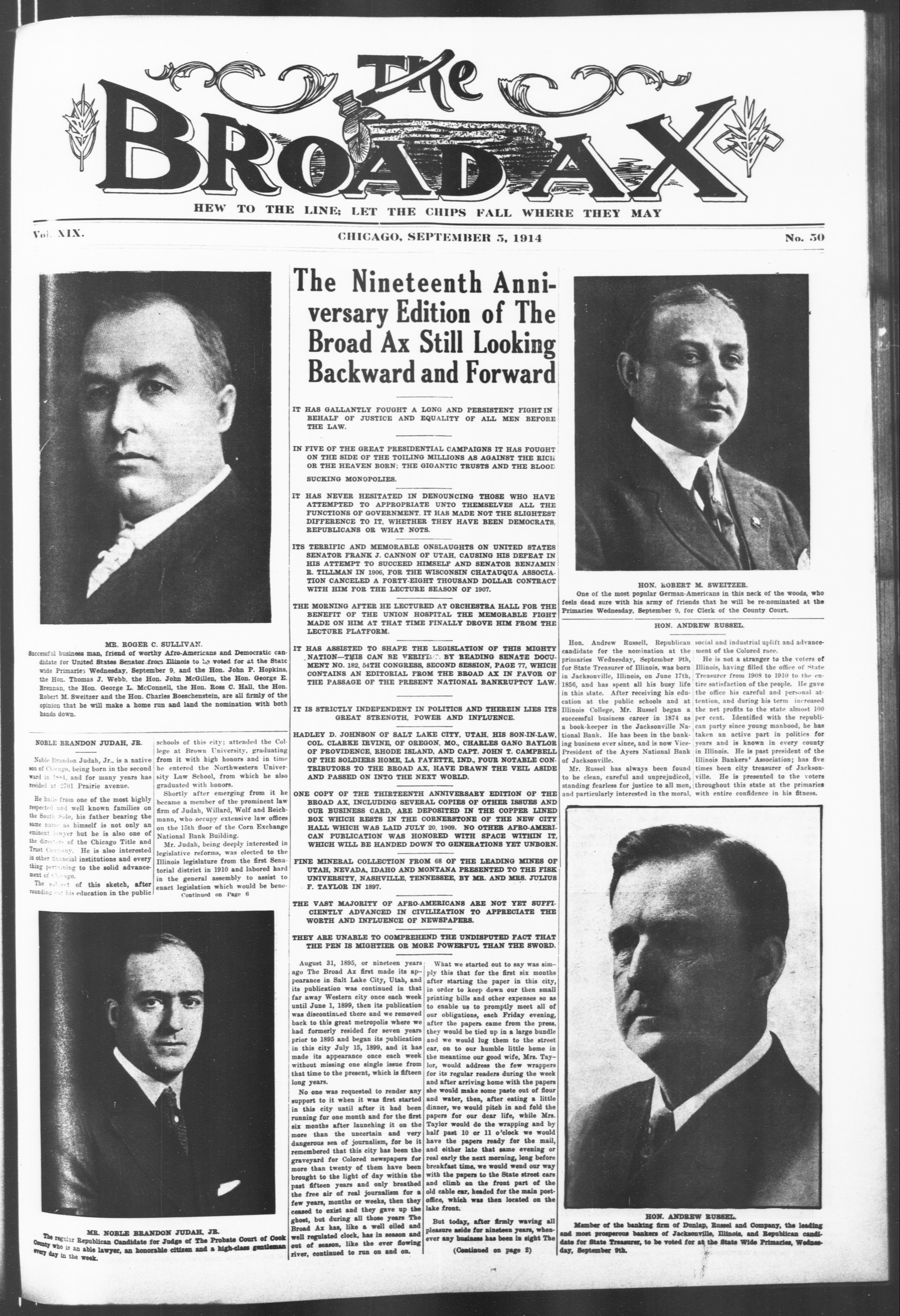
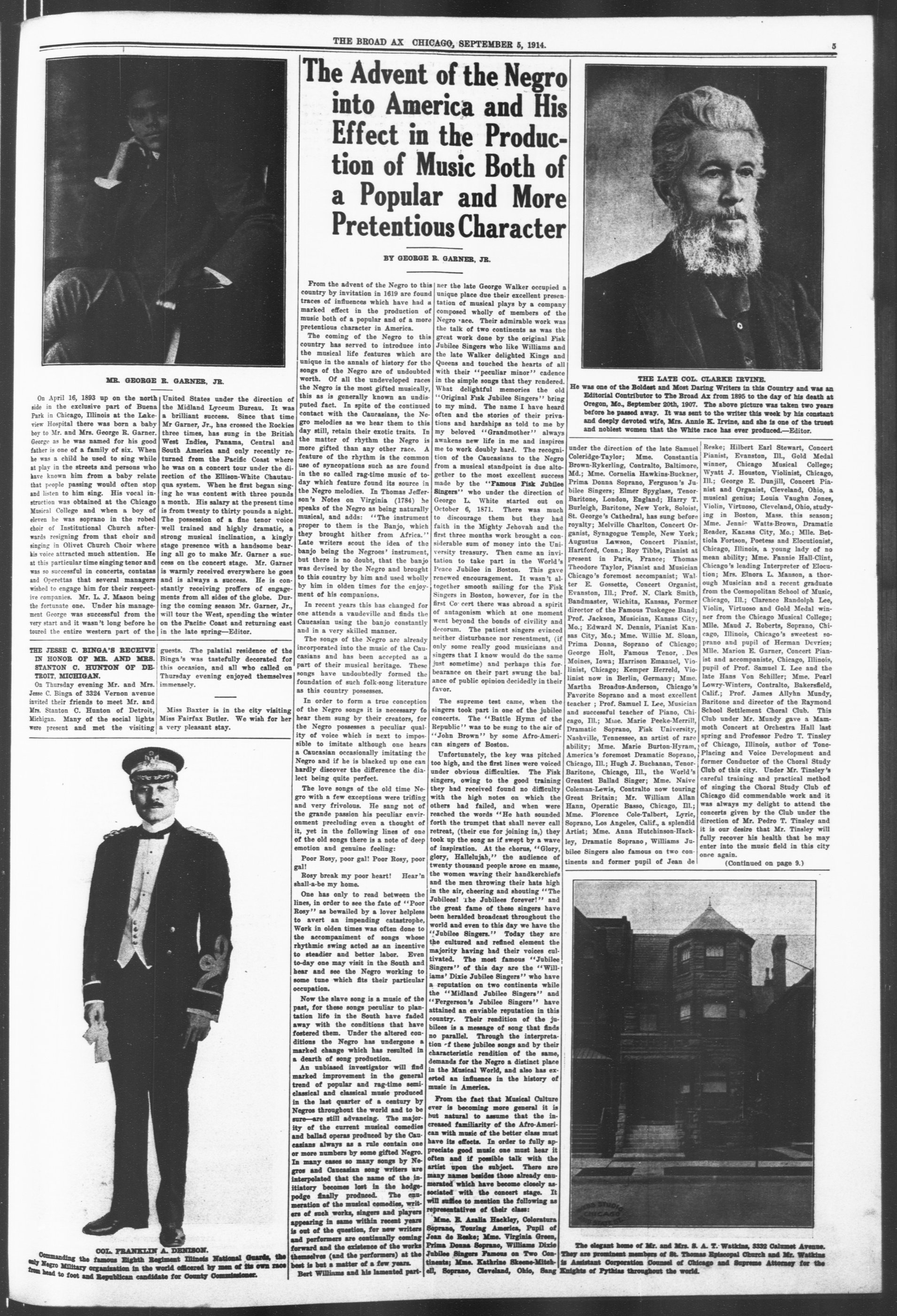
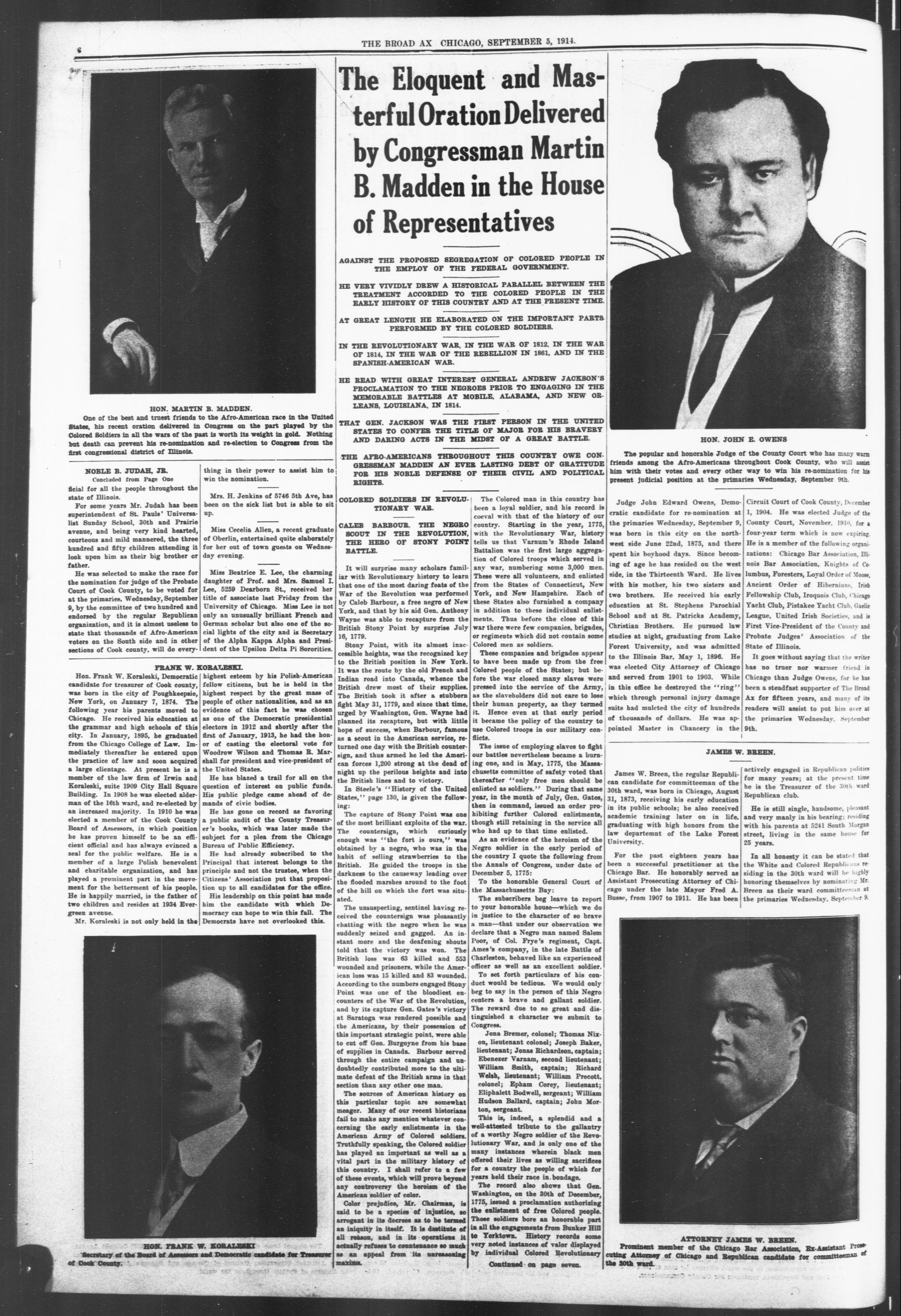
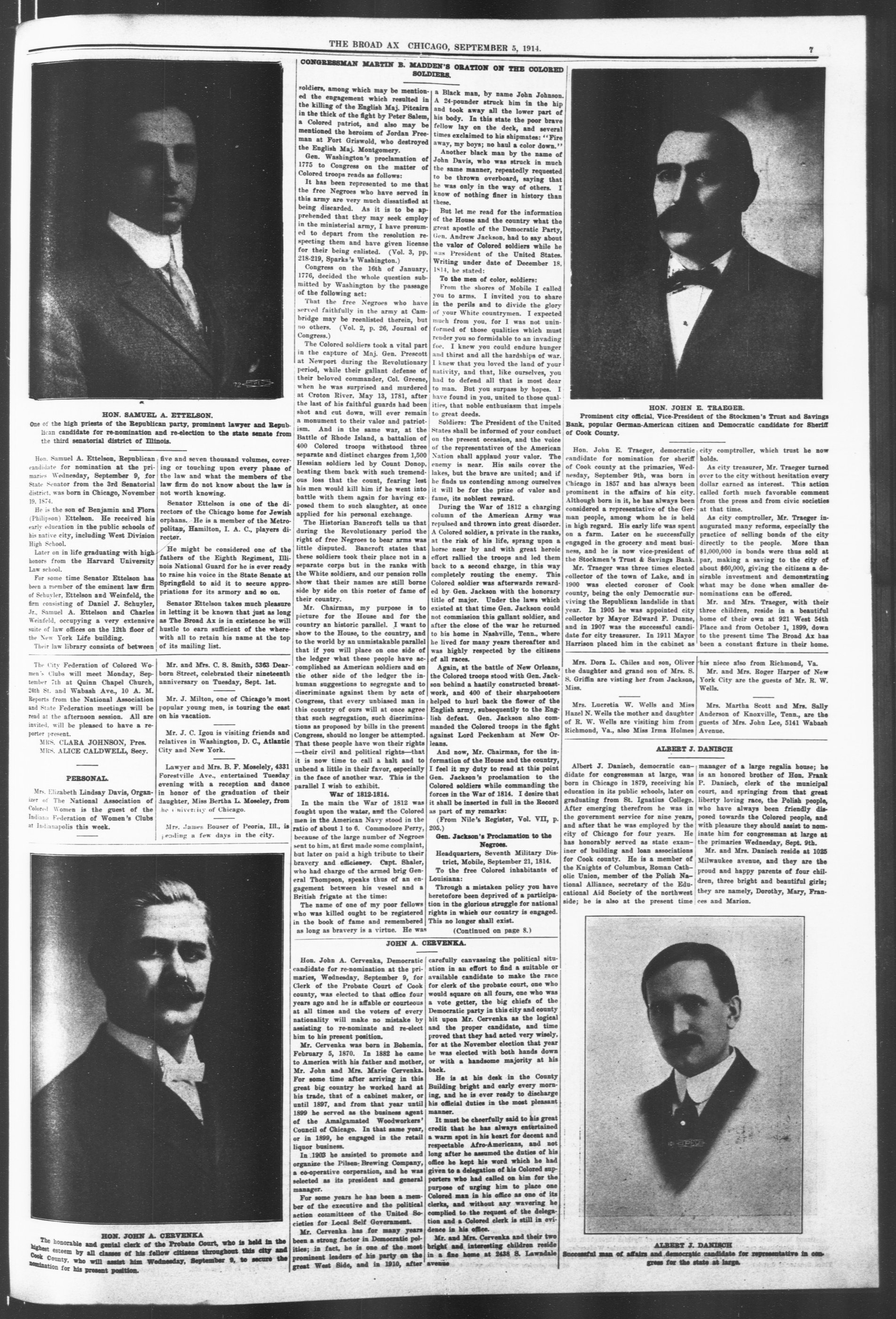
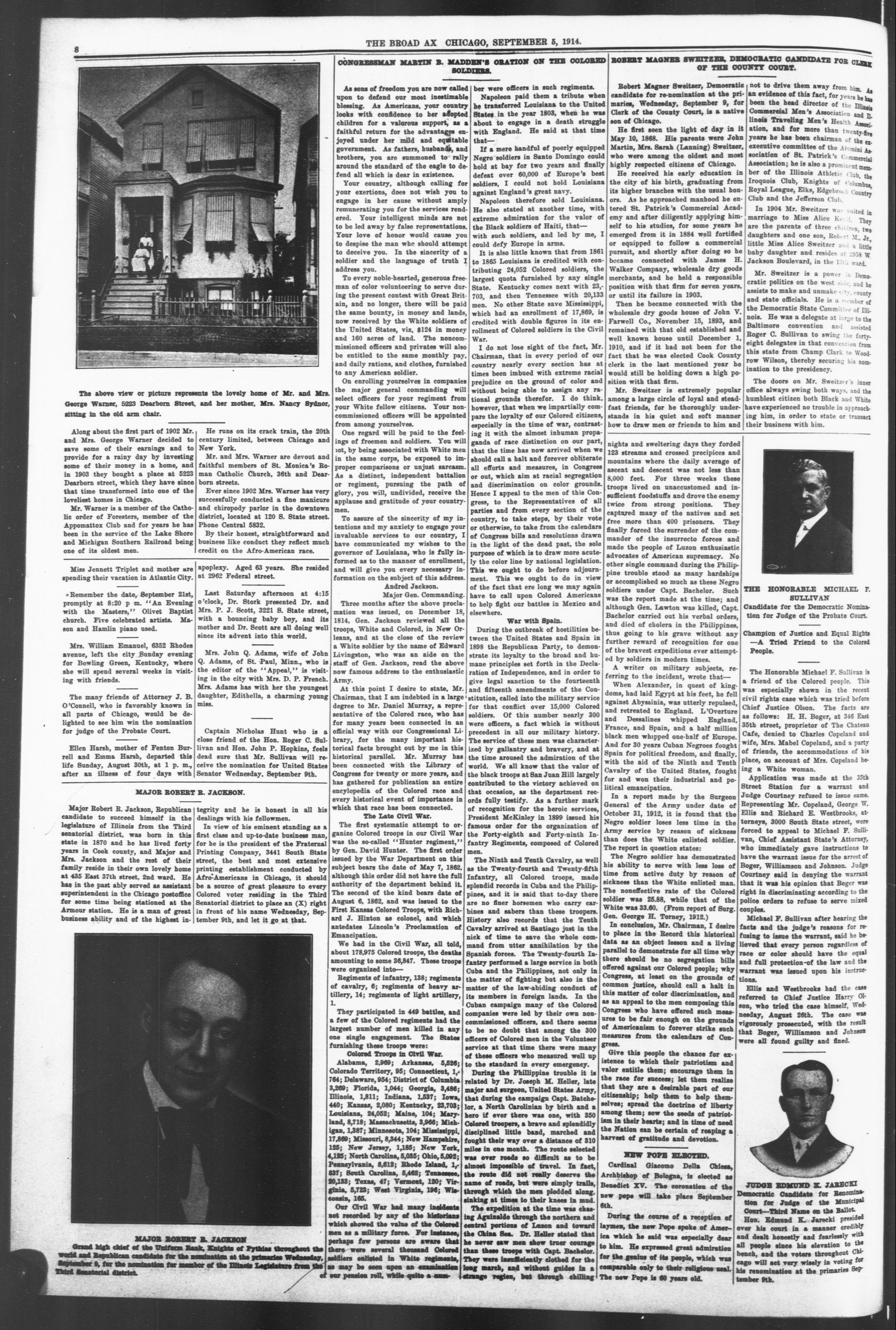
Page text (machine-generated)
BROAD AX
[Name]
MR. ROGER C. SULLIVAN. Successful business man, friend of worthy Afro-Americans and Democratic candidate for United States Senator from Illinois to vote for at the State wide Primaries Wednesday, September 9, and the Hon. John P. Hopkins, the Hon. Thomas J. Webb, the Hon. John McGillen, the Hon. George E. Brennan, the Hon. George L. McConnell, the Hon. Ross C. Hall, the Hon. Robert M. Sweitzer and the Hon. Charles Boeschenstein, are all firmly of the opinion that he will make a home run and land the nomination with both hands down.
NOBLE BRANDON JUDAH, JR
Noble Brandon Judah, Jr., is a native son of Chicago, being born in the second ward in 1844, and for many years has resided at 2701 Prairie avenue.
He hails from one of the most highly respected and well known families on the South Side, his father bearing the same name as himself is not only an eminent lawyer but he is also one of the directors of the Chicago Title and Trust Company. He is also interested in other financial institutions and every thing pertaining to the solid advancement of Chicago.
The subject of this sketch, after rounding out his education in the public
```markdown
```
MR. NOBLE BRANDON JUDAH. JB.
MR. NOBLE BRANDON JUDAH, JR.
The regular Republican Candidate for Judge of the Probate Court of Cook County who is an able lawyer, an honorable citizen and a high-class gentleman every day in the week.
Vol. XIX.
schools of this city; attended the College at Brown University, graduating from it with high honors and in time he entered the Northwestern University Law School, from which he also graduated with honors. Shortly after emerging from it he became a member of the prominent law firm of Judah, Willard, Wolf and Reichmann, who occupy extensive law offices on the 15th floor of the Corn Exchange National Bank Building. Mr. Judah, being deeply interested in legislative reforms, was elected to the Illinois legislature from the first Senatorial district in 1910 and labored hard in the general assembly to assist to enact legislation which would be bene-
Continued on Page 6
CHICAGO, SEPTEMBER 5. 1914
The Nineteenth Anniversary Edition of The Broad Ax Still Looking Backward and Forward
IT HAS GALLANTLY FOUGHT A LONG AND PERSISTENT FIGHT IN BEHALF OF JUSTICE AND EQUALITY OF ALL MEN BEFORE THE LAW.
IN FIVE OF THE GREAT PRESIDENTIAL CAMPAIGNS IT HAS FOUGHT ON THE SIDE OF THE TOILING MILLIONS AS AGAINST THE RICH OR THE HEAVEN BORN; THE GIGANTIC TRUSTS AND THE BLOOD SUCKING MONOPOLIES.
IT HAS NEVER HESITATED IN DENOUNCING THOSE WHO HAVE ATTEMPTED TO APPROPRIATE UNTO THEMSELVES ALL THE FUNCTIONS OF GOVERNMENT. IT HAS MADE NOT THE SLIGHTEST DIFFERENCE TO IT, WHETHER THEY BEEN DEMOCRATS, REPUBLICANS OR WHAT NOTS.
ITS TERRIFIC AND MEMORABLE ONSLAUGHTS ON UNITED STATES SENATOR FRANK J. CANNON OF UTAH, CAUSING HIS DEFEAT IN HIS ATTEMPT TO SUCCEED HIMSELF AND SENATOR BENJAMIN B. TILLMAN IN 1906, FOR THE WISCONSIN CHATAUQUA ASSOCIATION CANCELED A FORTY-EIGHT THOUSAND DOLLAR CONTRACT WITH HIM FOR THE LECTURE SEASON OF 1907.
THE MORNING AFTER HE LECTURED AT ORCHESTRA HALL FOR THE BENEFIT OF THE UNION HOSPITAL THE MEMORABLE FIGHT MADE ON HIM AT THAT TIME FINALLY DROVE HIM FROM THE LECTURE PLATFORM.
IT HAS ASSISTED TO SHAPE THE LEGISLATION OF THIS MIGHTY NATION—TMIS CAN BE VERIFIED BY READING SENATE DOCUMENT NO. 182, 54TH CONGRESS, SECOND SESSION, PAGE 77, WHICH CONTAINS AN EDITORIAL FROM THE BROAD AX IN FAVOR OF THE PASSAGE OF THE PRESENT NATIONAL BANKRUPTCY LAW
IT IS STRICTLY INDEPENDENT IN POLITICS AND THEREIN LIES ITS GREAT STRENGTH, POWER AND INFLUENCE.
HADLEY D. JOHNSON OF SALT LAKE CITY, UTAH. HIS SON-IN-LAW, COL. CLARKE IRVINE, OF OREGON, MO., CHARLES GANO BAYLOR OF PROVIDENCE, RHODE ISLAND, AND CAPT. JOHN T. CAMPBELL OF THE SOLDIERS HOME, LA FAYETTE, IND., FOUR NOTABLE CONTRIBUTORS TO THE BROAD AX, HAVE DRAWN THE VEIL ASIDE AND PASSED ON INTO THE NEXT WORLD.
ONE COPY OF THE THIRTEENTH ANNIVERSARY EDITION OF THE BROAD AX, INCLUDING SEVERAL COPIES OF OTHER ISSUES AND OUR BUSINESS CARD, ARE DEPOSITED IN THE COPPER LINED BOX WHICH RESTS IN THE CORNERSTONE OF THE NEW CITY HALL WHICH WAS LAID JULY 20, 1909. NO OTHER AFRO-AMERICAN PUBLICATION WAS HONORED WITH SPACE WITHIN IT, WHICH WILL BE HANDED DOWN TO GENERATIONS YET UNBORN.
FINE MINERAL COLLECTION FROM 68 OF THE LEADING MINES OF UTAH, NEVADA, IDAHO AND MONTANA PRESENTED TO THE FISK UNIVERSITY, NASHVILLE, TENNESSEE, BY MR. AND MRS. JULIUS F. TAYLOR IN 1897.
THE VAST MAJORITY OF AFRO-AMERICANS ARE NOT YET SUFFICIENTLY ADVANCED IN CIVILIZATION TO APPRECIATE THE WORTH AND INFLUENCE OF NEWSPAPERS.
THEY ARE UNABLE TO COMPREHEND THE UNDISPUTED FACT THAT THE PEN IS MIGHTIER OR MORE POWERFUL THAN THE SWORD.
August 31, 1895, or nineteen years ago The Broad Ax first made its appearance in Salt Lake City, Utah, and its publication was continued in that far away Western city once each week until June 1, 1899, then its publication was discontinued there and we removed back to this great metropolis where we had formerly resided for seven years prior to 1895 and began its publication in this city July 15, 1899, and it has made its appearance once each week without missing one single issue from that time to the present, which is fifteen long years.
No one was requested to render any support to it when it was first started in this city until after it had been running for one month and for the first six months after launching it on the more than the uncertain and very dangerous sea of journalism, for be it remembered that this city has been the graveyard for Colored newspapers for more than twenty of them have been brought to the light of day within the past fifteen years and only breathed the free air of real journalism for a few years, months or weeks, then they ceased to exist and they gave up the ghost, but during all those years The Broad Ax has, like a well oiled and well regulated clock, has in season and out of season, like the ever flowing river, continued to run on and on.
What we started out to say was simply this that for the first six months after starting the paper in this city, in order to keep down our then small printing bills and other expenses so as to enable us to promptly meet all of our obligations, each Friday evening, after the papers came from the press, they would be tied up in a large bundle and we would lug them to the street car, on to our humble little home in the meantime our good wife, Mrs. Taylor, would address the few wrappers for its regular readers during the week and after arriving home with the papers she would make some paste out of flour and water, then, after eating a little dinner, we would pitch in and fold the papers for our dear life, while Mrs. Taylor would do the wrapping and by half past 10 or 11 o'clock we would have the papers ready for the mail, and either late that same evening or real early the next morning, long before breakfast time, we would wend our way with the papers to the State street cars and climb on the front part of the old cable car, headed for the main post-office, which was then located on the lake front.
But today, after firmly waving all pleasure aside for nineteen years, whenever any business has been in sight The (Continued on page 2)
PETER H. HARRIS
One of the most popular German-Americans in this neck of the woods, who feels dead sure with his army of friends that he will be re-nominated at the Primaries Wednesday, September 9, for Clerk of the County Court.
HON. ANDREW RUSSEL
Hon. Andrew Russell, Republican candidate for the nomination at the primaries Wednesday, September 9th, for State Treasurer of Illinois, was born in Jacksonville, Illinois, on June 17th, 1856, and has spent all his busy life in this state. After receiving his education at the public schools and at Illinois College, Mr. Russel began a successful business career in 1874 as a book-keeper in the Jacksonville National Bank. He has been in the banking business ever since, and is now Vice-President of the Ayers National Bank of Jacksonville.
Mr. Russel has always been found to be clean, careful and unprejudiced, standing fearless for justice to all men, and particularly interested in the moral
[Name not visible in the image]
HON. ANDREW RUSSEL.
Member of the banking firm of Dunlap, Russel and Company, the leading and most prosperous bankers of Jacksonville, Illinois, and Republican candidate for State Treasurer, to be voted for at the State Wide Primaries, Wednesday. September 9th.
Member of the banking firm of Dunlap, Russell and Company, the leading and most prosperous bankers of Jacksonville, Illinois, and Republican candidate for State Treasurer, to be voted for at the State Wide Primaries, Wednesday. September 9th.
social and industrial uplift and advancement of the Colored race.
He is not a stranger to the voters of Illinois, having filled the office of State Treasurer from 1908 to 1910 to the entire satisfaction of the people. He gave the office his careful and personal attention, and during his term increased the net profits to the state almost 100 per cent. Identified with the republican party since young manhood, he has taken an active part in politics for years and is known in every county in Illinois. He is past president of the Illinois Bankers' Association; has five times been city treasurer of Jacksonville. He is presented to the voters throughout this state at the primaries with entire confidence in his fitness.
No. 50
```markdown
```
MR. HENRY HORNER
One of the Most Distinguished Lawyers
in Chicago and Democratic Candidate for Judge of the Probate Court,
to be Voted for at the Primaries
Wednesday, September 9th.
Henry Horner, democratic candidate for the nomination of judge of the Probate Court, was born in Chicago November 30, 1878, and has resided here all his life. His parents were also born here. His residence is at 4801 Forestville avenue. He has always been a democrat. He was educated in the Chicago public schools, Chicago Manual Training, Chicago University, Chicago Kent College of Law. He was admitted to the bar of this state in 1899, and has practiced law here ever since. He is now engaged in the active practive of law at 1003 Straus Bldg., 6 N. Clark street. He is a member of the Chicago Bar Association, Illinois State Bar Association, American Bar Association, Standard Club, Iroquois Club, the Lake Shore Country Club and various other organizations.
He has been active in local charities for a great many years. He is a member of the board of directors of the Home for the Aged; a member of the board of directors of the Aid Society, the Relief Society and of the West Side Dispensary. He is also interested in a boys' camp, which is this summer taking care of 250 poor Chicago boys at Long Lake, Ill. He is also connected with other charitable institutions and social service work. He is a member of the New Charter Commission of which he is chairman of the "Committee on Municipal Legislature and its Powers." He is also interested in bathing beaches, small parks and other civic work.
In 1902 he was elected South Town collector, but at that time the proposition as to whether or no the town office within the limits of the city of Chicago should be abolished was submitted to popular vote. The vote thereon was in the affirmative. Although many lawyers were then of the opinion that the abolition was effective only after the term to which he was elected had expired, he responded to the public sentiment then prevailing and refused to take any steps to take office. In the early part of 1913 he was selected by the Board of Assessors of Cook county as its attorney, and served them during the years of 1913 and 1914. Although previous attorneys received a salary for their service of $3,000 per annum, yet no appropriation having been made for such salary since March, 1913, Mr. Horner has since that time served as the Board's attorney without compensation.
He gives up a good practice for the opportunity for service the office of the judge of the Probate Court offers. Mr. Horner is of German-Bohemian extraction. His grandfather was born in C-Kin, Pesek V. Cechy, Bohemia. His grandmother was born in Dieberg Hesse-Darmstadt.
SIR
J.
(1912) "Has served one term in the House, taking rank as one of the most fearless and aggressive friends of fair play and good government." (1914) "Ending his second term. Honest, aggressive and high minded. An able representative of whom his constituency should be weed."
EDWARD LITZINGER, REPUBLICAN CANDIDATE FOR COUNTY TREASURER.
The nomination by the Committee of 200, representing the Republican party of Cook County, of Edward R. Litzinger, for County Treasurer, makes a new area in the selection of useful servants for public office.
Mr. Litzinger was born in Chicago, September 19, 1874, graduated from the Holden Public School and for a number of years attended the Y. M. C. A. night classes. He pursued his legal studies in the Kent College of Law and was admitted to the Bar in 1898. Since which time he has built an extensive law practice under the firm name of Litzinger, McGurn & Reed. He is a member of the Bar Association, Vice-president and Director of the South-West Trust & Savings Bank, president of the United States Tent and Awning Company. His political career has not been very long, but during his short tenure of office as Alderman of the 5th Ward, he participated in and succeeded in having made into laws a number of useful ordinances affecting the interest of Chicago.
Edward R. Litzinger is well known among the older of the Colored men of this City, as a famous amateur ball player having played with the old Union Giants back in the early days
EDWARD R. LITZINGER.
lawyer, Base Ball Fan, who is favorably known throughout Chicago, and Republican candidate for treasurer of Cook County. of the beginning of Negro base ball history in this City. For many years he played second base for the rivals in the old City League, later was Captain winning of a Championship of the Mercantile League. He organized the first amateur base ball association of Chicago and for 7 years was its president.
He no doubt has grown out of the minds of a large majority of the Colored people by reason of his marvelous and unusual success in the business and professional world. The Colored voters are however, fortunate of being reminded of the fact that he is the same Edward R. Litzinger that he was in former days notwithstanding through honest and courageous efforts he has succeeded in garnering considerable of this world's goods. His heart nevertheless beats warm for all man-kind, regardless of race, color or creed.
As County Treasurer, the Colored voters can expect of him to restore to that office the former spirit of Republicanism which has predominated in the former years, and through the restoration of such spirit the Colored voters will inevitable come into their own.
Mr. Litzinger comes of an old respected German family and was born amid poverty and ill-luck, which enables him to appreciate the poor and working class of people. He is highly and favorable spoken of by the leading Colored business and professional men of Chicago. He is recommended by the Colored voters by such Colored men of the legal and business fraternity as Attorney E. H. Morris, Colonel Franklin A. Denison, Honorable Louis B. Anderson, W. W. Johnson, J. B. Anter, James A. Scott, Walter M. Farmer, Charles A. Ward, H. M. Porter, ex-County Commissioner Oscar DePriest, ex-representative, Edward D. Green, George O. Jones, S. Laing Williams, Edward E. Alexander, Dr. M. J. Brown, Frank L. Hamilton, Geo. W. Holt and others."B."
"That umpire stands for a lot of gab from the players." observed the thin fan.
"Yes," replied the fat fan. "He's a married man and he's used to back talk."—Cincinnati Enquirer.
Give me the land of pure delight
That knows no boundry fence,
Where war dogs neither bark nor bite
And censors never cense.
—Cleveland Plain Dealer.
"I understand the new arrival, Mrs. Blowser, expects to do a great deal of entertaining."
"The neighbors were entertained when she moved in."—Birmingham Are-Herald.
"How is the new man?" "Oh, he works some. He has to work some in order to be able to quit when the whistle blows."-Houston Post.
Man wants but little here below.
Yet thinks he wants a lot.
And, in the bean, some men don't know How little they have.
Indiana Star.
THE BROAD AX CHICAGO, SEPTEMBER 5. 1914
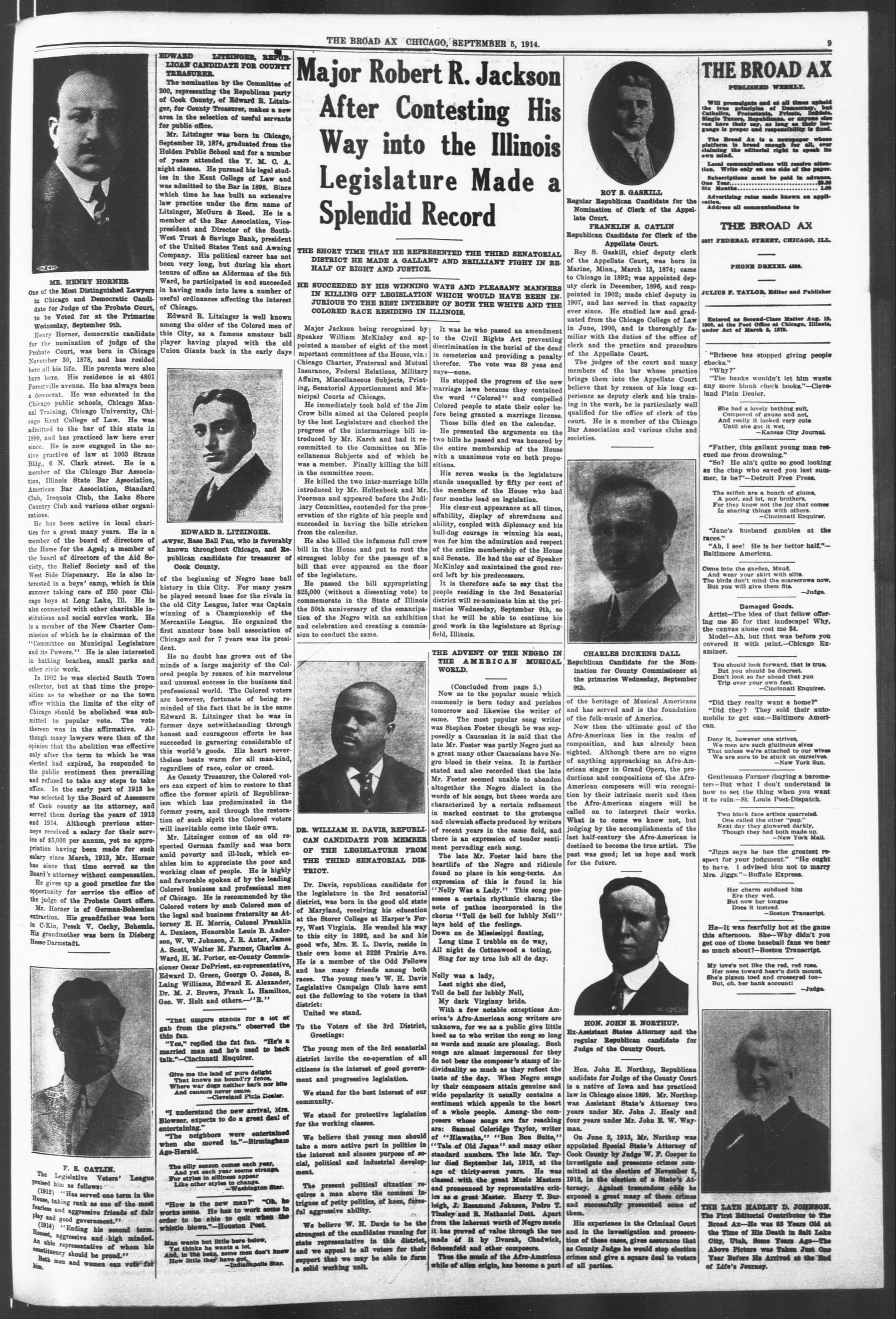
Major Robert R. Jackson After Contesting His Way into the Illinois Legislature Made a Splendid Record
THE SHORT TIME THAT HE REPRESENTED THE THIRD SENATORIAL DISTRICT HE MADE A GALLANT AND BRILLIANT FIGHT IN BEHALF OF RIGHT AND JUSTICE.
HE SUCCEEDED BY HIS WINNING WAYS AND PLEASANT MANNERS IN KILLING OFF LEGISLATION WHICH WOULD HAVE BEEN INJURIOUS TO THE BEST INTEREST OF BOTH THE WHITE AND THE COLORED RACE RESIDING IN ILLINOIS.
Major Jackson being recognized by Speaker William McKinley and appointed a member of eight of the most important committees of the House, viz.: Chicago Charter, Fraternal and Mutual Insurance, Federal Relations, Military Affairs, Miscellaneous Subjects, Printing, Senatorial Apportionment and Municipal Courts of Chicago.
It was he who passed an amendment to the Civil Rights Act preventing discrimination in the burial of the dead in cemeteries and providing a penalty therefor. The vote was 89 yeas and mays—none.
He stopped the progress of the new marriage laws because they contained the word "Colored" and compelled
He immediately took hold of the Jim Crow bills aimed at the Colored people by the last Legislature and checked the progress of the intermarriage bill introduced by Mr. Karch and had it recommitted to the Committee on Miscellaneous Subjects and of which he was a member. Finally killing the bill in the committee room.
He killed the two inter-marriage bills introduced by Mr. Hollenbeck and Mr. Poorman and appeared before the Judiciary Committee, contended for the preservation of the rights of his people and succeeded in having the bills stricken from the calendar.
He also killed the infamous full crew bill in the House and put to rout the strongest lobby for the passage of a bill that ever appeared on the floor of the legislature.
He passed the bill appropriating $25,000 (without a dissenting vote) to commemorate in the State of Illinois the 50th anniversary of the emancipation of the Negro with an exhibition and celebration and creating a commission to conduct the same.
A. B.
DR. WILLIAM H. DAVIS, REPUBLICAN CANDIDATE FOR MEMBER OF THE LEGISLATURE FROM THE THIRD SENATORIAL DISTRICT.
Dr. Davis, republican candidate for the legislature in the 3rd senatorial district, was born in the good old state of Maryland, receiving his education at the Storer College at Harper's Ferry, West Virginia. He wended his way to this city in 1892, and he and his good wfe, Mrs. E. L. Davis, reside in their own home at 3226 Prairie Ave. He is a member of the Odd Fellows and has many friends among both races. The young men's W. H. Davis Legislative Campaign Club have sent out the following to the voters in that district:
United we stand.
To the Voters of the 3rd District,
Greetings:
The young men of the 3rd senatorial district invite the co-operation of all citizens in the interest of good government and progressive legislation.
We stand for the best interest of our community.
We stand for protective legislation for the working classes.
We believe that young men should take a more active part in politics in the interest and sincere purpose of social, political and industrial development.
The present political situation requires a man above the common intrigues of petty politics, of keen, forceful aggressive ability.
We believe W. H. Davis to be the strongest of the candidates running for state representative in this district, and we appeal to all voters for their support that we may be able to form a solid working unit.
It was he who passed an amendment to the Civil Rights Act preventing discrimination in the burial of the dead in cemeteries and providing a penalty therefor. The vote was 89 yeas and nays—none.
He stopped the progress of the new marriage laws because they contained the word "Colored" and compelled Colored people to state their color before being granted a marriage license. Those bills died on the calendar.
He presented the arguments on the two bills he passed and was honored by the entire membership of the House with a unanimous vote on both propositions.
His seven weeks in the legislature stands unequalled by fifty per cent of the members of the House who had four months lead on legislation.
His clear-cut appearance at all times, affability, display of shrewdness and ability, coupled with diplomacy and his bull-dog courage in winning his seat, won for him the admiration and respect of the entire membership of the House and Senate. He had the ear of Speaker McKinley and maintained the good record left by his predecessors.
It is therefore safe to say that the people residing in the 3rd Senatorial district will re-nominate him at the primaries Wednesday, September 9th, so that he will be able to continue his good work in the legislature at Springfield, Illinois.
THE ADVENT OF THE NEGRO IN
THE AMERICAN MUSICAL
WORLD.
(Concluded from page 5.)
Now as to the popular music which commonly is born today and perishes tomorrow and likewise the writer of same. The most popular song writer was Stephen Foster though he was supposedly a Caucasian it is said that the late Mr. Foster was partly Negro just as a great many other Caucasians have Negro blood in their veins. It is further stated and also recorded that the late Mr. Foster seemed unable to abandon altogether the Negro dialect in the words of his songs, but these words are characterized by a certain refinement in marked contrast to the grotesque and clownish effects produced by writers of recent years in the same field, and there is an expression of tender sentiment pervading each song.
The late Mr. Foster laid bare the heartlife of the Negro and ridicule found no place in his song-texts. An expression of this is found in his "Nelly Was a Lady." This song possesses a certain rhythmic charm; the note of pathos incorporated in the chorus "Toll de bell for lubbly Nell" lays hold of the feelings. Down on de Mississippi floating, Long time I trabble on de way, All night de Cottonwood a tooting, Sing for my true lub all de day.
Nelly was a lady,
With a few notable exceptions America's Afro-American song writers are unknown, for we as a public give little heed as to who writes the song so long as words and music are pleasing. Such songs are almost impersonal for they do not bear the composer's stamp of individuality so much as they reflect the taste of the day. When Negro songs by their composers attain genuine and wide popularity it usually contains a sentiment which appeals to the heart of a whole people. Among the composers whose songs are far reaching are: Samuel Coleridge Taylor, writer of "Hiawatha," "Bon Bon Suite," "Tale of Old Japan" and many other standard numbers. The late Mr. Taylor died September 1st, 1912, at the age of thirty-seven years. He was classed with the great Music Masters and pronounced by representative critics as a great Master. Harry T. Burleigh, J. Rosamond Johnson, Pedre T. Tinsley and R. Nathaniel Dett. Apart from the inherent worth of Negro music it has proved of value through the use made of it by Dvorak, Chadwick, Schoenfeld and other composers.
Thus the music of the Afro-American while of alien origin, has become a part
ROY S. GASKILL
Regular Republican Candidate for the
Nomination of Clerk of the Appellate Court.
FRANKLIN S. CATLIN
Republican Candidate for Clerk of the
Appellate Court.
Roy S. Gaskill, chief deputy clerk of the Appellate Court, was born in Marine, Minn., March 13, 1874; came to Chicago in 1892; was appointed deputy clerk in December, 1896, and reappointed in 1902; made chief deputy in 1907, and has served in that capacity ever since. He studied law and graduated from the Chicago College of Law in June, 1900, and is thoroughly familiar with the duties of the office of clerk and the practice and procedure of the Appellate Court.
The judges of the court and many members of the bar whose practice brings them into the Appellate Court believe that by reason of his long experience as deputy clerk and his training in the work, he is particularly well qualified for the office of clerk of the court. He is a member of the Chicago Bar Association and various clubs and societies.
P.
CHARLES DICKENS DALL
Republican Candidate for the Nomination for County Commissioner at the primaries Wednesday, September 9th.
of the heritage of Musical Americans and has served and is the foundation of the folk-music of America.
Now then the ultimate goal of the Afro-American lies in the realm of composition, and has already been sighted. Although there are no signs of anything approaching an Afro-American singer in Grand Opera, the productions and compositions of the Afro-American composers will win recognition by their intrinsic merit and then the Afro-American singers will be called on to interpret their works. What is to come we know not, but judging by the accomplishments of the last half-century the Afro-American is destined to become the true artist. The past was good; let us hope and work for the future.
HON. JOHN E. NORTHUP.
Ex-Assistant States Attorney and the
regular Republican candidate for
Judge of the County Court.
Hon. John E. Northup, Republican candidate for Judge of the County Court is a native of Iowa and has practiced law in Chicago since 1899. Mr. Northup was Assistant State's Attorney two years under Mr. John J. Healy and four years under Mr. John E. W. Wayman.
On June 2, 1913, Mr. Northup was appointed Special State's Attorney of Cook County by Judge W. F. Cooper to investigate and prosecute crimes committed at the election of November 5, 1912, in the election of a State's Attorney. Against tremendous odds he exposed a great many of these crimes and successfully prosecuted some of them.
His experience in the Criminal Court and in the investigation and prosecution of these cases, gives assurance that as County Judge he would stop election crimes and give a square deal to voters of all parties.
9
THE BROAD AX
PUBLISHED WEEKLY.
Will promulgate and at all times uphold the constitution, constitution, constitution, but Catholicos, Protestants, Priests, Inmates, Single Tuxure, Rapidienne, or anyone else can have their say, as long as their language is proper and responsibility is fixed.
The Broad Ax is a newspaper whose platform is broad enough for all, ever claiming the editorial right to speak its own mind.
Local communications will receive attention. Write only on one side of the paper.
Subscriptions must be paid in advance. One Year.....$9.00
Six Months.....1.00
Advertising rates made known on application.
Address all communications to
THE BROAD AX
5027 FEDERAL STREET, CHICAGO, ILL
PHONE DREXEL 4500.
JULIUS F. TAYLOR, Editor and Publisher
Entered as Second-Class Matter Aug. 18, 1962, at the Five O'Clock Chicago, Illinois.
"Briscoe has stopped giving people checks."
"Why?"
"The banks wouldn't let him waste any more blank check books."—Cleveland Plain Dealer.
She had a lovely bathing suit, Composed of gauze and net, And really it looked very cute Until she got it wet.
—Kansas City Journal.
"Father, this gallant young man rescued me from drowning."
"So? He ain't quite so good looking as the chap who saved you last summer, is he?"—Detroit Free Press.
The selfish are a bunch of glums, A poor, sad lot, my brothers, For they know not the joy that comes In sharing things with others.
—Cincinnati Enquirer.
"Jane's husband gambles at the races."
"Ah, I see! He is her bettor half."—Baltimore American.
Come into the garden, Maud, And wear your skirt with slits. The birds don't mind the scarecrows now, But you will give them fits.
Artist—The idea of that fellow offering me $5 for that landscape! Why, the canvas alone cost me $4.
Model—Ah, but that was before you covered it with paint—Chicago Examiner.
You should look forward, that is true.
But you should be discreet.
Don't look so far ahead that you Trip over your own feet.
—Cincinnati Enquirer.
"Did they really want a home?"
"Did they? They sold their automobile to get one. Baltimore American.
Deny it, however one strives.
We men are such glutinous elves
That unless we're attached to our wives
We are sure to be stuck on ourselves.
—New York Sun.
Gentleman Farmer (buying a barometer—But what I don't understand is how to set the thing when you want it to rain.—St. Louis Post-Dispatch.
Two black face artists quarreled.
One called the other "pup."
Next day they glowered darkly,
Though they had both made up.
—New York Mail.
"Jiggs says he has the greatest respect for your judgment." "He ought to have. I advised him not to marry Mrs. Jiggs."—Buffalo Express.
Her charm subdued him
Ere they wed.
But now her tongue
Does it instead
—Boston Transcript.
He—It was fearfully hot at the game this afternoon. She—Why didn't you get one of those baseball fans we hear so much about?—Boston Transcript.
My love's not like the red, red rose.
Her nose toward heav'n doth mount
She's pigeon toed and crosseyed too-
but, oh, her bank account!
1930
THE LATE HADLEY D. JOHNSON.
The First Editorial Contributor to The Broad Ax—He was 83 Years Old at the Time of His Death in Salt Lake City, Utah, Some Years Age—The Above Picture was Taken Just One Year Before He Arrived at the End of Life's Journey.
DAOAD
MRS. MARY ANN TAYLOR-DIXON.
The mother of Julius P. Taylor, who celebrated her 89th birthday Wednesday, August 26, 1914 at the home of her daughter, Mrs. Jennie Frazier, Harrisburg, Pa.
The mother of Julius F. Taylor, who celebrated her 89th birthday Wednesday, August 26, 1914 at the home of her daughter, Mrs. Jennie Praxier, Harrisburg, Pa.
VOTE FOR JOSEPH M. FITZGERALD
Democratic candidate for renomination for County Commissioner.
Mr. J. M. Fitzgerald has always proved himself the friend to the Colored people. He has at all times favored equal rights to every person, regardless of race or color. He has a number of personal friends among our people who ask and wish that every Colored democrat will vote to renominate Mr. Fitzgerald.
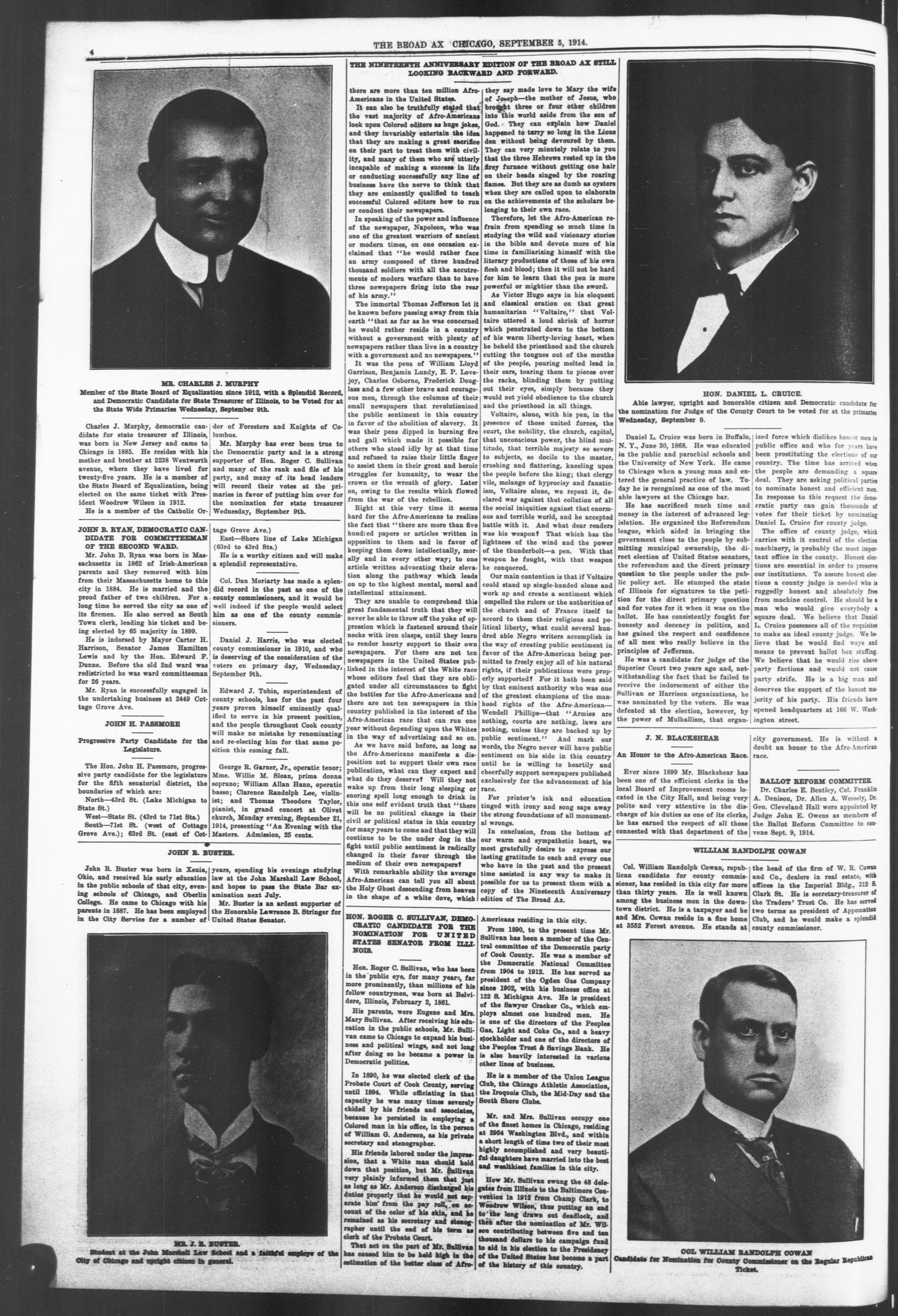
HUBERT KILENS, DEMOCRATIC CANDIDATE FOR THE RENOMINATION FOR THE LEGISLATURE IN THE 4TH SENATORIAL DISTRICT.
Is Candidate for the Renomination for the Legislature in the 4th Senatorial District.
In 1912 Mr. Hubert Kilens was for the first time elected to the legislature from the 4th senatorial district, and at all times he proved himself to be a man of his own convictions.
He voted solidly against the initiative and referendum, for he honestly believes that if that law would be
He pledges to them in return that he will support every measure for humane treatment and proper housing for the unfortunate poor and sick of the county; the union scale for all members of trade unions in the service of the county; fair play and a living wage for women employed as janitresses, domestics, laudresses in Cook county; the establishment of a permanent "Children's Outing Camp." Vote for our friend Mr. Joseph M. Fitzgerald.
ANDREW DONOVAN.
Andrew Donovan, Progressive candidate for the nomination for member of the legislature from the First Senatorial district was born in Bangor, Mich., March 22, 1880, and from his boyhood days to the present he has always been with the under boy in his fight, or with the plain or the common or the laboring people in their long fight and hard struggle to enjoy a larger share of the fruits of their labor.
He received his education in the grammar and high school of his native thriving and enterprising little city; later on in life he entered the law department of the University of Michigan, graduating from it in 1902, with high honors, not many years afterwards he headed for this city and he has been an honored member of the Chicago bar since 1908, with law offices in the Metropolitan Block, and in being honest with his many clients
M. H. M.
10
ho celebrated her 89th birthday Wednes-
er daughter, Mrs. Jennie Fraxier, Harris-
HUBEERT KILENS, DEMOCRATIC
CANDIDATE FOR THE RENOM-
INATION FOR THE LEGISLAT-
URE IN THE 4TH SENATORIAL
DISTRICT.
Is Candidate for the Renomination for
the Legislature in the 4th Senatorial
District.
In 1912 Mr. Hubert Kilens was for
the first time elected to the legislature
from the 4th senatorial district, and at
all times he proved himself to be a
man of his own convictions.
He voted solidly against the initiative and referendum, for he honestly believes that if that law would have passed it would have been against the best interest of all the people residing in his district and in other parts of the state.
He is a strong advocate of personal liberty and equal rights to all, and that is one reason why the majority of the voters residing in his district should renominate him at the primaries Wednesday, September 9th.
Mr. and Mrs. Kilens reside at 5026 So. Ashland avenue, and are good citizens.
and by paying close attention to his duties he has succeeded in working up a fine law practice.
Mr. Donovan, comes from the best and the oldest fighting stock in this country; when the war of the rebellion broke out, in this country in 1861, his father was among the first men, in Michigan to enlist in the Union Army and at the battle of Ripley, which was one of the hardest fought battles during the war, he had his horse shot out from under him.
Mr. Donovan is sound on the race problem in fair play and in equal and exact justice to all men, irrespective of their race or nationality.
All Progressives in his district should cast their votes for his nomination at the primaries Wednesday, September 9th.
THE BROAD AX CHICAGO, SEPTEMBER 5, 1914.
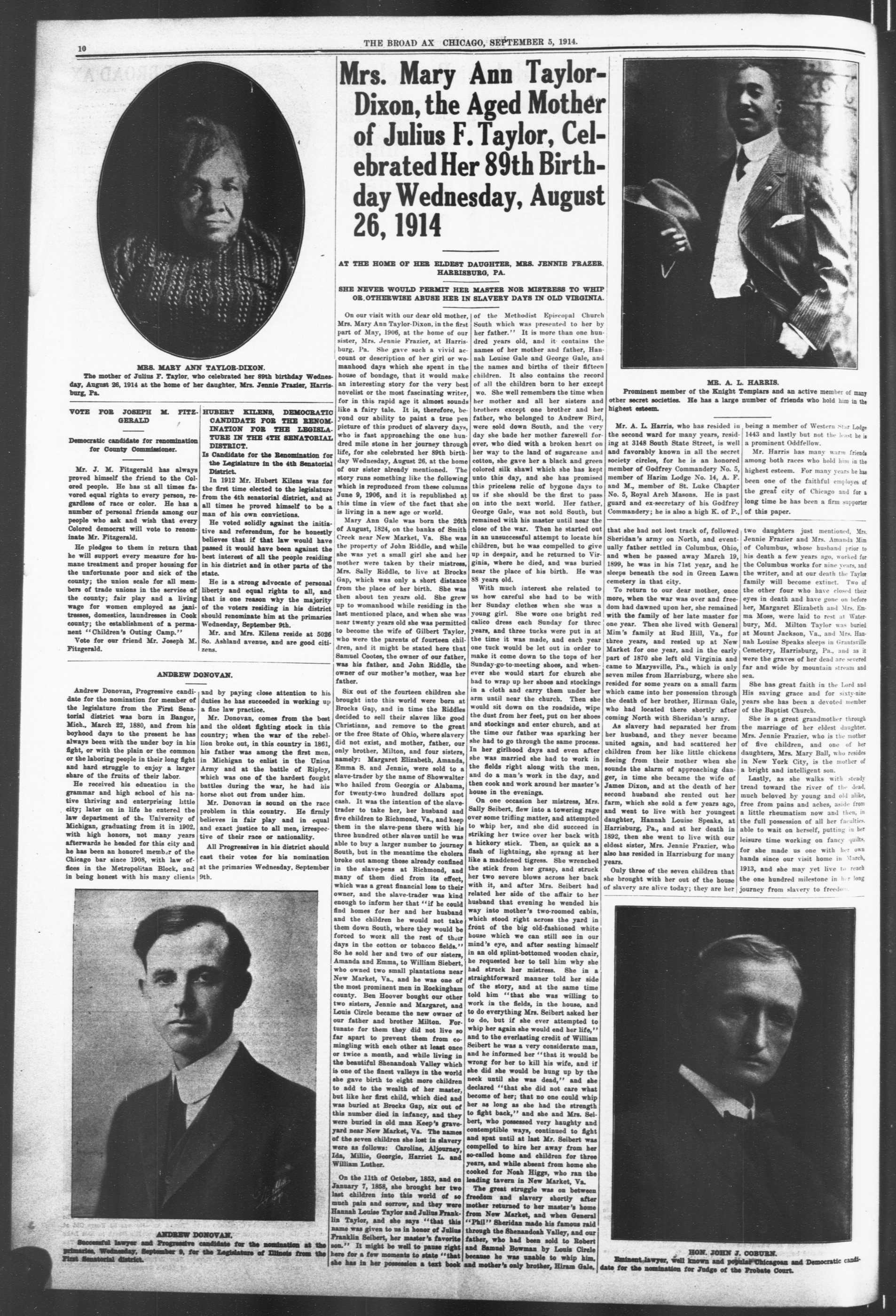
Mrs. Mary Ann Taylor- Dixon, the Aged Mother of Julius F. Taylor, Celebrated Her 89th Birthday Wednesday, August 26.1914
AT THE HOME OF HER ELDEST DAUGHTER, MRS. JENNIE FRAZER,
HARRISBURG, PA.
SHE NEVER WOULD PERMIT HER MASTER NOR MISTRESS TO WHIP
OR.OTHERWISE ABUSE HER IN SLAVERY DAYS IN OLD VIRGINIA.
On our visit with our dear old mother, Mrs. Mary Ann Taylor-Dixon, in the first part of May, 1906, at the home of our sister, Mrs. Jennie Frazier, at Harrisburg, Pa. She gave such a vivid account or description of her girl or womanhood days which she spent in the house of bondage, that it would make an interesting story for the very best novelist or the most fascinating writer, for in this rapid age it almost sounds like a fair tale. It is, therefore, beyond our ability to paint a true pen picture of this product of slavery days, who is fast approaching the one hundred mile stone in her journey through life, for she celebrated her 89th birthday Wednesday, August 26, at the home of our sister already mentioned. The story runs something like the following which is reproduced from these columns June 9, 1906, and it is republished at this time in view of the fact that she is living in a new age or world.
Mary Ann Gale was born the 26th of August, 1824, on the banks of Smith Creek near New Market, Va. She was the property of John Riddle, and while she was yet a small girl she and her mother were taken by their mistress, Mrs. Sally Riddle, to live at Brocks Gap, which was only a short distance from the place of her birth. She was then about ten years old. She grew up to womanhood while residing in the last mentioned place, and when she was near twenty years old she was permitted to become the wife of Gilbert Taylor, who were the parents of fourteen children, and it might be stated here that Samuel Cootes, the owner of our father, was his father, and John Riddle, the owner of our mother's mother, was her father.
Six out of the fourteen children she brought into this world were born at Brocks Gap, and in time the Riddler decided to sell their slaves like good Christians, and remove to the great or the free State of Ohio, where slavery did not exist, and mother, father, our only brother, Milton, and four sisters, namely: Margaret Elizabeth, Amanda Emma S. and Jennie, were sold to a slave-trader by the name of Showwalter who hailed from Georgia or Alabama, for twenty-two hundred dollars spot cash. It was the intention of the slave-trader to take her, her husband and five children to Richmond, Va., and keep them in the slave-pens there with his three hundred other slaves until he was able to buy a larger number to journey South, but in the meantime the cholera broke out among those already confined in the slave-pens at Richmond, and many of them died from its effect, which was a great financial loss to their owner, and the slave-trader was kind enough to inform her that "if he could find homes for her and her husband and the children he would not take them down South, where they would be forced to work all the rest of their days in the cotton or tobacco fields." So he sold her and two of our sisters, Amanda and Emma, to William Siebert, who owned two small plantations near New Market, Va., and he was one of the most prominent men in Rockingham county. Ben Hoover bought our other two sisters, Jennie and Margaret, and Louis Circle became the new owner of our father and brother Milton. Fortunate for them they did not live so far apart to prevent them from comingling with each other at least once or twice a month, and while living in the beautiful Shenandoah Valley which is one of the finest valleys in the world she gave birth to eight more children to add to the wealth of her master, but like her first child, which died and was buried at Brocks Gap, six out of this number died in infancy, and they were buried in old man Keep's graveyard near New Market, Va. The names of the seven children she lost in slavery were as follows: Caroline, Aljourney, Ida, Millie, Georgie, Harriet L. and William Luther.
On the 11th of October, 1853, and on January 7, 1858, she brought her two last children into this world of so much pain and sorrow, and they were Hannah Louise Taylor and Julius Franklin Taylor, and she says "that this name was given to her in honor of Julius Franklin Seibert, her master's favorite son." It might be well to pause right here for a few moments to state "that she has in her possession a text book
of the Methodist Episcopal Church South which was presented to her by her father." It is more than one hundred years old, and it contains the names of her mother and father, Hannah Louise Gale and George Gale, and the names and births of their fifteen children. It also contains the record of all the children born to her except two. She well remembers the time when her mother and all her sisters and brothers except one brother and her father, who belonged to Andrew Bird, were sold down South, and the very day she bade her mother farewell forever, who died with a broken heart on her way to the land of sugarcane and cotton, she gave her a black and green colored silk shawl which she has kept unto this day, and she has promised this priceless relic of bygone days to us if she should be the first to pass on into the next world. Her father, George Gale, was not sold South, but remained with his master until near the close of the war. Then he started out in an unsuccessful attempt to locate his children, but he was compelled to give up in despair, and he returned to Virginia, where he died, and was buried near the place of his birth. He was 88 years old.
With much interest she related to us how careful she had to be with her Sunday clothes when she was a young girl. She wore one bright red calico dress each Sunday for three years, and three tucks were put in at the time it was made, and each year one tuck would be let out in order to make it come down to the tops of her Sunday-go-to-meeting shoes, and whenever she would start for church she had to wrap up her shoes and stockings in a cloth and carry them under her arm until near the church. Then she would sit down on the roadside, wipe the dust from her feet, put on her shoes and stockings and enter church, and at the time our father was sparking her she had to go through the same process. In her girlhood days and even after she was married she had to work in the fields right along with the men, and do a man's work in the day, and then cook and work around her master's house in the evenings.
On one occasion her mistress, Mrs. Sally Seibert, flew into a towering rage over some trifling matter, and attempted to whip her, and she did succeed in striking her twice over her back with a hickory stick. Then, as quick as a flash of lightning, she sprang at her like a maddened tigress. She wrenched the stick from her grasp, and struck her two severe blows across her back with it, and after Mrs. Seibert had related her side of the affair to her husband that evening he wended his way into mother's two-roomed cabin, which stood right across the yard in front of the big old-fashioned white house which we can still see in our mind's eye, and after seating himself in an old splint-bottomed wooden chair, he requested her to tell him why she had struck her mistress. She in a straightforward manner told her side of the story, and at the same time told him "that she was willing to work in the fields, in the house, and to do everything Mrs. Seibert asked her to do, but if she ever attempted to whip her again she would end her life," and to the everlasting credit of William Seibert he was a very considerate man, and he informed her "that it would be wrong for her to kill his wife, and if she did she would be hung up by the neck until she was dead," and she declared "that she did not care what become of her; that no one could whip her as long as she had the strength to fight back," and she and Mrs. Seibert, who possessed very haughty and contemptible ways, continued to fight and spat until at last Mr. Seibert was compelled to hire her away from her so-called home and children for three years, and while absent from home she cooked for Noah Higgs, who ran the leading tavern in New Market, Va.
The great struggle was on between freedom and slavery shortly after mother returned to her master's home from New Market, and when General "Phil" Sheridan made his famous raid through the Shenandoah Valley, and our father, who had been sold to Robert and Samuel Bowman by Louis Circle because he was unable to whip him, and mother's only brother, Hiram Gale.
THE MUSICIAN
MR. A. L. HARRIS.
Prominent member of the Knight Templars and an active member of many other secret societies. He has a large number of friends who hold him in the highest esteem.
Mr. A. L. Harris, who has resided in the second ward for many years, residing at 3148 South State Street, is well and favorably known in all the secret society circles, for he is an honored member of Godfrey Commandery No. 5, member of Harim Lodge No. 14, A. F. and M., member of St. Luke Chapter No. 5, Royal Arch Masons. He is past guard and ex-secretary of his Godfrey Commandery; he is also a high K. of P..
being a member of Western Star Lodge 1443 and lastly but not the least he is a prominent Oddfellow.
Mr. Harris has many warm friends among both races who hold him in the highest esteem. For many years he has been one of the faithful employees of the great city of Chicago and for a long time he has been a firm supporter of this paper.
that she had not lost track of, followed Sheridan's army on North, and eventually father settled in Columbus, Ohio, and when he passed away March 19, 1899, he was in his 71st year, and he sleeps beneath the sod in Green Lawn cemetery in that city.
To return to our dear mother, once more, when the war was over and freedom had dawned upon her, she remained with the family of her late master for one year. Then she lived with General Mim's family at Rud Hill, Va., for three years, and rested up at New Market for one year, and in the early part of 1870 she left old Virginia and came to Marysville, Pa., which is only seven miles from Harrisburg, where she resided for some years on a small farm which came into her possession through the death of her brother, Hirman Gale, who had located there shortly after coming North with Sheridan's army.
As slavery had separated her from her husband, and they never became united again, and had scattered her children from her like little chickens fleeing from their mother when she sounds the alarm of approaching danger, in time she became the wife of James Dixon, and at the death of her second husband she rented out her farm, which she sold a few years ago, and went to live with her youngest daughter, Hannah Louise Speaks, at Harrisburg, Pa., and at her death in 1892, then she went to live with our eldest sister, Mrs. Jennie Frazier, who also has resided in Harrisburg for many years.
Only three of the seven children that she brought with her out of the house of slavery are alive today; they are her
[Name]
HON. JOHN J. COBURN.
Eminent lawyer, well known and popular Chicagoan and Democratic candidate for the nomination for Judge of the Probate Court.
being a member of Western Star Lodge 1443 and lastly but not the least he is a prominent Oddfellow.
Mr. Harris has many warm friends among both races who hold him in the highest esteem. For many years he has been one of the faithful employees of the great city of Chicago and for a long time he has been a firm supporter of this paper.
two daughters just mentioned, Mrs Jennie Frazier and Mrs. Amanda Mim of Columbus, whose husband prior to his death a few years ago, worked for the Columbus works for nine years, and the writer, and at our death the Taylor family will become extinct. Two of the other four who have closed their eyes in death and have gone on before her, Margaret Elizabeth and Mrs. Emma Moss, were laid to rest at Waterbury, Md. Milton Taylor was buried at Mount Jackson, Va., and Mrs. Hannah Louise Speaks sleeps in Grantsville Cemetery, Harrisburg, Pa., and as it were the graves of her dead are severed far and wide by mountain stream and sea.
She has great faith in the Lord and His saving grace and for sixty-nine years she has been a devoted member of the Baptist Church.
She is a great grandmother through the marriage of her eldest daughter, Mrs. Jennie Frazier, who is the mother of five children, and one of her daughters, Mrs. Mary Ball, who resides in New York City, is the mother of a bright and intelligent son. Lastly, as she walks with steady tread toward the river of the dead, much beloved by young and old alike, free from pains and aches, aside from a little rheumatism now and then, in the full possession of all her faculties, able to wait on herself, putting in her leisure time working on fancy quilts, for she made us one with her own hands since our visit home in March, 1913, and she may yet live to reach the one hundred milestone in her long journey from slavery to freedom.
M.
ALDERMAN GEORGE F. HARDING
Valuable member of the City Council since 1905, popular r
cans in all parts of Cook County and Republican candi
tation at the Primaries Wednesday, September 9. For
the first Senatorial district of Illinois.
of the City Council since 1905, popular with the Afro-Ameri- is of Cook County and Republican candidate for the nomina- maries Wednesday, September 9. For State Senator from torial district of Illinois.
Valuable member of the City Council since 1905, popular with the Afro-Americans in all parts of Cook County and Republican candidate for the nomination at the Primaries Wednesday, September 9. For State Senator from the first Senatorial district of Illinois.
In 1905, after a very bitter and rough and tumble fight Alderman George F. Harding, Republican candidate for the nomination for state senator in the first senatorial district, was for the first time elected to the city council from the old Second Ward, The Broad Ax, being the only newspaper on the south side which warmly supported him at that time, and from that time to the present he has been one of the most valuable and hard working members and has always served with much credit to himself and to the citizenship of Chicago on many of the most important committees and he has always worked and voted for every measure which would redound to the benefit of all the people throughout this city.
He is a true blue Chicagoan for he was in this city at his beautiful home 2336 Indiana Ave., where he has resided until this day. Alderman Harding never conducts
HONORABLE JAMES T. McDERMOTT
At the congressional election in 1908 after a spirited contest, with Charles Wharton, the Hon. James T. M-Dermott, was elected to congress from the fourth congressional district. He was re-elected in 1908 and in 1910, each time with increased majorities, showing that he stands high in the estimation of the voters in his district, regardless of their race, color or nationality and that a large number of independent and progressive Republicans at each election, record their votes in his favor, feeling that he is plenty good enough, to represent them in the
```markdown
```
COOPER
HON. JAMES T. MC DERMOTT.
Democratic candidate for re-nomin the 4th Congressional district. He fe of all measures beneficial to all the peo that he should receive the endorsement vote at the primaries, Wednesday, Sept
Candidate for re-nomination and re-election to Congress from renal district. He feels that he has been a loyal supporter official to all the people residing in all parts of the district—give the endorsement of all the Democrats who are able to dies, Wednesday, September 9.
Democratic candidate for re-nomination and re-election to Congress from the 4th Congressional district. He feels that he has been a loyal supporter of all measures beneficial to all the people residing in all parts of the district—that he should receive the endorsement of all the Democrats who are able to vote at the primaries. Wednesday, September 9.
Democratic candidate for re-nomination and re-election to Congress from the 4th Congressional district. He feels that he has been a loyal supporter of all measures beneficial to all the people residing in all parts of the district—that he should receive the endorsement of all the Democrats who are able to vote at the primaries. Wednesday, September 9.
himself in no swaggering manner for at all times he will bestow the proper amount of consideration upon all those who approach him and it makes not the slightest difference to him whether they are of high or low degree, rich or poor, White or Black and that is one reason why he is so extremely popular with all classes of his fellow citizens. He is a graduate of Harvard College, also of the Phillips Exter of New Hampshire and that fact alone largely accounts for his splendid intellectual attainments.
In conclusion there is not the slightest question about him securing the nomination for state senator at the primaries, Wednesday, September 9th, for he is the peoples candidate in the first senatorial district and the vast majority of its voters are at his back and will assist to land him safe and sound in the state senate at Springfield, Illinois.
halls of Congress.
Congressman McDermott, not with any brass bands, in the past, diligently labored in Congress for the best interest of all the people, in his district.
Congressman McDermott, who always talks keen, sharp and right to the point; has in many ways in the past both in and out of Congress, shown his friendship for the Colored race, and we take much pleasure in stating, that many Afro-American voters in the Fourth Congressional district will assist him in his fight for re-nomination at the primaries Wednesday, September 9th.
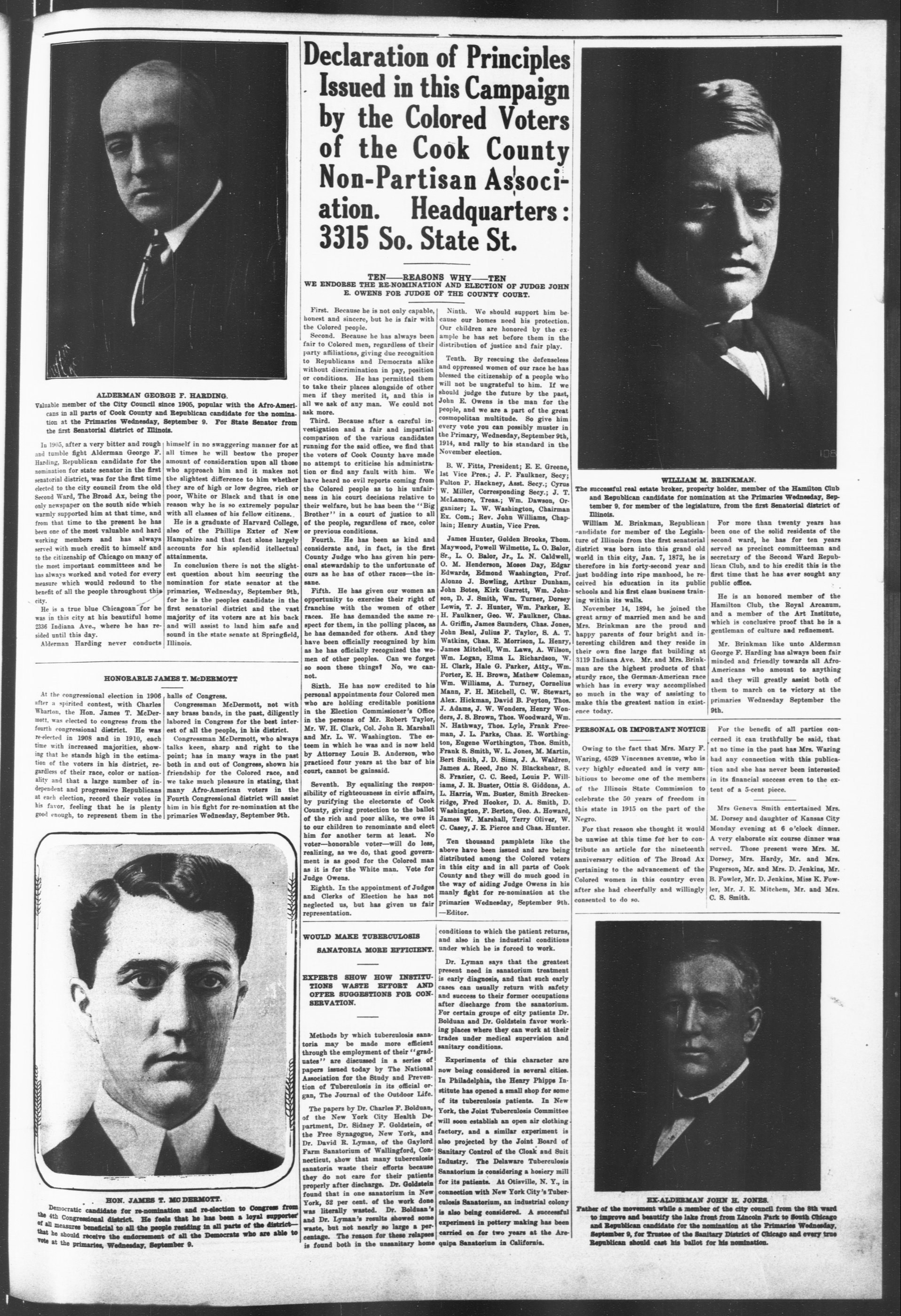
Declaration of Principles Issued in this Campaign by the Colored Voters of the Cook County Non-Partisan Association. Headquarters: 3315 So. State St.
TEN——REASONS WHY——TEN
WE ENDORSE THE RE-NOMINATION AND ELECTION OF JUDGE JOHN E. OWENS FOR JUDGE OF THE COUNTY COURT.
First. Because he is not only capable, honest and sincere, but he is fair with the Colored people.
Second. Because he has always been fair to Colored men, regardless of their party affiliations, giving due recognition to Republicans and Democrats alike without discrimination in pay, position or conditions. He has permitted them to take their places alongside of other men if they merited it, and this is all we ask of any man. We could not ask more.
Ninth. We should support him because our homes need his protection. Our children are honored by the example he has set before them in the distribution of justice and fair play.
Tenth. By rescuing the defenseless and oppressed women of our race he has blessed the citizenship of a people who will not be ungrateful to him. If we should judge the future by the past, John E. Owens is the man for the people, and we are a part of the great
Third. Because after a careful investigation and a fair and impartial comparison of the various candidates running for the said office, we find that the voters of Cook County have made no attempt to criticise his administration or find any fault with him. We have heard no evil reports coming from the Colored people as to his unfairness in his court decisions relative to their welfare, but he has been the "Big Brother" in a court of justice to all of the people, regardless of race, color or previous conditions.
Fourth. He has been as kind and considerate and, in fact, is the first County Judge who has given his personal stewardship to the unfortunate of ours as he has of other races—the insane.
Fifth. He has given our women an opportunity to exercise their right of franchise with the women of other races. He has demanded the same respect for them, in the polling places, as he has demanded for others. And they have been officially recognized by him as he has officially recognized the women of other peoples. Can we forget so soon these things? No, we cannot.
Sixth. He has now credited to his personal appointments four Colored men who are holding creditable positions in the Election Commissioner's Office in the persons of Mr. Robert Taylor, Mr. W. H. Clark, Col. John B. Marshall and Mr. L. W. Washington. The esteem in which he was and is now held by Attorney Louis B. Anderson, who practiced four years at the bar of his court, cannot be gainsaid.
Seventh. By equalizing the responsibility of righteousness in civic affairs, by purifying the electorate of Cook County, giving protection to the ballot of the rich and poor alike, we owe it to our children to renominate and elect him for another term at least. No voter—honorable voter—will do less, realizing, as we do, that good government is as good for the Colored man as it is for the White man. Vote for Judge Owens.
Eighth. In the appointment of Judges and Clerks of Election he has not neglected us, but has given us fair representation.
WOULD MAKE TUBERCULOSIS
SANATORIA MORE EFFICIENT
EXPERTS SHOW HOW INSTITUTIONS WASTE EFFORT AND OFFER SUGGESTIONS FOR CONSERVATION.
Methods by which tuberculosis sanatoria may be made more efficient through the employment of their "graduates" are discussed in a series of papers issued today by The National Association for the Study and Prevention of Tuberculosis in its official organ. The Journal of the Outdoor Life
The papers by Dr. Charles F. Bolduan, of the New York City Health Department, Dr. Sidney F. Goldstein, of the Free Synagogue, New York, and Dr. David R. Lyman, of the Gaylord Farm Sanatorium of Wallingford, Connecticut, show that many tuberculosis sanatoria waste their efforts because they do not care for their patients properly after discharge. Dr. Goldstein found that in one sanatorium in New York, 52 per cent. of the work done was literally wasted. Dr. Bolduan and Dr. Lyman's results showed some waste, but not nearly so large a percentage. The reason for these relapses is found both in the unsanitary home
Ninth. We should support him because our homes need his protection. Our children are honored by the example he has set before them in the distribution of justice and fair play.
Tenth. By rescuing the defenseless and oppressed women of our race he has blessed the citizenship of a people who will not be ungrateful to him. If we should judge the future by the past, John E. Owens is the man for the people, and we are a part of the great cosmopolitan multitude. So give him every vote you can possibly muster in the Primary, Wednesday, September 9th, 1914, and rally to his standard in the November election.
B. W. Fitts, President; E. E. Greene, 1st Vice Pres.; J. P. Faulkner, Secy; Fulton P. Hackney, Asst. Secy.; Cyrus W. Miller, Corresponding Secy; J. T. McLamore, Treas.; Wm. Dawson, Organizer; L. W. Washington, Chairman Ex. Com.; Rev. John Williams, Chaplain; Henry Austin, Vice Pres.
James Hunter, Golden Brooks, Thom. Maywood, Powell Wilmette, L. O. Balor, Sr., L. O. Balor, Jr., L. N. Caldwell, O. M. Henderson, Moses Day, Edgar Edwards, Edmond Washington, Prof. Alonzo J. Bowling, Arthur Dunham, John Botes, Kirk Garrett, Wm. Johnson, D. J. Smith, Wm. Turner, Dorsey Lewis, T. J. Hunter, Wm. Parker, E. H. Faulkner, Geo. W. Faulkner, Chas. A. Griffin, James Saunders, Chas. Jones, John Beal, Julius F. Taylor, S. A. T. Watkins, Chas. E. Morrison, L. Henry James Mitchell, Wm. Laws, A. Wilson Wm. Logan, Elma L. Richardson, Wm. Clark, Hale G. Parker, Atty., Wm. Porter, E. H. Brown, Mathew Coleman Wm. Williams, A. Turney, Cornelius Mann, F. H. Mitchell, C. W. Stewart, Alex Hickman, David B. Peyton, Thos. J. Adams, J. W. Wonders, Henry Wonders, J. S. Brown, Woodward, Wm. N. Hathaway, Thos. Lyle, Frank Freeman, J. L. Parks, Chas. E. Worthington, Eugene Worthington, Thos. Smith, Frank S. Smith, W. L. Jones, M. Martin, Bert Smith, J. D. Sims, J. A. Waldren, James A. Reed, Jno N. Blackshear, S. Frazier, C. C. Reed, Louis P. Williams, J. R. Buster, Ottis S. Giddons, A. L. Harris, Wm. Buster, Smith Breckenridge, Fred Focker, D. Geo. D. Washington, F. Berton, Geo. A. Howard, James W. Marshall, Terry Oliver, W. C. Casey, J. E. Pierce and Chas. Hunter
Ten thousand pamphlets like the above have been issued and are being distributed among the Colored voters in this city and in all parts of Cook County and they will do much good in the way of aiding Judge Owens in his manly fight for re-nomination at the primaries Wednesday, September 9th. —Editor.
conditions to which the patient returns, and also in the industrial conditions under which he is forced to work.
Dr. Lyman says that the greatest present need in sanatorium treatment is early diagnosis, and that such early cases can usually return with safety and success to their former occupations after discharge from the sanatorium. For certain groups of city patients Dr. Bolduan and Dr. Goldstein favor working places where they can work at their trades under medical supervision and sanitary conditions.
Experiments of this character are now being considered in several cities. In Philadelphia, the Henry Phipps Institute has opened a small shop for some of its tuberculosis patients. In New York, the Joint Tuberculosis Committee will soon establish an open air clothing factory, and a similar experiment is also projected by the Joint Board of Sanitary Control of the Cloak and Suit Industry. The Delaware Tuberculosis Sanatorium is considering a hosiery mill for its patients. At Otisville, N. Y., in connection with New York City's Tuberculosis Sanatorium, an industrial colony is also being considered. A successful experiment in pottery making has been carried on for two years at the Arecuina Sanatorium in California.
108
WILLIAM M. BRINKMAN.
The successful real estate broker, property holder, member of the Hamilton Club and Republican candidate for nomination at the Primaries Wednesday, September 9, for member of the legislature, from the first Senatorial district of Illinois.
William M. Brinkman, Republican candidate for member of the Legislature of Illinois from the first senatorial district was born into this grand old world in this city, Jan. 7, 1872, he is therefore in his forty-second year and just budding into ripe manhood, he received his education in its public schools and his first class business training within its walls.
For more than twenty years has been one of the solid residents of the second ward, he has for ten years served as precinct committeeman and secretary of the Second Ward Republican Club, and to his credit this is the first time that he has ever sought any public office.
He is an honored member of the
November 14, 1894, he joined the great army of married men and he and Mrs. Brinkman are the proud and happy parents of four bright and interesting children and they reside in their own fine large flat building at 3119 Indiana Ave. Mr. and Mrs. Brinkman are the highest products of that sturdy race, the German-American race which has in every way accomplished so much in the way of assisting to make this the greatest nation in existence today.
PERSONAL OR IMPORTANT NOTICE
Owing to the fact that Mrs. Mary F. Waring, 4529 Vincennes avenue, who is very highly educated and is very ambitious to become one of the members of the Illinois State Commission to celebrate the 50 years of freedom in this state in 1915 on the part of the Negro.
For that reason she thought it would be unwise at this time for her to contribute an article for the nineteenth anniversary edition of The Broad Ax pertaining to the advancement of the Colored women in this country even after she had cheerfully and willingly consented to do so.
1910
[Name]
EX-ALDERMAN JOHN H. JONES.
Father of the movement while a member to improve and beautify the lake fr and Republican candidate for the m September 9, for Trustee of the San Republican should cast his ballot
Father of the movement while a member of the city council from the 8th ward to improve and beautify the lake front from Lincoln Park to South Chicago and Republican candidate for the nomination at the Primaries Wednesday, September 9, for Trustee of the Sanitary District of Chicago and every true Republican should cast his ballot for his nomination.
Father of the movement while a member of the city council from the 8th ward to improve and beautify the lake front from Lincoln Park to South Chicago and Republican candidate for the nomination at the Primaries Wednesday, September 9, for Trustee of the Sanitary District of Chicago and every true Republican should cast his ballot for his nomination.
For more than twenty years has been one of the solid residents of the second ward, he has for ten years served as precinct committeeman and secretary of the Second Ward Republican Club, and to his credit this is the first time that he has ever sought any public office.
He is an honored member of the Hamilton Club, the Royal Arcanum, and a member of the Art Institute, which is conclusive proof that he is a gentleman of culture and refinement.
Mr. Brinkman like unto Alderman George F. Harding has always been fair minded and friendly towards all Afro-Americans who amount to anything and they will greatly assist both of them to march on to victory at the primaries Wednesday September the 9th.
For the benefit of all parties concerned it can truthfully be said, that at no time in the past has Mrs. Waring had any connection with this publication and she has never been interested in its financial success even to the extent of a 5-cent piece.
Mrs Geneva Smith entertained Mrs. M. Dorsey and daughter of Kansas City Monday evening at 6 o'clock dinner. A very elaborate six course dinner was served. Those present were Mrs. M. Dorsey, Mrs. Hardy, Mr. and Mrs. Fugerson, Mr. and Mrs. D. Jenkins, Mr. B. Fowler, Mr. D. Jenkins, Miss K. Fowler, Mr. J. E. Mitchem, Mr. and Mrs. C. S. Smith.
1.
or of the city council from the 8th ward sent from Lincoln Park to South Chicago nomination at the Primaries Wednesday, Mitary District of Chicago and every true for his nomination.
3 per cent allowed on Savings Accounts Safety Deposit Vaults, $3.00 per Year
REAL ESTATE DEPARTMENT
As agent buy and sell Real Estate on commission, manages estates for non-residents, including payment of taxes and locking after assessments. Money to loan on Chicago Real Estate.
Especially Invites the patronage of Chicago business men.
Complete Funeral for $65.00 including Casket—any color in Plush, Hearse, 2 Carriages, Grave, Outside Box, Embalming
OCULAR SPECIALIST EYES EXAMINED AND TESTED Hypermetropia, Astigmatism and Stablemuse Scientifically Corrected
LA VERDO BUFFET IMPORTED AND DOMESTIC CIGARS AND CIGARETTES 3100 State Street CHICAGO
BROOKLYN MUSEUM
S. E. Cor. State and 36th Place, Chicago Telephone Douglas 1565
CENTRAL 2121 AUTOMATIC 64-146
Hours
8 to 6 Sunday, 10 to 1
PROF. WM. EMANUEL
SCIENTIFIC CHIROPODY CO.
(Incorporated)
135 S. State St., Rm. 201
Peacock Bldg. Cor. Adams St., opp. The Fair
OPERATING STAFF:
Prof. William Emanuel William H. Emanuel
Floyd S. Emanuel McKinley Emanuel
JOHN J. BRADLEY
BILLIARD PARLOR
Mr. McGowan is ever ready to extend the glad hand to his many friends and patrons.
DePRIEST & DePRIEST
Mr. DUNN and Mr. HIGHT are always pleased to greet their many FRIENDS and PATRONS.
5050 SO. STATE STREET PHONE OAKLAND 1014
Automatic 73-277
A STORE FOR EVERYBODY
HILLMAN'S
STATE & WASHINGTON STS.
Everything to eat, to wear and for the home. It is duty to
wear attire for man, woman and child at lowest prices,
quality and workmanship considered. Make it a point to
visit this store every day and take advantage of the special
bargain offerings that we give in all departments
LINCOLN STATE BANK OF CHICAGO
JULIUS F. TAYLOR: Please enter my name as a subscriber to THE BROAD AX. I herewith enclose $2.00, the annual subscription to same. Six months for one dollar.
A BUILT-IN HOME BANK
BANKING ONLINE ONLINE
NICKELS CENTS
This Registering Home Bank
FREE to our Savings Depositors: will start you saving and keep you at it. A Savings Account is the first step to wealth. Open one with us.
Phone FRANKLIN 2717
Louis B. Anderson
LAWYER
Room 508 Firmenich Building
184 W. Washington St. :: CHICAGO
Cor. 5th Ave.
RESIDENCE 1262 MACALISTE PLACE
TELEPHONE, MONROE 2714
MILES J. DEVINE
ATTORNEY AT LAW
SUITE 310-329 REAPER BLOCK
CLARK AND WASHINGTON STS.
PHONES
CENTRAL 230
AUTOMATIC 41-916
CHICAGO
ATTORNEY AT LAW
118 North La Salle St. Chicago
Suite 615 to 616
Telephone Main 3077
PHONES: OFFICE, MAIN 4183
AUTOMATIC 33-736
RESIDENCE, DREXEL 7990
Walter M. Farmer
ATTORNEY AT LAW
SUITE 708, 184 WASHINGTON ST.
NOTARY PUBLIC CHICAGO
Phone
FRANKLIN 2727
AUTO. 41-543
Res. 508 E. 36th St.
Phone Douglas 4397
J. GRAY LUCAS
ATTORNEY AT LAW
25 N. Dearborn St.
Union Bank Building
Suite 311 CHICAGO
Franklin A. Denison
ATTORNEY AT LAW
36 W. Randolph Street, CHICAGO
Suite 708 Delaware Blvd. Tel. General 3142
THE BROAD A
5027 Federal St., Chicago
JULIUS F. TAYLOR: Please
THE BROAD AX. I herewith
tion to same. Six months for one
Name
Commercial Banking
Savings and Checking Accounts
Foreign Exchange
Safety Deposit Vaults
Mortgages and Bonds
3 Per Cent Interest on Savings Deposits Your Patronage Solicited
Depository and Correspondent, Continental & Commercial National Bank of Chicago, Illinois.
Phone Main 2017 Automatic 32-395
A. L. WILLIAMS
ATTORNEY AND COUNSELOR AT LAW
Suite 706 Firmenich Bldg.
184 W. Washington St.
Residence 5548 Jefferson Av.
Phone Midway 5515 Chicago
NOTARY PUBLIC
Office Phone
Automatic 44-185
W. G. ANDERSON
ATTORNEY-AT-LAW
Room 40, 143 North Dearborn Street
Cor. Randolph St. CHICAGO McCormick Blvd.
Evening Office, 3458 State Street
Phone Automatic 77 574
LAWYER
NOTARY PUBLIC
Suite 8 Johnson Bldg. Phone Douglas 7720
3522 So. State St., Chicago
RESIDENCE 3423 FOREST AVE.
Phone Douglas 6001
Phone Douglas 8078 Automatic 72-384
Office Hours—8 a.m. to 5 p.m.
Dr. MacENRY J. BROWN
PHYSICIAN AND SURGEON
OCULIST
@Practice Limited to Diseases of
Eye and Ear
3502 S. State St. CHICAGO
Office Phones: Res. 5133 So. Walash Ave.
Oakland 4602. Auto. 73-658 Phone Drexel 18315
Dr. Theo. R. Mozee
DENTIST
[Name]
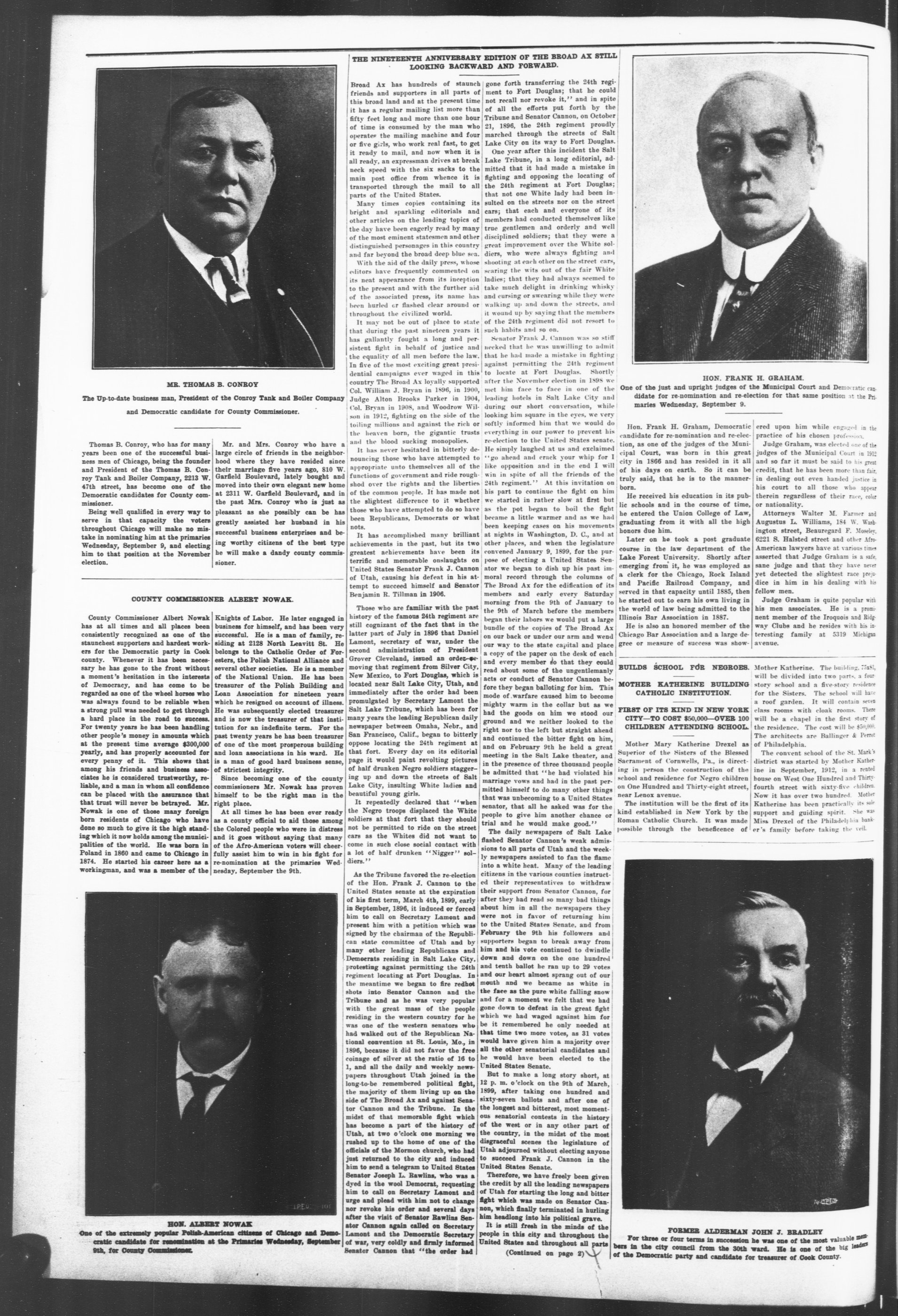
Thomas B. Conroy, who has for many years been one of the successful business men of Chicago, being the founder and President of the Thomas B. Conroy Tank and Boiler Company, 2213 W. 47th street, has become one of the Democratic candidates for County commissioner.
Being well qualified in every way to serve in that capacity the voters throughout Chicago will make no mistake in nominating him at the primaries Wednesday, September 9, and electing him to that position at the November election.
COUNTY COMMISSIONER ALBERT NOWAK
County Commissioner Albert Nowak has at all times and all places been consistently recognized as one of the staunchest supporters and hardest workers for the Democratic party in Cook county. Whenever it has been necessary he has gone to the front without a moment's hesitation in the interests of Democracy, and has come to be regarded as one of the wheel horses who was always found to be reliable when a strong pull was needed to get through a hard place in the road to success. For twenty years he has been handling other people's money in amounts which at the present time average $300,000 yearly, and has properly accounted for every penny of it. This shows that among his friends and business associates he is considered trustworthy, reliable, and a man in whom all confidence can be placed with the assurance that that trust will never be betrayed. Mr. Nowak is one of those many foreign born residents of Chicago who have done so much to give it the high standing which it now holds among the municipalities of the world. He was born in Poland in 1860 and came to Chicago in 1874. He started his career here as a workingman, and was a member of the
LPEU 101
One of the extremely popular Polish-American citizens of Chicago and Democratic candidate for renomination at the Primaries Wednesday, September 9th, for County Commissioner.
Mr. and Mrs. Conroy who have a large circle of friends in the neighborhood where they have resided since their marriage five years ago, 810 W Garfield Boulevard, lately bought and moved into their own elegant new home at 2311 W. Garfield Boulevard, and in the past Mrs. Conroy who is just as pleasant as she possibly can be has greatly assisted her husband in his successful business enterprises and being worthy citizens of the best type he will make a dandy county commissioner.
Knights of Labor. He later engaged in business for himself, and has been very successful. He is a man of family, residing at 2128 North Leavitt St. He belongs to the Catholic Order of Foresters, the Polish National Alliance and several other societies. He is a member of the National Union. He has been treasurer of the Polish Building and Loan Association for nineteen years which he resigned on account of illness. He was subsequently elected treasurer and is now the treasurer of that institution for an indefinite term. For the past twenty years he has been treasurer of one of the most prosperous building and loan associations in his ward. He is a man of good hard business sense, of strictest integrity.
Since becoming one of the county commissioners Mr. Nowak has proven himself to be the right man in the right place. At all times he has been ever ready as a county official to aid those among the Colored people who were in distress and it goes without saying that many of the Afro-American voters will cheerfully assist him to win in his fight for re-nomination at the primaries Wednesday, September the 9th.
THE NINETEENTH ANNIVERSARY EDITION OF THE BROAD AX STILL LOOKING BACKWARD AND FORWARD.
Broad Ax has hundreds of staunch friends and supporters in all parts of this broad land and at the present time it has a regular mailing list more than fifty feet long and more than one hour of time is consumed by the man who operates the mailing machine and four or five girls, who work real fast, to get it ready to mail, and now when it is all ready, an expressman drives at break neck speed with the six sacks to the main post office from whence it is transported through the mail to all parts of the United States.
gone forth transferring the 24th regiment to Fort Douglas; that he could not recall nor revoke it," and in spite of all the efforts put forth by the Tribune and Senator Cannon, on October 21, 1896, the 24th regiment proudly marched through the streets of Salt Lake City on its way to Fort Douglas.
One year after this incident the Salt Lake Tribune, in a long editorial, admitted that it had made a mistake in fighting and opposing the locating of the 24th regiment at Fort Douglas; that not one White lady had been in
Many times copies containing its bright and sparkling editorials and other articles on the leading topics of the day have been eagerly read by many of the most eminent statesmen and other distinguished personages in this country and far beyond the broad deep blue sea. With the aid of the daily press, whose editors have frequently commented on its neat appearance from its inception to the present and with the further aid of the associated press, its name has been hurled or flashed clear around or throughout the civilized world.
It may not be out of place to state that during the past nineteen years it has gallantly fought a long and persistent fight in behalf of justice and the equality of all men before the law. In five of the most exciting great presidential campaigns ever waged in this country The Broad Ax loyalty supported Col. William J. Bryan in 1896, in 1900, Judge Alton Brooks Parker in 1904, Col. Bryan in 1908, and Woodrow Wilson in 1912, fighting on the side of the toiling millions and against the rich or the heaven born, the gigantic trusts and the blood sucking monopolies.
It has never hesitated in bitterly denouncing those who have attempted to appropriate unto themselves all of the functions of government and ride roughshod over the rights and the liberties of the common people. It has made not the slightest difference to it whether those who have attempted to do so have been Republicans, Democrats or what nots.
It has accomplished many brilliant achievements in the past, but its two greatest achievements have been its terrific and memorable onslaughts on United States Senator Frank J. Cannon of Utah, causing his defeat in his attempt to succeed himself and Senator Benjamin R. Tillman in 1906.
Those who are familiar with the past history of the famous 24th regiment are still cognizant of the fact that in the latter part of July in 1896 that Daniel Lamont, secretary of war, under the second administration of President Grover Cleveland, issued an order removing that regiment from Silver City, New Mexico, to Fort Douglas, which is located near Salt Lake City, Utah, and immediately after the order had been promulgated by Secretary Lamont the Salt Lake Tribune, which has been for many years the leading Republican daily newspaper between Omaha, Nebr., and San Francisco, Calif., began to bitterly oppose locating the 24th regiment at that fort. Every day on its editorial page it would paint revolting pictures of half drunken Negro soldiers staggering up and down the streets of Salt Lake City, insulting White ladies and beautiful young girls.
It repeatedly declared that "when the Negro troops displaced the White soldiers at that fort that they should not be permitted to ride on the street cars as the Whites did not want to come in such close social contact with a lot of half drunken "Nigger" soldiers."
As the Tribute favored the re-election of the Hon. Frank J. Cannon to the United States senate at the expiration of his first term, March 4th, 1899, early in September, 1896, it induced or forced him to call on Secretary Lamont and present him with a petition which was signed by the chairman of the Republican state committee of Utah and by many other leading Republicans and Democrats residing in Salt Lake City, protesting against permitting the 24th regiment locating at Fort Douglas. In the meantime we began to fire redhot shots into Senator Cannon and the Tribute and as he was very popular with the great mass of the people residing in the western country for he was one of the western senators who had walked out of the Republican National convention at St. Louis, Mo., in 1896, because it did not favor the free coinage of silver at the ratio of 16 to 1, and all the daily and weekly newspapers throughout Utah joined in the long-to-be remembered political fight, the majority of them living up on the side of The Broad Ax and against Senator Cannon and the Tribute. In the midst of that memorable fight which has become a part of the history of Utah, at two o'clock one morning we rushed up to the home of one of the officials of the Mormon church, who had returned to the city and induced him to send a telegram to United States Senator Joseph L. Rawlins, who was a dyed in the wool Democrat, requesting him to call on Secretary Lamont and urge and plead with him not to change nor revoke his order and several days after the visit of Senator Rawlins Senator Cannon again called on Secretary Lamont and the Democratic Secretary of war, very coldly and firmly informed Senator Cannon that "the order had
gone forth transferring the 24th regiment to Fort Douglas; that he could not recall nor revoke it," and in spite of all the efforts put forth by the Tribune and Senator Cannon, on October 21, 1896, the 24th regiment proudly marched through the streets of Salt Lake City on its way to Fort Douglas. One year after this incident the Salt Lake Tribune, in a long editorial, admitted that it had made a mistake in fighting and opposing the locating of the 24th regiment at Fort Douglas; that not one White lady had been insulted on the streets nor on the street cars; that each and everyone of its members had conducted themselves like true gentlemen and orderly and well disciplined soldiers; that they were a great improvement over the White soldiers, who were always fighting and shooting at each other on the street cars, scaring the wits out of the fair White ladies; that they had always seemed to take much delight in drinking whisky and cursing or swearing while they were walking up and down the streets, and it wound up by saying that the members of the 24th regiment did not resort to such habits and so on.
Senator Frank J. Cannon was so stiff necked that he was unwilling to admit that he had made a mistake in fighting against permitting the 24th regiment to locate at Fort Douglas. Shortly after the November election in 1898 we met him face to face in one of the leading hotels in Salt Lake City and during our short conversation, while looking him square in the eyes, we very softly informed him that we would do everything in our power to prevent his re-election to the United States senate. He simply laughed at us and exclaimed "go ahead and crack your whip for I like opposition and in the end I will win in spite of all the friends of the 24th regiment." At this invitation on his part to continue the fight on him we started in rather slow at first but as the pot began to boil the fight became a little warmer and as we had been keeping cases on his movements at nights in Washington, D. C., and at other places, and when the legislature convened January 9, 1899, for the purpose of electing a United States Senator we began to dish up his past immoral record through the columns of The Broad Ax for the edification of its members and early every Saturday morning from the 9th of January to the 9th of March before the members began their labors we would put a large bundle of the copies of The Broad Ax on our back or under our arm and wend our way to the state capital and place a copy of the paper on the desk of each and every member so that they could read about some of the ungentlemanly acts or conduct of Senator Cannon before they began balloting for him. This mode of warfare caused him to become mighty warm in the collar but as we had the goods on him we stood our ground and we neither looked to the right nor to the left but straight ahead and continued the bitter fight on him, and on February 9th he held a great meeting in the Salt Lake theater, and in the presence of three thousand people he admitted that "he had violated his marriage vows and had in the past permitted himself to do many other things that was unbecoming to a United States senator, that all he asked was for the people to give him another chance or trial and he would make good."
The daily newspapers of Salt Lake flashed Senator Cannon's weak admissions to all parts of Utah and the weekly newspapers assisted to fan the flame into a white heat. Many of the leading citizens in the various counties instructed their representatives to withdraw their support from Senator Cannon, for after they had read so many bad things about him in all the newspapers they were not in favor of returning him to the United States Senate, and from February the 9th his followers and supporters began to break away from him and his vote continued to dwindle down and down on the one hundred and tenth ballot he ran up to 29 votes and our heart almost sprang out of our mouth and we became as white in the face as the pure white falling snow and for a moment we felt that we had gone down to defeat in the great fight which we had waged against him for be it remembered he only needed at that time two more votes, as 31 votes would have given him a majority over all the other senatorial candidates and he would have been elected to the United States Senate.
But to make a long story short, at 12 p. m. m.'clock on the 9th of March, 1899, after taking one hundred and sixty-seven ballots and after one of the longest and bitterest, most momentous senatorial contests in the history of the west or in any other part of the country, in the midst of the most disgraceful scenes the legislature of Utah adjourned without electing anyone to succeed Frank J. Cannon in the United States Senate.
Therefore, we have freely been given the credit by all the leading newspapers of Utah for starting the long and bitter fight which was made on Senator Cannon, which finally terminated in hurling him headlong into his political grave.
It is still fresh in the minds of the people in this city and throughout the United States and throughout all parts (Continued on page 2)
HON. FRANK H. GRAHAM.
One of the just and upright judges of the idate for re-nomination and re-ele maries Wednesday, September 9.
One of the just and upright judges of the Municipal Court and Democratic candidate for re-nomination and re-election for that same position at the Primaries Wednesday, September 9.
Hon. Frank H. Graham, Democratic candidate for re-nomination and re-election, as one of the judges of the Municipal Court, was born in this great city in 1866 and has resided in it all of his days on earth. So it can be truly said, that he is to the manner-born.
He received his education in its public schools and in the course of time, he entered the Union College of Law, graduating from it with all the high honors due him.
ered upon him while engaged in the practice of his chosen profession.
Judge Graham, was elected one of the judges of the Municipal Court in 1915 and so far it must be said to his great credit, that he has been more than fair in dealing out even handed justice in his court to all those who appear therein regardless of their race, color or nationality.
Attorneys Walter M. Farmer and Augustus L. Williams, 184 W. Washington street. Beauregard F. Moselley.
Later on he took a post graduate course in the law department of the Lake Forest University. Shortly after emerging from it, he was employed as a clerk for the Chicago, Rock Island and Pacific Railroad Company, and served in that capacity until 1885, then he started out to earn his own living in the world of law being admitted to the Illinois Bar Association in 1887. He is also an honored member of the Chicago Bar Association and a large degree or measure of success was show-
BUILDS SCHOOL FOR NEGROES
MOTHER KATHERINE BUILDING
CATHOLIC INSTITUTION.
FIRST OF ITS KIND IN NEW YORK
CITY—TO COST $50,000—OVER 100
CHILDREN ATTENDING SCHOOL.
Mother Mary Katherine Drexel as Superior of the Sisters of the Blessed Sacrament of Cornwells, Pa., is directing in person the construction of the school and residence for Negro children on One Hundred and Thirty-eight street, near Lenox avenue.
The institution will be the first of its kind established in New York by the Roman Catholic Church. It was made possible through the benefice of
---
74
FORMER ALDERMAN JOHN J. BRADLEY
For three or four terms in succession he was one of the most valuable members in the city council from the 30th ward. He is one of the big leaders of the Democratic party and candidate for treasurer of Cook County.
ered upon him while engaged in the practice of his chosen profession.
Judge Graham, was elected one of the judges of the Municipal Court in 1912 and so far it must be said to his great credit, that he has been more than fair in dealing out even handed justice in his court to all those who appear therein regardless of their race, color or nationality.
Attorneys Walter M. Farmer and Augustus L. Williams, 184 W. Washington street, Beauregard F. Moseley 6221 S. Halsted street and other Afro-American lawyers have at various times asserted that Judge Graham is a safe sane judge and that they have never yet detected the slightest race prejudice in him in his dealing with his fellow men.
Judge Graham is quite popular with his men associates. He is a prominent member of the Iroquois and Ridgeway Clubs and he resides with his interesting family at 5319 Michigan avenue.
Mother Katherine. The building, 7581, will be divided into two parts, a four-story school and a five-story residence for the Sisters. The school will have a roof garden. It will contain seven classrooms with cloak rooms. There will be a chapel in the first story of the residence. The cost will be $50,000. The architects are Ballinger & Perot of Philadelphia.
The convent school of the St. Mark's district was started by Mother Katherine in September, 1912, in a rented house on West One Hundred and Thirty-four street with sixty-five children. Now it has over two hundred. Mother Katherine has been practically its sole support and guiding spirit. She was Miss Drexel of the Philadelphia banker's family before taking the veil.
[Name]
JOSEPH V. CALLAHAN
Deportation Agent for the State of among all classes of its fellow citizen candidate for the nomination of Congress district to be voted for at the primari
Deportation Agent for the State of Illinois, who has thousands of friends among all classes of its fellow citizens in the town of Lake and Democratic candidate for the nomination of Congressman from the fourth Congressional district to be voted for at the primaries Wednesday, September 9th.
Mr. Joseph V. Callahan is a candidate for Congress in the 4th Congressional district. Mr. Callahan is a Chicago born young man. He has every ability to fit him for the office he is seeking at present. Mr. Callahan is Deportation Agent of the State; through this position he is brought daily in contact with the Colored race. His kindness and humane manner to them has become very noticeable.
Mr. Callahan is the brother of Mrs. Alice E. Shanahan, matron at the stock yards police station, who has been an uplifter to every unfortunate Colored woman and girl who is placed under her care. Not alone has Mrs. Shanahan went before judges to plead for them, but has went as far as giving them shelter in her own home, provided financially for others when charity bureaus found it impossible to assist.
Mr. Callahan deserves the vote of every voter in this district, irrespective of party affiliation.
He will be a man the Colored race can approach as well as his own.
WHAT IS A DEMOCRAT?
Col. Harrison, our honored mayor, attacking Col. Sullivan with all the impetuosity permitted by Col. Stringer, Col. Sullivan's chivalrous adversary, suggests that Col. Sullivan is no Democrat.
This opens up the interesting question: What is a Democrat? We do not ask the obvious, Why is a Democrat? We propound merely the practical, What is a Democrat? Col. Sullivan's deviation from devotion to the one time sacred but now despised ratio of 16 to 1 seems to indicate that he once was not a consistent joiner. But if Col. Bryan were all powerful, autocratic, and dictatorial now he would stipulate nothing as to 16 to 1. Col. Sullivan might insist that his foresight was better than Col. Bryan's hindsight.
The Denver convention platform contained no reference to silver or its ratio to gold. Was this a confession that Col. Sullivan was right and Col. Bryan was wrong? All this is ancient unpleas-
THE HON. BENJAMIN M. MITCHELL
Hon. Benjamin M. Mitchell, who is successfully engaged in the manufacturing business, was born in Quincy, Ill., in 1869, of German Jewish parentage. When seven months of age his parents removed to this city, where he has resided ever since, receiving his education in its public schools.
He is a prominent member of several fraternal and social societies. He was first elected to the general assembly of Illinois in 1892, and re-elected in 1896, defeated in 1898 and again elected in 1900, 1902, 1904, 1910 and 1912.
At all times while a member of the
---
101
HON. BENJAMIN M. MITCHELL
Successfully engaged in the manufacturing business and a warm friend and supporter of the Hon. Roger C. Sullivan and Democratic candidate for the nomination for representative in the General Assembly from the 21st Senatorial district
of Illinois, who has thousands of friends is in the town of Lake and Democratic pressman from the fourth Congressional as Wednesday, September 9th.
uplifter to every unfortunate Colored woman and girl who is placed under her care. Not alone has Mrs. Shanahan went before judges to plead for them, but has went as far as giving them shelter in her own home, provided financially for others when charity bureaus found it impossible to assist.
Mr. Callahan deserves the vote of every voter in this district, irrespective of party affiliation.
He will be a man the Colored race can approach as well as his own.
antness and we do not wish to bring it up, but it has a relation to the inquiry, What is a Democrat? Let us take Col. Harrison's own case. In 1904 in St. Louis he had a seat in the national convention because David R. Francis—as we recall it was Col. Francis—hunted him up and gave him a guest ticket. In 1908 in Denver we believe he was absent. We are not quite sure whether he was present or absent, but we know that he was not present with a vote. He was not recognized as a delegate. In 1912 in Baltimore Col. Harrison was allowed to roost in the press coop by the kindness of a reporter, who gave him a press badge.
What, then, is a Democrat? Col. Harrison evidently is an unrecognized one. Col. Sullivan has been present and voting. We yet trust and hope that our battling Jeffersonians will get down to brass tacks and tell the truth about each other. These slaps upon the wrist are distressingly feeble.—Editorial from the Chicago Tribune.
legislature he has voted solidly against all Jim Crow legislation striking at the manhood rights of the Colored people. He voted in favor of all the amendments to the Civil Rights Bill and for the bill appropriating $150,000 for the construction of the New Eighth Regiment Armory. The Colored people residing in the 13th, 14th and 17th wards always regard him as their true friend. Mr. Mitchell is unmarried and resides with his brother at 3246 W. Washington Boulevard.
---
THE BROAD AX CHICAGO, SEPTEMBER 5, 1914. THE NINETEENTH ANNIVERSARY EDITION OF THE BROAD AX STILL LOOKING BACKWARD AND FORWARD.
of the world, for that matter, how The Broad Ax in November, 1906 began its terrific and memorable fight or onslaught on United States Senator Benjamin R. Tillman and for two weeks before he attempted to speak at Orchestra Hall, Tuesday evening, November 27, 1906, the whole country was in an uproar over it for the associated press had flashed it to the fartherest ends of the earth and before it ended all the great daily newspapers, the weekly newspapers and even the monthly publications took a hand in it. So great and so bitter was the feeling against permitting him to come to this city to pour out his vile spleen against the Colored people and this sentiment against him had been fanned into fever heat by the writer through the columns of the Broad Ax and by no one else for many of the so-called prominent Colored leaders of the race at that time severely condemned us for firing into him at that time; they claiming that he promised them and one of their White lady friends that he would not touch on the "Negro Question" while delivering his so-called lecture on the "Annexation of Cuba" for the benefit of the Union Hospital.
On the day of his arrival in this city he was met at the Northwestern station by more than twenty policemen who escorted him to the great Northern Hotel where they stood guard over him until he appeared at Orchestra Hall, where more than two hundred policemen had been stationed to protect him and as he had been lashed into a fury by our writings for we had dipped our pen in wormwood and bitter gall, while stripping the bloody mask from his an-arhistic face.
Still smarting under our merciless lashing which had been kept up in these columns for two weeks that he had not been speaking more than a few moments before he exclaimed to "H—1 with the law" when it comes down to dealing with Colored people, and like a cowardly midnight assassin he was glad to cower behind six or seven Colored policemen while he was engaged in branding all Colored men as "apes, baboons and ravishers of White women." The morning after his last lecture in this city its whole press turned against him and on that same morning the Wisconsin Chataquua Association canceled a forty-eight thousand dollar contract with him and our memorable fight on him, almost single handed and alone, finally drove him from the lecture platform.
It is true that The Broad Ax is small in size, nevertheless it has assisted to shape the legislation of this mighty nation; this can be verified by simply reading senate document No. 182, 54th congress, second session, page 77, which contains an editorial from The Broad Ax in favor of the passage of the present National bankruptcy law.
Being absolutely free and independent in politics and free from debt it fears no man nor any set of men or politicians who have so far been spawned upon the face of the earth.
Since August 31, 1895, four of the notable contributors to The Broad Ax who were among the best editorial writers in this country have gently drawn the thin veil aside which separates life from the ever present death and passed on into the next world.
Namely, Hadley D. Johnson of Salt Lake City, Utah, who was for a long time editor of the Salt Lake Herald, his son-in-law, Colonel Clarke Irvine of Oregon, Mo., Charles Gano Baylor of Providence, Rhode Island, and Capt. John T. Campbell of the Old Soldiers Home, La Fayette, Ind. No truer friends or sons of humanity ever lived than the four above mentioned men, for at all times their noble and warm hearts were on the side of the weak and the lowly in their struggle for existence. It was Col. Irvine who wrote the two beautiful and interesting stories which ran through these columns in 1906, "The Slave of Murillo" and "Benjamin Banneker." May their sweet honest and courageous spirits repose in peace throughout eternity.
As stated before in these columns one copy of the Thirteenth Anniversary Edition of The Broad Ax, including several copies of other issues and our business card, are deposited in the copper lined box which rests in the cornerstone of the new city hall, which was laid July 20, 1909, and no other Afro-American publication was honored with space within it which will be handed down to generations yet unborn.
The latter part of 1896 Governor Heber M. Wells of Utah, who was a strong Republican and actually hated any Colored man who dared to think for himself along political lines, appointed the following Colored men as commissioners to the Tennessee Exposition, which was held at Nashville in that state in 1897, namely, W. W. Taylor, R. B. Johnson, P. H. Robinson, P. C. Howell, Rev. M. Jones and P. W. Jackson.
It was the duty of the Colored commissioners to make an effort to collect needle or art work or anything else of value among the Colored people of Utah and send it to Nashville where it would be exhibited in the Negro building.
After those commissioners had utterly failed to raise their little fingers to
wards discharging the honor and trusts imposed upon them by Governor Wells the writer collected a fine mineral collection consisting of 178 pieces from 68 of the leading mines of Utah, Nevada, Idaho and Montana, and it was shipped to Richard Hill who had charge of the Negro building and at the close of the exposition the collection, which was valued at four hundred dollars and a type written catalogue fully describing each specimen, was presented to the Fisk University, Nashville, Tenn., by Mr. and Mrs. Julius F. Taylor.
Mrs. Taylor, who was for five years a student at the Chicago Art Institute, also sent six of her oil paintings for exhibit at the Nashville Exposition. In that connection the following letters speak for themselves.
Nashville, Tenn., July 23, 1897.
Mr. J. F. Taylor,
Salt Lake City, Utah.
Dear Sir:—The three boxes of minerals sent to Richard Hill, chief of Negro department, Tennessee Centennial for exhibit during the Exposition came to hand day before yesterday and is being set up and arranged today. I have been asked to write you for Mr. Hill and also in behalf of Fisk University to which institution the minerals are to go—saying that they have come and to express our appreciation of the exhibit. I met Mr. Pyper the other day and he had good words to say for you to us who are strangers. The exhibit is set up as a part of the Fisk exhibit but labeled stating the facts as to collector donor etc.
Prof. Math Fisk Univ.
931 Salem St., Nashville, Tenn
Nashville, Tenn., July 16, 1897
Mrs. J. F. Taylor,
Salt Lake City, Utah.
Dear Madam:—Your beautiful pictures were received alright.
We like them very much.
As yet we have received no minerals
Yours truly,
Richard Hill,
Chief.
Nashville, Tenn., July 30, 1897
Mr. Julius F. Taylor,
Nash Lake City, Utah
Salt Lake City, Utah.
Dear Sir:—Your favor of 25th received contents noted. In reply allow me to say that the mineral exhibit has arrived and has been placed in a nice case by the Fisk University people, near one at the main entrances. It is the best mineral collection in the Negro Building.
Your papers are received weekly and read with care.—R. Hill.
Salt Lake City, Utah, June 30, 1897.
Julius F. Taylor,
Editor The Broad Ax,
Salt Lake City.
Permit me to thank you and your good wife for the interest you have taken in the Tennessee Centennial Exposition at Nashville. The exhibition of the beautiful paintings, the work of Mrs. Taylor; and the mineral exhibits collected and prepared by you, will not only add greatly to the interest of the already attractive Negro Building; but are of great credit both to our State, to Mrs. Taylor and yourself. The course persued by you, as a man and journalist, has done you and your race credit, and has tended and is tending to dissipate what may remain of prejudice heretofore existing between the White and Black people, and this without in the least trespassing upon social rights. Your course is commendable and I hope and believe that you will not only continue, but persist therein.
Most respectfully yours.
J. W. Judd,
Chairman Utah Commission
Tennessee Centennial Exp.
Salt Lake City, June 29, 1897.
Mr. Julius F. Taylor,
City.
Dear Sir:—I am informed that you have been instrumental in collecting and shipping a very creditable exhibit of minerals from this state to the Tennessee Centennial Exposition at Nashville and that Mrs. Tayor has also loaned some valuable original paintings for said exhibition—these to be exhibited in the "Negro Building." For this service to the public the Colored citizens of Utah ought to be especially grateful as they will be accredited with the exhibit by the thousands of spectators who will view the same at Nashville.
Permit me to tender the thanks of the public as well as my personal thanks in recognition of the energy and public spirit displayed by yourself and wife.
In this connection it might be truthfully said that the vast majority of Afro-Americans have not yet sufficiently advanced in civilization to appreciate the power, influence or the real worth of the newspaper for after more than forty years of freedom and progress on the part of Afro-Americans there is only one financial supporters of Negro newspapers to each 35,000 Afro-American's throughout this country.
This is an appalling showing when we take into consideration the fact that Continued on page four
[Name]
JUDGE THOMAS F. SCULLY.
The "Big Brother"—Father of the Boys Court and Democratic candidate for judge of the County Court.
Judge Thomas F. Scully, Democratic candidate for Judge of the County Court was elected as one of the Judges of the Municipal Court at the November election in 1910 and it can also be said in his favor that he is to the of day in this city in 1871 and his manner born, for he first saw the light parents were among its oldest and most highly esteemed citizens. He was educated in the Holy Family school, he is also a graduate of the Kent College of Law, from which he received his diploma in 1896, while attending college he was connected with the law department of the Board of Education, and later on he held a very responsible position in the County Recorder's office and then after he had succeeded in getting a firm foothold, as it were, he severed his connection with it to actively engage in the practice of his chosen profession and for some years thereafter he was a member of the law firm of Cunnes, Scully and Rafferty with law offices on the seventh floor of the Reaper Block.
In 1897, Mayor Carter H. Harrison, appointed him assistant corporation counsel and attorney for the city comptroller, in 1905 he was elected to the city council from the 10th Ward and he was one of the city fathers from that time until he was elected one of
A SPLENDID ENDORSEMENT
Dr. Mary F. Waring, 4529 Vineennes Ave., has been unanimously endorsed by the Illinois Federation of Women's Clubs and by the City Federation composed of 52 Clubs of Chicago, to fill the vacancy in the Illinois Commission of the Semi-centennial Exposition caused by the resignation owing to ill-health of Mrs. Susan Lawrence Joergen-Dahl of Springfield. It is now up to the Governor to con
[Picture of a man in a suit and bow tie].
Long the tried and true-friend of the Colored race who has always voted against Jim Crow legislation, aimed at it in Congress, and Democratic candidate for re-nomination and re-election to the House of Representatives from the Eighth Congressional District.
Long the tried and true-friend of the Colored race who has always voted against Jim Crow legislation, aimed at it in Congress, and Democratic candidate for re-nomination and re-election to the House of Representatives from the Eighth Congressional District.
the Municipal Court Judges in 1910, while serving the people in that capacity he was a member of some of its most important committees.
Judge Scully is a prominent member of the Catholic Order of Foresters, Knights of Columbus, Royal League, and many other organizations; the late Mayor Fred. A. Busse appointed him chairman of the committee on the Cherry mine disaster and he took an active part in the relief work accomplished by that committee.
The first part of this present year Judge Scully was selected by Chief Justice Harry Olson of the Municipal Court to preside over the Boys court and it is the first and only kind in the world and being the very best Judge in the right place, he is a kind father and a big brother to all the boys who appear before him.
Judge Scully has always been a true friend to the Afro-American race and in the past he has cheerfully performed many kindly deeds for its worthy members.
Judge and his good wife, Mrs. Scully reside at 1107 South Ashland avenue, and for many years he has been a constant supporter of The Broad Ax and once each week it finds its way into their pleasant and comfortable home.
firm the endorsement. Dr. Waring is in every way fitted to fill the position with credit to herself and the thousands of women who have recommended her.—R.
George R. Garner, Jr., tenor; Mme. Willie M. Sloan, soprano; William A. Hann, bass; Clarence R. Lee, violinist; Thomas Theodore Taylor, pianist, presenting "An Evening With The Masters" September 21st, promptly at 8:20, Olivet Baptist Church, 27th and Dearhorn St.
3
M. B.
MR. CHARLES J. MURPHY
Member of the State Board of Equalization since 1912, with a Splendid Record,
and Democratic Candidate for State Treasurer of Illinois, to be Voted for at
the State Wide Primaries Wednesday, September 9th.
Charles J. Murphy, democratic candidate for state treasurer of Illinois, was born in New Jersey and came to Chicago in 1885. He resides with his mother and brother at 2238 Wentworth avenue, where they have lived for twenty-five years. He is a member of the State Board of Equalization, being elected on the same ticket with President Woodrow Wilson in 1912. He is a member of the Catholic Or-der of Foresters and Knights of Columbus.
Mr. Murphy has ever been true to the Democratic party and is a strong supporter of Hon. Roger C. Sullivan and many of the rank and file of his party, and many of its head leaders will record their votes at the primaries in favor of putting him over for the nomination for state treasurer Wednesday, September 9th.
JOHN B. RYAN, DEMOCRATIC CANDIDATE FOR COMMITTEEAM OF THE SECOND WAR.
tage Grove Ave.)
East—Shore line of Lake Michigan
(63rd to 43rd Sts.)
Mr. John B. Ryan was born in Massachusetts in 1862 of Irish-American parents and they removed with him from their Massachusetts home to this city in 1884. He is married and the proud father of two children. For a long time he served the city as one of its firemen. He also served as South Town clerk, leading his ticket and being elected by 65 majority in 1899. He is indorsed by Mayor Carter H. Harrison, Senator James Hamilton Lewis and by the Hon. Edward F. Dunne. Before the old 2nd ward was redistricted he was ward committeeman for 26 years. Mr. Ryan is successfully engaged in the undertaking business at 2449 Cottage Grove Ave.
Progressive Party Candidate for the Legislature.
The Hon. John H. Passmore, progressive party candidate for the legislature for the fifth senatorial district, the boundaries of which are:
North—43rd St. (Lake Michigan to State St.)
West—State St. (43rd to 71st Sta.)
South—71st St. (west of Cottage Grove Ave.); 63rd St. (east of Cot-
JOHN B. BUSTER.
John R. Buster was born in Xenia, Ohio, and received his early education in the public schools of that city, evening schools of Chicago, and Oberlin College. He came to Chicago with his parents in 1887. He has been employed in the City Service for a number of
---
Student at the John Marshall Law School and a faithful employee of the City of Chicago and upright citizen in general.
4
JOHN H. PASSMORE
der of Foresters and Knights of Columbus.
Mr. Murphy has ever been true to the Democratic party and is a strong supporter of Hon. Roger C. Sullivan and many of the rank and file of his party, and many of its head leaders will record their votes at the primaries in favor of putting him over for the nomination for state treasurer Wednesday, September 9th.
tage Grove Ave.)
East—Shore line of Lake Michigan (63rd to 43rd Sts.)
He is a worthy citizen and will make a splendid representative.
Col. Dan Moriarty has made a splendid record in the past as one of the county commissioners, and it would be well indeed if the people would select him as one of the county commissioners.
Daniel J. Harris, who was elected county commissioner in 1910, and who is deserving of the consideration of the voters on primary day, Wednesday, September 9th.
Edward J. Tobin, superintendent of county schools, has for the past four years proven himself eminently qualified to serve in his present position, and the people throughout Cook county will make no mistake by renominating and re-electing him for that same position this coming fall.
George R. Garner, Jr., operatic tenor; Mme. Willie M. Sloan, prima donna soprano; William Allan Hann, operatic basso; Clarence Randolph Lee, violinist; and Thomas Theodore Taylor, pianist, in grand concert at Olivet church, Monday evening, September 21, 1914, presenting "An Evening with the Masters. Admission, 25 cents.
years, spending his evenings studying law at the John Marshall Law School, and hopes to pass the State Bar examination next July. Mr. Buster is an ardent supporter of the Honorable Lawrence B. Stringer for United States Senator.
there are more than ten million Afro-Americans in the United States. It can also be truthfully stated that the vast majority of Afro-Americans look upon Colored editors as huge jokes, and they invariably entertain the idea that they are making a great sacrifice on their part to treat them with civility, and many of them who are utterly incapable of making a success in life or conducting successfully any line of business have the nerve to think that they are eminently qualified to teach successful Colored editors how to run or conduct their newspapers.
they say made love to Mary the wife of Joseph—the mother of Jesus, who brought three or four other children into this world aside from the son of God. They can explain how Daniel happened to tarry so long in the Lions den without being devoured by them. They can very minutely relate to you that the three Hebrews rested up in the fire furnace without getting one hair on their heads singed by the roaring flames. But they are as dumb as oysters when they are called upon to elaborate on the achievements of the scholars belonging to their own race.
In speaking of the power and influence of the newspaper, Napoleon, who was one of the greatest warriors of ancient or modern times, on one occasion exclaimed that "he would rather face an army composed of three hundred thousand soldiers with all the accutrements of modern warfare than to have three newspapers firing into the rear of his army."
The immortal Thomas Jefferson let it be known before passing away from this earth "that as far as he was concerned he would rather reside in a country without a government with plenty of newspapers rather than live in a country with a government and no newspapers." It was the pens of William Lloyd Garrison, Benjamin Lundy, E. P. Lovejoy, Charles Osborne, Frederick Douglass and a few other brave and courageous men, through the columns of their small newspapers that revolutionized the public sentiment in this country in favor of the abolition of slavery. It was their pens dipped in burning fire and gall which made it possible for others who stood idly by at that time and refused to raise their little finger to assist them in their great and heroic struggles for humanity, to wear the crown or the wreath of glory. Later on, owing to the results which flowed from the war of the rebellion.
Right at this very time it seems hard for the Afro-Americans to realize the fact that "there are more than five hundred papers or articles written in opposition to them and in favor of keeping them down intellectually, morally and in every other way; to one article written advocating their elevation along the pathway which leads on up to the highest mental, moral and intellectual attainment.
They are unable to comprehend this great fundamental truth that they will never be able to throw off the yoke of oppression which is fastened around their necks with iron clasps, until they learn to render hearty support to their own newspapers. For there are not ten newspapers in the United States published in the interest of the White race whose editors feel that they are obligated under all circumstances to fight the battles for the Afro-Americans and there are not ten newspapers in this country published in the interest of the Afro-American race that can run one year without depending upon the Whites in the way of advertising and so on.
As we have said before, as long as the Afro-Americans manifests a disposition not to support their own race publication, what can they expect and what do they deserve? Will they not wake up from their long sleeping or snoring spell long enough to drink in this one self evident truth that "there will be no political change in their civil or political status in this country for many years to come and that they will continue to be the under dog in the fight until public sentiment is radically changed in their favor through the medium of their own newspapers?
With remarkable ability the average Afro-American can tell you all about the Holy Ghost descending from heaven in the shape of a white dove, which
HON. ROGER C. SULLIVAN, DEMOCRATIC CANDIDATE FOR THE NOMINATION FOR UNITED STATES SENATOR FROM ILLINOIS.
Hon. Roger C. Sullivan, who has been in the public eye, for many years, far more prominently, than millions of his fellow countrymen, was born at Belvidere, Illinois, February 2, 1861.
His parents, were Eugene and Mrs. Mary Sullivan. After receiving his education in the public schools, Mr. Sullivan came to Chicago to expand his business and political wings, and not long after doing so he became a power in Democratic politics.
In 1890, he was elected clerk of the Probate Court of Cook County, serving until 1894. While officiating in that capacity he was many times severely chided by his friends and associates, because he persisted in employing a Colored man in his office, in the person of William G. Anderson, as his private secretary and stenographer.
His friends labored under the impression, that a White man should hold down that position, but Mr. Sullivan very plainly informed them that just as long as Mr. Anderson discharged his duties properly that he would not separate him' from the pay roll, on account of the color of his skin, and he remained as his secretary and stenographer until the end of his term as clerk of the Probate Court.
That act on the part of Mr. Sullivan has caused him to be held high in the estimation of the better class of Afro-
they say made love to Mary the wife of Joseph—the mother of Jesus, who brought three or four other children into this world aside from the son of God. They can explain how Daniel happened to tarry so long in the Lions den without being devoured by them. They can very minutely relate to you that the three Hebrews rested up in the firey furnace without getting one hair on their heads singed by the roaring flames. But they are as dumb as oysters when they are called upon to elaborate on the achievements of the scholars belonging to their own race.
Therefore, let the Afro-American refrain from spending so much time in studying the wild and visionary stories in the bible and devote more of his time in familiarizing himself with the literary productions of those of his own flesh and blood; then it will not be hard for him to learn that the pen is more powerful or mightier than the sword.
As Victor Hugo says in his eloquent and classical oration on that great humanitarian "Voltaire," that Voltaire uttered a loud shriek of horror which penetrated down to the bottom of his warm liberty-loving heart, when he beheld the priesthood and the church cutting the tongues out of the mouths of the people, pouring melted lead in their ears, tearing them to pieces over the racks, blinding them by putting out their eyes, simply because they would not yield obedience to the church and the priesthood in all things.
Voltaire, alone, with his pen, in the presence of those united forces, the court, the nobility, the church, capitol, that unconscious power, the blind multitude, that terrible majesty so severe to subjects, so docile to the master, crushing and flattering, kneeling upon the people before the king; that clergy vile, melange of hypocrisy and fanaticism, Voltaire alone, we repeat it, declared war against that collation of all the social iniquities against that enormous and terrible world, and he accepted battle with it. And what dear readers was his weapon? That which has the lightness of the wind and the power of the thunderbolt—a pen. With that weapon he fought, with that weapon he conquered.
Our main contention is that if Voltaire could stand up single-handed alone and work up and create a sentiment which compelled the rulers or the authorities of the church and of France itself to accord to them their religious and political liberty, what could several hundred able Negro writers accomplish in the way of creating public sentiment in favor of the Afro-American being permitted to freely enjoy all of his natural rights, if their publications were properly supported? For it hath been said by that eminent authority who was one of the greatest champions of the manhood rights of the Afro-American—Wendell Phillips—that "Armies are nothing, courts are nothing, laws are nothing, unless they are backed up by public sentiment." And mark our words, the Negro never will have public sentiment on his side in this country until he is willing to heartily and cheerfully support newspapers published exclusively for the advancement of his race.
For printer's ink and education tinged with irony and song saps away the strong foundations of all monumental wrongs.
In conclusion, from the bottom of our warm and sympathetic heart, we most gratefully desire to express our lasting gratitude to each and every one who have in the past and the present time assisted in any way to make it possible for us to present them with a copy of the Nineteenth Anniversary edition of The Broad Ax.
Americans residing in this city.
From 1890, to the present time Mr. Sullivan has been a member of the Central committee of the Democratic party of Cook County. He was a member of the Democratic National Committee from 1904 to 1912. He has served as president of the Ogden Gas Company since 1902, with his business office at 122 S. Michigan Ave. He is president of the Sawyer Cracker Co., which employs almost one hundred men. He is one of the directors of the Peoples Gas, Light and Coke Co., and a heavy stockholder and one of the directors of the Peoples Trust & Savings Bank. He is also heavily interested in various other lines of business.
He is a member of the Union League Club, the Chicago Athletic Association, the Iroquois Club, the Mid-Day and the South Shore Clubs.
Mr. and Mrs. Sullivan occupy one of the finest homes in Chicago, residing at 2954 Washington Blvd., and within a short length of time two of their most highly accomplished and very beautiful daughters have married into the best and wealthiest families in this city.
How Mr. Sullivan swung the 48 delegates from Illinois to the Baltimore Convention in 1918 from Champ Clark, to Woodrow Wilson, thus putting an end to the long drawn out deadlock, and then after the nomination of Mr. Wilson contributing between five and ten thousand dollars to his campaign fund to aid in his election to the Presidency of the United States has become a part of the history of this country.
```markdown
```
HON. DANIEL L. CRUICE.
Able lawyer, upright and honorable citizen and Democratic candidate for the nomination for Judge of the County Court to be voted for at the primaries Wednesday, September 9.
Daniel L. Cruice was born in Buffalo, N. Y., June 30, 1868. He was educated in the public and parochial schools and the University of New York. He came to Chicago when a young man and entered the general practice of law. Today he is recognized as one of the most able lawyers at the Chicago bar.
ized force which dislikes honest men in public office and who for years have been prostituting the elections of our country. The time has arrived when the people are demanding a square deal. They are asking political parties to nominate honest and efficient men. In response to this request the dem
He has sacrificed much time and money in the interest of advanced legislation. He organized the Referendum league, which aided in bringing the government close to the people by submitting municipal ownership, the direct election of United States senators, the referendum and the direct primary question to the people under the public policy act. He stumped the state of Illinois for signatures to the petition for the direct primary question and for votes for it when it was on the ballot. He has consistently fought for honesty and decency in politics, and has gained the respect and confidence of all men who really believe in the principles of Jefferson.
He was a candidate for judge of the Superior Court two years ago and, notwithstanding the fact that he failed to receive the indorsement of either the Sullivan or Harrison organizations, he was nominated by the voters. He was defeated at the election, however, by the power of Multhallism, that organ-
J. N. BLACKSHEAR
An Honor to the Afro-American Race.
Ever since 1899 Mr. Blackshear has been one of the efficient clerks in the local Board of Improvement rooms located in the City Hall, and being very polite and very attentive in the discharge of his duties as one of its clerks, he has earned the respect of all those connected with that department of the
WILLIAM RANDOLPH COWAN
Col. William Randolph Cowan, republican candidate for county commissioner, has resided in this city for more than thirty years. He is well known among the business men in the downtown district. He is a taxpayer and he and Mrs. Cowan reside in a fine home at 3552 Forest avenue. He stands at
[Name]
COL WILLIAM RANDOLPH COWAN Candidate for Nomination for County Commissioner on the Regular Republican Ticket
ized force which dislikes honest men in public office and who for years have been prostituting the elections of our country. The time has arrived when the people are demanding a square deal. They are asking political parties to nominate honest and efficient men. In response to this request the democratic party can gain thousands of votes for their ticket by nominating Daniel L. Cruise for county judge.
The office of county judge, which carries with it control of the election machinery, is probably the most important office in the county. Honest elections are essential in order to preserve our institutions. To assure honest elections a county judge is needed who is ruggedly honest and absolutely free from machine control. He should be a man who would give everybody a square deal. We believe that Daniel L. Cruice possesses all of the requisites to make an ideal county judge. We believe that he would find ways and means to prevent ballot box stuffing. We believe that he would rise above party factions and would not cause party strife. He is a big man and deserves the support of the honest majority of his party. His friends have opened headquarters at 166 W. Washington street.
city government. He is without a doubt an honor to the Afro-American race.
BALLOT REFORM COMMITTEE
Dr. Charles E. Bentley, Col. Franklin A. Denison, Dr. Allen A. Wessely, Dr. Geo. Cleveland Hall were appointed by Judge John E. Owens as members of the Ballot Reform Committee to convene Sept. 9, 1914.
the head of the firm of W. R. Cowan and Co., dealers in real estate, with offices in the Imperial Bldg., 312 S. Clark St. He is secretary-treasurer of the Traders' Trust Co. He has served two terms as president of Appomattox Club, and he would make a splendid county commissioner.
```markdown
```
MR. GEORGE B. GARNER. JR.
On April 16, 1893 up on the north side in the exclusive part of Buens Park in Chicago, Illinois at the Lakeview Hospital there was born a baby boy to Mr. and Mrs. George R. Garner. George as he was named for his good father is one of a family of six. When he was a child he used to sing while at play in the streets and persons who have known him from a baby relate that people passing would often stop and listen to him sing. His vocal instruction was obtained at the Chicago Musical College and when a boy of eleven he was soprano in the robed choir of Institutional Church afterwards resigning from that choir and singing in Olivet Church Choir where his voice attracted much attention. He at this particular time singing tenor and was so successful in concerts, contatas and Operettas that several managers wished to engage him for their respective companies. Mr. L. J. Mason being the fortunate one. Under his management George was successful from the very start and it wasn't long before he toured the entire western part of the
THE JESSE C. BINGA'S RECEIVE
IN HONOR OF MR. AND MRS.
STANTON C. HUNTON OF DETROIT, MICHIGAN.
On Thursday evening Mr. and Mrs.
Jesse C. Binga of 3324 Vernon avenue
invited their friends to meet Mr. and
Mrs. Stanton C. Hunton of Detroit,
Michigan. Many of the social lights
were present and met the visiting
M
COL. FRANKLIN A. DENIBON.
Commanding the famous Eighth Regiment Illinois National Guards, the only Negro Military organization in the world offered by men of its own race from head to foot and Republican candidate for County Commissioner.
United States under the direction of the Midland Lyceum Bureau. It was a brilliant success. Since that time Mr Garner, Jr., has crossed the Rockies three times, has sung in the British West Indies, Panama, Central and South America and only recently returned from the Pacific Coast where he was on a concert tour under the direction of the Ellison-White Chautauqua system. When he first began singing he was content with three pounds a month. His salary at the present time is from twenty to thirty pounds a night. The possession of a fine tenor voice well trained and highly dramatic, a strong musical inclination, a kingly stage presence with a handsome bearing all go to make Mr. Garner a success on the concert stage. Mr. Garner is warmly received everywhere he goes and is always a success. He is constantly receiving proffers of engagements from all sides of the globe. During the coming season Mr. Garner, Jr., will tour the West, spending the winter on the Pacific Coast and returning east in the late spring—Editor.
guests. The palatial residence of the Binga's was tastefully decorated for this occasion, and all who called on Thursday evening enjoyed themselves immensely.
Miss Baxter is in the city visiting Miss Fairfax Butler. We wish for her a very pleasant stay.
THE BROAD AX CHICAGO, SEPTEMBER 5. 1914
The Advent of the Negro into America and His Effect in the Production of Music Both of a Popular and More Pretentious Character
BY GEORGE R. GARNER. JR.
From the advent of the Negro to this country by invitation in 1619 are found traces of influences which have had a marked effect in the production of music both of a popular and of a more pretentious character in America.
The coming of the Negro to this country has served to introduce into the musical life features which are unique in the annals of history for the songs of the Negro are of undoubted worth. Of all the undeveloped races the Negro is the most gifted musically, this as is generally known an undisputed fact. In spite of the continued contact with the Caucasians, the Negro melodies as we hear them to this day still, retain their exotic traits. In the matter of rhythm the Negro is more gifted than any other race. A feature of the rhythm is the common use of syncopations such as are found in the so called rag-time music of today which feature found its source in the Negro melodies. In Thomas Jefferson's Notes on Virginia (1784) he speaks of the Negro as being naturally musical, and adds: "The instrument proper to them is the Banjo, which they brought hither from Africa." Late writers scout the idea of the banjo being the Negroes' instrument, but there is no doubt, that the banjo was devised by the Negro and brought to this country by him and used wholly by him in old times for the enjoyment of his companions.
In recent years this has changed for one attends a vaudeville and finds the Caucasian using the banjo constantly and in a very skilled manner.
The songs of the Negro are already incorporated into the music of the Caucasians and has been accepted as a part of their musical heritage. These songs have undoubtedly formed the foundation of such folk-song literature as this country possesses.
In order to form a true conception of the Negro songs it is necessary to hear them sung by their creators, for the Negro possesses a peculiar quality of voice which is next to impossible to imitate although one hears a Caucasian occasionally imitating the Negro and if he is blacked up one can hardly discover the difference the dialect being quite perfect.
The love songs of the old time Negro with a few exceptions were trifling and very frivolous. He sang not of the grande passion his peculiar environment precluding even a thought of it, yet in the following lines of one of the old songs there is a note of deep emotion and genuine feeling:
Poor Rosy, poor gall! Poor Rosy, poor gal!
Rosy break my poor heart! Hear'n shall-a-be my home.
One has only to read between the lines, in order to see the fate of "Poor Rosy" as bewailed by a lover helpless to avert an impending catastrophe, Work in olden times was often done to the accompaniment of songs whose rhythmic swing acted as an incentive to steadier and better labor. Even to-day one may visit in the South and hear and see the Negro working to some tune which fits their particular occupation.
Now the slave song is a music of the past, for these songs peculiar to plantation life in the South have faded away with the conditions that have fostered them. Under the altered conditions the Negro has undergone a marked change which has resulted in a dearth of song production.
An unbiased investigator will find marked improvement in the general trend of popular and ragtime semi-classical and classical music produced in the last quarter of a century by Negros throughout the world and to be sure—are still advancing. The majority of the current musical comedies and ballad operas produced by the Caucasians always as a rule contain one or more numbers by some gifted Negro. In many cases so many songs by Negros and Caucasian song writers are interpolated that the name of the initiatory becomes lost in the hodgepodge finally produced. The enumeration of the musical comedies, writers of such works, singers and players appearing in same within recent years is out of the question, for new writers and performers are continually coming forward and the existence of the works themselves (and the performers) at the best is but a matter of a few years. Paul Williams and his launted part-
ner the late George Walker occupied a unique place due their excellent presentation of musical plays by a company composed wholly of members of the Negro ace. Their admirable work was the talk of two continents as was the great work done by the original Fisk Jubilee Singers who like Williams and the late Walker delighted Kings and Queens and touched the hearts of all with their "peculiar minor" cadence in the simple songs that they rendered. What delightful memories the old "Original Fisk Jubilee Singers" bring to my mind. The name I have heard often and the stories of their privations and hardships as told to me by my beloved "Grandmother" always awakens new life in me and inspires me to work doubly hard. The recognition of the Caucasians to the Negro from a musical standpoint is due altogether to the most excellent success made by the "Famous Fisk Jubilee Singers" who under the direction of George L. White started out on October 6, 1871. There was much to discourage them but they had faith in the Mighty Jehovah and the first three months work brought a considerable sum of money into the University treasury. Then came an invitation to take part in the World's Peace Jubilee in Boston. This gave renewed encouragement. It wasn't altogether smooth sailing for the Fisk Singers in Boston, however, for in the first Concert there was abroad a spirit of antagonism which at one moment went beyond the bonds of civility and decorum. The patient singers evinced neither disturbance nor resentment, (if only some really good musicians and singers that I know would do the same just sometime) and perhaps this forbearance on their part swung the balance of public opinion decidedly in their favor.
The supreme test came, when the singers took part in one of the jubilee concerts. The "Battle Hymn of the Republic" was to be sung to the air of "John Brown" by some Afro-American singers of Boston.
Unfortunately, the key was pitched too high, and the first lines were voiced under obvious difficulties. The Fisk singers, owing to the good training they had received found no difficulty with the high notes on which the others had failed, and when were reached the words "He hath sounded forth the trumpet that shall never call retreat, (their cue for joining in,) they took up the song as if swept by a wave of inspiration. At the chorus, "Glory, glory, Hallelujah," the audience of twenty thousand people arose en masse, the women waving their handkerchiefs and the men throwing their hats high in the air, cheering and shouting "The Jubilees! the Jubilees forever!" and the great fame of these singers have been heralded broadcast throughout the world and even to this day we have the "Jubilee Singers." Today they are the cultured and refined element the majority having had their voices cultivated. The most famous "Jubilee Singers" of this day are the "Williams' Dixie Jubilee Singers" who have a reputation on two continents while the "Midland Jubilee Singers" and "Fergerson's Jubilee Singers" have attained an enviable reputation in this country. Their rendition of the jubilees is a message of song that finds no parallel. Through the interpretation of these jubilee songs and by their characteristic rendition of the same, demands for the Negro a distinct place in the Musical World, and also has exerted an influence in the history of music in America.
From the fact that Musical Culture ever is becoming more general it is but natural to assume that the increased familiarity of the Afro-American with music of the better class must have its effects. In order to fully appreciate good music one must hear it often and if possible talk with the artist upon the subject. There are many names besides those already enumerated which have become closely associated with the concert stage. It will suffice to mention the following as representatives of their class:
Mme. E. Azalia Hackley, Coloratura Soprane, Touring America, Pupil of Jean de Reske; Mme. Virginia Green, Prima Donna Soprane, Williams Dixie Jubilee Singers Famous on Two Continents; Mme. Kathrine Skeene-Mitchell, Soprane, Cleveland, Ohio, Sang
THE LATE COL. CLARKE IRVINE.
He was one of the Boldest and Most Daring Writers in this Country and was an Editorial Contributor to The Broad Ax from 1895 to the day of his death at Oregon, Mo., September 20th, 1907. The above picture was taken two years before he passed away. It was sent to the writer this week by his constant and deeply devoted wife, Mrs. Annie K. Irvine, and she is one of the truest and noblest women that the White race has ever produced—Editor.
He was one of the Boldest and Most Daring Writers in this Country and was an Editorial Contributor to The Broad Ax from 1895 to the day of his death at Oregon, Mo., September 20th, 1907. The above picture was taken two years before he passed away. It was sent to the writer this week by his constant and deeply devoted wife, Mrs. Annie K. Irvine, and she is one of the truest and noblest women that the White race has ever produced—Editor.
under the direction of the late Samuel Coleridge-Taylor; Mme. Constantia Brown-Rykerling, Contralto, Baltimore Md.; Mme. Cornelia Hawkins-Buckner, Prima Donna Soprano, Ferguson's Jubilee Singers; Elmer Spyglass, Tenor Baritone, London, England; Harry T Burleigh, Baritone, New York, Soloist St. George's Cathedral, has sung before royalty; Melville Charlton, Concert Organist, Synagogue Temple, New York; Augustus Lawson, Concert Pianist Hartford, Conn.; Roy Tibbs, Pianist at present in Paris, France; Thomas Theodore Taylor, Pianist and Musician Chicago's foremost accompanist; Walter E. Gossett, Concert Organist Evanston, Ill.; Prof. N. Clark Smith, Bandmaster, Wichita, Kansas, Former director of the Famous Tuskegee Band; Prof. Jackson, Musician, Kansas City, Mo.; Edward N. Dennis, Pianist Kansas City, Mo.; Mme. Willie M. Shoan, Prima Donna, Soprano of Chicago; George Holt, Famous Tenor. Des Moines, Iowa; Harrison Emanuel, Violinist, Chicago; Kemper Herreld, Violinist now in Berlin, Germany; Mme. Martha Broadus-Anderson, Chicago's favorite Soprano and a most excellent teacher; Prof. Samuel I. Lee, Musician and successful teacher of Piano, Chicago, Ill.; Mme. Marie Peeke-Merrill, Dramatic Soprano, Fisk University, Nashville, Tennessee, an artist of rare ability; Mme. Marie Burton-Hyram, America's foremost Dramatic Soprano, Chicago, Ill.; Hugh J. Buchanan, Tenor-Baritone, Chicago, Ill., the World's Greatest Ballad Singer; Mme. Naive Coleman-Lewis, Contralto now touring Great Britain; Mr. William Allan Hann, Operatic Basso, Chicago, Ill.; Mme. Florence Cole-Talbert, Lyric, Soprano, Los Angeles, Calif., a splendid Artist; Mme. Anna Hutchinson-Hackley, Dramatic Soprano, Williams Jubilee Singers also famous on two continents and former pupil of Jean de
MEDIA STUDIO
CHICAGO
AND STATE DC
The elegant home of Mr. and Mrs. S. A. T. Watkins, S332 Calumet Avenue. They are prominent members of St. Thomas Episcopal Church and Mr. Watkins is Assistant Corporation Counsel of Chicago and Supreme Attorney for the Knights of Pythias throughout the world.
Reske; Hilbert Earl Stewart, Concert Pianist, Evanston, Ill., Gold Medal winner, Musical College, Wyatt J. Houston, Violinist, Chicago Ill.; George E. Dunjill, Concert Pianist and Organist, Cleveland, Ohio, a musical genius; Louia Vaughn Jones, Violin, Virtuoso, Cleveland, Ohio, studying in Boston, Mass. this season; Mme. Jennie Watts-Brown, Dramatic Reader, Kansas City, Mo.; Mlle. Bettiola Fortson, Poetess and Elocutionist, Chicago, Illinois, a young lady of no mean ability; Mme. Fannie Hall-Clint, Chicago's leading Interpreter of Elocution; Mrs. Elnora L. Manson, a thorough Musician and a recent graduate from the Cosmopolitan School of Music, Chicago, Ill.; Clarence Randolph Lee, Violin, Virtuoso and Gold Medal winner from the Chicago Musical College; Mlle. Maud J. Roberts, Soprano, Chicago, Illinois, Chicago's sweetest soprano and pupil of Herman Devries; Mlle. Marion E. Garner, Concert Pianist and accompany, Chicago, Illinois, pupil of Prof. Samuel I. Lee and the late Hans Von Schiller; Mme. Pearl Lowry-Winters, Contralto, Bakersfield, Calif.; Prof. James Allyhn Mundy, Baritone and director of the Raymond School Settlement Choral Club. This Club under Mr. Mundy gave a Mammoth Concert at Orchestra Hall last spring and Professor Pedro T. Tinsley of Chicago, Illinois, author of Tone-Placing and Voice Development and former Conductor of the Choral Study Club of this city. Under Mr. Tinsley's careful training and practical method of singing the Choral Study Club of Chicago did commendable work and it was always my delight to attend the concerts given by the Club under the direction of Mr. Pedro T. Tinsley and it is our desire that Mr. Tinsley will fully recover his health that he may enter into the music field in this city once again.
(Continued on page 9.)
5
[Picture of a man in a suit, with a hand resting on a desk.]
HON. MARTIN B. MADDEN.
One of the best and truest friends to the Afro-American race in the United States, his recent oration delivered in Congress on the part played by the Colored Soldiers in all the wars of the past is worth its weight in gold. Nothing but death can prevent his re-nomination and re-election to Congress from the first congressional district of Illinois.
NOBLE B. JUDAH, JB.
Concluded from Page One
ficial for all the people throughout the state of Illinois. For some years Mr. Judah has been superintendent of St. Pauls' Universalist Sunday School, 30th and Prairie avenue, and being very kind hearted, courteous and mild mannered, the three hundred and fifty children attending it look upon him as their big brother or father. He was selected to make the race for the nomination for judge of the Probate Court of Cook County, to be voted for at the primaries, Wednesday, September 9, by the committee of two hundred and endorsed by the regular Republican organization, and it is almost useless to state that thousands of Afro-American voters on the South side and in other sections of Cook county, will do every-
FRANK W. KORALESKI
Hon. Frank W. Koraleski, Democratic candidate for treasurer of Cook county, was born in the city of Poughkeepsie, New York, on January 7, 1874. The following year his parents moved to Chicago. He received his education at the grammar and high schools of this city. In January, 1895, he graduated from the Chicago College of Law. Immediately thereafter he entered upon the practice of law and soon acquired a large clientage. At present he is a member of the law firm of Irwin and Koraleski, suite 1909 City Hall Square Building. In 1908 he was elected alderman of the 16th ward, and re-elected by an increased majority. In 1910 he was elected a member of the Cook County Board of Assessors, in which position he has proven himself to be an efficient official and has always evinced a zeal for the public welfare. He is a member of a large Polish benevolent and charitable organization, and has played a prominent part in the movement for the betterment of his people. He is happily married, is the father of two children and resides at 1934 Evergreen avenue.
Mr. Koraleski is not only held in the
6
6
to the Afro-American race in the United
Congress on the part played by the
last is worth its weight in gold. Nothing
in and re-election to Congress from the
thing in their power to assist him to
win the nomination.
Mrs. H. Jenkins of 5746 5th Ave, has
been on the sick list but is able to sit
up.
Miss Cecelia Allen, a recent graduate
of Oberlin, entertained quite elaborately
for her out of town guests on Wednesday
evening.
Miss Beatrice E. Lee, the charming daughter of Prof. and Mrs. Samuel I Lee, 5259 Dearborn St., received her title of associate last Friday from the University of Chicago. Miss Lee is not only an unusually brilliant French and German scholar but also one of the social lights of the city and is Secretary of the Alpha Kappa Alpha and President of the Upsilon Delta Pi Sororities
highest esteem by his Polish-American fellow citizens, but he is held in the highest respect by the great mass of people of other nationalities, and as an evidence of this fact he was chosen as one of the Democratic presidential electors in 1912 and shortly after the first of January, 1913, he had the honor of casting the electoral vote for Woodrow Wilson and Thomas R. Marshall for president and vice-president of the United States.
He has blazed a trail for all on the question of interest on public funds. His public pledge came ahead of demands of civic bodies.
He has gone on record as favoring a public audit of the County Treasurer's books, which was later made the subject for a plea from the Chicago Bureau of Public Efficiency.
He had already subscribed to the Principal that interest belongs to the principle and not the trustee, when the Citizens' Association put that proposition up to all candidates for the office. His leadership on this point has made him the candidate with which Democracy can hope to win this fall. The Democrats have not overlooked this.
THE BROAD AX CHICAGO, SEPTEMBER 5, 1914
The Eloquent and Masterful Oration Delivered by Congressman Martin B. Madden in the House of Representatives
AGAINST THE PROPOSED SEGREGATION OF COLORED PEOPLE IN THE EMPLOY OF THE FEDERAL GOVERNMENT.
HE VERY VIVIDLY DREW A HISTORICAL PARALLEL BETWEEN THE TREATMENT ACCORDED TO THE COLORED PEOPLE IN THE EARLY HISTORY OF THIS COUNTRY AND AT THE PRESENT TIME.
AT GREAT LENGTH HE ELABORATED ON THE IMPORTANT PARTS PERFORMED BY THE COLORED SOLDIERS.
IN THE REVOLUTIONARY WAR, IN THE WAR OF 1812, IN THE WAR OF 1814, IN THE WAR OF THE REBELLION IN 1861, AND IN THE SPANISH-AMERICAN WAR.
HE READ WITH GREAT INTEREST GENERAL ANDREW JACKSON'S PROCLAMATION TO THE NEGROES PRIOR TO ENGAGING IN THE MEMORABLE BATTLES AT MOBILE, ALABAMA, AND NEW ORLEANS, LOUISIANA, IN 1814.
THAT GEN. JACKSON WAS THE FIRST PERSON IN THE UNITED STATES TO CONFER THE TITLE OF MAJOR FOR HIS BRAVERY AND DARING ACTS IN THE MIDST OF A GREAT BATTLE.
THE AFRO-AMERICANS THROUGHOUT THIS COUNTRY OWE CONGRESSMAN MADDEN AN EVER LASTING DEBT OF GRATITUDE FOR HIS NOBLE DEFENSE OF THE IIR CIVIL AND POLITICAL RIGHTS.
COLORED SOLDIERS IN REVOLUTIONARY WAR.
CALEB BARBOUR, THE NEGRO SOUT IN THE REVOLUTION, THE HERO OF STONY POINT BATTLE.
The Colored man in this country has been a loyal soldier, and his record is coeval with that of the history of our country. Starting in the year, 1775, with the Revolutionary War, history tells us that Varnum's Rhode Island Battalion was the first large aggregation.
It will surprise many scholars familiar with Revolutionary history to learn that one of the most daring feats of the War of the Revolution was performed by Caleb Barbour, a free negro of New York, and that by his aid Gen. Anthony Wayne was able to recapture from the British Stony Point by surprise July 16, 1779.
Stony Point, with its almost inaccessible heights, was the recognized key to the British position in New York. It was the route by the old French and Indian road into Canada, whence the British drew most of their supplies. The British took it after a stubborn fight May 31, 1779, and since that time, urged by Washington, Gen. Wayne had planned its recapture, but with little hope of success, when Barbour, famous as a scout in the American service, returned one day with the British counter-sign, and thus armed he led the American forces 1,200 strong at the dead of night up the perilous heights and into the British lines and to victory.
In Steele's "History of the United States," page 130, is given the following:
The capture of Stony Point was one of the most brilliant exploits of the war. The countersign, which curiously enough was "the fort is ours," was obtained by a negro, who was in the habit of selling strawberries to the British. He guided the troops in the darkness to the causeway leading over the flooded marshes around to the foot of the hill on which the fort was situated.
The unsuspecting, sentinel having received the countersign was pleasantly chatting with the negro when he was suddenly seized and gagged. An instant more and the deafening shouts told that the victory was won. The British loss was 63 killed and 553 wounded and prisoners, while the American loss was 15 killed and 83 wounded. According to the numbers engaged Stony Point was one of the bloodiest encounters of the War of the Revolution, and by its capture Gen. Gates's victory at Saratoga was rendered possible and the Americans, by their possession of this important strategic point, were able to cut off Gen. Burgoyne from his base of supplies in Canada. Barbour served through the entire campaign and undoubtedly contributed more to the ultimate defeat of the British arms in that section than any other one man.
The sources of American history on this particular topic are somewhat meager. Many of our recent historians fail to make any mention whatever concerning the early enlistments in the American Army of Colored soldiers. Truthfully speaking, the Colored soldier has played an important as well as a vital part in the military history of this country. I shall refer to a few of these events, which will prove beyond any controversy the heroism of the American soldier of color.
Color prejudice, Mr. Chairman, is said to be a species of injustice, so arrogant in its decrees as to be termed an iniquity in itself. It is destitute of all reason, and in its operations it actually refuses to countenance so much as an appeal from its unreasoning
The Colored man in this country has been a loyal soldier, and his record is coeval with that of the history of our country. Starting in the year, 1775 with the Revolutionary War, history tells us that Varnum's Rhode Island Battalion was the first large aggregation of Colored troops which served in any war, numbering some 3,000 men. These were all volunteers, and enlisted from the States of Connecticut, New York, and New Hampshire. Each of these States also furnished a company in addition to these individual enlistments. Thus before the close of this war there were few companies, brigades, or regiments which did not contain some Colored men as soldiers.
These companies and brigades appear to have been made up from the free Colored people of the States; but before the war closed many slaves were pressed into the service of the Army, as the slaveholders did not care to lose their human property, as they termed it. Hence even at that early period it became the policy of the country to use Colored troops in our military conflicts.
The issue of employing slaves to fight our battles nevertheless became a burning one, and in May, 1775, the Massachusetts committee of safety voted that thereafter "only free men should be enlisted as soldiers." During that same year, in the month of July, Gen. Gates, then in command, issued an order prohibiting further Colored enlistments, though still retaining in the service all who had up to that time enlisted.
As an evidence of the heroism of the Negro soldier in the early period of the country I quote the following from the Annals of Congress, under date of December 5, 1775:
To the honorable General Court of the Massachusetts Bay:
The subscribers beg leave to report to your honorable house—which we do in justice to the character of so brave a man—that under our observation we declare that a Negro man named Salem Poor, of Col. Frye's regiment, Capt. Ames's company, in the late Battle of Charleston, behaved like an experienced officer as well as an excellent soldier.
To set forth particulars of his conduct would be tedious. We would only beg to say in the person of this Negro centers a brave and gallant soldier. The reward due to so great and distinguished a character we submit to Congress.
Jona Bremer, colonel; Thomas Nixon, lieutenant colonel; Joseph Baker, lieutenant; Jonas Richardson, captain; Ebenezer Varnam, second lieutenant; William Smith, captain; Richard Welsh, lieutenant; William Precott, colonel; Epham Corey, lieutenant; Eliphallett Bodwell, sergeant; William Hudson Ballard, captain; John Morton, sergeant.
This is, indeed, a splendid and a well-attested tribute to the gallantry of a worthy Negro soldier of the Revolutionary War, and is only one of the many instances wherein black men offered their lives as willing sacrifices for a country the people of which for years held their race in bondage. The record also shows that Gen. Washington, on the 30th of December, 1775, issued a proclamation authorizing the enlistment of free Colored people. Those soldiers bore an honorable part in all the engagements from Bunker Hill to Yorktown. History records some very noted instances of valor displayed by individual Colored Revolutionary
M.
HON. JOHN E. OWENS
The popular and honorable Judge of friends among the Afro-Americans tha him with their votes and every other present judicial position at the prima
The popular and honorable Judge of the County Court who has many warm friends among the Afro-Americans throughout Cook County, who will assist him with their votes and every other way to win his re-nomination for his present judicial position at the primaries Wednesday, September 9th.
Judge John Edward Owens, Democratic candidate for re-nomination at the primaries Wednesday, September 9, was born in this city on the northwest side June 22nd, 1875, and there spent his boyhood days. Since becoming of age he has resided on the west side, in the Thirteenth Ward. He lives with his mother, his two sisters and two brothers. He received his early education at St. Stephens Parochial School and at St. Patricks Academy, Christian Brothers. He pursued law studies at night, graduating from Lake Forest University, and was admitted to the Illinois Bar, May 1, 1896. He was elected City Attorney of Chicago and served from 1901 to 1903. While in this office he destroyed the "ring" which through personal injury damage suits had muted the city of hundreds of thousands of dollars. He was appointed Master in Chancery in the
JAMES W. BREEN.
James W. Breen, the regular Republican candidate for committeeman of the 30th ward, was born in Chicago, August 31, 1873, receiving his early education in its public schools; he also received academic training later on in life, graduating with high honors from the law department of the Lake Forest University.
For the past eighteen years has been a successful practitioner at the Chicago Bar. He honorably served as Assistant Prosecuting Attorney of Chicago under the late Mayor Fred A. Busse, from 1907 to 1911. He has been
---
[Name]
ATTORNEY JAMES W. BREEN.
Prominent member of the Chicago Bar Association, Ex-Assistant Prosecuting Attorney of Chicago and Republican candidate for committeeman of the 30th ward.
of the County Court who has many warm
broughout Cook County, who will assist
way to win his re-nomination for his
Series Wednesday, September 9th.
Circuit Court of Cook County, December 1, 1904. He was elected Judge of the County Court, November, 1910, for a four-year term which is now expiring. He is a member of the following organizations: Chicago Bar Association, Illinois Bar Association, Knights of Columbus, Foresters, Loyal Order of Moose, Ancient Order of Hibernians, Irish Fellowship Club, Iroquois Club, Chicago Yacht Club, Pistakee Yacht Club, Gaelic League, United Irish Societies, and is First Vice-President of the County and Probate Judges' Association of the State of Illinois.
It goes without saying that the writer has no truer nor warmer friend in Chicago than Judge Owens, for he has been a steadfast supporter of The Broad Ax for fifteen years, and many of its readers will assist to put him over at the primaries Wednesday. September 9th.
actively engaged in Republican politics for many years; at the present time he is the Treasurer of the 30th ward Republican club. He is still single, handsome, pleasant and very manly in his bearing; residing with his parents at 5241 South Morgan street, living in the same house for 25 years. In all honesty it can be stated that the White and Colored Republicans residing in the 30th ward will be highly honoring themselves by nominating Mr. Breen as their ward committeeman at the primaries Wednesday, September 9.
---
72
HON. SAMUEL A. ETTELSON. One of the high priests of the Republican party, prominent lawyer and Republi can candidate for re-nomination and re-election to the state senate from the third senatorial district of Illinois.
One of the high priests of the Republican party, prominent lawyer and Republican candidate for re-nomination and re-election to the state senate from the third senatorial district of Illinois.
Hon. Samuel A. Ettelson, Republican candidate for nomination at the primaries Wednesday, September 9, for State Senator from the 3rd Senatorial district, was born in Chicago, November 19, 1874.
He is the son of Benjamin and Flora (Philipson) Ettelson. He received his early education in the public schools of his native city, including West Division High School.
Later on in life graduating with high honors from the Harvard University Law school.
five and seven thousand volumes, covering or touching upon every phase of the law and what the members of the law firm do not know about the law is not worth knowing.
Senator Ettelson is one of the directors of the Chicago home for Jewish orphans. He is a member of the Metropolitan, Hamilton, I. A. C., players director.
He might be considered one of the fathers of the Eighth Regiment, Illinois National Guard for he is ever ready
For some time Senator Ettelson has been a member of the eminent law firm of Schuyler, Ettelson and Weinfeld, the firm consisting of Daniel J. Schuyler, Jr., Samuel A. Ettelson and Charles Weinfeld, occupying a very extensive suite of law offices on the 12th floor of the New York Life building.
Their law library consists of between
The City Federation of Colored Women's Clubs will meet Monday, September 7th at Quinn Chapel Church, 24th St. and Wabash Ave., 10 A. M. Reports from the National Association and State Federation meetings will be read at the afternoon session. All are invited, will be pleased to have a reporter present.
MRS. CLARA JOHNSON, Pres.
MRS. ALICE CALDWELL, Secv.
Mrs. Elizabeth Lindsay Davis, Organizer of The National Association of Colored Women is the guest of the Indiana Federation of Women's Clubs at Indianapolis this week.
[Name]
HON. JOHN A. CERVENKA
The honorable and genial clerk of the Probate Court, who is held in the highest esteem by all classes of his fellow citizens throughout this city and Cook County, who will assist him Wednesday, September 9, to secure the nomination for his present position.
PERSONAL
can party, prominent lawyer and Repub-
and re-election to the state senate from
nois.
five and seven thousand volumes, covering
or touching upon every phase of the law and what the members of the law firm do not know about the law is not worth knowing.
Senator Ettelson is one of the directors of the Chicago home for Jewish orphans. He is a member of the Metropolitan, Hamilton, I. A. C., players director.
He might be considered one of the fathers of the Eighth Regiment, Illinois National Guard for he is ever ready to raise his voice in the State Senate at Springfield to aid it to secure appropriations for its armory and so on.
Senator Ettelson takes much pleasure in letting it be known that just as long as The Broad Ax is in existence he will hustle to earn sufficient of the wherewith all to retain his name at the top of its mailing list.
Mr. and Mrs. C. S. Smith, 5363 Dearborn Street, celebrated their nineteenth anniversary on Tuesday, Sept. 1st.
Mr. J. Milton, one of Chicago's most popular young men, is touring the east on his vacation.
Mr. J. C. Igou is visiting friends and relatives in Washington, D. C., Atlantic City and New York.
Lawyer and Mrs. B. F. Moselely, 4331 Forestville Ave., entertained Tuesday evening with a reception and dance in honor of the graduation of their daughter, Miss Bertha L. Moseley, from the University of Chicago.
Mrs. James Bouser of Peoria, Ill., is pending a few days in the city.
THE BROAD AX CHICAGO, SEPTEMBER 5, 1914
soldiers, among which may be mentioned the engagement which resulted in the killing of the English Maj. Piteairm in the thick of the fight by Peter Salem, a Colored patriot, and also may be mentioned the heroism of Jordan Freeman at Fort Griswold, who destroyed the English Maj. Montgomery.
Gen. Washington's proclamation of 1775 to Congress on the matter of Colored troops reads as follows:
It has been represented to me that the free Negroes who have served in this army are very much disatisfied at being discarded. As it is to be apprehended that they may seek employ in the ministerial army, I have presumed to depart from the resolution respecting them and have given license for their being enlisted. (Vol. 3, pp. 218-219, Sparks's Washington.)
Congress on the 16th of January, 1776, decided the whole question submitted by Washington by the passage of the following act:
That the free Negroes who have served faithfully in the army at Cambridge may be reenlisted therein, but no others. (Vol. 2, p. 26, Journal of Congress.)
The Colored soldiers took a vital part in the capture of Maj. Gen. Prescott at Newport during the Revolutionary period, while their gallant defense of their beloved commander, Col. Greene, when he was surprised and murdered at Croton River, May 13, 1781, after the last of his faithful guards had been shot and cut down, will ever remain a monument to their valor and patriotism. And in the same war, at the Battle of Rhode Island, a battalion of 400 Colored troops withstood three separate and distinct charges from 1,500 Hessian soldiers led by Count Donop, beating them back with such tremendous loss that the count, fearing lest his men would kill him if he went into battle with them again for having exposed them to such slaughter, at once applied for his personal exchange.
The Historian Bancroft tells us that during the Revolutionary period the right of free Negroes to bear arms was little disputed. Bancroft states that these soldiers took their place not in a separate corps but in the ranks with the White soldiers, and our pension rolls show that their names are still borne side by side on this roster of fame of their country.
Mr. Chairman, my purpose is to picture for the House and for the country an historic parallel. I want to show to the House, to the country, and to the world by an unmistakable parallel that if you will place on one side of the ledger what these people have accomplished as American soldiers and on the other side of the ledger the inhuman suggestions to segregate and to discriminate against them by acts of Congress, that every unbiased man in this country of ours will at once agree that such segregation, such discriminations as proposed by bills in the present Congress, should no longer be attempted. That these people have won their rights—their civil and political rights—that it is now time to call a halt and to unbend a little in their favor, especially in the face of another war. This is the parallel I wish to exhibit.
In the main the War of 1812 was fought upon the water, and the Colored men in the American Navy stood in the ratio of about 1 to 6. Commodore Perry, because of the large number of Negroes sent to him, at first made some complaint, but later on paid a high tribute to their bravery and efficiency. Capt. Shaler, who had charge of the armed brig General Thompson, speaks thus of an engagement between his vessel and a British frigate at the time:
The name of one of my poor fellows who was killed ought to be registered in the book of fame and remembered as long as bravery is a virtue. He was
JOHN A. CERVENKA.
Hon. John A. Cervenka, Democratic candidate for re-nomination at the primaries, Wednesday, September 9, for Clerk of the Probate Court of Cook county, was elected to that office four years ago and he is affable or courteous at all times and the voters of every nationality will make no mistake by assisting to re-nominate and re-elect him to his present position.
Mr. Cervenka was born in Bohemia, February 5, 1870. In 1882 he came to America with his father and mother, Mr. John and Mrs. Marie Cervenka. For some time after arriving in this great big country he worked hard at his trade, that of a cabinet maker, or until 1897, and from that year until 1899 he served as the business agent of the Amalgamated Woodworkers' Council of Chicago. In that same year, or in 1899, he engaged in the retail liquor business. In 1903 he assisted to promote and organize the Pilsen-Brewing Company, a co-operative corporation, and he was selected as its president and general manager. For some years he has been a member of the executive and the political action committees of the United Societies for Local Self Government.
Mr. Cervenka has for many years been a strong factor in Democratic politics; in fact, he is one of the most prominent leaders of his party on the great West Side, and in 1910, after
War of 1812-1814.
MADDEN'S ORATION ON THE COLORED SOLDIERS.
entioned in the staircase
at McCairn Salem,
may be Free-troyed
son of officer
of that died in
died at
a Black man, by name John Johnson.
A 24-pounder struck him in the hip
and took away all the lower part of
his body. In this state the poor brave
fellow lay on the deck, and several
times exclaimed to his shipmates: "Fire
away, my boys; no haul a color down."
Another black man by the name of
John Davis, who was struck in much
the same manner, repeatedly requested
to be thrown overboard, saying that
he was only in the way of others. I
know of nothing finer in history than
these.
But let me read for the information of the House and the country what the great apostle of the Democratic Party, Gen. Andrew Jackson, had to say about the valor of Colored soldiers while he was President of the United States. Writing under date of December 18, 1814, he stated:
To the men of color, soldiers:
From the shores of Mobile I called you to arms. I invited you to share in the perils and to divide the glory of your White countrymen. I expected much from you, for I was not uninformed of those qualities which must render you so formidable to an invading foe. I knew you could endure hunger and thirst and all the hardships of war. I knew that you loved the land of your nativity, and that, like ourselves, you had to defend all that is most dear to man. But you surpass by hopes. I have found in you, united to those qualities, that noble enthusiasm that impels to great deeds.
Soldiers: The President of the United States shall be informed of your conduct on the present occasion, and the voice of the representatives of the American Nation shall applaud your valor. The enemy is near. His sails cover the lakes, but the brave are united; and if he finds us contending among ourselves it will be for the prize of valor and fame, its noblest reward.
During the War of 1812 a charging column of the American Army was repulsed and thrown into great disorder. A Colored soldier, a private in the ranks at the risk of his life, sprang upon a horse near by and with great heroic effort rallied the troops and led them back to a second charge, in this way completely routing the enemy. This Colored soldier was afterwards rewarded by Gen. Jackson with the honorary title of major. Under the laws which existed at that time Gen. Jackson could not commission this gallant soldier, and after the close of the war he returned to his home in Nashville, Tenn., where he lived for many years thereafter and was highly respected by the citizens of all races.
Again, at the battle of New Orleans, the Colored troops stood with Gen. Jackson behind a hastily constructed breastwork, and 400 of their sharpshooters helped to hurl back the flower of the English army, subsequently to the English defeat. Gen. Jackson also commanded the Colored troops in the fight against Lord Peckenham at New Orleans.
And now, Mr. Chairman, for the information of the House and the country, I feel it my duty to read at this point Gen. Jackson's proclamation to the Colored soldiers while commanding the forces in the War of 1814. I desire that it shall be inserted in full in the Record as part of my remarks:
(From Nile's Register, Vol. VII, p. 205.)
Gen. Jackson's Proclamation to the Negroes.
Headquarters, Seventh Military Dis
Headquarter, Seventh Avenue Intl. trict, Mobile, September 21, 1814.
To the free Colored inhabitants of Louisiana:
Through a mistaken policy you have heretofore been deprived of a participation in the glorious struggle for national rights in which our country is engaged. This no longer shall exist.
carefully canvassing the political situation in an effort to find a suitable or available candidate to make the race for clerk of the probate court, one who would square on all fours, one who was a vote getter, the big chiefs of the Democratic party in this city and county hit upon Mr. Cervenka as the logical and the proper candidate, and time proved that they had acted very wisely, for at the November election that year he was elected with both hands down or with a handsome majority at his back. He is at his desk in the County Building bright and early every morning, and he is ever ready to discharge his official duties in the most pleasant manner.
It must be cheerfully said to his great credit that he has always entertained a warm spot in his heart for decent and respectable Afro-Americans, and not long after he assumed the duties of his office he kept his word which he had given to a delegation of his Colored supporters who had called on him for the purpose of urging him to place one Colored man in his office as one of its clerks, and without any wavering he complied to the request of the delegation and a Colored clerk is still in evidence in his office.
Mr. and Mrs. Cervenka and their two bright and interesting children reside in a fine home at 2438 S. Lawndale avenue
---
(Continued on page 8.)
HON. JOHN E. TRAEGER.
Prominent city official, Vice-President of the Stockmen's Trust and Savings Bank, popular German-American citizen and Democratic candidate for Sheriff of Cook County.
Hon. John E. Traeger, democratic candidate for nomination for sheriff of Cook county at the primaries, Wednesday, September 9th, was born in Chicago in 1857 and has always been prominent in the affairs of his city. Although born in it, he has always been considered a representative of the German people, among whom he is held in high regard. His early life was spent on a farm. Later on he successfully engaged in the grocery and meat business, and he is now vice-president of the Stockmen's Trust & Savings Bank.
city comptroller, which trust he now holds.
As city treasurer, Mr. Traeger turned over to the city without hesitation every dollar earned as interest. This action called forth much favorable comment from the press and from civic societies at that time.
As city comptroller, Mr. Traeger inaugurated many reforms, especially the practice of selling bonds of the city directly to the people. More than $1,000,000 in bonds were thus sold at par, making a saving to the city of
Mr. Traeger was three times elected collector of the town of Lake, and in 1900 was elected coroner of Cook county, being the only Democratic surviving the Republican landslide in that year. In 1905 he was appointed city collector by Mayor Edward F. Dunne, and in 1907 was the successful candidate for city treasurer. In 1911 Mayor Harrison placed him in the cabinet as
Mrs. Dora L. Chiles and son, Oliver the daughter and grand son of Mrs. S. Griffin are visiting her from Jackson, Miss.
Mrs. Lucretia W. Wells and Miss Hazel N. Wells the mother and daughter of R. W. Wells are visiting him from Richmond, Va., also Miss Irma Holmes
ALBERT J. DANISCH
Albert J. Danish, democratic candidate for congressman at large, was born in Chicago in 1879, receiving his education in its public schools, later on graduating from St. Ignatius College. After emerging therefrom he was in the government service for nine years, and after that he was employed by the city of Chicago for four years. He has honorably served as state examiner of building and loan associations for Cook county. He is a member of the Knights of Columbus, Roman Catholic Union, member of the Polish National Alliance, secretary of the Educational Aid Society of the northwest side; he is also at the present time
10:
city comptroller, which trust he now holds.
As city treasurer, Mr. Traeger turned over to the city without hesitation every dollar earned as interest. This action called forth much favorable comment from the press and from civic societies at that time.
As city comptroller, Mr. Traeger inaugurated many reforms, especially the practice of selling bonds of the city directly to the people. More than $1,000,000 in bonds were thus sold at par, making a saving to the city of about $60,000, giving the citizens a desirable investment and demonstrating what may be done when smaller denominations can be offered.
Mr. and Mrs. Traeger, with their three children, reside in a beautiful home of their own at 921 West 54th Place and from October 1, 1899, down to the present time The Broad Ax has been a constant fixture in their home.
his niece also from Richmond, Va.
Mr. and Mrs. Roger Harper of New York City are the guests of Mr. R. W. Wells.
Mrs. Martha Scott and Mrs. Sally Anderson of Knoxville, Tenn., are the guests of Mrs. John Lee, 5141 Wabash Avenue.
manager of a large regalia house; he is an honored brother of Hon. Frank P. Danisch, clerk of the municipal court, and springing from that great liberty loving race, the Polish people, who have always been friendly disposed towards the Colored people, and with pleasure they should assist to nominate him for congressman at large at the primaries Wednesday, Sept. 9th. Mr. and Mrs. Danisch reside at 1025 Milwaukee avenue, and they are the proud and happy parents of four children, three bright and beautiful girls; they are namely, Dorothy, Mary, Frances and Marion.
---
7
THE HOME OF THE MOTHER OF THE FAMILY
The above view or picture represents the lovely home of Mr. and Mrs. George Warner, 5223 Dearborn Street, and her mother, Mrs. Nancy Sydnor, sitting in the old arm chair.
Along about the first part of 1902 Mr. and Mrs. George Warner decided to save some of their earnings and to provide for a rainy day by investing some of their money in a home, and in 1903 they bought a place at 5223 Dearborn street, which they have since that time transformed into one of the loveliest homes in Chicago.
Mr. Warner is a member of the Catholic order of Foresters, member of the Appomattox Club and for years he has been in the service of the Lake Shore and Michigan Southern Railroad being one of its oldest men.
He runs on its crack train, the 20th century limited, between Chicago and New York.
Mr. and Mrs. Warner are devout and faithful members of St. Monica's Roman Catholic Church, 36th and Dearborn streets.
Ever since 1902 Mrs. Warner has very successfully conducted a fine manicure and chiropody parlor in the downtown district, located at 120 S. State street. Phone Central 5832.
By their honest, straightforward and business like conduct they reflect much credit on the Afro-American race.
Miss Jennett Triplet and mother are spending their vacation in Atlantic City.
* Remember the date, September 21st, promptly at 8:20 p.m. "An Evening with the Masters," Olivet Baptist church. Five celebrated artists. Mason and Hamlin piano used.
Mrs. William Emanuel, 6352 Rhodes avenue, left the city Sunday evening for Bowling Green, Kentucky, where she will spend several weeks in visiting with friends.
The many friends of Attorney J. B. O'Connell, who is favorably known in all parts of Chicago, would be delighted to see him win the nomination for judge of the Probate Court.
Ellen Harsh, mother of Fenton Burrell and Emma Harsh, departed this life Sunday, August 30th, at 1 p. m., after an illness of four days with
MAJOR ROBERT R. JACKSON
Major Robert R. Jackson, Republican candidate to succeed himself in the legislature of Illinois from the Third senatorial district, was born in this state in 1870 and he has lived forty years in Cook county, and Major and Mrs. Jackson and the rest of their family reside in their own lovely home at 435 East 37th street, 2nd ward. He has in the past ably served as assistant superintendent in the Chicago postoffice for some time being stationed at the Armour station. He is a man of great business ability and of the highest in-
```markdown
```
Grand high chief of the Uniform Bank, Knights of Pythias throughout the world and Republican candidate for the nomination at the primaries Wednesday, September 9, for the nomination for member of the Illinois Legislature from the Third Senatorial district.
8
---
He runs on its crack train, the 20th century limited, between Chicago and New York.
Mr. and Mrs. Warner are devout and faithful members of St. Monica's Roman Catholic Church, 36th and Dearborn streets.
Ever since 1902 Mrs. Warner has very successfully conducted a fine manicure and chiropody parlor in the downtown district, located at 120 S. State street. Phone Central 5832.
By their honest, straightforward and business like conduct they reflect much credit on the Afro-American race.
apoplexy. Aged 63 years. She resided at 2962 Federal street.
Last Saturday afternoon at 4:15 o'clock, Dr. Stork presented Dr. and Mrs. P. J. Scott, 3221 S. State street, with a bouncing baby boy, and its mother and Dr. Scott are all doing well since its advent into this world.
Mrs. John Q. Adams, wife of John Q. Adams, of St. Paul, Minn., who is the editor of the "Appeal," is visiting in the city with Mrs. D. P. French. Mrs. Adams has with her the youngest daughter, Edithella, a charming young miss.
Captain Nicholas Hunt who is a close friend of the Hon. Roger C. Sullivan and Hon. John P. Hopkins, feels dead sure that Mr. Sullivan will receive the nomination for United States Senator Wednesday, September 9th.
tegrity and he is honest in all his dealings with his fellowmen. In view of his eminent standing as a first class and up-to-date business man, for he is the president of the Fraternal Printing Company, 3441 South State street, the best and most extensive printing establishment conducted by Afro-Americans in Chicago, it should be a source of great pleasure to every Colored voter residing in the Third Senatorial district to place an (X) right in front of his name Wednesday, September 9th, and let it go at that.
THE BROAD AX CHICAGO, SEPTEMBER 5, 1914.
As sons of freedom you are now called upon to defend our most inestimable blessing. As Americans, your country looks with confidence to her adopted children for a valorous support, as a faithful return for the advantages enjoyed under her mild and equitable government. As fathers, husbands, and brothers, you are summoned to rally around the standard of the eagle to defend all which is dear in existence. Your country, although calling for your exertions, does not wish you to engage in her cause without amply remunerating you for the services rendered. Your intelligent minds are not to be led away by false representations. Your love of honor would cause you to despise the man who should attempt to deceive you. In the sincerity of a soldier and the language of truth I address you.
To every noble-hearted, generous freedman of color volunteering to serve during the present contest with Great Britain, and no longer, there will be paid the same bounty, in money and lands, now received by the White soldiers of the United States, viz, $124 in money and 160 acres of land. The noncommissioned officers and privates will also be entitled to the same monthly pay, and daily rations, and clothes, furnished to any American soldier.
On enrolling yourselves in companies the major general commanding will select officers for your regiment from your White fellow citizens. Your noncommissioned officers will be appointed from among yourselves.
One regard will be paid to the feelings of freemen and soldiers. You will 101, by being associated with White men in the same corps, be exposed to improper comparisons or unjust sarcasm. As a distinct, independent battalion or regiment, pursuing the path of glory, you will, undivided, receive the applause and gratitude of your countrymen.
To assure of the sincerity of my intentions and my anxiety to engage your invaluable services to our country, I have communicated my wishes to the governor of Louisiana, who is fully informed as to the manner of enrollment, and will give you every necessary information on the subject of this address.
Andred Jackson.
Major Gen. Commanding.
Three months after the above proclamation was issued, on December 18, 1814, Gen. Jackson reviewed all the troops, White and Colored, in New Orleans, and at the close of the review a White soldier by the name of Edward Livingston, who was an aide on the staff of Gen. Jackson, read the above now famous address to the enthusiastic Army.
At this point I desire to state, Mr. Chairman, that I am indebted in a large degree to Mr. Daniel Murray, a representative of the Colored race, who has for many years been connected in an official way with our Congressional Library, for the many important historical facts brought out by me in this historical parallel. Mr. Murray has been connected with the Library of Congress for twenty or more years, and has gathered for publication an entire encyclopedia of the Colored race and every historical event of importance in which race has been connected.
The Late Civil War.
The first systematic attempt to organize Colored troops in our Civil War was the so-called "Hunter regiment," by Gen. David Hunter. The first order issued by the War Department on this subject bears the date of May 7, 1862, although this order did not have the full authority of the department behind it. The second of the kind bears date of August 6, 1862, and was issued to the First Kansas Colored Troops, with Richard J. Hinton as colonel, and which antedates Lincoln's Proclamation of Emancipation.
We had in the Civil War, all told, about 178,975 Colored troops, the deaths amounting to some 36,847. These troops were organized into—
Regiments of infantry, 138; regiments of cavalry, 6; regiments of heavy artillery, 14; regiments of light artillery, 1.
They participated in 449 battles, and a few of the Colored regiments had the largest number of men killed in any one single engagement. The States furnishing these troops were:
Colored Troops in Civil War.
Alabama, 2,969; Arkansas, 5,526; Colorado Territory, 95; Connecticut, 1,764; Delaware, 954; District of Columbia 3,269; Florida, 1,044; Georgia, 3,486; Illinois, 1,811; Indiana, 1,537; Iowa, 440; Kansas, 2,080; Kentucky, 23,703; Louisiana, 24,052; Maine, 104; Maryland, 8,718; Massachusetts, 3,966; Michigan, 1,387; Minnesota, 104; Mississippi, 17,869; Missouri, 3,148; New Hampshire, 125; New Jersey, 1,815; New York, 4,125; North Carolina, 5,035; Ohio, 5,092; Pennsylvania, 8,612; Rhode Island, 1,837; South Carolina, 5,462; Tennessee, 20,133; Texas, 47; Vermont, 120; Virginia, 5,723; West Virginia, 196; Wisconsin, 165.
Our Civil War had many incidents not recorded by any of the historians which showed the value of the Colored men as a military force. For instance, perhaps few persons are aware that there were several thousand Colored soldiers enlisted in White regiments, as may be seen upon an examination our pension roll, while quite a num-
ber were officers in such regiments.
Napoleon paid them a tribute when he transferred Louisiana to the United States in the year 1803, when he was about to engage in a death struggle with England. He said at that time that—
If a mere handful of poorly equipped Negro soldiers in Santo Domingo could hold at bay for two years and finally defeat over 60,000 of Europe's best soldiers, I could not hold Louisiana against England's great navy.
Napoleon therefore sold Louisiana. He also stated at another time, with extreme admiration for the valor of the Black soldiers of Haiti, that—with such soldiers, and led by me, I could defy Europe in arms.
It is also little known from 1861 to 1865 Louisiana is credited with contributing 24,052 Colored soldiers, the largest quota furnished by any single State. Kentucky comes next with 23,703, and then Tennessee with 20,133 men. No other State save Mississippi, which had an enrollment of 17,869, is credited with double figures in its enrollment of Colored soldiers in the Civil War.
I do not lose sight of the fact, Mr. Chairman, that in every period of our country nearly every section has at times been imbued with extreme racial prejudice on the ground of color and without being able to assign any rational grounds therefor. I do think, however, that when we impartially compare the loyalty of our Colored citizens, especially in the time of war, contrasting it with the almost inhuman propaganda of race distinction on our part, that the time has now arrived when we should call a halt and forever obliterate all efforts and measures, in Congress or out, which aim at racial segregation and discrimination on color grounds. Hence I appeal to the men of this Congress, to the Representatives of all parties and from every section of the country, to take steps, by their vote or otherwise, to take from the calendars of Congress bills and resolutions drawn in the light of the dead past, the sole purpose of which is to draw more acutely the color line by national legislation. This we ought to do before adjournment. This we ought to do in view of the fact that are long we may again have to call upon Colored Americans to help fight our battles in Mexico and elsewhere.
War with Spain.
During the outbreak of hostilities between the United States and Spain in 1898 the Republican Party, to demonstrate its loyalty to the broad and humane principles set forth in the Declaration of Independence, and in order to give legal sanction to the fourteenth and fifteenth amendments of the Constitution, called into the military service for that conflict over 15,000 Colored soldiers. Of this number nearly 300 were officers, a fact which is without precedent in all our military history. The service of these men was characterized by gallantry and bravery, and at the time aroused the admiration of the world. We all know that the valor of the black troops at San Juan Hill largely contributed to the victory achieved on that occasion, as the department records fully testify. As a further mark of recognition for the heroic services, President McKinley in 1899 issued his famous order for the organization of the Forty-eighth and Forty-ninth Infantry Regiments, composed of Colored men.
The Ninth and Tenth Cavalry, as well as the Twenty-fourth and Twenty-fifth Infantry, all Colored troops, made splendid records in Cuba and the Philippines, and it is said that to-day there are no finer horsemen who carry caribines and sabers than these troopers. History also records that the Tenth Cavalry arrived at Santiago just in the nick of time to save the whole command from utter annihilation by the Spanish forces. The Twenty-fourth Infantry performed a large service in both Cuba and the Philippines, not only in the matter of fighting but also in the matter of the law-abiding conduct of its members in foreign lands. In the Cuban campaign many of the Colored companies were led by their own noncommissioned officers, and there seems to be no doubt that among the 300 officers of Colored men in the Volunteer service at that time there were many of these officers who measured well up to the standard in every emergency.
During the Phillipine trouble it is related by Dr. Joseph M. Heller, late major and surgeon, United States Army, that during the campaign Capt. Batchelor, a North Carolinian by birth and a hero if ever there was one, with 350 Colored troopers, a brave and splendidly disciplined little band, marched and fought their way over a distance of 310 miles in one month. The route selected was over roads so difficult as to be almost impossible of travel. In fact, the route did not really deserve the name of roads, but were simply trails, through which the men plodded along, sinking at times to their knees in mud.
The expedition at the time was chasing Aguinaldo through the northern and central portions of Luzon and toward the China Sea. Dr. Heller stated that he never saw men show truer courage than these troops with Capt. Bachelor. They were insufficiently clothed for the long march, and without guides in a strange region, but through chilling
Robert Magner Swetzer, Democratic candidate for re-nomination at the primaries, Wednesday, September 9, for Clerk of the County Court, is a native son of Chicago. He first seen the light of day in it May 10, 1868. His parents were John Martin, Mrs. Sarah (Lanning) Swetzer, who were among the oldest and most highly respected citizens of Chicago.
He received his early education in the city of his birth, graduating from its higher branches with the usual honors. As he approached manhood he entered St. Patrick's Commercial Academy and after diligently applying himself to his studies, for some years he emerged from it in 1884 well fortified or equipped to follow a commercial pursuit, and shortly after doing so he became connected with James H. Walker Company, wholesale dry goods merchants, and he held a responsible position with that firm for seven years, or until its failure in 1903.
Then he became connected with the wholesale dry goods house of John V. Farwell Co., November 15, 1893, and remained with that old established and well known house until December 1, 1910, and if it had not been for the fact that he was elected Cook County clerk in the last mentioned year he would still be holding down a high position with that firm.
Mr. Sweitzer is extremely popular among a large circle of loyal and steadfast friends, for he thoroughly understands in his quiet and soft manner how to draw men or friends to him and
nights and sweltering days they forded 123 streams and crossed precipices and mountains where the daily average of ascent and descent was not less than 8,000 feet. For three weeks these troops lived on unaccustomed and insufficient foodstuffs and drove the enemy twice from strong positions. They captured many of the natives and set free more than 400 prisoners. They finally forced the surrender of the commander of the insurrection forces and made the people of Luzon enthusiastic advocates of American supremacy. No other single command during the Philippine trouble stood as many hardships or accomplished so much as these Negro soldiers under Capt. Bachelor. Such was the report made at the time; and although Gen. Lawton was killed, Capt. Bachelor carried out his verbal orders, and died of cholera in the Philippines, thus going to his grave without any further reward of recognition for one of the bravest expeditions ever attempted by soldiers in modern times.
A writer on military subjects, referring to the incident, wrote that—When Alexander, in quest of kings doms, had laid Egypt at his feet, he fell against Abyssinia, was utterly repulsed, and retreated to England. L'Overture and Dessalines whipped England, France, and Spain, and a half million black men whipped one-half of Europe. And for 30 years Cuban Negroes fought Spain for political freedom, and finally, with the aid of the Ninth and Tenth Cavalry of the United States, fought for and won their industrial and political emancipation.
In a report made by the Surgeon General of the Army under date of October 31, 1912, it is found that the Negro soldier loses less time in the Army service by reason of sickness than does the White enlisted soldier. The report in question states:
The Negro soldier has demonstrated his ability to serve with less loss of time from active duty by reason of sickness than the White enlisted man. The noneffective rate of the Colored soldier was 25.88, while that of the White was 33.60. (From report of Surg. Gen. George H. Torney, 1912.)
In conclusion, Mr. Chairman, I desire to place in the Record this historical data as an object lesson and a living parallel to demonstrate for all time why there should be no segregation bills offered against our Colored people; why Congress, at least on the grounds of common justice, should call a halt in this matter of color discrimination, and as an appeal to the men composing this Congress who have offered such measures to be fair enough on the grounds of Americanism to forever strike such measures from the calendars of Congress.
Give this people the chance for existence to which their patriotism and valor entitle them; encourage them in the race for success; let them realize that they are a desirable part of our citizenship; help them to help themselves; spread the doctrine of liberty among them; sow the seeds of patriotism in their hearts; and in time of need the Nation can be certain of resaping a harvest of gratitude and devotion.
NEW POPE ELECTED.
Cardinal Giacomo Della Chiesa, Archbishop of Bologna, is elected as Benedict XV. The coronation of the new pope will take place September 6th.
During the course of a reception of laymen, the new Pope spoke of America which he said was especially dear to him. He expressed great admiration for the genius of its people, which was comparable only to their religious zeal. The new Pope is 60 years old.
not to drive them away from him. As an evidence of this fact, for years he has been the head director of the Illinois Commercial Men's Association and Illinois Traveling Men's Health Association, and for more than twenty-five years he has been chairman of the executive committee of the Alumini Association of St. Patrick's Commercial Association; he is also a prominent member of the Illinois Athletic Club, the Iroquois Club, Knights of Columbus, Royal League, Elks, Edgebrook Country Club and the Jefferson Club.
In 1904 Mr. Sweitzer was united in marriage to Miss Alice Kevil. They are the parents of three children, two daughters and one son, Robert M. Jr., little Miss Alice Sweitzer and a little baby daughter and resides at 2058 W. Jackson Boulevard, in the 13th ward.
Mr. Sweitzer is a power in Democratic politics on the west side, and he assists to make and unmake city, county and state officials. He is a member of the Democratic State Committee of Illinois. He was a delegate at large to the Baltimore convention and assisted Roger C. Sullivan to swing the forty-eight delegates in that convention from this state from Champ Clark to Woodrow Wilson, thereby securing his nomination to the presidency.
The doors on Mr. Sweitzer's inner office always swing both ways, and the humbleest citizen both Black and White have experienced no trouble in approaching him, in order to state or transact their business with him.
THE HONORABLE MICHAEL P.
SULLIVAN
Candidate for the Democratic Nomination for Judge of the Probate Court.
Champion of Justice and Equal Rights
—A Tried Friend to the Colored People.
---
The Honorable Michael F. Sullivan is a friend of the Colored people. This was especially shown in the recent civil rights case which was tried before Chief Justice Olson. The facts are as follows: H. H. Boger, at 346 East 35th street, proprietor of The Chateau Cafe, denied to Charles Copeland and wife, Mabel Copeland, and a party of friends, the accommodations of his place, on account of Mrs. Copeland being a White woman.
Application was made at the 35th Street Station for a warrant and Judge Courtney refused to issue same Representing Mr. Copeland, George W. Ellis and Richard E. Westbrooks, attorneys, 3000 South State street, were forced to appeal to Michael F. Sullivan, Chief Assistant State's Attorney, who immediately gave instructions to have the warrant issue for the arrest of Boger, Williamson and Johnson. Judge Courtney said in denying the warrant that it was his opinion that Boger was right in discriminating according to the police orders to refuse to serve mixed couples.
Michael F. Sullivan after hearing the facts and the judge's reasons for refusing to issue the warrant, said he believed that every person regardless of race or color should have the equal and full protection-of the law and the warrant was issued upon his instructions.
Ellis and Westbrooks had the case referred to Chief Justice Harry Olson, who tried the case himself, Wednesday, August 26th. The case was vigorously prosecuted, with the result that Boger, Williamson and Johnson were all found guilty and fined.
PETER B.
JUDGE EDMUND K. JARECKI Democratic Candidate for Renomination for Judge of the Municipal Court—Third Name on the Ballot. Hon. Edmund K. Jarecki presided over his court in a manner credibly and dealt honestly and fearlessly with all people since his elevation to the bench, and the voters throughout Chicago will act very wisely in voting for his renomination at the primaries September 9th.