The Broad Ax
Saturday, September 19, 1914
Chicago, Illinois
Page text (machine-generated)
THE BROAD AX
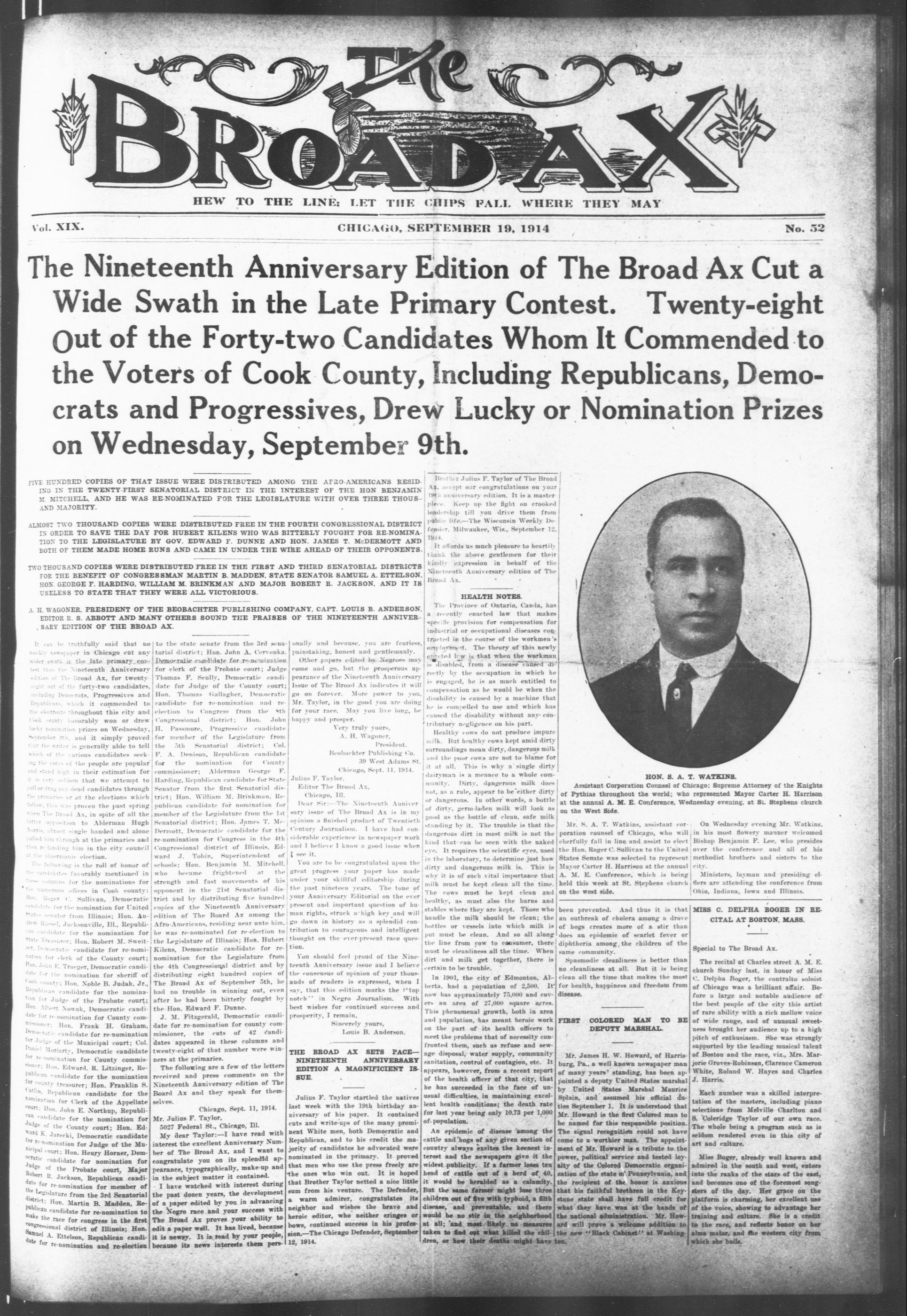
The Nineteenth Anniversary Edition of The Broad Ax Cut a Wide Swath in the Late Primary Contest. Twenty-eight Out of the Forty-two Candidates Whom It Commended to the Voters of Cook County, Including Republicans, Democrats and Progressives, Drew Lucky or Nomination Prizes on Wednesday, September 9th.
FIVE HUNDRED COPIES OF THAT ISSUE WERE DISTRIBUTED AMONG THE AFRO-AMERICANS RESIDING IN THE TWENTY-FIRST SENATORIAL DISTRICT IN THE INTEREST OF THE HON BENJAMIN M. MITCHELL, AND HE WAS RE-NOMINATED FOR THE LEGISLATURE WITH OVER THREE THOUSAND MAJORITY.
ALMOST TWO THOUSAND COPIES WERE DISTRIBUTED FREE IN THE FOURTH CONGRESSIONAL DISTRICT IN ORDER TO SAVE THE DAY FOR HUBERT KILENS WHO WAS BITTERLY FOUGHT FOR RE-NOMINATION TO THE LEGISLATURE BY GOV. EDWARD F. DUNNE AND HON. JAMES T. McDERMOTT AND BOTH OF THEM MADE HOME RUNS AND CAME IN UNDER THE WIRE AHEAD OF THEIR OPPONENTS.
TWO THOUSAND COPIES WERE DISTRIBUTED FREE IN THE FIRST AND THIRD SENATORIAL DISTRICTS FOR THE BENEFIT OF CONGRESSMAN MARTIN B. MAADDEN, STATE SENATOR SAMUEL A. ETTELSON, HON. GEORGE F. HARDING, WILLIAM M. BRINKMAN AND MAJOR ROBERT R. JACKSON, AND IT IS USELESS TO STATE THAT THEY WERE ALL VICTORIOUS.
A. H. WAGONER, PRESIDENT OF THE BEOBACHTER PUBLISHING COMPANY, CAPT. LOUIS B. ANDERSON, EDITOR R. S. ABBOTT AND MANY OTHERS SOUND THE PRAISES OF THE NINETEENTH ANNIVERSARY EDITION OF THE BROAD AX.
Vol. XIX.
The Nineteenth Wide Saw Out of the Vote crats are on Wedd
FIVE HUNDRED COPIES OF THAT ING IN THE TWENTY-FIRST M. MITCHELL, AND HE WAS AND MAJORITY.
ALMOST TWO THOUSAND COPIES IN ORDER TO SAVE THE DAY TION TO THE LEGISLATURE BOTH OF THEM MADE HOME
TWO THOUSAND COPIES WERE DID FOR THE BENEFIT OF CONGRHON. GEORGE F. HARDING, WI USELESS TO STATE THAT TH
A. H. WAGONER, PRESIDENT OF THE EDITOR R. S. ABBOTT AND MA SARY EDITION OF THE BROA
It can be truthfully said that no weekly newspaper in Chicago cut any wider swain in the late primary contest than the Nineteenth Anniversary edition of The Broad Ax, for twenty-eight out of the forty-two candidates, including Democrats, Progressives and Republicans, which it commended to the electrore throughout this city and Cook county honorably won or drew hecky nomination prizes on Wednesday, September 19th, and it simply proved that the writer is generally able to tell which of the various candidates seeking the votes of the people are popular and stand high in their estimation for it is very solidion that we attempt to pull or drag any dead candidates through the primaries or at the elections which follow, this was proven the past spring when The Broad Ax, in spite of all the bitter opposition to Alderman Hugh Norris, almost single handed and alone palled him through at the primaries and then rehandling him in the city council at the admirable election.
---
J. M. Fitzgerald, Democratic candidate for re-nomination for county commissioner, the cuts of 42 candidates appeared in these columns and twenty-eight of that number were winners at the primaries.
The following are a few of the letters received and press comments on the Nineteenth Anniversary edition of The Board Ax and they speak for themselves.
My dear Taylor:—I have read with interest the excellent Anniversary Number of The Broad Ax, and I want to congratulate you on its splendid appearance, typographically, make-up and in the subject matter it contained. I have watched with interest during the past dozen years, the development of a paper edited by you in advancing the Negro race and your success with The Broad Ax proves your ability to edit a paper well. It has lived, because it is newsy. It is read by your people, because its news interests them pers-
CHICAGO, SEPTEMBER 19, 1914
onally and because, you are fearless
painstaking, honest and gentlemanly.
Other papers edited by Negroes may
come and go, but the prosperous ap-
pearance of the Nineteenth Anniversary
Issue of The Broad Ax indicates it will
go on forever. More power to you.
Mr. Taylor, in the good you are doing
for your race. May you live long, be
happy and prosper.
Very truly yours,
A. H. Wagoner,
President.
Beobachter Publishing Co.
39 West Adams St.
Editor The Broad Ax.
Chicago, Ill.
Dear Sirt:—The Nineteenth Anniversary issue of The Broad Ax is in my opinion a finished product of Twentieth Century Journalism. I have had considerable experience in newspaper work and I believe I know a good issue when I see it.
You are to be congratulated upon the great progress your paper has made under your skillful editorship during the past nineteen years. The tone of your Anniversary Editorial on the ever present and important question of human rights, struck a high key and will go down in history as a splendid contribution to courageous and intelligent thought on the ever-present race question.
You should feel proud of the Nineteenth Anniversary issue and I believe the consensus of opinion of your thousands of readers is expressed, when I say, that this edition marks the "top notch" in Negro Journalism. With best wishes for continued success and prosperity, I remain.
Sincerely yours,
Louis B. Anderson.
THE BROAD AX SETS PACE—
NINETEENTH ANNIVISARY
EDITION A MAGNIFICIENT ISSUE.
Julius F. Taylor startled the natives last week with the 19th birthday anniversary of his paper. It contained cuts and write-ups of the many prominent White men, both Democratie and Republican, and to his credit the majority of candidates he advocated were nominated in the primary. It proved that men who use the press freely are the ones who win out. It is hoped that Brother Taylor netted a nice little sum from his venture. The Defender, a warm admirer, congratulates its neighbor and wishes the brave and heroic editor, who neither cringes or bows, continued success in his profession.—The Chicago Defender, September 12, 1914.
Brother Julius F. Taylor of The Broad Ax, accept our congratulations on your 19th anniversary edition. It is a masterpiece. Keep up the fight on crooked leadership till you drive them from public life.—The Wisconsin Weekly Defender, Milwaukee, Wis., September 12, 1804.
It affords us much pleasure to heartily thank the above gentlemen for their kindly expression in behalf of the Nineteenth Anniversary edition of The Broad Ax.
HEALTH NOTES.
The Province of Ontario, Canada, has a recently enacted law that makes specific provision for compensation for industrial or occupational diseases contracted in the course of the workmen's employment. The theory of this newly enacted law is that when the workman is disabled, from a disease caused directly by the occupation in which he is engaged, he is as much entitled to compensation as he would be when the disability is caused by a machine that he is compelled to use and which has caused the disability without any contributory negligence on his part.
Healthy cows do not produce impure milk. But healthy cows kept amid dirty surroundings mean dirty, dangerous milk and the poor cows are not to blame for it at all. This is why a single dirty dairyman is a menace to a whole community. Dirty, dangerous milk does not, as a rule, appear to be either dirty or dangerous. In other words, a bottle of dirty, germ-laden milk will look as good as the bottle of clean, safe milk standing by it. The trouble is that the dangerous dirt in most milk is not the kind that can be seen with the naked eye. It requires the scientific eyes, used in the laboratory, to determine just how dirty and dangerous milk is. This is why it is of such vital importance that milk must be kept clean all the time. The cows must be kept clean and healthy, as must also the barns and stables where they are kept. Those who handle the milk should be clean; the bottles or vessels into which milk is put must be clean. And so all along the line from cow to consumer, there must be cleanliness all the time. When dirt and milk get together, there is certain to be trouble.
In 1901, the city of Edmonton, Alberta, had a population of 2,500. It now has approximately 75,000 and covers an area of 27,000 square acres. This phenomenal growth, both in area and population, has meant heroic work on the part of its health officers to meet the problems that of necessity confronted them, such as refuse and sewage disposal, water supply, community sanitation, control of contagion, etc. It appears, however, from a recent report of the health officer of that city, that he has succeeded in the face of unusual difficulties, in maintaining excellent health conditions; the death rate for last year being only 10.73 per 1,000 of population.
An epidemic of disease 'among the cattle and hogs of any given section of country always excites the keenest interest and the newspapers give it the widest publicity. If a farmer loses ten head of cattle out of a herd of 40, it would be heralded as a calamity. But the same farmer might lose three children out of five with typhoid, a fifth disease, and preventable, and there would be no stir in the neighborhood at all; and most likely no measures taken to find out what killed the children, or how their deaths might have
[Name]
HON. S. A. T. WATKINS.
Assistant Corporation Counsel of CU of Pythias throughout the world; who at the annual A. M. E. Conference, We on the West Side.
Assistant Corporation Counsel of Chicago; Supreme Attorney of the Knights of Pythias throughout the world; who represented Mayor Carter H. Harrison at the annual A. M. E. Conference, Wednesday evening, at St. Stephens church on the West Side.
Mr. S. A. T. Watkins, assistant corporation counsel of Chicago, who will cherfully fall in line and assist to elect the Hon. Roger C. Sullivan to the United States Senate was selected to represent Mayor Carter H. Harrison at the annual A. M. E. Conference, which is being held this week at St. Stephens church on the west side.
been prevented. And thus it is that an outbreak of cholera among a drove of hogs creates more of a stir than does an epidemic of scarlet fever or diphtheria among the children of the same community.
Spasmodie cleanliness is better than no cleanliness at all. But it is being clean all the time that makes the most for health, happiness and freedom from disease.
On Wednesday evening Mr. Watkins, in his most flowery manner welcomed Bishop Benjamin F. Lee, who presides over the conference and all of his methodist brothers and sisters to the city.
Ministers, layman and presiding elders are attending the conference from Ohio, Indiana, Iowa and Illinois.
MISS C. DELPHA BOGER IN RECITAL AT BOSTON, MASS.
Special to The Broad Ax.
The recital at Charles street A. M. E. church Sunday last, in honor of Miss C. Delpha Boger, the contraito soloist of Chicago was a brilliant affair. Before a large and notable audience of
FIRST COLORED MAN TO BE
DEPUTY MARSHAL.
Mr. James H. W. Howard, of Harrisburg, Pa., a well known newspaper man of many years' standing, has been appointed a deputy United States marshal by United States Marshal Maurice Splain, and assumed his official duties September 1. It is understood that Mr. Howard is the first Colored man to be named for this responsible position. The signal recognition could not have come to a worthier man. The appointment of Mr. Howard is a tribute to the power, political service and tested loyalty of the Colored Democratic organization of the state of Pennsylvania, and the recipient of the honor is anxious that his faithful brethren in the Keystone state shall have full credit for what they have won at the hands of the national administration. Mr. Howard will prove a welcome addition to the new "Black Cabinet" at Washington.
d Ax Cut a
enty-eight
mended to
ns, Demo-
tion Prizes
nicago; Supreme Attorney of the Knights represented Mayor Carter H. Harrisonnesday evening, at St. Stephens church
On Wednesday evening Mr. Watkins, in his most flowery manner welcomed Bishop Benjamin F. Lee, who presides over the conference and all of his methodist brothers and sisters to the city.
Ministers, layman and presiding elders are attending the conference from Ohio, Indiana, Iowa and Illinois.
MISS C. DELPHA BOGER IN RE CITAL AT BOSTON, MASS.
Special to The Broad Ax.
The recital at Charles street A. M. E. church Sunday last, in honor of Miss C. Delphia Boger, the contralto soloist of Chiego was a brilliant affair. Before a large and notable audience of the best people of the city this artist of rare ability with a rich mellow voice of wide range, and of unusual sweetness brought her audience up to a high pitch of enthusiasm. She was strongly supported by the leading musical talent of Boston and the race, viz., Mrs. Marjorie Groves-Robinson, Clarence Cameron White, Roland W. Hayes and Charles J. Harris.
Each number was a skilled interpretation of the masters, including piano selections from Melville Charlton and S. Coleridge Taylor of our own race. The whole being a program such as is seldom rendered even in this city of art and culture.
Miss Boger, already well known and admired in the south and west, enters into the ranks of the stars of the east, and becomes one of the foremost songsters of the day. Her grace on the platform is charming, her excellent use of the voice, showing to advantage her training and culture. She is a credit to the race, and reflects honor on her alma mater, and the western city from which she hails.
No. 52
PAGE TWO
D
D
D
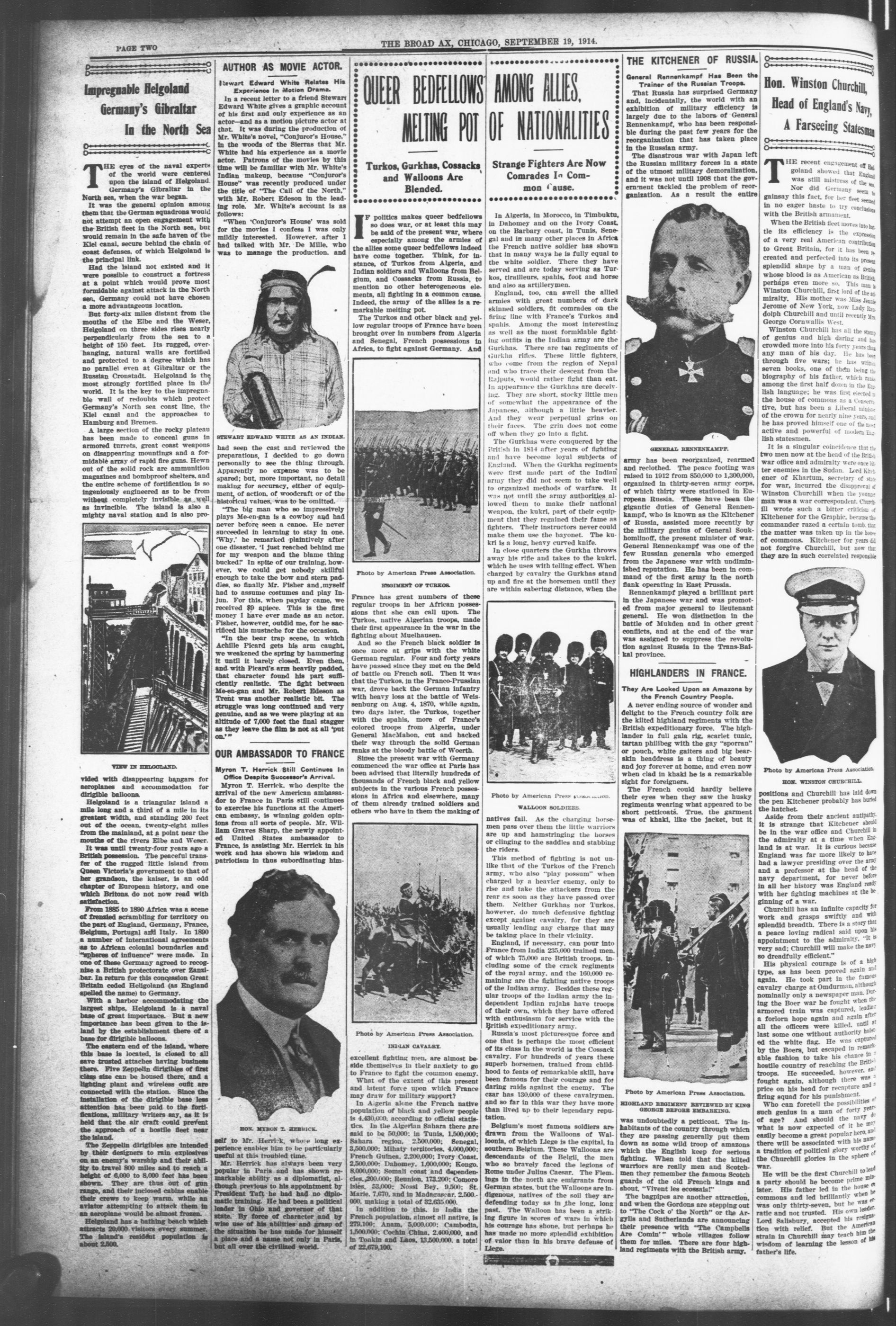
Impregnable Helgoland Germany's Gibraltar In the North Sea
THE eyes of the naval experts of the world were centered upon the island of Helgoland, Germany's Gibraltar in the North sea, when the war began.
It was the general opinion among them that the German squadrons would not attempt an open engagement with the British fleet in the North sea, but would remain in the safe haven of the Kiel canal, secure behind the chain of coast defenses, of which Helgoland is the principal link.
Had the island not existed and it were possible to construct a fortress at a point which would prove most formidable against attack in the North sea, Germany could not have chosen a more advantageous location.
But forty-six miles distant from the mouths of the Elbe and the Weser, Helgoland on three sides rises nearly perpendicularly from the sea to a height of 150 feet. Its rugged, overhanging, natural walls are fortified and protected to a degree which has no parallel even at Gibraltar or the Russian Cronstadt. Helgoland is the most strongly fortified place in the world. It is the key to the impregnable wall of redoubts which protect Germany's North sea coast line, the Kiel canal and the approaches to Hamburg and Bremen.
A large section of the rocky plateau has been made to conceal guns in armored turrets, great coast weapons on disappearing mountings and a formidable array of rapdl fire guns. Hewn out of the solid rock are ammunition magazines and bombproof shelters, and the entire scheme of fortification is so ingeniously engineered as to be from without completely invisible as well as invincible. The island is also a mighty naval station and is also pro-
MILWAUKEE
VIEW IN HELGOLAND.
vided with disappearing hangars for aeroplanes and accommodation for dirigible balloons.
Helgoland is a triangular island a mile long and a third of a mile in its greatest width, and standing 200 feet out of the ocean, twenty-eight miles from the mainland, at a point near the mouths of the rivers Elbe and Weser.
It was until twenty-four years ago a British possession. The peaceful transfer of the rugged little island from Queen Victoria's government to that of her grandson, the kaiser, is an odd chapter of European history, and one which Britons do not now read with satisfaction.
From 1885 to 1890 Africa was a scene of freesized scrambling for territory on the part of England, Germany, France, Belgium, Portugal and Italy. In 1890 a number of international agreements as to African colonial boundaries and "spheres of influence" were made. In one of these Germany agreed to recognize a British protectorate over Zanzibar. In return for this concession Great Britain ceded Helgoland (as England spelled the name) to Germany. With a harbor accommodating the largest ships, Helgoland is a naval base of great importance. But a new importance has been given to the island by the establishment there of a base for dirigible balloons.
The eastern end of the island, where this base is located, is closed to all save trusted attaches having business there. Five Zeppelin dirigibles of first class size can be housed there, and a lighting plant and wireless oufit are connected with the station. Since the installation of the dirigible base less attention has been paid to the fortifications, military writers say, as it is held that the air craft could prevent the approach of a hostile fleet near the island. The Zeppelin dirigibles are intended by their designers to rain explosives on an enemy's warship and their ability to travel 800 miles and to reach a height of 6,000 to 8,000 feet has been shown. They are thus out of gun range, and their inclosed cabins enable their crews to keep warm, while an aviator attempting to attack them in an aeroplane would be almost frozen.
Helgoland has a bathing beach which attracts 20,000 visitors every summer. The island's resident population is about 2,500.
AUTHOR AS MOVIE ACTOR.
Stewart Edward White Relates His Experience in Motion Drama.
In a recent letter to a friend Stewart Edward White gives a graphic account of his first and only experience as an actor—and as a motion picture actor at that. It was during the production of Mr. White's novel, "Conjuror's House." In the woods of the Slireras that Mr. White had his experience as a movie actor. Patrons of the movies by this time will be familiar with Mr. White's Indian makeup, because "Conjuror's House" was recently produced under the title of "The Call of the North," with Mr. Robert Edeson in the leading role. Mr. White's account is as follows:
"When 'Conjuror's House' was sold for the movies I confess I was only mildly interested. However, after I had talked with Mr. De Mille, who was to manage the production, and
STEWART EDWARD WHITE AS AN INDIAN.
had seen the cast and reviewed the preparations, I decided to go down personally to see the thing through. Apparently no expense was to be spared; but, more important, no detail making for accuracy, either of equipment, of action, of woodcraft or of the historical values, was to be omitted.
"The big man who so impressively plays Me-en-gan is a cowboy and had never before seen a canoe. He never succeeded in learning to stay in one. 'Why,' he remarked plaintively after one disaster, 'I just reached behind me for my weapon and the blame thing bucked.' In spite of our training, however, we could get nobody skillful enough to take the bow and stern paddies, so finally Mr. Fisher and myself had to assume costumes and play Injun. For this, when payday came, we received $9 apiece. This is the first money I have ever made as an actor. Fisher, however, outdid me, for he sacrificed his mustache for the occasion.
"In the bear trap scene, in which Achile Picard gets his arm caught, we weakened the spring by hammering it until it barely closed. Even then, and with Picard's arm heavily padded, that character found his part sufficiently realistic. The fight between Me-en-gan and Mr. Robert Edeson as Trent was another realistic bit. The struggle was long continued and very genuine, and as we were playing at an altitude of 7,000 feet the final stagger as they leave the film is not at all 'put on.'"
OUR AMBASSADOR TO FRANCE
Myron T. Herrick Still Continues in Office Despite Successor's Arrival.
Myron T. Herrick, who despite the arrival of the new American ambassador to France in Paris still continues to exercise his functions at the American embassy, is winning golden opinions from all sorts of people. Mr. William Graves Sharp, the newly appointed United States ambassador to France, is assisting Mr. Herrick in his work and has shown his wisdom and patriotism in thus subordinating him
M.
HON. MYRON T. HERRICK.
self to Mr. Herrick, whose long experience enables him to be particularly useful at this troubled time.
Mr. Herrick has always been very popular in Paris and has shown remarkable ability as a diplomatist, although previous to his appointment by President Taft he had no diplomatic training. He had been a political leader in Ohio and governor of that state. By force of character and by wise use of his abilities and grasp of the situation he has made for himself a place and a name not only in Paris, but all over the civilized world.
THE BROAD AX, CHICAGO, SEPTEMBER 19, 1914.
QUEER BEDFELLOWS MELTING POT
Turkos, Gurkhas, Cossacks, and Walloons Are Blended.
IF politics makes queer bedfellows so does war, or at least this may be said of the present war, where especially among the armies of the allies some queer bedfellows indeed have come together. Think, for instance, of Turkos from Algeria, and Indian soldiers and Walloons from Belgium, and Cossacks from Russia, to mention no other heterogeneous elements, all fighting in a common cause. Indeed, the army of the allies is a remarkable melting pot.
The Turkos and other black and yellow regular troops of France have been brought over in numbers from Algeria and Senegal, French possessions in Africa, to fight against Germany. And
Photo by American Press Association.
REGIMENT OF TURKOS
France has great numbers of these regular troops in her African possessions that she can call upon. The Turks, native Algerian troops, made their first appearance in the war in the fighting about Muelhausen. And so the French black soldier is once more at grips with the white German regular. Four and forty years have passed since they met on the field of battle on French soil. Then it was that the Turks, in the Franco-Prussian war, drove back the German infantry with heavy loss at the battle of Weisburg on Aug. 4, 1870, while again, two days later, the Turks, together with the spahis, more of France's colored troops from Algeria, under General MacMahon, cut and hacked their way through the solid German ranks at the bloody battle of Woerth.
Since the present war with Germany commenced the war office at Paris has been advised that literally hundreds of thousands of French black and yellow subjects in the various French possessions in Africa and elsewhere, many of them already trained soldiers and others who have in them the making of
Photo by American Press Association.
excellent fighting men, are almost beside themselves in their anxiety to go to France to fight the common enemy.
What of the extent of this present and latent force upon which France may draw for military support?
In Algeria alone the French native population of black and yellow people is 4,430,000, according to official statistics. In the Algerian Sahara there are said to be 50,000; in Tunis, 1,500,000; Sahara region, 2,500,000; Senegal, 3,500,000; Mihaty territories, 4,000,000; French Gulnea, 2,200,000; Ivory Coast, 2,500,000; Dahomey, 1,000,000; Kongo, 8,000,000; Somali const and dependencies, 200,000; Reunion, 173,200; Comoros isles, 53,000; Nossi Bey, 9,500; St. Marle, 7,670, and in Madagascar, 2,500,000, making a total of 32,635,000.
In addition to this, in India the French population, almost all native, is 279,100; Anam, 5,000,000; Cambodia, 1,500,000; Cochin China, 2,400,000, and in Tonkin and Laos, 13,500,000, a total of 22,679,100.
AMONG ALLIES. OF NATIONALITIES
In Algeria, in Morocco, in Timbuktu,
in Dahomey and on the Ivory Coast,
on the Barbary coast, in Tunis, Senegal
and in many other places in Africa
the French native soldier has shown
that in many ways he is fully equal to
the white soldier. There they have
served and are today serving as Turkos,
tirailleurs, spahls, foot and horse
and also as artillerymen.
England, too, can swell the allied armies with great numbers of dark skinned soldiers, fit comrades on the firing line with France's Turks and spahis. Among the most interesting as well as the most formidable fighting outfits in the Indian army are the Gurkhas. There are ten regiments of Gurkha rifles. These little fighters, who come from the region of Nepal and who trace their descent from the Rajputs, would rather fight than eat. In appearance the Gurkhas are deceiving. They are short, stocky little men of somewhat the appearance of the Japanese, although a little heavier. And they wear perpetual grins on their faces. The grin does not come off when they go into a fight.
The Gurkhas were conquered by the British in 1814 after years of fighting and have become loyal subjects of England. When the Gurkha regiments were first made part of the Indian army they did not seem to take well to organized methods of warfare. It was not until the army authorities allowed them to make their national weapon, the kukri, part of their equipment that they regained their fame as fighters. Their instructors never could make them use the bayonet. The kukri is a long, heavy curved knife. In close quarters the Gurkha throws away his rifle and takes to the kukri, which he uses with telling effect. When charged by cavalry the Gurkha stands up and fire at the horsemen until they are within sabering distance, when the
Photo by American Press
natives fall. As the charging horsemen pass over them the little warriors are up and hamstringing the horses or clinging to the saddles and stabbing the riders.
This method of fighting is not unlike that of the Turkos of the French army, who also "play possum" when charged by a heavier enemy, only to rise and take the attackers from the rear as soon as they have passed over them. Neither Gurkhas nor Turkos, however, do much defensive fighting except against cavalry, for they are usually leading any charge that may be taking place in their vicinity.
England, if necessary, can pour into France from India 235,000 trained men, of which 75,000 are British troops, including some of the crack regiments of the royal army, and the 160,000 remaining are the fighting native troops of the Indian army. Besides these regular troops of the Indian army the independent Indian rajahs have troops of their own, which they have offered with enthusiasm for service with the British expeditionary army.
Russia's most picturesque force and one that is perhaps the most efficient of its class in the world is the Cossack cavalry. For hundreds of years these superb horsemen, trained from childhood to feats of remarkable skill, have been famous for their courage and for daring raids against the enemy. The czar has 130,000 of these cavalrymen, and so far in this war they have more than lived up to their legendary reputation.
Belgium's most famous soldiers are drawn from the Walloons of Walloonia, of which Liege is the capital, in southern Belgium. These Walloons are descendants of the Belgij, the men who so bravely faced the legions of Rome under Julius Caesar. The Flemings in the north are emigrants from German states, but the Walloons are indigenous, natives of the soil they are defending today as in the long, long past. The Walloon has been a striking figure in scores of wars in which his courage has shone, but perhaps he has made no more splendid exhibition of valor than in his brave defense of Liege.
General Rennenkampf Has Been the Trainer of the Russian Troops.
That Russia has surprised Germany and, incidentally, the world with an exhibition of military efficiency is largely due to the labors of General Rennenkampf, who has been responsible during the past few years for the reorganization that has taken place in the Russian army.
The disastrous war with Japan left the Russian military forces in a state of the utmost military demoralization, and it was not until 1908 that the government tackled the problem of reorganization. As a result the entire
C
GENERAL RENNENKAMPF.
army has been reorganized, rearmed and recoltled. The peace footing was raised in 1912 from 850,000 to 1,300,000, organized in thirty-seven army corps, of which thirty were stationed in European Russia. These have been the gigantic duties of General Rennenkampf, who is known as the Kitchener of Russia, assisted more recently by the military genius of General Soukhomlinoff, the present minister of war. General Rennenkampf was one of the few Russian generals who emerged from the Japanese war with undiminished reputation. He has been in command of the first army in the north flank operating in East Prussia.
Rennenkampf played a brilliant part in the Japanese war and was promoted from major general to leitenant general. He won distinction in the battle of Mukden and in other great conflicts, and at the end of the war was assigned to suppress the revolution against Russia in the Trans-Balkal province.
HIGHLANDERS IN FRANCE.
They Are Looked Upon as Amazons by the French Country People.
A never ending source of wonder and delight to the French country folk are the kilted highland regiments with the British expeditionary force. The highlander in full gala rig, scarlet tunic, tartan philibilg with the gay "sporran" or pouch, white gaiters and big bearskin headdress is a thing of beauty and joy forever at home, and even now when clad in khaki he is a remarkable sight for foreigners.
The French could hardly believe their eyes when they saw the husky regiments wearing what appeared to be short petticoats. True, the garment was of khaki, like the jacket, but it
1930
Photo by American Press Association.
HIGHLAND REGIMENT REVIEWED BY KING GEORGE BEFORE EMBARKING.
was undoubtedly a petticoat. The inhabitants of the country through which they are passing generally put them down as some wild troop of amazon which the English keep for serious fighting. When told that the kilted warriors are really men and Scotchmen they remember the famous Scotch guards of the old French kings and shout "Vivent les ecossais!"
The bagpipes are another attraction, and when the Gordons are stepping out to "The Cock o' the North" or the Argylls and Sutherlands are announcing their presence with "The Campbells Are Conn'!" whole villages follow them for miles. There are four highland regiments with the British army.
---
Hon. Winston Churchill, Head of England's Navy, A Farseeing Statesman
THE recent engagement off Belgoland showed that England was still mistress of the sea. Nor did Germany seem to gainsay this fact, for her fleet seemed in no eager haste to try conclusions with the British armament.
When the British fleet moves into battle its efficiency is the expression of a very real American contribution to Great Britain, for it has been recreated and perfected into its present splendid shape by a man of genius whose blood is as American as British perhaps even more so. This man is Winston Churchill, first lord of the admiralty. His mother was Miss Jennie Jerome of New York, now Lady Randolph Churchill and until recently Mrs George Cornwallis West.
Winston Churchill has all the stamp of genius and high daring and has crowded more into his forty years than any man of his day. He has been through five wars; he has written seven books, one of them being the biography of his father, which ranks among the first half dozen in the English language; he was first elected in the house of commons as a Conservative, but has been a Liberal minister of the crown for nearly nine years, and he has proved himself one of the most active and powerful of modern English statesmen.
It is a singular coincidence that the two men now at the head of the British war office and admiralty were once bitter enemies in the Sudan. Lord Kitchener of Khartum, secretary of state for war, incurred the disapproval of Winston Churchill when the younger man was a war correspondent. Churchill ill wrote such a bitter criticism of Kitchener for the Graphic, because the commander razed a certain tomb, that the matter was taken up in the house of commons. Kitchener for years did not forgive Churchill, but now that they are in such correlated responsible
PETER HARRIS
Photo by American Press Association
positions and Churchill has laid down the pen Kitchener probably has buried the hatchet. Aside from their ancient antipathy it is strange that Kitchener should be in the war office and Churchill in the admiralty at a time when England is at war. It is curious because England was far more likely to have had a lawyer presiding over the army and a professor at the head of the navy department, for never before in all her history was England ready with her fighting machines at the beginning of a war. Churchill has an infinite capacity for work and grasps swiftly and with splendid breadth. There is a story that a peace loving radical said upon his appointment to the admiralty, "It is very sad; Churchill will make the navy so gracefully efficient."
His physical courage is of a high type, as has been proved again and again. He took part in the famous cavalry charge at Omdurman, although nominally only a newspaper man. During the Boer war he fought when the armored train was captured, leading a forlorn hope again and again after all the officers were killed, until at last some one without authority hoisted the white flag. He was captured by the Boers, but escaped in remarkable fashion to take his chance in a hostile country of reaching the British troops. He succeeded, however, and fought again, although there was a price on his head for recapture and a firing sound for his punishment.
Who can fordetell the possibilities of such genius in a man of forty years of age? And should the navy do what is now expected of it he may easily become a great popular hero, and there will be associated with his name a tradition of political glory worthy of the Churchill glories in the sphere of war.
He will be the first Churchill to lead a party should he become prime minister. His father led in the house of commons and led brilliantly when he was only thirty-seven, but he was erratic and not trusted. His own leader, Lord Salisbury, accepted his resignation with relief. But the American strain in Churchill may teach him the wisdom of learning the lesson of his father's life.
CATHOLIC CHURCH HAS HAD
THREE AFRICAN POPES.
Twas in the Long, Long Ago, but
They Ruled Well and Wisely.
Washington, D. C., Sept. 15.—At this time when the Roman Catholic church is mourning the loss of Pope Pius X and crowning Pope Benedict XV, the fact that church has had three African popes is interesting. "Jay," a writer in the Washington Sun, says in last week's issue:
The oldest Roman Catholic employee, who for years has been on duty under the great white dome, and who has grown gray in the service of the House of Representatives, and I think an Irishman by birth, stopped me long enough on Monday to ask what I knew about the African race and the Catholic church. I told him I knew very little. "Do you know that three full-blooded Africans have occupied the chair of St. Peter as popes?" I said, "No." "Then," said he, "you ought to step over to the Congressional library and reimburse your historical knowledge on that subject." I went over to the Congressional Library and found in "Cormenin's History of the Popes," volume one, that three Africans had been elected popes.
The first one was Saint Victor, who, after writing several opinions on the festival of Easter, suffered martyrdom about the year A. D. 202. He was the fifteenth pope. The next African pope, regularly elected by the See of Rome, was Pope Melchiades, a man of great piety and learning, who reigned during the time of Constantine the Great. Pope Melchiades occupied the papal throne in the days of St. Augustine. He was the thirty-third pope.
The next was Pope Gelasius, who compiled the rules of the Catholic church known as the "Sacramentarium," the manuscript of which was republished in Rome in the year 1680, after it had been preserved for 900 years. He reigned as pope for four years, and died on the 8th of September, A. D. 496. He was the fifty-first pope.
Now, somebody ought to get a copy of corvinien's History and send it by special messenger to Vardamann, of Mississippi, as he is about the only one left who thinks men of African descent are destitute of all the underlying qualities which go to make great Statesmen, diplomats and churchmen in this old world of ours.
Col. S. B. Turner it seems has put to flight Mr. A. H. Roberts in the contest with him for member of the legislature from the first senatorial district, and the indications are that Col. Turner will be able to answer present at roll call at Springfield shortly after January 1, 1915, for it is claimed that he received from 30 to 50 more votes than Mr. Roberts.
Disease breeds ignorance, immorality and strife.
An old bachelor says a marriage certificate is a noose paper.
Smear yourself with honey and you will be devoured by flies.
False friends are like your shadow—only with you in sunshine.
The quality of our work depends upon the quality of our lives.
War never helps anybody except the people who publish geographies.
The one man who is always pretty sure of a job is the bill collector.
If you would be happy don't imagine that there's a secret of happiness.
Many a nervous woman has solved the problem of perpetual emotion.
Whoever settles this row gets the Nobel peace prize—and deserves it.
Why is it that in sieges churches and cathedrals are always destroyed?
Everybody likes the person who knows how to make a long story short.
References to the "gay capitals of Europe" are sadly out of place just now.
Charity may cover a multitude of sins, but there are several still uncovered.
Some fools prove it by never changing their minds, others by changing too often.
The millennium is a time when family jars will be used in preserving peace.
Wouldn't it be nice to be able to declare a sixty days' moratorium on your debts?
When your house is on fire you don't stop to filter the water which you pour upon it.
One country is keeping perfectly cool in this crisis, and that happy land is Iceland.
The inhabitants of Mars will be glad to know that the earth has the conflict localized.
Troubles are like eggs; the more you brood over them the more likely they are to hatch.
Scrap Book
Pygmalion in Real Life.
In M. D. Stott's "The Real Algeria" is a story told the author by a sergeant of chasseurs at Batna. It relates to a certain colonel with a passion for fetes, who was organizing a fete at Constantine in honor of a "fair charmer." He ordered from L'Artiste twenty statues to adorn the park at a louis apiece, to be completed in a week. L'Artiste had 10 louis in advance. The sixth day came, but no statues appeared, and there was a stormy interview between the colonel and L'Artiste, who
A STORMY INTERVIEW
the in honor of a "fair charmer." He ordered from L'Artiste twenty statues to adorn the park at a louis apiece, to be completed in a week. L'Artiste had 10 louis in advance. The sixth day came, but no statues appeared, and there was a stormy interview between the colonel and L'Artiste, who had been "daily and gloriously drunk." "Be tranquil, mon colonel," said L'Artiste as he pocketed the second 10 louis. "They will be there." And they were there-amazing exhibitions of the sculptor's skill, ranged around the park the following evening.
"Oh, how beautiful, how marvelous!" cried the colonel's charming guest as she glanced from one gem of snow white, marble to the next. "What men! How adorable! * * * If men were really like that I believe I should run away with every one of them. If only they were alive!" In her excitement she grabbed the nearest one excitedly by the arm.
"OH, HOW BEAUTI-
"OH, HOW BEAUTIFUL"
It sprang to the
ground—and bolted! So did the rest
ground and bolted. So did the rest.
The town roared for months over the little joke at the colonel's expense. * * * while L. Artiste and his masterpieces beat fruitlessly upon the walls of their cells.
Progress.
New occasions teach new duties. Time makes ancient good uncount. They must upward still and onward who would keep abreast of Truth. Lo, before ds gleum her campresses. We ourselves must pilgrims be. Launch our Maytower and steer boldly through the desperate winter sea. Nor attempt the future's portal with the past's blood rusted key.
Fair Odds
Judge Musgrove set up a leisurely law office in the town square in Tellico. It looked dignified to have his name as counselor at law painted on the door. Besides, it provided a haven whither he and his listeners could repair when the rain drove them from the sidewalk in front of the Snedecor House, and as a forum for the continuation of the judge's oral memoirs of the war.
To allow a reasonable time for dinner, the judge thought it well to advertise the fact that he would not be in from 10 o'clock to 1. So he sent Jim down to add this information to the painted legend on the door. Jim did it this way:
JUDGE, MUSGROVE,
Counselor at Law.
Ten to One He Isn't In.
—New York Post.
The words we speak and the things we do today may seem to be lost, but in the great final revealing the smallest of them will appear—Lowell.
The Wicked Hadn't Come.
Lady Cardigan is very well known as a teller of good stories. One of them relates to an incident that happened a good many years ago when she was staying with Lord and Lady Wilton at Melton Mowbray. The then Lord Wilton, for various reasons, had gained the title among his tenantry of "The Wicked Earl"—in fact, few of the country people ever called him anything else.
One Sunday Lady Cardigan and Lady Wilton went to church, unaccompanied by his lordship, who usually was a very regular attendant. Lady Cardigan saw the verger look at them curiously as they entered the church, and he evidently noticed that Lord Wilton was not with them, but she was scarcely prepared for what followed.
It was the custom in the church to begin the service only after Lord Wilton and his party had arrived, but a new clergyman who was conducting the service that day was not aware of this, and the duly commenced:
"When the wicked man"—
"He's not come yet!" the verger promptly interrupted in an agitated whisper—Pearson's.
Among the Wounded.
One of the crop of stories that came from West Point with the last graduating class was the remark of a cadet who was precious near to failure in one of his studies. His father was at the Point for the graduation exercises. The cadet was inclined to attribute his narrow squeak to the severity of the instructor, in fixing the grades.
"His system of marking's pretty stiff, eh, son?" asked the pater sympathetically.
"Governor," replied the cadet earnestly, "that man's system isn't marking. It's marksmanship."—New York Post.
THE BROAD AX. CHICAGO. SEPTEMBER 19. 1914
Kitchen Kinks
Intelligent Use of Butter.
It is almost universally admitted that vegetables require the addition of fat in order that they may be at their best, and there is no fat which is so suitable as butter for the majority of vegetables, judged by the character of the dish and also by its flavor.
Some housekeepers have a way of looking upon the use of butter, milk and cream in the preparation of vegetables, soups and sauces as if these ingredients were simply "luxuries" and not food essentials. But it should be remembered that these articles are valuable foods and naturally increase the food value of the dish of which they form a part. They are all wholesome foods, and, although generally more expensive than the vegetable foods with which they are combined, their use in reasonable quantities is certainly to be recommended.
Increasing the cost of the dish by the free use of butter, cream, etc., may, after all, be economy if the increase is intelligently made, and the vegetable soups and purees made richer as well as more appetizing by the addition of butter or cream combined with smaller quantities of meat.
Preserved Ginger.
Those people who like it should keep a few jars of preserved ginger on hand. Now is the time to buy the ginger root. Young roots are put into a vessel and kept at the scalding point until tender, when they should be peeled in cold water. Make a thin sirup and pour it over the ginger and allow it to remain for five days. Then place the ginger in the jars for keeping and enrich the sirup by the addition of sugar. Boll thoroughly and pour over the ginger. It is then ready for sealing.
Ginger pears are novel. The pears should be ripe. Peel them and remove the cores, then cut into thin slices. To every four pounds of pears allow the juice of two large lemons, three and one-half pounds of sugar, four ounces of ginger root shaved fine and one gill of water. Dissolve the sugar, then drop in the pears, ginger and lemon juice and cook for an hour very slowly. Place in the cans and seal when hot.
Blanched Vegetables
Green string beans, onions, full grown lima beans and other green garden vegetables are made more delicate and palatable for many by blanching them, to remove the strong or acrid flavor, before cooking them. This is done by dropping the prepared vegetables into a saucepan well filled with boiling water and salted, immediately brought back to boiling point and boiled continuously from five to twenty minutes, according to the kind and condition of the vegetable. The cover, if used at all, should only partially cover the saucepan. The blanched vegetables must not stand in this water. If not convenient to finish cooking them at once, drain them from the hot water, throw into cold water to cool at once; then drain again and set in a cool place covered with a piece of cheesecloth until ready to finish the cooking.
Fruit Sirups
To make fruit sirups boll the fruit till soft and let it drip through a jelly bag. Put juice in a preserving kettle, boll and skim it, add a pint of sugar to each quart of juice, boll it five minutes, and skim. Have ready bottles sterilized by putting them in cool water brought to a boll. Fill them with the sirup and stand them in pans of water in the oven for ten minutes. Have boiling juice ready, fill the bottles, put in corks that have been in boiling water, and coat the corks with paraffin. Stand the bottles where no draft can strike them till cool; keep them in a cool, dark place.
Dutch butter cakes are delicious
They are made as follows: Take one
half pound butter, three cupfuls flour,
one-half, pound brown sugar, a beaping
teaspoonful baking powder, one
fourth pound sweet almonds and yolk
of one egg, cut into small pieces. Mix
butter and sugar until soft; add all
other ingredients, mix thoroughly with
hands until they stick together; form
into cakes and brush each with white
of egg. Bake in very hot oven; not too
brown, as otherwise butter becomes
too dry.
How to Can Beets.
Wash young beets, and leave on an inch of the stems. Boil them till tender, drop them in cold water then rub off the skin, pack them tightly in jars, set these on a rack, fill the jars to overflowing with boiling water, and add a teaspoonful of salt to each jar. Put on rubbers and covers loosely, set the jars in a kettle of water that partly covers them, and boil them for three-quarters of an hour. Then tighten the covers and let them cool in the kettle. Carrots may be canned in the same way.
Crisp Cabbage
To treat cabbage in order to have it retain all its fresh, crisp, clean qualities for a long time, strip off the root and old outside leaves clear down to a compact head. Take two or three thicknesses of clean newspapers and wrap each cabbage in a tight, neat little bundle. Place in a box or bar
The KITCHEN CUPBOARD
DINNER MENU.
Soup.
Creamed Parsnips.
Braised Lamb Chops.
Nut and Potato Croquettes.
Salad in Aspic Jelly.
Baked Pudding.
Coffee.
A WELL balanced meal is the following, the chops being cooked in a way that makes them especially digestible.
Braised Lamb Chops.—Wipe the chops, put into covered pan and into hot oven twenty minutes. Then dust with a little salt and pepper, add a cupful of cold water, reduce the heat of oven and roast for thirty minutes. Add a little more water if needed to make a cupful. Serve with the following gravy: Add a tablespoonful of flour, which has been mixed with a little cold water, a little salt and pepper; boil until it thickens, add a tablespoonful of caramel and strain.
A Dainty Entree.
Nut and Potato Croquettes.—Take two cupfuls of hot riced potatoes and to them add three tablespoonfuls of cream, half a teaspoonful of salt, an eighth of a teaspoonful of pepper, a few grains of cayenne and a few drops of onion juice. Beat and add one egg yolk. Cook one-fourth of a cupful of soft breadcrumbs with one-fourth of a cupful of cream until the consistency of a thick paste. Then add half an egg yolk, and salt to taste. Cool and add pecan nut meats broken in pieces, using as many nuts as will be held together by the paste. Shape potato mixture in small nests, fill nests with nut mixture, cover with potato mixture and roll into balls. Dip in crumbs, egg and crumbs, fry in deep fat, and drain on brown paper.
Dainty and Novel Salad.
Salad In Aspic Jelly.—Serve on a bed of crisp watercress with the salad heaped up in the center of the jelly ring, which is made in this way: Whip stiff a cupful of thick cream, and into this stir a cupful of strong aspic jelly. Cool it, and before it is quite set add a small quantity of potted or very finely minced cooked ham. Combine ingredients with the egg whip, color pink and pack in the mold.
Baked Pudding.—Take four level tablespoonfuls of butter, a cupful of sugar, one egg, a cupful of milk, two cupfuls of flour and three level teaspoonfuls of baking powder. Cream the butter and sugar, add the egg and milk and sift in flour and baking powder. Bake and serve with sauce.
Aunna Thompson.
The KITCHEN
CUPBOARD
SOUTHERN housewives know how to serve the sweet potato to perfection and are skilled in a variety of ways of preparing this delicious food. The following methods commended by a famous chef may be of interest:
A Baked Purse.
Sweet Potato Puree.—Boll five medium sized sweet potatoes. When done mash through a potato ricer. Add butter the size of an egg, a quarter teaspoonful of cinnamon, two eggs, one beaping tablespoonful of brown sugar and four tablespoonfuls of milk. Cream well together, pour into buttered pudding dish in which it is to be served and bake in oven till brown. Sweet Potatoes and Pork.—Boll, peel and mash a sufficient quantity of sweet potatbes and molsten with butter and egg. With them cover the bottom of a deep dish; then put on a layer of slices of cooked pork and sprinkle with sage and marjoram. Next another layer of sweet potatoes, then another layer of pork and so on until the dish is full. Finish with a layer of sweet potato and bake till hot and brown on the surface.
Palatable and Nourishing.
Sweet Potato Croquettes—Take one pint of boiled, mashed, steamed or baked sweet potatoes, add the beaten yolks of two eggs, season to taste with salt and pepper. Stir over the fire until the mass comes away from the sides of the pan. When cold form into small croquettes, brush over with beaten egg, roll in fine breadcrumbs and fry in smoking hot fat until a golden brown color. The croquette mixture may be made into balls inching chopped cooked meat. When used in this way serve with sauce.
Light and Wholesome.
Sweet Potato Puffs—Steam six large potatoes until tender, then peel and mash them; add two tablespoonfuls of butter, one tablespoonful of sugar, a saltspoonful of salt, four drops of onion juice and a dash of paprika. Beat until light with a silver fork, then stir in lightly the stiffly beaten whites of two eggs. Pour at once into buttered custard cups or cocotes, place in a pan of boiling water and bake in a hot oven for twenty minutes. Serve in the cups as an entree or as a vegetable accompanying turkey. They look pretty garnished with parsley.
Anna Thompson
Kathryn—In one respect she's like all other women.
Kitty—Meaning?
Kathryn—She thinks she's so different—Puck.
There are a lot of careless geeks Who manufacture toil.
They wait until an engine squeaks Before they purchase oil.
—Cincinnati Enquirer.
"How can I make this summer room look cool?"
"Why not try a friese on the walls?"
—Baltimore American.
As long as wife loves her chap She dresses neat and dapper. But when she doesn't care a rap She slouches in a wrapper.
—New York Mall.
Visitor—Why have you put two hot water bottles in my bed, Bridget? Bridget—Sure, mum, wan of thim was leaking, and I didn't know which, so I put both in to make sure—Current Opinion.
"I must disguise myself again," Said old Detective Topp. He touched a button on his vest And turned into a shop. —Philadelphia Ledger.
Mistress—That's a nicely made dress you have on, Jane. It's like the new parlormaid's, isn't it?
Jane (a close student of the fashion catalogues) — Oh, no, ma'am, this is quite a different creation—Punch.
The lawyer wooed and lost the maid; Her love was warm, but short. But she was brought to terms, for he Sued for contempt of court. Philadelphia Ledger.
"Mrs. Blitter has a fine disposition,
hasn't she? And gets on with her hus-
band, doesn't she?"
"Indeed, yes. Why, she would get
on with anybody's husband."—Life.
Come, Maud, into the garden go'
And pluck a juicy mango;
Then down the paths, all graveled smooth.
Let's munch and dance the tango.
—Baltimore American.
Little Brother—Bet he'd kiss you if
I weren't here!
Sister—You insolent boy! Go away
this very minute—Penn State Froth.
The skirts now fit 'em like a glove,
But when the bustles hit 'em.
More like a padded boxing glove
Is how their skirts will fit 'em.
—New York Mail.
"Here, waiter!"
"Yessah!"
"You said you had some fresh dew
berries. These you brought are over
due berries."—Exchange.
"Why does yo' call dat ole mule 'Fact?
A ding queer name, Eph Bings?"
"Why, Rufus, I am the mule 'Fac
'Cause fac's an stuart things."
—Philadelphia Ledger.
"Time flies," quoted the sage.
"Yes," replied the fool. "But he isn't
crazy enough to loop the loop like some
of the modern filers."—Cincinnati Enquirer.
How beautiful the stars appear
Under the lens' wondrous spell.
And yet it fetches, seems to me,
The chorus girls out quite as well
—New York Sun.
"There ain't nothin' bad about me,
lady," said the tramp at the door.
"No?" said the Boston lady with the
eyeglasses. "How about your grammar?"
—Yonkers Statesman.
Love, honor and obey—the marriage vows
Alas for vows so promising, so mocking!
Full many a bride will simply knit her
brows
When mildly asked to darn her hubby's
stocking.
—Judge.
"I don't know what to call this new
runner we've planted."
"Why not call it the Marathon vine?"
—Baltimore American.
The year's at the spring.
And day's at the morn;
Morning's at seven;
We are all uppee;
For we're on the wing;
The cat looks forlorn;
We leave at eleven—
The house is to let!
—Milwaukee Journal.
"She's very formal, isn't she?"
"Very. She even objected when the
parrot spoke to her without being
introduced."—Detroit Free Press.
By now the groom of June no doubt
Would like to meet the simple John
Who very often pointed out
That two could live as cheap as one.
—Detroit Free Press.
"The Beegins are a remarkable family."
"How so?"
"They have a boy seven years old
and they don't call him 'Buster'."—
New York Press.
There was a young man of Racine
Invented a flying machine.
It was good as could be,
With one drawback. You see,
The thing wouldn't fly worth a beam.
—Milwaukee Free Press.
"Was it a bad accident?"
"Well, I was knocked speechless,
and my wheel was knocked spokesle."
—Christian Register.
I herewith discourse on
The subject of sorrow:
The troubles that kill are
The troubles we borrow!
—Judge.
"He is a man, I am told, of sedentary
halldn."
"No such thing! He never touches
a drop."—Baltimore American.
Spring has bees and blooms in bud
On display
And eleven kinds of mud,
By the way.
—Pittsburgh Post.
PAGE THREE
LIFE STRUGGLES OF AN EX-SLAVE
AT TRIAL OF JOHN BROWN.
Coachman For Judge Richard Parkes, Who Presided at the Trial of the Hero of Harper's Ferry, Tells Thrilling Story—Hale and Hearty at Seventy-six Years of Age.
Alliance, O.—One of the most highly esteemed colored men in this city is Presley Dunwood, whose life story is a most interesting bit of information. His memory is intimately linked with the daring dash of John Brown of Harpers Ferry, which gave the tocsin of the bloody civil war. Presley Dunwood was the servant of Judge Richard Parker, the noted jurist, who presided at the trial of John Brown.
In giving brief bits of information concerning his early career Mr. Dunwood says:
"I was born in Clark county, Va., in 1838 and taken from my mother when one year old. At the age of seven I was 'hired out,' in 1851-2 being with a man named Isaac Gantz. In 1853-4 I was 'hired' to Henry Hose of Perrysville, Va. In 1855 I was with John Shumetz and in 1856-7 was 'hired' with a man named Henry Hesa in Loudoun county, Va. In 1857 there was a division of the men in some way, and I fell to the ownership of Judge Richard Parker of Winchester. Judge Parker had judicial charge of the courts of both Jefferson and Frederick counties.
"John Brown with his handful of men came to the neighborhood of Harpers Ferry on Sunday, Oct. 16, 1850, and oh Monday morning at 1 o'clock made his charge and by morning gained possession of the arsenal. There was fighting with much excitement up to 3 o'clock, when a company of Washington marines came up and captured Brown and his men. Brown had with him but eighteen men.
"I believe he expected many more, but was betrayed. They did not show up as promised or anticipated. Hayward Shepherd was the first man to be shot in that day of turnoff. He was the toll keeper of the Maryland bridge, as it was called. Brown and his men coming up to Harpers Ferry from the Maryland side. Shepherd would not give up the keys to the bridge to Brown and his men, and he was shot.
"The trial of Brown and the men captured with him was held at Charlestown, in Jefferson county. I had charge of Judge Parker's carriage and drove him to and from the courthouse to his home every day during the trial. I often saw John Brown during this time, but did not hear any of the evidence in the trial, as colored people were not allowed in the courthouse. We were given to understand that Brown and his men had attacked the government. I was told the life of the judge was threatened, but I never saw any trouble while driving to and from the courthouse. The trial of Brown alone lasted a period of three weeks and the trial of those with him about three weeks more—six weeks in all.
"The men were condemned to death, and Brown was the first to be hanged. Seven men in all were hanged, the hanging having taken place on Dec. 2, 1850. John Brown's wife came and received his body. Parker was not in sympathy with the south in the matter of slavery, but had to do his duty as a judge.
"Following the hanging of Brown and his men, slaves were sold rapidly, many owners realizing the probabilities the future held in store. After the election of Lincoln as president there was no sale for slaves at all."
"At the beginning of the war I was pressed into the. Confederate army and was with that army in the first battle of Bull Run. Following a big fight about Winchester, I was captured by a company of the Forty-sixth Pennsylvania volunteers under command of Captain Benjamin W. Morgan, and from that time on I was in the Union army, however, not an enlisted man. I was in the battle at Cedar Mountain, the second Bull Run sight, and saw much of the fight at Antietam.
"After the war I accompanied Captain Morgan to Pittsburgh and worked for him for several years, he being engaged in business there, conducting a confectionery store. In 1888, knowing where my mother was, I brought her to Pittsburgh and was with her and cared for her until her death in 1901. A pension had been obtained for mother. My brother Jim was a soldier in the Union army, he being killed in the battle at Petersburg.
"After mother's death I left Pittsburgh, coming to Lisbon, and for some years worked at the Hostetter House. Two years ago I came to Alliance from Lisbon with Claud Hasbrouck, and I have since remained here. I never went to school a day in my life, but can read and write, a good old Presbyterian lady at Winchester in about 1890 teaching me to read from the Bible and also to write. I have seen Abraham Lincoln, Johnston, Lee, Grant and others of the noted generals of that day. I have seen President Wilson's father and heard him preach, he having lived and preached in Virginia in that region where my younger years were passed."
tie Fo PAGS FOUR ~~~ o> < ot
Shee 3
THE BROAD AX
3 “FORLISUED WEEKLY. _
eee ne a es
Catholics, Protestants, Priests, Infidels,
‘Single Taxers, Repablicans, or amyene cise
wan bave theif say. ae long. ae thelr lane
Senge te proper and responsiblity fe Grad.
(The Bread Axis a re whose
‘platform ; enough = all, os
own ‘mind.
Local communications will receive stten-
tien. "Write only on one side of the paper.
ne een ee es
_ahdvertatng rates made known om appll-
‘Addréss al) communications to
THE BROAD AX
‘tt FEDERAL STREET, curcaco, 11.
PHONE DREXEL «90. ts
JULIUS F. TAYLOR. Editor and Publisher
Entered as Second-Clase Matter Aug. 18,
19902, at tbe Post Omice at Chicage, Hiltnele
under Act of March 3, 1873.
WHAT IS ANTI-TUBERCULOSIS
WORK. +
HOW RED CROSS SEAL MONEY
MUST BE SPENT.
For the benefit of the numerous or-
ganizations who helped to sell nearly
45,000,000 Red Cross Seals last year
and for the general public, the Amer-
iean Red Cross and The National Asso-
ciation for the Study and Prevention
of Tuberculosis have framed a defini-
tion of anti-tuberculosis work showing
how the proceeds from these holiday
‘stickers are to be used. The definition
limits the expenditure of money only
for the year ending April 30, 1915.
‘The definition was framed at a re-
cent meeting of The National Associa-
tion for the Study and Prevention of
Tuberculosis and states that the term
“*anti-tuberculosis work"’ as it relates
to the expenditare of Red Cross, Seal
money shall include the following ac-
tivities:
1, The construction of hospitals or
sanatoria for the care of the tubercu-
lous.
2 The maintenance of the tubereu-
lous, ie
3. The provision of day or night
camps for the tuberculous; the pro-
vision and maintenance of dispensaries
visiting nurses, open air schools, fresh
air classes, or preventoria for the care
or treatment of tuberculous cases or for
the prevention of the spread of tuber-
culosis.
4. The maintenance of educational
or legislative activities whieh have for
their object the prevention of infection
with tubereulosis.
Dr. Charles J. Hatfield, executive
secretary of The National Association
says in commenting on this definition,
‘We hope by this.means to prevent
the spending, particularly of small sums
of money, in useless activities, and to
direet the efforts of all anti-tubercu-
losis agencies along the lines which
will produce most results for the money
Invested. We are in thorough sym-
pathy and co-operation with every
movement for better community or in-
dividual health, but if this Red Cross
‘Seal money is to be spent, as we ad-
vertise, only for tuberculosis work,
wre wish to see that it is ex, to
the best advantage.’? ee
NEWS FROM MOUNDS, ILL.
Special to the Brosd Ax.
Mrs. Haywood Chambliss and daugh-
ters, Christine and Gwendoline, have
returned home after a very. pleasant
visit with Miss Mittie Foulks, of Syd-
ney, Ti. i.
Messrs. Napolien Humble and Dr. 8.
T. Sealy received Monday evening at
the beautiful and spacious home of Mr.
Umbles, in honor of Miss Mabel and
Eva Overton, of Chicago. The Misses
Overton being bouse guests of Miss
Louise and Vesta Lewis, of Cairo, Ill.
The party was perfectly grand in
every detail and the guests were, name-
jy: Dr. R. M. Young, Cairo, IL; Miss
Louise Lewis, Cairo, IIL, Dr. J. C. Lew-
is, Cairo, IIL, Misses Mabel “and Eva
Overton, Chicago, Miss Grace Thomp-
son, Mound City, Cora Thompson,
Mound City, Bessie Garver, Monnon,
Ind., Mr. Archie Clemmons, Mound City,
‘Mrs. Martha Kin, Mounds, Miss Pauline
Dabney Owens, Mounds, Miss Sarah
Clark, Mounds, Miss Minnie A. Howard,
‘Mounds, Mr. and Mrs. L, W. Washing-
ton, Mounds, Mrs. John Howard,
Mounds,, Mrs. John Alexander, Mounds,
‘Mrs. Haywood Chambliss, Mounds,
‘Miss Hortense Moseby, Springfield, IIL,
‘Mr. Daniel mer sage a Rich-
ard Anderson, Mgunds, “Mr. Dewitt
Love, Mounds, Mr. James ‘Sn
‘Hugo Chambliss, Mounds, Mr. Grover
‘Clesviand Blackwell, Mounds,
The guests all voted Drs. Sealey and
‘Humble excellent host 9 -
» Miss Mittie Foalks, of 1 i. a
mains at Se ania cen
eee — ee
‘seck josghonas boo aeeitie? akin hi
tine Chambliss accompanied her back
Sud will enter the great Dr. Stinson’s
College.
Miss Azalea Dumas and Mr. Cook, of
Cairo, were-ealling on Miss Pauline D.
Owens Friday p. m.
WEGRO FELLOWSHIP LEAGUE.
Dr. M. W. Dogan, president of Wiley
University, Marshall Texas, will ad-
dress the League, 3005 State St., Sun-
day afternoon, September 20th. Dr.
Dogan will answer questions raised by
Mr. Frank Stephens in his address
Sunday last, on the war in Europe,
when he asked ‘‘If Christianity was
a Failure’ beeanse it had been unable
to prevent, the terrible war, which is
now raging in Europe. Meeting be-
gins promptly at 4 0’elock, Don’t fail
to bear him.
Mr. Stephens was at his best, and his
address was both masterly and eloquent.
Men of national reputgtion were pres
ent and they said that he cleared up
for them, many matters in connection
with the war. He showe’ how the
war affected the international history
of all the countries involved and the
various races of which they are made
up; how it affected our factories by
keeping our white and cotton goods in
this country; how the color question
came to the fore during this war, and
many other interestibg points.
Among the visitors were Prof. Dogan,
Dr, I. Garland Penn, secretary of Fried:
man’s Aid Society, Cincinnati, Ohio:
Rev. Bryant, district superintendent of
the M. E. Church and Rev. J. W. Rob-
inson, of St. Marks.
‘JOHN B. RYAN WILL CONTINUE
"HIS FIGHT AGAINST ALDERMAN
| ‘MICHAEL KENNA IN THE FIRST
WARD.
HE WILL BECOME A CANDIDATE
FOR ALDERMAN AT THE SPRING
ELECTION IN 1915.
Mr. John B. Ryan, who is success-
fully engaged in the undertaking busi-
ness at 2449 Cottage Grove avenue, and
who was a candidate for Ward Com-
mitteeman at the late primaries against
Alderman Michael Kenna, and was only
defeated by him by from 300 to 400
votes will keep up his fight against
him.
Mr. Ryan states that he will run for
Alderman of the first ward in 1915;
that he will perfect a thorough organi-_
zation in each preeinet throughout that
ward and give the little first ward states:
man 2 hot foot race for the aldermanie:
nomination.
JUDGE M. K. LANDIS STARTS ON
THE WAR PATH AFTER ATTOR-
MEY 8. A. McELWEE.
Judge Landis aroused when he
learned actions of 8S. A. MeElwee, Ne-
gro lawyer, who filed petition in bank—
ruptey two years ago for Charles A.
Lett, 3132 South State street, saloon-
keeper. Alleged Lett was penniless.
‘The court was told that in two years
Lett had paid to MeElwee $139.50 in
fees. Mrs. Blanche Lett showed thir-
teen receipts. for various amounts.
““MeElwee, you pay Mrs. Letts $138.50
week from today at 12 o'clock, and
also pay referee's and court costs of
this case, amounting to $f54.50,"’ said
Judge Landis. ‘‘AM right, Judge, I
will,’? said Mrs MeElwee.—The Herald,
Thursday, Sept. 17, 1914.
MR. AND MRS. HARRY A. DUNCAN
ARE SPENDING THEIR VACA-
TION AT MILWAUKEE, WIS.
‘Mr. and Mrs. Harry A. Duncan of
3256 Rhodes Ave. are spending the
month of September in Milwaukee, Wis.,
the guests of Rev. and Mrs. J.S. Woods.
Tuesday evening the 16th, a concert
was given at St. Mark A. M. E. church,
when Mrs. Duncan, as oue of the par-
ticipants, gave an address on the
‘«American boy.’? :
They are having a most enjoyable
time and will return home October Ist.
MEN'S CIVIC LEAGUE.
Prof. Allomoni addressed the club
Tuesday evening on ‘‘Civies and Eco:
nomies.’”? A goodly number was pres:
ent to bear him. The address was ex-
cellent and enjoyed by all. The presi-
dent, Mr. W. D. Neighbors, and mem-
bers extend a cordial invitation to all
men to be present, every Tuesday even-
ing, at 8 o'clock, 3005 State St.
ALPHA SUFFRAGE CLUB.
Wednesday evening was the regular
business metting of the Alpha Suffrage
Club. The elub is busy making plans
for the fall work. Ladies in doubt as
to whether women should vote or not,
are especially invited to be present.
Meeting held at 3005 State St, on
Wednesday evenings, 8 o'clock.
SUNDAY, SEPTEMBER 20, AT 4 P.M.
SERVICES WILL BE HELD AT
‘LOUISE TRADMING SCHOOL
f COLORED BOYS, 6129 SOUTH
This coming Sunday afternoon, Sep-
tember 20, at 4 P. ML regular services
‘will be resumed after the summer va-
cation at thé Laise Training school for
ives = opera ame pehna
"Mr. William 0. Lamonte will address
the Boys at the above mentioned time.
THE BROAD AX, CHICAGO, SEPTEMBER 19, 1914.
Lae 3 4
ee
Ps
eae. «(’
ee a5? \
2 Be aa TN :
eaitiay co Cas
Lee i a &
eS pet 4 Se
a ee ee ;
LEE ey:
$ aaa ee ee
3 , ORF see es
ts fond a Saat oh a
4 pe RS hoe = a
fot Foe oe ai
ON. THOMAS GALLAGHER.
Democratic candidate for re-election to Congress from the 8th Congressional
torial district.
. ere =
Be.
. ze a a
oy
e. re:
eed
Rs
Roe
tg. Bs
———_ |
oat E
=
2 ‘HON. BENJAMIN M. MITCHELL.
‘Democratic candidate for re-election to the Legislature from the 2ist Sens-
;
Mrs. Blakemore, of Detroit, Mich.,
‘is the guest of her friend, Mrs. Ge-
neva Smith, 5263 Dearborn street.
Hon. Edward D. Green arrives! home
Friday morning from Lima, Ohio,
whiere he went on a real estate «eal.
Mrs. Carrie Seams, 5026 Federal St.
will leave tomorrow evening on a
pleasure trip to French Lick, Indiana,
where she will spend two weeks.
Mmm. Emma MeGowen, 4735 trans
avenue, returned home Sunday morning
from Springfield, UL, where sie at
tended the session of the head lize of
the Sisters of Jericho.
Mr. Richard Green, for many \ cars
chief messenger in the Treasury De-
partnient, has been promoted to 9
clerkship by the executive order of
President Wilson at a salary of $1,400.
Henry Jones, part owner of the poy
ular Elite Cafe, 3030 S. State street,
also of the new Elite Cafe No. 2,
which is under construction on the east
side of State street near 35th street,
spent the first part of this week at
Watseka, Il.
Miss Ida M. Taylor, 5427 Wabash
avenue, who has for some years been
the bookkeeper in the real estate de-
partment of Jesse Binga’s bank, has
severed her connection with it and the
first of October she will take up some
advanced studies at the Chicago Uni-
versity.
‘Mrs. Martha B. Anderson, 6450
Champlain avenue, arrived home Sun-
day morning from Springfield, Il.
where she gave a successful recital at
Masonic Hall and attended the ses-
sions of the Sisters of Jericho. She
greatly enjoyed her first visit ‘to the
Capitol of the State of Mlinois.
dobn W. Lewis, Nezro physician, pro-
prictor of the West Side Drug and
Supply Company, 1753 West Lake St.
was held in default of $1,500 bonds on
the charge of illegally selling cocaine.
He was arrested Wednesday by detee-
tives who say they trapped him and
found marked bills on bis person.
Hon. Charles F. Clyne, of Aurora,
UL, the new United States listriet at-
torney at this point and for the North-
ern Dist. of Ilinois, assumed his duties
this week. Mr. Clyne, who is a warm
friewd of the Hon. Samuel Alsehuler,
is an able lawyer and it is freely pre
dicted that he will make a tip top
United States district attorney.
eet ‘ »
eae Nc nS «
on ©
eae
Be
Se. OE
eee
cme
Ae ae
ars
IP oS:
ee
EDWARD BE. LITZINGER.
Republican candidate for County
‘Treasurer.
Mra, Alice Payne, the beloved meth-
er of Madam Rosa Lee Tyler, 3313 8.
State street, the Palms ice cream par
Jor, was laid to rest last Priday in
Mt. Forest cemetery. On that date
funeral services were held over her
remains at Olivet Baptist church, Rev
Dunean officiating. Mrs. Tyler has the
sympathy of a large circle of friends
over the loss which she has sustained
iGastagtilere ce
Some men fall in love. Others are
Lucky is the man who doesn't believe
in tuck,
‘Tuinting things impossible is what
makes them 90.
Don't be easily seared. Even a halt
casts a shadow,
Some people would rather be polite
thin tell the trath,
| More than ove throne trembles on
the balance of battle.
| The man with cold feet seldom
“travels at a rapid pace.
| Make your neighbor's front yard
jealous of your back yard,
Even when your wife's argument
“dues not sound convincing. it is.
Some men are sntistied with half a
“loaf, and some loaf stil the time.
The wolf at the door sometimes
comes disgulsed as a bill collector.
A min whe can dispose of his trou
bles for a cousideration is a genius.
Relatively speaking, Mexico is now
one of our leading peaceful countries.
It Is better not to tell your troubles
more than once to the same individual,
‘The horrors of war scarcely begin
until the armies spend a winter in the
field,
A shoemaker has been divorced six
times. Evidently he couldn't stick to
his Iast.
All the labor saving devices ever in-
vented have failed to make the loafer
popular.
A few more bloody chapters are be-
ing written for the next generation's
history books.
Calling a man a “genius” fs often a
polite way of intimating that he lacks
cominon sense.
Bumper crops are fine. but one must
be careful that they do not bump the
wrong persous.
War will end kings. says Oscar
Straus. It will if they stand in front
of the Gatlings.
About the only place in Europe where
there is any “hum of industry” fs in
the gun factories.
The well known fact that gold is non-
magnetic probably explains why so
few of us attract it. |
A fatalist is a man who thinks that
what fs to be will be and that some-
body else fs to blame.
What a ghastly silence must answer
the roll call these days in some of
those European armies!
Does the tremendous jump in the
price of carbolie acid prove that ear-
bolic acid fs very bard to make?
It is said that distance lends en-
chantment to the view, but not to
man’s view of the almighty dollar.
Holland has the advantage of being
able to become a submarine country
any time it chooses to cut the dikes.
A music publisher says he spent
‘over $8,000 to popularize a song. Still,
he got many a whistle for his money.
Activities of censors show that pub-
lic opinion as well as money and arms
fs a force to be reckoned with in war.
fare.
It’s a doubtful satisfaction that 1s de-
rived from the knowledge that one can
have next week the thing one wants
today.
Many American women tourists in-
timate they were treated even worse
abroad than at the New York customs
house.
Envy is the feeling that prompts u-
to think the things that make life
worth living are the things other peo-
ple have.
‘The small boy in this country wi
hail the European war as a great
blessing if it makes the price of castor
ofl prohibitive.
Among the other examples of incon-
sequential expenditures ean be men-
tioned the $1,500,000 expended for the
unsailed yacht race.
Considering the other matters it has
to worry about, a transatlantic liner
is liable* to run right through an ice-.
berg without stopping.
Perhaps, after all, it is just as well
that we have no expensive legation
buildings in the capitals of Europe to
be bombarded to pieces.
With a crop of 1,200,000,000 pushels
of oats reported it is not likely that
the equine population will complain
of hard times this year.
It is given out that golf in tne umt-
ed States costs $50,000,000 a year.
Even so, it is cheaper than the Euro-
pean game of ultimatum.
| “Did you see where an heinse nu.
| Tied a buteher?*
“HE suppose she SAW it 9. phe g
way she could afford (0 et seu a
day.”—Balthnore Americas ’
Come into the arien, Mon
‘And wear your skirt
j The birds don't mint he » :
| But you will Rive ther ss
—Ailative «
“What makes her s0 jos :
| everything?”
| “Her sex."—Philadelphin 1
Buz now witts folt
‘Their bushands) px
The ladles wre 0 ts
That peopie cab the
Willle—Paw. whit is »
mor?
Paw—That is sometiiin «
indalzed in by the mos
his own jokes, my son, +
quirer.
| He asked the itt to
| Ills words we he
| Beseeched to tly, +
Te put Mer in a thr
—Laisvtite
Bill-I see King Geors. 6 1
“fs in the hands of his sdejsi:
Tl—Crown work, 1 ippese 4
| kers Statesman,
| A good thins ts 1 ts 5
| “Een though et
| And T ean say, "tw.
| TF d rather do thin
“Are you economizin:* ~1
say so,” said the man wie i.
cheerful. “My wife bensit coo.
marked down articles ty <0 <9
the original prices.”—Washins? 1 S5y
‘They say that golf's a splenlet «
And perfect recreation
But every time T play I cis
That golf's an irritition
—Detroit Fr
“So Ethel is now engages in refor
work?"
“Yes; she is teaching her parnit not
‘to swear."—Boston Transerij
When the people wed in Holi!
‘And the Wedding: zuests enth
Do they shower the brsla! part
‘With those heavs Wowrlem shoes
Kansas City Journat
Mr. Pester—I dreamed 1 hat un
counted gold.
Mrs. Pester — That's just like soa
You never even take the trouble 19
count your chanze.—Puck.
“Won't you take a chair? sail be,
Just to see her at her ease,
And without meaning she
Said, “After you. sir, please
New York San
Warden—Are you willins to confess?
Voice From the Dunzeon—No, sit
T'm as much in the dark as ever
Buffalo Express.
He dreamed a castle in the air,
‘A lazy chap’s ideal one.
‘Then sold the plan to a busy man
‘With cash to build! areal os
~Jotse
“How on earth did a man with 2
record like his ever manaze to clean
it up?”
“I guess he did it with soft soap."—
Baltimore American.
T always envy Mr. Keer,
For he has wealth, I know.
His park contains a herd of deer.
‘And he has plenty doe.
Cincinnati Enquirer
“How's that budding genius son of
yours?”
“He's a blooming idiot now.”—Phils
delphia Ledger.
1d Stingy Jenks would never treat
It cost too many pence—
But he invited every one
To joke at his expense.
‘New York Mait
“Ever see spots on the sun, Sam?”
“Oh, yes, sal.”
“When, Sam?*
“Other day. when dat ornery mule
kicked me at high noon. sth!"
Yonkers Statesman.
I can handle soft confetti
Eat raw oysters with the best,
But I cannot eat spaghetti
‘Without musing up my vest
—Peoria Journal
“How long has he been married?”
“Not very long. He still zoes bome
to lunch."—Detroit Free Press.
‘The Indian that we used to know
Presents a transformation fest
He draws a salary from a sho
‘Or cashes in on real estate
Washington Star
Willie—Paw, what is a square deal?
Paw—That’s when you get about 10
“A tear was in her voice,” he wroie
‘And how it made the critic ="«"
‘When on a car he chanced to nt
A loud voiced booby read :t “+35”
Wife (after callers had gone)—How
dare you scold me before comns*
Hub—Well, you know, my deat.
don't dare do it when we are by 00°
selves.—Boston Transcript.
‘The whole world hates a grouchy ste™
It always makes us cuss
‘To fall in with a fellow who
‘Wants to fall out with us
‘Cincinnati Enquirer.
“What did you do while your wife
‘was away on a vacation?” -
“I talked! triumphantly rer!
skimpy little Mr. Hennypeck—Put-
A man gets tight, then walks the street
A-stumbling left and right.
Awoman walks wtih staggering fe‘
‘Because her skirt is tight.
ee vor
Lord Kitcheer is a rather grim person and hardly a subject for a joke, but on one occasion General Botha scored on him rather neatly. While terms of peace in South Africa were being discussed there were several interviews between the two leaders before a working basis for a treaty was agreed upon. There was still a good deal of skirmish going on, and at the end of one interview General Botha got up with the remark, "Well, I'm afraid I must be off."
"There's no hurry," replied Lord Kitcheer pleasantly; "you haven't got a train, you know!"
to catch it.
General Both laughed.
"Perhaps not," he answered, "but I must go now."
Bidding Lord Kitchener goodby, he hurried off. Next morning came the news of a successful Boer raid on a British armored train on the Delagoon line.
"Ah!" Lord Kitchener commented when the news was brought to him. "General Both did catch his train."
Faith.
Surely cabined in the ship below.
Through darkness and through storm I
cross the sea.
A pathless wilderness of waves to me.
But yet I do not fear, because I know
that he who guides the good ship o'er that
waste.
Sees in the stars her shining pathway.
fold
Birdfold I walk this life's bewildering
maze.
Up tight steep, through frozen mountain
pass.
Through thorn set barren and through
deep moss.
But strong in faith I tread the uneven
And bare my head unshrinking to the blast.
Because my Father's arm is round me cast.
And if the way seems rough I only clasp
The hand that leads me with a firmer
-Anne C. Lynch Botta.
Her Sense of Humor.
Martin and Kenyon met on the street a few mornings ago, and the latter, who had been present a few evenings previous at Martin's initiation into the brotherhood, asked:
"Well did you tell Mrs. M. about your initiation?"
"Yes." replied the other. "I told her how you made me jump into a tank full of water in my evening clothes, how you made me ride around the block sitting backward on a goat, how you me catch a greasy pig, how you branded me on my back with the motto of our brotherhood, how you set me in a basin with a couple of toothpicks and made me row ashore, how you mixed horseradish with my lemonade and made me drink it and numerous other stunts which you subjected me to." "I'll warrant she enjoyed a good, hearty laugh."
"Oh, you do? Well, you're wrong.
She got ripping mad. Women haven't
any sense of humor, anyway."—Buffalo
Express.
Time's One Regret
Time brings only one regret—that we had not more joy in the things that were, more belief, more patience, more love, more knowledge of the way things worked out, more willingness to help toward the final result.—Jennie June.
Not Convinced.
Many years ago Henry Pettitt happened to meet an old schoolfellow.
"By the way," said his friend, "are you any relation to Henry Pettitt, the dramatist?
"I am be," replied Pettitt.
"No, no." was the reply, "I mean the great Henry Pettitt who writes plays for Henry Lane."
"Yes," said Henry modestly, "that's me."
"Well," said his friend, with disgust, "you always were a liar. Pettitt"—London Telegraph
Newman's Traveling Bag
Oliver P. Newman, chairman of the board of commissioners of Washington, D. C., and Louis Brownlow, a world wide traveler, are boon companions.
After the last presidential election Newman, then a political writer, was ordered to accompany President Elect Wilson to Bermuda. He promptly wired Brownlow for the use of a travel bag which had been round the world several times and was entirely covered with foreign labels. Possession of the bag, Newman felt, would show him to be eligible for membership in the Round the World club.
In due time a crate was carried into Newman's apartment in New York. With pleasant thoughts of the impression the bag would make on the presidential party, Newman unpacked the crate. Before him was a bag as immaculate as his own new suitcase. Newman wired Brownlow:
Are the blues are the foreign labels?
Brownlow's reply was:
You
you are an inmate, I spent $2 to have the labels washed off.
- Washington Star.
Her Second Meeting With the Stork.
They had just finished taking a new film in a big German moving picture studio near Berlin. Among the properties was a live stork which had been trained to reach out one of his long legs and shake hands with people. Everybody was gathered around the bird trying out his accomplishment. A little six-year-old girl was among them. The stork shook hands with her too. Then she ran beaming to her mother crying: "Mamma, mamma! He knew me again at once." - New York Post.
Pathetic
Oh, sad is the lot of the soef!
But you can add to soef.
But you can add to his soef.
With his high buttoned coat.
He's shirtless, but no one will noet.
—Allentown Democrat.
Oh, sad is the heart of the poet
Of Rody McHhee (you should noet!)
He hasn't t a hair.
On his head, though up there
Is a dandy big smooth place to groet.
—Houston Post.
Are a pair who are free
Of all that, and their eagerness sheet
The Truth.
"Men are getting more sensible," said the moralist. "I see very few of them congregating on the street corners on rainy days to stare at the ladies."
"That's right," agreed his observing friend. "With the present styles they don't have to wait for rainy days."—Puck.
Come Across.
Texan so bold!
Toward the water, we're told,
These words will dally忘;
"You who yearn for the fray.
Do not further delay!
Come across!' Come across!' Come across!"
The Texan at last
across!"
Washington Star.
A Friend In Need.
Soubrette—Ravenelp thinks a great deal of the president.
Comedian—Yes; the president did him the best turn any one can possibly do an actor.
Soubrette—What was it?
Soubrette—What was it?
Comedian—Gave him an audience.
Judge.
The Perfect Baby
Little Miss Wigger was measured and weighted
weighed.
Measured and charted and given a grade;
Little Miss Wigger was tested with care,
Tested and sounded from instep to hair.
Never a point did the measurers miss—
Never a baby as perfect as this!
"Tested did the judges, 'the prize goes to you.'
Blushing. Wigger responded with
"Goo!"
—Cleveland Plain Dealer.
An Astronomical Theory.
The moon was doing its best to flood Indianapolis' part of the earth with light. Little Margaret and her mother were looking at the moon. "Oh, mamma," exclaimed Margaret "look how bright the moon is! It must be nickel plated." - Indianapolis News.
Apropos.
Clare and her sister sat without—
We knew a beau was due—
When suddenly exclaimed small Bess,
"Oh, sister, kiss me too!"
Who hesitates is lost, and Clare
Without a single stammer
Replied: "You should say twice, my dear
Where did you learn such grammar?"
-St. Louis Post-Dispatch.
Resting.
Patience—Did you see Peggy down at the beach?
Patrice—Oh, yes.
"What was she doing—flirting, as usual?"
"No; she said she went down there for a rest."—Yonkers Statesman.
Generalship
He reached the green in two shots, but,
Lifting his ball, he said to me:
"It's scarce ten feet, an easy putt.
I'll just concede myself a three."
A dandy scheme this seemed to be,
So ere to drive I had begun
I said, and lifted from the tee,
"I'll just concede myself a one."
-New York World.
A Saving Woman.
Boarder—What do you mean by calling us to breakfast at this hour? It's only 5 o'clock.
Waitress—The missus heard it thundering, and she told me to hurry up and serve breakfast before the milk soured.—Boston Transcript.
is the man Who can kill.
Waen lily wife tangens morn, moon and
night.
Social Uplift
"Do you cover a wide range of subjects?"
"Oh. no. We confine ourselves exclusively to bridge and tango."—Cleveland Plain Dealer.
Wuff!
He married a corn fed named Maud.
Whose shape wasn't long, but quite braid
They continued to spoon
For a brief berymoon,.
But now he is claud, claud and jaud.
Cincinnati Enquirer.
What Would Happen.
What Would I be? "Had I the wings of a bird"—began the poet.
"You'd suffer," interrupted the prosaic person. "Your wife would take them away from you to trim a bat."—Detroit Free Press.
Nothing Doing.
Nothing Dings
There was a sea captain named Haun
On the warship with one of brawn.
It was his proud boast
The enemy to roast.
But when he got there they were gone!
-Sookapie Spokesman-Review.
His Proceedings.
"A pickpocket in the park caught a couple of spoons the other night."
"What did he do to them?"
"Told them he would knife them unless they would fork over."—Baltimore American.
More Praises for the Nineteenth Anniversary Edition of The Broad Ax. Clear-cut and Intelli-gent Review of Some of Its Contents
By John R. Buster, as the following Communication speaks for itself.
Chicago, Ill., Sept. 16, 1914. amendment as this to a bill see
Mr. Julius F. Taylor. to pay pensions to soldiers who see
Editor The Broad Ax. I cannot sit here w
Dear Sir:
After reading the nineteenth anniversary edition of your paper, The Broad Ax, from beginning to end, I feel it my duty as a regular subscriber to your paper, to congratulate you, and do most earnestly commend your work. You do not need to be told how emphatically I favor the policy adopted by the Editor in the publication of your creditable paper, namely: "How to the Line, Let the Chips Fall Where They May." Every intelligent Negro ought to patronize the papers that defends our rights, not those that are afraid to publish our slavery. In my opinion the influence of The Broad Ax on the mental, social and moral welfare of the Colored and White people of this city is incalculable, and believe Chicago has the honor of having one of the greatest, if not the greatest Colored newspaper in this country. In the anniversary edition I read with interest of the ability of the Honorable Roger C. Sullivan, who won the nomination for U. S. Senator in the primaries of Sept. 9th. The Hon. John E. Trager, our present, and I, believe, the best City Comptroller Chicago ever had, who won the nomination on the Democratic ticket for Sheriff of Cook County by an overwhelming majority. The present Judge of the County Court, Hon. John E. Owens, and his successful opponent, the Hon. Thomas F. Seully, much about the record of Major Robert R. Jackson, while a member of the 48th General Assembly, and of our good and popular friend, Hon. Albert Nowak, our talented musician, Mr. Geo R. Garner, and the eloquent speech delivered by the Hon. Congressman Martin B. Madden in the House of Representatives in the part played by Negro soldiers in this country in the time of war from 1775, when Varnum's Rhode Island Battalion of Colored troops, numbering 3,000 men, enlisted up to the present time. On the 10th day of May, 1912, Congressman Roddenberg, of Georgia, made an unsuccessful attempt to compel the government to "Jim Crow" the Negro veterans when he offered an amendment to the Sherwood Pension bill (H. R. 24016). Roddenberg's amendment provided that no pension should be allowed inmates of soldiers' homes unless Whites and Blacks are cared for in separate domiciles and grounds. In support of his contention Roddenberg made a most vile speech against the Negro race, which was promptly answered as follows by the brave and brainy Representative in the National Congress, whose eloquent voice is always lifted in behalf of human rights, the Hon. Martin B. Madden.
"I am astonished that any man on this floor" would introduce such an
The people who never make mistakes must lead a mighty monotonous existence.
The longest way round is the shortest way home, when traffic is congested.
Live as long as you may, the first twenty years are the longest part of your life.
Everything has its drawbacks. Even the bachelor hasn't any wife to blame things on.
Beef is to go still higher, and the reason given is there isn't any. So why worry?
The young man who has been jilted thinks that all the trouble in the world wears petticoats.
A new world's altitude aviation record is 26,246 feet. But man still climbs higher than he flies.
Beef prices are going to be boosted up again, the packers say—and the packers know.
Many a timid man gives another credit for his own ideas because he isn't sure of their merits.
There are some people who think the music never amounts to much unless they play the first fiddle.
The London audience that hooted at futurist music will doubtless enter the plaat that the orchestra hooted first.
amendment as this to a bill seeking to pay pensions to soldiers who served their country. I cannot sit here without saying a word in opposition to such an amendment. I hope with all my heart that every vote will be cast against it. No men fought more bravely than the Black men. They are entitled to their full share of credit for preserving the nation. You say their liberties were at stake? Yes; and so was the liberty of every person in the land. Thank God the close of the war brought liberty alike to the North and to the South, to the Whites and to the Blacks. I grieve to see the gentleman from Georgia express such bitterness towards the Negro. He should be one of the Colored man's ablest defenders. He should be advocating measures to help the Negro to help himself. The Black man has made wonderful progress considering his lack of opportunity. He is a good citizen, a gallant soldier. He should be encouraged, not reviled. Who led the successful charge at El Caney, at San Juan Hill? Was it not the Colored man? Who questioned his color then? Did any one revile him? Not at all. All praised his valor, and plained his intrepidity. He is brave, he is fearless, he makes a good soldier, he is entitled to be honored no less than his White brother. We should know no color in ministering to the wants of those who gave their all in defense of the country. Who made the nation great. Who questioned the color of the soldier's skin when he enlisted to fight for the preservation of the Union? No man cared whether he was Colored or White. The question then was—was he willing to give his life to the service of his country? He offered all he had when he offered his life, and the country owes him a debt of gratitude for the work he did in the dark days of trouble. Gentlemen, strike down the color line. Defeat the amendment and let the news spread into homes in this broad land that congress will tolerate no discrimination in the treatment of the country's veteran soldiers on account of the color of their skin. The Negro has been used to great profit to this nation. He has been the cream and savior in time of trouble, in the time of peace he has been submissive to some of the greatest abuses and is today the most despised and unprotected man under the American flag.
Lastly, but not the least, on page 10 of the anniversary edition, I saw the photo of Mrs. Mary Ann Taylor-Dixon, the aged mother of the editor, which impressed me more forcibly than any other, it demonstrated, without a doubt, that to love and honor your mother, remembering her in the time of success and plenty that God will make it possible for you to succeed in life. May God bless her and may you join in celebrating her 100th anniversary, as you did in the 89th last August.
HON. JOHN E. NORTHUP.
Republican candidate for Judge of
the County Court.
Fashion Frills
Military fashions are to be the go in women's garb this year. Again the slashed skirt?—New York Sun.
It has been noticed that the newspaper fashion editors do not always dress that way.—New York American.
Another horror of war has been disclosed. It is said that, as a result of the... illity of Paris, Chicago is to originate the styles of women's clothes.—Indianapolis News.
How widespread are the effects of war! Even women's clothing is to reflect it. Manufacturers announce the fall styles will all be along military lines.—Cleveland Plain Dealer.
The man of the hour doesn't watch the clock.
Charity never keeps up with the demand for it.
Don't give advice that you wouldn't take yourself.
Vanity covers a multitude of skins—with cosmetics.
Ambition is like a boiler. If nobody fires it there's no steam.
It is better to leap before you look than never to leap at all.
A bullet headed man is not necessarily a military tactician.
This world is an iron ring on which every one cuts his eyeteeth.
Lend to one who won't repay, and you will provoke his dislike.
We hope that the affair in Europe will not go into extra innings.
Stand up for your rights if you expect others to take a back seat.
Many a man puts his foot in it when he asks a woman for her hand.
They who pine in their youth can never look spruce in their old age.
War is a most expensive luxury, and it is not much of a luxury at that.
When a man hasn't got much sense he thinks a quarrel is an argument.
How are the movies going to present a 250 mile battle front in three reels?
Solomon would have drawn the color
line at painting towns red and feeling
blue.
After all, we can get along pretty
well without either perfumes or absinth.
Many a man can tell right from left
who doesn't seem to know right from
wrong.
There is no lack of German, French
and English dyes on the battlefields of
Europe.
The gift of gab generally demon-
strates that it takes a wise man to say
nothing.
War makes no distinction between
the rights of men and the rights of
property.
Good health, like a clear conscience, is most appreciated by those who do not have it.
Every rose has its thorn, but it might be worse. Suppose roses grew only on the cactus!
Many a man has become intoxicated with success, not thinking of the morning after.
Most of us are blinded to our own faults by the shock we feel at the faults of others.
Poverty is no disgrace, but it is often a disappointment when you expect to get a loan from him.
The climax of hard luck is for a man to marry a laundress and then have to send his washing out.
When the dumdum bullet gets inside of you it expands like a dried apple, but it hurts more.
Only those acquainted with a subject are competent to decide as to its merits and practical value.
People are posting themselves on the map of Europe just at a time when the map is about to be changed.
Adding further to the horrors of war is the probability that Europe will have to do without our oysters.
Be careful how you breathe. An authority has discovered that a man betrays the fact when he tells a lie by his breathing.
If Europeans begin forgiving their enemies now the list is so full that it may take them some years to get them all forgiven.
Divorce isn't the only thing that ought to be made harder. Making marriage harder for the immature would also help a great deal.
Holland is worrying about the safety of its colonies. How grateful Spain must be to us for relieving it of all cause for worry in the present crisis.
This plea of the "inevitableness of war" reminds one of the old fashioned explanation of an automobile accident that it "could not have been avoided."
The Abyssinian wife is the head of the house, says a writer. Well, what is wonderful about that? Ask nine out of ten of our own happily married men.
Preparations go on with absolute confidence that by 1915 peace will prevail to an extent that will permit the attention of the world to be focused on San Francisco.
Professor Munsterberg's prediction that the war will last from twenty days to twenty years is what might be called a fairly safe guess, psychologically considered.
---
SIRES AND SONS.
General Suckomilinoff, the Russian minister of war, unlike most of his predecessors at the war department, is a Slav and a Russian Nationalist and was formerly military governor of Klev.
Count Shigenobu Okuma, who was recently appointed premier of Japan, is seventy-six years old. The count has been the head of the treasury department, minister of the interior and minister of agriculture and commerce.
Carl Schurz Vrooman, the new assistant secretary of agriculture, succeeding Beverly T. Galloway, is a writer on public questions. He is a truisee of the Coworkers' fraternity of Boston. He graduated from Harvard university.
General Luigi Cadorna has been appointed commander in chief of the Italian army to succeed General Pollio. General Cadorna has commanded an army corps in Rome and has taken a brilliant though short part in the Lybian campaign.
Charles Sumner Hamlin, whom President Wilson has appointed as governor of the federal reserve board, is a Boston attorney who was assistant secretary of the United States treasury, 1893-7, and was again appointed last year. He was a commissioner at the convention between Russia, Japan and this country in 1897. He also served at the convention between Great Britain and the United States to determine the fur seal controversy.
War Echoes.
No one has yet complained of any war advance in wages.—Chicago News. The war may not last very long, but for thousands it means eternity.—Philadelphia Press. We might make a try at applying the Sherman law to this war, for it's surely a combination in restraint of trade.—Indianapolis News. A cannon with an 18.5 inch bore shooting sixteen miles at a cost of $1,125 per shot and good for but twenty discharges adds to the high cost both of living and dying.—New York World. Remember, in discussing the war, that a man is not necessarily anti-German because he is not pro-German, anti-English because he is not pro-English or anti-French because he is not pro-French. He may be an American.—Cincinnati Times-Star.
Flippant Flings.
Judging by the pictures of the Zeppelin air craft, they are shaped like Texas watermelons, but are not half so glorious inside.—Houston Post.
Kansas reports a hen swimming a river. Hens used to be satisfied with crossing the road. The feminist movement is marching on.—Toledo Blade.
Surgical instruments have gone up greatly in price because of the war. No one can afford to go away and leave a forceps in you now.—St. Louis Globe-Democrat.
A western man left $10,000 to a barber who shaved him for two years and never asked him a question. We fear, however, that even this won't cause the habit to spread.—Detroit Free Press
Laundry Lines.
When boiling soiled clothes try putting a slice of lemon in the pot and boiling it with the clothes.
If lace is rinsed in milk and ironed while still damp it will have just a little body, and this is quite desirable.
One ounce of epsom salts added to a gallon of water makes an excellent rinsing mixture for colored blouses and washing dresses.
Colored handkerchiefs should be soaked in cold salt water for a short time before they are washed. This will prevent the colors from running or fading.
Dress Hints.
Vaseline rubbed into patent leather boots or shoes twice a week will prevent them from cracking.
When pressing velvet lay the piece to be pressed face down on another piece of velvet; then it will not become at all glossy.
Sponge a shiny suit or dress with clean hot vinegar and press in usual manner. No odor of vinegar will reman, all the "shine" caused by wear will disappear, and the garment will look like new. The vinegar leaves no stain.
Town Topics.
Philadelphia has declared a moratorium against street beggars.—Washington Post. Ostend suggests what a fine place our own Atlantic City would be as a military base.—Boston Herald. New York is not the only city that needs to modernize its ways of bringing in its nearby food supplies.—Boston Herald.
Short Stories.
Guam island is twenty-two miles long.
Coffee was first planted in Brazil in 1754.
Cholock waterfall, Yosemite, is 2,364 feet high.
The effective range of the rifle, which in 1870 was a little over 400 yards, is now 700.
The Daily Republic, one of the native newspapers of Hankow, China, recently published "The Pilgrim's Progress" as a serial.
Mary
Photo by American Press Association.
The report that the Archduchess Maria Theresa heads Red Cross work in Austria brings to public attention a princess whose devotion to good work is notable in Vienna. She is a lady of honor of the Order of St. Elizabeth of Bavaria.
The Archduchess Maria Theresa is stepmother of the murdered Archduke Francis Ferdinand, whose death was the cause of the present European war. The father of Francis Ferdinand was a brother of the present emperor and died in 1806 after having been three times married. His first wife was a princess of Saxony. His second wife, the mother of the Archduke Francis, was a princess of Bourbon-Sicily. She died in 1871, and in 1873, when he was forty and she was eighteen, he wedded Maria Theresa, infanta of Portugal and sister of Miguel, duke of Braganza, known in Europe as the pretender to the throne of Portugal.
The archduchess is therefore aunt to Prince Miguel of Braganza, who married, Miss Anita Stewart of New York. She is also aunt to the young Grand Duchess Marie Adelaide of Luxembourg, through whose neutral territory the Austro-German troops pushed their way in spite of the youthful ruler's spirited protest. The fact that she is aunt also of Princess Zita of Parma, who is the wife of the Archduke Charles Francis Joseph, the heir to the Austrian throne, makes her little court in Vienna one of importance.
The archduchess is as kind as she is brave. It is related that having heard a fire had broken out in the neighborhood of one of her country houses she instantly drove to the place. Learning that a little child was a prisoner in one of the burning houses, the royal lady rushed into the building, dashed up the blazing staircase and a few minutes later emerged with the child bundled in her arms and quite unharmed. Her own hair, face and hands were, however, badly scorched. For this deed she was made honorary captain of the Central Association of Fire Brigades of Austria.
NICHES AND ALCOVES
Into These Attractive Bookcases May Be Built Inexpensively.
A closed doorway makes a very nice frame for a bookcase or bric-a-brac shelf. The door should be covered with burlap and then the shelves built into the jamb. With good bracing these may be rounded out to make them deeper than the ordinary door frame would allow for. When finished the shelves may be stained or enameled to correspond with the other woodwork in the room.
Sometimes there is an arched niche between two closets in the bedroom of an old fashioned house. There may or may not be a stationary washstand in this niche. If there is not built in shelves will make a desirable bookcase or dressing table. In the latter case one shelf should be made at the usual height of a bureau or table. One lower than this can be hidden by a cretonne curtain gathered to the shelf above. A looking glass in the niche above, which should, by the way, be papered in white or a plain pale tint. will complete a very attractive little corner.
Sometimes such a niche is large enough to accommodate a desk. In this case several roomy shelves can be built in above, or a hanging bookshelf can be bought to place there. Again, the niche can be made into a cozy seat by the aid of a homemade bench and some cushions. In this case a shelf above, high enough to escape the head, will make a fitting place for photographs or ornaments and books. The walls between the shelf and the seat should be covered with burlap or plain cretonne.
Daily Centers.
Instead of the usual hemming and buttonhole stitching of dolly centers, a quick and easy way is to crochet them around with a medium cotton and hook in the double crochet stitch, working closely. This is especially useful for the small cuttings of damask, from which small rounds, ovals, etc., can be made.
.
Points for Mothers
Homemade Cap For the Baby.
"Don't you find that, to keep a baby anything like nice, one has always to be spending money?" asked the shopping mother as she gazed yearningly at the alluring things in the outfitter's window. "I really think I'll get that bonnet marked a dollar, baby is so shabby!"
"So would that one be," her companion observed critically. "in jess than a month's time. Of course it looks pretty with all that lace trimming and puffed out silk and those fussy rosettes, but think how quickly it will catch the dust, and it certainly won't wash!
"I've long since discovered the futility of ready made baby things. I can make a little bonnet that will last for months. All you want is half a yard of Jap silk rucked by hand, lined with an odd bit of muslin and simply trimmed with two flat rosettes and strings of washing ribbon, finished with a little soft frill.
"For this, by the way, I buy not the ordinary cap frills, but neck frilling, as I can cut three from a yard. The net sort lasts the longest."
"Then when the bonnet gets solled it is quite easy to let out the gathers, unpick the rosettes and just wash it, and with the ribbon nicely ironed out I find it comes up again like new." "Yes," murmured the mother of four, "that's a hint worth trying."
Fare For the Kiddies.
In diet less meat or gravy should be given to children in hot weather than usual. Potatoes should be reduced in quantity or altogether omitted, while porridge, lentils, beans and similar foods should be abandoned altogether. Very often a few days' strict dieting, substituting fish or eggs entirely for meat or soup, fruit and custard and cold milk puddings for suet puddings of various kinds and reducing the quantity of butter eaten, will work wonders in the case of a child who has been fractious and unwell. Green vegetables, especially spinach, are distinctly valuable, provided they are well cooked, but salads or raw vegetables in any form should never be given to young children.
Such a diet, especially by knocking off butter and possibly some quantity of the milk taken, will be somewhat lowering, but to combat this the addition of malted milk to the dietary will be found very beneficial; indeed, it is good to let this take the place of ordinary milk or bread and milk once a day certainly for awhile.
Nutritive Jellies
A thing mothers neglect too much is the value of isinglass. Most children love jellies, and when made with a good isinglass they are extremely good; needless to say the ordinary jelly, though very nice, has no nutritive value and so is not a suitable food for children at all except, of course, as a delicacy.
A nice and nutritious jelly is made by boiling one ounce of rice, sago and pearl barley together very slowly in three pints of water; strain the water and add to it one-half ounce of isinglass (or more if the weather is very hot) and enough fruit juice to flavor it.
This jelly is very nourishing and is much liked by children, while the heat forming properties of the farinaceous foods are avoided at the same time that their food value is retained.
New Dolls From Old.
A doll with a broken head and arms can easily be transformed into a new toy. Make a rag head and arms and stitch them to the body. Cover the whole with black sateen.
Take two white linen and two black shoe buttons; pierce the linen ones through the center, put the shanks of the black ones through them and stitch these on for eyes.
Run a bit of white tape down to make the nose and across for the mouth. Use black fur for the hair.
A bright red frock or a green plush jacket and breeches with red waist-coat and yellow tie is made for attire, and there is a splendid gollwog.
Unwelcome Visitors
The visitor who plays boisterous games with babies when they are just going to bed. teases them under the impression that she is amusing them and finally goes off, leaving the chicks thoroughly tired out and cross and their mother feeling extremely annoyed because she has to "face the music" and smooth things down again, is a nuisance.
Many people fail to realize the time before bedtime should be a sort of preparation for sleep. Boisterous play wakes children up, and as a result they take a far longer time than usual to go off.
The Why Stage.
When your child has reached the "why" period be sympathetic and gentle with him. Remember, asking questions is the best and easiest way of acquiring knowledge. His little mind is one big interrogation point.
Make a careful study of all his questions and answer them as fully as you can. To the child the mother is the source of all knowledge. Do not fail him. The longer he continues in this belief the stronger your hold on him.
THE BROAD AX, CHICAGO, SEPTEMBER 19, 1914.
A Prize Winner at the
Ashbury Park Baby Parade.
I
Photo by American Press Association.
Every year at Asbury Park, that delightful beach on New Jersey's shore, is given a baby parade. This baby parade is the main feature of the season's jollifications and is witnessed by thousands. People from all parts of the country make it a point to be present at Asbury Park's baby parade, and they are always repaid for their journey. Hundreds of prizes are given in a great number of classes, but perhaps the most interesting exhibits are those dressed in burlesque costumes. The first prize winner this year was Ralph B. Moore of New York city. Ralph is four years old and was represented as a war veteran who had seen hard times. The present war in Europe no doubt induced Ralph's parents to present him as a war worm soldier. "After the War" his makeup was called. While his costume was a burlesque, it is sad to think that it very nearly approached the appearance of many real soldiers now in Europe. Little folks happily do not know much about the horrors of warfare.
Game of Initials
This is a jolly game, requires no preparation and makes lots of fun. The guests sit in a circle around the room. One sits in a revolving chair in the center of the circle so that he can easily face any one in the room.
"Ladies and gentlemen," he begins, "I am here for criticism, advice and condemnation. I am not sensitive and it doesn't matter what I get, but the principal words of your answers must begin with my initials, J. C. F." Turning to the first player, he says: "What sort of a chap am I?"
"Jaunty, careless and fresh," might be answered.
To the next one he asks, "What sort of a wife ought I to have?"
"Jolly, crisp and flirty," would be a rather appalling description. Questions and answers might go on somewhat after this fashion:
Q. "What ought I to eat?"
A. "Jam, custard and fish."
Q. "What profession am I best fitted for?"
A. "Janitor, carpenter or fisherman."
Q. "What other business would I succeed in?"
A. "Judge, commercial lawyer or financier."
And so on as long as questions and answers can be thought of. When a person fails to make an answer he must change places with the questioner and give his own initials, then proceed to ask questions about himself.
No question is allowed on any other subject or about any one else. Two minutes may be allowed for thinking of an answer, but it is more fun to answer quickly and keep the game lively.
A Spanish Game.
The "gate of Alcala." a favorite game among the children of Spain, is much like "London bridge." "Moon and the morning stars" is their game of tag. One child is chosen for the moon and has to stay within the shadow. The other children, who are the stars, have to stay only where it is light. If the moon catches a child in the forbidden shadow the child takes the place of the moon. Then as the stars dance and run around in and out of the shadow they sing:
Oh, the moon and the morning stars!
Oh, the moon and the morning stars!
What does it mean, oh, oh.
Within the shadow?
Phonetic Word Building.
Outside I heard a gentle —, and, laying down my —, I called up to my brother — and said, "I'll need some help from —," He laughingly said, "O —!" and ran down and stood the post — the whole word.
Answer.—Purr, pen, Dick, you, la-perpendicular.
Luck, Pluck.
"I wish you good luck," is no word to say.
"I wish you good pluck" is better.
For pluck means more in every way
Than just an additional letter.
It is good to believe in your luck. I know;
It is bad to be thought unlucky;
But the best of luck for us folk below
Is the habit of being plucky
You can turn your luck if you have the
pluck
You can conquer the shalt that shakes it.
So I will not stop at a wish for luck.
But here's to your pluck that makes it
-St Nicholas
Useful and Smart Wrap For Early Autumn Sports.
STENCILED COAT.
For fall sports the coat pictured here is smart and pleasing. The wrap is of white cotele adorned with a stenciled border in blue and white and caught in front with a fringed sash. The coat may be worn with a little white sports hat of the same material.
FINE WHITE VEILS.
Frenchwomen Are Wearing Them Now In Elaborate Patterns.
The Parisiennes wear fine white wash vells with hats. Many of the vells have elaborate spider's web designs worked all over them, but one of the latest beauty vells is made of fine white wash tulle, with spots worked all over its surface in colored linen thread. For example, a white tulle veil is worked over with butcher blue linen spots, or the same tulle is combined with pale heliotrope linen thread. The spots are at some little distance from one another, and the veils are delightfully light and summerlike.
Parisiennes are very careful about their vells. They have them frequently washed or cleaned, and they do not hesitate, in the first instance, to pay very high prices for them. It is a charming idea to wear wash vells, and these only, with hats covered with white fabrics.
Wear Jet Ornaments
Jet will be worn by every one this season. Jet ornaments with a white gown or with a black and white costume are considered especially chic. Pictured here is a cut jet pendant
Victoria
JET PENDANT AND NECKLACE
which may be worn on a band of ribbon velvet. The necklace. also illustrated, is an elegant affair and is made up of large cut jet beads alternated by ornaments built up of small once. It is finished with a handsome pendant.
Fall Trimmings.
Among smart fall trimmings are radium cup spangles, beaded fringe, tassels, ornaments of jet and of fancy braid. Binding braids promise to have much use.
Milady's Mirror
If you were to tell the average woman that her teeth were not clean she would look at you in indignation. Does she not brush them every morning and night? This is not all that is needed to keep them in good condition, however, and it is not even enough to keep them clean.
Of course, upon arising in the morning the teeth must be brushed and the mouth washed out. However, at this early stage it is unnecessary to use a powder or paste, as it is taken for granted that the mouth has been made clean the night before upon retiring. Therefore in the morning it is only necessary to brush the teeth with water and then to rinse out the mouth with a good wash. Now the mouth is in good condition to receive food.
After the morning meal comes the real brushing. This time a reliable paste or powder should be used, the teeth scrubbed with a brush up and down as well as across the surface so as to get out every particle of food.
Also remember to scrub the inside as well as the outside of the teeth, for this is where the deadly tartar forms, and that is at the root of almost all dental troubles.
Now rinse out the mouth with water several times to free it of all paste or powder. Inspect the teeth with a looking glass held close to the mouth, and if they are not perfectly clean in the crevices take a piece of dental floss and force between the teeth. This will free them of all particles which remain in the mouth.
After each meal go through this process if you wish to keep your teeth in the best condition.
The Neck and Throat:
Now that the blouse with the open neck is the thing to wear it behooves women to take great care of the skin of the neck and throat, which, if once allowed to become red and scorched through sunburn, looks very unsightly indeed. Some people, it is true, admire the becoming brown which is characteristic of the river girl, but we do not all brown becomingly, and in any case constant tanning and browning to such an extent are bound to harm the skin in due course. If you make a practice of wearing low necked blouses out of doors don't forget your sunshade and rub a little glycerin and rosewater well into the skin of the throat and neck a few minutes before going out, wiping it off again with a soft towel. Then dust over with a little powder. This affords ample protection as a rule, unless, of course, you spend a very great part of your time on the river or at the seaside. If you tan easily avoid low necked blouses for both river and seaside wear, for "prevention is better than cure."
How to Walk Correctly.
"The proper way to walk," says a writer in the Woman's Home Companion, "is with the foot almost flat so that the weight of the body at each step is distributed over the entire sole of the advanced foot. The heel should touch the ground first and foot point straight ahead. Do not attempt to stiffen the knees in military style, but let them give somewhat with each step; let the arms swing naturally at the sides and take a moderately long stride. If you do considerable walking and hold the body erect with the chest high you need not worry about the correct way, because in order to cover ground rapidly you will strike the ground with the heels first, and in a long walk any one who toes out will observe that there is an ever increasing tendency to point the foot straight ahead."
When Washing Dishes
If the pains of your hands get scaly and dry never put them into strong soda water, such as is used in washing up dishes, without first rubbing vaseline well into them. Put your hands in the water as little as possible. Use a dish mop or cloth in washing up dishes.
After finishing the dishes cleanse your hands thoroughly in a lather of good toilet soap and hot water. Apply glycerine and rosewater and wear a pair of chamois leather gloves for a while.
Preventing Sunburn.
To entirely prevent sunburn on a tender skin is almost impossible. But it can be greatly lessened by rubbing a cold cream on the face before going out in the strong sunlight. Cover the face and neck (if the neck is to be exposed) with a cream, rub it in for a few moments; then wipe it all off, but not too thoroughly, and dust with rice powder. When you return use the cream and powder again. If your face should become chapped bathe it with very hot water.
Friction For the Skin
Friction means a healthy skin and good complexion. Unless the pores are kept open by exercise it is necessary to resort to artificial means to keep the skin in good condition. A flesh brush, loofah or friction glove should form part of every bathing equipment. A rough巾, used vigorously after the bath, can also accomplish much.
FOR EVENING WEAR.
Charming Frock of Net For the College Girl's Entertainments.
NET EVENING GOWN.
There will be various entertainments at college which will demand evening dress of the fair student, but a simple, pretty evening frock of modest style will be the requirement, not a buffy, coquettish dance frock of tulle with a daring decolletage.
Soft pussy willow taffeta in blue, raspberry or oleander pink or in some dainty shade of lavender, buff or pale green will make a dainty frock. The skirt may have scalloped frills, and chiffon or lace may be used for the bodice, provided its style is not too decolletate for the student.
Pictured here is a charming evening gown for a young girl. It is fashioned of plain and embroidered net. An insertion of black moire ribbon is applied to the foundation skirt. The tunic is of embroidered net clasped by a black satin girdle. The elbow sleeves are finished by frills. The little Dutch cap of net makes a charming accessory to the costume.
WASHING DELICATE FABRICS
How to Cleanse Them So They Preserve Their Loveliness.
It is always a safe precaution to set the color in most wash fabrics. It is decidedly worth while for delicate colors, says the home economics department of the University of Wisconsin. Salt is a valuable aid in making colors fast, as it acts as a mordant for the substantive dyes most commonly used for cotton and linen. A handful of salt in a dish of cold water, however, is not sufficient. The material or garment must be placed in a strong hot solution and allowed to stand until the water is cool to obtain the best results. Salt is cheap, is usually on hand and is probably best for all around use, but the effect of brine is said not to be lasting.
Among other good mordants are sugar of lead for all colors except pink and blue, saltpeter for pinks and blues, vinegar for pinks, alum for greens, manny, purples, etc.
The following proportions should be used: To one gallon of water add one half cupful mild vinegar, two cupfuls of salt, one tablespoonful of alum or one tablespoonful of sugar of lead. Faded blue garments are freshened by rinsing in a strong bluing solution. Other delicate colors would often profit by a similar treatment in a dye solution of the same color.
Testing Out the Dog
The Browns recently took up their abode at a new house in the suburbs, and Robinson, who, by the way, was Brown's most intimate friend in his bachelor days, went down to see them one Saturday afternoon.
As he approached the house a large dog ran out and began barking at him fiercely through the fence.
Robinson hesitated. He didn't altogether like the looks of that dog. Just then, however, Mrs. Brown came to the door.
"Hello!" she exclaimed. "How nice of you to come down here to see us! Come right in. Don't mind the dog."
Nervously Robinson fingered the latch of the gate.
"But are you sure she won't bite?" he asked, glancing toward the dog, which he was by no means anxious to meet until he had received some assurance of personal safety.
"Oh," replied Mrs. Brown. "that's just what I want to find out. You see, I only bought him this morning."
Travelers' Wash Clothes
Small disks of cotton compressed into pill box size expand when they are dropped into water to the size of the ordinary face cloth. These are sold ten of them, in a little Morocco case, and they find favor with the woman who is traveling rapidly so rapidly that the face cloth has no time to dry before it must again be packed into its receptacle for further journeying, for these compact little cloths are thrown away in the assurance that another can be had from the leather case at the next stopping place.
ARAGO'S NOSE
It Was Tremendous In Size, but It Was Safely Anchored.
Emmanuel Arago, the French politician, was a nephew of the noted astronomer and was considered a handsome man, although his nose was extremely conspicuous. At one time he was traveling by train to Versailles when a child who was in the same car and who had watched Arago for some time with dilated eyes began to cry. In vain did the child's mother endeavor to calm the perturbed juvenile. The poor mother was in despair, and as the shrieks grew more and more piercing Arago felt bound to interfere and see what he could do. He said to the child:
the child.
"What ails you, my dear?"
Thus addressed, the child sobbed
"Wake off your nose."
out. "I take on you."
Arago looked at the mother, who grew very confused and said:
"Ah, monsieur, excuse me—excuse my son."
"But, madame," said Arago, "what does he mean?"
The mother then explained that she had during the carnival taken her
A
"TAKE OFF YOUR FALSE NOSE!"
child to see a number of persons in masks and with false noses, and he had become so excited that he could think of nothing else.
"By an unfortunate occurrence," she added, "we got into the same carriage as you, no doubt for some good reason are prolonging the carnival. But you see what a deplorable result has followed. Let me then beg of you to have pity on a poor mother and take off your nose."
"But, madame," said Arago, stupefied.
"A little more and my child will have convulsions!" shrieked the mother. "Take off your false nose."
"But, madame," said Arago in despair. "that is impossible. This is not a false nose, but my own!"
"Impassible, impossible!" cried the agonized lady.
"Touch it," said Arago.
The lady gave a pull at Arago's nose, but it did not come off in her hands, as she had expected.
"A thousand pardons," she said. "bray-oh, pray, hide it with your hat."
So Arago continued his journey with his nose in his hat, and the child's screams gradually subsided. Arago himself used to tell the story with much glee.
Cheap Advertising
A Washington correspondent was in a western city one night, sitting in a hotel lobby and wishing he might meet some one he knew.
A hotel page came by shouting, "Senator Blank! Senator Blank!"
The correspondent knew the senator whose name was being shouted, and he thought to have a talk with him. He stepped over to the desk and said to the clerk:
"Is Senator Blank in the hotel?"
"Oh, yes." the clerk replied, "he's having himself paged now."—Saturday Evening Post.
A Lost Joke.
Soon after Miss Madge Lessing, the actress, went to Germany she was interviewed by the representative of a Berlin newspaper. The interviewer complimented her on being able to speak her lines in the piece without a trace of a foreign accent. "Oh," replied Miss Lessing frivolously, "I play in five languages—German, French, American, English and Irish." Poor Miss Lessing expected at least a smile at her little joke, but the interviewer wrote it down quite seriously, and in due course the statement appeared in print.
Almost immediately another newspaper chided her, solemnly informing her that American, English and Irish were practically one and the same language. "Miss Lessing," it pointed out, "should know better than make a mistake like this."
How Much Does
Murphy Swam the Torrent.
During army maneuvers in the Philippines Sergeant Murphy with a patrol, keen for getting back to camp and supper, came to a bridge over a mountain torrent with the placard "Destroyed." Much averse to a long detour, the sergeant did a little reconnoitering and, finding the coast apparently clear, led his men to the bridge. Halfway they were caught by a galloping officer. "Hi! Can't you see that this bridge is supposed to be destroyed?" "Sure I do, sir." answered Murphy, "but this detachment is supposed to be swimming!" And the passage was safely effected.—Springfield Republican.
Scrap Book
Recognized.
Miss Brown was giving an elaborate description of a blacksmith, preparatory to teaching Longfellow's poem to her first grade class. "Now, children, we are going to learn a poem today about some one who works very hard. He is very large and has great arms that can lift such heavy things. His face is blackened with soot that comes from his fires. And he wears a dirty black apron, and he has a fire that glows so red, and whenever he makes anything he must use this fire. And the sparks飞 about his head as he beats it. Now, which little boy or girl can tell me what I have been describing?"
A little maid who had been listening to these vivid details with open eyes, sprang to her feet and said, in an awed whisper:
"The devil!"—Woman's Home Companion.
Room at the Top.
But the man who tries for the larger prize
Must travel the heights alone.
He must make for himself a pathway
Where no other foot e'er trod
Till he grows complete in contentment
sweet
As he learns to walk with God.
There is glory upon the mountain,
Iough the summit is cold and bleak.
Yet the radiant burst of the dawn falls
first
Like a blowing rose on the peak.
Then dare the paths of the mountain.
O spirit with godlike fire.
Whose depths are stirred by an inward
word
But with purpose bold heed the adage old.
She Admitted It.
The conversation at a recent social affair turned to frank admissions when Judge Joseph H. Gaskill of Mount Holly was reminded of an incident that happened in Camden.
A short time ago, the judge said, a pretty young woman from Wenonah was visiting friends in the aforesaid Camden burg, when she was prevailed upon to assist at a bazaar. The duty assigned her was to juggle sweets in the candy booth. Eventually two young men rambled in that direction.
"How much is this candy?" asked one of the young men, pointing to a box on the booth.
"One dollar," was the prompt response of the Wenonah girl. "If you don't care for that we have some for 90 cents."
"Say, aren't you a little dear?" asked the young man.
"Well." unhesitatingly replied the pretty one, "that's what all the Wenonah boys say." — Philadelphia Telegraph.
Do Right Now.
Always scorn appearances, and you always may. The force of character is cumulative. All the foregone days of virtue work their health into this.—Emerson
A Willing Witness.
Judge William Hammond of Atlanta, Ga., was new at the bar when two Chinamen entered his office and retained him to help prosecute "one yelly bad man, Ching Lee." After locking the retainer in the safe, Mr. Hammond inquired what Ching Lee had done.
"Him velly bad man," the willing spokesman replied. "Ching Lee, he kill he wife. He lives same street, close me—my brother—both look out window 'closs street,' see Ching Lee stabble wife. She die light away. He lun. You hang Ching Lee?"
"Certainly," Mr. Hammond replied obliquely. "But you must tell the police just what you tell me you saw."
"Ching Lee kill wife"—they began again, but the attorney interrupted:
"Yes, yes, I know, but when you first saw Ching was the knife up high or down low?"
"Hoong yeh goyamen zoon fah goon quong gey yoola"—the Chinaman began jabbering and singing at each other, when Mr. Hammond again interrupted:
"I want a truthful answer. Stop consulting one another. Was the knife up high or down low?"
The Chinaman who had been acting as principal spokesman wore a puzzled look. Restraining the impulse, however, to consult his brother again, he turned a guilleless stare on Mr. Hammond and asked. "Which you thinke best?"—New York American.
Friendly Advice.
The British royal yacht squadron is the most exclusive club in the world, and there is a story that relates to an undesirable member who, somehow or other, managed to get elected into the club. The members wanted the election canceled, and the only way out of the difficulty was to persuade the unpopular member to resign. The secretary, as tactfully as possible, offered him a substantial sum of money if he would withdraw his membership. The member was furious, and bounced off to complain to one of the committee.
"I have been grossly insulted by the secretary of this club," he roared. "He has offered me a sum of money to resign."
"Oh, well," said the other soothingly, "however much it is, if you sit tight you'll get double."
THE BROAD AX, CHICAGO, SEPTEMBER 19. 1914
AN UNREASONABLE WOMAN.
She Wouldn't Attune Herself to Her Husband's Poetic Nature.
The Poet of Cheer sat in his library deep in thought, while his poor wife was wrestling, after the fashion of Eve, with the serpents of domestic cares.
"Really, Wadsworth," the good woman said, as she entered the room timidly. "I hate to disturb you, but you must do something about the coal. There isn't a scuttleful left in the cel"—"Ab. Maria, dear," said the poet, looking up from his work, "you are just in time. Listen to this, dear."
Now, what care I for winter's woe. And what care I if coal be low? I find my warmth in wonder skies And soothe the chill of winter's guise By gazing into Susan's eyes.
So lustrously below.
"That's very pretty. Waddy, dear," said the poor woman. "but just at present there are more pressing things than poetry that must be attended to. Cook has just left us because her wages were not paid prompt"— "That reminds me," said the poet smiling sweetly, "I haven't read this little thing to you that I dashed off last night: What though my friends have passed me by
And left me stranded here?
What though my. heart is cold and I
a hopeless wreck appear?
Mid all the dread of loneliness
And all the woes that round me press
"Rather nice, eh?"
"Yes," said Mrs. Jinx. "but really, Wad. dear, I can't smile on you with the cooking to do and the children to wash and dress"—
"Ah, the children!" cried the poet ecstatically. "There you hit the supremest joys of life."
O ye kiddies, chickabiddies, half of joyous play.
Though skies be dark and care and cark Shall lie on my way.
No plaint of mine, no grievous white, Shall ever come from me
Whilst I can hear their laughter clear Up in the nursery!
There was no answer. Mrs. Jinx had disappeared, and the poet resumed his work. When two hours had passed and the pangs of hunger had begun to make themselves felt the poet arose from his desk and called:
"Maria!"
There was no answer, and the poet repeated the call:
"Oh. Maria! I'm ready for my lu-unch!"
Still there was no reply, and the poet walked out into the kitchen. There, pinned to the icy range, was a sheet of paper on which were written in his wife's handwriting the following lines:
Now, what care I for cark and care,
And unpaid bills round everywhere,
And life domestic with its snare
Or woe that courage smothers?
When dark and dreary is the sky
I'll call you near your sigh
Because the kids and also I
Have gone back home to mother's!
"Well, I'll be jiggered!" said the poet, as he read this effusion over. "For general irresponsibility of conduct, give me a woman!"—John Kendrick Bangs in Lippincott's.
Just a Whiff.
The judge, acquiring a new jug of private stock of great worth, generously tried a smidge of it on Uncle Luke, the garden hand. Luke, something of a connoisseur owing to previous and surreptitious acquaintance with earlier private stock, struggled for words.
"Ah ain't sayin' dat's good, judge," he remarked earnestly. "All Ah'm sayin' is dat w'en Ah'm dead and lyn' in de caskit jes pass er whiff er dat 'neath mah nose an' ef Ah doan' rise up jes bury me, jes bury me, dat's all!"—New York Post.
His Chance to Save.
He was a hard headed Scottsman, and he was in conflict with that enemy of mankind, the jobbing gardener. The question was the price of a barrow load of potting soil, which the gardener had
G. H.
"YE'RE NO TELLIN' ME?"
just wheeled in. 'The gardener demanded a shilling; the Scotchman offered ninepence.
"Why, sir." pleaded the gardener, "gentlemen pay me ninepence when they come and borrow my barrow and take away the soil themselves."
"Ye're no tellin' me?" said the Scotchman. "Then ye mum jist wheel that barrow load back again. I'll be room' at yer place in ten meenures."
STRICTLY
UNION MADE CLOTHES
MADE TO YOUR MEASURE
Quality, Style, Workmanship
SUIT or O'COAT 15.00 UP
OUR FALL AND WINTER STYLES NOW READY
ONE TRIAL WILL CONVINCE YOU THAT WE ARE YOUR TAILORS
SPECIAL OFFER
AN EXTRA PAIR of TROUSERS FREE with any suit made to your measure at $20.00 or over.
THE UNION TAILORS
Between Jackson and Van Buren St.
326 South State Street,
Between Jackson and Van Buren St.
UNION LABEL IN EVERY GARMENT
Open Evenings and Sunday Mornings. Saturdays till 10 p. m.
Those who win success by practice have not time to do much preaching.
Some men are always going to make hay while the sun shines—tomorrow.
If marriage is a lottery, that may explain why the law interferes in so many cases.
It is when you have to take back your words that talk doesn't seem cheap.
Riches permit one to appreciate the blessings of poverty—from a proper distance.
"Eat less and live longer," says a doctor. Bang goes another professional secret.
Which would you rather do or be a London cop assigned to arrest Mrs. Pankhurst?
A fortune awaits the inventor who can adapt the Sperry stabilizer to a political boom.
The doctors announce that no heart injury is hopeless. What, not even broken ones?
Ragtime is now being advocated as a spur to equine energy, but who wants to be a horse?
It is always better to live so that your neighbors will not feel like congratulating your widow.
Why does the average man think he is the only one in a hurry when he gets mixed up in a crowd?
British authorities now favor only such lifebeits as will help to save lives. There is good sense in the idea.
When a mule begins to bite it is a sure sign that he has rheumatism in his hind legs and can't use them.
He is an optimist who, after falling into a lonely well, thanks heaven for the privacy of his new position.
By all the laws of heredity, children of militants ought to carry off collegiate honors in hammer throwing.
A real murder mystery always causes surprise that the detection of crime can be made to seem so easy in fiction.
An English opinion of the ancient game of golf is that it is "the incarnation of slow footed egotism." Isn't that awful?
The scholar is more inclined to inquire than to affirm. He is more ready to ask, "What do you think?" than to say, "I know."
Applicants for the French loan subscribed the amount forty times. France must be the ideal country in which to become strapped.
A London woman shot her eighty-year-old husband through jealousy on the theory no doubt that there's no fool like an old fool.
"What are the three most important problems now before the American people?" asks a New Yorker. The same old three—money.
Office Phones: Res. 5133 So. Wahash Ave.
Oakland 4682, Ante. 73-658 Phone Dresel 18515
Dr. Theo. R. Mozee DENTIST
Hours 9 A. M. to 5 P. M., 7 P. M. to 9 P. M.
Sundays by Appointment
LINCOLN STATE BANK OF CHICAGO
CAPITAL, $200,000.00
NICKELS CENTS
This Registering Home Bank FREE to our Savings Depositors: will start you saving and keep you at it. A Savings Account is the first step to wealth. Open one with us.
Phone FRANKLIN 2717
Louis B. Anderson
LAWYER
Room 508 Firmenich Building
184 W. Washington St. :: CHICAGO
Cor. 5th Ave.
Phone Main 2017 Automatic 32-395
A. L. WILLIAMS
ATTORNEY AND COUNSELOR AT LAW
Suite 706 Firmenich Bldg.
184 W. Washington St.
Residence 5548 Jefferson Av.
" Phone Midway 5515 Chicago
PHONES: OFFICE, MAIN 4153
AUTOMATIC 33-736
RESIDENCE, DREXEL 7990
SUITE 708, 184 WASHINGTON ST.
NOTARY PUBLIC CHICAGO
Phone Res. 508 E. 36th St.
FRANKLIN 2727 Phone Douglas 4397
AUTO. 41-543
J. GRAY LUCAS
ATTORNEY-AT-LAW
25 N. Dearborn St.
Union Bank Building
Suite 311 CHICAGO
Phone Douglas 8078 Automatic 72-384
Office Hours—8 a. m. to 5 p. m.
Dr. MacENRY J. BROWN
PHYSICIAN AND SURGEON
OCULIST
Practice Limited to Diseases of Eye and Ear
3502 S. State St. CHIC
3502 S. State St. CHICAGO
= STRICT
UNION MADE
MADE TO YOUR
PAGE SEVEN
BANK OF CHICAGO
STATE SUPERVISION
WITH STATE STREET
CAGO, ILL.
douglas 200
SURPLUS, $20,000.00
Commercial Banking
Savings and Checking Accounts
Foreign Exchange
Safety Deposit Vaults
Mortgages and Bonds
3 Per Cent Interest on Savings Deposits Your Patronage Solicited
Depository and Correspondent,
Continental & Commercial
National Bank of Chicago,
Illinois.
NOTARY PUBLIC Office Phone
Automatic 44-185
W. G. ANDERSON
ATTORNEY-AT-LAW
Room 40. 143 North Dearborn Street
Cor. Randolph St. CHICAGO McCormick Blvd
Evening Office, 3458 State Street
Phone Automatic 77 574
DE WITT H. HARDIN
LAWYER
NOTARY PUBLIC
Suite 8 Johnson Bldg. Phone Douglas 7720
3522 So. State St., Chicago
RESIDENCE 3423 FOREST AVB.
Phone Douglas 6001
A. D. GASH
ATTORNEY AT LAW
118 North La Salle St. Chicago
Suite 615 to 616
Telephone Main 3077
RESIDENCE 1262 MACALISTE PLACE
TELEPHONE, MONROE 2714
MILES J. DEVINE
ATTORNEY AT LAW
SUITE 316-329 REAPER BLOCK
CLARK AND WASHINGTON STS.
PHONES
CENTRAL 220
AUTOMATIC 41-816
CHICAGO
Franklin A. Denison
ATTORNEY AT LAW
36 W. Randolph Street, CHICAGO
Suite 708 Delaware Blvd. Tel. General 3142
CTLY=
E CLOTHES
UR MEASURE
THE BANK OF THE UNITED STATES
JESSE BINGA BANKER
S. E. Cor, State and 36th Place, Chicago Telephone Douglas 1565 GENERAL BANKING
3 per cent allowed
Safety Deposit Vault
REAL ESTATE
As agent buy and sell Real Estate on cond
dents, including payment of taxes and lo
on Chicago Real Estate.
Especially Invites the patron
Telephone
JOHN J.
cent allowed on Savings Account
by Deposit Vaults, $3.00 per
REAL ESTATE DEPARTMENT
and sell Real Estate on commission, manages estates
payment of taxes and locking after assessments.
Real Estate.
Specially Invites the patronage of Chicago business me
Telephone Yerds 693
JOHN J. BRADLEY
owed on Savings Accounts
at Vaults, $3.00 per Year
ESTATE DEPARTMENT
estate on commission, manages estates for non-resi-
xes and locking after assessments. Money to loan
the patronage of Chicago business men.
telephone Yerds 693
J. BRADLEY
3 per cent allowed on Savings Accounts Safety Deposit Vaults, $3.00 per Year REAL ESTATE DEPARTMENT As agent buy and sell Real Estate on commission, manages estates for non-residents, including payment of taxes and locking after assessments. Money to loan on Chicago Real Estate. Especially Invites the patronage of Chicago business men.
Real Estate Loans
Fire and Plate Glass Insurance
4709 S. HALSTED ST
CHICAGO
Anglas 4482 HARRY J.
73-974 Pr
74-478
LA VERDO BUFFET
AND DOMESTIC CIGARS AND CIGARS
street
Anglas 3256 Autom
ERDO BUFFET
DOMESTIC CIGARS AND CIGARETTES
CHICAGO
Automatic 72-379
LA VERDON
IMPORTED AND DOMESTIC
3100 State Street
Phone: Douglas 3256
LA VERDO BUFFET IMPORTED AND DOMESTIC CIGARS AND CIGARETTES 3100 State Street CHICAGO
HENRY JONES
THE ELITE CAFE and BUFFET
ELITE and BUFFET
THE CAFE and
THE ELITE CAFE and BUFFET
Finest Table d'Hote in the City 4 p. m., to 1 a. m.
BLOCKI, Pres. F. W. BLOCKI
JOHN BLOCKI & S.
PERFUMERS
GO TO
E. Kreyssler, Drugs
2057 S. STATE STREET
NOT ON THE CORNER
grade Drugs, Chemicals, and Medicinal Prep
All Prescriptions Carefully Compounded
ALSO CARRY A FULL LINE OF
Blocki's Ideal & Blocki's Fl
In Bottle Perfumes
das 5732
enter 3070
Sporting Events o
by Special
Phone Douglas 6569
Auto. 72-380
FOLEY'S BUFFET
3036 SOUTH STATE STREET
D. P. FOLEY, Proprietor
e for
ROAD MEN
3030 State Street
F. W. BLOCKI, Trena.
BLOCKI & SON
PERFUMERS
GO TO
Heyssler, Druggist
STATE STREET
N THE CORNER
Chemicals, and Medicinal Preparations
Options Carefully Compounded
HARRY A FULL LINE OF
Real & Blocki's Flower
Bottle Perfumes
Sporting Events of all kinds
by Special Wire
Phone Douglas 6569
Auto. 72-380
EY'S BUFFET
SOUTH STATE STREET
P. FOLEY, Proprietor
CHICAGO
JOHN BLOCKI, Pres.
JOHN BLOCKI
PERFUME
C. E. Kreysa
5057 S. STATE
NOT ON THE
For high grade Drugs, Chemicals
All Prescriptions Can
ALSO CARRY A
Blocki's Ideal & In Bottle
Phone Douglas 5732
Res., Edgewater 3070
Phone Do
Auto.
FOLEY'S
3036 SOUTH
D. P. FOLE
Headquarters for
RAIL-ROAD MEN
Established 1890
Tel. Douglas 9059-2222
Automatic 72-109
Office 1370 Douglas
JOHN BLOCKI, Pres. F. W. BLOCKI, Treas.
JOHN BLOCKI & SON
PERFUMERS
GO TO
C. E. Kreyssler, Druggist
5057 S. STATE STREET
NOT ON THE CORNER
For high grade Drugs, Chemicals, and Medicinal Preparations
All Prescriptions Carefully Compounded
ALSO CARRY A FULL LINE OF
Blocki's Ideal & Blocki's Flower
In Bottle Perfumes
AL. RUSSELL
RETAIL
LIQUORS
CAFE AND CHOP SUE IN CONNECTION
20 YEARS AT THIS CORNER
N. E. Cor. 35th and State St., Chicago
The board of inquiry into the Empress of Ireland disaster established a new precedent in its report. The blame for the negligence which caused the loss of 1,002 lives was not laid on a dead man.
The well known dove of peace is the latest candidate for admission to the Enforced Idleness club.
Manmoth cave and Niagara Falls will be good enough for American honeymooners this year.
If Europe were an individual it would promptly be sent to the psychopathic ward for observation.
A camera which permits photographs to be autographed on the film at the moment the picture is taken has been sold for $300,000. Most of us would like to see a photograph of our signature worth the price of the patent.
---
Phones {Douglas 4452
Auto 73-974
Auto 74-478
HARRY J. KELLY
Prop
A. F. CODOZOE
Europe at the present writing resembles a futurist painting of a house falling downstairs.
Another of the horrors of war! The yacht races for the America's cup are to be postponed.
Once there was a country called Mexico, where people were fighting. What became of it?
It's getting so that a nation has to fight in order to enjoy the privilege of not fighting these days.
Chicago, Ill
THE BROAD AX, CHICAGO, SEPTEMBER 19, 1914.
TOO STINGY FOR ANYTHING
Anyhow He Ought to Have Known They Were Willing to Pay.
"New Yorkers ain't what you would call neighborly." Mrs. Bates summed up to her friend, Mary Abby Thomas, at the end of a dramatic account of her ten days' sojourn in Manhattan.
"No, nor even humanly accommodating as one man to another," she added firmly; "they're plain stuck up."
"How so?" inquired Mary Abby with error.
"In more ways than one, but one'll do," Mrs. Bates answered with dignity, her long, thin cheeks flushing as with some polignant recollection. "The last morning but one before we left as Hiram and I were starting out for the day he noticed a spot on the front of my gray skirt. You know how partlar he is and I expected he'd send me-back to the hotel. But he didn't. He seemed to have a quick idea near's I could make out from his face, and before I could ask what he was doing he stepped up to a public chauffeur pulled up at the sidewalk in a big automobile. We'd seen him lots of times and noticed that he favored our Alice's Frank considerable, and there was no reason why he shouldn't have recognized us. Besides, he'd ought to have known we wan't the borrowing kind of folks, but meant to pay.
"Young man," Hiram says to him, "can you spare us a little mite of your gasoline? My wife's got a grease spot on her dress."
"What!' s's he. But it wasn't a question: he understood what Hiram said well enough, for he began to snicker, and before I could pull Hi along that boy was laughing fit to split."
"I call him stingy." said Mary Abby with an air of furnishing a fresh in terpretation of character. "It wouldn't have taken more than a drop or two of his old gasoline."
Wasted Effort.
Representative Bell of Georgia once spent about two weeks carrying a law case through the courts to obtain a writ of habeas corpus to free a man from jail in his county. When he finally got the writ, after much difficulty, and handed it to the sheriff, the latter took one look and then remarked disgustedly: "Hub! That feller broke out o' here a month ago and I ain't seen him since"—New York Sun.
Demetra Vaka in her book, "A Child of the Orient," tells an amusing story of her first dinner in the new world. "A tall glass vase stood in the middle of the table filled with such strange flowers as we had never seen before.
G. Rusche
They were pale greenish white, with streaks of yellow. We thought it very kind of the proprietor to furnish them for us and each of us took one and fastened it on our dresses.
"The waiters glanced at us in surprise, but it was nothing to the sensation we created when we rose to go out of the dining room. People nudged each other and stared at us. Of the French maid who came to unfasten my dress I asked: 'Do we seem very foreign?'
"'No, indeed,' she repiled; 'I should have taken mademoiselle for a French girl except that she wears her hair loose on her back.''
"'Then why did the people in the dining room stare at us so?'
"'She suppressed a giggle. 'Yes, I know, mademoiselle. I have heard about it. It is the flower mademoiselle is wearing.'
"What is the matter with it?
"Nothing, except that it is not a flower; it is a vegetable, called celery."
Even the Judge Doomed.
Less than a century ago the morals of Sydney were dubious. The following illustrative anecdote is told by Tighe Hopkins in his book "The Romance of Fraud."
A negro had come to the colony in some gentleman's service. For, years he had been the best of blacks, but in Sydney he robbed his master. At his trial he was asked by the judge if he could produce a witness as to character. No, he said sadly, he could not. "No, massa. Poor Jaccho no character now. When Jaccho came a Tidney Jaccho berry good man. Jaccho a rogue now. All rogue in Tidney. Bimeby, massa, ledge a rogue tool."
DAMES AND DAUGHTERS.
Mme. Curie, who, with her husband, discovered radium, is the only person in the world to hold two Nobel prizes. Mrs. Winston Churchill, the famous English beauty, is taking a prominent part in the Red Cross efforts to lessen the horrors of war. Mrs. Carrie Chapman Catt says she is confident that before she dies woman an suffrage will be obtained in every state of the Union. Mrs. W. K. Vanderbilt has turned her large house in Paris into a hospital for the wounded of the French army and remains there in charge of it herself. Miss Mabel Boardman, president of the American Red Cross, is directing the campaign of mercy in this country to alleviate the sufferings of the victims of the war in Europe.
Mrs. Richard Cope Burleson, wife of Lieutenant Burleson, U. S. A., and niece of Postmaster General Burleson, is an ardent suffragist and has become a student of economics at Washington university.
Pert Personals.
Did you ever think what a fine book agent John Lind would not make?—Memphis Commercial-Appeal.
George Bernard Shaw boasts that he does not smoke. But where does he get all his pipe dreams?—Philadelphia Press.
William Waldorf Astor helped his valet carry the luggage in Switzerland a day or two ago. And this is the man who thought he was qualified for an English title:—Philadelphia Inquirer.
Mme. Caillaux is serving as a hospital nurse, while M. Caillaux has gone to the front. From this distance it would appear that the positions should be reversed.—Norfolk Virginian Pilot.
While Mme. Sarah Bernhardt is wishing that she were a man so that she could fight in the war, she might as well wish to have a few years knocked off of her age so that she could pass the recruiting sergeant.—Indianapolis News
Fashion Frills.
"The necktie is the only artistic thing about modern man's apparel," says a paragrapher. Why overlook his suspenders?—Toledo Blade.
The horrors of war tread on each other's heels, so fast they follow. Now the English propose to set the fashions for women's clothes.—Indianapolis News.
One of the things that a man cannot understand is how a woman knows when her hat is on straight when it's a hat that is made to be worn aslant.—Albany Journal.
If war compulsus us to design our own clothes it is not likely that the worst performances by American designers will be any more horrifying than some of the sartorial ideas that have come out of the French capital—Detroit News.
The Royal Box.
King Alfonso of Spain and his cousin, the Count of Caserta, both hold the title of king of the Two Sicilies, but the king of Italy, who is actual ruler of the Two Sicilies, does not. Queen Amelia of Portugal has studied medicine for years and used to conduct a clinic for the poor in the royal palace at Lisbon when her husband and son reigned. She is said to be well qualified as a physician. Francis Joseph, emperor of Austria, is eighty-four years of age. If he lives until Dec. 2 he will celebrate the sixty-sixth anniversary of his succession to the throne, the longest actual reign of any ruler of modern times.
Train and Track.
An English railway in 1846 ran the first smoking car. Chile has spent $5,657,500 for 823 bridges on government railroads. The chief difficulty in arranging an intercontinental railway line from the United States to South America lies in the fact that Argentina, Peru and Chile all have different gauges. The Canadian Northern has 8,694 miles of road completed and 7,152 miles under operation in Canada. The completed mileage has cost for construction and equipment $303,319,232.
Sporting Quips.
The only thing left for the Shamrock to do is to engage in the coastwise trade.—Washington Post.
Mars may stop yacht races, but he'll get into trouble if he interferes with football.—Cleveland Plain Dealer.
That medical warning against golf doesn't seem to have thrown much of a scare into our crack amateurs.—Exchange.
So far as the fighting in the National league is concerned, Pittsburgh has decided to remain absolutely neutral.—Pittsburgh Press.
Science Siftings.
All substances known attract all others by a force totally unknown—named gravitation.
There are twenty-eight pounds of blood in the body of an average adult and ten pounds are moved at every pulsation of the heart.
A Norwegian scientist has advanced the theory that Saturn's rings are electrical phenomena, produced by the radiation of luminous particles from the planet, which constantly renews them.
A STORE FOR EVERYBODY
HILLMAN'S
STATE & WASHINGTON STS.
Everything to eat, to wear and for the home. Ready to
wear attire for man, woman and child at lowest prices
quality and workmanship considered. Make it a point to
visit this store every day and take advantage of the special
bargain offerings that we give in all departments.
The Cranford Apartment Building. 3600 Wabash Ave.
THE MIDTOWN MUSEUM
The finest building ever opened to Colored tenants in Chicago Steam heat, electric light, tile baths, marble entrance.
THE LIGHTING OF THE TABLE
"What have you planned to do when the long, dark evenings come?"
To get the fullest enjoyment from these evenings, you must see to it now that you have the right kind of light.
Do not risk eye-strain, headaches or that "tired feeling" which inevitably follows the use of insufficient or improper lighting systems.
An improper light is responsible for a great many illies besides eye-strain. It induces nausea, indigestion, and nervous irritation. It causes a loss of time and temper, and its unremitting inadequacy has brought many a worthy ambition to a premature and untimely end.
Whether you plan to work or play you need proper light, or your plans will come to grief.
There is only one scientifically accurate and satisfactory home illuminant. It is The Amber Glow Gas Light.
In spite of the fact that it is the best, it is also the cheapest. Amber Glow Lights are so cheap that they can be enjoyed by anybody. Amber Glow Lights are so good that they should be used by everybody.
One Amber Glow Light is sufficient to illuminate a large room and consumes about four cents worth of gas in FIFTEEN hours.
An Amber Glow Light costs $2.25, payable, if you wish, in three installments of seventy-five cents each with your gas bill.
Drop us a postal card with your name and address, and we will be glad to give you a free demonstration in your own home.
The Peoples Gas Light & Coke Company
Peoples Gas Building
Telephone Randolph 4567
FRANK DUNN
ESTABLISHED
TEL. OAKLAND
J. B. McCAHEY
1877
1860, 1851, 156
TRUSTEES
JULIUS F. TAYLOR: Please enter my name as a subscriber to THE BROAD AX. I herewith enclose $2.00, the annual subscription to same. Six months for one dollar.