The Broad Ax
Saturday, October 17, 1914
Chicago, Illinois
Page text (machine-generated)
THE BROAD AX
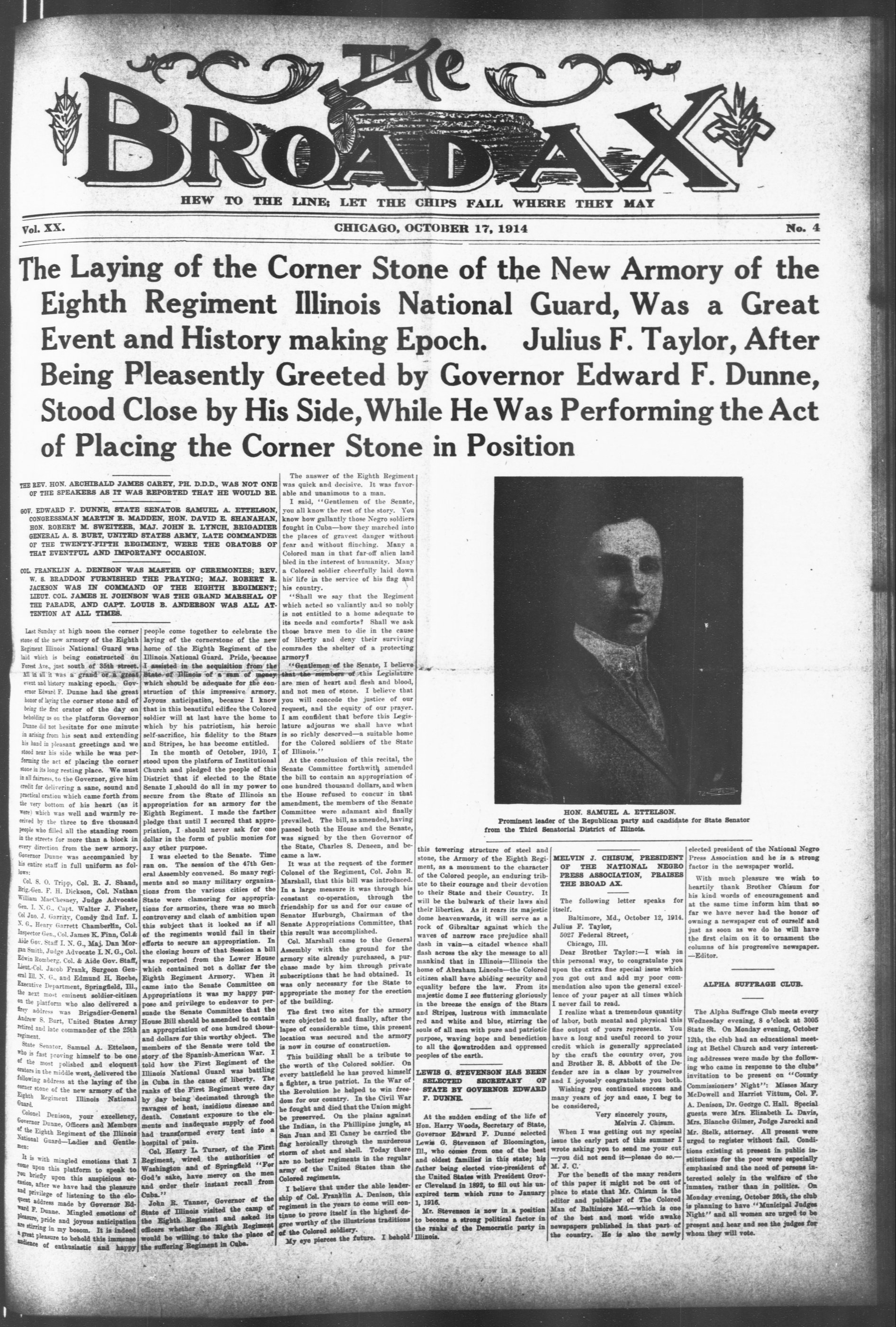
The Laying of the Corner Stone of the New Armory of the Eighth Regiment Illinois National Guard, Was a Great Event and History making Epoch. Julius F. Taylor, After Being Pleasently Greeted by Governor Edward F. Dunne, Stood Close by His Side, While He Was Performing the Act of Placing the Corner Stone in Position
THE REV. HON. ARCHIBALD JAMES CAREY, PH. D.D.D., WAS NOT ONE OF THE SPEAKERS AS IT WAS REPORTED THAT HE WOULD BE.
GOV. EDWARD F. DUNNE, STATE SENATOR SAMUEL A. ETTELSON, CONGRESSMAN MARTIN B. MADDEN, HON. DAVID E. SHANAHAN, HON. ROBERT M. SWEITZER, MAJ. JOHN B. LYNCH, BRIGADIER GENERAL A. S. BUET, UNITED STATES ARMY, LATE COMMANDER OF THE TWENTY-FIFTH REGIMENT, WERE THE ORATORS OF THAT EVENTFUL AND IMPORTANT OCCASION.
COL. FRANKLIN A. DENISON WAS MASTER OF CEREMONIES; REV. W. S. BRADDON FURNISHED THE PRAYING; MAJ. ROBERT B. JACKSON WAS IN COMMAND OF THE EIGHTH REGIMENT; LIEUT. COL. JAMES H. JOHNSON WAS THE GRAND MARSHAL OF THE PARADE, AND CAPT. LOUIS B. ANDERSON WAS ALL ATTENTION AT ALL TIMES.
Vol. XX.
The Laying
Eighth
Event and
Being P
Stood O
of Plac
THE REV. HON. ARCHIBALD JAMES
OF THE SPEAKERS AS IT WAS
GOV. EDWARD F. DUNNE, STATE
CONGRESSMAN MARTIN B. MA
HON. ROBEET M. SWEITZER,
GENERAL A. S. BURT, UNITED
OF THE TWENTY-FIFTH REC
THAT EVENTFUL AND IMPORT
COL. FRANKLIN A. DENISON WA
W. S. BRADDON FURNISHED
JACKSON WAS IN COMMAND
LIEUT. COL. JAMES H. JOHNS
THE PARADE, AND CAPT. L.
TENTION AT ALL TIMES.
Last Sunday at high noon the corner stone of the new armory of the Eighth Regiment Illinois National Guard was laid which is being constructed on Forest Ave., just south of 35th street. All in it was a grand or a great event and history making epoch. Governor Edward F. Dunne had the great honor of laying the corner stone and of being the first orator of the day on beholding as on the platform Governor Dunne did not hesitate for one minute in arising from his seat and extending his hand in pleasant greetings and we stood near his side while he was performing the act of placing the corner stone in its long resting place. We must in all fairness, to the Governor, give him credit for delivering a sane, sound and practical oration which came forth from the very bottom of his heart (as it were) which was well and warmly received by the three to five thousand people who filled all the standing room in the streets for more than a block in every direction from the new armory. Governor Dunne was accompanied by his entire staff in full uniform as follows:
Col. S. O. Tripp, Col. R. J. Shand, Brig-Gen. F. H. Dickson, Col. Nathan William MacCheesney, Judge Advocate Gen. I. N.G., Capt. Walter J. Fisher, Col Juo. J. Garrity, Comdy 2nd Inf. L. N. G., Henry Garrett Chamberlin, Col. Inspector Gen. Col. James K. Finn, Col. & Aide Gov. Staff I. N. G., Maj. Dan Morgan Smith, Judge Advocate I. N. G., Col. Edwin Romberg, Col. & Aide Gov. Staff, Lieut. Col. Jacob Frank, Surgeon General Ill. N. G., and Edmund H. Roche, Executive Department, Springfield, Ill., the next most eminent soldier-citizen on the platform who also delivered a firey address was Brigadier-General Andrew S. Burt, United States Army retired and late commander of the 25th regiment.
State Senator, Samuel A. Ettelson, who is fast proving himself to be one of the most polished and eloquent orators in the middle west, delivered the following address at the laying of the corner stone of the new armory of the Eighth Regiment Illinois National Guard.
Colonel Denison, your excellency, Governor Dunne, Officers and Members of the Eighth Regiment of the Illinois National Guard—Ladies and Gentlemen:
It is with mingled emotions that I come upon this platform to speak to you briefly upon this auspicious occasion, after we have had the pleasure and privilege of listening to the eloquent address made by Governor Edward F. Dunne. Mingled emotions of pleasure, pride and joyous anticipation are stirring in my bosom. It is indeed a great pleasure to behold this immense audience of enthusiastic and happy
people come together to celebrate the laying of the cornerstone of the new home of the Eighth Regiment of the Illinois National Guard. Pride, because I assisted in the acquisition from the State of Illinois of a num of money which should be adequate for the construction of this impressive armory. Joyous anticipation, because I know that in this beautiful edifice the Colored soldier will at last have the home to which by his patriotism, his heroic self-sacrifice, his fidelity to the Stars and Stripes, he has become entitled. In the month of October, 1910, I stood upon the platform of Institutional Church and pledged the people of this District that if elected to the State Senate I should do all in my power to secure from the State of Illinois an appropriation for an armory for the Eighth Regiment. I made the farther pledge that until I secured that appropriation, I should never ask for one dollar in the form of public monies for any other purpose.
I was elected to the Senate. Time ran on. The session of the 47th General Assembly convened. So many regiments and so many military organizations from the various cities of the State were clamoring for appropriations for armories, there was so much controversy and clash of ambition upon this subject that it looked as if all of the regiments would fail in their efforts to secure an appropriation. In the closing hours of that Session a bill was reported from the Lower House which contained not a dollar for the Eighth Regiment Armory. When it came into the Senate Committee on Appropriations it was my happy purpose and privilege to endeavor to persuade the Senate Committee that the House Bill should be amended to contain an appropriation of one hundred thousand dollars for this worthy object. The members of the Senate were told the story of the Spanish-American War. I told how the First Regiment of the Illinois National Guard was battling in Cuba in the cause of liberty. The ranks of the First Regiment were day by day being decimated through the ravages of heat, insidious disease and death. Constant exposure to the elements and inadequate supply of food had transformed every tent into a hospital of pain.
Col. Henry L. Turner, of the First Regiment, wired the authorities of Washington and of Springfield "For God's sake, have mercy on the men and order their instant recall from Cuba." John R. Tanner, Governor of the State of Illinois visited the camp of the Eighth Regiment and asked its officers whether the Eighth Regiment would be willing to take the place of the suffering Regiment in Cubs.
CHICAGO, OCTOBER 17, 1914
The answer of the Eighth Regiment was quick and decisive. It was favorable and unanimous to a man.
I said, "Gentlemen of the Senate, you all know the rest of the story. You know how gallantly those Negro soldiers fought in Cuba—how they marched into the places of gravest danger without fear and without flinching. Many a Colored man in that far-off alien land bled in the interest of humanity. Many a Colored soldier cheerfully laid down his life in the service of his flag and his country.
"Shall we say that the Regiment which acted so valiantly and so nobly is not entitled to a home adequate to its needs and comforts? Shall we ask those brave men to die in the cause of liberty and deny their surviving comrades the shelter of a protecting armory?
"Gentlemen of the Senate, I believe that the members of this Legislature are men of heart and flesh and blood, and not men of stone. I believe that you will concede the justice of our request, and the equity of our prayer. I am confident that before this Legislature adjourns we shall have what is so richly deserved—a suitable home for the Colored soldiers of the State of Illinois."
At the conclusion of this recital, the Senate Committee forthwith amended the bill to contain an appropriation of one hundred thousand dollars, and when the House refused to concur in that amendment, the members of the Senate Committee were adamant and finally prevailed. The bill, as amended, having passed both the House and the Senate, was signed by the then Governor of the State, Charles S. Deneen, and became a law.
It was at the request of the former Colonel of the Regiment, Col. John R. Marshall, that this bill was introduced. In a large measure it was through his constant co-operation, through the friendship for us and for our cause of Senator Hurburgh, Chairman of the Senate Appropriations Committee, that this result was accomplished.
Col. Marshall came to the General Assembly with the ground for the armory site already purchased, a purchase made by him through private subscriptions that he had obtained. It was only necessary for the State to appropriate the money for the erection of the building.
The first two sites for the armory were objected to and finally, after the lapse of considerable time, this present location was secured and the armory is now in course of construction.
This building shall be a tribute to the worth of the Colored soldier. On every battlefield he has proved himself a fighter, a true patriot. In the War of the Revolution he helped to win freedom for our country. In the Civil War he fought and died that the Union might be preserved. On the plains against the Indian, in the Phillipine jungle, at San Juan and El Caney he carried the flag heroically through the murderous storm of shot and shell. Today there are no better regiments in the regular army of the United States than the Colored regiments.
I believe that under the able leadership of Col. Franklin A. Denison, this regiment in the years to come will continue to prove itself in the highest degree worthy of the illustrious traditions of the Colored soldier.
My niece pieces the future. I behold
72
HON. SAMUEL A. ETTELSON.
Prominent leader of the Republican party and candidate for State Senator from the Third Senatorial District of Illinois.
this towering structure of steel and stone, the Armory of the Eighth Regiment, as a monument to the character of the Colored people, an enduring tribute to their courage and their devotion to their State and their Country. It will be the bulwark of their laws and their liberties. As it rears its majestic dome heavenwards, it will serve as a rock of Gibraltar against which the waves of narrow race prejudice shall dash in vain—a citadel whence shall flash across the sky the message to all mankind that in Illinois—Illinois the home of Abraham Lincoln—the Colored citizen shall have abiding security and equality before the law. From its majestic dome I see fluttering gloriously in the breeze the ensign of the Stars and Stripes, lustrous with immaculate red and white and blue, stirring the souls of all men with pure and patriotic purpose, waving hope and benediction to all the downtrodden and oppressed peoples of the earth.
LEWIS G. STEVENSON HAS BEEN SELECTED SECRETARY OF STATE BY GOVERNOR EDWARD F. DUNNE
At the sudden ending of the life of Hon. Harry Woods, Secretary of State, Governor Edward F. Dunne selected Lewis G. Stevenson of Bloomington, Ill., who comes from one of the best and oldest families in this state; his father being elected vice-president of the United States with President Grover Cleveland in 1892, to fill out his unexpired term which runs to January 1, 1916.
Mr. Stevenson is now in a position to become a strong political factor in the ranks of the Democratic party in Illinois.
MELVIN J. CHISUM, PRESIDENT OF THE NATIONAL NEGRO PRESS ASSOCIATION, PRAISES THE BROAD AX.
The following letter speaks for itself.
Baltimore, Md., October 12, 1914.
Julius F. Taylor,
5027 Federal Street,
Chicago, Ill.
Dear Brother Taylor:—I wish in this personal way, to congratulate you upon the extra fine special issue which you got out and add my poor commendation also upon the general excellence of your paper at all times which I never fail to read.
I realize what a tremendous quantity of labor, both mental and physical this fine output of yours represents. You have a long and useful record to your credit which is generally appreciated by the craft the country over, you and Brother R. S. Abbott of the Defender are in a class by yourselves and I joyously congratulate you both.
Wishing you continued success and many years of joy and ease, I beg to be considered,
Very sincerely yours,
Melvin J. Chisum.
When I was getting out my special issue the early part of this summer I wrote asking you to send me your cut—you did not send it—please do so.—M. J. C.:
For the benefit of the many readers of this paper it might not be out of place to state that Mr. Chisum is the editor and publisher of The Colored Man of Baltimore Md.—which is one of the best and most wide awake newpapers published in that part of the country. He is also the newly
No. 4
elected president of the National Negro Press Association and he is a strong factor in the newspaper world.
With much pleasure we wish to heartily thank Brother Chisum for his kind words of encouragement and at the same time inform him that so far we have never had the honor of owning a newspaper cut of ourselves and just as soon as we do he will have the first claim on it to ornament the columns of his progressive newspaper.
—Editor.
ALPHA SUFFRAGE CLUB
The Alpha Suffrage Club meets every Wednesday evening, 8 o'clock at 3005 State St. On Monday evening, October 12th, the club had an educational meeting at Bethel Church and very interesting addresses were made by the following who came in response to the clubs' invitation to be present on "County Commissioners' Night": Misses Mary McDowell and Harriet Vittum, Col. F. A. Denison, Dr. George C. Hall. Special guests were Mrs. Elizabeth L. Davis, Mrs. Blanche Gilmer, Judge Jarecki and Mr. Stelk, attorney. All present were urged to register without fail. Conditions existing at present in public institutions for the poor were especially emphasized and the need of persons interested solely in the welfare of the inmates, rather than in politics. On Monday evening, October 26th, the club is planning to have "Municipal Judges Night" and all women are urged to be present and hear and see the judges for whom they will vote.
PAGE TWO
THE SEVENTH ANNIVERSARY OF THE LOUISE TRAINING SCHOOL FOR COLORED BOYS.
The Seventh Anniversary of the Louise Juvenile Home for Dependent children and the First Anniversary of the Louise Training School for Colored Boys was brilliantly celebrated last Friday afternoon and evening at 6130 So. Ada St.
The anniversary was honored by the presence of many distinguished public workers, among whom were Mr. Charles Virden, State Agent of the Board of Administration of Springfield, Ill., who took a diagram of the entire institution and spoke of the unique manner and system on which it was run. Remarking that of all the institutions of this kind in the whole state none was run as this school or excelled it in cleanliness and order. He was very well pleased with it in every respect and pledged himself to the work to make it a success.
Mr. Leo Philips, Supt. of the Glenwood Manual Training School, was present and was well pleased with the Home and said it couldn't be better for its young years.
Mr. Jacob West, an officer of the Glenwood Training School and also of the Louise Training School was among the noted guests and was much impressed with the institution.
Dr. Emory F. Lyons of the Howard Association, was the principal speaker of the evening. His remarks were full of enthusiasm.
All the speakers on the program were present for which Mrs. E. McDonald, the Superintendent, was very grateful.
Hon. C. W. M. Farmer, one of our attorneys, spoke very masterly and encouragingly of the school and seemed to have made a very promising impression upon the people. He also promised to help in any way he could.
Mr. R. E. Moore also graced our anniversary and made some very helpful remarks.
Mr. L. Lloyd Stone handled the program with dignity and grace. Mr. Stone is a pledger and strong supporter to the Home.
The chief attraction for the day and the one that called forth much flattering comment was the military drill by the boys of the school. They executed many difficult military movements. They made a beautiful sight in their red ties, white waists and stockings and blue pants. Their instructor was Leut. R. D. Lewis of the 8th Regiment. Mr. Lewis is said to be one of the best qualified military drill masters'. Smith's orchestra rendered the music.
The boys also sang sweetly, which we owe to the faithful and patient work of Mr. Wadsworth Holmes with the excellent assistance of young Miss Ferdella Cassell, the pianist, who has given her time to the boys for a year.
We are thankful to say that the Home is marching on to victory. We have two excellent helpers, Mrs. Lizzie Centers from Chattanooga, Tenn., and Miss Henrietta Lawson from Battle Creek, Mich., and who taught school in Michigan for twelve years, now associated with the work as head-matron, has proved very efficient in the work for which we are thankful.
Mrs. E. McDonald, the Superintendent, wishes to return hearty thanks to all on the program and all helpers during the day and evening.
LAYING OF THE CORNERSTONE OF THE EIGHTH REGIMENT ARMORY.
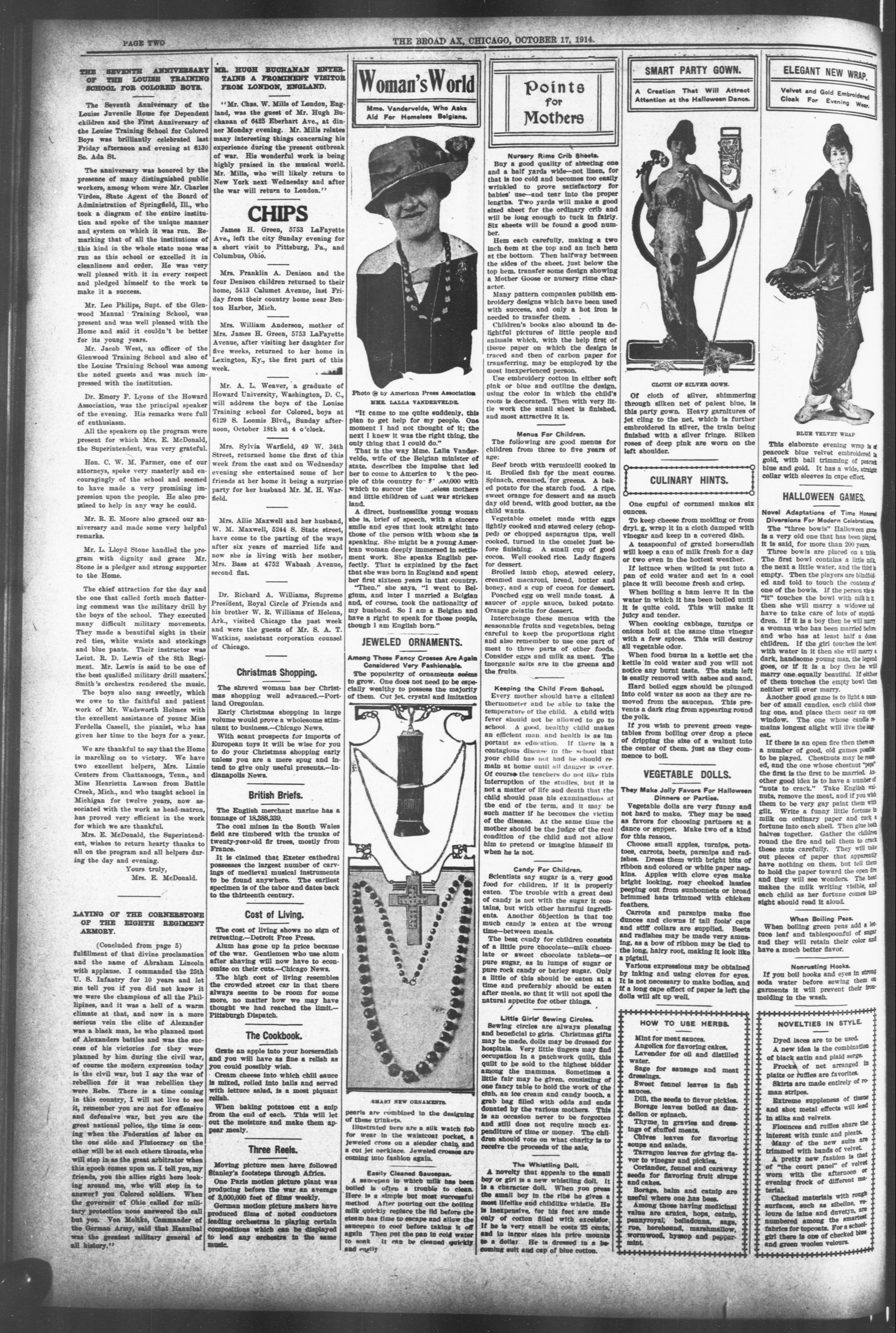
(Concluded from page 5) fulfillment of that divine proclamation and the name of Abraham Lincoln with applause. I commanded the 25th U. S. Infantry for 10 years and let me tell you if you did not know it we were the champions of all the Philippines, and it was a hell of a warm climate at that, and now in a more serious vein the clite of Alexander was a black man, he who planned most of Alexanders battles and was the success of his victories for they were planned by him during the civil war, of course the modern expression today is the civil war, but I say the war of rebellion for it was rebellion they were Rebs. There is a time coming in this country, I will not live to see it, remember you are not for offensive and defensive war, but you are the great national police, the time is coming when the Federation of labor on the one side and Plutoocracy on the other will be at each others throats, who will step in as the great arbitrator when this epoch comes upon us. I tell you, my friends, you the allies right here looking around me, who will step in to answer! you Colored soldiers. When the governor of Ohio called for military protection none answered the call but you. Von Moltke, Commander of the German Army, said that Hannibal was the greatest military general of all history."
MR. HUGH BUCHANAN ENTERTAINS A PROMINENT VISITOR FROM LONDON, ENGLAND.
"Mr. Chas. W. Mills of London, England, was the guest of Mr. Hugh Buchanan of 6425 Eberhart Ave., at dinner Monday evening. Mr. Mills relates many interesting things concerning his experience during the present outbreak of war. His wonderful work is being highly praised in the musical world. Mr. Mills, who will likely return to New York next Wednesday and after the war will return to London."
CHIPS
James H. Green, 5753 LaFayette Ave., left the city Sunday evening for a short visit to Pittsburg, Pa., and Columbus, Ohio.
Mrs. Franklin A. Denison and the four Denison children returned to their home, 5413 Calumet Avenue, last Friday from their country home near Benton Harbor, Mich.
Mrs. William Anderson, mother of Mrs. James H. Green, 5753 LaFayette Avenue, after visiting her daughter for five weeks, returned to her home in Lexington, Ky., the first part of this week.
Mr. A. L. Weaver, a graduate of Howard University, Washington, D. C., will address the boys of the Louise Training school for Colored, boys at 6129 S. Loomis Blvd., Sunday afternoon, October 18th at 4 o'clock.
Mrs. Sylvia Warfield, 49 W. 34th Street, returned home the first of this week from the east and on Wednesday evening she entertained some of her friends at her home it being a surprise party for her husband Mr. M. H. Warfield.
Mrs. Allie Maxwell and her husband, W. M. Maxwell, 5244 S. State street, have come to the parting of the ways after six years of married life and now she is living with her mother, Mrs. Bass at 4752 Wabash Avenue, second flat.
Dr. Richard A. Williams, Supreme President, Royal Circle of Friends and his brother W. R. Williams of Helena, Ark., visited Chicago the past week and were the guests of Mr. S. A. T. Watkins, assistant corporation counsel of Chicago.
Christmas Shopping
The shrewd woman has her Christmas shopping well advanced.—Portland Oregonian.
Early Christmas shopping in large volume would prove a wholesome stimulant to business.—Chicago News.
With scant prospects for imports of European toys it will be wise for you to do your Christmas shopping early unless you are a mere spug and intend to give only useful presents.—Indianapolis News.
British Briefs.
The English merchant marine has a tonnage of 18,388,339.
The coal mines in the South Wales field are timbered with the trunks of twenty-year-old fir trees, mostly from France.
It is claimed that Exeter cathedral possesses the largest number of carvings of medieval musical instruments to be found anywhere. The earliest specimen is of the tabor and dates back to the thirteenth century.
Cost of Living.
The cost of living shows no sign of retreating.-Detroit Free Press.
Alum has gone up in price because of the war. Gentlemen who use alum after shaving will now have to economize on their cuts.-Chicago News.
The high cost of living resembles the crowded street car in that there always seems to be room for some more, no matter how we may have thought we had reached the limit.-Pittsburgh Dispatch.
The Cookbook.
Grate an apple into your horseradish and you will have as fine a relish as you could possibly wish.
Cream cheese into which chili sauce is mixed, rolled into balls and served with lettuce salad, is a most pliant relish.
When baking potatoes cut a snip from the end of each. This will let out the moisture and make them appear mealy.
Three Reels
Moving picture men have followed Stanley's footsteps through Africa.
One Paris motion picture plant was producing before the war an average of 3,000,000 feet of films weekly.
German motion picture makers have produced films of noted conductors leading orchestras in playing certain compositions which can be displayed to lead any orchestra in the same music.
THE BROAD AX. CHICAGO, OCTOBER 17, 1914
A.
Photo @ by American Press Association
MME. LALLA VANDERVELDE.
"It came to me quite suddenly, this
plan to get help for my people. One
moment I had not thought of it; the
next I knew it was the right thing, the
only thing that I could do."
That is the way Mme. Lalla Vandervelde, wife of the Belgian minister of state, describes the impulse that led her to come to America to ask the people of this country for $100,000 with which to succor theeless mothers and little children of that war stricken land.
A direct, businesslike young woman she is, brief of speech, with a sincere smile and eyes that look straight into those of the person with whom she is speaking. She might be a young American woman deeply immersed in settlement work. She speaks English perfectly. That is explained by the fact that she was born in England and spent her first sixteen years in that country. "Then," she says, "I went to Belgium, and later I married a Belgian and, of course, took the nationality of my husband. So I am a Belgian and have a right to speak for those people, though I am English born."
JEWELED ORNAMENTS.
Among These Fancy Crosses Are Again Considered Very Fashionable.
The popularity of ornaments seems to grow. One does not need to be especially wealthy to possess the majority of them. Cut jet, crystal and imitation
C
SMART NEW ORNAMENTS.
pearls are combined in the designing of these trinkets.
Illustrated here are a silk watch fob for wear in the waistcoat pocket, a jeweled cross on a slender chain and a cut jet necklace. Jewelled crosses are coming into fashion again.
Easily Cleaned Saucepan.
A saucepan in which milk has been boiled is often a trouble to clean. Here is a simple but most successful method. After pouring out the boiling milk quickly replace the lid before the steam has time to escape and allow the saucepan to cool before taking it off again. Then put the pan in cold water to soak it can be cleaned quickly and easily.
Points
for
Mothers
Buy a good quality of sheeting one and a half yards wide—not linen, for that is too cold and becomes too easily wrinkled to prove satisfactory for babies' use—and tear into the proper lengths. Two yards will make a good sized sheet for the ordinary crib and will be long enough to tuck in fairly. Six sheets will be found a good number.
Hem each carefully, making a two inch hem at the top and an inch hem at the bottom. Then halfway between the sides of the sheet, just below the top hem, transfer some design showing a Mother Goose or nursery rime character.
Many pattern companies publish embroidery designs which have been used with success, and only a hot iron is needed to transfer them.
Children's books also abound in delightful pictures of little people and animals which, with the help first of tissue paper on which the design is traced and then of carbon paper for transferring, may be employed by the most inexperienced person. Use embroidery cotton in either soft pink or blue and outline the design, using the color in which the child's room is decorated. Then with very little work the small sheet is finished, and most attractive it is.
Menus For Children.
The following are good menus for children from three to five years of age:
Beef broth with vermicelli cooked in it. Broiled fish for the meat course. Spinach, creamed, for greens. A baked potato for the starch food. A ripe, sweet orange for dessert and as much day old bread, with good butter, as the child wants.
Vegetable omelet made with eggs lightly cooked and stewed celery (chopped) or chopped asparagus tips, well cooked, turned in the omelet just before finishing. A small cup of good cocoa. Well cooked rice. Lady fingers for dessert.
Broiled lamb chop, stewed celery, creamed macaroni, bread, butter and honey, and a cup of cocoa for dessert.
Poached egg on well made toast. A saucer of apple sauce, baked potato. Orange gelatin for dessert.
Interchange these menus with the seasonable fruits and vegetables, being careful to keep the proportions right and also remember to use one part of meat to three parts of other foods. Consider eggs and milk as meat. The inorganic salts are in the greens and the fruits.
Keeping the Child From School.
Every mother should have a clinical thermometer and be able to take the temperature of the child. A child with fever should not be allowed to go to school. A good, healthy child makes an efficient man, and health is as important as education. If there is a contagious disease in the school that your child has not had he should remain at home until all danger is over. Of course the teachers do not like this interruption of the studies, but it is not a matter of life and death that the child should pass his examinations at the end of the term, and it may be such matter if he becomes the victim of the disease. At the same time the mother should be the judge of the real condition of the child and not allow him to pretend or imagine himself ill when he is not.
Candy For Children
Scientists say sugar is a very good food for children, if it is properly eaten. The trouble with a great deal of candy is not with the sugar it contains, but with other harmful ingredients. Another objection is that too much candy is eaten at the wrong time—between meals.
The best candy for children consists of a little pure chocolate—milk chocolate or sweet chocolate tablets—or pure sugar, as in lumps of sugar or pure rock candy or barley sugar. Only a little of this should be eaten at a time and preferably should be eaten after meals, so that it will not spoil the natural appetite for other things.
Little Girls' Sewing Circles
Sewing circles are always pleasing and beneficial to girls. Christmas gifts may be made, dolls may be dressed for hospitals. Very little fingers may find occupation in a patchwork quilt, this quilt to be sold to the highest bidder among the mammas. Sometimes a little fair may be given, consisting of one fancy table to hold the work of the club, an ice cream and candy booth, a grab bag filled with odds and ends donated by the various mothers. This is an occasion never to be forgotten and still does not require much expenditure of time or money. The children should vote on what charity is to receive the proceeds of the sale.
The Whistling Doll.
A novelty that appeals to the small boy or girl is a new whistling doll. It is a character doll. When you press the small boy in the ribs he gives a most lifelike and childlike whistle. He is inexpensive, for his feet are made only of cotton filled with excelsior. If he is very small he costs 25 cents, and in larger sizes his price mounts to a dollar. He is dressed in a becoming suit and cap of blue cotton.
II
CLOTH OF SILVER GOWN.
Of cloth of silver, shimmering through silken net of palest blue, is this party gown. Heavy garnitures of jet cling to the net, which is further embroidered in silver, the train being finished with a silver fringe. Silken roses of deep pink are worn on the left shoulder.
CULINARY HINTS.
One cupful of cornmeal makes six ounces.
To keep cheese from molding or from dryl. g, wrap it in a cloth damped with vinegar and keep in a covered dish.
A teaspoonful of grated horseradish will keep a can of milk fresh for a day or two even in the hottest weather.
If lettuce when wilted is put into a pan of cold water and set in a cool place it will become fresh and crisp.
When boiling a ham leave it in the water in which it has been boiled until it is quite cold. This will make it juicy and tender.
When cooking cabbage, turnips or onions boil at the same time vinegar with a few spices. This will destroy all vegetable odor.
When food burns in a kettle set the kettle in cold water and you will not notice any burnt taste. The stain left is easily removed with ashes and sand.
Hard boiled eggs should be plunged into cold water as soon as they are removed from the saucepan. This prevents a dark ring from appearing round the yolk.
If you wish to prevent green vegetables from boiling over drop a piece of dripping the size of a walnut into the center of them, just as they commence to boil.
VEGETABLE DOLLS
They Make Jolly Favors For Halloween Dinners or Parties.
Vegetable dolls are very funny and not hard to make. They may be used as favors for choosing partners at a dance or supper. Make two of a kind for this reason.
Choose small apples, turnips, potatoes, carrots, beets, parsnips and radishes. Dress them with bright bits of ribbon and colored or white paper napkins. Apples with clove eyes make bright looking, rosy cheeked lassies peeping out from sunbonnets or broad brimmed hats trimmed with chicken feathers.
Carrots and parsnips make fine dunces and clowns if tall fools' caps and stiff collars are supplied. Beets and radishes may be made very amusing, as a bow of ribbon may be tied to the long, hairy root, making it look like a pigtail.
Various expressions may be obtained by inking and using cloves for eyes. It is not necessary to make bodies, and if a long cape effect of paper is left the dolls will sit up well.
HOW TO USE HERBS.
Mint for meat sauces.
Angelica for flavoring cakes.
Lavender for oil and distilled water.
Sage for sausage and meat dressings.
Sweet fennel leaves in fish sauces.
Dill, the seeds to flavor pickles.
Borage leaves boiled as dandelion or spinach.
Thyme, in gravies and dressings of stuffed meats.
Chives leaves for flavoring soups and salads.
Tarragon leaves for giving flavor to vinegar and pickles.
Coriander, fennel and caraway seeds for flavoring fruit shrubs and cakes.
Borage, balm and catnip are useful where one has bees.
Among those having medicinal value are arnica, hops, catnip, pennyroyal, belladonna, sage, rue, horehound, marshmallow, wormwood, hyssop and pepper mint.
1
BLUE VELVET WRAP
This elaborate evening wrap is of peacock blue velvet embroidered in gold, with ball trimming of peacock blue and gold. It has a wide, straight collar with sleeves in cape effect.
HALLOWEEN GAMES
Novel Adaptations of Time Honored
Diversions For Modern Celebrations.
The "three bowls" Halloween game is a very old one that has been played
it is said, for more than 200 years.
Three bowls are placed on a table.
The first bowl contains a little milk
the next a little water, and the third is
empty. Then the players are blindfolded
and told to touch the contents of
one of the bowls. If the person who is
"it" touches the bowl with milk in it
then she will marry a widow and
have to take care of lots of stepchildren.
If it is a boy then he will marry
a woman who has been married before
and who has at least half a dozen
children. If the girl touches the bowl
with water in it then she will marry a
dark, handsome young man, the legend
goes, or if it is a boy then he will
marry one equally beautiful. If either
of them touches the empty bowl then
neither will ever marry.
Another good game is to light a num
ber of small candles, each child choos
ing one, and place them near an open
window. The one whose candle
remains longest alight will live the longest.
If there is an open fire then there are a number of good, old games possible to be played. Chestnut may be roasted, and the one whose chestnut "pegs" the first is the first to be married. Another good idea is to have a number of "nuts to crack." Take English walnuts, remove the meat, and if you wish them to be very gay paint them with gilt. Write a funny little fortune in milk on ordinary paper and tuck it fortune into each shell. Then glue both halves together. Gather the children round the fire and tell them to crack these nuts carefully. They will take out pieces of paper that apparently have nothing on them, but tell them to hold the paper toward the open fire and they will see wonders. The heat makes the milk writing visible, and each child as her fortune comes into sight should read it aloud.
When Boiling Peas
When boiling green peas add a lettuce leaf and tablespoonful of sugar and they will retain their color and have a much better flavor.
Nonrusting Hooks.
If you boll hooks and eyes in strong soda water before sewing them on garments it will prevent their iron molding in the wash.
FRENCH GUNS CAPTURED BY GERMANS.
In order to arouse enthusiasm French guns captured in the fighting in France have been sent to Berlin they were taken through the streets under military escort. They will also be exhibited in other German c
GERMAN PRISONERS OF WAR IN FRANCE
This detachment of the kaiser's troops, captured by the English, are being taken back to the English arm
e
e
THE CITY OF NEW YORK
Photo by American Press Association
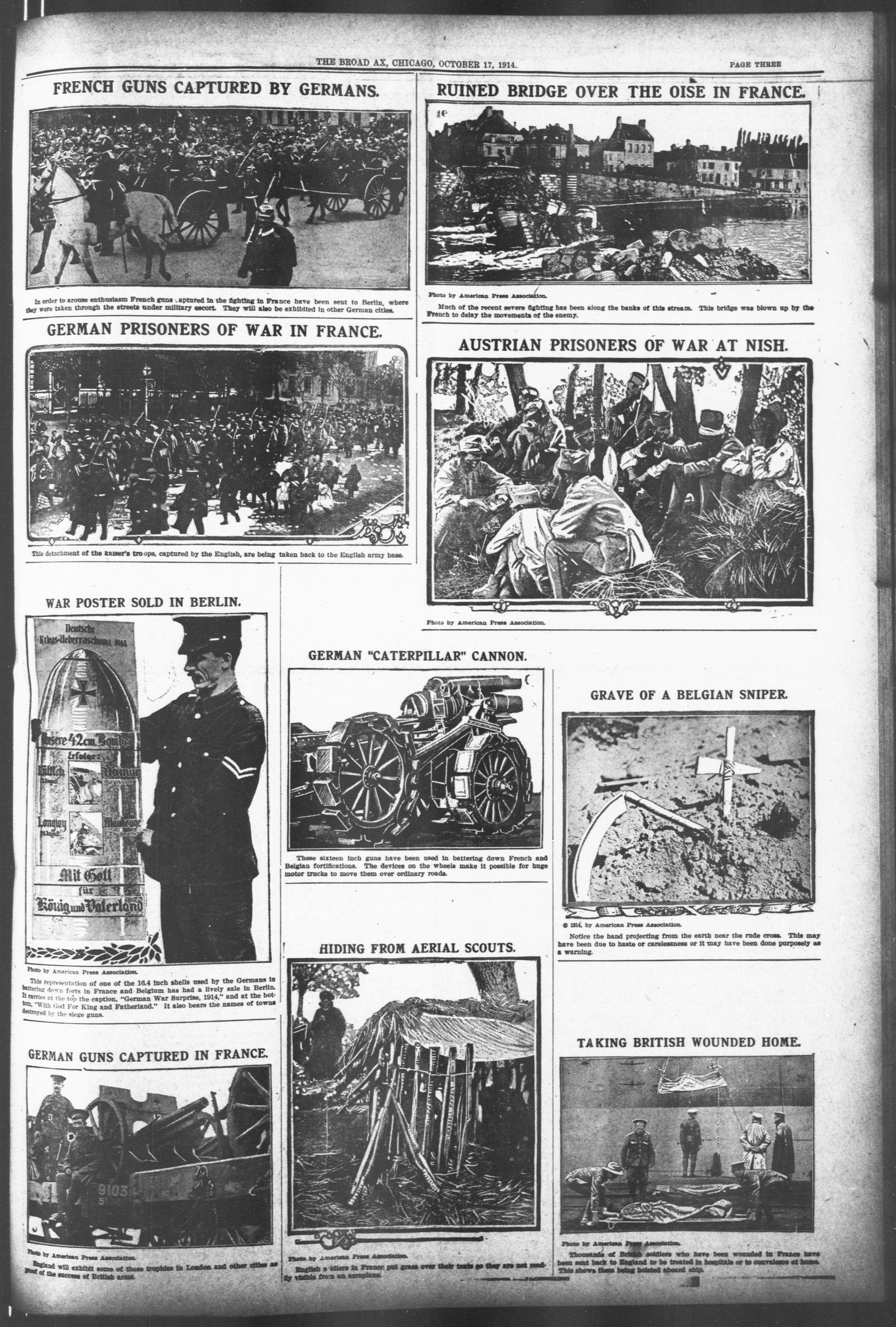
In order to arouse enthusiasm French guns captured in the fighting in France have been sent to Berlin, where they were taken through the streets under military escort. They will also be exhibited in other German cities.
face have been sent to Berlin, where exhibited in other German cities.
IN FRANCE.
Much of the recent severe fighting French to delay the movements of the
Much of the recent severe fighting has been along the banks of this stream. This bridge was blown up by the French to delay the movements of the enemy.
GERMAN PRISONERS OF WAR IN FRANCE.
AUSTRIAN PRISONERS OF WAR AT NISH.
aken back to the English army base.
American Press Association.
R" CANNON.
This detachment of the kaiser's troops, captured by the English, are being taken back to the English army base.
Photo by American Press Association.
GERMAN "CATERPILLAR" CANNON.
C
These sixteen inch guns have been used in battering down French and Belgian fortifications. The devices on the wheels make it possible for huge motor trucks to move them over ordinary roads.
Photo by American Press Association.
---
tents so they are not read-
Photo by American Press Association.
Thousands of British soldiers who have been wounded in France have been sent back to England to be treated in hospitals or to convalescence at home. This shows them being hoisted aboard ship.
England will exhibit some of these trophies in London and other cities as proof of the success of British arms.
English s-idiers in France put grass over their tents so they are not readily visible from an aeroplane.
WAR POSTER SOLD IN BERLIN.
Deutsche
Kriegs-Ilberraschung, 1914
Ausere 42cm. Bombe
Erfolge:
Kiffch
Romun
Longjoy
Maudeuge
Mit Gott
für
Köning und Valerland
Photo by American Press Association.
This representation of one of the 16.4 inch shells used by the Germans in battering down forts in France and Belgium has had a lively sale in Berlin. It carries at the top the caption, "German War Surprise, 1914," and at the bottom, "With God For King and Fatherland." It also bears the names of towns destroyed by the siege guns.
GERMAN GUNS CAPTURED IN FRANCE.
9103
5'
THE BROAD AX, CHICAGO, OCTOBER 17, 1914.
HIDING FROM AERIAL SCOUTS.
PAGE THREE
GRAVE OF A BELGIAN SNIPER.
+
Notice the hand projecting from the earth near the rude cross. This may have been due to haste or carelessness or it may have been done purposely as a warning.
TAKING BRITISH WOUNDED HOME.
THE DEATH OF A MEN IN A WAR
PAGE FOUR
THE BROAD AX
PUBLISHED WEEKLY.
Will promulgate and at all times uphold the true principle of Democracy, but Catholics, Protestants, Priests, Infidels, Single Taxers, Republicans, or anyone else can have their say, as long as their language is proper and responsibility is fixed.
The Brand Ax is a newspaper whose platform is broad enough for all, ever claiming the editorial right to speak its own view.
Local communications will receive attention. Write only on one side of the paper.
Subscriptions must be paid in advance.
One Week $8.99
Six Months $1.00
Advertising rates made known on application.
Address all communications to
THE BROAD AX
2027 FEDERAL STREET, CHICAGO, ILL
PHONE DEEXEL 4500.
JULIUS F. TAYLOR, Editor and Publisher
Entered as Second-Class Matter Aug. 18, 1902, at the University of Illinois, Illinois. Born in Mayfield, Illinois, on August 14, 1902.
EDITORIAL COLUMNS
HON. HARRY WOODS, SECRETARY OF STATE, HAS PASSED ON INTO THE NEXT WORLD.
The people throughout Illinois were greatly astonished to learn that on Monday afternoon Hon. Harry Woods, Secretary of State had committed suicide by shooting himself with a revolver in his garage at Springfield, sometime on Sunday morning. It is supposed that his mind, gave way under the great rush and strain of business. He leaves a wife and two daughters at Springfield, an aged mother, 3000 Warren Avenue, this city, and other friends and relatives to mourn his sudden passing away.
All of his affairs in connection with his office were as straight as a string. Funeral services were held over his remains in that city Wednesday.
Mr. Woods, it is true, had his faults and it was rather hard to understand him. He was extremely excitable at all times which caused many people to hesitate to come in contact with him, but if he could have his own way in setting forth his ideas and giving expressions to his thoughts in a rapid manner, anyone could get along with him.
The late secretary always treated us very nicely when we had occasion to come in contact with him and for several years past he had been a regular subscriber to The Broad Ax. May the better part of him rest in peace throughout the coming ages.
SULZER DEFIES COLONEL TO A
JOLNT DEBATE
COUNTERS TO ALL OF BOOSEVELT'S CHARGES AND BRANDS HIM AN ALLY OF MURPHY.
New York, Oct. 15—Instead of repenting, as Col. Roosevelt told him to do, "Plain Bill" Sulzer started today to smite the colonel hip and thigh with charges, insinuations, questions, and a challenge to a joint debate. As to repentance, "Plain Bill" asked the colonel: "When did you do penance?" In an open letter to Col. Roosevelt Mr. Sulzer says: "Several newspapers report that you said I deceived you. This is not so. I call for a bill of particulars. If either was deceived, it was I
"These newspapers report that you say, like your political ally, Murphy, that in my campaign statement of 1912 I did not account for all the money given me. You are again wrong. Every dollar I did not account for, and more besides, Murphy got—and has got it yet, so far as I know.
"I did not make a false statement concerning my campaign account of 1912. But how about that statement to which you swore to avoid payment of your taxes—that you were not a resident of New York!"
"Talking about campaign money, who is financing your campaign? Is it Tammany Hall? What have you to say about the Harriman campaign in 1904 contribution of several hundred thousand dollars when you were a candidate? Who got that? Who accounted for it? Who got the money through the insurance companies of the widows and orphans, amounting to thousands of dollars, when you were a candidate? Who accounted for that?" Will you please stand up and lead us in prayer Col. Roosevelt--Editor.
The John R. Tanner Camp No. 11 and the Ladies' Auxiliary No. 16, United Spanish War Veterans, Department of Illinois, gave a reception and ball the past Monday evening at Johnson's Dreamland Hall, 3520 S. State Street, which was a success in every way.
THE OPENING OF BETHEL LITERARY SOCIETY, THE ELECTION AND INSTALLATION OF OFFICERS OCCUERRED LAST SUNDAY AFTERNOON AT 4 P. M.
WITH BENEWED VIGOR AND EN
THUSLAIM
The following officers were elected for the ensuing year, Mr. B. W. Fitts, Pres.; Mr. Sandy W. Trice, Vice-Pres.; Miss Catherine Martin, Secretary; Mrs. Gaynor, assistant Secretary; Mrs. R. A. Jackson, Treasurer; Mrs. Hattie Champion, Chaplain; Mr. R. A. Jackson, Historian; Mr. William Adams, Sgt. at Arms.
Program committee, Mr. W. Hocker, chairman; Mrs. E. Owen and Mr. Fulton P. Hackney.
Miss Edna E. Jackson was elected chairman of the Musical committee.
Mr. Irwin Jackson, chairman of the lookout committee, associated with him Mrs. Hattie Sherman.
Quite a tribute of respect was paid to ex-State Senator Theophile T. Allain formerly of the State of La., now a resident of this State by calling upon him both to preside over the meeting and to install those elected, which dignified the occasion in no mean way.
A GALAXY OF MUSICAL ARTISTS IN RECITAL AT THE ABRAHAM LINCOLN CENTRE, MONDAY EVENING, OCTOBER 19TH, 1914.
Participants: — Clarence Cameron White of Boston, Mass., Violin; Mrs. Gertrude Wood-Towson, Contralto; Mrs. Agnes Peeler Lillard, Soprano; Miss Ethel Mae Minor, Accompanist; Misses Ida Mae Bell, Albertine Pierce, Grace and Violet Galloway and Mr. Ernst Green, Assistants at the Piano.
Program—Spanish Dance, No. 5,
(Duo), Moszkowski, Ida Mae Bell
and Ernestine Thompson; Expectancy
(Vocal), Stickles, Mrs. Lillard; Kuyaiwaik (Two pianos), Wieniawski, Albertine Pierce and Mr. Johnson; Military
March (Eight hands), Schubert, Beatrice Lear, Helen Wheeler, John Chur
and Mr. Johnson; Dreaming (Vocal),
Joyce, Violet Galloway; Fantasie Appassionata (Violin), Vieuxtemps, Mr. White; Concerto—Andante Expressive, Ferdinand Hiller, Ernst Green and Mr.
Johnson; (a) When the Roses Fall (Vocal),
Vannah, (b) Bid Me To Live, Hatton,
Mrs. Towson; (a) Berceuse (Violin)
Clarence Cameron White, (b) Orientale,
Caesar Cui, (c) Liebesfreund, Fritz
Kreisler, Mr. White; Concertstuck—
Last Movement, Weber, Miss Grace
Galloway and Mr. Johnson; When the
Heart is Young (Vocal), Buck, Mrs.
Lillard; (a) Traumerei (Violin) By
Desire, Schumann, (b) Perpetual
Franz Ries, Mr. White; Concerto—Last
Movement, Mendelssohn, Miss Ida Mae
Bell and Mr. Johnson.
Ushers and Attendants: — Misses Noami Bunn, Katie Fowler, Jeanette Triplett, Vivian Ferguson, Alga Porter, Emma Williams, Therrell Riley, Lucile Dean, Fairfax Butler.
SUDDEN DEATH OF MBS. AIDA
OVERTEN WALKER.
Sunday evening at ten minutes past 6 o'clock, Aida Overton Walker, wife of the late George Walker of the Williams and Walker Company, very suddenly expired at her home in New York City.
At this distance it is hard to ascertain just what was the cause of her untimely death.
Mr. and Mrs. Henry Jones, 6641 Evans Avenue, who ranked among her best friends in this city where she always stopped while visiting it left Wednesday morning for New York City to attend the funeral services which were held over her remains in that city on Thursday. The next issue of this paper will contain a more comprehensive account of her passing away.
FRANK W. HENRY WILL ADDRESS
THE BETHEL LITERARY CLUB
Bethel Literary Club will be addressed Sunday afternoon, Oct. 18, at 4 o'clock by Mr. Frank W. Henry. Subject "The European War, causes thereof and its effect upon civilization." Everybody welcome.
MEN'S CIVIC CLUB.
The regular meeting, of the Men's Civic Club was held on last Tuesday evening at 3005 State St, 8 o'clock. The meeting was especially interesting. The club is planning to do much in the way of bettering civic conditions. All men invited to be present and join the club. W. D. Neighbors, President.
NEGRO FELLOWSHIP LEAGUE.
The league will be addressed Sunday October 18th by Mr. J. Winthrop of the McCormick Theological Seminary. Come and hear him at the Reading Room, 3005 State St., at 4 p. m. Interesting meetings are held every Sunday afternoon. It is hoped that the house will be crowded. Everybody cordially invited.
THE BROAD AX, CHICAGO, OCTOBER 17, 1914.
HON. MARTIN B. MADDEN.
Republican candidate for re-election to District of Illinois, Champion of the American, who paid a short and Colored soldiers in all the wars in stone of the New Armory belonged.
You can't tell what a man knows by what he doesn't say.
Not every fellow who carries a hammer can crack a joke.
Knowledge is power—except when you know you're beaten.
Sometimes people get along together better by remaining apart.
All the heroes haven't medals. Some of them have received bills.
As a general thing, he who laughs last carries it a little too far.
Is life worth living? Not to the fellow who argues that it is not.
Did you ever know a rich young woman to marry a poor old man?
In travelling the road to success some people always want to cut across lots.
The "safety first" reform does not get much attention in Europe at present.
Men are like fish. Neither would get into trouble if they kept their mouth shut.
Old ideas die hard. A dispatch from Holland speaks of "the concert of the powers."
In the matter of poverty's joys the majority of us are overjoyed most of the time.
The man who borrows trouble doesn't have to worry over insistent demands for its return.
The world old question of how the other half lives is fast being answered in the negative.
The next crop of European tourists will have a fine assortment of new ruins to inspect.
It often happens that a critical point in life comes to us disguised as an everyday incident.
The Hague is now located as a small section of peace influence entirely surrounded by war.
A man with a good conscience is not afraid when there is a knock at the door at midnight.
The optimist is a welcome visitor, but the pessimist's room is worth more than his company.
Those armies, it appears, are like the lamb in the lion's cage—they have to be renewed frequently.
For re-election to Congress from the Champion of the civil and political aid a short and glowing tribute to all the wars in this country, at the Armory belonging to the Eighth.
A man knows by
to carries a ham-
ter—except when
at along together
at medals. Some
bills.
the who laughs
too far.
Not to the fel-
is not.
by a rich young
or old man?
to success some
cut across lots.
Reform does not
Europe at pres-
either would get
their mouths
A dispatch from
the concert of the
Poverty's joys the
joyed most of
is trouble doesn't
existent demands
of how the
being answered
European tourists
department of new
at a critical point
excused as an ev-
created as a small
pace entirely sur-
conscience is not
a knock at the
Welcome visitor,
is worth more
pears, are like
age—they have
ly.
But the best
paid up.
Most of us w
practice anyw
If you would
select a dull or
About the ea
world is disgru
Infant indust
chance for birth
A war without
usual, to say t
You can "run
you can't ride t
Pay as you
glad to see you
Lucky is the
press agent of
Scientists cla
fected a black t
It is easier t
things than how
Many a man
often accused of
Honesty is the
long run the pr
Man's nature
tendency of war
A man may
out, but he is
If we never
couldn't appre
Next time the
powers it will m
As things not
deal of money t
ing.
When there is
never give up
ghost.
If China war
we will give it
goods.
It doesn't take
phold fever long
game.
A price that
already been p
show for it.
While men co
and use them, l
pray for peace?
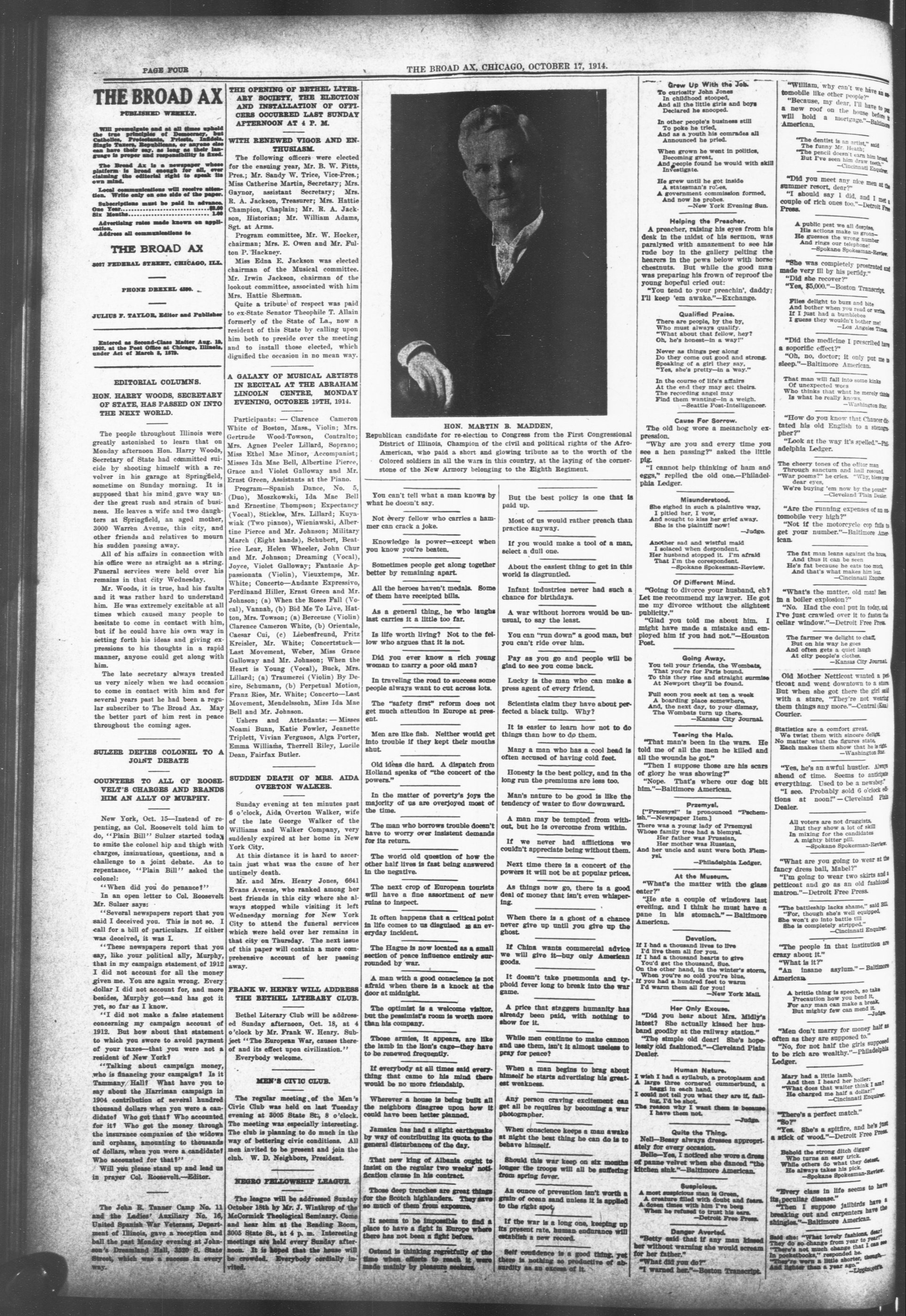
Republican candidate for re-election to Congress from the First Congressional District of Illinois, Champion of the civil and political rights of the Afro-American, who paid a short and glowing tribute as to the worth of the Colored soldiers in all the wars in this country, at the laying of the cornerstone of the New Armory belonging to the Eighth Regiment.
If everybody at all times said everything that came to his mind there would be no more friendship.
Wherever a house is being built all the neighbors disagree upon how it could have been better planned.
Jamaica has had a slight earthquake by way of contributing its quota to the general disturbances of the day.
That new king of Albania ought to insist on the regular two weeks' notification clause in his contract.
Those deep trenches are great things for the Scotch highlanders. They save so much of them from exposure.
It seems to be impossible to find a place to have a fight in Europe where there has not been a fight before.
Ostend is thinking regretfully of the time when efforts to reach it were made mainly by pleasure seekers.
sible to find a Europe where light before.
greatfully of the reach it were in seekers.
If the war is its present rate, establish a new
Self confidence there is nothing surdity as an ex
Grew Up With the Job.
To curiosity John Jones
In childhood stooped,
And all the little girls and boys
Declared he snooped.
In other people's business still
To poke he tried,
And as a youth his comrades all
Announced he pried.
When grown he went in politics,
Becoming great,
And people found he would with skill
Investigate.
He grew until he got inside
A statesman's robes,
A government commission formed,
And now he probes.
-New York Evening Sun.
Helping the Preacher.
A preacher, raising his eyes from his desk in the midst of his sermon, was paralyzed with amazement to see his rude boy in the gallery pelting the hearers in the pews below with horse chestnuts. But while the good man was preparing his frown of reproof the young hopeful cried out:
"You tend to your preachin', daddy; I'll keep 'em awake."—Exchange.
Qualified Praise.
There are people, by the by,
Who must always qualify.
"What about that fellow, hey?
Oh, he's honest—in a way!"
Never as things peg along
Do they come out good and strong.
Speaking of a girl they say,
"Yes, she's pretty—in a way."
In the course of life's affairs
At the end they may get theirs.
The recording angel may
Find them wanting—in a weigh.
—Seattle Post-Intelligence.
Cause For Sorrow.
The old hog wore a meiancholy expression.
"Why are you sad every time you see a hen passing?" asked the little pig.
"I cannot help thinking of ham and eggs," replied the old one.—Philadelphia Ledger.
Misunderstood.
She sighed in such a plaintive way,
I pitied her, I vow,
And sought to kiss her grief away.
She is the plaintiff now!
—Judge.
Another sad and wistful mald
I soaked when despondent.
Her husband stopped it. I'm afraid
That I'm the correspondent.
—Spokane Spokesman-Review.
Of Different Mind.
"Going to divorce your husband, eh? Let me recommend my lawyer. He got me my divorce without the slightest publicity." "Glad you told me about him. I might have made a mistake and employed him if you had not."—Houston Post.
Going Away.
You tell your friends, the Wombats,
That you're for Paris bound.
To this they rise and straight surmise
At Newport they'll be found.
Full soon you seek at a ten week
A boarding place somewhere.
And, the next day, to your dismay,
The Wombats turn up there.
-Kansas City Journal
Tearing the Halo.
Tearing the Hand.
"That man's been in the wars. He told me of all the men he killed and all the wounds he got."
"Then I suppose those are his scars of glory he was showing?"
"Nope. That's where our dog bit him."—Baltimore American.
Przemysl.
[{"Przemysl"} is pronounced "Pschemish."—Newspaper Item.]
There was a young lady of Przemysl
Whose family tree had a blemysl.
Her father was Prussian,
Her mother was Russian,
And her uncle and aunt were both Flemysl.
—Philadelphia Ledger.
At the Museum.
"What's the matter with the glass enter?"
Przemval.
"He ate a couple of windows last evening, and I think he must have a pane in his stomach."—Baltimore American.
Devotion.
If I had a thousand lives to live
I'd live them all for you.
If I had a thousand hearts to give
You'd get the thousand, Sue.
On the other hand, in the winter's storm,
When you're so cold you're blue,
If you had a hundred feet to warm
I'd warm them all for you!
Her Only Excuse.
"Did you hear about Mrs. Midly's latest? She actually kissed her husband goodby at the railway station." "The simple old dear! She's hopefully old fashioned."—Cleveland Plain Dealer.
Human Nature.
I wish I had a syllabub, a protoplasm and a large three cornered cummerbund, a haggis in each hand.
I could not tell you what they are if, failing, I'd be shot.
The reason why I want them is because I have them not.
—Judge.
Quite the Thing.
Nell—Bessy always dresses appropriately for every occasion.
Belle—Yes, I noticed she wore a dress of panne velvet when she danced "the kitchen sink."—Baltimore American.
"William, why can't we have an app to mobile like other people?"
may you can't we have an am-
tomobile like other people?
"Because, my dear, I'll have to put
a new roof on the house before it
will hold a mortgage."—Baltimore
American.
"The dentist is an artist," said
The funny Mr. Heath.
"The蜡汁 doesn't earn him bread.
But I've seen him draw teeth."
—Cincinnati Enquirer.
"Did you meet any nice men at the
summer resort, dear?"
"I should say I did, and I met a couple of rich ones too."-Detroit Free Press.
A public pest we all despise.
His actions make us groan-
He guesses the wrong number
And rings our telephone!
-Spokane Spokesman-Review.
"She was completely prostrated and made very ill by his perilid."
"Did she recover?"
Files delight to buzz and bite
And bother you when read or write.
If I just had a bumblebee
I guess they wouldn't bother me!
—Los Angeles Times.
"Did the medicine I prescribed have a soporific effect?"
"Oh, no, doctor; it only put me to sleep."—Baltimore American.
That man will fall into some kinks
Of unexpected woes
Who thinks that what he merely thinks
Is what he really knows.
—Washington Star.
"How do you know that Chaucer dictated his old English to a stenographer?"
"Look at the way it's spelled."—Philadelphia Ledger.
The cheery tones of the editor man
Through sanctum and hall resound.
"War poems?" he cries. "Why, bless you
"Are the running expenses of an am
tomobile very high?"
"Not if the motorcycle cop falls to
get your number."—Baltimore Amer
ican.
The fat man leans against the house,
And thus it can be seen
He's fat because he eats too much
And that's what makes him lean.
—Cincinnati Enquirer.
"What's the matter, old man! Been
in a boiler explosion?"
The farmer we delight to chaff,
But on his way he goes
And often gets a quiet laugh
At city people's clothes.
—Kansas City Journal
Old Mother Netticoat wanted a pet
ticoat and went downtown to a store
But when she got there the girl said
with a stare, "They're not wearing
them things any more."—Central (Kin)
Courler.
Statistics are a comfort great.
We twist them with sincere delight
No matter what the figures make.
Each makes them show that he is right.
—Washington Sun
"Yes, he's an awful hustler. Always
ahead of time. Seems to anticipate
everything. Used to be a newsboy."
"I see. Probably sold 6 o'clock
elections at noon!"—Cleveland Plain
Dealer.
All voters are not druggists,
But they show a lot of skill
In mixing for the candidates
A mighty bitter pill.
—Spokane Spokesman-Review.
"What are you going to wear at the fancy dress ball, Mabel?"
"I'm going to wear two skirts and a petticoat and go as an old fashioned matron."-Detroit Free Press.
"The battleship lacks shame," said Bill.
"For, though she's well equipped,
She won't go into battle till
She is completely stripped."
-Cincinnati Enquirer.
"An insane asylum."—Baltimore American
A brittle thing is speech, so take Precaution how you bend it.
For any man can make a break,
But mighty few can mend it.
—Judge.
"Men don't marry for money half as often as they are supposed to."
"No, for not half the girls supposed to be rich are wealthy."—Philadelphia Ledger.
Mary had a little lamb,
And then I heard her holer:
"What does that waiter think I am?
He charged me half a dollar!"
—Cincinnati Enquirer.
"There's a perfect match."
"So?"
"Yes. She's a spitfire, and he's just a stick of wood."—Detroit Free Press.
Bebold the strong ditch digger
Who turns an easy trick.
While others do what they detest.
He always takes his pick.
—Spokane Spokesman-Review.
"Every class in life seems to have
its, peculiar disease."
"Then I suppose jailbirds have a
breaking out and carpenters have the
shingles."—Baltimore American.
Said she: "What lovely fashion, dear!
They do so change from year to year!"
"There's not much change that I can see
in pocketbooks," responded he.
"They're worn a little shorter, though.
And lighter than a year ago."
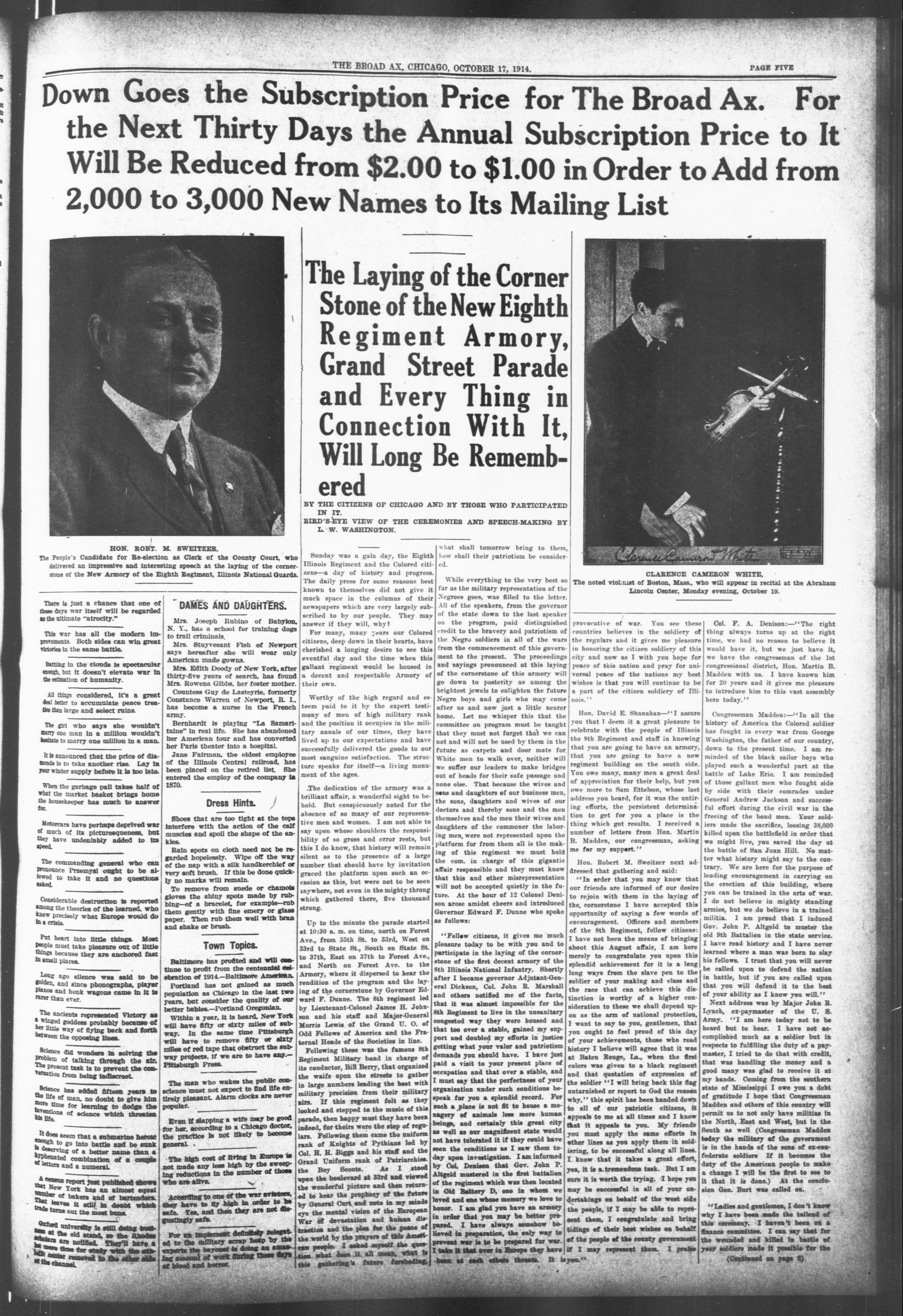
Down Goes the Subscription Price for The Broad Ax. For the Next Thirty Days the Annual Subscription Price to It Will Be Reduced from $2.00 to $1.00 in Order to Add from 2,000 to 3,000 New Names to Its Mailing List
PETER H.
HON. ROET. M. SWEITZER
The People's Candidate for Re-elective delivered an impressive and interest stone of the New Armory of the E
The People's Candidate for Re-election as Clerk of the County Court, who delivered an impressive and interesting speech at the laying of the cornerstone of the New Armory of the Eighth Regiment, Illinois National Guards
There is just a chance that one of these days war itself will be regarded as the ultimate "atrocity."
This war has all the modern improvements. Both sides can win great victories in the same battle.
Battling in the clouds is spectacular enough, but it doesn't elevate war in the estimation of humanity.
All things considered, it's a great deal better to accumulate peace treaties than large and select ruins.
The girl who says she wouldn't marry one man in a million wouldn't hesitate to marry one million in a man.
It is announced that the price of diamonds is to take another rise. Lay in your winter supply before it is too late.
When the garbage pail takes half of what the market basket brings home the housekeeper has much to answer for.
Motorcars have perhaps deprived war of much of its picturesqueness, but they have undeniably added to its speed.
The commanding general who can pronounce Przemysl ought to be allowed to take it and no questions asked.
Considerable destruction is reported among the theories of the learned, who knew precisely what Europe would do in a crisis.
Put heart into little things. Most people must take pleasure out of little things because they are anchored fast in small places.
Long ago silence was said to be golden, and since phonographs, player pianos and honk wagons came in it is rarer than ever.
The ancients represented Victory as a winged goddess probably because of her little way of flying back and forth between the opposing lines.
Science did wonders in solving the problem of talking through the air. The present task is to prevent the conversation from being indiscreet.
Science has added fifteen years to the life of man, no doubt to give him more time for learning to dodge the inventions of science which threaten his life.
It does seem that a submarine heroe enough to go into battle and be sunk is deserving of a better name than a hyphenated combination of a couple of letters and a numeral.
A census report just published shows that New York has an almost equal number of bakers and of bartenders. That leaves it still in doubt which trade turns out the most buns.
Oxford university is still doing business at the old stand, so the Rhodes scholars are notified. They'll have a lot more time for study with the athletic center removed to the other side at the channel.
ation as Clerk of the County Court, who
esting speech at the laying of the corner
Eighth Regiment, Illinois National Guards
DAMES AND DAUGHTERS
Mrs. Joseph Rubino of Babylon, N. Y., has a school for training dogs to trail criminals.
Mrs. Stuyvesant Fish of Newport says hereafter she will wear only American made gowns.
Mrs. Edith Doody of New York, after thirty-five years of search, has found Mrs. Rowena Gibbs, her foster mother. Countess Guy de Lasteyrie, formerly Constance Warren of Newport, R. L., has become a nurse in the French army.
Bernhardt is playing "La Samaritaine" in real life. She has abandoned her American tour and has converted her Paris theater into a hospital.
Jane Fairman, the oldest employee of the Illinois Central railroad, has been placed on the retired list. She entered the employ of the company in 1870.
Shoes that are too tight at the tops interfere with the action of the calf muscles and spoil the shape of the ankles. Rain spots on cloth need not be regarded hopelessly. Wipe off the way of the nap with a silk handkerchief or very soft brush. If this be done quickly no marks will remain. To remove from suede or chamois gloves the shiny spots made by rubbing—of a bracelet, for example—rub them gently with fine emery or glass paper. Then rub them well with bran and shake or brush.
Baltimore has profited and will continue to profit from the centennial celebration of 1914.—Baltimore American. Portland has not gained as much population as Chicago in the last two years, but consider the quality of our better babies.—Portland Oregonian. Within a year, it is heard, New York will have fifty or sixty miles of subway. In the same time Pittsburgh will have to remove fifty or sixty miles of red tape that obstruct the subway projects, if we are to have any.—Pittsburgh Press.
The man who wakes the public conscience must not expect to find life entirely pleasant. Alarm clocks are never popular.
Even if slapping a wife may be good for her, according to a Chicago doctor, the practice is not likely to become general.
The high cost of living in Europe is not made any less high by the sweeping reductions in the number of those who are alive.
According to one of the war aviators, they have to try high in order to be safe. Yes, and then they are not disgustingly safe.
For an implement definitely relegated to the military scrap heap by the experts the bayonet is doing an amazing amount of work during these days of blood and horror.
---
Dress Hints.
Town Topics.
THE BROAD AX, CHICAGO, OCTOBER 17, 1914
The Laying of the Corner Stone of the New Eighth Regiment Armory, Grand Street Parade and Every Thing in Connection With It, Will Long Be Remembered
BY THE CITIZENS OF CHICAGO AND BY THOSE WHO PARTICIPATED IN IT.
BIRD'S-EYE VIEW OF THE CEREMONIES AND SPEECH-MAKING BY L. W. WASHINGTON.
Sunday was a gala day, the Eighth Illinois Regiment and the Colored citizens—a day of history and progress. The daily press for some reasons best known to themselves did not give it much space in the columns of their newspapers which are very largely subscribed to by our people. They may answer if they will, why? For many, many years our Colored citizens, deep down in their hearts, have cherished a longing desire to see this eventful day and the time when this gallant regiment would be housed in a decent and respectable Armory of their own.
Worthy of the high regard and esteem paid to it by the expert testimony of men of high military rank and the position it occupies in the military annals of our times, they have lived up to our expectations and have successfully delivered the goods to our most sanguine satisfaction. The structure speaks for itself—a living monument of the ages.
The dedication of the armory was a brilliant affair, a wonderful sight to behold. But conspicuously noted for the absence of so many of our representative men and women. I am not able to say upon whose shoulders the responsibility of so gross and error rests, but this I do know, that history will remain silent as to the presence of a large number that should have by invitation graced the platform upon such an occasion as this, but were not to be seen anywhere, not even in the mighty throng which gathered there, five thousand strong.
Up to the minute the parade started at 10:30 a. m. on time, north on Forest Ave., from 35th St. to 33rd, West on 33rd to State St., South on State St to 37th, East on 37th to Forest Ave. and North on Forest Ave. to the Armory, where it dispersed to hear the rendition of the program and the laying of the cornerstone by Governor Edward F. Dunne. The 8th regiment led by Lieutenant-Colonel James H. Johnson and his staff and Major-General Morris Lewis of the Grand U. O. of Odd Fellows of America and the Fractal Heads of the Societies in line.
Following these was the famous 8th Regiment Military band in charge of its conductor, Bill Berry, that organized the waifs upon the streets to gather in large numbers leading the host with military precision from their military airs. If this regiment felt as they looked and stepped to the music of this parade, then happy must they have been indeed, for theirs were the step of regulars. Following them came the uniform rank of Knights of Pythians led by Col. H. H. Biggs and his staff and the Grand Uniform rank of Patriarchies, the Boy Scouts. As I stood upon the boulevard at 33rd and viewed the wonderful picture and then returned to hear the prophecy of the future by General Curt and note in my minds eye the mental vision of the European War of devastation and human distraction and the pleas for the peace of the world by the prayers of the American people. I asked myself the question what does it all mean, what is this gathering's future foreboding,
what shall tomorrow bring to them, how shall their patriotism be considered.
While everything to the very best so far as the military representation of the Negroes goes, was filled to the letter. All of the speakers, from the governor of the state down to the last speaker on the program, paid distinguished credit to the bravery and patriotism of the Negro soldiers in all of the wars from the commencement of this government to the present. The proceedings and sayings pronounced at this laying of the cornerstone of this army will go down to posterity as among the brightest jewels to enlighten the future Negro boys and girls who may come after us and now just a little nearer home. Let me whisper that the committee on program must be taught that they must not forget that we can not and will not be used by them in the future as carpets and door mats for White men to walk over, neither will we suffer our leaders to make bridges out of heads for their safe passage and none else. That because the wives and sons and daughters of our business men, the sons, daughters and wives of our doctors and thereby sons and the men themselves and the men their wives and daughters of the commoner the laboring men, were not represented upon the platform for from them all is the making of this regiment we must hold the com. in charge of this gigantic affair responsible and they must know that this and other misrepresentation will not be accepted quietly in the future. At the hour of 12 Colonel Denison arose amidst cheers and introduced Governor Edward F. Dunne who spoke as follows:
"Fellow citizens, it gives me much pleasure today to be with you and to participate in the laying of the corner stone of the first decent armory of the 8th Illinois National Infantry. Shortly after I became governor Adjutant-General Dickson, Col. John R. Marshall and others notified me of the facts, that it was almost impossible for the 8th Regiment to live in the unsanitary congested way they were housed and that too over a stable, gained my support and doubled my efforts in justice getting what your valor and patriotism demands you should have. I have just paid a visit to your present place of occupation and that over a stable, and I must say that the perfectness of your organization under such conditions bespeak for you a splendid record. For such a place is not fit to house a menagery of animals less more human beings, and certainly this great city as well as our magnificent state would not have tolerated if they could have seen the conditions as I saw them today upon investigation. I am informed by Col. Denison that Gov. John P. Altgeld mustered in the first battalion of the regiment which was then located in Old Battery D, one in whom we loved and one whose memory we love to honor. I am glad you have an armory in order that you may be better prepared. I have always somehow believed in preparation, the only way to prevent war is to be prepared for war. I take it that over in Europe they have been at each others throats. It is
Clarence Carver White
CLARENCE CAMERON WHITE,
The noted violinist of Boston, Mass., who will appear in recital at the Abraham
Lincoln Center, Monday evening, October 19.
provocative of war. You see these countries believes in the soldiery of the regulars and it gives me pleasure in honoring the citizen soldiery of this city and now as I with you hope for peace of this nation and pray for universal peace of the nations my best wishes is that you will continue to be a part of the citizen soldiery of Illinois."
Hon. David E. Shanahan—“I assure you that I deem it a great pleasure to celebrate with the people of Illinois the 8th Regiment and staff in knowing that you are going to have an armory, that you are going to have a new regiment building on the south side. You owe many, many men a great deal of appreciation for their help, but you owe more to Sam Ettelson, whose last address you heard, for it was the untiring efforts, the persistent determination to get for you a place is the thing which got results. I received a number of letters from Hon. Martin B. Madden, our congressman, asking me for my support.”
Hon. Robert M. Sweitzer next addressed that gathering and said:
“In order that you may know that our friends are informed of our desire to rejoin with them in the laying of the, cornerstone I have accepted this opportunity of saying a few words of encouragement. Officers and members of the 8th Regiment, fellow citizens: I have not been the means of bringing about this August affair, I am here merely to congratulate you upon this splendid achievement for it is a long long ways from the slave pen to the soldier of your making and class and the race that can achieve this distinction is worthy of a higher consideration to these we shall depend upon as the arm of national protection, I want to say to you, gentlemen, that you ought to feel proud of this day of your achievements, those who read history I believe will agree that it was at Baten Rouge, La., when the first colors was given to a black regiment and that quotation of expression of the soldier “I will bring back this flag untarnished or report to God the reason why,” this spirit has been handed down to all of our patriotic citizens, it appeals to me at all times and I know that it appeals to you. My friends you must apply the same efforts in either lines as you apply them in soldiering, to be successful along all lines. I know that it takes a great effort, yes, it is a tremendous task. But I am sure it is worth the trying. I hope you may be successful in all of your undertakings on behalf of the west side the people, if I may be able to represent them, I congratulate and bring tidings of their best wishes on behalf of the people of the county government if I may represent them. I praise
PAGE FIVE
AMERON WHITE,
who will appear in recital at the Abraham
day evening, October 19.
Col. F. A. Denison:—"The right thing always turns up at the right time, we had no reason to believe it would have it, but we just have it, we have the congressman of the 1st congressional district, Hon. Martin B. Madden with us. I have known him for 20 years and it gives me pleasure to introduce him to this vast assembly here today."
Congressman Madden:—“In all the history of America the Colored soldier has fought in every war from George Washington, the father of our country, down to the present time. I am reminded of the black sailor boys who played such a wonderful part at the battle of Lake Erie. I am reminded of those gallant men who fought side by side with their comrades under General Andrew Jackson and successful effort during the civil war in the freeing of the bond men. Your soldiers made the sacrifice, loosing 38,000 killed upon the battlefield in order that we might live, you saved the day at the battle of San Juan Hill. No matter what history might say to the contrary. We are here for the purpose of lending encouragement in carrying on the erection of this building, where you can be trained in the arts of war. I do not believe in mighty standing armies, but we do believe in a trained militia. I am proud that I induced Gov. John P. Altgeld to muster the old 9th Battalion in the state service. I have read history and I have never learned where a man was born to slay his fellows. I trust that you will never be called upon to defend the nation in battle, but if you are called upon that you will defend it to the best of your ability as I know you will.”
Next address was by Major John R. Lynch, ex-paymaster of the U. S. Army. "I am here today not to be heard but to hear. I have not accomplished much as a soldier but in respects to fulfilling the duty of a paymaster, I tried to do that with credit, that was handling the money and a good many was glad to receive it at my hands. Coming from the southern state of Mississippi I owe you a debt of gratitude I hope that Congressman Madden and others of this country will permit us to not only have militias in the North, East and West, but in the South as well (Congressman Madden today the military of the government is in the hands of the sons of ex-confederate soldiers If it becomes the duty of the American people to make a change I will be the first to see to it that it is done.) At the conclusion Gen. Burt was called on.
"Ladies and gentlemen, I don't know why I have been made the tailend of this ceremony. I haven't been on a finance committee. I can say that for the wounded and killed in battle of your soldiers made it possible for the (Continued on page 2)
PAGE SIX
Miss Mills And Dick
How the Change in the Firm Came to Pass.
By ANITA WENTWORTH.
The name of the firm was Brownlow & Son, but every one who knew Dick Brownlow knew that the "old man" had taken him in without too many hopes of making a business man of him. Dick was twenty-three years old. He had been squeezed through college and made many trips abroad. He was a member of three clubs, and it had cost his father $50,000 to get him to his present point in life.
Dick had been using the office as a sort of "hangout" for two or three months and had at last advanced in the business world to the point where he could acknowledge an order by mail and almost bluff the old office manager and other employees.
Then the older Brownlow decided that the son ought to have a stenographer all to himself, and an advertisement was accordingly inserted. There were forty-nine answers, and it was for Dick to peruse them and make up his mind which applicant to take.
He had five of them call at the office and chose Miss Mills because she was the best looking of the lot. So Miss Mills appeared on a certain Monday morning and began her work.
Although he was the junior partner, Dick determined at once to prove to her that he not only acknowledged her right to live, but that he was rather glad she was alive.
That morning the Son of Brownlow & Son dictated two letters and spent the rest of the time in patronizing his stenographer. He asked many questions and related some of his adventures. When noon came he felt that he had made matters so pleasant that he decided to ask Miss Mills to lunch with him. She looked him sedately in the eyes and refused politely. There had been an expression in her face for a moment, however, as if she intended to give notice and resign her place on the spot. But evidently her glance at Dick's frank, honest face overcome this idea, if she had it.
The junior partner was astonished. To do him justice, he was not indignant, but he was piqued.
The setback made him assume more dignity in the afternoon, and if he was not glad of it Miss Mills was. It was two days before the invitation was renewed and as promptly refused. That was another setback for Dick, and it naturally set him to studying the problem. He was not accustomed to being refused anything by anybody. It was a real relief to him when finally he decided that the girl stood in awe of him because he was the junior partner of the house. It seemed to him only kind that he should dissipate that awe. At the end of another week he made it his business to overtake her on the street as she was going home. Bowing with the utmost respect, he said: "Miss Mills, a friend of mine who was going to the theater tonight with his wife has been disappointed and has given me the tickets. Wouldn't you like to accompany me?"
"I-I have another engagement," she replied, blushing both because it was false and because he knew it was false.
"Oh—ah—I see. It's a great play."
"I thank you just the same."
That was another surprise for Mr. Dick Brownlow, but he didn't turn on his heel with the mental threat to discharge the "uppy" stenographer in the morning.
Miss Mills went to her duties next morning wondering if she would be told that her services were no longer required, but nothing of the sort awaited her. On the contrary, about mid-foreonon, when she had written several letters, the junior partner remarked:
"Miss Mills, I want to say that your work gives the greatest satisfaction, and from this time on your salary will be advanced from $12 to $16 a week."
"But I can't earn $16 a week—not now," she replied. "I'm only a beginner, and I'm glad to earn $12." "You refuse a raise of salary!" he explained, as he looked at her in astonishment.
"If you please—until I can earn every penny of it."
Dick came down with another thud. It was no use trying to puzzle it out. He didn't the brain power to do it. Instead of puzzling he went to his father and said:
"Governor, I wanted to raise my stenographer's salary and she wouldn't have it. What do you think of that?"
"Dear me, Dick, but I hope you are not going to get into a scrape," replied the father as he rubbed his hands together and looked very anxious. "If you think she is trying to get a hold on you you'd better discharge her."
"Oh, see here, dad," said Dick promptly. "I know that she isn't anything of that kind, but I can't make her out. She won't go out to lunch or to the theater with me or accept any other favors."
"You shouldn't have asked her, Dick," said Mr. Brownnow sternly. Some junior partners might have given it up, but Dick wouldn't. He felt that he had been thrown down and humiliated, and he wanted to know why. So one evening he presented himself at Miss Miles' boarding house and
asked for her. He was received in the parlor, and Miss Mills came down. He hemmed and hawed for a time and then drew a long breath and began: "Miss Mills, would it do any good to ask you to go to the theater with me some night toward the last of the week?" "I'm afraid not," she answered. "But I can't make you out. You refuse to go to lunch with me; you refuse a raise of salary; you refuse to go to the theater. Will you tell me why this is?" "I will, Mr. Brownlow. I am from a small town in the interior of the state. My mother is a widow, and we are poor. I am here to make a living for both of us.
"I had two places before I came to you, but I had to give them up because of just such flattery as you have bestowed upon me. They were not satisfied to let me do as good work as I could for a fixed sum per week. I must give up my place with you for the same reason."
"But I don't see it," replied Dick.
Miss Mills looked at the young man and perceived that he really did not "see it." Very patiently and in a tone not at all angry she replied:
"You are the junior partner in the house. I am your stenographer. You want me to go to the theater with you. We should see many people there that know you. Who am I? Your stenographer. What would they think and say? Perhaps nothing to injure you socially, but how about me?"
"Miss Mills," said Dick, getting up and preparing to go, "I see now. Thank you for the lesson. You have made me realize something, and that something is that I must seem to you like a pompous fool."
Without waiting for a reply he bade her a ceremonious "Good night" and hurried away.
The girl watched him go with an expressionless face, but when the door closed behind him she hurried to her room and sobbed bitterly.
That she could not remain with the firm was a decision that she made without argument. Indeed, she hesitated next morning as to whether she should go to the office at all or merely write surrendering her post.
Her sense of duty conquered. When she appeared Dick Brownlow did not attempt to help her off with her vell and coat, as he had tried before. Instead he merely said "Good morning" politely and turned to his desk again.
Presently he stepped to her side and began to dictate. When he was done he hesitated and said:
"Will you pardon me if I recur once more and for the last time to a personal matter?"
Miss Mills, who had been trying to reach the point of presenting her resignation and finding it very hard, much to her own indignation at herself, said "Yes" almost inaudibly.
"Then," said Mr. Dick Brownlow bravely, "I will ask you not to resign, as I know you intended to do. I could see it in your face this morning. If it will make you more comfortable, I will arrange to have you transferred to my father's office, but if you would forgive me and do me the honor of trusting me I think I can prove to you that you will not make a mistake by staying in my own office."
The girl looked at him with eyes moist with tears. "I will stay," said she.
Six months afterward the Son of Brownlow & Son entered the private office of the head of the firm and said: "Father, that Miss Mills didn't exactly try to get a hold on me, but she has one for all that, and I really think we'll have to take her into the firm and make it Brownlow, Son & Daughter." "I couldn't want a better partner," said the head of the firm.
Stridas Used by Soldiers.
Soldiers are marching across Europe, but they do not keep step. They vary both in the length of the step and rapidity of their pace. The British infantry step thirty-one and one-half inches, the longest of all the steps. Germany keeps step with Switzerland—they each do thirty-one inches—while twenty-nine inches is the pace in the armies of Italy, France and Austria. The Russians take the shortest step, twenty-seven and one-half inches, and do only 112 in a minute. The German infantryman does 114, the Austrian 115, and the French and Italian each manage 120. Consequently to march a mile takes the Russian twenty minutes, the Austrian eighteen and two-thirds minutes, the French and Italian eighteen minutes, while the German could beat this by ten or eleven seconds—London Chronicle.
PRACTICAL HEALTH HINT.
```markdown
```
The Mouth and Disease
Do not lose sight of the fact that a clean mouth, clean gums and also teeth go a long way toward promoting good health. Guard them well, for when they are neglected they become breeding places for germs and disease. A cheap and effective dentifice is made thus: Dissolve two ounces of borax in three pints of warm water; before quite cold add thereto one teaspoonful of fracture of myrrh and one table-spoonful of spirits of camphor; bottle the mixture for use. One wineglassful of the solution is sufficient for each application. This preparation applied daily with a soft brush preserves and beautifies the teeth, extirpates all tartarous adhesion, produces a pearl-like whiteness, arrests decay and induces a healthy action of the gums.
---
THE BROAD AX, CHICAGO, OCTOBER 17, 1914.
PRACTICAL HEALTH HINT.
Diet For the Anaemic.
A diet for anaemic persons should be very nutritious and digestible. As much as possible should be taken, including a generous supply of red meat lightly cooked, green vegetables, no potatoes, eggs raw or proached, bacon toasted or boiled, no fried food, no veal or pork, no tea, very little coffee, plenty of milk and cream, cocoa, milk puddings, and stewed fruits. Stewed prunes, figs and baked apples are helpful, as are fluids in large quantities; no acids, such as vinegar, acid wines, like claret and white wines; no recooked meat, no spiced or curried dishes, no salads or pickles, no cheese, new bread or pastry.
GROWTH OF INDIA.
It Has Made Wonderful Strides In the Last Half Century.
India's trade has increased during the last half century from $300,000,000 to more than $1,400,000,000. It has in operation 32,000 miles of railroad in its railroad mileage, carrying 330,000,000 passengers yearly at the rate of five miles for one cent. It maintains 76,000 miles of telegraph line, over which messages can be sent for more than 2,000 miles at a cost of only 12 cents.
India is now the largest exporter of rice in the world, holds first place in its exports of tea, next to Argentina is the largest exporter of hides, and next to the United States is the largest exporter of cotton in the world. Next to the United States and Russia it is the largest wheat producing country. The Tata iron works in Bengal, employing 8,000 men, have laid down iron in San Francisco at less than the price charged by the United States Steel corporation. India's system of irrigation stands easily first in the world, being far more extensive than that of Egypt or America. Its more than 46,000 miles of irrigation canals have reclaimed more than 22,000,000 acres of land, and famine has been prevented forever in some districts.—Sherwood Eddy in World's Work.
BISMARCK'S PROPHECY.
A Peep Into the Future by the Great German Statesman.
Many years ago the writer, then a mere boy, was for a short time a privileged visitor in the country home at Friedrichsruh of the late Prince Bismarck. The memory of one conversation remains with him as though it occurred but yesterday.
With a map of the world before him the prince was explaining how the existing political conditions had come into being and, among other things, remarked that no state of affairs could be considered permanent there—in Europe.
Placing his left hand upon France, he said, "Here we shall have ever growing' dissension and weakness resulting from overculture." Then, placing his right hand upon Asia, he said; "Eventually here will move here" (indicating Europe by a tapping movement of the forefinger of his left hand). "It is only a question of when these millions become hungry enough." A little later he continued. "In those days there will be but one safe country, but one country that shall represent our civilization." And silently he lifted his left hand and laid it heavily upon America.-Howard V. Sutherland in New York Post.
Spoiled Food In Commerce.
The United States department of agriculture has issued a ruling which hereafter will require any spoiled food to be denatured before it can be shipped in interstate commerce. This will permit the shipment of spoiled eggs for use in tanning and other spoiled substances for the making of fertilizer or oils or greases used in machinery, but will require them to be treated with salt, kerosene oil or coloring matter or in other ways so that they cannot possibly be used for food. This is on the analogy of the denaturing of grain alcohol for use in the arts.
Chinese In Uncle Sam's Army.
A company of Chinese soldiers regularly enlisted in the militia in Hawaii constitutes an odd body in the reserve fighting forces of the United States. The organization was formed with the sanction of the war department at Washington, and under the tutelage of American army officers has made such pronounced progress in the mastery of military tactics that the recruiting of a second company is being considered. —Popular Mechanics Magazine.
Woman's Progress In England.
A woman has for the first time been appointed superintendent and deputy medical officer to the women convicts in an English prison. Less than fifty years ago Miss Jex-Blake, the first woman to attempt taking a medical degree in England, was stoned in the streets of Edinburgh and the university closed to her.—Women's Political World.
Power of the Modern Big Gun.
Some idea of the power of a modern gun may be formed when it is stated that when an eighty-one ton gun fires a shot twelve miles it is fired at such an angle that the shell goes up to a height of 5,428 feet higher than Mont Blanc. A 100 ton projectile strikes with a force equal to 405,000 155 pound men jumping from a height of one foot.
OPEN EVENINGS. in large department stores and for the reason of having this enormous outlet, we are in a position to buy in unusually large quantities direct from the manufacturers. Through our buying power we are enabled to give our patrons millinery at extraordinary popular prices and still maintain the usual good merit of quality and Service.
$3.50 and $4.00 silk velvet shapes, all new models,
large new dress shapes $1.98 Special opening sale price
$3.00 all silk velvet Russian Turban
Sailor Shapes. Special 98c
$4.00 all silk velvet, large shapes, soft
and blocked crown, sailor effect. Special $1.98
Dress and Street Trimmed Hats--artist-
ically trimmed with ostrich,
velvet flowers and gold ef-
fects, $7.50 values $2.98
WE CARRY CHILDRENS SCHOOL HATS
“Hats Delivered Free of Charge”
LINCOLN
MILLINERY
3218 STATE STREET 3218
“TAKE A PEEK AT OUR WINDOWS”
Arthur's $2.00 Hats
oko
Advertise in The Broad Ax
Copyright 1914
Gage Brothers & Co.
Chicago
OPEN EVENINGS
having this enormous outfit
quantities direct from the
enabled to give our patron
maintain the usual good m
$3.50 and $4.00
large new dress shaw
$3.00 all silk velvet Russ
Sailor Shapes. Special -
$4.00 all silk velvet, large
and blocked crown, sailor eff
Dress and S
ically trimmed
velvet flower
fects, $7.50
WE CARRY O
“Hats Delic
LING
M
3218 ST
“TAKE A F
Arthur
J. W.
9
Autumn Announcement
We cordially invite you and your friends to inspect our Fall millinery display. We have placed for your approval the many models of the latest Parisian effects in the new Kaiser hat and the unique Russian Turban and the large sailor with the new flat trimming.
We operate a chain of many Millin-
in large department stores and the
outlet, we are in a position to buy in
the manufacturers. Through our buyin-
trons millinery at extraordinary popula-
d merit of quality and Service.
1.00 silk velvet shapes, all new
shapes $1.98 Special open
Russian Turban 98c OPEN
large shapes, soft effect. Special $1.98
and Street Trimmed Hats--artist-
trimmed with ostrich,
flowers and gold ef-
f.50 values $2.98
MARY CHILDRENS SCHOOL HATS
"Delivered Free of Charge"
N COLN
MILLINERY
STATE STREET 32
A PEEK AT OUR WINDOW
r's $2.00 H
FEDERAL HAT COMPANY
The Fall 'Heading' for you is an Arthur Hat---one like our "Green Top,"say. If you want to see this and about a hundred other down-to-the-minute styles of consistent $3.00 quality; drop in to-day---and admit we're showing them at
$2.00
```markdown
```
new models,
al opening sale price
OPEN EVENINGS
T 3218
WINDOWS"
Arthur's $2.
"GREEN TOP"
---
OVERWORKING DIGNITY.
What Happened When the Minister Gave the Bridegroom a Timely Hint. A minister was recounting some of his amusing experiences in marrying people. "There's an old custom," said he, "that the bridegroom shall kiss the bride immediately after the marriage ceremony is over. It's a good, practical custom, for it serves more handily than anything else that I know of to dissipate the awkward pause that almost always follows a simple, informal ceremony. For this reason I keep the custom alive.
"One day a man whom I shall call Smith came to the parsonage to be married. Mr. Smith was a pompous, consequential little man. The prospective Mrs. Smith was a fine, winsome girl. After the ceremony Mr. Smith, in spite of his pomposity, did not seem to know just what was the next thing to do, so, as is my practice in such emergencies, I said, 'My dear sir, it is your privilege to salute the bride.' He turned around and, extending his hand formally, said, 'Mrs. Smith, I congratulate you'." New York Times
He—You must admit you have en-
couraged me!
She—Encouraged you! Why, you haven't been able to save a dollar since you met me!-Chicago News.
From Father to Son
"Well, Bobby," said the minister to the small son of one of his deacons, "what is the news?"
"Popper's got a new set of false teeth."
"Indeed!" said the minister, restraining a desire to laugh. "And what will he do with the old set?"
"Oh, I suppose," replied Bobby, "they'll cut 'em down and make me wear 'em-' Kansas City Star
Cautious.
"Want to take a little ride in my automobile?" asked Mr. Chuggins.
"Where are you going?" asked the habitual ingrate.
"Anywhere you say."
"Well, take me some place where I can look at a new building or a monument. I've seen all the garages and repair shops in the district."—Washington Star.
Cause For Curiosity
"How did you like my latest poem?" inquired Tennyson J. Daft, the versatile verificationist, angling for a compliment.
"What was it about?" returned J. Fuller Gloom, the deservedly unpopular misanthrope.
"Why, didn't you read it?"
"Oh. yes! That is what aroused my curiosity."-Judge
Too Late.
"I thought," said the indignant answerer of an advertisement as he looked about an empty room, "that this was advertised as a 'going concern'?"
"It sure was," said the janitor as he wring his mop, "but that was last week. It's gone now."—Chicago Post.
Pa Dared Him.
She-I told pa you wanted to see him
the next time you called.
He-What did he say?
She-He said for you to come on; he
wasn't afraid of you.—Boston Transcript
```markdown
```
Varicose Veins.
As is generally known, a varicose vein is one which is pathologically and permanently enlarged. Usually this condition occurs in the veins of the legs, though any vein may be affected in this way. Not only are varicose veins enlarged in width, but they are also enlarged in length, with the result that they assume very tortuous or sinuous courses. The symptoms of varix are usually relieved by raising the limb. The superficially enlarged veins are readily recognized. One of the worst effects is hemorrhage from the bursting of an affected vein. The treatment of this accident is most simple, yet through ignorance many lives are lost in this way. The patient should at once lie down, and the limb should be raised. A pad should be fixed over the wounded vein by a bandage or handkerchief, and the limb should then be bandaged from the toes upward. As to the treatment of varicose veins, there is no doubt that in all bad cases excision by a surgeon is the most satisfactory. Milder cases should be treated by supporting the veins by a well fitting elastic stocking or properly applied rubber bandage.
---
PRACTICAL HEALTH HINT.
Scarlet Fever.
No matter how mild the case of scarlet fever, the patient must be put to bed and kept there for four weeks, for it must not be forgotten that his kidneys are affected just as if his was the most serious case. Milk must be the basis of the diet, no meat in any form, not even broth, being allowed.
TINY MORESNET.
The Little Republic That Lies Hidden on Belgium's Border.
If there is an advantage in a country being large there is also an advantage in its being small, provided it is small enough. The republic of Moresnet, also called Klemis and sometimes Altenberg, owes its independent existence to the fact that it is so small that the European powers don't even take the trouble to annex it.
Moresnet lies on the border of Belgium and Prussia between Verviers and Aix-la-Chapelle. It has an area of 1,400 acres and a population of 3,500
At one time the community belonged to Austria. It was later annexed by France and made the subject of quite a little dispute between Napoleon I. and the Prussians. But at the congress of Vienna in 1815 nobody seems to have thought of Moresnet, and to this day the country is an independent republic. For a time there was some dispute between Belgium and Prussia about the territory on account of the rich cadmium mine located there. But even this is now extinct. The republic has an administration of its own, composed of a burgomaster and ten members of a council. The burgomaster is both a Prussian and a Belgian subject. The inhabitants speak both German and French and decide individually whether they will perform military service for Prussia or for Belgium.
Moresnet has not yet been heard from in the present conflict.-Wall Street Journal.
THE NEXT OLYMPIC GAMES.
They May, Through the War's Influence, Be Held In This Country. The possible effect of the gigantic conflict in Europe on international sporting events for some years to come offers no more interesting speculation than the future of the Olympic games. Even though three emperors, as many kings and one president should cease before the snow flies to play millions of men like so many pawns, no treaty of peace will be strong enough to heal racial rancor at once.
Berlin may yet be in a position to adhere to her program of being the scene of the 1916 games, but how about British, French, Russian and Belgian athletes caring to meet German and Austrian competitors there? In the same sense if to a somewhat less degree the objection would apply to the Stockholm of the neutral Swedes, which seems to be willing again to hold the games provided the other nations are agreeable.
Notwithstanding the geographical disadvantage to the majority of the contestants one of the cities of the United States east of the Mississippi would be a better alternative than Stockholm.—London Sport.
The German Army Step.
In the German army great attention is paid to physical exercises. At first the recruit is taught to throw back his arms violently, expand his chest, lower and elevate the body by bending the knees and many similar movements calculated to strengthen and render supple all the muscles of the body. Then comes practice in marching, and here the famous "goose along step" comes into evidence. A whole squad of recruits may be seen marching across the drill ground, rising on one foot and balancing there with the other leg extended until the order comes. Then down comes the elevated foot in as long a step as possible and up with the other. This long step is said to make the Germans excellent marshers.
African Colonies
The African possessions and protectorates of the European powers now at war are more than three times as large as continental United States. They are more than three times as large as all of Europe now plunged in war and are eleven times larger than England, France, Germany and Belgium, which control them. The largest individual holder of African territory is France, with 3,812,000 square miles, more than 1,500,000 of which are the Sahara desert. England controls 3,618,245 square miles; Belgium, with Belgian Kongo as its sole possession, 902,000 square miles and Germany 1,085,086 square miles.—Argonaut.
Cottage Plan For Public Schools.
Colorado Springs is trying with success the "cottage plan" for public schools. With a separate building for each class the disturbances are eliminated of classes passing through rooms or halls to and from recitations, and the risks of fire, panic and epidemic disease are reduced to a minimum.
The Suffrage Convention.
The Suffrage Convention.
The National American Woman Suffrage association convention will be held in Nashville, Tenn., Nov. 12 to 17.
The national body has a membership of sixty branch associations, and this year's meeting is the forty-eighth annual convention. The Tennessee Equal Suffrage league is the hostess.
THE BROAD AX, CHICAGO, OCTOBER 17, 1914.
THE NEW ATLAS THEATER
THE FINEST MOVING PICTURE HOUSE ON
THE SOUTH SIDE
SHOW EVERY EVENING. MATINEE EVERY
SATURDAY AND SUNDAY
NEW PICTURES EVERY NIGHT. FRESH AIR EVERY
MINUTE. BEAUTIFUL LOBBY. EVERYTHING MODERN
Admission - - Adults, 10 Cents; Children, 5 Cents
D. A. DOOLEY, Proprietor
THE FINEST MOVING
THE SO
SHOW EVERY EVENT
SATURDAY
NEW PICTURES EVERY N
MINUTE. BEAUTIFUL LO
Admission - Adults,
OPEN THE Y
Phone Douglas 4049 and 538
GEO.
CARPENTER
Repair work of
Screens made to order
Office and Res. 3315 STATE
SIRES AND SONS.
Judge E. M. W. Nye of Buffalo has celebrated his nineteenth birthday. Dr. G. S. F. Savage of Chicago still
Dr. G. S. F. Savage of Chicago still practices medicine at ninety-seven.
Sir John Jellicoe, admiral of the British navy, is fifty-four years of age.
Martin Sheets of Terre Haute, Ind., has placed a telephone in the mausoleum in which he expects some day to rest.
Sir Edward Grey, now England's minister for foreign affairs, caused John Morley to say twenty years ago, "That young man will go far; he will be prime minister some day." He is fifty-two years of age.
For the past fifteen years N. E. Swanson of Denver has been working over the construction of a cube puzzle consisting of thirty pieces of wood which interlock. He says that he has found the solution and that no one can solve his puzzle in less than twenty-four hours' work.
Dr. Marlon Dorset, biochemist of the federal bureau of animal industry, is the scientist who first isolated the germ responsible for that farm scourge, cholera in the hog. That accomplished, he perfected a serum to combat it, protected his processes by patents and then turned them over to the public to be used without charge.
Short Stories.
Portugal has only two large cities, Lisbon and Oporto.
The human skeleton, exclusive of teeth, consists of 208 bones.
The first warship to pass through the Panama canal was the Peruvian destroyer, Teniente Rodrigues.
One-third of the world's supply of platinum is required in dentistry and another third for electrical purposes.
The florists of New York are said to be losing $5,000 a day because of the war, as there are no orders for steamer bouquets.
The first voyage of an American vessel around the world was made by the ship Columbia from Boston, starting Sept. 30. 1787.
A schooner built in Amesbury in 1805 and used in the war of 1812 as a privateer still is in active service in the Maine coasting trade.
Recent Inventions
Barbs on the point and shaft of a new nail make it hold as securely as a screw.
To facilitate milking there has been invented a substantial can that also serves as a stool, the milk being drawn into a long necked funnel.
In newly invented shackles convicts sent out to do road work can walk around at will. If they try to run the mechanism locks their legs automatically.
The heart of an average man makes about one three-thousandth of a volt of electricity at every beat, and an instrument sensitive enough to measure it has been invented.
The Royal Box.
Japan's empress is making bandages for the Red Cross nurses.
The czar of Russia is the only European monarch whose life is not insured in a British life insurance office.
Grand Duchess Marie Adelaide, ruler of the independent nation of Luxemburg, is only twenty years of age. Luxemburg was recently invaded by the German army.
King Albert of Belgium is the son of the late Prince Philip of Saxe-Coburg-Gotha and of Flanders and of the Princess Marie of Hohenzollern-Sigmaringen. He is the nephew of Leopold II. of Belgium, whom he succeeded.
Fashion Frills.
All is not gold that glitters—we refer to the fall coats for men—Pittsburgh Press.
The new wraps are described as very military, but, of course, in neutral tints—Baltimore Sun.
A man's clothes are in style as long as they are wearable; a woman's, wearable as long as they are in style—Youth's Companion.
Before you men begin making facetious remarks about the fall headgear of the women have a look at the bizarre shapes of the new men's soft and stiff hats—St. Paul Dispatch.
STRICTLY
UNION MADE CLOTHES
MADE TO YOUR MEASURE
Quality, Style, Workmanship
SUIT or O'COAT 15.00 UP
OUR FALL AND WINTER STYLES NOW READY
ONE TRIAL WILL CONVINCE YOU THAT WE ARE YOUR TAILORS
SPECIAL OFFER
AN EXTRA PAIR OF TROUSERS FREE with any suit made to your measure at $20.00 or over.
THE UNION TAILORS
Between Jackson and Van Buren St.
326 South State Street,
Between Jackson and Van Buren St.
UNION LABEL IN EVERY GARMENT
Open Evenings and Sunday Mornings. Saturdays till 10 p. m.
T. E. MURPHY, Manager
PICTURE HOUSE ON
NUTH SIDE
ING. MATINEE EVERY
AND SUNDAY
RIGHT. FRESH AIR EVERY
BODY. EVERYTHING MODERN
10 Cents; Children, 5 Cents
YEAR ROUND
W. WELLS
AND CONTRACTOR
all kinds neatly done
er. Satisfaction Guaranteed
ST: -- -- CHICAGO
CHICAGO
Just Wanted a Peep.
Representative Ashbrook of Ohio has a mania for collecting rare coins. He maintains an index showing the location of practically every rare coin in the country and full information concerning it, a good deal as the Bertillon records of criminals are kept by the police. Ashbrook remarked one day that he wished congress would adjourn so that he could go to a point in Tennessee.
"There's a man there with an 1804 dollar," he explained.
"Couldn't you buy it by mail?" he was asked.
"I don't want to buy it," said Ashbrook. "I've got one. I just want to look at it"—New York Sun.
Pumpkin Pie.
"Should a pumpkin pie be more than an inch thick?" demands the St. Louis Globe-Democrat. Well, well! And in this particularly Providence blessed corner of the earth we never speak of "thickness" in connection with the joy producing padding of a pumpkin pie. Up here it is referred to as "depth," the preference being given to the kind that is too deep to be sounded and too luscious to be fathomed.—Philadelphia Inquirer.
Radium at the Big Exposition
The United States bureau of mines is planning a comprehensive exhibit at the Panama exposition in San Francisco. Visitors, after exploring a mine, will regain the surface through a radium booth, in which actual radium emanations will be shown. An officer of the bureau will give his whole attention to visitors.
Slays In Austria.
Among its peoples Austria numbers about 20,000,000 of Slavic blood, own brothers of the Serb. But Austria's Slavs are separated from the Servians by an alphabet. Their language is practically the same, but the Austrian Slavs use the Latin alphabet, like our English print, while the Servians use the Russian characters.
Res. 508 E. 36th St.
Phone Douglas 4397
Phone
FRANKLIN 2727
AUTO 41-543
J. GRAY LUCAS
25 N. Dearborn St.
Union Bank Building Suite 311
OhioP Bank Building
Suite 311
CHICAGO
LINCOLN STATE BANK OF CHICAGO
3105-07 SOUTH STATE STREET CHICAGO, ILL.
BILLS BANK BANK
MONEY MONEY
NICKELS CENTS
This Registering Home Bank
FREE to our Savings Depositors: will start you saving and keep you at it. A Savings Account is the first step to wealth. Open one with us.
DE WITT H. HARDIN
LAWYER
NOTARY PUBLIC
Suite 8 Johnson Bldg. Phone Douglas 7720
3522 So. State St., Chicago
RESIDENCE 3423 FOREST AVB.
Phone Douglas 6001
NOTARY PUBLIC Office Phone
Automatic 44-185
W. G. ANDERSON
ATTORNEY-AT-LAW
Room 40, 143 North Dearborn Street
Cor. Randolph St. CHICAGO McCormick Bldg
Evening Office, 3458 State Street
Phone Automatic 77-574
A. D. GASH
ATTORNEY AT LAW
118 North La Salle St. Chicago
Suite 615 to 616
Telephone Main 3077
Louis B. Anderson
LAWYER
Room 508 Firmenich Building
184 W. Washington St. :: CHICAGO
Cor. 5th Ave.
PHONES: OFFICE. MAIN 4153
AUTOMATIC 33-736
RESIDENCE, DREXEL 7990
Walter M. Farmer
ATTORNEY AT LAW
SUITE 708, 184 WASHINGTON ST.
NOTARY PUBLIC CHICAGO
= STRIC
UNION MADE
MADE TO YOU
CAPITAL, "$200,000.00
Phone FRANKLIN 2717
PAGE SEVEN
Douglas 200
SURPLUS, $20,000.00
Commercial Banking
Savings and Checking Accounts
Foreign Exchange
Safety Deposit Vaults
Mortgages and Bonds
3 Per Cent Interest on Savings Deposits Your Patronage Solicited
Depository and Correspondent, Continental & Commercial National Bank of Chicago, Illinois.
RESIDENCE 1262 MACALISTE PLACE
TELEPHONE, MONROE 2714
MILES J. DEVINE
ATTORNEY AT LAW
SUITE 311-250 REAPER BLOCK
CLARK AND WASHINGTON STS
PHONES
CENTRAL 299
AUTOMATIC 41-816
CHICAGO
ATTORNEY AT LAW
36 W. Randolph Street, CHICAGO
Suites 708 Delaware Bldg. Tel. Central 3142
Office Phones: Res. 5133 So. Wahaveah. Oakland 4662, Auto. 73-058 Phone Dreszel 18815
Hours 9 A. M. to 5 P. M., 7 P. M. to 9 P. M.
Sundays by Appointment
Office Hours—8 a. m. to 5 p. m.
Dr. MacENRY J. BROWN
PHYSICIAN AND SURGEON
OCULIST
Practice Limited to Diseases of
Eye and Ear
3502 S. State St. CHICAGO
02 S. State St. CHICAGO
Phone Main 2017 Automatic 32-39
A. L. WILLIAMS
ATTORNEY AND COUNSELOR AT LAW
Suite 706 Firmenich Bldg.
184 W. Washington St.
Residence 5548 Jefferson Av.
Phone Midway 5515 Chicago
PAGE EIGHT
GENERAL BANKING
3 per cent allowed
Safety Deposit Va
REAL ESTATE
As agent buy and sell Real Estate on
dents, including payment of taxes and
on Chicago Real Estate.
Especially Invites the pat
Telephone
JOHN J.
Real
Lo
y cent allowed on Savings Access
y Deposit Vaults, $3.00 per
REAL ESTATE DEPARTMENT
and sell Real Estate on commission, manages estate
payment of taxes and looking after assessments,
Real Estate,
especially Invites the patronage of Chicago business m
3 per cent allowed on Savings Accounts Safety Deposit Vaults, $3.00 per Year
REAL ESTATE DEPARTMENT
As agent buy and sell Real Estate on commission, manages estates for non-residents, including payment of taxes and looking after assessments. Money to loan on Chicago Real Estate.
Especially Invites the patronage of Chicago business men.
Telephone Yards 693
OHN J. BRADLE
Real Estate
Loans
JOHN J. BRADLEY
Fire and Plate Glass Insurance
4709 S. HALSTED ST
CHICAGO
Dylas 4482 HARRY
73-974 P
74-478 P
LA VERDO BUFFET
AND DOMESTIC CIGARS AND CIGARS
street
Dylas 3256 Autot
LA VERD
IMPORTED AND DOMESTIC
3100 State Street
LA VERDO BUFFET
IMPORTED AND DOMESTIC CIGARS AND CIGARETTES
3100 State Street CHICAGO
Phone: Douglas 3256 Automatic 72-379
HENRY JONES A. F. CODOZO
THE ELITE
CAFE and BUFFET
Finest Table d'Hote in the City
4 p. m., to 1 a. m.
THE ELITE
CAFE and BUFFET
Finest Table d'Hote in the City
4 p. m., to 1 a. m.
e Street
BLOCKI, Pres.
F. W. BLOCKI
JOHN BLOCKI & S.
PERFUMERS
GO TO
E. Kreyssler, Drugs
2057 S. STATE STREET
NOT ON THE CORNER
grade Drugs, Chemicals, and Medicinal Prep
All Prescriptions Carefully Compounded
ALSO CARRY A FULL LINE OF
Blocki's Ideal & Blocki's Flo
In Bottle Perfumes
as 5732
ter 3070
Sporting Events o
by Special V
Phone Douglas, 6569
Auto. 72-380
3030 State Street
JOHN BLOCKI, Pres.
JOHN BLOCKI
PERF
C. E. Kreys
5057 S. STA
NOT ON T
For high grade Drugs, Chemie
All Prescriptions C
ALSO CARRY
Blocki's Ideal &
In Bottle
Phone Douglas 5732
Res., Edgewater 3070
Phone D
Auto
For high grade Drugs, Chemicals, and Medicinal Preparations All Prescriptions Carefully Compounded ALSO CARRY A FULL LINE OF Blockl's Ideal & Blockl's Flower In Bottle Perfumes
Phone Douglas 5732
Res., Edgewater 3070
Sporting Events of all kinds
by Special Wire
Phone Douglas 6569
Auto. 72-380
FOLEY'S BUFFET
3036 SOUTH STATE STREET
D. P. FOLEY, Proprietor
Headquarters for
RAIL-ROAD MEN
Established 1890
Tel. Douglas 9069-9222 Automatic 72-109
Office 1370 Douglas
AL. RUSSELL
RETAIL
LIQUORS
CAFE AND CHOP SUE IN CONNECTION
20 YEARS AT THIS CORNER
N. E. Cor. 35th and State Sta., Chicago
Facts From
France has only two
tories.
France and its col-
area of 4,872,000 squa-
the river Seine, it
canals, connect the ch
one-fifth the area and
population of France.
Beauty S
D. P. FOLEY, Proprietor for ROAD MEN CH
The board of inquiry into the Empress of Ireland disaster established a new precedent in its report. The blame for the negligence which caused the loss of 1,082 lives was not laid on a dead man.
A camera which permits photographs to be autographed on the film at the moment the picture is taken has been sold for $300,000. Most of us would like to use a photograph of our signature worth the price of the patent.
---
Phones {Douglas 4482
Auto 73-974
Auto 74-478}
S. E. Cor. State and 36th Place, Chicago Telephone Douglas 1565
owed on Savings Accounts
at Vaults, $3.00 per Year
ESTATE DEPARTMENT
State on commission, manages estates for non-resi-
tives and looking after assessments. Money to loan
the patronage of Chicago business men.
J. BRADLEY Real Estate Loans
RDO BUFFET
DOMESTIC CIGARS AND CIGARETTES
CHICAGO
Automatic 72-379
A. F. CODOZOE
ELITE
and BUFFET
table d'Hote in the City
p. m., to 1 a. m.
F. W. BLOOKI, Tresa.
BLOCKI & SON
PERFUMERS
GO TO
Keyssler, Druggist
ESTATE STREET
IN THE CORNER
Chemicals, and Medicinal Preparations
Options Carefully Compounded
HARRY A FULL LINE OF
Real & Blocki's Flower
Little Perfumes
Sporting Events of all kinds
by Special Wire
Phone Douglas 6569
Auto. 72-380
P. FOLEY, Proprietor CHICAGO
Facts From France.
France has only twenty tobacco factories. France and its colonies occupy an area of 4,872,000 square miles. The river Seine, its branches and canals, connect the city of Rouen with one-fifth the area and one-third the population of France.
Beauty Spots.
When polishing the finger nails rub across, not up and down.
Cutting the eyebrows and eyelashes results in stiff, stubby hairs.
In removing wrinkles from the forehead the movement should be rotary and backward toward the temples.
Constantly blinking the eyes encourages the little network of wrinkles around them that are so disgiring.
The bran or oatmeal bag thrown into the bath water will soften the water and aid the cleansing process.
HARRY J. KELLY
Prop
Automatic 72-379
Chicago, Ill
CHICAGO
THE BROAD AX CAN BE POUND ON SALE AT THE FOLLOWING NEWS STANDS:
From on and after this date The Broad Ax, can be found on sale at the following news stands:
E. H. Faulkner, news agency; 3109 S. State street.
Mme. Rosa Lee Tyler, ice cream cafe; 3313 S. State St.
George 1 Martin, maker of fine cigars and news stand, 18 W. 31st St., near State.
R. M. Harvey's barber shop and news stand, 3924 State street.
W. S. Cole, cigars, tobacco and news stand, 34 W. 31st St., near Dearborn.
A HUMAN MENAGERIE
Her "lamb" his mother called him he was a toddler small.
His nunky "little monkey" his wee ew used to call.
He grew up fat and awkward, to the "a great big calf."
At college he was "gay young dog." said it with a laugh.
He entered next the Stock Exchange there he was a "bear."
As he was shrewd, one said of him, fox, I declare!
Making a coup sensational, a "lion" came.
"A mean skunk" some men said who and on him placed the blame.
Later from "bear" he turned to "but foolish step alas!"
W. M. Marwell, notions, cigars, bacco, confections and news stand, 5244 State St.
Edward Felix, notions, cigars and news stand, 52 W. 30th St.
F. Bishop, cigars, tobacco and news stand. 3 W, 27th St., near State.
Sylvester McGloffin, news stand and laundry office, 4122 State St.
William Gaughan, laundry office cigars, tobacco and news stand, 2636 State St.
E. M. Oliver, notions, cigars and news stand, 15 W. 36th Street, near State.
A. D. Hayes, cigars, tobacco, notions, stationery and news stand, 3640 S. State St.
George McFaro, shoe shining parlors and news stand. 3800½ State street.
T. B. Hall, Laundry office, cigars, tobacco and news stand. 3618 South State street.
Bell & Alford, cigars, tobacco and news stand. 3128½ South State street.
Fred M. Waterfield, cigars, tobacco, notions and news stand, 5202 South State street.
Coleman & Glanton, cigars, tobacco and news stand, 3342 S. State street.
J. S. Williams, ladies and gents shoe dressing parlor, laundry office and news stand. 12 E. 34th street.
Miss E. M. McClain, hair dressing parlor and news stand. 30 W. 39th street.
F. M. Diffay, cigars, tobacco, notions and news stand. 3605 State street.
A. Turpin, cigars, confections and news stand. 3511 S. State street.
PETROGRAD.
The New Name is Simply a Return to the Original One.
The city heretofore known as St. Petersburg is in future to be called Petrograd. This apparent innovation is in reality a return to the name which Peter the Great's second capital had borne from the beginning. All the old books published in that city during the latter part of Peter's reign and those of his immediate successors bear the word Petrograd on the title pages. "Grad" and "gorod" are two forms of the same word, which means "city" or "town." Etymologically it signifies an enclosed space and belongs to the same root as the English word "garden." It occurs in hundreds of Slav geographical names—as, for instance, in Novgorod, "new town." Ivangorod, Elizabetgrad, Euxinograd. Constantinople itself is often called in Russian the "emperor's city"—Ozaregrad.
During the reigns of the Empresses Catherine and Elizabeth the mania for adopting foreign names was rife in Russia, and on many places known in old Russian history German names were bestowed, most of which remain to this day.
After the treaty of Berlin, when Count Ignatiev, who had been Russia's ambassador in Constantinople became at first minister of the interior and then president of the Slavonic society, he, Kamarov, and a number of other Slavophiles started a movement in favor of altering those German names to their Russian equivalents or to the original Slav appellations, wherever there were any such. In time, no doubt, Peterhof, Oranienbaum, Yekaterinburg, Orenburg and a host of other places will also be rechristened, and Count Ignatiev's proposal will be fully carried out—Dr. E. J. Dillon in Manchester Guardian.
HOW THE SUGAR GOES
Pathetic Wail of a New York Restaurant Proprietor.
"I love my patrons," said a well known restaurant proprietor, "but friendship and platiconic affection cease when they begin to take all the sugar I have. The other day I took an inventory of the stock of this establishment, and I found that my patrons were using fifteen and eighteen lumps of sugar to every cup of coffee or tea that was consumed. I knew that could not be true, and I put a watch on my help, thinking that some one was stealing the sugar. I saw none of my help go near the barrel, while the sugar continued to go at the same rate.
"So I watched my customers. Many of them never used sugar in their coffee or tea before this war, and now they dig into the bowl and take out a large handful of the lumps. Do you think they put any of it into their coffee or tea? No; they put the lumps into their pockets and take them home. "The war and the high cost of living are responsible. People taking their lunches downtown feel that they cannot afford to buy sugar for the family, so they let the restaurant man furnish it. What am I going to do? If I catch them and tell them to put it back they do not come here for their lunches any more, and if I let them keep on taking it I will be broke soon."—New York Telegraph.
A HUMAN MENAGERIE.
Her "lamb" his mother called him when he was a toddler small.
His nunky "little monkey" his wee nephew used to call.
He grew up fat and awkward, to the girls "a great big calf."
At college he was "gay young dog." They said it with a laugh.
He entered next the Stock Exchange, and married over the "beer."
Making a coup sensational, a "ilon" he became.
"A mean skunk" some men said who lost and on him placed the blame.
Later from "bear" he turned to "bull," a foolish step alas!
He dropped his entire fortune and was frankly dubbed an "ass."
—Boaton Transcript.
"I understand that you have broken your engagement with Harold Jimkins," said one girl.
"We were never engaged," replied the other. "The trouble with Harold is that he is too grammatical."
"What has grammar to do with it?" "He took advantage of the fact that when I get excited I stammer. When he asked me to marry him I said 'No, no!' and he immediately insisted that two negatives make an affirmative."—Washington Star.
Periods of Elation.
"Why do you have your office on the same floor with a dentist?" asked Mrs. Gabb. "Don't the painful noises worry you?" "Sometimes," replied Mr. Gabb, "But I enjoy the painful silences." "What do you mean by a painful silence?" asked Mrs. Gabb. "That's when the dentist gets a woman in the chair and puts a rubber dam in her mouth," replied Mr. Gabb. "Cincinnati Enquirer.
Little Girl's Guess.
Little Girl's mother was reading the paper and came to a personal referring to the departure of a young man for a polytechnic school.
"Wonder what polytechnic means?" she said. "Look in the dictionary, Little Girl, and see."
But Little Girl was busy with a new doll's wardrobe, so she chose to guess.
No Reason For a Curfew.
"I understand they have a curfew law out there now," he said.
"No," his informant answered; "they did have one, but they abandoned it."
"What was the matter?"
"Well, the bell rang at 9 o'clock and almost every one complained that it woke them up."—Pittsburgh Chronicle-Telegraph.
Had to Say Something Mean.
"Hubby, some ladies have asked me to join the movement for beautifying our town."
"Well?"
"And I'd like to join."
"And what's your idea of beautifying our town? Getting a new feather for your hat?"—Kansas City Journal.
A Compliment.
"I've lent Grimpus my garden hose, my lawn mower, my phonograph and my safety razor, but I had to refuse his last request."
"What did he want?"
"He wanted to borrow my photograph to carry on a flirtation by mail."
—Pittsburgh Dispatch.
Distressing.
"And so you were held up abroad by the war. You suffered many inconveniences no doubt"
"Yes, indeed. Why, for weeks before I could get out there wasn't a tango parlor open."—Pittsburgh Press.
Exchanging Compliments.
Mr. Eatabout—I like to see one eat appropriate food. May I offer you some of this delicious angel food?
Mrs. Donetodeath—I quite agree with you. Suppose you try some of the sponge cake.—New York Globe.
Not So Mad as All That.
"I never saw a woman so mad. In her rage she stamped up and down the room."
"And tore her hair, I suppose."
"Mercy, no! It cost too much."—Boston Transcript.
Father's Hours.
"Does the baby cry for you?"
"It's mother says so," replied the young father. "Seems it is always crying for me when it yells after 10 n m."—Louisville Courier Journal.
```markdown
```
A STORE FOREVERYBODY
HILLMAN'S
STATE & WASHINGTON STS.
Everything to eat, to wear and for the home. Ready to
wear attire for man, woman and child at lowest prices,
quality and workmanship considered. Make it a point to
visit this store every day and take advantage of the special
bargain offerings that we give in all departments.
The-Cranford Apartment Building. 3600 Wabash Ave.
THE MASTER CITY
The finest building ever opened to Colored tenants in Chicago Steam heat, electric light, tile baths, marble entrance. J. W. Casey, Agent, Phone Randolph 803 74 W. WASHINGTON STREET.
Is Mobilizing
ge to your castle—and get you, to
defense in that one cold room—the
room against Jack's assaults, you
Kitchen Heater
In The Picture
s are but 14 inches wide—they se
they eat an insignificant amount
turn all sorts of sweepings, refuse
the little heaters at this season of the
best built homes in Chicago.
our branch stores (open Tuesday
nings till 9 o'clock), or our big
Light & Coke Company
Telephone Randolph 4567
BILISHED
1877
TEL. OAKLA
1880, 1891, 1892
J. DUNN
OAL RETAIL
and ARMOUR AVENUE
St. and L. S. & M. S.
ARMOUR AVE.
CHICAGO
AMERICA BRILLIES
Jack Frost Is Mobilizing
And he's going to lay siege to your castle—and get you, too, if you don't strengthen your defense in that one cold room—the kitchen. To defend that room against Jack's assaults, you must have
A Little Kitchen Heater Like The One In The Picture
These little kitchen heaters are but 14 inches wide—they set right along the gas range—they eat an insignificant amount of fuel and are built to burn all sorts of sweepings, refuse and even garbage.
We sell hundreds of these little heaters at this season of the year and install them in the best built homes in Chicago.
Order yours at any of our branch stores (open Tuesday, Thursday and Saturday evenings till 9 o'clock), or our big salesroom downtown.
FRANK DUNN ESTABLISHED TEL. OAKLAND
J. B. McOANEY 1877 1880, 1881, 1882
TRUSTEEI
$2.00 PER YEAR
$1.00 FOR 6 MONTHS
Please enter my name as a subscriber to
enclose $2.00, the annual subscrip-
e dollar.
JULIUS F. TAYLOR: Please enter my name as a subscriber to THE BROAD AX. I herewith enclose $2.00, the annual subscription to same. Six months for one dollar.